Absolute Quantification in Low-Biomass Samples: A Comprehensive Guide to Methods, Challenges, and Best Practices for Biomedical Research
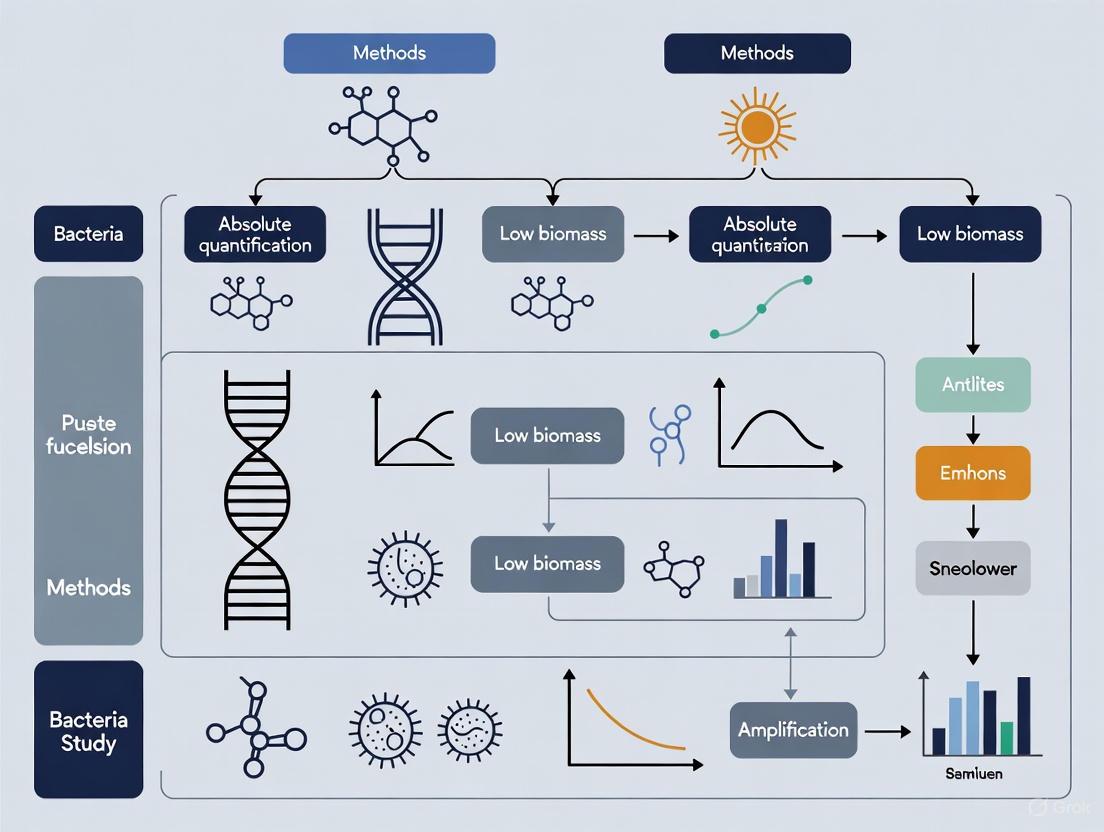
Accurate absolute quantification of microbial load in low-biomass samples—such as those from skin, respiratory tract, blood, and tumors—is critical for meaningful biological conclusions in biomedical research and drug development.
Absolute Quantification in Low-Biomass Samples: A Comprehensive Guide to Methods, Challenges, and Best Practices for Biomedical Research
Abstract
Accurate absolute quantification of microbial load in low-biomass samples—such as those from skin, respiratory tract, blood, and tumors—is critical for meaningful biological conclusions in biomedical research and drug development. This article provides a foundational understanding of the unique challenges in low-biomass environments, including relic DNA bias, contamination, and host DNA misclassification. It details current methodological approaches like shotgun metagenomics with relic-DNA depletion, flow cytometry, and optimized nucleic acid extraction protocols. The content further offers troubleshooting strategies and guidelines for contamination prevention and data decontamination. Finally, it presents a comparative analysis of validation techniques and computational tools, synthesizing best practices to ensure data reliability and reproducibility in clinical and research settings.
Navigating the Low-Biomass Landscape: Core Challenges and the Critical Need for Absolute Quantification
Low-biomass samples are environments or tissues that contain minimal amounts of microbial life, often approaching the detection limits of standard molecular biology techniques [1]. These samples present unique challenges for microbiome research because the target microbial signal can be easily overwhelmed by contaminating DNA from various sources, including sampling equipment, laboratory reagents, and researchers themselves [1] [2]. The inherent low concentration of target microbial DNA means that even minute amounts of contamination can disproportionately influence results and lead to spurious conclusions about the microbial community composition.
The range of low-biomass environments is remarkably diverse, spanning both host-associated and free-living systems. In human tissues, low-biomass environments include the skin, respiratory tract, placenta, breast milk, fetal tissues, and blood [1] [3] [2]. Beyond human hosts, challenging environments include the atmosphere, hyper-arid soils, treated drinking water, the deep subsurface, ice cores, plant seeds, and certain animal guts [1]. Some environments, such as the human placenta and some polyextreme environments, have been reported to lack detectable resident microorganisms altogether, making contamination control paramount for accurate characterization [1]. The common thread connecting these diverse environments is that they all require specialized methodologies to distinguish true biological signals from technical artifacts.
Defining Characteristics and Challenges
Key Characteristics of Low-Biomass Samples
Low-biomass samples share several defining characteristics that differentiate them from high-biomass environments like gut microbiota or soil. The most obvious feature is the low absolute abundance of microbial cells, which directly translates to minimal microbial DNA yield [4]. This scarcity means that the target DNA "signal" is often dwarfed by the contaminant "noise" introduced during sampling and processing [1]. Another critical characteristic is the frequent presence of inhibitors that can interfere with downstream molecular analyses, such as host DNA in tissue samples or environmental inhibitors in water and soil samples [4]. The proportional nature of sequence-based datasets further complicates analysis, as even small amounts of contaminating DNA can dramatically skew perceived microbial community structure [1].
The challenge of "relic DNA" – DNA from dead or non-viable microorganisms – is particularly pronounced in low-biomass environments. A recent study of the skin microbiome found that up to 90% of microbial DNA could be relic DNA rather than from living communities, significantly biasing understanding of the actual living population [3]. This distinction is crucial for clinical applications where viability may impact disease progression or treatment efficacy. Furthermore, low-biomass samples often exhibit high variability between technical replicates due to stochastic effects at low template concentrations, requiring greater replication and stringent controls to ensure reproducible results [2].
Quantitative and Qualitative Challenges
| Challenge Category | Specific Issue | Impact on Data Quality |
|---|---|---|
| Contamination | DNA from reagents, kits, personnel | False positives; skewed community structure [1] [2] |
| Technical Variation | Stochastic PCR amplification | Inconsistent community profiles between replicates [5] |
| Host/Inhibitor Interference | High host-to-microbe DNA ratio; co-purified inhibitors | Reduced sequencing depth for microbial targets [4] |
| Relic DNA | DNA from non-viable organisms | Misrepresentation of living microbial community [3] |
| Cross-contamination | Well-to-well leakage during PCR | Transfer of signal between samples [1] |
| Detection Limit Challenges | Limited microbial template | Inability to detect rare taxa; reduced statistical power [4] [5] |
Absolute Quantification Methods for Low-Biomass Research
Method Comparison and Selection Criteria
Accurate quantification in low-biomass research requires specialized approaches that address the unique challenges of minimal microbial material. Traditional relative abundance measurements provided by standard sequencing protocols are often insufficient because they can mask important biological changes in total microbial load. Absolute quantification methods provide crucial complementary data by measuring the actual abundance of specific targets, enabling more meaningful comparisons between samples and conditions.
The selection of an appropriate quantification method depends on multiple factors, including the sample type, required sensitivity, and specific research questions. Flow cytometry has demonstrated particular utility for low-biomass applications because it can rapidly distinguish and quantitate live and dead bacteria in a mixed population with minimal interference from nanoparticles or other potential inhibitors [6]. Quantitative PCR (qPCR) remains widely used due to its sensitivity and specificity, but it requires careful calibration and can be impaired by matrix-associated inhibitors [7]. Droplet digital PCR (ddPCR) has emerged as a robust alternative, offering absolute quantification without standard curves and reduced susceptibility to inhibition effects [7].
Comparative Performance of Quantification Methods
| Method | Detection Limit | Viability Assessment | Inhibition Resistance | Throughput | Best Applications |
|---|---|---|---|---|---|
| Flow Cytometry | ~10³ cells/mL | Yes (with viability staining) | High [6] | High | Rapid enumeration of live/dead cells; nanoparticle-containing samples [6] |
| Droplet Digital PCR | ~1-10 gene copies | No | High [7] | Medium | Absolute quantification without standards; inhibitor-rich samples [7] |
| Quantitative PCR | ~10-100 gene copies | No | Low-Medium [7] | High | Target-specific quantification; high-throughput screening [7] |
| 16S rRNA qPCR | ~100 fg DNA [5] | No | Medium | High | Total bacterial load assessment; screening prior to sequencing [4] [5] |
Experimental Protocols for Low-Biomass Research
Sample Collection and Preservation
Proper sample collection is the most critical step in low-biomass research, as errors introduced at this stage cannot be remedied later. For human tissue sampling, such as respiratory tract specimens, the use of personal protective equipment including gloves, masks, and clean suits is essential to minimize contamination from researchers [1] [8]. All sampling equipment and collection vessels should be pre-treated by autoclaving or UV-C light sterilization and remain sealed until the moment of sample collection [1]. For surface sampling, innovative devices like the Squeegee-Aspirator for Large Sampling Area (SALSA) can improve recovery efficiency compared to traditional swabs by combining squeegee action and aspiration of liquid from surfaces into a collection tube, completely bypassing the problem of cell and DNA adsorption to swab fibers [9].
The choice of preservation method depends on sample type and downstream applications. For fish gill microbiomes (a model for other low-biomass mucous membranes), surfactant-based washes with agents like Tween 20 have proven effective for maximizing microbial recovery while minimizing host material collection [4]. Immediate freezing on dry ice and storage at -80°C is standard practice, with some samples benefiting from preservation solutions like DNA/RNA shield [5]. The dilution solvent used for mock communities and controls significantly influences results, with elution buffer providing more accurate representations of theoretical microbial community profiles compared to Milli-Q water or DNA/RNA shield [5].
DNA Extraction and Contamination Control
Effective DNA extraction from low-biomass samples requires maximizing microbial DNA yield while minimizing co-extraction of inhibitors. Mechanical disruption through bead beating with zirconium beads has demonstrated effectiveness for difficult-to-lyse samples, but must be balanced against potential DNA shearing [5]. For samples with high host contamination, such as fish gills or human tissues, pre-extraction methods to reduce host DNA include differential lysis approaches that exploit the weaker structure of host cell membranes compared to bacterial cell walls [4]. However, these methods may introduce bias toward Gram-positive bacteria and require careful optimization [4].
Contamination control requires a multi-pronged approach throughout the entire workflow. Laboratory reagents should be checked for DNA contamination, and DNA-free, single-use materials should be employed whenever possible [1]. The inclusion of multiple negative controls is essential, including extraction blanks (containing only lysis buffer), no-template PCR controls, and sampling controls such as empty collection vessels or swabs exposed to the air in the sampling environment [1] [5]. Decontamination of work surfaces and equipment with 80% ethanol followed by a nucleic acid degrading solution (e.g., sodium hypochlorite) helps remove both viable organisms and trace DNA [1]. Ultra-clean dedicated workspaces with UV irradiation provide additional protection against contamination [1].
Library Preparation and Sequencing
Library preparation for low-biomass samples requires careful optimization to maintain representative amplification while minimizing technical artifacts. For 16S rRNA gene sequencing, amplification with 30 PCR cycles has been shown to provide robust representation without excessive amplification bias for respiratory samples [5]. Purification of amplicon pools by two consecutive AMPure XP steps provides superior results compared to gel electrophoresis purification [5]. For shotgun metagenomics, modifications to commercial nanopore rapid PCR barcoding kits may be necessary to achieve successful amplification with ultra-low inputs (<10 pg/sample), sometimes requiring the addition of carrier DNA [9].
Quantitative approaches before sequencing can significantly improve data quality. Quantification of 16S rRNA gene copies via qPCR facilitates not only the screening of samples prior to costly library construction but also the production of equicopy libraries based on 16S rRNA gene copies rather than equal volume loading, which has been shown to significantly increase captured bacterial diversity [4]. Sample titration experiments have demonstrated that a significant drop in sequencing reads occurs below 1e6 16S rRNA gene copies, establishing a practical threshold for successful library preparation [4].
The Scientist's Toolkit: Essential Research Reagents and Materials
| Tool/Reagent | Function | Application Notes |
|---|---|---|
| SALSA Sampler | Surface sample collection via squeegee-aspiration | Higher recovery efficiency (~60%) vs. swabs (~10%); bypasses adsorption issues [9] |
| ZymoBIOMICS Microbial Standards | Positive controls for extraction and sequencing | Dilute in elution buffer (not water/DNA shield) for accurate community profiles [5] |
| DNA Decontamination Solutions | Remove contaminating DNA from surfaces and equipment | Sodium hypochlorite (bleach), UV-C, hydrogen peroxide, or commercial DNA removal solutions [1] |
| Surfactant Washes (Tween 20) | Maximize microbial recovery from surfaces | 0.1% concentration optimal for fish gills; higher concentrations cause host cell lysis [4] |
| Bead Beating Matrix | Mechanical cell lysis for DNA extraction | Zirconium beads (0.1 mm) effective for difficult-to-lyse samples [5] |
| AMPure XP Beads | PCR purification and size selection | Two consecutive cleanups recommended for low-biomass amplicons [5] |
| InnovaPrep CP Concentrator | Sample concentration for low-abundance targets | Hollow fiber concentration; elution volumes as low as 150 µL [9] |
| Propidium Monoazide (PMA) | Viability assessment | Distinguishes intact (live) from compromised (dead) cells; reduces relic DNA signal [3] [4] |
The accurate characterization of low-biomass samples requires integrated methodological approaches that address contamination, quantification, and viability challenges at every experimental stage. While no single technique provides a complete solution, the combination of careful contamination control, absolute quantification methods, and appropriate data normalization enables robust characterization of these challenging environments. As methodological refinements continue to emerge, particularly in areas of single-cell analysis and improved viability assessment, our understanding of true microbial community structure in low-biomass environments will continue to advance, with significant implications for clinical diagnostics, environmental monitoring, and fundamental microbial ecology.
The Pervasive Problem of Relic DNA and Its Impact on Microbial Load Interpretation
In the study of low-biomass microbial environments—such as certain human tissues, atmospheric samples, and hyper-arid soils—the interpretation of sequencing data is critically compromised by a pervasive yet often overlooked problem: relic DNA. This remnant DNA from dead cells can constitute the majority of sequenced genetic material in a sample, profoundly skewing our understanding of the actual living microbial community. For researchers and drug development professionals, this bias presents a substantial challenge in accurately characterizing microbiomes and their associations with health and disease. The following analysis compares methods to overcome this limitation, focusing on their experimental protocols, performance in quantifying viable microbiota, and applicability to low-biomass research contexts.
What is Relic DNA and Why Does It Matter?
Relic DNA refers to extracellular DNA or DNA released from dead microbial cells that persists in the environment. Unlike DNA from intact, living cells, relic DNA does not represent the metabolically active or functionally relevant population but can still be amplified and sequenced alongside DNA from viable organisms.
The problem is particularly acute in low-biomass samples like skin, where a recent 2025 study demonstrated that up to 90% of the microbial DNA sequenced can be relic DNA [3]. This significant bias distorts the true composition of the living microbiome, potentially leading to incorrect conclusions about microbial diversity, taxon abundance, and community dynamics. When relic DNA is not accounted for, researchers are effectively analyzing a combined signal of both current and past microbial inhabitants rather than the actual living population interacting with the host or environment [3] [10].
The compositional nature of standard sequencing data—where results are expressed as relative abundances rather than absolute counts—further compounds this problem. In such data, an apparent increase in one taxon's relative abundance must be compensated by a decrease in others, regardless of actual changes in absolute abundance [11] [12]. This limitation becomes critical when studying conditions that alter total microbial load, as relic DNA can create the illusion of taxonomic shifts that merely reflect changes in overall cellularity rather than genuine compositional changes [13] [14].
Comparative Analysis of Absolute Quantification Methods
The table below summarizes the core methodologies developed to address relic DNA bias and enable absolute quantification in microbiome studies.
| Method Category | Key Principle | Advantages | Limitations | Suitable for Low-Biomass Samples |
|---|---|---|---|---|
| PMA Treatment with Metagenomics [3] [10] | Uses propidium monoazide (PMA) dye to cross-link and exclude relic DNA from amplification prior to shotgun sequencing. | Discriminates between live and dead cells; provides species-level resolution; compatible with absolute quantification via flow cytometry. | Requires optimization of PMA concentration and light exposure; may not penetrate all complex matrices equally. | Excellent, specifically validated for low-biomass skin samples. |
| Microbial Load Prediction via Machine Learning [13] [14] | Applies machine learning models to predict microbial load (cells/gram) from standard relative abundance data. | No additional experiments required; applicable to existing datasets; high-throughput and cost-effective. | Predictive rather than direct measurement; model performance depends on training data quality and representativeness. | Good, but may be less accurate for under-represented sample types in training data. |
| Flow Cytometry with Sequencing [10] [11] [12] | Directly counts microbial cells via flow cytometry, then integrates counts with sequencing data for absolute abundance. | Direct, quantitative measure of total microbial load; agnostic to nucleotide sequence. | Requires specialized equipment; additional experimental step; challenging for very low biomass. | Good, though sensitivity limits may apply to extremely low biomass. |
| Reference Frames & Ratio Analysis [12] | Computes log-ratios of taxa to cancel out the microbial load bias inherent in compositional data. | No need for microbial load quantification; re-analysis of existing data possible; circumvents compositionality. | Does not provide absolute abundances; identifies relative shifts rather than absolute changes. | Moderate, provides robust relative comparisons but not quantitative counts. |
Experimental Protocols for Relic-DNA Depletion
PMA Treatment Protocol for Skin Microbiome Samples
Based on the 2025 skin microbiome study, the following protocol details the integration of relic-DNA depletion with shotgun metagenomics [3] [10]:
- Sample Collection: Standardize the sampling area using plastic patterns. Swab defined skin sites with two sterile PBS-soaked plastic swabs simultaneously for 30 seconds. Break swab heads into Eppendorf tubes containing buffer solution.
- Sample Pre-processing: Vortex samples for 2 minutes at maximum speed. Filter the solution through a 5-µm filter to remove human cells and plastic debris. Pool replicates from the same swab site.
- PMA Treatment: Add 4 µL of 100-µM PMA (Biotium, cat. no. 40013) to 400 µL of bacterial extract (1-µM PMA final). Incubate in the dark at room temperature for 5 minutes. Place samples horizontally on ice 20 cm from a 488 nm light source for 25 minutes to activate PMA. Vortex gently every 5 minutes during light exposure to ensure even distribution.
- DNA Extraction and Sequencing: Proceed with standard DNA extraction protocols optimized for low biomass. Perform shotgun metagenomic sequencing with sufficient coverage to account for potential DNA loss from PMA treatment.
- Absolute Quantification: Analyze parallel aliquots of both PMA-treated and untreated samples via flow cytometry with SYBR Green staining and fluorescent counting beads for absolute bacterial quantification [10].
Machine Learning Workflow for Microbial Load Prediction
For researchers analyzing existing datasets where direct quantification wasn't performed, this computational approach provides an alternative [13] [14]:
- Data Preparation: Compile a large-scale metagenomic dataset with both relative abundance profiles and experimentally measured microbial loads (cells per gram) for model training. The original study used data from over 3,700 individuals.
- Model Training: Train a machine learning model (e.g., gradient boosting, random forest) to predict microbial load from relative taxonomic abundance patterns. The model learns to recognize compositional signatures associated with high and low microbial density.
- Model Validation: Test the trained model on a separate hold-out dataset with known microbial loads to assess prediction accuracy.
- Application to Target Datasets: Apply the validated model to larger datasets (e.g., >27,000 individuals across 159 studies) where microbial load has not been experimentally measured. Use predicted loads to adjust association analyses between microbial features and clinical outcomes.
Visualizing the PMA-Based Relic DNA Depletion Workflow
The following diagram illustrates the experimental workflow for discriminating between live and dead microbial cells using PMA treatment:
The Scientist's Toolkit: Essential Research Reagents and Materials
| Item | Function/Application | Key Considerations |
|---|---|---|
| Propidium Monoazide (PMA) [10] | Selective cross-linking of DNA from dead cells with compromised membranes. | Membrane impermeability critical; requires optimization of concentration and activation light exposure. |
| SYBR Green I Nucleic Acid Stain [10] [15] | Fluorescent DNA staining for flow cytometric cell counting. | Distinguishes DNA from background; used with counting beads for absolute quantification. |
| Fluorescent Counting Beads [10] | Internal standard for absolute cell quantification in flow cytometry. | Enables conversion of cell counts to concentration values (cells/volume). |
| DNA-free Swabs & Collection Tubes [1] | Minimize contamination during sample collection from low-biomass environments. | Essential for avoiding false positives; should be pre-treated to remove contaminating DNA. |
| 5-µm Filters [10] | Removal of human cells and debris from microbial samples. | Improves sequencing efficiency for microbial DNA; reduces host contamination. |
| Universal 16S rRNA Primers [12] | Target amplification for community profiling when using amplicon sequencing. | Potential primer bias affects microbial composition; less resolution than shotgun metagenomics. |
The challenge of relic DNA represents a fundamental methodological hurdle in low-biomass microbiome research, with recent studies revealing that it can dominate the genetic signal in certain environments. The methods compared herein—from experimental approaches like PMA treatment coupled with flow cytometry to computational solutions like machine learning prediction of microbial load—offer complementary pathways to overcome this limitation. For researchers and drug development professionals, selecting the appropriate method depends on specific research questions, sample types, and available resources. Experimental approaches provide direct, quantitative measurements of viable cells but require additional laboratory work, while computational methods offer scalability and re-analysis potential for existing datasets. As the field progresses, the integration of these absolute quantification methods will be essential for generating biologically meaningful insights into microbiome function and its role in health and disease.
The Unseen Adversary: Contamination in Low-Biomass Research
In low-biomass microbiome studies, where microbial DNA signals are faint, even minimal contamination can drastically distort results, leading to false discoveries and erroneous conclusions [1]. Contaminants originate from a myriad of sources, including laboratory reagents, sampling equipment, personnel, and the laboratory environment itself [1] [16]. The proportional nature of sequence-based datasets means that in samples with very little target DNA, the contaminant 'noise' can easily overwhelm the true biological 'signal' [1]. This challenge is particularly acute in research areas such as the human upper respiratory tract, blood, fetal tissues, and certain environmental samples like treated drinking water and hyper-arid soils [1] [8] [16]. A recent study confirmed that the background contamination patterns in DNA extraction reagents vary significantly not only between different commercial brands but also between different manufacturing lots of the same brand, underscoring a pervasive and variable problem [16].
Reagent Contamination ("Kitome")
Laboratory reagents and DNA extraction kits are well-documented sources of contaminating microbial DNA, forming a distinct background "kitome" [16].
- Evidence: A 2025 study profiling four commercial DNA extraction reagent brands (denoted M, Q, R, and Z) found that 13 different viral families were detectable as contaminants in laboratory blanks, with Parvoviridae being the most frequent [17] [16]. Furthermore, distinct profiles of bacterial contaminants were identified across different brands and, importantly, showed significant variation between different lots of the same brand [16].
- Impact: These reagent-derived contaminants can create false virus-host associations in metagenomic sequencing (mNGS) data, potentially misleading infectious disease research, zoonotic surveillance, and public health responses [17].
- Mitigation:
- Batch-Specific Profiling: Researchers should demand comprehensive background microbiota data from manufacturers for each reagent lot [16].
- Use of Blanks: Inclusion of extraction blanks (samples where water is used as input) in every sequencing run is non-negotiable. These blanks are essential for identifying the reagent-derived contaminant profile [1] [16].
- Computational Decontamination: Tools like Decontam, SourceTracker, and microDecon can statistically identify and remove contaminant sequences from datasets, typically using the prevalence-in-blanks or frequency-versus-concentration methods [16].
Cross-Contamination During Liquid Handling
The transfer of material between samples during laboratory processing is a critical point of failure.
- Sources: This includes pipette-to-sample contamination (from a contaminated pipette or aerosol), sample-to-pipette contamination (where liquid or aerosols enter the pipette cone), and sample-to-sample carry-over when the same tip is reused [18].
- Impact: Cross-contamination can lead to false-positive results and spurious correlations, directly compromising data integrity [1] [18].
- Mitigation:
- Automated Liquid Handling: Introducing enclosed, automated liquid handling systems significantly reduces human error and aerosol-based cross-contamination [19]. Many such systems are equipped with HEPA filters and UV light for decontamination.
- Proper Pipetting Technique: Always use filter tips to prevent aerosol and pipette contamination, and change the tip after pipetting each sample without exception [18].
- Maintain Pipettes: Clean pipettes regularly and ensure they are kept in a vertical position during use to prevent liquid from running into the pipette body [18].
Environmental and Human-Borne Contamination
Contamination can be introduced during sample collection and handling from the environment or the researchers themselves.
- Sources: Human operators are a major source, shedding skin cells, hair, and generating aerosol droplets through breathing [1]. The air in laboratories and sampling environments can also carry microbial contaminants [1] [20].
- Impact: For low-biomass samples like fetal meconium or upper respiratory tract swabs, human and environmental contaminants can make the sample's microbiome indistinguishable from negative controls, invalidating key findings [1].
- Mitigation:
- Personal Protective Equipment (PPE): Wearing gloves, lab coats, masks, and hairnets is essential. Gloves should be changed frequently, especially when moving between samples [1] [19].
- Sterile Workspace: Using laminar flow hoods with HEPA filters creates a sterile air environment for sample manipulation, preventing airborne contaminants from settling on samples [19].
- Decontamination of Equipment: Sampling equipment and surfaces should be decontaminated with ethanol (to kill microbes) followed by a DNA-degrading solution like sodium hypochlorite (bleach) to remove residual DNA [1].
Table 1: Key Contamination Sources and Control Measures
| Contamination Source | Specific Examples | Recommended Mitigation Strategies |
|---|---|---|
| Laboratory Reagents | Silica membranes in DNA kits, molecular grade water [17] [16] | Use extraction blanks; employ computational decontamination (Decontam); request lot-specific contaminant profiles from manufacturers [16] |
| Laboratory Pipetting | Aerosols, contaminated pipette cones, carry-over between samples [18] | Use filter tips; change tips after every sample; employ automated liquid handlers; clean pipettes regularly [19] [18] |
| Human Operator | Skin cells, hair, respiratory aerosols [1] | Wear full PPE (gloves, mask, lab coat); change gloves between samples; use cleanroom suits for ultra-sensitive work [1] [19] |
| Sampling Equipment & Environment | Collection tubes, swabs, air exposure [1] [16] | Use single-use, DNA-free equipment; decontaminate with ethanol and bleach; use laminar flow hoods; collect environmental controls (air, swab) [1] |
Absolute Quantification: A Path to More Resilient Data
A fundamental limitation of traditional relative quantification metagenomics is its compositional nature, where the abundance of one taxon affects the perceived abundance of all others. This makes data from low-biomass samples, which are heavily influenced by contaminating sequences, particularly difficult to interpret accurately [21]. Absolute quantification methods, which measure the exact number of microbial cells or gene copies per unit of sample, offer a more robust framework.
- Spike-In Internal Standards: Known quantities of non-native cells (e.g., Imtechella halotolerans and Allobacillus halotolerans from ZymoBIOMICS Spike-in Control) or synthetic DNA sequences are added to the sample prior to DNA extraction [22] [16]. By tracking the recovery rate of these spikes through sequencing, researchers can back-calculate the absolute abundance of native taxa in the sample, providing a buffer against the distorting effects of contamination [22].
- Viability Staining with PMAxx: To distinguish between intact, viable cells and non-viable cells or free DNA (which can be contaminants), samples can be treated with PMAxx dye prior to DNA extraction. This dye penetrates membrane-compromised cells and, upon light exposure, cross-links their DNA, preventing its amplification. When combined with spike-ins and sequencing, this allows for the absolute quantification of viable bacteria, offering a clearer picture of the living community of interest [22].
A 2025 study comparing relative and absolute quantitative sequencing for analyzing gut microbiota demonstrated that absolute quantification provided a more accurate representation of the true microbial community and the modulatory effects of drugs, which were often misinterpreted by relative abundance data alone [21].
The Researcher's Toolkit for Contamination Control
Table 2: Essential Reagents and Kits for Reliable Low-Biomass Research
| Item | Function | Example Use Case |
|---|---|---|
| DNA Decontamination Solution | Degrades contaminating DNA on surfaces and equipment. Essential for creating a DNA-free workspace [1]. | Decontaminating sampling tools and work surfaces before and between sample processing. |
| HEPA-Filtered Laminar Flow Hood | Provides a sterile workspace by continuously flowing HEPA-filtered air, preventing airborne contaminants from settling on samples [19]. | All open-tube sample manipulations, PCR setup, and reagent preparation. |
| Automated Liquid Handler | Reduces human error and cross-contamination via automated, enclosed pipetting. Many models include UV and HEPA filtration [19]. | High-throughput transfer of samples and reagents during DNA extraction and library preparation. |
| ZymoBIOMICS Spike-in Control | Provides a known quantity of microbial cells for use as an internal standard to enable absolute quantification [16]. | Added to a sample aliquot prior to DNA extraction to calculate absolute microbial abundances. |
| PMAxx Dye | A viability dye that selectively inhibits PCR amplification of DNA from membrane-damaged (non-viable) cells and free DNA [22]. | Treating samples to focus analysis on intact, viable cells and reduce signal from contaminating free DNA. |
| Filter Pipette Tips | Have an internal barrier to prevent aerosols and liquids from contaminating the pipette shaft, thereby protecting samples and the pipette [18]. | Used for all pipetting steps, especially when handling high-concentration DNA samples or PCR products. |
| Extraction Kits with Documented Low Biomass | Kits specifically designed or validated for low-biomass samples, ideally with provided contaminant profiles for each lot [16]. | DNA extraction from low-biomass samples like blood, swabs, or sterile water. |
Experimental Protocol: A Contamination-Aware Workflow for Low-Biomass Samples
The following integrated protocol is compiled from recent methodologies designed for low-biomass analysis [1] [8] [22].
1. Pre-Sampling Preparation:
- Decontaminate: Treat all sampling equipment (forceps, tubes, etc.) with 80% ethanol followed by a DNA-degrading solution (e.g., 0.5-1% sodium hypochlorite) and expose to UV-C light if possible [1].
- Prepare Controls: Label tubes for the following controls: (1) Extraction blank (molecular-grade water), (2) Sampling control (e.g., an empty collection vessel or a swab exposed to the air during sampling), and (3) Positive control (e.g., a mock community or a spike-in control) [1] [16].
2. Sample Collection:
- Use PPE: Wear gloves, mask, and a lab coat. Change gloves between samples if handling multiple specimens [1] [19].
- Minimize Exposure: Collect the sample with minimal handling and exposure to the environment. Immediately place it in a pre-sterilized container [1].
3. Laboratory Processing:
- Nucleic Acid Extraction:
- In a laminar flow hood, add PMAxx dye (if viability assessment is needed) to the sample, incubate in the dark, and then photo-activate with light according to the manufacturer's protocol [22].
- Spike-In Addition: Add a known quantity of spike-in control (e.g., ZymoBIOMICS Spike-in Control) to the sample and to the dedicated positive control tube [22] [16].
- Process all samples and controls (extraction blank, sampling control, positive control) through the same DNA extraction protocol simultaneously [16].
- Library Preparation and Sequencing:
4. Data Analysis:
- Bioinformatic Processing: Process raw sequencing reads through a standard pipeline (quality filtering, denoising, OTU/ASV picking, taxonomy assignment).
- Contaminant Identification: Apply a tool like Decontam (using the "prevalence" method) to identify taxa that are significantly more abundant in the extraction and sampling controls than in the true samples, and remove them from the dataset [16].
- Absolute Quantification: Using the known input amount and the sequencing recovery rate of the spike-in control, calculate the absolute abundance of each native taxon in the original sample [22].
Diagram 1: A contamination-aware workflow for low-biomass microbiome studies integrates stringent wet-lab practices and specific controls with robust bioinformatic cleaning to yield reliable data.
Contamination is an ever-present challenge in low-biomass research, but it is not an insurmountable one. A multi-layered defense strategy is paramount. This involves acknowledging the inherent "kitome" of reagents, rigorously implementing negative and positive controls at every stage, adopting automated and careful manual techniques to prevent cross-contamination, and moving beyond relative abundance to absolute quantification where possible. By integrating these practices—from sample collection to computational analysis—researchers can significantly improve the accuracy and reliability of their findings, ensuring that the signals they detect are genuine reflections of the microbiome and not merely artifacts of the laboratory process.
In the analysis of low-biomass samples, the reliance on relative abundance data generated from high-throughput sequencing presents significant interpretative challenges. The compositional nature of this data means that an apparent increase in one taxon's abundance may simply reflect a decrease in others, potentially leading to high false-positive rates in differential abundance analyses and spurious correlations [23]. This review objectively compares absolute quantification methods that provide non-negotiable solutions to these limitations, enabling true cross-sample comparability and more reliable biological insights for researchers and drug development professionals.
Relative abundance measurements, derived from normalizing sequencing data to account for technical variations, create a closed system where all measurements are interdependent. This fundamental constraint means that an increase in one taxon's relative abundance necessarily causes a corresponding decrease in others [24] [23]. In low-biomass environments—such as fish gills, sputum, or other mucus-rich samples—this limitation is particularly problematic as minor contaminants or technical artifacts can disproportionately skew the entire microbial profile [4]. The conversion to absolute quantification represents a paradigm shift that moves beyond these constraints to provide measurements that are independent, comparable across studies, and reflective of true biological reality.
Comparative Performance of Absolute Quantification Methods
Table 1: Absolute Quantification Methods for Low-Biomass Samples
| Method | Principle | Throughput | Sensitivity | Key Applications | Major Limitations |
|---|---|---|---|---|---|
| Digital PCR (dPCR) | Partitions sample into thousands of reactions for absolute counting without standards [25] [26] | Medium | High (superior for medium-high viral loads) [26] | Viral load quantification, rare allele detection [25] [26] | Higher cost, limited automation [26] |
| Spike-in Internal Standards | Adds known quantities of exogenous cells/DNA to enable absolute calculation [24] | High | High (depends on spike-in recovery) | Gut microbiome studies, complex environmental samples [24] [23] | Requires appropriate standard selection [23] |
| Flow Cytometry (FCM) | Direct cell counting using light scattering/fluorescence [23] | High (up to 35,000 events/sec) [27] | Medium (interference from debris) [23] | Water microbiology, immunophenotyping [27] [23] | Challenging with aggregated cells [23] |
| Quantitative PCR (qPCR) | Quantifies using standard curves [25] | High | Medium (affected by inhibitors) [26] | Gene expression, pathogen detection [25] | Requires accurate standards, efficiency validation [25] |
| Microscopic Counting | Direct visual enumeration of stained cells [23] | Low | Medium | General microbial enumeration [23] | Operator-dependent, limited throughput [23] |
Technical Performance in Low-Biomass Contexts
Recent comparative studies demonstrate that dPCR exhibits superior accuracy and consistency compared to real-time RT-PCR, particularly for medium-to-high viral loads. In respiratory virus detection, dPCR showed enhanced performance for high viral loads of influenza A, influenza B, and SARS-CoV-2, along with medium loads of RSV [26]. This precision is attributed to dPCR's partitioning mechanism which reduces the impact of inhibitors common in complex matrices like respiratory samples [25] [26].
Spike-in methods have shown remarkable versatility across sample types. In gut microbiome research, marine-sourced bacterial DNA spike-ins (Pseudoalteromonas sp. APC 3896 and Planococcus sp. APC 3900) enabled accurate absolute quantification in mother-infant paired samples, revealing that mothers exhibited higher total bacterial loads than infants by approximately half a log, while Bifidobacterium abundance was comparable between groups [24].
Experimental Protocols for Key Absolute Quantification Methods
Digital PCR Workflow for Viral Quantification
Protocol: Respiratory Virus Absolute Quantification Using QIAcuity dPCR [26]
- RNA Extraction: Perform nucleic acid extraction using KingFisher Flex system with MagMax Viral/Pathogen kit.
- Assay Preparation: Prepare dPCR reactions using optimized primer-probe mixes specific for target viruses (Influenza A, Influenza B, RSV, SARS-CoV-2) and internal control in multiplex format.
- Partitioning and Amplification: Load samples into nanowell plates (approximately 26,000 partitions) and perform endpoint PCR.
- Signal Detection and Analysis: Detect fluorescent signals using QIAcuity Suite software v.0.1, which calculates absolute copy number per target based on Poisson statistics.
- Quality Control: Include negative controls and validate partitioning efficiency.
Application Note: This protocol demonstrated significantly improved consistency and precision compared to real-time RT-PCR, particularly in quantifying intermediate viral levels, though it requires higher initial instrumentation investment [26].
Spike-in Internal Standard Method for Microbiome Studies
Protocol: Marine-Sourced Bacterial DNA Spike-in for Absolute Microbiome Quantification [24]
- Spike-in Selection and Preparation: Select phylogenetically distant marine bacteria (Pseudoalteromonas sp. APC 3896 and Planococcus sp. APC 3900) not found in mammalian gut microbiomes. Culture in Difco 2216 marine broth at 30°C for 24 hours.
- DNA Extraction and Quantification: Extract genomic DNA and quantify using Qubit 1X dsDNA High Sensitivity assay. Calculate copy numbers using the formula: number of copies = (amount of DNA ng × 6.022 × 10²³) / (length of dsDNA amplicon × 660 g/mole × 1 × 10⁹ ng/g).
- Sample Processing: Add known quantities of spike-in DNA to sample DNA prior to extraction or library preparation.
- Library Preparation and Sequencing: Perform standard 16S rRNA gene sequencing (V3-V4 regions) with appropriate controls.
- Absolute Abundance Calculation: Calculate absolute abundance of endogenous taxa using the formula: Absolute abundance = (Relative abundance of target × Spike-in DNA added) / Relative abundance of spike-in.
Application Note: This method produced results consistent with qPCR and total DNA quantification while enabling scalable, high-throughput absolute quantification without altering alpha diversity measures [24].
Optimized Sampling and DNA Extraction for Low-Biomass Samples
Protocol: Gill Microbiome Sampling for Maximum Bacterial Diversity [4]
- Sample Collection: Employ filter swab method rather than whole tissue collection to minimize host DNA contamination.
- Inhibitor Reduction: Use surfactant washes (Tween 20 at 0.1% concentration) to reduce inhibitor content while minimizing host cell lysis.
- DNA Extraction and Quantification: Extract DNA using kits validated for low-biomass samples. Quantify both host DNA and bacterial 16S rRNA genes via qPCR to assess sample quality.
- Library Normalization: Create equicopy libraries based on 16S rRNA gene copies rather than standard DNA concentration measurements.
- Sequencing and Analysis: Perform 16S rRNA gene sequencing and analyze with appropriate bioinformatic pipelines.
Application Note: This optimized approach significantly increased captured bacterial diversity compared to traditional methods, providing greater information on the true structure of microbial communities in challenging low-biomass environments [4].
Visualizing Absolute Quantification Workflows
Diagram 1: Spike-in Workflow for Absolute Quantification illustrates the critical pathway for converting relative data to absolute values using internal standards, highlighting the divergence from compositionally constrained analyses.
The Scientist's Toolkit: Essential Research Reagent Solutions
Table 2: Key Reagents and Materials for Absolute Quantification Studies
| Reagent/Material | Function | Application Notes |
|---|---|---|
| Marine Bacterial DNA Spike-ins (Pseudoalteromonas sp., Planococcus sp.) [24] | Exogenous internal standards for absolute quantification | Evolutionarily distant from gut microbes; easily distinguishable in sequencing data |
| Digital PCR Reagents (QIAcuity, Bio-Rad ddPCR) [26] | Absolute quantification without standard curves | Superior for medium-high viral loads; resistant to inhibitors |
| Viability Stains (SYTO 9, propidium iodide) [24] [23] | Distinguish live/dead cells in flow cytometry | Used in LIVE/DEAD BacLight Bacterial Viability and Counting Kit |
| Low-Binding Plastics (tubes, tips) [25] | Minimize DNA loss in low-biomass samples | Critical for accurate digital PCR and spike-in methods |
| Bead Beating Matrix (zirconia/silica beads) [24] | Mechanical cell lysis for DNA extraction | Essential for efficient DNA extraction from tough microbial cells |
| DNA Quantification Kits (Qubit dsDNA HS Assay) [24] | Accurate DNA concentration measurement | Fluorometry preferred over spectrophotometry for low-concentration samples |
The evidence unequivocally demonstrates that absolute quantification is indispensable for robust experimental design in low-biomass research. While relative abundance data can provide a preliminary view of microbial communities, their compositional nature fundamentally limits biological interpretation and cross-study comparison. The methods detailed herein—particularly spike-in facilitated absolute quantification and digital PCR—provide viable, increasingly accessible pathways to overcome these limitations. As the field moves toward more rigorous analytical standards, the adoption of absolute quantification methods will be non-negotiable for researchers seeking to make reliable, reproducible conclusions about microbial dynamics in challenging sample types.
The accurate measurement of biological targets is a foundational pillar of biomedical research, directly influencing the reliability of diagnostic, therapeutic, and developmental outcomes. This is particularly critical in the study of low-biomass samples, where the target signal is minimal and the risk of contamination or measurement error is high. In such contexts, traditional relative quantification methods often yield misleading data, as the relative abundance of a substance can remain stable even when its absolute concentration changes dramatically [21]. Absolute quantification methods, which measure the exact number or concentration of a target molecule, cell, or pathogen, are therefore essential for deriving biologically meaningful conclusions.
This guide provides a comparative analysis of key applications, experimental protocols, and technological advancements across three pivotal biomedical fields: respiratory health, oncology, and infectious disease. The central thesis underscores that the move toward absolute quantitative techniques is revolutionizing research and clinical practice by providing more accurate, reproducible, and actionable data, especially in challenging sample types like low-biomass microbiomes, rare cancer cells, and low-titer pathogens.
Infectious Disease: Vaccine Development and Pathogen Detection
The field of infectious disease research, particularly vaccine development and pathogen characterization, relies heavily on precise quantification to track immune responses and identify causative agents.
Comparative Analysis of Vaccine Technology Platforms
The global vaccine research and development (R&D) landscape comprises 919 candidates as of 2025, targeting a wide range of infectious diseases [28]. The distribution of these candidates across different technology platforms and development phases provides insight into prevailing trends and methodological preferences.
Table 1: Global Infectious Disease Vaccine R&D Landscape (as of March 2025)
| Category | Subcategory | Number of Candidates | Percentage/Notes |
|---|---|---|---|
| Top Targeted Diseases | COVID-19 | 245 | 27% of total candidates |
| Influenza | 118 | 13% of total candidates | |
| HIV | 68 | 7% of total candidates | |
| Technology Platform | Nucleic Acid Vaccines (mRNA/DNA) | 231 | 25% of total candidates |
| Recombinant Protein Vaccines | 125 | 14% of total candidates | |
| Viral Vector Vaccines | 73 | 8% of total candidates | |
| Development Phase | Pre-Phase II (IND + Phase I) | >50% | Includes IND (8%) and Phase I (38%) |
| Phase II | 144 | ~15% of total | |
| Phase III | 137 | ~15% of total |
Geographically, vaccine development is concentrated in a few key countries. China leads with 313 candidates, followed by the United States with 276 candidates and the United Kingdom with 63 candidates [28]. The technological focus also varies by region; the U.S., France, and South Korea primarily develop mRNA vaccines, China focuses on recombinant protein vaccines, and the UK specializes in viral vector vaccines [28].
Key Experimental Protocol: Absolute Quantitative Metagenomic Sequencing
To accurately characterize low-biomass microbiomes (e.g., in the respiratory tract, blood, or other sterile sites), absolute quantitative metagenomic sequencing is superior to relative methods.
- Objective: To quantify the absolute abundance of all microbial taxa in a sample, rather than their abundance relative to each other.
- Methodology: Researchers spiked the sample with a known quantity of internal standard cells or synthetic DNA sequences (spike-ins) prior to DNA extraction [21]. Following DNA extraction, full-length 16S rRNA gene sequencing was performed using primers 27F and 1492R on a PacBio Sequel II platform. The resulting sequence data was processed to create an OTU table. The absolute abundance of each native bacterial taxon was calculated based on the ratio of its read count to the read count of the known spike-in standards.
- Comparative Data: In a study of drug effects on gut microbiota in ulcerative colitis, absolute quantification revealed that the regulatory effects of berberine (BBR) and sodium butyrate (SB) were opposite to what was suggested by relative quantitative analysis in some key bacterial genera [21]. This demonstrates that relative abundance measurements can lead to spurious correlations and incorrect conclusions about drug mechanisms.
Low-Biomass Research Reagent Solutions
Table 2: Essential Reagents for Low-Biomass Infectious Disease Research
| Research Reagent | Function/Application |
|---|---|
| DNA Decontamination Solutions | Sodium hypochlorite (bleach), hydrogen peroxide, or commercial DNA removal solutions are used to eliminate contaminating DNA from sampling equipment and work surfaces [1]. |
| Ultra-Clean Plasticware/Glassware | Pre-treated by autoclaving or UV-C light sterilization to ensure sterility before sample collection [1]. |
| Internal Standard Spikes | Known quantities of non-native cells or synthetic DNA added to samples prior to DNA extraction to enable absolute quantification during sequencing [21]. |
| Personal Protective Equipment (PPE) | Gloves, goggles, coveralls, and masks are used to limit the introduction of contaminating human cells or DNA into low-biomass samples [1]. |
| Nucleic Acid Degrading Solutions | Used after ethanol decontamination to remove traces of DNA from equipment, ensuring that sterility equates to being DNA-free [1]. |
Workflow Diagram: Contamination Control in Low-Biomass Studies
Oncology: Innovations in Cancer Therapy and Diagnostics
The oncology field is being reshaped by precision medicine, where absolute quantification of genetic alterations, immune cell populations, and protein biomarkers is paramount for diagnosis, prognosis, and treatment selection.
Comparative Analysis of Leading Oncology Modalities
Several innovative therapy modalities are demonstrating significant clinical success in 2025, each with distinct mechanisms and applications.
Table 3: Key Oncology Therapy Modalities and Innovations in 2025
| Therapy Modality | Mechanism of Action | Key Examples & Approvals (2025) | Performance Data & Applications |
|---|---|---|---|
| Bispecific Antibodies | Binds simultaneously to a tumor antigen (e.g., HER2, CEA) and an immune cell activator (e.g., CD3 on T-cells), recruiting immune cells to kill cancer cells [29]. | Tarlatamab (SCLC), JANX007 (Prostate), Ivonescimab (NSCLC) [29]. | Ivonescimab (VEGF-PD-1) "decisively" beat Keytruda in 1st-line NSCLC. JANX007 showed 100% PSA50 rate in prostate cancer [29]. |
| Antibody-Drug Conjugates (ADCs) | Monoclonal antibody linked to a cytotoxic drug. The antibody delivers the drug directly to cancer cells by binding to a specific surface protein [30]. | Emrelis (NSCLC), Datroway (NSCLC, Breast), Enhertu (Breast) [30]. | Targets tumors expressing specific proteins (e.g., HER2, TROP2), selectively destroying cancer cells while sparing healthy tissue [30]. |
| Cell Therapies (CAR-T, TCR) | Engineers patient's own T-cells to express receptors (CAR or TCR) that recognize specific cancer cell targets, enabling a potent, targeted immune response [30]. | Tecelra (first FDA-approved TCR therapy for metastatic synovial sarcoma) [30]. | Primarily used for hematologic malignancies; ongoing trials for solid tumors. Demonstrates potential for durable remissions [30]. |
| Synthetic Lethality | Exploits context where mutations in two genes together result in cell death, but mutation in either alone does not. Drugs target the "synthetic lethal" partner of a cancer gene mutation [29]. | PARP inhibitors, IDEAYA's IDE705 (Pol Theta inhibitor), IDE275 (Werner helicase inhibitor) [29]. | IDEAYA's darovasertib + crizotinib showed 45% ORR in metastatic uveal melanoma. Targets HRD and MSI-high solid tumors [29]. |
Key Experimental Protocol: AI-Driven Genomic Analysis for Precision Oncology
Artificial intelligence is enhancing the quantification and interpretation of complex genomic data to guide treatment.
- Objective: To precisely identify actionable genomic targets, such as Homologous Recombination Deficiency (HRD), from standard biopsy slides.
- Methodology: The deep-learning tool DeepHRD was trained on whole-slide images (WSIs) of tumor biopsies that were annotated with HRD status from traditional genomic tests [30]. The AI model learns to recognize visual patterns and features in the tissue morphology that are characteristic of HRD-positive cancers. Once trained, the model can analyze new, unlabeled WSIs to predict HRD status with high accuracy.
- Comparative Data: DeepHRD was reported to be up to three times more accurate in detecting HRD-positive cancers compared to current genomic tests. Furthermore, it has a negligible failure rate, a significant improvement over the 20-30% failure rate of standard genomic tests [30]. This allows more patients to be accurately identified for treatments like PARP inhibitors.
Signaling Pathway Diagram: Bispecific T-Cell Engager Mechanism
Respiratory Health: Devices for Management and Monitoring
The respiratory care devices market is experiencing robust growth, driven by the rising prevalence of chronic respiratory diseases and technological innovation, particularly in devices suitable for home and low-resource settings [31] [32] [33].
Comparative Analysis of Respiratory Care Devices
The market is segmented into therapeutic, monitoring, and diagnostic devices, each serving a critical function in managing conditions like COPD, asthma, and sleep apnea.
Table 4: Respiratory Care Devices Market and Product Analysis
| Device Category | Key Product Types | Market Share & Growth Drivers | Performance & Technological Trends |
|---|---|---|---|
| Therapeutic Devices | Ventilators, CPAP/BiPAP machines, Nebulizers, Oxygen Concentrators [31] [32]. | Held 45.33% of 2024 sales. Growth driven by rising elective surgeries and chronic disease programs [33]. | Embedding of AI-driven adaptive pressure algorithms to improve comfort and adherence. Miniaturization and portability for home use [33]. |
| Monitoring & Diagnostic Devices | Spirometers, Pulse Oximeters, Peak Flow Meters, Capnographs [33]. | Fastest-growing branch (8.53% CAGR). Catalyzed by population screening and home sleep-test kits [33]. | AI analysis of flow-volume loops for early obstruction detection. Convergence with telemedicine (e.g., wearable oximeters like OxiWear) [33]. |
| By Disease Indication | COPD, Sleep Apnea, Asthma, Infectious Diseases [32]. | COPD segment held 42.25% revenue (2024). Sleep Apnea therapies show strongest momentum (8.93% CAGR) [33]. | COPD: Demand for nebulizers and oxygen therapy. Sleep Apnea: Focus on patient comfort with fabric masks and quiet machines [33]. |
| By End User | Hospitals, Home Care Settings [32]. | Hospitals controlled 48.42% of 2024 demand. Home care is fastest-growing (9.12% CAGR) [33]. | Home care: Portable concentrators (<2.5 kg), wearable monitors, and remote-device-management portals [33]. |
Key Experimental Protocol: Validation of a Portable Respiratory Device
The shift toward home-based care necessitates rigorous testing of portable devices against clinical gold standards.
- Objective: To validate the accuracy and reliability of a new portable oxygen concentrator or ventilator for home use.
- Methodology: A cross-over trial design is often employed. Patients with a defined respiratory condition (e.g., COPD) are randomized to use either the portable device or a standard hospital-grade device for a set period, followed by a washout period and then switching to the other device [33]. Key parameters measured include:
- Oxygen Saturation (SpO₂): Continuously monitored via pulse oximetry.
- Tidal Volume and Respiratory Rate: For ventilators.
- Patient Comfort and Adherence: Using questionnaires and device usage logs.
- Clinical Outcomes: Exacerbation rates, need for hospitalization.
- Comparative Data: Researchers have responded to the high cost of traditional devices by developing modular systems that combine oxygen generation and ventilation at a lower cost. A 2025 cross-over trial validated such a portable solution as effective for acute-lung-injury care, demonstrating non-inferiority to standard equipment in maintaining SpO₂ and other physiological parameters [33].
Research Reagent Solutions for Respiratory Health
Table 5: Key Materials for Respiratory Health Research and Care
| Research Reagent / Material | Function/Application |
|---|---|
| High-Flow Nasal Cannula Systems | Deliver high flows of humidified and heated air/oxygen, improving patient comfort and gas exchange in respiratory failure [32]. |
| Cloud-Linked Oximeters | Wearable or fingertip devices (e.g., OxiWear, Masimo MightySat) that monitor blood oxygen saturation (SpO₂) and pulse rate, transmitting data to clinician dashboards [33]. |
| Bluetooth-Enabled Nebulizers | Deliver liquid medication as a mist for inhalation; connected devices can track dose delivery and timing to monitor patient adherence [33]. |
| AI-Powered CPAP Algorithms | Software that adapts air pressure throughout the night based on real-time detection of breathing patterns, reducing mask leak discomfort [33]. |
| Modular Oxygen Generation Systems | Lower-cost, portable systems designed for use in resource-constrained settings, combining oxygen generation and ventilation functions [33]. |
The consistent theme across respiratory health, oncology, and infectious disease research is the indispensable value of absolute quantification and precise measurement. Whether it is quantifying bacterial load in a low-biomass microbiome, determining the exact abundance of a predictive biomarker in a tumor, or validating the output of a life-sustaining respiratory device, moving beyond relative data is critical for accuracy.
The future of biomedicine will be shaped by technologies that enhance this precision, including AI-driven diagnostic tools, next-generation sequencing with spike-in controls, and connected medical devices that provide real-world, quantitative data. For researchers and drug development professionals, adopting and advocating for these absolute quantification methods is not merely a technical improvement—it is a fundamental requirement for generating reliable, translatable scientific results that can truly advance human health.
A Methodologist's Toolkit: Techniques for Precise Quantification in Low-Biomass Contexts
The accurate characterization of microbial communities is fundamental to advancing research in human health, environmental science, and drug development. However, the persistence of relic DNA—genetic material from dead or membrane-compromised cells—poses a significant challenge, particularly in low-biomass environments like skin, drinking water, and certain clinical samples. This extracellular DNA can constitute up to 90% of the total microbial DNA in some samples, profoundly skewing microbial community analyses and leading to inaccurate biological interpretations [3] [10].
Relic-DNA depletion techniques have emerged as critical methodological innovations to overcome this bias, enabling researchers to distinguish between the historical microbial footprint and the currently living community. This guide provides a comprehensive comparison of the primary relic-DNA depletion methodologies, their experimental protocols, performance data, and applications to empower researchers in selecting the optimal approach for their specific low-biomass research contexts.
Comparison of Major Relic-DNA Depletion Techniques
The table below summarizes the core characteristics, advantages, and limitations of the three principal relic-DNA depletion methods used in contemporary research.
| Technique | Mechanism of Action | Best For | Key Advantages | Documented Limitations |
|---|---|---|---|---|
| PMA/PMAxx | Binds to and cross-links relic DNA upon light activation; cross-linked DNA is not amplified [10]. | Skin microbiome [3], saliva [34], beach water [35]. | Effectively discriminates live/dead cells; compatible with shotgun metagenomics and absolute quantification [3] [35]. | May have variable efficiency in complex, high-density communities like gut microbiota [34]. |
| Benzonase-based Approach (BDA) | Enzymatically degrades unprotected, extracellular DNA into short fragments prior to cell lysis [36]. | Skin microbiome samples, especially those with high host DNA contamination [36]. | Simultaneously depletes both microbial relic DNA and host DNA; does not require light activation step [36]. | Less effective if relic DNA is partially protected within cell debris; not selective for microbial DNA. |
| Osmotic Lysis + PMAxx (lyPMAxx) | Combines gentle osmotic lysis of human cells with subsequent PMAxx treatment of microbial relic DNA [34]. | Complex human samples (e.g., saliva, feces) requiring host DNA depletion [34]. | Highly effective for host DNA depletion (>95%); improves viable signal in complex matrices [34]. | Additional steps may increase processing time; optimization needed for different sample types. |
Performance and Experimental Data
The efficacy of relic-DNA depletion is quantifiable through its impact on microbial load assessment, community composition, and diversity metrics. The following table consolidates key experimental findings from recent studies.
| Study & Sample Type | Technique Used | Key Quantitative Finding | Impact on Community Analysis |
|---|---|---|---|
| Human Skin Microbiome [3] | PMA + Shotgun Metagenomics | Up to 90% of total microbial DNA was identified as relic DNA. | Reduced intra-individual sample similarity; revealed different patterns of taxa abundance compared to total DNA sequencing. |
| Beach Water Quality [35] | PMA + Nanopore Sequencing | Achieved high agreement with culture-based counts for viable E. coli and Vibrio spp. | Enabled accurate absolute quantification of viable pathogens for improved risk assessment. |
| Skin Mock Community [36] | Benzonase (BDA) | Reduced reads from heat-killed bacteria from ~18% to <1% and depleted >99.99% of free bacterial DNA. | Principal Coordinate Analysis (PCoA) showed distinct clustering, indicating removal of dead cell bias. |
| Human Saliva & Feces [34] | lyPMAxx + Metagenomic Sequencing | Eliminated >95% of host and heat-killed microbial DNA. | Significantly changed relative abundances of specific phyla (e.g., Firmicutes decreased in feces). |
| Antarctic Soils & Rocks [37] | Extracellular DNA Depletion | Extracellular DNA inflated diversity metrics and obscured correlations with environmental parameters. | Depletion increased the number of significant correlations between physicochemical variables and community composition. |
Detailed Experimental Protocols
Protocol 1: PMA Treatment for Shotgun Metagenomics of Skin Swabs
This protocol, adapted from Thiruppathy et al., integrates relic-DNA depletion with absolute quantification via flow cytometry [3] [10].
- Sample Collection: Swab defined skin areas using sterile swabs soaked in 1× PBS. Standardize the sampling area and duration (e.g., 30 seconds). Break off swab heads into tubes containing buffer.
- Initial Processing: Vortex samples thoroughly to dislodge cells. Filter the solution through a 5-µm filter to remove human cells and large debris.
- PMA Treatment:
- Add PMA stock solution to the sample to a final concentration of 1 µM.
- Incubate in the dark at room temperature for 5 minutes to allow dye intercalation.
- Place samples horizontally on ice, 20 cm from a 488 nm light source, for 25 minutes to photo-activate the PMA. Vortex gently every 5 minutes to ensure even exposure.
- After cross-linking, store samples at -80°C until DNA extraction.
- Parallel Absolute Quantification: Analyze an aliquot of both PMA-treated and untreated samples using flow cytometry with SYBR Green staining to determine live and total bacterial loads, respectively [3] [10].
Protocol 2: Benzonase-based DNA Extraction (BDA) for Skin Microbiome
This protocol, as described by Bjerre et al., focuses on pre-digesting unprotected DNA before microbial lysis [36].
- Sample Preparation: Resuspend skin swabs or mock community samples in an appropriate buffer.
- Benzonase Digestion: Add Benzonase nuclease to the sample and incubate to degrade all DNA not protected by an intact cell membrane.
- Enzyme Inactivation: Stop the reaction, often by adding EDTA or by proceeding to the lysis step of a commercial DNA extraction kit.
- Microbial Lysis and DNA Extraction: Continue with standard mechanical and/or enzymatic lysis protocols to break open intact microbial cells and extract the protected DNA. The QIAamp DNA Microbiome Kit has been successfully used in this context [36].
- Downstream Application: Proceed with 16S rRNA gene amplicon or shotgun metagenomic sequencing.
Visualizing Experimental Workflows
The following diagram illustrates the logical flow and key decision points in the two primary protocols described above.
The Scientist's Toolkit: Essential Research Reagents
This table details key reagents and their critical functions in relic-DNA depletion protocols.
| Research Reagent / Tool | Primary Function in Relic-DNA Depletion |
|---|---|
| Propidium Monoazide (PMA) | Membrane-impermeable dye that selectively cross-links relic DNA upon photo-activation, preventing its amplification [10] [35]. |
| PMAxx | An advanced, more efficient derivative of PMA, offering improved penetration and DNA cross-linking in complex samples [34]. |
| Benzonase Nuclease | Endonuclease that digests all unprotected DNA (both host and microbial relic DNA) into short oligonucleotides prior to cell lysis [36]. |
| SYBR Green I / Propidium Iodide (PI) | Fluorescent stains used in flow cytometry to quantify total (SYBR) and intact/membrane-compromised (SYBR+PI) bacterial cells for absolute quantification [3] [38]. |
| Cellular Spike-ins | Known quantities of foreign cells (e.g., Pseudomonas veronii) added to a sample to enable absolute quantification of microbial abundances from sequencing data [35]. |
| Bead Beating System | Mechanical lysis method using beads (e.g., stainless steel or silica) to robustly break open resilient microbial cell walls for DNA extraction [39]. |
The selection of an appropriate relic-DNA depletion technique is paramount for generating accurate and biologically relevant data in low-biomass microbiome research. PMA-based methods offer a robust solution for general viable microbial profiling and are highly compatible with absolute quantification workflows. In contrast, Benzonase-based approaches provide a powerful alternative for samples plagued by high levels of host DNA contamination. The emerging lyPMAxx protocol demonstrates superior performance for complex human samples requiring simultaneous host and relic-DNA depletion.
Researchers must consider their specific sample type, the dominant sources of DNA bias (microbial relic DNA, host DNA, or both), and the required downstream analyses (relative vs. absolute quantification) when choosing a methodology. As the field moves beyond compositional profiling, integrating these depletion techniques with absolute quantification methods will set a new standard for precision in microbial ecology and translational research.
Integrating Shotgun Metagenomics with Absolute Abundance Determination
Shotgun metagenomic sequencing has revolutionized the study of microbial communities by enabling comprehensive characterization of taxonomic composition and functional potential directly from environmental samples. However, a fundamental limitation of standard metagenomic sequencing is that it generates relative abundance data, where the proportion of each microbial taxon is expressed relative to other taxa in the sample rather than as an absolute cell count or concentration. This compositional nature of sequencing data means that information about the absolute microbial abundance is lost during sequencing, making it difficult to distinguish whether observed changes in relative abundance represent true expansion of a taxon or merely relative shifts due to depletion of other community members [40].
The challenge of absolute quantification becomes particularly critical in low-biomass environments such as certain human tissues (respiratory tract, fetal tissues), cleanrooms, hospital operating rooms, and ultra-clean manufacturing facilities, where contaminating DNA can disproportionately impact results and lead to spurious findings [9] [1]. Without absolute quantification, researchers cannot determine whether an increase in a taxon's relative abundance represents actual microbial growth or simply a relative shift caused by the decrease of other community members [41].
This guide comprehensively compares current methodologies for integrating absolute abundance determination with shotgun metagenomics, with particular emphasis on applications in low-biomass research contexts where accurate quantification is most challenging yet most critical.
Core Methodologies for Absolute Abundance Determination
Digital PCR (dPCR) and Quantitative PCR (qPCR) Anchoring
Digital PCR (dPCR) provides an ultrasensitive method for absolute quantification of microbial loads by partitioning PCR reactions into thousands of nanoliter-scale droplets or wells and counting positive amplification events. This approach enables direct enumeration of 16S ribosomal RNA gene copies without requiring standard curves, offering high precision especially in low-biomass samples where quantification is most challenging [41].
The dPCR anchoring workflow begins with efficient DNA extraction validated across different sample types and microbial loads. Researchers then perform universal 16S rRNA gene amplification using dPCR with carefully optimized primers to minimize amplification biases. The absolute abundance measurements obtained through dPCR are subsequently used to transform relative abundances from metagenomic sequencing into absolute values, typically expressed as copies per gram of sample or per extraction [41].
A recent study demonstrated that dPCR exhibits approximately 2x accuracy in DNA extraction efficiency across diverse tissue types including cecum contents, stool, and small intestine mucosa when total 16S rRNA gene input exceeds 8.3×10^4 copies. This translates to a lower limit of quantification (LLOQ) of 4.2×10^5 16S rRNA gene copies per gram for stool/cecum contents and 1×10^7 copies per gram for mucosal samples [41].
Spike-in Standards
Spike-in standards involve adding known quantities of exogenous DNA from organisms not present in the sample before DNA extraction and library preparation. These standards serve as internal calibrators throughout the workflow, enabling conversion of relative sequencing abundances to absolute values based on the known relationship between spike-in input and sequenced output [42] [41].
The spike-in method requires careful selection of non-biological background sequences or DNA from organisms absent from the target ecosystem. The accuracy of this approach depends on efficient and equitable DNA extraction of both spike-in and native microbial DNA, as well as similar behavior during library preparation and sequencing. Recent implementations have demonstrated successful absolute quantification across samples with varying microbial loads, though performance can be compromised when spike-in DNA behaves differently than native DNA in extraction or amplification [41].
Machine Learning Prediction Models
Machine learning approaches offer a computational alternative to experimental absolute quantification by predicting microbial loads based on sample characteristics. Recent research has demonstrated that DNA concentration shows a strong positive correlation (Spearman's rho = 0.92) with absolute prokaryotic abundance as measured by ddPCR [40].
This correlation enables training of regression models, with random forest implementations achieving Spearman correlations of 0.89-0.91 between predicted and measured absolute abundances when using DNA concentration alone or in combination with additional features such as host read fraction and prokaryotic alpha diversity [40]. These models show exceptional prediction accuracy on external validation cohorts, suggesting potential for broad application where direct absolute quantification is impractical.
Flow Cytometry and Total DNA Quantification
Flow cytometry provides a direct cell counting approach that can anchor metagenomic data to absolute scales. This method requires dissociating samples into single bacterial cells followed by staining and enumeration using calibrated flow cytometers. While flow cytometry avoids amplification biases associated with PCR-based methods, it requires complex sample preparation and has not been fully validated with complex, host-rich samples such as gut mucosa [41].
Total DNA quantification represents another anchoring approach that converts relative abundances to absolute values based on total DNA concentration measurements. This method is limited to samples containing primarily microbial DNA, as substantial host DNA contamination skews quantification [41].
Table 1: Comparison of Absolute Quantification Methods for Metagenomics
| Method | Mechanism | Detection Limit | Key Advantages | Key Limitations |
|---|---|---|---|---|
| dPCR/qPCR Anchoring | Quantification of 16S rRNA gene copies | 4.2×10^5 copies/g (stool); 1×10^7 copies/g (mucosa) [41] | High sensitivity, applicable to diverse sample types | PCR amplification biases, requires optimization |
| Spike-in Standards | Exogenous DNA added pre-extraction | Varies with spike-in level and background | Controls for technical variation throughout workflow | Potential differential extraction/amplification |
| Machine Learning Prediction | Correlation of DNA concentration with microbial load | Depends on training data quality [40] | No additional wet-lab experiments required | Limited by model training data and feature availability |
| Flow Cytometry | Direct cell counting | ~10^4 cells/mL [40] | Direct cell counting, no amplification biases | Complex sample preparation, host-rich samples challenging |
Experimental Protocols for Key Methods
Digital PCR Anchoring Protocol
The dPCR anchoring method provides a robust framework for absolute quantification across diverse sample types, from high-biomass stool to low-biomass mucosal samples [41].
Sample Processing and DNA Extraction:
- Begin with standardized sample processing to minimize variance from differing stool amounts used for DNA extraction [40]
- Extract DNA using columns with defined capacity (e.g., 20-μg columns), determining maximum sample input through preliminary DNA quantification
- For low-biomass mucosal samples, limit input mass to prevent column saturation with host DNA (e.g., 8 mg mucosa)
- Include negative control extractions to identify contamination sources
Digital PCR Quantification:
- Perform dPCR with universal primers targeting the 16S rRNA gene
- Use microfluidic dPCR systems to partition reactions into thousands of nanoliter droplets
- Set the number of 16S copies for overly dilute samples to the lower limit of detection
- Remove samples producing insufficient droplets (e.g., <10,000)
Sequencing and Data Integration:
- Perform shotgun metagenomic sequencing using standardized protocols
- Convert relative abundances from sequencing to absolute values using dPCR measurements
- Express results as absolute copies per extraction or normalize by sample mass
Validation Steps:
- Evaluate extraction efficiency using defined microbial communities spiked into germ-free samples
- Assess performance across Gram-positive and Gram-negative microbes
- Determine lower limits of quantification for each sample type
- Include replicate samples to measure technical variability
Low-Biomass Optimized Protocol
Ultra-low biomass samples (<10^5 microbial cells) require specialized handling to minimize contamination and maximize signal detection [9] [1].
Sample Collection and Contamination Control:
- Use single-use DNA-free collection equipment or thoroughly decontaminate reusable tools
- Decontaminate with 80% ethanol followed by nucleic acid degrading solution (e.g., bleach, UV-C light)
- Wear appropriate personal protective equipment (PPE) including gloves, coveralls, and masks to limit human-derived contamination
- Collect extensive negative controls including empty collection vessels, air samples, and swabs of PPE
Sample Concentration and Processing:
- Concentrate samples using high-efficiency methods such as liquid filtering with 0.2-μm polysulfone hollow fiber concentrators
- Employ SpeedVac concentration or magnetic capture techniques for further concentration
- Use specialized sampling devices like the Squeegee-Aspirator for Large Sampling Area (SALSA) for improved recovery from surfaces [9]
DNA Extraction and Library Preparation:
- Extract DNA using kits validated for low-biomass applications
- Add carrier DNA if necessary to improve yields (e.g., 200 pg input DNA with nonspecific carrier)
- Modify low-input protocols (e.g., Oxford Nanopore Rapid PCR Barcoding) for ultra-low inputs by increasing PCR cycles
- Include multiple negative controls at each processing stage
Sequencing and Bioinformatics:
- Use specialized computational processing to account for high-quality "noise reads"
- Apply stringent quality filtering and contamination removal workflows
- Report contaminants identified in negative controls alongside sample results
Method Performance Comparison
Quantitative Performance Metrics
Table 2: Performance Characteristics of Absolute Quantification Methods
| Method | Precision (CV%) | Dynamic Range | Sample Throughput | Cost per Sample | Implementation Complexity |
|---|---|---|---|---|---|
| dPCR Anchoring | <10% CV for technical replicates [41] | 5 orders of magnitude [41] | Medium | High | High |
| Spike-in Standards | Varies with spike-in consistency | Limited by spike-in concentration range | High | Medium | Medium |
| Machine Learning | Spearman correlation 0.89-0.91 vs. ddPCR [40] | Limited to training data range | Very High | Low | Low (after model development) |
| Flow Cytometry | ~15-25% CV for complex samples [40] | 10^4-10^8 cells/mL | Low | High | High |
Application-Specific Performance
Low-Biomass Environments: For ultra-low biomass samples (<10^4 microbial cells), dPCR anchoring and optimized spike-in methods demonstrate superior sensitivity. Machine learning approaches may lack sufficient training data for these challenging samples, while flow cytometry often falls below detection limits [9] [41]. Contamination control becomes paramount, with recommendations including UV sterilization, DNA-free reagents, and extensive negative controls [1].
High-Biomass Environments: In high-biomass samples like stool, all methods show reasonable performance, with machine learning approaches offering cost-effective alternatives to experimental quantification. Flow cytometry provides direct cell counting but requires dissociation into single cells, which can be challenging for aggregated samples [40].
Host-Rich Samples: For samples with high host DNA content (e.g., mucosal biopsies), dPCR anchoring with universal 16S rRNA primers shows reliable performance despite host DNA background. Total DNA quantification methods are unsuitable for these samples due to host DNA interference [41].
Integrated Workflow Visualization
The following diagram illustrates a comprehensive workflow integrating shotgun metagenomics with absolute abundance determination, specifically optimized for low-biomass samples:
Diagram Title: Shotgun Metagenomics with Absolute Quantification Workflow
Research Reagent Solutions
Table 3: Essential Research Reagents and Materials for Absolute Quantification Studies
| Reagent/Material | Function | Application Notes | Example Products |
|---|---|---|---|
| Universal 16S rRNA Primers | Amplification of bacterial marker gene for dPCR/qPCR | Optimize for broad coverage and minimal bias [41] | 515F/806R, 27F/338R |
| Exogenous Spike-in DNA | Internal standard for absolute quantification | Select organisms absent from sample type [41] | ZymoBIOMICS Gut Microbiome Standard |
| DNA Decontamination Solutions | Remove contaminating DNA from surfaces and equipment | Critical for low-biomass work [1] | Sodium hypochlorite, DNA-away |
| DNA-free Water | Sample hydration and dilution | Certified DNA-free for low-biomass applications [9] | Molecular biology grade, UV-treated |
| Microfluidic dPCR Reagents | Partitioning and amplification for absolute quantification | Higher precision than qPCR for low-abundance targets [41] | Bio-Rad ddPCR supermixes |
| Cell Detachment Solutions | Release microbial cells from surfaces and aggregates | Essential for flow cytometry and single-cell applications [43] | EDTA, sodium pyrophosphate, Tween 80 |
| DNA Extraction Kits | Isolation of microbial DNA from complex matrices | Validate efficiency for Gram-positive and negative bacteria [41] | Maxwell RSC, PowerSoil |
| Whole Genome Amplification Kits | Amplification of low-input DNA for sequencing | Required for single-cell and low-biomass applications [43] | REPLI-g, GenomiPhi |
Integrating absolute abundance determination with shotgun metagenomics addresses fundamental limitations of relative abundance data and enables more accurate comparisons across samples and studies. The optimal integration strategy depends on sample type, biomass levels, and research objectives.
For low-biomass environments where contamination concerns are paramount, we recommend dPCR anchoring with extensive negative controls, as this approach provides the sensitivity and robustness needed for reliable quantification near detection limits. For high-biomass samples where cost-effectiveness is prioritized, machine learning prediction based on DNA concentration offers reasonable accuracy without additional wet-lab experiments. For studies requiring maximal comparability across different laboratories and protocols, spike-in standards provide internal calibration throughout the workflow.
Future methodological developments will likely focus on improving sensitivity for ultra-low-biomass applications, standardizing protocols across laboratories, and enhancing computational approaches for integrating absolute abundance data with taxonomic and functional profiling. Regardless of the specific method selected, rigorous validation, comprehensive controls, and transparent reporting are essential for generating reliable absolute quantification in metagenomic studies.
High-throughput nucleic acid extraction represents a paradigm shift in molecular biology, enabling the simultaneous processing of dozens to hundreds of samples in an automated fashion. This approach is characterized by its use of liquid handling robots, magnetic bead-based purification systems, and streamlined protocols that significantly reduce hands-on time while improving reproducibility. For research on low biomass samples—characterized by limited starting material such as single cells, rare cell populations, or minimally invasive environmental samples—the efficiency of extraction protocols becomes particularly critical. Inefficient extraction can lead to stochastic loss of genetic material, increased impact of contaminants, and ultimately, unreliable downstream data. The growing interest in single-cell and rare-cell population studies across fields like oncology, immunology, and microbiology has created a pressing need for extraction methods that are not only high-throughput but also highly efficient with minimal input material [44].
Within this context, both commercial kits and open-source protocols have emerged, each with distinct advantages. Commercial kits often provide standardized, optimized reagents with guaranteed performance but at higher costs, whereas open-source methods offer transparency, customizability, and significant cost reduction. This guide provides an objective comparison of current high-throughput nucleic acid extraction protocols, with particular focus on their application in low biomass research where extraction efficiency directly impacts the reliability of absolute quantification methods.
Protocol Comparison: Performance and Experimental Data
Featured Protocol: NAxtra Magnetic Nanoparticle-Based Extraction
The NAxtra magnetic nanoparticle-based method (Norwegian University of Science and Technology) represents a significant advancement in high-throughput nucleic acid purification. This open-source protocol utilizes superparamagnetic, silica-coated iron oxide nanoparticles to isolate total NA, DNA, or RNA from both two- and three-dimensional cell cultures. A key innovation is its enhanced sensitivity, which allows for purification from inputs ranging from 10,000 cells down to the challenging single-cell level [44].
Experimental Protocol for Single-Cell Extraction:
- Cell Lysis: Cells are lysed using a customized buffer that facilitates the binding of nucleic acids to magnetic nanoparticles.
- Nucleic Acid Binding: The lysate is combined with NAxtra magnetic nanoparticles, allowing NA adsorption.
- Magnetic Separation: Using KingFisher systems (Duo Prime or Flex), the nanoparticle-NA complexes are magnetically captured and separated from contaminants.
- Wash Steps: Several wash steps are performed while the beads remain magnetized to remove impurities.
- Nuclease Treatment (for RNA/DNA isolation): For specific NA isolation (RNA or DNA only), a nuclease treatment step is included.
- Elution: Purified NA are eluted in a suitable buffer or nuclease-free water.
- Throughput and Time: The automated process handles 96 samples simultaneously within 12-18 minutes, depending on whether total NA or specific RNA/DNA is purified [44].
Key Performance Data: In a comparative study with the commercial QIAGEN AllPrep DNA/mRNA Nano kit, NAxtra demonstrated superior performance for certain targets. When extracting from 10 HAP1 cells, NAxtra showed superior ACTB mRNA detection with an average Ct difference of 0.83 (±0.21) in RT-qPCR, indicating approximately 50-65% more target mRNA compared to AllPrep samples. For the low-expression TBX5 mRNA target in single cells, NAxtra showed even greater superiority with an average Ct difference of 2.39 (±1.24), suggesting 10-45% more target mRNA. For DNA targets (MYC gDNA), both methods detected the target in all single-cell samples, with similar performance in downstream qPCR despite NAxtra using a 5-fold lower elution volume (5µl vs. 25µl), making it more suitable for volume-restricted applications [44].
Alternative High-Throughput Extraction Protocols
Table 1: Comparison of High-Throughput Nucleic Acid Extraction Protocols
| Protocol Name | Type | Input Flexibility | Throughput | Processing Time | Cost Profile | Key Applications |
|---|---|---|---|---|---|---|
| NAxtra | Magnetic bead-based (Open-source) | 1 cell - 10,000+ cells | 96 samples | 12-18 min | Low-cost | Single-cell omics, rare cell populations, (RT-)qPCR, NGS |
| DREX1/DREX2 | Magnetic bead-based (Open-source) | Fecal samples (≤100mg) | 96 samples | Not specified | Cost-effective | Hologenomics, host-microbiome interactions, microbial metagenomics |
| MagMAX Microbiome Ultra | Commercial kit | Various sample types | 96 samples | Not specified | Premium | Bacterial, archaeal, and fungal community analysis, shotgun metagenomics |
| ZymoBIOMICS MagBead | Commercial kit | Various sample types | 96 samples | Not specified | Premium | Microbiome studies, bacterial and fungal community analysis |
| AllPrep DNA/mRNA Nano | Commercial kit | 1 cell - 10,000+ cells | 96 samples | 3-5 hours | Premium | mRNA purification, single-cell studies |
DREX Protocol (Open-Source): The DREX (Dual RNA/DNA Extraction) protocol was developed as part of the Earth Hologenome Initiative to generate standardized, comparable hologenomic data. It comes in two variants: DREX1, which separates RNA and DNA into different fractions, and DREX2, which recovers total nucleic acids in a simplified workflow. Both methods rely on the binding of nucleic acids to silica-coated magnetic beads in the presence of chaotropic salts like guanidinium thiocyanate, with citrate buffer helping to preserve RNA integrity by inhibiting RNase activity [45].
Experimental Protocol for DREX:
- Sample Homogenization: Samples are mechanically lysed using bead-beating on a TissueLyser II (two 6-minute intervals at 30Hz).
- Binding: Homogenized lysates are combined with binding buffer containing guanidinium thiocyanate and silica-coated magnetic beads.
- Magnetic Separation: Nucleic acids are captured using magnetic stands or automated systems.
- Wash Steps: Multiple washes remove contaminants while nucleic acids remain bound to beads.
- Elution: DNA and RNA (separately in DREX1, combined in DREX2) are eluted in nuclease-free water or buffer.
- Performance: When benchmarked against the commercial ZymoBIOMICS MagBead DNA/RNA kit, DREX protocols yielded highly similar microbial community profiles and comparable host genome coverage depths across diverse vertebrate fecal samples, though with slightly reduced performance on bird guano [45].
Commercial Kits Performance: In a comprehensive comparison of six DNA extraction protocols for 16S and ITS sequencing, the MagMAX Microbiome Ultra Nucleic Acid Isolation Kit performed best across multiple criteria including cost, processing time, well-to-well contamination, DNA yield, limit of detection, and microbial community composition. The PowerSoil Pro kit performed comparably but with increased cost per sample and overall processing time. The Zymo MagBead and NucleoMag Food kits were also included in the comparison, which evaluated diverse sample types from human stool to environmental samples [46].
For RNA-specific applications, a 2024 comparative analysis of four high-throughput RNA extraction kits for non-human primate tissues found that the MagMAX mirVana Total RNA Isolation Kit provided the most accurate and reproducible results, making it preferred for applications requiring high RNA quality and consistency. The Maxwell HT simplyRNA Kit offered a good balance between cost and performance, though with some trade-offs in precision [47].
Technical Considerations for Low Biomass Samples
Critical Performance Metrics
For low biomass research where absolute quantification is paramount, several technical considerations must be prioritized:
Inhibition Resistance: Different extraction methods vary in their ability to remove PCR inhibitors. A comparative evaluation of automated systems found that the magnetic bead-based NucliSens easyMAG system removed PCR inhibitors from urine specimens more efficiently than the silica membrane-based BioRobot MDx system, resulting in significantly lower PCR failure rates (12.5% vs. 33.3%) [48].
Yield and Purity: The NAxtra method achieves comparable or superior yields to commercial alternatives without requiring carrier RNA, proteinase K, or beta-mercaptoethanol—common additives that can introduce variability or inhibition in downstream applications [44].
Well-to-Well Contamination: In high-throughput processing, cross-contamination between samples can significantly impact data reliability. Extraction systems that employ individual tube strips during lysis (e.g., NucleoMag Food, Zymo MagBead) demonstrate reduced well-to-well contamination compared to 96-deepwell plate formats, as contamination primarily occurs during the lysis step [46].
Extraction Efficiency: The absolute quantity of nucleic acid recovered from known inputs, particularly for low-abundance targets, varies substantially between methods. Studies consistently show that magnetic bead-based systems generally outperform silica membrane-based methods for complex sample types [48].
Platform Selection for Downstream Applications
The choice of extraction method must align with the intended downstream analysis:
Single-Cell RNA Sequencing: The efficiency of nucleic acid extraction directly impacts scRNA-seq outcomes. Comparative studies between 10X Chromium (droplet-based) and BD Rhapsody (microwell-based) platforms reveal significant differences in cell type representation, with BD Rhapsody excelling in capturing low-mRNA content cells like T cells and neutrophils, while 10X Chromium may better recover epithelial cells [49] [50]. These biases originate in part from the initial nucleic acid extraction and capture efficiency.
Microbiome Studies: For comprehensive microbiome analysis including both bacterial and fungal communities, the MagMAX Microbiome kit has demonstrated superior performance across diverse sample types compared to other commercial kits, providing more balanced representation of different microbial kingdoms [46].
Absolute Quantification: For studies requiring absolute quantification (e.g., viral load monitoring, absolute transcript counting), methods with consistently high extraction efficiency across the dynamic range of expected concentrations are essential. Internal positive controls (IPCs), such as the Xeno IPC used in RNA extraction studies, are valuable for normalizing extraction efficiency variations [47].
Essential Research Reagent Solutions
Table 2: Key Research Reagent Solutions for High-Throughput Nucleic Acid Extraction
| Reagent/Equipment | Function | Example Use Cases |
|---|---|---|
| NAxtra Magnetic Nanoparticles | Silica-coated iron oxide nanoparticles for NA binding | Total NA, DNA, or RNA purification from low cell inputs |
| KingFisher Systems | Magnetic particle processing for automated purification | High-throughput (96 samples) processing of magnetic bead-based extractions |
| MagMAX Microbiome Ultra Kit | Commercial NA isolation for diverse microbiota | Simultaneous extraction of bacterial, archaeal, and fungal DNA |
| DNA/RNA Shield | Preservation of nucleic acid integrity in samples | Stabilization of DNA and RNA during sample storage and transport |
| TissueLyser II | Mechanical disruption of tough sample matrices | Homogenization of fecal, soil, and tissue samples prior to extraction |
| LabChip GX Touch HT | High-throughput quality control of nucleic acids | Simultaneous analysis of up to 384 samples for fragment size and concentration |
Workflow Visualization
High-Throughput NA Extraction Workflow
The evaluation of high-throughput nucleic acid extraction protocols reveals a dynamic landscape where both open-source and commercial solutions offer distinct advantages for low biomass research. The NAxtra method stands out for its exceptional cost-effectiveness, rapid processing time, and robust performance with ultra-low inputs down to single cells. For research requiring absolute quantification from limited starting material, this combination of attributes makes it particularly valuable. Meanwhile, established commercial kits like MagMAX Microbiome Ultra provide standardized performance across diverse sample types with minimal optimization required.
The optimal extraction strategy depends heavily on specific research priorities: open-source protocols like NAxtra and DREX maximize accessibility, customization, and throughput for budget-conscious laboratories, while commercial alternatives offer convenience, reproducibility, and technical support. For all approaches, the critical importance of validating extraction efficiency through spike-in controls and quality metrics cannot be overstated, particularly when comparing absolute quantification results across different platforms or studies. As low biomass research continues to expand across fields from single-cell oncology to environmental microbiology, the development and refinement of efficient, high-throughput nucleic acid extraction methods will remain fundamental to generating reliable, reproducible scientific insights.
The Role of Flow Cytometry for Direct Bacterial Load Determination
The accurate determination of bacterial load is fundamental to multiple research and clinical fields, including microbial ecology, infectious disease diagnosis, drug development, and disinfection efficacy testing. Absolute quantification methods provide actual cell counts or biomass measurements, offering significant advantages over relative abundance approaches that can obscure true biological changes due to compositional effects [24]. For low biomass samples—characterized by limited bacterial numbers or high levels of non-bacterial interference—selecting an appropriate quantification method becomes particularly critical as each technique carries distinct advantages and limitations. This guide objectively compares the performance of flow cytometry with other established absolute quantification methods, providing experimental data and protocols to inform methodological selection for research applications.
Within this landscape, flow cytometry (FCM) has emerged as a powerful technique for direct bacterial load determination. FCM enables rapid, multi-parameter analysis of single cells in a heterogeneous fluid stream [51]. Its capabilities are especially valuable for analyzing dilute populations or resolving distinct subpopulations in mixed bacterial communities, applications where traditional methods like optical density or plate counts lack sensitivity or discriminative power [52]. The following sections provide a detailed comparison of FCM against other techniques, supported by experimental data and standardized protocols.
Comparative Analysis of Absolute Quantification Methods
The selection of a bacterial quantification method depends on multiple factors, including required sensitivity, sample type, throughput needs, and whether viability, taxonomic identity, or sheer abundance is the primary measurement goal. The table below provides a systematic comparison of leading absolute quantification techniques.
Table 1: Comparison of Absolute Bacterial Quantification Methods
| Method | Principle of Detection | Typical Sensitivity/Sample Requirements | Key Advantages | Key Limitations | Suitable for Low Biomass? |
|---|---|---|---|---|---|
| Flow Cytometry (FCM) | Optical scatter and fluorescence of single cells [52] | 103 cells/mL [52]; Requires sample dilution to 105-107 cells/mL [24] | High throughput, provides viability data via staining, detects non-culturable cells, multi-parameter data [53] [54] | Requires cell dissociation; interference from debris; instrument calibration needed [24] | Yes, with optimal sample preparation [52] [24] |
| Culture-Based Plate Counts | Growth of viable cells on solid media | ~102-103 CFU/mL; Requires ~1g sample [24] | Measures only viable, culturable cells; considered a "gold standard" | Misses non-culturable cells; long incubation (24-48h); medium-dependent [53] [24] | Limited by viability and culturability |
| 16S rRNA qPCR | Amplification of conserved bacterial gene | High sensitivity (theoretical single gene copy); Requires DNA extraction | High taxonomic specificity; sensitive | PCR bias; variable 16S copy number; does not distinguish live/dead; host DNA contamination in low biomass [24] | Yes, but results confounded by host DNA [24] |
| DNA Spike-In Quantification | Addition of known exogenous DNA before sequencing | Varies with spike-in level; Requires DNA extraction | Corrects for technical bias in sequencing; provides absolute taxon abundances [24] | Requires careful spike-in calibration; does not provide viability information [24] | Yes, particularly effective for normalization |
| Epifluorescence Microscopy (EFM) | Direct visual counting of stained cells | Similar to FCM; Requires sample filtration/concentration | Direct visualization; no complex instrumentation | Tedious, low throughput, operator-dependent, less precise than FCM [54] | Moderately, but prone to human counting error |
Quantitative data from comparative studies highlight these performance differences. One investigation of activated sludge samples found that while flow cytometry and epifluorescence microscopy counts correlated, FCM demonstrated greater reproducibility and lower inherent error and biases compared to microscopy [54]. In disinfectant efficacy testing, a strong correlation was observed between FCM and traditional culture methods for identifying live and dead cell populations, with FCM providing the additional advantage of detecting injured, non-culturable subpopulations that plate counts missed [53]. However, a notable exception occurred with sodium hypochlorite at higher concentrations, where diminished fluorescence led FCM to underestimate the dead cell population [53].
Experimental Protocols for Bacterial Quantification via Flow Cytometry
Standard Protocol for Bacterial Biomass Determination
This protocol, adapted from research on bacterial biomass determination, details how to relate forward light scatter intensity to dry mass [52].
- Sample Preparation: Preserve samples with filtered formaldehyde (0.5% wt/vol final concentration). Store at 5°C in the dark for at least 16 hours. Before analysis, vortex, dilute to approximately 10^6 cells/mL, treat with Triton X-100 (0.1%), and stain with DAPI (0.5 μg/mL) at 10°C in the dark for 1 hour [52].
- Instrument Setup: Use a flow cytometer equipped with a laser tuned to UV emission (e.g., 351.1 and 363.8 nm). Configure forward light scatter collection at angles of 0.5° to 20° past a vertical beam blocker. Trigger data acquisition on DAPI-DNA fluorescence to eliminate signals from non-fluorescent debris [52].
- Calibration and Standardization: Include fluorescent polystyrene microspheres (e.g., 0.60-μm and 0.90-μm diameter) as internal standards. The 0.90-μm spheres can be concentration-adjusted using a Coulter Counter for population counts, while the 0.60-μm spheres serve to normalize forward light scatter and fluorescence intensities among samples [52].
- Data Acquisition and Analysis: Use logarithmic amplifiers with a dynamic range of at least 3.5 decades. Convert channel numbers to linear values for mean forward light scatter and DNA-bound DAPI fluorescence intensity calculations. The ratio of the mean forward light scatter intensity of the bacterial population to that of the 0.6-μm internal standard is used to normalize readings [52].
- Biomass Calculation: Relate normalized forward light scatter intensity to dry mass using a standard curve formulated with Rayleigh-Gans theory, calibrated for cell shape and alignment. The curve should account for the effects of preservation, such as formaldehyde-induced increases in light scatter [52].
Rapid Protocol for Disinfectant Efficacy Testing
This streamlined protocol is designed for rapid viability assessment following disinfectant exposure [53].
- Bacterial Preparation: Grow bacterial cultures overnight, harvest by centrifugation, wash three times, and resuspend in an appropriate buffer like Tryptone to an optical density (OD620) of ~0.1 (approximately 5 × 10^8 cells/mL) [53].
- Disinfectant Exposure: Mix 20 μL of bacterial suspension with 160 μL of disinfectant at the desired concentration (e.g., minimum lethal concentration or sublethal concentration). Maintain a contact time of 5 minutes at 20°C [53].
- Neutralization: Transfer 20 μL of the assay mix to 160 μL of a compatible neutralizing buffer (e.g., BD neutralizing buffer). Allow 5 minutes for neutralization to occur [53].
- Viability Staining and FCM Analysis: Stain the neutralized suspension with a viability dye such as propidium iodide (PI), which penetrates only cells with compromised membranes. Analyze by FCM to distinguish live (PI-negative) and dead (PI-positive) populations. The entire process from disinfectant exposure to result can be completed in under one hour [53].
The following workflow diagram illustrates the key steps in a standard flow cytometry protocol for bacterial quantification:
Figure 1: FCM Bacterial Quantification Workflow.
Advanced Applications and Data Interpretation
Gating Strategies for Population Analysis
A critical strength of flow cytometry is its ability to resolve distinct subpopulations within a mixed sample through data gating. A common initial step involves plotting forward scatter (FSC-A), which correlates with cell size, against side scatter (SSC-A), which correlates with cell granularity or internal complexity [51] [55]. This plot allows researchers to gate on the primary bacterial population while excluding debris and aggregates [51]. Subsequent gates can then be applied based on fluorescence parameters.
- Viability Gating: Using a membrane-impermeant dye like propidium iodide (PI), cells can be classified as live (PI-negative, intact membrane) or dead (PI-positive, compromised membrane) [53]. As shown in [53], this gating can also reveal "injured" or "in-between" subpopulations with intermediate staining characteristics, which are often missed by traditional culture methods.
- Phenotypic Differentiation: In more complex communities, fluorescent markers can be used to identify specific taxa. For example, [56] used a fluorescently labeled E. coli strain (mCherry) to track it within a multi-species community. Supervised classification models trained on flow cytometry data from monocultures can then be applied to identify and quantify specific species in cocultures based on their multivariate light scatter and fluorescence profiles [56].
Data Visualization and Quantification
Flow cytometry data is typically visualized using histograms for single parameters or scatter plots for multiple parameters [51] [55].
- Histograms: A single-parameter histogram displays the distribution of signal intensity (e.g., fluorescence) on the x-axis (often a log scale) and the number of events (cells) on the y-axis. A positive signal is indicated by a clear rightward shift in the peak compared to a negative control [55]. The Mean Fluorescence Intensity (MFI) can serve as a relative measure of antigen abundance [51].
- Scatter Plots: Dot plots, density plots, and contour plots are used to display two parameters simultaneously, such as FSC vs. SSC or two different fluorescent markers [51]. These plots can be divided into quadrants to identify and quantify single-positive and double-positive cell populations [55]. Converting standard dot plots to density or contour plots can help visualize smaller cell populations that might be obscured [51].
Table 2: Essential Research Reagent Solutions for Bacterial Flow Cytometry
| Reagent/Material | Function/Purpose | Example Usage in Protocol |
|---|---|---|
| Formaldehyde | Sample preservative | Fixing cells (0.5% final concentration) prior to analysis and storage [52]. |
| DAPI (4',6-diamidino-2-phenylindole) | DNA-binding fluorescent stain | Staining bacterial DNA (0.5 μg/mL) to trigger acquisition and discriminate cells from debris [52]. |
| Propidium Iodide (PI) | Viability stain (membrane integrity) | Differentiating live/dead cells in disinfectant testing; stains only cells with compromised membranes [53]. |
| SYBR Green I | Nucleic acid stain | General bacterial staining for enumeration and community analysis [56]. |
| Fluorescent Microspheres | Internal standards for calibration and normalization | 0.60-μm and 0.90-μm beads used to normalize instrument settings and calculate cell concentrations [52]. |
| Triton X-100 | Detergent | Permeabilizing cell membranes (0.1%) to facilitate dye entry [52]. |
| Neutralizing Buffer | Inactivates disinfectants | Stopping the action of disinfectants immediately after the contact time in efficacy tests [53]. |
The following diagram illustrates a logical decision-making process for selecting an appropriate absolute quantification method based on research goals and sample characteristics:
Figure 2: Method Selection Decision Tree.
Flow cytometry represents a robust and versatile platform for direct bacterial load determination, particularly valued for its speed, sensitivity, and ability to provide multi-parameter data at the single-cell level. As demonstrated, it performs favorably against traditional methods like plate counts and microscopy, especially in applications requiring viability assessment, analysis of mixed communities, or high-throughput processing [53] [54]. While methods like qPCR and DNA spike-ins are superior for obtaining taxon-specific information in complex samples, and plate counts remain the standard for assessing culturability, flow cytometry occupies a unique and powerful niche in the microbial quantification toolkit. For researchers and drug development professionals working with low biomass samples, the choice of method must be guided by the specific experimental question, weighing the need for viability data, taxonomic resolution, throughput, and the sample's inherent characteristics. Flow cytometry often provides an optimal balance of these factors, delivering rapid, accurate, and information-rich absolute quantification.
The accurate identification and quantification of proteins in low-biomass samples represents one of the most significant challenges in mass spectrometry-based proteomics. Research areas such as single-cell analysis, micro-biopsies, spatial tissue mapping, and metaproteomics require methods capable of detecting low-abundance proteins amidst complex backgrounds with limited sample material. Within this context, absolute quantification methods for low biomass research demand exceptional sensitivity, accuracy, and depth from analytical tools. This comparison guide objectively evaluates the performance of two computational proteomics platforms—FragPipe and Scribe—in addressing these challenges, providing researchers with experimental data and methodologies to inform their tool selection for pushing the boundaries of detectable proteomes.
FragPipe: A Comprehensive Database Search Platform
FragPipe is a computational proteomics platform that integrates the ultrafast MSFragger search engine with numerous downstream processing tools for a complete analysis pipeline. Its core innovation lies in utilizing fragment ion indexing to enable extremely fast searches, including specialized modes like "open search" for post-translational modification discovery and "DDA+" for identifying co-fragmented peptides. The platform supports all major quantification strategies including label-free quantification (LFQ), tandem mass tags (TMT), and data-independent acquisition (DIA) processing, providing a versatile solution for diverse experimental designs. Through its graphical interface and modular workflow design, FragPipe offers both accessibility for novice users and customizability for advanced applications [57] [58].
Scribe: Spectral Library Searching for Enhanced Sensitivity
Scribe employs a different computational strategy based on spectral library searching with Prosit-predicted spectral libraries. Rather than searching experimental spectra against theoretical spectra generated from protein sequences (as in database searching), Scribe matches experimental spectra against extensive libraries of predicted reference spectra. This approach can potentially overcome certain limitations of database search methods, particularly for detecting low-abundance peptides that might be missed by conventional search engines. The method has demonstrated particular utility in metaproteomics applications where complex microbial communities present unique analytical challenges [59] [60].
Performance Comparison: Experimental Data
Metaproteomics Benchmarking on Ground-Truth Microbiome Data
A rigorous comparative study using a ground-truth microbiome dataset provides direct performance metrics for Scribe, FragPipe, and MaxQuant, with a focus on their capabilities for detecting low-abundance proteins in complex samples.
Table 1: Performance Comparison in Metaproteomics Analysis
| Performance Metric | Scribe | FragPipe | MaxQuant |
|---|---|---|---|
| Proteins Detected (1% FDR) | Highest | Intermediate | Lower |
| Peptide Verification (PepQuery) | Lower | Highest | Intermediate |
| Low-Abundance Protein Detection | Superior | Moderate | Moderate |
| Quantification Accuracy | Most Accurate | Accurate | Accurate |
| Community Composition Quantification | Most Accurate | Accurate | Accurate |
The study concluded that Scribe detected more proteins at a 1% false discovery rate compared to MaxQuant or FragPipe, while FragPipe detected more peptides verified by PepQuery. Specifically, Scribe demonstrated enhanced capability to detect low-abundance proteins in the microbiome dataset and provided more accurate quantification of microbial community composition, a critical requirement for metaproteomics studies [59] [60].
Performance in Low Sample Amount Proteomics
Research on dia-PASEF technology has highlighted FragPipe's utility in low-sample-amount scenarios. When combined with DIA-NN for data analysis, FragPipe-generated spectral libraries enabled the quantification of over 5,300 proteins from single injections of only 200 ng HeLa peptides using fast 5.6-minute gradients. This represented an 83% gain in protein identification compared to previous work without the optimized FragPipe/DIA-NN combination. The study noted that these gains primarily originated from improved detection of medium- and low-abundance proteins, precisely the challenge addressed by emerging proteomic approaches [61].
Advancements in Identification Sensitivity
The recent introduction of MSFragger-DDA+ within the FragPipe platform specifically addresses the challenge of chimeric spectra in DDA data, where multiple peptides are co-fragmented. This is particularly relevant for low-abundance proteins, as their peptides are more likely to be co-fragmented with more abundant ones. MSFragger-DDA+ performs a full isolation window search rather than the traditional narrow mass tolerance search, enabling identification of multiple peptides from single spectra. Evaluations across diverse datasets demonstrate that this approach significantly increases identification sensitivity while maintaining stringent false discovery rate control. This enhancement is particularly beneficial for wide-window acquisition DDA methods, which are gaining popularity in single-cell proteomics and other low-input applications [62].
Experimental Protocols and Methodologies
FragPipe LFQ-MBR Workflow for Label-Free Quantification
The standard FragPipe workflow for label-free quantification with match-between-runs (MBR) provides a robust method for maximizing proteome coverage:
- Data Preparation: Convert raw mass spectrometry files to mzML format with peak picking (if using Thermo RAW files) [63].
- Workflow Selection: Load the "LFQ-MBR" workflow in FragPipe, which pre-configures MSFragger for closed search, IonQuant for quantification with match-between-runs, and Philosopher for FDR filtering [64].
- Database Configuration: Download appropriate protein sequence databases (e.g., UniProt reviewed sequences with common contaminants) [64].
- Parameter Optimization: For low-abundance protein detection, key parameters include:
- Downstream Analysis: Utilize FragPipe-Analyst for statistical analysis and visualization, including data normalization, missing value imputation, and differential expression analysis [57].
Scribe Spectral Library Workflow
The Scribe methodology employs a different approach based on spectral prediction:
- Spectral Library Generation: Utilize Prosit to predict theoretical spectra for peptides in the target proteome, creating a comprehensive reference library [59] [60].
- Library Searching: Match experimental MS/MS spectra against the predicted spectral library rather than theoretical spectra from sequence databases.
- False Discovery Rate Estimation: Employ target-decoy strategies adapted to spectral library searching to control false identifications.
- Quantification Analysis: Extract quantitative information from matched peptides using label-free or isobaric labeling approaches as appropriate for the experimental design.
Sample Preparation Considerations for Low-Biomass Applications
Both computational approaches benefit from optimized wet-lab methodologies for low-biomass samples:
- Minimal Processing Steps: Reduce sample handling to minimize losses [61]
- Appropriate Fractionation: Implement limited fractionation when sample amounts allow to reduce complexity [61]
- Sensitive Instrument Methods: Utilize dia-PASEF or narrow-window DIA methods that enhance sensitivity [65] [61]
- Contamination Control: Implement rigorous空白 controls to identify background proteins [57]
Workflow Visualization
Scribe and FragPipe Computational Workflows
The diagram illustrates the fundamental differences in computational approach between Scribe (spectral library searching) and FragPipe (database searching). Scribe leverages predicted spectral libraries for matching, while FragPipe employs direct database searching with extensive post-processing, reflecting their different strategies for maximizing proteome coverage.
Research Reagent Solutions
Table 2: Essential Research Reagents and Computational Tools
| Reagent/Tool | Function/Purpose | Application Context |
|---|---|---|
| FragPipe Platform | Integrated computational proteomics pipeline with MSFragger | Database search for DDA, DIA, LFQ, TMT data [58] |
| Scribe with Prosit | Spectral library search using predicted libraries | Metaproteomics, low-abundance protein detection [59] [60] |
| DIA-NN Software | Deep learning-based DIA data analysis | High-sensitivity quantification, especially with FragPipe libraries [61] |
| IonQuant | MS1-based label-free quantification | Accurate quantification with FDR-controlled match-between-runs [64] [58] |
| Philosopher Toolkit | Peptide and protein FDR filtering | Statistical validation of identifications in FragPipe [57] [58] |
| Orbitrap Astral Mass Spectrometer | High-sensitivity mass analyzer | nDIA with 200-Hz MS/MS scanning for deep coverage [65] |
| timsTOF Pro Instrument | TIMS-enabled mass spectrometer | dia-PASEF for enhanced sensitivity in low-sample analyses [61] |
The comparative analysis reveals that both FragPipe and Scribe offer distinct advantages for detecting low-abundance proteins, yet their optimal applications differ. Scribe demonstrates superior performance in metaproteomics applications and for detecting low-abundance proteins in complex mixtures, with more accurate quantification of community composition. FragPipe provides a more comprehensive solution for diverse proteomics applications, with particular strengths in identification sensitivity through its DDA+ mode, support for multiple quantification methods, and seamless integration with downstream analysis tools like FragPipe-Analyst.
For researchers focusing specifically on microbiome or complex community analysis where detection of rare components is paramount, Scribe offers a compelling solution. For broader proteomics applications requiring flexibility in experimental design and quantification methods, FragPipe's comprehensive platform presents significant advantages. Both platforms continue to evolve, with FragPipe's recent MSFragger-DDA+ enhancement and Scribe's spectral library approach representing significant advances in the pursuit of deeper, more sensitive proteome characterization for low-biomass research.
From Pitfalls to Precision: Optimizing Workflows and Decontaminating Data
The study of low-biomass environments—including certain human tissues, treated drinking water, hyper-arid soils, and the deep subsurface—presents unique challenges for DNA-based sequencing approaches. When working near the limits of detection, contamination from external sources becomes a critical concern that can fundamentally compromise research validity. In these sensitive environments, the inevitable introduction of contaminant DNA during sample collection, processing, or analysis can disproportionately impact results, potentially leading to false conclusions about microbial community composition and function [1].
The research community has recognized that practices suitable for handling higher-biomass samples may produce misleading results when applied to lower microbial biomass samples. This recognition has led to the recent development of comprehensive consensus guidelines specifically addressing contamination prevention throughout the research workflow. These guidelines emphasize that considerations must be made at every study stage, from initial sample collection through final data reporting, to effectively reduce and identify contaminants [1]. The implementation of these practices is particularly crucial for studies employing absolute quantification methods, where accurate determination of microbial abundance is essential for meaningful biological interpretation.
Foundational Principles for Low-Biomass Research
Defining the Contamination Challenge
In low-biomass microbiome studies, contamination refers to the introduction of microbial DNA from sources other than the sample of interest. This can include contamination from human operators, sampling equipment, laboratory environments, and molecular biology reagents [1]. A particularly persistent problem is cross-contamination—the transfer of DNA or sequence reads between samples—which can occur through mechanisms such as well-to-well leakage during PCR amplification [1].
The proportional nature of sequence-based datasets means that even small amounts of contaminant DNA can strongly influence study results and their interpretation when the target biological signal is minimal. This problem has sparked ongoing debates in multiple fields, including discussions about the existence of microbiomes in environments such as the human placenta, fetal tissues, blood, and the deep subsurface [1].
Core Prevention Strategies
Effective contamination control in low-biomass research rests on three foundational principles:
- Decontamination of Sources: Equipment, tools, vessels, and gloves should be thoroughly decontaminated using protocols that remove both viable cells and trace DNA. Sterility alone is insufficient, as cell-free DNA can persist on surfaces even after autoclaving or ethanol treatment [1].
- Physical Barriers: Personal protective equipment (PPE) and other barriers limit contact between samples and contamination sources. In extreme cases, this may approach cleanroom-level protocols with multiple layers of protection [1].
- Comprehensive Controls: The inclusion of various control types throughout the workflow is essential for identifying contamination sources and evaluating prevention effectiveness [1].
Phase-by-Phase Guidelines: From Sample Collection to Sequencing
Sample Collection and Handling
The initial sample collection phase represents the first critical point for contamination prevention. During this stage, researchers should implement rigorous protocols to minimize external contamination introduction.
Table 1: Sample Collection and Handling Guidelines
| Phase | Key Practices | Considerations for Low-Biomass Samples |
|---|---|---|
| Pre-Sampling | Check reagents for DNA-free status; conduct test runs; pre-treat collection vessels [1]. | DNA removal via sodium hypochlorite, UV-C exposure, or commercial DNA removal solutions is essential [1]. |
| During Sampling | Use single-use DNA-free objects; decontaminate reusable equipment; wear appropriate PPE [1]. | Cover exposed body parts; protect samples from human aerosols; minimize handling [1]. |
| Sample Storage | Immediate freezing at -80°C; use of preservative buffers when immediate freezing isn't possible [66]. | Stabilizing agents help maintain microbial composition but may influence specific bacterial taxa [66]. |
The collection of appropriate controls during sampling is equally important. These may include empty collection vessels, air swabs from the sampling environment, swabs of PPE, aliquots of preservation solutions, or other blanks that account for potential contamination sources [1]. In environmental studies involving drilling or cutting, the incorporation of tracer dyes in fluids can help identify sample contamination [1].
Laboratory Processing and DNA Extraction
Once samples reach the laboratory, maintaining contamination-free conditions requires careful attention to workspace organization and procedural controls.
Laboratory Setup and Workflow
A fundamental principle for molecular biology workflows is the physical separation of pre-PCR and post-PCR laboratory areas [67]. This separation prevents contamination of samples and reagents with amplified DNA products, which can severely compromise results.
- Pre-PCR Area ("Clean Area"): This dedicated space should be maintained for handling precious samples prior to amplification, with measures to keep it free of contaminating amplified DNA [67].
- Post-PCR Area: This separate space is designated for working with amplified DNA, where contamination risk to the current experiment is reduced [67].
- Unidirectional Workflow: Samples, equipment, and reagents should move from pre-PCR to post-PCR areas, never in the reverse direction [67].
The following workflow diagram illustrates the recommended laboratory setup and sample processing pathway for contamination prevention:
DNA Extraction and Quality Control
The choice of DNA extraction method significantly impacts the quality and reliability of microbiome data from low-biomass samples. Different DNA isolation kits can produce varying results in terms of DNA concentration and microbial community composition, although studies have shown comparable sequence depths across kits when proper controls are implemented [66].
Quality control measures should include:
- Functional checks on instruments and regular equipment maintenance [67]
- Proper pipetting technique to prevent contamination [67]
- Use of appropriate positive and negative controls throughout the process [67]
- Verification that reagents have not expired and have been stored correctly [67]
Sequencing and Data Analysis
The final phases of the workflow require careful consideration of sequencing approaches and bioinformatic techniques to identify and account for any remaining contamination.
Sequencing Method Selection
Researchers must carefully choose between 16S rRNA gene amplicon sequencing and shotgun metagenomic sequencing based on study requirements [66]. Primer selection is particularly important for low-biomass studies, as some primer sets (e.g., V1V2) may be better suited for certain sample types than others (e.g., V4), which may underestimate species richness or be more prone to human DNA contamination [66].
For absolute quantification, both relative and absolute quantitative sequencing approaches have distinct advantages and limitations:
Table 2: Comparison of Quantitative Sequencing Approaches
| Parameter | Relative Quantitative Sequencing | Absolute Quantitative Sequencing |
|---|---|---|
| Fundamental Principle | Proportion of each taxon relative to total sequenced DNA [21] | Actual abundance of each taxon per unit sample [21] |
| Key Advantage | Standardized microbiome analysis workflow | Reflects true microbial counts in sample [21] |
| Key Limitation | Can produce spurious correlations; compositional nature constrains interpretation [21] | Requires additional standardization steps; more complex methodology [21] |
| Impact on Results | May show stability in relative abundance while absolute quantities vary considerably [21] | More consistent with actual microbial community structure [21] |
Absolute Quantification Methods
For research requiring precise microbial quantification, particularly in interventional studies or when evaluating microbial loads, absolute quantification methods provide significant advantages over relative abundance approaches. The following diagram illustrates the methodology for absolute quantitative microbiome analysis using internal standards:
Absolute quantification can be achieved through various approaches, each with distinct methodological considerations:
- Internal Standard-Based Quantification: This approach involves adding a known quantity of internal standard cells (or synthetic DNA constructs) to the sample prior to DNA extraction [23]. The recovery rate of the internal standard during sequencing then enables conversion of relative abundances to absolute counts.
- Total Microbial Load Estimation: This method incorporates relative abundance data with independent measurements of total microbial load through techniques such as flow cytometry, quantitative PCR, or digital PCR [23].
- Computational Reconstruction: Some bioinformatic approaches use genomic characteristics to infer absolute abundance from relative sequencing data, though these methods have limitations for low-biomass samples.
Recent research demonstrates that absolute quantitative analysis can provide more accurate representations of true microbial counts in a sample compared to relative abundance measurements, which might not accurately reflect the true abundance of microbial species [21].
Essential Research Reagent Solutions
Implementing effective contamination prevention requires specific reagents and materials designed to maintain sample integrity and prevent external contamination. The following table outlines key solutions for low-biomass microbiome research:
Table 3: Essential Research Reagent Solutions for Contamination Prevention
| Reagent/Material | Function | Application Notes |
|---|---|---|
| DNA Decontamination Solutions | Remove trace DNA from surfaces and equipment [1] | Sodium hypochlorite, commercial DNA removal solutions; required even after autoclaving |
| Sample Preservation Buffers | Maintain microbial stability when immediate freezing isn't possible [66] | Options include OMNIgene·GUT, AssayAssure; effectiveness varies by bacterial taxa |
| DNA-Free Collection Materials | Single-use items for sample collection and handling [1] | Pre-treated by autoclaving or UV-C light sterilization; must remain sealed until use |
| RNase Removal Solutions | Critical for RNA sequencing workflows; eliminate RNase contamination [67] | Clean workspace with 80% ethanol and/or RNase removal solutions; use RNase-free materials |
| Internal Standard Cells/DNA | Enable absolute quantification in sequencing workflows [23] | Added in known quantities prior to DNA extraction; allows conversion from relative to absolute abundance |
The implementation of comprehensive contamination prevention guidelines throughout the research workflow—from sample collection to sequencing and data analysis—is essential for producing valid, reproducible results in low-biomass microbiome studies. The consensus recommendations outlined here provide a framework for minimizing contamination introduction and identifying contaminants that inevitably occur despite best efforts.
As the field advances, the adoption of absolute quantification methods represents a promising approach for overcoming the limitations of relative abundance data, particularly for interventional studies or when evaluating changes in microbial loads in response to experimental conditions. However, these methods still require careful implementation of contamination controls throughout the workflow to ensure accurate results.
By adhering to these standardized protocols while maintaining flexibility for technological advancements, researchers can significantly improve data quality and reproducibility in low-biomass microbiome research, ultimately enhancing our understanding of microbial communities in these challenging environments.
In low-biomass microbiome research, where microbial signals are faint and easily overwhelmed by contamination, robust experimental design is not merely beneficial—it is foundational to generating credible data. Studies of environments like human tissues, blood, or certain environmental samples are fraught with challenges that can lead to dramatic controversies and retractions if not properly managed [68]. This guide objectively compares the performance of different methodological approaches, focusing on how the strategic use of controls and the avoidance of batch confounding separate reliable results from artifactual ones.
The Critical Challenges in Low-Biomass Research
Low-biomass microbiome studies are particularly vulnerable to a set of pervasive analytical challenges. Recognizing these pitfalls is the first step in designing a study that can overcome them.
- External Contamination: Microbial DNA from reagents, kits, laboratory environments, and personnel can be co-extracted and sequenced alongside the target DNA. In low-biomass contexts, this contaminant DNA can constitute a large proportion, or even the majority, of the observed data [68] [1].
- Host DNA Misclassification: In host-associated metagenomic studies (e.g., tumor or blood microbiomes), the vast majority of sequenced DNA is often from the host. If not properly accounted for, this host DNA can be misclassified as microbial, generating significant noise or even artifactual signals if confounded with a phenotype [68].
- Well-to-Well Leakage: Also known as cross-contamination or the "splashome," this occurs when DNA from one sample on a processing plate (e.g., a 96-well plate) leaks into an adjacent well. This can compromise the integrity of nearby samples and, critically, the negative controls used to detect contamination [68] [1].
- Batch Effects and Processing Bias: Differences introduced by varying reagents, personnel, protocols, or laboratory conditions can create systematic differences between groups of samples processed at different times. When these batch differences are confounded with the experimental groups (e.g., all cases processed in one batch and all controls in another), they can create false associations that are indistinguishable from true biological signals [68].
The table below summarizes these key challenges and their potential impact on study outcomes.
Table 1: Key Analytical Challenges in Low-Biomass Microbiome Studies
| Challenge | Description | Primary Consequence |
|---|---|---|
| External Contamination | Introduction of DNA from reagents, kits, and the laboratory environment [68] [1]. | Contaminants dominate the sequence data, obscuring or mimicking the true biological signal. |
| Host DNA Misclassification | Host-derived sequences are incorrectly identified as microbial in origin [68]. | Inflates perceived microbial diversity and abundance; can create false signals if confounded. |
| Well-to-Well Leakage | Transfer of DNA between adjacent samples during processing [68] [1]. | Violates sample independence and can compromise negative controls used for decontamination. |
| Batch Effects | Technical variation introduced when samples are processed in different batches [68]. | Generates spurious associations if batch structure is confounded with the experimental phenotype. |
A Hypothetical Case Study: How Pitfalls Generate False Discoveries
A simulated case-control dataset vividly illustrates how these challenges can lead to completely artifactual results. Imagine 54 case and 54 control samples that are biologically identical. If the cases and controls are processed in separate, confounded batches, each batch will be subject to its own unique combination of contamination, well-to-well leakage, and processing bias. The resulting observed datasets for cases and controls will appear highly distinct from each other. Consequently, standard analysis would incorrectly identify several microbial taxa as being significantly associated with case-control status, despite the absence of any true biological difference [68]. This underscores that the core problem is not the presence of technical noise per se, but its confounding with the variable of interest.
Experimental Design Solutions: Controlling for Contamination and Confounding
The most effective way to manage the challenges of low-biomass research is through rigorous experimental design. Proactive planning is vastly more effective than attempting to correct for problems post-sequencing.
Avoiding Batch Confounding through Design
A critical step is to ensure that the experimental groups are distributed across processing batches. Randomization is helpful, but a more powerful approach is to actively design batches to be balanced using tools like BalanceIT [68]. This ensures that technical variation affects all experimental groups equally, converting potential false signals into random noise that does not systematically support a false hypothesis.
A Strategic Framework for Process Controls
The use of various process controls is considered standard practice for identifying the sources and scope of contamination [68] [1]. There are two primary strategies:
- Comprehensive Controls: These are blank samples that pass through the entire experimental process alongside the real samples, from DNA extraction to sequencing. They capture the aggregate contamination from all sources.
- Process-Specific Controls: These are controls that target specific potential sources of contamination, such as unused sampling swabs, aliquots of DNA extraction reagents, or swabs of the laboratory environment [68] [1].
The following diagram illustrates the logical relationship between the key challenges in low-biomass studies and the corresponding design-based solutions that mitigate them.
Diagram: Connecting Challenges to Design Solutions
Detailed Experimental Protocols for Control Inclusion
Based on consensus guidelines [1], the following controls are essential for a robust low-biomass study:
Protocol for Comprehensive "Blank" Extraction Controls:
- Preparation: Include at least one, but preferably multiple, blank control samples in every DNA extraction batch. The blank should consist of the same solution used for sample resuspension (e.g., molecular-grade water or a sterile buffer).
- Processing: Subject the blank controls to the identical DNA extraction, library preparation, and sequencing protocols as the biological samples. They should be placed in different, randomized locations on the extraction plate to also monitor well-to-well leakage.
- Analysis: Sequence data from these blanks serves as a direct profile of the contamination introduced during the wet-lab workflow. This profile is used computationally to subtract contaminants from the biological samples.
Protocol for Sampling Controls (e.g., Swab or Kit Controls):
- Collection: At the sampling site (e.g., clinic, field site), open a sterile collection kit (swab, tube, etc.) and then immediately seal it without collecting any material.
- Storage and Transport: Store and transport this control alongside the true samples to capture environmental exposure during these stages.
- Processing: Process this control through all subsequent laboratory steps identical to the biological samples. This controls for contamination inherent to the sampling kits and brief environmental exposure.
The table below compares the utility of different control types, helping researchers select the right combination for their study.
Table 2: Comparison of Process Control Types for Low-Biomass Studies
| Control Type | Primary Function | Key Advantage | Limitation |
|---|---|---|---|
| Blank Extraction Control | Profiles contamination from DNA extraction kits, reagents, and laboratory environment [68] [1]. | Captures the core contamination background of the entire wet-lab workflow. | May miss contamination introduced during sample collection. |
| Sampling/Kit Control | Profiles contamination from collection materials and brief environmental exposure during sampling [1]. | Essential for identifying contamination sources introduced before the sample reaches the lab. | Does not control for contamination from later processing steps. |
| No-Template Control (NTC) | Specifically controls for contamination during the library amplification (PCR) step [1]. | Pinpoints contamination from enzymes and primers used in amplification. | Provides a very narrow view of the overall contamination landscape. |
The Scientist's Toolkit: Essential Research Reagent Solutions
The following reagents and materials are fundamental for implementing the controls and practices described above.
Table 3: Essential Research Reagents and Materials for Low-Biomass Studies
| Item | Function | Application Example |
|---|---|---|
| DNA-Free Water | Serves as the matrix for blank extraction controls and for preparing solutions [1]. | Used as the substance for "mock" extractions in blank controls. |
| DNA Decontamination Solutions | Destroys contaminating DNA on surfaces and equipment. Sodium hypochlorite (bleach) and commercially available DNA removal solutions are effective [1]. | Used to decontaminate work surfaces, tools, and equipment before sample processing. |
| Personal Protective Equipment (PPE) | Acts as a barrier to prevent contamination of samples from researchers [1]. | Wearing gloves, masks, and clean lab coats reduces the introduction of human-associated microbes. |
| Single-Use, DNA-Free Consumables | Prevents carryover contamination between samples. | Using sterile, disposable swabs, tubes, and pipette tips is a primary defense against contamination. |
For low-biomass microbiome research, the adage "an ounce of prevention is worth a pound of cure" holds profound truth. The choice between a confounded and a balanced study design, or between a study with inadequate controls and one with a strategic panel of controls, is the choice between generating misleading artifacts and producing robust, reliable data. By objectively comparing methodological approaches, it is clear that the best-performing studies are those that integrate rigorous design principles—active avoidance of batch confounding and the comprehensive use of process controls—as a non-negotiable foundation. This rigorous framework is what allows researchers to confidently distinguish true biological signals from the ever-present background of technical noise.
The study of low-biomass microbiomes presents a unique analytical challenge where contaminating microbial DNA can constitute a substantial proportion, or even exceed, the true biological signal from the sample itself [1]. This contamination problem is particularly acute in research involving human tissues (blood, plasma, skin), certain environmental samples (atmosphere, drinking water), and other low microbial biomass environments where the minimal resident microbial DNA must be distinguished from technical artifacts [69] [1]. Computational decontamination has therefore become an essential step in the analytical pipeline, with R packages like micRoclean and decontam representing sophisticated statistical approaches to address this pervasive issue.
The fundamental challenge stems from multiple contamination sources throughout the research workflow. Cross-contamination between samples can occur during processing, while environmental contaminants from reagents, kits, and laboratory surfaces introduce exogenous DNA that disproportionately impacts low-biomass samples [69] [1]. Without proper computational correction, these contaminants can generate spurious findings, misrepresent true microbial diversity, and compromise the validity of biomarker identification [1]. The recent consensus statement in Nature Microbiology emphasizes that "contamination cannot be fully eliminated, [so] these steps enable contamination to be minimized and detected" through rigorous analytical approaches [1].
This comparison guide evaluates leading R packages for computational decontamination within the context of a broader thesis on absolute quantification methods for low-biomass research. We examine their underlying methodologies, performance characteristics, and practical implementation to inform researchers, scientists, and drug development professionals working at the frontiers of microbiome science.
Taxonomy of Decontamination Methods
Computational decontamination approaches generally fall into three methodological categories, each with distinct strengths and applications:
- Control-based methods: Leverage negative controls to identify contaminant sequences based on their abundance in these blank samples.
- Sample-based methods: Identify contaminants through their distribution patterns across sample batches or abundance profiles.
- Blocklist methods: Remove taxa previously identified as common contaminants based on established databases and literature.
The R packages discussed herein implement variations and combinations of these core approaches, with some incorporating multiple methodologies to enhance contaminant detection accuracy.
Featured R Packages for Decontamination
| Package | Primary Method | Contaminant Removal Approach | Key Innovation |
|---|---|---|---|
| micRoclean | Pipeline-based (integrates multiple methods) | Partial or complete feature removal | Dual pipelines for different research goals; FL statistic for quantifying filtering impact [69] |
| decontam | Control- & sample-based | Complete feature removal | Simple statistical identification using prevalence or frequency [69] |
| SCRuB | Control-based | Partial read removal | Source-based modeling that accounts for well-to-well leakage [69] |
| MicrobIEM | Control-based | Partial read removal | User-friendly interface with integration of experimental controls [69] |
Comparative Performance Analysis
Methodological Approaches and Experimental Designs
Recent benchmarking studies have employed diverse experimental designs to evaluate decontamination performance. The micRoclean package was validated using a multi-batch simulated microbiome dataset and real-world blood plasma microbiome data, comparing its performance against established tools with similar objectives [69]. These simulations allowed for controlled assessment of contaminant identification accuracy while preserving true biological signals.
In parallel, independent evaluations have compared method performance using dilution series of mock microbial communities alongside low-biomass clinical samples (e.g., skin swabs) [70]. These studies typically employ a strategy of "removing taxa that are at a higher relative abundance in negative control samples than in experimental samples," though this approach requires careful implementation as common skin microbiome constituents may also appear in controls [70]. The mock community dilution series provides a critical ground truth for evaluating how effectively each method distinguishes true signal from contamination across the biomass gradient.
Quantitative Performance Metrics
Table: Comparative Performance of Decontamination Methods on Low-Biomass Samples
| Performance Metric | micRoclean | decontam | SCRuB | MicrobIEM |
|---|---|---|---|---|
| True Positive Rate | Matches or outperforms similar tools [69] | Varies by contaminant prevalence | Maintains consistent abundance across dilution series [70] | High for known control-based contaminants |
| False Discovery Rate | Controlled via FL statistic [69] | Can be elevated in high-contamination scenarios | Effective in blood plasma datasets [69] | Moderate with proper control inclusion |
| Covariance Preservation | Quantified via FL statistic (values closer to 0 preferred) [69] | Not directly quantified | Maintains cross-sample relationships | Limited published data |
| Well-to-Well Contamination Correction | Integrated via SCRuB functionality [69] | Not available | Native spatial decontamination [69] | Not available |
| Multi-Batch Processing | Native functionality [69] | Requires manual implementation | Requires manual batch processing | Limited batch integration |
Diagram: Decision Workflow for Computational Decontamination Methods. The FL statistic quantifies the impact of decontamination on the overall covariance structure of the data [69].
Impact on Downstream Analytical Outcomes
The choice of decontamination method significantly influences downstream analytical results, particularly for low-biomass samples. Studies comparing 16S rRNA sequencing with metagenomic approaches and qPCR have demonstrated that inappropriate decontamination can artificially reduce diversity in genuine low-biomass communities [70]. For example, in skin microbiome studies, both qPCR and metagenomics detected significantly more diverse microbial communities than 16S sequencing in low-biomass leg samples (P=6.2×10⁻⁵ and P=7.6×10⁻⁵, respectively), highlighting how method selection impacts perceived biodiversity [70].
The micRoclean package addresses this concern through its filtering loss (FL) statistic, which quantifies the contribution of filtered features to the overall covariance structure of the dataset [69]. This innovation helps researchers avoid over-filtering, where legitimate biological signal is inadvertently removed during decontamination. The FL statistic is defined as:
Where X is the pre-filtering count matrix and Y is the post-filtering count matrix. Values closer to 0 indicate low contribution of removed features to overall covariance, while values closer to 1 suggest potential over-filtering [69].
Implementation Protocols
micRoclean Implementation Framework
The micRoclean package provides two distinct pipelines tailored to different research objectives, with specific experimental protocols for each:
Original Composition Estimation Pipeline (research_goal = "orig.composition"):
- Input Requirements: Sample × feature count matrix and metadata with control specifications and batch information [69]
- Core Methodology: Implements and extends SCRuB functionality for multi-batch processing [69]
- Well-to-Well Contamination Assessment: Automatically checks for well leakage exceeding 10% threshold [69]
- Output: Partially decontaminated count matrix with FL statistic [69]
Biomarker Identification Pipeline (research_goal = "biomarker"):
- Input Requirements: Multiple batches of data for cross-comparison [69]
- Core Methodology: Derives from established multi-step decontamination pipeline focusing on cross-batch contaminant identification [69]
- Output: Strictly filtered count matrix with FL statistic [69]
Experimental Best Practices for Control Inclusion
Regardless of package selection, proper experimental design is essential for effective computational decontamination:
- Negative Controls: Include multiple negative controls (extraction blanks, library preparation blanks) across processing batches [1]
- Sample Replication: Process replicates across different batches to identify batch-specific contaminants [70]
- Mock Communities: Incorporate dilution series of known communities to establish abundance thresholds for contaminant removal [70]
- Well Location Tracking: Record spatial arrangement in sample plates to account for well-to-well leakage [69]
Recent studies emphasize that "the inclusion of sampling controls is important for determining the identity and sources of potential contaminants, to evaluate the effectiveness of prevention measures, and interpret the data in context" [1]. These controls should be processed alongside experimental samples through all stages to accurately characterize contamination profiles.
Table: Essential Research Reagent Solutions for Low-Biomass Decontamination Studies
| Resource Category | Specific Solutions | Function in Decontamination Workflow |
|---|---|---|
| Experimental Controls | Extraction blanks, library preparation blanks, mock communities | Provides ground truth for contaminant identification and method validation [1] [70] |
| DNA Removal Reagents | Sodium hypochlorite (bleach), UV-C exposure, hydrogen peroxide, DNA removal solutions | Eliminates contaminating DNA from equipment and surfaces prior to sampling [1] |
| Sample Collection | DNA-free swabs, pre-sterilized collection vessels, personal protective equipment | Minimizes introduction of contaminants during sample acquisition [1] |
| Computational Tools | micRoclean, decontam, SCRuB, MicrobIEM | Implements statistical algorithms for identifying and removing contaminant sequences [69] |
| Benchmarking Datasets | Multi-batch simulated data, dilution series of mock communities | Validates decontamination performance and optimizes parameters [69] [70] |
Computational decontamination represents an essential component of the analytical pipeline for low-biomass microbiome research. The emerging generation of R packages, including micRoclean with its dual-pipeline architecture and filtering loss statistic, offers sophisticated solutions to the persistent challenge of distinguishing true biological signal from technical contamination [69].
The comparative analysis presented herein demonstrates that method selection should be guided by specific research objectives. For studies aiming to reconstruct original microbial composition, the micRoclean Original Composition Estimation pipeline provides appropriate functionality, particularly when well-to-well contamination is a concern [69]. For biomarker discovery applications requiring stringent contaminant removal, the Biomarker Identification pipeline offers more aggressive filtering [69].
Critically, computational decontamination cannot compensate for inadequate experimental design. Effective implementation requires appropriate controls, replication across batches, and careful documentation of processing metadata [1] [70]. When properly implemented within a rigorous experimental framework, these computational approaches significantly enhance the reliability and interpretability of low-biomass microbiome data, advancing their application in clinical, pharmaceutical, and environmental research contexts.
Addressing Well-to-Well Leakage and Host DNA Misclassification
In low-biomass microbiome research, where microbial signals are faint and approach the limits of detection, two technical challenges disproportionately compromise data integrity: well-to-well leakage and host DNA misclassification. These phenomena represent fundamentally different types of contamination that require distinct prevention and mitigation strategies. Well-to-well leakage, also termed "cross-contamination" or the "splashome," involves the physical transfer of DNA between samples processed concurrently, often in adjacent wells on laboratory plates [71] [68]. In contrast, host DNA misclassification occurs when abundant host genetic material is incorrectly identified as microbial in origin during bioinformatic analysis [68] [72]. Both issues are particularly problematic in sensitive applications like cancer microbiome research, pathogen tracking, and therapeutic development, where they can generate false signals and obscure true biological findings [1] [73]. This guide objectively compares absolute quantification methods that help researchers address these challenges, providing experimental data and protocols to inform methodological selection.
Understanding Well-to-Well Leakage
Mechanisms and Impact
Well-to-well leakage represents a form of cross-contamination where DNA from one sample inadvertently transfers to another during laboratory processing. Research has demonstrated that this contamination primarily occurs during DNA extraction and, to a lesser extent, during library preparation, while barcode leakage is typically negligible [71]. The spatial pattern of contamination is predictable, with the strongest effects observed between immediately adjacent wells, though rare transfer events can occur up to 10 wells apart [71].
The impact of well-to-well leakage is not uniform across sample types. Low-biomass samples are most vulnerable, as the proportional impact of contaminating DNA is significantly greater when the authentic microbial signal is faint [71] [1]. This effect systematically distorts diversity metrics, potentially leading to spurious ecological conclusions about the sampled environment.
Comparative Experimental Data on Well-to-Well Leakage
Rigorous assessment of well-to-well contamination behavior reveals how methodological choices influence contamination risk. The following table summarizes key experimental findings from studies that quantified well-to-well leakage under different processing conditions:
Table 1: Experimental Comparison of Well-to-Well Leakage Factors
| Experimental Factor | Comparison | Impact on Well-to-Well Leakage | Study Findings |
|---|---|---|---|
| DNA Extraction Method | Plate-based vs. Single-tube | Plate methods showed more well-to-well contamination | Single-tube methods had higher background contaminants but less cross-talk [71] |
| Laboratory Protocol | Inter-laboratory comparison | Laboratories differed significantly in contamination levels | Highlights importance of standardized protocols [71] |
| Sample Biomass | Low vs. High biomass | Greatest in lower biomass samples | Negatively impacted alpha and beta diversity metrics [71] |
| Spatial Arrangement | Adjacent vs. Distant wells | Primarily in neighboring samples | Rare events detected up to 10 wells apart [71] |
Understanding Host DNA Misclassification
The Host DNA Challenge in Metagenomics
Host DNA misclassification presents a distinct challenge in host-derived samples. While sometimes inaccurately termed "host contamination," this DNA genuinely originates from the host organism rather than representing external contamination [68]. The central problem arises when bioinformatic tools misclassify these host sequences as microbial in origin [68] [72].
The magnitude of this challenge varies substantially by sample type. Whereas stool samples may contain less than 10% human DNA, samples from saliva, buccal mucosa, and tumors can comprise over 90% host-derived sequences [74] [72]. This predominance of host genetic material drastically reduces sequencing coverage of microbial genomes, requiring deeper sequencing to achieve sufficient microbial resolution and increasing the risk of misclassification errors that generate false microbial signals [68] [72].
Comparative Performance of Host DNA Depletion Methods
Multiple approaches have been developed to address the host DNA challenge, either through physical or chemical depletion of host material prior to sequencing, or through bioinformatic removal during analysis. The following table compares the efficiency of various host DNA depletion methods tested on human saliva samples:
Table 2: Experimental Comparison of Host DNA Depletion Methods
| Depletion Method | Type | Percentage of Human Reads | Key Advantages | Key Limitations |
|---|---|---|---|---|
| Untreated Sample | None | 89.29% ± 0.03 | No bias introduced | Microbial signals drowned by host DNA [74] |
| Osmotic Lysis + PMA (lyPMA) | Pre-extraction | 8.53% ± 0.10 | Lowest taxonomic bias, cost-effective | Requires optimization [74] |
| NEBNext Microbiome DNA Enrichment Kit | Post-extraction | 30.10% ± 0.60 | Targets methylated DNA | Bias against AT-rich microbes [74] |
| QIAamp DNA Microbiome Kit | Pre-extraction | 35.90% ± 0.50 | Integrated approach | Multiple wash steps risk biomass loss [74] |
| MolYsis Basic | Pre-extraction | 76.30% ± 0.40 | Designed for low biomass | Limited efficiency in high-host samples [74] |
| 5-μm Filtration | Size-based | ~89% (not significant) | Simple concept | Ineffective due to extracellular DNA [74] |
Absolute Quantification as a Solution
Limitations of Relative Quantification
Traditional relative quantification approaches in microbiome research, which express taxonomic abundances as proportions summing to 100%, face fundamental limitations when addressing contamination challenges. These compositional data can generate spurious correlations because they cannot distinguish between an increase in one taxon's absolute abundance versus a decrease in another's [21]. This problem is particularly acute when addressing well-to-well leakage and host DNA, as both alter the denominator against which all abundances are calculated.
Experimental evidence demonstrates that relative and absolute quantification can produce directly opposing biological conclusions. In studies of drug modulation of gut microbiota, relative abundance measurements sometimes contradicted absolute abundance data, leading to different interpretations of microbial community responses to therapeutic interventions [21].
Absolute Quantification Methodologies
Absolute quantification methods provide concrete measurements of target DNA molecules per unit volume or mass, offering distinct advantages for contamination detection and correction:
Digital PCR (dPCR) Approaches Droplet digital PCR (ddPCR) enables absolute quantification of host DNA without standard curves by partitioning reactions into thousands of nanolitre droplets and counting positive reactions [75]. This method demonstrates particular robustness to PCR inhibitors that commonly complicate fecal DNA analysis [75]. Specific assays targeting multi-copy genomic elements like LINE-1 repeats (60-bp amplicon) and mitochondrial genes (83-bp amplicon) provide sensitive, species-specific detection even in complex backgrounds [75].
Whole Metagenome Sequencing with Spike-Ins Internal standards or spike-ins of known concentration can transform relative metagenomic data into absolute abundance measurements. These controlled additions enable researchers to distinguish authentic abundance changes from artifacts introduced by contamination or variable host DNA content [21].
Metagenomic Analysis with Host-DNA Quantification Integrated pipelines that concurrently quantify host DNA and microbial content allow researchers to monitor the proportion of host material and adjust sequencing depth accordingly. Studies demonstrate that samples with >90% host DNA require significantly deeper sequencing to achieve equivalent microbial genome coverage compared to low-host-DNA samples [72].
Experimental Protocols for Method Validation
Protocol: Assessing Well-to-Well Contamination
- Objective: Quantify cross-contamination between adjacent wells during DNA extraction.
- Experimental Design:
- Create a plate layout with unique bacterial taxa (or DNA extracts) assigned to specific well positions, interspersed with low-biomass samples and blank controls [71].
- Include samples of varying biomass levels (high, low, and blanks) across the plate to assess biomass-dependent effects [71].
- Process plates using both plate-based and single-tube extraction methods for comparison [71].
- DNA Extraction & Sequencing:
- Bioinformatic Analysis:
- Map sequences to reference genomes for all unique taxa included in the experiment.
- Quantify the percentage of each source taxon appearing in non-source wells.
- Analyze spatial patterns of contamination with emphasis on adjacent wells [71].
- Interpretation: Plate-based methods typically show higher well-to-well contamination, while single-tube methods exhibit more background reagent contaminants [71].
Protocol: Validating Host DNA Depletion Methods
- Objective: Compare efficiency and bias of host DNA depletion techniques.
- Sample Preparation:
- Depletion Methods:
- lyPMA Protocol: Resuspend sample in pure water for osmotic lysis, add PMA to 10μM concentration, incubate 10 minutes in dark, then expose to visible light for 15 minutes [74].
- Commercial Kits: Follow manufacturer protocols for QIAamp DNA Microbiome Kit, NEBNext Microbiome DNA Enrichment Kit, and MolYsis Basic [74].
- Size Selection: Implement 5-μm filtration as a comparative method [74].
- DNA Extraction & Sequencing:
- Extract DNA using consistent method across all samples.
- Prepare shotgun metagenomic libraries with equal input DNA mass.
- Sequence on Illumina platform with minimum 10 million reads per sample [72].
- Analysis:
- Calculate percentage of reads aligning to human genome (e.g., hg38).
- Evaluate taxonomic bias by comparing to untreated controls.
- Assess microbial community diversity and composition [74].
- Interpretation: lyPMA typically shows highest host depletion efficiency with minimal taxonomic bias, while methylation-based kits may underrepresent AT-rich microbes [74].
Visualizing Experimental Strategies and Contamination Pathways
Research Design to Mitigate Contamination
Experimental Workflow for Method Comparison
Essential Research Reagent Solutions
Table 3: Key Research Reagents for Addressing Contamination Challenges
| Reagent / Kit | Primary Function | Application Context |
|---|---|---|
| Propidium Monoazide (PMA) | Chemical host DNA depletion | Pre-extraction treatment to remove exposed host DNA after osmotic lysis [74] |
| AccuRes Host Cell DNA Quantification Kits | Species-specific DNA quantification | qPCR-based absolute quantification of residual host cell DNA [76] |
| NEBNext Microbiome DNA Enrichment Kit | Methylation-based host DNA depletion | Post-extraction removal of methylated eukaryotic DNA [74] |
| QIAamp DNA Microbiome Kit | Integrated host DNA removal | Pre-extraction enzymatic digestion of host DNA [74] |
| LINE-1 & mtDNA ddPCR Assays | Absolute quantification of host DNA | Sensitive detection of human DNA in complex samples using multi-copy targets [75] |
| Microbial Mock Community B (BEI Resources) | Process control and standardization | Well-characterized reference for evaluating contamination and quantification accuracy [72] |
| Nextera XT DNA Library Preparation Kit | Metagenomic library preparation | Automated library prep for low-input DNA samples [72] |
Addressing well-to-well leakage and host DNA misclassification requires complementary strategies that span experimental design, laboratory processing, and bioinformatic analysis. The experimental data presented demonstrates that no single method universally outperforms all others across all scenarios. Rather, optimal methodological choices depend on specific sample characteristics, research questions, and available resources.
For well-to-well leakage, evidence supports single-tube extraction methods when processing low-biomass samples, despite their higher background contamination, as they minimize the spatial cross-talk that disproportionately affects plate-based protocols [71]. For host DNA challenges, osmotic lysis with PMA treatment provides the most effective depletion with minimal taxonomic bias, though methylation-based approaches offer advantages for specific applications [74].
Critically, absolute quantification methods provide the foundation for distinguishing authentic signals from artifacts introduced by these contamination sources. By implementing the comparative approaches and validation protocols outlined in this guide, researchers can significantly improve the reliability of low-biomass microbiome data across diverse applications from clinical diagnostics to biotherapeutic development.
In low-biomass microbiome research, such as studies of human tissues, air, drinking water, and certain animal guts, the accurate analysis of microbial communities is paramount. These environments, characterized by minimal microbial DNA, approach the limits of detection of standard DNA-based sequencing methods. The inevitability of contamination from external sources becomes a critical concern, making data filtering an essential step. However, filtering also presents a significant dilemma: overly aggressive removal of data can eliminate true biological signals, while insufficient filtering allows contamination to produce spurious results. This guide objectively compares the performance of relative versus absolute quantification methods, demonstrating how statistical and experimental approaches can quantify filtering impact to avoid over-filtering and preserve data integrity.
The Critical Need for Informed Filtering in Low-Biomass Research
Low-biomass samples are uniquely vulnerable to contamination and analytical artifacts. Key challenges include:
- External Contamination: DNA from reagents, kits, sampling equipment, and laboratory environments can constitute a large proportion of the observed data, as the target DNA "signal" is very small compared to the contaminant "noise" [68] [1].
- Host DNA Misclassification: In host-associated samples (e.g., tissues, blood), host DNA can be misidentified as microbial, generating noise or even artifactual signals if confounded with a phenotype [68].
- Well-to-Well Leakage: Cross-contamination between adjacent samples during processing can compromise the inferred composition of every sample [68] [1].
- Batch Effects: Differences due to protocols, personnel, or reagent batches can distort inferred signals, particularly if batches are confounded with a phenotype of interest [68].
These challenges necessitate robust filtering and decontamination protocols. However, the application of these methods without rigorous statistical guidance can lead to over-filtering—the unnecessary removal of true biological signal. This is often a consequence of failing to distinguish between low-abundance contaminants and genuine, rare community members.
Comparative Analysis: Relative vs. Absolute Quantification
The choice between relative and absolute quantification methods is fundamental, as it directly influences filtering strategies and biological interpretations. The table below summarizes their core differences.
Table 1: Comparison of Relative and Absolute Quantitative Sequencing Approaches
| Feature | Relative Quantification | Absolute Quantification |
|---|---|---|
| Core Principle | Measures proportion of each taxon relative to others (compositional data) [21] | Measures the exact number or concentration of microbial cells or gene copies [21] |
| Impact on Filtering | Can mask changes in true abundance; may lead to incorrect filtering decisions based on skewed proportions [21] | Provides a true abundance baseline, enabling more informed and statistically robust filtering thresholds [21] |
| Risk of Over-Filtering | Higher, as low-abundance but genuine signals can be mistaken for noise [4] | Lower, as the true abundance of rare taxa is accounted for |
| Key Advantage | Cost-effective and widely accessible [21] | Reflects the actual microbial load, preventing spurious correlations [21] |
| Key Limitation | Susceptible to misinterpretation; relative abundance can be inversely related to true abundance [21] | More complex and costly protocol requiring additional steps for quantification [4] |
Evidence strongly supports the superiority of absolute quantification for accurate analysis. A 2025 study comparing the two methods in a gut microbiota model found that results from absolute sequencing were more consistent with the actual microbial community [21]. The study concluded that "relative abundance measurements might not accurately reflect the true abundance of microbial species," and that "relative quantitative sequencing analyses are prone to misinterpretation" [21]. This demonstrates that relying solely on relative data can lead to flawed filtering decisions and erroneous biological conclusions.
Statistical Frameworks and Experimental Protocols to Quantify Filtering Impact
Experimental Design: Control Strategies to Define Background Noise
A foundational strategy to avoid over-filtering is to empirically define contamination through controlled experiments.
- Use of Process Controls: It is standard practice to collect various process controls whose contents represent contamination introduced throughout the study [68]. These should be included in each processing batch.
- Types of Controls:
- Blank Extraction Controls: Contain only the reagents used in DNA extraction [68].
- No-Template Controls (NTCs): Included during the PCR amplification step to identify contaminants in master mixes [68].
- Sampling Controls: Can include empty collection vessels, swabs exposed to the air, or aliquots of preservation solution [1].
Table 2: Essential Research Reagent Solutions for Low-Biomass Studies
| Reagent/Material | Function in Experimental Protocol |
|---|---|
| DNA-Free Swabs & Collection Vessels | To collect samples without introducing contaminating DNA at the point of collection [1]. |
| Nucleic Acid Degrading Solution (e.g., Bleach) | To decontaminate re-usable equipment and surfaces, removing traces of DNA beyond what ethanol or autoclaving can achieve [1]. |
| Personal Protective Equipment (PPE) | Acts as a barrier to limit contact between samples and contamination from operators (e.g., skin, hair, aerosols) [1]. |
| Standardized DNA Extraction Kits | To ensure consistent lysis efficiency and DNA recovery across all samples and control blanks [4]. |
| Quantitative PCR (qPCR) Assay Components | To absolutely quantify 16S rRNA gene copies or other markers, enabling the creation of equicopy libraries [4]. |
The data from these controls are not used to blindly subtract sequences found in blanks. Instead, they provide a statistical profile of the contamination in each batch, which can be used to inform computational decontamination tools, helping them distinguish contamination from true signal and thereby reducing over-filtering.
Absolute Quantification with qPCR and Equicopy Library Construction
A powerful protocol to enhance signal and reduce filtering bias is the use of pre-sequencing quantification to create "equicopy" libraries.
- Protocol Workflow:
- Extract Total DNA from both low-biomass samples and controls.
- Absolute Quantification via qPCR: Perform qPCR with primers targeting the 16S rRNA gene to determine the absolute number of bacterial gene copies in each sample and control [4].
- Normalize Sequencing Input: Instead of sequencing equal masses of DNA (which can be mostly host DNA), normalize and pool samples based on their 16S rRNA gene copy numbers [4].
- Sequence Equicopy Libraries: Sequence these normalized libraries.
This method significantly increases the diversity of bacteria captured, providing a more robust and truthful representation of the microbial community [4]. By equalizing the microbial signal across samples, it reduces the technical variation that can lead to unnecessary filtering of under-sampled communities.
Computational Decontamination and Cross-Validation
After sequencing, computational tools are used for decontamination. The key to avoiding over-filtering is to use a cross-validated, statistical approach.
- Strategy: Use the data from the process controls to train a model (e.g., with tools like
decontam) that identifies contaminating sequences in true samples based on their prevalence and/or frequency patterns. - Validation: The impact of the filtering should be tested. For instance, if a phenotype is associated with a microbe, confirm that this association holds after filtering and is not an artifact of batch effects. If batch structure is not confounded with the phenotype, experimental biases are more likely to generate random noise rather than false signals [68].
The following workflow diagram synthesizes these experimental and statistical strategies into a coherent process to minimize over-filtering.
Integrated Workflow to Prevent Over-Filtering: This diagram outlines a combined experimental and computational pipeline. The yellow node highlights critical experimental controls, the green node signifies the key step of absolute quantification, the blue node represents informed computational cleaning, and the red node emphasizes the final statistical validation essential for quantifying filtering impact.
In low-biomass research, the path to reliable data lies not in the indiscriminate removal of potential contaminants, but in the strategic use of statistical and quantitative methods to guide filtering decisions. The evidence clearly shows that absolute quantification methods provide a more accurate foundation for analysis than relative quantification alone. By integrating rigorous experimental design—featuring comprehensive controls and equicopy libraries—with statistically informed computational decontamination, researchers can effectively quantify the impact of their filtering. This integrated approach is the most effective strategy to avoid the dual pitfalls of contamination and over-filtering, ensuring that biological discovery is driven by true signal, not technical artifact.
Benchmarking Success: Validating Methods and Comparing Performance Across Platforms
The investigation of low-biomass microbial environments—such as human tissues, air, drinking water, and certain engineered systems—presents unique analytical challenges that distinguish them from high-biomass counterparts like gut microbiota or soil. As research interest in these elusive microbial communities grows, so too does the recognition that standard DNA-based approaches are perilously prone to contamination and technical artifacts, potentially leading to spurious conclusions and scientific controversies. The retraction of a prominent tumor microbiome paper and the ongoing debate regarding the placental microbiome underscore the high stakes of improper methodology in this domain. This guide objectively compares the performance of various absolute quantification methods and validation strategies, providing researchers with a framework for establishing reliable ground truth in low-biomass research.
Key Analytical Challenges in Low-Biomass Research
Low-biomass microbiome studies encounter several distinct methodological hurdles that can compromise data integrity if not properly addressed. The fundamental issue stems from the proportional nature of sequence-based data, where even minute amounts of contaminating DNA can constitute a substantial portion of the observed signal, potentially obscuring or masquerading as biological truth.
External Contamination: DNA introduced from reagents, sampling equipment, laboratory environments, or personnel can dominate the sequencing output from low-biomass samples. Unlike high-biomass samples where contaminants represent minor noise, in low-biomass contexts they can become the primary signal [68] [1].
Host DNA Misclassification: In host-associated low-biomass samples (e.g., tissues, blood), the overwhelming majority of sequenced DNA originates from the host organism. This host DNA can be misclassified as microbial during bioinformatic analysis, creating false microbial signals where none exist [68].
Well-to-Well Leakage: Also termed "cross-contamination" or the "splashome," this phenomenon involves the transfer of DNA between adjacent samples during laboratory processing, particularly in high-throughput plate-based workflows. This leakage can violate the core assumptions of computational decontamination methods [68] [1].
Relic DNA Bias: DNA from dead or non-viable microbial cells can persist in environmental samples and be sequenced alongside DNA from living cells, creating a distorted picture of the functionally active microbiome. In skin microbiome samples, relic DNA has been shown to constitute up to 90% of total microbial DNA [77].
Batch Effects and Processing Bias: Technical variability introduced across different processing batches, reagent lots, or personnel can create artifactual signals that are confounded with biological variables of interest, particularly when batch structure aligns with experimental groups [68].
Comparative Analysis of Absolute Quantification Methods
Absolute quantification methods provide crucial "anchor points" that convert relative sequencing data into concrete cell numbers or DNA counts, enabling meaningful cross-sample comparisons and overcoming the limitations of compositional data. The table below compares the primary methodological approaches for absolute quantification in low-biomass contexts.
Table 1: Comparison of Absolute Quantification Methods for Low-Biomass Samples
| Method | Principle | Limit of Detection | Throughput | Key Advantages | Key Limitations |
|---|---|---|---|---|---|
| Flow Cytometry (FCM) | Physical counting of fluorescently-labeled cells | Varies with staining; suitable for low biomass | High (results in <15 min) | High accuracy (RSD <3%), distinguishes live/dead cells with appropriate dyes [78] | Requires well-dispersed cells; sensitive to debris interference [78] |
| Internal Standard-Based Sequencing | Spike-in of known quantities of synthetic or foreign cells | Limited by sequencing depth and spike-in accuracy | Medium (dependent on sequencing) | Applicable to diverse sample types; culture-independent; wide taxonomic spectrum [78] | Biases from standard selection; requires specialized bioinformatic expertise [78] |
| Propidium Monoazide (PMA) Treatment | Selective inhibition of relic DNA amplification through photo-inducible crosslinking | Dependent on extraction efficiency | Medium | Effectively discriminates live vs. dead cells; reduces relic DNA bias (up to 90% in skin) [77] | Optimization required for different sample types; may not penetrate all complex matrices [77] |
| Digital PCR (dPCR) | Absolute nucleic acid quantification via endpoint dilution and Poisson statistics | ~16 copies/reaction for target genes | Medium | High precision; unaffected by amplification efficiency; no standard curves needed | Limited multiplexing capability; requires prior knowledge of targets [78] |
| Microscopic Counting | Direct visualization and enumeration using fluorescent stains | Limited by field of view and operator skill | Low | Direct observation without cultivation; visual validation of morphology | Operator-dependent; low throughput; challenging for aggregated cells [78] |
Experimental Design Strategies for Validation
Establishing ground truth in low-biomass research begins with rigorous experimental design that anticipates and controls for the specific challenges of these systems. Proper design considerations can prevent artifacts from being introduced at the outset, rather than attempting to correct for them computationally after the fact.
Contamination-Informed Sampling Protocols
Effective low-biomass sampling requires meticulous attention to potential contamination sources throughout collection. Recommended practices include using single-use, DNA-free collection vessels; decontaminating reusable equipment with ethanol followed by DNA-degrading solutions like sodium hypochlorite; and employing personal protective equipment (PPE) including gloves, coveralls, and masks to minimize human-derived contamination [1]. For skin microbiome studies, standardized sampling areas using plastic templates and consistent swabbing techniques with PBS-soaked sterile swabs help ensure reproducibility [77].
Comprehensive Process Controls
The strategic implementation of control samples is fundamental to distinguishing environmental signal from technical noise. Different control types address distinct contamination sources:
Negative Extraction Controls: Contain only the reagents used in DNA extraction, revealing contaminants introduced during this critical step [68] [1].
No-Template Controls (NTCs): Undergo the entire laboratory process without any sample, identifying contamination from reagents and laboratory environments [68].
Sampling Controls: Include empty collection vessels, air swabs from the sampling environment, or swabs of PPE, capturing contaminants introduced during sample collection [1].
Internal Standards: Known quantities of exogenous cells or synthetic DNA spikes added prior to DNA extraction, enabling absolute quantification and accounting for sample-specific losses during processing [78].
Table 2: Essential Research Reagent Solutions for Low-Biomass Studies
| Reagent/Material | Function | Application Notes |
|---|---|---|
| Propidium Monoazide (PMA) | Crosslinks relic DNA from dead cells; prevents amplification | Use final concentration of 1µM; 5min dark incubation followed by 25min light exposure on ice [77] |
| SYBR Green I Nucleic Acid Stain | DNA-specific fluorescent dye for cell enumeration | Use at 0.1× concentration; 15min incubation in dark; compatible with FCM and microscopy [77] |
| DNA-Decontaminated Swabs | Sample collection with minimal background DNA | Pre-treated with UV-C or ethylene oxide gas; verify DNA-free status before use [1] [77] |
| PBS Solution | Sampling suspension medium that maintains cellular integrity | Soak swabs prior to sampling; helps maintain cell viability during processing [77] |
| Cellular Internal Standards | Reference points for absolute quantification | Use unnatural strains (e.g., Pseudomonas simiae) not found in target environments [78] |
| Filtration Membranes (0.2µm PES) | Concentrate biomass from large-volume samples | More efficient than direct extraction from filters; enables processing of large air/water volumes [79] |
Batch Design and Randomization
To prevent batch effects from generating artifactual results, researchers must ensure that biological variables of interest are not confounded with processing batches. This requires active planning approaches rather than simple randomization, using tools like BalanceIT to deliberately distribute samples across extraction plates, sequencing runs, and processing days [68]. When complete deconfounding is impossible (e.g., samples from different clinical sites with different case:control ratios), researchers should assess result generalizability explicitly across batches rather than analyzing all data collectively [68].
Detailed Methodological Protocols
Protocol 1: PMA Treatment for Relic-DNA Depletion
The following protocol, adapted from live skin microbiome research, effectively differentiates DNA from intact microbial cells versus relic DNA:
Sample Preparation: Transfer 400µL of bacterial extract (from skin swabs suspended in PBS) to a sterile tube [77].
PMA Addition: Add 4µL of 100µM PMA solution to achieve 1µM final concentration. Vortex briefly and incubate in the dark at room temperature for 5 minutes [77].
Photoactivation: Place samples horizontally on ice 20cm from a 488nm light source for 25 minutes. Gently vortex every 5 minutes during this period to ensure even distribution of PMA molecules [77].
DNA Extraction: Proceed with standard DNA extraction protocols. The cross-linked relic DNA will not amplify in subsequent PCR or sequencing steps [77].
Parallel Processing: Process untreated aliquots of the same sample in parallel to enable comparison between total DNA and live-cell DNA [77].
Protocol 2: Internal Standard-Based Absolute Quantification
This approach integrates cellular internal standards with metagenomic sequencing for absolute quantification:
Standard Selection: Choose an internal standard organism (e.g., Pseudomonas simiae) not expected in the target environment. Culture and quantify the standard cells using FCM [78].
Spike-in Addition: Add a known quantity of standard cells (typically 10⁴-10⁵ cells) to the low-biomass sample immediately before DNA extraction [78].
Co-processing: Extract DNA from the sample-standard mixture using the same protocol applied to other samples in the study [78].
Sequencing and Bioinformatic Analysis: Sequence all samples and map reads to the internal standard's reference genome. Calculate absolute abundance of native taxa using the formula: Absolute Abundance = (Native Taxon Reads / Standard Reads) × Known Standard Cells Added [78].
Validation: Verify that extraction efficiency is similar for standard and native cells through pilot experiments with different sample types [78].
Visualizing Experimental Workflows
The following diagrams illustrate key experimental designs and methodological relationships in low-biomass research, providing visual guidance for implementing these strategies.
Diagram 1: Comprehensive low-biomass analysis workflow integrating multiple validation strategies from sample collection through data analysis.
Diagram 2: Decision framework for selecting appropriate absolute quantification methods based on research requirements and practical constraints.
Establishing ground truth in low-biomass microbiome research requires a multifaceted approach that addresses the unique vulnerabilities of these challenging samples. No single method provides a perfect solution; rather, researchers must implement complementary strategies spanning careful experimental design, comprehensive controls, appropriate absolute quantification methods, and computational corrections. The integration of PMA treatment to address relic-DNA bias, internal standard-based quantification to overcome compositional effects, and rigorous contamination controls represents a particularly powerful combination for validating low-biomass methodologies. As this field continues to evolve, the adoption of these comprehensive validation frameworks will be essential for producing reliable, reproducible insights into the microbial communities that inhabit these elusive environments.
Mass spectrometry-based metaproteomics has become an indispensable tool for characterizing the functional landscape of complex microbial communities, providing direct insight into the proteins expressed by microbiomes in various environments from the human gut to ecological systems [80] [59]. The computational analysis of metaproteomics data presents unique challenges due to the extreme complexity and diversity of microbial protein sequences, creating a critical need for efficient and accurate search engines that can identify peptides from tandem mass spectra against extensive protein databases [80] [81]. The selection of an appropriate search engine significantly influences peptide and protein identification rates, quantification accuracy, and ultimately, the biological conclusions drawn from metaproteomics studies [82].
This comparative guide focuses on three prominent search engines used in metaproteomics research: the established database search tools MaxQuant and FragPipe, and the emerging spectral library search approach Scribe. As research increasingly focuses on low-biomass samples and absolute quantification methods, understanding the relative strengths and limitations of these platforms becomes essential for researchers designing experiments, particularly in clinical and pharmaceutical development contexts where accuracy and sensitivity are paramount [80] [81]. We evaluate these tools using recently published benchmark studies that employed ground-truth datasets, providing objective performance metrics to guide selection for specific metaproteomics applications.
Experimental Protocols and Methodologies
Benchmarking Study Design
The comparative data presented in this guide primarily derives from a rigorous benchmarking study that utilized a synthetic microbiome sample with known composition [80] [59]. This ground-truth dataset consisted of a digested mixture of 32 microbial species and strains from Archaea, Bacteria, Eukaryotes, and Bacteriophages with predetermined species abundances (the "UNEVEN" community from PMID: 29146960) [80]. The experimental design ensured controlled conditions for evaluating search engine performance across relevant metrics.
Cell pellets from each microbial culture were lysed using Tris-HCl buffer supplemented with 4% SDS and 0.1M DTT, followed by disruption through bead beating and incubation at 95°C for 10 minutes [80]. After clearing cellular debris by centrifugation, the lysate was digested using a modified filter-aided sample preparation (FASP) protocol with MS-grade trypsin [80]. The resulting peptides were desalted using Sep-Pak C18 Plus Light Cartridges, and concentrations were determined via Pierce Micro BCA assay [80].
LC-MS/MS Analysis Conditions
For mass spectrometry analysis, four replicates of the UNEVEN mock community were analyzed using liquid chromatography-tandem mass spectrometry (LC-MS/MS) on a QExactive Quadrupole Orbitrap Hybrid Mass Spectrometer interfaced with an Ultimate 3000 UHPLC system [80]. The instrument was operated in positive mode using Full MS/dd-MS2 Top 15 mode with the following parameters:
- Full MS scan: Resolution of 35,000 with AGC target of 1e6, maximum IT of 30 milliseconds, and scan range of 400-1600 m/z
- Data-dependent MS2: Resolution of 17,500 with AGC target of 1e6, maximum IT of 50 milliseconds, isolation window of 2.0 m/z, and scan range of 200-2000 m/z [80]
The LC separation used a 120-minute gradient with mobile phase A (water with 0.1% formic acid) and mobile phase B (acetonitrile with 0.1% formic acid), maintaining 5% B for 5 minutes, increasing to 35% B from 5-95 minutes, then to 95% B from 95-100 minutes, holding at 95% B from 100-110 minutes, and finally re-equilibrating at 5% B from 112-120 minutes [80].
Database Construction and Search Parameters
The protein sequence databases for the benchmarking study were carefully constructed to evaluate search engine performance under realistic metaproteomics conditions. A composite database (112,580 protein sequences from 30 microbial species) was created by combining protein sequences of all species in the UNEVEN mock community, clustered at 95% identity to remove redundancy using cd-hit [80]. To simulate the challenge of searching against large databases typical in metaproteomics, background protein sequences from the Integrated Gene Catalog (IGC) Database were added to create expanded databases (2X database with 225,160 protein sequences) [80].
The three search engines were evaluated using their standard workflows and recommended parameters:
- Scribe was used with Prosit predicted spectral libraries for spectral library searching [80] [59]
- FragPipe employed the MSFragger search engine with ultrafast fragment ion indexing, followed by Percolator for false discovery rate (FDR) control and IonQuant for quantification [58] [57]
- MaxQuant utilized the Andromeda search engine with its standard label-free quantification (LFQ) algorithms [80] [82]
All searches were conducted with a 1% false discovery rate (FDR) threshold for peptide and protein identifications, following HUPO guidelines that recommend controlling global FDR at ≤1% for both peptide-spectrum matches and protein identifications [83].
Figure 1: Experimental workflow for comparative analysis of metaproteomics search engines, from sample preparation through performance evaluation.
Key Research Reagent Solutions
Table 1: Essential research reagents and computational tools for metaproteomics benchmarking studies
| Category | Specific Product/Software | Function in Experimental Protocol |
|---|---|---|
| Sample Preparation | MS-grade Trypsin (Thermo Scientific Pierce) | Protein digestion into peptides for MS analysis [80] |
| Sample Cleanup | Sep-Pak C18 Plus Light Cartridges (Waters) | Desalting and purification of tryptic peptides [80] |
| Protein Assay | Pierce Micro BCA Assay (Thermo Scientific) | Determination of peptide concentrations after digestion [80] |
| Database Resources | Integrated Gene Catalog (IGC) Database | Source of background protein sequences for realistic search scenarios [80] |
| Spectral Library Generation | Prosit | Prediction of peptide fragmentation patterns for spectral library construction [80] |
| Validation Tool | PepQuery | Independent verification of peptide-spectrum matches [80] [59] |
Performance Comparison: Quantitative Results
Protein and Peptide Identification Metrics
The comparative analysis revealed distinct performance profiles for each search engine across key metrics. When evaluating the number of protein identifications at a stringent 1% false discovery rate (FDR), Scribe demonstrated superior performance, identifying significantly more proteins compared to both FragPipe and MaxQuant [80] [59]. This advantage was particularly pronounced for low-abundance proteins in the complex microbiome dataset, suggesting that spectral library searching provides enhanced sensitivity for detecting less abundant community members [80].
Conversely, FragPipe excelled in peptide-level identification, detecting more peptides that could be independently verified using the PepQuery validation tool [80] [59]. This indicates that while Scribe may identify more proteins overall, FragPipe provides exceptional accuracy for individual peptide-spectrum matches. MaxQuant delivered solid, balanced performance across both protein and peptide identification metrics, serving as a reliable benchmark as one of the most established platforms in the field [80] [82].
Table 2: Comparative performance metrics for Scribe, FragPipe, and MaxQuant in metaproteomics analysis
| Performance Metric | Scribe | FragPipe | MaxQuant |
|---|---|---|---|
| Protein Detection (1% FDR) | Highest number of proteins identified [80] [59] | Intermediate | Lowest |
| Peptide Verification | Intermediate | Highest number of peptides verified by PepQuery [80] [59] | Intermediate |
| Low-Abundance Protein Detection | Most sensitive for low-abundance proteins [80] | Intermediate | Least sensitive |
| Quantification Accuracy | Most accurate microbial community composition [80] [59] | Intermediate | Least accurate |
| Search Strategy | Spectral library searching with Prosit prediction [80] | Database search with MSFragger [58] | Database search with Andromeda [82] |
| Computational Efficiency | Fast with pre-built libraries | Ultrafast fragment indexing [58] [84] | Moderate speed |
Quantification Accuracy and Community Composition
Beyond identification metrics, quantification accuracy represents a critical performance dimension, particularly for studies aiming to characterize microbial community structure and dynamics. In the ground-truth benchmarking study, Scribe generated more accurate quantification of the microbial community composition compared to both FragPipe and MaxQuant [80] [59]. This advantage in quantification precision, combined with its sensitivity for low-abundance proteins, positions Scribe as a compelling choice for studies requiring accurate profiling of community structure and relative species abundances.
The recently introduced MSFragger-DDA+ algorithm within the FragPipe platform addresses the challenge of chimeric spectra—a common issue in complex metaproteomics samples where multiple peptides are co-fragmented [84]. Unlike traditional search engines that typically identify only a single peptide per spectrum, MSFragger-DDA+ performs a comprehensive search within the full isolation window for each tandem mass spectrum, enabling identification of multiple co-fragmented peptides [84]. This advancement significantly enhances identification sensitivity while maintaining stringent false discovery rate control, particularly benefitting the analysis of highly complex samples [84].
Figure 2: Performance strengths of each search engine across key metaproteomics metrics, highlighting complementary advantages.
Implications for Low-Biomass and Absolute Quantification Research
The comparative performance characteristics of these search engines have particular significance for research involving low-biomass samples and absolute quantification methods. Scribe's enhanced sensitivity for low-abundance proteins addresses a critical challenge in low-biomass metaproteomics, where detection limits often constrain biological insights [80] [59]. Similarly, its superior quantification accuracy supports more reliable absolute quantification approaches, which depend on precise measurement of peptide abundances across samples.
For pharmaceutical and clinical applications, where reproducibility and accuracy are paramount, the performance differences observed in these benchmarks can inform platform selection. FragPipe's strength in peptide-level verification and computational efficiency makes it well-suited for high-throughput screening applications, while Scribe's advantages in protein detection and quantification accuracy may be more valuable for definitive biomarker validation studies [80] [59].
The emerging approach of data-independent acquisition (DIA) in metaproteomics presents additional considerations for search engine selection. Recent research demonstrates that library-free DIA (directDIA) outperforms both LFQ-DDA and TMT approaches in metaproteomics by providing superior proteome coverage while maintaining high quantification accuracy and precision [81]. While this benchmark specifically evaluated Spectronaut's directDIA implementation, the FragPipe platform has also developed robust DIA capabilities through MSFragger-DIA and integration with DIA-NN [58] [57]. These advancements in DIA methodologies may influence future search engine development and selection criteria as the field continues to evolve.
This comparative analysis reveals that search engine selection involves meaningful trade-offs between protein detection sensitivity, peptide verification accuracy, and quantification precision. Scribe emerges as the optimal choice for studies prioritizing comprehensive protein detection and accurate community quantification, particularly for low-biomass samples or when investigating rare community members. FragPipe excels in scenarios requiring high-confidence peptide identifications and computational efficiency, especially with the recent MSFragger-DDA+ enhancements for chimeric spectra. MaxQuant remains a robust, well-established option with extensive community support and integration with downstream analysis tools like Perseus.
For researchers focusing on absolute quantification methods in low-biomass environments, our analysis suggests that Scribe's sensitivity advantages may be decisive, though verification of critical peptides using FragPipe's high-confidence identifications could provide an optimal hybrid approach. As mass spectrometry technologies continue to advance, particularly with wider adoption of DIA methods and improvements in spectral prediction, the relative strengths of these platforms will likely evolve, necessitating ongoing benchmarking studies to guide the metaproteomics community.
In low-biomass microbiome research, where contaminant DNA can obscure true biological signals, choosing the appropriate decontamination pipeline is critical. The micRoclean R package directly addresses this challenge by offering two distinct pipelines, each tailored for specific research goals. This guide provides a detailed comparison of the "Original Composition Estimation" and "Biomarker Identification" pipelines to help researchers select the optimal method for their study.
The micRoclean package is designed to decontaminate 16S-rRNA sequencing data from low-biomass samples, which are characterized by a small amount of microbial DNA and are particularly vulnerable to contamination from laboratory reagents, cross-sample leakage, and the environment [85].
To address varying research objectives, micRoclean implements two specialized pipelines [85]:
- The Original Composition Estimation pipeline is designed to estimate the sample's true microbial composition prior to contamination as closely as possible.
- The Biomarker Identification pipeline aims to aggressively remove all likely contaminant features to protect downstream analyses from spurious findings.
Both pipelines require a sample-by-feature count matrix and sample metadata as input. A key output is the Filtering Loss (FL) statistic, which quantifies the impact of decontamination on the overall covariance structure of the data, helping to prevent over-filtering [85].
Pipeline Comparison: Performance and Application
The table below summarizes the core characteristics, performance, and optimal use cases for each pipeline to guide your selection.
| Feature | Original Composition Estimation Pipeline | Biomarker Identification Pipeline |
|---|---|---|
| Core Objective | Estimate original sample composition prior to contamination [85] | Identify true biological signals by strictly removing contaminants for robust biomarker discovery [85] |
| Underlying Method | SCRuB (Single-Cell Removal of Contamination via Background Modeling) [85] | Multi-step method derived from Zozaya-Valdés et al. (architecture includes batch-effect correction and cross-contamination removal) [85] |
| Key Advantage | Accounts for well-to-well leakage contamination; processes multiple batches automatically [85] | Robust batch-effect correction; stringent contaminant removal [85] |
| Handling of Multi-Batch Data | Automatically splits data, decontaminates by batch, and recombines results [85] | Requires and leverages multiple batches for effective decontamination [85] |
| Ideal Use Case | Studies requiring accurate composition estimates (e.g., ecological characterization); studies with well location data and concern about well-to-well leakage [85] | Case-control studies aiming for biomarker identification; multi-batch studies where batch effects are a primary concern [85] |
| Performance Insight | Matches or outperforms similar tools in multi-batch simulated data; effective for composition estimation [85] | Effective at removing contaminants to reveal true biological signals in complex, multi-batch datasets [85] |
Experimental Protocols for Pipeline Benchmarking
Benchmarking decontamination tools requires realistic datasets where the true signal is known. The following protocol, adapted from established benchmarking studies, outlines how to evaluate pipeline performance.
Workflow for Decontamination Benchmarking
Protocol Details
Sample Preparation:
- Staggered Mock Communities: Create a mock community with microbial strains varying in absolute cell counts by several orders of magnitude (e.g., from 18% to 0.18%). This staggered composition more realistically represents natural, complex microbiomes than an even community [86].
- Serial Dilution: Prepare a serial dilution series (e.g., from 10^8 down to 10^3 cells) to mimic a range of microbial biomass, including low-biomass conditions [86].
- Negative Controls: Include multiple types of negative controls, such as pipeline negative controls (exposed to all steps from DNA extraction onward) and PCR controls. These are essential for control-based decontamination methods [86].
Wet-Lab Processing:
- Perform DNA extraction using a kit-based method suitable for low-biomass samples, such as a modified protocol for the QIAamp Fast DNA Stool Mini Kit [87].
- Sequence the V4 region of the bacterial 16S rRNA gene on an Illumina MiSeq platform [86].
- Process raw sequencing data through a standard bioinformatics workflow (e.g., denoising with DADA2, annotation with the SILVA database) [86].
Decontamination and Evaluation:
- Process the resulting count matrix and metadata through both micRoclean pipelines.
- For the Original Composition pipeline, ensure well location information is provided for optimal well-to-well decontamination [85].
- For the Biomarker Identification pipeline, confirm batch information is correctly specified in the metadata [85].
- Evaluate performance using Youden's Index (Sensitivity + Specificity - 1), which provides an unbiased measure of the ability to discriminate true signals from contaminants, especially in low-biomass samples [86].
The Scientist's Toolkit: Essential Reagents and Materials
The table below lists key reagents and materials used in the experimental protocols for low-biomass decontamination studies.
| Reagent/Material | Function in Protocol |
|---|---|
| Staggered Mock Community | A calibrated mix of microbial strains with uneven abundances; serves as a ground-truth standard for benchmarking [86]. |
| Kit-based DNA Extraction Kit (e.g., QIAamp Fast DNA Stool Mini Kit) | Isolates total microbial DNA from samples while minimizing the introduction of contaminating DNA [87]. |
| 16S rRNA Gene Primers (e.g., targeting V4 region) | Amplifies the target gene region for subsequent sequencing [86]. |
| Pipeline Negative Controls | Control samples containing only sterile water or buffer taken through the entire DNA extraction and sequencing process; used to identify contaminating DNA from reagents and the lab environment [86]. |
| Marine-Sourced Bacterial DNA (e.g., Pseudoalteromonas sp.) | Acts as an exogenous spike-in control added to sample DNA before sequencing for absolute quantification, helping to distinguish true signal from contamination [24]. |
Selecting between micRoclean's two pipelines depends primarily on the research question. For studies aiming to characterize a microbial community as it exists in situ, the Original Composition Estimation pipeline is the superior choice, particularly when well-to-well contamination is a concern. Conversely, for case-control studies focused on discovering microbial biomarkers, the Biomarker Identification pipeline offers more stringent decontamination and is better suited for multi-batch experimental designs.
The field is moving toward absolute quantification, using methods like spike-in controls and bacterial-to-host DNA ratios to move beyond compositional data [24] [88]. When evaluating any decontamination pipeline, using realistic staggered mock communities and robust metrics like Youden's index is crucial for a realistic assessment of its performance in low-biomass research [86].
Core Metrics in Diagnostic and Quantitative Research
For researchers evaluating methods in low-biomass microbiome studies or diagnostic test accuracy, sensitivity and specificity are foundational performance metrics. Sensitivity measures the test's ability to correctly identify true positives, while specificity measures its ability to correctly identify true negatives [89]. In quantitative biology, moving beyond relative abundance to absolute quantification is crucial, as it provides the actual number of microbial cells or targets, preventing misinterpretations inherent in compositional data [21] [23].
The table below summarizes the performance of various methods assessed in recent studies:
| Method or Model | Sensitivity (%) | Specificity (%) | Context of Use |
|---|---|---|---|
| PubMed High-Sensitivity Filter [90] | 98.0 | 88.9 | Retrieving systematic reviews |
| PubMed High-Specificity Filter [90] | 96.7 | 99.1 | Retrieving systematic reviews |
| Enhanced CT for Colorectal Tumors [91] | 76 | 87 | Clinical diagnosis |
| AI Models for Diabetic Retinopathy [92] | Varied (Low) | Relatively High | Medical image analysis |
The Critical Role of an Imperfect Gold Standard
Validation research relies on a gold standard, but its imperfection can significantly skew results. A 2025 simulation study demonstrated that when a gold standard has imperfect sensitivity, it leads to an underestimation of the test's true specificity, an effect that worsens as the condition's prevalence increases [89]. For instance, with a high death prevalence of 98%, a gold standard with 99% sensitivity suppressed the measured specificity of a perfect test from 100% to below 67% [89]. This highlights a critical consideration for low-biomass research, where target prevalence can be high and perfect gold standards are rare.
Absolute vs. Relative Quantification in Microbiome Research
In microbiome studies, the choice between absolute and relative quantification methods directly impacts data accuracy and interpretability.
| Quantification Method | Key Advantage | Primary Limitation | Suitability for Low-Biomass |
|---|---|---|---|
| Relative Quantitative Sequencing | Standardized, high-throughput workflow | "Compositional" nature can create spurious correlations; may obscure true microbial shifts [21]. | Poor; proportional data is highly susceptible to contamination bias [1]. |
| Absolute Quantitative Metagenomics (Internal Standards) | Provides true microbial counts; enables valid cross-sample/sudy comparisons [23]. | Requires specialized computational resources; potential bias from standard selection [23]. | High; corrects for variable microbial loads and identifies contaminants [23]. |
A 2025 study on ulcerative colitis demonstrated that conclusions based on relative abundance were sometimes directly opposed to those from absolute quantification, which more accurately reflected the true microbial community and drug effects [21].
Experimental Protocols for Accurate Low-Biomass Analysis
Robust experimental design is non-negotiable for generating reliable data in low-biomass research. Key steps include:
- Incorporating Internal Standards for AQ: For absolute quantification (AQ), adding a known quantity of synthetic or foreign cells (internal standards) to the sample prior to DNA extraction allows for the conversion of relative sequencing reads into absolute counts [23]. This controls for technical biases across the entire workflow.
- Rigorous Contamination Control: Due to the high impact of contaminant DNA, the following are essential [1]:
- Using DNA-free Reagents and Equipment: Treat tools with sodium hypochlorite (bleach) or UV-C to remove residual DNA, as autoclaving alone is insufficient.
- Comprehensive Controls: Include negative controls (e.g., blank extraction kits, sterile swabs) throughout the process to identify contaminating sequences.
- Proper Personal Protective Equipment (PPE): Wearing gloves, masks, and coveralls minimizes contamination from researchers.
The Scientist's Toolkit: Key Reagents and Materials
| Item | Function |
|---|---|
| Cellular Internal Standards | Known quantities of non-native cells (e.g., synthetic microbe) added to a sample to calibrate sequencing data and calculate absolute abundance [23]. |
| DNA-Decontaminated Reagents | Kits and solutions (e.g., for DNA extraction) treated to remove microbial DNA, crucial for reducing background contamination in low-biomass studies [1]. |
| Quantitative PCR (qPCR) Assays | Used to independently measure the total abundance of a target gene (e.g., 16S rRNA), providing a reference to "anchor" relative metagenomic data [23]. |
| Flow Cytometry (FCM) | Provides a rapid and accurate count of total microbial cells in a sample, which can be used to normalize sequencing data for absolute quantification [23]. |
Adhering to these guidelines and understanding the interplay between sensitivity, specificity, and quantification methodologies is essential for producing rigorous, reproducible, and impactful research in fields ranging from diagnostic oncology to environmental microbiology.
Absolute quantification is paramount in low-biomass microbiome research, where traditional relative abundance profiling can produce misleading results. In these samples, an apparent change in the relative abundance of a microbe can be caused by a true shift in its population or by a change in the abundance of all other community members. Furthermore, the low signal-to-noise ratio makes such studies particularly susceptible to contaminants and technical artifacts. This guide examines real-world case studies to compare the performance of various absolute quantification methods, highlighting their successful applications and common pitfalls to equip researchers with the knowledge to select and implement the most appropriate protocols.
Comparative Performance of Absolute Quantification Methods
The table below summarizes the core characteristics, performance data, and applicable scenarios of the primary absolute quantification methods used in low-biomass research, as demonstrated in the featured case studies.
Table 1: Comparison of Absolute Quantification Methods for Low-Biomass Samples
| Method | Reported Sensitivity (LOD) | Key Advantages | Key Limitations | Ideal Use Case |
|---|---|---|---|---|
| PMA with Shotgun Metagenomics & Flow Cytometry [3] [77] | N/A (Measures viability) | Discriminates live/dead cells; Provides taxonomic and functional data [3]. | Complex workflow; PMA optimization required [77]. | Characterizing viable microbial communities in low-biomass environments like skin [3]. |
| Strain-Specific qPCR [87] | ~103 to 104 cells/g feces | High sensitivity and specificity; Cost-effective; Wide dynamic range [87]. | Requires strain-specific primers; Susceptible to PCR inhibitors [87]. | Accurate quantification of specific bacterial strains (e.g., probiotics) in fecal samples [87]. |
| Marine-Sourced DNA Spike-In [93] | Consistent with qPCR and total DNA quantification | Controls for technical bias; Scalable for high-throughput studies [93]. | Requires phylogenetically distant, non-native microbes [93]. | Absolute taxonomic profiling in gut microbiome studies, especially with low input material [93]. |
| Droplet Digital PCR (ddPCR) [87] | Comparable to qPCR | Absolute quantification without standard curves; Resilient to PCR inhibitors [87]. | Higher cost; Lower throughput; Narrower dynamic range than qPCR [87]. | Quantifying low-abundance targets in inhibitor-rich samples where qPCR fails [87]. |
Successful Applications: Detailed Experimental Protocols
Case Study 1: Overcoming Relic-DNA Bias in the Skin Microbiome
Background: The skin microbiome is a classic low-biomass environment where a significant portion of sequenced DNA can originate from dead cells (relic DNA), skewing community profiles. A 2025 study successfully integrated propidium monoazide (PMA) treatment with shotgun metagenomics and flow cytometry to quantify only the living microbial population [3] [77].
Key Experimental Workflow:
The following diagram illustrates the integrated methodology used to quantify the living skin microbiome.
Methodology Details:
- Sample Collection: Volunteers were swabbed at six defined skin sites using sterile, PBS-soaked swabs. Plastic patterns standardized the sampling area. Two swabs per site were pooled and filtered through a 5-µm filter to remove human cells and debris [77].
- PMA Treatment: A 400 µL aliquot of the bacterial extract was treated with PMA to a final concentration of 1 µM. After incubation in the dark, samples were exposed to 488 nm light on ice to cross-link the relic DNA, rendering it non-amplifiable [77].
- Flow Cytometry: Both PMA-treated and untreated samples were stained with SYBR Green and mixed with fluorescent counting beads. Analysis was performed on a cell sorter to obtain absolute cell counts [77].
- DNA Sequencing and Analysis: Shotgun metagenomic sequencing was performed on both sample sets. The data from sequencing and flow cytometry were integrated to determine the absolute abundance of live bacteria for specific taxa [3] [77].
Results and Success Metrics: The study found that up to 90% of microbial DNA from skin was relic DNA. While relative abundances were not significantly affected, relic-DNA depletion reduced intraindividual similarity and revealed stronger underlying patterns between volunteers. Crucially, the differential abundance of live bacteria across skin sites was inconsistent with estimates from total DNA sequencing, providing a more accurate baseline for studying skin health and disease [3].
Case Study 2: Absolute Quantification of Probiotic Strains in Feces
Background: Tracking specific bacterial strains, such as probiotics, requires high sensitivity and specificity that next-generation sequencing (NGS) often lacks due to its compositional nature and high limit of detection. A 2024 study systematically developed a strain-specific qPCR protocol for Limosilactobacillus reuteri [87].
Key Experimental Workflow:
Methodology Details:
- Primer Design: Strain-specific marker genes were identified through in silico analysis of whole-genome sequences. Primers were designed to target unique genomic regions and validated for specificity against related strains [87].
- DNA Extraction: The study compared three DNA isolation methods: a phenol-chloroform-based method, a modified QIAamp Fast DNA Stool Mini Kit protocol, and an optimized kit-based method (protocol Q). The kit-based methods showed superior performance with less inhibition and higher DNA quality [87].
- qPCR vs. ddPCR Comparison: The protocol was used to compare qPCR and ddPCR. While ddPCR showed slightly better reproducibility, qPCR demonstrated comparable sensitivity (LOD ~10⁴ cells/g feces), excellent linearity (R² > 0.98), a wider dynamic range, and advantages in cost and speed [87].
Results and Success Metrics: The finalized strain-specific qPCR assay achieved a sensitive detection limit of approximately 10³ cells/g feces in spiked samples. When applied to fecal samples from a human trial, the qPCR assays accurately quantified the administered L. reuteri strains with a much lower LOD and broader dynamic range than NGS approaches, confirming its utility for tracking bacterial strains in complex communities [87].
Common Pitfalls and Problematic Applications
The Contamination Crisis in Low-Biomass Studies
Analyses of low-biomass environments are notoriously vulnerable to contamination, which can lead to false discoveries and scientific controversies. Prominent examples include early claims of a placental microbiome, which subsequent studies revealed were likely driven by contamination from laboratory reagents and sampling kits [1] [68]. Similarly, studies of human blood, tumors, and ancient samples have been compromised by these issues [1] [68].
Major Sources of Error:
- External Contamination: DNA from reagents, kits, and laboratory environments can be introduced during sample collection, DNA extraction, and library preparation. In low-biomass samples, this contaminant DNA can constitute most of the sequenced material [1] [68].
- Cross-Contamination (Well-to-Well Leakage): DNA can leak between adjacent wells on a plate during laboratory processing, causing the signal from one sample to appear in another [1] [68].
- Host DNA Misclassification: In metagenomic studies of host-associated samples (e.g., tumors), the vast majority of sequenced DNA is from the host. If not properly accounted for, this DNA can be misclassified as microbial, generating noise or artifactual signals [68].
- Batch Effects: Technical variations between different processing batches can create spurious associations if the batches are confounded with experimental groups (e.g., all case samples processed in one batch and all controls in another) [68].
Case Study: Lessons from a Retracted Tumor Microbiome Study
A high-profile study analyzing the tumor microbiome was retracted due to concerns including misclassification of human DNA as microbial and flaws in machine learning approaches [68]. This case underscores the critical importance of rigorous controls and data validation in low-biomass research. Failure to adequately address contamination and batch effects led to conclusions that could not be substantiated, highlighting a systemic pitfall in the field.
The Scientist's Toolkit: Essential Research Reagents
The following table lists key reagents and materials used in the successful protocols described above, which are essential for robust absolute quantification in low-biomass research.
Table 2: Key Research Reagent Solutions for Absolute Quantification
| Reagent / Material | Function | Application Example |
|---|---|---|
| Propidium Monoazide (PMA) | DNA intercalating dye that penetrates only dead cells with compromised membranes; cross-links upon light activation, inhibiting PCR amplification. | Depletion of relic DNA from skin swab samples prior to DNA extraction and sequencing [3] [77]. |
| Marine-Sourced Bacterial DNA (e.g., Pseudoalteromonas sp.) | Exogenous DNA spike-in from phylogenetically distant organisms not found in the sample ecosystem. | Served as an internal standard for absolute quantification in mother-infant gut microbiome study [93]. |
| Strain-Specific PCR Primers | Oligonucleotides designed to bind unique genomic regions of a target bacterial strain, enabling highly specific detection and quantification. | Absolute quantification of L. reuteri strains PB-W1 and DSM 20016T in human fecal samples [87]. |
| Fluorescent Counting Beads | Microspheres of known concentration used in flow cytometry to calibrate and determine the absolute volume of sample analyzed. | Enabled conversion of cell counts to concentration (cells/µL) in the skin microbiome study [77]. |
| DNA-Free Collection Swabs & Kits | Sterile, pre-treated sampling equipment certified to be free of microbial DNA to minimize introduction of contaminants at the first step. | Critical for reliable sampling in all low-biomass studies, as emphasized by contamination guidelines [1]. |
The path to reliable absolute quantification in low-biomass microbiome research is fraught with challenges, but the case studies presented provide a clear roadmap for success. The integration of PMA with metagenomics and the use of strain-specific qPCR demonstrate that method selection must be driven by the specific research question—whether it is profiling entire viable communities or tracking specific low-abundance strains. The consistent lesson from both successful and problematic applications is that rigorous experimental design, including the strategic use of controls and a critical awareness of contamination sources, is not merely a best practice but a fundamental requirement for generating scientifically valid and reproducible results.
Conclusion
The move from relative to absolute quantification is a paradigm shift essential for robust low-biomass microbiome research. Success hinges on an integrated approach that combines rigorous wet-lab techniques—such as relic-DNA depletion and controlled nucleic acid extraction—with sophisticated computational decontamination. Adherence to emerging consensus guidelines for contamination prevention and validation is paramount for generating reliable, clinically actionable data. Future directions will likely focus on standardizing these methods across laboratories, developing more sensitive multi-omics integration techniques, and establishing universal benchmarks for data quality. This methodological rigor will ultimately unlock deeper insights into the role of microbial communities in human health and disease, accelerating diagnostics and therapeutic development.
References
- 1. Guidelines for preventing and reporting contamination in ... [https://www.nature.com/articles/s41564-025-02035-2]
- 2. challenges of low microbial biomass samples during ... [https://pubmed.ncbi.nlm.nih.gov/31944633/]
- 3. Absolute quantification of the living skin microbiome ... - PubMed [https://pubmed.ncbi.nlm.nih.gov/40038838/]
- 4. Optimization of Low-Biomass Sample Collection and ... [https://pmc.ncbi.nlm.nih.gov/articles/PMC9769501/]
- 5. Benchmarking laboratory processes to characterise low ... [https://www.nature.com/articles/s41598-021-96556-5]
- 6. A comparison of conventional methods for the quantification of ... [https://pmc.ncbi.nlm.nih.gov/articles/PMC4236543/]
- 7. Comparative Analysis of Concentration and Quantification ... [https://www.mdpi.com/2076-0817/14/10/1050]
- 8. Protocol for microbial profiling of low-biomass upper ... [https://www.sciencedirect.com/science/article/pii/S2666166725001467]
- 9. Analysis of Microbiomes from Ultra-Low Biomass Surfaces ... [https://pmc.ncbi.nlm.nih.gov/articles/PMC10644977/]
- 10. Absolute quantification of the living skin microbiome ... [https://pmc.ncbi.nlm.nih.gov/articles/PMC11877739/]
- 11. Benchmarking microbiome transformations favors ... [https://pmc.ncbi.nlm.nih.gov/articles/PMC8196019/]
- 12. Establishing microbial composition measurement ... [https://www.nature.com/articles/s41467-019-10656-5]
- 13. Fecal microbial load is a major determinant of gut ... [https://www.sciencedirect.com/science/article/pii/S0092867424012042]
- 14. Machine Learning Reveals Impact of Microbial Load on ... [https://www.genengnews.com/topics/artificial-intelligence/machine-learning-reveals-impact-of-microbial-load-on-gut-health-and-disease/]
- 15. Comparison of five DNA quantification methods [https://www.sciencedirect.com/science/article/pii/S1872497308000409]
- 16. Deciphering the impact of contaminating microbiota in DNA ... [https://pmc.ncbi.nlm.nih.gov/articles/PMC12502690/]
- 17. Laboratory reagent contamination threatens accuracy of ... [https://www.news-medical.net/news/20250818/Laboratory-reagent-contamination-threatens-accuracy-of-infectious-disease-research.aspx]
- 18. Preventing cross-contamination [https://www.thermofisher.com/us/en/home/life-science/lab-plasticware-supplies/lab-plasticware-supplies-learning-center/lab-plasticware-supplies-resource-library/fundamentals-of-pipetting/proper-pipetting-techniques/preventing-cross-contamination.html]
- 19. How to Avoid Contamination in Lab Samples [https://www.aurorabiomed.com/how-to-avoid-contamination-in-lab-samples/?srsltid=AfmBOoofCAvBUbq3Dw6yR_ip42LNEMjP6J8l6Vjo0ybxo-Mn7cFuEhSR]
- 20. Potential of Flow Cytometric Approaches for Rapid ... [https://pmc.ncbi.nlm.nih.gov/articles/PMC8701031/]
- 21. Absolute Quantitative Metagenomic Analysis Provides More ... [https://pmc.ncbi.nlm.nih.gov/articles/PMC11940175/]
- 22. Absolute quantification of viable bacteria abundances in ... [https://www.sciencedirect.com/science/article/pii/S2665927123000114]
- 23. The quest for environmental analytical microbiology: absolute ... [https://microbiomejournal.biomedcentral.com/articles/10.1186/s40168-024-02009-2]
- 24. Assessment of absolute abundance in mother-infant gut ... [https://pmc.ncbi.nlm.nih.gov/articles/PMC12367464/]
- 25. Absolute vs. Relative Quantification for qPCR [https://www.thermofisher.com/us/en/home/life-science/pcr/real-time-pcr/real-time-pcr-learning-center/real-time-pcr-basics/absolute-vs-relative-quantification-real-time-pcr.html]
- 26. Comparative Performance of Digital PCR and Real-Time RT ... [https://pmc.ncbi.nlm.nih.gov/articles/PMC12474457/]
- 27. High Throughput Flow: A High Content Platform For ... [https://www.ddw-online.com/high-throughput-flow-a-high-content-platform-for-phenotypic-screening-545-201504/]
- 28. Trends and disparities in the research and development of ... [https://pmc.ncbi.nlm.nih.gov/articles/PMC12599347/]
- 29. The Oncology Market: Outlook for 2025 [https://bluematterconsulting.com/insights/blog/oncology-market-outlook-2025/]
- 30. Top Oncology Innovations That Shaped the First Half of 2025 [https://binaytara.org/cancernews/article/top-oncology-innovations-that-shaped-the-first-half-of-2025]
- 31. Respiratory Care Devices Market Competitor Analysis ... [https://finance.yahoo.com/news/respiratory-care-devices-market-competitor-153800042.html]
- 32. Respiratory Care Devices Market Landscape Report 2025 ... [https://finance.yahoo.com/news/respiratory-care-devices-market-landscape-084100054.html]
- 33. Respiratory Devices Market Size & Share Analysis [https://www.mordorintelligence.com/industry-reports/global-respiratory-device-market-industry]
- 34. Systematic Evaluation of the Viable Microbiome in ... [https://www.sciencedirect.com/org/science/article/pii/S2379507723003367]
- 35. QMRA of beach water by Nanopore sequencing-based ... [https://www.sciencedirect.com/science/article/abs/pii/S0043135423002932]
- 36. Pre-digest of unprotected DNA by Benzonase improves the ... [https://pmc.ncbi.nlm.nih.gov/articles/PMC8157445/]
- 37. Antarctic rock and soil microbiomes: Shared taxa, selective ... [https://www.sciencedirect.com/science/article/pii/S0016706124001472]
- 38. Enhancing the DNA yield intended for microbial ... [https://www.frontiersin.org/journals/microbiology/articles/10.3389/fmicb.2024.1339844/full]
- 39. Effects of sampling strategy and DNA extraction on human ... [https://www.nature.com/articles/s41598-019-53599-z]
- 40. Accurate prediction of absolute prokaryotic abundance ... [https://pmc.ncbi.nlm.nih.gov/articles/PMC12146642/]
- 41. A quantitative sequencing framework for absolute ... [https://www.nature.com/articles/s41467-020-16224-6]
- 42. Toward Accurate and Quantitative Comparative Metagenomics [https://pmc.ncbi.nlm.nih.gov/articles/PMC5080976/]
- 43. High throughput single cell metagenomic sequencing with ... [https://www.frontiersin.org/journals/microbiology/articles/10.3389/fmicb.2024.1516656/full]
- 44. Rapid DNA and RNA isolation from few or single cells ... [https://www.nature.com/articles/s41598-025-05770-y]
- 45. Robust, Open‐Source and Automation‐Friendly DNA ... [https://pmc.ncbi.nlm.nih.gov/articles/PMC12550468/]
- 46. A comparison of six DNA extraction protocols for 16S, ITS ... [https://pmc.ncbi.nlm.nih.gov/articles/PMC9361692/]
- 47. Comparative analysis of high-throughput RNA extraction ... [https://pubmed.ncbi.nlm.nih.gov/39236994/]
- 48. NucliSens easyMAG Versus BioRobot MDx [https://pubmed.ncbi.nlm.nih.gov/19712698/]
- 49. Comparative analysis of 10X Chromium vs. BD Rhapsody ... [https://pmc.ncbi.nlm.nih.gov/articles/PMC11059509/]
- 50. Performance comparison of high throughput single-cell ... [https://www.sciencedirect.com/science/article/pii/S2405844024132161]
- 51. Data analysis in flow cytometry [https://www.abcam.com/en-us/technical-resources/guides/flow-cytometry-guide/data-analysis-in-flow-cytometry]
- 52. Determination of the Biomasses of Small Bacteria at Low ... [https://pmc.ncbi.nlm.nih.gov/articles/PMC106576/]
- 53. Comparison between Flow Cytometry and Traditional ... [https://pmc.ncbi.nlm.nih.gov/articles/PMC5289957/]
- 54. A flow cytometry method for bacterial quantification and ... [https://www.sciencedirect.com/science/article/pii/S0167701219300740]
- 55. How to Interpret Flow Cytometry Data [https://www.fortislife.com/resources/antibody-resources/how-to-interpret-flow-cytometry-data]
- 56. Fast quantification of gut bacterial species in cocultures ... [https://www.nature.com/articles/s43705-022-00123-6]
- 57. Analysis and visualization of quantitative proteomics data ... [https://pmc.ncbi.nlm.nih.gov/articles/PMC10942459/]
- 58. FragPipe | A complete proteomics pipeline with the ... [https://fragpipe.nesvilab.org/]
- 59. Comparative performance of Scribe and database search ... [https://www.sciencedirect.com/science/article/pii/S1874391925001769]
- 60. Comparative performance of Scribe and database search ... [https://pubmed.ncbi.nlm.nih.gov/41130385/]
- 61. dia-PASEF data analysis using FragPipe and DIA-NN for deep proteomics of low sample amounts | Nature Communications [https://www.nature.com/articles/s41467-022-31492-0]
- 62. MSFragger-DDA+ enhances peptide identification ... [https://www.nature.com/articles/s41467-025-58728-z]
- 63. Using FragPipe [https://fragpipe.nesvilab.org/docs/tutorial_fragpipe.html]
- 64. Label-free quantification with FragPipe [https://fragpipe.nesvilab.org/docs/tutorial_lfq.html]
- 65. Ultra-fast label-free quantification and comprehensive ... [https://pmc.ncbi.nlm.nih.gov/articles/PMC11631760/]
- 66. Best Practice Guidelines for Collecting Microbiome ... [https://www.sciencedirect.com/science/article/abs/pii/S2405456924002657]
- 67. General guidelines and tips for good scientific practice [https://www.lexogen.com/blog/general-guidelines-and-tips-for-good-scientific-practice/]
- 68. Planning and analyzing a low-biomass microbiome study [https://pmc.ncbi.nlm.nih.gov/articles/PMC12445924/]
- 69. an R package for decontaminating low-biomass 16S-rRNA ... [https://www.frontiersin.org/journals/bioinformatics/articles/10.3389/fbinf.2025.1556361/full]
- 70. Microbiome diversity of low biomass skin sites is captured ... [https://pmc.ncbi.nlm.nih.gov/articles/PMC12262292/]
- 71. Quantifying and Understanding Well-to- ... [https://pubmed.ncbi.nlm.nih.gov/31239396/]
- 72. Frontiers | Impact of Host and Sequencing Depth on the... DNA [https://www.frontiersin.org/journals/microbiology/articles/10.3389/fmicb.2019.01277/full]
- 73. Bioinformatics challenges for profiling the microbiome in ... [https://www.sciencedirect.com/science/article/pii/S0966842X24002269]
- 74. Improving saliva shotgun metagenomics by chemical host ... DNA [https://microbiomejournal.biomedcentral.com/articles/10.1186/s40168-018-0426-3]
- 75. A Pipeline for Faecal Host Analysis by Absolute Quantification of... DNA [https://pmc.ncbi.nlm.nih.gov/articles/PMC6447604/]
- 76. Host Cell DNA Quantification: Tips and Tricks [https://www.cygnustechnologies.com/host-cell-dna-quantification-tips-and-tricks?srsltid=AfmBOoovF61ZV5iM_da3YaSYE6_ogIEQloyO_OuVK4WgbgMmIZZPwZOf]
- 77. Absolute quantification of the living skin microbiome ... [https://microbiomejournal.biomedcentral.com/articles/10.1186/s40168-025-02063-4]
- 78. The quest for environmental analytical microbiology [https://pmc.ncbi.nlm.nih.gov/articles/PMC11773863/]
- 79. Experimental parameters defining ultra-low biomass ... [https://www.nature.com/articles/s41522-021-00209-4]
- 80. Benchmarking Spectral Library and Database Search Approaches for... [https://pmc.ncbi.nlm.nih.gov/articles/PMC12139738/]
- 81. Data-independent acquisition boosts quantitative metaproteomics for... [https://www.nature.com/articles/s41522-023-00373-9?error=cookies_not_supported]
- 82. Choosing the Right Proteomics Data Analysis Software... - MetwareBio [https://www.metwarebio.com/proteomics-software-comparison-lc-msms-lfq-tmt-silac-dia/]
- 83. MS Proteomics Data Preprocessing: Overview & Tools [https://bigomics.ch/blog/how-to-process-raw-mass-spectrometry-data-top-tools-for-proteomics-data/]
- 84. MSFragger-DDA+ enhances peptide... | Nature Communications [https://www.nature.com/articles/s41467-025-58728-z?error=cookies_not_supported&code=eb511327-a2be-4279-af12-ab5ee38505bb]
- 85. an R package for decontaminating low-biomass 16S-rRNA ... [https://pmc.ncbi.nlm.nih.gov/articles/PMC12095030/]
- 86. Benchmarking MicrobIEM – a user-friendly tool for ... [https://pmc.ncbi.nlm.nih.gov/articles/PMC10666409/]
- 87. Highly accurate and sensitive absolute quantification of ... [https://microbiomejournal.biomedcentral.com/articles/10.1186/s40168-024-01881-2]
- 88. A Simpler, Smarter Way to Measure Gut Bacterial Biomass [https://isbscience.org/news/health/isb-scientists-develop-new-gut-bacterial-biomass-measurement/]
- 89. Behavior of test specificity under an imperfect gold standard [https://pmc.ncbi.nlm.nih.gov/articles/PMC12125893/]
- 90. Development and validation of high-sensitivity and high ... [https://bmcmedresmethodol.biomedcentral.com/articles/10.1186/s12874-025-02666-3]
- 91. a meta-analysis and systematic review [https://dirjournal.org/articles/diagnostic-sensitivity-and-specificity-of-enhanced-computed-tomography-in-colorectal-tumors-a-meta-analysis-and-systematic-review/dir.2025.243185]
- 92. Common AI Models Fall Short of Acceptable Sensitivity and ... [https://www.reviewofoptometry.com/article/common-ai-models-fall-short-of-acceptable-sensitivity-and-specificity-rates-in-dr]
- 93. Assessment of absolute abundance in mother-infant gut microbiome... [https://www.oaepublish.com/articles/mrr.2024.94]