Beyond Culturability: The Dormancy Continuum and Resuscitation Strategies for Uncultured Bacteria
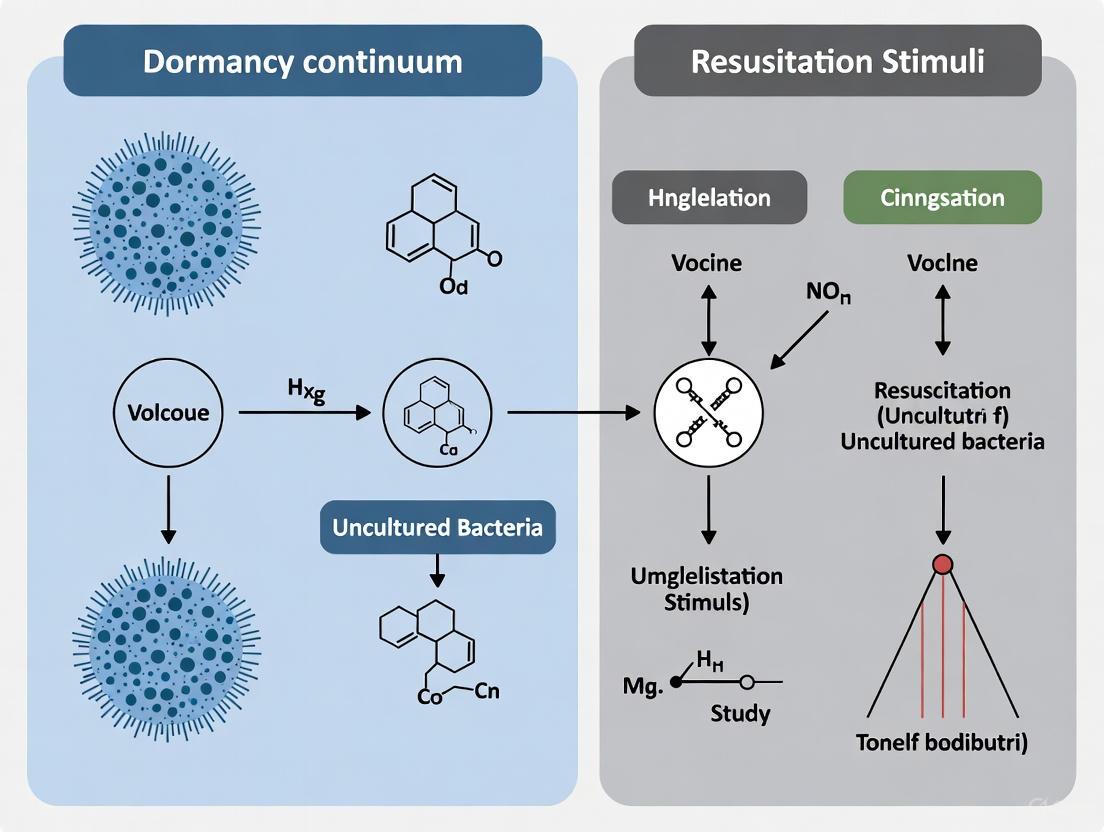
This article synthesizes current scientific understanding of bacterial dormancy, a critical survival strategy where bacteria enter a viable but non-culturable (VBNC) state or become persister cells, evading conventional detection and...
Beyond Culturability: The Dormancy Continuum and Resuscitation Strategies for Uncultured Bacteria
Abstract
This article synthesizes current scientific understanding of bacterial dormancy, a critical survival strategy where bacteria enter a viable but non-culturable (VBNC) state or become persister cells, evading conventional detection and treatment. We explore the 'dormancy continuum' hypothesis, which posits a gradient of metabolic inactivity connecting these states. For researchers and drug development professionals, this review details the environmental triggers inducing dormancy, advanced molecular and computational methods for detecting and characterizing uncultured microbes, and the specific biochemical resuscitation stimuli that can revert dormant cells to a cultivable state. We further analyze the challenges in differentiating and eradicating dormant populations, compare the efficacy of various cultivation techniques, and discuss the profound clinical implications of these processes, particularly in the context of chronic and recurrent infections. The goal is to provide a comprehensive framework that bridges microbial ecology with clinical strategy, offering new avenues for drug discovery and infectious disease management.
The Hidden Microbial World: Defining the Dormancy Continuum and Its Triggers
The pervasive threat of antibiotic failure in clinical settings is increasingly linked to bacterial dormancy, a physiological state where metabolically active cells elude conventional treatments. Within this realm, two phenomena—the viable but nonculturable (VBNC) state and antibiotic persistence—represent critical survival strategies that contribute to recurrent infections and treatment relapse. The VBNC state describes cells that are viable, metabolically active, and possess an intact membrane, yet cannot form colonies on routine laboratory media that typically support their growth [1]. In contrast, persister cells are defined as a slow or nongrowing subpopulation within a growing culture that survives antibiotic exposure but can readily resume growth upon antibiotic removal, exhibiting a drug-tolerant rather than a drug-resistant phenotype [2] [3]. While historically studied independently, emerging evidence substantiates that these states are not distinct binaries but rather exist on a dormancy continuum, a concept proposing that VBNC cells and persisters share molecular mechanisms but occupy different physiological positions along a spectrum of metabolic activity and resuscitative potential [2] [4]. This paradigm shift has profound implications for understanding persistent infections and developing novel therapeutic interventions, particularly within the context of investigating uncultured bacteria which represent a vast reservoir of unexplored microbial diversity with potential clinical significance [5].
Defining the Dormancy States: A Comparative Analysis
Accurately differentiating between VBNC and persister cells is fundamental to dormancy research. The distinction primarily hinges on two criteria: culturability and resuscitation requirements. Persister cells remain culturable on standard media immediately after the stressor is removed, whereas VBNC cells lose this ability and require specific, often prolonged, resuscitation conditions to regain culturability [2] [1]. Furthermore, while both states exhibit reduced metabolic activity compared to active cells, VBNC cells maintain a measurable level of metabolic activity, which distinguishes them from deeply dormant spores or cells with undetectable metabolism [1].
The table below provides a structured comparison of the key characteristics distinguishing VBNC cells from persister cells, essential for accurate identification and study design.
Table 1: Comparative Characteristics of VBNC and Persister Cells
| Characteristic | VBNC Cells | Persister Cells |
|---|---|---|
| Culturability on Routine Media | Lost; cannot form colonies [1] | Retained; can form colonies after stress removal [2] |
| Resuscitation Requirement | Requires specific stimuli and conditions (e.g., temperature upshift, nutrient modulation) [1] | Resumes growth shortly after stress removal without special conditions [2] |
| Metabolic Activity | Low but measurable metabolic activity and gene expression [1] | Reduced or absent metabolic activity; often dormant [3] |
| Induction Triggers | Diverse moderate-to-long-term stresses: starvation, temperature extremes, high salinity, osmotic pressure [1] | Often specific stresses: antibiotic exposure, nutrient starvation, oxidative stress [2] [3] |
| Typical Resuscitation Time | Hours to days [1] | Minutes to hours [2] |
| Clinical Significance | Cause of recurrent infections and antibiotic failure; pathogens can resuscitate in vivo [2] [1] | Underlie chronic and biofilm-associated infections; contribute to relapse post-treatment [3] |
The Dormancy Continuum Hypothesis: Bridging the Phenotypes
The "dormancy continuum hypothesis" posits that VBNC cells and persisters represent different points on a spectrum of cellular dormancy, interconnected by shared molecular mechanisms and environmental triggers [2] [4]. This model provides a framework for understanding the fluidity and relatedness of these states. A key piece of experimental evidence supporting this hypothesis is the observation that VBNC cells can be present during standard persister isolation experiments. For instance, when persister cells of Vibrio vulnificus or Escherichia coli are isolated via antibiotic treatment and subsequently exposed to prolonged nutrient starvation and cold temperatures, they can transition into a VBNC state, losing culturability on routine media [2]. This demonstrates that persisters can be precursors to VBNC cells under sustained stress.
Furthermore, both subpopulations can be induced by the same clinically relevant stressors. Research has shown that human serum can induce the formation of both persisters and VBNC cells, a finding that underscores the clinical relevance of this interplay [2]. At the molecular level, this coexistence and shared induction are partly regulated by toxin-antitoxin (TA) systems. These genetic modules, classically implicated in persister formation through stochastic toxin activation leading to growth arrest, have also been shown to be upregulated during incubation in human serum and during entry into the VBNC state [2]. This suggests a common molecular pathway that can drive cells to different depths of dormancy along the continuum. The model below illustrates this dynamic relationship and the shared regulatory mechanisms.
Diagram 1: The Dormancy Continuum Pathway. This diagram illustrates the proposed dormancy continuum, where environmental stresses trigger TA systems, leading to the formation of persister and VBNC cells. Persisters can further transition to the VBNC state under prolonged stress, while VBNC cells require specific resuscitation stimuli to re-enter the growth cycle.
Methodologies for Isolation and Characterization
The study of dormant bacterial states requires specialized protocols to isolate, quantify, and characterize these subpopulations. The following section details established experimental workflows for investigating VBNC cells and persisters.
The standard protocol for inducing and resuscitating VBNC cells involves subjecting bacteria to a prolonged, sub-lethal environmental stress. A representative method using Vibrio vulnificus is outlined below [2].
Induction:
- Culture Preparation: Grow V. vulnificus to log phase in Heart Infusion (HI) broth.
- Nutrient Removal: Wash the cells twice using 1/2 Artificial Seawater (ASW) to remove residual nutrients.
- Stress Application: Dilute the washed cell suspension 1:100 (vol/vol) into fresh 1/2 ASW. Incubate statically at 4°C.
- Monitoring: Quantify culturable cells daily by standard plate count on HI agar until culturability is lost (e.g., < 10 CFU/ml detectable). The presence of viable cells is confirmed using a viability stain, such as the BacLight Live/Dead kit, which distinguishes cells with intact membranes (green fluorescence, live) from those with damaged membranes (red fluorescence, dead) [2].
Resuscitation:
- Stimulus Application: After confirming the VBNC state (zero CFUs, high percentage of live cells by staining), incubate the culture at a permissive temperature (e.g., 20°C) for 24 hours.
- Confirmation: Perform standard plate counts after the resuscitation period to confirm the recovery of culturability [2].
Persister Cell Isolation Protocol
Persister cells are typically isolated from a larger population by exploiting their tolerance to high doses of bactericidal antibiotics.
- Procedure:
- Culture Preparation: Grow the bacterial strain (e.g., E. coli K-12) to log phase in an appropriate broth like HI or LB.
- Antibiotic Challenge: Treat the culture with a high concentration of an antibiotic such as ampicillin (e.g., 100 μg/ml) for a defined period (e.g., 4 hours) at the optimal growth temperature with aeration.
- Antibiotic Removal: Wash the antibiotic-treated culture multiple times (e.g., four times) with phosphate-buffered saline (PBS) or 0.85% NaCl to thoroughly remove the antibiotic.
- Quantification: Determine the number of surviving culturable cells using the standard plate count method. These colonies represent the persister population that withstood the antibiotic treatment [2].
Table 2: Key Reagents and Experimental Tools for Dormancy Research
| Research Reagent / Tool | Function in Experiment | Specific Example |
|---|---|---|
| 1/2 Artificial Seawater (ASW) | A defined, nutrient-limited medium for inducing the VBNC state in marine bacteria like Vibrio vulnificus [2]. | Used for dilution and incubation of cells at low temperatures. |
| BacLight Live/Dead Viability Kit | Differentiates viable from dead cells based on membrane integrity, crucial for confirming viability in nonculturable populations [2]. | SYTO 9 (green, live) and propidium iodide (red, dead) staining with fluorescence detection. |
| High-Dose Bactericidal Antibiotic | Selects for persister cells by killing the majority of the growing, susceptible population [2]. | Ampicillin at 100 μg/ml for E. coli and V. vulnificus. |
| Heart Infusion (HI) Broth/Agar | A nutrient-rich routine laboratory medium for cultivating active cells and assessing culturability via colony counts [2]. | Used for standard plate counts before and after stress exposure. |
| Propidium Monoazide (PMA) | A DNA-binding dye that penetrates only cells with compromised membranes; used with qPCR to selectively detect DNA from viable cells (VBNC state) [1]. | PMA-qPCR prevents false positives from free DNA or dead cells. |
Molecular Mechanisms and Regulatory Networks
The entry into and maintenance of dormancy are governed by complex molecular networks. A central player in this process is the type II toxin-antitoxin (TA) system [2] [4]. These systems consist of a stable toxin protein and a labile antitoxin that neutralizes it. Under stress conditions, the antitoxin is degraded, freeing the toxin to act on its cellular targets. This can lead to the inhibition of vital processes like translation, consequently inducing growth arrest and facilitating dormancy [2]. The stochastic expression of TA system components is thought to be a key driver of the phenotypic heterogeneity observed in bacterial populations, naturally generating a subpopulation of dormant cells even in the absence of external stress [2].
The molecular profile of a dormant cell varies with its position on the dormancy continuum. Proteomic studies on Shewanella putrefaciens in the VBNC state revealed upregulation of ribosomal proteins, potentially to enable rapid synthesis of stress proteins upon resuscitation, and specific proteins like ornithine decarboxylase (SpeF) and MraY involved in damage repair [6]. Concurrently, these cells downregulate metabolic and transport proteins, such as dehydrogenases, to reduce their metabolic footprint, a hallmark of the VBNC state [6]. Beyond TA systems, other global regulatory mechanisms, including the stringent response to nutrient stress and the involvement of small non-coding RNAs, contribute to the formation and maintenance of persister cells, further illustrating the multifaceted nature of dormancy regulation [3].
Implications for Unculturability and Drug Development
The dormancy continuum has profound implications for the field of uncultured bacteria research. The vast majority of environmental bacteria are deemed "unculturable" because they do not grow on standard laboratory media. This unculturability may, for a significant subset, reflect a reversible dormancy state rather than an intrinsic inability to grow [5]. The conditions required for resuscitation—which are often unknown—are likely highly specific and differ from those needed for culturing routine laboratory strains. This understanding is driving new approaches to access this "microbial dark matter" for drug discovery.
Traditional culturing methods have limited our ability to tap into the biosynthetic potential of soil bacteria for antibiotics. A groundbreaking approach, synthetic bioinformatic natural products (synBNP), circumvents this bottleneck. This method involves extracting large fragments of DNA directly from soil, sequencing them to reconstruct bacterial genomes, bioinformatically predicting the structure of natural products (like antibiotics), and then chemically synthesizing these compounds [5] [7]. This culture-independent strategy has already yielded novel antibiotic candidates, such as erutacidin (which disrupts bacterial membranes) and trigintamicin (which targets the ClpX unfoldase), from previously uncultured soil bacteria [5] [7]. This provides a powerful template for how understanding and bypassing dormancy and unculturability can fuel the discovery of new therapeutics.
The paradigm of the dormancy continuum, bridging VBNC and persister cell states, provides a more nuanced and accurate framework for understanding bacterial survival strategies. Recognizing the shared molecular triggers, such as TA systems, and the fluid transitions between these states is critical for addressing the significant clinical challenge they pose in the form of chronic and recurrent infections. Future research must continue to elucidate the precise molecular signals that govern entry into and resuscitation from these dormant states. Furthermore, the development of innovative, culture-independent techniques, exemplified by the synBNP approach, is essential for discovering novel anti-persister therapeutics and unlocking the vast potential of the uncultured microbial world. Overcoming the hurdles presented by the bacterial dormancy spectrum is a pivotal step toward mitigating the global crisis of antibiotic failure.
Bacterial dormancy represents a critical survival strategy wherein microorganisms reversibly transition into a state of reduced metabolic activity to withstand lethal environmental conditions. Within the framework of the dormancy continuum, bacteria can occupy various physiological states, from shallow-dormancy persisters to the deep-dormancy viable but non-culturable (VBNC) state [8]. This continuum allows bacterial populations to heterogeneously respond to stressors, ensuring some cells survive acute challenges. Environmental stresses—ranging from nutrient deprivation to antibiotic exposure—act as the fundamental drivers that push bacterial cells along this dormancy continuum [9]. Understanding these mechanisms is paramount for addressing persistent infections and the global antibiotic resistance crisis, as dormant cells evade conventional treatments and contribute to infection recurrence [10] [11].
This technical guide examines how key environmental stressors induce bacterial dormancy, explores the underlying molecular mechanisms, and details advanced methodological approaches for studying uncultured bacteria within the dormancy continuum. By synthesizing current research and experimental findings, we provide researchers with a comprehensive framework for investigating bacterial persistence and developing novel therapeutic strategies.
The Dormancy Continuum: From Persistence to the VBNC State
The dormancy continuum hypothesis posits that bacterial cells under stress can transition through progressively deeper states of metabolic shutdown rather than existing in binary states of active growth or death [8] [12]. This model encompasses several distinct but interconnected physiological states:
- Active Cells: Fully metabolically active, culturable cells susceptible to antibiotics and other stressors.
- Persister Cells: Shallow-dormancy variants characterized by growth arrest without genetic modification, leading to transient antibiotic tolerance that reverses when stress is removed [8] [12]. These cells maintain the ability to resuscitate relatively quickly once favorable conditions return.
- VBNC Cells: Deep-dormancy cells that are metabolically active but non-culturable on standard laboratory media, requiring specific resuscitation stimuli to regain culturality [8] [9]. These cells exhibit even greater tolerance to environmental stresses and antibiotics.
Recent research on Escherichia coli has revealed that the transition along this continuum is governed by a progressive process of protein aggregation, where metabolic proteins first form liquid-like condensates that gradually solidify, ultimately leading to metabolic shutdown [12] [11]. The structural properties of these protein aggregates—specifically their transition from liquid to solid states—appear to dictate the position of a cell along the dormancy continuum and its potential for resuscitation [12].
Table 1: Characteristics of Bacterial Cells in Different Dormancy States
| Characteristic | Active Cells | Persister Cells | VBNC Cells |
|---|---|---|---|
| Culturality | Culturable on standard media | Culturable on standard media | Non-culturable on standard media, requires specific resuscitation signals |
| Metabolic Activity | High | Reduced but detectable | Low but detectable |
| Antibiotic Susceptibility | Susceptible | Tolerant | Tolerant |
| Growth & Division | Active | Reversible growth arrest | No division, but viability maintained |
| Primary Function | Growth and reproduction | Population survival under stress | Long-term survival under extended stress |
| Resuscitation Potential | Not applicable | High following stress removal | Limited, requires specific stimuli |
| Protein Aggregation State | Minimal | Liquid-like condensates | Solidified aggregates |
Environmental Stressors Driving Dormancy Transition
Nutrient Starvation and Population Dynamics
Nutrient availability fundamentally shapes microbial population dynamics and dormancy development. The "feast and famine existence" of bacteria in natural environments contrasts sharply with nutrient-rich laboratory conditions, favoring succession between copiotrophs and oligotrophs [9]. During endogenous succession, when concentrated nutrients are initially available, copiotrophs dominate; as resources deplete, oligotrophs with higher substrate affinity become prevalent [9]. This nutrient transition acts as a powerful environmental cue triggering dormancy entry.
Starvation response pathways, including the stringent response with (p)ppGpp signaling, redirect cellular resources from growth to maintenance, facilitating entry into dormancy [9]. This metabolic reprogramming enables long-term survival under nutrient limitation but comes at the cost of reduced culturality on standard media—a phenomenon contributing to the "great plate count anomaly" where direct microscopic counts vastly exceed culturable counts [9].
Antibiotic Exposure and Sublethal Stresses
Antibiotic pressure represents a clinically significant inducer of bacterial dormancy. Sublethal antibiotic concentrations can promote dormancy development through multiple mechanisms:
- Cellular Damage: Antibiotics causing DNA damage (e.g., fluoroquinolones) can activate the SOS response, leading to cell cycle arrest and persistence [12].
- Protein Aggregation: Aminoglycosides and other translation inhibitors can induce proteotoxic stress, accelerating protein aggregation and dormancy transition [12].
- Energy Depletion: Drugs targeting energy metabolism (e.g., electron transport chain inhibitors) reduce ATP levels, facilitating persistence development [12].
Beyond antibiotics, various sublethal environmental stresses commonly used in food preservation—including osmotic stress (elevated salt), pH extremes, and temperature fluctuations—can induce cross-protection against antibiotics and promote dormancy [13]. These stresses often trigger the multiple antibiotic resistance (mar) operon and enhance efflux pump expression, further contributing to antibiotic tolerance [13].
Molecular Mechanisms of Stress-Induced Dormancy
Recent research has elucidated protein aggregation as a central mechanism governing dormancy development across bacterial species [12] [11]. The process involves:
- Stress-Induced Condensation: Under nutrient limitation or antibiotic stress, metabolic proteins (particularly those involved in energy production) undergo liquid-liquid phase separation, forming liquid-like condensates [12] [11].
- Metabolic Sequestration: These condensates selectively sequester enzymes critical for ATP production and central metabolism, effectively shutting down energy generation [12].
- Liquid-to-Solid Transition: Over time, these liquid condensates solidify through a maturation process, progressively limiting resuscitation potential [12].
- Dormancy Establishment: Solidified aggregates create a metabolic bottleneck that maintains cells in a deeply dormant VBNC state [12].
This aggregation process is conserved across diverse genetic backgrounds of E. coli, with the timing of aggregation consistently preceding or coinciding with dormancy development [12]. Molecular chaperones, particularly DnaK, play crucial roles in both facilitating aggregate formation and enabling disaggregation during resuscitation [12] [11].
Diagram Title: Dormancy Continuum and Protein Aggregation Pathway
Experimental Methodologies for Dormancy Research
Quantifying Dormancy States Through Advanced Microscopy
Distinguishing between persistence and VBNC states requires complementary approaches that assess viability, metabolic activity, and culturality. Advanced microscopy techniques enable researchers to track protein aggregation dynamics—a key biomarker of dormancy progression:
- Fluorescent Fusion Proteins: Early-stage protein aggregates can be detected using fluorescent fusions of the small chaperone IbpA (IbpA-msfGFP), which rapidly associates with protein condensates [12].
- Phase Contrast Microscopy: Late-stage aggregates mature into phase-bright foci (Ph aggregates) visible through phase contrast microscopy [12].
- Correlative Imaging: Combining fluorescence and phase contrast microscopy allows researchers to track the progression from liquid-like IbpA-positive condensates to solid Ph aggregates [12].
The percentage of bacterial cells carrying aggregates serves as a quantitative indicator of dormancy development, with timing of aggregation consistently preceding persistence development across genetic backgrounds [12].
Resuscitation of VBNC cells requires specialized cultivation approaches that replicate essential aspects of the bacterium's natural environment:
- Nutrient Modulation: Transitioning from copiotrophic to oligotrophic conditions better mimics natural feast-famine cycles and supports recovery of dormant cells [9].
- Signaling Molecules: Quorum-sensing molecules or resuscitation-promoting factors (Rpfs) can trigger exit from dormancy by signaling favorable conditions [9].
- Co-culture Systems: Incorporating supportive microbial neighbors or host cells provides necessary cross-feeding relationships and signaling cues for resuscitation [9].
- Extended Incubation: Prolonged cultivation periods account for the delayed growth kinetics of resuscitating cells compared to actively growing populations [9].
These cultivation strategies address the limitations of standard laboratory media that fail to support the growth of many environmental microorganisms, contributing to the "great plate count anomaly" [9].
Table 2: Quantitative Analysis of Stress-Induced Antibiotic Resistance Changes
| Stress Type | Specific Condition | Pathogen | Effect on Antibiotic Resistance | Stability After Stress Removal |
|---|---|---|---|---|
| High Temperature | 45°C | E. coli | Decreased resistance | Not persistent |
| High Temperature | 45°C | S. aureus | Decreased resistance | Not persistent |
| High Temperature | 45°C | S. enterica | Decreased resistance | Not persistent |
| Osmotic Stress | 4.5%-12% NaCl | E. coli | Increased resistance | Stable in some cases |
| Osmotic Stress | 12% NaCl | S. aureus | Increased resistance | Stable in some cases |
| Osmotic Stress | 4.5% NaCl | S. enterica | Increased resistance | Stable in some cases |
| Acid Stress | pH 4.0-5.0 | E. coli | Increased resistance | Stable in some cases |
| Acid Stress | pH 5.0 | S. aureus | Increased resistance | Stable in some cases |
| Acid Stress | pH 4.0 | S. enterica | Increased resistance | Stable in some cases |
Molecular Tools for Dormancy Research
Diagram Title: Experimental Workflow for Dormancy State Analysis
The Scientist's Toolkit: Research Reagent Solutions
Table 3: Essential Research Reagents for Bacterial Dormancy Studies
| Reagent/Condition | Function/Application | Example Use Cases | Technical Considerations |
|---|---|---|---|
| IbpA-msfGFP Fusion | Early detection of protein aggregates via fluorescence microscopy | Tracking liquid-like condensate formation in E. coli | Higher sensitivity than phase contrast; rapid association with aggregates [12] |
| Phase Contrast Microscopy | Detection of mature protein aggregates as phase-bright foci | Identifying solid aggregates in VBNC cells | Lower sensitivity than fluorescence; detects late-stage aggregates [12] |
| Mueller-Hinton Broth | Culture medium for antibiotic resistance testing with stressed bacteria | Assessing antibiotic susceptibility of stressed pathogens | Recommended for culture and assessment of antibiotic resistance in stressed bacteria [13] |
| Sublethal Stress Conditions | Induction of dormancy states without causing cell death | Studying stress-induced antibiotic resistance and persistence | NaCl (4.5-12%), pH (4.0-5.0), temperature (10-45°C) provide reproducible dormancy induction [13] |
| DnaK Chaperone System | Facilitates protein disaggregation and resuscitation from dormancy | Reactivating metabolic proteins from condensates | Pulls proteins out of condensates; essential for recovery from persistence [12] [11] |
| Oligotrophic Media | Cultivation of oligotrophic bacteria and resuscitation of VBNC cells | Mimicking natural low-nutrient conditions | Supports growth of slow-growing organisms with high substrate affinity [9] |
| Ringer's Solution | Washing and resuspending bacterial cells for stress experiments | Preparing standardized inocula for stress assays | Maintains osmotic balance while removing residual nutrients/metabolites [13] |
Environmental stressors, from nutrient starvation to antibiotic exposure, serve as powerful drivers that push bacterial populations along the dormancy continuum from active growth through persistence to the VBNC state. The recently elucidated mechanism of protein aggregation—with its sequential progression from liquid-like condensates to solidified aggregates—provides a biochemical framework understanding how metabolic shutdown occurs and how resuscitation potential diminishes over time [12] [11].
For researchers investigating uncultured bacteria, this mechanistic understanding suggests promising avenues for future work. Targeting the aggregation process itself, enhancing disaggregation through chaperone induction, or developing resuscitation signals that trigger aggregate dissolution represent potential strategies for overcoming bacterial persistence in clinical and environmental settings. As our knowledge of the dormancy continuum expands, so too will our ability to cultivate previously unculturable microorganisms and combat persistent infections that evade conventional antibiotic therapies.
Within the framework of the dormancy continuum, bacterial populations can occupy a spectrum of physiological states between active replication and deep dormancy, a survival strategy that poses significant challenges for both clinical treatment and fundamental research [14]. This continuum encompasses closely related states such as persister cells and the Viable But Non-Culturable (VBNC) state, both characterized by distinct metabolic reprogramming that allows bacteria to withstand hostile conditions, including antibiotic exposure [15] [14]. While persisters are a small, multi-drug tolerant subpopulation within an otherwise susceptible culture that can quickly resuscitate after stress removal, VBNC cells represent a deeper dormancy stage where bacteria lose cultivability on routine media but maintain viability, requiring prolonged resuscitation stimuli [14]. Understanding the metabolic hallmarks of these states—low metabolic activity, altered gene expression, and structural changes—is crucial for developing strategies to combat persistent infections and to access the vast untapped resource of uncultured bacteria for drug discovery [15] [16]. This technical guide delineates these core metabolic features, providing researchers with the analytical frameworks and experimental methodologies needed to investigate bacterial dormancy and its reversal.
Core Metabolic Hallmarks of Dormant Bacteria
Hallmark 1: Drastically Reduced Metabolic Activity
Dormant bacterial states, including persisters and VBNC cells, are fundamentally characterized by a profound reduction in metabolic activity, a strategic downshift that conservs energy and enhances survival under stress.
Metabolic Downshift and Energy Metabolism: Persister cells typically reside in a slow- or non-growing state, with studies indicating that this reduced metabolic state increases their chance of survival against antibiotics [15]. Investigations into energy metabolism have revealed contradictions; for instance, in E. coli, mutants with defects in ubiquinone biosynthesis (ubiF) or the TCA cycle (sucB) showed decreased persister levels, suggesting a role for ATP generation in persistence. Conversely, inhibition of ATP synthesis by CCCP or reduction of the proton motive force (PMF) by TisB expression increased persister formation, indicating a complex relationship between energy metabolism and dormancy that may be organism or context-dependent [15]. In biofilms, which harbor high persister levels, impaired nutrient penetration creates an environment where metabolic downshifts are common, with genes for the TCA cycle and energy production often downregulated [15].
Metabolic Activity in VBNC Cells: VBNC cells are defined by their loss of cultivability on standard media, yet they maintain reduced metabolic activity and membrane integrity [17] [18]. This state is not a prelude to death but a distinct survival program, and the cells can remain in this state of low metabolic flux for extended periods. The ability to resuscitate from this state is time-dependent, with a defined "resuscitation window" during which cells can recover; this window shortens with increased intensity of the VBNC-inducing stress [17].
Table 1: Experimental Evidence for Reduced Metabolic Activity in Dormant Bacteria
| Experimental Evidence | Dormancy State | Key Findings | Technical Approach |
|---|---|---|---|
| Transcriptome Analysis [15] | Persister | Downregulation of metabolic genes in M. tuberculosis and E. coli persisters. | Isolation via lytic antibiotics, RNA sequencing. |
| Phenotype Microarrays [15] | Persister | Less active metabolism increases the chance for a cell to enter the persister state. | Fluorescent dyes to assay reductase activity. |
| Isotopolog Profiling [15] | Persister | Stationary-phase S. aureus challenged with daptomycin showed active amino acid anabolism, glycolysis, TCA cycle, and PPP. | Feeding with 13C-labeled carbohydrates; analysis of labeled intermediates. |
| Direct Viable Count (DVC) [18] | VBNC | Cells are metabolically active and can elongate in the presence of nutrients + cell division inhibitor. | Microscopic counting after incubation with yeast extract and nalidixic acid. |
Hallmark 2: Altered Gene Expression and Regulatory Networks
A profound reprogramming of gene expression is a cornerstone of the dormant state, mediated by sophisticated regulatory networks that respond to environmental and internal cues.
Toxin-Antitoxin (TA) Systems and Stringent Response: TA systems are key genetic regulators of the persister state [15]. These modules consist of a stable toxin that disrupts essential cellular processes (e.g., protein synthesis, DNA replication) and a labile antitoxin that neutralizes the toxin. Under stress conditions like glucose starvation or amino acid depletion, the antitoxin is degraded, freeing the toxin to induce dormancy [15]. This process is intricately linked to the stringent response. Nutrient limitation triggers the accumulation of the alarmone (p)ppGpp, which acts as a central mediator between metabolism and persistence. For example, in E. coli, the HipA toxin phosphorylates the glutamyl-tRNA synthetase GltX, mimicking amino acid starvation and triggering ppGpp synthesis [15]. Similarly, in P. aeruginosa and S. aureus, high ppGpp levels direct cells toward a state of increased antibiotic tolerance [15]. The second messenger cAMP also integrates into this network, forming a complex with Crp that can activate transcription of TA-related genes and relA, further amplifying the ppGpp pool [15].
Genetic Reprogramming in the VBNC State: Entry into the VBNC state is initiated by a cascade of cellular events in response to environmental stresses [18]. This involves the differential expression of genes related to stress response, peptidoglycan synthesis, and central metabolism. Resuscitation from the VBNC state is not a simple reversal of this process; it requires active transcription and translation to rebuild cellular machinery. This is demonstrated by the inhibition of resuscitation when chloramphenicol (protein synthesis inhibitor) or penicillin (peptidoglycan synthesis inhibitor) is added to the recovery medium [17].
The following diagram illustrates the core signaling pathways that integrate metabolic stress into the genetic reprogramming leading to dormancy.
Hallmark 3: Structural and Compositional Changes
The transition to a dormant state is accompanied by distinct physical and structural alterations at the cellular level.
Morphological Changes: VBNC cells often undergo a noticeable reduction in cell volume, resulting in dwarfing or abnormal morphology compared to their actively growing counterparts [17]. Upon successful resuscitation, these cells recover their normal size and shape, a process that requires the re-synthesis of cytoplasmic proteins and cell wall peptidoglycan [17]. The importance of peptidoglycan remodeling is highlighted by studies showing that inhibition of penicillin-binding proteins (PBPs) PBP1 and PBP5 prevents the resuscitation of VBNC E. faecalis [17].
Membrane and Cell Wall Transformations: The targets of novel antibiotics discovered from previously uncultured bacteria provide insight into critical structural components. Compounds like teixobactin and clovibactin, isolated from uncultured soil bacteria, target immutable, non-protein lipid precursors of the cell wall—lipid II (peptidoglycan precursor) and lipid III (teichoic acid precursor) [19] [16]. These targets are immutable because they are not directly encoded by genes, making it difficult for bacteria to develop resistance. Clovibactin exhibits a unique mechanism where it not only binds these targets but also forms supramolecular fibrils that sequester the precursors and create a structurally disruptive scaffold on the bacterial membrane [19]. This suggests that the membrane composition and architecture of dormant cells, or the precursors they produce, are structurally critical and represent a key vulnerability.
Research Methodologies and Experimental Protocols
Key Analytical Workflows
The diagram below outlines a generalized experimental workflow for inducing, isolating, and characterizing dormant bacterial cells.
Detailed Experimental Protocols
Protocol 1: Inducing and Isulating Persister Cells
- Principle: A high dose of a bactericidal antibiotic kills growing cells, leaving behind a purified population of drug-tolerant persisters [15].
- Procedure:
- Grow a bacterial culture to the desired growth phase (e.g., mid-exponential or stationary). Note that stationary phase cultures typically have higher persister levels [15].
- Administer a lethal dose of an antibiotic like a fluoroquinolone (e.g., ciprofloxacin) or a beta-lactam (e.g., ampicillin). The concentration and exposure time must be optimized to kill >99.9% of the population.
- Remove the antibiotic by washing the cells thoroughly with sterile saline or phosphate-buffered saline (PBS). This can be achieved through multiple cycles of centrifugation and resuspension.
- The resulting pellet consists of a highly enriched population of persister cells, which can be used for downstream -omics analyses or resuscitation studies [15].
Protocol 2: Confirming VBNC Resuscitation (Excluding Regrowth)
- Principle: To definitively prove resuscitation of VBNC cells, one must exclude the possibility that observed growth comes from a small number of remaining culturable cells [17].
- Procedure:
- Induce the VBNC state by exposing a culture to a specific stressor (e.g., low temperature in nutrient-free artificial seawater) [18].
- Serially dilute the VBNC-state suspension. High dilution minimizes the probability that any remaining culturable cells are transferred to the resuscitation medium.
- (Optional) Add antibiotics like ampicillin to the resuscitation medium to inhibit the proliferation of any residual culturable cells that might be present [17].
- (Optional) Include H₂O₂ scavengers such as sodium pyruvate or catalase in the medium. This excludes the resuscitation of H₂O₂-sensitive culturable cells, confirming that growth originates from the more robust VBNC population [17].
- Monitor for culturability restoration via plate counts or turbidity. The actively growing cells under these conditions are confirmed to be resuscitated from the VBNC state.
Protocol 3: Isotopolog Profiling for Persister Metabolism
- Principle: This technique tracks the incorporation of stable isotopes (e.g., ¹³C) into metabolic intermediates, providing a snapshot of relative metabolic pathway activities in persisters, even when overall flux is low [15].
- Procedure:
- Isolate persister cells as described in Protocol 1.
- Resuspend the persister pellet in a medium containing a ¹³C-labeled carbon source (e.g., ¹³C-glucose or ¹³C-acetate).
- Incubate for a defined period to allow for metabolite labeling.
- Quench metabolism and extract intracellular metabolites.
- Analyze the extracts using techniques like Gas Chromatography-Mass Spectrometry (GC-MS) or Nuclear Magnetic Resonance (NMR) spectroscopy to determine the ¹³C-labeling patterns in key metabolites (e.g., amino acids, TCA cycle intermediates).
- Interpret the data: For example, de novo biosynthesis of amino acids with labeling patterns indicating an active glycolysis, TCA cycle, and pentose phosphate pathway was demonstrated in S. aureus persisters challenged with daptomycin [15].
The Scientist's Toolkit: Key Reagents and Technologies
Table 2: Essential Research Reagents and Tools for Dormancy Studies
| Reagent / Technology | Function / Application | Key Details |
|---|---|---|
| Diffusion Chambers / iChip [16] | Cultivating previously "unculturable" bacteria. | Semi-permeable device placed in natural environment; allows diffusion of environmental molecules, facilitating growth of ~40% of previously uncultured soil bacteria. |
| Resuscitation-Promoting Factors (Rpfs) [17] [18] | Resuscitating VBNC cells; converting dormant cells back to an active state. | Bacterial cytokines; addition to VBNC cells can stimulate resuscitation. |
| Sodium Pyruvate [17] | Resuscitation of VBNC cells; acts as an H₂O₂ scavenger. | Added to resuscitation medium to degrade hydrogen peroxide, which can inhibit the growth of resuscitating cells. |
| 13C-Labeled Substrates [15] | Isotopolog profiling to analyze metabolic fluxes in dormant cells. | e.g., ¹³C-glucose; fed to cells to trace active pathways via analysis of labeled intermediates (e.g., Asp, Glu for TCA cycle activity). |
| Live/Dead Staining (e.g., CFDA/PI) [14] | Differentiating viable, sublethally injured, VBNC, and dead cells at single-cell level. | Fluorescent dyes used with microscopy; distinguishes cells based on membrane integrity and esterase activity. |
| Carbonyl Cyanide m-Chlorophenylhydrazone (CCCP) [15] | Studying the role of energy metabolism in persistence. | Protonophore that inhibits ATP synthesis; shown to increase persister formation in some studies. |
| gapseq Software [20] | Predicting metabolic pathways and reconstructing accurate metabolic models from genomic data. | Uses curated reaction database and gap-filling algorithm; outperforms other tools in predicting enzyme activity and carbon source utilization. |
Implications for Drug Discovery and Culturing the Uncultured
The study of dormant bacterial metabolism is directly fueling innovative approaches in antibiotic discovery. The vast majority (∼99%) of environmental bacteria are unculturable under standard lab conditions, representing a massive "microbial dark matter" with immense potential [16]. By employing advanced culturing techniques like the iChip, researchers can now access this untapped reservoir. This has led to the discovery of novel antibiotics such as teixobactin and clovibactin from previously uncultured soil bacteria [19] [16]. These compounds are particularly valuable because they target immutable targets like the pyrophosphate moiety of cell wall precursors (lipid II, lipid III), making resistance development difficult [19] [21]. Clovibactin's unique mechanism of forming supramolecular fibrils on the bacterial membrane further underscores the potential for discovering entirely new antibiotic classes by probing the metabolic and structural peculiarities of dormant and uncultured microbes [19]. Understanding the metabolic hallmarks of dormancy and the stimuli required for resuscitation is therefore not merely an academic exercise but a critical endeavor for unlocking new therapeutic agents and combating the global crisis of antimicrobial resistance.
Microbial dormancy, a reversible state of reduced metabolic activity, represents a fundamental survival strategy for bacteria confronting environmental stress. This state enables microorganisms to withstand periods of harshness, including antibiotic exposure, nutrient limitation, and other fluctuating biotic and abiotic factors [22] [23]. In public health, dormancy is not merely a biological curiosity but a central phenomenon underpinning recurrent infections, antibiotic treatment failures, and the silent persistence of pathogens in environmental reservoirs. The clinical significance of dormancy is profoundly illustrated by two well-defined states in nonsporulating bacteria: the viable but nonculturable (VBNC) state and antibiotic persistence [2]. These dormant subpopulations are genetically identical to their susceptible counterparts but exhibit a phenotypically tolerant state, allowing them to survive high-dose antibiotic regimens that eradicate actively growing cells [2] [14].
The ecological implications of dormancy extend far beyond the clinic, influencing global biogeochemical cycles and ecosystem functioning. In virtually all of Earth's ecosystems, from soil to marine sediments, a substantial proportion of microbial communities exist in a dormant state, forming a massive microbial seed bank [22] [24]. This seed bank preserves microbial diversity and functions, enabling ecosystems to maintain resilience in the face of environmental change. Scientists estimate that up to 90% of bacteria and fungi in soil are dormant at any given time, with dormant bacteria accounting for up to 40% of taxon richness in nutrient-poor systems [23] [24]. The ability of dormant microorganisms to interact with the geosphere over geologically relevant timescales underscores their profound influence on Earth's ecological and biogeochemical architecture [22]. Understanding the dormancy continuum and the stimuli that trigger resuscitation is therefore critical for addressing pressing public health challenges, from antibiotic resistance to emerging infectious diseases, within the broader context of planetary health.
The Dormancy Continuum: From Persistence to the VBNC State
Conceptual Framework and Definitions
The "dormancy continuum" hypothesis provides a unifying framework for understanding the relationship between different bacterial dormancy states. This model proposes that persister cells and VBNC cells represent different physiological positions on a spectrum of reduced metabolic activity, rather than distinct and unrelated phenomena [2] [14]. On this continuum, persister cells represent an initial stage of dormancy characterized by reversible growth arrest and multi-drug tolerance, while VBNC cells occupy a deeper state of dormancy with more pronounced metabolic reduction and different resuscitation requirements [2]. The transition between these states is governed by the intensity and duration of environmental stress, with persisters potentially progressing to a VBNC state upon prolonged stress exposure [2].
The operational distinction between these states primarily hinges on their resuscitation dynamics. Persister cells can quickly resume growth on routine laboratory media shortly after the removal of stress (such as antibiotics), typically within hours. In contrast, VBNC cells are unable to form colonies on standard media immediately after stress removal, requiring a prolonged resuscitation period—often 24 hours or more—and sometimes specific environmental signals to return to a cultivable state [2] [25]. This continuum challenges rigid categorical definitions and emphasizes the fluid nature of microbial responses to stress, with significant implications for both clinical outcomes and ecological dynamics.
Molecular Mechanisms and Regulation
The entrance into and exit from dormancy are regulated by sophisticated molecular mechanisms that interpret environmental cues. Toxin-antitoxin (TAS) systems are central players in this process, classically implicated in persister formation and now recognized as contributors to the VBNC state [2]. These systems typically consist of a two-gene operon encoding a stable protein toxin and a labile cognate antitoxin. Under favorable conditions, the antitoxin neutralizes the toxin. Stressful conditions disrupt this balance, leading to toxin activation and subsequent growth inhibition through targets such as translation machinery [2]. The variable levels of free toxin across individual cells are thought to drive population heterogeneity, producing a mixture of actively growing cells, persisters, and VBNC cells within a genetically identical population [2].
Recent research has identified additional genetic regulators and metabolic enzymes that modulate dormancy entry and exit. For instance, the oxidative stress regulator OxyR and the general stress regulator RpoS have been shown to influence VBNC formation in various bacterial species [25]. Proteomic analyses of VBNC cells have revealed significant upregulation of proteins involved in metabolic functional categories, with lactate dehydrogenase (LldD) emerging as a potential key regulator [25]. In Vibrio parahaemolyticus, deletion of the lldD gene accelerated entry into the VBNC state, while lactate supplementation aided resuscitation and extended the resuscitation window, suggesting a role for lactate metabolism in regulating the VBNC state [25].
Table 1: Key Characteristics of Dormancy States on the Continuum
| Characteristic | Persister Cells | VBNC Cells |
|---|---|---|
| Culturability on Routine Media | Retained after stress removal | Temporarily lost, requires resuscitation |
| Resuscitation Time | Short (hours) | Prolonged (24+ hours) |
| Metabolic Activity | Reduced but detectable | Greatly reduced but maintained |
| Primary Induction Triggers | Antibiotics, nutrient limitation | Prolonged starvation, extreme temperatures, salinity |
| Clinical Significance | Biofilm-related chronic infections, antibiotic tolerance | Recurrent infections, diagnostic limitations |
| Molecular Regulators | Toxin-antitoxin systems, HipA | Toxin-antitoxin systems, RpoS, OxyR, LldD |
Clinical Significance: Dormancy as a Public Health Challenge
Role in Chronic and Recurrent Infections
Dormant bacterial subpopulations directly contribute to the persistence of chronic and recurrent infections that pose significant challenges in clinical settings. Persister cells are particularly problematic in biofilm-associated infections, where they contribute to the recalcitrance of conditions such as chronic cystic fibrosis lung infections, tuberculosis, prosthetic joint infections, and chronic wound infections [2]. The ability of these dormant cells to survive antibiotic concentrations that kill their actively growing counterparts means that standard antibiotic regimens often reduce but do not eliminate pathogenic populations, leading to recurrent symptoms once treatment ceases and bacteria resuscitate [14].
The VBNC state presents an even more stealthy threat to public health. Numerous bacterial pathogens, including Vibrio cholerae, Escherichia coli O157:H7, Mycobacterium tuberculosis, and Salmonella species, can enter the VBNC state, evading detection by routine clinical culture methods while retaining virulence potential [2] [25]. Studies have demonstrated that VBNC cells of uropathogenic E. coli can persist in mouse models after antibiotic treatment and resuscitate when antibiotics are withdrawn, providing direct experimental evidence for their role in recurrent urinary tract infections [2]. Similarly, VBNC Vibrio cholerae O1 has been shown to regain culturability during passage through human intestines, confirming the clinical relevance of this dormant state in disease transmission and recurrence [2]. These findings underscore the limitations of culture-based diagnostic methods and explain why some infections recur despite negative culture results during treatment.
Implications for Diagnostic Microbiology and Antimicrobial Stewardship
The presence of dormant bacterial populations creates significant challenges for clinical diagnostics and appropriate antimicrobial prescribing. Conventional clinical microbiology laboratories rely heavily on culture-based methods that fail to detect VBNC cells, leading to false-negative results and underestimation of the true microbial burden [2] [14]. This diagnostic gap has tangible clinical consequences, as evidenced by studies finding that 14-27% of infections with negative culture results were actually positive for pathogenic organisms when tested with more sensitive molecular methods [2].
The following diagram illustrates the progressive dormancy states and their impact on clinical diagnostics and treatment outcomes:
The limitations of conventional diagnostics necessitate the development and implementation of more sophisticated detection methods that can identify dormant pathogens. Additionally, the phenomenon of microbial dormancy challenges current antibiotic treatment paradigms, which primarily target actively growing cells. Addressing these challenges requires innovative approaches that consider the unique biology of dormant cells and their role in disease persistence.
Ecological Significance: Dormancy as an Ecosystem Regulator
Maintenance of Microbial Diversity and Ecosystem Resilience
Beyond the clinical context, dormancy plays a fundamental role in maintaining microbial diversity and stabilizing ecosystem function across diverse environments. The microbial seed bank—the reservoir of dormant individuals in an environment—acts as a buffer against environmental fluctuations, preserving genetic and functional diversity that might otherwise be lost due to local extinctions [22] [24]. This preservation of diversity enhances ecosystem resilience by providing a source of taxonomic and functional redundancy that can be activated when environmental conditions change.
The ecological significance of dormancy is quantified by its substantial contribution to overall microbial richness. Molecular surveys of lake ecosystems have revealed that dormant bacteria can account for up to 40% of taxon richness in nutrient-poor systems, with the proportion of dormant bacteria varying inversely with ecosystem productivity [24]. This dormant diversity is not evenly distributed across the microbial community; rare bacterial taxa are disproportionately active relative to common bacterial taxa, suggesting that microbial rank-abundance curves are more dynamic than previously considered and that dormancy plays a crucial role in maintaining rare members of the community [24]. Through repeated transitions to and from the seed bank, dormancy helps maintain the high levels of microbial biodiversity observed in nearly all ecosystems, with important implications for ecosystem stability and function.
Influence on Biogeochemical Cycles and Climate Feedbacks
Dormant microorganisms exert a powerful influence on global biogeochemical cycles, despite their reduced metabolic state. Early studies often assumed that dormant microbes were passive players in processes like soil organic carbon remineralization and nutrient cycling, with these processes being driven largely by the active fraction of microbial communities [22]. However, contemporary research reveals that even microorganisms subsisting under extreme energy limitation—likely in a dormant state—are vastly influential on global biogeochemical cycles when considered over long timescales [22].
Microbes in marine sediments, for instance, subsist at the lowest power utilization known to all life (as low as 10^-20 W per cell) and are likely mostly dormant rather than growing [22] [26]. Despite this extremely low metabolic rate, they degrade enormous quantities of organic carbon, thereby regulating the transfer of carbon between the fast-cycling and slow-cycling portions of the global carbon cycle [22]. This process ultimately affects Earth's climate and oxygenation patterns [22] [26]. In the context of climate change, dormant microbes in Arctic soils play key roles in modeling carbon accumulation, with their activation or inactivation in response to environmental stressors directly impacting carbon cycling and potentially creating climate feedback loops [23].
Table 2: Ecological Functions of Microbial Dormancy Across Ecosystems
| Ecosystem | Dormancy Prevalence | Key Ecological Functions | Climate Change Interactions |
|---|---|---|---|
| Soil Systems | 40-90% of microbial community | • Carbon sequestration• Nutrient cycling• Maintenance of biodiversity | • Drought-induced activation/inactivation• Temperature-sensitive resuscitation• Altered greenhouse gas fluxes |
| Marine Sediments | Majority of community (estimated) | • Organic carbon degradation• Regulation of slow carbon cycle• Methane cycling | • Permafrost thaw-induced activation• Positive climate feedbacks |
| Freshwater Lakes | Up to 40% of bacterial richness | • Nutrient regeneration• Food web dynamics• Synchronization of community composition | • Temperature-driven community shifts• Altered biogeochemical cycling |
| Rhizosphere | Variable, stress-responsive | • Plant-microbe interactions• Pathogen suppression• Nutrient mobilization | • Drought-activated subsets• Impact on crop health and productivity |
Experimental Approaches: Studying the Dormancy Continuum
Methodologies for Isolation and Characterization
Investigating the dormancy continuum requires specialized methodologies that go beyond conventional microbiological approaches. The following experimental workflow outlines a comprehensive approach for isolating and characterizing persister and VBNC populations:
For persister isolation, standard protocols involve treating log-phase cultures with high concentrations of bactericidal antibiotics (e.g., 100 μg/ml ampicillin for 4 hours), followed by antibiotic removal through multiple washing steps [2]. The surviving population, which is able to grow on standard media shortly after antibiotic removal, represents the persister fraction [2]. VBNC induction typically involves subjecting cells to prolonged environmental stress such as nutrient limitation in combination with low-temperature incubation (e.g., 4°C) until culturability is lost on standard media (<10 CFU/ml detectable) [2] [25]. Resuscitation of VBNC cells often requires specific signals or conditions, such as temperature upshift, nutrient supplementation, or passage through an animal host [2] [25].
The Scientist's Toolkit: Essential Research Reagents and Methods
Table 3: Essential Research Reagents and Methods for Dormancy Studies
| Reagent/Method | Function/Application | Technical Considerations |
|---|---|---|
| BacLight Live/Dead Viability Kit | Distinguishes viable cells with intact membranes (green fluorescence) from dead cells with compromised membranes (red fluorescence) | Does not distinguish between active and dormant viable cells; requires correlation with culturability [2] |
| rRNA-based Community Fingerprinting | Characterizes active portion of microbial communities; analogous to aboveground plant communities | Compared with rDNA-based approaches that assess total (active + dormant) community composition [24] |
| Fluorescence-Activated Cell Sorting (FACS) | Isolates subpopulations based on metabolic activity, membrane integrity, or morphological characteristics | Enables separation of distinct VBNC subpopulations for proteomic analysis [25] |
| Toxin-Antitoxin System Mutants | Elucidates molecular mechanisms of dormancy entry and maintenance | Gene deletion studies demonstrate role in both persistence and VBNC states [2] |
| Resuscitation-Promoting Factors | Identifies environmental signals that trigger VBNC cell resuscitation | Includes temperature shifts, nutrient supplements (e.g., lactate), and host factors [2] [25] |
| Proteomic Analysis (2D-DIGE, LC-MS/MS) | Identifies protein expression changes during dormancy entry and exit | Reveals key regulators like lactate dehydrogenase (LldD) [25] |
The study of microbial dormancy reveals profound connections between clinical medicine and environmental science, with dormant microorganisms serving as key players in both infectious disease processes and global ecosystem functioning. The dormancy continuum—from persister cells to VBNC states—represents a fundamental microbial adaptation that enables survival across diverse and fluctuating environments, from human tissues to soil and aquatic systems. Understanding this continuum is essential for addressing pressing public health challenges, including chronic infections, antibiotic treatment failures, and the limitations of current diagnostic methods.
Future research directions should focus on elucidating the molecular triggers that govern transitions along the dormancy continuum, developing novel therapeutic approaches that specifically target dormant populations, and integrating knowledge of microbial seed banks into models of ecosystem response to global change. As climate change alters environmental conditions worldwide, the activation of dormant microorganisms from diverse reservoirs may unleash novel metabolic functions with potentially beneficial or detrimental consequences for human health and ecosystem stability. By embracing an integrated perspective that connects the clinical and ecological significance of microbial dormancy, researchers can advance both public health and environmental sustainability in an increasingly interconnected world.
Advanced Tools and Techniques: Detecting and Waking Sleeping Bacteria
The study of bacterial life has long been constrained by the limitations of traditional culture-based methods, which fail to capture the vast majority of microbial diversity. It is now widely recognized that a significant portion of bacterial populations can enter dormant states such as the viable but non-culturable (VBNC) state or become persister cells, rendering them undetectable by conventional plate counting while maintaining viability and metabolic activity [2] [4]. This limitation has profound implications for both environmental microbiology and clinical practice, as VBNC cells retain virulence potential and can resuscitate under appropriate conditions, contributing to recurrent infections and antibiotic treatment failure [2]. The emergence of the "dormancy continuum" hypothesis proposes that various dormant states, including VBNC and persister cells, represent different points on a physiological spectrum rather than distinct phenomena, sharing common molecular mechanisms and survival strategies [2] [4].
This technical guide explores advanced molecular detection methodologies that transcend traditional culturing limitations, focusing on integrated approaches that combine propidium monoazide (PMA) treatment, ribosomal RNA (rRNA) analysis, and metabolomic profiling. These techniques enable researchers to detect, quantify, and characterize the entire bacterial community, including dormant populations that evade conventional detection methods. By operating within the conceptual framework of the dormancy continuum and resuscitation dynamics, these approaches provide unprecedented insights into microbial ecology, host-pathogen interactions, and the mechanisms underlying bacterial survival in stressful environments.
The Dormancy Continuum: VBNC and Persister Cells
Defining Dormant Bacterial States
Dormancy represents a fundamental survival strategy for bacteria facing environmental stress, characterized by significant reductions in metabolic activity without complete loss of viability [2]. Within nonsporulating bacteria, two well-defined dormancy states have been characterized: the viable but non-culturable (VBNC) state and antibiotic persistence [2]. While these states share common features of reduced metabolic activity and enhanced stress tolerance, they differ fundamentally in their capacity for resuscitation under laboratory conditions.
Persister cells are slow or nongrowing subpopulations within a genetically identical culture that withstand multiple types of antibiotics without possessing genetic resistance mechanisms [2] [4]. These cells exist stochastically in unstressed growing cultures but can also be induced by environmental stressors such as starvation, oxidative stress, DNA damage, and antibiotic exposure [2]. Crucially, persisters retain the ability to resume growth on routine laboratory media shortly after the removal of the inducing stress [2].
VBNC cells, in contrast, represent a deeper state of dormancy characterized by a temporary loss of replicative capacity on standard laboratory media, despite maintaining viability, intact cell membranes, and low-level metabolic activity [2]. Transition from the VBNC state to a culturable form requires specific resuscitation signals rather than simple stress removal [2]. At least 85 bacterial species have been documented to enter the VBNC state when exposed to stressors such as nutrient starvation, temperature extremes, salinity fluctuations, and hypoxia [2].
Molecular Mechanisms Underlying Bacterial Dormancy
The dormancy continuum hypothesis suggests that VBNC and persister cells represent different physiological positions on a spectrum of metabolic activity, sharing overlapping molecular mechanisms [2]. Central to this model are toxin-antitoxin (TA) systems, which consist of two-gene operons encoding a protein toxin and its cognate antitoxin [2]. Under normal conditions, the antitoxin neutralizes the toxin; however, environmental stresses that disrupt this balance liberate the toxin, leading to growth inhibition through mechanisms such as translation interference [2].
Experimental evidence demonstrates that TA systems classically implicated in persister formation are also induced during VBNC state entry [2]. Human serum, for instance, has been shown to induce both VBNC cells and persisters while simultaneously upregulating TA system expression [2]. This shared mechanistic foundation supports the concept of a dormancy continuum and explains the coexistence of both cell types within stressed populations.
Table 1: Comparative Characteristics of Dormant Bacterial States
| Characteristic | Persister Cells | VBNC Cells |
|---|---|---|
| Culturability on routine media | Retained after stress removal | Temporarily lost, requires resuscitation |
| Metabolic activity | Significantly reduced | Low-level maintenance |
| Formation triggers | Stochastic and induced (antibiotics, stress) | Environmental stress (starvation, temperature, salinity) |
| Antibiotic tolerance | High | High |
| Resuscitation signals | Nutrient availability | Specific environmental/chemical stimuli |
| Molecular mechanisms | Toxin-antitoxin systems, stress responses | Toxin-antitoxin systems, stress responses |
Clinical and Ecological Significance
The clinical relevance of dormant bacterial cells cannot be overstated. VBNC cells have been demonstrated to resuscitate in vivo and regain virulence, contributing to recurrent infections and antibiotic treatment failure [2]. Studies have detected VBNC populations in mouse infection models following antibiotic therapy, with subsequent resuscitation upon treatment cessation [2]. Similarly, epidemiological evidence suggests that 14-27% of culture-negative infections may harbor VBNC pathogens detectable only through molecular methods [2]. These findings underscore the critical importance of detection methodologies that extend beyond plate counting for accurate diagnosis and therapeutic monitoring.
Molecular Detection Methodologies
PMA-Based Viability Testing
Propidium monoazide (PMA) and similar DNA-intercalating dyes represent powerful tools for differentiating between viable and non-viable bacterial cells in molecular analyses. The fundamental principle underlying PMA technology relies on the dye's ability to penetrate cells with compromised membrane integrity—a hallmark of cell death—while being excluded from viable cells with intact membranes.
Upon photoactivation, PMA forms stable covalent bonds with DNA, effectively preventing its amplification in subsequent PCR reactions. This selective inhibition enables researchers to distinguish DNA from membrane-compromised (dead) cells from that of membrane-intact (viable) cells. For dormant populations such as VBNC and persister cells that maintain membrane integrity despite reduced metabolic activity, PMA treatment provides a crucial viability checkpoint in molecular detection schemes.
Integrated workflow:
- Sample treatment: Incubation with PMA under controlled conditions
- Photoactivation: Cross-linking of PMA to DNA from dead cells
- DNA extraction: Isolation of total genetic material
- Molecular analysis: PCR, qPCR, or sequencing with confidence that amplified DNA originates from viable cells
This approach is particularly valuable in clinical diagnostics, where determining bacterial viability directly impacts treatment decisions, and in environmental monitoring, where distinguishing between active and relic microbial communities is essential.
rRNA-Based Detection and Quantification
Ribosomal RNA molecules serve as excellent targets for detecting viable bacteria due to their abundance in active cells and relatively rapid degradation upon cell death. While 16S rRNA gene sequencing has become a cornerstone of microbial taxonomy and community analysis [27] [28], targeting the rRNA transcript itself provides insights into metabolic activity rather than mere presence.
Full-length 16S rRNA gene sequencing using long-read technologies such as Oxford Nanopore's MinION platform enables comprehensive taxonomic classification by capturing all nine variable regions (V1-V9) of this approximately 1,500 bp genetic marker [28]. This approach offers significant advantages over short-read sequencing, which captures only partial regions and may miss critical taxonomic signatures [28].
Methodological optimization is crucial for reliable results:
- PCR cycle number: Elevated amplification cycles (beyond 25) introduce significant bias in community representation [28]
- Primer selection: Specific primer sets dramatically impact taxonomic classification accuracy [28]
- Polymerase choice: Enzyme selection affects amplification efficiency and bias [28]
- Bioinformatics workflows: Tools such as BugSeq, Kraken-Silva, and EPI2ME-16S show varying performance across taxonomic levels [28]
Table 2: Optimization of Full-Length 16S rRNA Sequencing Parameters
| Parameter | Impact on Results | Recommendation |
|---|---|---|
| PCR cycles | Increased community distortion with cycles >25 | Limit to 15-25 cycles |
| Primer set | Significantly affects taxonomic classification accuracy | Test multiple sets (e.g., 27F/1492R, GM3/GM4) |
| Taq polymerase | Influences amplification efficiency and bias | Validate against community standards |
| Annealing temperature | Affects specificity and yield | Optimize for primer-template combination |
| Bioinformatics workflow | Varying performance at genus vs. species level | BugSeq superior for species-level identification |
The development of portable sequencing technologies has further revolutionized field-based applications, enabling real-time bacterial community characterization in clinical, environmental, and industrial settings [29] [28].
Metabolomic Profiling for Functional Characterization
Metabolomics completes the analytical triad by providing insights into the functional state of bacterial communities through comprehensive profiling of small molecule metabolites. This approach captures the ultimate output of cellular processes, offering a direct readout of metabolic activity that complements genetic and genomic data.
For dormant bacterial populations, metabolomic profiling can identify signature biochemical patterns associated with different states along the dormancy continuum. Key applications include:
- Detection of viability signatures: Identification of metabolites specific to active metabolic pathways
- Resuscitation monitoring: Tracking metabolic awakening during transition from dormant to active states
- Stratification of dormancy depth: Discriminating between different levels of metabolic reduction
Advanced mass spectrometry platforms coupled with chromatographic separation enable detection of hundreds to thousands of metabolites simultaneously, creating comprehensive metabolic fingerprints of microbial communities. When integrated with genetic and viability data, metabolomics provides a powerful dimension for understanding the functional ecology of bacterial systems.
Integrated Workflows for Comprehensive Analysis
The true power of modern bacterial detection lies in the strategic integration of multiple methodological approaches. The following workflows illustrate how PMA treatment, rRNA analysis, and metabolomics can be combined to address specific research questions in bacterial detection and characterization.
Viability-Coupled Community Profiling
This integrated approach combines PMA treatment with full-length 16S rRNA sequencing to characterize the viable component of complex microbial communities:
Viability-Coupled Community Profiling Workflow
Dormancy Continuum Mapping
This comprehensive workflow integrates multiple molecular approaches to position bacterial populations along the dormancy continuum:
Dormancy Continuum Mapping Workflow
Essential Research Reagents and Materials
Successful implementation of these advanced detection methodologies requires careful selection of reagents and materials. The following table summarizes critical components for establishing these workflows in research and diagnostic settings.
Table 3: Essential Research Reagents for Molecular Detection of Dormant Bacteria
| Reagent/Material | Function | Application Notes |
|---|---|---|
| PMA dye | Selective DNA modification in membrane-compromised cells | Concentration and incubation time require optimization for different sample types |
| Full-length 16S rRNA primers | Amplification of complete 16S rRNA gene | Primer sets 27F/1492R and GM3/GM4 show different coverage specificities [28] |
| LongAmp Hot Start Taq Polymerase | High-fidelity amplification of long targets | Recommended for full-length 16S amplification [28] |
| Nanopore sequencing kits | Library preparation for long-read sequencing | SQK-LSK109 with barcoding expansions enable multiplexing [28] |
| DNA extraction kits | Isolation of inhibitor-free DNA | Must be optimized for different sample matrices (soil, water, clinical specimens) |
| Metabolite extraction solvents | Comprehensive metabolite recovery | Typically methanol:acetonitrile:water mixtures with internal standards |
| Live/Dead staining kits | Microscopic viability assessment | BacLight kit components (SYTO 9/propidium iodide) distinguish membrane integrity [2] |
| Resuscitation media | Recovery of VBNC cells | Varies by species; may include nutrient supplementation or signaling molecules |
Future Perspectives and Concluding Remarks
The integration of PMA-based viability testing, rRNA analysis, and metabolomic profiling represents a paradigm shift in bacterial detection that transcends the limitations of traditional culturing methods. These approaches acknowledge the continuum of bacterial metabolic states and provide tools for characterizing the entire microbial community, including dormant populations of significant clinical and ecological relevance.
Future methodological developments will likely focus on several key areas:
- Single-cell applications enabling resolution of population heterogeneity
- Increased portability for field-based and point-of-care applications
- Standardization of protocols facilitating cross-study comparisons
- Integrated bioinformatics platforms streamlining multi-omics data analysis
As these technologies mature and become more accessible, they will transform our understanding of microbial ecology, host-microbe interactions, and the mechanisms underlying bacterial persistence in both environmental and clinical contexts. By embracing these comprehensive detection frameworks, researchers and clinicians can address fundamental questions about bacterial survival, adaptation, and resuscitation that have remained elusive under traditional culturing paradigms.
The challenge moving forward lies not only in technological refinement but also in conceptual integration—recognizing that bacterial existence spans a dynamic continuum of metabolic states rather than a simple binary of alive versus dead. This perspective, coupled with the advanced methodological toolkit described in this guide, promises to unlock new dimensions in microbiology with profound implications for human health, environmental management, and fundamental science.
The challenge of studying the vast majority of microorganisms that cannot be cultured in the laboratory has long hindered microbiological research. A critical breakthrough was the discovery that many bacteria, when faced with environmental stress, enter a viable but nonculturable (VBNC) state—a dormant condition where cells are metabolically active but cannot form colonies on routine laboratory media [18]. This state represents a unique survival strategy adopted by numerous Gram-negative and Gram-positive bacteria [18] [2]. The concept of a "dormancy continuum" has emerged to describe the relationship between different bacterial survival states, positioning VBNC cells and persister cells (another dormant phenotype) along a spectrum of metabolic activity and resuscitative potential [2] [3].
Within this framework, resuscitation refers to the process where VBNC cells regain culturability under favorable conditions [18] [17]. The study of resuscitation is not merely academic; resuscitated pathogenic VBNC cells can regain virulence and pose significant risks to public health [2]. Conversely, resuscitating functional bacteria offers promising applications in industry and ecology [17]. This catalog systematically details the major resuscitation stimuli, their mechanisms, and experimental protocols to support advanced research in microbial dormancy and resuscitation.
Resuscitation-promoting factors (Rpfs) are bacterial cytokines that stimulate the resuscitation and growth of dormant bacteria. These proteins are structurally and functionally related to lysozymes and function as muralytic enzymes that cleave bonds within the peptidoglycan of bacterial cell walls [30]. This activity is crucial for remodeling the cell wall to facilitate bacterial division upon exiting dormancy.
The mechanism of Rpf action involves a synergistic partnership with other peptidoglycan hydrolases. In Mycobacterium tuberculosis, for instance, RpfB interacts with the d,l-endopeptidase, RipA, enabling these proteins to degrade peptidoglycan synergistically and facilitate growth [30]. The breakdown of peptidoglycan not only physically remodels the cell wall but may also produce muropeptides that act as signaling molecules, potentially influencing both bacterial and host pathways [30]. The practical application of Rpfs is demonstrated in studies where the heat-labile component of the Micrococcus luteus culture supernatant (containing Rpf) increased both the number and diversity of cultured bacteria from a soil sample, enabling the cultivation of 51 previously uncultured potentially novel bacterial species [31].
Autoinducers and Quorum Sensing Molecules
Quorum sensing (QS) is a bacterial communication system that regulates gene expression in response to cell population density, mediated by signaling molecules called autoinducers. Autoinducer-2 (AI-2) has been specifically implicated in the resuscitation of VBNC cells [32] [17]. High concentrations of AI-2 can enhance the antioxidant capacity of cells, protecting them from oxidative stress and promoting resuscitation [32]. For example, autoinducers collected from the culture medium of a wild-type strain triggered catalase protein expression, which restored the growth of oxyR mutant Salmonella typhimurium VBNC cells [32]. This suggests that QS molecules can sense favorable conditions for population growth and initiate a coordinated resuscitation response.
Sodium Pyruvate and Catalase
Sodium pyruvate, a key intermediate in glycolysis, is a highly effective chemical resuscitant. Its primary mechanism is believed to be the scavenging of reactive oxygen species (ROS), particularly hydrogen peroxide (H₂O₂), that accumulate in stressed cells and can damage macromolecules [33] [17]. By detoxifying H₂O₂, pyruvate alleviates oxidative stress, allowing cellular repair mechanisms to proceed.
Research on Salmonella Enteritidis has shown that pyruvate, at concentrations as low as 0.3 mM, can resuscitate H₂O₂-induced VBNC cells [33]. During this process, pyruvate enables resuscitating cells to incorporate significantly more radiolabeled precursors into DNA and proteins, indicating it triggers the synthesis of these essential macromolecules [33]. Most pyruvate analogues, such as bromopyruvate or phenylpyruvate, do not show similar restoration activity, with α-ketobutyrate being a notable exception [33]. Catalase, an enzyme that decomposes H₂O₂, functions similarly to pyruvate as a resuscitation stimulus by mitigating oxidative stress [18] [17].
- YeaZ: This protein is another identified stimulus that promotes the resuscitation of VBNC cells, though its precise mechanism is less characterized than that of Rpfs [18] [34].
- Siderophores: These iron-chelating molecules can facilitate resuscitation by providing essential iron to iron-starved VBNC cells, enabling the reactivation of iron-dependent metabolic pathways [34].
- Temperature Upshift: A simple increase to a permissive growth temperature is a common physical method for resuscitating VBNC cells induced by low-temperature stress [17].
- Nutrient Supplementation: The addition of nutrients to starved VBNC cells can reverse the VBNC state induced by nutrient starvation [17].
Table 1: Catalog of Major Resuscitation Stimuli
| Stimulus Category | Representative Examples | Proposed Mechanism of Action | Target Bacteria/Context |
|---|---|---|---|
| Protein Factors | Rpf (Resuscitation-Promoting Factor) | Peptidoglycan remodeling; synergistic hydrolysis with other enzymes [30] | Mycobacterium tuberculosis, Soil bacteria, Marine bacteria [18] [31] |
| YeaZ | Not fully elucidated; promotes culturability [18] | Marine bacteria [34] | |
| Signaling Molecules | Autoinducer-2 (AI-2) | Enhances cellular antioxidant capacity; quorum sensing [32] [17] | Salmonella typhimurium, E. coli [32] |
| Metabolic Intermediates & Enzymes | Sodium Pyruvate | Scavenges hydrogen peroxide (H₂O₂); triggers macromolecule synthesis [33] | Salmonella Enteritidis, E. coli [33] [17] |
| Catalase | Decomposes H₂O₂, reducing oxidative stress [18] [17] | Various bacteria including E. coli and Salmonella [17] | |
| α-Ketobutyrate (Pyruvate analogue) | Shares functional similarity with pyruvate [33] | Salmonella Enteritidis [33] | |
| Nutrient Availability | Siderophores | Iron chelation and supply [34] | Marine bacteria [34] |
| General Nutrient Supplementation | Reversal of starvation-induced dormancy [17] | Various starved bacteria [17] | |
| Physical Stimuli | Temperature Upshift | Reversal of low-temperature-induced dormancy [17] | Vibrio vulnificus, Aeromonas hydrophila [17] |
Understanding the molecular journey from dormancy to active growth is key to manipulating the process. Recent research has illuminated the critical role of energy management and specific metabolic pathways in initiating resuscitation.
The Central Role of ATP and NAD+ Synthesis
A pivotal study on E. coli O157:H7 revealed that intracellular ATP levels are a major determinant of resuscitation efficiency. Mutant VBNC cells (ΔrfaL) that resuscitated more efficiently maintained higher ATP levels in the VBNC state compared to wild-type cells [32] [35]. During the lag phase of resuscitation, this ATP was consumed to activate the Handler pathway and salvage pathway for synthesizing NAD+ [32] [35]. NAD+ is a central cofactor in redox reactions and is essential for restoring metabolic activity. Thus, VBNC cells utilize their residual ATP stores to reboot core metabolic machinery, driving the exit from dormancy.
The following diagram synthesizes current knowledge into a proposed signaling pathway for resuscitation initiation, integrating key stimuli and their molecular interactions.
Essential Experimental Protocols
A critical first step in any resuscitation experiment is to distinguish true resuscitation of VBNC cells from the mere regrowth of a few remaining culturable cells. Several control strategies are essential [17]:
- Serial Dilution: The induced VBNC bacterial suspension is serially diluted before resuscitation to minimize the possible presence of culturable cells. If resuscitation occurs in a dilution where no culturable cells are expected, it confirms the VBNC origin [17].
- Antibiotic Addition: Adding antibiotics like ampicillin to the medium after VBNC induction can inhibit the proliferation of any remaining culturable cells. Growth after antibiotic treatment confirms resuscitation [17].
- H₂O₂ Scavenger Use: Including sodium pyruvate or catalase in the resuscitation medium excludes the possibility that regrowth is from H₂O₂-sensitive culturable cells [33] [17].
This protocol is adapted from a study on Salmonella Enteritidis [33].
VBNC Induction:
- Grow Salmonella Enteritidis to the mid-logarithmic phase in LB medium.
- Harvest cells by centrifugation, wash, and resuspend in ice-cold PBS.
- Expose cells to 3 mM H₂O₂ in fresh LB medium at 37°C for 60 minutes with shaking.
- Confirm entry into the VBNC state by pour-plate assays on LB agar (<0.1 CFU/mL).
Resuscitation Procedure:
- Harvest H₂O₂-treated cells by centrifugation to remove the stressor.
- Resuspend the bacterial pellet in M9 minimal medium at a density of 1x10⁷ cells/mL, supplemented with 0.3-30 mM sodium pyruvate.
- Incubate at 37°C for up to 60 minutes.
- Monitor resuscitation by measuring both the optical density at 550 nm (OD₅₅₀) and colony-forming units (CFU) on LB agar plates at regular intervals.
Assessment of Metabolic Activity:
- Respiratory Activity: Use the CTC (5-cyano-2,3-di-(p-tolyl) tetrazolium chloride) reduction assay. Viable cells with active respiration reduce CTC to fluorescent formazan. Quantify using confocal laser-scanning microscopy [33].
- Macromolecular Synthesis: Assess DNA and protein synthesis by measuring the incorporation of radiolabeled precursors (e.g., ³H-thymidine for DNA, ³H-leucine for proteins) during the resuscitation process [33].
This protocol uses a genetic approach to study resuscitation mechanisms in E. coli O157:H7 [32] [35].
Strain Construction:
- Construct a Tn5 transposon mutant library of E. coli O157:H7.
- Screen for mutants with altered resuscitation phenotypes. The ΔrfaL (O-antigen ligase) mutant is a candidate with a markedly shortened resuscitating lag phase.
VBNC Induction & Resuscitation Curve:
- Induce the VBNC state in wild-type and ΔrfaL strains using a High-Pressure Carbon Dioxide (HPCD) system (5 MPa, 25°C, 40 min) or other stressors like low pH (pH 3.0) or H₂O₂.
- After induction, centrifuge samples, resuspend pellets in fresh LB medium, and transfer to a 24-well plate.
- Culture in a microplate reader at 37°C, measuring OD₆₀₀ every 15 minutes to generate a precise resuscitation curve.
Mechanistic Investigation:
- Single-Cell ATP Content: Use a commercial ATP assay kit to quantify the intracellular ATP levels of WT and ΔrfaL VBNC cells.
- Metabolomic Analysis: Employ LC-MS/MS to profile metabolomic changes, focusing on the Handler and salvage pathways for NAD+ synthesis.
- NAD(H) Quantification: Measure the levels of NAD+ and NADH in cells at different stages of resuscitation using a NAD/NADH assay kit.
Table 2: The Scientist's Toolkit: Key Research Reagents for Resuscitation Studies
| Reagent / Material | Function / Application | Specific Example / Citation |
|---|---|---|
| Sodium Pyruvate | Chemical resuscitant; scavenges H₂O₂ in resuscitation media. | Used at 0.3-30 mM in M9 medium to resuscitate Salmonella Enteritidis [33]. |
| CTC Staining Kit | Detecting respiratory activity in viable cells. | Bacstain CTC Rapid Staining Kit; cells stained and viewed via confocal microscopy [33]. |
| LIVE/DEAD BacLight Viability Kit | Differentiating viable and dead cells based on membrane integrity. | Used with flow cytometry to confirm VBNC state (membrane-intact but non-culturable) [2] [32]. |
| Micrococcus luteus Rpf | Protein resuscitant; used in supernatant to stimulate diverse bacteria. | Supernatant added to soil samples to cultivate novel species [31]. |
| EZ-Tn5 Transposome Kit | For constructing transposon mutant libraries to screen resuscitation genes. | Used to create an E. coli O157:H7 library, identifying rfaL as a resuscitation inhibitor [32]. |
| M9 Minimal Medium | Defined minimal medium for resuscitation experiments. | Used as the base medium for pyruvate resuscitation assays [33]. |
| LB (Luria-Bertani) Medium | Standard complex medium for routine cultivation and as a rich resuscitation medium. | Used to resuscitate HPCD-induced VBNC E. coli after stress removal [32]. |
| Anti-Ampicillin Antibiotic | Selective agent to inhibit growth of residual culturable cells during resuscitation confirmation. | Added to resuscitation medium to confirm VBNC resuscitation is not regrowth [17]. |
The catalog of resuscitation stimuli, from proteinaceous Rpfs to metabolic intermediates like pyruvate, provides a versatile toolkit for probing the biology of the "microbial dark matter" that resides in the VBNC state. The emerging molecular picture reveals resuscitation is not a simple reversal of dormancy but an active process requiring specific signaling, energy investment (ATP), and metabolic reactivation (NAD+ synthesis). Framed within the dormancy continuum hypothesis, these stimuli are probes to understand the gradients of metabolic activity and resuscitative potential that exist in bacterial populations. For researchers and drug development professionals, mastering these stimuli and their associated protocols is fundamental to tackling persistent infections caused by resuscitating pathogens and to harnessing the potential of beneficial microbial communities that were once beyond our reach.
The prokaryotic empire represents the most prevalent form of life on Earth in terms of both number and diversity, yet it remains significantly shrouded in darkness, often termed microbial "dark matter" [9]. This realm of uncultured bacteria constitutes approximately 99% of all bacterial species in most environments and represents a vast untapped reservoir of phylogenetic and metabolic diversity [21]. The inability to culture these microorganisms in laboratory settings has created a substantial bottleneck in antibiotic discovery and microbial ecology, limiting access to novel bioactive compounds and fundamental biological insights [9] [21].
The dormancy continuum concept provides a crucial framework for understanding unculturability, positioning microbial cells along a spectrum of metabolic inactivity rather than a simple binary of alive or dead [9]. This continuum encompasses various states including sporulation, persistence, and the viable but non-culturable (VBNC) state, each representing distinct survival strategies that enable bacteria to withstand unfavorable conditions [9]. The "great plate count anomaly" – the discrepancy of several orders of magnitude between microscopic counts and cultivable cells – starkly illustrates our current limitations and highlights the need for innovative cultivation approaches [9].
The Dormancy Continuum and Cultivation Barriers
Physiological States of Uncultured Bacteria
Microbial dormancy represents a reversible interruption of phenotypic development where cells exhibit negligible metabolic activity but retain the capacity to resume growth when conditions become favorable [9]. This continuum encompasses several distinct physiological states:
- Sporulation: A well-characterized dormancy phenomenon where bacterial and fungal cells form specialized structures to survive deleterious conditions [9]
- Persister Cells: Non-growing phenotypic variants that appear as small subpopulations, exhibiting high tolerance to antibiotics without genetic changes [9]
- Viable But Non-Culturable (VBNC) State: A survival strategy widespread among Gram-negative bacteria where cells remain viable but cannot be cultured using standard methods [9]
Overcoming Cultivation Barriers
Successful cultivation requires replicating essential aspects of a microorganism's natural environment, addressing both nutritional and signaling requirements [9]. The feast-famine existence common in natural environments differs dramatically from nutrient-rich laboratory conditions, creating a fundamental mismatch that prevents the growth of many environmental isolates [9]. This is further complicated by the distinction between oligotrophs (slow-growing with high substrate affinity) and copiotrophs (fast-growing in high-nutrient conditions), which respond differently to cultivation attempts [9].
Table 1: Microbial Nutritional Strategies and Cultivation Requirements
| Strategy | Growth Kinetics | Substrate Affinity | Cultivation Approach |
|---|---|---|---|
| Oligotrophs | Slow-growing | High affinity | Low-nutrient media, extended incubation |
| Copiotrophs | Rapid-growing | Lower affinity | Nutrient-rich media, shorter incubation |
High-Throughput Cultivation Methodologies
Simulated Natural Environments
Advanced cultivation techniques aim to bridge the gap between laboratory conditions and natural habitats by incorporating critical environmental factors:
- Chemical Cues: Signaling molecules, growth factors, and quorum-sensing compounds that trigger resuscitation from dormant states [9]
- Physical Conditions: Precise replication of temperature, pH, salinity, and pressure parameters matching the native environment [9]
- Nutritional Composition: Media formulations reflecting the nutrient availability and diversity of natural habitats [9]
- Co-cultivation Systems: Leveraging microbial interactions and community effects to support growth of dependent species [9]
Diffusion-Based Cultivation Technologies
Innovative devices that enable cultivation in conditions that more closely mimic natural environments have shown remarkable success:
Figure 1: High-throughput cultivation workflow using diffusion chambers. This approach allows uncultured bacteria to grow while exposed to chemical signals from their natural environment.
Research Reagent Solutions for Microbial Cultivation
Table 2: Essential Research Reagents for Cultivating Uncultured Bacteria
| Reagent/Category | Function | Application Examples |
|---|---|---|
| Resuscitation Stimuli | Signaling molecules that trigger exit from dormancy | Bacterial pheromones, growth factors, resuscitation-promoting factors (Rpfs) |
| Chemical Cues | Simulate natural microbial neighborhood | Quorum-sensing molecules, siderophores, secondary metabolites |
| Growth Factors | Provide essential nutrients | Heme, vitamins, amino acids, nucleotides, specific carbon sources |
| Physical Matrix Materials | Recreate environmental structure | Agar, gellan gum, soil extracts, marine sponge extracts |
| Co-culture Components | Support growth through microbial interactions | Helper strains, feeder cells, conditioned media |
Case Study: Clovibactin Discovery
Experimental Protocol and Workflow
The discovery of clovibactin exemplifies the successful application of advanced cultivation methods combined with systematic screening approaches:
Figure 2: Experimental workflow for clovibactin discovery from an uncultured soil bacterium, demonstrating the integration of cultivation and screening methodologies.
Mechanism of Action and Significance
Clovibactin demonstrates a unique mechanism of action that explains its efficacy against drug-resistant Gram-positive pathogens without detectable resistance development [19]. Through biochemical assays, solid-state nuclear magnetic resonance, and atomic force microscopy, researchers determined that clovibactin blocks cell wall synthesis by targeting pyrophosphate groups of multiple essential peptidoglycan precursors (C55PP, lipid II, and lipid IIIWTA) [19].
The compound employs an unusual hydrophobic interface to tightly wrap around pyrophosphate molecules while bypassing variable structural elements of precursors, accounting for the lack of resistance development [19]. Selective target binding is achieved through precursor sequestration into supramolecular fibrils that form exclusively on bacterial membranes containing lipid-anchored pyrophosphate groups [19]. This novel mechanism represents a significant advancement in antibiotic discovery, holding promise for designing improved therapeutics that eliminate bacterial pathogens without resistance development [19].
Technical Protocols and Implementation
High-Throughput Cultivation Protocol
Materials and Methods:
- Sample Preparation: Homogenize environmental samples (e.g., soil, sediment) in sterile dilution buffer
- Dilution Series: Prepare serial dilutions in low-nutrient agar supplemented with relevant growth factors
- Device Inoculation: Transfer diluted samples to diffusion chambers or similar cultivation devices
- Environmental Incubation: Place devices in natural environments or environmental simulation chambers
- Monitoring: Regularly screen for colony formation over extended periods (weeks to months)
- Isolation: Transfer emerging colonies to specialized media for pure culture establishment
Critical Parameters:
- Maintain environmental conditions matching sample origin throughout process
- Incorporate relevant signaling molecules and growth factors based on metabolic predictions
- Implement co-culture systems where single-cell cultivation proves unsuccessful
- Allow extended incubation times to accommodate slow-growing oligotrophs
Quantitative Assessment of Cultivation Success
Table 3: Performance Metrics for Advanced Cultivation Methods
| Method | Throughput Capacity | Diversity Recovery | Time Investment | Specialized Equipment |
|---|---|---|---|---|
| Diffusion Chambers | Medium | High | Extended (weeks-months) | Minimal |
| Microfluidic Devices | High | Medium-High | Medium (days-weeks) | Significant |
| Co-culture Systems | Low-Medium | Medium | Variable | Minimal |
| Conditioned Media | Medium | Medium | Medium (weeks) | Minimal |
| Cell Sorting-Based | High | Medium | Medium (days-weeks) | Significant |
The integration of high-throughput cultivation methods with simulated natural environments represents a paradigm shift in microbial ecology and drug discovery. By addressing the fundamental physiological principles of the dormancy continuum and incorporating resuscitation stimuli, these approaches successfully access previously untapped microbial diversity [9]. The discovery of clovibactin from an uncultured bacterium demonstrates the tremendous potential of these methodologies, yielding compounds with novel mechanisms of action that circumvent existing resistance mechanisms [19] [21].
Future advancements will likely focus on refining environmental simulation through more precise replication of chemical and physical parameters, developing increasingly sophisticated high-throughput screening platforms, and leveraging genomic data to design targeted cultivation approaches [9] [21]. As these methodologies continue to evolve, they promise to unlock the vast potential of microbial dark matter, providing new solutions to the escalating crisis of antibiotic resistance and revealing fundamental insights into microbial biology and ecology [19] [21]. The continued exploration of this microbial wilderness remains essential for developing robust defenses against drug-resistant pathogens and harnessing the full biochemical potential of Earth's smallest inhabitants.
Bacterial dormancy represents a fundamental survival strategy that poses a significant challenge in clinical settings, contributing to persistent infections, antibiotic treatment failures, and biofilm-associated complications. Far from being a singular state, dormancy exists across a physiological spectrum often termed the "dormancy continuum," encompassing various phenotypes from shallow persistence to deep dormancy [3] [2]. Within this continuum, two well-characterized states are of particular importance: persister cells, which are transiently tolerant, antibiotic-insensitive subpopulations capable of regrowth shortly after antibiotic removal, and the viable but non-culturable (VBNC) state, wherein bacteria exhibit dramatically reduced metabolic activity and cannot immediately replicate on routine laboratory media, yet retain viability and pathogenicity [18] [2]. Understanding and modeling these states is critical for developing therapeutic strategies against chronic and recurrent bacterial infections.
This technical guide synthesizes current methodologies for studying bacterial dormancy, providing researchers with experimentally validated models that replicate key aspects of the in vivo environment. By framing these approaches within the context of the dormancy continuum and resuscitation stimuli, we aim to bridge the gap between laboratory models and clinical manifestations of persistent bacterial infections.
Conceptual Framework: The Molecular Basis of Bacterial Dormancy
Defining the Dormancy Continuum
The dormancy continuum hypothesis posits that bacterial cells can occupy different positions along a spectrum of metabolic activity and replicative capacity [2]. At one end lie active, replicating cells with high metabolic rates, while the opposite end comprises deeply dormant VBNC cells with minimal detectable metabolism. Between these extremes exist persister cells of varying depths, characterized by their transient tolerance and capacity for relatively rapid resuscitation [3]. Movement along this continuum is dynamic and reversible, driven by environmental cues, stochastic processes, and specific molecular mechanisms. This model explains the heterogeneous responses observed within bacterial populations under stress and provides a framework for developing interventions targeting multiple dormancy states.
Key Mechanisms and Molecular Players
Several interconnected biological processes regulate entry into, maintenance of, and exit from dormant states:
Protein Aggregation and Condensation: Recent research has revealed that under stress conditions, bacterial metabolic proteins undergo liquid-liquid phase separation, forming gel-like condensates that progressively solidify. This process effectively shuts down energy production and induces a dormant state. The chaperone protein DnaK facilitates reactivation by extracting proteins from these aggregates, restoring metabolic function [11].
Toxin-Antitoxin (TAS) Systems: These genetic modules, present in many bacterial pathogens, contribute to dormancy through the controlled release of toxins that inhibit essential cellular processes like translation. TAS activation creates a heterogeneous population containing actively growing cells, persisters, and VBNC cells at different positions on the dormancy continuum [3] [2].
Transcriptional and Metabolic Reprogramming: Dormancy entry involves global transcriptional repression, as evidenced by RNA-seq studies showing 30-50-fold decreases in total mRNA levels in dormant Mycobacterium tuberculosis. However, specific stability of low-abundant mRNAs and non-coding RNAs is maintained, enabling rapid response to resuscitation signals [36].
Lipid Metabolism Alterations: Comparative lipidomics of M. tuberculosis reveals dramatic changes in lipid profiles during dormancy, including degradation of cell wall-associated lipids and their gradual restoration during reactivation [37].
The following diagram illustrates the key molecular events in the formation of and recovery from protein aggregation-associated dormancy:
Established In Vitro Models for Studying Dormancy
Nutrient-Limited and Chemically Defined Models
Nutrient limitation represents one of the most physiologically relevant approaches to inducing dormancy in laboratory settings. These models simulate the feast-famine existence characteristic of many natural environments and host habitats.
Table 1: Nutrient-Based Models for Bacterial Dormancy Studies
| Model System | Inducing Condition | Key Features | Applicable Organisms | References |
|---|---|---|---|---|
| K+ Deficiency Model | Growth in K+-deficient medium | Generates non-culturable cells tolerant to cell wall-targeting antibiotics; reversible upon K+ reintroduction | Mycobacterium tuberculosis | [36] |
| Modified RPMI-1640 System | Growth in nutrient-limited RPMI-1640 amended with specific bases | Induces dormancy-like phenotype with minimal replication but sustained viability; distinct cellular morphology | Aggregatibacter actinomycetemcomitans | [38] |
| Wayne's Hypoxia Model | Self-generated hypoxia through oxygen depletion in sealed cultures | Produces non-replicating, drug-tolerant persisters; morphological changes to smaller, condensed forms | Mycobacterium tuberculosis | [37] |
| Artificial Seawater Incubation | Incubation in nutrient-free 1/2 artificial seawater at low temperature | Induces VBNC state in Gram-negative organisms; resuscitation possible with temperature upshift | Vibrio vulnificus, Escherichia coli | [2] |
The K+ deficiency model for M. tuberculosis involves culturing bacteria in potassium-deficient media, triggering a transition to a non-culturable state characterized by transcriptional repression and metabolic downregulation. These dormant bacilli exhibit tolerance to cell wall-targeting antibiotics but can be resuscitated following K+ reintroduction, even after prolonged persistence under rifampicin pressure [36].
For orofacial pathogen research, the modified RPMI-1640 system provides a chemically defined environment that supports limited growth while sustaining viability. In this model, Aggregatibacter actinomycetemcomitans exhibits a dormancy-like phenotype characterized by minimal replication, prolonged viability maintenance, and distinct cellular morphology observable via electron microscopy [38].
Antibiotic-Based Persister Isolation
Antibiotic treatment represents another established method for enriching dormant subpopulations, particularly persister cells:
Standardized Persister Isolation Protocol [2]:
- Grow bacterial cultures to log phase (OD610: 0.15-0.25) in appropriate broth medium
- Treat with 100 μg/ml ampicillin (or relevant antibiotic at appropriate concentration) for 4 hours at optimal growth temperature with aeration
- Wash antibiotic-treated cultures four times with buffer (e.g., PBS, 1/2 ASW, or 0.85% NaCl) to remove antibiotics
- Determine surviving culturable cells using standard plate count methods
- For VBNC cell detection, resuspend washed cells in resuscitation-promoting buffer and incubate for 24 hours at permissive temperature before plating
This approach enables discrimination between persisters (capable of growth shortly after antibiotic removal) and VBNC cells (requiring extended resuscitation before growth detection) [2].
Simulated Human Body Fluids for Enhanced Physiological Relevance
Conventional laboratory media often fail to replicate the complex chemical environment encountered by pathogens during human infection. Recent approaches address this limitation through simulated human body fluids that more accurately mimic in vivo conditions:
Rationale: Bacterial behavior differs significantly in simulated human fluids compared to simple laboratory media, with important implications for growth patterns, biofilm formation, and treatment efficacy [39].
Application: These media can be tailored to specific infection sites (urinary tract, respiratory system, etc.) to induce dormancy phenotypes more representative of clinical scenarios.
Advantage: Improved predictive value for antibiotic efficacy and bacterial responses under conditions resembling actual host environments.
In Vivo and Ex Vivo Models with Clinical Translation
While in vitro models provide valuable insights, their limitations in replicating host-pathogen interactions have driven the development of more sophisticated approaches.
Animal Models of Persistent Infection
Animal models remain indispensable for studying dormancy in the context of intact host immune systems and complex tissue environments:
Mouse Urinary Tract Infection Model: Studies demonstrate that E. coli VBNC cells persist after antibiotic treatment and resuscitate when antibiotics are withdrawn, providing direct evidence for the role of dormancy in recurrent infections [2].
Rabbit Endocarditis Model: Research shows a clear relationship between bacterial tolerance and treatment efficacy, with tolerant Streptococcus sanguis surviving better than non-tolerant bacteria after extended therapy [3].
These models have been instrumental in establishing causal links between bacterial persistence and treatment failures, providing platforms for evaluating anti-persister therapeutic strategies.
Advanced Ex Vivo and Organ-on-a-Chip Systems
Emerging technologies bridge the gap between traditional in vitro and in vivo approaches:
Organ-on-a-Chip Platforms: Microfluidic devices that incorporate fluid flow, biomechanical cues, and intercellular interactions to create more physiologically relevant environments for studying biofilm formation and antibiotic penetration [40].
Ex Vivo Tissue Models: These systems maintain native tissue architecture and cellular complexity while allowing controlled experimental manipulation, offering insights into host-pathogen interactions during persistent infections.
These advanced models address critical limitations of conventional systems by incorporating essential elements of the host environment, including fluid dynamics, immune components, and host-bacteria interactions [40].
Methodological Toolkit: Protocols for Dormancy Research
Comprehensive Workflow for Dormancy Studies
The following diagram outlines a generalized experimental workflow for inducing and analyzing bacterial dormancy:
Essential Research Reagents and Materials
Table 2: Key Reagents for Dormancy and Resuscitation Research
| Reagent/Condition | Function in Dormancy Research | Specific Application Examples | References |
|---|---|---|---|
| RPMI-1640 Medium | Base for nutrient-limited dormancy induction | Amended with specific nucleobases for A. actinomycetemcomitans dormancy studies | [38] |
| Artificial Seawater (1/2 ASW) | Low-nutrient environment for VBNC induction | VBNC induction in Vibrio vulnificus and other marine organisms at 4°C | [2] |
| Sodium Pyruvate | Reactive oxygen species scavenger | Resuscitation stimulant for VBNC cells; component of recovery media | [18] |
| Catalase | Oxidative stress protection | Resuscitation factor that degrades hydrogen peroxide, promoting VBNC recovery | [18] |
| Rifampicin | RNA polymerase inhibitor | Selective elimination of metabolically active cells in M. tuberculosis dormancy models (5 μg/ml) | [36] |
| BacLight Live/Dead Viability Kit | Membrane integrity assessment | Differentiating viable VBNC cells from dead cells with compromised membranes | [2] |
| Modified Trypticase Soy Broth | Nutrient-enriched growth medium | Routine cultivation of A. actinomycetemcomitans; control for dormancy studies | [38] |
Analytical Methods for Dormancy Characterization
Comprehensive analysis of dormant states requires multiple complementary approaches:
Viability Assessment: Combine plate counting with vital staining (e.g., SYTO 9/propidium iodide) to discriminate between culturable, non-culturable viable, and dead cells [2].
Morphological Analysis: Employ scanning and transmission electron microscopy to identify structural changes associated with dormancy, including size reduction, cell wall alterations, and intracellular condensation [38] [37].
Molecular Profiling: Implement RNA-seq and lipidomics to characterize transcriptional and metabolic adaptations during dormancy entry, maintenance, and exit [37] [36].
Resuscitation Monitoring: Track culturability restoration following application of resuscitation stimuli such as temperature upshift, nutrient addition, or quorum sensing molecules [18] [2].
The study of bacterial dormancy requires sophisticated models that replicate key aspects of the in vivo environment while allowing controlled experimental manipulation. The models and methodologies described herein provide researchers with robust tools for investigating this clinically significant phenomenon within the conceptual framework of the dormancy continuum.
Future advances will likely focus on increasing model complexity through incorporation of host elements, immune components, and polymicrobial interactions to better simulate infection environments. Additionally, standardization of resuscitation protocols and further elucidation of molecular mechanisms governing transitions along the dormancy continuum will enhance our ability to target these persistent bacterial subpopulations therapeutically.
As antibiotic resistance continues to escalate globally, understanding and modeling bacterial dormancy becomes increasingly crucial for developing effective treatments against persistent and recurrent infections. The integrated application of these in vitro and in vivo approaches will accelerate the discovery of anti-persister therapies that address this significant clinical challenge.
Overcoming Hurdles: Challenges in Resuscitation and Anti-Dormancy Therapy
In both clinical microbiology and environmental microbial ecology, the ability to accurately distinguish between dormant, dead, and active cells represents a fundamental challenge with profound implications. The misclassification of these cellular states can lead to significant errors in assessing treatment efficacy, understanding microbial ecology, and evaluating public health risks. Dormant cells—including bacterial persisters in infections and disseminated tumor cells in cancer—contribute substantially to therapeutic resistance and disease recurrence because they escape conventional treatments that target metabolically active cells [41] [42]. Similarly, in environmental microbiology, the presence of relic DNA from dead cells can dramatically inflate diversity estimates and obscure the true functional potential of microbial communities [43].
The core challenge lies in the technical limitations of conventional detection methods. Culture-based approaches, long considered the gold standard in microbiology, fail to detect viable but non-culturable (VBNC) cells, creating a substantial gap between observed and actual viable populations [18]. Molecular methods that rely solely on DNA detection cannot differentiate between genetic material from active, dormant, or dead cells, leading to misinterpretations of community composition and function [43]. This technical guide addresses these pitfalls by providing a comprehensive overview of current methodologies for accurately discriminating cellular states, with particular emphasis on applications within uncultured bacteria research and clinical diagnostics.
Defining the Cellular States
Key Characteristics and Definitions
Active Cells: These cells are metabolically active, capable of proliferation, and contain detectable levels of rRNA transcripts. They are susceptible to conventional antimicrobial treatments and form colonies on appropriate culture media. Active cells drive biogeochemical cycles in environmental systems and are the primary targets of most therapeutic agents [43].
Dormant Cells: Dormant cells exist in a state of reversible quiescence with reduced metabolic activity. They are viable but non-culturable under standard conditions, possess intact cell membranes, and contain insufficient rRNA for detection via RNA-seq approaches. This category includes bacterial persister cells, VBNC cells, and dormant cancer cells, all of which exhibit heightened tolerance to stressors and antimicrobial agents [41] [18] [42].
Dead Cells: These cells have lost membrane integrity and are non-viable. They may contain detectable DNA but lack metabolic activity and cannot resume growth. Their genetic material contributes to relic DNA pools that persist in various environments, particularly in sediments where they can comprise up to 44% of sequence reads and 80% of amplicon sequence variant (ASV) richness [43].
The Dormancy Continuum in Uncultured Bacteria
For uncultured microorganisms, the dormancy continuum represents a central conceptual framework. Many microbial taxa previously considered "unculturable" may in fact be cultivable once appropriate resuscitation stimuli are applied. The transition between dormant and active states is influenced by diverse environmental cues, including nutrient availability, quorum sensing signals, and specific resuscitation factors [18] [44]. Understanding this continuum is essential for developing strategies to bring elusive microorganisms into culture, thereby expanding our knowledge of microbial diversity and function.
Table 1: Comparative Characteristics of Cellular States
| Characteristic | Active Cells | Dormant Cells | Dead Cells |
|---|---|---|---|
| Metabolic Activity | High | Low to undetectable | None |
| Membrane Integrity | Intact | Intact | Compromised |
| Culturability | Culturable | Non-culturable | Non-culturable |
| rRNA Detection | Detectable in RNA-seq | Undetectable in RNA-seq | Not applicable |
| DNA Amplification | Amplifiable with PMA | Amplifiable with PMA | Not amplifiable with PMA |
| Therapeutic Susceptibility | Susceptible | Tolerant | Not applicable |
Technical Pitfalls in Current Methodologies
Limitations of Culture-Based Approaches
Traditional cultivation methods exhibit significant bias toward fast-growing microorganisms with known nutritional requirements. The majority of environmental bacteria—estimated at >99% in some habitats—resist cultivation using standard techniques, leading to the "great plate count anomaly" [44]. This limitation stems from several factors:
- Inability to replicate natural conditions: Laboratory media often fail to mimic the complex chemical, physical, and biological interactions of natural environments [31].
- Overlooked dormancy states: Conventional cultivation cannot detect VBNC cells that remain viable but refuse to grow on artificial media [18].
- Insufficient incubation times: Slow-growing microorganisms are often outcompeted or overlooked when standard incubation periods are used [44].
- Lack of essential signaling molecules: Many microorganisms require quorum sensing autoinducers or resuscitation-promoting factors (Rpfs) for growth initiation [18] [44].
Molecular Method Shortcomings
Molecular techniques, while powerful, introduce their own set of challenges when distinguishing cellular states:
- DNA-based approaches (16S rRNA gene sequencing) cannot differentiate between genetic material derived from active, dormant, or dead cells, leading to significantly inflated diversity estimates [43].
- RNA-based methods provide better indicators of activity but still face limitations due to varying rRNA copy numbers and the potential detection of stable transcripts from recently dead cells [43].
- Fluorescence-activated cell sorting (FACS) relies on membrane integrity or enzymatic activity dyes, which may miss dormant cells with extremely low metabolic activity [41].
Advanced Solutions and Methodologies
Integrated Molecular Approaches
The triple metabarcoding approach (TMA) represents a significant advancement in discriminating cellular states in environmental samples. This method integrates three parallel analyses: (1) standard DNA sequencing (DNA-seq) of total environmental DNA, (2) RNA sequencing (RNA-seq) of rRNA transcripts, and (3) DNA sequencing after propidium monoazide treatment (PMA-seq) [43]. The power of TMA lies in its ability to categorize phylotypes into distinct physiological states based on their detection patterns across these three datasets.
Diagram 1: Triple Metabarcoding Approach Workflow (63 characters)
Propidium Monoazide (PMA) Treatment
PMA is a photoreactive DNA-binding dye that selectively penetrates cells with compromised membranes (dead cells) and covalently cross-links to their DNA upon light exposure. This cross-linking renders the DNA insoluble and prevents its amplification during PCR. Consequently, PMA treatment ensures that only DNA from cells with intact membranes (viable cells, including dormant ones) is amplified and sequenced [43]. The PMA methodology is particularly valuable for reducing the signal from relic DNA in environmental samples, which can dramatically alter perceptions of microbial community composition.
Advanced Cultivation Techniques
Novel cultivation approaches have emerged that specifically target previously uncultured microorganisms by addressing their unique physiological requirements:
- Dilution-to-extinction culturing: This method involves diluting environmental inocula to very low cell densities in low-nutrient media, reducing competition from fast-growing organisms and enabling the growth of oligotrophic species [31].
- High-throughput cultivation: Automated systems allow for the simultaneous testing of thousands of cultivation conditions, significantly increasing the discovery rate for novel microorganisms [31].
- Co-culture approaches: Some microorganisms require specific partners for growth, which can be provided through intentional co-cultivation with helper strains [44].
- Resuscitation-promoting factors (RPFs): The addition of Micrococcus luteus culture supernatant containing RPFs has been shown to increase both the number and diversity of cultured bacterial taxa from soil samples, enabling the cultivation of 51 previously uncultured potentially novel bacterial species [31].
Table 2: Quantitative Distribution of Microbial States Across Environments
| Environment | Bacterial States (%) | Archaeal States (%) | Microeukaryote States (%) |
|---|---|---|---|
| Surface Waters | Active: 45-92Dormant: 8-20Dead: ≤5 | Active: 5-92Dormant: 20-62Dead: ≤5 | Active: 28-92Dormant: 8-28Dead: ≤5 |
| Bottom Waters | Active: 28-92Dormant: 8-20Dead: ≤5 | Active: 5-92Dormant: 20-62Dead: ≤5 | Active: 28-92Dormant: 16-28Dead: ≤5 |
| Sediments | Active: 11-52Dormant: 11-14Dead: 44-80 | Active: 14-52Dormant: 14-71Dead: 44-80 | Active: 9-52Dormant: 9-81Dead: 44-80 |
Data derived from TMA analysis of coastal waters and surface sediments [43]
RPFs are bacterial cytokines that stimulate the resuscitation of dormant cells at remarkably low concentrations (pico- to nanomolar range). These proteins exhibit lysozyme-like activity, cleaving peptidoglycan in bacterial cell walls and potentially initiating signaling cascades that lead to metabolic reactivation [44]. The application of RPFs or RPF-containing culture supernatants has successfully promoted the cultivation of previously uncultured Actinobacteria and other phylogenetic groups from diverse environments.
Various chemical compounds have demonstrated efficacy in resuscitating dormant cells:
- Sodium pyruvate and its analog α-ketobutyrate exhibit dose-dependent resuscitative effects on hydrogen peroxide-treated Salmonella enterica, likely through their antioxidant properties that counteract oxidative stress [44].
- Quorum sensing autoinducers can stimulate resuscitation by signaling favorable population densities for growth renewal [18].
- Catalase facilitates resuscitation by degrading hydrogen peroxide, removing this common stressor that induces dormancy [18].
- Nutrient modulation, including the use of low nutrient concentrations appropriate for oligotrophs, can promote the resuscitation of dormant cells adapted to nutrient-poor environments [44].
Physical and Cultural Manipulations
- Extended incubation times allow slow-growing resuscitating cells to form visible colonies [44].
- Membrane bioreactors prevent washout of free-living cells, enabling the enrichment of slow-growing organisms like planktonic anaerobic ammonium-oxidizing bacteria [44].
- Cell sorting systems coupled with flow cytometry enable the isolation of specific phylogenetic groups for targeted cultivation attempts [31].
Molecular Mechanisms and Signaling Pathways
Understanding the molecular basis of dormancy entry, maintenance, and exit provides critical insights for developing targeted resuscitation approaches. In bacteria, key regulatory systems include toxin-antitoxin modules and signaling networks that control metabolic downregulation.
Diagram 2: Bacterial Dormancy Regulation Pathways (55 characters)
Toxin-Antitoxin Systems and Persistence
Toxin-antitoxin systems constitute a key mechanism for bacterial persistence and dormancy induction. These systems typically consist of a stable toxin that disrupts essential cellular processes and a labile antitoxin that prevents toxicity [42]. Under stress conditions, proteases such as Lon degrade the antitoxin, allowing the toxin to induce dormancy:
- MqsR/MqsA: The MqsR toxin cleaves most cellular transcripts at GCU sites, dramatically reducing translation and inducing dormancy [42].
- TisB/IstR-1: The TisB toxin decreases proton motive force and ATP levels, leading to metabolic shutdown and antibiotic tolerance [42].
- HipA/HipB: HipA phosphorylates elongation factor EF-Tu, inhibiting translation and promoting persistence [42].
Signaling Networks
The ppGpp alarmone plays a central role in initiating the stringent response to nutrient limitation and other stresses. ppGpp directly interacts with RNA polymerase to reprogram transcription, activates stress response sigma factors, and stimulates TA system activity [42]. This coordinated response enables rapid metabolic downshift and dormancy entry in response to unfavorable conditions.
The Scientist's Toolkit: Essential Research Reagents
Table 3: Key Research Reagents for Dormancy Studies
| Reagent/Category | Function/Application | Examples/Specifics |
|---|---|---|
| Viability Dyes | Selective DNA labeling based on membrane integrity | Propidium monoazide (PMA) [43] |
| Nucleotide Analogs | Pulse-chase labeling of replicating cells | BrdU, EdU, 3H-T [41] |
| Cell Tracking Dyes | Label retention assays for quiescent cells | CSFE, PKH26, DiD [41] |
| Resuscitation Factors | Stimulate dormant cell reactivation | Rpfs, YeaZ, sodium pyruvate [18] [44] |
| Metabolic Probes | Detection of metabolic activity | CTC, INT, rRNA-targeted FISH probes |
| Membrane Integrity Indicators | Assessment of cell viability | SYTOX Green, propidium iodide |
| Gene Reporters | Identification of slow-cycling cells | H2B-GFP, FUCCI, CDKN2A promoter [41] |
Accurate discrimination between dormant, dead, and active cells remains challenging but essential across multiple scientific disciplines. The integration of complementary approaches—including molecular methods like TMA, advanced cultivation techniques, and targeted resuscitation strategies—provides a powerful framework for addressing these challenges. As our understanding of the molecular mechanisms governing cellular dormancy continues to expand, so too will our ability to manipulate these states for clinical, environmental, and biotechnological applications. Particularly in the field of uncultured microorganism research, applying these sophisticated discrimination and resuscitation approaches promises to unlock previously inaccessible microbial diversity, revealing novel taxa with unique metabolic capabilities and ecological functions.
The viable but nonculturable (VBNC) state represents a sophisticated survival strategy adopted by numerous bacterial species to withstand harsh environmental conditions. While VBNC cells maintain metabolic activity, they lose the ability to form colonies on routine culture media, posing significant challenges for clinical detection and public health. Recent research has illuminated the molecular mechanisms governing resuscitation from this dormant state, revealing adenosine triphosphate (ATP) as a critical currency for microbial revival. This whitepaper synthesizes current understanding of how ATP dynamics power the exit from dormancy, focusing on ATP-mediated NAD+ synthesis as a central resuscitation pathway. Framed within the dormancy continuum hypothesis, this analysis provides technical guidance for researchers investigating uncultured bacteria and developing therapeutic interventions against persistent infections.
The Dormancy Continuum in Bacterial Populations
Bacterial dormancy represents a fundamental survival strategy that enables microorganisms to persist under unfavorable conditions. Within this broad physiological spectrum, the viable but nonculturable (VBNC) state and bacterial persistence constitute two well-defined dormancy phenotypes with significant clinical implications [2]. The dormancy continuum hypothesis proposes that these states represent different physiological positions along a range of metabolic activity, with VBNC cells typically exhibiting deeper dormancy than persister cells [2]. First described by Xu et al. in 1982, the VBNC state has since been identified in over 100 bacterial species across both Gram-negative and Gram-positive classifications [32] [45]. While in the VBNC state, bacteria cannot form colonies on conventional laboratory media, rendering them undetectable by standard culture-based methods, yet they maintain viability, metabolic activity, and the potential to resuscitate when conditions improve [32] [46].
Clinical and Public Health Significance
The resuscitation of VBNC pathogens poses substantial risks for public health and clinical medicine. These dormant cells have been implicated in recurrent infections and antibiotic treatment failures, as they can resuscitate in vivo following antibiotic therapy cessation [2]. For instance, VBNC Escherichia coli cells have been detected in mouse urinary tract infection models after antibiotic treatment, with subsequent resuscitation occurring once antibiotics were withdrawn [2]. Similarly, Vibrio cholerae O1 can convert from the VBNC state to a culturable form during human passage [2]. These clinical observations underscore the importance of understanding resuscitation mechanisms for developing effective countermeasures against persistent infections.
The transition from dormancy to active growth requires substantial energy investment, with ATP serving as the primary molecular currency for this physiological transformation. Research has demonstrated that intracellular ATP levels play a determining role in resuscitation efficiency [32] [46]. VBNC cells utilize residual ATP stores to reactivate critical metabolic pathways, driving the exit from dormancy through carefully orchestrated molecular events. Studies with E. coli O157:H7 have revealed a strong correlation between ATP consumption during the resuscitating lag phase and successful recovery to culturability [32]. Mutant strains lacking the O-antigen ligase RfaL exhibited higher ATP levels in the VBNC state and correspondingly shortened resuscitation lag phases, directly linking ATP availability to revival efficiency [32] [46].
ATP-Dependent NAD+ Biosynthesis Pathways
Recent mechanistic studies have identified a crucial role for ATP in activating NAD+ biosynthesis during resuscitation [32] [46]. Metabolomic analyses of resuscitating E. coli O157:H7 revealed that ATP is utilized to activate both the Handler and salvage pathways for NAD+ synthesis [46]. This ATP-dependent NAD+ production facilitates the balancing of redox reactions essential for recovering metabolic activity, creating a positive feedback loop that powers the exit from dormancy [32]. The following diagram illustrates this central resuscitation pathway:
The RfaL Regulatory Node in ATP Allocation
The O-antigen ligase RfaL has been identified as a key resuscitation inhibitor in E. coli O157:H7, functioning through modulation of ATP allocation [32]. Mutation of the rfaL gene significantly shortens the resuscitating lag phase by redirecting cellular energy resources [32]. In wild-type cells, ATP is partitioned between lipopolysaccharide (LPS) synthesis, requiring RfaL activity, and NAD+ biosynthesis. In ΔrfaL mutants, the absence of functional O-antigen ligase conserves ATP, making more energy available for NAD+ production through the Handler and salvage pathways [32] [46]. This metabolic reallocation enhances resuscitation efficiency, demonstrating how genetic regulation of ATP utilization influences dormancy exit.
Experimental data consistently demonstrate a direct relationship between intracellular ATP concentration and resuscitation capability. The following table summarizes key quantitative findings from recent studies investigating ATP dynamics during VBNC resuscitation:
Table 1: ATP Correlations with Resuscitation Efficiency in VBNC Bacteria
| Bacterial Strain | Experimental Condition | ATP Level Change | Resuscitation Impact | Reference |
|---|---|---|---|---|
| E. coli O157:H7 WT | HPCD-induced VBNC | Baseline ATP | Standard lag phase (~4-6h) | [32] |
| E. coli O157:H7 ΔrfaL | HPCD-induced VBNC | 2.5-3.5× higher than WT | Lag phase reduced by ~50% | [32] [46] |
| E. coli O157:H7 WT | Acid-induced VBNC | Progressive ATP depletion | Delayed resuscitation | [47] |
| Multiple species* | ATP-based VBNC detection | Variable but detectable | Predicts resuscitation potential | [48] |
Includes *E. coli, Bacillus cereus, Pseudomonas aeruginosa, and Listeria monocytogenes [48]
Experimental Conditions and ATP Dynamics
The induction method for VBNC states significantly influences ATP dynamics and subsequent resuscitation patterns. Different stress conditions produce VBNC cells with varying metabolic states and resuscitation requirements:
Table 2: VBNC Induction Methods and Associated ATP Characteristics
| Induction Method | Key Parameters | Impact on ATP | Resuscitation Requirements | |
|---|---|---|---|---|
| High-Pressure CO₂ (HPCD) | 5-50 MPa, 0-60°C, acidic pH | Significant initial depletion | Nutrient-rich media (e.g., LB broth), temperature ~37°C | [32] [47] |
| Nutrient Starvation | Incubation in nutrient-free microcosm | Gradual depletion over time | Carbon source availability, 12h+ recovery | [45] [49] |
| Acid Stress | pH 3.0, 5h exposure | Rapid depletion | pH neutralization, nutrient supplementation | [47] |
| Oxidative Stress | 50mM H₂O₂, 6h exposure | Moderate depletion | Antioxidants (e.g., pyruvate), catalase | [32] [45] |
| Low Temperature | 4°C in artificial seawater | Slow depletion | Temperature upshift to 20-37°C | [45] |
This protocol enables quantitative tracking of ATP flux throughout the resuscitation process, adapted from methodologies used in recent publications [32] [48]:
Materials and Reagents:
- BacTiter-Glo Microbial Cell Viability Assay (or equivalent luciferase-based ATP detection system)
- Luria-Bertani (LB) broth or appropriate resuscitation medium
- Microtiter plates (white, opaque-walled for luminescence detection)
- Luminometer or plate reader capable of luminescence detection
- Phosphate-buffered saline (PBS), pH 7.2-7.4
- VBNC cell suspension (confirmed by live/dead staining and lack of culturability)
Procedure:
- Prepare VBNC cell suspension in appropriate resuscitation medium at standardized density (e.g., 10⁶ cells/mL based on direct count).
- Aliquot 100μL suspensions into microtiter plates in replicates of at least 6.
- Incubate under optimal resuscitation conditions (e.g., 37°C for enteric bacteria).
- At predetermined time points (0, 2, 4, 6, 8, 12, 24h), remove one replicate and process for ATP measurement.
- For ATP quantification: Add 100μL BacTiter-Glo reagent to each 100μL sample, mix thoroughly for 2min, and measure luminescence.
- Generate standard curve using known ATP concentrations for quantification.
- Parallel samples should be assessed for culturability recovery at each time point via plate counts.
Data Interpretation:
- Calculate ATP concentration per cell using standard curve and direct cell counts.
- Plot ATP dynamics against resuscitation curve (CFU/mL recovery).
- Lag phase ATP consumption rate can be calculated as the slope of ATP decline during early resuscitation hours.
Protocol: Assessing the Role of Specific Genes in ATP Allocation
This genetic approach evaluates how specific gene products influence ATP utilization during resuscitation, based on methods used to characterize RfaL function [32]:
Materials and Reagents:
- Wild-type and mutant strains (e.g., ΔrfaL E. coli O157:H7)
- LB broth and appropriate selective antibiotics
- ATP extraction and detection system
- Metabolite extraction reagents (e.g., cold methanol)
- NAD+/NADH quantification kit
- Materials for transcriptional analysis (qPCR or RNA-Seq)
Procedure:
- Induce VBNC state in both wild-type and mutant strains using standardized conditions (e.g., HPCD at 5MPa, 25°C for 40min).
- Confirm VBNC state by live/dead staining and lack of culturability on non-selective media.
- Initiate resuscitation in fresh LB medium at optimal temperature.
- Monitor ATP levels throughout resuscitation using protocol 4.1.
- Parallel samples should be analyzed for:
- NAD+/NADH ratios at critical time points
- Transcript levels of genes in NAD+ biosynthesis pathways
- Metabolic profiling via LC-MS if available
- Compare temporal patterns of ATP utilization and NAD+ synthesis between strains.
Data Interpretation:
- Earlier NAD+ increase in mutant strains suggests redirected ATP utilization.
- Correlation analysis between ATP depletion rate and NAD+ accumulation.
- Transcriptional upregulation of Handler (nadM) and salvage (nadE, nadR) pathway genes indicates ATP investment in NAD+ synthesis.
The following workflow diagram illustrates the key experimental steps for investigating ATP-mediated resuscitation:
Table 3: Essential Research Tools for Investigating ATP in Bacterial Resuscitation
| Reagent/Kit | Specific Application | Key Features | Representative Use |
|---|---|---|---|
| BacTiter-Glo Microbial Cell Viability Assay | ATP quantification | Luciferase-based detection, high sensitivity | Measuring ATP dynamics during resuscitation [48] |
| LIVE/DEAD BacLight Bacterial Viability Kit | VBNC state confirmation | SYTO 9/PI staining, membrane integrity assessment | Differentiating viable and dead cells [32] [2] |
| NAD/NADH-Glo Assay | Redox cofactor measurement | Luminescent detection, distinguishes NAD+ and NADH | Monitoring NAD+ synthesis during resuscitation [32] |
| RNAprotect Bacteria Reagent | RNA stabilization | Immediate stabilization of gene expression profiles | Transcriptomic analysis of resuscitation stages [32] |
| Metabolite Extraction Kits (e.g., MTBE/methanol) | Metabolomic profiling | Comprehensive metabolite preservation | Analyzing metabolic flux during resuscitation [32] |
| Propidium Iodide (standalone) | Membrane integrity assessment | Exclusion by intact membranes | Flow cytometry analysis of VBNC populations [32] |
Implications for Cultivation of Uncultured Bacteria
The understanding of ATP-dependent resuscitation mechanisms provides critical insights for cultivating previously uncultured microorganisms from environmental samples. Many marine and environmental bacteria likely exist in dormant states analogous to the VBNC condition, explaining their resistance to laboratory cultivation [45]. Strategic application of resuscitation stimuli that address the energy requirements for dormancy exit could dramatically expand the repertoire of cultivable microorganisms.
Key considerations for cultivating uncultured bacteria based on ATP-mediated resuscitation principles include:
Energy Substrate Supplementation: Providing appropriate carbon sources that generate sufficient ATP for resuscitation without creating toxic metabolic byproducts. Simple carbon sources (e.g., glucose) support cellular repair processes, while complex sources (e.g., beef extract) enhance energy production for resuscitation [49].
Resuscitation Promoters: Incorporating known resuscitation stimuli such as sodium pyruvate (antioxidant and energy source), quorum sensing autoinducers (cell signaling molecules), resuscitation-promoting factors (Rpfs, peptidoglycan remodeling), and catalase (oxidative stress protection) [45].
ATP Monitoring as Cultivation Guide: Using ATP measurements as a real-time indicator of metabolic activation during cultivation attempts, allowing for medium optimization before visible growth occurs [48].
Staged Nutrient Availability: Implementing gradual nutrient introduction to avoid substrate-accelerated death while providing sufficient energy for cellular repair and replication.
These approaches, informed by the fundamental role of ATP in resuscitation, offer promising pathways for accessing the vast diversity of currently uncultured microorganisms for biotechnological applications and ecological studies.
ATP serves as the fundamental energy currency that powers the awakening of bacteria from the VBNC state, with intracellular ATP levels and allocation strategies determining resuscitation efficiency. The critical role of ATP in activating NAD+ biosynthesis pathways highlights the complex metabolic rewiring required for dormancy exit. These insights, framed within the dormancy continuum hypothesis, provide both theoretical foundations and practical methodologies for investigating uncultured microorganisms and developing therapeutic interventions against persistent infections. Future research directions should include systematic exploration of ATP allocation patterns across diverse bacterial taxa, development of ATP-boosting resuscitation protocols for environmental isolate cultivation, and identification of compounds that selectively disrupt ATP homeostasis in persistent pathogens.
The pervasive challenge of bacterial dormancy represents a critical frontier in the ongoing battle against antimicrobial resistance. A significant proportion of environmental and pathogenic bacteria enter a spectrum of dormant states, rendering them temporarily unreachable by conventional antibiotics and cultivation techniques. This phenomenon, known as the "great plate count anomaly," reveals a discrepancy of several orders of magnitude between microscopic cell counts and those recoverable on growth media [9]. Within this dormancy continuum, bacterial populations exist in various metabolic states, including spores, persistent cells, and viable but non-culturable (VBNC) cells, each presenting unique challenges for therapeutic intervention [9] [8].
The dormancy continuum hypothesis posits that actively growing bacteria can transition through progressively deeper states of metabolic shutdown in response to environmental stresses, including antibiotic exposure [8]. This continuum encompasses metabolically active but non-dividing persister cells, which exhibit multidrug tolerance without genetic resistance mechanisms, and extends to the deeply dormant VBNC state, where cells retain viability but lose culturalbility on standard laboratory media [9] [50]. Understanding the metabolic pathways that govern these transitions is paramount to developing novel therapeutic strategies that can effectively target the entire bacterial population, not just the actively dividing fraction.
The Dormancy Continuum: Metabolic States and Clinical Significance
Defining Dormancy Phenotypes
Bacterial dormancy manifests through several distinct but interconnected phenotypic states, each characterized by specific metabolic attributes and survival strategies:
Persister Cells: These are non-growing phenotypic variants that occur in bacterial populations as a small subpopulation, exhibiting high tolerance to antibiotics without undergoing genetic changes. Persister formation is associated with the SOS and stringent response, (p)ppGpp signaling, ATP depletion, and changes in toxin-antitoxin systems [51]. Traditionally considered metabolically dormant, emerging evidence challenges this view, demonstrating that persisters maintain metabolic activity, adapt their transcriptome, and actively produce RNA to enhance survival [50].
Viable But Non-Culturable (VBNC) State: VBNC cells represent a survival strategy widespread throughout Gram-negative and some Gram-positive bacteria, characterized by decelerated growth rate and reduced metabolic activity. These cells are defined as non-cultivable microbial cells with the potential to revert to a growth state, retaining membrane integrity and translational dynamics despite reduced metabolic activity [8]. VBNC cells undergo significant changes in proteins, fatty acid levels, and peptidoglycan structure, and exhibit varying gene expression profiles compared to their cultivable counterparts [8].
Spores: As the most well-known state of dormancy, sporulation represents a survival strategy where some bacterial cells form spores to outlast deleterious conditions, germinating when environmental conditions become favorable again [9].
Table 1: Characteristics of Major Bacterial Dormancy Phenotypes
| Phenotype | Metabolic Activity | Culturalbility | Antibiotic Tolerance | Reversibility |
|---|---|---|---|---|
| Persister Cells | Low to moderate [50] | Retained | High [51] | Rapid upon stress removal |
| VBNC State | Significantly reduced but detectable [8] | Lost | Very High [8] | Requires specific resuscitation signals |
| Spores | Minimal | Lost | Extreme | Germination under favorable conditions |
Metabolic Transitions Along the Dormancy Continuum
The transition between active growth and dormant states involves sophisticated metabolic reprogramming. Evidence suggests that persister cells and VBNC states may represent different points along a metabolic continuum rather than distinct phenomena. Research indicates that persister cells may transition more efficiently into the VBNC state compared to log-phase cells, suggesting a progressive metabolic shutdown [8]. This metabolic progression involves:
- Energy Metabolism Shift: Downregulation of central metabolic pathways including glycolysis, gluconeogenesis, pyruvate metabolism, and the TCA cycle [51].
- Transcriptional Reprogramming: Major shifts in gene network activity at various time points of antibiotic exposure, with consistent upregulation of specific survival genes [50].
- Structural Adaptations: Changes in peptidoglycan crosslinking, outer membrane protein composition, and fatty acid profiles that enhance cellular integrity under stress conditions [8].
Energy Generation and Central Carbon Metabolism
The metabolic state of bacterial cells profoundly influences their position along the dormancy continuum and their susceptibility to antibiotic treatment. Bactericidal antibiotic exposure triggers immediate upregulation of stress response networks while simultaneously dysregulating core energy generation pathways, including the electron transport chain, tricarboxylic acid (TCA) cycle, central carbon oxidation, and cellular redox balance [51]. This metabolic dysregulation contributes to antibiotic-induced cell death, particularly under aerobic conditions where alterations to the TCA cycle and NADH depletion are associated with oxidative damage [51].
In contrast, bacteriostatic drugs typically decrease metabolic activity by limiting energy utilization, macromolecule biosynthesis, and protein translation, leading to an excess build-up of energy metabolites [51]. This metabolic suppression creates a state compatible with dormancy establishment. Under anaerobic conditions, antibiotic treatment drives increased glycolysis, accumulating central carbon metabolites such as glucose and pyruvate, and generating different reactive metabolic byproducts [51].
Diagram 1: Metabolic pathways in dormancy establishment
Signaling Networks and Metabolic Regulation
The transition into and out of dormancy is governed by sophisticated signaling networks that sense environmental conditions and coordinate metabolic responses. Key regulatory systems include:
- (p)ppGpp Signaling: The stringent response mediated by (p)ppGpp serves as a master regulator of bacterial stress adaptation, redirecting cellular resources from growth to maintenance and survival [51].
- Toxin-Antitoxin Systems: These systems contribute to persister formation by modulating essential cellular processes through the controlled expression of toxic proteins that inhibit growth under stress conditions [51].
- SOS Response: Activation of the SOS response to DNA damage promotes dormancy entry through cell cycle arrest and metabolic remodeling [51].
The metabolic state of the cell directly influences antibiotic efficacy through multiple mechanisms. Boosting cellular metabolism by introducing external metabolites or upregulating diverse metabolic pathways can sensitize resistant cells to antibiotic treatment [51]. This relationship highlights the therapeutic potential of targeting bacterial metabolic states to combat antimicrobial resistance, particularly against dormant populations.
Experimental Approaches for Studying Dormant Populations
Overcoming the "unculturability" of dormant bacteria requires sophisticated approaches that replicate essential aspects of the microorganisms' natural environment. Successful cultivation strategies must address several critical factors:
- Physical and Chemical Factors: Recreation of native environmental conditions including temperature, pH, oxygen tension, and light exposure appropriate to the bacterial niche [9].
- Growth Factors: Supplementation with specific signaling molecules, vitamins, or cofactors that may be essential for reactivation from dormancy [9].
- Microbial Neighborhoods: Implementation of co-cultivation systems that reproduce critical interspecies interactions, including cross-feeding relationships and quorum sensing [9].
Resuscitation of VBNC cells requires specific signals that reverse the dormancy-inducing conditions. These may include temperature upshift, nutrient supplementation, or removal of stressful stimuli. Research demonstrates that the efficiency of resuscitation varies significantly between bacterial species and depends on the depth and duration of the dormant state [8].
Table 2: Quantitative Analysis of Metabolic Activity in Dormant Bacterial States
| Metabolic Parameter | Active Cells | Persister Cells | VBNC State | Measurement Technique |
|---|---|---|---|---|
| ATP Levels | High | Variable (may decrease) [51] | Significantly reduced | Luciferase-based assays |
| RNA Synthesis | Active | Ongoing, adaptive [50] | Minimal but detectable | Transcriptomic analysis |
| Membrane Integrity | Maintained | Maintained | Maintained [8] | Fluorescent staining |
| Culturalbility | High | Retained | Lost [8] | Plate counting |
| Metabolic Activity | High | Low to moderate [50] | Significantly reduced [8] | Resazurin reduction, INT staining |
Metabolic Profiling and Functional Analysis
Advanced computational and molecular techniques enable researchers to infer metabolic capabilities and functional states of dormant populations:
- STELLA Algorithm: This computational method derives the spectrum of metabolites associated with the microbiome of an individual by integrating known information on metabolic pathways associated with each bacterial species and extracting metabolic products of each reaction through automatic text analysis [52].
- PICRUSt2: Phylogenetic Investigation of Communities by Reconstruction of Unobserved States (PICRUSt2) enables prediction of metabolic microbial profiles from 16S rRNA gene data that strongly agree with results from shotgun metagenomics, particularly for the human and ocean biomes [53].
- Transcriptomic Analysis: RNA sequencing of persister cells at multiple time points following antibiotic exposure reveals dynamic gene expression changes, demonstrating that persisters actively produce RNA and adapt their transcriptome to enhance survival [50].
Diagram 2: Experimental workflow for metabolic analysis
Therapeutic Strategies Targeting Dormant Cell Metabolism
Metabolic Reactivation Approaches
The metabolic activity of dormant cells presents a strategic vulnerability that can be exploited for therapeutic purposes. Approaches to target dormant populations through metabolic manipulation include:
- Metabolic Priming: Administration of specific metabolites or nutrient sources that reactivate dormant cells without promoting pathogenic processes, rendering them susceptible to conventional antibiotics [51].
- Resuscitation Factor Identification: Characterization of endogenous signaling molecules that trigger exit from dormancy, enabling targeted disruption of resuscitation pathways or timed antibiotic administration [9] [8].
- Energy System Targeting: Exploitation of the differential energy requirements between dormant and active cells, particularly the altered TCA cycle, electron transport chain, and central carbon metabolism [51].
Combination Therapies and Adjuvant Development
The complex metabolic adaptations of dormant bacteria necessitate multi-pronged therapeutic approaches:
- Antibiotic Potentiation: Identification of metabolic modulators that enhance the efficacy of existing antibiotics against dormant populations without increasing toxicity [51].
- Anti-Biofilm Strategies: Development of agents that disrupt the protective microenvironment of biofilms, where dormant subpopulations frequently reside and contribute to antimicrobial treatment failures [8].
- Host-Pathogen Metabolic Interface: Exploitation of the interplay between host and bacterial metabolism, particularly relevant for pathogens like Helicobacter pylori that exhibit transient presence in the oral cavity and can enter the VBNC state [8].
The Scientist's Toolkit: Essential Research Reagents and Methodologies
Table 3: Key Research Reagent Solutions for Dormancy Research
| Reagent/Method | Function | Application Examples |
|---|---|---|
| PICRUSt2 Software | Predicts metabolic potential from 16S rRNA gene data [53] | Inferring metabolic pathways in uncultured communities |
| STELLA Algorithm | Estimates metabolite production/consumption from microbiome data [52] | Identifying metabolic alterations in dysbiotic states |
| Viability Stains | Differentiate viable cells based on membrane integrity and enzymatic activity [8] | Detecting VBNC cells without cultivation |
| Transcriptomic Analysis | Profiles gene expression patterns in dormant cells [50] | Identifying metabolic adaptations in persisters |
| Resuscitation Promoters | Specific signals that reverse dormancy (temperature, nutrients) [9] | Recovery of VBNC cells for further study |
| Metabolic Profiling | Measures accumulation/depletion of energy metabolites [51] | Characterizing metabolic states during antibiotic treatment |
The strategic targeting of metabolic pathways in dormant bacterial populations represents a paradigm shift in antimicrobial drug development. By understanding the metabolic continuums that govern bacterial dormancy and resuscitation, researchers can develop innovative therapeutic approaches that address the complete bacterial lifecycle, not just actively replicating cells. The integration of computational prediction tools with advanced cultivation techniques and metabolic profiling enables unprecedented insight into the functional state of previously "unculturable" microorganisms. As our understanding of bacterial metabolic adaptations deepens, so too will our ability to develop targeted interventions that overcome the challenges of antimicrobial tolerance and resistance posed by dormant populations.
The pervasive reality in microbiology is that standard laboratory techniques can only culture a tiny fraction of global bacterial diversity, a phenomenon historically termed "The Great Plate Count Anomaly" [54]. This is not an intrinsic unculturability but rather a reflection of our inability to replicate essential aspects of a bacterium's natural environment in vitro [54]. These uncultured bacteria represent the majority of biological diversity and are an untapped reservoir of novel natural products, including potentially new classes of antibiotics [54]. Accessing this resource is a central challenge in modern microbiology and is crucial for advancing drug development. This guide frames the pursuit of optimal culture conditions within the context of the dormancy continuum, where many cells in a population exist in a spectrum of metabolic states. The goal of optimization is thus to provide the appropriate resuscitation stimuli to transition these cells from dormancy into active replication [54].
Core Physiological Challenges and Their Optimization
A systematic approach to culturing requires understanding and addressing the primary physiological stresses faced by bacteria when removed from their natural habitat.
Nutrient Stress: Replicating the Native Environment
Nutrient levels in laboratory media are often orders of magnitude higher than those in natural environments like soil or water. For oligotrophic (low-nutrient-adapted) bacteria, standard rich media can be toxic [55]. The key is to align media nutrient content with the environmental context of the source sample.
Table 1: Strategies for Addressing Nutrient Stress
| Strategy | Protocol Summary | Key Findings & Applications |
|---|---|---|
| Low-Nutrient Media [55] | Dilute standard media (e.g., R2A, LB) to 1/10, 1/30, or 1/50 strength. Alternatively, use naturally oligotrophic media like R2A. | Isolation of novel species from Taklimakan Desert; high-nutrient media favored fast-growing dominants, while low-nutrient media improved overall culturability [55]. |
| Soil Extract Supplement [56] | Suspend 1 kg of soil in 2 L d/w; shake overnight; centrifuge and filter supernatant (0.2 µm). Mix 1:1 (v/v) with a basal medium like R2A or a defined medium like J26. | Provides trace nutrients, minerals, and potential signaling molecules. Successfully used to cultivate previously uncultured soil bacteria [56]. |
| Extended Incubation [55] [56] | Incolate plates for several weeks (up to 4-8 weeks) rather than days. Protect from desiccation. | Critical for recovering slow-growing microorganisms; visible colony formation for some taxa may require over 5 weeks [55]. |
Osmotic Stress: Maintaining Cellular Homeostasis
Bacteria are bounded by semipermeable membranes, and sudden changes in external osmotic pressure can cause lethal water efflux (hyperosmotic shock) or influx and cell lysis (hypoosmotic shock) [57]. Successful cultivation requires stabilizing this pressure.
Table 2: Bacterial Osmotic Stress Responses and Cultivation Implications
| Osmotic Challenge | Bacterial Physiological Response | Cultivation Guidance |
|---|---|---|
| Hyperosmotic Stress (High external solute concentration) | 1. Immediate import of ions (K⁺) to balance osmolarity [57].2. Synthesis/import of compatible solutes (osmolytes) like glycine betaine, proline, trehalose to replace ions without disrupting enzyme function [57] [58]. | - Supplement media with osmoprotectants like glycine betaine or proline for high-osmolarity environments [57].- For halophiles, ensure adequate salt concentrations (e.g., NaCl) are present and maintained. |
| Hypoosmotic Stress (Low external solute concentration) | Rapid efflux of solutes through mechanosensitive channels in the membrane to prevent bursting [57]. | - For bacteria from high-osmolarity environments, avoid transferring directly to standard low-osmolarity media; use a gradual step-down protocol. |
| Nutrient-Osmotic Coupling | Nutrient scarcity can induce cytoplasmic dehydration and shrinkage (plasmolysis) similar to hyperosmotic stress [58]. | Overcoming nutrient stress can concurrently resolve osmotic imbalances. The stress responses are physiologically and regulatorily linked [58]. |
The Social Environment: Leveraging Microbial Interactions
Many bacteria rely on other organisms for growth factors, signaling molecules, or the removal of toxic metabolites. The absence of these helper organisms is a major cause of unculturability [54] [56].
Table 3: Co-culture and Community-Based Cultivation Methods
| Method | Experimental Protocol | Utility |
|---|---|---|
| Diffusion Chamber/Bioreactor [54] [56] | 1. Inoculate cells into a chamber sealed with a semipermeable membrane (0.4 µm pore size).2. Incubate the chamber in situ in the original environment (e.g., on a seabed) or in a lab aquarium/tank filled with environmental material [54].3. After incubation, retrieve the chamber and isolate grown microcolonies. | Allows continuous diffusion of natural growth factors and signaling molecules from the environment. Achieved up to 40% recovery rates for marine sediments, compared to 0.05% on standard plates [54]. |
| Direct Co-culture | 1. Co-inoculate the target strain with a potential helper strain (e.g., from the same environment) on a solid medium plate.2. Alternatively, use a conditioned medium from a helper culture to supplement the growth medium of the target. | Provides specific growth factors (e.g., siderophores for iron solubilization) or degrades inhibitory compounds. Essential for cultivating parasitic or symbiotic lineages like some DPANN archaea [59]. |
Integrated and Advanced Workflows
Combining the above strategies into a systematic workflow and leveraging new technologies is the most effective path forward.
An Integrated Experimental Workflow for Cultivation
The following diagram outlines a logical workflow for developing cultivation strategies, moving from environmental sampling to pure culture isolation.
Emerging Approaches: Machine Learning and Adaptive Laboratory Evolution
- Machine Learning for Media Prediction: A promising approach involves using 16S rRNA gene sequence data to predict optimal media. Models like MediaMatch use the XGBoost algorithm on 3-mer frequencies of the 16S rRNA gene to predict growth on different media with high accuracy (76% to 99.3%), significantly improving cultivation efficiency for human gut microbes and other systems [60].
- Adaptive Laboratory Evolution (ALE): This method involves gradually passaging microbes in a stressful environment to select for mutants with enhanced tolerance. ALE has been successfully used to improve microbial tolerance to inhibitors like furfural and acetic acid in lignocellulosic hydrolysates, and to enhance the utilization of non-preferred substrates [61]. This is a powerful tool to "train" strains to adapt to laboratory conditions.
The Scientist's Toolkit: Essential Research Reagent Solutions
Table 4: Key Reagents and Materials for Cultivation Optimization
| Reagent/Material | Function/Application | Example Use Case |
|---|---|---|
| R2A Medium | A low-nutrient agar medium designed for the cultivation of heterotrophic bacteria from water. | Superior to nutrient-rich media (e.g., TSA, LB) for isolating environmental bacteria from drinking water and soil [55] [56]. |
| Gellan Gum | A substitute for agar as a gelling agent. | Can increase the growth rate of some microbes inhibited by agar [56]. |
| Soil Extract (SE) | A source of trace elements, minerals, and potential organic growth factors from a natural environment. | Added to basal media (e.g., R2A-SE, J26-SE) to mimic the natural chemical environment and cultivate previously uncultured soil bacteria [56]. |
| Osmoprotectants | Organic solutes that accumulate in the cytoplasm to balance external osmolarity without disrupting enzyme function. | Glycine betaine and proline are added to media for isolating bacteria from high-osmolarity environments (e.g., saline soils, marine samples) [57] [58]. |
| Polycarbonate Membrane (0.4 µm) | Creates a semipermeable barrier for diffusion chambers, allowing passage of molecules but not cells. | The core component of diffusion chambers and bioreactors that enable growth in a simulated natural environment [56]. |
| Cycloheximide | A eukaryotic translation inhibitor. | Added to culture media (typically at 50 µg/mL) to suppress fungal contamination during long-term incubation of bacterial cultures [56]. |
| Box-Behnken Design (BBD) | A response surface methodology for optimizing multiple factors with a minimal number of experimental runs. | Used to systematically optimize interdependent culture conditions like temperature, pH, and agitation rate for maximal growth or metabolite production [62] [63]. |
The cultivation of the "unculturable" majority is no longer a matter of mere trial and error. It is a deliberate process of diagnosing and overcoming physiological stresses—nutritional, osmotic, and social—that prevent resuscitation and growth in the laboratory. By systematically applying the principles and protocols outlined in this guide, researchers can transform the challenge of unculturability into an opportunity for discovery, unlocking a vast reservoir of microbial diversity for fundamental research and the development of novel therapeutics.
Validating Strategies: Efficacy of Techniques and Clinical Implications
A significant challenge in clinical microbiology and antibacterial drug development is the ability of many bacterial pathogens to enter a dormant state, evading conventional treatments and environmental stresses. Within a population of genetically identical cells, a subpopulation can adopt a transiently non-replicating, drug-tolerant phenotype known as the dormant state. These dormant cells exist on a dormancy continuum, ranging from lightly dormant persister cells to deeply dormant Viable But Non-Culturable (VBNC) cells [64] [18]. Persister cells are typically culturable after simple dilution into fresh media, whereas VBNC cells require specific resuscitation stimuli to regain culturability on routine laboratory media [64] [18]. This phenomenon has critical implications for chronic infections, antibiotic treatment failure, and public health, particularly with major pathogens like Mycobacterium tuberculosis and Escherichia coli.
The entry into and resuscitation from the VBNC state represent a sophisticated survival strategy for bacteria facing adverse conditions. For M. tuberculosis, this dormancy allows for latent infection, while in E. coli and other waterborne pathogens, it can lead to an underestimation of health risks in disinfected water systems [18] [65]. Understanding the mechanisms controlling this dormancy continuum is paramount for developing novel diagnostic tools, therapeutic agents, and public health strategies aimed at eradicating persistent bacterial reservoirs. This analysis explores the molecular mechanisms, experimental models, and resuscitation pathways of these two clinically significant pathogens within the context of modern uncultured bacteria research.
M. tuberculosis possesses a sophisticated genetic system to regulate its dormancy and resuscitation, centrally featuring the Resuscitation-Promoting Factors (Rpfs) and the Dormancy Survival Regulator (DosR) regulon.
Resuscitation-Promoting Factors (Rpfs): M. tuberculosis encodes five Rpf-like proteins (RpfA-E) that share structural and functional similarity to the founding Rpf from Micrococcus luteus [66]. These proteins are lysozyme-like enzymes that exhibit muralytic activity, hydrolyzing bacterial peptidoglycan [66]. This activity is critical for remodeling the cell wall during the transition from a dormant to an active state. Although the genes are functionally redundant—with no single rpf gene being essential for growth—they are collectively crucial for resuscitation from a non-culturable state [66]. Studies show that mutants lacking multiple rpf genes (e.g., triple or quadruple mutants) are severely defective in their ability to resuscitate from a non-culturable state induced by starvation and are attenuated in mouse models of chronic infection and reactivation [66] [67]. Furthermore, RpfB and RpfE interact with a putative peptidase, RipA, suggesting a specialized role for these variants in septal peptidoglycan cleavage during cell division and resuscitation [66].
DosR Regulon: The DosR regulon comprises at least 48 genes activated in response to stressors like hypoxia and nitric oxide, which are key environmental signals encountered within the host granuloma [68]. This regulon orchestrates a metabolic downshift, enabling bacterial survival during extended periods of dormancy. Proteins encoded by DosR-regulated genes, such as Rv0569, Rv1733c, Rv1737c, Rv2029c, and Rv2628, serve as "latency antigens" and elicit differential immune responses in individuals with latent TB infection (LTBI) compared to those with active TB, highlighting their stage-specific expression [68].
The interplay between the DosR regulon (managing entry into dormancy) and the Rpfs (orchestrating exit from dormancy) forms a core regulatory axis for the persistence and reactivation of tuberculosis.
In contrast to the Rpf-centric mechanism in M. tuberculosis, E. coli and other Gram-negative bacteria respond to a wider array of resuscitation stimuli, though the overarching principle of a dormancy continuum remains consistent.
Resuscitation Stimuli: Key stimuli that can resuscitate VBNC E. coli include:
- Sodium Pyruvate: Often incorporated into media to quench reactive oxygen species that may accumulate in metabolically imbalanced dormant cells [18].
- Quorum Sensing Autoinducers: Signaling molecules that allow bacterial cells to sense population density, suggesting that a critical cell density might be necessary for coordinated resuscitation [18].
- Temperature Upshift: Simply moving cells from a low temperature (a common VBNC inducer) to an optimal growth temperature can be sufficient for resuscitation [18].
- Nutrient Replenishment: The provision of fresh, nutrient-rich media after extended starvation is a fundamental resuscitation signal [69].
Morphological and Genetic Adaptations: When E. coli enters the VBNC state induced by low-level chlorination—a relevant stressor in water distribution systems—cells display increased membrane permeability but do not always show the severe shrinkage associated with other stresses [65]. Transcriptomic analyses reveal that VBNC E. coli undergo global transcriptional reprogramming, with upregulation of genes involved in stress response, antibiotic resistance, and toxin production, which may contribute to their tolerance and potential pathogenicity even in the non-culturable state [65].
Table 1: Key Resuscitation Factors in M. tuberculosis and E. coli
| Pathogen | Key Resuscitation Factor/Stimulus | Proposed Mechanism of Action |
|---|---|---|
| M. tuberculosis | RpfA-E proteins | Hydrolyze peptidoglycan to remodel the cell wall and stimulate growth resuscitation [66]. |
| DosR Regulon Antigens | Not resuscitation factors per se, but their immunogenicity helps differentiate latent from active infection, indicating their role in dormancy [68]. | |
| E. coli | Sodium Pyruvate | Quenches reactive oxygen species, allowing recovery on culture media [18]. |
| Quorum Sensing Autoinducers | Enables cell-to-cell communication for coordinated resuscitation [18]. | |
| Temperature Upshift | Reverses the low-temperature stress that often induces the VBNC state [18]. | |
| Nutrient Replenishment | Provides essential nutrients and energy for exiting dormancy [69]. |
Experimental Models and Methodologies for Studying Dormancy
In Vitro Models of Dormancy
Researchers employ various in vitro models to mimic the conditions that induce dormancy in a controlled setting.
For M. tuberculosis:
- The Wayne Model: This classic model uses progressive hypoxia through self-generated oxygen consumption in sealed cultures to create a non-replicating persistence state [70].
- K+ Limitation Model: A more recent model that induces a "non-culturable" state with high tolerance to antibiotics like rifampicin and isoniazid. The key feature of this model is the transient "zero-CFU" phenotype, from which bacteria can be resuscitated by abolishing potassium deficiency [70].
For E. coli:
- Starvation in Microcosms: A standard method involves incubating cells in a nutrient-free saline solution at low temperatures (e.g., 4°C) for extended periods, leading to a loss of culturability on standard media while maintaining viability [18].
- Low-Level Chlorination: Exposure to chlorine at concentrations relevant to drinking water distribution systems (e.g., 0.5 mg/L) can effectively induce a VBNC state in E. coli, making it a highly relevant model for environmental and public health studies [65].
Detection and Quantification of Dormant Cells
Accurately detecting and counting dormant cells is methodologically challenging, as they do not form colonies on solid media. The table below summarizes key methods.
Table 2: Methodologies for Detecting and Quantifying Dormant Cells
| Method | Principle | Application & Advantage | Disadvantage |
|---|---|---|---|
| Direct Viable Count (DVC) | Cells are incubated with nutrients and a cell division inhibitor (e.g., cephalexin). Viable cells elongate but do not divide [18]. | Differentiates viable, non-dividing cells from dead cells. | Does not directly indicate resuscitatability; time-consuming. |
| Modified Cell Filamentation Method | A refinement of DVC. Treats cells with cephalexin, causing non-persisters to form filaments. Dormant cells (persisters/VBNC) remain small and are counted using viability stains (e.g., PI, CTC) and microscopy [64]. | Faster and more sensitive (10³–10⁴ times) than colony method; detects deeply dormant cells missed by plating [64]. | Requires fluorescence microscopy and optimized staining. |
| Live/Dead Staining with Flow Cytometry | Uses fluorescent dyes (e.g., SYTO 9, PI) to assess membrane integrity and physiological activity at the single-cell level [65]. | High-throughput, quantitative; can analyze thousands of cells rapidly. | Does not confirm the ability of cells to proliferate. |
| Resuscitation Assays | Transfers VBNC cells to a nutrient-rich, non-selective medium and monitors for the re-appearance of culturable cells [69] [65]. | Directly demonstrates the reversible nature of the VBNC state. | Can be misinterpreted if a small number of residual culturable cells proliferate instead of true resuscitation. |
Implications for Diagnosis, Therapeutics, and Public Health
Diagnostic Applications
The antigens associated with dormancy and resuscitation offer promising targets for improved diagnostics, particularly for tuberculosis.
- Differentiating Latent from Active TB: A systematic review and meta-analysis demonstrated that specific DosR antigens (Rv0569, Rv1733c, Rv1735c, Rv1737c, Rv2029c, Rv2626c, Rv2628) and Rpf antigens (Rv0867c, Rv1009, Rv2450c) elicit significantly higher interferon-gamma (IFNγ) responses in individuals with LTBI compared to patients with active TB [68]. This differential immunogenicity provides a foundation for developing new blood tests (IGRAs) or skin tests that can distinguish between these two states of infection, a feat not possible with current TST or standard IGRAs [68].
Therapeutic and Vaccine Development
Targeting the dormant population is a key frontier in the fight against persistent infections.
- Novel Drug Targets: The essential peptidoglycan-remodeling activity of Rpfs and their interaction with partner proteins like RipA represent attractive, bacterium-specific drug targets [66] [71]. Inhibiting these proteins could prevent the reactivation of latent M. tuberculosis.
- Vaccine Strategies: Antigens expressed during dormancy, such as those from the DosR regulon and Rpfs, are being investigated as components of post-exposure vaccines designed to prevent reactivation of latent TB [71].
Public Health and Environmental Safety
The VBNC state poses a significant challenge for public health, especially in water safety monitoring.
- Risk Assessment in Water Systems: Conventional culture-based methods fail to detect VBNC E. coli, leading to a gross underestimation of fecal contamination and potential pathogen presence in drinking and recreational water [69] [65]. Studies show that chlorination, while reducing culturable counts, can induce VBNC states in E. coli and other pathogens, which retain virulence genes and can resuscitate under favorable conditions [65]. This underscores the critical need to incorporate viability testing, like DVC or molecular methods, into water safety protocols to avoid false-negative results that could have profound health effects [69].
The Scientist's Toolkit: Essential Research Reagents
Table 3: Key Reagents for Studying Bacterial Resuscitation
| Reagent / Material | Function in Research | Specific Example |
|---|---|---|
| Cephalexin (Cep) | A cell division inhibitor used in the Direct Viable Count (DVC) and Modified Cell Filamentation Method to cause filamentation in growing cells, allowing the visual identification of non-growing, dormant cells [64] [18]. | Used at 100-400 µg/mL for 2-6 hours to inhibit septum formation [64]. |
| Viability Stains (SYTO 9, PI, CTC) | Fluorescent dyes used to assess cell membrane integrity (SYTO 9/PI) or metabolic activity (CTC) in combination with microscopy or flow cytometry [64] [65]. | Differentiates viable cells (SYTO 9+/CTC+) from dead cells (PI+) in a population [65]. |
| Sodium Pyruvate | A reactive oxygen species (ROS) quenching agent; when added to culture media, it can facilitate the resuscitation of VBNC cells by mitigating oxidative stress [18]. | Added to solid or liquid recovery media at 0.1-1.0% concentration. |
| Resuscitation-Promoting Factors (Rpfs) | Recombinant proteins used to stimulate the resuscitation of dormant M. tuberculosis and other Actinobacteria in in vitro assays [66] [18]. | Purified Rpf from M. luteus or recombinant M. tuberculosis RpfA-E used at pico- to nanomolar concentrations. |
| Quorum Sensing Autoinducers | Signaling molecules (e.g., AHLs, AI-2) used in experiments to investigate the role of cell-to-cell communication in the resuscitation of VBNC bacterial populations [18]. | Added to resuscitation media at specific concentrations to trigger coordinated recovery. |
Conceptual Workflow and Signaling Pathways
The following diagram synthesizes the core concepts of the dormancy continuum and the key resuscitation pathways for M. tuberculosis and E. coli as discussed in this analysis.
Diagram 1: The Dormancy Continuum and Key Resuscitation Pathways in M. tuberculosis and E. coli. The diagram illustrates the transition of bacterial cells along a dormancy continuum from active growth to a deeply dormant VBNC state in response to environmental stress (red arrows). Recovery (green arrows) is facilitated by pathogen-specific mechanisms: M. tuberculosis relies on Rpf-mediated peptidoglycan hydrolysis, while E. coli responds to diverse chemical and physical stimuli. Dashed lines connect the VBNC state to the specific resuscitation pathways for each pathogen.
The study of bacterial resuscitation, framed within the concept of a dormancy continuum, provides critical insights into the life cycles of important human pathogens like M. tuberculosis and E. coli. While the molecular players differ—with M. tuberculosis utilizing specialized Rpfs and E. coli responding to a broader set of environmental cues—the fundamental principle of a reversible, low-metabolism state is a common survival strategy. Advancing our understanding of these mechanisms is not merely an academic exercise; it is essential for innovating new diagnostic tools that can accurately identify latent infections, developing therapeutic agents that target resilient dormant populations, and refining public health safety nets to account for the hidden threat of VBNC cells. Future research, particularly the application of single-cell 'omics' technologies to cells along the dormancy spectrum, will be pivotal in bridging the gap between the physiology of uncultured bacteria and the development of effective countermeasures against the chronic and recurrent infections they cause.
The enduring principle in clinical microbiology has been that to identify a bacterium, one must first culture it. This paradigm, established by Robert Koch in the late nineteenth century, is fundamentally challenged by the dormancy continuum observed in bacterial populations, particularly the viable but nonculturable (VBNC) state [18]. In this state, bacteria are metabolically active but fail to grow on routine laboratory media, the very media upon which traditional culture-based diagnostics rely. This state is not a rare exception; it is a survival strategy adopted by a wide range of Gram-negative and Gram-positive bacteria in response to environmental stresses such as nutrient starvation, osmotic shock, or antibiotic exposure [18]. The existence of the VBNC state and other dormant forms creates a critical blind spot in clinical and research microbiology, leading to false-negative diagnoses, misguided treatment, and an incomplete understanding of microbial ecology.
This technical guide establishes a comparative framework for molecular and culture-based detection methods, framed within the critical context of bacterial dormancy and the emerging science of resuscitation stimuli. We dissect the technical capabilities, limitations, and appropriate applications of each method, providing researchers and drug development professionals with the data to select the optimal toolkit for their work on the uncultured majority.
Methodological Foundations and Key Limitations
Culture-Based Detection: The Established Gold Standard
Core Principle: Culture-based methods depend on the ability to propagate bacterial cells in or on a nutrient-rich medium, leading to visible growth (colonies or turbidity) that can be further analyzed [72] [73].
Standardized Protocols:
- Disk Diffusion (Kirby-Bauer Test): A standardized bacterial suspension is spread on an agar plate. Antibiotic-impregnated disks are placed on the agar, and after incubation (typically 18-24 hours), the diameter of the inhibition zone around each disk is measured and interpreted using CLSI or EUCAST guidelines to categorize the isolate as susceptible, intermediate, or resistant [73].
- Broth Dilution: This method determines the Minimum Inhibitory Concentration (MIC). A bacterial inoculum is added to a series of broth tubes or wells containing serial dilutions of an antimicrobial. After incubation, the MIC is read as the lowest concentration that prevents visible growth, providing quantitative data for dosing strategies [73].
Key Limitations in the Context of Dormancy:
- Inability to Detect VBNC Cells: This is the most significant limitation. Cells in the VBNC state will not form colonies on conventional media, leading to a false-negative result despite the presence of viable, potentially pathogenic bacteria [18].
- Lengthy Turnaround Time: Incubation periods typically range from 18 hours to several days, with some slow-growing organisms or those in biofilms requiring extended culture times of up to 14 days [74] [73]. This delays critical therapeutic decisions.
- Dependence on Viable, Culturable State: The method only detects bacteria that can proliferate under the provided laboratory conditions, which may not replicate the in vivo environment [18].
- Sampling Errors in Heterogeneous Infections: In low-grade infections like periprosthetic joint infections (PJIs), bacteria often exist in aggregates or biofilms distributed heterogeneously in tissue. The probability of a tissue biopsy capturing these aggregates is low, leading to high false-negative rates. One study calculated that obtaining five tissue specimens is effective only below a critical aggregation threshold; beyond this, increasing sample numbers yields diminishing returns [74].
Molecular Detection: A Genetic Lens on the Microbiome
Core Principle: Molecular methods, primarily Polymerase Chain Reaction (PCR) and quantitative PCR (qPCR), detect specific genetic sequences (DNA or RNA) of pathogens directly from a sample, bypassing the need for cultivation [72] [75].
Standardized Protocols:
- DNA Extraction: A critical first step, it involves lysing cells and purifying nucleic acids from clinical samples (e.g., tissue, swabs, water). Commercial kits (e.g., FastDNA SPIN Kit, PowerWater DNA Isolation Kit) are commonly used to ensure consistency and yield [75] [76].
- Quantitative PCR (qPCR): Extracted DNA is combined with sequence-specific primers, probes, and a master mix. The reaction is run on a real-time PCR machine, which monitors fluorescence at each amplification cycle. The cycle threshold (Ct) value allows for the quantification of the original target gene copy number in the sample [75] [76]. Multiplex qPCR can simultaneously detect multiple targets in a single reaction.
Key Capabilities for Dormancy Research:
- Detection Independent of Viability State: qPCR can detect DNA from both culturable and VBNC cells, as well as from dead cells, providing a more comprehensive profile of the microbial community present [75] [76].
- Superior Sensitivity and Speed: Molecular methods are exceptionally sensitive, capable of detecting low-abundance pathogens (e.g., as few as 10 gene copies per reaction) that would be missed by culture. Turnaround time is drastically reduced to just 2-3 hours [75] [77] [76].
- Revealing Microbial Complexity: Studies have consistently shown that qPCR detects a higher prevalence of bacterial carriage and, crucially, a significantly higher rate of co-colonization with multiple serotypes compared to culture. For example, in pneumococcal carriage studies, qPCR detected multiple serotypes in 28.7% of samples, versus only 4.5% by culture [76].
Quantitative Comparative Analysis
The table below synthesizes a head-to-head comparison of the two methodologies across critical performance and operational metrics.
Table 1: Technical and operational comparison of molecular and culture-based detection methods.
| Parameter | Molecular Methods (qPCR) | Culture-Based Methods |
|---|---|---|
| Basis of Detection | Nucleic acid (DNA/RNA) sequence [72] [75] | Viable cell proliferation [72] [73] |
| Turnaround Time | ~2-3 hours [75] [77] | 18-48 hours to several days/weeks [72] [74] [73] |
| Sensitivity | High (can detect < 100 gene copies) [76] | Lower (requires ~10^4 CFU/ml for reliable detection) [76] |
| Ability to Detect VBNC | Yes [18] | No [18] |
| Multi-Pathogen Detection | Yes (via multiplex assays) [72] [76] | Limited (requires multiple selective media) |
| Quantification | Yes (gene copy number/mL) [75] [76] | Yes (CFU/mL) [73] |
| Antibiotic Susceptibility | Indirect (detection of resistance genes) [75] [73] | Direct (phenotypic profile) [73] |
| Key Limitation | Cannot differentiate live/dead cells; requires known target sequence [75] | Misses VBNC, fastidious, and aggregated bacteria; slow [18] [74] |
The following workflow diagram illustrates the procedural and temporal differences between these two diagnostic pathways, highlighting key points where VBNC cells lead to diagnostic gaps.
Diagram 1: A comparative workflow of culture-based and molecular diagnostic pathways.
The Scientist's Toolkit: Essential Reagents and Materials
Successful implementation of these detection methods requires a suite of specialized reagents and tools. The following table details key research solutions for the featured experiments.
Table 2: Key research reagents and materials for bacterial detection and resuscitation studies.
| Item | Function/Application |
|---|---|
| Laminar Flow Hood / Biosafety Cabinet | Provides an aseptic environment for handling samples and culture media to prevent contamination [73]. |
| Microbiological Incubator | Maintains optimal temperature, atmosphere, and humidity for the growth of specific microorganisms [73]. |
| Real-time PCR System | Instrument that amplifies and quantifies target DNA sequences in real-time using fluorescence detection [75] [76]. |
| FastDNA SPIN Kit / PowerWater DNA Isolation Kit | Commercial kits for efficient mechanical and chemical lysis of cells and subsequent purification of genomic DNA from tissue or water samples [75]. |
| Specific Primer/Probe Sets (e.g., for LytA, blaCTX-M, sul1) | Short, single-stranded DNA sequences designed to bind to and amplify a specific target gene, enabling detection and quantification of specific pathogens or resistance genes [75] [76]. |
| Selective Culture Media (e.g., mFC Agar, m-Enterococcus Agar) | Nutrient media containing dyes, antibiotics, or other components that inhibit the growth of unwanted microbes and promote the growth of target organisms [75]. |
| Sodium Pyruvate | A known resuscitation stimulus that can help recover VBNC cells by mitigating oxidative stress and acting as an energy source [18]. |
| Catalase | An enzyme that decomposes hydrogen peroxide, another known resuscitation stimulus that protects cells from oxidative damage, facilitating the exit from the VBNC state [18]. |
The VBNC state is not a terminal state but a reversible form of dormancy. Resuscitation is the process by which VBNC cells regain culturability upon removal of the inducing stress and/or introduction of favorable stimuli [18]. Understanding resuscitation is critical for both accurate diagnosis and for cultivating previously "uncultured" microorganisms from environmental and clinical samples.
The following diagram synthesizes the known environmental triggers for VBNC induction and the corresponding chemical and physical stimuli that can promote resuscitation, integrating this concept into the diagnostic framework.
Diagram 2: The VBNC cycle, showing induction triggers and potential resuscitation pathways.
The dichotomy between molecular and culture-based methods is a false one. The future of effective microbial detection and combating the challenge of bacterial dormancy lies in a synergistic, integrated framework. Culture-based methods remain indispensable for phenotypic antibiotic susceptibility testing (AST) and as a reference standard. However, their severe limitations in detecting the VBNC state and slow speed necessitate a paradigm shift.
Molecular methods, particularly qPCR, offer a powerful, rapid, and sensitive complement, revealing the full genetic potential of a sample, including dormant and unculturable populations. For researchers focused on the "dormancy continuum," the integration of molecular screening with the application of specific resuscitation stimuli—such as sodium pyruvate, quorum sensing molecules, or catalase—provides a promising pathway to bring the vast uncultured microbial world into the laboratory [18]. This combined approach will accelerate drug discovery, refine diagnostic accuracy, and deepen our fundamental understanding of microbial pathogenesis and persistence.
The persistence of chronic and recurrent bacterial infections presents a formidable challenge in clinical practice. A critical underlying factor is the presence of dormant bacterial subpopulations—including persister cells and viable but non-culturable (VBNC) cells—that survive antibiotic treatment during active infection. This technical review synthesizes evidence from animal and clinical studies demonstrating that resuscitation from these dormant states is a key driver of infection relapse. Within the conceptual framework of the "dormancy continuum," we examine the physiological triggers and molecular mechanisms that enable bacterial populations to resuscitate following the cessation of antibiotic therapy or host immune suppression. We further summarize quantitative data linking resuscitation dynamics to relapse outcomes, detail standardized experimental methodologies for resuscitation research, and identify emerging therapeutic strategies targeting the resuscitation process to prevent infection recurrence.
Bacterial dormancy represents a fundamental survival strategy wherein cells enter a reversible state of reduced metabolic activity to withstand environmental stress. Within this paradigm, two well-described dormant forms contribute significantly to infection relapse: persister cells and viable but non-culturable (VBNC) cells [2] [3]. Persisters are genetically drug-susceptible, slow-growing, or non-growing cells that survive antibiotic exposure and can regrow after stress removal [3]. In contrast, VBNC cells are non-culturable on routine laboratory media but maintain membrane integrity and low metabolic activity, requiring specific resuscitation stimuli to regain cultivability [2] [8]. These states are not distinct categories but exist along a dormancy continuum, with cells occupying different physiological positions based on their depth of metabolic shutdown and resuscitation requirements [2].
The clinical significance of this dormancy-resuscitation cycle is profound. Relapse infections occurring after apparently successful antibiotic treatment are frequently attributable to resuscitating dormant populations rather than acquired genetic resistance [78] [3]. This pattern is observed across diverse pathogens, including Mycobacterium tuberculosis, Salmonella enterica, Pseudomonas aeruginosa, and Escherichia coli [79] [67]. Understanding the mechanisms linking resuscitation to relapse is therefore critical for developing novel therapeutic interventions that target the complete bacterial population, including dormant subsets.
Resuscitation-promoting factors (Rpfs) are bacterial proteins with lysozyme-like activity that play a crucial role in stimulating dormancy exit. In M. tuberculosis, five Rpf homologs (RpfA-E) have been identified, and their combined activity is essential for efficient resuscitation from dormancy [67]. Experimental evidence demonstrates that M. tuberculosis mutants lacking multiple rpf genes exhibit significant attenuation in mouse models of chronic infection and defective reactivation after immunosuppression [67]. These findings establish a direct molecular link between Rpf-mediated resuscitation and disease recurrence in vivo.
The activity of Rpfs is concentration-dependent, functioning at picomolar concentrations, suggesting they operate through signaling mechanisms rather than solely enzymatic degradation of peptidoglycan [67]. Additional signaling molecules, including microbial-associated molecular patterns (MAMPs) and cytokines produced during tissue damage or inflammation, may also create favorable environments for resuscitation by providing both metabolic stimuli and environmental cues that the host threat has diminished.
Toxin-Antitoxin Systems and Their Regulation
Toxin-antitoxin (TA) systems are genetic modules that contribute to dormancy maintenance and resuscitation timing [2] [3]. These systems typically consist of a stable toxin that inhibits bacterial growth and a labile antitoxin that neutralizes the toxin. Under stress conditions, toxin activation induces growth arrest, facilitating survival during antibiotic exposure. During resuscitation, degradation of free toxin or production of antitoxin enables growth resumption. Notably, TA systems are upregulated in both persister and VBNC cells, indicating their central role in the dormancy continuum [2].
Single-cell tracking studies have revealed that persister resuscitation follows exponential dynamics rather than stochastic awakening, challenging previous models of random resuscitation timing [79]. This exponential model indicates that resuscitation is initially slow but accelerates over time, with kinetics influenced by antibiotic concentration during pretreatment and efflux activity during recovery [79]. The mathematical description of this process is represented by:
[ \frac{dP}{dt} = \alpha e^{\beta t}P ]
where P is the number of persisters, and α and β are empirical parameters mapping to treatment intensity and recovery capacity, respectively [79].
Figure 1: The Dormancy Continuum and Infection Relapse Pathway. Bacterial populations exist along a metabolic spectrum. Antibiotic exposure selects for dormant subpopulations (persisters and VBNC cells) that can resuscitate upon receiving appropriate stimuli, leading to infection relapse.
Clinical Evidence from Tuberculosis Studies
Analysis of sputum samples from tuberculosis patients provides compelling clinical evidence linking resuscitation capacity to treatment outcomes. The resuscitation index (RI), which quantifies the proportion of differentially culturable Mtb (DCMtb) requiring resuscitation-promoting growth conditions, shows significant predictive value for unfavorable outcomes.
Table 1: Resuscitation Index as Predictor of Unfavorable TB Treatment Outcomes
| Timepoint | Resuscitation Index Threshold | Sensitivity | Specificity | Diagnostic Odds Ratio | AUC-ROC |
|---|---|---|---|---|---|
| Week 4 | 0.815 | 86% | 77% | 20.4 | 0.805 |
Data obtained from a retrospective case-control study analyzing serial sputum samples from TB patients treated with standard therapy (2HRZE/4HR) [78]. The resuscitation index was calculated as the ratio of bacterial counts in liquid media with culture supernatant supplementation (MPNCSN) to counts in standard liquid media (MPN7H9), reflecting the proportion of bacteria requiring resuscitation factors for growth.
Patients with unfavorable outcomes (relapse) exhibited significantly higher RIs at week 4 of treatment, indicating a larger population of bacteria existing in a resuscitable state despite ongoing therapy [78]. This quantitative measure demonstrates the clinical relevance of resuscitation-capable populations in infection relapse.
Animal Model Evidence
Controlled animal studies provide experimental evidence for the causal relationship between resuscitation and relapse across various infection models:
Table 2: Resuscitation and Relapse in Animal Infection Models
| Infection Model | Bacterial Species | Resuscitation Trigger | Relapse Rate | Key Findings |
|---|---|---|---|---|
| Intraperitoneal TB | M. tuberculosis | Immunosuppression (anti-TNFα/AG) | 2-log increase in lung CFUs | Rpf mutants showed defective reactivation [67] |
| Urinary Tract Infection | E. coli UTI isolate | Antibiotic cessation | Microcolony formation | Persister partitioning observed [79] |
| Mouse Sepsis Model | V. vulnificus, E. coli | Serum exposure, temperature upshift | Culturable population recovery | VBNC cells resuscitated in vivo [2] |
In the intraperitoneal TB model, wild-type M. tuberculosis exhibited significant reactivation following immunosuppression, while Rpf-deficient mutants showed attenuated resuscitation capacity, directly linking these molecular factors to relapse potential [67]. Similarly, in urinary tract infection models, persister cells survived antibiotic treatment and resuscitated through a partitioning mechanism that segregated damage into non-viable daughter cells while producing healthy progeny [79].
Principle: Persisters are isolated based on their ability to survive high-dose antibiotic exposure while retaining the capacity to resume growth after antibiotic removal.
Protocol (adapted from [2] [79]):
- Culture Preparation: Grow bacteria to mid-log phase (OD610 ~0.15-0.25) in appropriate liquid medium.
- Antibiotic Treatment: Expose culture to 100μg/ml ampicillin (or relevant antibiotic at 10-100× MIC) for 4 hours at optimal growth temperature with aeration.
- Wash Procedure: Centrifuge antibiotic-treated culture (4,000×g, 10min) and resuspend pellet in fresh pre-warmed medium. Repeat 4× to ensure antibiotic removal.
- Resuscitation Assessment:
- Option A (Plate Count): Perform serial dilutions and plate on non-selective agar. Incubate at optimal temperature and count colonies after 24-48h.
- Option B (Single-Cell Tracking): Resuspend washed cells in fresh medium, incubate on agarose slides, and image every 30min to track microcolony formation [79].
- Calculation: Persister frequency = (CFU/ml after antibiotic treatment and resuscitation) / (CFU/ml before antibiotic treatment).
Principle: VBNC cells are induced through prolonged exposure to sublethal stress and resuscitated through specific environmental or molecular signals.
Protocol (adapted from [2] [8]):
- VBNC Induction:
- Viability Assessment: Monitor culturability by regular plating on non-selective agar. VBNC state is confirmed when culturable counts drop below detection limits (<10 CFU/ml) while viability markers (e.g., LIVE/DEAD staining) remain positive.
- Resuscitation Methods:
- Temperature Upshift: Move VBNC cultures from low temperature (4°C) to permissive temperature (20-37°C) for 24h [2].
- Nutrient Supplementation: Add fresh nutrient medium to VBNC cultures.
- Rpf Addition: Supplement with culture supernatant containing resuscitation-promoting factors (0.1-1% v/v) or purified Rpf proteins at picomolar concentrations [67].
- Confirmation: Assess return to culturability by plating on non-selective media after resuscitation attempts.
Principle: Monitor bacterial resuscitation following immunosuppression or antibiotic cessation in infected animals.
Protocol (adapted from [67]):
- Infection Phase: Infect mice intraperitoneally with ~10³ CFU of M. tuberculosis.
- Chronic Infection Establishment: Maintain infection for 90 days to establish stable bacterial loads in lungs and spleen.
- Immunosuppression: Administer immunosuppressive agents:
- Anti-TNFα antibodies: 100μg/mouse/day IP for 10 days
- Aminoguanidine (NOS inhibitor): 1% wt/vol orally for 14 days
- Resuscitation Monitoring: Sacrifice animals at intervals post-immunosuppression, homogenize organs, and plate serial dilutions to quantify bacterial loads.
- Analysis: Compare resuscitation capacity between wild-type and mutant strains (e.g., Rpf-deficient mutants).
The Scientist's Toolkit: Essential Research Reagents
Table 3: Key Reagents for Resuscitation Research
| Reagent/Cell Line | Application | Key Features | Experimental Role |
|---|---|---|---|
| Bacterial Strains | |||
| M. tuberculosis H37Rv | TB persistence models | Wild-type reference strain | Positive control for resuscitation assays [67] |
| M. tuberculosis ΔrpfABD | Rpf function studies | Triple Rpf mutant | Attenuated resuscitation phenotype [67] |
| E. coli K-12 | Gram-negative persistence | Standard lab strain | Persister isolation and single-cell tracking [79] |
| V. vulnificus CMCP6 | VBNC induction studies | Efficient VBNC formation | VBNC induction and resuscitation studies [2] |
| Growth Media | |||
| Middlebrook 7H9/7H11 | Mycobacterial culture | Standard TB culture media | Routine culture and CFU enumeration [67] |
| Heart Infusion (HI) Broth | Vibrio culture | Nutrient-rich medium | Pre-stress culture for VBNC induction [2] |
| 1/2 Artificial Seawater | VBNC induction | Nutrient-limited, osmotic balance | VBNC induction for marine vibrios [2] |
| Specialized Reagents | |||
| FITC-sinistrin | GFR measurement | Fluorescent renal clearance marker | Monitoring renal function in shock models [80] |
| LIVE/DEAD BacLight | Viability staining | Membrane integrity assessment | Differentiating VBNC from dead cells [2] |
| Anti-TNFα antibodies | Immunosuppression | Neutralizes TNFα signaling | Inducing reactivation in chronic infection [67] |
| Culture Supernatant (CSN) | Rpf source | Contains resuscitation factors | Resuscitation of DCMtb in MPN assays [78] |
Figure 2: Experimental Workflow for Assessing Resuscitation Capacity. The diagram outlines the key methodological steps for quantifying resuscitation-capable bacterial populations from clinical or animal samples, culminating in calculation of the resuscitation index for relapse prediction.
Implications for Therapeutic Development
The mechanistic link between bacterial resuscitation and infection relapse presents novel therapeutic opportunities for persistent infections. Current strategies under investigation include:
1. Resuscitation-Inhibiting Compounds: Small molecules that block Rpf activity or interfere with resuscitation signaling pathways could prevent dormancy exit, effectively trapping bacteria in dormant states where they pose no threat and may eventually be cleared by the immune system [78] [67].
2. Resuscitation-Dependent Antibiotics: Therapeutic agents that selectively target resuscitating cells during the vulnerable transition period between dormancy and active growth could eliminate relapse sources without requiring continuous antibiotic administration [79] [3].
3. Host-Directed Therapies: Interventions that modulate host inflammatory responses to avoid creating resuscitation-favoring environments may reduce relapse risk by maintaining conditions unfavorable for dormancy exit [81] [67].
4. Combination Therapies: Strategic sequencing of conventional bactericidal antibiotics followed by resuscitation-blocking agents may offer superior efficacy against infections with high relapse potential, particularly in biofilm-associated and intracellular infections [3].
Evidence from both clinical studies and controlled animal models firmly establishes bacterial resuscitation from dormant states as a critical mechanism underlying infection relapse. The dormancy continuum framework provides a conceptual model for understanding the relationship between different bacterial subpopulations and their respective resuscitation requirements. Quantitative measures, particularly the resuscitation index in tuberculosis, demonstrate the clinical relevance of resuscitation-capable populations as predictors of unfavorable treatment outcomes.
Methodological advances in single-cell tracking, molecular characterization of resuscitation pathways, and standardized animal models of reactivation have significantly enhanced our understanding of this phenomenon. Future therapeutic development targeting the resuscitation process itself offers promising avenues for reducing relapse rates in persistent bacterial infections, potentially extending beyond traditional pathogen-specific approaches to address a fundamental mechanism of treatment failure across diverse infectious diseases.
A significant portion of the bacterial world, often termed the "microbial dark matter," resists cultivation under standard laboratory conditions, while many pathogens can enter a dormant, treatment-resistant state [82]. This "Great Plate Count Anomaly"—the discrepancy between microscopic cell counts and viable colonies—highlights that approximately 99% of environmental bacteria and about a third of human oral bacteria remain uncultivated [82]. Furthermore, dangerous pathogens like Mycobacterium tuberculosis (Mtb) can generate dormant, drug-tolerant 'persister' cells that survive antibiotic treatment only to reactivate later, causing relapse and fueling antimicrobial resistance [83]. This whitepaper establishes a rigorous framework for benchmarking success in two interconnected frontiers: the cultivation of previously uncultured bacteria and the development of therapies targeting dormant cells. Framed within the context of a dormancy continuum and resuscitation stimuli, we provide a technical guide with standardized metrics, detailed protocols, and visualization tools for researchers and drug development professionals.
Quantitative Benchmarks for Cultivation Success
Evaluating the success of novel cultivation strategies requires moving beyond simple binary outcomes. The following metrics provide a multi-dimensional view of experimental efficacy, from diversity gains to cultivation efficiency.
Table 1: Key Quantitative Metrics for Evaluating Cultivation Strategies
| Metric Category | Specific Metric | Calculation / Definition | Benchmark / Example |
|---|---|---|---|
| Diversity Yield | Novel Taxa Isolated | Count of new species, genera, or phyla | Isolation of 45 novel species from a single study [84] |
| Phylogenetic Gap Closure | Number of representative isolates from previously uncultured phyla or clusters | Cultivation of Fretibacterium from the Synergistetes phylum [82] | |
| Cultivation Efficiency | Total Cultivability | (Viable Count on Plate / Direct Microscopic Count) x 100 | Up to 45% efficiency reported using standard marine agar [84] |
| Comparative Yield | Number of taxa cultured vs. number detected via molecular methods (e.g., 16S rRNA sequencing) | Cultivation of 4 phyla not detected by molecular methods [84] | |
| Method Throughput | High-Throughput Capacity | Number of parallel cultures or conditions achievable | Use of the ichip with hundreds of diffusion chambers [82] |
Table 2: Metrics for Specific Cultivation Modalities
| Cultivation Modality | Success Metric | Application Example |
|---|---|---|
| Co-culture & Helper Strains | Successful establishment of obligate symbiosis | Growth of Saccharibacteria strain TM7x with Actinomyces odontolyticus [82] |
| In Situ Simulation (Diffusion Chambers) | Colony formation in diffusion chambers vs. standard plates | Growth of previously uncultivated marine bacteria in chambers permitting chemical exchange [82] |
| Media & Condition Optimization | Increase in colony-forming units (CFUs) or diversity over baseline | Significantly more Acidobacteria recovered with 5% CO₂ supplementation [85] |
Experimental Protocols for Cultivation and Characterization
Diffusion Chamber and Ichip Method for In Situ Cultivation
This protocol leverages simulated natural environments to provide essential chemical factors and signals from the native habitat.
- Chamber Preparation: Construct a diffusion chamber consisting of a plastic washer sandwiched between two semi-permeable membranes (0.03 μm pore size) that allow the passage of molecules but not cells [82]. For high-throughput work, use an "ichip" device, which contains hundreds of such miniature chambers [82].
- Inoculation: Dilute the environmental sample (e.g., soil, sediment, or water) and mix with warm, liquefied low-nutrient agar. Use this mixture to inoculate the chambers.
- In Situ Incubation: Seal the chamber and incubate it in the original natural environment (e.g., submerged in seawater or buried in soil) or in a laboratory-simulated natural habitat for an extended period (e.g., more than 30 days) [82] [85].
- Recovery and Isolation: After visible colonies form, open the chamber and attempt to transfer colonies to standard laboratory media. Repeated sub-culturing may be necessary to achieve purity.
Targeted Cultivation of Dormant Mtb and Evaluation of Rpf Activity
This protocol focuses on resuscitating and quantifying dormant Mycobacterium tuberculosis cells using Resuscitation-Promoting Factors (Rpfs).
- Induction of Dormancy: Establish a model of non-replicating persistence for Mtb. Common methods include:
- Nutrient Starvation: Incubating cultures in phosphate-buffered saline for prolonged periods.
- Hypoxia: Using the Wayne model to create low-oxygen conditions that induce a non-replicating state [86].
- Resuscitation Assay: Supplement the dormant culture with recombinant Rpf proteins or culture supernatant containing Rpf activity. Include an untreated control group [86].
- Quantification of Success:
- Time to Positivity (TTP): Measure the time required for the culture to become turbid or produce a positive signal in a culture system (e.g., BACTEC MGIT). Successful resuscitation is indicated by a significantly shorter TTP in Rpf-supplemented groups [86].
- Colony Forming Units (CFUs): Plate serial dilutions of resuscitated cultures on Middlebrook 7H10/7H11 agar at regular intervals to quantify the increase in viable counts [86].
- Gene Expression Analysis: Use RT-qPCR to monitor the upregulation of rpf genes (e.g., rpfA and rpfD during early resuscitation) as a molecular marker of the exit from dormancy [86].
Benchmarking Therapeutic Strategies Against Dormancy
For drug development, success metrics must evaluate the ability to eliminate dormant populations and prevent resuscitation, directly addressing the challenge of relapse.
Table 3: Metrics for Evaluating Anti-Dormancy Therapeutics
| Therapeutic Approach | Key Success Metrics | Experimental Model |
|---|---|---|
| Targeting Persister Cells | Reduction in persister cell burden after antibiotic treatment; Prevention of post-antibiotic regrowth [83]. | In vitro persistence model (e.g., prolonged antibiotic exposure); Mouse model of TB relapse. |
| Inhibiting DosR Regulon | Downregulation of DosR-regulated genes; Impaired bacterial survival under hypoxia [87]. | Hypoxic Wayne model; Gene expression analysis via RNA-seq. |
| Targeting Rpf Activity | Delayed or prevented resuscitation in vitro; Reduced relapse rates in animal models [86]. | Resuscitation assay; Mouse latency/reactivation model. |
Experimental Workflow for Identifying Anti-Persister Targets
This workflow, derived from a high-throughput genetic screen, identifies bacterial genes essential for persister survival [83].
The Scientist's Toolkit: Key Research Reagents and Materials
Successful research in this field relies on a suite of specialized reagents and tools designed to mimic natural environments and target dormancy mechanisms.
Table 4: Essential Research Reagents and Materials
| Reagent / Material | Function / Application | Specific Examples |
|---|---|---|
| Semi-Permeable Membranes | Enable chemical exchange between the cultivated organism and its natural environment in diffusion chambers [82]. | 0.03 μm pore-size membranes for diffusion chambers; 0.1 μm hollow-fiber membranes in HFMC devices [82]. |
| Oligotrophic Media | Provide low nutrient levels suitable for bacteria adapted to nutrient-poor environments, preventing oxidative stress [85] [88]. | Dilute nutrient agar (e.g., 1:100 R2A); Soil extract media; Unsupplemented seawater agar [85]. |
| Signaling Molecules & Cofactors | Simulate quorum sensing and provide essential metabolites that some bacteria cannot synthesize (auxotrophy) [82] [85]. | Acyl homoserine lactones (AHLs); Siderophores; Humic acids or anthraquinone disulfonate [85]. |
| Resuscitation-Promoting Factors (Rpfs) | Recombinant proteins used to stimulate the resuscitation of dormant cells, such as Mtb, in culture [86]. | Recombinant RpfA, RpfB, RpfC, RpfD, RpfE from Mtb; Commercial Rpf supplements for culture media. |
| DosR Regulon Inhibitors | Small molecule compounds identified through in silico screens to disrupt the dormancy regulon in Mtb [87]. | Candidate compounds RI081, RI089, RI107 [87]. |
Signaling Pathways Governing the Dormancy Continuum
The transition between active growth, dormancy, and resuscitation is regulated by key bacterial signaling pathways. Understanding these is critical for developing targeted interventions.
The Dormancy-Resuscitation Signaling Axis: The DosR regulon is a key pathway orchestrating the entry into dormancy. Environmental stressors like hypoxia and nitric oxide (NO) activate sensor kinases (DosS, DosT), which phosphorylate the transcriptional regulator DosR [86] [87]. Phosphorylated DosR then induces ~50 genes of the DosR regulon, enabling metabolic adaptation and arrest of replication, leading to a drug-tolerant, dormant state [86]. Conversely, Resuscitation-Promoting Factors (Rpfs), which are peptidoglycan-hydrolyzing enzymes, are expressed under certain conditions and facilitate the exit from dormancy, likely by remodeling the cell wall and promoting division [86]. The balance and interplay between these pathways govern the position of a bacterial cell on the dormancy continuum.
Benchmarking success in the cultivation of uncultured bacteria and the defeat of dormant pathogens demands a multifaceted approach. No single metric provides a complete picture; rather, integration across diversity indices, cultivation efficiency, molecular characterization, and therapeutic efficacy is essential. The experimental frameworks and tools outlined here provide a foundation for standardized, comparable, and high-impact research. As these fields advance, the development of high-throughput, functional assays that directly link the resuscitation of a cultured novel bacterium to its role in the ecosystem or the efficacy of a anti-dormancy drug to patient outcomes will represent the ultimate benchmark of success.
Conclusion
The study of the bacterial dormancy continuum and resuscitation mechanisms is transforming our understanding of microbial ecology and pathogenesis. The key takeaway is that 'unculturable' does not mean 'non-viable'; dormant bacteria represent a significant reservoir that can lead to recurrent infections and treatment failure. Success in this field hinges on integrating foundational knowledge of metabolic shutdown with advanced methodological approaches that can probe and reverse this state. Future research must focus on elucidating the precise molecular switches that control entry into and exit from dormancy, developing standardized and high-throughput resuscitation protocols, and translating these insights into novel therapeutic agents that can specifically target and eradicate dormant persister and VBNC cells. Overcoming these challenges is paramount for improving outcomes in chronic infections, combating antimicrobial tolerance, and finally bringing the vast, hidden microbial world into both culture and therapeutic focus.
References
- 1. Viable but nonculturable (VBNC) state, an underestimated ... [https://www.sciencedirect.com/science/article/abs/pii/S0966842X23001476]
- 2. Viable but Nonculturable and Persister Cells Coexist ... [https://pmc.ncbi.nlm.nih.gov/articles/PMC4598401/]
- 3. Bacterial persisters: molecular mechanisms and ... [https://www.nature.com/articles/s41392-024-01866-5]
- 4. Bridging the gap between viable but non-culturable and ... [https://www.sciencedirect.com/science/article/abs/pii/S0966842X14001954]
- 5. Hundreds of new bacteria, and two potential antibiotics ... [https://www.rockefeller.edu/news/38239-hundreds-of-new-bacteria-and-two-potential-antibiotics-found-in-soil/]
- 6. The viable but non-culturable (VBNC) status of Shewanella ... [https://www.sciencedirect.com/science/article/pii/S1350417724002566]
- 7. Soil's hidden bacteria could hold future antibiotic ... [https://www.drugtargetreview.com/news/187701/soils-hidden-bacteria-could-hold-future-antibiotic-breakthroughs/]
- 8. Viable but non-cultivable state in oral microbiota [https://www.frontiersin.org/journals/cellular-and-infection-microbiology/articles/10.3389/fcimb.2025.1533768/full]
- 9. Obstacles and successes of microbial cultivation and their ... [https://pmc.ncbi.nlm.nih.gov/articles/PMC10027941/]
- 10. Analyzing bacterial persistence and dormancy: A bibliometric ... [https://pmc.ncbi.nlm.nih.gov/articles/PMC10847988/]
- 11. New study uncovers mechanisms of bacterial dormancy ... [https://press.vib.be/new-study-uncovers-mechanisms-of-bacterial-dormancy-involving-protein-aggregation]
- 12. Composition and liquid-to-solid maturation of protein ... [https://www.nature.com/articles/s41467-025-56387-8]
- 13. Environmental Stress and Antibiotic Resistance in Food ... [https://pmc.ncbi.nlm.nih.gov/articles/PMC1797128/]
- 14. Defining bacterial heterogeneity and dormancy with the ... [https://www.sciencedirect.com/science/article/abs/pii/S2214799322000042]
- 15. Metabolic aspects of bacterial persisters - PMC [https://pmc.ncbi.nlm.nih.gov/articles/PMC4205924/]
- 16. Hunting for Antibiotics in Unusual and Unculturable Microbes [https://asm.org/articles/2023/june/hunting-for-antibiotics-in-unusual-and-unculturabl]
- 17. Wake Up! Resuscitation of Viable but Nonculturable Bacteria [https://pmc.ncbi.nlm.nih.gov/articles/PMC9818539/]
- 18. Viable but nonculturable bacteria and their resuscitation [https://pmc.ncbi.nlm.nih.gov/articles/PMC10077291/]
- 19. An antibiotic from an uncultured bacterium binds to ... - PubMed [https://pubmed.ncbi.nlm.nih.gov/37611581/]
- 20. gapseq: informed prediction of bacterial metabolic pathways ... [https://genomebiology.biomedcentral.com/articles/10.1186/s13059-021-02295-1]
- 21. Exploring the antibiotic potential of cultured 'unculturable' ... [https://www.sciencedirect.com/science/article/abs/pii/S0966842X2300330X]
- 22. Microbial dormancy as an ecological and biogeochemical ... [https://pmc.ncbi.nlm.nih.gov/articles/PMC12032139/]
- 23. Why Dormant Microbes Matter in a Changing Climate [https://asm.org/articles/2024/december/why-dormant-microbes-matter-in-a-changing-climate]
- 24. Dormancy contributes to the maintenance of microbial diversity [https://pmc.ncbi.nlm.nih.gov/articles/PMC2851880/]
- 25. Bacterial dormancy: A subpopulation of viable but non ... [https://pmc.ncbi.nlm.nih.gov/articles/PMC7837498/]
- 26. Microbial dormancy as an ecological and biogeochemical ... [https://www.nature.com/articles/s41467-025-59167-6]
- 27. Uniting the classification of cultured and uncultured and... bacteria [https://pubmed.ncbi.nlm.nih.gov/25118885/]
- 28. Optimized bacterial community characterization through full-length... [https://bmcmicrobiol.biomedcentral.com/articles/10.1186/s12866-024-03208-5]
- 29. Culture-Independent molecular techniques for bacterial ... [https://www.sciencedirect.com/science/article/pii/S1687428524000992]
- 30. Resuscitation-promoting factors as lytic enzymes for ... [https://pubmed.ncbi.nlm.nih.gov/19799629/]
- 31. The Uncultured Microorganisms: Novel Technologies and ... [https://www.frontiersin.org/journals/microbiology/articles/10.3389/fmicb.2021.756287/full]
- 32. Resuscitation of viable but nonculturable bacteria promoted ... [https://pmc.ncbi.nlm.nih.gov/articles/PMC11156606/]
- 33. Differential Resuscitative Effect of Pyruvate and its Analogues ... [https://pmc.ncbi.nlm.nih.gov/articles/PMC4070669/]
- 34. Cultivation of uncultured marine microorganisms [https://link.springer.com/article/10.1007/s42995-021-00093-z]
- 35. Resuscitation of viable but nonculturable bacteria ... [https://www.sciencedirect.com/science/article/pii/S2090123223002060]
- 36. non-culturable Mycobacterium tuberculosis retains stable... Dormant [https://bmcgenomics.biomedcentral.com/articles/10.1186/s12864-015-2197-6]
- 37. Comparative label-free lipidomic analysis of Mycobacterium... [https://www.nature.com/articles/s41598-019-40051-5?error=cookies_not_supported&code=2ab795d9-9ef1-4032-a0e3-cca6c3e82c6e]
- 38. Dormancy-like Phenotype of Aggregatibacter ... [https://www.mdpi.com/2076-0817/13/5/418]
- 39. Simulated Media for Mimicking the Human Environment In ... [https://pubmed.ncbi.nlm.nih.gov/40214088/]
- 40. In vitro and ex vivo systems at the forefront of infection ... [https://pmc.ncbi.nlm.nih.gov/articles/PMC7172914/]
- 41. Cellular Dormancy in Cancer: Mechanisms and Potential ... [https://pmc.ncbi.nlm.nih.gov/articles/PMC10372609/]
- 42. Bacterial Persister Cell Formation and Dormancy - PMC [https://pmc.ncbi.nlm.nih.gov/articles/PMC3837759/]
- 43. Seasonally and niche-differentiated diversity of active ... [https://www.nature.com/articles/s42003-025-08789-z]
- 44. Keys to Cultivating Uncultured Microbes [https://pmc.ncbi.nlm.nih.gov/articles/PMC4676551/]
- 45. Viable but nonculturable bacteria and their resuscitation [https://link.springer.com/article/10.1007/s42995-020-00041-3]
- 46. Resuscitation of viable but nonculturable bacteria ... [https://pubmed.ncbi.nlm.nih.gov/37541583/]
- 47. Effect of preliminary stresses on the induction of viable but ... [https://www.sciencedirect.com/science/article/abs/pii/S0963996923002557]
- 48. A Fast and Easy ATP-Based Approach Enables MIC ... [https://www.frontiersin.org/journals/microbiology/articles/10.3389/fmicb.2019.01365/full]
- 49. Bacterial Resuscitation from Starvation-Induced Dormancy ... [https://pubmed.ncbi.nlm.nih.gov/35788867/]
- 50. Antibiotic persisters are metabolically active, non-growing ... [https://www.sciencedirect.com/science/article/pii/S0924857924003029]
- 51. The role of bacterial metabolism in antimicrobial resistance [https://pmc.ncbi.nlm.nih.gov/articles/PMC12173792/]
- 52. Quantitative analysis of disease-related metabolic ... [https://pmc.ncbi.nlm.nih.gov/articles/PMC9823209/]
- 53. Metabolic pathways inferred from a bacterial marker gene ... [https://www.nature.com/articles/s41467-021-22409-4]
- 54. Growing Unculturable Bacteria - PMC [https://pmc.ncbi.nlm.nih.gov/articles/PMC3416243/]
- 55. Microbial Community Structure in the Taklimakan Desert [https://www.mdpi.com/2079-7737/13/10/797]
- 56. Development of a novel cultivation technique for ... [https://www.nature.com/articles/s41598-019-43182-x]
- 57. Bacterial responses to osmotic challenges - PMC [https://pmc.ncbi.nlm.nih.gov/articles/PMC4411257/]
- 58. Physiological and regulatory convergence between ... [https://www.sciencedirect.com/science/article/abs/pii/S0955067423000194]
- 59. Challenges and Approaches of Culturing the Unculturable ... [https://www.mdpi.com/2079-7737/12/12/1499]
- 60. Prediction of Bacterial Growth on Different Culture Media ... [https://pmc.ncbi.nlm.nih.gov/articles/PMC12495271/]
- 61. Microbial Adaptation to Enhance Stress Tolerance [https://www.frontiersin.org/journals/microbiology/articles/10.3389/fmicb.2022.888746/full]
- 62. Optimization of culture conditions for growth and secondary ... [https://www.sciencedirect.com/science/article/pii/S2950194625001918]
- 63. Optimization of Culture Conditions for Bacteriocin ... [https://www.mdpi.com/2311-5637/11/8/470]
- 64. Characterization of Escherichia coli Persisters from Biofilm ... [https://pmc.ncbi.nlm.nih.gov/articles/PMC11434456/]
- 65. Characterization and potential mechanisms of highly ... [https://pmc.ncbi.nlm.nih.gov/articles/PMC7005040/]
- 66. The resuscitation-promoting factors of Mycobacterium ... [https://pmc.ncbi.nlm.nih.gov/articles/PMC2229633/]
- 67. The role of resuscitation promoting factors in pathogenesis ... [https://bmcinfectdis.biomedcentral.com/articles/10.1186/1471-2334-7-146]
- 68. Role of dormancy survival regulator and resuscitation ... [https://bmcpulmmed.biomedcentral.com/articles/10.1186/s12890-024-03348-4]
- 69. Resuscitation and quantification of stressed Escherichia ... [https://www.sciencedirect.com/science/article/pii/S0944501307000195]
- 70. Mycobacterium tuberculosis Dormancy: How to Fight a Hidden ... [https://pmc.ncbi.nlm.nih.gov/articles/PMC9784227/]
- 71. Exploring the multifaceted roles of resuscitation-promoting ... [https://www.sciencedirect.com/science/article/pii/S2215017X2500013X]
- 72. . Molecular Testing vs Culture [https://www.linkedin.com/pulse/molecular-vs-culture-testing-moses-elharati-cieqe]
- 73. Frontiers | Detecting antibiotic resistance: classical, molecular ... [https://www.frontiersin.org/journals/microbiology/articles/10.3389/fmicb.2025.1673343/full]
- 74. Detection limitations of bacteria in tissue samples - PMC [https://pmc.ncbi.nlm.nih.gov/articles/PMC12178716/]
- 75. Comparison of Culture- and Quantitative PCR-Based ... [https://pmc.ncbi.nlm.nih.gov/articles/PMC6862664/]
- 76. Comparison of traditional culture and molecular qPCR for ... [https://www.nature.com/articles/s41598-017-04915-y]
- 77. Opportunities and limitations of molecular methods for ... [https://www.sciencedirect.com/science/article/pii/S016041201300305X]
- 78. Risk of relapse: TB treatment outcome associates with ... [https://pmc.ncbi.nlm.nih.gov/articles/PMC12352955/]
- 79. Resuscitation dynamics reveal persister partitioning after ... [https://pmc.ncbi.nlm.nih.gov/articles/PMC10090945/]
- 80. A novel animal model to study delayed resuscitation ... [https://pmc.ncbi.nlm.nih.gov/articles/PMC9512111/]
- 81. Post-resuscitation shock: recent advances in pathophysiology ... [https://annalsofintensivecare.springeropen.com/articles/10.1186/s13613-020-00788-z]
- 82. Cultivation strategies for growth of uncultivated bacteria [https://pmc.ncbi.nlm.nih.gov/articles/PMC5382963/]
- 83. New study moves closer to defeating dormant tuberculosis ... [https://www.news-medical.net/news/20250704/New-study-moves-closer-to-defeating-dormant-tuberculosis-cells.aspx]
- 84. Cultivating marine bacteria under laboratory conditions [https://www.frontiersin.org/journals/bioengineering-and-biotechnology/articles/10.3389/fbioe.2022.964589/full]
- 85. New strategies for cultivation and detection of previously ... [https://pubmed.ncbi.nlm.nih.gov/15294811/]
- 86. Exploring the multifaceted roles of resuscitation-promoting ... [https://pmc.ncbi.nlm.nih.gov/articles/PMC11978375/]
- 87. Targeting Mycobacterial Dormancy Survival Regulator ... [https://pubmed.ncbi.nlm.nih.gov/40512441/]
- 88. Strategies for culture of 'unculturable' bacteria [https://kclpure.kcl.ac.uk/portal/en/publications/strategies-for-culture-of-unculturable-bacteria]