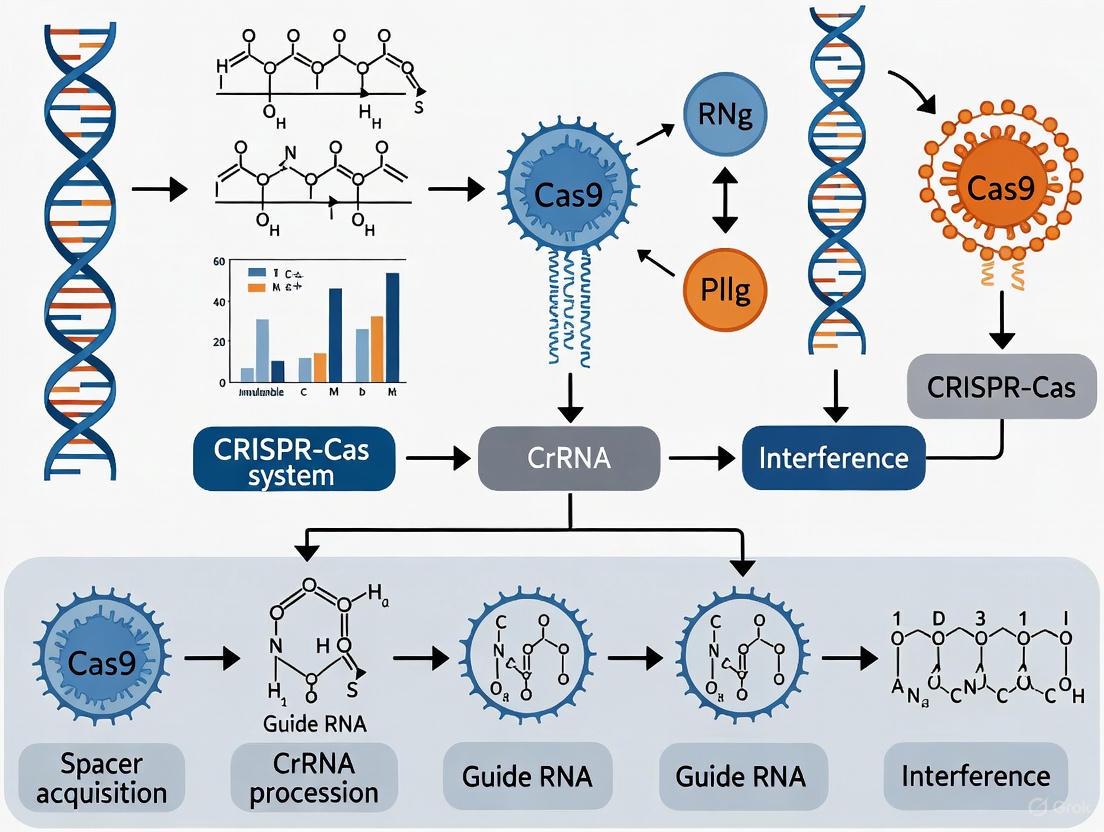
CRISPR-Cas Systems: From Bacterial Adaptive Immunity to Revolutionary Biomedical Applications
Levi JamesNov 27, 2025857
This article provides a comprehensive analysis of CRISPR-Cas systems, covering their fundamental role as adaptive immune mechanisms in prokaryotes and their transformative applications in biotechnology and medicine.
CRISPR-Cas Systems: From Bacterial Adaptive Immunity to Revolutionary Biomedical Applications
Abstract
This article provides a comprehensive analysis of CRISPR-Cas systems, covering their fundamental role as adaptive immune mechanisms in prokaryotes and their transformative applications in biotechnology and medicine. We explore the molecular architecture, classification, and mechanisms of these systems, detailing their evolution from bacterial defense to precision genome editing tools. The content examines cutting-edge therapeutic applications, including combating antimicrobial resistance and developing genetic therapies, while addressing critical challenges such as off-target effects and delivery optimization. Through comparative analysis of system variants and their validation methods, this resource serves researchers, scientists, and drug development professionals seeking to leverage CRISPR technologies for advanced biomedical innovation.
The Evolutionary Architecture of CRISPR-Cas Adaptive Immunity
The Clustered Regularly Interspaced Short Palindromic Repeats (CRISPR)-Cas system represents one of the most significant discoveries in molecular biology, transforming our understanding of bacterial immunity and revolutionizing genetic engineering. Originally observed as an enigmatic bacterial oddity, CRISPR-Cas is now recognized as a sophisticated adaptive immune system that provides prokaryotes with sequence-specific protection against mobile genetic elements. This remarkable biological mechanism enables bacteria and archaea to "remember" previous infections by storing fragments of invader DNA, subsequently utilizing this memory to identify and eliminate invading pathogens with remarkable precision [1]. The journey from initial observation to mechanistic understanding spans decades of research, culminating in the development of transformative genome-editing technologies that have reshaped modern biotechnology and therapeutic development.
The historical narrative of CRISPR-Cas reflects how fundamental research into seemingly obscure biological phenomena can yield profound insights with far-reaching implications. What began as a study of unusual repetitive sequences in bacterial genomes has evolved into a multifaceted field spanning microbiology, structural biology, and genomic medicine. This whitepaper traces the key discoveries and experimental approaches that elucidated CRISPR-Cas function, providing researchers and drug development professionals with a comprehensive technical framework for understanding this fundamental bacterial defense mechanism.
Historical Timeline: Key Discoveries and Milestones
Table 1: Historical Timeline of Key CRISPR-Cas Discoveries
Year
Discovery Milestone
Key Researchers/Teams
Significance
1987
First identification of unusual repetitive sequences in E. coli
Ishino et al.
Initial observation of what would later be recognized as CRISPR sequences [2]
2002
Term "CRISPR" coined and systematic analysis
Mojica et al., Jansen et al.
Recognition of CRISPR as a distinct family of DNA repeats with associated (cas) genes [2]
2005
Bioinformatics analysis reveals spacers derive from foreign genetic elements
Multiple groups
Hypothesis that CRISPR functions as an adaptive immune system [1]
2007
Experimental demonstration of adaptive immunity in Streptococcus thermophilus
Barrangou et al.
First direct evidence that CRISPR provides resistance against viruses [1]
2012-2013
Development of CRISPR-Cas9 as a programmable genome-editing tool
Doudna, Charpentier, and colleagues
Re-purposing of bacterial immune mechanism for genetic engineering [1]
2020
Nobel Prize in Chemistry awarded for CRISPR-Cas9 genome editing
Doudna and Charpentier
Recognition of the transformative potential of CRISPR technology [2]
2020-2025
Updated classification and discovery of novel systems
International consortium
Expansion to 2 classes, 7 types, and 46 subtypes reflecting system diversity [3]
Molecular Mechanisms: The Three Stages of CRISPR-Cas Immunity
The adaptation phase represents the memory formation stage of CRISPR-Cas immunity, where bacteria capture and integrate short fragments of invading nucleic acids into their genome as new spacers. This process is mediated by the conserved Cas1-Cas2 complex, which functions as a molecular integrase [4]. The Cas1-Cas2 heterohexameric complex comprises two Cas1 dimers and a Cas2 dimer, with Cas1 serving as the primary catalytic subunit while Cas2 provides structural support [4].
The molecular mechanism of spacer acquisition involves several precise steps:
Protospacer Selection: The Cas1-Cas2 complex identifies potential protospacers from foreign DNA, with selection guided by protospacer adjacent motifs (PAMs). These short (2-5 nucleotide) sequences flank the protospacer and enable discrimination between self and non-self DNA [4][5].
DNA Processing: The complex excises a protospacer of approximately 33 base pairs, with tyrosine residues (Tyr22) of Cas1 subunits binding to the foreign DNA and limiting the central duplex region to 23 base pairs [4].
Integration: The Cas1-Cas2 complex exhibits integrase activity, catalyzing the incorporation of new spacers into the CRISPR locus. This occurs through a two-step transesterification reaction where the 3'OH groups at each protospacer end perform nucleophilic attacks on the CRISPR locus, first at the leader-repeat junction and then at the repeat-spacer junction [4].
Ligation: Following integration, host DNA polymerases and ligation systems mediate the production of a new copy of the original repeat, completing the expansion of the CRISPR array [4].
In some CRISPR-Cas types, additional proteins facilitate adaptation. For example, in type II systems, Cas9 mediates spacer selection by recognizing PAM sequences, while Csn2 stabilizes dsDNA cleavage during spacer integration [4]. The host integration factor (IHF) induces CRISPR DNA bending in Gram-negative bacteria, facilitating the proximity of the Cas1-Cas2 complex to the leader-repeat junction [4].
crRNA Biogenesis: Generating Guide Molecules
The expression and maturation of CRISPR RNAs represents the information processing stage where the stored genetic memory is converted into functional guide molecules. This phase begins with transcription of the CRISPR array from the leader region, producing a long precursor CRISPR RNA (pre-crRNA) [5].
The processing mechanisms differ significantly between CRISPR classes:
Class 1 Systems: pre-crRNA is typically processed by the dedicated Cas6 ribonuclease, which trims the transcript to produce mature crRNAs, each containing a single spacer sequence flanked by partial repeat sequences [5]. The exception is subtype I-C, where processing is performed by Cas5 [5].
Class 2 Systems: pre-crRNA processing is conducted by the effector proteins themselves (Cas9, Cas12, and Cas13 for types II, V, and VI, respectively) [5]. Type II systems additionally require tracrRNA (trans-activating CRISPR RNA), RNase III, and other factors for proper crRNA maturation [5][2].
The mature crRNAs then assemble with Cas proteins to form effector complexes capable of target recognition and cleavage.
The interference phase represents the execution stage where CRISPR-Cas systems identify and destroy invading nucleic acids. This process involves crRNA-guided targeting of sequences complementary to the spacer region [1].
Table 2: Comparison of Interference Mechanisms Across Major CRISPR-Cas Types
Type
Signature Protein
Target
PAM Requirement
Cleavage Mechanism
I
Cas3
DNA
Yes
Cas3 helicase/nuclease recruited by Cascade complex for processive degradation [6]
A critical feature of DNA-targeting systems is the protospacer adjacent motif (PAM) requirement, which prevents autoimmunity by ensuring that CRISPR-Cas systems only target sequences containing this short motif that is absent from the host CRISPR locus [5]. Upon target recognition, conformational changes activate nuclease domains that cleave the invading nucleic acid, providing immunity against the genetic element corresponding to the spacer.
Classification and Diversity of CRISPR-Cas Systems
Evolutionary Classification Framework
CRISPR-Cas systems demonstrate remarkable diversity reflective of the ongoing evolutionary arms race between prokaryotes and their genetic parasites. The current classification scheme, updated in 2025, organizes these systems into 2 classes, 7 types, and 46 subtypes based on effector module architecture and signature genes [3].
Table 3: Updated Classification of CRISPR-Cas Systems (2025)
The fundamental distinction between Class 1 and Class 2 systems lies in their effector module organization. Class 1 systems utilize multi-protein effector complexes, while Class 2 systems employ a single large effector protein for target recognition and cleavage [6]. Class 1 systems are phylogenetically widespread and particularly dominant in archaea, whereas Class 2 systems are primarily found in bacteria and appear to have evolved more recently [1][6].
Classification Visualization
Experimental Approaches: Methodologies for Studying CRISPR-Cas Function
Key Experimental Protocols
The elucidation of CRISPR-Cas mechanisms has relied on diverse experimental approaches spanning genetics, biochemistry, and structural biology. Key methodologies include:
Spacer Acquisition Assay:
Purpose: Demonstrate adaptive spacer integration following phage challenge
Protocol:
Challenge naive bacterial cells with bacteriophages at appropriate MOI
Recover surviving colonies and culture for subsequent generations
Isolate genomic DNA and amplify CRISPR locus by PCR
Sequence CRISPR arrays to identify newly acquired spacers
Bioinformatics analysis to match new spacers to phage genome sequences
Key Finding: Streptococcus thermophilus acquired new spacers from phage DNA following infection, conferring resistance to subsequent challenges [1]
In Vitro Interference Assay:
Purpose: Reconstitute target cleavage using purified components
Protocol:
Purify Cas effector proteins (e.g., Cas9) and express guide RNAs
Form ribonucleoprotein complexes in appropriate buffer conditions
Incubate with target DNA substrates containing PAM sequences
Analyze cleavage products by gel electrophoresis
Verify specificity using mutated target sequences
Key Finding: Cas9-crRNA complexes cleave target DNA in a PAM-dependent manner [7]
CRISPR Knockout Validation:
Purpose: Verify gene disruption via CRISPR-induced mutations
Protocol:
Transfert cells with plasmids expressing Cas9 and target-specific gRNA
Isolate genomic DNA from transfected populations or clones
Amplify target region by PCR and analyze by:
Restriction fragment length polymorphism (if cleavage disrupts site)
T7 endonuclease I mismatch detection assay
Sanger sequencing of cloned PCR products
Quantify indel frequency by next-generation sequencing
Application: Demonstration of efficient gene knockout in diverse cell types [7]
The Scientist's Toolkit: Essential Research Reagents
Table 4: Essential Research Reagents for CRISPR-Cas Studies
Reagent Category
Specific Examples
Function/Application
Technical Notes
Cas Expression Plasmids
pCas9 (Addgene #42876), pCas3 (Addgene #133773)
Delivery of Cas nucleases to target cells
Select based on target organism and delivery method [8][7]
Guide RNA Vectors
pCas12f1, multiplex gRNA plasmids
Express single or multiple guide RNAs for target recognition
Multiplex systems enable simultaneous targeting of 2-7 loci [8][7]
Engineered Cas Variants
eSpCas9(1.1), SpCas9-HF1, HypaCas9, xCas9
Enhanced specificity reduced off-target effects
High-fidelity variants contain point mutations that reduce non-specific DNA binding [7]
PAM-Flexible Cas9s
SpCas9-NG, SpG, SpRY
Recognize non-NGG PAM sequences expanding target range
Choice depends on target cell type and application (in vitro vs in vivo)
Validation Tools
T7E1 assay, next-generation sequencing, digital PCR
Detect and quantify genome editing outcomes
Essential for measuring editing efficiency and specificity
The journey of CRISPR-Cas from bacterial oddity to understood adaptive immune mechanism represents a paradigm shift in molecular biology. What began as fundamental research into bacterial repeat sequences has revealed sophisticated biological systems that maintain microbial diversity by regulating virus-host interactions. The classification of these systems continues to expand as new variants are discovered, particularly among the "long tail" of rare systems in diverse prokaryotic lineages [3].
The mechanistic understanding of CRISPR-Cas function has enabled its repurposing as a programmable genome engineering tool, revolutionizing genetic research and therapeutic development. CRISPR-based technologies now enable precise gene editing, transcriptional regulation, and diagnostic applications across diverse biological systems [9][2]. Furthermore, native CRISPR-Cas systems are being harnessed as sequence-specific antimicrobials to combat antibiotic resistance by targeting resistant genes in bacterial pathogens [8].
The historical elucidation of CRISPR-Cas mechanisms continues to inspire new technologies and applications at the intersection of microbiology, genetics, and medicine. As research progresses, further insights into the regulation and evolution of these remarkable systems will undoubtedly yield additional tools for understanding and manipulating biological systems, solidifying the legacy of this fundamental discovery from bacterial immunity.
The Clustered Regularly Interspaced Short Palindromic Repeats (CRISPR) and CRISPR-associated (Cas) genes system functions as an adaptive immune system in prokaryotes, enabling bacteria and archaea to defend themselves against invading genetic elements such as viruses and plasmids [10][2]. This defense system allows organisms to "remember" previous infections by incorporating short sequences from the invader's genome into their own CRISPR locus, providing a genetic record that confers immunity upon subsequent encounters [11]. The discovery of this mechanism has revolutionized molecular biology, transforming CRISPR-Cas from a fundamental biological phenomenon into a versatile technological tool for precise genome editing across diverse applications [10][12]. The system's ability to perform targeted DNA modification has paved the way for unprecedented advances in biomedical research, therapeutic development, and agricultural biotechnology [2].
The significance of CRISPR-Cas systems extends far beyond their natural immunological function. Since their adaptation for genome engineering in 2012, these systems have become the most widely used genome editing technology in molecular biology laboratories worldwide due to their simple design, low cost, high efficiency, good repeatability, and short cycle times [10]. This technical guide provides an in-depth examination of the core molecular components of CRISPR-Cas systems, detailing their structure, function, and classification within the context of bacterial adaptive immunity research.
Core Components of the CRISPR-Cas System
CRISPR Locus Architecture
The CRISPR locus represents a distinctive genetic element composed of three fundamental components that work in concert to provide adaptive immunity:
Direct Repeats: Short, palindromic DNA sequences (typically 28-37 base pairs in length) that are repeated at regular intervals and read the same in both directions [2]. These repeats form the structural backbone of the CRISPR array and are partially transcribed into the CRISPR RNA (crRNA) that guides target recognition.
Spacers: Unique DNA sequences (generally 32-38 base pairs in length) situated between the direct repeats [2]. These sequences are derived from fragments of foreign genetic material that previously infected the bacterium, serving as a molecular memory of past invasions. The spacers are acquired from mobile genetic elements (MGEs), including bacteriophages, transposons, or plasmids [2].
Leader Sequence: An AT-rich region located upstream of the CRISPR array that functions as a promoter for transcription of the CRISPR locus [2]. This region plays a crucial role in the adaptation stage by facilitating the integration of new spacers into the CRISPR array.
Table 1: Core Components of a CRISPR Locus
Component
Length Range
Function
Characteristics
Direct Repeats
28-37 bp
Structural framework, partially transcribed into crRNA
Palindromic sequences
Spacers
32-38 bp
Immunological memory from previous invasions
Derived from foreign DNA
Leader Sequence
Variable
Promoter for transcription & spacer integration
AT-rich region
The molecular anatomy of a typical CRISPR array is visualized below, depicting the arrangement of repeats, spacers, and the leader sequence:
Diagram 1: Architecture of a CRISPR array showing repeats, spacers, and leader sequence.
Cas Genes and Proteins
The Cas genes encode the protein machinery that executes all functional stages of the CRISPR-Cas immune response. These genes are typically located adjacent to the CRISPR array and can be grouped into core Cas genes that are widely conserved across different system types, and subtype-specific genes that define particular functional characteristics [2].
The core Cas proteins include:
Cas1 and Cas2: Universal components found in nearly all CRISPR-Cas systems that form the adaptation module responsible for acquiring new spacers from invading DNA [2]. These proteins work together to recognize foreign DNA, process it into appropriate fragments, and catalyze the integration of new spacers into the CRISPR array.
Effector Cas Proteins: Execute the interference stage by targeting and cleaving foreign nucleic acids. The composition of effector complexes varies significantly between different classes of CRISPR-Cas systems, with Class 1 systems utilizing multi-protein complexes and Class 2 systems employing single effector proteins such as Cas9 or Cas12 [10][3].
Table 2: Core Cas Protein Functions
Cas Protein
Primary Function
Conservation
Cas1
Spacer acquisition
Universal
Cas2
Spacer acquisition
Universal
Cas3
DNA cleavage (Type I)
Type I-specific
Cas9
DNA cleavage (Type II)
Type II-specific
Cas10
DNA/RNA cleavage (Type III)
Type III-specific
Cas12
DNA cleavage (Type V)
Type V-specific
Cas13
RNA cleavage (Type VI)
Type VI-specific
Classification of CRISPR-Cas Systems
CRISPR-Cas systems demonstrate remarkable diversity in their composition and mechanisms, leading to their classification into distinct types and subtypes based on evolutionary relationships, gene content, and effector complex organization [3]. The current classification scheme recognizes 2 classes, 7 types, and 46 subtypes, reflecting the expanding understanding of system diversity [3].
Class 1 vs. Class 2 Systems
The fundamental division in CRISPR-Cas taxonomy separates systems into two broad classes based on the architecture of their effector complexes:
Class 1 Systems: Characterized by multi-subunit effector complexes that require multiple Cas proteins to form a functional interference machinery. This class includes Types I, III, IV, and VII[10][3]. Class 1 systems are generally more prevalent in archaea and bacteria, with Type I being the most common among prokaryotes.
Class 2 Systems: Employ single, large effector proteins for target recognition and cleavage, making them structurally simpler and more amenable to biotechnological applications. This class includes Types II, V, and VI[10][2]. The simplicity of Class 2 systems, particularly Type II with its signature Cas9 protein, has facilitated their widespread adoption in genome engineering applications.
Table 3: CRISPR-Cas System Classification and Key Characteristics
Class
Type
Signature Gene
Effector Complex
Target
PAM Requirement
Class 1
I
Cas3
Multi-protein
dsDNA
Yes
III
Cas10
Multi-protein
ssRNA/DNA
No
IV
DinG
Multi-protein
dsDNA
Unknown
VII
Cas14
Multi-protein
RNA
Unknown
Class 2
II
Cas9
Single protein
dsDNA
NGG
V
Cas12
Single protein
dsDNA
AT-rich
VI
Cas13
Single protein
ssRNA
Non-G
The evolutionary relationships between different CRISPR-Cas types and their functional specializations are illustrated below:
Diagram 2: Classification of CRISPR-Cas systems showing 2 classes and 7 types.
Molecular Mechanisms of CRISPR-Cas Immunity
The adaptive immune function of CRISPR-Cas systems operates through three distinct stages that collectively provide sequence-specific protection against invading genetic elements.
Adaptation Stage
The adaptation phase represents the immunological memory formation step where the system captures and integrates fragments of foreign DNA into the host genome:
Recognition: Cas1 and Cas2 proteins form a complex that surveys intracellular DNA, identifying foreign nucleic acids through recognition of protospacer adjacent motifs (PAMs) or other structural features [10][2].
Processing: The Cas1-Cas2 complex excises a short fragment (protospacer) from the invading DNA and processes it to an appropriate length for integration [2].
Integration: The processed spacer is inserted into the CRISPR array as a new spacer adjacent to the leader sequence, creating a permanent genetic record of the infection [11].
Recent research has revealed that bacteria preferentially acquire spacers from viruses in a dormant state (lysogeny), as this temporary cessation of viral activity provides the bacterial CRISPR system sufficient time to capture and integrate viral DNA fragments [11].
Expression Stage
During the expression stage, the genetic information stored in the CRISPR array is transcribed and processed into functional guide RNAs:
Transcription: The entire CRISPR array is transcribed as a long precursor CRISPR RNA (pre-crRNA) under the control of the leader sequence promoter [12].
Processing: The pre-crRNA is cleaved at the boundaries of each repeat sequence by specific Cas proteins (e.g., Cas6 in Type I and III systems, or RNase III in conjunction with tracrRNA in Type II systems) to generate mature crRNAs, each containing a single spacer sequence [12].
Effector Complex Formation: Individual crRNAs assemble with Cas proteins to form functional interference complexes ready for target recognition [10].
Interference Stage
The interference stage represents the execution phase of immunity, where the system identifies and eliminates foreign genetic elements:
Surveillance: The crRNA-loaded effector complex scans intracellular DNA or RNA for sequences complementary to the spacer sequence [10].
Target Recognition: Upon encountering a complementary sequence adjacent to an appropriate PAM, the effector complex undergoes conformational changes that activate its nuclease activity [7]. The PAM sequence is critical for self/non-self discrimination, as it prevents the CRISPR system from targeting the host's own CRISPR arrays [2].
Cleavage: Activated effector nucleases cleave the target nucleic acid, neutralizing the threat. Different CRISPR types employ distinct cleavage mechanisms:
Type II (Cas9) uses RuvC and HNH nuclease domains to cut target DNA [10]
Type V (Cas12) utilizes a single RuvC domain for DNA cleavage [10]
Type VI (Cas13) employs two HEPN domains to degrade RNA targets [10]
The complete CRISPR-Cas immune response pathway, integrating all three stages, is illustrated below:
Diagram 3: The three-stage CRISPR-Cas adaptive immune pathway.
Experimental Protocols for CRISPR-Cas Research
CRISPR Array Identification and Analysis
Protocol 1: Computational Identification of CRISPR Arrays in Genomic Sequences
Principle: CRISPR arrays can be identified in genomic sequences through bioinformatic analysis based on their characteristic architecture of short, direct repeats separated by similarly-sized, non-repetitive spacers [13].
Methodology:
Sequence Input: Provide genomic DNA sequence in FASTA format.
Maximal Repeat Detection: Identify all maximal repeats (23-55 bp) with gap sizes of 25-60 bp using algorithms like VMatch, which implements enhanced suffix arrays for computational efficiency [13].
CRISPR Validation: Apply filters to eliminate false positives:
Spacer size should be 0.6 to 2.5 times the repeat size
Spacer similarity should be <60% to exclude tandem repeats
Assess internal repeat conservation and spacer divergence [13]
Orientation Prediction: Determine CRISPR orientation using the CRISPRDirection program through comparison to curated consensus repeats or AT% analysis of flanking regions [13].
Evidence Rating: Classify arrays using Evidence Level 1-4, with Level 4 representing the highest confidence arrays based on repeat and spacer conservation [13].
Protocol 2: Identification and Classification of cas Genes
Principle: Cas genes are identified through homology searches and classified based on their association with specific CRISPR-Cas types and subtypes [13][14].
Methodology:
Open Reading Frame Prediction: Identify all potential coding sequences using programs such as Prodigal [13].
HMM Search: Analyze predicted proteins against hidden Markov model (HMM) profiles of known Cas proteins using MacSyFinder [13].
Cluster Analysis: Identify complete Cas gene clusters and assign type/subtype based on gene composition and organization [13].
Functional Annotation: Annotate specific domains and catalytic residues to predict molecular function.
Protocol 3: Experimental Validation of CRISPR-Cas Immune Function
Principle: The functionality of CRISPR-Cas systems can be validated through spacer acquisition assays and interference activity tests [11].
Methodology:
Spacer Acquisition Assay:
Infect bacteria with phages (either wild-type or engineered mutants)
Allow survival of infected cells
Sequence CRISPR loci of survivors to detect new spacers
Compare spacer acquisition rates from active vs. dormant phages [11]
Interference Assay:
Challenge bacteria with previously encountered phages
Measure survival rates and phage propagation
Sequence targeted phage genomes to verify cleavage at expected positions
Assess requirement for PAM sequences in immunity [11]
Cross-talk Analysis:
Investigate potential cooperation between different CRISPR-Cas subtypes
Test primed spacer acquisition between systems
Analyze enhanced immunity through system cooperation [15]
The Scientist's Toolkit: Essential Research Reagents
Table 4: Essential Research Reagents for CRISPR-Cas Studies
Reagent/Solution
Function
Application Examples
Cas9 Nucleases
RNA-guided DNA endonuclease
Genome editing, gene knockout
Guide RNA Vectors
Target specification
Customizing genomic targets
dCas9 Effectors
DNA binding without cleavage
Gene regulation, imaging
Base Editors
Precision point mutation
Single nucleotide editing
CRISPR Libraries
Genome-wide screening
Functional genomics
Cas Variants (Cas12, Cas13)
Alternative targeting
DNA/RNA editing, diagnostics
HMM Databases
Cas protein identification
Bioinformatics classification
CRISPR Detection Tools
Array identification
Genomic analysis
Advanced Concepts and Recent Developments
System Engineering and Optimization
The native CRISPR-Cas machinery has been extensively engineered to enhance its functionality and expand its applications:
High-Fidelity Cas Variants: Engineered Cas9 proteins with reduced off-target effects, including eSpCas9(1.1), SpCas9-HF1, HypaCas9, and evoCas9, which improve specificity through various mechanisms such as weakening non-target strand interactions or enhancing proofreading capabilities [7].
PAM Flexibility Engineering: Modified Cas variants with altered PAM specificities (xCas9, SpCas9-NG, SpG, SpRY) that expand the targetable genomic space beyond the canonical NGG PAM sequence [7].
Multiplexing Systems: Approaches for simultaneous targeting of multiple genomic loci using arrays of guide RNAs, with Cas12a (Cpf1) offering particularly efficient multiplexing capabilities due to its simpler guide RNA requirements [7].
CRISPR-Cas System Crosstalk
Recent research has revealed that different CRISPR-Cas systems within the same bacterium can engage in functional cooperation, demonstrating an unprecedented level of crosstalk that enhances overall adaptive immunity [15]. This cooperative behavior between different CRISPR-Cas subtypes enables primed spacer acquisition, where one system can facilitate adaptation for another, creating a more robust immune network than previously appreciated [15].
Emerging CRISPR-Cas Types
The diversity of CRISPR-Cas systems continues to expand with the discovery of previously unknown types and subtypes. Recent additions to the classification include:
Type VII Systems: Recently identified systems found predominantly in diverse archaeal genomes that feature Cas14 effector proteins containing metallo-β-lactamase (β-CASP) nuclease domains and target RNA in a crRNA-dependent manner [3].
Specialized Type III Subtypes: Newly characterized variants including III-G, III-H, and III-I that show evidence of reductive evolution, with inactivated polymerase/cyclase domains in Cas10 and loss of ancillary signaling components [3].
The molecular anatomy of CRISPR-Cas systems reveals an exquisite evolutionary adaptation that transforms prokaryotic organisms from passive victims of viral infection into active defenders with a sophisticated immunological memory. The core components—CRISPR arrays serving as genetic archives of past invasions, and Cas proteins functioning as the execution machinery of immunity—represent one of nature's most remarkable nucleic acid-targeting systems. The continuing expansion of CRISPR-Cas classification, with 7 types and 46 subtypes currently identified, underscores both the diversity of these systems and the ongoing nature of discovery in this field [3].
For research scientists and drug development professionals, understanding the fundamental architecture and mechanisms of native CRISPR-Cas systems provides the essential foundation for developing novel applications in biotechnology and medicine. The precise targeting programmability of these systems, particularly the single-protein effectors of Class 2, has already revolutionized genome engineering, but their complete potential remains to be explored. As research continues to uncover new CRISPR-Cas variants and elucidate the complexities of their natural functions, particularly the emerging understanding of inter-system crosstalk [15], the toolkit available for technological development will continue to expand, opening new frontiers in genetic medicine, diagnostic applications, and therapeutic interventions.
Clustered Regularly Interspaced Short Palindromic Repeats (CRISPR) and CRISPR-associated (Cas) proteins constitute an adaptive immune system in prokaryotes that provides sequence-specific protection against foreign genetic elements such as viruses and plasmids [16][17]. These systems function through three distinct operational stages: adaptation, expression, and interference [16][18]. During adaptation, short fragments of foreign DNA (protospacers) are integrated into the host genome as new spacers in the CRISPR array [18]. In the expression stage, the CRISPR array is transcribed and processed into mature CRISPR RNAs (crRNAs) [16]. Finally, during interference, Cas protein-effector complexes programmed by crRNAs recognize and cleave complementary nucleic acids from invading genetic elements [16][18]. The extraordinary diversity of CRISPR-Cas systems has necessitated a robust classification framework that reflects evolutionary relationships and functional mechanisms [3][16]. This framework has evolved significantly, with the most recent classification encompassing 2 classes, 7 types, and 46 subtypes, demonstrating the rapid expansion of our understanding of these systems [3].
Hierarchical Classification Structure
The classification of CRISPR-Cas systems employs a polythetic approach that combines phylogenetic analysis of conserved Cas proteins with comparative analysis of gene repertoires and organizational architecture of CRISPR-cas loci [16]. This hierarchical system organizes CRISPR-Cas systems into classes, types, and subtypes based on evolutionary relationships and mechanistic differences.
Classification Hierarchy
The fundamental hierarchy flows from class to type to subtype, with two overarching classes distinguished by the architecture of their effector modules [3][19]:
Class 1: Systems utilize multi-subunit effector complexes [20][19]
Class 2: Systems utilize single-protein effector modules [20][19]
Within these classes, systems are further categorized into types based on their signature genes and effector mechanisms, and subsequently into subtypes based on more nuanced genetic and structural features [3][16].
Table 1: Overview of CRISPR-Cas System Classification
Class
Types
Signature Gene/Effector
Target
Effector Complexity
Class 1
I
Cas3
dsDNA
Multi-subunit (Cascade)
III
Cas10
DNA/RNA
Multi-subunit (Csm/Cmr)
IV
DinG, Csf1
dsDNA (putative)
Multi-subunit
VII
Cas14
RNA
Multi-subunit
Class 2
II
Cas9
dsDNA
Single protein
V
Cas12 (Cpf1)
dsDNA/ssDNA
Single protein
VI
Cas13 (C2c2)
RNA
Single protein
Distribution and Abundance
Class 1 systems represent approximately 90% of all identified CRISPR-Cas systems in bacteria and nearly 100% in archaea, while Class 2 systems are less common but have been more extensively exploited for biotechnological applications [19]. The recently characterized variants, particularly type VII systems, are considered rare and comprise what researchers describe as "the long tail" of the CRISPR-Cas distribution in prokaryotes and their viruses [3].
Class 1 Systems: Multi-Subunit Effector Complexes
Class 1 systems are characterized by their utilization of multi-protein effector complexes for target recognition and cleavage [20][19]. These systems include types I, III, IV, and the recently identified type VII [3].
Type I Systems
Type I systems represent the most prevalent CRISPR-Cas type across prokaryotes [19]. These systems employ the CRISPR-associated complex for antiviral defense (Cascade) for crRNA processing and target recognition, and the Cas3 protein for DNA degradation [18].
Key Characteristics:
Signature Protein: Cas3, which possesses both helicase and nuclease activities [19][17]
Recognition: Requires a protospacer adjacent motif (PAM) sequence [17]
Mechanism: Cascade recognizes and unwinds target DNA, then recruits Cas3 which processively degrades DNA in both directions from the target site [19][18]
Type I systems are currently divided into seven subtypes (I-A through I-F, and I-U) [17], with additional variants recently identified such as I-E2 and I-F4 that incorporate HNH nucleases [3].
Type III Systems
Type III systems are among the most complex CRISPR-Cas systems and are hypothesized to represent an ancestral form from which other systems evolved [19].
Key Characteristics:
Signature Protein: Cas10, which contains polymerase/cyclase domains [19][17]
PAM Requirement: Does not require a PAM sequence [17]
Unique Features: Can target transcriptional templates (DNA) and products (RNA) simultaneously [17]; often activate cyclic oligoadenylate (cOA) signaling pathways that induce collateral RNase activity [3]
Type III systems include subtypes III-A through III-D, with recent additions of III-G, III-H, and III-I [3]. The III-E subtype features a unique fused effector protein called Cas7-11 (originally Cas7-11e) [3][19].
Type IV Systems
Type IV systems are poorly characterized "putative" systems that lack complete adaptive immune functionality [19].
Key Characteristics:
Signature Components: Distinct Cas7-type gene and DinG helicase [3][19]
Deficiencies: Lack adaptation modules (Cas1-Cas2) and often lack nucleases [19]
Genomic Context: Typically located on plasmids [19]
The function of type IV systems remains unclear, though hypotheses suggest roles in plasmid competition or the ability to hijack machinery from other CRISPR systems [19].
Type VII Systems
Type VII represents the most recent addition to CRISPR-Cas classification, identified through deep terascale clustering of genomic data [3][19].
Key Characteristics:
Signature Protein: Cas14, a metallo-β-lactamase (β-CASP) effector nuclease [3]
Evolution: Believed to have evolved reductively from type III systems [3]
Type VII effector complexes can contain up to 12 subunits, making them among the largest Class 1 effector complexes [3].
Class 2 Systems: Single-Protein Effector Modules
Class 2 systems utilize single, multi-domain effector proteins for nucleic acid targeting and cleavage, making them particularly amenable to biotechnological applications [20][19]. These systems include types II, V, and VI.
Type II Systems
Type II systems are the most well-known and widely utilized CRISPR systems, largely due to the revolutionary Cas9 enzyme [10][19].
crRNA Processing: Requires both crRNA and trans-activating crRNA (tracrRNA), with RNase III involvement [18]
Mechanism: Creates blunt-ended double-strand breaks in target DNA using HNH and RuvC nuclease domains [10]
Type II systems are divided into subtypes II-A, II-B, and II-C based on variations in Cas9 and the presence of additional genes such as Csn2 in II-A systems [16][17].
Type V Systems
Type V systems utilize Cas12 effectors (including Cpf1) and offer distinct mechanistic advantages for certain applications [10][19].
Mechanism: Contains two Higher Eukaryotes and Prokaryotes Nucleotide-binding (HEPN) RNase domains that cleave target RNA [10]
Applications: RNA knockdown, tracking, and diagnostics (e.g., SHERLOCK) [20][19]
Type VI systems include subtypes VI-A through VI-D, with variations in protospacer flanking site (PFS) requirements [10].
Table 2: Key Features of Class 2 CRISPR Effector Proteins
Effector
Type
Target
Nuclease Domains
tracrRNA Requirement
PAM/PFS
Cleavage Pattern
Cas9
II
dsDNA
RuvC, HNH
Yes
3' NGG (SpCas9)
Blunt ends
Cas12a
V-A
dsDNA
RuvC, Nuc
No
5' T-rich
Staggered ends
Cas12b
V-B
dsDNA
RuvC
Yes
5' AT-rich
Staggered ends
Cas13a
VI-A
ssRNA
2x HEPN
No
3' non-G
RNA cleavage
Cas13b
VI-B
ssRNA
2x HEPN
No
5' non-C; 3' NAN/NNA
RNA cleavage
Cas13d
VI-D
ssRNA
2x HEPN
No
Variable
RNA cleavage
Experimental Characterization of CRISPR-Cas Systems
Computational Identification and Classification
The identification and classification of novel CRISPR-Cas systems begins with comprehensive computational analysis [16]:
Genomic Sequence Analysis:
Search for CRISPR arrays using repeat detection algorithms (e.g., CRISPRFinder, PILER-CR)
Identify clustered cas genes in genomic neighborhoods adjacent to CRISPR arrays
Annotate cas genes using profile-based search methods (HHpred, PSI-BLAST) against curated Cas protein databases
Classification Methodology:
Determine class based on effector module architecture (multi-subunit vs. single effector)
Identify signature proteins (Cas3 for type I, Cas9 for type II, Cas10 for type III, etc.)
Analyze phylogenetic relationships of conserved proteins (Cas1, Cas2)
Compare gene repertoire and organizational structure of loci
Assign subtype based on combination of above criteria
Functional Characterization of Novel Systems
For experimentally validating the function of newly identified systems, particularly rare variants from the "long tail" of CRISPR diversity [3], researchers employ standardized protocols:
Interference Assay Protocol:
Clone candidate CRISPR-Cas locus into expression vector
Introduce reporter plasmid containing potential protospacer with PAM variants
Co-transform into phage-free expression host (e.g., E. coli BL21)
Measure reporter loss via antibiotic resistance or fluorescence markers
Confirm cleavage sites through sequencing of degradation products
Biochemical Characterization:
Express and purify effector complex components
Reconstitute complex in vitro with synthetic crRNAs
Assess nucleic acid binding via electrophoretic mobility shift assays (EMSAs)
Determine cleavage specificity and kinetics using labeled substrate assays
Identify cofactor requirements (Mg²⁺, Mn²⁺, etc.)
Structural Analysis:
Determine complex architecture via negative stain electron microscopy
Resolve high-resolution structure using cryo-EM single particle analysis
Identify functional domains through comparative structural analysis
Map catalytic residues via mutagenesis and functional assays
Diagram 1: CRISPR-Cas System Classification Hierarchy. This diagram illustrates the hierarchical organization of CRISPR-Cas systems, showing the relationship between classes, types, and their signature proteins.
The Scientist's Toolkit: Essential Research Reagents
Table 3: Essential Reagents for CRISPR-Cas System Research
Reagent Category
Specific Examples
Research Application
Technical Considerations
Expression Vectors
pET, pACYCDuet, pCDF
Recombinant protein expression
Compatible origins, selection markers
Host Strains
E. coli BL21(DE3), E. coli DH10B
Transformation and protein production
Phage-free, restriction-deficient
Purification Systems
His-tag, GST-tag, Strep-tag
Protein complex purification
Maintain complex integrity
Nucleic Acid Substrates
Fluorescently-labeled oligonucleotides
Cleavage assays
Include PAM sequences
Cell-Free Systems
PURExpress, wheat germ extract
In vitro characterization
Controlled reaction conditions
Structural Biology
Grids, negative stains, cryo-protectants
EM sample preparation
Complex homogeneity
Antibodies
Anti-Cas, anti-tag antibodies
Western blot, immunoprecipitation
Specificity validation
The classification framework for CRISPR-Cas systems continues to evolve as new sequencing technologies and bioinformatic approaches reveal unprecedented diversity in prokaryotic adaptive immune systems [3]. The expansion from 6 types and 33 subtypes to 7 types and 46 subtypes in just five years demonstrates the rapid pace of discovery in this field [3]. This refined classification not only provides a systematic framework for understanding the natural biology of these systems but also informs the selection of appropriate tools for biotechnological applications. As research progresses, particularly into the "long tail" of rare CRISPR variants, this classification framework will continue to serve as an essential foundation for exploring the remarkable diversity of microbial defense systems and harnessing their capabilities for scientific and therapeutic advancement.
The Clustered Regularly Interspaced Short Palindromic Repeats (CRISPR) and their CRISPR-associated (Cas) proteins constitute an adaptive immune system that confers prokaryotes with sequence-specific defense against mobile genetic elements (MGEs), including viruses and plasmids [1][21]. Since its discovery, the system has been identified across diverse bacterial and archaeal lineages, though its distribution is notably uneven [22][2]. Understanding the prevalence and architectural complexity of CRISPR-Cas systems in these two domains is fundamental to appreciating their evolutionary biology and their potential applications in biotechnology and medicine.
This review synthesizes current data on the distribution of CRISPR-Cas systems across Bacteria and Archaea, framing it within the broader thesis of their role in prokaryotic adaptive immunity. We provide a comparative analysis of system prevalence, classification, and complexity, and explore the functional implications of these distributions, particularly regarding horizontal gene transfer (HGT) and antibiotic resistance.
Comparative Prevalence and Diversity
The distribution of CRISPR-Cas systems between Archaea and Bacteria is quantitatively and qualitatively distinct. Archaea demonstrate a significantly higher prevalence of these systems compared to Bacteria.
Table 1: Comparative Prevalence of CRISPR-Cas Systems in Prokaryotes
Broader mix of Class 1 and Class 2 systems; prevalence influenced by ecological pressures [22][23].
This disparity is attributed to different evolutionary pressures and ecological niches. Archaea, particularly hyperthermophiles, are thought to be frequently exposed to viral attacks, favoring the retention of robust adaptive immune systems [22][23]. In contrast, Bacteria have diversified into a wider range of habitats and face diverse threats, including antibiotics, leading to a greater reliance on alternative defense mechanisms in many lineages [22][23].
Beyond simple prevalence, the diversity and complexity of the systems also vary. Archaea not only possess CRISPR-Cas systems more frequently but also exhibit a greater number and complexity of CRISPR loci within their genomes [22][23]. Furthermore, the types of systems found in each domain differ. Archaeal systems are almost exclusively Class 1, which utilize multi-protein effector complexes [22][1]. Bacterial genomes, meanwhile, harbor a mix of Class 1 and Class 2 systems, with Class 1 still representing the majority (~75%) of detected systems in studied genomes [22][23]. Class 2 systems, which rely on a single large Cas protein (e.g., Cas9, Cas12) for interference, are predominantly found in Bacteria [1].
The following diagram illustrates the logical relationship between habitat, selective pressure, and the resulting prevalence and complexity of CRISPR-Cas systems in the two prokaryotic domains.
Updated Classification of CRISPR-Cas Systems
The classification of CRISPR-Cas systems is continuously refined as new variants are discovered. The most current classification scheme, based on evolutionary relationships, includes 2 classes, 7 types, and 46 subtypes[3]. This represents a significant expansion from the previous classification of 6 types and 33 subtypes, highlighting the rapid discovery of novel systems, many of which are relatively rare [3].
Class 1 (Types I, III, IV, and the newly defined VII) use multi-protein effector complexes. These systems are evolutionarily ancient and are the most prevalent in nature, found in both Bacteria and Archaea [1][3].
Class 2 (Types II, V, and VI) utilize a single, large Cas effector protein (e.g., Cas9 for Type II, Cas12 for Type V, Cas13 for Type VI). These systems are predominantly found in Bacteria and are the primary drivers of CRISPR-based biotechnology due to their simplicity [1][24].
Recent discoveries have characterized the Type VII system, often found in archaea. Its signature effector, Cas14, is a β-CASP family nuclease that targets RNA. Type VII loci typically lack adaptation modules and are thought to have evolved reductively from Type III systems [3]. Other newly identified variants include subtypes III-G, III-H, and III-I, which also show features of reductive evolution, such as inactivated enzymatic domains in the Cas10 protein [3].
Table 2: Key Characteristics of Major CRISPR-Cas Types
Functional Implications: CRISPR-Cas and Antibiotic Resistance
A critical functional consequence of CRISPR-Cas activity is its role in regulating horizontal gene transfer (HGT). By targeting and cleaving foreign genetic elements, these systems can prevent the acquisition of plasmids and other MGEs that often carry antibiotic resistance genes [22][25].
Substantial research indicates an inverse correlation between the presence of a functional CRISPR-Cas system and the prevalence of antibiotic resistance genes (ARGs). A 2025 genomic analysis found that bacteria lacking CRISPR-Cas systems displayed a higher prevalence of ARGs, suggesting the system acts as a barrier to HGT [22]. This finding is supported by clinical studies; for instance, in Klebsiella pneumoniae, the presence of a subtype I-E CRISPR-Cas system was significantly correlated with a lower frequency of extended-spectrum β-lactamase (ESBL) and other antibiotic resistance genes [25].
This relationship positions the CRISPR-Cas system as a key player in bacterial evolution, offering a selective trade-off: robust defense against viruses at the potential cost of limiting the acquisition of beneficial genes, including those conferring antibiotic resistance [22][23].
Experimental Protocols for Identification and Analysis
The identification and characterization of CRISPR-Cas systems in prokaryotic genomes rely on a suite of bioinformatic and molecular biology tools. The following workflow outlines a standard methodology for such analyses.
Detailed Methodological Steps
1. Genome Selection and Curation:
Source: Obtain complete, assembled genomic sequences from public databases like the National Center for Biotechnology Information (NCBI) or the Genomes OnLine Database (GOLD) [23].
Criterion: Apply strict inclusion criteria to avoid redundancy and ensure data quality. This typically involves selecting one representative genome per species and confirming assembly completeness (100%) [23]. For comparative studies, include control groups (e.g., bacteria without confirmed CRISPR structures).
2. Identification of CRISPR Arrays:
Tool: Use specialized algorithms such as CRISPRFinder[23].
Parameters: The search is configured with default parameters, including a repeat length of 23-55 base pairs, a spacer size of 25-60 bp, and allowing for a 20% nucleotide mismatch between repeats [23]. Small structures with few repeats are classified with a level of evidence and require internal conservation of repeats and spacer divergence to be validated.
3. Identification of cas Genes:
ORF Prediction: First, identify all open reading frames (ORFs) in the genomic sequence using tools like Prodigal[23].
Gene Assignment: Analyze the predicted ORFs using MacSyFinder with Hidden Markov Models (HMMs) of known Cas proteins. Alternatively, perform homology searches using BLAST against databases of Cas protein sequences [23]. This step identifies the cas genes flanking the CRISPR arrays.
4. System Classification and Typing:
Basis: Classify the system into types and subtypes based on the cas operon architecture, gene content, and the sequence of signature proteins (e.g., Cas3 for Type I, Cas9 for Type II) [3][23]. The presence of universal genes like cas1 and cas2 is also confirmed.
5. Correlation with Antibiotic Resistance Genes (Experimental Validation):
Phenotypic Testing: For clinical isolates, perform phenotypic tests such as the combination disk diffusion test to identify extended-spectrum β-lactamase (ESBL) producers according to CLSI guidelines [25].
Genotypic Detection: Use polymerase chain reaction (PCR) with specific primers to detect the presence of antibiotic resistance genes (e.g., blaCTX-M, blaSHV, aac(3)-Iva) and CRISPR-Cas subtype genes (e.g., cas1, cas3 for type I-E) [25].
Statistical Analysis: Employ statistical tests (e.g., Pearson chi-square, Fisher's exact test) to determine the significance of the correlation between the presence of the CRISPR-Cas system and the absence of antibiotic resistance genes [25].
The Scientist's Toolkit: Essential Research Reagents
Table 3: Key Reagents for CRISPR-Cas Prevalence and Function Studies
Reagent / Tool
Function / Application
Example / Note
CRISPRFinder
Bioinformatics tool for identifying CRISPR arrays in genomic sequences [23].
Software for identifying protein systems in genome sequences using HMM profiles [23].
Used with HMM library of known Cas proteins.
Cas-Specific HMMs
Hidden Markov Models for detecting Cas proteins in ORFs based on sequence homology [23].
Core to classifying Cas protein types.
Prodigal
Bioinformatics tool for predicting protein-coding genes (ORFs) in microbial genomes [23].
Precedes Cas gene analysis.
Cas-Subtype Specific Primers
Oligonucleotides for PCR amplification of specific cas genes (e.g., cas1, cas3) [25].
Used for molecular validation in wet-lab studies.
Antibiotic Resistance Gene Primers
Oligonucleotides for PCR detection of genes like ESBL and AME genes [25].
Essential for correlating CRISPR presence with resistance.
ERIC-PCR Primers
Primers for Enterobacterial Repetitive Intergenic Consensus-PCR, used for genotyping and assessing genetic relatedness of isolates [25].
Helps rule out clonal spread in clinical studies.
The distribution of CRISPR-Cas systems across prokaryotes is fundamentally shaped by evolutionary pressures. Archaea, often inhabiting extreme environments with high viral exposure, exhibit a remarkably high prevalence and complexity of these systems, predominantly of the multi-component Class 1. Bacteria show a more varied distribution, with ecological pressures leading to a mix of Class 1 and the simpler Class 2 systems. The inverse relationship between functional CRISPR-Cas systems and antibiotic resistance genes underscores the critical role of this adaptive immune system as a regulator of horizontal gene transfer, presenting a key trade-off in prokaryotic evolution. A deep understanding of this distribution provides an essential foundation for harnessing these systems in biotechnology, therapeutics, and managing the challenge of antibiotic resistance.
Clustered Regularly Interspaced Short Palindromic Repeats (CRISPR) and CRISPR-associated (Cas) proteins constitute an adaptive immune system in bacteria and archaea that provides sequence-specific protection against invasive genetic elements such as viruses and plasmids [1][2]. This defense system relies on three fundamental stages: adaptation, expression, and interference, which together enable prokaryotes to "remember" and eliminate previously encountered pathogens [1][26]. The CRISPR-Cas system functions as a molecular memory bank: during the initial adaptation phase, short segments of foreign DNA are captured and integrated into the host genome as spacers within the CRISPR array [4][2]. Subsequently, during expression, these spacers are transcribed and processed into guide RNAs that direct Cas proteins to recognize and cleave complementary invading nucleic acids during the interference stage [1][26]. The discovery and characterization of this mechanism have not only revealed a fundamental biological process but have also revolutionized biotechnology through the development of CRISPR-based genome editing tools [2][9].
CRISPR-Cas systems demonstrate remarkable diversity and are classified into two main classes based on their effector module architecture [3][1]. Class 1 systems (including Types I, III, and IV) utilize multi-protein effector complexes, while Class 2 systems (including Types II, V, and VI) rely on a single large Cas protein for interference [3][2]. Recent analyses have expanded this classification to include 2 classes, 7 types, and 46 subtypes, reflecting the ongoing discovery of novel variants [3]. The core principles of the three-stage mechanism remain conserved across this diversity, though the specific proteins and molecular details vary between types [4]. This technical guide provides an in-depth examination of the adaptation, expression, and interference stages, with detailed methodologies and resources to support ongoing research into bacterial adaptive immunity.
Stage 1: Adaptation - Spacer Acquisition
Molecular Mechanism of Spacer Integration
The adaptation phase represents the immunization process of the CRISPR-Cas system, during which prokaryotes capture and integrate fragments of foreign genetic material into their CRISPR loci as new spacers [4][26]. This process begins with the recognition of protospacers—short segments (30-50 base pairs) of invading DNA from mobile genetic elements such as bacteriophages or plasmids [4]. Protospacer selection is not random but is guided by protospacer adjacent motifs (PAMs), short nucleotide sequences (typically 2-6 base pairs) that flank the target region and enable the system to distinguish between self and non-self DNA [4][2]. In Type I and Type II systems, PAM recognition is essential for spacer acquisition, while Type III systems operate in a PAM-independent manner [2].
The integration of new spacers is primarily mediated by the universal Cas1-Cas2 complex, a heterohexameric structure comprising two Cas1 dimers and one Cas2 dimer [4]. Structural studies in E. coli have revealed that the Cas1-Cas2 complex functions as a sequence- and structure-specific integrase that catalyzes the insertion of protospacers into the CRISPR array [4]. The process occurs in two distinct steps: first, the 3'OH groups at each protospacer end catalyze transesterification reactions through nucleophilic attacks on the negative strand of the CRISPR locus, forming a branched intermediate that enables protospacer binding [4]. Second, the protospacer attacks the junction between the first CRISPR repeat and the leader sequence, resulting in integration of the new spacer at the leader end of the array [4]. DNA polymerases and ligation systems then complete the formation of a new copy of the original repeat, positioning it to receive subsequent spacers [4].
Table 1: Key Proteins in CRISPR-Cas Adaptation
Protein
Structure
Function
System Type
Cas1
Homodimer
Primary integrase; recognizes PAM sequences
Universal across types
Cas2
Homodimer
Structural role; stabilizes Cas1-Cas2 complex
Universal across types
Cas4
RecB-like exonuclease
Processes protospacer ends; involved in PAM selection
Types I, II, some III
Csn2
Ring-shaped tetramer
Stabilizes dsDNA during spacer integration
Type II-A
Host Integration Factor (IHF)
Heterodimer
Bends CRISPR DNA; facilitates integration
Type I (Gram-negative bacteria)
RecBCD complex
Multi-subunit
Cleaves dsDNA for ssDNA recognition by Cas1-Cas2
Type I in some bacteria
Experimental Protocol for Studying Adaptation
Objective: To investigate spacer acquisition in Type I-E CRISPR-Cas systems using E. coli as a model organism.
Materials:
E. coli strain with functional Type I-E CRISPR-Cas system
Isogenic mutant lacking cas1 or cas2 genes (negative control)
Bacteriophage λ or plasmid with known sequence and confirmed PAM (5'-CTT-3' for Type I-E)
LB broth and agar plates
Antibiotics for selection (if using plasmid)
PCR reagents and primers targeting leader sequence and repeat regions
DNA sequencing reagents
Western blot reagents for Cas1/Cas2 detection
Method:
Culture Preparation: Grow wild-type and mutant E. coli strains to mid-log phase in LB broth at 37°C with shaking.
Pathogen Exposure: Infect experimental cultures with bacteriophage λ at MOI 5 or transform with plasmid DNA (50-100 ng) using electroporation.
Spacer Integration Period: Allow spacer acquisition to proceed for 2-4 hours post-infection/transformation.
CRISPR Locus Amplification: Isolate genomic DNA and perform PCR using primers flanking the leader-proximal end of the CRISPR array.
Spacer Analysis: Sequence PCR products and compare to pre-infection samples to identify newly acquired spacers.
Protospacer Mapping: Align new spacer sequences to the bacteriophage or plasmid genome to determine protospacer origins and adjacent PAM sequences.
Quantification: Calculate spacer acquisition frequency as the percentage of colonies with new spacers in the CRISPR array.
Technical Notes: The host integration factor (IHF) enhances adaptation efficiency in E. coli by inducing CRISPR DNA bending, which facilitates Cas1-Cas2 access to the leader-repeat junction [4]. For Type II systems, include Csn2 in the analysis, as it stabilizes double-stranded DNA cleavage during spacer integration [4]. Recent studies have revealed that Cas4 forms fusion products with Cas1-Cas2 in some Type I and III systems, suggesting a functional complex for spacer acquisition in these organisms [4].
Stage 2: Expression - crRNA Biogenesis
Processing of CRISPR Arrays into Guide RNAs
The expression phase encompasses the transcription and processing of the CRISPR array into mature CRISPR RNAs (crRNAs) that guide Cas proteins to complementary targets during interference [1][4]. The process begins with the transcription of the entire CRISPR locus into a long precursor CRISPR RNA (pre-crRNA) by the host RNA polymerase [26]. This pre-crRNA contains the full sequence of repeats and spacers, which must be processed into individual crRNA units, each consisting of a single spacer flanked by partial repeat sequences [2][26]. The specific mechanisms of crRNA biogenesis vary significantly between CRISPR-Cas types, reflecting the diversity of these systems [26].
In Class 1 systems, dedicated Cas6-like nucleases typically recognize and cleave within the repeat sequences of the pre-crRNA to generate intermediate crRNA fragments [3][26]. For example, in Type I systems, Cas6e or Cas6f cleaves at a specific site within each repeat, producing crRNAs with a 5' handle derived from the repeat [26]. In Class 2 systems, different mechanisms have evolved: Type II systems utilize a trans-activating crRNA (tracrRNA) that forms complexes with the pre-crRNA and recruits the host RNase III and Cas9 for processing [2][26]. The tracrRNA contains a region that is complementary to the repeats in the pre-crRNA, facilitating complex formation and guiding precise cleavage [2]. In the engineered CRISPR-Cas9 system widely used for genome editing, the crRNA and tracrRNA are combined into a single-guide RNA (sgRNA) to simplify the system [2][27].
Table 2: crRNA Processing Mechanisms Across CRISPR-Cas Types
CRISPR Type
Processing Enzyme(s)
crRNA Structure
Key Accessory Elements
Type I
Cas6
5' handle from repeat, spacer
Cascade complex binding
Type II
RNase III, Cas9
Mature crRNA with specific stem-loop
tracrRNA essential for processing
Type III
Cas6
5' and 3' repeats
Csm or Cmr complex assembly
Type V
Cas12
Short direct repeat remnants
Single RNA guide formation
Type VI
Cas13
Variable processing
RNA-targeting specificity
Experimental Protocol for crRNA Analysis
Objective: To characterize crRNA biogenesis in Type II-A CRISPR-Cas systems from Streptococcus thermophilus.
Materials:
S. thermophilus strain with functional Type II-A system
Isogenic mutant lacking cas9 or tracrRNA genes
TRIzol reagent for RNA extraction
DNase I (RNase-free)
Northern blot apparatus and reagents
Radiolabeled probes complementary to repeat and spacer sequences
RT-PCR reagents with gene-specific primers
RNA sequencing library preparation kit
Bioanalyzer or tape station for RNA quality control
Method:
RNA Isolation: Harvest bacterial cells during mid-log phase and extract total RNA using TRIzol reagent. Treat with DNase I to remove genomic DNA contamination.
RNA Quality Assessment: Verify RNA integrity using a Bioanalyzer; only proceed with samples showing RIN > 8.0.
Northern Blot Analysis: Separate RNA samples (5-10 μg) on denaturing urea-PAGE gels, transfer to membranes, and hybridize with radiolabeled probes targeting:
Pre-crRNA (probe complementary to repeat sequence)
Mature crRNAs (probes complementary to specific spacers)
tracrRNA (probe specific to tracrRNA sequence)
RT-PCR Validation: Perform reverse transcription with primers specific to processed crRNAs, followed by PCR amplification and sequencing of products.
RNA Sequencing: Prepare libraries from size-fractionated RNA (20-50 nt) to enrich for small RNAs. Sequence to characterize the complete crRNA and tracrRNA repertoire.
Processing Interference: Use genetic approaches to knock out specific processing components (e.g., RNase III) and examine the impact on crRNA maturation and immune function.
Technical Notes: In Type II systems, the tracrRNA is essential for crRNA maturation [2]. The secondary structures of both the CRISPR repeats and tracrRNA are critical for proper processing, and computational prediction of these structures can inform experimental design [2]. Recent studies have revealed substantial diversity in crRNA processing mechanisms across different CRISPR-Cas subtypes, with newly identified systems such as Type VII employing unique processing pathways [3].
Stage 3: Interference - Target Degradation
Mechanisms of Nucleic Acid Cleavage
The interference stage represents the execution phase of CRISPR-Cas immunity, during which mature crRNAs guide Cas effector complexes to recognize and cleave complementary nucleic acids from invading genetic elements [1][4]. The specific mechanisms and targets vary considerably between CRISPR-Cas types: DNA is the primary target for most systems, though Type VI systems target RNA, and some Type III systems can target both DNA and RNA [3][26]. A critical feature of DNA-targeting systems is their reliance on protospacer adjacent motifs (PAMs) for initial target recognition and self/non-self discrimination [4][2]. The PAM sequence, typically 2-6 nucleotides in length, is present in the invading DNA but absent from the bacterial CRISPR array, thereby preventing autoimmunity [2].
In Class 1 systems, multi-protein complexes facilitate interference [3][1]. For example, Type I systems employ the Cascade (CRISPR-associated complex for antiviral defense) complex, which surveys DNA for PAM sequences and promotes R-loop formation when a matching protospacer is identified [26]. This recruitment activates the Cas3 helicase-nuclease, which processively degrades the target DNA [26]. Type III systems exhibit unique features, including PAM-independent targeting and the ability to cleave both RNA and DNA [3][26]. Recent studies have identified new subtypes such as III-G, III-H, and III-I, which show evidence of reductive evolution and have lost certain functionalities, such as the cyclic oligoadenylate (cOA) signaling pathway in some cases [3].
In Class 2 systems, a single effector protein performs interference [1][2]. The well-characterized Cas9 from Type II systems uses its HNH and RuvC nuclease domains to cleave both strands of target DNA, generating double-strand breaks [2][27]. Cas12 effectors from Type V systems employ a single RuvC domain to generate staggered DNA breaks, while Cas13 effectors from Type VI target RNA through dual higher eukaryotes and prokaryotes nucleotide-binding (HEPN) domains [9][26]. Recent discoveries have expanded the Class 2 toolbox to include novel effectors such as Cas14 (now Type VII) and CasΦ, which offer unique properties including compact size and distinct targeting preferences [3][9].
Diagram 1: CRISPR-Cas Interference Mechanisms. This diagram illustrates the core interference pathway shared by CRISPR-Cas systems, with specialized subpathways for Class 1 (multi-protein) and Class 2 (single effector) systems.
Experimental Protocol for Interference Assay
Objective: To quantify DNA interference activity in Type V-A CRISPR-Cas systems using Francisella novicida Cpf1 (Cas12a).
Materials:
E. coli BL21(DE3) expression strain with inducible Cpf1 expression
crRNA expression plasmid or synthetic crRNAs
Target plasmid with protospacer and TTN PAM sequence
Control plasmid with mutated protospacer or PAM
LB broth and agar plates with appropriate antibiotics
IPTG for induction of Cpf1 expression
Plasmid extraction kit
Restriction enzymes for plasmid linearization
Electroporation apparatus
qPCR reagents and equipment
Method:
Strain Preparation: Transform E. coli with Cpf1 expression plasmid and maintain selection with appropriate antibiotics.
crRNA Delivery: Introduce crRNA expression plasmid or pre-load cells with synthetic crRNAs targeting the test protospacer.
Target Challenge: Transform cells with target plasmid (with functional PAM) and control plasmid (with mutated PAM/protospacer) using electroporation. Include empty vector controls.
Interference Induction: Add IPTG (0.1-1.0 mM) to induce Cpf1 expression and initiate interference.
Transformation Efficiency Assessment: Plate serial dilutions on selective media and count colonies after overnight incubation at 37°C.
Interference Quantification: Calculate interference efficiency as: 1 - (colonies with target plasmid/colonies with control plasmid) × 100%.
Molecular Verification: Isolve plasmids from surviving colonies and sequence target regions to confirm cleavage or identify escape mutations.
Technical Notes: Cpf1 recognizes a 5' TTN PAM sequence and generates staggered DNA cuts with 5-8 bp overhangs [26]. The interference efficiency can be influenced by crRNA design, PAM specificity, and the chromatin context of the target site [27]. For Type VI systems targeting RNA, adapt the protocol to include RNA targets and measure RNA degradation rather than DNA cleavage [9]. Recent studies have identified "long-tail" CRISPR-Cas variants with unique interference mechanisms, including Type IV variants that cleave target DNA and Type V variants that inhibit target replication without cleavage [3].
The Scientist's Toolkit: Essential Research Reagents
Table 3: Key Reagents for CRISPR-Cas Mechanism Research
Reagent/Category
Specific Examples
Function/Application
Technical Notes
Cas Protein Expression Systems
Recombinant Cas9, Cas12a, Cas13
Interference assays, in vitro cleavage studies
Purify using affinity tags; test nuclease activity
Guide RNA Synthesis Kits
Synthetic crRNAs, tracrRNAs, sgRNAs
crRNA processing studies, interference targeting
Chemical modifications enhance stability
PAM Library Sets
Randomized oligonucleotide libraries
Determine PAM specificity for novel systems
Use in vitro selection or in vivo screening
Reporter Plasmids
GFP disruption, antibiotic resistance
Quantify interference efficiency
Include matched non-target controls
Cas1-Cas2 Complex
Recombinant heterohexamer
In vitro adaptation assays
Requires divalent cations for integration activity
Anti-CRISPR Proteins
AcrIE8.1, AcrIE9.2, AcrIIA4
Inhibition studies, control experiments
Validate specificity for target Cas proteins
The expanding CRISPR-Cas research landscape has prompted the development of specialized bioinformatics tools that facilitate guide design, off-target prediction, and data analysis [27]. These resources are essential for designing rigorous experiments and interpreting results accurately. Commonly used tools include CRISPResso for analyzing CRISPR editing outcomes, CHOPCHOP for guide RNA design, and Cas-OFFinder for predicting potential off-target sites [27]. For classification and detection of novel systems, CRISPRDetect and CRISPRmap provide valuable functionality, while databases such as CRISPRdb and CRISPR-Casdb enable comprehensive storage and comparison of annotated CRISPR data [27]. Recent benchmarking studies highlight that while current tools address specific tasks effectively, researchers often need to combine multiple tools in fragmented workflows, indicating a need for more integrated platforms in the future [27].
The three-stage mechanism of adaptation, expression, and interference underpins the function of diverse CRISPR-Cas systems as adaptive immune mechanisms in prokaryotes [1][4]. While the core principles are conserved, the molecular implementation varies considerably across the 2 classes, 7 types, and 46 subtypes identified in current classification schemes [3]. The adaptation stage establishes immunological memory through Cas1-Cas2 mediated integration of foreign DNA spacers [4]. The expression stage generates functional guide RNAs through transcription and processing of CRISPR arrays [2][26]. The interference stage executes immunological function through crRNA-guided nucleases that target and degrade invading nucleic acids [3][1].
Recent research has revealed unexpected complexity in these systems, including the discovery of rare variants that constitute the "long tail" of CRISPR-Cas diversity [3], the coupling of adaptation and interference stages in some systems [26], and the widespread occurrence of anti-CRISPR proteins that inhibit immune function [28]. These findings highlight the dynamic nature of CRISPR-Cas systems and their ongoing co-evolution with mobile genetic elements. From a practical perspective, the mechanistic insights gained from studying these systems have fueled the development of transformative biotechnological applications [9][29], while simultaneously advancing our fundamental understanding of prokaryotic immunity and host-pathogen interactions [1][28]. Future research will undoubtedly continue to uncover novel mechanisms and applications as exploration of the CRISPR-Cas landscape expands.
Harnessing CRISPR Mechanisms for Biomedical Innovation and Therapy
}}
From Bacterial Immunity to Genome Engineering: The CRISPR-Cas9 Revolution
CRISPR-Cas is an adaptive immune system found in approximately 50% of bacteria and 90% of archaea, protecting them from invading mobile genetic elements like viruses and plasmids [30][31]. This remarkable system consists of Clustered Regularly Interspaced Short Palindromic Repeats (CRISPR) arrays and CRISPR-associated (Cas) proteins that provide sequence-specific, heritable immunity against foreign genetic material [32][33]. The discovery that this bacterial defense mechanism could be repurposed for precise genome editing in eukaryotic cells has catalyzed a biotechnology revolution, earning Emmanuelle Charpentier and Jennifer Doudna the 2020 Nobel Prize in Chemistry for their work developing the CRISPR-Cas9 system into a programmable genome engineering tool [30].
The fundamental principle of CRISPR-Cas immunity involves capturing short DNA fragments from invading pathogens and storing them as "spacers" within the host's CRISPR array, creating a genetic memory of past infections [32][33]. Upon re-exposure, the system transcribes these spacers into RNA guides that direct Cas nucleases to cleave complementary foreign DNA, thereby providing adaptive immunity [32]. This biological mechanism has been harnessed for genome engineering by programming the CRISPR system with synthetic guide RNAs to target virtually any DNA sequence of interest, enabling precise modifications in diverse organisms and cell types [10][7].
Molecular Mechanisms of Native CRISPR-Cas Function
The CRISPR-Cas immune response operates through three distinct stages that enable prokaryotes to adapt to invading genetic elements and mount a targeted defense.
The Three Stages of CRISPR-Cas Adaptive Immunity
Adaptation: During this initial phase, the bacterial cell recognizes invading foreign DNA and integrates short fragments (∼30-40 bp) of this material as new spacers into its CRISPR array [32]. This process is mediated by the Cas1-Cas2 complex, which captures protospacers from invading DNA and catalyzes their integration into the host genome in a sequence-specific manner [32]. Some systems employ additional proteins like Cas4 to ensure precise spacer acquisition, while type III systems with reverse transcriptase activity can acquire spacers directly from RNA templates [32]. This stage establishes a heritable genetic record of infection that can be passed to progeny.
crRNA Biogenesis: The CRISPR array is transcribed as a long precursor CRISPR RNA (pre-crRNA) that undergoes processing to generate mature CRISPR RNAs (crRNAs)[32]. In Class 1 systems, the Cas6 enzyme typically cleaves within the repeat sequences to liberate individual crRNAs [32]. Class 2 systems employ diverse processing mechanisms: type II requires RNase III and tracrRNA, while types V and VI often use the signature Cas protein itself (Cas12, Cas13) for crRNA maturation [32][30]. Some systems directly transcribe pre-processed crRNAs from individual promoters [32].
Interference: In this effector stage, mature crRNAs guide Cas protein complexes to recognize and cleave complementary foreign nucleic acids [32]. The mechanism varies by system type: Type I systems use the multi-protein Cascade complex for target recognition and recruit Cas3 for degradation [32]. Type II employs the single effector Cas9, which requires both crRNA and tracrRNA for DNA targeting and cleavage [30]. Type V systems use Cas12 enzymes that process their own crRNAs and make staggered cuts in DNA [30]. Type VI systems feature Cas13 which targets RNA rather than DNA [30]. Critical to self/non-self discrimination is the protospacer adjacent motif (PAM), a short flanking sequence that prevents autoimmunity by ensuring targeting only occurs against foreign DNA with the correct motif [32][7].
Classification of CRISPR-Cas Systems
CRISPR-Cas systems are broadly categorized into two classes based on their effector module architecture, further divided into six types and numerous subtypes according to their signature genes and interference mechanisms [32][10].
Table 1: Classification of Major CRISPR-Cas Systems
Class
Type
Effector Complex
Target
Signature Protein
PAM/PFS Requirement
tracrRNA Needed
1
I
Cascade (Multi-protein)
dsDNA
Cas3
Varies by subtype
No
1
III
Cascade (Multi-protein)
ssRNA, ssDNA
Cas10
None (5´ tag complementarity)
No
1
IV
Cascade (Multi-protein)
dsDNA
Unknown
Unknown
No
2
II
Cas9
dsDNA
Cas9
3´-NGG (SpCas9)
Yes
2
V
Cas12 (e.g., Cas12a/Cpf1)
dsDNA
Cas12
5´-TTTV (Cas12a)
No (for Cas12a)
2
VI
Cas13 (e.g., Cas13a/C2c2)
ssRNA
Cas13
None (3´ PFS for Cas13a)
No
Class 1 systems (types I, III, and IV) utilize multi-subunit effector complexes for nucleic acid targeting [32][10]. Type I employs the Cascade complex for DNA recognition and recruits Cas3 for degradation, which exhibits both nuclease and helicase activities that result in long-range DNA degradation [32]. Type III systems are unique in targeting transcriptionally active nucleic acids, cleaving both RNA via Cas7 and the associated ssDNA via Cas10 [32]. Type IV represents a minimal system often found on plasmids, lacking adaptation proteins and potentially functioning in plasmid competition [32].
Class 2 systems (types II, V, and VI) have revolutionized biotechnology by utilizing single effector proteins, simplifying their application as genome engineering tools [32][10]. Type II employs Cas9, which uses HNH and RuvC nuclease domains to create blunt-ended double-strand breaks in target DNA and requires both crRNA and tracrRNA for function [10][30]. Type V systems feature Cas12 enzymes that utilize a single RuvC domain to generate staggered DNA cuts and process their own crRNAs without needing tracrRNA [30]. Type VI includes Cas13, an RNA-guided RNase that targets single-stranded RNA and exhibits collateral cleavage activity that has been harnessed for diagnostic applications [30].
From Bacterial Immunity to Genome Engineering
The transformation of CRISPR-Cas from a bacterial immune mechanism to a versatile genome engineering platform required key insights and modifications to create programmable molecular tools.
Engineering the CRISPR-Cas9 System for Eukaryotic Applications
The breakthrough in adapting the native Type II CRISPR system for genome editing came with several critical modifications. Researchers recognized that the two-RNA system (crRNA and tracrRNA) from Streptococcus pyogenes could be simplified by fusing them into a single-guide RNA (sgRNA)[30]. This chimeric RNA maintains the essential structural features needed for Cas9 binding while presenting a 20-nucleotide guide sequence that can be programmed to target any DNA sequence adjacent to a PAM (5´-NGG for SpCas9)[7][30].
The engineered two-component system (Cas9 + sgRNA) could be introduced into human cells to generate targeted double-strand breaks (DSBs) in genomic DNA [33][30]. These breaks are subsequently repaired by the cell's endogenous DNA repair machinery, primarily through two pathways: error-prone non-homologous end joining (NHEJ) which often results in insertion/deletion mutations (indels) that disrupt gene function, or homology-directed repair (HDR) which can introduce precise genetic modifications using an exogenous DNA template [10][7].
Advanced CRISPR Tool Development
Beyond wild-type Cas9, extensive protein engineering has created a diverse toolbox of CRISPR systems with enhanced capabilities:
Table 2: Engineered Cas Variants and Their Applications
Enzyme
Primary Feature
Key Application
PAM
eSpCas9(1.1)
Weakened non-target strand binding
Reduced off-target effects
NGG
SpCas9-HF1
Disrupted DNA phosphate backbone interactions
High-fidelity editing
NGG
HypaCas9
Enhanced proofreading
Increased specificity & discrimination
NGG
xCas9
Broadened PAM recognition (NG, GAA, GAT)
Increased target range & fidelity
NG, GAA, GAT
SpCas9-NG
Relaxed PAM requirement
Expanded target range
NG
SpRY
Near-PAMless recognition
Extremely versatile targeting
NRN > NYN
Cas12a (Cpf1)
Staggered DNA cuts; T-rich PAM; crRNA only
Multiplexing; simplified system
5´-TTTV
Cas13 (C2c2)
RNA-guided RNA targeting; collateral cleavage
RNA knockdown; diagnostics (e.g., SHERLOCK)
None (PFS)
Catalytically Inactive Cas9 (dCas9): By introducing point mutations (D10A and H840A) in the nuclease domains, researchers created dCas9, which binds DNA without cleavage [10]. This platform enables CRISPR interference (CRISPRi) and CRISPR activation (CRISPRa) when fused to transcriptional repressors or activators, allowing precise gene regulation without altering DNA sequence [10]. dCas9 fusions also enable epigenetic editing, genome imaging, and base editing.
Base Editors: These systems combine dCas9 with nucleobase deaminase enzymes to directly convert one base pair to another without creating DSBs [10]. Cytosine base editors (CBEs) convert C•G to T•A, while adenine base editors (ABEs) convert A•T to G•C, significantly expanding the therapeutic potential of CRISPR technologies [10].
Prime Editors: These more recent developments use a reverse transcriptase fused to Cas9 nickase and a prime editing guide RNA (pegRNA) to directly write new genetic information into a target DNA site, enabling all 12 possible base-to-base conversions as well as small insertions and deletions without requiring donor templates or causing DSBs [34].
Experimental Framework: Core Methodologies for CRISPR-Cas9 Research
The application of CRISPR-Cas9 technology follows established experimental protocols that can be adapted for various research objectives from gene knockout to precise editing.
Protocol 1: CRISPR-Cas9 Mediated Gene Knockout
This fundamental protocol enables targeted gene disruption through NHEJ-mediated repair of Cas9-induced DNA breaks.
Workflow:
Target Selection: Identify a 20-nucleotide target sequence within the coding region of your gene of interest that is unique in the genome and precedes a 5´-NGG PAM sequence [7].
gRNA Design: Design and clone the sgRNA sequence into an appropriate expression vector containing the RNA polymerase III promoter (U6 or H1) [7].
Delivery System Preparation: Co-transfect mammalian cells with your sgRNA expression vector and a Cas9 expression plasmid (or deliver as ribonucleoprotein complexes) using your preferred transfection method [7].
Validation and Screening: Harvest cells 48-72 hours post-transfection and assess editing efficiency using T7E1 assay, tracking of indels by decomposition (TIDE), or next-generation sequencing [7].
Clonal Isolation: For stable cell lines, apply appropriate selection and isolate single-cell clones by limiting dilution or FACS sorting. Expand clones and validate gene knockout by Western blot or functional assays [7].
Critical Considerations:
Validate target specificity using tools like CRISPRscan or CHOPCHOP to minimize off-target effects [7].
Include multiple gRNAs targeting the same gene to control for potential functional redundancy or compensatory mechanisms.
Use high-fidelity Cas9 variants (e.g., SpCas9-HF1, eSpCas9) when working with therapeutically relevant cells to reduce off-target editing [7].
Protocol 2: Homology-Directed Repair for Precise Genome Editing
This protocol enables precise gene correction or insertion using a DNA repair template.
Workflow:
gRNA Design: Design sgRNAs to create a DSB close to the intended edit site (within 10 bp for base substitutions, closer for larger insertions) [7].
Repair Template Construction: Generate a single-stranded or double-stranded DNA donor template containing your desired modification flanked by homology arms (∼800 bp total for plasmid donors, ∼100-200 bp for ssODN donors) [7].
Co-delivery: Introduce sgRNA, Cas9, and repair template simultaneously into cells using electroporation or chemical transfection methods optimized for your cell type [7].
Enrichment and Screening: Use reporter systems or selective markers to enrich for successfully edited cells. Screen clones by PCR and sequencing across both homology arms to verify precise editing [7].
Critical Considerations:
Synchronize cells or use cell cycle regulators to enrich for HDR, as this pathway is most active in S/G2 phases.
Consider using Cas9 nickase paired with two adjacent sgRNAs to create staggered cuts that may enhance HDR efficiency while reducing NHEJ.
Inhibit NHEJ pathway components (e.g., with KU-0060648) during editing to favor HDR-mediated repair.
The Scientist's Toolkit: Essential Research Reagents
Table 3: Key Research Reagents for CRISPR-Cas9 Experiments
Reagent
Function
Cas9 Expression Plasmid
Encodes the Cas9 endonuclease for delivery into target cells.
Guide RNA (gRNA) Expression Vector
Produces the RNA molecule that directs Cas9 to a specific genomic locus.
Single-Guide RNA (sgRNA)
A synthetic fusion of crRNA and tracrRNA that simplifies the CRISPR system to two components.
Homology-Directed Repair (HDR) Template
A DNA template containing desired edits, used for precise gene insertion or correction.
Lipid Nanoparticles (LNPs)
Delivery vehicle for in vivo administration of CRISPR components (e.g., Cas9-gRNA RNP or mRNA).
AAV Vectors
Adeno-associated virus; a common viral delivery system for CRISPR machinery in gene therapy.
CRISPRi/a Systems (dCas9-KRAB/dCas9-VPR)
Catalytically dead Cas9 fused to repressors (KRAB) or activators (VPR) for gene regulation without cleavage.
Base Editor Plasmids (e.g., ABE, CBE)
Fusions of dCas9 with deaminase enzymes for direct conversion of one base pair to another without DSBs.
Anti-CRISPR Proteins
Bacteriophage-derived proteins that inhibit Cas nuclease activity, used as off-switches for CRISPR systems.
Current Applications and Clinical Translation
CRISPR-Cas9 technology has rapidly advanced from basic research to clinical applications, with multiple therapies now in human trials and the first approvals granted.
Therapeutic Areas and Clinical Progress
Genetic Disorders: The first FDA-approved CRISPR-based therapy, Casgevy, addresses sickle cell disease and transfusion-dependent beta thalassemia by editing the BCL11A gene to restore fetal hemoglobin production [35]. Ongoing clinical trials are investigating CRISPR therapies for Duchenne muscular dystrophy, transthyretin amyloidosis, hereditary angioedema, and familial hypercholesterolemia [36]. Both ex vivo approaches (editing cells outside the body before transplantation) and in vivo strategies (direct systemic administration) are being pursued, with lipid nanoparticles (LNPs) emerging as a promising delivery vehicle for liver-targeted therapies [35][36].
Cancer Immunotherapy: CRISPR has revolutionized cancer treatment through engineered immune cells. Clinical trials are using CRISPR to enhance chimeric antigen receptor (CAR) T-cells by knocking out inhibitory receptors like PD-1 or optimizing signaling pathways to improve persistence and antitumor activity [34][37]. A Phase 1 trial of FT819, an off-the-shelf CAR T-cell therapy for systemic lupus erythematosus, demonstrated significant disease improvement in all 10 treated patients, with one maintaining drug-free remission at 15 months [34].
Infectious Diseases: CRISPR-based approaches are being developed to target latent viral infections and combat antibiotic resistance. Researchers are engineering CRISPR-phage systems to specifically target and eliminate antibiotic-resistant bacterial pathogens, representing a novel approach to address the antimicrobial resistance crisis [35].
Key Clinical Trial Updates (2024-2025)
Recent clinical developments highlight both progress and challenges in CRISPR therapeutics:
NTLA-2001 (nexiguran ziclumeran): Intellia Therapeutics' Phase 3 trial for transthyretin amyloidosis demonstrated sustained ∼90% reduction in disease-causing TTR protein levels over two years [35]. However, the trial was temporarily paused in 2025 after a patient experienced severe liver toxicity, highlighting the ongoing safety challenges in CRISPR medicine [34].
Personalized CRISPR Therapy: In a landmark case, researchers developed a bespoke in vivo CRISPR treatment for an infant with CPS1 deficiency in just six months, demonstrating the potential for rapid development of personalized genetic medicines [35]. The patient safely received multiple LNP-delivered doses, showing improvement in symptoms with no serious side effects [35].
VERVE-101/102: Verve Therapeutics' base editing programs for familial hypercholesterolemia represent the first clinical application of base editing to permanently inactivate the PCSK9 gene, though the program faced regulatory scrutiny after laboratory abnormalities were observed [36].
Challenges and Future Perspectives
Despite remarkable progress, several challenges must be addressed to fully realize CRISPR's potential. Off-target effects remain a primary safety concern, though improved bioinformatic prediction tools and high-fidelity Cas variants have substantially mitigated this risk [37][33]. Delivery efficiency to specific tissues and cells continues to limit in vivo applications, with ongoing research focused on optimizing viral vectors, LNPs, and novel delivery platforms [35]. The immune response to bacterial-derived Cas proteins presents another hurdle, particularly for systemic administration [33].
Future directions include the development of more compact Cas variants for viral packaging, enhanced precision editing systems like prime editors, and artificial intelligence-driven gRNA design and outcome prediction [34][37]. The successful redosing of patients in LNP-based trials opens possibilities for titratable gene therapies, moving beyond one-time treatments [35]. As the field addresses these challenges while navigating ethical considerations, CRISPR-based therapies are poised to transform treatment for a broad spectrum of genetic diseases, cancers, and infectious diseases.
The escalating global burden of antimicrobial resistance (AMR) presents a critical threat to modern medicine, with drug-resistant infections causing an estimated 4.71 to 4.94 million deaths annually worldwide and projections suggesting this could rise to 10 million annually by 2050[38][39]. This crisis is particularly driven by multidrug-resistant ESKAPE pathogens (Enterococcus faecium, Staphylococcus aureus, Klebsiella pneumoniae, Acinetobacter baumannii, Pseudomonas aeruginosa, and Enterobacter species), which represent the leading cause of hospital-acquired infections and have been classified by the WHO as highest-priority pathogens for developing new antimicrobials [39]. Traditional antibiotic discovery pipelines have slowed considerably, creating an urgent need for innovative approaches that precisely target resistance mechanisms without contributing to further resistance development [38][40].
Clustered Regularly Interspaced Short Palindromic Repeats (CRISPR) and CRISPR-associated (Cas) proteins constitute an adaptive immune system in prokaryotes that provides sequence-specific protection against invasive genetic elements, including bacteriophages and plasmids [1][2]. This system, naturally present in approximately 50% of bacteria and 87% of archaea, maintains a molecular memory of previous infections by integrating short fragments of invader DNA (spacers) into the host CRISPR array [1][41]. During subsequent encounters, the transcribed CRISPR RNA (crRNA) guides Cas nucleases to recognize and cleave complementary foreign nucleic acids, thereby neutralizing the threat [1]. This fundamental mechanism of bacterial immunity has been repurposed to develop precision antimicrobial strategies that selectively eliminate resistance genes or pathogenic strains while preserving commensal microbiota [38][39].
Table 1: Current Global Burden of Antimicrobial Resistance (Based on 2019 Data)
The CRISPR-Cas system operates through three functionally distinct stages: adaptation, expression, and interference [1][39]. During adaptation, specialized Cas1-Cas2 integrase complexes recognize and process foreign DNA fragments (protospacers) from invading plasmids or viruses, integrating them as new spacers into the CRISPR array [1][42]. This creates an heritable genetic record of previous infections, forming the basis of adaptive immunity [1]. In the expression phase, the CRISPR array is transcribed and processed into short CRISPR RNAs (crRNAs), each containing a unique spacer sequence [1]. Finally, during interference, the mature crRNAs assemble with Cas proteins to form effector complexes that survey the cell for complementary nucleic acid sequences [1][2]. Upon recognition, the Cas nucleases are activated to cleave the invading DNA or RNA, providing sequence-specific defense [1].
A critical feature for self/non-self discrimination is the protospacer adjacent motif (PAM), a short DNA sequence flanking the target site that is essential for recognition by most DNA-targeting systems but absent from the host CRISPR locus [1][2]. Additionally, the seed sequence (8-10 bases at the 3' end of the gRNA targeting sequence) plays a crucial role in initial annealing to target DNA, where mismatches most significantly inhibit cleavage [7].
Evolutionary Classification and System Diversity
CRISPR-Cas systems exhibit remarkable diversity and are currently classified into 2 classes, 7 types, and 46 subtypes based on their effector module composition and evolutionary relationships [3]. Class 1 systems (Types I, III, IV, and VII) utilize multi-protein effector complexes and are prevalent in most CRISPR-bearing bacteria and nearly all archaea [1][3]. In contrast, Class 2 systems (Types II, V, and VI) employ a single large Cas protein (such as Cas9, Cas12, or Cas13) as the effector and are predominantly found in bacteria [1][41]. This classification continues to expand with newly discovered variants, including type VII systems identified in diverse archaeal genomes that target RNA via the Cas14 effector [3].
Table 2: Major CRISPR-Cas System Types and Their Antimicrobial Applications
Emerging system with potential for RNA targeting [3]
The following diagram illustrates the core mechanism of the Type II CRISPR-Cas9 system, which has been most widely adapted for antimicrobial applications:
CRISPR-Based Targeting of Antimicrobial Resistance
Molecular Strategies for Resistance Gene Elimination
CRISPR-based antimicrobials employ two primary strategies for combating AMR: resistance gene inactivation and selective pathogen killing[38][39]. The first approach involves delivering CRISPR systems that specifically target and cleave antibiotic resistance genes (ARGs) located on chromosomes or plasmids, thereby resensitizing bacteria to conventional antibiotics[39]. This strategy was demonstrated effectively against the colistin resistance gene mcr-1, where CRISPR-Cas9 restored susceptibility to carbapenems in E. coli and Klebsiella pneumoniae by eliminating the resistance plasmid [38]. Similarly, conjugative CRISPR-Cas9 systems targeting mcr-1 and tet(X4) successfully reduced resistant E. coli populations to less than 1%, restoring sensitivity to colistin and tigecycline [39].
The second approach utilizes sequence-specific targeting of pathogenic strains while preserving commensal microbiota, addressing a significant limitation of broad-spectrum antibiotics [42]. This precision targeting is particularly valuable for treating infections caused by opportunistic pathogens that are normal constituents of the human microbiome but cause disease in specific contexts [39]. The effectiveness varies based on differences in CRISPR locus formation among bacterial species, as demonstrated in Enterococcus faecalis, where variations in CRISPR loci influence the targeting efficiency of resistance genes like tetM and ermB [38].
ESKAPE Pathogen Targeting and Resistance Mechanisms
The ESKAPE pathogens represent particularly challenging targets for CRISPR antimicrobials due to their diverse resistance mechanisms and cellular structures [39]. The following table summarizes key resistance genes and successful CRISPR targeting approaches for these priority pathogens:
Table 3: CRISPR-Based Targeting of ESKAPE Pathogens and Resistance Mechanisms
The workflow for developing and implementing a CRISPR-based antimicrobial strategy involves multiple stages from target identification to efficacy validation:
Delivery Mechanisms for CRISPR Antimicrobials
Bacteriophage-Mediated Delivery
Engineered bacteriophages represent the most advanced and natural delivery vehicles for CRISPR antimicrobials, leveraging the inherent ability of phages to inject genetic material into specific bacterial hosts [39][42]. Both lytic and temperate phages can be engineered to carry CRISPR-Cas payloads, though lytic phages are generally preferred for therapeutic applications due to their immediate bacterial killing effect combined with CRISPR-mediated targeting [39]. For instance, the OMKO1 lytic phage targeting P. aeruginosa exploits the outer membrane protein OprM, which functions as an efflux pump component; bacterial attempts to evade phage infection by modifying OprM compromise the efflux system, leading to intracellular antibiotic accumulation and restored susceptibility [39].
Phage delivery systems can be implemented through multiple approaches: natural phages engineered to carry CRISPR systems, non-replicative phagemids that require helper phages for packaging, and engineered phage genomes with modified host ranges [39]. A significant advantage of phage-mediated delivery is the natural specificity for particular bacterial species or strains, minimizing impact on commensal microbiota [39]. However, challenges remain regarding host range limitations, potential immune responses, and the development of bacterial resistance to phage infection [39].
Non-Viral Delivery Methods
Conjugative plasmids offer an efficient alternative for transferring CRISPR systems between bacterial populations, particularly in dense microbial communities like biofilms [39]. These plasmids contain origin-of-transfer (oriT) sequences that enable them to be mobilized between donor and recipient cells through type IV secretion systems [39]. Studies have demonstrated successful use of conjugative plasmids to deliver CRISPR-Cas9 systems targeting mcr-1 and tet(X4) genes, reducing resistant E. coli populations to less than 1% and restoring antibiotic sensitivity [39].
Nanoparticle-based delivery represents an emerging approach that offers advantages including protection of CRISPR components from degradation, enhanced cellular uptake, and potential for surface functionalization to target specific bacterial species [39]. While nanoparticle delivery for prokaryotes is less developed than for eukaryotic systems, it shows promise for applications where phage or conjugation-based methods face limitations [39].
Experimental Protocols and Methodologies
Protocol: CRISPR-Cas9 System for Protection Against Horizontal Gene Transfer
This protocol, adapted from a 2025 Scientific Reports study, details the construction and evaluation of a CRISPR-Cas9 system designed to protect E. coli from acquiring antibiotic resistance genes through horizontal gene transfer [42].
Materials and Reagents:
Bacterial strains:E. coli MG1655 and probiotic E. coli Nissle 1917
Plasmids: pWEB-TNC cloning vector, pBAD18-kan for donor plasmid construction
Perform transformation experiments with donor plasmids at standardized concentrations
Plate on selective media containing appropriate antibiotics
Compare colony formation between strains with active CRISPR-Cas9 versus control (CRISPR-negative)
Conjugation Protection Assay:
Construct donor strains with clinical plasmids containing targeted AMR genes
Set up conjugation experiments with CRISPR-protected recipients and control recipients
Use filter mating method with standardized donor:recipient ratios
Plate on selective media to enumerate transconjugants
Calculate conjugation frequency and protection efficiency
Transduction Protection Assay:
Construct donor strains with chromosomal integration of targeted AMR genes
Prepare phage lysates from donor strains
Perform transduction to CRISPR-protected and control recipients
Plate on selective media to count transductants
Assess protection level provided by CRISPR system
Validation and Analysis:
Calculate protection efficiency as log reduction in acquired resistance compared to controls
Verify sequence-specific cleavage through PCR and sequencing of target loci
Assess potential off-target effects through whole-genome sequencing of protected strains
Evaluate stability of CRISPR protection over multiple generations
This system demonstrated 2-3 logs of protection against acquisition of targeted resistance genes through transformation and transduction, and successfully blocked conjugation of clinical plasmids in both laboratory and probiotic E. coli strains [42].
Protocol: Conjugative Delivery for Resensitizing Resistant Pathogens
This protocol details the use of conjugative plasmids to deliver CRISPR-Cas systems for eliminating resistance genes from bacterial populations, based on successful applications against mcr-1 and tet(X4) resistance genes [39].
Materials and Reagents:
Donor strain:E. coli carrying conjugative plasmid with CRISPR-Cas system
Include appropriate selection markers for donor and transconjugant selection
Conjugation Procedure:
Grow donor and recipient strains separately to mid-log phase
Mix at standardized ratio (typically 1:1 donor:recipient)
Concentrate by centrifugation and resuspend in small volume
Spot on filter placed on non-selective agar plate
Incubate for conjugation (typically 2-24 hours depending on system)
Resuspend cells and plate on selective media containing antibiotics that counterselect donor and select for transconjugants
Efficiency Assessment:
Count transconjugant colonies and calculate conjugation frequency
Screen transconjugants for loss of resistance genes by PCR
Perform antibiotic susceptibility testing to confirm resensitization
Quantify reduction in resistant population percentage
Applications and Validation:
This approach successfully reduced mcr-1-positive E. coli to less than 1% of the population and restored sensitivity to colistin and tigecycline [39]. The method is particularly valuable for treating complex infections where multiple resistance mechanisms are present and for preventing the spread of plasmid-borne resistance in hospital settings.
The Scientist's Toolkit: Essential Research Reagents
Table 4: Key Research Reagent Solutions for CRISPR Antimicrobial Development
Reagent Category
Specific Examples
Function/Application
Considerations
Cas Effectors
SpCas9, FnCas9, NmCas9, Cas12a (Cpf1), Cas13
DNA or RNA targeting nucleases for different applications
CRISPR-based antimicrobial strategies represent a paradigm shift in how we approach the escalating crisis of antimicrobial resistance. By leveraging the fundamental principles of bacterial adaptive immunity, these technologies offer unprecedented precision in targeting resistance genes and pathogenic strains while preserving beneficial microbiota [1][38]. The continued diversification of CRISPR tools, including newly characterized systems like Type VII with its Cas14 effector and the development of PAM-flexible Cas variants, promises to expand the targetable range of resistance mechanisms [3][7].
Despite the remarkable progress, significant challenges remain in optimizing delivery efficiency, minimizing potential off-target effects, and addressing bacterial evasion mechanisms[38][39]. The future of CRISPR antimicrobials will likely involve combination therapies that pair CRISPR with conventional antibiotics or other antimicrobial approaches, leveraging synergy to prevent resistance development [39]. Additionally, advances in biodistribution modeling and safety profiling will be essential for translating these technologies from laboratory settings to clinical applications [39][42]. As research continues to address these challenges, CRISPR-based approaches hold tremendous potential to revolutionize our antimicrobial arsenal and provide sustainable solutions to the global AMR crisis.
The Clustered Regularly Interspaced Short Palindromic Repeats (CRISPR) and CRISPR-associated (Cas) systems function as adaptive immune mechanisms in prokaryotes, providing sequence-specific defense against invasive genetic elements such as viruses and plasmids [1][43]. This bacterial defense system has been repurposed as a revolutionary gene-editing technology that can modify or correct precise regions of human DNA to treat serious diseases [44]. The fundamental components of this system include CRISPR arrays, which contain short repetitive DNA sequences interspersed with unique "spacer" segments derived from pathogens, and Cas genes that encode the protein machinery for immune function [1]. The transition from bacterial immunity to genome editing represents one of the most significant advancements in modern biotechnology, enabling researchers to develop transformative therapies for genetic disorders that were previously considered untreatable [9].
The natural function of CRISPR-Cas systems in bacteria involves three distinct stages: adaptation, where new spacers are acquired from invading DNA; expression, where CRISPR arrays are transcribed and processed into CRISPR RNAs (crRNAs); and interference, where crRNAs guide Cas proteins to cleave complementary nucleic acids of invading pathogens [1][43]. This adaptive immune mechanism allows bacteria to "remember" previous infections and eliminate recurring threats with remarkable specificity [1]. The repurposing of this system for therapeutic genome editing represents a paradigm shift in medical science, leveraging bacterial defense mechanisms to correct disease-causing mutations in human cells [44][9].
Classification and Mechanisms of CRISPR-Cas Systems
Molecular Architecture and Functional Diversity
CRISPR-Cas systems demonstrate extraordinary diversity in their genetic composition and functional mechanisms. These systems are broadly classified into two classes based on their effector complex architecture. Class 1 systems utilize multi-protein effector complexes and include types I, III, IV, and the newly identified type VII [3]. Class 2 systems, which have become the primary tools for genome editing applications, employ a single large Cas protein as the effector and include types II, V, and VI [1][10][3]. The known diversity of CRISPR-Cas systems continues to expand, with the current classification encompassing 2 classes, 7 types, and 46 subtypes [3].
Table 1: Classification and Characteristics of Major CRISPR-Cas Systems
Class
Type
Signature Effector
Target
Protospacer Adjacent Motif (PAM)
Key Features
Class 1 (Multi-protein effector)
I
Cas3
dsDNA
Variable (2-3 nt, 5' end)
Most prevalent in bacteria; utilizes Cascade complex [1][43]
III
Cas10
ssRNA/ssDNA
Not characterized
Prevalent in archaea; can target both DNA and RNA [1][43]
The classification of CRISPR-Cas systems is based on a polythetic approach that combines phylogenetic analysis of conserved Cas proteins with comparison of gene repertoires and arrangements in CRISPR-Cas loci [16]. This classification system continues to evolve as new variants are discovered through mining of genomic and metagenomic databases [3]. The functional diversity of these systems provides researchers with a versatile toolkit for addressing different therapeutic genome editing challenges.
Mechanism of DNA Targeting and Cleavage
The Type II CRISPR-Cas9 system, derived from Streptococcus pyogenes, has become the most widely used platform for therapeutic genome editing due to its simplicity and efficiency [10]. The system consists of two key components: the Cas9 endonuclease and a guide RNA (gRNA) that combines the functions of crRNA and tracrRNA [10][45]. The Cas9 protein contains two nuclease domains: HNH, which cleaves the DNA strand complementary to the gRNA, and RuvC, which cleaves the non-complementary strand [10]. Target recognition requires the presence of a protospacer adjacent motif (PAM) immediately adjacent to the target sequence, which enables distinction between self and non-self DNA [1][43].
Upon formation of the Cas9-gRNA ribonucleoprotein (RNP) complex and recognition of the PAM sequence, the complex surveys the DNA substrate for complementary sequences to the gRNA. When a match is found, the HNH and RuvC nuclease domains are activated, generating a double-stranded break (DSB) precisely 3 base pairs upstream of the PAM sequence [10][46]. This targeted DSB formation represents the fundamental mechanism that enables precise genome editing, as cellular repair pathways are then harnessed to introduce specific genetic modifications.
Therapeutic Genome Editing Mechanisms
Harnessing Endogenous DNA Repair Pathways
Therapeutic genome editing leverages the cellular repair mechanisms that respond to CRISPR-induced double-stranded breaks. The two primary pathways for DNA repair are non-homologous end joining (NHEJ) and homology-directed repair (HDR) [10][46]. These pathways determine the outcome of genome editing interventions and can be strategically leveraged for different therapeutic applications.
NHEJ is an error-prone repair pathway that directly ligates the broken DNA ends without requiring a template. This process often results in small insertions or deletions (indels) at the cleavage site, which can be exploited to disrupt target genes [10][44]. HDR is a precise repair mechanism that uses a homologous DNA template to repair the break, allowing for specific sequence corrections or insertions [46][44]. The competition between these pathways presents a significant challenge for therapeutic applications requiring precision, as NHEJ is more efficient and active throughout the cell cycle, while HDR is restricted to late S and G2 phases [10][46].
Table 2: DNA Repair Pathways in Therapeutic Genome Editing
Repair Pathway
Template Requirement
Editing Outcome
Therapeutic Applications
Efficiency Considerations
Non-Homologous End Joining (NHEJ)
None
Random insertions or deletions (indels)
Gene disruption, knockout of disease-associated genes [44]
Highly efficient; active throughout cell cycle [10][46]
Homology-Directed Repair (HDR)
Homologous DNA template
Precise sequence alteration
Gene correction, specific point mutations, gene insertion [46][44]
Low efficiency; restricted to late S/G2 phases [10][46]
Recent advancements in genome editing technology have expanded the therapeutic toolbox beyond standard CRISPR-Cas9 systems. Base editing systems utilize catalytically impaired Cas proteins (dCas9) fused to nucleotide deaminases to directly convert one base pair to another without inducing double-stranded breaks [10]. Cytidine base editors (CBE) mediate C•G to T•A conversions, while adenine base editors (ABE) facilitate A•T to G•C changes [10]. This approach minimizes indel formation and expands the therapeutic window for correcting point mutations associated with genetic disorders.
Prime editing represents a further refinement that enables precise edits without double-stranded breaks or donor templates. This system uses a Cas9 nickase fused to a reverse transcriptase and a prime editing guide RNA (pegRNA) that both specifies the target site and contains the desired edit [9]. Prime editing can achieve all 12 possible base-to-base conversions, as well as small insertions and deletions, with greater precision and reduced off-target effects than conventional CRISPR-Cas9 systems [9].
The CRISPR toolkit continues to expand with the discovery of novel Cas variants including CasΦ and CasX (Cas12f), which offer compact sizes beneficial for delivery applications [9]. Additionally, Cas12a (Cpf1) systems provide alternative targeting capabilities with different PAM requirements, while Cas13 systems enable RNA targeting for transient modulation of gene expression without permanent genomic changes [10][9].
Experimental Design and Methodologies
Optimized Parameters for Homology-Directed Repair
Efficient HDR requires careful optimization of multiple experimental parameters. Research has demonstrated that delivery of CRISPR components as ribonucleoprotein (RNP) complexes provides faster onset of action, reduced off-target effects, and eliminates the risk of random plasmid integration compared to plasmid-based delivery [46]. The use of single-stranded oligodeoxynucleotide (ssODN) donor templates with 30-40 nucleotide homology arms has been shown to maximize HDR efficiency across multiple mammalian cell lines [46].
Strategic incorporation of "blocking mutations" in the donor template is critical for preventing re-cleavage of successfully edited loci. These mutations disrupt the PAM sequence or seed region of the gRNA binding site while maintaining the desired amino acid sequence, thus preventing continuous cycles of cleavage and repair that can reduce HDR efficiency [46]. For Cas9 systems, studies have shown that two blocking mutations—one in the PAM-distal seed region and one disrupting the PAM sequence itself—provide optimal prevention of re-cleavage without compromising editing efficiency [46].
The selection of guide RNA and donor strand preference also significantly impacts HDR outcomes. Systematic analysis of 254 genomic loci in Jurkat cells and 239 loci in HAP1 cells revealed that the optimal strand for the ssODN donor template (targeting vs. non-targeting) may be cell-type dependent, with no universal strand preference observed across all systems [46]. This underscores the importance of empirical optimization for specific experimental contexts.
The Scientist's Toolkit: Essential Reagents and Methodologies
Table 3: Research Reagent Solutions for Therapeutic Genome Editing
Reagent/Method
Function
Applications
Optimization Considerations
Cas9 RNP Complex
RNA-guided DNA endonuclease
DSB induction for gene knockout or HDR
Chemical modifications improve gRNA stability; accurate protein:gRNA ratio critical [46]
Therapeutic genome editing has shown remarkable potential for treating a wide spectrum of genetic disorders. For blood disorders such as sickle cell disease and β-thalassemia, CRISPR-based approaches have advanced to clinical trials, targeting the BCL11A enhancer to reactivate fetal hemoglobin production [44][9]. This strategy demonstrates how gene disruption via NHEJ can produce therapeutic benefits without requiring precise gene correction.
For disorders requiring precise gene correction, HDR-based approaches are being developed for conditions such as Duchenne muscular dystrophy, where restoring the reading frame of the dystrophin gene could ameliorate disease progression [9]. Similarly, precision editing strategies are being explored for cystic fibrosis, Huntington's disease, and various metabolic disorders caused by specific point mutations [9].
Emerging applications extend to complex diseases, including cardiovascular disorders, neurodegenerative conditions like Alzheimer's and Parkinson's disease, and cancer immunotherapy [9]. In oncology, CRISPR is being used to engineer next-generation chimeric antigen receptor (CAR) T-cells with enhanced potency and persistence [44]. The versatility of genome editing platforms enables both ex vivo manipulation of cells and in vivo therapeutic approaches, expanding the potential treatment modalities for diverse diseases.
Delivery Strategies and Clinical Considerations
The translation of therapeutic genome editing to clinical applications hinges on effective delivery systems. Viral vectors, particularly adeno-associated viruses (AAVs), remain the most common delivery platform for in vivo applications due to their established safety profile and efficiency [9]. However, packaging constraints limit their utility for larger Cas proteins, driving the development of compact variants such as Cas12f [9].
Non-viral delivery methods, including lipid nanoparticles (LNPs) and electroporation, have gained prominence, particularly for ex vivo applications. RNP delivery offers advantages including transient activity that reduces off-target effects, precise control over dosage, and immediate activity without the delays associated with transcription and translation [46]. These features make RNP delivery particularly attractive for clinical applications where safety and predictability are paramount.
Clinical translation requires careful consideration of off-target effects, immunogenicity, and long-term safety. High-fidelity Cas variants with reduced off-target activity, along with advanced computational tools for gRNA design, have significantly improved the specificity of genome editing systems [10][9]. Ongoing research focuses on developing more accurate prediction algorithms, understanding the impact of genomic context on editing efficiency, and establishing comprehensive safety profiles for therapeutic applications.
Therapeutic genome editing represents the culmination of decades of basic research into bacterial immunity systems and their repurposing as powerful biomedical tools. From its origins as a prokaryotic adaptive immune mechanism, CRISPR-Cas technology has evolved into a precision medicine platform with transformative potential for treating genetic disorders. The continued refinement of editing precision, delivery methods, and safety profiles will undoubtedly expand the therapeutic landscape, offering new hope for patients with previously untreatable genetic diseases. As the field advances, the integration of novel Cas variants, precision editing systems, and optimized delivery methodologies will further establish therapeutic genome editing as a cornerstone of modern medicine.
Clustered Regularly Interspaced Short Palindromic Repeats (CRISPR) and CRISPR-associated (Cas) proteins function as an adaptive immune system in prokaryotes, providing sequence-specific defense against invasive genetic elements such as viruses and plasmids [1]. This system, which stores fragments of invader DNA as "spacers" for future recognition, has been repurposed into a powerful technology that revolutionizes molecular diagnostics [1][47]. The core functionality that makes CRISPR-Cas systems ideal for diagnostics is their ability to be programmed with guide RNA to recognize and cleave specific nucleic acid sequences with exceptional precision. Recent advancements have leveraged particular Cas proteins like Cas12, Cas13, and Cas14 that exhibit collateral cleavage activity—upon recognizing their target sequence, they become activated and non-specifically cleave surrounding nucleic acids, enabling highly sensitive signal amplification [48][49][47]. This technical guide explores the fundamental principles, current platforms, and emerging applications of CRISPR-based detection systems and biosensors, framing them within their origin as bacterial adaptive immune mechanisms.
Core Mechanisms: Cas Effectors and Signaling Pathways
The diagnostic application of CRISPR-Cas systems relies on understanding the distinct mechanisms of different Cas effectors. Class 2 CRISPR systems, which utilize single effector proteins, are particularly suitable for diagnostic development due to their simplicity and efficiency [1]. The following effectors have been engineered into primary diagnostic platforms:
Cas9 (Type II): Binds and cleaves target DNA adjacent to a Protospacer Adjacent Motif (PAM) using a single guide RNA (sgRNA). While primarily used for gene editing, it has been adapted for diagnostic applications through modified systems that detect specific sequences but lacks trans-cleavage activity [50].
Cas12 (Type V): Upon target DNA recognition and binding, Cas12 exhibits trans-cleavage activity, indiscriminately degrading single-stranded DNA (ssDNA) molecules in solution. This collateral cleavage is harnessed for signal amplification in diagnostic platforms like DNA Endonuclease-Targeted CRISPR Trans Reporter (DETECTR) [48][50].
Cas13 (Type VI): After binding to target RNA sequences, Cas13 activates its collateral cleavage ability, degrading surrounding RNA molecules. This activity forms the basis of the Specific High-Sensitivity Enzymatic Reporter UnLOCKing (SHERLOCK) platform [48][47].
Cas14 (Type V): A smaller Cas protein that targets single-stranded DNA (ssDNA) and also exhibits trans-cleavage activity against ssDNA, making it valuable for detecting mutations and single-nucleotide polymorphisms (SNPs) [50].
The signaling pathways central to CRISPR-based diagnostics can be visualized as a coordinated process of target recognition and signal amplification, as depicted below.
Major CRISPR-Diagnostic Platforms and Workflows
Integrated Experimental Workflow
CRISPR-diagnostic platforms typically integrate pre-amplification steps to enhance sensitivity, followed by CRISPR-based recognition and signal generation. The general workflow for detecting pathogens or biomarkers involves sample preparation, target amplification, CRISPR detection, and result interpretation, as illustrated below.
Platform-Specific Methodologies
SHERLOCK (Specific High-sensitivity Enzymatic Reporter UnLOCKing)
Core Component: Cas13 enzyme
Target Molecule: RNA sequences
Detailed Protocol:
Extract RNA from sample using commercial extraction kits or rapid extraction protocols.
Amplify target RNA using recombinase polymerase amplification (RPA) or reverse transcription RPA (RT-RPA) at 37-42°C for 15-20 minutes.
Set up CRISPR reaction mix containing:
Cas13 enzyme
Target-specific crRNA
Fluorescently quenched RNA reporter molecule
Incubate at 37°C for 30-60 minutes.
Visualize results using fluorescence readers or lateral flow strips.
Performance Metrics and Comparison of Major CRISPR Systems
The performance of CRISPR-diagnostic platforms is evaluated based on sensitivity, specificity, limit of detection, and time to result. The table below summarizes the quantitative performance metrics of major CRISPR-diagnostic systems for various applications.
Table 1: Performance Comparison of Major CRISPR-Diagnostic Systems
CRISPR diagnostics offer several advantages over traditional methods like PCR and ELISA. The table below compares these technologies across key parameters relevant to diagnostic applications.
Table 2: CRISPR Diagnostics vs. Traditional Methods
Parameter
CRISPR-Based Diagnostics
Traditional PCR
ELISA
Equipment Needs
Minimal (compatible with point-of-care)
Extensive (thermocyclers, specialized labs)
Moderate (plate readers)
Assay Time
0.5-2 hours
2-4 hours
2-5 hours
Sensitivity
Attomolar to femtomolar
Femtomolar
Picomolar to nanomolar
Specificity
Single-base discrimination
High, but may require optimization
High for proteins
Multiplexing Capability
Emerging platforms
Established but complex
Established
Cost per Test
Low (potentially <$1)
Moderate to high
Moderate
Portability
High (lateral flow, handheld devices)
Low
Moderate
The Scientist's Toolkit: Essential Research Reagents
Implementing CRISPR-based detection systems requires specific reagents and materials. The following table outlines essential components and their functions in developing CRISPR-diagnostic assays.
Table 3: Essential Research Reagents for CRISPR-Diagnostics
Reagent/Material
Function
Examples/Specifications
Cas Effectors
Target recognition and collateral cleavage
Recombinant Cas12a, Cas13a, Cas14 proteins purified from E. coli
Guide RNA
Target specificity
Synthetic crRNA designed complementary to target sequence
Reporter Molecules
Signal generation
Fluorescently quenched RNA (for Cas13) or DNA (for Cas12) probes
Amplification Enzymes
Target pre-amplification
RPA, LAMP, or PCR kits with appropriate buffers
Nucleic Acid Extraction Kits
Sample preparation
Commercial kits or rapid lysis buffers for DNA/RNA extraction
Lateral Flow Strips
Result readout
Commercial strips with test and control lines
Fluorescence Detectors
Quantitative readout
Portable fluorimeters or plate readers
Buffer Systems
Reaction optimization
Nuclease-free buffers with appropriate salt concentrations
While initially developed for nucleic acid detection, CRISPR-based biosensing has expanded to detect a wide range of non-nucleic acid targets, including proteins, small molecules, and ions. This expansion is achieved by coupling CRISPR detection with recognition elements that convert the presence of non-nucleic acid targets into detectable nucleic acid signals [50]. Key strategies include:
Aptamer-Based Detection: Aptamers (single-stranded DNA or RNA oligonucleotides that bind specific targets) are linked to nucleic acid substrates that become accessible for CRISPR detection upon target binding [50].
Antibody-Assisted Detection: Antibodies conjugated with DNA oligonucleotides serve as substrates for CRISPR Cas proteins after binding to their target proteins, transforming protein-protein interactions into detectable nucleic acid signals [50].
Allosteric CRISPR Sensors: Engineered Cas proteins that activate only in the presence of specific small molecules or cellular signals [50].
These advancements significantly broaden the application scope of CRISPR biosensors to include detection of cytokines, biomarkers, metabolites, and pathogens without nucleic acid amplification requirements.
CRISPR-based detection systems represent a paradigm shift in diagnostic technology, translating the fundamental principles of bacterial adaptive immunity into powerful tools for precise molecular detection. The unique properties of Cas effectors—particularly their programmable target recognition and collateral cleavage activities—enable development of highly sensitive, specific, and rapid diagnostic platforms suitable for both laboratory and point-of-care settings. Future developments will likely focus on enhancing multiplexing capabilities, integrating artificial intelligence for result interpretation, improving signal amplification strategies, and expanding the range of detectable non-nucleic acid targets [48][50]. As these technologies mature and address current challenges related to validation and standardization, CRISPR-based biosensors are poised to become indispensable tools in clinical diagnostics, epidemiological surveillance, and personalized medicine.
Functional genomics has emerged as a cornerstone of modern drug discovery, fundamentally shifting the paradigm from observational genetics to causal validation. This approach aims to elucidate the roles and interactions of genes and genetic elements, providing direct insights into their involvement in health and disease [51]. The core premise is that the function of a gene product can best be inferred by systematically altering its activity and measuring the resulting phenotypic changes, an approach now widely known as perturbomics[51]. The integration of CRISPR-Cas systems has dramatically accelerated this field, transforming functional genomics from a specialized research area into a powerful, scalable platform for identifying and validating therapeutic targets. These technologies have proven particularly valuable for addressing the fundamental challenge in genomics: while sequencing reveals numerous disease-associated genetic variants, most lack confirmed functional roles, creating a critical bottleneck in therapeutic development [52][51].
The global functional genomics market, estimated at USD 11.34 billion in 2025 and projected to reach USD 28.55 billion by 2032, reflects the profound impact of these technologies on biomedical research and pharmaceutical development [53]. This growth is propelled by the convergence of several technological trends: advancements in next-generation sequencing (NGS), the rise of CRISPR-based screening methodologies, and the integration of artificial intelligence and multi-omics data analysis [53][54]. For drug discovery professionals, these tools now enable unprecedented precision in moving from genetic associations to causally validated targets, thereby de-risking the early stages of therapeutic development and providing a more reliable foundation for clinical translation.
CRISPR-Cas Systems: From Bacterial Immunity to Biomedical Tool
Fundamental Mechanisms and Biological Origins
CRISPR-Cas systems function as adaptive immune mechanisms in bacteria and archaea, providing sequence-specific protection against invasive genetic elements such as bacteriophages and plasmids [1][2]. These systems consist of two core components: the CRISPR array, a genetic locus containing short repetitive DNA sequences interspersed with unique "spacer" sequences derived from previous invaders, and the Cas (CRISPR-associated) genes, which encode the protein machinery responsible for defense functions [1]. The natural immune function proceeds through three distinct stages: (1) Adaptation, where Cas1-Cas2 integrase complexes capture fragments of foreign DNA and integrate them as new spacers into the CRISPR array; (2) Expression, involving transcription and processing of the array into CRISPR RNAs (crRNAs); and (3) Interference, where crRNAs guide Cas proteins to recognize and cleave complementary foreign nucleic acids, thereby neutralizing the threat [1].
A critical feature for target recognition is the protospacer-adjacent motif (PAM), a short DNA sequence flanking the target that enables the system to distinguish between self and non-self DNA, preventing autoimmunity [1][2]. The evolutionary conservation of this system across diverse prokaryotic lineages—approximately 40% of sequenced bacteria and over 80% of archaea possess at least one CRISPR-Cas system—underscores its fundamental role in microbial adaptation and survival [1].
Classification and Molecular Diversity
CRISPR-Cas systems exhibit substantial diversity, which has been formally classified into two broad classes based on their effector complex architecture:
Class 1 Systems (Types I, III, and IV): Utilize multi-protein effector complexes for nucleic acid targeting and cleavage. These systems are prevalent in most CRISPR-bearing bacteria and nearly all archaea [1][55].
Class 2 Systems (Types II, V, and VI): Employ a single large Cas protein as the effector, significantly simplifying their adaptation as biomedical tools. This class includes the well-characterized Cas9 (Type II), Cas12 (Type V), and Cas13 (Type VI) proteins [1][55].
Table 1: Major CRISPR-Cas System Types and Their Characteristics
Class
Type
Signature Protein
Target
Key Features
Class 1
I
Cas3
DNA
Multi-protein complex, DNA cleavage
Class 1
III
Cas10
DNA/RNA
Targets both nucleic acid types
Class 2
II
Cas9
DNA
Requires tracrRNA, widely adopted
Class 2
V
Cas12
DNA
Single RNA guide, collateral activity
Class 2
VI
Cas13
RNA
RNA targeting, collateral activity
The landmark repurposing of the Type II CRISPR-Cas9 system from Streptococcus pyogenes into a programmable genome editing tool in 2012-2013 marked the beginning of the technology's transformative impact on biotechnology and medicine [1][52]. By combining the Cas9 enzyme with a synthetic single-guide RNA (sgRNA), researchers created a versatile two-component system capable of precise DNA targeting and cleavage, establishing the foundation for contemporary functional genomics applications [1][52][2].
CRISPR-Based Functional Genomics Methodologies
Core Screening Approaches and Experimental Designs
CRISPR-Cas screening enables systematic functional annotation of genes through targeted perturbations and phenotypic analysis. The foundational approach involves pooled knockout screens, where large populations of Cas9-expressing cells are transduced with a complex library of guide RNAs (gRNAs) targeting thousands of genes simultaneously [51][55]. Following delivery of the gRNA library, cells are subjected to selective pressures relevant to the disease context—such as drug treatments, nutrient deprivation, or fluorescence-activated cell sorting (FACS) based on specific markers. Next-generation sequencing of gRNAs before and after selection identifies genes whose perturbation confers survival advantages or disadvantages, thereby linking gene function to phenotypic outcomes [51].
The basic workflow for a CRISPR screen consists of several critical steps:
Library Design: Computational design and synthesis of gRNA oligonucleotides targeting the gene set of interest
Library Delivery: Viral transduction of the gRNA library into Cas9-expressing cells
Selection Phase: Application of selective pressure or phenotypic sorting
Sequencing and Analysis: Amplification and sequencing of gRNAs from selected populations, followed by computational analysis to identify enriched/depleted gRNAs [51]
Table 2: CRISPR-Cas Screening Modalities and Applications
Screening Modality
CRISPR System
Molecular Effect
Primary Applications
Knockout
Wild-type Cas9
Frameshift mutations, gene knockout
Essentiality screening, drug resistance
CRISPR Interference (CRISPRi)
dCas9-KRAB fusion
Transcriptional repression
Hypomorphic studies, essential gene analysis
CRISPR Activation (CRISPRa)
dCas9-activator fusion
Transcriptional activation
Gain-of-function studies, gene suppression
Base Editing
dCas9-deaminase fusion
Single-nucleotide substitutions
Disease modeling, variant functionalization
Epigenetic Editing
dCas9-epigenetic modifier
DNA methylation/histone modification
Chromatin biology, gene regulation
Advanced Screening Technologies
Recent technological advances have substantially expanded the capabilities of CRISPR-based functional genomics. Single-cell CRISPR screening platforms, such as Perturb-seq, combine pooled CRISPR perturbations with single-cell RNA sequencing, enabling high-resolution mapping of transcriptional responses to genetic perturbations across heterogeneous cell populations [52][51]. This approach moves beyond simple fitness readouts to capture complex molecular phenotypes, providing insights into the mechanisms through which genetic perturbations influence cellular states and signaling pathways.
The development of precision genome editing tools has further enhanced the functional genomics toolkit. Base editors enable direct, irreversible conversion of one DNA base pair to another without requiring double-strand breaks, while prime editors offer even greater versatility for targeted insertions, deletions, and all possible base-to-base conversions [52][51]. These technologies are particularly valuable for modeling and functionally characterizing single-nucleotide variants identified through human genetic studies, bridging the gap between genetic association and functional validation.
For enhanced physiological relevance, CRISPR screens are increasingly being implemented in complex model systems, including organoids and in vivo models[51]. Techniques like MIC-Drop (Multiplexed Intermixed CRISPR Droplets) enable pooled CRISPR screening in vertebrate models, facilitating functional genomics in developing organisms and tissues with complex cellular architectures that cannot be replicated in monolayer cell culture [52].
Experimental Framework: Implementing CRISPR Screening for Target Validation
Protocol for a Pooled CRISPR Knockout Screen
Objective: Identify genes essential for cancer cell survival and therapeutic response.
Materials and Reagents:
Cas9-Expressing Cell Line: Lentivirally transduced to stably express S. pyogenes Cas9
gRNA Library: Validated pooled library targeting the human genome (e.g., Brunello or GeCKO libraries)
Lentiviral Packaging System: psPAX2 packaging plasmid and pMD2.G envelope plasmid
Cell Culture Media: Appropriate complete medium with selection antibiotics
Transfection Reagent: Polyethylenimine (PEI) or commercial alternative
Puromycin: For selection of transduced cells
DNA Extraction Kit: For genomic DNA isolation
PCR Reagents: For gRNA amplification and sequencing library preparation
Next-Generation Sequencing Platform: Illumina HiSeq or equivalent
Methodology:
Library Amplification and Virus Production:
Transform the plasmid gRNA library into electrocompetent E. coli to achieve at least 200x coverage of library diversity
Israte plasmid DNA using a maxiprep kit
Co-transfect HEK293T cells with the library plasmid, psPAX2, and pMD2.G using PEI transfection
Collect lentiviral supernatant at 48 and 72 hours post-transfection, concentrate using PEG-it virus precipitation solution, and titer using HEK293T cells
Cell Transduction and Selection:
Plate Cas9-expressing cells at 25% confluence one day before transduction
Transduce cells at an MOI of 0.3-0.5 to ensure most cells receive a single gRNA, maintaining 500x library coverage throughout
Add polybrane to enhance transduction efficiency (final concentration 8 μg/mL)
Begin puromycin selection (dose determined by kill curve) 48 hours post-transduction and maintain for 5-7 days
Selection Phase and Sample Collection:
Maintain cells at minimum 500x library coverage throughout the experiment
Split experimental arm into vehicle control and drug-treated conditions
Culture cells for 14-21 population doublings to allow phenotypic manifestation
Harvest 50-100 million cells per condition for genomic DNA extraction at multiple timepoints
Pellet cells and store at -80°C for DNA extraction
gRNA Amplification and Sequencing:
Extract genomic DNA using a maxi prep kit, aiming for >50 μg DNA per sample
Amplify gRNA sequences from genomic DNA in 100 μL PCR reactions using barcoded primers
Purify PCR products using solid-phase reversible immobilization (SPRI) beads
Quantify libraries by fluorometry and sequence on an Illumina platform to achieve >500 reads per gRNA
Data Analysis:
Demultiplex sequencing reads and align to the reference gRNA library
Calculate gRNA abundance and fold-change between conditions
Use specialized algorithms (MAGeCK, CERES) to identify significantly enriched/depleted genes
Perform pathway enrichment analysis to identify biological processes associated with hits
The Scientist's Toolkit: Essential Research Reagents
Table 3: Key Reagents for CRISPR-Based Functional Genomics
Reagent Category
Specific Examples
Function and Application
Cas9 Expression Systems
lentiCas9-Blast, EF1a-Cas9
Stable Cas9 expression in target cells
gRNA Library Platforms
Brunello, GeCKO, Human CRISPR Knockout Library
Comprehensive gene targeting
Viral Delivery Systems
Lentiviral, AAV vectors
Efficient gRNA delivery to diverse cell types
Selection Agents
Puromycin, Blasticidin, Fluorescent markers
Enrichment for successfully transduced cells
Sequencing Library Prep Kits
Illumina Nextera, NEBNext Ultra II
Preparation of gRNA amplicons for sequencing
Validation Reagents
Synthetic sgRNAs, Antibodies for Western blot
Confirmation of screening hits
Visualization of Core Concepts and Workflows
CRISPR-Cas Bacterial Immunity Mechanism
Functional Genomics Screening Workflow
Applications in Therapeutic Development and Current Trends
Translational Applications Across Disease Areas
CRISPR-based functional genomics has demonstrated particular utility in oncology, where large-scale screens have identified synthetic lethal interactions that can be exploited therapeutically. For example, screens conducted across hundreds of cancer cell lines have revealed context-specific genetic dependencies, informing combination therapy approaches and biomarker development [51]. In neurodegenerative diseases like ALS, CRISPR screens are identifying modifiers of TDP-43 phosphorylation and protein aggregation, revealing novel therapeutic entry points [56]. Similar approaches are advancing understanding of cardiovascular disorders, viral infections, and rare genetic diseases [9].
The direct clinical impact of this approach is exemplified by recent therapeutic advances. CRISPR-based gene therapies have now received regulatory approval for sickle cell disease and beta-thalassemia, demonstrating the translational potential of target validation through functional genomics [1][52][9]. Ongoing clinical programs are exploring CRISPR-based therapies for additional genetic disorders, cancers, and infectious diseases, significantly expanding the therapeutic landscape [9][2].
Emerging Trends and Future Directions
The field of CRISPR-based functional genomics continues to evolve rapidly, with several key trends shaping its future application in drug discovery:
Integration with Artificial Intelligence: Machine learning approaches are being deployed to predict gRNA efficacy, design optimal libraries, and interpret complex screening data, enhancing both the efficiency and predictive power of functional genomics platforms [53][54].
High-Content Phenotypic Screening: Combining CRISPR perturbations with multi-parameter readouts—including transcriptomic, proteomic, and morphological profiling—provides richer functional annotations and deeper mechanistic insights [52][51].
In Vivo and Organoid Screening Platforms: Moving beyond traditional cell lines to more physiologically relevant models improves the translational predictive value of functional genomics findings [56][51].
Single-Cell Multi-omics Integration: Simultaneous measurement of CRISPR perturbations and molecular phenotypes at single-cell resolution enables deconvolution of complex biological systems and cell-type-specific effects [51].
Expansion to Non-Coding Genomes: CRISPR screening approaches are increasingly being applied to functionalize non-coding regulatory elements, including enhancers and non-coding RNAs, which constitute the majority of disease-associated genetic variants identified through genome-wide association studies [52][51].
The convergence of these technological advances positions functional genomics as an increasingly central discipline in therapeutic development, enabling more systematic and comprehensive target identification and validation. As these platforms mature, they promise to accelerate the translation of genetic insights into novel therapeutics across a broad spectrum of human diseases.
Overcoming Technical Hurdles in CRISPR Implementation
The Clustered Regularly Interspaced Short Palindromic Repeats (CRISPR) and CRISPR-associated (Cas) system functions as an adaptive immune mechanism in bacteria and archaea, protecting against invading genetic elements [57]. In this native context, the system demonstrates high specificity, which is paramount for its derived applications in eukaryotic genome editing. The repurposing of CRISPR-Cas systems, particularly the type II CRISPR-Cas9 system, for precise genome engineering has revolutionized biological research and therapeutic development [58]. However, a significant challenge persists: off-target effects, where the Cas nuclease induces unintended, spurious edits at genomic sites with sequence similarity to the intended on-target site [59][60]. In therapeutic applications, these off-target mutations can disrupt essential genes or regulatory regions, potentially leading to genomic instability, adverse immunogenicity, or oncogenesis [60]. Therefore, understanding the mechanisms behind off-target activity and developing robust strategies to enhance specificity are foundational to the safe and effective application of CRISPR technologies, especially in clinical settings.
Mechanisms of Off-Target Activity
The high fidelity of the native bacterial CRISPR system is not always fully recapitulated in engineered applications. The core mechanism of off-target effects stems from the Cas9-sgRNA complex's ability to tolerate deviations from the perfectly complementary target sequence. Several interrelated factors govern this tolerance.
sgRNA-DNA Mismatch Tolerance: The Cas9 nuclease can cleave DNA even when the guide RNA sequence contains mismatches, bulges, or gaps relative to the genomic DNA [58][60]. Research indicates that mismatches located in the "seed region" (the 8-12 nucleotides closest to the Protospacer Adjacent Motif or PAM) are generally less tolerated, whereas those in the distal region may have a lesser impact on cleavage efficiency [60].
Role of the Protospacer Adjacent Motif (PAM): The PAM is a short, specific nucleotide sequence adjacent to the target site that is essential for Cas9 to recognize and bind DNA [60]. While the PAM requirement (e.g., 5'-NGG-3' for Streptococcus pyogenes Cas9) adds a layer of specificity, off-target cleavage can still occur at sites with similar, non-canonical PAM sequences [58][60].
sgRNA and Sequence-Specific Factors: The design of the sgRNA itself is a critical determinant. The GC content of the sgRNA sequence influences off-target risk; both excessively high and low GC content can be detrimental to specificity [60]. Furthermore, genomic regions with high sequence homology to the sgRNA, such as repetitive or conserved gene families, are inherently more prone to off-target editing [60].
Cellular Environment: The intracellular context, including chromatin accessibility and epigenetic modifications, significantly influences Cas9 binding. Histone modifications that promote a tight chromatin structure can physically block access to the DNA, while open chromatin regions are more readily cleaved, which can affect both on-target and off-target activity [60].
The following diagram summarizes the primary mechanisms and influencing factors leading to off-target effects:
Detection and Prediction of Off-Target Effects
Accurately identifying and nominating potential off-target sites is a critical step in assessing the safety profile of any CRISPR-based application. The methodologies can be broadly classified into computational prediction and experimental detection.
In Silico Prediction Tools
Computational tools rapidly scan a reference genome to identify sites with high sequence similarity to the sgRNA. These tools are essential for the initial design and screening phase. They can be categorized based on their underlying algorithms [58]:
Alignment-Based Models: Tools like CasOT and Cas-OFFinder perform exhaustive searches for genomic sites that align with the sgRNA sequence, allowing for a user-defined number of mismatches and specific PAM sequences [58].
Scoring-Based Models: More advanced tools, such as MIT CRISPR Design, CCTop, and Cutting Frequency Determination (CFD), employ scoring algorithms that weight mismatches based on their position and type. DeepCRISPR incorporates machine learning and epigenetic features to further improve prediction accuracy [58].
Table 1: Comparison of Key In Silico Off-Target Prediction Tools
Machine learning using sequence and epigenetic data
Higher accuracy by incorporating more features
Requires more computational resources
Experimental Detection Methods
While in silico tools are invaluable for prediction, unbiased experimental validation is crucial, as they can miss off-target sites with low sequence homology. Several genome-wide, high-throughput methods have been developed [58][60].
Cell-Free Methods: These techniques use purified genomic DNA or cell-free chromatin incubated with the Cas9-sgRNA complex in vitro.
Digenome-seq: Purified genomic DNA is digested with Cas9-sgRNA and then subjected to whole-genome sequencing (WGS). The cleavage sites appear as linearized DNA fragments with specific sequencing signatures [58].
CIRCLE-seq: Genomic DNA is sheared and circularized before being incubated with Cas9-sgRNA. Cleaved sites are linearized, amplified, and sequenced. This method is highly sensitive and can detect low-frequency off-target events [58].
Cell-Based Methods: These methods detect off-target effects within the native cellular environment.
GUIDE-seq: This method uses short, double-stranded oligodeoxynucleotides (dsODNs) that are integrated into double-strand breaks (DSBs) in vivo. The integration sites are then amplified and sequenced, providing a genome-wide map of Cas9 cleavage sites with high sensitivity [58].
BLISS & BLESS: These techniques capture DSBs in situ using biotinylated adaptors, providing a snapshot of breaks at the moment of detection [58].
Whole-Genome Sequencing (WGS): Sequencing the entire genome of edited and unedited cells can, in theory, identify all mutations. However, it is expensive and requires high sequencing coverage to detect low-frequency events, making it less practical for routine screening [58][60].
The workflow for selecting and applying these detection methods is outlined below:
Experimental Protocols for Off-Target Assessment
This section provides a detailed methodological overview of two prominent off-target detection techniques.
Protocol: GUIDE-seq
Principle: GUIDE-seq (Genome-wide, Unbiased Identification of DSBs Enabled by sequencing) relies on the capture and sequencing of a tagged dsODN integrated into CRISPR-Cas9-induced double-strand breaks in living cells [58].
Detailed Methodology:
Transfection: Co-transfect cultured cells with plasmids (or ribonucleoproteins) expressing the Cas9 nuclease and sgRNA of interest, along with the GUIDE-seq dsODN tag using standard methods (e.g., lipofection, electroporation).
Genomic DNA Extraction: Allow 48-72 hours for editing and tag integration. Subsequently, harvest cells and extract high-molecular-weight genomic DNA using a commercial kit.
Library Preparation and Sequencing:
Shearing: Fragment the genomic DNA to an average size of 400-500 bp using a controlled sonication system (e.g., Covaris).
End-Repair and A-Tailing: Perform enzymatic end-repair and A-tailing on the sheared DNA fragments to prepare them for adapter ligation.
Adapter Ligation: Ligate Illumina sequencing adapters to the repaired DNA ends.
Enrichment PCR: Perform two sequential PCR amplifications. The first PCR uses one primer specific to the ligated adapter and another specific to the integrated GUIDE-seq dsODN tag. This enriches for fragments containing the tag. A second, nested PCR with barcoded Illumina primers adds full sequencing adapters and sample indices.
Data Analysis: Sequence the final library on an Illumina platform. Process the sequencing data using the dedicated GUIDE-seq software pipeline to align reads to the reference genome and identify genomic locations with significant tag integration, which represent Cas9 cleavage sites (both on-target and off-target).
Protocol: CIRCLE-seq
Principle: CIRCLE-seq (Circularization for In Vitro Reporting of Cleavage Effects by Sequencing) is an in vitro, highly sensitive method that detects potential off-target sites in purified genomic DNA [58].
Detailed Methodology:
Genomic DNA Preparation and Shearing: Extract genomic DNA from the target cell type. Shear the DNA to a size of 300-500 bp.
DNA Circularization: Use a DNA ligase to circularize the sheared genomic DNA fragments. Purify the circularized DNA to remove any linear fragments.
In Vitro Cleavage Reaction: Incubate the circularized DNA library with the pre-assembled Cas9-sgRNA ribonucleoprotein (RNP) complex.
Linearization and Adapter Ligation: The Cas9 RNP will linearize circles only at sites complementary to the sgRNA. Following cleavage, perform an end-repair reaction on the linearized fragments and ligate Illumina sequencing adapters.
Library Amplification and Sequencing: Amplify the adapter-ligated DNA by PCR using Illumina primers and subject the product to high-throughput sequencing.
Data Analysis: Analyze the sequencing data with the CIRCLE-seq computational pipeline. The pipeline maps the reads to the reference genome, and sites enriched for linearized fragments correspond to Cas9 cleavage sites. The read count at each site can be used as a semi-quantitative measure of cleavage efficiency.
Strategies for Minimizing Off-Target Effects
Substantial research efforts have yielded multiple, often complementary, strategies to enhance the specificity of CRISPR-Cas systems. These can be categorized as improvements to the protein, the guide RNA, or the delivery method.
Cas Protein and sgRNA Engineering
High-Fidelity Cas9 Variants: Protein engineering has produced Cas9 mutants with reduced off-target activity while retaining robust on-target cleavage. These include eSpCas9(1.1) and SpCas9-HF1, which work by re-engineering Cas9-DNA contacts to increase dependency on perfect sgRNA-DNA complementarity, thereby making the enzyme less tolerant of mismatches [60].
sgRNA Optimization: The design of the sgRNA is a primary determinant of specificity.
Truncated sgRNAs: Shortening the sgRNA guide sequence by 2-3 nucleotides at the 5' end reduces its binding stability and can increase specificity by lowering tolerance to mismatches, particularly in the distal region [60].
Chemical Modifications: Incorporating chemical modifications such as 2'-O-methyl-3'-phosphonoacetate at the sgRNA termini can enhance stability and, in some cases, improve specificity [60].
Altering Cas9 Expression and Activity: Controlling the dosage and duration of Cas9 expression is a straightforward strategy. Using transient delivery methods like Cas9 ribonucleoprotein (RNP) complexes instead of plasmid DNA reduces the window of opportunity for off-target cleavage, as the nuclease is degraded more quickly in the cell [60].
Table 2: Key Strategies for Enhancing CRISPR-Cas9 Specificity
Engineered to require more perfect sgRNA-DNA complementarity for activation
May have reduced on-target efficiency for some targets; requires validation
sgRNA Design
Truncated sgRNAs (tru-gRNAs)
Reduced length lowers binding energy and mismatch tolerance
Must be tested case-by-case, as efficacy can vary
Delivery & Dosage
RNP (Ribonucleoprotein) Delivery
Transient Cas9 activity reduces time for off-target editing
Highly effective; considered a best practice
Alternative Systems
Cas12a (Cpf1) System
Different PAM requirement (T-rich), produces staggered ends, reported lower off-targets in some studies [61]
Different editing output; ecosystem of tools less mature than for Cas9
The Scientist's Toolkit: Research Reagent Solutions
The following table details essential reagents and tools for conducting rigorous off-target analysis, as featured in the cited research.
Table 3: Essential Research Reagents for Off-Target Analysis
Reagent / Tool
Function / Description
Example Use Case
High-Fidelity Cas9
Engineered Cas9 nuclease with enhanced specificity.
Replacing wild-type Cas9 in experiments where off-target effects are a primary concern [60].
Cas12a (Cpf1)
An alternative, single RNA-guided nuclease with a T-rich PAM.
Gene editing in contexts where its distinct PAM and staggered-cut profile are advantageous [61].
GUIDE-seq dsODN
A short, double-stranded oligodeoxynucleotide tag that integrates into DSBs.
Genome-wide, unbiased identification of off-target sites in live cells [58].
CIRCLE-seq Kit
A commercially available or lab-assembled kit for in vitro off-target screening.
Highly sensitive, cell-free profiling of an sgRNA's potential off-target landscape using circularized genomic DNA [58].
Alt-R HDR Enhancer Protein
A protein that improves the efficiency of Homology-Directed Repair (HDR).
Used in conjunction with a donor template to increase the rate of precise edits without raising off-target events [62].
In Silico Prediction Software (e.g., Cas-OFFinder)
Computational tool for nominating potential off-target sites from a reference genome.
Initial, rapid screening during the sgRNA design phase to rule out guides with numerous high-similarity off-target sites [58].
Addressing off-target effects is a cornerstone for the advancement of CRISPR-based technologies from research tools to safe therapeutic products. The field has moved beyond simply identifying the problem to developing a robust toolkit for its management. This includes a deep understanding of the mechanistic underpinnings of off-target activity, a suite of sophisticated computational and experimental methods for its detection, and a growing arsenal of strategies—from high-fidelity enzymes to optimized delivery formats—for its mitigation. The rigorous application of these specificity enhancement strategies, often in combination, is essential for generating reliable genotype-phenotype correlations in basic research and for ensuring the safety and efficacy of CRISPR-based gene therapies in the clinic. As the field progresses, continuous refinement of these strategies and the development of next-generation editors with inherently higher fidelity will be crucial for realizing the full potential of CRISPR biology.
The Clustered Regularly Interspaced Short Palindromic Repeats (CRISPR) and CRISPR-associated (Cas) system, originally identified as an adaptive immune mechanism in prokaryotes, has been repurposed as a revolutionary tool for genetic engineering [2][1]. This bacterial defense system provides sequence-specific immunity by storing fragments of foreign DNA from previous infections and using them to recognize and cleave invading genetic elements upon re-exposure [1]. The transition of CRISPR-Cas from a bacterial immune mechanism to a programmable genome-editing platform was catalyzed by the seminal discovery that the system could be reconstituted with a single guide RNA (sgRNA) to direct the Cas9 nuclease to specific DNA sequences [2][1]. This breakthrough earned Emmanuelle Charpentier and Jennifer Doudna the 2020 Nobel Prize in Chemistry and opened unprecedented possibilities for genetic manipulation across diverse fields [2].
The practical application of CRISPR-Cas technology, whether in basic research or therapeutic development, is fundamentally dependent on the efficient delivery of its molecular components—primarily the Cas nuclease and guide RNA—into target cells [63]. Delivery vectors serve as the essential transport vehicles that overcome multiple biological barriers to bring these CRISPR machinery into cells. Viral vectors leverage the natural infectious capabilities of viruses, while non-viral vectors employ synthetic or physical methods to facilitate genetic material entry [64][63]. The selection and optimization of these delivery systems present significant technical challenges that must be addressed to fully realize the potential of CRISPR-based technologies, particularly for clinical applications where safety, efficiency, and specificity are paramount [2][63]. This review examines the core challenges associated with both viral and non-viral vector systems for CRISPR delivery, providing a technical analysis of current limitations and methodological approaches to overcome them.
Viral Vector Systems: Mechanisms and Challenges
Viral vectors represent highly efficient gene delivery platforms that leverage the natural ability of viruses to transfer genetic material into host cells. Among the most prominent viral vectors used in gene therapy and CRISPR delivery are adenoviruses (AdVs), adeno-associated viruses (AAVs), and lentiviruses [63]. Each platform possesses distinct structural characteristics, infection mechanisms, and associated challenges that influence their suitability for specific applications.
Adenoviruses are non-enveloped viruses with icosahedral capsids that accommodate large double-stranded DNA genomes ranging from 26 to 45 kilobases (kb) [63]. The adenoviral infection pathway initiates with binding between the viral fiber protein and cell surface receptors such as the coxsackievirus-adenovirus receptor (CAR), followed by internalization via interaction between the RGD motif in the penton base and αV integrins on the host cell surface [63]. Following endocytosis, viral capsid proteins facilitate endosomal escape, and the viral DNA enters the nucleus through nuclear pore complexes, where it remains as an episomal element without integrating into the host genome [63]. This non-integrative nature reduces the risk of insertional mutagenesis but also results in transient transgene expression, which may be desirable for certain therapeutic applications.
Adeno-associated viruses are small, non-enveloped parvoviruses with single-stranded DNA genomes of approximately 4.7 kb [63]. AAVs are considered one of the safest viral vector platforms due to their minimal pathogenicity and non-inflammatory properties [63]. The relatively small packaging capacity of AAV, however, presents a significant constraint for CRISPR delivery, particularly for larger Cas orthologs. Lentiviruses, a subclass of retroviruses, are enveloped viruses with single-stranded RNA genomes that reverse transcribe upon entry and integrate into the host cell genome, enabling long-term transgene expression [63]. While this integrative capacity provides sustained expression, it also carries the risk of insertional mutagenesis and oncogenic potential [64].
Key Challenges in Viral Vector-Mediated Delivery
Despite their high transduction efficiency, viral vectors face several substantial challenges that limit their clinical application for CRISPR delivery:
Immunogenicity: Pre-existing immunity against common viral vectors, particularly AdVs and AAVs, represents a major hurdle [63]. Most people carry neutralizing antibodies against prevalent viral serotypes, which can rapidly clear administered vectors and diminish therapeutic efficacy while potentially causing harmful inflammatory responses [63]. This challenge is particularly acute for AdV vectors, which elicit strong immune responses that not only eliminate transduced cells but also prevent re-administration [63].
Limited Packaging Capacity: The constrained packaging capacity of viral vectors, especially AAVs (≤4.7 kb), presents a significant limitation for delivering CRISPR components [64][63]. While the commonly used Streptococcus pyogenes Cas9 (SpCas9) fits within this limit, many engineered Cas variants, such as those with enhanced specificity or alternative PAM requirements, and other CRISPR effectors like Cas12 and Cas13, exceed the AAV packaging capacity [7]. This limitation has driven the development of smaller Cas orthologs, such as CasΦ and Cas12f, and creative approaches such as splitting Cas9 into dual AAV vectors [9].
Off-Target Effects: The delivery of CRISPR components via viral vectors can result in prolonged expression of Cas9 and gRNA, increasing the probability of off-target editing [65][7]. These off-target effects occur when the CRISPR system cleaves DNA at sites with partial complementarity to the guide RNA, potentially leading to detrimental consequences including genotoxicity and oncogenesis [65]. Numerous high-fidelity Cas9 variants (e.g., eSpCas9, SpCas9-HF1, HypaCas9) have been engineered to address this challenge through allosteric modulations that raise the energy barrier for Cas9 activation, thereby improving discrimination between perfectly matched and mismatched targets [65][7].
Tissue-Specific Targeting Limitations: While different viral serotypes exhibit natural tropism for specific tissues, achieving precise cell-type specificity remains challenging [66][63]. Engineering viral capsids to alter tropism is an active area of research, but the process is complex, and the degree of specificity achievable is often limited [66]. Local delivery approaches, such as direct injection into target tissues or convection-enhanced delivery, can mitigate some targeting challenges but introduce their own limitations related to invasiveness and restricted distribution [66].
Table 1: Quantitative Comparison of Major Viral Vector Platforms for CRISPR Delivery
Predominantly non-integrating (some AAVs can integrate at specific sites)
Low; but pre-existing neutralizing antibodies common
~10¹² - 10¹³ GC/mL
Limited packaging capacity, potential genotoxicity at high doses, challenging large-scale production
Lentivirus
Up to 8 kb
Integrating (random insertion)
Moderate
~10⁸ - 10⁹ TU/mL
Insertional mutagenesis risk, more complex biosafety requirements, random integration
Non-Viral Vector Systems: Mechanisms and Challenges
Non-viral gene delivery systems encompass synthetic and physical methods for introducing nucleic acids into cells. These approaches have gained increasing attention as alternatives to viral vectors due to their favorable safety profiles, reduced immunogenicity, and greater design flexibility [64]. The two primary categories of non-viral systems are chemical-based vectors (cationic lipids and polymers) and physical/mechanical delivery methods [64].
Cationic lipids, such as DOTAP and DOTMA, self-assemble with negatively charged nucleic acids to form lipoplexes through electrostatic interactions [64]. These complexes protect the genetic payload from degradation and facilitate cellular uptake through endocytosis. Similarly, cationic polymers including polyethyleneimine (PEI), poly-L-lysines, and chitosan form polyplexes with nucleic acids [64]. The 25 kDa branched PEI is particularly notable as a gold standard in non-viral transfection due to its "proton-sponge" effect, which promotes endosomal escape through buffering capacity that leads to osmotic swelling and endosomal disruption [64].
Physical methods employ mechanical forces or electrical pulses to transiently disrupt cell membranes and allow nucleic acid entry into cells [64]. Electroporation applies controlled electrical fields to create temporary pores in the cell membrane, enabling DNA or RNA transfer [64]. Magnetofection utilizes magnetic fields to enhance the delivery of nucleic acids bound to paramagnetic nanoparticles [64]. Other physical approaches include sonoporation (ultrasound-induced membrane permeabilization), optoporation (laser-induced membrane disruption), gene gun (ballistic delivery of DNA-coated particles), and microinjection (direct mechanical injection into cells) [64].
Key Challenges in Non-Viral Vector-Mediated Delivery
Despite their advantages in safety and manufacturing, non-viral delivery systems face significant challenges that have limited their clinical translation for CRISPR applications:
Lower Transfection Efficiency: Non-viral vectors generally exhibit significantly lower transfection efficiency compared to their viral counterparts [64][67]. Quantitative studies comparing Lipofectamine Plus (LFN) and adenovirus demonstrated that while cellular uptake for LFN was significantly higher than for Ad, the nuclear transcription efficiency was substantially lower [67]. Specifically, LFN required approximately three orders of magnitude more intranuclear gene copies to achieve transgene expression comparable to adenovirus, highlighting a critical bottleneck in nuclear transcription rather than intracellular trafficking [67].
Cytotoxicity: Many cationic lipids and polymers used in non-viral delivery systems exhibit dose-dependent cytotoxicity [64]. Polyethylenimine, particularly in its high molecular weight forms, can cause significant membrane disruption and cellular toxicity [64]. While structural modifications and the development of biodegradable polymers have mitigated these effects to some extent, balancing transfection efficiency with acceptable toxicity profiles remains challenging [64].
Limited In Vivo Performance: The transition from in vitro success to in vivo efficacy represents a major hurdle for non-viral systems [64]. Systemic administration faces numerous biological barriers, including serum protein adsorption, aggregation in blood circulation, renal clearance, mononuclear phagocyte system uptake, and inadequate penetration into target tissues [64]. Additionally, navigating the extracellular matrix and reaching target cells in vivo presents further challenges that are less problematic in controlled in vitro environments.
Reproducibility and Standardization Issues: The performance of non-viral gene delivery vectors is highly dependent on experimental conditions that vary significantly between laboratories [64]. Factors such as nucleic acid-vector ratio, complexation time, cell culture conditions, and the presence of serum in transfection media can dramatically influence results [64]. This variability has contributed to a "reproducibility crisis" in the field, with inconsistent findings making it difficult to compare novel vectors against established benchmarks [64].
Table 2: Comparison of Non-Viral Delivery Methods for CRISPR Systems
Delivery Method
Mechanism
Efficiency
Throughput
Key Challenges
Optimal Application Context
Cationic Lipids (Lipofection)
Self-assembly with nucleic acids to form lipoplexes; endocytic uptake
Moderate to high in vitro; variable in vivo
High
Serum sensitivity, cytotoxicity, instability in circulation
In vitro transfection of adherent and suspension cells
Methodological Approaches for Vector Analysis and Characterization
Rigorous characterization of delivery vectors is essential for understanding their performance and optimizing their design. Advanced analytical techniques have been developed to quantify vector distribution, composition, and functional activity.
Quantitative 3D Reconstruction of Vector Distribution
Understanding the spatial distribution of vectors within tissues is critical for evaluating delivery efficiency, particularly for localized administration approaches. A computational pipeline for reconstructing and quantifying 3D distribution of viral vectors from 2D microscopy images has been developed to address this challenge [66]. This method combines machine learning and computational tools to remove false-positive artifacts common in large-scale images of uncleared tissue sections and accurately predicts vector dispersion from the delivery site [66].
Experimental Protocol: 3D Vector Distribution Analysis
Tissue Processing and Sectioning
Administer viral vectors (e.g., AAV or AdV) to target tissue via chosen delivery method (needle injection, capsule implantation, etc.)
After appropriate incubation period, harvest tissue and fix with 4% paraformaldehyde
Section tissue into serial slices (20-50 μm thickness) using cryostat or vibratome
Perform immunohistochemistry or direct fluorescence staining to detect viral vectors
Image Acquisition
Acquire high-resolution images of stained sections using automated fluorescence microscopy
Ensure adequate overlap between imaging fields to enable reconstruction
Include control samples without vector administration to establish background signal
Computational Analysis
Apply pixel classification using supervised machine learning to distinguish true vector signal from artifacts
Implement density-based spatial clustering (DBSCAN) to identify discrete vector particles
Reconstruct 3D distribution from 2D sections using registration algorithms
Quantify distribution parameters: volume of distribution, gradient from delivery site, particle density
This pipeline has been successfully applied to compare distribution patterns of different viral vectors in both rodent and ovine brain models, capturing differences in transport properties between AAV and AdV serotypes [66]. The method is directly applicable to distribution studies in large animal models, facilitating translational research [66].
Characterization of AAV Vector Quality Attributes
Standardized evaluation of AAV vector products is essential for ensuring safety and efficacy in clinical applications [68]. Comprehensive characterization involves analyzing multiple critical quality attributes through orthogonal analytical techniques.
qPCR/Digital PCR: Detects residual host cell DNA contaminants
Next-Generation Sequencing: Identifies recombinant AAV species and vector genome heterogeneity
These characterization methods face challenges including low throughput, large sample requirements, and poorly understood measurement variability [68]. Establishing higher-order reference methods and standardized reference materials is essential for improving comparability between studies and ensuring product quality [68].
Diagram 1: A comprehensive analytical workflow for characterizing AAV vector critical quality attributes, incorporating orthogonal methods to assess physical, chemical, and functional properties.
Successful implementation of CRISPR delivery experiments requires careful selection of appropriate reagents and tools. The following table outlines key research solutions for viral and non-viral delivery approaches.
Table 3: Essential Research Reagents and Resources for CRISPR Delivery Studies
Process development and quality assessment for AAV production
The delivery of CRISPR-Cas systems represents both a formidable challenge and a tremendous opportunity in genetic medicine and biological research. Viral vectors offer high efficiency but face limitations in immunogenicity, packaging capacity, and safety concerns [63]. Non-viral systems provide greater safety and design flexibility but generally exhibit lower transfection efficiency and challenges with in vivo delivery [64][67]. Advances in vector engineering, including the development of novel Cas variants with improved specificity [65][7], enhanced delivery systems [66][9], and sophisticated analytical methods for vector characterization [68], are progressively addressing these limitations. The optimal delivery strategy is highly dependent on the specific application, target tissue, and therapeutic goals. Future progress will likely involve hybrid approaches that combine the favorable attributes of both viral and non-viral systems, continued refinement of vector design based on structural insights, and improved standardization of characterization methods to enhance reproducibility and translational potential [64][68]. As these delivery technologies mature, they will undoubtedly expand the therapeutic landscape for CRISPR-based interventions across a broad spectrum of genetic diseases.
The Clustered Regularly Interspaced Short Palindromic Repeats (CRISPR) and CRISPR-associated (Cas) system originated as an adaptive immune mechanism in bacteria and archaea, providing protection against invading viruses and plasmids [69]. When a virus infects a bacterial cell, the bacterium incorporates fragments of the viral DNA into its own genome as "spacers" within the CRISPR array [69]. This genetic memory enables the production of guide RNAs that direct Cas nucleases to recognize and cleave matching foreign DNA sequences during subsequent infections, thus eliminating the threat [69].
This fundamental biological mechanism has been harnessed for genome engineering, with the CRISPR-Cas9 system emerging as the most widely used platform due to its simplicity, efficiency, and programmability [70]. The system creates double-strand breaks (DSBs) at specific genomic locations, which eukaryotic cells repair primarily through two pathways: the error-prone non-homologous end joining (NHEJ) and the precise homology-directed repair (HDR) [70]. While NHEJ often results in insertions or deletions (indels) that disrupt gene function, HDR enables precise genetic modifications by using a donor DNA template [70]. Improving the efficiency and precision of HDR is crucial for applications requiring accurate gene correction, such as modeling genetic diseases and developing therapeutic interventions.
Understanding the HDR Challenge
The natural dominance of the NHEJ pathway in most mammalian cells presents a significant challenge for precision genome editing [70]. Several factors contribute to low HDR efficiency:
Cell Cycle Dependency: HDR is active primarily during the S and G2 phases when homologous templates are available, while NHEJ operates throughout the cell cycle [71].
Competing Repair Pathways: The inherently faster kinetics of NHEJ often outcompete HDR for DSB repair [70].
Cellular Toxicity: The CRISPR-induced DSBs can trigger apoptosis through p53 activation, particularly in human pluripotent stem cells, reducing the recovery of correctly edited cells [72].
Delivery Challenges: Efficient co-delivery of all CRISPR components (nuclease, guide RNA, and donor template) into the nucleus remains technically challenging [73].
The following diagram illustrates the competitive relationship between the NHEJ and HDR repair pathways following a CRISPR-Cas9 induced double-strand break:
Strategic Framework for Enhancing HDR Efficiency
Guide RNA Design and Selection
The precision of CRISPR editing largely hinges on the quality of guide RNA design. Select gRNA sequences that have high on-target activity and minimal off-target effects [71]. Computational tools should be utilized to predict the most effective gRNA sequences based on the target locus, GC content, and potential off-target sites [74]. For HDR, the Cas9 cleavage site should be located as close as possible to the intended edit, ideally within 10 nucleotides or less, to maximize recombination efficiency [72].
Modulation of Cellular Repair Pathways
Shifting the balance from NHEJ toward HDR can be achieved through both pharmacological and genetic approaches:
p53 Suppression: Transient inhibition of p53, either through shRNA [72] or chemical inhibitors, significantly improves cell survival and HDR efficiency, particularly in human induced pluripotent stem cells (iPSCs) [72].
Cell Cycle Synchronization: Synchronizing cells in S/G2 phases using compounds such as nocodazole or thymidine enhances HDR by restricting DSB repair to cell cycle phases where the homologous recombination machinery is active [71].
HDR Enhancers: Commercial HDR enhancer compounds can improve recombination rates when used during editing [72].
Cas Protein Engineering and Selection
The choice of Cas protein significantly impacts editing outcomes:
High-Fidelity Cas9 Variants: Engineered Cas9 variants with reduced off-target activity improve the specificity of editing [74][71].
Cas9 Nickases: These single-strand nucleases generate nicks rather than DSBs, promoting HDR over NHEJ when used in paired configurations [73].
Alternative Cas Orthologs: Cas12a and other orthologs with different protospacer adjacent motif (PAM) requirements expand the targeting range and can offer improved specificity [70].
Advanced Precision Editing Systems
Base Editing
Base editing represents a significant advancement for precision editing without requiring DSBs. This technology uses a catalytically impaired Cas protein fused to a deaminase enzyme that directly converts one DNA base to another [73]. Cytosine base editors (CBEs) convert C•G to T•A, while adenine base editors (ABEs) convert A•T to G•C [73]. Since base editing doesn't generate DSBs, it avoids the competing NHEJ pathway entirely, resulting in higher precision with minimal indel formation [73].
Prime Editing
Prime editing offers even greater versatility as a "search-and-replace" technology that can mediate all 12 possible base-to-base conversions, as well as small insertions and deletions, without DSBs [73]. The system uses a Cas9 nickase fused to a reverse transcriptase enzyme, programmed with a prime editing guide RNA (pegRNA) that specifies the target site and encodes the desired edit [73]. Prime editing demonstrates remarkably high precision with minimal off-target effects, making it particularly valuable for therapeutic applications [73].
The table below summarizes the key characteristics of different precision editing approaches:
Table 1: Comparison of Precision Genome Editing Technologies
Technology
Mechanism
Editing Scope
DSB Formation
HDR Requirement
Key Advantages
CRISPR-HDR
DSB repair with donor template
Insertions, deletions, substitutions
Yes
Yes
Versatile for large edits
Base Editing
Direct chemical conversion of bases
C>T, G>A, A>G, T>C transitions
No
No
High efficiency, minimal indels
Prime Editing
Reverse transcription of new sequence
All point mutations, small indels
No
No
Most versatile, high precision
High-Efficiency HDR Protocol for iPSCs
A recently published high-efficiency protocol demonstrated HDR rates exceeding 90% in human induced pluripotent stem cells (iPSCs) by combining p53 inhibition with pro-survival small molecules [72]. The following workflow outlines the optimized procedure:
Key Reagents and Materials
Table 2: Essential Research Reagents for High-Efficiency HDR
PAM Disruption: Introduce silent mutations in the repair template to disrupt the protospacer adjacent motif (PAM) sequence, preventing re-cleavage of successfully edited alleles [72].
Cell Health Maintenance: Use specialized cloning media containing pro-survival factors throughout the process to minimize cellular stress [72].
Quality Control: Perform comprehensive validation including karyotyping to detect chromosomal abnormalities and whole-genome sequencing to identify potential off-target effects [72].
Optimizing HDR efficiency and editing precision remains crucial for advancing CRISPR applications in disease modeling and therapeutic development. The strategic integration of improved guide RNA design, modulation of DNA repair pathways, and utilization of advanced editing technologies like base and prime editing collectively address the long-standing challenges of precision genome editing. As these methodologies continue to evolve, they bridge the fundamental biology of bacterial adaptive immunity with transformative applications in genetic engineering and medicine.
The Clustered Regularly Interspaced Short Palindromic Repeats (CRISPR) and CRISPR-associated (Cas) system, functioning as an adaptive immune system in prokaryotes, has been repurposed as a revolutionary tool for genome editing in eukaryotic cells [2][75]. Its applications in research and therapy are vast, ranging from correcting genetic disorders and combating viral infections to engineering cell therapies for cancer [76][77]. However, the transition from a bacterial defense mechanism to a human therapeutic tool introduces significant safety considerations, primarily concerning immune responses, and raises profound ethical implications. This review, framed within the context of bacterial adaptive immunity research, details these challenges and outlines the experimental methodologies essential for their investigation. As CRISPR-based therapies move toward clinical reality, a thorough understanding of these factors is paramount for researchers, scientists, and drug development professionals [76][77].
Immune Responses to CRISPR-Cas Systems
The bacterial origin of CRISPR-Cas systems presents a fundamental safety challenge: the potential for pre-existing or treatment-induced adaptive immune responses in human patients. Cas proteins, being foreign bacterial antigens, can trigger host immune reactions that may compromise the efficacy of CRISPR therapies and pose significant safety risks.
Pre-existing Immunity
2.1.1 Seroprevalence and T-Cell Responses
Pre-existing immunity to Cas proteins is widespread in the human population, a consequence of natural exposure to the ubiquitous bacteria from which these proteins are derived. For example, the Cas9 orthologs from Streptococcus pyogenes (SpCas9) and Staphylococcus aureus (SaCas9) are common bacterial proteins to which humans are frequently exposed. Several studies have quantified this pre-existing humoral and cell-mediated immunity.
Table 1: Documented Pre-existing Immune Responses to Common Cas Proteins
Cas Protein
Source Organism
Seroprevalence (IgG)
T-Cell Response Prevalence
Key References (Ex.)
SpCas9
Streptococcus pyogenes
~60% in healthy donors
Antigen-specific T-cells detected in peripheral blood
2.1.2 Mechanisms and Impact of Pre-existing Immunity
The presence of neutralizing antibodies can lead to rapid clearance of CRISPR-Cas components upon administration, significantly reducing gene editing efficiency. Furthermore, the activation of Cas-specific T-cells can provoke a cytotoxic response against the treated cells, potentially eliminating the very cells intended for therapeutic correction and undermining the treatment's long-term benefit.
Treatment-Induced Immune Responses
Even in the absence of pre-existing immunity, the administration of CRISPR-Cas components can elicit a de novo immune response. The delivery method plays a critical role in the nature and magnitude of this response. Viral vectors, such as Adeno-Associated Viruses (AAVs), are particularly potent in inducing immunogenicity due to their inherent adjuvant effects and their ability to drive prolonged expression of the Cas antigen. This sustained expression can break immune tolerance and lead to the generation of high-titer antibodies and robust T-cell activation.
Ethical Implications of CRISPR-Cas Technology
The power to rewrite the code of life carries immense ethical weight. While the therapeutic applications for somatic cells (non-heritable) are widely supported, several ethical challenges demand careful public and professional deliberation.
Heritable Germline Editing: The modification of human sperm, eggs, or embryos to create genetically altered offspring is the most contentious ethical frontier. Such changes would be heritable, permanently altering the human gene pool. The international scientific consensus currently strongly advises against clinical germline editing due to unresolved risks and profound ethical questions.
Off-Target Effects and Unintended Consequences: The potential for CRISPR systems to cleave DNA at unintended, off-target sites in the genome is a primary safety concern [76][77]. While high-fidelity Cas variants and improved delivery methods have mitigated this risk, the possibility of introducing deleterious mutations that could lead to oncogenesis or other pathologies remains a key ethical consideration for clinical trials.
Equity and Access: The high cost of developing and administering advanced gene therapies raises significant concerns about equitable access. There is a tangible risk that CRISPR-based treatments could become luxury available only to the wealthy, exacerbating existing health disparities.
Therapeutic vs. Enhancement Applications: A critical ethical boundary exists between using CRISPR to treat disease and using it for genetic enhancement (e.g., to augment intelligence, physical prowess, or appearance). The latter raises fears of "designer babies" and could have severe societal consequences.
The Scientist's Toolkit: Research Reagent Solutions
Investigating immune responses and optimizing CRISPR-Cas systems requires a suite of specialized reagents and tools. The table below details essential materials and their functions in this research domain.
Table 2: Key Research Reagent Solutions for Immune and Safety Profiling
Reagent / Material
Function and Application in Research
Example Use-Case
High-Fidelity Cas Variants (e.g., eSpCas9, SpCas9-HF1)
Engineered Cas9 proteins with reduced off-target activity by modulating protein-DNA interactions [77].
Used in functional genomics screens to minimize confounding off-target effects and enhance therapeutic safety.
Cas9 Nickase
A modified Cas9 that cuts only one DNA strand, creating a single-strand break. Paired nickases can create a DSB with significantly reduced off-target potential [77].
For precise genome editing where high fidelity is critical, such as correcting point mutations in therapeutic contexts.
Recombinant Cas Proteins
Purified Cas proteins (e.g., SpCas9, SaCas9, LbCas12a) for in vitro assays and as antigens.
Used in Enzyme-Linked Immunosorbent Assays (ELISAs) to detect and quantify pre-existing anti-Cas antibodies in human serum samples.
Synthetic Guide RNA (sgRNA)
Chemically synthesized RNA that guides the Cas protein to a specific genomic locus. Modified sgRNAs can improve stability and reduce immunogenicity.
The core targeting component in all CRISPR experiments; designed using tools like CRISPOR or CHOPCHOP [78].
Peripheral Blood Mononuclear Cells (PBMCs)
Immune cells isolated from human blood donors.
Used in Enzyme-Linked Immunospot (ELISPOT) or intracellular cytokine staining assays to measure T-cell responses against Cas proteins.
Anti-Cas Protein Antibodies
Antibodies specifically raised against various Cas epitopes.
Essential for Western Blotting and Immunohistochemistry to detect Cas protein expression in in vitro or ex vivo samples.
Experimental Protocols for Assessing Immune Responses
Robust experimental protocols are required to characterize and quantify immune responses to CRISPR-Cas components. Below are detailed methodologies for key assays.
Protocol 1: Detecting Pre-existing Humoral Immunity via ELISA
Objective: To quantify pre-existing IgG antibodies against a specific Cas protein (e.g., SpCas9) in human serum.
Coating: Dilute recombinant Cas protein to 1-5 µg/mL in coating buffer. Add 100 µL per well to the ELISA plate. Seal and incubate overnight at 4°C.
Washing: Aspirate the coating solution and wash the plate three times with 300 µL PBST per well.
Blocking: Add 200 µL of Blocking Buffer to each well. Incubate for 1-2 hours at room temperature.
Primary Antibody Incubation: Wash plate three times with PBST. Dilute test and control serum samples (e.g., 1:50 to 1:200) in Blocking Buffer. Add 100 µL of each dilution to designated wells. Incubate for 2 hours at room temperature.
Secondary Antibody Incubation: Wash plate five times with PBST. Dilute HRP-conjugated anti-human IgG antibody as per manufacturer's instructions in Blocking Buffer. Add 100 µL per well. Incubate for 1 hour at room temperature, protected from light.
Detection: Wash plate five times with PBST. Add 100 µL of TMB substrate per well. Incubate for 10-30 minutes in the dark until color develops.
Signal Measurement: Add 100 µL of Stop Solution per well. Read the absorbance immediately at 450 nm using a microplate reader.
Data Analysis: Calculate the mean absorbance for blanks and samples. A sample is considered positive if its absorbance exceeds the mean of the negative control by a pre-defined cutoff (e.g., 2 or 3 standard deviations).
Protocol 2: Detecting Antigen-Specific T-Cell Responses via ELISPOT
Objective: To quantify the frequency of Cas protein-specific T-cells in human PBMCs by measuring interferon-gamma (IFN-γ) secretion.
Materials:
Human IFN-γ ELISPOT kit (pre-coated plates)
Ficoll-Paque PLUS for PBMC isolation
RPMI-1640 culture medium with supplements
Recombinant Cas protein or overlapping peptide pools covering the full Cas protein sequence
Positive control (e.g., Phytohemagglutinin-P)
Cell culture incubator (37°C, 5% CO2)
ELISPOT plate reader
Methodology:
PBMC Isolation: Isolate PBMCs from fresh human blood using density gradient centrifugation with Ficoll-Paque. Count and assess cell viability.
Plate Preparation: Pre-wet the ELISPOT plate with 200 µL of sterile PBS per well for 10 minutes. Aspirate.
Stimulation: Seed PBMCs (2-4 x 10^5 cells per well) in culture medium. Add stimuli:
Test Wells: Recombinant Cas protein (e.g., 10 µg/mL) or peptide pools (e.g., 1-2 µg/mL per peptide).
Positive Control Wells: PHA-P.
Negative Control Wells: Culture medium only.
Incubation: Incubate the plate for 24-48 hours at 37°C and 5% CO2. Do not move or disturb the plate.
Development: Following incubation, carefully remove cell suspension and follow the ELISPOT kit manufacturer's instructions for plate washing, addition of detection antibodies, and substrate development.
Spot Enumeration: After the plate has dried completely, count the dark spots, each representing a single IFN-γ-secreting T-cell, using an automated ELISPOT reader.
Data Analysis: The frequency of antigen-specific T-cells is expressed as Spot Forming Units (SFU) per million PBMCs. The background (negative control) value is subtracted from the test well values.
Visualization of Immune Response Pathways and Assay Workflows
Diagram 1: CRISPR-Cas Immune Response Pathway. This diagram illustrates the cellular and molecular cascade following the administration of CRISPR-Cas components, from antigen presentation to the detrimental effector phases that impact therapy safety and efficacy.
Diagram 2: Pre-existing Immunity Assay Workflow. This workflow outlines the parallel experimental processes for quantifying pre-existing humoral immunity (via ELISA) and cellular immunity (via ELISPOT) against Cas proteins.
The transformative potential of CRISPR-Cas technology in biology and medicine is undeniable. However, its path to successful clinical application is intertwined with critical safety and ethical hurdles. Immune responses, both pre-existing and treatment-induced, pose a tangible risk to patient safety and therapeutic efficacy, necessitating rigorous pre-clinical screening and innovative engineering to evade immunity. Simultaneously, the ethical implications, particularly surrounding germline editing and equitable access, demand ongoing, inclusive public dialogue and robust regulatory frameworks. For researchers and drug developers, addressing these challenges through diligent science and thoughtful consideration is not an obstacle but a fundamental responsibility. The future of CRISPR therapy depends on a balanced advancement that prioritizes both scientific innovation and unwavering commitment to ethical and safe application.
The Clustered Regularly Interspaced Short Palindromic Repeats (CRISPR) and CRISPR-associated (Cas) systems constitute the adaptive immune system in bacteria and archaea, protecting hosts from invasive genetic elements [2]. The fundamental biological role of these systems has been harnessed to revolutionize genetic engineering, diagnostics, and therapeutic development. As the field advances, the discovery and characterization of novel Cas variants have dramatically expanded the natural diversity of CRISPR-Cas systems beyond the well-characterized Cas9, providing researchers with an enriched molecular toolkit with enhanced targeting capabilities and improved specificity [3][76].
The evolutionary classification of CRISPR-Cas systems has recently undergone significant expansion, now encompassing 2 classes, 7 types, and 46 subtypes, a substantial increase from the 6 types and 33 subtypes recognized just five years ago [3][79]. This newly characterized diversity includes rare variants that represent the "long tail" of CRISPR-Cas distribution in prokaryotes and their viruses [3]. These novel systems exhibit unique functional mechanisms, including target DNA cleavage without traditional effector complexes, replication inhibition without cleavage, and specialized signaling pathways [3][79]. This technical guide examines these novel Cas variants within their fundamental biological context, detailing their mechanisms, experimental characterization, and application potential for research and therapeutic development.
Updated Evolutionary Classification of CRISPR-Cas Systems
Framework for Classification
CRISPR-Cas system classification employs a polythetic approach that combines comparative genomics of CRISPR-cas loci architecture with sequence similarity clustering and phylogenetic analysis of conserved Cas proteins, particularly Cas1, the integrase central to adaptation [3]. Systems are categorized hierarchically: classes distinguish multi-subunit effector complexes (Class 1) from single-protein effectors (Class 2); types are defined by unique effector modules; and subtypes represent further variations in gene composition and content [3][2].
Novel Additions to the Classification Scheme
Recent discoveries have substantially expanded the CRISPR-Cas landscape, particularly within Class 1 systems:
Type VII Systems: A newly defined type found predominantly in diverse archaeal genomes, characterized by the signature effector Cas14, a metallo-β-lactamase (β-CASP) nuclease [3]. Type VII loci typically lack adaptation modules and associate with CRISPR arrays containing repeat sequences with multiple substitutions, suggesting infrequent spacer acquisition [3]. Structural analysis reveals these effector complexes can contain up to 12 subunits, with Cas14 binding to the Cas7 backbone via a Cas10-like remnant domain, indicating evolutionary descent from type III systems [3]. Functionally, type VII systems target RNA in a crRNA-dependent manner, with cleavage mediated by Cas14 [3].
Type III Subtypes (III-G, III-H, and III-I): These newly classified subtypes illustrate reductive evolution from canonical type III systems [3]:
Subtype III-G (Sulfolobales-specific): Features an inactivated polymerase/cyclase domain in Cas10 and lacks associated cOA-binding ancillary proteins. It uniquely encodes Csx26, which may replace Cas11 in effector complexes, and appears to recruit crRNAs in trans as no dedicated CRISPR arrays have been identified [3].
Subtype III-H: Contains a highly diverged small subunit (Cas11) that appears to replace the C-terminal domain of Cas10. Similar to III-G, its Cas10 lacks catalytic residues for cOA generation, and it has lost the cOA signaling pathway [3].
Subtype III-I: Features an extremely diverged Cas10 lacking the N-terminal polymerase/cyclase domain and a multidomain effector protein (Cas7-11i) consisting of three fused Cas7 domains and a Cas11 domain, independently derived from subtype III-D [3].
Table 1: Novel CRISPR-Cas Variants and Their Characteristics
Functional Mechanisms and Specificity Enhancements
Novel Cleavage and Defense Mechanisms
Beyond the nucleolytic activities of well-characterized systems like Cas9, novel variants employ diverse mechanisms for target interference:
Alternative Cleavage Strategies: Variants such as I-E2, I-F4, and IV-A2 incorporate HNH nucleases fused to Cas5, Cas8f, and CasDinG proteins, respectively, enabling robust crRNA-guided double-stranded DNA cleavage even in the absence of canonical Cas3 nuclease [3].
Non-Cleavage Defense: Certain type V variants have been characterized that inhibit target replication without cleavage, expanding the functional repertoire beyond destructive nucleases [79].
Signaling Pathway Specialization: Type III systems utilize cyclic oligoadenylate (cOA) signaling to activate ancillary effector proteins. Newly classified subtypes show degeneration of this pathway (III-G, III-H), indicating functional specialization and reductive evolution [3].
Specificity Determinants in CRISPR-Cas Systems
The specificity of CRISPR-Cas systems is governed by multiple molecular determinants that minimize off-target effects:
Guide RNA-Target DNA Complementarity: The degree and position of mismatches between the guide RNA spacer and target DNA significantly impact cleavage efficiency. Mismatches close to the Protospacer Adjacent Motif (PAM) are generally less tolerated [58].
Protospacer Adjacent Motif (PAM) Requirements: PAM sequences serve as critical recognition elements that prevent autoimmunity by distinguishing self from non-self DNA. Different Cas proteins have distinct PAM requirements that influence their targeting range [2][80].
Protein Structural Features: Cas enzyme structures dictate their fidelity. For example, Cas9 undergoes conformational changes upon target recognition that activate its nuclease domains, while Cas12 and Cas13 exhibit collateral cleavage activity activated by specific target recognition [81].
Cellular Environment: Factors such as chromatin accessibility, epigenetic modifications, and nuclear organization influence the accessibility of target sites and can contribute to off-target effects [58].
Experimental Assessment of Targeting Fidelity
Methodologies for Detecting Off-Target Effects
The comprehensive assessment of off-target effects is crucial for therapeutic applications of CRISPR-Cas systems. Multiple experimental approaches have been developed:
Cell-Free Methods:
Digenome-seq: Purified genomic DNA is digested with Cas9-guide RNA ribonucleoprotein (RNP) complexes followed by whole-genome sequencing to identify cleavage sites [58].
CIRCLE-seq: Genomic DNA is circularized, sheared, incubated with Cas9-guide RNA RNP, and linearized fragments are sequenced, providing high sensitivity for off-target site identification [58].
SITE-seq: Utilizes selective biotinylation and enrichment of Cas9-cleaved fragments, requiring minimal sequencing depth [58].
Cell Culture-Based Methods:
GUIDE-seq: Integrates double-stranded oligodeoxynucleotides (dsODNs) into double-strand breaks, enabling genome-wide mapping of cleavage sites with high sensitivity and low false-positive rates [58].
BLISS/BLESS: Directly capture double-strand breaks in situ using biotinylated adaptors or dsODNs with promoter sequences, providing snapshot information of cleavage events at the time of detection [58].
Discover-seq: Utilizes the DNA repair protein MRE11 as bait for chromatin immunoprecipitation followed by sequencing, offering high sensitivity and precision in cellular environments [58].
In Vivo Detection:
Long-Read Sequencing (e.g., PacBio): Enables detection of large structural variants (≥50 bp) at both on-target and off-target sites that may be missed by short-read sequencing. Studies in zebrafish have shown that up to 6% of editing outcomes can be structural variants, which can be transmitted to subsequent generations [82].
Table 2: Experimental Methods for Assessing CRISPR-Cas Specificity
Method
Principle
Advantages
Limitations
In Silico Prediction
Computational nomination of off-target sites based on sequence similarity to guide RNA
The expanding universe of novel Cas variants represents a rich source of molecular tools with diverse targeting capabilities and mechanisms. The updated evolutionary classification, now encompassing 7 types and 46 subtypes, reflects the remarkable natural diversity of these bacterial defense systems [3][79]. As research continues to characterize the "long tail" of rare CRISPR-Cas variants, new opportunities emerge for developing specialized applications with enhanced specificity and novel functions. The comprehensive experimental frameworks outlined in this guide provide researchers with robust methodologies for characterizing these systems, assessing their fidelity, and harnessing their potential for therapeutic development. Continued investigation of both common and rare variants will further illuminate the fundamental biology of bacterial immunity while expanding the genome engineering toolkit available to researchers and clinicians.
Evaluating CRISPR System Efficacy and Clinical Potential
The Clustered Regularly Interspaced Short Palindromic Repeats (CRISPR) and CRISPR-associated (Cas) systems function as adaptive immune mechanisms in prokaryotes, providing sequence-specific defense against invasive genetic elements such as viruses and plasmids [1]. This adaptive immunity involves three stages: adaptation, where new spacers are integrated from foreign DNA into the CRISPR array; expression, where the array is transcribed and processed into CRISPR RNAs (crRNAs); and interference, where crRNA-guided Cas proteins recognize and cleave complementary nucleic acids [1]. The precision of this interference phase—ensuring efficient on-target editing while minimizing off-target effects—is paramount for both understanding native bacterial immunity and adapting CRISPR systems for biotechnological applications [83][74]. This guide details established and emerging methodologies for quantitatively measuring CRISPR editing efficiency and specificity, providing a critical resource for researchers aiming to characterize and optimize CRISPR-Cas systems.
Quantitative Measurement of Editing Efficiency
Editing efficiency quantifies the success of a CRISPR experiment by measuring the proportion of target cells that have undergone intended genetic modifications, typically through the formation of insertions or deletions (indels) following Cas-induced double-strand breaks [84].
Core Methodologies for Efficiency Assessment
Multiple techniques are available for efficiency assessment, each with distinct advantages in throughput, cost, and information depth.
Table 1: Comparison of Primary Methods for Assessing CRISPR Editing Efficiency
Detection of indels via mismatch-sensitive enzymes (e.g., T7 Endonuclease I) that cleave heteroduplex DNA.
Cleavage efficiency (semi-quantitative).
Low-Medium
Low
Rapid, gel-based method; no sequencing required.
Detailed Experimental Protocols
Protocol 1: Sanger Sequencing with ICE Analysis
This protocol is ideal for rapid, cost-effective validation of editing efficiency [85].
Genomic DNA Extraction: Extract genomic DNA from the transfected or transduced pooled cell population using a standard kit.
PCR Amplification: Design primers flanking the target site and amplify the region of interest. The amplicon size should be compatible with Sanger sequencing (typically 500-800 bp).
Sanger Sequencing: Purify the PCR product and submit for Sanger sequencing.
ICE Analysis:
Access the Synthego ICE tool (https://www.synthego.com/guide/how-to-use-crispr/ice-analysis-guide).
Upload the Sanger sequencing chromatogram file (.ab1) for the edited sample.
Upload a control (unedited) sample chromatogram.
Input the guide RNA (gRNA) target sequence (excluding the PAM) and select the nuclease used (e.g., SpCas9, Cas12a).
The tool outputs an Indel Percentage (editing efficiency), a Knockout Score (proportion of frameshift or large indels), and an R² value indicating the confidence of the model fit.
Protocol 2: Next-Generation Sequencing (NGS)-Based Efficiency Measurement
This protocol offers the highest accuracy and detail for efficiency measurement [84][74].
Library Preparation:
Amplification: Perform a primary PCR on extracted genomic DNA using target-specific primers that include universal overhangs.
Indexing: Use a limited-cycle secondary PCR to attach unique dual indices and sequencing adapters to the amplicons.
Sequencing: Pool the indexed libraries and sequence on an appropriate NGS platform (e.g., Illumina MiSeq) to achieve high coverage (>10,000x).
Data Analysis:
Demultiplexing: Assign sequences to samples based on their indices.
Alignment: Map reads to the reference genome sequence.
Variant Calling: Use specialized algorithms (e.g., CRISPResso2, others) to identify and quantify indels within the target region relative to the PAM site.
The following workflow summarizes the key decision points in the experimental journey for measuring editing efficiency:
Comprehensive Analysis of Editing Specificity
Specificity, the minimization of off-target effects, is a critical challenge. Off-target activity occurs when Cas nuclease cleaves genomic sites with high sequence similarity to the on-target guide RNA [74]. In bacterial immunity, this is prevented by the protospacer adjacent motif (PAM) requirement and precise spacer-protospacer matching [83][1]. In engineered systems, rigorous assessment is required.
Methodologies for Off-Target Detection
Two complementary approaches are used: biased methods that investigate predicted sites and unbiased genome-wide methods.
Table 2: Comparison of Methods for Detecting CRISPR Off-Target Effects
GUIDE-seq is a robust, unbiased method for identifying off-target sites in cells [74].
dsODN Transfection: Co-deliver the CRISPR-Cas9 components (e.g., Cas9 mRNA and gRNA) with a low-cost, blunt-ended, phosphorothioate-modified dsODN into the target cells.
Genomic DNA Extraction and Shearing: Harvest cells 2-3 days post-transfection. Extract genomic DNA and shear it to an average fragment size of 500 bp.
Library Preparation and Sequencing:
End-Repair and A-Tailing: Prepare the sheared DNA for adapter ligation.
Adapter Ligation: Ligate sequencing adapters to the DNA fragments.
dsODN-Specific PCR Enrichment: Perform PCR using a primer specific to the dsODN tag and a primer complementary to the ligated adapter to enrich for fragments containing a DSB.
Data Analysis:
Map sequenced reads to the reference genome.
Identify genomic locations where the dsODN has been integrated, which correspond to Cas9-induced DSB sites.
Compare these sites to the on-target sequence to identify off-target loci with sequence homology.
The following diagram illustrates the logical framework for designing a comprehensive specificity assessment strategy:
Table 3: Essential Research Reagent Solutions for CRISPR Assessment
Reagent / Tool
Function
Example & Notes
gRNA Design Tools
Computational selection of highly specific and efficient guide RNA sequences.
GuideScan2[86]: Designs high-specificity gRNAs and analyzes potential off-targets across custom genomes.
Synthetic gRNAs
High-purity, pre-designed guides for consistent performance.
TrueGuide Synthetic gRNAs[84]: Include positive controls (e.g., targeting human HPRT, AAVS1) and negative controls.
Genomic Cleavage Detection Kits
All-in-one reagents for rapid, enzymatic assessment of editing efficiency.
GeneArt Genomic Cleavage Detection Kit[84]: Contains enzymes and buffers for the GCD assay.
NGS Library Prep Kits
Optimized reagents for preparing sequencing libraries from PCR amplicons.
Ion Torrent Kits[84]: Targeted sequencing solutions for efficient multiplex analysis.
Analysis Software
Computational tools to quantify and characterize editing outcomes from sequencing data.
ICE[85]: Analyzes Sanger data. CRISPResso2 (and others): Analyzes NGS data for efficiency and specificity.
Concluding Remarks
The journey from observing a native bacterial immune response [83][1] to wielding it as a precise genome engineering tool hinges on our ability to rigorously assess its performance. As the field advances, the development of more sensitive and comprehensive off-target detection methods [74][86], high-fidelity Cas variants [9], and standardized guidelines for reporting editing outcomes [87] will be crucial for translating CRISPR technologies from fundamental research, rooted in bacterial immunity, into safe and effective therapeutic applications.
Clustered Regularly Interspaced Short Palindromic Repeats (CRISPR) and CRISPR-associated (Cas) proteins constitute an adaptive immune system in prokaryotes that defends against invasive genetic elements such as viruses and plasmids [1][2]. This sophisticated defense mechanism involves three distinct stages: adaptation, where spacers derived from foreign DNA are integrated into the CRISPR array; expression, involving transcription and processing of CRISPR RNA (crRNA); and interference, where crRNA-guided Cas complexes recognize and cleave complementary nucleic acids of invading pathogens [1]. The CRISPR-Cas system functions as a molecular memory bank, storing genetic records of previous infections to provide sequence-specific immunity against future threats [1][2].
The evolutionary development of CRISPR-Cas systems reflects an ancient arms race between microbes and their pathogens. Genomic analyses reveal that approximately 40% of sequenced bacteria and over 80% of archaea possess at least one CRISPR-Cas system [1]. These systems are broadly classified into two classes: Class 1 systems (types I, III, and IV) utilize multi-protein effector complexes, while Class 2 systems (types II, V, and VI) employ single large Cas proteins for target interference [1][2]. This review focuses on the comparative analysis of Class 2 Cas enzymes—including Cas9, Cas12, Cas13, and emerging variants—within the fundamental context of bacterial adaptive immunity research.
Classification and Fundamental Mechanisms
CRISPR-Cas systems exhibit remarkable diversity, with ongoing research continually expanding their classification. As of 2020, a refined classification identifies two classes, six types, and at least 33 subtypes [1]. The Class 2 systems, which form the basis of most CRISPR applications, are categorized into type II (Cas9), type V (Cas12 family including Cas12a/b/f/h), and type VI (Cas13) [1][2][88]. Each system employs distinct mechanisms for nucleic acid recognition and cleavage, with variations in guide RNA requirements, protospacer adjacent motif (PAM) dependencies, and cleavage activities.
The core components of all CRISPR-Cas systems include the CRISPR array, consisting of repetitive sequences interspersed with spacer sequences derived from previous invaders, and Cas genes encoding the protein machinery [2]. The system's specificity is governed by RNA-guided targeting, where crRNAs or single-guide RNAs (sgRNAs) direct Cas proteins to complementary nucleic acid sequences. A critical feature for self/non-self discrimination in many systems is the requirement for a short PAM sequence adjacent to the target site, which prevents autoimmunity by distinguishing foreign DNA from the bacterial CRISPR locus [1][2].
Table 1: Classification of Major CRISPR-Cas Systems
System Type
Signature Effector
Class
Target
PAM Requirement
Cleavage Mechanism
Type II
Cas9
2
dsDNA
Yes (3'-NGG-5')
cis-cleavage (HNH & RuvC domains)
Type V
Cas12 family
2
dsDNA/ssDNA
Yes (T-rich)
cis- & trans-cleavage (RuvC domain)
Type VI
Cas13
2
RNA
PFS preferred
cis- & trans-cleavage (HEPN domains)
Type I
Cas3
1
dsDNA
Yes
Multi-protein complex
Type III
Cas10
1
DNA/RNA
No
Multi-protein complex
Bacterial Immunity Workflow
The following diagram illustrates the fundamental three-stage process of CRISPR-Cas adaptive immunity in bacteria:
Comparative Analysis of Cas Enzyme Mechanisms
Cas9: The Precision DNA Cutter
Cas9, the hallmark enzyme of type II systems, functions as a RNA-guided DNA endonuclease that introduces double-strand breaks in target DNA [1][2]. Its mechanism requires two RNA components: CRISPR RNA (crRNA) for target recognition and trans-activating CRISPR RNA (tracrRNA) for complex maturation, which are often engineered as a single-guide RNA (sgRNA) for biotechnological applications [2]. Cas9 undergoes conformational activation upon recognizing a specific protospacer adjacent motif (PAM), typically 5'-NGG-3' for Streptococcus pyogenes Cas9 [2][89]. Target recognition requires complementarity between the crRNA spacer and target DNA, triggering Cas9's dual nuclease activity: the HNH domain cleaves the complementary strand, while the RuvC domain cleaves the non-complementary strand [89].
In bacterial immunity, Cas9 provides defense against DNA phages and plasmids through precise DNA cleavage. The requirement for both PAM recognition and extensive guide-target complementarity ensures high fidelity in distinguishing self from non-self DNA [1][2]. Research applications leverage this precision for genome editing, though concerns regarding off-target effects persist [48][2]. Recent engineering efforts have developed high-fidelity Cas9 variants with reduced off-target activity while maintaining on-target efficiency [48].
Cas12 Family: Versatile DNA Targeting with Collateral Activity
The Cas12 family (type V) encompasses diverse effectors including Cas12a, Cas12b, and the recently characterized Cas12h1 [88]. These systems utilize a single crRNA for guidance and recognize T-rich PAM sequences [88][89]. Unlike Cas9, which produces blunt ends, most Cas12 enzymes generate staggered ends with 5' overhangs through asymmetric cleavage of dsDNA [88]. A distinctive feature of Cas12 enzymes is their collateral cleavage activity—upon target recognition, they non-specifically cleave single-stranded DNA molecules in trans [90][89].
This collateral activity has been harnessed for diagnostic applications through platforms like DNA Endonuclease-Targeted CRISPR Trans Reporter (DETECTR) [90][48]. The mechanism involves activation by target DNA, followed by rampant cleavage of reporter molecules (typically fluorophore-quencher labeled ssDNA), generating amplified detectable signals [90][89]. Recent structural studies of Cas12h1 reveal a unique "flexible-to-stable" transition in its lid motif during activation, broadening understanding of type V effector mechanisms [88]. Cas12h1 exhibits nickase preference, predominantly cleaving the non-target strand, and recognizes a broad 5'-DHR-3' PAM (D = A/G/T; H = A/C/T; R = A/G), expanding its targeting range [88].
Cas13: RNA-Targeting with RNA Collateral Cleavage
Cas13, the signature effector of type VI systems, represents a distinct class of RNA-guided RNases that target single-stranded RNA [90][89]. Unlike DNA-targeting Cas enzymes, Cas13 requires a protospacer flanking site (PFS) rather than a strict PAM sequence [90]. Upon target RNA recognition and binding, Cas13 undergoes conformational activation that stimulates its collateral RNase activity, non-specifically cleaving nearby RNA molecules [90][89].
This RNA collateral cleavage capability has been leveraged for sensitive RNA detection in platforms like Specific High-sensitivity Enzymatic Reporter unLOCKing (SHERLOCK) [90][48]. In bacterial immunity, Cas13 likely provides defense against RNA phages, though its biological functions remain an active research area [1]. Engineering of Cas13 variants has yielded improved specificity and applications in RNA editing, tracking, and diagnostics, with particular utility for RNA virus detection and transcriptional regulation [90][48].
Emerging and Engineered Cas Variants
The CRISPR toolbox continues to expand with the discovery and engineering of novel Cas effectors. Compact variants like Cas12f (Cas14, ~400-700 amino acids) and CasΦ demonstrate efficient genome editing in human cells despite their small size, advantageous for delivery applications [9]. Cas12h1, recently characterized through cryo-EM studies, reveals unique structural mechanisms including a broad PAM recognition and nickase preference [88]. Engineered high-fidelity variants such as Cas12h1hf have been developed through rational engineering to distinguish single-base mismatches while retaining on-target activity [88].
Base editors and prime editors represent sophisticated CRISPR derivatives that enable precise nucleotide changes without creating double-strand breaks [91][9]. These advanced tools combine catalytically impaired Cas enzymes with nucleobase deaminases or reverse transcriptases, expanding therapeutic applications where traditional CRISPR editing might be problematic [91][9].
Table 2: Functional Comparison of Major Cas Enzymes
Property
Cas9
Cas12a
Cas12b
Cas13a
Cas12h1
Molecular Weight
~160 kDa
~130 kDa
~110 kDa
~130 kDa
~100 kDa
Guide RNA
crRNA+tracrRNA/sgRNA
crRNA
crRNA+tracrRNA
crRNA
crRNA
PAM Sequence
3'-NGG-5'
5'-TTTV-3'
5'-DTTN-3'
PFS (non-G)
5'-DHR-3'
Cleavage Pattern
Blunt ends
Staggered (5' overhang)
Staggered
RNA cleavage
Nickase (prefers NTS)
Collateral Activity
No
ssDNA trans-cleavage
ssDNA trans-cleavage
ssRNA trans-cleavage
ssDNA trans-cleavage
Optimal Temperature
37°C
37°C
55°C
37°C
37-55°C
Primary Applications
Genome editing, gene regulation
Genome editing, diagnostics
Diagnostics, editing
RNA editing, diagnostics
Genome editing, diagnostics
Experimental Protocols for Cas Enzyme Analysis
In Vitro DNA Cleavage Assay for Cas12h1 Characterization
The functional analysis of Cas enzymes requires standardized protocols to assess nuclease activity, specificity, and kinetics. The following protocol for Cas12h1 characterization exemplifies approaches applicable across Cas enzyme families [88]:
Materials and Reagents:
Purified Cas12h1 protein (≥1 mg/mL in storage buffer)
Synthetic crRNA targeting desired sequence
Target DNA substrate (supercoiled plasmid or PCR-amplified fragment)
Reaction buffer: 20 mM HEPES pH 7.5, 100 mM KCl, 5 mM MgCl₂, 1 mM DTT
S1 nuclease (for nickase confirmation)
Proteinase K and DNA loading dye for reaction termination
Agarose gel electrophoresis equipment
Procedure:
Ribonucleoprotein (RNP) Complex Formation: Pre-incubate 50 nM Cas12h1 with 75 nM crRNA in reaction buffer for 15 minutes at 25°C to form the surveillance complex.
Cleavage Reaction: Initiate cleavage by adding 10 nM target DNA substrate to the RNP complex. Incubate at 37°C for 60 minutes in a total volume of 20 μL.
Reaction Termination: Add 1 μL proteinase K and incubate at 56°C for 10 minutes to digest Cas12h1, followed by addition of DNA loading dye.
Product Analysis: Resolve cleavage products by 1% agarose gel electrophoresis. Visualize DNA bands with ethidium bromide or SYBR Safe staining.
Nickase Confirmation: For enzymes with suspected nickase activity (like Cas12h1), treat reaction products with S1 nuclease (5 U/μL) for 15 minutes at 37°C before electrophoresis to convert nicked DNA to linear forms.
Expected Results: Wild-type Cas12h1 primarily nicks supercoiled plasmids, visible as relaxed circular forms with reduced electrophoretic mobility compared to supercoiled DNA. S1 nuclease treatment converts these to linear DNA, confirming nickase activity. Quantitative analysis can determine cleavage efficiency under varying conditions.
GFP Activation Assay for Eukaryotic Cell Editing Efficiency
This protocol assesses Cas enzyme activity in human cells using a GFP-reactivation system [88]:
Materials and Reagents:
HEK293T cells with frameshifted GFP cassette
Plasmids encoding Cas enzyme and guide RNAs
Transfection reagent (e.g., lipofectamine)
Cell culture media and supplements
Flow cytometer or fluorescence microscope
Controls: Untransfected cells, GFP-positive control
Procedure:
Cell Seeding: Plate HEK293T cells containing frameshifted GFP in 24-well plates at 70-80% confluence.
Plasmid Transfection: Co-transfect cells with (1) Cas expression plasmid and (2) guide RNA plasmids targeting both DNA strands (for nickases like Cas12h1).
Incubation: Culture transfected cells for 48-72 hours to allow expression and editing.
Analysis: Quantify GFP-positive cells by flow cytometry or fluorescence microscopy. Calculate editing efficiency as percentage of GFP-positive cells.
Expected Results: Functional Cas enzymes introduce indels at the target site, restoring the GFP reading frame. Cas12h1 with dual guides typically achieves up to 62% editing efficiency in this system [88].
High-Fidelity Cas12h1 Engineering and Validation
Rational engineering of high-fidelity Cas variants involves structure-guided mutations to enhance specificity [88]:
Materials and Reagents:
Cas12h1 structural information (from cryo-EM studies)
Site-directed mutagenesis kit
Mammalian cell expression system
Target and off-target DNA substrates
Next-generation sequencing platform
Procedure:
Rational Design: Identify residues involved in non-specific DNA binding from structural data. Select mutation sites that may increase stringency of target recognition.
Protein Engineering: Introduce selected mutations via site-directed mutagenesis of Cas12h1 expression plasmids.
Specificity Screening: Evaluate mutant variants using the GFP activation assay with perfectly matched and mismatched targets.
Comprehensive Validation: Assess top candidates using next-generation sequencing to quantify on-target efficiency and off-target effects across the genome.
Expected Results: Successfully engineered high-fidelity variants like Cas12h1hf maintain robust on-target activity while significantly reducing off-target effects, enabling single-nucleotide discrimination in diagnostic applications [88].
Research Reagent Solutions Toolkit
Table 3: Essential Research Reagents for Cas Enzyme Studies
Balance sensitivity with point-of-care applicability
Structural Mechanisms and Engineering Insights
Structural biology has been instrumental in understanding Cas enzyme mechanisms and guiding engineering efforts. Cryo-EM studies of Cas12h1 in surveillance, R-loop formation, and interference states reveal the molecular basis for its unique properties [88]. These structures show how Cas12h1 undergoes a "flexible-to-stable" transition in its lid motif during activation, exposing the catalytic site to substrate DNA [88]. Similar structural insights have informed the engineering of other high-fidelity Cas variants.
The following diagram illustrates the comparative mechanisms of Cas9, Cas12, and Cas13 enzymes:
Engineering efforts have produced Cas variants with expanded targeting ranges, altered PAM specificities, reduced off-target effects, and specialized functions. For example, PAM-relaxed Cas9 variants recognize broader PAM sequences, while high-fidelity variants incorporate mutations that increase stringency of guide-target complementarity requirements [91][88]. The continuous discovery of novel Cas enzymes from microbial diversity further expands the CRISPR toolbox, with compact variants like Cas12f (Cas14) and CasΦ offering advantages for delivery applications [9].
The comparative analysis of Cas enzymes reveals both conserved principles and remarkable diversity in RNA-guided nucleic acid targeting. While Cas9, Cas12, and Cas13 share an evolutionary origin in bacterial adaptive immunity, each has evolved distinct mechanisms reflecting their specialized roles in defending against different types of genetic invaders [1][2]. These fundamental differences have in turn dictated their translational applications, with Cas9 excelling in precision genome editing, Cas12 in DNA detection and editing, and Cas13 in RNA targeting and diagnostics [90][48][89].
Future directions in Cas enzyme research include the continued exploration of microbial diversity to discover novel systems with unique properties [88][9]. Rational engineering approaches, informed by structural insights and computational modeling, will yield next-generation CRISPR tools with enhanced precision, versatility, and programmability [91][88]. The integration of artificial intelligence and machine learning promises to accelerate guide RNA design and off-target prediction, addressing current limitations in specificity [90][48][91]. As these technologies mature, they will further bridge the fundamental biology of bacterial immunity with transformative applications across biomedicine, agriculture, and diagnostics.
The enduring connection between basic research in bacterial immunity and applied biotechnology exemplifies how understanding fundamental biological mechanisms can yield powerful tools that reshape scientific and therapeutic landscapes. The ongoing characterization of Cas enzyme diversity and mechanisms continues to expand the CRISPR toolkit, promising new capabilities and applications that build upon the ancient arms race between bacteria and their pathogens.
The CRISPR-Cas system, originally identified as an adaptive immune mechanism in prokaryotes, has revolutionized biomedical research by providing unprecedented precision in genetic manipulation [1]. This bacterial defense system, which allows microbes to "remember" and eliminate previously encountered pathogens by storing fragments of invader DNA, has been repurposed as a versatile tool for functional genomics [1][2]. For researchers and drug development professionals, validating CRISPR-mediated genetic modifications across appropriate model systems is crucial for ensuring experimental reliability and translational relevance. This technical guide examines the hierarchy of validation models, from simple cell lines to complex animal studies, providing detailed methodologies and quantitative comparisons to inform robust experimental design.
In Vitro Validation Models
Cell Line Models and Validation Methodologies
In vitro models serve as the foundational platform for initial validation of CRISPR-Cas edits, offering controlled environments for assessing editing efficiency and functional consequences.
Induced Pluripotent Stem Cells (iPSCs): Human iPSCs present unique editing challenges including low survival rates and activation of the p53 pathway in response to double-strand breaks. The protocol below demonstrates a highly efficient approach:
Table 1: Key Reagents for Enhanced iPSC Genome Editing
Reagent
Function
Concentration/Format
Alt-R S.p. HiFi Cas9 Nuclease V3
High-fidelity DNA cleavage
10 μg/μL
ROCK inhibitor (Revitacell)
Enhances single-cell survival
100×
p53 inhibitor (shp53-f2 plasmid)
Reduces apoptosis from DNA damage
1 μg/μL
Alt-R Cas9 HDR enhancer
Improves homology-directed repair
3 mM
CloneR
Supports clonal expansion
10 mL
A combination of p53 inhibition and pro-survival small molecules achieves homologous recombination rates exceeding 90% in human iPSCs [92]. The optimized workflow begins with in silico design of sgRNA and single-strand oligodeoxynucleotide (ssODN) templates using IDT software, followed by nucleofection with the RNP complex combined with p53 inhibition. Post-editing, cells are maintained in CloneR media supplemented with Revitacell to enhance viability [92].
Primary Cells and Fibroblasts: Many therapeutically relevant genes display tissue-specific expression patterns not recapitulated in standard fibroblast cultures. To validate edits in these non-expressing cells, researchers employ CRISPR-dCas9 transcriptional activators to transiently induce gene expression. This approach was successfully demonstrated in porcine fibroblasts containing a stem cell-specific LGR5-GFP transgene, where dCas9 activators recapitulated the in vivo expression profile, enabling functional validation before animal generation [93].
Advanced In Vitro Functional Assays
CRISPR-Based Diagnostics (CRISPRdx): Cas12a-based approaches enable high-precision detection of single-nucleotide variants (SNVs) with applications in cancer biomarker validation. The ARTEMIS algorithm identifies targetable SNVs and designs optimized crRNAs for fluorescence-based detection on synthetic DNA, cell line-derived cell-free DNA (cfDNA), and liquid biopsy samples [94]. This methodology provides a critical bridge between genetic edits and functional diagnostic applications.
Cleavage Assay for Rapid Validation: A simplified cleavage assay (CA) detects CRISPR-Cas9-mediated edits in preimplantation mouse embryos by leveraging the inability of the RNP complex to recognize modified target sequences. This method reduces dependency on extensive Sanger sequencing while maintaining high accuracy, serving as an efficient screening step before embryo transfer [95].
In Vivo Validation Models
Vertebrate Model Organisms
Animal models provide indispensable platforms for evaluating CRISPR edits in complex physiological contexts, with each model organism offering distinct advantages.
Table 2: Quantitative Comparison of CRISPR Efficiency in Animal Models
Embryo electroporation (30V, 3ms ON + 97ms OFF, 10 pulses)
Human disease modeling, therapeutic validation
Pig
Validated via transcriptional activation
Somatic cell nuclear transfer (SCNT)
Large animal models, translational biomedical research
Zebrafish and C. elegans: These models enable high-throughput functional genomics. In zebrafish, optimized mRNA and gRNA concentrations (300pg and 240pg per embryo, respectively) significantly enhance activity of minimal PAM enzymes like SpG and SpRY, expanding the targetable genomic landscape [96]. The CRISPRscan algorithm effectively predicts highly active gRNAs for these engineered nucleases in vivo [96]. In C. elegans, RNP delivery limits Cas activity duration and reduces off-target effects, with efficiency restored at higher concentrations (8μM) [96].
Mouse Models: CRISPR-Cas9 has revolutionized mouse model generation, with electroporation parameters optimized for embryo survival and editing efficiency (30V, 3ms ON + 97ms OFF, 10 pulses) [95]. The cleavage assay validation method enables efficient identification of modified embryos before transfer to surrogate mothers, significantly reducing animal usage while maintaining high confidence in edit establishment [95].
Advanced Genetically Engineered Animal Models
Large Animal Models: Pigs serve as highly relevant translational biomedical models due to physiological similarities to humans. The somatic cell nuclear transfer (SCNT) approach enables generation of precisely edited large animals, but requires careful in vitro validation beforehand. As demonstrated with LGR5-GFP porcine models, unexpected expression patterns in offspring necessitate secondary model generation, highlighting the importance of robust pre-validation [93].
Humanized Models: CRISPR-Cas9 and transgenic techniques enable creation of humanized immune responses in animal models. In cardiac implant studies, humanized porcine models show a 30% increase in endothelialization rates, reducing thrombosis risk [97]. Immune-humanized mouse models demonstrate improved implant integration with decreased rejection and inflammatory responses [97]. These advanced models provide critical platforms for evaluating human-specific therapeutic responses.
The Scientist's Toolkit: Essential Research Reagents
Table 3: Key Research Reagent Solutions for CRISPR Validation
Superovulation and embryo handling for model generation
Robust validation of CRISPR-Cas edits requires a hierarchical approach that progresses from simple in vitro systems to complex in vivo models. By implementing the optimized protocols and quantitative benchmarks outlined in this guide, researchers can maximize experimental efficiency while ensuring biological relevance. The continued refinement of both Cas enzymes and validation methodologies will further enhance our ability to precisely model human disease and develop novel therapeutics, fully leveraging the potential of bacterial immune systems to advance biomedical science.
The Clustered Regularly Interspaced Short Palindromic Repeats (CRISPR) system originated in prokaryotes as a form of adaptive immunity, enabling bacteria and archaea to defend against viral infections by incorporating fragments of invading phage DNA into their own genomes [30]. This biological mechanism has been repurposed into the revolutionary CRISPR-Cas9 gene-editing technology, which uses a Cas nuclease complexed with a guide RNA to create precise double-strand breaks in DNA at targeted genomic locations [30]. The transition from fundamental bacterial defense mechanism to therapeutic application represents one of the most significant advances in modern medicine, with the first CRISPR-based therapy receiving regulatory approval in 2023 and numerous candidates now advancing through clinical development [98]. This whitepaper examines the current landscape of CRISPR clinical trials, detailing therapeutic outcomes, methodological approaches, and future directions.
Current Clinical Trial Landscape
The CRISPR clinical trial ecosystem has expanded rapidly, with approximately 250 therapeutic gene-editing candidates currently in clinical development as of February 2025, over 150 of which are actively recruiting or treating patients [98]. This landscape encompasses multiple editing platforms beyond the pioneering CRISPR-Cas9, including base editors, prime editors, and epigenetic editors targeting a diverse range of therapeutic areas [98].
Table 1: Active CRISPR Clinical Trials by Therapeutic Area (February 2025)
The clinical development pipeline has matured significantly, with Phase 3 trials now underway across multiple therapeutic categories beyond the pioneering hemoglobinopathies, including hereditary amyloidosis and immunodeficiencies [98]. The field has also diversified technically, with both ex vivo and in vivo editing approaches demonstrating therapeutic utility across different disease contexts.
Quantitative Analysis of Therapeutic Outcomes
Hematologic and Genetic Disease Outcomes
CASGEVY (exagamglogene autotemcel) represents the first approved CRISPR-based therapy, demonstrating durable resolution of vaso-occlusive crises in sickle cell disease and transfusion independence in beta thalassemia [99]. Commercial rollout has progressed with approximately 75 activated treatment centers globally and 29 patients treated as of June 2025 [99].
Table 2: Efficacy Outcomes for Select In Vivo CRISPR Therapies in Clinical Trials
Therapeutic Candidate
Target/Indication
Phase
Key Efficacy Outcomes
Safety Profile
NTLA-2001 (Intellia)
TTR Gene/Hereditary ATTR Amyloidosis
III
~90% reduction in TTR protein sustained at 2 years; functional stabilization or improvement [35]
Mild to moderate infusion-related events common [35]
NTLA-2002 (Intellia)
KLKB1 Gene/Hereditary Angioedema
I/II
86% reduction in kallikrein; 8/11 patients attack-free for 16 weeks at higher dose [35]
Well-tolerated; no serious adverse events at therapeutic dose [35]
CTX310 (CRISPR Therapeutics)
ANGPTL3/Hypercholesterolemia
I
82% reduction in triglycerides; 86% reduction in LDL-C [99]
No clinically significant liver enzyme changes; well-tolerated [99]
VERVE-101 (Verve Therapeutics)
PCSK9/Familial Hypercholesterolemia
Ib
Durable LDL-C reduction demonstrated in initial cohorts [36]
Trial paused due to laboratory abnormalities; VERVE-102 advancing with cleaner profile [36]
Oncology and Immunotherapy Outcomes
In hematologic malignancies, allogeneic CAR-T candidates CTX112 (anti-CD19) and CTX131 (anti-CD70) have demonstrated promising early results. CTX112 has shown strong clinical benefit with the convenience of an "off-the-shelf" therapy, earning FDA Regenerative Medicine Advanced Therapy (RMAT) designation for relapsed or refractory follicular lymphoma and marginal zone lymphoma [99]. Preliminary safety, pharmacokinetic, and pharmacodynamic data from oncology trials support its potential application in autoimmune indications including systemic lupus erythematosus, systemic sclerosis, and inflammatory myositis [99].
Experimental Methodologies and Workflows
In Vivo Gene Editing Protocol
The landmark NTLA-2001 trial established a methodology for systemic in vivo CRISPR-Cas9 genome editing using lipid nanoparticle (LNP) delivery [35]. The experimental workflow comprises:
LNP Formulation: CRISPR-Cas9 ribonucleoprotein complexes are encapsulated in biodegradable lipid nanoparticles optimized for hepatic delivery. The LNP composition includes ionizable lipids, phospholipids, cholesterol, and PEG-lipid conjugates in precise molar ratios [35].
Dosing Administration: Patients receive a single intravenous infusion dosed by body weight, with premedication to prevent infusion-related reactions. The treatment is administered in a clinical setting with continuous monitoring [35].
Mechanism of Action: Following systemic administration, LNPs preferentially accumulate in hepatocytes via ApoE-mediated uptake. After cellular internalization, LNPs undergo endosomal escape, releasing Cas9-gRNA complexes which translocate to the nucleus [35].
Genomic Editing: The guide RNA directs Cas9 to the human TTR gene, where it creates a double-strand break in the coding sequence. Subsequent non-homologous end joining results in frameshift mutations that disrupt TTR protein production [35].
Therapeutic Effect: Edited hepatocytes demonstrate reduced TTR synthesis, with trial participants showing rapid, deep (approximately 90%), and sustained reduction in serum TTR levels, which correlates with improved clinical outcomes in hereditary ATTR amyloidosis [35].
Ex Vivo Cell Therapy Protocol
CASGEVY exemplifies the ex vivo CRISPR editing approach for autologous hematopoietic stem cell therapy:
Cell Collection: CD34+ hematopoietic stem and progenitor cells are collected from the patient via apheresis following mobilization with granulocyte colony-stimulating factor [99].
Ex Vivo Editing: Cells are electroporated with CRISPR-Cas9 components targeting the BCL11A erythroid-specific enhancer to disrupt its expression and consequently induce fetal hemoglobin production [99].
Conditioning Therapy: Patients receive myeloablative busulfan conditioning to create marrow niche space for the edited cells [99].
Reinfusion and Engraftment: The CRISPR-edited CD34+ cells are infused back into the patient, where they engraft in the bone marrow and reconstitute the hematopoietic system with red blood cells that produce fetal hemoglobin [99].
Research Reagent Solutions
Table 3: Essential Research Reagents for CRISPR Clinical Trial Applications
Reagent/Category
Function
Clinical Application Examples
Lipid Nanoparticles (LNPs)
In vivo delivery of CRISPR components to hepatocytes
The primary technical challenge remains efficient and specific delivery of editing components to target tissues [35]. Current LNP technology demonstrates high tropism for hepatocytes, enabling numerous liver-directed therapies, but delivery to other tissues remains suboptimal [35]. Next-generation LNPs with altered biodistribution properties are in preclinical development to expand the addressable tissue repertoire. Viral delivery systems, particularly AAVs, show promise for tissues such as muscle and CNS, though immunogenicity concerns persist [36].
Safety and Specificity Advances
The first demonstration of redosable in vivo CRISPR therapy represents a significant safety advancement [35]. Unlike viral vectors, LNPs do not trigger significant immune reactions, allowing multiple administrations to enhance editing efficiency [35]. This was demonstrated in both the Intellia hATTR trial, where participants received second infusions, and the personalized CPS1 deficiency case, where an infant safely received three doses with cumulative benefit [35]. Novel enzyme systems including base editors, prime editors, and high-fidelity Cas variants offer improved specificity profiles while maintaining therapeutic efficacy [36].
Economic and Regulatory Landscape
The CRISPR medicine field faces significant economic headwinds, with venture capital investment declining and market forces driving pipeline narrowing [35]. The high cost of clinical trials has created financial pressures leading to layoffs across CRISPR-focused companies [35]. Simultaneously, proposed cuts to US government science funding threaten to reduce the pace of basic research that feeds the clinical pipeline [35]. Despite these challenges, regulatory pathways are maturing, with the landmark personalized CRISPR treatment for CPS1 deficiency establishing a precedent for rapid approval of platform therapies [35].
CRISPR-based therapies have transitioned from theoretical promise to clinical reality, with approved products demonstrating durable clinical benefits and an expanding pipeline addressing diverse genetic, cardiovascular, oncologic, and infectious diseases. The field has successfully established multiple platform approaches, including both ex vivo and in vivo editing strategies, with optimizing delivery remaining the primary focus for future innovation. As the clinical trial landscape continues to mature, with over 150 active studies and numerous late-stage programs, CRISPR medicine is poised to address increasingly common conditions while expanding the therapeutic armamentarium for rare diseases. The ongoing refinement of editing precision, delivery efficiency, and safety profiles will determine how broadly this revolutionary technology can be applied to human disease.
Gene editing has become a cornerstone of modern molecular biology, with applications ranging from basic research to clinical therapies. This field has evolved from early techniques that relied on homologous recombination to the advent of programmable nucleases. Traditional methods such as Zinc Finger Nucleases (ZFNs) and Transcription Activator-Like Effector Nucleases (TALENs) provided early breakthroughs in targeted genetic modifications but required intricate protein engineering and significant expertise [100]. The emergence of CRISPR-Cas systems has revolutionized the field, providing a simpler, cost-effective, and highly adaptable platform [100][101]. Understanding the fundamental differences between these technologies is crucial for researchers selecting the appropriate tool for their specific applications, whether in basic research, drug discovery, or therapeutic development.
The conceptual foundation for CRISPR gene editing originated from studies of bacterial adaptive immunity. CRISPR-Cas functions as an adaptive immune system in prokaryotes, providing sequence-specific protection against mobile genetic elements such as viruses and plasmids [43][31]. This biological system has been repurposed for precise genome editing applications across diverse organisms and cell types. This whitepaper provides a comprehensive technical comparison between CRISPR systems and traditional gene editing platforms, framed within their mechanistic origins and practical research applications.
Fundamental Mechanisms: From Bacterial Immunity to Precision Tools
The CRISPR-Cas Adaptive Immune System
The CRISPR-Cas system confers adaptive immunity against exogenic elements in many bacteria and most archaea [43]. Conceptually, CRISPR-Cas shares functional features with mammalian adaptive immunity while exhibiting characteristics of Lamarckian evolution [43]. The system consists of Clustered Regularly Interspaced Short Palindromic Repeats (CRISPR arrays) and associated Cas proteins that provide the enzymatic activity for DNA interference [43][102].
CRISPR-mediated immunization occurs through three distinct stages [43]:
Adaptation: The system acquires short DNA sequences (spacers) from invasive genetic elements such as plasmids and viruses and integrates them into the CRISPR locus.
crRNA Biogenesis: CRISPR arrays are transcribed and processed into small interfering CRISPR RNAs (crRNAs).
Targeting: crRNAs guide Cas nucleases for specific cleavage of complementary sequences, destroying invading genetic elements.
This adaptive immune function is regulated by sequence-specific binding of CRISPR RNA (crRNA) to target DNA/RNA, with an additional requirement for a flanking DNA motif called the protospacer adjacent motif (PAM) in certain CRISPR systems [43][102]. The PAM, typically 2-5 nucleotides long, is essential for self versus non-self discrimination and target cleavage [43].
Table 1: Classification of Major CRISPR-Cas Systems
Before CRISPR technology, several programmable nuclease platforms enabled targeted genome editing:
Zinc Finger Nucleases (ZFNs) are engineered proteins that combine zinc finger DNA-binding domains with the FokI nuclease domain [100]. Each zinc finger recognizes a specific DNA triplet, and multiple fingers must be assembled to target a unique sequence. The FokI nuclease requires dimerization to become active, necessitating pairs of ZFNs binding to opposite DNA strands with proper spacing and orientation [100].
Transcription Activator-Like Effector Nucleases (TALENs) operate on a similar principle to ZFNs but use TALE proteins for DNA recognition [100]. Each TALE repeat recognizes a single nucleotide, offering greater design flexibility than ZFNs. Like ZFNs, TALENs use the FokI nuclease domain that requires dimerization for activity, providing inherent specificity through paired binding events [100].
Both ZFNs and TALENs function as programmable DNA-binding domains fused to non-specific nuclease domains, enabling targeted double-strand break induction at specific genomic locations.
Diagram 1: CRISPR-Cas Adaptive Immunity Mechanism
Technical Comparison: Mechanisms and Performance
Molecular Targeting Mechanisms
The fundamental difference between CRISPR and traditional platforms lies in their targeting mechanisms. CRISPR systems rely on RNA-guided DNA recognition, where a short guide RNA (gRNA) directs the Cas nuclease to complementary DNA sequences [100][102]. In contrast, ZFNs and TALENs use protein-DNA interactions for target recognition, requiring engineered protein domains for each new target [100].
The CRISPR-Cas9 system requires two key components: the Cas9 nuclease and a guide RNA (gRNA) that combines the functions of crRNA and tracrRNA into a single molecule [102][103]. The gRNA directs Cas9 to specific DNA sequences through complementary base pairing, while the Cas9 nuclease introduces double-strand breaks using its HNH and RuvC nuclease domains, which cleave the complementary and non-complementary DNA strands, respectively [102]. Target recognition requires the presence of a protospacer adjacent motif (PAM) immediately adjacent to the target sequence, which varies depending on the Cas nuclease used [43].
After nuclease-induced double-strand breaks, cellular repair mechanisms determine the editing outcome. Two primary pathways are engaged:
Non-Homologous End Joining (NHEJ) is an error-prone repair pathway that directly ligates broken DNA ends without a template [103]. The Ku protein binds to DNA ends, forming a complex with DNA-PKcs that processes the ends before ligation by XLF:XRCC4 DNA ligase IV [103]. This often results in small insertions or deletions (indels) that can disrupt gene function, making NHEJ suitable for gene knockout applications [103].
Homology-Directed Repair (HDR) is a precise repair mechanism that uses a homologous DNA template to faithfully repair the break [103]. After resection of DNA ends to create 3' overhangs, the RAD51 protein facilitates strand invasion into the homologous template, followed by DNA synthesis and resolution [103]. HDR enables precise gene modifications, including insertions, corrections, and point mutations, when a donor DNA template is provided [103].
Table 2: Comparative Analysis of Gene Editing Platforms
Viral delivery: lentivirus for stable expression, AAV for in vivo applications
Physical methods: electroporation for primary cells, microinjection for zygotes
Nanoparticles: lipid nanoparticles (LNPs) for in vivo therapeutic applications [35]
4. Analysis of Editing Outcomes
Surveyor or T7E1 assay for initial efficiency assessment
Tracking of Indels by Decomposition (TIDE) for quantitative analysis
Next-generation sequencing (NGS) for comprehensive characterization
Functional validation: Western blot, phenotypic assays, or reporter systems
Advanced analysis tools like CRISPR-Analytics (CRISPR-A) provide comprehensive characterization of editing outcomes. This platform offers a robust gene editing analysis pipeline with mock-based noise correction, spike-in calibrated amplification bias reduction, and interactive visualization of editing results [104]. CRISPR-A achieves higher accuracy than current tools and is ideal for analyzing sensitive cases such as clinical samples or experiments with low editing efficiencies [104].
Research Reagent Solutions
Table 3: Essential Reagents for CRISPR Genome Editing Research
Reagent Category
Specific Examples
Function and Application
Cas Nucleases
SpCas9, SaCas9, Cas12a (Cpf1), HiFi Cas9
Engineered variants with improved specificity or altered PAM requirements [102]
Delivery Systems
Lentiviral vectors, AAV vectors, Lipid Nanoparticles (LNPs), Electroporation systems
Enable efficient intracellular delivery of editing components [35][100]
Analysis Tools
CRISPR-A, CRISPResso2, CRISPRdetector, TIDE
Bioinformatics tools for designing guides and analyzing editing outcomes [104][105]
HDR Enhancers
Alt-R HDR Enhancer Protein, RS-1, SCR7
Chemical compounds or proteins that improve HDR efficiency [106]
Enable validation and quantification of editing efficiency
Applications and Therapeutic Translation
Research and Clinical Applications
CRISPR-based technologies have demonstrated remarkable success in both basic research and clinical applications:
Therapeutic Genome Editing has seen significant advances, with the first FDA-approved CRISPR therapy, Casgevy, approved for sickle cell disease and transfusion-dependent beta thalassemia [35]. This ex vivo therapy involves editing patient-derived hematopoietic stem cells to reactivate fetal hemoglobin production. For in vivo applications, lipid nanoparticles (LNPs) have emerged as a preferred delivery platform, offering advantages over viral vectors including scalable manufacturing, lower immunogenicity, and repeat dosing capability [35][106].
Rare Genetic Disease Treatment has progressed significantly, with clinical trials showing promising results for hereditary transthyretin amyloidosis (hATTR) and hereditary angioedema (HAE) [35]. Intellia Therapeutics' phase I trial for hATTR demonstrated quick, deep, and long-lasting reductions (~90%) in disease-related TTR protein levels sustained over two years of follow-up [35]. In a landmark 2025 case, the first personalized in vivo CRISPR treatment was developed and delivered to an infant with CPS1 deficiency in just six months, establishing a regulatory pathway for rapid approval of bespoke gene therapies [35].
Functional Genomics and Drug Discovery utilize CRISPR screening technologies to systematically interrogate gene function [100]. Crown Bioscience and other organizations leverage CRISPR screening to identify essential genes, uncover novel drug targets, discover resistance mechanisms, and optimize combination therapy strategies [100]. Recent innovations include doxycycline-inducible Cas9 systems that enable CRISPR screens in non-proliferative cell states like senescence and quiescence, expanding applications to aging research and cancer therapy [106].
Emerging Technologies and Future Directions
The CRISPR technology landscape continues to evolve with several innovative platforms:
Base Editing enables precise single-nucleotide changes without creating double-strand breaks, reducing off-target effects and increasing safety profiles [100][106]. Recent developments include engineered adenine base editors (ABEs) with minimized RNA editing activity, such as TadA8e mutants (H52L/D53R), which retain efficient on-target editing while demonstrating enhanced precision [106].
Prime Editing represents a versatile "search-and-replace" technology capable of introducing all 12 possible base-to-base conversions, small insertions, and small deletions without double-strand breaks [101]. Improved approaches like proPE employ a second non-cleaving sgRNA to enhance editing efficiency 6.2-fold for previously low-performing edits while requiring less optimization [106].
Eukaryotic RNA-guided Nucleases such as Fanzor systems represent the next frontier in genome editing. The newly engineered SpuFz1 V4 nuclease demonstrates substantially enhanced editing activity in human cells and supports both adenine and cytosine base editing through DNA deaminase fusion [106]. Due to its compact size, it enables single-AAV delivery for robust in vivo genome editing applications [106].
Advanced Delivery Platforms including engineered virus-like particles (eVLPs) can deliver Cas9 ribonucleoproteins for therapeutic applications. Recent studies demonstrate that a single subretinal injection of eVLPs targeting Vegfa achieved up to 99% editing efficiency in vitro and 16.7% average efficiency in mouse retinal pigment epithelium, significantly reducing choroidal neovascularization without retinal toxicity [106].
The evolution from traditional gene editing platforms to CRISPR-based systems represents a paradigm shift in molecular biology and therapeutic development. While ZFNs and TALENs provided the first generation of programmable nucleases and remain valuable for applications requiring validated high-specificity edits, CRISPR technologies offer unprecedented simplicity, efficiency, and versatility [100]. The fundamental distinction lies in CRISPR's RNA-guided targeting mechanism, which dramatically simplifies design and implementation while enabling scalable multiplexed applications impossible with protein-based systems [100].
The future of gene editing will likely see continued refinement of CRISPR platforms with enhanced specificity, expanded targeting scope, and more efficient delivery systems [101]. Emerging technologies like base editing, prime editing, and RNA editing are addressing current limitations while opening new therapeutic possibilities [100][106]. As the field progresses, both CRISPR and traditional methods will play complementary roles based on their respective strengths, with platform selection guided by specific research requirements, desired precision, and available resources [100]. The ongoing clinical success of CRISPR-based therapies underscores the transformative potential of these technologies to revolutionize medicine and advance human health.
Conclusion
CRISPR-Cas systems represent a paradigm shift in molecular biology, bridging fundamental bacterial immunity with transformative biomedical applications. The journey from prokaryotic defense mechanism to precision genome editing technology has unlocked unprecedented capabilities in research, therapeutics, and diagnostic development. Current challenges including delivery optimization, off-target effects, and safety concerns continue to drive innovation in CRISPR technology, with emerging solutions such as base editing, prime editing, and novel Cas variants expanding the therapeutic landscape. Future directions will focus on refining clinical applications, developing personalized medicine approaches, and harnessing the growing diversity of CRISPR systems for tackling complex diseases. As research progresses, CRISPR-based technologies are poised to revolutionize biomedical science, offering new pathways to address antimicrobial resistance, genetic disorders, and previously untreatable conditions through precise genetic interventions.