Decoding Bacterial Survival: A Comprehensive Guide to Killing Curve Analysis for Distinguishing Persister vs. Resistant Bacteria
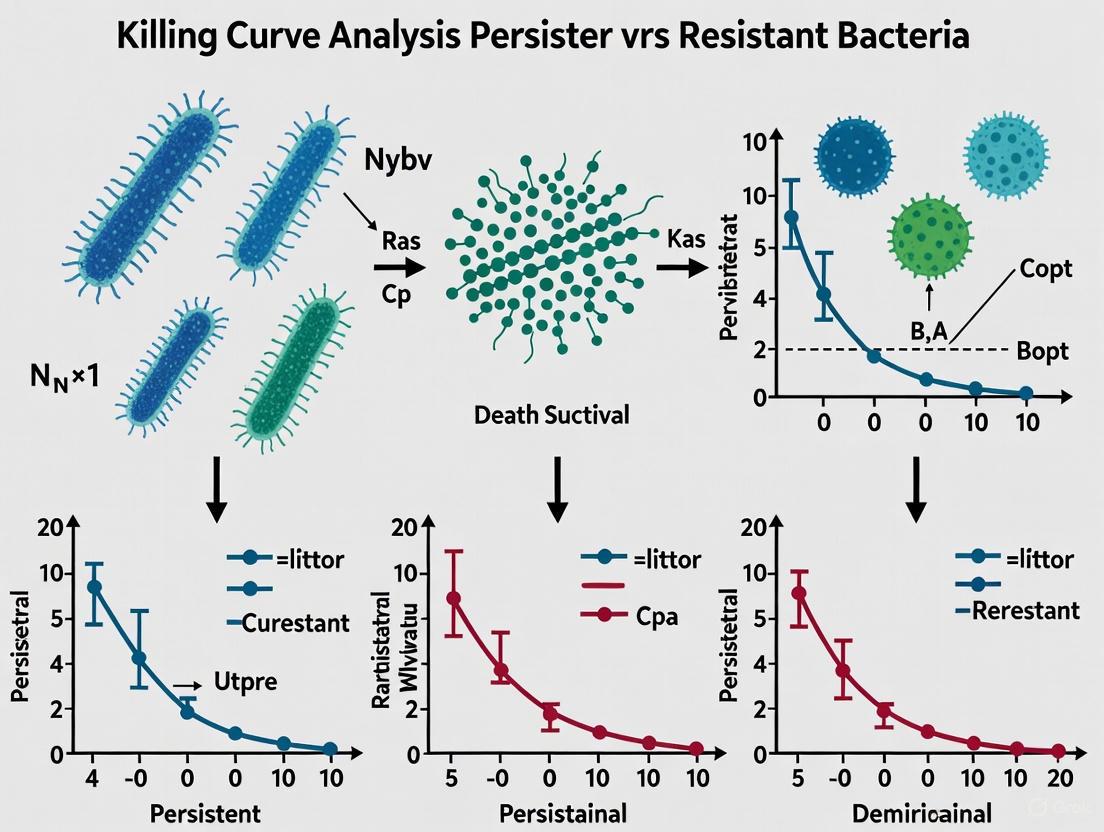
This article provides a comprehensive guide for researchers and drug development professionals on the application of killing curve analysis to differentiate between antibiotic-resistant and persister bacterial populations.
Decoding Bacterial Survival: A Comprehensive Guide to Killing Curve Analysis for Distinguishing Persister vs. Resistant Bacteria
Abstract
This article provides a comprehensive guide for researchers and drug development professionals on the application of killing curve analysis to differentiate between antibiotic-resistant and persister bacterial populations. It covers the fundamental phenotypic distinctions, detailed protocols for time-kill and concentration-killing curve assays, strategies for troubleshooting common experimental challenges, and advanced methods for data validation and comparative pharmacodynamic modeling. By offering a systematic framework for characterizing these clinically distinct survival states, this resource aims to support the development of more effective therapeutic strategies against recalcitrant and recurring bacterial infections.
Understanding the Adversaries: Fundamental Concepts in Bacterial Persistence and Resistance
In the relentless battle against bacterial infections, the failure of antibiotic therapy is not solely a story of genetic resistance. The phenomena of antibiotic tolerance and persistence represent crucial, yet distinct, survival strategies that contribute significantly to treatment failure, relapse infections, and the challenge of eradicating chronic diseases [1]. While these terms are sometimes used interchangeably, they describe fundamentally different bacterial phenotypes. For researchers and drug development professionals, understanding these distinctions is paramount for developing more effective therapeutic strategies and accurately interpreting killing curve data.
This guide provides a structured comparison of resistance, tolerance, and persistence, framing them within the context of killing curve analysis—a cornerstone methodology for quantifying these phenotypes in laboratory research. We dissect the defining characteristics, molecular mechanisms, and standardized experimental protocols that enable precise measurement and differentiation of these survival states, providing a foundational resource for antimicrobial development.
Phenotype Definitions and Key Characteristics
The following table delineates the core features that differentiate antibiotic-resistant, tolerant, and persistent bacteria.
Table 1: Defining Characteristics of Bacterial Survival Phenotypes
| Feature | Antibiotic Resistance | Antibiotic Tolerance | Antibiotic Persistence |
|---|---|---|---|
| Minimum Inhibitory Concentration (MIC) | Increased | Unchanged | Unchanged |
| Fundamental Nature | Heritable genetic trait | Non-heritable, often transient physiological state of the entire population | Non-heritable, transient physiological state of a small subpopulation |
| Subpopulation Level | Not applicable; entire population is resistant | A property of the entire population | A small subpopulation (typically <1% of total) [2] |
| Killing Kinetics | Not applicable; population grows despite antibiotic | Monophasic but slowed killing of the entire population | Biphasic killing curve: rapid killing of majority followed by a persistent plateau [2] |
| Underlying Mechanism | Genetic mutations (e.g., in drug target, efflux pumps, drug-inactivating enzymes) [2] | Slowed bacterial growth or reduced metabolism in the entire population [3] [2] | Dormancy or metabolic quiescence in a subpopulation; linked to Toxin-Antitoxin systems, (p)ppGpp, etc. [4] [1] [2] |
| Clinical Impact | Treatment failure due to continued bacterial growth | Prolongs treatment duration, requires longer antibiotic exposure | Relapsing infections, chronicity (e.g., TB, Lyme disease), biofilm-associated infections [1] |
Quantitative Killing Curve Analysis and Metrics
Killing curve assays are the gold standard for differentiating these phenotypes. The following table summarizes the key quantitative metrics and the typical kinetic profiles observed for each bacterial phenotype.
Table 2: Quantitative Metrics and Kinetic Profiles in Killing Curve Analysis
| Aspect | Antibiotic Resistance | Antibiotic Tolerance | Antibiotic Persistence |
|---|---|---|---|
| Primary Metric | Minimum Inhibitory Concentration (MIC) | Minimum Duration for killing 99% (MDK99) [5] | Persister Fraction (PF) |
| Killing Curve Profile | No net killing; growth may occur | Monophasic, linear but slowed kill rate | Biphasic, with a distinct plateau after initial kill [6] [2] |
| Defining Equation | Not applicable (static MIC measurement) | MDK99: Time to reduce CFU by 99% [5] | PF = (Npersister / Ntotal) × 100% |
| Mathematical Modeling | Not typically modeled with killing kinetics | Often modeled with a single exponential decay: N(t) = N₀e⁻ᵏᵗ | Modeled with two subpopulations: N(t) = Nₛe⁻ᵏˢᵗ + Nₚe⁻ᵏᵖᵗ (where kp << ks) [7] [6] |
| Key Model Parameter | Not applicable | Death rate constant (k) of the population | Switching rates between normal and persister states, death rate of persisters [7] |
The following diagram illustrates the classic killing curve profiles that distinguish susceptible, tolerant, and persistent bacterial populations, and how these relate to the presence of a resistant subpopulation.
Experimental Protocols for Phenotype Characterization
Time-Kill Assay for Persistence and Tolerance
The time-kill assay is the sector standard for studying antibiotic persistence and tolerance, valued for its quantitative nature [4].
- Primary Objective: To quantify the dynamics of bacterial killing over time, distinguishing between susceptible, tolerant, and persistent subpopulations.
- Procedure:
- Inoculum Preparation: Grow the bacterial strain to mid-exponential phase in appropriate liquid medium (e.g., LB for E. coli).
- Antibiotic Exposure: Add a lethal concentration of antibiotic (typically 10-100× MIC) to the culture.
- Time-Point Sampling: Remove aliquots at predetermined time points (e.g., 0, 2, 4, 6, 8, 24 hours).
- Viable Count Determination: Serially dilute samples in sterile saline or PBS and plate on drug-free agar plates. Incubate plates for 16-24 hours and count colony-forming units (CFU).
- Data Analysis: Plot log10 CFU/mL versus time. A biphasic curve indicates persistence, while a monophasic but shallow curve indicates tolerance [4] [2].
Concentration-Killing Curve (CKC) and BC50 Metric
This method provides a more nuanced and accurate estimation of bactericidal potency compared to the endpoint Minimum Bactericidal Concentration (MBC) [8].
- Primary Objective: To model the relationship between antibiotic concentration and bacterial killing, deriving the median bactericidal concentration (BC50).
- Procedure:
- Agar Plate Preparation: Prepare a series of agar plates containing a gradient of antibiotic concentrations.
- Standardized Inoculation: Inoculate each plate with a defined, small number of cells (e.g., ~500 CFU) to minimize the impact of pre-existing resistant mutants [8].
- Incubation and Enumeration: Incubate plates for 24 hours and count all surviving colonies.
- Curve Fitting and Analysis: Fit the data (N vs. x) to the sigmoidal function: N = N₀ / [1 + e^(r(x - BC₅₀))].
- N: number of surviving colonies at concentration x
- N₀: initial inoculum size
- r: bactericidal intensity (slope parameter)
- BC₅₀: median bactericidal concentration [8]
- Advantage: The CKC offers a continuous, quantitative measure of bactericidal activity, overcoming the inaccuracies of traditional MBC measurements.
MDK99 Assay for Tolerance Quantification
A novel metric specifically designed to quantify tolerance by measuring the time required for killing.
- Primary Objective: To determine the Minimum Duration for killing 99% of the population (MDK99) as a standardized metric for tolerance [5].
- Procedure:
- Culture and Treatment: Expose a standardized bacterial culture to a lethal antibiotic concentration (e.g., 10-20× MIC).
- High-Frequency Sampling: Monitor the decline in viable count (CFU/mL) at frequent intervals, especially during the first hours of treatment.
- MDK99 Calculation: Determine the time point at which the viable count has dropped by 99% compared to the initial inoculum.
- Application: This metric is proposed as a standard for in vitro characterization of antimicrobial sensitivity, alongside MIC, to ensure tolerance is accounted for in treatment strategies [5].
Molecular Mechanisms and Signaling Pathways
The formation of persister cells is governed by a complex network of intracellular signaling pathways that induce a dormant, tolerant state. The following diagram maps these key mechanisms and their interactions.
The Scientist's Toolkit: Essential Research Reagents and Solutions
The following table catalogs key reagents and methodological solutions critical for conducting rigorous research on bacterial persistence and tolerance.
Table 3: Essential Research Reagents and Tools for Phenotype Studies
| Reagent / Solution | Primary Function in Research | Application Example |
|---|---|---|
| Luria-Bertani (LB) Broth/Agar | Standard medium for culturing model organisms like E. coli and S. aureus. | Routine cultivation and preparation of inoculum for time-kill assays [8] [7]. |
| Mueller-Hinton Broth | Recommended medium for standardized antimicrobial susceptibility testing (AST). | Performing MIC determinations according to CLSI guidelines. |
| Phosphate Buffered Saline (PBS) | Isotonic buffer for washing cells, making serial dilutions, and resuspending samples. | Diluting bacterial aliquots for accurate CFU plating during time-kill assays [3]. |
| Antibiotic Stock Solutions | Prepared at high concentrations in suitable solvents (e.g., water, DMSO). | Creating precise antibiotic concentrations for killing curve and CKC experiments [8]. |
| Penicillinase / Drug-Inactivating Enzymes | Enzymes that specifically degrade an antibiotic. | Used in some plaque-based persister assays to inactivate the drug after exposure, allowing persister colonies to grow [7]. |
| Specific Metabolites (e.g., Pyruvate, Sugars) | Compounds used to manipulate bacterial metabolic state. | Testing "wake-and-kill" strategies; e.g., using metabolites to resuscitate persisters and re-sensitize them to antibiotics [9]. |
| SYTOX Green / Propidium Iodide | Membrane-impermeant fluorescent nucleic acid stains. | Differentiating viable vs. dead cells in fluorescence-based assays or flow cytometry. |
| ROS-Sensitive Dyes (e.g., H2DCFDA) | fluorescent probes that detect intracellular reactive oxygen species (ROS). | Investigating the role of ROS in antibiotic-mediated killing and its suppression in persisters [3]. |
The precise differentiation between antibiotic resistance, tolerance, and persistence is a critical frontier in modern microbiology and antimicrobial drug development. Resistance, characterized by an elevated MIC, allows bacteria to grow in the presence of an antibiotic. In contrast, tolerance and persistence, both characterized by a normal MIC but reduced killing rate, enable bacteria to survive antibiotic treatment without growing, leading to relapse and chronic infections.
Killing curve analysis serves as the foundational experimental framework for dissecting these phenotypes. The biphasic killing curve is the hallmark of persistence, revealing a small, durable subpopulation. Understanding the molecular mechanisms—from toxin-antitoxin systems to the stringent response—that drive a subpopulation into this dormant state is key to innovating beyond traditional antibiotic regimens. Emerging therapeutic strategies, such as metabolite-adjuvant approaches that seek to "wake and kill" persisters, highlight the translational importance of these mechanistic insights [9]. For researchers, employing standardized metrics like the MDK99 for tolerance and the Persister Fraction for persistence, alongside robust protocols like the Concentration-Killing Curve, will ensure that these distinct phenotypes are accurately quantified and targeted, paving the way for more effective treatments against stubborn persistent infections.
Bacterial persisters represent a subpopulation of metabolically dormant cells that survive lethal antibiotic exposure without genetic resistance, contributing significantly to chronic and recurrent infections. This review examines the direct clinical implications of persister cells, highlighting their role in treatment failure and infection relapse. We compare persister phenotypes to resistant bacteria, provide detailed killing curve analyses, and summarize experimental methodologies for studying persistence. The evidence demonstrates that persister cells survive antibiotic therapy by entering a transient, dormant state, then resuscitate to cause recurrent infections that are genetically identical to the original infection. Understanding these mechanisms is critical for developing effective treatments against persistent infections.
Bacterial persistence describes a phenomenon where a small subpopulation of genetically susceptible cells survives exposure to high concentrations of bactericidal antibiotics. These phenotypic variants differ fundamentally from resistant bacteria as they do not possess genetic resistance mechanisms and remain susceptible to the same antibiotics upon regrowth [1] [10]. First identified by Joseph Bigger in 1944 when he observed that a small fraction of staphylococcal populations survived penicillin treatment, persisters have since been recognized as a significant contributor to treatment failures in chronic bacterial infections [1]. The clinical importance of persisters stems from their association with difficult-to-treat infections across numerous pathogenic species, including Myelobacterium tuberculosis, Staphylococcus aureus, Pseudomonas aeruginosa, and Escherichia coli [11] [12].
The distinction between antibiotic resistance and tolerance is crucial for understanding persistence. While resistance refers to the ability of bacteria to grow in the presence of antibiotics, tolerance (including persistence) refers to the ability to survive antibiotic exposure without growth [12]. Persisters exhibit multidrug tolerance, surviving diverse antibiotic classes that target active cellular processes, as their dormant state prevents these drugs from corrupting essential functions [11]. This transient, non-heritable phenotype contrasts with stable genetic resistance, though evidence suggests persisters can serve as a "springboard" for the evolution of permanent resistance mechanisms [13].
Comparative Analysis: Persisters versus Resistant Bacteria
Table 1: Fundamental characteristics distinguishing bacterial persisters from resistant strains
| Characteristic | Persister Cells | Resistant Bacteria |
|---|---|---|
| Genetic Basis | Non-heritable phenotype; genetically identical to susceptible population | Heritable genetic mutations or acquired resistance genes |
| MIC Changes | No change in Minimum Inhibitory Concentration (MIC) | Elevated MIC to specific antibiotics |
| Population Frequency | Typically 10⁻⁶ to 10⁻³ in laboratory strains | Can constitute 100% of population under antibiotic selection |
| Mechanism | Dormancy, toxin-antitoxin systems, reduced metabolic activity | Drug inactivation, target modification, efflux pumps, enzymatic bypass |
| Phenotype Stability | Transient; reverts to susceptible upon regrowth | Stable across generations |
| Detection Methods | Killing curve analysis, reporter systems | MIC determination, genetic testing |
| Clinical Impact | Chronic, relapsing infections | Treatment failure in acute infections |
Table 2: Killing curve patterns distinguishing persister versus resistance phenotypes
| Parameter | Persister Killing Curve | Resistant Population Killing Curve |
|---|---|---|
| Initial Killing Phase | Biphasic: rapid initial killing followed by plateau | Monophasic: limited to no killing from outset |
| Plateau Phase | Distinct subpopulation survives despite prolonged exposure | Entire population grows or survives with minimal killing |
| Concentration Dependence | Survival largely independent of antibiotic concentration | Survival dependent on antibiotic concentration relative to MIC |
| Regrowth Pattern | Original susceptibility restored upon subculture | Maintains reduced susceptibility upon subculture |
| Impact of Combination Therapy | Often unaffected by antibiotic combinations | Pattern may change with combination therapy |
The killing curves for persister populations typically display biphasic patterns, characterized by an initial rapid killing phase followed by a plateau where a subpopulation survives extended antibiotic exposure [14] [12]. This contrasts with resistant populations that may show limited killing from the outset. The plateau phase in persister killing curves represents the dormant subpopulation that is unaffected by antibiotics targeting active cellular processes. This fraction remains relatively constant even with increasing antibiotic concentrations, unlike resistant strains where survival is concentration-dependent relative to the MIC [12].
Methodologies for Persister Cell Research
Experimental Workflows for Persister Isolation and Characterization
Key Experimental Protocols
Microfluidic Single-Cell Observation of Persister Dynamics
The membrane-covered microchamber array (MCMA) device enables real-time observation of persister cell histories under controlled conditions [14]. This protocol allows researchers to track over one million individual bacterial cells before, during, and after antibiotic exposure:
- Device Preparation: Fabricate microchambers (0.8-µm deep) etched on glass coverslips, covered with cellulose semipermeable membrane via biotin-streptavidin bonding
- Cell Loading: Enclose E. coli cells in microchambers forming two-dimensional microcolonies
- Medium Control: Control medium conditions around cells flexibly by medium flow above the membrane
- Antibiotic Exposure: Treat with lethal doses of antibiotics (e.g., 200 µg/mL ampicillin, corresponding to 12.5×MIC)
- Time-Lapse Imaging: Monitor cell growth, division, and survival at single-cell resolution throughout experiment
- Data Analysis: Identify persister cells and categorize based on pre-exposure growth status and post-exposure dynamics
This methodology revealed that when exponentially growing E. coli populations were treated with ampicillin or ciprofloxacin, most persisters were actively growing before antibiotic treatment, challenging the dogma that persisters exclusively originate from pre-existing dormant cells [14].
Killing Curve Analysis for Persister Quantification
The standardized killing curve assay remains fundamental for persister research:
- Culture Preparation: Grow bacterial cultures to desired phase (exponential, stationary)
- Antibiotic Challenge: Expose to bactericidal antibiotic at 5-100×MIC concentration
- Time-Point Sampling: Remove aliquots at predetermined intervals (0, 1, 2, 4, 6, 8, 24 hours)
- Viability Counting: Serially dilute samples, plate on drug-free media, and enumerate CFUs after incubation
- Data Plotting: Graph log CFU/mL versus time to visualize killing kinetics
Killing curves of persister populations typically show biphasic patterns with an initial rapid killing phase followed by a plateau, representing the persister subpopulation that survives prolonged antibiotic exposure [14] [12].
Mechanisms of Persister Formation and Survival
Persister formation involves diverse molecular mechanisms that converge on growth arrest and metabolic suppression. The stringent response, mediated by (p)ppGpp, reprograms cellular metabolism under nutrient limitation or stress conditions [1] [11]. Toxin-antitoxin (TA) systems contribute to persistence through controlled toxin activity that transiently halts essential cellular processes. For example, hipA overexpression in E. coli inhibits glutamyl-tRNA synthetase, triggering growth arrest [1]. Additional pathways include SOS response activation, phage shock response, and energy depletion through membrane potential dissipation [11] [13].
The heterogeneity of persister populations is now well-established, with different "depths" of dormancy corresponding to varying resuscitation times and antibiotic susceptibilities [1]. This continuum includes shallow persisters that resuscitate quickly and deep persisters requiring extended recovery periods. This heterogeneity is influenced by growth phase, environmental conditions, and stochastic gene expression within isogenic populations [14] [1].
The Research Toolkit: Essential Reagents and Solutions
Table 3: Key research reagents and solutions for persister cell studies
| Reagent Category | Specific Examples | Research Application |
|---|---|---|
| Antibiotics | Ampicillin, Ciprofloxacin, Ofloxacin | Persister induction and killing curve analysis |
| Bacterial Strains | E. coli MG1655, P. aeruginosa PAO1, S. aureus strains | Model organisms for persistence mechanisms |
| Microfluidic Devices | Membrane-covered microchamber arrays (MCMA) | Single-cell analysis of persister dynamics |
| Viability Stains | Propidium iodide, SYTO dyes, GFP reporters | Differentiation of viable versus non-viable cells |
| Culture Media | LB broth, M9 minimal media, Stationary phase cultures | Manipulation of growth conditions to induce persistence |
| Molecular Biology Tools | RNA sequencing kits, Proteomics reagents | Transcriptomic and proteomic profiling of persisters |
| Biofilm Models | Flow cells, Calgary device, Microtiter plates | Study of biofilm-associated persisters |
Clinical Implications and Therapeutic Strategies
The clinical significance of persister cells is profound, contributing to recurrent infections across numerous disease contexts. In tuberculosis, persisters necessitate extended multi-drug therapy to prevent relapse [1]. In cystic fibrosis, P. aeruginosa persisters within biofilms resist eradication despite aggressive antibiotic regimens [11] [12]. Persistent urinary tract infections often involve E. coli persisters that survive antibiotic treatment and reseed the infection [12]. Evidence from infection models and patient isolates demonstrates that persisters withstand prolonged antibiotic exposure in the host environment, serving as reservoirs for infection relapse [13].
Novel therapeutic approaches targeting persisters include:
- Metabolic Stimulation: Awakening dormant persisters with metabolites to sensitize them to antibiotics
- Anti-biofilm Agents: Disrupting biofilm matrices to improve antibiotic penetration
- Combination Therapies: Using drug pairs that target both active and dormant populations
- Anti-persister Compounds: Developing molecules that specifically kill persisters through unique mechanisms
The growing understanding of persister biology continues to inform new strategies for combating chronic and recurrent bacterial infections, addressing a critical unmet need in antimicrobial therapy.
In the relentless battle against bacterial infections, a thorough understanding of how pathogens survive antibiotic treatment is paramount for developing effective therapies. The analysis of time-kill curves, which plot surviving bacterial numbers against time of antibiotic exposure, serves as a critical tool for differentiating between distinct survival phenotypes. Two fundamental patterns emerge from these analyses: the biphasic killing curve, a hallmark of bacterial persistence, and the monophasic, population-wide shift indicative of tolerance. While both phenomena represent forms of antibiotic treatment failure, they stem from fundamentally different biological mechanisms and carry distinct implications for treatment strategies and clinical outcomes. This guide provides a structured comparison of these essential patterns, equipping researchers with the methodological frameworks and analytical tools needed to accurately identify and characterize these survival states in both bacterial and cancer cell populations.
Core Definitions and Key Distinctions
Antibiotic persistence describes a scenario where a small, genetically susceptible subpopulation of cells survives antibiotic treatment that kills the majority of the population. This survival is a transient, non-heritable phenotypic state, not a genetic resistance. In contrast, antibiotic tolerance represents the reduced ability of an entire bacterial population to be killed by antibiotics, affecting all cells rather than just a subpopulation. [15] [16]
The table below summarizes the fundamental characteristics that differentiate persistence, tolerance, and full resistance:
| Characteristic | Persistence | Tolerance | Genetic Resistance |
|---|---|---|---|
| Genetic Basis | Non-genetic, phenotypic state | Non-genetic, can be phenotypic or triggered by environment | Stable genetic mutations or acquired genes [15] [16] |
| Population Affected | Small subpopulation [17] [18] | Entire population [18] | Entire population [16] |
| Growth in Antibiotics | Cannot grow or divide (dormant) | Delayed killing, but can be growing or non-growing | Can grow and divide [15] [16] |
| Minimum Inhibitory Concentration (MIC) | Unchanged | Unchanged | Increased [15] [16] |
| Reversibility | Reversible upon antibiotic removal | Reversible | Generally permanent [16] |
| Clinical Detection | Requires specialized persistence assays (e.g., time-kill curves) | Measured by MDK (Minimum Duration of Killing) | Standard susceptibility testing (e.g., MIC) [18] [16] |
Hallmark Killing Curve Patterns and Their Biological Basis
The visual representation of time-kill curves provides the most direct evidence for distinguishing persistence from tolerance.
The Biphasic Pattern of Persistence
A biphasic killing curve is the definitive signature of a persister subpopulation. This pattern features an initial rapid decline in viable cell count, reflecting the death of the majority, treatment-sensitive population. This is followed by a distinct plateau phase, where the killing rate slows dramatically or ceases, indicating the survival of a small, transiently drug-tolerant persister subpopulation. [17] [6] [18]
The Monophasic Pattern of Tolerance
In contrast, tolerance manifests as a uniform, monophasic killing curve across the entire bacterial population. The key indicator is a reduced killing rate that affects all cells, leading to a slower but steady decline in viability without the distinct plateau seen in biphasic curves. The survival fraction at a given time point shows weak dependence on high drug concentrations, saturating even at elevated dosages. [18]
Transition from Tolerance to Persistence
Research in cancer cells has revealed that these states can be dynamic. An early, drug-induced tolerant response across the entire population can, over time, morph into a biphasic pattern as a smaller persister subpopulation is established. [18]
Experimental Protocols for Killing Curve Analysis
Core Methodology for Time-Kill Curve Assays
The fundamental protocol for generating time-kill curves involves exposing a bacterial or cancer cell culture to a lethal concentration of an antibiotic or chemotherapeutic agent and monitoring the number of surviving cells over time. [17] [18]
- Culture Preparation: Grow the bacterial or cancer cell population to the desired phase (e.g., mid-logarithmic or stationary).
- Antibiotic Exposure: Apply the antibiotic at a concentration significantly above the Minimum Inhibitory Concentration (MIC). For cancer studies, concentrations at and far above the IC50 are used. [18]
- Constant Drug Pressure: Maintain constant drug exposure by periodic renewal to avoid experimental bias from drug degradation. [17]
- Viable Count Monitoring: At predetermined time points (e.g., 0, 2, 4, 8, 24, 48 hours), sample the culture. For bacteria, perform serial dilutions and plate on drug-free media to enumerate Colony Forming Units (CFUs). For cancer cells, use assays like Cell Titer Glo or direct cell counting.
- Data Plotting: Plot the log10 of the surviving fraction against time to generate the kill curve.
Protocol for Isolating and Characterizing Persisters
Following the observation of a biphasic curve, further experiments can confirm the presence of persisters:
- Drug Sensitivity of Survivors: Isolate the surviving cells from the plateau phase and test their drug sensitivity compared to the parental, untreated population. True persisters will exhibit regained sensitivity in the absence of drug pressure. [17]
- Regrowth Assay: Wash the surviving cells to remove the antibiotic and transfer them to fresh, drug-free media. Monitor for regrowth, which confirms the transient, reversible nature of the persistence phenotype. [17] [19]
The table below quantifies the expected outcomes from these experiments for the different survival phenotypes:
| Experimental Assay | Persistence Phenotype | Tolerance Phenotype |
|---|---|---|
| Time-Kill Curve Shape | Biphasic (two distinct phases) [17] [18] | Monophasic (uniform slow kill) [18] |
| Survivor Drug Sensitivity | Reverts to sensitive upon drug removal [17] [16] | Reverts to sensitive upon drug removal [15] |
| Population Analysis of Survivors | A small, distinct subpopulation | The entire population exhibits uniform survival |
| Dependence on Drug Concentration | Survival fraction weakly dependent at high concentrations [18] | Killing rate and MDK depend on concentration |
Molecular Mechanisms and Signaling Pathways
The distinct killing curve patterns are governed by specific molecular mechanisms that promote survival.
Mechanisms Driving Persister Formation
- Toxin-Antitoxin (TA) Modules: Under stress, labile antitoxins are degraded, freeing stable toxins to inhibit essential processes like translation or replication, inducing dormancy. [1] [16]
- The Stringent Response: Nutrient starvation or antibiotic stress triggers the production of the alarmone (p)ppGpp, which drastically reprograms cellular metabolism, suppresses growth, and promotes dormancy. [1] [20]
- Metabolic Shifts and Dormancy: A common feature of persisters is a pronounced downshift in metabolic activity, reducing ATP production and minimizing the activity of antibiotic-targeted processes. This can involve a shift toward oxidative phosphorylation and fatty acid β-oxidation. [17] [16]
Mechanisms Underlying Population-Wide Tolerance
- Drug-Induced Stress Response: In cancer cells, exposure to chemotherapies can induce a pervasive, early tolerant response across the entire population, often propelled by the activation of autophagy and comprehensive DNA damage repair (DDR) pathways. [18]
- Global Slowing of Biosynthesis: While not full dormancy, a general reduction in the growth rate of the entire population can confer tolerance by reducing the efficacy of time-dependent, concentration-independent killing. [17]
The Scientist's Toolkit: Essential Research Reagents and Models
Successfully investigating persistence and tolerance requires a specific set of research tools, from biological models to chemical inhibitors.
| Tool Category | Specific Examples | Function in Research |
|---|---|---|
| Biological Models | E. coli MG1655 [21], Pseudomonas aeruginosa [1] [19], Patient-Derived Organoids (PDOs) [18] | Provide reproducible, clinically relevant systems for studying persistence and tolerance mechanisms. |
| Therapeutic Agents | Antibiotics (e.g., Penicillin, Ofloxacin) [17] [19], Chemotherapies (e.g., FOLFOX, Cisplatin) [18] | Apply selective pressure to induce and study persister and tolerant cell populations. |
| Chemical Inhibitors | SBI-0206965 (ULK1/autophagy inhibitor) [18] | Probe the molecular mechanisms driving tolerance and persistence by targeting specific survival pathways. |
| Analytical Frameworks | Gompertz Equation [21], MDK (Minimum Duration of Killing) [18] | Quantify and compare killing curve data, enabling objective differentiation between phenotypes. |
The clear distinction between the biphasic kinetics of persisters and the population-wide shifts of tolerance is a cornerstone of modern research into treatment failure. Accurately interpreting these hallmark killing curve patterns enables researchers to correctly identify the underlying survival phenotype, which is essential for developing tailored therapeutic strategies. Eradicating a small, dormant persister subpopulation demands a different approach than overcoming the blanket survival of a tolerant population. As research progresses, leveraging the experimental protocols, molecular knowledge, and research tools outlined in this guide will be critical for translating this understanding into novel therapies that effectively target these resilient cells and improve clinical outcomes.
In the ongoing battle against bacterial infections, two distinct survival strategies pose significant challenges to effective antibiotic treatment: genetic resistance and phenotypic persistence. While both can lead to treatment failure, they are fundamentally different phenomena. Antibiotic resistance involves heritable genetic changes that enable bacteria to grow in the presence of antibiotics, typically measured by increased Minimum Inhibitory Concentration (MIC). In contrast, bacterial persistence involves a transient, non-heritable phenotypic switch to a dormant state that allows a small subpopulation of bacteria to survive antibiotic exposure without genetic change [16] [1]. This distinction is clinically crucial: resistance leads to complete treatment failure, whereas persistence causes relapse infections after treatment cessation when dormant cells resuscitate [16]. Understanding these core survival mechanisms is essential for developing effective therapeutic strategies against stubborn bacterial infections.
Comparative Analysis: Resistance versus Persistence
Table 1: Fundamental Characteristics of Resistance versus Persistence
| Characteristic | Antibiotic Resistance | Bacterial Persistence |
|---|---|---|
| Genetic Basis | Stable genetic mutations or acquired genes [16] | No genetic changes; phenotypic variant [22] [16] |
| Population Affected | Entire population [16] | Small subpopulation (typically ~1%) [22] [16] |
| Heritability | Heritable [16] | Non-heritable [16] |
| Growth in Antibiotics | Can grow and divide [16] | Cannot grow or divide (dormant) [22] [16] |
| MIC Change | Increased [16] [23] | Unchanged [16] [23] |
| Reversibility | Generally permanent [16] | Reversible upon antibiotic removal [16] [1] |
| Clinical Detection | Standard susceptibility testing (MIC) [16] [23] | Specialized persistence assays (e.g., MDK) [16] [23] |
Table 2: Quantitative Assessment in Killing Curve Analysis
| Parameter | Resistance Profile | Persistence Profile |
|---|---|---|
| Killing Curve Pattern | Monophasic, reduced killing efficiency | Biphasic, with a distinct plateau [16] [23] |
| Primary Metric | Minimum Inhibitory Concentration (MIC) [23] | Minimum Duration for Killing (MDK) [23] |
| Typical MDK₉₉ Value | Similar to wild-type strains | Significantly extended vs. wild-type [23] |
| Effect of Antibiotic Combination | May remain resistant | Often susceptible to combination therapies [16] |
Core Mechanisms of Resistance and Persistence
Genetic Foundations of Antibiotic Resistance
Antibiotic resistance arises through stable genetic changes that compromise drug efficacy. These include: (1) chromosomal mutations that alter drug targets or cellular permeability; (2) acquisition of resistance genes through horizontal gene transfer (plasmids, transposons); and (3) upregulation of efflux pumps that export antibiotics from the cell [16]. These genetic modifications confer a selective advantage, allowing resistant populations to proliferate during antibiotic treatment. Critically, resistance affects all cells in the population uniformly and is transmitted to subsequent generations, making it a permanent trait unless reversed by subsequent mutations [16].
Molecular Mechanisms of Persister Formation and Dormancy
Persister cells employ diverse molecular strategies to enter a protective dormant state. The key mechanisms include:
Toxin-Antitoxin (TA) Systems: TA modules consist of a stable toxin and a labile antitoxin. Under stress, antitoxins are degraded, freeing toxins to disrupt essential processes like translation, DNA replication, or ATP synthesis, thereby inducing dormancy [22] [24]. Type II TA systems such as HipBA and MqsR/MqsA contribute to persistence by inhibiting translation through mRNA cleavage [22].
Stringent Response: Nutrient limitation and other stresses trigger production of the alarmones (p)ppGpp, which suppress growth-related processes and redirect resources toward survival, promoting dormancy [22] [16] [24].
Metabolic Shifts and Reduced ATP: Persisters undergo metabolic reprogramming with decreased ATP production, limiting activity of antibiotic-targeted processes [16] [9]. Reduced proton motive force further contributes to dormancy [24].
Other Mechanisms: Additional pathways include SOS response to DNA damage, quorum sensing, and reactive oxygen species-induced stress responses [1] [9].
Figure 1: Signaling Pathways Leading to Bacterial Persistence. Multiple stress-induced pathways converge to induce cellular dormancy, enabling antibiotic tolerance.
Essential Experimental Approaches for Differentiation
Killing Curve Analysis: The Fundamental Assay
The biphasic killing curve remains the hallmark experimental demonstration of bacterial persistence [16] [23]. This assay involves exposing a bacterial population to a lethal antibiotic concentration and monitoring viable counts over time. Unlike resistant populations that show continuous growth or minimal killing, populations containing persisters exhibit rapid initial killing followed by a plateau where the persister subpopulation survives [16] [23].
Detailed Protocol:
- Prepare logarithmic-phase cultures in appropriate medium.
- Add antibiotic at 5-10× MIC concentration.
- Incubate under optimal growth conditions.
- At predetermined intervals (0, 2, 4, 8, 24 hours), remove aliquots.
- Wash samples to remove antibiotics (e.g., using spin-downs or β-lactamase for ampicillin) [23].
- Perform serial dilutions and plate on antibiotic-free medium.
- Count colony-forming units (CFUs) after incubation.
- Plot log CFU versus time to identify biphasic patterns.
Quantifying Tolerance and Persistence: The MDK Metric
While MIC measures resistance, the Minimum Duration for Killing (MDK) quantifies tolerance and persistence [23]. MDK₉₉ represents the minimum time required to kill 99% of the population at a lethal antibiotic concentration.
Automated MDK Protocol [23]:
- Prepare 96-well plates with antibiotic concentrations exceeding MIC (typically ≥20× MIC).
- Inoculate wells with standardized bacterial inocula (~100-1000 CFU/well).
- Inoculate rows at timed intervals using robotic systems.
- After antibiotic exposure, wash cells to remove antibiotics.
- Transfer to fresh medium and monitor for regrowth.
- Calculate MDK₉₉ based on the longest exposure time preventing regrowth in 99% of wells.
Single-Cell Persistence Dynamics
Advanced microfluidic devices enable direct observation of persister awakening dynamics at single-cell resolution [25] [14].
Microfluidic Protocol for Awakening Dynamics [25]:
- Load bacterial cells into membrane-covered microchamber array (MCMA) device.
- Perfuse with fresh medium to establish baseline growth.
- Switch to medium containing lethal antibiotic concentration (e.g., 200 µg/mL ampicillin).
- Monitor cell survival and morphology via time-lapse microscopy over 24-48 hours.
- After treatment, switch to antibiotic-free medium to observe persister regrowth.
- Analyze single-cell histories to identify pre-treatment growth states of persisters.
Figure 2: Experimental Workflow for Single-Cell Persistence Analysis. Microfluidic approaches enable tracking of individual persister cells before, during, and after antibiotic exposure.
The Scientist's Toolkit: Essential Research Reagents and Platforms
Table 3: Key Reagents and Platforms for Resistance and Persistence Research
| Reagent/Platform | Application | Key Function | Experimental Example |
|---|---|---|---|
| Microfluidic Devices (MCMA) | Single-cell persistence dynamics [14] | Enables tracking of individual cell lineages before/during/after antibiotic exposure | Observing E. coli persister awakening after ampicillin treatment [14] |
| Liquid Handling Robotics | Automated MDK assessment [23] | High-throughput tolerance screening with precise timing | Performing inoculation of 96-well plates at timed intervals for MDK₉₉ [23] |
| Fluorescence-Activated Cell Sorting (FACS) | Persister isolation [22] | Isolation of dormant cells based on reduced fluorescence from ribosomal promoters | Separating metabolically inactive E. coli persisters for transcriptomic analysis [22] |
| ATP Assay Kits | Metabolic activity quantification | Measures intracellular ATP levels as indicator of metabolic state | Correlating reduced ATP with antibiotic tolerance in S. aureus [16] |
| β-lactamase Enzyme | Antibiotic neutralization [23] | Rapid inactivation of β-lactam antibiotics after exposure | Washing steps in MDK protocol to enable regrowth assessment [23] |
| RpoS-mCherry Reporter | Stress response monitoring [14] | Visualizes general stress response activation at single-cell level | Tracking correlation between RpoS expression and persistence in E. coli [14] |
Therapeutic Implications and Future Directions
The distinction between resistance and persistence necessitates different therapeutic approaches. For resistant infections, higher antibiotic doses or different drug classes are required. For persistent infections, strategies include: (1) combination therapies pairing antibiotics with compounds that disrupt persistence mechanisms; (2) metabolic activation using metabolites to "wake" dormant cells before killing [26] [9]; and (3) anti-biofilm agents that target the protective environment housing persisters [26] [16].
Emerging approaches include nanomaterial-based strategies that physically disrupt persister cells [26], bacteriophage therapy that targets dormant cells [16], and metabolite-adjuvant combinations that resensitize persisters to conventional antibiotics [9]. The development of standardized diagnostics for persistence, particularly MDK assessment in clinical settings, remains a crucial frontier for improving treatment outcomes of chronic and recurrent infections [23].
Genetic resistance and phenotypic persistence represent evolutionarily distinct bacterial survival strategies with profound clinical implications. While resistance involves permanent genetic changes enabling growth in antibiotic presence, persistence constitutes a reversible phenotypic switch to dormancy in a subpopulation. Killing curve analysis reveals this fundamental difference: resistance reduces killing efficiency across the entire population, while persistence produces biphasic killing with a surviving subpopulation. Understanding these core mechanisms enables more targeted therapeutic development. For resistance, the focus remains on overcoming specific genetic mechanisms, while for persistence, the challenge lies in disrupting dormancy pathways or activating metabolism to enable antibiotic killing. As research advances, integrating this knowledge into clinical diagnostics and treatment regimens will be essential for addressing the ongoing challenge of difficult-to-treat bacterial infections.
Bacterial persistence describes a phenomenon where a small subpopulation of genetically susceptible bacteria enters a transient, dormant state, allowing them to survive exposure to high concentrations of bactericidal antibiotics [1] [27]. These persister cells are not antibiotic-resistant in the conventional sense—they exhibit minimum inhibitory concentrations (MICs) identical to their susceptible counterparts—but rather display phenotypic tolerance by surviving antibiotic treatments that kill the majority of the population [28]. When the antibiotic pressure is removed, persisters can resume growth and regenerate a population that remains genetically susceptible to the same antibiotic, distinguishing this phenomenon from genuine genetic resistance [19].
The clinical significance of persister cells lies in their direct association with recurrent infections and treatment failures across numerous bacterial pathogens [1]. Persisters have been implicated in chronic and difficult-to-treat infections caused by Mycobacterium tuberculosis, Pseudomonas aeruginosa, Escherichia coli, and Staphylococcus aureus, among others [19]. Particularly problematic is the role of persisters in biofilm-associated infections, where these dormant cells contribute to the recalcitrance of biofilms to antibiotic therapy, complicating treatment of conditions such as cystic fibrosis, endocarditis, and infections associated with medical implants [19]. Understanding the persistence-resistance nexus is thus critical for developing more effective therapeutic strategies against chronic bacterial infections.
Comparative Analysis of Experimental Approaches
Research investigating the relationship between bacterial persistence and resistance evolution has employed diverse methodological approaches, each contributing unique evidence to support this connection. The table below summarizes key experimental designs and their findings.
Table 1: Experimental Approaches for Studying the Persistence-Resistance Nexus
| Experimental Approach | Key Methodology | Principal Findings | Supporting Evidence |
|---|---|---|---|
| Correlative Studies in Natural Isolates | Comparison of persistence levels and resistance mutation frequency across natural E. coli variants (ECOR collection) [29] | Strong positive correlation between persister fractions and likelihood of developing genetic resistance [29] | Correlation maintained even when accounting for number of surviving cells, suggesting pleiotropic link [29] |
| Laboratory Evolution Experiments | Repeated cycles of antibiotic treatment followed by outgrowth using defined bacterial strains [28] | Tolerance rapidly evolves under intermittent antibiotic treatment and promotes subsequent resistance development [28] | Identified specific mutations in genes (vapB, metG, prsA) that increase lag time and persistence [28] |
| Single-Cell Dynamics Analysis | Microfluidic tracking of >1 million individual E. coli cells before and after antibiotic exposure [30] | Most persisters from exponential phase were actively growing before antibiotic treatment, exhibiting heterogeneous survival dynamics [30] | Revealed diverse persister phenotypes including continuous growth with L-form-like morphologies, responsive growth arrest, or post-exposure filamentation [30] |
| Mathematical Modeling | Computational simulations of bacterial population dynamics during antibiotic treatment incorporating persister subpopulations [29] | Increased survival and mutation rates jointly accelerate evolution of clinical resistance [29] | Model demonstrates that both persister survival and elevated mutation rates contribute to resistance evolution [29] |
Detailed Experimental Protocols
Resistance Evolution on Agar Plates
The agar-based resistance evolution assay provides a straightforward method to quantify the ability of bacterial populations to generate genetic resistance mutants [29]. The protocol begins by preparing overnight cultures of the bacterial strains of interest in appropriate liquid medium (e.g., Mueller-Hinton or LB broth). After incubation, cultures are resuspended in a neutral solution such as 10 mM MgSO₄, and 100 µl aliquots are plated onto agar containing antibiotics at concentrations corresponding to specific multiples of the MIC (e.g., 2× MIC for ciprofloxacin and norfloxacin, 3× MIC for chloramphenicol, or 4× MIC for kanamycin) [29].
The number of cells initially plated is determined by parallel plating on non-selective agar and counting resulting colonies. Plates are then incubated for an extended period (e.g., 24-48 hours or longer at 37°C) to allow development of resistant colonies. To confirm that colonies arise from genuine genetic resistance rather than temporary tolerance, researchers typically streak putative resistant colonies onto fresh antibiotic-containing plates and perform MIC testing [29]. Valid resistant mutants should grow upon transfer and exhibit increased MIC values, typically ranging from 2× to >64× the original MIC [29]. Controls should include verification of antibiotic stability throughout the incubation period to ensure selective pressure remains constant.
Resistance Evolution in Liquid Medium
Liquid culture systems enable real-time monitoring of resistance emergence and can detect earlier resistance events [29]. In this protocol, overnight bacterial cultures are diluted in fresh medium containing antibiotics at concentrations such as 2× MIC to an inoculum size of approximately 10⁶ bacteria. The cultures are then incubated under optimal growth conditions (e.g., 37°C with linear shaking) in an automated plate reader that monitors optical density (OD₆₀₀) at regular intervals (e.g., every 15 minutes) over an extended period (e.g., 8 days) [29].
When a cell acquires a resistance-conferring mutation, its progeny will eventually overcome the antibiotic suppression and initiate population outgrowth, which is detectable as an increase in OD. The timing of the mutational event can be estimated by analyzing the resulting growth curve. At the experiment's conclusion, isolated colonies should be subjected to MIC determination to confirm genetic resistance, typically showing 2 to 16-fold increased MIC values compared to the ancestral strain [29]. This approach allows parallel assessment of multiple independent populations (e.g., 32-64 replicates) from the same starting culture, providing statistical power to detect differences in resistance emergence between strains with varying persistence levels.
Rifampicin Fluctuation Assay
The rifampicin-based fluctuation assay provides a standardized method to quantify mutation rates in bacterial populations with different persistence levels [29]. The protocol begins by inoculating multiple parallel cultures (e.g., 10-20 per strain) from a small initial inoculum (e.g., 5000 CFU/ml) in 96-well plates containing appropriate growth medium. After 24 hours of incubation, the entire population from each culture is plated on LB agar supplemented with rifampicin (100 µg/ml), which selects for mutants with alterations in the RNA polymerase that confer resistance to this antibiotic [29].
Additionally, control cultures grown under identical conditions are plated on non-selective LB agar to determine the final total cell number in each culture. Colonies on both non-selective and rifampicin-containing plates are counted after appropriate incubation periods (24 and 48 hours, respectively). The number of mutant colonies across the parallel cultures allows calculation of mutation rates using established methods such as the Lea-Coulson method of the median. Applying this assay to strains with different persistence levels (e.g., wild-type vs. high-persistence mutants) enables researchers to test whether persistence is pleiotropically linked with increased mutation rates, potentially explaining the facilitated evolution of resistance [29].
Visualization of Key Mechanisms and Workflows
Single-Cell Analysis of Persister Dynamics
Table 2: Key Research Reagents for Single-Cell Persistence Studies
| Research Reagent | Function/Application | Experimental Context |
|---|---|---|
| MCMA Microfluidic Device | Membrane-covered microchamber array for single-cell encapsulation and imaging | Enables tracking of >1 million individual cells before/during/after antibiotic exposure [30] |
| E. coli MG1655 | Wild-type K-12 strain used for single-cell persistence dynamics | Primary model organism for studying heterogeneous persister responses [30] |
| Ampicillin (200 µg/mL) | β-lactam antibiotic (12.5× MIC) for persistence studies | Induces diverse survival dynamics including L-form-like morphologies [30] |
| Ciprofloxacin (1 µg/mL) | Fluoroquinolone antibiotic (32× MIC) for persistence studies | Targets growing persisters; all survivors were growing before treatment [30] |
| RpoS-mCherry Fusion | Fluorescent reporter for stress response signaling | Marks activation of general stress response (note: functional defects in RpoS activity) [30] |
Diagram 1: Single-cell persister analysis workflow using microfluidics
Molecular Mechanisms Linking Persistence to Resistance
Diagram 2: Mechanisms linking persistence to resistance evolution
Tabular Synthesis of Quantitative Evidence
Table 3: Quantitative Evidence Supporting the Persistence-Resistance Nexus
| Experimental System | Key Metrics | Numerical Findings | Interpretation |
|---|---|---|---|
| Natural E. coli Isolates (ECOR) | Correlation between persistence level and resistance development [29] | Strong positive correlation (specific statistical values not provided in source) | Persister cells facilitate resistance evolution across diverse genetic backgrounds [29] |
| labE. coli Strains (SX43, oppB, de-evolved oppB) | Survival after 5h antibiotic exposure; Resistant colony formation [29] | High-persistence mutants (oppB) showed increased resistant colony formation compared to low-persistence (de-evolved oppB) | Genetic determinants of persistence pleiotropically influence resistance development [29] |
| Rifampicin Fluctuation Assays | Mutation rate calculation from 30-40 parallel cultures per strain [29] | High-persistence strains exhibited elevated mutation rates | Pleiotropic link between persistence and hypermutation accelerates resistance evolution [29] |
| Mathematical Modeling | Time until resistant cells reach >10⁸ cells during simulated treatment [29] | Combinations of increased survival and mutation rates dramatically reduced time to resistance takeover | Joint effect of persistence and increased mutation rates clinically significant [29] |
| Single-Cell Analysis (Microfluidics) | Percentage of persisters growing before antibiotic treatment [30] | Most exponential phase persisters were growing before Amp/CPFX treatment; Stationary phase differed for Amp | Persister heterogeneity depends on growth phase and antibiotic type [30] |
The accumulated evidence strongly supports a model where bacterial persisters serve as an evolutionary reservoir from which genetically resistant mutants can emerge [29]. This persistence-resistance nexus operates through at least two distinct mechanisms: (1) providing a viable cell reservoir that survives antibiotic treatment and subsequently generates resistant mutants, and (2) establishing a pleiotropic link between the molecular pathways controlling persistence and those influencing mutation rates [29]. The heterogenous nature of persister cells, with some subpopulations maintaining metabolic activity and even continuing to divide slowly under antibiotic pressure, further complicates the clinical management of persistent infections [30].
These findings suggest that effective antimicrobial strategies must address both resistance and tolerance mechanisms simultaneously. Future therapeutic development should focus on anti-persister compounds that specifically target the dormant subpopulations that conventional antibiotics fail to eradicate [29] [1]. Combination therapies that include drugs capable of killing persister cells alongside traditional antibiotics may prevent the relapse of infections and limit the evolutionary trajectory toward resistance [19]. The detailed experimental protocols and analytical approaches summarized in this review provide researchers with the necessary tools to further investigate this critical relationship and develop the next generation of antimicrobial therapies that effectively target both the susceptible majority and the persistent minority in bacterial populations.
From Theory to Bench: Standardized Killing Curve Assays and Analysis
Time-kill curve analysis represents a sophisticated dynamic in vitro methodology that provides a comprehensive assessment of the rate and extent of bactericidal activity over time, offering significant advantages over static susceptibility measurements like MIC determination [31]. This experimental approach is particularly invaluable in the context of a broader thesis on killing curve analysis for persister versus resistant bacteria research, as it enables researchers to distinguish between genetically resistant populations and phenotypically tolerant persister cells through detailed temporal killing profiles [1]. Whereas standard MIC testing provides a single endpoint determination, time-kill curves capture the complex dynamics of microbial responses to antimicrobial pressure, revealing subpopulations with differential susceptibility patterns that are critical for understanding treatment failures and relapse infections.
The fundamental principle underlying time-kill analysis involves exposing standardized bacterial inocula to varying antibiotic concentrations and quantitatively assessing viable bacterial counts at predetermined time intervals, typically over 24-48 hours [32] [33]. This methodology generates rich, time-dependent data that can be mathematically modeled to determine pharmacodynamic parameters such as the maximal kill rate, time to bactericidal effect, and presence of regrowth due to adaptive resistance or persister cells [32] [33] [31]. For researchers investigating the recalcitrance of persistent infections, this approach provides the temporal resolution necessary to identify the biphasic killing patterns characteristic of persister populations—an initial rapid killing phase followed by a sustained plateau where a small subpopulation survives despite continued antibiotic exposure [1].
Theoretical Framework: Distinguishing Persister Cells from Resistant Bacteria
Fundamental Characteristics and Distinctions
Table 1: Comparative Analysis of Antibiotic Resistance vs. Persister Formation
| Characteristic | Antibiotic-Resistant Bacteria | Persister Cells |
|---|---|---|
| Genetic basis | Heritable genetic mutations | Non-heritable phenotypic heterogeneity |
| MIC values | Elevated | Unchanged |
| Population frequency | Can dominate under selective pressure | Always a subpopulation (typically 0.001%-1%) |
| Growth state | Actively growing | Non-growing or slow-growing (dormant) |
| Mechanisms | Target modification, efflux pumps, enzyme production | Toxin-antitoxin modules, stringent response, reduced metabolism |
| Re-growth pattern | Uniform growth in presence of antibiotic | Regrowth only after antibiotic removal |
The critical distinction between genetically resistant bacteria and phenotypically tolerant persister cells lies at the heart of advanced antimicrobial pharmacodynamics [1]. Resistant strains possess heritable genetic modifications that enable growth at elevated antibiotic concentrations, resulting in increased MIC values that are stable across generations. In contrast, persister cells represent a transient, non-heritable phenotypic variant within a genetically susceptible population that exhibits enhanced survival without genetic resistance [1]. These metabolically quiescent cells evade antibiotic killing through dormancy rather than specific resistance mechanisms, as most antibiotics target active cellular processes.
The clinical implications of this distinction are profound. While resistance is readily detected through standard susceptibility testing, persister cells remain undetectable in conventional MIC assays yet underlie many chronic and relapsing infections [1]. Time-kill curve analysis is uniquely positioned to identify and characterize this persister phenotype through its extended observation period and quantitative culture methods that capture biphasic killing kinetics—initially effective killing followed by a plateau where persisters survive [1]. Understanding this dynamic is essential for designing antibiotics and regimens effective against both resistant and persistent bacterial populations.
Mathematical Modeling of Time-Kill Data
Table 2: Key Pharmacodynamic Parameters from Time-Kill Curve Analysis
| Parameter | Description | Interpretation |
|---|---|---|
| ψ_max | Maximal bacterial growth rate without antibiotic | Baseline fitness of bacterial strain |
| ψ_min | Minimal bacterial growth rate at high antibiotic concentrations | Maximum kill rate achievable |
| κ | Hill coefficient describing steepness of concentration-effect relationship | Cooperativity in antibiotic binding or effect |
| zMIC | Pharmacodynamic MIC derived from kill curve modeling | In vitro potency parameter |
| Inoculum Effect | Reduction in killing efficacy with higher bacterial densities | Important for high-burden infections |
Advanced analysis of time-kill data incorporates mathematical modeling to extract meaningful pharmacodynamic parameters that describe the concentration-effect relationship more comprehensively than MIC values alone [33]. The model established by Regoes et al. characterizes antimicrobial effects through four key parameters: the maximal bacterial growth rate in absence of drug (ψmax), the minimal growth rate at high drug concentrations (ψmin), the Hill coefficient (κ) describing the steepness of the concentration-effect relationship, and the pharmacodynamic MIC (zMIC) [33]. This approach transforms raw time-kill data into quantitative parameters that enable cross-comparison between different antibiotic classes and bacterial strains.
For persister research, modified models account for the inoculum effect—the phenomenon where antibacterial efficacy diminishes against high-density bacterial populations [32]. This can be conceptualized mathematically by incorporating an effective drug concentration term that decreases sigmoidally with increasing initial inoculum size, reflecting the barrier function of dense bacterial populations [32]. Additionally, adaptation and regrowth observed in time-kill studies can be modeled using saturable functions of antibiotic selective pressure over time, helping to distinguish between pre-existing persisters and adaptive resistance development [32].
Figure 1: Time-Kill Curve Experimental Workflow
Experimental Design and Protocols
Inoculum Preparation Standardization
The foundation of reproducible time-kill experiments lies in standardized inoculum preparation. For most bacterial pathogens, the recommended starting inoculum is approximately 5 × 10^5 to 1 × 10^6 CFU/ml, typically achieved by diluting overnight cultures or suspending colonies from fresh agar plates in appropriate liquid medium [32] [33]. However, investigating inoculum effects—a critical aspect of persister research—requires testing across a density range, typically from 10^5 to 10^8 CFU/ml [32]. The inoculum should be prepared from cultures in early- to mid-logarithmic growth phase (approximately 4-6 hours of incubation) to ensure metabolic synchronization and minimize the inherent heterogeneity of stationary-phase cultures [33].
Specific fastidious organisms require specialized approaches. For Neisseria gonorrhoeae, researchers have developed a standardized protocol using Graver-Wade medium followed by 4-hour pre-incubation to achieve synchronized early- to mid-log phase growth before antibiotic exposure [33]. For mycobacterial species like M. tuberculosis, the protocol involves simultaneous quantification using both colony-forming units (CFU) and most probable number (MPN) readouts to enhance accuracy across diverse metabolic states [34]. Regardless of the bacterial species, consistency in inoculum preparation is paramount, requiring careful attention to pre-culture conditions, dilution accuracy, and verification of initial viable counts through plating.
Antibiotic Concentration Range Selection
Table 3: Recommended Antibiotic Concentration Ranges for Time-Kill Studies
| Antibiotic Class | Typical Range (Multiples of MIC) | Key Considerations |
|---|---|---|
| Beta-lactams | 0.25× to 256× MIC | Test high concentrations to overcome inoculum effect |
| Fluoroquinolones | 0.016× to 16× MIC | Include concentrations below MIC to assess sub-MIC effects |
| Aminoglycosides | 0.25× to 64× MIC | Concentration-dependent killing pattern |
| Combination studies | Clinically achievable free drug concentrations | Check for synergistic/additive effects |
Designing appropriate antibiotic concentration ranges is essential for comprehensive pharmacodynamic assessment. The recommended approach includes a wide range of concentrations extending from well below the MIC to substantially above it, typically using serial two-fold dilutions spanning 0.016× to 256× the predetermined MIC [32] [33]. This broad range enables characterization of the complete concentration-effect relationship, including sub-MIC effects, the concentration-dependent killing phase, and the maximal kill rate plateau. For beta-lactam antibiotics against high-inoculum populations, extending the upper concentration limit to 256× MIC may be necessary to overcome the inoculum effect and observe saturation of killing [32].
For combination therapy studies against multidrug-resistant pathogens, researchers should employ clinically achievable concentrations of each drug alone and in combination. A recent study evaluating ceftazidime-avibactam combinations against XDR P. aeruginosa tested each antibiotic at clinically relevant free-drug concentrations to model human pharmacokinetics [35]. When studying persister populations, consider including concentrations significantly above the MIC to distinguish between simple tolerance and high-level resistance, as persisters will eventually be killed at sufficiently high concentrations, though at a much slower rate than susceptible cells.
Time Point Selection and Sampling Strategy
Strategic time point selection captures the essential dynamics of microbial killing and regrowth. The recommended sampling schedule includes baseline (0h) followed by 2, 4, 6, 8, 12, and 24 hours post-antibiotic exposure, with extended studies occasionally requiring 48-hour time points for slow-growing organisms or to monitor late regrowth [32] [33]. Early time points (2-6 hours) capture the initial rate of killing, intermediate points (8-12 hours) identify bactericidal activity, and later points (24-48 hours) detect regrowth due to adaptive resistance or persister resuscitation.
Sampling technique significantly impacts data quality. To minimize antibiotic carryover, samples should be centrifuged (10,000 × g for 15 minutes) and reconstituted in sterile normal saline or appropriately diluted before plating [32]. For mycobacterial studies, simultaneous CFU and MPN quantification enhances detection of viable cells with different metabolic states, providing a more comprehensive assessment of persistent subpopulations [34]. Each sample should be quantitatively cultured using spiral plating or serial dilution methods with a lower limit of detection of at least 400 CFU/ml to accurately characterize substantial reductions in bacterial density [32].
Essential Reagents and Research Solutions
Table 4: Research Reagent Solutions for Time-Kill Experiments
| Reagent/Category | Function/Purpose | Examples/Specifications |
|---|---|---|
| Culture Media | Supports bacterial growth under standardized conditions | Cation-adjusted Mueller-Hinton broth, Graver-Wade medium for fastidious organisms |
| Antibiotic Stocks | Source of antimicrobial pressure | Piperacillin, ciprofloxacin, ceftazidime-avibactam; prepare stock solutions and store at -70°C |
| Viability Indicators | Quantifies viable bacterial counts | Crystal violet, MTT assay, colony counting on agar plates |
| Neutralizing Agents | Prevents antibiotic carryover during plating | Saline wash, centrifugation, specific neutralizing agents in agar |
| Quality Control Strains | Verifies experimental conditions | Reference strains (e.g., E. coli ATCC 25922, P. aeruginosa ATCC 700888) |
The reliability of time-kill curve data depends heavily on quality-controlled reagents and standardized materials. Cation-adjusted Mueller-Hinton broth serves as the standard medium for most non-fastidious organisms, while specialized media like Graver-Wade medium may be required for fastidious pathogens such as N. gonorrhoeae [33]. Antibiotic stock solutions should be prepared in appropriate solvents, aliquoted, and stored at -70°C to maintain stability, with verification of potency through stability testing during extended incubation periods [32].
Quality control measures include testing reference strains with known susceptibility profiles alongside experimental samples to validate methodology. For biofilm-related persister studies, the Calgary Biofilm device provides standardized biofilm formation, with quantification using crystal violet staining or similar methods [32]. For advanced analysis, mathematical modeling software (MATLAB, R) enables pharmacodynamic parameter estimation, while colorimetric assays like MTT testing can complement traditional CFU counting for biomass quantification [32] [33].
Figure 2: Persister Mechanisms Leading to Treatment Failure
Data Interpretation in Persister versus Resistance Research
Analyzing Biphasic Killing Curves
The hallmark of persister populations in time-kill studies is biphasic killing kinetics, characterized by an initial rapid decline in viable counts followed by a flattening of the curve where a subpopulation survives despite prolonged antibiotic exposure [1]. This pattern distinguishes phenotypic tolerance from genuine resistance, where resistant strains would show continued growth or minimal killing across all concentrations. The plateau phase represents the persister subpopulation that can be quantified by the surviving fraction at 24 hours, typically ranging from 0.001% to 1% of the initial inoculum depending on the bacterial strain and growth conditions [1].
Mathematical analysis enhances persister identification in these curves. The minimal bacterial reduction at 24 hours compared to baseline, the slope of the second phase of the kill curve, and the ratio of killing at early (4-8h) versus late (24h) time points all serve as quantitative measures of persistence levels [32] [33]. For Mycobacterium tuberculosis, comparing CFU and MPN counts simultaneously can reveal differential detection of various persister subpopulations, with MPN often capturing a higher proportion of damaged but viable cells that may not form colonies on solid medium [34].
Distinguishing Resistance Mechanisms through Kinetic Analysis
Time-kill curves help differentiate various resistance mechanisms through their distinct kinetic profiles. Genetically resistant strains typically exhibit right-shifted concentration-effect relationships without significant reduction in maximal kill rate (ψ_min), whereas permeability barriers often manifest as a parallel shift in the entire kill curve [31]. Enzymatic resistance mechanisms like beta-lactamase production may show initial killing followed by rapid regrowth as the antibiotic is inactivated, a pattern that can be mitigated by beta-lactamase inhibitors [35].
When evaluating combination therapies against resistant pathogens, synergistic interactions are identified when the killing observed with the combination exceeds the sum of killing by individual agents [35]. For instance, the combination of ceftazidime-avibactam with colistin demonstrated additive or synergistic effects against 100% of CZA-resistant XDR P. aeruginosa isolates, providing critical information for treatment selection [35]. Against persister cells, combination approaches often aim to activate dormant cells through one agent while maintaining killing capacity with another, creating opportunities for eradication of persistent subpopulations.
Time-kill curve methodology provides an indispensable tool for dissecting the complex dynamics of antibiotic-bacteria interactions, particularly in the critical distinction between resistance and persistence. The standardized approaches to inoculum preparation, concentration range selection, and sampling strategies outlined in this guide enable researchers to generate reproducible, high-quality data that captures the temporal dimension of antimicrobial action. When properly executed and analyzed through appropriate pharmacodynamic modeling, time-kill experiments reveal subtleties of bacterial responses impossible to detect through endpoint metrics like MIC alone.
For the field of persister research, these kinetic analyses are particularly vital, offering the resolution necessary to identify and characterize the dormant subpopulations responsible for chronic and relapsing infections. As drug development increasingly targets these recalcitrant populations, robust time-kill methodology will continue to provide the foundational data needed to advance novel therapeutic strategies against the most challenging bacterial infections.
The Concentration-Killing Curve (CKC) method represents a significant advancement over traditional endpoint bactericidal testing by providing a comprehensive sigmoidal relationship between antibiotic concentration and bacterial survival. This methodology introduces two novel parameters—median bactericidal concentration (BC50) and bactericidal intensity (r)—that enable more accurate and reproducible estimation of antibiotic potency against bacterial populations, including persister cells. Framed within the critical context of killing curve analysis for persister versus resistant bacteria research, this guide objectively compares the CKC approach with conventional alternatives, supported by experimental data and detailed protocols. For researchers and drug development professionals, understanding this distinction is paramount: whereas genetic resistance enables growth in elevated drug concentrations, persistence involves dormant, tolerant cells that survive antibiotic exposure without genetic change and can serve as an evolutionary reservoir for resistance development.
The accurate estimation of bactericidal potency is fundamental to antibiotic pharmacology and proper antimicrobial therapy. Traditional methods have relied primarily on endpoint determinations such as the minimum inhibitory concentration (MIC) and minimum bactericidal concentration (MBC), which provide limited information about the concentration-response relationship [8]. The inherent limitations of these conventional approaches include wide confidence intervals due to exponentially increasing dilution series and susceptibility to artifacts from pre-existing resistant mutants that grow preferentially in antibiotic-containing broth [8].
The CKC method addresses these limitations by modeling the complete relationship between antibiotic concentration and bacterial survival. This approach is particularly valuable in the context of persister cells—non-growing or slow-growing bacterial subpopulations that survive antibiotic exposure despite genetic susceptibility. These persisters complicate treatment outcomes and have been strongly correlated with increased likelihood of developing genetic resistance [29]. The CKC method, with its ability to characterize the entire bactericidal response curve, provides enhanced tools for investigating this critical phenotypic tolerance and its relationship to resistance development.
Methodological Comparison: CKC vs. Traditional Approaches
The Concentration-Killing Curve Method
The CKC method employs a sigmoidal function to model the relationship between antibiotic concentration and bacterial survival: N = N0 / [1 + e^(r(x - BC50))] where:
- N = number of colonies surviving at antibiotic concentration x
- N0 = initial inoculum size
- r = bactericidal intensity parameter
- x = antibiotic concentration
- BC50 = median bactericidal concentration [8] [36]
This mathematical framework generates a point-symmetrical sigmoidal curve around the inflexion point (BC50, N0/2), enabling precise estimation of bactericidal potency across the entire concentration range [8]. The method utilizes approximately 500 E. coli cells inoculated onto agar plates containing series of antibiotic concentrations, with viable colonies enumerated after 24 hours of incubation at 37°C [8] [36].
Comparative Analysis of Methodologies
Table 1: Comparison of Bactericidal Assessment Methods
| Method | Key Parameters | Advantages | Limitations |
|---|---|---|---|
| CKC Method | BC50, r, BC1 | Complete concentration-response relationship; Higher accuracy and reproducibility; Quantifies bactericidal intensity | More complex data analysis; Requires specialized curve fitting |
| MBC Determination | Single eradication concentration | Simple binary endpoint; Familiar to clinicians | Wide confidence intervals; Overestimation due to resistant mutants; Influenced by inoculum size |
| Time-Kill Curves | Killing rate over time | Dynamic assessment of bactericidal activity; Can evaluate regrowth | Resource intensive; Complex protocol standardization |
| MIC Determination | Growth inhibition concentration | Simple to perform; Standardized protocols | Does not distinguish bactericidal vs. bacteriostatic; Endpoint measure |
The CKC approach addresses a critical methodological gap in traditional MBC determination, where the actual MBC remains uncertain between dilution series (e.g., between 64 and 128 μg/ml) when higher concentrations produce no CFU [8]. Furthermore, the CKC parameter BC1 (the concentration at which only one colony survives) represents the least critical value of MBC in the CKC framework and can be defined as BC50 + [ln(N0 - 1)/r] [8] [36].
Experimental Protocols and Workflows
CKC Method Protocol
Materials and Reagents:
- Luria-Bertani (LB) agar plates
- Antibiotic stock solutions
- Escherichia coli culture (or target organism)
- Sterile dilution buffers
- Incubator set to 37°C
Procedure:
- Prepare antibiotic-containing LB plates with a series of concentrations (e.g., linear or logarithmic increments)
- Standardize bacterial inoculum to approximately 500 CFU per plate
- Inoculate bacterial suspension onto antibiotic-containing plates
- Incubate at 37°C for 24 hours
- Enumerate all viable colonies on each plate
- Fit data to the sigmoidal equation: N = N0 / [1 + e^(r(x - BC50))]
- Calculate derived parameters (BC50, r, BC1) [8]
The critical experimental consideration is maintaining a low inoculum size (~500 CFU) to minimize the influence of spontaneous mutants that could distort the concentration-killing relationship [8].
Workflow Visualization
Diagram 1: CKC Experimental Workflow
Key Parameters and Data Interpretation
Core CKC Parameters
The CKC method introduces three fundamental parameters for quantifying bactericidal potency:
BC50 (Median Bactericidal Concentration): The antibiotic concentration that reduces the initial inoculum by 50%. This parameter is analogous to EC50 in pharmacological concentration-response studies and serves as a robust indicator of antibiotic potency [8] [36]. Mathematically, it represents the inflection point of the sigmoidal curve where the survival is exactly half of N0.
r (Bactericidal Intensity): This parameter determines the steepness of the concentration-killing curve and reflects how rapidly bactericidal activity increases with concentration. A higher r value indicates a more pronounced concentration-dependent killing effect [8]. The bactericidal intensity is particularly valuable for comparing how different antibiotics achieve their killing effects across concentration gradients.
BC1: Defined as BC50 + [ln(N0 - 1)/r], this parameter represents the antibiotic concentration at which only a single colony survives—essentially the most conservative estimate of the minimum bactericidal concentration within the CKC framework [8] [36].
Comparative Performance Data
Table 2: CKC Parameter Comparison for Different Antibiotic Classes
| Antibiotic | BC50 (μg/ml) | Bactericidal Intensity (r) | BC1 (μg/ml) | Traditional MBC (μg/ml) |
|---|---|---|---|---|
| Gentamicin | 2.1 | 0.85 | 8.9 | 8.0 |
| Penicillin | 0.75 | 1.12 | 3.2 | 4.0 |
| Enoxacin | 1.8 | 0.92 | 7.5 | 8.0 |
| Ciprofloxacin | 0.4 | 1.25 | 2.1 | 2.0 |
Note: Data represent hypothetical values for illustration based on methodology described in [8]
The mathematical relationship of the CKC framework enables precise extrapolation between parameters. For instance, 2×BC50 can often substitute for the traditional MBC, providing a more reproducible and accurate estimate of complete eradication concentrations [8].
Research Reagent Solutions
Table 3: Essential Research Materials for CKC Experiments
| Reagent/Equipment | Function in CKC Protocol | Key Specifications |
|---|---|---|
| LB Agar Plates | Support bacterial growth and colony formation | Standardized growth medium for consistent results |
| Antibiotic Stock Solutions | Create concentration gradients | High purity, precise concentration verification |
| Microbial Strains | Target organisms for bactericidal assessment | Well-characterized reference strains recommended |
| Colony Counting System | Enumerate surviving CFU | Manual or automated systems with consistent threshold |
| Curve Fitting Software | Parameter estimation from survival data | Non-linear regression capabilities (R² > 0.9) |
| Sterile Dilution Buffers | Maintain bacterial viability during preparation | Isotonic solutions to prevent osmotic stress |
Applications in Persister Bacteria Research
Distinguishing Persistence from Resistance
The CKC method provides particular utility in investigating bacterial persistence, which is fundamentally distinct from genetic resistance. While resistance involves genetic changes that enable growth at elevated antibiotic concentrations, persistence represents a reversible, non-heritable state of antibiotic tolerance [1]. Single-cell analyses have revealed that persister cells exhibit heterogeneous survival dynamics, including continuous growth with L-form-like morphologies, responsive growth arrest, or post-exposure filamentation [14].
The relationship between persistence and resistance development represents a critical research area. Evidence indicates that persister cells facilitate genetic resistance by maintaining a viable cell reservoir from which resistant mutants can emerge through horizontal gene transfer or de novo chromosomal mutations [29]. This correlation appears to be partly attributable to pleiotropic links between persistence mechanisms and mutation rates, creating a complex evolutionary landscape.
Mechanistic Insights into Persister Survival
Diagram 2: Persister Cell Dynamics and Resistance Development
The CKC method enhances investigation into these survival mechanisms by providing quantitative parameters that can be correlated with persister frequencies across different bacterial strains and growth conditions. For example, studies have demonstrated that when exponentially growing E. coli populations are treated with ampicillin or ciprofloxacin, most persisters were actually growing before antibiotic treatment, challenging the traditional dogma that persistence exclusively derives from pre-existing dormant cells [14].
The Concentration-Killing Curve method represents a significant refinement in bactericidal potency assessment, providing researchers with robust parameters (BC50 and r) that offer superior accuracy and reproducibility compared to traditional MBC determinations. Within the critical context of persister bacteria research, the CKC framework enables more precise characterization of the complex relationship between phenotypic tolerance and genetic resistance development.
For drug development professionals, this methodology supports optimized antibiotic dosing strategies and enhanced assessment of candidate compounds against persistent infections. The continued application and refinement of killing curve analyses will be essential for addressing the ongoing challenge of treatment failures associated with bacterial persistence and resistance evolution.
Bacterial persistence represents a significant challenge in treating infectious diseases, distinct from genetic antibiotic resistance. Persistence is a phenomenon where a small, transient subpopulation of bacterial cells survives exposure to high doses of antibiotics that kill the majority of the population [37] [14]. These persister cells can resume growth once antibiotic pressure is removed, potentially leading to recurrent infections. Unlike resistance, which involves genetic changes that reduce drug efficacy across the entire population, persistence represents a non-genetic, phenotypic heterogeneity where all cells are genetically identical but differ physiologically.
The persister fraction is the quantitative measure of these surviving cells, typically representing a very small proportion of the total population (often ranging from 10⁻⁶ to 10⁻³) [14] [38]. Accurately calculating this fraction is crucial for understanding bacterial treatment failures and developing strategies to combat persistent infections. Kill curve analysis (also known as time-kill curve analysis) provides the experimental foundation for quantifying this persister fraction by monitoring bacterial survival over time under antibiotic exposure [33]. This guide compares the primary methodological approaches for calculating persister fractions from kill curve data, providing researchers with a framework for selecting appropriate quantification strategies based on their specific experimental needs and bacterial systems.
Theoretical Foundations of Persister Fraction Calculation
Defining the Persister Fraction
The persister fraction is formally defined as the ratio of persister cells to the total number of cells in a population after sufficient antibiotic exposure time has elapsed to distinguish between the rapidly killed majority population and the tolerant persister subpopulation. In kill curve experiments, this manifests as biphasic killing kinetics [38], where the initial rapid killing phase (representing the normal population) is followed by a much slower decline or plateau (representing the persister population). The quantification can be expressed as:
Persister Fraction = Number of surviving cells after antibiotic treatment / Total number of cells before treatment
It is important to distinguish this from related metrics. The "persister proportion" refers to the proportion of persisters in any subpopulation with respect to all persisters in the entire population, while the "normalized persister proportion" (NPP) is the persister proportion for a specific subpopulation divided by the proportion of normal cells in that same subpopulation [38]. NPP values greater than 1 indicate an over-abundance of persisters within that subpopulation.
Mathematical Models for Persister Dynamics
The classic mathematical framework for understanding persister dynamics involves two-state models where cells can switch between normal and persister states [37]. In these models, normal cells die at a rate μ and switch to the persister state at rate α, while persister cells do not die or grow but can switch back to the normal state at rate β. The major advantage of using such mathematical models is that the inferred parameters, including the persister fraction, become independent of experimental idiosyncrasies such as the specific time points at which measurements are taken [37].
For concentration-based kill curves, the Concentration-Killing Curve (CKC) approach provides an alternative sigmoidal model described by the function: N = N₀ / [1 + e^(r(x - BC₅₀))] where N is the number of colonies surviving at antibiotic concentration x, N₀ is the initial inoculum size, r represents the bactericidal intensity, and BC₅₀ is the median bactericidal concentration [8]. This approach allows derivation of parameters analogous to those used in pharmacodynamics, providing a more nuanced view of antibiotic effects across a concentration gradient.
Methodological Approaches for Kill Curve Analysis
Experimental Design Considerations
The accurate quantification of persister fractions requires careful experimental design with particular attention to several key parameters that significantly influence results. The table below summarizes critical experimental factors and their implications for persister fraction calculation:
Table 1: Key Experimental Design Considerations for Kill Curve Analysis
| Experimental Factor | Impact on Persister Fraction | Recommendations |
|---|---|---|
| Growth phase at treatment | Substantial variation observed between exponential and stationary phase cells [14] [30] | Standardize culture conditions; report growth phase and optical density |
| Antibiotic selection | Persister fractions are antibiotic-specific, even for drugs with similar modes of action [37] | Use clinically relevant antibiotics; specify concentrations in MIC multiples |
| Treatment duration | Affects distinction between normal and persister populations [37] | Continue treatment until clear biphasic pattern emerges (typically 5-24 hours) |
| Inoculum size | Influences cell-cell interactions and nutrient availability [8] | Standardize initial CFU; consider using ~500 CFU for CKC methods [8] |
| Culture medium | Affects metabolic state and persistence frequency [14] | Use physiologically relevant media; maintain consistency across experiments |
The specific antibiotic used critically influences the observed persister fraction, as different physiological changes may underlie persistence to different drugs [37]. For example, when E. coli cells from stationary phase were treated with ampicillin, most persisters derived from non-growing cell fractions, whereas with ciprofloxacin treatment, all identified persisters were growing before treatment [14] [30]. This underscores the importance of drug-specific considerations when designing kill curve experiments.
Established Protocols for Kill Curve Assays
Several standardized protocols have been developed for conducting kill curve assays across different bacterial species:
Standard Time-Kill Assay Protocol: For Neisseria gonorrhoeae, a standardized approach involves culturing bacteria in defined liquid medium, exposing to a range of antimicrobial concentrations (typically from 0.016× to 16× MIC), and performing viable counts at multiple time points [33]. The modified Miles and Misra method is used, where serial dilutions are spotted on agar plates and CFU/ml calculated after incubation [33].
Microfluidic Single-Cell Observation: Advanced approaches use microfluidic devices like the membrane-covered microchamber array (MCMA) to track over one million individual E. coli cells before, during, and after antibiotic exposure [14] [30]. This enables direct observation of persister cell histories and heterogeneous survival dynamics.
Persister Recovery Protocols: Recent methods focus on post-antibiotic recovery kinetics using spectrophotometry and flow cytometry to quantify persister resuscitation and physiological states at the single-cell level [39].
The following workflow diagram illustrates the key decision points in selecting an appropriate kill curve methodology:
Comparative Analysis of Quantification Methods
Methodologies and Their Applications
Researchers have developed multiple complementary approaches for calculating persister fractions from kill curve data, each with distinct advantages, limitations, and appropriate applications. The following table compares the four primary methodologies:
Table 2: Comparison of Methods for Calculating Persister Fractions from Kill Curve Data
| Method | Key Principle | Data Output | Throughput | Key Advantages | Major Limitations |
|---|---|---|---|---|---|
| Population-Based Time-Kill Assay [33] | Monitor CFU decline over time at fixed antibiotic concentration | Time-kill curves, persister fraction at specific time points | Medium | Standardized, accessible, provides kinetic information | Population average, misses heterogeneity |
| Concentration-Killing Curve (CKC) [8] | Measure survival across antibiotic concentration gradient | Sigmoidal CKC, BC₅₀ (median bactericidal concentration) | Medium | Derives multiple parameters (BC₅₀, r), more accurate than MBC | Does not provide temporal dynamics |
| Microfluidic Single-Cell Tracking [14] [30] | Track individual cell lineages before, during, and after treatment | Single-cell survival dynamics, lineage histories, heterogeneity | Low | Reveals cellular heterogeneity, direct observation of persistence events | Technically challenging, low throughput |
| Persister-FACSeq [38] | FACS sorting + sequencing to correlate physiology with persistence | Gene expression distributions in normal vs. persister cells | High | High-throughput, connects physiology to persistence, measures heterogeneity | Indirect method, requires reporter libraries |
Technical Requirements and Reagent Solutions
Each method requires specific technical expertise and research reagents. The following table outlines essential materials and their functions for implementing these approaches:
Table 3: Research Reagent Solutions for Kill Curve Analysis of Persister Fractions
| Category | Specific Reagents/Equipment | Function in Persister Fraction Calculation |
|---|---|---|
| Culture Systems | Chemically defined media (e.g., GW medium for N. gonorrhoeae [33]) | Supports reproducible growth across strains; essential for standardized kill curves |
| Specialized Equipment | Membrane-covered microchamber array (MCMA) [14] [30] | Enables single-cell tracking under controlled medium conditions |
| Cell Sorting & Analysis | Fluorescence-activated cell sorter (FACS) [38] | Segregates subpopulations based on fluorescent reporter expression |
| Detection Reagents | Viability stains (e.g., propidium iodide) [38] | Distinguishes live vs. dead cells during analysis |
| Molecular Biology Tools | Fluorescent transcriptional reporter libraries [38] | Enables high-throughput analysis of gene expression in persisters |
| Antibiotic Preparations | Clinical-grade antibiotics at precise concentrations | Standardized challenge conditions; concentrations should be reported in MIC multiples |
Data Analysis and Interpretation
Analytical Frameworks for Different Data Types
The analysis of kill curve data requires method-specific analytical approaches to accurately extract persister fractions:
For Population Time-Kill Curves: Data is typically plotted as log₁₀(CFU/mL) versus time. The persister fraction is calculated from the plateau phase of the biphasic curve after the initial rapid killing [38]. For E. coli treated with ampicillin or ciprofloxacin, this typically occurs between 3-5 hours of treatment [14] [30]. The application of mathematical models, such as the two-state model previously described, allows for estimation of switching rates between normal and persister states in addition to the persister fraction itself [37].
For Concentration-Killing Curves: Data is fitted to the sigmoidal function N = N₀ / [1 + e^(r(x - BC₅₀))] to derive the median bactericidal concentration (BC₅₀) and bactericidal intensity (r) [8]. The persister fraction can be estimated from the lower asymptote of the curve, representing the subpopulation that survives even at high antibiotic concentrations.
For Single-Cell Data: Analysis focuses on classifying individual cell fates based on pre- and post-antibiotic growth behaviors. Researchers categorize cells as growing or non-growing before treatment and monitor their survival outcomes, revealing that persisters can originate from both growing and non-growing subpopulations depending on the antibiotic used [14] [30].
Critical Considerations in Data Interpretation
Several important factors must be considered when interpreting persister fractions derived from kill curve data:
Antibiotic-Specific Effects: Persister fractions are highly dependent on the specific antibiotic used, even for drugs with nearly identical modes of action [37]. For example, some E. coli strains exhibit high persister fractions with one antibiotic but low fractions with a second antibiotic, suggesting that different physiological mechanisms underlie persistence to different drugs.
Growth History Dependencies: The growth phase and pre-treatment history significantly influence persister fractions. Stationary phase cultures typically contain higher persister fractions than exponentially growing cultures, though the relationship is complex and antibiotic-dependent [14] [30].
Heterogeneity of Persister Populations: Single-cell studies reveal that persisters represent a heterogeneous group with different survival strategies, including continuous growth with morphological adaptations, responsive growth arrest, or filamentation [14]. This heterogeneity means that the calculated persister fraction represents an aggregate of multiple distinct physiological states.
The following diagram illustrates the key steps in analyzing kill curve data to calculate and interpret persister fractions:
The accurate calculation of persister fractions from kill curve data requires careful selection of appropriate methodological approaches based on research objectives, technical capabilities, and the specific bacterial system under investigation. Traditional population-based time-kill assays remain valuable for standard quantification, while emerging technologies like microfluidic single-cell tracking and Persister-FACSeq provide unprecedented resolution into the heterogeneity and physiological mechanisms underlying bacterial persistence.
The field continues to evolve toward more sophisticated, high-throughput methods that can capture the complexity of persister populations while providing quantitative data suitable for mathematical modeling and systematic comparison across experimental conditions. As research advances, standardization of these methodologies will be essential for generating comparable data across laboratories and ultimately developing effective strategies to combat persistent bacterial infections.
Pharmacodynamic (PD) modeling is a quantitative discipline that integrates pharmacokinetics with pharmacological systems to characterize the time course and intensity of drug effects on the body [40]. In antimicrobial therapy, PD modeling is essential for understanding the complex relationships between drug exposure, bacterial killing, and the emergence of resistance. These models provide a mathematical framework to characterize drug effects, from simple direct relationships to complex indirect responses, enabling researchers to optimize dosing regimens and counter bacterial defense strategies [40] [41].
The growing challenge of bacterial persistence represents a critical area where PD modeling demonstrates particular utility. Unlike genetic resistance, persistence involves a small subpopulation of phenotypic variants that survive lethal antibiotic exposure without genetic mutation, significantly contributing to treatment failure and chronic infections [29] [42]. This guide examines the application of PD modeling to distinguish between conventional killing curves and those involving persister cells, focusing on the determination of key parameters including zMIC, ψmin, and Hill coefficients.
Theoretical Foundations of Pharmacodynamic Models
Basic Model Structures and Equations
Table 1: Comparison of Fundamental Pharmacodynamic Models
| Model Type | Key Equation | Application Context | Signature Profile |
|---|---|---|---|
| Simple Direct Effect | ( E = E0 + \frac{E{max} \times C^\gamma}{EC_{50}^\gamma + C^\gamma} ) [40] [43] | Direct concentration-effect relationships without temporal disconnect | Effect peaks with concentration, parallel decline [40] |
| Biophase Distribution | ( \frac{dCe}{dt} = k{eo} \times (Cp - Ce) ) [40] [41] | Effect lag due to distribution to site of action | Counterclockwise hysteresis [40] [43] |
| Indirect Response (Model I) | ( \frac{dR}{dt} = k{in} \times I(t) - k{out} \times R ) [44] | Inhibition of production factors | Slow onset and return to baseline [44] |
| Indirect Response (Model II) | ( \frac{dR}{dt} = k{in} - k{out} \times I(t) \times R ) [44] | Inhibition of dissipation factors | Dependent on model and dose [44] |
| Irreversible Effects | System-specific equations [40] | Cytotoxic chemotherapeutic agents | Effect persists after drug elimination [40] |
The Hill Equation and Key Parameters
The sigmoid Emax model (Hill equation) represents a fundamental relationship in pharmacodynamics [40] [43]. The equation describes how drug effect (E) relates to drug concentration (C):
[ E = E0 + \frac{E{max} \times C^\gamma}{EC_{50}^\gamma + C^\gamma} ]
Where:
- E₀ = Baseline effect prior to drug administration
- Emax = Maximum possible drug-induced effect
- EC₅₀ = Drug concentration producing 50% of maximal effect
- γ (Hill coefficient) = Sigmoidicity factor describing curve steepness [40]
The Hill coefficient (γ) quantifies the steepness of the concentration-effect relationship, with values greater than 1 indicating a steeper curve where small concentration changes produce large effect changes [40]. This parameter reflects cooperative binding in receptor theory and has implications for dosing precision and therapeutic window.
While the search results provide substantial information about EC₅₀ and Hill coefficients, they do not explicitly define the specialized parameters zMIC and ψmin, which appear to be specific to antimicrobial pharmacodynamic modeling outside the scope of these particular sources.
Bacterial Persistence vs. Genetic Resistance
Table 2: Comparative Analysis of Bacterial Survival Mechanisms
| Characteristic | Genetic Resistance | Persistence | Tolerance |
|---|---|---|---|
| Mechanism | Genetic mutations enabling growth at elevated drug concentrations [29] | Transient, non-heritable phenotypic variant formation [42] | Population-wide reduced susceptibility |
| Heritability | Stable and heritable [29] | Non-heritable, reversible [42] | May be inducible |
| Population Frequency | Can dominate population under selection pressure | Typically 10⁻⁶ to 10⁻³ in isogenic populations [14] | Population-wide |
| Effect on MIC | Increased MIC values [29] | Unchanged MIC [42] | May increase MIC |
| PD Model Implications | Altered EC₅₀ values in concentration-effect relationships | Biphasic killing curves with non-growing subpopulation [14] | Right-shifted concentration-effect curves |
The evolutionary relationship between persistence and resistance is complex. Theory suggests that persistence can act as a "stepping stone" to genetic resistance by maintaining a viable cell reservoir from which resistant mutants can emerge [29]. Experimental evidence demonstrates a strong positive correlation between persistence levels and the likelihood of developing genetic resistance in Escherichia coli, partly attributed to increased survival and mutation rates in persistent subpopulations [29].
Figure 1: Relationship Between Antibiotic Exposure and Bacterial Survival Strategies. Persistent cells provide a reservoir for resistance development [29].
Experimental Protocols for Killing Curve Analysis
Time-Kill Curve Methodology
Time-kill curves represent a cornerstone experimental approach for quantifying the time-dependent bactericidal activity of antibiotics and generating data for PD modeling [29]. The following protocol outlines the standard methodology:
Bacterial Preparation: Grow bacterial strains to stationary or exponential phase in appropriate media (e.g., Mueller-Hinton broth). For persistence studies, use wildtype strains like E. coli MG1655 to avoid hyper-persister mutations [14].
Antibiotic Exposure: Expose cultures to a range of antibiotic concentrations, typically multiples of the MIC (e.g., 5× MIC, 10× MIC). Include untreated controls to account for natural growth [29].
Viability Assessment: Sample aliquots at predetermined time points (e.g., 0, 2, 4, 6, 8, 24 hours). Perform serial dilutions in 10 mM MgSO₄ and plate on non-selective agar (e.g., LB agar) [29] [14].
Colony Counting: Incubate plates for 24-48 hours at 37°C and count colony-forming units (CFU). The limit of detection is typically 10-100 CFU/mL depending on sampling volume [29].
Data Collection for Persistence: Extend sampling to 24-48 hours to capture the biphasic killing pattern characteristic of persister populations, with an initial rapid killing phase followed by a plateau of surviving cells [14].
Single-Cell Persistence Analysis Using Microfluidics
Advanced microfluidic devices enable direct observation of persister cell dynamics at single-cell resolution [14]:
Device Setup: Utilize a membrane-covered microchamber array (MCMA) device with 0.8-μm deep microchambers etched on glass coverslips, covered with a cellulose semipermeable membrane via biotin-streptavidin bonding [14].
Cell Loading and Imaging:
- Enclose E. coli cells in microchambers where they grow in a monolayer forming two-dimensional microcolonies
- Control medium conditions via flow above the membrane
- Image cells before, during, and after antibiotic exposure using time-lapse microscopy
- Track individual cell lineages to correlate pre-exposure growth state with survival outcomes [14]
Antibiotic Treatment: Apply lethal doses of antibiotics (e.g., 200 μg/mL ampicillin or relevant concentrations of ciprofloxacin) through the flow medium and monitor survival dynamics [14].
Data Analysis: Classify persister cells based on pre-exposure growth status (growing vs. non-growing) and post-exposure survival patterns (continuous growth, growth arrest, filamentation, or L-form-like morphologies) [14].
Figure 2: Experimental Workflow for Single-Cell Persistence Analysis Using Microfluidics [14].
Data Fitting and Parameter Estimation
Model Fitting Approaches
Parameter estimation for PD models typically employs nonlinear regression techniques implemented in specialized software platforms:
Software Tools: Utilize established modeling platforms including PCNONLIN, NONMEM, ADAPT, or WinNonlin for parameter estimation [44] [41]. These programs numerically solve differential equations and optimize parameter values to minimize difference between observed and predicted effects.
Model Selection Criteria: Evaluate competing models using objective criteria including diagnostic plots, Akaike Information Criterion (AIC), and precision of parameter estimates [40]. Verify that final parameter values are biologically plausible.
Handling Hysteresis: For effects lagging behind plasma concentrations, employ effect-compartment (biophase distribution) models or indirect response models based on the underlying mechanism [40] [43]. Counterclockwise hysteresis loops suggest distributional delays, while clockwise hysteresis may indicate functional adaptation or tolerance [43].
Indirect Response Model Application: When delayed effects result from inhibition or stimulation of physiological processes rather than distributional delays, apply the four basic indirect response models [44]. These models characterize drug effects on factors controlling production or loss of response variables.
Challenges in Persister Data Modeling
Modeling killing curves for persistent populations presents unique challenges:
Biphasic Patterns: Persister populations generate characteristic biphasic killing curves with rapid initial killing followed by a sustained plateau of surviving cells [14]. Fit these patterns using multicompartment models distinguishing between susceptible and persistent subpopulations.
Pre-exposure History Dependence: Persister formation depends on growth phase, nutrient availability, and pre-exposure stress conditions [14]. Stationary phase cultures typically yield higher persister frequencies, particularly for cell-wall acting antibiotics like ampicillin [14].
Heterogeneous Survival Dynamics: Single-cell studies reveal diverse persister survival mechanisms including continuous growth with morphological changes (L-forms), responsive growth arrest, or filamentation [14]. These heterogeneous responses may require complex models with multiple subpopulations.
The Scientist's Toolkit: Essential Research Reagents
Table 3: Key Reagents and Materials for Killing Curve Analysis
| Reagent/Equipment | Specification | Function | Example Usage |
|---|---|---|---|
| Bacterial Strains | E. coli MG1655 (wildtype), hipA7 (high-persistence mutant), or clinical isolates [29] [14] | Provide model organisms with varying persistence phenotypes | Compare persister frequencies across genetic backgrounds [29] |
| Culture Media | Mueller-Hinton broth, Luria-Bertani (LB) agar [29] [14] | Support bacterial growth under standardized conditions | MIC determination and time-kill curves [29] |
| Antibiotics | Ciprofloxacin, ampicillin, norfloxacin, kanamycin [29] [14] | Selective pressure for killing curve experiments | Apply at 5-100× MIC for persistence assays [29] |
| Microfluidic Devices | Membrane-covered microchamber array (MCMA) [14] | Single-cell analysis of persistence dynamics | Track individual cell lineages before/during/after antibiotic exposure [14] |
| Detection Reagents | Rifampicin (for fluctuation assays), fluorescent protein plasmids [29] [14] | Assess mutation rates and visualize cellular processes | Rifampicin resistance fluctuation assays to measure mutation rates [29] |
Comparative Analysis of Pharmacodynamic Applications
Case Study: Verapamil Cardiovascular Effects
The comparative analysis of different PD models for verapamil illustrates the importance of model selection in parameter estimation [45]. Research in aortic coarctated rats (a model of renovascular hypertension) demonstrated that:
- A linear model provided precise but inaccurate parameter estimation for verapamil's hypotensive effect
- The classical Emax model failed to accurately estimate parameters for chronotropic effects
- A modified Emax model replacing EC₅₀ with S₀ (initial drug sensitivity) enabled both precise and accurate parameter estimation for all cardiovascular effects [45]
This case highlights how conventional models may prove inadequate when the full concentration-effect range cannot be explored for safety reasons, necessitating modified modeling approaches.
Case Study: Corticosteroid Indirect Response Models
Research with methylprednisolone exemplifies the application of indirect response models [44]. Computer simulations demonstrated that:
- Indirect response models produce slow onset and slow return to baseline, with time of maximal response dependent on both model structure and dose
- Application of inappropriate effect-compartment models to indirect response data yielded dose-dependent parameters that were biologically implausible
- The four basic indirect response models provide a framework for evaluating pharmacological effects where drug action precedes or follows the measured response variable [44]
This work established that indirect response models must be treated as distinct from conventional direct-effect PD models.
Pharmacodynamic modeling provides essential tools for quantifying antimicrobial effects and differentiating between resistance and persistence mechanisms. The accurate determination of parameters such as Hill coefficients, zMIC, and ψmin enables researchers to characterize concentration-effect relationships, optimize dosing strategies, and address the challenging phenomenon of bacterial persistence.
As single-cell technologies reveal increasing heterogeneity in persister populations, PD models must evolve to incorporate this complexity. Future directions include integrating PD models with systems biology approaches, accounting for spatial heterogeneity in infections, and developing multi-scale models that bridge molecular mechanisms to population-level outcomes. Such advances will enhance our ability to combat persistent infections and address the ongoing challenge of antibiotic treatment failure.
In the relentless battle against bacterial infections, the phenomena of antibiotic tolerance and resistance represent two formidable challenges. While antibiotic resistance involves genetic mutations that reduce drug efficacy, bacterial persistence represents a non-genetic, phenotypic state of dormancy that enables a subpopulation of cells to survive antibiotic exposure without acquiring resistance mutations. These persister cells are genetically drug-susceptible but exist in a transient, quiescent state that protects them from conventional antibiotic treatments that typically target active cellular processes. Upon antibiotic removal, these cells can regrow, leading to chronic and relapsing infections that are notoriously difficult to eradicate [1]. The clinical significance of persisters cannot be overstated—they underlie persistent infections including tuberculosis, recurrent urinary tract infections, and biofilm-associated infections that account for approximately 65% of nosocomial infections [46] [1].
Traditional bulk population killing curves, while useful for assessing overall antibiotic efficacy, fundamentally mask the cellular heterogeneity that drives persistence. These population-level averages cannot distinguish between uniform weak activity against all cells versus highly effective killing of most cells coupled with complete survival of a small persister subpopulation. This limitation has profound implications for antibiotic development and treatment strategies. Single-cell analysis techniques have therefore emerged as indispensable tools for disentangling this complexity, enabling researchers to correlate population-level killing dynamics with the distinct physiological states of individual bacterial cells [46]. By revealing the molecular mechanisms and cellular heterogeneity underlying persistence, these advanced techniques are paving the way for novel therapeutic strategies against stubborn persistent infections.
Single-Cell Technologies for Analyzing Bacterial Persistence
Bacterial Single-Cell RNA Sequencing
The application of single-cell RNA sequencing (scRNA-seq) to bacterial systems represents a groundbreaking advancement, though it presents significant technical challenges due to bacterial cell size, low RNA content, and absence of polyadenylated tails. Innovative methods like BaSSSh-seq (bacterial scRNA-seq with split-pool barcoding, second strand synthesis, and subtractive hybridization) have been developed specifically to overcome these hurdles [46]. This method employs split-pool barcoding to label individual cells without sophisticated commercial equipment, uses random hexamers for unbiased RNA capture, incorporates second strand synthesis to replace inefficient template switching, and implements an enzyme-free rRNA depletion method to significantly reduce ribosomal RNA contamination [46].
When applied to Staphylococcus aureus biofilms, BaSSSh-seq revealed extensive transcriptional heterogeneity during biofilm growth compared to planktonic cells, capturing metabolic diversity and stress response variations across cellular subpopulations [46]. This technological approach enables researchers to identify rare persister cells within heterogeneous populations and analyze their unique gene expression signatures, providing unprecedented insights into the molecular basis of dormancy and survival under antibiotic pressure.
Live-Cell Imaging and Kinetic Tracking
Real-time kinetic labeling approaches offer powerful complementary techniques to transcriptomic methods by enabling direct observation of individual cell fates over time. The SPARKL (single-cell and population-level analyses using real-time kinetic labeling) method integrates high-content live-cell imaging with automated detection of fluorescent reporters for cell death and proliferation [47]. This zero-handling, non-disruptive protocol cultures cells in normal growth media containing non-toxic fluorescent probes such as annexin V (for detecting phosphatidylserine exposure during apoptosis) and viability dyes like YOYO-3, allowing continuous monitoring without the mechanical and chemical stresses associated with sample processing in flow cytometry [47].
A key advantage of SPARKL is its ability to capture the lag phase between antibiotic exposure and commitment to cell death—a critical period during which persister cells may emerge. The technology has demonstrated particular utility in characterizing death kinetics across different pathways (apoptosis, ferroptosis, necroptosis) and can distinguish between subtle differences in sister cell fates within isogenic populations [47]. When applied to bacterial persistence research, similar approaches can track individual bacterial cell responses to antibiotic treatments, identifying which cells survive and potentially correlating survival with pre-existing physiological states.
Advanced Cell Isolation Methods
The accurate isolation of individual cells represents a critical first step in many single-cell analysis workflows. By 2025, several advanced technologies have emerged that are particularly suited for studying bacterial persisters:
- Next-Generation Microfluidic Platforms: Modern systems incorporate sophisticated droplet generation, piezoelectric sorting, and real-time AI-guided selection capabilities. Intelligent droplet technology automatically adjusts parameters like droplet size, surfactant concentration, and flow rates for specific cell types, ensuring ideal conditions for delicate primary cells [48].
- Acoustic Focusing Systems: These provide label-free separation using controlled ultrasonic standing waves to position cells, avoiding the potential stress induced by labels or strong electrical fields. This gentle approach maximizes viability and is particularly valuable for studying persisters that may have altered membrane properties [48].
- Optical Tweezers Technology: Using focused laser beams to manipulate individual cells, optical tweezers enable non-contact isolation with exquisite precision. Recent advancements have improved throughput while reducing potential photodamage [48].
- AI-Enhanced Cell Sorting: Artificial intelligence has transformed sorting from a static process to a dynamic, adaptive one. Machine learning algorithms can analyze high-dimensional data in real-time to identify subtle morphological features or predict cellular states beyond what current markers can detect, potentially allowing for the identification and isolation of persister cells based on physiological characteristics rather than just surface markers [48].
Table 1: Single-Cell Analysis Techniques for Bacterial Persistence Research
| Technique | Key Capabilities | Applications in Persistence Research | Limitations |
|---|---|---|---|
| Bacterial scRNA-seq (BaSSSh-seq) | Transcriptome profiling of individual bacterial cells, identification of heterogeneous subpopulations | Revealing gene expression signatures of dormant cells, identifying metabolic pathways associated with persistence | Technical challenges with low RNA content, high rRNA contamination, specialized expertise required |
| Live-Cell Kinetic Imaging (SPARKL) | Real-time tracking of cell death and survival at single-cell resolution, monitoring lag phases and commitment points | Correlating pre-existing states with survival outcomes, tracking persistence dynamics over time | Limited to observable phenotypes, potential phototoxicity with prolonged imaging |
| AI-Enhanced Microfluidics | High-throughput single-cell isolation based on morphological and physiological features | Sorting persister cells without specific markers, identifying rare subpopulations based on intrinsic properties | Requires sophisticated equipment and computational resources, method development can be complex |
| Mass Cytometry (CyTOF) | High-parameter protein quantification using metal-labeled antibodies | Profiling signaling networks and protein expression in persistent cells, deep immunophenotyping | Limited to known protein targets, destructive to cells (no recovery of live cells) |
Experimental Approach: Correlating Killing Curves with Single-Cell States
Integrating Population-Level Killing with Single-Cell Analysis
To effectively correlate population-level killing with individual cell states, researchers can employ an integrated experimental workflow that combines traditional killing curve assays with advanced single-cell analysis techniques. The following diagram illustrates this comprehensive approach:
Experimental Protocol: Killing Curve Assay with Single-Cell Resolution
Objective: To characterize the heterogeneous responses of individual bacterial cells during antibiotic exposure and identify distinct cell states correlated with survival.
Materials and Reagents:
- Bacterial culture (e.g., Escherichia coli HM22 with high persistence due to hipA7 allele) [49]
- Appropriate antibiotic(s) based on research question
- Growth medium suitable for bacterial strain
- Microfluidic cell isolation system or FACS sorter [48]
- scRNA-seq reagents (e.g., 10x Genomics Chromium system) or live-cell imaging setup [46]
- Metabolic dyes (e.g., for membrane potential, ATP levels)
Procedure:
Culture Preparation and Antibiotic Exposure:
- Grow bacterial culture to mid-log phase (OD₆₀₀ ≈ 0.3-0.5) under standard conditions.
- Divide culture into treatment (antibiotic) and control (no antibiotic) groups.
- Expose treatment group to lethal antibiotic concentration (e.g., 10-100× MIC).
Time-Point Sampling and Population-Level Analysis:
- Collect samples at predetermined time points (t = 0, 2, 4, 8, 24 hours).
- Perform serial dilutions and plate for viable counts (CFU/mL) at each time point.
- Generate traditional killing curves by plotting log₁₀(CFU/mL) versus time.
Single-Cell Isolation from Survivors:
- At each time point, collect additional sample and process for single-cell isolation.
- Use microfluidic systems (e.g., droplet-based platforms) or FACS to isolate individual bacterial cells from the surviving population [48].
- For viability-preserving methods, employ acoustic focusing systems or optical tweezers to minimize cellular stress [48].
Single-Cell State Analysis:
- Option A (Transcriptomics): Process isolated cells using bacterial scRNA-seq (e.g., BaSSSh-seq protocol) to profile gene expression in surviving cells [46].
- Option B (Live-Cell Tracking): Use SPARKL-like approach with fluorescent reporters to track individual cell fates and physiological changes in real-time [47].
- Option C (Functional Assays): Measure metabolic activity, membrane potential, or protein expression in individual cells using appropriate dyes or antibodies.
Data Integration and Correlation:
- Compare single-cell profiles of survivors to those of untreated control cells.
- Identify distinct cellular states (transcriptomic, metabolic, or physiological) associated with survival at different time points.
- Correlate the abundance of specific cell states with killing curve phases to determine which subpopulations contribute to persistence.
Case Study: Chemoinformatic Approach to Persister Control Agents
A recent innovative study demonstrates how single-cell principles can inform the discovery of compounds effective against persister cells. Rather than conventional screening methods, researchers employed a rational chemoinformatic approach to identify persister control agents [49]. This methodology is particularly instructive for correlating compound efficacy with specific cellular states.
The researchers began with the understanding that persister cells have altered membrane properties, including reduced membrane potential and changes in membrane fluidity, which limit penetration of conventional antibiotics [49]. They established specific criteria for persister control agents: (1) positive charge under physiological conditions to interact with negatively charged bacterial membranes; (2) ability to penetrate via energy-independent diffusion; (3) amphiphilic character for membrane activity; and (4) strong binding to intracellular targets to kill persisters during wake-up phases [49].
Using these criteria, they developed a tailored clustering algorithm focusing on molecular descriptors including logP (octanol-water partition coefficient), halogen content, hydroxyl groups, and globularity. Applying this algorithm to a library of 80 antimicrobial compounds clustered with known persister-killing antibiotics (eravacycline, minocycline), they identified 11 candidate compounds for experimental testing [49].
Table 2: Experimental Results of Top Persister-Killing Compounds Identified Through Chemoinformatic Clustering
| Compound ID | E. coli HM22 Persister Killing (%) | Activity Against UPEC Persisters | Activity Against P. aeruginosa Persisters | Biofilm Activity |
|---|---|---|---|---|
| 171 | 85.2% ± 2.7 | Active | Active | Effective against biofilm-associated persisters |
| 161 | 95.5% ± 1.7 | Active | Active | Effective against biofilm-associated persisters |
| 173 | Significant killing reported | Active | Active | Effective against biofilm-associated persisters |
| 175 | Significant killing reported | Active | Active | Effective against biofilm-associated persisters |
| Eravacycline (Reference) | 99.9% | Active | Active | Effective against biofilm-associated persisters |
The high success rate (5 out of 11 compounds showing significant anti-persister activity) demonstrates the power of this targeted approach compared to conventional random screening [49]. This case study illustrates how understanding persister cell states at the molecular level—particularly their membrane properties and dormancy mechanisms—can directly inform the design of more effective therapeutic interventions.
The Scientist's Toolkit: Essential Reagents and Technologies
Table 3: Key Research Reagent Solutions for Single-Cell Persistence Studies
| Reagent/Technology | Function | Application Notes |
|---|---|---|
| Annexin V-FITC | Detection of phosphatidylserine exposure during apoptosis | Useful for tracking cell death initiation; stoichiometric binding allows quantitative assessment [47] |
| YOYO-3/SYTOX dyes | Cell-impermeable viability dyes indicating loss of membrane integrity | Labels cells at final stages of death process; compatible with long-term incubation in SPARKL protocols [47] |
| Metabolic dyes (CTC, CDG-AM) | Indicators of metabolic activity and membrane potential | Can distinguish metabolically active vs. dormant cells; useful for identifying persister states |
| 10x Genomics Chromium | High-throughput single-cell partitioning for RNA sequencing | Enables transcriptomic analysis of thousands of individual cells; adapted for bacterial systems with protocol modifications [46] |
| BaSSSh-seq reagents | Bacterial single-cell RNA sequencing with rRNA depletion | Specifically optimized for bacterial transcriptomics; reduces rRNA contamination without enzymatic steps [46] |
| Acoustic focusing systems | Label-free, gentle cell separation | Maintains viability of delicate cells; ideal for studying persisters in their native state [48] |
| AI-enhanced sorting algorithms | Intelligent cell identification and isolation based on morphological features | Can identify rare subpopulations without predefined markers; adapts to sample variability [48] |
Molecular Mechanisms of Persistence: A Pathway Perspective
Understanding the molecular pathways underlying bacterial persistence provides crucial context for interpreting single-cell data. The following diagram integrates key mechanisms involved in persister formation and survival:
These interconnected mechanisms create a continuum of persistence states, from "shallow" persisters that can be readily killed by some antibiotics to "deep" persisters exhibiting profound dormancy [1]. Single-cell technologies are essential for dissecting this complexity, as they can identify which specific mechanisms dominate in different subpopulations and under varying environmental conditions.
The integration of single-cell analysis techniques with traditional killing curve methodologies represents a paradigm shift in how researchers study and combat bacterial persistence. By moving beyond population averages to examine individual cell states, scientists can now identify the specific molecular features that enable certain bacterial subpopulations to survive antibiotic treatment. Technologies such as bacterial scRNA-seq, live-cell kinetic imaging, and advanced cell isolation methods provide unprecedented resolution for characterizing persister cells and their heterogeneous responses to therapeutic challenges.
The correlation of population-level killing dynamics with single-cell states not only advances our fundamental understanding of bacterial persistence but also opens new avenues for therapeutic development. The rational design of anti-persister compounds, informed by single-cell data on persister physiology and mechanisms of survival, promises more effective treatments for chronic and relapsing infections. As these technologies continue to evolve, they will undoubtedly yield deeper insights into the complex interplay between antibiotic treatments, bacterial heterogeneity, and treatment outcomes, ultimately leading to more effective strategies for combating persistent infections.
Overcoming Experimental Pitfalls: Optimizing Kill Curve Assays for Reliable Data
Addressing Inoculum Effects and the Impact of Pre-existing Resistant Mutants
The efficacy of antibiotic treatments is challenged by two significant bacterial strategies: pre-existing genetic resistance and non-genetic, phenotypic survival mechanisms such as persistence and tolerance. While antibiotic resistance enables bacteria to grow in the presence of drugs, antibiotic persistence describes the phenomenon where a small, genetically susceptible subpopulation survives lethal antibiotic exposure by entering a transient, non-growing or slow-growing state [1]. These persister cells can subsequently resuscitate, leading to relapsing infections and treatment failure. Complicating this landscape is the inoculum effect (IE), a laboratory-observed phenomenon where the minimum inhibitory concentration (MIC) of an antibiotic increases significantly with the size of the bacterial inoculum [50]. This guide objectively compares the experimental analysis of persister cells and pre-existing resistant mutants, focusing on their distinct behaviors in killing curve assays and the critical influence of the inoculum effect, to provide a framework for more effective drug development.
Defining the Adversaries: Resistance, Tolerance, and Persistence
A clear conceptual and operational distinction between resistance, tolerance, and persistence is fundamental to accurate killing curve analysis. The following table summarizes their core definitions and characteristics.
Table 1: Key Characteristics of Bacterial Survival Strategies
| Feature | Antibiotic Resistance | Antibiotic Tolerance | Antibiotic Persistence |
|---|---|---|---|
| Definition | Ability to grow at high antibiotic concentrations [1] | Increased survival of the entire population; reduced kill rate [51] | Increased survival of a small subpopulation; biphasic killing [51] [1] |
| MIC (Minimum Inhibitory Concentration) | Increased | Unchanged | Unchanged |
| Underlying Mechanism | Genetic mutations (e.g., in gyrA, oprD, mexR) [29] [52] | Population-wide slowdown in growth or kill rate [51] | Stochastic entry into a dormant state within an isogenic population [14] [1] |
| Detection Method | Broth microdilution (MIC) [52] | Time-kill assay (MDK99) [51] | Time-kill assay (biphasic curve) [29] [51] |
The relationship between these phenotypes is complex. Evidence suggests that persistence can act as a stepping stone to genetic resistance. By surviving antibiotic treatment, persisters provide a reservoir of viable cells from which resistant mutants can emerge through de novo mutations or horizontal gene transfer [29] [52]. Research in Pseudomonas aeruginosa has demonstrated that persister cells surviving meropenem treatment can evolve high-level resistance through sequential mutations, first in the oprD porin gene and then in the mexR repressor gene [52].
Killing Curve Analysis: A Core Experimental Protocol
The time-kill curve assay is the gold standard for differentiating between susceptible, tolerant, and persistent populations, as it directly measures the rate and extent of bacterial killing over time [51].
Detailed Experimental Protocol
- Preparation of Inoculum:
- Grow bacteria to the desired growth phase (e.g., mid-logarithmic or stationary phase). The growth history significantly impacts persister frequency [14].
- Adjust the bacterial suspension to a standardized optical density (e.g., OD600 ≈ 0.8 - 1.0) in a suitable buffer like 10 mM MgSO4 [29]. The cell density will be a key variable for studying the inoculum effect.
- Antibiotic Exposure:
- Dilute the standardized inoculum into fresh, pre-warmed culture medium containing the antibiotic at a specific, high multiple of the MIC (e.g., 5x, 10x, or 100x MIC) [29] [51]. Use a drug-free control to monitor natural population changes.
- Incubate the cultures under appropriate conditions (e.g., 37°C with shaking).
- Viable Cell Count Determination:
- At predetermined time points (e.g., 0, 1, 2, 3, 4, 5, 6, 8, 24 hours), extract aliquots from the culture.
- Wash the samples (e.g., three times with 0.9% NaCl) to remove the antibiotic and prevent carryover [52].
- Perform serial dilutions and plate onto antibiotic-free solid agar media.
- Incubate plates and count the resulting colonies (CFUs) after an appropriate period (e.g., 24-48 hours) [51] [52].
- Data Analysis and Modeling:
- Plot the log10(CFU/mL) against time to generate the killing curve.
- For persistent populations, the data is often fitted with a non-linear mixed model to account for biphasic killing, estimating parameters such as the duration of any bacteriostatic phase, the rapid kill rate (k1) of the main population, the slow kill rate (k2) of the persister subpopulation, and the proportion of cells in each population [29] [51].
Accounting for the Inoculum Effect
The inoculum effect (IE) is a critical confounding variable. It is defined as a significant increase in the MIC of an antibiotic when the number of inoculated organisms is increased [50]. The IE is particularly prominent with beta-lactam antibiotics against beta-lactamase-producing bacteria [50]. When conducting and interpreting killing curves, researchers must standardize the inoculum size and be aware that the effective antibiotic concentration may be different for different initial cell densities. Failure to do so can lead to misclassifying an IE-driven survival as tolerance or persistence.
Comparative Data from Key Studies
The following tables synthesize quantitative findings from recent research, highlighting how killing curve analysis distinguishes these phenotypes and their evolutionary interplay.
Table 2: Comparative Killing Curve Parameters from E. coli Studies
| Strain / Condition | Antibiotic (10x MIC) | Bacteriostatic Phase (T0 - min) | Persister Proportion (P) | Key Finding |
|---|---|---|---|---|
| Clinical E. coli Isolates [51] | Piperacillin-Tazobactam (TZP) | 66.2 (avg) | Low (varies) | Killing has 3 phases: lag, rapid kill, slow kill. |
| Clinical E. coli Isolates [51] | Cefotaxime (CTX) | 57 (avg) | Low (varies) | Persister frequency varies by drug class. |
| Clinical E. coli Isolates [51] | Meropenem (MEM) | 43 (avg) | Highest among β-lactams | Only 1 of 15 isolates was a high-persister. |
| E. coli MG1655 (Exponential) [14] | Ampicillin (Amp) | Not Applicable | ~10⁻⁶ - 10⁻³ | Most persisters were growing before treatment. |
Table 3: Evolution of Resistance from P. aeruginosa Persisters [52]
| Evolutionary Stage | Selected Mutations | Antibiotic Phenotype | Collateral Resistance |
|---|---|---|---|
| Initial Passages | Various mutations | Low-level meropenem resistance | Not Reported |
| Intermediate Passages | oprD porin loss | Increased meropenem resistance | Not Reported |
| Later Passages | oprD loss + mexR mutation | High-level meropenem resistance | Yes (to Ciprofloxacin) |
Visualizing Concepts and Workflows
Signaling Pathways and Molecular Mechanisms of Persistence
The formation of persister cells is governed by a complex network of interconnected biological processes, not a single linear pathway. The following diagram summarizes key mechanisms and their interactions as identified in contemporary research.
Experimental Workflow for Killing Curve Analysis
The following diagram outlines the key steps in a robust time-kill experiment, from initial culture to data interpretation, highlighting points where the inoculum effect and pre-existing mutants must be considered.
The Scientist's Toolkit: Essential Research Reagents and Materials
Table 4: Key Reagent Solutions for Persister and Resistance Research
| Item | Function in Experiment | Example from Search Results |
|---|---|---|
| Mueller-Hinton Broth | Standardized medium for susceptibility and time-kill assays [29] [51]. | Used for culture growth and MIC determination [29]. |
| Cation-Adjusted Mueller-Hinton Broth (CAMHB) | Refined medium for reliable MIC testing, particularly with P. aeruginosa [52]. | Used for broth microdilution per CLSI guidelines [52]. |
| Microfluidic Devices (MCMA) | Enables single-cell observation of persister formation and resuscitation dynamics [14]. | Used to track >10^6 individual E. coli cells under antibiotic stress [14]. |
| Antibiotics for Selection | To apply lethal selective pressure and isolate resistant mutants or persisters. | Ciprofloxacin, meropenem, ampicillin used at 5-10x MIC [29] [51] [52]. |
| Rifampicin | Used in fluctuation assays to quantify mutation rates in bacterial populations [29]. | Plating on LB agar supplemented with 100 µg/mL rifampicin [29]. |
| Sucrose Solution (0.3 M) | Used in density-based centrifugation to separate viable cells from dead debris after antibiotic exposure [52]. | Purification step in the experimental evolution of P. aeruginosa persisters [52]. |
Killing curve analysis remains an indispensable tool for deconvoluting the contributions of pre-existing resistance, tolerance, and persistence to antibiotic treatment failure. A critical takeaway is that these phenotypes are not mutually exclusive; persistence provides a survival reservoir that can facilitate the evolution of stable genetic resistance [29] [52]. Furthermore, the inoculum effect is a critical variable that must be controlled for in experimental design to avoid misinterpreting survival data. Future therapeutic strategies aimed at eradicating persistent infections will likely require a dual approach: combining conventional antibiotics that kill growing cells with anti-persister compounds that target the dormant subpopulation, thereby closing the evolutionary escape route to full resistance [29] [1].
Standardizing Growth Phase and Media to Control for Triggered vs. Spontaneous Persistence
Bacterial persistence represents a significant challenge in clinical medicine, underlying many chronic and relapsing infections. Unlike antibiotic resistance, which is a genetically inherited ability to grow at high drug concentrations, persistence is a transient, phenotypic tolerance exhibited by a subpopulation of bacterial cells that can survive lethal antibiotic exposure without genetic mutation [1] [53]. These dormant or slow-growing bacterial cells can survive antibiotic treatment and later regrow once the treatment ceases, leading to treatment failure and chronic infections [1]. The critical distinction in persistence research lies between triggered persistence (induced in response to environmental stresses) and stochastic persistence (which occurs spontaneously without external triggers) [54]. This comparison guide examines how standardization of growth phase and media composition enables researchers to distinguish between these persistence mechanisms, with direct implications for developing more effective therapeutic strategies against persistent infections.
Defining Persistence and Its Clinical Relevance
Key Characteristics of Bacterial Persisters
Bacterial persisters exhibit several defining characteristics that distinguish them from both susceptible and resistant cells. Persisters are non-growing or slow-growing bacteria that survive stress conditions like antibiotic exposure, acidic pH, or starvation, yet remain genetically susceptible and can regrow once the stress is removed [1]. They demonstrate phenotypic heterogeneity, encompassing a spectrum from metabolic quiescence (Type I persisters) to slow metabolism (Type II persisters) [1]. This heterogeneity creates a continuum of persistence levels, ranging from "shallow" to "deep" persistence, with varying capacities to withstand antibiotic challenges [1].
Distinguishing Persistence from Resistance and Other States
Understanding persistence requires clear differentiation from related bacterial states:
- Antibiotic Resistance: Genetically inherited ability to grow at high antibiotic concentrations, measurable by minimum inhibitory concentration (MIC) [53]. Resistance involves specific genetic mutations or acquired resistance genes.
- Antibiotic Tolerance: The ability of genetically susceptible populations to survive transient antibiotic exposure, often through reduced metabolic activity [53].
- Viable But Non-Culturable (VBNC) State: A deeper state of dormancy than persistence where bacteria do not grow on standard culture media but can be resuscitated under specific conditions [55].
Table 1: Comparison of Bacterial Survival States
| Characteristic | Persistence | Genetic Resistance | VBNC State |
|---|---|---|---|
| Genetic Basis | Phenotypic, reversible | Genetic mutations or acquired genes | Phenotypic, reversible |
| Growth on Media | Reduced or absent, but can regrow | Normal growth at inhibitory concentrations | No growth without resuscitation |
| Measure | Killing curve assays | MIC determination | Viability PCR, staining methods |
| Clinical Impact | Chronic, relapsing infections | Treatment failure with standard regimens | Undetected, potential reservoirs |
Growth Phase Standardization for Persistence Studies
Bacterial Growth Curve and Persistence Formation
The standard bacterial growth curve consists of four distinct phases, each with characteristic physiological states that influence persistence development [56]:
- Lag Phase: A period of adaptation where cells prepare for division by synthesizing RNA, enzymes, and essential metabolites. Cells repair damage and adjust to environmental conditions during this phase [56] [57].
- Exponential/Log Phase: Period of rapid, predictable cell division where populations double at regular intervals. Cells are healthiest and most uniform during this phase [56].
- Stationary Phase: Growth cessation due to nutrient depletion or waste accumulation. Cells undergo physiological changes to survive starvation, including nucleoid condensation and activation of stress response pathways [56].
- Death/Decline Phase: Predictable decrease in viable cell numbers, though some cells may persist through adaptation [56].
Growth Phase Dependencies for Triggered vs. Spontaneous Persistence
The timing and mechanisms of persistence formation vary significantly across growth phases, creating distinct subpopulations:
- Triggered Persisters: Typically form during stationary phase in response to nutrient limitation, accumulated waste products, or other environmental stresses [54]. These persisters are often associated with oligotrophic adaptation strategies where cells activate survival mechanisms to withstand adverse conditions [56].
- Spontaneous/Stochastic Persisters: Arise during exponential growth without external triggers, representing a small subpopulation that enters dormancy randomly [54]. These persisters are "born" rather than "made" and are far less common than triggered persisters in most experimental systems [54].
Table 2: Standardized Growth Conditions for Studying Persistence Mechanisms
| Persistence Type | Recommended Growth Phase | Key Inducers | Typical Frequency |
|---|---|---|---|
| Triggered Persistence | Late stationary phase (24-48h cultures) | Nutrient starvation, waste accumulation, stress signals | High (can reach 1-10% of population) |
| Spontaneous Persistence | Mid-exponential phase (OD₆₀₀ ~0.3-0.6) | None (stochastic formation) | Low (typically 0.001-0.1% of population) |
| Biofilm-Associated | Mature biofilms (3-7 days) | Nutrient gradients, reduced metabolic activity | Variable (often higher than planktonic) |
The following diagram illustrates the workflow for standardizing growth conditions to study different persistence mechanisms:
Media Composition and Environmental Control
Nutrient Availability and Persistence Triggering
Media composition significantly influences persistence development through multiple mechanisms:
- Rich Media vs. Minimal Media: Rich media like LB broth typically support higher growth rates but can lead to more pronounced stationary-phase triggered persistence due to rapid nutrient depletion and waste accumulation [56]. Minimal media with controlled carbon sources allow precise manipulation of metabolic triggers.
- Carbon Source Limitation: Glucose starvation specifically induces stringent response with (p)ppGpp accumulation, a key signaling molecule for triggered persistence [1].
- Nitrogen and Phosphate Limitation: These limitations activate distinct stress response pathways that can promote persistence through different mechanisms than carbon starvation.
Biofilm Culture Systems for Enhanced Persistence
Colony-biofilm culture systems consistently produce higher persister numbers than standard liquid culture, with demonstrated "memory effects" where cells retain persistent phenotypes for extended periods after withdrawal from biofilm conditions [58]. This system more closely mimics in vivo infection environments where biofilms are frequently associated with chronic, difficult-to-treat infections.
Killing Curve Analysis Methodologies
Traditional vs. Novel Killing Curve Approaches
Killing curve analysis provides essential data for quantifying and distinguishing persistence mechanisms:
- Traditional Time-Kill Curves: Monitor bacterial survival over time at fixed antibiotic concentrations, typically showing biphasic patterns where susceptible populations die rapidly while persisters survive longer [54].
- Concentration-Killing Curve (CKC) Method: A novel approach that evaluates bactericidal effects across concentration gradients, generating sigmoidal curves that can be fitted to the function N = N₀/[1 + er(x - BC₅₀)], where N is the number of survivors at concentration x, N₀ is the initial inoculum, BC₅₀ is the median bactericidal concentration, and r represents bactericidal intensity [8].
Distinguishing Persistence from Resistance in Killing Assays
The following diagram illustrates the key differences in killing curve patterns between populations containing persisters versus resistant mutants:
Table 3: Killing Curve Parameters for Persistence Quantification
| Parameter | Definition | Calculation Method | Interpretation |
|---|---|---|---|
| BC₅₀ | Median bactericidal concentration | Concentration producing 50% killing of initial inoculum | Lower values indicate higher potency |
| Bactericidal Intensity (r) | Slope of the killing curve | Tangent slope at inflection point when N₀ is limited | Steeper slopes indicate more effective killing |
| Minimum Duration of Killing (MDK) | Time required to eliminate 99.9% of population | From time-kill curves at set concentrations | Longer MDK indicates higher persistence |
| Persistence Ratio | Fraction surviving extended antibiotic exposure | CFU after 24h treatment / initial CFU | Higher ratios indicate more persistent subpopulation |
Experimental Protocols for Standardized Persistence Research
Protocol for Triggered Persistence Induction and Assessment
Objective: Induce and quantify nutrient-triggered persistence during stationary phase
- Culture Standardization: Inoculate single colonies into 10mL LB broth and incubate with shaking (150-200rpm) at 37°C for 48 hours to establish standardized stationary-phase inoculum [57]
- Experimental Culture: Dilute standardized inoculum 1:1000 into fresh LB broth (50mL in 250mL flask) and incubate with shaking at 37°C for 24-48 hours to reach stationary phase
- Growth Monitoring: Measure OD₆₀₀ every 2-4 hours and perform viable counts to confirm growth phase transition
- Persistence Induction: Maintain cultures in stationary phase for additional 4-24 hours to allow triggered persistence development
- Antibiotic Challenge: Treat with appropriate antibiotic at 10-100× MIC for 24 hours
- Viability Assessment: Perform serial dilutions and plating on antibiotic-free media to quantify surviving persisters [58]
- Confirmation of Phenotype: Verify susceptibility of survivors by replica plating or MIC testing
Protocol for Spontaneous Persistence Assessment
Objective: Quantify stochastic persistence during exponential growth phase
- Culture Preparation: Inoculate single colonies into 10mL LB broth and incubate overnight (16-18 hours) at 37°C with shaking
- Experimental Culture: Dilute overnight culture 1:100 into fresh pre-warmed LB broth and incubate with shaking at 37°C
- Growth Phase Confirmation: Monitor OD₆₀₀ every 30 minutes until mid-exponential phase (OD₆₀₀ 0.3-0.6)
- Antibiotic Challenge: Immediately treat exponential-phase cultures with appropriate antibiotic at 10-100× MIC for 5-24 hours
- Viability Assessment: Perform serial dilutions and plating on antibiotic-free media
- Persistence Frequency Calculation: Express results as (CFU after treatment / initial CFU) × 100%
The Scientist's Toolkit: Essential Research Reagents and Solutions
Table 4: Essential Reagents for Persistence Research
| Reagent/Solution | Function | Application Notes |
|---|---|---|
| LB Broth (Lennox formulation) | Standard rich medium for bacterial growth | Consistent powder batches reduce experimental variation [57] |
| M9 Minimal Medium | Defined minimal medium for controlled nutrient studies | Allows precise manipulation of carbon, nitrogen, or phosphate sources |
| Phosphate Buffered Saline (PBS) | Washing and dilution buffer | Maintains osmotic balance without introducing nutrients |
| Antibiotic Stock Solutions | Selective pressure for persistence assays | Prepare fresh or aliquots stored at -20°C; verify activity regularly |
| Agar Plates (LB-based) | Viable counting and colony isolation | Quality control for consistent pouring thickness and dryness |
| Formaldehyde Solution (4%) | Cell fixation for microscopy | Preserves cellular morphology for population heterogeneity studies |
| Filter Sterilization Units | Media preparation | Prevents pH variations from autoclaving [57] |
Implications for Therapeutic Development and Dosing Strategies
Understanding the distinction between triggered and spontaneous persistence has direct implications for therapeutic development:
- Anti-Persister Compounds: Recent screening approaches have identified compounds with efficacy against persister cells by focusing on physicochemical properties that enhance penetration into dormant cells, including positive charge, amphiphilic character, and strong target binding [49]
- Periodic Dosing Strategies: Computational modeling suggests that periodic antibiotic dosing aligned with biofilm persistence dynamics can reduce required antibiotic doses by up to 77% by targeting persister cells during vulnerable "reawakening" phases [54]
- Combination Therapies: Approaches that combine conventional antibiotics with compounds that disrupt persistence mechanisms or enhance penetration into dormant cells show promise for eradicating persistent subpopulations [49]
The standardized methodologies outlined in this guide provide a framework for consistent, reproducible research on bacterial persistence, enabling more effective development of therapeutic strategies against chronic and relapsing infections.
Biofilm-derived persister cells represent a critical therapeutic challenge in the management of chronic and recurrent bacterial infections. Unlike genetically resistant bacteria, persisters are dormant phenotypic variants that survive antibiotic treatment by entering a transient, metabolically inactive state without undergoing genetic mutation [1] [59]. These cells can resuscitate after antibiotic withdrawal, leading to relapsing infections and treatment failure. The dual challenges of drug penetration and metabolic heterogeneity form the cornerstone of persister recalcitrance, creating populations that are tolerant to conventional antibiotics which primarily target active cellular processes [1] [60].
The extracellular polymeric substance (EPS) matrix of biofilms acts as a formidable physical barrier to antimicrobial penetration, while the heterogeneous metabolic states within biofilms create distinct subpopulations with varying susceptibility profiles [61] [60]. Understanding these mechanisms is essential for developing effective therapeutic strategies against persistent infections. This review systematically compares emerging anti-persister approaches, evaluating their mechanisms, efficacy, and applicability within the context of killing curve analysis for persister versus resistant bacteria research.
Therapeutic Strategy Comparison
The table below summarizes and compares the major therapeutic strategies targeting biofilm-derived persisters, their mechanisms of action, and representative experimental data.
Table 1: Comparison of Anti-Persister Therapeutic Strategies
| Therapeutic Strategy | Mechanism of Action | Key Agents/Formulations | Reported Efficacy (Log Reduction) | Target Pathogens |
|---|---|---|---|---|
| Membrane-Targeting Compounds | Disrupts cell membrane integrity and induces lysis; some generate ROS [59]. | XF-73, SA-558, TPP-Thy3, C-AgND [59]. | ~3-4 log CFU reduction [59]. | S. aureus, P. aeruginosa [59] |
| Nanomaterial-Based Systems | Physical membrane disruption, ROS generation, and enhanced drug delivery [26]. | Caff-AuNPs, AuNC@ATP, MPDA/FeOOH-GOx@CaP microspheres [26]. | Up to 7 log CFU reduction for AuNC@ATP [26]. | E. coli, S. aureus, P. aeruginosa [26] |
| Metabolic Reactivation | "Wake-and-kill": Reactivates dormant cells, sensitizing them to conventional antibiotics [26]. | PS+(triEG-alt-octyl) polymer, FAlsBm nanocarrier (serine) [26]. | Significant biofilm clearance (specific metrics not provided) [26]. | S. aureus, E. coli [26] |
| Synergistic Combinations | Membrane permeabilizers increase intracellular uptake of co-administered antibiotics [59]. | MB6 + Gentamicin, PMBN + Antibiotics [59]. | Strong synergy, complete eradication in some models [59]. | MRSA, E. coli [59] |
Experimental Protocols for Key Assays
Persister Killing Assay and Killing Curve Analysis
The persister killing assay is fundamental for distinguishing tidal activity against persisters from effects on genetically resistant strains. The protocol below generates the data necessary for creating definitive killing curves.
Table 2: Key Steps in a Standard Persister Killing Assay
| Step | Protocol Description | Critical Parameters |
|---|---|---|
| 1. Persister Isolation | Treat a stationary-phase culture or biofilm with a high concentration of a bactericidal antibiotic (e.g., 100x MIC of ciprofloxacin) for 3-5 hours to eliminate planktonic and actively growing cells [1]. | Confirm the initial population is >99% eliminated, leaving a non-growing, tolerant subpopulation. |
| 2. Drug Exposure | Wash the remaining persister cells and resuspend in fresh medium containing the test anti-persister compound. Maintain appropriate controls [49] [59]. | Use standardized inoculum size (e.g., 10^7 CFU/mL). Monitor compound stability during incubation. |
| 3. Time-Kill Kinetics | Sample at predetermined time points (e.g., 0, 2, 4, 8, 24 hours). Serial dilute and plate on drug-free media to quantify viable counts (CFU/mL) [14]. | Ensure plates are incubated for sufficient time (up to 48h) to allow resuscitation of damaged persisters. |
| 4. Data Analysis | Plot log10(CFU/mL) versus time to generate killing curves. Compare the slope and nadir of killing between test compounds and controls [1]. | A biphasic curve is characteristic of persister populations, with a rapid initial kill followed by a sustained, tolerant tail. |
Single-Cell Analysis Using Microfluidic Devices
Advanced microfluidic devices enable real-time observation of persister cell resuscitation and heterogeneity, providing insights beyond bulk population data [14].
Table 3: Protocol for Single-Cell Persister Dynamics Analysis
| Step | Protocol Description | Critical Parameters |
|---|---|---|
| 1. Device Fabrication | Use a membrane-covered microchamber array (MCMA) device. The 0.8-µm deep microchambers confine bacterial growth to a monolayer for high-resolution imaging [14]. | Ensure membrane permeability allows for rapid medium exchange (<5 minutes) within the microchambers. |
| 2. Cell Loading & Treatment | Load a diluted bacterial suspension into the device. Flush with growth medium to remove non-adhered cells. Introduce antibiotic solution to generate persisters in situ [14]. | Control flow rate to prevent shear stress from dislodging cells. |
| 3. Time-Lapse Imaging | After antibiotic removal, initiate time-lapse microscopy with a controlled environment (temperature, humidity). Capture images every 15-30 minutes for 24-48 hours [14]. | Use phase-contrast and fluorescence (if reporter strains are used) to track cell morphology and resuscitation. |
| 4. Lineage Tracking | Track individual cells and their progeny over time using image analysis software. Categorize survival dynamics (e.g., continuous growth, delayed resuscitation, lysis) [14]. | Manually validate automated tracking results, especially for rare persister events. |
Visualization of Mechanisms and Workflows
Therapeutic Targeting of Biofilm Persisters
The following diagram illustrates the primary mechanisms used by different therapeutic strategies to target persister cells within a biofilm.
Experimental Workflow for Killing Curve Analysis
This workflow outlines the key steps for conducting a robust killing curve analysis to evaluate anti-persister compounds.
The Scientist's Toolkit: Research Reagent Solutions
The table below catalogues essential reagents and materials critical for conducting research on biofilm-derived persisters.
Table 4: Essential Research Reagents for Persister Studies
| Reagent/Material | Function/Application | Key Considerations |
|---|---|---|
| Microfluidic Devices (e.g., MCMA) | Enables single-cell analysis of persister resuscitation and heterogeneity under controlled conditions [14]. | Allows real-time tracking of >10^6 individual cells; requires specialized fabrication and imaging setup. |
| Cationic Membrane Agents (e.g., XF-73, SA-558) | Disrupts persister cell membranes; used to study direct killing mechanisms independent of metabolic activity [59]. | Positively charged to interact with negative bacterial membranes; potential cytotoxicity must be evaluated. |
| Functionalized Nanomaterials (e.g., Caff-AuNPs, AuNC@ATP) | Serves as delivery vehicles or direct antimicrobials; enhances penetration through biofilm EPS [26]. | Surface functionalization (e.g., with caffeine or ATP) is crucial for targeting and efficacy. |
| Metabolic Reactivators (e.g., Serine, PS+(triEG-alt-octyl)) | "Wake-and-kill" strategy; reactivates dormant persisters to sensitize them to conventional antibiotics [26]. | Compound specificity and the timing of subsequent antibiotic application are critical for success. |
| ROS-Generating Systems (e.g., MPDA/FeOOH-GOx@CaP) | Kills persisters via oxidative damage; often engineered to be activated by the biofilm microenvironment (e.g., low pH) [26]. | Controls required to distinguish ROS-mediated killing from other mechanisms. |
| Synergistic Permeabilizers (e.g., PMBN, MB6) | Increases membrane permeability to facilitate entry of co-administered antibiotics into persister cells [59]. | The ratio and timing of the combination are key parameters to optimize for synergy. |
Within the field of antimicrobial research, a critical distinction exists between antibiotic resistance and antibiotic tolerance. Resistance occurs when bacteria acquire genetic mutations that allow them to grow in the presence of drugs, typically characterized by elevated minimum inhibitory concentrations (MICs). In contrast, tolerance, often exhibited by bacterial persisters, refers to the capacity of a genetically susceptible subpopulation to survive transient, high-dose antibiotic exposure without genetic mutation [1] [62]. These dormant, metabolically inactive cells are increasingly recognized as a primary cause of chronic and relapsing infections, including those associated with biofilms in medical devices and cystic fibrosis lungs [63] [1].
The core challenge in eradicating persisters lies in the mechanism of most conventional antibiotics, which target active cellular processes like cell wall synthesis, DNA replication, and protein translation. Because persisters exist in a state of growth arrest and low metabolic activity, these targets are effectively absent, rendering the cells tolerant to treatment [62]. This phenomenon is robustly captured through killing curve analysis, which distinguishes persistent from resistant populations. Whereas killing curves for a resistant strain show little reduction in viable count, curves for a susceptible population with persisters exhibit a characteristic biphasic decay: an initial rapid killing phase followed by a sustained plateau where the tolerant persister subpopulation survives [30] [1]. Understanding this dynamic is essential for developing anti-persister therapies. The strategic use of metabolite-driven adjuvants aims to "wake up" these dormant cells, forcing them to resume metabolic activity and thus become susceptible again to conventional antibiotics, a approach central to modern anti-persister drug development.
Comparative Analysis of Anti-Persister Adjuvant Strategies
Anti-persister strategies aim to either directly kill dormant cells or sensitize them to existing antibiotics. The following table compares the mechanisms, advantages, and key experimental findings for several promising adjuvant approaches.
Table 1: Comparison of Anti-Persister Adjuvant Strategies
| Adjuvant / Strategy | Mechanism of Action | Key Experimental Findings | Antibiotic Synergy Demonstrated |
|---|---|---|---|
| Host-Directed Compound KL1 [64] | Modulates host response; suppresses macrophage ROS/RNS production to resuscitate intracellular bacterial metabolism. | ≥10-fold increased killing of intracellular S. aureus; effective in murine bacteraemia models. | Rifampicin, Moxifloxacin |
| Prenylated Flavonoid GP [65] | Targets transcriptional regulator FarR; disrupts fatty acid metabolism, induces ROS and apoptosis-like death. | Killed MRSA persisters in vitro; reduced bacterial loads and improved pathology in murine lung infection models. | Not Applicable (Direct Killing) |
| Membrane-Active Compounds (e.g., CD437, MB6) [62] | Disrupts bacterial membrane integrity; increases permeability and enhances antibiotic uptake. | Strong anti-persister activity against MRSA when combined with gentamicin. | Gentamicin |
| CSE Inhibitors [62] | Inhibits bacterial H2S biogenesis, a key mediator of antibiotic tolerance and antioxidant defense. | Reduced persister formation in S. aureus and P. aeruginosa; potentiated aminoglycosides. | Gentamicin |
| Nitric Oxide (NO) [62] | Acts as a metabolic disruptor, preventing cells from entering a deeply dormant state. | Reduced persister formation in E. coli.\ | |
| Not Specified |
Key Insights from Comparative Data
- Therapeutic Paradigms: The strategies above represent two distinct paradigms: direct killing (e.g., GP) and sensitization (e.g., KL1, membrane-active compounds). Sensitizing approaches are inherently synergistic and can rejuvenate the existing antibiotic arsenal.
- Target Diversity: Effective adjuvants act on diverse targets, from host pathways (KL1) and bacterial membranes to specific metabolic regulators (FarR by GP) and signaling molecules (H2S, NO).
- Context-Dependent Efficacy: The choice of adjuvant is highly dependent on the infection context. For example, KL1 is specifically designed for hard-to-treat intracellular reservoirs, while membrane-active compounds may be more broadly applicable.
Experimental Protocols for Key Assays
To evaluate the efficacy of anti-persister adjuvants, standardized and insightful experimental protocols are required. Below are detailed methodologies for two critical assays used in the cited research.
This protocol is adapted from the high-throughput screen used to discover the host-directed adjuvant KL1 [64].
- Cell Culture and Infection: Seed murine bone marrow-derived macrophages (BMDMs) or human macrophage-like cell lines (e.g., THP-1) in 384-well assay plates. Infect cells with a bioluminescent reporter strain of the target bacterium (e.g., MRSA JE2-lux) at a pre-optimized multiplicity of infection (MOI). Centrifuge plates to synchronize infection.
- Extracellular Antibiotic Protection: After 30-60 minutes of infection, wash cells and incubate in medium containing a high concentration of gentamicin (e.g., 50 µg/mL) for 1-2 hours to kill extracellular bacteria.
- Adjuvant and Antibiotic Treatment: Replace medium with a low, non-bactericidal concentration of gentamicin (e.g., 5 µg/mL) to prevent bacterial escape. Add the test adjuvant (e.g., KL1 at 10 µM) alone or in combination with a penetrating antibiotic (e.g., Rifampicin at 2 ng/mL). Include controls for adjuvant alone, antibiotic alone, and vehicle.
- Metabolic Readout and Viability Assessment: Incubate for 4-24 hours. Measure bacterial metabolic activity in real-time by quantifying bioluminescence using a plate reader. In parallel, assess host cell viability using a standard assay (e.g., AlamarBlue, Resazurin).
- Quantification of Bacterial Killing: At the endpoint, lyse the macrophages with sterile water or dilute detergent. Plate the lysates serially on agar plates to determine the number of colony-forming units (CFUs). The fold-reduction in CFU in the combination group versus antibiotic alone quantifies adjuvant efficacy.
Protocol 2: Killing Curve Analysis for Phenotypic Tolerance
This method is used to distinguish persister-mediated biphasic killing from genuine resistance [30] [1].
- Culture Preparation: Grow the bacterial strain of interest to the desired growth phase (exponential or stationary), as persister frequency can vary significantly between them.
- Antibiotic Exposure: Inoculate a high density of cells (e.g., ~10^8 CFU/mL) into flasks containing a lethal concentration of antibiotic (typically 10-100x the MIC). Maintain one flask without antibiotic as a growth control.
- Time-Point Sampling: At regular intervals (e.g., 0, 1, 2, 4, 6, 8, 24 hours), remove aliquots from the treatment and control flasks.
- Viable Count Determination: Serially dilute the samples in sterile saline or broth to neutralize the antibiotic. Plate onto antibiotic-free agar plates. Incubate until colonies appear.
- Data Plotting and Analysis: Plot the log10(CFU/mL) versus time. A biphasic curve, where an initial rapid kill transitions into a flat plateau, indicates the presence of a tolerant persister subpopulation. The height of the plateau reflects the size of this subpopulation.
The entry into and exit from the persister state are governed by complex bacterial and host signaling pathways. Targeting these pathways is the basis for metabolite-driven adjuvant strategies.
Diagram Title: Metabolic Pathways in Persister Formation & Resuscitation
The diagram illustrates how environmental stressors trigger a bacterial response, often mediated by the stringent response and the secondary messenger (p)ppGpp, leading to metabolic shutdown and dormancy [63] [1]. This dormant state is the root of antibiotic tolerance. Adjuvants like KL1 act by suppressing the host's production of reactive species, a key stressor inducing dormancy. In contrast, compounds like GP directly disrupt the metabolic paralysis by targeting regulators like FarR, which is a novel transcriptional regulator implicated in persister development in S. aureus [65]. Other adjuvants, such as NO and CSE inhibitors, prevent the initiation or maintenance of the tolerant state. The collective result of these interventions is the resuscitation of bacterial metabolism, restoring energy production and making the cells vulnerable again to conventional antibiotics.
The Scientist's Toolkit: Essential Research Reagents
The following table details key reagents and their critical functions in studying persister cells and developing metabolite-driven adjuvants.
Table 2: Essential Reagents for Persister Research and Assay Development
| Reagent / Material | Function in Research |
|---|---|
| Microfluidic Devices (e.g., MCMA) [30] [14] | Enables long-term, single-cell observation of persister dynamics under controlled nutrient and antibiotic flows, overcoming the challenge of their low frequency. |
| Bioluminescent Reporter Strains (e.g., JE2-lux) [64] | Serves as a real-time, non-destructive proxy for intracellular bacterial metabolic activity and energy state (ATP levels) in high-throughput screens. |
| Bone Marrow-Derived Macrophages (BMDMs) [64] | Provides a physiologically relevant ex vivo model for studying host-pathogen interactions and intracellular persister reservoirs. |
| FarR Mutant Strains [65] | Essential for validating the target of novel compounds like GP through phenotypic comparison with wild-type strains (e.g., in killing assays). |
| Caspase-3/7 Activity Assay Kits [65] | Used to detect and quantify apoptosis-like cell death in bacteria, a novel mechanism of action for some direct-killing anti-persister compounds. |
| ROS/RNS Detection Probes (e.g., DCFH-DA) | Critical for measuring reactive oxygen and nitrogen species in both bacterial and host cells, as these are key inducers of the persister state. |
The fight against chronic bacterial infections demands a paradigm shift beyond combating genetic resistance to address phenotypic tolerance. Metabolite-driven assay optimization, centered on killing curve analysis, provides the foundational framework for discovering and validating the next generation of anti-persister adjuvants. As this comparison guide illustrates, successful strategies are diverse, ranging from host-directed therapies that modulate the infection microenvironment to bacterial-targeted compounds that disrupt specific metabolic regulators. The future of this field lies in the intelligent combination of these adjuvants with conventional antibiotics, guided by a deep understanding of the metabolic pathways that control bacterial dormancy and resuscitation. This integrated approach, leveraging the tools and protocols detailed herein, holds the greatest promise for effectively eradicating persistent infections and overcoming one of the most challenging obstacles in modern antimicrobial therapy.
In the critical field of antibacterial research, accurate interpretation of killing curve assays is paramount for distinguishing between true bacterial eradication and experimental artifacts. This guide objectively compares the impact of common artifacts—antibiotic degradation, liquid carryover, and bacterial regrowth—on experimental data quality and reliability. Within the broader thesis of killing curve analysis for persister versus resistant bacteria, understanding these artifacts is essential. Bacterial persisters, a non-growing, transiently tolerant subpopulation genetically identical to their susceptible counterparts, are a major cause of chronic infections and relapse, complicating the analysis of time-kill studies [1] [66]. This article provides a structured comparison of these challenges, supported by experimental data and standardized protocols, to aid researchers in selecting the most robust methodologies for their work.
The table below summarizes the core artifacts that can compromise killing curve experiments, their impact on data interpretation, and recommended solutions.
Table 1: Comparative Analysis of Common Artifacts in Killing Curve Assays
| Artifact Type | Impact on Killing Curve Data | Consequences for Interpretation | Recommended Solutions |
|---|---|---|---|
| Antibiotic Stability [67] | Progressive decline in effective antibiotic concentration during assay, leading to regrowth that mimics tolerance. | False negative for killing efficacy; overestimation of time-to-resistance; misinterpretation of bacterial persister populations. | Use chemical stability assays (HPLC); employ bioassays to verify potency; adjust pH/temperature of media. |
| Liquid Carryover [68] | Transfer of residual drug from a high-concentration well to a subsequent culture in serial passage or checkerboard assays. | Inoculum of subsequent culture is compromised; false low MIC readings; inaccurate assessment of antibiotic resistance evolution. | Implement proper pipetting techniques; use of fresh tips; plate designs with spacing; validation washes. |
| Regrowth Interpretation [69] [11] | Resumption of bacterial growth after initial decline, due to antibiotic degradation, bacterial persisters, or resistant mutants. | Inability to distinguish between antibiotic tolerance and true resistance; underestimation of drug potency against persisters. | Apply mathematical modeling (e.g., Rate-Area-Shape); extend observation time; use dynamic models instead of static. |
Experimental Protocols for Artifact Avoidance
Protocol: Quantifying Antibiotic Stability in Growth Media
The degradation of antibiotics, particularly β-lactams, in growth media on timescales shorter than a standard 24-hour MIC assay is a critical but often overlooked variable [67].
- Principle: A "delay-time bioassay" estimates antibiotic stability by measuring the progressive delay in bacterial growth initiation in media pre-incubated with antibiotic for varying durations. This serves as a functional proxy for active antibiotic concentration without requiring specialized chemical analysis equipment [67].
- Materials:
- Test antibiotic (e.g., Mecillinam, Aztreonam, Cefotaxime).
- Appropriate bacterial growth media (e.g., MOPS-buffered or LB broth).
- Plate reader capable of maintaining 37°C and monitoring optical density (OD).
- Method:
- Pre-incubation: Prepare a solution of the antibiotic in the growth medium at a concentration near the MIC or a clinically relevant multiple. Aliquot this solution into multiple vials.
- Time-Course Incubation: Incubate the aliquots at the experimental temperature (e.g., 37°C) for different time periods (e.g., 0, 2, 4, 6, 8, 24 hours).
- Inoculation and Growth Measurement: After each pre-incubation period, inoculate one aliquot with a standardized inoculum of the target bacterium (~10^5 CFU/mL). Immediately transfer the mixture to a plate reader and monitor OD600 continuously.
- Data Analysis: For each pre-incubation time, determine the "time-to-detection" (TTD), defined as the time taken for the culture to reach a threshold OD. Plot TTD against pre-incubation time. A decreasing TTD with longer pre-incubation indicates antibiotic degradation. The half-life can be estimated from this curve [67].
Protocol: Assessing and Mitigating Liquid Carryover
Liquid carryover in serial dilution assays can lead to significant errors in concentration-dependent studies.
- Principle: By using a colored dye or a non-toxic, easily detectable compound in place of an antibiotic, the physical transfer of liquid between wells during serial dilution can be visualized and quantified.
- Materials:
- Solution of colored dye (e.g., methylene blue) or a fluorescent tracer.
- Multi-channel pipette and standard microtiter plates.
- Spectrophotometer or fluorometer (if using a tracer).
- Method:
- Simulation: Prepare a solution of the tracer at a concentration analogous to a high-dose antibiotic stock. Perform a standard serial dilution across a microtiter plate, mimicking the exact pipetting procedure used in MIC or checkerboard assays.
- Detection: After the dilution series is complete, measure the signal (color intensity or fluorescence) in each well.
- Quantification: Compare the measured values in the lower-concentration wells to the expected values. Significant signal in wells that should contain only solvent indicates carryover.
- Mitigation Validation: Repeat the simulation with modified techniques, such as using fresh pipette tips for every transfer, employing air displacement pipettes with a blow-out step, or incorporating a small "void" well between high- and low-concentration wells, to demonstrate a reduction in carryover [68].
Protocol: Advanced Modeling for Regrowth Analysis
Traditional metrics like the area under the bacterial kill curve (AUBC) or log-change in CFU at 24h (ΔCFU24) can fail to differentiate between antibiotics with different killing and regrowth kinetics [69].
- Principle: The Rate-Area-Shape model uses non-linear regression to deconvolute the overall killing curve into distinct components for the initial killing rate and the subsequent regrowth rate, providing a more nuanced analysis [69].
- Materials:
- Time-kill curve data with frequent sampling points (e.g., 0, 0.5, 1, 2, 4, 6, 8, 24h).
- Software capable of non-linear regression (e.g., built-in SOLVER in Microsoft Excel, R, Prism).
- Method:
- Data Collection: Perform a standard static concentration time-kill (SCTK) assay with a sufficient number of data points to capture both the killing and regrowth phases.
- Model Fitting: Fit the data to the Rate-Area-Shape model equation:
log10(CFU/ml) = A * e^(-Kd * t) + B / (1 + e^(-Kr * (t - C)))whereAis the extent of killing,Kdis the rate of killing,Bis the extent of regrowth,Kris the rate of regrowth, andCis the time delay before regrowth begins [69]. - Parameter Estimation: Use ordinary least-squares regression to estimate the parameters. For robustness, the regrowth rate (
Kr) can be fixed to the value estimated from the growth control of the same experiment. - Derivation of Metrics: Calculate model-based metrics such as time to 2-log10 kill and time to 5-log10 regrowth from the estimated parameters to quantitatively compare drug effects [69].
Visualizing the Interplay of Factors in Kill-Curve Analysis
The following diagram illustrates the logical workflow for dissecting a killing curve to distinguish between true antibacterial effects and experimental artifacts.
The Scientist's Toolkit: Essential Research Reagents and Materials
The table below lists key reagents and their critical functions in designing robust killing curve assays, especially in the context of persister research.
Table 2: Key Research Reagent Solutions for Killing Curve Assays
| Reagent/Material | Function in Assay | Considerations for Persister Research |
|---|---|---|
| Defined Growth Media (e.g., MOPS) [67] | Provides a chemically reproducible environment for assessing antibiotic stability and bacterial behavior. | Preferred over complex media for stability studies; pH and component consistency is critical for antibiotic potency over time. |
| β-lactam Antibiotics (e.g., Cefotaxime) [67] | Probe drugs for studying concentration-dependent killing and the emergence of bacterial persisters. | High risk of degradation during long-term assays; stability must be pre-quantified to avoid misinterpreting regrowth. |
| Static Concentration Time-Kill (SCTK) Setup [69] | The foundational system for generating time-resolved data on bacterial killing and regrowth. | Must be paired with advanced modeling (e.g., Rate-Area-Shape) to effectively characterize antibiotic tolerance in persisters. |
| Microbiological Bioassay [70] | Quantifies both the potency and bioactivity of an antibiotic directly against a test organism. | Can detect loss of bioactivity before chemical degradation is apparent, providing a more functional readout. |
| Plate Reader with Growth Curves [67] | Enables high-throughput, automated monitoring of bacterial growth and kill kinetics. | Essential for running delay-time stability bioassays and collecting dense data points for robust model fitting. |
The objective comparison of methodologies presented here underscores that no single metric is sufficient for characterizing the complex dynamics of bacterial killing, particularly when differentiating persister phenotypes from genetic resistance. Artifacts arising from antibiotic instability and procedural errors like carryover can significantly distort this picture, leading to incorrect conclusions about a compound's efficacy. Integrating the described protocols—stability testing, carryover mitigation, and sophisticated mathematical modeling—into standard workflows provides a more reliable framework. This rigorous approach enables researchers to accurately distinguish between experimental noise and true biological phenomena, such as antibiotic tolerance in bacterial persisters, thereby accelerating the development of more effective therapeutic strategies against chronic and relapsing infections.
Beyond the Kill Curve: Validation, Correlation, and Advanced Profiling
In the relentless struggle against bacterial infections, the precise correlation of phenotypic profiles with genotypic blueprints has become a cornerstone of modern antimicrobial research and development. This guide systematically compares the foundational methodologies used to characterize bacterial responses to antimicrobial agents, with a specific focus on distinguishing between genetically resistant bacteria and phenotypically tolerant persister cells. The critical differentiator lies in the biphasic killing curve, a hallmark of persister populations, where an initial rapid killing phase is followed by a sustained plateau of surviving cells, contrasting with the monophasic elimination of genuinely susceptible populations [71]. Understanding this distinction is paramount for developing effective therapies against chronic and relapsing infections, as persisters—dormant, non-growing variants—can survive antibiotic concentrations that far exceed the minimum inhibitory concentration (MIC) and resume growth once antibiotic pressure is removed, without possessing heritable genetic resistance [1] [71].
The clinical imperative is clear: infections caused by pathogens like Mycobacterium tuberculosis, Salmonella typhimurium, and Staphylococcus aureus often exhibit relapse due to persister cell formation [71]. Furthermore, emerging evidence suggests that antibiotic tolerance can serve as a evolutionary precursor to genuine genetic resistance, making its accurate detection and characterization a critical front in the battle against antimicrobial resistance [71]. This guide provides a detailed, data-driven comparison of the key experimental platforms and reagents essential for dissecting these complex bacterial survival strategies.
Comparative Analysis of Key Phenotypic and Genotypic Platforms
The following section provides a structured, data-focused comparison of the primary techniques used for phenotypic antimicrobial profiling and advanced genotyping.
Table 1: Comparison of Core Phenotypic Antimicrobial Susceptibility Testing Methods
| Method | Principle | Measured Output | Key Differentiator from Persisters | Throughput | Standardization |
|---|---|---|---|---|---|
| Broth Microdilution [72] [73] | Serial antibiotic dilution in liquid broth | MIC: Lowest concentration inhibiting visible growth [73] | Defines resistance (heritable MIC increase), not persistence (non-heritable survival at high MIC) [71] | High | CLSI/EUCAST guidelines [72] |
| Agar Dilution [72] [73] | Antibiotic incorporation into solid agar | MIC: Lowest concentration inhibiting growth on agar [72] | Same as broth microdilution; used for viscous compounds or anaerobes [73] | Medium | CLSI/EUCAST guidelines [72] |
| Time-Kill Assay [73] | Viable count over time under antibiotic exposure | Killing Kinetics: Log CFU/mL reduction over time [73] | Identifies biphasic killing curve, the definitive phenotype of persisters [71] | Low | Laboratory-specific protocols |
| MBC/MFC Assay [73] | Sub-culturing from MIC wells onto antibiotic-free agar | MBC/MFC: Lowest concentration killing ≥99.9% of population [73] | Confirms cidal vs. static activity; persisters survive MBC doses. | Medium (follows MIC) | CLSI guidelines |
Table 2: Comparison of Advanced Genotypic Strain Typing and Analysis Methods
| Method | Genetic Target | Discriminatory Power | Best Application in Resistance/Persistence Research | Technical Barrier |
|---|---|---|---|---|
| Pulsed-Field Gel Electrophoresis (PFGE) [74] [75] | Whole genome macro-restriction fragments | Medium [74] | Outbreak investigation; historical gold standard [74] [75] | High [74] [75] |
| Multilocus Sequence Typing (MLST) [74] [75] | 7-8 housekeeping genes [74] | Medium [74] | Long-term, global epidemiology [74] | Medium [74] |
| Core Genome MLST (cgMLST) [74] | Hundreds to thousands of core genes [74] | High [74] | High-resolution outbreak tracing [74] | High [74] |
| Whole Genome Sequencing (WGS) [74] [75] | Entire genome | Very High [74] | Gold standard: identifies resistance mutations, mechanism studies [74] [75] | High (Bioinformatics) [74] |
Experimental Protocols for Phenotype-Genotype Correlation
Protocol 1: MIC/MBC Determination with Broth Microdilution
This quantitative method is the benchmark for determining the minimum inhibitory and bactericidal concentrations of an antimicrobial agent [72] [73].
Detailed Methodology:
- Compound Preparation: Prepare a stock solution of the test antibiotic. Using a solvent compatible with the compound (e.g., water, DMSO, phosphate buffer per CLSI guidelines [72]), perform twofold serial dilutions in Mueller-Hinton Broth (MHB) across a 96-well microtiter plate. The concentration range should typically cover 0.125 to 256 μg/mL [73] [76].
- Inoculum Standardization: Take colonies from an overnight agar plate and prepare a bacterial suspension in saline, adjusting to a 0.5 McFarland standard (approximately 1-2 x 10^8 CFU/mL). Dilute this suspension in MHB to achieve a final inoculum of 5 x 10^5 CFU/mL in each well [73] [76].
- Inoculation and Incubation: Dispense the standardized inoculum into each well of the microdilution plate, including growth (no antibiotic) and sterility (no bacteria) controls. Seal the plate and incubate at 35±2°C for 16-20 hours [76].
- MIC Determination: After incubation, examine wells for visible growth. The MIC is defined as the lowest concentration of antibiotic that completely prevents visible turbidity [73].
- MBC Determination: Subculture a sample (typically 10 μL) from each well showing no growth and from the growth control well onto antibiotic-free agar plates. Incubate these plates for 24 hours. The MBC is the lowest antibiotic concentration that results in ≥99.9% killing of the initial inoculum (a reduction of 3-log10 in CFU/mL) [73].
Protocol 2: Time-Kill Kinetics Assay
This assay is critical for differentiating between populations exhibiting classic resistance and those with tolerance or persistence, as it reveals the dynamics of bacterial killing over time [73] [71].
Detailed Methodology:
- Exposure Setup: Prepare a culture flask containing MHB and the test antibiotic at a predetermined concentration (e.g., 4x or 8x the MIC). Inoculate with a standardized bacterial suspension to a final density of approximately 5 x 10^5 CFU/mL [73].
- Incubation and Sampling: Incubate the flask under constant agitation. Withdraw samples (e.g., 1 mL) at defined time intervals (e.g., 0, 2, 4, 6, 8, and 24 hours) [73].
- Viable Count Quantification: Serially dilute each sample in sterile saline or broth and plate appropriate dilutions onto agar plates in duplicate. Incubate the plates for 18-24 hours and count the resulting colonies.
- Data Analysis and Interpretation: Calculate the log10 CFU/mL for each time point and plot against time to generate a killing curve.
- Bactericidal Activity: A ≥3-log10 reduction in CFU/mL from the initial inoculum.
- Bacteriostatic Activity: Maintenance of the initial inoculum level without net growth.
- Persister Phenotype: A biphasic killing curve characterized by an initial rapid decline in viable count followed by a sustained, flat plateau where a subpopulation survives despite continuous antibiotic exposure [71].
The workflow below illustrates the logical decision process for classifying bacterial survival mechanisms based on MIC and time-kill assay results.
Advanced Molecular Diagnostics for Genotypic Elucidation
While phenotypic assays define the survival profile, genotypic methods uncover the underlying genetic determinants.
- Whole-Genome Sequencing (WGS): WGS provides the most comprehensive analysis by determining the complete DNA sequence of a bacterial isolate. It is on track to become the new gold standard for bacterial strain typing and resistance mechanism identification [74] [75]. Its application allows researchers to pinpoint specific single-nucleotide polymorphisms (SNPs) or acquired resistance genes (e.g., mecA in MRSA) that confer classical resistance. In persistence research, WGS can be used to compare the genomes of persister cells regrown after treatment to those of the original population to identify mutations that may favor persistence [74].
- Core Genome MLST (cgMLST): This WGS-based method expands on traditional MLST by using a scheme of hundreds to thousands of core genes (genes present in nearly all strains of a species) to determine genetic relatedness with high resolution. It is highly effective for investigating outbreaks of resistant pathogens and confirming epidemiological links between isolates [74].
- Investigating Persister Mechanisms: The molecular mechanisms of persistence are complex and multifactorial, often involving bacterial stress responses like toxin-antitoxin systems, the stringent response, and metabolic downregulation [1]. Transcriptomic analysis (RNA-seq) of persister cells isolated from time-kill assays can reveal these unique gene expression signatures, such as the downregulation of metabolic pathways and upregulation of specific stress response genes, differentiating them from both susceptible and resistant cells [1] [76].
The following diagram maps the experimental workflow that integrates these phenotypic and genotypic analyses to characterize bacterial survival strategies comprehensively.
The Scientist's Toolkit: Essential Research Reagent Solutions
Successful experimentation in this field relies on a suite of validated reagents and tools. The following table details key solutions for conducting the protocols described in this guide.
Table 3: Essential Research Reagents and Materials
| Research Reagent Solution | Function/Application | Key Considerations |
|---|---|---|
| Mueller-Hinton Broth (MHB) & Agar (MHA) [72] | Standard medium for MIC determination by broth microdilution and agar dilution. | Requires supplementation (e.g., lysed horse blood, β-NAD) for fastidious organisms like Streptococcus pneumoniae [72]. |
| Cation-Adjusted MHB | Used for testing specific antibiotics like daptomycin against Staphylococcus spp. | Ensures accurate cation concentration (Ca²⁺) for reliable MIC results [72]. |
| CLSI/EUCAST Quality Control Strains (e.g., S. aureus ATCC 29213, E. coli ATCC 25922) [72] | Essential for validating the accuracy and precision of susceptibility test results. | Must be used in every run to ensure compliance with international standards. |
| Annexin V-FITC/PI Apoptosis Detection Kit [76] | Flow cytometry-based assessment of bacterial cell viability and membrane integrity. | Used in mechanistic studies to evaluate antimicrobial-induced damage, as demonstrated in MRSA treated with Mastoparan X [76]. |
| LIVE/DEAD BacLight Bacterial Viability Kit [76] | Confocal laser scanning microscopy (CLSM) to visualize live/dead bacteria in biofilms or planktonic culture. | Differentiates between viable and non-viable cells based on membrane permeability. |
| Resazurin Dye [76] | Metabolic indicator for determining MIC endpoints in microdilution plates. | A color change (blue to pink) indicates metabolic activity and therefore bacterial growth. |
| Next-Generation Sequencing Platforms (e.g., Illumina, Ion Torrent) [74] [75] | Enables WGS and cgMLST for high-resolution genotyping and resistance mechanism investigation. | Requires significant bioinformatics infrastructure for data analysis [74] [75]. |
The fight against sophisticated bacterial survival strategies demands a multi-faceted approach. No single platform is sufficient to fully characterize the complex interplay between genetic resistance and phenotypic persistence. The path forward requires the rigorous integration of phenotypic profiles, defined by MIC/MBC and the definitive biphasic killing curve of time-kill assays, with the deep mechanistic insights provided by genotypic analyses like WGS and transcriptomics. This synergistic correlation of phenotype and genotype is not merely an academic exercise; it is the foundational strategy for identifying novel drug targets against persister cells, understanding the evolutionary trajectory from tolerance to resistance, and ultimately developing more effective therapeutic regimens to combat chronic and relapsing infections.
The escalating crisis of antibiotic failure necessitates a deep understanding of all bacterial survival strategies. Beyond well-characterized genetic resistance, another formidable challenge comes from bacterial persisters – a subpopulation of genetically susceptible cells that enter a transient, dormant state, allowing them to survive lethal antibiotic exposure [1] [42]. These persisters are increasingly recognized as a primary cause of chronic and relapsing infections and a potential stepping stone to the evolution of full resistance [1] [29]. A critical tool for dissecting the molecular mechanisms driving this phenotype is gene knockout technology, which allows researchers to definitively link specific genes to the persister state. This guide compares the application of different knockout technologies in persistence research, focusing on the validation of mechanisms in high-persistence mutants like hipA7, and frames this work within the essential analytical framework of killing curve analysis.
Core Concepts: Persistence vs. Resistance and the Role of hipA
Distinguishing Persistence from Resistance and Tolerance
It is crucial to differentiate persistence from related concepts. Antibiotic resistance is the ability of a bacterium to grow in the presence of an antibiotic, typically conferred by genetic mutations that directly impact the drug's target or its uptake [1]. In contrast, antibiotic tolerance is a population-wide ability to survive antibiotic treatment for an extended time without genetic change, often linked to slow growth or metabolic inactivity [3] [1]. Persistence describes a phenomenon where only a small subpopulation of an isogenic culture exhibits this tolerance [3] [1]. The key distinction is that upon regrowth, the population remains susceptible, as the persister state is non-heritable and reversible.
The hipA7 Mutant: A Model for High-Frequency Persistence
The hipA7 allele is one of the most extensively studied high-persistence (hip) mutations. It is a gain-of-function mutation in the hipA gene, which encodes a toxin that is part of the HipBA toxin-antitoxin (TA) system [1] [77]. In a typical TA system, a stable toxin and a labile antitoxin form a complex; under stress, the antitoxin is degraded, freeing the toxin to induce growth arrest and dormancy [77]. The hipA7 mutation leads to elevated (p)ppGpp production (the "stringent response") and results in a population with a significantly higher proportion (several orders of magnitude) of persister cells against multiple antibiotic classes, such as β-lactams and fluoroquinolones [3] [1]. This makes it a powerful genetic model for probing the molecular basis of persistence.
Genetic Knockout Technologies: A Comparative Guide
Gene knockout is a fundamental method for investigating gene function by disrupting a target gene in the chromosome and observing the resulting phenotypic changes [78]. When applied to a hipA7 background, knockout strategies can validate the role of specific genes or pathways in the observed high-persistence phenotype. The table below compares the primary knockout technologies used in bacterial research.
Table 1: Comparison of Common Bacterial Gene Knockout Technologies
| Technology | Underlying Mechanism | Key Components | Primary Applications in Persistence Research | Key Advantages | Main Limitations |
|---|---|---|---|---|---|
| Red Homologous Recombination | Homologous recombination mediated by λ phage Red proteins [78]. | Gam, Exo, and Beta proteins; linear DNA donor fragment with homologous arms [78]. | High-efficiency knockout of persistence-associated genes (e.g., TA systems, metabolic genes) in model organisms like E. coli [78]. | High efficiency in suitable strains; uses short homologous arms (~36 nt); allows for marker recycling [78]. | Host-restricted (best in E. coli, Salmonella, Klebsiella); requires specific plasmid systems (e.g., pKD46) [78]. |
| CRISPR/Cas9 | RNA-programmed DNA cleavage (Double-Strand Break, DSB) followed by cellular repair [78]. | Cas9 nuclease, guide RNA (gRNA), repair template (for HDR). | Rapid and precise gene editing in a wider range of bacterial species, including clinical isolates [78]. | High precision and efficiency; versatile for multiple species; enables point mutations and deletions [78]. | Significant off-target effects; requires efficient delivery system; bacterial toxicity in some cases [78]. |
| Suicide Plasmid Systems | Homologous recombination via plasmid integration and resolution [78]. | Suicide vector with homologous DNA, counterselectable marker. | Gene knockout in non-model Gram-negative bacteria and for studying essential genes in persistence. | Broad host range; useful for bacteria not amenable to other methods [78]. | Time-consuming two-step process; lower efficiency compared to other methods [78]. |
Experimental Data: Validating Persistence Mechanisms with Knockouts
Killing curve analysis is the gold standard assay for quantifying and characterizing persistence. It involves exposing a bacterial population to a lethal concentration of an antibiotic and plating for survivors over time [3] [29]. A biphasic killing curve, featuring an initial rapid drop in viable cells followed by a plateau, is the hallmark of a persister subpopulation.
The following table summarizes key experimental data and findings from studies utilizing genetic knockouts to validate persistence mechanisms.
Table 2: Summary of Key Experimental Data from Persistence Studies Using Genetic Knockouts
| Bacterial Strain / Mutant | Target Gene/Pathway | Killing Curve Analysis Findings | Key Measured Phenotypes | Interpretation & Role in Persistence |
|---|---|---|---|---|
| E. coli hipA7 (High-persistence mutant) | Endogenous hipA7 allele [3] | Biphasic curve with a ~10% survival plateau after 5h of ciprofloxacin (20x MIC) treatment in stationary phase; survival remained high even with nutrient addition [3]. | Survival rate ~10% (vs. 0.001% in WT with nutrients); Suppressed ROS accumulation [3]. | Confirms a genetic, non-reversible form of persistence linked to toxin-antitoxin system dysregulation and ROS suppression [3]. |
| E. coli Wild-Type (Stationary Phase) | N/A (Environmental perturbation) | Biphasic curve with ~10% survival plateau in stationary phase; shifted to extensive killing (0.001% survival) upon nutrient restoration [3]. | Survival dropped from 10% to 0.001% with nutrients; Killing was ROS-dependent [3]. | Demonstrates phenotypic tolerance, a reversible state dependent on nutrient availability, distinct from genetic persistence [3]. |
| E. coli metG2 (High-persistence mutant) | metG2 (involved in (p)ppGpp synthesis) [3] | Similar to hipA7, high survival plateau not reversed by nutrient addition [3]. | High survival rate; Suppressed ROS [3]. | Independently confirms the role of the stringent response and (p)ppGpp in driving a genetic persistence phenotype [3]. |
| Knockout of cycA in E. coli | cycA (D-serine transporter) [79] | Conditional ciprofloxacin resistance observed specifically in minimal media with D-serine [79]. | Resistance phenotype is media-dependent. | Identified via ML-driven discovery; knockout validates cycA as a context-dependent resistance/tolerance gene. |
Essential Protocols for Killing Curve Analysis and Knockout Validation
Protocol 1: Time-Kill Curve Assay for Persistence
This protocol is adapted from methods described in [3] and [29].
- Culture Preparation: Grow the bacterial strain of interest (e.g., wild-type and hipA7 mutant) to the desired phase (e.g., stationary phase: 16-24h growth).
- Antibiotic Exposure: Dilute the culture into fresh, pre-warmed medium containing a lethal concentration of antibiotic (e.g., 5-20x the MIC of ciprofloxacin). Maintain a control without antibiotic.
- Sampling: At predetermined time intervals (e.g., 0, 1, 2, 3, 4, 5, 6, 24 hours), remove aliquots from the culture.
- Viable Count Plating: Serially dilute the aliquots in sterile saline or phosphate-buffered saline (PBS) to neutralize the antibiotic. Plate the dilutions onto drug-free agar plates.
- Incubation and Enumeration: Incubate the plates for ~16-24 hours until colonies are visible. Count the colony-forming units (CFU) and calculate the CFU/mL for each time point.
- Data Analysis: Plot the log(_{10})(CFU/mL) versus time to generate the killing curve. The characteristic biphasic curve indicates persistence.
Protocol 2: Validating Gene Function Using Red-Mediated Knockout inhipA7Background
This protocol follows the established λ-Red recombination method [78].
- Donor DNA Construction: Design a linear DNA fragment containing a selectable marker (e.g., a kanamycin resistance cassette) flanked by ~36-50 nucleotide homology arms identical to the sequences immediately upstream and downstream of the target gene to be knocked out.
- Recombinase Expression: Transform the hipA7 strain with a helper plasmid (e.g., pKD46) that expresses the λ-Red Gam, Exo, and Beta proteins under an arabinose-inducible promoter.
- Electroporation: After inducing recombinase expression with arabinose, make the cells electrocompetent and introduce the linear donor DNA fragment via electroporation.
- Selection and Screening: Plate the cells on media containing the appropriate antibiotic (e.g., kanamycin) to select for clones where the target gene has been replaced by the resistance cassette.
- Verification: Verify the knockout by colony PCR using primers that bind outside the homologous region used for recombination.
- Marker Excision (Optional): To remove the antibiotic marker, transform the knockout strain with a plasmid expressing FLP recombinase (e.g., pCP20), which recognizes FRT sites flanking the marker.
- Phenotypic Validation: Subject the final, clean knockout strain (e.g., hipA7 ΔtolC) to the time-kill curve assay (Protocol 1) to determine the effect of the gene knockout on the persistence phenotype.
Visualizing Signaling Pathways and Experimental Workflows
The HipBA Toxin-Antitoxin System and Persistence Formation
The following diagram illustrates the molecular mechanism of the HipBA system, both in its wild-type state and when perturbed by the hipA7 mutation, leading to persister formation.
Workflow for Genetic Knockout and Phenotypic Validation
This diagram outlines the key steps for creating a gene knockout in a high-persistence mutant and subsequently validating its phenotype through killing curve analysis.
The Scientist's Toolkit: Key Reagents and Solutions
Table 3: Essential Research Reagents for Genetic Knockout and Persistence Studies
| Reagent / Material | Critical Function | Example Use-Case & Notes |
|---|---|---|
| pKD46 Vector | Temperature-sensitive plasmid expressing λ-Red (Gam, Exo, Beta) recombinase under arabinose control [78]. | Essential for Red-mediated recombination in E. coli and related species. Requires growth at 30°C and induction with L-arabinose. |
| pKD3/pKD4 Vectors | Template plasmids containing FRT-flanked antibiotic resistance cassettes (Chloramphenicol, Kanamycin) [78]. | Source of the resistance marker amplified by PCR for gene replacement. |
| pCP20 Vector | Plasmid expressing FLP recombinase, which is temperature-sensitive for replication [78]. | Used to excise the FRT-flanked antibiotic resistance cassette after successful knockout, leaving a clean, marker-less deletion. |
| Electrocompetent Cells | Bacterial cells made permeable to DNA via electrical shock. | Crucial for high-efficiency transformation of linear DNA fragments during knockout construction. |
| L-Arabinose | Inducer of the arabinose-inducible promoter (ParaBAD) on pKD46. | Used to induce the expression of the λ-Red recombinase proteins prior to electroporation. |
| Antibiotics for Selection | (e.g., Kanamycin, Chloramphenicol, Ampicillin). | Used for selective pressure to maintain plasmids and select for successful knockout clones. Concentrations must be optimized for the bacterial strain. |
| Ciprofloxacin / Other Cidal Drugs | Fluoroquinolone antibiotic that induces DNA breaks. | A commonly used bactericidal antibiotic for time-kill curve experiments to induce and quantify the persister subpopulation [3] [29]. |
The strategic combination of genetic knockout technologies and rigorous killing curve analysis forms the bedrock of mechanistic research in bacterial persistence. As demonstrated in studies of the hipA7 mutant, these methods allow researchers to move beyond correlation to causation, definitively validating the roles of specific genes and pathways. The ongoing refinement of knockout techniques, particularly with CRISPR-based systems, promises to accelerate the functional characterization of persistence genes across a wider range of bacterial pathogens. This knowledge is not merely academic; it is fundamental for designing novel therapeutic strategies that specifically target and eradicate persister cells, thereby tackling one of the root causes of chronic and relapsing infections in the post-antibiotic era.
In the escalating battle against bacterial infections, two distinct survival strategies confound effective treatment: antibiotic resistance and bacterial persistence. Although both lead to therapeutic failure, they represent fundamentally different biological phenomena with direct implications for pharmacodynamic analysis. Antibiotic resistance is a genetically inherited, reproducible trait that enables bacteria to grow in the presence of antibiotics, typically measured by the minimum inhibitory concentration (MIC) [80]. In contrast, bacterial persisters are transiently dormant, phenotypic variants that exist within a genetically susceptible population; they do not possess resistance genes but survive antibiotic exposure through metabolic quiescence, only to resume growth once the antibiotic pressure is removed [1] [80]. This tolerance mechanism is quantified not by MIC but by the Minimum Duration for Killing (MDK), specifically the MDK99, which measures the time required to kill 99% of the population [23].
The clinical significance of this distinction is profound. Resistance leads to outright treatment failure as bacteria continue to proliferate despite therapy, whereas persistence often causes relapsing infections after apparently successful treatment, because dormant cells survive the antibiotic course and regenerate the infection once treatment ceases [1]. This is particularly problematic in chronic and biofilm-associated infections such as tuberculosis, cystic fibrosis-related lung infections, and device-associated infections [1] [59]. Understanding the differential pharmacodynamics of drug classes against these distinct bacterial populations is therefore essential for developing more effective therapeutic strategies and mitigating the global antimicrobial resistance crisis, which the WHO reports is currently affecting one in six bacterial infections worldwide [81] [82].
Comparative Pharmacodynamic Profiles of Major Drug Classes
The efficacy of antibacterial agents varies dramatically between resistant bacteria and persisters, primarily due to differences in their cellular targets and metabolic states. Conventional antibiotics predominantly target active cellular processes like cell wall synthesis, protein synthesis, and nucleic acid replication—functions largely suspended in dormant persister cells [59]. The table below summarizes the response profiles of major drug classes against these distinct populations.
Table 1: Pharmacodynamic Profiles of Drug Classes Against Resisters and Persisters
| Drug Class | Mechanism of Action | Efficacy Against Resisters | Efficacy Against Persisters | Key Pharmacodynamic Parameters |
|---|---|---|---|---|
| β-Lactams | Inhibit cell wall synthesis | Variable (depends on resistance mechanisms like β-lactamase production) | Poor (require active cell wall synthesis) | MIC for resisters; MDK99 shows minimal killing [23] [80] |
| Aminoglycosides | Bind 30S ribosomal subunit, inhibit protein synthesis | Effective against susceptible strains | Poor (require active metabolism and proton motive force) | Concentration-dependent killing of growing cells only [59] |
| Fluoroquinolones | Inhibit DNA gyrase and topoisomerase IV | Effective against susceptible strains | Poor (require active DNA replication) | Time-dependent killing of replicating cells [23] |
| Membrane-Targeting Agents | Disrupt membrane integrity, cause lysis | Effective against many Gram-positives; variable against Gram-negatives | High (membrane integrity is growth-independent) | MDK99 shows significant reduction in persister populations [59] |
| Pyrazinamide | Disrupts membrane energetics, targets PanD | Poor against actively growing M. tuberculosis | High against M. tuberculosis persisters | Unique activity against non-replicating populations [1] [59] |
The differential efficacy stems from fundamental physiological differences. Resistant bacteria typically employ mechanisms such as enzyme-mediated drug inactivation (e.g., β-lactamases), target site modification, efflux pumps, or membrane permeability barriers to neutralize antibiotics while maintaining growth capacity [80]. In contrast, persisters evade killing by entering a dormant state with reduced metabolic activity, thereby negating the action of antibiotics that corrupt active biosynthetic processes [1] [59]. This dormancy exists on a continuum, with "shallow" persisters exhibiting reduced metabolic activity and "deep" persisters approaching a viable but non-culturable state, each demonstrating different levels of tolerance to various drug classes [1].
Methodologies for Killing Curve Analysis in Persister/Resister Research
Robust experimental design is crucial for distinguishing between resistance and persistence phenomena and for generating meaningful pharmacodynamic data. The following section outlines key methodologies and metrics specifically adapted for this comparative analysis.
Critical Metrics and Definitions
- Minimum Inhibitory Concentration (MIC): The lowest antibiotic concentration that prevents visible growth of a bacterium. This remains the gold standard for quantifying resistance in proliferating cells but provides no information about persister populations [23] [80].
- Minimum Duration for Killing (MDK): A time-based metric that quantifies tolerance, particularly the MDK99, which measures the time required to kill 99% of the population at a specified antibiotic concentration (typically 5-10× MIC). This parameter effectively discriminates between tolerant and non-tolerant strains and can be automated for high-throughput applications [23].
- Killing Curve Analysis: Time-kill curves that plot viable cell counts against time under antibiotic exposure. Biphasic patterns typically indicate the presence of persister subpopulations, with an initial rapid killing phase followed by a plateau where persisters survive [23].
Standardized Persister Induction and Detection Protocols
Several well-established methods exist for generating persister cells for pharmacodynamic studies:
- Stationary Phase Enrichment: Culturing bacteria into stationary phase naturally enriches for persister cells (Type I persisters) through nutrient limitation and accumulation of waste products [1].
- Chemical Induction: Treatment with protonophores like carbonyl cyanide m-chlorophenyl hydrazone (CCCP) disrupts the membrane potential and induces a persistent state reversibly. For example, in E. coli, exposure to 100 μg/mL CCCP for 15 minutes effectively generates persister populations suitable for study [83].
- Antibiotic Selection: Treatment with bactericidal antibiotics at high concentrations kills the majority population while enriching for persisters, which can then be harvested after antibiotic removal for further analysis [1].
Table 2: Experimental Workflow for Comparative Killing Curve Analysis
| Step | Procedure | Purpose | Key Considerations |
|---|---|---|---|
| 1. Culture Preparation | Grow bacterial culture to mid-log phase (for resisters) or stationary phase (for persister enrichment) | Establish baseline populations with defined physiological states | Standardize inoculum size and growth conditions [23] |
| 2. Persister Induction | Apply chemical inducer (e.g., CCCP) or antibiotic stress | Generate homogenous persister populations | Use appropriate controls to confirm persistence versus resistance [83] |
| 3. Antibiotic Exposure | Expose to multiple antibiotic concentrations (including ≥5× MIC) for varying durations | Assess concentration- and time-dependent killing | Include concentrations below and above MIC; typical range up to 20× MIC [23] |
| 4. Viability Assessment | Sample at timed intervals, wash away antibiotic, plate for colony forming units (CFUs) | Quantify surviving populations over time | Ensure effective antibiotic removal to permit persister resuscitation [23] |
| 5. Data Analysis | Plot time-kill curves, calculate MDK99 values, compare biphasic patterns | Quantify differential killing kinetics | Statistical analysis of survival fractions distinguishes subpopulations [23] |
Metabolic State Characterization
Advanced techniques like stable isotope labeling with 13C-glucose or 13C-acetate followed by LC-MS or GC-MS analysis can characterize the metabolic state of persister cells. This approach has demonstrated that persisters exhibit markedly reduced metabolic fluxes through central carbon pathways compared to normal cells, with particular suppression of the TCA cycle and proteinogenic amino acid synthesis [83]. Such metabolic profiling provides mechanistic insights into the tolerance mechanisms and helps explain the failure of conventional antibiotics.
Molecular Mechanisms and Signaling Pathways
The differential efficacy of drug classes against persisters and resisters stems from distinct molecular pathways and cellular states. The following diagram illustrates the key mechanisms and their interactions.
Diagram 1: Resistance vs. persistence mechanisms.
Resistance Pathways
Genetic resistance mechanisms operate through several well-characterized pathways as shown in Diagram 1. Enzymatic inactivation, such as β-lactamase production (including NDM-CRE which has surged by 460% between 2019-2023), directly modifies antibiotics to neutralize their activity [84]. Target modification involves mutations in antibiotic binding sites that reduce drug affinity, as seen in altered penicillin-binding proteins in MRSA or DNA gyrase in fluoroquinolone-resistant strains [80]. Efflux pump upregulation actively exports antibiotics from the cell, while reduced membrane permeability creates physical barriers to drug entry, particularly in Gram-negative bacteria with their outer membrane structure [80]. These mechanisms enable bacteria to continue growing despite the presence of antibiotics and are genetically stable, passing to subsequent generations.
Persistence Pathways
Persistence represents a bet-hedging strategy where a subpopulation enters a transient, non-genetic dormant state characterized by markedly reduced metabolic activity [83]. This dormancy is triggered by various stress signals including nutrient limitation, oxidative stress, and antibiotic exposure. Key molecular players include the stringent response mediated by (p)ppGpp alarmones, toxin-antitoxin modules that reversibly inhibit essential cellular processes, and energy depletion that suppresses metabolic fluxes through central pathways [1]. The resulting dormant state renders conventional antibiotics ineffective because their targets become inactive or inaccessible. Unlike resistance, this tolerance is reversible—upon antibiotic removal, persisters can resuscitate and regenerate a susceptible population, explaining the relapsing nature of persistent infections [1] [59].
The Scientist's Toolkit: Essential Research Reagents and Materials
Table 3: Essential Research Reagents for Persister/Resister Studies
| Reagent/Category | Specific Examples | Function/Application | Key Considerations |
|---|---|---|---|
| Persister Inducers | CCCP, Rifampicin, Nutrient starvation | Induce dormant state for experimental studies | CCCP disrupts membrane potential; rifampicin inhibits transcription [83] |
| Membrane-Targeting Agents | XF-73, SA-558, Synthetic retinoids (CD437, CD1530) | Disrupt membrane integrity for direct persister killing | Effective against dormant cells; often combined with antibiotics [59] |
| Metabolic Tracers | 13C-glucose, 13C-acetate | Trace metabolic activity in persisters via LC-MS/GC-MS | Reveals reduced flux in central carbon metabolism [83] |
| Resistance Breakers | β-lactamase inhibitors, Efflux pump inhibitors | Counter specific resistance mechanisms | Restore efficacy of conventional antibiotics [80] |
| Detection Reagents | LIVE/DEAD stains, ATP assays, Molecular beacons | Differentiate viable versus dead cells, detect metabolic activity | Distinguish dormant from dead cells in persister studies [1] |
| Specialized Media | M9 minimal medium, Carbon-free washing solutions | Control metabolic state during experiments | Eliminate carryover nutrients that might resuscitate persisters [83] |
This comparative analysis reveals fundamental pharmacodynamic distinctions between conventional antibiotics and emerging anti-persister strategies. While standard drug classes exhibit variable efficacy against resistant strains depending on their specific mechanisms of resistance, they uniformly fail against persister cells due to the intrinsic limitations of their growth-dependent mechanisms. In contrast, membrane-targeting compounds and metabolic disruptors show promising activity against persisters but face different challenges regarding host cytotoxicity and pharmacological optimization.
The growing global resistance crisis, with WHO reporting one in six bacterial infections now resistant to antibiotics, underscores the urgency of developing dual-targeting approaches that address both resistance and persistence [81] [82]. Future research directions should focus on combination therapies that simultaneously target active populations and dormant persisters, novel pharmacokinetic/pharmacodynamic models that account for heterogeneous bacterial populations, and diagnostic tools that can distinguish between resistance and persistence in clinical settings. The recent 460% surge in NDM-CRE infections highlights the consequences of our current limitations [84]. By integrating killing curve analyses that measure both MIC and MDK parameters, researchers and clinicians can develop more effective strategies to combat the full spectrum of bacterial survival mechanisms, ultimately addressing both treatment failure and relapse infections that characterize persistent bacterial diseases.
A cornerstone of preclinical research for persistent bacterial infections is the animal model, a critical bridge between in vitro assays and clinical trials. These models are indispensable for evaluating the efficacy of novel antibacterial agents, particularly against phenotypically tolerant persister cells and populations responsible for relapsing disease [1]. The choice of model system—encompassing species, route of infection, and treatment protocol—profoundly influences the assessment of a drug's bactericidal and sterilizing activity. This guide provides a comparative overview of prominent animal models used to study relapsing infections, with a focus on tuberculosis and Pseudomonas aeruginosa, framing the analysis within the context of killing curve kinetics that distinguish persister elimination from the selection of genetically resistant mutants.
Comparative Analysis of Key Animal Models
The table below summarizes the core characteristics, applications, and key experimental outcomes of three primary mouse models for tuberculosis research and one for P. aeruginosa.
Table 1: Comparative Overview of Animal Models for Relapsing Infections
| Model Name/Type | Infection Route & Inoculum | Treatment Protocol | Key Readouts & Data | Interpretation in Killing Curve Context |
|---|---|---|---|---|
| Low-Dose Aerosol (LDA) - Chronic TB [85] | Low-dose aerosol (∼50-100 CFU) [85] | Drugs start after infection establishment; various durations (e.g., 1-6 months) [85] | CFU counts in lungs/spleens over time; Relapse rates after treatment cessation [85] | Models multiphasic killing curves; a shallow, persistent tail indicates a reservoir of non-growing or slow-growing persisters. |
| High-Dose Aerosol (HDA) - Rapid TB [85] | High-dose aerosol (∼3,000-10,000 CFU) [85] | Short-term, intensive therapy started soon after infection [85] | Bacterial load reduction in lungs; Time to animal death without treatment [85] | Generates a rapid initial kill phase; used to quickly assess if a compound can penetrate and initiate activity against a large bacterial population. |
| Cornell-Type Model - Latent/Reactivated TB [86] | Intravenous (∼70 CFU) or high-dose aerosol [86] | Chemotherapy (e.g., INH + PZA) for several weeks to "sterilize" organs, followed by withdrawal [86] | Re-appearance of cultivable bacilli in organs post-therapy; Time to relapse; Percentage of mice with relapse [86] | Directly models the "regrowth" phase of a killing curve after antibiotic pressure is removed, indicating the size of the dormant persister reservoir. |
| Alginate-Bead Lung Infection - P. aeruginosa [87] | Intratracheal instillation of bacteria embedded in alginate beads (∼5x10^5 CFU/mouse) [87] | High-dose tobramycin (e.g., 120 mg/kg) via nasal droplets 24h post-infection [87] | Bacterial load (CFU/lung) at intervals during antibiotic exposure (e.g., 2.5h, 5h) [87] | A biphasic kill curve is observed, with a rapid initial drop (killing of active cells) followed by a sustained plateau (surviving tolerant persisters). |
Detailed Experimental Protocols
- Animal Strain: Female BALB/c or C57BL/6 mice, 6-12 weeks old.
- Bacterial Strain: Virulent M. tuberculosis (e.g., Erdman strain).
- Infection: Mice are exposed to an aerosol generated from a bacterial suspension, calibrated to deposit approximately 50-100 bacilli in the lungs.
- Chemotherapy: Treatment typically begins after the infection is established (e.g., 2-3 weeks post-infection). Drugs are administered orally, 5 days per week. Common regimens include the standard combination of Isoniazid (INH, 25 mg/kg), Rifampin (RIF, 10 mg/kg), and Pyrazinamide (PZA, 150 mg/kg), often compared against experimental combinations (e.g., replacing INH with Moxifloxacin).
- Assessment of Efficacy:
- Bactericidal Activity: Groups of mice are sacrificed at predetermined time points (e.g., after 1, 2, and 3 months of treatment). Lungs and spleens are aseptically removed, homogenized, and plated on Middlebrook 7H11 agar for CFU enumeration.
- Sterilizing Activity & Relapse: After a full treatment course (e.g., 4 or 6 months), therapy is stopped. After a further "wait-out" period (e.g., 2-3 months), mice are sacrificed, and organs are cultured to determine the proportion of animals with relapsing infection.
- Animal Strain: BALB/c mice.
- Bacterial Strain: P. aeruginosa isolates (e.g., lab strain PA14 or clinical isolates).
- Infection:
- Bacteria are mixed with a solution of sodium alginate.
- The mixture is extruded dropwise into a solution of calcium chloride, forming solid alginate beads that encapsulate the bacteria.
- Mice are anesthetized, and a suspension of these beads (containing ~5x10^5 CFU) is instilled directly into the trachea.
- Antibiotic Treatment: Tobramycin is administered at a high dose (120 mg/kg body weight) via nasal droplets 24 hours post-infection.
- Assessment of Tolerance:
- Mice are sacrificed at specific intervals after antibiotic administration (e.g., 2.5 hours, 5 hours).
- Lungs are homogenized and plated to quantify the remaining viable bacteria.
- The survival level (persistence) is calculated as the log CFU remaining after treatment compared to the pre-treatment baseline.
Visualizing Experimental Workflows and Killing Kinetics
Workflow for TB Model Efficacy & Relapse Assessment
Conceptual Killing Curves: Persisters vs Resistance
The Scientist's Toolkit: Key Research Reagents & Materials
Table 2: Essential Reagents and Materials for Relapsing Infection Models
| Item | Function/Application | Example Usage & Notes |
|---|---|---|
| Mouse Strains | Host with defined genetic background for infection. | BALB/c and C57BL/6 are common for TB [85]; I/St mice show high susceptibility for relapse studies [86]. |
| Bacterial Strains | Pathogen source for infection. | M. tuberculosis Erdman (virulent, drug-sensitive) [85]; P. aeruginosa PA14 (lab strain) or clinical isolates [87]. |
| Antimicrobial Agents | Test compounds for efficacy studies. | Isoniazid, Rifampin, Pyrazinamide for TB [85]; Tobramycin for P. aeruginosa [87]. |
| Alginate (Seaweed) | Polymer to create biofilm-like beads for lung infection. | Mimics alginate in biofilms during chronic P. aeruginosa lung infections [87]. |
| Middlebrook 7H11 Agar | Selective culture medium for mycobacteria. | Used for CFU enumeration from homogenized organs in TB models [85]. |
| Microfluidic Device (MCMA) | Single-cell analysis of persistence. | Tracks growth and survival of >10^6 individual E. coli cells under antibiotic stress [30]. |
The relentless challenge of antimicrobial resistance is compounded by the phenomenon of bacterial persistence, where a small subpopulation of bacteria survives antibiotic treatment without genetic resistance. This phenotypic heterogeneity is a significant cause of recurrent infections and treatment failure. Traditional antimicrobial susceptibility testing, focused on minimum inhibitory concentration (MIC), fails to address persister cells that exhibit tolerance through non-genetic mechanisms. The differentiation between persister and resistant bacteria is foundational: resistance enables growth in antibiotic presence, while persistence describes survival without growth during treatment [88]. Research in this field demands technologies capable of probing rare cellular events and heterogeneous populations at single-cell resolution. Emerging technologies centered on microfluidics, high-throughput screening, and multi-omics integration are revolutionizing our capacity to profile, understand, and ultimately combat bacterial persistence with unprecedented depth and throughput [89] [90].
Technology Comparison: Principles, Applications, and Experimental Data
Microfluidic Platforms for Single-Cell Analysis
Microfluidic technology enables the engineered manipulation of fluids at the sub-millimeter scale, providing unparalleled control over the cellular microenvironment. For persistence research, this facilitates long-term single-cell tracking, precise antibiotic exposure, and real-time observation of persister formation and resuscitation [89] [14].
Table 1: Comparison of Microfluidic Platforms in Persistence Research
| Platform Type | Key Principle | Throughput | Key Applications in Persistence | Representative Findings |
|---|---|---|---|---|
| Membrane-Covered Microchamber Array (MCMA) [14] | Cells confined in microchambers with controlled medium flow via semi-permeable membrane | Analysis of >1 million individual cells | Tracking pre- and post-antibiotic single-cell histories; Heterogeneity studies | Revealed most persisters from exponential phase were growing before ampicillin treatment [14] |
| Droplet-Based Microfluidics [90] [91] | Encapsulation of single cells in picoliter water-in-oil droplets | Thousands of droplets per second | High-throughput functional screening; Persister cell isolation | Enabled screening of millions of antibody-secreting cells for functional activity [91] |
| Perfusion Flow Systems [90] | Continuous flow of media/antibiotics through microchannels containing cells | Varies with design (medium) | Antibiotic killing kinetics; Real-time monitoring of biofilm formation | Used for parallelized screening of different chemical conditions on cell viability [90] |
High-Throughput Screening (HTS) Methodologies
HTS accelerates the discovery of anti-persister compounds and genetic determinants by enabling rapid testing of thousands of conditions. When integrated with microfluidics, HTS achieves minimal reagent consumption and maximal information content from small cell numbers [89] [90].
Table 2: High-Throughput Screening Approaches for Persister Research
| Screening Approach | Throughput & Scale | Readout | Advantages | Limitations |
|---|---|---|---|---|
| Conventional Well-Plate Screening [92] [49] | 96- to 1536-well plates; Moderate throughput | OD measurements, CFU counts | Standardized, accessible protocols; Amenable to automation | High reagent cost; Evaporation issues in small volumes; Limited single-cell data |
| Rational Chemoinformatic Screening [49] | Targeted screening of compound libraries based on molecular descriptors | CFU counting post-treatment | Lower cost; Higher hit rates; Insight into structure-function relationships | Relies on pre-existing knowledge and accurate molecular descriptors |
| Droplet-Based Functional Screening [91] | Millions of droplets within hours; Ultra-high throughput | Fluorescence-activated droplet sorting (FADS) | Maintains phenotype-genotype linkage; Exceptional throughput | Complex setup; Requires specialized instrumentation and expertise |
Key Experimental Data: A rational screening approach identified five new compounds effective against E. coli persisters from a library of 80 molecules, a notably high success rate attributed to clustering compounds based on properties like logP, halogen content, and globularity [49]. In a separate study, droplet microfluidics enabled the functional screening of a combinatorial bispecific antibody library (~10⁵ members), identifying active anti-Her2 × anti-CD3 BiTE antibodies with a sorting throughput of 11 million droplets [91].
Experimental Protocols for Key Methodologies
Protocol 1: Single-Cell Persister Dynamics Using Microfluidics
This protocol, adapted from observations of over one million E. coli cells, details the use of a microfluidic device to track persister histories [14].
Sample Preparation:
- Grow bacterial strains (e.g., E. coli MG1655) in desired media to the target growth phase (exponential or stationary).
- For some devices, cells may require staining with fluorescent dyes (e.g., CellTrace variants) for visualization.
Technical Setup:
- Device: Use a Membrane-Covered Microchamber Array (MCMA). This consists of 0.8-µm deep microchambers etched on a glass coverslip, covered by a semi-permeable cellulose membrane.
- Cell Loading: Introduce the bacterial suspension into the device, allowing cells to be trapped in the microchambers, forming a monolayer.
- Medium Flow: Establish a continuous flow of fresh medium above the membrane. The semi-permeable membrane allows rapid medium exchange (within ~5 minutes) within the chambers without washing cells away.
Data Acquisition:
- Pre-treatment Imaging: Conduct time-lapse microscopy to record baseline growth and single-cell phenotypes before antibiotic exposure.
- Antibiotic Treatment: Switch the flow medium to one containing a lethal dose of antibiotic (e.g., 200 µg/mL ampicillin, ~12.5× MIC). Continue time-lapse imaging.
- Post-treatment Monitoring: After a defined treatment period, switch back to antibiotic-free medium to monitor the recovery and regrowth of surviving persister cells.
- Analysis: Use image analysis software to track lineages, quantifying parameters like division events, morphological changes, and time to regrowth for individual cells.
Protocol 2: Assessing Persister Recovery Kinetics via Spectrophotometry
This protocol outlines steps to quantify the recovery of persister cells after antibiotic removal, using spectrophotometry and flow cytometry [92].
Sample Preparation:
- Persister Isolation: Subject a stationary-phase culture to a lethal antibiotic concentration (e.g., 100 µg/mL amikacin for E. coli, ≥10× MIC) for a duration determined by a time-kill assay to reach the "persister plateau."
- Washing: Remove the antibiotic by washing the cells with fresh medium or buffer through centrifugation and resuspension.
Technical Setup:
- Recovery Culture: Dilute the washed persister sample into fresh, pre-warmed medium. A high dilution is often necessary to isolate individual persister cells for outgrowth.
- Spectrophotometry: Transfer the recovery culture to a spectrophotometer tube or multi-well plate.
- Flow Cytometry (for physiological states): Take aliquots at defined time points during recovery, stain with viability or metabolic dyes (e.g., for membrane potential, enzymatic activity), and fix if necessary.
Data Acquisition:
- Kinetics: Measure optical density (OD₆₀₀ or OD₅₉₅) at regular intervals to establish the recovery growth curve. The lag time until resumption of growth is a key metric.
- Physiological States: Analyze the aliquots via flow cytometry to determine the heterogeneity in physiological states (e.g., viable but non-culturable cells, metabolically active cells) within the recovering population.
Diagram 1: Experimental workflow for single-cell persister analysis using microfluidics.
The Scientist's Toolkit: Key Reagent Solutions
Table 3: Essential Research Reagents and Materials for Advanced Persistence Studies
| Item/Category | Specific Examples | Function/Application in Research |
|---|---|---|
| Microfluidic Devices | MCMA [14], Droplet Generators [91], PDMS-based Chips [90] | Provide a controlled microenvironment for single-cell analysis, culture, and high-throughput screening. |
| Specialized Bacterial Strains | E. coli MG1655 (wild-type) [14], E. coli BW25113 [92], E. coli HM22 (hipA7 mutant) [49] | Serve as model organisms. High-persistence mutants (e.g., hipA7) increase persister frequency for more tractable experiments. |
| Antibiotics & Stains | Ampicillin, Ciprofloxacin, Amikacin [14] [92]; CellTrace Violet/Yellow dyes [91], NucGreen Dead 488 [91] | Antibiotics induce persister formation and killing. Fluorescent dyes enable cell tracking, viability assessment, and sorting. |
| Cell Culture Reagents | Lysogeny Broth (LB), Mueller-Hinton (MH) Broth [92], M9CA Minimal Medium [93] | Support bacterial growth under various nutrient conditions to study the impact of metabolic state on persistence. |
| Detection & Sorting Systems | Fluorescence-Activated Droplet Sorting (FADS) [91], Time-Lapse Microscopy Systems [14], Plate Spectrophotometers [92] | Enable detection, quantification, and isolation of persister cells or active compounds based on functional or phenotypic readouts. |
Integrated Workflows and Future Outlook
The convergence of microfluidics, HTS, and omics is creating powerful new workflows. For instance, persister cells isolated via microfluidics or FADS can be subjected to whole-genome or transcriptome sequencing to uncover genetic mutations or expression patterns underlying the persistent state [91] [93]. These integrated approaches are shifting the paradigm from simple population-level killing curves to a multi-dimensional understanding of persistence.
Diagram 2: The iterative cycle of integrated technologies in persistence research.
Future directions will be heavily influenced by machine learning and AI. Tools like AlphaFold are already accelerating enzyme discovery and engineering, which could lead to novel anti-persister therapies [94]. Furthermore, the application of these technologies in exploring collateral sensitivity—where resistance to one antibiotic increases susceptibility to another—presents a promising therapeutic strategy to combat both resistance and persistence [93]. As these tools become more accessible and integrated, they will undoubtedly unlock deeper layers of understanding and enable the development of more effective treatments against recalcitrant bacterial infections.
Conclusion
Killing curve analysis remains an indispensable tool for deconvoluting the complex survival strategies of bacteria under antibiotic pressure. A rigorous, standardized application of these assays allows for the clear phenomenological distinction between antibiotic resistance and persistence—a critical first step in developing targeted countermeasures. The future of combating stubborn infections lies in leveraging these analytical frameworks to discover and optimize novel anti-persister therapies, such as metabolite adjuvants that reprogram bacterial metabolism, and combining them with traditional antibiotics. Embracing integrated approaches that link detailed killing kinetics with molecular mechanism and in vivo validation will be paramount for translating basic research into clinical solutions that mitigate treatment failure and curb the resistance crisis.
References
- 1. Bacterial persisters: molecular mechanisms and ... [https://www.nature.com/articles/s41392-024-01866-5]
- 2. Molecular mechanism and application of emerging ... [https://bmcmicrobiol.biomedcentral.com/articles/10.1186/s12866-024-03628-3]
- 3. Antibiotic-persistent bacterial cells exhibiting low-level ROS ... [https://pmc.ncbi.nlm.nih.gov/articles/PMC12345145/]
- 4. A Quantitative Survey of Bacterial Persistence in the Presence ... [https://pmc.ncbi.nlm.nih.gov/articles/PMC7460088/]
- 5. An Experimental Framework for Quantifying Bacterial ... [https://www.sciencedirect.com/science/article/pii/S0006349517305519]
- 6. Estimating treatment prolongation for persistent infections [https://pmc.ncbi.nlm.nih.gov/articles/PMC6134427/]
- 7. Quantitative analysis of persister fractions suggests different ... [https://bmcmicrobiol.biomedcentral.com/articles/10.1186/1471-2180-13-25]
- 8. Novel Concentration-Killing Curve Method for Estimation of ... [https://pmc.ncbi.nlm.nih.gov/articles/PMC521920/]
- 9. Metabolite-driven reprogramming of bacterial persisters [https://www.sciencedirect.com/science/article/abs/pii/S1368764625001256]
- 10. Bacterial persisters: molecular mechanisms and ... [https://pubmed.ncbi.nlm.nih.gov/39013893/]
- 11. Bacterial Persister Cells and Development of Antibiotic ... - PMC [https://pmc.ncbi.nlm.nih.gov/articles/PMC11335562/]
- 12. Persistent Bacterial Infections, Antibiotic Treatment Failure ... [https://pmc.ncbi.nlm.nih.gov/articles/PMC8944626/]
- 13. Impact of bacterial persisters on their host [https://www.sciencedirect.com/science/article/abs/pii/S1369527420300874]
- 14. Observation of persister cell histories reveals diverse ... [https://elifesciences.org/articles/79517]
- 15. Link Between Antibiotic Persistence and Antibiotic Resistance ... [https://pmc.ncbi.nlm.nih.gov/articles/PMC9343593/]
- 16. Antibiotic Persistence Unveiled: Mechanisms of Dormancy ... [https://e-jmi.org/archive/detail/164?is_paper=y]
- 17. Cancer drug-tolerant persister cells: from biological questions ... [https://pmc.ncbi.nlm.nih.gov/articles/PMC12622869/]
- 18. Early tolerance and late persistence as alternative drug ... [https://www.nature.com/articles/s41467-024-54728-7]
- 19. Bacterial Persister Cells and Development of Antibiotic ... [https://www.frontierspartnerships.org/journals/british-journal-of-biomedical-science/articles/10.3389/bjbs.2024.12958/full]
- 20. Molecular Mechanisms Underlying Bacterial Persisters [https://www.sciencedirect.com/science/article/pii/S0092867414002979]
- 21. Predicting drug inactivation by changes in bacterial growth ... [https://www.nature.com/articles/s44259-025-00152-w]
- 22. Bacterial Persister Cell Formation and Dormancy - PMC [https://pmc.ncbi.nlm.nih.gov/articles/PMC3837759/]
- 23. An Experimental Framework for Quantifying Bacterial ... [https://pmc.ncbi.nlm.nih.gov/articles/PMC5479142/]
- 24. Are Bacterial Persisters Dormant Cells Only? [https://www.frontiersin.org/journals/microbiology/articles/10.3389/fmicb.2021.708580/full]
- 25. Assessing persister awakening dynamics following ... [https://www.sciencedirect.com/science/article/pii/S2666166722003562]
- 26. Antibacterial nanoagents: an emerging arsenal against ... [https://pmc.ncbi.nlm.nih.gov/articles/PMC12537890/]
- 27. Persistence: mechanisms for triggering and enhancing ... [https://www.sciencedirect.com/science/article/abs/pii/S0959437X11001481]
- 28. Evolution of Bacterial Tolerance Under Antibiotic Treatment ... [https://www.frontiersin.org/journals/microbiology/articles/10.3389/fmicb.2021.617412/full]
- 29. Bacterial persistence promotes the evolution of antibiotic ... [https://pmc.ncbi.nlm.nih.gov/articles/PMC6474225/]
- 30. Observation of persister cell histories reveals diverse ... [https://pmc.ncbi.nlm.nih.gov/articles/PMC12074638/]
- 31. Kill Curves versus MIC - PMC - PubMed Central - NIH [https://pmc.ncbi.nlm.nih.gov/articles/PMC321563/]
- 32. Mathematical Modeling To Characterize the Inoculum Effect [https://pmc.ncbi.nlm.nih.gov/articles/PMC2976129/]
- 33. Time-kill curve analysis and pharmacodynamic modelling ... [https://bmcmicrobiol.biomedcentral.com/articles/10.1186/s12866-016-0838-9]
- 34. Protocol to quantify bacterial burden in time-kill assays ... [https://www.sciencedirect.com/science/article/pii/S2666166725000498]
- 35. Time-Kill Evaluation of Antibiotic Combinations Containing ... [https://pmc.ncbi.nlm.nih.gov/articles/PMC8552783/]
- 36. Novel concentration-killing curve method for estimation ... [https://pubmed.ncbi.nlm.nih.gov/15388449/]
- 37. Quantitative analysis of persister fractions suggests different ... [https://pmc.ncbi.nlm.nih.gov/articles/PMC3682893/]
- 38. Development of Persister-FACSeq: a method to massively ... [https://www.nature.com/articles/srep25100]
- 39. Protocol for assessing single-cell persister recovery ... [https://www.sciencedirect.com/science/article/pii/S2666166724001497]
- 40. Mechanism-Based Pharmacodynamic Modeling - PMC [https://pmc.ncbi.nlm.nih.gov/articles/PMC3684160/]
- 41. Moving from Basic towards Systems Pharmacodynamic ... [https://pmc.ncbi.nlm.nih.gov/articles/PMC3743951/]
- 42. Combatting persister cells: The daunting task in post- ... [https://www.sciencedirect.com/science/article/pii/S2772892723000287]
- 43. Part 3—Introduction to Pharmacodynamic Modeling Methods [https://pmc.ncbi.nlm.nih.gov/articles/PMC3917320/]
- 44. Comparison of Four Basic Models of Indirect ... [https://pmc.ncbi.nlm.nih.gov/articles/PMC4207304/]
- 45. Comparison of different pharmacodynamic models for PK– ... [https://www.sciencedirect.com/science/article/abs/pii/S1056871908000233]
- 46. Bacterial single-cell RNA sequencing captures biofilm ... [https://www.nature.com/articles/s41467-024-54581-8]
- 47. Single-Cell and Population-Level Analyses Using Real-Time Kinetic Labeling Couples Proliferation and Cell Death Mechanisms - PMC [https://pmc.ncbi.nlm.nih.gov/articles/PMC6810872/]
- 48. Cell Isolation Methods 2025: Single-Cell Technologies Guide - Semionics [https://semionics.com/cell-isolation-methods-2025-guide/]
- 49. A rational approach to discovering new persister control ... [https://pmc.ncbi.nlm.nih.gov/articles/PMC12406675/]
- 50. Inoculum effect [https://pubmed.ncbi.nlm.nih.gov/2664999/]
- 51. Antibiotic tolerance and persistence in clinical isolates of ... [https://pmc.ncbi.nlm.nih.gov/articles/PMC12403604/]
- 52. Evolution of Resistant Mutants in Pseudomonas aeruginosa ... [https://pmc.ncbi.nlm.nih.gov/articles/PMC12299539/]
- 53. Antibiotic resistance and persistence—Implications for human ... [https://pmc.ncbi.nlm.nih.gov/articles/PMC7726816/]
- 54. Optimization of periodic treatment strategies for bacterial ... [https://pmc.ncbi.nlm.nih.gov/articles/PMC11003776/]
- 55. Persister Cells and Differences From Other Cell Types [https://estechlab.com/persister-cells-and-differences-from-other-cell-types-2/]
- 56. Microbial Growth – General Microbiology [https://open.oregonstate.education/generalmicrobiology/chapter/microbial-growth/]
- 57. Lag Phase Is a Distinct Growth Phase That Prepares Bacteria ... [https://pmc.ncbi.nlm.nih.gov/articles/PMC3264077/]
- 58. Bacterial Persister Cells Can Retain Their Phenotype for ... [https://www.frontiersin.org/journals/microbiology/articles/10.3389/fmicb.2018.01396/full]
- 59. Mini review: Persister cell control strategies [https://www.frontiersin.org/journals/pharmacology/articles/10.3389/fphar.2025.1706115/full]
- 60. Mechanisms of antimicrobial resistance in biofilms [https://www.nature.com/articles/s44259-024-00046-3]
- 61. Biofilms: structure, resistance mechanism, emerging ... [https://pubs.rsc.org/en/content/articlehtml/2025/pm/d5pm00094g]
- 62. Mini review: Persister cell control strategies - PMC [https://pmc.ncbi.nlm.nih.gov/articles/PMC12568461/]
- 63. Mechanistic insights and therapeutic innovations in ... [https://pmc.ncbi.nlm.nih.gov/articles/PMC12230804/]
- 64. A host-directed adjuvant sensitizes intracellular bacterial ... [https://www.nature.com/articles/s41564-025-02124-2]
- 65. Prenylated flavonoids combat metabolically dormant ... [https://the-innovation.org/article/doi/10.59717/j.xinn-life.2025.100154]
- 66. Are all antibiotic persisters created equal? [https://www.frontiersin.org/journals/cellular-and-infection-microbiology/articles/10.3389/fcimb.2022.933458/full]
- 67. Stability of β-lactam antibiotics in bacterial growth media [https://journals.plos.org/plosone/article?id=10.1371/journal.pone.0236198]
- 68. What is Liquid Carryover? Understanding the Impact and ... [https://processvision.com/knowledge/what-is-liquid-carryover-understanding-the-impact-and-prevention/]
- 69. Novel Rate-Area-Shape Modeling Approach To Quantify Bacterial... [https://pmc.ncbi.nlm.nih.gov/articles/PMC4291376/]
- 70. Selection of appropriate analytical tools to determine the ... [https://www.sciencedirect.com/science/article/pii/S2095177916300521]
- 71. Combatting persister cells: The daunting task in post- ... [https://pmc.ncbi.nlm.nih.gov/articles/PMC10250163/]
- 72. The Minimum Inhibitory Concentration of Antibiotics [https://pmc.ncbi.nlm.nih.gov/articles/PMC7913839/]
- 73. Understanding Antimicrobial Testing: A Guide to MIC, ... [https://emerypharma.com/blog/understanding-antimicrobial-testing-a-guide-to-mic-mbc-and-more/]
- 74. Techniques in bacterial strain typing: past, present, and future [https://pmc.ncbi.nlm.nih.gov/articles/PMC9245535/]
- 75. Microbial Identification and Strain Typing Using Molecular ... [https://www.rapidmicrobiology.com/test-method/molecular-techniques-for-microbial-identification-and-typing]
- 76. Studies on the antibacterial activity of the antimicrobial ... [https://www.frontiersin.org/journals/cellular-and-infection-microbiology/articles/10.3389/fcimb.2025.1552872/full]
- 77. Evidence for a Functional HipBA Toxin–Antitoxin System in ... [https://www.mdpi.com/1422-0067/26/7/3366]
- 78. Review of knockout technology approaches in bacterial ... [https://pmc.ncbi.nlm.nih.gov/articles/PMC10440060/]
- 79. Global pathogenomic analysis identifies known and ... [https://www.nature.com/articles/s41467-023-43549-9]
- 80. An overview of the antimicrobial resistance mechanisms ... [https://pmc.ncbi.nlm.nih.gov/articles/PMC6604941/]
- 81. WHO warns of widespread resistance to common ... [https://www.who.int/news/item/13-10-2025-who-warns-of-widespread-resistance-to-common-antibiotics-worldwide]
- 82. Antibiotic resistance surges globally, UN health agency warns [https://news.un.org/en/story/2025/10/1166087]
- 83. Differential carbon source utilization drives metabolic state ... [https://pmc.ncbi.nlm.nih.gov/articles/PMC12440864/]
- 84. CDC Report Finds Sharp Rise in Dangerous Drug ... [https://www.cdc.gov/media/releases/2025/2025-cdc-report-finds-sharp-rise-in-dangerous-drug-resistant-bacteria.html]
- 85. Comparative Studies Evaluating Mouse Models Used for ... [https://pmc.ncbi.nlm.nih.gov/articles/PMC3067068/]
- 86. Direct comparison of low-dose and Cornell-like models ... [https://www.sciencedirect.com/science/article/abs/pii/S1472979204000800]
- 87. In Vitro Persistence Level Reflects In Vivo Antibiotic ... [https://pmc.ncbi.nlm.nih.gov/articles/PMC10269860/]
- 88. Definitions and guidelines for research on antibiotic ... [https://www.nature.com/articles/s41579-019-0196-3]
- 89. - High and combinatorial... throughput screening approaches [https://pubmed.ncbi.nlm.nih.gov/26361719/]
- 90. Microfluidics for cell-based high throughput screening ... [https://www.sciencedirect.com/science/article/abs/pii/S0003267015013823]
- 91. High-throughput functional screening for next-generation ... [https://pmc.ncbi.nlm.nih.gov/articles/PMC8195480/]
- 92. Protocol for assessing single-cell persister recovery ... [https://pmc.ncbi.nlm.nih.gov/articles/PMC11015153/]
- 93. Evolutionary trajectory of bacterial resistance to antibiotics ... [https://pmc.ncbi.nlm.nih.gov/articles/PMC11915801/]
- 94. Accelerating enzyme discovery and engineering with high - throughput ... [https://pubs.rsc.org/en/content/articlehtml/2025/np/d4np00031e]