Dissecting Biofilm Regulatory Networks with CRISPR-Cas: From Foundational Mechanisms to Precision Antimicrobial Strategies
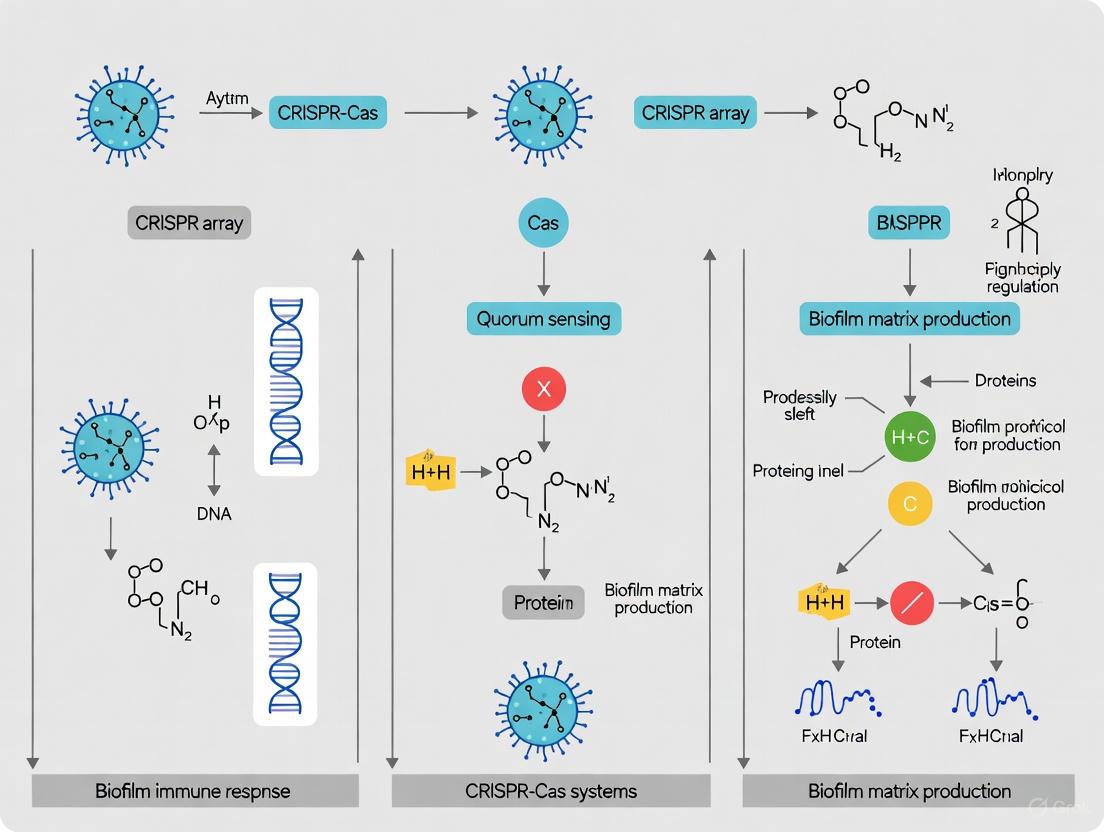
This comprehensive review explores the transformative role of CRISPR-Cas systems in deciphering and targeting complex biofilm regulatory networks.
Dissecting Biofilm Regulatory Networks with CRISPR-Cas: From Foundational Mechanisms to Precision Antimicrobial Strategies
Abstract
This comprehensive review explores the transformative role of CRISPR-Cas systems in deciphering and targeting complex biofilm regulatory networks. Designed for researchers, scientists, and drug development professionals, the article examines how CRISPR-based tools enable precise functional genomics, dissecting gene networks controlling biofilm formation, virulence, and antibiotic resistance. We cover foundational bacterial immunity mechanisms, methodological applications including CRISPRi/a for gene modulation without permanent editing, and nanoparticle-enhanced delivery systems. The article further addresses critical troubleshooting considerations for microbial community applications and provides validation frameworks comparing CRISPR approaches with conventional methods. By synthesizing recent advances and future directions, this work highlights CRISPR-Cas technology as a paradigm-shifting tool for developing precision antimicrobials and anti-biofilm strategies against multidrug-resistant pathogens.
CRISPR-Cas Systems: From Bacterial Immunity to Biofilm Network Dissection
Fundamental Principles of CRISPR-Cas Adaptive Immunity in Prokaryotes
Clustered Regularly Interspaced Short Palindromic Repeats (CRISPR) and CRISPR-associated (Cas) proteins constitute an adaptive immune system in prokaryotes that provides sequence-specific protection against mobile genetic elements. This adaptive immunity system, found in approximately 40% of bacteria and 80% of archaea, functions through a sophisticated mechanism of foreign DNA acquisition, processing, and targeted interference. This technical guide examines the fundamental principles of CRISPR-Cas systems, with particular emphasis on their emerging role as regulators of biofilm formation and virulence in pathogenic bacteria. Understanding these mechanisms provides researchers with powerful tools for dissecting bacterial regulatory networks and developing novel antimicrobial strategies.
Discovery and Biological Significance
CRISPR sequences were first identified in bacteria in 1987, but their function remained enigmatic for nearly two decades [1] [2]. A pivotal breakthrough came in 2005 when bioinformatic analyses revealed that spacer sequences within CRISPR arrays were homologous to viral and plasmid DNA, leading to the hypothesis that CRISPR might function as a prokaryotic immune system [3] [1]. Experimental validation followed in 2007 when researchers demonstrated that Streptococcus thermophilus could acquire resistance to bacteriophages by integrating new spacers derived from phage DNA into its CRISPR locus [1] [2].
CRISPR-Cas systems represent a remarkable case of Lamarckian inheritance in prokaryotes, where acquired characteristics (spacers from invasive DNA) are inherited by progeny [3]. This system functions as a genuine adaptive immune mechanism, providing bacteria and archaea with the ability to "remember" previous infections and mount sequence-specific defenses against recurring invaders [1] [2]. The system's discovery has fundamentally transformed our understanding of host-pathogen interactions in microbial communities and has provided revolutionary tools for genetic engineering.
Distribution Across Prokaryotes
CRISPR-Cas systems are unevenly distributed across prokaryotic lineages, with approximately 37-45% of sequenced bacterial genomes and 83-90% of archaeal genomes encoding these systems [3] [1]. This distribution reflects diverse evolutionary strategies, with some lineages heavily investing in adaptive immunity while others rely on alternative defense mechanisms. The prevalence of CRISPR-Cas tends to be higher in environments with elevated phage pressure, such as in hyperthermophilic archaea, where nearly all species possess multiple CRISPR-Cas variants [2].
Molecular Architecture and Classification
Core Genomic Components
All functional CRISPR-Cas systems contain two fundamental components: CRISPR arrays and cas genes. The CRISPR array consists of short (23-55 bp), partially palindromic repeats separated by similarly-sized variable sequences called spacers, which are derived from previous encounters with foreign genetic elements [1] [2]. Flanking the array is the leader sequence, which contains promoters for transcription and signals for spacer integration [1].
The cas operon encodes specialized proteins that execute all stages of the immune response. While substantial diversity exists among CRISPR-Cas systems, the cas1 and cas2 genes are universally present and represent the minimal requirement for a functional system [3] [1]. These core genes are involved in the adaptation phase, specifically in the acquisition of new spacers from invading DNA.
System Classification
CRISPR-Cas systems are categorized based on their genetic content, structural organization, and mechanistic features. The current classification scheme divides systems into two classes, six types, and numerous subtypes [2].
Table 1: Classification of Major CRISPR-Cas Systems
| Class | Type | Signature Protein | Effector Complex | Target | PAM Requirement |
|---|---|---|---|---|---|
| Class 1 | I | Cas3 | Multi-subunit (Cascade) | DNA | Yes (5' of protospacer) |
| Class 1 | III | Cas10 | Multi-subunit | DNA/RNA | No |
| Class 2 | II | Cas9 | Single protein | DNA | Yes (3' of protospacer) |
| Class 2 | V | Cas12 | Single protein | DNA | Yes |
| Class 2 | VI | Cas13 | Single protein | RNA | No |
Class 1 systems (Types I, III, and IV) utilize multi-protein effector complexes for interference, while Class 2 systems (Types II, V, and VI) employ a single large Cas protein for the same function [2]. Class 2 systems are particularly significant for biotechnology applications due to their simplicity and ease of reprogramming.
Mechanism of CRISPR-Cas Adaptive Immunity
The CRISPR-Cas immune response operates through three functionally distinct stages: adaptation, expression and processing, and interference. Each stage involves specific Cas proteins and biochemical activities that collectively provide sequence-specific immunity against invading genetic elements.
Adaptation Stage: Spacer Acquisition
The adaptation phase represents the immunization process, where the system captures fragments of invading DNA and integrates them as new spacers into the CRISPR array. This process begins when foreign DNA enters the cell, typically through viral infection or plasmid conjugation [3] [1].
The universal Cas1-Cas2 complex plays a central role in spacer acquisition. Cas1 functions as a metal-dependent DNAse with integrase activity, while Cas2 is a metal-dependent endoribonuclease [3]. The complex recognizes and processes invader DNA into protospacers of characteristic length (typically 30 base pairs) and facilitates their integration at the leader end of the CRISPR array [3] [1].
A critical aspect of spacer selection involves the protospacer adjacent motif (PAM), a short (2-5 bp) conserved sequence adjacent to the protospacer in the target DNA [1]. The PAM enables the system to distinguish self from non-self, preventing autoimmune reactions against the cell's own CRISPR arrays. Different CRISPR-Cas types recognize distinct PAM sequences, with Type I systems typically recognizing PAMs at the 5' end of the protospacer and Type II systems recognizing PAMs at the 3' end [1].
Diagram 1: CRISPR Adaptation Phase - Spacer Acquisition. The Cas1-Cas2 complex recognizes foreign DNA through PAM sequences, processes protospacers, and integrates them as new spacers into the CRISPR array.
Expression and Processing: crRNA Biogenesis
During the expression phase, the CRISPR array is transcribed as a long precursor CRISPR RNA (pre-crRNA) that is subsequently processed into mature CRISPR RNAs (crRNAs) [1] [2]. Each crRNA contains a spacer sequence flanked by partial repeat sequences, which serve as guide RNAs for target recognition.
Processing mechanisms vary between system types. In Type I systems, Cas6-like nucleases cleave within the repeat sequences to generate individual crRNAs [1]. In Type II systems, RNase III processes the pre-crRNA in conjunction with a trans-activating crRNA (tracrRNA), while in Type V systems, Cas12 processes its own guides [2].
The mature crRNAs assemble with Cas proteins to form effector complexes: Cascade (CRISPR-associated complex for antiviral defense) in Type I systems, Cas9-crRNA-tracrRNA in Type II, and Cas12-crRNA in Type V systems [3] [1].
Interference Stage: Target Degradation
The interference phase represents the execution of immunity, where crRNA-guided Cas complexes recognize and cleave complementary nucleic acids from invading elements [1]. Upon encountering target sequences matching the crRNA spacer, the effector complex initiates degradation of the invading DNA or RNA.
Type I systems utilize the Cascade complex for target recognition, which then recruits Cas3 for degradation. Cas3 contains both helicase and nuclease activities that processively degrade the target DNA [1] [2]. Type II systems employ the single protein Cas9, which contains two nuclease domains (HNH and RuvC) that generate double-strand breaks in target DNA [2]. Type V systems use Cas12, which also cleaves DNA but employs a single RuvC domain [2].
Throughout the interference process, the PAM remains critical for self/non-self discrimination, ensuring that the system only targets sequences flanked by the appropriate motif present in foreign DNA but absent from the host's own CRISPR arrays [1].
Diagram 2: CRISPR Expression and Interference Phases. The CRISPR array is transcribed and processed into mature crRNAs that guide Cas effector complexes to recognize and cleave complementary invader sequences.
Quantitative Analysis of CRISPR-Cas Systems
Table 2: Experimentally Determined Activities of Core Cas Proteins
| Protein | Representation in CRISPR-Cas | Predicted Activity | Experimentally Demonstrated Activity | Structural Information |
|---|---|---|---|---|
| Cas1 (COG1518) | Universal (all types) | Nuclease, possible integrase; role in adaptation | Metal-dependent DNase, cleaves both DNA and RNA; integrates alien DNA into CRISPR | Unique mostly α-helical fold (PDB: 3GOD) |
| Cas2 (COG1343) | Universal (all types) | Unknown | Metal-dependent endoribonuclease; role in adaptation unclear | - |
| Cas3 | Type I signature | Helicase and nuclease | Processive DNA degradation; recruited by Cascade complex | HD nuclease domain fused to Superfamily 2 helicase |
| Cas9 | Type II signature | RNA-guided DNA nuclease | HNH and RuvC domains create double-strand breaks in target DNA | Bilobed architecture with guide RNA and target DNA |
| RAMP Proteins (e.g., Cas6) | Multiple types (I, III) | RNA-binding | Endoribonuclease processes pre-crRNA; some have RNAse activity | Double ferredoxin-fold domain |
The molecular functions of Cas proteins have been characterized through biochemical studies and structural analyses. Cas1 and Cas2 represent the universal core, while other proteins exhibit type-specific distributions and activities [3]. The Repeat Associated Mysterious Proteins (RAMPs) constitute a particularly diverse superfamily with extreme sequence divergence, making their relationships difficult to trace despite functional conservation [3].
CRISPR-Cas in Biofilm Regulation: Experimental Approaches
Beyond their canonical immune function, CRISPR-Cas systems play significant roles in regulating bacterial physiology, including biofilm formation and virulence. The following experimental approaches demonstrate how CRISPR-Cas tools can dissect these regulatory networks.
Protocol: CRISPR-Cas9 Gene Editing for Biofilm Studies
The protocol below, adapted from Thavorasak et al. (2025), details a method for targeted gene mutation in Acinetobacter baumannii to investigate biofilm-related genes [4].
Materials and Methods:
sgRNA Design: Design gene-specific sgRNAs using computational tools like CHOPCHOP. The targeting sequence (crRNA sequence) should be specific to your gene of interest.
- Example spacer sequence: 5'-tagtTTTCGTGTACGTGTAGCTTC-3' and 5'-aaacGAAGCTACACGTACACGAAA-3' [4]
Oligonucleotide Preparation: Synthesize sgRNA oligonucleotides commercially and phosphorylate using T4 Polynucleotide Kinase.
Plasmid Construction:
- Clone phosphorylated, annealed oligonucleotides into appropriate CRISPR plasmid (e.g., pBECAb-apr) using Golden Gate assembly.
- Use BsaI-HFv2 restriction enzyme and T4 DNA ligase in a thermocycler with the following parameters: 25 cycles at 37°C for 3 min, and 16°C for 4 min; 50°C for 5 min; 80°C for 10 min; hold at 16°C [4].
Transformation: Transform 10 μL ligation product into 100 μL of competent E. coli DH5α cells using heat shock. Plate on selective media (e.g., LB-apr agar with 50 μg/mL apramycin) and incubate at 37°C for 16 hours.
Screening: Verify successful cloning by direct colony PCR using spacer-specific and vector-specific primers.
Mutant Generation: Introduce the verified plasmid into your target bacterial strain and screen for desired mutations.
Protocol: Assessing Biofilm Phenotypes After Genetic Manipulation
After generating mutants, use these standardized assays to quantify changes in biofilm formation:
Biofilm Quantification by Crystal Violet Staining:
- Grow bacterial cultures in appropriate media for 24-48 hours under conditions promoting biofilm formation.
- Remove planktonic cells and gently wash adhered biofilms.
- Fix biofilms with methanol or heat.
- Stain with 0.1% crystal violet solution for 15-30 minutes.
- Destain with ethanol-acetone mixture (80:20) or acetic acid (30%).
- Measure absorbance at 570-600 nm to quantify biofilm biomass [4] [5].
Confocal Laser Scanning Microscopy (CLSM) for Biofilm Architecture:
- Grow biofilms on appropriate surfaces (e.g., glass coverslips).
- Stain extracellular polysaccharide (EPS) matrix with Alexa Fluor 647-conjugated dextran (emission: 668 nm).
- Counterstain bacterial cells with SYTO9 green fluorescent nucleic acid stain (emission: 498 nm).
- Image using CLSM to visualize three-dimensional biofilm architecture and thickness [5].
Diagram 3: Experimental Workflow for CRISPR-Cas Mediated Biofilm Research. The process begins with sgRNA design and proceeds through genetic manipulation to phenotypic and mechanistic analysis.
Case Studies: CRISPR-Cas Regulation of Biofilm Formation
Cas3-Mediated Biofilm Enhancement inAcinetobacter baumannii
A 2025 study demonstrated that Cas3 of the type I-Fa CRISPR-Cas system upregulates biofilm formation and virulence in A. baumannii [5]. Researchers constructed a cas3 deletion mutant (19606Δcas3) and complemented strain (19606Δcas3/pcas3) in A. baumannii ATCC19606. The findings revealed that:
- Biofilm formation was significantly reduced in the Δcas3 mutant compared to wild-type and complemented strains
- The thickness and structural complexity of biofilms were diminished in mutants, as visualized by CLSM
- Virulence factors including biofilm-related genes and outer membrane protein A (ompA) were downregulated
- Deletion of cas3 reduced adhesion and invasion rates in A549 human alveolar epithelial cells
- In vivo virulence was attenuated, with improved survival rates in Galleria mellonella and murine infection models [5]
Mechanistic analyses indicated that Cas3 participates in regulating carbon metabolism and oxidative phosphorylation pathways, suggesting a broad regulatory role beyond canonical immunity [5].
SmpB Mutation Affecting Biofilm Formation
Another 2025 study utilized CRISPR-Cas9 to generate a targeted smpB mutant in A. baumannii [4]. The C212T nucleotide substitution (A89G amino acid change) resulted in:
- Significant reduction in biofilm formation (p = 0.0079)
- Impaired twitching motility while swimming and swarming motility remained unaffected
- Altered antibiotic susceptibility patterns
- Reduced virulence in the G. mellonella infection model (84% larval survival vs. 72% in wild type)
- Proteomic changes including downregulation of stress response proteins (GroEL, DnaK, RecA) and virulence factors [4]
These findings established SmpB as a key regulator of biofilm formation and virulence, highlighting the potential of targeting non-canonical CRISPR-related genes for antimicrobial development.
Table 3: Research Reagent Solutions for CRISPR-Cas Biofilm Studies
| Reagent/Category | Specific Examples | Function/Application | Experimental Notes |
|---|---|---|---|
| CRISPR Plasmids | pBECAb-apr | Contains Cas9 and sgRNA scaffold for genome editing | Apramycin resistance; optimized for A. baumannii [4] |
| Design Tools | CHOPCHOP web tool | Computational sgRNA design | Optimizes for specificity and efficiency [4] |
| Cloning Enzymes | T4 Polynucleotide Kinase, BsaI-HFv2, T4 DNA Ligase | Golden Gate assembly | Enables modular vector construction [4] |
| Biofilm Assays | Crystal violet staining, Confocal Laser Scanning Microscopy | Biofilm quantification and visualization | SYTO9 (cells) and Alexa Fluor 647-dextran (EPS) for CLSM [5] |
| Virulence Models | Galleria mellonella, murine infection models | In vivo assessment of pathogenicity | Determine LD50 and tissue bacterial loads [4] [5] |
| Proteomic Analysis | LC-MS/MS, STRING network analysis | Mechanistic insights into regulatory changes | Identifies downstream effects of gene manipulation [4] |
The fundamental principles of CRISPR-Cas adaptive immunity in prokaryotes encompass a sophisticated molecular machinery for acquiring memory of previous infections and executing sequence-specific defense against recurrent invaders. The system's three-stage mechanism—adaptation, expression, and interference—provides a flexible framework that has evolved into numerous types and subtypes across diverse prokaryotic lineages.
Beyond its canonical immune function, CRISPR-Cas systems play significant roles in regulating bacterial physiology, including biofilm formation and virulence. As demonstrated in recent studies, components such as Cas3 can function as regulators of biofilm architecture and pathogenicity, while CRISPR-Cas tools enable precise dissection of these regulatory networks. These insights not only advance our fundamental understanding of prokaryotic biology but also open new avenues for therapeutic interventions targeting biofilm-associated infections.
The integration of CRISPR-Cas methodologies with biofilm research provides researchers with powerful tools to unravel complex bacterial behaviors and develop novel strategies to combat antimicrobial resistance. As our understanding of these systems continues to evolve, so too will their applications in both basic research and translational medicine.
Biofilms are structured microbial communities encased in a self-produced extracellular polymeric substance (EPS) matrix that adheres to biological or abiotic surfaces [6]. This architectural complexity is not merely a physical aggregate; it represents a fundamental shift in microbial lifestyle, conferring inherent resistance to antimicrobial agents and host immune responses. The World Health Organization has identified antibiotic resistance as a leading global health threat, with biofilm-associated infections playing a pivotal role in this crisis [7] [8]. The clinical significance of biofilms is magnified by their association with the ESKAPE pathogens (Enterococcus faecium, Staphylococcus aureus, Klebsiella pneumoniae, Acinetobacter baumannii, Pseudomonas aeruginosa, and Enterobacter species), which are notorious for multidrug resistance and prevalence in healthcare-associated infections [6] [8]. Understanding the structural and mechanistic basis of biofilm-mediated resistance is paramount for developing effective therapeutic interventions, with CRISPR-Cas emerging as a transformative tool for dissecting these complex regulatory networks.
Architectural Foundations of Biofilm Resistance
Structural Organization and Development
Biofilm formation follows a programmed developmental sequence comprising distinct, overlapping stages that transform planktonic cells into structured communities [6]. The process initiates with reversible attachment, where free-floating microorganisms adhere to preconditioned surfaces through weak interactions such as van der Waals forces and electrostatic attractions [6]. Surface characteristics significantly influence this phase, with rough surfaces promoting greater microbial adhesion than smooth surfaces [6].
This transient attachment transitions to irreversible adhesion through the production of EPS components that anchor cells firmly to the substrate [6]. The attached cells then proliferate and form microcolonies, initiating the development of the characteristic three-dimensional biofilm architecture [6]. During maturation, the biofilm evolves into a fully organized structure with heterogeneous communities, water channels for nutrient distribution, and specialized microenvironments [9]. The final dispersion phase involves the controlled release of planktonic cells from the biofilm to colonize new surfaces, completing the lifecycle and facilitating infection dissemination [9].
Extracellular Polymeric Substance: The Biofilm Matrix
The EPS matrix represents the primary architectural component of biofilms, constituting up to 97% of their total biomass [9]. This complex, gel-like substance forms a protective barrier that limits antibiotic penetration and provides structural stability. The EPS composition varies between species and environmental conditions but typically includes:
- Exopolysaccharides: Such as alginate, cellulose, and pel polysaccharides that provide structural scaffolding
- Proteins: Including structural proteins and enzymes for matrix modification
- Extracellular DNA (eDNA): Contributing to matrix integrity and horizontal gene transfer
- Lipids and other polymeric substances [7] [9]
The heterogeneous architecture of mature biofilms creates specialized microenvironments with varying nutrient availability, pH, oxygen concentrations, and metabolic activity gradients [7] [6]. This spatial organization is critical for understanding the multifaceted nature of biofilm-mediated resistance.
Intrinsic Resistance Mechanisms: The Targeting Conundrum
Biofilms employ a multifaceted arsenal of resistance mechanisms that operate at physical, physiological, and genetic levels, presenting a formidable challenge for therapeutic intervention.
Table 1: Core Mechanisms of Biofilm-Mediated Antibiotic Resistance
| Resistance Mechanism | Functional Basis | Impact on Efficacy |
|---|---|---|
| Physical Barrier | EPS matrix limits antimicrobial penetration through binding and sequestration | Restricted diffusion creates concentration gradients; some antibiotics penetrate <10% of biofilm depth |
| Metabolic Heterogeneity | Gradients of nutrients, oxygen, and waste products create varied metabolic states | Dormant persister cells exhibit up to 1000× greater antibiotic tolerance than planktonic cells |
| Enhanced Horizontal Gene Transfer | High cell density and eDNA facilitate genetic exchange | Accelerated dissemination of resistance genes within and between species |
| Altered Microenvironment | Modified pH, accumulation of enzymes in matrix | Local conditions inactivate certain antibiotics; β-lactamases concentrate in matrix |
| Stress Response Activation | Nutrient limitation, waste accumulation induce stress responses | Upregulation of efflux pumps and general stress response systems |
The Physical-Chemical Barrier
The EPS matrix functions as a molecular sieve that restricts antibiotic penetration through binding and sequestration mechanisms [7]. This extracellular shield creates concentration gradients that prevent antimicrobial agents from reaching lethal concentrations in the deeper biofilm layers, particularly for positively charged antibiotics that interact with negatively charged matrix components [7] [6]. The matrix not only impedes antibiotic penetration but also accumulates antimicrobial-inactivating enzymes such as β-lactamases, creating a localized deactivation zone [7].
Physiological Heterogeneity and Persister Cells
The structural heterogeneity of biofilms generates diverse microenvironments with gradients of nutrients, oxygen, and metabolic waste products [7] [6]. These conditions lead to the development of metabolically dormant persister cells that exhibit exceptional tolerance to conventional antibiotics [7] [9]. This physiological diversification represents a bet-hedging strategy where subpopulations within the biofilm withstand antimicrobial challenges that eliminate their metabolically active counterparts. The metabolic inactivity of these cells prevents engagement with many antibiotic targets, rendering them refractory to conventional treatments that require active cellular processes [7].
CRISPR-Cas Systems: Precision Tools for Dissecting Biofilm Networks
CRISPR-Cas Fundamentals and System Diversity
The CRISPR-Cas system is an adaptive immune system in prokaryotes that provides sequence-specific protection against foreign genetic elements [10]. This system consists of CRISPR arrays containing short DNA repeats interspaced with spacer sequences acquired from previous invaders, and Cas proteins that mediate adaptation, expression, and interference [10]. Class 2 systems, particularly those utilizing Cas9, Cas12, and Cas13 effectors, have been repurposed as programmable molecular tools for precision genome editing and gene regulation in biofilm research [11] [12].
Table 2: CRISPR-Cas Systems for Biofilm Research
| System Type | Key Components | Application in Biofilm Research |
|---|---|---|
| CRISPR-Cas9 | Cas9 nuclease, gRNA | Targeted knockout of resistance genes, virulence factors, and biofilm regulators |
| CRISPRi (dCas9) | Catalytically dead Cas9, gRNA | Reversible gene silencing without DNA cleavage; studies of essential genes |
| CRISPRa (dCas9) | dCas9-activator fusions | Targeted gene activation; study gain-of-function phenotypes |
| Cas13 Systems | RNA-targeting Cas13 | Degradation of specific mRNA transcripts; study essential metabolic pathways |
CRISPR Interference (CRISPRi) for Biofilm Gene Analysis
CRISPRi employs a catalytically dead Cas9 (dCas9) that binds to DNA without introducing double-strand breaks, enabling reversible gene silencing through steric hindrance of transcription [13]. This approach is particularly valuable for studying essential genes and regulatory networks in biofilm formation, as it allows temporal control without permanent genetic alterations [11] [13].
In Pseudomonas fluorescens, CRISPRi has been successfully implemented to investigate genes controlling biofilm formation, including components of the GacA/S two-component system and regulatory proteins associated with cyclic di-GMP (c-di-GMP) signaling [13]. The system utilizes two compatible plasmids: one carrying the dCas9 gene under control of a PtetA promoter inducible by anhydrotetracyclin (aTc), and another constitutively expressing a guide RNA (gRNA) targeting specific genes of interest [13].
Targeting Biofilm Regulation Networks
The application of CRISPR-Cas systems has revealed critical insights into the hierarchical regulatory networks controlling biofilm formation:
- Quorum Sensing Systems: Targeted disruption of autoinducer synthase genes and receptor proteins reduces coordination of biofilm development and virulence factor production [12]
- Cyclic di-GMP Signaling: CRISPRi-mediated silencing of diguanylate cyclases (DGCs) and phosphodiesterases (PDEs) has elucidated their specific contributions to the transition from motile to sessile lifestyles [13]
- Two-Component Systems: Precision targeting of response regulators such as GacA demonstrates their central role in controlling EPS production and biofilm maturation [13]
- Transcription Factors: CRISPR approaches enable functional characterization of biofilm-associated transcription factors in their native genomic context [12]
Advanced Delivery Systems for Biofilm Targeting
Nanoparticle-Mediated CRISPR Delivery
The efficient delivery of CRISPR components through the protective biofilm matrix represents a significant technical challenge. Nanoparticles (NPs) have emerged as innovative carriers that enhance the stability, penetration, and cellular uptake of CRISPR machinery within biofilm environments [7].
Table 3: Nanoparticle Delivery Systems for Anti-Biofilm CRISPR Applications
| Nanoparticle Type | Composition | Delivery Efficacy | Key Advantages |
|---|---|---|---|
| Liposomal NPs | Phospholipid bilayers | >90% reduction in P. aeruginosa biofilm biomass [7] | Enhanced biofilm penetration, biocompatibility |
| Gold NPs | Gold cores, surface functionalization | 3.5× increase in editing efficiency vs. non-carrier systems [7] | Controlled release, surface modifiability |
| Polymeric NPs | Biodegradable polymers | Efficient co-delivery with antibiotics [7] | Tunable properties, synergistic effects |
| Hybrid Systems | Composite materials | Superior biofilm disruption and editing [7] | Multifunctional platforms |
These advanced nanocarriers can be engineered with surface modifications that enhance interaction with biofilm components, facilitating efficient penetration and delivery of CRISPR-Cas constructs directly to bacterial cells [7]. The co-delivery of CRISPR components with conventional antibiotics or antimicrobial peptides creates synergistic effects that enhance biofilm eradication [7].
Bacteriophage and Conjugative Plasmid Vectors
Beyond nanoparticle systems, biological delivery vectors offer additional options for precision targeting of biofilm communities:
- Engineered Bacteriophages: Lytic phages modified to carry CRISPR payloads can specifically infect and deliver antimicrobial machinery to target pathogens while exploiting natural phage penetration capabilities [8]
- Conjugative Plasmids: Self-transmissible plasmids enable the transfer of CRISPR systems across bacterial populations, facilitating community-wide targeting of resistance genes [8]
- Phagemid Systems: Hybrid phage-plasmid vectors combine the infectivity of phages with the cloning capacity of plasmids for optimized delivery [12]
Experimental Framework: CRISPR-Based Biofilm Analysis
Protocol: CRISPRi-Mediated Gene Silencing in Biofilm Models
Materials and Reagents:
- Bacterial strains of interest (e.g., P. fluorescens SBW25, WH6, or Pf0-1)
- Two-plasmid CRISPRi system (dCas9 expression plasmid + gRNA plasmid)
- Anhydrotetracycline (aTc) inducer
- Appropriate selective antibiotics
- Confocal laser scanning microscopy (CLSM) equipment
- Crystal violet staining solution
- Flow cytometry equipment (for quantification)
Methodology:
Strain Preparation:
- Transform target strain with dCas9 expression plasmid
- Subsequently transform with gRNA plasmid targeting gene of interest
- Include non-targeting gRNA control strain
Biofilm Cultivation:
- Inoculate cultures in appropriate medium with selective antibiotics
- Induce dCas9 expression with 100-200 ng/mL aTc
- Allow biofilm formation under optimal conditions (24-48 hours)
Phenotypic Analysis:
- Biomass Quantification: Crystal violet staining with ethanol elution and OD570 measurement
- Architectural Analysis: CLSM with appropriate fluorescent stains (SYTO9 for cells, dextran conjugates for EPS)
- Metabolic Activity: Resazurin reduction assays or CTC staining
- Gene Expression: RT-qPCR validation of target gene knockdown
Data Interpretation:
- Compare architecture parameters (biovolume, thickness, roughness) between experimental and control conditions
- Correlative analysis between gene expression and phenotypic outcomes
This experimental framework enables systematic functional analysis of biofilm-associated genes with temporal control and minimal pleiotropic effects.
Research Reagent Solutions for Biofilm CRISPR Studies
Table 4: Essential Research Reagents for CRISPR-Based Biofilm Analysis
| Reagent Category | Specific Examples | Research Application |
|---|---|---|
| CRISPR Plasmids | dCas9 expression vectors, gRNA cloning backbones | Modular gene silencing platforms adaptable to diverse bacterial species |
| Induction Systems | Anhydrotetracycline (aTc), Arabinose | Temporal control of CRISPR component expression |
| Detection Reagents | SYTO9/propidium iodide, fluorescent dextrans | Visualization of live/dead cells and EPS matrix components |
| Analytical Tools | Crystal violet, resazurin, ATP assays | Quantification of biofilm biomass and metabolic activity |
| Delivery Vehicles | Liposomal nanoparticles, engineered phages | Enhanced penetration through protective biofilm matrix |
The architectural complexity of biofilms and their multifaceted resistance mechanisms present formidable challenges that demand innovative targeting approaches. The integration of CRISPR-Cas technologies provides unprecedented precision for dissecting the regulatory networks underlying biofilm formation and maintenance. These molecular tools enable researchers to move beyond correlation to establish causal relationships between specific genetic elements and biofilm phenotypes.
The future of biofilm targeting lies in combinatorial strategies that leverage CRISPR insights to design intelligent interventions. The convergence of CRISPR with advanced delivery systems such as engineered nanoparticles and bacteriophages creates opportunities for precision antimicrobial therapies that can overcome the physical, physiological, and genetic barriers posed by biofilms. Furthermore, the integration of CRISPR screening with multi-omics approaches and artificial intelligence will accelerate the identification of critical network vulnerabilities that can be exploited for therapeutic intervention.
As these technologies mature, they hold the potential to transform our approach to biofilm-associated infections, moving from broad-spectrum antimicrobial bombardment to precision genetic surgery that selectively disarms pathogens while preserving commensal communities. This paradigm shift will be essential for addressing the escalating crisis of antimicrobial resistance and developing next-generation therapies for persistent biofilm-mediated infections.
CRISPR-Cas systems are universally recognized as the adaptive immune machinery of prokaryotes, providing sequence-specific defense against invasive genetic elements like bacteriophages and plasmids. However, emerging research has unveiled a fascinating expansion of their functional repertoire: these systems also function as sophisticated native regulators of core bacterial physiology [2]. Beyond their canonical role in immunity, CRISPR-Cas systems are intrinsically involved in modulating critical pathogenicity determinants, including virulence factor expression and biofilm development [5] [14]. This regulatory duality positions CRISPR-Cas as a pivotal bridge between bacterial immunity and host interactions.
The following review synthesizes recent advances in understanding how different CRISPR-Cas types naturally govern virulence and biofilm formation in clinically relevant bacterial pathogens. We dissect specific molecular mechanisms, present quantitative experimental data, and provide detailed methodologies for studying these phenomena, framing this knowledge within the broader context of dissecting biofilm regulatory networks for therapeutic intervention.
Molecular Mechanisms of Virulence and Biofilm Regulation
Transcriptional Control of Virulence Pathways
CRISPR-Cas systems can directly influence bacterial virulence by regulating the expression of virulence-associated genes. This control can occur through both indirect and direct transcriptional mechanisms.
Indirect Regulation via Virulence Regulators: In Streptococcus agalactiae (Group B Streptococcus), the master virulence regulator CovR directly represses a distal promoter (P2cas) of the cas operon. This finding integrates CRISPR-Cas immunity within the broader virulence regulatory network. De-repression of this promoter in ΔcovR mutants leads to a 4-fold increase in cas9, cas1, and csn2 transcription, enhancing immunity and restoring potency against mutated target sequences [15].
Direct Targeting of Endogenous Genes: In hypervirulent Klebsiella pneumoniae, the type I-E* CRISPR-Cas system directly targets the hutT gene, a component of the histidine utilization (Hut) operon. This self-targeting action represses the Hut pathway and influences bacterial virulence, although the net effect on pathogenicity is complex and context-dependent [16].
Table 1: Regulatory Mechanisms of CRISPR-Cas Systems in Bacterial Pathogens
| Bacterial Pathogen | CRISPR-Cas Type | Regulatory Target | Molecular Mechanism | Effect on Virulence/Biofilm |
|---|---|---|---|---|
| Streptococcus agalactiae | II-A | Cas operon expression | CovR repression of P2cas promoter | Modulates immune memory and off-target cleavage [15] |
| Acinetobacter baumannii | I-Fa | Biofilm-related factors | Cas3-mediated upregulation of OmpA and biofilm matrix components | Increases biofilm formation and virulence [5] |
| Acinetobacter baumannii | I-Fb | PNAG production, pilus expression | H-NS/BaeR repression of Cas3 expression | Decreases biofilm and host adhesion [14] |
| Klebsiella pneumoniae | I-E* | Histidine utilization (Hut) operon | Direct targeting of hutT gene sequence | Alters histidine metabolism and virulence [16] |
Control of Biofilm Formation and Architecture
Biofilm formation represents a crucial virulence factor for many pathogens, providing protection against antibiotics and host immune responses. CRISPR-Cas systems significantly influence this process through diverse mechanisms.
In Acinetobacter baumannii, the role of CRISPR-Cas exhibits intriguing subtype specificity. The type I-Fa system enhances biofilm formation, where deletion of cas3 significantly reduces biofilm thickness and complexity, as visualized through confocal laser scanning microscopy [5]. The extracellular polysaccharide (EPS) matrix is notably diminished in Δcas3 mutants, highlighting Cas3's role in maintaining biofilm architecture.
Conversely, the I-Fb system in A. baumannii exerts an opposing effect, acting as a repressor of biofilm formation. In this system, Cas3 inhibits the production of the extracellular matrix component poly-N-acetylglucosamine (PNAG) and downregulates pilus-associated genes, thereby impairing cellular adhesion [14]. This repression is controlled by a hierarchical regulatory axis where the transcriptional regulators BaeR and H-NS suppress Cas3 expression. Deletion of cas3 in this context releases this repression, leading to enhanced biofilm formation and host colonization [14].
Figure 1: The BaeR/H-NS Regulatory Axis Controlling Cas3 and Virulence in A. baumannii. This diagram illustrates the hierarchical regulation where BaeR controls H-NS expression, which directly represses the cas3 promoter, ultimately modulating biofilm formation and host adhesion through Cas3-dependent pathways [14].
Experimental Approaches and Quantitative Assessments
Methodologies for Investigating CRISPR-Cas Regulation
A. Genetic Manipulation and Mutant Construction
The foundational approach for elucidating CRISPR-Cas functions involves constructing isogenic mutant strains. For A. baumannii type I-Fa studies, researchers created a cas3 deletion mutant (19606Δcas3) and a chromosomally complemented strain (19606Δcas3/pcas3). The mutants were verified through PCR and sequencing to ensure precise genetic alterations [5]. Similar approaches were employed for K. pneumoniae, where a casABECD-deletion mutant was constructed to analyze the system's role in regulating the Hut operon [16].
B. Biochemical Characterization of Protein-DNA Interactions
Electrophoretic mobility shift assays (EMSA) are crucial for demonstrating direct binding of regulatory proteins to target DNA. In S. agalactiae, EMSA with purified CovR protein and a radiolabeled P2cas promoter probe confirmed direct binding, while DNase I protection assays precisely mapped the binding site to a sequence encompassing the P2cas transcriptional start site [15]. Similarly, in A. baumannii, DNA pull-down assays combined with EMSA demonstrated H-NS binding to AT-rich regions within the cas3 promoter [14].
C. Transcriptional Analysis
Quantitative PCR after reverse transcription (RT-qPCR) is routinely used to measure changes in gene expression. In S. agalactiae, RT-qPCR confirmed a 4-fold increase in cas9, cas1, and csn2 transcription in ΔcovR mutants compared to wild-type strains [15]. For global transcriptional profiling, RNA-sequencing can identify differentially expressed genes between wild-type and CRISPR-Cas mutants, as demonstrated in K. pneumoniae studies that revealed upregulation of the Hut operon in ΔcasABECD strains [16].
D. Phenotypic Virulence Assays
- Biofilm Quantification: Biofilm formation is typically quantified using crystal violet staining, measuring absorbance at 570-600 nm after dye extraction [5].
- Host Cell Adhesion/Invasion: Epithelial cell adhesion and invasion assays are performed using cell lines like A549 human alveolar epithelial cells, infecting at a specific multiplicity of infection (e.g., MOI of 100) and enumerating cell-associated and internalized bacteria [5].
- In Vivo Models: Galleria mellonella (wax moth larvae) infection models provide a convenient invertebrate system for assessing virulence, with survival monitored over time [5]. Murine infection models offer more physiologically relevant assessments of pathogenicity [5].
Table 2: Quantitative Effects of CRISPR-Cas Modulation on Bacterial Pathogenicity
| Experimental Manipulation | Pathogen | Key Quantitative Findings | Experimental Method |
|---|---|---|---|
| cas3 deletion (Type I-Fa) | A. baumannii ATCC19606 | >90% reduction in biofilm formation; ~50% larval survival at 96h (vs. 0% for WT) [5] | Crystal violet staining; G. mellonella model |
| covR deletion | S. agalactiae BM110 | 4-fold increase in cas operon transcription; Full immunity against protospacers 12/13 (vs. -3 | RT-qPCR; Immunity index (transformation efficiency) |
| casABECD deletion | K. pneumoniae | Enhanced growth with histidine as sole carbon source; Upregulation of Hut operon genes [16] | Transcriptomics; Growth assays |
| cas3 deletion (Type I-Fb) | A. baumannii AB43 | Increased biofilm thickness; Elevated PNAG production; Enhanced epithelial adhesion [14] | CLSM; EPS quantification; Adhesion assays |
Figure 2: Experimental Workflow for Investigating CRISPR-Cas Regulatory Roles. This workflow outlines the standard methodological pipeline for dissecting how CRISPR-Cas systems modulate bacterial virulence and biofilm formation, from genetic manipulation to in vivo validation [15] [5] [14].
The Scientist's Toolkit: Essential Research Reagents
Table 3: Key Research Reagents for Investigating CRISPR-Cas Regulatory Functions
| Reagent / Material | Specific Example | Experimental Function |
|---|---|---|
| Isogenic Mutant Strains | A. baumannii 19606Δcas3; S. agalactiae ΔcovR | Enable comparative studies to determine gene function without confounding genetic background effects [15] [5] |
| Complementation Plasmids | 19606Δcas3/pcas3 (chromosomal) | Verify that observed phenotypes are due to the specific gene deletion and not secondary mutations [5] |
| β-Galactosidase Reporter System | P2cas promoter fused to lacZ | Quantify promoter activity under different genetic backgrounds or environmental conditions [15] |
| Epitope-Tagged Cas Proteins | FLAG-tagged Cas9 in S. agalactiae | Enable detection of protein expression levels and potentially localization through western blot or immunofluorescence [15] |
| Purified Recombinant Proteins | CovR, H-NS, BaeR | Used for in vitro binding assays (EMSA, DNase I footprinting) to demonstrate direct protein-DNA interactions [15] [14] |
| Specialized Growth Media | Minimal medium with histidine as sole carbon source | Assess metabolic adaptations resulting from CRISPR-Cas manipulation [16] |
| Model Infection Systems | G. mellonella larvae; A549 epithelial cells | Provide tractable models for assessing virulence changes in CRISPR-Cas mutants [5] [16] |
Implications for Anti-Biofilm Therapeutic Strategies
Understanding the native regulatory functions of CRISPR-Cas systems opens innovative avenues for combating biofilm-mediated infections. The emerging paradigm suggests that targeted manipulation of these systems could reprogram bacterial behavior toward less pathogenic states.
The dual role of Cas3 in A. baumannii highlights the therapeutic potential of modulating CRISPR-Cas activity. In strains where Cas3 suppresses virulence traits, strategic activation of the CRISPR-Cas system could attenuate pathogenicity [14]. Conversely, in systems where Cas3 enhances biofilm formation, targeted inhibition might reduce bacterial persistence [5].
Novel therapeutic approaches are exploring the integration of CRISPR-Cas with nanoparticle delivery systems. Liposomal Cas9 formulations have demonstrated over 90% reduction of Pseudomonas aeruginosa biofilm biomass in vitro, while gold nanoparticle carriers enhance editing efficiency up to 3.5-fold compared to non-carrier systems [7]. These hybrid platforms enable co-delivery with antibiotics, creating synergistic antibacterial effects and superior biofilm disruption.
Furthermore, CRISPR interference (CRISPRi) technologies utilizing catalytically inactive Cas proteins (dCas9) offer precise transcriptional control without DNA cleavage. This approach can target essential virulence genes or biofilm regulatory networks with high specificity, potentially overcoming the limitations of conventional antibiotics [11]. As we deepen our understanding of CRISPR-Cas biology within biofilm regulatory networks, these insights will inform the development of next-generation antimicrobials that manipulate bacterial behavior rather than simply killing pathogens, potentially reducing selective pressure for resistance.
CRISPR-Cas systems have transcended their traditional identity as simple immune defenses, emerging as sophisticated integrators of bacterial immunity and physiology. The evidence reviewed herein demonstrates that these systems natively regulate critical virulence determinants—including biofilm formation, host adhesion, and metabolic adaptation—through diverse molecular mechanisms that vary across bacterial species and CRISPR-Cas types. This regulatory capacity positions CRISPR-Cas as a central node in the complex network controlling bacterial pathogenicity.
For researchers dissecting biofilm regulatory networks, these findings underscore the importance of considering CRISPR-Cas systems not merely as genetic tools but as intrinsic components of bacterial regulatory circuitry. The experimental frameworks and reagents outlined provide a roadmap for further exploration of these functions across diverse bacterial pathogens. As we continue to unravel the complexities of CRISPR-Cas-mediated regulation, this knowledge will accelerate the development of novel anti-infective strategies that leverage bacterial innate systems for therapeutic benefit, potentially offering new solutions to the escalating crisis of antibiotic resistance.
Clustered Regularly Interspaced Short Palindromic Repeats (CRISPR) and CRISPR-associated (Cas) proteins constitute an adaptive immune system in prokaryotes that provides sequence-specific protection against invasive genetic elements such as viruses and plasmids [2]. These systems are broadly categorized into two classes based on the architecture of their effector complexes. Class 1 systems utilize multi-subunit effector complexes for target interference, while Class 2 systems employ a single, large protein effector for the same function [17] [18]. This fundamental distinction not only influences their natural biological roles but also determines their practical applications in biotechnology and research, particularly in complex areas such as biofilm regulation and control.
The classification of CRISPR-Cas systems extends beyond the two classes into types and subtypes based on signature genes, locus organization, and mechanisms of action [19]. Current classification includes six major types (I-VI) and numerous subtypes, with Class 1 encompassing types I, III, and IV, and Class 2 containing types II, V, and VI [2]. Understanding this hierarchical classification is crucial for researchers selecting appropriate CRISPR tools for specific applications, including the manipulation of biofilm formation and disruption of biofilm-associated antibiotic resistance mechanisms.
Class 1 CRISPR-Cas Systems: Architecture and Mechanisms
Class 1 CRISPR systems represent the evolutionarily older and more widespread form of CRISPR immunity, comprising approximately 90% of all identified CRISPR loci in bacteria and nearly 100% in archaea [17] [19]. These systems are characterized by their multi-protein effector complexes, which require the coordinated assembly of several Cas protein subunits to form functional interference machinery. The complexity of these multi-subunit complexes has historically limited their biotechnological application compared to Class 2 systems, though recent advances are beginning to overcome these challenges [19].
Type I Systems
Type I systems constitute the most prevalent CRISPR type among all classes and are defined by the presence of the Cas3 signature protein, which possesses both helicase and nuclease activities [17] [19]. These systems employ a Cascade (CRISPR-associated complex for antiviral defense) complex for target recognition and binding, which then recruits Cas3 for DNA degradation. A unique feature of Cas3 is its ability to processively degrade long stretches of DNA after recruitment by Cascade, making it particularly useful for applications requiring large genomic deletions [19]. Type I systems are exclusively DNA-targeting and contain seven subtypes (A-G) that differ primarily in the specific composition of their Cascade complexes [17].
Type III Systems
Type III systems represent what many consider the most complex CRISPR systems and are hypothesized to be the evolutionary ancestor of all other CRISPR types [19]. These systems are characterized by the presence of the Cas10 signature protein, which contains Palm and cyclase domains responsible for nucleic acid cleavage [17]. Unlike other CRISPR types, Type III systems demonstrate dual targeting capability, able to recognize and cleave both RNA and DNA substrates, though DNA targeting is considered their primary function [19]. The system contains six subtypes (A-F) defined by accessory Cas proteins in their effector complexes. Notably, the Type III-E subtype has been engineered to create Cas7-11, a single-protein effector capable of RNA targeting in mammalian cells despite its Class 1 origins [19].
Type IV Systems
Type IV systems remain the most enigmatic of the CRISPR classes, with three identified subtypes (A-C) that are poorly characterized compared to other types [17] [19]. These systems are considered "putative" as they lack several canonical CRISPR features, including adaptation modules (Cas1 and Cas2 genes) and, in the case of subtypes IV-A and IV-B, nuclease effectors capable of target cleavage [19]. Type IV systems are typically found on plasmids rather than bacterial chromosomes, leading to hypotheses that they may function in plasmid competition or hijack machinery from other CRISPR systems [19]. Subtype IV-C contains a helicase domain resembling Cas10 but its precise mechanism remains unknown [19].
Table 1: Classification and Properties of Class 1 CRISPR Systems
| Type | Signature Protein | Target Nucleic Acid | Key Features | Subtypes |
|---|---|---|---|---|
| I | Cas3 | DNA | Most common type; degrades large DNA sections; Cas3 has helicase/nuclease activity | A-G (7 subtypes) |
| III | Cas10 | DNA & RNA | Most complex; considered ancestral; dual targeting capability | A-F (6 subtypes) |
| IV | Various (Cas7-like) | Unknown | Putative systems; lack adaptation genes; often plasmid-encoded | A-C (3 subtypes) |
Class 2 CRISPR-Cas Systems: Architecture and Mechanisms
Class 2 CRISPR systems are defined by their utilization of a single, multidomain protein effector for nucleic acid targeting and cleavage, significantly simplifying their architecture compared to Class 1 systems [18]. Despite representing only approximately 10% of identified CRISPR loci and being found almost exclusively in bacteria (with no known examples in hyperthermophiles), Class 2 systems have become the foundation of contemporary CRISPR biotechnology due to their simplicity and ease of programming [17] [18]. The single-effector nature of these systems has facilitated their adaptation as versatile tools for genome editing, transcriptional regulation, and diagnostic applications.
Type II Systems
Type II systems are the most well-known and widely utilized CRISPR type, defined by the signature Cas9 effector protein [17] [20]. These systems require two RNA components for function: a CRISPR RNA (crRNA) that provides target specificity, and a trans-activating CRISPR RNA (tracrRNA) that facilitates pre-crRNA processing and Cas9 activation [20]. Cas9 contains two distinct nuclease domains: RuvC, which cleaves the non-target DNA strand, and HNH, which cleaves the target strand complementary to the crRNA guide [20]. This results in blunt-ended double-strand breaks in target DNA. Type II systems are further divided into three subtypes (A-C) based on variations in their genetic architecture and accessory proteins, with the commonly used Streptococcus pyogenes Cas9 (SpCas9) belonging to subtype II-A [19].
Type V Systems
Type V systems employ Cas12 (formerly Cpf1) as their primary effector protein and represent one of the most popular alternatives to Cas9 for genome editing applications [19]. Unlike Cas9, Cas12 contains a single RuvC nuclease domain that cleaves both DNA strands, resulting in staggered DNA ends with 5' overhangs that may enhance homology-directed repair efficiency [19] [21]. Another distinguishing feature is that most Cas12 effectors can process their own pre-crRNA arrays without requiring tracrRNA, enabling multiplexed targeting from a single transcript [21]. Type V systems demonstrate considerable diversity, with at least 10 subtypes (A-I and U) including compact Cas14 variants (400-700 amino acids) that target single-stranded DNA and CRISPR-associated transposase (CAST) systems that enable precise DNA insertion without double-strand breaks [19].
Type VI Systems
Type VI systems are defined by Cas13 effectors, which represent the only CRISPR systems that exclusively target RNA substrates rather than DNA [17] [19]. Cas13 proteins contain two Higher Eukaryotes and Prokaryotes Nucleotide-binding (HEPN) domains that confer RNase activity, enabling programmable RNA cleavage for applications in transcript knockdown, RNA editing, and nucleic acid detection [19] [21]. Following target recognition, Cas13 exhibits collateral RNase activity that non-specifically cleaves nearby RNA molecules, a property that has been harnessed for sensitive diagnostic applications such as SHERLOCK (Specific High-sensitivity Enzymatic Reporter unLOCKing) for pathogen detection [17] [19]. Type VI contains four subtypes (A-D) with varying properties and specificities.
Table 2: Classification and Properties of Class 2 CRISPR Systems
| Type | Signature Protein | Target Nucleic Acid | Key Features | Subtypes |
|---|---|---|---|---|
| II | Cas9 | DNA | Requires tracrRNA; creates blunt-end cuts; most widely engineered | A-C (3 subtypes) |
| V | Cas12 | DNA | Self-processes crRNAs; creates staggered cuts; includes compact variants | A-I, U (10 subtypes) |
| VI | Cas13 | RNA | Only RNA-targeting; exhibits collateral cleavage; used in diagnostics | A-D (4 subtypes) |
Comparative Analysis: Class 1 vs. Class 2 CRISPR Systems
The fundamental distinctions between Class 1 and Class 2 CRISPR systems extend beyond their effector complexity to encompass differences in distribution, mechanism, and practical application. Class 1 systems dominate the natural CRISPR landscape, comprising approximately 90% of all identified systems in bacteria and nearly 100% in archaea, while Class 2 systems represent only about 10% and are found exclusively in bacteria [17] [18]. This distribution suggests possible evolutionary trade-offs, with the multi-subunit approach of Class 1 potentially offering advantages in natural contexts that the simpler Class 2 systems cannot match.
From a mechanistic perspective, Class 1 systems employ complex, multi-protein effector complexes such as Cascade (Type I) or Csm/Cmr complexes (Type III) that recognize target nucleic acids and recruit separate nuclease modules like Cas3 for DNA degradation [19]. In contrast, Class 2 systems integrate all essential functions—target recognition, cleavage activation, and nucleic acid processing—into single multidomain proteins like Cas9, Cas12, or Cas13 [18]. This architectural simplicity has made Class 2 systems dramatically more amenable to biotechnology applications, as expressing and delivering a single protein is considerably more straightforward than coordinating the expression and assembly of multiple subunits with proper stoichiometry.
The practical implications of these differences are significant for research applications. Class 2 systems offer simplicity, ease of delivery, and straightforward engineering, making them ideal for most standard genome editing applications [18]. However, Class 1 systems provide unique capabilities such as the processive DNA degradation of Cas3 (Type I) that enables large genomic deletions, or the simultaneous DNA and RNA targeting of Type III systems that may offer advantages for comprehensive anti-viral strategies [19]. Recent engineering efforts have begun to overcome the delivery challenges of Class 1 systems, making them increasingly accessible for specialized applications where their unique properties provide distinct advantages.
Figure 1: Classification Hierarchy of CRISPR-Cas Systems
CRISPR-Cas Applications in Biofilm Research: Mechanisms and Approaches
Biofilm Challenges and CRISPR Solutions
Biofilms represent structured communities of microorganisms encapsulated within an extracellular polymeric substance (EPS) matrix that adherent to biological or inert surfaces [22]. These structures pose significant challenges in clinical and industrial settings due to their inherent resistance to conventional antimicrobial therapies, with biofilm-associated bacteria demonstrating up to 1000-fold greater tolerance to antibiotics compared to their planktonic counterparts [22]. This resilience stems from multiple factors including reduced metabolic activity of embedded cells, limited antibiotic penetration through the EPS matrix, and the presence of persistent cells that survive antimicrobial treatment [22].
CRISPR-Cas systems offer transformative approaches to combat biofilm-mediated resistance through precision targeting of essential biofilm genes, antibiotic resistance determinants, and regulatory pathways [11] [22]. Unlike broad-spectrum antimicrobials that indiscriminately affect both pathogenic and commensal microorganisms, CRISPR-based interventions can be designed to selectively eliminate specific pathogens or resensitize them to conventional antibiotics by disrupting resistance genes [22]. This precision targeting minimizes collateral damage to beneficial microbiota and reduces the selective pressure for de novo resistance development that plagues traditional antibiotic therapies.
Targeting Biofilm Formation and Maintenance Pathways
CRISPR-Cas systems can be programmed to disrupt critical genetic determinants of biofilm formation and stability, including genes involved in quorum sensing, extracellular matrix production, and adhesion mechanisms [11]. For instance, in Bacillus velezensis FZB42, CRISPR-Cas9-mediated deletion of the slrR gene, a key regulator of biofilm formation, resulted in significant alterations to biofilm architecture and development, providing insights into the molecular mechanisms controlling biofilm dynamics [23]. Similarly, CRISPR interference (CRISPRi) approaches utilizing catalytically inactive Cas9 (dCas9) fused to repressor domains can selectively downregulate expression of biofilm-related genes without permanent genetic alterations, enabling reversible modulation of biofilm phenotypes for both research and potential therapeutic applications [11].
The effectiveness of this approach was demonstrated in a study targeting Pseudomonas aeruginosa biofilms, where CRISPR-Cas9 systems designed to disrupt quorum sensing genes (lasR and rhlR) resulted in significantly impaired biofilm formation and enhanced bacterial susceptibility to antibiotic treatments [22]. By precisely targeting the regulatory networks that coordinate biofilm development, CRISPR systems provide researchers with powerful tools to dissect the complex molecular pathways underlying biofilm-mediated resistance while simultaneously developing potential therapeutic interventions.
Eliminating Antibiotic Resistance in Biofilms
Beyond targeting biofilm structural genes, CRISPR-Cas systems can directly eliminate antibiotic resistance genes from bacterial populations within biofilms, resensitizing them to conventional antimicrobials [22]. This approach has shown promise against clinically relevant resistance mechanisms, including the targeted disruption of beta-lactamase genes (bla), methicillin resistance genes (mecA), and New Delhi metallo-beta-lactamase genes (ndm-1) that confer resistance to last-resort antibiotics [22]. By specifically eliminating these resistance determinants from pathogen genomes, CRISPR restoration of antibiotic susceptibility provides a strategy to rescue the efficacy of existing antibiotics that would otherwise be ineffective against resistant biofilm infections.
The potential of this approach was highlighted in experiments where liposomal CRISPR-Cas9 formulations specifically targeting carbapenem resistance genes in Pseudomonas aeruginosa biofilms reduced biofilm biomass by over 90% in vitro when combined with meropenem treatment [22]. Similarly, CRISPR-Cas9 systems designed to target the vanA gene in vancomycin-resistant Enterococcus (VRE) biofilms restored susceptibility to vancomycin and significantly reduced bacterial loads in biofilm models [22]. These results demonstrate the potential of sequence-specific antimicrobials to overcome the recalcitrance of biofilm-associated infections that routinely resist conventional antibiotic therapies.
Experimental Protocols for Biofilm Research Using CRISPR-Cas
CRISPR-Cas9-Mediated Gene Knockout in Biofilm-Associated Bacteria
The following protocol outlines the methodology for targeted gene disruption in biofilm-forming bacteria using CRISPR-Cas9, based on established approaches in Bacillus velezensis and other biofilm-forming species [23]:
Materials Required:
- Appropriate bacterial strain with known genome sequence
- CRISPR-Cas9 plasmid system compatible with target bacteria
- Oligonucleotides for sgRNA synthesis targeting gene of interest
- Homology-directed repair (HDR) template (if performing precise editing)
- Appropriate antibiotics for selection
- Biofilm culture vessels (e.g., microtiter plates, flow cells)
- Confocal laser scanning microscopy (CLSM) equipment
- Quantitative PCR equipment
- Scanning electron microscopy (SEM) equipment
Procedure:
sgRNA Design and Cloning:
- Identify target sequence within biofilm-related gene (e.g., slrR, eps, or quorum sensing genes) with appropriate PAM sequence (5'-NGG-3' for SpCas9)
- Design sgRNA with 20-nucleotide guide sequence complementary to target site
- Synthesize oligonucleotides and clone into CRISPR-Cas9 expression plasmid
- Verify construct by sequencing
Transformation:
- Introduce CRISPR-Cas9 plasmid into target bacteria using appropriate method (electroporation, conjugation, or natural transformation)
- Select transformants on antibiotic-containing media
- Verify plasmid acquisition by colony PCR
Gene Editing Verification:
- Screen colonies for desired genetic modifications using PCR and sequencing
- Verify loss of target protein expression by Western blot or immunostaining
- Confirm off-target effects are minimal through whole-genome sequencing of selected mutants
Biofilm Phenotyping:
- Culture wild-type and mutant strains under biofilm-forming conditions
- Quantify biofilm biomass using crystal violet staining or similar method
- Analyze biofilm architecture by confocal laser scanning microscopy (CLSM)
- Examine ultrastructural changes by scanning electron microscopy (SEM)
- Assess changes in gene expression profiles via RNA-seq or qRT-PCR
This protocol enabled researchers to demonstrate that slrR deletion in Bacillus velezensis FZB42 significantly altered biofilm structure and development, providing key insights into the genetic regulation of biofilm formation in this plant growth-promoting rhizobacterium [23].
Nanoparticle-Mediated CRISPR Delivery for Biofilm Eradication
Overcoming the delivery barrier for CRISPR components into bacterial biofilms represents a significant challenge that nanoparticle-based systems can address [22]. The following protocol details the preparation and application of CRISPR-nanoparticle conjugates for enhanced biofilm penetration and editing efficiency:
Materials Required:
- Gold nanoparticles (e.g., 20-50nm) or lipid nanoparticles
- Cas9 protein or encoding plasmid
- sgRNA targeting antibiotic resistance or biofilm genes
- Appropriate buffer systems (PBS, HEPES)
- Biofilm model system (in vitro or ex vivo)
- Antibiotics for synergy testing
- Characterization equipment (DLS, TEM, spectrophotometry)
Procedure:
Nanoparticle Functionalization:
- Prepare gold nanoparticles using citrate reduction method (for metallic nanoparticles) or prepare lipid nanoparticles via microfluidic mixing
- Conjugate Cas9/sgRNA ribonucleoproteins (RNPs) to nanoparticle surface using thiol chemistry (gold) or encapsulate CRISPR components (lipids)
- Characterize conjugates using dynamic light scattering (DLS), transmission electron microscopy (TEM), and UV-Vis spectroscopy
- Verify CRISPR activity using in vitro cleavage assays
Biofilm Treatment:
- Establish mature biofilms (48-72 hours) in appropriate model systems
- Apply CRISPR-nanoparticle formulations at varying concentrations
- Include appropriate controls (untreated, nanoparticles alone, free CRISPR)
- Incubate under conditions appropriate for target bacteria
Efficacy Assessment:
- Quantify biofilm biomass reduction using crystal violet or similar staining
- Assess bacterial viability within biofilms via colony-forming unit (CFU) counts
- Evaluate editing efficiency at target locus using sequencing
- Measure downregulation of target genes using qRT-PCR
- Test resensitization to antibiotics by minimum inhibitory concentration (MIC) assays
Synergy Testing:
- Combine subtherapeutic doses of CRISPR-nanoparticles with conventional antibiotics
- Determine fractional inhibitory concentration (FIC) indices to quantify synergy
- Compare efficacy to antibiotic monotherapy and nanoparticle monotherapy
Studies implementing this approach have demonstrated that liposomal Cas9 formulations can reduce Pseudomonas aeruginosa biofilm biomass by over 90% in vitro, while gold nanoparticle carriers enhance editing efficiency up to 3.5-fold compared to non-carrier systems [22].
Table 3: Research Reagent Solutions for CRISPR Biofilm Studies
| Reagent/Category | Specific Examples | Function/Application | Key Considerations |
|---|---|---|---|
| CRISPR Systems | Cas9, Cas12a, Cas13 | Targeted gene editing, knockdown, or disruption | PAM requirements, efficiency, specificity |
| Delivery Vehicles | Gold nanoparticles, liposomal formulations | Enhance biofilm penetration and cellular uptake | Stability, loading capacity, biocompatibility |
| Model Systems | Microtiter plates, flow cells, catheter segments | Biofilm growth and assessment under various conditions | Relevance to in vivo environment, reproducibility |
| Assessment Tools | CLSM, SEM, crystal violet staining | Quantify biofilm biomass and architectural changes | Resolution, quantification method, throughput |
| Analytical Methods | RNA-seq, qPCR, whole-genome sequencing | Verify genetic modifications and transcriptomic changes | Cost, throughput, data analysis requirements |
Figure 2: Experimental Workflow for CRISPR-Based Biofilm Research
The diverse arsenal of CRISPR-Cas systems, spanning both Class 1 and Class 2 categories, provides researchers with an expanding toolkit for dissecting and manipulating the complex regulatory networks governing biofilm formation and maintenance. While Class 2 systems currently dominate biotechnology applications due to their simplicity and ease of use, ongoing research is increasingly leveraging the unique capabilities of Class 1 systems for specialized applications, including large-scale genomic deletions and CRISPR-associated transposase (CAST) systems that enable precise DNA integration without double-strand breaks [19].
The integration of CRISPR technologies with nanoparticle delivery systems represents a particularly promising avenue for advancing biofilm research and therapeutic development [22]. These hybrid approaches address the critical challenge of delivering CRISPR components through protective biofilm matrices while enhancing editing efficiency and specificity. As these platforms continue to evolve, they will likely enable increasingly sophisticated interventions against biofilm-associated infections that complement or potentially replace conventional antibiotic therapies.
Future directions in CRISPR-based biofilm research will likely focus on enhancing delivery efficiency, expanding the scope of targetable sequences through engineered Cas variants with novel PAM specificities, developing sophisticated control systems for temporal and spatial precision, and leveraging multi-omics approaches to comprehensively understand the systems-level impacts of CRISPR interventions on biofilm biology [11] [22]. As these technologies mature, they will not only advance our fundamental understanding of biofilm regulation but also provide transformative approaches for combating biofilm-associated infections that pose persistent challenges across clinical and industrial settings.
Biofilms represent a protected mode of growth that allows microorganisms to survive in hostile environments and evade conventional antimicrobial treatments. These structured communities of microorganisms adhere to biological or abiotic surfaces, embedded within a self-produced extracellular polymeric substance (EPS) matrix. The biofilm structure is highly organized, characterized by microcolonies interspersed with water channels that facilitate nutrient distribution and waste removal [7]. This complex architecture creates microenvironments with varying levels of nutrient availability, pH, oxygen, and waste products, contributing to microbial survival under challenging conditions [7]. Understanding the regulatory networks governing biofilm formation is crucial for developing targeted strategies to combat biofilm-associated infections, particularly in the context of rising antibiotic resistance.
The regulation of biofilm development involves sophisticated systems including quorum sensing (QS) for cell-density dependent coordination, EPS biosynthesis for structural integrity, and stress response pathways for environmental adaptation. These interconnected systems present promising targets for novel therapeutic interventions. With the emergence of CRISPR-Cas technologies, researchers now possess unprecedented tools for precisely dissecting these regulatory networks, enabling the development of targeted strategies to disrupt biofilm formation and persistence [11]. This technical guide examines these core regulatory elements through the lens of modern genetic techniques, providing a framework for research and therapeutic development.
Quorum Sensing in Biofilm Regulation
Mechanisms and Signaling Pathways
Quorum sensing is a cell-density dependent communication system that allows bacteria to coordinate gene expression and collective behaviors. This process relies on the production, detection, and response to extracellular signaling molecules called autoinducers, which accumulate as cell density increases [24] [25]. In Gram-negative bacteria like Pseudomonas aeruginosa, QS systems typically utilize acyl-homoserine lactones (AHLs) as signaling molecules, with the LasIR and RhlIR systems organized hierarchically [26]. The LasI enzyme produces 3-oxo-C12-homoserine lactone (3OC12-HSL), which binds to the LasR receptor when a critical threshold concentration is reached. This LasR-3OC12-HSL complex then activates target genes, including those encoding the RhlIR system, which utilizes C4-HSL as its signaling molecule [26].
This hierarchical arrangement enables a coordinated temporal regulation of gene expression across bacterial populations, including the expression of virulence factors, biofilm formation, and stress adaptation mechanisms. In Serratia species, a LuxIR-type QS system utilizes SmaI to produce predominantly N-butanoyl-l-homoserine lactone (C4-HSL), which is sensed by the SmaR transcriptional regulator [24]. In the absence of AHLs, SmaR acts as a DNA-binding repressor, while at increased cell density, AHLs bind SmaR and inhibit its DNA binding activity, resulting in elevated gene expression through a derepression mechanism [24].
Integration with CRISPR-Cas Systems
Recent research has revealed fascinating connections between QS and bacterial adaptive immunity. In Serratia, QS regulation results in increased expression of type I-E, I-F, and III-A CRISPR-Cas systems in high-density populations [24]. Strains unable to communicate via QS were less effective at defending against invaders targeted by any of the three CRISPR-Cas systems, and the acquisition of immunity by the type I-E and I-F systems was impaired in the absence of QS signaling [24]. This suggests that bacteria use chemical communication to modulate the balance between community-level defense requirements in high cell density populations and the host fitness costs of basal CRISPR-Cas activity.
Table 1: Quorum Sensing Regulation of CRISPR-Cas Systems in Serratia
| CRISPR-Cas System | Effect of QS on Expression | Impact on Interference | Effect on Adaptation |
|---|---|---|---|
| Type I-E | Significant increase in cas operon and CRISPR expression | ~20-fold reduction in interference in QS-deficient mutant | Impaired spacer acquisition |
| Type I-F | Significant increase in cas operon and CRISPR expression | ~500-fold reduction in interference in QS-deficient mutant | Impaired spacer acquisition |
| Type III-A | Increased cas operon expression (CRISPR arrays not regulated) | ~240-fold reduction in interference in QS-deficient mutant | Not determined |
The relationship between QS and CRISPR-Cas systems presents complex implications for therapeutic interventions. Contrary to initial expectations, chemical inhibition of QS in Pseudomonas aeruginosa was found to decrease phage adsorption rates due to downregulation of the Type IV pilus (a phage receptor), which subsequently favored the evolution of CRISPR immunity rather than limiting it [26]. This highlights the need for careful consideration when designing anti-QS strategies, as downstream effects may counter intuitively enhance alternative resistance mechanisms.
Experimental Protocol: Analyzing QS-CRISPR Interactions
Objective: To determine how QS regulates CRISPR-Cas expression and function in bacterial populations.
Materials:
- Wild-type bacterial strain (e.g., Serratia sp. ATCC39006, Pseudomonas aeruginosa PA14)
- Isogenic QS-deficient mutants (e.g., smaI mutant, lasI/rhlI double mutant)
- Synthetic AHL signals (e.g., C4-HSL, 3OC12-HSL) for complementation studies
- QS inhibitors (e.g., Baicalein for P. aeruginosa)
- Conjugative plasmids with spacer-matching protospacers and appropriate PAM sequences
- Culture media (e.g., M9 with 0.2% glucose for P. aeruginosa)
- RNA extraction and qRT-PCR reagents for expression analysis
Methodology:
- Growth Conditions and Sampling: Grow wild-type and QS mutant strains under controlled conditions, sampling at various growth phases (early exponential, late exponential, stationary) to monitor temporal regulation.
- Expression Analysis: Extract RNA and perform qRT-PCR to quantify expression of cas genes, CRISPR arrays, and QS-regulated control genes throughout growth.
- Functional Interference Assays: Introduce target plasmids containing protospacers matching native CRISPR spacers via conjugation. Calculate interference efficiency by comparing conjugation frequencies of targeted versus control plasmids.
- Spacer Acquisition Assays: Expose strains to plasmids or phages to assess de novo spacer acquisition in wild-type versus QS-deficient backgrounds.
- QS Inhibition/Complementation: Repeat experiments in the presence of QS inhibitors or exogenous AHL signals to confirm QS-dependent effects.
Expected Results: QS-proficient strains should show upregulated cas gene expression and CRISPR interference at high cell densities, while QS-deficient strains exhibit reduced CRISPR-Cas activity. Complementation with synthetic AHLs should restore wild-type functionality [24] [26].
Figure 1: QS Regulation of CRISPR-Cas Systems. At high cell density, AHL signals accumulate and bind to SmaR repressor proteins, leading to derepression of CRISPR-cas genes and enhanced adaptive immunity.
Extracellular Polymeric Substance (EPS) Biosynthesis
EPS Composition and Structural Role
The extracellular polymeric substance matrix forms the architectural foundation of biofilms, providing structural integrity and protection for embedded microorganisms. EPS is composed primarily of polysaccharides, proteins, nucleic acids, and lipids, with water accounting for approximately 97% of the biofilm volume [25]. This hydrated matrix creates a protective barrier that limits antibiotic penetration and plays a pivotal role in maintaining biofilm integrity and resilience [7]. The specific composition of EPS varies significantly between bacterial species and strains, contributing to the diverse physicochemical properties observed in different biofilms.
In Streptococcus thermophilus, EPS production is crucial for imparting textural, taste, and rheological properties to fermented dairy products [27]. The EPS produced by S. thermophilus S-3 has been shown to significantly improve the viscosity and texture of yogurt products compared to other lactic acid bacteria [27]. Similarly, Paenibacillus polymyxa produces EPSs with antioxidant activity and outstanding rheological properties that qualify them for applications in therapeutics or as thickeners [28]. The structural versatility of EPS, with over 350 annotated variants from prokaryotes, makes these polymers ideal targets for engineering approaches aimed at either enhancing beneficial properties or disrupting pathogenic biofilm integrity [28].
Genetic Regulation and CRISPR-Based Engineering
EPS biosynthesis is directed by specialized gene clusters encoding enzymes responsible for sugar nucleotide synthesis, glycosyltransferases, polymerases, and transport proteins. In P. polymyxa, the implementation of CRISPR-Cas9 based genome editing has enabled the systematic dissection of the EPS biosynthesis machinery, allowing researchers to assign putative roles to several genes involved in EPS production [28]. Using simple gene deletion strategies, researchers have generated EPS variants that differ from the wild-type polymer not only in terms of monomer composition but also in their rheological behavior [28].
Table 2: CRISPR-Based EPS Engineering in Bacterial Systems
| Bacterial System | Engineering Approach | Genetic Targets | Outcome |
|---|---|---|---|
| Paenibacillus polymyxa DSM 365 | CRISPR-Cas9 with homology-directed repair | Multiple genes in EPS biosynthetic cluster | EPS variants with altered monomer composition and rheological properties |
| Streptococcus thermophilus S-3 | CRISPR/nCas9-assisted genome editing | Key genes in EPS biosynthesis | Changes in molecular weight, viscosity, and monosaccharide composition of EPS |
| General EPS engineering | Glycosyltransferase (GT) swapping | GT genes with different substrate specificities | Directed incorporation of user-specified sugars imparting desired properties |
The development of CRISPR/nCas9 (nickase) systems has further advanced EPS engineering capabilities. In S. thermophilus, a CRISPR/nCas9-assisted genome editing system achieved editing efficiency up to 60% by optimizing promoters for sgRNA and nCas9 expression [27]. This system enabled single and multiple gene knockout to characterize key genes for EPS biosynthesis, resulting in changes to the molecular weight, viscosity, and monosaccharide composition of the produced EPS [27]. The nCas9 approach causes single-strand breaks with less cellular toxicity compared to wild-type Cas9, improving editing efficiency, particularly in strains with poor double-strand break repair capabilities [27].
Experimental Protocol: CRISPR-Mediated EPS Engineering
Objective: To engineer EPS biosynthesis pathways using CRISPR-based genome editing for altered polymer properties.
Materials:
- Bacterial strain of interest (e.g., P. polymyxa, S. thermophilus)
- CRISPR plasmid system (e.g., pCasPP for Paenibacillus, nCas9 system for Streptococcus)
- Oligonucleotides for sgRNA design targeting EPS genes
- Donor DNA templates for homologous recombination (if needed)
- Selective antibiotics appropriate for the system
- Media for EPS production and characterization
- Analytical instruments for EPS analysis (HPLC, rheometers)
Methodology:
- Target Identification: Identify target genes in EPS biosynthetic clusters through sequence analysis and homology comparisons.
- Vector Construction: Design sgRNAs targeting selected genes and clone into appropriate CRISPR vectors. For nCas9 systems, optimize promoter combinations for sgRNA and nCas9 expression.
- Transformation: Introduce CRISPR constructs into target bacteria via appropriate transformation methods.
- Mutant Screening: Screen for successful mutants using antibiotic selection and colony PCR verification.
- Phenotypic Characterization:
- Quantify EPS production under standard conditions
- Analyze monosaccharide composition chromatographically
- Determine molecular weight distribution
- Measure rheological properties
- Complementary Analysis: Assess impacts on biofilm architecture using microscopy techniques.
Expected Results: Successful gene editing should generate strains with altered EPS production levels and properties. Knockout of key biosynthetic genes may abolish or significantly reduce EPS production, while targeted modifications may yield polymers with novel characteristics [28] [27].
Figure 2: CRISPR-Mediated EPS Engineering Workflow. Systematic approach from target identification to phenotypic characterization for modifying expolysaccharide biosynthesis in bacteria.
Stress Response Pathways
Mechanisms of Stress Adaptation in Biofilms
Bacteria within biofilms encounter various stresses, including antibiotic exposure, oxidative stress, nutrient limitation, and immune system attacks. The ability to sense and adapt to these stresses is crucial for biofilm persistence and contributes significantly to treatment failures. In Listeria monocytogenes, stress response systems are tightly regulated and modulated by interspecies and cross-domain bacterial communication [29]. The stress responses in L. monocytogenes can be influenced by interactions with surrounding microflora, food components, and the host, with quorum sensing serving as one mechanism of stress response regulation [29].
In Acinetobacter baumannii, a multidrug-resistant pathogen notorious for hospital-acquired infections, the small protein B (SmpB) plays a critical role in stress adaptation [4]. SmpB is part of the trans-translation system, a rescue mechanism that resolves ribosome stalling caused by damaged or truncated mRNAs. When ribosomes stall, SmpB binds transfer-messenger RNA (tmRNA), facilitating its interaction with stalled ribosomes, enabling translation to resume, and marking incomplete peptides for degradation [4]. Disruption of smpB leads to accumulation of stalled ribosomes and incomplete proteins, which compromises cellular fitness under stress conditions [4].
CRISPR-Based Dissection of Stress Response Systems
CRISPR-Cas9 has enabled precise dissection of stress response pathways in biofilm-forming pathogens. In A. baumannii, CRISPR/Cas9-mediated editing was used to introduce a specific point mutation (C212T) in the smpB gene, resulting in an A89G amino acid change [4]. Although this mutation did not significantly affect growth under nutrient-rich conditions, it resulted in a substantial reduction in biofilm formation (p = 0.0079) and impaired twitching motility [4]. The mutant also showed altered antibiotic susceptibility, with increased sensitivity to ceftizoxime, piperacillin/tazobactam, and gentamicin, alongside decreased susceptibility to cefepime, tetracycline, and spectinomycin [4].
Proteomic analysis of the smpB mutant revealed downregulation of key stress response and virulence-associated proteins, including GroEL, DnaK, RecA, and PirA, while proteins involved in ribosome maturation and transcription, such as RimP and RpoA, were upregulated [4]. These findings demonstrate that SmpB serves as a key regulator of biofilm formation, motility, antibiotic response, and virulence in A. baumannii, highlighting the potential of targeting the trans-translation system as a novel antimicrobial strategy [4].
Experimental Protocol: Analyzing Stress Response Mutants
Objective: To characterize the role of stress response genes in biofilm formation using CRISPR-Cas9 gene editing.
Materials:
- Acinetobacter baumannii ATCC17978 or target strain of interest
- pBECAb-apr plasmid or appropriate CRISPR vector for the target organism
- Oligonucleotides for sgRNA design targeting stress response genes
- Antibiotics for selection (apramycin for pBECAb-apr system)
- Growth media for stress conditions
- Crystal violet for biofilm quantification
- Motility assay media (swimming, swarming, twitching)
- Antibiotic disks for susceptibility testing
- Proteomic analysis equipment (LC-MS/MS)
Methodology:
- sgRNA Design and Vector Construction: Design gene-specific sgRNAs using computational tools (e.g., CHOPCHOP). Synthesize, phosphorylate, and anneal oligonucleotides before cloning into CRISPR plasmid.
- Transformation: Introduce CRISPR constructs into target bacteria via appropriate transformation methods (e.g., heat shock for E. coli, conjugation or electroporation for A. baumannii).
- Mutant Verification: Screen for successful mutants using antibiotic selection and verify mutations by colony PCR and sequencing.
- Phenotypic Characterization:
- Growth curves under standard and stress conditions
- Biofilm quantification using crystal violet staining and microscopy
- Motility assays (swimming, swarming, twitching)
- Antibiotic susceptibility testing using disk diffusion or MIC determination
- Virulence assessment using appropriate models (e.g., Galleria mellonella)
- Proteomic Analysis: Compare protein expression profiles between wild-type and mutant strains using LC-MS/MS.
Expected Results: Mutations in key stress response genes should impact biofilm formation, motility, and antibiotic susceptibility without necessarily affecting growth under optimal conditions. Proteomic analysis typically reveals alterations in stress response proteins and virulence factors [4].
Integrated Therapeutic Approaches and Research Applications
CRISPR-Nanoparticle Hybrid Systems
The integration of CRISPR-Cas systems with nanoparticle technology represents a promising approach for combating biofilm-associated infections. Nanoparticles serve as effective carriers for CRISPR-Cas components while exhibiting intrinsic antibacterial properties, enhancing cellular uptake, increasing target specificity, and ensuring controlled release within biofilm environments [7]. Recent advances have demonstrated that liposomal CRISPR-Cas9 formulations can reduce Pseudomonas aeruginosa biofilm biomass by over 90% in vitro, while gold nanoparticle carriers enhance editing efficiency up to 3.5-fold compared to non-carrier systems [7].
These hybrid platforms enable co-delivery of CRISPR components with antibiotics or antimicrobial peptides, producing synergistic antibacterial effects and superior biofilm disruption [7]. For example, lipid-based nanoparticles, polymeric nanoparticles, and metallic nanoparticles can be engineered with surface modifications that enhance interaction with biofilm components, ensuring efficient penetration and delivery of CRISPR-Cas constructs directly to bacterial cells [7]. This integrated method holds promise for addressing the growing crisis of antibiotic resistance, particularly in chronic and device-associated infections where biofilms are prevalent [7].
Research Toolkit: Essential Reagents and Materials
Table 3: Research Reagent Solutions for Biofilm CRISPR Studies
| Reagent/Material | Function | Examples/Specifications |
|---|---|---|
| CRISPR-Cas9 Systems | Targeted gene editing | pBECAb-apr for A. baumannii, pCasPP for P. polymyxa, nCas9 systems for LAB |
| Quorum Sensing Modulators | QS inhibition or activation | Baicalein (QS inhibitor), synthetic AHLs (C4-HSL, 3OC12-HSL) |
| Nanoparticle Delivery Systems | Enhanced CRISPR delivery | Liposomal Cas9 formulations, gold nanoparticle carriers |
| Conjugative Plasmids | CRISPR interference assays | Plasmids with spacer-matching protospacers and appropriate PAM sequences |
| Biofilm Assessment Tools | Biofilm quantification | Crystal violet staining, confocal microscopy, microtiter plate assays |
| Proteomic Analysis Platforms | Systems-level response analysis | LC-MS/MS for protein expression profiling |
The dissection of biofilm regulatory networks through CRISPR-Cas research has revealed the intricate connections between quorum sensing, EPS production, and stress response pathways. Quorum sensing emerges as a master regulator that coordinates CRISPR-Cas immune function with population density, while EPS biosynthesis pathways present promising targets for engineering approaches aimed at either enhancing beneficial properties or disrupting pathogenic biofilm integrity. Stress response systems, including the trans-translation mechanism, play crucial roles in biofilm persistence under adverse conditions.
The integration of CRISPR technologies with nanoparticle delivery systems and multi-omics approaches provides powerful tools for both fundamental research and therapeutic development. As these technologies continue to advance, they offer promising avenues for precision control of biofilms in clinical, industrial, and research settings. The continued elucidation of these regulatory networks will undoubtedly yield novel strategies for combating biofilm-associated infections and harnessing beneficial biofilm properties.
Precision Toolkit: CRISPR-Cas Applications for Biofilm Functional Genomics and Control
CRISPR Interference (CRISPRi) and Activation (CRISPRa) for Reversible Gene Regulation in Biofilm Studies
Bacterial biofilms represent a protected mode of growth that confers significant resistance to antimicrobial treatments and environmental stresses, contributing substantially to persistent infections and biofouling in industrial settings. Understanding the complex genetic networks governing biofilm formation, maintenance, and dispersal requires research tools that enable precise, reversible manipulation of gene expression without permanent genetic alterations. CRISPR Interference (CRISPRi) and CRISPR Activation (CRISPRa) have emerged as powerful technologies that fulfill this need by providing tunable, sequence-specific gene regulation [30] [12]. These techniques utilize a catalytically inactive Cas9 (dCas9) that retains its DNA-binding capability but does not cleave the target DNA, functioning instead as a programmable platform for transcriptional control [12]. When fused to repressive or activating domains, dCas9 can be directed to specific genomic loci by guide RNAs (gRNAs) to either silence or enhance transcription of target genes, enabling researchers to probe gene function within biofilm regulatory networks with unprecedented precision [30] [12].
The application of CRISPRi/a in biofilm studies represents a significant advancement over traditional genetic knockout approaches, particularly for investigating essential genes, multigenic traits, and dynamic regulatory processes [30]. This technical guide comprehensively outlines the mechanisms, implementation methodologies, and applications of CRISPRi/a technologies specifically tailored for investigating bacterial biofilms, providing researchers with practical frameworks for employing these powerful tools in their experimental systems.
Molecular Mechanisms of CRISPRi and CRISPRa
Core System Components
The CRISPRi/a platform consists of two principal components: the deactivated Cas9 (dCas9) protein and a single-guide RNA (sgRNA). The dCas9 is generated through point mutations (D10A and H840A for Streptococcus pyogenes Cas9) that inactivate the nuclease activity while preserving DNA-binding capability [12]. The sgRNA comprises a CRISPR RNA (crRNA) segment that confers target specificity through 20-nucleotide base pairing with the DNA protospacer, and a trans-activating crRNA (tracrRNA) that serves as a binding scaffold for dCas9 [12].
Table 1: Core Components of CRISPRi/a Systems for Bacterial Biofilm Studies
| Component | Function | Key Considerations for Biofilm Studies |
|---|---|---|
| dCas9 | DNA-binding protein that targets sequences specified by sgRNA | Can be expressed constitutively or inducibly; codon-optimization may be required for different bacterial species |
| sgRNA | Guides dCas9 to specific DNA targets | Specificity determined by 20-nt spacer sequence; positioning relative to transcription start site critical for efficacy |
| Repressive Domains (CRISPRi) | Silences transcription when fused to dCas9 | Common domains: ω subunit of RNA polymerase (bacteria), KRAB, SID (eukaryotes) |
| Activating Domains (CRISPRa) | Enhances transcription when fused to dCas9 | Common domains: SoxS, Rob, CRP (bacteria), VP64, p65, Rta (eukaryotes) |
| Promoter | Drives expression of the sgRNA | Strong, constitutive promoters (e.g., J23119) often used; inducible promoters enable temporal control |
| Delivery Vector | Plasmid or other nucleic acid vehicle for introducing CRISPR components | Must be compatible with target bacterium; consider copy number, stability, and compatibility with inducible systems |
Mechanism of Transcriptional Repression (CRISPRi)
CRISPRi functions through steric hindrance of transcriptional machinery. When targeted to promoter regions or the transcription start site, dCas9 physically blocks RNA polymerase binding or progression, effectively repressing gene expression [13] [12]. The efficiency of repression is influenced by several factors, including the specific target site within the promoter, the orientation of the sgRNA (targeting template or non-template strand), and the intracellular concentration of dCas9-sgRNA complexes [13].
In bacterial systems, enhanced repression can be achieved by fusing dCas9 to repressive domains such as the ω subunit of RNA polymerase or utilizing multiple sgRNAs targeting the same promoter region [12]. Research in Pseudomonas fluorescens demonstrated that sgRNAs targeting transcription initiation regions provided more effective repression than those targeting elongation regions, with repression efficiencies varying based on strand targeting (template vs. non-template) [13].
Mechanism of Transcriptional Activation (CRISPRa)
CRISPRa employs dCas9 fused to transcriptional activation domains that recruit RNA polymerase to promote transcription initiation. In bacterial systems, effective activation domains include SoxS, Rob, and the cAMP receptor protein (CRP) [12]. These activators function through different mechanisms—SoxS interacts directly with the RNA polymerase α subunit, while CRP and Rob bind to specific DNA sequences and facilitate polymerase recruitment through protein-protein interactions.
For effective activation, the dCas9-activator fusion must be targeted to positions upstream of the core promoter where it can optimally engage with transcriptional machinery. The binding site orientation and distance from the transcription start site significantly impact activation efficiency, with optimal positioning varying between activator domains [12].
Diagram 1: Molecular mechanism of CRISPRi-mediated gene repression. The dCas9-sgRNA complex binds to promoter regions, creating steric hindrance that blocks RNA polymerase and prevents transcription initiation.
Implementation Guide for Biofilm Studies
System Design and Optimization
Implementing CRISPRi/a for biofilm research requires careful consideration of several design parameters to ensure optimal performance:
Vector Selection and Design: CRISPRi/a systems typically employ two-plasmid systems for independent control of dCas9 and sgRNA expression [13]. The dCas9 (with or without effector domains) is often placed under inducible control (e.g., tetracycline- or arabinose-inducible promoters) to enable temporal regulation and minimize fitness costs associated with constitutive expression [13]. The sgRNA is typically expressed from a constitutive promoter (e.g., J23119) with termination signals to ensure proper processing.
sgRNA Design Principles: Effective sgRNA design requires identifying target sites within the promoter region of the gene of interest. For CRISPRi, targeting the non-template strand near the transcription start site typically yields strongest repression [13]. For CRISPRa, target sites should be located upstream of the core promoter at positions compatible with the specific activator domain being used. Computational tools should be employed to minimize off-target effects by ensuring unique targeting sequences within the genome.
Delivery Methods: Efficient delivery of CRISPR components is essential for effective gene regulation. In biofilm studies, common delivery approaches include:
- Plasmid transformation via electroporation or chemical methods
- Conjugative transfer from donor strains
- Phagemid or nanoparticle delivery for challenging strains [7] [12]
- Chromosomal integration of dCas9 with plasmid-based sgRNA expression
Table 2: Experimental Parameters for CRISPRi/a in Biofilm Models
| Parameter | CRISPRi Applications | CRISPRa Applications | Validation Methods |
|---|---|---|---|
| Repression/Activation Efficiency | 70-95% knockdown of target genes [13] | 5-50 fold activation depending on promoter strength | qRT-PCR, reporter assays (e.g., fluorescence) [13] |
| Temporal Control | Inducible dCas9 expression enables timed repression | Inducible systems allow controlled activation | Time-course measurements of target gene expression |
| Multiplexing Capacity | Multiple sgRNAs enable concurrent targeting of several genes | Simultaneous activation of multiple pathways | Individual assessment of each target |
| Spatial Considerations in Biofilms | Gradient effects in biofilm depth due to delivery limitations | Similar penetration challenges as CRISPRi | Spatial profiling via microscopy or sectioning |
| Phenotypic Validation | Reduced EPS production, altered biofilm architecture [13] [10] | Enhanced biofilm formation or dispersion | Confocal microscopy, biomass quantification, rheology |
Protocol for CRISPRi-Mediated Gene Silencing in Pseudomonas fluorescens Biofilms
The following protocol adapts the CRISPRi system for investigation of biofilm-related genes in P. fluorescens, based on methodology from scientific reports [13]:
Materials:
- Two-plasmid system: dCas9 expression plasmid (inducible PtetA promoter) and sgRNA expression plasmid
- P. fluorescens strains (SBW25, WH6, or Pf0-1)
- Anhydrotetracycline (aTc) for induction
- Appropriate growth media (e.g., LB, M9 minimal media)
- Flow cytometry equipment for validation (if using fluorescent reporters)
- Confocal microscopy setup for biofilm visualization
Procedure:
- Strain Engineering: Introduce the dCas9 expression plasmid into P. fluorescens via electroporation. Select transformants using appropriate antibiotics.
- sgRNA Cloning: Design sgRNAs targeting biofilm-related genes (e.g., gacA/S two-component system, c-di-GMP signaling components). Clone sgRNA sequences into the expression plasmid under a constitutive promoter [13].
- System Validation: Validate repression efficiency using qRT-PCR to measure target gene expression or flow cytometry if using fluorescent reporters. Test multiple aTc concentrations (e.g., 10-200 ng/mL) to establish dose-response relationship [13].
- Biofilm Assays: Incubate CRISPRi strains with and without aTc induction in biofilm-promoting conditions (e.g., static culture, flow cells). Include appropriate controls (non-targeting sgRNA).
- Phenotypic Analysis: After 24-72 hours, assess biofilm phenotypes using:
- Confocal microscopy to visualize biofilm architecture and extracellular matrix
- Crystal violet staining for biomass quantification
- Swarming motility assays for functional correlates
- Molecular Confirmation: Extract RNA from biofilms and verify target gene repression using qRT-PCR.
Troubleshooting Notes:
- Inadequate repression may require optimization of sgRNA target position or induction levels
- Growth defects may indicate off-target effects; include multiple sgRNAs targeting the same gene
- For spatial analysis in biofilms, consider sectioning or use of transparent substrates for microscopy
Diagram 2: Experimental workflow for implementing CRISPRi/a in biofilm studies. The process involves iterative optimization of sgRNA design and validation before proceeding to phenotypic characterization.
Applications in Biofilm Research
Dissecting Signaling Pathways and Regulatory Networks
CRISPRi/a enables systematic functional analysis of genes controlling biofilm development through precise perturbation of specific pathway components. Key applications include:
c-di-GMP Signaling Networks: Cyclic di-GMP is a ubiquitous bacterial second messenger that regulates the transition between motile and sessile lifestyles [13]. CRISPRi has been successfully employed to silence genes encoding diguanylate cyclases (DGCs) and phosphodiesterases (PDEs) in P. fluorescens, revealing their specific contributions to biofilm formation and architecture [13]. The reversible nature of CRISPRi enables temporal studies of c-di-GMP flux, allowing researchers to determine when specific signaling components exert their effects during biofilm development.
Two-Component Systems: CRISPRi-mediated silencing of the GacA/S two-component system in P. fluorescens produced dramatic swarming and biofilm phenotypes similar to gene inactivation, but with the advantage of temporal control [13]. This approach enables researchers to dissect the specific stages of biofilm formation regulated by these systems and their downstream targets.
Quorum Sensing Circuits: CRISPRi/a allows precise manipulation of quorum sensing networks that coordinate group behaviors in biofilms [12] [10]. By selectively repressing or activating specific components of these cell-cell communication systems, researchers can determine their hierarchical organization and functional redundancy.
Targeting Essential Genes and Multigenic Traits
Traditional knockout approaches are unsuitable for studying essential genes or multigenic traits where complete gene disruption would be lethal or yield complex phenotypes. CRISPRi provides a solution through partial, tunable repression that enables functional analysis without cell death [30]. This approach has been particularly valuable for investigating:
- Essential genes involved in cell wall biosynthesis that impact biofilm formation
- Metabolic pathways where complete disruption creates secondary effects
- Functional redundancy in multigene families regulating extracellular matrix production [10]
The Scientist's Toolkit: Essential Research Reagents
Table 3: Key Research Reagent Solutions for CRISPRi/a Biofilm Studies
| Reagent Category | Specific Examples | Function in CRISPRi/a Experiments |
|---|---|---|
| dCas9 Expression Systems | dCas9 (D10A, H840A mutants); dCas9-ω; dCas9-SoxS | Core DNA-binding platform; fusion proteins add repressive or activating functions |
| sgRNA Cloning Vectors | pCRISPR; pTarget; custom sgRNA plasmids | Delivery of sgRNA expression cassettes with selection markers |
| Inducible Systems | aTc-inducible PtetA; arabinose-inducible PBAD | Temporal control of dCas9 or sgRNA expression |
| Delivery Tools | Electroporation equipment; conjugative plasmids; nanoparticle carriers [7] | Introduction of CRISPR components into target bacteria |
| Validation Reagents | qPCR kits; RNA extraction kits; fluorescent reporter plasmids | Confirmation of gene regulation efficiency |
| Biofilm Assay Materials | Flow cells; crystal violet; concanavalin A staining; microtiter plates | Assessment of biofilm phenotypes following genetic perturbation |
Future Perspectives and Advanced Applications
The integration of CRISPRi/a with emerging technologies promises to further enhance its utility in biofilm research. Several advanced applications are currently in development:
Multiplexed Perturbation Screens: CRISPRi libraries enable systematic functional screening of multiple genes simultaneously, allowing identification of novel biofilm regulators and genetic interactions [31]. These approaches are particularly powerful when combined with high-content imaging to quantify multiple biofilm parameters.
Integration with Nanoparticle Delivery: Nanoparticle-based delivery of CRISPR components enhances penetration through biofilm matrices, addressing a key limitation of conventional delivery methods [7]. Hybrid systems combining CRISPRi with nanoparticles have demonstrated up to 3.5-fold increase in editing efficiency and significant biofilm reduction in P. aeruginosa models [7].
Spatiotemporal Control: Advanced CRISPRi/a systems with improved spatial and temporal resolution enable precise perturbation of gene expression at specific stages of biofilm development or within distinct biofilm subregions. Light-inducible and small molecule-responsive systems offer particularly fine control over the timing and location of genetic perturbations.
Combination with Omics Technologies: Integrating CRISPRi/a with transcriptomic, proteomic, and metabolomic analyses provides systems-level understanding of biofilm regulatory networks [12]. This multi-modal approach enables comprehensive characterization of molecular responses to targeted genetic perturbations, revealing compensatory mechanisms and network adaptations.
As these technologies continue to evolve, CRISPRi/a will play an increasingly central role in dissecting the complex genetic architecture of bacterial biofilms, ultimately facilitating development of novel anti-biofilm strategies for clinical and industrial applications.
Microbial biofilms represent a significant challenge in clinical and industrial settings, forming structured communities embedded in extracellular polymeric substances (EPS) that adhere to surfaces. These complexes confer up to 1000-fold greater tolerance to antibiotics compared to their planktonic counterparts and act as reservoirs for persistent pathogens [7]. Conventional broad-spectrum antimicrobials disrupt entire microbial communities, drive resistance, and often fail to eradicate biofilms due to limited matrix penetration and the presence of metabolically dormant persister cells [12] [7]. The global health burden is substantial, with biofilm-related infections contributing to antimicrobial resistance that causes an estimated 700,000 deaths annually [7].
CRISPR-Cas systems have evolved from a bacterial adaptive immune mechanism into programmable molecular tools that offer a paradigm shift in antimicrobial strategy [12] [32]. These systems enable sequence-specific targeting of pathogens based on their unique genetic signatures. Unlike conventional antibiotics, CRISPR-Cas antimicrobials can be designed to selectively eliminate antibiotic-resistant pathogens or resensitize them to traditional drugs by inactivating resistance genes, while preserving the beneficial microbiota [12] [7] [32]. This precision is particularly valuable for managing complex multispecies biofilms, where distinguishing between pathogenic and commensal species is critical for effective treatment and ecological stability.
Mechanisms of CRISPR-Cas Systems for Antimicrobial Applications
Functional Diversity of CRISPR-Cas Systems
CRISPR-Cas systems are classified into two main classes based on their effector complex architecture. Class 1 (types I, III, and IV) utilizes multi-subunit effector complexes, while Class 2 (types II, V, and VI) employs single-protein effectors such as Cas9, Cas12, and Cas13, which have been widely adapted for biotechnological applications [32]. The core components include the Cas nuclease and a guide RNA (gRNA) that directs sequence-specific recognition and cleavage [32].
The antimicrobial action enacts through two primary mechanisms:
- DNA Cleavage and Cell Death: Cas effectors like Cas9 and Cas12 introduce double-strand breaks in chromosomal DNA of pathogens, leading to lethal DNA damage [32].
- Gene Knockdown without Lethality (CRISPRi): A catalytically inactive Cas9 (dCas9) can block transcription or translation of specific genes—such as those involved in antibiotic resistance, virulence, or biofilm formation—without altering the DNA sequence, offering a reversible control mechanism [12].
Table 1: CRISPR-Cas Systems Used in Antimicrobial Development
| System Type | Effector Protein | Target Molecule | Key Antimicrobial Mechanism | Example Target Genes |
|---|---|---|---|---|
| Type II | Cas9 | dsDNA | Chromosomal cleavage, plasmid curing | mecA, blaNDM-1 [32] |
| Type I | Cascade/Cas3 | dsDNA | Targeted DNA degradation | ndm-1, ctx-M-15 [32] |
| Type V | Cas12a | dsDNA | DNA cleavage, self-processing pre-crRNA | ompA, biofilm regulators [33] |
| Type VI | Cas13a | RNA | mRNA degradation, collateral RNAse activity | blaIMP-1, acrA [32] |
| CRISPRi | dCas9 | DNA/RNA | Gene repression without cleavage | Quorum sensing genes [12] |
Targeting Strategies for Biofilm Control and Pathogen Elimination
Precise gRNA design enables strategic targeting of different genetic elements to combat biofilms and resistance:
- Antibiotic Resistance Genes: Targeting genes like
mecA(methicillin resistance) orblaNDM-1(carbapenem resistance) can resensitize bacteria to first-line antibiotics [32]. - Virulence and Biofilm Formation Factors: Genes encoding quorum-sensing systems (
agr), adhesion factors, and EPS production proteins are prime targets to disrupt biofilm integrity without killing the cell [12] [5]. - Essential Genes: Targeting essential chromosomal genes provides highly specific and selective pathogen eradication, useful for decolonizing specific pathogens from a multispecies community [7].
- Plasmid Curing: Targeting plasmid replication genes or antibiotic resistance genes on plasmids can eliminate resistance elements without killing the host cell, reducing horizontal gene transfer [32].
Delivery Strategies for Biofilm Environments
Nanoparticle-Mediated Delivery
Nanoparticles (NPs) represent a promising delivery vehicle for CRISPR-Cas components, particularly for biofilm applications. Their small size and tunable surface properties enable enhanced penetration through the dense EPS matrix [7]. NPs can protect CRISPR machinery from degradation and facilitate controlled release.
- Lipid Nanoparticles (LNPs): Effective for encapsulating Cas9-gRNA ribonucleoprotein (RNP) complexes. Studies demonstrate liposomal Cas9 formulations reduce Pseudomonas aeruginosa biofilm biomass by over 90% in vitro [7].
- Gold Nanoparticles (AuNPs): Can be conjugated with Cas RNP complexes via covalent or electrostatic binding. CRISPR-gold nanoparticle hybrids demonstrate a 3.5-fold increase in gene-editing efficiency compared to non-carrier systems and promote synergistic action with antibiotics [7].
- Polymeric Nanoparticles: Biodegradable polymers like chitosan or PLGA can be engineered with surface ligands to enhance bacterial uptake and target specificity [12].
Biological Vectors
- Bacteriophages: Naturally evolved to infect bacteria and can be engineered to deliver CRISPR-Cas systems instead of viral DNA. Phages offer high specificity but may have limited host ranges. Engineered λ phage and T7 phage have successfully delivered CRISPR-Cas3 to eliminate E. coli carrying
ndm-1andctx-M-15resistance genes [32]. - Conjugative Plasmids: Exploit bacterial mating mechanisms to transfer CRISPR-Cas DNA between cells. Effective for community-wide dissemination but raises ecological concerns about horizontal gene transfer [32].
Table 2: Delivery Systems for CRISPR-Cas Antimicrobials
| Delivery System | Key Advantages | Key Limitations | Editing Efficiency | Best Application Context |
|---|---|---|---|---|
| Lipid Nanoparticles | High payload capacity, biofilm penetration | Potential cytotoxicity | ~90% biofilm reduction [7] | Multispecies biofilms, in vivo applications |
| Gold Nanoparticles | Stable conjugation, tunable surface chemistry | Complex synthesis | 3.5× higher than non-carrier [7] | Chronic infections, combination therapy |
| Bacteriophages | High natural specificity, self-replicating | Narrow host range, immune response | High in susceptible strains [32] | Specific pathogen targeting, surface biofilms |
| Conjugative Plasmids | Community-wide dissemination | Horizontal gene transfer risk | Varies with conjugation efficiency [32] | Gut microbiota modification, environmental biofilms |
Experimental Protocols for CRISPR-Cas Antimicrobial Development
Protocol 1: gRNA Design andIn VitroValidation
This protocol covers the initial design and validation of gRNAs for targeting antibiotic resistance genes in biofilm-forming pathogens.
- Step 1: Target Identification: Select unique sequences within the target gene (e.g.,
mecA,ndm-1) that are not present in commensal species. For single-nucleotide specificity, include the PAM site in the recognition sequence [32]. - Step 2: gRNA Design: Design 3-5 gRNAs per target with the following criteria:
- 20-nucleotide targeting sequence adjacent to PAM (5'-NGG-3' for SpCas9)
- Avoidance of self-complementarity to prevent secondary structure
- GC content between 40-60%
- Step 3: In Vitro Cleavage Assay:
- Express and purify Cas nuclease (e.g., Cas9, Cas12a) [33].
- Synthesize gRNAs by in vitro transcription.
- Incubate 50 nM target DNA with 50 nM Cas nuclease and 100 nM gRNA in reaction buffer at 37°C for 1 hour.
- Analyze cleavage efficiency by agarose gel electrophoresis or Fragment Analyzer.
- Step 4: Specificity Validation: Test against genomic DNA from non-target species to confirm absence of off-target cleavage [32].
Protocol 2: Nanoparticle Formulation and Biofilm Penetration Assay
This protocol describes the formulation of lipid nanoparticles (LNPs) for CRISPR-Cas delivery and evaluation of their biofilm penetration capability.
- Step 1: LNP Formulation:
- Prepare Cas RNP complex by incubating purified Cas protein with gRNA at 1:1.5 molar ratio for 10 minutes at room temperature.
- Use microfluidic mixing to encapsulate RNP in LNPs with ionizable cationic lipids, DSPC, cholesterol, and PEG-lipid at 3:1:2:0.5 molar ratio [7].
- Purify LNPs by dialysis or tangential flow filtration.
- Characterize particle size (Zetasizer), encapsulation efficiency (RiboGreen assay), and stability.
- Step 2: Biofilm Penetration Assay:
- Grow 48-hour biofilms of target pathogen on glass-bottom dishes or flow cells.
- Treat with fluorescently labeled LNPs (incorporate DyLight 650 or similar).
- Incubate for 2-24 hours depending on biofilm thickness.
- Analyze penetration depth using confocal laser scanning microscopy (CLSM) with z-stack imaging [7].
- Quantify fluorescence intensity at different biofilm depths using ImageJ or similar software.
Protocol 3: Assessment of Antimicrobial Efficacy in Multispecies Biofilms
This protocol evaluates the specificity and efficacy of CRISPR-Cas antimicrobials in complex multispecies biofilm communities.
- Step 1: Multispecies Biofilm Establishment:
- Combine target pathogen (e.g., MRSA) with commensal species (e.g., S. epidermidis, P. acnes) at appropriate ratios.
- Culture on relevant substrates (e.g., polystyrene, silicone) for 48-72 hours with medium refreshment every 24 hours [12].
- Verify community composition by FISH, qPCR, or 16S rRNA sequencing.
- Step 2: CRISPR-Cas Treatment:
- Apply CRISPR-Cas formulation (NP-encapsulated, phage-delivered, etc.) at predetermined concentrations.
- Include controls: untreated, scramble gRNA, delivery vehicle only.
- Incubate for 24-48 hours under relevant conditions.
- Step 3: Efficacy Assessment:
- Quantify viable counts of target and non-target species by selective plating.
- Assess biofilm biomass by crystal violet staining [5].
- Visualize biofilm architecture by CLSM after LIVE/DEAD staining [5].
- Measure antibiotic resensitization by determining MIC changes for previously resistant strains [32].
The Scientist's Toolkit: Essential Research Reagents
Table 3: Essential Research Reagents for CRISPR-Cas Antimicrobial Development
| Reagent Category | Specific Examples | Function/Application | Key Considerations |
|---|---|---|---|
| Cas Effectors | SpCas9, LbCas12a, LwaCas13a | DNA/RNA targeting nucleases | PAM requirement, temperature stability [33] [32] |
| gRNA Synthesis Systems | T7 RiboMAX Express, HiScribe T7 | In vitro gRNA transcription | Yield, purity, modified bases for stability [32] |
| Nanoparticle Components | Ionizable lipids (DLin-MC3-DMA), gold nanoparticles, chitosan | CRISPR component delivery | Encapsulation efficiency, biocompatibility, targeting ligands [7] |
| Biofilm Assay Tools | Crystal violet, LIVE/DEAD BacLight, SYTO9, ConA-AlexaFluor conjugates | Biofilm visualization and quantification | EPS staining, viability distinction, CLSM compatibility [5] |
| Delivery Validation | DyLight fluorophores, Cy5-labeled gRNAs, anti-Cas antibodies | Tracking delivery efficiency | Cellular uptake quantification, subcellular localization [7] |
| Specificity Assessment | GUIDE-seq, CIRCLE-seq, targeted NGS panels | Off-target effect profiling | Comprehensive genome-wide analysis vs. focused candidate approach [12] |
Quantitative Efficacy Data and Applications
Performance Metrics Across Pathogens and Delivery Systems
Recent studies demonstrate compelling efficacy of CRISPR-Cas antimicrobials against diverse biofilm-forming pathogens. The tables below summarize key quantitative findings.
Table 4: Efficacy of CRISPR-Cas Antimicrobials Against Biofilm-Forming Pathogens
| Target Pathogen | CRISPR System | Target Gene | Delivery Method | Biofilm Reduction | Resensitization to Antibiotics |
|---|---|---|---|---|---|
| Pseudomonas aeruginosa | Cas9 | papG |
Liposomal nanoparticles | >90% biomass reduction [7] | Not reported |
| Escherichia coli | Cas3 | ndm-1, ctx-M-15 |
Bacteriophage (λ, T7) | ~3-log reduction in viable counts [32] | Restored susceptibility to carbapenems [32] |
| Staphylococcus aureus | Cas9 | mecA, nuc |
Bacteriophage (phiNM1) | Significant disruption of biofilm integrity [32] | Restored susceptibility to β-lactams [32] |
| Acinetobacter baumannii | dCas9 (CRISPRi) | ompA, biofilm regulators |
Conjugative plasmid | ~70% reduction in biofilm formation [5] | Enhanced sensitivity to colistin [5] |
| Enterococcus faecalis | Cas9 | ermB, tetM |
Conjugative plasmid (pPD1) | Dispersed established biofilms [32] | Restored susceptibility to erythromycin, tetracycline [32] |
Integration with Diagnostic Systems and Future Directions
The full potential of CRISPR-Cas antimicrobials is realized when integrated with rapid diagnostic systems. CRISPR-based diagnostics like SHERLOCK (Cas13-based) and DETECTR (Cas12-based) exploit collateral cleavage activity to achieve attomolar sensitivity with single-base specificity, enabling rapid pathogen identification before targeted treatment [12]. These platforms provide marked advantages over culture-based and PCR assays, which are slower and often less adaptable to on-site implementation [12].
Future developments focus on:
- AI-Guided Design: Machine learning algorithms to predict optimal gRNA sequences and identify novel targets within complex biofilm regulatory networks [12].
- Smart Delivery Systems: Stimuli-responsive nanoparticles that release CRISPR payloads in response to biofilm-specific signals like low pH or quorum-sensing molecules [12] [7].
- Multiplexed Targeting: Simultaneous targeting of multiple resistance mechanisms and virulence factors to prevent compensatory adaptations and treatment escape [33].
- Resistance Monitoring: Implementation of longitudinal tracking to detect potential resistance mechanisms against CRISPR-Cas systems themselves, such as anti-CRISPR proteins or target site mutations [32].
Bacterial biofilms represent a fundamental mode of growth that confers significant survival advantages to microbial communities, particularly in the context of antimicrobial resistance. These structured communities of microorganisms adhere to surfaces and become embedded within a self-produced matrix of extracellular polymeric substances (EPS), creating a formidable physical and physiological barrier to conventional antibiotic therapies [22]. The biofilm matrix reduces antibiotic penetration, creates gradients of metabolic activity that produce dormant persister cells, and enhances horizontal gene transfer of resistance genes—collectively rendering biofilm-associated infections potentially 1000-fold more tolerant to antibiotics compared to their planktonic counterparts [22]. This recalcitrance presents a critical clinical challenge, particularly in device-associated and chronic infections where biofilms predominate.
The emergence of CRISPR/Cas9 gene-editing technology has introduced a revolutionary approach for precision targeting of bacterial resistance mechanisms at the genetic level. This system enables targeted disruption of antibiotic resistance genes, quorum-sensing pathways, and biofilm-regulating factors [22]. However, the clinical application of CRISPR-based antibacterials against biofilm-associated infections faces a fundamental delivery challenge: the same protective biofilm matrix that limits antibiotic penetration also represents a signifcant barrier to the efficient delivery of CRISPR/Cas9 components to their bacterial targets [22]. This technical whitepaper explores the strategic integration of nanoparticle-mediated delivery systems to overcome this barrier, enhancing CRISPR component penetration through biofilm matrices within the broader context of dissecting and targeting biofilm regulatory networks.
Biofilm Architecture and the Imperative for Enhanced Delivery
Structural Complexity of Biofilm Matrices
The extracellular biofilm matrix is not merely a passive physical barrier but a dynamically organized, functional component of the microbial community. Its composition is highly heterogeneous, consisting primarily of polysaccharides, proteins, lipids, and extracellular DNA (eDNA) that form a complex, hydrated polymer network [22] [34]. This matrix architecture displays considerable spatial organization, characterized by microcolonies interspersed with water channels that facilitate nutrient distribution and waste removal [22]. At the ultrastructural level, biofilms exhibit stratified organization with a basal layer of densely packed cells firmly attached to surfaces via adhesins and pili, intermediate layers of microcolonies surrounded by dense EPS, and uppermost layers with less densely packed cells exhibiting phenotypic heterogeneity [22].
The physical properties of this EPS matrix create a multi-faceted barrier system against antimicrobial agents. The highly cross-linked anionic polymer network acts as a molecular sieve, selectively restricting the diffusion of antimicrobial molecules based on size, charge, and hydrophobicity [34]. Additionally, the matrix contains specific binding sites that can sequester and neutralize antimicrobial compounds before they reach their cellular targets. The matrix also creates diverse microenvironments with varying levels of nutrient availability, pH, oxygen concentration, and metabolic waste products, which significantly influence bacterial metabolic states and thereby their susceptibility to antimicrobials [22].
Limitations of Conventional Delivery Approaches
Traditional delivery methods for CRISPR/Cas9 components—including viral vectors, naked nucleic acids, and synthetic formulations—face substantial limitations in penetrating this complex biofilm architecture. The high molecular weight and anionic nature of CRISPR/Cas9 ribonucleoprotein complexes (RNPs) or their encoding nucleic acids hinder passive diffusion through the negatively charged EPS matrix [22]. Furthermore, nucleases and proteases within the biofilm environment can degrade CRISPR components before they reach their intracellular targets [35]. These limitations collectively result in insufficient intracellular delivery efficiency to achieve therapeutic gene editing outcomes against biofilm-embedded bacteria.
Nanoparticle Solutions for Enhanced Biofilm Penetration
Rational Design of Nanoparticles for Biofilm Penetration
Nanoparticles offer a promising solution to the biofilm delivery challenge through their tunable physicochemical properties and multifunctional design capabilities. The strategic engineering of nanoparticles focuses on optimizing key parameters that influence their interaction with and penetration through the biofilm matrix, including size, surface charge, surface chemistry, and composition [34]. The transport of nanoparticles through biofilms can be conceptualized as a three-step process: (1) transport to the biofilm vicinity, (2) attachment to the biofilm surface, and (3) migration within the biofilm interior [34]. At each step, nanoparticle characteristics dictate interaction outcomes.
Size optimization is particularly critical, as the pore sizes within biofilm matrices typically range from 10-1000 nm, creating a physical filtration barrier. Studies have demonstrated that nanoparticle self-diffusion becomes severely limited when sizes exceed 50 nm in dense biofilms [34]. Surface charge significantly influences nanoparticle-biofilm interactions due to the predominantly anionic nature of EPS components; positively charged nanoparticles often exhibit enhanced binding but may become trapped in superficial layers, while negatively charged particles may demonstrate improved depth penetration through reduced electrostatic interactions with matrix components [34]. Surface functionalization with specific ligands or coatings can further enhance penetration; for instance, polyethylene glycol (PEG)-conjugated quantum dots demonstrated superior penetration into Pseudomonas aeruginosa biofilms compared to carboxyl-functionalized counterparts [34].
Table 1: Key Nanoparticle Characteristics for Enhanced Biofilm Penetration
| Characteristic | Optimal Range/Type | Impact on Biofilm Penetration |
|---|---|---|
| Size | 10-50 nm | Enables diffusion through biofilm pore spaces (typically 10-1000 nm) |
| Surface Charge | Neutral to slightly negative | Reduces electrostatic binding to anionic EPS components |
| Surface Chemistry | PEGylation, hydrogel coatings | Minimizes non-specific interactions with matrix components |
| Shape | Spherical or anisotropic | Influences diffusion coefficients and orientation during penetration |
| Composition | Lipid, polymeric, metallic | Affributes degradation profile, drug release kinetics, and intrinsic antibacterial properties |
Nanoparticle Platforms for CRISPR Delivery
Multiple nanoparticle platforms have been investigated for CRISPR/Cas9 delivery against bacterial biofilms, each offering distinct advantages for specific application contexts:
Lipid-Based Nanoparticles (LNPs): These represent one of the most advanced delivery platforms, with demonstrated efficacy in CRISPR delivery. LNPs can encapsulate CRISPR components (RNPs, mRNA, or plasmid DNA) within a protective lipid bilayer, shielding them from degradation and facilitating fusion with bacterial membranes. Recent advances have demonstrated that liposomal Cas9 formulations can reduce Pseudomonas aeruginosa biofilm biomass by over 90% in vitro [22]. The modular composition of LNPs allows for incorporation of cationic or ionizable lipids that enhance encapsulation efficiency and promote endosomal escape following cellular uptake.
Gold Nanoparticles (AuNPs): Gold nanoparticles provide a versatile platform for CRISPR delivery due to their biocompatibility, tunable surface chemistry, and unique optical properties. AuNPs can be functionalized with CRISPR components through covalent gold-thiol linkages or electrostatic interactions. Gold nanoparticle carriers enhance editing efficiency up to 3.5-fold compared to non-carrier systems [22]. Their surface can be further modified with biofilm-penetrating peptides or quorum-sensing inhibitors to enhance targeting and efficacy.
Polymeric Nanoparticles: Biodegradable polymers such as poly(lactic-co-glycolic acid) (PLGA), chitosan, and polyethylenimine (PEI) offer controlled release profiles and high payload capacity for CRISPR components. The surface functionality of polymeric nanoparticles can be precisely engineered with targeting ligands, environment-responsive components, and penetration enhancers. Their degradation kinetics can be tuned to match therapeutic timeframes, providing sustained release of CRISPR payloads within the biofilm environment [35].
Hybrid and Biomimetic Systems: Emerging platforms combine multiple material classes to leverage complementary advantages. These include lipid-polymer hybrids, inorganic-organic composites, and cell-membrane-coated nanoparticles that mimic natural biological structures for enhanced biocompatibility and targeting [35]. Extracellular vesicle-inspired systems represent a particularly promising direction, leveraging natural intercellular communication mechanisms for efficient delivery.
Table 2: Nanoparticle Platforms for CRISPR Delivery Against Biofilms
| Platform Type | Key Advantages | CRISPR Payload Options | Demonstrated Efficacy |
|---|---|---|---|
| Lipid Nanoparticles (LNPs) | High encapsulation efficiency, clinical validation, biocompatibility | mRNA, RNPs, plasmid DNA | >90% reduction in P. aeruginosa biofilm biomass [22] |
| Gold Nanoparticles (AuNPs) | Tunable surface chemistry, photothermal properties, facile functionalization | RNPs, plasmid DNA via surface conjugation | 3.5-fold increase in editing efficiency [22] |
| Polymeric Nanoparticles (e.g., PLGA) | Controlled release, biodegradability, high payload capacity | RNPs, plasmid DNA, mRNA | Enhanced biofilm penetration and sustained release (preclinical) [35] |
| Biomimetic Nanovesicles | Native targeting mechanisms, immune evasion, natural membrane composition | RNPs, mRNA | Improved tissue targeting and cellular uptake (preclinical) [35] |
Experimental Models and Assessment Methodologies
Standardized Biofilm Cultivation Models
Robust assessment of nanoparticle penetration and CRISPR efficacy requires standardized, reproducible biofilm models that recapitulate key aspects of clinical infections. The following models represent foundational approaches:
Static Microtiter Plate Assays: This high-throughput method involves growing biofilms in 96-well plates, with biomass quantification typically performed using crystal violet staining. While limited in physiological relevance, this model provides rapid screening for anti-biofilm effects and initial assessment of nanoparticle penetration enhancement. Modifications include incorporating relevant surface materials (e.g., catheter segments, titanium coupons) to better simulate medical device-related infections [36].
Flow Cell Systems: These continuous-culture models better simulate in vivo conditions by providing constant nutrient replenishment and shear forces that influence biofilm development and architecture. Biofilms grown in flow cells are particularly amenable to real-time, non-destructive imaging techniques such as confocal laser scanning microscopy (CLSM) for evaluating nanoparticle distribution and penetration kinetics within the biofilm depth [34].
Bioreactor-Grown Biofilms: Larger-scale systems such as drip-flow reactors, rotating disk reactors, and CDC biofilm reactors enable the generation of substantial, uniform biofilm biomass for detailed molecular analyses, including assessment of CRISPR-mediated gene editing efficiency and transcriptional profiling of biofilm regulatory networks.
Quantitative Assessment of Nanoparticle Penetration
Advanced imaging and analytical techniques enable precise quantification of nanoparticle distribution within biofilms:
Confocal Laser Scanning Microscopy (CLSM): This represents the gold standard for three-dimensional visualization of nanoparticle penetration within intact biofilms. When combined with fluorescently labeled nanoparticles and appropriate counterstaining of biofilm components (e.g., SYTO9 for bacterial cells, dextran conjugates for EPS), CLSM enables precise localization and quantification of nanoparticle distribution through Z-stack analysis and subsequent image processing [5]. Specific parameters measurable via CLSM include penetration depth, uniform distribution, and association with specific biofilm components.
Scanning Electron Microscopy (SEM): High-resolution SEM provides ultrastructural details of nanoparticle interactions with biofilm matrices and bacterial cells. Sample preparation typically involves chemical fixation, dehydration, and critical point drying to preserve native biofilm architecture, with optional conductive coating to enhance imaging quality [36].
Fluorescence Correlation Spectroscopy (FCS): This technique quantifies diffusion coefficients of fluorescent nanoparticles within biofilms, providing insights into their mobility and interaction kinetics with matrix components. Studies utilizing FCS have demonstrated that nanoparticle self-diffusion coefficients decrease with increasing size and negative charge [34].
Functional Assessment of CRISPR Efficacy
Beyond physical penetration, functional assessment of CRISPR-mediated genetic manipulation is essential:
Quantitative PCR (qPCR) and Digital PCR: These methods enable precise quantification of specific gene edits, including indels (insertions/deletions) resulting from non-homologous end joining (NHEJ) repair of CRISPR-induced double-strand breaks. When targeting antibiotic resistance genes, this approach can quantify reduction in gene copy number following CRISPR treatment.
Transcriptional Profiling: RNA sequencing or targeted RT-qPCR assesses changes in expression of genes targeted for disruption (e.g., antibiotic resistance genes, quorum-sensing regulators, biofilm-associated genes). Successful CRISPR interference should demonstrate significant downregulation of targeted transcripts.
Phenotypic Assays: Functional outcomes include resensitization to antibiotics previously resisted, reduction in biofilm formation capacity, and attenuation of virulence in appropriate infection models. For example, successful targeting of biofilm regulatory genes should manifest as disrupted biofilm architecture and enhanced susceptibility to conventional antibiotics.
Research Reagent Solutions Toolkit
Table 3: Essential Research Reagents for Nanoparticle-Mediated CRISPR Delivery Studies
| Reagent Category | Specific Examples | Function/Application |
|---|---|---|
| Nanoparticle Synthesis | Ionizable lipids (DLin-MC3-DMA), PLGA, Gold nanorods, Chitosan | Core materials for constructing delivery vehicles with tailored properties |
| Surface Functionalization | PEG derivatives, Peptides (penetratin, TAT), Targeting ligands (antibodies, aptamers) | Enhance stability, penetration, and specific targeting to biofilm components |
| CRISPR Components | Cas9 mRNA, guide RNA, Ribonucleoprotein (RNP) complexes, All-in-one expression plasmids | Genetic editing payloads with varying stability and activity profiles |
| Biofilm Staining | SYTO9, Propidium iodide, Crystal violet, Alexa Fluor-dextran conjugates, FITC-conjugated concanavalin A | Visualize and quantify biofilm biomass, viability, and matrix components |
| Assessment Tools | Anti-Cas9 antibodies, PCR primers for target genes, Antibiotic susceptibility test strips, Lactate dehydrogenase (LDH) cytotoxicity assay | Validate delivery, editing efficiency, and functional outcomes |
Integration with Biofilm Regulatory Network Analysis
The combination of nanoparticle-mediated CRISPR delivery with biofilm research creates powerful opportunities for dissecting complex regulatory networks that control biofilm development and maintenance. The CRISPR/Cas system itself represents a fascinating component of bacterial biology with demonstrated roles in regulating virulence and population behaviors, including biofilm formation [5] [37]. For instance, in Acinetobacter baumannii, the Cas3 protein of the type I-Fa CRISPR-Cas system upregulates biofilm formation and virulence, with deletion of cas3 significantly reducing biofilm formation and pathogenicity in murine models [5]. This intimate connection between native CRISPR systems and biofilm regulation highlights the potential for strategic intervention.
Beyond its role as a biotechnological tool, understanding the natural regulatory mechanisms controlling CRISPR-Cas systems in bacteria—including both auto-regulatory mechanisms and exogenous proteins of phage origin—provides valuable insights for optimizing CRISPR-based antimicrobial strategies [37]. The modular nature of CRISPR-Cas systems enables diverse targeting approaches against biofilm regulatory networks:
Targeting Essential Structural Genes: Directing CRISPR systems against genes encoding critical structural components of the biofilm matrix (e.g., polysaccharide synthesis enzymes, biofilm-associated proteins) can disrupt physical integrity and enhance susceptibility to co-administered antimicrobials.
Targeting Regulatory Hubs: Focusing on master regulators of biofilm development (e.g., quorum-sensing systems, cyclic-di-GMP signaling components, two-component systems) can produce amplified disruptive effects on biofilm maintenance and resilience.
Targeting Resistance Determinants: Simultaneous targeting of multiple antibiotic resistance genes can resensitize biofilm communities to conventional antibiotics, enabling combination therapies that address both genetic and phenotypic resistance mechanisms.
Targeting Virulence Factors: Disruption of virulence genes can attenuate pathogenicity without directly affecting bacterial viability, potentially reducing selective pressure for resistance development.
The conceptual framework below illustrates how nanoparticle-mediated CRISPR delivery integrates with biofilm regulatory network analysis and intervention:
Diagram 1: Integration Framework for Nanoparticle-CRISPR-Biofilm Research. This diagram illustrates the core conceptual relationships in using nanoparticle-mediated CRISPR delivery to investigate and target biofilm regulatory networks.
The experimental workflow for integrating nanoparticle-mediated CRISPR delivery with biofilm regulatory network analysis involves multiple coordinated steps:
Diagram 2: Experimental Workflow for Biofilm Regulatory Network Dissection. This workflow outlines the key steps in applying nanoparticle-mediated CRISPR delivery to analyze and target biofilm regulatory mechanisms.
The integration of nanoparticle delivery systems with CRISPR/Cas technology represents a paradigm shift in our approach to combating biofilm-associated infections and dissecting their underlying regulatory networks. By overcoming the fundamental barrier of biofilm matrix penetration, this combined strategy enables precision targeting of genetic determinants that control biofilm development, maintenance, and antibiotic resistance. The quantitative advances demonstrated in recent studies—including over 90% reduction in biofilm biomass and 3.5-fold enhancement in editing efficiency through nanoparticle-mediated delivery—highlight the transformative potential of this approach [22].
Future developments in this field will likely focus on several key areas: First, the engineering of environment-responsive nanoparticles that activate or release their CRISPR payloads specifically in response to biofilm microenvironment cues (e.g., pH, enzymes, metabolic signals). Second, the development of multifunctional systems that combine CRISPR-mediated genetic targeting with conventional antibiotics or biofilm matrix-degrading enzymes for synergistic effects. Third, the implementation of advanced targeting strategies using species-specific or strain-specific ligands to enable precision editing within complex polymicrobial communities. Finally, the translation of these technologies will require comprehensive assessment of potential resistance development and ecological impacts, ensuring that these powerful tools are deployed responsibly against recalcitrant biofilm-associated infections.
As research progresses, the combination of nanoparticle delivery and CRISPR technology will not only provide new therapeutic options but also serve as a powerful investigative tool for fundamental studies of biofilm biology, enabling precise dissection of regulatory networks that have thus far resisted conventional analytical approaches.
The formation of bacterial biofilms represents a fundamental challenge in combating persistent infections and antimicrobial resistance. These structured communities of microorganisms, encased in a protective extracellular polymeric substance (EPS), exhibit up to 1,000-fold greater tolerance to antibiotics compared to their planktonic counterparts [7]. Biofilms provide a physical barrier that limits antibiotic penetration, enhances horizontal gene transfer, and enables bacterial survival in hostile environments, contributing significantly to chronic infections and treatment failures in clinical settings [7] [38]. Within the context of dissecting biofilm regulatory networks, CRISPR-Cas research has emerged as a transformative approach for precisely targeting the genetic determinants of biofilm formation and antibiotic resistance.
The integration of CRISPR-modified probiotics represents a sophisticated therapeutic strategy that operates at the intersection of microbial ecology, genetic engineering, and antimicrobial therapy. This approach leverages the natural colonization capabilities of probiotic strains while arming them with programmable CRISPR-Cas systems to precisely target and eliminate biofilm-forming pathogens through multiple mechanisms: (1) competitive inhibition for ecological niches and resources, (2) targeted delivery of CRISPR-Cas systems to disrupt biofilm-associated genes in pathogens, and (3) selective elimination of antibiotic-resistant populations within complex microbial communities [39] [40] [41]. This technical guide explores the mechanistic basis, implementation methodologies, and experimental validation of CRISPR-engineered probiotics for controlling biofilm-forming pathogens, providing researchers with a comprehensive framework for developing next-generation antimicrobial strategies.
Molecular Mechanisms: How CRISPR-Modified Probiotics Target Biofilm Networks
Precision Targeting of Biofilm Regulatory Elements
CRISPR-modified probiotics exert their anti-biofilm effects through precise interference with essential genetic elements that coordinate biofilm development and maintenance. The strategic design of guide RNAs (gRNAs) enables targeted disruption of key functional categories in biofilm-forming pathogens:
- Quorum sensing systems: Targeted disruption of autoinducer synthases (e.g., LuxS, LasI) and receptor genes (e.g., LuxR-type regulators) impairs cell-to-cell communication essential for biofilm maturation [38] [10].
- Extracellular matrix components: CRISPR interference against genes encoding EPS production (e.g., polysaccharide synthesis operons, extracellular DNA release mechanisms) directly compromises biofilm structural integrity [7] [10].
- Antibiotic resistance genes: Selective targeting of plasmid-borne or chromosomal resistance genes (e.g., beta-lactamases, efflux pump regulators) resensitizes biofilm-associated bacteria to conventional antibiotics [39] [10].
- Metabolic coordination pathways: Disruption of central metabolic regulators and stress response systems reduces the fitness of biofilm-forming pathogens in competitive environments [40] [41].
The following diagram illustrates the core mechanism of how a CRISPR-engineered probiotic bacterium delivers the CRISPR-Cas system to a target biofilm-forming pathogen, leading to the disruption of its biofilm-forming genes:
Figure 1: Core mechanism of CRISPR-engineered probiotic action against biofilm-forming pathogens.
Conjugative Delivery Systems for Enhanced Efficiency
The efficacy of CRISPR-modified probiotics depends critically on the delivery mechanism for transferring CRISPR components to target pathogens. Bacterial conjugation has emerged as a highly efficient delivery vehicle, particularly when optimized through directed evolution. Research demonstrates that engineered conjugative plasmids like TP114 can achieve remarkable transfer rates in complex microbial environments such as the gut microbiota [39]. When armed with CRISPR-Cas9 systems targeting specific antibiotic resistance genes, these conjugative delivery vehicles can eliminate >99.9% of targeted antibiotic-resistant Escherichia coli in the mouse gut microbiota using a single dose [39] [42].
The conjugative delivery approach offers distinct advantages over other delivery methods: (1) Broad host range capabilities that surpass phage-mediated delivery limitations; (2) Self-replicating transfer where transconjugant cells can further disseminate the CRISPR system; (3) Resilience to environmental challenges that often inactivate phage particles; and (4) High in situ transfer rates maintained in complex microbial communities [39]. This cis-configured system (where CRISPR-Cas is integrated directly into the conjugative plasmid) enables continuous propagation of the targeting system through the pathogen population, creating a self-amplifying antimicrobial effect that can substantially reduce target pathogens within 36 hours of administration [39].
Experimental Implementation: Protocols for Developing and Testing CRISPR-Modified Probiotics
Probiotic Engineering Workflow
The development of CRISPR-modified probiotics follows a systematic engineering workflow that integrates molecular biology, microbiology, and synthetic biology approaches. The following diagram outlines the key stages from initial design to functional validation:
Figure 2: Comprehensive workflow for developing and validating CRISPR-modified probiotics.
Detailed Protocol: Conjugative Transfer and Biofilm Inhibition Assay
Objective: To evaluate the efficacy of CRISPR-modified probiotics in inhibiting biofilm formation through conjugative delivery of anti-biofilm CRISPR systems.
Materials Required:
- CRISPR-engineered probiotic donor strain (e.g., EcN containing TP114::CRISPR-biofilm)
- Biofilm-forming target pathogen (e.g., Pseudomonas aeruginosa, Staphylococcus aureus)
- Appropriate selective media with antibiotics for donor, recipient, and transconjugants
- 96-well polystyrene plates for biofilm assays
- Crystal violet staining solution
- Confocal laser scanning microscopy (CLSM) equipment
Procedure:
Bacterial Culture Preparation:
- Grow CRISPR-modified probiotic donor strain and target pathogen separately in appropriate media overnight at 37°C with shaking.
- Subculture 1:100 into fresh media and grow to mid-exponential phase (OD600 ≈ 0.5).
Conjugation Assay:
- Mix donor and recipient strains at 1:1 ratio (approximately 1×10^8 CFU each) in a final volume of 1 mL.
- Deposit mixture on 0.22μm filter placed on agar plate without antibiotics.
- Incubate for 4-6 hours at 37°C.
- Resuspend cells from filter and perform serial dilutions.
- Plate on selective media to enumerate donor, recipient, and transconjugant colonies.
- Calculate conjugation frequency as (number of transconjugants)/(number of recipients).
Biofilm Inhibition Quantification:
- Culture transconjugants and controls in 96-well plates for 24-48 hours at 37°C.
- Carefully remove planktonic cells and rinse adhered cells with PBS.
- Fix biofilms with methanol for 15 minutes, then stain with 0.1% crystal violet for 20 minutes.
- Rinse excess stain and solubilize bound crystal violet with 33% acetic acid.
- Measure absorbance at 595nm to quantify biofilm biomass.
- Compare biofilm formation between CRISPR-targeted and control populations.
Advanced Validation via CLSM:
- Grow biofilms on glass-bottom dishes or coverslips.
- Stain with fluorescent dyes (e.g., SYTO9 for live cells, propidium iodide for dead cells, ConA for matrix).
- Image using CLSM with appropriate laser settings and filters.
- Analyze 3D biofilm architecture using image analysis software (e.g., IMARIS, COMSTAT).
Expected Outcomes: Successful CRISPR targeting should result in >90% reduction in biofilm formation compared to non-targeted controls, with significant architectural disruption observable via CLSM [7].
Research Reagent Solutions
Table 1: Essential research reagents for developing CRISPR-modified probiotics
| Reagent/Category | Specific Examples | Function & Application |
|---|---|---|
| Probiotic Chassis Strains | E. coli Nissle 1917, Lactobacillus spp., Bifidobacterium spp. [39] [40] | Engineered host for CRISPR delivery; provides colonization capability and safety profile |
| CRISPR-Cas Systems | Cas9, Cas12a, Type I-E CRISPR-Cas10 [40] [41] | Programmable nuclease for targeted gene disruption in biofilm-forming pathogens |
| Conjugative Plasmids | Evolved TP114 plasmid, Broad Host Range (BHR) plasmids [39] | High-efficiency DNA transfer vehicle between probiotic and target pathogens |
| Delivery Enhancement | Liposomal nanoparticles, Gold nanoparticles, Polydopamine coatings [7] [41] | Improves CRISPR component stability, cellular uptake, and biofilm penetration |
| Selection Markers | Antibiotic resistance genes (chloramphenicol, spectinomycin, tetracycline) [39] | Enables selection and tracking of engineered probiotics and transconjugants |
| Biofilm Assay Tools | Crystal violet, SYTO9/propidium iodide, Concanavalin A conjugates [7] [38] | Quantification and visualization of biofilm biomass, viability, and architecture |
Quantitative Assessment of CRISPR-Modified Probiotic Efficacy
Performance Metrics for Anti-Biofilm Activity
Table 2: Quantitative efficacy metrics of CRISPR-modified probiotics against biofilm-forming pathogens
| Performance Parameter | Reported Efficacy | Experimental Context | Reference |
|---|---|---|---|
| Pathogen Elimination | >99.9% reduction | Antibiotic-resistant E. coli in mouse gut model | [39] [42] |
| Biofilm Biomass Reduction | >90% decrease | Pseudomonas aeruginosa with liposomal CRISPR-Cas9 | [7] |
| Gene Editing Efficiency | 3.5-fold enhancement | Gold nanoparticle carriers vs. non-carrier systems | [7] |
| Conjugative Transfer Rate | >10,000-fold target reduction | CRISPR-Cas9 targeting cat gene in E. coli | [39] |
| In Vivo Clearance | Full pathogen clearance in 4 days | Citrobacter rodentium infection model | [39] |
| Resistance Reversal | Successful resensitization | Disruption of β-lactamase and efflux pump genes | [10] |
Optimization Strategies for Enhanced Performance
The efficacy of CRISPR-modified probiotics can be further enhanced through systematic optimization approaches:
- Directed evolution of conjugative efficiency: Laboratory evolution of conjugative plasmids like TP114 has demonstrated significant improvements in DNA transfer rates, directly enhancing CRISPR delivery efficiency [39].
- Nanoparticle-enhanced delivery: Integration of nanoparticle systems (liposomal, gold) with CRISPR components improves biofilm penetration and increases gene editing efficiency by up to 3.5-fold compared to non-carrier systems [7].
- Multiplexed gRNA targeting: Simultaneous targeting of multiple biofilm-related genes (e.g., quorum sensing regulators, matrix production genes, antibiotic resistance determinants) creates synergistic effects that substantially reduce escape mutant formation [10].
- Regulatory circuit integration: Incorporation of pathogen-sensing genetic circuits enables conditional activation of CRISPR-Cas systems only in the presence of target pathogens, reducing off-target effects on commensal microbiota [40].
CRISPR-modified probiotics represent a sophisticated and powerful approach for the targeted control of biofilm-forming pathogens through competitive inhibition and precise genetic editing. By leveraging the natural colonization capabilities of probiotic strains with the programmability of CRISPR-Cas systems, this technology enables species-specific targeting within complex microbial communities while preserving the overall microbiota structure. The experimental protocols and quantitative assessments outlined in this technical guide provide researchers with a comprehensive framework for developing and validating novel CRISPR-based anti-biofilm strategies.
As the field advances, key areas for future development include: (1) expansion of probiotic chassis systems to include diverse microbial species with specialized colonization niches; (2) refinement of conjugative delivery systems for enhanced target range and transfer efficiency; (3) integration of pathogen-sensing genetic circuits for conditional CRISPR activation; and (4) development of safety systems to control and reverse CRISPR activity if needed. When properly implemented within the broader context of biofilm regulatory network research, CRISPR-modified probiotics offer a transformative approach to addressing the persistent challenge of biofilm-associated infections and antimicrobial resistance.
Bacterial biofilms are structured communities of microbial cells encased in a self-produced extracellular polymeric substance (EPS) matrix, which constitutes a significant public health threat due to their inherent resistance to antimicrobial treatments [6]. This protective matrix creates microenvironments that limit antibiotic penetration, alter bacterial metabolism, and enhance horizontal gene transfer, allowing bacterial pathogens to survive in hostile conditions [7]. Biofilm-associated infections are particularly problematic in clinical settings, where they facilitate persistent infections on medical devices and tissues, leading to increased morbidity and mortality [6]. The ESKAPE pathogens (Enterococcus faecium, Staphylococcus aureus, Klebsiella pneumoniae, Acinetobacter baumannii, Pseudomonas aeruginosa, and Enterobacter species) are of particular concern, as their biofilm architectures demonstrate remarkable resilience to conventional antibiotics [6].
The emergence of CRISPR-Cas-based functional genomics screening has revolutionized our ability to systematically identify genetic determinants of complex phenotypic traits like biofilm formation at a genome-wide scale [43]. Unlike traditional single-gene knockout approaches, CRISPR libraries enable simultaneous perturbation of thousands to tens of thousands of genes, dramatically accelerating the discovery of essential biofilm-regulating genes [43]. Each bacterial strain in these libraries is barcoded with unique sgRNA spacers, allowing researchers to rapidly track genes associated with specialized phenotypes through barcode sequencing [43]. This high-throughput approach provides unprecedented resolution for establishing genotype-phenotype relationships and mapping the complex regulatory networks that control biofilm development and maintenance [43].
CRISPR Library Platforms for Bacterial Genetic Screening
Library Design and Composition
The foundation of effective high-throughput screening lies in the strategic design of CRISPR perturbation libraries. Several specialized library formats have been developed to address different research questions in bacterial genomics, each with distinct mechanisms and applications as detailed in the table below.
Table 1: CRISPR Library Platforms for Bacterial Genetic Screening
| Library Type | Mechanism of Action | Primary Applications | Key Features |
|---|---|---|---|
| CRISPRi (Interference) | dCas9-mediated transcriptional repression [43] | Identification of gene essentiality; knockdown of biofilm-related genes [43] | Scalable gene expression knockdown; suitable for high-throughput screening of essential genes and regulatory elements [43] |
| Base-Editing Libraries | CRISPR/dCas9 or nCas9 with cytidine deaminase for protein mutations [43] | Loss-of-function (LOF) and gain-of-function (GOF) modifications; dissecting protein-level functional nuances [43] | Enables targeted amino acid substitutions; introduces premature stop codons; probes functional residues of low-abundance but highly active enzymes [43] |
| CRISPR Knockout | Cas9 nuclease-mediated double-strand breaks [44] | Complete gene disruption; essential gene identification [44] | Creates frameshift mutations via NHEJ; enables scarless gene deletions [44] |
The design principles for these libraries incorporate specific parameters to ensure comprehensive coverage and effectiveness. For a genome-wide CRISPRi library, researchers typically design up to seven sgRNAs for each coding gene and up to ten sgRNAs for each noncoding gene, ensuring full coverage and uniqueness [43]. The library should include nontargeting sgRNAs as internal negative controls to estimate background variation and establish significance thresholds [43]. Critical design rules include appropriate spacer length optimization, balanced GC content, sequence avoidance patterns, and strategic target locations within genes to maximize functional impact [43].
Implementation Considerations for Bacterial Systems
Implementing CRISPR libraries in bacterial systems presents unique challenges not encountered in eukaryotic models. Transformation efficiency varies significantly across bacterial species, with thick peptidoglycan layers in many bacteria complicating foreign DNA transformation [43]. For species with inefficient direct transformation, conjugative transfer approaches are employed, where DNA is first introduced into an intermediate strain like E. coli before delivery to the target host [43]. Maintaining high library coverage across multiple transfer steps requires the donor strain to have substantially higher initial diversity, as each transfer step can reduce library complexity [43]. Species-specific codon optimization of Cas proteins and the use of appropriate promoters are essential for achieving efficient editing in diverse bacterial hosts [44].
Workflow for High-Throughput Biofilm Screening
The complete workflow for identifying essential biofilm-regulating genes using CRISPR libraries encompasses library design, delivery, phenotypic selection, and hit validation as visualized below.
Phenotypic Selection Strategies for Biofilm Genes
The screening phase employs specialized selection strategies to distinguish mutants with altered biofilm-forming capabilities. Crystal violet staining provides a quantitative measure of overall biofilm biomass, allowing comparison between different mutant pools [5]. For enhanced spatial resolution, confocal laser scanning microscopy (CLSM) with fluorescent staining techniques enables detailed visualization of three-dimensional biofilm architecture. Specific staining protocols employ SYTO9 green fluorescent nucleic acid stain for bacterial cells (emission: 498 nm) and Alexa Fluor 647-conjugated dextran (emission: 668 nm) for extracellular polysaccharide (EPS) matrix components, allowing clear spatial differentiation between cellular and matrix constituents [5]. Flow cytometry-based cell sorting can physically separate planktonic and biofilm-associated populations for subsequent comparative sgRNA abundance analysis [43].
Bioinformatic Analysis and Hit Calling
Following phenotypic selection and sequencing, bioinformatic analysis identifies sgRNAs significantly enriched or depleted in biofilm populations compared to controls. Read alignment and quantification processes map sequencing reads to the sgRNA library reference. Statistical frameworks like MAGeCK or edgeR identify significantly differentially represented sgRNAs, accounting for multiple testing using false discovery rate (FDR) corrections [43]. Gene-level scores aggregate data from multiple sgRNAs targeting the same gene, improving confidence in hit calling. Pathway enrichment analysis tools (Gene Ontology, KEGG) identify biological processes and molecular functions overrepresented among hit genes, revealing functional networks controlling biofilm formation [43].
Experimental Protocols for Key Screening Stages
Genome-Wide CRISPRi Library Construction
The construction of a genome-wide CRISPRi library for bacterial biofilm screening follows a systematic protocol:
sgRNA Design and Synthesis: Design sgRNAs according to established parameters: (i) spacer length of 20-22 nt, (ii) GC content between 40-60%, (iii) avoidance of self-complementarity and repeat sequences, (iv) positioning near the transcription start site for CRISPRi applications [43]. Synthesize oligonucleotide pools using array-based synthesis technology.
Library Cloning: Amplify the sgRNA pool by PCR and clone into an appropriate dCas9-expression backbone using Golden Gate assembly or similar high-efficiency cloning methods. For Shewanella oneidensis MR-1, a comprehensive library of 30,804 sgRNAs was developed using this approach [43].
Transformation and Quality Control: Transform the library into a high-efficiency E. coli strain and harvest plasmids. Verify library representation by deep sequencing, ensuring >95% of designed sgRNAs are present at sufficient coverage (typically >500x). For conjugation-based delivery, introduce the library into a donor strain like E. coli WM3064 [43].
Library Delivery to Target Bacteria: For directly transformable species, use electroporation or chemical transformation with adequate library coverage. For species requiring conjugation, perform conjugative transfer with appropriate selection, maintaining high coverage throughout the process. In the case of S. oneidensis, tailored conjugative transfer procedures achieved uniform sgRNA representation [43].
Biofilm Phenotypic Screening and Selection
The phenotypic screening protocol specifically optimized for biofilm-related phenotypes:
Biofilm Growth Conditions: Inoculate the CRISPR library into appropriate biofilm-promoting media in specialized growth vessels such as flow cells, microtiter plates, or peg lids. Incubate under conditions relevant to the research question (static vs. flow conditions, specific nutrient availability).
Selective Population Harvesting: After appropriate incubation (typically 24-72 hours), separately harvest planktonic and biofilm-associated populations. For adherent biofilms, gently wash away non-adherent cells before disaggregating biofilm-associated cells using mechanical (pipetting, vortexing) or enzymatic (dispersin B, DNase I) methods [6].
Sample Processing for Sequencing: Extract genomic DNA from both planktonic and biofilm populations. Amplify sgRNA regions using primers containing Illumina adapter sequences and barcodes to enable multiplexed sequencing. Pool amplified libraries in equimolar ratios for high-throughput sequencing.
Validation of Screening Results: Confirm the role of identified genes in biofilm formation through secondary assays, including targeted gene deletions, complementation studies, and transcriptional analysis of biofilm-related genes.
Research Reagent Solutions for CRISPR-Biofilm Screening
Table 2: Essential Research Reagents for CRISPR-Biofilm Screening
| Reagent/Category | Specific Examples | Function and Application |
|---|---|---|
| CRISPR Library Systems | Genome-wide CRISPRi library (30,804 sgRNAs) [43]; Base-editing libraries for protein mutation [43] | Large-scale gene perturbation; enabling simultaneous screening of thousands of genes [43] |
| Delivery Tools | Conjugative transfer using E. coli WM3064 [43]; Electroporation protocols; Nanoparticle carriers (liposomal, gold NPs) [7] | Introducing CRISPR components into target bacteria; enhancing cellular uptake and editing efficiency [7] [43] |
| Biofilm Assessment | Crystal violet staining [5]; CLSM with SYTO9/Alexa Fluor 647-dextran [5]; EPS matrix analysis [5] | Quantifying biofilm biomass; visualizing 3D biofilm architecture; analyzing matrix components [5] |
| Selection Markers | Kanamycin resistance cassettes [43]; Mineral salts medium for electroactive bacteria [43] | Maintaining selective pressure for CRISPR constructs; enabling growth-based screening approaches [43] |
| Analytical Tools | NGS platforms for sgRNA sequencing; Bioinformatics pipelines (MAGeCK) [43] | Quantifying sgRNA abundance; identifying significantly enriched/depleted genes [43] |
Case Study: CRISPR Screening inShewanella oneidensisMR-1
A comprehensive implementation of CRISPR screening for biofilm-related genes was demonstrated in Shewanella oneidensis MR-1, an electroactive microbe with applications in microbial fuel cells and bioremediation [43]. Researchers designed and constructed three distinct CRISPR-mediated libraries: a genome-wide CRISPRi knockdown library, a base-editing library for functional protein mutation, and a base-editing library for genome-scale inactivation [43]. This multi-platform approach enabled both broad functional exploration and fine-resolution mechanistic analysis of genes involved in extracellular electron transfer (EET) and biofilm formation [43].
The screening identified candidate essential genes under both aerobic and anaerobic conditions, revealing key genetic determinants of electrochemical function and metabolic adaptation [43]. The base-editing mutation library specifically targeted 57 genes involved in carbohydrate metabolism pathways, successfully expanding the substrate spectrum of S. oneidensis to include chitin for bioelectricity generation [43]. This case study exemplifies how integrated CRISPR screening platforms can map genotype-phenotype associations underlying complex biofilm-related processes like EET, which involves intertwined processes of biofilm formation, redox mediator biosynthesis, and morphological adaptation [43].
CRISPR-based high-throughput screening represents a paradigm shift in our ability to systematically identify essential biofilm-regulating genes at genome-wide scale. The integration of complementary approaches—CRISPRi for transcriptional repression, base-editing for protein-level modifications, and knockout libraries for complete gene disruption—provides a multi-layered strategy for comprehensive functional genomics [43]. These platforms have moved beyond model organisms to enable genetic dissection of complex biofilm phenotypes in diverse bacterial species, including non-model organisms with environmental and clinical relevance [43].
Future developments in CRISPR-based biofilm screening will likely focus on several key areas. First, improved delivery systems, particularly nanoparticle-based carriers, show promise for enhancing CRISPR component delivery efficiency while potentially exhibiting intrinsic antibacterial properties [7]. Second, the integration of multi-omics approaches (transcriptomics, proteomics, metabolomics) with CRISPR screening data will provide deeper insights into the regulatory networks controlling biofilm formation [9]. Finally, advanced editing technologies like prime editing and CRISPR activation (CRISPRa) will expand the functional screening toolbox, enabling more precise manipulation of biofilm genes and pathways [44]. As these technologies mature, CRISPR-based screening will continue to drive discoveries in biofilm biology and accelerate the development of novel anti-biofilm therapeutic strategies.
Navigating Technical Challenges: Optimization Strategies for Robust CRISPR-Biofilm Research
The extracellular polymeric substance (EPS) matrix of bacterial biofilms presents a formidable physical and chemical barrier that severely limits the efficacy of conventional antimicrobials and emerging precision therapies. This protective matrix, composed of a complex mixture of polysaccharides, proteins, lipids, and extracellular DNA, creates a shielded microenvironment that restricts penetration of therapeutic agents while enhancing horizontal gene transfer and bacterial persistence [7]. The inherent resistance of biofilms is demonstrated by their ability to exhibit up to 1000-fold greater tolerance to antibiotics compared to their planktonic counterparts [7]. For CRISPR-Cas systems—revolutionary gene-editing tools that enable precise targeting of antibiotic resistance genes, quorum-sensing pathways, and biofilm-regulating factors—efficient penetration through this EPS barrier represents a critical delivery challenge that must be overcome to realize their therapeutic potential against biofilm-associated infections [7] [12].
The integration of CRISPR technologies with advanced nanocarrier systems has emerged as a promising strategy to circumvent these delivery barriers. This technical guide examines the current state of delivery platforms, characterization methodologies, and experimental approaches for enhancing CRISPR component transport through EPS matrices, with particular emphasis on their application within the broader context of dissecting biofilm regulatory networks.
Biofilm Matrix Composition and Barrier Properties
The biofilm EPS architecture demonstrates remarkable structural heterogeneity, characterized by microcolonies interspersed with water channels that facilitate nutrient distribution and waste removal [7]. This organized complexity creates diffusion-limiting gradients that significantly reduce antibiotic penetration while establishing heterogeneous microenvironments with varying metabolic activity, oxygen tension, and pH—factors that collectively contribute to biofilm resilience [7]. At the ultrastructural level, biofilms exhibit stratified organization with a basal layer of densely packed cells forming strong surface adhesions, intermediate regions of microcolony development, and upper layers with greater architectural complexity where phenotypic heterogeneity, including persister cell populations, contributes significantly to antibiotic tolerance [7].
The biophysical interactions within the biofilm matrix are increasingly understood through the lens of polymer physics. Recent research on Vibrio cholerae biofilms has revealed that matrix-cell interactions can shift from attractive to repulsive during biofilm development, with downregulation of Vibrio polysaccharide (VPS) production and enzymatic trimming by polysaccharide lyases facilitating cell dispersal through surface remodeling [45]. This dynamic interplay between matrix biochemistry and biophysical properties creates a delivery challenge that demands sophisticated transport solutions for CRISPR-based antimicrobials.
CRISPR Cargo Formats and Delivery Considerations
The selection of appropriate CRISPR cargo format represents a critical initial decision point that significantly influences editing efficiency, specificity, and potential for successful EPS penetration. Each format presents distinct advantages and limitations for biofilm applications, as outlined in Table 1.
Table 1: CRISPR/Cas9 Cargo Formats and Delivery Considerations for Biofilm Applications
| Cargo Format | Key Advantages | Delivery Challenges | Optimal Delivery Methods | Reported Editing Efficiency |
|---|---|---|---|---|
| Plasmid DNA (pDNA) | Simplified design, cost-effective production, stable maintenance | Large size hinders EPS penetration, requires nuclear entry, moderate cytotoxicity | Viral vectors, electroporation, polymeric nanoparticles | Varies significantly by construct and delivery method [46] |
| Cas9 mRNA + gRNA | Rapid expression, reduced off-target effects, transient activity | Cytoplasmic delivery requirement, susceptibility to nucleases, potential immunogenicity | Lipid nanoparticles (LNPs), electroporation | High efficiency with bioreducible LNPs; reduced off-target effects [46] |
| Ribonucleoprotein (RNP) Complexes | Immediate activity, highest specificity, minimal off-target effects, rapid clearance | Limited stability, complex encapsulation, potential aggregation | Gold nanoparticles, lipid-based systems, electroporation | Superior editing efficiency and specificity; tissue-specific editing demonstrated in murine models [46] |
The Cas9 protein's tendency toward aggregation presents an often-overlooked challenge for RNP delivery, as abnormal clustering can create particles exceeding the optimal size range for cellular delivery, thereby compromising editing efficiency [46]. This aggregation behavior must be carefully managed through proper formulation and carrier design to maintain functionality during transport through the EPS matrix.
Nanoparticle-Mediated Delivery Strategies
Nanoparticle-based delivery systems have demonstrated remarkable potential for enhancing CRISPR component transport through biofilm matrices, with various platforms offering distinct mechanisms for improved penetration, cellular uptake, and targeted release. These systems can be engineered with surface properties that promote interaction with biofilm components while protecting genetic payloads from degradation [7].
Table 2: Nanoparticle Platforms for CRISPR Delivery Through Biofilm EPS
| Nanoparticle Platform | Key Features | Biofilm Penetration Mechanism | Reported Efficacy | Limitations |
|---|---|---|---|---|
| Lipid Nanoparticles (LNPs) | Biocompatible, tunable surface charge, self-assembly | Membrane fusion-enhanced cellular uptake, pH-responsive release | Liposomal Cas9 reduced P. aeruginosa biofilm by >90% in vitro [7] | Limited stability, potential cytotoxicity with cationic lipids |
| Gold Nanoparticles | Conjugatable surface, tunable size and shape, photothermal properties | Electrostatic interactions with EPS, enhanced permeability through matrix disruption | 3.5-fold increase in gene-editing efficiency vs. non-carrier systems [7] | Potential long-term accumulation concerns, synthesis complexity |
| Polymeric Nanoparticles | Controlled release kinetics, functionalizable surface, biodegradable | Size-dependent diffusion, sustained payload release | Efficient co-delivery with antibiotics for synergistic effects [7] | Batch-to-batch variability, potential inflammatory responses |
| Hybrid Nanosystems | Combined advantages of multiple materials, multi-functionality | Multi-stage release mechanisms, complementary penetration strategies | Superior biofilm disruption and targeted editing [7] | Manufacturing complexity, characterization challenges |
The integration of nanoparticles with intrinsic antibacterial properties further enhances their therapeutic potential. For instance, metallic nanoparticles can generate reactive oxygen species or leverage photothermal effects to compromise biofilm integrity, while simultaneously delivering CRISPR components to target genetic resistance determinants [7]. This dual-action approach—physical disruption of the EPS matrix coupled with precision genetic editing—represents a promising strategy for overcoming biofilm-mediated resistance.
Experimental Methodologies for Assessing Delivery Efficiency
Robust characterization of CRISPR component delivery through biofilm matrices requires multidisciplinary approaches that quantify both transport efficiency and functional outcomes. The selection of appropriate assessment methods should align with specific research questions while considering equipment availability and technical feasibility [47].
Quantitative Biofilm Assessment Methods
Table 3: Methods for Quantifying Biofilm Formation and CRISPR Delivery Efficacy
| Method Category | Specific Techniques | Key Measured Parameters | Advantages | Limitations |
|---|---|---|---|---|
| Viability-Based | Colony Forming Units (CFU), ATP bioluminescence | Viable cell counts, metabolic activity | Direct assessment of bactericidal effects, standardized protocols | Labor-intensive, requires biofilm disruption, time-consuming [47] |
| Biomass Quantification | Crystal violet staining, total organic carbon | Total biofilm biomass, adherent material | High-throughput capability, cost-effective, simple implementation | Does not distinguish live/dead cells, limited to endpoint analysis [47] |
| Microscopic & Imaging | Confocal laser scanning microscopy (CLSM), scanning electron microscopy (SEM) | 3D architecture, spatial organization, thickness, biofilm-CRISPR localization | Visualizes biofilm structure and matrix penetration, non-destructive (CLSM) | Specialized equipment requirements, complex sample preparation (SEM) [7] [47] |
| Physical Characterization | Quartz crystal microbalance (QCM), rheometry | Mass deposition, viscoelastic properties, mechanical strength | Real-time monitoring of biofilm development and treatment effects | Limited biological context, requires specialized instrumentation [47] |
Protocol: Assessment of Nanoparticle Penetration Using CLSM
Principle: Tracking fluorescently labeled nanoparticles through biofilm depth to quantify penetration efficiency and spatial distribution.
Materials:
- Mature biofilms (72-96 hours) grown in flow cells or on substrate surfaces
- Fluorescently labeled nanoparticles (e.g., Cy5-labeled Cas9 RNP, FITC-labeled carriers)
- Confocal laser scanning microscope with Z-stack capability
- Image analysis software (e.g., ImageJ, IMARIS)
Procedure:
- Grow biofilms under conditions relevant to the target pathogen (e.g., flow systems for Pseudomonas aeruginosa, static conditions for Staphylococcus epidermidis).
- Apply fluorescent nanoparticle formulations to mature biofilms at concentrations determined by preliminary dose-response experiments.
- Incubate for specified durations (typically 2-24 hours) under appropriate physiological conditions.
- Gently rinse to remove non-adherent nanoparticles while preserving biofilm integrity.
- Acquire Z-stack images at multiple random locations using CLSM with consistent laser power and detection settings.
- Process images to quantify fluorescence intensity as a function of biofilm depth.
- Calculate penetration efficiency using the formula: (Fluorescence at base / Fluorescence at surface) × 100%.
Data Interpretation: Effective penetration demonstrates a gradual fluorescence decrease from surface to basal layers, while poor penetration shows rapid signal attenuation within superficial regions. Co-localization studies with bacterial markers can further determine cellular association versus matrix trapping [47].
The Scientist's Toolkit: Essential Research Reagents and Materials
Successful investigation of CRISPR delivery through biofilm matrices requires carefully selected reagents and specialized materials. The following toolkit highlights essential components for designing and executing these sophisticated experiments.
Table 4: Research Reagent Solutions for CRISPR-Biofilm Delivery Studies
| Category | Specific Reagents/Materials | Function/Purpose | Key Considerations |
|---|---|---|---|
| CRISPR Components | High-purity Cas9 protein, synthetic guide RNAs, RNase inhibitors | Forms functional editing complexes, targets specific genetic sequences | RNP complexes offer immediate activity with minimal off-target effects [46] |
| Nanocarrier Systems | Cationic lipids (DLin-MC3-DMA), biodegradable polymers (PLGA), gold nanocarriers, chitosan-based particles | Protects CRISPR components, enhances EPS penetration, facilitates cellular uptake | Surface functionalization with targeting ligands improves specificity [7] [46] |
| Biofilm Growth & Assessment | Flow cell systems, crystal violet, SYTO 9/propidium iodide viability stains, Calgary biofilm devices | Standardized biofilm cultivation, quantitative assessment of biomass and viability | Flow systems better mimic in vivo conditions than static models [47] |
| Detection & Characterization | CRISPR-Cas12/13-based biosensors (SHERLOCK, DETECTR), antibodies for Cas9 detection, qPCR reagents | Sensitive detection of editing events, verification of successful delivery | Biosensors offer attomolar sensitivity for pathogen detection [12] |
| Specialized Equipment | Confocal laser scanning microscope, electroporation systems, quartz crystal microbalance, dynamic light scattering | High-resolution imaging, physical delivery, real-time mass deposition monitoring, nanoparticle characterization | CLSM enables non-destructive 3D visualization of biofilm structure [47] |
Integrated Workflow for CRISPR Delivery Evaluation
The following diagram illustrates a comprehensive experimental workflow for developing and evaluating nanoparticle-mediated CRISPR delivery systems for biofilm applications:
Integrated Workflow for CRISPR-Biofilm Delivery Studies
Emerging Strategies and Future Perspectives
The future of CRISPR delivery through biofilm matrices lies in the development of increasingly sophisticated, multifunctional systems that integrate precision biology with advanced materials science. Several promising directions are emerging:
Intelligent Responsive Systems: Next-generation nanocarriers are being engineered with environmental sensitivity to release CRISPR payloads in response to specific biofilm microenvironment cues, such as localized pH changes, enzyme activity, or quorum-sensing molecules [12]. These systems leverage the unique biochemical signatures of mature biofilms to achieve spatiotemporal control of therapeutic activation.
Multiplexed Pathway Targeting: Simultaneous delivery of CRISPR components targeting multiple genetic pathways—including antibiotic resistance genes, quorum-sensing networks, and EPS structural genes—represents a powerful approach for overcoming functional redundancy in complex biofilm communities [12]. Advanced gRNA design facilitates coordinated disruption of these complementary pathways.
Integration with Artificial Intelligence: AI-driven approaches are being employed to predict optimal gRNA sequences, model nanoparticle transport through heterogeneous EPS matrices, and identify novel genetic targets for enhanced biofilm disruption [12]. These computational methods accelerate the design process while improving the predictive power of in silico screening.
Advanced Delivery Platforms: Continued innovation in nanocarrier design includes biomimetic systems that leverage natural biofilm penetration mechanisms, such as bacteriophage-inspired structures and enzyme-functionalized particles that actively remodel the EPS matrix to enhance diffusion [7] [12]. These platforms represent the cutting edge of biofilm-responsive therapeutic delivery.
As these technologies mature, standardization of characterization methodologies and rigorous validation in clinically relevant biofilm models will be essential for translating promising in vitro results into effective therapeutic applications. The integration of CRISPR-based antimicrobials with advanced delivery platforms holds immense potential to address the growing crisis of antibiotic-resistant biofilm infections through precision targeting of the genetic and structural determinants of biofilm resilience.
In the pursuit of dissecting biofilm regulatory networks using CRISPR-Cas research, precision is paramount. Biofilms represent complex, multi-species microbial communities where off-target effects can disrupt ecological balance and confound experimental results. These effects occur when CRISPR systems cleave untargeted genomic sites, potentially leading to adverse outcomes that compromise both research validity and potential therapeutic applications [48]. The challenge is particularly pronounced in microbial communities where horizontal gene transfer and protective extracellular matrices can complicate targeting specificity [22]. This technical guide examines integrated strategies combining high-fidelity Cas variants and sophisticated gRNA design optimization to achieve unprecedented specificity in microbial community manipulation, with direct relevance to biofilm research.
Mechanisms of Off-Target Effects and Kinetic Foundations
Understanding the mechanistic basis of off-target activity is essential for developing effective mitigation strategies. CRISPR-Cas9 systems do not require perfect RNA-DNA complementarity and can cleave off-target sequences with sufficient similarity to the guide RNA [48]. The kinetic parameters governing this process have been elucidated through single-molecule FRET measurements, revealing that Cas9 substrate recognition allows for HNH domain transitions independent of substrate binding [49].
Fundamental Mechanisms Driving Off-Target Effects
- sgRNA-dependent off-target effects: The Cas9/sgRNA complex can tolerate up to 3 mismatches between the sgRNA and genomic DNA, with the position and distribution of these mismatches significantly influencing cleavage probability [48].
- sgRNA-independent off-target effects: These occur through alternative mechanisms not solely dependent on sequence complementarity, necessitating unbiased detection methods for comprehensive assessment [48].
- Cellular environment factors: Chromatin accessibility, epigenetic modifications, and nuclear microenvironment conditions can influence off-target susceptibility, though these factors are often insufficiently considered by computational prediction tools [48].
Recent kinetic modeling reveals that enhancements in Cas9 specificity are achieved primarily through changes in reaction kinetics rather than alterations in substrate binding affinities [49]. This insight has profound implications for engineering high-fidelity variants, suggesting that strategic perturbation of HNH domain transition kinetics can enable high-accuracy cleavage while maintaining efficient on-target activity.
Table 1: Classification and Characteristics of Off-Target Effects
| Off-Target Category | Primary Mechanism | Detection Methods | Influencing Factors |
|---|---|---|---|
| sgRNA-dependent | Mismatch tolerance (up to 3 bp) between sgRNA and DNA | Cas-OFFinder, CCTop, GUIDE-seq | Mismatch position, PAM proximity, GC content |
| sgRNA-independent | Non-specific binding or catalytic activity | Digenome-seq, BLISS, Discover-seq | Chromatin state, cellular stress, nuclease concentration |
| Biofilm-enhanced | Enhanced HGT in matrix-protected environments | Metagenomic sequencing, Fluorescence in situ hybridization | EPS matrix density, species proximity, metabolite exchange |
High-Fidelity Cas Variants: Mechanisms and Applications
The development of high-fidelity Cas variants represents a cornerstone approach for reducing off-target effects while maintaining robust on-target activity. These engineered variants achieve enhanced specificity through precise alterations of kinetic parameters rather than fundamental changes to substrate binding affinities [49].
Kinetic Mechanisms of High-Fidelity Variants
Advanced kinetic models parametrized with single-molecule FRET data demonstrate that high-fidelity Cas9 variants operate through strategic manipulation of the cleavage pathway. Specifically, these variants introduce kinetic barriers that:
- Increase the energy threshold for HNH domain activation following DNA binding
- Favor dissociation from off-target sites before catalytic commitment
- Maintain rapid on-target cleavage through optimized transition states [49]
This kinetic specialization explains how high-fidelity variants can achieve substantially reduced off-target rates without completely sacrificing editing efficiency at intended targets.
AI-Designed CRISPR Systems
Revolutionary approaches now employ large language models (LLMs) trained on biological diversity to design highly functional genome editors with optimal properties. By curating a dataset of more than 1 million CRISPR operons from 26 terabases of assembled genomes and metagenomes, researchers have generated AI-designed editors that exhibit comparable or improved activity and specificity relative to SpCas9 while being "400 mutations away in sequence" from natural proteins [50].
One exemplar editor, OpenCRISPR-1, demonstrates exceptional compatibility with base editing applications while maintaining high specificity [50]. The AI generation process expanded natural diversity by 4.8-fold across CRISPR-Cas families, with particularly significant expansions for families with limited natural representatives (Cas13: 8.4×, Cas12a: 6.2×) [50].
Table 2: High-Fidelity Cas Variants and Their Characteristics
| Variant/System | Development Approach | Key Mechanism | Reported Specificity Enhancement | Compatibility |
|---|---|---|---|---|
| OpenCRISPR-1 | AI-generated via protein language models | Novel sequence scaffold (~40-60% identity to natural Cas9) | Comparable or improved vs. SpCas9 [50] | Base editing, microbial systems |
| Kinetic-engineered HiFi Cas9 | Structure-guided mutagenesis based on kinetic models | Altered HNH domain transition kinetics [49] | Model-predicted parameter optimization [49] | Standard editing, CRISPRi/a |
| SpCas9-HF1 | Rational design | Weakened non-specific DNA contacts | Various reports (method-dependent) [48] | Broad application range |
gRNA Design Optimization with Artificial Intelligence
The second pillar of precision editing involves computational optimization of guide RNA design, where artificial intelligence has dramatically advanced predictive capabilities. Modern AI systems integrate multiple factors influencing gRNA activity, including sequence composition, secondary structure, and genomic context [51].
Deep Learning Frameworks for gRNA Design
Contemporary deep learning models have moved beyond simple sequence rules to incorporate multi-modal data integration for enhanced prediction accuracy:
- CRISPRon: This framework integrates gRNA sequence features with epigenomic information (particularly chromatin accessibility) to predict Cas9 on-target knockout efficiency with superior accuracy compared to sequence-only predictors [51].
- Multitask models: Systems like those developed by Vora et al. simultaneously learn both on-target efficacy and off-target cleavage propensity, internalizing the trade-offs between these competing objectives [51].
- Variant-specific predictors: Specialized models trained on large-scale cleavage datasets enable guide selection optimized for engineered Cas9 variants with altered PAM specificities or fidelity profiles (e.g., xCas9, SpCas9-NG) [51].
Explainable AI for Biological Insight
A significant advancement in AI-assisted gRNA design involves explainable AI (XAI) techniques that illuminate the "black box" nature of deep learning models. These approaches:
- Identify which nucleotide positions contribute most to activity or specificity predictions
- Reveal biologically meaningful patterns and sequence motifs that affect Cas9 binding or cleavage
- Build user confidence through transparent decision logic [51]
For instance, attention mechanisms in deep neural networks can highlight influential sequence positions around target bases, providing both predictive power and biological insight [51].
Diagram 1: AI Architecture for gRNA Design (55 characters)
Experimental Protocols for Validation and Assessment
Robust experimental validation is essential for confirming the specificity of high-fidelity systems in microbial communities. Both cell-free and cell-based methods offer complementary approaches for comprehensive off-target assessment.
Cell-Free Detection Methods
- Digenome-seq: This method involves digesting purified genomic DNA with Cas9/sgRNA ribonucleoprotein (RNP) complexes followed by whole-genome sequencing to identify cleavage sites. Advantages include high sensitivity, while limitations include cost and requirement for high sequencing coverage [48].
- CIRCLE-seq: A highly sensitive approach that circularizes sheared genomic DNA before incubation with Cas9/sgRNA RNP complexes, then linearizes the cleaved DNA for next-generation sequencing. This method eliminates background noise and does not require a reference genome [48].
- SITE-seq: This biochemical method employs selective biotinylation and enrichment of fragments after Cas9/gRNA digestion, requiring minimal read depth while eliminating background signals [48].
Cell Culture-Based Detection Methods
- GUIDE-seq: This technique integrates double-stranded oligodeoxynucleotides (dsODNs) into double-strand breaks, providing highly sensitive, cost-effective detection with low false-positive rates, though it can be limited by transfection efficiency [48].
- Discover-seq: This innovative approach utilizes the DNA repair protein MRE11 as bait to perform ChIP-seq, offering high sensitivity and precision in cellular environments, though some false positives may occur [48].
- LAM-HTGTS: This method detects DSB-caused chromosomal translocations by sequencing bait-prey DSB junctions, accurately identifying chromosomal rearrangements induced by DSBs while being limited to breaks that result in translocations [48].
Table 3: Experimental Methods for Off-Target Detection
| Method | Category | Key Principle | Sensitivity | Throughput | Key Limitation |
|---|---|---|---|---|---|
| GUIDE-seq | Cell-based | dsODN integration into DSBs | High | Medium | Limited by transfection efficiency |
| CIRCLE-seq | Cell-free | Circularized DNA cleavage & sequencing | Very High | High | Does not reflect cellular context |
| Discover-seq | Cell-based | MRE11 recruitment (ChIP-seq) | High | Medium | Potential false positives |
| Digenome-seq | Cell-free | WGS of RNP-digested DNA | High | Medium | Expensive, requires high coverage |
| SITE-seq | Cell-free | Biotinylation & enrichment | Medium | High | Lower validation rate |
Integrated Applications in Biofilm Research
The integration of high-fidelity CRISPR systems with optimized gRNA design enables precise dissection of biofilm regulatory networks, offering unprecedented capabilities for functional genomics in complex microbial communities.
Targeting Biofilm-Specific Mechanisms
Precision CRISPR tools can selectively manipulate key biofilm processes including:
- Quorum sensing pathways: Targeted repression of autoinducer synthases or receptors to disrupt cell-cell communication without affecting viability [12].
- EPS biosynthesis: Strategic inhibition of exopolysaccharide production genes to compromise matrix integrity [12].
- Antibiotic resistance genes: Specific disruption of resistance determinants within biofilm populations to restore antibiotic susceptibility [22].
- Metabolic cooperation: Selective manipulation of cross-feeding interactions to understand metabolic interdependencies in multi-species biofilms [12].
CRISPRi/a for Functional Genomics
Catalytically inactive Cas9 (dCas9) systems enable precise transcriptional modulation without permanent genetic alterations:
- CRISPR interference (CRISPRi): dCas9 fused to repressive domains can specifically downregulate target genes, allowing functional analysis of essential genes without lethality [12].
- CRISPR activation (CRISPRa): dCas9-activator fusions can enhance transcription of silent genes, enabling gain-of-function studies in biofilm development [12].
- Multiplexed regulation: Tools like MultiCRISPR-EGA optimize guide RNA array design for concurrent regulation of multiple targets, using algorithms like the Elitist Genetic Algorithm to maximize stability and efficacy [52].
Diagram 2: Biofilm Research Workflow (43 characters)
The Scientist's Toolkit: Research Reagent Solutions
Table 4: Essential Research Reagents for High-Fidelity CRISPR in Microbial Communities
| Reagent/Category | Specific Examples | Function/Application | Key Considerations |
|---|---|---|---|
| High-Fidelity Cas Variants | OpenCRISPR-1 [50], SpCas9-HF1 | Core editing machinery with enhanced specificity | PAM compatibility, expression optimization, delivery constraints |
| gRNA Design Tools | CRISPRon [51], MultiCRISPR-EGA [52] | Computational design of optimized guide RNAs | Algorithm selection, epigenetic data integration, multiplexing capacity |
| Delivery Systems | Lipid nanoparticles [53], Conjugative plasmids [12] | Transport of editing components to target cells | Efficiency in multispecies communities, biofilm penetration, payload size |
| Off-Target Validation | GUIDE-seq [48], CIRCLE-seq [48] | Experimental confirmation of editing specificity | Sensitivity threshold, computational analysis, background correction |
| Biofilm Model Systems | Flow cell reactors, Microfluidic devices | Relevant testing environments for community editing | Ecological complexity, reproducibility, analytical accessibility |
The integration of high-fidelity Cas variants with AI-optimized gRNA design represents a transformative approach for precision manipulation of microbial communities. As CRISPR-based research continues to dissect biofilm regulatory networks, these specificity-enhancing strategies will be crucial for generating reliable, interpretable data. Future directions will likely see increased integration of machine learning with experimental validation in complex biofilm environments, further refining our ability to precisely target specific microbial populations within consortia. The convergence of these technologies promises to accelerate both fundamental understanding of biofilm biology and development of novel interventions for biofilm-associated challenges across medical, industrial, and environmental contexts.
The application of CRISPR systems has revolutionized functional genomics, enabling precise dissection of biofilm regulatory networks in bacteria. However, the introduction and operation of CRISPR systems often impose significant fitness costs on bacterial hosts, potentially compromising experimental outcomes and biological relevance. These costs arise from multiple sources, including the metabolic burden of expressing CRISPR components, DNA damage from editing activities, and unintended perturbation of native physiological processes [14] [2]. In biofilm studies, where accurate representation of bacterial growth and community dynamics is essential, these fitness consequences can skew results and lead to erroneous conclusions about gene function and regulatory mechanisms.
Understanding and mitigating these fitness costs is particularly crucial when investigating biofilm formation, as the complex, multi-stage process involves precise temporal and spatial regulation of numerous genes. Research on Acinetobacter baumannii has demonstrated that CRISPR-Cas deficiency can significantly alter virulence phenotypes, enhancing biofilm thickness and increasing production of extracellular matrix components such as poly N-acetyl glucosamine (PNAG) [14]. This highlights the critical importance of maintaining physiological relevance while employing CRISPR technologies in functional studies. This technical guide provides evidence-based strategies for balancing editing efficiency with bacterial viability, specifically within the context of dissecting biofilm regulatory networks.
Metabolic Burden and Resource Allocation
The constitutive expression of CRISPR machinery components represents a substantial metabolic burden on bacterial cells. The synthesis of Cas proteins, which are often large and complex, competes for cellular resources including amino acids, energy molecules (ATP), and ribosomal capacity [14]. This burden is particularly pronounced in biofilm environments, where nutrients may already be limited due to diffusion barriers and high cell density. Studies have documented that bacteria carrying active CRISPR systems may exhibit reduced growth rates and longer lag phases compared to their wild-type counterparts, directly impacting the interpretation of biofilm development kinetics [2].
Toxicity from DNA Damage and Off-Target Effects
The fundamental mechanism of CRISPR-Cas9 involves creating double-strand breaks in DNA, which can activate stress response pathways and potentially trigger apoptosis-like processes in bacterial cells. Even when using catalytically inactive variants (dCas9) for interference studies, the binding of CRISPR complexes to DNA can obstruct transcription and replication, causing DNA replication stress and transcriptional interference [54]. These effects are magnified in biofilm studies, where bacterial cells often exhibit altered metabolic states and stress tolerance compared to their planktonic counterparts.
Interference with Native Cellular Processes
CRISPR systems can inadvertently disrupt normal cellular functions through multiple mechanisms. Research has revealed that endogenous CRISPR-Cas systems in bacteria often participate in the regulation of virulence traits and biofilm formation. In A. baumannii, the Cas3 protein naturally inhibits biofilm formation and extracellular matrix production, and its deletion leads to significantly enhanced host adhesion capacity [14]. This illustrates how experimental manipulation of CRISPR components can directly influence the very processes being studied in biofilm research.
Table 1: Major Sources of Fitness Costs in Bacterial CRISPR Experiments
| Source Category | Specific Mechanisms | Impact on Bacterial Viability |
|---|---|---|
| Metabolic Burden | Cas protein expression, gRNA transcription, plasmid maintenance | Reduced growth rate, longer lag phase, decreased carrying capacity |
| Genetic Toxicity | Double-strand breaks, DNA binding interference, SOS response activation | Genomic instability, stress response activation, cell death |
| Physiological Interference | Disruption of native regulatory networks, unintended gene regulation | Altered virulence, modified biofilm architecture, changed stress tolerance |
| Host-Plasmid Conflict | Plasmid replication costs, antibiotic selection pressure, incompatibility with host factors | Reduced competitive fitness, selection for compensatory mutations |
Quantitative Assessment of Fitness Costs in CRISPR Systems
Systematic evaluation of fitness costs is essential for designing robust CRISPR experiments in biofilm studies. Multiple studies have provided quantitative measurements of these impacts across different bacterial species and CRISPR approaches.
Plasmid-Associated Fitness Costs
The maintenance of CRISPR plasmids imposes measurable fitness costs on bacterial hosts, which vary significantly across strains and experimental conditions. A comprehensive study investigating the pOXA-48 plasmid in clinical Enterobacterales revealed that plasmid carriage produced highly variable fitness effects across different bacterial hosts [54]. When CRISPRi was used to target specific plasmid genes, researchers discovered that the carbapenemase-encoding gene blaOXA-48* was the primary contributor to fitness costs, demonstrating how specific genetic elements disproportionately impact bacterial viability.
CRISPR Component-Specific Impacts
Different components of CRISPR systems contribute variably to overall fitness costs. Research on the I-Fb CRISPR-Cas system in A. baumannii identified that the histone-like nucleoid structuring protein (H-NS) directly binds the cas3 promoter region, suppressing both interference activity and adaptive immunity [14]. This natural regulatory mechanism likely evolved to mitigate the fitness costs associated with constitutive CRISPR activity. Furthermore, the two-component regulator BaeR was found to control this suppression by positively regulating H-NS expression, creating a multi-tiered regulatory axis that balances immune defense with metabolic economy.
Gene Editing Efficiency Versus Viability Trade-offs
The relationship between editing efficiency and bacterial viability often represents a fundamental trade-off in CRISPR experiments. Studies implementing nanoparticle-based CRISPR delivery reported that while liposomal Cas9 formulations reduced Pseudomonas aeruginosa biofilm biomass by over 90% in vitro, the editing efficiency varied substantially based on delivery optimization [7]. Similarly, gold nanoparticle carriers enhanced editing efficiency up to 3.5-fold compared to non-carrier systems, but required precise dosing to maintain bacterial viability for subsequent phenotypic analysis [7].
Table 2: Quantitative Measures of CRISPR Fitness Costs Across Experimental Systems
| Experimental System | Fitness Metric | Impact Measurement | Primary Contributing Factor |
|---|---|---|---|
| pOXA-48 CRISPRi in Enterobacterales | Relative growth rate | Variable across 13 clinical strains (0.72-1.15 relative to plasmid-free) | blaOXA-48* expression identified as main cost source [54] |
| A. baumannii I-Fb CRISPR-Cas | Biofilm formation | Increased thickness & PNAG production in Δcas3 mutants | Relief of BaeR/H-NS mediated suppression [14] |
| Liposomal Cas9 in P. aeruginosa | Biofilm biomass | >90% reduction with optimized delivery | Delivery efficiency and cellular uptake [7] |
| CRISPR-gold nanoparticle hybrids | Editing efficiency | 3.5-fold increase vs. non-carrier systems | Nanoparticle protection and controlled release [7] |
Strategic Approaches for Minimizing Fitness Costs
Inducible Expression Systems
Implementing tightly regulated inducible expression systems for CRISPR components represents one of the most effective strategies for minimizing fitness costs. These systems allow researchers to express Cas proteins and gRNAs only during specific experimental phases, reducing the continuous metabolic burden. The pFR56apm vector used in pOXA-48 CRISPRi screens expresses CRISPRi machinery under DAPG induction, enabling controlled temporal activation [54]. For biofilm studies, inducible systems are particularly valuable as they permit initial bacterial attachment and early biofilm development without CRISPR interference, followed by targeted manipulation at specific developmental stages.
Advanced Delivery Systems
Nanoparticle-mediated delivery of CRISPR components offers significant advantages for maintaining bacterial viability by providing transient rather than persistent expression. Lipid-based nanoparticles (LNPs) have demonstrated particular promise, facilitating efficient delivery while avoiding the continuous metabolic burden associated with plasmid maintenance [7] [53]. Recent advances include:
- Liposomal formulations that protect genetic material from degradation and enhance cellular uptake
- Gold nanoparticles that provide high editing efficiency with controlled release kinetics
- Polymeric nanoparticles that can be engineered for biofilm-penetrating capabilities
These systems have demonstrated remarkable efficacy in biofilm studies, with liposomal Cas9 formulations reducing P. aeruginosa biofilm biomass by over 90% in vitro while maintaining sufficient bacterial viability for subsequent phenotypic analysis [7].
CRISPR Interference (CRISPRi) for Reduced Toxicity
The use of catalytically inactive dCas9 for gene repression rather than editing presents a lower-fitness-cost alternative for functional studies. CRISPRi screens targeting the pOXA-48 plasmid in clinical Enterobacterales demonstrated that gene-specific silencing could elucidate gene function without the DNA damage associated with active editing [54]. This approach is particularly valuable for biofilm regulatory network studies because:
- It enables reversible gene repression rather than permanent mutation
- It allows simultaneous targeting of multiple genes in a network
- It minimizes activation of DNA damage response pathways
- It provides temporal control over gene expression manipulation
Modulation of CRISPR Component Expression Levels
Fine-tuning the expression levels of CRISPR components through promoter engineering and ribosomal binding site optimization can significantly reduce fitness costs while maintaining sufficient editing activity. Studies have demonstrated that moderate expression levels often provide the optimal balance between efficiency and viability, avoiding the disproportionate costs associated with high-level constitutive expression [54]. For biofilm studies, where extended timeframes are often necessary to observe developmental phenotypes, this optimization is particularly critical.
Diagram 1: Fitness cost mitigation strategy framework illustrating the relationship between cost sources, intervention approaches, and desired experimental outcomes.
Experimental Protocols for Fitness Cost-Aware CRISPR Studies
Protocol 1: Inducible CRISPRi for Biofilm Gene Regulatory Networks
This protocol adapts methods from pOXA-48 CRISPRi screens for studying biofilm regulatory networks while minimizing fitness costs [54].
Materials Required:
- pFR56apm vector or similar inducible CRISPRi system
- DAPG (3,5-dihydroxyphenylglycine) or appropriate inducer for your system
- Target bacterial strains
- sgRNA library targeting biofilm-related genes
- Biofilm cultivation apparatus (flow cells, microtiter plates, etc.)
Procedure:
- sgRNA Library Design: Design 5 sgRNAs per target gene with optimized specificity parameters. Include non-targeting controls for normalization.
- Library Cloning: Clone sgRNA library into inducible vector system using high-efficiency transformation protocols.
- Induction Optimization: Determine optimal inducer concentration and timing through pilot experiments measuring both repression efficiency and growth impact.
- Biofilm Cultivation with Induced CRISPRi:
- Initiate biofilm growth without induction to establish initial attachment
- Add inducer at specific developmental timepoints (e.g., microcolony formation stage)
- Maintain induction for defined periods (e.g., 4-8 hours) rather than continuously
- Fitness Monitoring: Track bacterial viability throughout experiment using colony-forming unit counts and metabolic activity assays.
- Phenotypic Analysis: Assess biofilm architecture, matrix production, and gene expression changes following induction period.
Validation Measures:
- Quantify target gene repression efficiency via qRT-PCR
- Compare growth curves of induced vs. non-induced conditions
- Assess maintenance of sgRNA library diversity throughout experiment
Protocol 2: Nanoparticle-Mediated Transient CRISPR Delivery for Biofilm Studies
This protocol utilizes nanoparticle delivery systems based on successful applications in bacterial biofilm targeting [7].
Materials Required:
- CRISPR ribonucleoprotein (RNP) complexes (Cas9-gRNA)
- Functionalized nanoparticles (gold, lipid, or polymeric)
- Biofilm culture systems
- Appropriate controls (empty nanoparticles, non-targeting gRNAs)
Procedure:
- RNP Complex Formation: Pre-assemble Cas9 protein with target-specific gRNAs at optimal molar ratios.
- Nanoparticle Loading: Encapsulate RNP complexes in selected nanoparticles using appropriate methods (e.g., microfluidics for LNPs, coating for gold nanoparticles).
- Surface Functionalization: Modify nanoparticles with biofilm-penetrating peptides or other targeting moieties if needed.
- Delivery Optimization: Determine optimal nanoparticle:cell ratios and exposure durations that maximize editing while maintaining >80% viability.
- Biofilm Treatment:
- Establish mature biofilms (typically 24-72 hours depending on species)
- Apply nanoparticle formulations in relevant medium
- Incubate for optimized duration (typically 4-24 hours)
- Remove nanoparticles and replace with fresh medium
- Recovery Period: Allow bacterial recovery for 1-2 generations before phenotypic assessment.
Critical Considerations:
- Monitor nanoparticle penetration through biofilm layers using fluorescence tagging
- Assess editing efficiency at multiple timepoints following treatment
- Compare biofilm architecture and viability between treated and control conditions
The Scientist's Toolkit: Essential Reagents for Fitness Cost-Aware CRISPR Research
Table 3: Research Reagent Solutions for Managing CRISPR Fitness Costs
| Reagent Category | Specific Examples | Function in Mitigating Fitness Costs | Application Notes |
|---|---|---|---|
| Inducible Vector Systems | pFR56apm (DAPG-inducible), Arabinose-inducible systems, Tet-on/off systems | Enables temporal control of CRISPR activity; reduces continuous metabolic burden | DAPG systems offer tight regulation; ideal for extended biofilm studies [54] |
| Nanoparticle Delivery Platforms | Liposomal Cas9 formulations, Gold nanoparticle carriers, Lipid nanoparticles (LNPs) | Provides transient delivery; avoids plasmid maintenance costs; enhances biofilm penetration | Gold nanoparticles show 3.5x efficiency improvement; LNPs enable redosing [7] [53] |
| CRISPRi Components | dCas9 variants, Modular sgRNA scaffolds, Effector domain fusions (repressors) | Eliminates DNA damage-associated toxicity; enables reversible gene modulation | Essential for essential gene studies in biofilm networks; allows temporal resolution [54] |
| Fitness Reporters | Fluorescent growth reporters, Metabolic activity probes, Competitive fitness markers | Quantifies fitness costs in real-time; enables optimization of delivery parameters | Should be validated in biofilm conditions; can be coupled with high-content imaging |
| Biofilm-Compatible Delivery Agents | EPS-penetrating peptides, Quorum sensing-responsive carriers, Enzyme-functionalized nanoparticles | Enhances delivery through biofilm matrix; improves targeting in structured communities | Critical for mature biofilm manipulation; species-specific optimization often required [7] |
Pathway Analysis of CRISPR Fitness Cost Mitigation in Biofilm Research
Diagram 2: Experimental workflow for fitness cost-aware CRISPR study design in biofilm research, highlighting iterative optimization points.
Effectively addressing fitness costs is not merely a technical concern but a fundamental requirement for generating biologically meaningful data in CRISPR-based studies of biofilm regulatory networks. The strategies outlined in this guide—including inducible systems, nanoparticle delivery, CRISPRi approaches, and careful expression optimization—provide a toolkit for maintaining bacterial viability while achieving sufficient editing efficiency. As research progresses, the development of increasingly sophisticated delivery systems and regulatory controls will further enhance our ability to dissect complex biofilm processes with minimal experimental perturbation. By implementing these fitness cost-aware methodologies, researchers can uncover novel insights into biofilm regulation while maintaining the physiological relevance essential for translating findings into effective therapeutic strategies.
Biofilms are structured microbial communities embedded in an extracellular polymeric substance, representing a predominant mode of bacterial life with critical implications in both clinical and industrial settings [55] [47]. The formation and resilience of biofilms are governed by sophisticated regulatory networks that coordinate the transition from planktonic to sessile lifestyles, matrix production, and eventual dispersal. Understanding the complex architecture of these networks is essential for developing strategies to combat biofilm-associated infections and industrial biofouling. The inherent redundancy and compensatory mechanisms within these networks present significant challenges for therapeutic interventions, as targeting individual components often fails to disrupt the overall system functionality. Recent advances in CRISPR-based technologies have provided unprecedented tools for dissecting these complex networks with precision, enabling researchers to systematically probe gene function, identify essential nodes, and overcome the limitations of conventional genetic approaches [22] [13].
This technical guide examines the complexity of biofilm regulatory networks, with particular emphasis on the redundant design principles and compensatory mechanisms that ensure network robustness. By integrating findings from multiple model organisms and recent CRISPR-Cas research, we provide a comprehensive framework for understanding and targeting these resilient biological systems.
Core Architecture of Biofilm Regulatory Circuits
Network Topology and Master Regulators
Biofilm regulatory networks typically exhibit a tightly interconnected topology with multiple master transcription factors forming complex circuits that control hundreds to thousands of target genes. In Candida albicans, a foundational model for eukaryotic biofilm studies, six master transcriptional regulators (Bcr1, Tec1, Efg1, Ndt80, Rob1, and Brg1) form a core biofilm circuit characterized by extensive mutual regulation and overlapping target genes [55]. Subsequent research expanded this core to include additional regulators (Gal4, Rfx2, and Flo8), revealing even greater network complexity [55]. These master regulators directly bind to each other's promoter regions and coordinate both common and unique sets of target genes, enabling both coordinated control and functional specialization within the network.
The interconnection between these regulators creates a robust control system where perturbation of one component can be compensated by others. For instance, in C. albicans, the six master regulators form an interdependent circuit with extensive cross-regulation, where each regulator controls certain elements of biofilm formation independently while also working cooperatively to coordinate concerted responses to environmental cues [55]. This network architecture explains why single gene deletions may produce variable phenotypes depending on genetic background and environmental conditions.
Key Signaling Systems and Second Messengers
Bacterial biofilm networks integrate multiple signaling systems, with cyclic di-GMP (c-di-GMP) serving as a central second messenger that coordinates the motile-sessile transition [13] [56]. This near-universal bacterial signaling molecule regulates diverse aspects of bacterial behavior, including motility, virulence, and biofilm formation through a complex network of diguanylate cyclases (DGCs) that synthesize c-di-GMP and phosphodiesterases (PDEs) that degrade it [13].
The GacA/S two-component system represents another crucial regulatory layer, particularly in pseudomonads, where it senses environmental stimuli and regulates genes involved in quorum sensing, stress responses, and biofilm formation [13]. This system controls the expression of non-coding small regulatory RNAs RsmZ and RsmY, which subsequently modulate the translation of target mRNAs involved in biofilm development [13]. The integration of these systems creates a multi-layered regulatory architecture that can process diverse environmental signals and generate appropriate phenotypic responses.
Table 1: Core Biofilm Regulatory Components Across Microbial Species
| Component Type | Key Elements | Organisms | Primary Function |
|---|---|---|---|
| Transcription Factors | Bcr1, Tec1, Efg1, Ndt80, Rob1, Brg1 | Candida albicans [55] | Master regulators of biofilm formation |
| Second Messengers | cyclic di-GMP (c-di-GMP) | Pseudomonas, Burkholderia [13] [56] | Motile-sessile transition switch |
| Two-Component Systems | GacA/S | Pseudomonas fluorescens [13] | Environmental signal transduction |
| Integrated Regulators | RpfR | Burkholderia cenocepacia [56] | Quorum sensing and c-di-GMP integration |
Redundancy and Compensation in Biofilm Networks
Genetic Redundancy and Distributed Control
A hallmark of biofilm regulatory networks is the extensive genetic redundancy observed across multiple system levels. In Burkholderia cenocepacia, the RpfR protein exemplifies this principle by integrating two major signaling systems—quorum sensing via the autoinducer BDSF and c-di-GMP metabolism—through multiple sensor and catalytic domains [56]. This multifunctional regulator contains distinct domains including an FI domain that binds RpfF (involved in BDSF production), a PAS domain that binds BDSF, a diguanylate cyclase (GGDEF/DGC) domain that synthesizes c-di-GMP, and a phosphodiesterase (EAL/PDE) domain that degrades c-di-GMP [56]. The presence of both synthetic and degradative enzymatic activities within a single protein exemplifies the complex control mechanisms that have evolved to fine-tune bacterial lifestyle decisions.
Experimental evolution studies with B. cenocepacia have demonstrated that mutations in different RpfR domains produce distinct ecological strategies that can coexist within populations, indicating functional diversification within a single regulatory gene [56]. Remarkably, mutations were significantly enriched in linker regions between functional domains rather than in catalytic sites themselves, suggesting selection for altered interactions between domains rather than complete loss of function [56]. This domain-level specialization enables bacteria to evolve new regulatory strategies without completely disrupting existing networks.
Circuit Diversification Across Strains
Recent comparative studies across multiple C. albicans clinical isolates have revealed striking circuit diversification, where the functional impact of specific transcription factor mutations varies considerably between strains [57]. For instance, mutations in BCR1 or UME6 exhibit variable effects on biofilm formation across different isolates, while mutations in BRG1 or EFG1 consistently produce severe defects [57]. This variability indicates that while certain nodes represent network hubs with conserved essential functions, others display context-dependent importance.
This circuit diversification was demonstrated through CRISPR-based mutation of four key biofilm transcription factors (BCR1, UME6, BRG1, and EFG1) in five C. albicans clinical isolates, which revealed highly variable phenotypic and gene expression impacts [57]. The regulatory relationships between these core factors differed substantially between isolates, particularly in the control of BRG1 by BCR1 [57]. These findings underscore that regulatory network architecture is not fixed within a species but rather diversifies through evolutionary processes, creating challenges for broad-spectrum anti-biofilm strategies.
Table 2: Strain-Dependent Effects of Biofilm Transcription Factor Deletions in Candida albicans
| Transcription Factor | Function in SC5314 Reference Strain | Phenotypic Variability Across 5 Clinical Isolates [57] | Conservation of Regulatory Relationships |
|---|---|---|---|
| EFG1 | Master regulator of hyphal development | Uniformly severe biofilm defects across all isolates | High conservation of essential function |
| BRG1 | Regulation of hyphal extension and matrix production | Consistently essential for biofilm formation | Conserved core function with some downstream variation |
| BCR1 | Control of surface adhesion and cell-wall proteins | Highly variable impact ranging from severe to mild defects | Substantial rewiring of regulatory inputs |
| UME6 | Promotion of hyphal elongation and maintenance | Strain-dependent effects on biofilm architecture | Divergent placement within regulatory hierarchy |
CRISPR-Cas Technologies for Dissecting Biofilm Networks
CRISPR Interference (CRISPRi) for Targeted Gene Silencing
CRISPR interference (CRISPRi) has emerged as a powerful tool for probing biofilm network components without permanent genetic modification. Based on a catalytically inactive Cas9 (dCas9) that binds DNA without cleaving it, CRISPRi enables reversible gene silencing by blocking transcription initiation or elongation when targeted to promoter regions or open reading frames, respectively [13]. This approach is particularly valuable for studying essential genes and complex genetic interactions in biofilm networks.
In Pseudomonas fluorescens, CRISPRi has been successfully adapted for diverse strain isolates (SBW25, WH6, and Pf0-1) to investigate genes controlling biofilm formation, including components of the GacA/S two-component system and c-di-GMP signaling pathways [13]. The system employs two compatible plasmids—one carrying dCas9 under a PtetA promoter inducible by anhydrotetracyclin (aTc), and another constitutively expressing a guide RNA (gRNA) targeting specific genes [13]. This setup allows tunable repression with minimal basal activity when uninduced, enabling studies of essential genes and temporal control of biofilm processes.
Advanced CRISPR-Cas Applications
Beyond CRISPRi, several advanced CRISPR applications are revolutionizing biofilm research:
CRISPR activation (CRISPRa) utilizes dCas9 fused to transcriptional activation domains to enhance gene expression, enabling researchers to test sufficiency of specific network components for biofilm phenotypes [12].
CRISPR-based antimicrobials employ Cas nucleases with engineered guide RNAs to selectively target and eliminate biofilm-forming pathogens or specific resistance genes while sparing commensal species [22] [12].
CRISPR diagnostics leverage Cas12/Cas13 systems coupled with isothermal amplification for rapid detection of biofilm-forming pathogens in clinical and industrial settings, enabling real-time monitoring [12].
These technologies collectively provide an unprecedented toolkit for systematically dissecting biofilm regulatory networks, identifying critical vulnerabilities, and developing precision interventions that overcome network redundancy.
Experimental Protocols for Network Analysis
CRISPRi Protocol for Biofilm Gene Silencing
Materials Required:
- Two-plasmid system: dCas9 expression plasmid (inducible by aTc) and gRNA expression plasmid
- Appropriate bacterial strains (P. fluorescens, E. coli, etc.)
- Anhydrotetracycline (aTc) for induction
- Biofilm cultivation vessels (flow cells, microtiter plates, or silicone squares)
- Confocal microscopy equipment for structural analysis
Procedure:
- gRNA Design: Select 20-nt target sequences complementary to the template or non-template DNA strand of the gene of interest. For optimal repression, target the promoter region or beginning of the open reading frame [13].
Strain Transformation: Introduce both dCas9 and gRNA plasmids into the target strain using appropriate transformation methods. Validate dCas9 expression under induced conditions.
Induction Conditions: For silencing, grow cultures with appropriate concentrations of aTc inducer (e.g., 100 ng/mL). Include uninduced controls to assess basal repression [13].
Phenotypic Assessment:
- Biofilm biomass: Quantify using crystal violet staining or confocal microscopy image analysis
- Matrix production: Assess exopolysaccharides using specific stains (e.g., concanavalin A)
- Morphological features: Analyze cellular morphology and biofilm architecture via microscopy
Validation: Measure target gene repression at mRNA level using RT-qPCR and confirm expected phenotypic consequences.
This protocol enables systematic functional analysis of biofilm network components with temporal control and minimal pleiotropic effects compared to traditional knockout approaches.
Circuit Diversification Analysis Across Strains
Materials Required:
- Multiple clinical isolates of the target microbial species
- CRISPR-Cas9 components for gene editing in relevant organisms
- Standardized biofilm cultivation conditions (e.g., RPMI+serum medium at 37°C for C. albicans)
- Transcriptional profiling platform (RNA-Seq or Nanostring)
- Computational tools for network inference
Procedure:
- Strain Selection: Choose diverse clinical or environmental isolates representing phylogenetic diversity [57].
Genetic Manipulation: Use CRISPR-Cas9 to create mutations in key regulatory genes across all isolates. Ensure isogenic backgrounds for clean comparisons.
Phenotypic Screening: Assess biofilm formation under standardized conditions using quantitative metrics (biomass, thickness, architecture) and morphological characterization [57].
Transcriptional Profiling: Compare gene expression patterns between wild-type and mutant strains across isolates using RNA-Seq or targeted approaches.
Network Analysis: Identify conserved and divergent regulatory relationships by comparing expression changes between isolates. Construct strain-specific regulatory networks.
Functional Validation: Test hypotheses regarding network differences through cross-complementation and epistasis experiments.
This approach reveals the plasticity of regulatory networks and identifies core components that may represent better therapeutic targets despite circuit diversification.
Research Reagent Solutions
Table 3: Essential Research Reagents for Biofilm Network Studies
| Reagent Category | Specific Examples | Applications | Key Features |
|---|---|---|---|
| CRISPR Systems | dCas9 plasmids with inducible promoters [13]; gRNA expression vectors [58] | Gene silencing (CRISPRi), activation (CRISPRa) | Tunable, reversible, target-specific |
| Delivery Vehicles | Liposomal nanoparticles [22]; Gold nanoparticles [22] [59] | CRISPR component delivery | Enhanced penetration, protected delivery |
| Biofilm Assays | Crystal violet staining [47]; Colony forming unit (CFU) counts [47] | Biomass quantification, viable cell enumeration | High-throughput compatibility |
| Imaging Tools | Confocal laser scanning microscopy (CLSM) [47] [57]; Scanning electron microscopy (SEM) [22] | Structural analysis, architectural assessment | 3D reconstruction capabilities |
| Strain Collections | Clinical isolate panels [57]; Transposon mutant libraries | Circuit diversification studies, functional genomics | Diversity representation, comprehensive coverage |
Visualization of Biofilm Regulatory Networks
Diagram 1: Integrated Biofilm Regulatory Network Architecture. This visualization depicts the complex interplay between environmental signals, signaling systems, master transcriptional regulators, and functional outputs in biofilm formation. The circuit highlights redundant connections and feedback loops that confer robustness.
Diagram 2: Experimental Workflow for CRISPR-Based Network Analysis. This flowchart outlines the key steps in systematically dissecting biofilm regulatory networks using CRISPR tools, from target identification to network modeling.
The complexity of biofilm regulatory networks, characterized by extensive redundancy, compensatory mechanisms, and circuit diversification, presents significant challenges for therapeutic intervention. However, the integration of CRISPR-based technologies with traditional genetic and biochemical approaches is rapidly advancing our understanding of these resilient systems. The key to effective biofilm control lies in identifying and targeting core network components that exhibit minimal functional redundancy and maximal conservation across strains.
Future research directions should focus on several critical areas: First, systematic mapping of biofilm networks across diverse clinical and environmental isolates will identify truly essential nodes that are less prone to compensatory bypass. Second, combination approaches that simultaneously target multiple network components may overcome redundancy more effectively than single-target strategies. Third, nanoparticle-enhanced delivery of CRISPR components [22] [59] promises to improve the efficiency and specificity of biofilm interventions. Finally, computational modeling integrating multi-omics data from CRISPR screens will enable predictive understanding of network behavior and identification of optimal intervention points.
As these technologies mature, we anticipate a new generation of precision anti-biofilm strategies that can overcome network redundancy by targeting critical vulnerabilities in these remarkably resilient biological systems.
The escalating crisis of antimicrobial resistance (AMR), driven extensively by biofilm-associated infections, demands a paradigm shift from conventional antibiotic monotherapies. This whitepaper delineates a synergistic strategy that integrates the precision of CRISPR-Cas gene-editing technology with the penetrative capabilities of nanoparticle delivery systems and the established efficacy of conventional antibiotics. Within the context of dissecting biofilm regulatory networks, we explore how this combinatorial approach precisely disrupts genetic resistance determinants, quorum sensing circuits, and the extracellular polymeric matrix of biofilms. The document provides a comprehensive technical guide, detailing the mechanisms of action, summarizing quantitative evidence in structured tables, outlining critical experimental protocols, and visualizing key signaling pathways and workflows. Furthermore, it equips researchers with a curated toolkit of reagent solutions and discusses the translational challenges and future directions for this next-generation antimicrobial strategy, framing it as a powerful application of CRISPR-Cas research in deconstructing and combating complex biofilm-mediated resistance.
Biofilms, structured communities of microorganisms encased in a self-produced extracellular polymeric substance (EPS), are a principal contributor to the global AMR crisis. This EPS matrix acts as a formidable physical and physiological barrier, reducing antibiotic penetration, fostering horizontal gene transfer, and creating heterogeneous microenvironments with metabolically dormant persister cells [22] [9]. Consequently, bacteria within biofilms can exhibit up to 1000-fold greater tolerance to antibiotics compared to their planktonic counterparts, rendering many conventional treatments ineffective for chronic and device-associated infections [22].
The limitations of a mono-therapeutic approach necessitate a multi-pronged strategy. The CRISPR-Cas system, repurposed from a bacterial immune mechanism into a programmable gene-editing tool, offers unprecedented precision for targeting and disrupting specific genetic elements that confer resistance [60] [61]. However, its clinical application is hindered by challenges in delivery, stability, and uptake, particularly within the dense biofilm matrix [22]. This is where nanoparticles (NPs) present an innovative solution. Engineered NPs can serve as efficient carriers, protecting CRISPR-Cas components and enhancing their delivery to bacterial cells within biofilms, while some also exhibit intrinsic antibacterial properties [22] [60].
This whitepaper posits that the integration of these three modalities—CRISPR, nanoparticles, and antibiotics—creates a synergistic effect that is greater than the sum of its parts. By leveraging CRISPR-Cas research to dissect and target biofilm regulatory networks, and employing nanotechnology to overcome physical delivery barriers, this approach can resensitize resistant bacteria to conventional antibiotics, paving the way for a new class of precision antimicrobial therapies.
Core Mechanisms and Synergistic Action
Deconstructing Biofilm Defense Networks with CRISPR-Cas
The CRISPR-Cas system functions as a molecular scalpel, enabling precise interventions at the genetic level to dismantle biofilm integrity and resistance. Its application can be stratified into several key mechanistic approaches, each targeting different nodes of the biofilm regulatory network:
- Targeted Disruption of Antibiotic Resistance Genes: The system can be programmed to introduce double-strand breaks in specific antibiotic resistance genes (e.g.,
bla,mecA,ndm-1), effectively inactivating them and resensitizing the bacteria to conventional antibiotics [22] [61]. The Cas9 nuclease, guided by a specific gRNA, is the primary tool for this DNA-level intervention. - Interference with Quorum Sensing (QS) Pathways: QS is a cell-density-dependent communication system that regulates biofilm formation, maturation, and virulence factor production. CRISPR-Cas can be used to knock out key QS genes (e.g.,
lasI,rhlIin Pseudomonas aeruginosa) or employ CRISPR interference (CRISPRi) with a catalytically dead Cas9 (dCas9) to repress their transcription, thereby disrupting community coordination and biofilm development [12]. - Degradation of Extracellular DNA (eDNA): The Cas13 nuclease, which targets RNA, can be programmed to degrade mRNA encoding for DNABII proteins, which are crucial for stabilizing the eDNA meshwork within the EPS. Destabilizing this structure sensitizes the biofilm to mechanical disruption and antibiotic penetration [62].
- Elimination of Plasmids and Mobile Genetic Elements (MGEs): Many resistance genes are housed on plasmids. CRISPR-Cas systems can be designed to target and cleave these conjugative plasmids, preventing the horizontal gene transfer that rapidly disseminates AMR within and between bacterial populations [61].
Nanoparticles as Penetration and Delivery Enhancers
Nanoparticles are engineered to overcome the primary barriers posed by biofilms and cellular membranes. Their synergistic role is multifaceted:
- Enhanced Penetration and Distribution: The small size and tunable surface chemistry of NPs allow them to diffuse through the porous EPS matrix, bypassing the physical barrier that restricts conventional antibiotics [22]. Surface modifications with PEG or specific ligands can further improve penetration and distribution.
- Protection of Cargo: CRISPR-Cas components (plasmid DNA, mRNA, or ribonucleoprotein complexes) are vulnerable to degradation by nucleases in the environment and within the biofilm. NPs encapsulate and protect this genetic cargo, ensuring its integrity until delivery [60].
- Facilitated Cellular Uptake: Cationic lipid-based or polymer-based NPs can electrostatically interact with negatively charged bacterial membranes, promoting cellular uptake and internalization of the CRISPR-Cas payload [60].
- Controlled and Targeted Release: NPs can be engineered for stimuli-responsive release (e.g., in response to the acidic pH or specific enzymes within a biofilm), ensuring the CRISPR-Cas system is activated in the target microenvironment [22] [12].
- Intrinsic Antibiofilm Properties: Certain metallic nanoparticles, such as silver or gold NPs, possess inherent antimicrobial and anti-biofilm activities, which can work in concert with the genetic editing and antibiotic action [22].
Visualizing the Synergistic Mechanism
The following diagram illustrates the coordinated action of nanoparticles, CRISPR-Cas systems, and antibiotics in disrupting a bacterial biofilm.
Synergistic Biofilm Disruption Mechanism
Quantitative Evidence and Performance Data
Recent in vitro studies demonstrate the potent efficacy of this combinatorial approach. The data below summarize key performance metrics from pioneering research.
Table 1: Quantitative Efficacy of Integrated CRISPR-Nanoparticle-Antibiotic Strategies
| Pathogen | CRISPR Target | Nanoparticle Type | Synergized Antibiotic | Key Experimental Outcome | Reference |
|---|---|---|---|---|---|
| Pseudomonas aeruginosa | Biofilm-regulating factors | Liposomal NP | Not Specified | >90% reduction in biofilm biomass in vitro | [22] |
| P. aeruginosa | Antibiotic resistance genes | Gold NP (AuNP) | Not Specified | 3.5-fold increase in gene-editing efficiency vs. non-carrier systems | [22] |
| Non-Small Cell Lung Cancer (NSCLC) Cells | MutT Homolog 1 (MTH1) gene | Multifunctional Cationic LNP (DSPE-PEG-HA) | N/A (Cancer Model) | Effective MTH1 gene disruption and suppression of NSCLC development | [60] |
| Chronic Myeloid Leukemia (CML) Cells | BCR-ABL fusion gene | Cationic Lipid-Assisted Nanoparticle (CLAN) | N/A (Cancer Model) | Extended longevity and reduced leukemia load in CML mice | [60] |
| General Foodborne Pathogens | Virulence & Resistance Genes | Phagemids / Conjugative Systems | N/A | ~3-log reduction of target pathogens in vitro; spared beneficial microbes | [12] |
Experimental Protocols and Methodologies
To facilitate the replication and advancement of this research, this section provides detailed protocols for key experiments cited in this whitepaper.
Protocol: Liposomal CRISPR-Cas9 Formulation for Anti-Biofilm Assay
This protocol outlines the methodology for developing liposomal nanoparticles encapsulating CRISPR-Cas9 components and testing their efficacy against Pseudomonas aeruginosa biofilms, based on the work cited in [22].
- Objective: To formulate and characterize liposomal CRISPR-Cas9 complexes and evaluate their ability to reduce pre-established P. aeruginosa biofilms in vitro.
- Materials:
- Lipids: Cationic lipid (e.g., DOTAP), helper lipid (e.g., DOPE), cholesterol, DSPE-PEG2000.
- CRISPR-Cas9 Payload: Plasmid DNA encoding Cas9 and gRNA targeting a biofilm-related gene (e.g.,
pelAfor polysaccharide synthesis). - Buffer: HEPES-buffered saline (HBS), pH 7.4.
- Bacterial Strain: P. aeruginosa PAO1.
- Cell Culture: 96-well polystyrene plates, Mueller-Hinton broth.
- Methodology:
- Liposome Preparation: Dissolve lipid mixtures in ethanol. Inject the lipid solution rapidly into HBS under vigorous stirring to form thin-film hydration liposomes. Extrude the suspension through polycarbonate membranes to achieve a uniform size of ~100 nm.
- CRISPR Encapsulation: Incubate the liposome suspension with plasmid DNA at an optimized charge ratio (N/P ratio) for 30 minutes at room temperature to form stable lipoplexes.
- Characterization: Determine particle size and zeta potential using dynamic light scattering (DLS). Measure encapsulation efficiency using a dye exclusion assay.
- Biofilm Assay:
- Grow P. aeruginosa biofilms in 96-well plates for 24 hours.
- Treat mature biofilms with (a) Liposomal CRISPR-Cas9, (b) Empty liposomes, (c) Free CRISPR-Cas9, (d) Untreated control.
- Incubate for an additional 24 hours.
- Quantify biofilm biomass using crystal violet staining: aspirate planktonic cells, stain biofilm with 0.1% crystal violet, solubilize in acetic acid, and measure absorbance at 595 nm.
- Calculate percentage reduction relative to the untreated control.
Protocol: Gold Nanoparticle (AuNP)-Mediated CRISPR Delivery and Editing Efficiency
This protocol describes the synthesis of CRISPR-conjugated gold nanoparticles and the quantification of their enhanced editing efficiency, as referenced in [22].
- Objective: To conjugate CRISPR-Cas9 ribonucleoprotein (RNP) to gold nanoparticles and demonstrate a 3.5-fold increase in editing efficiency in a target bacterial population.
- Materials:
- Gold Nanoparticles: Spherical, 15-20 nm citrate-capped AuNPs.
- CRISPR-Cas9 RNP: Pre-complexed Cas9 protein with target-specific sgRNA.
- Conjugation Linker: Thiol-PEG-NHS ester.
- Model System: A laboratory strain of E. coli containing a chromosomally integrated GFP gene as the editing target.
- Methodology:
- Surface Functionalization: Incubate AuNPs with thiol-PEG-NHS to create a stable monolayer. Purify via centrifugation.
- RNP Conjugation: Incubate the functionalized AuNPs with the CRISPR-Cas9 RNP complex, allowing the NHS ester to react with primary amines on the Cas9 protein.
- Bacterial Transformation/Electroporation: Grow E. coli to mid-log phase. Make cells competent and introduce the AuNP-RNP conjugates via electroporation.
- Efficiency Quantification:
- Plate transformed cells and incubate to form colonies.
- The successful knockout of the GFP gene will result in a loss of fluorescence.
- Quantify editing efficiency by counting non-fluorescent colonies versus total colonies (via flow cytometry or fluorescence microscopy).
- Compare the efficiency of the AuNP-RNP group to a control group treated with naked RNP complex.
Workflow for a Combinatorial CRISPR-NP-Antibiotic Study
The following diagram maps the logical workflow for a comprehensive experiment designed to test the synergy between these three components.
Combinatorial Therapy Evaluation Workflow
The Scientist's Toolkit: Research Reagent Solutions
Successful implementation of the described strategies requires a carefully selected suite of reagents and materials. The following table catalogs essential components for research in this field.
Table 2: Essential Research Reagents and Materials for CRISPR-NP-Antibiotic Studies
| Item Category | Specific Examples | Function & Application Notes |
|---|---|---|
| CRISPR-Cas Systems | Cas9 plasmid, sgRNA, Cas9 RNP complex, dCas9 for CRISPRi, Cas13a for RNA targeting. | The core gene-editing machinery. RNPs offer rapid action and reduced off-target effects compared to plasmid delivery. |
| Lipid Nanoparticles | Cationic lipids (DOTAP, DC-Chol), ionizable lipids (DLin-MC3-DMA), PEG-lipids (DSPE-PEG). | Form the backbone of LNPs for nucleic acid encapsulation. Ionizable lipids enhance endosomal escape and in vivo efficacy. |
| Polymeric NPs | PLGA, Chitosan, PEG-PLGA. | Provide biodegradable and biocompatible platforms for sustained release of cargo. |
| Inorganic NPs | Gold Nanoparticles (AuNPs), Mesoporous Silica Nanoparticles (MSNs). | AuNPs are easily functionalized for RNP conjugation. MSNs offer high surface area for drug co-loading. |
| Targeting Ligands | Hyaluronic Acid (HA), peptides (iRGD), antibodies. | Surface functionalization of NPs to enhance specificity towards target bacterial cells or biofilm components. |
| Biofilm Assay Kits | Crystal Violet Staining Kit, SYTO 9/Propidium Iodide Live-Dead Staining, ATP-based viability assays. | Standardized tools for quantifying total biofilm biomass and determining bacterial cell viability within the biofilm. |
| Characterization Instruments | DLS/Zeta Potential Analyzer, Transmission Electron Microscope (TEM). | Essential for measuring NP size, distribution, surface charge, and visualizing morphology. |
Discussion and Future Perspectives
The integration of CRISPR, nanoparticles, and conventional antibiotics represents a frontier in the fight against AMR. However, the translation of this technology from bench to bedside is contingent upon overcoming several significant challenges.
A primary hurdle is the efficiency of in vivo delivery. While nanoparticles improve penetration, achieving uniform distribution and high editing efficiency in the complex, heterogeneous environment of a human infection remains difficult. Future efforts will focus on advanced nanoparticle engineering, such as the development of stimuli-responsive systems that release their cargo upon encountering biofilm-specific signals (e.g., low pH, enzymes) [22] [12]. Furthermore, the potential for off-target effects of the CRISPR system must be minimized through the use of high-fidelity Cas variants and careful gRNA design [60] [63].
The regulatory and ethical landscape for these combinatorial therapies is uncharted. The use of genetically modified microbes (via CRISPR) in humans or the environment, even for therapeutic purposes, raises important safety and ethical questions that must be addressed through rigorous preclinical studies and open dialogue with regulatory bodies [12] [64].
Looking ahead, the field will be shaped by the integration of artificial intelligence (AI). AI and machine learning models can accelerate the discovery of optimal gRNA sequences, predict NP-biofilm interactions, and identify the most vulnerable nodes in biofilm regulatory networks for targeted intervention [12]. Combining this synergistic therapeutic approach with rapid CRISPR-based diagnostics (e.g., SHERLOCK, DETECTR) could enable a theranostic platform that detects a pathogen and its resistance profile and then delivers a tailored, precision treatment [12] [62].
In conclusion, the strategic convergence of CRISPR-Cas research, nanotechnology, and conventional antibiotics provides a powerful framework for dissecting and dismantling biofilm-driven infections. By providing detailed mechanisms, protocols, and resources, this whitepaper aims to equip researchers with the tools to advance this promising paradigm, ultimately helping to mitigate the global threat of antimicrobial resistance.
Efficacy Assessment and Future Directions: Validating CRISPR Approaches Against Traditional Methods
The persistence of biofilm-associated infections represents a major challenge in clinical and industrial settings, primarily due to the enhanced tolerance of biofilm-embedded bacteria to conventional antibiotics. Within the broader thesis of dissecting biofilm regulatory networks using CRISPR-Cas research, the accurate quantification of intervention outcomes is paramount. This technical guide provides a comprehensive framework for assessing the efficacy of anti-biofilm strategies, with a specific focus on CRISPR-based interventions, through three critical dimensions: reduction in biofilm biomass, changes in gene expression profiles, and reversal of associated phenotypes. The precision of CRISPR tools—including nuclease-active Cas9 for gene disruption and CRISPR interference (CRISPRi) for gene silencing—enables targeted dissection of biofilm regulatory networks, but requires equally precise methodological approaches for validation [9] [12] [10]. This document details the established quantitative metrics and experimental protocols that form the cornerstone of rigorous biofilm research.
Quantitative Metrics for Biofilm Assessment
The evaluation of anti-biofilm strategies requires a multi-faceted approach that captures structural, genetic, and functional changes. The tables below summarize the core quantitative metrics essential for comprehensive assessment.
Table 1: Metrics for Biofilm Biomass and Structural Integrity
| Assessment Method | Quantifiable Metric | Technical Protocol | Representative Findings |
|---|---|---|---|
| Crystal Violet Staining | Absorbance at 570-600 nm; Biofilm biomass | Fixation with methanol or ethanol, staining with 0.1% crystal violet, elution with acetic acid/ethanol, spectrophotometric measurement | smpB mutant showed significant reduction (p=0.0079) in A. baumannii [4] |
| Confocal Laser Scanning Microscopy (CLSM) | Biofilm thickness (µm), biovolume (µm³), surface coverage (%) | Staining with FITC-concanavalin A, SYTO dyes, or propidium iodide; z-stack imaging with 3D reconstruction | Liposomal Cas9 reduced P. aeruginosa biofilm biomass by >90% in vitro [7] |
| Scanning Electron Microscopy (SEM) | Ultrastructural architecture, matrix density, cellular morphology | Chemical fixation, dehydration, critical point drying, sputter-coating with gold/palladium | CRISPR/Cas9-mediated slrR deletion altered biofilm structure in B. velezensis [23] |
Table 2: Metrics for Gene Expression and Phenotypic Changes
| Assessment Category | Specific Metric | Measurement Technique | Application Example |
|---|---|---|---|
| Gene Expression | Log2 fold change of target genes; RNA-Seq differential expression | RNA extraction, cDNA synthesis, qRT-PCR or RNA-Seq | 722 genes differentially regulated in lasR-defective vs. lasR-WT P. aeruginosa (∣log2FC∣ ≥1) [65] |
| Motility & Virulence | Zone of migration (mm); Larval survival (%) | Swimming, swarming, twitching assays; Galleria mellonella infection model | smpB mutant impaired twitching motility; 84% larval survival vs. 72% in WT (p=0.4183) [4] |
| Antibiotic Susceptibility | Zone of inhibition diameter (mm); Minimum Inhibitory Concentration (MIC) | Disk diffusion assay; Broth microdilution | smpB mutant showed increased sensitivity to ceftizoxime, piperacillin/tazobactam, and gentamicin [4] |
| Proteomic Profile | Expression levels of stress response proteins | LC-MS/MS proteomic analysis | smpB mutant showed downregulation of GroEL, DnaK, RecA; upregulation of RimP, RpoA [4] |
Experimental Protocols for Key Assessments
CRISPR-Cas9-Mediated Gene Editing in Acinetobacter baumannii
The following protocol, adapted from Thavorasak et al. (2025), details the generation of a targeted smpB mutant in A. baumannii to study its role in biofilm formation [4]:
sgRNA Design and Cloning: Design gene-specific sgRNAs using computational tools (e.g., CHOPCHOP). Synthesize oligonucleotides containing the targeting sequence (e.g., 5'-tagtTTTCGTGTACGTGTAGCTTC-3' and 5'-aaacGAAGCTACACGTACACGAAA-3' for smpB). Phosphorylate and anneal oligonucleotides using T4 Polynucleotide Kinase.
Plasmid Construction: Clone annealed oligonucleotides into the pBECAb-apr plasmid using Golden Gate ligation with BsaI-HFv2 and T4 DNA ligase. Use the following thermal cycling parameters: 25 cycles of 37°C for 3 minutes and 16°C for 4 minutes, followed by 50°C for 5 minutes and 80°C for 10 minutes.
Transformation and Verification: Transform ligation product into E. coli DH5α competent cells via heat shock. Plate on LB agar supplemented with 50 μg/mL apramycin. Verify successful cloning by colony PCR using spacer-specific and M13R primers (theoretical amplicon size: 224 bp).
Mutant Selection and Genotypic Validation: Transform verified plasmid into A. baumannii via electroporation. Select transformants on apramycin plates. Sequence target gene to confirm introduction of desired mutation (e.g., C212T substitution in smpB resulting in A89G amino acid change).
CRISPRi-Mediated Gene Silencing in Pseudomonas fluorescens
For reversible gene silencing without permanent genetic alteration, CRISPRi can be implemented with the following protocol adapted for P. fluorescens [13]:
Two-Plasmid System: Construct a system with two compatible plasmids: one carrying the S. pyogenes dCas9 gene under control of the PtetA promoter, and another constitutively expressing a gRNA.
gRNA Design for Transcriptional Repression: Design gRNAs to target either transcription initiation (binding near promoter regions) or transcription elongation (binding within the open reading frame). gRNAs can target either template (T) or non-template (NT) strands.
Induction and Validation: Induce dCas9 expression with anhydrotetracycline (aTc). Monitor repression efficiency over time using flow cytometry for fluorescent reporter genes or qRT-PCR for endogenous gene expression. Optimize aTc concentration for dose-dependent repression (e.g., 0-100 ng/mL).
Phenotypic Characterization: Assess biofilm formation, motility, and other relevant phenotypes following 24-48 hours of dCas9 induction.
Quantitative Biofilm Assay Using Crystal Violet Staining
This standardized protocol allows for high-throughput quantification of biofilm biomass [4]:
Biofilm Growth: Grow bacterial cultures in 96-well flat-bottom polystyrene plates for 24-48 hours at appropriate temperature (e.g., 37°C for pathogenic species).
Fixation and Staining: Carefully remove planktonic cells and rinse adhered biofilms with phosphate-buffered saline (PBS). Fix biofilms with 200 μL methanol for 15 minutes. Discard methanol and stain with 0.1% crystal violet solution for 15-20 minutes.
Destaining and Quantification: Rinse stained biofilms thoroughly with water to remove unbound dye. Add 200 μL of 33% acetic acid to dissolve bound crystal violet. Measure absorbance of the eluted dye at 570-600 nm using a plate reader.
Data Analysis: Normalize absorbance values to negative controls (medium alone) and express as fold-change relative to appropriate controls (e.g., wild-type strains).
Signaling Pathways in Biofilm Regulation
The following diagrams, generated using DOT language, illustrate key signaling pathways involved in biofilm formation and the experimental workflows for their interrogation.
Diagram 1: Biofilm Regulatory Pathways
Diagram 2: Experimental Workflow
The Scientist's Toolkit: Essential Research Reagents
Table 3: Essential Research Reagents for CRISPR-Based Biofilm Research
| Reagent/Category | Specific Examples | Function/Application |
|---|---|---|
| CRISPR-Cas Systems | pBECAb-apr plasmid; dCas9 for CRISPRi; Cas9 nuclease | Target gene editing or silencing; CRISPRi allows reversible gene repression without DNA cleavage [4] [13] |
| Nanoparticle Carriers | Liposomal formulations; Gold nanoparticles (AuNPs) | Enhance CRISPR component delivery; AuNPs increased editing efficiency 3.5-fold vs. non-carrier systems [7] |
| Biofilm Staining Reagents | Crystal violet (0.1%); FITC-concanavalin A; SYTO dyes | Visualize and quantify biofilm biomass and matrix components; FITC-concanavalin A binds EPS polysaccharides [4] [23] |
| Molecular Biology Kits | T4 Polynucleotide Kinase; BsaI-HFv2; T4 DNA ligase | CRISPR plasmid construction; Golden Gate assembly for sgRNA cloning [4] |
| Selection Antibiotics | Apramycin (50 μg/mL); Strain-specific antibiotics | Select for successful transformants containing CRISPR plasmids [4] |
| Induction Agents | Anhydrotetracycline (aTc) | Induce dCas9 expression in CRISPRi systems for tunable gene silencing [13] |
The quantitative assessment of biofilm reduction, gene expression changes, and phenotypic reversal requires a multidisciplinary approach that integrates molecular genetics, microscopy, and biochemical techniques. The metrics and protocols detailed in this guide provide a standardized framework for evaluating the efficacy of CRISPR-based interventions against biofilms. As CRISPR technologies continue to evolve, particularly with advances in nanoparticle delivery systems and precision tools like CRISPRi, the ability to dissect and target biofilm regulatory networks with unprecedented specificity will expand significantly. The consistent application of these quantitative assessment methods across studies will facilitate direct comparison of results and accelerate the development of novel anti-biofilm strategies for clinical and industrial applications.
Biofilms, which are structured communities of microorganisms embedded in an extracellular polymeric substance (EPS), represent the predominant mode of bacterial life in nature and play critical roles in chronic infections, industrial contamination, and environmental persistence [13]. Dissecting the genetic networks that control biofilm formation—including surface adhesion, matrix production, quorum sensing, and dispersal—requires precise genetic tools that can reliably link genotype to phenotype [12]. While conventional gene knockouts have long been the gold standard for gene function analysis, newer technologies including RNA interference (RNAi) and CRISPR-Cas systems now offer complementary approaches for functional genomics studies. This technical guide provides a comprehensive comparison of these three methodologies within the specific context of biofilm research, detailing their mechanisms, experimental workflows, performance characteristics, and applications for elucidating biofilm regulatory networks.
Conventional Gene Knockouts
Mechanism: Conventional gene knockouts involve the permanent deletion or disruption of a target gene through homologous recombination, typically replacing the target sequence with a selectable marker. This process completely ablates gene function, resulting in a true null allele. In biofilm research, this approach has been valuable for establishing the essentiality of specific genes in processes like EPS production, adhesion, and quorum sensing [13].
Applications in Biofilm Research: Knockout mutants have been instrumental in identifying key regulators of biofilm formation. For example, systematic surveys of knockout mutants in Pseudomonas fluorescens Pf0-1 revealed that approximately one-third of proteins associated with cyclic di-GMP (c-di-GMP) signaling exhibit strong biofilm phenotypes across multiple growth conditions [13].
RNA Interference (RNAi)
Mechanism: RNAi silences gene expression at the post-transcriptional level through the introduction of double-stranded RNA (dsRNA) that is processed into small interfering RNAs (siRNAs) or short hairpin RNAs (shRNAs) by the Dicer enzyme. These fragments load into the RNA-induced silencing complex (RISC), which guides them to complementary mRNA targets for cleavage or translational inhibition [66]. RNAi generates partial gene "knockdowns" rather than complete knockouts, resulting in a spectrum of reduced gene expression rather than complete abolition.
Applications in Biofilm Research: RNAi screens have identified essential genes in various bacterial systems. Notably, one study found that RNAi effectively identified genes involved in specific biological processes such as the chaperonin-containing T-complex, demonstrating its utility for functional genomics [67]. However, a significant challenge in using RNAi for biofilm research is the potential degradation of dsRNA by bacterial nucleases. Recent research has identified Bacillus species that secrete extracellular nucleases capable of degrading dsRNA, potentially reducing RNAi efficiency in biofilm systems that contain such bacteria [68].
CRISPR-Cas Systems
Mechanism: CRISPR-Cas systems function as bacterial adaptive immune systems but have been repurposed as highly versatile genetic tools. The most widely used system, CRISPR-Cas9, creates double-strand breaks in DNA at sites specified by a guide RNA (gRNA). Cellular repair through error-prone non-homologous end joining (NHEJ) typically introduces insertion/deletion mutations that disrupt gene function [66] [69]. CRISPR systems offer multiple modes of genetic manipulation:
- Gene Knockouts: Using nuclease-active Cas9 to create permanent gene disruptions [69]
- CRISPR Interference (CRISPRi): Using catalytically dead Cas9 (dCas9) to block transcription without altering the DNA sequence [13]
- Gene Activation (CRISPRa): Using dCas9 fused to transcriptional activators to enhance gene expression [12]
Applications in Biofilm Research: CRISPRi has been successfully adapted for diverse bacterial isolates, including Pseudomonas fluorescens strains SBW25, WH6, and Pf0-1, enabling targeted silencing of genes controlling biofilm formation without permanent genetic alterations [13]. CRISPR systems can disrupt antibiotic resistance genes, quorum sensing pathways, and biofilm-regulating factors with high precision [7]. Furthermore, studies have demonstrated that CRISPR and RNAi screens provide complementary information, with each technology identifying distinct essential biological processes [67].
Table 1: Fundamental Mechanisms of Gene Perturbation Technologies
| Feature | Conventional Knockouts | RNAi | CRISPR-Cas9 |
|---|---|---|---|
| Level of Intervention | DNA | mRNA | DNA |
| Molecular Mechanism | Homologous recombination | RISC-mediated mRNA degradation/translational blockade | Cas nuclease-mediated DNA cleavage |
| Permanence | Permanent | Transient/reversible | Permanent |
| Effect on Gene | Complete knockout | Partial to near-complete knockdown | Complete knockout |
| Typical Efficiency | Variable, often low in wild strains | High but variable between reagents | High |
| Key Components | Targeting vector, recombinase machinery | dsRNA/siRNA/shRNA, Dicer, RISC complex | Cas nuclease, gRNA |
| Application in Biofilms | Identification of essential biofilm genes | Functional screening of biofilm formation pathways | Precision targeting of resistance and regulatory genes |
Technical Comparison and Performance Metrics
Specificity and Off-Target Effects
RNAi is notorious for sequence-dependent and sequence-independent off-target effects. siRNAs can trigger interferon responses in some cell types and may target mRNAs with limited complementarity, potentially leading to misinterpretation of phenotypes [66]. Although improved design algorithms and chemical modifications have reduced these issues, off-target effects remain a significant concern for RNAi experiments.
CRISPR systems initially exhibited sequence-specific off-target effects but have seen rapid improvements through optimized gRNA design tools, the use of truncated gRNAs, and high-fidelity Cas variants [66]. A systematic comparison of shRNA and CRISPR/Cas9 screens found little correlation between their results, suggesting each technology has unique off-target profiles and may reveal different aspects of biology [67].
Efficiency in Functional Genomics Screening
High-throughput genetic screening represents a major application for both RNAi and CRISPR technologies in identifying genes essential for biofilm formation.
RNAi screens historically pioneered large-scale loss-of-function studies but suffered from reagent heterogeneity and variable knockdown efficiency [67]. In one direct comparison, an shRNA screen identified approximately 3,100 genes affecting growth, while a parallel CRISPR screen identified about 4,500 genes, with only about 1,200 genes overlapping between the screens [67].
CRISPR screens generally demonstrate higher consistency and better agreement with essential gene databases. The development of computational frameworks like casTLE (Cas9 high-Throughput maximum Likelihood Estimator), which combines data from multiple targeting reagents and different technologies, has further improved the identification of essential genes in screening experiments [67].
Table 2: Performance Comparison in Genetic Screens
| Parameter | RNAi | CRISPR |
|---|---|---|
| Gold Standard Essential Genes Detected | ~60% at 1% FPR | ~60% at 1% FPR |
| Total Hits Identified | ~3,100 genes | ~4,500 genes |
| False Positive Rate | Higher | Lower |
| Reagent Consistency | Variable between hairpins | More consistent between guides |
| Combined Performance (casTLE) | >85% of essential genes identified at ~1% FPR when combined with CRISPR | |
| Biological Processes Identified | Chaperonin-containing T-complex | Electron transport chain |
Practical Implementation in Biofilm Studies
CRISPRi offers particular advantages for studying biofilms as it enables reversible gene silencing without permanent genetic alterations, allowing researchers to study essential genes that would be lethal if completely knocked out [13]. In P. fluorescens, CRISPRi has been successfully used to target promoters of genes encoding the GacA/S two-component system and c-di-GMP regulatory proteins, producing swarming and biofilm phenotypes consistent with known knockout mutants [13].
Conventional knockouts remain valuable for creating stable mutant strains but are labor-intensive and may not be feasible for essential genes or in genetically intractable organisms [13].
RNAi can provide partial knockdowns that are useful for studying essential genes, but its application in biofilm systems may be limited by nuclease activity present in bacterial communities or host systems [68].
Experimental Design and Protocols
CRISPRi Workflow for Biofilm Gene Analysis
The following protocol outlines the implementation of CRISPRi for studying biofilm-related genes in Pseudomonas fluorescens, adaptable to other bacterial systems.
CRISPRi Experimental Workflow for Biofilm Studies
Reagent Design and Vector Construction
gRNA Design:
- Select target sites within promoter regions or the 5' end of coding sequences for optimal transcriptional repression [13]
- For P. fluorescens, design gRNAs of 20 nt targeting DNA sequences followed by a 5'-NGG-3' PAM sequence
- Cloning into a gRNA expression plasmid under a constitutive promoter (e.g., Pc promoter)
dCas9 Expression System:
- Utilize dCas9 from S. pyogenes under inducible control (e.g., PtetA promoter responsive to anhydrotetracycline, aTc) [13]
- Clone into a compatible plasmid with different antibiotic resistance than the gRNA plasmid
Bacterial Transformation and Induction
Transformation:
- Introduce both plasmids into target bacterial strains via electroporation or chemical transformation
- Select for transformants using appropriate antibiotics
Gene Silencing Induction:
- Grow cultures to mid-log phase (OD600 ≈ 0.5)
- Induce dCas9 expression with aTc (e.g., 100 ng/mL)
- Continue incubation for 6-24 hours depending on target gene half-life
Phenotypic Assessment of Biofilm Formation
Biofilm Mass Quantification:
- Use crystal violet staining to measure total biofilm biomass [13]
- Monitor biofilm formation over extended periods (24-72 hours) to capture maturation dynamics
Architectural Analysis:
- Employ confocal laser scanning microscopy (CLSM) to visualize 3D biofilm structure [13]
- Use fluorescent stains (e.g., SYTO9 for cells, Congo red for matrix polysaccharides) to distinguish cellular and EPS components
Motility Assays:
- Assess swarming and swimming motility on appropriate agar media [13]
Validation of Gene Silencing
Molecular Validation:
- Quantify mRNA reduction using qRT-PCR
- Assess protein levels when antibodies are available
- Use flow cytometry for fluorescent reporter systems [13]
RNAi Protocol for Bacterial Systems
While RNAi is more commonly applied in eukaryotic systems, it can be implemented in bacterial biofilm research with specific considerations:
dsRNA Preparation:
- Design dsRNA targeting 200-500 bp regions of the target mRNA
- Generate dsRNA using in vitro transcription with T7 RNA polymerase
- Purify dsRNA using phenol-chloroform extraction and ethanol precipitation
Delivery:
- Add purified dsRNA directly to bacterial cultures at 10-100 μg/mL
- Use electroporation for more efficient internalization in some bacterial species
- Soak surfaces in dsRNA solutions for biofilm formation assays
Controls:
- Include nonspecific dsRNA (e.g., targeting GFP) as a negative control
- Monitor bacterial viability to exclude toxicity effects
- Account for potential nuclease degradation by symbiotic bacteria [68]
The Scientist's Toolkit: Essential Research Reagents
Table 3: Key Reagents for Biofilm Genetic Studies
| Reagent Category | Specific Examples | Function and Application |
|---|---|---|
| CRISPR Systems | dCas9 (catalytically dead Cas9) | Transcriptional repression in CRISPRi without DNA cleavage [13] |
| Guide RNA (gRNA) vectors | Target-specific RNA components for directing Cas proteins [13] | |
| aTc (anhydrotetracycline) | Inducer for PtetA promoter controlling dCas9 expression [13] | |
| RNAi Components | dsRNA/siRNA | Double-stranded RNA for triggering sequence-specific mRNA degradation [68] |
| Dicer enzyme | Processes long dsRNA into siRNAs (endogenous in eukaryotic systems) | |
| Delivery Vehicles | Lipid-based nanoparticles | Enhance cellular uptake of CRISPR components or RNAi reagents [7] |
| Plasmid vectors | Express CRISPR components or shRNA in target cells [66] | |
| Ribonucleoprotein (RNP) complexes | Preassembled Cas9-gRNA complexes for improved editing efficiency [66] | |
| Analytical Tools | Confocal Laser Scanning Microscopy | Visualize 3D biofilm architecture and matrix composition [13] |
| Flow cytometry | Quantify gene silencing efficiency in bacterial populations [13] | |
| Crystal violet staining | Quantify total biofilm biomass [13] |
Integration with Biofilm Regulatory Networks
Targeting Key Biofilm Signaling Pathways
CRISPR and RNAi technologies enable precise interrogation of the complex genetic networks that control biofilm development:
Quorum Sensing Systems:
- CRISPRi can target LuxS, LuxR, and other quorum sensing components to disrupt cell-cell communication without affecting viability [12]
Cyclic di-GMP Signaling:
- In P. fluorescens, CRISPRi silencing of genes encoding diguanylate cyclases (DGCs) and phosphodiesterases (PDEs) has revealed their specific contributions to biofilm architecture and motility [13]
Two-Component Systems:
- The GacA/S system, a global regulator of biofilm formation, has been successfully targeted using CRISPRi, producing phenotypes consistent with knockout mutants [13]
Extracellular Matrix Production:
- Genes encoding EPS synthesis (e.g., alginate, cellulose, Pel, and Psl) can be systematically targeted to elucidate their relative contributions to biofilm integrity [12]
Biofilm Regulatory Network and Intervention Points
The comparative analysis of conventional knockouts, RNAi, and CRISPR technologies reveals a sophisticated toolkit for dissecting biofilm regulatory networks. Each approach offers distinct advantages: conventional knockouts provide definitive genetic nulls, RNAi enables reversible partial knockdowns, and CRISPR systems deliver unprecedented precision and versatility. The emerging consensus from direct comparative studies indicates that CRISPR and RNAi screens identify complementary sets of essential genes and biological processes, suggesting that a combined approach may provide the most comprehensive understanding of biofilm genetics. For researchers investigating complex biofilm phenotypes, CRISPRi offers particular utility with its reversible, titratable gene silencing that can target essential genes without lethal consequences. As these technologies continue to evolve, their integration with advanced imaging, omics technologies, and bioinformatics will further enhance our ability to decipher the intricate genetic networks that control biofilm formation and persistence.
The field of infection research faces a persistent and well-recognized challenge: the frequent failure of preclinical findings to translate into clinical success. This translational gap is particularly pronounced in the study of biofilm-associated infections, where promising in vitro results often fail to predict therapeutic efficacy in complex living systems. Biofilms—structured communities of microorganisms encapsulated in a matrix of exopolymeric substances—are estimated to be associated with 65-80% of human infections and demonstrate up to 1000-fold greater tolerance to antibiotics compared to their planktonic counterparts [70] [7]. This inherent resistance, combined with the profound physiological differences between simplified laboratory models and the human host environment, creates significant barriers to effective therapeutic development.
The translational failure remains a major barrier in critical illness research, with preclinical findings from animal models often failing to replicate in human trials [71]. This challenge is multifaceted, arising from interspecies differences, inability to capture patient-specific variability, and oversimplified model systems that cannot replicate the dynamic host-pathogen interactions occurring in human infections. For researchers dissecting biofilm regulatory networks with CRISPR-Cas systems, these challenges are particularly relevant, as the efficacy of precision genetic interventions must be validated across increasingly complex biological environments before clinical application.
This technical guide provides a comprehensive framework for validating findings across the in vitro to in vivo continuum, with specific emphasis on bridging CRISPR-Cas research with clinical applications in biofilm-associated infections. We examine current model systems, advanced validation methodologies, integrated workflows, and practical implementation strategies designed to enhance the predictive value of preclinical research and accelerate the development of effective anti-biofilm therapies.
Advanced Model Systems: From Simple Structures to Complex Microenvironments
Evolution of In Vitro Biofilm Models
Traditional in vitro models have provided foundational insights into biofilm biology but suffer from significant limitations in replicating host environments. These models can be broadly categorized into three groups:
Closed or static models (e.g., colony biofilm models, microtiter plates) offer advantages of low cost, easy setup, and amenability to high-throughput screening but feature limited nutrients and aeration [70]. The Calgary Biofilm Device, for instance, enables consistent shear force across multiple pegs and allows study of biofilm development over time without system contamination.
Open or dynamic systems (e.g., flow cells, CDC biofilm reactors) function similarly to continuous cultures, constantly replacing spent culture with fresh medium [70]. These systems allow control of environmental parameters such as shear forces and enable real-time, non-destructive biofilm observation, though they require specialized equipment and technical expertise.
Microcosms represent more sophisticated models that closely mimic in situ conditions by incorporating multiple bacterial species, human cell components, and material from the studied environment [70]. These systems bridge the gap between simplistic monoculture models and the complex heterogeneity of natural biofilm infections.
Table 1: Comparison of In Vitro Biofilm Model Systems
| Model Type | Examples | Key Advantages | Primary Limitations | Applications in CRISPR-Cas Research |
|---|---|---|---|---|
| Static Systems | Microtiter plates, Colony biofilms, Calgary Biofilm Device | Low cost, high-throughput capability, reproducible | Limited physiological relevance, no fluid dynamics | Initial screening of guide RNA efficacy, high-throughput mutant library validation |
| Dynamic Systems | Flow cells, CDC biofilm reactors, Drip flow reactors | Controlled shear forces, real-time observation, mature biofilms | Specialized equipment needed, lower throughput | Studying biofilm structural changes post-intervention, assessing spatial effects of gene editing |
| 3D & Microcosm Models | Hydrogel-based models, Tissue culture models, Lubbock wound model | Incorporation of host components, better mimicry of in vivo conditions | Increased complexity and cost, standardization challenges | Evaluating host-biofilm interactions following genetic manipulation |
Physiologically Relevant In Vitro Platforms
Recent technological advances have yielded increasingly sophisticated models that better recapitulate key aspects of human physiology and pathology:
Organ-on-a-chip and body-on-a-chip models are microfluidic cell culture systems that emulate the structural, functional, and mechanical microenvironment of human tissues [71]. These platforms typically consist of perfusable microchannels lined with living human cells, arranged to mimic physiological interfaces such as the alveolar-capillary barrier. By integrating fluid flow, shear stress, and 3D architecture, they reproduce organ-level physiology in vitro, allowing real-time analysis of cellular responses, tissue-tissue communication, and systemic effects in a highly controlled and human-relevant setting [71].
For example, lung-on-a-chip models replicate alveolar-capillary interface dynamics using human epithelial and endothelial cells, enabling real-time visualization of immune cell adhesion, barrier disruption, and cytokine signaling under mechanical stretch—mimicking not just structural but also biomechanical environments of human lungs during injury [71]. These systems have demonstrated unique capabilities, such as revealing how IL-2-induced pulmonary edema is exacerbated by cyclic mechanical strain, a key insight into ventilator-associated lung injury previously unrecognized in animal models [71].
Three-dimensional (3D) organoid models have similarly improved our understanding of infection dynamics by providing physiologically relevant environments that cannot be replicated by traditional 2D models [72]. Human pluripotent stem cell-derived organoids, integrated with immune and vascular components, enable single-cell multi-omics analysis to elucidate pathogenesis mechanisms [72]. Innovative human lung organoid models combined with macrophages have facilitated long-term tuberculosis infection studies, providing novel platforms for host-directed therapy development [72].
In Vivo Models and Their Applications
While advanced in vitro systems are essential, animal models remain invaluable for testing pathophysiological hypotheses about infection endotypes—biologically coherent disease subtypes [72]. These models allow researchers to carefully control variables like host genetics, microbiota, exposure dose and timing, and comorbidities—factors that cannot be easily controlled in human patients.
Humanized animal models represent critical translational advancements, particularly when combined with organoid technologies to create pathogen screening platforms [72]. Such integration highlights an exciting path forward, where future translational models can become more complete by combining the unique advantages of both in vitro and in vivo research.
CRISPR-Cas Applications in Biofilm Research
Precision Tools for Dissecting Biofilm Regulation
The CRISPR-Cas system has emerged as a revolutionary tool for precision genome modification, offering targeted disruption of antibiotic resistance genes, quorum sensing pathways, and biofilm-regulating factors [7]. Several CRISPR systems have been adapted for biofilm research:
Cas9-mediated gene editing enables precise disruption of essential biofilm formation genes, antibiotic resistance determinants, and virulence factors. The system consists of two key components: the Cas9 nuclease, which introduces double-strand breaks in DNA, and a guide RNA (gRNA) that directs Cas9 to specific genomic sequences [7].
CRISPR interference (CRISPRi) utilizes catalytically dead Cas9 (dCas9) fused to repressor domains to block transcription of target genes without altering DNA sequences [11]. This approach enables reversible gene knockdown, making it ideal for studying essential genes involved in biofilm formation.
CRISPR activation (CRISPRa) employs dCas9 fused to transcriptional activators to enhance expression of specific genes, enabling researchers to identify potential anti-biofilm targets by activating biofilm dispersal genes or immune response pathways [11].
Cas13-based systems target RNA rather than DNA, providing tools to knock down gene expression transiently and study the functional roles of essential genes without permanent genetic alterations [11].
Nanoparticle-Mediated Delivery for Biofilm Penetration
A significant challenge in clinical application of CRISPR-based antibacterials is efficient delivery and stability within bacterial populations, particularly through protective biofilm matrices. Nanoparticles (NPs) present an innovative solution, serving as effective carriers for CRISPR/Cas9 components while exhibiting intrinsic antibacterial properties [7].
Nanoparticles can enhance CRISPR delivery by improving cellular uptake, increasing target specificity, and ensuring controlled release within biofilm environments. Recent advances have demonstrated that liposomal Cas9 formulations can reduce Pseudomonas aeruginosa biofilm biomass by over 90% in vitro, while gold nanoparticle carriers enhance editing efficiency up to 3.5-fold compared to non-carrier systems [7]. These hybrid platforms also enable co-delivery with antibiotics, producing synergistic antibacterial effects and superior biofilm disruption.
Table 2: Nanoparticle Platforms for CRISPR Delivery Against Biofilms
| Nanoparticle Type | CRISPR Payload | Editing Efficiency | Biofilm Reduction | Key Advantages |
|---|---|---|---|---|
| Lipid-based NPs | Cas9/sgRNA complexes | Moderate to high | >90% for P. aeruginosa | Biocompatible, scalable production, encapsulation of multiple payload types |
| Gold NPs | Cas9 RNP or plasmid DNA | High (3.5-fold enhancement) | Significant reduction demonstrated | Tunable surface chemistry, photothermal properties, precise control over release kinetics |
| Polymeric NPs | Cas9 mRNA or RNP | Variable based on polymer | Under investigation | Controlled release profiles, protection of nucleic acids, functionalization capabilities |
| Biomimetic NPs | Cas9 RNP | Enhanced in complex environments | Improved in host-mimicking conditions | Immune evasion, natural targeting mechanisms, biocompatibility |
Integrated Validation Workflow: Bridging Model Systems
Establishing a robust validation pipeline requires systematic progression through model systems of increasing complexity, with continuous refinement of hypotheses and experimental approaches based on findings at each stage.
Diagram 1: Integrated Validation Workflow. This workflow illustrates the sequential progression from target identification through clinical translation, with feedback loops (red dashed arrows) enabling refinement based on findings at each stage.
Experimental Protocols for Cross-Model Validation
Protocol 1: CRISPR Screening in Biofilm Models
gRNA Library Design: Design gRNAs targeting biofilm-associated genes (adhesion, quorum sensing, matrix production, persistence) based on prior genomic and transcriptomic data.
Library Delivery: Transform gRNA library into appropriate bacterial strains using electroporation or conjugative transfer. For refractory strains, utilize nanoparticle-mediated delivery systems.
Selective Pressure Application: Culture transformed populations under biofilm-forming conditions using:
- Static models (96-well plates with crystal violet staining) for initial assessment
- Dynamic models (flow cells, CDC reactors) for mature biofilm analysis
- Advanced models (organ-chips, 3D co-cultures) for host-relevant conditions
Population Analysis: Sequence the resulting biofilm populations to identify enriched or depleted gRNAs, indicating genes essential for biofilm formation under each condition.
Hit Validation: Validate individual hits using targeted CRISPR-Cas editing with quantitative assessment of biofilm formation, structure, and antimicrobial tolerance.
Protocol 2: Multi-Model Efficacy Assessment
In Vitro Efficacy Screening: Test anti-biofilm interventions (CRISPR-based, antimicrobial, combinatorial) in high-throughput static models to determine preliminary efficacy and establish dose-response relationships.
Mechanistic Profiling in Advanced Systems: Advance promising candidates to organ-on-a-chip or 3D organoid models to assess:
- Host-cell cytotoxicity
- Immune cell recruitment and activation
- Barrier function integrity
- Pathogen persistence in host-mimicking environments
In Vivo Validation: Utilize appropriate animal models (murine, porcine, etc.) that reflect key aspects of the target human infection to evaluate:
- Pharmacokinetics and biodistribution
- Host tissue penetration
- In vivo efficacy and safety
- Immune responses to both pathogen and intervention
Multi-Omics Analysis: Apply transcriptomic, proteomic, and metabolomic approaches across model systems to identify conserved response pathways and model-specific differences.
The Scientist's Toolkit: Essential Research Reagents and Platforms
Successful translation of CRISPR-based biofilm research requires access to specialized reagents, model systems, and analytical tools. The following table summarizes key resources for implementing the workflows described in this guide.
Table 3: Essential Research Reagent Solutions for CRISPR-Biofilm Research
| Category | Specific Reagents/Platforms | Key Function | Application Notes |
|---|---|---|---|
| CRISPR Components | Cas9 nucleases (SpCas9, SaCas9), dCas9 variants, guide RNA scaffolds, Base editors | Precision genetic manipulation | Select Cas orthologs based on PAM requirements and delivery constraints; consider size limitations for viral delivery |
| Delivery Systems | Lipid nanoparticles, Gold nanoparticles, Conjugative plasmids, Phage-derived particles | Transport of CRISPR components through biofilm matrix | Nanoparticles enhance penetration through EPS; functionalize with biofilm-targeting ligands for improved specificity |
| Biofilm Culture Systems | Calgary Biofilm Device, Flow cells, CDC biofilm reactors, Microfluidic chips | Reproducible biofilm cultivation under controlled conditions | Match model complexity to research stage: high-throughput screening → physiological relevance |
| Host-Pathogen Models | Organ-on-chip platforms, 3D organoids, Humanized animal models | Study of biofilm interactions with host tissues | Incorporate immune components for realistic host response assessment |
| Analytical Tools | Confocal microscopy, SEM, RNA-seq, LC-MS/MS, Biofilm viability stains | Quantitative assessment of biofilm structure and function | Combine multiple methods for comprehensive characterization |
Analytical Approaches for Cross-Model Validation
Computational Integration and Digital Twins
The development of hybrid computational-experimental systems represents a significant innovation in translational modeling. Researchers have successfully integrated malaria-on-a-chip devices with advanced pharmacokinetic/pharmacodynamic (PK/PD) modeling [72]. This approach allowed researchers to take laboratory findings and directly predict treatment outcomes in living organisms, representing an implementation of 'digital twin' technology in infectious disease research.
Computational integration enables researchers to:
- Identify conserved responses across model systems through multi-optic data integration
- Predict in vivo efficacy based on in vitro parameters using quantitative systems pharmacology
- Identify biomarkers of treatment response that transcend model-specific artifacts
- Optimize dosing regimens across species using physiological scaling principles
Endotype Identification and Patient Stratification
Advanced in vitro platforms offer the ability to identify functional cellular phenotypes and infection endotypes—biologically defined disease subtypes. For example, organ-on-chip platforms with human lung microvascular endothelium under flow, perfused with patient-derived immune cells, have been used to analyze neutrophil behavior in ICU sepsis patients [71]. Researchers identified three distinct neutrophil phenotypes—hyperimmune, hypoimmune, and hybrid—based on ex vivo neutrophil adhesion and transmigration patterns across the endothelium, with these functional phenotypes correlating with clinical severity [71].
This immune–vascular chip illustrates how multi-cell, two-compartment microsystems can capture patient-specific immune dysregulation and endothelial interactions in sepsis, enabling stratification of sepsis endotypes for personalized therapy [71]. Similar approaches can be applied to biofilm infections, identifying patient subgroups most likely to respond to specific anti-biofilm strategies, including CRISPR-based interventions.
Translating findings from reductionist in vitro models to complex in vivo environments remains a formidable challenge in biofilm research. However, the strategic integration of advanced model systems—from organ-on-chip platforms to humanized animal models—creates a continuous translational pathway that enhances the predictive value of preclinical research. For scientists dissecting biofilm regulatory networks with CRISPR-Cas, this integrated approach enables rigorous validation of genetic targets across biological complexities that increasingly mirror the human host environment.
The future of biofilm research lies in further refining these model systems, enhancing their physiological relevance through incorporation of immune components, microbiota, and patient-derived cells. Simultaneously, advances in CRISPR technology—including more efficient delivery systems, precision editing tools, and combinatorial approaches—will expand our ability to precisely manipulate biofilm behavior across these model systems. By embracing this multifaceted validation framework, researchers can accelerate the development of effective anti-biofilm therapies and bridge the persistent gap between laboratory discoveries and clinical applications in combating biofilm-associated infections.
The escalating global health crisis of antimicrobial resistance (AMR) is profoundly exacerbated by the ability of bacterial pathogens to form biofilms. These structured microbial communities, encased in a self-produced extracellular polymeric substance (EPS), exhibit tolerance to antimicrobial agents up to 1,000-fold greater than their planktonic counterparts [7] [6]. Among the most formidable clinical adversaries are the ESKAPE pathogens (Enterococcus faecium, Staphylococcus aureus, Klebsiella pneumoniae, Acinetobacter baumannii, Pseudomonas aeruginosa, and Enterobacter species), which represent the leading causes of hospital-acquired infections worldwide due to their extensive multidrug resistance and robust biofilm-forming capabilities [8] [73]. The intricate architecture of biofilms creates a physical barrier that limits antibiotic penetration while fostering heterogeneous bacterial subpopulations, including metabolically dormant persister cells, which contribute significantly to chronic and recurrent infections [7] [6].
The advent of CRISPR-Cas gene-editing technology has inaugurated a transformative era in the fight against biofilm-associated infections. This revolutionary approach enables precise targeting and disruption of specific genetic determinants that govern antibiotic resistance, biofilm formation, and virulence pathways in ESKAPE pathogens [8] [9]. By leveraging the inherent precision of CRISPR-Cas systems, researchers can directly target and eliminate antibiotic resistance genes, disrupt quorum-sensing networks that coordinate biofilm development, and resensitize multidrug-resistant bacteria to conventional antibiotics [8] [10]. This whitepaper synthesizes recent groundbreaking case studies that demonstrate the successful application of CRISPR-Cas systems against ESKAPE pathogens, with a specific focus on dissecting biofilm regulatory networks. We provide detailed experimental methodologies, quantitative outcomes, and essential resource frameworks to empower research initiatives aimed at developing next-generation anti-biofilm therapeutics.
CRISPR-Cas Mechanisms for Targeting Biofilm Regulation
The CRISPR-Cas system functions as an adaptive immune system in prokaryotes, comprising two core components: the Cas nuclease which introduces double-strand breaks in DNA, and a guide RNA (gRNA) that confers sequence specificity by directing Cas to complementary genomic loci [8] [10]. This system can be repurposed to target specific genetic elements within bacterial pathogens through several mechanistic approaches:
- Direct Elimination of Resistance Genes: CRISPR-Cas systems can be programmed to introduce lethal double-strand breaks in plasmids or chromosomal loci harboring antibiotic resistance genes (e.g., bla, mecA, ndm-1), effectively resensitizing bacteria to treatment [7] [8].
- Disruption of Quorum Sensing Pathways: By targeting and disrupting genes involved in quorum sensing (e.g., lasI, rhlI in P. aeruginosa), CRISPR-Cas interferes with cell-to-cell communication essential for biofilm maturation and virulence factor production [10] [9].
- Targeting Biofilm Structural Components: CRISPR-Cas can knockout genes responsible for EPS production, adhesion proteins, or regulatory factors that orchestrate the transition from planktonic to biofilm lifestyles [10] [4].
The following diagram illustrates the core mechanistic pathways through which CRISPR-Cas systems combat biofilm-mediated antimicrobial resistance in ESKAPE pathogens.
Case Studies: Quantitative Outcomes
Recent experimental applications of CRISPR-Cas systems have demonstrated remarkable efficacy against ESKAPE pathogens. The table below summarizes key quantitative findings from pioneering studies that utilized CRISPR-Cas technology to combat biofilm-associated antimicrobial resistance.
Table 1: CRISPR-Cas Applications Against ESKAPE Pathogen Biofilms: Experimental Outcomes
| Pathogen Target | CRISPR Target Gene/Element | Intervention Strategy | Key Quantitative Outcomes | Reference Model |
|---|---|---|---|---|
| Acinetobacter baumannii | smpB (ribosome rescue system) |
CRISPR/Cas9-mediated point mutation (C212T) | • 84% larval survival vs. 72% (wild-type)• Significant biofilm reduction (p=0.0079)• Altered antibiotic susceptibility profiles | Galleria mellonella infection model [4] |
| Pseudomonas aeruginosa | Biofilm-regulating genes | Liposomal CRISPR-Cas9 formulation | >90% reduction in biofilm biomass in vitro | In vitro biofilm model [7] |
| Klebsiella pneumoniae | Plasmid-borne resistance genes | Endogenous CRISPR-Cas3 system | ~100% elimination of resistance plasmidsEffective reversal of drug resistance | In vivo infection model [8] |
| Escherichia coli (model system) | mcr-1, tet(X4) resistance genes |
Conjugative CRISPR-Cas9 system | Reduction of resistant bacteria to <1%Resensitization to colistin & tigecycline | In vitro bacterial culture [8] |
| Multiple ESKAPE pathogens | Antibiotic resistance genes (ARGs) | Gold nanoparticle-CRISPR delivery | 3.5× increase in gene-editing efficiency vs. non-carrier systems | In vitro biofilm models [7] |
Detailed Experimental Protocol: smpB Targeting in Acinetobacter baumannii
The following section provides a comprehensive methodological breakdown of a landmark study that utilized CRISPR-Cas9 to target the smpB gene in A. baumannii, significantly impacting biofilm formation and antibiotic susceptibility [4]. This protocol serves as a representative framework for implementing CRISPR-Cas approaches against ESKAPE pathogens.
sgRNA Design and Plasmid Construction
- sgRNA Design: Design a 20-nucleotide gene-specific sgRNA targeting the
smpBgene using computational tools such as CHOPCHOP. The target sequence should be immediately adjacent to a PAM (Protospacer Adjacent Motif) sequence (5'-NGG-3' for Streptococcus pyogenes Cas9).- Example spacer sequence: 5'-TTTCGTGTACGTGTAGCTTC-3' [4]
- oligonucleotide Preparation: Synthesize complementary oligonucleotides containing the target spacer sequence with appropriate overhangs for cloning (Forward: 5'-tagtTTTCGTGTACGTGTAGCTTC-3'; Reverse: 5'-aaacGAAGCTACACGTACACGAAA-3') [4].
- Phosphorylation and Annealing: Treat oligonucleotides with T4 Polynucleotide Kinase for phosphorylation, then anneal them using a thermal cycler program: 37°C for 30 minutes; 95°C for 5 minutes, then ramp down to 25°C at 5°C per minute.
- Plasmid Ligation: Clone the annealed oligonucleotides into a CRISPR plasmid (e.g., pBECAb-apr) using Golden Gate assembly with BsaI-HFv2 restriction enzyme and T4 DNA ligase. Use the following thermal cycling parameters: 25 cycles of (37°C for 3 minutes, 16°C for 4 minutes); followed by 50°C for 5 minutes; 80°C for 10 minutes [4].
- Transformation and Verification: Transform the ligation product into E. coli DH5α competent cells via heat shock. Screen transformants by direct colony PCR using spacer-specific and vector-specific primers (e.g., M13R: 5'-CAGGAAACAGCTATGACC-3'). Verify successful cloning by Sanger sequencing.
Bacterial Transformation and Mutant Selection
- Transformation into Target Strain: Introduce the verified CRISPR plasmid into competent A. baumannii cells via electroporation or chemical transformation.
- Selection and Screening: Plate transformed cells on agar plates containing apramycin (50 μg/mL) for selection. Incubate at 37°C for 16-24 hours.
- Mutant Verification: Isocate potential mutants and verify successful gene editing through:
- PCR Amplification: Amplify the target
smpBlocus and subject to sequencing to confirm introduction of the desired mutation (C212T substitution resulting in A89G amino acid change) [4]. - Phenotypic Screening: Assess potential mutants for reduced biofilm formation and altered antibiotic susceptibility.
- PCR Amplification: Amplify the target
Phenotypic and Proteomic Analysis
- Biofilm Quantification: Assess biofilm formation using crystal violet staining method:
- Motility Assays: Evaluate motility phenotypes using:
- Swimming motility: Low agar (0.3%) plates
- Swarming motility: Intermediate agar (0.5-0.8%) plates
- Twitching motility: Stab inoculation through 1% agar plates [4]
- Antibiotic Susceptibility Testing: Perform disk diffusion or broth microdilution assays according to CLSI guidelines. The
smpBmutant exhibited increased sensitivity to ceftizoxime, piperacillin/tazobactam, and gentamicin, alongside decreased susceptibility to cefepime, tetracycline, and spectinomycin [4]. - Proteomic Analysis: Conduct comparative proteomic profiling via LC-MS/MS to identify differentially expressed proteins in the mutant strain. The
smpBmutant showed downregulation of stress response proteins (GroEL, DnaK, RecA) and upregulation of ribosome maturation factors (RimP) [4]. - Virulence Assessment: Utilize the Galleria mellonella infection model:
- Inject approximately 10^6 CFU of wild-type and mutant strains into larvae.
- Monitor survival over 5-7 days at 37°C.
- The
smpBmutant showed 84% larval survival compared to 72% for wild-type [4].
The following workflow diagram illustrates the complete experimental pipeline for CRISPR-Cas9 gene editing in bacterial pathogens, from sgRNA design to phenotypic validation.
Successful implementation of CRISPR-Cas approaches against ESKAPE biofilms requires specialized reagents and methodologies. The following table compiles essential research tools and their applications for investigating biofilm regulatory networks.
Table 2: Essential Research Reagents for CRISPR-Cas Biofilm Studies
| Research Reagent/Category | Specific Examples | Function/Application | Experimental Notes |
|---|---|---|---|
| CRISPR Plasmids | pBECAb-apr (Addgene #122001) | Cas9/sgRNA expression in bacteria | Apramycin resistance marker; contains Golden Gate assembly sites [4] |
| sgRNA Design Tools | CHOPCHOP web tool | Computational design of target-specific sgRNAs | Identifies optimal target sites with minimal off-target effects [4] |
| Transformation Systems | Electroporation, Heat shock | Plasmid DNA delivery into bacterial cells | Efficiency varies by bacterial species; optimization required |
| Biofilm Assessment Assays | Crystal violet staining, Confocal microscopy | Biomass quantification and structural analysis | Crystal violet measures total biomass; microscopy provides architectural details [4] [74] |
| Motility Assays | Swimming, swarming, twitching assays | Evaluation of bacterial motility phenotypes | Uses agar at different concentrations (0.3%, 0.5-0.8%, 1.0%) [4] |
| Antibiotic Susceptibility Testing | Disk diffusion, Broth microdilution | Assessment of antibiotic resistance profiles | Performed according to CLSI guidelines [4] |
| Proteomic Analysis | LC-MS/MS | Identification of differentially expressed proteins | Reveals global proteomic changes in mutant strains [4] |
| In Vivo Virulence Models | Galleria mellonella (wax moth larvae) | Assessment of bacterial pathogenicity | Ethical alternative to mammalian models; incubate at 37°C [4] |
| Nanoparticle Delivery Systems | Gold nanoparticles, Liposomal formulations | Enhanced CRISPR component delivery | 3.5× increased editing efficiency reported with gold nanoparticles [7] |
The case studies and methodologies presented in this technical guide demonstrate the formidable potential of CRISPR-Cas systems as precision weapons against biofilm-mediated antimicrobial resistance in ESKAPE pathogens. The ability to specifically target and disrupt critical regulatory genes, such as smpB in A. baumannii, while avoiding broad-spectrum antimicrobial activity, represents a paradigm shift in anti-biofilm therapeutic development [4]. The integration of advanced delivery platforms, particularly nanoparticle-based systems, has further enhanced the efficacy and specificity of CRISPR-Cas interventions, enabling remarkable outcomes such as >90% biofilm reduction and complete resensitization to last-resort antibiotics [7] [8].
Despite these promising advances, significant challenges remain in translating CRISPR-Cas technologies from laboratory research to clinical applications. Delivery efficiency, potential off-target effects, and bacterial evasion mechanisms necessitate continued optimization of CRISPR platforms [8] [9]. Future research directions should prioritize the development of more sophisticated delivery vectors capable of penetrating dense biofilm matrices, exploration of novel CRISPR-Cas systems with enhanced precision, and comprehensive assessment of resistance emergence against CRISPR-based antimicrobials. As research continues to unravel the complex regulatory networks governing biofilm formation in ESKAPE pathogens, CRISPR-Cas technologies stand poised to revolutionize our approach to combating multidrug-resistant infections, potentially ushering in a new era of precision antimicrobial therapy.
Biofilms, structured microbial communities encased in a self-produced extracellular polymeric matrix, represent a formidable challenge in clinical medicine and industrial settings. Their complex architecture and protective matrix confer a remarkable tolerance to antimicrobial agents and environmental stresses, allowing biofilms to act as reservoirs for persistent pathogens [12]. This resilience is orchestrated through sophisticated regulatory networks involving quorum sensing, cyclic di-GMP signaling, and complex gene expression programs that control the transition from planktonic to sessile lifestyles [75]. Traditional antimicrobial strategies often fail against biofilms due to their heterogeneous nature and physical barrier properties, creating an urgent need for precision tools capable of targeting the fundamental genetic determinants of biofilm formation and maintenance.
The convergence of CRISPR-Cas systems and artificial intelligence (AI) is revolutionizing our approach to biofilm research and control. CRISPR-based technologies offer unprecedented precision for both interrogating biofilm regulatory networks and developing sensitive detection platforms, while AI algorithms are transforming how we design and optimize these molecular tools [51]. This synergy enables researchers to move from broad-spectrum interventions to targeted approaches that disrupt specific genetic pathways controlling biofilm development, virulence, and antibiotic resistance. By integrating AI-guided guide RNA (gRNA) design with CRISPR-based diagnostics, scientists can now systematically dissect the complex regulatory hierarchies governing biofilm formation while simultaneously monitoring pathogenic biofilms with exceptional sensitivity and specificity [12] [76]. This technical guide explores the emerging frontiers at the intersection of these technologies, providing researchers with advanced methodologies for precision biofilm analysis and control.
AI-Guided gRNA Design for Biofilm Network Interrogation
Computational Frameworks for Optimal gRNA Selection
Designing highly efficient and specific gRNAs is paramount for successful CRISPR applications in biofilm research. Early gRNA design relied on empirical rules and simplified scoring algorithms, but these approaches often failed to capture the complex determinants of gRNA activity and specificity. The emergence of AI-driven design frameworks has dramatically improved our ability to predict gRNA efficacy by learning from large-scale CRISPR screening datasets and incorporating multiple contextual factors [51]. Deep learning models, particularly convolutional neural networks (CNNs) and recurrent neural networks (RNNs), have demonstrated exceptional performance in gRNA design by recognizing complex sequence patterns that influence Cas protein binding and cleavage efficiency.
Table 1: AI Models for gRNA Design in Microbial Systems
| Model Name | Key Features | Applications in Biofilm Research | Performance Metrics |
|---|---|---|---|
| CRISPRon | Integrates sequence features with epigenomic information; deep learning architecture | Predicting Cas9 knockout efficiency for biofilm-associated genes | More accurate efficiency ranking compared to sequence-only predictors [51] |
| CRISPR-Net | Combines CNN and bi-directional GRU; analyzes guides with mismatches/indels | Quantifying off-target effects against biofilm regulatory genes | Capable of scoring cleavage activity with up to 4 mismatches [51] |
| Kim et al. model | Predicts activity of Cas9 variants with altered PAM specificities | Enabling guide selection for non-model biofilm-forming bacteria | Optimized for next-generation nucleases (xCas9, SpCas9-NG) [51] |
| Croton | Variant-aware deep learning; predicts spectrum of indels | Forecasting editing outcomes in diverse genetic backgrounds of clinical isolates | Accounts for single-nucleotide polymorphisms in target sequences [51] |
Advanced models like CRISPRon leverage both sequence features and epigenetic information to predict Cas9 on-target knockout efficiency with remarkable accuracy, which is particularly valuable when targeting biofilm genes in their native chromatin context [51]. Similarly, multitask models that jointly optimize for both on-target efficacy and off-target minimization are essential for biofilm research, where precise targeting of specific regulatory genes without disturbing the broader network is crucial for accurate phenotypic interpretation.
Explainable AI for Interpretable gRNA Design
The "black box" nature of complex deep learning models presents significant challenges for biological interpretation. Explainable AI (XAI) techniques are addressing this limitation by illuminating the nucleotide-level features that drive model predictions, thereby providing insights into the sequence determinants of gRNA efficiency [51]. Attention mechanisms in deep neural networks can highlight which sequence positions around the target site most significantly influence editing outcomes, revealing biologically meaningful patterns such as position-dependent importance of GC content or the identification of detrimental motifs that impair Cas protein binding.
For biofilm researchers, these interpretable models offer dual benefits: they not only facilitate the selection of optimal gRNAs for genetic manipulation but also advance our fundamental understanding of Cas protein biochemistry and sequence requirements. When targeting essential biofilm regulators such as the GacA/S two-component system or cyclic di-GMP metabolic enzymes, understanding why certain gRNAs perform better enables more rational design strategies and improves experimental success rates [75]. The integration of XAI with gRNA design represents a significant advancement for systematically dissecting complex biofilm regulatory networks with enhanced precision and predictability.
CRISPR-Based Diagnostic Platforms for Biofilm Detection
Molecular Mechanisms of CRISPR Diagnostics
CRISPR-based diagnostics leverage the programmable nucleic acid recognition capabilities of various Cas proteins to achieve exceptional sensitivity and specificity in pathogen detection. The core mechanism involves a CRISPR RNA (crRNA) that guides the Cas protein to complementary target sequences, triggering enzymatic activities that generate detectable signals [76]. Different Cas proteins offer distinct advantages for diagnostic applications: Cas9 provides precise sequence recognition for specific identification of biofilm-forming pathogens, while Cas12 and Cas13 exhibit collateral cleavage activities that enable robust signal amplification upon target recognition [76].
The Cas12 family (including Cas12a) targets DNA sequences and demonstrates trans-cleavage activity against single-stranded DNA reporters upon target recognition, making it ideal for detecting bacterial pathogens and antibiotic resistance genes in biofilms [76]. Similarly, Cas13 targets RNA and exhibits collateral cleavage of single-stranded RNA reporters, enabling detection of pathogen-specific transcripts and expression profiling of biofilm regulatory genes [76]. These molecular mechanisms form the foundation for highly adaptable diagnostic platforms that can be tailored to detect specific biofilm-forming pathogens, virulence factors, or antimicrobial resistance genes with single-base specificity.
Table 2: CRISPR-Cas Diagnostic Platforms for Biofilm Detection
| Platform | Cas Protein | Target | Detection Limit | Applications in Biofilm Monitoring |
|---|---|---|---|---|
| SHERLOCK | Cas13 | RNA | Attomolar (aM) sensitivity | Detection of pathogen-specific mRNA in biofilm samples; identification of viable cells [12] [76] |
| DETECTR | Cas12a | DNA | Attomolar (aM) sensitivity | Identification of biofilm-forming bacterial species; detection of antibiotic resistance genes [12] [76] |
| HOLMESv2 | Cas12b | DNA | Attomolar (aM) sensitivity | Multiplex detection of pathogens in complex biofilm samples [76] |
| CRISPR-Cas9 | Cas9 | DNA | High specificity with single-base resolution | Discrimination between closely related bacterial strains in multispecies biofilms [76] |
Integration with Biosensors and Point-of-Care Applications
The true potential of CRISPR diagnostics for biofilm monitoring is realized through integration with portable biosensing platforms that enable rapid, on-site detection. Lateral flow assays provide a simple, equipment-free readout that is ideal for field deployment, while microfluidic systems automate sample processing and enable multiplexed detection in complex samples [12] [76]. Electrochemical biosensors translate CRISPR-mediated target recognition into electrical signals that can be quantified with portable devices, offering quantitative measurements suitable for monitoring biofilm development or treatment efficacy over time [76].
Recent innovations have addressed key challenges in point-of-care biofilm monitoring, including the development of lyophilized CRISPR reagents that maintain stability without refrigeration and integrated "sample-to-result" systems that minimize required user steps [76]. For clinical applications, these platforms can detect biofilm-associated pathogens in wound samples, respiratory secretions, or medical device surfaces, enabling rapid diagnosis and targeted intervention. In industrial settings, CRISPR-based biosensors facilitate real-time monitoring of microbial contamination on food-processing surfaces or water systems, allowing proactive biofilm control before problematic levels accumulate [12].
Experimental Protocols for Biofilm Network Analysis
CRISPRi-Based Gene Silencing in Biofilm Models
CRISPR interference (CRISPRi) enables reversible, tunable gene silencing without permanent genetic alterations, making it ideal for functional analysis of essential biofilm regulatory genes. The following protocol details the implementation of CRISPRi for dissecting biofilm networks in Pseudomonas fluorescens, adaptable to other biofilm-forming bacteria with appropriate modifications [75].
Reagents and Equipment:
- Two-plasmid CRISPRi system (dCas9 expression plasmid + gRNA expression plasmid)
- Anhydrotetracycline (aTc) for inducible dCas9 expression
- Appropriate bacterial growth medium and biofilm cultivation surfaces
- Flow cytometry system for fluorescence validation (if using reporter constructs)
- Confocal laser scanning microscopy (CLSM) equipment for biofilm structural analysis
Procedure:
- gRNA Design and Validation: Design gRNAs targeting transcription initiation sites (approximately -35 to +1 relative to transcription start site) of biofilm-related genes of interest. For P. fluorescens biofilm studies, prioritize genes involved in cyclic di-GMP metabolism (GGDEF/EAL domain proteins), two-component systems (GacA/S), and extracellular matrix production [75].
Strain Transformation: Sequentially transform the target bacterial strain with (1) the dCas9 expression plasmid (under PtetA promoter control) and (2) the gRNA expression plasmid (constitutive promoter). Include appropriate antibiotic selection at each stage.
Induction Optimization: Conduct dose-response experiments with aTc inducer (0-100 ng/mL) to establish the optimal concentration that maximizes gene silencing while minimizing basal dCas9 expression. Validate knockdown efficiency via qRT-PCR or reporter fluorescence measurement [75].
Biofilm Phenotyping: Cultivate biofilms under relevant conditions (flow-cell systems for structural analysis or microtiter plates for quantification). Assess biofilm phenotypes using:
- Confocal Microscopy: Image 3D biofilm architecture following staining with matrix-specific dyes (e.g., concanavalin-A for polysaccharides, SYTO dyes for cells).
- Biomass Quantification: Measure total biofilm biomass using crystal violet staining with ethanol solubilization and absorbance measurement at 570-600 nm [77].
- Motility Assays: Evaluate swarming and swimming motility as indicators of planktonic-to-biofilm transition alterations [75].
Transcriptomic Validation: Perform RNA sequencing on silenced strains to verify target gene downregulation and identify compensatory pathway alterations.
This approach enables systematic functional analysis of biofilm gene networks, as demonstrated in P. fluorescens where CRISPRi silencing of the GacA/S system and cyclic di-GMP signaling genes produced distinct swarming and biofilm phenotypes comparable to traditional knockout mutants [75].
CRISPR-Based Biofilm Pathogen Detection Protocol
This protocol details the implementation of Cas12a-based detection (DETECTR system) for identifying specific biofilm-forming pathogens in complex samples, adaptable for both laboratory and point-of-care applications [76].
Reagents and Equipment:
- Recombinant Cas12a protein
- Custom crRNA targeting pathogen-specific sequence (e.g., 16S rRNA variable regions, virulence genes)
- Fluorescent ssDNA reporter (e.g., FAM-TTATT-BHQ1)
- Isothermal amplification reagents (RPA or LAMP) if pre-amplification required
- Lateral flow strips or plate reader for detection
Procedure:
- Sample Collection and Nucleic Acid Extraction:
- Collect biofilm samples from relevant surfaces (medical devices, industrial equipment, clinical specimens).
- Disrupt biofilm structure via mechanical disruption (vortexing with beads) or enzymatic treatment (DNase I, Dispersin B) [78].
- Extract total DNA using commercial kits with modifications for complex biofilm matrices.
crRNA Design and Validation:
- Design crRNAs targeting unique genomic regions of target pathogens with appropriate PAM requirements (TTTV for Cas12a).
- Validate specificity in silico against microbial databases to ensure no cross-reactivity with non-target species in the biofilm community.
CRISPR Detection Reaction Assembly:
- Prepare reaction mixture containing:
- 50 nM Cas12a
- 50 nM crRNA
- 100 nM fluorescent ssDNA reporter
- 1× reaction buffer
- 5 μL extracted DNA template
- For low-biomass samples, include pre-amplification step using RPA (20 minutes at 37-42°C) prior to CRISPR detection.
- Prepare reaction mixture containing:
Incubation and Signal Detection:
- Incubate reactions at 37°C for 30-60 minutes.
- Detect signals using appropriate method:
- Fluorescence: Measure real-time fluorescence using plate reader (excitation/emission: 485/535 nm for FAM).
- Lateral Flow: Apply reaction mixture to lateral flow strips with test/control lines for visual readout.
Data Interpretation:
- Establish threshold values using negative controls.
- Quantify pathogen abundance based on time-to-positive values or endpoint fluorescence intensity compared to standard curve.
This protocol achieves attomolar sensitivity with single-base specificity, enabling discrimination between closely related bacterial species in multispecies biofilms and detection of antibiotic resistance genes relevant to biofilm treatment [76]. Integration with microfluidic platforms further enhances throughput and facilitates automated "sample-to-answer" workflows for routine biofilm monitoring.
The Scientist's Toolkit: Essential Research Reagents
Table 3: Key Research Reagents for AI-Guided CRISPR Biofilm Research
| Reagent Category | Specific Examples | Function and Application |
|---|---|---|
| CRISPR Nucleases | Cas9, dCas9, Cas12a (Cpf1), Cas13a | Genome editing (Cas9), gene regulation (dCas9), diagnostic applications (Cas12a, Cas13a) [12] [76] |
| Delivery Systems | Liposomal nanoparticles, Gold nanoparticles, Bacteriophages | Enhancing cellular uptake of CRISPR components; liposomal Cas9 formulations reduce P. aeruginosa biofilm biomass by >90% in vitro [22] |
| Biofilm Matrix Disruption Reagents | DNase I, Dispersin B, Alginate lyase | Enzymatic degradation of extracellular matrix components to improve nucleic acid accessibility and antimicrobial penetration [78] |
| Signal Reporters | FAM-/BHQ-labeled ssDNA reporters (for Cas12), RNA reporters (for Cas13), Horseradish peroxidase conjugates | Generating detectable signals in CRISPR diagnostics; collateral cleavage activity enables signal amplification [76] |
| gRNA Design Platforms | CRISPRon, CRISPR-Net, DeepCRISPR | AI-driven selection of optimal guide RNAs with high on-target activity and minimal off-target effects [51] |
Integrated Workflow Diagrams
AI-Guided gRNA Design and Validation
CRISPR-Based Biofilm Detection Workflow
The integration of AI-guided gRNA design with CRISPR-based diagnostics represents a paradigm shift in biofilm research and control. These technologies enable unprecedented precision in both deciphering the complex regulatory networks that govern biofilm development and detecting pathogenic biofilms with exceptional sensitivity and specificity. As AI models continue to evolve with improved predictive capabilities and greater interpretability, and as CRISPR diagnostics advance toward point-of-care deployment, researchers and clinicians are gaining powerful new tools to address the persistent challenge of biofilm-associated infections and contamination. The protocols and frameworks outlined in this technical guide provide a foundation for implementing these cutting-edge approaches to advance both fundamental understanding and clinical management of biofilms across diverse applications.
Conclusion
CRISPR-Cas technology has fundamentally transformed our approach to dissecting biofilm regulatory networks, providing unprecedented precision in mapping gene function and developing targeted anti-biofilm strategies. The integration of CRISPR tools with advanced delivery systems like nanoparticles and engineered phages demonstrates remarkable potential for overcoming the inherent resistance of biofilms to conventional treatments. However, clinical translation requires addressing critical challenges in delivery efficiency, safety validation, and navigating regulatory frameworks. Future research should focus on refining CRISPR-based antimicrobials for in vivo applications, developing standardized validation protocols across diverse bacterial species, and exploring synergistic combinations with traditional antibiotics. The convergence of CRISPR technology with artificial intelligence for target prediction and smart material science for controlled delivery represents the next frontier in precision biofilm control, offering promising avenues to combat the global threat of antimicrobial resistance and chronic infections.
References
- 1. CRISPR-Cas systems: prokaryotes upgrade to adaptive ... [https://pmc.ncbi.nlm.nih.gov/articles/PMC4025954/]
- 2. CRISPR-Cas Systems: Bridging Bacterial Immunity and ... [https://www.mdpi.com/2673-8007/5/4/118]
- 3. CRISPR-Cas: an adaptive immunity system in prokaryotes [https://pmc.ncbi.nlm.nih.gov/articles/PMC2884157/]
- 4. CRISPR/Cas9-targeted smpB mutation revealing roles in ... [https://journals.plos.org/plosone/article?id=10.1371/journal.pone.0329638]
- 5. Cas3 of type I-Fa CRISPR-Cas system upregulates ... [https://www.nature.com/articles/s42003-025-08124-6]
- 6. Biofilms: structure, resistance mechanism, emerging control ... [https://pubs.rsc.org/en/content/articlehtml/2025/pm/d5pm00094g]
- 7. integrating CRISPR/Cas9 and nanoparticles against biofilm ... [https://pmc.ncbi.nlm.nih.gov/articles/PMC12366227/]
- 8. CRISPR-Cas mediated targeting of resistance genes for ... [https://www.sciencedirect.com/science/article/pii/S0141813025097375]
- 9. Beyond antibiotics: CRISPR/Cas9 triumph over biofilm- ... [https://www.frontiersin.org/journals/cellular-and-infection-microbiology/articles/10.3389/fcimb.2024.1408569/full]
- 10. Precision targeting of food biofilm-forming genes by microbial ... [https://pmc.ncbi.nlm.nih.gov/articles/PMC9396135/]
- 11. CRISPR-Cas systems as emerging tools for precision ... [https://pubmed.ncbi.nlm.nih.gov/41271362/?utm_source=FeedFetcher&utm_medium=rss&utm_campaign=None&utm_content=14MpKbWO9zvAeasdR__ANU13Wb_0XmzdDkWFWNOZzBCk4IB5C&fc=None&ff=20251122111023&v=2.18.0.post22+67771e2]
- 12. CRISPR–Cas systems as emerging tools for precision ... [https://www.sciencedirect.com/science/article/abs/pii/S0963996925021416]
- 13. CRISPR interference to interrogate genes that control ... [https://www.nature.com/articles/s41598-019-52400-5]
- 14. BaeR and H-NS control CRISPR-Cas-mediated immunity and ... [https://pmc.ncbi.nlm.nih.gov/articles/PMC12625773/]
- 15. The virulence regulator CovR boosts CRISPR-Cas9 ... [https://www.nature.com/articles/s41467-025-60871-6]
- 16. Type I-E* CRISPR-Cas of Klebsiella pneumoniae ... [https://pubmed.ncbi.nlm.nih.gov/40387367/]
- 17. Classy CRISPR: Differences between Class 1 and Class 2 ... [https://www.synthego.com/blog/crispr-systems/]
- 18. Diversity and evolution of class 2 CRISPR–Cas systems [https://pmc.ncbi.nlm.nih.gov/articles/PMC5851899/]
- 19. Typing CRISPR Systems [https://blog.addgene.org/typing-crispr-systems]
- 20. Class 2 CRISPR/Cas: an expanding biotechnology toolbox for ... [https://cellandbioscience.biomedcentral.com/articles/10.1186/s13578-018-0255-x]
- 21. Diverse Class 2 CRISPR-Cas Effector Proteins for Genome ... [https://pmc.ncbi.nlm.nih.gov/articles/PMC6768076/]
- 22. integrating CRISPR/Cas9 and nanoparticles against biofilm ... [https://bmcmedicine.biomedcentral.com/articles/10.1186/s12916-025-04323-4]
- 23. High-Efficiency CRISPR-Cas9 Genome Editing Unveils ... [https://pubmed.ncbi.nlm.nih.gov/39871438/]
- 24. Quorum Sensing Controls Adaptive Immunity through the ... [https://pmc.ncbi.nlm.nih.gov/articles/PMC5179492/]
- 25. biofilms, quorum sensing, formation and prevention [https://pmc.ncbi.nlm.nih.gov/articles/PMC7086079/]
- 26. The effect of Quorum sensing inhibitors on the evolution of ... [https://www.nature.com/articles/s41396-021-00946-6]
- 27. Construction of a CRISPR/nCas9-assisted genome editing ... [https://www.sciencedirect.com/science/article/abs/pii/S0963996922006081]
- 28. Tailor-made exopolysaccharides—CRISPR-Cas9 ... [https://pmc.ncbi.nlm.nih.gov/articles/PMC7445874/]
- 29. Bacterial communication in the regulation of stress ... [https://www.sciencedirect.com/science/article/pii/S0023643821018569]
- 30. new CRISPR-derived technologies to dissect microbial multi ... [https://pubmed.ncbi.nlm.nih.gov/38511958/]
- 31. Designing custom CRISPR libraries for hypothesis-driven ... [https://www.sciencedirect.com/science/article/pii/S2001037020303627]
- 32. CRISPR-Cas-Based Antimicrobials: Design, Challenges, ... [https://pmc.ncbi.nlm.nih.gov/articles/PMC10353011/]
- 33. Discovering CRISPR-Cas system with self-processing pre- ... [https://www.nature.com/articles/s41467-024-54365-0]
- 34. When nanoparticles meet biofilms—interactions guiding ... [https://pmc.ncbi.nlm.nih.gov/articles/PMC4468922/]
- 35. Advances in Nanomaterial‐Mediated CRISPR/Cas ... [https://www.frontiersin.org/journals/bioengineering-and-biotechnology/articles/10.3389/fbioe.2025.1669104/abstract]
- 36. Biogenic nanoparticle-mediated inhibition of bacterial ... [https://www.sciencedirect.com/science/article/pii/S2307410824000269]
- 37. Mechanisms regulating the CRISPR-Cas systems [https://www.frontiersin.org/journals/microbiology/articles/10.3389/fmicb.2023.1060337/full]
- 38. CRISPR/Cas9 triumph over biofilm-associated antibiotic ... [https://pubmed.ncbi.nlm.nih.gov/39035353/]
- 39. High‐efficiency delivery of CRISPR‐Cas9 by engineered probiotics enables precise microbiome editing - PMC [https://pmc.ncbi.nlm.nih.gov/articles/PMC8527022/]
- 40. CRISPR-Cas-Based Engineering of Probiotics - PMC [https://pmc.ncbi.nlm.nih.gov/articles/PMC10541000/]
- 41. CRISPR-Assisted Probiotic and In Situ Engineering of Gut ... [https://link.springer.com/article/10.1007/s12602-025-10561-y]
- 42. High-efficiency delivery of CRISPR-Cas9 by engineered probiotics enables precise microbiome editing - PubMed [https://pubmed.ncbi.nlm.nih.gov/34665940/]
- 43. Genome-scale CRISPRi and base-editing libraries for ... [https://www.sciencedirect.com/science/article/abs/pii/S0167779925004123]
- 44. Microbial Genome Editing with CRISPR–Cas9 [https://www.mdpi.com/2311-5637/11/7/410]
- 45. Surface remodeling and inversion of cell-matrix ... [https://www.nature.com/articles/s41467-024-55602-2]
- 46. CRISPR/Cas9 Delivery Systems to Enhance Gene Editing ... [https://www.mdpi.com/1422-0067/26/9/4420]
- 47. Quantitative and Qualitative Assessment Methods for Biofilm ... [https://pmc.ncbi.nlm.nih.gov/articles/PMC6133255/]
- 48. Off-target effects in CRISPR/Cas9 gene editing - PMC [https://pmc.ncbi.nlm.nih.gov/articles/PMC10034092/]
- 49. Kinetic Mechanism for Fidelity of CRISPR-Cas9 Variants [https://pubmed.ncbi.nlm.nih.gov/40434364/]
- 50. Design of highly functional genome editors by modelling ... [https://www.nature.com/articles/s41586-025-09298-z]
- 51. Artificial Intelligence for CRISPR Guide RNA Design [https://arxiv.org/html/2508.20130v1]
- 52. MultiCRISPR-EGA: Optimizing Guide RNA Array Design for ... [https://pubmed.ncbi.nlm.nih.gov/?linkname=pubmed_pubmed_citedin&from_uid=39976310]
- 53. CRISPR Clinical Trials: A 2025 Update [https://innovativegenomics.org/news/crispr-clinical-trials-2025/]
- 54. Dissecting pOXA-48 fitness effects in clinical ... [https://www.nature.com/articles/s41467-025-63082-1]
- 55. Transcriptional Circuits Regulating Developmental Processes ... [https://pmc.ncbi.nlm.nih.gov/articles/PMC7793994/]
- 56. One gene, multiple ecological strategies: A biofilm regulator is ... [https://pmc.ncbi.nlm.nih.gov/articles/PMC7474642/]
- 57. Circuit diversification in a biofilm regulatory network [https://journals.plos.org/plospathogens/article?id=10.1371/journal.ppat.1007787]
- 58. Multi-input CRISPR/Cas genetic circuits that interface host ... [https://pmc.ncbi.nlm.nih.gov/articles/PMC4299604/]
- 59. Innovative approaches to combat antibiotic resistance [https://pubmed.ncbi.nlm.nih.gov/40830872/]
- 60. Nanotechnology-Based Delivery of CRISPR/Cas9 for ... [https://pmc.ncbi.nlm.nih.gov/articles/PMC12346122/]
- 61. Current Knowledge on CRISPR Strategies Against Antimicrobial-Resistant Bacteria [https://www.mdpi.com/2079-6382/13/12/1141]
- 62. Addressing antimicrobial resistance with Cas9, Cas12, ... [https://www.sciencedirect.com/science/article/pii/S2405844025003937]
- 63. CMN Weekly (10 October 2025) [https://crisprmedicinenews.com/news/cmn-weekly-10-october-2025-your-weekly-crispr-medicine-news/]
- 64. Advancements in Antibacterial Therapy: Feature Papers - PMC [https://pmc.ncbi.nlm.nih.gov/articles/PMC11945154/]
- 65. Evolution of biofilm-adapted gene expression profiles in ... [https://www.nature.com/articles/s41522-022-00268-1]
- 66. RNAi vs. CRISPR: Guide to Selecting the Best Gene ... [https://www.synthego.com/blog/rnai-vs-crispr-guide/]
- 67. Systematic comparison of CRISPR-Cas9 and RNAi ... [https://pmc.ncbi.nlm.nih.gov/articles/PMC4900911/]
- 68. Bacillus secretes nucleases to degrade dsRNA, thereby ... [https://www.nature.com/articles/s41522-025-00757-z]
- 69. CRISPR/Cas9 therapeutics: progress and prospects [https://www.nature.com/articles/s41392-023-01309-7]
- 70. From in vitro to in vivo Models of Bacterial Biofilm-Related ... [https://pmc.ncbi.nlm.nih.gov/articles/PMC4235718/]
- 71. Can patient-derived in vitro models improve clinical ... [https://pmc.ncbi.nlm.nih.gov/articles/PMC12528567/]
- 72. Bridging Basic Infection Research and Clinical Applications [https://www.frontiersin.org/journals/medicine/articles/10.3389/fmed.2025.1730195/full]
- 73. Insights into biofilm-mediated mechanisms driving last ... [https://pubmed.ncbi.nlm.nih.gov/40098357/]
- 74. Biofilms Exposed: Innovative Imaging and Therapeutic ... [https://www.mdpi.com/2079-6382/14/9/865]
- 75. interference to interrogate genes that control CRISPR ... biofilm [https://pmc.ncbi.nlm.nih.gov/articles/PMC6828691/]
- 76. CRISPR‐driven diagnostics: Molecular mechanisms, clinical ... [https://pmc.ncbi.nlm.nih.gov/articles/PMC12464570/]
- 77. Biofilms Exposed: Innovative Imaging and Therapeutic ... [https://pmc.ncbi.nlm.nih.gov/articles/PMC12466655/]
- 78. Biofilms and multidrug resistance: an emerging crisis ... [https://www.frontiersin.org/journals/bioengineering-and-biotechnology/articles/10.3389/fbioe.2025.1625356/full]