Flow Cytometry vs. Molecular Quantification: A Comparative Guide for Advanced Bioanalysis in Drug Development
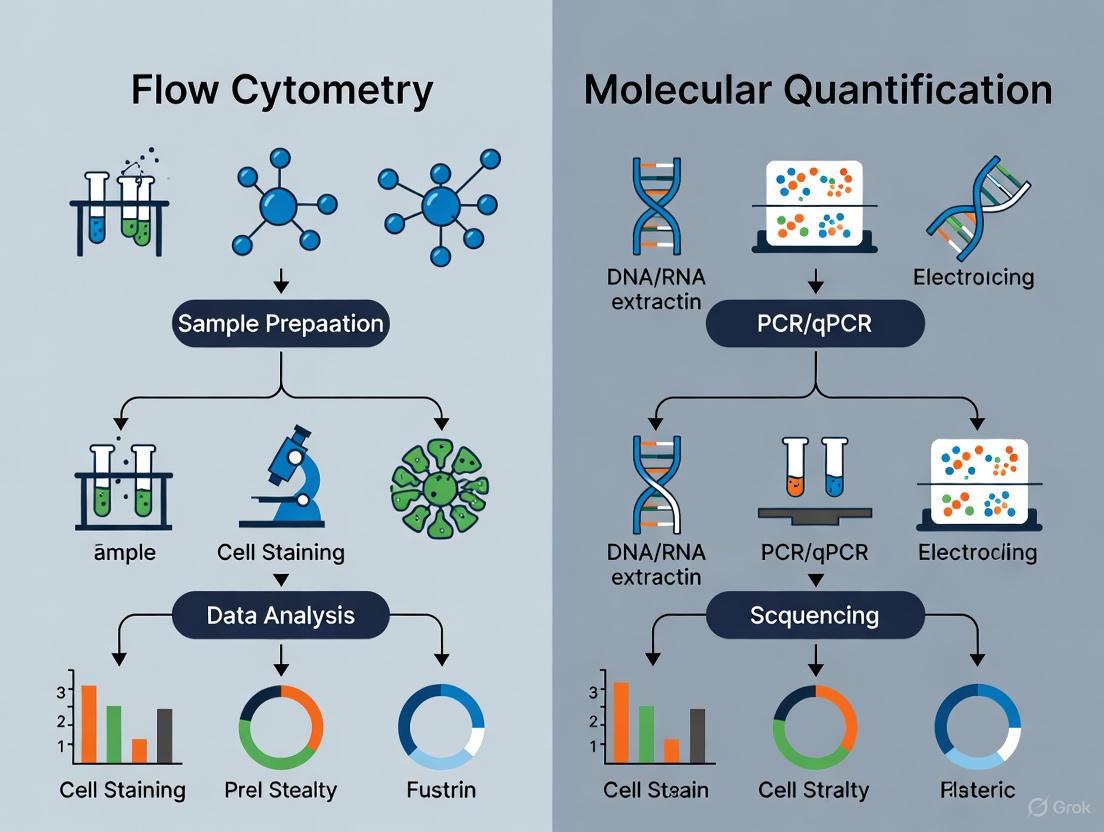
This article provides a comprehensive comparison between flow cytometry and molecular quantification methods, tailored for researchers and drug development professionals.
Flow Cytometry vs. Molecular Quantification: A Comparative Guide for Advanced Bioanalysis in Drug Development
Abstract
This article provides a comprehensive comparison between flow cytometry and molecular quantification methods, tailored for researchers and drug development professionals. It explores the foundational principles of both technologies, delves into their specific methodological applications from hit identification to clinical trials, addresses key troubleshooting and optimization challenges, and establishes a framework for analytical validation. By synthesizing these core intents, the article serves as a strategic guide for selecting the appropriate technology to accelerate biomarker discovery, immunotherapy development, and robust clinical bioanalysis.
Core Principles: Deciphering the Technological DNA of Single-Cell and Molecular Analysis
Flow cytometry stands as a cornerstone technology in biomedical research and clinical diagnostics, enabling high-throughput, multiparametric analysis of single cells in suspension. This guide explores the fundamental principles of flow cytometry, where cells are literally "interrogated with light," and their resulting optical signals are decoded to reveal complex phenotypic and functional information. The technology has evolved significantly from its analog origins, transitioning from a qualitative tool to a quantitative science capable of precise cellular measurements [1]. This transformation is particularly relevant when comparing flow cytometry with alternative molecular quantification methods, as each approach offers distinct advantages for specific research questions in drug development and basic science.
The core principle of flow cytometry involves hydrodynamically focusing a cell suspension into a single-file stream, passing each cell through one or more focused laser beams. As cells intersect these beams, they scatter light and, if fluorescently labeled, emit light at specific wavelengths. Detectors then capture this light, converting it into digital data that provides information about each cell's physical and biochemical characteristics. Modern flow cytometers can analyze thousands of cells per second, measuring multiple parameters simultaneously and generating rich datasets for comprehensive cellular profiling [2] [3].
Technological Evolution: From Conventional to Spectral Flow Cytometry
Conventional Flow Cytometry
Traditional flow cytometry operates on a "one detector–one fluorophore" approach. Optical filters—dichroic mirrors and bandpass filters—separate and direct emitted light to specific photomultiplier tubes (PMTs) tuned to narrow wavelength bands approximating emission peaks of known fluorophores [4]. While effective, this system presents limitations. The fluorescent signal (350–850 nm) can only be divided into a limited number of detectors, typically 10–12. Increasing detectable parameters requires substantially complicating the optical system with additional filters and detectors, which increases cost and technical challenges [4]. Modern conventional cytometers like the BD FACSymphony A5 Cell Analyzer can analyze more than 20 parameters through more sensitive detectors, increased lasers, and improved optics [4].
Spectral Flow Cytometry
Spectral flow cytometry represents a paradigm shift in fluorescent detection. Instead of isolating specific wavelengths with filters, spectral cytometers capture the entire emission spectrum of each fluorophore across a wide wavelength range [5] [4]. This is achieved using a prism or diffraction grating to scatter emitted light, which is then captured by an array of highly sensitive detectors [4].
This fundamental difference in detection strategy provides spectral cytometry with several key advantages:
- Superior Multiplexing Capacity: By analyzing full spectral signatures rather than discrete wavelengths, spectral cytometers can resolve more fluorophores with overlapping spectra, enabling panels of 40+ colors [4].
- Improved Resolution: Mathematical "unmixing" algorithms separate composite signals into their individual fluorophore components, minimizing spillover and more accurately managing cellular autofluorescence [5] [4].
- Reduced Optical Complexity: The elimination of complex filter configurations simplifies instrument design and reduces manufacturing costs [4].
Leading spectral platforms include the Cytek Aurora, which utilizes Full Spectrum Profiling technology, and the BD FACSDiscover S8 Cell Sorter, which combines spectral detection with real-time imaging capabilities [5] [4].
Figure 1: Spectral cytometry workflow captures full emission spectra, which are then decomposed into individual fluorophore signals using computational unmixing.
Comparative Analysis: Flow Cytometry Versus Alternative Methods
Technical Comparison with Molecular Quantification Methods
When designing experiments, researchers must consider the relative strengths and limitations of flow cytometry compared to other single-cell analysis technologies. The table below provides a systematic comparison of key methodologies:
Table 1: Comparative analysis of single-cell technologies for cell surface marker and molecular profiling
| Parameter | Flow Cytometry | Spectral Flow Cytometry | Mass Cytometry (CyTOF) | Single-Cell RNA Sequencing | CITE-Seq |
|---|---|---|---|---|---|
| Measured Analytics | Surface/intracellular proteins, cell physiology | Surface/intracellular proteins, cell physiology | Surface/intracellular proteins | Whole transcriptome | Surface proteins + Whole transcriptome |
| Throughput | High (10,000+ cells/sec) | High (10,000+ cells/sec) | Medium (500-1,000 cells/sec) | Low (hundreds to thousands of cells) | Low (hundreds to thousands of cells) |
| Number of Parameters | Typically 10-30, up to 40+ with advanced systems | 40-50+ parameters | 40-50+ parameters | 20,000+ genes | 100+ proteins + 20,000+ genes |
| Sensitivity | High (fluorophore brightness varies) | High with improved spillover management | High (minimal background) | Variable (depends on sequencing depth) | High for proteins, variable for RNA |
| Cell Sorting | Possible (cell sorters) | Possible (spectral sorters) | Not possible | Not typically coupled | Not typically coupled |
| Throughput Cost | Low to moderate | Moderate | High | High | High |
| Key Advantages | Live cell analysis, high throughput, sorting capability | High multiplexing, improved autofluorescence handling | Minimal spillover, high parameter detection | Whole transcriptome profiling, discovery capability | Combined protein and RNA profiling |
| Key Limitations | Spectral overlap limits multiplexing | Expertise required for panel design and unmixing | Low throughput, no cell sorting, specialized equipment | Cost, throughput, destructive process | Cost, complexity, lower throughput |
This comparison reveals that flow cytometry maintains distinct advantages in applications requiring high-throughput analysis of protein expression, particularly when live cell sorting or functional assays are needed. As noted in recent assessments, "mRNA levels correlate poorly with the expression of proteins, which are traditionally used to determine the types of immune cells, which may lead to an incorrect assessment of the functional activity of a particular cell" [4]. This underscores the continued value of protein-based detection methods like flow cytometry for immunophenotyping and related applications.
Quantitative Performance Metrics
The quantitative capabilities of flow cytometry have advanced significantly, though implementation varies across laboratories. Data generated by flow cytometers can be categorized across a spectrum of quantification:
Table 2: Categories of flow cytometric data and their characteristics
| Data Category | Definition | Standardization Requirements | Common Applications |
|---|---|---|---|
| Definitive Quantitative | Continuous numerical data with standard curve and reference standards | SI-traceable reference fluorophores, calibration beads | Absolute antigen counting, regulated environments |
| Relative Quantitative | Continuous numerical data with standard curve but no reference standard | Calibration beads without reference standards | Multisite studies, longitudinal experiments |
| Quasi-Quantitative | Continuous numerical data without standard curve | Instrument quality control only | Research phenotyping, internal comparisons |
| Qualitative | Categorical, non-numeric data | Basic instrument setup | Cell population identification, diagnostic screening |
Most conventional flow cytometric assays currently report quasi-quantitative or qualitative data, but the field is moving toward more rigorous quantification. As emphasized by Litwin, "It's not witchcraft. It's not art. It's science. It needs to be standardized and quantitative" [1]. Technical pathways to improved quantification include employing commercially available multi-intensity beads with Equivalent Reference Fluorophore (ERF) assigned SI-traceable values provided by NIST, and applying quantification beads like BD QuantiBrite PE with monoclonal antibodies conjugated at 1:1 fluorophore-to-protein ratios for absolute quantitation [1].
Advanced Applications and Experimental Design
Cellular Interaction Mapping
A cutting-edge application of high-parameter flow cytometry is the mapping of cellular interactions. A recently developed "Interact-omics" framework enables the identification and quantification of physically interacting cells (PICs) at ultra-high resolution and scale [6]. This approach leverages the high throughput of flow cytometry to study transient cellular interactions that serve as central hubs for information processing in immune responses [6].
The experimental protocol for cellular interaction mapping involves:
- Sample Preparation: Cells are incubated under conditions that promote or preserve cellular interactions (e.g., using bispecific antibody-based reagents like CytoStim to physically engage T cells with antigen-presenting cells) [6].
- Staining Optimization: Cell-type-specific markers are assigned to fluorophores with low spectral overlap to enable simultaneous detection of mutually exclusive markers in multiplets [6].
- Data Acquisition: Samples are acquired without multiplet exclusion to preserve cellular complexes.
- Multiplet Identification: The forward scatter area-to-height ratio (FSC ratio), alongside other scatter properties and marker expression, is used to distinguish single cells from multiplets [6].
- Cluster Analysis: Louvain clustering using surface marker expression, scatter properties, and FSC ratio identifies PIC-containing clusters characterized by high FSC ratio and combinations of mutually exclusive cell-type-specific markers [6].
This methodology enables researchers to study cellular crosstalk dynamics in various physiological and pathological states, with applications ranging from basic biology to applied biomedicine [6].
Figure 2: Cellular interaction mapping workflow uses specialized analysis to identify physically interacting cells (PICs) in complex samples.
Reagent Solutions for High-Parameter Panels
Designing effective flow cytometry experiments requires careful selection of reagents. The expanding palette of fluorochromes has been instrumental in enabling high-parameter applications:
Table 3: Key reagent solutions for spectral flow cytometry
| Reagent Category | Specific Examples | Key Characteristics | Application Notes |
|---|---|---|---|
| Small Organic Dyes | Spark, Vio, eFluor series | Brightness, photostability | Ideal for low-abundance targets |
| Tandem Dyes | PE-Cy7, APC-Cy7, Brilliant Violet series | Large Stokes shifts, broad emission | Require careful compensation; some stability issues |
| Fluorescent Proteins | GFP, RFP, mCherry | Genetically encodable | Cell tracking, reporter systems |
| Polymer Dyes | Brilliant Violet, Brilliant Ultraviolet | High brightness, narrow emission | Excellent for high-parameter panels |
| Lanthanide-Labeled Antibodies | MaxPar Metal-Conjugated Antibodies | Minimal spectral overlap | Used in mass cytometry (CyTOF) |
| Calibration Beads | BD Calibrite, UltraComp eBeads | Standardized fluorescence | Instrument calibration, quantitative standardization |
| Viability Dyes | Fixable Viability Dyes eFluor | Distinguish live/dead cells | Critical for data quality, exclude false positives |
The development of new fluorochromes continues to be an active area of innovation, with recent introductions including the Spark and Spark PLUS dyes from BioLegend and the Vio series from Miltenyi [4]. These advancements directly support the expanding parameter capabilities of modern flow cytometers.
Future Directions and Integration with Complementary Methods
The future of flow cytometry is characterized by several convergent trends: increased parameterization, improved quantification, enhanced automation, and deeper integration with complementary technologies. The market for flow cytometry reagents in Europe alone is projected to grow from $928.3 million in 2024 to $2.04 billion by 2035, reflecting expanding applications in drug discovery, translational research, and clinical trials [7].
Key developments shaping the future of flow cytometry include:
- Artificial Intelligence Integration: Machine learning algorithms are being deployed for automated gating, population identification, and quality control, reducing manual analysis time and inter-operator variability [2] [8].
- Automation and Miniaturization: Emerging compact, portable flow cytometers with high-throughput capabilities are making the technology more accessible for point-of-care settings [8].
- Combined Workflows: Integration with mass spectrometry for validation of fluorescent probes, small molecules, and antibody-drug conjugates provides orthogonal verification of results [5].
- Quantitative Standardization: Global initiatives like the ISAC Quantitative Flow Cytometry Interest Group, NIST Flow Cytometry Standards Consortium, and CLSI Expert Panels are developing consensus recommendations, reference standards, and best practices to improve reproducibility [1].
These advancements collectively position flow cytometry as an increasingly quantitative and integrative technology within the broader landscape of single-cell analysis methods. As the technology continues to evolve, its unique capabilities for high-throughput, multiparametric analysis of live cells will ensure its continued relevance for researchers and drug development professionals seeking to unravel cellular complexity in health and disease.
Molecular quantification forms the cornerstone of modern biological research and clinical diagnostics, providing critical tools for measuring specific nucleic acids and proteins within complex samples. This guide objectively compares two pivotal quantitative technologies: flow cytometry, which excels at multi-parameter single-cell analysis, and molecular quantification methods like quantitative PCR (qPCR), which deliver exceptional sensitivity for nucleic acid detection. Understanding their complementary strengths and limitations enables researchers to select optimal methodologies for specific applications in drug development, clinical diagnostics, and basic research.
Flow cytometry has evolved from a simple cell counting technology to a sophisticated platform capable of quantifying multiple cellular parameters simultaneously at the single-cell level. Meanwhile, molecular techniques like qPCR provide unparalleled sensitivity for detecting and amplifying specific nucleic acid sequences. The strategic selection between these methodologies depends heavily on the research question, required sensitivity, need for single-cell resolution, and the nature of the target molecules. This comparison provides the foundational knowledge needed to make evidence-based methodological decisions.
Technology Comparison: Flow Cytometry Versus Molecular Detection Methods
Fundamental Principles and Measurement Capabilities
Flow Cytometry operates on the principle of hydrodynamic focusing to pass single cells through a laser beam, measuring light scattering and fluorescence emissions. It provides multi-parametric analysis of cellular characteristics including size (forward scatter), internal complexity (side scatter), and fluorescence intensity from labeled antibodies or probes [9]. Modern instruments can simultaneously measure up to 30-50 parameters using multiple laser systems and advanced detection technologies [9]. This enables deep immunophenotyping, intracellular signaling analysis, and functional assessment at the single-cell level across heterogeneous populations.
Molecular Quantification Methods such as quantitative PCR (qPCR) operate on fundamentally different principles, relying on enzymatic amplification of specific nucleic acid sequences with fluorescence-based detection in real-time. Unlike flow cytometry, qPCR typically analyzes bulk populations rather than single cells, providing exceptional sensitivity for detecting rare transcripts or pathogens but losing cellular heterogeneity information. The critical distinction lies in what each method quantifies: flow cytometry measures actual cellular proteins and properties, while qPCR detects specific nucleic acid sequences.
Direct Performance Comparison: Experimental Evidence
Table 1: Comparative Performance of Flow Cytometry and qPCR in Bacterial Viability Assessment
| Parameter | Flow Cytometry | Quantitative PCR (with PMA) | Traditional Plate Counts |
|---|---|---|---|
| Viability Measurement Principle | Membrane integrity via dye exclusion | DNA amplification from membrane-intact cells | Cellular replication |
| Detection of VBNC Cells | Yes (distinguishes intact, permeabilized, and partially permeabilized) | Limited | No |
| Throughput | High (thousands of cells/second) | Moderate | Low |
| Quantification After SC-CO2 Treatment | Detailed resolution of subpopulations | Binary (viable/non-viable) | >5 log reduction |
| Information Depth | Multiple cellular states simultaneously | Single parameter | Only replicating cells |
| Application in Food Safety | Comprehensive assessment | Limited to DNA-based viability | Industry standard but incomplete |
A direct comparative study examining bacterial membrane permeabilization following supercritical CO2 treatment demonstrated flow cytometry's superior resolution compared to PMA-qPCR [10]. While plate counts showed a dramatic reduction of over 5 log units in cultivable cells, flow cytometry provided a more nuanced picture by distinguishing three distinct cellular states: intact, partially permeabilized, and completely permeabilized cells. This detailed resolution of subpopulations is crucial for accurate risk assessment in food safety and environmental monitoring [10].
For Listeria monocytogenes, flow cytometry revealed markedly higher membrane permeabilization following treatment compared to E. coli and Salmonella enterica, and identified an intermediate permeabilization state where cellular surface was altered and biovolume increased up to 1.5-fold [10]. This level of detailed morphological information is inaccessible to molecular quantification methods like qPCR.
Sensitivity and Resolution Limits
The sensitivity of flow cytometry instruments varies significantly between platforms and configurations. A comprehensive evaluation of 23 cytometers revealed substantial differences in fluorescence detection sensitivity, even among instruments with nominally identical configurations [11]. The study adopted the "2+2SD limit of resolution" metric, which defines the minimum dye signal required to clearly distinguish positive events from background.
Table 2: Sensitivity Comparison Between Technologies
| Technology | Theoretical Sensitivity | Practical Resolution Limit | Key Factors Affecting Sensitivity |
|---|---|---|---|
| Flow Cytometry | Single molecule for bright fluorophores | 500-1000 equivalent soluble fluorochrome molecules | Laser power, optical efficiency, detector sensitivity [11] |
| qPCR | Single nucleic acid molecule | 10-100 copies per reaction | Primer efficiency, inhibitor presence, amplification efficiency |
| Imaging Flow Cytometry | Lower than conventional flow | Subcellular localization | Camera sensitivity, magnification, pixel resolution [12] |
Instrument sensitivity in flow cytometry is characterized by two fundamental parameters: Q (photoelectron signal per unit of dye) and B (total background) [11]. These parameters combine to determine the actual detection limit for specific applications. The 2+2SD values represent a fundamental measure of instrument capability that defines the minimum limit of resolution, independent of particular cell samples or applications [11]. Lower 2+2SD values enable better distinction between negative and low-positive events, which is particularly valuable for detecting rare cells or analyzing samples with low autofluorescence like microorganisms and extracellular vesicles.
Experimental Protocols for Quantitative Applications
Quantitative Flow Cytometry for Antigen Quantification
Protocol: Absolute Quantification of Cell Surface Antigens
Principle: This method utilizes calibrated fluorescence standards to convert median fluorescence intensity (MFI) into molecules of equivalent soluble fluorochrome (MESF) or antigen binding capacity (ABC) values [13].
Materials:
- Quantum Simply Cellular beads (Bangs Laboratories) with known antibody binding capacities
- Fluorophore-conjugated antibody of interest
- Flow cytometer with stable configuration
- Test cells expressing target antigen
Procedure:
- Prepare single-cell suspension at 1×10^6 cells/mL in staining buffer
- Stain cells with saturating concentrations of fluorophore-conjugated antibody (determined by prior titration)
- In parallel, stain Quantum Simply Cellular beads with identical antibody preparation
- Acquire bead standards on flow cytometer, ensuring PMT voltages remain identical to cell sample acquisition
- Acquire stained cell sample using identical instrument settings
- Generate standard curve by plotting bead fluorescence intensity against known ABC values
- Calculate ABC for cell sample by interpolating MFI from standard curve
Data Analysis: Using QuickCal software (Bangs Laboratories) or similar algorithms, the standard curve establishes the relationship between fluorescence intensity and ABC. The linear range, detection threshold, and resolution limits are determined automatically [13]. This approach has been successfully applied to quantify CD34+ hematopoietic stem cells for transplantation dosing and differentiate between chronic lymphoproliferative disorders based on quantitative antigen expression patterns [13].
Kinetic Approach to Antigen Quantification
Protocol: Dynamic Quantification Without Calibration Beads
Principle: This innovative approach analyzes the temporal evolution of cellular fluorescence during antibody binding using a diffusion-reaction mathematical model, eliminating the need for physical calibration standards [14].
Materials:
- LSRII flow cytometer or equivalent with temperature control
- PE-labeled RPA-T8 (anti-CD8α) antibody or target-specific antibody
- Antibody capture beads or target cells
- Phosflow Lyse/Fix Buffer
Procedure:
- Prepare cell suspension (4.5×10^5 cells in 40μL PBS with 10% FCS)
- Initiate binding reaction by adding 10μL antibody solution
- At predetermined timepoints (0.16, 1, 3, 9, 27, and 81 minutes), remove 8μL aliquots
- Immediately dilute aliquots in 300μL PBS to stop reaction
- Acquire all samples on flow cytometer using consistent settings
- Record mean fluorescence intensity (MFI) for each timepoint
Data Analysis: Experimental MFI values over time are fitted using a diffusion-reaction mathematical model with the Levenberg-Marquardt nonlinear least squares curve-fitting algorithm [14]. This fitting process directly yields the number of target antigens per cell, independent of specially prepared calibration beads or reagents. The method has been validated against QuantiBRITE calibration systems for CD8α antigen quantification on human T cells [14].
Diagram 1: Kinetic Antigen Quantification Workflow. This approach eliminates the need for calibration beads by using mathematical modeling of binding kinetics.
Advanced Applications and Integration with Molecular Methods
Imaging Flow Cytometry: Bridging Cellular and Molecular Analysis
Imaging flow cytometry (IFC) represents a powerful hybrid technology that combines the high-throughput capability of conventional flow cytometry with spatial information from microscopy [12]. This integration enables quantification approaches inaccessible to either technology alone.
Key Applications:
- Cell Cycle Analysis: IFC enables estimation of cell cycle phases from large numbers of acquired cellular images using machine learning, providing more precise cell cycle analysis than conventional methods [12].
- Protein Localization Analysis: IFC has been applied to investigate intracellular survival and differentiation signals triggered by external stimuli, and to monitor DNA damage responses such as γH2AX foci formation [12].
- Immunological Synapse Formation: IFC enables detection of immune synapse formation among interacting cells within large populations and analysis of these interactions at the molecular level [12].
- Chromosomal Abnormalities: In hematological malignancies, IFC combined with fluorescence in situ hybridization (FISH) enables high-throughput detection of chromosomal abnormalities, such as BCR-ABL1 translocations [12].
The recent integration of deep learning technologies with IFC has established new analytical methods that utilize large volumes of single-cell image data [12]. Furthermore, instruments like the BD FACSDiscover S8 Cell Sorter now combine image analysis with cell sorting capabilities, enabling purification of cells based on morphological features and protein localization patterns [12].
Comparative Analysis of Cytometry Platforms
Table 3: Flow Cytometry Platform Capabilities Comparison
| Platform Type | Key Features | Quantification Strengths | Throughput | Best Applications |
|---|---|---|---|---|
| Traditional Flow Cytometers | 1-5 lasers, 10-30 parameters | High-quality multi-parameter data | High (10,000 cells/sec) | Immunophenotyping, intracellular signaling [9] |
| Imaging Flow Cytometers | Microscopy + flow cytometry | Spatial and localization data | Moderate (1,000-5,000 cells/sec) | Protein localization, cell morphology [12] |
| Mass Cytometers | Metal-tagged antibodies, time-of-flight MS | Minimal background, 40+ parameters | Low (1,000 cells/sec) | High-parameter deep immunophenotyping [9] |
| Spectral Analyzers | Full emission spectrum capture | Superior unmixing of fluorophores | High (10,000 cells/sec) | Complex panels with spectral overlap [9] |
| Acoustic Focusing Cytometers | Ultrasonic cell focusing | Consistent analysis, reduced clogging | High (10,000 cells/sec) | Clinical samples, high-throughput screening [9] |
Essential Research Reagent Solutions
Successful quantification requires carefully selected reagents and controls. The following solutions represent critical components for reliable experimental outcomes.
Table 4: Essential Research Reagents for Quantitative Applications
| Reagent Category | Specific Products | Function in Quantification | Application Notes |
|---|---|---|---|
| Quantification Beads | Quantum Simply Cellular (Bangs Labs), Quantibrite (BD Biosciences) | Conversion of MFI to ABC or MESF | Must use saturating antibody concentrations; same lot across experiments [13] |
| Viability Dyes | Propidium Iodide, DAPI, Fixable Viability Stains | Exclusion of dead cells from analysis | Critical for accurate quantification of rare populations [15] |
| Calibration Standards | Rainbow Calibration Particles, Duke Standards | Instrument performance tracking | Essential for longitudinal studies and multi-center trials [11] |
| Antibody Conjugates | PE, APC, Brilliant Violet Series | Target detection with varying brightness | Consider fluorophore brightness matching antigen density [9] |
| Cell Preparation Reagents | Ficoll-Paque, RBC Lysis Buffer | Sample preparation quality | Preservation of surface epitopes critical for accurate quantification |
Flow cytometry provides unparalleled capabilities for multi-parameter single-cell analysis with high throughput, making it indispensable for immunophenotyping, rare cell detection, and functional assessment. Molecular methods like qPCR offer exceptional sensitivity for nucleic acid detection but lack single-cell resolution. The emerging integration of artificial intelligence with flow cytometry data analysis, including automated gating algorithms and dimensionality reduction techniques, is further enhancing its quantitative capabilities [16].
Strategic method selection should consider whether the research question requires single-cell resolution, the abundance of the target, need for multiplexing, and whether protein or nucleic acid quantification is needed. For comprehensive cellular analysis, flow cytometry remains the gold standard, while molecular methods provide complementary strengths for genomic applications. Understanding these foundational principles enables researchers to make informed decisions that optimize experimental outcomes across basic research and clinical applications.
In the evolving landscape of single-cell analysis technologies, throughput capability stands as a critical differentiator for researchers and drug development professionals. Flow cytometry establishes its unique position by offering unparalleled analytical speed, capable of interrogating thousands of individual cells per second within a heterogeneous sample [17]. This high-throughput advantage enables rapid characterization of cellular landscapes based on size, granularity, and specific biomarker expression, making it indispensable for applications ranging from basic research to clinical diagnostics and therapeutic monitoring [18] [19]. While molecular quantification methods like single-cell RNA sequencing (scRNA-seq) provide deep genomic insights, they traditionally operate at significantly lower throughput levels, creating a fundamental trade-off between analytical depth and processing speed that researchers must navigate based on their experimental objectives.
The core technological principle enabling this speed lies in the integration of specialized fluidics, optics, and detection systems. As cells in a buffered solution pass through a focused laser beam in a single-file stream, detectors simultaneously gather light scatter information and fluorescence signals from multiple parameters [19]. This process occurs continuously without physical separation of cellular populations during analysis, allowing for the expedited processing of extensive cell populations that would be impractical with lower-throughput techniques [17]. For drug discovery pipelines and clinical diagnostics where time and statistical power are paramount, this throughput advantage positions flow cytometry as a primary workhorse for comprehensive cellular analysis.
Flow Cytometry: Architecture of Speed
Core Technological Principles Enabling High-Throughput Analysis
The exceptional throughput of flow cytometry stems from its integrated system architecture, specifically designed for rapid sequential cell analysis. The process begins with hydrodynamic focusing, where the sample fluid is constrained by a faster-moving sheath fluid, creating a laminar flow that aligns cells single-file past the interrogation point [17]. This precise cellular positioning enables the instrument to analyze thousands of cells per second while maintaining individual cell resolution.
As each cell passes through the laser beam, it generates two primary types of optical signals:
- Light Scatter: Forward scatter (FSC) detects light diffracted at small angles relative to the laser, correlating with cell size, while side scatter (SSC) measures light refracted and reflected at approximately 90 degrees, indicating cellular complexity and granularity [19].
- Fluorescence Emission: When present, fluorochrome-conjugated antibodies or fluorescent proteins absorb laser light and emit at longer wavelengths, providing specific information about biomarker expression [17].
Advanced detection systems with multiple photomultiplier tubes (PMTs) simultaneously capture these signals across different wavelengths, enabling multiparametric analysis at high speed. The integration of sophisticated electronics then converts these optical signals into digital data for immediate analysis or storage in Flow Cytometry Standard (FCS) files for subsequent interpretation [17].
Standardization Frameworks for Quantitative High-Throughput Applications
For flow cytometry to deliver reliable quantitative data at high speeds, rigorous standardization is essential. The National Institute of Standards and Technology (NIST) leads development of reference materials and methodologies to ensure measurement precision across different platforms and timepoints [18]. Central to this effort is the establishment of the Equivalent Number of Reference Fluorophores (ERF) unit, which provides a standardized approach for fluorescence calibration, enabling comparable quantitative measurements across instruments and laboratories [18].
The NIST Flow Cytometry Standards Consortium (FCSC), active through August 2029, coordinates these standardization efforts through specialized working groups focusing on instrument calibration, assay standardization, data repositories, and gene delivery systems [18]. These initiatives are particularly crucial for clinical applications where quantitative accuracy must be maintained despite the technology's high operating speed, ensuring that rapid analysis does not compromise measurement reliability in critical areas such as CD4+ T-cell counting for HIV monitoring or CD34+ stem cell enumeration for transplantation medicine [18] [13].
Comparative Performance Analysis: Flow Cytometry vs. Molecular Quantification Methods
Throughput and Analytical Capabilities Across Platforms
When selecting single-cell analysis technologies, researchers must balance throughput, multiparametric capability, and genomic depth. The table below provides a systematic comparison of flow cytometry against leading molecular quantification methods based on key performance metrics:
Table 1: Technology Comparison Based on Key Performance Metrics
| Performance Metric | Flow Cytometry | Single-Cell RNA Sequencing | Imaging Flow Cytometry |
|---|---|---|---|
| Throughput (cells/second) | Thousands [17] | Varies by platform (e.g., 10× Chromium, BD Rhapsody) [20] | Lower than conventional flow |
| Multiplexing Capacity | Up to 30-50 parameters simultaneously [19] | Whole transcriptome (~10,000 genes) [21] | Similar to flow cytometry plus morphological data |
| Analytical Output | Protein expression, size, granularity, phosphorylation | Gene expression profiles, splice variants, clonality [21] | Protein expression plus spatial and morphological data |
| Therapeutic Applications | Immunophenotyping, CAR-T monitoring, CD34+ enumeration [18] [13] | Functional precision medicine, drug mechanism studies [21] | Rare event analysis, cell cycle studies |
| Standardization | Well-established (NIST standards, ERF units) [18] | Emerging standards, platform-specific biases [20] | Less standardized |
This comparison reveals that flow cytometry maintains a distinct advantage in applications requiring rapid processing of large sample sizes, such as clinical diagnostics where throughput directly impacts patient management decisions. However, for discovery-phase research requiring deep genomic insights, scRNA-seq provides unparalleled resolution of transcriptional states despite its comparatively lower throughput [21] [20].
Recent advances in pharmacotranscriptomics highlight how these technologies can complement each other in drug screening applications. While flow cytometry offers rapid assessment of cell surface protein responses to drug perturbations, scRNA-seq can delineate comprehensive transcriptional changes following the same treatments, creating a more complete picture of drug mechanisms [22]. This complementary relationship enables researchers to leverage the respective strengths of each technology at different stages of the drug development pipeline.
Standardized Quantitative Applications in Clinical and Research Settings
The high-throughput nature of flow cytometry is particularly valuable in standardized clinical applications where quantitative accuracy must be maintained despite rapid analysis. The table below highlights key validated applications that leverage this combination of speed and precision:
Table 2: Standardized High-Throughput Applications in Flow Cytometry
| Application Domain | Specific Application | Quantitative Readout | Throughput Advantage |
|---|---|---|---|
| HIV/AIDS Management | CD4+ T-cell counting for ART monitoring | Absolute CD4+ count [18] | Rapid processing enables timely treatment decisions |
| Transplantation Medicine | CD34+ hematopoietic stem cell enumeration | CD34+ cells/μL [13] | Quick assessment of graft adequacy before transplantation |
| Oncology Diagnostics | Minimal Residual Disease (MRD) detection in ALL | Antigen expression levels (e.g., TdT, CD10, CD19) [13] | Sensitive detection of rare malignant cells among normal cells |
| Immunodeficiency Diseases | Chronic granulomatous disease diagnosis (DHR test) | Rhodamine fluorescence intensity [19] | Fast assessment of neutrophil function |
| B-cell Disorders | Chronic lymphoproliferative disorder profiling | ABC values for CD19, CD20, CD22, etc. [13] | Rapid discrimination between different B-cell malignancies |
These applications demonstrate how flow cytometry's throughput capabilities directly impact patient care by providing rapid, quantitative data for critical clinical decisions. In CD34+ stem cell enumeration, for example, the ISHAGE gating strategy combines with internal reference counting beads to enable precise quantification of rare stem cell populations in apheresis products, with throughput sufficient to inform real-time clinical collection decisions [13].
Essential Research Reagents and Standardization Tools
The quantitative reliability and high-throughput performance of flow cytometry depend heavily on specialized reagents and calibration systems. The researcher's toolkit must include both detection reagents and standardization materials to ensure data quality and inter-experiment comparability:
Table 3: Essential Research Reagent Solutions for Quantitative Flow Cytometry
| Reagent Category | Specific Examples | Function | Application Context |
|---|---|---|---|
| Calibration Beads | Quantum Simply Cellular (Bangs Labs) [13] | ABC calculation for antibody binding capacity | Converting fluorescence intensity to antigen numbers |
| Calibration Beads | Quantibrite Beads (BD Biosciences) [13] | PE molecule quantification for ABC estimation | Standardizing PE-conjugated antibody experiments |
| Calibration Beads | Quantum MESF Beads (Bangs Labs) [13] | MESF calculation for fluorescence quantification | Instrument performance validation and standardization |
| Reference Materials | NIST SRM 1934 [18] | Fluorescent dye standardization | Cross-platform fluorescence intensity standardization |
| Viability Indicators | DNA-binding dyes [19] | Live/dead cell discrimination | Exclusion of non-viable cells from analysis |
| Cell Preparation | Erythrocyte lysis solutions [19] | Blood sample preparation | White blood cell isolation for immunophenotyping |
These standardization tools enable researchers to convert relative fluorescence intensity into absolute quantitative measurements, expressed as either Molecules of Equivalent Soluble Fluorochrome (MESF) or Antibody Binding Capacity (ABC) [13]. This quantitative transformation is particularly crucial for high-throughput environments where instrument performance must be continuously verified across thousands of samples, ensuring that the speed of analysis does not compromise measurement accuracy.
The selection of appropriate bead standards depends on the specific experimental design. For direct immunofluorescence assays, pre-stained beads with known fluorophore levels enable MESF quantification, while for absolute antigen quantification, beads with captured antibodies that bind the same detection conjugates used on cells allow ABC determination [13]. Proper implementation requires that monoclonal antibodies be used at saturating concentrations for both beads and cells, with consistent reagents and instrument settings maintained across all experiments to ensure data comparability.
Methodological Framework: Experimental Protocols for High-Throughput Applications
Standardized Protocol for CD34+ Hematopoietic Stem Cell Enumeration
The enumeration of CD34+ hematopoietic stem cells for transplantation represents a well-standardized high-throughput application that exemplifies the integration of rapid analysis with quantitative precision. The International Society of Hemotherapy and Graft Engineering (ISHAGE) protocol employs a sequential Boolean gating strategy to accurately identify and quantify rare CD34+ cells among heterogeneous leukocyte populations [13].
The methodological workflow proceeds through these critical stages:
Sample Preparation: Anticoagulated peripheral blood or apheresis product is aliquoted and stained with fluorochrome-conjugated antibodies against CD34, CD45, and potentially other lineage markers, along with addition of fluorescent counting beads at known concentration [13].
Instrument Calibration: Prior to sample acquisition, performance validation is conducted using standardized fluorescence calibration beads (e.g., Quantibrite beads for PE-conjugated antibodies) to ensure quantitative accuracy [13].
Data Acquisition: Samples are run on the flow cytometer with careful attention to maintaining appropriate flow rates – neither too slow to limit throughput nor too fast to compromise resolution – typically analyzing tens of thousands of events to ensure statistical significance for rare cell populations.
Sequential Gating Analysis:
- Step 1: Identify lymphocytes based on low FSC/SSC characteristics
- Step 2: Gate CD45+ events with low side scatter
- Step 3: Select CD34+ cells from the CD45+ population
- Step 4: Verify CD34+ population by low CD45 expression pattern
- Step 5: Use counting beads to calculate absolute CD34+ count per μL [13]
This protocol demonstrates how careful methodological design enables flow cytometry to maintain both high throughput and quantitative precision, even when analyzing rare cell populations of critical clinical importance.
Quantitative Flow Cytometry Calibration Methodology
For researchers requiring absolute quantification of surface antigens rather than relative expression levels, implementation of a rigorous calibration protocol is essential. This methodology transforms flow cytometry from a qualitative technique into a truly quantitative analytical tool while preserving its high-throughput advantages.
The standard quantification procedure involves:
Bead Preparation: Simultaneously with cell staining, prepare a series of calibration beads (e.g., Quantum Simply Cellular beads with five distinct populations having known antibody-binding capacities) stained with the same fluorochrome-conjugated antibody used for cell labeling [13].
Instrument Acquisition: Acquire bead suspensions using identical instrument settings to those used for experimental samples, ensuring the detector voltages and compensation settings remain unchanged between bead and sample runs.
Standard Curve Generation: Using vendor-provided software, plot the median fluorescence intensity of each bead population against its known antibody-binding capacity to generate a standard curve representing the relationship between fluorescence intensity and antigen density [13].
Sample Analysis: Analyze experimental samples and apply the standard curve to convert fluorescence intensity values into absolute antigen numbers per cell, typically expressed as ABC values.
Quality Control Verification: Regularly perform quality control checks using reference control materials (e.g., NIST standard reference materials) to validate instrument performance and ensure longitudinal reproducibility of quantitative measurements [18].
Emerging Innovations and Future Trajectories
Artificial Intelligence and Automation in High-Throughput Flow Cytometry
The integration of artificial intelligence (AI) and machine learning (ML) represents the next frontier in enhancing flow cytometry's high-throughput capabilities. As the technology generates increasingly complex multiparameter data from thousands of cells per second, traditional analysis methods become limiting factors. AI-driven approaches are now being deployed to automate data analysis, improve population identification, and enhance quality control in high-throughput screening environments [23].
Significant developments in this domain include:
Automated Population Identification: Advanced algorithms can now identify cell populations in high-dimensional space without manual gating, reducing analytical time from hours to minutes while increasing reproducibility [24].
Quality Control Automation: Machine learning systems can detect subtle instrument performance deviations that might compromise data quality in high-throughput operations, enabling real-time quality assurance [23].
Rare Event Detection: AI models excel at identifying rare cell populations within large datasets, enhancing the sensitivity of applications like minimal residual disease detection without compromising analytical speed [23].
Companies like Genedata have developed specialized software that automates entire flow cytometry screening workflows, replacing legacy tools with unified platforms that increase efficiency while reducing data handling errors – a critical advancement for pharmaceutical companies conducting large-scale drug screening campaigns [24]. These computational advances complement the inherent throughput advantages of flow cytometry instrumentation, addressing previous bottlenecks in data interpretation.
Standardization Initiatives for Next-Generation High-Throughput Applications
As flow cytometry expands into new applications requiring both high throughput and quantitative precision, standardization efforts have intensified accordingly. NIST's Flow Cytometry Standards Consortium (FCSC), recently extended through 2029, exemplifies the collaborative approach being taken to address emerging challenges in areas including cell and gene therapies, extracellular vesicle analysis, and viral vector characterization [18].
Key innovation areas in standardization include:
Sub-Micrometer Particle Standards: Development of reference materials for extracellular vesicles (30-150 nm) and virus-like particles, enabling accurate quantification of nanoscale bioparticles that push the sensitivity limits of conventional flow cytometry [18].
Lentiviral Vector Characterization: Standardized methods for quantifying lentiviral vector titers and quality attributes, critically important for CAR-T cell therapies where vector performance directly correlates with therapeutic efficacy [18].
Rare Event Quantification: Advanced approaches like Flow-FISH (combining fluorescence in situ hybridization with flow cytometry) enable high-throughput quantification of rare genomic events at single-cell resolution, overcoming limitations of traditional microscopy-based FISH analysis [18].
These initiatives ensure that as flow cytometry technology evolves toward higher throughput and greater sensitivity, the quantitative reliability of the generated data keeps pace, particularly important for clinical applications where regulatory compliance and result comparability are essential considerations.
Flow cytometry maintains its fundamental advantage in applications requiring rapid analysis of thousands of cells per second, providing unparalleled throughput for immunophenotyping, clinical diagnostics, and therapeutic monitoring. This throughput advantage positions it as a cornerstone technology in time-sensitive environments from clinical laboratories to drug discovery pipelines. However, strategic experimental design requires acknowledging that molecular quantification methods like scRNA-seq offer complementary deep genomic insights, albeit at different throughput levels.
The ongoing integration of artificial intelligence with flow cytometry data analysis, coupled with robust standardization initiatives led by organizations like NIST, ensures that this technology will continue to evolve while maintaining its quantitative reliability. For researchers and drug development professionals, the optimal approach often lies in recognizing the respective strengths of each technology – leveraging flow cytometry's high-throughput capabilities for large-scale screening and validation studies while employing molecular methods for deeper mechanistic investigations. This balanced perspective enables maximum scientific return from the unique advantages each technology provides in the rapidly advancing field of single-cell analysis.
In the era of big data biology, researchers increasingly require technologies capable of deep cellular phenotyping to unravel the complexity of biological systems. Traditional flow cytometry, while powerful, faces inherent limitations in parameter capacity due to spectral overlap of fluorochromes. Two advanced technologies have emerged to overcome these constraints: spectral flow cytometry (SFC) and mass cytometry (MC), also known as cytometry by time-of-flight (CyTOF). Both enable simultaneous assessment of ≥40 markers from individual cells, yet employ fundamentally different detection principles [4] [25]. This guide provides an objective comparison of these platforms, focusing on their performance characteristics, experimental requirements, and suitability for different research scenarios within the broader context of flow cytometry and molecular quantification methods.
Spectral Flow Cytometry
Spectral flow cytometry builds upon conventional flow cytometry principles but incorporates a key difference in detection methodology. Instead of using optical filters and dichroic mirrors to direct narrow wavelength bands to specific detectors, spectral cytometers capture the full emission spectrum of every fluorophore across a wide range of wavelengths [4]. This is achieved using prisms or diffraction gratings to scatter emitted light, which is then captured by an array of highly sensitive detectors (typically 32-64 channels) [4]. The resulting spectral signatures are subsequently deconvoluted through mathematical algorithms in a process called spectral unmixing, which separates the individual contributions of each fluorophore from the composite signal [26] [27].
Mass Cytometry (CyTOF)
Mass cytometry represents a more radical departure from conventional flow cytometry, replacing fluorescent tags with heavy metal isotopes and optical detection with mass spectrometry [25]. Antibodies are conjugated to stable isotopes of rare earth metals rather than fluorochromes. The labeled cells are nebulized into single-cell droplets, which are then ionized and passed through a time-of-flight mass spectrometer [28]. This system measures the mass-to-charge ratio of the metal ions, allowing for the quantification of marker expression without the spectral overlap issues that plague fluorescence-based techniques [25] [29].
Technical Comparison: Key Performance Characteristics
The fundamental differences in detection principles between spectral flow cytometry and mass cytometry translate to distinct performance characteristics, advantages, and limitations. The table below summarizes the key technical specifications and their practical implications for research applications.
Table 1: Comprehensive Technical Comparison of Spectral Flow Cytometry and Mass Cytometry
| Characteristic | Spectral Flow Cytometry | Mass Cytometry (CyTOF) |
|---|---|---|
| Detection Method | Full spectral measurement with fluorescence detection [4] | Heavy metal isotope detection via mass spectrometry [25] |
| Maximum Panel Size | 40+ markers (practical limit ~50) [28] [27] | 50+ markers (theoretical limit higher) [25] [28] |
| Sensitivity | ~40 molecules per cell [25] | ~400-500 molecules per cell [25] |
| Acquisition Rate | ~20,000 events/second [25] [29] | ~300-500 events/second [25] [29] |
| Cell Input Requirements | Lower input requirements, suitable for limited samples [28] | 2-3× higher cell input needed [28] |
| Cell Recovery Rate | Higher recovery (median 53.1%) [25] | Lower recovery (median 26.8%) [25] |
| Throughput Considerations | Faster sample processing but limited post-stain stability (<24 hours) [28] | Slower acquisition but exceptional post-stain stability [28] |
| Autofluorescence | Can be extracted and subtracted during unmixing [27] | Not applicable (no autofluorescence) [25] |
| Cell Size/Complexity Data | Provides FSC/SSC information [25] | No inherent light scatter information [25] |
| Commercial Reagents | Wide selection of commercially available fluorochrome-conjugated antibodies [28] | Limited commercial reagents, often require custom conjugation [28] |
Experimental Performance Data: Direct Comparative Studies
Recent systematic comparisons have quantitatively evaluated the performance of both technologies for specific applications. A 2023 study directly compared SFC and MC for monitoring innate myeloid cell (IMC) populations in human blood, using panels with 21 common markers [25] [29]. The research employed unsupervised clustering analysis to identify 24 leukocyte populations, including 21 IMC subsets, enabling direct comparison of population identification and characterization.
Table 2: Experimental Performance Metrics from Comparative Studies
| Performance Metric | Spectral Flow Cytometry | Mass Cytometry | Statistical Significance |
|---|---|---|---|
| Population Distribution Correlation | Pearson's ρ=0.99 [25] | Pearson's ρ=0.99 [25] | High concordance |
| Marker Staining Resolution | Pearson's ρ=0.55 [25] | Pearson's ρ=0.55 [25] | Moderate correlation |
| Intra-measurement Variability (CV) | Median 42.5% [25] | Median 68.0% [25] | p<0.0001 |
| Acquisition Time (median) | 16 minutes [25] | 159 minutes [25] | Significantly faster |
| Cell Recovery Rate (median) | 53.1% [25] | 26.8% [25] | Significantly higher |
The experimental data demonstrates that both technologies show excellent correlation for identifying and enumerating cell populations, but SFC offers advantages in speed and cell recovery [25]. The significantly longer acquisition times and lower recovery rates associated with MC were identified as potential limitations for time-sensitive applications or samples with limited cellularity [25] [28].
Experimental Design and Methodologies
Panel Design Considerations
Spectral Flow Cytometry Panel Design:
- Utilize the broad selection of commercially available fluorochrome-conjugated antibodies [28]
- Include reference controls for spectral unmixing rather than compensation controls [27]
- Incorporate an autofluorescence control (unstained cells) that can be subtracted during unmixing [27]
- Position bright fluorophores on low-density antigens and dim fluorophores on highly expressed antigens [4]
- Leverage specialized software for panel optimization and spectral overlap assessment [26]
Mass Cytometry Panel Design:
- Prioritize in-house conjugation of antibodies with heavy metals due to limited commercial availability [25] [28]
- Assign dimly expressed markers to metals in the 159-175 mass range where mass cytometers are most sensitive [25]
- Minimize isotopic impurities and oxidation effects by placing markers not co-expressed by the same cells in adjacent channels [25]
- Consider metal purity and oxidation potential (+16 Da) when assigning markers to channels [25]
Sample Preparation Protocols
Universal Sample Considerations:
- Both technologies can analyze PBMCs, fresh whole blood, and gently fixed samples [28]
- Process fixed frozen samples within 2 hours of blood collection to prevent granulocyte degradation [28]
- Avoid over-fixing to prevent epitope alteration and incomplete hemolysis [28]
- For PBMC isolation, use standard Ficoll-Paque Plus gradient centrifugation protocols [25]
Technology-Specific Processing:
- SFC: Stain cells following conventional flow cytometry protocols with titrated antibodies [25]
- MC: Stain cells following metal-conjugated antibody protocols with cell fixation and DNA intercalation for viability assessment [25]
Key Research Reagent Solutions
Table 3: Essential Research Reagents for Spectral and Mass Cytometry
| Reagent Category | Specific Examples | Function and Application |
|---|---|---|
| SFC Fluorochromes | Spark, Spark PLUS, Vio dyes, eFluor series [4] | Small organic fluorophores with distinct emission spectra for antibody conjugation |
| SFC Tandem Dyes | PE-Cy7, APC-Cy7, Brilliant Violet series [4] | Fluorescence resonance energy transfer-based dyes that expand panel flexibility |
| Mass Cytometry Metals | Lanthanide series isotopes (Pr-141, Nd-146, etc.) [25] | Pure metal isotopes for antibody tagging with minimal spectral overlap |
| Cell Viability Markers | Cisplatin-based viability stains (MC), Fixable viability dyes (SFC) [25] | Distinguish live/dead cells during analysis to improve data quality |
| DNA Intercalators | Cell-ID Intercalator-Rh (MC) [25] | Permeabilize cells and identify nucleated cells for analysis |
| Reference Controls | Unstained cells, single-color controls [26] [27] | Enable spectral unmixing in SFC and instrument calibration |
Data Analysis Approaches for High-Dimensional Datasets
Both spectral flow and mass cytometry generate high-dimensional data requiring specialized computational approaches for interpretation. The analysis workflow typically involves data cleaning, population identification, and visualization through multiple steps.
Computational Analysis Techniques
Unsupervised clustering algorithms are essential for analyzing high-dimensional cytometry data:
- FlowSOM: Uses self-organizing maps to cluster cells with similar marker expression profiles [26]
- PhenoGraph: Identifies phenotypically similar clusters of cells represented as interconnected nodes [26]
- SPADE: Combines down-sampling, clustering, and minimum-spanning tree algorithms for visualization [26]
Dimensionality reduction techniques enable visualization of high-dimensional data:
- t-SNE (t-Distributed Stochastic Neighbor Embedding): Preserves local data structure ideal for identifying distinct cell populations [26]
- UMAP (Uniform Manifold Approximation and Projection): Offers faster processing speeds while preserving both local and global data structure [26]
- PCA (Principal Component Analysis): Condenses data to its principal components to visualize relationships [26]
Application-Specific Platform Selection Guide
Recommended Applications for Spectral Flow Cytometry
- High-throughput immune monitoring studies requiring rapid analysis of multiple samples [25] [27]
- Projects with limited sample material (pediatric samples, biopsies, rare patient samples) [28] [27]
- Detection of low-abundance antigens or subtle expression differences due to higher sensitivity [25] [28]
- Studies requiring cell sorting based on phenotypic markers [4]
- Analysis of autofluorescent samples where autofluorescence extraction provides benefit [27]
- Labs seeking minimal workflow changes from conventional flow cytometry [4]
Recommended Applications for Mass Cytometry
- Ultra-high-parameter panels exceeding 50 markers simultaneously [25] [28]
- Batch processing of samples where long acquisition times are acceptable [28]
- Samples with high autofluorescence that would interfere with fluorescence detection [25]
- Metal-based multiplexing techniques that complement existing panels [25]
- Labs with expertise in custom antibody conjugation and mass spectrometry [28]
Spectral flow cytometry and mass cytometry both effectively overcome the parameter limitations of conventional flow cytometry through distinct technological approaches. The choice between platforms depends heavily on specific research requirements, with SFC offering advantages in speed, sensitivity, and sample preservation, while MC provides superior parameter capacity and minimal signal overlap. As both technologies continue to evolve, they will undoubtedly expand our ability to decipher cellular complexity in health and disease, ultimately advancing drug development and clinical diagnostics. Researchers should carefully consider their specific experimental needs, sample availability, and technical expertise when selecting between these powerful high-dimensional cytometry platforms.
Flow cytometry provides a powerful platform for multiparametric single-cell analysis, but the journey from raw fluorescence signals to biologically meaningful quantitative data is complex. The core analytical outputs in flow cytometry exist on a broad spectrum, ranging from relative fluorescence intensity in arbitrary units to absolute quantitation of antigen copy numbers [13] [1]. This progression represents a fundamental shift from qualitative assessments to precise, reproducible quantitative science essential for both basic research and clinical applications [1]. Understanding this quantification hierarchy is crucial for researchers comparing flow cytometry with molecular quantification methods, as it defines the technology's capabilities and limitations in delivering standardized, numerically meaningful data.
The traditional practice of reporting results in arbitrary units has created significant challenges for data reproducibility and cross-study comparisons [1]. As Virginia Litwin, Director of Flow Cytometry at Eurofins Clinical Trial Solutions, explains: "In most cases the only thing we quantify is the number of cells" [1]. This limitation persists despite decades of available calibration technologies. The emerging paradigm of quantitative flow cytometry (QFCM) addresses this gap by utilizing fluorescence calibration standards to convert intensity values into absolute counts, such as molecules per cell [13]. This transformation enables true standardization across experiments, enhances reproducibility in multicenter studies, and allows accurate quantitation of biomarkers critical for disease monitoring and therapeutic development [13].
The Analytical Hierarchy: From Relative to Absolute Measurements
Bioanalytical data in flow cytometry fall into distinct categories of quantitative rigor [1]. Understanding these categories is essential for selecting appropriate methods and interpreting results accurately.
Qualitative data provide categorical, non-numeric information used primarily for distinguishing positive versus negative staining populations. While useful for basic phenotyping, this approach lacks the precision required for comparative studies or longitudinal monitoring [1].
Quasi-quantitative data offer continuous numerical measurements without standard curves, typically reported as median or geometric mean fluorescence intensity (MFI) in arbitrary units. This approach represents the current practice in most laboratories but suffers from significant limitations in reproducibility and cross-instrument comparability [1].
Relative quantitative data incorporate standard curves but lack traceable reference standards, providing improved relative quantitation within controlled experimental systems. This approach facilitates more reliable comparisons across samples run using the same protocols and instruments [1].
Definitive quantitative data represent the highest standard, providing continuous numerical data with both standard curves and SI-traceable reference standards. This approach enables true absolute quantitation and represents the gold standard for clinical applications and regulated environments [1].
Table 1: Categories of Flow Cytometry Data Outputs
| Data Category | Standardization Method | Output Units | Applications | Limitations |
|---|---|---|---|---|
| Qualitative | None | Positive/Negative | Basic cell phenotyping | No numerical output |
| Quasi-Quantitative | None | Arbitrary Units (AU) | Research screening | Limited reproducibility |
| Relative Quantitative | Standard curve without reference standards | Relative Units | Internal study comparisons | Not transferable between labs |
| Definitive Quantitative | Standard curve with SI-traceable standards | Molecules per Cell | Clinical trials, regulated environments | Requires rigorous standardization |
Core Analytical Outputs and Measurement Methodologies
Relative Fluorescence Intensity and Population Analysis
The most fundamental analytical output in flow cytometry is relative fluorescence intensity, typically measured as median or geometric mean fluorescence intensity (MFI) and reported in arbitrary units [1]. This measurement provides a relative measure of marker expression levels across cell populations and forms the basis for standard immunophenotyping applications. The analysis relies on light scatter properties (forward scatter for cell size and side scatter for granularity) combined with fluorescence detection to identify and characterize cell populations [9]. While this approach excels at distinguishing cell types based on surface marker expression patterns, it provides limited quantitative information about actual antigen density or copy number [1].
Advanced computational methods have enhanced the analysis of relative fluorescence data, particularly for complex multi-sample experiments. Multi-sample Gaussian mixture models (MSGMM) represent one such advancement, enabling simultaneous analysis of multiple flow cytometry samples using a computationally efficient implementation of the expectation-maximization algorithm [30]. This approach facilitates direct comparison of cell populations across samples and enhances detection of rare cell populations by sharing information across multiple samples [30]. Similarly, generalized linear modeling (GLM) frameworks provide robust statistical analysis for high-dimensional flow cytometry data, accommodating non-normal distributions and complex experimental designs that violate assumptions of traditional statistical tests [31].
Absolute Cell Counting and Enumeration
Absolute cell counting represents a crucial step toward quantitative flow cytometry, providing measurements of cell concentrations (e.g., cells per microliter) rather than just relative percentages [13]. This approach typically utilizes internal reference counting beads added to samples in known concentrations, enabling calculation of absolute cell counts based on the bead-to-cell ratio [13]. The Flow Cytometry Standards Consortium and other organizations have developed guidelines and calibration materials to improve the accuracy and reproducibility of these methods [1].
This absolute counting capability has proven particularly valuable in clinical applications such as CD34+ hematopoietic stem cell enumeration for transplantation, where precise dosing is critical for successful outcomes [13]. Standardized gating strategies, such as those established by the International Society of Hemotherapy and Graft Engineering (ISHAGE), combined with counting beads, provide the necessary precision for these clinical applications [13]. Similar approaches have been applied to absolute counting of bacterial cells, including mycobacteria, using flow cytometry with fluorescent dyes like Calcein-AM and SYBR-gold as alternatives to traditional colony-forming unit (CFU) counts [32].
Absolute Antigen Quantification
The most advanced quantitative output in flow cytometry is the measurement of absolute antigen copy number, expressed as molecules per cell [13]. This approach requires specialized calibration methods and reagents to convert fluorescence signals into quantitative molecular measurements. Two primary units are used for this purpose: Molecules of Equivalent Soluble Fluorochrome (MESF) and Antigen Binding Capacity (ABC) [13].
MESF quantification relies on calibration curves generated using beads with known quantities of fluorophore molecules, enabling conversion of cellular fluorescence intensity to equivalent soluble fluorophore units [13]. ABC quantification utilizes beads coated with known quantities of antibody capture sites to determine the number of antibodies bound per cell [13]. Both approaches represent significant advances over relative fluorescence measurements, providing true quantitative data essential for clinical monitoring and therapeutic development.
Table 2: Quantitative Flow Cytometry Standards and Applications
| Standardization Method | Measured Parameter | Common Applications | Key Commercial Products |
|---|---|---|---|
| MESF Beads | Molecules of Equivalent Soluble Fluorochrome | Receptor quantification | Quantum MESF Beads (Bangs Labs) |
| ABC Quantification | Antigen Binding Capacity | Clinical biomarker quantification | Quantibrite (BD), Quantum Simply Cellular (Bangs Lab) |
| Counting Beads | Absolute Cell Concentration | CD34+ stem cell enumeration, immune monitoring | Multiple vendors |
| Reference Fluorophores | Instrument Performance | Cross-platform standardization | NIST-traceable standards |
Experimental Protocols for Quantitative Flow Cytometry
Absolute Quantification of Surface Antigens
The protocol for absolute antigen quantification requires careful attention to standardization and calibration throughout the experimental process [13]. The critical first step involves selecting appropriate quantification bead kits matched to the fluorochromes used in the experiment. For ABC quantification, saturating concentrations of antibodies must be determined through titration for both the beads and cells, noting that these concentrations may differ between the two [13]. The same reagents, ideally from the same vendor and lot, should be used at identical concentrations across all experiments to ensure consistency [13].
The quantification process involves acquiring both the calibration beads and experimental samples under identical instrument settings on the same day [13]. The standard curve is generated by plotting the median or geometric mean fluorescence channel values of the blank bead and each fluorescence peak bead against the vendor-provided, lot-specific number of fluorochrome molecules per bead [13]. Once established, this calibration curve enables conversion of cellular fluorescence intensity to absolute molecular counts for experimental samples run with the same fluorescence settings [13].
Absolute Counting of Bacterial Cells
Flow cytometry methods for absolute counting of mycobacteria demonstrate alternative approaches to quantitative analysis [32]. The protocol utilizes a bench-top flow cytometer (BD Accuri C6) and two fluorescent dyes: SYBR-Gold (SG) for total intact cell counts and Calcein-AM (CA) for metabolic activity assessment [32]. Optimal counting requires specific threshold strategies; while traditional light scatter thresholds produce high false discovery rates (>10%), thresholding on side scatter and fluorescence (FL1 533/30 nm) in heat-killed, SYBR-gold stained samples reduces false discovery to <0.5% while improving linearity across serial dilutions (R² > 0.99) [32].
A critical consideration in this protocol is the management of cell clumping, which represents a major source of variance and bias in bacterial counting [32]. Standard dispersal methods like vortex and sonication often fail to disrupt clumped populations observed on flow cytometry, while needle emulsification effectively eliminates clumping and increases single-cell counts by more than 0.5 log [32]. This method has demonstrated effectiveness across various mycobacteria, including M. tuberculosis, providing a robust alternative to traditional CFU counting with additional capabilities for detecting and enumerating cell aggregates [32].
Advanced Computational Frameworks
Generalized Linear Modeling (GLM) provides a robust statistical framework for analyzing high-dimensional flow cytometry data, particularly when data violate assumptions of traditional statistical tests [31]. The protocol begins with restructuring flow cytometry data into a GLM-compatible format, followed by exploratory analysis to understand distributions, variability, and proportions of immune response "success" within the dataset [31]. For proportional data, which typically follows binomial distributions, the framework involves fitting multiple GLMs to evaluate which variables best explain outcomes of immune cell phenotypes [31].
The model selection process includes checking for dispersion (deviation from observed values) and using analysis of deviance testing to compare nested models [31]. For example, in evaluating activated T cell probabilities, an expanded model incorporating three-way interactions between group, day, and sex demonstrated significantly better fit (p=0.017) than a simpler model with only main effects [31]. This framework accommodates both continuous and categorical explanatory variables, enabling comprehensive analysis of complex experimental variables without the constraints of traditional parametric tests [31].
Essential Research Reagent Solutions
Successful implementation of quantitative flow cytometry requires specific reagent systems designed for calibration and standardization. The selection of appropriate reagents depends on the specific quantification approach and application requirements.
Table 3: Essential Reagents for Quantitative Flow Cytometry
| Reagent Category | Specific Products | Primary Function | Application Notes |
|---|---|---|---|
| Quantification Beads | Quantibrite (BD), Quantum Simply Cellular (Bangs Lab), QIFKIT (Agilent) | ABC calibration using beads with predefined antibody binding capacities | Require saturating antibody concentrations; lot-specific values must be used |
| MESF Beads | Quantum MESF Beads (Bangs Labs) | Creation of standard curves for fluorescence intensity quantification | Available for multiple fluorophores including Alexa Fluor 488, FITC, PE, APC |
| Counting Beads | Various commercial sources | Absolute cell enumeration by providing internal reference standards | Critical for clinical applications like CD34+ stem cell enumeration |
| Viability Dyes | Propidium Iodide, Calcein-AM, SYBR-gold | Discrimination of live/dead cells and functional status | Calcein-AM detects metabolic activity; SYBR-gold assesses membrane integrity |
| Reference Standards | NIST-traceable fluorophores | Instrument performance tracking and cross-platform standardization | Enables comparison of data across different instruments and laboratories |
Comparative Analysis with Molecular Quantification Methods
When evaluating flow cytometry against molecular quantification methods, distinct advantages and limitations emerge across technical parameters. Flow cytometry excels in single-cell resolution, providing multidimensional data on protein expression, cell size, granularity, and functional status simultaneously [9]. This capability enables high-throughput analysis of thousands of cells per second, far exceeding the throughput of most molecular methods [9]. Additionally, modern flow cytometers can measure up to 30+ parameters simultaneously, offering exceptional multiplexing capacity for comprehensive cellular characterization [9].
However, molecular methods frequently surpass flow cytometry in absolute quantification precision, particularly for nucleic acid targets. While quantitative flow cytometry approaches like ABC and MESF provide molecular counts, these are indirect measurements based on fluorescence equivalence rather than direct molecular detection [13]. Molecular methods also typically offer superior sensitivity for rare targets, detecting biomarkers at concentrations below the detection limits of conventional flow cytometry. Additionally, molecular techniques preserve sample material for subsequent analysis, whereas flow cytometry typically consumes samples during acquisition [9].
The emerging mass cytometry technology represents a convergence of these approaches, combining flow cytometry-style single-cell analysis with mass spectrometry detection using heavy metal-tagged antibodies [9]. This hybrid approach eliminates spectral overlap issues associated with fluorescent labels and enables measurement of over 40 parameters simultaneously without compensation needs [9]. However, this technology sacrifices the cell sorting capabilities of traditional flow cytometers and operates at significantly lower acquisition speeds (approximately 1,000 cells/second versus 10,000 cells/second for standard analyzers) [9].
The evolution of flow cytometry from qualitative phenotyping to absolute quantification represents a fundamental shift in analytical capabilities. The core analytical outputs now span a comprehensive spectrum from basic relative intensity measurements to precise molecular counts, enabling researchers to select appropriate quantification strategies based on their specific application requirements [13] [1]. The emergence of standardized quantification methods, including MESF and ABC calibration, provides a pathway toward improved reproducibility and cross-study comparability [13].
Global initiatives led by organizations such as the International Society for the Advancement of Cytometry (ISAC), the National Institute of Standards and Technology (NIST), and the Clinical and Laboratory Standards Institute (CLSI) are actively addressing standardization challenges [1]. These efforts, combined with technological advances in instrumentation and reagent development, are transforming flow cytometry into a truly quantitative science. As these practices become more widely adopted, the gap between flow cytometry and molecular quantification methods will continue to narrow, enhancing the role of flow cytometry as a precise quantitative tool in both basic research and clinical applications.
Strategic Applications: Deploying the Right Tool from Discovery to Clinic
Immunophenotyping and Immune Cell Monitoring in Immunotherapy Development
Immunophenotyping, the process of identifying and quantifying immune cells based on their functional or morphological characteristics, has become indispensable in immunotherapy development [33] [34]. As immunotherapies—particularly immune checkpoint inhibitors and CAR-T cells—demonstrate curative potential in various cancers, reliable predictors of response have emerged as a critical unmet need [35] [2] [34]. The immune contexture of primary tumors provides information that can be equally effective, and sometimes superior, to traditional TNM staging in predicting progression-free and overall survival [34]. This guide objectively compares the two principal technological approaches enabling this profiling: flow cytometry, the canonical multi-parameter single-cell analysis technique, and molecular quantification methods, which include computational deconvolution of bulk data and single-cell sequencing.
Technology Comparison: Flow Cytometry vs. Molecular Methods
Fundamental Principles and Capabilities
Flow Cytometry is a bioanalytical tool that enables multi-parameter characterization of physical and fluorescent properties of single cells in solution at high speed [36]. Current polychromatic flow cytometry involves multi-step, multi-reagent assays followed by sample acquisition on sophisticated instruments capable of capturing up to 20 parameters per cell at rates of tens of thousands of cells per second [36]. Advanced spectral flow cytometers now push this further, simultaneously analyzing dozens of parameters [2]. A key application in immunotherapy development is the characterization of T-cell phenotypes, including exhausted T-cells expressing checkpoints like PD-1 and CTLA-4 [37].
Molecular Quantification Methods encompass a range of techniques that infer immune cell composition from genomic or transcriptomic data. These include bulk RNA sequencing (RNA-Seq) deconvolution algorithms (e.g., quanTIseq, CIBERSORT), single-cell RNA sequencing (scRNA-Seq), and mass cytometry (CyTOF) [33] [34] [38]. Mass cytometry replaces fluorophores with heavy metal isotopes and detection by mass spectrometry, overcoming spectral overlap limitations and allowing simultaneous monitoring of over 40 protein markers [33] [34].
Performance Characteristics and Limitations
Table 1: Comparative Analysis of Immunophenotyping Technologies
| Feature | Flow Cytometry | Molecular Deconvolution | Mass Cytometry (CyTOF) | Single-Cell RNA-Seq |
|---|---|---|---|---|
| Measured Output | Protein expression & light scatter | Gene expression signatures | Isotope-tagged antibody detection | Whole transcriptome per cell |
| Cell Throughput | Very High (10,000+ cells/sec) [36] | N/A (bulk tissue sample) | Moderate (hundreds of cells/sec) [33] | Low (100s-1000s of cells) [33] |
| Parameters Analyzed | Typically 10-20, up to 50 with spectral [36] [2] | Limited to signature genes [38] | 40+ parameters simultaneously [33] | Genome-wide (1000s of genes) [33] |
| Spatial Context | No (requires single-cell suspension) [39] | No (inferred from bulk tissue) | No | No (but can be paired with spatial tech) [33] |
| Key Limitation | Spectral overlap, subjective gating [36] | Limited resolution & cell type specificity [38] | Low throughput, destructive analysis [33] | Cost, technical noise, complex data [33] |
| Primary Application | Immune cell quantification & sorting [39] [37] | Immune contexture of archived samples [38] | Deep immune phenotyping of complex samples [34] | Novel cell type discovery, heterogeneity [33] |
Table 2: Sensitivity and Resolution Metrics in Practice
| Metric | Flow Cytometry (8-color panel) | Quantitative Flow Cytometry (QFCM) | Molecular Deconvolution (quanTIseq) |
|---|---|---|---|
| Detection Limit | ~1% of parent population [37] | Precise ABC or MESF values [13] | Varies by cell type (~1-5% in mixture) [38] |
| Quantification Output | Relative fluorescence intensity (qualitative) | Absolute molecule count per cell (e.g., CD34+ enumeration) [13] | Absolute fraction of total tissue [38] |
| Resolution Capability | Distinguishes main lymphocyte subsets | Detects subtle antigen density changes (e.g., MRD in ALL) [13] | Estimates 10 immune cell types from bulk RNA [38] |
| Standardization Method | Fluorescence minus one (FMO) controls [37] | Calibration beads (MESF/ABC) [13] | Signature matrix from purified cell types [38] |
Flow cytometry's limitations include its susceptibility to subjective gating strategies and spectral overlap, which can introduce variability, especially in multi-center studies [36]. Molecular methods like deconvolution are particularly valuable for archived samples where cell suspensions are unavailable, but they cannot identify rare subpopulations or provide the same level of cellular resolution as single-cell techniques [38].
Experimental Protocols for Key Applications
An 8-Color Flow Cytometry Panel for Immune Checkpoint Profiling
Background: This protocol validates a panel for detecting clinically relevant immune checkpoint markers (PD-1, CTLA-4, LAG-3, TIM-3, ICOS) on T-lymphocytes, optimized for cryopreserved PBMCs from clinical trials [37].
Sample Preparation:
- PBMC Isolation & Stimulation: Isolate PBMCs from whole blood within 6 hours of collection. Culture cells at 5 million cells/mL in RPMI with 10% FBS. For activation, use CD3/CD28 Dynabeads at a ratio of 1 million beads per 10 million cells for 24-48 hours [37].
- Staining Procedure:
- Viability Staining: Resuspend cell pellet and stain with Zombie Near IR fixable viability dye (1:2500 dilution in PBS) for 18 minutes on ice in the dark [37].
- Fc Receptor Blocking: Incubate cells with FcR blocking reagent (1:625 in FACS buffer) for 18 minutes on ice [37].
- Surface Marker Staining: Stain cells with predetermined antibody volumes (see Table 3) in 100 μL total stain volume for 18 minutes on ice in the dark. The panel includes CD3, CD4, CD8, PD-1, CTLA-4, ICOS, TIM-3, LAG-3, and CD56 (for NK cell exclusion) [37].
- Fixation: Wash cells twice with FACS buffer and fix in 2% paraformaldehyde before acquisition [37].
- Instrument Acquisition & Analysis: Acquire on a flow cytometer (e.g., BD LSR Fortessa) with voltages set using 1-peak Rainbow Beads. Use single-color control beads for compensation. Analyze with software (e.g., FlowJo) using FMO controls for gating [37].
Figure 1: Workflow for Immune Checkpoint Flow Cytometry Panel
Computational Deconvolution of Bulk Tumor RNA-seq Data
Background: The quanTIseq pipeline quantifies absolute fractions of ten immune cell types from bulk RNA-seq data, enabling immune contexture analysis of archived samples where fresh tissue is unavailable [38].
Computational Methodology:
- RNA-seq Data Pre-processing:
- Gene Expression Quantification:
- Analyze pre-processed reads with Kallisto to generate gene counts and transcripts per million (TPM) values using a human reference (e.g., hg19) [38].
- Re-annotate gene names to updated HGNC symbols, taking median expression for duplicates [38].
- Compute normalized expression values for deconvolution [38].
- Deconvolution with Signature Matrix:
- Utilize the TIL10 signature matrix containing cell-type-specific genes for ten immune cell types (including B cells, CD4+ T cells, CD8+ T cells, Tregs, and macrophages) [38].
- Apply constrained least squares regression to estimate cell fractions that minimize the difference between observed gene expression and the expression expected from the signature matrix and estimated cell fractions [38].
- Output absolute fractions of immune cells referred to the total cell mixture [38].
Figure 2: Workflow for Computational Deconvolution of Immune Cell Types
Essential Research Reagent Solutions
Table 3: Key Reagents for Advanced Immunophenotyping
| Reagent/Category | Specific Examples | Function & Application | Considerations |
|---|---|---|---|
| Flow Cytometry Antibodies | Anti-PD-1-BV510, Anti-CTLA-4-PE, Anti-CD3-PE/Cy7 [37] | Immune checkpoint detection & lineage determination | Titrate to saturating concentrations; validate with FMO controls [37] |
| Viability Stains | Zombie NIR fixable viability dye [37] | Exclusion of dead cells from analysis | Compatible with surface staining; APC-Cy7 emission spectrum overlaps [37] |
| Quantification Standards | Quantibrite Beads (BD), Quantum Simply Cellular (Bangs Labs) [13] | Convert fluorescence to ABC or MESF for QFCM | Use same vendor/lot; maintain instrument settings [13] |
| Cell Stimulation Reagents | CD3/CD28 Dynabeads [37] | T-cell activation for functional studies | Use consistent bead-to-cell ratio (e.g., 1:10) [37] |
| Signature Matrices | TIL10 (quanTIseq), LM22 (CIBERSORT) [38] | Reference for computational deconvolution | Cell type specificity and tumor expression filtering critical [38] |
| Mass Cytometry Tags | Lanthanide metal-tagged antibodies [33] [34] | High-parameter detection without spectral overlap | Specialized instrumentation (CyTOF) required [33] |
The choice between flow cytometry and molecular methods for immunophenotyping in immunotherapy development depends on specific research questions, sample availability, and required resolution. Flow cytometry remains the workhorse for high-throughput, protein-based immune monitoring of fresh samples, particularly when cell sorting or rare population detection is needed. Quantitative flow cytometry (QFCM) extends this by providing absolute molecule counts, crucial for assays like CD34+ stem cell enumeration [13]. Molecular methods, particularly scRNA-seq and deconvolution approaches, offer powerful alternatives for deep phenotyping of complex samples and archived tissues, revealing transcriptomic states and novel cellular subsets [33] [38].
Emerging trends point toward integration rather than replacement. Artificial intelligence is being employed to reduce subjectivity in flow cytometry gating and to integrate multi-omics datasets [33] [2]. As immunotherapy continues to advance, the complementary strengths of these technologies will provide the comprehensive immune profiling necessary to predict treatment responses, understand resistance mechanisms, and develop next-generation immunotherapies.
Hit Identification and Lead Optimization in Drug Discovery Pipelines
Hit identification and lead optimization represent the critical foundation of the drug discovery pipeline, where initial candidate molecules (hits) are identified and subsequently refined into promising lead compounds with optimized therapeutic properties. The traditional approach to this process has been radically transformed by the integration of advanced technologies, particularly artificial intelligence (AI) and high-throughput experimental methods [40] [41]. Where conventional drug discovery once relied heavily on cumbersome trial-and-error methodologies, modern platforms now leverage machine learning (ML) and generative models to dramatically accelerate these early-stage research phases [40].
This technological evolution has produced remarkable efficiency gains. AI-driven companies like Exscientia have demonstrated the ability to advance drug candidates to clinical stages in a fraction of the traditional timeline, compressing discovery and preclinical work that typically requires ~5 years down to just 18-24 months in some cases [40] [41]. These platforms achieve this acceleration by harnessing predictive algorithms for virtual screening, absorption, distribution, metabolism, excretion, and toxicity (ADMET) profiling, and generative chemistry, significantly reducing the number of compounds that need to be synthesized and tested physically [40] [42]. For instance, Exscientia reported achieving a clinical candidate after synthesizing only 136 compounds for a CDK7 inhibitor program, whereas traditional programs often require thousands [40]. This review provides a comparative analysis of two cornerstone technological approaches—flow cytometry and molecular quantification methods—within this modern context, evaluating their performance, applications, and complementary roles in advancing drug candidates.
Flow Cytometry in Drug Discovery
Flow cytometry has evolved from a basic cell analysis tool into a sophisticated high-content screening platform capable of multi-parameter analysis at the single-cell level. Modern technological breakthroughs have significantly expanded its utility in drug discovery:
- High-Parameter Spectral Flow Cytometry: Instruments like the Cytek Aurora Evo can analyze up to 40 parameters simultaneously, enabling deep immune profiling and complex phenotypic analysis [43] [3]. This allows researchers to capture a comprehensive view of cellular responses to drug candidates.
- Imaging Flow Cytometry (IFC): This hybrid technology combines the high-throughput capability of conventional flow cytometry with spatial information from microscopy [12]. IFC can acquire multidimensional information, including cellular morphology and the spatial arrangement of proteins, nucleic acids, and organelles, enabling discrimination of cell states based on localization information that was previously indistinguishable [12].
- Advanced Cellular Interaction Mapping: Recently developed frameworks like "Interact-omics" use cytometry to accurately map cellular landscapes and physical cellular interactions across all immune cell types at ultra-high resolution [6]. This is particularly valuable for immuno-oncology and immunotherapy development, as it can monitor transient cellular interactions that act as central hubs for information processing during immune responses [6].
- Nanoparticle Flow Cytometry (NanoFCM): This innovation has broken the micrometer-level detection bottleneck, achieving single-particle characterization of nanoparticles like exosomes and viruses, opening new avenues for novel therapeutic modalities [3].
Molecular Quantification Methods in Drug Discovery
Molecular quantification encompasses a suite of techniques focused on measuring direct target engagement and biochemical interactions. Key methods include:
- Cellular Thermal Shift Assay (CETSA): This method has emerged as a leading approach for validating direct target engagement in intact cells and tissues, providing quantitative, system-level validation that closes the gap between biochemical potency and cellular efficacy [42].
- Surface Plasmon Resonance (SPR): While not explicitly detailed in the search results, SPR is a well-established biophysical method for quantifying binding kinetics and affinity.
- Isothermal Titration Calorimetry (ITC): Similarly, ITC provides quantitative information on the thermodynamics of molecular interactions.
- AI-Enhanced Molecular Modeling: Machine learning models now routinely inform target prediction, compound prioritization, pharmacokinetic property estimation, and virtual screening strategies [42]. Recent work demonstrated that integrating pharmacophoric features with protein-ligand interaction data can boost hit enrichment rates by more than 50-fold compared to traditional methods [42].
Performance Comparison Table
The table below summarizes the core characteristics of flow cytometry and molecular quantification methods, highlighting their complementary strengths in the drug discovery pipeline.
Table 1: Comparative Analysis of Flow Cytometry and Molecular Quantification Methods
| Feature | Flow Cytometry | Molecular Quantification Methods |
|---|---|---|
| Primary Application | Phenotypic screening, cell population analysis, immunophenotyping, cellular interaction mapping [6] [3] | Target engagement, binding affinity, kinetic parameters, binding confirmation [42] |
| Key Readout | Cell surface/intracellular markers, cell count, viability, signaling states, spatial protein localization [12] [1] | Direct binding measurements, thermal stability shifts, kinetic constants (Kon, Koff) [42] |
| Therapeutic Area Strength | Immunology, oncology, infectious diseases [43] [3] | Oncology, broad applicability across target classes [42] [41] |
| Throughput | High to ultra-high (millions of cells) [6] | Low to medium |
| Information Depth | High multidimensionality on cell populations | High precision on molecular interaction |
| Key Advantage | Functional context in live cells, single-cell resolution, high-throughput interaction mapping [6] | Direct mechanistic insight, quantitative binding data under controlled conditions [42] |
Experimental Data and Case Studies
Case Study: AI-Driven Lead Optimization with Experimental Validation
A compelling 2025 study illustrates the powerful integration of AI and experimental validation in lead optimization. Researchers utilized deep graph networks to generate over 26,000 virtual analogs, from which sub-nanomolar MAGL inhibitors were identified with a >4,500-fold potency improvement over initial hits [42]. This case exemplifies the compression of the traditionally lengthy hit-to-lead phase through AI-guided retrosynthesis and scaffold enumeration. The workflow likely involved:
- In silico Generation: AI models proposed novel molecular structures satisfying predefined target product profiles.
- Virtual Screening: Compounds were prioritized based on predicted efficacy and developability using tools like molecular docking and ADMET prediction.
- Experimental Validation: The top-ranking virtual compounds were synthesized and tested using functional biochemical assays and likely cellular models (which could include flow cytometry for functional phenotyping) to confirm potency and selectivity.
Quantitative Performance Metrics
The efficiency gains from modern integrated approaches are quantifiable. A comparative analysis of discovery methods reveals significant advantages:
Table 2: Quantitative Performance Metrics of Discovery Methods
| Method | Timeline Reduction | Compound Efficiency | Reported Potency Improvement |
|---|---|---|---|
| Traditional Discovery | Baseline (∼5 years) [40] | Thousands of compounds [40] | Baseline |
| AI-Driven Platforms | 18-24 months to clinic [40] [41] | 70% faster design cycles, 10x fewer compounds [40] | >4,500-fold in optimized cases [42] |
| Integrated AI/Experimental | Hit-to-lead from months to weeks [42] | Clinical candidate with only 136 synthesized compounds [40] | 50-fold+ hit enrichment in virtual screening [42] |
Experimental Protocols for Core Methodologies
Protocol for Flow Cytometry-Based Cellular Interaction Mapping
The "Interact-omics" framework provides a robust protocol for quantifying cellular interactions, which is crucial for assessing immunomodulatory drug candidates [6].
1. Sample Preparation and Stimulation:
- Isolate peripheral blood mononuclear cells (PBMCs) from donor blood using density gradient centrifugation.
- Optionally, induce defined cellular interactions using a bispecific antibody-based reagent (e.g., CytoStim) that engages T-cell receptors with major histocompatibility complex molecules on antigen-presenting cells [6].
- Stain cells with a optimized panel of fluorophore-conjugated antibodies targeting lineage-defining surface markers (e.g., CD3 for T cells, CD19 for B cells, CD14 for monocytes). Assign markers to fluorophores with low spectral overlap to minimize spreading errors in multiplet detection [6].
2. Data Acquisition:
- Acquire data on a high-parameter flow cytometer (e.g., full-spectrum flow cytometer) without applying a multiplet exclusion gate [6].
- Collect data on millions of cellular events to ensure sufficient statistical power for detecting rare cell populations and interactions.
3. Computational Analysis with PICtR Toolkit:
- Preprocessing and Sketching: Preprocess data using standard pipelines and apply nonuniform sampling (sketching) to preserve rare cell types and cellular multiplets while managing computational load [6].
- Clustering: Perform clustering (e.g., Louvain clustering) based on surface marker expression, light scatter properties, and the forward scatter area/height ratio (FSC ratio) [6].
- Multiplet Identification and Annotation: Identify clusters characterized by high FSC ratio and co-expression of mutually exclusive lineage-defining markers. These clusters represent physical interacting cells (PICs). Quantify the frequency of specific cellular interactions (e.g., T cell–dendritic cell) [6].
Protocol for Target Engagement Validation via CETSA
CETSA provides a key molecular quantification method for confirming that a drug candidate engages its intended target in a physiologically relevant cellular context [42].
1. Sample Preparation and Drug Treatment:
- Culture cells expressing the target of interest under appropriate conditions.
- Treat cells with the drug candidate at varying concentrations, including a DMSO-only vehicle control. Incubate for a predetermined time to allow for cellular uptake and target engagement.
2. Heat Challenge and Protein Denaturation:
- Aliquot the drug-treated and control cell suspensions.
- Subject each aliquot to a precise, graded heat challenge (e.g., a range of temperatures from 45°C to 65°C) for a fixed time (e.g., 3 minutes) in a thermal cycler. This step differentially denatures unbound proteins, while drug-bound targets exhibit shifted thermal stability.
3. Soluble Protein Extraction and Quantification:
- Rapidly cool the heat-challenged samples on ice.
- Lyse cells and separate the soluble (non-denatured) protein fraction from the insoluble (denatured) aggregates by high-speed centrifugation.
- Quantify the levels of the intact target protein in the soluble fraction using a specific detection method, such as:
- Immunoblotting: For initial validation.
- High-Resolution Mass Spectrometry: For a broader, proteome-wide assessment of target engagement and selectivity [42].
4. Data Analysis:
- Plot the fraction of soluble protein remaining against the heating temperature for each drug concentration to generate melt curves.
- Plot the fraction of soluble protein remaining against the drug concentration at a fixed temperature to generate isothermal dose-response curves.
- A positive right-shift in the melt curve or an increase in soluble protein at a given temperature indicates stabilization of the target due to drug binding, confirming target engagement.
Visualizing Workflows and Signaling Pathways
Hit-to-Lead Optimization Workflow
The following diagram illustrates the integrated, iterative workflow of a modern, AI-driven hit-to-lead optimization platform, highlighting the roles of flow cytometry and molecular quantification.
Diagram Title: Integrated AI-Driven Hit-to-Lead Workflow
Cellular Interaction Mapping via Flow Cytometry
This diagram outlines the specific process of detecting and analyzing cellular interactions for immunology-focused drug discovery using the Interact-omics framework.
Diagram Title: Cellular Interaction Mapping Workflow
The Scientist's Toolkit: Essential Research Reagents and Materials
The table below lists key reagents and materials essential for implementing the flow cytometry and molecular quantification protocols discussed.
Table 3: Essential Research Reagents and Solutions for Featured Protocols
| Item | Function/Application | Key Considerations |
|---|---|---|
| Viability Dye | Distinguishes live from dead cells in flow cytometry, crucial for accurate analysis. | Viability dye is recommended over light scatter for live/dead discrimination [6]. |
| Fluorophore-conjugated Antibodies | Detection of cell surface and intracellular markers for phenotyping and interaction mapping. | Panel design is critical. Use antibodies conjugated at a 1:1 fluorophore-to-protein ratio for absolute quantitation where needed [1]. |
| Calibration Beads | Instrument standardization and quantitative fluorescence calibration. | Use multi-intensity beads with Equivalent Reference Fluorophore (ERF) assigned SI-traceable values for quantitative work [1]. |
| Bispecific Engagement Reagent | Induces defined cellular interactions (e.g., T cell-APC) for assay control. | Reagents like CytoStim are used to generate ground-truth data for method validation [6]. |
| Cell Culture Reagents | Maintenance of relevant cell lines or primary cells for in vitro assays. | Use physiologically relevant models, including primary cells or patient-derived samples, for translational relevance [40]. |
| CETSA Lysis Buffer | Extraction of soluble protein fraction after thermal challenge in CETSA. | Buffer composition must be optimized for the target protein to ensure effective lysis and stability [42]. |
| Protein Detection Antibodies | Specific quantification of target protein in soluble fractions (for immunoblotting). | Antibody specificity is paramount for accurate interpretation of CETSA results. |
The integration of advanced flow cytometry and molecular quantification methods is forging a new paradigm in hit identification and lead optimization. Flow cytometry provides unparalleled insights into cellular phenotype, function, and interaction networks within physiologically relevant systems, while molecular quantification techniques like CETSA deliver mechanistic clarity and quantitative confirmation of target engagement [42] [6]. Together, they form a powerful complementary toolkit that, when leveraged within AI-driven discovery platforms, significantly de-risks the early drug discovery process. The future of drug discovery lies in the continued refinement of these integrated, multidisciplinary workflows, which collectively enhance translational predictivity, compress development timelines, and increase the likelihood of delivering effective therapeutics to patients.
Pharmacodynamic (PD) biomarkers are crucial tools in drug development, providing direct evidence of a therapeutic agent's biological activity on its intended target. Among these, receptor occupancy (RO) assays have emerged as a powerful class of PD biomarkers that quantitatively measure the extent to which a drug binds to its target receptor [44] [45]. These assays are particularly valuable for establishing pharmacokinetic-pharmacodynamic (PK-PD) relationships, which inform critical decisions throughout the drug development pipeline—from preclinical studies to clinical trials [45] [46]. By measuring target engagement directly, RO data helps optimize dosing regimens, confirm mechanism of action, and provide early indicators of therapeutic efficacy [46].
The measurement of receptor occupancy has become increasingly sophisticated, with multiple technological platforms now available to researchers. Flow cytometry has traditionally been the primary analytical technique for RO assessment, especially for therapeutics targeting cell surface proteins [45] [46]. However, emerging technologies including imaging flow cytometry, mass spectrometry-based proteomics, and affinity-based platforms are expanding the toolbox available to scientists [12] [47] [48]. This guide provides a comprehensive comparison of these methodologies, their performance characteristics, and experimental protocols to assist researchers in selecting the most appropriate platform for their specific application needs.
Flow Cytometry-Based RO Assays: Formats and Methodologies
Flow cytometry-based RO assays provide a robust platform for measuring target engagement on specific cell populations within complex mixtures like whole blood. These assays can be configured in three principal formats, each with distinct advantages and applications [45] [46].
Free Receptor Assays
Free receptor assays measure receptors not bound by the therapeutic drug, typically using a fluorescence-labeled detection reagent competitive with the drug for the same epitope [45] [46]. This format directly measures receptors available for signaling or ligand binding, making it ideal for antagonistic drugs whose primary mechanism is to block these interactions [45]. The detection reagent can be either a competitive antibody or the labeled drug itself [46]. When using competitive antibodies, it is critical to ensure the antibody's specificity is equal to or lower than the therapeutic drug to avoid displacing bound drug and underestimating free receptor occupancy [46].
Drug-Occupied Receptor Assays
This format directly quantifies receptors bound by the therapeutic using anti-drug antibodies (ADAs) that recognize the drug-receptor complex without competing for binding [45] [46]. These non-neutralizing anti-idiotypic antibodies or Fc-specific reagents provide a direct measurement of target engagement [45]. This approach is particularly valuable when suitable anti-receptor antibodies are unavailable or produce weak signals [46].
Total Receptor Assays
Total receptor measurements quantify all receptors regardless of drug occupancy status using non-competing antibodies that bind to epitopes distinct from the drug-binding site [45] [46]. This format is essential when the drug mechanism involves receptor modulation—such as internalization, upregulation, or downregulation—or when normalizing free receptor data to account for changes in receptor expression levels [45]. Normalization of free receptor measurements against total receptor levels compensates for inherent biological variability in receptor expression, enabling more accurate RO assessment [44].
Table 1: Comparison of Flow Cytometry RO Assay Formats
| Assay Format | Measured Parameter | Detection Reagent | Key Applications | Technical Considerations |
|---|---|---|---|---|
| Free Receptor | Unoccupied receptors | Competitive antibody or labeled drug | Antagonistic drugs; Blocking therapeutics | Competitive antibody must have equal/lower specificity than drug |
| Drug-Occupied Receptor | Drug-bound receptors | Anti-drug antibody (ADA) | Direct target engagement measurement | Requires non-competing ADA; May need signal amplification |
| Total Receptor | All receptors (occupied + unoccupied) | Non-competing antibody | Receptor modulation studies; Normalization | Essential when receptor expression changes during treatment |
The fundamental relationship for calculating receptor occupancy percentage depends on the assay format used. For free receptor assays, the formula is: % RO = (1 - Free Receptorpost-dose/Free Receptorpre-dose) × 100. For total receptor assays incorporating normalization: % Free Receptor = (Free Receptor/Total Receptor) × 100, with % RO derived accordingly [44].
Comparative Performance of RO Assessment Platforms
Multiple technological platforms are available for assessing receptor occupancy and target engagement, each with distinct performance characteristics, capabilities, and limitations.
Flow Cytometry vs. Molecular Quantification Methods
Flow cytometry provides exceptional cellular resolution, enabling RO measurement on specific cell subsets within heterogeneous populations. However, emerging molecular methods offer complementary advantages for specific applications.
Table 2: Platform Comparison for Target Engagement Assessment
| Platform | Multiplexing Capacity | Sensitivity | Cellular Resolution | Throughput | Key Advantages | Primary Limitations |
|---|---|---|---|---|---|---|
| Conventional Flow Cytometry | Moderate (5-30 parameters) | High for surface targets | Single-cell | High (thousands of cells/sec) | Phenotypic correlation; High throughput | No spatial information; Tissue dissociation required |
| Imaging Flow Cytometry | Moderate (up to 12 channels) | High | Single-cell with morphology | Moderate | Adds morphological context; Subcellular localization | Lower throughput than conventional flow |
| Mass Spectrometry Proteomics | High (1000s of proteins) | Moderate to high | Bulk population or single-cell (with sorting) | Low to moderate | Unbiased detection; Post-translational modifications | Complex sample prep; Limited cellular resolution |
| Affinity-Based Platforms (Olink, SomaScan) | Very high (1000s of proteins) | High | None (bulk measurement) | High | Excellent sensitivity; High multiplexing | No cellular resolution; Requires specific reagents |
A direct performance comparison between flow cytometry and an alternative platform was demonstrated in a study measuring SARS-CoV-2-Spike-reactive-IFN-γ-producing T cells, where a flow cytometry intracellular cytokine staining (FC-ICS) assay showed significantly greater sensitivity than a commercial cytokine release assay (QuantiFERON) [49]. The FC-ICS assay detected positive responses in 134 of 141 participants compared to 120 for QuantiFERON, with particularly striking differences in SARS-CoV-2-naïve participants [49].
Advanced Cytometry Applications
Multiplexed RO Assessments
Multiplexed RO assays enable simultaneous assessment of multiple PD biomarkers, which is particularly valuable when specimen volumes are limited—such as in pediatric studies or small animal models [44]. For bispecific antibodies or multi-target therapeutics, multiplexing allows comprehensive assessment of target engagement for all relevant receptors. In one case study, multiplexed measurements of free and total IGF1R for a bispecific antibody demonstrated that normalization of free receptor measurements against total receptor levels compensated for variability in receptor expression, enabling more accurate RO interpretation [44]. Similarly, for CTLA4-Ig, which targets both CD80 and CD86 receptors, multiplexed RO assessment simultaneously measured engagement with both targets, demonstrating dose-dependent binding that correlated well with pharmacokinetic profiles [44].
Imaging Flow Cytometry
Imaging flow cytometry (IFC) merges the high-throughput capabilities of conventional flow cytometry with spatial and morphological information from microscopy [12]. This technology can acquire multidimensional information, including cellular morphology and the spatial arrangement of proteins, nucleic acids, and organelles for each imaging channel [12]. This enables discrimination of cell states based on protein localization patterns that are difficult to assess using conventional flow cytometry [12]. For RO applications, IFC provides visual confirmation of receptor distribution and internalization events while maintaining statistical significance through high-throughput analysis. Recent commercial systems like the BD FACSDiscover S8 Cell Sorter have further integrated image-based sorting capabilities, enabling isolation of cells based on morphological features or molecular localization patterns [12].
Cellular Interaction Mapping
Emerging cytometry-based frameworks now enable mapping of physical cell-cell interactions at ultra-high scale. The "Interact-omics" approach uses flow cytometry to accurately map cellular landscapes and physical cellular interactions across all immune cell types with high precision and scale [6]. This methodology identifies cell multiplets through a combination of scatter properties (particularly forward scatter area-to-height ratio) and co-expression of mutually exclusive lineage markers [6]. This approach enables studying transient cellular interactions that serve as central hubs for information processing in immune responses, with applications in immunotherapy mechanism-of-action studies and organism-wide immune network analysis [6].
Experimental Protocols for Key RO Assessment Methods
Multiplexed Free and Total Receptor RO Assay
This protocol, adapted from PMC5057311, describes a multiplexed approach for measuring free and total IGF1R receptor occupancy in cynomolgus monkey blood [44].
Sample Preparation:
- Collect whole blood in sodium heparin tubes and maintain at 2-8°C
- Split each sample into five 70 μL aliquots for:
- Stained condition (duplicate)
- Blocked condition (duplicate, pre-incubated with excess drug)
- Isotype control (single replicate)
Staining Procedure:
- Prechill aliquots and incubate with or without blocking reagents for 30 minutes
- Add detection antibody mixture (1H7-PE for free receptor, AbMed-Alexa647 for total receptor)
- Incubate for 1 hour at 2-8°C protected from light
- Lyse red blood cells using BD PharmLyse buffer
- Wash with PBS using centrifugation
- Resuspend white blood cells in PBS with 2% paraformaldehyde fixation
Flow Cytometry Acquisition:
- Acquire samples on flow cytometer (e.g., FACS CantoII)
- Collect 5,000-7,000 events in the granulocyte gate
- Analyze using FlowJo software
Data Analysis:
- Determine free and total receptor levels as geometric mean fluorescence values
- Subtract background fluorescence from blocked controls
- Normalize to pre-dose values: %Rt = 100 × (FLstained - FLblocked)t / (FLstained - FLblocked)pre-dose
- Express free receptor as percentage of total receptor: % Free Receptor = (Free IGF1R/Total IGF1R) × 100
Flow Cytometry Intracellular Cytokine Staining (FC-ICS) Protocol
This protocol, adapted from PMC8853233, details the FC-ICS method used for detecting antigen-specific T cells, demonstrating the application of flow cytometry for functional target engagement assessment [49].
Stimulation and Staining:
- Incubate 0.5 mL heparinized whole blood with overlapping peptide pools (1 μg/mL per peptide)
- Add costimulatory antibodies (anti-CD28 and anti-CD49d, 1 μg/mL each)
- Include mock-stimulated controls with PBS/DMSO and costimulatory antibodies
- Add brefeldin A (10 μg/mL) for the last 4 hours of incubation
- Lyse red blood cells using BD FACS lysing solution
- Freeze pellets at -80°C or process immediately
Intracellular Staining:
- Thaw stimulated blood at 37°C if frozen
- Wash cells and permeabilize using BD permeabilizing solution
- Stain with labeled antibody cocktail (anti-IFNγ-FITC, anti-CD4-APC-H7, anti-CD8-PerCP-Cy5.5, anti-CD3-APC)
- Incubate for 1 hour at room temperature protected from light
- Wash and resuspend in 1% paraformaldehyde
Flow Cytometry Analysis:
- Acquire on flow cytometer (e.g., LSR Fortessa) within 2 hours
- Gate on CD3+CD4+ and CD3+CD8+ populations
- Analyze IFN-γ production within gated populations
- Correct for background using isotype control or negative control values
Imaging Flow Cytometry Protocol for Cellular Interactions
This protocol, based on Nature Methods 2025, outlines the use of imaging flow cytometry for detecting and quantifying physical cell-cell interactions [6].
Sample Preparation:
- Prepare single-cell suspensions (e.g., PBMCs)
- Optionally induce specific interactions using bispecific antibody reagents (e.g., CytoStim)
- Maintain appropriate controls without induction
Staining and Acquisition:
- Stain with optimized antibody panel (24-plex for human immune cells)
- Assign cell-type-specific markers to fluorophores with low spectral overlap
- Acquire on imaging flow cytometer (e.g., ImageStreamX Mark II or prototype)
- Do not exclude multiplets during acquisition
Data Analysis:
- Perform feature importance analysis using manually classified images as ground truth
- Use FSC ratio (forward scatter area/height) as primary discriminator
- Apply Otsu thresholding for multiplet identification
- Perform Louvain clustering using surface markers and scatter properties
- Identify PIC-containing clusters based on high FSC ratio and co-expression of mutually exclusive markers
- Quantify interaction frequencies using:
- Relative frequencies among all live events
- Relative frequencies among all interactions
- Harmonic mean for expected versus observed interactions
Essential Research Reagent Solutions
Successful implementation of RO assays requires carefully selected reagents and controls. The following table outlines key solutions and their applications.
Table 3: Essential Research Reagent Solutions for RO Assays
| Reagent Category | Specific Examples | Function | Application Notes |
|---|---|---|---|
| Detection Antibodies | 1H7-PE (anti-IGF1R); Anti-CD80-PE; Anti-CD86-APC | Target receptor detection | Competitive vs. non-competitive based on assay format; Bright fluorophores recommended for low-expression targets |
| Labeled Therapeutics | AbMed-Alexa647; CTLA4-Ig-Alexa647 | Direct detection of free receptors | Avoids competition; Must maintain binding affinity after labeling |
| Anti-Drug Antibodies | Anti-idiotypic antibodies; Fc-specific antibodies | Detection of drug-bound receptors | Must be non-competing; Specificity for drug-receptor complex |
| Cell Identification Cocktails | Anti-CD3-Pacific Blue; Anti-CD14-FITC; Lineage-defining markers | Cell population gating | Essential for heterogeneous samples; Enables cell-type-specific RO analysis |
| Controls | Isotype controls; Blocked controls; Unstained controls | Background determination; Assay specificity | Critical for accurate fluorescence quantification and background subtraction |
| Sample Processing Reagents | BD PharmLyse; Permeabilization buffers; Fixation reagents | Sample preparation | Maintain receptor epitopes during processing; Standardize protocols across samples |
| Magnetic Bead Kits | SP3 beads; Seer Proteograph; PreOmics ENRICHplus | Sample preparation for MS | Protein enrichment from plasma; Depletion of high-abundance proteins |
Signaling Pathways and Experimental Workflows
Receptor Occupancy Assay Selection Algorithm
Flow Cytometry RO Workflow
The landscape of receptor occupancy and target engagement assessment continues to evolve with increasingly sophisticated technologies enabling more precise and comprehensive pharmacodynamic biomarker measurement. Flow cytometry remains the cornerstone technology for cell-surface RO assessment, offering unparalleled cellular resolution and compatibility with complex biological samples like whole blood [44] [45] [46]. The emergence of imaging flow cytometry extends these capabilities by adding morphological context and spatial information, enabling more detailed mechanistic studies of drug action [12] [50].
For researchers requiring ultra-high multiplexing or analyzing soluble targets, mass spectrometry and affinity-based platforms provide complementary approaches that can detect thousands of proteins simultaneously [47] [48]. The optimal technology selection depends on multiple factors including the biological question, target characteristics, sample availability, and required throughput. As drug modalities become increasingly complex—including bispecific antibodies, multi-target therapeutics, and cellular therapies—multiplexed RO assessment approaches will become increasingly valuable for comprehensive pharmacodynamic characterization [44] [6].
By understanding the performance characteristics, experimental requirements, and applications of each platform, researchers can select the most appropriate methodology for their specific needs, accelerating the development of novel therapeutics through robust assessment of target engagement.
Quantitative Flow Cytometry (QFCM) for Absolute Biomarker Measurement
Quantitative Flow Cytometry (QFCM) represents a significant technological advancement over standard flow cytometry, transforming it from a qualitative tool into a precise quantitative platform. While conventional flow cytometry is predominantly used to distinguish positive from negative cell populations based on relative fluorescence intensity, QFCM enables the precise measurement of the absolute number of specific molecules—such as receptors, antigens, or intracellular targets—on individual cells or particles. This is achieved by converting raw fluorescence intensity into standardized, quantitative units like Antibody Binding Capacity (ABC) or Molecules of Equivalent Soluble Fluorochrome (MESF) through the use of calibration standards [13].
The capacity to generate absolute counts rather than relative measurements has established QFCM as an indispensable methodology in both translational and clinical applications. It provides critical capabilities for standardization across experiments, enhances reproducibility in multicenter studies, and allows for the accurate quantitation of biomarkers essential for disease monitoring and therapeutic development. In the broader context of comparing flow cytometry with molecular quantification methods, QFCM occupies a unique niche, offering the high-throughput, single-cell analysis capabilities of flow cytometry while approaching the quantitative precision traditionally associated with molecular techniques like qPCR [13] [51] [52].
Core Principles and Standardization Methods
The fundamental principle of QFCM involves calibrating the fluorescence axis of a flow cytometer using microbead standards with known fluorescent properties. A calibration curve is generated by plotting the median fluorescence intensity of these beads against their known fluorochrome quantities. When test samples are acquired using the same instrument settings, the fluorescence intensity of stained cells can be interpolated from this curve and expressed in standardized quantitative units [13] [53].
Key Quantitative Units
Two primary units are commonly used to express fluorescence quantification in QFCM:
MESF (Molecules of Equivalent Soluble Fluorochrome): This unit represents the number of soluble fluorochrome molecules required to generate a fluorescence signal equivalent to that from a labeled cell or particle. MESF has been formally adopted by standards organizations like the National Institute of Standards and Technology (NIST) and is considered a fundamental standard for fluorescence intensity measurement [13] [51].
ABC (Antibody Binding Capacity): This unit directly quantifies the median number of antibodies bound per cell, providing a more biologically relevant measurement of antigen expression levels. Conversion from MESF to ABC requires additional calibration to account for the fluorescence-to-protein ratio of the specific antibody conjugate used [13].
Commercial Calibration Systems
Various commercially available bead kits facilitate the implementation of QFCM, each with distinct characteristics and applications:
Table 1: Comparison of Major Quantitative Flow Cytometry Bead Kits
| Bead Kit | Manufacturer | Type of Immunofluorescence | Key Features | Primary Output |
|---|---|---|---|---|
| Quantibrite | Becton & Dickinson | Direct | Conjugated with 4 levels of PE; used with BD's Cell Quanti Quest software | ABC |
| Quantum Simply Cellular (QSC) | Bangs Laboratory | Direct | 5 bead populations with Fc-specific capture antibody; works with QuickCal software | ABC |
| QIFKIT | Agilent | Indirect | Six bead populations coated with mouse monoclonal antibodies; requires parallel staining | MESF |
| Quantum MESF Beads | Bangs Laboratory | Direct & Indirect | Used to generate MESF standard curve; can determine F:P ratio with Simply Cellular beads | MESF |
These calibration systems form the foundation for reproducible QFCM measurements, though studies indicate that ABC values for the same antigen can vary by 20-40% when determined using different fluorochrome conjugates and calibrators, highlighting the importance of consistent methodology [13] [54].
Experimental Protocols for QFCM
Implementing robust QFCM requires strict standardization throughout the experimental workflow, from sample preparation to data analysis. The following protocol outlines the key steps for reliable antigen quantification.
Sample Preparation and Staining Protocol
Reagent Preparation:
- Select antibodies with high affinity and appropriate fluorochrome conjugates. Tandem dyes may show instability, affecting quantification.
- Titrate all antibodies to determine saturating concentrations for both calibration beads and cells, noting that these concentrations may differ [13] [55].
- Use reagents from the same vendor and lot across all experiments to minimize variability [13].
Staining Procedure:
- Sample Handling: Process samples with consistent anticoagulant, incubation time, and fixation protocols. Whole blood lysis methods should be standardized [51].
- Staining Conditions: Incubate cells with titrated antibodies under saturating conditions. For indirect immunofluorescence, use consistent secondary antibody concentrations [13].
- Parallel Bead Staining: Simultaneously stain calibration beads using the same antibody conjugates and concentrations as cell samples. For kits requiring antibody labeling, ensure beads are incubated with the same detection conjugate used for cells [13].
The relationship between experimental components and the quantitative workflow can be visualized as follows:
Instrument Calibration and Data Acquisition
Flow Cytometer Setup:
- Perform daily instrument quality control using calibration beads to ensure laser stability and optical alignment [53] [55].
- Maintain identical instrument settings (voltages, gains), fluorescence compensation, and detection thresholds across all acquisitions for beads and experimental samples [13] [51].
- For inter-laboratory studies, establish a Unified Window of Analysis (UWA) using reference microbeads to standardize fluorescence intensity scales across different instruments [54].
Data Acquisition and Analysis:
- Acquire calibration beads first to generate the standard curve.
- Collect experimental sample data without altering instrument settings.
- Use vendor-provided software (e.g., QuickCal, BD Cell Quanti Quest) to generate standard curves by plotting median fluorescence intensity of blank and calibration beads against their known MESF or ABC values [13].
- Interpolate the fluorescence intensity of stained cells from the standard curve to determine ABC or MESF values.
- Report results as absolute molecules per cell rather than arbitrary fluorescence units [13] [51].
The Scientist's Toolkit: Essential QFCM Reagents and Materials
Successful implementation of QFCM requires specific reagents and materials designed for quantitative analysis:
Table 2: Essential Research Reagent Solutions for QFCM
| Reagent/Material | Function | Application Notes |
|---|---|---|
| Calibration Bead Kits | Convert fluorescence intensity to absolute molecular counts | Choose based on needed output (ABC vs. MESF) and immunofluorescence type |
| Saturating Antibodies | Specifically bind target antigens with high affinity | Require precise titration; critical for accurate quantification |
| Reference Control Cells | Monitor inter-assay variability | Biological controls with stable antigen expression |
| Instrument QC Beads | Monitor laser power, alignment, and background | Used daily before quantitative experiments |
| Standardized Buffer Systems | Maintain consistent staining conditions | Critical for reproducible sample processing |
| Analysis Software | Generate standard curves and calculate molecular counts | Vendor-specific or third-party solutions |
Clinical and Research Applications
QFCM has demonstrated particular utility in clinical diagnostics and therapeutic monitoring where precise biomarker quantification impacts clinical decision-making.
Hematological Malignancies
In hematological malignancies, QFCM enables the differentiation of neoplastic cells based on aberrant antigen expression levels that are difficult to discern with qualitative flow cytometry:
- Chronic Lymphocytic Leukemia (CLL): QFCM profiles of B-cell antigens (CD19, CD20, CD22, CD79b) improve differential diagnosis of CLL from other B-cell chronic lymphoproliferative disorders. Dim CD20 expression quantified by QFCM has direct implications for anti-CD20 monoclonal antibody therapy [13] [53].
- Acute Lymphocytic Leukemia (ALL): QFCM discriminates between regenerating bone marrow and malignant B-cell precursors through precise measurement of TdT (>100×10³ molecules/cell), CD10 (<50×10³ molecules/cell), and CD19 (<10×10³ molecules/cell) expression levels, enabling sensitive minimal residual disease detection [13].
- Mature B-cell Neoplasms: Quantitative evaluation of CD200, CD123, CD43, and CD52 expression patterns provides a powerful tool for differential diagnosis of various mature B-cell malignancies [53].
Stem Cell Enumeration and Therapy Monitoring
QFCM plays a critical role in transplantation medicine through precise quantification of CD34+ hematopoietic stem cells (HSCs) in cord blood, peripheral blood, and apheresis products. The International Society of Hemotherapy and Graft Engineering (ISHAGE) guidelines employ a sequential Boolean gating strategy with internal reference counting beads to standardize HSC enumeration for transplantation dosing [13].
Emerging Applications
Beyond cellular analysis, QFCM applications have expanded to nanoscale particles and soluble factors:
- Extracellular Vesicle/Exosome Characterization: QFCM enables phenotypic heterogeneity analysis and quantification of cell-derived vesicles, which serve as biomarkers for acute and chronic diseases [13] [56].
- Cytokine Receptor Profiling: Precise measurement of cytokine receptor density (e.g., TNF-R2 upregulation in renal replacement therapy patients) provides insights into altered immune signaling pathways [13].
- Virus Particle Analysis: QFCM methodologies allow for quantification and characterization of virus particles, expanding its utility in virology and vaccine development [56].
The diverse applications of QFCM across different biological contexts and analysis targets are summarized below:
Comparative Performance Data
QFCM provides distinct advantages for specific applications compared to both qualitative flow cytometry and molecular quantification methods. The following table summarizes key comparative performance characteristics:
Table 3: Performance Comparison of Quantitative Flow Cytometry with Alternative Methods
| Parameter | Qualitative Flow Cytometry | Quantitative Flow Cytometry | Molecular Methods (qPCR) |
|---|---|---|---|
| Primary Output | Relative fluorescence intensity | Absolute molecules/cell (ABC, MESF) | Nucleic acid copy number |
| Sensitivity | Moderate (depends on antigen density) | High (precise quantification at low expression) | Very high (single copy detection) |
| Multiparameter Capability | Excellent (30+ parameters) | Excellent (30+ parameters) | Limited (typically 1-6 targets) |
| Throughput | High (thousands of cells/second) | High (thousands of cells/second) | Moderate to low |
| Cell Viability | Maintained | Maintained | Lost (destructive analysis) |
| Therapeutic Correlation | Moderate (phenotypic identification) | Strong (direct measurement of drug targets) | Indirect (gene expression) |
| Standardization Between Labs | Challenging | Achievable with calibration standards | Well-established |
| Rare Cell Detection | Good (with enrichment) | Excellent (precise quantification of rare populations) | Excellent (with pre-amplification) |
When comparing QFCM with qPCR for cellular kinetics in cell therapies, research indicates that qPCR offers superior sensitivity, while QFCM provides direct measurement and characterization of the cell therapy product, including viable phenotypic subsets and physiological state assessment [52].
Technical Considerations and Limitations
Despite its significant advantages, QFCM implementation faces several challenges that require careful consideration:
Standardization and Reproducibility
Quantitative flow cytometry assays have demonstrated variable reproducibility, with coefficients of variation (CV%) ranging between 7-33% for the same monoclonal antibody tested using the same equipment on different days [53]. This variability stems from multiple factors:
- Pre-analytical variables: Sample type, anticoagulant, storage time, and autofluorescence contribute to measurement variability [51].
- Instrument factors: Laser power fluctuations, detector sensitivity, and optical alignment affect fluorescence quantification [9] [55].
- Reagent variability: Antibody affinity, fluorochrome-to-protein ratios, and lot-to-lot differences impact binding capacity measurements [54] [51].
Methodological Constraints
Current QFCM methodologies have inherent limitations that affect absolute quantification:
- Discrepancies between calibration systems: Different commercial calibration systems may yield ABC values differing by 20-40% for the same antigen [54].
- Epitope recognition differences: Antibodies from different vendors recognizing distinct epitopes on the same antigen may yield different quantitative results [54].
- Accessibility issues: Quantitative measurements may not account for antigenic sites obscured by steric hindrance or located intracellularly [51].
Successful implementation requires rigorous standardization of the entire workflow—from sample collection and antibody titration to instrument calibration and data analysis—to achieve reliable and reproducible quantitative results [53] [55]. Adherence to established guidelines, such as those from the EuroFlow consortium, significantly improves inter-laboratory reproducibility [53].
Quantitative Flow Cytometry represents a transformative evolution in flow cytometric analysis, bridging the gap between traditional phenotypic characterization and precise molecular quantification. By providing absolute measurements of biomarker expression at the single-cell level, QFCM enables researchers and drug development professionals to make more definitive assessments of therapeutic targets, disease mechanisms, and treatment responses.
While technical challenges remain in standardization and reproducibility, the methodology offers unique capabilities that complement molecular quantification approaches. The growing availability of standardized calibration systems, combined with rigorous experimental protocols, positions QFCM as an increasingly essential tool in both basic research and clinical diagnostics, particularly where correlation between antigen expression levels and disease status or therapeutic response is paramount.
As flow cytometry technology continues to advance with developments in spectral analysis, high-parameter instrumentation, and nanoscale applications, the precision and utility of quantitative approaches will further expand, solidifying QFCM's role in the comprehensive analytical toolkit for modern biomedical research and precision medicine.
Minimal Residual Disease (MRD) refers to the small population of cancer cells that persist in patients after treatment, at levels undetectable by conventional microscopy [57]. These residual cells, often present at frequencies as low as 1 in 1,000,000 (10⁻⁶) normal cells, represent a primary cause of relapse in hematological malignancies [58] [59]. The detection and monitoring of MRD have revolutionized oncology, shifting the treatment paradigm from achieving morphological complete remission to pursuing molecular-level eradication of disease [59]. In current clinical practice, two technological approaches dominate MRD assessment: flow cytometry-based methods and molecular quantification techniques. Flow cytometry leverages multiparametric analysis of cell surface and intracellular markers to identify aberrant immunophenotypes, while molecular methods, including polymerase chain reaction (PCR) and next-generation sequencing (NGS), detect disease-specific genetic alterations [60] [57]. This article provides a comprehensive comparative analysis of these competing technologies, examining their technical capabilities, experimental requirements, and clinical applications to guide researchers and drug development professionals in selecting appropriate methodologies for specific contexts.
Technical Comparison: Flow Cytometry vs. Molecular Methods
The two principal technological approaches for MRD detection operate on fundamentally different principles, each with distinct performance characteristics, advantages, and limitations.
Flow Cytometry-Based MRD Detection
Flow cytometry identifies residual malignant cells based on their immunophenotypic profiles. The EuroFlow Consortium has developed standardized 8-color antibody panels that achieve sensitivities of 10⁻⁵, requiring analysis of at least 4 million cells [58]. Next-generation flow cytometry (NGF) further enhances sensitivity to approximately 2 × 10⁻⁶ through optimized fluorochrome-antibody combinations [58]. In acute myeloid leukemia (AML), flow cytometry identifies leukemia-associated immunophenotypes (LAIPs) present on >10% of blasts but absent in healthy bone marrow, which can be detected in approximately 90% of patients [58]. A significant advantage of flow cytometry is its rapid turnaround time, providing results within hours of sample processing [58]. However, limitations include requirement for fresh samples, potential immunophenotypic shifts during treatment, and some degree of subjective interpretation [58].
Molecular Biology-Based MRD Detection
Molecular methods offer alternative approaches with potentially superior sensitivity in specific applications:
PCR-Based Techniques: Real-time quantitative PCR (RQ-PCR) targeting immunoglobulin (IG) and T-cell receptor (TCR) gene rearrangements achieves sensitivities of 10⁻⁵ and remains the gold standard for MRD detection in acute lymphoblastic leukemia (ALL) [58]. For fusion gene-positive leukemias, reverse transcription PCR (RT-PCR) provides exceptional sensitivity, particularly valuable in Philadelphia chromosome-positive ALL for BCR-ABL1 transcript detection [58].
Next-Generation Sequencing: NGS-based methods like the FDA-cleared clonoSEQ assay achieve unparalleled sensitivity of 10⁻⁶ through comprehensive characterization of IG/TCR repertoires [58]. Beyond superior sensitivity, NGS enables clonal tracking, providing insights into clonal evolution patterns during treatment and relapse [58].
Table 1: Comparative Analysis of MRD Detection Technologies
| Parameter | Flow Cytometry | PCR-Based Methods | Next-Generation Sequencing (NGS) |
|---|---|---|---|
| Sensitivity | 10⁻⁴ to 10⁻⁵ (conventional); 2×10⁻⁶ (NGF) [58] | 10⁻⁵ to 10⁻⁶ [58] | 10⁻⁶ [58] |
| Applicability | ~90% for AML (via LAIPs); virtually 100% for other hematological malignancies [57] [58] | ~40-50% (fusion genes); ~90% (Ig/TCR rearrangements) [57] [58] | >95% [57] |
| Turnaround Time | Hours (same day) [58] | Days [57] | Several days to weeks [57] |
| Key Applications | AML, ALL, Multiple Myeloma, CLL [60] [58] | ALL (especially BCR-ABL1+), CML, APL [58] [59] | B-ALL, CLL, Multiple Myeloma [58] |
| Major Limitations | Phenotypic shifts, fresh sample requirement, operator dependency [58] | Requires prior identification of targets, may miss clonal evolution [57] | High cost, complex data analysis, longer turnaround [57] |
Experimental Protocols: Standardized Workflows for MRD Assessment
EuroFlow Next-Generation Flow Cytometry Protocol
The EuroFlow consortium has established standardized protocols for MRD detection in various hematological malignancies:
Sample Preparation:
- Collect bone marrow aspirate or peripheral blood in appropriate anticoagulant tubes (EDTA or heparin)
- Process samples within 24-48 hours of collection (critical for cell viability)
- Perform red blood cell lysis using ammonium chloride-based lysing solutions
- Wash cells and adjust concentration to 10⁷ cells/mL in phosphate-buffered saline (PBS) with 0.5% bovine serum albumin (BSA)
Staining Procedure:
- Aliquot 100μL of cell suspension (10⁶ cells) into staining tubes
- Add pre-titrated antibody cocktails (8-color panels) and incubate for 15 minutes at room temperature in the dark
- Wash cells twice with PBS/BSA to remove unbound antibody
- If intracellular staining required, perform fixation and permeabilization using commercial kits
- Resuspend cells in 300-500μL of PBS for acquisition
Data Acquisition and Analysis:
- Acquire minimum of 3-5 × 10⁶ events per tube using calibrated flow cytometers
- Use standardized instrument settings and compensation matrices
- Analyze data following hierarchical gating strategies: FSC-A/SSC-A to exclude debris → FSC-H/FSC-A to exclude doublets → CD45/SSC to identify blast population → marker combinations to identify aberrant immunophenotypes [61] [60]
Next-Generation Sequencing MRD Protocol (clonoSEQ)
The NGS-based approach follows a structured workflow:
Sample Requirements and DNA Extraction:
- Obtain diagnostic bone marrow or peripheral blood sample (minimum 1-2 mL)
- Extract high-molecular-weight DNA using validated extraction kits (minimum 3-5μg DNA required)
- For follow-up monitoring, extract DNA from bone marrow (preferred) or peripheral blood
- Assess DNA quality and quantity using spectrophotometry and fluorometry
Library Preparation and Sequencing:
- Amplify IgH (V-J, D-J), IgK, and IgL loci using multiplex PCR primers
- Attach unique molecular identifiers (UMIs) to template molecules during initial amplification cycles to correct for PCR bias and enable accurate quantification
- Perform adapter ligation and library amplification
- Sequence on Illumina platform to achieve minimum coverage of 500,000 reads per sample
Bioinformatic Analysis:
- Align sequences to reference genomes using specialized algorithms
- Cluster rearranged sequences into clonal groups
- Track disease-associated clones across sequential timepoints
- Report results as cells containing marker per total nucleated cells (sensitivity up to 10⁻⁶) [58]
MRD Detection Method Workflows: This diagram illustrates the standardized experimental workflows for both flow cytometry and next-generation sequencing approaches to MRD detection, highlighting key procedural differences and technical requirements.
Clinical Utility and Prognostic Value: Outcome Correlations Across Technologies
The prognostic significance of MRD status has been extensively validated across hematological malignancies, regardless of the detection method employed.
Clinical Outcomes by MRD Status
MRD positivity consistently predicts inferior survival outcomes across leukemia subtypes. In adult ALL patients, those achieving MRD negativity within the first three chemotherapy cycles demonstrated 64% ten-year event-free survival, compared to only 21% in MRD-positive patients [58]. For AML, the five-year overall survival reaches 68% in MRD-negative patients but drops dramatically to 34% in MRD-positive cases [58]. The timing of MRD clearance also carries prognostic importance; in high-risk Philadelphia-negative ALL, patients achieving early MRD negativity (within 1.5 months) had 100% two-year relapse-free survival versus 38% for those remaining MRD-positive [58].
In multiple myeloma, meta-analyses demonstrate that MRD negativity consistently correlates with superior progression-free survival (HR 0.33) and overall survival (HR 0.45), regardless of sensitivity thresholds or cytogenetic risk [59]. Similarly, in chronic lymphocytic leukemia (CLL), achieving undetectable MRD translates to a 72% reduction in the risk of progression or death [59].
Technology-Specific Clinical Applications
Table 2: Clinical Applications and Limitations of MRD Detection Methods
| Technology | Optimal Clinical Scenarios | Strength in Clinical Decision-Making | Evidence Level |
|---|---|---|---|
| Flow Cytometry | Rapid treatment decisions, screening pre-MRD testing, centers without molecular infrastructure [61] [58] | Fast turnaround enables timely clinical decisions; high applicability across disease types [61] | Real-world data from >13,000 specimens showing feasibility in reference lab setting [61] |
| PCR-Based Methods | Diseases with defined genetic markers (CML, APL, Ph+ ALL), monitoring known mutations [58] [59] | High sensitivity for specific targets; guides therapy duration in CML and eligibility for treatment-free remission [59] | ELN guidelines incorporation; decades of clinical validation in CML and APL [59] |
| NGS-Based Methods | Clinical trials, clonal evolution monitoring, when maximal sensitivity required, baseline sample available [58] | Unmatched sensitivity; comprehensive clonal tracking; detects emerging subclones [58] | FDA clearance for specific indications; correlation with outcomes in multiple trials [58] |
Successful MRD detection requires carefully selected reagents and standardized materials. The following table outlines essential components for establishing robust MRD assays.
Table 3: Essential Research Reagent Solutions for MRD Detection
| Reagent/Material | Function | Specific Examples | Technical Notes |
|---|---|---|---|
| EuroFlow Antibody Panels | Identification of leukemia-associated immunophenotypes | 8-color tubes for B-ALL, T-ALL, AML, myeloma [60] | Standardized combinations validated across laboratories; reduce inter-lab variability |
| DNA Extraction Kits | High-quality DNA isolation for molecular assays | Qiagen, Maxwell, MagNA Pure systems | Minimum 3-5μg DNA required; critical for NGS success |
| Multiplex PCR Primers | Amplification of Ig/TCR gene rearrangements | BIOMED-2, clonoSEQ primer sets | Coverage of V-J, D-J, and IgK/IgL loci essential |
| Unique Molecular Identifiers (UMIs) | Correction of PCR amplification bias | Integrated DNA Technologies | Enable accurate quantification in NGS assays |
| Lysing Solutions | Red blood cell removal from bone marrow/peripheral blood | Ammonium chloride, commercial lysing kits | Maintain cell viability and surface antigen integrity |
| Flow Cytometry Compensation Beads | Instrument calibration and compensation | Anti-mouse/rat antibody capture beads | Critical for multicolor panel accuracy |
| NGS Library Prep Kits | Preparation of sequencing libraries | Illumina, Thermo Fisher platforms | Must be compatible with UMIs for MRD applications |
Emerging Trends and Future Directions
The MRD detection landscape is evolving rapidly, with several emerging trends shaping future applications:
Technological Convergence and Innovation
Imaging flow cytometry represents a technological advancement that merges the high-throughput capability of conventional flow cytometry with spatial information provided by cellular morphology [12]. This integration enables discrimination of cell states based on localization information previously indistinguishable using conventional flow cytometry [12]. Additionally, the recent development of cell sorters with integrated imaging capabilities, such as the BD FACSDiscover S8, enables sorting based on morphological features derived from image information [12].
Artificial intelligence is transforming MRD data analysis by improving speed, accuracy, and standardization. In flow cytometry, AI can reduce manual analysis time from minutes to seconds per case and handle multi-dimensional data to improve accuracy in complex cases [62]. For NGS-based methods, machine learning algorithms enhance sensitivity (LoD as low as 0.0001% tumor fraction) through advanced computational approaches [63].
Standardization Initiatives
Harmonization of MRD methodologies across laboratories has been led by major consortia including EuroFlow and EuroMRD [59]. EuroFlow has established standardized multiparametric flow cytometry MRD protocols for ALL, CLL, and multiple myeloma [59]. The EuroFlow NGF approach is regarded as the flow cytometry gold standard for MRD assessment in multiple myeloma according to IMWG guidelines [59]. EuroMRD focuses on molecular MRD assessment in ALL and lymphoma, with interpretation guidelines forming the basis for molecular MRD quantification in most non-American clinical trials for ALL [59].
Flow cytometry and molecular methods represent complementary rather than mutually exclusive technologies in the MRD detection landscape. Flow cytometry offers advantages of rapid turnaround, wide availability, and immediate clinical actionability, particularly valuable for time-sensitive treatment decisions [61] [58]. Molecular methods, especially NGS, provide superior sensitivity and the ability to track clonal evolution, making them ideal for definitive response assessment and clinical trial endpoints [58]. The choice between technologies depends on specific clinical scenarios, available infrastructure, and therapeutic questions being addressed. As MRD assessment becomes increasingly integrated into treatment paradigms and drug development pathways, understanding the comparative strengths and limitations of each approach enables researchers and clinicians to strategically deploy these powerful technologies to improve patient outcomes. Future directions will likely focus on further standardization, technological convergence, and expanding applications to solid tumors, cementing MRD's role as an essential biomarker in precision oncology.
Chimeric Antigen Receptor (CAR) T-cell therapy has revolutionized immunotherapy for relapsed or refractory hematologic malignancies. The efficacy and safety of these "living drugs" are intrinsically linked to their performance in vivo, characterized by complex cellular kinetics—distribution, expansion, contraction, and persistence. Accurate characterization and monitoring of CAR-T cells are therefore paramount for understanding product activity, predicting clinical outcomes, and managing toxicity. This guide provides a comparative analysis of the primary analytical methods used for CAR-T cell characterization, focusing on the interplay between flow cytometry and molecular quantification techniques. As the field expands into solid tumors and autoimmune diseases, standardized and insightful profiling of these engineered products becomes increasingly critical for advancing research and clinical application [64] [65].
Comparative Analysis of CAR-T Cell Characterization Methods
Two primary technical approaches are established for quantifying CAR-T cells: flow cytometry, which detects the expressed CAR protein on the cell surface, and quantitative polymerase chain reaction (qPCR), which detects the integrated CAR transgene. Each method offers distinct advantages and limitations, influencing the type of data obtained and its clinical interpretation [66].
The table below summarizes the core characteristics of these two methods.
Table 1: Key Methodological Features of Flow Cytometry and qPCR for CAR-T Cell Monitoring
| Feature | Flow Cytometry | Quantitative PCR (qPCR) |
|---|---|---|
| Detection Target | CAR protein on cell surface | CAR transgene DNA |
| Measured Entity | CAR-positive T cells | CAR transgene copies per microgram genomic DNA |
| Key Advantage | Direct quantification of functional, protein-expressing cells; provides phenotypic data (e.g., memory subsets, exhaustion markers) | High sensitivity; detects cells with low or no CAR expression; usable with various tissue samples including frozen DNA |
| Primary Limitation | Lower sensitivity; requires viable cells; staining protocols not fully standardized | Cannot distinguish between viable CAR-T cells and non-viable cells or fragments carrying the transgene |
| Correlation with Cytokine Levels | Stronger correlation (higher r-value, lower p-value) [66] | Weaker correlation compared to flow cytometry [66] |
| Dynamic Range | Broader dynamic range, enabling more accurate early pharmacokinetic characterization [66] | High sensitivity but narrower dynamic range |
| Phenotyping Capability | Yes; can identify T-cell subsets (e.g., naïve, effector memory) and activation/exhaustion status (e.g., PD-1, LAG-3) [67] [68] | No |
A comprehensive understanding requires comparing the quantitative data generated by each method. Analysis of combined data from four clinical trials revealed a critical insight: qPCR measurements (CAR transgene copy number) show a stronger correlation with the ratio of CAR-T cells to total white blood cells (WBCs) than with the absolute CAR-T cell count from flow cytometry. This indicates qPCR data is more reflective of the proportion of CAR-T cells in the circulation rather than their absolute number [66].
Table 2: Quantitative Correlation Data Between Flow Cytometry and qPCR from Clinical Trials
| Analysis Type | Correlated Variables | Pearson Correlation Coefficient (r) | Interpretation |
|---|---|---|---|
| Combined Data (4 trials, 584 time points) | CAR transgene vs. CAR-T cells (absolute) | 0.43 [66] | Moderate correlation |
| CAR transgene vs. WBC counts | 0.27 [66] | Weak correlation | |
| CAR transgene vs. CAR-T cells/WBC ratio | 0.95 [66] | Strong correlation | |
| Individual Project Analysis | Project 1: CAR transgene vs. CAR-T cells | 0.72 [66] | Strong correlation |
| Project 2: CAR transgene vs. CAR-T cells | 0.89 [66] | Strong correlation | |
| Project 4: CAR transgene vs. CAR-T cells | 0.79 [66] | Strong correlation |
Experimental Protocols for Method Validation and Application
Flow Cytometric CAR-T Cell Detection Protocol
The following protocol, validated for monitoring patients receiving tisagenlecleucel, ensures precise and reliable quantification of circulating CD19-targeted CAR-T cells [67].
Key Materials:
- CD19 CAR Detection Reagent: Biotinylated CD19 antigen (Miltenyi Biotec) for specific CAR binding.
- Anti-Biotin-PE Antibody: Fluorescent conjugate for detection.
- Cell Surface Antibodies: e.g., CD3-APC, CD45-KrO for lymphocyte gating.
- Viability Stain: 7-AAD to exclude dead cells.
- Flow Cytometer: e.g., NAVIOS or DxFLEX (Beckman Coulter).
Staining and Acquisition Workflow:
- Sample Preparation: Collect peripheral blood in EDTA. Lyse 200 µl of whole blood with 2 ml of NH4Cl-based lysing solution for 10 minutes. Wash cells with PBS containing 0.5% Human Serum Albumin (HSA).
- CAR Staining: Resuspend the cell pellet and incubate with 1 µl of CD19 CAR Detection Reagent for 15 minutes. Wash twice to remove unbound reagent.
- Secondary Staining: Incubate cells with a cocktail containing Anti-Biotin-PE, CD3-APC, CD45-KrO, and 7-AAD for 15 minutes protected from light.
- Acquisition: Wash cells and acquire data on a flow cytometer. A minimum of 100,000 events in the lymphocyte gate is recommended for reliable detection.
Gating Strategy: CAR T cells are identified as 7-AAD-/CD45+/mononuclear cells/CD3+/CAR-PE+ [67].
Assay Validation Parameters:
- Limit of Detection (LOD): Determined to be 13 CAR T cell events.
- Lower Limit of Quantification (LLOQ): Defined as 0.05% of T cells (approximately 22 events), with a coefficient of variation (CV) < 30%.
- Sample Stability: CAR T cell values diminish after 24 hours. Analysis should be performed on the day of sample collection for optimal accuracy [67].
Figure 1: Flow Cytometry CAR-T Cell Detection Workflow.
qPCR Protocol for CAR Transgene Quantification
This protocol outlines the steps for quantifying CAR transgene copies in patient blood samples, a key molecular method for monitoring cellular kinetics [66].
Key Materials:
- DNA Isolation Kit: For genomic DNA extraction from whole blood.
- qPCR System: e.g., QuantStudio 5 (Thermo Fisher Scientific).
- Primers/Probes: Specific for the CAR transgene sequence.
- Reference Gene Assay: e.g., for the human ApoB gene, to normalize DNA input.
- Standard Curves: Generated using linearized plasmids with known CAR transgene copy numbers.
Experimental Procedure:
- DNA Extraction: Isolate genomic DNA from whole blood samples collected at serial time points pre- and post-infusion.
- Standard Curve Preparation: Create a dilution series of the plasmid standard to generate a curve of copy number versus cycle threshold (Ct).
- qPCR Setup: Perform reactions in triplicate for both the CAR transgene and the reference gene (ApoB) to account for the exact amount of genomic DNA in each sample.
- Data Calculation: Calculate the transgene copies per microgram of DNA using the formula:
(Transgene copies / DNA amount [ng]) × 1000 ng[66].
Advanced Techniques and Research Applications
Phenotypic Characterization by Flow Cytometry
Beyond simple quantification, flow cytometry is indispensable for deep phenotypic profiling. Studies show that CAR-T cells often have a different composition from the overall T-cell pool. For instance, one analysis found a significantly higher percentage of effector memory T cells and a lower percentage of naïve and TEMRA cells among CAR-T cells compared to total T cells [67]. Furthermore, activation (e.g., CD25, CD69) and exhaustion markers (e.g., PD-1, LAG-3, Tim-3) can be assessed simultaneously with CAR detection to evaluate the functional state of the product [68].
Super-Resolution Microscopy for Direct CAR Visualization
Emerging technologies like direct Stochastic Optical Reconstruction Microscopy (dSTORM) offer single-molecule resolution to visualize and quantify CAR surface expression. This tag-free method uses an antibody targeting the IgG4 spacer region common in many CAR constructs, allowing for direct detection independent of the scFv specificity. This technique can determine CAR density on the T cell surface, a factor linked to CAR-T cell performance and clinical outcome, providing mechanistic insights beyond the capabilities of flow cytometry or qPCR [68].
Figure 2: Antigen Impact on Engineered T-cells. Under high antigenic pressure, CAR-T cells show impaired expansion and increased exhaustion, whereas engineered TCR-T cells expand robustly [69].
Quantitative Flow for Antigen Density and Clinical Correlation
Moving beyond binary positive/negative reporting, quantitative flow cytometry measures antigen density on target cells, which can predict therapy response. A study on CD19 CAR-T in large B-cell lymphoma found patients with a median pre-treatment CD19 density below 3000 molecules/cell had significantly lower progression-free survival. This highlights the utility of advanced flow cytometry not only for monitoring the therapeutic product but also for characterizing the tumor target to inform treatment strategies [70].
The Scientist's Toolkit: Essential Research Reagents
Table 3: Key Reagents for CAR-T Cell Characterization Experiments
| Reagent / Solution | Primary Function | Example Use Case |
|---|---|---|
| Biotinylated Target Antigen | Directly binds the CAR's scFv for detection. | CD19 CAR Detection Reagent in flow cytometry [67]. |
| Fluorochrome-conjugated Anti-Biotin | Detects the biotinylated antigen bound to the CAR. | Anti-Biotin-PE used in conjunction with biotinylated CD19 [67]. |
| Anti-human IgG4 Antibody | Binds the IgG4-derived hinge region in many CAR constructs. | Direct CAR labeling for super-resolution microscopy (dSTORM) [68]. |
| Viability Dyes (7-AAD, Zombie Aqua) | Distinguishes live from dead cells during analysis. | Critical for accurate flow cytometry quantification by excluding dead cells [67] [68]. |
| Cell Surface Phenotyping Antibodies | Identifies T-cell subsets and functional states. | Antibodies against CD4, CD8, CD45RA, CD45RO, CD62L, PD-1, Tim-3 [68]. |
| qPCR Primers/Probes for CAR Transgene | Amplifies and detects the integrated CAR DNA sequence. | Quantifying CAR transgene copy number in patient blood samples [66]. |
| Reference Gene Assay (e.g., ApoB) | Normalizes DNA input in qPCR experiments. | Ensures accurate quantification of transgene copies per µg DNA [66]. |
The characterization of CAR-T cells is a multifaceted endeavor that relies on complementary techniques. Flow cytometry excels in directly quantifying and phenotyping functional, protein-expressing cells and shows stronger correlations with key pharmacodynamic markers like cytokines. In contrast, qPCR offers superior sensitivity for tracking transgene persistence. The choice of method depends on the specific research or clinical question, whether it's assessing early expansion peaks and T-cell fitness or monitoring long-term persistence.
Future developments will focus on standardizing assays across laboratories [65], integrating high-dimensional techniques like spectral flow and super-resolution microscopy [68], and correlating cellular kinetic data with clinical outcomes more robustly. As articulated in a recent European survey, harmonizing these analytical methods is essential for accelerating the development of next-generation engineered T-cell therapies and ensuring their safe and effective application for a broader range of patients [65].
Navigating Challenges: Optimization and Problem-Solving for Robust Data
Addressing Spectral Spillover and Fluorescent Compensation in Polychromatic Panels
Spectral spillover presents a fundamental challenge in polychromatic flow cytometry, where fluorophore emission spectra inevitably overlap into adjacent detectors, compromising data accuracy. This guide systematically compares traditional compensation and spectral unmixing approaches, providing experimental protocols and quantitative performance data to inform method selection. By examining spillover spreading matrices and panel design strategies, we equip researchers with practical tools to optimize multicolor panels within the broader context of quantitative single-cell analysis.
Spectral spillover occurs when a fluorophore's emission is detected in channels beyond its primary detection channel, a phenomenon inherent to the broad emission spectra of fluorescent molecules [71]. In polychromatic panels, this spillover can significantly compromise data quality by reducing sensitivity and creating ambiguous populations if not properly corrected. The physical basis for spillover stems from the "spectral promiscuity" of fluorophores—while we commonly refer to FITC as "green," it actually emits photons across a 480-600 nm wavelength range, with decreasing intensity further from its 520 nm peak [71]. This wide emission profile means that even fluorophores with distinct primary peaks will exhibit detectable spillover into spectrally adjacent channels.
The challenges of spillover intensify with polychromatic panels due to two converging factors. First, the limited optical detection range (approximately 370-800 nm) must be partitioned across an increasing number of fluorescence parameters, forcing detectors into closer spectral proximity [71]. Second, the prevalent use of tandem fluorophores introduces additional complexity, as these constructs combine donor and acceptor molecules where energy transfer efficiency directly impacts the degree of residual donor emission and associated spillover [72]. Perfect tandems with 100% energy transfer efficiency don't exist, making spillover correction essential for accurate data interpretation in high-parameter flow cytometry.
Fundamental Principles of Fluorescence Compensation
Mathematical Foundation of Compensation
Compensation is a mathematical correction that accounts for spillover by subtracting proportional signals from affected detectors [71]. The process relies on spillover coefficients, which represent constant proportionality relationships between primary and secondary detector signals. For any fluorophore A measured in detector A (its primary detector) and detector B (a secondary detector), the spillover coefficient is defined as:
ASB = AFB / AFA
Where ASB represents the spillover coefficient from fluorophore A into detector B, AFB represents the signal from fluorophore A in detector B, and AFA represents the signal from fluorophore A in its primary detector A [71].
These relationships form a compensation matrix that is applied to raw fluorescence data to calculate "true" fluorescence values. The matrix is derived from single-stained controls, where each fluorophore is measured individually across all detectors to establish its specific spillover profile [71]. In practice, modern flow cytometers perform these calculations automatically, but understanding the mathematical principles remains essential for proper experimental design and troubleshooting.
Spillover Spreading and its Impact on Sensitivity
After compensation, a phenomenon called "spillover spreading" becomes evident as the spreading of nominally negative distributions [73]. This spreading represents residual measurement error that limits detection sensitivity, particularly for dim markers adjacent to bright fluorophores. The spillover spreading matrix (SSM) quantifies this effect, with each element (SSCP) representing the intrinsic spillover spread between a primary detector P and spillover parameter C [73]:
SSCP = ΔσC / √ΔFP
Where ΔσC represents the incremental standard deviation arising from spectral overlap in channel C, and ΔFP represents the difference in median fluorescence intensity in the primary channel [73]. This relationship demonstrates that spillover spreading increases with the square root of fluorescence intensity, meaning brighter fluorophores create more spreading in their spillover channels [73]. The SSM provides a standardized metric for comparing instrument performance and predicting potential sensitivity limitations in multicolor panels.
Comparative Analysis: Compensation vs. Spectral Unmixing
Technical Implementation and Data Processing
Traditional compensation and spectral unmixing represent distinct computational approaches to spillover correction, each with characteristic workflows and hardware requirements.
Table 1: Comparison of Compensation and Spectral Unmixing Methods
| Feature | Traditional Compensation | Spectral Unmixing |
|---|---|---|
| Mathematical basis | Matrix-based subtraction method [71] | Full spectrum analysis using reference spectra [72] |
| Data requirements | Single-stained controls for each fluorophore [71] | Pre-recorded spectral signatures for all fluorophores [72] |
| Error handling | Accounts primarily for spectral overlap [72] | Can incorporate models for electronic noise and other error sources [72] |
| Computational complexity | Linear algebra solution | Various algorithms (e.g., Least-Weighted Squares) [72] |
| Hardware requirements | Conventional flow cytometers | Spectral cytometers with array detectors [72] |
Performance Metrics in Polychromatic Panels
The effectiveness of spillover correction methods can be quantified using several performance metrics, with the spillover spreading matrix providing crucial standardized values for comparison.
Table 2: Performance Comparison of Correction Methods in High-Parameter Panels
| Parameter | Traditional Compensation | Spectral Unmixing | Measurement Context |
|---|---|---|---|
| Spillover spreading values | Typically <10 in well-designed panels [72] | Generally reduced compared to compensation [72] | 20-color panel (OMIP-61) [72] |
| Complexity index | Higher for panels with spectral neighbors | Lower due to full spectrum analysis | 15-color panel on 18-color instrument [72] |
| Sensitivity recovery | Limited in high-spillover situations | Improved for dim markers adjacent to bright fluorophores | Experimental observation [72] |
| Panel design flexibility | Constrained by spillover relationships | Enhanced due to superior separation capability | Instrument comparison studies [72] |
The complexity index emerges as a particularly valuable metric for panel optimization, representing the cumulative similarity of spectral signatures within a panel [72]. Panels with complexity scores above 10 generally require meticulous optimization and careful marker-fluorophore assignment to co-expression groups [72].
Experimental Protocols for Spillover Assessment
Determining the Spillover Spreading Matrix
The spillover spreading matrix provides a quantitative measure of instrument performance and panel compatibility. The following protocol adapts the methodology established by Nguyen and Perfetto [73] for routine laboratory use:
Materials:
- Single-stained control samples (compensation beads or cells)
- Unstained control sample
- Flow cytometer with calibrated detectors
- Analysis software capable of percentile calculations
Procedure:
- Prepare single-stained controls for each fluorophore in the panel using compensation beads or cells, ensuring bright, uniform staining.
- Acquire data for each single-stained control and an unstained reference sample.
- For each spillover pair (primary fluorophore P and spillover detector C):
- Calculate the median fluorescence in the primary parameter: FP(50)S for stained and FP(50)R for reference [73]
- Compute ΔFP = FP(50)S - FP(50)R [73]
- Determine the 84th and 50th percentiles in the spillover channel C for both stained (FC(84)S, FC(50)S) and reference (FC(84)R, FC(50)R) samples [73]
- Calculate standard deviations: σCS = FC(84)S - FC(50)S and σCR = FC(84)R - FC(50)R [73]
- Compute the incremental standard deviation: ΔσC = √(σ²CS - σ²CR) [73]
- Derive the intrinsic spillover value: SSCP = ΔσC / √ΔFP [73]
- Compile all SSCP values into the SSM, with columns representing primary detectors and rows representing spillover parameters.
This protocol generates an instrument-specific SSM that remains stable over time (showing CV <30% over 2-month periods in validation studies) and enables objective comparison of different instrument configurations [73].
Panel Validation Using Similarity Index Assessment
Fluorophore similarity assessment provides a proactive approach to minimize spillover during panel design:
Materials:
- Spectral viewer software (e.g., FluoroFinder Spectra Viewer)
- Panel design platform with similarity indexing
Procedure:
- Input all proposed fluorophores into the spectral viewer software.
- Generate a similarity matrix, which quantifies spectral overlap between all fluorophore pairs [72].
- Identify fluorophore pairs with similarity indices >0.8, indicating high spectral overlap [72].
- Reassign fluorophores to avoid pairing high-similarity fluorophores on co-expressed markers.
- Calculate the overall panel complexity index, aiming to minimize this value while maintaining phenotypic resolution [72].
- For fixed panels, prioritize assigning problematic fluorophore combinations to markers with mutually exclusive expression patterns.
This pre-experimental validation significantly reduces spillover-related issues before sample acquisition begins, saving both time and reagents.
Visualization of Spillover Concepts and Workflows
Spectral Spillover Correction Pathways
Spillover Spreading Matrix Workflow
Research Reagent Solutions for Spillover Management
Effective management of spectral spillover requires carefully selected reagents and reference materials. The following toolkit outlines essential components for robust spillover correction:
Table 3: Essential Reagents for Spillover Management
| Reagent Category | Specific Examples | Function in Spillover Management |
|---|---|---|
| Single-stained controls | Compensation beads, antigen-coated beads [73] [71] | Establish spillover coefficients for each fluorophore [73] [71] |
| Viability dyes | Fixable viability stains (e.g., Zombie dyes) | Exclude dead cells that increase autofluorescence and spillover [72] |
| Reference standards | Rainbow calibration particles, stable fluorescent beads [73] | Normalize instrument performance over time [73] |
| Tandem fluorophores | Brilliant Violet 421, Brilliant Violet 510 [71] [72] | Expand panel size but require careful monitoring of stability [72] |
| Validated antibody panels | OMIP (Optimized Multicolor Immunofluorescence Panels) [2] | Pre-optimized panels with known spillover characteristics [2] |
Integration with Molecular Quantification Methods
The management of spectral spillover in flow cytometry directly parallels challenges in other single-cell quantification methods, creating opportunities for cross-technological learning. Quantitative flow cytometry (qFC) has evolved to convert arbitrary fluorescence intensity units into absolute antibody binding capacity (ABC) values, enabling direct comparison with molecular quantification approaches [74]. This standardization is particularly relevant for correlative studies combining flow cytometry with single-cell RNA sequencing, where accurate protein quantification complements transcriptional profiles.
Recent advances in imaging flow cytometry (IFC) further bridge this methodological divide, providing morphological context to complement molecular quantification [12] [75]. IFC's ability to capture high-resolution images of individual cells during analysis enables visual verification of subcellular localization and cell-cell interactions, adding spatial dimension to conventional flow cytometry data [12] [75]. This integration is particularly valuable for validating rare cell populations or complex cellular events that might be obscured by spillover artifacts in conventional flow cytometry.
Spectral spillover remains an inherent challenge in polychromatic flow cytometry, but systematic approaches to compensation and panel design can effectively mitigate its impacts. The spillover spreading matrix provides a quantitative framework for comparing instrument performance and predicting panel compatibility, while similarity indices offer proactive tools for optimal fluorophore assignment. As flow cytometry continues to evolve toward higher parameter panels, integration of artificial intelligence and machine learning shows particular promise for automated spillover management [2]. These computational approaches, combined with ongoing development of fluorophores with narrower emission spectra, will further enhance our ability to extract meaningful biological signals from complex multicolor panels.
The reliability of any experimental data in biomedical research is fundamentally rooted in the quality of the starting material. For techniques as pivotal as flow cytometry and molecular quantification methods, the journey from a complex solid tissue to a viable single-cell suspension or intact nucleic acids is fraught with challenges. In the context of drug development, where decisions are data-driven, suboptimal sample preparation can introduce artifacts, obscure true biological signals, and ultimately lead to erroneous conclusions. This guide objectively compares the performance of flow cytometry with molecular methods such as qPCR and sequencing, focusing on the cascading effects of sample preparation pitfalls. We will dissect the vulnerabilities inherent in processing solid tissues, provide experimental data highlighting how these pitfalls affect analytical outcomes, and outline protocols to mitigate these risks, providing a clear framework for researchers and drug development professionals to ensure data integrity.
The Critical Role of Sample Preparation
Sample preparation is the foundational step that can determine the success or failure of downstream analyses. For solid tissues, this process involves dissociating the complex extracellular matrix to liberate individual cells without compromising their viability, surface markers, or internal macromolecules.
A primary challenge is that flow cytometry requires high-quality single-cell suspensions to function effectively. [2] The process of tissue dissociation, however, is inherently stressful to cells. Variations in this process can severely impact sample yield, cell viability, and the quality of surface molecule expression, which are critical parameters for accurate immunophenotyping. [2] These preparation-induced artifacts can directly affect the data quality, leading to inaccurate cell population statistics and potentially misguiding research conclusions.
Similarly, molecular quantification methods like qPCR and RNA sequencing are exquisitely sensitive to the integrity of nucleic acids. The enzymes and mechanical forces used during tissue dissociation can inadvertently activate nucleases or cause physical shearing of DNA and RNA. Consequently, a sample that appears to have high cell viability post-dissociation may still yield degraded genetic material, compromising the accuracy of gene expression profiles and other molecular analyses.
Comparative Analysis: Flow Cytometry vs. Molecular Quantification Methods
The choice between flow cytometry and molecular methods often depends on the research question, but understanding how each technique is impacted by sample preparation is crucial for experimental design and data interpretation. The table below summarizes a direct comparison based on key parameters.
Table 1: Performance Comparison of Flow Cytometry and Molecular Quantification Methods
| Parameter | Flow Cytometry | Molecular Quantification (qPCR/Sequencing) |
|---|---|---|
| Sample Input | Requires viable single-cell suspension. [76] | Can use cells, extracted nucleic acids, or sometimes intact tissue. |
| Key Preparation Pitfall | Sensitivity to dissociation methods affecting viability and surface epitopes. [2] | Sensitivity to nuclease activity and physical shearing degrading nucleic acids. |
| Impact of Poor Preparation | Loss of rare cell populations; altered immunophenotyping; false-negative results. [2] | Introduction of bias in gene expression profiles; reduced amplification efficiency; inaccurate quantification. |
| Throughput | High-throughput, analyzing thousands of cells per second. [17] [77] | Lower throughput, typically processing samples one at a time in a plate. |
| Multiplexing Capacity | High, allows simultaneous analysis of dozens of parameters per cell. [78] [2] | Moderate, limited by the number of fluorescent probes or required for sequencing library preparation. |
| Data Output | Protein expression and quantification at the single-cell level. [77] | Gene expression and quantification, often at a population average. |
| Key Strength | Ability to characterize and quantify heterogeneous cell populations. [17] [2] | High sensitivity for detecting low-abundance transcripts and sequence variants. |
The following workflow diagram maps the shared and divergent pathways in sample preparation for these techniques, highlighting critical decision points where pitfalls commonly occur.
Detailed Experimental Protocols
To illustrate the impact of sample preparation, we describe two key experimental protocols and present data demonstrating how variations in these protocols affect downstream results.
Protocol 1: Solid Tissue Dissociation for Flow Cytometry
Objective: To obtain a single-cell suspension from a solid tumor for immunophenotyping by flow cytometry.
Materials:
- Collagenase/DNase Solution: Enzymatic cocktail to digest the extracellular matrix and prevent cell clumping.
- RPMI 1640 Medium: A tissue culture medium to maintain cell viability during processing.
- Cell Strainer (70µm): To remove undissociated tissue clumps and obtain a single-cell suspension.
- Viability Dye (e.g., Propidium Iodide or DAPI): To distinguish live from dead cells during analysis.
Method:
- Tissue Mincing: Place the fresh tissue sample in a petri dish with a small volume of cold RPMI medium. Using a sterile scalpel, mince the tissue into fine fragments (approximately 1-2 mm³).
- Enzymatic Digestion: Transfer the minced tissue into a tube containing a pre-warmed (37°C) solution of collagenase (e.g., 1-2 mg/mL) and DNase I (e.g., 0.1 mg/mL) in RPMI. Incubate for 20-45 minutes at 37°C with gentle agitation.
- Termination: Add a volume of cold, serum-containing medium to stop the enzymatic reaction.
- Cell Separation: Pass the cell suspension through a 70µm cell strainer to remove undigested fragments. Centrifuge the filtrate and wash the cell pellet with cold buffer.
- Red Blood Cell Lysis: If necessary, resuspend the pellet in a red blood cell lysis buffer for 5-10 minutes at room temperature. Wash cells again.
- Viability and Count: Resuspend the final cell pellet and perform a cell count using a hemocytometer or automated counter with a viability dye.
Protocol 2: Nucleic Acid Extraction Post-Dissociation
Objective: To isolate high-integrity RNA from a single-cell suspension obtained from solid tissue for qPCR analysis.
Materials:
- RNase Inhibitors: To prevent RNA degradation during the extraction process.
- Triazol-based Lysis Reagent: A chemical solution that lyses cells and inactivates nucleases.
- Magnetic Beads or Silica Membrane Columns: For binding and purifying nucleic acids.
- DNase I (RNase-free): To remove contaminating genomic DNA.
Method:
- Lysis: Lyse a portion of the single-cell suspension (from Protocol 1, Step 6) in a triazol-based reagent. Homogenize thoroughly.
- Phase Separation: Add chloroform, shake vigorously, and centrifuge to separate the mixture into aqueous and organic phases.
- RNA Binding: Transfer the RNA-containing aqueous phase to a new tube and mix with ethanol. Apply this mixture to a silica membrane column.
- DNase Treatment: On-column DNase I treatment is performed to digest any residual DNA.
- Washing and Elution: Wash the column with buffer to remove impurities. Elute the pure RNA in nuclease-free water.
- Quality Control: Assess RNA concentration and integrity using a spectrophotometer (e.g., Nanodrop for A260/A280 ratio) and an instrument such as the Bioanalyzer to determine the RNA Integrity Number (RIN).
Experimental Data and Comparison
To quantitatively compare the outcomes of different preparation methods, we analyzed a solid tumor sample processed with two dissociation protocols: a "Gentle" protocol (shorter incubation, optimized enzymes) and a "Harsh" protocol (longer incubation, higher enzyme concentration). The resulting cell suspensions were split for parallel analysis by flow cytometry and RNA sequencing.
Table 2: Impact of Dissociation Protocol on Downstream Analytical Results
| Metric | Gentle Protocol | Harsh Protocol | Implication |
|---|---|---|---|
| Cell Viability (Flow Cytometry) | 92% | 65% | Harsh protocol increases dead cell debris, interfering with analysis. [2] |
| % Viable Tumor Cells (CD45-/EpCAM+) | 45% | 28% | Increased death of sensitive epithelial cells skews population proportions. |
| RNA Integrity Number (RIN) | 9.0 | 6.5 | Harsh conditions activate nucleases, fragmenting RNA and compromising sequencing. [2] |
| Gene Detection Count (RNA-Seq) | 15,800 | 12,100 | Degraded RNA leads to loss of transcript information, especially long mRNAs. |
The data clearly demonstrates that aggressive dissociation conditions, while potentially increasing total cell yield, can be detrimental to both cellular and molecular integrity. The following diagram conceptualizes how poor sample preparation introduces bias at multiple levels, ultimately affecting the final data.
The Scientist's Toolkit: Essential Reagents and Materials
The following table details key solutions and materials required for the successful preparation of samples, as cited in the experimental protocols above.
Table 3: Research Reagent Solutions for Sample Preparation
| Reagent/Material | Function | Example in Protocol |
|---|---|---|
| Collagenase/DNase Solution | Enzymatically digests the extracellular matrix and prevents cell clumping by degrading released DNA. | Solid tissue dissociation. |
| RPMI Medium | A buffered culture medium used to maintain cell viability and function during the dissociation process. | Transport and washing medium for cells. |
| Cell Strainer | A mesh filter used to remove tissue clumps and aggregates to generate a true single-cell suspension. | Filtering post-dissociation. |
| Viability Dye | A fluorescent dye that is excluded by live cells, allowing for the discrimination of live/dead cells in flow cytometry. | Flow cytometry quality control. |
| RNase Inhibitors | Chemical or protein-based agents that protect RNA from degradation by ribonucleases. | Nucleic acid extraction. |
| Triazol-based Lysis Reagent | A mono-phasic solution of phenol and guanidine isothiocyanate that effectively lyses cells and denatures proteins, including nucleases. | Initial step of RNA extraction. |
The path from solid tissue to robust analytical data is a delicate balance between sufficient dissociation and the preservation of cellular and molecular integrity. As this comparison guide has detailed, both flow cytometry and molecular quantification methods are vulnerable to distinct yet interconnected sample preparation pitfalls. Aggressive dissociation can simultaneously reduce cell viability for flow cytometry and degrade nucleic acids for sequencing, leading to a compounded loss of biological information. For researchers and drug development professionals, the choice of protocol is not merely a technicality but a critical variable that must be optimized and reported. A rigorous, standardized approach to sample preparation, with stringent quality control checkpoints, is indispensable for generating reliable, reproducible data that can confidently guide scientific discovery and therapeutic development.
Flow cytometry stands as a powerful analytical technology capable of delivering detailed quantitative measurements of cellular properties, yet its full quantitative potential often remains untapped in many laboratories [1]. The persistence of reporting results in arbitrary units rather than standardized measurements limits data reproducibility and translatability across experiments, instruments, and research sites [1]. This article explores how the implementation of standardized protocols and calibration beads is transforming flow cytometry from a qualitative technique to a rigorous quantitative science, particularly within the broader context of comparing flow cytometry with molecular quantification methods.
The fundamental challenge in flow cytometry standardization stems from both technical and cultural factors. As Virginia Litwin, Director of Flow Cytometry at Eurofins Clinical Trial Solutions and President-elect of the International Society for the Advancement of Cytometry (ISAC), explains, "In most cases the only thing we quantify is the number of cells" [1]. This practice persists despite decades of progress in developing calibration beads, standardized dyes, and SI-traceable reference fluorophores [1]. Understanding this standardization landscape is essential for researchers seeking to generate data that can be trusted, compared, and built upon across molecular analysis platforms.
The Classification of Flow Cytometry Data: Understanding the Spectrum
Bioanalytical data in flow cytometry falls into distinct categories with varying levels of quantitative rigor [1]. Understanding this spectrum is crucial for appropriately interpreting and comparing data across different methodological approaches:
- Definitive Quantitative Data: This category represents the highest standard, providing continuous numerical data with a standard curve and reference standards, enabling absolute measurements with SI-traceable units [1].
- Relative Quantitative Data: This intermediate category provides continuous numerical data with a standard curve but lacks reference standards, allowing for comparison within experiments but not between different studies or platforms [1].
- Quasi-Quantitative Data: This category, common in many flow cytometry applications, provides continuous numerical data without a standard curve, typically reported as arbitrary fluorescence intensity units [1].
- Qualitative Data: This foundational category provides categorical, non-numeric data used primarily for identifying cell populations rather than quantifying expression levels [1].
Most conventional flow cytometric assays currently report quasi-quantitative or qualitative data, which limits their reproducibility and translational potential compared to molecular quantification methods like RT-qPCR, which provides definitive quantitative data through standardized calibration curves [1] [79].
Standardization Tools: Beads and Calibration Systems
Compensation Beads for Signal Standardization
Compensation beads are essential tools for managing fluorescence spillover in multicolor flow cytometry experiments [80]. These beads capture species-specific antibodies conjugated to fluorophores and serve as critical controls for setting voltages and gating parameters to obtain accurate fluorescence signals [80]. Their use becomes particularly important when dealing with multiple fluorophore emissions that overlap in the same detector, poorly expressed markers with minimal distinction between positive and negative populations, or when sample availability is limited for running adequate controls [80].
Table 1: Comparison of Major Compensation Bead Types
| Product Name | Primary Application | Species Reactivity | Laser Compatibility | Key Features |
|---|---|---|---|---|
| UltraComp eBeads Spectral Unmixing Beads | Spectral & conventional flow cytometry | Human, Mouse, Rabbit, Rat, Hamster | UV to IR | Superior unmixing performance, low background noise, single-vial format |
| UltraComp eBeads Plus Compensation Beads | Conventional flow cytometry | Human, Mouse, Rabbit, Rat, Hamster | UV to 633 nm | Combined positive/negative beads, broad species reactivity |
| UltraComp eBeads Compensation Beads | Conventional flow cytometry | Mouse, Rat, Hamster | 405 to 633 nm | Single-vial format, basic compensation needs |
| AbC Total Antibody Compensation Bead Kit | Cell sorting & conventional cytometry | Mouse, Rat, Hamster, Rabbit | 488 to 633 nm | Extremely bright signals, distinct positive/negative populations |
| ArC Amine Reactive Compensation Bead Kit | Cell viability assays | Amine-reactive dyes | UV to 633 nm | Designed for viability dyes, two-vial format |
Quantitative Calibration Beads for Absolute Measurement
Beyond compensation, quantitative calibration beads enable the conversion of fluorescence intensity into absolute molecular counts, bridging the gap between flow cytometry and molecular quantification methods [13]. These bead kits establish calibration curves for calculating either Molecules of Equivalent Soluble Fluorochrome (MESF) or Antigen Binding Capacity (ABC), with MESF formally adopted by NIST and NCCLS as the standard measurement of fluorescence intensity [13].
Table 2: Quantitative Bead Kits for Absolute Measurement
| Bead Kit | Manufacturer | Quantification Method | Immunofluorescence Type | Key Applications |
|---|---|---|---|---|
| Quantibrite | Beckton & Dickenson | ABC | Direct | PE-labeled antibodies, absolute quantitation |
| Quantum Simply Cellular (QSC) | Bangs Lab | ABC | Direct | Broad antibody applications, linearity assessment |
| QIFKIT | Agilent | MESF | Indirect | Mouse primary antibodies, secondary detection |
| Quantum MESF | Bangs Labs | MESF | Direct & Indirect | Multiple fluorophores, detection threshold assessment |
The selection between direct and indirect immunofluorescence bead-labeling methods depends largely on the sample preparation procedure, with critical requirements including using antibodies at saturating concentrations for both beads and cells, maintaining consistent reagents across experiments, and preserving identical instrument settings during bead and sample acquisition [13].
Experimental Protocols for Standardized Quantification
Protocol for Absolute Antigen Quantification Using Calibration Beads
Principle: This protocol enables the conversion of fluorescence intensity to absolute molecule counts per cell using quantitative calibration beads, allowing direct comparison with molecular quantification methods [13].
Materials:
- Quantitative calibration beads (e.g., Quantum Simply Cellular or Quantibrite)
- Test samples stained with target antibodies
- Saturation concentrations of antibodies (determined by prior titration)
- Flow cytometer with standardized settings
Procedure:
- Bead Preparation:
- Prepare calibration beads according to manufacturer instructions
- For direct immunofluorescence beads: incubate with relevant antibody conjugates at saturating concentrations
- For indirect immunofluorescence beads: incubate with primary antibodies followed by fluorophore-conjugated secondary antibodies
- Include blank beads for background determination
Sample Preparation:
- Stain test samples using identical antibody concentrations and conditions as bead staining
- Ensure staining is performed at saturating antibody concentrations
Data Acquisition:
- Acquire bead samples first to establish standard curve
- Acquire test samples using identical instrument settings
- Maintain consistent fluidics and laser power throughout acquisition
Data Analysis:
- Generate standard curve by plotting median fluorescence intensity of blank and calibration beads against vendor-provided molecule values
- Use vendor software or custom algorithms to interpolate sample fluorescence to absolute molecule counts
- Report results as ABC (Antigen Binding Capacity) or MESF (Molecules of Equivalent Soluble Fluorochrome) [13]
Protocol for Cross-Platform Standardization Using SI-Traceable Reference Beads
Principle: This protocol enables the normalization of data across different flow cytometry platforms and instruments using NIST-traceable reference materials, facilitating multicenter studies and method comparison [1].
Materials:
- Commercially available multi-intensity beads with assigned Equivalent Reference Fluorophore (ERF) values
- Instrument-specific calibration protocols
- Reference standards with SI-traceable values
Procedure:
- Instrument Calibration:
- Run multi-intensity calibration beads according to manufacturer recommendations
- Establish instrument performance baselines for key parameters (fluorescence sensitivity, scatter)
- Document instrument settings and laser performances
Assay Standardization:
- Incorporate calibration beads in each experiment as internal references
- Convert experimental fluorescence values to ERF units
- Apply normalization factors when transferring assays between different platforms
Quality Control:
- Establish acceptance criteria for instrument performance based on bead readings
- Monitor performance over time to detect instrument drift
- Implement corrective actions when values fall outside established ranges
The implementation of such standardized protocols allows flow cytometry to achieve the reproducibility typically associated with molecular quantification methods like RT-qPCR, which relies on standardized curves and reference materials for absolute quantification [79].
Comparative Analysis: Flow Cytometry vs. Molecular Quantification Methods
Technical Comparison of Method Characteristics
Table 3: Flow Cytometry vs. Molecular Quantification Methods
| Parameter | Flow Cytometry | RT-qPCR | Microflow Cytometry |
|---|---|---|---|
| Throughput | High (thousands of cells/second) [17] | Medium (multiple samples per run) | High with miniaturization [81] |
| Measured Target | Surface/intracellular proteins, cell characteristics [60] | Nucleic acid expression levels [79] | Cellular proteins with miniaturized platform [81] |
| Quantification Type | Protein molecules/cell (with calibration) [13] | Nucleic acid copies/sample [79] | Protein molecules/cell [81] |
| Multiplexing Capacity | High (dozens of parameters) [2] | Limited without specialized approaches | Moderate (growing with technology) [81] |
| Standardization Approach | Bead-based calibration [1] [13] | Standard curves & reference genes [79] | Bead-based with microfluidics [81] |
| Data Output | Molecules of equivalent soluble fluorochrome (MESF) [13] | Cycle threshold (Ct) or copy number [79] | Fluorescence intensity (scalable to MESF) |
| Sensitivity | Limited by antibody affinity and fluorophore brightness | High (detection of rare transcripts) | Improved with dedicated microfluidic designs [81] |
Applications in Clinical and Research Settings
The integration of standardized flow cytometry with molecular methods provides complementary data that enhances research and clinical applications:
Minimal Residual Disease (MRD) Monitoring: In acute lymphoblastic leukemia (ALL), quantitative flow cytometry differentiates malignant from normal B-cell precursors through precise measurement of TdT, CD10, and CD19 molecules per cell, with malignant cells showing higher TdT (>100×10³) and lower CD10 (<50×10³) and CD19 (<10×10³) molecules compared to regenerating bone marrow cells [13]. This approach provides rapid results that complement molecular methods like RT-qPCR for IG/TCR gene rearrangements, which though sensitive, are time-consuming and require patient-specific assay development [60].
Immunotherapy Development: Flow cytometry facilitates characterization of immune cell populations and optimization of therapeutic strategies, as demonstrated in the development of anti-PD-1 immunotherapy, where flow cytometry was essential for detecting PD-1 molecules and studying their mechanism of action [2]. When combined with molecular assessment of cytokine expression, this provides a comprehensive view of immune responses.
Macrophage Polarization Studies: Comparative studies demonstrate how flow cytometry and molecular methods provide complementary data. Flow cytometry quantifies surface markers (CD86, CD64 for M1; CD206 for M2), while RT-qPCR measures cytokine expression (IL-1β, IL-6 for M1; IL-10 for M2), together offering a more complete characterization of macrophage phenotypes than either method alone [79].
The Scientist's Toolkit: Essential Reagents for Standardized Flow Cytometry
Table 4: Essential Research Reagent Solutions for Standardized Flow Cytometry
| Reagent Category | Specific Examples | Function | Application Context |
|---|---|---|---|
| Compensation Beads | UltraComp eBeads, AbC Total Antibody Beads [80] | Control for fluorescence spillover | Multicolor panel validation and standardization |
| Quantitative Calibration Beads | Quantum Simply Cellular, Quantibrite, QIFKIT [13] | Convert fluorescence to molecule counts | Absolute receptor quantification, assay standardization |
| SI-Traceable Reference Materials | NIST-assigned ERF values [1] | Cross-platform standardization | Multicenter trials, longitudinal studies |
| Viability Stains | LIVE/DEAD Fixable Stains [80] | Distinguish live/dead cells | Cell health assessment, exclusion of non-viable cells |
| Instrument Performance Beads | Rainbow calibration particles | Monitor instrument sensitivity | Daily quality control, performance tracking |
| Standardized Antibody Panels | OMIPs (Optimized Multicolor Immunofluorescence Panels) [2] | Ensure reproducible staining | Consistent immunophenotyping across experiments |
Quality Control Frameworks and Standard Operating Procedures
Implementing Systematic Quality Control
Effective quality control in flow cytometry requires a comprehensive framework encompassing pre-analytical, analytical, and post-analytical phases:
Pre-Analytical Controls:
- Sample preparation standardization: Implement consistent tissue dissociation protocols to ensure high-quality single-cell suspensions with optimal yield, viability, and surface molecule preservation [2].
- Antibody titration: Determine optimal antibody concentrations for both beads and cells to ensure saturation conditions [13].
- Reagent validation: Use consistent reagent lots across experiments and validate new lots against established standards [13].
Analytical Controls:
- Daily instrument quality control: Use performance tracking beads to monitor laser power, fluidics stability, and optical alignment [1].
- Compensation controls: Implement bead-based single-color controls for accurate spillover correction in multicolor experiments [80].
- Reference standard integration: Include internal reference standards with known reactivity in each experiment to monitor assay performance [1].
Post-Analytical Controls:
- Standardized gating strategies: Implement Boolean gating approaches following established guidelines (e.g., ISHAGE guidelines for CD34+ stem cell enumeration) [13].
- Data quality assessment: Establish criteria for acceptance based on reference sample performance and background fluorescence levels.
- Documentation and reporting: Follow MIAME-style guidelines for experimental documentation to ensure reproducibility.
Global Standardization Initiatives
Several major initiatives are advancing flow cytometry standardization:
- ISAC Quantitative Flow Cytometry Interest Group: Develops tutorials, workshops, and consensus recommendations while fostering collaboration between academic, clinical, and industrial laboratories [1].
- NIST Flow Cytometry Standards Consortium: Creates calibration materials, reference standards, and interlaboratory studies to assess variability and refine best practices [1].
- CLSI Expert Panels: Produce consensus documents guiding assay validation, instrument performance tracking, and cell enumeration protocols [1].
- EuroFlow Consortium: Develops standardized protocols and antibody panels for immunophenotyping, particularly in hematological malignancies [2].
- SOULCAP: A multinational collaboration unifying cell population nomenclature and standardizing automated gating accuracy [1].
Workflow Visualization: Standardized Flow Cytometry Processes
Quantitative Flow Cytometry Calibration Workflow
Method Comparison and Integration Framework
The integration of bead-based standardization and rigorous SOPs represents a fundamental shift in flow cytometry, transforming it from a qualitative technique to a robust quantitative science capable of generating reproducible, translatable data. This evolution enables more meaningful comparisons with molecular quantification methods and facilitates integrated multi-omics approaches to biological research.
As flow cytometry continues to advance with developments in high-parameter spectral cytometry, microfluidic integration, and artificial intelligence-driven data analysis, the importance of standardization only grows more critical [81] [2]. The cultural shift toward embracing quantitative rigor as essential rather than optional will ultimately determine how effectively flow cytometry can contribute to translational research and therapeutic development.
The future of flow cytometry in comparative method studies lies in its ability to provide standardized, quantitative protein-level data that complements genomic and transcriptomic information, creating a more comprehensive understanding of cellular function in health and disease. Through continued collaboration between researchers, manufacturers, and standardization organizations, flow cytometry will maintain its essential role in the quantitative biology toolkit.
The rapid evolution of analytical technologies in biomedical research has ushered in an era of high-dimensional data generation, creating both unprecedented opportunities and significant analytical challenges. Flow cytometry, once limited to a handful of parameters, now stands at the forefront of this revolution, with modern instruments capable of measuring over 40 parameters simultaneously from individual cells [4]. This explosion of data complexity necessitates advanced strategies for management, processing, and interpretation.
Concurrently, molecular quantification methods like polymerase chain reaction (PCR) and next-generation sequencing provide deeply resolved genetic information but often lack the multiparameter single-cell resolution of cytometric approaches. This comparison guide objectively evaluates the performance of advanced flow cytometry platforms against established molecular quantification methods, providing researchers with a structured framework for selecting appropriate technologies based on their specific experimental requirements and data analysis capabilities.
Table: Evolution of Flow Cytometry Platforms and Their Data Output
| Platform Type | Key Technological Features | Typical Parameters Measured | Data Output Scale |
|---|---|---|---|
| Conventional Flow Cytometry | Optical filters, PMT detectors | 6-12 colors | Moderate (10-15 parameters) |
| Spectral Flow Cytometry | Full spectrum capture, array detectors | 30-40+ colors | High (40+ parameters) |
| Imaging Flow Cytometry | High-speed cameras, morphological analysis | 6-12 colors + spatial information | Very High (Image data + features) |
| Quantitative Flow Cytometry | Calibration beads, standardized units | Absolute molecule counts | Standardized quantitative data |
Technological Platforms: Capabilities and Data Output
Spectral Flow Cytometry: Expanding Multicolor Capabilities
Spectral flow cytometry represents a fundamental shift in detection methodology compared to conventional flow cytometry. Unlike conventional systems that use dichroic mirrors and bandpass filters to direct specific wavelength ranges to individual detectors, spectral instruments capture the complete emission spectrum of every fluorophore across a wide range of wavelengths [4]. This full-spectrum acquisition is enabled by sensitive detector arrays that measure fluorescence across 32-64 channels [4], creating a rich, high-dimensional dataset for each cell analyzed.
The critical advantage of this approach lies in its superior ability to resolve complex panels of fluorophores with overlapping emission spectra. While conventional cytometry struggles with spectral overlap that requires careful compensation, spectral systems use reference spectra for each fluorophore to mathematically "unmix" the signals during analysis [4]. This capability directly addresses the high-dimensional data challenge by enabling researchers to measure more parameters from each cell while reducing the technical complexity of panel design. The data processing demands, however, increase substantially, requiring specialized algorithms and computational resources to deconvolute the complex spectral signatures into meaningful biological information.
Imaging Flow Cytometry: Adding Spatial Dimensions to High-Throughput Data
Imaging flow cytometry (IFC) merges the high-throughput capabilities of conventional flow cytometry with the rich morphological information of microscopy, generating exceptionally data-rich datasets. Modern IFC systems like the ImageStreamX Mark II can acquire up to 12 channels of fluorescence images while processing tens of thousands of cells per sample [12]. This technology provides multidimensional information that includes not only fluorescence intensity but also subcellular localization, cell morphology, and protein co-localization – features impossible to capture with conventional flow cytometry.
The data management challenges with IFC are substantial, as each experiment generates thousands of high-resolution cellular images. To address this, modern IFC platforms incorporate machine learning algorithms that can automatically classify cells based on morphological features or protein localization patterns [12]. For example, IFC has been successfully applied to monitor DNA damage responses by quantifying γH2AX foci formation and to detect immune synapse formation in interacting cell populations [12]. The recent integration of image-based sorting in instruments like the BD FACSDiscover S8 Cell Sorter further extends the utility of IFC by enabling purification of cells based on spatial characteristics, creating new opportunities for downstream analysis of functionally defined populations [12].
Molecular Quantification Methods: Genetic and Proteomic Approaches
Molecular techniques provide complementary approaches to cellular analysis, generating distinct data types that often require integration with cytometric methods. PCR-based strategies, particularly quantitative PCR, offer exceptional sensitivity for detecting rare genetic targets but typically lack the multiparameter capability of advanced cytometry. In minimal residual disease (MRD) monitoring for leukemia, for example, PCR amplification of antigen-receptor genes can detect one leukemic cell among 10,000-100,000 normal cells [82], providing crucial prognostic information that guides treatment decisions.
Mass cytometry (CyTOF) represents a hybrid approach that combines cytometry principles with mass spectrometry detection, using metal-labeled antibodies instead of fluorophores. This technology effectively eliminates spectral overlap issues and dramatically increases parameter capacity, but at the cost of slower analysis speed and the inability to perform cell sorting [4]. Meanwhile, emerging sequencing-based approaches like CITE-Seq enable simultaneous measurement of transcriptomic and proteomic features from single cells, generating truly massive datasets that require sophisticated bioinformatic expertise for interpretation [4].
Comparative Performance Analysis
Detection Sensitivity and Resolution
The critical performance metrics for high-dimensional technologies vary significantly across platforms, influencing their suitability for specific applications. Sensitivity – the ability to detect weak signals or small particles – is particularly important when analyzing rare cell populations or weakly expressed biomarkers. For extracellular vesicle analysis, high-sensitivity flow cytometry can detect particles as small as 100-150 nm in diameter [83], while nanoparticle tracking analysis (NTA) can extend detection down to 50-70 nm [83], illustrating the trade-offs between different approaches.
In clinical diagnostics, particularly minimal residual disease detection, flow cytometry and PCR show complementary sensitivity profiles. Comparative studies in childhood acute lymphoblastic leukemia demonstrate that these methods yield concordant results in the majority of cases, though each can detect positive samples missed by the other technique [82]. This supports a combined approach for comprehensive disease monitoring, leveraging the strengths of both technologies to overcome their individual limitations.
Table: Performance Comparison of High-Dimensional Analysis Platforms
| Platform | Detection Sensitivity | Multiplexing Capacity | Analysis Speed | Key Applications |
|---|---|---|---|---|
| Spectral Flow Cytometry | ~100-150 nm particles [83] | 30-40+ parameters [4] | >10,000 cells/sec [77] | Deep immunophenotyping, complex cellular analysis |
| Imaging Flow Cytometry | Subcellular features [12] | 6-12 channels + spatial data [12] | Thousands of cells/sample [12] | Morphological analysis, protein localization, cell interactions |
| Conventional Flow Cytometry | ~300 nm (standard), ~100-150 nm (high-sensitivity) [83] | 6-20 parameters | >10,000 cells/sec [77] | Immunophenotyping, cell cycle, apoptosis |
| PCR/Genetic Methods | 1 in 10^5 cells (MRD detection) [82] | Typically 1-10 targets | Hours to days | Genetic abnormality detection, MRD monitoring, gene expression |
| Mass Cytometry (CyTOF) | Metal tags, no background [4] | 40+ parameters [4] | Slower than flow cytometry [4] | High-parameter immune profiling, signaling studies |
Quantitative Accuracy and Standardization
Quantitative flow cytometry (QFCM) addresses a significant limitation of conventional approaches by enabling precise measurement of absolute molecule counts on individual cells rather than relative fluorescence intensity [13]. This is achieved through calibration standards that convert fluorescence signals into molecules of equivalent soluble fluorochrome (MESF) or antigen binding capacity (ABC) units [13]. Such standardization is particularly valuable in clinical applications where precise biomarker quantification directly informs therapeutic decisions.
The technical foundation of QFCM relies on bead-based calibration systems that establish standardized reference curves. Commonly used kits include Quantibrite beads for PE-conjugated antibodies and Quantum Simply Cellular beads with multiple populations of defined antibody-binding capacity [13]. These standardization tools enable cross-instrument and cross-laboratory comparability, addressing a critical challenge in multicenter trials and longitudinal studies where technical variability could otherwise compromise data integrity [1].
Experimental Design and Workflow Strategies
Panel Design for High-Parameter Experiments
Effective management of high-dimensional datasets begins with thoughtful experimental design, particularly through optimized panel construction. Spectral flow cytometry significantly simplifies panel design by accommodating fluorophores with substantial spectral overlap, provided their full spectral profiles remain distinguishable [4]. However, this flexibility introduces new considerations for reference controls and unmixing validation.
A critical strategy involves including internal reference controls for data normalization. For nanoscale particle analysis, such as extracellular vesicles, adding a known quantity of reference particles enables correction for instrument-to-instrument variability [83]. Similarly, in quantitative flow cytometry applications, calibration beads with assigned equivalent reference fluorophore values facilitate conversion of arbitrary fluorescence units into standardized measurements [1]. These normalization approaches are essential for ensuring data comparability across experiments and between laboratories.
Standardized Protocols for Reproducible Data Generation
Robust experimental protocols form the foundation of reliable high-dimensional data generation. For quantitative flow cytometry, consistent sample processing is essential, requiring saturation staining conditions achieved through antibody titration and the use of identical reagent lots across experiments [13]. Instrument quality control procedures, including regular calibration with traceable standards, further enhance data reproducibility [1].
The following workflow diagram illustrates a standardized process for high-dimensional flow cytometry data generation and analysis:
High-Dimensional Flow Cytometry Workflow
Data Analysis Approaches for High-Dimensional Datasets
Computational Tools for High-Dimensional Cytometry Data
The analysis of high-dimensional cytometry data requires specialized computational approaches that can effectively reduce dimensionality while preserving biologically relevant information. For conventional cytometry data, traditional gating strategies – sequential application of binary gates – remain widely used but become increasingly cumbersome and subjective as panel complexity increases [12]. This limitation has driven development of automated clustering algorithms that can identify cell populations in high-dimensional space without manual intervention.
For imaging flow cytometry data, the analytical challenges are even greater due to the combination of high-content imagery with traditional fluorescence intensity measurements. Modern IFC platforms incorporate machine learning capabilities that enable automated classification of cells based on morphological features or protein localization patterns [12]. These tools allow researchers to process large image datasets efficiently, identifying rare cellular events or subtle phenotypic changes that would be difficult to detect manually. The integration of these computational approaches with traditional cytometry analysis has created new opportunities for discovering previously unrecognized cell subsets and functional states.
Integration with Molecular Data Types
A particularly powerful strategy for managing biological complexity involves integrating flow cytometry data with complementary molecular datasets. Mass cytometry, for example, enables deep immunophenotyping but cannot be used for live cell sorting [4]. Combining these approaches with sequencing technologies like CITE-Seq, which allows simultaneous profiling of surface proteins and transcriptomes in single cells, provides a more comprehensive view of cellular identity and function [4].
The following diagram illustrates the complementary relationships between different high-dimensional analysis platforms:
Multimodal High-Dimensional Data Integration
Essential Research Reagent Solutions
Successful implementation of high-dimensional analysis requires careful selection of reagents and reference materials. The following table outlines key solutions for generating robust, reproducible data:
Table: Essential Research Reagents for High-Dimensional Analysis
| Reagent Category | Specific Examples | Function & Application | Key Considerations |
|---|---|---|---|
| Quantification Beads | Quantum Simply Cellular (Bangs Lab), Quantibrite (BD) [13] | Convert fluorescence to absolute molecule counts; quantitative flow cytometry standardization | Requires saturating antibody concentrations; lot-to-lot consistency critical |
| Fluorescent Dyes & Antibodies | Spark, Spark PLUS dyes (BioLegend); eFluor dyes (ThermoFisher) [4] | Multiparameter panel detection; spectral cytometry applications | Reference controls essential for spectral unmixing; fluorophore brightness matching |
| Calibration & QC Standards | NIST-traceable reference fluorophores [1] | Instrument performance tracking; cross-platform standardization | Regular monitoring essential for longitudinal studies; documentation of QC metrics |
| Viability & Detection Reagents | DNA intercalators, amine-reactive dyes | Exclusion of non-viable cells; improved data quality | Titration required to minimize spectral overlap; compatibility with fixation protocols |
| Reference Control Materials | Healthy donor samples, cultured cell lines | Assay performance monitoring; experimental controls | Batch aliquoting recommended for longitudinal consistency; clear acceptance criteria |
Implementation Framework and Future Directions
Practical Implementation Strategy
Successfully implementing high-dimensional data analysis requires a structured approach that aligns technological capabilities with research objectives. A phased implementation beginning with platform selection based on parameter requirements, sensitivity needs, and sample availability ensures appropriate technology matching to experimental goals. For laboratories new to high-dimensional analysis, starting with established panels and progressively increasing complexity allows for method validation and staff training.
Critical to this process is establishing robust data management protocols at the outset. A single spectral cytometry experiment can easily generate hundreds of megabytes to gigabytes of data [4], necessitating planned storage solutions, backup systems, and data organization frameworks. Implementing standardized naming conventions, metadata documentation, and version control for analysis scripts significantly enhances reproducibility and facilitates collaboration across research teams.
Emerging Trends and Future Developments
The field of high-dimensional cellular analysis continues to evolve rapidly, with several emerging trends shaping future directions. The integration of artificial intelligence and machine learning into analysis workflows is becoming increasingly sophisticated, enabling automated population identification and outlier detection in complex datasets [12]. Similarly, the development of commercial microplastic analysis by flow cytometry demonstrates how these technologies are expanding into new application areas beyond traditional life sciences [84].
Global standardization initiatives led by organizations such as the International Society for the Advancement of Cytometry (ISAC) and the National Institute of Standards and Technology (NIST) are promoting more quantitative approaches through reference materials and consensus guidelines [1]. These efforts, combined with technological advances in detector sensitivity, computational power, and data visualization, will continue to enhance our ability to extract meaningful biological insights from high-dimensional datasets, ultimately accelerating discovery in basic research and translational applications.
The Rise of AI and Machine Learning for Automated Analysis and Pattern Recognition
The integration of artificial intelligence (AI) and machine learning (ML) is fundamentally transforming bioanalytical techniques, enabling the extraction of unprecedented insights from complex single-cell and single-molecule data. This evolution is particularly impactful in the comparison between flow cytometry and emerging molecular quantification methods. Where traditional analysis relied on manual gating and subjective interpretation, AI-driven automated pattern recognition now allows for high-dimensional, unbiased classification of cell populations and rare events with high precision and throughput [12]. This guide objectively compares the performance of these AI-enhanced technologies, providing researchers and drug development professionals with the data needed to inform their experimental strategies.
Experimental Protocols and Methodologies
AI-Driven Imaging Flow Cytometry (IFC) for Subcellular Analysis
Objective: To leverage IFC for high-throughput, single-cell analysis of morphological features and protein localization, followed by ML-based classification of cell states [12].
Protocol:
- Sample Preparation: Cells are cultured and stained with fluorescently labeled antibodies targeting specific intracellular or surface markers (e.g., for cell cycle phases or organelle-specific proteins) [12].
- Data Acquisition: Samples are run on an IFC instrument, such as an ImageStreamX Mark II or BD FACSDiscover S8 Cell Sorter. These systems capture multichannel fluorescence images (up to 12 channels) and brightfield images of tens of thousands of individual cells as they flow through the system [12].
- Image Feature Extraction: Dedicated software (e.g., IDEAS or custom CellProfiler pipelines) automatically calculates hundreds of quantitative morphological features for each cell. These include cell and nuclear size, shape, texture, and the spatial distribution and co-localization of fluorescent signals [12].
- Machine Learning Classification:
- The extracted feature datasets are used to train ML models, such as deep learning convolutional neural networks (CNNs).
- The models are trained on manually annotated image sets to learn the association between feature patterns and biological states (e.g., phases of the cell cycle, DNA damage foci, or immunological synapse formation) [12].
- Once trained, the model can automatically classify new, unseen cell images at high speed and with high accuracy.
Single-Molecule Quantification via Flow Cytometry with Multiparametric Barcoding
Objective: To detect and quantify single nucleic acid molecules (e.g., microRNA) using a commercial flow cytometer, overcoming inherent sensitivity limits through molecular amplification and AI-powered cross-correlation analysis [85].
Protocol:
- Molecular Amplification: A target microRNA is enzymatically extended using Rolling Circle Amplification (RCA). This generates a long, repetitive single-stranded DNA amplicon (~48 kilobases) attached to the original miRNA molecule [85].
- Multispectral Fluorescent Labeling: The miR amplicon is densely labeled using a combination of an intercalating dye (e.g., SYBR Green) and multiple sequence-specific oligonucleotide probes conjugated with distinct fluorophores (e.g., Cy3 and Cy5). This creates a brightly labeled, submicron-sized product [85].
- Flow Cytometry Acquisition: The labeled solution is injected into a standard benchtop flow cytometer. Data is acquired for side-scatter (SSC) and multiple fluorescence channels corresponding to the dyes used [85].
- AI-Enabled Cross-Correlation Analysis:
- Raw data contains significant background noise in each optical channel, making single-parameter gating ineffective.
- A computational method cross-correlates the 4-dimensional data set (SSC, SYBR Green, Cy3, Cy5) for each event.
- True amplicon events are identified by their strong linear proportionality across all parameters (Pearson correlation coefficient: 0.884–0.976). This multiparametric gating, a form of pattern recognition, amplifies the signal-to-background ratio by 1,600-fold, enabling clear detection of single molecules [85].
Performance Comparison: Quantitative Data
The table below summarizes key performance metrics for conventional systems versus AI-enhanced flow cytometry and molecular quantification methods, based on cited experimental data.
Table 1: Performance Comparison of Conventional and AI-Enhanced Analytical Methods
| Method | Key Metric | Performance with Traditional Analysis | Performance with AI/ML Automation | Source Experiment |
|---|---|---|---|---|
| Imaging Flow Cytometry (IFC) | Throughput (events/sec) | ~1,000 - 10,000 eps [86] | >1,000,000 eps (Optofluidic Time-Stretch) [86] | OTS-IFC system [86] |
| Single-Molecule Detection | Limit of Detection | Varies by method (e.g., PCR) | 47 fM (microRNA via RCA) [85] | RCA-flow cytometry [85] |
| Single-Molecule Detection | Signal-to-Background Ratio | Not applicable (undetectable) | ~1,600-fold improvement [85] | RCA-flow cytometry [85] |
| Cell Classification | Accuracy | Dependent on manual gating skill | 99.90% accuracy (blood cell classification) [86] | OTS-IFC with ML [86] |
| High-Dimensional Data | Analysis Speed & Objectivity | Slow, subjective, prone to bias | Rapid, unbiased population identification [12] | IFC with deep learning [12] |
Table 2: Comparison of Core Analytical Techniques
| Feature | Conventional Flow Cytometry | AI-Enhanced Imaging Flow Cytometry | AI-Enhanced Molecular Quantification |
|---|---|---|---|
| Primary Output | Fluorescence intensity & light scatter [50] | Fluorescence intensity + high-resolution cell images [12] [50] | Absolute count of specific molecules (e.g., ABC, MESF) [13] |
| Spatial Context | No data on protein localization or morphology [50] | Yes: subcellular localization, co-localization, morphology [12] [50] | No |
| Sensitivity | Cellular-level (≥0.5 µm) [85] | Cellular and subcellular level | Single molecule (e.g., microRNA) [85] |
| Key AI/ML Application | Automated gating (improving consistency) | Image-based classification & sorting [12] | Cross-correlation for noise reduction & event identification [85] |
| Ideal Application | High-throughput immunophenotyping, cell sorting | Cell cycle analysis, detecting synaptic formations, rare cell identification [12] | Ultra-sensitive biomarker detection, pathogen identification, multiplexed assays [85] |
The Scientist's Toolkit: Essential Research Reagents and Materials
The following reagents and materials are critical for implementing the advanced protocols described in this guide.
Table 3: Essential Research Reagent Solutions
| Item | Function | Example Kits & Reagents |
|---|---|---|
| Quantification Bead Kits | Convert arbitrary fluorescence units into absolute quantitative values (e.g., Antibody Binding Capacity - ABC) [13] | Quantum Simply Cellular (Bangs), Quantibrite (BD) [13] |
| Fluorophore-Conjugated Antibodies | Specific detection of target proteins (surface or intracellular) for fluorescence imaging or measurement. | Antibodies conjugated to PE, FITC, APC, etc. [13] |
| Rolling Circle Amplification (RCA) Reagents | Enzymatically amplify a single molecular target (e.g., miRNA) into a long, detectable polymer for single-molecule sensitivity in flow cytometry [85] | Circular DNA template, DNA polymerase, target-specific primers [85] |
| Multispectral Fluorescent Probes | Dense labeling of amplified products to generate distinct optical barcodes for cross-correlation analysis. | Sequence-specific dye-DNA probes (e.g., Cy3-DNA, Cy5-DNA), intercalating dyes (e.g., SYBR Green) [85] |
| Imaging Flow Cytometer | Instrumentation that acquires high-resolution images of cells in flow for morphological and spatial analysis. | ImageStreamX, BD FACSDiscover S8 [12] |
Workflow and Relationship Visualizations
The following diagrams illustrate the core workflows and logical relationships of the AI-enhanced methods discussed.
Benchmarking Performance: A Framework for Validation and Technology Selection
The selection of appropriate analytical methods is fundamental to success in biomedical research and drug development. This guide provides a detailed, objective comparison of key technologies—flow cytometry, mass cytometry, and advanced molecular quantification methods—based on four critical performance metrics: sensitivity, specificity, multiplexing capability, and throughput. Understanding the capabilities and limitations of each platform enables researchers to align their methodological choices with specific experimental requirements, whether for basic research, diagnostic applications, or large-scale therapeutic screening. As technological innovations continue to emerge, the boundaries of what can be measured in biological systems are rapidly expanding, creating new opportunities for scientific discovery while complicating the platform selection process. This article synthesizes experimental data from recent studies to provide a evidence-based framework for comparing these powerful analytical tools.
Comparative Analysis of Key Analytical Platforms
The table below summarizes the quantitative performance metrics of six advanced analytical platforms based on recent experimental studies:
| Technology | Sensitivity (LOD) | Specificity / CV | Multiplexing Capability | Throughput / Speed | Primary Application |
|---|---|---|---|---|---|
| MOMS [87] | 100 nM | >93% viability post-modification | Target-specific aptamers | 3.0 × 10³ cells/sec; 10⁷ cells/run | Yeast extracellular secretion analysis |
| nELISA [88] | <1 pg/mL | Intra-plate CV: 3.16-6.71%; Inter-plate CV: 3.33-5.49% | 191-plex (demonstrated) | 1,536 wells/day (384-well format) | High-plex inflammatory secretome profiling |
| Bead-based Mass Cytometry Serology [89] | Not specified | Minimal channel overlap | 18,480 unique barcodes; 20×924 samples | 924 samples in single tube; 36,960 tests in 8h | High-throughput multiplexed serology |
| Multiplex Bead Flow Cytometry [90] [91] | Not specified | Intra-plate CV: 3.16-6.71%; Inter-plate CV: 3.33-5.49% | 13-plex barcoding | 624 samples in 2 hours | SARS-CoV-2 antibody isotyping |
| Interact-omics [6] | Single-cell resolution | Clustering-based multiplet identification | 24-plex marker panel | Millions of cellular events | Cellular interaction mapping |
| Flow Cytometry Mycobacteria Detection [32] | Correlation with CFU counts | CV <5% between technical replicates | 2-color (CA+SG) | High-throughput single-cell | Mycobacterial phenotyping & counting |
Performance Metric Analysis
Sensitivity ranges from the exceptional sub-picogram per milliliter level achieved by nELISA [88] to the 100 nM sensitivity of the MOMS platform [87]. The mycobacteria flow cytometry method demonstrates good correlation with traditional CFU counting while offering superior single-cell resolution [32].
Multiplexing capability shows the most dramatic variation across platforms. Bead-based mass cytometry serology leads with an unprecedented 18,480 unique barcodes [89], while nELISA demonstrates practical 191-plex implementation for inflammatory secretome profiling [88]. Flow cytometry platforms typically offer more moderate multiplexing (13-24 plex) but maintain high analysis speed [90] [6].
Throughput considerations differ significantly between platforms. The MOMS platform processes 3,000 cells per second [87], while nELISA handles 1,536 wells per day in 384-well format [88]. The bead-based mass cytometry approach processes 924 samples simultaneously in a single tube, performing 36,960 individual tests in approximately 8 hours [89].
Experimental Protocols and Methodologies
Molecular Sensors on Mother Yeast Cells (MOMS) for Secretion Analysis
The MOMS platform employs aptamer-based sensors selectively anchored to mother yeast cells for high-sensitivity detection of extracellular secretions [87]. The experimental workflow proceeds as follows:
- Cell Surface Biotinylation: Yeast cells are treated with sulfo-NHS-LC-biotin to biotinylate cell wall proteins. The charged sulfonyl group ensures membrane impermeability, restricting modification to the cell surface [87].
- Sensor Assembly: Streptavidin and biotin-bearing DNA aptamers are sequentially attached to create a high-density molecular sensor coating (1.4 × 10⁷ sensors/cell) [87].
- Selective Mother Cell Confinement: During cell division, the MOMS coating remains exclusively on mother cells as daughter cells bud with newly synthesized membranes, ensuring high sensor density and distinct fluorescence signals [87].
- Secretion Detection: Target metabolites bind to aptamers, generating detectable signals while maintaining >93% cell viability as confirmed by fluorescein diacetate (FDA) staining [87].
- High-Throughput Screening: The platform analyzes over 10⁷ single yeast cells per run, identifying rare secretory strains (0.05%) from 2.2 × 10⁶ variants within 12 minutes [87].
nELISA Platform for High-Plex Secretome Profiling
The nELISA platform combines CLAMP (colocalized-by-linkage assays on microparticles) technology with emFRET bead barcoding to overcome reagent-driven cross-reactivity limitations in multiplexed immunoassays [88]:
- Antibody Pair Preassembly: Capture and detection antibody pairs are preassembled on target-specific, barcoded beads, ensuring spatial separation between noncognate assays [88].
- DNA Tethering: Detection antibodies are tethered via flexible single-stranded DNA to enable efficient ternary sandwich formation upon target binding [88].
- Toehold-Mediated Strand Displacement: Detection occurs through toehold-mediated strand displacement, where fluorescently labeled DNA oligos simultaneously untether and label detection antibodies [88].
- emFRET Bead Barcoding: Beads are barcoded using emFRET technology with four standard fluorophores (AlexaFluor 488, Cy3, Cy5, Cy5.5) varied in ratios to generate 384 distinct spectral signatures [88].
- Flow Cytometric Analysis: Pooled CLAMPs are dispensed into 384-well plates and analyzed via flow cytometry, achieving a throughput of 1,536 wells per day on a single cytometer [88].
Bead-Based Mass Cytometry for Multiplexed Serology
This approach leverages mass cytometry for ultra-high-throughput serology testing using isotopically barcoded beads [89]:
- Isotopic Barcoding: Polystyrene beads are uniformly loaded with combinations of stable isotopes (¹⁵⁹Tb to ¹⁷⁶Yb) via binding of isotope-conjugated biotinylated proteins to streptavidin-coated beads [89].
- Double-Barcode Strategy: Each bead contains two barcode sets—one for molecular target identification (3 out of 6 isotopes) and another for sample identification (6 out of 12 isotopes)—generating 18,480 unique barcodes [89].
- Assay Assembly: Barcoded beads are coated with specific antigens and pooled with patient samples in a single tube [89].
- Mass Cytometry Analysis: Antibody binding to bead-bound antigens is detected using metal-conjugated secondary antibodies, with minimal channel overlap enabling precise barcode identification [89].
- Automated Debarcoding: A computational pipeline identifies bead events with correct double-barcode signatures, enabling simultaneous analysis of 924 samples for 20 targets each (36,960 tests) in approximately 8 hours [89].
Interact-omics Framework for Cellular Interaction Mapping
The Interact-omics platform uses cytometry-based methodology to map physical cell-cell interactions at ultra-high scale [6]:
- Sample Preparation: Cells are stained with optimized high-plex marker panels (24-plex demonstrated) assigned to fluorophores with low spectral overlap to reduce spreading errors [6].
- Data Acquisition: Flow cytometry data is acquired without multiplet exclusion to preserve cellular interaction events [6].
- Multiplet Identification: The FSC ratio (forward scatter area/height) is used as a primary indicator for distinguishing single cells from multiplets, with Otsu-based thresholding providing robust classification [6].
- Clustering Analysis: Louvain clustering incorporating surface marker expression, scatter properties, and FSC ratio identifies PIC-containing clusters characterized by high FSC ratio and coexpression of mutually exclusive lineage markers [6].
- Interaction Quantification: Cellular interaction frequencies are normalized using three approaches: relative frequencies among all events, composition among all interactions, and harmonic mean-based enrichment calculations [6].
Workflow Visualization
nELISA CLAMP Assay Workflow
nELISA CLAMP Assay Workflow: This diagram illustrates the key steps in the nELISA CLAMP assay, showing how preassembled antibody pairs on barcoded beads enable multiplexed detection through a DNA-based displacement mechanism [88].
Interact-omics Cellular Interaction Mapping
Interact-omics Analysis Pipeline: This workflow details the Interact-omics framework for identifying and quantifying physical cell-cell interactions from cytometry data without multiplet exclusion [6].
Research Reagent Solutions
The following table outlines essential research reagents and their functions across the featured technologies:
| Reagent / Material | Function | Technology Application |
|---|---|---|
| DNA Aptamers [87] | Target recognition elements for specific metabolite detection | MOMS platform for yeast secretion analysis |
| Sulfo-NHS-LC-Biotin [87] | Cell surface biotinylation for sensor anchoring | MOMS platform fabrication |
| Streptavidin-Biotin System [87] [89] | High-affinity binding for complex assembly | MOMS sensor assembly; Mass cytometry bead coating |
| RayPlex Multiplex Beads [90] [91] | Fluorescently barcoded carriers for multiplexed assays | Bead-based flow cytometry serology |
| Stable Isotope-Loaded Beads [89] | Mass barcoding for ultra-high-plex assays | Mass cytometry serology |
| CLAMP Beads [88] | Preassembled antibody pairs with DNA tethers | nELISA platform |
| Fluorochrome-Conjugated Detection Antibodies [90] [91] | Specific signal generation for target detection | Multiplex bead-based flow cytometry |
| Calcein-AM & SYBR-Gold [32] | Metabolic activity and membrane integrity probes | Mycobacterial viability assessment |
| High-Plex Antibody Panels [6] | Cell type and state identification | Interact-omics cellular interaction mapping |
The comparative analysis presented in this guide demonstrates that technology selection involves significant trade-offs between sensitivity, multiplexing capability, throughput, and application specificity. Researchers must carefully align their platform choice with specific experimental requirements: MOMS offers exceptional sensitivity for microbial secretion analysis [87], nELISA provides high-plex secretome profiling with excellent reproducibility [88], mass cytometry serology enables unprecedented sample multiplexing [89], and Interact-omics reveals cellular interaction networks at ultra-high scale [6]. As these technologies continue to evolve, the integration of complementary approaches will likely provide the most comprehensive biological insights, particularly when combining the single-cell resolution of flow cytometry with the multiplexing power of molecular barcoding strategies.
The development and approval of cell and gene therapies (CGTs), along with other advanced therapeutics, hinge on robust analytical methods that can generate reliable, reproducible, and standardized data. Analytical validation—encompassing the assessment of robustness, precision, and specificity—is a regulatory cornerstone for ensuring that measurement techniques are fit for their intended purpose, from research and development to clinical diagnostics and potency assessment [18]. Within this framework, flow cytometry stands as a pivotal technology for single-cell analysis, yet its quantitative outputs must be rigorously validated against other established methods, particularly molecular quantification techniques [18] [92]. This guide provides an objective comparison of flow cytometry and molecular methods, focusing on their performance in the analytical parameters critical for regulatory compliance. We present supporting experimental data and detailed protocols to aid researchers, scientists, and drug development professionals in selecting and validating the most appropriate methodology for their specific application.
Comparative Performance Data: Flow Cytometry vs. Molecular Methods
The choice between flow cytometry and molecular methods depends heavily on the required performance metrics for a given application. The following tables summarize key quantitative data comparing their analytical validation parameters, drawing from recent studies and standardization efforts.
Table 1: Comparison of Key Performance Metrics for Regulatory Compliance
| Performance Metric | Flow Cytometry | Molecular Methods (e.g., PCR-based) | Context and Implications |
|---|---|---|---|
| Analytical Sensitivity | 0.002% MRD (validated for CLL) [92] | Can detect single-digit copy numbers | Flow sensitivity is often expressed as a percentage of rare cells in a population, while molecular methods detect nucleic acid copies. |
| Quantitative Precision | CV < 10% for MRD quantification; High repeatability across operators [92] | CV typically < 5% for well-optimized qPCR | Flow cytometry precision can be enhanced with AI-assisted analysis, reducing inter-operator variability [92]. |
| Specificity | High with multicolor panels (e.g., 10+ markers); Confirmed via FMO controls | Very high; determined by primer/probe design | Flow cytometry specificity is achieved through antibody-antigen binding and spectral unmixing, while molecular methods rely on sequence complementarity. |
| Throughput | High (thousands of cells/second); DNN-assisted analysis reduced time by 60.3% [92] | Moderate to High (depends on automation) | Flow cytometry offers superior single-cell analysis speed, whereas molecular methods provide aggregate population data. |
| Multiplexing Capacity | High (up to 40+ parameters with spectral cytometry) [4] | Moderate (e.g., 5-10 targets per reaction) | Spectral flow cytometry significantly expands multiplexing by using the full emission spectrum of fluorophores [4]. |
Table 2: Data Output and Standardization Capabilities
| Characteristic | Flow Cytometry | Molecular Methods |
|---|---|---|
| Data Output | Multi-parameter, single-cell data (FCS files) | Aggregate nucleic acid concentration or presence/absence |
| Quantification Units | Molecules of Equivalent Soluble Fluorochrome (MESF), Antigen Binding Capacity (ABC) [13] | Copy number, Cycle threshold (Ct) |
| Standardization Tools | Calibration beads (e.g., Quantibrite, Quantum MESF), NIST ERF unit [13] [18] | Certified reference materials, DNA standards |
| Regulatory Adoption | CD34+ enumeration, MRD testing in leukemia/lymphoma [13] [92] | Viral load monitoring, pathogen detection |
Experimental Protocols for Method Validation
To ensure robustness, precision, and specificity, the following experimental protocols should be implemented when validating flow cytometry assays.
Protocol for Assessing Precision in Flow Cytometry
Precision, encompassing repeatability and reproducibility, is a critical metric for analytical validation.
- Objective: To verify that the flow cytometric assay produces consistent results across multiple replicates, operators, and instruments.
- Materials:
- Method:
- Sample Preparation: Aliquot a single, homogeneous sample into multiple tubes (e.g., 6 samples, each in triplicate) [92].
- Staining and Acquisition: Stain all samples following a standardized protocol. Acquire data on two different instruments and with two different operators, generating a total of 12 replicates per sample (3 replicates × 2 instruments × 2 operators) [92].
- Data Analysis: Analyze the data using a consistent gating strategy or a validated deep neural network (DNN) model. Record the quantitative result (e.g., % of positive cells, MESF value) for each replicate.
- Statistical Analysis: Calculate the mean, standard deviation (SD), and coefficient of variation (CV%) for the replicates. Acceptance criteria should be predefined (e.g., CV < 10% for MRD quantification) [92].
Protocol for Determining Analytical Sensitivity (Limit of Detection)
- Objective: To establish the lowest level of analyte that can be reliably detected by the assay.
- Materials:
- Target cell line (e.g., CLL cells) and negative control cells (e.g., normal peripheral blood mononuclear cells - PBMCs).
- Validated antibody panel and flow cytometer.
- Method:
- Sample Dilution Series: Create a dilution series of the target cells in the negative control cells, spanning the expected detection limit (e.g., from 1% down to 0.001%).
- Acquisition and Analysis: Process and acquire each sample in the dilution series. Analyze the data to determine the lowest concentration at which the target population can be consistently and reliably distinguished from the background. A sensitivity of 0.002% MRD has been validated for a DNN-assisted CLL assay [92].
Protocol for Evaluating Specificity
- Objective: To confirm that the assay measures solely the intended analyte.
- Materials:
- Test samples containing the target cell population.
- Control samples: Fluorescence-Minus-One (FMO) controls, isotype controls, and biological negative controls.
- Method:
- Control Staining: Include FMO controls for each fluorochrome in the panel. These controls contain all antibodies except one, helping to set accurate positive gates and identify spectral overlap [17].
- Acquisition and Analysis: Acquire all controls and test samples. Use the FMO controls to establish the boundary between positive and negative staining for each channel, ensuring that the signal is specific to the antibody-antigen interaction and not due to background or spillover fluorescence.
Visualizing the Validation Workflow and Technology Comparison
The following diagrams illustrate the core validation workflow for a flow cytometry assay and a high-level comparison of the technologies.
Diagram 1: Analytical validation workflow for a flow cytometry assay, outlining the key parallel processes of precision, sensitivity, and specificity evaluation that feed into final data analysis.
Diagram 2: A comparison of core strengths and weaknesses of flow cytometry versus molecular quantification methods, highlighting their complementary nature.
The Scientist's Toolkit: Essential Reagents and Materials
Successful analytical validation requires carefully selected, high-quality reagents and standards. The following table details key materials for a robust flow cytometry assay.
Table 3: Essential Research Reagent Solutions for Quantitative Flow Cytometry
| Item | Function | Example Products & Notes |
|---|---|---|
| Quantitative Calibration Beads | Convert fluorescence intensity to standardized units (MESF, ABC); essential for instrument calibration and inter-lab reproducibility [13] [18]. | Quantum MESF Beads, Quantibrite PE Beads, Simply Cellular Beads [13]. |
| Viability Dye | Distinguish live from dead cells to prevent non-specific antibody binding and ensure analysis is restricted to viable cells. | Fixable Viability Dyes (e.g., Zombie dye, LIVE/DEAD). |
| Validated Antibody Panels | Detect specific cellular markers (antigens). Fluorochrome choice and vendor validation are critical for specificity and brightness. | Pre-conjugated antibodies from various vendors; titrate for optimal signal-to-noise [4]. |
| Compensation Beads | Generate single-color controls to calculate fluorescence spillover into adjacent detectors, a key step for data integrity. | Anti-Mouse/Rat Igκ Beads, ArC Amine Reactive Beads. |
| Process Control Materials | Monitor assay performance over time; detect "input data drift" in reagent or sample quality, crucial for longitudinal studies [92]. | Stabilized whole blood or cell preparations; commercially available quality control products. |
| Reference Standards | Provide a traceable benchmark for quantifying specific cell populations, supporting regulatory submissions. | NIST Standard Reference Materials (SRMs), WHO International Standards (e.g., for CD4+ counting) [18]. |
This guide provides an objective comparison between flow cytometry and molecular quantification methods (such as qPCR and RNA sequencing) for researchers and drug development professionals. The analysis focuses on direct costs, operational requirements, and specific experimental applications to inform strategic investment in research instrumentation.
Key Differentiators at a Glance
| Feature | Flow Cytometry | Molecular Quantification (qPCR/RNA-seq) |
|---|---|---|
| Primary Data | Protein expression, cell surface markers, physical characteristics (size/granularity) at single-cell level [9] | Gene expression, nucleic acid sequences, genetic variants [93] |
| Sample Throughput | High (thousands of cells/second) [9] [94] | Moderate to High (parallel processing of multiple samples) |
| Multiplexing Capacity | High (simultaneous measurement of 30+ parameters) [9] [43] | Moderate (limited by primers/probes in qPCR; high in RNA-seq) |
| Capital Cost (Equipment) | $100,000 - $1,500,000+ [95] | $20,000 - $500,000+ |
| Consumable Cost | High (fluorescent antibodies, custom reagents) [96] [16] | Moderate (enzymes, primers, sequencing kits) |
| Operational Expertise | High (specialized training for operation & data analysis) [96] [97] | Moderate (standardized protocols, bioinformatics for NGS) |
| Key Application | Immunophenotyping, intracellular signaling, rare cell population analysis [9] [13] | Gene expression profiling, genotyping, pathogen detection [93] |
Detailed Cost Breakdown
Understanding the full financial commitment requires looking beyond the initial instrument price to ongoing operational expenditures.
Instrumentation Acquisition Costs
Table 1: Flow Cytometer Instrumentation Costs
| Instrument Type | Key Features | Price Range (USD) | Typical Applications |
|---|---|---|---|
| Basic Analyzer | 2-4 lasers, limited parameters [95] | $100,000 - $250,000 [95] | Routine immunophenotyping, cell viability [95] |
| Mid-Range Analyzer | 4-6 lasers, high-parameter analysis [95] | $250,000 - $500,000 [95] | Complex immunology, multicolor panels [95] |
| High-End Cell Sorter | 6+ lasers, sorting capability [94] [95] | $500,000 - $1,000,000 [95] | Rare cell population sorting, single-cell studies [94] [98] |
| Mass Cytometer | Uses metal tags, ~40 parameters, no fluorescence [9] [94] | $500,000 - $1,500,000 [95] | Ultra-high-parameter immunophenotyping [9] |
| Refurbished System | Pre-owned, basic analysis | $70,000 - $150,000 [95] | Limited-budget labs, core facility backup |
Molecular Quantification Instrument Costs: Standard qPCR instruments are significantly less expensive, typically ranging from $20,000 to $80,000. Next-Generation Sequencing (NGS) systems represent a higher capital investment, with benchtop sequencers starting around $100,000 and high-end production-scale systems exceeding $500,000.
Reagent and Consumable Expenses
Table 2: Comparative Annual Reagent & Consumable Costs
| Cost Component | Flow Cytometry | Molecular Quantification (qPCR) |
|---|---|---|
| Primary Reagents | Fluorescently conjugated antibodies, viability dyes, DNA binding dyes [96] [9] | Enzymes (polymerase, reverse transcriptase), dNTPs, fluorescent probes, primers |
| Consumables | Specialized tubes, sheath fluid, cleaning solutions [96] | Reaction plates, tubes, tips |
| Cost Driver | High-quality, specific antibodies (especially for multicolor panels); frequent purchases [96] [43] | Licensed probe chemistry (e.g., TaqMan); sample prep kits |
| Estimated Annual Cost | $10,000 - $50,000+ (Highly dependent on experiment scale and multiplexing) [96] | $5,000 - $20,000+ (Scales with sample number and replication) |
The flow cytometry market analysis indicates that reagents and consumables constitute the largest product segment, accounting for 54.7% of the total market value, underscoring their significant and recurring cost burden [43].
Operational and Hidden Costs
- Maintenance and Service Contracts: For flow cytometers, annual service contracts are essential and typically cost 10-15% of the instrument's purchase price ($10,000 - $100,000+ per year) [96] [95]. These contracts cover routine maintenance, repairs, and software updates to ensure data integrity and instrument longevity [94].
- Personnel and Training: Flow cytometry requires specialized technical expertise for operation, experimental design, and complex data analysis. Salaries for trained technicians or PhD-level scientists and the cost of ongoing training contribute significantly to operational expenses [96] [94].
- Data Management: Both techniques generate large datasets. High-parameter flow cytometry and NGS require robust data storage solutions and, often, expensive proprietary or sophisticated open-source software for analysis, adding to the total cost of ownership [96] [43].
Diagram 1: Total cost of ownership components. Recurring costs for reagents and operations form a significant portion long-term expenses.
Experimental Protocols & Applications
The choice between technologies is often dictated by the biological question. The following protocols highlight their distinct applications.
Flow Cytometry Protocol: Quantitative Receptor-Mediated Mitophagy
This protocol details a specific application of flow cytometry for monitoring mitochondrial turnover, a process crucial in cellular physiology and disease [93].
Key Research Reagent Solutions
| Item | Function in Experiment |
|---|---|
| HEK293 Cells | A standard, easily transfectable mammalian cell line for model system studies [93]. |
| pEGFP-C1/BNIP3L/NIX Plasmid | Plasmid encoding a mitophagy receptor (BNIP3L/NIX) fused to GFP; serves as the fluorescent reporter for mitochondria [93]. |
| Carbonyl Cyanide m-Chlorophenylhydrazone (CCCP) | A chemical inducer of mitochondrial stress that triggers mitophagy [93]. |
| Propidium Iodide (PI) | A viability dye that stains dead cells, allowing for their exclusion from the analysis [93]. |
| Anti-TOMM20 Antibody | Antibody against a mitochondrial outer membrane protein; used for immunofluorescence to confirm mitochondrial localization of the reporter [93]. |
| JetPRIME Transfection Reagent | A chemical reagent used to introduce the GFP-BNIP3L/NIX plasmid into the HEK293 cells [93]. |
Detailed Methodology [93]
- Cell Culture & Transfection: HEK293 cells are cultured until 60-70% confluency and then transfected with the
pEGFP-C1/BNIP3L/NIXplasmid using a transfection reagent like jetPRIME. A control sample transfected with a plasmid lacking the mitophagy receptor (e.g.,GFP-BNIP3L/NIXΔLIR) should be included. Cells are incubated for 24 hours. - Mitophagy Induction: After confirming transfection efficiency (~70%), replace the culture medium with fresh medium containing 10 µM CCCP. A control group should receive the vehicle (e.g., DMSO) only. Incubate for an additional 24 hours.
- Sample Preparation & Staining: Aspirate the medium, wash cells with PBS, and detach them using trypsin. Inactivate the trypsin with a medium containing serum, pellet the cells by centrifugation, and resuspend in a suitable buffer for flow cytometry. Include propidium iodide (PI) to identify and exclude dead cells from the final analysis.
- Data Acquisition & Analysis: Analyze the cells on a flow cytometer. The key measurement is the reduction in GFP fluorescence intensity in the CCCP-treated sample compared to the control. This decrease directly correlates with the degradation of mitochondria (mitophagy). Data is typically presented as a histogram overlay or as the geometric mean fluorescence intensity (gMFI).
Diagram 2: Receptor-mediated mitophagy workflow. GFP signal loss indicates mitochondrial degradation.
Molecular Quantification Counterpart: Gene Expression Analysis of Mitophagy Markers
A molecular approach to studying the same biological process (mitophagy) would focus on measuring changes in the expression of relevant genes.
Typical Workflow:
- Treatment & RNA Extraction: Treat cells (e.g., HEK293) with CCCP or vehicle, identical to the flow cytometry protocol. After incubation, lyse cells and extract total RNA.
- cDNA Synthesis: Use reverse transcriptase enzyme to synthesize complementary DNA (cDNA) from the purified RNA.
- Quantitative PCR (qPCR): Perform qPCR reactions using gene-specific primers for mitophagy-related genes (e.g.,
BNIP3L,PINK1,Parkin). Include reference genes (e.g.,GAPDH,ACTB) for normalization. - Data Analysis: Analyze qPCR data using the ΔΔCt method to calculate the fold-change in gene expression in CCCP-treated samples relative to the control.
Comparative Data Interpretation:
- Flow Cytometry provides a direct, functional measure of the mitophagy process at the protein/organelle level in single cells.
- qPCR provides an indirect measure by quantifying the transcriptional response to the stress, but cannot confirm if the protein is functional or if mitochondria are actually degraded.
Strategic Decision-Making Guide
When to Prioritize Flow Cytometry
- Need for Single-Cell Protein Data: When your research question requires analysis of protein expression, post-translational modifications (e.g., phosphorylation), or cell surface markers at the single-cell level [9] [13].
- Analysis of Heterogeneous Cell Populations: When you need to identify and characterize distinct subpopulations (e.g., immune cell subsets, cancer stem cells) within a mixed sample without prior purification [9] [98].
- Functional Assays Requiring Cell Sorting: When your downstream applications (e.g., single-cell sequencing, functional co-cultures, clonal expansion) depend on the physical isolation of pure cell populations based on specific markers [94] [98].
When to Prioritize Molecular Quantification
- Primary Focus on Gene Expression: When the core objective is to profile gene expression patterns, identify splice variants, or discover novel transcripts, especially using RNA-seq [93].
- Budget and Expertise Constraints: When capital and operational budgets are limited, or when in-house expertise for flow cytometry is not available. qPCR is more accessible and easier to standardize across labs [96].
- High-Sensitivity Detection of Rare Targets: For applications like pathogen detection (e.g., HIV viral load) or minimal residual disease monitoring where PCR's amplification step provides superior sensitivity compared to standard flow cytometry.
Synthesis for Drug Development
In drug development, the techniques are complementary. Molecular quantification is powerful for target identification and validation (genomics/transcriptomics). Flow cytometry is indispensable for pharmacodynamics (measuring target engagement and downstream signaling in immune cells) and biomarker development (immunophenotyping to monitor patient response to immunotherapy) [16] [13]. A comprehensive strategy often involves using flow cytometry to sort cell populations of interest, followed by molecular analysis to deeply characterize them.
In biomedical research and drug development, selecting the appropriate analytical technique is crucial for generating meaningful data. Flow cytometry and molecular quantification methods represent two foundational approaches, each with distinct strengths and applications. Flow cytometry provides multidimensional, cell-by-cell analysis of physical and chemical characteristics, enabling researchers to phenotype cells and analyze protein expression and function at a single-cell level [17] [78]. Molecular methods, including various forms of PCR and next-generation sequencing (NGS), instead focus on genetic information—detecting and quantifying specific nucleic acid sequences, mutations, and gene expression patterns [99] [100]. Rather than being competing technologies, they offer complementary insights, and the choice depends on the specific biological question, sample type, and required information. This guide provides a structured comparison to help researchers select the optimal readout for their experimental needs.
Technical Comparison: Core Principles and Outputs
The fundamental difference between these approaches lies in what they measure. Flow cytometry analyzes cells and proteins, while molecular methods analyze nucleic acids. The table below summarizes their core characteristics.
Table 1: Fundamental Characteristics of Flow Cytometry and Molecular Readouts
| Feature | Flow Cytometry | Molecular Methods (PCR/NGS) |
|---|---|---|
| Analyte | Whole cells, proteins, phosphorylation states, cellular components [101] [78] | DNA, RNA (including cell-free DNA and circulating tumor DNA), gene sequences [99] [100] |
| Primary Output | Protein expression levels, cell size/granularity, population percentages, protein localization [12] [17] | Nucleic acid sequence, gene expression levels, mutation status, copy number variations [99] [100] |
| Key Strength | Multidimensional single-cell analysis, high-throughput, functional protein studies, detection of rare cell populations [17] [2] | High sensitivity for genetic mutations, ability to work with limited/degraded samples (e.g., liquid biopsies, FFPE), absolute quantification [99] [100] |
| Throughput | High (thousands of cells per second) [17] | Varies (High for RT-qPCR; lower for dPCR and NGS) [99] |
| Sensitivity | Detects rare cells at frequencies of ~1 in 10,000 [17] | Extremely high; dPCR can detect mutant allele frequencies <0.1% [99] |
The following diagram illustrates the fundamental operational principles and primary outputs that distinguish these two methodological families.
Application-Specific Indications and Experimental Design
Key Applications and Decision Framework
The choice between cellular and genetic readouts is often dictated by the research goal. The following table outlines typical scenarios where each technique is most indicated.
Table 2: Application-Based Selection Guide
| Research Goal | Recommended Technique | Rationale and Experimental Context |
|---|---|---|
| Immunophenotyping(Characterizing immune cells) | Flow Cytometry [17] [2] | Enables simultaneous quantification of multiple cell surface and intracellular proteins to define cell lineages and functional states in a heterogeneous sample (e.g., blood, dissociated tissue). |
| Cell Cycle & Apoptosis | Flow Cytometry [17] | Provides direct measurement of DNA content (via propidium iodide) and apoptotic markers (e.g., Annexin V) on a per-cell basis, revealing population distributions. |
| Analyzing Protein Localization(e.g., nuclear translocation) | Imaging Flow Cytometry [12] | Combines high-throughput of flow cytometry with spatial information of microscopy; essential for quantifying phenomena like NF-κB nuclear translocation or γH2AX DNA damage foci. |
| Detecting Genetic Mutations(from tissue or liquid biopsy) | dPCR or NGS [99] [100] | Offers the sensitivity and specificity required to identify and quantify low-frequency mutations (e.g., in oncogenes like PIK3CA) in complex samples, including liquid biopsies. |
| Gene Expression Profiling(without single-cell resolution) | RT-qPCR [99] [102] | A robust, quantitative, and cost-effective method for profiling the expression of a defined set of genes from a bulk cell population. |
| High-Dimensional Discovery(Unbiased target discovery) | NGS [99] [100] | Allows for hypothesis-free exploration of the entire genome or transcriptome (via WGS or RNA-Seq) to identify novel mutations, fusions, or expression signatures. |
Integrated Workflow in Drug Discovery
In modern drug discovery, flow cytometry and molecular methods are often used in tandem across different stages of the pipeline. The following workflow diagram illustrates how these techniques can be integrated to advance a therapeutic candidate.
Experimental Protocols for Key Applications
Protocol 1: Cell-Based Potency Assay Using Flow Cytometry
This protocol is typical for quantifying the functional potency of immunomodulatory compounds, such as kinase inhibitors, in primary immune cells [101].
- Cell Stimulation: Isolate primary human T cells from peripheral blood mononuclear cells (PBMCs) using density gradient centrifugation. Seed cells in a 96-well plate and stimulate them with a mitogen (e.g., anti-CD3/CD28 beads) to induce activation. Co-treat with a serial dilution of the test compound (e.g., a HPK1 inhibitor) and a DMSO vehicle control for 24-48 hours [101].
- Cell Staining: Harvest cells and stain with a viability dye (e.g., Zombie NIR) to exclude dead cells. Subsequently, stain the cells with fluorescently conjugated antibodies against surface activation markers (e.g., CD69-APC, CD25-BV510) and lineage markers (e.g., CD3-FITC, CD4-PerCP) for 30 minutes on ice in the dark [101].
- Data Acquisition and Analysis: Wash cells, resuspend in buffer, and acquire data on a flow cytometer. First, gate on single, live, CD3+ lymphocytes. Then, analyze the percentage of CD4+ T cells expressing CD69 and/or CD25. The dose-dependent increase in activation markers is used to calculate the compound's half-maximal effective concentration (EC50) [101].
Protocol 2: Mutation Detection in Liquid Biopsies Using Digital PCR (dPCR)
This protocol is used for highly sensitive detection and monitoring of tumor-specific mutations, such as PIK3CA mutations in breast cancer, from plasma samples [99] [100].
- Cell-Free DNA (cfDNA) Extraction: Collect blood plasma from patients via venipuncture. Centrifuge the blood to separate plasma, then use a second high-speed centrifugation to remove residual cells and debris. Extract cfDNA from the clarified plasma using a commercial silica-membrane column kit designed for low-concentration samples [100].
- dPCR Assay Setup: Design and validate FAM- and HEX/VIC-labeled probe-based assays for the specific mutation (e.g., PIK3CA E545K) and a wild-type reference gene. Prepare the dPCR reaction mix containing the extracted cfDNA, assays, and dPCR supermix. Load the reaction mix into a droplet generator to create thousands of nanoliter-sized droplets, effectively partitioning the sample [99].
- Amplification and Reading: Transfer the droplets to a PCR plate and run endpoint PCR amplification in a thermal cycler. After amplification, load the plate into a droplet reader, which counts each droplet as positive or negative for the mutant and wild-type signals. The concentration of the mutant allele is then absolutely quantified, and the mutant allele frequency (MAF) is calculated without the need for a standard curve [99].
Essential Research Reagent Solutions
Successful implementation of these techniques relies on a suite of specialized reagents. The following table catalogues key materials required for the experiments described above.
Table 3: Essential Research Reagents and Their Functions
| Reagent / Material | Function / Application | Example in Protocol |
|---|---|---|
| Fluorochrome-Conjugated Antibodies [78] | Detection of specific cell surface and intracellular proteins for immunophenotyping and functional analysis. | Antibodies against CD3, CD4, CD25, CD69 for T cell activation assays [101]. |
| Viability Dyes [17] | Distinguish live from dead cells during flow cytometry to improve data quality by excluding false-positive signals from compromised cells. | Zombie NIR, Propidium Iodide. |
| dPCR Assay Kits [99] [100] | Pre-optimized sets of primers and fluorescent probes (TaqMan) for the specific and sensitive quantification of mutant and wild-type alleles. | PIK3CA mutation detection assays. |
| cfDNA Extraction Kits [100] | Silica-membrane column or magnetic bead-based kits optimized for isolating low-abundance, fragmented cell-free DNA from plasma samples. | Kits for liquid biopsy sample preparation. |
| Cell Stimulation Cocktails [101] | Agents used to activate cells in vitro to study signaling pathways and compound effects on cellular functions. | Anti-CD3/CD28 beads for T cell activation. |
| NGS Library Prep Kits [100] | Reagents for fragmenting DNA/RNA, attaching adapter sequences, and amplifying libraries for subsequent sequencing on NGS platforms. | Kits for targeted gene panels, whole exome, or whole genome sequencing. |
Flow cytometry and molecular readouts are indispensable, yet distinct, tools in the modern researcher's arsenal. Flow cytometry excels in providing multidimensional, functional analysis of proteins and cells at a single-cell level, making it the technique of choice for immunophenotyping, functional cellular assays, and analyzing rare cell populations. Molecular methods, particularly dPCR and NGS, offer unparalleled sensitivity and specificity for interrogating the genetic code, enabling the detection of rare mutations, gene expression changes, and the use of liquid biopsies. The decision is not which technique is superior, but which is most appropriate for the specific biological question at hand. As the fields advance, the integration of both data types—through multi-omics approaches—will provide the most comprehensive picture of biological systems, ultimately accelerating drug discovery and precision medicine.
The landscape of biomedical research is undergoing a transformative shift toward integrated analytical frameworks that combine high-parameter single-cell data with spatial context. This evolution is particularly evident in flow cytometry, where technological advancements now enable measurements of 50 or more parameters per cell at speeds of tens of thousands of cells per second [2]. Concurrently, emerging spatial omics technologies provide the crucial tissue context that traditional single-cell analyses lose during tissue dissociation. The convergence of these approaches enables researchers to move beyond cataloging cellular components to understanding how spatial organization and multi-omics layers interact in health and disease. This comparison guide examines how flow cytometry integrates with spatial multi-omics approaches, providing an objective assessment of their complementary strengths, performance characteristics, and practical applications in drug discovery and development.
Technology Comparison: Flow Cytometry versus Spatial Multi-Omics Platforms
The following table summarizes the core technical capabilities and applications of flow cytometry against emerging spatial multi-omics integration methods.
Table 1: Comparative Analysis of Flow Cytometry and Spatial Multi-Omics Technologies
| Feature | Flow Cytometry | Spatial Multi-Omics Integration (e.g., SIMO) |
|---|---|---|
| Core Strength | High-throughput, quantitative single-cell analysis [2] | Preserving and integrating spatial context with molecular data [103] |
| Multiplexing Capacity | 50+ parameters per cell [2] | Varies by platform; potentially unlimited through sequential integration [103] |
| Throughput | Tens of thousands of cells/second [2] | Lower throughput, tissue section-based |
| Spatial Context | Lost during tissue dissociation | Preserved and central to the analysis [103] |
| Multi-Omics Capability | Limited to protein/mRNA with specialized panels | Integrates transcriptomics, epigenetics, proteomics spatially [103] |
| Quantitative Nature | Highly quantitative with calibration standards [18] [104] | Semi-quantitative, relies on inference and computational mapping [103] |
| Primary Applications | Immunophenotyping, compound screening, rare cell detection [101] [104] | Understanding tissue architecture, cell-cell interactions, spatial gene regulation [103] [105] |
| Throughput in Drug Screening | High (96-, 384-, 1536-well formats) [106] [104] | Not currently suited for high-throughput screening |
Experimental Integration and Workflows
Computational Integration of Flow Cytometry Data Across Samples
A significant challenge in flow cytometry analysis involves comparing corresponding cell populations across multiple samples. Traditional approaches include pooling data (which loses sample-specific features) or fitting individual models (which fails to share information across samples) [30]. The Multi-Sample Gaussian Mixture Model (MSGMM) represents an advanced computational solution that creates a joint model for multiple samples simultaneously, keeping component parameters fixed across samples while allowing mixing parameters to vary [30].
Table 2: Comparison of Multi-Sample Analysis Approaches for Flow Cytometry Data
| Method | Key Approach | Advantages | Limitations |
|---|---|---|---|
| Data Pooling | Combines cells from all samples before clustering [30] | Simple, model-independent | Describes only "averaged" data; reduces sensitivity for rare populations [30] |
| Post Hoc Matching | Fits models individually, then matches clusters [30] | Flexible, works with any clustering method | No information sharing between samples; ad hoc parameter choices [30] |
| Multi-Sample GMM (MSGMM) | Simultaneous modeling of all samples [30] | Direct population comparison; enhanced rare cell detection; consistent labeling [30] | Computationally complex; requires specialized implementation [30] |
The MSGMM approach is particularly valuable for analyzing heterogeneous sample sets where individual samples contain varying subsets of possible cell populations. This method facilitates the creation of complete data models or class "templates" that can summarize entire classes of samples and reveal associations between sample composition and clinical outcomes [30].
Spatial Multi-Omics Integration with SIMO
The SIMO (Spatial Integration of Multi-Omics) computational method enables the integration of diverse single-cell modalities within a spatial context through a sequential mapping process [103]. Unlike tools limited to transcriptomics, SIMO can integrate chromatin accessibility (scATAC-seq), DNA methylation, and other omics data with spatial transcriptomics.
The key methodological steps in SIMO include:
Initial Transcriptomics Mapping: Integration of spatial transcriptomics (ST) with scRNA-seq data using k-nearest neighbor (k-NN) graphs and fused Gromov-Wasserstein optimal transport to calculate mapping relationships [103].
Multi-Omics Bridge: Using gene activity scores (calculated from chromatin accessibility) as a linkage point between RNA and ATAC modalities [103].
Label Transfer: Applying Unbalanced Optimal Transport (UOT) to transfer labels between modalities based on Pearson Correlation Coefficients (PCCs) of gene activity scores [103].
Cell Alignment: Constructing modality-specific k-NN graphs and calculating alignment probabilities between cells across different modalities using Gromov-Wasserstein transport [103].
Spatial Allocation: Precisely allocating non-transcriptomic data to spatial locations followed by coordinate adjustment based on modality similarity with neighboring spots [103].
Performance Benchmarking and Experimental Data
SIMO Performance on Spatial Mapping Tasks
Benchmarking of SIMO on simulated datasets with varying spatial complexity demonstrates its robustness across different conditions. Performance was evaluated using multiple metrics, including cell mapping accuracy, Root Mean Square Error (RMSE), and Jensen-Shannon Distance (JSD) for both spot-level and type-level accuracy [103].
Table 3: SIMO Performance Metrics Across Spatial Complexity Patterns
| Spatial Pattern | Description | Mapping Accuracy | RMSE | JSD (spot) | JSD (type) |
|---|---|---|---|---|---|
| Pattern 1 | Simple distribution | >91% [103] | Lowest values [103] | Lowest values [103] | Lowest values [103] |
| Pattern 2 | Simple distribution | >88% [103] | Lowest values [103] | Lowest values [103] | Lowest values [103] |
| Pattern 3 | Moderate complexity (15.4% multi-type spots) | 83% [103] | 0.098 [103] | 0.056 [103] | 0.131 [103] |
| Pattern 4 | High complexity (67.8% multi-type spots) | 73.8% [103] | 0.205 [103] | 0.222 [103] | 0.279 [103] |
| Pattern 5 | Very high complexity (61% multi-type, 10 cell types) | 62.8% [103] | 0.179 [103] | 0.300 [103] | 0.564 [103] |
| Pattern 6 | Extreme complexity (91% multi-type, 10 cell types) | 55.8% [103] | 0.182 [103] | 0.419 [103] | 0.607 [103] |
The optimal performance for SIMO was achieved with parameter α (balancing transcriptomic differences and graph distances) set to 0.1, which demonstrated superior stability as noise (δ) increased compared to α=0 (gene expression only) or α=1 (graph data only) [103].
Flow Cytometry in Drug Discovery Applications
Flow cytometry provides robust quantitative data for compound screening, with high-throughput systems enabling analysis from 96- to 1536-well plate formats [104]. Quantitative measurements are enhanced through calibration beads that enable standardized measurement of Molecules of Equivalent Soluble Fluorophores (MESF) or Antibody Binding Capacity (ABC), allowing normalization across runs and facilitating longitudinal data comparison [104].
In a recent application for immunotherapy development, researchers screened over 10,000 hybridoma pools initially by ELISA, followed by high-throughput flow cytometry to identify neutralizing anti-PD-1 antibodies [104]. This integrated approach narrowed candidates to 50 hybridoma clones, which were further evaluated for binding affinity and functional potency in T-cell reactivation assays [104].
For phenotypic screening, flow cytometry has enabled large-scale compound evaluation. One study screened more than 250,000 test compounds for their effect on T regulatory cell proliferation and immunosuppressive function using a 384-well design, identifying hits that modulated Treg proliferation more than 2-fold relative to vehicle controls [104].
Essential Research Reagent Solutions
The following table outlines key reagents and materials essential for implementing the integrated multi-omics and flow cytometry approaches discussed in this guide.
Table 4: Essential Research Reagents for Multi-Omics and Flow Cytometry Workflows
| Reagent/Material | Function | Application Context |
|---|---|---|
| Calibration Microspheres | Instrument calibration and quantitative fluorescence standardization [18] [104] | Flow cytometry quantification (MESF/ABC values) |
| Fluorophore-Conjugated Antibodies | Multiparameter detection of surface and intracellular markers [2] | High-dimensional flow cytometry panels |
| Gene Activity Score Matrix | Bridge between chromatin accessibility and gene expression [103] | Spatial multi-omics integration (SIMO) |
| Sub-micrometer Particle Standards | Quality control and calibration for extracellular vesicle/virus analysis [18] | Advanced flow cytometry applications |
| Reference Biological Standards | Assay control/validation and measurement harmonization [18] | Cross-platform standardization (e.g., CD4+ counting) |
| Optimal Transport Algorithms | Computational mapping between different data modalities [103] | Spatial integration of multi-omics data |
The integration of flow cytometry with spatial multi-omics technologies represents a powerful convergence in biomedical research. Flow cytometry excels at high-throughput, quantitative single-cell analysis with well-established standardization frameworks, making it indispensable for drug discovery applications requiring robust quantification [18] [104]. Meanwhile, spatial multi-omics integration tools like SIMO provide the crucial spatial context needed to understand tissue architecture and cellular neighborhoods [103].
The future of comparative analysis in this field lies in leveraging the complementary strengths of these approaches: using flow cytometry for deep phenotyping and compound screening across large sample sets, while employing spatial multi-omics to validate findings in tissue context and unravel complex cellular relationships. As both technologies continue to advance—with flow cytometry expanding its parameter capacity and spatial methods improving resolution and throughput—their integration will become increasingly seamless, ultimately providing researchers with a truly holistic view of biological systems for drug discovery and development.
Conclusion
Flow cytometry and molecular quantification are not competing but complementary technologies that form the backbone of modern bioanalysis. Flow cytometry excels in providing multi-parameter, functional, and phenotypic data at the single-cell level, which is indispensable for immunology and cell therapy. Molecular methods offer unparalleled sensitivity for detecting specific genetic sequences and rare mutations. The future lies in their integration, guided by AI-driven data analysis and standardized validation frameworks, to create a more holistic understanding of disease mechanisms and therapeutic responses. For researchers, the strategic selection between these tools—or their combined use—will be pivotal in accelerating the translation of novel discoveries into effective clinical therapies.
References
- 1. Flow Cytometry: From Arbitrary Units to Quantitative Science [https://www.sepscience.com/flow-cytometry-from-arbitrary-units-to-quantitative-science-12122]
- 2. The future direction and applications of flow cytometry [https://www.ddw-online.com/the-future-direction-and-applications-of-flow-cytometry-34291-202504/]
- 3. Review Technologic advances in flow cytometry [https://www.sciencedirect.com/science/article/abs/pii/S0009898125004462]
- 4. Spectral Flow Cytometry: The Current State and Future of ... [https://pmc.ncbi.nlm.nih.gov/articles/PMC12193525/]
- 5. New & Emerging Spectral Flow Cytometry Instrumentation [https://fluorofinder.com/new-and-emerging-spectral-flow-cytometry-instrumentation/]
- 6. Ultra-high-scale cytometry-based cellular interaction ... [https://www.nature.com/articles/s41592-025-02744-w]
- 7. Europe Flow Cytometry Research Report 2025: Market to [https://www.globenewswire.com/news-release/2025/09/18/3152221/28124/en/Europe-Flow-Cytometry-Research-Report-2025-Market-to-Surpass-2-Billion-by-2035-Expanding-Use-in-Drug-Discovery-Translational-Research-and-Clinical-Trials.html]
- 8. Flow Cytometers Market in 2025: Trends and Challenges ... [https://www.linkedin.com/pulse/flow-cytometers-market-2025-trends-challenges-ahead-epic-voyage-p14kf/]
- 9. Flow Cytometry: An Overview - PMC [https://pmc.ncbi.nlm.nih.gov/articles/PMC5939936/]
- 10. Comparison of quantitative PCR and flow cytometry as ... [https://pubmed.ncbi.nlm.nih.gov/23579687/]
- 11. Methodology for Evaluating and Comparing Flow Cytometers [https://pmc.ncbi.nlm.nih.gov/articles/PMC7901711/]
- 12. Imaging Flow Cytometry as a Molecular Biology Tool [https://pmc.ncbi.nlm.nih.gov/articles/PMC12524540/]
- 13. Quantitative Flow Cytometry: Applications & Benefits [https://kcasbio.com/blogs/understanding-quantitative-flow-cytometry/]
- 14. Dynamic quantification of antigen molecules with flow ... [https://pmc.ncbi.nlm.nih.gov/articles/PMC4380687/]
- 15. Data analysis in flow cytometry [https://www.abcam.com/en-us/technical-resources/guides/flow-cytometry-guide/data-analysis-in-flow-cytometry]
- 16. Flow Cytometry Market Size and Forecast 2025 to 2034 [https://www.precedenceresearch.com/flow-cytometry-market]
- 17. Advantages & Limitations of Flow Cytometry [https://lifesciences.danaher.com/us/en/products/flow-cytometers/topics/non-sorting-flow-cytometry.html]
- 18. Quantitative Flow Cytometry Measurements | NIST [https://www.nist.gov/programs-projects/quantitative-flow-cytometry-measurements]
- 19. Flow Cytometry: A Blessing and a Curse - PMC [https://pmc.ncbi.nlm.nih.gov/articles/PMC8615642/]
- 20. Performance comparison of high throughput single-cell ... [https://www.sciencedirect.com/science/article/pii/S2405844024132161]
- 21. Comparison of high-throughput single-cell RNA-seq ... [https://pubmed.ncbi.nlm.nih.gov/38288374/]
- 22. Advances in high-throughput drug screening based on ... [https://pubmed.ncbi.nlm.nih.gov/40945847/]
- 23. AI and flow cytometry - PubMed - NIH [https://pubmed.ncbi.nlm.nih.gov/41212078/]
- 24. ELRIG High Content Imaging and Flow Cytometry 2025 [https://www.genedata.com/resources/connect/details/conference/elrig-high-content-imaging-and-flow-cytometry-2025]
- 25. Performance of spectral flow cytometry and ... - PubMed Central [https://pmc.ncbi.nlm.nih.gov/articles/PMC10235610/]
- 26. Spectral Flow Cytometry Data Analysis [https://www.thermofisher.com/us/en/home/life-science/cell-analysis/flow-cytometry/flow-cytometry-learning-center/flow-cytometry-resource-library/flow-cytometry-methods/spectral-flow-cytometry-data-analysis.html]
- 27. Spectral Flow Cytometry: Understanding Its Advantages [https://kcasbio.com/blogs/spectral-flow-understanding-the-advantages/]
- 28. Spectral Flow and Mass Cytometry: Select the Right Platform [https://cellcarta.com/science-hub/spectral-flow-and-mass-cytometry/]
- 29. Performance of spectral flow cytometry and mass ... [https://www.frontiersin.org/journals/immunology/articles/10.3389/fimmu.2023.1191992/full]
- 30. Computationally efficient multi-sample flow cytometry data ... [https://pmc.ncbi.nlm.nih.gov/articles/PMC12551185/]
- 31. Generalized linear modeling of flow cytometry data to ... [https://www.nature.com/articles/s41540-025-00572-4]
- 32. Flow cytometry method for absolute counting and single- ... [https://www.nature.com/articles/s41598-021-98176-5]
- 33. Immune profiling in oncology: bridging the gap between ... [https://pmc.ncbi.nlm.nih.gov/articles/PMC12380968/]
- 34. Immune cell profiling in cancer: molecular approaches to ... [https://www.nature.com/articles/s41698-017-0031-0]
- 35. Recent Advances in Molecular Mechanisms of Cancer ... [https://pmc.ncbi.nlm.nih.gov/articles/PMC10216302/]
- 36. Managing Multi-center Flow Cytometry Data for Immune ... [https://pmc.ncbi.nlm.nih.gov/articles/PMC4463798/]
- 37. Detection of clinically relevant immune checkpoint markers ... [https://pmc.ncbi.nlm.nih.gov/articles/PMC6706095/]
- 38. Molecular and pharmacological modulators of the tumor ... [https://genomemedicine.biomedcentral.com/articles/10.1186/s13073-019-0638-6]
- 39. . Fluorescence Microscopy Flow Cytometry vs [https://www.news-medical.net/life-sciences/Flow-Cytometry-vs-Fluorescence-Microscopy.aspx]
- 40. Leading AI-Driven Drug Discovery Platforms [https://www.sciencedirect.com/science/article/abs/pii/S0031699725075118]
- 41. From Lab to Clinic: How Artificial Intelligence (AI) Is ... [https://pmc.ncbi.nlm.nih.gov/articles/PMC12298131/]
- 42. Top 5 Drug Discovery Trends 2025 Driving Breakthroughs [https://www.pelagobio.com/cetsa-drug-discovery-resources/blog/drug-discovery-trends-2025/]
- 43. Flow Cytometry Market Analysis 2025 to 2035 [https://www.futuremarketinsights.com/reports/flow-cytometry-market]
- 44. Multiplexing of receptor occupancy measurements for ... [https://pmc.ncbi.nlm.nih.gov/articles/PMC5057311/]
- 45. Receptor occupancy assessment by flow cytometry as a ... [https://pmc.ncbi.nlm.nih.gov/articles/PMC5042057/]
- 46. Receptor Occupancy Assays by Flow Cytometry [https://xtalks.com/receptor-occupancy-assays-by-flow-cytometry-benefits-for-clinical-trials-3052/]
- 47. High-throughput proteomics: a methodological mini-review [https://www.nature.com/articles/s41374-022-00830-7]
- 48. Blood proteomics for quantitative biomarkers of cellular ... [https://pmc.ncbi.nlm.nih.gov/articles/PMC12481993/]
- 49. Performance comparison of a flow cytometry immunoassay ... [https://pmc.ncbi.nlm.nih.gov/articles/PMC8853233/]
- 50. Flow vs. Image Cytometry: Comparing Techniques to ... [https://evidentscientific.com/en/insights/flow-vs-image-cytometry-comparing-techniques-to-evaluate-large-cell-populations]
- 51. Quantitative flow cytometry in the clinical laboratory [https://www.sciencedirect.com/science/article/abs/pii/S1529104905000632]
- 52. Flow Cytometry and Its Applications to Molecular Biology ... [https://pmc.ncbi.nlm.nih.gov/articles/PMC10671029/]
- 53. Quantitative flow cytometric evaluation of CD200, CD123 ... [https://pmc.ncbi.nlm.nih.gov/articles/PMC5568581/]
- 54. Performance of calibration standards for antigen ... [https://pubmed.ncbi.nlm.nih.gov/9773879/]
- 55. Quantitative Flow Cytometry: Concerns and ... [https://pubmed.ncbi.nlm.nih.gov/28188679/]
- 56. Article Quantitative flow cytometry enables end-to- ... [https://www.sciencedirect.com/science/article/pii/S2667237523003417]
- 57. Minimal Residual Disease Detection: Implications for ... [https://pmc.ncbi.nlm.nih.gov/articles/PMC12079024/]
- 58. Breaking Research: MRD Positive Status Predicts ... [https://globalrph.com/2025/10/breaking-research-mrd-positive-status-predicts-leukemia-outcomes/]
- 59. Measurable residual disease in hematologic malignancies [https://pmc.ncbi.nlm.nih.gov/articles/PMC12257026/]
- 60. An Update on Flow Cytometry Analysis of Hematological ... [https://pmc.ncbi.nlm.nih.gov/articles/PMC12190783/]
- 61. Real-life sensitivity of flow cytometry minimal residual ... [https://www.nature.com/articles/s41408-024-01113-8]
- 62. Minimal Residual Disease (MRD) Testing Market Size to ... [https://www.precedenceresearch.com/minimal-residual-disease-testing-market]
- 63. A comprehensive overview of minimal residual disease in ... [https://www.nature.com/articles/s41698-025-00984-9]
- 64. CAR-T cell therapy for cancer: current challenges and ... [https://www.nature.com/articles/s41392-025-02269-w]
- 65. European survey on CAR T-Cell analytical methods from ... [https://www.frontiersin.org/journals/immunology/articles/10.3389/fimmu.2025.1567582/full]
- 66. Correlation Between Chimeric Antigen Receptor T‐Cell ... [https://pmc.ncbi.nlm.nih.gov/articles/PMC12445920/]
- 67. Monitoring of Circulating CAR T Cells: Validation of a Flow ... [https://www.frontiersin.org/journals/immunology/articles/10.3389/fimmu.2022.830773/full]
- 68. Direct visualization of chimeric antigen receptors on ... [https://www.frontiersin.org/journals/immunology/articles/10.3389/fimmu.2025.1632823/full]
- 69. Comparing CAR and TCR engineered T cell performance as a ... [https://pmc.ncbi.nlm.nih.gov/articles/PMC8812760/]
- 70. ICCS 2025 [https://cytometry.org/public-admin/mobile/show_presentation.php?abstractno=89]
- 71. Why Flow Cytometry Fluorescence Compensation Is Critical ... [https://expertcytometry.com/flow-cytometry-fluorescence-compensation/]
- 72. Spectral Spillover in Flow Cytometry [https://fluorofinder.com/spectral-spillover/]
- 73. Quantifying Spillover Spreading for Comparing Instrument ... [https://pmc.ncbi.nlm.nih.gov/articles/PMC3678531/]
- 74. Recommendations for Accurate Target Expression ... [https://pubmed.ncbi.nlm.nih.gov/40519160/]
- 75. Imaging flow cytometry: from high - resolution ... [https://www.frontiersin.org/journals/bioengineering-and-biotechnology/articles/10.3389/fbioe.2025.1580749/full]
- 76. Flow Cytometry - an overview | ScienceDirect Topics [https://www.sciencedirect.com/topics/medicine-and-dentistry/flow-cytometry]
- 77. Flow Cytometry: The Complete Guide [https://www.antibodies.com/applications/flow-cytometry]
- 78. Flow Cytometry: The Next Revolution - PMC [https://pmc.ncbi.nlm.nih.gov/articles/PMC10378642/]
- 79. Comparative analysis of RT-qPCR, flow cytometry, and Di ... [https://pmc.ncbi.nlm.nih.gov/articles/PMC12418842/]
- 80. Flow Cytometry Compensation Beads [https://www.thermofisher.com/us/en/home/life-science/cell-analysis/flow-cytometry/flow-cytometry-calibration/flow-cytometry-compensation-tools.html]
- 81. Advances in Microflow Cytometry-Based Molecular ... [https://pmc.ncbi.nlm.nih.gov/articles/PMC11352968/]
- 82. analysis of Comparative and polymerase chain... flow cytometry [https://www.nature.com/articles/2403348?error=cookies_not_supported&code=a0177e28-da99-4794-8f76-1afe5c0bf3a2]
- 83. Accurate Exosome Quantification : NTA vs Flow Cytometry [https://www.sepscience.com/accurate-exosome-quantification-nta-vs-flow-cytometry-12178]
- 84. Can flow cytometry emerge as a high-throughput technique ... [https://www.sciencedirect.com/science/article/pii/S2589014X25001525]
- 85. High-Fidelity Single Molecule Quantification in a Flow ... [https://pmc.ncbi.nlm.nih.gov/articles/PMC7295608/]
- 86. Imaging flow cytometry with a real-time throughput beyond ... [https://www.nature.com/articles/s41377-025-01754-9]
- 87. Sensitive, high-throughput, metabolic analysis by ... [https://pmc.ncbi.nlm.nih.gov/articles/PMC12504667/]
- 88. nELISA: a high-throughput, high-plex platform enables ... [https://www.nature.com/articles/s41592-025-02861-6]
- 89. High-throughput multiplexed serology via the mass ... [https://www.nature.com/articles/s41551-025-01349-0]
- 90. A Novel Flow Cytometry Array for High Throughput ... [https://pmc.ncbi.nlm.nih.gov/articles/PMC12567774/]
- 91. A Novel Flow Cytometry Array for High Throughput ... [https://www.mdpi.com/2076-393X/13/10/1063]
- 92. Clinical Validation and Post-Implementation Performance ... [https://pmc.ncbi.nlm.nih.gov/articles/PMC12110696/]
- 93. Cost‐effective and simple flow cytometry quantification of ... [https://pmc.ncbi.nlm.nih.gov/articles/PMC11961372/]
- 94. A Survey on Core Flow Cytometry Facilities: Instrument ... [https://pmc.ncbi.nlm.nih.gov/articles/PMC10805361/]
- 95. How Much Does A Flow Cytometer Cost in 2024? [https://www.excedr.com/blog/how-much-does-a-flow-cytometer-cost]
- 96. Evaluating the Costs of Flow Cytometry - nanomicronspheres [https://nanomicronspheres.com/is-flow-cytometry-expensive%E6%B5%81%E5%BC%8F%E7%BB%86%E8%83%9E%E4%BB%AA/]
- 97. Guidelines for the use of flow cytometry and cell sorting in ... [https://pmc.ncbi.nlm.nih.gov/articles/PMC9165548/]
- 98. Flow Cytometry vs. FACS: Understanding the Differences [https://www.bosterbio.com/blog/post/flow-cytometry-vs-facs-understanding-the-differences?srsltid=AfmBOoo5E3PuOEUhzqkmS9INCkYOKdthu7uXtNVFQr6m8nz4qrHqxpe5]
- 99. Molecular methods in cancer diagnostics: a short review - PMC [https://pmc.ncbi.nlm.nih.gov/articles/PMC11100444/]
- 100. A Step-by-Step Guide to Molecular Profiling of Tumors for ... [https://www.thermofisher.com/blog/life-in-the-lab/a-step-by-step-guide-to-molecular-profiling-of-tumors-for-cancer-researchers/]
- 101. Applications of Flow Cytometry in Drug Discovery and ... [https://pmc.ncbi.nlm.nih.gov/articles/PMC11011675/]
- 102. Comparative analysis of RT-qPCR, flow cytometry, and Di- ... [https://www.sciencedirect.com/science/article/pii/S2405580825003127]
- 103. Spatial integration of multi-omics single-cell data with SIMO [https://www.nature.com/articles/s41467-025-56523-4]
- 104. Advancing Drug Discovery: The Power of Flow Cytometry ... [https://kcasbio.com/blogs/advancing-drug-discovery-the-power-of-flow-cytometry-in-compound-screening/]
- 105. Tracing cancer progression through interpretable spatial ... [https://pubmed.ncbi.nlm.nih.gov/41260975/]
- 106. Flow Cytometry: Impact on Early Drug Discovery [https://www.sciencedirect.com/science/article/pii/S2472555222072458]