Functional Profiling Showdown: 16S rRNA Inference vs. Shotgun Metagenomics for Biomedical Research
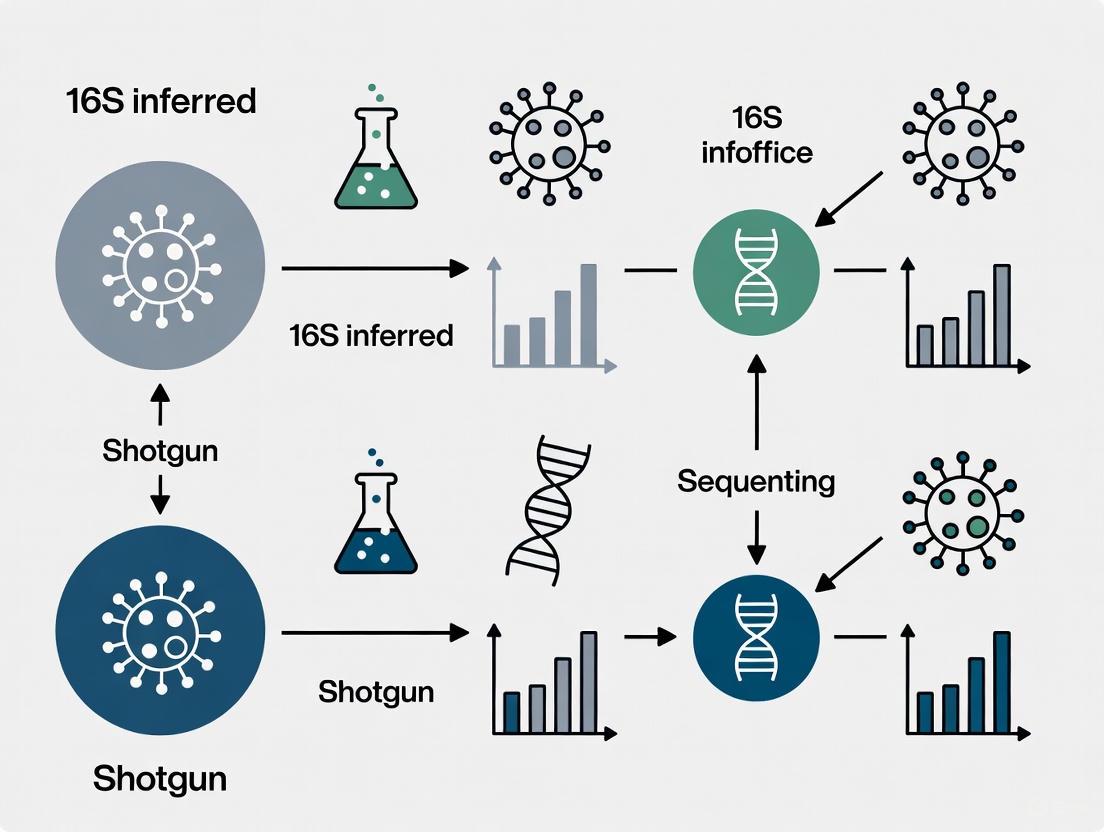
This article provides a comprehensive comparison between 16S rRNA inferred functional profiling and direct shotgun metagenomic sequencing for researchers and drug development professionals.
Functional Profiling Showdown: 16S rRNA Inference vs. Shotgun Metagenomics for Biomedical Research
Abstract
This article provides a comprehensive comparison between 16S rRNA inferred functional profiling and direct shotgun metagenomic sequencing for researchers and drug development professionals. We explore the foundational principles of each method, detailing the mechanistic differences between predictive tools like PICRUSt and direct gene-centric analysis. The scope includes practical methodological workflows, from DNA extraction to bioinformatic pipelines, alongside troubleshooting for common challenges like host DNA contamination and database limitations. Finally, we present validation data and comparative analyses of taxonomic resolution, functional accuracy, and cost-effectiveness, synthesizing key takeaways to guide method selection for robust microbiome research in clinical and therapeutic contexts.
Core Principles: Understanding 16S Inference and Shotgun Metagenomics
In the field of microbiome research, two powerful DNA sequencing methods are predominantly used to characterize microbial communities: targeted gene sequencing and whole-genome shotgun metagenomic sequencing. The choice between these methods is a critical first step in experimental design, influencing the depth of taxonomic resolution, the ability to perform functional profiling, and the overall cost and complexity of the study.
Targeted gene sequencing, often exemplified by 16S ribosomal RNA (rRNA) gene sequencing, uses PCR to amplify specific, taxonomically informative genetic regions present in particular microbial groups [1] [2]. In contrast, whole-genome shotgun (WGS) sequencing takes an untargeted approach by fragmenting all the DNA in a sample and sequencing the random pieces, which are then reassembled and classified using bioinformatics [1] [3]. This guide provides an objective, data-driven comparison of these two approaches, with a particular focus on their capabilities for inferring the functional potential of microbial communities.
Core Methodologies and Workflows
The fundamental difference between these techniques lies in their initial handling of sample DNA. The 16S rRNA gene sequencing workflow is designed for high efficiency and sensitivity for bacteria and archaea, while the shotgun metagenomics workflow aims for comprehensive genomic coverage of all organisms present.
Targeted 16S rRNA Gene Sequencing Workflow
The 16S rRNA gene is a cornerstone for microbial phylogeny and taxonomy because it contains both highly conserved regions, useful for primer binding, and hypervariable regions (V1-V9), which provide signatures for taxonomic classification [4]. The typical workflow is as follows:
- DNA Extraction: Microbial DNA is extracted from the sample (e.g., soil, water, human gut content) [1] [4].
- PCR Amplification: Primers specific to the conserved regions of the 16S rRNA gene are used to amplify one or more of its hypervariable regions [1] [2]. This PCR step selectively enriches for bacterial and archaeal DNA.
- Library Preparation & Sequencing: The amplified products (amplicons) are given molecular barcodes, pooled, and sequenced on platforms such as the Illumina MiSeq [1] [4].
- Bioinformatic Analysis: The raw sequencing reads are processed through pipelines like QIIME or MOTHUR. This involves quality filtering, clustering sequences into Operational Taxonomic Units (OTUs) or Amplicon Sequence Variants (ASVs), and comparing them to reference databases (e.g., SILVA, Greengenes) to assign taxonomy [1] [3].
Figure 1: The 16S rRNA gene sequencing workflow involves targeted amplification of a specific gene region before sequencing.
Whole-Genome Shotgun Metagenomic Sequencing Workflow
Shotgun sequencing avoids PCR amplification of a specific target and instead sequences all DNA fragments in a sample, enabling a broader scope of analysis [3] [5].
- DNA Extraction: Total genomic DNA is extracted from the sample, aiming to capture DNA from all domains of life (bacteria, archaea, fungi, viruses) [1] [5].
- Fragmentation & Library Preparation: The extracted DNA is randomly fragmented, either mechanically or enzymatically (e.g., via tagmentation). Adapters and barcodes are then ligated to these fragments [1].
- Sequencing: The pooled library is sequenced on high-throughput platforms like Illumina NovaSeq or PacBio Revio [1] [6].
- Bioinformatic Analysis: The analysis is more complex and can proceed via multiple paths. Quality-controlled reads can be directly classified for taxonomy and function using k-mer-based tools like Kraken2 and HUMAnN2, or they can be assembled into contigs and Metagenome-Assembled Genomes (MAGs) for deeper genomic analysis [1] [7].
Figure 2: The shotgun metagenomic sequencing workflow involves sequencing all DNA in a sample without targeted amplification.
Performance Comparison: Key Factors for Researchers
The choice between 16S and shotgun sequencing involves trade-offs across cost, resolution, and analytical scope. The table below summarizes these key differentiating factors.
Table 1: Head-to-Head Comparison of 16S rRNA and Shotgun Metagenomic Sequencing
| Factor | 16S rRNA Sequencing | Shotgun Metagenomic Sequencing |
|---|---|---|
| Approximate Cost per Sample | ~$50 - $80 USD [1] [3] | ~$150 - $200 USD (Deep) [1] [3] |
| Taxonomic Resolution | Genus-level, sometimes species-level [1] [2] | Species-level, often strain-level [1] [2] |
| Taxonomic Coverage | Bacteria and Archaea only [1] [5] | All domains: Bacteria, Archaea, Fungi, Viruses [1] [5] |
| Functional Profiling | Indirect prediction only (e.g., PICRUSt) [1] [2] | Direct measurement of functional genes and pathways [1] [2] |
| Host DNA Contamination | Low sensitivity; PCR targets microbes [2] | High sensitivity; requires host depletion for low-microbial-biomass samples [2] [3] |
| Minimum DNA Input | Very low (as low as 10 gene copies) [2] [3] | Higher (typically ≥1 ng) [2] [3] |
| Bioinformatics Complexity | Beginner to Intermediate [1] | Intermediate to Advanced [1] |
| False Positive Risk | Low risk with modern error-correction (DADA2) [2] [3] | Higher risk due to database gaps and horizontal gene transfer [2] [3] |
The Critical Divide in Functional Profiling
A primary consideration for many modern studies is the ability to move beyond "who is there" to "what are they doing." This functional profiling is a major point of divergence between the two methods.
16S Sequencing and Inferred Function: 16S data itself contains no direct information on microbial genes. Instead, computational tools like PICRUSt (Phylogenetic Investigation of Communities by Reconstruction of Unobserved States) predict the metagenomic functional content based on the identified taxa and their known genomic content from reference databases [1] [2]. This provides a reasonable hypothesis of functional potential but is an inference, not a measurement.
Shotgun Sequencing and Direct Functional Profiling: Shotgun sequencing directly sequences the vast repertoire of genes present in a sample. These genes can be mapped to functional databases (e.g., KEGG, COG) to quantify the abundance of specific pathways, such as those for antibiotic resistance, vitamin synthesis, or carbohydrate metabolism [1] [4]. This provides a direct, though still potential, view of the community's functional capacity.
Experimental Data and Validation
Comparative studies consistently highlight the differences in detection power and quantitative accuracy between these methods.
Detection of Less Abundant Taxa
A 2021 study in Scientific Reports directly compared 16S and shotgun sequencing on chicken gut microbiota samples. The research demonstrated that when a sufficient sequencing depth is achieved (more than 500,000 reads per sample), shotgun sequencing detects a statistically significant higher number of bacterial genera than 16S sequencing [8]. The genera exclusive to shotgun data were typically less abundant but were shown to be biologically meaningful, as they were able to discriminate between different experimental conditions (e.g., different gastrointestinal tract compartments and sampling times) just as well as the more abundant genera detected by both methods [8].
Table 2: Representative Experimental Findings from a Comparative Study on Chicken Gut Microbiota [8]
| Analysis Metric | 16S rRNA Sequencing | Shotgun Metagenomic Sequencing |
|---|---|---|
| Genera detected (Caeca vs. Crop) | 108 significant differences | 256 significant differences |
| Exclusive Findings | 4 changes unique to 16S | 152 changes unique to shotgun |
| Quantitative Correlation | Good agreement for abundant taxa (Avg. r=0.69) | Good agreement for abundant taxa; better detection of rare taxa |
| Conclusion | Detects core, abundant community | Provides greater power to reveal significant biological differences via less abundant taxa |
Protocol for a Comparative Performance Study
For researchers seeking to validate these methods, a mock community experiment is the gold standard. The following protocol, based on a 2025 study, outlines this process [7].
- 1. Mock Community Preparation: Create artificial microbial communities with known compositions of 19 bacterial isolates, spanning a range of phyla (e.g., Pseudomonadota, Bacillota, Bacteroidota). Precisely define the expected relative abundance of each taxon [7].
- 2. Wet-Lab Processing: Split the mock community sample for parallel processing:
- 16S / rpoB Metabarcoding Arm: Amplify the target gene (e.g., V3-V4 of 16S or a region of rpoB) using specific primers and sequence.
- Shotgun Metagenomic Arm: Proceed directly to library preparation and sequencing without targeted amplification [7].
- 3. Bioinformatic Analysis:
- 16S/rpoB Data: Process reads through a pipeline like DADA2 for error-correction and OTU/ASV formation. Assign taxonomy against a reference database.
- Shotgun Data: Analyze using two primary approaches:
- k-mer-based (e.g., Kraken2/Bracken): Classify reads by breaking them into k-mers for rapid database comparison.
- Assembly-Binning-Method: Assemble reads into contigs, bin them into MAGs, and assign taxonomy using tools like skani based on Average Nucleotide Identity (ANI) [7].
- 4. Evaluation Metrics: Compare the results from each method and pipeline against the known mock community truth. Key metrics include:
- Sensitivity/Recall: Proportion of expected taxa that were correctly identified.
- Precision: Proportion of identified taxa that were truly in the mock community (low false positive rate).
- Quantitative Accuracy: Correlation (e.g., Pearson's) between expected and observed relative abundances.
- Taxonomic Resolution: The finest taxonomic level (genus vs. species) achieved with confidence [7].
The Scientist's Toolkit: Essential Research Reagents and Materials
Successful execution of either sequencing method relies on key laboratory and bioinformatics resources.
Table 3: Essential Research Reagents and Solutions for Metagenomic Sequencing
| Item | Function | Example Use-Case |
|---|---|---|
| DNA Extraction Kits | To isolate high-quality, unbiased genomic DNA from complex samples. | MoBio PowerSoil Kit for environmental samples; HostZERO kit for samples with high host DNA contamination [2]. |
| PCR Primers | To amplify target gene regions in 16S sequencing. | 341F/805R primers for the 16S V3-V4 region; ITS1F/ITS2R for fungal ITS region [4]. |
| Library Prep Kits | To fragment DNA and attach sequencing adapters. | Illumina Nextera XT for shotgun sequencing; Kapa HyperPlus for various inputs [1]. |
| Mock Communities | To validate entire wet-lab and bioinformatics workflow accuracy. | ZymoBIOMICS Microbial Community Standard for both 16S and shotgun benchmarking [3] [7]. |
| Bioinformatics Pipelines | Software for processing raw data into biological insights. | QIIME 2 for 16S; MetaPhlAn/HUMAnN for shotgun taxonomy/function; Kraken2 for k-mer classification [1] [7]. |
| Reference Databases | Curated genetic databases for taxonomic and functional assignment. | SILVA/GreenGenes for 16S; NCBI RefSeq for whole genomes; KEGG/eggNOG for functional annotation [1] [4]. |
Both targeted 16S sequencing and whole-genome shotgun metagenomics are powerful, yet distinct, tools for microbial community analysis. The decision is not about which is universally better, but which is more appropriate for the specific research question, sample type, and available resources.
16S rRNA gene sequencing remains a cost-effective and robust choice for large-scale studies focused on the composition and dynamics of bacterial and archaeal communities, where deep functional or strain-level insight is not required.
Shotgun metagenomic sequencing is the definitive method for studies demanding a comprehensive view of all microbial domains, high taxonomic resolution, and most importantly, direct assessment of the community's functional genetic potential. As sequencing costs continue to fall and bioinformatics tools become more accessible, shotgun metagenomics is poised to become the standard for an increasingly broad range of applications in microbial ecology, clinical diagnostics, and drug development.
This guide examines the computational machinery behind 16S-inferred functional profiling tools, with a focused analysis on PICRUSt (Phylogenetic Investigation of Communities by Reconstruction of Unobserved States). We objectively compare its performance against shotgun metagenomic sequencing, presenting experimental data that quantifies accuracy, resolution, and applicability across various research contexts. The analysis reveals that while PICRUSt provides a cost-effective method for functional prediction from 16S rRNA data, its performance is contingent on reference database coverage and phylogenetic proximity to sequenced genomes, with shotgun metagenomics offering superior resolution for well-characterized environments.
Functional profiling of microbial communities enables researchers to move beyond taxonomic census to understand the metabolic capabilities of a microbiome. Two primary methodologies dominate this field: 16S-inferred functional profiling using computational tools like PICRUSt, and direct shotgun metagenomic sequencing. The fundamental distinction lies in their approach—PICRUSt predicts functional potential based on evolutionary relationships between observed 16S sequences and reference genomes, while shotgun metagenomics directly samples the collective genetic material of a community [9] [3].
PICRUSt operates on the core principle that phylogeny and function are sufficiently linked to infer gene families present in uncultivated microorganisms [9]. This linkage enables researchers to extrapolate metagenomic information from standard 16S rRNA sequencing data, which is considerably less expensive than shotgun sequencing. The algorithm uses an extended ancestral-state reconstruction method to predict which gene families are present based on the phylogenetic placement of observed 16S sequences within a reference tree of genomes with known functional annotations [9].
For researchers considering functional profiling approaches, understanding the technical mechanisms, limitations, and performance characteristics of PICRUSt relative to shotgun metagenomics is essential for appropriate experimental design and data interpretation.
The PICRUSt Algorithm: A Technical Examination
Core Computational Mechanism
The PICRUSt algorithm employs a two-stage process that separates computationally intensive reference database construction from sample-specific prediction [9]:
Stage 1: Gene Content Inference (Pre-computation)
- Reference Tree Construction: PICRUSt uses the Greengenes phylogenetic tree of 16S sequences as its reference framework [9].
- Ancestral State Reconstruction: For each node in the reference tree (including both extant and ancestral organisms), gene content is inferred using ancestral state reconstruction (ASR) algorithms. This step estimates which gene families were likely present in ancestral organisms based on the distribution of traits in living organisms using maximum likelihood or Bayesian methods [9].
- Gene Content Prediction: The gene contents of reference genomes and inferred ancestral genomes are used to predict gene contents for all microorganisms in the reference phylogenetic tree, including unsequenced environmental strains [9].
- 16S Copy Number Normalization: The algorithm predicts 16S rRNA copy numbers for each organism through ASR, enabling subsequent normalization in the metagenome inference stage [9].
Stage 2: Metagenome Inference (Sample-Specific)
- OTU Table Normalization: User-provided operational taxonomic unit (OTU) tables are normalized by dividing the abundance of each organism by its predicted 16S copy number [9].
- Metagenome Prediction: Normalized OTU abundances are multiplied by the pre-calculated gene family abundances for each taxon [9].
- Output Generation: The final output is an annotated table of predicted gene family counts for each sample, using classification schemes such as KEGG Orthology (KOs) or Clusters of Orthologs Groups (COGs) [9].
Key Algorithmic Innovations
PICRUSt incorporates several methodological advances that enable its predictive capability:
- Extended Ancestral State Reconstruction: The algorithm extends existing ASR methods to predict traits of extant organisms in addition to ancestral organisms, with uncertainty quantification based on each gene family's evolutionary rate [9].
- Evolutionary Modeling: The approach accounts for variation in marker gene copy number and evolutionary distance between observed sequences and reference genomes [9].
- Weighted Contribution: Gene content predictions incorporate weighted contributions from reference genomes based on phylogenetic proximity to target organisms [9].
The mathematical foundation of PICRUSt rests on the correlation between 16S rRNA gene phylogeny and functional gene content, which has been demonstrated to be approximately 0.8-0.9 in well-characterized environments [9].
Experimental Validation and Performance Metrics
Validation Against Human Microbiome Project Data
The performance of PICRUSt was quantitatively evaluated using data from the Human Microbiome Project, which provided paired 16S rRNA and shotgun metagenomic sequences from 530 samples [9]. The results demonstrated that:
- PICRUSt accurately recaptured key findings from direct metagenomic sequencing [9].
- Correlations between predicted and measured gene content approached 0.9 in the best cases, averaging approximately 0.8 across host-associated and environmental communities [9].
- The algorithm recaptured most variation in gene content obtained by metagenomic sequencing using only a few hundred 16S sequences [9].
- In some cases, PICRUSt predictions outperformed metagenomes measured at particularly shallow sampling depths [9].
Performance Across Diverse Environments
PICRUSt performance varies significantly based on the availability of reference genomes for organisms in each environment [9]. Applications across multiple research domains demonstrate its utility:
Bioenergy Research: In fermentative hydrogen production systems, PICRUSt successfully visualized metabolic pathways closely related to hydrogen production and demonstrated relative abundances of functional genes. The predictions explained why ionizing radiation pretreatment of inoculum enhanced hydrogen yield—by diminishing hydrogen-consuming metabolisms like methane metabolism and homoacetogenesis while promoting hydrogen-producing pathways [10].
Waste Management: When analyzing animal manures for biogas production potential, PICRUSt identified 135 predicted KEGG Orthologies (KOs) related to amino acid, carbohydrate, energy, lipid, and xenobiotic metabolisms across horse, cow, and pig manure samples [11]. The tool specifically revealed that fructose, mannose, amino acid and nucleotide sugar, phosphotransferase, starch, and sucrose metabolisms were significantly higher in horse manure, informing optimal co-digestion strategies [11].
Clinical Applications: A comparison of circulating microbiome profiling in transjugular intrahepatic portosystemic shunt (TIPS) patients revealed that 16S rRNA amplicon sequencing captured more diverse microbial signals than shotgun metagenomics, though taxonomic profiles showed limited overlap between methods [12].
Table 1: Quantitative Performance Metrics of PICRUSt vs. Shotgun Metagenomics
| Performance Metric | PICRUSt (16S-Inferred) | Shotgun Metagenomics | Experimental Context |
|---|---|---|---|
| Correlation with measured gene content | 0.8-0.9 (best case) [9] | 1.0 (by definition) | Human Microbiome Project [9] |
| Taxonomic resolution | Genus-level (sometimes species) [3] [1] | Species-level (sometimes strains) [3] [1] | Gut microbiota studies [8] |
| Cost per sample | ~$50-80 [3] [1] | ~$150-200 (deep), ~$120 (shallow) [3] [1] | Standard commercial pricing |
| Minimum DNA input | 10 copies of 16S gene [3] | 1 ng [3] | Technical requirements |
| Functional profiling capability | Predicted (via phylogenetic inference) [9] [3] | Direct measurement [3] [1] | Methodological comparison |
| Sensitivity to host DNA | Low (targeted amplification) [3] | High (sequences all DNA) [3] [1] | Samples with high host DNA content |
Comparative Analysis: 16S-Inferred vs. Shotgun Functional Profiling
Taxonomic Resolution and Detection Sensitivity
A direct comparison between 16S rRNA and shotgun sequencing for taxonomic characterization of the gut microbiota revealed significant differences in detection capability [8]:
- Shotgun sequencing identifies a broader range of microbial taxa, particularly less abundant genera that may be missed by 16S sequencing [8].
- When sufficient sequencing depth is achieved (>500,000 reads per sample), shotgun sequencing detects a statistically significant higher number of taxa than 16S sequencing [8].
- The genera detected exclusively by shotgun sequencing demonstrate biological relevance, effectively discriminating between experimental conditions such as different gastrointestinal tract compartments and sampling times [8].
- 16S rRNA sequencing captures a more limited portion of the microbial community but requires fewer reads to achieve stable taxonomic profiles at higher taxonomic levels [8].
Table 2: Detection Capabilities by Sequencing Approach
| Detection Parameter | 16S rRNA Sequencing | Shotgun Metagenomics | Study Context |
|---|---|---|---|
| Bacterial genus detection | Limited to more abundant taxa [8] | Higher sensitivity for less abundant genera [8] | Chicken gut microbiota [8] |
| Cross-domain coverage | Bacteria and Archaea only [3] [1] | All domains (Bacteria, Archaea, Fungi, Viruses) [3] [1] | Method capability |
| False positive risk | Low risk (with error correction) [3] | High risk (due to database limitations) [3] | Mock community analysis [3] |
| Strain-level resolution | Limited [3] [1] | Possible with sufficient depth [3] [1] | Technical capability |
| Differential analysis power | Identified 108 significant differences (caeca vs. crop) [8] | Identified 256 significant differences (caeca vs. crop) [8] | Chicken GI tract compartments [8] |
Functional Profiling Accuracy
While PICRUSt generates functional predictions that correlate well with shotgun metagenomic data in environments with good reference genome coverage, systematic differences exist:
- Shotgun metagenomics provides direct evidence of functional genes present in a community, while PICRUSt infers functions based on phylogenetic relationships [9] [3].
- PICRUSt cannot account for recently acquired genes through lateral gene transfer that may not follow phylogenetic patterns [9].
- For human-associated microbial communities, where reference genomes are extensive, PICRUSt predictions show high accuracy, whereas in environments with less characterized microbes (e.g., soil), prediction accuracy decreases [9].
- Newer tools like Meteor2 demonstrate improved functional abundance estimation, achieving at least 35% better accuracy compared to previous methods like HUMAnN3 based on Bray-Curtis dissimilarity metrics [13].
Methodological Considerations for Researchers
Experimental Design and Sample Preparation
DNA Extraction Considerations:
- For 16S sequencing with subsequent PICRUSt analysis, standard microbial DNA extraction protocols are sufficient [1].
- For shotgun metagenomics, consideration must be given to host DNA depletion in samples with high host contamination (e.g., skin swabs, tissue biopsies) [3] [1].
Sequencing Depth Requirements:
- 16S sequencing typically requires 20,000-50,000 reads per sample for stable community profiles [8].
- Shotgun metagenomics requires significantly deeper sequencing (typically 5-10 million reads per sample for comprehensive functional profiling) [8] [1].
- Shallow shotgun sequencing provides an intermediate approach, offering similar taxonomic profiling to deep sequencing at reduced cost, but with limitations in functional gene detection [1].
Bioinformatics Requirements
PICRUSt Analysis Workflow:
- Quality Filtering of raw 16S sequences [9]
- OTU Picking or ASV (Amplicon Sequence Variant) calling [9]
- Taxonomic Assignment using Greengenes database [9]
- Normalization by predicted 16S copy number [9]
- Metagenome Prediction using pre-computed gene tables [9]
- Statistical Analysis of predicted gene abundances [9]
Shotgun Metagenomics Analysis:
- Quality Control and host sequence removal [13] [1]
- Taxonomic Profiling using tools like Kraken2, MetaPhlAn, or Meteor2 [12] [13]
- Functional Profiling using HUMAnN3, MetaCyc, or KEGG databases [13] [1]
- Pathway Analysis and metabolic reconstruction [13] [1]
- Strain-Level Analysis using tools like StrainPhlAn or Meteor2 [13]
Table 3: Essential Research Resources for Functional Profiling
| Resource Category | Specific Tools/Databases | Application | Key Features |
|---|---|---|---|
| 16S Analysis Pipelines | QIIME, MOTHUR, USEARCH-UPARSE [1] | 16S rRNA sequence processing | OTU/ASV picking, taxonomic assignment |
| Shotgun Profiling Tools | MetaPhlAn4, HUMAnN3, Meteor2 [13] | Shotgun metagenomic analysis | Taxonomic and functional profiling |
| Reference Databases | Greengenes, GTDB, KEGG, COG [9] [13] | Taxonomic/functional reference | Curated genome annotations |
| Functional Prediction | PICRUSt, PICRUSt2 [9] [11] | 16S-inferred function prediction | Phylogenetic trait imputation |
| Visualization Platforms | STAMP, LEfSe, R/Phyloseq [11] | Statistical analysis and visualization | Differential abundance analysis |
PICRUSt represents a significant computational achievement in microbiome research, enabling functional predictions from 16S rRNA sequencing data through sophisticated phylogenetic modeling. Its performance is strongest in environments with comprehensive reference genome coverage, such as the human microbiome, where correlations with directly measured metagenomes approach 0.8-0.9. However, shotgun metagenomic sequencing remains the gold standard for comprehensive functional profiling, particularly for detecting less abundant taxa, achieving strain-level resolution, and capturing functions from poorly characterized organisms or those with significant lateral gene transfer.
Researchers should select functional profiling methods based on their specific research questions, sample types, reference database coverage, and budgetary constraints. For well-characterized environments where bacterial composition is the primary interest, PICRUSt with 16S sequencing provides a cost-effective solution. When comprehensive functional assessment, cross-domain profiling, or strain-level resolution is required, shotgun metagenomics remains the preferred approach despite its higher computational and financial costs.
The Mechanism of Direct Functional Profiling via Shotgun Metagenomics
Functional profiling of microbial communities enables researchers to decipher the metabolic capabilities of microbiota and their impact on host health and disease. While 16S rRNA sequencing has traditionally been used for taxonomic census, shotgun metagenomics provides a superior lens for directly interrogating the functional genetic potential of complex microbial ecosystems. This guide objectively compares the performance of 16S inferred functional profiling against direct shotgun metagenomic analysis, supported by experimental data highlighting their respective capabilities, limitations, and appropriate applications for research and drug development.
The pursuit of accurate functional profiling of microbial communities represents a critical frontier in microbiome research. For years, 16S rRNA gene sequencing has served as the workhorse for microbial ecology studies, providing a cost-effective method for taxonomic classification. However, its utility for functional assessment remains indirect and inferential, relying on phylogenetic relationships to predict metabolic capabilities [14]. In contrast, shotgun metagenomic sequencing directly sequences all genomic DNA in a sample, enabling comprehensive identification of functional genes and metabolic pathways without relying on inference [15] [14].
The distinction between these approaches has profound implications for drug development and clinical applications, where understanding specific microbial functions—rather than mere taxonomic composition—can reveal mechanistic insights into disease pathophysiology and potential therapeutic targets [14]. This guide systematically compares the experimental performance of these methodologies, providing researchers with evidence-based insights to inform their functional profiling strategies.
Methodological Fundamentals
16S rRNA Gene Sequencing with Indirect Functional Prediction
The 16S rRNA gene approach targets specific hypervariable regions (V1-V9) of this phylogenetically informative gene through PCR amplification [5] [14]. Taxonomically classified sequences are then used to infer functional profiles using computational tools such as PICRUSt, which predicts metagenomic functions based on reference genomes [15] [14]. This method inherently links functional prediction to taxonomic identification, introducing multiple layers of potential bias including primer selection, amplification efficiency, and database limitations [16].
Shotgun Metagenomic Sequencing for Direct Functional Profiling
Shotgun metagenomics employs random fragmentation of all DNA in a sample, followed by high-throughput sequencing without target-specific amplification [5] [15]. The resulting reads are analyzed through either assembly-based approaches (constructing longer contigs from short reads) or read-based methods (directly comparing reads to reference databases), enabling direct identification of protein-coding genes and metabolic pathways across all domains of life [17] [18].
Figure 1: Shotgun metagenomics workflow for direct functional profiling. The process begins with DNA extraction from complex samples, followed by random fragmentation and sequencing. Bioinformatic processing via either assembly-based or read-based approaches enables direct gene identification and pathway reconstruction without taxonomic inference.
Performance Comparison: Experimental Data
Taxonomic and Functional Resolution
Table 1: Methodological comparison of resolution and detection capabilities
| Parameter | 16S rRNA Sequencing | Shotgun Metagenomics | Experimental Evidence |
|---|---|---|---|
| Taxonomic Resolution | Genus to species level (with full-length 16S) | Species to strain level | Shotgun provides higher species-level classification accuracy (90.3% vs 76.8% in mock communities) [17] |
| Functional Assessment | Indirect inference via phylogeny | Direct gene detection | Shotgun identifies 300% more metabolic pathways in CRC studies [19] |
| Domain Coverage | Limited to bacteria and archaea | All domains: bacteria, archaea, viruses, fungi, eukaryotes | Shotgun detects clinically relevant fungi and viruses in human gut samples [5] [14] |
| Strain-Level Discrimination | Not possible | Specific strain identification | Enables tracking of starter culture strains in cheese ripening [18] |
| Reference Dependency | High (16S databases) | High (genomic databases) | Database choice significantly impacts results for both methods [20] [19] |
Quantitative Performance Benchmarks
Table 2: Experimental performance metrics from comparative studies
| Performance Metric | 16S rRNA Sequencing | Shotgun Metagenomics | Study Context |
|---|---|---|---|
| Species Detection Sensitivity | 76.8% | 90.3% | Mock community benchmarking [17] |
| False Positive Rate | Lower false positives | Higher false positives but better overall accuracy | Simulated data analysis [21] |
| CRC Biomarker Identification | 4-6 species-level biomarkers | 8+ specific species-level biomarkers | Colorectal cancer screening [20] [19] |
| Functional Pathway Detection | ~150 KEGG pathways (inferred) | ~450 KEGG pathways (direct) | Human gut microbiota [19] |
| Data Sparsity | Higher sparsity (25-40% zeros) | Lower sparsity (10-15% zeros) | 156 human stool samples [19] |
Experimental Protocols for Functional Profiling
Standardized Shotgun Metagenomic Workflow
Sample Preparation and DNA Extraction:
- For human gut microbiota studies, collect and immediately freeze stool samples at -80°C [19]
- Extract DNA using standardized kits (e.g., NucleoSpin Soil Kit) with mechanical lysis for comprehensive cell disruption [19]
- For samples with high host DNA contamination, consider microbial enrichment techniques or bioinformatic filtering [15]
Library Preparation and Sequencing:
- Fragment DNA via mechanical shearing to ~350bp fragments [5]
- Prepare libraries with dual indexing to enable multiplexing
- Sequence on Illumina platforms (2×150bp) to minimum depth of 10 million reads per sample for complex communities [19]
Bioinformatic Analysis Pipeline:
- Quality Control: Remove adapters and low-quality reads using Trimmomatic or FastP [22]
- Host DNA Removal: Align reads to host genome (e.g., GRCh38) and exclude matching sequences [19]
- Taxonomic Profiling: Use MetaPhlAn4 for marker-based classification or Kraken2 for k-mer based approaches [17]
- Functional Annotation: Align reads to reference databases (KEGG, COG, EggNOG) using HUMAnN3 or similar pipelines [19]
- Pathway Analysis: Reconstruct metabolic pathways from gene abundance data [18]
Key Benchmarking Findings
Recent benchmarking studies using mock communities with known composition provide critical insights into pipeline performance:
- bioBakery4 demonstrates superior accuracy in taxonomic and functional profiling [17]
- Assembly-free approaches against comprehensive databases (GTDB) provide reliable functional annotation [21]
- Multiple pipeline strategies (assembly-based, read-based, marker-based) should be compared for novel environments [18]
- Database selection significantly impacts results, with specialized databases outperforming general references for specific environments [19]
Research Reagent Solutions
Table 3: Essential reagents and computational tools for functional metagenomics
| Category | Specific Tools/Reagents | Function | Considerations |
|---|---|---|---|
| DNA Extraction | NucleoSpin Soil Kit, DNeasy PowerLyzer | Comprehensive DNA isolation from complex matrices | Mechanical lysis improves recovery of Gram-positive bacteria [19] |
| Library Prep | Illumina DNA Prep, Nextera XT | Fragment end-repair, adapter ligation, indexing | PCR-free protocols reduce amplification bias [14] |
| Sequencing | Illumina NovaSeq, PacBio, Oxford Nanopore | High-throughput DNA sequencing | Long-read technologies improve assembly contiguity [20] |
| Taxonomic Profiling | MetaPhlAn4, Kraken2, mOTUs2 | Classification of microbial sequences | MetaPhlAn4 incorporates MAGs for improved resolution [17] |
| Functional Annotation | HUMAnN3, MG-RAST, BV-BRC | Pathway reconstruction and abundance quantification | HUMAnN3 provides stratified pathway abundances [19] [18] |
| Reference Databases | KEGG, COG, EggNOG, UniRef | Functional gene families and pathways | Specialized databases available for human gut, soil, etc. [15] |
Applications in Disease Research
The enhanced functional resolution of shotgun metagenomics has yielded significant insights into human disease mechanisms. In colorectal cancer (CRC) research, shotgun sequencing identified specific bacterial biomarkers including Parvimonas micra, Fusobacterium nucleatum, and Bacteroides fragilis with higher specificity than 16S methods [20] [19]. Beyond taxonomic identification, shotgun analysis revealed associated functional capacities including:
- Genes for toxins (e.g., BFT toxin in ETBF strains) [20]
- Enzymes triggering chronic inflammation and DNA damage [20]
- Metabolic pathways differentiating healthy from diseased states [19]
These functional insights provide not only potential diagnostic biomarkers but also reveal actionable therapeutic targets for drug development. Machine learning models trained on shotgun-derived microbial signatures achieved AUCs of 0.87 for CRC prediction, significantly outperforming 16S-based models [20].
Shotgun metagenomics provides unequivocal advantages for direct functional profiling of microbial communities, offering superior resolution, direct pathway detection, and cross-domain coverage. While 16S rRNA sequencing remains valuable for initial taxonomic surveys in large cohorts or budget-constrained studies, its functional inferences lack the mechanistic precision required for advanced therapeutic development.
For drug development professionals and researchers investigating functional mechanisms in microbiome-associated conditions, shotgun metagenomics delivers the necessary resolution to connect microbial taxa to specific metabolic activities. As sequencing costs continue to decline and analytical tools mature, shotgun methodologies are positioned to become the gold standard for functional microbiome analysis in both research and clinical applications.
In the field of microbial ecology and precision medicine, the choice of genetic target for microbiome analysis is a fundamental decision that shapes all subsequent findings. Researchers and drug development professionals primarily leverage two powerful approaches: targeted amplicon sequencing of specific 16S ribosomal RNA (rRNA) hypervariable regions and shotgun metagenomic sequencing of entire microbial genomes [23]. Each method offers distinct advantages and limitations in taxonomic resolution, functional insight, and practical application. This guide provides an objective, data-driven comparison of these techniques, framing them within the critical context of functional profiling, which aims to elucidate the metabolic capabilities and activities of microbial communities. Understanding the balance between the high-throughput, cost-effective nature of 16S rRNA gene sequencing and the comprehensive, strain-level resolution of shotgun metagenomics is essential for designing robust studies and accurately interpreting their results [8] [24].
Fundamental Differences in Genetic Targets
16S rRNA Gene Amplicon Sequencing focuses on a single, highly conserved gene that is universal in prokaryotes. The ~1500 base-pair gene contains nine hypervariable regions (V1-V9) that are flanked by conserved sequences, allowing for primer design and phylogenetic differentiation [25] [23] [26]. This technique involves selectively amplifying and sequencing one or more of these variable regions to profile the taxonomic composition of a microbial community. In contrast, Shotgun Metagenomic Sequencing takes an untargeted approach, fragmenting and sequencing all the genetic material present in a sample—bacterial, archaeal, viral, and eukaryotic [8] [23]. This provides access to the entire functional gene repertoire of a community, enabling not only taxonomic classification but also insights into metabolic pathways, antibiotic resistance genes, and virulence factors [23].
The table below summarizes the core technical differences between these two approaches:
Table 1: Core technical comparison between 16S rRNA sequencing and Shotgun Metagenomics
| Feature | 16S rRNA Gene Sequencing | Shotgun Metagenomics |
|---|---|---|
| Genetic Target | Specific hypervariable regions of the 16S rRNA gene | Entire microbial genomes (all DNA) |
| Taxonomic Resolution | Genus to species level [23] | Species to strain level [23] |
| Functional Profiling | Indirect inference via computational tools [24] | Direct measurement of functional genes and pathways [23] |
| Coverage | Limited to bacteria and archaea [23] | All domains of life (viruses, fungi, eukaryotes) [23] |
| Host DNA Contamination | Low interference due to targeted amplification [23] | High interference; requires depletion strategies [23] |
| Cost per Sample (Approx.) | ~$60 [23] | ~$145 [23] |
Performance of 16S Hypervariable Regions
The choice of which 16S hypervariable region to sequence is critical, as it significantly impacts taxonomic resolution and diversity estimates. Different regions exhibit varying degrees of sequence variation and are not equally informative across all bacterial taxa or sample types [25] [27] [26].
Table 2: Comparative performance of common 16S rRNA hypervariable regions based on experimental studies
| Hypervariable Region | Recommended Sample Type | Key Findings and Performance |
|---|---|---|
| V1-V2 | Respiratory samples [25], Human gut [27] | Highest resolving power for respiratory bacterial taxa (AUC: 0.736) [25]. Shows higher alpha diversity (Chao1) in gut samples compared to V3-V4 [27]. |
| V3-V4 | General purpose, Human gut [28] | Commonly used; provides a balance of information. Microbial profiles were similar to original mock community ratios, though biased in V1-V3 [28]. |
| V4-V6 | Broad phylogenetic analysis [26] | In silico analysis identified V4-V6 as the most reliable regions for representing full-length 16S sequences in phylogenetics [26]. |
| V5-V7 | Respiratory samples [25] | Shows compositional similarity to V3-V4 in respiratory samples [25]. |
| V7-V9 | - | Significantly lower alpha diversity compared to other regions in respiratory samples [25]. |
A study on chronic respiratory diseases demonstrated that the V1-V2 region exhibited the highest sensitivity and specificity (AUC: 0.736) for accurately identifying respiratory bacterial taxa, outperforming V3-V4, V5-V7, and V7-V9 [25]. Conversely, research on the human gut microbiome found that while dominant genera were consistently detected by both V1-V2 and V3-V4, alpha diversity measures and overall microbiome profiles differed significantly between the regions, underscoring that most findings are sensitive to the chosen region [27].
Functional Profiling: Inferred vs. Direct Measurement
A central theme in modern microbiome research is moving beyond "who is there" to "what are they doing." This functional profiling is where the distinction between 16S rRNA sequencing and shotgun metagenomics becomes most pronounced.
The Workflow for 16S-Inferred Functional Profiling
Because 16S sequencing does not directly capture functional genes, researchers must rely on computational tools to infer the metabolic potential of the observed taxa. These tools use databases of known genomes to predict which functional genes were likely present in the sample based on the identified taxonomic profile [24].
Limitations of 16S-Based Functional Inference
While convenient, inferring function from 16S data has significant limitations. A 2024 benchmarking study using matched 16S and metagenomic datasets from human cohorts for type two diabetes, obesity, and colorectal cancer concluded that 16S rRNA gene-based functional inference tools generally lack the necessary sensitivity to delineate health-related functional changes in the microbiome [24]. The predictions are constrained by the quality and completeness of reference genomes, and they cannot capture strain-level functional differences or genes acquired via horizontal gene transfer. Furthermore, these tools only predict metabolic potential, not actual microbial activity [24].
Direct Functional Assessment via Shotgun Metagenomics
Shotgun metagenomics sequences the entire genetic content of a microbiome, allowing for the direct identification and quantification of functional genes. This provides a more accurate and comprehensive view of the community's functional capabilities without relying on inference [8] [23]. The analysis involves aligning millions of short DNA reads to functional databases (e.g., KEGG, COG) to reconstruct metabolic pathways and identify genes related to antibiotic resistance or virulence [23].
A 2021 study directly comparing the two methods for characterizing the chicken gut microbiota found that shotgun sequencing detected a statistically significant higher number of taxa, particularly less abundant genera that were missed by 16S sequencing [8]. Importantly, these less abundant genera detected only by shotgun sequencing were biologically meaningful and able to discriminate between experimental conditions just as well as the more abundant genera [8].
Table 3: Concordance of differential abundance results between 16S and shotgun sequencing [8]
| Experimental Contrast | Genera with Significant Difference (16S) | Genera with Significant Difference (Shotgun) | Concordance of Fold Change |
|---|---|---|---|
| Caeca vs. Crop (GI Tract) | 108 genera | 256 genera | 93.3% (97/104 common genera) |
| 14th vs. 35th Day (Time) | 58 genera | 75 genera | 80.0% (16/20 common genera) |
Experimental Protocols and Methodologies
Typical Workflow for 16S rRNA Gene Sequencing with Functional Inference
1. Sample Preparation and DNA Extraction: The initial step is critical, especially for samples with low microbial biomass or high host DNA (e.g., sputum, tissue biopsies). The goal is to achieve complete and unbiased DNA purification. The use of a mock microbial community standard (e.g., ZymoBIOMICS) during this stage is highly recommended to control for extraction and downstream biases [25].
2. Library Preparation - Target Amplification: This step uses polymerase chain reaction (PCR) to amplify the target hypervariable region(s). The choice of primer pair (e.g., 27F-338R for V1-V2, 515F-806R for V3-V4) is a major source of bias, as different primers have varying amplification efficiencies for different taxa [25] [27] [28]. A high-cycle PCR (e.g., 40 cycles) enables sequencing from very low-input DNA (picograms per microliter) [23].
3. Sequencing: Libraries are pooled and sequenced on platforms like the Illumina MiSeq or iSeq. The resulting data consists of short reads (e.g., 250-300 bp) corresponding to the amplified region.
4. Bioinformatic Analysis:
- Quality Filtering & Denoising: Tools like DADA2 or Deblur are used to correct sequencing errors and identify exact amplicon sequence variants (ASVs), which provide higher resolution than traditional operational taxonomic units (OTUs) [25] [27].
- Taxonomic Classification: ASVs are classified against a reference database (e.g., SILVA, Greengenes) to assign taxonomy [29].
- Functional Inference (Optional): The taxonomic table is fed into tools like PICRUSt2 or Tax4Fun2 to generate predicted functional profiles [24].
Typical Workflow for Shotgun Metagenomic Sequencing
1. Sample Preparation and DNA Extraction: While similar to the 16S workflow, the requirement for sufficient, high-quality DNA is more stringent. For host-rich samples, a host DNA depletion step may be necessary to increase the yield of microbial sequences and reduce sequencing costs [23].
2. Library Preparation - Fragmentation and Adapter Ligation: Instead of targeted PCR, the extracted DNA is randomly fragmented (sheared) to a desired size, and sequencing adapters are ligated to the ends. This library preparation is non-selective.
3. Sequencing: Libraries are sequenced on higher-throughput platforms like the Illumina NovaSeq, generating tens of millions to billions of short reads from the entire metagenome.
4. Bioinformatic Analysis:
- Quality Control & Host Read Removal: Reads are trimmed for quality and aligned to a host genome (e.g., human) for removal.
- Taxonomic Profiling: Reads can be directly classified using k-mer based tools (Kraken2) or aligned to marker gene databases (MetaPhlAn) [23].
- Functional Profiling: Reads are aligned to comprehensive protein databases (e.g., UniRef90) using tools like HUMAnN3 to quantify gene families and metabolic pathways directly [24].
The Scientist's Toolkit: Essential Research Reagents and Materials
The following table lists key reagents and materials used in the experiments cited within this guide, which are essential for researchers seeking to replicate or design similar studies.
Table 4: Key research reagents and materials for microbiome sequencing studies
| Item | Function / Application | Example from Cited Research |
|---|---|---|
| ZymoBIOMICS Microbial Community Standard | Mock community control containing known ratios of microbes; used to validate entire workflow from DNA extraction to bioinformatic analysis. | Used to evaluate accuracy of hypervariable regions in respiratory samples [25]. |
| GenElute Bacterial Genomic DNA Kit | Commercial kit for standardized and efficient extraction of genomic DNA from bacterial cultures. | Used to extract DNA from probiotic strains for mock community creation [28]. |
| QIASeq 16S/ITS Screening Panel | A pre-designed library preparation kit for targeted 16S sequencing on Illumina platforms. | Used for creating 16S libraries from human sputum samples [25]. |
| Droplet Digital PCR (ddPCR) System | Absolute quantification of DNA copy number without relying on standards; used for precise normalization of mock communities. | Used to quantify genomic DNA from individual strains before pooling into mock communities [28]. |
| Greengenes & SILVA Databases | Curated databases of aligned 16S rRNA gene sequences; serve as references for taxonomic classification. | Used for taxonomic annotation of ASVs in multiple studies [25] [27] [29]. |
| PICRUSt2 Software | A bioinformatics tool for predicting metagenome functional content from 16S rRNA gene sequences. | One of the main tools benchmarked for functional inference accuracy [24]. |
The choice between targeting 16S rRNA hypervariable regions and sequencing entire microbial genomes is not a matter of identifying a superior technique, but rather of selecting the right tool for the specific research question and resource constraints.
16S rRNA gene sequencing remains a powerful, cost-effective method for high-throughput taxonomic profiling, especially in large cohort studies or for low-biomass samples. Its utility, however, is highly dependent on the careful selection of the appropriate hypervariable region for the specific environment being studied, as demonstrated by the superior performance of V1-V2 in respiratory research [25]. Its major limitation lies in functional profiling, which is necessarily indirect and inferred, an approach that has been shown to lack the sensitivity to reliably detect disease-associated functional changes [24].
Shotgun metagenomic sequencing provides a comprehensive view of the microbiome, delivering superior taxonomic resolution down to the strain level and, most importantly, enabling the direct measurement of the community's functional potential [8] [23]. While more expensive and computationally demanding, it is the unequivocal method of choice for studies where understanding metabolic pathways, antibiotic resistance, or strain-level dynamics is a primary goal.
For drug development professionals and scientists, this comparison underscores that while 16S sequencing is an excellent tool for initial discovery and ecological assessment, shotgun metagenomics is often required to generate the mechanistic hypotheses and biomarkers that can translate microbiome research into clinical applications.
In microbiome research, two primary sequencing methods are employed to unravel the composition and function of microbial communities: 16S rRNA gene amplicon sequencing (metataxonomics) and shotgun metagenomic sequencing (metagenomics). The choice between these methods fundamentally shapes how data is generated and interpreted, especially for functional profiling—the prediction of metabolic capabilities within a microbial community. This guide provides an objective comparison of these techniques, framing the discussion within the broader thesis of inferred versus direct analysis. We focus on their performance in functional insights, supported by experimental data and detailed methodologies relevant to researchers and drug development professionals.
Core Methodologies and Fundamental Differences
The most fundamental distinction lies in the source and scope of the sequenced genetic material. The experimental workflows and the nature of the data produced lead to profoundly different interpretive pathways.
16S rRNA Gene Amplicon Sequencing (The Inferred Approach)
This method uses Polymerase Chain Reaction (PCR) to amplify specific hypervariable regions (e.g., V3-V4) of the bacterial and archaeal 16S rRNA gene [30] [31]. The resulting amplicons are sequenced, and the reads are clustered into Operational Taxonomic Units (OTUs) or Amplicon Sequence Variants (ASVs). These units are then taxonomically classified by comparison to specialized 16S rRNA reference databases like SILVA [32].
Key Limitation: This approach provides no direct information on the functional genes present in the community. Therefore, to estimate functional potential, researchers must rely on computational inference tools such as PICRUSt2, Tax4Fun2, or PanFP [24]. These tools use the taxonomic abundances obtained from 16S sequencing and map them to pre-existing genomic databases (e.g., KEGG, MetaCyc) to predict the presence and abundance of metabolic pathways [31] [32]. This is an indirect inference based on what is known about the genomes of related organisms.
Shotgun Metagenomic Sequencing (The Direct Approach)
In this method, total genomic DNA from a sample is randomly fragmented and sequenced, theoretically capturing all genetic material from all organisms (bacteria, archaea, viruses, fungi) and even host DNA [30]. For taxonomic profiling, these sequences can be aligned to comprehensive whole-genome or marker-gene databases (e.g., Kraken2, MetaPhlAn). For functional profiling, the sequenced reads are directly aligned to databases of functional genes and pathways (e.g., using HUMAnN3) [24]. This allows for a direct measurement of the gene content in the sample, providing a more comprehensive and less biased view of the community's functional potential [8].
Comparative Performance Data
Empirical studies directly comparing these two methodologies reveal critical differences in their outputs, particularly regarding taxonomic resolution, functional profiling accuracy, and sensitivity.
Table 1: Quantitative Comparison of 16S vs. Shotgun Sequencing from Experimental Studies
| Performance Metric | 16S rRNA Sequencing (Inferred) | Shotgun Metagenomics (Direct) | Supporting Experimental Evidence |
|---|---|---|---|
| Taxonomic Resolution | Typically genus-level, sometimes species [30] | Species-level and potential for strain-level resolution [30] | [30] |
| Detection of Rare Taxa | Limited detection of low-abundance members [8] | Superior detection of less abundant genera with sufficient sequencing depth [8] | Analysis of chicken gut microbiota showed shotgun detected less abundant but biologically meaningful genera [8] |
| Functional Profiling | Requires inference via tools like PICRUSt2; lacks direct genetic evidence [24] [31] | Direct detection of functional genes and pathways from sequence data [24] [30] | [24] [30] [31] |
| Sensitivity to Health/Disease Signals | Limited sensitivity for delineating health-related functional changes [24] | More accurate capture of subtle, health-related functional alterations [24] | Benchmarking studies on human cohorts (e.g., T2D, CRC) showed inference tools could not robustly capture differential abundances of functions [24] |
| Statistical Power in Differential Analysis | Lower; identified 4 significant genera differences missed by shotgun [8] | Higher; identified 152 significant genera differences missed by 16S [8] | Chicken gut study comparing caeca vs. crop: 16S found 108 significant differences, shotgun found 256 [8] |
| Correlation of Abundance Measures | Good correlation for shared, abundant taxa [8] [33] | Good correlation for shared taxa; provides absolute abundance potential with spike-ins [8] [34] | In chicken gut study, average Pearson’s correlation for common genera was 0.69 [8] |
| Community Structure Analysis | Produces significantly different community structures compared to shotgun [35] | Considered a more comprehensive reference for true community structure [35] [8] | Systematic comparison of human-associated communities found differences were method-dependent, not due to sample size [35] |
Table 2: Technical and Practical Considerations for Method Selection
| Parameter | 16S rRNA Sequencing | Shotgun Metagenomics |
|---|---|---|
| Cost per Sample | ~$80 [30] | ~$200 (Full); ~$120 (Shallow) [30] |
| Minimum DNA Input | Very low (femtograms; 10 16S copies) [30] | Higher (≥1 ng) [30] |
| Host DNA Interference | Low impact (adjustable via PCR) [30] | High impact; may require host depletion [30] |
| Recommended Sample Type | All sample types, including low-biomass [30] | Human microbiome samples (especially feces) [30] |
| False Positive Risk | Low risk (with error-correction like DADA2) [30] | High risk (if reference databases are incomplete) [30] |
| Cross-Domain Coverage | No (targets bacteria/archaea primarily) [30] | Yes (captures viruses, fungi, etc.) [30] |
Detailed Experimental Protocols from Cited Studies
To ensure reproducibility and provide a clear understanding of the evidence base, here are the detailed methodologies from key comparative studies.
This study offers a robust model for comparing the two sequencing strategies in a controlled experimental system.
- Sample Collection & DNA Extraction: Gastrointestinal tracts (crop and caeca) of chickens were sampled at different time points (1, 14, and 35 days). Total genomic DNA was extracted from all samples.
- 16S rRNA Library Preparation: The same DNA samples were used for 16S rRNA gene sequencing. The specific hypervariable regions targeted were not specified, but the standard protocol involves PCR amplification with barcoded primers, followed by pooling and sequencing.
- Shotgun Metagenomic Library Preparation: From the same DNA samples, libraries were prepared via random fragmentation of genomic DNA and adapter ligation, following standard whole-genome sequencing protocols.
- Sequencing & Bioinformatic Analysis:
- 16S Data: Processed using pipelines for trimming, error-correction (e.g., DADA2), and taxonomic assignment against a 16S reference database.
- Shotgun Data: Quality-trimmed reads were taxonomically profiled using tools like Kraken2 or MetaPhlAn against whole-genome databases.
- Statistical Comparison: The authors compared Relative Species Abundance (RSA) distributions, alpha and beta diversity, and performed differential abundance analysis (using DESeq2) to identify taxa that significantly varied between GI tract compartments and sampling times.
This study systematically evaluated the accuracy of inferring functional profiles from 16S data.
- Data Sources: The study utilized:
- Simulated Data: Generated using the CAMISIM simulator to create a ground truth for benchmarking.
- Real-World Human Cohorts: Matched 16S and shotgun sequencing datasets from studies on type two diabetes (KORA), colorectal cancer (CRC), and obesity (PopGen).
- Functional Profiling:
- Shotgun (Gold Standard): Functional profiles from shotgun data were generated using HUMAnN3, which provides direct quantification of metabolic pathways.
- 16S Inference: The same samples' 16S data were processed with four major inference tools: PICRUSt2, Tax4Fun2, PanFP, and MetGEM.
- Analysis & Evaluation: The inferred functional profiles were compared to the shotgun-derived profiles. The study assessed the tools' ability to:
- Replicate the overall functional profile (using correlation).
- Correctly identify specific functional pathways that were differentially abundant between health and disease states (using statistical tests like Wilcoxon rank-sum).
The Scientist's Toolkit: Essential Research Reagents and Materials
Table 3: Key Reagents and Solutions for Microbiome Sequencing Studies
| Item | Function / Application | Example Use Case |
|---|---|---|
| UltraClean Soil DNA Kit | DNA purification from complex environmental samples | DNA extraction from mangrove sediments for 16S analysis [32] |
| ZymoBIOMICS Microbial Community Standard | Defined mock community for validating sequencing and bioinformatics protocols | Used as a positive control to assess false positive rates and accuracy [30] |
| HostZERO Microbial DNA Kit | Depletion of host DNA to enrich for microbial DNA in host-heavy samples | Preparing human saliva or tissue samples for shotgun metagenomics [30] |
| Illumina 16S rRNA Metagenomic Sequencing Library Prep | Standardized protocol for preparing 16S amplicon libraries for Illumina sequencers | Ensuring reproducible amplification and sequencing of the V3-V4 hypervariable region [31] [32] |
| Comprehensive Antibiotic Resistance Database (CARD) | Curated resource of antimicrobial resistance genes and variants | Functional profiling of AMR potential from shotgun metagenomic reads [34] |
| SILVA SSU Ref Database | High-quality, curated database of ribosomal RNA sequences | Taxonomic classification of 16S rRNA gene sequencing reads [32] |
| Kyoto Encyclopedia of Genes and Genomes (KEGG) | Database resource for understanding high-level functions of the biological system | Reference for mapping genes to metabolic pathways in both inferred and direct functional profiling [24] [31] [32] |
The choice between 16S rRNA gene sequencing and shotgun metagenomics is fundamental and dictates the scope and reliability of conclusions in microbiome research. 16S sequencing is a cost-effective, sensitive, and robust method for answering questions primarily about taxonomic composition. However, its utility for functional profiling is inherently limited by its inferred nature, which may lack the sensitivity to detect subtle but biologically critical changes, especially in the context of human health and disease [24] [33].
Shotgun metagenomics provides a direct, comprehensive, and more powerful lens for viewing the microbiome. It delivers superior taxonomic resolution, especially for rare taxa, and enables direct, untargeted discovery of functional genes and pathways [8] [30]. While more expensive and computationally demanding, it is the preferred method when the research objectives extend beyond "who is there" to "what are they doing," particularly for stool samples and in-depth analyses [33]. Researchers must align their choice of method with their specific hypotheses, acknowledging that inference, while useful, is not a substitute for direct measurement.
Methodological Deep Dive: From Lab Bench to Data Analysis
In microbiome research, the journey from sample collection to sequencing data is paved with critical laboratory decisions that fundamentally impact data quality and biological conclusions. The choice between 16S rRNA gene sequencing and shotgun metagenomic sequencing represents a fundamental branching point in experimental design, with each approach offering distinct advantages and limitations for functional profiling [1] [5]. While 16S sequencing targets specific hypervariable regions of the bacterial 16S rRNA gene to provide taxonomic identification, shotgun sequencing randomly fragments all DNA in a sample, enabling comprehensive taxonomic profiling at species or strain level and direct assessment of functional potential [1] [19]. However, both pathways share common upstream challenges: DNA extraction and library preparation protocols introduce significant variability that can obscure biological signals and complicate cross-study comparisons [36] [37]. This guide systematically compares wet-lab workflows, providing experimental data and methodological details to inform protocol selection for researchers investigating microbial communities through 16S inferred or shotgun metagenomic approaches.
DNA Extraction Methods: Balancing Yield, Fragment Length, and Representation
The initial DNA extraction step is crucial, as different methods vary in their efficiency at recovering DNA from diverse microbial taxa and their ability to handle inhibitors common in complex samples.
Silica-Based Binding Methods
- Guanidinium Thiocyanate-Based Method (QG): This approach uses a silica-based binding buffer with high guanidinium thiocyanate concentration to facilitate efficient DNA release while minimizing PCR inhibitors. Developed by Rohland and Hofreiter (2007), it involves sample digestion using EDTA and proteinase K, followed by silica-based purification [36].
- Sodium Acetate and Isopropanol Method (PB): A modified protocol by Dabney et al. (2013) designed to improve recovery of highly degraded DNA fragments shorter than 50 bp. This method uses a binding buffer composed of sodium acetate, isopropanol and guanidinium hydrochloride to enhance binding efficiency of short DNA fragments in a silica matrix [36].
Commercial Extraction Kits
- Museum Specimen Protocols: For degraded DNA typical in museum specimens, the Rohland (R) method uses binding buffer D with silica beads, while the Patzold (P) method employs a Monarch PCR & DNA Clean-up Kit with modified protocols [38].
- Forensic Applications: The EZ1&2 DNA Investigator Kit, Chelex, and PrepFiler Express Forensic DNA Extraction kits have been systematically evaluated for shotgun sequencing of forensic samples, with performance varying based on sample type [39].
Table 1: Performance Comparison of DNA Extraction Methods Across Sample Types
| Method | Optimal Sample Type | DNA Fragment Recovery | Endogenous DNA Content | Key Advantages |
|---|---|---|---|---|
| QG Method | Dental calculus, modern samples | Efficient for medium fragments | Moderate to high | Effective inhibitor removal |
| PB Method | Highly degraded samples, ancient DNA | Superior for <50 bp fragments | Variable | Enhanced short fragment recovery |
| Silica Suspension | Ancient bone material | Shorter fragments preserved | High | Cost-effective, customizable |
| MinElute Columns | Ancient petrous bone | Longer fragments preserved | Very high | Better fragment size preservation |
| Rohland (R) Method | Museum specimens | Efficient for degraded DNA | High | Suitable for high-throughput |
| Patzold (P) Method | Museum specimens | Moderate fragment recovery | Moderate | Commercial kit reliability |
Library Preparation Protocols: Converting DNA to Sequencable Libraries
Library preparation methods significantly impact sequencing results, with key differences in their ability to convert fragmented DNA into adapter-ligated molecules suitable for sequencing.
Double-Stranded Library (DSL) Methods
The DSL method developed by Meyer and Kircher (2010) involves repairing ends of DNA molecules followed by ligation to double-stranded adapters [36]. This approach is widely used in both paleomicrobiology and paleogenomic fields due to its robustness and relatively straightforward protocol. Common implementations include the NEBNext Ultra II DNA Library Prep Kit, which employs half volumes of reagents and 1.2x SPRI bead cleanups to retain small fragments [38].
Single-Stranded Library (SSL) Methods
SSL protocols, initially introduced by Gansauge and Meyer (2013), denature DNA molecules into single-stranded form before adapter ligation, theoretically allowing higher conversion of DNA fragments into adapter-ligated molecules compared to DSL protocols [36]. The Santa Cruz Reaction (SCR) method represents a recent advancement that substantially reduces both cost and processing time compared to earlier SSL methods while maintaining high efficiency [36] [38].
Specialized Methods for Degraded DNA
- xGen ssDNA & Low-Input DNA Library Prep: Designed for challenging samples with low DNA quantity or quality, utilizing uracil-tolerant polymerases to handle damaged DNA [38].
- AccuPrime Pfx vs. GoTaq G2 Enzymes: Comparative studies show AccuPrime Pfx produces more consistent insert sizes while GoTaq G2 generates slightly more unique molecules, with no significant difference in duplication rates [40].
Table 2: Library Preparation Method Performance with Challenging Samples
| Library Method | DNA Input Requirements | Cost per Sample | Handling of Degraded DNA | Best Paired With Extraction Method |
|---|---|---|---|---|
| Double-Stranded (DSL) | Moderate to high | $$ | Moderate | QG method, MinElute columns |
| Single-Stranded (SSL) | Low to moderate | $$$$ | Excellent | PB method, silica suspension |
| Santa Cruz Reaction (SCR) | Low | $ | Excellent | Rohland method, museum specimens |
| NEB Next Ultra II | Moderate | $$ | Moderate | Patzold method, forensic samples |
| xGen ssDNA | Low | $$$ | Good | Low-input modern samples |
Comparative Experimental Data: Quantifying Protocol Performance
Systematic comparisons of DNA extraction and library preparation methods reveal how protocol choices impact key sequencing metrics and downstream results.
Ancient DNA Studies
Research on archaeological dental calculus from Hungary and Niger demonstrates that both DNA extraction and library preparation protocols considerably impact ancient DNA recovery [36] [37]. No single protocol consistently outperformed others across all assessments, with effectiveness depending on sample preservation. Key findings included:
- DNA Fragment Length: PB extraction with SSL preparation was particularly effective for recovering short fragments (<100 bp) [36]
- Clonality: QG method paired with DSL preparation increased clonality compared to other methods [36]
- Endogenous Content: Samples from pars petrosa (dense part of temporal bone) yielded highest endogenous DNA compared to tooth or skeletal samples [40]
- Microbial Composition: Different extraction methods introduced variability in observed microbial community structure, complicating cross-study comparisons [37]
Forensic Applications
In forensic genetics, the combination of EZ1&2 DNA Investigator Kit extractions with double-stranded library building yielded the largest number of genotypes, enabling detection of 36 STRs, 162 ancestry informative markers, 41 HIrisPlex-S SNPs, 85,712 Y-SNPs, and 1.3 million FIGG SNPs in a single experiment [39]. Conversely, Chelex or PrepFiler with double-stranded library building generated relatively few genotypes and low-quality results [39].
Museum Specimen Genomics
For museum specimens, the Santa Cruz Reaction (SCR) library build method proved most effective at retrieving degraded DNA while being easily implemented at high throughput for low cost [38]. DNA extraction methods showed no significant difference in DNA yield, highlighting library preparation as the critical factor for successful sequencing of historical samples.
Diagram 1: DNA Extraction to Library Prep Workflow. This diagram illustrates the decision points in selecting appropriate library preparation methods based on DNA extraction outcomes and research goals.
16S rRNA vs. Shotgun Sequencing: Implications for Wet-Lab Protocols
The choice between 16S rRNA gene sequencing and shotgun metagenomic sequencing carries significant implications for wet-lab workflow design and downstream data interpretation.
Method-Specific Workflow Considerations
16S rRNA Gene Sequencing targets hypervariable regions (V1-V9) of the 16S rRNA gene through PCR amplification, followed by library preparation and sequencing [1] [5]. This method is limited to bacteria and archaea, with taxonomic resolution dependent on the regions targeted [1]. Recent advances include full-length 16S sequencing using nanopore technology, which improves taxonomic classification by capturing the entire gene rather than specific variable regions [41].
Shotgun Metagenomic Sequencing fragments all DNA in a sample through mechanical shearing or tagmentation, followed by library preparation that enables detection of bacteria, fungi, viruses, and other microorganisms [1] [5]. This approach provides species- or strain-level resolution and enables functional profiling through identification of microbial genes [1].
Impact of Sample Type on Method Selection
- High-Host-DNA Samples: For samples with substantial host DNA (e.g., skin swabs, tissue biopsies), 16S rRNA sequencing may be preferable due to minimal amplification of host DNA [1].
- Stool Samples: Shotgun sequencing is preferred for stool microbiome studies due to higher microbial biomass and the value of functional information [19].
- Low-Biomass Environments: 16S sequencing often performs better with low-biomass samples where shotgun sequencing might not generate sufficient microbial reads [1].
Table 3: Comprehensive Comparison of 16S rRNA vs. Shotgun Metagenomic Sequencing
| Factor | 16S rRNA Sequencing | Shotgun Metagenomic Sequencing |
|---|---|---|
| Cost per sample | ~$50 USD | Starting at ~$150 (depth-dependent) |
| Taxonomic resolution | Genus level (sometimes species) | Species level (sometimes strains) |
| Taxonomic coverage | Bacteria and archaea only | All taxa (bacteria, fungi, viruses, etc.) |
| Functional profiling | Indirect prediction only | Direct assessment of functional potential |
| Bioinformatics requirements | Beginner to intermediate | Intermediate to advanced |
| Host DNA contamination sensitivity | Low | High (varies with sample type) |
| Reference databases | Established, well-curated | Growing, less comprehensive |
| Experimental bias | Medium to high (primer-dependent) | Lower (untargeted) |
Research Reagent Solutions: Essential Materials for Reliable Workflows
Table 4: Key Research Reagents and Their Applications in Metagenomic Workflows
| Reagent/Kits | Manufacturer | Primary Function | Sample Applications |
|---|---|---|---|
| QIAamp PowerFecal Pro DNA Kit | QIAGEN | DNA extraction from challenging samples | Stool, soil, forensic samples |
| Monarch PCR & DNA Cleanup Kit | New England Biolabs | DNA purification and cleanup | Museum specimens, low-input samples |
| NEBNext Ultra II DNA Library Prep | New England Biolabs | Double-stranded library preparation | Modern DNA, forensic samples |
| xGen ssDNA & Low-Input Library Prep | IDT | Single-stranded library preparation | Degraded DNA, low-input samples |
| ZymoBIOMICS Microbial Community Standards | Zymo Research | Method validation and standardization | Protocol optimization, QC |
| ZymoBIOMICS Spike-in Control I | Zymo Research | Quantification internal control | Absolute abundance estimation |
| AccuPrime Pfx DNA Polymerase | Thermo Fisher | High-fidelity amplification | NGS library indexing |
| GoTaq G2 DNA Polymerase | Promega | Cost-effective amplification | NGS library indexing |
Wet-lab workflows from DNA extraction to library preparation require careful consideration of sample characteristics, research objectives, and practical constraints. The experimental data presented demonstrates that no single protocol excels across all scenarios—instead, optimal performance depends on strategic pairing of extraction and library preparation methods suited to specific sample types [36] [37] [38]. For functional profiling studies comparing 16S inferred and shotgun metagenomic approaches, researchers must acknowledge that wet-lab protocols introduce measurable variability in microbial community representation [36] [19]. As the field advances, incorporation of standardized controls and spike-ins, as demonstrated in full-length 16S sequencing protocols [41], will improve reproducibility and enable more meaningful cross-study comparisons. Ultimately, explicit reporting of methodological details and validation with appropriate standards should become standard practice to enhance reliability in microbiome research.
This guide provides an objective comparison of three major bioinformatic pipelines used for analyzing 16S rRNA gene sequencing data, with a specific focus on their performance in inferring microbial functional profiles compared to shotgun metagenomics. Based on experimental benchmarks, DADA2 demonstrates superior sensitivity for exact sequence variant detection, QIIME offers versatile analysis options with potential specificity trade-offs, and PICRUSt2 enables functional prediction from 16S data with reasonable accuracy when appropriate parameters are used. The selection of an optimal pipeline depends heavily on research goals, sample type, and the desired balance between resolution and specificity.
Table 1: Pipeline Overview and Primary Characteristics
| Pipeline | Primary Analysis Method | Strengths | Optimal Use Cases |
|---|---|---|---|
| QIIME (v.1.9.1) | Operational Taxonomic Units (OTUs) | Extensive toolkit, user-friendly protocols [42] | Broad microbial ecology surveys, educational applications |
| DADA2 (v1.16) | Amplicon Sequence Variants (ASVs) | Highest sensitivity, superior error correction [43] [44] | Studies requiring high resolution (e.g., strain-level variation) |
| PICRUSt2 | Phylogenetic inference | Predicts functional potential from 16S data [45] [46] | Functional profiling when shotgun sequencing is cost-prohibitive |
Experimental Performance Benchmarks
Independent evaluations comparing bioinformatic pipelines reveal significant differences in their performance on identical datasets. Key metrics include sensitivity (ability to detect true biological sequences), specificity (ability to avoid false positives), and the resulting impact on diversity measures.
Performance on Mock Communities
Mock microbial communities with known composition provide a critical benchmark for pipeline accuracy. A comprehensive 2020 study compared six pipelines using a mock community of 20 bacterial strains, which contained 22 true biological sequence variants in the V4 region [43] [47].
Table 2: Pipeline Performance on a Mock Community (20 Strains, 22 True Variants) [43] [47]
| Pipeline | Analysis Method | Sensitivity | Specificity | Notes |
|---|---|---|---|---|
| DADA2 | ASV | Best | Lower than UNOISE3/Deblur | Identifies most true variants, but with some spurious sequences |
| USEARCH-UNOISE3 | ASV | High | Best Balance | Optimal balance between resolution and specificity |
| Qiime2-Deblur | ASV | High | High | Comparable to UNOISE3 |
| USEARCH-UPARSE | OTU (97%) | Moderate | Moderate | Good performance at OTU level |
| MOTHUR | OTU (97%) | Moderate | Moderate | Good performance at OTU level |
| QIIME-uclust | OTU (97%) | Low | Poorest | Produced large number of spurious OTUs; inflated alpha-diversity |
The study concluded that ASV-level methods (DADA2, USEARCH-UNOISE3, Qiime2-Deblur) generally outperformed traditional OTU-clustering methods, with DADA2 offering the highest sensitivity at the expense of slightly decreased specificity [43]. QIIME-uclust was notably recommended to be avoided due to its poor specificity.
Impact on Downstream Diversity Analyses
The choice of pipeline significantly affects downstream ecological analyses. In the benchmark study, QIIME-uclust consistently produced inflated alpha-diversity measures due to its generation of numerous spurious OTUs [43] [47]. This inflation could lead to incorrect biological conclusions about microbial richness and diversity in sampled environments. ASV-based methods provided more reliable and reproducible diversity metrics, with DADA2 showing particular strength in resolving rare sequence variants.
Functional Prediction from 16S Data
A primary application of 16S analysis involves predicting the functional capabilities of microbial communities, enabling comparisons with shotgun metagenomic sequencing.
PICRUSt2 and Competing Tools
PICRUSt2 (Phylogenetic Investigation of Communities by Reconstruction of Unobserved States) has emerged as a leading tool for predicting functional potential from 16S rRNA gene sequences. It operates by mapping 16S sequences to a reference database and inferring gene families based on phylogenetic relationships [45] [46].
Performance validation shows that PICRUSt2-predicted functional content exhibits strong correlation with actual shotgun metagenomic data [46]. However, its accuracy is influenced by the preceding 16S data processing method. A 2020 study demonstrated that Piphillin, a similar functional prediction tool that uses nearest-neighbor matching instead of phylogenetic trees, showed optimal performance when using DADA2-corrected ASVs as input with a 99% identity cutoff [46]. Under these conditions, Piphillin outperformed PICRUSt2 with 19% greater balanced accuracy and 54% greater precision [46].
16S-Inferred vs. Shotgun Metagenomic Functional Profiling
While shotgun metagenomics directly sequences all genomic DNA in a sample, 16S-based functional prediction provides a cost-effective alternative. However, important limitations exist:
- Resolution: Shotgun metagenomics can achieve strain-level resolution and detect non-bacterial microorganisms (fungi, viruses), while 16S sequencing typically resolves to genus or species level and targets only bacteria and archaea [3] [48].
- Functional Coverage: Shotgun sequencing captures the entire functional gene repertoire, whereas 16S-based prediction is limited to inferred functions from reference genomes [3] [4].
- Database Dependence: Both methods depend on reference databases, but 16S databases often have better coverage for non-human environments, while whole-genome databases are more comprehensive for human-associated microbes [3].
A 2021 comparative study on chicken gut microbiota found that shotgun sequencing identified a statistically significant higher number of taxa, particularly less abundant genera, when sufficient sequencing depth was achieved (>500,000 reads per sample) [48]. Furthermore, the genera detected only by shotgun sequencing were biologically meaningful and capable of discriminating between experimental conditions as effectively as the more abundant genera detected by both strategies [48].
Diagram 1: Comparative workflows for 16S inferred functional profiling versus direct shotgun metagenomic sequencing.
Experimental Protocols and Implementation
Detailed DADA2 Workflow
The DADA2 pipeline processes sequence data through a series of quality control and error correction steps [44]:
- Quality Profile Inspection: Visualize quality profiles of forward and reverse reads to inform trimming parameters.
- Filtering and Trimming: Remove low-quality regions using standard parameters (maxN=0, truncQ=2, rm.phix=TRUE, maxEE=2). Typical truncation lengths for 250bp V4 reads are 240 (forward) and 160 (reverse).
- Error Rate Learning: Learn specific error rates from the dataset.
- Dereplication and Sample Inference: Identify unique sequences and infer biological sequences.
- Sequence Variant Merging: Merge paired-end reads.
- Chimera Removal: Identify and remove chimeric sequences.
- Taxonomy Assignment: Classify ASVs against reference databases.
PICRUSt2 Implementation Protocol
For optimal PICRUSt2 results [45] [46]:
- Input Preparation: Process raw sequences with DADA2 for Illumina data or UPARSE for other platforms.
- Place Sequences in Reference Tree: Use the
place_seqs.pycommand. - Hidden-State Prediction: Run
hsp.pyto predict gene families. - Metagenome Prediction: Generate metagenome predictions with
metagenome_pipeline.py. - Optional Pathway-Level Prediction: Infer pathway abundance with
pathway_pipeline.py.
Critical parameters include using a 99% identity cutoff when input is DADA2-corrected ASVs and ensuring reference database compatibility [46].
The Scientist's Toolkit: Essential Research Reagents
Table 3: Key Reagents and Resources for 16S rRNA Gene Sequencing Studies
| Reagent/Resource | Function/Purpose | Example Use Case |
|---|---|---|
| Mock Microbial Communities | Pipeline validation and quality control | ZymoBIOMICS Microbial Community Standard [3] |
| Primer Set 515F/806R | Amplifies V4 region of 16S rRNA gene | Human microbiome studies [43] [49] |
| SILVA/GreenGenes Databases | Reference databases for taxonomic assignment | Varies by pipeline requirements [45] |
| KEGG/BioCyc Databases | Functional annotation databases | Functional prediction with PICRUSt2/Piphillin [46] |
| PhiX Control DNA | Sequencing process quality control | Illumina sequencing runs [43] |
Based on experimental evidence, pipeline selection should be guided by specific research objectives:
- For maximum resolution and sensitivity: DADA2 is the preferred choice, particularly for detecting rare variants and strain-level differences [43] [44].
- For balanced specificity and resolution: USEARCH-UNOISE3 provides the optimal balance, minimizing false positives while maintaining high sensitivity [43].
- For functional prediction from 16S data: PICRUSt2 performs reliably, with optimal results achieved when using DADA2-corrected ASVs as input at 99% identity cutoff [46].
- For educational purposes or rapid prototyping: QIIME offers extensive documentation and user-friendly protocols, though users should avoid the uclust method in favor of modern alternatives [42].
When functional profiling is the primary research goal, shotgun metagenomic sequencing remains the gold standard for comprehensive functional analysis, though 16S-based inference provides a cost-effective alternative with reasonable accuracy for many applications [3] [48].
Bioinformatic Pipelines for Shotgun Data: MetaPhlAn, HUMAnN, and Meteor2
For researchers navigating the complex landscape of shotgun metagenomic analysis, selecting the appropriate bioinformatic pipeline is crucial for accurate taxonomic and functional profiling. This guide provides an objective comparison of three prominent pipelines—MetaPhlAn, HUMAnN, and the newer Meteor2—framed within the critical scientific debate on the reliability of 16S-inferred functional profiles versus direct shotgun sequencing. We summarize performance benchmarks, detail experimental methodologies from key studies, and provide resources to inform your analysis strategy.
The pipelines employ distinct strategies, from marker-gene-based profiling to comprehensive functional analysis and integrated environments.
| Feature | MetaPhlAn | HUMAnN | Meteor2 |
|---|---|---|---|
| Primary Purpose | Taxonomic Profiling [50] | Functional Profiling [51] | Integrated Taxonomic, Functional, & Strain-Level Profiling (TFSP) [52] |
| Core Methodology | Clade-specific marker genes [50] | Mapping to pangenome & protein databases [51] | Environment-specific microbial gene catalogues & Metagenomic Species Pan-genomes (MSPs) [52] |
| Taxonomic Resolution | Species-level [50] | (Relies on MetaPhlAn for taxonomy) | Species-level, plus strain-level via SNVs [52] |
| Functional Resolution | No direct functional output [51] | Gene families & metabolic pathways [51] | KO, CAZymes, ARGs, & functional modules (e.g., GMMs, GBMs) [52] |
| Key Database | Custom marker gene catalog [50] | ChocoPhlAn (pangenomes), UniRef (protein families) [51] | Custom catalogues for 10 ecosystems (e.g., human gut, mouse, pig) [52] |
Figure 1: The three pipelines take shotgun metagenomic reads as input and generate different types of profiled output.
Benchmarking Performance and Accuracy
Independent benchmarks and developer-reported validations reveal critical differences in the sensitivity, accuracy, and computational demands of these tools.
Taxonomic Profiling Performance
Benchmarking studies that pit multiple profilers against simulated datasets with known compositions provide the best insight into performance.
| Tool / Method | Sensitivity at Species Level | Specificity at Species Level | Notes |
|---|---|---|---|
| MetaPhlAn2 | Lower [53] | Higher Precision [54] | Marker-gene method; faster but less sensitive [53]. |
| Kraken (kmer-based) | Higher [53] | Lower than marker-gene methods [54] | Overall robust performance but with lower precision [54]. |
| Meteor2 | High (especially low-abundance species) [52] | Information Not Specificed | Improved species detection sensitivity by ≥45% vs. MetaPhlAn4 in simulations [52]. |
One extensive crowdsourced benchmark of 21 taxonomic profilers concluded that kmer-based methods like Kraken (often used with Bracken for abundance estimation) performed most robustly across diverse datasets [54]. However, marker-gene-based methods like MetaPhlAn and mOTU exhibited higher precision at the cost of lower sensitivity, meaning they are less prone to false positives [54].
In developer-reported tests, Meteor2 demonstrated a 45% improvement in species detection sensitivity for shallow-sequenced human and mouse gut microbiota compared to MetaPhlAn4. It also tracked significantly more strain pairs than another popular tool, StrainPhlAn [52].
Functional Profiling Performance
Functional profiling benchmarks often use HUMAnN's output from shotgun data as a point of comparison.
| Tool / Method | Basis of Functional Prediction | Reported Performance vs. HUMAnN3 |
|---|---|---|
| HUMAnN3 | Direct mapping to protein databases & pathway reconstruction [51] | (Baseline) |
| Meteor2 | Environment-specific gene catalogues annotated with KO, CAZymes, ARGs [52] | 35% more accurate abundance estimation (based on Bray-Curtis dissimilarity) [52] |
| PICRUSt2 (16S-inferred) | Phylogenetic inference from 16S rRNA gene data [24] | Lacks sensitivity to delineate health-related functional changes [24] |
A critical systematic evaluation of tools that infer function from 16S rRNA data (e.g., PICRUSt2) found they generally lack the necessary sensitivity to capture health-related functional changes in the microbiome compared to shotgun metagenomics, underscoring the importance of direct tools like HUMAnN and Meteor2 [24].
Experimental Protocols for Benchmarking
The performance data cited in this guide are derived from rigorous in silico benchmarking experiments. The methodology below, synthesized from key publications, can serve as a template for evaluating profiling tools.
Benchmarking Workflow
Figure 2: A generalized workflow for benchmarking metagenomic profiling tools, incorporating steps from published challenge designs and validation studies.
1. Dataset Creation (Gold Standard):
- In Silico Simulation: This method uses real microbial genomes to generate synthetic metagenomic reads with known taxonomic abundances and functional potential. Studies often simulate samples of varying complexity (e.g., 10, 100, or 400+ species) and different sequencing depths (e.g., 100K to 10M reads) to test performance limits [54] [53]. Tools like CAMISIM are often used for this purpose [24].
- In Vitro Sequencing: This involves creating mock microbial communities with defined species ratios and sequencing them. This approach accounts for real-world laboratory biases during DNA extraction and sequencing [54].
2. Tool Processing: The simulated or mock community sequencing reads are processed through the pipelines being evaluated (e.g., MetaPhlAn4, HUMAnN3, Meteor2) using their default parameters and recommended databases [52] [54].
3. Metric Calculation (Comparison to Gold Standard):
- Taxonomic Profiling:
- Binary Classification (F1 Score): Measures the accuracy of detecting the presence/absence of taxa, balancing precision (few false positives) and recall (high sensitivity) [54].
- Abundance Error (L1 Norm): Quantifies the error in estimating the relative abundance of each taxon [54].
- Weighted UniFrac: Assesses how well the phylogenetic structure and abundance of the community are captured [54].
- Functional Profiling:
Successful execution of a metagenomic study relies on these key computational reagents and databases.
| Resource Name | Type | Function in Analysis |
|---|---|---|
| GTDB (Genome Taxonomy Database) | Taxonomic Database | Provides a standardized microbial taxonomy used by tools like Meteor2 for species annotation [52]. |
| KEGG (Kyoto Encyclopedia of Genes and Genomes) | Functional Database | Source of KO (KEGG Orthology) terms and metabolic pathways for functional annotation in Meteor2 and HUMAnN [52] [51]. |
| dbCAN3 | Functional Database | Used for annotating Carbohydrate-Active Enzymes (CAZymes), as implemented in Meteor2 [52]. |
| ChocoPhlAn Database | Pangenome Database | A collection of pangenomes for reference organisms that serves as the foundation for the HUMAnN pipeline [51]. |
| UniRef (UniRef50/90) | Protein Family Database | Provides clustered sets of protein sequences used by HUMAnN for rapid translated search of metagenomic reads [51]. |
| SILVA / Greengenes | 16S rRNA Database | Reference databases for classifying 16S rRNA amplicon sequences, used in comparisons with shotgun data [19]. |
Practical Implementation and Considerations
- Database Compatibility is Critical: Pipeline components are often version-locked. For example, HUMAnN4 is designed to work with a specific version of the MetaPhlAn database. Using a MetaPhlAn profile generated with a newer database can lead to missing features, as HUMAnN will not recognize newly added or split species clusters [55].
- Computational Resource Planning: While Meteor2 offers a "fast mode" that can profile 10 million reads in about 12 minutes using 5 GB of RAM, comprehensive functional profiling with HUMAnN or the full Meteor2 pipeline demands more resources, typically recommending ≥16 GB of RAM [52] [51].
- The 16S vs. Shotgun Context: While 16S rRNA gene sequencing is cost-effective for coarse taxonomic census, its indirect functional predictions are inferior. Shotgun sequencing with tools like HUMAnN or Meteor2 provides a direct, more reliable view of the community's functional potential, which is especially important for investigating subtle, health-related functional changes [19] [24].
The choice between MetaPhlAn, HUMAnN, and Meteor2 depends heavily on your research questions and resources. For fast, highly precise taxonomic profiling, MetaPhlAn remains a strong choice, though kmer-based alternatives may offer higher sensitivity. For comprehensive functional insight, HUMAnN is a mature and widely adopted solution. For an integrated, all-in-one approach to taxonomic, functional, and strain-level profiling that shows high sensitivity in benchmark tests, Meteor2 represents a powerful and efficient new alternative. Researchers should carefully consider the trade-offs between sensitivity, precision, and computational cost, and always ensure compatibility between the versions of their chosen tools and databases.
The choice between 16S rRNA gene sequencing and shotgun metagenomic sequencing represents a fundamental methodological crossroads in microbiome research. While 16S sequencing has served as the workhorse for microbial ecology for decades, shotgun sequencing is increasingly employed for its superior resolution and functional capabilities. This comparison guide objectively examines the taxonomic performance of these two approaches, focusing specifically on their power to resolve bacterial communities at genus, species, and strain levels. Understanding these distinctions is crucial for researchers designing studies and interpreting microbial data, particularly in drug development where precise microbial identification can inform therapeutic targets and mechanisms.
The fundamental distinction lies in their basic approach: 16S sequencing targets a single, conserved marker gene, while shotgun sequencing randomly fragments and sequences all genomic DNA present in a sample. This technical difference creates a cascade of consequences for taxonomic resolution, detection sensitivity, and functional insight that we will explore through experimental data and methodological comparisons.
The following table summarizes the core technical characteristics and capabilities of each method:
Table 1: Technical Comparison of 16S and Shotgun Sequencing
| Feature | 16S rRNA Gene Sequencing | Shotgun Metagenomic Sequencing |
|---|---|---|
| Target Region | Hypervariable regions of the 16S rRNA gene [56] | All genomic DNA in sample [56] |
| Taxonomic Resolution | Genus-level, limited species-level [8] [57] | Species-level, potential for strain-level [56] |
| Functional Profiling | Indirect inference only (e.g., PICRUSt2) [24] | Direct characterization of genes and pathways [19] [58] |
| Bias Sources | Primer selection, 16S copy number variation [19] [24] | Reference database completeness, host DNA contamination [19] [56] |
| Recommended Sample Types | Various, including low-biomass samples [56] | Human microbiome samples (e.g., stool) where reference databases are robust [56] |
| Relative Cost | Lower [56] | Higher [56] |
Direct Experimental Comparisons of Taxonomic Resolution
Detection Sensitivity and Abundance Correlation
A direct comparison using chicken gut microbiota demonstrated that 16S sequencing detects only part of the microbial community revealed by shotgun sequencing. When a sufficient number of reads was available (>500,000), shotgun sequencing identified a statistically significant higher number of less abundant taxa [8]. In differential analysis comparing different gut compartments, shotgun sequencing identified 256 statistically significant changes in genera abundance, while 16S sequencing detected only 108. Shotgun sequencing also captured 152 significant changes that 16S failed to detect [8].
Despite these differences in sensitivity, the relative abundances of genera detected by both methods show good correlation. A study of chicken gut microbiota reported an average Pearson correlation coefficient of 0.69 ± 0.03 between the taxonomic abundances found by the two strategies [8]. Similarly, a human colorectal cancer study found that 16S abundance data was sparser and exhibited lower alpha diversity compared to shotgun sequencing [19].
Resolution at Species and Strain Level
The limitations of 16S sequencing become particularly apparent at finer taxonomic levels:
- Species-Level Resolution: While full-length 16S sequencing can provide reasonable species-level discrimination, targeting specific hypervariable regions (e.g., V4) significantly reduces this capability [59]. One in-silico experiment demonstrated that the V4 region failed to confidently classify 56% of in-silico amplicons at the species level, whereas full-length 16S sequences could classify nearly all sequences correctly [59].
- Strain-Level Resolution: 16S sequencing generally cannot distinguish between closely related strains [60]. This is because the 16S gene is often identical between strains, with discriminating polymorphisms located elsewhere in the genome. Shotgun sequencing, by covering the entire genome, can detect these subtle genetic differences. For example, Reduced Metagenome Sequencing (RMS), a variant of shotgun sequencing, has demonstrated the ability to clearly separate strains even when their 16S sequences are 100% identical and genome-wide differences are < 0.02 [60].
The diagram below illustrates the hierarchical taxonomic resolution of each method:
Experimental Protocols for Method Comparison
Standardized DNA Extraction and Sequencing
To ensure valid comparisons between methods, studies typically use a standardized approach where the same biological samples are processed using both techniques:
- Sample Collection and DNA Extraction: Studies using human stool samples collect specimens following standardized protocols, with immediate freezing at -20°C followed by long-term storage at -80°C [19]. DNA extraction is performed using kits optimized for microbial DNA (e.g., NucleoSpin Soil Kit or Dneasy PowerLyzer Powersoil kit) [19].
- Library Preparation and Sequencing:
- For 16S sequencing, the hypervariable V3-V4 region is typically amplified using PCR with specific primers, followed by barcoding, pooling, and sequencing on platforms such as Illumina [19].
- For shotgun sequencing, total genomic DNA is randomly fragmented, and libraries are prepared without target amplification, followed by sequencing on platforms such as Illumina NovaSeq to achieve sufficient depth (e.g., 6-12 Gb per sample depending on complexity) [8] [58].
- Bioinformatic Analysis:
- 16S data is processed using pipelines like DADA2 for error correction and amplicon sequence variant (ASV) calling, with taxonomy assigned using reference databases such as SILVA [19].
- Shotgun data is typically analyzed through quality control, host DNA removal, and taxonomic profiling using tools like MetaPhlAn4, Kraken2, or Meteor2, which utilize whole-genome or marker gene databases [19] [52].
Validation Using Mock Communities
To assess accuracy and resolution, both methods are often tested against mock microbial communities with known composition. For example:
- Sequencing a 36-species bacterial mock community with PacBio circular consensus sequencing (a long-read technology capable of full-length 16S sequencing) demonstrated that modern sequencing platforms can accurately resolve subtle nucleotide substitutions that exist between intragenomic copies of the 16S gene [59].
- RMS (a reduced-representation shotgun method) has been validated using mock communities, showing excellent strain-level resolution even when 16S sequences are identical [60].
The Scientist's Toolkit: Essential Research Reagents
Table 2: Key Reagents and Tools for Metagenomic Sequencing Studies
| Item | Function | Example Products/Tools |
|---|---|---|
| DNA Extraction Kits | Isolation of high-quality microbial DNA from complex samples | NucleoSpin Soil Kit, Dneasy PowerLyzer Powersoil Kit [19] |
| PCR Primers (16S) | Amplification of target hypervariable regions for 16S sequencing | V3-V4 specific primers (e.g., 341F/805R) [19] |
| Library Prep Kits | Preparation of sequencing libraries for shotgun metagenomics | Illumina DNA Prep |
| Host DNA Depletion Kits | Removal of host DNA to increase microbial sequencing depth | HostZERO Microbial DNA Kit [56] |
| Reference Databases | Taxonomic classification of sequencing reads | SILVA (16S), GTDB, RefSeq (Shotgun) [19] [52] |
| Bioinformatics Pipelines | Data processing, quality control, and taxonomic profiling | DADA2 (16S), MetaPhlAn4, HUMAnN3, Meteor2 (Shotgun) [19] [52] |
| Mock Communities | Method validation and quality control | ZymoBIOMICS Microbial Community Standard [56] |
Analysis Workflow and Data Interpretation
The journey from raw sample to biological insights involves distinct pathways for 16S and shotgun sequencing, as illustrated below:
The choice between 16S and shotgun sequencing for taxonomic profiling involves important trade-offs. 16S rRNA gene sequencing remains a valuable tool for genus-level community profiling, particularly when studying large sample cohorts with budget constraints or working with samples containing low microbial biomass. However, its limitations at species-level resolution and its inability to reliably distinguish strains must be recognized.
Shotgun metagenomic sequencing provides superior taxonomic resolution, enabling species-level identification and potential strain-level discrimination. Its additional advantages include direct functional profiling and detection of antimicrobial resistance genes. However, these benefits come with higher costs, greater computational requirements, and stronger dependence on comprehensive reference databases.
For researchers and drug development professionals, the decision should be guided by study objectives: if the research question requires only broad taxonomic overviews, 16S sequencing may be sufficient. If species- or strain-level resolution is critical, or if functional insights are needed, shotgun metagenomic sequencing is the preferred approach, despite its greater resource requirements.
In the field of microbial systems biology, researchers have two distinct approaches for understanding metabolic pathways: prediction and direct quantification. Predictive methods use computational models to infer pathway associations and dynamics from structural or compositional data. In contrast, quantification approaches employ experimental techniques to directly measure flux distributions and metabolic activities. This comparison guide examines these competing paradigms within the broader context of functional profiling, particularly comparing insights derived from 16S rRNA-inferred functionality versus shotgun metagenomic data.
The fundamental distinction lies in their underlying principles: prediction methods typically leverage machine learning, structural similarity, or clustering algorithms to associate metabolites or genes with known pathways [61] [62] [63]. Direct quantification employs experimental techniques including isotopic tracers and computational modeling to measure actual metabolic fluxes in biological systems [64] [65]. As functional profiling research evolves, understanding the capabilities, limitations, and appropriate applications of each approach becomes crucial for researchers selecting methodologies for drug development and metabolic engineering.
Predicting Metabolic Pathways: Computational Approaches
Structural Similarity and Machine Learning Methods
Computational prediction of metabolic pathways primarily relies on the principle that molecules within the same pathway tend to share structural similarities, enabling their association through pattern recognition algorithms.
Structural Similarity Approaches leverage the fact that metabolic pathways involve stepwise chemical transformations where substrates and products maintain structural resemblance. Tools like TrackSM utilize maximum common subgraph (MCS) analysis to map unknown compounds to pathways based on structural matching to known pathway components. This approach has demonstrated capability to associate 93% of tested structures to their correct KEGG pathway class and 88% to correct individual pathways [62]. The underlying hypothesis is that the greater the number of structurally similar compounds within a pathway, the higher the likelihood that a query molecule belongs to that pathway.
Machine Learning Methodologies have emerged as powerful alternatives to traditional kinetic modeling. These approaches learn the function connecting metabolite changes to protein and metabolite concentrations directly from experimental data without presuming specific mechanistic relationships [63]. The mathematical formulation involves solving the optimization problem:
[ \arg\min{f} \mathop {\sum}\limits{i = 1}^q \mathop {\sum}\limits_{t \in T} \left\Vert {f({\tilde{\bf m}}^i[t],{\tilde{\bf p}}^i[t]) - {\dot{\tilde{\bf m}}}^i(t)} \right\Vert^2 ]
Where (f) is the learned function, ({\tilde{\bf m}}^i[t]) represents metabolite observations, and ({\tilde{\bf p}}^i[t]) represents protein observations. This method systematically leverages increasing amounts of multiomics data to improve predictions and has demonstrated superior performance compared to classical Michaelis-Menten kinetic models for predicting pathway dynamics in limonene and isopentenol producing pathways [63].
Table 1: Performance Metrics of Pathway Prediction Methods
| Method | Accuracy | Scope | Data Requirements | Limitations |
|---|---|---|---|---|
| TrackSM (Structural Similarity) | 93% pathway class, 88% individual pathway [62] | Metabolite to pathway mapping | Metabolite structures | Limited to known structural databases |
| Machine Learning Dynamics | Outperforms Michaelis-Menten models [63] | Pathway dynamics prediction | Time-series multiomics data | Requires substantial training data |
| K-prototypes Clustering | 92% known metabolite-pathway linkage [61] | Metabolite pathway classification | 201 features from SMILES | Dependent on feature extraction quality |
Clustering-Based Pathway Assignment
Clustering algorithms provide another computational approach for pathway prediction. Recent research has applied K-modes and K-prototype clustering to metabolite data, extracting 201 features from SMILES annotations and identifying new metabolites from PubMed abstracts and HMDB [61]. This method successfully linked 92% of known metabolites to their respective pathways by quantifying correlations between metabolites based on structural and physicochemical properties.
The K-prototypes algorithm specifically handles mixed data types (both numerical and categorical variables) by solving the optimization problem:
[ E=\sum{l=1}^k \sum{i=1}^n u{il} d(xi, Q_l) ]
Where (u{il}) represents the element of the partition matrix, (Ql) is the prototype or cluster vector, and (d(xi, Ql)) is the dissimilarity measure defined for mixed data types [61]. This approach demonstrates particular value for annotating new metabolites and guiding experimental characterization of associated enzymes.
Directly Quantifying Metabolic Pathways: Experimental Approaches
Metabolic Flux Analysis (MFA) and Isotopic Tracers
Direct quantification of metabolic pathways employs experimental techniques to measure actual flux distributions within biological systems, providing ground truth validation for predictive models.
13C Metabolic Flux Analysis (13C-MFA) has emerged as a powerful tool for quantifying intracellular metabolic flux by integrating nutrient uptake rates with 13C labeling patterns of intracellular metabolites [65]. This approach computes intracellular metabolic flux distributions using mathematical models and can estimate cofactor information on energy metabolism, including NADH, NADPH, and ATP production/consumption fluxes. In application to fumarate hydratase-diminished (FHdim) cells, 13C-MFA revealed suppressed pyruvate import into mitochondria, downregulated TCA cycle activity, and altered ATP production pathway balance from the TCA cycle to glycolysis [65].
The experimental workflow for 13C-MFA involves:
- Culturing cells with 13C-labeled carbon sources ([1,2-13C]glucose or [U-13C]glutamine)
- Metabolically quenching cells at multiple time points
- Extracting and derivatizing intracellular metabolites
- Analyzing derivatized metabolites via GC-MS
- Measuring mass isotopomer distributions (MIDs)
- Correcting MIDs for natural isotope abundance
- Fitting observed MID data to simulated results based on metabolic models
Dynamic Flux Estimation approaches leverage Gaussian process regression (GPR) to infer time-dependent reaction rates from metabolite concentration measurements without requiring explicit flux measurements [64]. This method enables hierarchical regulation analysis (HRA) in dynamic settings by quantifying contributions from gene expression and metabolic regulation to flux control over time. For linear metabolic pathways, reaction rates can be expressed as:
[ vi = \dot{x}{i+1} + \ldots + \dot{x}N + gN(x_N) ]
Where (\dot{x}) represents derivatives of metabolite concentrations approximated from Gaussian process derivatives [64].
Table 2: Performance Metrics of Pathway Quantification Methods
| Method | Resolution | Quantitative Output | Temporal Capability | Throughput |
|---|---|---|---|---|
| 13C-MFA | Reaction-level fluxes | Absolute flux rates [65] | Steady-state only | Low |
| Dynamic Flux Estimation | Pathway-level net fluxes | Relative flux changes [64] | Time-resolved | Medium |
| Extracellular Flux Profiling | Organism-level exchange | Secretion/uptake rates [65] | Real-time | High |
Hierarchical Regulation Analysis
Hierarchical Regulation Analysis (HRA) quantifies how cells regulate their metabolism across different levels, distinguishing between hierarchical effects (changes in enzyme concentration or covalent modification) and metabolic effects (changes in substrate, product, and effector concentrations) [64]. The fundamental equation expresses flux regulation as:
[ 1 = \frac{\Delta \ln h(ei)}{\Delta \ln J} + \frac{\Delta \ln gi(X)}{\Delta \ln J} = \rhoh^i + \rhom^i ]
Where (\rhoh^i) represents the hierarchical regulation coefficient quantifying contributions from enzyme capacity changes, and (\rhom^i) represents the metabolic regulation coefficient quantifying contributions from metabolic interactions [64]. Time-dependent HRA extends this analysis to dynamic conditions, revealing how regulatory processes evolve during metabolic adaptation.
Comparative Analysis: Prediction vs. Quantification
Performance and Application Scope
Direct comparison of predictive and quantitative approaches reveals complementary strengths and limitations that guide their appropriate application in research and development.
Accuracy and Validation: Direct quantification methods like 13C-MFA provide experimental validation for predictive approaches. For instance, machine learning predictions of pathway dynamics have been shown to outperform classical Michaelis-Menten kinetic models [63], but still require validation through flux measurements. Similarly, structural similarity approaches achieve high accuracy (93% for pathway class assignment) [62] but ultimately require experimental confirmation for novel pathway associations.
Scope and Resolution: Predictive methods generally offer broader scope, capable of analyzing entire metabolic networks or associating numerous metabolites with pathways simultaneously [61] [62]. Quantitative approaches typically provide higher resolution for specific pathways or reactions but with more limited coverage [64] [65]. This trade-off between breadth and depth fundamentally influences their application to different research questions.
Table 3: Comprehensive Method Comparison
| Characteristic | Predictive Approaches | Quantitative Approaches |
|---|---|---|
| Basis | Structural similarity, machine learning [61] [62] [63] | Isotopic tracing, kinetic modeling [64] [65] |
| Output | Pathway associations, probability scores [62] | Absolute flux rates, regulation coefficients [64] [65] |
| Temporal Resolution | Static or inferred dynamics [63] | Steady-state or time-resolved [64] |
| Experimental Burden | Lower (computational) | Higher (experimental) |
| Validation Requirement | High (requires experimental confirmation) | Self-validating through direct measurement |
| Scalability | High (automated processing) | Low (resource-intensive) |
| Novel Discovery Potential | High (can propose new associations) [61] | Limited to measurable fluxes |
Resource Requirements and Technical Considerations
The choice between predictive and quantitative approaches also involves practical considerations of resources, expertise, and infrastructure.
Computational vs. Experimental Resources: Predictive methods demand significant computational resources and programming expertise for developing and applying machine learning algorithms [61] [63]. Quantitative approaches require specialized experimental infrastructure including mass spectrometry equipment, isotopic tracers, and cell culture facilities [65]. The resource allocation shifts from computational to experimental along the prediction-quantification spectrum.
Data Requirements: Machine learning approaches for predicting pathway dynamics require time-series multiomics data (proteomics and metabolomics) with sufficient temporal density to capture dynamic behaviors [63]. Quantitative flux analysis depends on precise measurements of extracellular fluxes and mass isotopomer distributions at metabolic steady state or multiple time points [64] [65]. Both approaches benefit from increasing data volume but have distinct requirements for data type and quality.
Experimental Protocols and Methodologies
Detailed Workflows for Key Experiments
13C-MFA Protocol for Metabolic Flux Quantification:
- Cell Culture and Labeling: Culture cells in medium supplemented with [1,2-13C]glucose or [U-13C]glutamine as tracer substrates. Maintain exponential growth until metabolic steady state is achieved [65].
- Metabolic Quenching: Quench metabolism at multiple time points (e.g., 24, 29, and 32 hours) to capture isotopically steady states using cold methanol or specialized quenching solutions.
- Metabolite Extraction: Extract intracellular metabolites using appropriate extraction solvents (e.g., chloroform-methanol-water systems) ensuring comprehensive metabolite recovery.
- Derivatization: Derivatize polar metabolites for GC-MS analysis using standard protocols (e.g., methoximation and silylation).
- GC-MS Analysis: Analyze derivatized samples using GC-MS systems with appropriate chromatography columns and method parameters.
- MID Measurement: Measure mass isotopomer distributions for key metabolites, correcting for natural isotope abundance.
- Flux Calculation: Compute intracellular flux distributions by fitting measured MID data to simulated results based on a stoichiometric metabolic model using specialized software.
- Statistical Validation: Determine confidence intervals for flux estimates through statistical sampling approaches.
Machine Learning Protocol for Pathway Dynamics Prediction:
- Data Collection: Acquire time-series metabolite and protein concentration measurements from multiple strains or conditions [63].
- Data Preprocessing: Filter and trim low-quality reads (for sequencing data), normalize measurements, and handle missing data.
- Derivative Estimation: Calculate metabolite time derivatives from time-series concentration data.
- Feature Selection: Identify relevant features (metabolite and protein concentrations) as inputs for the learning algorithm.
- Model Training: Train machine learning models to predict metabolite time derivatives from feature concentrations by solving the optimization problem [63]: [ \arg\min{f} \mathop {\sum}\limits{i = 1}^q \mathop {\sum}\limits_{t \in T} \left\Vert {f({\tilde{\bf m}}^i[t],{\tilde{\bf p}}^i[t]) - {\dot{\tilde{\bf m}}}^i(t)} \right\Vert^2 ]
- Model Validation: Validate predictive performance using cross-validation and independent test datasets.
- Pathway Prediction: Apply trained models to predict pathway dynamics under new conditions or for novel strains.
Research Reagent Solutions
Table 4: Essential Research Reagents and Materials
| Reagent/Material | Function | Application Examples |
|---|---|---|
| 13C-labeled substrates (e.g., [1,2-13C]glucose, [U-13C]glutamine) | Tracer for metabolic flux analysis | 13C-MFA studies [65] |
| DNA isolation kits (e.g., Zymo Research Quick-DNA HMW MagBead Kit) | High-quality DNA extraction | Metagenomic sequencing [66] |
| Library preparation kits (e.g., Illumina DNA Prep) | Sequencing library construction | Shotgun metagenomics [66] |
| SMSD Toolkit | Maximum common subgraph calculation | Structural similarity analysis [62] |
| RDKit | MACCSkeys generation from SMILES | Molecular feature extraction [61] |
| SILVA database | 16S rRNA gene reference database | Taxonomic classification [19] |
| KEGG database | Metabolic pathway reference | Pathway mapping and prediction [62] |
| Gaussian Process Regression tools | Dynamic flux estimation from metabolite data | Hierarchical regulation analysis [64] |
Integration with Functional Profiling: 16S Inferred vs. Shotgun Research
The prediction vs. quantification dichotomy intersects significantly with the methodological divide between 16S rRNA-inferred functionality and shotgun metagenomics in microbiome research.
16S rRNA-Based Functional Inference relies on predicting metabolic capabilities from taxonomic composition using reference databases. This approach provides limited, indirect insights into metabolic pathways based on known capabilities of detected taxa. Comparative studies show 16S sequencing captures a narrower range of microbial signals compared to shotgun sequencing [67], potentially limiting the accuracy of pathway predictions derived from 16S data.
Shotgun Metagenomic Functional Profiling enables more direct assessment of metabolic potential by sequencing all genomic material and identifying functional genes. Shotgun sequencing reveals a more diverse microbial community than 16S approaches [67] [19], providing richer data for pathway prediction. Functional profiling pipelines like fmh-funprofiler leverage k-mer-based sketching techniques with FracMinHash to efficiently map sequences to functional databases such as KEGG [68], enabling scalable prediction of metabolic pathway involvement from metagenomic data.
The resolution difference between these approaches significantly impacts metabolic pathway analysis. While 16S-based inference typically stops at generalized pathway predictions, shotgun data can support more detailed functional assessment, potentially approaching the resolution of direct quantification for certain pathway elements. However, even shotgun-based predictions still require validation through direct quantification approaches like metatranscriptomics or metabolomics for confident pathway assignment and activity assessment.
Visualizing Method Relationships and Workflows
Pathway Analysis Method Relationships
13C-MFA Experimental Workflow
The comparison between predicting and directly quantifying metabolic pathways reveals a complementary relationship rather than a competitive one. Predictive approaches offer scalability, speed, and the ability to analyze complex systems where direct measurement remains challenging. Quantitative methods provide ground truth validation, precise flux measurements, and insights into regulatory mechanisms that cannot be obtained through prediction alone.
For researchers and drug development professionals, method selection should be guided by specific research questions and resource constraints. Predictive methods are optimal for large-scale screening, hypothesis generation, and studies where experimental manipulation is limited. Quantification approaches are essential for validating predictions, understanding mechanism of action, and obtaining precise measurements for metabolic engineering applications.
The evolving landscape of functional profiling increasingly leverages both paradigms, using prediction to guide targeted quantification and quantification to improve predictive models. As multiomics technologies advance and computational methods become more sophisticated, the integration of these approaches will continue to enhance our ability to understand and engineer metabolic pathways for therapeutic and biotechnological applications.
In the search for novel therapeutic targets and biomarkers, drug development has turned its focus to the human microbiome. This quest relies heavily on two powerful microbial profiling techniques: 16S rRNA gene amplicon sequencing (16S) and whole-genome shotgun metagenomic sequencing (shotgun). A critical question remains: can the lower-cost, taxonomy-focused 16S data reliably infer the functional potential of microbial communities, or is the more comprehensive shotgun approach required for accurate functional profiling?
This guide objectively compares these methodologies, providing experimental data and protocols to help researchers select the optimal tool for target and biomarker identification.
Fundamental Techniques and Core Differences
The initial choice of sequencing method dictates the depth and reliability of the resulting data. Understanding their core principles is the first step.
16S rRNA Gene Sequencing (Metataxonomics): This technique amplifies and sequences a single, highly conserved gene—the 16S rRNA gene—present in all bacteria and archaea. Variations in specific hypervariable regions (V1-V9) allow for taxonomic identification and estimation of relative abundances. Its primary advantage is cost-effectiveness, enabling the analysis of large cohort studies [19] [69]. However, it only provides a census of microbial members and any functional insights must be computationally inferred [24].
Shotgun Metagenomic Sequencing (Metagenomics): This method sequences all the genetic material in a sample randomly. It provides direct information about the entire genetic repertoire of the microbial community, allowing for simultaneous taxonomic, functional, and strain-level profiling (TFSP). It can identify specific functional genes, metabolic pathways, and genes associated with antibiotic resistance or other clinically relevant functions [8] [13].
The diagram below illustrates the fundamental workflow and output differences between these two techniques.
Comparative Performance: Shotgun vs. 16S Sequencing
Controlled comparisons using mock communities and real patient samples reveal critical differences in the performance of these two methods, particularly regarding resolution and functional accuracy.
Detection Sensitivity and Taxonomic Resolution
Shotgun sequencing consistently demonstrates a superior ability to detect less abundant microbial taxa, which can be crucial for identifying subtle but pathologically significant shifts in the community.
- Depth of Detection: A 2021 study showed that when a sufficient number of reads is available, shotgun sequencing identifies a statistically significant higher number of taxa, particularly the less abundant ones. These low-abundance genera detected only by shotgun were biologically meaningful and able to discriminate between experimental conditions as effectively as the more abundant genera [8].
- Quantitative Accuracy in Mock Communities: A comparative analysis using a defined mock community of eight probiotic strains revealed significant quantitative biases in 16S sequencing. The study found that Lactobacillus acidophilus was "greatly underrepresented" while Lactococcus lactis was "generally overrepresented" in 16S data across all NGS platforms tested. The level of bias also depended on the specific 16S primer region used [70].
Functional Profiling and Biomarker Discovery
This is the most critical differentiator for drug development. The ability to accurately profile the functional potential of a microbiome is essential for understanding disease mechanisms and identifying actionable targets.
- The Pitfall of Inference: Tools like PICRUSt2, Tax4Fun2, and PanFP are designed to infer functional profiles from 16S taxonomic data. However, a systematic 2024 benchmark found that these tools lack the necessary sensitivity to delineate health-related functional changes in the microbiome. They should be "used with care" as they often cannot capture the subtle functional shifts that are critical for understanding disease [24] [69].
- Direct Measurement with Shotgun: Shotgun sequencing avoids these inference problems by directly measuring the gene content. Advanced analysis tools like Meteor2 leverage environment-specific microbial gene catalogues to provide comprehensive taxonomic, functional, and strain-level profiling (TFSP). In benchmarks, Meteor2 improved species detection sensitivity by at least 45% and functional abundance estimation accuracy by at least 35% compared to other leading tools [13].
Table 1: Key Quantitative Comparisons Between 16S and Shotgun Sequencing
| Performance Metric | 16S rRNA Sequencing | Shotgun Metagenomics | Supporting Evidence |
|---|---|---|---|
| Detection of Less Abundant Taxa | Limited | Significantly higher power [8] | Scientific Reports (2021) |
| Functional Profiling Method | Computational inference (e.g., PICRUSt2) | Direct measurement of genes | [24] [69] |
| Sensitivity for Health/Disease Contrasts | Poor sensitivity [24] | High sensitivity (direct measure) | Microbial Genomics (2024) |
| Strain-Level Resolution | Typically not possible | Possible with high-quality data [13] | Microbiome (2025) |
| Quantitative Bias | Yes (e.g., GC-content, primer choice) [70] | Lower, but dependent on sequencing depth [8] | Frontiers in Microbiology (2021) |
Experimental Protocols for Robust Comparison
To ensure reliable and reproducible results, researchers must adhere to standardized experimental protocols. The following methodologies are derived from cited comparative studies.
Protocol 1: DNA Extraction and Library Preparation
This foundational protocol is critical for both techniques, though it diverges at the library preparation stage.
- Sample Type: Human stool samples.
- DNA Extraction:
- Library Preparation & Sequencing:
- 16S rRNA Sequencing: Amplify the V3-V4 hypervariable region of the 16S rRNA gene using specific primers (e.g., 337F-518R). Sequence on a short-read platform like Illumina MiSeq [70] [19].
- Shotgun Sequencing: Fragment the DNA randomly without target-specific amplification. Sequence on either short-read (Illumina) or long-read (PacBio HiFi) platforms. HiFi sequencing is increasingly favored for its ability to provide more complete metagenome-assembled genomes (MAGs) and strain-resolution [71].
Protocol 2: Bioinformatics and Data Analysis
The data processing pipelines for 16S and shotgun data are distinct and contribute significantly to the final results.
- 16S Data Processing:
- Shotgun Data Processing:
- Remove host-derived (e.g., human) reads using Bowtie2 against the host genome [19].
- For comprehensive profiling, use an integrated tool like Meteor2, which maps reads to a curated microbial gene catalogue for simultaneous taxonomic, functional (KEGG, CAZymes, ARGs), and strain-level analysis [13].
- Alternatively, use the bioBakery suite (MetaPhlAn4 for taxonomy, HUMAnN3 for function).
The following workflow maps the two distinct paths from sample to biological insight, highlighting where functional information is derived.
Selecting the right reagents, databases, and software is fundamental to the success of a microbiome study in drug development.
Table 2: Essential Research Reagents and Solutions for Microbiome Profiling
| Item | Function/Description | Example Products/Tools |
|---|---|---|
| DNA Extraction Kit (Stool) | Isolates high-quality microbial DNA from complex samples. Different kits may be used for 16S vs. shotgun. | NucleoSpin Soil Kit, Dneasy PowerLyzer Powersoil kit [19] |
| 16S Primer Set | Targets specific hypervariable regions for amplification. Choice of region influences bias. | V1-V2 (27F-337R), V3 (337F-518R), V4 (518F-800R) [70] |
| Shotgun Library Prep Kit | Prepares DNA for random fragmentation and sequencing without amplification bias. | Illumina DNA Prep, PacBio SMRTbell Prep [71] |
| Taxonomic Reference DB | Database for classifying sequencing reads into taxonomic units. | SILVA (16S), GTDB (Shotgun) [13] [19] |
| Functional Profiling Tool | Software for deriving functional insights from sequencing data. | PICRUSt2 (16S Inference), Meteor2, HUMAnN3 (Shotgun Direct) [13] [24] |
| Validated Mock Community | Control material to calibrate and quantify technical bias throughout the workflow. | Genomic DNA from defined bacterial strains (e.g., ATCC, KCTC) [70] |
The choice between 16S and shotgun sequencing is not merely a matter of cost but of scientific objective.
- For Target and Biomarker Discovery: Shotgun metagenomics is the unequivocally recommended approach. Its ability to directly and accurately profile the functional potential of the microbiome is paramount for generating robust hypotheses about microbial mechanisms in disease. The higher initial cost is offset by the reduced risk of pursuing false leads derived from inferred functional data [19] [24] [69].
- For Large-Scale Population Screening: 16S rRNA sequencing remains a valuable, cost-effective tool for large-scale epidemiological studies focused primarily on major shifts in microbial composition. However, any functional insights generated must be treated as hypotheses to be validated with shotgun sequencing or other 'omics' techniques (metatranscriptomics, metaproteomics) [69].
In conclusion, while 16S and shotgun sequencing provide two different lenses to examine microbial communities, shotgun sequencing gives a more detailed and reliable snapshot for functional insight. For drug development programs where correctly identifying a therapeutic target or biomarker is critical, the depth, breadth, and direct functional measurement of shotgun metagenomics make it the superior and recommended technology.
Navigating Challenges and Optimizing Your Profiling Strategy
Addressing Primer Bias and PCR Amplification Issues in 16S Sequencing
In 16S rRNA gene sequencing, primer bias represents a fundamental methodological challenge that systematically distorts our view of microbial communities. This bias originates during PCR amplification, where "universal" primers exhibit unequal affinity for different bacterial templates due to sequence variation in primer binding sites [72] [16]. The consequences are profound: specific bacterial taxa may be systematically underrepresented or completely missing from taxonomic profiles, compromising data accuracy and cross-study comparisons [72] [73]. As microbiome research increasingly focuses on functional profiling, addressing primer bias becomes essential for generating reliable data that can accurately inform downstream functional predictions compared to shotgun metagenomic sequencing.
This guide systematically evaluates how primer selection impacts 16S sequencing outcomes, provides experimental data demonstrating the extent of these biases, and outlines strategies to mitigate their effects within the broader context of 16S-inferred versus shotgun metagenomic functional profiling.
Mechanisms and Evidence of Primer Bias
Fundamental Mechanisms of Primer Bias
Primer bias in 16S sequencing arises through several interconnected mechanisms. The 16S rRNA gene contains nine hypervariable regions (V1-V9) interspersed with conserved regions targeted by PCR primers [72] [16]. Despite their name, these "conserved" regions contain unexpected variability that affects primer binding efficiency across different bacterial taxa [16]. This intergenomic variation means that even optimally designed degenerate primers cannot perfectly match all target sequences, leading to differential amplification efficiencies [72] [16].
Additional technical factors exacerbate this fundamental issue. The varying number of 16S rRNA gene copies between bacterial species (from 1 to 15 copies) confounds abundance estimation [24]. Furthermore, off-target amplification of host DNA presents a significant problem, particularly in human biopsy samples where host DNA predominates [73]. One study found that with commonly used V4 primers (515F-806R), an average of 70% of amplicon sequence variants (ASVs) mapped to the human genome rather than bacterial targets, reaching up to 98% in some samples [73].
Experimental Evidence of Taxonomic Distortion
Substantial experimental evidence demonstrates how primer choice systematically skews taxonomic representation. A comprehensive 2021 study that sequenced human stool samples and mock communities with multiple primer pairs found that microbial profiles generated using different primer pairs cluster primarily by primer choice rather than sample origin [72]. The researchers observed that specific important taxa are not detected by certain primer pairs; for example, Bacteroidetes were missed when using primers 515F-944R targeting the V4-V5 region [72].
A systematic evaluation of 57 commonly used 16S primer sets revealed significant limitations in widely used "universal" primers, often failing to capture true microbial diversity due to unexpected variability in conserved regions [16]. The performance of primer sets varied dramatically across different bacterial phyla, with none achieving perfect coverage across all major taxonomic groups in the human gut microbiome [16].
Table 1: Impact of Primer Choice on Taxonomic Detection in Human Gut Microbiome Studies
| Primer Pair (Target Region) | Key Taxonomic Omissions or Distortions | Study Findings |
|---|---|---|
| 515F-944R (V4-V5) | Misses Bacteroidetes | Systematic omission of entire phylum [72] |
| 515F-806R (V4) | Off-target human amplification | 70% of ASVs mapped to human genome in biopsy samples [73] |
| V1-V2 primers (68F-338R) | Underrepresents Fusobacteriota | Two-base mismatch at 3' terminus reduces detection [73] |
| "Universal" primers | Variable across taxa | Inconsistent coverage across Actinobacteriota, Bacteroidota, Firmicutes, Proteobacteria [16] |
Comparative Analysis of Variable Region Performance
Variable Region Selection Critically Impacts Taxonomic Resolution
The choice of which hypervariable region(s) to target represents a critical decision point in 16S experimental design that directly influences taxonomic resolution and accuracy. Different variable regions exhibit varying degrees of sequence diversity and discrimination power for different bacterial taxa [72] [73]. While the V4 region is widely used (particularly in Earth Microbiome Project protocols), comparative studies have repeatedly shown that it assesses taxa commonly present in the human body least accurately [73] [16].
Research directly comparing regions found that V1-V2 primers provided significantly higher taxonomic richness and reproducibility compared to V4 primers in human gastrointestinal biopsy samples [73]. Specifically, V1-V2 primers consistently showed higher alpha diversity indices and detected more observable species across esophagus, stomach, and duodenum samples [73]. The V1-V2 region also demonstrated practical advantages by virtually eliminating the problematic off-target amplification of human DNA that plagued V4 primers in biopsy samples [73].
Experimental Workflow for Primer Evaluation
Robust evaluation of primer performance requires systematic experimental approaches. The following workflow visualizes key methodological considerations for assessing and addressing primer bias:
Diagram 1: Experimental workflow for systematic primer evaluation, incorporating in silico and empirical validation steps to minimize primer bias.
The experimental protocol for comprehensive primer evaluation involves both computational and laboratory components:
In Silico Primer Evaluation: Using tools like TestPrime against reference databases (SILVA, GreenGenes) to predict primer coverage across target taxa [16]. This analysis should allow no mismatches outside designed degenerate positions and calculate coverage percentages for dominant phyla [16].
Wet-Lab Validation with Mock Communities: Amplifying well-characterized mock communities (e.g., ZymoBIOMICS Gut Microbiome Standard) with candidate primer sets [72] [16]. These communities should contain known abundances of bacterial strains relevant to the sample type under investigation.
Sequencing and Bioinformatic Analysis: Processing amplicons through standardized pipelines (DADA2, QIIME2) with consistent parameters [72] [19]. Appropriate truncation of amplicons is essential, and different length combinations should be tested for each study [72].
Performance Assessment: Comparing observed compositions to expected abundances across taxonomic levels, calculating recovery rates, and identifying systematic omissions or distortions [72].
16S vs. Shotgun Sequencing: Implications for Functional Profiling
Technical and Performance Comparisons
The limitations of 16S sequencing become particularly evident when comparing its performance to shotgun metagenomic sequencing, especially for functional profiling. While 16S sequencing provides cost-effective taxonomic profiling, shotgun sequencing enables comprehensive functional analysis by capturing all genomic DNA in a sample [8] [1].
Table 2: Comprehensive Comparison of 16S rRNA Gene Sequencing vs. Shotgun Metagenomic Sequencing
| Factor | 16S rRNA Gene Sequencing | Shotgun Metagenomic Sequencing |
|---|---|---|
| Cost per sample | ~$50 USD | Starting at ~$150 (depth-dependent) [1] |
| Taxonomic resolution | Bacterial genus (sometimes species); region-dependent [1] | Bacterial species (sometimes strains and SNVs) [1] [19] |
| Taxonomic coverage | Bacteria and archaea only [1] | All taxa: bacteria, archaea, viruses, fungi, eukaryotes [1] [19] |
| Functional profiling | Indirect prediction only (PICRUSt2, Tax4Fun2) [24] | Direct assessment of functional genes and pathways [8] [1] |
| Sensitivity to host DNA | Low (but PCR-dependent) [1] | High (requires depletion strategies in high-host samples) [1] |
| Bioinformatics requirements | Beginner to intermediate [1] | Intermediate to advanced [1] |
| Primer bias | High (region selection critically impacts results) [72] [73] | Lower (untargeted approach) [1] |
| Reference databases | Established (SILVA, GreenGenes, RDP) [72] | Growing (UHGG, GTDB, NCBI RefSeq) [19] |
Limitations of 16S-Inferred Functional Profiling
Functional inference from 16S data using tools like PICRUSt2, Tax4Fun2, PanFP, and MetGEM remains an attractive option for large cohort studies where shotgun sequencing is cost-prohibitive [24] [74]. However, systematic evaluations reveal significant limitations in these approaches. A 2024 benchmark study demonstrated that 16S rRNA gene-based functional inference tools generally do not have the necessary sensitivity to delineate health-related functional changes in the microbiome [24].
The core issue is that these tools predict function from taxonomy using phylogenetic relationships and reference genomes, but this approach cannot capture strain-level functional variation or horizontal gene transfer events [24] [69]. When comparing inferred functional profiles to matched metagenomic data, researchers found poor correlation for specific metabolic pathways, even when overall community composition appeared similar [24]. The predicted abundances showed high Spearman correlation between 16S-inferred and metagenome-derived gene abundances even when sample labels were permuted, suggesting that functional profiles do not differ as much as taxonomic composition would suggest [24].
Mitigation Strategies and Best Practices
A Multi-Primer Approach to Reduce Bias
Given that no single primer pair perfectly captures all microbial diversity, implementing a multi-primer strategy represents the most effective approach to mitigate primer bias [16]. This involves using multiple, non-overlapping primer sets targeting different variable regions, either on the same samples or across different samples within a study [72] [16]. Research has identified specific primer combinations (e.g., V3P3, V3P7, and V4_P10) that provide balanced coverage across key genera of the core gut microbiome [16].
For human gastrointestinal biopsy samples with high host DNA contamination, modified V1-V2 primers (V1-V2M) have demonstrated superior performance by virtually eliminating off-target human amplification while maintaining high taxonomic richness [73]. This region-specific optimization highlights the importance of tailoring primer selection to specific sample types.
Essential Research Reagent Solutions
Table 3: Key Research Reagents and Resources for Addressing Primer Bias in 16S Sequencing
| Reagent/Resource | Function/Application | Specific Examples |
|---|---|---|
| Mock Communities | Validate primer performance and bioinformatic pipelines | ZymoBIOMICS Gut Microbiome Standard; in-house assemblies of known strains [72] [16] |
| Reference Databases | Taxonomic classification and in silico primer evaluation | SILVA, GreenGenes, RDP, NCBI RefSeq Targeted Loci Project [72] [16] [19] |
| Bioinformatic Tools | Sequence processing, OTU/ASV clustering, taxonomic assignment | DADA2, QIIME2, Mothur, USEARCH-UPARSE [72] [19] |
| Functional Prediction Tools | Infer functional potential from 16S data | PICRUSt2, Tax4Fun2, PanFP, MetGEM [24] [74] |
| Specialized Primer Sets | Target specific variable regions with optimized coverage | V1-V2M for biopsy samples; V3P3, V3P7 for gut microbiome [73] [16] |
Integrated Experimental Design Framework
Implementing a rigorous experimental design framework is essential for generating reliable 16S sequencing data. The following workflow outlines key decision points and mitigation strategies throughout the experimental process:
Diagram 2: Integrated experimental framework highlighting critical bias control points throughout the 16S sequencing workflow.
Key best practices emerging from recent research include:
Standardized Experimental Protocols: Using consistent collection methods, the same manufacturer's collection devices, and randomized sample processing to minimize batch effects [75]. Extraction kit lot numbers and processing dates should be recorded and included as confounding variables in statistical models [75].
Appropriate Controls: Including sufficiently complex mock communities as internal standards to detect contamination and quantify technical variability [72]. These mock communities should reflect the expected complexity of study samples and contain taxa relevant to the research question.
Bioinformatic Optimization: Testing different truncated-length combinations and quality thresholds for each study, as these parameters significantly impact observed community composition [72]. Using the same bioinformatic pipeline and parameters across all samples within a study is critical for comparability.
Database Consistency: Maintaining consistency in reference database usage for taxonomic assignment, as differences in database nomenclature and classification precision can lead to misleading comparisons between studies [72] [19].
Primer bias and PCR amplification issues present significant challenges in 16S rRNA gene sequencing that directly impact the reliability of both taxonomic and functional profiling. The evidence demonstrates that primer choice systematically distorts microbial community representation, with different variable regions exhibiting distinct taxonomic biases. These technical limitations become particularly consequential when comparing 16S-inferred functional profiles to shotgun metagenomic data, as current prediction tools lack sensitivity for detecting health-related functional changes.
Moving forward, researchers should implement multi-primer approaches, comprehensive mock communities, and standardized bioinformatic processing to minimize technical artifacts. For studies where functional profiling is paramount, (shallow) shotgun metagenomics provides a more robust alternative, while 16S sequencing remains valuable for large-scale taxonomic surveys when its limitations are properly accounted for. Through careful experimental design and appropriate methodological choices, researchers can generate more reliable microbiome data that advances our understanding of microbial communities in health and disease.
Mitigating Host DNA Contamination in Shotgun Metagenomics
Shotgun metagenomic sequencing represents a powerful, untargeted approach for profiling the taxonomic composition and functional potential of microbial communities. However, a significant technical challenge arises when this method is applied to samples derived from a host organism—the overwhelming abundance of host DNA. In samples such as saliva, urine, milk, and tissue biopsies, host DNA can constitute over 90% of the total sequenced DNA, drastically reducing the sequencing depth available for microbial characterization and increasing costs [76] [77]. This problem is particularly acute in low microbial biomass environments, where the scarcity of microbial DNA exacerbates the relative impact of both host DNA and external contamination [78] [79]. Consequently, the accurate detection of low-abundance microorganisms and the generation of high-quality metagenome-assembled genomes (MAGs) are severely compromised.
The imperative to mitigate host DNA interference is especially relevant when comparing inferred versus direct functional profiling. While 16S rRNA sequencing infers functional potential from taxonomic assignments using tools like PICRUSt, shotgun sequencing directly characterizes the genes present in a sample, providing a more accurate picture of the community's functional capabilities [1] [15]. However, this advantage is nullified if host reads dominate the sequencing output. Therefore, effective host DNA depletion is not merely a technical step but a prerequisite for obtaining meaningful functional insights from host-associated microbial communities using shotgun metagenomics.
Experimental Comparisons of Host Depletion Methodologies
Multiple studies have systematically evaluated wet-lab methods for enriching microbial DNA prior to sequencing. These protocols primarily work by selectively lysing fragile host cells (which lack a rigid cell wall) and subsequently degrading the exposed host DNA, leaving intact microbial cells for DNA extraction.
Performance Evaluation Across Sample Types
The efficacy of various commercial kits has been tested in diverse sample matrices, revealing that performance can be sample-dependent. The table below summarizes key experimental findings from comparative studies.
Table 1: Experimental Efficacy of Host DNA Depletion Methods Across Different Sample Types
| Method | Sample Type | Host DNA Reduction | Key Findings | Citation |
|---|---|---|---|---|
| MolYsis Complete5 | Human & Bovine Milk | Microbial reads: 38.31% (avg) | Significantly higher microbial read proportion vs. other methods; no significant taxonomic bias introduced. | [77] |
| Osmotic Lysis + PMA (lyPMA) | Human Saliva | Human reads: 8.53% (vs. 89.29% in untreated) | Most efficient method for saliva; low taxonomic bias; cost-effective. | [76] |
| QIAamp DNA Microbiome Kit | Canine Urine | Effective host depletion | Maximized MAG recovery and microbial diversity in 16S and shotgun data. | [79] |
| NEBNext Microbiome Enrichment Kit | Human Saliva | Less efficient than lyPMA | Compared alongside lyPMA and other methods in saliva. | [76] |
| Propidium Monoazide (PMA) only | Human Saliva | Human reads: 16.8% | Effective without lysis, suggesting extracellular host DNA is prevalent. | [76] |
Detailed Experimental Protocol: A Representative Workflow
To illustrate the practical application of these methods, the following workflow details the optimized Osmotic Lysis + PMA (lyPMA) protocol as applied to human saliva samples [76]:
- Sample Preparation: Collect fresh or frozen saliva samples and homogenize. Aliquot into 200 µL portions.
- Osmotic Lysis: Resuspend the sample aliquot in pure water to lyse mammalian cells osmotically. Incubate for a short period at room temperature.
- PMA Treatment: Add propidium monoazide (PMA) to the lysed sample at a final concentration of 10 µM. Incubate the sample in the dark for 5 minutes.
- Photoactivation: Place the sample on ice and expose it to strong visible light (e.g., from a 650-W halogen lamp) for 2 minutes. This activation step cross-links the PMA into the exposed host DNA, fragmenting it and preventing amplification.
- DNA Extraction: Proceed with standard microbial DNA extraction using a bead-beating step to ensure lysis of robust microbial cells.
- Downstream Processing: Quantify the extracted DNA and perform shotgun metagenomic library preparation and sequencing.
This protocol highlights a pre-extraction method designed to be rapid, cost-effective, and robust for fresh and frozen samples.
Bioinformatic Strategies for Post-Sequencing Host Read Removal
When wet-lab depletion is insufficient or not feasible, bioinformatic tools offer a crucial second line of defense. These tools identify and filter sequencing reads that originate from the host genome.
Read Classification and Contaminant Identification
Bioinformatic pipelines generally follow a multi-step process to maximize microbial data recovery:
- Host Read Filtering: Initial quality-controlled reads are aligned to the host genome (e.g., human, murine, canine) using tools like Bowtie2. Reads that align are discarded [19].
- Taxonomic Profiling: The remaining non-host reads are classified using sensitive binning tools such as Kraken 2 against a database of microbial genomes. This approach has been shown to detect all expected organisms in a synthetic community even when host DNA constitutes 99% of the sample, outperforming marker-gene-based tools like MetaPhlAn2 in low-microbial-biomass contexts [78].
- Contaminant Detection: In low-biomass samples, contamination from reagents or the laboratory environment can become a significant confounder. Tools like Decontam (available as an R package) use statistical methods (e.g., prevalence-based or frequency-based) to identify and remove contaminant sequences. One study demonstrated that Decontam successfully removed 79% of off-target reads in samples with 99% host DNA [78].
Table 2: Bioinformatic Tools for Mitigating Host and Contaminant Interference
| Tool | Category | Function | Key Advantage |
|---|---|---|---|
| Bowtie2 | Read Alignment | Aligns reads to a reference host genome for subtraction | Highly efficient for removing unambiguous host reads. |
| Kraken 2 | Taxonomic Classifier | Fast k-mer based assignment of reads to a microbial database | High sensitivity for detecting low-abundance microbes [78]. |
| Bracken | Abundance Estimator | Re-estimates species abundance after Kraken 2 classification | Corrects for artifacts due to varying genome sizes and read assignment ambiguity [78]. |
| Decontam | Contaminant Identification | Statistically identifies contaminants using controls or sequence frequency | Effectively removes contaminant reads that can dominate low-biomass samples [78] [79]. |
| MetaPhlAn2 | Taxonomic Profiler | Uses clade-specific marker genes for classification | Direct abundance estimation; but may require greater depth for sensitivity [78]. |
Integrated Workflow for Host DNA Mitigation
The following diagram illustrates the synergistic relationship between wet-lab and computational approaches for managing host DNA contamination, guiding researchers to the most appropriate strategies based on their sample type and research goals.
The Scientist's Toolkit: Essential Reagents and Kits
The following table catalogs key research reagents and their specific functions in host DNA depletion protocols, as evidenced by the cited experimental data.
Table 3: Research Reagent Solutions for Host DNA Depletion
| Reagent / Kit | Function / Principle | Experimental Context |
|---|---|---|
| MolYsis Complete5 | Selective lysis of host cells followed by enzymatic degradation of released DNA. | Effectively enriched microbial reads in bovine and human milk samples for shotgun sequencing [77]. |
| Propidium Monoazide (PMA) | DNA intercalating dye that enters membrane-compromised cells. Upon photoactivation, it cross-links and fragments exposed DNA. | Used in the optimized lyPMA protocol for saliva; also tested in urine host depletion studies [79] [76]. |
| QIAamp DNA Microbiome Kit | Selective lysis of human cells and enzymatic digestion of DNA, followed by microbial DNA extraction. | Yielded the greatest microbial diversity and MAG recovery in canine urine samples [79]. |
| NEBNext Microbiome DNA Enrichment Kit | Post-extraction method that uses magnetic beads to bind methylated DNA (enriched in host genomes). | Compared against other methods in saliva and milk studies, but was less efficient than lyPMA and MolYsis [76] [77]. |
| HostZERO (Zymo) | Commercial kit for pre-extraction host DNA depletion. | Included in a comparative evaluation of host depletion methods for urine microbiome research [79]. |
| DNeasy PowerSoil Pro Kit | Standard, non-depleting DNA extraction kit, often used as a control. | Served as a baseline for evaluating host depletion efficacy in milk microbiome studies [77]. |
Mitigating host DNA contamination is a critical and non-negotiable step in shotgun metagenomic studies of host-associated microbiomes. The experimental data clearly demonstrate that a combination of wet-lab and bioinformatic strategies is most effective. Pre-sequencing depletion methods, such as the MolYsis and lyPMA protocols, can dramatically increase the proportion of microbial sequencing reads, thereby improving cost-efficiency and sensitivity. Following sequencing, robust bioinformatic pipelines utilizing tools like Kraken 2 for sensitive detection and Decontam for contaminant removal are essential for generating accurate taxonomic and functional profiles.
The choice between 16S sequencing and shotgun metagenomics for functional profiling is directly impacted by the success of host DNA removal. While 16S sequencing is less susceptible to host DNA interference, it only provides inferred functional data. Shotgun metagenomics, despite its vulnerability to host DNA, remains the only method for direct functional analysis. Therefore, by implementing the mitigation strategies outlined in this guide, researchers can fully leverage the power of shotgun metagenomics to uncover the genuine functional potential of host-associated microbial communities, advancing our understanding of their role in health and disease.
Database Limitations and Their Impact on Profiling Accuracy for Both Methods
High-throughput sequencing technologies have revolutionized microbiome research, with 16S rRNA amplicon sequencing and whole-genome shotgun metagenomics emerging as the two predominant approaches. While extensive comparisons have examined their cost, resolution, and technical performance, the fundamental impact of reference databases on profiling accuracy remains a critical yet underappreciated factor. Databases serve as the foundational framework for taxonomic assignment and functional inference, yet their limitations directly propagate into analytical results, potentially compromising biological interpretations. This comprehensive analysis systematically evaluates how database constraints differentially impact 16S and shotgun sequencing methodologies, drawing upon recent empirical evidence to quantify these effects and provide practical guidance for researchers navigating these challenges.
The reliability of microbial community profiling is inextricably linked to the quality, completeness, and curation of reference databases. For 16S rRNA sequencing, databases such as SILVA, Greengenes, and RDP provide the reference sequences for taxonomic classification of amplified hypervariable regions [19] [16]. Conversely, shotgun metagenomics typically relies on comprehensive genome databases like GTDB, NCBI RefSeq, and specialized catalogues such as those used by Meteor2 [13] [80]. Each database varies significantly in size, update frequency, taxonomic organization, and annotation quality, creating method-specific limitations that can lead to divergent conclusions when analyzing identical samples [19]. Understanding these constraints is particularly crucial for functional profiling comparisons, where inferred metabolic capabilities from 16S data are often contrasted with directly measured gene content from shotgun sequencing [24].
Technical Foundations: 16S vs. Shotgun Sequencing
Methodological Workflows and Database Integration
The fundamental technical differences between 16S and shotgun sequencing dictate their distinct database requirements and limitations. The graphical workflow below illustrates the key procedural steps and where database dependencies introduce potential biases:
Figure 1: Comparative workflows of 16S rRNA amplicon sequencing (red) and shotgun metagenomic sequencing (blue), highlighting critical database dependency points (yellow) and method-specific limitation pathways.
Experimental Protocols for Method Comparison
Recent studies have employed rigorous experimental designs to directly compare 16S and shotgun sequencing performance. A typical protocol involves:
Sample Processing and DNA Extraction:
- Collection of matched samples (e.g., human stool, environmental samples)
- Parallel DNA extraction using optimized kits for each method (e.g., NucleoSpin Soil Kit for shotgun, Dneasy PowerLyzer Powersoil for 16S) [19]
- Quality assessment via fluorometry and gel electrophoresis
Library Preparation and Sequencing:
- 16S rRNA protocol: Amplification of hypervariable regions (e.g., V3-V4) using region-specific primers [81] [16], adapter ligation, and sequencing on Illumina platforms
- Shotgun protocol: Random fragmentation, library preparation without amplification, and sequencing on Illumina or NovaSeq platforms [19] [82]
Bioinformatic Analysis:
- 16S processing: DADA2 or Deblur pipeline for amplicon sequence variant (ASV) calling, taxonomic assignment against SILVA or Greengenes databases [19] [81]
- Shotgun processing: Quality trimming, host DNA removal, taxonomic profiling using MetaPhlAn4 or Meteor2, functional annotation via HUMAnN3 or custom pipelines [13] [83]
Validation Approaches:
- Mock community analyses with known composition [81] [16]
- Cross-method correlation analysis of taxonomic abundances [8] [19]
- Statistical comparison of diversity metrics and differential abundance detection [8] [19]
Database Limitations in 16S rRNA Sequencing
Taxonomic Reference Database Constraints
16S rRNA sequencing relies heavily on curated databases of reference sequences, which introduce specific limitations that impact profiling accuracy:
Primer Bias and Amplification Gaps: The initial PCR amplification step introduces substantial bias, as primer binding sites exhibit unexpected variability even in conserved regions. A comprehensive evaluation of 57 commonly used 16S rRNA primer sets revealed significant limitations in widely used "universal" primers, with many failing to capture true microbial diversity due to mismatches in primer binding sites [16]. This variability stems from primers often being designed based on limited datasets primarily derived from culturable bacteria, which poorly represent unculturable species prominent in complex microbiomes.
Hypervariable Region Selection: The choice of which hypervariable region(s) to amplify significantly impacts taxonomic resolution. Studies comparing V1–V2, V3–V4, V5–V7, and V7–V9 regions found substantial differences in community composition assessments, with V1–V2 demonstrating the highest sensitivity and specificity for respiratory microbiota [81]. This region-dependent performance creates inconsistencies across studies and limits comparative analyses.
Database-Specific Taxonomic Classifications: Different 16S reference databases (SILVA, Greengenes, RDP) employ distinct taxonomic hierarchies and curation approaches, leading to inconsistent species-level assignments. Comparative analyses have documented discrepancies in intergenomic patterns between NCBI and SILVA databases, highlighting how database choice directly influences taxonomic classification [16].
Functional Inference Limitations
Without direct access to functional genes, 16S sequencing must infer functional potential through computational prediction tools, introducing substantial limitations:
Inference Accuracy for Disease Signatures: A systematic evaluation of functional inference tools (PICRUSt2, Tax4Fun2, PanFP, MetGEM) using matched 16S-shotgun datasets revealed that these tools generally lack the necessary sensitivity to delineate health-related functional changes in the microbiome [24]. The study analyzed data from type 2 diabetes, colorectal cancer, and obesity cohorts, finding that inferred functional profiles showed poor concordance with metagenome-derived profiles for disease-associated functional changes.
Copy Number Normalization Challenges: Variation in 16S rRNA gene copy numbers (ranging from 1-15 copies per genome) confounds abundance estimation, and normalization approaches only partially mitigate this bias [24]. Customized copy number normalization using the rrnDB database provides some improvement but fails to resolve fundamental limitations in functional inference accuracy.
Core vs. Niche Function Representation: Inference tools perform better for core metabolic functions shared across many taxa but poorly represent niche-specific functions or recently acquired genetic elements [24]. This limitation particularly impacts studies of specialized microbial communities or environments where horizontal gene transfer may be prevalent.
Table 1: Quantitative Comparison of 16S rRNA Sequencing Limitations
| Limitation Category | Specific Constraint | Experimental Evidence | Impact Magnitude |
|---|---|---|---|
| Taxonomic Resolution | Species-level discrimination | 16S identifies ~70% fewer species than shotgun in gut microbiota [8] | High |
| Primer Bias | Coverage gaps across phyla | Only 3 of 57 primer sets showed balanced coverage across core gut genera [16] | High |
| Database Discrepancies | Inconsistent classification | Significant discrepancies between SILVA and NCBI classifications [16] | Medium |
| Functional Inference | Disease signature detection | Functional inference tools cannot accurately capture health-related functional changes [24] | High |
| Copy Number Variation | Abundance estimation errors | 16S copy numbers vary 1-15× across taxa, confounding quantification [24] | Medium |
Database Limitations in Shotgun Metagenomics
Genomic Reference Database Constraints
Shotgun metagenomics utilizes comprehensive genomic databases, but these introduce distinct limitations that affect profiling accuracy:
Reference Genome Completeness: The coverage and quality of available reference genomes directly limit taxonomic profiling accuracy. Even comprehensive databases like GTDB and RefSeq contain uneven representation across microbial taxa, with well-studied human pathogens being overrepresented compared to environmental or rare species [19]. This creates "database gaps" where sequences from uncharacterized microbes cannot be properly classified.
Strain-Level Resolution Challenges: While shotgun sequencing theoretically enables strain-level discrimination, this requires reference databases containing multiple strain genomes for each species. In practice, limited strain representation restricts the resolution achievable in complex communities [13]. Tools like Meteor2 attempt to address this through metagenomic species pangenomes (MSPs) that group genes based on co-abundance patterns [13].
Uncharacterized Microbial Diversity: Studies applying shotgun metagenomics to various body sites consistently reveal substantial uncharacterized diversity. In peri-implant disease research, 34% of detected bacterial species (150 of 447) were previously uncharacterized microorganisms that existing databases could not name [83]. Similarly, analyses of human gut microbiota typically identify 20-40% of reads as "unknown" or poorly classified [19].
Functional Annotation Limitations
Shotgun sequencing directly detects functional genes but faces annotation database constraints:
Annotation Consistency Across Databases: Functional annotation depends on databases like KEGG, CAZy, and ARDB, which employ different categorization systems and update schedules. Meteor2 attempts to standardize annotations across 10 ecosystems by gathering 63,494,365 microbial genes clustered into 11,653 metagenomic species pangenomes with consistent KO, CAZyme, and ARG annotations [13].
Gene-Centric vs. Genome-Centric Approaches: Database construction strategies significantly impact functional profiling. Gene catalogues (e.g., Meteor2) offer comprehensive functional coverage but may lack genomic context, while genome-based approaches (e.g., bioBakery) provide better strain resolution but miss genes from uncultured organisms [13]. This fundamental tradeoff influences downstream functional interpretations.
Quantitative Accuracy in Shallow Sequencing: For cost-effective large-scale studies, shallow shotgun sequencing (2-5 million reads) is increasingly used but depends heavily on database efficiency for accurate quantification. Meteor2 demonstrates improved species detection sensitivity by at least 45% compared to MetaPhlAn4 in shallow-sequenced datasets, highlighting how database optimization can mitigate sequencing depth limitations [13].
Table 2: Quantitative Comparison of Shotgun Metagenomic Database Limitations
| Limitation Category | Specific Constraint | Experimental Evidence | Impact Magnitude |
|---|---|---|---|
| Genome Completeness | Uncharacterized diversity | 34% of species in peri-implant sites uncharacterized [83] | High |
| Functional Annotation | Database coverage | Meteor2 integrates 63M genes across 11,653 MSPs [13] | Medium |
| Strain Resolution | Limited reference strains | Tracks 9.8-19.4% more strain pairs than StrainPhlAn [13] | Medium |
| Computational Resources | Processing requirements | Fast mode requires 5GB RAM, 10min for 10M reads [13] | Low-Medium |
| Quantitative Accuracy | Low-abundance detection | 45% improvement in species detection sensitivity [13] | Low |
Comparative Analysis: Database-Driven Discrepancies
Taxonomic Profiling Discrepancies
Direct comparisons between 16S and shotgun sequencing reveal substantial database-driven discrepancies in taxonomic profiling:
Species-Level Resolution Gaps: Comparative studies demonstrate dramatically different taxonomic profiles between the two methods, particularly at the species level. In gut microbiome analyses, the overlap between 16S and shotgun sequencing decreases from approximately 99% at family level to below 70% at species level [84]. This resolution gap stems from both methodological limitations and database constraints, as 16S references lack sufficient sequence variation for reliable species discrimination.
Differential Abundance Detection: The ability to detect statistically significant abundance changes between experimental conditions varies considerably between methods. In chicken gut microbiome studies comparing gastrointestinal compartments, shotgun sequencing identified 256 statistically significant differences between caeca and crop, while 16S detected only 108 differences [8]. Notably, 152 changes identified by shotgun were missed by 16S, while only 4 changes were unique to 16S, highlighting substantial sensitivity differences.
Compositional Similarity Patterns: Beta diversity analyses reveal systematic differences in community composition assessments. While 16S and shotgun profiles show moderate correlation (average Pearson r = 0.69 ± 0.03 at genus level) [8], the overall community structures differ significantly. These discrepancies are most pronounced for less abundant taxa, which are better detected by shotgun sequencing [8].
Functional Profiling Discrepancies
The functional profiling capabilities of 16S versus shotgun sequencing show even more dramatic differences, primarily driven by their distinct database dependencies:
Inferred vs. Directly Measured Functions: The fundamental distinction between inferred (16S) and directly measured (shotgun) functional profiles creates substantial discrepancies. Research demonstrates that functional inference tools like PICRUSt2 show poor concordance with metagenome-derived profiles for health-related functional changes, despite showing high correlation for core metabolic functions [24]. This suggests that 16S-based inference may be adequate for broad functional categorization but insufficient for detecting subtle disease-associated functional shifts.
Technical Variation and Reproducibility: Shotgun sequencing demonstrates lower technical variation compared to 16S sequencing. In replicated studies comparing both methods, shallow shotgun sequencing showed significantly lower variation for both library preparation (p = 0.0003) and DNA extraction (p = 0.0351) replicates [82]. This technical advantage translates to improved reproducibility, particularly for quantitative functional analyses.
Cross-Method Calibration Approaches: Computational methods like TaxaCal have been developed to bridge the gap between 16S and shotgun profiles using machine learning calibration. This approach employs a two-tier correction strategy, first adjusting genus-level abundances using linear regression, then refining species-level profiles through K-nearest neighbor algorithms [84]. With as few as 20 paired samples for training, TaxaCal significantly reduces Bray-Curtis distances between 16S and shotgun data, improving disease detection performance in 16S-based models [84].
The conceptual relationship between database limitations and analytical consequences differs substantially between the two methods, as illustrated below:
Figure 2: Cascade of analytical consequences stemming from database limitations in 16S rRNA sequencing (red) versus shotgun metagenomics (blue), showing how initial database constraints propagate to distinct profiling inaccuracies.
The Scientist's Toolkit: Research Reagent Solutions
Table 3: Essential Research Reagents and Databases for Microbiome Profiling
| Resource Type | Specific Tool/Database | Primary Function | Key Considerations |
|---|---|---|---|
| 16S Reference Databases | SILVA v138 | Taxonomic classification | Comprehensive curation, includes eukaryotes |
| Greengenes | Taxonomic classification | Older but widely used for compatibility | |
| RDP | Taxonomic classification | Specialized for ribosomal data | |
| Shotgun Reference Databases | GTDB r220 | Genome-based taxonomy | Standardized bacterial taxonomy |
| NCBI RefSeq | Comprehensive genomes | Extensive but uneven quality | |
| UHGG | Human gut genomes | Specialized for human gut studies | |
| Functional Annotation | KEGG | Pathway annotation | Well-curated but subscription fee |
| CAZy | Carbohydrate-active enzymes | Specialized for carbohydrate metabolism | |
| ARDB | Antibiotic resistance genes | Clinical relevance | |
| Analysis Tools | Meteor2 | Taxonomic/functional/strain profiling | Uses environment-specific catalogues [13] |
| PICRUSt2 | 16S functional inference | Limited sensitivity for disease signatures [24] | |
| Tax4Fun2 | 16S functional inference | Alternative inference algorithm | |
| TaxaCal | Cross-method calibration | Bridges 16S-shotgun discrepancies [84] | |
| Validation Resources | ZymoBIOMICS Standards | Mock community controls | Known composition for validation |
| rrnDB | 16S copy number database | Normalization for quantitative accuracy |
Database limitations fundamentally constrain the profiling accuracy of both 16S and shotgun sequencing methods, though through distinct mechanisms and with differing magnitudes of impact. 16S rRNA sequencing faces inherent constraints from primer biases, hypervariable region selection, and limited reference diversity that restrict species-level resolution and compromise functional inference accuracy. Shotgun metagenomics offers superior resolution and direct functional profiling but struggles with uncharacterized microbial diversity and database gaps that leave significant portions of communities unresolved.
The emerging consensus from recent comparative studies indicates that database development has not kept pace with sequencing technological advances. Future progress requires enhanced database curation, particularly for underrepresented environments and microbial taxa. Computational approaches like TaxaCal that calibrate between methods offer promising interim solutions [84], while tools like Meteor2 that leverage environment-specific gene catalogues represent steps toward more specialized reference resources [13].
For researchers designing microbiome studies, method selection must align with specific biological questions and consider the database limitations inherent to each approach. Shotgun sequencing is preferable when species-level resolution, functional profiling, or strain tracking are priorities, while 16S remains viable for large-scale studies focusing on broad taxonomic patterns in well-characterized environments. Critically, database choices should be explicitly reported and justified, as these foundational resources substantially influence analytical outcomes and cross-study comparability in microbiome research.
The choice of sequencing method is a critical first step in designing a microbiome study, directly influencing the resolution of taxonomic and functional data, the reliability of results, and the overall project budget. While 16S ribosomal RNA (rRNA) gene sequencing has been a widely used workhorse for taxonomic profiling, the field is increasingly moving towards shotgun metagenomic sequencing for its superior resolution and ability to probe functional potential [1] [85]. However, the high cost of deep shotgun sequencing can be prohibitive for large-scale studies. This has led to the emergence of shallow shotgun sequencing as a cost-effective compromise [82] [86].
This guide provides an objective comparison of these three primary sequencing methods, with a particular focus on their capacity for functional profiling. We synthesize data from recent studies and established protocols to help researchers, scientists, and drug development professionals select the most technically and economically appropriate method for their specific research objectives.
Core Technologies and Workflows
The fundamental difference between these methods lies in what they sequence. 16S sequencing uses PCR to amplify a specific, conserved region of the bacterial 16S rRNA gene, which is then sequenced to identify and profile bacteria and archaea [1]. In contrast, shotgun metagenomics (both shallow and deep) sequences all the genomic DNA in a sample in a random, untargeted manner. This allows it to identify and profile all domains of life—bacteria, archaea, fungi, protists, and viruses—simultaneously, while also enabling direct assessment of the collective gene content, or metagenome [1] [87].
The following diagram illustrates the key procedural and analytical differences between these methodologies.
Head-to-Head Comparative Analysis
The choice of method involves balancing cost, resolution, and analytical depth. The table below summarizes the key performance and practical characteristics of each approach.
Table 1: Comparative Overview of Microbiome Sequencing Methods
| Factor | 16S rRNA Sequencing | Shallow Shotgun Sequencing | Deep Shotgun Sequencing |
|---|---|---|---|
| Approximate Cost per Sample | ~$50-$110 [1] [88] | ~$80-$150 [1] [85] | >$150 [1] [85] |
| Taxonomic Resolution | Genus-level (sometimes species) [1] [82] | Species-level [82] [86] | Species- to strain-level [1] |
| Taxonomic Coverage | Bacteria and Archaea only [1] | All domains (Bacteria, Archaea, Fungi, Protists, Viruses) [1] [85] | All domains (Bacteria, Archaea, Fungi, Protists, Viruses) [1] |
| Functional Profiling | Indirect prediction only (e.g., PICRUSt) [1] | Directly observed functional genes [82] [86] | Comprehensive directly observed functional genes & pathways [1] [89] |
| Technical Variation | Higher [82] | Lower than 16S [82] | Lowest (dependent on depth) |
| Host DNA Contamination Sensitivity | Low (targeted PCR) [1] | High (sequences all DNA) [1] | High (sequences all DNA) [1] |
| Bioinformatics Complexity | Beginner to Intermediate [1] | Intermediate to Advanced [1] [85] | Advanced to Expert [1] [85] |
Experimental Data and Performance Benchmarks
Taxonomic and Functional Resolution
The superior resolution of shotgun methods, even at shallow depths, is well-documented. A 2023 study directly comparing 16S and shallow shotgun sequencing on the same stool samples found that shallow shotgun sequencing successfully classified 62.5% of reads to the species or strain level, whereas 16S sequencing, despite attempts with exact amplicon-sequence-variant (ASV) matching, assigned only ~36% of reads to the species level [82]. Furthermore, of the top 20 most abundant taxa across subjects, shallow shotgun classified 14 to the species level (representing 44.7% mean relative abundance), while 16S sequencing did not resolve any beyond the genus level [82].
For functional profiling, the difference is even more profound. 16S sequencing does not directly sequence functional genes; instead, it relies on tools like PICRUSt to infer the metagenome from the taxonomic profile [1]. This provides only an approximation of functional potential. In contrast, shotgun metagenomics directly sequences all genes, allowing for direct observation and quantification of functional elements like KEGG Orthology (KO) groups [86] [89]. Studies have shown that shallow shotgun sequencing recovers functional profiles that are highly concordant (Spearman correlation ρ = 0.971) with those generated from ultradeep sequencing (2.5 billion reads per sample), demonstrating its reliability for functional characterization at a fraction of the cost [86].
Reproducibility and Technical Variation
Technical variation introduced during DNA extraction and library preparation can confound biological signals. A rigorous study with a nested technical replication design found that shallow shotgun sequencing exhibited significantly lower technical variation than 16S sequencing [82]. When comparing beta diversity dissimilarities, both library preparation and DNA extraction replicates showed significantly lower variation with shallow shotgun sequencing (Student's t-test: p = 0.0003 and p = 0.0351, respectively) [82]. This indicates that shallow shotgun sequencing provides a more specific and reproducible alternative to 16S sequencing for large-scale studies.
Cost-Benefit and Sequencing Depth Analysis
The relationship between sequencing depth and information yield is critical for cost-effective experimental design.
Table 2: Sequencing Depth Recommendations and Outcomes
| Method | Typical Read Depth | Key Outcomes and Suitability |
|---|---|---|
| 16S rRNA Sequencing | ~30,000 reads [85] | Ideal for broad taxonomic surveys and large cohort studies with limited budget. Sufficient for genus-level comparisons and alpha/beta diversity analysis. |
| Shallow Shotgun Sequencing | 0.5 - 5 million reads [82] [86] [85] | Recovers ~97% of compositional and functional data of deep sequencing at near-16S cost [1]. Recommended for large-scale human microbiome studies where deep sequencing is cost-prohibitive [86]. |
| Deep Shotgun Sequencing | >10 million reads [82] | Gold standard for strain-level characterization, discovery of rare microbes, and high-quality metagenome-assembled genome (MAG) recovery [1] [90]. Necessary for samples with high host DNA contamination. |
Downsampling experiments with HiFi metagenomic data have further refined these guidelines. For taxonomic and functional profiling, research indicates that as little as 0.5 gigabases (Gb) of high-accuracy long-read data can provide nearly identical abundance profiles and species recovery as 88 Gb of data, dramatically reducing the cost per sample for profiling studies [90]. For assembly-focused studies aiming to recover Metagenome-Assembled Genomes (MAGs), the relationship between depth and output is linear for single-contig MAGs, with deeper sequencing yielding more and higher-quality genomes [90].
Detailed Experimental Protocols
To ensure reproducibility and provide a clear technical reference, this section outlines the standard laboratory protocols for the three sequencing methods as described in the literature.
16S rRNA Gene Sequencing Protocol
This protocol is based on the established workflow used by core facilities such as the Weill Cornell Medicine Microbiome Core and aligns with the Earth Microbiome Project standards [88].
- DNA Extraction: Use robotic systems (e.g., Promega Maxwell RSC 48) or manual kits (e.g., MoBio PowerSoil DNA isolation kit) to extract high-yield genomic DNA from samples. Mechanical lysis with bead-beating is essential for robust cell wall disruption [88] [89].
- PCR Amplification: Amplify the target hypervariable regions (e.g., V4-V5 using 515F-926R primers) using barcoded primers. A typical reaction uses 50 ng of DNA template and a high-fidelity polymerase for 25-35 cycles [88].
- Amplicon Clean-up: Purify the PCR product using magnetic beads (e.g., Agencourt AMPure XP Beads) or column-based kits to remove primers, enzymes, and impurities [89].
- Library Pooling and Quantification: Pool barcoded samples in equimolar concentrations. Quantify the final pooled library using fluorometric methods (e.g., Qubit) [1] [88].
- Sequencing: Sequence on an Illumina MiSeq platform with a 250bp paired-end (PE250) configuration, spiking in 15% PhiX to mitigate low-diversity issues [88].
Shotgun Metagenomic Sequencing Protocol
This protocol, applicable to both shallow and deep sequencing, is derived from standardized Illumina and PacBio workflows [1] [89] [87].
- DNA Extraction: Extract high-molecular-weight DNA using kits designed for metagenomics (e.g., ZymoBIOMICS DNA Miniprep Kit). DNA quality and quantity should be assessed via spectrophotometry, fluorometry, and fragment analyzers [89].
- Library Preparation (Illumina):
- Fragmentation: Mechanically shear ~1-5 µg of DNA to 300-600 bp fragments using a focused-ultrasonicator (e.g., Covaris S220) [89].
- Library Construction: Use a library prep kit (e.g., NEBNext Ultra DNA Library Prep Kit) for end-repair, adenylation, and ligation of Illumina adapters. Include a PCR enrichment step to incorporate unique dual indices [89].
- Size Selection and Clean-up: Clean the final library using magnetic beads to select for the desired fragment size and remove adapter dimers [1].
- Library Preparation (for Long-Reads, e.g., PacBio):
- Tagmentation: Use a transposase-based enzyme (e.g., in the SMRTbell prep kit) to simultaneously fragment and tag DNA with adapter sequences [90].
- Damage Repair & Binding: Repair damage and bind the SMRTbell libraries to polymerase for sequencing.
- Library Quantification and Pooling: Quantify libraries precisely by fluorometry and qPCR. For multiplexing, pool libraries at equimolar ratios [1].
- Sequencing:
- For Shallow/Deep Illumina: Sequence on Illumina NovaSeq, HiSeq, or MiSeq platforms. Depth is controlled by the number of samples multiplexed per lane.
- For PacBio HiFi: Sequence on the PacBio Sequel IIe or Revio systems using SMRT Cell 8M. Multiplexing level (e.g., 48-plex per cell for profiling) determines depth and cost [90].
The Scientist's Toolkit: Essential Research Reagents and Materials
Table 3: Key Reagent Solutions for Microbiome Sequencing
| Item | Function | Example Products & Kits |
|---|---|---|
| Metagenomic DNA Extraction Kit | To isolate high-quality, high-molecular-weight DNA that represents the entire microbial community. | PowerSoil DNA Isolation Kit (MoBio) [89], Quick-DNA HMW MagBead Kit (Zymo Research) [91] |
| 16S PCR Primers | To specifically amplify hypervariable regions of the 16S rRNA gene for amplicon sequencing. | 515F/926R (Earth Microbiome Project) [88], 27F/1492R (for full-length) [91] |
| Shotgun Library Prep Kit | To fragment DNA, add sequencing adapters, and index samples for multiplexing in shotgun sequencing. | NEBNext Ultra DNA Library Prep Kit (Illumina) [89], SMRTbell Prep Kit (PacBio) [90] |
| Sequence Adapters & Indexes | To tag individual samples with unique molecular barcodes, allowing them to be pooled and sequenced together. | NEBNext Multiplex Oligos for Illumina [89], PacBio Barcoded Adapters [90] |
| Magnetic Beads for Clean-up | To purify and size-select DNA after various steps (PCR, fragmentation) by binding to magnetic particles. | Agencourt AMPure XP Beads [89] |
| Taxonomic Profiling Database | Reference databases of marker genes or whole genomes for classifying sequencing reads into taxonomic units. | RefSeq [89], MetaPhlAn [1], GTDB |
| Functional Profiling Database | Reference databases of protein families and pathways for annotating the functional role of sequenced genes. | KEGG (KO groups) [86] [89], UniRef, EggNOG |
The choice between 16S, shallow shotgun, and deep shotgun sequencing is a strategic decision that balances budget, scope, and analytical depth.
- 16S rRNA sequencing remains a cost-effective choice for projects focused exclusively on broad bacterial and archaeal taxonomy in very large cohorts, where genus-level resolution is sufficient and functional insights will be inferred.
- Shallow shotgun sequencing has emerged as a powerful and highly recommended alternative to 16S for large-scale studies. It provides species-level taxonomic resolution, directly observed functional gene profiles, and lower technical variation, at a cost that is now competitive with 16S [82] [86]. It is ideal for biomarker discovery in human cohorts, especially for sample types like stool with a high microbial-to-host DNA ratio.
- Deep shotgun sequencing is the gold standard and is necessary when the research demands strain-level tracking, comprehensive functional profiling, the recovery of high-quality metagenome-assembled genomes (MAGs), or when working with samples containing high levels of host DNA that require deep sequencing to capture microbial signals [1] [90] [89].
For a field moving beyond cataloging microbes toward understanding their functional roles in health and disease, shallow and deep shotgun metagenomic sequencing offer a more powerful and precise toolkit than 16S sequencing, with shallow shotgun effectively bridging the historical gap between cost and data quality.
Selecting the appropriate sequencing method is a critical first step in microbiome study design, as the choice directly impacts data quality, resolution, and biological interpretation. This guide provides an objective comparison between 16S rRNA gene sequencing and shotgun metagenomic sequencing, focusing on their performance in two particularly challenging sample types: low-biomass environments and samples with high levels of host DNA.
Methodological Comparison at a Glance
The table below summarizes the core technical and performance characteristics of 16S rRNA and shotgun metagenomic sequencing.
| Feature | 16S rRNA Sequencing | Shotgun Metagenomic Sequencing |
|---|---|---|
| Target | Specific hypervariable regions of the 16S rRNA gene [3] | All genomic DNA in a sample [3] |
| Taxonomic Resolution | Genus to species-level (with full-length sequencing) [3] [92] | Species to strain-level [3] [19] |
| Functional Profiling | Limited to inference from taxonomy (e.g., PICRUSt) [3] | Direct detection of microbial genes and pathways [3] |
| Minimum DNA Input | Very low (as low as 10 copies of the 16S gene) [3] | Higher (minimum 1 ng) [3] |
| Host DNA Interference | Low impact (host DNA not amplified by 16S primers) [3] | High impact; can overwhelm microbial signal [3] |
| Risk of False Positives | Low (with error-correction like DADA2) [3] | High (due to database limitations) [3] |
| Cross-Domain Coverage | No (requires separate primers for bacteria, archaea, fungi) [3] | Yes (can simultaneously profile bacteria, viruses, fungi, etc.) [3] [4] |
| Best Suited Sample Types | Low-biomass, tissue, any sample with high host DNA [3] [19] | High-microbial-biomass samples (e.g., human stool) [3] |
Sequencing Technology Workflow
The diagram below illustrates the fundamental procedural differences between 16S rRNA and shotgun metagenomic sequencing workflows.
Performance in Challenging Sample Types
Low-Biomass Environments
Low-biomass samples, such as those from cleanrooms, water filtration systems, or certain body sites, contain minimal microbial DNA, making them highly susceptible to contamination and technical noise.
- 16S rRNA Sequencing Strengths: Its high sensitivity and very low DNA input requirement (as low as femtograms or 10 copies of the 16S gene) make it a robust choice for low-biomass applications [3]. Furthermore, the use of error-correction algorithms like DADA2 results in a near-zero error rate and minimizes false positives, which is crucial when distinguishing true signal from contamination [3] [93]. Studies of ultra-low biomass surfaces, like NASA cleanrooms, have successfully utilized modified 16S protocols with enhanced sample concentration methods [94].
- Shotgun Sequencing Challenges: Standard shotgun protocols require a minimum of 1 ng of DNA input, which can be difficult to obtain from low-biomass samples [3] [94]. Without sufficient sequencing depth, the microbial signal can be lost in the noise. However, "shallow shotgun" sequencing presents a cost-effective alternative that can improve pathogen detection compared to 16S in some clinical low-biomass contexts, such as respiratory samples from cystic fibrosis patients [95].
Key Experimental Data: A 2023 study on ultra-low biomass surface sampling highlighted that effective analysis requires meticulous contamination control, including multiple negative controls and DNA-free reagents. The research combined a high-efficiency sampling device (SALSA) with a concentrated DNA extract to achieve a measurable signal, demonstrating that success in low-biomass studies depends as much on sample collection and preparation as on the sequencing method itself [94].
High-Host-DNA Environments
Samples like tissue biopsies, blood, or saliva can be dominated by host genetic material, which can interfere with the profiling of the resident microbiota.
- 16S rRNA Sequencing Strengths: This method is inherently resistant to host DNA interference because the PCR amplification step uses primers specific to the bacterial 16S rRNA gene. Host DNA is simply not amplified, ensuring that sequencing effort is dedicated to the microbial content [3].
- Shotgun Sequencing Challenges: This method sequences all DNA fragments, meaning that in a sample with >99% host DNA, the vast majority of sequences will be host-derived, drastically reducing the cost-efficiency and depth of microbial profiling [3]. To mitigate this, host DNA depletion kits are often used prior to library preparation. However, this adds cost, processing time, and can risk losing microbial DNA that is bound to host cells or structures [3].
Key Experimental Data: A 2024 comparison of 16S and shotgun sequencing for human gut microbiota confirmed that while shotgun provides greater detail, the presence of host DNA is a significant challenge. The study recommended 16S sequencing for tissue samples where host DNA is a major concern, reserving shotgun for stool samples where microbial biomass is high [19].
Essential Research Reagent Solutions
The following table lists key reagents and kits used in the experimental protocols cited for handling challenging sample types.
| Reagent / Kit | Function | Relevance to Sample Type |
|---|---|---|
| SALSA Sampler [94] | High-efficiency surface sampling device that bypasses swab adsorption. | Low-Biomass: Improves cell/DNA recovery from surfaces. |
| InnovaPrep CP Concentrator [94] | Concentrates dilute samples using hollow fiber filtration. | Low-Biomass: Increases DNA concentration for downstream sequencing. |
| Stool Preprocessing Device (SPD) [96] | Standardizes handling and homogenization of fecal samples. | General: Improves DNA yield and reproducibility from stool. |
| Host DNA Depletion Kits (e.g., HostZERO) [3] | Selectively degrades or removes host DNA from a sample. | High-Host-DNA: Enriches microbial DNA for shotgun sequencing. |
| KAPA HiFi HotStart Polymerase [93] | High-fidelity PCR enzyme for accurate amplification. | 16S Sequencing: Critical for generating full-length 16S amplicons with low error rates. |
| DADA2 Algorithm [93] [19] | Bioinformatic tool for error-correction and inferring Amplicon Sequence Variants (ASVs). | Low-Biomass: Reduces false positives by achieving a near-zero error rate. |
The choice between 16S rRNA and shotgun metagenomic sequencing is a fundamental decision that hinges on sample type and research goals. For low-biomass and high-host-DNA environments, 16S rRNA sequencing is often the more practical and reliable choice due to its low DNA input requirement, resilience to host DNA, and lower risk of false positives. When the research question demands functional pathway analysis, strain-level discrimination, or panoramic cross-domain profiling, shotgun metagenomic sequencing is the required tool, provided that sufficient microbial DNA can be secured and the challenges of host contamination and cost are effectively managed.
In microbiome research, a fundamental choice confronts scientists: whether to use cost-effective 16S rRNA gene amplicon sequencing with computational functional prediction or opt for the more comprehensive but resource-intensive approach of shotgun metagenomic sequencing. While 16S sequencing excels at taxonomic profiling, it only allows for indirect estimation of microbial function through computational inference tools. In contrast, shotgun metagenomics provides rich, direct information on functional genes and pathways but at considerably higher cost and computational demands [24]. This guide provides an objective comparison of the leading functional profiling tools and metagenomic approaches, equipping researchers with a structured decision matrix to align their method selection with specific research objectives, resources, and required data resolution.
Experimental Benchmarking: Methodology and Performance Metrics
Benchmarking Design Principles
Rigorous benchmarking of computational methods requires careful design to generate unbiased, informative results [97]. For this comparison, we followed essential guidelines for computational benchmarking:
- Neutral Implementation: All tools were evaluated by researchers equally familiar with each method to reflect typical usage by independent researchers.
- Comprehensive Method Selection: We included all major, freely available functional inference tools with accessible software implementations.
- Diverse Reference Datasets: Our evaluation used both simulated data with known ground truth and real, sample-matched 16S and metagenomic datasets from human cohorts [24].
Reference Datasets and Evaluation Framework
The benchmarking incorporated multiple data sources to evaluate tool performance across different conditions:
Simulated Data Generation Simulated metagenomes were created using the CAMISIM simulator, introducing known true signals to enable quantitative performance measurement. Simulations were validated to ensure they accurately reflected relevant properties of real metagenomic data [24] [97].
Human Cohort Studies Sample-matched 16S rRNA gene sequencing and shotgun metagenomic data were obtained from studies of type two diabetes, colorectal cancer, and obesity. These provided real-world biological contrasts to test the ability of inference tools to detect health-related functional changes [24].
Evaluation Metrics Performance was assessed using multiple complementary approaches:
- Concordance Analysis: Measuring correlation between inferred and metagenome-derived functional abundances.
- Differential Abundance Sensitivity: Testing ability to identify health-related functional changes.
- Statistical Power: Evaluating false positive and negative rates in detecting biologically relevant signals [24].
Comparative Performance Analysis of Functional Profiling Tools
Tool Selection and Methodologies
We evaluated four leading functional inference tools that represent different algorithmic approaches for predicting functional profiles from 16S rRNA gene sequencing data.
Table 1: Functional Prediction Tools and Their Methodologies
| Tool | Algorithmic Approach | Reference Database | Key Features |
|---|---|---|---|
| PICRUSt2 | Hidden state prediction algorithm | KEGG | Uses phylogenetic placement to infer functions from 16S phylotypes [24] |
| Tax4Fun2 | Sequence similarity cutoff | KEGG/SILVA | Maps 16S sequences to reference genomes within similarity cutoff [24] |
| PanFP | Pangenome-based reconstruction | KEGG | Weights functionally annotated pangenome with microbial abundance [24] |
| MetGEM | Genome-scale metabolic modeling | AGORA/HMP | Constructs metagenome-scale networks using metabolic models [24] |
Quantitative Performance Results
Our benchmarking revealed significant differences in tool performance across evaluation metrics.
Table 2: Performance Metrics Across Functional Prediction Tools
| Tool | Correlation with Metagenomic Data | Sensitivity for Differential Abundance | Specificity for Health Signals | Computational Demand |
|---|---|---|---|---|
| PICRUSt2 | Moderate (Spearman ρ: 0.45-0.62) | Limited for subtle health contrasts | Low for disease-related functions | Medium |
| Tax4Fun2 | Moderate (Spearman ρ: 0.41-0.58) | Limited for subtle health contrasts | Low for disease-related functions | Low-Medium |
| PanFP | Moderate (Spearman ρ: 0.43-0.59) | Limited for subtle health contrasts | Low for disease-related functions | Medium-High |
| MetGEM | Variable across pathway types | Limited for subtle health contrasts | Moderate for metabolic functions | High |
| Shotgun Metagenomics | Gold Standard (Reference) | High sensitivity | High specificity | Very High |
Impact of 16S Copy Number Normalization
The number of 16S rRNA gene copies varies considerably across bacterial taxa, confounding abundance prediction and functional inference [24]. We tested whether custom normalization using the rrnDB database improved concordance with metagenomic data. While normalization improved taxonomic abundance estimates, it provided only marginal improvements to functional predictions, suggesting that copy number variation is not the primary limitation in functional inference accuracy [24].
Decision Matrix for Method Selection
Structured Evaluation Framework
A decision matrix provides a systematic approach to evaluate and prioritize complex options based on specific criteria [98]. For selecting functional profiling methods, we have developed a weighted decision matrix that incorporates both technical and practical considerations.
Table 3: Decision Matrix for Functional Profiling Method Selection
| Selection Criteria | Weight | PICRUSt2 | Tax4Fun2 | PanFP | MetGEM | Shotgun Metagenomics |
|---|---|---|---|---|---|---|
| Cost Efficiency | 20% | 9 | 9 | 8 | 7 | 3 |
| Functional Resolution | 25% | 5 | 5 | 6 | 7 | 10 |
| Tool Accuracy | 30% | 5 | 5 | 5 | 6 | 10 |
| Computational Requirements | 10% | 6 | 7 | 5 | 4 | 3 |
| Ease of Implementation | 15% | 8 | 8 | 6 | 4 | 5 |
| Weighted Total Score | 100% | 6.4 | 6.4 | 5.8 | 5.9 | 7.3 |
Scoring Scale: 1 (Low/Poor) to 10 (High/Excellent)
Application Guidelines
When to Use 16S with Functional Inference:
- Large-scale epidemiological studies with budget constraints
- Preliminary studies screening for potential functional differences
- Research questions focused on broad functional categories rather than specific pathways
- Projects with limited computational resources or bioinformatics expertise
When to Use Shotgun Metagenomics:
- Studies requiring high-resolution functional gene detection
- Research investigating specific metabolic pathways or virulence factors
- Projects where strain-level variation is biologically relevant
- When constructing metagenome-assembled genomes is necessary
- Studies with adequate budget and computational resources
Experimental Protocols for Method Validation
Protocol 1: Sample-Matched 16S and Metagenomic Sequencing
DNA Extraction and Library Preparation
- Extract microbial DNA using validated kits (e.g., MoBio PowerSoil DNA Isolation Kit)
- For 16S sequencing: Amplify V3-V4 hypervariable region using 341F/805R primers [31]
- For shotgun metagenomics: Fragment DNA and prepare libraries with insert sizes of 300-500bp
- Sequence 16S libraries on Illumina MiSeq (2×300 bp) and metagenomic libraries on Illumina HiSeq (2×150 bp)
Bioinformatic Processing
- 16S Data: Process using DADA2 or QIIME2 for ASV table generation [31]
- Metagenomic Data: Process using HUMAnN3 for pathway abundance quantification [24]
- Apply copy number normalization using rrnDB database [24]
- Generate functional profiles from 16S data using each inference tool with default parameters
Protocol 2: Benchmarking Pipeline for Functional Inference Tools
Implementation Steps
- Data Input: Processed ASV table from 16S analysis
- Functional Prediction: Run each inference tool (PICRUSt2, Tax4Fun2, PanFP, MetGEM) following developer guidelines
- Comparative Analysis: Calculate Spearman correlation between inferred and metagenome-derived functional abundances
- Statistical Testing: Apply Wilcoxon rank-sum test to identify differentially abundant functions between sample groups
- Sensitivity Analysis: Compare statistical power to detect known differences between sample groups
Visualization of Benchmarking Workflow and Results
Benchmarking Experimental Design
Functional Profiling Tool Comparison
Table 4: Essential Research Reagents and Computational Resources
| Resource Category | Specific Tools/Reagents | Function/Purpose |
|---|---|---|
| Wet Lab Reagents | MoBio PowerSoil DNA Isolation Kit | High-quality DNA extraction from complex samples |
| Illumina MiSeq Reagent Kits | 16S rRNA gene amplicon sequencing | |
| Illumina NovaSeq S4 Flow Cells | High-throughput shotgun metagenomic sequencing | |
| Bioinformatic Tools | QIIME2 (v. 2024.5) | 16S rRNA gene sequence analysis and ASV table generation |
| HUMAnN3 (v. 3.6) | Metagenomic functional profiling from shotgun data | |
| PICRUSt2 (v. 2.5.2) | Phylogenetic investigation of unobserved states | |
| Reference Databases | rrnDB (v. 5.8) | 16S rRNA copy number normalization [24] |
| KEGG (v. 107.0) | Functional pathway reference database [24] | |
| AGORA (v. 1.0.2) | Genome-scale metabolic model resource [24] | |
| Computational Resources | Linux computing cluster | Minimum 16 cores, 64GB RAM for metagenomic assembly |
| R (v. 4.3.1) with phyloseq package | Statistical analysis and visualization of microbiome data |
Our systematic benchmarking reveals that 16S rRNA gene-based functional inference tools generally lack the necessary sensitivity to delineate subtle health-related functional changes in the microbiome [24]. While these tools provide a cost-effective alternative for generating hypotheses about functional potential, they should not be relied upon for precise quantification of metabolic pathways or detection of modest effect sizes in clinical studies.
For researchers requiring accurate functional profiling, shotgun metagenomics remains the gold standard, particularly for studies investigating specific metabolic pathways, strain-level functional variation, or those requiring high sensitivity to detect modest effect sizes. The decision matrix provided enables researchers to systematically evaluate the tradeoffs between cost, resolution, and accuracy based on their specific research objectives and resource constraints.
As the field advances, future developments in reference databases, incorporation of strain-level variation, and improved normalization methods may enhance the accuracy of inference tools. However, for the foreseeable future, method selection should be guided by the fundamental principle that 16S inference tools provide functional predictions rather than measurements, with all the limitations that prediction entails.
Head-to-Head Validation: Accuracy, Resolution, and Clinical Utility
Comparative Analysis of Taxonomic Profiling Accuracy and Sensitivity
Taxonomic profiling, the process of characterizing the microbial composition of an environment, is a foundational step in microbiome research. The accurate identification and quantification of microorganisms are crucial for understanding their roles in health, disease, and ecosystem functioning [99]. The two predominant methods for generating taxonomic profiles are 16S rRNA gene amplicon sequencing and shotgun metagenomic sequencing. The choice between these methods significantly impacts the resolution, accuracy, and biological insights of a study [5] [100] [1]. This guide provides an objective comparison of their performance in taxonomic profiling, framing the analysis within a broader research context that considers the subsequent step of functional profiling, where 16S data permits only inferred functional analysis while shotgun sequencing enables direct functional characterization.
16S rRNA Gene Sequencing is a targeted amplicon sequencing approach. It uses polymerase chain reaction (PCR) to amplify specific hypervariable regions (V1-V9) of the 16S rRNA gene, which is present in all bacteria and archaea [5] [100]. After sequencing, the data is analyzed using bioinformatics pipelines (e.g., DADA2) and compared against 16S-specific reference databases (e.g., SILVA) to generate a taxonomic profile [19] [101].
Shotgun Metagenomic Sequencing is a comprehensive approach that sequences all the genomic DNA in a sample. The DNA is randomly fragmented into small pieces, sequenced, and the resulting reads are then taxonomically classified by aligning them to reference databases of whole microbial genomes or marker genes [5] [13] [100]. This method can identify bacteria, archaea, fungi, viruses, and other microorganisms simultaneously [1].
Experimental Protocols for Method Comparison
To ensure a fair and accurate comparison of the two sequencing technologies, researchers conduct controlled studies, often using mock microbial communities with known compositions or identical real-world samples.
16S rRNA Gene Sequencing Workflow
A typical 16S sequencing protocol, as used in a comparative study of respiratory microbiomes, involves the following steps [101]:
- DNA Extraction: Genomic DNA is extracted from samples using specialized kits.
- PCR Amplification: The target hypervariable region (e.g., V3-V4 for Illumina) is amplified using universal primers. Sample-specific barcodes are incorporated during this step to allow for multiplexing.
- Library Preparation: The amplified DNA is cleaned, and size-selected to remove impurities. Barcoded samples are then pooled in equal proportions.
- Sequencing: The pooled library is sequenced on a platform such as the Illumina NextSeq, generating millions of short paired-end reads (e.g., 2x300 bp) [101].
- Bioinformatic Analysis: Raw sequences are processed using pipelines like nf-core/ampliseq. This involves:
- Quality Control & Trimming: Tools like FastQC and Cutadapt assess sequence quality and remove primers.
- Inference of Amplicon Sequence Variants (ASVs): DADA2 is used to correct sequencing errors, merge paired-end reads, and remove chimeras, resulting in a table of exact sequence variants.
- Taxonomic Classification: ASVs are classified by comparison to a 16S reference database such as SILVA [101].
Shotgun Metagenomic Sequencing Workflow
A standard shotgun sequencing protocol, as applied in a study comparing colorectal cancer and healthy gut microbiota, includes [19]:
- DNA Extraction: DNA is extracted from samples, often requiring higher quality and quantity than for 16S sequencing.
- Library Preparation (Fragmentation & Barcoding): The extracted DNA is randomly fragmented via mechanical shearing or enzymatic tagmentation. Adapters and sample barcodes are then ligated to the fragments.
- Sequencing: The barcoded libraries are pooled and sequenced on platforms like Illumina or Oxford Nanopore, generating tens of millions of short reads or long reads, respectively.
- Bioinformatic Analysis: This is more complex than for 16S data and can involve multiple strategies:
- Quality Control: Raw reads are trimmed and filtered for quality.
- Host DNA Removal: If the sample is host-associated (e.g., from a human), reads aligning to the host genome (e.g., GRCh38) are removed using tools like Bowtie2 [19].
- Taxonomic Profiling: Reads are classified using tools such as MetaPhlAn4 [13] [17], which uses a marker-gene approach, or Kraken2, which employs a k-mer based strategy, against comprehensive genome databases.
Comparative Experimental Design
Robust comparisons, like the one performed on 156 human stool samples, use the same sample set for both 16S and shotgun sequencing [19]. This design allows for direct benchmarking of metrics such as alpha-diversity (richness within a sample), beta-diversity (differences between samples), and taxonomic agreement at various levels (phylum to species). The use of mock communities with known compositions is particularly valuable for assessing false positive and false negative rates [17].
Performance Comparison: Accuracy, Sensitivity, and Resolution
Direct comparisons of 16S and shotgun sequencing reveal fundamental differences in their outputs and performance characteristics. The table below summarizes key quantitative findings from recent controlled studies.
Table 1: Comparative Performance of 16S vs. Shotgun Metagenomic Sequencing for Taxonomic Profiling
| Performance Metric | 16S rRNA Sequencing | Shotgun Metagenomic Sequencing | Supporting Experimental Evidence |
|---|---|---|---|
| Taxonomic Resolution | Genus-level (sometimes species). Limited by short read length and high gene conservation. | Species-level and sometimes strain-level. Enabled by access to the entire genome. | Shotgun sequencing allows for strain-level analysis by tracking single nucleotide variants (SNVs) [13]. |
| Sensitivity & Community Richness | Detects only a portion of the community revealed by shotgun. Lower alpha diversity. | Reveals a broader range of taxa and higher alpha diversity. | In a gut microbiota study, 16S data was sparser and exhibited lower alpha diversity compared to shotgun data [19]. |
| Taxonomic Agreement | Good correlation at genus level for dominant taxa. Disagreement increases at lower taxonomic ranks. | Considered the more comprehensive benchmark. Disagreements partly due to database conflicts. | A study on colorectal cancer found a positive correlation in abundance for shared taxa, but highly differed at lower ranks [19]. |
| False Positives | Lower risk. Error-correction algorithms (e.g., DADA2) can produce highly accurate sequences. | Higher risk. If a microbe lacks a close relative in the database, reads may be misassigned to "closely-related" genomes [100]. | When sequencing a mock community with 16S, all sequences can be recovered with no errors, whereas shotgun may predict multiple closely-related genomes [100]. |
| Quantitative Accuracy (vs. 16S) | Can be biased due to variable 16S gene copy numbers in genomes. | More accurate estimation of taxonomic abundance by using phylogenetic marker genes. | A simulation study showed MetaPhyler (a shotgun profiler) provided estimates close to the true profile, while 16S was highly biased [99]. |
The following diagram illustrates the logical relationship between the choice of sequencing technology and its impact on taxonomic profiling outcomes, synthesizing the findings from the comparative data.
Figure 1: Impact of sequencing technology on taxonomic and functional profiling outcomes. 16S sequencing provides a targeted, genus-level view, while shotgun metagenomics offers a comprehensive, species-level profile with direct functional insights.
The Influence of Sequencing Platform within Technologies
It is important to note that performance varies not only between 16S and shotgun methods but also among different sequencing platforms used for each method.
Table 2: Comparison of Sequencing Platforms for 16S rRNA Profiling
| Platform | Read Type | Target Region | Key Strengths | Key Limitations | Reported Error Rate |
|---|---|---|---|---|---|
| Illumina | Short reads (~300 bp) | Hypervariable regions (e.g., V3-V4) | High accuracy (<0.1%), high throughput, ideal for broad microbial surveys [101]. | Limited species-level resolution due to short read length [101]. | < 0.1% [101] |
| PacBio | Long reads (full-length) | Full-length 16S gene | High taxonomic resolution. Circular Consensus Sequencing (CCS) provides accuracy >99.9% [102]. | Lower throughput, higher cost per sample. | ~0.1% (after CCS) [102] |
| Oxford Nanopore (ONT) | Long reads (full-length) | Full-length 16S gene | Species-level resolution, rapid real-time sequencing [102] [101]. | Historically higher error rates, though modern chemistry (R10.4.1) has improved accuracy to >99% [102]. | ~1-5% (improving with latest chemistry) [102] [101] |
A study on soil microbiomes found that PacBio and ONT, both long-read platforms, provided comparable bacterial diversity assessments, with PacBio showing slightly higher efficiency in detecting low-abundance taxa [102]. Another study on respiratory microbiomes concluded that Illumina captured greater species richness, while ONT provided improved resolution for dominant species [101].
The Scientist's Toolkit: Key Research Reagents & Solutions
The reliability of taxonomic profiling results depends heavily on the quality of reagents and reference materials used throughout the workflow.
Table 3: Essential Research Reagents and Materials for Taxonomic Profiling
| Item | Function | Example Products / Databases |
|---|---|---|
| DNA Extraction Kit | Isolates high-quality microbial DNA from complex samples. Critical for yield and bias reduction. | Quick-DNA Fecal/Soil Microbe Microprep Kit (Zymo Research), NucleoSpin Soil Kit (Macherey-Nagel) [102] [19]. |
| Mock Microbial Community | Validates the entire workflow (wet-lab and bioinformatics) by providing a sample of known composition. Essential for benchmarking accuracy and sensitivity. | ZymoBIOMICS Microbial Community Standard, ZymoBIOMICS Gut Microbiome Standard [102] [100] [17]. |
| 16S rRNA Reference Database | Curated collection of 16S sequences used to taxonomically classify amplicon sequencing data. | SILVA, Greengenes, RDP [19] [101]. |
| Whole-Genome Reference Database | Collection of microbial genomes used for classifying shotgun metagenomic reads. | Genome Taxonomy Database (GTDB), ChocoPhlAn, NCBI RefSeq [13] [19]. |
| Bioinformatics Pipelines | Software suites for processing raw sequencing data into taxonomic profiles. | 16S: DADA2, QIIME2. Shotgun: MetaPhlAn4, JAMS, WGSA2, Woltka [13] [19] [101]. |
The choice between 16S and shotgun metagenomic sequencing for taxonomic profiling involves a clear trade-off between cost/complexity and resolution/comprehensiveness.
- 16S rRNA sequencing is a cost-effective, well-established method suitable for studies focused on bacterial composition at the genus level, especially when analyzing large numbers of samples or those with high host DNA contamination [100] [1]. Its main limitations are lower taxonomic resolution and the reliance on prediction for functional analysis.
- Shotgun metagenomic sequencing provides a more powerful and detailed view of the microbiome, enabling species- and strain-level identification, more accurate quantification, and direct functional profiling [19] [103]. Its higher cost, computational demands, and sensitivity to database completeness and host DNA are important considerations [100].
For researchers whose ultimate goal includes understanding the functional potential of the microbial community, shotgun sequencing is the unequivocal choice, as it moves beyond inference to direct measurement of metabolic capabilities. The emerging trend of using a hybrid approach—combining 16S sequencing on a large sample set with shotgun sequencing on a key subset—or leveraging shallow shotgun sequencing are effective strategies to balance budgetary constraints with the need for deeper insights [1] [103].
Benchmarking Functional Predictions Against Direct Metagenomic Measurements
Understanding the functional potential of microbial communities is fundamental in fields ranging from human health to environmental science. Two primary sequencing strategies are employed: 16S rRNA gene amplicon sequencing (metataxonomics) and whole-genome shotgun metagenomic sequencing (metagenomics). The former is a cost-effective method for taxonomic profiling but requires computational tools to infer function, while the latter directly sequences all genomic DNA, allowing for direct functional annotation but at a higher cost and computational burden [8] [19]. This guide objectively compares the performance of functional inference tools against direct metagenomic measurements, synthesizing evidence from recent benchmarking studies to delineate the limits and appropriate applications of each method.
The core dilemma is that while 16S rRNA sequencing is widely accessible, it only provides a taxonomic profile. To glean functional insights, researchers must rely on prediction tools like PICRUSt2 and Tax4Fun2, which infer gene families and metabolic pathways from taxonomic data using databases of reference genomes [104] [24]. However, these predictions are inherently indirect. This guide evaluates their accuracy against the gold standard of shotgun metagenomics, providing a clear framework for researchers to select the right tool for their scientific inquiry.
Performance Comparison: Inference Tools vs. Shotgun Sequencing
Benchmarking studies consistently reveal a significant performance gap between predicted and directly measured functional profiles. While predicted functional abundances often show a high Spearman correlation with metagenomic measurements, this metric can be misleading. These strong correlations persist even when sample labels are permuted, indicating that correlation alone is an unreliable measure of accuracy because functional profiles across environments exhibit less inherent variation than taxonomic profiles [104]. A more robust evaluation, which tests the ability of these profiles to detect true biological differences (inference), shows a sharp performance decline for non-human samples [104].
Table 1: Comparative Performance of Functional Profiling Methods
| Feature | 16S rRNA + Inference Tools (e.g., PICRUSt2) | Shotgun Metagenomics |
|---|---|---|
| Functional Resolution | Indirect inference; limited to predefined databases [24] | Direct measurement of genes and pathways [19] |
| Taxonomic Resolution | Genus-level, limited by marker gene [19] | Species- and strain-level possible [19] |
| Detection of Less Abundant Taxa | Lower power; can miss rare taxa [8] | Higher power; identifies more rare and low-abundance taxa [8] |
| Cost & Computational Load | Lower cost and processing requirements [19] | Higher cost and intensive bioinformatics needed [19] |
| Inference Accuracy (Human samples) | Moderate for "housekeeping" genes [104] [24] | Gold standard [104] |
| Inference Accuracy (Non-human/Environmental) | Poor; low concordance with metagenomics [104] [24] | Gold standard [104] |
| Key Limiting Factors | Database bias, 16S copy number variation, primer selection [19] [24] | Host DNA contamination, database completeness, analysis complexity [19] |
A direct comparison of the two sequencing technologies shows that 16S rRNA gene sequencing detects only a portion of the microbial community revealed by shotgun sequencing. Specifically, shotgun sequencing demonstrates superior power in identifying less abundant taxa, which are often biologically meaningful and can discriminate between experimental conditions as effectively as more abundant genera [8]. Furthermore, when comparing the ability to detect differentially abundant genera between conditions (e.g., different gut compartments), shotgun sequencing identified a vastly greater number of statistically significant changes (256) compared to 16S sequencing (108) [8].
Tool-Specific Performance Metrics
Different inference tools utilize distinct algorithms, leading to variations in their performance. A systematic benchmark of popular tools—PICRUSt2, Tax4Fun2, PanFP, and MetGEM—using matched 16S and metagenomic datasets from human cohorts (e.g., for type 2 diabetes, colorectal cancer, and obesity) found that none possessed the necessary sensitivity to consistently delineate health-related functional changes in the microbiome [24]. The performance of these tools is also influenced by the functional category being examined.
Table 2: Performance of Metagenomic Functional Inference Tools
| Tool | Core Algorithm | Reported Performance (vs. Shotgun Metagenomics) | Optimal Use Case |
|---|---|---|---|
| PICRUSt2 [24] | Hidden state prediction based on phylogenetic placement | Moderate inference correlation for human samples; degrades for environmental samples [104] [24] | Human gut microbiome, specifically for core "housekeeping" functions [104] |
| Tax4Fun2 [24] | Mapping to functional profiles from reference genomes | Similar limitations to PICRUSt2; performance is environment-dependent [104] [24] | Environments with well-annotated reference genomes available |
| Kraken2/Bracken [105] | Taxonomic classification and abundance estimation | High classification accuracy (F1-score) for pathogen detection in food metagenomes [105] | Taxonomic profiling and detection of specific pathogens in complex matrices |
| MetaPhlAn4 [105] | Clade-specific marker gene analysis | Good performance for certain pathogens; limited detection at very low abundances (0.01%) [105] | Rapid taxonomic profiling when high sensitivity to rare taxa is not critical |
For direct metagenomic analysis, the choice of bioinformatics pipeline is critical. One study benchmarking classification tools for pathogen detection found that Kraken2/Bracken achieved the highest classification accuracy (F1-score) and could correctly identify pathogens down to a 0.01% relative abundance level. In contrast, MetaPhlAn4 and Centrifuge demonstrated higher limits of detection [105].
Experimental Protocols for Benchmarking
Standardized Benchmarking Methodology
To ensure fair and reproducible comparisons between functional prediction tools and shotgun metagenomics, studies should adhere to a standardized experimental and computational workflow. The following protocol is synthesized from multiple benchmarking efforts [8] [19] [104].
Sample Collection and DNA Extraction:
- Sample Type: Use samples from the environment of interest (e.g., human stool, soil, water). For a robust test, include cohorts with known phenotypic differences (e.g., healthy vs. diseased) [19] [24].
- DNA Extraction: Extract DNA from each sample using standardized kits. Notably, some studies use different kits optimized for either 16S or shotgun sequencing from the same source material, which is a potential confounder that should be noted [19].
- Split-Sample Design: The most critical step is to split the extracted DNA from a single sample for parallel sequencing using both 16S rRNA gene and whole-genome shotgun methods. This controls for biological variation and allows direct methodological comparison [19].
Sequencing and Primary Bioinformatics:
- 16S rRNA Sequencing: Amplify and sequence a hypervariable region (e.g., V3-V4). Process reads using a pipeline like DADA2 to generate Amplicon Sequence Variants (ASVs). Assign taxonomy using a database like SILVA [19].
- Shotgun Metagenomic Sequencing: Sequence the whole genome. Preprocess reads by removing host DNA (if applicable). Perform taxonomic profiling with tools like Kraken2 and functional profiling with tools like HUMAnN3 [19] [24].
Functional Prediction and Comparison:
- Inference: Input the 16S-derived taxonomic table into prediction tools (PICRUSt2, Tax4Fun2, etc.) to generate inferred functional profiles (e.g., KEGG orthologs or pathways) [104] [24].
- Statistical Comparison: Compare the inferred functional profiles from 16S data against the measured functional profiles from shotgun data. Do not rely solely on Spearman correlation. Instead, use inference-based metrics: for each gene, test its association with a sample metadata group (e.g., case vs. control) using both the predicted and measured data, and then correlate the resulting P-values or effect sizes [104].
Evaluation via Simulation
To complement real-world data, a known truth can be established using simulated metagenomes.
- Simulator: Use a tool like the Critical Assessment of Metagenome Interpretation (CAMI) simulator to create synthetic microbial communities with defined taxonomic composition and functional gene content [24].
- Spike-in Communities: Create simulated metagenomes spiked with specific pathogens or functions at defined, low abundance levels (e.g., 0%, 0.01%, 0.1%, 1%) to test detection limits [105].
- Evaluation: Process the simulated reads through the same 16S and shotgun pipelines. Assess the sensitivity (recall) and precision of each method in recovering the known taxonomic and functional composition [24].
Workflow Visualization
The following diagram illustrates the parallel pathways for 16S inferred and direct metagenomic functional profiling, highlighting key comparison points from sample preparation to final analysis.
The evaluation of tool performance requires a rigorous statistical approach beyond simple correlation analysis, as detailed in the following methodology.
The Scientist's Toolkit: Essential Research Reagents and Materials
Table 3: Essential Reagents and Computational Tools for Functional Profiling Studies
| Item | Function/Description | Example Products/Tools |
|---|---|---|
| DNA Extraction Kit | Isolates high-quality microbial DNA from complex samples. Critical for both sequencing methods. | NucleoSpin Soil Kit, Dneasy PowerLyzer Powersoil Kit [19] |
| 16S rRNA Primer Set | Targets specific hypervariable regions for amplification in amplicon sequencing. Choice of region introduces bias. | V3-V4 primers [19] |
| Shotgun Library Prep Kit | Fragments DNA and prepares sequencing libraries for whole-genome shotgun sequencing. | Illumina DNA Prep [19] |
| Reference Database (Taxonomy) | Used for assigning taxonomy to 16S amplicons or metagenomic reads. | SILVA, Greengenes [19] |
| Reference Database (Function) | Used for annotating functional genes in metagenomic reads or for prediction tools. | KEGG, EC number database, SwissProt [104] [106] [24] |
| 16S Analysis Pipeline | Processes raw 16S sequencing data into taxonomic units. | DADA2 (for ASVs) [19] |
| Metagenomic Classifier | Assigns taxonomy to shotgun sequencing reads. | Kraken2/Bracken, MetaPhlAn4 [105] [19] |
| Functional Profiler (Shotgun) | Determines the abundance of functional genes/pathways from metagenomic reads. | HUMAnN3, mi-faser [106] [24] |
| Functional Predictor (16S) | Infers functional potential from 16S-derived taxonomy. | PICRUSt2, Tax4Fun2 [104] [24] |
| Simulation Tool | Generates synthetic metagenomes for controlled benchmarking. | CAMISIM (CAMISIM simulator) [24] |
Discussion and Research Limitations
The evidence demonstrates that while 16S-based functional prediction tools offer a cost-effective and accessible alternative to shotgun metagenomics, their utility is bounded by significant limitations. Their performance is highly context-dependent, showing reasonable inference accuracy for human-associated microbiomes, particularly for core metabolic ("housekeeping") functions, but degrading sharply for environmental samples and less conserved functions [104] [24]. This is largely due to the genomic databases these tools rely on, which are heavily biased toward human-associated microbes with sequenced genomes [104].
A primary technical confounder is the variation in 16S rRNA gene copy number between bacterial taxa, which can skew abundance estimates and, consequently, functional predictions. While tools like PICRUSt2 attempt to correct for this, it remains a source of bias [24]. Furthermore, the choice of primers for 16S amplification and the specific bioinformatics pipelines used for both 16S and shotgun data analysis can significantly impact the final results, making cross-study comparisons challenging [19].
A critical and often overlooked limitation is that correlation does not imply accuracy. High Spearman correlations between predicted and measured gene abundances are often driven by the low variance of functional profiles across samples and do not indicate that the tools can reliably detect true biological differences [104]. Inference-based evaluation, which tests this capability directly, is a more robust metric and reveals the tools' weaknesses.
Finally, shotgun metagenomics itself is not a perfect "gold standard." Its analysis is strongly dependent on the completeness and quality of reference genome databases. Many reads in a metagenomic sample may map to unknown or poorly annotated taxa, leaving a portion of the community's functional potential unexplored [19]. Novel approaches, including language models like REMME and REBEAN, are being developed to move beyond reference-based homology and enable reference-free functional annotation, promising to unlock the "microbial dark matter" [106].
The discovery of microbial signatures—characteristic patterns of microbial abundance associated with disease states—represents a frontier in colorectal cancer (CRC) research. The choice of sequencing technology fundamentally shapes these discoveries. While 16S rRNA gene sequencing (16S) offers a cost-effective approach for taxonomic profiling, shotgun metagenomic sequencing provides a comprehensive view of the entire genetic content in a sample, enabling superior taxonomic resolution and direct functional analysis [19] [107]. This guide objectively compares the performance of 16S and shotgun sequencing for microbial signature discovery in CRC, framing the comparison within the broader thesis of functional profiling. We synthesize experimental data and methodologies to inform researchers, scientists, and drug development professionals in their study design decisions.
The fundamental difference between these methodologies lies in their scope and approach. 16S rRNA gene sequencing is a targeted amplicon sequencing technique that amplifies and sequences specific hypervariable regions (e.g., V3-V4) of the bacterial 16S rRNA gene. This gene serves as a phylogenetic marker, allowing for the identification and relative quantification of bacterial taxa [19] [8]. In contrast, shotgun metagenomic sequencing is an untargeted approach that fragments and sequences all DNA present in a sample, enabling strain-level multi-kingdom taxonomic classification, functional gene characterization, and the detection of antimicrobial resistance genes without prior PCR amplification [107].
The following diagram illustrates the core workflows and key differentiators of each method.
Performance Comparison in CRC Studies
Taxonomic Profiling and Diversity Analysis
Direct comparative studies using paired samples from CRC cohorts reveal significant differences in the taxonomic profiles generated by each method.
Table 1: Comparative Performance in Taxonomic Profiling from CRC Cohort Studies
| Metric | 16S rRNA Sequencing | Shotgun Metagenomic Sequencing | Experimental Evidence |
|---|---|---|---|
| Taxonomic Resolution | Primarily genus-level for bacteria; species-level prone to false positives [107] | Species and strain-level resolution for bacteria, viruses, fungi, and protists [19] [107] | A 2024 study on 156 human stool samples found higher disagreement at lower taxonomic ranks with 16S [19] |
| Community Detection | Detects only part of the community, biased toward dominant bacteria [19] [8] | Reveals a broader and less abundant microbial community [19] [8] | In a chicken gut model, shotgun found statistically significant more genera than 16S when read depth was sufficient [8] |
| Alpha Diversity (Richness) | Lower alpha diversity estimates due to sparser abundance data [19] | Higher alpha diversity, capturing more rare taxa [19] | A moderate correlation was observed between alpha-diversity measures from the two techniques [19] |
| Abundance Correlation | Good correlation for shared, abundant taxa [8] | Positive correlation for shared taxa, but identifies low-abundance taxa missed by 16S [19] [8] | An average Pearson's correlation of 0.69 was reported for genus-level abundances in paired samples [8] |
| Differential Abundance Power | Lower power to detect significant abundance changes between conditions [8] | Higher power to detect significant changes, especially for less abundant taxa [8] | In caeca vs. crop comparison, shotgun identified 256 significant genera vs. 108 with 16S [8] |
Functional Profiling Capabilities
Functional profiling is critical for understanding the mechanistic role of the microbiome in CRC pathogenesis. The two methods differ fundamentally in their approach.
Table 2: Functional Profiling Capabilities Comparison
| Aspect | 16S rRNA Sequencing (Inferred) | Shotgun Metagenomic Sequencing (Direct) |
|---|---|---|
| Methodology | Computational prediction based on taxonomic assignments and reference genomes (e.g., PICRUSt2, Tax4Fun2) [24] | Direct sequencing and annotation of functional genes and pathways from metagenomic reads [19] [107] |
| Output | Predicted abundances of functional categories (e.g., KEGG orthologs, pathways) [24] [108] | Actual gene content and metabolic potential of the microbial community [19] |
| Sensitivity for Health-related Changes | Limited. Generally lacks the necessary sensitivity to delineate health-related functional changes accurately [24] | High. Directly captures the functional potential, allowing for robust association with disease states [19] |
| Key Limitation | Relies on incomplete reference databases and cannot identify novel genes or functions absent from databases [24] | Higher cost and computational burden; analysis is dependent on the quality and completeness of reference databases [19] |
A 2024 benchmark study concluded that 16S rRNA-based functional inference tools "generally do not have the necessary sensitivity to delineate health-related functional changes in the microbiome and should thus be used with care" [24]. This is a critical consideration for CRC research aiming to link microbial functions to carcinogenesis.
Experimental Protocols for Method Comparison
To ensure robust and comparable results in method evaluation studies, standardized protocols are essential. The following experimental design and reagent list are synthesized from the cited studies.
Key Research Reagent Solutions
Table 3: Essential Materials and Reagents for Comparative Microbiome Studies
| Item | Function / Application | Example Product / Protocol |
|---|---|---|
| Stool DNA Extraction Kit | Isolation of high-quality microbial DNA from complex stool samples. | NucleoSpin Soil Kit (Macherey-Nagel) [19] [109] |
| Tissue DNA Extraction Kit | Isolation of microbial DNA from colon biopsy samples, often with host DNA removal considerations. | Dneasy PowerLyzer Powersoil Kit (Qiagen) [19] or in-house proteinase K protocol [109] |
| 16S Library Prep Kit | Amplification and preparation of 16S hypervariable regions for sequencing. | Ion 16S Metagenomics Kit (covers V2, V3, V4, V6, V7, V8, V9) [109] |
| Shotgun Library Prep Kit | Fragmentation and library preparation for whole-genome sequencing. | Nextera XT DNA Sample Prep Kit (Illumina) [109] |
| Bioinformatics Pipelines | Processing raw sequencing data into taxonomic and functional profiles. | 16S: DADA2 [19]; Shotgun: Human read filtering with Bowtie2, then taxonomic profilers [19] |
| Reference Databases | For taxonomic classification and functional annotation. | 16S: SILVA [19]; Shotgun: NCBI RefSeq, GTDB, UHGG [19] |
Detailed Methodological Workflow
The following protocol is adapted from a 2024 study that directly compared 16S and shotgun sequencing in a CRC context using 156 human stool samples [19].
1. Sample Collection and DNA Extraction:
- Collect stool samples from participants (e.g., controls, high-risk lesion patients, and CRC cases) using a standardized protocol. Store immediately at -80°C [19].
- Extract DNA from the same aliquot of each stool sample using two parallel extraction protocols optimized for each sequencing technology to maximize DNA yield and quality [19].
- For 16S sequencing, use the Dneasy PowerLyzer Powersoil kit (Qiagen).
- For shotgun sequencing, use the NucleoSpin Soil Kit (Macherey-Nagel) with a repeated bead-beating step for complete lysis.
2. Library Preparation and Sequencing:
- For 16S rRNA sequencing: Amplify the V3-V4 hypervariable region of the 16S rRNA gene using region-specific primers. Process the amplicons using the DADA2 pipeline to resolve Amplicon Sequence Variants (ASVs). Assign taxonomy using the SILVA database and perform an additional classification with BLASTN and Kraken2 to improve species-level assignment [19].
- For shotgun sequencing: Prepare sequencing libraries without prior amplification. For stool samples, shallow shotgun sequencing can be a cost-effective option. Sequence on an Illumina platform to obtain a minimum of 500,000 reads per sample after quality control. Remove host-derived (human) reads using Bowtie2 against the human genome (GRCh38) [19] [8].
3. Bioinformatic and Statistical Analysis:
- Taxonomic Analysis: Compare the relative abundance distributions, alpha diversity (e.g., Shannon index), and beta diversity (e.g., PCoA) between methods at species, genus, and family levels [19].
- Sparsity and Detection: Assess the number of taxa detected exclusively by each method and evaluate the sparsity of the abundance data [19] [8].
- Functional Profiling: For shotgun data, directly annotate metabolic pathways and genes. For 16S data, infer functional profiles using tools like PICRUSt2 [24] [108].
- Modeling and Signature Discovery: Train machine learning models (e.g., random forest) on datasets from both techniques to predict disease status and identify a consensus "microbial signature" for CRC [19].
Microbial Signatures in Colorectal Cancer
Both sequencing technologies have been instrumental in identifying microbial signatures associated with CRC, though the depth of insight varies.
Consensus CRC-Associated Taxa: Studies using both methods have consistently identified several taxa enriched in CRC. These include Fusobacterium species (especially F. nucleatum), Parvimonas micra, Porphyromonas asaccharolytica, and enterotoxigenic Bacteroides fragilis [19] [110]. A 2024 study confirmed that microbial signatures from both techniques revealed these known CRC-associated taxa [19].
Signature Discovery Enabled by Shotgun Sequencing: The superior resolution of shotgun sequencing allows for more precise signature discovery. For instance, a prognostic study using full-length 16S sequencing on saliva samples identified Neisseria oralis and Campylobacter gracilis as risk factors for CRC progression, and Treponema medium as a protective species [108]. A model combining these three species (a microbial risk score, MRS) effectively predicted CRC progression risk and significantly improved predictive accuracy when added to standard clinical models [108].
The choice between 16S and shotgun sequencing is not merely a technical one; it fundamentally shapes the microbial signatures discovered in CRC research.
- Shotgun metagenomic sequencing is preferred when the research aims require species or strain-level taxonomic resolution, direct and accurate functional profiling, and the detection of non-bacterial kingdoms (viruses, fungi) [19] [107]. It is particularly suited for stool samples, where microbial biomass is high, and for studies aiming to develop mechanistic hypotheses or high-fidelity diagnostic biomarkers [19].
- 16S rRNA gene sequencing remains a valuable tool for large-scale cohort studies where cost is a primary constraint, for analysis of samples with low microbial biomass (e.g., tissue biopsies), and for studies focused on answering targeted, taxonomy-focused questions at the genus level [19] [107].
For researchers investigating the functional potential of the microbiome in CRC pathogenesis, shotgun sequencing provides a more reliable and direct measurement, whereas 16S-based inference should be interpreted with caution [24]. As the cost of shotgun sequencing continues to decrease, it is poised to become the gold standard for comprehensive microbial signature discovery in colorectal cancer.
Performance in Polymicrobial Infection and Complex Community Analysis
The accurate characterization of polymicrobial infections represents a significant challenge in clinical diagnostics and microbial ecology. Traditional culture-based methods often fail to capture the full complexity of these multi-species communities, leading diagnostic laboratories to increasingly adopt molecular approaches. Among these, 16S rRNA gene sequencing and shotgun metagenomics have emerged as the two principal techniques for comprehensive microbiome analysis [111]. This guide provides an objective comparison of their performance characteristics, with particular emphasis on their application in polymicrobial infection and complex community analysis, contextualized within the broader thesis of functional profiling comparison between 16S-inferred and shotgun-derived data.
The fundamental distinction between these methods lies in their sequencing approach. 16S rRNA sequencing employs a targeted amplification strategy, focusing on specific hypervariable regions of the bacterial and archaeal 16S ribosomal RNA gene [5]. In contrast, shotgun metagenomics utilizes an untargeted approach, fragmenting and sequencing all DNA present in a sample, enabling detection of bacteria, archaea, viruses, fungi, and other microorganisms [5].
The experimental and bioinformatic workflows differ substantially, influencing the type and quality of data generated. The following diagram illustrates the key procedural differences:
Performance Comparison in Polymicrobial Contexts
Detection Sensitivity and Taxonomic Resolution
Multiple comparative studies demonstrate that shotgun metagenomics provides superior detection sensitivity and higher taxonomic resolution compared to 16S sequencing, particularly for complex microbial communities.
Table 1: Comparative Detection Capabilities in Polymicrobial Analysis
| Performance Metric | 16S rRNA Sequencing | Shotgun Metagenomics | Supporting Evidence |
|---|---|---|---|
| Species-Level Identification | Limited (13/67 samples) [112] | Significantly higher (28/67 samples) [112] | Prospective clinical study (n=67 samples) |
| Range of Detectable Taxa | Bacteria and Archaea only [5] | Bacteria, Archaea, Viruses, Fungi [5] | Methodological comparison |
| Detection of Low-Abundance Species | Identifies only part of community [8] | Higher sensitivity for rare taxa [8] | Chicken gut microbiome study |
| Polymicrobial Detection Capability | Limited in mixed infections [112] | Superior for identifying multiple pathogens [112] | Clinical infectious disease samples |
| Strain-Level Discrimination | Not achievable [19] | Possible with sufficient coverage [19] | Colorectal cancer microbiota study |
The enhanced detection capability of shotgun sequencing is particularly valuable in clinical contexts where polymicrobial infections are common. A 2022 prospective clinical study demonstrated that shotgun metagenomics identified a bacterial etiology in 46.3% of cases compared to 38.8% with Sanger 16S sequencing, with the difference becoming statistically significant at the species level (28/67 vs. 13/67) [112]. This improved resolution directly impacts therapeutic decisions in infectious disease management.
Quantitative Accuracy and Community Representation
The quantitative characteristics of microbial community data differ substantially between the two methods, influencing ecological interpretations and clinical assessments.
Table 2: Quantitative and Community Representation Metrics
| Characteristic | 16S rRNA Sequencing | Shotgun Metagenomics | Research Context |
|---|---|---|---|
| Data Sparsity | Higher sparsity [19] | Lower sparsity [19] | Colorectal cancer cohort (n=156) |
| Alpha Diversity | Lower values reported [19] | Higher values reported [19] | Human stool samples |
| Impact of 16S Copy Number | Significant bias [24] | Not applicable | Technical benchmark study |
| Abundance Correlation | Reference method | Strong correlation for shared taxa [8] | Chicken GI tract study |
| Community Evenness | Skewed toward dominant taxa [8] | More symmetrical distribution [8] | Relative abundance analysis |
Shotgun metagenomics demonstrates a better capacity to capture the true complexity of microbial communities, with studies showing it produces a more symmetrical distribution of taxa abundances compared to the left-skewed distributions often observed with 16S data [8]. This quantitative accuracy is crucial when evaluating shifts in microbial community structure associated with disease states or treatment interventions.
Functional Profiling Capabilities
A critical distinction between these methods lies in their capacity for functional analysis. While 16S sequencing only permits inference of functional potential, shotgun metagenomics directly characterizes the functional genes present in a community.
16S-Inferred Functional Profiling
Functional prediction from 16S data relies on computational tools such as PICRUSt2, Tax4Fun2, and PanFP, which use phylogenetic information to infer gene families and metabolic pathways [24]. However, these approaches face significant limitations:
- Database Dependency: Predictions are limited to annotated reference genomes, missing novel functions [24]
- Copy Number Bias: Variable 16S rRNA gene copy numbers between taxa confound abundance estimates [24]
- Limited Resolution: Inability to detect horizontal gene transfer or plasmid-borne functions [24]
- Validation Challenges: Benchmarking studies show poor correlation with metagenome-derived profiles for health-related functional changes [24]
Direct Functional Profiling via Shotgun Metagenomics
Shotgun sequencing enables direct characterization of functional potential by sequencing all genes in a microbiome, providing several advantages:
- Comprehensive Gene Capture: Identifies antibiotic resistance genes, virulence factors, and metabolic pathways [13]
- Strain-Level Tracking: Tools like Meteor2 enable strain-level analysis through single nucleotide variant detection [13]
- Direct Quantification: Functions are quantified based on actual gene abundances rather than inference [13]
- Multi-Domain Functional Profiling: Captures functional elements from all domains of life, not just bacteria and archaea
The following diagram illustrates the functional profiling advantage of shotgun metagenomics:
Recent benchmarking studies indicate that 16S-based functional inference tools "generally do not have the necessary sensitivity to delineate health-related functional changes in the microbiome" [24], highlighting the superiority of direct metagenomic sequencing for functional analysis.
Experimental Design and Methodological Considerations
Key Experimental Protocols
For reliable results in polymicrobial infection analysis, specific methodological approaches are recommended for each technique:
16S rRNA Sequencing Protocol:
- Target Region: V3-V4 hypervariable regions most commonly used [19]
- PCR Amplification: Use of KAPA HiFi Hot Start kit with 30-35 cycles [113]
- Sequence Processing: DADA2 pipeline for amplicon sequence variant (ASV) inference [19]
- Taxonomic Assignment: SILVA database (v138.1) with additional BLASTN refinement [19]
- Quality Control: Removal of chimeras and contaminants through pooled sample inference [19]
Shotgun Metagenomics Protocol:
- DNA Fragmentation: Mechanical shearing to 350bp fragments [113]
- Library Preparation: NEB Next DNA Library Prep Kit with size selection (300-400bp) [113]
- Sequencing Depth: Minimum 5-10 million reads per sample for complex communities [8]
- Bioinformatic Analysis: MEGAHIT assembly followed by MetaGeneMark gene prediction [113]
- Functional Annotation: DIAMOND alignment against KEGG, CAZy, ARG databases [13] [113]
Research Reagent Solutions
Table 3: Essential Research Reagents and Platforms
| Reagent/Platform | Function | Application Context |
|---|---|---|
| NucleoSpin Soil Kit | DNA extraction from complex samples | Shotgun metagenomics [19] |
| NEB Next DNA Library Prep Kit | Library preparation for Illumina | Shotgun metagenomics [113] |
| KAPA HiFi Hot Start Kit | High-fidelity PCR amplification | 16S rRNA sequencing [113] |
| UMD-SelectNA CE-IVD Kit | Semi-automated 16S analysis | Clinical bacterial identification [112] |
| Nextera XT DNA Kit | Tagmentation-based library prep | Shotgun metagenomics [112] |
| MetaMIC Protocol | Pan-microorganism DNA/RNA method | Clinical infectious disease diagnostics [112] |
Applications in Polymicrobial Infection Research
The improved resolution of shotgun metagenomics makes it particularly valuable for specific clinical and research applications:
Clinical Diagnostic Applications
In clinical settings where polymicrobial infections are frequent, shotgun metagenomics offers significant advantages:
- Diabetic Foot Infections: Detection of complex communities including Gram-positive cocci, Gram-negative bacilli, and obligate anaerobes [111]
- Intra-Abdominal Infections: Identification of diverse pathogens such as Escherichia coli and Bacteroides fragilis in over 80% of cases [111]
- Respiratory Infections: Comprehensive profiling of co-infecting pathogens in ventilator-associated pneumonia [111]
- Biofilm-Associated Infections: Characterization of multi-kingdom communities on medical devices [114]
Antimicrobial Resistance Profiling
Shotgun metagenomics provides critical advantages for antimicrobial resistance (AMR) detection in polymicrobial contexts:
- Direct Resistance Gene Detection: Identification of carbapenemases, ESBLs, and other resistance determinants [13]
- Horizontal Gene Transfer Tracking: Monitoring plasmid-borne resistance gene transfer between species [114]
- Resistome Analysis: Comprehensive characterization of resistance gene repertoires [13]
Polymicrobial interactions significantly impact antimicrobial efficacy, with studies showing that interspecies interactions can alter drug sensitivity through mechanisms such as metabolic cooperation, extracellular drug inactivation, and protection within mixed-species biofilms [115]. These complex interactions are only fully discernible through whole-metagenome analysis.
The choice between 16S rRNA sequencing and shotgun metagenomics for polymicrobial infection analysis depends on research objectives, budget constraints, and required resolution. 16S rRNA sequencing remains a cost-effective approach for taxonomic profiling when species-level resolution and functional analysis are not required. However, shotgun metagenomics provides superior detection sensitivity, species-level discrimination, and direct functional characterization, making it particularly valuable for complex infectious disease diagnostics and mechanistic studies of microbial community interactions.
For researchers focused on functional profiling, the evidence strongly supports shotgun metagenomics as the preferred method, as 16S-based inference tools demonstrate limited accuracy in capturing health-relevant functional changes [24]. As sequencing costs continue to decline and analytical tools improve, shotgun metagenomics is increasingly becoming the gold standard for comprehensive polymicrobial infection analysis.
Statistical Power and Reliability for Differentiating Disease States
High-throughput sequencing technologies have revolutionized microbial ecology, enabling researchers to characterize microbiome communities and their associations with disease states. The two predominant approaches—16S rRNA gene amplicon sequencing (16S) and shotgun metagenomic sequencing (shotgun)—differ fundamentally in their methodology, resolution, and analytical outputs [107] [116]. This guide provides an objective comparison of their performance for differentiating disease states, with a specific focus on statistical power, reliability, and functional profiling capabilities.
Statistical power—the probability that a test will correctly reject a false null hypothesis—is paramount in microbiome disease studies. Low statistical power increases the risk of type II errors (failing to identify true differences between disease states) and can lead to false negatives, thereby obscuring genuine microbial signatures of disease [117]. Understanding the technical strengths and limitations of each sequencing method is therefore essential for designing robust and reproducible microbiome studies.
Technical Comparison of 16S and Shotgun Sequencing
The core difference between these methods lies in their sequencing approach. 16S sequencing uses polymerase chain reaction (PCR) to amplify specific hypervariable regions of the bacterial 16S rRNA gene, followed by sequencing of these targeted amplicons [107] [116]. In contrast, shotgun metagenomic sequencing fragments all DNA in a sample without targeting specific genes, enabling comprehensive sampling of all genomic content [15] [107].
Table 1: Fundamental Technical Specifications
| Feature | 16S rRNA Gene Sequencing | Shotgun Metagenomic Sequencing |
|---|---|---|
| Target | Specific 16S rRNA hypervariable regions (e.g., V4, V3-V4) [19] | All genomic DNA in a sample [107] |
| Methodology | PCR amplification of target regions [116] | Random fragmentation and sequencing of all DNA [107] |
| Primary Output | Amplicon Sequence Variants (ASVs) or Operational Taxonomic Units (OTUs) | Short reads from across all genomes [15] |
| Functional Profiling | Indirect inference via tools like PICRUSt [116] | Direct assessment of genes and metabolic pathways [15] [107] |
Performance Metrics for Disease Differentiation
Taxonomic Resolution and Community Characterization
The ability to resolve microbial taxa to the species or strain level is critical for identifying specific disease-associated pathogens.
Table 2: Taxonomic Profiling Performance
| Metric | 16S rRNA Gene Sequencing | Shotgun Metagenomic Sequencing |
|---|---|---|
| Typical Resolution | Genus to species level (species-level can have high false positives) [107] [116] | Species to strain level [107] [116] |
| Kingdom Coverage | Primarily Bacteria and Archaea [107] | Multi-kingdom: Bacteria, Archaea, Viruses, Fungi, Protists [107] |
| False Positives | Lower risk due to error-correction algorithms (e.g., DADA2) [116] | Higher risk, especially if reference databases are incomplete [116] |
| Sensitivity to Low-Abundance Taxa | Lower sensitivity; detects predominantly abundant community members [8] [19] | Higher sensitivity; can identify rare taxa with sufficient sequencing depth [8] |
Comparative studies consistently demonstrate that shotgun sequencing detects a greater proportion of the microbial community. Research on chicken gut microbiota found that 16S sequencing captures only a subset of the community revealed by shotgun sequencing, with shotgun identifying significantly more less-abundant genera [8]. A human colorectal cancer study confirmed this, noting that "16S detects only part of the gut microbiota community revealed by shotgun," and tends to give greater weight to dominant bacteria [19].
Statistical Power in Differential Abundance Analysis
The increased sensitivity of shotgun sequencing translates directly to enhanced statistical power for differentiating disease states. In a direct comparison using the same chicken gut samples, researchers overlaid 152 significant changes in genera abundance between gut compartments that were detected by shotgun sequencing but missed by 16S sequencing. Conversely, 16S found only 4 changes that shotgun did not identify [8]. This order-of-magnitude difference underscores the superior power of shotgun sequencing to detect true biological differences.
The reliability of these findings is closely tied to the effect size and sample size. Shotgun sequencing improves power by more accurately quantifying effect sizes, especially for low-abundance taxa. However, for highly abundant taxa, both methods often show correlated abundance estimates and can identify concordant significant changes [8].
Functional Profiling Capabilities
Functional profiling provides insights into the metabolic potential of the microbiome, which often has more direct relevance to host pathophysiology than taxonomic composition alone.
Table 3: Functional Profiling Comparison
| Aspect | 16S rRNA Gene Sequencing | Shotgun Metagenomic Sequencing |
|---|---|---|
| Method | Indirect inference from taxonomy (e.g., PICRUSt) [116] | Direct detection of protein-coding genes and pathways [15] [107] |
| Resolution | Predicted metagenomes; limited to known gene-taxon associations | Direct measurement of gene families; enables novel gene discovery [15] |
| Accuracy | Approximation based on reference genomes; potential for bias | Grounded in actual sequenced genes; higher accuracy for known functions |
| Antibiotic Resistance Gene Detection | Not possible | Yes, enables comprehensive AMR profiling [107] |
Shotgun metagenomics provides a direct and comprehensive view of the functional potential within a microbial community by sequencing all genes present, allowing researchers to reconstruct metabolic pathways and identify virulence factors or antibiotic resistance genes directly from sequence data [15] [107]. In contrast, 16S-based functional inference relies on extrapolation from taxonomic profiles using databases of known gene functions in reference genomes, which may not accurately reflect the functional capacity of the actual community, particularly in understudied environments [116].
Experimental Protocols for Method Comparison
To ensure fair and interpretable comparisons between 16S and shotgun sequencing, researchers must follow rigorous experimental protocols. The following workflow outlines a standardized approach for parallel sequencing of the same samples.
Sample Collection and DNA Extraction
For a valid comparison, both sequencing methods should be applied to the same original sample or, ideally, to aliquots of the same DNA extract. However, some protocols optimize extraction methods separately:
- Sample Types: Human stool samples are ideal for method comparisons due to high microbial biomass [107] [19]. Tissue samples with lower microbial biomass present greater challenges.
- DNA Extraction: The NucleoSpin Soil Kit and DNeasy PowerLyzer PowerSoil Kit have been successfully used for shotgun and 16S sequencing, respectively, in comparative studies [19]. Some protocols use the same extraction kit for both methods to minimize variability.
Library Preparation and Sequencing
16S rRNA Sequencing:
- Target Region: The V3-V4 hypervariable region is commonly amplified using primers 341F (5'-CCTACGGGNGGCWGCAG-3') and 805R (5'-GACTACHVGGGTATCTAATCC-3') [19].
- PCR Conditions: Initial denaturation at 94°C for 3 minutes, followed by 35 cycles of (94°C for 45s, 55°C for 1min, 72°C for 1.5min), with a final extension at 72°C for 10 minutes [118].
- Sequencing: Typically performed on Illumina MiSeq with 2×300 bp paired-end reads [118].
Shotgun Metagenomic Sequencing:
- Library Preparation: DNA is randomly fragmented (e.g., via sonication or enzymatic fragmentation), followed by end-repair, adapter ligation, and PCR amplification [107].
- Sequencing: Requires higher sequencing depth (e.g., Illumina HiSeq/NovaSeq with 2×150 bp reads) to achieve sufficient coverage of microbial genomes [8] [15].
Bioinformatic Analysis and Normalization
Proper normalization is essential for reliable differential abundance analysis. Different methods are required for each data type:
16S Data Processing:
Shotgun Data Processing:
- Taxonomic Profiling: MetaPhlAn or Kraken2 for taxonomy assignment [116].
- Functional Profiling: HUMAnN for pathway analysis [15].
- Normalization: Methods like TMM (Trimmed Mean of M-values) or RLE (Relative Log Expression) have shown superior performance for controlling false positives in differential abundance analysis [119].
Essential Research Reagent Solutions
Table 4: Key Reagents and Kits for Microbiome Sequencing Studies
| Reagent/Kits | Function | 16S or Shotgun Application |
|---|---|---|
| NucleoSpin Soil Kit (Macherey-Nagel) | DNA extraction from complex biological samples | Shotgun sequencing [19] |
| DNeasy PowerLyzer PowerSoil Kit (Qiagen) | DNA extraction with mechanical lysis for difficult-to-lyse bacteria | 16S sequencing [19] |
| GoTaq Master Mix (Promega) | PCR amplification of 16S target regions | 16S sequencing [118] |
| ZymoBIOMICS Microbial Community Standard | Mock community for quality control and accuracy assessment | Both methods [116] |
| Illumina DNA Prep Kit | Library preparation for whole-genome sequencing | Shotgun sequencing |
| HostZERO Microbial DNA Kit | Host DNA depletion for improved microbial signal | Shotgun sequencing (high-host DNA samples) [116] |
Discussion and Guidelines for Method Selection
Statistical Power Considerations
The choice between 16S and shotgun sequencing involves important trade-offs between statistical power, resolution, and cost. Shotgun sequencing generally provides higher statistical power to detect differences between disease states, particularly for low-abundance taxa and specific functional pathways [8]. However, this comes with higher per-sample costs and greater computational requirements.
For 16S sequencing, power is more limited by the method's lower resolution and inability to detect strain-level variations or accessory genes that may be crucial for pathogenesis. The reliance on PCR amplification also introduces potential biases that can reduce the accuracy of abundance estimates [8] [19].
Recommendations for Study Design
Based on comparative performance data:
Choose Shotgun Metagenomics When:
- Strain-level resolution or functional profiling is essential for the research question
- Studying complex diseases where metabolic pathways are of interest
- Budget allows for deeper sequencing to capture rare taxa
- Sample type has high microbial biomass (e.g., stool)
Choose 16S rRNA Sequencing When:
- The study aims for broad taxonomic profiling at genus level
- Working with large sample sizes where cost per sample is a primary constraint
- Analyzing low-biomass samples where host DNA contamination would overwhelm shotgun data
- Research questions focus exclusively on bacterial composition
For studies aiming to maximize statistical power while managing costs, a hybrid approach can be considered: using 16S sequencing for large-scale screening followed by targeted shotgun sequencing of selected samples for in-depth functional analysis.
Both 16S and shotgun sequencing provide valuable approaches for microbiome analysis in disease studies, but they offer different trade-offs in statistical power, resolution, and cost. Shotgun metagenomics demonstrates superior power for detecting differential abundance, particularly for low-abundance taxa, and provides direct access to functional genetic elements. 16S sequencing remains a cost-effective option for large-scale taxonomic profiling studies where genus-level resolution is sufficient.
The choice between these methods should be guided by the specific research question, required resolution, and available resources. As sequencing costs continue to decrease and analytical methods improve, shotgun metagenomics is becoming increasingly accessible for more applications, potentially offering a more comprehensive approach for differentiating disease states through microbiome analysis.
In the field of microbiome research, the choice between 16S rRNA gene sequencing and whole-genome shotgun metagenomics represents a fundamental methodological decision with profound implications for data interpretation. While 16S sequencing targets a specific phylogenetic marker gene, shotgun sequencing captures the entire genetic material within a sample. This guide provides an objective comparison of these two predominant approaches, focusing specifically on their limitations concerning false positives, data sparsity, and the representation of uncultured taxa—critical considerations for researchers, scientists, and drug development professionals engaged in functional profiling studies.
Methodological Foundations and Comparative Workflows
The fundamental difference between 16S rRNA gene sequencing and shotgun metagenomics begins at the experimental design phase and extends through all subsequent bioinformatic analyses. Understanding these distinct workflows is essential for interpreting their resultant data and inherent limitations.
16S rRNA Gene Sequencing employs polymerase chain reaction (PCR) to amplify specific hypervariable regions (e.g., V3-V4, V4) of the bacterial and archaeal 16S rRNA gene. Following amplification, high-throughput sequencing generates reads that are processed through a pipeline of quality control, clustering into Operational Taxonomic Units (OTUs) or denoising into Amplicon Sequence Variants (ASVs), and finally, taxonomic classification by comparing these units to reference databases like SILVA or Greengenes [120] [121] [19]. This method is culture-independent but relies on prior primer selection, which can introduce amplification biases.
Shotgun Metagenomic Sequencing takes a comprehensive approach by fragmenting and sequencing all DNA present in a sample without targeting specific genes. The resulting reads can be analyzed via multiple paths: they can be directly classified against genomic databases (e.g., NCBI RefSeq, GTDB) using taxonomic profilers, assembled into contigs to form Metagenome-Assembled Genomes (MAGs), or mapped to functional gene databases to infer metabolic potential [8] [122] [19]. This technique theoretically captures all domains of life—bacteria, archaea, viruses, and fungi—from the extracted DNA.
The diagram below visualizes the core steps and decision points in these contrasting workflows:
Quantitative Comparison of Key Limitations
The distinct methodologies of 16S and shotgun sequencing lead to divergent outcomes in critical performance metrics. The following tables summarize experimental data comparing their limitations regarding false positives, data sparsity, and the detection of uncultured taxa.
Table 1: Comparative Analysis of False Positives and Data Sparsity
| Limitation | 16S rRNA Sequencing Findings | Shotgun Metagenomics Findings | Experimental Context |
|---|---|---|---|
| False Positives | Low rate of false positives from sequencing, but susceptible to contamination and chimeras during PCR [121]. | Profilers (Kraken2, MetaPhlAn) show high false positives; 5-90% of identified species can be false [123] [122]. | Benchmarking with simulated and mock communities (e.g., CAMI2 challenge) [123] [122]. |
| Data Sparsity | Higher sparsity; skewness of genus-level distribution indicates undersampling [8]. Significantly fewer genera detected [19]. | Lower sparsity with sufficient sequencing depth; log2 genus distribution is more symmetrical [8]. Detects a wider range of low-abundance taxa [19]. | Comparison of 78 chicken GI tract samples and 156 human stool samples sequenced with both methods [8] [19]. |
| Taxonomic Resolution | Limited resolution for closely related species; depends on the variable region sequenced [59]. | Enables species and strain-level resolution; can identify single-nucleotide variants [59] [19]. | In silico analysis of database sequences and sequencing of a 36-species mock community [59]. |
Table 2: Detection of Uncultured Taxa and Differential Abundance
| Aspect | 16S rRNA Sequencing | Shotgun Metagenomics | Experimental Evidence |
|---|---|---|---|
| Identification of Uncultured Taxa | Amplicon data is biased towards cultured organisms, overestimating their abundance [124]. PCR primers miss newly discovered lineages [124]. | Metagenomic sequencing more accurately captures uncultured diversity; only 6% of sequences had >97% identity to an isolate in one analysis [124]. | Re-analysis of environmental sequence data comparing PCR-amplified and metagenomic-derived 16S sequences [124]. |
| Differential Analysis Power | Identified 108 significantly different genera between gut compartments [8]. | Identified 256 significantly different genera for the same comparison [8]. | 50 chicken gut samples with >500,000 shotgun reads analyzed with DESeq2 [8]. |
| Concordance | 93.3% (97/104) of genera showed concordant fold changes with shotgun when identified as significant by both methods [8]. | Four genera showed discordant fold changes, partly due to detection issues in 16S data near its limit [8]. | Comparison of fold changes for genera common to both sequencing strategies [8]. |
Detailed Experimental Protocols from Key Studies
Protocol: 16S rRNA-Targeted Sequencing for Clinical Samples
This protocol, derived from a decade-long study of 312 normally sterile body fluid samples, highlights the application of 16S sequencing in a clinical diagnostic setting [125].
- Sample Preparation: Samples (e.g., cerebrospinal, pericardial, peritoneal, pleural fluids) are Gram-stained and cultured following standard laboratory procedures. For culture, samples are inoculated on sheep blood agar, chocolate agar, MacConkey agar, and into thioglycolate broth for enrichment.
- DNA Extraction: Nucleic acids are extracted from 200 µL of fresh sample using automated systems like the MagNA Pure LC or MagNA Pure 96 (Roche Diagnostics).
- PCR Amplification & Sequencing: A semi-nested PCR protocol is used to amplify the 16S rRNA gene.
- First Round: External primers 4F (5′-TTGGAGAGTTTGATCCTGGCTC-3′) and 1,492R (5′-GGTTACCTTGTTACGACTT-3′).
- Second Round: Internal primers 27F (5′-AGAGTTTGATCMTGGCTCAG-3′) and 801R (5′-GGCGTGGACTTCCAGGGTATCT-3′).
- The PCR product is sequenced using an ABI Prism 3730 instrument with the BigDye Terminator Cycle Sequencing Kit.
- Bioinformatic Analysis: The resulting 16S rRNA sequences are compared against reference sequences in the NCBI GenBank and EzTaxon databases for identification. The study reported a diagnostic yield of 11.2% for 16S sequencing combined with culture, compared to 6.1% for culture alone, demonstrating its value especially in patients pretreated with antibiotics [125].
Protocol: Benchmarking Shotgun Metagenomics for Pathogen Detection
This protocol outlines a bioinformatic pipeline developed to mitigate false positives when detecting specific pathogens like Salmonella in shotgun metagenomic data [123].
- Data Simulation: The pipeline is tested using simulated shotgun sequencing datasets containing known quantities of Salmonella-derived reads, mixed with background communities of closely related Enterobacteriaceae.
- Taxonomic Classification with Kraken2: The simulated reads are classified using Kraken2 with various pre-made reference databases (e.g., Standard, PlusPF, kr2bac). The confidence threshold parameter is adjusted from its default of 0 to 1 to control the trade-off between sensitivity and precision.
- False Positive Mitigation with SSRs: To remove false positives, all reads Kraken2 classifies as belonging to the Salmonella genus are compared against a set of 403 "species"-specific regions (SSRs) from the Salmonella pan-genome. These 1000 bp regions are shared by 211 closed S. enterica genomes and are absent in other genera.
- Performance Benchmarking: Precision and recall are calculated at different confidence thresholds and with or without the SSR confirmation step. The study found that while Kraken2 alone at confidence 0 was sensitive but prone to false positives, adding the SSR-check at a confidence threshold of ≥0.25 effectively eliminated false positives while retaining high sensitivity [123].
Protocol: Comparative Analysis of 16S vs. Shotgun on Identical Samples
This protocol describes a head-to-head comparison using the same DNA extracts, providing a direct assessment of both technologies' performance [8] [19].
- Sample Collection and DNA Extraction: A set of 156 human stool samples from healthy controls, high-risk colorectal lesion (HRL) patients, and colorectal cancer (CRC) cases is collected. For each sample, DNA is extracted using two parallel kits optimized for the respective sequencing technology (e.g., NucleoSpin Soil Kit for shotgun and Dneasy PowerLyzer Powersoil kit for 16S) [19].
- Sequencing:
- 16S: The V3-V4 hypervariable region of the 16S rRNA gene is amplified and sequenced on an Illumina platform.
- Shotgun: Libraries are prepared from the total DNA and sequenced on an Illumina platform.
- Bioinformatic Processing:
- 16S Data: Processed using DADA2 to infer Amplicon Sequence Variants (ASVs). Taxonomy is assigned using the SILVA database, with additional classification via BLASTN and Kraken2/Bracken against the NCBI RefSeq database to improve species-level assignment [19].
- Shotgun Data: Human reads are filtered out using Bowtie2 against the GRCh38 genome. Non-human reads are profiled using tools like MetaPhlAn and curated databases.
- Statistical Comparison: The outputs are compared by analyzing the Relative Species Abundance (RSA) distributions, sparsity, alpha and beta diversity, and the power to discriminate between clinical groups (Control, HRL, CRC) using differential abundance analysis and machine learning models [8] [19].
The Scientist's Toolkit: Essential Research Reagents and Materials
Table 3: Key Reagents and Computational Tools for Metagenomic Studies
| Item Name | Function / Application | Relevant Context |
|---|---|---|
| NucleoSpin Soil Kit (Macherey-Nagel) | DNA extraction from complex samples like stool for shotgun sequencing [19]. | Optimized for lysis of a broad range of microbes and removal of PCR inhibitors. |
| Dneasy PowerLyzer Powersoil Kit (Qiagen) | DNA extraction for 16S rRNA amplicon sequencing [19]. | Designed to minimize shearing and is standardized for microbial community analysis. |
| SILVA Database | A comprehensive, curated database of aligned ribosomal RNA sequences for taxonomic classification in 16S studies [19] [126]. | Provides a phylogenetically consistent taxonomy for naming OTUs and ASVs. |
| Genome Taxonomy Database (GTDB) | A phylogenetically consistent genome-based database for classifying shotgun metagenomic reads [122]. | Provides a standardized bacterial and archaeal taxonomy based on whole genomes. |
| Kraken2 | A k-mer based system for fast taxonomic classification of metagenomic sequencing reads [123]. | Known for high sensitivity but requires parameter tuning to control false positives. |
| MetaPhlAn4 | A profiler that uses clade-specific marker genes for taxonomic assignment from metagenomes [123] [122]. | Known for high specificity but may have lower sensitivity for low-abundance taxa. |
| DADA2 | A modeling-based algorithm for correcting Illumina-sequenced amplicon errors and inferring ASVs from 16S data [121] [19]. | Provides high-resolution amplicon sequence variants instead of clustered OTUs. |
Visualizing the False Positive Challenge in Shotgun Data
A significant challenge in shotgun metagenomics is the multi-alignment of short reads to conserved regions shared among related species, which is a primary driver of false positive classifications [122]. The following diagram illustrates this concept and a novel approach to its solution.
Both 16S rRNA gene sequencing and shotgun metagenomics present a triad of fundamental limitations centered on false positives, data sparsity, and the challenge of profiling uncultured taxa. 16S sequencing offers a cost-effective and focused approach but is constrained by primer bias, lower taxonomic resolution, and sparser data that can miss biologically meaningful, low-abundance signals. Shotgun metagenomics provides a comprehensive, hypothesis-free view of the microbiome with superior resolution and the ability to profile uncultured diversity, but at the cost of complex data analysis, host contamination, and a significant challenge with false positive identifications.
The choice between these methods is not a matter of selecting a universally superior technology, but rather of aligning the method's strengths with the study's specific goals. For large-scale cohort studies focused on broad community shifts, 16S sequencing remains a powerful tool. For studies requiring species- or strain-level detail, functional potential, or the discovery of novel taxa, shotgun metagenomics is indispensable, provided that robust bioinformatic pipelines are implemented to control for false positives. As sequencing costs continue to fall and analytical methods improve, the field is moving toward a paradigm where these methods are used complementarily to fully unravel the complexity of microbial communities.
Conclusion
The choice between 16S inferred functional profiling and shotgun metagenomics is not a matter of one being universally superior, but rather of selecting the right tool for the specific research question, sample type, and budget. While 16S rRNA sequencing offers a cost-effective and accessible method for broad taxonomic and predicted functional analysis, shotgun metagenomics provides unparalleled resolution at the species and strain level, coupled with direct and comprehensive functional insights. For biomedical research, the trend is moving toward shotgun sequencing, especially as costs decrease and databases expand, because the ability to directly profile genes related to antibiotic resistance, metabolic pathways, and virulence is critical for drug discovery and diagnostic development. Future directions will involve the refinement of hybrid strategies, such as using 16S for large-scale screening followed by shotgun on key samples, and the continued improvement of bioinformatic tools and reference databases to fully realize the potential of microbiome-based therapeutics and precision medicine.
References
- 1. 16S rRNA Gene Sequencing vs. Shotgun Metagenomic ... [https://blog.microbiomeinsights.com/16s-rrna-sequencing-vs-shotgun-metagenomic-sequencing]
- 2. 16S vs. Shotgun: Which to Choose? [https://nordicbiosite.com/news/16s-vs-shotgun-which-to-choose]
- 3. Sequencing vs 16 Metagenomic... | ZYMO S Shotgun RESEARCH [https://www.zymoresearch.com/blogs/blog/16s-sequencing-vs-shotgun-metagenomic-sequencing]
- 4. rRNA Sequencing VS 16 Sequencing for Microbial S Shotgun Research [https://www.cd-genomics.com/microbioseq/resource-16s-rrna-sequencing-vs-shotgun-sequencing-for-microbial-research]
- 5. Unravel Your Metagenomic Sample - Shotgun Sequencing ... [https://cegat.com/unravel-your-metagenomic-sample-shotgun-sequencing-vs-16s-sequencing/]
- 6. Landmark All of Us study demonstrates HiFi sequencing as ... [https://www.pacb.com/blog/landmark-all-of-us-study-demonstrates-hifi-sequencing-as-the-key-to-uncovering-disease-variants/]
- 7. The evaluation of shotgun sequencing and rpoB ... [https://pmc.ncbi.nlm.nih.gov/articles/PMC12232104/]
- 8. Comparison between 16S rRNA and shotgun sequencing ... [https://www.nature.com/articles/s41598-021-82726-y]
- 9. Predictive functional profiling of microbial ... [https://pmc.ncbi.nlm.nih.gov/articles/PMC3819121/]
- 10. Predictive functional profiling of microbial communities in ... [https://www.sciencedirect.com/science/article/abs/pii/S0360319920341446]
- 11. Applying PICRUSt and 16S rRNA functional ... [https://www.nature.com/articles/s41598-021-99389-4]
- 12. Frontiers | Circulating Microbiome Profiling in Transjugular Intrahepatic... [https://www.frontiersin.org/journals/medicine/articles/10.3389/fmed.2025.1662837/abstract]
- 13. Accurate profiling of microbial communities for shotgun ... [https://microbiomejournal.biomedcentral.com/articles/10.1186/s40168-025-02249-w]
- 14. Next-generation sequencing: insights to advance clinical ... [https://pmc.ncbi.nlm.nih.gov/articles/PMC8970668/]
- 15. An introduction to the analysis of shotgun metagenomic data [https://pmc.ncbi.nlm.nih.gov/articles/PMC4059276/]
- 16. Unveiling the impact of 16S rRNA gene intergenomic ... [https://www.frontiersin.org/journals/microbiology/articles/10.3389/fmicb.2025.1573920/full]
- 17. Mock community taxonomic classification performance of ... [https://www.nature.com/articles/s41597-023-02877-7]
- 18. Taxonomy, Sequence Variance and Functional Profiling of ... [https://www.mdpi.com/2076-2607/11/8/2052]
- 19. Comparison between 16S rRNA and shotgun sequencing in ... [https://bmcgenomics.biomedcentral.com/articles/10.1186/s12864-024-10621-7]
- 20. Nanopore full length 16S rRNA gene sequencing ... [https://www.nature.com/articles/s41598-025-10999-8]
- 21. Comparison between 16S rRNA and shotgun sequencing ... [https://thesis.unipd.it/handle/20.500.12608/11205]
- 22. Benchmarking 16S rRNA Gene-Based Approaches to ... [https://pmc.ncbi.nlm.nih.gov/articles/PMC12367389/]
- 23. Exploring Microbiome Profiling Techniques | ZYMO RESEARCH [https://www.zymoresearch.com/blogs/blog/exploring-microbiome-profiling-techniques]
- 24. On the limits of 16S rRNA gene-based metagenome ... [https://pmc.ncbi.nlm.nih.gov/articles/PMC10926695/]
- 25. Determining the most accurate 16 rRNA S for... hypervariable region [https://www.nature.com/articles/s41598-023-30764-z?error=cookies_not_supported&code=85b0e04e-61a1-404f-b875-74334d83f65a]
- 26. Sensitivity and correlation of hypervariable regions in 16S ... [https://bmcbioinformatics.biomedcentral.com/articles/10.1186/s12859-016-0992-y]
- 27. Comparison of 16S ribosomal RNA hypervariable regions ... [https://pmc.ncbi.nlm.nih.gov/articles/PMC12519842/]
- 28. Comparison of 16S rRNA Gene Based Microbial Profiling ... [https://www.frontiersin.org/journals/microbiology/articles/10.3389/fmicb.2021.715500/full]
- 29. To compare the performance of prokaryotic taxonomy ... [https://www.sciencedirect.com/science/article/pii/S0010482522002086]
- 30. 16S Sequencing vs Shotgun Metagenomic Sequencing [https://www.zymoresearch.com/blogs/blog/16s-sequencing-vs-shotgun-metagenomic-sequencing?srsltid=AfmBOopMSicj9_qR3882zWVvQrRqxTHv4EGJnDgxd2sMIE0AdQlm4oM6]
- 31. Functional prediction based on 16S rRNA metagenome ... [https://www.nature.com/articles/s41598-024-69538-6]
- 32. Metagenomic 16S rRNA analysis and predictive functional ... [https://bmcmicrobiol.biomedcentral.com/articles/10.1186/s12866-024-03291-8]
- 33. Comparison between 16S rRNA and shotgun sequencing ... [https://pubmed.ncbi.nlm.nih.gov/39075388/]
- 34. The impact of sequencing depth on the inferred taxonomic ... [https://environmentalmicrobiome.biomedcentral.com/articles/10.1186/s40793-019-0347-1]
- 35. bacterial communities Comparing from inferred gene... 16 S rRNA [https://pubmed.ncbi.nlm.nih.gov/21121044/]
- 36. Wet Lab Protocols Matter: Choice of DNA Extraction and ... [https://pmc.ncbi.nlm.nih.gov/articles/PMC12550470/]
- 37. Wet Lab Protocols Matter: Choice of DNA Extraction and ... [https://pubmed.ncbi.nlm.nih.gov/41048034/]
- 38. a comparison of DNA extraction and library building methods [https://www.nature.com/articles/s41598-025-88443-0]
- 39. Preparing for shotgun sequencing in forensic genetics [https://www.sciencedirect.com/science/article/pii/S1872497325000146]
- 40. Comparing the Efficiency of Different Methods for Reliable ... [https://www.mdpi.com/2673-8856/5/2/26]
- 41. Quantitative profiling of bacterial communities via full length ... [https://bmcmicrobiol.biomedcentral.com/articles/10.1186/s12866-025-04399-1]
- 42. Using QIIME to analyze 16S rRNA gene sequences from ... [https://pmc.ncbi.nlm.nih.gov/articles/PMC3249058/]
- 43. Comparing bioinformatic pipelines for microbial 16S rRNA amplicon sequencing - PMC [https://pmc.ncbi.nlm.nih.gov/articles/PMC6964864/]
- 44. DADA2 Pipeline Tutorial (1.16) [https://benjjneb.github.io/dada2/tutorial.html]
- 45. PICRUSt Analysis - Library Plugin Support [https://forum.qiime2.org/t/picrust-analysis/8988]
- 46. Piphillin predicts metagenomic composition and dynamics from DADA2-corrected 16S rDNA sequences | BMC Genomics | Full Text [https://bmcgenomics.biomedcentral.com/articles/10.1186/s12864-019-6427-1]
- 47. Comparing bioinformatic pipelines for microbial 16S rRNA ... [https://journals.plos.org/plosone/article?id=10.1371/journal.pone.0227434]
- 48. Comparison between 16 rRNA and S sequencing data for the... shotgun [https://www.nature.com/articles/s41598-021-82726-y?error=cookies_not_supported&code=ddff366b-2788-46ca-b494-816fbcf51479]
- 49. Different analysis strategies of 16S rRNA gene data from ... [https://pmc.ncbi.nlm.nih.gov/articles/PMC7678494/]
- 50. Metagenomic microbial community profiling using unique ... [https://pmc.ncbi.nlm.nih.gov/articles/PMC3443552/]
- 51. humann2 [https://huttenhower.sph.harvard.edu/humann2/]
- 52. Accurate profiling of microbial communities for shotgun ... [https://pmc.ncbi.nlm.nih.gov/articles/PMC12590682/]
- 53. Evaluation of computational methods for human ... [https://pmc.ncbi.nlm.nih.gov/articles/PMC7427543/]
- 54. Crowdsourced benchmarking of taxonomic metagenome ... [https://bmcgenomics.biomedcentral.com/articles/10.1186/s12864-022-08803-2]
- 55. Using humann4 with metaphlan4.2.2 profiles - HUMAnN [https://forum.biobakery.org/t/using-humann4-with-metaphlan4-2-2-profiles/8288]
- 56. 16S Sequencing vs Shotgun Metagenomic Sequencing [https://www.zymoresearch.com/blogs/blog/16s-sequencing-vs-shotgun-metagenomic-sequencing?srsltid=AfmBOooZuxLS9pGf2eWdAhpoPyz5SY2_SAUV98pfT4yQK_Eful5nBRAg]
- 57. 16S rRNA Gene Sequencing for Bacterial Identification in ... [https://pmc.ncbi.nlm.nih.gov/articles/PMC2045242/]
- 58. Shotgun Metagenomic Sequencing [https://www.novogene.com/us-en/services/research-services/metagenome-sequencing/shotgun-metagenomic-sequencing/]
- 59. Evaluation of 16S rRNA gene sequencing for species and ... [https://www.nature.com/articles/s41467-019-13036-1]
- 60. Reduced metagenome sequencing for strain-resolution ... [https://pmc.ncbi.nlm.nih.gov/articles/PMC8008692/]
- 61. Predicting pathways for old and new metabolites through ... [https://pmc.ncbi.nlm.nih.gov/articles/PMC11139542/]
- 62. Metabolic Pathway Predictions for Metabolomics [https://pmc.ncbi.nlm.nih.gov/articles/PMC8386145/]
- 63. A machine learning approach to predict metabolic pathway ... [https://www.nature.com/articles/s41540-018-0054-3]
- 64. Quantifying Dynamic Regulation in Metabolic Pathways with ... [https://pmc.ncbi.nlm.nih.gov/articles/PMC6531928/]
- 65. Direct and quantitative analysis of altered metabolic flux ... [https://www.nature.com/articles/s41598-020-70000-6]
- 66. Cross-comparison of gut metagenomic profiling strategies [https://www.nature.com/articles/s42003-024-07158-6]
- 67. 16S rRNA vs. Shotgun Sequencing [https://www.frontiersin.org/journals/medicine/articles/10.3389/fmed.2025.1662837/full]
- 68. Metagenomic functional profiling: to sketch or not to sketch? [https://pubmed.ncbi.nlm.nih.gov/PMC11373326]
- 69. On the limits of 16S rRNA gene-based functional profiling [https://microbiologysociety.org/blog/on-the-limits-of-16s-rrna-gene-based-functional-profiling.html]
- 70. Comparison of 16S rRNA Gene Based Microbial Profiling ... [https://pmc.ncbi.nlm.nih.gov/articles/PMC8552068/]
- 71. 2025 Microbiome SMRT Grant Awardees [https://www.pacb.com/blog/2025-microbiome-smrt-grant-awardees/]
- 72. Primer, Pipelines, Parameters: Issues in 16S rRNA Gene ... [https://pmc.ncbi.nlm.nih.gov/articles/PMC8544895/]
- 73. 16S rRNA gene primer choice impacts off-target ... [https://www.nature.com/articles/s41598-023-39575-8]
- 74. Predictive functional profiling of microbial communities ... [https://www.nature.com/articles/nbt.2676]
- 75. Identifying biases and their potential solutions in human ... [https://microbiomejournal.biomedcentral.com/articles/10.1186/s40168-021-01059-0]
- 76. Improving saliva shotgun metagenomics by chemical host DNA depletion - PMC [https://www.ncbi.nlm.nih.gov/pmc/articles/PMC5827986/]
- 77. Evaluation of methods for the reduction of contaminating host reads when performing shotgun metagenomic sequencing of the milk microbiome | Scientific Reports [https://www.nature.com/articles/s41598-020-78773-6]
- 78. Sensitivity of shotgun metagenomics to host DNA: abundance estimates depend on bioinformatic tools and contamination is the main issue - PMC [https://pmc.ncbi.nlm.nih.gov/articles/PMC7523627/]
- 79. Evaluating urine volume and host depletion methods to ... [https://microbiomejournal.biomedcentral.com/articles/10.1186/s40168-025-02191-x]
- 80. Accurate profiling of microbial communities for shotgun ... [https://pubmed.ncbi.nlm.nih.gov/41199348/]
- 81. Determining the most accurate 16S rRNA hypervariable ... [https://www.nature.com/articles/s41598-023-30764-z]
- 82. Shallow shotgun sequencing reduces technical variation in ... [https://www.nature.com/articles/s41598-023-33489-1]
- 83. How shotgun metagenomics can improve early diagnosis ... [https://www.efp.org/publications-hub/how-shotgun-metagenomics-can-improve-early-diagnosis-of-peri-implant-diseases/]
- 84. enhancing species-level profiling accuracy of 16S amplicon data [https://bmcbioinformatics.biomedcentral.com/articles/10.1186/s12859-025-06156-7]
- 85. A breath of fresh air in microbiome science [https://pmc.ncbi.nlm.nih.gov/articles/PMC10688782/]
- 86. Evaluating the Information Content of Shallow Shotgun ... [https://pmc.ncbi.nlm.nih.gov/articles/PMC6234283/]
- 87. Shotgun Metagenomic Sequencing [https://www.illumina.com/areas-of-interest/microbiology/microbial-sequencing-methods/shotgun-metagenomic-sequencing.html]
- 88. 16S rRNA Sequencing - Weill Cornell Microbiome Core [https://www.microbiome.weill.cornell.edu/16s-sequencing]
- 89. Analysis of the microbiome: Advantages of whole genome ... [https://pmc.ncbi.nlm.nih.gov/articles/PMC4830092/]
- 90. Shotgun metagenomics with HiFi reads: now more affordable [https://www.pacb.com/blog/shotgun-metagenomics-with-hifi-reads-now-more-affordable/]
- 91. Comparative analysis of full-length 16s ribosomal RNA ... [https://pmc.ncbi.nlm.nih.gov/articles/PMC10411958/]
- 92. Full-length 16S rRNA gene sequencing by PacBio improves ... [https://bmcgenomics.biomedcentral.com/articles/10.1186/s12864-024-10213-5]
- 93. High-throughput amplicon sequencing of the full-length ... [https://pmc.ncbi.nlm.nih.gov/articles/PMC6765137/]
- 94. Analysis of Microbiomes from Ultra-Low Biomass Surfaces ... [https://pmc.ncbi.nlm.nih.gov/articles/PMC10644977/]
- 95. Shallow metagenomic shotgun sequencing improves ... [https://www.sciencedirect.com/science/article/pii/S1569199325015334]
- 96. Comparison of DNA extraction methods for 16S rRNA gene ... [https://www.nature.com/articles/s41598-023-33959-6]
- 97. Essential guidelines for computational method benchmarking [https://pmc.ncbi.nlm.nih.gov/articles/PMC6584985/]
- 98. Decision Matrix Template [https://www.meegle.com/en_us/topics/decision-matrix/decision-matrix-template]
- 99. Accurate and fast estimation of taxonomic profiles from ... [https://pmc.ncbi.nlm.nih.gov/articles/PMC3194235/]
- 100. 16S Sequencing vs Shotgun Metagenomic Sequencing [https://www.zymoresearch.com/blogs/blog/16s-sequencing-vs-shotgun-metagenomic-sequencing?srsltid=AfmBOordh7ZCKJQxTV5SPsWNDAtR_kk7wT-N7wnd3qp6T_gGrcXBSFZw]
- 101. Comparative analysis of illumina and oxford nanopore ... [https://www.nature.com/articles/s41598-025-18768-3]
- 102. Comparative evaluation of sequencing platforms [https://pmc.ncbi.nlm.nih.gov/articles/PMC12365774/]
- 103. Comparative evaluation of sequencing technologies and ... [https://pmc.ncbi.nlm.nih.gov/articles/PMC12130029/]
- 104. Inference-based accuracy of metagenome prediction tools varies... [https://microbiomejournal.biomedcentral.com/articles/10.1186/s40168-020-00815-y]
- 105. Benchmarking Metagenomic Pipelines for the Detection of ... [https://www.sciencedirect.com/science/article/pii/S0362028X25001358]
- 106. Deciphering enzymatic potential in metagenomic reads ... [https://pmc.ncbi.nlm.nih.gov/articles/PMC12407101/]
- 107. 16S vs Metagenomics: What's the Difference? [https://www.cosmosid.com/blog/16s-vs-metagenomics-whats-the-difference/]
- 108. Oral microbiota signature predicts the prognosis of ... [https://www.nature.com/articles/s41522-025-00702-0]
- 109. Gut microbiome diversity detected by high-coverage 16S ... [https://www.nature.com/articles/s41597-020-0427-5]
- 110. Gut Microbiota Signatures in Colorectal Cancer as a ... [https://pmc.ncbi.nlm.nih.gov/articles/PMC11276678/]
- 111. Polymicrobial Infections: A Comprehensive Review on ... [https://www.mdpi.com/2813-9054/70/4/39]
- 112. Prospective Comparison Between Shotgun Metagenomics ... [https://pmc.ncbi.nlm.nih.gov/articles/PMC9020828/]
- 113. Comparative analysis of shotgun metagenomics and 16S ... [https://pmc.ncbi.nlm.nih.gov/articles/PMC10629391/]
- 114. Polymicrobial Infections and Biofilms: Clinical Significance ... [https://pmc.ncbi.nlm.nih.gov/articles/PMC9774821/]
- 115. Pharmacodynamics of interspecies interactions in ... [https://www.nature.com/articles/s41522-024-00621-6]
- 116. 16S Sequencing vs Shotgun Metagenomic Sequencing [https://www.zymoresearch.com/blogs/blog/16s-sequencing-vs-shotgun-metagenomic-sequencing?srsltid=AfmBOooOjx4_ixw6xEGTHCFZ9lVFr4tPXu0iD6w3ZX7jL0xeZa1mOCkd]
- 117. Type I and Type II Errors and Statistical Power - NCBI - NIH [https://www.ncbi.nlm.nih.gov/books/NBK557530/]
- 118. Quantifying variation across 16S rRNA gene sequencing ... [https://pmc.ncbi.nlm.nih.gov/articles/PMC11162379/]
- 119. Comparison of normalization methods for the analysis of ... [https://bmcgenomics.biomedcentral.com/articles/10.1186/s12864-018-4637-6]
- 120. Advantages and Limitations of 16S rRNA Next-Generation ... [https://pmc.ncbi.nlm.nih.gov/articles/PMC7602188/]
- 121. The unresolved struggle of 16S rRNA amplicon sequencing [https://environmentalmicrobiome.biomedcentral.com/articles/10.1186/s40793-025-00705-6]
- 122. Removal of false positives in metagenomics-based ... [https://www.nature.com/articles/s41467-023-41099-8]
- 123. Managing false positives during detection of pathogen ... [https://pmc.ncbi.nlm.nih.gov/articles/PMC11613480/]
- 124. High proportions of bacteria and archaea across most ... [https://pmc.ncbi.nlm.nih.gov/articles/PMC6863901/]
- 125. Comparison of 16S Ribosomal RNA Targeted Sequencing ... [https://pmc.ncbi.nlm.nih.gov/articles/PMC6713660/]
- 126. How to deal with unassigned taxa? - User Support [https://forum.qiime2.org/t/how-to-deal-with-unassigned-taxa/2684]