Interspecies Interactions in Multispecies Biofilm Matrix Assembly: Mechanisms, Methods, and Biomedical Applications
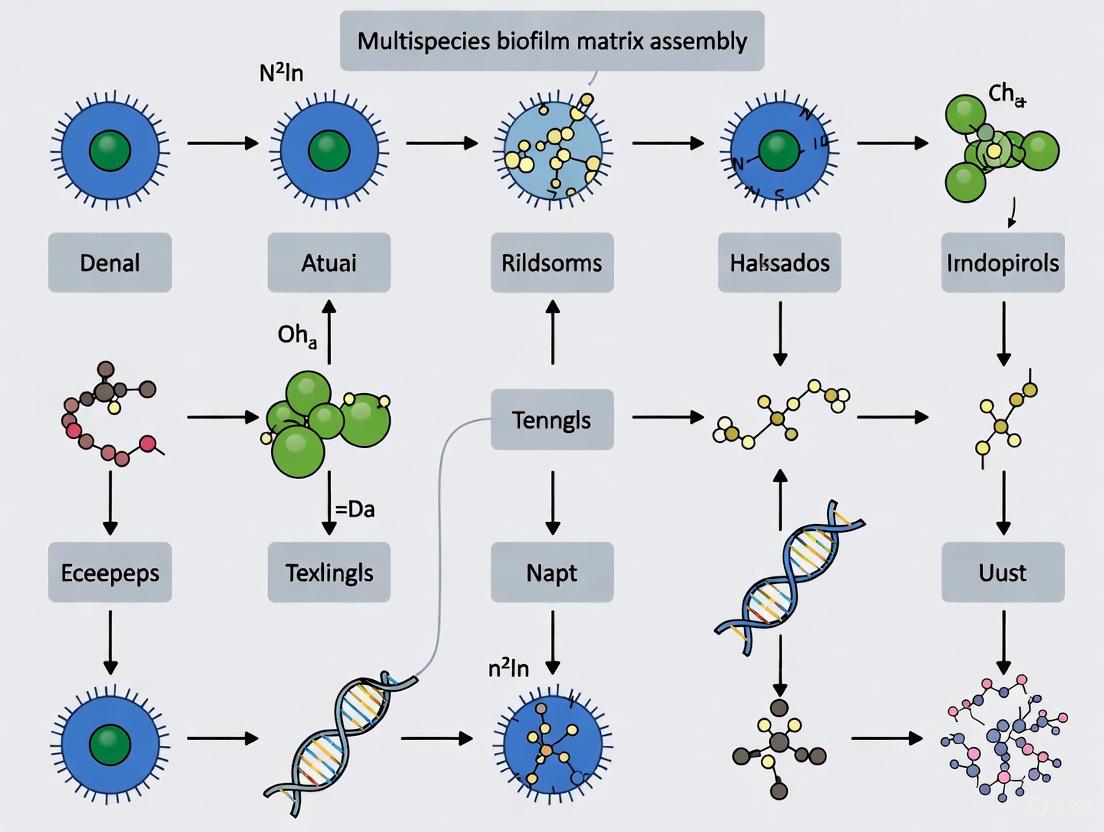
This article synthesizes current research on how interspecies interactions dictate the assembly, composition, and function of multispecies biofilm matrices.
Interspecies Interactions in Multispecies Biofilm Matrix Assembly: Mechanisms, Methods, and Biomedical Applications
Abstract
This article synthesizes current research on how interspecies interactions dictate the assembly, composition, and function of multispecies biofilm matrices. Targeting researchers and drug development professionals, it explores the foundational principles of emergent matrix properties, advanced methodological approaches for community analysis, strategies for troubleshooting and optimizing synthetic communities, and frameworks for validating biofilm models. By integrating findings from proteomics, glycan analysis, 3D imaging, and evolutionary studies, this review provides a comprehensive guide for leveraging biofilm ecology to develop novel anti-biofilm therapeutics and exploit beneficial microbial consortia.
The Social Network of Microbes: Exploring Emergent Properties in Biofilm Matrix Assembly
The extracellular polymeric substance (EPS) is a complex matrix of natural polymers of high molecular weight secreted by microorganisms into their environment [1]. This matrix establishes the functional and structural integrity of biofilms and is considered the fundamental component that determines their physicochemical properties [1]. The EPS encompasses microbial cells in a three-dimensional architecture, providing compositional support, stability, and protection for microbial communities [1] [2]. The stability of this matrix is ensured by non-covalent bonding between EPS components, which involves weak physicochemical forces, conferring cohesion and viscoelasticity to the overall structure [2]. Understanding the core components of the EPS and their interactions is paramount to deciphering the biofilm phenotype, particularly within the context of multispecies communities where interspecies interactions dynamically reshape the matrix's composition and function [3] [4].
Core Constituents of the EPS
The EPS is primarily composed of a mixture of biopolymers, including polysaccharides, proteins, nucleic acids, and lipids [1] [2]. These components are distributed between cells in a non-homogeneous pattern and interact to form the matrix that encompasses microbial cells [2]. Notably, EPS can constitute 50% to 90% of a biofilm's total organic matter [1]. The following sections detail these core constituents, and Table 1 provides a quantitative summary.
Table 1: Core Components of the Extracellular Polymeric Substance (EPS)
| Component Class | Key Subtypes & Examples | Primary Functions | Relative Abundance & Notes |
|---|---|---|---|
| Polysaccharides | Alginate (Pseudomonas spp.), Cellulose (Acetobacter xylinum), Xanthan (Xanthomonas campestris), Galactose/Glucose/Xylose polymers [1]. | Structural scaffold, adhesion, water retention, resistance to desiccation [1]. | Often the most abundant polymer; can be heteropolymers or homopolymers; may be anionic and contain non-carbohydrate substituents (e.g., acetate, pyruvate) [1]. |
| Proteins | Extracellular enzymes (proteases, amylases), surface-layer (S-layer) proteins, flagellins, peroxidases [1] [3] [4]. | Enzymatic activity, structural stability, cell-to-cell interactions, stress resistance (e.g., oxidative stress) [1] [4]. | Include enzymes for nutrient acquisition and structural proteins; presence and function can be significantly altered in multispecies biofilms [3]. |
| Nucleic Acids | Extracellular DNA (eDNA) [2]. | Structural integrity, horizontal gene transfer, cation retention [2]. | Contributes to matrix stability via electrostatic interactions; found in the 900-1250 cm⁻¹ region in FT-IR spectra [2]. |
| Lipids | Membrane-derived lipids and surfactants [1] [2]. | Hydrophobicity modulation, energy storage, interaction with other polymers. | Identified in the 2800-3000 cm⁻¹ spectral region (CH, CH₂, CH₃ groups) via FT-IR [2]. |
| Other Components | Humic substances, minerals (e.g., CaCO₃, calcium, magnesium) [1]. | Enhanced structural integrity (minerals), protection from shear forces and antimicrobials [1]. | Minerals contribute to morphogenesis and structural integrity; can cause medical issues like catheter encrustation [1]. |
Exopolysaccharides
Exopolysaccharides are the sugar-based parts of the EPS and represent a wide spectrum of multifunctional polysaccharides [1]. They can be loosely attached to the cell wall or excreted into the environment and are involved in critical processes such as cell-to-cell interactions, adhesion, and biofilm formation [1]. Many are heteropolymers composed of multiple monosaccharides (e.g., galactose, glucose, rhamnose, fructose, xylose) and often contain uronic acids, which contribute to their anionic nature [1]. This diversity allows for a wide range of physical properties and functions.
Proteins and Exoenzymes
Proteins within the EPS include a vast array of functional and structural molecules. Exoenzymes, such as alkaline phosphatases, chitinases, β-d-glucosidases, and proteases, are secreted by microorganisms to break down large environmental molecules into smaller, absorbable nutrients, influencing chemical signaling and biogeochemical cycling [1]. Other proteins, like surface-layer proteins and flagellins, contribute directly to the matrix's structural integrity and community organization [4]. The presence of specific proteins, such as a unique peroxidase identified in Paenibacillus amylolyticus within multispecies biofilms, can indicate enhanced functional capabilities like oxidative stress resistance [4].
The Role of eDNA and Other Components
Extracellular DNA (eDNA) is another crucial structural component that interacts with other EPS polymers, helping to stabilize the matrix [2]. Furthermore, minerals resulting from biomineralization processes, such as calcite (CaCO₃), are integral to the matrix, providing a scaffold that protects bacterial cells from shear forces and antimicrobial chemicals [1].
Analytical Methodologies for EPS Characterization
A comprehensive understanding of the EPS requires a multifaceted analytical approach. Key methodologies enable researchers to deconstruct the matrix, identify its components, and understand their functional roles.
Fourier Transform Infrared (FT-IR) Spectroscopy
FT-IR spectroscopy is a powerful, non-destructive technique that provides information about the chemical content and relative proportions of different EPS constituents based on their absorption of infrared light at specific wavelengths [2]. When used in attenuated total reflection (ATR) mode, it is particularly well-suited for studying the initial stages of biofilm formation under hydrated conditions [2].
Table 2: Key FT-IR Spectral Signatures for EPS Components [2]
| Spectral Region (cm⁻¹) | Principal EPS Component | Functional Groups & Bond Vibrations |
|---|---|---|
| 2800–3000 | Lipids | C-H, CH₂, CH₃ stretching |
| 1500–1800 | Proteins | C=O (Amide I), N-H, C-N (Amide II) |
| 900–1250 | Polysaccharides, Nucleic Acids | C-O, C-O-C, P=O (from nucleic acids), C-N, N-H (Amide III) |
Experimental Protocol: ATR/FT-IR Analysis of Biofilms
- Sample Preparation: Grow a biofilm directly on the surface of the Internal Reflection Element (IRE), typically a germanium crystal, to allow for in situ analysis. Alternatively, mature biofilms can be dried and analyzed, though this is a destructive method [2].
- Spectral Acquisition: Place the sample in the ATR/FT-IR spectrometer. The IR radiation generates an evanescent wave that penetrates the sample (~2 µm), where functional groups absorb energy at characteristic wavelengths [2].
- Data Analysis: Analyze the resulting absorption spectrum. Monitor the evolution of band intensity ratios over time to understand biofilm development. For instance:
Enzymatic Susceptibility Assays
The sensitivity of a biofilm to hydrolytic enzymes provides direct insight into the functional role of specific EPS components in maintaining structural integrity [2]. The disruption of the biofilm after enzymatic treatment indicates the targeted component's critical structural role.
Experimental Protocol: Enzymatic Disruption of Biofilms
- Biofilm Growth: Grow biofilms in a standardized format, such as in microtiter plates or on relevant surfaces (e.g., stainless steel coupons) [2].
- Enzyme Preparation: Prepare solutions of purified enzymes in an appropriate buffer. Common enzymes include:
- Treatment: Gently apply the enzyme solution to the mature biofilm and incubate under optimal conditions for the enzyme (e.g., specific temperature, pH, and duration). Include a buffer-only control.
- Assessment of Disruption: Quantify the remaining biofilm biomass using a validated method, such as crystal violet staining. Compare the biomass in enzyme-treated wells to control wells to determine the percentage reduction [2]. A reduction of ≥70% indicates high efficiency [2].
Advanced Techniques for Multispecies Analysis
Studying multispecies biofilms requires techniques that can resolve the contribution of different species to the complex matrix.
- Fluorescence Lectin Binding Analysis (FLBA): This technique uses fluorescently-labeled lectins (proteins that bind specific carbohydrates) to identify and localize particular glycan structures within the biofilm matrix. In multispecies consortia, it has revealed diverse and distinct glycan compositions, such as fucose and amino sugar-containing polymers, that differ significantly from monospecies biofilms [3] [4].
- Meta-proteomics: This involves the large-scale characterization of all proteins in a complex microbial community. Proteins are extracted from the biofilm matrix, digested with enzymes like trypsin, and analyzed by mass spectrometry. This approach has been used to identify the presence of specific structural proteins (e.g., flagellins) and stress-response enzymes (e.g., peroxidases) that are uniquely enriched in multispecies biofilms [3] [4].
The following workflow diagram illustrates the integration of these methodologies in a comprehensive EPS analysis pipeline.
Interspecies Interactions Reshape the EPS Matrix
The composition of the EPS is not static and is profoundly influenced by interspecies interactions within multispecies biofilms. Research on defined soil isolate consortia has demonstrated that the transition from monospecies to multispecies biofilms results in substantial changes to both the glycan and protein components of the matrix [3] [4]. For instance:
- Glycan Alterations: In isolation, Microbacterium oxydans produces specific galactose/N-Acetylgalactosamine network-like structures. When grown in a consortium, it influences the overall glycan composition of the mixed-species matrix [4].
- Protein Modulation: The presence of multiple species can induce the production of unique proteins. Paenibacillus amylolyticus was found to express surface-layer proteins and a unique peroxidase specifically in multispecies settings, enhancing the community's resistance to oxidative stress [4]. Similarly, flagellin proteins in Xanthomonas retroflexus and P. amylolyticus were more prevalent in multispecies biofilms, suggesting altered motility or structural organization [4].
These findings highlight that the biofilm matrix is a dynamically shared space, where the final composition and functional properties emerge from the complex web of interactions between the constituent species.
The Scientist's Toolkit: Key Research Reagents and Materials
The following table details essential reagents and materials used in the experimental methodologies for EPS characterization.
Table 3: Research Reagent Solutions for EPS Characterization
| Reagent / Material | Function / Application | Example Use Case |
|---|---|---|
| Specific Lectins | Binds to specific sugar residues (e.g., Fucose, Galactose) in EPS glycans for visualization and localization. | Fluorescence Lectin Binding Analysis (FLBA) to map glycan diversity and spatial organization in multispecies biofilms [3] [4]. |
| Hydrolytic Enzymes | Targets and degrades specific EPS polymers to assess their structural role in biofilm integrity. | Proteases (e.g., Savinase) or Amylases used in enzymatic susceptibility assays to disrupt biofilms and quantify biomass loss [2]. |
| ATR/FT-IR Spectrometer | Provides a molecular fingerprint of the biofilm matrix by detecting vibrational modes of chemical bonds. | Non-destructive, in situ analysis of the relative proportions of proteins, polysaccharides, and nucleic acids during biofilm development [2]. |
| Mass Spectrometer | Identifies and characterizes proteins and peptides based on their mass-to-charge ratio. | Meta-proteomic analysis of EPS extracts to identify matrix proteins, including structural proteins and enzymes like peroxidases [4]. |
| Defined Bacterial Consortia | A controlled mixture of known bacterial species used to study emergent properties in complex communities. | Investigating how interspecies interactions (e.g., between M. oxydans and P. amylolyticus) alter EPS composition and function [3] [4]. |
The extracellular polymeric substance is a dynamically complex and multifunctional scaffold that defines the biofilm mode of life. Its core components—polysaccharides, proteins, nucleic acids, and lipids—interact to create a protected, organized microbial habitat. Crucially, the matrix is not a static entity; its composition is remodeled by interspecies interactions, leading to emergent properties such as enhanced stress resistance in multispecies communities. A comprehensive, multi-technique approach, integrating spectroscopy, enzymatic assays, glycan mapping, and meta-proteomics, is essential to decode the structure-function relationships within the EPS. This understanding is fundamental for developing strategies to manage detrimental biofilms or harness beneficial ones in environmental, industrial, and medical contexts.
Within the paradigm of multispecies biofilm matrix assembly research, a compelling principle emerges: the consortium exhibits properties that transcend the additive capabilities of its individual constituents. These complex communities, where microorganisms are embedded in a self-produced matrix of extracellular polymeric substances (EPS), represent the predominant form of microbial life in most natural, industrial, and clinical environments. The biofilm matrix is not a static scaffold; it is a dynamic, shared space that shapes the community's structure, adaptability, and functionality [4]. This whitepaper delves into the core mechanisms underpinning a key emergent property of multispecies consortia: the development of synergistic biomass and enhanced structural integrity. We examine how interspecies interactions directly modulate the composition and spatial organization of the EPS, leading to biofilms with greater biomass and robustness than their monospecies counterparts, a phenomenon with profound implications for antimicrobial resistance and therapeutic development.
Quantitative Evidence of Synergy in Biomass and Structural Integrity
Empirical data from studies on diverse microbial consortia provide clear evidence of the synergistic effects on biofilm biomass and stability. The following tables summarize key quantitative findings from recent investigations.
Table 1: Synergistic Biomass and Viability in Mixed-Species Biofilms
| Study Consortium | Observation on Biomass/Viability | Quantitative Findings | Experimental Method |
|---|---|---|---|
| C. albicans & A. actinomycetemcomitans [5] | Non-reciprocal growth promotion | Mixed-species conditions promoted the growth of A. actinomycetemcomitans, while C. albicans viability remained stable. | CFU Enumeration (Biofilm Viability Assay) |
| C. albicans & A. actinomycetemcomitans [5] | Elevated total biomass | Significant increase in total biofilm biomass in mixed-species consortia compared to monospecies biofilms. | Crystal Violet Staining and Absorbance Reading (570 nm) |
Table 2: Matrix Composition and Associated Functional Enhancements
| Study Consortium | Matrix Component | Observation | Experimental Method |
|---|---|---|---|
| Four-Species Soil Consortium (M. oxydans, P. amylolyticus, S. rhizophila, X. retroflexus) [4] [3] | Glycans | Substantial differences in glycan structures (e.g., fucose, amino sugars) between mono- and multispecies biofilms. M. oxydans produced galactose/N-Acetylgalactosamine networks. | Fluorescence Lectin Binding Analysis (FLBA) |
| Four-Species Soil Consortium [4] [3] | Proteins | Presence of flagellin in X. retroflexus & P. amylolyticus, and unique surface-layer proteins & a peroxidase in P. amylolyticus in multispecies conditions. | Meta-Proteomics (Mass Spectrometry) |
| C. albicans & A. actinomycetemcomitans [5] | Overall Matrix | Enhanced antimicrobial tolerance in mixed cultures, linked to increased EPS production and potential quorum-sensing interactions. | Antimicrobial Susceptibility Testing (AST) |
Mechanisms of Interaction: Shaping the Matrix from the Bottom Up
The quantitative increases in biomass and stability are not random; they are the direct result of specific, interaction-driven modifications to the biofilm matrix. Interspecies communication and competition within the consortium trigger a reprogramming of microbial behavior, leading to a matrix that is chemically and structurally distinct.
- EPS Composition and Diversity: The soil isolate study demonstrated that interspecies interactions directly dictate the composition of the EPS, particularly its glycan and protein profiles [4]. The production of unique glycan structures and specific matrix proteins only in multispecies conditions points to a coordinated community-wide effort to build a more resilient matrix.
- Functional Reinforcement through Specialized Proteins: The identification of a unique peroxidase in P. amylolyticus when grown in a multispecies consortium is a prime example of functional enhancement [4] [3]. This protein confers increased resistance to oxidative stress, directly contributing to the structural stability of the entire community under adverse conditions. Similarly, the elevated production of flagellin and surface-layer proteins suggests enhancements to community architecture and cohesion.
- Metabolic Cooperation and Altered Antimicrobial Tolerance: In the C. albicans and A. actinomycetemcomitans model, the synergism led to increased tolerance to azithromycin and fluconazole [5]. This is attributed to enhanced matrix production that acts as a physical barrier and potential cross-protective interactions, such as quorum-sensing molecule exchange or metabolic cooperation, making the consortium inherently more resistant to standard therapeutic agents.
Experimental Methodologies for Consortium Analysis
To decode the mechanisms of synergy, a combination of established and advanced techniques is required. Below are detailed protocols for key experiments cited in this review.
Biofilm Biomass Quantification (Crystal Violet Assay)
This standard method measures the total adhered biomass, including cells and the EPS matrix [5].
- Biofilm Formation: Inoculate 96-well polystyrene microtiter plates with standardized cell suspensions (e.g., 0.1 McFarland for monospecies, 0.4 McFarland for mixed-species in RPMI-1640 medium). For mixed-species biofilms, inoculate 50 μL of each 4x concentrated species suspension per well. Incubate at 37°C with 5% CO₂ for 72 hours.
- Washing and Fixing: Aspirate the culture medium and gently wash the biofilms with 200 μL of phosphate-buffered saline (PBS, 0.1 M, pH 7.2) to remove non-adherent cells. Fix the biofilms with 200 μL of methanol for 15 minutes. Remove methanol and air-dry the plates at room temperature.
- Staining and Elution: Add 200 μL of crystal violet (1% v/v) to each well and incubate for 5 minutes. Gently wash the wells twice with sterile ultra-pure water to remove excess stain. Elute the bound crystal violet by adding 200 μL of acetic acid (33% v/v).
- Quantification: Measure the absorbance of the eluted crystal violet solution in triplicate using a microtiter plate reader at a wavelength of 570 nm. Calculate the percentage of biomass produced relative to controls.
Biofilm Viability Assay (CFU Enumeration)
This protocol determines the number of viable cells within a biofilm, allowing for the assessment of non-reciprocal synergism [5].
- Biofilm Disruption: After forming biofilms as described in 4.1 and washing with PBS, scrape the biofilms from the well surfaces.
- Cell Disaggregation: Transfer the biofilm suspension to a microtube and vortex vigorously for 2 minutes to disaggregate cells from the matrix.
- Serial Dilution and Plating: Perform serial decimal dilutions of the homogenized suspension in PBS. Plate appropriate dilutions onto selective agar media for each species (e.g., Sabouraud Dextrose Agar for C. albicans, Blood Agar for A. actinomycetemcomitans).
- Incubation and Counting: Incubate plates under optimal conditions for each species (e.g., 24-48 hours at 37°C). Count the resulting colony-forming units (CFUs) and present the results as Log₁₀ CFU/mL.
Matrix Component Characterization
Advanced techniques are required to deconstruct the complex chemical nature of the EPS.
- Fluorescence Lectin Binding Analysis (FLBA): This technique identifies specific glycan components within the EPS. Fluorescently labeled lectins (proteins that bind specific carbohydrates) are applied to biofilm samples. The binding patterns, visualized via fluorescence or confocal laser scanning microscopy, reveal the spatial distribution and diversity of glycans like fucose and amino sugar-containing polymers [4] [3].
- Meta-Proteomics: This approach characterizes the entire protein profile of the biofilm matrix. Proteins extracted from biofilm samples are digested and analyzed by liquid chromatography-tandem mass spectrometry (LC-MS/MS). The resulting data are searched against protein databases to identify and quantify matrix proteins, such as flagellins, surface-layer proteins, and unique enzymes like peroxidases [4] [3]. Raw data is typically deposited in repositories like PRIDE (ProteomeXchange Consortium) for further research.
Visualization of Synergistic Interactions and Workflows
Synergistic Biofilm Matrix Assembly
Experimental Workflow for Biofilm Analysis
The Scientist's Toolkit: Essential Research Reagents and Materials
Table 3: Key Research Reagent Solutions for Biofilm Consortium Studies
| Reagent/Material | Function in Research | Specific Example from Literature |
|---|---|---|
| Polystyrene Microtiter Plates | Standard substrate for in vitro biofilm formation and high-throughput assays. | 96-well plates used for crystal violet and CFU assays [5]. |
| Crystal Violet | A basic dye that binds to negatively charged molecules, used to quantify total biofilm biomass. | 1% v/v solution applied to fixed biofilms for staining [5]. |
| Selective Culture Media | Supports the growth of specific microorganisms, allowing for viability counts in mixed-species consortia. | Sabouraud Dextrose Agar for C. albicans; Blood Agar for A. actinomycetemcomitans [5]. |
| Fluorescent Lectins | Glycan-binding probes used to identify and visualize specific carbohydrate structures within the EPS matrix. | Applied in FLBA to reveal fucose and amino sugar-containing polymers [4]. |
| Mass Spectrometry-Grade Reagents | Chemicals and enzymes (e.g., trypsin) for preparing protein samples for high-sensitivity meta-proteomic analysis. | Used to identify matrix proteins like flagellin and peroxidases via LC-MS/MS [4] [3]. |
| Antimicrobial Standards | Pure chemical substances used in Antimicrobial Susceptibility Testing (AST) to evaluate tolerance in biofilms. | Fluconazole and Azithromycin aliquots prepared in DMSO [5]. |
In multispecies biofilms, the extracellular polymeric substance (EPS) is not a simple amalgamation of individual species' secretions but a dynamically engineered structure shaped by interspecies interactions. This whitepaper synthesizes recent findings demonstrating that microbial cross-talk actively reprograms the molecular composition of the biofilm matrix, leading to emergent structural and functional properties. We detail how interactions between different bacterial species induce the production of unique glycan structures and matrix proteins—such as surface-layer proteins and specific peroxidases—that are not observed in monospecies cultures. These changes enhance community-level resilience, including improved oxidative stress resistance and altered antimicrobial tolerance. For researchers and drug development professionals, understanding these mechanisms provides a critical foundation for novel anti-biofilm strategies that target the communication networks underpinning matrix assembly.
Biofilms represent the predominant mode of microbial life in most natural, clinical, and industrial environments. These surface-associated microbial communities are encased in a self-produced matrix of extracellular polymeric substances (EPS) that determines their physical structure, mechanical stability, and functional capabilities [6]. The EPS is a complex hydrogel composed primarily of polysaccharides (glycans), proteins, extracellular DNA, and lipids [7]. Traditionally, biofilm research has focused on single-species models, yet most environmental and clinical biofilms are polymicrobial, comprising multiple bacterial and fungal species engaged in sophisticated interspecies interactions [4] [5].
These interactions generate community-intrinsic properties—characteristics that cannot be predicted by simply summing the behaviors of individual species in isolation [7]. Such emergent properties include synergistic increases in biofilm biomass, metabolic cross-feeding, enhanced stress resistance, and improved degradation of complex substrates [7]. The molecular mechanisms underlying these community-level traits are increasingly traced to profound alterations in the composition and spatial organization of EPS components, particularly glycans and proteins [4] [3]. This molecular cross-talk represents a fundamental challenge in antimicrobial development while simultaneously offering novel targets for therapeutic intervention.
Key Findings: Interspecies Interactions Reprogram Matrix Composition
Alterations in Glycan Diversity and Structure
Glycans, the carbohydrate polymers of the EPS, play crucial roles in biofilm architecture, cell-cell adhesion, and protection against environmental stresses. Research on a defined four-species soil consortium (Microbacterium oxydans, Paenibacillus amylolyticus, Stenotrophomonas rhizophila, and Xanthomonas retroflexus) reveals that interspecies interactions significantly diversify glycan profiles compared to monospecies biofilms [4] [7] [3].
Table 1: Glycan Alterations in Multispecies Biofilms
| Observation | Monospecies Context | Multispecies Context | Functional Implication |
|---|---|---|---|
| Glycan Structures | Limited diversity | Diverse structures, including fucose and amino sugar-containing polymers [4] | Enhanced structural complexity |
| Specific Glycan Networks | M. oxydans produces galactose/N-Acetylgalactosamine network-like structures [4] | M. oxydans influences the overall matrix composition [4] | Species-specific contributions to community matrix |
| Spatial Organization | Predictable, species-specific organization [7] | Substantial differences in composition and spatial organization [4] | Emergent spatial patterning |
Reprogramming of the Matrix Proteome
The proteinaceous components of biofilms include structural proteins, enzymes, and surface adhesins that contribute to matrix stability and functionality. Meta-proteomic analyses of mono- versus multispecies biofilms have identified several key proteins induced or enhanced specifically through interspecies interactions [4] [8]:
- Flagellin proteins: Identified in X. retroflexus and P. amylolyticus, particularly in multispecies biofilms, suggesting interaction-mediated activation of motility-associated genes [4] [3].
- Surface-layer proteins: Unique to P. amylolyticus in multispecies consortia, providing structural stability to the community architecture [4] [3].
- Unique peroxidase: Identified in P. amylolyticus specifically in multispecies settings, indicating enhanced oxidative stress resistance as a community-level adaptation [4] [3].
Table 2: Protein Alterations in Multispecies Biofilms
| Protein Category | Specific Examples | Producing Organism | Significance in Multispecies Context |
|---|---|---|---|
| Structural Proteins | Flagellin proteins [4] | X. retroflexus, P. amylolyticus [4] | Enhanced presence in multispecies biofilms |
| Stress Resistance | A unique peroxidase [4] | P. amylolyticus [4] | Indicates enhanced oxidative stress resistance |
| Architectural | Surface-layer proteins [4] | P. amylolyticus [4] | Provides structural stability |
These compositional changes have direct functional consequences. The identification of a unique peroxidase in P. amylolyticus specifically in multispecies biofilms demonstrates how interspecies interactions can enhance community-level stress resistance [4] [3]. Similarly, in fungal-bacterial systems, C. albicans and A. actinomycetemcomitans form mixed biofilms with elevated antimicrobial tolerance compared to their monospecies counterparts, likely due to enhanced EPS production and potential quorum-sensing interactions [5].
Figure 1: Conceptual Framework of Interspecies Interactions in Multispecies Biofilms. Interactions between different bacterial species trigger molecular reprogramming of EPS components, leading to emergent community properties that enhance fitness and resilience [4] [7] [3].
Experimental Approaches: Methodologies for Decoding Matrix Complexity
Fluorescence Lectin Binding Analysis (FLBA) for Glycan Characterization
Purpose: To identify and spatially localize specific glycan components within the biofilm matrix using carbohydrate-binding proteins [7].
Detailed Protocol:
- Biofilm Growth: Grow mono- and multispecies biofilms on polycarbonate chips (12 × 12 × 0.78 mm) placed diagonally in 24-well plates for 24 hours at 24°C under static conditions [7].
- Sample Preparation: Wash biofilms once with 1× PBS to remove non-adherent cells [7].
- Lectin Staining: Prepare staining solutions containing fluorescently labeled lectins at a concentration of 100 μg/mL. The study employed 78 different lectins with specificities for various carbohydrate residues [7].
- Visualization and Analysis: Analyze stained biofilms using confocal laser scanning microscopy (e.g., Leica TCS SP5X) with appropriate laser and filter settings for each fluorophore. Image analysis software reconstructs three-dimensional distribution of specific glycans [7].
Key Considerations: Lectin selection should cover diverse carbohydrate specificities. Appropriate controls (e.g., inhibition with specific sugars) validate binding specificity.
Meta-Proteomics for Matrix Protein Characterization
Purpose: To comprehensively identify and quantify proteins in the biofilm matrix, particularly those differentially expressed in mono- versus multispecies contexts [4] [8].
Detailed Protocol:
- Matrix Protein Extraction: Separate matrix proteins from cellular components using differential extraction methods. This may include gentle washing with buffer or EDTA to solubilize loosely bound matrix components [4].
- Protein Digestion: Digest proteins using trypsin or other proteases following standard protocols [8].
- Mass Spectrometry Analysis: Analyze peptides using high-resolution mass spectrometry (e.g., Q Exactive HF). The study utilized data-dependent acquisition with MaxQuant software for analysis [8].
- Data Processing and Validation: Process raw data using standard proteomics pipelines. Search against appropriate protein databases with false discovery rate control. Deposit data in repositories like ProteomeXchange (identifier PXD057669) [8].
Key Considerations: Matrix enrichment is critical for distinguishing true matrix components from intracellular proteins. Biological and technical replicates ensure robust identification of interaction-specific proteins.
Figure 2: Integrated Experimental Workflow for Analyzing Biofilm Matrix Components. The parallel application of FLBA and meta-proteomics to mono- and multispecies biofilms enables comprehensive characterization of interaction-mediated changes in EPS composition [4] [7] [8].
The Scientist's Toolkit: Essential Research Reagents and Materials
Table 3: Key Research Reagents for Studying Interspecies Interactions in Biofilms
| Reagent/Material | Specific Example | Function/Application | Experimental Context |
|---|---|---|---|
| Fluorescent Lectins | 78 different lectins with FITC, AlexaFluor488, or Fluorescein conjugates [7] | Identify and localize specific glycan structures in biofilms via FLBA [7] | Glycan profiling |
| Mass Spectrometry | Q Exactive HF mass spectrometer [8] | Identify and quantify matrix proteins through meta-proteomics [8] | Protein identification |
| Biofilm Growth System | 24-well plates with polycarbonate chips [7] | Standardized biofilm cultivation under controlled conditions [7] | Biofilm cultivation |
| Bacterial Strains | M. oxydans, P. amylolyticus, S. rhizophila, X. retroflexus [4] | Defined four-species consortium for studying interspecies interactions [4] | Model community |
| Culture Medium | Tryptic Soy Broth (TSB) [7] | Standardized growth medium for biofilm cultivation [7] | Biofilm growth |
| Data Analysis Software | MaxQuant [8] | Process raw mass spectrometry data for protein identification [8] | Proteomic data analysis |
| Confocal Microscopy | Leica TCS SP5X [7] | High-resolution imaging of biofilm structure and lectin staining [7] | Spatial analysis |
Implications for Drug Development and Future Perspectives
The documented rewiring of matrix composition through interspecies interactions presents both challenges and opportunities for antimicrobial drug development. The enhanced tolerance observed in polymicrobial biofilms [5] [9] suggests that current antimicrobial screening methods, which predominantly use planktonic monocultures, fail to account for critical community-level resistance mechanisms.
Promising therapeutic strategies emerging from this research include:
- Quorum sensing interference: Targeting the communication systems that coordinate matrix production across species [5].
- Matrix-disrupting enzymes: Using specific glycosidases or proteases to degrade interaction-specific EPS components [6].
- Combination therapies: Pairing conventional antimicrobials with EPS-disrupting agents, as demonstrated by the enhanced efficacy of N-acetylcysteine prior to conventional H. pylori treatment [10].
Future research should prioritize developing more sophisticated in vitro models that better recapitulate the polymicrobial nature of clinical infections, integrating computational approaches with experimental validation to predict interaction outcomes, and exploring whether specific interspecies interactions represent conserved vulnerabilities across different biofilm communities.
Metabolic cooperation, primarily through cross-feeding of essential nutrients, constitutes a fundamental ecological strategy that underpins the assembly, stability, and resilience of multispecies biofilm communities. This review synthesizes current research on the molecular mechanisms of metabolic interdependence, highlighting how the exchange of metabolites, enzymes, and genetic material coordinates community functions and structures the biofilm matrix. We present quantitative evidence of synergistic interactions, detail experimental methodologies for probing these relationships, and visualize key signaling pathways. The findings underscore that cross-feeding networks are not merely metabolic conveniences but are foundational to the emergent properties of biofilms, including enhanced tolerance to antimicrobials and environmental stresses. Understanding these cooperative foundations provides a critical framework for developing novel strategies to manipulate microbial communities in clinical, industrial, and environmental contexts.
Multispecies biofilms represent the predominant mode of bacterial life in most natural, clinical, and industrial environments [11]. These communities are characterized by a high degree of species heterogeneity, where intimate physical proximity facilitates intricate interspecies interactions that dictate community-level fitness [12]. Far from being passive aggregates, these biofilms are dynamically structured by a matrix of Extracellular Polymeric Substances (EPS), which provides architectural integrity and creates heterogeneous microenvironments [4] [3]. Within this matrix, metabolic cooperation emerges as a critical evolutionary strategy for nutrient acquisition, niche specialization, and collective stress resistance [13]. Cross-feeding—the exchange of metabolites between microbial cells—transforms the biofilm from a collection of competing individuals into an integrated, cooperative consortium with stability and functional capabilities exceeding the sum of its constituent species [14] [13]. This review delves into the molecular foundations of these interactions, arguing that metabolic cross-feeding is a cornerstone of community stability, shaping everything from spatial organization to emergent resilience.
Molecular Mechanisms of Metabolic Cross-Feeding
Cross-feeding relationships are mediated by a diverse array of externalized molecules, from small metabolites to macromolecules, which directly or indirectly nourish neighboring cells.
Key Transferred Molecules and Materials
The table below summarizes the major classes of molecules involved in cross-feeding and their ecological impacts.
Table 1: Major Classes of Externalized Molecules in Metabolic Cross-Feeding
| Molecule Class | Example Molecules | Producer Mechanism | Impact on Recipient/Community |
|---|---|---|---|
| Metabolites | Sugars, organic acids, amino acids, vitamins [13] | Passive excretion or active secretion of metabolic by-products/waste [13] | Serves as direct nutritional source; enables growth of auxotrophic partners [14] [13] |
| Gasses | CO₂, H₂, H₂S [13] | Metabolic by-products of fermentation or respiration [13] | Provides substrates for autotrophs or methanogens; influences local pH and redox [13] |
| Inorganic Nutrients | Ammonium (NH₄⁺), Nitrite (NO₂⁻) [13] | Excretion after internal processing of nitrogen sources [13] | Supports growth of species with different nitrogen utilization pathways [15] |
| Public Good Enzymes | Extracellular hydrolases, peroxidases [4] [13] | Active secretion to break down complex polymers (e.g., polysaccharides, proteins) [13] | Liberates digestible monomers for the entire community; a classic example of "cooperative digestion" [13] |
| Siderophores | Pyoverdine, enterobactin [13] | Secretion under iron-limited conditions to chelate environmental iron [13] | Enhances iron availability; can be exploited by "cheater" strains with matching receptors [13] |
| Electrons | N/A | Direct interspecies electron transfer (DIET) via microbial nanowires or conductive minerals [13] | Supports syntrophic relationships, e.g., between fermentative bacteria and methanogens [13] |
| Quorum Sensing Signals | Acyl-homoserine lactones (AHLs), Autoinducer-2 (AI-2) [11] [16] [15] | Secreted in a cell-density-dependent manner [15] | Coordinates gene expression across species, regulating biofilm formation, virulence, and EPS production [11] [16] |
Interaction Typology and Ecological Outcomes
These molecular exchanges give rise to distinct ecological interaction types, each leaving a characteristic imprint on community structure and function:
- Mutualism and Commensalism: In mutualistic cross-feeding, all participating species benefit from the exchange of metabolites, leading to enhanced biomass and productivity [14]. For instance, Pseudomonas putida evolves to better utilize benzoate, a by-product of Acinetobacter sp., resulting in a more stable and productive community [11]. Commensalism, where one species benefits while the other is unaffected, is equally common and often involves one species consuming the waste products of another [14] [17]. These cooperative interactions consistently foster dense, intermixed spatial structures within the biofilm, as seen in agent-based models where mutualism and commensalism lead to flat, interconnected domains [14].
- Syntrophy and Metabolic Interdependence: A specialized form of mutualism, syntrophy involves the cooperative degradation of a substrate that neither species can break down alone. This is often driven by the exchange of metabolites like H₂ or formate, and is heavily influenced by spatial proximity, which ensures efficient transfer of labile intermediates [12] [13].
- Competition and Antagonism: Despite the prevalence of cooperation, competitive interactions persist. Species may compete for limited nutrients like carbon or oxygen, leading to spatial segregation within the biofilm [12] [14]. Furthermore, antagonism, where one species inhibits another via antibiotics or toxins, can shape community composition. For example, Bacillus subtilis produces surfactin and other antibiotics that inhibit the growth of related species like Bacillus simplex [11]. Agent-based models show that competitive interactions result in sparse, segregated patches [14].
Quantitative Evidence of Synergy in Multispecies Biofilms
Empirical studies across diverse environments have quantified the synergistic effects of metabolic cooperation, demonstrating that multispecies consortia often outperform their monospecies counterparts.
Table 2: Documented Synergistic Effects in Multispecies Biofilm Consortia
| Biofilm Consortium Composition | Environmental Origin | Quantified Synergistic Effect | Proposed Mechanism |
|---|---|---|---|
| Stenotrophomonas rhizophila, Bacillus licheniformis, Microbacterium lacticum, Calidifontibacter indicus [18] [17] | Dairy industry surface [18] [17] | 3.13-fold increase in biofilm mass compared to the sum of monocultures [18] [17] | Dynamic social interactions (commensalism, exploitation); M. lacticum acts as a keystone species [17] |
| Four soil isolates: Stenotrophomonas rhizophila, Xanthomonas retroflexus, Microbacterium oxydans, Paenibacillus amylolyticus [11] | Soil [11] | Threefold increase in biofilm biomass [11] | Shared evolutionary history facilitating nutrient cross-feeding [11] |
| 34 different four-species combinations [18] | Dairy, meat, and egg industries [18] | ~50% of combinations showed >1.5-fold synergy in biofilm mass [18] | Strain-specific synergistic interactions, often involving keystone industry-specific species [18] |
| Pseudomonas putida KT2440 and Acinetobacter sp. C6 [11] | Environmental [11] | Enhanced community stability and productivity [11] | Evolution of P. putida to better utilize benzoate from Acinetobacter [11] |
Experimental Methodologies for Investigating Cross-Feeding
Decoding metabolic interactions requires a combination of classic microbiology techniques and advanced molecular analyses. The following workflow and protocols outline a standard approach for characterizing synergistic interactions in defined multispecies consortia.
Workflow for Characterizing Biofilm Synergy
The following diagram visualizes the key stages of this experimental process.
Detailed Experimental Protocols
Protocol 1: Biofilm Cultivation and Synergy Quantification (Microtiter Plate Assay) [18] [17]
- Strain Preparation: Grow pure cultures of each bacterial strain for 16-18 hours in a general-purpose broth like Brain-Heart Infusion (BHI) at their optimum temperature (e.g., 30°C or 37°C).
- Inoculum Standardization: Dilute each culture to a standard optical density (e.g., OD₅₉₅ ≈ 0.05) in fresh medium.
- Inoculation:
- Monospecies controls: Inoculate 160 µL of a single standardized culture into individual wells of a 96-well microtiter plate.
- Multispecies communities: For a four-species combination, pool 40 µL of each standardized culture to a total volume of 160 µL per well.
- Biofilm Growth: Incubate the plates under static conditions for 24 hours at the appropriate temperature.
- Crystal Violet Staining:
- Carefully remove the planktonic culture.
- Wash the wells gently with sterile water to remove non-adherent cells.
- Stain the adhered biofilm with 0.1% (w/v) crystal violet solution for 15-45 minutes.
- Wash away excess stain and solubilize the bound crystal violet with 33% glacial acetic acid.
- Quantification and Synergy Calculation: Measure the absorbance of the solubilized crystal violet at 595 nm (Abs₅₉₅).
- Calculate the Fold Synergy as:
Abs₅₉₅ (Multispecies Biofilm) / Sum of Abs₅₉₅ (Individual Monospecies Biofilms). - A value >1 indicates synergy [18].
- Calculate the Fold Synergy as:
Protocol 2: Mechanistic Probe Using Spent Culture Supernatants [17]
- Supernatant Preparation: Grow pure cultures as in Protocol 1. Remove the cells by centrifugation and filter-sterilize the supernatant (planktonic fraction) through a 0.2 µm filter to obtain Cell-Free Supernatant (CFS).
- Replacement Assay: In the multispecies combination, systematically replace the viable cells of one species with an equal volume of its CFS.
- Biofilm Assessment: Cultivate and quantify the biofilm as in Protocol 1.
- Interpretation: If the biofilm mass is maintained or enhanced with CFS, it indicates that diffusible molecules (metabolites, signals) from that species are sufficient to drive the synergistic interaction. A decrease suggests that physical presence or viable metabolic activity is required [17].
Protocol 3: Matrix Glycan and Protein Analysis [4] [3]
- Biofilm Cultivation: Grow mono- and multispecies biofilms on suitable surfaces (e.g., stainless steel coupons in 6-well plates).
- Glycan Profiling: Use Fluorescence Lectin Binding Analysis (FLBA). Fix the biofilms, incubate with a panel of fluorescently labeled lectins with different sugar specificities (e.g., for fucose, galactose, N-Acetylgalactosamine), and visualize via confocal microscopy to map glycan distribution [4] [3].
- Meta-proteomics:
- Extract proteins from the biofilm matrix.
- Digest proteins with trypsin and analyze the peptides by liquid chromatography coupled to tandem mass spectrometry (LC-MS/MS).
- Identify proteins by searching fragmentation spectra against a protein database.
- Compare the abundance of matrix proteins (e.g., flagellins, surface-layer proteins, unique peroxidases) between mono- and multispecies conditions [4] [3].
The Scientist's Toolkit: Essential Research Reagents
The following table catalogs key reagents and their applications for studying cross-feeding and biofilm matrix assembly.
Table 3: Essential Reagents for Cross-Feeding and Biofilm Matrix Research
| Reagent / Material | Primary Function in Research | Specific Application Example |
|---|---|---|
| Crystal Violet | Histological stain for quantifying adherent biofilm biomass [18] [17] | Standard microtiter plate assay for high-throughput screening of biofilm formation capacity and synergy [18] [17] |
| Fluorescently Labeled Lectins | Glycan-specific molecular probes for mapping EPS composition [4] [3] | Fluorescence Lectin Binding Analysis (FLBA) to identify and localize specific sugar residues (e.g., fucose, amino sugars) in the biofilm matrix [4] [3] |
| Acyl-Homoserine Lactone (AHL) Standards | Pure chemical standards for Quorum Sensing signaling molecules [15] | Quantifying AHL production in biofilms via LC-MS/MS; used as exogenous additives to probe QS-regulated behaviors [15] |
| Selective Media & Antibiotics | Allows for selective counting and isolation of individual species from a mixed consortium [17] | Quantifying the abundance of each species in a multispecies biofilm over time to understand population dynamics [17] |
| Cell Culture Inserts / Flow Cells | Tools for creating structured co-cultures and analyzing biofilm development in real-time under shear stress [12] | Studying spatial organization, metabolite gradient formation, and the development of syntrophic layers in biofilms [12] |
| Stainless Steel Coupons | Representative surface material for industrial biofilm studies [18] [17] | Cultivating biofilms on a highly relevant surface to test cleaning/disinfection efficacy and study industry-relevant consortia [18] [17] |
Impact of Cross-Feeding on Biofilm Matrix Assembly and Structure
Metabolic interactions directly shape the physical architecture and chemical composition of the biofilm matrix. Studies on defined soil isolate consortia (Microbacterium oxydans, Paenibacillus amylolyticus, Stenotrophomonas rhizophila, Xanthomonas retroflexus) have demonstrated that interspecies interactions significantly alter the EPS components compared to monospecies biofilms [4] [3]. For instance, M. oxydans in isolation produces specific galactose/N-Acetylgalactosamine network-like structures, and its presence influences the overall matrix composition in multispecies consortia [4]. Proteomic analyses reveal that in multispecies biofilms, specific matrix proteins are upregulated; P. amylolyticus was found to produce surface-layer proteins and a unique peroxidase, indicating enhanced structural stability and oxidative stress resistance conferred by the community context [4] [3].
These compositional changes are driven by metabolic cooperation and are reflected in distinct spatial organizations. Agent-based modeling confirms that the nature of metabolic interactions dictates emergent structure: competitive interactions lead to segregated species domains, while mutualistic cross-feeding promotes extensive intermixing [14]. This intermixing keeps mutualistic partners in close proximity, facilitating efficient metabolite exchange and reinforcing the cooperative relationship [12] [14]. The resulting matrix is not a static scaffold but a dynamically shared space, shaped by and in service of the metabolic network within.
Metabolic cooperation through cross-feeding is a foundational principle governing the stability, structure, and function of multispecies biofilms. The exchange of metabolites, electrons, and public goods creates an interdependent metabolic network that enhances community biomass, drives the assembly of a protective and structured matrix, and fosters remarkable resilience to antimicrobials and environmental stresses. The experimental evidence, from quantitative synergy measurements to molecular matrix analysis, consistently shows that the community is far greater than the sum of its parts.
Future research must leverage sophisticated synthetic communities and spatially-resolved meta-omics techniques to map cross-feeding fluxes with greater precision within the biofilm architecture. From a translational perspective, understanding these cooperative foundations opens avenues for novel control strategies. Instead of targeting individual pathogens, future anti-biofilm therapies could aim to disrupt keystone metabolic interactions or exploit competitive relationships to destabilize the entire community. Similarly, engineering robust synthetic biofilms for bioremediation or industrial bioprocessing will depend on rationally designing stable cross-feeding partnerships. Ultimately, viewing biofilms through the lens of metabolic cooperation provides a powerful framework for manipulating these complex microbial ecosystems to improve human, animal, and environmental health.
Spatial organization is a fundamental property of multispecies biofilms, emerging from a complex interplay of microbial interactions and directly influencing community function and resilience. This in-depth technical guide explores how cooperative and competitive interspecies interactions dictate the physical arrangement of cells within the extracellular polymeric matrix. We synthesize current research demonstrating that metabolic interdependence, mediated by diffusible metabolites, fosters tight cellular intermixing, while competition leads to segregation. The review provides a detailed examination of advanced methodologies—including high-resolution 3D imaging, agent-based modeling, and genetic tools—used to decipher the link between proximity and architecture. Furthermore, we discuss the functional consequences of spatial organization, highlighting its role in enhancing tolerance to antimicrobials and modulating virulence. This resource is intended to equip researchers and drug development professionals with a comprehensive understanding of the principles and tools driving innovation in multispecies biofilm matrix assembly research.
Microorganisms predominantly exist in dense, surface-associated communities known as biofilms, which represent the default mode of bacterial life in most environments, including the human body [12]. Historically, biofilm research focused on single-species systems, but the field has progressively shifted toward investigating the far greater complexity of multispecies consortia [12]. A critical insight from this work is that biofilms are not amorphous aggregates of cells; they are structured and spatially defined communities with intricate architectural features [12]. This spatial organization is not merely a passive outcome of growth but is actively shaped by, and in turn influences, the nature of interspecies interactions.
The spatial arrangement of different species within the biofilm matrix has profound implications for community stability and function. Structured environments facilitate more effective coexistence by negating localized competitive interactions and stabilizing beneficial ones, such as co-metabolism [12]. This organization can lead to emergent properties, including enhanced tolerance to antibiotics and host immune responses, which benefit the entire community [12]. Understanding the mechanisms that govern spatial organization is therefore paramount for addressing biofilm-related challenges in clinical, environmental, and industrial settings. This guide frames spatial organization within the broader thesis that interspecies interactions are the primary architects of the biofilm matrix, dictating its assembly, architecture, and ultimate function.
The Intersection of Microbial Interactions and Spatial Structure
The physical proximity of different microbial species—whether they co-aggregate, stratify, or segregate—is a direct reflection of their biological interactions. These spatial patterns can be categorized based on the nature of the underlying interspecies dynamics.
Cooperation Drives Integration
Metabolic mutualism, a form of cooperation where species exchange essential nutrients, strongly promotes spatial intermixing. This close physical proximity allows for efficient cross-feeding of metabolites [12]. Agent-based modeling (ABM) conceptually simulating gut mucosal biofilms demonstrates that mutualistic interactions and commensalism consistently result in densely interconnected, intermixed community structures [14]. This intermixing is evolutionarily favored in spatially structured environments because it keeps mutualistic partners in close contact, ensuring stronger reciprocity [12]. For example, computational models indicate that strong inter-population cooperation leads to partner intermixing in microbial communities [12]. Furthermore, the initial ratio of facilitative to inhibitory interactions in a community significantly influences its eventual diversity; spatial structure amplifies the benefits of facilitation, leading to greater species richness compared to well-mixed environments [19].
Competition Drives Segregation
In contrast, competitive interactions, whether for limited nutrients or through the production of antimicrobial compounds, typically lead to spatial segregation. Agent-based models show that competitive scenarios result in biofilms composed of sparse, segregated patches [14]. This segregation is a self-organizing phenomenon driven by competition, as described by classical competition theory [12]. Spatial structure can mitigate the negative impacts of competition by allowing species to avoid each other, thus enabling coexistence that would be impossible in a well-mixed environment [19]. This avoidance strategy is observed in natural systems, where species maintain distance to reduce conflict over substrates or exposure to toxic compounds [12].
Table 1: Interspecies Interaction Types and Their Spatial Outcomes
| Interaction Type | Spatial Pattern | Functional Consequence |
|---|---|---|
| Mutualism | Tight Intermixing | Efficient metabolite exchange, enhanced community stability |
| Commensalism | Intermixing / Co-localization | Unidirectional benefit, stable for benefactor |
| Competition | Segregation / Exclusion | Niche partitioning, reduced direct conflict |
| Exploitation | Layered / Stratified | Transient stability, potential for evolutionary arms race |
Quantitative Methodologies for Analyzing Spatial Organization
Deciphering the complex architecture of multispecies biofilms requires a suite of quantitative and qualitative characterization methods. The choice of technique depends on the research question, whether it concerns the quantification of biomass and viable cells, or the detailed analysis of community morphology and chemistry.
Quantitative Biofilm Characterization
Quantitative methods are essential for measuring biofilm accumulation and cell viability. These can be broadly divided into direct methods, which enumerate cells or biomass, and indirect methods, which infer quantity through correlated measurements [20].
- Direct Counting Methods: The colony forming unit (CFU) count is a standard method for determining the number of viable cells in a biofilm. The biofilm is homogenized via scraping, vortexing, or sonicating, serially diluted, and plated on agar. After incubation, colonies are counted to calculate the original concentration of live cells [20]. While this method does not require specialized equipment, it is time-consuming and can be prone to error from bacterial clumping. More automated direct methods include flow-based cell counting (e.g., Coulter counters and flow cytometry), which provide high-throughput enumeration but may not differentiate between live and dead cells without specific stains [20].
- Indirect Quantification Methods: Crystal violet (CV) staining is a common, high-throughput assay that measures total adhered biomass, both cellular and extracellular. After staining and destaining, the bound dye is dissolved in a solvent, and its absorbance is measured [20]. ATP bioluminescence is another indirect method that infers viable cell presence by measuring ATP, a universal energy currency in living cells. This method provides results in minutes but can be influenced by environmental conditions [20]. The quartz crystal microbalance (QCM) measures mass accumulation in real-time by detecting changes in the resonance frequency of a crystal upon bacterial adhesion and biofilm growth [20].
Table 2: Quantitative Methods for Biofilm Analysis
| Method | What It Measures | Key Advantages | Key Limitations |
|---|---|---|---|
| CFU Counting | Viable cell count | Differentiates live/dead cells; standard method | Labor-intensive; prone to clumping error |
| Crystal Violet | Total adhered biomass | High-throughput; inexpensive | Does not differentiate live/dead cells |
| ATP Bioluminescence | Metabolically active biomass | Rapid results (minutes) | Sensitive to environmental factors |
| Flow Cytometry | Cell count & characteristics | High-throughput; multi-parameter | Requires biofilm homogenization |
| QCM | Real-time mass accumulation | Label-free; real-time data | Measures total mass (cells & matrix) |
High-Resolution Imaging and Spatial Analysis
Advanced imaging technologies are indispensable for visualizing the 3D structure of biofilms and quantifying spatial relationships between species.
Confocal Laser Scanning Microscopy (CLSM) is a cornerstone technique, allowing for non-destructive optical sectioning of thick biofilms. When combined with vital fluorescent stains (e.g., SYTO9, FM4-64) or genetically encoded fluorophores (e.g., GFP, mCherry), CLSM enables the visualization of live, multi-species communities in 3D [21]. Recent advancements leverage high-content screening CLSM (HCS-CLSM) to generate large, reproducible datasets on multispecies biofilm phenotypes [21]. A powerful application is 4D (xyzt) live-cell imaging, which tracks the temporal development of biofilm spatial structure, revealing dynamic interaction dynamics [21].
Image analysis pipelines are then used to extract quantitative data from CLSM image stacks. These analyses can determine the biovolume of individual species, their co-localization coefficients (a measure of intermixing), and the spatial distribution of cells within the biofilm architecture. This quantitative description of spatial organization can be an alternative strategy to reveal the nature of underlying interspecies interactions [12].
Experimental Protocols for Studying Spatial Dynamics
A 3D Imaging-Driven Pipeline for Antagonistic Biofilm Assembly
A recent study developed a bottom-up approach integrating 3D fluorescence imaging with high-throughput analysis to assemble synthetic microbial communities (SynComs) for pathogen exclusion [21].
Workflow Overview:
- Strain Selection and Fluorescent Labeling: A collection of candidate antagonistic strains (e.g., Bacillus and Pediococcus spp.) is selected. Strains are genetically transformed with plasmids carrying genes for fluorescent proteins (e.g., GFP, mCherry) to enable distinction in mixed cultures [21].
- Biofilm Cultivation: Biofilms are cultivated in μClear 96-well plates compatible with high-resolution fluorescence microscopy. Submerged biofilms are grown in a suitable medium like Tryptic Soy Broth (TSB) [21].
- Interaction Assays:
- Co-inoculation Model: GFP-labelled pathogens and unlabeled or differently labeled antagonistic strains are co-inoculated at defined initial biovolume ratios (e.g., 10:1, 1:1, 1:10). Adhesion is allowed statically, after which supernatant is replaced with fresh medium and biofilms are incubated for 24 hours [21].
- Invasion Model: A mature (24-hour) established biofilm of the antagonistic SynCom is formed first. Subsequently, a GFP-labelled pathogen suspension is added and allowed to adhere. Imaging is performed immediately (t=0h) and after a further 24-hour incubation (t=24h) to assess prevention of colonization [21].
- Endpoint Staining and Imaging: Before acquisition, biofilms are stained with vital, cell-permeable nucleic acid dyes (e.g., SYTO9, SYTO61) if the strains are not intrinsically fluorescent. CLSM is used to acquire 3D image stacks of the multi-species biofilms [21].
- Image Analysis and Data Quantification: Dedicated image analysis software is used to quantify the biovolume of each species, their spatial distribution, and degree of co-localization. Pathogen exclusion is quantified by comparing pathogen biovolume in the presence versus absence of the SynCom [21].
In silico Modeling of Metabolic Interactions
Agent-based modeling (ABM) coupled with the finite volume method (FVM) is a powerful computational approach to simulate how metabolic interactions shape biofilm structure [14].
Protocol Overview:
- Model Setup: A 1D or 2D spatial grid is created to represent the environment (e.g., a gut mucosal surface). The top boundary is typically set with a constant concentration of bulk nutrients [14].
- Agent Definition: Bacterial cells are defined as individual agents. Each agent is assigned properties including:
- Metabolic Capabilities: Specific nutrients it can consume from the bulk fluid and metabolic by-products it can produce and/or consume from other agents [14].
- Growth Kinetics: Parameters for Monod kinetics to govern growth rates based on local nutrient concentrations [14].
- Physical Rules: Abilities to attach, grow, replicate, and shove neighboring agents to simulate mechanical forces [14].
- Interaction Scenarios: Simulations are run for fundamental interaction types:
- Competition: Two or more species compete for a single, common nutrient.
- Neutralism: Each species consumes a distinct nutrient with no metabolic interaction.
- Commensalism: One species consumes metabolic by-products produced by another.
- Mutualism: Species engage in cross-feeding, each consuming the other's by-products [14].
- Simulation and Output: The model simulates community enrichment over time. The primary outputs are the emergent 3D biofilm structures and the population dynamics of the constituent species, which can be quantified for metrics like richness and segregation index [14].
The Scientist's Toolkit: Essential Research Reagents and Materials
Table 3: Key Research Reagent Solutions for Spatial Biofilm Studies
| Reagent / Material | Function / Application | Specific Examples |
|---|---|---|
| Fluorescent Proteins | Genetic labeling of specific strains for tracking and co-localization analysis in mixed cultures. | GFP (Green Fluorescent Protein), mCherry [21] |
| Vital Nucleic Acid Stains | Non-specific staining of live and dead cells for total biomass visualization in endpoint assays. | SYTO9, SYTO61, DAPI [21] |
| Membrane Stains | Vital staining of cell membranes for kinetic measurements of live cells. | FM4-64 [21] |
| Specialized Microplates | High-throughput biofilm cultivation compatible with high-resolution microscopy. | μClear 96-well plates [21] |
| Culture Media | Supports biofilm growth; can be modified to study specific nutrient interactions. | Tryptic Soy Broth (TSB) [21] |
| Confocal Microscope | High-resolution 3D imaging of live, multi-species biofilms without destruction. | Zeiss LSM 700/800 [21] |
Functional Consequences of Spatial Organization
The spatial structure of a biofilm is not an aesthetic feature; it has direct and critical consequences for community function.
- Enhanced Stress Tolerance: The structured nature of biofilms provides strong fitness advantages to associated bacteria compared to their free-floating (planktonic) counterparts [12]. The matrix creates chemical heterogeneity and gradients of nutrients, waste products, and signaling molecules [12]. This heterogeneity can contribute to increased tolerance against antibiotics and host immune responses, an emergent property that benefits all community members [12].
- Modulation of Virulence: In infectious settings, the spatial organization of pathogens within a multispecies consortium can increase virulence. The close packing and specific arrangements can enhance resistance to treatment and facilitate coordinated attacks on host defenses [12].
- Evolutionary Dynamics: Spatial structure significantly influences the evolutionary trajectories of constituent species. Studies with Bacillus thuringiensis in multispecies biofilms have shown that interspecies interactions can drive the selection of specific phenotypic variants with traits such as reduced matrix production, which promotes coexistence with other species like Pseudomonas [22]. This diversification, driven by spatial proximity and interaction, has profound implications for the long-term stability and function of microbial consortia.
Decoding Community Dynamics: Advanced Methodologies for Biofilm Analysis and Engineering
The extracellular polymeric substances (EPS) that constitute the biofilm matrix are complex mixtures of polysaccharides, proteins, glycoconjugates, extracellular DNA, and lipids that determine the architecture, function, mechanical stability, and dynamics of microbial communities [7]. In multispecies biofilms, interspecies interactions drive emergent properties that cannot be predicted from monospecies analyses alone, leading to synergistic biofilm biomass, metabolic cross-feeding, and enhanced stress resistance [7]. Understanding these communities requires advanced analytical techniques that can characterize the compositional and spatial heterogeneity of matrix components.
Meta-proteomics and Fluorescence Lectin Binding Analysis (FLBA) have emerged as powerful complementary approaches for deciphering biofilm matrix complexity. Meta-proteomics identifies and quantifies the proteinaceous components of the biofilm matrix, including secreted enzymes, structural proteins, and virulence factors [23] [24]. Meanwhile, FLBA enables the in situ visualization and characterization of glycoconjugates and polysaccharides within the fully hydrated biofilm structure using fluorescently-labeled lectins with specific carbohydrate binding affinities [25] [26]. When integrated, these techniques provide unprecedented insights into how interspecies interactions shape the biofilm matrix at both molecular and spatial levels.
Meta-Proteomics in Biofilm Research
Principles and Technical Foundations
Meta-proteomics applies high-resolution mass spectrometry-based proteomics to complex microbial communities, providing direct insight into the functional proteins actively expressed in biofilm systems [24]. Unlike genomic approaches that reveal metabolic potential, meta-proteomics captures the realized functional activities of community members, including post-translational modifications and host-protein interactions when present [23]. This approach is particularly valuable for identifying microbial effectors - proteins including virulence factors, toxins, antibiotics, and antimicrobial resistance markers that shape microbiome structure and function [23].
The standard meta-proteomics workflow involves multiple meticulous steps: protein extraction from biofilm samples, enzymatic digestion (typically with trypsin), peptide separation via liquid chromatography, mass spectrometry analysis, and computational identification against comprehensive protein databases [24]. The Critical Assessment of MetaProteome Investigation (CAMPI) study demonstrated the robustness of current metaproteomics approaches through multi-laboratory benchmarking, establishing standardized protocols for the field [24].
Advanced Methodological Protocols
Sample Preparation and Protein Extraction
For biofilm matrix proteomics, researchers must first separate the matrix fraction from cellular components. A validated protocol involves growing biofilms on polycarbonate chips in 24-well plates for 24 hours under static conditions [7]. Following incubation, biofilms are gently washed with phosphate-buffered saline (PBS) to remove non-adherent cells. Matrix proteins are then extracted using specialized extraction buffers, typically containing mild detergents and EDTA, to solubilize extracellular proteins without causing cell lysis [7] [24].
Mass Spectrometry and Computational Analysis
Extracted proteins are digested using sequence-grade modified trypsin at a 1:50 enzyme-to-protein ratio overnight at 37°C [24]. The resulting peptides are separated using nanoflow liquid chromatography (typically C18 columns with 75μm inner diameter) coupled to high-resolution mass spectrometers such as Q-Exactive or TIMS-TOF platforms [24]. Data-independent acquisition (DIA) methods provide comprehensive peptide fragmentation maps, while data-dependent acquisition (DDA) targets the most abundant precursors [24].
Database searching represents a critical challenge in meta-proteomics. For the four-species model consortium (Microbacterium oxydans, Paenibacillus amylolyticus, Stenotrophomonas rhizophila, and Xanthomonas retroflexus), researchers developed a custom database containing reference proteomes for each species, followed by a novel pipeline for removing shared peptide sequences to ensure correct taxonomic resolution [27]. MaxQuant software is commonly used for protein identification, with results deposited in public repositories like PRIDE with dataset identifiers (e.g., PXD057669) [4].
Table 1: Key Protein Identifications in Four-Species Biofilm Consortium
| Protein Category | Specific Proteins Identified | Species Origin | Regulation in Multispecies vs. Monospecies | Proposed Function |
|---|---|---|---|---|
| Stress Resistance | Unique peroxidase | P. amylolyticus | Exclusive to multispecies | Enhanced oxidative stress resistance |
| Structural | Surface-layer proteins | P. amylolyticus | Upregulated in multispecies | Matrix stability and structural integrity |
| Motility | Flagellin proteins | X. retroflexus and P. amylolyticus | Enhanced in multispecies | Surface attachment and community expansion |
Applications in Interspecies Interaction Research
Meta-proteomics has revealed how interspecies interactions reprogram protein expression in biofilm communities. In the four-species model consortium, meta-proteomics identified distinctive protein expression patterns between community and single-species biofilms, particularly in metabolic pathways involved in amino acid cross-feeding [27]. Notably, surface-layer proteins and a unique peroxidase were identified in P. amylolyticus only in multispecies biofilms, indicating enhanced oxidative stress resistance and structural stability emerging from interspecies interactions [7] [3].
Furthermore, meta-proteomics detected the presence of flagellin proteins in X. retroflexus and P. amylolyticus particularly in multispecies biofilms, suggesting coordinated surface colonization strategies [7]. These findings demonstrate how meta-proteomics can identify molecular mechanisms underlying emergent community properties, providing insights into how microbial species divide labor and synergistically enhance community fitness.
Fluorescence Lectin Binding Analysis (FLBA)
Theoretical Framework and Principles
Fluorescence Lectin Binding Analysis (FLBA) utilizes the specific binding properties of lectins - carbohydrate-binding proteins of non-immune origin - to characterize glycoconjugate profiles in biofilm matrices [25] [26]. Each lectin has defined specificity for particular sugar moieties (e.g., fucose, galactose, mannose, N-acetylglucosamine), allowing researchers to create detailed maps of carbohydrate distribution within intact biofilms [25]. The technique encompasses two complementary approaches: Fluorescence Lectin Barcoding (FLBC), which involves screening a biofilm sample with numerous lectins to identify binding patterns, and FLBA, which employs selected lectin panels for targeted experimental analysis [26].
FLBA is particularly valuable for environmental and multispecies biofilms where immunological techniques are impractical due to the inability to generate specific antibodies against the vast array of potential glycoconjugates [26]. The approach preserves the native three-dimensional structure of biofilms, allowing spatial analysis of matrix heterogeneity under fully hydrated conditions that maintain biofilm integrity [26].
Comprehensive Experimental Protocols
Lectin Selection and Staining Procedure
For comprehensive glycoconjugate characterization, researchers typically screen biofilm samples with a panel of lectins. A recent study on in situ-grown dental biofilms employed 10 FITC-labeled lectins with different carbohydrate specificities: AAL (fucose), ABA (galactose), ASA (mannose), HPA (N-acetylgalactosamine), LEA (N-acetylglucosamine), MNA-G (galactose), MPA (N-acetylgalactosamine), PSA (mannose), VGA (galactose), and WGA (N-acetylglucosamine) [25].
The staining protocol involves fixing biofilms in 3.5% paraformaldehyde for 3 hours at 4°C, followed by three washes with PBS [25]. Biofilms are then incubated with lectin working solutions (100 μM concentration) for 30 minutes at room temperature in the dark, followed by additional washing to remove unbound lectin [25]. For counterstaining of microbial cells, SYTO 60 (10 μM for 15 minutes) is commonly employed to distinguish between glycoconjugate distribution and cellular localization [25].
Imaging and Data Analysis
Confocal Laser Scanning Microscopy (CLSM) is performed using instruments such as the Zeiss LSM 700 with a 63× objective [25]. FITC-labeled lectins are excited at 488 nm with emission detection between 500-550 nm, while SYTO 60 is excited at 639 nm [25]. For each biofilm specimen, z-stacks spanning the entire biofilm height are acquired at multiple predefined positions to capture structural heterogeneity.
Digital image analysis quantifies lectin-stained biovolumes relative to total microbial biovolume. In dental biofilms, different lectins targeted substantial matrix biovolumes ranging from 19.3% to 194.0% of the microbial biovolume, illustrating the remarkable diversity of carbohydrate compounds in complex biofilms [25]. MNA-G (galactose-specific), AAL (fucose-specific), and ASA (mannose-specific) consistently stained the largest biovolumes across samples [25].
Table 2: Lectin Binding Patterns in Multispecies Biofilms
| Lectin | Abbreviation | Carbohydrate Specificity | Relative Biovolume Stained | Binding Intensity |
|---|---|---|---|---|
| Aleuria aurantia lectin | AAL | Fucose (α1-6) N-Acetylglucosamine | Extensive | Strong |
| Allium sativum agglutinin | ASA | Mannose | Extensive | Strong |
| Morniga agglutinin G | MNA-G | Galactose >> Mannose/Glucose | Extensive | Strong |
| Wheat germ agglutinin | WGA | (N-Acetylglucosamine)₂ | Intermediate | Intermediate |
| Helix pomatia agglutinin | HPA | N-Acetylgalactosamine | Intermediate | Intermediate |
| Agaricus bisporus agglutinin | ABA | Galactose (β1-3) N-Acetylgalactosamine | Low | Low |
Applications in Interspecies Interaction Research
FLBA has revealed how interspecies interactions dramatically alter glycoconjugate production and spatial organization in multispecies biofilms. In the four-species model consortium, FLBA identified diverse glycan structures including fucose and various amino sugar-containing polymers, with substantial differences between monospecies and multispecies biofilms [7]. Specifically, M. oxydans in isolation produced galactose/N-acetylgalactosamine network-like structures that significantly influenced the overall matrix composition when the species was incorporated into multispecies communities [7].
Spatial analysis using FLBA with RCA-Rhodamine on GFP-tagged X. retroflexus revealed species-specific patterns of glycan production within the multispecies consortium, demonstrating how interspecies proximity triggers distinct matrix compositional changes [7]. These findings highlight the crucial role of interspecies interactions in shaping the biofilm matrix glycome, which in turn influences community stability, stress resistance, and functionality.
Integrated Analytical Workflows
The powerful synergy between meta-proteomics and FLBA enables researchers to construct comprehensive models of biofilm matrix organization and function. Meta-proteomics identifies the protein players and their functional roles, while FLBA maps the spatial distribution of glycoconjugates that provide structural scaffolding and mediate interfacial processes [7] [26]. This integrated approach is particularly valuable for understanding how interspecies interactions drive emergent matrix properties in multispecies biofilms.
In the four-species consortium, the combined application of these techniques revealed that community development depends on interactions between members that facilitate surface attachment and cross-feeding on specific amino acids, while competition for limited resources also shapes community development through opposite regulation patterns of fermentation and nitrogen pathways in different species [27]. These findings demonstrate the multitude of pathways characterizing biofilm formation in mixed communities and highlight how integrated analytical approaches can decipher this complexity.
The Scientist's Toolkit: Essential Research Reagents and Materials
Table 3: Essential Research Reagents for Biofilm Matrix Analysis
| Category | Specific Reagent | Application/Function | Example Use Case |
|---|---|---|---|
| Lectin Panel | AAL, ASA, MNA-G, WGA, HPA | Specific glycoconjugate targeting in FLBA | Spatial mapping of fucose, mannose, and galactose in biofilm matrix [25] |
| Proteomics Enzymes | Sequence-grade modified trypsin | Protein digestion for MS analysis | Digestion of biofilm matrix proteins into measurable peptides [24] |
| Separation Media | C18 nanoflow LC columns | Peptide separation prior to MS | Resolution of complex peptide mixtures from biofilm digests [24] |
| Staining Reagents | SYTO 60, Paraformaldehyde | Cellular counterstaining and biofilm fixation | Distinguishing microbial cells from matrix in CLSM [25] |
| Culture Materials | Polycarbonate chips, 24-well plates | Standardized biofilm growth | Reproducible biofilm cultivation for comparative studies [7] |
| Reference Databases | Custom protein databases, CARD, ResFinder | Protein identification and functional annotation | Taxonomic and functional analysis of meta-proteomics data [23] [24] |
The integration of meta-proteomics and FLBA provides researchers with powerful complementary tools for deciphering the complex molecular and spatial organization of multispecies biofilms. These techniques have revealed that interspecies interactions trigger profound changes in both the protein and glycoconjugate composition of the biofilm matrix, leading to emergent properties including enhanced stress resistance, structural stability, and metabolic cooperation [27] [7]. As these methodologies continue to evolve through improvements in mass spectrometry sensitivity, computational analysis, and lectin panel diversity, they will undoubtedly yield further insights into the fundamental principles governing microbial community organization and function. For researchers investigating biofilm matrix assembly, the combined application of meta-proteomics and FLBA offers a comprehensive analytical framework that bridges molecular identification with spatial mapping, ultimately enabling the development of novel strategies for modulating biofilm formation in clinical, industrial, and environmental contexts.
High-Content 3D and 4D Live-Cell Imaging (CLSM) for Spatial-Temporal Analysis
Confocal Laser Scanning Microscopy (CLSM) has emerged as a cornerstone technology for investigating the intricate architecture and dynamic interactions within multispecies biofilms. This non-destructive imaging approach enables researchers to capture high-resolution three-dimensional (3D) and four-dimensional (4D; 3D over time) data of living microbial communities in their native states. The application of CLSM is particularly valuable for deciphering the complex social relationships that govern biofilm assembly, structure, and function, providing unprecedented insights into interspecies interactions that drive community-level behaviors [28]. When integrated with advanced computational analysis, CLSM transforms our ability to quantify spatial organization and temporal dynamics, offering a powerful framework for understanding how microbial consortia establish themselves, compete for resources, and coordinate their activities within the structured biofilm environment [21].
The integration of high-content screening (HCS) methodologies with CLSM has further revolutionized this field by enabling the simultaneous analysis of multiple parameters across numerous samples. This HCS-CLSM combination provides a robust pipeline for phenotypic screening of multispecies biofilms, allowing researchers to systematically investigate how different microbial combinations assemble into structured communities and how these structures influence functional outcomes such as pathogen exclusion, metabolic cooperation, and stress resistance [21]. Within the context of interspecies interactions in multispecies biofilm matrix assembly research, this technical approach offers the spatial and temporal resolution necessary to decode the principles governing community organization and stability.
Technical Foundations of CLSM for Biofilm Imaging
Core Imaging Principles and System Configuration
CLSM operates on the principle of point illumination and spatial pinhole filtering to eliminate out-of-focus light, enabling optical sectioning of thick biological specimens with exceptional resolution. This capability is fundamental for biofilm research, as it allows for non-invasive visualization of the complex 3D architecture without the need for physical sectioning. Modern systems configured for high-content biofilm analysis typically incorporate multiple laser lines (405 nm, 488 nm, 561 nm, 640 nm) to excite a broad spectrum of fluorophores, motorized stages for precise positional control across multi-well plates, and environmental chambers to maintain physiological conditions during time-lapse experiments [21]. The implementation of resonant scanners for high-speed imaging has been particularly impactful for 4D analyses, where rapid acquisition is essential to capture dynamic processes without introducing significant photodamage or motion artifacts.
For multispecies biofilm investigations, the microscope must be capable of sequential scanning with multiple laser lines to minimize cross-talk between fluorophores with overlapping excitation spectra. Optimal system performance requires regular calibration using fluorescent standards, alignment of pinholes, and validation of z-axis movement precision. Most contemporary systems achieve axial resolution of approximately 0.5-1.0 µm and lateral resolution of 0.2-0.3 µm, which is sufficient to resolve individual bacterial cells and fine structural details of the biofilm matrix [28]. The integration of automated focus maintenance systems is critical for long-term 4D experiments, as thermal fluctuations and mechanical drift can compromise image quality and quantitative analysis.
Fluorescent Labeling Strategies for Multispecies Biofilms
The selection of appropriate fluorescent labeling approaches is paramount for successful visualization and discrimination of different microbial species within complex biofilms. Researchers typically employ two primary strategies: genetic encoding of fluorescent proteins and staining with synthetic fluorophores.
Genetic labeling involves introducing genes encoding fluorescent proteins (e.g., GFP, mCherry) into the chromosomal DNA or plasmids of target microorganisms. This approach provides stable, heritable labeling that enables long-term tracking of specific strains within mixed communities. For example, in studies of Bacillus velezensis and Pediococcus spp. interactions, researchers used plasmid-based expression of GFP and mCherry to differentially label constituent species [21]. The key consideration for genetic labeling is ensuring plasmid stability or chromosomal integration, with appropriate selection markers and promoters that maintain consistent expression without altering the fitness or behavior of the engineered strains [21].
Synthetic fluorophores offer a flexible alternative without requiring genetic manipulation. Cell-permeable nucleic acid stains such as SYTO9 (green), SYTO61 (red), or DAPI (blue) enable rapid visualization of biofilm communities [21]. Membrane dyes like FM4-64 provide complementary information about cellular structures and are compatible with live-cell imaging [21]. For fixed samples, fluorescence in situ hybridization (FISH) with species-specific oligonucleotide probes conjugated to fluorophores allows precise identification of taxonomic groups within multispecies biofilms [29].
Table 1: Fluorescent Labeling Techniques for Biofilm Imaging
| Technique | Mechanism | Applications | Advantages | Limitations |
|---|---|---|---|---|
| Genetic FP Expression | Chromosomal/plasmid encoding of fluorescent proteins | Long-term tracking of specific strains in mixed communities | Heritable, stable expression; suitable for 4D imaging | Potential fitness effects; transformation required |
| Nucleic Acid Stains | Intercalation or minor groove binding to DNA/RNA | General community visualization; viability assessment | Broad spectrum; easy application; no genetic modification needed | Non-specific labeling; potential phototoxicity |
| FISH | Hybridization of fluorescent oligonucleotide probes to rRNA | Taxonomic identification and spatial mapping | Species-specific; high phylogenetic resolution | Requires cell fixation; permeability challenges |
| Membrane Dyes | Incorporation into lipid bilayers | Delineation of cellular boundaries; membrane dynamics | Compatible with live cells; structural context | Transient labeling; potential membrane disruption |
Experimental Design and Workflow
Biofilm Models and Cultivation Systems
Appropriate biofilm models are essential for investigating interspecies interactions under controlled yet biologically relevant conditions. Two primary models have been successfully employed in CLSM-based studies: the co-inoculation model and the invasion model.
The co-inoculation model involves simultaneous introduction of multiple species to study their competitive or cooperative interactions from initial attachment through mature biofilm development. This approach allows researchers to investigate how different initial ratios of species influence community assembly and structure. For instance, studies have examined interactions at different starting ratios (P > B, P ≈ B, P < B) where "P" represents pathogens and "B" represents beneficial strains [21]. This model is particularly useful for deciphering the fundamental principles governing species coexistence and spatial organization.
The invasion model investigates how pre-established biofilms resist or accommodate colonization by new species, mimicking scenarios such as pathogen invasion of resident microbial communities. In this model, a mature biofilm of one or more species is first established, followed by introduction of the invading species. This approach has revealed that pre-established SynComs can significantly enhance pathogen inhibition compared to single-species biofilms, demonstrating a distinct biofilm-associated exclusion effect [21]. This model has practical implications for understanding how resident microbiota can prevent colonization by undesirable bacteria.
For both models, biofilms are typically cultivated in flow cell systems or multi-well plates compatible with microscopy. μClear 96-well plates are particularly advantageous for high-throughput screening as they allow for parallel experimentation while maintaining optical clarity for high-resolution imaging [21]. Standard cultivation conditions often involve using rich media such as Tryptic Soy Broth (TSB) at temperatures relevant to the specific environment being modeled (e.g., 30°C or 37°C) [21].
Image Acquisition Protocols for 3D and 4D Analysis
Systematic image acquisition is critical for generating quantitative, comparable data across experimental conditions. The following protocols outline standardized approaches for 3D characterization and 4D temporal analysis of multispecies biofilms.
3D Imaging Protocol for Structural Analysis:
- Sample Preparation: Grow biofilms under appropriate conditions until desired developmental stage. For live imaging, replace culture medium with fresh pre-warmed medium containing vital dyes if required [21].
- Microscope Setup: Select appropriate laser lines and detection windows based on fluorophores used. Set pinhole diameter to 1 Airy unit for optimal sectioning. Adjust gain and offset to utilize full dynamic range without saturation.
- Z-stack Acquisition: Define top and bottom limits of the biofilm using the microscope's focus controls. Set step size to 0.5-1.0 µm to satisfy Nyquist sampling criterion for adequate 3D reconstruction [28].
- Multi-channel Imaging: Acquire each optical section sequentially for different fluorophores to minimize bleed-through. Use identical settings across all samples within an experiment.
- Multiple Field Acquisition: For representative sampling, acquire images from at least 5-10 random positions per sample, or use systematic sampling patterns for larger surface areas.
4D Live-Cell Imaging Protocol for Temporal Analysis:
- Environmental Control: Place samples in temperature-controlled stage incubator with CO₂ control if required. Allow sufficient time for stabilization before beginning time-lapse acquisition.
- Focus Maintenance: Activate automated focus maintenance system (e.g., Definite Focus, Z-drift compensation) to prevent focal drift during extended experiments.
- Time-lapse Parameters: Set appropriate time intervals based on the biological process being investigated – typically 15-60 minutes for biofilm development studies, with shorter intervals for rapid dynamics [21].
- Minimizing Phototoxicity: Use minimal laser power necessary for adequate signal-to-noise ratio. Consider using resonant scanners for faster acquisition and reduced light exposure.
- Data Management: Ensure sufficient storage capacity for large 4D datasets, which can easily reach terabytes for long-term, high-resolution experiments.
Quantitative Analysis of Biofilm Spatial Organization
Image Processing and Segmentation Techniques
The transformation of raw CLSM image data into quantitative metrics requires sophisticated processing and segmentation pipelines. The initial preprocessing steps typically include background subtraction, flat-field correction, and channel alignment to correct for any spatial offsets between different fluorescence channels. For time-lapse data, registration algorithms are applied to correct for sample drift over time, ensuring that the same region is tracked throughout the experiment [28].
Segmentation of individual cells and microbial clusters within multispecies biofilms presents particular challenges due to variations in cell morphology, density, and signal intensity. Machine learning approaches, particularly deep neural networks (e.g., U-Net architectures), have shown remarkable success in accurately delineating bacterial cells and resolving species identities in mixed communities [28]. These trained models can automatically identify and label different bacterial types based on their fluorescence signatures, enabling high-throughput analysis of complex biofilm architectures.
For situations where individual cell segmentation is impractical due to high density or limited resolution, alternative approaches include intensity thresholding followed by morphological operations to identify coherent regions occupied by different species. The segmentation quality directly impacts all subsequent quantitative analyses, making this a critical step that requires validation through manual inspection of a representative subset of images.
Spatial Metrics for Interspecies Interactions
Once segmented, biofilm images can be quantified using numerous spatial metrics that provide insights into the nature and intensity of interspecies interactions. These metrics can be calculated at the whole-biofilm level or within specific regions of interest to capture spatial heterogeneity.
Biotvolume measurements provide fundamental information about the relative abundance of different species within the biofilm. This is typically calculated as the total volume occupied by each fluorescent signal after appropriate segmentation and correction for background fluorescence [21]. Changes in biovolume ratios over time can reveal competitive exclusion or cooperative growth between species.
Spatial segregation indices quantify the degree to which different species are separated within the biofilm structure. The Mander's overlap coefficient measures the colocalization of two fluorescent signals, with values approaching 1 indicating strong intermixing and values near 0 indicating complete segregation [28]. The nearest neighbor distribution analysis determines whether cells of one species are found preferentially adjacent to cells of the same species (clustering) or a different species (intermixing).
Surface area-to-volume ratios provide information about the structural complexity of each species' distribution within the biofilm. Higher values indicate more intricate, open structures while lower values suggest more compact, dense organization. This metric can reveal how different species contribute to the overall biofilm architecture and accessibility to nutrients or antimicrobials.
Table 2: Key Spatial Metrics for Interspecies Interaction Analysis
| Spatial Metric | Description | Biological Interpretation | Calculation Method |
|---|---|---|---|
| Biotvolume Ratio | Relative abundance of each species | Competitive dominance or cooperative growth | Sum of voxels per channel after segmentation |
| Mander's Overlap Coefficient | Degree of signal colocalization | Spatial intermixing vs. segregation | M1 = sum(Acoloc)/sum(Atotal)M2 = sum(Bcoloc)/sum(Btotal) |
| Nearest Neighbor Distribution | Spatial arrangement of cell types | Species-specific clustering or dispersion | Distance from each cell to nearest neighbor of same/different species |
| Surface Area-to-Volume Ratio | Structural complexity | Compactness and accessibility | Isosurface area divided by biovolume |
| Spatial Correlation Function | Organization at different length scales | Pattern formation and microdomain structure | Fourier analysis of spatial distribution |
Temporal Analysis of Biofilm Dynamics
Quantifying Developmental Trajectories
The fourth dimension in 4D imaging—time—enables researchers to move beyond static snapshots and capture the dynamic processes that shape biofilm development and interspecies interactions. Quantitative analysis of temporal data reveals the trajectories of community assembly, stability, and response to perturbations.
Key temporal parameters include growth rates of individual species within the mixed community, which can be derived from changes in biovolume over time. Differences in growth kinetics between species can indicate competitive advantages or metabolic cross-feeding. The rate of spatial expansion measures how quickly the biofilm colonizes available surface area, which may be influenced by synergistic or antagonistic interactions between community members.
For invasion experiments, temporal analysis focuses on the colonization resistance of pre-established biofilms, quantified as the rate at which invading cells are excluded or incorporated into the existing structure [21]. Similarly, the stability of spatial patterns over time can be assessed using autocorrelation analysis, revealing whether initial organizational patterns are maintained or reorganized during biofilm maturation.
Mathematical Modeling of Interaction Dynamics
The quantitative data extracted from 4D CLSM imaging provides the foundation for mathematical modeling of interspecies interactions. These models move beyond descriptive analysis to predictive frameworks that can explain and forecast community behaviors.
The Lotka-Volterra predator-prey model has been adapted to describe interference competition in biofilms, where one species produces antimicrobial compounds that inhibit or kill another species [21]. In this framework, the "predator" is the inhibitor-producing species and the "prey" is the susceptible species. The model parameters quantify the strength of this interaction and can predict outcomes such as oscillatory dynamics or competitive exclusion.
The Jameson effect model describes nutritional competition where species compete for shared growth-limiting resources [21]. This model accounts for the deceleration of population growth as resources become depleted, and can explain how initially balanced communities become dominated by one species with superior nutrient acquisition capabilities.
More sophisticated individual-based models (IbM) simulate the behavior and interactions of individual cells within the spatial context of the biofilm. These models can incorporate experimentally measured parameters for growth rates, secretion of metabolites, spatial constraints, and response to environmental gradients, providing a virtual laboratory for testing hypotheses about the mechanisms driving observed community dynamics [21].
Applications in Synthetic Microbial Community Design
Rational Design of Antagonistic Biofilms
The insights gained from spatial-temporal analysis of multispecies biofilms directly inform the rational design of synthetic microbial communities (SynComs) with enhanced functionality. A primary application is the development of antagonistic biofilms that prevent colonization by harmful pathogens, offering a promising alternative to chemical antimicrobials [21]. The HCS-CLSM pipeline enables systematic screening of candidate strains for their compatibility and collective ability to exclude pathogens.
Research has demonstrated that SynComs composed of compatible strains with complementary exclusion mechanisms can enhance pathogen inhibition beyond the capabilities of individual strains. For example, combinations of Bacillus velezensis and Pediococcus spp. showed significantly improved exclusion of pathogens like Staphylococcus aureus, Enterococcus cecorum, Escherichia coli, and Salmonella enterica compared to single-species biofilms [21]. The spatial-temporal analysis revealed that this enhanced exclusion resulted from the combination of nutritional competition (Jameson effect) and specific interference dynamics (modeled by Lotka-Volterra equations), highlighting how different mechanisms can operate simultaneously in structured communities [21].
A critical consideration in SynCom design is that competitive strains effective against pathogens may also exclude desirable community members. Therefore, compatibility testing between potential SynCom constituents is essential before assessing their collective antagonistic capabilities [21]. The bottom-up approach that integrates 3D fluorescence imaging with high-throughput analysis provides a framework for selecting compatible strains that together enhance both biofilm formation and pathogen exclusion.
Industrial and Biomedical Applications
The principles of SynCom design guided by spatial-temporal analysis find applications across multiple domains. In agriculture and food safety, beneficial biofilms can be applied to surfaces in livestock buildings or food processing facilities to prevent colonization by pathogens [21]. In biomedical contexts, engineered biofilms offer potential for probiotic therapies that resist pathogen invasion in the gut or on mucosal surfaces.
In industrial biotechnology, SynComs with optimized spatial organization can improve the efficiency of bioreactors for bioproduction by stabilizing community composition and function. The spatial structure of these communities influences metabolic cross-feeding, product yield, and resilience to perturbations.
The environmental sector benefits from designed biofilms for bioremediation, where structured microbial communities degrade pollutants more effectively than single species. Understanding and controlling the spatial organization of these communities can optimize the sequential processing of complex contaminants.
Table 3: Research Reagent Solutions for CLSM Biofilm Imaging
| Reagent/Category | Specific Examples | Function/Application | Technical Considerations |
|---|---|---|---|
| Fluorescent Proteins | GFP, mCherry, variants | Genetic labeling of specific strains | Requires transformation; consider plasmid stability |
| Vital Nucleic Acid Stains | SYTO9, SYTO61, DAPI | General community visualization | Cell-permeable; compatible with live-cell imaging |
| Membrane Stains | FM4-64 | Delineation of cell boundaries | Lipophilic dye; stains membranes |
| Biofilm Model Systems | μClear 96-well plates | High-throughput biofilm cultivation | Optically clear bottom for high-resolution imaging |
| Culture Media | Tryptic Soy Broth (TSB) | Biofilm growth medium | Standardized formulation for reproducibility |
| Antibiotics for Selection | Erythromycin, Ampicillin | Maintain plasmid constructs | Concentration optimization required for different species |
| Mounting Media | ProLong Live Antifade | Preserve fluorescence during imaging | Formulations for live vs. fixed samples differ |
Implementation Framework and Technical Considerations
Integrated Workflow for Spatial-Temporal Analysis
Implementing a robust HCS-CLSM pipeline for multispecies biofilm research requires careful integration of multiple technical components. The complete workflow encompasses experimental design, sample preparation, image acquisition, computational analysis, and data interpretation, with iterative cycles that refine hypotheses and experimental approaches based on quantitative findings.
A critical aspect of this workflow is the validation of imaging parameters and analytical methods to ensure that observed patterns genuinely reflect biological phenomena rather than technical artifacts. This includes controlling for potential spectral bleed-through between channels, verifying that fluorescent labeling does not alter strain fitness or interactions, and confirming that segmentation algorithms accurately capture the boundaries between different species and the extracellular matrix.
The scale of data generated by 4D CLSM experiments necessitates thoughtful data management strategies, including standardized file naming conventions, metadata recording, and efficient storage solutions. For large-scale screening efforts, database systems that link experimental conditions with quantitative output parameters enable retrospective analysis and mining of relationships across multiple experiments.
Troubleshooting Common Challenges
Several technical challenges commonly arise in spatial-temporal analysis of multispecies biofilms. Photobleaching during long-term time-lapse imaging can be mitigated by optimizing laser power, using more photostable fluorophores, and increasing time intervals between acquisitions. Sample drift in 4D experiments can be addressed through hardware-based focus maintenance systems or software-based post-acquisition registration.
In mixed-species experiments, differential growth rates may lead to dominance by faster-growing species over extended time courses, potentially obscuring interactions of interest. This can be managed by adjusting initial inoculation ratios or using conditional expression systems that balance fitness differences. Variability in fluorescence intensity between species and across time points complicates segmentation and quantification, necessitating careful normalization procedures and threshold adjustments.
For computational analysis, validation of automated segmentation against manual ground-truth annotations is essential, particularly when applying machine learning approaches to new biofilm systems or experimental conditions. Similarly, statistical assessment of spatial patterns should account for multiple comparisons when testing numerous metrics across many samples.
The continued refinement of HCS-CLSM methodologies for spatial-temporal analysis of multispecies biofilms promises to deepen our understanding of microbial community assembly, stability, and function. By quantifying the dynamics of interspecies interactions within structured environments, this approach provides the foundational knowledge needed to engineer microbial communities for biomedical, agricultural, and industrial applications.
Rational Design of Synthetic Microbial Communities (SynComs) for Antagonistic Functions
The rational design of Synthetic Microbial Communities (SynComs) represents a paradigm shift in microbial ecology, enabling precise dissection of complex interspecies interactions. Within multispecies biofilm matrix assembly research, SynComs serve as tractable models to programmatically investigate and harness antagonistic functions—microbial interactions that suppress competitors through mechanisms like antibiotic production, resource competition, or spatial exclusion. This technical guide outlines the principles, methodologies, and experimental frameworks for designing SynComs with targeted antagonistic capabilities, bridging theoretical ecology with practical application for researchers and drug development professionals.
The structural and functional complexity of natural biofilms poses significant challenges for predictive manipulation [4] [3]. Synthetic microbial communities provide an experimentally controllable system to elucidate how interspecies interactions shape biofilm matrix composition, community stability, and functional output [30] [5]. By strategically engineering antagonistic interactions, SynComs can be programmed for targeted functions including pathogen suppression, biofilm disruption, and maintenance of community stability through balanced ecological relationships [30].
Ecological Foundations for Antagonistic Design
Microbial Interaction Theory in SynCom Engineering
Microbial interactions within SynComs fundamentally shape community dynamics and functional efficacy, requiring careful engineering to optimize antagonistic outputs while maintaining community stability [30].
Positive Interactions: Mutualism and commensalism typically emerge from metabolic specialization and cross-feeding, enhancing overall community efficiency and resilience [30]. For instance, engineered cross-feeding yeast consortia have demonstrated increased bioproduction through evolved mutualism [30].
Negative Interactions: Antagonism and competition form the basis for antimicrobial SynCom functions [30]. These interactions manifest through:
- Resource competition: Microbes compete for limited nutrients and space, leading to dynamic shifts in species dominance [30].
- Chemical warfare: Active suppression through antimicrobial compounds including antibiotics, bacteriocins, organic acids, and biosurfactants [30].
- Phage predation: "Kill-the-winner" dynamics preferentially lyse dominant taxa, intensifying competitive interactions [30].
Interaction Plasticity: Microbial interactions are context-dependent and can shift along a cooperation-competition continuum based on environmental conditions [30]. For example, elevated nutrient levels can trigger transitions from mutualism to competition in previously cooperative consortia [30].
Stability Considerations for Antagonistic Communities
Engineering stable antagonistic SynComs requires addressing fundamental ecological constraints:
Diversity-Functionality Trade-offs: Over-simplified consortia risk losing keystone species and stability, while high-diversity SynComs improve ecological performance but hinder scalability and predictability [30].
Cheating Behavior: Non-producing "cheater" strains can exploit public goods (e.g., antimicrobial compounds) without contributing metabolic costs, potentially collapsing mutualistic partnerships and community function [30].
Spatial Organization: Structured environments significantly alter interaction dynamics by creating physical barriers and concentration gradients that affect resource distribution and signal diffusion [30].
Table 1: Strategic Approaches for Enhancing SynCom Stability
| Challenge | Impact on Antagonistic Function | Mitigation Strategy |
|---|---|---|
| Cheating Behavior | Collapse of antimicrobial production; Community dysfunction | Spatial structuring; Engineered dependency; Conditional gene expression [30] |
| Uncontrolled Competition | Community collapse; Loss of keystone species | Balanced resource partitioning; Niche differentiation; Hierarchical organization [30] |
| Environmental Fluctuations | Functional inconsistency; Community destabilization | Bet-hedging strategies; Metabolic redundancy; Stress-responsive regulation [30] |
| Horizontal Gene Transfer | Unpredicted emergence of resistance | CRISPR-based containment; Essential gene deletion in mobile elements [30] |
Strain Selection and Community Design Strategies
Genomic and Metabolic Screening for Antagonistic Traits
Effective antagonistic SynCom design begins with strategic strain selection based on genomic and functional potential:
Biosynthetic Gene Cluster (BGC) Mining: Genome sequencing enables identification of strains harboring BGCs for antibiotics, bacteriocins, and other antimicrobial compounds [30]. Phylogenetic profiling and BGC overlap analysis can predict competitive outcomes between strains [30].
Function-Based Selection: Prioritizing strains encoding key functions identified through metagenomic analysis of diseased versus healthy states ensures SynComs capture relevant host-microbe interactions [31]. This approach enables construction of disease-specific SynComs that model pathological microbial ecosystems [31].
Metabolic Modeling for Coexistence Prediction: Genome-scale metabolic models (GSMMs) provide in silico evidence for cooperative strain coexistence prior to experimental validation [31]. Tools like GapSeq and BacArena simulate growth dynamics and metabolic interactions to predict stable strain combinations [31].
Antagonistic Potential Assessment: High-throughput antagonism screening against target pathogens identifies strains with strong inhibitory capabilities, while genomic analysis predicts interaction outcomes more reliably than simple inhibition assays alone [30].
Community Design Workflows
Two complementary approaches guide SynCom assembly for antagonistic functions:
Top-Down Refinement: Starting with complex natural communities and progressively simplifying while maintaining function preserves evolved ecological relationships [30].
Bottom-Up Assembly: Selecting individual strains with desired traits and combining them based on predicted interactions enables precise functional programming [30].
Table 2: Comparison of SynCom Design Approaches
| Design Aspect | Top-Down Approach | Bottom-Up Approach |
|---|---|---|
| Starting Point | Complex natural community | Individual isolates with desired traits [30] |
| Methodology | Progressive simplification through dilution, filtration, or cultivation | Rational combination based on genomic and metabolic predictions [30] |
| Advantages | Preserves co-evolved interactions; Maintains functional redundancy | High controllability; Precise functional programming [30] |
| Limitations | Limited predictability; Black-box interactions | May miss emergent properties; Simplified interactions [30] |
| Best Applications | Environmental applications; Complex functional optimization | Targeted therapeutic development; Mechanistic studies [30] |
Figure 1: Workflow for Rational Design of Antagonistic SynComs
Experimental Protocols for Assembly and Validation
High-Throughput Community Assembly
Full Factorial Construction Method [32]:
Principle: This protocol enables combinatorial assembly of all possible strain combinations from a microbial library using binary representation and strategic liquid handling.
Materials:
- Library of microbial strains (pre-cultured and standardized)
- 96-well microtiter plates
- 8-channel multichannel pipette
- Sterile growth medium
Procedure:
- Strain Coding: Assign each microbial strain a unique binary identifier (e.g., Strain 1: 00000001, Strain 2: 00000010).
- Initial Plate Setup: For the first 3 strains, prepare all combinations (2³ = 8 consortia) in a single plate column following binary order.
- Iterative Expansion: Duplicate existing consortia into new columns and add subsequent strains using multichannel pipetting.
- Binary Addition Logic: Combine only disjoint consortia (those sharing no strains) to maintain combinatorial integrity.
- Replication and Controls: Include appropriate replication and control wells (medium-only, single-strain controls).
Advantages: Enables complete mapping of community-function landscape; Identifies optimal strain combinations; Characterizes all pairwise and higher-order interactions [32].
Limitations: Limited to approximately 10 strains with standard 96-well plates; Requires careful liquid handling to prevent cross-contamination [32].
Biofilm Matrix Characterization
Multispecies Biofilm Matrix Analysis [4] [3]:
Objective: Quantify how interspecies interactions affect extracellular polymeric substance (EPS) composition in mono- versus multispecies biofilms.
Materials:
- Bacterial strains (e.g., Microbacterium oxydans, Paenibacillus amylolyticus, Stenotrophomonas rhizophila, Xanthomonas retroflexus)
- Fluorescence-labeled lectins
- Mass spectrometry system for meta-proteomics
- Confocal laser scanning microscope
- 96-well polystyrene microtiter plates
- Crystal violet stain
- Phosphate-buffered saline (PBS)
Procedure:
- Biofilm Cultivation: Grow mono- and multispecies biofilms in appropriate media for 72 hours.
- Glycan Profiling: Use fluorescence lectin binding analysis (FLBA) with specific lectins to identify glycan components (e.g., fucose, amino sugars).
- Meta-proteomics: Process biofilm matrices for LC-MS/MS analysis to characterize matrix proteins.
- Spatial Organization: For selected consortia, use PNA-FISH with confocal microscopy to visualize spatial structure.
- Biomass Quantification: Apply crystal violet staining with absorbance measurement at 570nm.
Key Applications: Identify matrix components enhanced in multispecies biofilms (e.g., peroxidases for oxidative stress resistance); Reveal species-specific matrix contributions (e.g., galactose/N-Acetylgalactosamine networks from M. oxydans) [4] [3].
Antagonism Assessment in Mixed-Species Biofilms
Interkingdom Antagonism Protocol [5]:
Objective: Evaluate antagonistic interactions and antimicrobial tolerance in single- versus mixed-species biofilms.
Materials:
- Microbial strains (e.g., Candida albicans and Aggregatibacter actinomycetemcomitans)
- Antimicrobial agents (e.g., fluconazole, azithromycin)
- 96-well polystyrene microtiter plates
- Sabouraud Dextrose Agar (SDA) and blood agar (BA)
- RPMI-1640 medium
- Phosphate-buffered saline (PBS)
- Dimethyl sulfoxide (DMSO)
Procedure:
- Biofilm Standardization:
- Prepare standardized cell suspensions (0.1 McFarland for single-species, 0.4 McFarland for mixed-species).
- Inoculate 100μL per well for single-species biofilms, 50μL of each species for mixed-species biofilms.
- Incubate at 37°C with 5% CO₂ for 72 hours.
- Biofilm Viability Assessment:
- Remove culture medium and wash with PBS.
- Scrape biofilms and vortex to disaggregate cells.
- Perform serial dilutions and plate on appropriate media (SDA for fungi, BA for bacteria).
- Enumerate colony-forming units (CFU/mL) after incubation.
- Antimicrobial Susceptibility Testing:
- Prepare antimicrobial solutions in RPMI-1640 at clinically relevant concentrations.
- Expose biofilms to antimicrobials for specified duration.
- Assess viability through CFU enumeration or metabolic assays.
- Biomass Quantification:
- Fix biofilms with methanol and stain with crystal violet (1% v/v).
- Destain with acetic acid (33% v/v) and measure absorbance at 570nm.
- Biofilm Standardization:
Data Analysis: Compare biomass and viability between single- and mixed-species conditions; Calculate percent reduction using formulas:
- % reduction of single species = 100 - (ODMixed/ODSingle × 100)
- Analyze antimicrobial tolerance enhancement in mixed-species biofilms [5].
The Scientist's Toolkit: Research Reagent Solutions
*Table 3: Essential Research Reagents for SynCom Biofilm Studies*| Reagent/Category | Specific Examples | Research Application | Technical Considerations |
|---|---|---|---|
| Synthetic DNA Standards | "Sequin" spike-in controls [33] | Internal reference standards for metagenomic sequencing; Quantitative normalization between samples | Validate analytical sensitivity; Benchmark new sequencing technologies [33] |
| Biofilm Matrix Probes | Fluorescence-labeled lectins [4] [3] | Characterization of glycan components in EPS; Spatial mapping of matrix constituents | Requires multiple lectins for comprehensive coverage; Subject to binding specificity [4] |
| Meta-proteomics Tools | LC-MS/MS systems; MaxQuant analysis [4] | Identification and quantification of matrix proteins in mono- vs. multispecies biofilms | Complex sample preparation; Database-dependent identification [4] |
| Metabolic Modeling Software | GapSeq, BacArena [31] | In silico prediction of strain coexistence; Simulation of community dynamics | Depends on genome annotation quality; Limited to modeled metabolic networks [31] |
| Combinatorial Assembly Platforms | Full factorial design methodology [32] | Systematic construction of all possible strain combinations from a library | Enables complete mapping of community-function landscapes; Scalable to ~10 strains with standard equipment [32] |
Visualization and Analysis of Interkingdom Interactions
Figure 2: Interkingdom Interactions in Polymicrobial Biofilms
The rational design of antagonistic SynComs represents a powerful approach to dissect and engineer complex microbial interactions within biofilm environments. By integrating ecological principles with advanced computational tools and high-throughput experimental validation, researchers can now program microbial communities with predictable antagonistic functions. Key frontiers include mechanistic decoding of microbial interaction networks, high-throughput culturomics for strain discovery, artificial intelligence-enabled exploitation of microbial dark matter, and automated platform-assisted consortium assembly [30].
For drug development applications, SynComs offer clinically relevant models for studying polymicrobial infections and developing novel anti-biofilm strategies. The emerging paradigm of theory-technology integration establishes SynComs as programmable ecotechnologies capable of addressing challenges in biomedical research, environmental biotechnology, and sustainable agriculture through engineered ecological resilience [30]. As these technologies mature, standardized frameworks and shared databases will be critical for advancing the field and translating SynCom research into practical applications [30].
Within multispecies biofilms, microbial populations do not exist in isolation but are embedded in a complex, self-produced extracellular polymeric substance (EPS) matrix. This matrix facilitates intense interspecies interactions that are central to community assembly, stability, and function [21] [22]. Interspecies interactions and spatial organization within this biofilm environment significantly influence bacterial fitness and adaptability, driving evolutionary trajectories and shaping community diversity [22]. Quantitative mathematical models are indispensable tools for deciphering these complex interaction networks to predict biofilm behavior and functions, a pivotal challenge in microbial ecology [21]. This guide focuses on two key modeling frameworks—the Lotka-Volterra model and the Jameson effect model—detailing their application, implementation, and integration within the context of multispecies biofilm matrix assembly research.
Theoretical Foundations of Interaction Models
The Lotka-Volterra Model
The Lotka-Volterra (LV) model was introduced in the early 20th Century to describe predator-prey systems and has since been expanded to capture the dynamics of numerous types of interacting populations [34]. The generic LV system for n populations or species xᵢ takes the form:
dxᵢ/dt = xᵢ(αᵢ + ∑ⱼ₌₁ⁿ βᵢⱼxⱼ) [34]
Here, the non-negative parameter αᵢ is the intrinsic growth rate of species i, and each real-valued interaction parameter βᵢⱼ quantifies the type and strength of the effect of species j on species i. The sign of βᵢⱼ defines the interaction type: negative for competition, positive for facilitation, and negative-positive pairs for predator-prey relationships [34]. The LV model serves as a valuable baseline model due to its simplicity and intuitive structure, though it makes simplifying assumptions, such as constancy of environmental conditions and initial proportionality between population size and its growth rate [34].
The Jameson Effect Model
The Jameson effect describes a different dynamic: nutritional competition between species for shared environmental resources, which results in the deceleration of population growth when common resources are exhausted [21]. This model accounts for a scenario where co-existing species mutually inhibit each other's growth by depleting essential nutrients, even in the absence of direct antagonism. In biofilm contexts, this can explain exclusion dynamics not driven by direct interference but by superior resource acquisition [21].
Model Selection and Interaction Context
The choice between these models depends on the dominant interaction mechanism within the biofilm:
- Lotka-Volterra models are suited for interactions mediated by diffusible chemicals, such as toxins, signaling molecules, or metabolites that directly stimulate or inhibit growth [21] [35]. They have been successfully applied to describe predator-prey dynamics and other direct interference competition within biofilms [21].
- Jameson effect models are appropriate when the primary interaction is exploitative competition for limited nutrients, where growth cessation is driven by resource depletion rather than direct inhibition [21].
Table 1: Comparison of Lotka-Volterra and Jameson Effect Models in Biofilm Research
| Feature | Lotka-Volterra Model | Jameson Effect Model |
|---|---|---|
| Primary Interaction Type | Interference competition, predator-prey, mutualism | Exploitative (nutritional) competition |
| Governing Principle | Direct effect of one species on another's growth rate | Indirect competition via shared resource depletion |
| Key Model Parameters | Intrinsic growth rate (α), interaction coefficients (βᵢⱼ) | Resource uptake rates, maximum growth rates |
| Typical Dynamic | Oscillations, stable coexistence, exclusion | Growth deceleration upon resource exhaustion, exclusion |
| Applicability in Biofilms | Pathogen inhibition via antimicrobial production [21] | Nutrient scavenging and spatial competition [21] |
Practical Implementation and Parameter Inference
Conditions for Successful LV Model Application
The LV model is not universally applicable. Research on human nasal bacteria indicates it is a good approximation when the environment is low-nutrient and complex (i.e., when multiple resources, rather than a few, determine growth) [36]. A proposed test for applicability involves growing each member in cell-free spent media (CFSM) from other members; a constant ratio of growth rate to carrying capacity for each isolate across different CFSMs suggests the LV framework may be appropriate [36].
Limitations and Criticisms
A significant limitation of pairwise LV models is their potential failure to capture diverse microbial interactions. They rely on an additivity assumption (fitness effects from pairwise interactions are additive) and a universality assumption (a single equation form can describe all interaction types) [35]. For chemical-mediated interactions, these assumptions are often violated. Whether an LV model adequately represents an interaction depends on mechanistic details such as whether a chemical mediator is consumable or reusable, or if an interaction is mediated by one or more chemicals [35]. Furthermore, in multispecies communities, the presence of a third species can influence interactions between a pair, leading to higher-order interactions that simple pairwise models cannot capture [35].
Parameter Inference Methods
Inferring the parameters of LV models (the αᵢ and βᵢⱼ) from experimental data is a crucial step. Several methods exist, each with strengths and weaknesses [34]:
- Traditional Optimization (e.g., Gradient Descent, Differential Evolution): These methods tend to yield low residuals but can overfit noisy data and incur high computational costs.
- Linear-Algebra-Based Method: This newer approach produces a solution much faster, generally without overfitting, but requires the user to estimate slopes from the time series data, which can introduce error.
Table 2: Key Quantitative Parameters from Experimental Biofilm Studies
| Parameter | Description | Experimental Context | Value/Example |
|---|---|---|---|
| Variant-to-Wild-Type Ratio | Fitness advantage of an evolved phenotype | B. thuringiensis in multispecies biofilm [22] | Biofilm: 18.2-fold; Planktonic: 3.2-fold |
| Pathogen Reduction | Log-scale decrease in pathogen count due to competition | B. velezensis vs. S. aureus in biofilm [21] | 1.92 Log₁₀ reduction |
| Carrying Capacity (K) | Max. population density supported by environment | Derived from logistic growth: K = -α/β [34] | Calculated from monoculture growth curves |
There is no single "always-best method," and prudent combinations of these strategies may be most effective [34]. The preparation of data—including cleaning, smoothing, and choosing an adequate loss function—is also critical for successful parameter inference.
Experimental Protocols for Model Parameterization
Workflow for Quantifying Biofilm Interactions
The following integrated experimental and computational workflow is adapted from recent studies to guide researchers in generating data for modeling interspecies interactions in biofilms.
Core Experimental Methodologies
1. Cell-Free Spent Medium (CFSM) Exposure Experiments This protocol tests the assumption underlying LV models that one species' growth in the environment modified by another can predict pairwise interaction outcomes [36].
- CFSM Preparation: Inoculate 12 mL of a low-nutrient broth (e.g., 10% Todd Hewitt Broth) with a single isolate at an initial OD₆₀₀ of 0.01. Grow for 16–18 hours at 37°C to stationary phase. Remove cells by centrifugation (4,000 rpm for 10 min) and filter-sterilize the supernatant through a 0.22-µm syringe filter. Adjust the pH to a standard value (e.g., 7.2) [36].
- Growth Characterization: Inoculate a standardized volume of each isolate's CFSM (including its own as a control) with a test strain at a low initial OD. Transfer to a 384-well microplate and measure OD₆₀₀ every 10 min for 24–48 hours using a plate reader [36].
- Data Analysis: Calculate the growth rate (by fitting a linear line to log-transformed OD readings in early growth) and carrying capacity (using maximum OD as a proxy) for each isolate in every CFSM. A positive, linear correlation between growth rate and carrying capacity across different CFSMs supports the use of an LV model [36].
2. Co-inoculation Biofilm Model for Temporal Interaction Analysis This method is designed to study competition between partners when they are present together from the beginning of biofilm formation [21].
- Initial Adhesion Standardization: Grow fluorescently tagged and unlabeled strains overnight. Dilute cultures to achieve desired initial adhesion ratios (e.g., 10:1 pathogen:antagonist, 1:1, 1:10) based on biovolume measurements from pilot experiments using fluorescent dyes like SYTO61 [21].
- Biofilm Growth and Imaging: Add 200 µL of the bacterial suspension to a µClear 96-well plate. Allow adhesion statically for 1.5 hours. Replace supernatant with fresh medium and incubate for 24 hours. For kinetic measurements, use a vital membrane stain (e.g., FM4-64 at 1 µg/mL) and perform 4D (xyzt) live-cell imaging via confocal laser scanning microscopy (CLSM) [21].
- Endpoint Quantification: For cell counts, detach biofilms from the well bottom via pipetting and mechanical scraping. Vortex the suspension, serially dilute, and plate on selective media for colony-forming unit (CFU) enumeration [20]. Alternatively, for biomass, use crystal violet staining or ATP bioluminescence [20].
3. Invasion Model to Test Preventive Efficacy This model assesses the ability of a pre-established biofilm to resist invasion by a pathogen, a key scenario for therapeutic SynComs [21].
- Biofilm Pre-establishment: Form a 24-hour antagonistic candidate biofilm as above.
- Pathogen Challenge: Add 50 µL of a GFP-labelled pathogen suspension to the wells and allow adhesion for 1.5 hours. Replace supernatants with fresh medium.
- Analysis: Image immediately (invasion t = 0 h) and after 24 hours of growth (invasion t = 24 h) using CLSM to quantify pathogen exclusion [21].
The Scientist's Toolkit: Essential Reagents and Materials
Table 3: Key Research Reagent Solutions for Biofilm Interaction Studies
| Reagent / Material | Function / Application | Example Usage in Protocol |
|---|---|---|
| Cell-Free Spent Medium (CFSM) | Conditioned medium containing metabolites and signaling molecules secreted by a growing population; used to assay chemical-mediated interactions. | Testing the assumption of LV model applicability [36]. |
| SYTO9 / SYTO61 / DAPI | Cell-permeable fluorescent nucleic acid stains for endpoint visualization and biovolume quantification of multi-species biofilms. | Differentiating species in a consortium during CLSM imaging [21]. |
| FM4-64 | A lipophilic styryl dye that stains cell membranes; used for vital staining in kinetic measurements without fixing cells. | Tracking biofilm development and cellular dynamics in live 4D imaging [21]. |
| Congo Red Agar | A diazo dye that binds to amyloid and polysaccharide components of the biofilm matrix; used as a visual marker for matrix production. | Identifying phenotypic variants with altered matrix production (e.g., B. thuringiensis "light variant") [22]. |
| μClear 96-Well Plate | Plates with optically clear bottoms designed for high-resolution fluorescence microscopy, enabling high-throughput biofilm imaging. | Culturing submerged biofilms for co-inoculation and invasion assays compatible with CLSM [21]. |
| Todd Hewitt Broth (10%) | A complex, low-nutrient growth medium that mimics resource-limiting conditions where microbial interactions are pronounced. | Used in CFSM experiments to allow quantification of both facilitation and inhibition [36]. |
Integrated Workflow: From Data to Model Selection
The final stage involves integrating experimental data to select and validate the appropriate mathematical model, a process summarized in the following decision pathway.
This structured approach, combining targeted experiments with clear decision criteria, enables researchers to move efficiently from raw data to a robust mathematical description of interspecies interactions within multispecies biofilms, thereby advancing the broader thesis of understanding community assembly and control.
Bottom-Up Assembly Approaches for Identifying Communities with Desired Emergent Properties
The study of multispecies biofilms is evolving from observational research to a predictive engineering science. Bottom-up assembly, the deliberate construction of microbial communities from defined individual species, has emerged as a powerful methodology for investigating interspecies interactions and creating biofilms with tailored, emergent properties. This approach leverages ecological principles to design communities that exhibit enhanced functionality, stability, and resilience compared to single-species cultures or naturally formed consortia. This technical guide explores the core principles, methodologies, and applications of bottom-up assembly, with a specific focus on its utility in identifying and harnessing emergent properties for industrial and therapeutic applications, framed within the broader context of interspecies interactions in biofilm matrix assembly research.
Emergent properties in multispecies biofilms are characteristics that arise from the interactions between component species but are not exhibited by any single species in isolation. These properties represent the core motivation for employing bottom-up assembly approaches. The conceptual foundation rests on the understanding that microbial interactions—including competition, commensalism, amensalism, and mutualism—fundamentally shape the structural integrity, metabolic functionality, and resilience of the biofilm community [14].
The transition from single-species to multispecies biofilm research marks a paradigm shift in microbial ecology and biotechnology. Where traditional approaches focused on isolating individual strains with desirable traits, bottom-up assembly recognizes that the complex interplay between species within a structured matrix can yield synergistic effects. These effects can include dramatically increased biomass production, enhanced tolerance to environmental stressors, and novel functional capabilities that cannot be predicted from studying individual members alone [17]. For instance, one study on dairy isolates reported a 3.13-fold increase in biofilm mass in a designed four-species community compared to the sum of its monoculture components, demonstrating the profound synergistic potential of properly assembled consortia [17].
The "bottom-up" terminology reflects the methodological approach: starting with isolated, well-characterized strains and systematically combining them to form increasingly complex communities. This reductionist strategy allows researchers to deconstruct the contributions of individual species and pairwise interactions to the overall community phenotype, enabling a mechanistic understanding of the interactions driving emergent properties.
Core Principles: Ecological Interactions Driving Emergent Properties
The success of bottom-up assembly approaches depends on understanding and harnessing fundamental ecological interactions that govern multispecies biofilm development. These interactions occur at multiple levels, from direct physical contact to metabolic exchange, and collectively determine the structural and functional outcomes of the community.
Table 1: Types of Interspecies Interactions in Multispecies Biofilms and Their Impacts
| Interaction Type | Ecological Definition | Impact on Biofilm Properties | Experimental Example |
|---|---|---|---|
| Mutualism | Mutual benefit between species (+/+) | Enhanced biomass, structural stability, metabolic cross-feeding | Cross-feeding of metabolites increases biofilm intermixing and cohesion [14] |
| Commensalism | One species benefits, the other unaffected (+/0) | Unidirectional enhancement of growth or matrix production | One species utilizes metabolic by-products from another without affecting the producer [14] |
| Competition | Both species negatively affect each other (−/−) | Spatial segregation, potential for competitive exclusion | Species compete for limited nutrients, forming segregated patches [14] [37] |
| Amensalism | One species negatively affects another, without being affected (0/−) | Inhibition of susceptible species, altered community composition | Production of antimicrobial compounds selectively inhibits competitors [17] |
| Exploitation | One species benefits at the expense of another (+/−) | Dynamic population shifts, potential for community collapse | One species consumes public goods without contributing to their production [17] |
A critical concept in bottom-up assembly is the identification and utilization of keystone species. These are species that, regardless of their abundance, exert a disproportionate influence on community structure and function. In one documented four-species dairy community, Microbacterium lacticum was identified as a keystone species that enhanced the growth of all other community members, thereby driving the observed synergistic increase in biofilm biomass [17]. The presence of such keystone species can fundamentally alter the selection pressures within a community. For instance, research has shown that certain interspecies interactions can reduce selection for hyper-competitive biofilm-optimized variants, thereby promoting community stability [38].
Spatial organization represents another crucial principle. The physical arrangement of different species within the biofilm matrix directly influences interaction efficiency and community function. In silico modeling has demonstrated that different interaction types produce characteristic spatial patterns: competition typically leads to segregated domains, while mutualism and commensalism foster high degrees of intermixing [14]. These spatial arrangements are not merely consequences of interactions but actively shape metabolite exchange, genetic transfer, and community resilience.
Methodological Framework: A Step-by-Step Technical Guide
Implementing a bottom-up assembly approach requires a systematic workflow that progresses from isolation and characterization to community construction and validation. The following section outlines a comprehensive methodological framework.
Phase 1: Isolation and Characterization of Candidate Species
The initial phase focuses on building a repository of well-characterized isolates that will serve as the building blocks for community assembly.
- Source Selection and Sampling: Isolates can be sourced from environments relevant to the desired application. For marine biofouling control, samples may be collected from natural and artificial marine surfaces, such as vessel hulls [39]. For industrial applications, isolates might be obtained from pasteurizers after cleaning and disinfection [17]. Standardized sampling protocols, including the use of sterile tools and appropriate transport media, are critical.
- Isolation and Identification: Samples are typically vortexed to detach material, serially diluted, and plated on selective media appropriate for the environment (e.g., marine agar for ocean isolates) [39]. Distinct colonies are selected based on morphology, purified through re-streaking, and identified using molecular techniques such as 16S rRNA gene sequencing.
- Functional Phenotyping: Isolates are characterized as monocultures for traits relevant to the target emergent property. Key assays include:
- Biofilm Mass Quantification: Using methods like crystal violet (CV) staining in microtiter plates [17].
- Adhesion and Cohesion Strength: Measured via rheological tests or biofilm removal assays.
- Environmental Stress Tolerance: Assessing growth and biofilm formation under varying temperatures, pH, or salinity [39].
- Metabolic Profiling: Evaluating the production of specific metabolites, enzymes, or antimicrobial compounds.
Phase 2: Bottom-Up Community Assembly and Screening
This phase involves systematically combining isolates to form multispecies communities and screening them for desired emergent properties.
- Assembly Strategy: Communities are constructed based on source (e.g., combining only algal isolates or only vessel isolates) or functional traits [39]. The complexity is gradually increased, beginning with dual-species combinations and progressing to three-, four-species, and more complex consortia.
- Screening for Emergent Properties: Assembled communities are evaluated for target functionalities. For antifouling applications, this involves testing the prevention of macrofouler settlement (e.g., barnacle cyprid larvae in laboratory assays) [39] [40]. For other applications, screening might focus on enhanced biomass, pollutant degradation, or pathogen inhibition.
- Interaction Analysis: The nature of interspecies interactions is dissected using:
- Cell-Free Supernatant (CFS) Studies: Replacing a live species with its filtered supernatant in a consortium tests whether observed effects are mediated by diffusible molecules [17].
- Spatial Analysis: Techniques like fluorescence microscopy with differentially labeled strains reveal spatial organization patterns in dual- and multi-species biofilms [37].
- Population Dynamics: Selective plating on species-specific media allows tracking of individual species' abundance within the community over time [17].
The following diagram illustrates the core workflow of the bottom-up assembly process:
Experimental Protocols for Key Assays
Protocol 1: Biofilm Formation Assay in Microtiter Plates (Adapted from [17])
- Inoculum Preparation: Grow bacterial species overnight in appropriate broth. Dilute cultures to a standardized optical density (e.g., OD₅₉₅ = 0.05) in fresh medium.
- Inoculation:
- For monospecies biofilms: Add 160 µL of diluted culture per well.
- For multispecies biofilms: Mix equal volumes of each diluted culture to a total volume of 160 µL per well.
- Incubation: Incubate plates under static conditions at the desired temperature (e.g., 30°C) for 24-48 hours.
- Staining and Quantification:
- Carefully remove planktonic cells by rinsing wells with water or saline.
- Add 0.1% (w/v) crystal violet solution (200 µL) to each well and incubate for 15-30 minutes.
- Rinse wells thoroughly to remove unbound dye.
- Solubilize bound dye with 33% glacial acetic acid (200 µL).
- Measure absorbance at 595 nm to quantify biofilm biomass.
Protocol 2: Barnacle Larval Settlement Assay (Adapted from [39])
- Biofilm Preparation: Grow mono- or multispecies biofilms on relevant substrates (e.g., polystyrene, steel coupons) under controlled conditions.
- Larval Exposure: Introduce a known number of competent barnacle cyprid larvae (e.g., Amphibalanus improvisus) to the biofilm-coated surfaces in filtered seawater.
- Incubation and Assessment: Incubate under appropriate conditions for a defined period (e.g., 24-48 hours). After incubation, count the number of settled (attached and metamorphosed) versus unsettled larvae.
- Data Analysis: Calculate the settlement rate as a percentage of the total larvae. Compare against appropriate controls (e.g., sterile surfaces).
Data Presentation and Analysis
Quantitative data from bottom-up assembly experiments must be systematically organized to identify synergistic communities and elucidate interaction mechanisms. The following tables exemplify how to structure key findings.
Table 2: Emergent Properties in a Model Four-Species Dairy Biofilm Community [17]
| Species Combination | Relative Biofilm Mass (CV Abs595) | Interaction Type | Key Emergent Property |
|---|---|---|---|
| S. rhizophila (SR) Monoculture | 1.00 (Baseline) | - | Baseline biofilm formation |
| B. licheniformis (BL) Monoculture | 0.95 | - | Baseline biofilm formation |
| M. lacticum (ML) Monoculture | 1.10 | - | Baseline biofilm formation |
| C. indicus (CI) Monoculture | 0.87 | - | Baseline biofilm formation |
| SR-BL-ML-CI Consortium | 3.13 | Synergistic | 3.13-fold increase in total biofilm mass |
| SR-BL-ML Consortium | 2.45 | Synergistic | Significant biomass increase, but lower than 4-species |
| Dual-species with ML | Variable increases | Commensalism/Mutualism | M. lacticum identified as keystone species |
Table 3: Impact of Metabolic Interaction Types on Biofilm Structure and Population [14]
| Interaction Type | Spatial Structure | Population Dynamics | Community Cohesion |
|---|---|---|---|
| Competition | Segregated, sparse patches | Maintains initial ratios | Low |
| Neutralism | Separated, larger patches | Converges to balanced ratio | Medium |
| Commensalism | Interconnected sectors | Converges to balanced ratio | High |
| Mutualism | Highly intermixed, flat layers | Converges to balanced ratio | Very High |
The Scientist's Toolkit: Essential Research Reagents and Materials
Successful implementation of bottom-up assembly requires specific laboratory reagents, tools, and strains. The following table details key resources referenced in the studies.
Table 4: Key Research Reagent Solutions for Bottom-Up Assembly Studies
| Reagent/Material | Specification/Function | Application Example |
|---|---|---|
| Growth Media | Väätanen Nine-Salt Solution (VNSS) Marine Agar [39]; Brain Heart Infusion (BHI) [17] | Provides appropriate ionic and nutrient conditions for marine or general-purpose bacterial growth |
| Selective Agents | Cycloheximide (40 µg/mL) [39]; Antibiotics for selective plating [17] | Inhibits fungal growth; enables counting of individual species from a consortium |
| Staining Dyes | Crystal Violet (0.1% w/v) [17]; Congo Red & Coomassie Blue [39] | Quantifies total biofilm biomass; aids in distinguishing colony morphology during isolation |
| Fluorescent Proteins | CFP, YFP, dsRed, mCherry [37] | Chromosomal labeling of strains for spatial visualization and quantification in mixed communities |
| Surface Substrates | Polystyrene microtiter plates [17]; Stainless Steel (SS) coupons [17]; Agar surfaces [37] | Provides surfaces for biofilm formation under different conditions (high-throughput vs. industrial-relevant) |
| Analytical Tools | Fluorescence microscopy with specific filter sets [37]; Proteomic analysis (PRIDE repository) [4] | Enables spatial analysis of community organization; identifies matrix protein components |
Visualization and Modeling: From Concepts to Predictive Design
Computational modeling provides a powerful complement to experimental approaches in bottom-up assembly. Agent-based models (ABMs) can conceptually simulate how individual agent behaviors and interactions give rise to emergent community structures.
The following diagram conceptualizes how different metabolic interaction types govern spatial organization in a biofilm, as revealed by in silico modeling [14]:
Bottom-up assembly represents a foundational methodology for advancing multispecies biofilm research from descriptive ecology to predictive design. The systematic approach of constructing communities from defined isolates, coupled with rigorous phenotypic screening and mechanistic dissection, enables researchers to identify synergistic consortia with emergent properties that are robust, reproducible, and tunable. The application of this approach has already demonstrated significant promise in fields ranging from the development of environmentally friendly marine antifouling coatings [39] [40] to understanding persistence in industrial biofilms [17].
The future of bottom-up assembly lies in increasing the complexity and predictive power of the models. This will involve integrating multi-omics data (proteomics, metabolomics) to fully elucidate interaction mechanisms [4], developing more sophisticated in silico models that can accurately predict community behavior from monoculture traits [14], and exploring the role of higher-order interactions that emerge only in more complex communities. As these tools mature, the engineered design of multispecies biofilms will become an increasingly powerful strategy for addressing challenges in biotechnology, medicine, and environmental management.
Navigating Complexity: Strategies for Controlling and Optimizing Polymicrobial Biofilms
Within the framework of interspecies interactions in multispecies biofilm matrix assembly research, managing competitive exclusion presents a fundamental challenge. Biofilms, which are surface-attached microbial communities embedded in a self-produced matrix, are often composed of multiple species engaged in complex interactions [41]. A hallmark of these multispecies consortia is their significantly increased tolerance to antimicrobial agents, a property that cannot be predicted from monoculture studies alone [41]. This technical guide explores the delicate balance required to design synthetic microbial communities (SynComs) that effectively exclude pathogens while maintaining internal compatibility among constituent species. The principles outlined herein are essential for researchers, scientists, and drug development professionals seeking to harness microbial ecology for biomedical and biotechnological applications, from preventing harmful bacterial settlement to reducing reliance on chemical antimicrobials in line with the 'One Health' concept [21].
Theoretical Foundations of Competitive Exclusion and Release
Defining Competitive Interactions in Biofilms
In microbial ecology, competitive exclusion refers to situations where one species is excluded from a local community by competitive interactions with other species, while competitive release occurs when an external factor limits competitors' ability to exclude a species, thereby allowing its persistence [42]. These opposing forces create a dynamic equilibrium that fundamentally shapes community structure and function.
Competitive phenotypes can be categorized into two primary mechanisms:
- Exploitative competition: Strategies focused on resource acquisition, including fast-but-wasteful growth, production of nutrient-scavenging molecules, and superior niche positioning [41].
- Interference competition: Direct antagonistic strategies involving production of antimicrobial compounds or contact-dependent inhibition systems [41].
In brewery biofilm isolates, research has demonstrated that competitive interactions strongly dominate over cooperative ones, with antimicrobial treatment potentially reducing competition levels and allowing previously suppressed species to bloom [41]. This phenomenon results in 1.2–42.7-fold lower percentage inhibition of these species and increased overall community tolerance [41].
Conceptual Framework for Balancing Inhibition and Compatibility
The effectiveness of competitive release can be quantified using a conceptual framework where the y-axis represents competitive release (CR - number of species released from competition by a releasing factor) and the x-axis represents competitive exclusion (CE - number of species excluded by competitors in the absence of the releasing factor) [42]. Systems where the releasing factor fully compensates for competitive exclusion fall on the line y=x (the compensation line), while systems with partial compensation fall below this line [42].
Table 1: Quantitative Parameters of Competitive Exclusion and Release
| Parameter | Definition | Measurement Approach | Typical Range in Biofilm Systems |
|---|---|---|---|
| Competitive Exclusion (CE) | Number of species excluded by competitors | Species difference between plots with/without competitors | 5-15 species in grassland systems [42] |
| Competitive Release (CR) | Number of species released by factor | Species difference between plots with/without releasing factor | 3-12 species in grassland systems [42] |
| Effectiveness Ratio | CR/CE | Ratio of release to exclusion | 0.2-0.8 in empirical studies [42] |
| Blooming Factor | Increase in population of suppressed species | Fold-change in CFU/cm² after intervention | 1.2-42.7× in brewery biofilms [41] |
Experimental Models for Studying Competitive Exclusion
Established Biofilm Model Systems
Simplified but relevant experimental models enable mechanistic studies of community establishment and dynamics while allowing control over environmental parameters [43]. A deterministically assembling four-species biofilm model comprising Bacillus thuringiensis, Pseudomonas fluorescens, Kocuria varians, and Rhodocyclus sp. has demonstrated robust temporal sequencing, reaching dynamic equilibrium after approximately 30 hours of growth [43]. This model reveals emergent complexity through increased spatial heterogeneity and non-monotonic developmental kinetics, providing an ideal platform for investigating competitive exclusion dynamics.
Industrial biofilm models derived from contaminating biofilms in breweries have identified dominant competitive interactions among 17 multispecies systems [41]. These models are particularly valuable for sanitation efficacy studies, as they represent real-world scenarios where biofilms cause economic losses and process inefficiencies.
Advanced 3D Imaging-Driven Approaches
Recent methodological advances integrate 3D fluorescence imaging with high-throughput analysis of multistrain biofilms [21]. This pipeline employs high-content screening confocal laser scanning microscopy (HCS-CLSM) combined with genetically engineered fluorescent strains and dedicated image analysis to non-destructively observe multispecies biofilm phenotypes [21].
Table 2: Experimental Models for Competitive Exclusion Studies
| Model System | Constituent Species | Key Measurable Parameters | Applications |
|---|---|---|---|
| Four-Species Deterministic Assembly [43] | Bacillus thuringiensis, Pseudomonas fluorescens, Kocuria varians, Rhodocyclus sp. | Biomass kinetics, spatial distribution, temporal sequencing | Fundamental interaction studies |
| Brewery Biofilm Isolates [41] | 17 multispecies combinations from contamination sites | Antimicrobial tolerance, population dynamics | Industrial sanitation testing |
| SynCom Antagonistic Biofilms [21] | Bacillus velezensis, Pediococcus spp., pathogens | Pathogen exclusion efficacy, compatibility indices | Biotechnological applications |
Methodological Framework
Core Experimental Protocols
Co-inoculation Model for Competition Studies
The co-inoculation model assesses competition between partners present in equal amounts at experiment initiation [21]:
- Prepare overnight cultures of GFP-labelled and unlabelled strains
- Dilute in fresh medium to achieve desired adhesion ratios (typically 10:1, 1:1, and 1:10 pathogen-to-antagonist ratios)
- Add 200μL bacterial solution to μClear 96-well plates
- Allow adhesion statically at 30°C for 1.5 hours
- Replace supernatant with fresh medium
- Incubate for 24 hours at 30°C
- Image using confocal laser scanning microscopy
- Quantify biofilm biovolume and spatial distribution
This protocol standardizes initial adhesion biovolumes between fluorescent and non-labelled strains using dual labeling with GFP and SYTO61 [21].
Invasion Model for Prevention Efficacy
The invasion model tests the preventive effect of established antagonistic biofilms on pathogen colonization [21]:
- Grow 24-hour antagonistic biofilm candidate at 30°C
- Add 50μL GFP-labelled pathogen suspension to wells
- Incubate at 30°C for 1.5 hours
- Replace supernatants with 200μL fresh medium
- Conduct CLSM acquisitions immediately (invasion t=0h) or after 24h growth (invasion t=24h)
- Before imaging, add TSB solution containing SYTO nucleic acid stains
- Quantify pathogen adhesion and biofilm integration
Mathematical Modeling of Interaction Dynamics
Temporal analysis of biofilm interactions supports understanding of exclusion mechanisms through mathematical modeling:
- Jameson Effect Model: Describes nutritional competition where population growth decelerates as shared resources deplete [21]
- Lotka-Volterra Predator-Prey Model: Adapted for microbiology to describe systems where interfering molecule secretion drives prey population decline [21]
These models provide quantitative parameters describing partner evolution and mutual influence, with biofilm-specific dynamics differing from planktonic interactions [21].
Quantitative Assessment and Image Analysis
Biofilm quantification employs robust detachment and enumeration protocols:
- Detach biofilms through successive pipetting with mechanical scraping
- Scrape well bottom 10× horizontally and 10× vertically using pipette tip
- Transfer recovered suspension to Eppendorf tubes
- Vortex vigorously for 5 seconds for homogenization
- Serially dilute in physiological water
- Plate on selective media for enumeration
- Calculate CFU/cm² based on dilution factors and surface area
For endpoint biofilm visualization, apply cell-permeable nucleic acid dyes:
- SYTO9 (green), SYTO61 (red), or DAPI (blue) at 2μg/mL final concentration
- For kinetic measurements, use FM4-64 lipophilic red dye at 1μg/mL (vital concentration)
The Scientist's Toolkit: Essential Research Reagents
Table 3: Research Reagent Solutions for Competitive Exclusion Studies
| Reagent/Category | Specific Examples | Function/Application | Experimental Context |
|---|---|---|---|
| Fluorescent Reporters | GFP, mCherry, SYTO9, SYTO61, DAPI, FM4-64 | Strain labeling, viability assessment, spatial visualization | Live imaging, endpoint quantification [21] |
| Biofilm Cultivation Systems | μClear 96-well plates, millifluidic channels | Controlled biofilm growth under standardized conditions | High-throughput screening, spatial analysis [43] [21] |
| Selective Media & Antibiotics | Erythromycin (5μg/mL), Ampicillin (100μg/mL) | Selective pressure, plasmid maintenance, pathogen isolation | SynCom assembly, competition assays [21] |
| Imaging Platforms | Zeiss LSM 700 CLSM, HCS-CLSM | 3D spatial analysis, temporal dynamics, biomass quantification | 4D (xyzt) interaction analysis [21] |
| Mathematical Modeling Tools | Jameson effect, Lotka-Volterra models | Quantifying interaction dynamics, predicting population outcomes | Mechanism discrimination, synergy detection [21] |
Data Analysis and Interpretation
Temporal Kinetics and Equilibrium States
Multispecies biofilm development follows characteristic kinetic patterns with distinct phases:
- Biofilm initiation phase (0-8 hours): Includes accelerated growth followed by damping
- Expansion phase (8-25 hours): Features secondary growth peak followed by stabilization
- Dynamic equilibrium (>25 hours): Balanced growth and detachment creating steady-state biomass [43]
The derivative of biomass kinetics reveals sharp peaks delineating these phases, with the stabilization phase marked by increased signal noise from detachment events [43]. This dynamic equilibrium demonstrates community resilience, with biofilms recovering after physical perturbation despite temporary biomass reduction [43].
Compatibility Assessment for SynCom Design
Compatibility between potential SynCom members must be empirically determined through co-cultivation experiments. Screening should assess:
- Mutual growth enhancement or inhibition
- Spatial segregation versus integration
- Stability of co-culture over multiple generations
- Antagonistic activity against target pathogens
Research reveals that competitive strains against undesirable bacteria may also exclude desirable community members, highlighting the necessity for compatibility control in SynCom assembly [21]. Successful SynComs composed of Bacillus velezensis and Pediococcus spp. demonstrate enhanced pathogen exclusion compared to single strains while maintaining internal stability [21].
Application and Future Directions
Rational SynCom Design Principles
Effective SynCom design for antagonistic biofilms follows these principles:
- Select compatible strains with complementary metabolic capabilities
- Include functional diversity to maximize niche coverage
- Verify absence of cross-inhibition between constituent members
- Validate enhanced collective efficacy against target pathogens
- Ensure spatial co-localization within biofilm architecture
Pre-established SynComs significantly increase pathogen inhibition compared to single-strain biofilms, indicating a distinct biofilm-associated exclusion effect that transcends individual strain capabilities [21].
Mathematical Modeling in Predictive Design
Mathematical models provide quantitative frameworks for predicting SynCom behavior:
- Jameson model parameters quantify nutritional competition intensity
- Lotka-Volterra coefficients describe interference competition dynamics
- Interaction curves reveal dependency on initial partner ratios
- Biofilm-specific models account for spatial structure limitations
These models demonstrate that exclusion dynamics depend on initial quantities of each partner in mixed biofilms and are specific to the biofilm lifestyle [21], highlighting the necessity of biofilm-specific testing rather than extrapolation from planktonic data.
Future Research Priorities
Key research gaps requiring further investigation include:
- High-throughput compatibility screening methodologies
- Spatial organization principles maximizing exclusion efficacy
- Metabolic cross-feeding networks enhancing community stability
- Evolutionary dynamics of SynComs over extended timeframes
- Standardized evaluation metrics for exclusion effectiveness
The insights from current studies provide a framework for SynCom assembly and refine our understanding of interaction dynamics driving antagonistic biofilm applications [21], paving the way for more sophisticated microbial community management in biomedical and industrial contexts.
In microbial ecosystems, organisms rarely exist in isolation. Instead, they form complex, multispecies communities where continuous interactions drive evolutionary innovation and diversification. Within structured biofilm environments, these interspecies interactions create selective pressures that fundamentally reshape evolutionary trajectories, leading to emergent phenotypic and genotypic diversity with profound implications for microbial ecology, infectious disease management, and biotechnological applications [44]. This evolutionary dynamic is particularly evident in biofilm-associated communities, where spatial structure and proximity amplify both cooperative and competitive interactions between species.
The biofilm matrix, composed of extracellular polymeric substances (EPS), serves as both a physical scaffold for these interactions and a dynamic interface where chemical signaling and metabolic exchange occur [7]. Recent research has demonstrated that the composition of this matrix is not static but evolves in response to interspecies interactions, creating feedback loops that further influence evolutionary pathways [7] [45]. Understanding these processes is critical for researchers and drug development professionals seeking to combat biofilm-associated infections or harness microbial communities for industrial applications.
This review synthesizes cutting-edge research on how interspecies interactions drive diversification in multispecies biofilms, with particular focus on the molecular mechanisms, experimental approaches, and evolutionary consequences of these complex relationships.
Interspecies Interactions and Matrix Remodeling
Matrix Composition as a Reflection of Interspecies Dynamics
The extracellular matrix represents a tangible record of interspecies interactions within biofilms. Advanced analytical techniques have revealed that multispecies consortia produce EPS components that are qualitatively and quantitatively distinct from those generated by any single species in isolation [7] [4].
Table 1: Matrix Components Influenced by Interspecies Interactions
| Matrix Component | Observed Changes in Multispecies Biofilms | Functional Consequences |
|---|---|---|
| Glycan structures | Production of fucose and amino sugar-containing polymers not observed in monospecies biofilms [7] | Enhanced structural stability, altered adhesion properties |
| Extracellular proteins | Increased flagellin production in X. retroflexus and P. amylolyticus; unique peroxidase in P. amylolyticus [7] [4] | Improved motility, enhanced oxidative stress resistance |
| Surface-layer proteins | Induced expression in P. amylolyticus in multispecies settings [4] | Structural stability under mixed-species conditions |
| Amyloid fibers | TasA production in B. subtilis provides protection to P. agglomerans [7] | Cross-species protection from antimicrobial killing |
Research on a four-species soil isolate consortium (Microbacterium oxydans, Paenibacillus amylolyticus, Stenotrophomonas rhizophila, and Xanthomonas retroflexus) demonstrated that interspecies interactions significantly alter glycan composition and spatial organization within the biofilm matrix [7]. When grown in multispecies biofilms, these organisms produced diverse glycan structures, including fucose and various amino sugar-containing polymers, that showed substantial differences from monospecies biofilms. Specifically, M. oxydans alone produced galactose/N-Acetylgalactosamine network-like structures, but in multispecies consortia, it significantly influenced the overall matrix composition in more complex ways [7].
Proteomic analyses further revealed that multispecies biofilms trigger the production of specific matrix proteins rarely observed in single-species contexts. Flagellin proteins were significantly upregulated in X. retroflexus and P. amylolyticus when grown in multispecies biofilms, suggesting enhanced motility functions in mixed communities [7] [4]. Perhaps more notably, surface-layer proteins and a unique peroxidase were identified in P. amylolyticus only when grown in multispecies biofilms, indicating that the presence of other species induces mechanisms for enhanced oxidative stress resistance and structural stability [4].
Emergent Properties Through Synergistic Interactions
These compositional changes in matrix components frequently yield emergent properties that benefit the entire microbial community. The four-species model consortium demonstrates various "community-intrinsic properties" not observed in individual species, including synergistic biofilm biomass, metabolic cross-feeding, pH stabilization, improved degradation of keratin, and plant protection capabilities [7]. Remarkably, all four species are required for these synergistic effects, highlighting the complexity of these multi-partner interactions [7].
Similar synergistic relationships have been observed in interkingdom biofilms. Recent research on interactions between Candida albicans and Aggregatibacter actinomycetemcomitans revealed that these species can coexist without significant mutual inhibition, with mixed-species biofilm conditions specifically promoting the growth of A. actinomycetemcomitans while C. albicans growth remains stable [5]. This non-reciprocal synergism demonstrates how interspecies interactions can create asymmetrical benefits that nonetheless stabilize the community structure.
Evolutionary Dynamics in Multispecies Biofilms
Selective Pressures and Phenotypic Diversification
The unique microenvironment of multispecies biofilms creates distinctive selective pressures that drive phenotypic and genotypic diversification in ways not observed in planktonic or single-species conditions. Spatial organization within biofilms increases the frequency of interactions between cells of the same genotype, potentially favoring cooperative behaviors, but can also support variants that would otherwise be outcompeted in unsegregated environments [22].
Table 2: Evolutionary Adaptations in Multispecies Biofilms
| Evolutionary Pressure | Resultant Adaptation | Observed In |
|---|---|---|
| Competition for limited space and resources | Emergence of variants with reduced matrix production and altered colony morphology [22] | Bacillus thuringiensis in co-culture with Pseudomonas species |
| Metabolic interdependence | Evolution of cross-feeding mutualisms and spatial intermixing [44] | Various oral bacteria including Streptococcus oralis and Actinomyces naeslundii |
| Exposure to antimicrobial compounds | Enhanced community-wide tolerance through matrix-mediated protection [5] | Candida albicans and Aggregatibacter actinomycetemcomitans co-cultures |
| Oxidative stress | Induction of unique peroxidase production in multispecies conditions [4] | Paenibacillus amylolyticus in four-species consortium |
A compelling example of this evolutionary dynamic comes from studies of Bacillus thuringiensis (BT) co-cultured with Pseudomonas defluvii (PD) and Pseudomonas brenneri (PB). During short-term evolution experiments, a distinct phenotypic variant of BT consistently emerged under both planktonic and biofilm conditions, but was strongly selected for in biofilms and during coexistence with Pseudomonas species [22]. This variant, termed the "light variant" due to its reduced binding of Congo red dye (which binds biofilm matrix components like amyloids and polysaccharides), exhibited shorter generation times, reduced sporulation, auto-aggregation, and produced lower biomass in mixed-species biofilms compared to its ancestor [22].
Genomic analysis revealed that mutations in the spo0A regulator, which controls both sporulation and biofilm matrix production, were identified in all emergent variants [22] [46]. Proteomic investigations further showed a reduction in TasA, a key matrix protein, in the variant strain when grown in isolation, but interestingly, increased TasA levels were observed when the variant was co-cultured with P. brenneri [22]. This suggests that interspecies interactions can modulate the expression of adaptive traits in ways that depend on the specific ecological context.
Spatial Organization as a Driver of Evolutionary Outcomes
The spatial structure of multispecies biofilms significantly influences evolutionary dynamics by creating microenvironments with distinct selective pressures. Bacterial species within these communities typically organize in three general patterns: interspecific segregation, co-aggregation, and/or stratification, with each pattern reflecting different types of interspecies interactions [44].
Metabolic interactions appear to play a particularly important role in determining spatial organization. Strong metabolic interdependence often leads to partner intermixing, as demonstrated by oral bacterial strains Streptococcus oralis and Actinomyces naeslundii, both of which were incapable of growing as mono-species biofilms but showed luxuriant, intermixed growth when co-cultured on surfaces with saliva as the sole nutrient source [44]. In contrast, weak metabolic interdependence typically results in initial species segregation, while competitive interactions driven by limited nutrients and space lead to greater interspecific segregation as biofilm development progresses [44].
Spatial Organization in Biofilms: This diagram illustrates how different types of interspecies interactions lead to distinct spatial organization patterns in multispecies biofilms, which in turn drive specific functional outcomes including evolutionary diversification.
Experimental Approaches and Methodologies
Advanced Techniques for Analyzing Diversification
Research into evolutionary dynamics within multispecies biofilms requires sophisticated methodological approaches capable of resolving both structural and functional changes at appropriate spatial and temporal scales.
Fluorescence Lectin Binding Analysis (FLBA) has emerged as a powerful technique for characterizing the identity and spatial organization of glycans in mono- versus multispecies biofilms [7]. This method utilizes a panel of fluorescently labeled lectins (78 different lectins were used in the four-species consortium study) with specific carbohydrate-binding properties to identify and localize distinct glycan structures within the biofilm matrix [7]. The protocol involves growing biofilms on polycarbonate chips for 24 hours, washing with PBS, then staining with lectin solutions at concentrations of 100 μg/mL before visualization using confocal laser scanning microscopy (CLSM) [7].
Meta-proteomics enables comprehensive characterization of matrix proteins in complex communities. This approach typically involves matrix protein extraction followed by tandem mass spectrometry analysis and database searching using tools like MaxQuant [7] [4]. In the four-species consortium study, this technique revealed the presence of flagellin proteins, surface-layer proteins, and unique peroxidases specifically in multispecies biofilms [7]. The raw proteomics data from such analyses are typically deposited in public repositories such as ProteomeXchange via PRIDE for community access [4].
Evolutionary experiments with defined microbial communities allow direct observation of diversification processes. The BT evolution study employed a serial transfer approach where biofilms were grown on submerged polycarbonate slides in 24-well plates, with slides transferred to fresh media every 24 hours for eight consecutive cycles [22]. Emerging variants were identified based on altered colony morphology on TSA Congo Red plates, which visualizes changes in matrix component production, then isolated for phenotypic and genotypic characterization [22].
The Scientist's Toolkit: Essential Research Reagents
Table 3: Key Research Reagents for Studying Evolutionary Dynamics in Biofilms
| Reagent/Category | Specific Examples | Function/Application |
|---|---|---|
| Fluorescent labels | FITC, AlexaFluor488, Rhodamine conjugates [7] | Visualization of matrix components and spatial organization |
| Lectin panels | 78 different lectins with specific carbohydrate binding [7] | Characterization of glycan diversity in EPS matrix |
| Biofilm cultivation systems | 24-well plates with polycarbonate chips [7] [22] | Standardized biofilm growth with solid support surface |
| Matrix stains | Congo Red, Crystal Violet [22] [5] | Visualization and quantification of matrix components |
| Proteomics reagents | Mass spectrometry solvents, trypsin for digestion [7] | Protein identification and quantification from biofilm matrix |
| Culture media | Tryptic Soy Broth (TSB), RPMI-1640 [7] [5] | Support microbial growth under controlled nutrient conditions |
Experimental Workflow for Biofilm Evolutionary Studies: This diagram outlines key methodological approaches for investigating evolutionary dynamics in multispecies biofilms, integrating matrix composition analysis with evolutionary experiments.
Implications and Future Directions
The evolutionary dynamics driven by interspecies interactions in biofilms have significant implications across multiple fields. In clinical settings, understanding how multispecies interactions enhance antimicrobial tolerance is crucial for addressing persistent infections [5]. Research has demonstrated that mixed-species biofilms exhibit elevated antimicrobial resistance compared to their single-species counterparts, likely due to enhanced extracellular matrix production and potential quorum-sensing interactions [5]. This enhanced tolerance creates significant challenges for treatment of biofilm-associated infections.
In biotechnology and agriculture, microbial consortia are increasingly employed for their emergent properties, such as enhanced plant growth promotion and biodegradation capabilities [7] [22]. The four-species soil isolate consortium demonstrates synergistic abilities in keratin degradation and plant protection that exceed the capabilities of any single species [7]. Similarly, the evolutionary study of BT in multispecies biofilms has direct implications for optimizing biopesticide formulations containing bacterial consortia [22].
Future research directions should focus on elucidating the specific molecular mechanisms that link interspecies interactions to evolutionary outcomes. Key questions remain regarding how chemical signaling between species influences gene expression patterns, how spatial organization affects the evolutionary trajectories of constituent species, and how these processes might be manipulated for clinical or biotechnological benefit. The integration of advanced imaging techniques with multi-omics approaches and computational modeling will likely provide unprecedented insights into these complex evolutionary dynamics.
As research in this field advances, it becomes increasingly clear that understanding microbial evolution requires consideration of the multispecies context in which most microorganisms naturally exist. The complex interplay between interspecies interactions, spatial organization, and evolutionary diversification represents a fundamental paradigm for understanding microbial adaptation with far-reaching consequences for managing microbial communities in health, disease, and environmental applications.
Overcoming Enhanced Antimicrobial Tolerance in Mixed-Species Biofilms
Mixed-species biofilms represent a significant challenge in clinical and industrial settings due to their enhanced tolerance to antimicrobial agents. These complex communities, comprising multiple microbial species embedded in an extracellular polymeric substance (EPS), demonstrate emergent properties that confer protection far beyond the capabilities of single-species biofilms [47] [6]. The intrinsic resistance of biofilms is well-established, but in polymicrobial contexts, interspecies interactions create synergistic relationships that further reduce antimicrobial susceptibility through physical, physiological, and genetic mechanisms [4]. Within these structured communities, synergistic interactions between species lead to spatial reorganization, metabolic cooperation, and enhanced matrix production, ultimately resulting in recalcitrant infections and treatment failures [38]. Understanding these complex interactions is crucial for developing effective strategies to overcome biofilm-mediated tolerance, particularly as biofilms formed by ESKAPE pathogens (Enterococcus faecium, Staphylococcus aureus, Klebsiella pneumoniae, Acinetobacter baumannii, Pseudomonas aeruginosa, and Enterobacter species) contribute significantly to healthcare-associated infections and antimicrobial resistance (AMR) [6].
Mechanisms of Enhanced Tolerance in Mixed-Species Biofilms
Structural and Matrix-Mediated Resistance
The biofilm matrix acts as a primary physical barrier against antimicrobial penetration. In mixed-species biofilms, the composition and organization of extracellular polymeric substances (EPS) are fundamentally altered through interspecies interactions, creating a more robust protective architecture [4].
Enhanced Physical Barrier Function: The EPS matrix, comprising polysaccharides, proteins, extracellular DNA (eDNA), and lipids, constitutes over 90% of the biofilm mass and significantly impedes antibiotic diffusion [47] [48]. In polymicrobial communities, interactions between different species lead to substantial differences in glycan composition and matrix protein expression compared to monospecies biofilms [4]. For instance, studies with a four-species consortium (Microbacterium oxydans, Paenibacillus amylolyticus, Stenotrophomonas rhizophila, and Xanthomonas retroflexus) revealed diverse glycan structures including fucose and various amino sugar-containing polymers that were absent in monospecies cultures [4].
Altered Antimicrobial Binding: Positively charged antimicrobial agents such as aminoglycosides can bind to negatively charged biopolymers like eDNA within the matrix, effectively reducing the concentration reaching bacterial cells [47]. In chronic infections like those in the cystic fibrosis lung, eDNA from both bacterial sources and host neutrophils (via neutrophil extracellular traps) forms a physical shield that protects biofilm communities from tobramycin and immune clearance [47].
Physiological and Metabolic Interactions
Spatial organization within mixed-species biofilms creates heterogeneous microenvironments with distinct metabolic gradients, leading to varied physiological states that collectively enhance community tolerance.
Metabolic Cooperation and Resource Exchange: Cross-feeding relationships and metabolic complementarity between species increase overall community efficiency and resilience. These interactions can maintain a subset of cells in slow-growing or dormant states that are inherently less susceptible to antimicrobials targeting active cellular processes [47] [48]. This physiological heterogeneity creates subpopulations with differential susceptibility profiles, ensuring community survival during antimicrobial challenge [48].
Altered Microenvironments: Metabolic activity within dense biofilm structures generates oxygen and nutrient gradients, leading to areas with limited metabolic activity where persister cells can reside [47] [6]. These dormant bacterial cells exhibit exceptionally high tolerance to antimicrobials and can repopulate biofilms after treatment cessation.
Evolutionary Dynamics and Resistance Gene Transfer
The close proximity of different bacterial species within biofilms facilitates efficient genetic exchange, accelerating the development and dissemination of antimicrobial resistance.
Horizontal Gene Transfer: Biofilms provide an ideal environment for the transfer of mobile genetic elements carrying resistance genes through conjugation, transformation, and transduction [47]. The EPS matrix enhances plasmid stability and conjugation efficiency, promoting the spread of resistance determinants across different species and genera [47] [6].
Phenotypic Selection: Interspecies interactions can either suppress or promote the emergence of competitive phenotypes. Research with the four-species model consortium demonstrated that the absence of M. oxydans led to selection for a hyper-matrix producing variant of X. retroflexus that successfully colonized the upper biofilm layers [38]. Conversely, in the presence of M. oxydans, this selective pressure was reduced, indicating that interspecies interactions can minimize the emergence of specialized competitive phenotypes [38].
Table 1: Quantitative Comparison of Antimicrobial Tolerance in Mono- vs. Mixed-Species Biofilms
| Antimicrobial Agent | Molecular Weight (g/mol) | Target Organism | Tolerance Factor (Monospecies) | Tolerance Factor (Mixed-Species) | Reference |
|---|---|---|---|---|---|
| Ciprofloxacin | 330 | P. aeruginosa | 3.5-8 | 90-2048 | [48] |
| Tobramycin | 468 | P. aeruginosa | 1.5-265 | >265 | [48] |
| Vancomycin | 1468 | S. aureus | 55 | >157 | [48] |
| Lactic Acid | 90.08 | Campylobacter spp. | 1024-2048 | 4096 | [49] |
Quantitative Assessment of Biofilm Tolerance
Defining and Measuring Tolerance Factors
The tolerance factor (TF) provides a quantitative framework for comparing antimicrobial susceptibility between planktonic and biofilm states. TF is calculated as:
TF = (LRP × tB × CB) / (LRB × tP × CP)
Where:
- LRP and LRB = log reduction in planktonic and biofilm populations, respectively
- tP and tB = dose duration for planktonic and biofilm cells, respectively
- CP and CB = dose concentration for planktonic and biofilm cells, respectively [48]
This equation demonstrates that biofilm killing is significantly slower than planktonic killing, with TF values ranging from 1 (no difference) to over 1,000 across different biofilm systems [48]. Meta-analysis of literature data reveals that tolerance factors depend more strongly on areal cell density and biofilm age than on antimicrobial chemistry or molecular weight [48].
Advanced Imaging and Quantification Technologies
Modern biofilm research employs sophisticated imaging and computational tools to quantify structural and physiological heterogeneity within polymicrobial communities.
BiofilmQ Software Platform: This comprehensive image cytometry tool enables automated, high-throughput quantification of numerous biofilm properties in three-dimensional space and time [50]. It can dissect biofilm biovolume into a cubical grid for spatially resolved analysis of structural, textural, and fluorescence properties, enabling researchers to map antimicrobial penetration and activity within different biofilm regions [50].
Single-Cell Morphometry in 3D (BCM3D): This image analysis workflow combines deep learning with mathematical image analysis to accurately segment and classify single bacterial cells in 3D fluorescence images of dense biofilms [51]. Using convolutional neural networks (CNNs) trained on simulated biofilm images with experimentally realistic parameters, BCM3D achieves voxel-level segmentation accuracies >80% and cell counting accuracies >90%, even under low signal-to-background conditions typical of live-cell imaging [51].
Table 2: Research Reagent Solutions for Mixed-Species Biofilm Analysis
| Reagent/Technology | Function/Application | Experimental Considerations |
|---|---|---|
| BiofilmQ Software | 3D image cytometry and analysis of biofilm internal architecture | Compatible with various fluorescence microscopy formats; requires biofilm segmentation [50] |
| BCM3D (Bacterial Cell Morphometry 3D) | Deep learning-based single-cell segmentation in dense biofilms | Optimized for light sheet microscopy data; trained on simulated biofilm images [51] |
| Fluorescence Lectin Binding Analysis | Specific detection of glycan components in EPS matrix | Reveals substantial differences in glycan composition between mono- and multispecies biofilms [4] |
| Meta-proteomics | Characterization of matrix protein composition | Identifies species-specific proteins (e.g., flagellin, surface-layer proteins) in multispecies consortia [4] |
| Colony Forming Unit (CFU) Enumeration | Determination of viable cell counts in biofilm populations | Requires homogenization; may underestimate density due to bacterial clumping [20] |
| Crystal Violet Staining | Total biofilm biomass quantification | Does not differentiate between live and dead cells; provides indirect measure [20] |
Experimental Models for Studying Mixed-Species Biofilms
Established Model Consortia and Community Selection
Well-defined multispecies models provide reproducible systems for investigating fundamental principles of interspecies interactions and their impact on antimicrobial tolerance.
The four-species soil isolate model (Microbacterium oxydans, Paenibacillus amylolyticus, Stenotrophomonas rhizophila, and Xanthomonas retroflexus) has demonstrated how interspecies interactions influence spatial organization and phenotypic selection [38]. In this model, the presence of M. oxydans, which produces galactose/N-acetylgalactosamine network-like structures, significantly influences the overall matrix composition in multispecies biofilms and reduces selection for hyper-matrix producing variants of X. retroflexus [4] [38]. Proteomic analysis of this consortium revealed the presence of flagellin proteins in X. retroflexus and P. amylolyticus specifically in multispecies biofilms, along with unique surface-layer proteins and a peroxidase in P. amylolyticus that enhances oxidative stress resistance in mixed communities [4].
Protocol: Analysis of Mixed-Species Biofilm Architecture and Matrix Composition
Objective: To characterize the spatial organization and extracellular matrix components of a defined four-species bacterial consortium.
Materials:
- Bacterial strains: Microbacterium oxydans, Paenibacillus amylolyticus, Stenotrophomonas rhizophila, Xanthomonas retroflexus [4] [38]
- Appropriate growth media (e.g., tryptic soy broth, R2A)
- Confocal microscopy imaging setup
- Fluorescent labels: lectin panels for glycan detection, DNA stains for biomass visualization
- Protein extraction reagents for meta-proteomics
Methodology:
- Biofilm Cultivation: Grow individual species and defined consortia in relevant biofilm growth systems (flow cells, microtiter plates, or drip-flow reactors) for 24-168 hours under appropriate conditions [4] [38].
- Spatial Organization Analysis: Use confocal laser scanning microscopy to capture 3D image stacks of mixed-species biofilms at different time points.
- Matrix Component Characterization:
- Apply fluorescence lectin binding analysis with appropriate controls to identify specific glycan components.
- Process samples for meta-proteomic analysis to characterize matrix protein composition.
- Use BiofilmQ software for quantitative analysis of 3D architecture and spatial correlations between species [50].
- Data Integration: Correlate spatial organization patterns with matrix composition data to identify interspecies dependencies.
Expected Outcomes: This protocol reveals how interspecies interactions reshape EPS composition and spatial organization, providing insights into the structural basis of enhanced antimicrobial tolerance in mixed-species biofilms [4] [38].
Emerging Control Strategies and Therapeutic Approaches
Matrix-Targeting Interventions
Disrupting the structural integrity of biofilm matrix represents a promising approach for enhancing antimicrobial efficacy against mixed-species communities.
Enzymatic Matrix Degradation: Glycoside hydrolases that break down glycosidic bonds within EPS components can induce biofilm dispersal. Studies using monospecies and multispecies P. aeruginosa and S. aureus biofilm models demonstrate that these enzymes can effectively disperse biofilms, particularly when combined with antimicrobial agents [47]. Similarly, fibrinolytic agents have been shown to effectively disperse S. aureus biofilms formed on plasma-coated surfaces, with dispersed cells becoming susceptible to antistaphylococcal antimicrobials [47].
Natural Product-Based Matrix Inhibition: Raspberry ketone (RK), a natural flavoring agent, has demonstrated significant antibiofilm activity against Salmonella enterica Typhimurium at 200 µg/mL by disrupting the rdar morphotype associated with curli fimbriae and cellulose production [49]. RK treatment reduces pellicle formation and cellular aggregation without affecting planktonic growth, indicating specific targeting of biofilm mechanisms.
Antimicrobial Potentiators and Combination Therapies
Adjuvant compounds that enhance conventional antimicrobial activity offer promising strategies for overcoming biofilm-mediated tolerance.
Cell Wall Permeabilizers: Octyl gallate (OG), a food-grade antioxidant, significantly enhances the activity of penicillin and bacitracin against Staphylococcus epidermidis biofilms by increasing bacterial cell wall permeability [49]. Checkerboard titration assays demonstrated 8-fold and 4-fold reductions in MIC for penicillin and bacitracin, respectively, when combined with OG.
Nanoparticle-Based Delivery Systems: Gold nanoparticles synthesized using β-caryophyllene (β-c-AuNPs) exhibit enhanced antimicrobial and antibiofilm activity against mixed-species biofilms of S. aureus and Candida albicans [49]. With an average size of 17.6 ± 1.2 nm and high negative zeta potential, these nanoparticles effectively inhibit initial biofilm formation and reduce colony-forming units in mature biofilms at concentrations of 512 µg/mL.
Polymer-Encapsulated Antimicrobials: Eugenol-based polymeric materials address the limitations of free eugenol (high volatility, low water solubility) while maintaining antimicrobial efficacy [49]. These materials demonstrate significant reduction in bacterial adhesion and biofilm formation on food packaging materials and medical devices, with reduced cytotoxicity compared to free eugenol.
Mixed-species biofilms present significant challenges due to their enhanced antimicrobial tolerance, driven by complex interspecies interactions that reshape matrix architecture, community physiology, and evolutionary dynamics. The integrated approaches outlined in this review—combining advanced analytical methods like BiofilmQ and BCM3D with matrix-targeting strategies and antimicrobial potentiators—provide promising avenues for overcoming these recalcitrant communities. Future research should focus on deciphering the specific molecular mechanisms underlying interspecies interactions in clinically relevant biofilm models and translating this knowledge into targeted therapeutic strategies that exploit the vulnerabilities of polymicrobial communities. As our understanding of biofilm biology deepens, the development of combination therapies that simultaneously target multiple tolerance mechanisms will be essential for effectively combating biofilm-associated infections.
The Impact of Colonization Order on Community Structure and Sanitizer Resistance
Within the realm of interspecies interactions in multispecies biofilm matrix assembly research, the sequence in which different bacterial species colonize a surface—the colonization order—is emerging as a critical determinant of the community's ultimate structure and function. While the intrinsic resistance of biofilms, conferred by their extracellular polymeric substance (EPS) and heterogeneous microenvironments, is well-documented [47] [52], the ecological principles governing assembly are less understood. This whitepaper synthesizes recent findings to elucidate how colonization order influences the spatial architecture, stability, and sanitizer tolerance of multispecies biofilms, providing a technical guide for researchers and drug development professionals aiming to combat these resilient microbial communities.
The Ecological and Structural Basis of Colonization Order
Foundational Concepts in Biofilm Assembly
The formation of a biofilm is a meticulously regulated, multi-stage process beginning with the initial attachment of planktonic cells to a surface, followed by irreversible attachment, microcolony formation, maturation, and eventual dispersion [47]. In multispecies contexts, this process transforms into a complex ecological succession. The order of species arrival can dictate the outcome of interspecies interactions—whether they are facilitative or inhibitory—which in turn shapes the community's trajectory [53] [37]. These interactions are mediated by mechanisms such as metabolite exchange, contact-dependent adhesion, and antibiotic production [37].
The Keystone Species Paradigm and Spatial Organization
The concept of keystone species—those with a disproportionate impact on their community relative to their abundance—is central to understanding colonization order effects. Research on a synthetic four-species root community (SPMX) identified Paenibacillus amylolyticus as a keystone species. While a poor colonizer on its own, its presence within the initial consortium enhanced overall biofilm production and root colonization for the entire community. Its removal led to a loss of plant growth-promoting effects and reduced colonization abilities, demonstrating that early inclusion of a keystone species can lock the community into a stable, functional state [54]. The spatial organization, a reflection of the underlying social interactions, is a key measurable outcome of colonization order. Studies using synthetic communities of Pseudomonas aeruginosa, Pseudomonas protegens, and Klebsiella pneumoniae on agar surfaces have revealed that dual-species pairing results in unique, species-dependent spatial patterns. These patterns are influenced by bacterial traits such as type IV pilus-mediated motility and extracellular matrix secretion, indicating that the order of colonization can either promote co-localization and mutualism or spatial segregation and competition [37].
Quantitative Impact on Community Structure and Sanitizer Resistance
Data on Colonization and Resistance Dynamics
The following tables summarize key quantitative findings from recent studies on multispecies biofilms, highlighting the variables that influence and are influenced by community structure.
Table 1: Impact of Microbial Community and Environment on Biofilm Formation and Pathogen Integration
| Factor | Observed Impact on Biofilm/Pathogen | Experimental Context |
|---|---|---|
| Multispecies Community from Meat Plants | Pathogens (E. coli O157:H7, S. enterica) integrated efficiently into pre-existing biofilms, with higher survival/post-sanitizer recovery in pork plant-derived communities [55]. | Biofilms developed from floor drain samples on stainless steel/tile at 7°C/15°C [55]. |
| Community Disruption (Intense Sanitization) | Post-disruption biofilms from 8 drains formed significantly stronger biofilms; higher pathogen survival was associated with a stronger biofilm matrix [56]. | Drain samples collected before/after intense sanitization at a beef processing plant [56]. |
| Flow Conditions (Static vs. Continuous) | Cell concentration of Listeria in multispecies biofilm and EPS concentration were higher in a continuous system, leading to significantly greater sanitizer resistance [57]. | Single/dual/triple species biofilms of P. fluorescens, S. aureus, L. monocytogenes [57]. |
| Keystone Species Inclusion | Exclusion of P. amylolyticus (keystone species) reduced overall biofilm production and root colonization, eliminating plant growth-promoting effects [54]. | Four-species synthetic community (SPMX) on Arabidopsis roots [54]. |
Table 2: Quantitative Sanitizer Resistance in Multispecies Biofilms
| Biofilm Community Composition | Sanitizer Treatment | Resistance/Survival Outcome | Reference |
|---|---|---|---|
| Multispecies community from pork processing plants harboring E. coli O157:H7 or S. enterica | Multi-component "Deep-Clean" sanitizer (foam/fog) | Higher survival and post-sanitization recovery of pathogens compared to communities from beef plants [55]. | [55] |
| Pre- and Post-Intense Sanitization (IS) drain communities harboring S. enterica | Quaternary Ammonium Compound (QAC) | Pathogen survival varied by drain location; higher survival correlated with stronger biofilm matrix in post-IS samples [56]. | [56] |
| Dual/Triple species biofilm with L. monocytogenes (Static vs. Continuous system) | Sodium Hypochlorite (50 ppm, 5 mins) | Biofilm in static system was significantly more susceptible. Resistance in continuous system correlated with higher EPS (8.0-15.6 μg/cm² vs 3.2-6.3 μg/cm² in static) [57]. | [57] |
| P. aeruginosa and E. coli dual-species biofilm | Physical shear stress (model) | P. aeruginosa formed a protective "blanket" over E. coli, providing a physical barrier [53]. | [53] |
Experimental Methodologies for Investigating Colonization Order
Model System Establishment and Inoculation
A robust approach involves using defined synthetic communities (SynComs) to reduce the complexity of natural microbiomes while preserving key interaction dynamics [54] [37].
- Strain Selection and Preparation: Select representative or suspected keystone species relevant to the study environment (e.g., Pseudomonas, Klebsiella, Paenibacillus spp.) [54] [37]. Maintain strains as frozen glycerol stocks. For each experiment, streak strains onto solid agar (e.g., Tryptic Soy Agar) and incubate to obtain single colonies. Inoculate a single colony into liquid broth and grow to the late exponential or early stationary phase (e.g., OD600 ~0.5-1.0) under appropriate conditions [54].
- Standardization and Mixing: Harvest bacterial cells by centrifugation, wash, and resuspend in a suitable buffer (e.g., PBS) or fresh medium. Adjust the optical density (OD600) to standardize cell concentrations, typically to ~10^7 - 10^8 CFU/mL [54]. For sequential colonization experiments, prepare monoculture suspensions separately. The colonization order is defined by the sequence and timing of spotting these suspensions onto the growth substrate.
Sequential Colonization and Biofilm Growth
This protocol outlines the process for testing the impact of colonization order using colony biofilms.
- Substrate Preparation: Prepare a nutrient-rich or minimal medium solidified with agar (concentration typically 0.6% - 1.5%). The agar concentration can be varied to manipulate surface stiffness and bacterial motility [37]. Pour the medium into Petri dishes or multi-well plates (e.g., 24-well plates) to create a uniform surface.
- Sequential Inoculation: Using a micropipette, spot a small volume (e.g., 0.5 - 1.0 μL) of the first colonizing strain(s) at the center of the agar surface. Allow the spot to dry completely in a laminar flow cabinet (approx. 30 minutes). After a predetermined time interval (T1; e.g., 2, 4, or 8 hours), spot the second colonizing strain(s) directly on top of or adjacent to the initial spot, depending on the research question. Control groups should include simultaneously inoculated co-cultures and all monocultures.
- Incubation and Monitoring: Seal the plates with parafilm to prevent desiccation and incubate at the relevant temperature (e.g., room temperature, 30°C, 37°C) for the duration of the experiment (e.g., 24-96 hours). Monitor colony growth and spatial structure periodically using microscopy.
Analysis and Evaluation Techniques
- Quantitative Imaging and Spatial Analysis: Image the mature colonies using epifluorescence or confocal laser scanning microscopy (CLSM) if strains are fluorescently tagged. Use tile-scanning to capture the entire colony. Analyze images with software (e.g., ImageJ, Zen, or custom R/python scripts) to quantify the biomass and spatial distribution of each species. Metrics include percentage colonization area, co-localization coefficients (e.g., Pearson's or Manders' coefficients), and distance between species centroids [54] [37].
- Sanitizer Efficacy Testing: For sanitizer resistance, develop mature biofilms on relevant surfaces (e.g., stainless steel coupons, tile chips). Submerge or treat the biofilms with a sanitizer (e.g., quaternary ammonium compounds, sodium hypochlorite, multi-component sanitizers) at a defined concentration and for a specified contact time [55] [57]. After treatment, neutralize the sanitizer, disrupt the biofilm by sonication/vortexing, and serially dilute the suspension. Plate the dilutions on selective and non-selective media to enumerate viable cells for each species and calculate log reduction.
- Community Composition Analysis: For non-defined communities, use 16S rRNA amplicon sequencing to characterize taxonomic shifts. Extract total genomic DNA from the entire biofilm, amplify the 16S rRNA gene, and perform high-throughput sequencing. Analyze the data to determine changes in alpha-diversity (within-sample diversity) and beta-diversity (between-sample diversity) based on colonization order [55] [56].
Visualization of Signaling and Workflow
Diagram 1: Experimental workflow for investigating colonization order effects, from model establishment to mechanistic analysis.
Diagram 2: Signaling pathways and logical relationships driven by early colonizer arrival, leading to either facilitative integration or competitive exclusion.
The Scientist's Toolkit: Essential Research Reagents and Materials
Table 3: Key Research Reagent Solutions for Multispecies Biofilm Studies
| Reagent/Material | Function/Application | Example Use Case |
|---|---|---|
| Synthetic Community (SynCom) | Defined model system to reduce complexity and enable mechanistic studies of interspecies interactions [54] [37]. | Identifying keystone species and their role in community assembly [54]. |
| Fluorescent Protein Tags (CFP, YFP, dsRed) | Visual differentiation and tracking of individual species within a mixed community via microscopy [54] [37]. | Quantifying spatial co-localization and biomass distribution in dual-species colonies [37]. |
| Multi-Component Sanitizer (e.g., Deep-Clean) | Industry-relevant treatment combining surfactants, solvents, and oxidizing agents to challenge biofilm resistance [55]. | Testing pathogen survival within protective multispecies biofilms from meat plants [55]. |
| Quaternary Ammonium Compounds (QACs) | Common disinfectant class used to evaluate biofilm tolerance and stress response [56]. | Assessing survival of S. enterica in pre- and post-sanitization environmental biofilms [56]. |
| Type IV Pilus/Matrix Mutants | Genetically modified strains to dissect the role of specific traits (motility, EPS production) in interactions [37]. | Determining how bacterial motility influences spatial organization in dual-species colonies [37]. |
| Flow Cell Systems (e.g., CDC Bioreactor) | Mimicking continuous flow conditions found in natural and industrial environments for biofilm growth [57]. | Comparing biofilm structure and sanitizer resistance under static vs. continuous flow [57]. |
The order of colonization is a fundamental ecological driver that shapes the structural and functional properties of multispecies biofilms. By determining initial interspecies interactions, preempting niches, and potentially locking the community into a stable state through keystone species, colonization order has profound implications for the community's resistance to sanitizers and antimicrobials. Future research harnessing defined synthetic communities, advanced spatial analysis, and industry-relevant challenge studies will be vital for translating this ecological understanding into novel, effective strategies for biofilm control in clinical and industrial settings. A paradigm shift from targeting individual pathogens to managing the entire microbial community presents a promising frontier for innovation.
Harnessing Quorum Sensing Interference and Matrix-Degrading Enzymes for Biofilm Control
Bacterial biofilms represent a significant challenge across medical, industrial, and environmental domains due to their enhanced tolerance to antimicrobials and host immune responses. This resistance is largely facilitated by the biofilm's extracellular polymeric substance (EPS) matrix and coordinated behaviors regulated through quorum sensing (QS). This technical guide provides a comprehensive examination of two innovative anti-biofilm strategies: quorum sensing interference (QSI) and enzymatic matrix degradation. Within the context of interspecies interactions in multispecies biofilm matrix assembly, we detail the molecular mechanisms, experimental methodologies, and therapeutic applications of these approaches. By integrating quantitative data on enzyme efficacy and QSI compounds with standardized protocols, this resource aims to equip researchers and drug development professionals with the tools necessary to advance next-generation biofilm control strategies that address the limitations of conventional antimicrobials.
Biofilms are structured microbial communities encased in a self-produced matrix of extracellular polymeric substances (EPS) that attach to biotic or abiotic surfaces. The biofilm lifecycle progresses through five distinct stages: initial reversible attachment, irreversible attachment, microcolony formation, maturation, and active dispersal [58]. This complex architecture presents a formidable barrier to conventional antimicrobial therapies, with biofilm-associated bacteria exhibiting 100 to 1000-fold greater resistance to antibiotics compared to their planktonic counterparts [59] [47].
The resilience of biofilms stems from multiple synergistic factors. The EPS matrix, comprising polysaccharides, proteins, extracellular DNA (eDNA), and lipids, creates a protective physical barrier that restricts antimicrobial penetration [60] [47]. Additionally, metabolic heterogeneity within biofilms results in subpopulations of metabolically dormant cells with enhanced tolerance to antimicrobials [47]. This protective environment facilitates efficient horizontal gene transfer, accelerating the dissemination of antibiotic resistance genes [47].
Understanding these mechanisms is fundamental to developing effective countermeasures. The following sections detail two promising approaches that target specific vulnerabilities in biofilm biology: disrupting bacterial communication through quorum sensing interference and dismantling the structural integrity of the EPS matrix through enzymatic degradation.
Quorum Sensing Interference Strategies
Fundamentals of Quorum Sensing
Quorum sensing (QS) is a cell-density dependent communication system that enables bacteria to synchronize population-wide gene expression, including virulence factor production, biofilm formation, and antibiotic tolerance [61]. This coordination occurs through the production, release, and detection of small signaling molecules called autoinducers (AIs). Gram-positive bacteria typically use autoinducing peptides (AIPs), while Gram-negative bacteria employ acyl-homoserine lactones (AHLs) [61]. A universal signaling molecule known as autoinducer-2 (AI-2) facilitates communication across both Gram-types and even between different bacterial species, playing a particularly important role in multispecies communities [61] [62].
The strategic importance of QS in biofilm pathogenesis makes it a prime target for therapeutic intervention. By disrupting these communication pathways, it becomes possible to attenuate bacterial virulence and biofilm development without exerting direct lethal pressure that would promote resistance development [61].
Molecular Mechanisms of Quorum Sensing Interference
Quorum quenching (QQ) encompasses various strategies to disrupt QS, primarily through enzymatic degradation of signaling molecules or using inhibitory compounds to block signal perception.
Table 1: Major Classes of Quorum Quenching Enzymes and Their Targets
| Enzyme Class | Target Signal | Mechanism of Action | Representative Examples |
|---|---|---|---|
| Acylases | AHLs | Cleave the amide bond in AHLs, releasing the fatty acid chain and homoserine lactone | Pseudomonas aeruginosa acylase [61] |
| Lactonases | AHLs | Hydrolyze the ester bond of the homoserine lactone ring | Phosphotriesterase-like lactonases (PLLs) [61] |
| Oxidoreductases | AHLs, AI-2 | Modify signaling molecules through oxidation or reduction reactions | AI-2 oxidoreductase [61] |
| Paraoxonases | AHLs | Hydrolyze lactone rings in AHLs | Human serum paraoxonase [61] |
Small molecule quorum sensing inhibitors (QSIs) represent another key QQ approach. These compounds can be either natural products or synthetic molecules that competitively inhibit AI binding to receptor proteins [61]. Natural QSIs include polyphenols from tea and honey, ajoene from garlic, and eugenol from clove, while synthetic examples include 5-fluorouracil (5-FU) and azithromycin at sub-inhibitory concentrations [61].
The following diagram illustrates the strategic approaches to quorum sensing interference:
Experimental Protocol: Evaluating QSI Efficacy
Objective: Assess the efficacy of quorum sensing inhibitors or quenching enzymes in disrupting biofilm formation and virulence factor production in Pseudomonas aeruginosa.
Materials:
- Bacterial strains: P. aeruginosa PAO1 (with functional las and rhl systems)
- Growth medium: LB broth and agar
- QSI candidate: Purified lactonase enzyme or synthetic QSI compound
- Control: Vehicle control (e.g., DMSO for soluble compounds)
- Reporter strains: GFP-tagged QS reporter constructs (optional)
- Microtiter plates (96-well for biofilm quantification)
- Spectrophotometer and microplate reader
Methodology:
- Culture Preparation: Grow P. aeruginosa overnight in LB broth at 37°C with shaking (200 rpm). Dilute to OD600 ≈ 0.05 in fresh medium.
- Treatment Application: Add QSI candidate at varying concentrations (e.g., 0.1-100 µM for compounds; 0.1-10 µg/mL for enzymes) to diluted cultures. Include vehicle controls.
- Biofilm Assay: Transfer 200 µL of treated cultures to 96-well polystyrene plates. Incubate statically at 37°C for 24-48 hours.
- Biomass Quantification: Remove planktonic cells and gently wash biofilms with PBS. Fix with 99% methanol for 15 minutes, then stain with 0.1% crystal violet for 20 minutes. Wash excess stain, solubilize in 33% acetic acid, and measure OD595.
- Virulence Factor Assessment:
- Pyocyanin Extraction: Mix culture supernatant with chloroform, then re-extract with 0.2 N HCl. Measure OD520.
- Protease Activity: Culture supernatant incubated with azocasein, TCA precipitation, measure OD440.
- QS Reporter Assay: If using GFP-reporters, measure fluorescence (ex485/em535) directly from cultures.
- Data Analysis: Normalize all measurements to untreated controls. Calculate IC50 values using non-linear regression.
Expected Outcomes: Effective QSI will demonstrate concentration-dependent reduction in biofilm biomass (up to 60-80% at optimal concentrations) and significant decrease in virulence factor production without substantially affecting bacterial growth [61].
Matrix-Degrading Enzyme Applications
EPS Matrix Composition and Enzyme Targets
The extracellular polymeric substance matrix represents the structural backbone of biofilms, providing mechanical stability and protection. The composition varies significantly between species and environmental conditions, but typically consists of polysaccharides (10-40%), proteins (20-60%), extracellular DNA (1-10%), and lipids (1-10%) [60]. In multispecies biofilms, interspecies interactions dramatically alter EPS composition, producing unique glycans and proteins not found in monospecies biofilms [3].
Enzymatic disruption of the EPS matrix targets these specific components through highly specialized mechanisms:
Table 2: Matrix-Degrading Enzymes and Their Biofilm Targets
| Enzyme Class | Specific Enzyme | Microbial Source | Target Substrate | Efficacy Examples |
|---|---|---|---|---|
| Polysaccharide-degrading | Dispersin B | Aggregatibacter actinomycetemcomitans | Poly-β-1,6-N-acetyl-D-glucosamine (PNAG) | 85-95% reduction in S. epidermidis biofilm [59] |
| Alginate lyase | Azotobacter vinelandii | Alginate in P. aeruginosa biofilms | 70% reduction in biofilm biomass [59] | |
| α-Amylase | Bacillus licheniformis | Glycogen-like polysaccharides | 65% dispersal of S. mutans biofilm [59] | |
| Protein-degrading | Proteinase K | Tritirachium album | Non-specific protein cleavage | >90% biofilm removal in S. aureus [59] |
| Subtilisin | Bacillus subtilis | Protein components in EPS | Effective against E. coli biofilms [59] | |
| Lysostaphin | Staphylococcus simulans | S. aureus cell wall | 99% killing of biofilm cells [59] | |
| Nucleic acid-degrading | DNase I | Bovine pancreas | Extracellular DNA (eDNA) | 50-70% inhibition of P. aeruginosa and S. aureus biofilm formation [59] |
| Oxidative enzymes | Cellobiose dehydrogenase | Aspergillus niger | Polysaccharides via H2O2 generation | Destabilizes S. aureus biofilms [59] |
The strategic application of these enzymes can effectively dismantle biofilm integrity. The following workflow illustrates the development process for enzymatic anti-biofilm strategies:
Experimental Protocol: Evaluating Enzyme-Mediated Biofilm Disruption
Objective: Quantify the efficacy of matrix-degrading enzymes in disrupting pre-formed biofilms of target pathogens.
Materials:
- Test organisms: Biofilm-forming strains (e.g., Staphylococcus aureus, Pseudomonas aeruginosa)
- Enzymes: Purified matrix-degrading enzymes (e.g., DNase I, proteinase K, dispersin B)
- Growth media: Appropriate broth for each test organism (e.g., TSB for S. aureus)
- Buffers: PBS, Tris-HCl (for enzyme dilution and activity maintenance)
- Control: Heat-inactivated enzymes or buffer-only controls
- 96-well microtiter plates (polystyrene or glass-bottom for microscopy)
- Confocal laser scanning microscopy (CLSM) supplies if available
- Crystal violet, SYTO 9/propidium iodide for viability staining
Methodology:
- Biofilm Formation: Grow test organisms in 96-well plates for 24-48 hours at appropriate temperatures to establish mature biofilms. Use 200 µL culture per well.
- Enzyme Treatment: Carefully remove planktonic cells and replace with fresh medium containing test enzymes at optimized concentrations (typically 10-100 µg/mL). Incubate for 2-24 hours at optimal enzyme temperature.
- Biofilm Quantification:
- Crystal Violet Staining: Fix, stain with 0.1% crystal violet, solubilize in acetic acid, measure OD595.
- Metabolic Activity: Use XTT or MTT assay to measure metabolic activity of residual biofilm.
- Biomass Assessment: Use Congo red binding or SYPRO Ruby for polysaccharide/protein quantification.
- Microscopic Analysis: For CLSM, stain enzyme-treated biofilms with SYTO 9/propidium iodide to visualize live/dead cells and assess structural integrity.
- Dispersed Cell Enumeration: Collect supernatant after enzyme treatment, serially dilute, and plate for colony counting to quantify dispersed viable cells.
- Synergy Testing: Combine sub-effective enzyme concentrations with conventional antibiotics to identify synergistic effects.
Expected Outcomes: Effective enzymes should demonstrate 50-90% reduction in biofilm biomass depending on enzyme specificity, concentration, and biofilm maturity. Microscopy should reveal significant structural disruption and increased antibiotic penetration in enzyme-treated biofilms [59] [60].
The Scientist's Toolkit: Research Reagent Solutions
Table 3: Essential Reagents for Biofilm Quorum Sensing and Matrix Degradation Research
| Reagent Category | Specific Examples | Function/Application | Commercial Sources/References |
|---|---|---|---|
| Quorum Sensing Inhibitors | AHL analogs (e.g., C4-HSL, 3-oxo-C12-HSL) | QS signal molecules for mechanistic studies | Cayman Chemical, Sigma-Aldrich [61] |
| Furanones (synthetic derivatives) | AI-2-mediated QS inhibition | EMD Millipore, Tocris [61] | |
| Azithromycin (sub-MIC) | Gram-negative QS inhibition | Pharmaceutical grade [61] | |
| Quorum Quenching Enzymes | Acylase I (Aspergillus sp.) | Degrades AHL signals by cleaving amide bonds | Sigma-Aldrich, Megazyme [61] |
| Paraoxonase (recombinant) | Hydrolyzes lactone ring of AHLs | R&D Systems [59] | |
| Lactonase (SsoPox) | Engineered lactonase with enhanced stability | Academic sources [61] | |
| Matrix-Degrading Enzymes | Dispersin B (recombinant) | Hydrolyzes PNAG polysaccharides | Kane Biotech, Sigma-Aldrich [59] |
| Proteinase K | Broad-spectrum protease for proteinaceous matrix | Thermo Fisher, Qiagen [59] | |
| DNase I (RNase-free) | Degrades eDNA in biofilm matrix | Roche, Worthington Biochemical [59] | |
| Alginate lyase | Specifically targets alginate in Pseudomonas biofilms | Sigma-Aldrich, Creative Enzymes [59] | |
| Specialized Assay Systems | GFP-based QS reporter strains | Real-time monitoring of QS activity | Academic repositories (Addgene) [62] |
| Calgary biofilm device | High-throughput biofilm susceptibility testing | MBEC Biofilm Products [60] | |
| Flow cell systems | Biofilm development under shear stress | BioSurface Technologies [47] |
The convergence of quorum sensing interference and matrix-degrading enzymes represents a paradigm shift in biofilm control strategies. By targeting the very mechanisms that enable bacterial community persistence rather than individual cells, these approaches offer the potential to overcome the limitations of conventional antibiotics. The multispecies nature of most clinically relevant biofilms adds layers of complexity, as interspecies interactions significantly alter matrix composition and QS signaling networks [3].
Future directions in this field should focus on several key areas. First, the development of multienzyme cocktails tailored to specific biofilm compositions shows promise for enhanced efficacy against complex multispecies communities [59] [60]. Second, enzyme immobilization strategies on medical device surfaces could provide sustained protection against biofilm formation [60]. Third, the integration of QSI with conventional antibiotics presents opportunities for synergistic treatment regimens that reduce antibiotic selective pressure while improving efficacy [61] [47].
As research advances, the translation of these strategies into clinical applications will require sophisticated diagnostic approaches to characterize patient-specific biofilm compositions and tailor treatments accordingly. The innovative approaches outlined in this technical guide provide a foundation for developing the next generation of anti-biofilm therapeutics that address the pressing challenge of antimicrobial resistance in biofilm-associated infections.
Bench to Bedside: Validating Biofilm Models and Comparing Clinical vs. Industrial Implications
Within the paradigm of a broader thesis on interspecies interactions in multispecies biofilm matrix assembly, this whitepaper provides a comparative analysis of the architecture and antimicrobial resistance of monospecies and multispecies biofilms. In natural, clinical, and industrial environments, bacteria predominantly exist in structured, surface-associated communities known as biofilms, which are encased in a self-produced matrix of extracellular polymeric substances (EPS) [47]. While much foundational knowledge has been derived from studying single-species systems, multispecies consortia represent the most common form of biofilm in their natural habitats [44]. These complex communities exhibit emergent properties—including enhanced biomass, structural robustness, and heightened tolerance to antimicrobials—that are not predictable from the study of isolated species alone [7] [47]. Understanding the fundamental distinctions between simple and complex biofilm systems is therefore critical for developing effective anti-biofilm strategies, particularly in drug development and clinical management of persistent infections. This guide synthesizes current research to delineate the architectural and functional consequences of interspecies interactions within biofilms, with a specific focus on matrix composition, spatial organization, and the underlying mechanisms of enhanced resistance.
Architectural and Functional Distinctions
The transition from a monospecies to a multispecies biofilm is not merely an increase in species number but a fundamental shift in community structure and function. Interspecies interactions profoundly reshape the biofilm's physical architecture and biochemical landscape.
Matrix Composition and Spatial Organization
The EPS matrix is the primary architectural component of a biofilm, and its composition is dynamically reshaped by interspecies interactions. Research on a defined four-species soil consortium (Microbacterium oxydans, Paenibacillus amylolyticus, Stenotrophomonas rhizophila, and Xanthomonas retroflexus) has demonstrated that the shift from monospecies to multispecies growth leads to significant alterations in key matrix components [7] [3].
- Glycan Diversity: Fluorescence lectin binding analysis revealed a greater diversity of glycan structures, including fucose and various amino sugar-containing polymers, in multispecies biofilms compared to their monospecies counterparts. Notably, M. oxydans produced distinct galactose/N-Acetylgalactosamine network-like structures in isolation and exerted a defining influence on the overall matrix composition when grown in a community [7].
- Protein Profile: Meta-proteomic analysis identified several proteins that were uniquely prevalent or exclusively produced in the multispecies context. Flagellin proteins were abundant in X. retroflexus and P. amylolyticus within the consortium. Furthermore, P. amylolyticus expressed surface-layer proteins and a unique peroxidase in multispecies biofilms, suggesting enhanced structural stability and resistance to oxidative stress [7] [3].
Spatial organization is a direct reflection of interspecies interactions. Cooperative interactions, such as metabolic cross-feeding, often lead to spatial intermixing of species, keeping mutualistic partners in close proximity for efficient metabolite exchange [44]. For instance, some oral bacteria that are incapable of forming monospecies biofilms grow in a luxuriant, intermixed pattern when co-cultured with a partner species, indicating strong metabolic interdependence [44]. Conversely, competitive or exploitative interactions typically result in spatial segregation, where species form distinct, separate microcolonies to avoid conflict or where one species overgrows another [44]. This structured organization is believed to stabilize the community by localizing competitive interactions and is a key factor in the community's emergent tolerance to antimicrobials [44].
Enhanced Biofilm Biomass and Synergistic Interactions
Multispecies biofilms frequently exhibit synergistic increases in biomass and stability that exceed the sum of their individual parts. This synergy has been documented across different model systems.
- Bacterial-Fungal Consortium: A study investigating dual-species biofilms of Staphylococcus aureus and the fungus Candida albicans under dynamic conditions in a microfluidic platform found that the dual-species biofilm achieved a coverage of approximately 96.5%, vastly exceeding the coverage of monospecies S. aureus (~50%) or C. albicans (~35%) biofilms [63]. This was attributed to collective physical and chemical interactions between the two species.
- Bacterial-Bacterial Consortium: Similarly, in a study on foodborne pathogens, a 1:1 inoculum of Escherichia coli and Salmonella Typhimurium (Mix A) showed a two-fold increase in biofilm formation after 24 hours compared to monospecies biofilms of either organism [64]. This synergistic interaction persisted, with the dual-species biofilm maintaining significantly higher microbial loads and cell viability over 120 hours.
Table 1: Quantitative Comparison of Mono- vs. Multispecies Biofilm Traits
| Biofilm Characteristic | Monospecies Biofilm | Multispecies Biofilm | Experimental Model |
|---|---|---|---|
| Biofilm Coverage | ~50% (S. aureus); ~35% (C. albicans) [63] | ~96.5% [63] | S. aureus & C. albicans (Microfluidic) |
| Early-stage Biofilm Mass (OD540nm) | Lower | ~1.70 ± 0.11 (2-fold increase) [64] | E. coli & S. Typhimurium (1:1) |
| Spatial Organization | Homogeneous, species-specific | Intermixed (cooperation) or Segregated (competition) [44] | Various in vitro models |
| Matrix Complexity | Limited, predictable glycan/protein profile | Diverse glycans (e.g., fucose), unique proteins (e.g., peroxidases) [7] | 4-species bacterial consortium |
Mechanisms of Enhanced Antimicrobial Resistance
Multispecies biofilms are notoriously more recalcitrant to antimicrobial treatment than monospecies biofilms or their planktonic counterparts. This enhanced resistance is multifactorial, arising from both intrinsic properties of the biofilm mode of life and synergistic interactions within the community.
Physical and Physiological Resistance Mechanisms
The biofilm matrix itself acts as a primary physical barrier to antimicrobial penetration. The EPS can hinder antibiotic absorption through several mechanisms: some antibiotics form complexes with matrix components like exopolysaccharides, while others, such as positively charged aminoglycosides, can bind to negatively charged molecules like extracellular DNA (eDNA) in the matrix, significantly slowing their diffusion [47]. In chronic infections, this protective effect can be amplified by host components; for example, in the cystic fibrosis lung, eDNA from both P. aeruginosa and host neutrophils can form a physical shield that protects the biofilm from tobramycin and immune cells [47].
Physiological heterogeneity within the structured biofilm community further contributes to resistance. Gradients of nutrients, oxygen, and waste products create diverse microniches, leading to metabolic heterogeneity [44]. This often includes sub-populations of metabolically dormant or slow-growing persister cells, which are highly tolerant to conventional antibiotics that typically target active cellular processes [47]. The close proximity of different species in a structured biofilm also facilitates the efficient exchange of resistance genes through horizontal gene transfer, accelerating the evolution and spread of resistance mechanisms within the community [47].
Emergent Community-Driven Resistance
The interplay between different species within a consortium can directly and indirectly foster a more robust and resistant community.
- Stabilization by Interaction: Interspecies interactions can reduce the selective pressure for competitive, hyper-matrix-producing variants within a species. In the four-species model, the absence of M. oxydans led to selection for a hyper-matrix-forming phenotype of X. retroflexus to ensure its survival in the top layers of the biofilm. However, in the full consortium, the presence of M. oxydans provided a favorable localization for X. retroflexus, eliminating the need for this variant and stabilizing the community [38]. This stabilization can prevent "cheater" populations from undermining community integrity.
- Enhanced Stress Response: The production of specific protective proteins in a multispecies context, such as the unique peroxidase identified in P. amylolyticus, directly points to a community-induced enhancement of the oxidative stress response, providing a direct mechanistic link between interspecies interaction and resilience [7].
- Synergistic Pathogenicity: Dual-species biofilms can exhibit enhanced virulence. The E. coli and S. Typhimurium consortium showed significantly higher adhesion to and invasion of Caco-2 cells (a model of human intestinal epithelium) compared to their monospecies or planktonic states, indicating that the interaction augments their pathogenic potential [64].
Table 2: Key Resistance Mechanisms in Mono- vs. Multispecies Biofilms
| Resistance Mechanism | Manifestation in Monospecies Biofilm | Enhancement in Multispecies Biofilm |
|---|---|---|
| Physical Barrier | Matrix hinders antibiotic diffusion [47] | More complex matrix; incorporation of host DNA/proteins [47] |
| Physiological State | Presence of dormant persister cells [47] | Increased metabolic heterogeneity and larger persister pools |
| Gene Transfer | Limited to intraspecies exchange | Efficient interspecies horizontal gene transfer [47] |
| Community Stability | Subject to invasion by variants/cheaters | Interspecies interactions reduce selection for destabilizing variants [38] |
| Stress Response | Standard stress response | Induced production of specialized protective enzymes (e.g., peroxidases) [7] |
Experimental Methodologies for Comparative Analysis
A robust comparison of biofilm architecture and resistance requires the integration of advanced cultivation, imaging, and molecular techniques.
Cultivation and Inoculation Protocols
Biofilm Cultivation in 24-Well Plates (for EPS Analysis) This protocol is adapted from the study of the four-species consortium [7].
- Strain Preparation: Grow pure cultures of the target strains (e.g., M. oxydans, P. amylolyticus, S. rhizophila, X. retroflexus) overnight in Tryptic Soy Broth (TSB) at 24°C with shaking at 250 rpm.
- Inoculum Standardization: Adjust all overnight cultures to an optical density at 600 nm (OD600) of 0.15 using fresh TSB.
- Monospecies vs. Multispecies Inoculation:
- For monospecies biofilms, add 2 ml of a single adjusted culture to a well containing a sterile polycarbonate (PC) chip.
- For multispecies biofilms, mix the adjusted cultures in the desired species ratio (e.g., 1:1:1:1 OD600) and add 2 ml of the mixed culture to a well.
- Incubation: Incubate the 24-well plate statically for 24 hours at 24°C. The PC chip should be diagonally tilted to allow bacterial adhesion to both sides.
Microfluidic Biofilm Formation (for Real-Time Analysis) This protocol enables real-time monitoring under dynamic flow conditions [63].
- Chip Priming: Load the microfluidic chip with growth media to remove air bubbles and condition the channels.
- Cell Loading and Mixing: Prepare overnight cultures of the target species (e.g., S. aureus and C. albicans). Mix the cell suspensions thoroughly using a herringbone mixer integrated into the microfluidic device to ensure a homogenous distribution before the mixture enters the observation channel.
- Flow Cell Operation: Inject the mixed microbial culture into the observation channel at a defined low flow rate (e.g., 1.0 µL/min) using a syringe pump. Maintain a constant flow of fresh growth media for 24-48 hours to support biofilm development under shear stress.
- Real-Time Imaging: Use time-lapse microscopy to monitor initial attachment, microcolony formation, and maturation in real-time.
Analytical Techniques for Architecture and Resistance
Matrix Glycan Analysis via Fluorescent Lectin Staining (FLS) FLS characterizes the identity and spatial organization of glycoconjugates in the EPS [7].
- Biofilm Fixation: After cultivation, carefully wash the biofilm (on the PC chip or in the microfluidic channel) once with 1x phosphate-buffered saline (PBS).
- Staining: Prepare a staining solution containing a fluorescently labeled lectin (e.g., FITC-conjugate) at a concentration of 100 µg/ml. Apply the solution to the biofilm and incubate in the dark.
- Imaging and Analysis: Image the stained biofilm using Confocal Laser Scanning Microscopy (CLSM). The binding pattern of specific lectins reveals the spatial distribution of particular sugar residues (e.g., galactose, fucose).
Matrix Protein Characterization via Meta-Proteomics This approach identifies and quantifies proteins in the biofilm matrix, particularly those differentially expressed in multispecies communities [7].
- Matrix Extraction: Gently harvest biofilms and separate the matrix fraction from the cellular fraction using differential centrifugation or chemical extraction methods.
- Protein Digestion: Digest the extracted proteins into peptides using a protease like trypsin.
- Liquid Chromatography-Tandem Mass Spectrometry (LC-MS/MS): Analyze the peptides using LC-MS/MS.
- Bioinformatic Analysis: Identify proteins by searching the mass spectrometry data against relevant protein databases. Compare protein profiles between monospecies and multispecies conditions to identify uniquely induced or enhanced proteins (e.g., flagellins, surface-layer proteins, peroxidases). Raw data is often deposited in public repositories like PRIDE [4].
Antimicrobial Tolerance Assessment
- Treatment Setup: Expose mature monospecies and multispecies biofilms to a range of concentrations of the antimicrobial agent of interest (e.g., antibiotic, sanitizer) for a specified time.
- Viability Quantification: Use metabolic assays (e.g., resazurin) or colony-forming unit (CFU) counts after biofilm disruption to quantify cell viability post-treatment.
- Comparative Analysis: Compare the minimum biofilm eradication concentration (MBEC) or the percentage of cell killing between the monospecies and multispecies biofilms. The multispecies consortium typically exhibits a significantly higher MBEC [64].
The following workflow diagram summarizes the key experimental steps for a comparative biofilm analysis:
Diagram 1: Experimental workflow for comparative biofilm analysis, covering cultivation, architectural and resistance profiling.
The Scientist's Toolkit: Key Research Reagents and Solutions
Table 3: Essential Reagents for Biofilm Matrix and Resistance Research
| Reagent / Solution | Primary Function | Application Example |
|---|---|---|
| Fluorescently Labelled Lectins | Binds specific glycan residues in the EPS for visualization. | Identifying spatial distribution of galactose, fucose, and amino sugars via CLSM [7]. |
| Tryptic Soy Broth (TSB) | A nutrient-rich, general-purpose growth medium. | Cultivating the four-species bacterial consortium for monospecies and multispecies biofilm studies [7]. |
| Polycarbonate (PC) Chips | Provides a standardized, inert surface for biofilm attachment. | Serving as a substrate for biofilm growth in 24-well plate assays [7]. |
| Microfluidic Chip with Herringbone Mixer | Enables real-time, high-resolution imaging under controlled hydrodynamic conditions. | Studying real-time formation and laser-eradication of mono- and dual-species (S. aureus & C. albicans) biofilms [63]. |
| Protease (e.g., Trypsin) | Digests proteins into peptides for mass spectrometric analysis. | Sample preparation for meta-proteomic characterization of the biofilm matrix [7]. |
| Citric Acid & Quercetin Combination | Acts as a synergistic anti-biofilm agent against foodborne pathogens. | Testing novel inhibition strategies against dual-species E. coli & S. Typhimurium biofilms [64]. |
Validating Predictive Models with Experimental Data from Co-culture and Invasion Assays
Understanding the complex interspecies interactions within multispecies biofilms is critical for advancing microbial ecology research and developing applications in biotechnology and medicine. Predictive mathematical models, such as those describing competitive exclusion (Jameson effect) or interference dynamics (Lotka-Volterra prey-predator relationships), provide powerful frameworks for hypothesizing how microbial communities assemble and function [21]. However, the true test of these models lies in their rigorous validation against robust experimental data. This technical guide outlines a comprehensive approach for validating predictive models of interspecies interactions through the systematic integration of co-culture and invasion assays, with a specific focus on multispecies biofilm systems. We present detailed protocols, quantitative data analysis frameworks, and standardized visualization techniques to bridge the gap between theoretical predictions and experimental observations in biofilm matrix assembly research.
The challenge in current biofilm research stems from the fundamental differences between planktonic interactions and the structured, matrix-embedded reality of biofilm communities [21]. While models developed from planktonic data may suggest certain interaction dynamics, these often fail to accurately predict behaviors observed in biofilms, where spatial organization, nutrient gradients, and matrix-mediated interactions come into play. This validation framework addresses this gap by employing biofilm-specific assays that preserve the three-dimensional structure and functional heterogeneity of these communities, enabling researchers to test model predictions under physiologically relevant conditions.
Experimental Workflow for Model Validation
The following diagram illustrates the integrated computational and experimental workflow for validating predictive models of interspecies interactions in biofilm systems:
Figure 1: Integrated workflow for validating predictive models of interspecies interactions through co-culture and invasion assays.
This workflow implements an iterative approach where initial model predictions inform experimental design, with experimental outcomes then used to refine model parameters. The process begins with clearly defined predictive models based on theoretical frameworks such as the Jameson effect (nutritional competition) or Lotka-Volterra dynamics (interference competition) [21]. Testable hypotheses are then formulated regarding specific interspecies interactions, such as pathogen exclusion efficacy or spatial segregation patterns. The experimental phase employs parallel co-culture and invasion assays to test these hypotheses under controlled conditions, with high-content imaging capturing both temporal and spatial dynamics of biofilm development. Quantitative analysis of the resulting data enables direct comparison with model predictions, leading to either validation or refinement of the original models.
Experimental Protocols and Methodologies
Co-culture Biofilm Assay for Interspecies Competition
The co-culture assay enables direct observation of interspecies interactions when microbial partners are inoculated simultaneously, allowing researchers to quantify competitive dynamics and spatial organization during biofilm development [21].
Detailed Protocol:
- Strain Preparation and Fluorescent Labeling: Transform wild-type bacterial strains with fluorescent protein plasmids (e.g., pCM11 derivatives carrying GFP or mCherry genes) using appropriate transformation protocols (heat shock for E. coli and Salmonella, natural competence for B. velezensis, electroporation for E. cecorum) [21]. Verify plasmid stability over the intended experiment duration.
- Initial Adhesion Standardization: Prepare overnight cultures (16-18 hours) in Tryptic Soy Broth (TSB) at 30°C. Centrifuge at 5000×g for 5 minutes and resuspend in fresh TSB. Standardize initial adhesion biovolumes using dual labeling with GFP and SYTO61 to ensure precise control of initial ratios between species [21].
- Inoculation and Biofilm Growth: Dilute fluorescently-labeled and unlabeled strains in TSB to achieve desired adhesion ratios (P > B: 10× more pathogens; P ≈ B: equal amounts; P < B: 10× more antagonistic strains). Add 200 μL of bacterial suspension to μClear 96-well plates. Allow adhesion statically at 30°C for 1.5 hours. Replace supernatant with fresh TSB and incubate for 24 hours at 30°C [21].
- Image Acquisition and Analysis: Perform 4D (xyzt) live-cell imaging using confocal laser scanning microscopy (e.g., Zeiss LSM 700). For endpoint visualization, stain with cell-permeable nucleic acid dyes (SYTO9, SYTO61, or DAPI at 2 μg/mL). For kinetic measurements, use vital dyes such as FM4-64 at 1 μg/mL [21].
Invasion Assay for Pathogen Exclusion Evaluation
The invasion assay tests the preventive capacity of pre-established biofilms against colonizing pathogens, modeling scenarios where beneficial biofilms protect surfaces against harmful bacterial settlement [21].
Detailed Protocol:
- Antagonistic Biofilm Establishment: Cultivate single-species or multispecies SynCom biofilms in μClear 96-well plates for 24 hours at 30°C using the protocol described in section 3.1.
- Pathogen Challenge: Prepare GFP-labeled pathogen suspensions in TSB. Add 50 μL of pathogen suspension to wells containing 24-hour pre-established antagonistic biofilms. Allow adhesion at 30°C for 1.5 hours.
- Post-invasion Incubation: Replace supernatants with 200 μL of fresh TSB. Conduct confocal laser scanning microscopy acquisitions either immediately (invasion t = 0 hours) to assess initial adhesion or after 24 hours of additional growth at 30°C (invasion t = 24 hours) to evaluate pathogen exclusion efficacy [21].
- Viability Assessment: Before imaging, add 50 μL of TSB solution containing SYTO61 (red fluorescent nucleic acid stain) to differentiate live from dead cells within the biofilm architecture.
Advanced 3D Imaging and Quantitative Analysis
High-content screening confocal laser scanning microscopy (HCS-CLSM) combined with genetically engineered fluorescent strains enables non-destructive observation of multispecies biofilm phenotypes [21]. The imaging protocol should include:
- 4D Live-Cell Imaging: Capture temporal (every 4-6 hours) and spatial (multiple z-stacks) development of biofilms to monitor dynamic interactions.
- Biovolume Quantification: Use dedicated image analysis software to calculate species-specific biovolumes based on fluorescence signals.
- Satial Pattern Analysis: Quantify species distribution, clustering, and segregation patterns using spatial statistics applied to 3D reconstructed biofilms.
- Cell Viability Assessment: Implement membrane integrity stains (e.g., FM4-64) or viability markers to correlate spatial organization with metabolic activity.
For biofilm detachment and quantitative plating, scrape each well bottom 10 times horizontally and 10 times vertically using a pipette tip. Vortex the recovered suspension vigorously for 5 seconds, perform serial dilutions in physiological water, and plate on selective media for species-specific enumeration [21].
Quantitative Data Analysis and Model Validation
Key Parameters for Model Validation
Table 1: Quantitative parameters for validating predictive models of interspecies interactions
| Parameter Category | Specific Metric | Measurement Technique | Relevant Predictive Model |
|---|---|---|---|
| Population Dynamics | Species-specific biovolume over time | 4D live-cell imaging, fluorescence quantification | Lotka-Volterra, Jameson effect |
| Maximum population density | Plate counting, biovolume analysis | Carrying capacity parameters | |
| Growth rate in co-culture | Temporal biovolume analysis | Competition coefficients | |
| Pathogen Exclusion | Invasion resistance index | Invasion assay with pathogen challenge | Spatial competition models |
| Exclusion efficacy (%) | (Pathogen alone - Pathagen in co-culture) / Pathogen alone × 100 | Antagonistic interaction terms | |
| Pre-emption capability | Comparison of pre-established vs co-inoculated biofilms | Priority effect models | |
| Spatial Organization | Spatial segregation index | 3D spatial correlation analysis | Individual-based models |
| Niche overlap coefficient | Co-localization analysis of fluorescent signals | Resource competition models | |
| Matrix production ratio | Specific staining (e.g., concanavalin A) | Community assembly models |
Data Integration with Mathematical Models
The quantitative parameters measured experimentally should be directly compared with values predicted by mathematical models of interspecies interactions. For the Jameson effect (nutritional competition), validate predictions regarding growth deceleration when shared resources become limited [21]. For Lotka-Volterra dynamics (interference competition), assess the correlation between predicted and observed population oscillations [21]. Statistical measures such as root mean square error (RMSE), correlation coefficients, and goodness-of-fit tests should be applied to quantify the agreement between models and experimental data.
The following diagram illustrates the relationship between experimental data and model refinement in the validation process:
Figure 2: Integration of experimental data with mathematical models for validation and refinement.
Research Reagent Solutions and Essential Materials
Table 2: Essential research reagents and materials for co-culture and invasion assays
| Reagent/Material | Specification | Application/Function | Example Source/Product |
|---|---|---|---|
| Fluorescent Protein Plasmids | pCM11 derivatives with GFP, mCherry | Genetic labeling for species differentiation | Custom construction [21] |
| Cell Viability Stains | SYTO9, SYTO61, DAPI (2 μg/mL) | Nucleic acid staining for cell visualization | Invitrogen [21] |
| Vital Membrane Dyes | FM4-64 (1 μg/mL) | Live-cell membrane staining for kinetics | Invitrogen [21] |
| Specialized Microplates | μClear 96-well plates | High-resolution fluorescence microscopy | Greiner Bio-one [21] |
| Growth Medium | Tryptic Soy Broth (TSB) | Standardized biofilm growth medium | BioMérieux [21] |
| Antibiotics | Erythromycin (5 μg/mL), Ampicillin (100 μg/mL) | Selective pressure for plasmid maintenance | Standard suppliers [21] |
| Imaging System | Confocal Laser Scanning Microscope | 4D (xyzt) live-cell imaging | Zeiss LSM 700 [21] |
| Chemotaxis Assay System | Incucyte Clearview 96-well Plates | Real-time visualization of cell migration | Sartorius [65] |
Discussion and Future Perspectives
The integration of co-culture and invasion assays with predictive modeling represents a powerful approach for advancing our understanding of interspecies interactions in multispecies biofilms. This validation framework enables researchers to move beyond correlative observations toward mechanistic explanations of community assembly patterns and functional outcomes. The protocols outlined here specifically address the limitations of planktonic interaction studies by preserving the spatial structure and microenvironmental gradients that characterize natural biofilm systems [21].
Future methodological developments will likely focus on increasing the complexity and throughput of these validation systems. The integration of microfluidic platforms with real-time imaging, as mentioned in cancer metastasis research [66], could be adapted for biofilm studies to introduce dynamic fluid flow and more complex spatial architectures. Similarly, the development of automated image analysis pipelines for extracting quantitative parameters from 3D biofilm images will enhance the efficiency and standardization of model validation across research laboratories. As these technical capabilities advance, so too will our ability to predict and engineer microbial communities for applications ranging from probiotic development to environmental bioremediation.
The consistent observation that pre-established SynComs significantly increase pathogen inhibition compared to co-inoculated systems [21] highlights the importance of temporal dynamics in interspecies interactions—a factor that must be incorporated into next-generation models. Similarly, the finding that competitive strains against undesirable bacteria may also exclude desirable community members underscores the need for compatibility control in synthetic community design. By rigorously validating predictive models against experimental data from well-designed co-culture and invasion assays, researchers can develop more accurate frameworks for understanding and harnessing the collective behaviors of microbial communities.
Antimicrobial susceptibility testing (AST) is a critical component of modern healthcare, guiding the selection of effective treatments that minimize adverse outcomes and associated costs [67]. However, conventional AST protocols face significant limitations that impede timely and accurate clinical decision-making, primarily because they focus on individual bacteria in their planktonic form, failing to replicate real-world clinical scenarios involving biofilm-associated infections, which constitute 65–80% of pathogenic encounters [67]. This gap is particularly problematic when addressing multispecies biofilms, where interspecies interactions within the extracellular polymeric substance (EPS) matrix significantly alter community behavior and antimicrobial tolerance [3] [45].
The biofilm matrix ensures spatial rigidity and compartmentalization while generating chemical gradients and providing protection [45]. In multispecies consortia, these matrix components are shaped by interspecies interactions, leading to emergent properties that cannot be predicted from monospecies studies [3] [44]. This in-depth technical guide examines the critical methodological considerations for assessing antimicrobial efficacy in single- versus mixed-species biofilms, providing researchers with structured experimental frameworks and analytical tools to advance this evolving field.
Fundamental Differences in Antimicrobial Response Between Single- and Mixed-Species Biofilms
Mechanisms of Enhanced Resistance in Multispecies Communities
Mixed-species biofilms exhibit enhanced tolerance to antimicrobial agents through several interconnected mechanisms that extend beyond the inherent physical barrier provided by the EPS matrix. The protective barrier formed by EPS hinders biocide diffusion, creating concentration gradients that leave deeper biofilm layers less exposed [68]. Within these layers, dormant persister cells and species capable of enzymatic detoxification may persist [68]. Moreover, interspecies interactions, such as metabolic cooperation and quorum sensing, further enhance community-level resistance [68].
Table 1: Key Resistance Mechanisms in Single- vs. Mixed-Species Biofilms
| Resistance Mechanism | Single-Species Biofilms | Mixed-Species Biofilms |
|---|---|---|
| Matrix Barrier | Limited to EPS produced by single species | Enhanced, diverse EPS composition from multiple species [3] |
| Metabolic Heterogeneity | Relatively uniform | High diversity with cross-feeding and metabolic interdependence [44] |
| Community Interactions | Limited to intraspecies | Complex interspecies interactions (cooperation, competition, synergy) [45] [44] |
| Stress Response | Species-specific | Coordinated community response with enhanced resilience [68] |
| Gene Transfer | Limited horizontal transfer | Increased opportunity for horizontal gene transfer [6] |
Quantitative Comparisons of Antimicrobial Efficacy
Recent studies have demonstrated quantitatively different efficacy profiles of antimicrobial agents against single- versus mixed-species biofilms. In aspiration pneumonia models involving Porphyromonas gingivalis and Candida albicans, mixed biofilms showed significantly reduced susceptibility to certain antibiotics compared to their monospecies counterparts [69]. While metronidazole and levofloxacin effectively inhibited bacterial viability in mixed biofilms, lower doses unexpectedly increased the release of bacterial proteases—an effect not observed in single-species contexts [69]. Similarly, meropenem and vancomycin showed reduced efficacy, requiring significantly higher doses to achieve similar effects in mixed biofilms as in single bacterial cultures [69].
Table 2: Comparative Antimicrobial Efficacy in Single- vs. Mixed-Species Biofilms
| Antimicrobial Agent | Target Organism | Efficacy in Single-Species Biofilms | Efficacy in Mixed-Species Biofilms | Key Findings |
|---|---|---|---|---|
| Meropenem | P. gingivalis | Effective at standard doses | Reduced efficacy | Required significantly higher doses for similar effect [69] |
| Vancomycin | P. gingivalis | Effective at standard doses | Reduced efficacy | Required significantly higher doses for similar effect [69] |
| Metronidazole | P. gingivalis | Effective | Retained efficacy | Lower doses increased bacterial protease release in mixed biofilms [69] |
| Glutaraldehyde | Mixed corrosion consortium | Not tested | Limited efficacy | Biofilms persisted and induced localized corrosion despite treatment [68] |
| Benzalkonium Chloride | Mixed corrosion consortium | Effective against D. ferrophilus IS5 | Superior efficacy | Most effective in preventing biofilm formation and pitting [68] |
Advanced Methodologies for Biofilm AST
Novel Platform Technologies for Rapid AST
Innovative platforms are emerging to address the limitations of conventional AST methods, particularly for biofilm-forming pathogens. A scalable, cost-effective paper-based organic field-effect transistor platform has been developed for rapid antimicrobial susceptibility testing of biofilm-forming pathogens [67]. This system directly tracks protons generated by biofilms, which serve as key indicators of bacterial metabolism under antibiotic exposure, using a proton-sensitive PEDOT:PSS channel where metabolic proton activity de-dopes the transistor, reducing conductivity [67]. This platform can provide real-time, quantitative antibiotic efficacy profiles significantly faster than conventional culture methods—often before bacterial populations become detectable by standard optical density measurements [67].
The engineered paper substrate facilitates rapid, high-quality biofilm formation that accurately replicates the three-dimensional in vivo environment, improving assay reliability [67]. When integrated with a microcontroller and machine learning algorithm, this system can classify antibiotic concentration relative to the minimum inhibitory concentration with over 85% accuracy [67]. This represents a transformative approach to AST, delivering rapid, on-site diagnostics with minimal resource demands while improving accessibility across diverse healthcare environments.
Experimental Workflow for Comparative Biofilm AST
The following diagram outlines a comprehensive experimental workflow for comparing antimicrobial efficacy in single- versus mixed-species biofilms, incorporating advanced quantification methodologies:
Metabolic Interactions and Chemical Gradients in Multispecies Biofilms
The spatial organization observed in multispecies biofilms is largely governed by metabolic interactions that create chemical heterogeneity within the biofilm structure. These chemical gradients result from the EPS providing a physical structure that segregates microenvironments with different biochemical properties [44]. Bacteria respond and adapt to these local chemical conditions, leading to biological heterogeneity that significantly influences antimicrobial susceptibility [44].
The following diagram illustrates the key metabolic interactions and chemical gradients that develop in multispecies biofilms and influence antimicrobial distribution and efficacy:
Essential Methodologies for Biofilm Analysis and Quantification
The Scientist's Toolkit: Research Reagent Solutions
Table 3: Essential Research Reagents and Platforms for Biofilm AST
| Reagent/Platform | Function/Application | Key Features |
|---|---|---|
| Paper-based Organic FET [67] | Rapid AST for biofilm-forming pathogens | Tracks metabolic protons, cost-effective, portable |
| BiofilmQ Software [50] | 3D image analysis of biofilm internal architecture | Quantifies 49+ structural, textural, and fluorescence properties |
| SEMTWIST [70] | Machine learning-based quantification of biofilm aggregates in tissues | Specifically designed for complex human wound tissue matrix |
| Dual Anaerobic Biofilm Reactor [68] | Evaluating biocide efficacy under environmentally relevant conditions | Models mixed-species biofilms under anoxic conditions |
| Fluorescence Lectin Binding Analysis [3] | Identification of specific glycan components in EPS | Reveals differences between mono- and multispecies biofilms |
| Meta-proteomics [3] | Characterization of matrix proteins in biofilms | Identifies surface-layer proteins and stress resistance enzymes |
Standardized Protocols for Biofilm AST
Strain Preparation: Culture P. gingivalis wild-type strain W83 (ATCC BAA-308) under anaerobic conditions (90% N₂, 5% CO₂, 5% H₂) at 37°C in tryptic soy broth supplemented with hemin (5 µg/ml), L-cysteine (50 µg/ml), and vitamin K (0.5 µg/ml). Culture C. albicans strain 3147 (ATCC 10231) in YPD medium for 18 hours at 30°C with shaking (170 rpm) under aerobic conditions.
Cell Harvesting: Harvest bacterial cells by centrifugation (4500 × g, 30 minutes) at 4°C. Harvest fungal cells by centrifugation (3000 × g, 3 minutes). Wash three times with phosphate-buffered saline (PBS), pH 7.4.
Biofilm Inoculation: Prepare independent suspensions of 2 × 10⁸ P. gingivalis cells/ml and 2 × 10⁷ C. albicans cells/ml in RPMI 1640 medium buffered with 25 mM HEPES, pH 7.3, supplemented with 10% heat-inactivated fetal bovine serum.
Biofilm Development: Inoculate flat-bottomed 96-well microplates with 100 µl of each suspension for mixed biofilms, or with single species plus sterile medium for controls. Incubate under aerobic conditions without shaking at 37°C for 24 hours.
Treatment Application: Add antibiotics and antifungal agents to 24-hour-old biofilms in 5 µl volume to achieve desired final concentrations. Include appropriate solvent controls.
Viability Assessment: For bacterial component: Measure gingipain activity using chromogenic substrates (Nα-benzoyl-DL-arginine-p-nitroanilide for Rgp and Nα-acetyl-L-lysine-p-nitroanilide for Kgp). For fungal component: Use XTT reduction assay to measure metabolic activity.
Biofilm Mass Quantification: Crystal violet staining with elution in 33% acetic acid and measurement of absorbance at 580-600 nm.
Advanced Imaging: Process samples for SEM analysis using glutaraldehyde fixation, ethanol dehydration series, HMDS treatment, and gold coating before imaging at 5 kV beam energy.
The assessment of antimicrobial efficacy in single- versus mixed-species biofilms reveals complex interactions that significantly impact treatment outcomes. The interspecies interactions within multispecies biofilms lead to emergent properties including enhanced resistance mechanisms that cannot be predicted from monospecies studies [3] [45] [44]. These findings highlight the critical limitation of conventional AST methods, which focus primarily on planktonic bacteria and fail to account for the biofilm mode of growth that characterizes most clinical infections [67] [6].
Future directions in biofilm AST should prioritize the development of standardized methods that incorporate mixed-species models, account for spatial organization and metabolic heterogeneity, and integrate advanced analytical technologies such as the paper-based organic field-effect transistor platform [67] and BiofilmQ image analysis software [50]. Additionally, clinical diagnostic approaches must evolve beyond traditional culture-based methods, embracing machine learning tools like SEMTWIST [70] that can provide objective quantification of biofilm burden in clinical specimens. By adopting these advanced methodologies, researchers and clinicians can better address the formidable challenge of biofilm-associated antibiotic resistance and develop more effective strategies for infection management.
Biofilms represent a primary defense strategy for microbial communities, enabling persistent infections and contributing significantly to antimicrobial resistance (AMR). These structured consortia, embedded in a self-produced extracellular polymeric substance (EPS), exhibit recalcitrance to conventional treatments, leading to chronic conditions in oral and systemic environments [71] [6]. The clinical validation of biofilm-associated persistence is critical for developing effective therapeutic strategies. This is particularly true in the context of multispecies biofilms, where interspecies interactions profoundly influence matrix assembly, community stability, and pathogenic potential [4] [38]. Understanding these dynamic interactions is essential for researchers and drug development professionals aiming to disrupt biofilm resilience and mitigate associated infections.
Structural and Ecological Basis of Biofilm Persistence
Architectural and Functional Dynamics of Biofilm Matrix
The persistence of biofilms in clinical settings is fundamentally rooted in their complex architecture and compositional integrity. Biofilms are not mere aggregates of cells but are highly organized ecosystems with distinct structural characteristics.
Table 1: Key Components of the Biofilm Extracellular Polymeric Substance (EPS) Matrix and Their Functional Roles
| Matrix Component | Primary Function | Clinical Impact on Persistence |
|---|---|---|
| Exopolysaccharides (e.g., glucans) | Form structural backbone, facilitate adhesion and aggregation [71]. | Stabilizes biofilm architecture, limits antimicrobial penetration. |
| Extracellular DNA (eDNA) | Maintains structural cohesion, promotes horizontal gene transfer [71]. | Enhances genetic resistance, chelates antibiotics, triggers inflammatory host responses. |
| Proteins (enzymes, adhesins) | Contribute to structural integrity, nutrient processing, and surface attachment [71] [4]. | Facilitates host tissue invasion and nutrient acquisition in infection niches. |
| Lipids | Influence biofilm hydrophobicity and barrier functions [71]. | Increases resistance to hydrophilic antimicrobial agents. |
| Inorganic Ions (e.g., Ca²⁺, Mg²⁺) | Cross-link matrix components, regulate mineralization [71]. | Enhances mechanical strength and physical resilience of the biofilm. |
The 3D architecture of biofilms creates heterogeneous microenvironments with gradients of oxygen, nutrients, and metabolic waste [71] [6]. This spatial organization drives ecological succession, where pioneer species like Streptococcus spp. consume oxygen, creating anaerobic niches that support the growth of pathogenic late colonizers such as Porphyromonas gingivalis [71]. This architectural complexity confers enhanced resistance to antibiotics and host immune defenses, making eradication particularly challenging [71].
Interspecies Interactions Governing Matrix Assembly
In multispecies biofilms, the EPS matrix is not a static scaffold but a dynamic product of microbial interactions. These interactions critically determine the biofilm's physical properties and resilience.
- Synergistic Interactions: Certain species mutually enhance each other's growth and virulence. For instance, Porphyromonas gingivalis and Treponema denticola exhibit mutualistic interactions within periodontal biofilms, exacerbating disease progression [71].
- Antagonistic Interactions: Competition for ecological niches is common, as seen with Streptococcus mutans producing bacteriocins to inhibit the growth of Streptococcus sanguinis [71].
- Spatial and Metabolic Interdependence: Research on soil isolate communities (e.g., Microbacterium oxydans, Paenibacillus amylolyticus) demonstrates that interspecies interactions drastically alter EPS composition, including glycan structures and protein profiles [4]. The presence of M. oxydans can influence the entire community's matrix, reducing the selection pressure for hyper-matrix producing variants of other species like Xanthomonas retroflexus [38]. This indicates that species diversity itself can stabilize the community and modulate phenotypic evolution.
The following diagram illustrates the network of interspecies interactions that dictate assembly and stability in a multispecies biofilm.
Clinical Manifestations and Diagnostic Challenges
Signs, Symptoms, and Validation in Chronic Infections
The clinical impact of biofilms is most apparent in chronic wounds and oral infections. Biofilms are estimated to be present in 60%–90% of chronic wounds but only 6% of acute wounds, highlighting their role in persistence [72]. In the absence of readily available definitive diagnostic tests, clinicians often rely on clinical signs and symptoms to infer biofilm presence [72].
An international Delphi study established consensus on 11 key clinical indicators most likely to signify biofilm presence in chronic wounds [72]. These include a shiny, slimy layer that reforms quickly after removal; failure to respond to antimicrobials; a wound duration exceeding 6 weeks; stalled healing despite optimal management; and persistent inflammation [72].
In oral infections, dysbiotic biofilms are the primary etiological agents in dental caries and periodontitis [71] [73]. More significantly, these oral biofilms are increasingly implicated in systemic conditions, including cardiovascular disease, diabetes, and Alzheimer's disease, underscoring their broad clinical significance [71].
Experimental Models and Methodologies for Validation
Quantitative Assessment of Biofilm Formation and Eradication
Robust experimental models are essential for clinically validating antibiofilm strategies. The following section details key protocols and the quantitative data they yield.
Table 2: Quantitative Efficacy of Rutin Against Oral Biofilm-Forming Pathogens
| Pathogen | Zone of Inhibition (mm) | Minimum Inhibitory Concentration (MIC) | Biofilm Biomass Reduction at 2x MIC | Key Measurement Technique |
|---|---|---|---|---|
| Streptococcus mutans | 17 mm | Part of mixed-biofilm MIC (10 mM) | 92% (in mixed biofilm) | Crystal Violet Staining [73] |
| Pseudomonas aeruginosa | 17 mm | Part of mixed-biofilm MIC (10 mM) | 92% (in mixed biofilm) | Crystal Violet Staining [73] |
| Candida albicans | 19 mm | Part of mixed-biofilm MIC (10 mM) | 92% (in mixed biofilm) | Crystal Violet Staining [73] |
| Mixed-Species Biofilm | Not Applicable | 10 mM | 92% | Confocal Laser Scanning Microscopy (Live/Dead staining) [73] |
Experimental Protocol: Antimicrobial and Antibiofilm Efficacy Testing
Objective: To evaluate the efficacy of a candidate compound (e.g., Rutin) against planktonic and biofilm-embedded microorganisms [73].
Step 1: Pathogen Isolation and Identification
- Collect clinical samples (e.g., pus, wound swabs) from infected sites such as periodontal abscesses.
- Culture samples on selective media (e.g., Blood Agar, MacConkey Agar).
- Identify pathogenic strains using automated systems like VITEK2 Compact System. Validate with American Type Culture Collection (ATCC) control strains [73].
Step 2: Screening for Antimicrobial Activity
- Use the well diffusion method. Impregnate sterile filter paper with the candidate compound.
- Apply to Mueller-Hinton agar plates inoculated with a standardized microbial suspension.
- Incubate at 37°C for 24 hours. Measure zones of inhibition (mm) and compare to standard antibiotic controls [73].
Step 3: Determining Minimum Inhibitory Concentration (MIC)
- Perform broth microdilution in 96-well microplates.
- Prepare serial dilutions of the compound in a sterile broth medium.
- Inoculate each well with a standardized microbial suspension.
- Incubate at 37°C for 24 hours. The MIC is the lowest concentration that completely inhibits visible growth [73].
Step 4: Antibiofilm Assay (Against Mature Biofilms)
- Develop a mature mixed-species biofilm in 96-well plates over 7 days under controlled conditions.
- Treat the mature biofilm with the candidate compound at 2x MIC for 24 hours.
- Quantify residual biofilm biomass using crystal violet staining. Measure the absorbance of the dissolved crystal violet to calculate percentage reduction [73].
Step 5: Live/Dead Cell Analysis via Confocal Laser Scanning Microscopy (CLSM)
- Stain the treated and untreated biofilms with a live/dead bacterial viability kit (e.g., SYTO 9 and propidium iodide).
- Visualize using CLSM. Live cells fluoresce green, while dead cells with compromised membranes fluoresce red.
- This provides a qualitative and quantitative assessment of cell viability within the biofilm structure post-treatment [73].
The following diagram outlines this multi-step workflow for validating anti-biofilm agents.
Advanced Analytical Techniques in Biofilm Research
Cutting-edge imaging and analytical technologies are transforming the capacity to visualize and quantify biofilm structures and dynamics.
- Large-Area Atomic Force Microscopy (AFM): Traditional AFM has a narrow field of view. An automated large-area AFM platform developed at Oak Ridge National Laboratory now enables high-resolution visualization of both individual bacterial cells and the larger organizational patterns across entire biofilms. This has revealed that bacteria can align in honeycomb-like patterns interconnected by flagella, features likely contributing to cohesion [74].
- AI-Powered Image Analysis: Analyzing time-lapse microscopy images of biofilms is challenging due to structural heterogeneity. Deep learning-based segmentation approaches now operate in an unsupervised manner to identify and quantify biofilm structures throughout the growth cycle, even under suboptimal imaging conditions. This reduces manual bias and streamlines the analysis of high-throughput data [75].
- Fluorescence Lectin Binding Analysis (FLBA) and Meta-Proteomics: These techniques are used to characterize the polysaccharide and protein components of the EPS matrix in multispecies consortia. They reveal how interspecies interactions lead to the production of unique glycans and proteins (e.g., surface-layer proteins, specific peroxidases) that are not present in monospecies biofilms, enhancing structural stability and stress resistance [4].
Therapeutic Implications and The Scientist's Toolkit
Emerging Strategies for Biofilm Management
The recalcitrance of biofilms necessitates innovative control strategies that move beyond conventional antibiotics. These emerging approaches include:
- Natural Compounds and Phytochemicals: Flavonoids like Rutin demonstrate potent antibiofilm activity by disrupting cell walls, inhibiting quorum sensing, and reducing virulence factor production. Its efficacy against mixed-species oral biofilms and high hemocompatibility make it a promising candidate [73].
- Nanomaterials and Antimicrobial Peptides: These agents can be engineered to penetrate the EPS matrix and target embedded cells, offering a new class of antimicrobials [6].
- Enzyme and Biosurfactant-Based Therapy: Enzymes that degrade key EPS components (e.g., polysaccharides, eDNA) or surfactants that weaken matrix integrity can sensitize biofilms to antimicrobials [71] [6].
- Bacteriophage Therapy: Phages can target and lyse specific bacterial species within the biofilm community, providing a species-specific biological control [6].
- Surface Engineering: Creating nanoscale ridges on medical implants and surfaces can disrupt the initial attachment and normal organization of pioneer bacteria, preventing biofilm formation [74].
Research Reagent Solutions for Biofilm Analysis
Table 3: Essential Reagents and Tools for Biofilm Research
| Research Reagent / Tool | Primary Function | Application in Biofilm Studies |
|---|---|---|
| Crystal Violet | Stains biological material. | Quantification of total biofilm biomass attached to a surface (e.g., polystyrene plates) [73]. |
| Live/Dead Viability Kits (e.g., SYTO 9/PI) | Fluorescent nucleic acid stains. | Differentiation between live and dead cells within a biofilm structure using Confocal Laser Scanning Microscopy (CLSM) [73]. |
| Selective Culture Media (e.g., Blood Agar, SAB) | Supports growth of specific microbes. | Isolation and purification of target pathogens (bacteria, fungi) from complex clinical samples [73]. |
| Fluorescently Labelled Lectins | Binds to specific carbohydrate structures. | Mapping the spatial distribution and composition of exopolysaccharides in the EPS matrix [4]. |
| Automated Identification Systems (e.g., VITEK2) | Biochemical-based microbial identification. | Accurate and rapid identification of clinical microbial isolates to species level [73]. |
| Atomic Force Microscopy (AFM) | High-resolution surface imaging. | Nanoscale topographic imaging of biofilm architecture and physical properties [74]. |
The clinical persistence of biofilm-associated infections is a direct consequence of their organized multicellular lifestyle, complex EPS matrix, and the intricate interspecies interactions that define their assembly and function. Successful therapeutic interventions will depend on strategies that target these foundational ecological principles. The integration of advanced analytical techniques, such as large-area AFM and AI-powered image analysis, with robust experimental models and a growing arsenal of anti-biofilm agents, provides a powerful pathway forward. Future research that decodes the molecular communication and metabolic interdependence within multispecies biofilms will be pivotal in translating these discoveries into effective clinical treatments, ultimately overcoming the challenge of biofilm-associated persistence in oral and systemic infections.
Biofilms, defined as structured communities of microorganisms encapsulated within a self-produced extracellular polymeric substance (EPS) matrix, represent a significant challenge across industrial sectors [76] [77]. In both food processing and marine environments, these consortia demonstrate enhanced resistance to antimicrobial agents and processing stresses, leading to operational inefficiencies, material degradation, and health risks [76] [68]. The resilience of biofilms is intrinsically linked to their structural and biological complexity, which is profoundly influenced by interspecies interactions within multispecies communities. These interactions impact spatial organization, metabolic cooperation, and community-level functionality, ultimately affecting the assembly of the biofilm matrix and the consortium's response to control strategies [38]. For instance, studies demonstrate that the presence or absence of specific species, such as Microbacterium oxydans, can determine whether competitive phenotypic variants of Xanthomonas retroflexus are selected for in a four-species biofilm model, thereby altering community structure and, presumably, its resistance profile [38].
Industrial validation of biofilm control strategies must therefore extend beyond simplistic monoculture laboratory models. It requires rigorous testing under conditions that replicate the compositional complexity and environmental parameters of real-world industrial settings. This review synthesizes recent advances in the efficacy validation of physical, chemical, and biological antifouling strategies, with a specific focus on studies that bridge the gap between laboratory discovery and industrial application in food and marine sectors. The overarching thesis is that understanding and leveraging interspecies interactions is paramount for developing next-generation, effective biofilm mitigation protocols.
Physical Control Strategies and Efficacy Validation
Physical methods for biofilm control leverage energy or material properties to disrupt biofilm integrity and prevent adhesion. Their efficacy is highly dependent on the treatment parameters and the specific industrial application.
Thermal and Electric Field Treatments
Thermal processing remains a cornerstone for biofilm control in the food industry. The application of heat denatures microbial proteins, damages nucleic acids, and compromises membrane integrity.
Experimental Protocol for Thermal Validation: A standard protocol for validating thermal efficacy involves cultivating biofilms on relevant food-contact surfaces (e.g., stainless steel, high-density polyethylene) for a defined period (e.g., 48-72 hours) to form mature biofilms. Coupons are then subjected to treatments such as superheated steam (SHS) at 150°C or hot water immersion at 71°C for varying durations (e.g., 15 seconds to 5 minutes) [76]. Post-treatment, biofilms are disaggregated using ultrasonic homogenization in a neutralizer solution, and viable cells are enumerated via serial dilution and plating. Efficacy is reported as log10 reduction in colony-forming units per square centimeter (CFU/cm²).
Electric fields, utilizing low-intensity direct or alternating current, offer a non-thermal alternative. The bioelectric effect—a synergistic enhancement of antimicrobial efficacy when used with biocides—works by increasing membrane permeability and enhancing antimicrobial transport [76].
Experimental Protocol for Bioelectric Effect Validation: Biofilms are grown in reactors equipped with electrodes, such as indium tin oxide or stainless steel. A defined electric field (e.g., 100 μA direct current) is applied concurrently with or prior to the introduction of a biocide. The detachment or inactivation of biofilm is quantified via viable cell counts and compared to controls treated with the biocide alone to demonstrate synergy [76].
Surface Modification and Ultrasonic Technologies
Surface engineering aims to create materials that inherently resist biofilm formation.
Experimental Protocol for Surface Coating Efficacy: Surfaces are coated with antifouling materials such as oil-based slippery coatings, copper, or nanoparticles (e.g., silver, zinc oxide) [76]. Coated and uncoated control surfaces are then immersed in a bacterial suspension or a flowing system to allow for biofilm formation. Biofilm biomass is quantified post-exposure using methods like crystal violet staining for total biomass, adenosine triphosphate (ATP) assays for metabolic activity, and viable counts. Confocal laser scanning microscopy (CLSM) is often used to visualize biofilm architecture and thickness.
Ultrasound, particularly when combined with chemical agents, physically disrupts the EPS matrix through cavitation.
Experimental Protocol for Ultrasonic Treatment: Biofilms formed on surfaces (e.g., stainless steel, lettuce) are treated in a tank with an ultrasonic transducer (e.g., 40 kHz) while submerged in a solution of organic acids (e.g., 1% chlorogenic acid, acetic acid) or acidic electrolyzed water [76]. Treatment duration and power are varied. The synergistic effect is determined by comparing the log reduction from the combined treatment to the sum of log reductions from individual treatments.
Table 1: Quantitative Efficacy of Physical Biofilm Control Strategies
| Physical Treatment | Target Strain / Environment | Key Parameters | Anti-Biofilm Activity (Log Reduction) | Industrial Context |
|---|---|---|---|---|
| Thermal (Superheated Steam) | Staphylococcus aureus | 150 °C, 15 s | Effectively eradicated mature biofilm [76] | Food contact surfaces |
| Thermal (Hot Water) | Staphylococcus epidermidis | 71 °C, 30 s | Elimination of up to 7 log CFU/cm² [76] | Liquid egg processing |
| Electric Field | S. epidermidis | 100 μA DC | 76% detachment from stainless steel [76] | General surface disinfection |
| Ultrasound + Chemical | Salmonella spp. | 40 kHz + Acidic Electrolyzed Water | Synergistic reduction [76] | Stainless steel surfaces |
| Surface Modification (Copper Coating) | Salmonella enteritidis | Coated vs. Uncoated Surface | 3–4 log CFU reduction [76] | Food contact surfaces |
Chemical and Biological Control Strategies
Chemical biocides and biologically-inspired strategies form a second pillar of biofilm control, but their efficacy is critically dependent on the test method and community composition.
Biocides and Nanoparticles
Conventional biocides like glutaraldehyde, quaternary ammonium compounds (QACs), and chlorine are widely used, but their performance against mixed-species biofilms is often overestimated by standard planktonic assays.
Experimental Protocol for Biocide Efficacy in Mixed-Species Biofilms: The novel dual anaerobic biofilm reactor provides a robust model for industrial validation [68]. A mixed-species consortium (e.g., from marine sediment) is cultivated on metal coupons (e.g., carbon steel) in a continuous-flow bioreactor under anoxic conditions to simulate environments like pipelines. Once a mature biofilm is established, a biocide (e.g., glutaraldehyde) is dosed cyclically. Efficacy is monitored using Multiple Lines of Evidence (MLOE): electrochemical measurements (corrosion potential, Ecorr), quantification of metabolic by-products (e.g., H2S), post-test surface analysis (profilometry for pitting, Raman spectroscopy for corrosion products), and 16S rRNA sequencing to track shifts in the microbial community in response to stress [68].
Metal oxide nanoparticles (NPs) such as ZnO, CuO, and TiO2 represent a promising alternative, acting as intrinsic antimicrobials or drug delivery vehicles [77]. Their small size allows them to penetrate the EPS matrix and disrupt cell walls.
Experimental Protocol for Nanoparticle Efficacy: Biofilms are exposed to a range of NP concentrations in a well-plate or reactor system. Efficacy is quantified using metabolic assays (e.g., resazurin) and CFU counts. The synergy of NPs with antibiotics is tested by combining sub-inhibitory concentrations of both and calculating the fractional inhibitory concentration index (FICI). Microscopy is used to observe NP penetration and biofilm structural damage.
Quorum Sensing Inhibition and Enzymatic Dispersal
Targeting the regulatory mechanisms of biofilms, such as Quorum Sensing (QS), offers a strategic, non-biocidal approach. Quorum Sensing Inhibitors (QSIs) interfere with the cell-to-cell communication that coordinates biofilm behavior.
Experimental Protocol for QSI Validation: A common protocol involves using reporter strains that produce a measurable signal (e.g., luminescence, pigment) in response to QS signals. The QSI is co-cultured with the reporter strain and its signal producer. A reduction in the reporter signal indicates successful QS inhibition. The impact on biofilm formation is then validated by cultivating biofilms in the presence of the QSI and quantifying biomass (crystal violet) and structure (CLSM).
Enzymes such as DNase, dispersin B, or proteases target specific components of the EPS matrix (e.g., eDNA, polysaccharides) to induce biofilm dispersal without killing the cells.
Experimental Protocol for Enzymatic Dispersal: Mature biofilms are treated with enzymes in a buffer solution for a defined period. The dispersed cells are removed, and the remaining biofilm is quantified. The effluent containing dispersed cells can also be collected and plated to distinguish between dispersal and killing.
Table 2: Efficacy of Chemical and Biological Strategies Against Mixed-Species Biofilms
| Strategy / Agent | Target / Mode of Action | Experimental Model | Key Finding | Considerations for Industrial Use |
|---|---|---|---|---|
| Glutaraldehyde | Broad-spectrum biocide | Dual anaerobic biofilm reactor (Mixed-species) | Biofilm persistence & localized corrosion despite treatment; community shift to stress-tolerant genera [68] | Cyclical dosing may select for tolerance; incomplete mitigation |
| Benzalkonium Chloride (BAC) | QAC, membrane disruption | Pure culture (D. ferrophilus) & Carbon Steel | Highly effective in preventing biofilm and pitting in pure culture [68] | Efficacy must be validated in complex mixed-species consortia |
| Phenolic + QAC Combination | Synergistic membrane damage | Environmental mixed-species biofilm isolate | Strong synergistic antimicrobial effect against mixed-species biofilm [68] | Combination therapies can overcome single-agent limitations |
| Metal Oxide Nanoparticles | EPS penetration, cell wall disruption | Laboratory biofilm models | Significant efficacy across bacterial species; can act as antibiotic carriers [77] | Potential environmental impact; long-term stability |
| Quorum Sensing Inhibitors | Disruption of cell signaling | Reporter strains & biofilm models | Reduces virulence and biofilm formation without direct killing [77] | May select for non-cooperative mutants; efficacy in complex communities |
The Scientist's Toolkit: Key Reagents and Experimental Platforms
Advancing biofilm control from laboratory research to industrial validation requires specialized reagents, materials, and standardized testing platforms.
Table 3: Research Reagent Solutions for Biofilm Studies
| Reagent / Material | Function / Application | Experimental Context |
|---|---|---|
| Glutaraldehyde | High-level disinfectant; cross-links proteins and nucleic acids. | Efficacy testing against anaerobic mixed-species biofilms in reactors; often used as a benchmark biocide [68]. |
| Quaternary Ammonium Compounds (QACs) | Cationic surfactants that disrupt cell membranes. | Used alone (e.g., Benzalkonium Chloride) or in synergistic combination with other biocides [68]. |
| DNase I | Enzyme that degrades extracellular DNA (eDNA), a key structural component of the EPS matrix. | Testing enzymatic dispersal strategies; used to validate the structural role of eDNA in biofilms [77]. |
| Metal Oxide Nanoparticles (ZnO, CuO, TiO₂) | Intrinsic antimicrobials; induce oxidative stress and damage cell membranes. | Development of nano-enhanced coatings and solutions; studied for synergy with conventional antibiotics [77]. |
| Resazurin Solution | redox indicator; measures metabolic activity of cells in a biofilm. | PrestoBlue and AlamarBlue assays; used for high-throughput screening of antimicrobial efficacy [68]. |
| Dual Anaerobic Biofilm Reactor | Continuous-flow system for cultivating mixed-species biofilms on relevant materials under anoxic conditions. | Gold-standard for industrially relevant validation of biocides and corrosion studies under environmentally realistic conditions [68]. |
| Crystal Violet | Dye that binds to polysaccharides and proteins in the EPS matrix. | Standard, high-throughput method for quantifying total biofilm biomass following treatment [76]. |
The industrial validation of biofilm control strategies demands a paradigm shift from testing on simple monocultures to evaluation within complex, multispecies consortia that reflect the realities of food processing and marine environments. The evidence clearly shows that interspecies interactions are a critical determinant of biofilm architecture, functional robustness, and antimicrobial tolerance [38]. Strategies that show promise in the lab, including advanced physical methods, nanoparticle-based solutions, and molecular approaches like QS inhibition, must be vetted through advanced experimental models such as the dual anaerobic biofilm reactor, which incorporates multiple lines of evidence for a holistic assessment [68]. Future research must continue to dissect the ecological principles governing multispecies biofilm assembly and resilience. This knowledge will be instrumental in developing integrated, adaptive, and environmentally sustainable control protocols that can overcome the formidable defensive synergies of industrial biofilms.
Conclusion
The study of interspecies interactions in multispecies biofilms reveals a complex landscape where community context dictates matrix assembly, driving emergent properties that cannot be predicted from isolated species studies. The integration of foundational ecology with advanced methodologies like 3D imaging and proteomics provides unprecedented insight into these dynamics. However, challenges remain in predicting evolutionary trajectories and controlling enhanced antimicrobial tolerance. Future research must focus on translating this knowledge into clinical and industrial applications, such as designing SynComs as living biotherapeutics or developing next-generation anti-biofilm agents that target specific interspecies dependencies. This paradigm shift from targeting single pathogens to managing microbial communities holds the key to addressing some of the most persistent challenges in biomedical science and antimicrobial resistance.
References
- 1. - Wikipedia Extracellular polymeric substance [https://en.wikipedia.org/wiki/Extracellular_polymeric_substance]
- 2. , a key element in understanding... Extracellular polymeric substances [https://pmc.ncbi.nlm.nih.gov/articles/PMC6604936/]
- 3. Decoding the impact of interspecies interactions on biofilm ... [https://pubmed.ncbi.nlm.nih.gov/40212915/]
- 4. Decoding the impact of interspecies interactions on biofilm ... [https://www.sciencedirect.com/science/article/pii/S259020752500019X]
- 5. Interspecies Interactions of Single- and Mixed-Species ... [https://www.mdpi.com/2227-9059/13/8/1890]
- 6. Biofilms: structure, resistance mechanism, emerging control ... [https://pubs.rsc.org/en/content/articlehtml/2025/pm/d5pm00094g]
- 7. Decoding the impact of interspecies interactions on biofilm matrix... [https://pmc.ncbi.nlm.nih.gov/articles/PMC11985002/]
- 8. ProteomeXchange Dataset PXD057669 [https://proteomecentral.proteomexchange.org/cgi/GetDataset?ID=PXD057669]
- 9. Pharmacodynamics of interspecies interactions in ... [https://www.nature.com/articles/s41522-024-00621-6]
- 10. Frontiers | Crosstalk between microbial biofilms in the gastrointestinal... [https://www.frontiersin.org/journals/microbiology/articles/10.3389/fmicb.2023.1151552/full]
- 11. We Are One: Multispecies Metabolism of a Biofilm Consortium ... [https://pmc.ncbi.nlm.nih.gov/articles/PMC7876221/]
- 12. Interspecific Bacterial Interactions are Reflected in ... [https://pmc.ncbi.nlm.nih.gov/articles/PMC5005372/]
- 13. Extracellular Metabolism Sets the Table for Microbial Cross ... [https://pmc.ncbi.nlm.nih.gov/articles/PMC7849352/]
- 14. Metabolic interactions shape emergent biofilm structures in ... [https://www.nature.com/articles/s41522-024-00572-y]
- 15. AHL-mediated quorum sensing drives microbial ... [https://www.sciencedirect.com/science/article/abs/pii/S0043135425006116]
- 16. Interactions between quorum sensing/ ... [https://pubmed.ncbi.nlm.nih.gov/37775014/]
- 17. Dynamic social interactions and keystone species shape ... [https://www.nature.com/articles/s43705-023-00328-3]
- 18. Synergistic interactions in multispecies biofilm ... [https://pmc.ncbi.nlm.nih.gov/articles/PMC10133454/]
- 19. Spatial structure favors microbial coexistence except when ... [https://elifesciences.org/articles/82504]
- 20. Quantitative and Qualitative Assessment Methods for Biofilm ... [https://pmc.ncbi.nlm.nih.gov/articles/PMC6133255/]
- 21. 3D imaging-driven assembly of multispecies biofilms with ... [https://pmc.ncbi.nlm.nih.gov/articles/PMC12539569/]
- 22. Evolution of genotypic and phenotypic diversity in ... [https://www.nature.com/articles/s41522-025-00755-1]
- 23. Metaproteomics in the One Health framework for ... - Microbiome [https://microbiomejournal.biomedcentral.com/articles/10.1186/s40168-025-02119-5]
- 24. Metaproteomics of human microbiota: Progress and key ... [https://www.sciencedirect.com/science/article/abs/pii/S135951132500159X]
- 25. Fluorescence lectin binding analysis of carbohydrate ... - PMC [https://pmc.ncbi.nlm.nih.gov/articles/PMC9804345/]
- 26. Matrix glycoconjugate characterization in multispecies ... [https://www.frontiersin.org/journals/microbiology/articles/10.3389/fmicb.2022.940280/full]
- 27. PXD006281 - Meta-Proteomics profiling of a four species biofilm - OmicsDI [https://www.omicsdi.org/dataset/pride/PXD006281]
- 28. Spatial analysis of multispecies bacterial biofilms [https://www.sciencedirect.com/science/article/abs/pii/S0580951723000090]
- 29. Multiplex fluorescence in situ hybridization (M-FISH) and confocal laser... [https://pubmed.ncbi.nlm.nih.gov/24664826/]
- 30. Ecological design of high-performance synthetic microbial ... [https://pmc.ncbi.nlm.nih.gov/articles/PMC12373479/]
- 31. Function-based selection of synthetic communities enables ... [https://pmc.ncbi.nlm.nih.gov/articles/PMC12507024/]
- 32. Full factorial construction of synthetic microbial communities [https://elifesciences.org/reviewed-preprints/101906]
- 33. provide... | Nature Communications Synthetic microbe communities [https://www.nature.com/articles/s41467-018-05555-0?error=cookies_not_supported&code=d359a0c8-5d0d-4417-8025-590f9383d5cc]
- 34. Methods of quantifying interactions among populations ... [https://www.frontiersin.org/journals/systems-biology/articles/10.3389/fsysb.2022.1021897/full]
- 35. Lotka-Volterra pairwise modeling fails to capture diverse ... [https://elifesciences.org/articles/25051]
- 36. When does a Lotka-Volterra model represent microbial ... [https://pmc.ncbi.nlm.nih.gov/articles/PMC10308948/]
- 37. Influence of interspecies interactions on the spatial ... [https://pmc.ncbi.nlm.nih.gov/articles/PMC7798468/]
- 38. Interspecies interactions reduce selection for a biofilm- ... [https://pubmed.ncbi.nlm.nih.gov/31680421/]
- 39. Directed assembly of biofilm communities for marine ... [https://pmc.ncbi.nlm.nih.gov/articles/PMC12442356/]
- 40. Directed assembly of biofilm communities for marine ... [https://pubmed.ncbi.nlm.nih.gov/40853106/]
- 41. Competitive inter-species interactions underlie the increased ... [https://pmc.ncbi.nlm.nih.gov/articles/PMC6052168/]
- 42. Quantifying Competitive Exclusion and Competitive Release ... [https://pmc.ncbi.nlm.nih.gov/articles/PMC4990188/]
- 43. Four species of bacteria deterministically assemble to form ... [https://www.nature.com/articles/s41522-021-00233-4]
- 44. Frontiers | Interspecific Bacterial Interactions are Reflected in... [https://www.frontiersin.org/journals/microbiology/articles/10.3389/fmicb.2016.01366/full]
- 45. The Role of Matrix Components in Multispecies ... | SpringerLink [https://link.springer.com/chapter/10.1007/978-3-031-70476-5_6]
- 46. Evolution of genotypic and phenotypic diversity in ... [https://pubmed.ncbi.nlm.nih.gov/40595717/]
- 47. Mechanisms of antimicrobial resistance in biofilms [https://www.nature.com/articles/s44259-024-00046-3]
- 48. Antimicrobial Tolerance in Biofilms - PMC [https://pmc.ncbi.nlm.nih.gov/articles/PMC4507308/]
- 49. The Battle Against Biofilms: A Focus on Novel Antimicrobial ... [https://pmc.ncbi.nlm.nih.gov/articles/PMC11852117/]
- 50. Quantitative image analysis of microbial communities with ... [https://www.nature.com/articles/s41564-020-00817-4]
- 51. Non-invasive single-cell morphometry in living bacterial ... [https://www.nature.com/articles/s41467-020-19866-8]
- 52. Antibiotics versus biofilm : an emerging battleground in microbial... [https://aricjournal.biomedcentral.com/articles/10.1186/s13756-019-0533-3]
- 53. Multispecies Biofilm Cities and the Importance of the Order ... [https://www.semanticscholar.org/paper/ad3cb777368de5cfdec455580e12dd1d4ff24130]
- 54. Interspecific interactions facilitate keystone species in a ... [https://pmc.ncbi.nlm.nih.gov/articles/PMC10938371/]
- 55. Frontiers | Characterization of multispecies microbial communities at... [https://www.frontiersin.org/journals/microbiology/articles/10.3389/fmicb.2025.1605719/full]
- 56. Impact of intense sanitization on environmental biofilm ... [https://pmc.ncbi.nlm.nih.gov/articles/PMC10906087/]
- 57. Evaluation of single and multispecies formed in the static and... biofilm [https://pubmed.ncbi.nlm.nih.gov/39705888/]
- 58. Ways to control harmful biofilms: Prevention, inhibition, and ... [https://pmc.ncbi.nlm.nih.gov/articles/PMC7954276/]
- 59. Microbial enzymes as powerful natural anti-biofilm candidates [https://pmc.ncbi.nlm.nih.gov/articles/PMC11664836/]
- 60. Extracellular matrix-degrading enzymes as a biofilm control ... [https://pmc.ncbi.nlm.nih.gov/articles/PMC10533455/]
- 61. Interference in Bacterial Quorum Sensing - PubMed Central [https://pmc.ncbi.nlm.nih.gov/articles/PMC5845960/]
- 62. Designer cells programming quorum-sensing interference ... [https://www.nature.com/articles/s41467-018-04223-7]
- 63. Real-time monitoring of mono- and dual-species biofilm ... [https://www.nature.com/articles/s41598-022-13699-9]
- 64. Dynamics of mono and dual-species biofilms ... [https://www.sciencedirect.com/science/article/pii/S0168160525002259]
- 65. Chemotaxis Cell Migration & Invasion [https://www.sartorius.com/en/applications/life-science-research/live-cell-assays/chemotactic-migration-invasion]
- 66. in vitro approaches for studying breast cancer progression [https://pmc.ncbi.nlm.nih.gov/articles/PMC12500478/]
- 67. Rapid and sensitive antimicrobial susceptibility testing of ... [https://pmc.ncbi.nlm.nih.gov/articles/PMC12013490/]
- 68. Evaluating biocide efficacy in mixed-species biofilms [https://www.nature.com/articles/s41529-025-00628-0]
- 69. The efficacy of antimicrobial therapies in the treatment ... [https://pmc.ncbi.nlm.nih.gov/articles/PMC11794384/]
- 70. SEMTWIST Quantification of Biofilm Infection in Human ... [https://pmc.ncbi.nlm.nih.gov/articles/PMC12359142/]
- 71. Formation, architecture, and persistence of oral biofilms [https://www.frontiersin.org/journals/microbiology/articles/10.3389/fmicb.2025.1602962/full]
- 72. Clinical Signs and Symptoms of Biofilm in Chronic Wounds ... [https://pmc.ncbi.nlm.nih.gov/articles/PMC12583926/]
- 73. Effective treatment of oral microbial infections and biofilm ... [https://pmc.ncbi.nlm.nih.gov/articles/PMC11982453/]
- 74. New imaging approach transforms study of bacterial biofilms [https://www.ornl.gov/news/new-imaging-approach-transforms-study-bacterial-biofilms]
- 75. Quantitative analysis of dynamic biofilm structures via time- ... [https://ui.adsabs.harvard.edu/abs/2025SPIE13585E..0AP/abstract]
- 76. Recent Advances in Biofilm Technologies for the Control ... Food [https://pmc.ncbi.nlm.nih.gov/articles/PMC11939704/]
- 77. Therapeutic Strategies against Biofilm Infections - PMC [https://pmc.ncbi.nlm.nih.gov/articles/PMC9866932/]