Nanomechanical Profiling of Bacterial Biofilms: AFM Measurement of Young's Modulus for Biomedical Applications
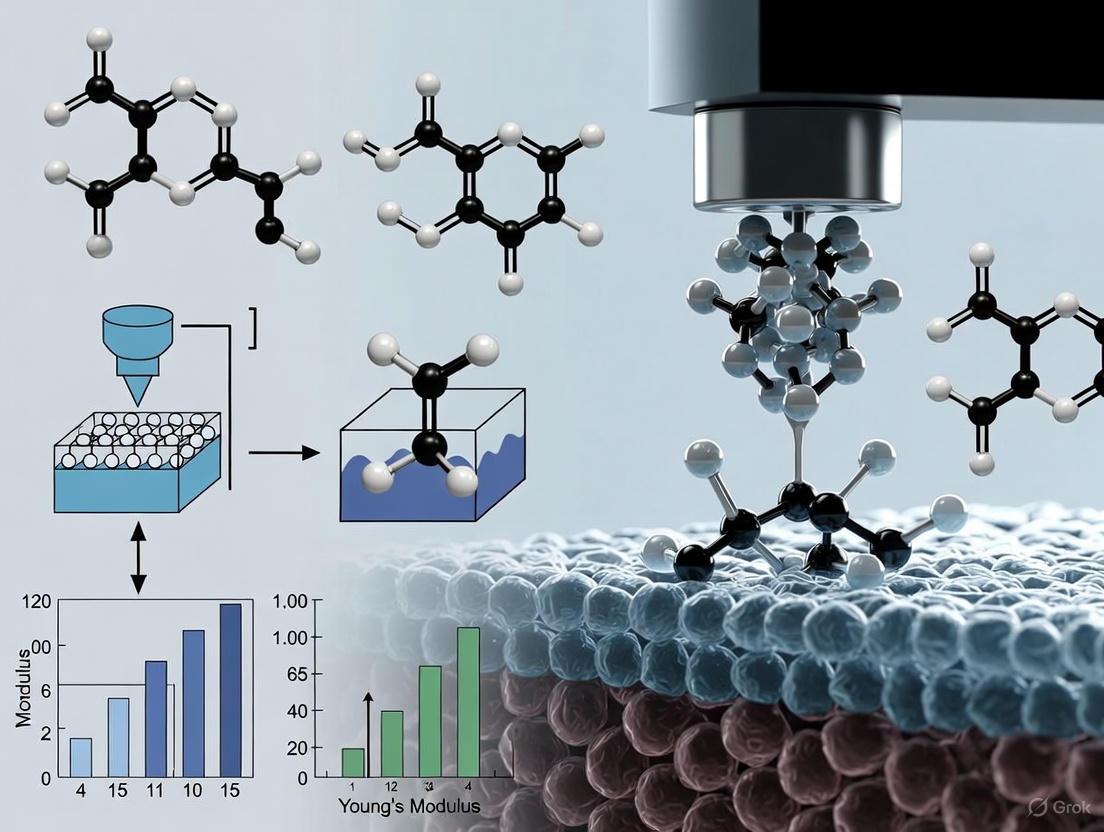
This comprehensive review explores the application of Atomic Force Microscopy (AFM) for quantifying the Young's modulus of bacterial biofilms, a critical mechanical property influencing biofilm stability and antibiotic resistance.
Nanomechanical Profiling of Bacterial Biofilms: AFM Measurement of Young's Modulus for Biomedical Applications
Abstract
This comprehensive review explores the application of Atomic Force Microscopy (AFM) for quantifying the Young's modulus of bacterial biofilms, a critical mechanical property influencing biofilm stability and antibiotic resistance. Covering foundational principles to advanced applications, we detail standardized AFM methodologies including force spectroscopy, nanoindentation, and data analysis using Hertzian contact models. The article addresses key challenges in sample preparation, measurement variability, and environmental control, while validating AFM against complementary techniques like rheology. With special focus on biomedical and clinical implications, we examine how nanomechanical properties inform drug development strategies against persistent biofilm-associated infections, synthesizing current research and future directions for researchers and pharmaceutical professionals.
The Biomechanical Foundation: Why Young's Modulus Matters in Bacterial Biofilms
Core Concepts: Biofilms as Viscoelastic Materials
Bacterial biofilms are structured communities of microorganisms encased in a self-produced matrix of extracellular polymeric substances (EPS). A key characteristic of this EPS matrix is its viscoelasticity, meaning it exhibits both solid-like (elastic) and liquid-like (viscous) mechanical properties [1]. This viscoelastic nature is a primary contributor to the mechanical resilience of biofilms, allowing them to withstand mechanical and chemical challenges in environments ranging from industrial pipelines to medical devices [1] [2].
- Viscoelasticity Fundamentals: An elastic material, represented as a spring, deforms instantaneously under stress and recovers its original shape completely when the stress is removed. A viscous material, represented by a dashpot, deforms irreversibly over time to relieve stress. A viscoelastic material combines these behaviors; it deforms under stress and returns over time to a state similar, but not identical, to its original state once the stress is removed [1].
- Structural Basis of Resilience: The EPS matrix is composed of polysaccharides, proteins, lipids, and extracellular DNA (eDNA) [3] [4]. This composition, particularly the eDNA, forms a structural backbone that governs the biofilm's physical properties. The matrix provides mechanical stability to the 3D biofilm structure and acts as a protective barrier [3].
- Stress Adaptation: Recent research demonstrates that biofilms are not just passive materials. Biofilm streamers exhibit stress-hardening behavior, where their differential elastic modulus and effective viscosity increase linearly with external hydrodynamic stress. This adaptive response, found across different bacterial species, originates from the properties of eDNA molecules that form the structural backbone of the streamers [2].
Atomic Force Microscopy (AFM) for Measuring Mechanical Properties
Atomic Force Microscopy (AFM) has emerged as a powerful tool for investigating the nanomechanical properties of biofilms, including Young's modulus, under near-native physiological conditions [5] [6].
Key AFM Methodologies and Experimental Setup
AFM operates by scanning a sharp tip attached to a flexible cantilever across a sample surface. The interaction forces between the tip and the sample are monitored to generate high-resolution topographical images and force-distance curves, from which mechanical properties are derived [5].
- Sample Immobilization: A critical first step is immobilizing biofilm cells to a solid substrate. Common methods include:
- Poly-L-lysine Coating: Creating a positively charged surface to adhere negatively charged bacterial cells [5].
- Corning Cell-Tak: A commercial adhesive that can provide more robust and reliable adhesion than poly-L-lysine [5].
- Biofilm Growth: Growing biofilms directly on a substratum (e.g., glass coverslips) eliminates the need for external fixation agents, though the overlying EPS may influence force measurements [5].
- Alternative Entrapment: For challenging cells, immobilization in porous membranes or polydimethylsiloxane (PDMS) stamps minimizes lateral drift [5].
- AFM Operation Modes for Mechanics:
- Force-Distance Curve Acquisition: The fundamental AFM operation for measuring mechanics. The cantilever is lowered and raised from the surface while monitoring the force, generating an approach (extension) curve and a retraction curve [5].
- Quantitative Imaging (QI) Mode: A advanced mode that performs a force-distance curve at each pixel of the scan, generating simultaneous topographical and nanomechanical property maps (e.g., Young's modulus) in real-time [6]. This mode is particularly useful for imaging living bacteria in liquid without aggressive immobilization [6].
The following workflow outlines the key steps for determining Young's modulus of a biofilm using AFM force spectroscopy:
Analyzing Force-Distance Curves to Determine Young's Modulus
The analysis of force-distance curves is essential for extracting quantitative mechanical properties.
- The Approach Curve: As the AFM tip approaches and indents the biofilm surface, the resulting force-distance curve provides information on the sample's elasticity and stiffness [5]. The curve can be divided into regimes:
- Non-Compression Regime: A flat line indicating no long-range interaction forces before contact [5].
- Nonlinear Compression Regime: Occurs just after initial contact, reflecting the elasticity of the cell wall or EPS surface polymers [5].
- Linear Compression Regime: As the tip continues to push, it encounters stronger, linear resistance. The slope of this linear region is the effective spring constant ((k_{effective})) [5].
- Calculating Stiffness and Young's Modulus:
- Cell Stiffness: The biofilm or cell stiffness ((k{cell})) can be derived from the slope of the linear compression regime and the known cantilever spring constant ((k{cantilever})) using the equation for springs in series: ( \frac{1}{k{effective}} = \frac{1}{k{cell}} + \frac{1}{k_{cantilever}} ) [5].
- Young's Modulus (E): This is a more intrinsic measure of material elasticity, independent of sample geometry. It is calculated by fitting the force versus indentation data from the approach curve with a mechanical model. The Hertz model or Sneddon model (for a conical tip) is commonly used [5] [6]. The Sneddon model for a conical indenter is expressed as: ( F = \frac{2}{\pi} \cdot \frac{E}{1-\nu^2} \cdot \delta^2 \cdot \tan(\alpha) ) where (F) is force, (E) is Young's Modulus, (\nu) is Poisson's ratio (often assumed to be 0.5 for biological materials), (\delta) is indentation depth, and (\alpha) is the half-opening angle of the tip [6].
Quantitative Data on Biofilm Mechanical Properties
The mechanical properties of biofilms, measured via various techniques including AFM, can vary significantly based on species, matrix composition, and environmental conditions.
Table 1: Young's Modulus of Biofilms and Reference Materials
| Material | Young's Modulus / Elasticity | Measurement Context / Notes | Reference |
|---|---|---|---|
| Pseudomonas biofilm (EPS) | ~0.1 Pa | Shear mode measurement | [1] |
| Pseudomonas entire biofilms | 10 - 100 Pa | Shear mode measurement | [1] |
| General Biofilms (via OCT) | 70 - 700 Pa | Range obtained from fluid-structure interaction modeling; exhibits hardening at high stress | [7] |
| Skin | 15,000 - 150,000 Pa | Reference biological material | [1] |
| Blood (37°C) | 3 - 4 Pa | Reference biological fluid | [1] |
| Silicone Rubber | 1,000 - 50,000 Pa | Reference synthetic material | [1] |
Table 2: Effects of EPS Modifiers on Biofilm Mechanical Properties This table summarizes how targeted enzymatic or chemical treatments alter biofilm cohesion and stiffness by degrading specific matrix components, based on a study of S. epidermidis biofilms [4].
| Treatment (EPS Modifier) | Target EPS Component | Effect on Biofilm Cohesive Strength | Key Mechanism |
|---|---|---|---|
| Proteinase K | Proteins | Decreased | Ruptures peptide bonds in proteins, degrading the protein-based EPS matrix. |
| Periodic Acid (HIO₄) | Polysaccharides (e.g., PNAG) | Decreased | Oxidizes carbon atoms bearing vicinal hydroxyl groups, cleaving C-C bonds in polysaccharides. |
| DNase I | Extracellular DNA (eDNA) | Decreased | Breaks down eDNA, which often serves as a critical structural backbone for the biofilm. |
| Sodium Metaperiodate | Polysaccharides | Decreased | Oxidizes and cleaves polysaccharide chains. |
| Calcium Chloride (CaCl₂) | N/A (Divalent cation) | Increased | Strengthens cross-linking within the EPS matrix via ion bridging. |
Advanced Research and Experimental Reagents
The Scientist's Toolkit: Essential Research Reagents
Table 3: Key Reagent Solutions for Biofilm Viscoelasticity Research
| Reagent / Material | Function in Experiment | Specific Example |
|---|---|---|
| EPS Degrading Enzymes | To selectively disrupt specific EPS components and investigate structure-function relationships. | DNase I (targets eDNA), Proteinase K (targets proteins), Dispersin B (targets PNAG polysaccharide), Lipases (target lipids) [4]. |
| Immobilization Coatings | To adhere biofilm or individual cells to a substrate for AFM scanning. | Poly-L-lysine, Corning Cell-Tak [5]. |
| Divalent Cations | To investigate the role of ion bridging in matrix cross-linking and mechanical strengthening. | Calcium Chloride (CaCl₂), Magnesium Chloride (MgCl₂) [4]. |
| Fluorescent Stains / Dyes | To visualize biofilm structure, components, and viability in conjunction with mechanical testing. | Propidium Iodide (binds to eDNA and dead cells) [2]. |
| Microfluidic Devices | To grow biofilms under controlled, reproducible hydrodynamic conditions (e.g., for streamer studies). | CDC biofilm reactor, pillar-based microfluidic channels [4] [2]. |
Current Research Frontiers
Recent studies have provided deeper insights into the sophisticated mechanical behaviors of biofilms and the central role of extracellular nucleic acids.
- The Central Role of eDNA and eRNA: Extracellular DNA (eDNA) is now recognized as a key structural element that constitutes the structural backbone of biofilm streamers. Furthermore, stress-hardening behavior—where the biofilm stiffens in response to increasing mechanical stress—has been directly linked to the inherent properties of eDNA molecules [2]. Recent evidence also implicates extracellular RNA (eRNA) as a modulator of the matrix network, promoting the formation of stable eDNA supramolecular structures and contributing to viscoelastic properties [2].
- Non-Linear Mechanical Behavior: Biofilms do not simply behave as linear elastic materials. Studies using optical coherence tomography (OCT) have quantified biofilm hardening at large applied stress due to increasing flow velocity [7]. This non-linear response is a key factor in their ability to adapt to dynamic environments.
The diagram below illustrates the relationship between biofilm composition, structure, and its resulting mechanical properties:
Young's modulus, a fundamental metric in materials science, quantifies the stiffness of a solid material by representing the relationship between stress (force per unit area) and strain (proportional deformation) in the elastic regime. In the context of bacterial biofilms, Young's modulus defines the inherent resistance of the extracellular polymeric substance (EPS) matrix to reversible deformation [8]. This measurement provides critical insight into biofilm cohesion, stability, and functional behavior across diverse environments.
The quantification of Young's modulus is particularly vital for understanding biofilm-mediated processes in both industrial and clinical settings. The viscoelastic properties of biofilms, characterized by parameters such as Young's modulus, influence detachment rates, antimicrobial penetration resistance, and structural integrity under fluid shear forces [9] [4]. This technical guide examines the significance of Young's modulus within the specific context of atomic force microscopy (AFM) measurement, detailing experimental methodologies, key influencing factors, and implications for biofilm management strategies.
AFM Methodologies for Quantifying Young's Modulus in Biofilms
Force-Distance Curve Analysis
Atomic force microscopy enables the mechanical characterization of biofilms at the nanoscale through the acquisition and analysis of force-distance curves [5]. In a standard experiment, a pyramidal tip attached to a flexible cantilever is lowered toward and retracted from the biofilm surface while monitoring interaction forces.
The process involves several distinct phases. As the tip approaches the biofilm surface, limited long-range interaction forces typically result in an initial flat regime in the extension curve [5]. Just before physical contact, electrostatic and van der Waals forces generate a nonlinear change, marking the nonlinear compression regime, which reflects the elasticity of the cell wall [5]. As the tip continues to advance, it encounters stronger resistance, transitioning to a linear compression regime where the relationship between force and distance becomes linear [5].
The slope of this linear region represents the effective spring constant ((k{\text{effective}})), which relates to the spring constant of the cantilever ((k{\text{cantilever}})) and the spring constant of the cell ((k_{\text{cell}})) through the equation:
[ \frac{1}{k{\text{effective}}} = \frac{1}{k{\text{cell}}} + \frac{1}{k_{\text{cantilever}}} ]
Since (k_{\text{cantilever}}) is determined through calibration prior to experimentation, researchers can quantitatively determine cell stiffness from the slope of the linear regime [5].
Experimental Workflow for AFM-Based Measurement
The following diagram illustrates the complete experimental workflow for determining Young's modulus in biofilms using AFM:
The Scientist's Toolkit: Essential Research Reagents and Materials
Successful AFM analysis of biofilm mechanical properties requires specific materials and reagents for sample preparation, immobilization, and measurement.
Table: Essential Research Reagents for AFM Biofilm Studies
| Reagent/Material | Function | Application Notes |
|---|---|---|
| Poly-L-lysine | Creates positive charges on surfaces for cell immobilization [5] | Suitable for many organisms; may require optimization for specific strains |
| Cell-Tak | Robust adhesion of microbial cells to surfaces [5] | Provides more reliable adhesion than poly-L-lysine for some organisms |
| Polydimethylsiloxane (PDMS) Stamps | Trapping cells for immobilization [5] | Particularly useful for yeast cells; maintains physiological relevance |
| Polycarbonate Porous Membranes | Physical entrapment of cells [5] | Alternative to chemical fixation; minimizes experimental artifacts |
| Anhydrotetracycline (aTc) | Inducer for synthetic riboregulator in engineered E. coli [10] | Enables controlled expression of CsgA amyloid fibrils in synthetic biology approaches |
| N-acetyl cysteine (NAC) | Matrix-penetrating antimicrobial for remnant matrix studies [11] | Kills biofilm bacteria while preserving matrix structure when pH < pKa |
| Calcium Chloride (CaCl₂) | Divalent cation for ion bridging in EPS matrix [4] | Significantly increases biofilm cohesiveness through cross-linking |
Factors Influencing Young's Modulus in Biofilms
EPS Composition and Matrix Structure
The composition of the extracellular polymeric substance matrix represents the primary determinant of biofilm mechanical properties. Specific EPS components contribute distinctly to biofilm stiffness:
Extracellular DNA (eDNA): Serves as a structural backbone in many biofilms, particularly in streamers. eDNA exhibits stress-hardening behavior, with differential elastic modulus increasing linearly with external stress [2]. DNase treatment significantly reduces mechanical integrity [4].
Alginate: This anionic polyelectrolyte in mucoid Pseudomonas aeruginosa biofilms creates polyelectrolyte hydrogels with super-absorbency and high mechanical stability. Alginate overproduction results in increased elastic modulus through swelling driven by the Donnan effect [11].
Psl Polysaccharide: In P. aeruginosa PAO1, Psl production correlates with increased Young's modulus in microcolonies, particularly during maturation. Psl-deficient mutants form microcolonies with significantly lower stiffness [8].
Pel Polysaccharide: Influences streamer morphology and viscoelastic properties, though its effect on stiffness appears less pronounced than other components [2].
The following diagram illustrates how these EPS components and environmental factors collectively influence Young's modulus in biofilms:
Quantitative Values of Young's Modulus Across Biofilm Systems
Young's modulus values for biofilms span several orders of magnitude depending on species, growth conditions, and measurement techniques.
Table: Experimentally Determined Young's Modulus Values for Various Biofilms
| Biofilm System | Young's Modulus | Measurement Technique | Key Influencing Factors |
|---|---|---|---|
| E. coli biofilm (curli-producing) | ~10 GPa | Instrumented indentation [10] | Amyloid nanofibrils on cell surface; ultra-low density structure |
| E. coli with CNT enhancement | >30 GPa | Instrumented indentation [10] | Carbon nanotube integration into biofilm matrix |
| Oral microcosm biofilms (0.1% sucrose) | 10-25 kPa | AFM force-volume imaging [12] | Low EPS production; minimal exopolysaccharide content |
| Oral microcosm biofilms (5% sucrose) | 2-8 kPa | AFM force-volume imaging [12] | High EPS production; increased matrix hydration |
| P. aeruginosa microcolonies | 1-100 kPa (size-dependent) | AFM indentation [8] | Psl production; microcolony diameter; peripheral regions stiffer |
| P. aeruginosa ΔmucA (NAC-treated) | Increased post-treatment | Particle tracking microrheology [11] | Alginate overproduction; matrix swelling after bacterial death |
| P. aeruginosa PAO1 (NAC-treated) | Decreased post-treatment | Particle tracking microrheology [11] | Psl-dominated matrix; crosslink breakage after treatment |
Implications for Biofilm Control and Therapeutic Development
The mechanical properties of biofilms, quantified by Young's modulus, have profound implications for biofilm management in industrial and clinical contexts. Biofilm stiffness directly influences detachment behavior, with higher Young's modulus values generally correlating with increased resistance to hydrodynamic removal [9]. This relationship is particularly relevant in industrial flow systems where biofilm accumulation causes biofouling and efficiency losses.
In clinical settings, the viscoelastic barrier formed by the EPS matrix contributes to antibiotic resistance by limiting antimicrobial penetration [4]. Matrix-targeting enzymes such as DNase, dispersin B, proteases, and periodate specifically degrade EPS components, reducing Young's modulus and enhancing biofilm eradication [4]. Mechanical characterization provides critical data for evaluating the efficacy of these emerging treatment strategies.
Furthermore, the ability of remnant biofilm matrices to prevent recolonization—a phenomenon linked to their mechanical properties after bacterial death—suggests novel approaches for biofilm control [11]. Engineering surfaces that modulate biofilm stiffness or developing treatments that exploit stress-hardening behavior represent promising frontiers in biofilm management.
Young's modulus serves as an essential quantitative descriptor of biofilm mechanical integrity, providing fundamental insights into structure-function relationships within these complex microbial communities. Through AFM-based methodologies, researchers can precisely characterize how EPS composition, environmental conditions, and therapeutic interventions influence biofilm stiffness. This knowledge enables more effective strategies for biofilm control across diverse applications, from industrial processes to medical therapeutics. As research advances, the continued refinement of measurement techniques and the integration of mechanical properties into biofilm models will further enhance our ability to predict and manipulate biofilm behavior in engineered and natural systems.
Biofilms are structured microbial communities embedded in a self-produced matrix of extracellular polymeric substances (EPS) that adhere to moist surfaces ranging from medical implants to industrial piping systems [4]. This EPS matrix, constituting more than 90% of the biofilm's dry mass, provides the fundamental scaffolding that determines the physicochemical and mechanical properties of the biofilm [4] [13]. The mechanical stability of biofilms, quantified by parameters such as Young's modulus and cohesive strength, is crucial for their persistence in both natural and engineered systems. While biofilm mechanics are influenced by multiple factors including microbial species composition and environmental conditions, the EPS matrix emerges as the primary determinant, governing structural integrity, stress resistance, and viscoelastic behavior [14] [15]. This technical guide explores the structure-function relationships of EPS components, details atomic force microscopy (AFM) methodologies for mechanical characterization, and presents quantitative data linking EPS composition to biofilm mechanical properties, providing researchers with a comprehensive framework for investigating and manipulating biofilm stability.
EPS Composition and Structural Organization
Core Components of the EPS Matrix
The EPS matrix is a complex, hydrated biopolymer network comprising several key constituent classes, each contributing distinct functional properties to the biofilm architecture [16] [13]:
- Polysaccharides: The most abundant EPS components, including exopolysaccharides such as alginate, cellulose, and poly-N-acetylglucosamine (PNAG). These polymers form the structural backbone of the matrix through chain entanglement and cross-linking, directly influencing porosity, density, and mechanical stability [4] [16].
- Proteins: Including structural proteins, enzymes, and glycoproteins. Amyloid-like proteins and fimbriae significantly enhance matrix stability through the formation of rigid fibrils, while extracellular enzymes facilitate nutrient acquisition and matrix remodeling [13].
- Extracellular DNA (eDNA): Once considered merely a cellular debris, eDNA is now recognized as a critical structural component that functions as an intercellular connector, forming grid-like structures and filamentous networks that provide architectural stability, particularly in early-stage biofilms [13].
- Lipids and Surfactants: Amphiphilic compounds that influence surface tension, hydrophobic interactions, and interface dynamics within the matrix [16].
- Other Components: Including humic substances, amino sugars (muramic acid, mannosamine, galactosamine, glucosamine), and ions that contribute to matrix charge and cross-linking [17].
The relative abundance of these components varies significantly depending on microbial species, environmental conditions, and biofilm age, creating a highly dynamic and adaptive matrix structure [17].
Environmental Determinants of EPS Composition
EPS composition is not static but dynamically responds to environmental conditions, which in turn directly modulates biofilm mechanical properties:
- Fluid Shear: Biofilms grown under high fluid shear conditions exhibit a threefold higher protein-to-polysaccharide (PN/PS) ratio compared to low-shear biofilms, resulting in a more compact, dense, and stiff biofilm architecture [14].
- Nutrient Availability: Phosphate limitation has been shown to trigger increased EPS production in reverse osmosis systems, leading to more rapid surface coverage and increased operational pressure drop [15].
- Substrate Quality: Carbon source quality significantly influences EPS yield and composition. Studies with diverse bacterial and fungal species demonstrated that starch-based media promote a higher EPS-carbohydrate/protein ratio compared to glycerol media, directly affecting matrix properties [17].
- Surface Presence: The presence of a mineral surface (e.g., quartz matrix) stimulates increased EPS production, particularly carbohydrates, highlighting how attachment surfaces modulate matrix development [17].
- Cations: Divalent cations such as Ca²⁺ and Mg²⁺ significantly strengthen the EPS matrix through ion bridging between anionic functional groups (e.g., carboxyl groups in alginate), dramatically increasing cohesive strength and stiffness [4] [18].
Table 1: Environmental Factors Influencing EPS Composition and Mechanical Properties
| Environmental Factor | Effect on EPS Composition | Impact on Mechanical Properties |
|---|---|---|
| High Fluid Shear | Increased protein-to-polysaccharide ratio [14] | Increased stiffness, lower creep compliance [14] |
| Calcium Availability | Enhanced ionic cross-linking [4] | Increased cohesive strength (0.10 to 1.98 nJ/μm³) [18] |
| Carbon Source (Starch) | Higher carbohydrate/protein ratio [17] | Altered viscoelastic properties |
| Phosphate Limitation | Enhanced total EPS production [15] | Increased fouling potential, structural density |
| Surface Attachment | Stimulated carbohydrate production [17] | Enhanced adhesion and structural stability |
AFM Methodologies for Biofilm Mechanical Characterization
Core Principles of AFM in Biofilm Mechanics
Atomic force microscopy provides unparalleled capability for quantifying the mechanical properties of biofilms at multiple scales, from single cells to complex multicellular communities. The fundamental principle involves measuring force-displacement curves as a calibrated tip interacts with the biofilm surface, enabling the calculation of key mechanical parameters [18] [12]:
- Young's Modulus (Elastic Modulus): A measure of biofilm stiffness, representing the resistance to elastic deformation under applied stress. Softer biofilms exhibit lower Young's modulus values, while stiffer biofilms show higher values.
- Adhesion Forces: The attractive forces between the AFM tip and biofilm surface, influenced by surface chemistry, hydrophobicity, and specific molecular interactions.
- Cohesive Energy: The energy required to displace a unit volume of biofilm material, directly quantifying the internal strength of the EPS matrix [18].
- Creep Compliance: A viscoelastic parameter describing the time-dependent strain under constant stress, with higher values indicating more fluid-like behavior [14].
Standardized AFM Protocols for Biofilm Mechanics
Reproducible measurement of biofilm mechanical properties requires standardized protocols encompassing biofilm growth, sample preparation, and AFM operation:
Experimental Workflow for AFM-based Mechanical Characterization
Biofilm Cultivation and Sample Preparation
- Reactor Systems: For flow-controlled conditions, use CDC biofilm reactors with defined shear conditions (e.g., 200 rpm rotational speed) to grow standardized biofilms [4]. Alternatively, membrane-aerated biofilm reactors provide consistent oxygenation for aerobic species [18].
- Growth Conditions: Grow Staphylococcus epidermidis or other model organisms in appropriate media (e.g., Tryptic Soy Broth with 1% glucose) for 12 days at 30°C to obtain mature biofilms [4]. For single-species studies, Pseudomonas aeruginosa PAO1 is widely used.
- Sample Stabilization: For hydrated AFM measurements, stabilize biofilm samples on appropriate substrates (e.g., hydroxyapatite for oral biofilms, gelatin-coated glass for bacterial immobilization) and maintain in phosphate-buffered saline during analysis [19] [12]. Control humidity at ~90% for moist biofilm measurements [18].
- Substrate Selection:
AFM Operational Parameters
- Probe Selection: Use functionalized cantilevers with 10 μm borosilicate spheres for standardized indentation experiments (spring constant ~0.36 N/m) [12]. V-shaped silicon nitride cantilevers with pyramidal tips are suitable for high-resolution imaging (spring constant 0.58 N/m) [18].
- Force Measurement: Perform force-volume imaging over multiple 50×50 μm areas with 16×16 force curves each [12]. Apply loads ranging from minimal (∼0 nN) for imaging to elevated loads (40 nN) for abrasion and cohesion measurements [18].
- Environmental Control: Conduct all measurements under fluid conditions (PBS) or controlled humidity (90%) to maintain native biofilm hydration state, which critically influences mechanical properties [18] [12].
- Data Acquisition:
- Set scan velocity between 50-100 μm/s [18]
- Acquire minimum of 256 force curves per sample area
- Perform measurements at multiple locations to account for heterogeneity
Data Analysis and Interpretation
- Young's Modulus Calculation: Fit force-distance curves using Hertz or Sneddon contact models, assuming appropriate tip geometry (spherical for colloid probes, parabolic for sharp tips) [12].
- Cohesive Energy Determination: Calculate from the volume of displaced biofilm and corresponding frictional energy dissipated during abrasive scanning at elevated loads [18].
- Adhesion Work: Quantify from the area under the retraction curve of force-displacement measurements [12].
- Spatial Mapping: Generate mechanical property maps by assigning Young's modulus values to specific locations, correlating with structural features identified through simultaneous optical coherence tomography [12].
Quantitative Relationships Between EPS and Mechanical Properties
Direct Measurements of EPS-Property Correlations
Rigorous experimentation has established quantitative relationships between specific EPS components and measurable mechanical parameters:
Table 2: Quantitative Effects of EPS Components on Biofilm Mechanical Properties
| EPS Component/Modifier | Experimental Treatment | Effect on Young's Modulus/Cohesion | Reference |
|---|---|---|---|
| Calcium Ions | Addition of 10 mM CaCl₂ during cultivation | Cohesive energy increased from 0.10 ± 0.07 to 1.98 ± 0.34 nJ/μm³ [18] | |
| Protein Matrix | High-shear conditions (increased PN/PS ratio) | Creep compliance decreased to 31 ± 1 Pa⁻¹ (inner biofilm) vs. 5570 ± 101 Pa⁻¹ in low-shear [14] | |
| PNAG Polysaccharide | Dispersin B and Periodic Acid treatment | >90% biofilm removal in E. coli, significant reduction in cohesion [4] | |
| eDNA | DNase treatment | Reduced structural stability, decreased tensile strength [4] | |
| α-1,4 Glycosidic Linkages | Identified via FTIR at 920 cm⁻¹ | Correlation with increased fouling potential and mechanical stability [15] |
Multi-scale Mechanical Characterization
Advanced correlative approaches combining AFM with other biophysical techniques reveal how EPS properties manifest across different spatial scales:
- Macroscale Morphology: Optical coherence tomography demonstrates that high-shear biofilms (high PN/PS ratio) exhibit lower thickness (29 ± 8 μm vs. 52 ± 20 μm) and reduced roughness (0.18 ± 0.06 vs. 0.31 ± 0.09) compared to low-shear biofilms [14].
- Microrheology: Particle-tracking microrheology reveals significant depth-dependent mechanical heterogeneity, with inner biofilm regions exhibiting lower creep compliance (31 ± 1 Pa⁻¹) compared to outer regions (49 ± 3 Pa⁻¹) in high-shear P. aeruginosa biofilms [14].
- Nanoindentation: AFM force mapping shows that oral biofilms grown under high sucrose conditions (5% w/v) exhibit significantly lower Young's modulus and increased cantilever adhesion compared to low sucrose (0.1% w/v) conditions, directly linking EPS composition to nanomechanical properties [12].
EPS-Driven Structure-Property Relationships in Biofilms
Research Reagent Solutions for EPS Manipulation
Targeted manipulation of specific EPS components provides both experimental evidence for their mechanical roles and potential therapeutic strategies for biofilm control:
Table 3: Research Reagents for Targeted EPS Modification
| Reagent | Target EPS Component | Mechanism of Action | Experimental Outcome |
|---|---|---|---|
| Dispersin B | PNAG polysaccharide | Hydrolyzes β-1,6-glycosidic linkages in poly-N-acetylglucosamine [4] | >90% removal of E. coli biofilms [4] |
| Proteinase K | Proteinaceous components | Cleaves peptide bonds in proteins and glycoproteins [4] | Significant reduction in biofilm adhesion and stability [4] |
| DNase I | Extracellular DNA (eDNA) | Degrades DNA backbone through hydrolysis of phosphodiester bonds [4] | Disruption of structural networks, decreased cohesion [4] |
| Periodic Acid (HIO₄) | Polysaccharide hydroxyl groups | Oxidizes carbon atoms bearing vicinal hydroxyl groups, cleaving C-C bonds [4] | Effective degradation of Staphylococcus epidermidis biofilms [4] |
| EDTA | Lipopolysaccharides (LPS) | Chelates divalent cations, disrupts outer membrane organization [19] | Reduced cell elasticity and adhesion forces in E. coli [19] |
| CaCl₂/MgCl₂ | Ionic cross-linking sites | Strengthens matrix through cation bridging between anionic groups [4] | Enhanced cohesive strength and mechanical stability [4] [18] |
The extracellular polymeric substance matrix unequivocally serves as the primary determinant of biofilm mechanical properties, with specific components contributing distinct structural and functional attributes that collectively define biofilm stability and resilience. Through advanced biophysical characterization techniques, particularly atomic force microscopy, researchers can now establish quantitative structure-property relationships that link EPS composition to mechanical behavior across multiple spatial scales. The experimental methodologies and reagent tools detailed in this technical guide provide a foundation for systematic investigation of biofilm mechanics, enabling both fundamental understanding of biofilm persistence and development of targeted strategies for biofilm control in medical, industrial, and environmental contexts. Future research directions should focus on real-time monitoring of EPS mechanical dynamics, high-throughput screening of EPS-targeting agents, and development of multi-scale models that predict mechanical behavior from EPS composition and environmental conditions.
Linking Mechanical Properties to Biofilm Virulence and Antibiotic Tolerance
Bacterial biofilms represent a predominant mode of microbial life associated with chronic infections and antimicrobial treatment failures. While the biochemical basis of antibiotic tolerance has been extensively studied, the direct link between biofilm mechanical properties and its recalcitrance has only recently emerged as a critical research frontier. The extracellular polymeric substance (EPS) matrix, which constitutes over 90% of the biofilm's dry mass, provides not only a physical barrier but also a specific mechanical architecture that directly influences virulence and antibiotic tolerance [4] [20]. This mechanical framework, characterized by properties such as stiffness, viscoelasticity, and cohesive strength, creates heterogeneous microenvironments that limit antibiotic penetration and induce metabolic dormancy in subpopulations of cells [21] [22].
Atomic force microscopy (AFM) has revolutionized our ability to quantify these mechanical properties at the nanoscale, providing researchers with unprecedented insight into structure-function relationships within biofilm matrices. Through direct measurement of Young's modulus, adhesion forces, and deformation characteristics, AFM has revealed that mechanical robustness is a key determinant of biofilm persistence in hostile environments, including those containing antibiotics [23] [4]. This technical guide explores the fundamental connections between biofilm mechanical properties, virulence expression, and antibiotic tolerance, with particular emphasis on AFM methodologies for quantifying these relationships under physiologically relevant conditions.
Biofilm Mechanical Properties: Quantitative Analysis
The mechanical characteristics of biofilms vary significantly based on species, environmental conditions, and matrix composition. The following table summarizes key quantitative findings from recent investigations into biofilm mechanical properties.
Table 1: Quantitative Measurements of Biofilm Mechanical Properties
| Biofilm System | Experimental Method | Young's Modulus/Stiffness | Key Mechanical Determinants | Reference |
|---|---|---|---|---|
| P. aeruginosa aggregates in SCFM2 | AFM force spectroscopy | 218.7 ± 118.7 kPa | Tight cellular packing, mucin-induced architecture | [23] |
| Planktonic P. aeruginosa (control) | AFM force spectroscopy | 50.8 ± 35.8 kPa | Individual cell membrane properties | [23] |
| S. epidermidis biofilms | AFM before/after EPS modifiers | Variable (composition-dependent) | EPS composition, cross-linking via divalent cations | [4] |
| P. fluorescens with Ca²⁺ supplementation | AFM micro-cantilever | Increased vs. control | Divalent cation-mediated bridging | [4] |
The data reveal that the transition from planktonic to aggregate states produces a four-fold increase in mechanical stiffness in P. aeruginosa, indicating that structural organization alone significantly enhances mechanical robustness [23]. This stiffness emerges even before the production of mature exopolysaccharide scaffolding, suggesting that cellular reorganization and compaction in mucus-rich environments represent an early physical adaptation mechanism [23].
Table 2: Impact of EPS-Degrading Treatments on Biofilm Mechanical Properties
| Treatment Agent | Target EPS Component | Effect on Young's Modulus | Impact on Cohesive Strength | Reference |
|---|---|---|---|---|
| Dispersin B | PNAG polysaccharide | Significant reduction | Major decrease in cohesion | [4] |
| Proteinase K | Proteinaceous components | Moderate reduction | Moderate decrease in cohesion | [4] |
| DNase | Extracellular DNA (eDNA) | Variable reduction | Context-dependent effects | [4] |
| Periodic acid (HIO₄) | PNAG polysaccharide | Significant reduction | Major decrease in cohesion | [4] |
| Ca²⁺/Mg²⁺ supplementation | Overall matrix structure | Increase | Enhanced cross-linking and stability | [4] |
Enzymatic treatments targeting specific EPS components demonstrate that polysaccharides and proteins contribute differentially to biofilm mechanical integrity, with PNAG-degrading enzymes like Dispersin B producing the most significant reduction in cohesive strength [4]. Conversely, divalent cations such as Ca²⁺ and Mg²⁺ strengthen the EPS matrix through ion bridging between anionic polymer chains, further enhancing mechanical robustness [4].
Mechanistic Links Between Mechanical Properties and Antibiotic Tolerance
Physical Barrier Function and Antibiotic Penetration
The biofilm matrix acts as a formidable physical barrier that significantly retards antibiotic penetration through several interconnected mechanisms. The EPS matrix creates a diffusion-limited environment where antimicrobial agents must traverse a complex anionic polymer network, leading to binding interactions that effectively reduce the concentration reaching deeper cellular layers [22] [24]. Positively charged antibiotics such as aminoglycosides (e.g., tobramycin) particularly suffer from this limitation as they form electrostatic complexes with negatively charged matrix components like eDNA, leading to sequestration and dramatically reduced diffusion rates [22] [25]. This delayed penetration provides biofilm-resident bacteria with additional time to activate stress response systems and implement additional resistance mechanisms [25].
Beyond simple diffusion limitation, the matrix facilitates direct antibiotic modification through the localization of antibiotic-degrading enzymes such as β-lactamases within the EPS [26] [27]. This creates a protective gradient where antibiotics are inactivated before reaching their cellular targets, particularly in the biofilm interior. This mechanism exemplifies how the physical structure of biofilms enhances biochemical resistance pathways.
Mechanical Regulation of Bacterial Physiology
The mechanical properties of biofilms directly influence bacterial physiology and metabolic activity through the creation of physicochemical gradients. As biofilm thickness increases, diffusion limitations generate oxygen and nutrient gradients from the biofilm surface to the substratum [21] [22]. This spatial heterogeneity produces distinct metabolic zones, with actively growing cells at the biofilm periphery and dormant, non-growing persister cells in the deeper anoxic regions [22] [20]. Since most antibiotics target active cellular processes, these metabolically dormant persisters exhibit dramatically increased tolerance, surviving antibiotic exposure that would eradicate their planktonic counterparts [24] [27].
The mechanical compression and spatial constraints within dense biofilm architectures further induce a stress response state characterized by upregulation of general stress response pathways and efflux pump systems [21]. This response not only enhances tolerance to antimicrobials but also promotes genetic adaptation through increased mutation rates and horizontal gene transfer, accelerating the evolution of stable resistance mechanisms [21] [27].
AFM Methodologies for Biofilm Mechanical Characterization
Sample Preparation Protocols
Biofilm Growth Conditions: For P. aeruginosa aggregate studies, cultures are grown in synthetic cystic fibrosis sputum medium (SCFM2) supplemented with mucin to mimic the lung environment of cystic fibrosis patients [23]. Static incubation for 4 hours at 37°C promotes aggregate formation without surface attachment. For S. epidermidis biofilms, CDC biofilm reactors provide controlled hydrodynamic conditions and consistent biofilm development over 12-day growth periods, producing biofilms with relevant architectural features [4].
Substrate Immobilization: Biofilm samples require immobilization on solid substrates for AFM analysis. Poly-L-lysine-coated glass slides provide optimal surface charge for gentle attachment while preserving native biofilm architecture [23]. For more robust biofilms, chemical fixation with low concentrations of glutaraldehyde (0.5-1%) may be employed, though this may alter mechanical properties and should be used cautiously [4].
AFM Force Spectroscopy Protocols
Instrument Calibration: Before measurements, AFM cantilevers must be thermally calibrated to determine the precise spring constant using the thermal noise method [23]. Spherical colloidal probes (diameter 2-5μm) are preferred over sharp tips for mechanical characterization as they provide more homogeneous stress distribution and minimize sample damage [23] [4].
Nanoindentation Parameters: Force mapping should be performed with the following standardized parameters: maximum indentation force 0.3-0.4 nN, approach/retraction speed 0.5-1 μm/s, and spatial resolution of 64×64 force curves over 10×10 μm areas for statistically significant sampling [23]. Multiple aggregates or biofilm regions should be measured to account for structural heterogeneity.
Data Analysis: Force-distance curves are analyzed using the Hertzian contact model for spherical indenters, which assumes linear elastic behavior and no adhesion effects [23]. The elastic modulus (Young's modulus) is extracted from the approach curve by fitting the indentation region with the following equation:
[ F = \frac{4}{3} \cdot \frac{E}{1-\nu^2} \cdot \sqrt{R} \cdot \delta^{3/2} ]
Where F is force, E is Young's modulus, ν is Poisson's ratio (typically assumed as 0.5 for biological samples), R is tip radius, and δ is indentation depth [23].
The Scientist's Toolkit: Essential Research Reagents and Materials
Table 3: Essential Research Reagents for Biofilm Mechanical Studies
| Reagent/Category | Specific Examples | Function/Application | Experimental Notes |
|---|---|---|---|
| Specialized Growth Media | Synthetic cystic fibrosis sputum medium (SCFM2) | Mimics in vivo conditions for clinically relevant biofilms | Promotes aggregate formation in P. aeruginosa [23] |
| EPS Modifying Enzymes | Dispersin B, Proteinase K, DNase I, Lipases | Targeted degradation of specific EPS components | Determines contribution of individual matrix elements to mechanics [4] |
| Divalent Cations | CaCl₂, MgCl₂ solutions | Enhance matrix cross-linking and mechanical strength | Concentrations typically 1-5 mM in treatment solutions [4] |
| Surface Coatings | Poly-L-lysine, collagen, fibrinogen | Substrate functionalization for biofilm attachment | Poly-L-lysine provides charge-based immobilization [23] |
| AFM Consumables | Colloidal probes, cantilevers | Physical measurement of mechanical properties | Spherical tips (2-5μm) preferred over sharp probes [23] [4] |
| Fixation Agents | Glutaraldehyde, formaldehyde | Structural preservation for imaging | May alter mechanical properties; use at low concentrations [4] |
The direct relationship between biofilm mechanical properties and antibiotic tolerance represents a paradigm shift in our understanding of treatment failures in chronic bacterial infections. AFM-based nanomechanical characterization has revealed that stiffness, viscoelasticity, and cohesive strength are not merely structural attributes but functional determinants that enable bacterial persistence under antimicrobial pressure. The quantitative data presented in this review demonstrate that mechanical robustness can precede genetic resistance mechanisms, providing an immediate survival advantage in hostile environments.
Future research directions should focus on exploiting these mechanical vulnerabilities for therapeutic benefit. EPS-degrading enzymes in combination with conventional antibiotics represent a promising approach to disrupt the mechanical integrity of biofilms, potentially restoring susceptibility to antimicrobial treatment [4]. Additionally, targeting the regulatory pathways that control matrix production, such as c-di-GMP signaling, may provide pharmacological opportunities to prevent the development of mechanically robust biofilms [22] [25]. As AFM methodologies continue to advance, particularly in operating under physiological flow conditions, we anticipate increasingly sophisticated understanding of how mechanical properties influence virulence expression, immune evasion, and antimicrobial resistance in clinically relevant biofilm models.
AFM as a Key Tool for Nanomechanical Characterization in Native Conditions
Atomic Force Microscopy (AFM) has established itself as a cornerstone technique in biophysical research, providing unparalleled capability for nanomechanical characterization of soft biological samples under native, aqueous conditions. Unlike conventional microscopy techniques that often require sample fixation, drying, or staining, AFM enables the investigation of samples in their physiological state, preserving their intrinsic mechanical properties. This is particularly critical for the study of bacterial biofilms, which are complex, hydrated structures of microbial communities encased in a self-produced matrix of extracellular polymeric substances (EPS). The mechanical robustness of biofilms, largely governed by their Young's modulus, is a primary factor affecting their development, stability, and resistance to mechanical and chemical challenges. Understanding these properties is essential for developing strategies to control biofilms in clinical and industrial settings, from combating chronic infections to managing biofouling.
The operational principle of AFM relies on measuring the force interactions between a sharp probe attached to a flexible cantilever and the sample surface. By systematically scanning the probe across the surface, a topographical image is generated with atomic or nanometer-scale resolution. More importantly for mechanical characterization, AFM can function as a nanoindenter, quantifying properties such as Young's modulus by analyzing the force required to deform the sample at a nanoscopic level. The force–distance curves obtained during indentation provide a direct measurement of the sample's elastic response, which can be fitted with theoretical contact mechanics models, such as the Hertz model, to extract quantitative mechanical properties. The diversification of AFM-based technologies has created a truly multiparametric platform, enabling the interrogation of all aspects of microbial systems, from single cells to complex biofilms.
AFM Operational Modes for Nanomechanics
The application of AFM in biofilm research leverages several operational modes, each suited to different aspects of imaging and mechanical property characterization.
- Static Force Mode (Contact Mode): This is the original AFM mode, where the probe maintains continuous contact with the surface during scanning. While it can be used for imaging, the associated lateral (dragging) forces can damage soft samples like biofilms. However, its principles are fundamental to force spectroscopy.
- Dynamic Force Mode (Tapping Mode): This is the most frequently used mode for imaging soft biological samples. The cantilever oscillates at a high frequency, making only intermittent contact with the surface. This significantly reduces lateral forces and minimizes sample damage. Phase imaging, which captures the phase lag between the cantilever's drive and its oscillation response, is often collected simultaneously and provides contrast based on variations in the sample's mechanical properties.
- Force Spectroscopy: This is not an imaging mode but a single-point measurement technique central to nanomechanical characterization. The AFM tip approaches the sample surface until contact is made, indents it, and then retracts. The cantilever deflection is recorded throughout this cycle, generating a force-distance curve. These curves are mined for mechanical properties, including adhesion forces, stiffness (Young's modulus), and indentation depth.
For robust biological samples like dense biofilms, tapping mode in fluid is often the preferred method for topographic imaging, as it maintains sample integrity. Force spectroscopy is then performed on specific regions of interest identified from the images to map or quantify mechanical properties.
Experimental Workflow for Young's Modulus Measurement in Biofilms
The following diagram illustrates the core experimental workflow for determining the Young's modulus of a bacterial biofilm using AFM.
Sample Preparation and Immobilization
Secure and benign immobilization of the biofilm is the most critical step for reliable AFM analysis, as it must withstand scanning forces without altering the biofilm's native properties.
- Biofilm Cultivation: Biofilms are typically grown in vitro on suitable substrates that promote adhesion. Common substrates include hydroxyapatite (HAP) discs (to mimic tooth enamel) or gas-permeable membranes, incubated with bacterial culture or pooled human saliva to form microcosm biofilms under controlled conditions [18] [12]. Growth media can be modified, for example, with varying sucrose concentrations, to study its effect on EPS production and mechanical strength.
- Hydration: After cultivation, the biofilm must be kept hydrated in a physiological buffer such as Phosphate Buffered Saline (PBS) during all stages of preparation and measurement to prevent dehydration artifacts [12] [28].
- Immobilization: For soft, hydrated biofilms, chemical immobilization is often required. This can be achieved by attaching the substrate to the AFM mount using a strong adhesive. For single-cell studies, the biofilm can be transferred to and immobilized on a poly-L-lysine-coated glass slide, which provides a positively charged surface that securely binds negatively charged bacterial cells [23] [28]. The goal is to immobilize the sample sufficiently to resist lateral scanning forces without using harsh chemical fixatives that could alter mechanical properties.
AFM Imaging and Force Curve Acquisition
This phase involves locating a region of interest and collecting the raw mechanical data.
- Topographical Imaging: The biofilm is first imaged, typically using tapping mode in fluid, to identify regions for mechanical testing. This mode minimizes shear forces that could damage the delicate biofilm structure [28].
- Force Volume Imaging (FVI): This advanced mode combines imaging with spectroscopy. The AFM performs a force-distance curve at every pixel in a defined array, generating a topographical image and a simultaneous map of mechanical properties [12].
- Force-Distance Curve Acquisition: The core of the measurement involves moving the AFM probe towards the surface until it contacts and indents the biofilm, then retracting it. The cantilever's deflection is measured as a function of the piezo displacement, generating a force-distance curve. Key segments of this curve are:
- Approach: The tip moves toward the sample until contact is established.
- Indentation: The tip pushes into the biofilm, causing a repulsive force that bends the cantilever upward. The slope of this segment is related to the sample's stiffness.
- Retraction: The tip withdraws from the sample. Adhesion forces between the tip and the biofilm often cause a "pull-off" event, visible as a negative force peak [28].
Data Processing and Young's Modulus Calculation
The raw force-distance data is processed and fitted with a contact mechanics model to extract the Young's modulus (E).
- Conversion and Baseline Correction: The piezo displacement and cantilever deflection (in volts) are converted into tip-sample separation and force (in newtons) using the cantilever's known spring constant.
- Indentation Depth Calculation: The indentation depth (δ) at each point is calculated by comparing the force curve on the biofilm with a reference curve taken on a rigid, non-deformable surface (e.g., clean glass or mica).
- Hertz Model Fitting: The indentation depth (δ) and applied force (F) data from the approach curve are fitted with an appropriate Hertzian contact model. For a parabolic (spherical) tip, the model is: F = (4/3) * E / (1-ν²) * √R * δ^(3/2) where F is the applied force, E is the Young's modulus, ν is the Poisson's ratio (typically assumed to be 0.5 for soft, incompressible biological materials), R is the radius of the AFM tip, and δ is the indentation depth [12] [28]. The fitting procedure yields the value of E, which is a direct measure of the biofilm's elastic stiffness.
Quantitative Data from Biofilm Research
AFM-based nanomechanical studies have successfully quantified how environmental factors and bacterial organization influence the Young's modulus of biofilms. The table below summarizes key quantitative findings from recent research.
Table 1: Young's Modulus Values of Bacterial Biofilms and Aggregates Measured by AFM
| Biofilm/Aggregate Type | Growth Condition/Modification | Young's Modulus (Mean ± SD) | Key Finding | Citation |
|---|---|---|---|---|
| Oral Microcosm Biofilm | Low Sucrose (0.1% w/v) | Higher Modulus | Increased sucrose decreased stiffness, linked to higher EPS production. | [12] |
| Oral Microcosm Biofilm | High Sucrose (5% w/v) | Lower Modulus | Increased sucrose decreased stiffness, linked to higher EPS production. | [12] |
| P. aeruginosa Aggregate | Synthetic Cystic Fibrosis Medium (SCFM2) | 218.7 ± 118.7 kPa | Aggregates exhibited significantly higher mechanical stiffness than planktonic cells. | [23] |
| P. aeruginosa Planktonic Cell | Mucin-Free Media | 50.8 ± 35.8 kPa | Highlights the mechanical resilience gained from early aggregation. | [23] |
| Activated Sludge Biofilm | Standard Culture | Cohesive Energy: 0.10 ± 0.07 to 2.05 ± 0.62 nJ/μm³ | Cohesive energy increased with biofilm depth. | [18] |
| Activated Sludge Biofilm | With 10 mM CaCl₂ | Cohesive Energy: 0.10 ± 0.07 to 1.98 ± 0.34 nJ/μm³ | Calcium ions significantly increased biofilm cohesiveness. | [18] |
The following diagram outlines the logical relationship between experimental parameters, the resulting changes in biofilm structure, and the final measured mechanical outcome.
Research Reagent Solutions Toolkit
A successful AFM nanomechanics experiment relies on a suite of essential materials and reagents. The table below lists key items and their specific functions in the context of biofilm studies.
Table 2: Essential Research Reagents and Materials for AFM Nanomechanics of Biofilms
| Item | Function in Experiment | Example from Research |
|---|---|---|
| Hydroxyapatite (HAP) Discs | A biologically relevant substrate for growing oral and other biofilms, mimicking mineralized surfaces like teeth. | Used as a growth substrate for microcosm biofilms formed from human saliva [12]. |
| Poly-L-Lysine | A synthetic polymer used to coat glass or mica slides, creating a positively charged surface that strongly immobilizes bacterial cells or aggregates. | Used to immobilize P. aeruginosa aggregates for AFM imaging and force spectroscopy [23]. |
| Phosphate Buffered Saline (PBS) | A physiological buffer used to hydrate and rinse biofilms during AFM measurement, maintaining osmotic balance and native conditions. | Used to submerge biofilm-covered HAP discs before and during OCT and AFM analysis [12]. |
| Calcium Chloride (CaCl₂) | A source of divalent Ca²⁺ ions that cross-link anionic groups in the EPS, increasing the mechanical strength and cohesiveness of the biofilm. | Adding 10 mM CaCl₂ during biofilm cultivation was shown to significantly increase cohesive energy [18]. |
| Brain Heart Infusion (BHI) / Artificial Saliva | Nutrient-rich and nutrient-poor growth media used to cultivate biofilms with varying structural and mechanical properties. | Used to grow oral microcosm biofilms, with BHI (5% sucrose) promoting higher EPS production [12]. |
| Functionalized AFM Cantilevers | Probes with modified tips for specific measurements. Spherical tips are used for nanoindentation to apply well-defined stress fields. | Cantilevers functionalized with 10 µm borosilicate spheres were used for force-volume imaging on oral biofilms [12]. |
AFM has proven to be an indispensable tool for the nanomechanical characterization of bacterial biofilms in their native state. Its unique ability to quantify key properties such as Young's modulus and cohesive strength under physiological conditions provides fundamental insights into the factors that control biofilm stability and resilience. The experimental protocols outlined, from careful sample immobilization to the application of the Hertz model on force-distance curves, provide a robust framework for researchers. As the data shows, environmental cues such as nutrient availability and ion concentration directly shape biofilm mechanical properties through structural changes. This knowledge is vital for the development of targeted strategies to disrupt undesirable biofilms in medical and industrial contexts, and for fostering beneficial biofilms in environmental applications. The continued advancement of AFM techniques promises to further unravel the structure-property relationships that govern the mechanical world of microbes.
AFM in Action: Standardized Protocols for Young's Modulus Quantification
Atomic force microscopy (AFM) has emerged as a powerful tool in biological research, enabling the investigation of microbial surfaces at nanometer resolution under physiological conditions [29] [30]. As a member of the scanning probe microscopy family, AFM provides unique capabilities for characterizing the structural and mechanical properties of bacterial biofilms—complex communities of microorganisms encapsulated in a self-produced extracellular polymeric substance (EPS) matrix [28] [4]. The relevance of AFM in biofilm studies stems from its ability to operate in aqueous environments, allowing researchers to probe native biofilm structures without the extensive sample preparation required for electron microscopy techniques [30] [31]. This technical guide examines the fundamental AFM operation modes—contact mode, tapping mode, and force spectroscopy—with specific application to the analysis of biofilm mechanical properties, particularly Young's modulus measurement.
The core principle of AFM involves scanning a sharp probe attached to a flexible cantilever across a sample surface while monitoring tip-sample interactions [29] [28]. A laser beam reflected from the cantilever onto a position-sensitive photodiode detector enables precise measurement of cantilever deflection, which is converted into topographical information or quantitative force data [29]. This operational framework provides the foundation for multiple imaging and force measurement modes, each offering distinct advantages for characterizing biofilm architecture and mechanics.
AFM Operational Modes: Theory and Applications
Contact Mode Imaging
Fundamental Principles: Contact mode represents the most basic AFM imaging technique, where the tip maintains continuous physical contact with the sample surface during scanning [29] [31]. The instrument operates in either constant height or constant force mode, with the latter using a feedback loop to maintain constant cantilever deflection by adjusting the scanner height, thereby generating topographical data [31]. In this mode, the force between tip and sample remains in the repulsive regime of the intermolecular force curve, providing high-resolution topographic mapping of surfaces [29].
Applications in Biofilm Research: Contact mode has proven effective for morphological characterization of bacterial cells and biofilms fixed on solid supports [31]. Studies have demonstrated its utility in visualizing bacterial shape, size, and population distribution, as well as investigating nanoparticle-induced cell damage [31]. The technique offers advantages of simplicity and rapid implementation, requiring minimal sample preparation compared to electron microscopy approaches [31].
Limitations for Biofilm Studies: Despite its utility for robust samples, contact mode presents significant limitations for investigating native biofilms due to the potential for sample deformation and damage [28]. The lateral (shear) forces generated during scanning can displace poorly immobilized cells or disrupt delicate EPS structures, limiting its application for hydrated, mechanically sensitive biofilm systems [28] [30].
Tapping Mode Imaging
Fundamental Principles: Tapping mode (also termed intermittent contact or dynamic force mode) addresses the limitations of contact mode by oscillating the cantilever at or near its resonance frequency while scanning [29] [28]. The tip intermittently contacts the surface, typically once per oscillation cycle, significantly reducing lateral forces and minimizing sample damage [28]. The system maintains constant oscillation amplitude through feedback control, with adjustments in scanner height generating topographical images [28].
Phase Imaging: A significant advantage of tapping mode operation is the simultaneous acquisition of phase images alongside topography data [28]. Phase imaging records the phase lag between the cantilever's driving oscillation and its actual response, which is sensitive to variations in surface properties including adhesion, viscoelasticity, and friction [29] [28]. This capability enables differentiation of chemical and mechanical heterogeneity within complex biofilm matrices, identifying regions with distinct material compositions without requiring specific labeling [28].
Applications in Biofilm Research: Tapping mode has become the preferred technique for imaging soft biological samples, including living microbial cells and hydrated biofilm structures [28]. Its minimal destructive potential allows researchers to investigate delicate surface macromolecules and extracellular polymeric substances under physiological conditions [28]. The combination of high-resolution topography and complementary phase data provides comprehensive structural characterization of biofilm architecture, enabling visualization of individual cells, EPS fibers, and their spatial organization within the matrix [28].
Force Spectroscopy
Fundamental Principles: Force spectroscopy utilizes the AFM as a sensitive force sensor to quantify nanomechanical properties and interaction forces at biofilm surfaces [28] [30]. This technique involves recording force-distance curves—measurements of cantilever deflection as a function of piezoelectric scanner position—at specific locations on a sample [28] [30]. As the tip approaches, contacts, and retracts from the surface, the resulting force profile reveals valuable information about surface adhesion, elasticity, and mechanical response [30].
Nanoindentation Measurements: AFM force spectroscopy enables nanoindentation studies for quantifying mechanical properties of biofilms, including Young's modulus—a fundamental parameter describing material stiffness [28]. By analyzing the slope of the force-distance curve during tip approach and applying appropriate contact mechanics models (e.g., Hertz, Sneddon, or JKR theories), researchers can calculate local elastic moduli with high spatial resolution [28]. The indentation depth is determined by comparing force curves obtained on the sample with reference measurements on a rigid substrate [28].
Applications in Biofilm Research: Force spectroscopy provides unique insights into biofilm mechanics, including the contributions of specific EPS components to matrix stiffness, the mechanical adaptation of biofilms to environmental stresses, and the spatial heterogeneity of mechanical properties within biofilm structures [28] [23] [4]. Recent studies have demonstrated that bacterial aggregates exhibit significantly higher elastic moduli than their planktonic counterparts, with Pseudomonas aeruginosa aggregates showing approximately 4.3-fold greater stiffness (218.7 ± 118.7 kPa versus 50.8 ± 35.8 kPa) [23]. These mechanical differences emerge early in aggregate formation, suggesting that structural organization alone confers enhanced mechanical resilience even before mature EPS matrix development [23].
Table 1: Comparison of AFM Operation Modes for Biofilm Analysis
| Parameter | Contact Mode | Tapping Mode | Force Spectroscopy |
|---|---|---|---|
| Tip-Sample Interaction | Continuous contact | Intermittent contact | Point measurements during approach-retraction cycles |
| Lateral Forces | High | Minimal | Not applicable |
| Sample Damage Potential | High for soft samples | Low | Minimal during single measurements |
| Primary Applications | Morphology of fixed cells, robust samples | High-resolution imaging of living cells, hydrated biofilms | Quantifying adhesion, elasticity, mechanical properties |
| Complementary Data | Topography, deflection | Topography, phase imaging | Force-distance curves, adhesion maps, stiffness maps |
| Suitability for Living Cells | Limited | Excellent | Excellent |
Force Spectroscopy and Young's Modulus Measurement
Theoretical Framework for Elastic Modulus Calculation
The mechanical properties of biofilms, particularly Young's modulus, are primarily determined through analysis of force-distance curves using established contact mechanics models [28]. The Hertz model provides the fundamental framework for analyzing elastic deformation when an indenter with a defined geometry contacts a semi-infinite elastic sample [28]. For a parabolic tip, the relationship between applied force (F) and indentation depth (δ) is described by:
$$F = \frac{4}{3} \frac{E}{1-\nu^2} \sqrt{R} \delta^{3/2}$$
where E represents Young's modulus, ν is the Poisson's ratio (typically assumed to be 0.5 for biological materials), and R is the tip radius [28]. This model assumes small deformations, perfectly smooth surfaces, homogeneous material properties, and no adhesion between the tip and sample [28]. When significant adhesion is present, alternative models such as Johnson-Kendall-Roberts (JKR) or Derjaguin-Muller-Toporov (DMT) theories may be more appropriate depending on the adhesive forces and tip geometry.
Experimental Factors Influencing Measurement Accuracy
Several technical considerations are critical for obtaining reliable Young's modulus measurements from biofilm samples:
Cantilever Selection: The spring constant of the cantilever must be appropriately matched to the sample stiffness—typically ranging from 0.01 to 1 N/m for biofilms [28]. Cantilever calibration using thermal tuning or reference methods is essential for accurate force quantification [28].
Indenter Geometry: Tip shape significantly influences the contact mechanics model application. Spherical tips with well-characterized radii (often 1-10 μm for biofilm studies) are preferred over sharp tips for homogeneous property measurement, as they reduce local stress concentrations and provide more reliable modulus values [28] [23].
Environmental Control: Measurements should be performed in fluid environments mimicking physiological conditions to maintain biofilm viability and native mechanical properties [28] [30]. Temperature, pH, and ion concentration should be controlled and documented, as these factors influence biofilm mechanics [4].
Sampling Strategy: Given the inherent heterogeneity of biofilms, comprehensive mechanical characterization requires numerous force curves collected across multiple samples and locations [23]. Statistical analysis should account for this variability, with studies often reporting means and standard deviations from thousands of individual measurements [23].
Table 2: Representative Elastic Modulus Values for Microbial Systems Measured by AFM
| Sample Type | Organism | Experimental Conditions | Young's Modulus (Mean ± SD) | Reference |
|---|---|---|---|---|
| Planktonic Cells | Pseudomonas aeruginosa | Synthetic cystic fibrosis sputum medium (without mucin) | 50.8 ± 35.8 kPa | [23] |
| Early-stage Aggregates | Pseudomonas aeruginosa | Synthetic cystic fibrosis sputum medium (with mucin) | 218.7 ± 118.7 kPa | [23] |
| S-layer | Bacillus coagulans | Aqueous buffer | 20-100 GPa (crystalline structure) | [30] |
| Magnetotactic Bacteria | Magnetospirillum gryphiswaldense | Aqueous environment | 0.5-10 MPa (cell body) | [30] |
Experimental Protocols for Biofilm Analysis
Sample Preparation Methodologies
Cell Immobilization: Successful AFM analysis of microbial systems requires effective immobilization strategies that maintain cell viability while preventing displacement by scanning forces [28]. Mechanical entrapment using porous membranes with pore diameters similar to cell dimensions or patterned polydimethylsiloxane (PDMS) stamps has proven effective for spherical microorganisms [28]. Chemical fixation using poly-l-lysine-coated surfaces provides strong electrostatic attachment, though potential effects on nanomechanical properties must be considered [28] [23]. Recent approaches incorporating divalent cations (Mg²⁺, Ca²⁺) and glucose in growth media enhance attachment while preserving physiological status [28].
Biofilm Growth Conditions: Model biofilms are typically grown in laboratory systems that simulate relevant environmental conditions [4]. The CDC biofilm reactor provides controlled hydrodynamic conditions and reproducible biofilm formation, superior to static well-plate cultures that poorly represent natural environments [4]. Biofilms are often grown on adhesion-promoting substrates such as glass, mica, or polystyrene for 1-14 days, depending on research objectives [28] [4]. For mechanical property measurements, biofilms are typically analyzed in their growth medium or appropriate buffer solution to maintain hydration and structural integrity [28].
Force Mapping Protocols
Elastic Modulus Determination: Comprehensive mechanical characterization involves force volume imaging—collecting force-distance curves at predefined grid points across a sample region [28]. This approach generates spatial maps of Young's modulus, revealing mechanical heterogeneity within biofilm structures [28]. Experimental parameters including approach/retraction speed, maximum applied force, and sampling density must be optimized to balance resolution, measurement quality, and acquisition time [28]. Typical loading rates range from 0.1 to 10 μm/s, with maximum forces of 0.1-10 nN to ensure measurable indentation without sample damage [28].
Data Analysis Workflow: Processing force spectroscopy data involves multiple steps: (1) converting raw deflection versus scanner position data to force versus separation curves; (2) identifying contact points and calculating indentation depth; (3) fitting the approach curve with appropriate contact mechanics models; and (4) statistical analysis of resulting modulus values across multiple measurements [28]. Commercial and open-source software packages (e.g., AtomicJ, Nanoscope Analysis, SPIP) provide automated processing routines, though manual verification of fitting quality is recommended [28].
Research Reagent Solutions for AFM Biofilm Studies
Table 3: Essential Materials and Reagents for AFM Biofilm Research
| Reagent/Material | Specification | Research Function | Application Notes |
|---|---|---|---|
| Poly-L-Lysine | 0.1% w/v aqueous solution | Substrate coating for cell immobilization | Enhances electrostatic attachment of cells to glass/mica surfaces [28] [23] |
| Polydimethylsiloxane (PDMS) Stamps | Patterned with 1.5-6 μm wide features | Mechanical entrapment of spherical microorganisms | Custom-fabricated using silicon wafer masters; enables oriented immobilization [28] |
| Silicon Nitride Cantilevers | Spring constant: 0.01-1 N/m, Tip radius: 10-60 nm | Standard probes for contact/tapping mode imaging | Suitable for most biofilm topography studies [29] [28] |
| Spherical Colloidal Probes | 1-10 μm diameter silica or polystyrene spheres | Nanoindentation measurements | Attached to cantilevers for well-defined contact geometry in modulus measurement [28] [23] |
| Synthetic Cystic Fibrosis Sputum Medium (SCFM2) | Defined biochemical composition | Physiologically relevant growth medium for pathogens | Mimics in vivo conditions for P. aeruginosa biofilm studies [23] |
| Enzymatic EPS Modifiers | Proteinase K, Dispersin B, DNase I | Selective degradation of matrix components | Investigates contribution of specific EPS polymers to biofilm mechanics [4] |
| Divalent Cation Solutions | MgCl₂, CaCl₂ (1-10 mM) | Matrix cross-linking modulation | Examines role of ion bridging in biofilm mechanical stability [4] |
Advanced Applications and Future Perspectives
The integration of AFM operation modes continues to advance understanding of biofilm pathophysiology and therapeutic interventions. Force spectroscopy has revealed that early bacterial aggregates exhibit significantly increased stiffness compared to planktonic cells, with Pseudomonas aeruginosa aggregates showing elastic moduli of 218.7 ± 118.7 kPa versus 50.8 ± 35.8 kPa for planktonic cells [23]. This mechanical adaptation emerges before extensive EPS production, suggesting that structural organization alone enhances resilience [23].
Advanced applications combine AFM with complementary techniques for multimodal characterization. Correlative AFM-confocal microscopy simultaneously maps topographical features, mechanical properties, and chemical composition in living biofilms [4]. High-speed AFM technologies now enable real-time observation of surface macromolecule dynamics and antimicrobial action on timescales of seconds to minutes [28].
These methodological advances provide new opportunities for therapeutic development. AFM-based assessment of enzymatic biofilm disruption has identified promising candidates for matrix degradation, including proteases, glycosidases, and nucleases that specifically target EPS components [4]. Similarly, nanoindentation measurements quantitatively evaluate the efficacy of antimicrobial compounds and biofilm control strategies by detecting mechanical changes preceding morphological alterations [28] [31].
The evolving AFM toolkit continues to expand fundamental knowledge of biofilm mechanics while enabling practical advances in biofilm management across clinical, industrial, and environmental contexts. Future developments will likely focus on increasing measurement throughput, enhancing spatial and temporal resolution, and strengthening correlations between mechanical properties and molecular composition within these complex living materials.
The accurate measurement of the Young's modulus in bacterial biofilms represents a significant challenge and opportunity in biophysical research. Atomic force microscopy (AFM) has emerged as a preeminent technique for characterizing the nanomechanical properties of these complex, viscoelastic structures. The selection and functionalization of appropriate AFM probes is not merely a technical preliminary but a fundamental determinant of data quality and biological relevance. This technical guide provides a comprehensive framework for researchers navigating the critical decisions in AFM probe selection, from conventional sharp tips for high-resolution imaging to specialized colloidal probes for quantitative force spectroscopy. Within the context of a broader thesis on AFM measurement of Young's modulus in bacterial biofilms, this resource addresses the specific needs of researchers, scientists, and drug development professionals who require robust, reproducible mechanical data to advance understanding of biofilm behavior, antibiotic tolerance, and therapeutic intervention strategies.
AFM Probe Fundamentals: Types and Properties
Probe Anatomy and Key Characteristics
An AFM probe system consists of a cantilever and a tip, each of whose properties must be carefully matched to the experimental goal. The cantilever's spring constant must be soft enough to avoid damaging the soft biofilm surface yet stiff enough to achieve measurable deflection. The tip geometry directly defines the contact area and stress distribution during indentation, fundamentally influencing the derived Young's modulus values. For the vast majority of biological samples, including bacterial cells and biofilm matrices, which have an elastic modulus in the kPa range, soft AFM probes are essential to prevent sample damage and ensure valid data acquisition [32].
Probe Classification and Typical Applications
AFM probes can be broadly categorized by their tip geometry and intended application. The table below summarizes the primary probe types used in biofilm research.
Table 1: Classification of AFM Probes for Biofilm Research
| Probe Type | Typical Tip Geometry | Spring Constant Range | Primary Applications in Biofilm Research | Key Advantages |
|---|---|---|---|---|
| Sharp Tips | Pyramidal, Cone; < 10 nm radius | 0.01 - 0.5 N/m [32] | High-resolution topographical imaging; mapping local surface properties [33] | High lateral resolution; reveals nanoscale surface features |
| Colloidal Probes (Microbeads) | Spherical; 0.5 - 20 µm diameter [34] | 0.01 - 42 N/m [34] | Microbead Force Spectroscopy (MBFS); quantitative adhesion and viscoelasticity measurement [35] | Defined contact geometry; minimized local pressure; suitable for Hertz model analysis |
| Tipless Cantilevers | None (platform for customization) | 0.01 - 42 N/m [34] | Base for custom probe creation (e.g., gluing a cell or a large bead) | Maximum flexibility for functionalization |
Probe Selection Criteria for Young's Modulus Measurement
The Rationale for Microbead Probes in Mechanical Characterization
For the quantitative measurement of Young's modulus in biofilms, spherical colloidal probes are often the preferred choice. The well-defined, large contact area of a microbead distributes the pressing force over a larger volume, which prevents the excessive stress and potential sample damage that can occur with sharp tips [34]. This is crucial for obtaining meaningful data from soft, hydrated samples. Furthermore, the spherical geometry is directly compatible with the Hertz contact model, which is the foundational theoretical framework used to extract elastic modulus from force-indentation data [35] [34]. The model relates the applied force (F), the indentation depth (δ), and the probe radius (R) to the sample's reduced modulus (E). For a spherical indenter, the relationship is given by: [ F = \frac{4}{3} E^ R^{1/2} \delta^{3/2} ] where the reduced modulus accounts for the mechanical properties of both the tip and the sample [34].
A Practical Guide to Probe Selection
The following decision diagram encapsulates the logical workflow for selecting the appropriate AFM probe based on the primary research objective.
Beyond the primary objective, several additional factors must be considered to finalize probe selection:
- Cantilever Stiffness: For colloidal probes used on biofilms, a soft cantilever with a spring constant (k) in the range of 0.01 N/m to 0.2 N/m is typically appropriate [35] [34]. This ensures sufficient sensitivity to measure the weak forces exerted by the biofilm without excessive indentation.
- Bead Material: Silica and borosilicate glass beads are common choices due to their hardness, chemical stability, and ease of functionalization via surface hydroxyl (-OH) groups [34]. Polystyrene beads offer even lower stiffness, which can be beneficial for extremely soft samples.
- Bead Diameter: A general rule of thumb is that the ratio of the indenter radius (R) to the indentation depth (δ) should not exceed 10 for valid Hertz model application [34]. For typical biofilm indentation depths of hundreds of nanometers, bead diameters in the 2-10 μm range are commonly selected [35] [34].
Functionalization of Microbead Probes
Standard Functionalization Protocols
Functionalization transforms an inert probe into a specific biosensor. For microbead probes, the process typically involves chemical activation of the bead surface followed by the coupling of a biomolecule of interest. The following workflow outlines a standard functionalization procedure, adaptable for various ligands.
Functionalization for Specific Biofilm Assays
The goal of the study dictates the functionalization ligand. Common strategies include:
- Non-specific Adhesion: Use of clean or silanized probes (e.g., with -OH or -NH₂ groups) to measure generic physicochemical interactions between the probe and the biofilm surface [36].
- Specific Molecular Interactions: Grafting of specific biomolecules (e.g., antibodies, lectins, or receptors) to study their role in biofilm cohesion and adhesion. For instance, functionalizing with a lectin can help map the distribution of specific polysaccharides within the EPS matrix.
- Whole Cell Probes: In some applications, a single bacterial cell can be attached to a tipless cantilever to study cell-to-surface or cell-to-cell interactions within a biofilm [18].
Experimental Protocol: Microbead Force Spectroscopy on Biofilms
Sample Preparation and Instrument Setup
Materials:
- AFM: A closed-loop scanner is recommended for accurate vertical positioning and absolute indentation measurement [35].
- Probe: A colloidal probe with a silica microbead (e.g., 5-10 μm diameter) glued to a tipless cantilever (k ≈ 0.03 - 0.2 N/m) [35] [34].
- Biofilm Sample: Biofilms are typically grown on a sterile, flat substrate (e.g., glass coverslip, plastic Petri dish) in relevant growth media for 1-3 days. For P. aeruginosa, trypticase soy broth (TSB) is commonly used [35].
- Liquid Cell: The experiment should be performed in the appropriate buffer or growth medium to maintain biofilm viability and native mechanical properties.
Calibration: The exact spring constant (k) of the cantilever must be determined prior to measurement, typically using the thermal tune method [35]. The optical lever sensitivity (InvOLS) is calibrated by performing a force curve on a hard, non-deformable surface (e.g., clean glass).
Data Acquisition and Standardization
To enable meaningful comparison between different experiments and samples, standardizing acquisition parameters is critical [35].
- Approach: Position the probe above a region of interest.
- Contact: Approach the surface at a set velocity (e.g., 1-2 μm/s) until a defined trigger threshold (a set force) is reached, indicating contact.
- Hold (Creep Test): Maintain a constant applied force (the "loading force") for a defined "dwell time" (e.g., 1-4 seconds). The continued indentation of the probe during this period is the "creep," which is used to model the sample's viscoelasticity [35].
- Retraction: Retract the probe from the surface at a constant velocity. The force required to separate the probe from the biofilm is the adhesion force.
Table 2: Standardized Force Spectroscopy Parameters from Literature
| Parameter | Typical Value / Range | Biological Rationale / Impact |
|---|---|---|
| Trigger Force / Loading Pressure | e.g., Adhesive pressure of 19-332 Pa [35] | Applies a consistent, non-destructive stress to the biofilm structure. |
| Dwell Time (Hold Time) | 1 - 4 seconds [35] | Allows time-dependent viscoelastic relaxation to be observed. |
| Retraction Velocity | 1 - 2 μm/s | Affects the measured adhesion force; must be kept constant for comparison. |
| Number of Curves per Location | 1 - 3 | Obtains a representative measurement while minimizing local damage. |
| Spatial Mapping Grid | e.g., 8x8 or 16x16 points over an area | Reveals mechanical heterogeneity across the biofilm surface. |
Data Analysis for Young's Modulus Extraction
- Force-Distance Curve Conversion: Convert the raw photodetector voltage vs. piezo displacement data into a force vs. tip-sample separation curve using the calibrated spring constant and sensitivity.
- Indentation Calculation: Subtract the cantilever deflection on a hard surface from the deflection on the sample to calculate the indentation (δ) at any given point.
- Hertz Model Fitting: Fit the approach portion of the force-indentation curve (up to the maximum load) with the spherical Hertz model: ( F = \frac{4}{3} E^* R^{1/2} \delta^{3/2} ) The fitting yields the reduced modulus (E). The sample's Young's modulus (E_sample) can be estimated if the probe's Young's modulus (E_tip) and Poisson's ratios for both (ν_tip and ν_sample) are known, using: ( \frac{1}{E^} = \frac{1-\nu{sample}^2}{E{sample}} + \frac{1-\nu{tip}^2}{E{tip}} ) For incompressible biological materials like biofilms, ν_sample is often assumed to be 0.5 [34].
- Viscoelastic Analysis (Optional): The creep during the hold period can be fitted to a viscoelastic model (e.g., a Voigt Standard Linear Solid model) to extract the instantaneous and delayed elastic moduli, as well as the apparent viscosity [35].
The Scientist's Toolkit: Essential Research Reagents and Materials
Table 3: Key Research Reagent Solutions for AFM Biofilm Mechanics
| Item / Reagent | Function / Application | Example Specifications / Notes |
|---|---|---|
| Tipless Cantilevers | Base for colloidal probe assembly. | Silicon; k: 0.2 N/m (e.g., TL-CONT) or 0.1 N/m (e.g., SD-qp-CONT-TL) for low drift in liquid [34]. |
| Silica Microspheres | Spherical indenter for quantitative force spectroscopy. | Diameter: 5 μm ±5%; Material: SiO₂; allows for functionalization via -OH groups [34]. |
| Biofilm-Relevant Ligands | Functionalization for specific binding studies. | Lectins (e.g., ConA for polysaccharides), Antibodies (for specific EPS components), Enzymes (e.g., Dispersin B, Proteases) [4]. |
| UV/Ozone Cleaner | Cleaning and activating probe surfaces. | Creates a hydrophilic surface rich in -OH groups for subsequent silanization. |
| Aminosilane | Common linker for functionalization. | (3-Aminopropyl)triethoxysilane (APTES); provides reactive amine (-NH₂) groups on the bead surface. |
| Cross-linker | Covalent attachment of ligands. | Glutaraldehyde; links amine groups on the bead to amine groups on proteins/antibodies. |
The path to reliable and biologically meaningful Young's modulus data for bacterial biofilms is paved with informed decisions regarding AFM probe selection and functionalization. The transition from sharp tips to microbead force spectroscopy represents a critical evolution in methodology, enabling the quantitative, nanomechanical interrogation of these complex ecosystems under native conditions. By adhering to standardized protocols for probe functionalization, force measurement, and data analysis, researchers can generate robust, comparable data that deepens our understanding of biofilm mechanics. This knowledge is indispensable for driving innovation in drug development and the design of anti-biofilm strategies, ultimately contributing to the fight against persistent bacterial infections.
In the field of bacterial biofilm research, understanding the mechanical properties of these complex microbial communities is crucial for addressing challenges in healthcare, such as antimicrobial resistance and medical device-related infections. Atomic Force Microscopy (AFM)-based nanoindentation has emerged as a pivotal technique for quantifying key mechanical properties, including Young's modulus and hardness, at the microscale and nanoscale levels. This in-depth technical guide details the standardized procedure for performing nanoindentation, with a specific focus on its application in characterizing the mechanical behavior of bacterial biofilms. The guide is structured to provide researchers, scientists, and drug development professionals with a comprehensive framework for obtaining reliable and quantitative mechanical data, which can inform strategies for biofilm control and removal.
Fundamental Principles of Nanoindentation
Nanoindentation, also known as instrumented indentation testing, is a variety of indentation hardness tests applied to small volumes [37]. The core principle involves pressing a hard tip with known mechanical properties (typically diamond) into a sample with unknown properties. A record of the depth of penetration is made during the instrumented indentation process, and the area of the indent is determined using the known geometry of the indentation tip. A load-displacement curve is plotted from these values, which is used to extract mechanical properties of the material [37].
The two primary properties obtained from nanoindentation are:
- Hardness (H): The resistance of a material to permanent (plastic) deformation. It is calculated as the maximum load ((P{\text{max}})) divided by the residual indentation area ((A{\text{r}})) or the projected contact area ((Ap)) [38] [37]: [ H = \frac{P{\text{max}}}{Ar} \quad \text{or} \quad H{\text{IT}} = \frac{P{\text{max}}}{Ap} ]
- Reduced Young's Modulus (Er): A measure of the elastic stiffness of the contact, which accounts for the elastic deformation of both the sample and the indenter. It is derived from the contact stiffness (S) and the contact area ((Ap)) [37]: [ Er = \frac{1}{\beta} \frac{\sqrt{\pi}}{2} \frac{S}{\sqrt{Ap(hc)}} ] The sample's Young's Modulus (E) can then be calculated using the known properties of the indenter [37] [39].
For biofilms and other time-dependent materials, the Continuous Stiffness Measurement (CSM) technique is particularly valuable. CSM involves applying a small, oscillating dynamic load on top of the static loading force. This allows for the continuous measurement of contact stiffness as a function of depth or frequency during a single indentation, eliminating the need for discrete unloading cycles and providing depth-dependent properties [40] [41].
Nanoindentation Workflow for Biofilm Characterization
The following section outlines the core procedural steps and data analysis for a nanoindentation experiment on a bacterial biofilm. The entire workflow, from sample preparation to result interpretation, is also summarized in the diagram below.
Figure 1: Comprehensive workflow of an AFM-based nanoindentation experiment, detailing the sequence from sample preparation to data interpretation.
Experimental Protocols and Procedures
Sample Preparation Protocol
Proper immobilization of the biofilm is critical for successful nanoindentation.
- Substrate Coating: Use gelatin-coated mica to create a positively charged surface for bacterial adhesion. Prepare a 0.5% (w/v) gelatin solution in deionized water at 100°C, then cool to 60–70°C. Immerse clean mica pieces in this solution and air-dry overnight in a laminar flow bench [42].
- Biofilm Immobilization: Pipette 20–30 µL of a bacterial suspension (e.g., Staphylococcus epidermidis at OD600 ≈ 0.7) onto the coated mica. Spread gently with the pipette tip, incubate for 10 minutes at room temperature, and then rinse gently with DI water to remove weakly attached cells [42].
- Environmental Control: Perform indentation in the desired aqueous environment (e.g., deionized water, PBS, or CaCl2 solution) to maintain biofilm physiology. Measurements should be completed within a defined window after immersion to ensure consistency [42].
System Calibration Protocol
Accurate calibration is non-negotiable for quantitative measurements.
- Cantilever Spring Constant: Calibrate using the thermal tune method. The actual spring constant (typically in the range of 0.15–0.16 N/m for biofilms) must be used for force calculation [42].
- Deflection Sensitivity: Measure on a rigid, non-deformable reference surface (e.g., a gelatin-coated mica piece) before indenting the biofilm [42].
- Tip Shape and Area Function: Calibrate the tip area function using a standard fused silica specimen [39].
The Indentation Cycle: A Step-by-Step Breakdown
The central mechanical event in nanoindentation is the indentation cycle, which consists of three main phases.
Approach and Surface Detection
The tip approaches the biofilm surface at a controlled velocity (e.g., 2 µm/s) until contact is detected [42]. Contact is typically determined by a predefined trigger threshold, such as a specific change in the cantilever's deflection or a set contact force. Precise detection of the "zero point" of contact is crucial for accurate depth measurement.
Loading and Contact
A load is applied to the tip according to a predefined function, pressing it into the biofilm. The specific control mode is important:
- Load Control vs. Displacement Control: In displacement control, the indentation strain rate is a direct function of the displacement rate divided by the current displacement. This makes it the ideal control mode for testing with controlled strain rates, especially for materials like biofilms that may exhibit power-law plastic flow or creep [41].
- Control Parameters: The maximum load, loading rate, and holding time at peak load must be carefully selected. For soft biofilms, loads are typically in the micro- to millinewton range [38]. A hold period at the peak load is often included to account for material creep and thermal drift [39].
Throughout the loading phase, the applied load (P) and the corresponding displacement into the surface (h) are recorded with high resolution, creating the loading segment of the force-distance curve.
Retraction
The tip is partially or fully unloaded from the sample. The retraction curve provides critical information about the elastic recovery of the material. For elastic-plastic contacts, a purely elastic recovery takes place in the initial regime of the retract curve [38]. The slope of the initial part of the unloading curve is used to determine the contact stiffness (S), a key parameter for calculating the reduced modulus [37].
Data Analysis and Model Fitting
The raw data from one complete indentation cycle is a force-versus-indentation depth (F-h) curve, also known as a load-displacement curve. The choice of contact model for analyzing this curve depends on the material's behavior.
- Elastic-Plastic Behavior (Oliver-Pharr Model): This is the most common model for materials exhibiting both elastic and plastic deformation. The model is based on the assumption that an elastic-plastic contact occurs during approach, and a purely elastic recovery takes place during the initial retraction. The Oliver-Pharr model is fit to the initial part of the retract curve to calculate mechanical properties such as hardness, stiffness, and Young's modulus [38] [40]. This model is well-suited for many biofilms.
- Purely Elastic Behavior (Hertz/Sneddon Models): For cases of purely elastic contact, where the approach and retract curves largely coincide, elastic contact models are used. The Sneddon model is applied for conical or pyramidal tips [38] [42]. The force-indentation depth relation for a conical tip is given by: [ F = \frac{2}{\pi} \frac{E}{1-\nu^2} \tan(\alpha) h^2 ] where ( \alpha ) is the semi-included angle of the tip, E is Young's modulus, and ν is Poisson's ratio [42].
- Accounting for Turgor in Bacterial Cells: For individual bacterial cells, the cell is not a homogeneous solid. A combined finite element modelling and mathematical modelling approach may be needed to separate the contributions of the cell wall stiffness and the internal turgor pressure to the overall measured apparent modulus [42].
Table 1: Key Parameters Derived from Nanoindentation Load-Displacement Curves
| Parameter | Symbol | Description | Extraction Method |
|---|---|---|---|
| Hardness | H | Resistance to permanent deformation | ( H = P{\text{max}} / Ap ) from peak load and contact area [37] |
| Reduced Modulus | Er | Elastic stiffness of the contact | From contact stiffness (S) and contact area (Ap) [37] |
| Young's Modulus | E | Elastic stiffness of the sample | Calculated from Er using indenter properties [39] |
| Stiffness | S | Resistance to elastic deformation | Slope of the initial portion of the unloading curve (dP/dh) [37] |
| Creep | CIT | Time-dependent deformation under constant load | Measured during the hold period at peak load [39] |
The Scientist's Toolkit: Essential Materials and Reagents
Table 2: Key Research Reagent Solutions and Materials for Biofilm Nanoindentation
| Item | Function/Application | Example Usage in Protocol |
|---|---|---|
| Diamond-coated AFM Tips (Berkovich) | Indentation tip with known geometry and high wear resistance for quantitative mechanical property measurement. | Recommended over silicon tips for well-defined geometry and minimal wear, allowing higher repeatability [38]. |
| Gelatin from Porcine Skin | Creates a positively charged coating on substrates (e.g., mica) for immobilizing bacterial cells without harsh chemicals. | 0.5% (w/v) solution used to coat mica pieces, providing a surface for bacterial adhesion for AFM measurement [42]. |
| Dispersin B | Enzyme that degrades the polysaccharide poly-N-acetylglucosamine (PNAG), a major component of many biofilm EPS matrices. | Used as an EPS-degrading treatment to investigate the relationship between specific EPS components and biofilm mechanical strength [4]. |
| Proteinase K | Protease that targets and degrades protein-based components within the biofilm EPS matrix. | Applied as a treatment to disrupt proteinaceous EPS, leading to changes in biofilm cohesiveness and mechanical properties [4]. |
| DNase I | Enzyme that breaks down extracellular DNA (eDNA) in the EPS, which contributes to biofilm structural integrity. | Used to study the role of eDNA in biofilm stability by enzymatically removing it and observing the resultant mechanical weakening [4]. |
| Calcium Chloride (CaCl₂) | Divalent cation that can cross-link EPS components, potentially altering the mechanical stiffness and cohesiveness of biofilms. | Preparation of testing environments (e.g., 100 mM CaCl₂) to study the effect of ion bridging on biofilm mechanics [42] [4]. |
Advanced Considerations for Biofilm Research
The workflow and data analysis described above provide a foundation. However, specific considerations are essential when applying nanoindentation to biofilms.
Influence of Experimental Parameters
The measured mechanical properties of a heterogeneous, hydrous material like a biofilm can be influenced by indentation parameters.
- Strain Rate Sensitivity: The deformation behavior of many materials is time-dependent. Performing tests at a constant strain rate is often desirable for consistent measurements and to provide insight into deformation mechanisms. The strain rate (( \dot{\epsilon} )) in indentation is proportional to the loading rate divided by the load (( \dot{P}/P )) or the displacement rate divided by the displacement (( \dot{h}/h )) [41].
- Indentation Depth: The mechanical properties of biofilms can be depth-dependent due to structural heterogeneity (e.g., varying density, composition). The CSM technique is particularly useful for characterizing this gradient [40]. Furthermore, for biofilm films, the indentation depth should typically not exceed 10% of the film thickness to avoid the influence of the underlying substrate [38].
Correlating Mechanics with Biofilm Composition and Structure
A key application of nanoindentation in biofilm research is to link mechanical properties to the composition and structure of the extracellular polymeric substance (EPS). The EPS matrix, constituting over 90% of the biofilm's dry mass, is primarily responsible for its mechanical integrity [4]. Research has shown that targeted enzymatic degradation of specific EPS components (e.g., polysaccharides by Dispersin B, proteins by Proteinase K, eDNA by DNase I) leads to significant changes in biofilm mechanical strength and cohesiveness [4]. Furthermore, environmental factors such as the presence of divalent cations (e.g., Ca²⁺) can strengthen the EPS matrix via ion bridging, increasing its stiffness [4]. Therefore, nanoindentation serves as a powerful tool for quantifying how genetic modifications, environmental changes, or chemical treatments aimed at the EPS translate into measurable changes in biofilm mechanics.
AFM-based nanoindentation provides a robust, quantitative method for characterizing the mechanical properties of bacterial biofilms. The step-by-step procedure—encompassing careful sample preparation, precise approach, controlled loading, and retraction, followed by appropriate model-based data analysis—enables the extraction of key parameters like Young's modulus and hardness. Integrating these mechanical measurements with insights into biofilm EPS composition and structure is essential for advancing our understanding of biofilm stability and resilience. This knowledge is critical for developing effective strategies to combat biofilms in industrial and clinical settings, ultimately supporting the development of novel anti-biofilm agents and materials.
This technical guide details the application of the Hertz contact model for processing atomic force microscopy (AFM) force-distance curves to quantify the elastic modulus of bacterial biofilms. Within the broader context of AFM mechanobiology, understanding the nanomechanical properties of biofilms provides critical insights into their behavior, antibiotic resistance, and structural integrity for researchers and drug development professionals. This whitepaper provides a comprehensive framework from experimental design and data acquisition to theoretical analysis and practical implementation, enabling accurate determination of Young's modulus.
Atomic force microscopy has evolved from a surface imaging tool to a powerful instrument for quantifying the biophysical properties of living biological systems [5]. In force spectroscopy mode, AFM enables the measurement of nanomechanical properties of bacterial biofilms under near-native physiological conditions, providing data inaccessible by other techniques [5]. The elastic modulus, quantified through Young's modulus, serves as a crucial parameter for understanding biofilm mechanics, as it reflects the structural integrity and response to mechanical stress of these complex microbial communities.
The Hertz contact model provides the fundamental theoretical framework for converting raw force-distance data into quantitative stiffness values, allowing researchers to compare mechanical properties across different biofilm strains, growth conditions, and treatment responses. This technical guide systematically addresses the complete workflow from experimental design through data interpretation, with particular emphasis on the mathematical processing required for accurate elastic modulus calculation.
Theoretical Foundation: The Hertz Contact Model
The Hertz contact model describes the elastic deformation between two contacting bodies and can be adapted to various tip geometries used in AFM indentation experiments. The model assumes linear elasticity, isotropic material properties, small deformations, and no adhesive forces during contact. For biofilm mechanics, several simplified geometries are commonly applied:
2.1 Paraboloid (Spherical) Tip Model The paraboloid approximation, suitable for spherical tips and larger indentations, follows the relationship:
$F = \frac{4}{3} \cdot \frac{E}{1 - ν^2} \cdot \sqrt{R} \cdot δ^{3/2}$
Where:
- F = Force (measured)
- E = Young's modulus (to be determined)
- ν = Poisson's ratio (typically assumed 0.5 for biofilms)
- R = Tip radius (known parameter)
- δ = Indentation depth (calculated)
2.2 Pyramidal Tip Model For sharp pyramidal tips commonly used in biofilm imaging, the Sneddon modification for a conical indenter applies:
$F = \frac{2}{π} \cdot \frac{E}{1 - ν^2} \cdot \tan(α) \cdot δ^2$
Where α represents the half-opening angle of the tip.
2.3 Flat-Punch Cylinder Model For a cylindrical flat punch tip geometry:
$F = 2 \cdot \frac{E}{1 - ν^2} \cdot R \cdot δ$
The appropriate model selection depends on tip geometry and experimental conditions, with the paraboloid model being most frequently applied for bacterial biofilm measurements.
Experimental Design and Methodology
Biofilm Immobilization Protocols
Proper biofilm immobilization is essential for reliable AFM force measurements. Several established methods provide different advantages:
Table 1: Biofilm Immobilization Methods for AFM Force Spectroscopy
| Method | Protocol | Advantages | Limitations |
|---|---|---|---|
| Poly-L-Lysine Coating | Deposit 0.1% w/v aqueous solution on substrate; incubate 10 minutes; rinse with DI water; apply biofilm suspension [5] | Rapid application; cost-effective | Variable adhesion strength; potential cell damage |
| Cell-Tak Adhesive | Apply according to manufacturer specifications; air dry; apply biofilm suspension [5] | Robust adhesion; reliable for diverse species | Higher cost; potential chemical interference |
| In Situ Biofilm Growth | Grow biofilms directly on suitable substrates under optimal conditions [5] | Preserves native EPS structure; minimal disturbance | Time-consuming; potential uneven coverage |
| PDMS Stamping | Trap cells in polydimethylsiloxane stamps [5] | Minimal chemical modification; physiological relevance | Technical complexity; specialized equipment required |
Cantilever Selection and Calibration
Appropriate cantilever selection is critical for biofilm measurements:
Spring Constant Calibration: The cantilever spring constant (k_cantilever) must be determined prior to experimentation using thermal tune, Sader method, or reference cantilever approaches [5]. Typical values for biofilm measurements range from 0.01-0.5 N/m to avoid excessive deformation while maintaining sensitivity.
Tip Geometry Considerations:
- Spherical tips (1-5μm radius): Ideal for elasticity measurements; minimize local penetration
- Sharp pyramidal tips: Suitable for combined imaging and force mapping; potential for membrane penetration
- Colloidal probes: Provide well-defined geometry; consistent contact area
Force Curve Acquisition Parameters
Optimal parameter selection ensures reproducible data collection:
- Approach/Retraction Distance: Typically 1-3μm to capture full interaction profile
- Approach Velocity: 0.5-2μm/s to minimize hydrodynamic effects
- Trigger Threshold: 1-10nN to establish contact point without excessive force
- Sampling Rate: 2-10kHz for sufficient data density
- Data Points: 512-2048 per curve for adequate resolution
Data Processing Workflow: From Raw Data to Elastic Modulus
The transformation of raw force-distance data to Young's modulus follows a systematic workflow that ensures accurate parameter extraction and model application.
Critical Processing Steps
4.1.1 Contact Point Determination The contact point represents the position where the tip first interacts with the biofilm surface. Accurate identification is essential for correct indentation calculation. Methods include:
- Visual inspection of deviation from baseline
- Algorithmic approaches detecting significant force change
- Intersection method between baseline and compliance regions
4.1.2 Baseline Correction and Force Conversion The raw cantilever deflection must be converted to force values using Hooke's Law:
$F = k_{cantilever} × Δz$
Where Δz represents the cantilever deflection from its neutral position. The force curve baseline should be flat in the non-contact region; any tilt requires correction through linear fitting and subtraction.
4.1.3 Indentation Calculation The indentation depth (δ) is calculated from the piezo displacement (z) and cantilever deflection (d):
$δ = z - z_0 - d$
Where z_0 represents the contact point position.
Hertz Model Implementation
The processed force-indentation data is fitted with the appropriate Hertz model using nonlinear least-squares optimization. The fitting should be constrained to the appropriate indentation range, typically 10-20% of sample height to avoid substrate effects.
Table 2: Hertz Model Parameters for Bacterial Biofilm Analysis
| Parameter | Symbol | Typical Values | Determination Method |
|---|---|---|---|
| Young's Modulus | E | 0.1-100 kPa | Extracted from model fit |
| Poisson's Ratio | ν | 0.5 (assumed) | Literature value for hydrated biological materials |
| Tip Radius | R | 10-50 nm (sharp); 1-5μm (colloidal) | Manufacturer specification or SEM characterization |
| Half-angle | α | 15-25° | Manufacturer specification |
| Indentation Depth | δ | 50-500 nm | Calculated from force curve |
| Correlation Coefficient | R² | >0.95 | Quality of Hertz model fit |
Research Reagent Solutions and Materials
Table 3: Essential Materials for AFM Biofilm Mechanics Research
| Material/Reagent | Function | Application Notes |
|---|---|---|
| Poly-L-Lysine Solution | Substrate coating for cell immobilization | 0.1% w/v aqueous solution; effective for most bacterial strains [5] |
| Cell-Tak Adhesive | Bioinspired adhesive for robust immobilization | Superior adhesion strength; suitable for force mapping experiments [5] |
| Polydimethylsiloxane (PDMS) Stamps | Microfabricated traps for cell positioning | Enables measurement without chemical modification; preserves viability [5] |
| Functionalized Cantilevers | Specific molecular interactions | Tips coated with antibiotics or antimicrobials for binding studies [5] |
| MBEC Assay Plates | High-throughput biofilm cultivation | Standardized biofilm growth for consistent mechanical properties |
| Physiological Buffer Solutions | Maintenance of native conditions | PBS, HEPES, or growth media to preserve biofilm hydration and structure |
Validation and Quality Control
Approach and Retraction Curve Analysis
Force-distance curves provide distinct information in their approach (extension) and retraction phases:
Approach Curve Components:
- Non-contact region: Minimal force interaction; establishes baseline [5]
- Nonlinear compression: Initial contact; reflects cell wall elasticity and polymer brush layers [5]
- Linear compression: Region for Hertz model application; determines cellular stiffness [5]
The slope of the linear compression region relates to sample stiffness through:
$\frac{1}{k{effective}} = \frac{1}{k{cell}} + \frac{1}{k_{cantilever}}$
Where k_cell represents the stiffness contribution from the biofilm [5].
Statistical Considerations
Robust elastic modulus determination requires:
- Minimum of 100-300 force curves per condition
- Multiple biological replicates (typically n≥3)
- Elimination of outliers beyond ±2SD from mean
- Assessment of normality for parametric testing
- Appropriate multiple comparisons corrections for group analyses
Applications in Bacterial Biofilm Research
The Hertz model-based elastic modulus quantification provides critical insights into biofilm pathophysiology and treatment response:
Antibiotic Efficacy Assessment: Changes in biofilm stiffness after antimicrobial treatment can indicate mechanical degradation and loss of structural integrity before visible biofilm disruption.
Matrix Composition Analysis: Correlations between elastic modulus and specific exopolysaccharide components identify key structural determinants in biofilm architecture.
Strain Comparison: Mechanical properties differentiate biofilm-forming capabilities across bacterial strains and mutants, elucidating genetic factors in biofilm development.
Treatment Optimization: Mechanical parameters serve as quantitative endpoints for evaluating novel anti-biofilm strategies and combination therapies.
The Hertz contact model provides a robust physical framework for extracting nanomechanical properties of bacterial biofilms from AFM force-distance curves. Proper implementation requires careful attention to experimental design, appropriate model selection, systematic data processing, and rigorous validation. When correctly applied, this methodology yields quantitative elastic modulus values that advance our understanding of biofilm mechanics and enable evidence-based development of anti-biofilm therapeutic strategies. The continued refinement of these approaches will further establish mechanical properties as essential parameters in biofilm characterization and antimicrobial development.
The mechanical characterization of bacterial surfaces and biofilms provides crucial insights into their physiological state, adaptive responses, and resilience. The Young's modulus (E), a key parameter representing the stiffness of a material, serves as a vital indicator for understanding how microbes respond to environmental stresses, interact with surfaces, and resist mechanical disruption [43]. This technical guide synthesizes methodologies and findings from key studies measuring the Young's modulus across diverse bacterial species and growth conditions, with a specific focus on Atomic Force Microscopy (AFM) as a principal investigation tool. The content is framed within the context of a broader thesis on AFM measurement of Young's modulus in bacterial biofilms research, addressing the critical need for standardized mechanical characterization in microbiology [44].
AFM has emerged as a particularly powerful technique for probing microbial mechanics because it enables measurements under physiologically relevant conditions—in liquid environments and with minimal sample preparation—thereby preserving native cellular structures and functions [5] [35]. The ability of AFM to quantify mechanical properties at the single-cell level while also assessing larger biofilm architectures makes it uniquely suited for exploring the structure-function relationships that underpin microbial mechanical adaptation [33].
Fundamental Principles of Young's Modulus Measurement
Definition of Young's Modulus
Young's modulus (E), also referred to as the elastic modulus, is defined as the ratio of stress (force per unit area) to strain (relative deformation) in the linear elastic regime of a material [45]. In practical terms, it measures the stiffness of a material, with higher values indicating greater resistance to elastic deformation. For microbial systems, this parameter typically ranges from kilopascals (kPa) for soft, hydrated biofilms to megapascals (MPa) for stiffer cellular envelopes [46] [45].
Atomic Force Microscopy in Biomechanics
AFM operates by scanning a sharp probe (tip) attached to a flexible cantilever across a sample surface. Interactions between the tip and the sample cause cantilever deflection, which is monitored via a laser beam reflected from the cantilever onto a position-sensitive photodetector [5] [45]. In force spectroscopy mode, the AFM tip is lowered toward the sample until contact is made, then indented into the surface before being retracted. The resulting force-distance curve contains information about the sample's mechanical properties, including its Young's modulus [5].
The following diagram illustrates the fundamental workflow for obtaining Young's modulus from AFM force curves:
Experimental Methodologies for Bacterial Systems
Sample Preparation Techniques
Proper immobilization of bacterial cells is a critical prerequisite for reliable AFM measurements. Multiple strategies have been developed, each with specific advantages and limitations:
- Chemical Adhesion: Surfaces treated with poly-L-lysine or commercial adhesives like Corning Cell-tak create positively charged substrates that effectively immobilize cells [5]. While generally effective, these chemicals may potentially alter surface properties.
- Physical Entrapment: Porous membranes or polydimethylsiloxane (PDMS) stamps can physically trap cells, minimizing chemical interactions and providing more physiologically relevant conditions for certain experiments [5].
- Biofilm Growth: Allowing cells to form biofilms naturally on substrates eliminates the need for external adhesives but introduces the potential influence of extracellular polymeric substances (EPS) on measurements [5].
- Hydrogel Encapsulation: For alternative methods like CLAMP (Cell Length Analysis of Mechanical Properties), cells are encapsulated in agarose gels with defined stiffness to infer mechanical properties from growth rates [46].
AFM Force Spectroscopy Protocol
The following step-by-step protocol outlines the standard procedure for measuring Young's modulus of bacterial samples using AFM:
Cantilever Selection and Calibration: Select an appropriate cantilever with a spring constant matching the expected sample stiffness (typically 0.01-0.1 N/m for biological samples) [47]. Pre-calibrate the cantilever's spring constant using the thermal tune method [35].
Sample Immobilization: Immobilize bacterial cells or biofilms on a suitable substrate (e.g., glass coverslip, hydroxyapatite disks for oral biofilms) using one of the methods described in Section 3.1 [5] [48].
System Setup: Mount the sample on the AFM stage and immerse both the cantilever and sample in an appropriate buffer solution (e.g., phosphate-buffered saline) to maintain physiological conditions and minimize capillary forces [5] [47].
Laser Alignment: Align the laser beam on the cantilever and position the reflected beam on the photodetector to maximize the sum signal while setting vertical and horizontal deflection signals close to zero [47].
Deflection Sensitivity Calibration: Perform a force curve on a hard, non-deformable surface (e.g., clean glass) to determine the inverse optical lever sensitivity (InvOLS), which relates photodetector voltage to cantilever deflection [47].
Force Curve Acquisition: Approach the bacterial surface with a low setpoint force (typically 0.5-1 nN) and acquire force curves with appropriate parameters (1 Hz frequency, 500-1000 nm indentation depth) [47]. Collect multiple curves (typically 20-36) across different cell locations to account for surface heterogeneity.
Data Analysis: Fit the approach portion of the force curve with an appropriate contact mechanics model (e.g., Hertz, Sneddon, or Oliver-Pharr) to extract Young's modulus values [5] [45].
Contact Mechanics Models
The conversion of force-distance data to Young's modulus values requires the application of contact mechanics models. The Hertz model is most commonly applied to bacterial systems and assumes:
- The sample is homogeneous, isotropic, and linear elastic
- The indentation is small compared to the sample thickness
- There is no adhesion between the tip and sample during approach
For a spherical indenter, the Hertz model describes the relationship between force (F) and indentation (δ) as:
[ F = \frac{4}{3} \frac{E}{1-\nu^2} \sqrt{R} \delta^{3/2} ]
Where E is Young's modulus, ν is Poisson's ratio (typically assumed to be 0.5 for incompressible biological materials), and R is the tip radius [5].
Young's Modulus Values Across Bacterial Species
Reported Young's modulus values for bacteria vary considerably depending on species, strain, measurement technique, and experimental conditions. The following table summarizes representative values from the literature:
Table 1: Young's Modulus Values for Various Bacterial Species
| Organism | Strain | Young's Modulus (MPa) | Conditions | Method | Reference |
|---|---|---|---|---|---|
| Escherichia coli | AB264 | 25 | Isolated sacculi | Tensile measurement | [46] |
| Escherichia coli | JM109 | 12.8 | Whole cells | AFM | [46] |
| Escherichia coli | JM109 | 0.12 | Whole cells | AFM | [46] |
| Escherichia coli | JM109 | 0.05 | Whole cells + EDTA | AFM | [46] |
| Escherichia coli | DH5α | 2-3 | Whole cells (live) | AFM | [46] |
| Escherichia coli | DH5α | 6 | Whole cells (dead) | AFM | [46] |
| Escherichia coli | MG1655 | 50-150 | In agarose gel | CLAMP | [46] |
| Bacillus subtilis | FJ7 | 10-30 | Bacterial filament | Tensile measurement | [46] |
| Bacillus subtilis | - | 100-200 | In agarose gel | CLAMP | [46] |
| Pseudomonas aeruginosa | PAO1 | 100-200 | In agarose gel | CLAMP | [46] |
| Staphylococcus aureus | NCTC 8532 | 95 | Whole cells | AFM | [46] |
| Staphylococcus aureus | ATCC 25923 | 1.8 | Whole cells | AFM | [46] |
| Shewanella putrefaciens | CN32 | 0.21 | pH 4, force spectroscopy | AFM | [46] |
| Shewanella putrefaciens | CN32 | 0.04 | pH 10, force spectroscopy | AFM | [46] |
The substantial variation in reported values, even for the same species, highlights the critical influence of experimental factors including measurement technique, sample preparation, growth conditions, and data analysis methods.
Influence of Growth Conditions on Mechanical Properties
Nutrient Availability and Media Composition
Growth conditions significantly impact the mechanical properties of bacteria and biofilms through alterations in cellular composition and extracellular matrix production:
- Media Richness: Oral biofilms grown in high-carbon conditions demonstrated significantly reduced elastic modulus compared to those grown in low-carbon media [48]. This mechanical softening was associated with decreased pH, increased soluble EPS production, and severe reduction in bacterial diversity.
- Chemical Stimuli: Environmental factors such as pH, nutrient availability, and chemical treatments induce structural and compositional changes that directly affect mechanical properties [44]. For example, Shewanella putrefaciens exhibited substantial stiffness variation (0.04-0.21 MPa) across different pH conditions [46].
Biofilm Maturation and Hydration State
The developmental stage and hydration status of biofilms profoundly influence their mechanical characteristics:
- Biofilm Age: Maturation of Pseudomonas aeruginosa biofilms resulted in prominent changes in adhesion and viscoelasticity, with instantaneous and delayed elastic moduli drastically reduced in mature biofilms compared to early biofilms [35].
- Hydration Cycles: Oral biofilms experience dynamic volumetric changes during dehydration and rehydration cycles, significantly impacting their structural and mechanical properties [48]. Fully hydrated biofilms exhibit substantially lower Young's modulus values compared to dehydrated specimens [48].
The following diagram illustrates the complex relationships between growth conditions and mechanical properties in bacterial systems:
The Scientist's Toolkit: Essential Research Reagents and Materials
Table 2: Key Research Reagents and Materials for Bacterial Mechanics Studies
| Item | Function/Application | Examples/Specifications |
|---|---|---|
| AFM Cantilevers | Probe for force measurement & indentation | CSC12/Tipless/No Al Type E (0.01-0.08 N/m); SAA-SPH-10UM spherical probe (≈0.1 N/m) [35] [47] |
| Cell Immobilization Reagents | Secure cells to substrates for AFM measurement | Poly-L-lysine; Corning Cell-tak; Polydimethylsiloxane (PDMS) stamps; Porous membranes [5] |
| Growth Media Components | Culture bacteria under controlled conditions | Artificial saliva; Brain Heart Infusion (BHI); Trypticase Soy Broth (TSB); Specific carbon sources [35] [48] |
| Hydrogel Materials | Encapsulate cells for mechanical constraint | Agarose with defined stiffness (for CLAMP method) [46] |
| Surface Substrates | Support for bacterial attachment & growth | Glass coverslips; Hydroxyapatite disks; PFOTS-treated surfaces [48] [33] |
| Buffer Solutions | Maintain physiological conditions during measurement | Phosphate-buffered saline (PBS); Other appropriate biological buffers [47] |
The measurement of Young's modulus across bacterial species and growth conditions reveals the remarkable mechanical adaptability of microbial systems. The substantial variation in reported values—influenced by genetic factors, environmental conditions, and methodological approaches—underscores the complexity of microbial mechanical characterization. AFM has emerged as an indispensable tool in this domain, providing nanoscale resolution of mechanical properties under physiologically relevant conditions.
Standardization of measurement protocols, sample preparation methods, and data analysis approaches remains a critical challenge in the field [44]. The development of automated large-area AFM techniques, combined with machine learning-assisted analysis, promises to enhance the throughput and reproducibility of mechanical measurements while capturing the inherent heterogeneity of microbial systems [33]. Furthermore, the integration of mechanical characterization with complementary microbiological assays enables correlative analysis linking mechanical properties to underlying physiological states and compositional factors.
As research in this field advances, mechanical properties such as Young's modulus are increasingly recognized as valuable biomarkers for assessing biofilm developmental stages, evaluating antimicrobial efficacy, and understanding fundamental structure-function relationships in microbial systems. The continued refinement of measurement techniques and analytical frameworks will undoubtedly expand our understanding of how mechanical properties contribute to microbial survival, adaptation, and resistance mechanisms.
Atomic Force Microscopy (AFM) is a powerful tool for nanoscale topographical, mechanical, and functional characterization, capable of operating under physiological conditions crucial for biological samples like bacterial biofilms [33]. Its application in measuring Young's modulus provides critical insights into the mechanical properties of biofilms, which are linked to their robustness and resistance to treatment. However, conventional AFM faces significant limitations for comprehensive biofilm studies. The inherent spatial heterogeneity of biofilms, characterized by variations in structure, composition, and metabolic activity, requires analysis over large areas to be representative and functionally relevant [33]. Traditional AFM's small imaging area, typically less than 100 µm, restricted by piezoelectric actuator constraints, creates a scale mismatch that obscures the link between local nanoscale properties and the biofilm's macroscale architecture and function [33]. Furthermore, the slow, labor-intensive nature of AFM operation hinders the collection of statistically significant data points across a heterogeneous sample, making it difficult to robustly characterize property distributions, such as Young's modulus, across a population [19].
Machine Learning Solutions for AFM Image Analysis
Machine Learning (ML) and Artificial Intelligence (AI) are transforming AFM from a manual, slow imaging technique into an intelligent, automated platform. These applications can be categorized into four key areas enhancing biofilm research [33]:
- Sample Region Selection: AI-driven models optimize scanning site selection, reducing human intervention and accelerating data acquisition from biologically relevant locations [33].
- Scanning Process Optimization: ML refines tip-sample interactions, corrects distortions, and enables sparse scanning approaches to dramatically reduce image acquisition time [33].
- Automated Data Analysis: This is particularly vital for analyzing the high-volume, information-rich data produced by large-area AFM. ML enables automated segmentation, classification, and defect detection in AFM images [33] [49]. For biofilm analysis, this includes automated extraction of parameters like cell count, confluency, cell shape, and orientation over millimeter-scale areas [33].
- Virtual AFM Simulation: ML models can simulate AFM imaging, aiding in experiment planning and interpretation [33].
For the analysis of Young's modulus maps, ML algorithms can efficiently identify distinct phenotypic subgroups within a clonal bacterial population based on their mechanical properties, a task challenging with conventional analysis [19]. These ML methods are particularly effective with AFM data because AFM images often represent physical properties in absolute units, making them directly suitable for ML algorithms [49].
Machine Learning Analysis Workflow
The diagram below illustrates the integrated machine learning workflow for AFM image analysis, from data acquisition to biological insight.
Large-Area Automated AFM for Biofilm Analysis
To address the fundamental limitation of small scan areas, automated large-area AFM approaches have been developed. This technique automates the scanning process to capture high-resolution images over millimeter-scale areas, effectively bridging the nanoscale-to-macroscale gap [33]. The process involves:
- Automated Imaging: The system performs multiple consecutive scans over adjacent areas with minimal user intervention [33].
- Image Stitching: Advanced algorithms seamlessly combine these individual high-resolution images into a single, large-area map. This is aided by machine learning to handle challenges like minimal matching features between images [33].
- Comprehensive Characterization: The resulting data provides a detailed view of spatial heterogeneity and cellular morphology during biofilm formation that was previously obscured by conventional AFM's limited field of view [33].
For example, applying this to Pantoea sp. YR343 revealed a preferred cellular orientation among surface-attached cells, forming a distinctive honeycomb pattern, and enabled detailed mapping of flagella interactions, suggesting their role in biofilm assembly beyond initial attachment [33]. When applied to mechanical property mapping, this approach allows researchers to correlate local variations in Young's modulus with specific structural features within the broader biofilm architecture.
Large-Area AFM Experimental Protocol
Objective: To characterize the spatial organization and mechanical properties of bacterial biofilms during early formation using automated large-area AFM.
Sample Preparation (Pantoea sp. YR343 Immobilization):
- Surface Treatment: Use PFOTS-treated glass coverslips or silicon substrates to create a controlled surface for bacterial attachment [33].
- Inoculation: Inoculate a petri dish containing the treated coverslips with Pantoea cells in a liquid growth medium [33].
- Incubation: Incubate for selected time points (e.g., ~30 minutes for initial attachment; 6-8 hours for cluster formation) [33].
- Rinsing and Fixation: At each time point, remove a coverslip, gently rinse with appropriate buffer (e.g., phosphate buffer) to remove unattached cells, and if necessary, air-dry or use chemical fixation while preserving structural integrity [33].
AFM Imaging and Young's Modulus Measurement:
- Instrument Setup: Use an AFM system capable of automated large-area scanning and force spectroscopy. Colloidal probes are recommended over sharp tips for mechanical mapping to average properties over the cell surface and minimize known surface diversity [19].
- Large-Area Scanning:
- Mechanical Mapping (Force Spectroscopy):
- Perform force-volume mapping or use a high-speed mechanical property mapping mode (e.g., PeakForce QNM) across the scanned area.
- Acquire force-distance curves on a grid spanning the biofilm sample.
- Fit the retraction portion of the force-distance curves with an appropriate contact mechanics model (e.g., Hertz, Sneddon, or DMT model) to calculate Young's modulus at each point [19].
- Data Processing:
- Image Stitching: Use machine learning-based algorithms to stitch individual topographical images into a seamless large-area map [33].
- Property Mapping: Compile local Young's modulus values into a spatial map co-registered with the topographical image.
Data Analysis via Machine Learning:
- Segmentation: Apply ML-based image segmentation to the stitched topographical image to automatically identify and delineate individual bacterial cells [33].
- Feature Extraction: For each segmented cell, extract features such as cell dimensions, surface area, orientation, and average/local Young's modulus values.
- Classification and Heterogeneity Analysis: Use unsupervised learning (e.g., clustering) to identify distinct phenotypic subgroups within the population based on their combined structural and mechanical properties [19] [49]. Quantify population heterogeneity using statistical measures or a heterogeneity index [19].
Essential Research Reagent Solutions
The following table details key materials and reagents used in AFM-based biofilm mechanical studies, with their specific functions in the experimental workflow.
Table 1: Key Research Reagents for AFM Biofilm Studies
| Reagent/Material | Function in Experiment | Application Context |
|---|---|---|
| PFOTS-treated glass | Creates a hydrophobic, controlled surface for bacterial attachment and study of attachment dynamics [33]. | Surface modification to investigate how substrate properties influence initial biofilm formation and structure [33]. |
| EDTA (Ethylenediaminetetraacetic acid) | Partially removes lipopolysaccharides (LPS) from the outer membrane of Gram-negative bacteria to study LPS role in mechanics [19]. | Used to investigate how specific cell wall components contribute to nanomechanical properties and population heterogeneity [19]. |
| Gelatin-coated glass surfaces | Provides a substrate for effective immobilization of bacterial cells for AFM imaging without structural damage [19]. | Essential sample preparation step to firmly attach live bacteria for high-resolution AFM imaging and force spectroscopy [19]. |
| Colloidal AFM Probes | Spherical tips for force spectroscopy that average mechanical properties over the cell surface, minimizing local variation [19]. | Preferred over sharp tips for single-cell mechanical characterization to focus on cell-to-cell heterogeneity rather than surface diversity [19]. |
| Pantoea sp. YR343 | A gram-negative, rod-shaped model bacterium with flagella and pilus, known for forming biofilms on abiotic surfaces [33]. | Used as a model organism to study early biofilm formation, cellular orientation, and the role of appendages in assembly [33]. |
| E. coli ATCC 25922 | A common gram-negative model organism used for studying LPS-mediated heterogeneity in adhesion and mechanics [19]. | Used in single-cell analysis to link outer membrane structure with nanomechanical properties and phenotypic variation [19]. |
Data Integration and Quantitative Analysis
Integrating large-area topography with nanomechanical mapping and automated ML analysis generates rich, quantitative datasets. The following table summarizes key quantitative findings from recent studies applying these advanced AFM techniques to biofilm and bacterial research.
Table 2: Quantitative Data from AFM Studies of Bacterial Systems
| Parameter Measured | Value/Findings | Bacterial System | Technical Approach |
|---|---|---|---|
| Cell Dimensions | ~2 µm in length, ~1 µm in diameter (surface area ~2 µm²) [33]. | Pantoea sp. YR343 [33] | Large-area AFM topography and cell segmentation. |
| Flagella Height | ~20–50 nm [33]. | Pantoea sp. YR343 [33] | High-resolution AFM imaging. |
| Effect of LPS Removal | Smoother, featureless surface; diminished adhesion forces and cell elasticity; reduced cell-to-cell heterogeneity [19]. | E. coli ATCC 25922 [19] | AFM force spectroscopy with colloidal probe before/after EDTA treatment. |
| Spatial Pattern | Preferred cellular orientation forming a distinctive honeycomb pattern [33]. | Pantoea sp. YR343 (6-8h biofilm) [33] | Large-area AFM imaging and ML-based analysis of cell orientation. |
| Market Growth | Projected to grow from USD 541.8 million in 2025 to USD 762.2 billion by 2030 (CAGR of 7.1%) [50]. | Global AFM Industry [50] | Market analysis, indicating expanding adoption and technological advancement. |
Data Integration and Heterogeneity Analysis Workflow
The integration of large-area AFM with machine learning creates a powerful pipeline for quantifying biofilm heterogeneity. The diagram below illustrates this workflow from data collection to statistical validation.
The integration of atomic force microscopy with machine learning and large-area automation represents a paradigm shift in biofilm research. This powerful combination directly addresses the critical challenge of heterogeneity by enabling statistically robust, correlative analysis of structural and mechanical properties, such as Young's modulus, across biologically relevant scales. By transitioning from single-point measurements to comprehensive population-wide analysis, these advanced techniques provide a more accurate and complete understanding of biofilm assembly, resilience, and function. This methodological framework not only deepens fundamental knowledge but also accelerates the development of targeted anti-biofilm strategies in medical, industrial, and environmental contexts.
Overcoming Measurement Challenges: Optimizing AFM for Reliable Biofilm Mechanics
In the field of bacterial biofilm research, accurate measurement of mechanical properties such as Young's modulus via Atomic Force Microscopy (AFM) is critically dependent on effective sample immobilization. The choice between mechanical entrapment and chemical fixation strategies represents a fundamental methodological crossroads, each with distinct implications for preserving the native biofilm structure-function relationship. Biofilms, as complex microbial communities encased in self-produced extracellular polymeric substances (EPS), exhibit mechanical properties that are central to their understanding and control [44] [4]. Young's modulus, a key parameter quantifying material stiffness, provides crucial insights into biofilm resilience, antibiotic tolerance, and dispersal mechanisms [23] [44]. However, the accuracy of these measurements is inextricably linked to appropriate sample preparation, where improper immobilization can introduce artifacts, alter native mechanical properties, or compromise structural integrity. This technical guide examines the principles, applications, and methodological considerations of mechanical entrapment and chemical fixation strategies specifically within the context of AFM-based nanomechanical characterization of bacterial biofilms, providing researchers with evidence-based protocols for obtaining reliable, reproducible mechanical data.
Fundamental Principles of Biofilm Mechanics and AFM Measurement
The mechanical characterization of biofilms through AFM requires understanding of both biofilm viscoelastic behavior and AFM operational principles. Biofilms exhibit complex mechanical properties, predominantly viscoelastic in nature, meaning they display both solid-like elastic characteristics and liquid-like viscous behavior [44]. Young's modulus (E), representing the elastic component, has become a crucial parameter for comparing biofilm mechanical behavior across different strains, environmental conditions, and treatment responses [23] [44].
AFM measures Young's modulus through force spectroscopy, where a calibrated probe tip indents the biofilm surface while precisely measuring applied force and resulting deformation [23] [51]. The resulting force-distance curves are fitted with appropriate contact mechanics models (e.g., Hertz, Sneddon, or JKR models) to calculate Young's modulus [23]. This approach enables nanoscale mapping of mechanical properties under physiologically relevant conditions, including liquid environments [33] [23].
However, the accuracy of these measurements faces significant challenges. Biofilms are structurally heterogeneous, mechanically fragile, often poorly adhered to substrates, and hydrated structures that may deform or detach during AFM probing [44]. Effective immobilization must therefore stabilize the biofilm without significantly altering its native mechanical properties—a considerable technical challenge that the strategies discussed herein aim to address.
Mechanical Entrapment Strategies
Principle and Applications
Mechanical entrapment, also referred to as physical confinement or embedding, utilizes porous matrices or microstructured environments to physically restrict biofilm movement without chemical modification of its constituents. This approach aims to preserve the native biochemical composition and hydration state of the biofilm, which is crucial for accurate mechanical characterization [44]. The fundamental principle involves creating a physical barrier that prevents lateral displacement or detachment during AFM probing while allowing access to the biofilm surface for measurement.
This strategy is particularly valuable for investigating native biofilm mechanics under near-physiological conditions, evaluating viscoelastic responses to environmental changes, and assessing mechanical properties of hydrated biofilm regions where chemical fixatives might alter polymer network interactions [44] [51]. Mechanical entrapment has been successfully applied in studies examining biofilm response to fluid shear, mechanical property changes during maturation, and spatial mapping of mechanical heterogeneity in multispecies biofilms [44].
Experimental Protocols
Membrane Filtration Entrapment Protocol:
- Grow biofilms on appropriate substrates (e.g., glass coverslips, polystyrene) under controlled conditions.
- Carefully transfer mature biofilms onto porous membrane filters (0.1-0.45 µm pore size) with biofilm surface facing upward.
- Apply gentle vacuum filtration (5-15 kPa) to remove excess liquid while ensuring biofilm structural integrity.
- Place membrane-filtered biofilm on AFM substrate and secure edges with biocompatible adhesive.
- Maintain hydration by adding appropriate growth medium or buffer to cover biofilm surface during AFM measurement.
- Conduct AFM measurements within 60 minutes of preparation to minimize changes due to nutrient deprivation [44].
Agarose Embedding Protocol:
- Prepare low-melting-point agarose (0.5-1.0% w/v) in appropriate physiological buffer and maintain at 35-37°C.
- Apply thin agarose layer to AFM substrate and allow partial solidification.
- Place biofilm sample on semi-solid agarose and gently press to ensure contact.
- Carefully overlay with additional warm agarose to partially embed structure.
- Allow complete solidification at room temperature or 4°C.
- Immerse in appropriate buffer for AFM measurement to prevent dehydration [44] [51].
Advantages and Limitations
Mechanical entrapment offers several significant advantages for AFM-based mechanical characterization. It maintains biofilms in hydrated conditions close to their native state, avoids potential chemical alterations of EPS components that could affect mechanical properties, and allows for measurement under physiological or near-physiological conditions [44]. Additionally, this approach enables time-course studies of the same biofilm sample as it avoids permanent sample alteration.
However, mechanical entrapment presents notable limitations. The confinement pressure applied during immobilization may potentially compress delicate biofilm structures and alter mechanical responses [44]. This method provides limited stabilization for weak adhesion to substrates, potentially compromising measurements on poorly adherent biofilms. The technique also offers restricted access to biofilm-substrate interface regions, which often exhibit distinct mechanical properties, and requires careful optimization of entrapment force to balance stabilization with minimal structural alteration [44].
Chemical Fixation Strategies
Principle and Applications
Chemical fixation employs cross-linking agents to stabilize biofilm structure through covalent bonding between biomolecules, particularly within the EPS matrix. This approach provides robust immobilization that withstands AFM probing forces while preserving structural architecture [52] [4]. The fundamental mechanism involves forming molecular bridges between adjacent polymers in the biofilm matrix, creating a stabilized network that maintains its three-dimensional organization.
Chemical fixation is particularly advantageous for high-resolution topographical imaging, long-duration AFM scans that require maximum stability, comparative studies of biofilm mechanical properties across different treatments, and investigation of delicate surface structures that would otherwise be displaced during probing [52] [53]. Additionally, fixed samples can be stored for extended periods, enabling repeated measurements and multi-technique characterization.
Experimental Protocols
Glutaraldehyde Fixation Protocol:
- Prepare fresh fixation solution (2.5% glutaraldehyde in 0.1M cacodylate or phosphate buffer, pH 7.2-7.4).
- Carefully apply fixative to cover biofilm completely and incubate for 2-4 hours at 4°C.
- Remove fixative and wash biofilm three times with same buffer (10 minutes per wash).
- Perform optional secondary fixation with 1% osmium tetroxide in buffer for 1 hour at 4°C.
- Conduct sequential ethanol dehydration (10%, 30%, 50%, 70%, 90%, 100% ethanol; 10 minutes each).
- Critical point dry or air dry samples before AFM measurement [52].
EDC and ABL Fixation Comparison Protocol: Recent studies have compared different fixation approaches for optimal EPS preservation:
- EDC Fixation: Use 3% EDC (N-(3-dimethylaminopropyl)-N'-ethylcarbodiimide) in 100mM cacodylate buffer (pH 7.2) for 1 hour at room temperature [52].
- ABL Fixation: Apply mixture containing 0.63mL formalin (16%), 0.50mL alcian blue (0.75% w/v), 0.75mL L-lysine hydrochloride (500mM), and 0.50mL glutaraldehyde (25%) for 1 hour [52].
- Post-fixation: Treat samples with 1% osmium tetroxide for 2 hours [52].
- Dehydration: Sequential ethanol dehydration (10%-100%) as described above [52].
Comparative studies indicate ABL fixation better preserves slime layers and delicate EPS structures that may be compromised with conventional EDC fixation [52].
Advantages and Limitations
Chemical fixation provides exceptional stabilization of biofilm architecture, enabling reproducible AFM measurements even on delicate surface features [52]. It effectively prevents sample deformation or detachment during scanning, facilitates detailed structural characterization, and allows for correlation between mechanical properties and specific structural elements. Fixed samples also exhibit reduced temporal variability, enabling extended measurement sessions and direct comparisons between different research groups.
The limitations of chemical fixation, however, are significant for mechanical characterization. Cross-linking agents can potentially alter native mechanical properties by increasing apparent stiffness through artificial reinforcement of the EPS matrix [44] [4]. Fixation eliminates the possibility of monitoring dynamic mechanical changes in living biofilms and may introduce structural artifacts through dehydration steps often required for optimal fixation [52]. The process is also irreversible, preventing subsequent biological assays on the same sample, and different fixation protocols may yield substantially different mechanical measurements, complicating inter-study comparisons [52] [44].
Comparative Analysis of Immobilization Strategies
Table 1: Strategic Comparison of Mechanical Entrapment vs. Chemical Fixation for AFM Biofilm Studies
| Parameter | Mechanical Entrapment | Chemical Fixation |
|---|---|---|
| Preservation of native mechanical properties | High | Variable; often altered |
| Structural stabilization | Moderate | High |
| Suitability for time-course studies | Excellent | Poor |
| Effect on biofilm hydration | Minimal | Often compromised |
| Implementation complexity | Low to moderate | Moderate to high |
| Compatibility with physiological conditions | Excellent | Limited |
| Risk of structural artifacts | Low to moderate | Moderate to high |
| Sample longevity | Hours | Months |
| Access to biofilm-substrate interface | Limited | Possible |
| Reproducibility across laboratories | Moderate | High with standardized protocols |
Table 2: Quantitative Impact of Immobilization Methods on Measured Young's Modulus
| Biofilm Species | Immobilization Method | Reported Young's Modulus | Measurement Conditions |
|---|---|---|---|
| Pseudomonas aeruginosa | Mechanical constraint in SCFM2 medium | 218.7 ± 118.7 kPa [23] | In liquid, spherical tip |
| Pseudomonas aeruginosa | Chemical fixation (glutaraldehyde) | 200-500 kPa (estimated from literature) [44] | In air, after dehydration |
| Staphylococcus epidermidis | Mechanical constraint in flow cell | 0.5-5 kPa (depending on EPS composition) [4] | In liquid, multiple treatments |
| Mixed species wastewater biofilms | Mechanical constraint under flow | 10-100 Pa (viscoelastic range) [44] | In liquid, rheological measurement |
Methodological Decision Framework
The choice between mechanical entrapment and chemical fixation should be guided by specific research objectives, biofilm characteristics, and measurement requirements. The following decision pathway provides a systematic approach to selection:
Figure 1: Decision pathway for selecting appropriate immobilization strategies for AFM-based mechanical characterization of bacterial biofilms.
Research Objective Considerations
Mechanical Entrapment is Preferred When:
- Investigating native viscoelastic properties under physiological conditions
- Monitoring dynamic mechanical changes during biofilm development or treatment
- Studying biofilm responses to environmental stimuli or chemical treatments
- Measuring mechanical properties of hydrated EPS components
- Conducting time-course studies on the same biofilm sample
Chemical Fixation is Preferred When:
- High-resolution topographical mapping is prioritized over absolute mechanical values
- Sample stabilization for extended measurement sessions is required
- Correlating specific structural features with mechanical properties
- Working with poorly adherent biofilms that cannot be stabilized otherwise
- Archiving samples for repeated measurements or multi-technique analysis
Substrate Modification and Hybrid Approaches
For challenging biofilm systems, substrate modification or hybrid approaches may provide superior immobilization. Poly-L-lysine coating enhances adhesion of both living and fixed biofilms to AFM substrates [23]. Functionalized surfaces with specific binding motifs can target particular biofilm components, while controlled dehydration protocols minimize artifacts in fixed samples [52]. Sequential approaches involving mild stabilization followed by measurement can balance the need for native properties with measurement practicality.
Research Reagent Solutions
Table 3: Essential Research Reagents for Biofilm Immobilization and AFM Characterization
| Reagent/Category | Specific Examples | Function in Immobilization | Considerations for Young's Modulus Measurement |
|---|---|---|---|
| Chemical Fixatives | Glutaraldehyde, Formalin, EDC, ABL mixture | Cross-links EPS components providing structural stability | May increase measured stiffness; concentration and duration require optimization [52] |
| Porous Membranes | Polycarbonate filters (0.1-0.45 µm), Anodisc filters | Physical constraint without chemical modification | Pore size affects constraint; may restrict access to basal biofilm regions [44] |
| Embedding Matrices | Low-melt agarose, Polyacrylamide, Carrageenan | Partial embedding for stabilization | Matrix stiffness must be considered in measurements; should be significantly softer than biofilm [44] |
| Surface Modifiers | Poly-L-lysine, Aminosilanes, ECM proteins | Enhances biofilm adhesion to substrates | Must be applied uniformly to prevent heterogeneous adhesion effects [23] |
| Buffers | Cacodylate, Phosphate, HEPES | Maintains pH during fixation and measurement | Ionic strength affects EPS swelling and measured mechanics [52] [4] |
| Dehydration Series | Ethanol, Acetone, HMDS | Gradual water removal for fixed samples | Critical point drying preferred over air drying to minimize collapse artifacts [52] |
Advanced Technical Considerations
Method-Specific Artifact Identification and Mitigation
Mechanical Entrapment Artifacts:
- Lateral Constraint Effects: Porous membranes or embedding matrices may impart lateral forces that alter measured mechanical properties. Mitigation strategies include using constraints with minimal contact area and verifying constraint independence through multiple approaches.
- Hydration Control: Despite aqueous measurement environments, subtle changes in hydration at the biofilm-constraint interface can affect measurements. Continuous perfusion systems help maintain constant hydration during extended measurements [44].
Chemical Fixation Artifacts:
- Cross-linking Density Variations: Inhomogeneous fixative penetration can create mechanical gradients not present in native biofilms. Using lower concentrations with longer incubation times promotes more uniform penetration.
- Dehydration Effects: Even when measuring in liquid, the initial dehydration-rehydration cycle may irreversibly alter EPS structure. Techniques such as environmental control chambers minimize these effects [52].
Validation Methodologies for Immobilization Efficacy
Regardless of the chosen strategy, validation of immobilization efficacy is crucial for interpreting Young's modulus measurements:
- Multiple Scanning Rate Test: Conduct AFM measurements at different scanning rates; significant rate-dependent variations in measured stiffness may indicate inadequate stabilization.
- Sequential Imaging Consistency: Repeated imaging of the same area should yield consistent topographical and mechanical data; drift or deformation suggests insufficient immobilization.
- Comparative Modality Correlation: When possible, correlate AFM measurements with other mechanical assessment methods (e.g., microbead force spectroscopy, microfluidic deformation assays) to identify method-specific artifacts [44] [4].
- Control Measurements: Include appropriate controls (e.g., untreated biofilms, different fixation protocols, varying constraint methods) to assess immobilization-specific effects on measured properties.
The selection between mechanical entrapment and chemical fixation for AFM-based measurement of Young's modulus in bacterial biofilms represents a critical methodological decision with significant implications for data interpretation and biological relevance. Mechanical entrapment strategies generally provide more physiologically relevant measurements for investigating native biofilm mechanical properties and dynamic processes, while chemical fixation offers superior stabilization for structural characterization and extended measurement sessions. The optimal approach depends fundamentally on specific research questions, biofilm characteristics, and the relative priority assigned to physiological relevance versus measurement stability. As AFM methodologies continue to advance, particularly with the integration of machine learning for large-area analysis [33] and multi-modal characterization, standardization of immobilization protocols across the research community will become increasingly important for generating comparable, reproducible mechanical data that advances our understanding of biofilm structure-function relationships.
The nanomechanical characterization of bacterial biofilms via Atomic Force Microscopy (AFM) to determine Young's modulus provides critical insights into biofilm resilience, antibiotic resistance, and community behavior. However, the measurement fidelity is profoundly influenced by three key environmental variables: hydration, temperature, and ionic strength. These parameters directly modulate biofilm structure, cellular turgor pressure, and intercellular adhesion forces, thereby impacting the measured mechanical properties. This technical guide examines the controlled management of these variables to ensure reproducible, physiologically relevant, and accurate AFM measurements within the broader context of biofilm research for pharmaceutical and therapeutic development.
The Critical Role of Environmental Variables in AFM Biofilm Mechanics
The mechanical properties of bacterial biofilms, quantified as Young's modulus (E), are not intrinsic constants but are exquisitely sensitive to their immediate microenvironment. AFM operates by scanning a sharp tip attached to a cantilever across the biofilm surface, measuring forces at the nanonewton scale [28]. The force-distance curves generated during indentation experiments are analyzed using mechanical models (e.g., Hertz, Sneddon) to extract E, a measure of biofilm stiffness [28]. Hydration state dictates the functionality of the extracellular polymeric substance (EPS) and cellular turgor; temperature governs the kinetic energy and fluidity of biofilm components; and ionic strength screens electrostatic repulsions and can form cation bridges between anionic EPS polymers [54] [55]. Uncontrolled variation in any of these parameters introduces significant measurement artifacts, complicating data interpretation and cross-study comparisons. For research aimed at developing anti-biofilm strategies, maintaining environmental control is therefore not optional but fundamental to generating biologically meaningful data.
Table 1: Impact of Environmental Variables on Biofilm Properties and AFM Measurement
| Environmental Variable | Impact on Biofilm Structure & Mechanics | Consequence for AFM Young's Modulus Measurement |
|---|---|---|
| Hydration State | Governs EPS swelling, polymer network formation, and cellular turgor pressure. Dehydration leads to biofilm collapse and irreversible hardening. | Measurements in liquid reflect native state; in air, modulus can be artificially elevated by orders of magnitude. |
| Temperature | Influences membrane fluidity, EPS viscosity, and metabolic activity. Higher temperatures typically increase molecular motion and can reduce stiffness. | Measured modulus may decrease with increasing temperature due to thermal softening of biofilm constituents. |
| Ionic Strength | Screens electrostatic repulsion between anionic EPS components. Divalent cations (e.g., Ca²⁺) can form bridges, increasing cohesion and stiffness. | Increased ionic strength, particularly with divalent ions, typically leads to an increase in the measured modulus. |
Quantitative Effects of Ionic Strength and Temperature
The interplay between ionic strength and temperature is complex, with both parameters capable of modulating the interaction potentials between biological macromolecules within the biofilm matrix. Systematic investigations on other colloidal systems, such as protein solutions and carbon nanotubes, provide a foundational understanding for biofilm mechanics.
Ionic Strength Effects
Ionic strength controls the compression of the electrical double layer surrounding charged surfaces. For biofilms, which are typically negatively charged, increased ionic strength reduces electrostatic repulsion between EPS polymers and cell surfaces, promoting aggregation and strengthening the network. Research on multi-walled carbon nanotubes (MWCNTs) showed that aggregation rates increased with ionic strength, with divalent cations (Ca²⁺) causing more significant aggregation than monovalent ones (Na⁺) due to more effective charge neutralization and cation bridging [54]. This principle translates directly to biofilms, where cation bridging can dramatically alter matrix integrity.
Temperature Effects
The effect of temperature is system-dependent, influenced by its impact on the solvation layers and the balance between entropic and enthalpic forces. A study on lysozyme solutions demonstrated that the intermolecular interaction potential changes in a nonlinear fashion with temperature [55]. For MWCNTs, elevated temperature (e.g., from 4°C to 25°C) was shown to increase the aggregation and deposition rate, as the increased kinetic energy promotes particle-particle collisions [54]. This suggests that for many systems, higher temperatures can destabilize colloidal suspensions, a behavior relevant to the initial stages of biofilm dispersal or the stability of biofilm fragments.
Table 2: Combined Effects of Ionic Strength and Temperature on Colloidal Stability
| Solution Condition | Effect on Aggregation/Interaction Potential | Presumed Analog in Biofilm Mechanics |
|---|---|---|
| Low Ionic Strength, Low Temp | Stable suspension; dominant long-range electrostatic repulsion. | Looser, more hydrated biofilm matrix with lower measured stiffness. |
| High Ionic Strength (Na⁺), Low Temp | Reduced electrostatic repulsion; slower aggregation due to lower kinetics. | More condensed matrix; increased stiffness due to reduced repulsion. |
| High Ionic Strength (Ca²⁺), Low Temp | Cation bridging induces rapid aggregation and strong network formation. | Significantly reinforced matrix; high stiffness from ionic cross-links. |
| High Ionic Strength (Ca²⁺), High Temp | Maximum aggregation and deposition rates; reduced energy barrier to attachment. | Dense, cross-linked matrix that may be prone to thermal rearrangement. |
Experimental Protocols for Controlled Measurement
Maintaining Hydration for Native-State AFM
Imaging and force spectroscopy must be performed under fluid to preserve the native biofilm architecture. The following protocol is recommended:
- Sample Immobilization: Grow biofilms directly on suitable substrates (e.g., glass, mica, or polystyrene Petri dishes) or carefully transfer mature biofilms to the substrate.
- Liquid Cell Assembly: Use a commercial AFM liquid cell. Gently introduce the appropriate buffer or growth medium to completely cover the biofilm sample, ensuring no air bubbles are trapped. The sample must remain submerged at all times.
- Buffer Exchange: For experiments requiring different ionic strengths, use a perfusion system or careful pipetting to exchange the liquid in the cell with a pre-equilibrated buffer of the desired composition. Allow the system to equilibrate for at least 15-20 minutes before measurement.
- Control and Measurement: Engage the AFM tip with the biofilm surface in fluid. Perform all topographical imaging and nanoindentation measurements while continuously monitoring the liquid level to prevent evaporation during long scans.
Controlling Temperature During AFM Analysis
A commercial AFM temperature control stage is essential. The protocol involves:
- System Calibration: Calibrate the temperature stage and sensor using a reference thermometer under the same fluid volume used in experiments. Account for any lag between the set-point and the actual sample temperature.
- Equilibration: After setting the desired temperature, allow the entire system (stage, fluid cell, and buffer) to equilibrate for a minimum of 30-45 minutes. Thermal equilibrium is critical for stable laser alignment and drift-free measurements.
- Data Acquisition: Conduct force-volume mapping or time-series measurements at the stable target temperature. When changing temperatures between measurements, repeat the equilibration step.
Preparing Ionic Strength Buffers
The choice of buffer and salt concentration is critical.
- Buffer Selection: Use a biologically compatible buffer (e.g., Bis-Tris, HEPES, PBS) at a concentration (typically 10-25 mM) sufficient to maintain pH without contributing significantly to the total ionic strength [55].
- Salt Addition: Prepare a stock solution of the buffer. Add a pre-calculated mass of salt (e.g., NaCl, KCl, CaCl₂) to achieve the desired final ionic strength. For divalent cations, note that their effectiveness in charge screening is much higher than monovalent ions.
- Osmolarity Consideration: When varying ionic strength, consider using an osmolyte like sucrose to adjust the osmotic pressure and isolate the effect of electrostatic screening from osmotic stress.
- Verification: Verify the pH of the final solution after salt addition and adjust if necessary. Filter-sterilize the buffer if experiments are to be performed over extended periods.
The Scientist's Toolkit: Essential Research Reagents and Materials
The following reagents and materials are fundamental for conducting controlled AFM studies of biofilms.
Table 3: Essential Research Reagents and Materials for AFM Biofilm Studies
| Reagent/Material | Function/Application | Key Considerations |
|---|---|---|
| AFM with Liquid Cell & Temperature Stage | Core instrument for nanomechanical measurement under controlled fluid and temperature. | Essential for native-state measurements. Requires calibration for thermal drift and force constants. |
| Chemically Functionalized AFM Tips | Tips coated with specific molecules (e.g., polymers, antibiotics) to probe specific interactions. | Enables Single Molecule Force Spectroscopy (SMFS) to study ligand-receptor binding [56]. |
| Biological Buffers (e.g., HEPES, PBS, Bis-Tris) | Maintain physiological pH during experiments, independent of ionic strength changes. | Concentration should be low (e.g., 25 mM) to avoid contributing significantly to ionic strength [55]. |
| Salts (NaCl, KCl, CaCl₂, MgCl₂) | Modulate ionic strength of the medium to study electrostatic screening and cation bridging. | Divalent cations (Ca²⁺) are far more effective at inducing aggregation and strengthening the biofilm matrix [54]. |
| Polydopamine / Poly-L-Lysine | Used for chemical immobilization of cells or biofilms onto AFM substrates to prevent detachment during scanning. | Provides secure attachment while aiming to minimize alteration of native cell surface properties [28] [56]. |
| PDMS Stamps / Microporous Membranes | Used for mechanical immobilization of single cells or biofilms for high-resolution imaging. | Prevents sample displacement by lateral scanning forces without chemical modification [28]. |
Advanced Applications: Linking Environment to Function and Resistance
Controlling these variables enables advanced research into biofilm resilience. For instance, AFM studies have revealed that antimicrobial-resistant strains often exhibit distinct nanomechanical properties, such as greater cell wall rigidity and increased adhesiveness, which are modulated by environmental conditions [56]. Furthermore, innovative approaches like automated large-area AFM, combined with machine learning for image analysis, now allow researchers to correlate these nanoscale mechanical properties with the larger-scale architecture and heterogeneity of biofilms across millimeter-sized areas [33]. This is crucial for understanding how microenvironments within a biofilm contribute to its overall tolerance against antimicrobial agents.
Biofilms are complex, multicellular microbial communities embedded in a self-produced matrix of extracellular polymeric substances (EPS). Their inherent structural and compositional heterogeneity, varying both spatially and temporally, presents a significant challenge for accurate mechanical characterization using Atomic Force Microscopy (AFM). This heterogeneity arises from variations in microbial species distribution, EPS composition, nutrient gradients, and developmental stages, all of which influence local mechanical properties such as Young's modulus [33] [12]. Understanding this variability is not merely an academic exercise; it is fundamental to developing effective biofilm control strategies in medical, industrial, and environmental contexts. The measurement of Young's modulus by AFM must therefore account for this four-dimensional complexity to generate meaningful and reproducible structure-property relationships.
The spatial heterogeneity of biofilms manifests across multiple scales. At the microscale, differences exist between individual cells, the surrounding EPS matrix, and void spaces. On a larger mesoscale, structures such as bulbous micro-colonies and regions of high and low EPS density create a patchwork of mechanical properties [12]. Temporally, the mechanical properties evolve as biofilms mature, with cohesive strength and stiffness changing over time [18]. This guide details the advanced methodologies and considerations essential for addressing these challenges, ensuring that AFM-based measurements of Young's modulus accurately capture the true nature of biofilm mechanics.
Spatial Heterogeneity: Multi-Scale Measurement Approaches
Spatial heterogeneity requires investigation across different length scales, from the nanoscale structure of the EPS to the organization of millimeter-scale communities. Traditional AFM, with its limited scan area (typically <100 µm), often fails to capture this broad spectrum of structural features, risking non-representative sampling [33].
Large-Area Automated AFM Imaging
To overcome the field-of-view limitation, large-area automated AFM techniques have been developed. These systems automate the scanning process, acquiring multiple high-resolution images across millimeter-scale areas that are subsequently stitched together using machine learning algorithms [33]. This approach was pivotal in a 2025 study of Pantoea sp. YR343, revealing a preferred cellular orientation and the formation of a distinctive honeycomb pattern during early biofilm assembly—features previously obscured by smaller scan sizes [33]. The methodology provides a robust framework for linking nanoscale cellular features, such as flagellar interactions, to the functional macroscale organization of the biofilm, thereby informing where nanomechanical mapping should be targeted.
Protocol: Large-Area AFM for Biofilm Assembly Analysis [33]
- Surface Preparation: Grow biofilms on substrates such as PFOTS-treated glass coverslips.
- Sample Preparation: At desired time points, remove substrates from growth medium, gently rinse to remove unattached cells, and air-dry.
- Automated Imaging: Mount the sample on an AFM equipped with large-area scanning capabilities. Program the system to collect a grid of contiguous images (e.g., 50 x 50 µm or 10 x 10 µm) across the area of interest.
- Image Stitching: Use machine learning-based algorithms to merge the individual images into a seamless, high-resolution mosaic with minimal overlap.
- Data Analysis: Implement ML-based segmentation to automatically extract quantitative parameters such as cell count, confluency, cell shape, and orientation from the stitched image.
Correlative AFM and Optical Coherence Tomography (OCT)
For a truly multi-scale analysis, correlating AFM with Optical Coherence Tomography (OCT) is a powerful strategy. OCT is a non-destructive imaging technique that provides depth-resolved, mesoscale (lateral resolution <5 µm) structural information, visualizing features like micro-colonies, voids, and variations in EPS density across a biofilm several millimeters in size [12]. This workflow involves first using OCT to identify distinct mesoscale features of interest—such as regions of high and low EPS density—and then employing AFM to perform nanomechanical mapping specifically on those pre-identified regions.
Protocol: Multi-Scale Analysis Using OCT and AFM [12]
- Sample Preparation: Grow multi-species biofilms on relevant substrates (e.g., hydroxyapatite discs for oral biofilms) under controlled conditions.
- OCT Imaging: Submerge the biofilm-covered substrate in phosphate-buffered saline (PBS). Use a swept-source OCT system to acquire 3D image stacks (e.g., 500 B-scans over a 6 x 6 mm area) to identify and map mesoscale structural features.
- AFM Nanomechanical Mapping: Transfer the sample to the AFM. Using a JPK Nanowizard or similar system with a borosilicate glass sphere-modified cantilever, perform force-volume imaging (FVI) on the regions identified by OCT.
- Data Correlation: Correlate the local Young's modulus values obtained from FVI with the specific mesoscale features (e.g., high-EPS region vs. bacterial cell cluster) observed in the OCT data to establish structure-property relationships.
Table 1: Key Reagents and Materials for Biofilm AFM Studies
| Research Reagent / Material | Function in Experiment |
|---|---|
| Hydroxyapatite (HAP) Discs | Mineralized substrate mimicking tooth enamel for growing oral biofilms in physiologically relevant conditions [12]. |
| PFOTS-Treated Glass | Creates a hydrophobic surface for studying early-stage bacterial attachment and biofilm assembly dynamics [33]. |
| Borosilicate Glass Spheres (10 µm) | Attached to AFM cantilevers (e.g., NPO-10) to create a spherical indenter for reliable nanoindentation and force-volume imaging on soft, heterogeneous biofilms [12]. |
| Microporous Polyolefin Membrane | Used in membrane-aerated biofilm reactors (MABR) to support the growth of young, uniform biofilms for reproducible mechanical testing [18]. |
| Brain Heart Infusion (BHI) with Sucrose | Nutrient-rich growth media used to cultivate microcosm biofilms, where varying sucrose concentration directly influences EPS production and biofilm mechanics [12]. |
Temporal Heterogeneity: Monitoring Biofilm Evolution
Biofilms are dynamic systems whose mechanical properties evolve over time. Cohesive strength and stiffness can change significantly during maturation, influenced by EPS production and environmental factors [18] [57].
Tracking Cohesive Energy Development
A seminal 2007 study developed an AFM-based method to measure the cohesive energy of biofilms as a function of depth and time, revealing that cohesive energy increases with biofilm depth, from 0.10 ± 0.07 nJ/µm³ near the surface to 2.05 ± 0.62 nJ/µm³ in deeper layers [18]. Furthermore, the addition of calcium (10 mM) during cultivation increased cohesive energy, demonstrating how chemical environment temporally influences mechanical integrity.
Protocol: In situ AFM Cohesive Energy Measurement [18]
- Biofilm Cultivation: Grow biofilms (e.g., from activated sludge culture) on a suitable substrate in a reactor for a defined period (e.g., 1 day).
- Humidity Control: Equilibrate the moist biofilm sample in an AFM chamber controlled at 90% humidity to maintain consistent water content.
- Topographic Imaging: First, obtain a non-perturbative topographic image of a defined region (e.g., 5 x 5 µm) at a low applied load (~0 nN).
- Abrasive Scanning: Zoom into a smaller sub-region (e.g., 2.5 x 2.5 µm) and abrade the biofilm under repeated raster scanning at an elevated load (e.g., 40 nN).
- Volume and Energy Calculation: Return to low load and image the abraded region again. Subtract the "before" and "after" height images to determine the volume of displaced biofilm. The frictional energy dissipated during abrasion is calculated from the scan parameters.
- Cohesive Energy Calculation: The cohesive energy (nJ/µm³) is calculated as the frictional energy dissipated divided by the volume of biofilm displaced.
Interfacial Rheometry for Pellicle Mechanics
For biofilms formed at air-liquid interfaces (pellicles), interfacial shear rheometry provides a sensitive method to track temporal changes in viscoelasticity. A 2012 study on E. coli pellicles demonstrated that the surface elasticity (Gs′) and the biofilm's ability to recover from strain increase over time and are further enhanced under conditions that upregulate the production of the amyloid fiber curli [57]. This technique captures the bulk mechanical evolution of the biofilm.
Table 2: Quantitative Mechanical Properties of Biofilms Under Different Conditions
| Biofilm Type / Condition | Measured Property | Quantitative Value | Technique |
|---|---|---|---|
| Activated Sludge (1-day old) | Cohesive Energy (surface) | 0.10 ± 0.07 nJ/µm³ | AFM Abrasion [18] |
| Activated Sludge (1-day old) | Cohesive Energy (deep) | 2.05 ± 0.62 nJ/µm³ | AFM Abrasion [18] |
| Activated Sludge (+10mM CaCl₂) | Cohesive Energy | Increased to 1.98 ± 0.34 nJ/µm³ | AFM Abrasion [18] |
| Oral Biofilm (Low Sucrose) | Young's Modulus | Higher than high-sucrose biofilm | AFM Force-Volume [12] |
| Oral Biofilm (High Sucrose) | Young's Modulus | Lower than low-sucrose biofilm | AFM Force-Volume [12] |
| E. coli Pellicle (+Curli) | Viscoelasticity & Strength | Increased strength and recovery | Interfacial Rheometry [57] |
Experimental Protocols for Robust Nanomechanics
Accurate measurement of Young's modulus in heterogeneous biofilms requires carefully optimized and controlled protocols from sample preparation to data analysis.
Force-Volume Imaging and Nanoindentation
Force-volume imaging (FVI) is a key AFM mode for generating spatially resolved maps of mechanical properties. It involves acquiring an array of force-distance curves (FDCs) across the sample surface. Each FDC is then fitted with an appropriate contact mechanics model (e.g., Hertz, Sneddon, JKR) to calculate local Young's modulus and adhesion force [58] [12].
Protocol: Force-Volume Imaging on Biofilms [12]
- Probe Selection and Modification: Use a tip-less cantilever (e.g., NPO-10) and modify it with a 10 µm borosilicate glass sphere using UV-curing resin. Calibrate the cantilever to determine its precise spring constant (e.g., ~0.36 N/m).
- Sample Environment: Perform all measurements under physiological fluid conditions (e.g., PBS) to maintain biofilm viability and native structure.
- Data Acquisition: Program the AFM to acquire a grid of FDCs (e.g., 32 x 32 or 64 x 64 points) over the region of interest. Each curve consists of an approach and retract cycle.
- Data Analysis: Use specialized software (e.g., JPK DP) to batch-process all FDCs. Fit the approach segment of each curve with the Hertz model for a spherical indenter to extract a value for Young's modulus at every pixel, generating a nanomechanical map.
Ensuring Quantitative Accuracy
Quantitative accuracy in AFM nanomechanical mapping depends on several critical factors [58]:
- Contact Model Selection: The choice of model (Hertz, Sneddon, etc.) must be appropriate for the tip geometry and sample material.
- Tip Characterization: The exact shape and radius of the AFM tip must be known and accounted for in the model.
- Indentation Depth: The indentation should be large enough to probe the material properties of the biofilm but small enough to avoid substrate effects, especially on thin films.
- Acquisition Rate and Viscoelasticity: Biofilms are viscoelastic. High-speed FDC acquisition methods (e.g., using sinusoidal z-modulation) help minimize artifacts arising from material relaxation during measurement [58].
Visualization of Workflows and Structure-Property Relationships
The following diagrams, generated using Graphviz DOT language, illustrate key experimental workflows and the logical relationship between biofilm heterogeneity and measurement strategy.
Diagram 1: Multi-scale Biofilm Analysis Workflow. This diagram outlines the correlative imaging approach for linking mesoscale structure to nanoscale mechanics.
Diagram 2: Addressing Biofilm Heterogeneity in AFM. This diagram shows the logical framework for designing experiments that account for spatial and temporal variability.
Atomic Force Microscopy (AFM) has become an indispensable tool for characterizing the mechanical properties of bacterial biofilms, most notably their Young's modulus. However, the soft, hydrated, and heterogeneous nature of biofilms makes these measurements particularly susceptible to artifacts. This technical guide details the primary sources of these artifacts—tip contamination, uncontrolled surface adhesion, and excessive sample compression—and provides validated methodologies to minimize them, ensuring the collection of reliable and quantitatively accurate data for research and drug development.
The Core Challenge: Biofilm Softness and Heterogeneity
The measurement of Young's modulus in bacterial biofilms using AFM is inherently challenging. Biofilms are complex, viscoelastic materials composed of bacterial cells encased in a hydrated matrix of extracellular polymeric substances (EPS). This EPS matrix, which can account for up to 90% of the biofilm's dry mass, dictates its physicochemical properties [8]. The Young's modulus of these structures is not a fixed value but can vary with the biofilm's size, morphology, age, and composition. For instance, the stiffness of Pseudomonas aeruginosa microcolonies has been shown to increase with their diameter, a phenomenon correlated with the production of the polysaccharide Psl [8]. This inherent variability, combined with the biofilm's extreme softness, necessitates meticulous experimental design to prevent the measurement process itself from altering the property being measured.
Artifact 1: Tip Contamination
Tip contamination occurs when biofilm components, primarily EPS and cellular debris, adhere to the AFM tip during indentation. This contamination fundamentally alters the tip's geometry and surface chemistry, leading to a cascade of measurement errors. A contaminated tip typically results in an overestimation of adhesion forces and an underestimation of the Young's modulus, as the effective contact area between the tip and sample increases unpredictably.
Minimization Protocols
- Probe Selection and Functionalization: Use sharp, high-aspect-ratio tips to minimize contact area and reduce drag through the soft matrix. For specific adhesion studies, functionalize tips with relevant molecules (e.g., lectins for polysaccharide mapping); however, for routine modulus measurement, clean, unmodified sharp tips are often preferable.
- In-Situ Cleaning Procedures: Implement a routine cleaning protocol between force curves or when adhesion forces drift. This involves engaging the tip on a clean, rigid area (e.g., the bare substrate adjacent to the biofilm or a patch of mica) at high force for several cycles to dislodge contaminants [18].
- Continuous Monitoring: Regularly perform force-distance curves on a known, clean reference material or on a stiff part of the sample to check for changes in tip geometry and adhesion baseline. Any significant deviation indicates potential contamination.
Artifact 2: Surface Adhesion
Adhesive interactions between the AFM tip and the biofilm surface can dominate the force-distance curve, complicating the determination of the point of contact—a critical parameter for accurate modulus calculation. In biofilm research, adhesion is not merely an artifact but also a key property of interest, as it mediates cell-surface and cell-cell interactions that are pivotal for biofilm development and stability [59].
Minimization and Measurement Protocols
- Controlled Hydration: Maintain the biofilm in a fully hydrated state using a liquid cell. Measurements in air or at low humidity lead to the formation of capillary forces, which are a major source of strong, uncontrolled adhesion. Performing AFM in a liquid environment effectively eliminates these forces [18] [60].
- Chemical Environment Control: Use appropriate buffers or ionic solutions to control the electrochemical environment, which can modulate electrostatic and van der Waals interactions between the tip and the sample.
- Quantitative Adhesion Mapping: Rather than avoiding adhesion, quantify it systematically. Use force-volume mapping to collect a grid of force-distance curves across the biofilm surface. This allows for the simultaneous spatial mapping of both Young's modulus and adhesion force, providing a more comprehensive mechanical profile [59].
Table 1: Experimental Factors Influencing Surface Adhesion
| Factor | Impact on Adhesion | Mitigation Strategy |
|---|---|---|
| Humidity | High humidity causes strong capillary forces [18]. | Perform measurements in liquid. |
| Tip Chemistry | Hydrophobic/hydrophilic interactions affect adhesion. | Use tips with known surface chemistry; plasma cleaning. |
| Biofilm Age | Mature biofilms show stronger cell-cell adhesion [59]. | Document biofilm age and compare cohorts. |
| Ionic Strength | Modulates electrostatic double-layer forces. | Use physiologically relevant buffers. |
Artifact 3: Compression Effects
Excessive loading force or indentation depth can lead to sample compression, potentially damaging the delicate biofilm structure and EPS matrix. This results in non-linear force responses, strain-hardening, and an overestimation of the Young's modulus. The goal is to stay within the linear elastic regime of the biofilm.
Minimization Protocols
- Optimal Load Force Calibration: Determine the minimum loading force required to achieve a stable, reproducible contact. This is often an iterative process, starting with very low forces (e.g., 0.1-0.5 nN) and gradually increasing until a clean force curve is obtained without evidence of plastic deformation [18].
- Shallow Indentation Depth: Limit indentation depth to a small percentage of the biofilm's thickness (typically <10%). This avoids influence from the underlying, stiffer substrate (e.g., glass) and minimizes damage to the biofilm's superficial layer, whose mechanical properties are critical for understanding biofilm architecture [8].
- Viscoelastic Model Fitting: Fit force-curve data to appropriate mechanical models that account for viscoelasticity and strain-stiffening, such as the Hertz model with a correction for a conical or spherical tip. This provides a more accurate extraction of the Young's modulus than simple linear elastic models.
Table 2: Key Considerations for Minimizing Compression Effects
| Parameter | Consideration | Recommended Practice |
|---|---|---|
| Indentation Depth | Must be small relative to sample thickness and tip radius. | Typically 100-500 nm for a several-micrometer-thick biofilm. |
| Loading Rate | Biofilms are viscoelastic; modulus is rate-dependent. | Use a consistent, physiologically relevant loading rate (e.g., 0.5-1 μm/s). |
| Contact Model | The Hertz model assumes linear elasticity and infinite thickness. | Use Sneddon's extension for larger indentations; verify model assumptions. |
| Spatial Heterogeneity | Stiffness can vary across a microcolony [8]. | Perform statistical mapping over multiple locations and cells. |
Integrated Experimental Workflow for Robust Young's Modulus Measurement
The following workflow synthesizes the protocols above into a coherent process for reliable data acquisition.
The Scientist's Toolkit: Essential Research Reagents and Materials
Table 3: Key Reagents and Materials for AFM of Biofilms
| Item | Function/Description | Example Application |
|---|---|---|
| Sharp AFM Probes | Silicon nitride tips with a nominal radius < 20-60 nm. | High-resolution topography and force mapping; minimizes contact area [59]. |
| Open Flow Cell (PDMS) | Allows biofilm growth under controlled shear with open access for AFM probe. | Probing biofilms grown under simulated environmental conditions without disrupting architecture [8]. |
| Physiological Buffers (e.g., PBS) | Maintains ionic strength and pH, preserving the native state of the biofilm. | Prevents sample dehydration and maintains physiological conditions during measurement [59]. |
| Fluorescent Probes (e.g., SYTO 9, Dextran-Conjugates) | For correlative microscopy. Labels live cells and specific EPS components. | Correlating AFM-measured mechanical properties with structural and compositional data from CLSM [59] [8]. |
| Reference Samples (e.g., PEG Hydrogels) | Materials with known, stable elastic modulus. | Validation and calibration of AFM force measurements and analysis routines [8]. |
Quantitative Data Synthesis from Recent Literature
The following table consolidates key quantitative findings from recent studies, highlighting how different factors influence the measured mechanical properties of biofilms.
Table 4: Quantitative Data on Biofilm Mechanical Properties from AFM Studies
| Biofilm System | Key Experimental Condition | Measured Property (Value) | Finding/Correlation | Source |
|---|---|---|---|---|
| Activated Sludge (Mixed Culture) | Depth from surface | Cohesive Energy (0.10 ± 0.07 to 2.05 ± 0.62 nJ/μm³) | Cohesive energy increased with biofilm depth. | [18] |
| Activated Sludge (Mixed Culture) | Addition of 10 mM Ca²⁺ | Cohesive Energy (0.10 ± 0.07 to 1.98 ± 0.34 nJ/μm³) | Divalent cations significantly increase biofilm cohesiveness. | [18] |
| Oral Multi-Species Biofilm | 1-week vs. 3-week maturation | Cell-Cell Adhesion Force | Adhesion force at cell-cell interface was significantly stronger than at cell surface in both young and mature biofilms. | [59] |
| Oral Multi-Species Biofilm | 1-week vs. 3-week maturation | Surface Roughness | Surface roughness significantly decreased as the biofilm matured. | [59] |
| P. aeruginosa mucA | Microcolony diameter | Young's Modulus | Young's modulus increased as a function of microcolony diameter. | [8] |
| P. aeruginosa mucA | Diffuse vs. circular morphology | Young's Modulus | Microcolonies with a diffuse morphology had a lower Young's modulus than isolated, circular ones. | [8] |
The measurement of Young's modulus in bacterial biofilms using Atomic Force Microscopy (AFM) has emerged as a crucial technique for quantifying the mechanical properties of these complex microbial communities. However, the inherent softness and gelatinous nature of biofilms, combined with variations in AFM methodologies across laboratories, has created significant challenges in obtaining reproducible and comparable data [18] [28]. The standardization of experimental approaches is not merely a procedural formality but a fundamental requirement for generating reliable, cross-validated data that can inform both basic science and applied drug development efforts. This technical guide examines the primary sources of variability in AFM-based nanomechanical measurements of biofilms and provides a comprehensive framework for implementing standardization protocols that ensure reproducibility across experiments and laboratories.
The mechanical characterization of biofilms provides critical insights into their behavior in medical, industrial, and environmental contexts. Biofilm mechanical properties, including Young's modulus, directly influence their resistance to mechanical removal, permeability to antimicrobial agents, and overall stability [28]. For researchers and drug development professionals, quantifying these properties enables the development of more effective biofilm control strategies, but only if measurements are consistent and reproducible. The current literature reveals significant methodological variations in sample preparation, immobilization techniques, AFM operation parameters, and data analysis approaches that collectively undermine the comparability of results across different studies [18] [28]. By establishing standardized protocols and reporting standards, the research community can advance the field more rapidly through direct comparison of results and collaborative verification of findings.
Key Challenges in Reproducible AFM Measurements of Biofilms
Multiple technical and biological factors contribute to the variability in Young's modulus measurements of bacterial biofilms. Understanding these sources of inconsistency is the first step toward developing effective standardization approaches. The table below summarizes the primary challenges and their impact on measurement reproducibility.
Table 1: Key Challenges in Reproducible AFM Measurements of Biofilm Mechanical Properties
| Challenge Category | Specific Source of Variability | Impact on Young's Modulus Measurements |
|---|---|---|
| Sample Preparation | Biofilm growth conditions & maturity | Alters EPS composition and matrix density [18] |
| Hydration state during measurement | Significantly affects mechanical properties; dry vs. hydrated states show orders of magnitude differences [18] [28] | |
| Immobilization method | Chemical fixation may alter nanomechanical properties; mechanical trapping may not provide uniform attachment [28] | |
| AFM Operational Parameters | Imaging mode (contact vs. tapping) | Different forces applied to soft samples affect measured deformation [28] |
| Cantilever selection & calibration | Spring constant variations directly impact force calculations [18] | |
| Loading rate & indentation depth | Viscoelastic response of biofilms leads to rate-dependent modulus values [28] | |
| Data Analysis | Contact model selection (Hertz, Sneddon, etc.) | Different assumptions about tip geometry and material behavior yield varying results [28] |
| Number of force curves & sampling locations | Insufficient sampling fails to capture biofilm heterogeneity [33] | |
| Data processing algorithms | Variations in baseline correction and contact point detection affect calculated modulus |
The biological variability of biofilms presents additional challenges that standardization must address. Biofilms are inherently heterogeneous structures, with mechanical properties that vary spatially and temporally based on species composition, extracellular polymeric substance (EPS) production, environmental conditions, and growth phase [18] [33]. This natural variability necessitates robust sampling strategies and comprehensive reporting of biological parameters to enable meaningful comparisons across experiments.
Standardized Methodological Frameworks
Sample Preparation and Immobilization Protocols
Consistent sample preparation is foundational to reproducible Young's modulus measurements. The following standardized approaches address key variability factors in biofilm cultivation and immobilization:
Controlled Biofilm Growth: Standardize growth conditions including nutrient composition (e.g., 1.87 g/liter sodium acetate, 0.52 g/liter ammonium chloride), temperature, aeration, and cultivation time (e.g., 1-day for young biofilms) [18]. Document chemical oxygen demand (147 ± 37 mg/liter) and ammonia nitrogen concentrations (28 ± 8 mg/liter) in bioreactor systems to ensure reproducible biofilm cultivation [18].
Hydration Control: Maintain consistent hydration during AFM measurement through controlled humidity chambers (∼90% humidity) to prevent artifacts from drying [18]. For fully hydrated measurements, use liquid cells with appropriate buffers that maintain physiological conditions.
Optimized Immobilization: Implement mechanical immobilization using porous substrates or PDMS microstructures that securely trap cells without chemical modification [28]. When chemical immobilization is necessary, use standardized concentrations of poly-l-lysine or other adhesives, and report all chemical treatments that might affect mechanical properties.
AFM Operation and Force Measurement Standardization
Standardizing AFM operational parameters ensures consistent measurement conditions across laboratories:
Cantilever Selection and Calibration: Use cantilevers with well-defined specifications (e.g., nominal spring constant of 0.58 N/m) and calibrate each cantilever's actual spring constant using thermal tuning or other validated methods before measurements [18]. Report manufacturer, model, nominal spring constant, measured spring constant, and tip geometry (e.g., pyramidal, oxide-sharpened Si3N4 tips with specified radius) for all experiments.
Force Measurement Parameters: Standardize applied loads (e.g., specific forces such as 40 nN for abrasion studies), loading rates, and indentation depths to enable direct comparison between experiments [18] [28]. Implement approach-retract cycle parameters that minimize sample damage while capturing the full mechanical response.
Spatial Sampling Strategy: Develop systematic approaches for sampling multiple locations across biofilm surfaces to account for heterogeneity. Large-area AFM approaches combined with machine learning analysis can identify representative regions for mechanical testing [33].
Table 2: Standardized AFM Parameters for Biofilm Mechanical Characterization
| Parameter Category | Recommended Standardized Setting | Rationale |
|---|---|---|
| Cantilever Properties | Spring constant: 0.01-1.0 N/m (calibrated) | Optimal force sensitivity for soft materials |
| Tip geometry: Pyramidal Si3N4, nominal radius 20 nm [61] | Consistent contact geometry for model application | |
| Force Measurement | Loading rate: 0.5-1 μm/s | Balances temporal resolution and hydrodynamic effects |
| Maximum indentation: <500 nm or 10-20% of biofilm thickness | Prevents substrate effect while maintaining linear response | |
| Number of force curves: ≥100 per condition [28] | Statistically significant sampling of heterogeneous material | |
| Environmental Control | Humidity: 90% for moist samples [18] | Prevents drying artifacts |
| Temperature: 20-25°C (controlled ±1°C) | Minimizes thermal drift |
Data Analysis and Model Selection Framework
The selection of appropriate contact models and consistent data processing approaches is essential for reproducible Young's modulus calculations:
Contact Model Selection: Implement the Hertz model for initial analysis of elastic deformation, with clear documentation of assumptions regarding tip geometry (parabolic for spherical tips, conical for sharp tips) and material behavior (homogeneous, isotropic) [28]. For more complex analyses, use standardized implementations of Sneddon, JKR, or DMT models based on specific experimental conditions.
Data Processing Pipeline: Develop standardized algorithms for baseline correction, contact point detection, and curve fitting with quality control metrics (e.g., R² values for fits). Implement validation procedures using reference materials with known mechanical properties.
Uncertainty Quantification: Report measurement uncertainties including standard deviation from multiple measurements, variability across sampling locations, and potential systematic errors from model assumptions.
Diagram 1: Standardized workflow for AFM-based Young's modulus measurement of bacterial biofilms, illustrating the critical steps for ensuring reproducibility.
Implementation Tools for Standardization
Research Reagent Solutions and Essential Materials
The following table details key reagents and materials required for implementing standardized AFM measurements of biofilm mechanical properties, along with their specific functions in ensuring reproducibility.
Table 3: Essential Research Reagents and Materials for Standardized AFM Biofilm Mechanics
| Category | Specific Reagent/Material | Standardized Function | Implementation Notes |
|---|---|---|---|
| Biofilm Cultivation | Defined growth medium components (sodium acetate, ammonium chloride) [18] | Controls biofilm composition and matrix production | Use consistent concentrations (1.87 g/liter sodium acetate, 0.52 g/liter ammonium chloride) |
| Calcium chloride (10 mM) [18] | Modulates cohesive strength through ionic bridging | Document concentration when used as experimental variable | |
| Sample Immobilization | Poly-l-lysine [28] | Chemical immobilization on substrates | Standardize concentration and application method; report potential mechanical effects |
| PDMS microstructures [28] | Mechanical trapping without chemical modification | Use defined dimensions (1.5-6 µm wide, 1-4 µm depth) for consistent immobilization | |
| AFM Operation | MLCT-D silicon nitride cantilevers [61] | Consistent tip geometry for force measurements | Specify nominal spring constant and actual calibrated values |
| Humidity control system [18] | Maintains hydration state during measurement | Implement 90% humidity control for moist biofilm measurement |
Machine Learning and Automated Approaches for Enhanced Reproducibility
Recent advances in machine learning (ML) and artificial intelligence (AI) offer promising approaches for standardizing AFM data acquisition and analysis:
Automated Region Selection: ML algorithms can identify representative regions for mechanical testing, reducing operator-dependent variability in site selection [33].
Intelligent Scanning Optimization: AI-driven approaches optimize tip-sample interactions and scanning parameters in real-time, maintaining consistent measurement conditions across different samples and operators [33].
Automated Data Analysis: Machine learning enables automated segmentation, classification, and analysis of AFM data, reducing subjective interpretation in feature identification and mechanical property calculation [33].
The integration of large-area AFM with machine learning algorithms addresses the critical challenge of limited sampling area in conventional AFM, enabling comprehensive characterization of biofilm heterogeneity while maintaining standardized analysis protocols [33].
Diagram 2: Machine learning framework for standardizing AFM data acquisition and analysis of biofilm mechanical properties, reducing operator-dependent variability.
Reporting Standards and Interlaboratory Validation
Minimum Information Standards for Publications
To enable proper interpretation and replication of AFM-based Young's modulus measurements, researchers should include the following minimum information in all publications:
Biofilm Cultivation Details: Species/strain composition, growth medium formulation, cultivation time, temperature, and surface substrate.
AFM Instrumentation Specifications: Microscope manufacturer and model, cantilever specifications (type, nominal and calibrated spring constants, tip geometry), and calibration methods.
Measurement Parameters: Applied load, loading rate, maximum indentation depth, number of force curves, sampling locations, and environmental conditions (temperature, humidity).
Data Analysis Methods: Contact model used with justification, data processing steps, fitting procedures, and quality control metrics.
Implementation of these reporting standards enables meaningful meta-analyses across studies and facilitates the identification of methodological factors that contribute to variations in reported Young's modulus values.
Reference Materials and Interlaboratory Comparisons
The development and implementation of reference materials with known mechanical properties is essential for validating AFM measurements across laboratories:
Polymer Gel Standards: Use synthetic hydrogels with characterized elastic moduli in the range typical of biofilms (1 kPa - 1 MPa) as calibration standards.
Control Biofilm Systems: Establish defined, reproducible model biofilms from specific bacterial strains under controlled conditions as biological reference materials.
Interlaboratory Round-Robin Studies: Participate in collaborative studies where identical biofilm samples are distributed to multiple laboratories for mechanical characterization using their local AFM systems and standardized protocols.
These approaches enable quantification of measurement uncertainties and identification of systematic biases between different laboratories and instrumentation platforms.
Standardization of AFM approaches for measuring Young's modulus in bacterial biofilms is an essential requirement for advancing the field and generating reliable, comparable data that can inform both basic research and applied drug development. The implementation of consistent methodologies for sample preparation, instrument operation, data analysis, and reporting will significantly enhance reproducibility across experiments and laboratories. Emerging technologies, including large-area AFM, machine learning-assisted analysis, and automated imaging approaches, offer promising pathways for overcoming current limitations in standardization. As these methods continue to evolve, the establishment of community-wide standards and reference materials will be crucial for ensuring that AFM-based mechanical characterization of biofilms realizes its full potential as a robust, reproducible, and informative analytical technique. Through collaborative efforts to implement and refine these standardization approaches, researchers can generate the high-quality, comparable data needed to unravel the complex structure-function relationships that govern biofilm mechanical properties and develop more effective strategies for biofilm control in medical and industrial contexts.
Troubleshooting Common Issues in Force Curve Interpretation and Model Fitting
Atomic force microscopy (AFM) force curve measurement is a powerful technique for determining the Young's modulus of bacterial biofilms, providing critical insights into their mechanical properties and virulence. However, interpreting these force curves and fitting them to appropriate mechanical models presents significant challenges that can compromise data accuracy. This technical guide addresses common pitfalls encountered during force curve analysis for biofilm research, offering detailed methodologies and solutions to ensure reliable measurement of mechanical properties. Framed within the context of biofilm biomechanics research, this whitepaper equips researchers with standardized protocols to overcome prevalent issues in nanomechanical characterization.
Common Issues in Force Curve Interpretation
Surface Roughness and Topography Effects
Problem: Bacterial biofilms exhibit inherent surface roughness and porous structures that complicate the determination of the exact contact point between the AFM tip and the sample surface. This uncertainty introduces significant errors in Young's modulus calculation, as the contact point defines zero separation for the force curve fitting process.
Root Cause: The nanoscale roughness of biofilm surfaces means that the initial contact detected between the tip and the sample may occur on a surface protrusion rather than the average surface plane. This is particularly problematic with porous biofilm structures where the tip may encounter varying contact points across different measurements.
Impact on Data: An incorrectly identified contact point leads to erroneous calculations in indentation depth, which directly affects the derived Young's modulus values. As noted in AFM literature, choosing different offset values (such as RMS roughness or variations thereof) can substantially alter fitted surface potentials and isoelectric points concluded from these values [62].
Solutions:
- Multiple Measurement Approach: Collect numerous force curves (≥100) across different surface regions to account for topological heterogeneity.
- Topography-Correlated Mapping: Combine force volume imaging with height data to correlate mechanical properties with specific topological features.
- Statistical Filtering: Implement data filtering protocols to exclude curves with ambiguous contact points or irregular approach segments.
- RMS Offset Consideration: Systematically evaluate how different offset choices (e.g., RMS roughness, twice RMS, half RMS) affect your fitted surface potentials and conclusions [62].
Viscoelasticity and Time-Dependent Effects
Problem: Biofilms exhibit pronounced viscoelastic behavior, meaning their mechanical response depends on both the magnitude of applied force and its duration. This time-dependent deformation violates the fundamental assumptions of purely elastic contact models like Hertz, Sneddon, or JKR, which are commonly used for Young's modulus calculation.
Root Cause: The extracellular polymeric substance (EPS) matrix of biofilms, composed of polysaccharides, proteins, lipids, and extracellular DNA, displays complex polymer dynamics with multiple relaxation timescales. Under stress, polymers within the EPS matrix undergo rearrangement, leading to time-dependent mechanical responses.
Impact on Data: When force curves are obtained at different loading rates or with varying contact times, inconsistent Young's modulus values result. Faster loading rates typically yield higher apparent moduli due to insufficient time for polymer relaxation and viscous flow.
Solutions:
- Multiple Loading Rate Analysis: Acquire force curves at varying approach velocities (0.1-10 μm/s) to characterize rate-dependent behavior.
- Viscoelastic Modeling: Implement appropriate viscoelastic models (e.g., Standard Linear Solid, Power-Law Rheology) instead of purely elastic models.
- Stress-Relaxation Experiments: Incorporate hold segments at constant indentation to quantify relaxation behavior.
- Consistent Loading Parameters: Maintain identical loading rates across comparative experiments to enable valid comparisons.
Sample Compression and Surface Compliance
Problem: The porous, compliant nature of biofilms leads to significant sample compression during indentation, particularly with sharper tips or higher applied forces. This compression alters the contact geometry between tip and sample, invalidating the assumptions of standard contact models.
Root Cause: Biofilms are mechanically robust yet compliant structures with reported Young's moduli ranging from Pa to kPa [63]. When indenting with stiff AFM probes (typical spring constants 0.01-1 N/m), the biofilm matrix can compress locally, changing the actual contact area between tip and sample.
Impact on Data: Excessive compression leads to overestimation of Young's modulus, as the model assumes less indentation depth for the same force. For rougher, more porous biofilm surfaces that may be more compliant, this manifests as a lower measured repulsive force and an apparently lower surface charge unless properly accounted for in analysis [62].
Solutions:
- Shallow Indentation Depth: Limit indentation to 10-15% of sample height to minimize substrate effects and nonlinear compression.
- Blunt Probe Selection: Use colloidal probes with larger radii (1-5 μm) to distribute stress more evenly and reduce local compression.
- Complex Model Implementation: Apply more sophisticated models (e.g., Bilayer, Fung Exponential) that account for substrate effects and large deformations.
- Compression Assessment: Monitor force curve shape for signs of nonlinear compression, particularly in the retraction curve hysteresis.
Adhesive Interactions and Tip Contamination
Problem: Adhesive forces between the AFM tip and biofilm components lead to distinctive features in retraction curves and can result in sample material adhering to the tip, changing its geometry and properties during measurement.
Root Cause: The EPS matrix contains various biopolymers with adhesive properties. Additionally, hydrophobic interactions, electrostatic forces, and specific ligand-receptor binding can create significant adhesion between tip and sample.
Impact on Data: Adhesion alters force curve shape, particularly in the retraction segment, and can lead to overestimation of Young's modulus if not properly accounted for. Tip contamination fundamentally changes the tip geometry and surface chemistry, producing inconsistent results across measurements.
Solutions:
- Adhesion-Aware Models: Implement adhesion-inclusive models (JKR, DMT, Maugis) when significant pull-off forces are observed.
- Functionalized Probes: Use consistently functionalized probes with controlled surface chemistry (e.g., PEGylation) to minimize nonspecific adhesion.
- In-Situ Cleaning: Develop protocols for in-situ tip cleaning between measurements in biofilm environments.
- Tip Characterization: Regularly image tip shape using calibration gratings to monitor for contamination.
Environmental and Instrumental Artifacts
Problem: Various instrumental factors including thermal drift, fluid dynamics, electrical noise, and vibration can introduce artifacts into force curves, complicating accurate interpretation.
Root Cause: AFM force spectroscopy in fluid environments involves complex interactions between the cantilever, sample, and surrounding medium. Thermal effects cause baseline drift, fluid dynamics create damping forces, and environmental noise introduces oscillations.
Impact on Data: Thermal drift leads to shifting baselines, complicating contact point determination. Fluid drag forces cause approach-retraction asymmetry, while noise reduces measurement precision and obscures subtle mechanical features.
Solutions:
- Thermal Equilibration: Allow sufficient time (30-60 minutes) for instrument thermal stabilization before measurements.
- Drift Compensation: Implement drift compensation protocols and monitor drift rates during experiments.
- Control Measurements: Perform control experiments in fluid without sample to characterize fluid dynamic effects.
- Vibration Isolation: Ensure proper function of anti-vibration tables and acoustic enclosures, particularly for high-resolution measurements [64].
- Noise Reduction Strategies: Identify quiet periods for imaging when electrical noise is minimal or relocate instruments to less noisy environments [64].
Table 1: Summary of common force curve interpretation issues and their impact on Young's modulus determination
| Issue Category | Typical Manifestation in Force Curves | Effect on Apparent E | Severity | Recommended Solution |
|---|---|---|---|---|
| Surface Roughness | Variable contact point, inconsistent approach segments | Overestimation or underestimation (up to 200% error) | High | Topography-correlated mapping, statistical filtering |
| Viscoelasticity | Loading rate dependence, hysteresis between approach/retraction | 50-300% variation with loading rate | High | Multiple loading rate analysis, viscoelastic modeling |
| Sample Compression | Nonlinear approach segment, reduced adhesion | Overestimation (50-150% error) | Medium-High | Shallow indentation (<15%), blunt probes |
| Adhesion | Non-zero baseline retraction, negative forces before detachment | Overestimation in Hertz model (30-100% error) | Medium | Adhesion-aware models (JKR/DMT) |
| Thermal Drift | Sloping baseline, shifting contact point | Variable error direction and magnitude | Medium | Thermal equilibration, drift compensation |
| Fluid Effects | Approach-retraction asymmetry, parabolic baseline | Minor overestimation (10-30% error) | Low-Medium | Control measurements, slower approach |
| Tip Contamination | Gradually changing curve shape during experiment | Unpredictable error | High | Regular tip inspection, cleaning protocols |
Table 2: Optimization parameters for reliable biofilm force curve acquisition
| Parameter | Suboptimal Setting | Recommended Setting | Rationale |
|---|---|---|---|
| Loading Rate | >5 μm/s | 0.5-2 μm/s | Minimizes viscous effects while maintaining stability |
| Indentation Depth | >500 nm or >20% height | 100-300 nm or 10-15% height | Avoids substrate effects and nonlinear compression |
| Trigger Force | >5 nN | 1-3 nN | Prevents excessive sample deformation |
| Approach/Retract Delay | None | 0.1-0.5 s | Allows stress relaxation |
| Sampling Points | <256 | 512-1024 | Improves resolution of contact region |
| Cantilever Spring Constant | Assumed from manufacturer | Calibrated (thermal method) | Ensures accurate force determination |
| Tip Geometry | Sharp tips (<20 nm radius) | Colloidal probes (1-5 μm radius) | Reduces local stress and penetration |
| Environmental Control | Unregulated temperature | Thermal equilibration (>30 min) | Minimizes thermal drift |
Experimental Protocols for Reliable Analysis
Standardized Force Curve Acquisition Protocol
Sample Preparation
- Grow biofilms under controlled, well-documented conditions using CDC biofilm reactors or similar systems that accurately represent real-world environments, rather than quiescent well-plate conditions [4].
- For mechanical testing, maintain consistent hydration to prevent artifactual changes in mechanical properties.
- When possible, use transparent substrates compatible with inverted optical microscopy for correlative imaging.
AFM Probe Selection and Calibration
- Select appropriate probe geometry based on biofilm features: colloidal probes for homogeneous modulus mapping, sharp tips for localized EPS component characterization.
- Precisely calibrate cantilever spring constant using thermal tune method in the actual measurement fluid.
- Characterize tip geometry using scanning electron microscopy or blind reconstruction from calibration grating.
System Stabilization
- Allow 45 minutes for thermal equilibration after mounting sample and introducing fluid.
- Monitor thermal drift rate (<0.1 nm/s) before commencing measurements.
- Perform control measurements on rigid reference sample (e.g., glass) to verify system performance.
Force Volume Acquisition
- Acquire sufficient curves (≥100 per condition) to account for biological heterogeneity.
- Implement appropriate grid spacing (≥50 nm) to avoid overlapping indentation sites.
- Include buffer-only control measurements to characterize fluid effects.
Quality Control During Acquisition
- Monitor approach and retraction curves in real-time for signs of tip contamination.
- Periodically verify cantilever sensitivity and spring constant during extended experiments.
- Implement automated filtering to flag and re-measure aberrant curves.
Data Processing Workflow
The following workflow diagram illustrates the recommended data analysis procedure:
Advanced Viscoelastic Characterization Protocol
For researchers requiring comprehensive viscoelastic characterization beyond simple elastic moduli:
Multi-Frequency Viscoelastic Mapping
- Implement force modulation techniques with varying oscillation frequencies (0.1-1000 Hz)
- Simultaneously extract storage (G') and loss (G") moduli in addition to Young's modulus
- Map viscoelastic phase shifts across biofilm topography
Stress Relaxation Analysis
- Approach at constant velocity to predetermined force
- Hold cantilever position fixed while monitoring force decay over time (0.1-100 s)
- Fit relaxation curve to multi-exponential model to extract characteristic time constants
Creep Compliance Measurements
- Apply instantaneous constant force step
- Monitor indentation depth increase over time
- Calculate creep compliance function to characterize time-dependent deformation
Research Reagent Solutions for Biofilm Mechanical Studies
Table 3: Essential research reagents for biofilm mechanical property investigation
| Reagent/Chemical | Function in Biofilm Mechanics Research | Example Application | Considerations |
|---|---|---|---|
| Proteases (Proteinase K, Trypsin) | Degrades protein components within EPS matrix | Investigating contribution of proteins to biofilm stiffness and cohesion | Concentration-dependent effects; may require optimization for different biofilm species [4] |
| Polysaccharide-degrading Enzymes (Dispersin B, Periodic Acid) | Specifically targets exopolysaccharides in biofilm matrix | Assessing role of polysaccharides in biofilm mechanical integrity | Periodic acid degrades PNAG by oxidizing carbon atoms bearing vicinal hydroxyl groups [4] |
| DNase I | Breaks down extracellular DNA (eDNA) in EPS | Evaluating eDNA contribution to biofilm adhesion and strength | Particularly important for early-stage biofilms where eDNA plays crucial structural role [4] |
| Divalent Cations (Ca²⁺, Mg²⁺) | Strengthens EPS matrix through ion bridging | Studying effect of cross-linking on biofilm viscoelastic properties | Calcium concentration significantly influences Staphylococcus aureus biofilm architecture [4] |
| Sodium Hydroxide (NaOH) | Traditional antimicrobial affecting EPS structure | Comparative studies of chemical vs enzymatic biofilm disruption | Health risks constrain widespread use in certain applications [4] |
| Lipases | Hydrolyzes ester bonds in lipid components | Investigating lipid contribution to biofilm matrix | Less studied but potentially important for certain biofilm types [4] |
Accurate interpretation of AFM force curves and reliable model fitting for bacterial biofilm Young's modulus determination requires careful attention to multiple potential artifacts and confounding factors. By implementing the standardized protocols, troubleshooting methods, and quality control measures outlined in this guide, researchers can significantly improve the reproducibility and biological relevance of their nanomechanical characterization data. Particular attention should be paid to biofilm-specific challenges including viscoelasticity, surface heterogeneity, and adhesive interactions, which necessitate specialized approaches beyond conventional elastic contact models. As research increasingly connects biofilm mechanical properties to infection outcomes and treatment efficacy, rigorous force curve analysis methodologies become essential for generating meaningful mechanistic insights.
Beyond AFM: Validating Measurements and Cross-Technique Correlations
The mechanical characterization of bacterial biofilms is pivotal for understanding their behavior, stability, and resistance in contexts ranging from medical infections to industrial biofouling. Biofilms are complex, viscoelastic structures composed of microbial communities encased in a self-produced matrix of extracellular polymeric substances (EPS) [51] [12]. A comprehensive understanding of their mechanical properties requires a multi-scale approach, bridging measurements from the nanoscale to the macroscale. Atomic Force Microscopy (AFM) and bulk rheology have emerged as two cornerstone techniques for this purpose. AFM provides nanoscale resolution of local mechanical properties, such as Young's modulus and adhesion forces, by indenting a sharp tip into the material [65] [58] [12]. In contrast, bulk rheology measures the averaged, macroscopic viscoelastic response of a biofilm sample, such as its complex modulus and loss tangent, under controlled shear or compression [51]. Framed within a broader thesis on the AFM measurement of Young's modulus in bacterial biofilms, this technical guide explores the principles, methodologies, and challenges of correlating data from these disparate scales. The objective is to provide researchers with a framework for developing robust structure-property relationships in biofilm systems, which are essential for designing effective biofilm control strategies or leveraging beneficial biofilms in applied settings [18] [51].
Fundamental Principles of AFM and Bulk Rheology
Atomic Force Microscopy (AFM) at the Nanoscale
AFM operates by scanning a sharp tip attached to a flexible cantilever across a sample surface. The interaction forces between the tip and the sample cause cantilever deflection, which is measured and used to construct topographical images and mechanical property maps [65] [58]. When used for mechanical characterization, the AFM tip performs a series of indentations on the sample.
- Key Measurable Parameters: The primary mechanical parameter derived from AFM indentation is the Young's Modulus (E), a measure of the material's elastic stiffness, by analyzing the force-distance curves obtained during indentation [65] [12]. Additionally, AFM can quantify adhesion forces between the tip and the sample from the retraction portion of the force curve, and through specific modes, it can also characterize viscoelastic properties and cohesive energy [18] [58].
- AFM Operational Modes for Mechanics:
- Force Volume Imaging (FVI): This mode involves acquiring an array of force-distance curves over the sample surface. Each curve is fitted with a contact mechanics model (e.g., Hertz, Sneddon) to generate a spatial map of properties like Young's modulus and adhesion [58] [12].
- Nano-DMA (Dynamic Mechanical Analysis): In this mode, the tip is held in contact with the sample at a set preload and then oscillated with a small amplitude at a single frequency or over a frequency range. The phase lag between the applied oscillation and the tip's response is used to calculate storage and loss moduli, enabling nanoscale rheological measurements [58].
- Parametric Modes (e.g., Bimodal AFM): These methods involve driving the cantilever at multiple resonant frequencies simultaneously. Changes in the oscillation parameters (amplitude, phase, frequency shift) due to tip-sample interaction are used to extract nanomechanical properties without explicitly taking force-distance curves [58].
Bulk Rheology at the Macroscale
Bulk rheology characterizes the mechanical response of a material volume subjected to stress, typically in shear or compression. It is the standard technique for determining the viscoelastic nature of soft materials like biofilms [51].
- Key Measurable Parameters: The fundamental parameters are the Storage Modulus (G'), which represents the elastic, solid-like component of the material where energy is stored; the Loss Modulus (G"), which represents the viscous, liquid-like component where energy is dissipated; and the Complex Modulus (G*), which is the overall resistance to deformation. The ratio of G" to G' defines the Loss Tangent (tan δ), indicating whether the material is more solid-like (tan δ < 1) or more liquid-like (tan δ > 1) [51].
- Rheological Tests:
- Oscillatory (Dynamic) Tests: A sample is subjected to a sinusoidal shear strain (or stress), and the resulting stress (or strain) is measured. This is the primary method for determining G' and G" and for performing strain and frequency sweeps to understand material structure and time-dependent behavior.
- Steady-Shear Tests: The sample is subjected to a constant shear rate to measure its steady-state viscosity and to study phenomena like shear thinning and yielding.
The following diagram illustrates the fundamental working principles of both techniques and the conceptual link between them.
Bridging the Scales: Correlation Challenges and Strategies
Directly correlating AFM-derived Young's modulus (E) with rheology-derived storage modulus (G') is not straightforward due to fundamental differences in the techniques, as summarized in the table below.
Table 1: Key Differences Between AFM and Bulk Rheology Measurements
| Feature | Atomic Force Microscopy (AFM) | Bulk Rheology |
|---|---|---|
| Length Scale | Nanoscale to microscale (nm - μm) [58] | Macroscale (mm) [66] |
| Probe & Volume | Sharp tip (nm radius) or colloidal probe; samples pL-nL volumes [18] [12] | Parallel plates or cone; samples μL-mL volumes [66] |
| Primary Output | Young's Modulus (E) [12] | Storage (G') and Loss (G") Moduli [51] |
| Type of Deformation | Primarily compressive indentation [65] [58] | Primarily shear [66] |
| Spatial Resolution | High (nanometers), can map heterogeneity [58] [12] | Low (averaged over entire sample) [51] |
| Assumptions | Contact mechanics models (e.g., Hertz), defined tip geometry [58] | Homogeneous, continuous material; no slip at walls [51] |
The central challenge in correlation arises from these differences. AFM measures a local, compressive stiffness (E), while rheology measures a global, shear stiffness (G'). For a simple, isotropic, linear elastic material, these are related by ( E = 2G(1+ν) ), where ( G ) is the shear modulus and ( ν ) is Poisson's ratio. However, biofilms are complex, heterogeneous, porous, and hydrous materials whose properties are often non-linear, time-dependent (viscoelastic), and strain-dependent [51]. Furthermore, AFM might probe single cells or EPS regions, while rheology measures the composite response, making direct conversion difficult [12].
A powerful strategy to bridge this gap is to use a multi-scale characterization approach, integrating data from various techniques to build a complete picture. The workflow below outlines this integrated methodology.
Experimental Protocols for Correlative Studies
AFM Protocol for Young's Modulus Measurement in Biofilms
This protocol details the measurement of Young's modulus in hydrated oral microcosm biofilms using force-volume imaging (FVI) with colloidal probes [12].
Biofilm Cultivation and Substrate:
- Grow microcosm biofilms from pooled human saliva on hydroxyapatite (HAP) discs, using a nutrient-rich medium with 5% sucrose to promote EPS production [12].
- Incubate for 3-5 days at 37°C in 5% CO₂, replacing the growth media every 24 hours.
- For control, cultivate biofilms in a nutrient-poor medium with 0.1% sucrose.
AFM Probe Functionalization:
- Use tipless cantilevers (e.g., NPO-10 from Bruker) with a nominal spring constant of ~0.36 N/m.
- Calibrate the exact spring constant of each cantilever using the thermal tune method before functionalization.
- Attach a 10 μm borosilicate glass sphere to the end of the cantilever using a UV-curing resin. This colloidal probe ensures a well-defined geometry for indentation and minimizes sample damage compared to a sharp tip.
- Cure the resin under UV light (λ = 400 nm) for 5 minutes.
Sample Mounting and Hydration:
- Mount the biofilm-covered HAP disc on an AFM specimen disk using a small amount of cyanoacrylate glue.
- Submerge the sample in phosphate-buffered saline (PBS) for at least 1 hour before analysis to ensure consistent hydration and physiological conditions during measurement.
Force-Volume Imaging (FVI):
- Engage the AFM in fluid with the functionalized colloidal probe.
- Program the AFM to acquire a grid of force-distance curves (e.g., 16x16 or 32x32) over a selected area (e.g., 50x50 μm).
- Set the maximum applied force to 5-10 nN to avoid damaging the biofilm.
- Set the approach and retraction velocity, typically between 1-5 μm/s.
Data Analysis for Young's Modulus:
- For each force-distance curve, convert the cantilever deflection vs. piezo displacement data into a force vs. indentation curve.
- Fit the approach curve with the Hertz contact model for a spherical indenter: ( F = (4/3) E{eff} R^{1/2} δ^{3/2} ) where *F* is force, *R* is the sphere radius, *δ* is indentation depth, and *Eeff* is the effective modulus.
- Calculate the sample's Young's modulus (E) from E_eff using the relation ( 1/E{eff} = (1-ν{sample}^2)/E{sample} + (1-ν{tip}^2)/E_{tip} ), assuming the tip modulus is much larger than the sample's. A Poisson's ratio (ν) of 0.5 is often assumed for hydrated, incompressible biofilms.
- Generate a spatial map of Young's modulus by plotting the fitted E value for each pixel in the grid.
Bulk Rheology Protocol for Viscoelastic Characterization
This protocol outlines a standard oscillatory shear test to characterize the linear viscoelastic region of a biofilm [51].
Sample Preparation and Loading:
- Cultivate biofilms in a rheometer-relevant geometry, such as directly on a parallel plate, or harvest a mature biofilm and carefully transfer it to the rheometer measuring system.
- Use a parallel plate geometry (e.g., 20-40 mm diameter) with a roughened surface or a serrated geometry to prevent wall slip.
- Carefully trim the biofilm to the exact gap height of the geometry. Set a normal force to zero to avoid excessive compression while ensuring full contact.
Strain Sweep Test:
- At a fixed temperature (e.g., 25°C or 37°C) and a fixed frequency (e.g., 1 Hz), perform an oscillatory strain sweep, typically from 0.01% to 10% strain.
- Plot G' and G" as a function of strain amplitude.
- Identify the critical strain, which is the point where G' begins to drop significantly, indicating the end of the Linear Viscoelastic Region (LVR).
Frequency Sweep Test:
- Within the LVR (at a strain amplitude below the critical strain), perform an oscillatory frequency sweep (e.g., from 0.1 to 100 rad/s).
- Record G' (Storage Modulus), G" (Loss Modulus), and tan δ (G"/G') as a function of frequency.
- This test reveals the time-dependent nature of the biofilm. A mostly solid-like biofilm will have G' > G" across the frequency range.
Integrated Structural Analysis with Optical Coherence Tomography (OCT)
To link mechanical properties with structure, perform non-destructive imaging.
- Use a Swept-Source OCT system (e.g., VivoSight) with a ~1305 nm laser [12].
- Submerge the biofilm sample in PBS in a petri dish for imaging.
- Acquire 3D scans (e.g., 6x6x2 mm volume) to resolve mesoscale features like overall thickness, heterogeneity, and regions of high and low EPS density based on backscattering intensity.
- Correlate the OCT images with the AFM mechanical maps and rheological data. For instance, regions identified as EPS-rich in OCT should correlate with higher adhesion in AFM and contribute significantly to the bulk G' [12].
Quantitative Data Comparison Across Scales
The following tables summarize representative quantitative data from AFM and rheology studies on biofilms and other soft materials, highlighting the range of properties and the challenges in direct correlation.
Table 2: AFM-Measured Mechanical Properties of Biofilms and Related Materials
| Material / System | Measured Property | Value | Method & Notes | Source |
|---|---|---|---|---|
| Oral Biofilm (High Sucrose) | Young's Modulus (E) | Decreased | AFM with colloidal probe; increased EPS softens biofilm. | [12] |
| Oral Biofilm (Low Sucrose) | Young's Modulus (E) | Increased | AFM with colloidal probe; less EPS results in a stiffer biofilm. | [12] |
| Activated Sludge Biofilm | Cohesive Energy | 0.10 ± 0.07 to 2.05 ± 0.62 nJ/μm³ | AFM abrasion method; energy increased with depth and with 10 mM Ca²⁺. | [18] |
| Live Mammalian Cell | Young's Modulus (E) | ~1 - 100 kPa | Force-volume mapping; exhibits viscoelastic hysteresis. | [58] |
| Bovine Articular Cartilage | Young's Modulus (E) | 0.74 MPa (Microindentation) | Microindentation with 50μm radius tip; deep zone. | [66] |
Table 3: Rheology-Measured Mechanical Properties of Biofilms
| Material / System | Measured Property | Value | Method & Notes | Source |
|---|---|---|---|---|
| Staphylococcus aureus Biofilm | Viscoelasticity | Allows resistance to detachment | Rheology; biofilm's viscoelastic response to fluid shear prevents detachment and facilitates rolling. | [51] |
| General Biofilm Viscoelasticity | Storage Modulus (G') | Variable (Pa - kPa) | Bulk rheology; depends on organism, EPS content, and environmental conditions. | [51] |
The Scientist's Toolkit: Essential Research Reagents and Materials
Table 4: Key Reagents and Materials for Biofilm Mechanobiology Studies
| Item | Function / Application | Example & Notes |
|---|---|---|
| Hydroxyapatite (HAP) Discs | Substrate for biofilm growth, mimicking mineralized surfaces like teeth. | Fabricated from <75 μm HAP powder using a pressing die [12]. |
| Brain Heart Infusion (BHI) / Artificial Saliva | Nutrient-rich growth media for cultivating complex oral microcosm biofilms. | BHI supplemented with mucin and 5% sucrose [12]. |
| Nutrient-Poor (NP) Media | Control growth media with limited nutrients to study EPS impact on mechanics. | Artificial saliva-based with 0.1% sucrose [12]. |
| Borophosphosilicate Glass Spheres | Colloidal probes for AFM, providing a well-defined geometry for nanoindentation. | 10 μm spheres attached to tipless cantilevers with UV resin [12]. |
| Phosphate Buffered Saline (PBS) with Protease Inhibitor (PI) | Hydration and storage solution for mechanical testing; PI prevents proteolytic degradation. | Used to submerge specimens during AFM and recovery [66]. |
| Calcium Chloride (CaCl₂) | Divalent cation to increase biofilm cohesiveness by cross-linking EPS polymers. | Adding 10 mM Ca²⁺ during cultivation increases cohesive energy [18]. |
| UV-Curing Resin | Adhesive for attaching colloidal spheres to AFM cantilevers. | Loctite brand, cured for 5 minutes under UV light (λ = 400 nm) [12]. |
Correlating AFM with bulk rheology is a non-trivial but essential endeavor for advancing the understanding of biofilm mechanics. While AFM provides unparalleled spatial resolution to map heterogeneity and measure local properties like Young's modulus, bulk rheology delivers the definitive macroscopic viscoelastic response. The discrepancy in their fundamental principles of operation means that a simple, direct conversion of data is often not possible for complex materials like biofilms. The path forward lies in an integrated, multi-scale approach that combines these mechanical techniques with high-resolution structural imaging like OCT and computational modeling. By systematically applying the protocols and frameworks outlined in this guide, researchers can build robust, quantitative structure-property relationships. This will ultimately accelerate the development of effective strategies to manage, control, or exploit bacterial biofilms in healthcare, industry, and environmental applications.
This technical guide provides a comparative analysis of Atomic Force Microscopy (AFM) against optical tweezers, micropipette aspiration, and microfluidics for measuring the Young's modulus of bacterial biofilms. As biofilm-associated infections pose significant challenges in healthcare due to their resilience against antibiotics, understanding their nanomechanical properties is crucial for developing effective therapeutic interventions. This review synthesizes current methodologies, highlighting AFM's unique capability for high-resolution structural imaging and quantitative nanomechanical mapping under physiologically relevant conditions. We present standardized experimental protocols, technical specifications, and advanced integrated approaches that are transforming biofilm mechanics research, enabling unprecedented insights into the structure-function relationships that govern biofilm resilience and persistence.
Bacterial biofilms are multicellular communities of microbial cells held together by self-produced extracellular polymeric substances (EPS) which adhere to biotic or abiotic surfaces [33]. These complex structures are ubiquitous in natural, industrial, and clinical environments, playing critical roles in various ecosystems while posing significant challenges in healthcare due to their resilience against antibiotics and disinfectants [33]. The mechanical properties of biofilms, particularly Young's modulus (a measure of material stiffness), provide crucial insights into their structural integrity, adaptive responses to environmental stresses, and resistance mechanisms. Understanding these biomechanical properties at the nanoscale is essential for developing strategies to disrupt biofilm formation and combat persistent infections.
The emergence of sophisticated nanomechanical characterization tools has enabled researchers to quantify these properties with increasing precision. Among these techniques, AFM has established itself as a cornerstone technology capable of simultaneously capturing high-resolution topographical images and quantifying nanoscale mechanical properties of bacterial communities [23]. This dual capability makes AFM particularly valuable for correlating structural features with mechanical function in biofilms. However, other techniques including optical tweezers, micropipette aspiration, and microfluidics each offer unique advantages for specific experimental scenarios. This review provides a comprehensive technical comparison of these methodologies within the specific context of bacterial biofilm research, with emphasis on their operational principles, force and spatial resolution, and applicability for measuring mechanical properties under physiologically relevant conditions.
Technical Comparison of Methodologies
Atomic Force Microscopy (AFM)
Principles and Capabilities: AFM operates by scanning a sharp probe attached to a flexible cantilever across a sample surface while measuring the forces between the probe and sample [67]. This enables nanometer-scale topographical imaging and quantitative mapping of nanomechanical properties including Young's modulus, adhesion, and viscoelasticity [33] [67]. AFM can be performed under physiological conditions (in liquids), preserving the native state of biological samples [33]. Modern AFM systems incorporate advanced operational modes including PeakForce Tapping, Quantitative Imaging (QI), and force spectroscopy, providing diverse approaches for mechanical property characterization [68] [67].
Biofilm Applications: AFM has been successfully employed to visualize and measure the physical properties of bacterial aggregates and biofilms. A recent study on Pseudomonas aeruginosa aggregates formed in synthetic cystic fibrosis sputum medium (SCFM2) revealed their complex architecture and increased mechanical stiffness compared to planktonic cells [23]. The average elastic modulus of aggregate regions was approximately 218.7 ± 118.7 kPa compared to 50.8 ± 35.8 kPa for individual planktonic cells, demonstrating significant mechanical differentiation at early aggregation stages [23]. AFM's capability to resolve fine structural features like flagella (20–50 nm in height) and extracellular polymeric substances provides critical insights into the structural basis of biofilm mechanical properties [33].
Optical Tweezers
Principles and Capabilities: Optical tweezers utilize forces exerted by a tightly focused laser beam to capture and manipulate microscopic objects in three dimensions through radiation pressure [69]. The technique leverages two primary force components: scattering force (along the light propagation direction) and gradient force (toward the light intensity gradient) [69]. Optical tweezers can detect extremely small forces ranging from femto-newtons (10⁻¹⁵ N) to pico-newtons (10⁻¹² N), with position resolution as accurate as 0.1 pN [69]. Advanced systems incorporate holographic optical tweezers (HOT) using spatial light modulators to create multiple simultaneous optical traps for manipulating numerous particles in parallel [69].
Biofilm Applications: While optical tweezers excel at manipulating individual cells and biomolecules, their application in direct biofilm mechanical characterization is more limited compared to AFM. The technique is particularly valuable for studying fundamental cellular mechanical properties including membrane elasticity, cell stretching, and stiffness [69]. Integration with microfluidics enables sophisticated cell sorting and analysis platforms, though these typically provide indirect information about biofilm mechanical properties rather than direct Young's modulus measurement [69].
Micropipette Aspiration
Principles and Capabilities: Micropipette aspiration evaluates cellular mechanical properties by applying controlled suction pressure through a glass micropipette to deform individual cells while monitoring the deformation microscopically [70]. This technique provides direct measurement of cellular viscoelastic properties including cortical tension, elastic modulus, and viscosity. Traditional micropipette aspiration offers excellent force sensitivity but is generally lower in throughput compared to other techniques and provides limited spatial resolution for heterogeneous samples like biofilms [70].
Biofilm Applications: While micropipette aspiration has historically been used for measuring mechanical properties of individual mammalian cells (such leukocytes), its application to bacterial biofilms is limited by the small size of bacterial cells and the multicellular, heterogeneous nature of biofilm structures [70]. The technique faces challenges in analyzing the mechanical properties of entire biofilm regions rather than individual cells, making it less suitable for comprehensive biofilm biomechanical assessment compared to AFM.
Microfluidics-Integrated Approaches
Principles and Capabilities: Microfluidics involves manipulating small fluid volumes (typically nanoliters to microliters) within networks of microfabricated channels, enabling precise control over cellular microenvironments and application of well-defined fluid stresses [70]. When applied to mechanical characterization, microfluidic approaches typically infer mechanical properties from cell deformation under controlled flow conditions. Recent innovations include "Rheofluidics," which merges traditional rheometry with microfluidic throughput to measure viscoelastic properties of microscopic objects like droplets, vesicles, and cells [70]. This approach can achieve measurement throughput over 1,000 times greater than single-object techniques like AFM [70].
Biofilm Applications: Microfluidic platforms enable real-time observation of biofilm development and mechanical responses to fluid shear stresses [70]. For example, constriction-based devices can evaluate cellular deformability by monitoring shape changes as cells pass through narrow channels. These systems are particularly valuable for studying early biofilm formation dynamics and bacterial adhesion under physiologically relevant flow conditions [70]. However, microfluidics typically provides indirect mechanical property measurements compared to the direct quantitative capabilities of AFM force spectroscopy.
Table 1: Technical Specifications of Biomechanical Characterization Techniques
| Technique | Force Resolution | Spatial Resolution | Measurable Parameters | Throughput | Sample Requirements |
|---|---|---|---|---|---|
| AFM | ≥0.1 pN [67] | Sub-nanometer [33] | Young's modulus, adhesion, viscoelasticity, topography [33] [67] | Low to Medium (with automation) [68] | Solid support, relatively flat surface |
| Optical Tweezers | 0.1 pN - 100 pN [69] | Nanometer (lateral) [69] | Stiffness, membrane elasticity, binding forces [69] | Medium (with HOT) [69] | Refractive index contrast, transparent medium |
| Micropipette Aspiration | ~1 pN [70] | Optical resolution limited | Cortical tension, elastic modulus, viscosity [70] | Low | Individual cells or large vesicles |
| Microfluidics | Varies with design | Optical resolution limited | Deformability, viscoelasticity, adhesion under flow [70] | High [70] | Suspended cells or biofilms |
Table 2: Applications in Bacterial Biofilm Research
| Technique | Strengths | Limitations | Typical Young's Modulus Range in Biofilms |
|---|---|---|---|
| AFM | Direct quantitative measurement; Nanoscale resolution; Works under physiological conditions; Combines imaging and spectroscopy [33] [23] [67] | Small scanning area; Limited throughput; Complex data interpretation; Requires firm surface attachment | 50-500 kPa (varies with species, growth conditions, and ECM composition) [23] |
| Optical Tweezers | Non-contact manipulation; High force sensitivity; Single-molecule capabilities; Internal cellular manipulation [69] | Limited to smaller, less dense structures; Heating concerns; Complex calibration; Indirect mechanical measurement | Not commonly reported for intact biofilms |
| Micropipette Aspiration | Direct visualization; Whole-cell deformation; Proven technique for single cells [70] | Low throughput; Limited to individual cells or large structures; Difficult with small bacterial cells | Limited data for bacterial biofilms |
| Microfluidics | High-throughput analysis; Physiological flow conditions; Real-time monitoring; Integration with other sensors [70] | Indirect mechanical assessment; Complex fabrication; Primarily qualitative for biofilms | Typically inferred rather than directly measured |
Experimental Protocols
AFM-Based Young's Modulus Measurement in Bacterial Aggregates
Sample Preparation: Bacterial aggregates are cultured in physiologically relevant media such as synthetic cystic fibrosis sputum medium (SCFM2) to mimic in vivo conditions [23]. For Pseudomonas aeruginosa studies, cultures are supplemented with mucin to promote aggregate formation under static conditions for 4 hours [23]. Aggregates are then gently transferred onto poly-L-lysine-coated glass slides to enable surface attachment while preserving native structure. Samples are rinsed with appropriate buffer (e.g., PBS) to remove unattached cells but maintain hydration, critical for preserving mechanical properties [23].
AFM Instrumentation and Measurement: Measurements are performed using AFM systems equipped with liquid cells and appropriate cantilevers (typically spherical tips with spring constants of 0.01-0.1 N/m for soft biological samples) [23] [67]. Force mapping is conducted over multiple aggregate regions and individual planktonic cells for comparison. For each measurement point, force-distance curves are acquired at sufficient sampling density (e.g., 64×64 points over 5×5 μm areas) to capture mechanical heterogeneity [23]. The elastic modulus is calculated from force-indentation curves using appropriate contact mechanics models, most commonly the Hertz model for spherical indenters:
[ F = \frac{4}{3} \cdot \frac{E}{1-\nu^2} \cdot \sqrt{R} \cdot \delta^{3/2} ]
Where F is force, E is Young's modulus, ν is Poisson's ratio (typically assumed as 0.5 for biological samples), R is tip radius, and δ is indentation depth [23] [67]. Statistical analysis typically includes hundreds to thousands of individual indentation measurements per condition to ensure representative sampling [23].
Large-Area Automated AFM for Biofilm Characterization
Instrumentation Setup: Advanced AFM systems like the Bruker CellWizard Stage enable automated large-area imaging and nanomechanical analysis through multi-well plate compatibility and AI-guided navigation [68]. The system incorporates high-precision positioning encoders and custom firmware for reliable movement between measurement locations. For biofilm studies, the system can be configured with environmental control accessories (e.g., Petri dish heaters) to maintain physiological conditions during extended measurements [68].
Automated Measurement Protocol: The process begins with AI-assisted optical imaging to identify regions of interest within each well or compartment [68]. Machine learning algorithms (either pre-trained or custom-trained for specific biofilm features) segment the optical images to automatically identify measurement targets. The system then creates optimized scan lists, moving autonomously between predefined locations to acquire high-resolution AFM images and force spectroscopy data [68]. Large-area mapping is achieved through automated tiling with minimal overlap between adjacent scans, followed by computational stitching to create seamless millimeter-scale images [33]. This approach successfully bridges the scale gap between cellular features (micrometers) and biofilm organization (millimeters) that has traditionally challenged conventional AFM [33].
Microfluidic Constriction Assay for Bacterial Mechanical Properties
Device Fabrication: Microfluidic devices for mechanical characterization typically feature a flow-focusing geometry with precisely fabricated constrictions (channel widths smaller than bacterial cells) [70]. Devices are fabricated using standard soft lithography techniques with polydimethylsiloxane (PDMS) bonded to glass substrates. Channel dimensions are optimized based on the specific bacterial strain being studied, with typical constriction widths of 0.5-2 μm for bacteria [70].
Measurement Procedure: Bacterial suspensions are introduced into the device using precision pressure controllers (e.g., Elveflow OB1) to maintain stable flow rates [70]. High-speed microscopy captures cell deformation as they pass through constrictions. Analysis of deformation kinetics and relaxation after constriction provides information about cellular mechanical properties [70]. For biofilm studies, microbial communities can be grown directly within microfluidic channels and subjected to precisely controlled fluid stresses while monitoring structural responses in real-time [70].
Advanced Methodologies and Integration
Multimodal Integration Approaches
The integration of multiple characterization techniques provides complementary insights that overcome limitations of individual methods. AFM has been successfully combined with optical microscopy, particularly fluorescence and confocal modalities, enabling correlated topographical, mechanical, and chemical characterization [68]. This approach allows researchers to identify specific biofilm components via fluorescence labeling while simultaneously mapping their mechanical properties through AFM [68]. Advanced systems like the Bruker CellWizard Stage facilitate this integration through seamless compatibility with inverted optical microscopes and sophisticated software for data correlation [68].
Further integration with Raman spectroscopy or infrared microscopy provides additional chemical characterization capabilities, creating comprehensive multiparametric analysis platforms [67]. These correlated approaches are particularly valuable for understanding structure-function relationships in complex, heterogeneous biofilms, revealing how specific molecular components contribute to overall mechanical resilience [67].
AI and Machine Learning Enhancements
Artificial intelligence and machine learning are transforming biofilm biomechanics research by automating data acquisition, enhancing analysis, and extracting meaningful patterns from complex datasets [33]. In AFM, ML applications span four key areas: sample region selection, scanning process optimization, data analysis, and virtual AFM simulation [33]. AI-driven models can automatically identify optimal scanning locations based on optical images, significantly reducing human intervention and accelerating data acquisition [68].
For data analysis, machine learning enables automated segmentation, classification, and feature detection in AFM images [33]. These capabilities are particularly valuable for high-throughput screening applications, such as testing how different surface modifications or antibiotic treatments affect biofilm mechanical properties [68]. AI-assisted analysis can identify subtle mechanical heterogeneities within biofilms that might be overlooked in conventional analysis, potentially revealing critical insights into structural mechanisms underlying antibiotic tolerance [33].
Research Reagent Solutions
Table 3: Essential Materials and Reagents for Biofilm Biomechanics Research
| Item | Function/Application | Examples/Specifications |
|---|---|---|
| AFM Probes | Nanomechanical probing | Spherical tips (for force mapping), Sharp tips (for imaging), Spring constants: 0.01-0.5 N/m |
| BioAFM System | Automated imaging and force spectroscopy | Bruker CellWizard Stage, JPK NanoWizard systems with multi-well plate compatibility [68] |
| Surface Substrates | Sample support and modification | Poly-L-lysine coated glass [23], PFOTS-treated glass [33], Silicon substrates |
| Bacterial Strains | Biofilm models | Pseudomonas aeruginosa PAO1 [23], Pantoea sp. YR343 [33] |
| Culture Media | Physiologically relevant growth conditions | Synthetic cystic fibrosis sputum medium (SCFM2) [23] |
| Microfluidic Systems | Flow-based mechanical assays | Elveflow OB1 pressure controllers [70], PDMS-based constriction devices |
| Environmental Control | Maintain physiological conditions | Petri dish heaters, Temperature controllers, Liquid cells [68] |
This comparative analysis demonstrates that AFM provides unique capabilities for measuring Young's modulus in bacterial biofilms, combining direct quantitative mechanical assessment with nanoscale structural imaging under physiologically relevant conditions. While optical tweezers, micropipette aspiration, and microfluidics each offer valuable capabilities for specific applications, AFM's versatility and quantitative precision make it particularly suitable for comprehensive biofilm biomechanical characterization. The ongoing integration of AFM with advanced optical microscopy, microfluidics, and artificial intelligence is creating increasingly powerful platforms for understanding the structural mechanisms underlying biofilm mechanical resilience. These technological advances promise to accelerate the development of novel anti-biofilm strategies targeting the physical properties that contribute to antibiotic tolerance and persistence in chronic infections.
The mechanical properties of biological systems, from single cells to complex biofilm communities, are critical determinants of their function and resilience. These properties are not fixed but are dynamically regulated by both genetic factors and environmental conditions. This review examines how mutations—alterations in the genetic blueprint—and growth conditions—the physicochemical environment—converge to modulate mechanical properties such as elasticity, cohesiveness, and strength. Atomic Force Microscopy (AFM) has emerged as a pivotal technique for quantifying these properties at the nanoscale, particularly in bacterial biofilm research. By providing in situ, high-resolution measurements of key parameters like Young's modulus, AFM allows researchers to directly correlate genetic and environmental perturbations with changes in mechanical behavior. Understanding these relationships is essential for advancing fields as diverse as antibiotic development, industrial biotechnology, and biomaterials design.
Genetic Determinants of Mechanical Properties
Genetic composition directly dictates the synthesis of structural proteins, polysaccharides, and regulatory elements that constitute a material's mechanical framework. Mutations in genes coding for these components can profoundly alter material strength and flexibility.
Bacterial Biofilm Matrix Components
In bacterial biofilms, the extracellular polymeric substance (EPS) matrix provides the primary structural scaffold. The production of specific matrix polysaccharides is a key genetic factor influencing mechanical integrity.
- Psl Polysaccharide in Pseudomonas aeruginosa: AFM studies on P. aeruginosa microcolonies have demonstrated a direct correlation between the production of the polysaccharide Psl and an increase in the Young's modulus, a measure of material stiffness. The Young's modulus was found to increase as a function of microcolony diameter, a process linked to Psl production at later maturation stages. Furthermore, microcolonies with a diffuse morphology, associated with a deficiency in Psl, exhibited a significantly lower Young's modulus compared to isolated, circular colonies [8]. This establishes a direct genetic link between a specific polysaccharide and the mechanical robustness of the biofilm structure.
Human Tendon and Ligament Structural Proteins
In humans, the mechanical properties of connective tissues like tendons and ligaments are governed by their collagen structure. Polymorphisms in the genes encoding these proteins can influence injury risk and mechanical performance.
- COL5A1 Gene Polymorphism: A study investigating the effects of single nucleotide polymorphisms (SNPs) on the mechanical properties of human tendon structures in vivo found that the COL5A1 rs12722 polymorphism is influential. For the knee extensors, individuals with a CC genotype exhibited significantly greater maximal tendon elongation and strain compared to individuals with TT or CT genotypes. This indicates that this specific genetic variation results in more extensible, and therefore mechanically distinct, tendon structures [71].
Table 1: Genetic Mutations and Their Measured Mechanical Impact
| Biological System | Gene/Genetic Component | Mechanical Property Measured | Impact of Mutation/Polymorphism | Measurement Technique |
|---|---|---|---|---|
| Pseudomonas aeruginosa Biofilm | Psl Polysaccharide Gene | Young's Modulus | Psl deficiency leads to a lower Young's modulus, indicating a softer biofilm. | Atomic Force Microscopy (AFM) [8] |
| Human Tendon | COL5A1 (rs12722) | Maximal Tendon Elongation and Strain | CC genotype associated with greater extensibility compared to TT/CT genotypes. | Ultrasonography [71] |
Environmental Modulation of Mechanical Properties
Growth conditions and environmental cues can induce significant changes in an organism's or material's mechanical properties without altering its fundamental genetic code. These changes often occur through the regulation of gene expression and the synthesis of structural components.
Microbial Growth Conditions
For microorganisms, parameters such as temperature, nutrient availability, and shear stress are potent modulators of mechanical character.
- Saccharomyces cerevisiae (Yeast) Cultivation: A single-cell compression study on S. cerevisiae revealed that cultivation parameters affecting the growth rate directly influence mechanical strength. Specifically, higher cultivation temperatures, which increased the growth rate, resulted in yeast cells with significantly lower bursting forces and bursting energies. The study concluded that higher growth rates generally result in lower mechanical strength of yeast cells, a critical consideration for industrial bioprocessing where mechanical degradation is part of downstream processing [72].
- Biofilm Cohesiveness and Shear Conditions: The mechanical environment during biofilm growth shapes its architecture and cohesion. AFM measurements of cohesive energy in biofilms from activated sludge showed that cohesive strength increases with biofilm depth, from 0.10 nJ/μm³ in superficial layers to 2.05 nJ/μm³ in deeper layers [18]. Furthermore, the hydrodynamic shear rate during growth influences the resulting mechanical properties of biofilms, with the periphery of the biofilm colony exhibiting a shear-independent stiffness [8].
- Chemical Environment: The presence of specific ions in the growth medium can dramatically alter biofilm mechanics. Adding calcium (10 mM) to the reactor during biofilm cultivation increased the cohesive energy from 0.10 nJ/μm³ to 1.98 nJ/μm³ [18]. This highlights how environmental chemistry can strengthen the biofilm matrix, likely through ionic cross-linking of EPS components.
Table 2: Environmental Factors and Their Measured Mechanical Impact
| Biological System | Environmental Factor | Mechanical Property Measured | Impact of Environmental Change | Measurement Technique |
|---|---|---|---|---|
| Saccharomyces cerevisiae | Cultivation Temperature | Bursting Force, Bursting Energy | Higher temperatures (increasing growth rate) lead to lower bursting force and energy. | Single-cell Compression [72] |
| Bacterial Biofilm (Activated Sludge) | Calcium Ion Concentration | Cohesive Energy | Addition of 10 mM CaCl₂ increased cohesive energy from 0.10 to 1.98 nJ/μm³. | AFM-based Abrasion [18] |
| Bacterial Biofilm (Activated Sludge) | Biofilm Depth | Cohesive Energy | Cohesive energy increased from 0.10 ± 0.07 nJ/μm³ (surface) to 2.05 ± 0.62 nJ/μm³ (depth). | AFM-based Abrasion [18] |
AFM Methodologies for Measuring Mechanical Properties
Atomic Force Microscopy is a powerful tool for probing the mechanical properties of biological samples under physiological conditions with minimal sample preparation. Several AFM-based methodologies have been developed to quantify different mechanical parameters in biofilms.
AFM Protocol for Cohesive Energy Measurement
This method quantifies the energy required to dislodge a defined volume of biofilm, providing a direct measure of cohesive strength [18].
- Biofilm Preparation: Biofilms are grown on a suitable substrate (e.g., a gas-permeable membrane). For measurement, a hydrated sample is placed in a chamber with controlled humidity (~90%) to maintain consistent water content.
- Topographic Imaging: A non-perturbative topographic image of a selected biofilm region (e.g., 5x5 μm) is first collected at a low applied load (~0 nN) to establish a baseline.
- Abrasive Scanning: The AFM tip is then zoomed into a smaller subregion (e.g., 2.5x2.5 μm) and raster-scanned repeatedly under an elevated load (e.g., 40 nN). This abrasive action displaces biofilm material.
- Volume and Energy Calculation: After a set number of abrasive scans, the applied load is reduced, and a new non-perturbative image is taken. The volume of displaced biofilm is calculated by subtracting the post-abrasion and pre-abrasion height images. The frictional energy dissipated by the tip during abrasion is simultaneously recorded. The cohesive energy (nJ/μm³) is then calculated as the frictional energy dissipated per unit volume of biofilm displaced.
AFM Protocol for Young's Modulus Measurement
AFM nanoindentation is used to determine the Young's modulus, which describes the elastic deformation of a material under stress.
- Open Flow Cell Growth: Biofilms are grown in an open-flow PDMS (polydimethylsiloxane) chamber that simulates fluctuating environmental conditions while allowing AFM access without disrupting the biofilm architecture [8].
- In Situ Probing: The biofilm, still attached to its growth substrate (e.g., a cover slip), is transferred to a petri dish containing a saline solution to remove non-attached cells. It is then probed in situ using an AFM.
- Force-Distance Curves: The AFM tip is brought into contact with the biofilm surface at multiple locations while force-distance curves are recorded. These curves capture the relationship between the force applied by the tip and the indentation depth into the biofilm.
- Data Analysis: The force-indentation data is fitted to a mechanical model (e.g., the Hertzian contact model for elastic materials) to calculate the Young's modulus. This allows for the spatial mapping of stiffness across different biofilm morphotypes, such as the periphery versus the center of a microcolony.
The Scientist's Toolkit: Essential Research Reagents and Materials
The following table details key reagents, materials, and instruments used in the experiments cited herein, which are essential for research in this field.
Table 3: Research Reagent Solutions and Essential Materials
| Item Name | Function/Application | Specific Example from Research |
|---|---|---|
| Atomic Force Microscope (AFM) | High-resolution imaging and nanomechanical probing. | PicoSPM with humidity control used for cohesive energy and Young's modulus measurements [18] [8]. |
| Open PDMS Flow Cell | Provides a system for growing biofilms under controlled flow while allowing AFM access. | Custom-fabricated PDMS channel used to grow P. aeruginosa biofilms for in situ AFM probing [8]. |
| Si₃N₄ AFM Tips | Probes for applying force and sensing surface topography. | Pyramidal, oxide-sharpened tips on V-shaped cantilevers (e.g., model NPS) used for imaging and abrasion [18]. |
| Calcium Chloride (CaCl₂) | Modifies biofilm cohesion by ionically cross-linking EPS components. | Added to reactor at 10 mM concentration to significantly increase biofilm cohesive energy [18]. |
| Polyethylene Glycol (PEG) Hydrogel | Used as a reference material or in calibration for mechanical tests. | Cylindrical PEG hydrogel particles synthesized via stop-flow lithography for method validation [8]. |
Experimental Workflow and Data Interpretation
The following diagram illustrates the integrated workflow for investigating genetic and environmental influences on biofilm mechanics using AFM.
AFM Workflow for Biofilm Mechanics
Interpreting AFM-derived data requires careful consideration of the biological context. A higher Young's modulus in a biofilm, often linked to specific polysaccharides like Psl, indicates a stiffer, more structurally rigid community [8]. Conversely, a higher cohesive energy signifies a stronger internal network that is more resistant to detachment [18]. It is crucial to note that these properties are not uniform; they can vary with spatial location (e.g., depth [18]) and the specific morphotype of the biofilm [8]. Correlating AFM measurements with complementary techniques, such as confocal laser scanning microscopy (CLSM) to visualize matrix architecture, provides a more comprehensive understanding of the underlying structural causes for mechanical changes.
The mechanical properties of biological systems are a product of a complex and dynamic interplay between genetic predisposition and environmental response. Genetic mutations in structural components, such as the Psl polysaccharide in biofilms or type V collagen in human tendons, define the inherent mechanical potential. Simultaneously, environmental factors—including temperature, ion availability, and hydrodynamic forces—act upon this genetic blueprint to fine-tune the final mechanical outcome, often by regulating growth rate and matrix composition. AFM has proven to be an indispensable technology in deciphering these relationships, providing quantitative, in situ measurements of key parameters like Young's modulus and cohesive energy. As research progresses, integrating these nanomechanical insights with genomic and transcriptomic data will enable a more predictive understanding of how biology builds, maintains, and adapts its structural materials. This knowledge is fundamental for developing novel strategies to control biofilms in medicine and industry, as well as for designing advanced bio-inspired materials.
The mechanical integrity of bacterial biofilms, quantified by the Young's modulus, is a critical determinant of their persistence and resistance to removal in both industrial and clinical settings. The extracellular polymeric substance (EPS) matrix, which constitutes the bulk of the biofilm's mass, is primarily responsible for these mechanical properties. This technical guide synthesizes current research on the targeted enzymatic degradation of specific EPS components and its direct, quantifiable impact on biofilm mechanical strength. Atomic Force Microscopy (AFM) serves as the principal methodology for nanoscale mechanical characterization, providing researchers with precise measurements of Young's modulus following enzymatic treatments. The data and protocols herein are designed to equip scientists and drug development professionals with the tools to develop novel biofilm control strategies based on mechanical disruption of the EPS matrix.
Biofilms are structured communities of microorganisms encapsulated within a self-produced matrix of Extracellular Polymeric Substances (EPS). This matrix is more than a physical scaffold; it is a dynamic, hydrated environment that determines the immediate conditions of life for biofilm cells [13]. The EPS accounts for over 90% of the biofilm's dry mass and is a complex mixture of polysaccharides, proteins, extracellular DNA (eDNA), and lipids [4]. The composition is highly variable, depending on microbial species, environmental conditions, and nutrient availability [4] [13].
The mechanical robustness of biofilms—their ability to resist deformation and removal—is a key factor in their resilience. This mechanical property is most fundamentally described by the Young's modulus (E), a measure of a material's stiffness, defined as the ratio of stress (force per unit area) to strain (proportional deformation) in the linear elastic regime [45]. A higher Young's modulus indicates a stiffer, more resistant biofilm. The EPS matrix mediates this property through a network of physical interactions, including polymer chain entanglement, hydrophobic interactions, and cross-linking via multivalent cations [4] [13] [73]. Consequently, targeted disruption of specific EPS components offers a rational strategy for weakening biofilm structure by directly reducing its Young's modulus.
EPS Composition and Key Enzymatic Targets
The biofilm EPS is a functionally diverse polymer network. Understanding its constituents is a prerequisite for their targeted degradation.
Table 1: Major Components of the Biofilm EPS Matrix and Their Functions
| EPS Component | Primary Function(s) in Biofilm | Representative Examples |
|---|---|---|
| Polysaccharides | Structural scaffolding, cohesion, water retention, adhesion | Alginate, Pel, Psl, Cellulose [13] [74] |
| Proteins | Structural integrity, enzymatic activity, adhesion | Amyloid fibrils (e.g., curli), extracellular enzymes [13] |
| Extracellular DNA (eDNA) | Structural component, cell-to-cell connectivity, ion exchange | Genomic DNA, often in filamentous networks [4] [13] |
| Lipids | Matrix hydrophobicity, potential structural role | Glycolipids, other amphiphilic lipids [4] |
Beyond providing structure, the EPS matrix acts as a protective barrier, inhibiting the penetration of antimicrobial agents and making biofilm-dwelling bacteria significantly more resistant than their planktonic counterparts [4]. Enzymatic treatments represent a promising anti-biofilm strategy because they specifically target and degrade these structural components, thereby compromising the matrix's physical integrity and potentially enhancing the efficacy of antimicrobials.
Enzymatic Treatments and Quantitative Impact on Young's Modulus
Research demonstrates that enzymatic degradation of specific EPS components directly alters the biofilm's mechanical properties. The following table summarizes key experimental findings on the effects of various EPS-degrading agents on Young's modulus.
Table 2: Impact of EPS-Degrading Enzymes and Agents on Biofilm Young's Modulus
| EPS Modifier Agent | Target EPS Component | Effect on Young's Modulus | Experimental Model & Measurement Technique |
|---|---|---|---|
| Proteinase K | Proteins | ~85% reduction (from ~0.47 kPa to ~0.07 kPa) [4] | Staphylococcus epidermidis biofilm; AFM force spectroscopy [4] |
| Trypsin | Proteins | Significant reduction [4] | Staphylococcus epidermidis biofilm; AFM force spectroscopy [4] |
| Dispersin B | Polysaccharide (PNAG) | ~60% reduction (from ~0.47 kPa to ~0.19 kPa) [4] | Staphylococcus epidermidis biofilm; AFM force spectroscopy [4] |
| DNase I | Extracellular DNA (eDNA) | ~45% reduction (from ~0.47 kPa to ~0.26 kPa) [4] | Staphylococcus epidermidis biofilm; AFM force spectroscopy [4] |
| Sodium Metaperiodate | Polysaccharides | ~75% reduction (from ~0.47 kPa to ~0.12 kPa) [4] | Staphylococcus epidermidis biofilm; AFM force spectroscopy [4] |
| Ca²⁺ / Mg²⁺ | Cross-linking agents | Increase in modulus (strengthens matrix) [4] [73] | Various biofilms and EPS hydrogels; AFM & DMA [4] [73] |
The data reveals that different enzymes cause varying degrees of mechanical weakening, with protein-degrading enzymes like Proteinase K having the most dramatic effect in the studied model. This underscores that proteins can be a critical structural element in some biofilms. Furthermore, the role of divalent cations like Ca²⁺ in strengthening the matrix via ion bridging highlights the complexity of EPS network interactions [4] [73].
Methodological Guide: AFM Measurement of Young's Modulus
Atomic Force Microscopy is uniquely capable of measuring Young's modulus with nanoscale lateral resolution, making it ideal for heterogeneous biofilm samples [45] [23].
Core AFM Principle for Mechanical Testing
In AFM force spectroscopy, a sharp tip on a flexible cantilever is indented into the biofilm surface. The resulting cantilever deflection is measured by a laser beam and a position-sensitive photodetector. This deflection is converted into force, and the indentation depth is determined from the piezo movement, together generating a force-distance curve [45].
Key Experimental Steps
- Sample Preparation: Biofilms are typically grown on a solid substrate (e.g., glass, plastic). For mechanical testing, they must be immobilized and kept hydrated in an appropriate buffer during measurement [4] [23].
- Cantilever Selection: The stiffness of the cantilever (spring constant, k) must be calibrated and chosen to be appropriate for the sample. Softer cantilevers (k ~ 0.01 - 1 N/m) are typically used for biofilms and cells to achieve sufficient sensitivity without causing excessive deformation [45] [23] [75].
- Force Curve Acquisition: An array of force curves is collected across the biofilm surface to map local mechanical properties and account for heterogeneity. This is often called "force volume mapping" or "Fast Force Mapping (FFM)" [45].
- Data Analysis via Hertz Contact Model: The retraction segment of the force curve is analyzed using a contact mechanics model, most commonly the Hertz model, to calculate Young's modulus (E). The model fits the force (F) vs. indentation (δ) data, considering tip geometry [45] [23].
- For a spherical tip: ( F = (4/3) E √R / (1-ν²) δ^{3/2} )
- Where R is the tip radius, and ν is the Poisson's ratio of the sample (often assumed to be ~0.5 for hydrated, incompressible biofilms).
The Scientist's Toolkit: Essential Research Reagents
Table 3: Key Reagents for EPS Modification and Mechanical Analysis Studies
| Reagent / Material | Function / Target | Example in Research |
|---|---|---|
| Proteinase K & Trypsin | Serine proteases; degrade protein components of EPS. | Induced greatest reduction in Young's modulus in S. epidermidis biofilms [4]. |
| Dispersin B | Glycoside hydrolase; degrades poly-N-acetylglucosamine (PNAG) polysaccharide. | Effective against PNAG-producing E. coli and S. epidermidis biofilms [4]. |
| DNase I | Nuclease; degrades extracellular DNA (eDNA) scaffold. | Quantitatively reduced biofilm stability and Young's modulus [4]. |
| Sodium Metaperiodate | Chemical oxidizing agent; cleaves carbon-carbon bonds in polysaccharide vicinal diols. | Achieved >90% removal of E. coli biofilms [4]. |
| Atomic Force Microscope | Instrument for nanoscale imaging and mechanical property mapping via force spectroscopy. | Used to measure elastic modulus of P. aeruginosa aggregates and S. epidermidis biofilms [4] [23]. |
| CDC Biofilm Reactor | System for growing reproducible, shear-controlled biofilms that mimic real-world conditions. | Used to grow standardized S. epidermidis biofilms for mechanical testing [4]. |
Advanced Research and Implications
The principles of EPS modification extend beyond pure enzymatic treatments. Studies on electroactive biofilms (EABs) have shown that applying specific electrode potentials can regulate EPS secretion, particularly influencing protein secondary structures. An increase in α-helical structures within extracellular proteins has been correlated with enhanced electron transfer and a more compact biofilm structure, which would influence mechanical properties [76]. Furthermore, the addition of extracted EPS to polluted environments has been shown to stimulate the growth of native degrading microbial communities, indicating its role as a nutritive source and its potential to shape community structure [77] [78]. This suggests that enzymatic degradation of EPS not only weakens the biofilm physically but may also alter the ecological dynamics within the community.
The targeted enzymatic disruption of the biofilm EPS matrix presents a powerful, rational approach for biofilm control. The direct correlation between the degradation of specific EPS components—particularly proteins and polysaccharides—and a measurable reduction in Young's modulus provides a quantitative framework for assessing the efficacy of potential treatments. AFM-based force spectroscopy is an indispensable tool in this research, offering nanoscale resolution of mechanical properties. As understanding of EPS complexity deepens, future strategies will likely involve synergistic combinations of enzymes, potentiating traditional antimicrobials by breaking down the protective physical barrier that makes biofilms a persistent challenge across medicine and industry.
The accurate quantification of mechanical properties, such as Young's modulus, is paramount for understanding biofilm resilience, informing eradication strategies, and developing reliable computational models. Atomic force microscopy (AFM) has emerged as a leading technique for characterizing the nanomechanical properties of biofilms, providing unprecedented insight into their viscoelastic behavior [6] [28]. However, AFM measurements are sensitive to methodological variations, including sample preparation, instrument calibration, and data analysis protocols. This technical guide outlines the framework and critical considerations for establishing robust interlaboratory comparisons (ILCs), which are essential for validating AFM-derived mechanical property data and building trusted, centralized databases for biofilm research.
The Critical Role of Interlaboratory Comparisons in Biofilm Research
Interlaboratory comparisons are a cornerstone of quality assurance in metrology, serving to establish method reproducibility, quantify measurement uncertainty, and build consensus within the scientific community. For biofilm mechanics, ILCs are not merely beneficial but necessary for several reasons:
- Method Validation: ILCs provide empirical evidence for the validation of AFM methodologies applied to soft, hydrated, and heterogeneous biological materials [79] [28]. They help distinguish true material properties from instrumentation or protocol-specific artifacts.
- Database Credibility: A mechanical property database is only as reliable as the data it contains. ILCs establish the confidence limits required for researchers and drug development professionals to utilize shared data meaningfully, for instance, in predictive modeling or screening for anti-biofilm agents.
- Standardization Catalyst: By identifying the most significant sources of inter-laboratory variance, ILCs provide a evidence-based foundation for developing future standards for biofilm mechanical testing [79].
A successful ILC for nanodimensional metrology on silicon nanowires demonstrated a combined standard uncertainty for diameter measurements of less than 3%, proving that high agreement is achievable with careful protocol design [79]. Applying this rigorous approach to biofilm mechanics is the next critical step.
Designing a Biofilm ILC: Protocols and Reference Materials
A well-designed ILC minimizes biological and technical variability to isolate and assess the measurement precision of the AFM methodology itself.
Certified Reference Materials and Biofilm Models
The ideal ILC would utilize a certified reference material with a known, stable mechanical property. While such materials for biofilms are still under development, several practical alternatives exist:
- Silicon Nanowires: As a non-biological starting point, silicon nanowires with defined dimensions can be used to calibrate and compare the basic imaging and force measurement capabilities of AFMs across laboratories, as demonstrated in a prior European interlaboratory study [79].
- Standardized Biofilm Models: Participating laboratories should use a common, well-characterized bacterial strain. The ESKAPE pathogen Pseudomonas aeruginosa is a frequent model organism in biofilm research [2] [80] [81]. Specifically, strain PA14 wild-type provides a benchmark for comparing against mutants with defined matrix alterations (e.g., Δpel, ΔwspF) [2].
- Growth Conditions: The ILC protocol must standardize growth medium, incubation time, temperature, and flow conditions if relevant. Biofilm streamers, for instance, can be grown in microfluidic platforms under controlled laminar flow (Re ∈ [0.02, 0.20]) to ensure reproducible morphology [2].
Standardized AFM Operational Protocols
Key AFM parameters must be harmonized across laboratories to ensure comparable measurements of Young's modulus.
Table 1: Key AFM Operational Parameters for ILCs on Biofilms
| Parameter | Recommended Setting | Rationale and Context |
|---|---|---|
| Imaging Mode | Quantitative Imaging (QI) / Force Mapping | Allows simultaneous topography mapping and mechanical property acquisition via approach/retract curves at each pixel [6]. |
| Environment | Liquid (relevant buffer or growth medium) | Essential for maintaining native biofilm structure and mechanical properties [6] [28]. |
| Cantilever | Standard probes (e.g., PPP-CONTPt, Nanosensors) | Low spring constant (~0.1-0.3 N/m) to avoid sample damage [6]. Tip geometry must be documented. |
| Immobilization | ITO-coated glass substrates [6] or mechanical entrapment [28] | ITO provides excellent adhesion for living bacteria without chemical fixation, preserving physiology [6]. |
| Force Model | Sneddon model for a conical indenter | Appropriate for fitting force curves on soft, elastic samples like biofilms and bacterial cells [6]. Poisson's ratio often assumed as 0.5 [6]. |
| Data Analysis | Defined indentation depth range & curve filtering | Ensures analysis is performed in the linear elastic regime and avoids substrate effects or outliers. |
Experimental Workflow for AFM-Based Young's Modulus Measurement
The following diagram illustrates the standardized experimental workflow for determining Young's modulus in a biofilm ILC.
Detailed Methodologies for Key Steps
- Sample Preparation: Adopt a non-perturbing protocol. As demonstrated on Rhodococcus wratislaviensis, pipette a volume of bacterial culture in its exponential growth phase onto an Indium-Tin-Oxide (ITO)-coated glass substrate. ITO's hydrophobic properties facilitate superior bacterial adhesion without chemical or mechanical immobilization, preserving the native state of the cells for true in vivo measurements [6].
- Data Acquisition - Force Mapping: Employ the Quantitative Imaging (QI) mode. This involves performing a force-distance curve at every pixel in a defined grid over the biofilm surface. The curves should be performed with a controlled approach/retract speed (e.g., 125 μm/s) over a set extension (e.g., 600 nm) [6]. This generates a topographical image alongside a matrix of force curves for nanomechanical analysis.
- Data Processing - Young's Modulus Calculation:
- Force Curve Conversion: For each force curve, convert the raw cantilever deflection versus scanner position data into a force versus indentation plot. This requires defining the point of contact and subtracting the baseline.
- Model Fitting: Fit the approach segment of the force-indentation curve using a contact mechanics model. The Sneddon model for a conical indenter is commonly used: F = (2/π) * [E/(1-ν²)] * δ² * tan(α) where F is force, E is Young's Modulus, ν is Poisson's ratio (often assumed to be 0.5 for incompressible materials), δ is indentation depth, and α is the half-opening angle of the tip [6].
- Statistical Aggregation: Calculate the mean and standard deviation of Young's modulus from all valid force curves collected across multiple samples and locations to account for biofilm heterogeneity.
The Scientist's Toolkit: Essential Research Reagents and Materials
Table 2: Key Research Reagent Solutions for AFM Biofilm Mechanics
| Item | Function in Experiment | Specific Examples & Notes |
|---|---|---|
| ITO-coated Glass Substrates | Provides excellent adhesion for living bacterial cells without chemical fixation for stable imaging in liquid. | Preferred over silanized glass; smooth, hydrophobic surface improves cell adhesion and image resolution [6]. |
| Standard AFM Probes | Conical tips for nanoindentation and force spectroscopy on soft biological samples. | PPP-CONTPt (Nanosensors) with a nominal spring constant of ~0.3 N/m [6]. |
| Microfluidic Flow Cells | For growing biofilm streamers under defined, reproducible hydrodynamic stress. | Enables study of stress-hardening behavior in response to flow [2]. |
| Enzymes for Matrix Digestion | To probe the contribution of specific EPS components to overall mechanics. | DNase I to digest eDNA backbone [2]; RNase to study role of eRNA [2]. |
| Defined Bacterial Mutants | To dissect the role of specific genes and matrix components in biofilm mechanics. | P. aeruginosa PA14 Δpel (polysaccharide-deficient) and ΔwspF (polysaccharide overproducer) [2]. |
Data Analysis and Reporting Standards for ILCs
Consistent data reporting is critical for the utility of a shared database. The following table outlines the minimum required data and metadata for each Young's modulus entry.
Table 3: Essential Data and Metadata for Biofilm Mechanical Property Database Entries
| Category | Specific Parameter | Importance for Reproducibility |
|---|---|---|
| Biological Sample | Bacterial strain(s) and relevant genotype (e.g., Δpel). | Matrix composition drastically alters mechanics [2]. |
| Growth medium, time, and temperature. | Physiology and EPS production are condition-dependent [81]. | |
| Substrate type and any immobilization method. | Affects cell adhesion and measured stiffness [6] [28]. | |
| AFM Methodology | AFM mode (e.g., QI, Force Mapping). | Fundamental to the measurement technique. |
| Cantilever type, spring constant, and tip geometry. | Critical for accurate force and modulus calculation [6] [28]. | |
| Indentation speed/rate and maximum load. | Affects measured response in viscoelastic materials. | |
| Number of curves and locations analyzed. | Indicates statistical robustness and accounts for heterogeneity. | |
| Data Analysis | Contact mechanics model used (e.g., Hertz, Sneddon). | Underpins the modulus value [6]. |
| Assumed Poisson's ratio. | A required input for the model. | |
| Data filtering criteria (e.g., indentation depth limit). | Ensures analysis avoids substrate effects or nonlinear regimes. | |
| Results | Mean Young's Modulus (E) and standard deviation. | The primary quantitative output. |
| Value of prestress (σ₀), if applicable. | For biofilms under flow, mechanics are stress-dependent [2]. |
Establishing confidence in biofilm mechanical property databases is an achievable but meticulous endeavor that hinges on the systematic implementation of interlaboratory comparisons. By adopting standardized protocols for sample preparation, AFM operation, and data analysis—akin to those proven successful in nanomaterials metrology—the biofilm research community can generate reliable, comparable, and meaningful data on Young's modulus. This foundational work is essential for unraveling the complex mechanics that underpin biofilm resilience and will directly accelerate the development of effective anti-biofilm strategies in clinical and industrial settings.
The mechanical properties of bacterial biofilms, particularly those quantified by Atomic Force Microscopy (AFM) such as Young's modulus, are increasingly recognized as critical determinants in infection persistence and treatment efficacy. This technical review synthesizes current evidence demonstrating how biofilm viscoelasticity contributes to virulence in chronic infections and influences resistance to both mechanical and chemical eradication methods. We present standardized methodologies for nanomechanical characterization of biofilms, comprehensive quantitative data linking mechanical properties to clinical outcomes, and analyze emerging therapeutic strategies that target biofilm mechanics. Within the context of AFM measurement of Young's modulus in bacterial biofilm research, this review establishes a critical framework for clinical microbiologists, infectious disease researchers, and pharmaceutical developers to understand and exploit mechanical properties for improved diagnostic and therapeutic outcomes.
Bacterial biofilms represent the predominant mode of microbial growth in nature and are implicated in over 80% of chronic human infections. The mechanical characteristics of these multicellular communities, conferred primarily by their self-produced extracellular polymeric substance (EPS) matrix, have emerged as fundamental to their resilience in infection settings. Biofilms exhibit complex viscoelastic properties, behaving neither as purely elastic solids nor viscous liquids but combining characteristics of both [63]. This mechanical duality enables biofilms to withstand physiological shear forces in host environments while permitting structural adaptation and expansion.
The measurement of Young's modulus (E) via Atomic Force Microscopy (AFM) provides a crucial quantitative parameter for assessing biofilm stiffness and deformation resistance at the nanoscale. As an intrinsic mechanical property, Young's modulus offers researchers a reproducible metric that complements conventional microbiological characterization [43]. The clinical relevance of these measurements stems from the growing evidence that mechanical properties are not merely passive characteristics but active contributors to biofilm-associated infection virulence, treatment resistance, and persistence [63] [35].
This review establishes the critical relationship between biofilm mechanical properties—quantified primarily through AFM-based nanomechanical characterization—and their clinical manifestations in infection outcomes and therapeutic efficacy. By integrating fundamental biophysical principles with clinical microbiology, we aim to provide researchers and drug development professionals with a comprehensive framework for understanding and targeting the mechanical determinants of biofilm-associated infections.
Biofilm Viscoelasticity as a Virulence Determinant
The viscoelastic nature of biofilms constitutes an evolved adaptive strategy that enhances survival in diverse environments, including the human host. This mechanical profile enables biofilms to maintain structural integrity while exhibiting time-dependent deformation when subjected to external forces, a combination that proves particularly advantageous in infection contexts [63].
Mechanisms of Mechanical Adaptation
Biofilms achieve their characteristic viscoelasticity through several interconnected mechanisms. The production of multiple extracellular polymeric components—including polysaccharides, proteins, extracellular DNA, and lipids—creates a complex, cross-linked polymer gel that determines mechanical behavior [63] [4]. This EPS matrix composition varies between species and in response to environmental conditions, allowing fine-tuning of mechanical properties to specific niches. From a clinical perspective, this adaptability presents a significant challenge, as biofilms can modify their mechanical characteristics in response to treatment pressures or host immune activity.
The viscoelastic spectrum observed in biofilms ranges from predominantly elastic solids to near-Newtonian fluids, with most clinical isolates exhibiting intermediate properties [63]. This diversity reflects functional adaptation rather than random variation, with specific mechanical profiles conferring advantages in particular infection environments. For instance, more elastic biofilms demonstrate enhanced resistance to phagocytosis and mechanical clearance in bloodstream infections, while more viscous variants facilitate surface spread in wound infections [43].
Clinical Manifestations of Biofilm Mechanics
The contribution of biofilm viscoelasticity to infection virulence operates through multiple pathways. Enhanced mechanical persistence enables biofilms to withstand physiological shear forces in the urinary tract, respiratory system, and vascular environments [63]. The matrix viscoelasticity further promotes resistance to eradication by maintaining structural coherence despite immune cell penetration attempts and antimicrobial penetration barriers [35]. Additionally, controlled viscoelastic flow facilitates biofilm expansion across biological surfaces, enabling colonization of new niches while maintaining community integrity [63].
Table 1: Clinical Infections and Associated Biofilm Mechanical Properties
| Infection Type | Common Pathogens | Mechanical Characteristics | Clinical Implications |
|---|---|---|---|
| Medical Device-Related Infections | Staphylococcus epidermidis, Staphylococcus aureus | High elastic modulus (G'), strong adhesion | Resistance to mechanical flushing, antibiotic tolerance |
| Cystic Fibrosis Lung Infections | Pseudomonas aeruginosa | Highly viscoelastic, variable stiffness | Mucus penetration, persistence despite therapy |
| Chronic Wound Infections | Polymicrobial communities | Heterogeneous mechanical properties | Tissue invasion, delayed healing |
| Dental Caries | Streptococcus mutans | Low modulus when hydrated | Penetration into enamel micro-fissures |
| Otitis Media | Haemophilus influenzae, Streptococcus pneumoniae | Adhesive, viscoelastic | Mucosal attachment, recurrence |
Quantitative Mechanical Properties and Clinical Correlations
Rigorous quantification of biofilm mechanical properties has revealed consistent relationships between specific parameters and infection outcomes. AFM-based measurements have been particularly instrumental in establishing these correlations, providing nanoscale resolution of mechanical characteristics under conditions that mimic physiological environments.
Key Mechanical Parameters and Their Significance
Young's modulus (E) represents the most direct measure of biofilm stiffness, quantifying the ratio of stress to strain during indentation experiments and reflecting the EPS matrix's structural integrity [63] [43]. The complex shear modulus (G*) encompasses both storage (G') and loss (G") moduli, describing respectively the elastic (energy-storing) and viscous (energy-dissipating) components of biofilm mechanical behavior [63]. Yield stress and strain identify the points at which biofilm structure undergoes irreversible deformation, serving as indicators of mechanical strength and malleability [63]. Adhesive properties quantify the force required to separate biofilm from substrates, directly influencing colonization and persistence on biological and synthetic surfaces [35].
Table 2: Representative Mechanical Properties of Clinically Relevant Biofilms
| Microorganism | Young's Modulus (Pa) | Shear Modulus G' (Pa) | Adhesion Pressure (Pa) | Experimental Conditions |
|---|---|---|---|---|
| Pseudomonas aeruginosa (PAO1) | 500-1500 | 100-500 | 19-34 | Mature biofilm, AFM microbead force spectroscopy [35] |
| P. aeruginosa (wapR mutant) | 100-500 | 50-200 | 80-332 | LPS-deficient, AFM microbead force spectroscopy [35] |
| Oral biofilm (healthy volunteers) | 250-800 (hydrated) | N/R | N/R | High carbon media, AFM indentation [48] |
| Staphylococcus epidermidis | 1000-3000 | 300-800 | N/R | 12-day biofilm, treated with EPS modifiers [4] |
Influence of Growth Conditions on Mechanical Properties
Biofilm mechanical properties demonstrate significant plasticity in response to environmental conditions, with direct implications for infection outcomes. Growth medium richness substantially impacts mechanical characteristics, as demonstrated in oral biofilms where enriched media compositions produced a significant reduction in elastic modulus upon AFM indentation [48]. This mechanical softening correlated with decreased pH, increased soluble EPS production, and reduced bacterial diversity—factors relevant to caries pathogenesis.
Hydration status represents another critical variable, with oral biofilms exhibiting dramatically different mechanical properties between dehydrated and hydrated states [48]. However, research indicates that growth media composition exerts an even stronger influence than hydration time on resulting mechanical properties, highlighting the importance of standardized culture conditions for reproducible mechanical characterization [48].
Methodologies for Nanomechanical Characterization
Accurate quantification of biofilm mechanical properties requires specialized methodologies that preserve native biofilm structure while providing controlled mechanical stimulation and precise response measurement.
Atomic Force Microscopy Approaches
AFM has emerged as the predominant technique for nanomechanical characterization of biofilms due to its compatibility with hydrated conditions, high spatial resolution, and versatility in measurement modes. Force spectroscopy involves collecting force-distance curves through repeated indentation cycles, with the linear portion of the approach curve yielding Young's modulus when fitted with appropriate contact mechanics models (e.g., Hertz, Sneddon, or Johnson-Kendall-Roberts) [82] [35].
Microbead Force Spectroscopy (MBFS) represents a specialized AFM approach that enhances reproducibility through defined contact geometry. This method utilizes a 50-μm diameter glass bead attached to a tipless AFM cantilever, coated with bacterial biofilm, and brought into controlled contact with a test surface [35]. MBFS simultaneously quantifies adhesive properties from force-separation curves during retraction and viscoelastic properties from indentation-time relationships during surface contact, providing comprehensive mechanical characterization [35].
Large-area automated AFM addresses the critical challenge of biofilm heterogeneity by enabling high-resolution imaging over millimeter-scale areas. This approach combines multiple scan areas using machine learning-assisted stitching algorithms, capturing both cellular-scale features and community-level organization [33] [83]. The resulting data reveal structural patterns such as the honeycomb organization of Pantoea sp. YR343, with flagellar coordination potentially contributing to mechanical stability [33].
Complementary Mechanical Characterization Techniques
While AFM provides exceptional spatial resolution, complementary methodologies offer additional insights into biofilm mechanical behavior. Rheometry applies controlled shear stresses in rotational or oscillatory modes to determine viscoelastic moduli of bulk biofilm samples [63]. Microindentation assesses mechanical response at microscale resolution, bridging the gap between nanoscale AFM and bulk rheometry [63]. Flow cell systems evaluate biofilm deformation and detachment under physiologically relevant shear conditions, providing direct assessment of mechanical stability in hydrodynamic environments [63].
Standardization and Reproducibility
Substantial variation in reported mechanical properties between studies—with moduli ranging from Pa to kPa—highlights the critical importance of standardized methodologies [63]. This variability stems from differences in microbial strains, growth conditions, EPS composition, and measurement parameters. Key standardization considerations include consistent loading rates during indentation, controlled environmental conditions (especially hydration), defined culture timelines distinguishing early and mature biofilms, and appropriate mathematical models for data interpretation [63] [35].
Diagram 1: AFM Methodologies for Clinical Correlations of Biofilm Mechanics
Therapeutic Implications and Targeting Strategies
The established relationship between biofilm mechanical properties and treatment resistance has inspired innovative therapeutic approaches targeting matrix integrity and mechanical stability.
Enzymatic Matrix Disruption
Enzymatic degradation of specific EPS components represents a promising strategy for mechanically compromising biofilm structure. Proteases (e.g., proteinase K, trypsin) target protein-based EPS components, disrupting peptide bonds and reducing matrix cohesion [4]. Polysaccharide-degrading enzymes (e.g., Dispersin B, periodic acid) specifically hydrolyze exopolysaccharides such as poly-N-acetylglucosamine (PNAG), significantly reducing biofilm adhesion and mechanical stability [4]. DNases attack extracellular DNA, a crucial structural component in many biofilms, while lipases degrade lipid constituents of the EPS matrix [4].
These enzymatic approaches demonstrate substantial efficacy in reducing biofilm mechanical strength. For instance, treatment with periodic acid achieved over 90% removal of Escherichia coli biofilms by degrading polysaccharide matrix components [4]. Similarly, Dispersin B effectively dispersed Staphylococcus epidermidis biofilms by specifically targeting PNAG [4].
Divalent Cation Manipulation
Divalent cations, particularly Ca²⁺ and Mg²⁺, significantly influence biofilm mechanical properties through ionic bridging between anionic EPS components [4]. Chelating agents that sequester these cations consequently reduce biofilm mechanical strength by disrupting cross-linking within the EPS matrix. Conversely, supplementation with divalent cations can enhance biofilm stiffness and adhesion, demonstrating the potential for mechanical manipulation through ionic modulation [4].
Surface Engineering and Physical Disruption
Materials engineering approaches focus on creating surfaces that either resist initial biofilm attachment or promote mechanical instability in established biofilms. Nanostructured surfaces with specific ridge patterns have demonstrated the ability to disrupt normal biofilm organization, potentially creating mechanical weaknesses that enhance susceptibility to removal [83]. These antifouling strategies represent a preventive approach to biofilm control by exploiting mechanical principles at the interface between microbial communities and underlying substrates.
The Scientist's Toolkit: Essential Research Reagents and Methodologies
Table 3: Essential Research Reagents and Methodologies for Biofilm Mechanical Analysis
| Reagent/Methodology | Function/Application | Representative Examples | Technical Considerations |
|---|---|---|---|
| AFM Cantilevers | Nanomechanical probing | CSC12/Tipless cantilevers (0.01-0.08 N/m) | Spring constant calibration critical [35] |
| Surface Modification | Sample immobilization | Poly-L-lysine, polydopamine, gelatin | Minimizes detachment during measurement [84] |
| EPS Degrading Enzymes | Matrix disruption | Dispersin B, proteinase K, DNase I | Target-specific mechanical alteration [4] |
| Standardized Growth Systems | Reproducible biofilm cultivation | CDC biofilm reactor, flow cell systems | Controls architecture and mechanics [4] |
| Mathematical Models | Data interpretation | Hertz model, Burgers model, SLS model | Extracts parameters from raw data [63] [35] |
| Hydration Control Systems | Environmental maintenance | Fluid cells, environmental chambers | Preserves native mechanical properties [48] |
Future Directions and Clinical Translation
The expanding recognition of mechanical properties as central determinants in biofilm-associated infections presents compelling opportunities for clinical innovation. Diagnostic applications could leverage mechanical phenotyping as a prognostic indicator, where quantification of biofilm stiffness via AFM might predict infection chronicity or treatment resistance [84]. Treatment stratification approaches may emerge from understanding how mechanical properties influence antibiotic penetration, potentially guiding selection of conventional antimicrobials based on biofilm mechanical characteristics.
The development of mechanics-targeting therapeutics represents a promising frontier, with combination therapies that enzymatically soften biofilms before conventional antibiotic treatment showing enhanced efficacy [4]. Additionally, medical device surface engineering informed by nanomechanical principles could reduce biofilm incidence through materials that mechanically disrupt attachment or maturation processes [83].
Technical advances in measurement methodologies will further accelerate clinical translation. High-throughput AFM systems enabled by machine learning and automation are overcoming traditional limitations in data acquisition speed and statistical power [33] [83]. Multimodal integration combining AFM with complementary techniques like confocal microscopy and Raman spectroscopy provides correlated structural, chemical, and mechanical data from the same biofilm sample [4]. Standardized protocols for mechanical characterization will enhance inter-study comparability and clinical relevance, while improved in vivo measurement techniques aim to bridge the gap between laboratory measurements and physiological conditions [63].
The mechanical properties of bacterial biofilms, quantitatively characterized through AFM-based measurement of Young's modulus and other parameters, demonstrate fundamental correlations with infection outcomes and treatment efficacy. Biofilm viscoelasticity functions as an evolved virulence determinant, enhancing persistence in hostile host environments and conferring resistance to eradication mechanisms. Standardized methodologies for nanomechanical characterization, particularly advanced AFM techniques, provide robust frameworks for quantifying these properties and assessing therapeutic interventions.
The growing understanding of structure-mechanics-function relationships in biofilms informs innovative treatment strategies that specifically target the EPS matrix to compromise mechanical integrity. As measurement technologies evolve toward higher throughput and greater physiological relevance, mechanical characterization promises to become an increasingly valuable tool for diagnosing biofilm-associated infections, predicting treatment responses, and developing novel therapeutic approaches. For researchers and drug development professionals, integration of mechanical perspectives with conventional microbiological approaches offers a powerful pathway to addressing the persistent challenge of biofilm-mediated infections.
Conclusion
AFM has emerged as an indispensable technique for quantifying the Young's modulus of bacterial biofilms, providing crucial insights into the mechanical underpinnings of biofilm resilience and antibiotic tolerance. Through standardized methodologies and rigorous validation against complementary techniques, researchers can reliably characterize how genetic, environmental, and compositional factors influence biofilm mechanics. The established connections between EPS composition, matrix integrity, and mechanical properties open new avenues for therapeutic intervention, particularly through enzymatic matrix disruption and targeted mechanical weakening. Future research should focus on real-time mechanical monitoring of biofilm development, high-throughput screening of anti-biofilm agents, and translation of nanomechanical insights into clinical strategies for combating persistent biofilm-associated infections. The integration of machine learning and automated AFM technologies promises to further advance our understanding of biofilm biomechanics and accelerate the development of novel anti-biofilm therapies.
References
- 1. Viscoelasticity of biofilms and their recalcitrance to ... [https://pmc.ncbi.nlm.nih.gov/articles/PMC4398279/]
- 2. Stress-hardening behaviour of biofilm streamers [https://www.nature.com/articles/s41467-025-64557-x]
- 3. Material properties of biofilms – key methods for ... [https://pmc.ncbi.nlm.nih.gov/articles/PMC4504244/]
- 4. Matrix matters: How extracellular substances shape biofilm ... [https://www.sciencedirect.com/science/article/abs/pii/S0927776524006003]
- 5. Using Atomic Force Microscopy To Illuminate the ... [https://pmc.ncbi.nlm.nih.gov/articles/PMC7447269/]
- 6. Atomic Force Microsocopy: Key Unconventional Approach for ... [https://pmc.ncbi.nlm.nih.gov/articles/PMC11603319/]
- 7. Determination of mechanical properties of biofilms by ... [https://www.sciencedirect.com/science/article/pii/S0043135418307000]
- 8. Mechanical properties of the superficial biofilm layer ... [https://pubs.rsc.org/en/content/articlehtml/2016/sm/c6sm00687f]
- 9. Material modeling of biofilm mechanical properties [https://www.sciencedirect.com/science/article/abs/pii/S0025556414000339]
- 10. Ultra-lightweight living structural material for enhanced ... [https://pmc.ncbi.nlm.nih.gov/articles/PMC9729073/]
- 11. Alginate exopolymer significantly modulates the ... [https://pmc.ncbi.nlm.nih.gov/articles/PMC12149293/]
- 12. A Multi-scale Biophysical Approach to Develop Structure ... [https://www.nature.com/articles/s41598-018-23798-1]
- 13. The EPS Matrix: The “House of Biofilm Cells” - PMC [https://pmc.ncbi.nlm.nih.gov/articles/PMC2168682/]
- 14. Effect of biofilm physical characteristics on their ... [https://www.nature.com/articles/s41522-024-00544-2]
- 15. Physicochemical Properties of Extracellular Polymeric ... [https://www.frontiersin.org/journals/microbiology/articles/10.3389/fmicb.2021.668761/full]
- 16. Extracellular polymeric substance [https://en.wikipedia.org/wiki/Extracellular_polymeric_substance]
- 17. Constituent of extracellular polymeric substances (EPS ... [https://bmcmicrobiol.biomedcentral.com/articles/10.1186/s12866-025-04034-z]
- 18. Biofilm Cohesiveness Measurement Using a Novel Atomic ... [https://pmc.ncbi.nlm.nih.gov/articles/PMC1892862/]
- 19. Single-cell analysis of lipopolysaccharide-mediated ... [https://pmc.ncbi.nlm.nih.gov/articles/PMC12535489/]
- 20. Biofilms: Understanding the structure and contribution ... [https://www.sciencedirect.com/science/article/pii/S2590097823000095]
- 21. Biofilms as Promoters of Bacterial Antibiotic Resistance ... [https://pmc.ncbi.nlm.nih.gov/articles/PMC7822488/]
- 22. Mechanisms of antimicrobial resistance in biofilms [https://www.nature.com/articles/s44259-024-00046-3]
- 23. AFM characterization of early P. aeruginosa aggregates ... [https://pmc.ncbi.nlm.nih.gov/articles/PMC12625752/]
- 24. The Role of Bacterial Biofilms in Antimicrobial Resistance [https://asm.org/articles/2023/march/the-role-of-bacterial-biofilms-in-antimicrobial-re]
- 25. Biofilm tolerance, resistance and infections increasing ... [http://microbialcell.com/researcharticles/2023a-yang-microbial-cell/]
- 26. Collective antibiotic tolerance: Mechanisms, dynamics, and ... [https://pmc.ncbi.nlm.nih.gov/articles/PMC4806783/]
- 27. The Complex Relationship between Virulence and Antibiotic ... [https://pmc.ncbi.nlm.nih.gov/articles/PMC5295033/]
- 28. Atomic Force Microscopy of Biofilms—Imaging, Interactions ... [https://www.intechopen.com/chapters/50739]
- 29. Atomic Force Microscopy Application in Biological Research [https://pmc.ncbi.nlm.nih.gov/articles/PMC3700051/]
- 30. Application of atomic force microscopy to microbial surfaces [https://www.sciencedirect.com/science/article/abs/pii/S0968432899001067]
- 31. Contact Mode Atomic Force Microscopy as a Rapid ... [https://www.jove.com/t/64823/contact-mode-atomic-force-microscopy-as-rapid-technique-for]
- 32. Selecting AFM Probes for Life Sciences AFM Applications [https://www.spmtips.com/how-to-choose-afm-probes-by-applications-life-science]
- 33. Analysis of biofilm assembly by large area automated AFM [https://www.nature.com/articles/s41522-025-00704-y]
- 34. Information about Colloidal AFM Probes [https://www.nanoandmore.com/about-colloidal-AFM-probes?srsltid=AfmBOoqaCsO73DaI_AEGtm7sOMuvswPL9ecWmtP6Faw1D95_4v6e9Bcp]
- 35. Absolute Quantitation of Bacterial Biofilm Adhesion and ... [https://pmc.ncbi.nlm.nih.gov/articles/PMC2711294/]
- 36. Atomic force microscopy measurements of bacterial ... [https://www.nature.com/articles/srep16857]
- 37. Nanoindentation [https://en.wikipedia.org/wiki/Nanoindentation]
- 38. Nanoindentation [https://www.parksystems.com/en/products/research-afm/AFM-modes/Nanomechanical-Modes/nanoindentation]
- 39. Using Nanoindentation to Characterize the Mechanical ... [https://pmc.ncbi.nlm.nih.gov/articles/PMC9089696/]
- 40. Nanoindentation [https://www.nanoscience.com/techniques/nanoindentation/]
- 41. Strain Rate and Nanoindentation [https://nanoindentation.oxinst.com/learning/view/article/strain-rate-and-nanoindentation]
- 42. Simultaneous determination of the mechanical properties and ... [https://pubs.rsc.org/en/content/articlehtml/2022/nr/d2nr02577a]
- 43. The mechanical properties of microbial surfaces and biofilms [https://pmc.ncbi.nlm.nih.gov/articles/PMC7389442/]
- 44. analysis and critical review | npj Biofilms and Microbiomes [https://www.nature.com/articles/s41522-018-0062-5]
- 45. How do you measure Young's Modulus with an AFM? [https://afm.oxinst.com/outreach/how-do-you-measure-youngs-modulus-with-an-afm]
- 46. Measuring the stiffness of bacterial cells from growth rates in ... [https://pmc.ncbi.nlm.nih.gov/articles/PMC3359400/]
- 47. Protocol for measuring the Young's modulus of organoids ... [https://pmc.ncbi.nlm.nih.gov/articles/PMC12148381/]
- 48. Dependency of hydration and growth conditions on the ... [https://www.nature.com/articles/s41598-021-95701-4]
- 49. On machine learning analysis of atomic force microscopy images for image classification, sample surface recognition - PMC [https://pmc.ncbi.nlm.nih.gov/articles/PMC11182436/]
- 50. Atomic Force Microscopy Market Size, Share & Trends [https://www.marketsandmarkets.com/Market-Reports/atomic-force-microscopy-market-57704156.html]
- 51. Advances in biofilm characterization: utilizing rheology and ... [https://link.springer.com/article/10.1007/s42114-024-00950-2]
- 52. Evaluation of two fixation techniques for direct observation ... [https://pmc.ncbi.nlm.nih.gov/articles/PMC7396342/]
- 53. Atomic force microscopy in biofilm study [https://pubmed.ncbi.nlm.nih.gov/24793174/]
- 54. Effects of ionic strength and temperature on the ... [https://www.sciencedirect.com/science/article/abs/pii/S1001074216302443]
- 55. The Effect of Ionic Strength, Temperature, and Pressure on ... [https://pmc.ncbi.nlm.nih.gov/articles/PMC3368150/]
- 56. Frontiers | Atomic Force Microscopy (AFM) As a Surface Mapping ... [https://www.frontiersin.org/articles/10.3389/fphar.2020.517165]
- 57. Quantitative Analysis of Amyloid-Integrated Biofilms ... [https://pmc.ncbi.nlm.nih.gov/articles/PMC3414876/]
- 58. Advances in nanomechanical property mapping by atomic ... [https://pubs.rsc.org/en/content/articlehtml/2025/na/d5na00702j]
- 59. Evaluation of extracellular polymeric substances matrix ... - PMC [https://pmc.ncbi.nlm.nih.gov/articles/PMC10547949/]
- 60. Measuring adhesion on rough surfaces using atomic force ... [https://pmc.ncbi.nlm.nih.gov/articles/PMC5405680/]
- 61. 4.4. Biofilm Surface Characterization by AFM [https://bio-protocol.org/exchange/minidetail?id=8353093&type=30]
- 62. Some issues to consider in the analysis of your force curves [https://journals.plos.org/plosone/article/comment?id=10.1371/annotation/6ac2e689-505d-4bd6-a72a-a274d9008522]
- 63. Biofilm mechanics: Implications in infection and survival [https://pmc.ncbi.nlm.nih.gov/articles/PMC7798440/]
- 64. 4 Common Imaging Problems (and how to fix them) - NuNano [https://www.nunano.com/blog/2020/11/23/4-common-imaging-problems-and-how-to-fix-them]
- 65. Investigating cell mechanics with atomic force microscopy [https://pmc.ncbi.nlm.nih.gov/articles/PMC4345470/]
- 66. Use of Microindentation to Characterize the Mechanical ... [https://pmc.ncbi.nlm.nih.gov/articles/PMC2906658/]
- 67. Current and future perspectives of atomic force microscopy ... [https://www.aimspress.com/article/doi/10.3934/bioeng.2022020?viewType=HTML]
- 68. JPK CellWizard Stage [https://www.bruker.com/en/products-and-solutions/microscopes/bioafm/jpk-cellwizard-stage.html]
- 69. in biomedical research – progress and techniques... Optical tweezers [https://pmc.ncbi.nlm.nih.gov/articles/PMC11705474/]
- 70. AERC 2025 Highlights with Elveflow [https://elveflow.com/blog/aerc-2025-highlights/]
- 71. Effect of gene polymorphisms on the mechanical properties ... [https://pmc.ncbi.nlm.nih.gov/articles/PMC3728528/]
- 72. Mechanical characterization of yeast cells: effects of growth ... [https://pubmed.ncbi.nlm.nih.gov/26189650/]
- 73. Impact of metal ions on structural EPS hydrogels from ... [https://pmc.ncbi.nlm.nih.gov/articles/PMC7798472/]
- 74. Enzymatic modifications of exopolysaccharides enhance ... [https://pmc.ncbi.nlm.nih.gov/articles/PMC4432689/]
- 75. Protocol for measuring the Young's modulus of organoids ... [https://www.sciencedirect.com/science/article/pii/S266616672500231X]
- 76. Electroactive biofilms alter the EPS structure and metabolic ... [https://www.sciencedirect.com/science/article/abs/pii/S0304389425003267]
- 77. Influences of extracellular polymeric substances (EPS ... [https://www.sciencedirect.com/science/article/abs/pii/S0301479724001828]
- 78. Degradation of extracellular polymeric substances shapes ... [https://journals.plos.org/plosbiology/article?id=10.1371/journal.pbio.3003287]
- 79. AFM interlaboratory comparison for nanodimensional ... [https://cea.hal.science/CEA-GRE/cea-04765303v1]
- 80. Identification and Validation of Promising Targets and ... [https://pmc.ncbi.nlm.nih.gov/articles/PMC12472822/]
- 81. Biofilms: structure, resistance mechanism, emerging control ... [https://pubs.rsc.org/en/content/articlehtml/2025/pm/d5pm00094g]
- 82. Nanomechanical characterization of soft nanomaterial ... [https://www.sciencedirect.com/science/article/pii/S259000642500064X]
- 83. New imaging approach transforms study of bacterial biofilms [https://www.ornl.gov/news/new-imaging-approach-transforms-study-bacterial-biofilms]
- 84. Atomic Force Microscopy (AFM) As a Surface Mapping ... [https://www.frontiersin.org/journals/pharmacology/articles/10.3389/fphar.2020.517165/full]