Optimizing DNA Extraction from Low-Biomass Samples: A Complete Guide for Robust Microbiome and Molecular Analysis
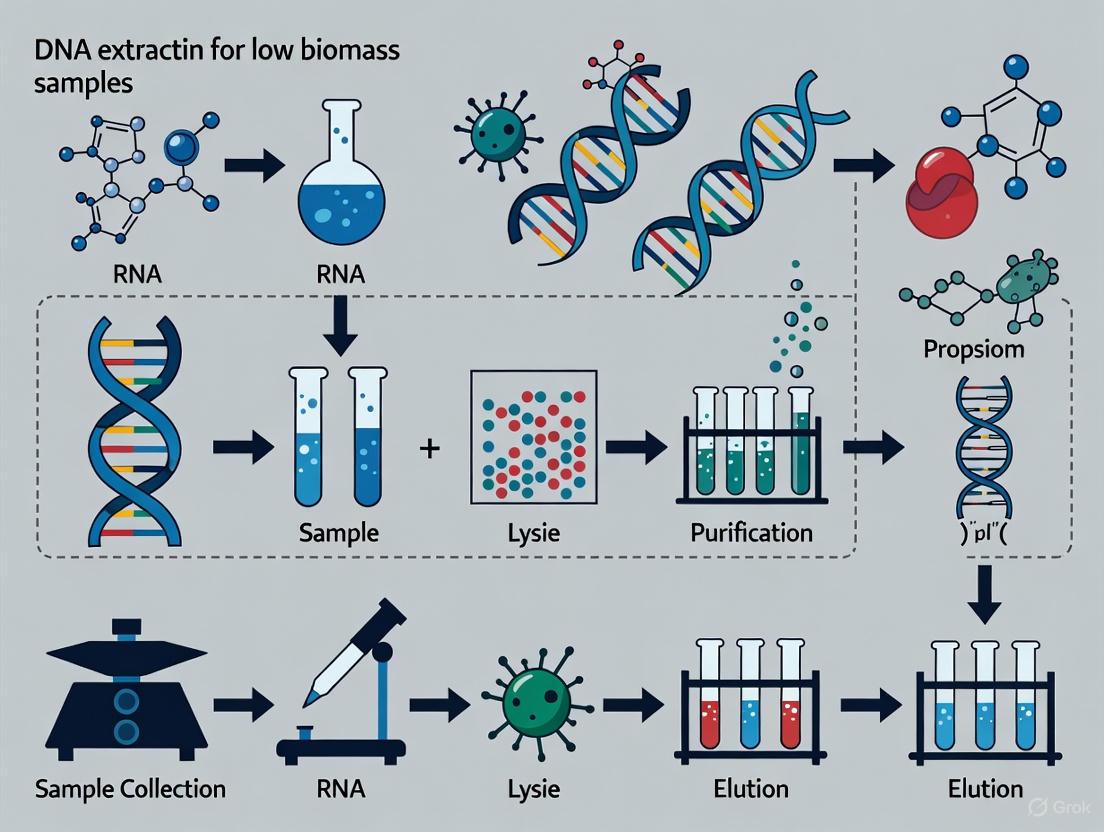
This article provides a comprehensive guide for researchers and drug development professionals tackling the unique challenges of DNA extraction from low-biomass samples.
Optimizing DNA Extraction from Low-Biomass Samples: A Complete Guide for Robust Microbiome and Molecular Analysis
Abstract
This article provides a comprehensive guide for researchers and drug development professionals tackling the unique challenges of DNA extraction from low-biomass samples. Covering foundational principles to advanced applications, we detail why standard protocols fail in low-biomass contexts and how contamination can compromise results. We evaluate precipitation-based, mechanical lysis, and novel agar-coprecipitation methods proven to enhance DNA yield and purity. A dedicated troubleshooting section addresses common pitfalls like degradation and contamination, while validation frameworks and comparative methodology analyses offer strategies for ensuring data reliability. This resource synthesizes the latest research and consensus guidelines to empower robust, reproducible molecular analyses in challenging sample types such as nasal fluid, skin, and tissue biopsies.
Why Low-Biomass DNA Extraction Fails: Core Challenges and Contamination Risks
The investigation of low-microbial-biomass environments represents a frontier in microbiome science, presenting both extraordinary opportunities and formidable methodological challenges. These environments, characterized by extremely low numbers of microbial cells, span diverse ecosystems including human tissues (respiratory tract, placenta, blood), built environments (drinking water systems, cleanrooms), and extreme natural environments (deep subsurface, hyper-arid soils, atmosphere) [1]. The defining feature of low-biomass samples is that they approach the limits of detection for standard DNA-based sequencing approaches, making them particularly vulnerable to contamination from external DNA sources that can severely skew results and lead to erroneous biological conclusions [1] [2].
The fundamental challenge in low-biomass research lies in the proportional nature of sequence-based datasets. When the target DNA "signal" from the actual sample is minimal, even small amounts of contaminating DNA "noise" from reagents, sampling equipment, or the laboratory environment can dominate the sequencing results and generate spurious findings [1]. This problem has fueled several scientific controversies, most notably in studies of the placental microbiome, where initial findings of resident microbes were later attributed to contamination [2]. Similar debates have emerged regarding microbial communities in human blood, tumors, and the deep subsurface [1]. These challenges highlight the critical importance of optimized, contamination-aware protocols for DNA extraction and processing specifically designed for low-biomass samples.
Defining the Low-Biomass Spectrum Across Ecosystems
Quantitative and Qualitative Characteristics
While some researchers have classified "low-biomass" quantitatively (e.g., <10,000 microbial cells/mL), it is more informative to consider biomass as a continuum, with certain methodological challenges having a stronger effect the fewer microbes are present in the ecosystem [2]. The defining characteristic is that the microbial DNA yield approaches the detection limits of standard molecular methods, making contaminating DNA disproportionately influential in downstream analyses.
Low-biomass environments share several key characteristics that complicate their analysis:
- Approach detection limits of standard DNA-based methods [1]
- High susceptibility to contamination from external DNA sources [1] [3]
- Proportional distortion where contaminants can comprise most sequenced DNA [1]
- Require specialized methods for collection, processing, and analysis [1] [4]
Diversity of Low-Biomass Environments
Table 1: Classification of Low-Biomass Environments with Example Systems
| Category | Example Environments | Key Characteristics |
|---|---|---|
| Human Tissues | Respiratory tract [5] [4], placenta [1] [2], blood [1] [2], fetal tissues [1], certain tumors [2] | High host DNA content; historically considered sterile; medical diagnostic importance |
| Natural Environments | Atmosphere [1], hyper-arid soils [1], deep subsurface [1] [2], snow and ice cores [1], hypersaline brines [1] | Extreme physicochemical conditions; geographically isolated; ecosystem function questions |
| Engineered Systems | Chlorinated drinking water [6], reverse osmosis-treated water [6], cleanrooms [1] | Treatment processes limit microbial growth; public health relevance; monitoring challenges |
| Research-Specific | Ancient samples [1], carbonate rocks [7] | Poor DNA preservation; extraction inhibitors present; specialized extraction requirements |
The respiratory tract exemplifies the challenges of human-associated low-biomass environments. Unlike the gut microbiota, respiratory tract microbial communities exist at much lower densities, making them particularly difficult to characterize accurately [5] [8]. These communities have been shown to impact human respiratory health through microbiota-host interactions, including protection against pathogens and immune system modulation [5] [8]. However, the lack of fast, cost-effective, and reliable nucleic acid extraction methods specifically optimized for these low-biomass samples has hindered progress in understanding their role in health and disease [5].
Methodological Framework for Low-Biomass Research
DNA Extraction Challenges and Optimization Strategies
DNA extraction from low-biomass samples presents unique challenges that require specialized approaches beyond those used for high-biomass samples like fecal material. The DNA extraction methodology has been identified as the largest source of experimental variability in microbiome studies, with this effect being magnified in low-biomass contexts [3].
Key considerations for DNA extraction from low-biomass samples include:
Lysis Efficiency: Mechanical lysis methods such as bead beating are often necessary for robust cell disruption but must be balanced against potential DNA shearing [8]. The HMP and MetaHIT protocols demonstrated different efficiencies for various bacterial taxa, highlighting how lysis method choice can bias community representation [3].
Inhibition Management: Calcium-rich samples like carbonate rocks may require specialized purification to remove PCR inhibitors [7]. Dialysis and the use of carrier molecules have shown effectiveness in improving DNA recovery from inhibitory matrices [7].
Yield Enhancement: For extremely low-biomass water samples, increasing sampling volume alone may be insufficient. Alternative concentration methods and the use of carrier molecules during extraction can improve yields [6]. Synthetic DNA carriers like poly-dIdC have been successfully used to increase recovery of minute DNA quantities from calcium-rich geologic samples [7].
Automation Potential: Automated extraction systems can improve reproducibility and reduce contamination. The NAxtra magnetic nanoparticle-based extraction protocol can be completed within 14 minutes for up to 96 samples on robotic systems, providing both speed and consistency [5].
Quantitative Comparison of DNA Yields Across Sample Types
Table 2: DNA Yield Comparisons Across Respiratory Sample Types Using NAxtra Protocol
| Sample Type | DNA Yield Range (ng/μL) | Biomass Classification | Notes |
|---|---|---|---|
| Saliva | 0.242 - 17.8 | Moderate to High Biomass | Higher microbial density; more consistent yields |
| Nasopharyngeal Aspirates | 0.286 - 12.8 | Low to Moderate Biomass | Variable yield; potentially higher human DNA content |
| Nasal Swabs | 0.058 - 4.44 | Low Biomass | Most challenging; lowest and most variable yields |
The substantial variability in DNA yields, particularly for nasal swabs, underscores the challenging nature of these sample types and the need for optimized extraction methods [5]. For comparison, chlorinated reverse osmosis drinking water typically contains only 10²-10³ cells/mL, requiring specialized concentration and extraction methods to generate sufficient DNA for sequencing [6].
Filter Membrane Optimization for Low-Biomass Liquid Samples
For liquid low-biomass samples like drinking water, filter membrane selection critically impacts DNA recovery efficiency. Research has demonstrated that membrane material and pore size significantly influence DNA yield, with polycarbonate membranes (0.2 μm) outperforming other materials in terms of both DNA quantity and quality [6]. Counterintuitively, smaller pore sizes alone did not consistently increase DNA yields, highlighting the importance of material properties in addition to physical filtration characteristics [6].
Comprehensive Experimental Protocol for Low-Biomass Respiratory Samples
Sample Collection and Storage
Proper sample collection is the first critical step in ensuring reliable low-biomass analysis. Recommended procedures include:
- Use DNA-free collection materials: Swabs and collection vessels should be pre-treated by autoclaving or UV-C light sterilization and remain sealed until use [1].
- Personal protective equipment (PPE): Operators should wear gloves, masks, and clean suits to minimize contamination from human sources [1].
- Immediate preservation: Samples should be frozen at -80°C or placed in appropriate preservation solutions like liquid Amies medium or DNA/RNA shield to prevent microbial community shifts [8].
- Environmental controls: Collect swabs of air, gloves, collection tubes, and other potential contamination sources to identify external DNA sources [1] [2].
DNA Extraction Using the NAxtra Protocol for Low-Biomass Samples
The NAxtra nucleic acid extraction protocol has shown promise for low-biomass respiratory samples, offering speed, cost-effectiveness, and compatibility with automation [5].
Materials Required:
- NAxtra nucleic acid extraction kit (Lybe Scientific)
- Tecan Fluent Automated Workstation or similar liquid handling system
- Qubit dsDNA HS Assay Kit (Life Technologies)
- Mechanical bead beater (e.g., Mini-Beadbeater-24)
- Zirconium beads (0.1 mm diameter)
- Phenol and binding buffers
- Magnetic separation rack
Procedure:
- Sample Preparation: Thaw samples on ice and vortex for 10 seconds. For swab samples, immerse in appropriate buffer and vigorously mix.
- Lysis: Add 600 μL of lysis buffer with zirconium beads and 550 μL phenol to each sample. Mechanically disrupt samples twice for 2 minutes at 3500 oscillations/minute, transferring to ice for 2 minutes between bead-beating steps [8].
- Phase Separation: Centrifuge tubes for 10 minutes at 4500 × g and transfer the clear aqueous phase to a new tube containing binding buffer and magnetic beads.
- Binding and Washing: Shake for 30 minutes to allow DNA binding to magnetic beads. Place in magnetic separation rack, discard supernatant, and wash beads with wash buffers.
- Elution: Air-dry beads for 15 minutes at 55°C and elute DNA in 35-80 μL elution buffer by shaking for 15 minutes at 55°C [5] [8].
- Quantification: Measure DNA concentration using fluorometric methods (e.g., Qubit dsDNA HS Assay) due to superior sensitivity for low-concentration samples compared to spectrophotometry.
Library Preparation and Sequencing for Low-Biomass Samples
16S rRNA Gene Amplification:
- Target the V4 region using 515F/806R primers or V3-V4 region using appropriate primers [5] [8]
- Perform PCR with 30 cycles for low-biomass samples [8]
- Use 2-step PCR procedure with 25 cycles for first PCR and 8 cycles for second PCR when necessary [5]
- Include positive controls (ZymoBIOMICS Microbial Community DNA Standard) and negative controls (water) in each PCR batch [5] [8]
Library Purification and Sequencing:
- Purify amplicon pools by two consecutive AMPure XP clean-up steps [8]
- Quantify libraries using sensitive fluorometric methods (e.g., Quant-iT PicoGreen)
- Pool libraries in equimolar ratios and sequence on Illumina MiSeq platform with V3 reagents [8]
- Include 20% PhiX control library to improve base calling for low-diversity samples [5]
Contamination Control and Quality Assurance
Essential Controls for Low-Biomass Studies
The implementation of comprehensive controls is non-negotiable in low-biomass research. Multiple types of controls should be included throughout the experimental workflow:
- Negative Controls: Extraction blanks (lysis buffer only), no-template PCR controls, and collection kit blanks to identify reagent and laboratory contamination [8] [3].
- Positive Controls: Mock microbial communities (e.g., ZymoBIOMICS standards) with known composition to evaluate extraction efficiency and bioinformatic performance [8].
- Environmental Controls: Swabs of collection environments, operator gloves, and air samples to characterize potential contamination sources [1].
- Process Controls: Samples representing all potential contamination sources processed alongside experimental samples [2].
Research Reagent Solutions for Low-Biomass Studies
Table 3: Essential Research Reagents and Their Applications in Low-Biomass Research
| Reagent/Kit | Application | Function | Considerations |
|---|---|---|---|
| NAxtra Nucleic Acid Extraction Kit | DNA/RNA extraction from low-biomass samples | Magnetic nanoparticle-based nucleic acid purification | Fast (14 min for 96 samples); automatable; cost-effective [5] |
| ZymoBIOMICS Microbial Community Standards | Positive process control | Defined microbial community for evaluating extraction and sequencing bias | Available in different complexities; provides ground truth for method validation [8] |
| Poly-dIdC Synthetic DNA | Carrier for low-yield extractions | Improves DNA recovery by acting as blocking agent and carrier molecule | Particularly useful for mineral-rich samples like rocks [7] |
| DNA/RNA Shield | Sample preservation | Stabilizes nucleic acids during sample storage and transport | Prevents microbial community shifts between collection and processing [8] |
| AMPure XP Beads | PCR purification | Size-selective purification of amplicons prior to sequencing | Two consecutive cleanups recommended for low-biomass samples [8] |
Analytical Workflow and Bioinformatics
Low-Biomass Analysis Workflow: This diagram outlines the comprehensive multi-stage process for reliable low-biomass microbiome analysis, highlighting critical steps for contamination control at each stage.
Bioinformatics Considerations for Low-Biomass Data
Bioinformatic processing of low-biomass sequencing data requires specialized approaches to distinguish true signal from contamination:
- Quality Control and Denoising: Use DADA2 for inferring amplicon sequence variants (ASVs) with strict quality filtering parameters [5].
- Contaminant Identification: Employ tools like Decontam or manual curation based on negative controls to identify and remove contaminant sequences [5] [2].
- Taxonomic Classification: Use SILVA database with sklearn classifier for consistent taxonomic assignment [5].
- Diversity Analysis: Calculate both alpha (observed ASVs, Shannon index) and beta diversity (Bray-Curtis distances) metrics, with appropriate statistical tests (Kruskal-Wallis, PERMANOVA) [5].
The reliable characterization of low-biomass microbial communities requires integrated methodological approaches that address the unique challenges these samples present. From sample collection through data analysis, each step must be optimized to minimize contamination and maximize authentic signal recovery. The NAxtra extraction protocol, combined with comprehensive controls and careful bioinformatic processing, represents a promising approach for respiratory and other low-biomass samples [5].
Future methodological developments should focus on:
- Standardized reference materials specifically designed for low-biomass studies [3]
- Improved computational methods for distinguishing contamination from true signal, particularly when well-to-well leakage occurs [2]
- Integration of cultivation and microscopy to provide "proof-of-life" validation of sequencing results [3]
- Multi-omics approaches that combine DNA, RNA, and protein analyses to confirm metabolic activity in low-biomass environments
As methodological rigor improves, so too will our understanding of the authentic microbial communities that inhabit low-biomass environments and their roles in human health, ecosystem function, and biotechnological applications.
The characterization of microbial communities using metagenomic next-generation sequencing (mNGS) has revolutionized fields from clinical diagnostics to environmental science. However, this powerful tool is critically vulnerable to a pervasive challenge: contamination from exogenous DNA. This issue is disproportionately detrimental in low microbial biomass samples, where the target DNA signal can be easily overwhelmed by contaminant "noise" [1]. In such samples, which include human blood, lung tissue, the upper respiratory tract, and certain environmental niches, the inevitability of contamination from laboratory reagents, kits, and the environment becomes a fundamental constraint that can compromise experimental integrity and lead to erroneous conclusions [9] [1] [10].
The core of the problem lies in the proportional nature of sequence-based datasets. Whereas contaminating DNA may be a negligible component in high-biomass samples like stool, it can constitute the majority of sequenced material in low-biomass contexts, potentially leading to false-positive pathogen detection, distorted ecological patterns, and inaccurate claims about the presence of microbes in purportedly sterile environments [1]. This Application Note delineates the sources and impacts of this contamination crisis and provides detailed, actionable protocols to safeguard genomic studies of low-biomass samples.
Contaminants in mNGS workflows are categorized as either external or internal. External contaminants originate from outside the sample and include DNA from laboratory reagents, extraction kits, molecular biology-grade water, collection tubes, laboratory surfaces and air, as well as investigators' skin and clothing [9] [1]. Reagents and DNA extraction kits are particularly significant sources, each possessing a unique "kitome"—a background microbiota profile that varies not only between commercial brands but also between different manufacturing lots of the same brand [9]. Internal contamination includes sample mix-up, well-to-well cross-contamination during liquid handling, index hopping in multiplexed sequencing runs, and erroneous bioinformatic read classification [9].
Quantitative Profiling of Reagent-Derived Contaminants
A recent systematic investigation into background microbiota profiles across four commercial DNA extraction reagent brands (denoted M, Q, R, and Z) revealed distinct contamination patterns between brands. Alarmingly, some kits contained background DNA from common pathogenic species, which could severely affect clinical interpretation [9]. Furthermore, the study highlighted significant lot-to-lot variability within the same brand, underscoring the necessity for lot-specific microbiota profiling rather than relying on generic brand-level contamination data [9].
Table 1: Quantitative Analysis of Contaminants Identified in Negative Control Samples
| Sample Type / Control | Total Bacterial Reads in Control | Predominant Bacterial Phyla (Relative Abundance) | Predominant Bacterial Families (Relative Abundance) | Key Findings |
|---|---|---|---|---|
| Negative Controls (DNA Extraction Reagents) [9] | N/A | Profiles distinct to brand & manufacturing lot | Some contained common pathogenic species | Lot-to-lift variability is significant; manufacturer-provided contamination data is essential |
| Negative Controls (Lung Tissue Study) [10] | 5,689 ± 3,268 (mean ± SD) | Proteobacteria (75.3%), Firmicutes (12.9%), Actinobacteria (7.6%) | Pseudomonadaceae (38.5%), Rhizobiaceae (24.2%), Streptococcaceae (8.6%) | 61.7% of reads in actual samples were removed after filtering against controls |
| Negative Controls (Fungal Analysis) [10] | 18,259 ± 5,228 (mean ± SD) | Ascomycota (86.2%), Basidiomycota (9.2%) | Aspergillaceae (53.9%), Nectriaceae (17.1%), Malasseziaceae (9.0%) | 8.7% of reads in actual samples were removed after filtering against controls |
The pervasive nature of contamination is further evidenced by studies of lung tissue, a classic low-biomass environment. Sequencing of negative controls in one study generated a substantial number of reads, identifying 55 bacterial families and 13 fungal families originating solely from reagents and the laboratory environment [10]. While bioinformatic subtraction of these contaminants is possible, this step removed over 60% of bacterial reads from the actual lung tissue samples, dramatically altering the perceived microbial community structure [10].
Essential Protocols for Contamination Control
Robust contamination control requires an integrated strategy spanning experimental design, wet-lab procedures, and bioinformatic analysis. The following protocols outline critical steps for reliable mNGS of low-biomass samples.
Protocol 1: Rigorous Collection and Processing of Negative Controls
Including negative controls is non-negotiable for identifying contaminating sequences and interpreting results from low-biomass samples accurately [9] [1].
- Application: Essential for all mNGS studies, particularly for clinical diagnostics, pathogen tracking, and characterization of low-biomass environments.
- Experimental Design: Process negative controls in parallel with actual samples through the entire workflow, from DNA extraction to sequencing.
- Required Materials: Molecular-grade water (0.1 µm filtered, analyzed for absence of nucleases) or the specific buffer used to suspend the samples [9].
- Procedure:
- Extraction Blanks: Use molecular-grade water as the input for DNA extraction instead of a biological sample [9].
- Sampling Controls: Include swabs exposed to the air in the sampling environment, swabs of personal protective equipment (PPE), or aliquots of sample preservation solution [1].
- Replication: Process negative controls in triplicate to account for variability [9].
- Sequencing and Analysis: Sequence controls in the same run as the actual samples. Use the resulting contaminant profile with bioinformatic tools like Decontam [9] or for manual curation.
Protocol 2: Optimized DNA Extraction with Host Depletion
Samples with high host DNA content, such as nasopharyngeal aspirates or lung tissue, require specialized protocols to enrich for microbial DNA and reduce host background.
- Application: Ideal for respiratory samples, lung tissue, and other host-dominated samples where microbial biomass is low [11] [10].
- Experimental Design: Compare different host depletion and DNA extraction combinations to determine the optimal protocol for a specific sample type.
- Required Materials:
- Procedure (Example: Mol_MasterPure Protocol) [11]:
- Host Cell Lysis: Add 100 µl of MolYsis Buffer to a 100 µl sample. Mix and incubate at room temperature for 15 minutes.
- Centrifugation: Centrifuge at 12,000 × g for 5 minutes to pellet host debris.
- Supernatant Transfer: Transfer the supernatant (containing intact microbial cells) to a new tube.
- Microbial Lysis: Add 1 µl of Proteinase K and 150 µl of MPC Microbial Lysis Buffer from the MasterPure kit. Vortex and incubate at 65°C for 30 minutes.
- DNA Precipitation: Add 300 µl of MPC Protein Precipitation Reagent. Vortex and centrifuge at 12,000 × g for 10 minutes.
- DNA Isolation: Transfer the supernatant to a new tube containing 500 µl of isopropanol. Gently mix and centrifuge to pellet DNA.
- Wash and Resuspend: Wash the pellet with 70% ethanol, air-dry, and resuspend in nuclease-free water.
Table 2: Comparison of Host DNA Depletion and DNA Extraction Methods for Nasopharyngeal Aspirates
| Protocol Name | Host DNA Depletion Kit | DNA Extraction Kit | Key Outcomes / Performance |
|---|---|---|---|
| MasterPure [11] | None | MasterPure Gram Positive | Retrieved expected DNA yield from mock community; high host DNA (99%) without depletion |
| MagMAX [11] | None | MagMAX Microbiome Ultra | Failed to reduce host DNA content satisfactorily |
| Mol_MasterPure [11] | MolYsis Basic5 | MasterPure Gram Positive | Most effective: Varied host DNA reduction (15% to 98%); increased bacterial reads by 7.6 to 1,725.8-fold |
| Mol_MagMax [11] | MolYsis Basic5 | MagMAX Microbiome Ultra | Retrieved too low total DNA yields, preventing analysis |
| PMA_MasterPure [11] | lyPMA | MasterPure Gram Positive | Failed to reduce host DNA content satisfactorily |
Protocol 3: SIFT-Seq for Contamination-Resistant Metagenomic Sequencing
The Sample-Intrinsic microbial DNA Found by Tagging and sequencing (SIFT-seq) method provides a wet-bench and bioinformatic solution to directly identify and remove contaminating DNA introduced after the initial tagging step [12].
- Application: Ultra-sensitive metagenomic sequencing of low-biomass clinical samples like blood plasma and urine, where specificity is critical [12].
- Principle: Sample-intrinsic DNA is tagged directly in the clinical sample via bisulfite conversion of unmethylated cytosines to uracils. Contaminant DNA introduced after tagging lacks this mark and is bioinformatically filtered out [12].
- Required Materials: Freshly collected plasma or urine samples, bisulfite conversion kit, DNA isolation kit, and Illumina sequencing reagents.
- Procedure [12]:
- Sample Tagging: Mix 1-20 mL of plasma or urine with bisulfite salts to achieve a final concentration of 3.1M bisulfite and 0.9M sulfite. Incubate in a thermal cycler (4°C for 2 minutes, 95°C for 2 minutes, 4°C for 2 minutes, 95°C for 2 minutes, 50°C for 1 hour).
- DNA Isolation: Purify DNA using a commercial cell-free DNA isolation kit, following the manufacturer's instructions.
- Library Preparation and Sequencing: Construct sequencing libraries using a kit compatible with bisulfite-converted DNA. Sequence on an Illumina platform.
- Bioinformatic Filtering:
- Remove reads mapping to the host genome.
- Discard sequences containing more than three cytosines or one cytosine-guanine (CG) dinucleotide, as true sample-intrinsic microbial DNA should have undergone C-to-T conversion.
The Scientist's Toolkit: Key Reagents & Materials
Table 3: Essential Research Reagent Solutions for Low-Biomass Studies
| Reagent / Material | Function / Application | Key Considerations |
|---|---|---|
| Molecular-Grade Water [9] | Negative control input for DNA extraction blanks | Must be 0.1 µm filtered and analyzed for absence of nucleases and proteases |
| ZymoBIOMICS Spike-in Controls (I & II) [9] [11] | In-situ positive control for extraction & sequencing efficiency; quantitation standard | Composed of bacterial strains (e.g., I. halotolerans, A. halotolerans) not typically found in human microbiome |
| MasterPure Gram Positive DNA Purification Kit [11] | DNA extraction optimized for robust lysis of Gram-positive bacteria | Effective for retrieving DNA from mock communities; works well post-host depletion |
| MolYsis Basic5 [11] | Host DNA depletion kit; selectively lyses mammalian cells in sample | Critical for enriching microbial DNA in high-host content samples like nasopharyngeal aspirates |
| Decontam (Bioconductor) [9] | Bioinformatics tool for identifying contaminant sequences in mNGS data | Uses statistical classification (e.g., higher frequency in low-concentration samples & negative controls) |
| Chelex-100 Resin [13] | Rapid, cost-effective DNA extraction via chelating agent and boiling | Ideal for high-throughput screening from dried blood spots (DBS); yields higher DNA than column methods |
| DNA Decontamination Solutions (e.g., XNA Spray) [14] | Remove nucleic acids, nucleases, and enzymes from laboratory surfaces | Essential for preventing cross-contamination and sample degradation; superior to ethanol alone |
Workflow Visualization: Managing Contamination
The following diagram illustrates the integrated workflow for contamination control, combining the protocols and strategies outlined in this document.
The contamination crisis in low-biomass microbiome research is a formidable but manageable challenge. Success hinges on a foundational shift in experimental approach: moving from a mindset of contamination elimination to one of contamination management. This requires acknowledging that contaminants are ubiquitous and proactively designing studies to identify and account for them at every stage.
As detailed in this Application Note, a robust strategy integrates several pillars: meticulous pre-laboratory planning, the consistent use of various negative controls, optimized wet-lab protocols for DNA extraction and host depletion, innovative methods like SIFT-seq for contamination-resistant sequencing, and rigorous bioinformatic cleaning. Furthermore, transparent reporting of all contamination control measures and reagent lot numbers is essential for reproducibility and peer evaluation [1]. By adopting these comprehensive practices, researchers can enhance the reliability and interpretability of their mNGS data, turning the contamination crisis from a debilitating problem into a controlled variable and thereby unlocking the true potential of metagenomics in low-biomass environments.
In the field of microbiome research, investigations into low-biomass environments—those with minimal microbial content—present unique methodological challenges that can compromise data integrity and biological interpretation. These environments include human tissues (tumors, placenta, blood), certain environmental samples (deep subsurface, hyper-arid soils), and processed materials [1] [2]. When studying these systems, the inevitability of contamination from external sources becomes a critical concern as researchers work near the limits of detection for standard DNA-based sequencing approaches [1]. The proportional nature of sequence-based datasets means that even small amounts of contaminating DNA can strongly influence results and their interpretation, potentially leading to false conclusions about the presence and composition of microbial communities [1] [2].
Among the most pervasive challenges in low-biomass research are three critical pitfalls: batch effects, host DNA misclassification, and well-to-well leakage. These technical artifacts have fueled ongoing controversies in the field, perhaps most notably in the debate surrounding the existence of a placental microbiome, where initial findings were later attributed to contamination [2]. Similarly, studies of the blood microbiome and certain tumor microbiomes have faced scrutiny due to these methodological challenges [2] [9]. This application note outlines the theoretical foundations, practical consequences, and methodological solutions for these pitfalls within the context of optimizing DNA extraction methods for low-biomass samples, providing researchers with frameworks to enhance the reliability of their findings.
Understanding the Critical Pitfalls
Batch Effects and Processing Bias
Batch effects represent systematic technical variations introduced when samples are processed in different groups, by different personnel, using different reagent lots, or at different times [2]. In low-biomass research, these effects are particularly problematic because the technical variation can exceed the biological signal of interest. Processing bias further compounds this problem, as different experimental approaches exhibit variable efficiency in lysing and recovering DNA from diverse microbial types [15]. For example, Gram-positive bacteria are notoriously resistant to certain lysis methods, potentially leading to their underrepresentation unless specialized enzymatic mixtures or physical disruption methods like bead-beating are employed [15].
The impact of batch effects is most severe when batch structure is confounded with the experimental groups, a phenomenon known as batch confounding. When this occurs, technical artifacts can create spurious biological signals that lead to incorrect conclusions [2]. For instance, if all case samples are processed in one batch and all controls in another, differences attributed to the condition may actually reflect technical variations in DNA extraction efficiency, reagent contamination, or amplification bias.
Host DNA Misclassification
In host-associated low-biomass samples, the vast majority of sequenced DNA often originates from the host rather than microbes. In tumor microbiome studies, for example, only approximately 0.01% of sequenced reads may be microbial in origin [2]. This imbalance creates challenges for bioinformatic classification, as host DNA sequences can be misclassified as microbial, particularly when reference databases are incomplete or when analytical pipelines lack stringency [2].
This misclassification problem is particularly acute in metagenomic and metatranscriptomic analyses, where the distinction between host and microbial sequences is not always straightforward. The term "host contamination" is somewhat misleading in this context, as host DNA genuinely originates from the sample itself rather than representing external contamination [2]. The core issue is not the presence of host DNA, but rather its misidentification as microbial, which generates noise and can produce artifactual signals if host DNA levels correlate with experimental conditions.
Well-to-Well Leakage (Cross-Contamination)
Well-to-well leakage, sometimes referred to as the "splashome," occurs when genetic material transfers between samples processed in close physical proximity, such as adjacent wells on a 96-well plate [1] [2]. This form of internal contamination can compromise the inferred composition of every sample in a processing batch and poses particular challenges for low-biomass studies where the contaminating signal may rival or exceed the true biological signal [2].
The mechanics of well-to-well leakage often involve aerosol formation during liquid handling, spillage between wells, or cross-contamination during robotic processing. Recent research has demonstrated that well-to-well leakage into contamination controls can violate the fundamental assumptions of most state-of-the-art computational decontamination methods, making prevention at the experimental stage particularly critical [2]. The impact of this phenomenon is proportional to the biomass differential between adjacent samples, with low-biomass samples being most vulnerable to contamination from higher-biomass neighbors.
Methodological Approaches and Experimental Design
DNA Extraction Considerations for Low-Biomass Samples
The selection and optimization of DNA extraction methods represent a critical first step in minimizing the three target pitfalls. DNA extraction efficiency varies significantly across different methodologies, with each approach introducing specific biases that can affect downstream analyses [15]. Mechanical bead-beating methodologies generally provide less biased representation of diverse microbial communities by ensuring efficient lysis of difficult-to-disrupt cells like Gram-positive bacteria [15]. However, these physical methods may increase DNA fragmentation, potentially exacerbating host DNA misclassification by creating more fragments that are difficult to classify bioinformatically.
Table 1: Comparison of DNA Extraction Method Biases for Low-Biomass Samples
| Extraction Method | Gram-Negative Bias | Gram-Positive Bias | DNA Fragmentation | Inhibitor Removal | Recommended Applications |
|---|---|---|---|---|---|
| Enzymatic Lysis Only | High | Extreme | Low | Variable | High-biomass samples, pure cultures |
| Bead-Beating (Standard) | Moderate | Moderate | High | Good | Mixed communities, environmental samples |
| Modified CTAB | Low | Low | Moderate | Excellent | Plant-associated, high-polyphenol samples |
| Silica Column-Based | Moderate | High | Low | Excellent | Clinical samples, high-throughput |
| Magnetic Bead-Based | Moderate | Moderate | Low | Excellent | Automated workflows, clinical diagnostics |
The background microbiota present in DNA extraction reagents themselves—termed the "kitome"—represents another significant source of batch effects [9]. Different commercial DNA extraction kits contain distinct microbial DNA profiles that can vary substantially between manufacturing lots of the same brand [9]. This variability underscores the importance of including extraction controls from the same reagent lots used for sample processing and the need for manufacturers to provide comprehensive background microbiota data for each reagent lot.
Experimental Design Strategies
Robust experimental design represents the most effective approach for mitigating the three target pitfalls in low-biomass research. Several key strategies should be incorporated during study planning:
- Avoid Batch Confounding: Ensure that experimental groups are distributed evenly across processing batches rather than being processed in separate batches. If complete deconfounding is impossible, explicitly assess result generalizability across batches [2].
- Incorporate Comprehensive Controls: Include multiple types of controls throughout the experimental workflow. These should include field blanks, extraction blanks, library preparation controls, and positive controls with known microbial compositions [2].
- Minimize Well-to-Well Leakage: Strategically arrange samples across processing plates to separate low-biomass samples from high-biomass samples. Include blank controls interspersed throughout the plate to monitor spatial patterns of contamination [2].
- Standardize Sample Input: While challenging for low-biomass samples, standardizing input material (where possible) reduces variation in host-to-microbial DNA ratios, minimizing batch effects related to differential extraction efficiency.
Table 2: Essential Controls for Low-Biomass Microbiome Studies
| Control Type | Purpose | Implementation | Frequency |
|---|---|---|---|
| Field/Collection Blanks | Identify contamination from sampling environment | Expose to sampling environment without collecting actual sample | Per sampling batch/site |
| Extraction Blanks | Detect reagent-derived contamination | Process molecular-grade water through extraction | Every extraction batch |
| Positive Controls | Monitor technical variability in processing | Use defined microbial communities (e.g., ZymoBIOMICS) | Every processing batch |
| Well-to-Well Controls | Assess cross-contamination between samples | Place blank controls adjacent to high-biomass samples | Strategically throughout plates |
| Host DNA Controls | Evaluate host depletion efficiency | Process host-only samples alongside test samples | When using depletion methods |
Laboratory Protocols for Contamination Mitigation
The following protocols outline specific procedures for minimizing contamination during sample processing:
Protocol 1: DNA Extraction from Low-Biomass Samples with Contamination Control
This protocol is adapted from established methodologies for low-biomass samples [1] [15] [9].
Pre-extraction Setup:
- Decontaminate work surfaces and equipment with 80% ethanol followed by DNA removal solution (e.g., 0.5-1% sodium hypochlorite or commercial DNA removal solutions).
- UV-irradiate consumables (tips, tubes) for at least 30 minutes before use.
- Prepare all solutions using molecular-grade, DNA-free water.
Sample Lysis:
- For heterogeneous samples (e.g., tissue, soil), use mechanical bead-beating with a combination of different bead sizes (e.g., 0.1mm, 0.5mm, and 1mm) to ensure comprehensive cell disruption.
- Include enzymatic lysis with lysozyme and mutanolysin for Gram-positive bacteria, followed by proteinase K treatment for comprehensive digestion.
- For sensitive samples, consider using a specialized enzymatic mixture such as MetaPolyzyme for enhanced lysis efficiency.
DNA Purification:
- Use silica-based membrane columns or magnetic beads optimized for recovery of small DNA fragments.
- Include inhibitor removal steps specific to sample type (e.g., polyvinylpolypyrrolidone for plant-derived polyphenols).
- Elute in molecular-grade water or low-EDTA TE buffer to maintain compatibility with downstream applications.
Quality Assessment:
- Quantify DNA using fluorometric methods (e.g., Qubit) rather than spectrophotometry for improved accuracy with low-concentration samples.
- Assess DNA fragment size distribution using microfluidic electrophoresis (e.g., Bioanalyzer, TapeStation).
- Include spike-in controls (e.g., synthetic DNA sequences not found in nature) to quantify recovery efficiency and potential inhibition.
Protocol 2: Library Preparation with Host DNA Depletion
This protocol minimizes host DNA misclassification while maintaining microbial sequence representation.
Host DNA Depletion:
- For samples with high host content, use probe-based hybridization methods (e.g., NEBNext Microbiome DNA Enrichment Kit) to selectively deplete host mitochondrial and ribosomal DNA.
- Alternatively, employ enzymatic degradation of methylated host DNA while preserving microbial DNA.
- Include undepleted controls to assess depletion efficiency and potential loss of microbial signals.
Library Construction:
- Use library preparation kits specifically designed for degraded or low-input DNA.
- Incorporate unique dual indices to minimize index hopping and enable accurate sample multiplexing.
- Limit PCR amplification cycles to reduce amplification bias, particularly for 16S rRNA gene sequencing.
Quality Control:
- Assess library complexity using qPCR-based methods (e.g., Kapa Library Quantification).
- Verify fragment size distribution using microfluidic electrophoresis.
- Sequence a test library to confirm host depletion efficiency and microbial representation before proceeding to full-scale sequencing.
Computational and Bioinformatic Solutions
Decontamination Tools and Implementation
Following laboratory processing, bioinformatic decontamination represents a crucial step for identifying and removing contaminating sequences. Multiple computational tools have been developed specifically for this purpose, each with different strengths and limitations.
Table 3: Bioinformatics Tools for Decontaminating Low-Biomass Microbiome Data
| Tool | Methodology | Input Requirements | Strengths | Limitations |
|---|---|---|---|---|
| Decontam | Statistical classification based on prevalence and/or frequency | Sample metadata indicating negative controls and/or DNA concentration | User-friendly, integrates with phyloseq | Removes entire features rather than subtracting contamination |
| SCRuB | Source-tracking model that estimates and subtracts contamination | Negative controls, well locations optional | Accounts for cross-contamination, partial subtraction | Requires spatial information for optimal performance |
| micRoclean | R package with multiple pipelines (SCRuB integration) | Count matrix, metadata with control information | Flexible pipelines for different research goals | Limited to 16S rRNA data in current implementation |
| MicrobIEM | Control-based decontamination with interactive interface | Negative controls, sample types | User-friendly interface, visualizations | Web-based with potential data transfer concerns |
| SourceTracker | Bayesian approach to estimate contamination sources | Negative controls from potential sources | Estimates proportion from contamination sources | Computationally intensive for large datasets |
The micRoclean R package provides two distinct decontamination pipelines tailored to different research objectives [16]. The "Original Composition Estimation" pipeline implements the SCRuB method and is ideal for studies aiming to characterize samples' original compositions as closely as possible [16]. The "Biomarker Identification" pipeline employs a more stringent decontamination approach to remove all likely contaminant features, minimizing the risk that downstream analyses are impacted by contamination [16]. This package additionally implements a filtering loss statistic to quantify the impact of decontamination on the overall covariance structure of the data, helping researchers avoid over-filtering [16].
Host DNA Classification and Verification
Robust bioinformatic classification is essential for minimizing host DNA misclassification. The following approaches enhance classification accuracy:
Multi-Database Classification: Use multiple reference databases (e.g., RefSeq, GenBank, specialized databases for understudied taxa) to improve classification sensitivity and specificity.
Validation with Negative Controls: Compare putative microbial signals in samples against those present in negative controls to identify likely contaminants.
Consensus Approaches: Apply multiple classification algorithms (e.g., k-mer-based, alignment-based) and require consensus for confident taxonomic assignment.
Fragment Length Analysis: Examine the fragment size distribution of putative microbial reads, as true microbial DNA often exhibits different fragmentation patterns than host DNA or contaminants.
The Scientist's Toolkit: Essential Research Reagents and Materials
Table 4: Research Reagent Solutions for Low-Biomass DNA Studies
| Reagent/Material | Function | Key Considerations | Example Products |
|---|---|---|---|
| DNA/RNA Decontamination Solution | Remove contaminating nucleic acids from surfaces and equipment | Must degrade both DNA and RNA; check material compatibility | DNA-ExitusPlus, DNA-Zap, 0.5-1% sodium hypochlorite |
| Molecular Grade Water | Preparation of solutions and dilutions | Certifications for nuclease-free and microbial DNA-free status | Sigma-Aldrich Molecular Biology Grade Water, Thermo Fisher UltraPure DNase/RNase-Free Water |
| DNA Extraction Kit (Low-Biomass Optimized) | Isolation of microbial DNA from limited starting material | Efficiency for Gram-positive bacteria; minimal reagent contamination | ZymoBIOMICS DNA Miniprep Kit, QIAamp DNA Microbiome Kit |
| Positive Control Standards | Monitoring extraction efficiency and technical variation | Should include Gram-positive and Gram-negative species | ZymoBIOMICS Microbial Community Standard, mock communities |
| Human DNA Depletion Reagents | Selective reduction of host DNA in host-associated samples | Depletion efficiency; potential loss of microbial taxa | NEBNext Microbiome DNA Enrichment Kit, NuGen Complete Microbial DNA Depletion |
| Indexed Adapter Kits | Library preparation with unique dual indexes | Minimize index hopping in multiplexed sequencing | Illumina Nextera XT, IDT for Illumina UDJs |
| Library Quantification Kits | Accurate quantification of sequencing libraries | Sensitivity for low-concentration libraries; discrimination of adapter-dimers | Kapa Biosystems Library Quantification Kit, Qubit dsDNA HS Assay |
Workflow Visualization
Figure 1: Critical Pitfalls and Mitigation Strategies in Low-Biomass Workflows. This diagram illustrates how batch effects, host DNA misclassification, and well-to-well leakage can impact various stages of the low-biomass research workflow, along with corresponding mitigation strategies.
The critical pitfalls of batch effects, host DNA misclassification, and well-to-well leakage present significant challenges for low-biomass microbiome research, but systematic approaches can effectively mitigate these issues. Through careful experimental design that avoids batch confounding, comprehensive control strategies, optimized DNA extraction methods, and robust bioinformatic decontamination, researchers can enhance the reliability of their findings in these challenging systems. The protocols and frameworks presented in this application note provide actionable guidance for maintaining data integrity throughout the research workflow, from sample collection through computational analysis. As methodological standards continue to evolve in this rapidly advancing field, adherence to these principles will help ensure that low-biomass microbiome research produces robust, reproducible, and biologically meaningful results.
The Impact of Processing Bias and Low Microbial DNA Signal on Data Integrity
In low-biomass microbiome research, where microbial cells are sparse relative to host or environmental DNA, the integrity of data is exceptionally vulnerable to technical artifacts. Processing biases introduced during DNA extraction and subsequent sequencing steps can significantly distort the observed microbial community, leading to erroneous biological conclusions [17] [2]. Such biases are a primary contributor to controversies in the field, such as conflicting reports regarding the microbiota of tumors, lungs, and placenta [2]. The core challenge lies in the fact that the technical noise introduced can overwhelm the faint biological signal, making the robust characterization of these ecosystems methodologically demanding [18]. This application note details the primary sources of processing bias, provides quantitative comparisons of methodological performance, and outlines standardized protocols designed to safeguard data integrity in studies of low-microbial-biomass samples.
Understanding Processing Biases in Low-Biomass Research
Processing bias refers to the variable efficiency of different experimental and analytical steps in detecting different microbes [2]. In low-biomass contexts, these biases are exacerbated and can lead to severe misinterpretations.
- External Contamination: DNA from reagents, kits, and laboratory environments can constitute a large proportion of the sequenced material in low-biomass samples. If this contamination is confounded with a study phenotype, it can generate artifactual signals [2]. For instance, the purported placental microbiome was later revealed to be largely driven by contamination [2].
- Host DNA Misclassification: In metagenomic studies of host-associated low-biomass sites (e.g., tumors or blood), the vast majority of sequenced reads can be host-derived. If not properly accounted for, these sequences can be misclassified as microbial, creating noise or false associations [2].
- Well-to-Well Leakage: Also termed "cross-contamination" or the "splashome," this occurs when DNA from one sample, often a high-biomass one, contaminates adjacent wells on a processing plate. This can compromise the inferred composition of all samples and violates the assumptions of many computational decontamination methods [2].
- DNA Extraction Bias: The method of DNA extraction is a major source of bias, impacting DNA yield, quality, and the lysis efficiency of different bacterial taxa. Gram-positive bacteria, with their thick peptidoglycan cell walls, are particularly susceptible to under-representation without rigorous mechanical lysis [19] [20].
The Impact of Confounded Batch Effects
A critical risk arises when technical batch effects are confounded with the biological groups under study. Figure 1 illustrates how a confounded study design can generate entirely artifactual "associations" between microbes and a phenotype.
Figure 1: How a confounded study design leads to artifactual findings. Processing all samples from one group (e.g., Cases) in a single batch and all samples from another group (e.g., Controls) in a separate batch links distinct technical bias profiles to the phenotype, creating false positives.
Quantitative Comparison of DNA Extraction Method Performance
The choice of DNA extraction method profoundly impacts DNA yield, quality, and the faithful recovery of microbial community structure. The following tables summarize key performance metrics from recent comparative studies.
Table 1: Performance of DNA Extraction Kits in Human Gut Microbiome Analysis [19]
| Extraction Protocol | DNA Yield (ng/µl) | DNA Purity (A260/280) | Alpha-Diversity (Observed ASVs) | % Samples >5 ng/µl |
|---|---|---|---|---|
| S-DQ (SPD + DNeasy PowerLyzer PowerSoil) | High | ~1.8 (Optimal) | High | 81% |
| S-QQ (SPD + QIAamp Fast DNA Stool) | Medium | ~2.0 (Suggests RNA) | Medium | 82% |
| S-Z (SPD + ZymoBIOMICS DNA Mini) | Medium | <1.8 | Medium | 88% |
| DQ (DNeasy PowerLyzer PowerSoil) | High | <1.8 | High | - |
| Z (ZymoBIOMICS DNA Mini) | Low | <1.8 | Low | - |
| MN (NucleoSpin Soil) | Low | <1.8 | Low | 86% |
Table 2: DNA Extraction Kit Performance for Low-Biomass Human Milk Samples [18]
| Extraction Kit | Performance in Human Milk (3.5 ml input) | Contamination Level | Suitability for Metagenomics |
|---|---|---|---|
| DNeasy PowerSoil Pro (PS) | Consistent 16S rRNA gene sequencing profiles | Low | Recommended |
| MagMAX Total Nucleic Acid (MX) | Consistent 16S rRNA gene sequencing profiles | Low | Recommended |
| Milk Bacterial DNA Isolation (MD) | Variable results | - | Not optimal |
| QIAamp Fast DNA Stool Mini (FS) | Variable results | - | Not optimal |
Table 3: The Researcher's Toolkit: Essential Reagents and Kits for Low-Biomass DNA Extraction
| Research Reagent Solution | Function / Application | Key Characteristics |
|---|---|---|
| DNeasy PowerSoil Pro Kit (QIAGEN) | DNA isolation from low-biomass, difficult samples [18]. | Effective lysis via bead-beating; inhibitor removal technology. |
| MagMAX Total Nucleic Acid Isolation Kit (Thermo Fisher) | Nucleic acid isolation from diverse sample types [18]. | Suitable for low-biomass human milk; manual or automated protocols. |
| Chelex-100 Resin | Rapid, cost-effective DNA extraction from dried blood spots [21]. | Ionic chelating resin; no purification steps, lower purity but high yield. |
| Stool Preprocessing Device (SPD, bioMérieux) | Standardizes fecal sample handling prior to DNA extraction [19]. | Improves DNA yield, diversity, and Gram-positive bacterial recovery. |
| ZymoBIOMICS Microbial Community Standards | Defined mock communities for protocol validation [18]. | Enables accuracy assessment by comparing observed vs. theoretical composition. |
| PowerBead Tubes (Ceramic/Silica Beads) | Mechanical cell lysis for tough-to-lyse microbes [19] [18]. | Critical for breaking Gram-positive bacterial cell walls. |
Standardized Experimental Protocols
Sample Input: 3.5 ml of human milk.
- Centrifugation: Transfer milk to a conical tube. Centrifuge at 13,000 × g at 4°C for 15 minutes.
- Pellet Collection: Carefully remove and discard the fat layer and supernatant. Resuspend the pellet in 800 µl of Solution CD1.
- Bead-Beating Lysis: Transfer the solution to a PowerBead Pro tube. Vortex briefly. Incubate at 65°C for 10 minutes.
- Homogenize: Bead-beat at 5000 rpm at 4°C for 45 seconds using a homogenizer (e.g., Precellys Evolution).
- Centrifuge: Spin samples at 15,000 × g at 4°C for 1 minute.
- DNA Purification: Transfer 600 µl of the supernatant to a new tube. Complete DNA purification on a Qiacube instrument using the standard "DNeasy PowerSoil Pro Kit with Inhibitor Removal Technology" protocol.
- Elution: Elute DNA in 50 µl of elution buffer. Store at -20°C.
Sample Input: One 6 mm DBS punch.
- Soaking: Place the DBS punch in a microcentrifuge tube. Add 1 mL of Tween20 solution (0.5% in PBS). Incubate overnight at 4°C.
- Washing: Remove the Tween20 solution. Add 1 mL of PBS to the punch. Incubate for 30 minutes at 4°C. Remove PBS.
- Chelex Addition: Add 50 µl of pre-heated 5% (m/v) Chelex-100 solution (56°C) to the punch.
- Vortex and Incubate: Pulse-vortex for 30 seconds. Incubate at 95°C for 15 minutes, with brief pulse-vortexing every 5 minutes.
- Pellet Debris: Centrifuge for 3 minutes at 11,000 rcf.
- Supernatant Collection: Carefully transfer the supernatant to a new tube using a P200 pipette. Repeat the centrifugation and transfer the final supernatant with a P20 pipette for precision.
- Storage: Store the extracted DNA at -20°C.
Strategic Workflow for Mitigating Bias
A comprehensive strategy, integrating experimental design and analytical checks, is required to ensure data integrity. Figure 2 outlines a robust workflow from sample collection to data interpretation.
Figure 2: A strategic workflow for mitigating processing bias in low-biomass microbiome studies, emphasizing unconfounded design, comprehensive controls, and rigorous validation.
The integrity of data generated from low-biomass microbiome studies is inextricably linked to the methodological rigor applied at every stage, from sample collection to data analysis. Processing biases, particularly from DNA extraction and contamination, are not merely nuisances but fundamental challenges that can invalidate biological conclusions. The protocols and comparisons provided here underscore that the adoption of standardized, validated methods—such as the DNeasy PowerSoil Pro kit for low-biomass fluids or optimized Chelex protocols for DBS—coupled with an unconfounded study design and comprehensive process controls, is non-negotiable. By integrating these practices into their workflows, researchers can significantly reduce technical artifacts, thereby ensuring that the signals they report reflect true biology and not methodological vagaries.
Proven DNA Extraction Methodologies for Maximizing Yield and Purity
The characterization of microbial communities in low biomass environments, such as the human respiratory tract, breast tissue, and air samples, presents significant challenges for microbiome research. The limited microbial material in these samples makes the DNA extraction process a critical determinant of downstream analytical success [5] [22]. The extraction method must efficiently lyse the limited number of bacterial cells present, recover the minimal DNA available, and minimize the introduction of contaminants that can disproportionately affect results [23] [22].
Two primary DNA purification chemistries dominate: precipitation-based methods (solution-based) and column-based methods (silica-membrane). The choice between these approaches significantly impacts DNA yield, purity, and the representative nature of the resulting microbial community profile [24] [25]. This application note provides a performance breakdown of these methodologies within the context of low biomass research, supported by experimental data and detailed protocols.
Technical Background: DNA Purification Chemistries
All DNA extraction protocols share five fundamental steps: 1) creation of lysate, 2) clearing of lysate, 3) binding of DNA, 4) washing, and 5) elution [25]. The critical divergence between precipitation and column-based kits occurs at the DNA binding stage.
- Precipitation-Based Chemistry: This solution-based chemistry does not rely on a binding matrix. After lysate creation, cell debris and proteins are precipitated using a high-concentration salt solution. The DNA is then forced out of solution by adding alcohol (e.g., isopropanol), pelleted via centrifugation, washed with ethanol to remove salt, and finally resuspended in an aqueous buffer [25]. Polyethylene Glycol (PEG) can be used to enhance this condensation of DNA [22].
- Column-Based Chemistry: These methods rely on binding DNA to a solid matrix under high-salt conditions. The most common format uses a silica membrane in a spin column. Chaotropic salts in the lysis buffer disrupt cells, inactivate nucleases, and enable DNA to bind to the silica. Contaminants are washed away, and purified DNA is eluted under low-salt conditions [25]. Variations include kits using magnetic silica particles for automated protocols [5].
Performance Comparison in Low Biomass Samples
The performance of extraction chemistries must be evaluated based on their efficiency with low microbial biomass, where challenges of contamination and DNA loss are magnified.
Table 1: Performance Overview of DNA Extraction Methods in Low Biomass Research
| Performance Metric | Precipitation-Based Methods | Silica Column-Based Kits | Magnetic Particle-Based Kits |
|---|---|---|---|
| Reported DNA Yield | Improved recovery from BALF with PEG protocol [22] | Variable; often insufficient for low biomass samples like BALF/sputum [24] [22] | High-yield reported for nasopharyngeal/saliva samples; automated for high-throughput [5] |
| Lysis Efficiency | Can be enhanced with multi-enzyme cocktails (e.g., lysozyme, proteinase K) [22] | Often requires added bead-beating step for comprehensive lysis [24] [22] | Often incorporates mechanical (bead-beating) and chemical lysis [5] [23] |
| Risk of Contaminant Carryover | Moderate | Lower due to wash steps on column [25] | Lower due to wash steps with beads [25] |
| Suitability for Automation | Low | Moderate (96-well plates) | High (magnetic particles for liquid handlers) [5] |
| Hands-on Time | High (multiple tube transfers, centrifugations) | Moderate | Low once automated [5] |
| Cost per Sample | Generally lower | Moderate to High | Moderate to High |
Table 2: Impact on Downstream Microbiome Analysis
| Aspect | Precipitation-Based Methods | Column-Based/Magnetic Kits |
|---|---|---|
| Community Representation | May recover a broader profile by avoiding filter selection [22] | Performance is kit-dependent; some may under-represent tough-to-lyse taxa [24] |
| 16S rRNA Sequencing Success | Distinguishable community profiles from negative controls in BALF [22] | Some kits fail to yield profiles distinct from negative controls in very low biomass BALF [22] |
| Shotgun Metagenomic Sequencing Success | Requires high DNA input, which can be challenging | Requires high DNA input; may need pooling or amplification, risking bias [26] [23] |
Detailed Experimental Protocols
Protocol 1: PEG-Based Precipitation for Bronchoalveolar Lavage Fluid (BALF)
This protocol is optimized for efficient bacterial DNA recovery from low-volume BALF samples [22].
Research Reagent Solutions:
- HyClone PBS (without EDTA): Resuspends the pellet in a neutral, calcium-free buffer.
- Hydrolytic Enzyme Mixture (e.g., MetaPolyzyme): Digests tough bacterial cell wall components (e.g., lysozyme for Gram-positives).
- Proteinase K: An enzyme that denatures proteins and helps inactivate nucleases.
- Sodium Chloride (NaCl) & Polyethylene Glycol (PEG): Work together to create a "condensation" environment that precipitates DNA.
- Absolute Ethanol: Used to wash the DNA pellet and remove residual salts.
Procedure:
- Sample Pre-processing: Centrifuge 1 mL of BALF at 20,000 × g for 30 minutes at 4°C. Discard the supernatant and resuspend the pellet in 100 µL of PBS.
- Enzymatic Lysis: Add the hydrolytic enzyme mixture to the resuspended pellet and incubate at 37°C for 1 hour.
- Proteinase K Digestion: Add Proteinase K and SDS to the lysate. Incubate at 56°C for 1-2 hours.
- DNA Precipitation: Add a mixture of NaCl and PEG to the cleared lysate. Mix thoroughly and incubate at room temperature for 10-30 minutes to allow DNA condensation.
- Pellet DNA: Centrifuge at high speed (e.g., 15,000 × g) for 15-20 minutes to pellet the DNA. Carefully decant the supernatant.
- Wash: Wash the DNA pellet with 70-80% cold ethanol. Centrifuge again, discard the ethanol, and air-dry the pellet briefly.
- Elution: Resuspend the purified DNA in nuclease-free water or TE buffer.
Protocol 2: Magnetic Silica Particle-Based Extraction for Respiratory Samples
This protocol, based on the NAxtra kit, is designed for high-throughput applications using a liquid handling robot [5].
Research Reagent Solutions:
- NAxtra Magnetic Nanoparticles: Silica-coated paramagnetic particles that bind nucleic acids in solution.
- Lysis Buffer (with chaotropic salts): Disrupts cells, inactivates nucleases, and creates conditions for DNA binding to silica.
- Wash Buffers (salt/ethanol solutions): Remove proteins, lipids, and other contaminants from the bound DNA.
- Elution Buffer (low-salt, TE, or water): Disrupts the DNA-silica interaction to release purified DNA.
Procedure:
- Sample Input: Combine 100 µL of sample (e.g., nasopharyngeal aspirate, nasal swab) with lysis buffer and magnetic silica particles in a deep-well plate.
- Automated Binding: The liquid handler mixes the solution to allow DNA to bind to the magnetic particles.
- Washing Steps: A magnet captures the particles while the supernatant is discarded. Wash buffers are added and removed while the magnet retains the particle-bound DNA.
- Elution: The purified DNA is eluted in 80 µL of nuclease-free water. Using a lower elution volume than recommended (e.g., 80 µL vs. 100 µL) increases the final DNA concentration [5].
Integrated Workflow & Decision Pathway
The following diagram summarizes the key decision points and steps involved in selecting and executing a DNA extraction protocol for low biomass samples.
The Scientist's Toolkit: Essential Research Reagents
Table 3: Key Reagents for Low Biomass DNA Extraction
| Reagent / Kit | Function / Principle | Application Context |
|---|---|---|
| Hydrolytic Enzyme Mixture | Digests tough bacterial cell walls (peptidoglycan, chitin) for improved lysis. | Critical for low biomass samples to ensure comprehensive cell disruption [22]. |
| Proteinase K | Broad-spectrum serine protease that degrades proteins and inactivates nucleases. | Standard in many lysis protocols; essential for samples with host cell contamination [24] [26]. |
| NAxtra Magnetic Nanoparticles | Silica-coated paramagnetic particles for DNA binding in solution. | Enables fast, automated, high-throughput extraction (e.g., 96 samples in <15 min) [5]. |
| Beads (Zirconia/Silica) | Used in mechanical lysis (bead-beating) to disrupt tough cell walls by physical force. | Added pre-treatment for column-based kits to improve lysis efficiency [24] [22]. |
| Chaotropic Salts (e.g., Guanidine HCl) | Disrupts cell membranes, inactivates nucleases, and enables DNA binding to silica. | Core component of lysis/binding buffers in silica-based kits [25]. |
| Polyethylene Glycol (PEG) + NaCl | Induces DNA condensation and precipitation from solution without a column. | Core of the solution-based PEG protocol for maximizing DNA recovery [22]. |
The selection between precipitation-based and column-based DNA extraction methods for low biomass samples involves critical trade-offs. Precipitation methods can offer superior DNA recovery from challenging samples like BALF, making them suitable for low-throughput studies where yield is the paramount concern [22]. In contrast, column-based and magnetic particle-based kits provide greater convenience, scalability, and reduced contamination risk, with magnetic particle systems being particularly adept for high-throughput clinical research [5] [25].
The optimal choice is dictated by the specific sample type, available volume, required throughput, and intended downstream analysis. No single method is universally superior; therefore, validation within the specific research context is essential. Future methodological developments will likely continue to hybridize the high-yield potential of precipitation with the convenience and automation of matrix-based binding to further advance the field of low biomass microbiome research.
The Essential Role of Mechanical Lysis in Minimizing Extraction Bias
In low-biomass microbiome research, the accurate profiling of microbial communities is critically dependent on the efficacy of DNA extraction. Mechanical lysis serves as a foundational step in this process, directly influencing DNA yield, integrity, and community representation. Extraction bias, particularly the differential lysis of microbial cells based on their wall structure, remains a significant challenge that can distort microbial composition data and compromise study validity. This application note examines the essential role of optimized mechanical lysis protocols in minimizing these biases, with specific focus on applications in low-biomass environments where technical artifacts can disproportionately impact results. We present quantitative data comparing lysis methodologies, detailed protocols for implementation, and strategic recommendations to enhance reproducibility in sensitive microbiome research.
The Impact of Lysis Efficiency on Microbial Community Representation
Fundamental Principles of Extraction Bias
Mechanical lysis introduces bias primarily through differential efficiency in disrupting diverse microbial cell wall structures. Gram-positive bacteria, with their thick peptidoglycan layers, require more vigorous lysis conditions compared to Gram-negative species [27]. This variability leads to underrepresentation of resistant taxa when lysis is suboptimal. In low-biomass samples, this bias is exacerbated as contaminants and cross-contamination can constitute a substantial proportion of the final sequence data [1] [28]. The 2025 consensus statement on low-biomass microbiome studies emphasizes that practices suitable for higher-biomass samples often produce misleading results when applied to low-biomass environments [1].
Recent research demonstrates that extraction bias is not random but systematically linked to cellular morphology. Studies using mock communities have revealed that taxon-specific extraction efficiencies are predictable based on bacterial cell wall properties, enabling computational correction approaches [28]. This understanding highlights that mechanical lysis optimization is not merely about maximizing DNA yield, but about achieving representative lysis across the entire microbial community.
Quantitative Comparison of Lysis Methods
Table 1: Comparative Performance of Mechanical Lysis Methods Across Sample Types
| Lysis Method | Optimal Parameters | DNA Yield | Fragment Size | Gram-positive Efficiency | Recommended Applications |
|---|---|---|---|---|---|
| Bead Beating (0.1-0.5mm zirconia beads) | 4 m s⁻¹ for 10s [29] | High (80-100 ng/μL) [29] | Medium (4-9 kb) [29] | High [27] [30] | Soil, stool, high-biomass environments |
| Sand Beating (300-800μm) | 50 Hz for 3 min [30] | Comparable to bead beating [30] | Not reported | Comparable to bead beating [30] | Low-cost alternative to bead beating |
| Low-Intensity Homogenization | 4 m s⁻¹ for 5-10s [29] | Moderate (sufficient for sequencing) [29] | High (≥9,000 bp) [29] | Variable [29] | Long-read sequencing, fragile taxa |
| Chemical Lysis Only | Protocol-dependent | Variable by protocol [30] | High [29] | Low [27] [30] | Protozoal communities, DNA integrity-critical applications |
Table 2: Impact of Mechanical Lysis Intensity on DNA Quality and Community Diversity
| Lysis Intensity (Distance Travelled) | Mean Fragment Length (bp) | N50 Read Length | DNA Yield (ng/μL) | Effect on Richness Estimates |
|---|---|---|---|---|
| 20m (Low) | 9,324 [29] | Highest [29] | 80 [29] | Minimal bias [29] |
| 80m (Medium) | 6,375 [29] | Medium [29] | Increased [29] | Moderate bias [29] |
| 360m (High) | 4,156 [29] | Low [29] | Highest [29] | Significant bias [29] |
| 960m (Very High) | 3,418 [29] | Lowest [29] | Plateau [29] | Maximum bias [29] |
The data reveal a clear trade-off between DNA yield and fragment length across lysis intensities. While higher energy input increases DNA quantity, it reduces fragment size—a critical consideration for long-read sequencing applications. Importantly, the optimal lysis parameters for maximizing fragment length (4 m s⁻¹ for 10s) still yield sufficient DNA for library preparation (≥80 ng/μL), making them suitable for most sequencing workflows [29].
Experimental Protocols for Mechanical Lysis Optimization
Protocol 1: Statistical Optimization of Mechanical Lysis Parameters
Principle: Implement a Design of Experiments (DoE) approach to systematically evaluate homogenization speed, time, and cycle number for determining optimal lysis conditions for specific sample types [29].
Materials:
- Benchtop homogenizer (e.g., FastPrep-24)
- Lysis buffers compatible with downstream extraction kits
- Soil, stool, or other target sample matrix
- NanoDrop or Qubit for DNA quantification
- Fragment analyzer (e.g., TapeStation, Bioanalyzer)
Procedure:
- Experimental Design: Generate a custom experimental design varying three factors: homogenization speed (4-6 m s⁻¹), total homogenization time (5-30s), and number of repeated homogenization cycles (1-3) with resting on ice between cycles [29].
- Sample Processing: Aliquot identical samples (200 μL of sample volume or 200 mg solid sample) into homogenization tubes containing appropriate lysis buffer and beating matrix [29] [30].
- Mechanical Lysis: Process samples according to experimental design parameters. For each condition, perform replicate extractions (n≥3) to account for technical variability [29].
- DNA Extraction: Complete DNA purification using your standard extraction protocol following mechanical lysis.
- Quality Assessment: Quantify DNA yield using fluorometric methods and determine mean fragment length via fragment analysis [29].
- Data Analysis: Fit response surfaces to identify optimal parameter combinations that maximize both DNA yield and fragment length while maintaining community representation [29].
Validation: Sequence DNA extracts from different lysis conditions and compare alpha and beta diversity metrics. Optimal conditions should maximize diversity estimates while maintaining sufficient DNA yield and integrity for downstream applications [29] [27].
Protocol 2: Evaluation of Beating Matrix Alternatives
Principle: Compare the efficacy of different beating matrices (various bead sizes, sand) for microbial community representation across sample types, with emphasis on Gram-positive bacterial recovery [27] [30].
Materials:
- Zirconia/silica beads of varying sizes (0.1mm, 0.5mm)
- Acid-washed sand (300-800μm)
- Homogenizer capable of consistent bead beating
- Mock microbial community with known composition
- Quantitative PCR capability
Procedure:
- Matrix Preparation: Prepare beating matrices: 0.1mm zirconia beads, 0.5mm zirconia beads, and 300-800μm acid-washed sand. Ensure consistent mass (200mg) across all conditions [30].
- Sample Allocation: Aliquot identical sample volumes (200μL) or masses into tubes containing each beating matrix with appropriate lysis buffer. Include a mock community control for quantification of lysis efficiency [27] [30].
- Homogenization: Process all samples at standardized conditions (e.g., 50Hz for 3 minutes) using a validated homogenizer [30].
- DNA Extraction and Purification: Complete extraction following standardized protocols after mechanical lysis.
- Efficiency Quantification: For mock community samples, calculate extraction efficiency by comparing observed to expected abundances of Gram-positive versus Gram-negative taxa [27].
- Community Analysis: For environmental samples, compare alpha diversity estimates and relative abundances of known difficult-to-lyse taxa (e.g., Firmicutes) across beating matrices [30].
Validation: The optimal beating matrix should provide high DNA yield while maximizing recovery of Gram-positive taxa and overall community diversity, as validated by mock community results [27].
Diagram 1: Comprehensive workflow for mechanical lysis optimization in low-biomass microbiome studies. The diagram highlights critical decision points for lysis method selection and parameter optimization based on sample type and research objectives.
The Scientist's Toolkit: Research Reagent Solutions
Table 3: Essential Reagents and Kits for Mechanical Lysis Optimization
| Reagent/Kits | Specific Examples | Primary Function | Application Notes |
|---|---|---|---|
| Homogenization Equipment | FastPrep-24 systems, SuperFastPrep-2 | Provide standardized mechanical disruption | Benchtop models offer higher consistency; handheld enables field applications [29] |
| Beading Matrices | Zirconia beads (0.1mm, 0.5mm), Silica sand (300-800μm) | Mechanical cell wall disruption | Smaller beads (0.1mm) more effective for tough cell walls; sand offers cost alternative [30] |
| DNA Extraction Kits | NucleoSpin Soil, QIAamp PowerFecal Pro, ZymoBIOMICS DNA Microprep | Post-lysis DNA purification and inhibitor removal | Kit selection significantly impacts Gram-positive/negative ratios in final extracts [27] |
| Lysis Buffers | RBB+C, Kit-specific lysis buffers | Chemical disruption complementing mechanical lysis | Combined mechanical+chemical lysis maximizes diversity representation [30] |
| Quality Control Tools | Bioanalyzer, TapeStation, Qubit fluorometer | DNA fragment size distribution and quantification | Essential for verifying fragment length preservation after mechanical lysis [29] |
Mechanical lysis represents a critical control point in minimizing extraction bias in low-biomass microbiome studies. The evidence demonstrates that optimized, moderate-intensity mechanical lysis preserves DNA integrity while maintaining representative community profiles. Based on current research, we recommend:
- Parameter Optimization: Implement DoE approaches to identify sample-specific optimal conditions rather than relying on manufacturer defaults [29].
- Intensity Balance: Utilize lower homogenization intensities (e.g., 4 m s⁻¹ for 10s) when DNA fragment length is prioritized, reserving higher-intensity protocols for maximum yield applications [29].
- Matrix Selection: Employ smaller bead sizes (0.1mm) for samples with high Gram-positive content, considering sand as a cost-effective alternative [30].
- Validation: Incorporate mock communities and negative controls to quantify and correct for persistent extraction biases [27] [28].
- Consistency: Maintain consistent lysis parameters throughout a study to minimize technical variation [1].
These strategies, integrated with appropriate contamination controls and downstream analytical corrections, substantially enhance the reliability and reproducibility of low-biomass microbiome data, supporting more accurate biological conclusions in drug development and clinical research applications.
Innovative Agar-Containing Solutions as a Coprecipitant to Boost DNA Recovery
The analysis of low-biomass microbial communities, such as those found on human skin, in the respiratory tract, and in various environmental samples, presents significant challenges for genomic research. The fundamental obstacle lies in recovering sufficient quantities of high-quality microbial DNA from specimens where microbial loads are extremely limited [31] [2]. This DNA recovery challenge is compounded by issues of contamination from reagents, laboratory environments, and host DNA, which can critically compromise data interpretation and lead to erroneous biological conclusions [32] [2].
Traditional DNA extraction methods often prove inadequate for low-biomass specimens, resulting in substantial DNA loss during processing and insufficient yields for downstream applications such as 16S rRNA gene sequencing and metagenomic analysis [31] [33]. To address these limitations, researchers have developed an innovative approach utilizing agar-containing solutions that function as effective co-precipitants throughout the DNA extraction process, significantly enhancing microbial DNA recovery from challenging low-biomass samples [31] [34].
The Low-Biomass Challenge in Microbiome Research
Defining Characteristics and Methodological Pitfalls
Low-biomass specimens are characterized by exceptionally low microbial cell densities, which create unique methodological challenges. In such samples, microbial DNA represents only a minute fraction of the total nucleic acid content, with host DNA typically dominating the sequence data in clinical specimens [2] [33]. This imbalance necessitates specialized approaches to avoid misleading results.
The primary challenges in low-biomass microbiome research include:
- External contamination: DNA from reagents, kits, and laboratory environments can constitute a substantial proportion of sequenced DNA, potentially distorting community profiles [32] [2].
- Host DNA misclassification: In metagenomic analyses, host DNA fragments may be misidentified as microbial sequences, generating false signals [2].
- Well-to-well leakage: Cross-contamination between samples processed simultaneously can compromise data integrity [2].
- Batch effects and processing bias: Technical variations between processing batches can introduce artifacts that confound biological interpretations [2].
These challenges are particularly evident in studies of the skin microbiome, deep subsurface biosphere, and respiratory tract microbiota, where biomass levels are naturally limited [31] [32]. Without appropriate methodological safeguards, contamination can account for the majority of observed sequences, rendering biological conclusions unreliable [32] [2].
Current Methodological Limitations
Conventional DNA extraction methods exhibit several limitations when applied to low-biomass specimens. Commercial kits often demonstrate reduced efficiency in lysing certain microbial cell types, particularly Gram-positive bacteria with robust cell walls [33]. Furthermore, standard protocols frequently involve multiple transfer and precipitation steps that promote DNA loss through adsorption to tube surfaces or inefficient recovery [31]. These limitations become critically important when working with specimens containing fewer than 10,000 microbial cells, where even minimal losses can determine the success or failure of downstream applications [2].
Agar-Containing Solutions: Mechanism and Optimization
Development and Principle of Agar as a Coprecipitant
The innovative use of agar-containing solutions addresses fundamental limitations in DNA recovery from low-biomass specimens. Researchers developed a sampling solution supplemented with 0.2% (w/v) agar (AgST) that significantly improves microbial DNA yield compared to conventional solutions like ST and SCF [31]. The effectiveness of agar stems from its properties as a viscous medium that reduces DNA loss throughout the extraction process.
The mechanism of agar-enhanced DNA recovery involves its function as a coprecipitant during critical stages of nucleic acid isolation. Agar polymers form a matrix that entraps microbial cells and DNA molecules, minimizing adsorptive losses to tube surfaces and improving precipitation efficiency during steps involving isopropanol or ethanol [31]. This coprecipitation effect is particularly valuable during the concentration of dilute nucleic acid solutions typical of low-biomass extracts.
Experimental evidence confirms that the presence of agar during DNA extraction, rather than during sample collection, is primarily responsible for enhanced DNA recovery. When agar was added to the reaction solution at the beginning of DNA extraction, rather than during swabbing, it significantly increased microbial DNA yields from skin samples [31].
Optimization of Agar Concentration and Application Timing
Systematic optimization revealed that agar concentrations between 0.05% and 0.4% (w/v) effectively enhanced DNA recovery from skin samples, with 0.2% emerging as the standard concentration for most applications [31]. The timing of agar addition proved critical to its effectiveness, with earlier introduction in the extraction workflow yielding superior results.
Experiments evaluating agar addition at six different points during DNA extraction from diluted saliva samples demonstrated a clear trend: earlier addition resulted in higher DNA yields [31]. The most significant improvement occurred when agar was added before bacterial cell precipitation (point P1), where it significantly increased DNA recovery compared to extractions without agar [31]. This timing allows agar to function throughout the entire extraction process, maximizing its protective and coprecipitation effects.
Table 1: Optimization of Agar-Enhanced DNA Recovery
| Parameter | Optimal Condition | Effect on DNA Recovery |
|---|---|---|
| Agar concentration | 0.2% (w/v) | Maximizes DNA yield while maintaining manageable viscosity |
| Timing of addition | Before cell precipitation (point P1) | Significantly improves yield compared to no agar (P = 0.038) |
| Sample types | Skin, diluted saliva, other low-biomass specimens | Effective across various low-biomass sample types |
| Alternative coprecipitants | Glycogen, sodium alginate | Similar improvement to agar; gelatin and LPA ineffective |
Comparative Performance Evaluation
Enhanced DNA Recovery from Skin Microbiome Samples
The agar-containing solution (AgST) demonstrated remarkable effectiveness in recovering microbial DNA from various skin sites with naturally low microbial biomass. In a comprehensive evaluation involving 198 specimens from 11 skin sites across six individuals, AgST consistently outperformed conventional sampling solutions [31].
Quantitative PCR targeting the 16S rRNA gene revealed that AgST samples contained significantly more microbial DNA than both ST and SCF samples for most skin sites, particularly those with very low microbial loads such as the volar forearm and antecubital fossa [31]. In direct comparisons, AgST yielded higher 16S rRNA gene abundance in 60 of 66 samples when compared to ST, and in 57 of 66 samples when compared to SCF [31]. This enhanced recovery proved crucial for reliable microbiome profiling, as samples with insufficient DNA often cluster separately with negative controls rather than with other specimens from the same site [31].
The improved DNA recovery directly translated to more reliable microbiome analyses. Cluster analysis of sequencing data revealed that samples processed with AgST were significantly less likely to group with negative controls compared to those processed with conventional solutions (P = 0.02701, Fisher's exact test) [31]. This indicates that the enhanced DNA recovery achieved with agar-containing solutions provides more robust and biologically representative data.
Reduction of Contamination and Improved Data Quality
Beyond increasing total DNA yield, agar-containing solutions surprisingly reduced the relative abundance of contaminating microorganisms in sequencing data. The total abundance of contamination-related operational taxonomic units (ctmOTUs) was significantly lower in AgST samples compared to both SCF and ST samples (P = 0.0063 and P = 0.0001, respectively) [31].
This contamination reduction effect stems from the enhanced recovery of authentic sample DNA, which effectively dilutes the contribution of contaminant DNA. A strong negative correlation was observed between 16S rRNA gene copy numbers and the total abundance of ctmOTUs (ρ = -0.6596, P = 4.27e-26) [31], indicating that improved biomass recovery minimizes the proportional impact of contamination.
Table 2: Performance Comparison of Agar-Containing vs. Conventional Solutions
| Performance Metric | Agar-Containing Solution (AgST) | Conventional Solutions (ST/SCF) |
|---|---|---|
| 16S rRNA gene recovery | Significantly higher at low-biomass skin sites | Lower, particularly at low-biomass sites |
| Samples with detectable DNA | More samples above Qubit detection limit (P = 1.78e-05) | Fewer samples with detectable DNA |
| Contamination rate | Significantly reduced ctmOTU abundance | Higher relative contamination |
| Cluster analysis | More samples cluster with biological replicates | More samples cluster with negative controls |
| DNA extraction efficiency | Improved via coprecipitation effect | Standard efficiency with higher loss |
Comparison with Commercial DNA Extraction Kits
The agar-enhanced enzymatic lysis method was directly compared with two commercially available DNA isolation kits: the PowerSoil DNA Isolation Kit (MB) and the PureLink Genomic DNA Mini Kit (PuLi) [31]. Using 1000-fold diluted saliva samples with microbial loads comparable to skin specimens, enzymatic lysis with agar significantly outperformed both commercial kits in microbial DNA yield [31].
Notably, the addition of agar to the PowerSoil kit protocol significantly increased microbial DNA yield, though it remained lower than that achieved through enzymatic lysis with agar [31]. This suggests that the coprecipitation effect of agar can enhance various extraction methodologies, but is most effective when integrated into a optimized enzymatic lysis protocol specifically designed for low-biomass samples.
Detailed Experimental Protocols
Agar-Containing Sampling Solution (AgST) Preparation
Materials:
- High-purity agarose or molecular biology grade agar
- ST sampling solution (commercially available or prepared as described [31])
- Sterile containers
- Autoclave
Procedure:
- Prepare ST sampling solution according to standard formulations [31]
- Add agar to achieve a final concentration of 0.2% (w/v)
- Heat the mixture with continuous stirring until the agar is completely dissolved
- Dispense into appropriate containers and sterilize by autoclaving
- Store at room temperature; gently remix before use if separation occurs
Sample Collection from Skin Sites Using AgST
Materials:
- Agar-containing sampling solution (AgST)
- Sterile swabs appropriate for microbiome sampling
- Sample collection tubes
- Cooled transport container or immediate access to -80°C freezer
Procedure:
- Moisten a sterile swab with AgST solution
- Firmly swab the target skin area (approximately 4 cm²) using consistent pressure and rotation
- Place the swab head into a collection tube containing additional AgST solution
- Immediately store samples at -80°C until DNA extraction
- Include negative control swabs processed identically without skin contact
Enzymatic Lysis DNA Extraction with Agar Enhancement
Materials:
- Lysis buffer (appropriate for enzymatic lysis)
- Proteinase K and lysozyme
- Molecular biology grade agar (distinct from the sampling solution agar)
- Phenol:chloroform:isoamyl alcohol (25:24:1)
- Isopropanol and 70% ethanol
- TE buffer or molecular grade water for elution
Procedure:
- Thaw samples and transfer 500-1000 µL to a microcentrifuge tube
- Add agar to achieve a final concentration of 0.2% (w/v) at the beginning of the extraction process
- Add lysozyme (final concentration 20 mg/mL) and incubate at 37°C for 30 minutes
- Add proteinase K (final concentration 0.2 mg/mL) and lysis buffer, then incubate at 56°C for 60 minutes
- Perform phenol:chloroform extraction following standard protocols
- Precipitate DNA with isopropanol in the presence of agar as a coprecipitant
- Wash the pellet with 70% ethanol and air-dry
- Resuspend DNA in TE buffer or molecular grade water
- Quantify DNA using sensitive fluorometric methods (e.g., Qubit)
Figure 1: Workflow for Agar-Enhanced DNA Extraction from Low-Biomass Samples. Critical steps incorporating agar are highlighted in yellow.
Quality Assessment and Contamination Monitoring
Essential Controls:
- Negative extraction controls: Include reagent-only controls with each extraction batch
- Positive controls: Use mock microbial communities with known composition
- Process controls: Collect and sequence empty collection kits, sampling solutions, and other potential contamination sources [2]
Quality Metrics:
- Quantify 16S rRNA gene copies using qPCR with universal primers
- Assess DNA fragment size using agarose gel electrophoresis or bioanalyzer
- Sequence negative controls and apply computational decontamination if needed
Research Reagent Solutions
Table 3: Essential Research Reagents for Agar-Enhanced DNA Recovery
| Reagent/Category | Specific Examples | Function in Protocol |
|---|---|---|
| Agar-Containing Solutions | AgST (0.2% agar in ST solution) | Enhances DNA recovery during sampling and extraction via coprecipitation |
| Enzymatic Lysis Reagents | Lysozyme, Proteinase K | Digests microbial cell walls and proteins to release DNA |
| Commercial DNA Extraction Kits | PowerSoil DNA Isolation Kit, PureLink Genomic DNA Mini Kit | Benchmark for performance comparison; can be enhanced with agar addition |
| Host DNA Depletion Kits | MolYsis system | Reduces host DNA in high-host content samples [33] |
| DNA Quantification Reagents | Qubit dsDNA HS kit, Quantifiler Human DNA Quantification Kit | Accurately measures low DNA concentrations |
| Positive Controls | ZymoBIOMICS Microbial Community Standards | Validates extraction efficiency and sequencing accuracy [33] |
| Magnetic Bead Systems | NAxtra magnetic nanoparticles [5] | Alternative high-throughput nucleic acid extraction method |
Implementation Guidelines for Different Sample Types
Adaptation for Various Low-Biomass Specimens
The agar-enhanced DNA recovery method can be adapted for diverse low-biomass sample types beyond skin microbiome:
Respiratory samples (nasopharyngeal aspirates, nasal swabs): These specimens typically contain low microbial biomass with high host DNA content [5] [33]. Combining agar-enhanced recovery with host DNA depletion methods (e.g., MolYsis) may provide optimal results for respiratory microbiome studies [33].
Forensic samples (fingerprints): Samples containing keratinized cells benefit from additional keratinase treatment to degrade the keratin mesh that traps DNA [35]. Agar coprecipitation can enhance recovery of the limited DNA available from such challenging specimens.
Ancient plant remains: The principles of enhanced recovery for degraded DNA may be applicable to archaeological samples, though requiring additional specialized steps to remove inhibitors like humic acids [36].
Ultra-low biomass environmental samples: Subsurface bedrock and other ultra-low biomass environments [32] present extreme challenges where agar-enhanced recovery may provide benefits, though contamination control remains paramount.
Integration with Downstream Applications
The DNA extracted using agar-enhanced methods proves suitable for various downstream applications:
- 16S rRNA gene sequencing: The improved microbial DNA yield enables more comprehensive characterization of community structure [31]
- Shotgun metagenomics: Adequate DNA quantities support whole genome sequencing approaches when combined with host DNA depletion for high-host content samples [33]
- Quantitative PCR: Enhanced DNA recovery improves accuracy and sensitivity of microbial quantification [31]
The integration of agar-containing solutions as coprecipitants represents a significant advancement in DNA recovery from low-biomass specimens. This method addresses fundamental limitations of conventional approaches by reducing DNA loss throughout the extraction process, resulting in substantially improved yields from challenging sample types like skin microbiome specimens. The agar-enhanced protocol demonstrates superior performance compared to commercial kits while simultaneously reducing the relative impact of contamination through increased recovery of authentic sample DNA.
For researchers investigating low-biomass microbial communities, implementing agar-enhanced DNA recovery provides a cost-effective methodological improvement that enhances data quality and reliability. When combined with appropriate contamination controls and sample-specific optimizations, this approach facilitates more robust characterization of previously challenging microbiomes, potentially enabling new discoveries in human health, environmental science, and forensic applications.
The analysis of low-biomass samples presents unique challenges in microbial research, where limited starting material amplifies the impact of technical variability and contamination. Automated magnetic bead-based nucleic acid extraction systems have emerged as critical tools for addressing these challenges by providing the standardization, reproducibility, and sensitivity required for reliable results. These systems leverage the fundamental principle of nucleic acid binding to silica-coated magnetic beads in the presence of chaotropic salts, enabling efficient isolation of DNA and RNA from complex sample matrices [37]. The implementation of automation is particularly valuable for low-biomass research, where manual processing inconsistencies can significantly alter microbial community profiles and lead to erroneous biological conclusions [2]. This application note details standardized protocols and performance metrics for automated magnetic bead-based systems optimized for challenging sample types, providing researchers with validated workflows for generating high-quality hologenomic data across diverse vertebrate taxa and low-biomass environments.
Performance Comparison of Magnetic Bead-Based Methods
To objectively evaluate different extraction approaches, we benchmarked a custom automated magnetic bead-based method against commercial kits. The performance was assessed across multiple metrics critical for low-biomass research, including DNA yield, host genome coverage, and microbial community representation.
Table 1: Performance Benchmarking of DREX Protocols Against Commercial Reference
| Performance Metric | DREX1 | DREX2 | REF (Commercial) |
|---|---|---|---|
| DNA Yield | Variable across taxa | Consistent across taxa | Similar to DREX protocols |
| Host Genome Coverage Breadth | High | High | Comparable to DREX |
| Host Genome Coverage Depth | High | High | Comparable to DREX |
| Microbial Community Profile | Highly similar to DREX2 | Highly similar to DREX1 | Comparable to DREX protocols |
| Performance on Bird Guano | Reduced | Reduced | Reduced |
| Cost per Sample | Lower | Lower | Higher |
| Protocol Transparency | Full disclosure | Full disclosure | Proprietary |
The DREX method demonstrates particular strength in cost-effectiveness and protocol transparency, addressing two significant limitations of commercial alternatives [37]. Both DREX1 and DREX2 yielded highly similar microbial community profiles as well as comparable depth and breadth of host genome coverage, despite some variation in laboratory performance metrics [37]. This consistency in downstream data quality makes these systems particularly suitable for large-scale studies where processing hundreds of samples with minimal technical variation is essential.
Table 2: Application Suitability Across Sample Types
| Sample Type | Recommended Protocol | Key Considerations | Expected Yield |
|---|---|---|---|
| Vertebrate Feces | DREX1 or DREX2 | Reduced performance on bird guano | Variable across taxa |
| Low-Biomass Respiratory | Modified DREX with reduced elution volume | Maximize concentration; prevent sample loss | Typically <100 pg/µL |
| Clay-Rich Soil | Enhanced lysis with mechanical disruption | Additives to counter DNA adsorption | Varies with clay content |
| Mammalian Feces | DREX1 for RNA/DNA separation | High yield expected | Up to 25 µg total DNA |
| Invertebrate Samples | DREX2 with increased input | Small size limits biomass | Low to moderate |
Detailed Experimental Protocols
DREX Protocol for Hologenomic Data from Faecal Samples
The Earth Hologenome Initiative (EHI) has standardized a modular, high-throughput nucleic acid extraction procedure to generate both genomic and microbial metagenomic data from faecal samples of vertebrates [37].
Sample Preparation and Lysis
- Preservation: Preserve samples in DNA/RNA Shield at a 1:10 ratio (100 mg faecal material per 1 mL shield) immediately upon collection. Store at -20°C until processing [37].
- Homogenization: Transfer preserved sample to Lysing Matrix E tubes. Process using a TissueLyser II (or equivalent bead-beating system) for two 6-minute intervals at 30 Hz, inverting samples between runs [37].
- Lysate Allocation: Centrifuge homogenized lysate and transfer supernatant to a deep-well plate. Allocate 200 µL aliquots for parallel processing if comparing multiple extraction methods [37].
Automated Nucleic Acid Extraction
The following workflow implements the magnetic bead-based extraction on an automated liquid handling system:
DREX1 Protocol (RNA and DNA Separation):
- Binding: Combine 200 µL lysate with 300 µL binding buffer containing guanidinium thiocyanate and citrate buffer. Add 50 µL silica-coated magnetic beads and mix thoroughly [37].
- Capture: Engage magnetic field for 2 minutes until supernatant clears. Discard supernatant without disturbing bead pellet.
- Washing: Wash beads twice with 500 µL wash buffer 1 (ethanol-based), followed by one wash with 500 µL wash buffer 2 (ethanol-based). Fully remove supernatant between washes.
- Drying: Air-dry bead pellet for 5-10 minutes to remove residual ethanol.
- Elution: Elute nucleic acids in 50-100 µL nuclease-free water or TE buffer. For DREX1, implement RNA/DNA separation using specific binding conditions [37].
DREX2 Protocol (Total Nucleic Acid Extraction):
- Follow the same procedure as DREX1 but omit the separation step, co-purifying both DNA and RNA in a single fraction [37].
Quality Control and Downstream Applications
- Quantification: Measure DNA concentration using fluorometric methods (e.g., Qubit Flex Fluorometer) for accurate quantification of low-concentration samples [37].
- Purity Assessment: Determine purity ratios (A260/A280 and A260/A230) using spectrophotometry. Optimal A260/A280 values are ≥1.8 [37].
- Integrity Check: Assess DNA integrity using automated electrophoresis systems (e.g., TapeStation) [37].
- Library Preparation: For shotgun sequencing, fragment DNA to approximately 350 bp using focused-ultrasonication. Prepare libraries using the Blunt-End Single Tube (BEST) protocol with adaptor molarities tailored to input DNA content [37].
Low-Biomass Respiratory Sample Protocol
This protocol is specifically optimized for upper respiratory tract samples, which typically have bacterial biomass of approximately 10^3 bacteria per swab [38].
Specialized Collection and Processing
- Sample Collection: Collect nasopharynx samples using COPAN eSwabs. Submerge swabs in liquid Amies medium and immediately freeze at -80°C [38].
- Low-Biomass Modifications:
- Process samples in dedicated low-biomass workspace with UV irradiation
- Include multiple negative controls (extraction blanks, no-template controls)
- Use reduced elution volumes (25-35 µL) to maximize DNA concentration
- Implement mechanical lysis with zirconium beads (0.1 mm) in phenol-containing buffer [38]
- Contamination Mitigation: Include process controls with each batch: empty collection kits, extraction blanks, and positive controls (diluted ZymoBIOMICS microbial community standard) [38] [2].
Essential Research Reagent Solutions
The successful implementation of automated magnetic bead-based extraction requires specific reagents and tools optimized for low-biomass applications.
Table 3: Essential Research Reagents for Automated Magnetic Bead-Based Extraction
| Reagent/Kit | Manufacturer | Specific Application | Key Features |
|---|---|---|---|
| DREX Custom Reagents | EHI Standardized | Vertebrate faecal samples | Open-source, cost-effective, modular design |
| ZymoBIOMICS DNA Miniprep Kit | Zymo Research | Low-biomass microbiome studies | Unbiased lysis, inhibitor removal, certified low bioburden |
| AllPrep DNA/mRNA Nano Kit | QIAGEN | Simultaneous DNA/RNA from low biomass | Magnetic-bead-based, suitable for 1 cell input |
| ZymoBIOMICS Microbial Community Standard | Zymo Research | Extraction process control | Known composition of Gram+/Gram- bacteria and yeast |
| DNA/RNA Shield | Zymo Research | Sample preservation | Stabilizes nucleic acids, inhibits RNases |
| Silica-Coated Magnetic Beads | Various | Nucleic acid binding | High binding capacity, uniform size distribution |
| Lysing Matrix E | MP Biomedicals | Mechanical disruption | Optimal for tough microbial cell walls |
Critical Implementation Considerations
Contamination Control in Low-Biomass Workflows
Low-biomass samples are particularly vulnerable to contamination that can skew results and lead to erroneous conclusions [2]. Implement a comprehensive contamination control strategy:
- Process Controls: Include extraction blanks, no-template controls, and positive controls with each processing batch [38] [39].
- Environmental Monitoring: Regularly swab work surfaces and equipment to monitor contaminating DNA.
- Reagent Validation: Test new reagent lots for background DNA before use in studies.
- Physical Separation: Perform pre-and post-PCR work in separated, dedicated areas with unidirectional workflow.
Automation Platform Selection
When implementing automated magnetic bead-based extraction, consider these platform characteristics:
- Liquid Handling Precision: Essential for working with reduced volumes in low-biomass applications.
- Magnetic Separation Efficiency: Impacts purity and yield of final eluate.
- Cross-Contamination Prevention: Look for systems with adequate well spacing and effective tip cleaning/parking.
- Protocol Flexibility: Enables customization of incubation times, mixing speeds, and wash conditions for specific sample types.
Data Interpretation Guidelines
Microbiome data from low-biomass samples requires careful interpretation:
- Control Normalization: Subtract taxa present in negative controls from experimental samples using appropriate computational decontamination methods [2].
- Batch Effect Correction: Account for processing batch effects in statistical models, particularly when samples are processed across multiple runs [2].
- Host DNA Assessment: In samples with high host-to-microbial DNA ratios, ensure sufficient sequencing depth to capture microbial signals [2].
- Validation: Confirm key findings with complementary methods (e.g., qPCR, FISH) when possible [39].
Automated magnetic bead-based nucleic acid extraction systems represent a significant advancement for low-biomass microbiome research, addressing critical challenges in standardization, reproducibility, and sensitivity. The protocols and guidelines presented here provide researchers with robust frameworks for implementing these systems across diverse sample types, from vertebrate faeces to low-biomass respiratory specimens. By adopting these standardized approaches and maintaining rigorous contamination control measures, researchers can generate comparable, high-quality data that advances our understanding of microbial communities in challenging low-biomass environments. The open-source nature of systems like DREX further enhances methodological transparency and facilitates protocol improvements through community collaboration.
In low-biomass microbiome research, the accuracy of your findings is fundamentally linked to the suitability of your DNA extraction protocol. Samples from the nasal cavity, skin, and various tissues present unique challenges, including low microbial load, high host DNA contamination, and difficult-to-lyse cellular structures. The high susceptibility of these samples to contamination and technical bias necessitates a methodical, sample-type-specific approach to DNA isolation [1]. This application note provides detailed, evidence-based strategies and protocols to optimize DNA extraction for these critical sample types, ensuring the reliability and reproducibility of your research outcomes.
Section 1: Nasal Sample Protocols
The upper respiratory tract, including the nasal passages, is a low-biomass environment where the microbiota plays a significant role in respiratory health outcomes [4]. Specialized protocols are required to overcome the challenges of low microbial load.
Optimized DNA Extraction from Nasal Lining Fluid (NLF)
NLF sampling via nasosorption is minimally invasive, but its low biomass requires a carefully validated extraction method to be feasible for microbiome assessment [40].
Key Findings from Method Comparison:
- Lysis Method is Critical: Mechanical lysis is essential to minimize bias and ensure the representative recovery of microbial communities [40].
- Chemistry Matters: Precipitation-based DNA extraction methods (e.g., Qiagen kits, in-house precipitation protocols) have been shown to yield sufficient DNA from NLF, whereas column-based kits (e.g., ZymoBIOMICS) may not perform as well for this specific sample type [40].
- Comparability to Swabs: When extracted with optimized, unbiased methodologies, microbial profiles from NLF are comparable to those from traditional nasal swabs, validating NLF as an appropriate surrogate [40].
Recommended Protocol: Precipitation-Based Method with Mechanical Lysis
- Sample Collection: Collect NLF using nasosorption tubes or nasal swabs. Store at -80°C if not processed immediately.
- Lysis: Resuspend the sample in a lysis buffer containing guanidine hydrochloride and proteinase K. Perform mechanical lysis using a bead-beater with zirconia/silica beads for 3-5 minutes.
- Precipitation: Add a high-concentration salt solution (e.g., 5 M NaCl) and isopropanol to the cleared lysate. Invert tube to mix and incubate at -20°C for 30 minutes.
- Pellet and Wash: Centrifuge at high speed (≥12,000 × g) for 15 minutes to pellet the DNA. Carefully decant the supernatant and wash the pellet with 70% ethanol.
- Resuspension: Air-dry the pellet and resuspend in nuclease-free water or TE buffer.
High-Throughput Alternative for Respiratory Samples
For larger studies, the NAxtra magnetic nanoparticle-based protocol offers a fast, low-cost, and automatable alternative. A pilot study demonstrated its suitability for profiling bacterial microbiota in low-biomass nasopharyngeal aspirates and nasal swabs [5].
Protocol Summary:
- Input: 100 µL of sample.
- Process: Bind DNA to NAxtra magnetic nanoparticles in the presence of a binding buffer. Wash particles to remove contaminants. Elute DNA in a reduced volume of 80 µL nuclease-free water to increase final DNA concentration [5].
- Sequencing Depth: A sequencing depth of 50,000 reads per sample was sufficient for microbiota profiling in these low-biomass respiratory samples [5].
Table 1: Performance Comparison of DNA Extraction Methods for Nasal Samples
| Extraction Method | Recommended Sample Type | Key Advantage | Throughput Potential | Validated Sequencing |
|---|---|---|---|---|
| Precipitation-Based with Mechanical Lysis [40] | Nasal Lining Fluid (NLF), Nasal Swabs | Minimizes bias; recovers sufficient DNA | Medium | Full-length 16S rRNA (Long-read) |
| NAxtra Magnetic Nanoparticles [5] | Nasal Swabs, Nasopharyngeal Aspirates | Fast, low-cost, and automatable | High (96-well) | 16S rRNA (V3-V4 region) |
Section 2: Skin Sample Protocols
Cutaneous microbiota studies are complicated by very low microbial biomass (yielding DNA in the nanogram range) and high inter-individual variability [41]. Standardizing the pre-analytical phase is therefore critical.
Optimized Swab Sampling Methodology
A systematic comparison investigated the effects of swab type, moistening solution, swabbing duration, and storage conditions on microbial community analysis [41].
Key Findings:
- Swab Type: Flocked nylon swabs (eSwabs) yielded significantly higher total DNA (average ~22.5 ng) compared to standard cotton swabs (average ~5 ng) [41].
- Other Conditions: Moistening solution (saline vs. PBS), duration of swabbing (30 seconds vs. 1 minute), and immediate storage at room temperature vs. -80°C did not significantly affect total DNA yield or microbiome profiling [41].
- Dominant Factor: Data clustering was affected more by individual subject variation than by the investigated sampling conditions [41].
Recommended Swabbing Protocol:
- Swab Type: Use flocked nylon swabs (eSwabs) for superior biomass recovery.
- Moistening: Moisten the swab with sterile saline or PBS.
- Technique: Swab the defined skin area (e.g., 5x5 cm) for 30-60 seconds with consistent pressure.
- Storage: Swabs can be stored at room temperature for short periods (≤30 minutes) or, for longer-term, at -80°C. Storage condition did not significantly impact community profiles under the tested conditions [41].
Section 3: Tissue Sample Protocols
Tissue samples, such as breast tissue, present a dual challenge: extremely low microbial biomass and overwhelming contamination from host DNA, which can constitute over 80% of the total DNA isolated [26].
Strategy to Minimize Host DNA Contamination
A comparison of three DNA isolation methods for breast tissue and fecal samples aimed to minimize the impact of human DNA [26].
Key Findings:
- Efficiency of Host DNA Removal: The trypsin and saponin pre-treatment methods resulted in a lower proportion of eukaryotic (host) DNA compared to standard mechanical lysis alone.
- Mechanical Lysis: 89.11% ± 2.32% host DNA
- Trypsin Method: 82.63% ± 1.23% host DNA
- Saponin Method: 80.53% ± 4.09% host DNA [26]
- Recommended Method: For tissue samples, the trypsin-based digestion method is the most convenient, effectively reducing host DNA load [26].
Recommended Protocol: Trypsin-Based Digestion for Tissue
- Sample Preparation: Grind 25 mg of frozen tissue in a mortar under liquid nitrogen.
- Digestion: Incubate the powdered tissue with trypsin (0.5 mg/mL) in a shaking thermoblock at 56°C for 2 hours. This enzymatic step digests host proteins and cells.
- Differential Lysis: Centrifuge to pellet microbial cells. Resuspend the pellet in a lysis buffer tailored for bacterial cell wall disruption (e.g., containing lysozyme and bead-beating).
- DNA Purification: Proceed with a standard precipitation or column-based DNA purification method.
Table 2: Performance Comparison of DNA Extraction Methods for Skin and Tissue Samples
| Sample Type | Optimal Method | Key Technical Consideration | Impact on Microbiome Analysis |
|---|---|---|---|
| Skin [41] | Flocked Nylon Swab (eSwab) | Superior biomass recovery over cotton swabs | Higher DNA yield without altering community structure |
| Tissue (High Host DNA) [26] | Trypsin Pre-Treatment | Reduces host DNA contamination by ~7% | Increases relative abundance of microbial reads for sequencing |
Section 4: Universal Controls for Low-Biomass Studies
Regardless of the sample type, contamination is an inherent risk in low-biomass studies. Implementing a rigorous system of controls is non-negotiable for credible results [1].
Essential Controls to Implement:
- Field Blanks/Equipment Controls: Include an empty collection vessel or a swab exposed to the air during sampling to account for environmental contamination [1].
- Extraction Reagent Blanks: Process a sample containing only the DNA extraction reagents and nuclease-free water through the entire protocol. This identifies contaminating DNA present in the kits and solvents themselves [1].
- Positive Controls: Use a defined mock microbial community of known composition to assess the extraction bias, PCR amplification efficiency, and accuracy of your entire workflow [19].
The Scientist's Toolkit
Table 3: Essential Research Reagent Solutions for Low-Biomass DNA Extraction
| Reagent / Kit | Function / Principle | Application Note |
|---|---|---|
| Bead Beater with Zirconia/Silica Beads [40] | Mechanical cell disruption; crucial for lysing Gram-positive bacteria | Essential for unbiased lysis in nasal and tissue samples. |
| Guanidine Hydrochloride/Isothiocyanate [25] | Chaotropic salt; disrupts cells, inactivates nucleases, enables DNA binding to silica. | Core component of lysis/binding buffers in many kits. |
| Magnetic Silica Particles (e.g., MagneSil) [25] | Solid phase for DNA binding in solution; enables automation. | Used in high-throughput protocols like NAxtra [5]. |
| Trypsin [26] | Proteolytic enzyme; digests host proteins to reduce human DNA load. | Critical pre-treatment for tissue samples. |
| RNase A [25] | Ribonuclease; degrades contaminating RNA. | Added during elution to ensure pure DNA for downstream applications. |
| Mock Microbial Community (e.g., ZymoBIOMICS) [19] | Defined mix of microbial cells; validates extraction bias and accuracy. | Critical positive control for any low-biomass study. |
Workflow Visualization
The following diagram illustrates the decision-making workflow for selecting the appropriate DNA extraction strategy based on your sample type.
Diagram 1: Sample-Type Specific DNA Extraction Workflow. This flowchart guides the selection of an appropriate DNA extraction strategy based on sample origin, incorporating key technical steps for nasal, skin, and tissue samples. All paths must converge on the implementation of essential negative and positive controls.
Troubleshooting Low Yields and Optimization Strategies for Reliable Results
In the field of low-biomass sample research, such as studies of specific human tissues, environmental samples, and ancient specimens, the integrity of genetic analysis hinges on the successful recovery of pure, high-quality DNA [1]. Two of the most pervasive challenges that compromise this goal are DNA degradation and salt contamination. Degradation fragments nucleic acids, rendering them unsuitable for advanced sequencing technologies, while salt impurities inhibit crucial downstream enzymatic reactions like PCR [1] [42]. This application note, framed within a broader thesis on optimal DNA extraction, provides researchers and drug development professionals with structured data, validated protocols, and visual guides to overcome these obstacles, with a particular emphasis on challenges in low-biomass contexts.
Understanding the Challenges in Low-Biomass Contexts
DNA degradation is a natural process that can be initiated through several distinct biochemical pathways, each of which is particularly detrimental when working with the limited DNA source of a low-biomass sample.
- Oxidative Damage: Caused by exposure to reactive oxygen species (ROS), heat, or UV radiation, leading to modified nucleotide bases and strand breaks [42].
- Hydrolytic Damage: Occurs when water molecules break the phosphodiester bonds in the DNA backbone, leading to depurination and the creation of abasic sites that can stall polymerase during amplification [42].
- Enzymatic Breakdown: Primarily mediated by endogeneous nucleases (DNases), which are abundant in biological samples. These enzymes rapidly digest DNA if not inactivated immediately upon collection [42].
- Physical Shearing: Excessive mechanical force during homogenization can fragment DNA, making it difficult to use for long-read sequencing [42].
In low-biomass environments, the threat of contamination is ever-present. Contaminating DNA from reagents, sampling equipment, or personnel can constitute a significant, or even majority, portion of the sequenced material, leading to erroneous conclusions [1]. Therefore, the use of appropriate negative controls and strict anti-contamination protocols is non-negotiable [1].
The Problem of Salt Contamination
Salt contamination frequently arises during the DNA extraction and purification process. Chaotropic salts, such as guanidine thiocyanate, are highly effective for lysing cells and binding DNA to silica membranes. However, if not thoroughly removed in subsequent wash steps, these salts can co-precipitate with DNA [43] [44].
The consequences for downstream applications are severe:
- Inhibition of Enzymatic Reactions: Salts can inhibit the activity of polymerases in PCR, ligases in cloning, and restriction enzymes in fragment analysis [43].
- Interference with Spectroscopy: Salt residues can skew absorbance measurements, leading to inaccurate quantification of DNA concentration and purity [44].
Quantitative Data and Comparative Analysis
Efficacy of EDTA in Preserving High-Molecular-Weight DNA
A recent investigation evaluated the effectiveness of thawing frozen tissues in a high-pH EDTA solution to improve the recovery of high-molecular-weight (HMW) DNA compared to direct frozen extraction and ethanol treatment. The following table summarizes the key quantitative findings from the study, which analyzed ten marine species [45].
Table 1: Recovery of High-Molecular-Weight DNA from Frozen Tissues Using Different Thawing Methods
| Species | Significantly Higher %HMW vs. Frozen (EDTA) | Significantly Higher nY vs. Frozen (EDTA) | Ethanol Performance (vs. Frozen) |
|---|---|---|---|
| Marine Fishes (5 species) | 4 out of 5 species | 2 out of 5 species | No significant improvement in 4 out of 5 species |
| Marine Invertebrates (5 species) | 4 out of 5 species | 3 out of 5 species | No significant improvement in 5 out of 5 species |
| Overall (10 species) | 8 out of 10 species | 5 out of 10 species | No significant improvement in 9 out of 10 species |
The data demonstrates that EDTA treatment is a broadly effective method, whereas ethanol provided no significant benefit for most species tested [45]. This method is especially valuable for samples destined for long-read sequencing technologies.
Contaminant Management in Low-Biomass Microbiome Studies
Research into low-biomass environments has established that the proportional impact of contaminating DNA is far greater than in high-biomass samples. The following table outlines common contamination sources and their impact, synthesizing consensus guidelines for such studies [1].
Table 2: Contamination Sources and Control Strategies in Low-Biomass Microbiome Research
| Contamination Source | Impact on Low-Biomass Samples | Recommended Control Strategy |
|---|---|---|
| Reagents & Kits | Can be the primary source of microbial DNA signal. | Use DNA-free reagents; include extraction negative controls (no sample added) [1]. |
| Sampling Equipment | Introduces foreign DNA at the first point of contact. | Decontaminate with 80% ethanol and a DNA-degrading solution (e.g., bleach); use single-use, DNA-free equipment where possible [1]. |
| Personnel (Skin, Aerosols) | Major source of human-associated bacterial DNA. | Use appropriate PPE (gloves, masks, clean suits); train personnel on contamination-aware procedures [1]. |
| Cross-Contamination (Well-to-Well) | Can cause false positives by transferring DNA between samples. | Use physical barriers in lab workflows; include multiple negative controls spaced throughout sample plates [1]. |
| Laboratory Environment | Airborne particles and dust can settle on exposed samples. | Process samples in a HEPA-filtered hood or laminar flow cabinet; dedicate equipment and spaces for low-biomass work [1]. |
Experimental Protocols
Protocol 1: EDTA-Assisted Thawing for HMW DNA Recovery from Frozen Tissues
This protocol is adapted from a 2025 study that demonstrated significantly improved recovery of HMW DNA from frozen tissues by thawing them in a high-pH EDTA solution [46] [45].
Principle: EDTA chelates divalent cations (e.g., Mg²⁺) that are essential cofactors for DNases. By sequestering these ions, EDTA inhibits enzymatic DNA degradation the moment the tissue thaws [46] [45]. The elevated pH (10) further increases EDTA's chelating efficiency [45].
Materials:
- Research Reagent Solutions:
- EDTA Solution (250 mM, pH 10): The core preservative, chelates metal ions to inhibit nucleases [45].
- Qiagen DNeasy Blood and Tissue Kit: A standard silica-column-based extraction system [45].
- Liquid Nitrogen: For cryogenic grinding to prevent thawing during initial processing (optional, for alternative method) [44].
Procedure:
- Preparation: Pre-chill an aluminum plate to -20°C or on dry ice. Prepare the EDTA solution (250 mM, pH-adjusted to 10 with NaOH) and ensure it is chilled to 4°C.
- Tissue Sampling: Working rapidly on the pre-chilled plate, dissect the frozen specimen and collect a tissue sample of approximately 25-100 mg. Place the sample into a labeled 1.5 mL microcentrifuge tube.
- Alternative for tough tissues: For fibrous or difficult-to-lyse tissues, the frozen sample can be pulverized in liquid nitrogen using a mortar and pestle before transfer [44].
- EDTA Thawing and Incubation: Immediately add 1 mL of the chilled EDTA solution to the tube containing the frozen tissue. Ensure the tissue is fully submerged.
- Incubate overnight at 4°C. This extended incubation allows the EDTA to fully penetrate the tissue and inactivate nucleases during the critical thawing phase.
- DNA Extraction: Following incubation, pipette a 25 mg subsample (or the entire sample if it is small) into the lysis buffer of your chosen DNA extraction kit, such as the Qiagen DNeasy Blood and Tissue kit. Proceed with the manufacturer's protocol for DNA extraction and purification.
- DNA Elution: Elute the purified DNA in a low-EDTA or EDTA-free buffer (e.g., 10 mM Tris-HCl, pH 8.5) to prevent inhibition of downstream applications.
Protocol 2: Silica-Column Based DNA Extraction with Rigorous Salt Removal
This protocol is optimized to minimize carryover of chaotropic salts from the binding step, which is a common source of salt contamination [43] [44].
Principle: DNA binds to a silica membrane in the presence of high-concentration chaotropic salts. Impurities are washed away, and pure DNA is eluted in a low-salt buffer [44].
Materials:
- Research Reagent Solutions:
- Chaotropic Salt Buffer (e.g., Guanidine HCl): Disrupts cells and enables DNA binding to silica [44].
- Wash Buffer (Ethanol-Based): Removes salts and other contaminants while keeping DNA bound [44].
- Elution Buffer (TE or Tris-HCl): Low-salt solution to elute pure, stable DNA [44].
- Proteinase K: Digests proteins and nucleases for higher yield and purity [44].
Procedure:
- Lysis: Digest the sample thoroughly in a lysis buffer containing chaotropic salts and Proteinase K according to the manufacturer's instructions. For challenging samples like bone, this may require extended incubation and mechanical homogenization (e.g., using a bead ruptor) [42].
- Binding: Transfer the lysate to a silica spin column and centrifuge. The DNA binds to the membrane, while contaminants pass through.
- First Wash: Add the recommended wash buffer 1 (often a salt-containing wash) to the column and centrifuge. Discard the flow-through.
- Critical Second Wash (Salt Removal): Add wash buffer 2 (typically an ethanol-based wash) and centrifuge. It is crucial to discard the flow-through. To ensure complete salt removal, this step can be repeated, and some protocols recommend an extended incubation (1-2 minutes) with the wash buffer on the column membrane before centrifugation.
- Drying Step: Centrifuge the empty column for an additional 1-2 minutes to remove residual ethanol, which can interfere with downstream reactions.
- Elution: Apply 50-200 µL of pre-warmed (50-65°C) elution buffer (TE or Tris-HCl) to the center of the silica membrane. Allow it to stand for 2-5 minutes before centrifuging to elute the pure, salt-free DNA.
Workflow and Pathway Visualizations
DNA Degradation Pathways and Preservation Mechanisms
The following diagram illustrates the primary pathways of DNA degradation and the corresponding points where preservation strategies intervene.
Figure 1: DNA Degradation Pathways and Preservation Strategies
Low-Biomass DNA Extraction and Contamination Control Workflow
This workflow outlines the critical steps for extracting DNA from low-biomass samples while integrating contamination control measures at every stage.
Figure 2: Low-Biomass DNA Extraction and Contamination Control Workflow
The investigation of low-biomass microbiomes presents unique challenges for researchers, as the inevitable introduction of contaminating DNA from external sources can critically impact data interpretation and lead to spurious conclusions [1]. Low-biomass environments—including certain human tissues (skin, respiratory tract, blood), the atmosphere, plant seeds, treated drinking water, and ancient ice cores—contain microbial DNA levels that approach the limits of detection of standard DNA-based sequencing approaches [1] [47]. In these samples, the contaminant "noise" can easily overwhelm the true biological "signal," distorting ecological patterns, evolutionary signatures, and potentially leading to inaccurate claims about microbial presence in various environments [1].
This application note provides a comprehensive framework for preventing contamination throughout the research workflow, from initial sample collection through computational analysis. By implementing these evidence-based protocols for personal protective equipment (PPE) use, decontamination procedures, and analytical contamination control, researchers can significantly improve the reliability and reproducibility of their low-biomass microbiome studies.
PPE Protocols for Low-Biomass Sample Collection
Minimum PPE Requirements and Enhanced Protocols
Personal protective equipment serves as a critical barrier between the sample and potential contamination sources, notably human operators. The appropriate selection and use of PPE is fundamental to reducing exogenous DNA introduction during sample handling [1].
Table 1: PPE Components for Low-Biomass Sample Handling
| PPE Component | Minimum Requirement | Enhanced Protocol (for ultra-clean studies) | Primary Contamination Source Mitigated |
|---|---|---|---|
| Gloves | Single pair, changed between samples | Multiple layers (2-3 pairs) enabling frequent changes without skin exposure [1] | Skin microbiota, cross-contamination between samples |
| Facial Protection | Surgical mask | Full face mask or visor [1] | Respiratory droplets generated while breathing or talking [1] |
| Body Covering | Laboratory coat | Cleanroom-style coveralls or cleansuits [1] | Cells shed from clothing, skin, and hair [1] |
| Head Covering | Disposable bouffant | Full hood [48] | Hair and scalp microbiota |
| Foot Protection | Shoe covers | Multiple layers (inner rubber shoes, outer disposable covers) [48] | Environmental dust and microbes |
The effectiveness of PPE protocols depends heavily on proper doffing procedures. Research has demonstrated that enhanced PPE protocols can significantly reduce contamination rates compared to adapted practice (72.7% vs. 22.7% contamination rates, P = .0009) [48]. Contamination most frequently occurs at the "hands-fingers" and "shirt" body areas during doffing, emphasizing the need for systematic removal techniques and training [48].
Experimental Protocol: Evaluating PPE Efficacy Using Fluorescent Tracers
Purpose: To quantify the effectiveness of PPE protocols in minimizing contamination during sample handling procedures.
Materials:
- Fluorescent powder (Glo Germ Powder, Glo Germ Company)
- Ultraviolet (UV) LED lamp
- Personal protective equipment (as specified in Table 1)
- High-resolution camera for documentation
- Touch-free, automatic-spray hand sanitizer dispenser
Procedure:
- Apply fluorescent powder generously to simulate contaminated surfaces or specimens.
- Participants don PPE according to either standard or enhanced protocols.
- Conduct simulated sample handling tasks for a minimum of one minute.
- Examine PPE surfaces with a UV lamp in a darkened room to identify initial contamination.
- Systematically doff PPE, with UV examination between each step to track contamination transfer.
- Photograph all contamination findings using a high-resolution camera.
- Categorize contamination levels as: "negligible" (very few particles), "noticeable" (clearly visible contamination), "apparent" (evident contamination), or "severe" (massive contamination) [48].
Interpretation: Compare contamination rates and locations between different PPE protocols. The enhanced protocols should demonstrate statistically significant reduction in contamination transfer (expected reduction from >70% to <25% based on published studies) [48].
Decontamination Protocols for Equipment and Reagents
Comprehensive Decontamination Strategies
Effective decontamination requires a multi-faceted approach that addresses both contaminating microorganisms and their DNA, as sterility does not equate to being DNA-free [1]. Even after autoclaving or ethanol treatment, cell-free DNA can persist on surfaces and interfere with low-biomass analyses [1].
Table 2: Decontamination Methods for Low-Biomass Research
| Method | Protocol | Effectiveness | Applications | Limitations |
|---|---|---|---|---|
| Chemical Decontamination (Bleach) | 80% ethanol followed by sodium hypochlorite (0.5-1%) solution [1] | High for both microbial cells and free DNA | Sampling equipment, work surfaces | May be corrosive; requires safety precautions |
| UV-C Irradiation | Exposure to UV-C light (254 nm) for 15-30 minutes [1] | Effective for surface DNA degradation | Plasticware, glassware, work areas | Shadow effects; effectiveness depends on distance and exposure time |
| Autoclaving | Standard sterilization cycles (121°C, 15-20 psi) | High for viable organisms but not for DNA removal [1] | Heat-resistant equipment and reagents | Does not remove persistent DNA contaminants [1] |
| DNA Removal Solutions | Commercial DNA degradation solutions per manufacturer protocols | Specifically targets contaminating DNA | Sensitive equipment, reagents | Cost may be prohibitive for large-scale applications |
Enhanced DNA Extraction for Low-Biomass Samples
Novel approaches to DNA extraction have been developed specifically to address the challenges of low-biomass specimens. The incorporation of agar-containing solutions has demonstrated significant improvements in microbial DNA recovery from extremely low-biomass specimens including skin sites [31].
Protocol: Agar-Enhanced DNA Extraction for Low-Biomass Samples
Principle: Agar functions as a co-precipitant during the precipitation of microbial cells and DNA, significantly reducing sample loss throughout the extraction process [31].
Reagents:
- Sampling solution with 0.2% (w/v) agar (AgST)
- Enzymatic lysis buffer
- Phenol-chloroform solution
- Isopropanol
- 70% ethanol
- Alternative co-precipitants: glycogen or sodium alginate (optional)
Procedure:
- Collect samples using swabs with AgST solution (0.2% agar).
- Transfer samples to extraction tubes and initiate enzymatic lysis.
- Add agar (0.2% final concentration) before bacterial cell precipitation step.
- Proceed with standard phenol-chloroform extraction.
- Precipitate DNA with isopropanol.
- Wash DNA pellet with 70% ethanol.
- Resuspend DNA in molecular-grade water or TE buffer.
Performance Data: This method yields significantly more microbial DNA compared to conventional solutions (P < 0.05 for multiple skin sites), with 16S rRNA gene copies increased in 57 of 66 samples (86.4%) compared to standard methods [31]. The approach also reduces the relative abundance of contaminating microbes in sequencing data by increasing the target signal [31].
Computational Decontamination Strategies
Bioinformatic Tools for Contaminant Identification
Following rigorous laboratory procedures, computational methods provide a final layer of contamination control. Several R packages have been specifically developed for decontaminating low-biomass 16S rRNA sequencing data.
Table 3: Computational Tools for Microbiome Decontamination
| Tool/Package | Methodology | Input Requirements | Advantages | Limitations |
|---|---|---|---|---|
| micRoclean [49] | Two pipelines: Original Composition Estimation (leverages SCRuB) and Biomarker Identification | Sample × feature count matrix; metadata with control identification | Provides filtering loss statistic to quantify decontamination impact; handles multiple batches | Requires understanding of research goals to select appropriate pipeline |
| decontam [49] | Control- and prevalence-based contaminant identification | Sample × feature count matrix; negative controls and/or sample DNA concentration | Well-established; intuitive contaminant identification | Removes entire features tagged as contaminants |
| SCRuB [49] | Spatial decontamination accounting for well-to-well leakage | Sample × feature count matrix with well location information | Accounts for cross-contamination between samples on sequencing plates | Requires precise well location metadata |
| MicrobIEM [49] | Control-based decontamination | Sample × feature count matrix with negative controls | User-friendly interface; effective contaminant removal | Limited to control-based identification |
Experimental Protocol: Implementing micRoclean for Data Decontamination
Purpose: To remove contaminant sequences from low-biomass 16S rRNA gene sequencing data while preserving biological signal.
Materials:
- R environment (version 4.0 or higher)
- micRoclean package (installed from GitHub: rachelgriffard/micRoclean)
- Sample × feature count matrix
- Metadata matrix including:
- Control sample identification
- Batch information
- Optional: well location data
Procedure:
- Install and load required packages:
For studies with well location information and concerns about well-to-well contamination, use the Original Composition Estimation pipeline:
For biomarker discovery studies without well location data, use the Biomarker Identification pipeline:
Evaluate decontamination effectiveness using the filtering loss (FL) statistic:
- FL values closer to 0 indicate low contribution of removed features to overall covariance
- FL values closer to 1 may indicate over-filtering
Interpretation: The micRoclean package matches or outperforms similar tools for decontaminating multi-batch simulated microbiome samples [49]. The choice between pipelines should be guided by research objectives: the Original Composition Estimation pipeline is ideal for characterizing original sample composition, while the Biomarker Identification pipeline is optimized for downstream biomarker analyses [49].
Research Reagent Solutions for Low-Biomass Studies
Table 4: Essential Research Reagents for Contamination Control
| Reagent/Category | Specific Examples | Function in Contamination Control | Application Notes |
|---|---|---|---|
| DNA-Free Collection Supplies | Pre-sterilized swabs, DNA-free collection tubes [1] | Minimize introduction of contaminating DNA during sample acquisition | Single-use, pre-treated by autoclaving or UV-C light sterilization [1] |
| Nucleic Acid Degrading Solutions | Commercial DNA removal solutions, sodium hypochlorite (bleach) [1] | Degrade contaminating DNA on surfaces and equipment | Use after ethanol decontamination for comprehensive contamination control [1] |
| Agar-Containing Sampling Solutions | ST buffer with 0.2% agar (AgST) [31] | Enhance microbial DNA recovery from low-biomass specimens | Significantly increases DNA yield from skin sites (P < 0.05) compared to conventional solutions [31] |
| Co-Precipitants for DNA Extraction | Agar (0.2%), glycogen, sodium alginate [31] | Improve DNA precipitation efficiency from dilute samples | Add before bacterial cell precipitation step; increases DNA yield in enzymatic lysis [31] |
| Negative Control Materials | Sterile water, empty collection vessels, swabbed PPE [1] | Identify contamination sources throughout workflow | Process alongside samples through all processing steps; essential for computational decontamination [1] |
Implementing comprehensive contamination control measures spanning from proper PPE use to computational decontamination is essential for generating reliable data in low-biomass microbiome research. The integration of rigorous sample collection protocols, enhanced DNA extraction methods, and bioinformatic decontamination strategies provides a multi-layered defense against contamination that can obscure true biological signals in these challenging samples. By adopting these evidence-based practices, researchers can significantly improve the validity and reproducibility of their findings in low-biomass environments.
Optimizing Sample Storage and Handling to Preserve Nucleic Acid Integrity
The success of downstream molecular analyses in low-biomass research—including metagenomics, quantitative PCR (qPCR), and metatranscriptomics—is fundamentally constrained by the initial steps of sample handling and storage. In these challenging samples, where the target nucleic acid signal is minimal, improper preservation can lead to significant degradation, introduction of contaminants, and ultimately, biased or non-representative results [50] [1]. This application note provides a detailed framework of evidence-based protocols designed to maximize nucleic acid integrity from collection to extraction, ensuring data reliability for low-biomass applications such as bioaerosol analysis, human microbiome studies, and environmental sampling.
Key Challenges in Low-Biomass Research
Working with low-biomass samples presents unique challenges that necessitate rigorous protocols:
- Heightened Contamination Risk: The low target DNA concentration means that even minute amounts of contaminating DNA from reagents, sampling equipment, or researchers can dominate the sequencing library, leading to spurious conclusions [1].
- Nucleic Acid Degradation: The integrity of DNA and RNA is more critically affected by sampling stress, storage conditions, and extraction efficiency. Long sampling times, for instance, can cause nucleic acid degradation due to desiccation or enzymatic activity [51].
- Inhibition of Downstream Reactions: Co-purified impurities from sampling buffers or sample matrices can inhibit subsequent (q)PCR or enzymatic steps, reducing sensitivity and accuracy [50].
The following workflow diagram outlines the critical stages for preserving nucleic acid integrity, from sampling to final analysis.
Sample Collection and Preservation Protocols
Contamination Prevention During Sampling
A contamination-aware sampling design is the first and most critical defense against introducing spurious signals [1].
- Personal Protective Equipment (PPE): Researchers should wear gloves, masks, and cleanroom suits to limit the introduction of human-associated contaminants from skin, hair, or aerosol droplets [1].
- Decontamination of Equipment: All sampling tools, vessels, and surfaces should be decontaminated with 80% ethanol to kill microorganisms, followed by a nucleic acid-degrading solution (e.g., sodium hypochlorite or commercial DNA removal solutions) to remove trace environmental DNA [1].
- Sampling Controls: It is essential to include negative controls during sampling, such as:
- An empty collection vessel exposed to the sampling environment.
- Swabs of the PPE or sampling surfaces.
- Aliquots of the preservation solution or sampling fluid [1]. These controls must be processed alongside actual samples through all downstream steps to identify the source and extent of any contamination.
Physical and Chemical Preservation Methods
The choice of preservation method depends on the sample type, target analyte (DNA or RNA), and intended downstream analysis. The table below summarizes key methods and their applications.
Table 1: Comparison of Nucleic Acid Preservation Methods for Low-Biomass Samples
| Method | Protocol Details | Optimal Use Case | Impact on Nucleic Acid Integrity |
|---|---|---|---|
| Flash Freezing | Snap-freeze sample immediately in liquid nitrogen. Store at -80°C [50]. | Long-term storage for DNA and RNA; metatranscriptomics [50]. | Preserves high-quality, high-molecular-weight DNA and RNA integrity [52]. |
| Quaternary Ammonium Salts | Mix sample with RNA stabilization solution containing salts like RNAlater. | RNA stabilization for biogas fermenter sludge and similar matrices [50]. | Satisfactory RNA stabilization comparable to flash freezing [50]. |
| Acidic Lugol's Solution | Preserve sample in Lugol's solution. | Phytoplankton community DNA analysis from archival collections [52]. | Potential for DNA analysis, but may introduce bias; not recommended for RNA [52]. |
| Freezer Storage (-20°C) | Store filters or samples at -20°C for several days. | Short-term storage of air filter samples when immediate processing is not possible [53]. | Viable for short-term DNA storage; no significant difference from instant processing for DNA yield or community profile [53]. |
Recommended Workflow for RNA Stabilization: For gene expression studies in low-biomass samples, immediately stabilize RNA either by:
- Flash Freezing: Submerging the sample in liquid nitrogen, followed by storage at -80°C [50].
- Chemical Stabilization: Immersing the sample in a commercial RNA stabilization reagent (e.g., RNAlater) for a minimum of 24 hours at 4°C before long-term storage at -80°C [50].
Sample Storage and Nucleic Acid Extraction
Optimizing Storage Conditions
Storage conditions must be optimized to maintain nucleic acid stability between collection and processing.
- Filter-Based Samples: For air filter samples, storage at -20°C for up to 5 days is a viable alternative to immediate processing, with no significant loss of DNA quantity or alteration of microbial community structure [53]. Room temperature storage is not recommended, as it can lead to a 20-30% loss in DNA quantity and minor shifts in taxonomic profiles [53].
- Liquid-Based Samples: For samples collected in liquids (e.g., impingement buffers), evaporation during storage can concentrate inhibitors and collected material, potentially leading to re-aerosolization and loss. If storage is necessary, ensure containers are sealed to prevent evaporation [51].
Evaluating DNA Extraction Methods for Low Inputs
The extraction protocol is a trade-off between nucleic acid recovery efficiency and the purity of the final extract [50]. The table below compares the performance of different extraction chemistries.
Table 2: Performance Comparison of DNA Extraction Methods for Challenging Sample Types
| Extraction Method | Protocol Summary | Average DNA Yield | Purity (A260/280) | Suitability for Downstream (q)PCR |
|---|---|---|---|---|
| Kit-Based (Silica Columns) | Uses physical/chemical lysis with spin columns; may include bead-beating [50]. | Varies by kit and sample input. | Can be low (A260/230) due to chaotropic salts, but may not inhibit PCR [50]. | Excellent and reproducible for biogas sludge; may be biased for phytoplankton [50] [52]. |
| CTAB-PVP Protocol | Uses CTAB buffer with polyvinylpyrrolidone to bind polyphenols; includes chloroform extraction [54]. | High yield from fungal mycelia [54]. | Optimal (~1.8) [54]. | High-quality DNA suitable for sequencing; may be less reproducible among labs [50] [54]. |
| Magnetic Beads | Uses silica-coated magnetic beads with carrier RNA to enhance recovery [55]. | High recovery from <10 ng input [55]. | Good, with efficient removal of inhibitors [55]. | Excellent for trace samples (FFPE, microdissections); automation-friendly [55]. |
Validated Protocol: CTAB-PVP for Fungal DNA (from Folorunso et al., 2025) [54]:
- Lysis: Incubate powdered mycelia (~100 mg) in 2% CTAB buffer (100 mM Tris-HCl, 1.4 M NaCl, 20 mM EDTA, 2% CTAB, 1% PVP) with 2% β-mercaptoethanol at 65°C for 60 minutes.
- Purification: Extract with an equal volume of chloroform-isoamyl alcohol (24:1) and centrifuge.
- Precipitation: Transfer the aqueous phase and precipitate nucleic acids with isopropanol.
- Wash and Elute: Wash the pellet with 70% ethanol, air-dry, and resuspend in TE buffer or nuclease-free water.
Quality Control and Quantification for Low-Input Samples
Accurate quantification and quality assessment are non-negotiable for low-input extracts. Spectrophotometry (NanoDrop) is unsuitable for precise quantification due to overestimation at low concentrations and inability to distinguish between DNA, RNA, and free nucleotides [55]. The following QC workflow is recommended.
Table 3: Quality Control Workflow for Low-Input Nucleic Acid Extracts
| QC Step | Recommended Tool | Purpose & Benchmark | Technical Notes |
|---|---|---|---|
| Quantification | Fluorometry (e.g., Qubit with dsDNA HS Assay) | Accurate concentration of dsDNA in low ng/µL range [55]. | DNA-specific dye; does not detect RNA or nucleotides. Essential for library prep [55]. |
| Purity Check | UV Spectrophotometry (e.g., NanoDrop) | Check for contaminants via absorbance ratios: A260/280 ~1.8, A260/230 ~2.0-2.2 [55]. | Overestimates concentration at low levels. Use to identify co-purified salts or organics [50] [55]. |
| Integrity Assessment | Capillary Electrophoresis (e.g., Agilent TapeStation) | Assess fragment size distribution and DNA Integrity Number (DIN); DIN ≥7 is ideal for NGS [55]. | Provides a numerical quality score; requires only ~1 µL of sample [55]. |
Note on Absorbance Ratios: A low A260/230 ratio does not always indicate PCR inhibition. For example, guanidine isothiocyanate (GITC), a common kit component, absorbs strongly at 230 nm but does not inhibit (q)PCR [50]. Therefore, functionality testing (e.g., a dilution qPCR assay) is more informative than relying solely on spectrophotometric ratios [50].
The Scientist's Toolkit: Essential Reagents and Equipment
Table 4: Key Research Reagent Solutions for Low-Biomass Nucleic Acid Workflows
| Item | Function | Example Use Case |
|---|---|---|
| RNA Stabilization Reagents | Chemical preservation of RNA in situ by inhibiting RNases. | Stabilization of RNA in biogas fermenter sludge for metatranscriptomics [50]. |
| CTAB-PVP Buffer | Lysis and binding of nucleic acids while complexing polyphenols/polysaccharides. | Extraction of high-molecular-weight DNA from pigment-rich fungal mycelia [54]. |
| Magnetic Bead Kits | High-efficiency binding and purification of nucleic acids from trace samples. | Extraction of DNA from laser-capture microdissected tissues or FFPE curls [55]. |
| Carrier RNA | Enhances precipitation and recovery of trace nucleic acids during purification. | Used with magnetic bead protocols to prevent sample loss during wash steps [55]. |
| DNA Degrading Solution | Removes contaminating DNA from surfaces and equipment (e.g., sodium hypochlorite). | Decontamination of sampling equipment and work surfaces prior to sample collection [1]. |
| Liquid Nitrogen | Provides instant physical fixation via flash-freezing for biomolecule stabilization. | Snap-freezing biopsy samples or microbial pellets to preserve nucleic acid integrity [50]. |
Optimizing the pre-analytical phase—from sample collection to storage and extraction—is paramount for generating robust and reliable data from low-biomass samples. Adherence to stringent contamination control measures, selection of appropriate preservation methods tailored to the analyte, and implementation of specialized extraction and QC protocols collectively ensure that the integrity of nucleic acids is maintained. The protocols and guidelines detailed herein provide a foundational framework that researchers can adapt to their specific low-biomass systems, thereby enhancing the validity and reproducibility of their molecular findings.
In the field of low-biomass microbiome research, where samples contain minimal microbial DNA, the risk of contamination from external sources poses a significant threat to data integrity. Contaminating DNA can be introduced from human operators, laboratory environments, sampling equipment, and even the reagents and kits used for DNA extraction and amplification [1]. The proportional nature of sequence-based datasets means that even small amounts of contaminant DNA can dramatically skew results and lead to erroneous conclusions, as the target DNA "signal" may be dwarfed by contaminant "noise" [1]. This is particularly critical when studying environments such as certain human tissues (e.g., placenta, fetal tissue, blood), the atmosphere, plant seeds, and the deep subsurface, all of which inherently contain low microbial biomass [1].
Implementing rigorous process controls, specifically negative and blank controls, is therefore not merely recommended but essential for distinguishing true biological signals from contamination. A systematic review of insect microbiota research revealed that two-thirds of 243 evaluated studies had not included blank controls, and only 13.6% both sequenced these blanks and used the information to control for contamination in their samples [56]. This lack of methodological rigor suggests that an unknown but potentially considerable number of bacteria reported in the literature could be contaminants, potentially misrepresenting true microbiota, especially in insects with low microbial biomass [56]. This application note provides a detailed protocol for implementing these critical controls within the context of DNA extraction for low-biomass samples.
Understanding Control Types and Their Roles
Controls are experiments or samples that undergo the same processing as experimental samples but are of a known or default state. They are fundamental for verifying that experimental processes are functioning correctly and for detecting contamination [57]. In DNA-based workflows for low-biomass samples, multiple control types should be incorporated at different stages.
Negative DNA Extraction Controls (Extraction Blanks): These are perhaps the most critical controls for low-biomass DNA extraction. An extraction blank consists of proceeding through the entire DNA extraction process without adding any sample material [57] [58]. Instead, an equivalent volume of sterile, DNA-free water or buffer is used. This control tests whether the reagents, kits, plasticware, or techniques used in the extraction process have introduced contaminating DNA [58]. Any amplification or sequencing of DNA from this control indicates systemic contamination in the extraction workflow.
Positive DNA Extraction Controls: This control verifies that the DNA extraction method itself is effective. It involves extracting DNA from a known, well-characterized sample—often a mock microbial community—that has been successfully processed previously [57]. A successful positive control demonstrates that the extraction protocol is working as expected, which is vital for troubleshooting when experimental samples fail.
Negative PCR Controls: Also called "no-template controls," these involve setting up a PCR reaction where PCR-grade water is added instead of a DNA template [57]. This control specifically tests for contamination within the PCR master mix, primers, water, or the PCR setup environment. A positive result (e.g., an amplicon) in this control indicates contamination in the amplification reagents or process [57].
Positive PCR Controls: This control tests whether the PCR itself is functioning. It uses a known, previously amplified DNA template that is confirmed to work with the specific primers and PCR conditions [57]. A successful result confirms the PCR reagents and thermal cycling parameters are valid, while a failure indicates a problem with the amplification step.
Table 1: Summary of Essential Controls in Low-Biomass DNA Workflows
| Control Type | Purpose | Composition | Expected Result | Interpretation of Deviation |
|---|---|---|---|---|
| Negative DNA Extraction | Detect contamination from extraction reagents & process | Sterile DNA-free water/buffer processed identically to samples | No detectable DNA/amplicon | Contamination present in extraction kits, reagents, or labware |
| Positive DNA Extraction | Verify extraction protocol efficacy | Known sample/mock community processed through extraction | Successful DNA recovery & amplification | Inefficient cell lysis or DNA recovery in the extraction method |
| Negative PCR | Detect contamination in amplification reagents | PCR-grade water instead of DNA template | No amplification | Contaminated PCR reagents (polymerase, water, primers, tubes) |
| Positive PCR | Verify PCR reaction integrity | Known DNA template with confirmed amplifiability | Successful amplification | Failed PCR due to faulty reagents or incorrect thermal cycling |
Experimental Protocol: Implementing Controls in DNA Extraction
The following protocol outlines the specific steps for incorporating negative and positive controls during DNA extraction from low-biomass samples, with a focus on minimizing and monitoring contamination.
Pre-Extraction Considerations and Sample Preparation
A. Sample Collection and Handling:
- Decontaminate Sources: Thoroughly decontaminate all sampling equipment, tools, and vessels. Use 80% ethanol to kill contaminating organisms, followed by a nucleic acid degrading solution (e.g., dilute sodium hypochlorite) to remove residual DNA [1].
- Use Personal Protective Equipment (PPE): Researchers should wear gloves, lab coats, and, if possible, masks and hair nets to limit contact between samples and contamination sources like human skin, hair, or aerosols [1].
- Collect Sampling Controls: During sample collection, include controls such as an empty collection vessel, a swab exposed to the air, or an aliquot of the preservation solution. These "sampling blanks" should be processed alongside biological samples to account for contaminants introduced during collection [1].
B. Laboratory Setup:
- Dedicated Pre-PCR Area: Perform DNA extraction and PCR setup in a dedicated, clean area, physically separated from post-PCR activities and areas where amplified DNA or high-biomass samples are handled [1].
- Surface Decontamination: Before starting, clean all work surfaces, pipettes, and equipment with a DNA decontamination solution (e.g., 10% bleach, followed by ethanol to remove residual bleach) and expose to UV light for at least 15 minutes to degrade any contaminating DNA.
DNA Extraction Workflow with Integrated Controls
This workflow is adapted for low-biomass samples and assumes the use of a silica-membrane column-based kit, a common and effective chemistry for DNA purification [25].
Materials and Reagents:
- Lysis buffer (e.g., containing guanidine salts, a chaotropic agent that facilitates DNA binding to silica) [25]
- Proteinase K (an enzyme that digests proteins and helps inactivate nucleases) [25]
- Silica-membrane spin columns
- Wash buffers (typically containing ethanol)
- Elution buffer (TE buffer or nuclease-free water)
- Bead-beating tubes (for mechanical lysis of tough cell walls) [25] [59]
- Negative Control: Molecular grade, DNA-free water
- Positive Control: A mock community of known microorganisms or a characterized low-biomass sample
Procedure:
- Sample Lysis:
- Process your low-biomass samples (e.g., pellets from centrifuged human milk, swabs) by adding them to a lysis buffer containing a chaotropic salt and Proteinase K [25] [59].
- For samples with tough cell walls (e.g., Gram-positive bacteria, spores), include a mechanical lysis step using bead-beating with ceramic or metallic beads in a benchtop homogenizer [25] [59].
- In parallel, prepare the Negative DNA Extraction Control: Add the same volume of DNA-free water to a lysis tube as you would sample.
- In parallel, prepare the Positive DNA Extraction Control: Add the mock community or control sample to a lysis tube.
Incubation: Incubate all samples and controls at the recommended temperature (often 55-65°C) to facilitate complete lysis.
Binding to Matrix:
- Transfer the lysate from samples and controls to silica-membrane spin columns.
- Centrifuge. The chaotropic salt conditions allow DNA to bind to the silica membrane while contaminants pass through [25].
Washing:
- Perform two wash steps with wash buffers containing ethanol to remove salts, proteins, and other impurities [25].
- Centrifuge thoroughly to ensure all ethanol is removed, as it can inhibit downstream PCR.
Elution:
- Elute the purified DNA from the membrane using a low-ionic-strength elution buffer (e.g., TE buffer or nuclease-free water) [25].
- The eluate from samples and controls is now ready for downstream analysis.
The following diagram illustrates the logical workflow for incorporating and interpreting these controls.
Data Analysis and Interpretation of Controls
The true value of controls is realized only upon correct interpretation of their results in the context of the experimental samples.
A. Quantitative and Qualitative Analysis: For low-biomass studies, it is crucial to measure the absolute abundance of DNA in samples and controls using quantitative PCR (qPCR). The average DNA abundance in negative controls can be used to establish a Limit of Detection (LoD). Any biological sample with DNA abundance below this LoD should be considered unreliable and potentially discarded, as it does not meet the minimum threshold of "true" DNA [56].
B. Contamination Identification in Sequencing Data: When using amplicon sequencing (e.g., 16S rRNA gene), the sequences derived from negative controls should be used to identify contaminating Amplicon Sequence Variants (ASVs). These contaminants can then be removed from the biological sample data using statistical packages like Decontam [56] [1]. This step is vital for obtaining an accurate representation of the true microbial community.
Table 2: Troubleshooting Guide Based on Control Results
| Scenario | Negative Extraction Control | Positive Extraction Control | Interpretation | Recommended Action |
|---|---|---|---|---|
| 1. Optimal | No amplification / low DNA | Successful amplification | Workflow is clean and efficient. | Proceed with analysis; use negative control data for bioinformatic filtering. |
| 2. Contaminated | Amplification / high DNA | Successful amplification | Contamination present in the extraction workflow. | STOP. Decontaminate reagents & workspace; use fresh aliquots; investigate kit/lot contamination [57] [1]. |
| 3. Failed Extraction | No amplification / low DNA | No amplification / failed | The DNA extraction method has failed. | Troubleshoot lysis efficiency (e.g., add/enhance mechanical disruption, optimize enzymatic digestion) [25] [59]. |
| 4. Inconclusive | Amplification / high DNA | No amplification / failed | The workflow is contaminated AND the extraction has failed. | STOP. This is the worst-case scenario. Systematically troubleshoot both contamination sources and extraction efficacy. |
The Scientist's Toolkit: Essential Reagents and Materials
Table 3: Key Research Reagent Solutions for Controlled Low-Biomass DNA Extraction
| Item | Function / Rationale | Example Application |
|---|---|---|
| Silica-Membrane Columns | Purification matrix that binds DNA under high-salt conditions for selective isolation [25]. | Genomic DNA isolation from various low-biomass sample types. |
| Chaotropic Salts (e.g., Guanidine HCl) | Disrupt cells, inactivate nucleases, and enable DNA binding to silica matrices [25] [59]. | Key component of lysis and binding buffers in many extraction kits. |
| Bead-Beating Tubes | Mechanical lysis using ceramic or glass beads to break tough cell walls (e.g., Gram-positive bacteria) [25]. | Essential for complete lysis in complex samples or organisms with robust cell walls. |
| Proteinase K | Broad-spectrum serine protease that digests proteins and inactivates nucleases [25]. | Added to lysis buffer to degrade proteins and release DNA. |
| DNA-Free Water | Certified to be free of DNases and contaminating DNA. | Critical for preparing negative controls and PCR master mixes. |
| Mock Microbial Communities | Defined mixes of genomic DNA from known microorganisms. | Serves as a positive control to validate extraction and amplification efficiency. |
The implementation of rigorous negative and blank controls is a non-negotiable component of any robust DNA extraction protocol for low-biomass research. As evidenced by the systematic review in insect microbiota studies, a failure to adopt these practices is widespread and risks generating datasets composed largely of contaminating signal rather than biological truth [56]. By adhering to the protocols outlined in this document—incorporating controls at the point of sample collection, during DNA extraction, and through amplification, and by critically interpreting the results—researchers can significantly improve the reliability, validity, and reproducibility of their findings. The research community is urged to adopt these standards to ensure the integrity of the rapidly expanding field of low-biomass microbiome science [56] [1].
Validating Your Workflow and Comparing Method Performance for Data Confidence
The accuracy and reliability of microbial community measurements in low-biomass environments are critically dependent on the DNA extraction method employed. Low-biomass samples, characterized by minimal microbial loads, present unique challenges for molecular analysis, as the inevitability of contamination from external sources becomes a substantial concern when working near the limits of detection [1]. The proportional nature of sequence-based datasets means that even small amounts of contaminating microbial DNA can disproportionately influence study results and their interpretation [1]. This application note systematically benchmarks three DNA extraction techniques—spin-column, magnetic beads, and hotshot (boiling) methods—within the context of low-biomass research, providing performance comparisons, detailed protocols, and implementation guidance to support researchers in selecting optimal methodologies for their specific applications.
Performance Comparison
Quantitative Benchmarking Data
Table 1: Comparative Performance of DNA Extraction Methods for Low-Biomass Applications
| Performance Metric | Spin-Column Method | Magnetic Bead Method | Hotshot/Boiling Method |
|---|---|---|---|
| Inhibition Resistance (Hemoglobin) | Not fully specified | Detects HPV even at 60 g/L hemoglobin [60] | Fails at 30 g/L hemoglobin [60] |
| HPV Detection Rate | Not fully specified | 20.66% (639 paired samples) [60] | 10.02% (639 paired samples) [60] |
| Cost Increase | Reference | +13.14% [60] | Reference |
| Detection Rate Improvement | Reference | +106.19% [60] | Reference |
| DNA Fragment Size (Hard-to-Lyse Bacteria) | Variable performance [61] | Not specified | 27-59 kbp with classical protocol [61] |
| Automation Compatibility | Moderate | High [62] | Low |
| Sample Throughput | Moderate to high | High [62] | Low to moderate |
Method Selection Guidelines
The optimal DNA extraction method depends on sample type, research objectives, and operational constraints:
- Magnetic bead methods are superior for challenging samples with PCR inhibitors present, high-throughput applications, and when maximizing detection sensitivity is critical [60] [62].
- Spin-column methods offer a balance of simplicity, speed, and cost-effectiveness for routine applications with moderate biomass levels [62].
- Hotshot/boiling methods provide the most rapid and economical approach but with significantly reduced detection sensitivity and inhibition resistance [60].
For hard-to-lyse Gram-positive bacteria with mycolic acids in their cell envelopes (e.g., Corynebacteriales), classical extraction methods incorporating lysozyme, proteinase K, and SDS, sometimes with glycine pre-treatment, can yield high-molecular-weight DNA (27-59 kbp) suitable for genome sequencing [61].
Experimental Protocols
Magnetic Bead-Based DNA Extraction Protocol
This protocol is adapted from the qEx-DNA/RNA virus T183 kit (Tianlong Corporation) and optimized for low-biomass samples [60]:
Reagents and Equipment:
- Magnetic bead-based DNA extraction kit
- PANA 9600s instrument or equivalent magnetic separator
- Lysis buffer
- Wash buffers
- Elution buffer
- Low-binding microcentrifuge tubes
Procedure:
- Sample Lysis:
- Transfer 300 µL of sample to extraction plate.
- Add recommended lysis buffer containing proteinase K.
- Incubate at 65°C for 15 minutes with intermittent mixing.
DNA Binding:
- Add functionalized magnetic beads to the lysate.
- Incubate for 10 minutes at room temperature with gentle agitation.
Magnetic Separation:
- Apply magnetic field to separate beads from solution.
- Carefully remove and discard supernatant.
Washing:
- Wash beads twice with 500 µL wash buffer AW1.
- Wash once with 500 µL wash buffer AW2.
- Ensure complete removal of wash buffers between steps.
Elution:
- Air-dry beads for 5-10 minutes to remove residual ethanol.
- Add 50-100 µL elution buffer.
- Incubate at 65°C for 5 minutes.
- Apply magnetic field and transfer eluate to a clean tube.
Quality Control:
- Quantify DNA using fluorometric methods.
- Assess fragment size if needed for downstream applications.
Spin-Column-Based DNA Extraction Protocol
This protocol is adapted from commercial kits (e.g., QIAamp DNA Mini Kit, ISOLATE II Genomic DNA Kit) and modified for low-biomass samples [61] [63]:
Reagents and Equipment:
- Spin-column DNA extraction kit
- Microcentrifuge
- Water bath or heating block
- Lysis buffer
- Wash buffers
- Elution buffer
Procedure:
- Cell Lysis:
- Concentrate sample by filtration or centrifugation.
- Resuspend pellet in 200 µL lysis buffer containing lysozyme (20 mg/mL).
- Incubate at 37°C for 30-60 minutes.
Complete Lysis:
- Add proteinase K and SDS to final concentrations of 60 µg/mL and 1%, respectively.
- Incubate at 55°C for 1-2 hours.
DNA Binding:
- Add binding buffer to lysate.
- Transfer mixture to spin column.
- Centrifuge at 10,000 × g for 1 minute.
- Discard flow-through.
Washing:
- Add 500 µL wash buffer AW1.
- Centrifuge at 10,000 × g for 1 minute.
- Discard flow-through.
- Add 500 µL wash buffer AW2.
- Centrifuge at 10,000 × g for 1 minute.
- Discard flow-through.
Final Wash:
- Centrifuge empty column at full speed for 2 minutes to dry membrane.
Elution:
- Place column in clean collection tube.
- Add 50-100 µL elution buffer to center of membrane.
- Incubate at room temperature for 5 minutes.
- Centrifuge at 10,000 × g for 1 minute.
- Store eluted DNA at -20°C.
Hotshot/Boiling DNA Extraction Protocol
This protocol is adapted from the boiling method using CheLex 100 resin [60]:
Reagents and Equipment:
- Nucleic acid extraction reagent (CheLex 100)
- Heating block or water bath (100°C)
- Microcentrifuge
- Low-binding microcentrifuge tubes
Procedure:
- Sample Preparation:
- Transfer 300 µL sample to 1.5 mL microcentrifuge tube.
- Centrifuge at 14,000 rpm for 3 minutes.
- Discard supernatant.
Resin Addition:
- Add 200 µL nucleic acid extraction reagent to pellet.
- Mix thoroughly by vortexing.
Heat Treatment:
- Incubate in 100°C metal bath for 15 minutes.
Separation:
- Centrifuge at 14,000 rpm for 5 minutes.
- Transfer 5 µL of supernatant to PCR reaction tubes.
Diagram 1: DNA extraction method workflows (760px)
The Scientist's Toolkit
Table 2: Essential Research Reagent Solutions for DNA Extraction from Low-Biomass Samples
| Reagent/Equipment | Function | Application Notes |
|---|---|---|
| CheLex 100 Resin | Chelating resin that binds metal ions, protecting DNA during heat treatment | Core component of hotshot/boiling method; rapid but lower sensitivity [60] |
| Silica Membranes | Selective DNA binding under high-salt conditions | Core component of spin-column methods; balance of efficiency and cost [62] |
| Functionalized Magnetic Beads | DNA binding surface with magnetic properties | Enable automation and high-throughput processing; superior inhibition resistance [60] [62] |
| Lysozyme | Hydrolyzes bacterial cell walls | Essential for hard-to-lyse Gram-positive bacteria; use concentration 20 mg/mL [61] |
| Proteinase K | Broad-spectrum serine protease | Degrades cellular proteins and nucleases; improves DNA yield and quality [61] |
| Glycine | Amino acid that reduces peptidoglycan cross-linking | Pre-treatment for recalcitrant bacteria (4.0-4.5% in media) [61] |
| DNA-Free Collection Tubes | Sample collection and storage | Critical for minimizing contamination in low-biomass studies [1] |
| Personal Protective Equipment (PPE) | Barrier against human-derived contamination | Essential for low-biomass work; includes gloves, masks, clean suits [1] |
Implementation Considerations for Low-Biomass Research
Contamination Control Strategies
Low-biomass samples require rigorous contamination control measures throughout the entire workflow:
- Pre-treatment Decontamination: Decontaminate equipment and surfaces with 80% ethanol followed by nucleic acid degrading solution (e.g., sodium hypochlorite, UV-C light) [1].
- Sample Collection: Use single-use DNA-free collection vessels and maintain sterility throughout collection [1].
- Negative Controls: Include multiple negative controls (extraction blanks, reagent controls) to identify contamination sources [1] [6].
- Environmental Monitoring: Collect and process samples from potential contamination sources (air, surfaces, PPE) to establish background contamination profiles [1].
Method Customization for Challenging Samples
Specific sample types may require protocol modifications:
- Hard-to-lyse Bacteria: Incorporate glycine pre-treatment (4.0-4.5% in growth media) to reduce peptidoglycan cross-linking and improve lysozyme efficiency [61].
- Inhibition-prone Samples: Increase wash steps or incorporate additional purification procedures to remove PCR inhibitors.
- Filter Selection: For water filtration, polycarbonate membranes with 0.2 μm pore size may provide optimal DNA recovery for low-biomass water samples [6].
The selection of an appropriate DNA extraction method is pivotal for obtaining accurate and reproducible results in low-biomass research. Magnetic bead-based methods demonstrate superior performance in detection sensitivity and inhibition resistance, making them particularly suitable for challenging samples and high-throughput applications. Spin-column methods offer a practical balance of performance and cost for routine analyses, while hotshot/boiling methods provide a rapid but less sensitive alternative for limited resource settings. Implementation of rigorous contamination controls and appropriate method customization for specific sample types are essential components of a robust DNA extraction strategy for low-biomass research.
Accurate assessment of DNA quality and quantity is a critical prerequisite for the success of downstream molecular applications, ranging from routine genotyping to next-generation sequencing. This requirement becomes particularly challenging when working with low-biomass samples, where the minimal amount of recoverable DNA elevates the risk of quantification inaccuracies and amplification biases. The implications of inadequate DNA assessment are profound in fields such as clinical diagnostics, microbial ecology, and drug development, where compromised data quality can lead to erroneous conclusions.
This application note provides a comprehensive framework for assessing DNA integrity, focusing on the transition from traditional spectrophotometric methods to advanced quantitative PCR (qPCR) and sequencing-based approaches. Within the specific context of optimizing DNA extraction for low-biomass research, we detail standardized protocols, present comparative performance data, and introduce specialized tools for evaluating sequencing read quality. By establishing robust assessment workflows, researchers can significantly enhance the reliability of their genomic data, ensuring that even the most challenging samples yield publication-quality results.
Fundamental Methods for DNA Quantification and Quality Control
The initial assessment of extracted DNA provides the first indication of sample suitability for downstream applications. The most commonly employed techniques leverage either absorbance or fluorescence measurements, each offering distinct advantages and limitations.
Ultraviolet (UV) Absorbance Spectrophotometry
UV absorbance represents one of the most historical and widely accessible methods for nucleic acid quantification. The technique exploits the property of DNA bases to absorb ultraviolet light at a characteristic wavelength of 260 nm.
Protocol: DNA Quantification and Purity Assessment via UV Absorbance
- Equipment and Reagents: Spectrophotometer equipped with UV lamp, UV-transparent cuvettes or microplates, nuclease-free water or buffer for blanking.
- Procedure:
- Dilute the DNA sample if necessary to ensure absorbance readings fall within the instrument's linear range (typically A260 of 0.1–1.0).
- Blank the instrument using the same buffer used to suspend the DNA.
- Measure absorbance at 230 nm, 260 nm, 280 nm, and 320 nm.
- Calculate DNA concentration, yield, and purity ratios using the formulas below.
- Calculations:
- DNA Concentration (µg/mL) = (A260 reading – A320 reading) × dilution factor × 50 µg/mL [64] [65]
- Total DNA Yield (µg) = DNA concentration × total sample volume (mL) [64]
- Purity Ratio (A260/A280) = (A260 – A320) / (A280 – A320). For pure DNA, expect a ratio of ~1.7–2.0 [64] [65].
- Purity Ratio (A260/A230) = (A260 – A320) / (A230 – A320). A ratio greater than 1.5 is generally acceptable, indicating minimal salt or organic solvent contamination [64].
Fluorescence-Based Methods
Fluorometric methods utilize dyes that selectively bind to double-stranded DNA (dsDNA) and emit fluorescence upon excitation. This approach is significantly more sensitive and specific than absorbance, as it is less affected by contaminants like RNA, free nucleotides, or degraded DNA.
Protocol: DNA Quantification with Fluorescent Dyes
- Equipment and Reagents: Fluorometer, fluorescent DNA-binding dye (e.g., PicoGreen, QuantiFluor, or SYBR Green), dsDNA standards, opaque microplates or tubes.
- Procedure:
- Prepare a dilution series of dsDNA standards covering the expected concentration range of unknowns.
- Prepare working solution of the fluorescent dye according to manufacturer instructions.
- Mix aliquots of standards and unknown samples with the dye solution.
- Incubate the mixture in the dark as specified by the protocol (typically 5-10 minutes).
- Measure fluorescence using the instrument's pre-set excitation/emission wavelengths for the specific dye.
- Generate a standard curve from the known standards and use it to calculate the concentration of unknown samples, factoring in any dilution [64] [65].
Comparative Analysis of Fundamental Methods
Table 1: Comparison of Primary DNA Quantification Methods
| Parameter | UV Absorbance | Fluorescence | Agarose Gel Electrophoresis |
|---|---|---|---|
| Principle | Absorption of UV light by nucleotides | Fluorescence emission of DNA-bound dyes | Electrophoretic mobility and dye intercalation |
| Specificity for dsDNA | Low (measures all nucleic acids) | High | Moderate |
| Sensitivity | Low (µg/mL level) | High (ng/mL or pg/mL level) | Moderate (ng level) |
| Sample Consumption | Low | Very Low | Moderate |
| Information Provided | Concentration, purity (ratios) | Concentration (dsDNA) | Size integrity, approximate concentration |
| Key Advantage | Fast, inexpensive, provides purity | Sensitive and specific for dsDNA | Assesses degradation and integrity |
| Main Disadvantage | Susceptible to common contaminants | Requires standard curve; dye-specific | Semi-quantitative; labor-intensive |
Advanced Quality Assessment for Sequencing Applications
For samples destined for sequencing, especially from low-biomass sources, basic quantification is insufficient. Advanced quality control (QC) is essential to predict and troubleshoot library preparation and sequencing performance.
qPCR for Amplification Competence
Quantitative PCR provides a functional assessment of DNA quality by measuring the amplification efficiency of a sample, which is critical for PCR-based library preparation methods. In multi-template PCR, sequence-specific variations in amplification efficiency can drastically skew abundance data, a significant concern in metabarcoding studies [66].
Protocol: Assessing Amplification Efficiency with qPCR
- Equipment and Reagents: Real-time PCR system, SYBR Green or TaqMan master mix, primers for a conserved single-copy gene (e.g., 16S rRNA gene for bacteria, GADPH for humans), DNA template, nuclease-free water.
- Procedure:
- Serially dilute a standardized control DNA sample to create a standard curve (e.g., 10-fold dilutions).
- Prepare qPCR reactions containing master mix, primers, and DNA template (unknowns and standards).
- Run the qPCR protocol with an annealing temperature optimized for the primer set.
- Analyze the data: The instrument software will generate a standard curve from the known standards. The concentration and amplification efficiency of unknown samples are extrapolated from this curve.
- Data Interpretation: Samples with high amplification efficiency (typically >90%) and low Cq values are considered high-quality. Significant deviation from the standard curve's efficiency may indicate the presence of PCR inhibitors in the sample.
Sequencing Read Quality Assessment
Following sequencing, the quality of the generated data itself must be evaluated. Specialized tools have been developed to process the vast datasets from various sequencing platforms efficiently.
Introduction to rdeval and LongReadSum
rdeval: A standalone tool developed in C++ that quickly computes and dynamically displays metrics from sequencing reads in various formats (FASTQ, BAM, CRAM). It is particularly valuable for large-scale sequencing projects, as it can store summary statistics in highly compressed "sketches" for efficient recall and processing. It generates detailed visual reports for data analytics [67].LongReadSum: A high-performance tool designed to generate comprehensive QC reports specifically for long-read sequencing data from platforms like Oxford Nanopore (ONT) and Pacific Biosciences (PacBio). It can summarize data from various file formats, including those containing raw signal information (POD5) or base modification data, addressing a critical gap in the long-read QC toolkit [68].
Key Sequencing Metrics and Their Interpretation
- Phred Quality Score (Q-score): A logarithmic score representing the probability of an incorrect base call. A Q-score of 20 (Q20) indicates a 1% error rate (99% accuracy), while Q30 indicates a 0.1% error rate (99.9% accuracy). Modern PacBio HiFi reads routinely achieve Q30+ [67] [69].
- Read Length Distribution: Long-read technologies can generate reads from thousands to tens of thousands of base pairs. PacBio Revio and ONT platforms can produce reads in the 10-20 kbp and 5-30 kbp ranges, respectively, with ONT capable of "ultralong" reads over 100 kbp [67] [69].
- Adapter Content and GC Bias: The presence of adapter sequences or abnormal GC distribution in the library can indicate preparation issues.
Specialized Considerations for Low-Biomass Samples
Research on low-biomass samples, such as chlorinated drinking water, air filters, or minimally contaminated clinical specimens, presents unique challenges in DNA assessment. The extremely limited starting material increases the relative impact of contamination, DNA loss during extraction, and stochastic PCR amplification effects.
Optimized DNA Extraction and QC Workflow
A tailored approach is necessary to maximize yield and ensure data fidelity from low-biomass samples.
Protocol: DNA Extraction and Assessment for Low-Biomass Water Samples
- Sample Collection and Concentration:
- Collect a sufficient volume of water (e.g., 1-10 L) based on expected cell density.
- Filter the water through a 0.2 µm polycarbonate membrane filter. Research shows that filter material significantly impacts DNA yield; polycarbonate 0.2 µm membranes have been demonstrated to outperform other materials (e.g., PES, PVDF) in terms of both DNA yield and quality from low-biomass reverse osmosis (RO) water [6].
- If immediate processing is not possible, store filters at -80°C.
- DNA Extraction:
- Use a commercial DNA extraction kit optimized for low-biomass and environmental samples.
- Include multiple negative controls throughout the process (e.g., extraction blanks with no filter, PCR blanks with no template) to monitor for contamination, which is critical for accurate interpretation of amplicon sequencing results [6].
- Elute DNA in a small volume of buffer (e.g., 20-50 µL) to maximize concentration.
- Post-Extraction Assessment:
- Quantify DNA yield using a fluorescence-based method due to its superior sensitivity and specificity for dsDNA over UV absorbance.
- Quality Check via qPCR targeting a taxonomically relevant gene (e.g., 16S rRNA for bacteria) to confirm the DNA is amplifiable and to estimate the number of target gene copies present.
Table 2: Troubleshooting Common Issues in Low-Biomass DNA Analysis
| Problem | Potential Cause | Solution |
|---|---|---|
| Insufficient DNA Yield | Sample volume too low; cell density too low; DNA loss during extraction. | Increase sample volume; use a different filter membrane material (e.g., polycarbonate); use carrier RNA during extraction. |
| Low A260/A280 Ratio | Protein contamination (e.g., from lysis). | Perform additional clean-up steps (e.g., column wash, phenol-chloroform extraction). |
| Low A260/A230 Ratio | Carryover of salts or organic compounds from extraction buffers. | Perform ethanol precipitation or use a DNA clean-up kit. |
| High qPCR Cq / Low Amplification Efficiency | Presence of PCR inhibitors from the sample or extraction. | Dilute the DNA template; use a inhibitor-removal kit; switch to a polymerase resistant to common inhibitors. |
| Skewed Microbial Community in Sequencing | Contamination from reagents or labware; non-homogeneous multi-template PCR amplification. | Meticulously use negative controls; employ unique molecular identifiers (UMIs); consider PCR-free library prep if possible [66] [4]. |
Research Reagent Solutions
Table 3: Essential Reagents and Tools for DNA Quality and Quantity Assessment
| Item | Function/Application | Examples / Notes |
|---|---|---|
| Fluorescent dsDNA Dyes | Highly sensitive and specific quantification of dsDNA. | PicoGreen, QuantiFluor, SYBR Green [64] [65]. |
| UV-Star Plates | Low-binding, UV-transparent microplates for absorbance reading. | Compatible with various spectrophotometers for accurate UV measurements [65]. |
| DNA Quality Standards | For calibrating instruments and generating standard curves. | Calf thymus DNA, lambda DNA; standards must match the type of DNA being analyzed (genomic, fragment, plasmid) [64] [65]. |
| Filter Membranes | Concentrating microbial cells from large volume liquid samples. | Polycarbonate (0.2 µm) is recommended for low-biomass water [6]. |
| Inhibitor Removal Kits | Removing contaminants that interfere with downstream enzymatic reactions. | Critical for samples from soil, water, or certain tissues. |
| QC Analysis Software | Evaluating sequencing read quality, generating summary reports. | rdeval (for general read evaluation), LongReadSum (for long-read data) [67] [68]. |
Workflow Visualization
The following diagram summarizes the decision-making process for assessing DNA quality and quantity, from fundamental checks to advanced, application-specific validation.
Diagram Title: DNA Quality Assessment Workflow
This integrated approach, combining traditional methods with advanced functional and computational assays, ensures that DNA quality is assessed with a rigor commensurate with the demands of modern genomic research, particularly when dealing with the inherent challenges of low-biomass samples.
Utilizing Mock Microbial Communities to Quantify Bias and Extraction Efficiency
In the field of microbiome research, the accuracy of DNA extraction is a foundational determinant of data reliability. This is particularly critical for low-biomass samples, where the limited microbial DNA can be disproportionately distorted by technical biases introduced during DNA extraction [70] [1]. These protocol-dependent biases significantly hinder the reproducibility and generalizability of microbiome studies, posing a substantial challenge for both research and clinical applications [70] [28].
Mock microbial communities, which are standardized samples containing known compositions and abundances of microorganisms, have emerged as an essential tool for quantifying these biases [70] [71]. By comparing the sequencing results of a mock community to its known composition, researchers can directly measure the extraction efficiency and bias introduced by their specific methodological pipeline. This application note details the protocols and strategies for using these controls to quantify and correct for DNA extraction biases, with a specific focus on challenging low-biomass environments.
The Critical Role of Mock Communities in Bias Quantification
DNA extraction is not a uniform process; different bacterial taxa exhibit varying resistance to lysis based on their cellular morphology, particularly the structure of their cell walls. Gram-positive bacteria, with their thick peptidoglycan layer, are often underrepresented compared to Gram-negative bacteria when standard lysis protocols are used [27] [70]. This extraction bias has been identified as one of the major confounders in microbiome sequencing studies, as it can significantly alter observed microbial compositions and diversity metrics [27] [70] [28].
Mock communities serve as a powerful internal control to diagnose this problem. A study comparing five DNA extraction kits across different sample types (e.g., soil, invertebrate, mammalian feces) used a mock community composed of Imtechella halotolerans (gram-negative) and Allobacillus halotolerans (gram-positive). The results revealed stark differences in the observed ratio of these two bacteria across kits, clearly illustrating kit-specific bias in lysing gram-positive cells [27]. Furthermore, recent pioneering research has demonstrated that the extraction bias for a given bacterial species is predictable based on its morphological properties, such as cell shape and size [70]. This finding opens the door for computational correction of extraction bias in environmental samples after it has been quantified using mock controls [70] [28].
Experimental Protocol: Quantifying Extraction Bias
Research Reagent Solutions
The table below catalogues essential materials and their functions for executing the described protocols.
Table 1: Key Research Reagents and Materials
| Item Name | Function/Application | Example Source/Type |
|---|---|---|
| ZymoBIOMICS Mock Communities | Standardized controls with known composition; available as even (D6300), staggered (D6310), or custom cell/DNA mixes. | Zymo Research [70] [71] |
| NucleoSpin Soil Kit | Commercial DNA extraction kit recommended for diverse sample types, providing high alpha diversity estimates. | MACHEREY–NAGEL [27] |
| QIAamp UCP Pathogen Mini Kit | Commercial DNA extraction kit suitable for low-biomass and challenging samples. | Qiagen [70] [28] |
| ZymoBIOMICS DNA Microprep Kit | Commercial DNA extraction kit often used in comparative methodological studies. | ZymoResearch [70] [28] |
| Phosphate Buffered Saline (PBS) | A diluent and washing buffer for mock communities and sample preparation. | Standard laboratory reagent [71] |
| Cetyltrimethylammonium Bromide (CTAB) | A chemical used in non-kit-based DNA extraction protocols, effective for difficult-to-lyse cells. | CTAB-based protocol [54] |
| Lysozyme | An enzyme that degrades gram-positive bacterial cell walls; critical for improving lysis efficiency. | Component of some kits/protocols [27] |
| Zirconia Beads (0.1 mm & 0.5 mm) | Used for mechanical lysis via bead beating to disrupt tough cell walls. | Included in many extraction kits [70] |
Workflow for Bias Assessment and Correction
The following diagram illustrates the comprehensive workflow for using mock communities to assess and correct bias in microbiome studies.
Detailed Procedural Steps
Step 1: Selection and Preparation of Mock Communities
- Choice of Mock: Select a mock community that best represents the sample type under investigation. Commercially available options like the ZymoBIOMICS series provide whole-cell (e.g., D6300 for even composition; D6310 for staggered) and pure DNA mock communities (e.g., D6305, D6311) [70] [71]. Whole-cell mocks are essential for evaluating the complete DNA extraction process, including lysis efficiency.
- Spiking Protocol: For low-biomass samples, spike the mock community directly into the sample matrix or a sterile buffer. For example, one protocol spiked 75 μL of a mock community into 2 grams of sterile bentonite clay suspended in PBS [71]. The spike-in level should be calibrated to be detectable without overwhelming the native signal.
Step 2: Co-processing with Test Samples
- Parallel Extraction: Process the mock community alongside the environmental samples and critical negative controls (e.g., extraction blanks with no template) using the identical DNA extraction protocol [1] [71].
- Varying Protocols: To compare kits, split the same mock community aliquot and process it in parallel with different DNA extraction methods. A recent study tested eight different protocols, combining variables from two extraction kits, two lysis conditions (soft vs. tough bead-beating), and two extraction buffers [70] [28].
- Lysis Considerations: Ensure the protocol includes robust mechanical lysis (e.g., bead beating with a combination of 0.1 mm and 0.5 mm zirconia beads) and, if needed, enzymatic pre-treatment (e.g., lysozyme) to improve the recovery of tough-to-lyse, gram-positive bacteria [27] [70].
Step 3: Sequencing and Data Analysis
- Sequencing: Amplify the V4 or V1-V3 region of the 16S rRNA gene from the extracted DNA and sequence on a platform such as the Illumina MiSeq [4] [70].
- Bioinformatics: Process raw sequencing data using a standard pipeline (e.g., DADA2 for error correction and Amplicon Sequence Variant (ASV) generation) to obtain taxonomic abundances [70].
- Bias Quantification: For each taxon in the mock community, calculate the deviation between the observed relative abundance (from sequencing) and the expected relative abundance (provided by the manufacturer). This can be expressed as a ratio or log-ratio [70].
Key Quantitative Findings from Recent Studies
The application of mock communities has yielded critical, quantitative insights into the performance of DNA extraction methods. The following table synthesizes key findings from recent comparative studies.
Table 2: Quantitative Comparison of DNA Extraction Efficiency and Bias Using Mock Communities
| Study Focus | Extraction Methods Compared | Key Quantitative Findings on Bias |
|---|---|---|
| Ecosystem Microbiotas [27] | 5 commercial kits (QBT, QMC, MNS, QPS, QST) | The NucleoSpin Soil (MNS) kit yielded the highest alpha diversity estimates. The QBT kit showed a significantly lower mean ratio of Gram-positive to Gram-negative MC bacteria (0.71) versus other kits (~1.35-1.40), indicating poor Gram-positive lysis [27]. |
| Low-Biomass Skin & Mocks [70] [28] | 8 protocols (2 kits x 2 lysis x 2 buffers) | Microbiome composition was significantly different between extraction kits and lysis conditions, but not between buffers. The bias per species was predictable by bacterial cell morphology, enabling morphology-based computational correction [70] [28]. |
| Clay-Rich Bentonite [71] | Kit-based (Engel et al.) vs. Phenol-Chloroform (Povedano-Priego et al.) | Both direct DNA extraction methods were viable for clay, but the best choice depended on downstream analysis requirements. Consistent use of one method is critical, as comparing results from different methods is challenging [71]. |
| General Contamination [1] | N/A (Consensus Guidelines) | In low-biomass studies, the inclusion of negative controls is non-negotiable. Contamination can constitute the majority of sequences in very low-biomass samples, leading to spurious results [1]. |
The systematic use of mock microbial communities is no longer an optional best practice but a necessity for rigorous microbiome research, especially in low-biomass contexts. The data unequivocally shows that DNA extraction method choice is a major driver of technical variation, significantly impacting observed microbial composition and diversity [27] [70]. Therefore, the selection of an extraction protocol must be validated with mocks rather than assumed to be accurate.
The most promising future development is the move towards computational correction of measured biases. The discovery that extraction efficiency correlates with bacterial cell morphology provides a scalable framework for this correction [70]. Once the relationship between bias and morphology is established using a mock community, it can be applied to correct the abundances of non-mock taxa in environmental samples with similar cell structures, thereby moving the field closer to representing true biological compositions.
Recommended Best Practices
Based on the consolidated evidence, the following actions are recommended for researchers:
- Validate Your Pipeline: Before processing study samples, use a relevant mock community to benchmark your specific DNA extraction and sequencing pipeline.
- Prioritize Lysis Efficiency: For comprehensive diversity assessment, select a kit that includes robust mechanical lysis and demonstrates good recovery of gram-positive bacteria in mock community tests. The NucleoSpin Soil kit has been shown effective for diverse sample types, but validation for your specific matrix is key [27].
- Control Rigorously: Always include both mock community positive controls and negative controls (extraction blanks) in every sequencing run to account for contamination and PCR artifacts [1] [71].
- Report Transparently: Adhere to emerging guidelines for reporting contamination and control results in low-biomass microbiome studies to ensure the interpretability and reproducibility of your work [1].
In conclusion, leveraging mock communities to quantify and correct for DNA extraction bias is a critical step towards achieving reproducible, accurate, and biologically meaningful results in microbiome science, thereby strengthening the foundation for both basic research and drug development.
The accurate characterization of microbial communities is crucial across biomedical research, clinical diagnostics, and therapeutic development. However, profiling microbiomes from challenging samples—particularly those with low microbial biomass or high complexity—presents significant technical hurdles. The choice between long-read and short-read sequencing technologies directly impacts the resolution, accuracy, and completeness of microbial profiles obtained from these difficult sample types. Within the context of optimal DNA extraction methods for low biomass samples research, understanding the complementary strengths and limitations of these sequencing approaches enables researchers to select the most appropriate methodology for their specific applications. This application note provides a structured comparison of long-read and short-read sequencing platforms, detailed experimental protocols for their implementation, and practical guidance for evaluating microbial profiles from challenging samples.
Technology Comparison: Performance Metrics and Applications
The fundamental differences between long-read and short-read sequencing technologies lead to distinct performance characteristics that must be considered when designing studies involving challenging samples.
Table 1: Comparative Analysis of Sequencing Platform Performance for Microbial Profiling
| Parameter | Short-Read Platforms (Illumina) | Long-Read Platforms (Oxford Nanopore) | Long-Read Platforms (PacBio) |
|---|---|---|---|
| Average Read Length | 75-300 bp [72] | 5-20+ kb [72] | 15-25 kb (HiFi) [73] |
| Per-Base Accuracy | >99.9% [72] | Raw: ~97-99% (R10.4); Consensus: >99.9% [74] | >99.9% (Q30+) for HiFi reads [73] |
| Sensitivity in LRTI Diagnosis | 71.8% [72] | 71.9% [72] | Not specifically reported |
| Time to Results | 1-3 days (typical) | <24 hours [72] | 1-3 days (typical) |
| Strength in Microbial Applications | Superior genome coverage (~100%) [72]; High per-base accuracy for variant calling [72] | Superior for Mycobacterium detection [72]; Rapid ARG context analysis [74]; Real-time sequencing [74] | High-confidence variant detection; Reference-grade genome assemblies [73] |
| Limitations | Fragmented assemblies in complex communities [72]; Limited resolution of repetitive regions [72] | Historically higher error rates (improving with recent chemistries) [72] [74] | Higher instrument costs [73]; Lower throughput compared to Illumina [73] |
For challenging samples like low-biomass respiratory specimens, both platforms demonstrate comparable sensitivity in identifying pathogens [72]. However, their divergent strengths make them suitable for different research objectives. Short-read sequencing remains the gold standard for applications requiring maximal base-level accuracy, such as single-nucleotide variant calling and quantitative microbiome analysis [72]. In contrast, long-read technologies excel at resolving complex genomic regions, detecting structural variants, and elucidating complete genetic contexts of antimicrobial resistance genes [74] [73].
Table 2: Platform Selection Guide Based on Research Objectives
| Research Objective | Recommended Platform | Rationale |
|---|---|---|
| Metagenome-assembled genomes (MAGs) from complex environments | Long-read (Nanopore) | Enables recovery of 15,000+ novel microbial species from complex soils versus fragmented short-read assemblies [75] |
| Antimicrobial resistance gene context & horizontal transfer | Long-read (Nanopore) | Long reads span entire resistance cassettes and mobile elements, revealing transmission mechanisms [74] |
| Outbreak surveillance & epidemiology | Either (with considerations) | Long reads enable real-time field sequencing [73]; Optimized short-read pipelines show accurate variant calling [76] |
| Low-biomass respiratory microbiome profiling | Either (with optimized extraction) | Similar sensitivity (71.8% Illumina vs 71.9% Nanopore) for pathogen detection in LRTIs [72] |
| Maximal sequencing depth for rare variant detection | Short-read (Illumina) | Higher throughput and lower cost per base for deep sequencing [72] |
| Structural variant discovery in host-microbe interactions | Long-read (PacBio HiFi) | Detects >50% of disease-associated SVs missed by short-read platforms [77] |
Experimental Protocols for Challenging Samples
DNA Extraction from Low-Biomass Respiratory Samples
The quality of nucleic acid extraction is particularly critical for low-biomass samples where contaminating DNA can significantly impact results. For nasal lining fluid and similar challenging respiratory samples, precipitation-based methods outperform column-based kits for DNA yield [40].
Protocol: Optimized DNA Extraction for Low-Biomass Respiratory Samples
Sample Collection: Collect nasal lining fluid via nasosorption or nasal swabs. Immediately freeze at -80°C or process immediately to prevent nucleic acid degradation [40] [5].
Cell Lysis: Use mechanical lysis methods (e.g., bead beating) to ensure maximal disruption of diverse microbial cell walls. This step is crucial for minimizing taxonomic bias in low-biomass samples [40].
DNA Extraction: Employ precipitation-based extraction methods (e.g., Qiagen kits or published precipitation protocols) rather than column-based kits. Precipitation methods yield sufficient DNA from low-biomass samples where column-based methods may fail [40].
DNA Purification: Include steps to remove inhibitors that can interfere with downstream sequencing. For automated high-throughput processing, the NAxtra magnetic nanoparticle protocol enables processing of 96 samples within 14 minutes [5].
Quality Control: Quantify DNA using fluorometric methods (e.g., Qubit) rather than spectrophotometry for accurate measurement of low-concentration samples. Verify absence of inhibitors through PCR amplification of a control gene [5].
Sequencing Workflow Selection and Optimization
The choice between full metagenomic sequencing and targeted 16S rRNA sequencing depends on the research questions and available biomass.
Workflow Diagram: Experimental Design for Challenging Samples
Protocol: Long-Read Metagenomic Sequencing for Complex Samples
Library Preparation: For Oxford Nanopore platforms, use the 1D library preparation method with the latest chemistry (R10.4+ flow cells) for optimal balance between accuracy and throughput. For PacBio, prepare SMRTbell libraries following manufacturer recommendations for metagenomic samples [74].
Sequencing Depth: For complex environmental samples, target ~100 Gbp of long-read data per sample to enable adequate genome recovery [75].
Quality Control: Base-call raw data using the latest algorithms (e.g., Dorado for Nanopore). For Nanopore data, perform adapter trimming and quality filtering based on Q-score thresholds (typically >7) [75].
Bioinformatic Processing: Implement specialized workflows such as mmlong2 that combine multiple binning strategies (differential coverage, ensemble binning, iterative binning) for optimal MAG recovery from complex samples [75].
Protocol: Short-Read Metagenomic Sequencing for Low-Biomass Samples
Library Preparation: Use Illumina-compatible library prep kits with dual indexing to enable multiplexing. Incorporate unique molecular identifiers (UMIs) to account for amplification bias in low-biomass samples.
Sequencing Depth: For 16S rRNA sequencing of respiratory samples, a sequencing depth of 50,000 reads per sample is sufficient for microbiota profiling [5].
Region Selection: For 16S sequencing, target the V3-V4 region (amplified with primers 341F/806R) for optimal taxonomic resolution across bacterial taxa [5].
Bioinformatic Processing: Process data using DADA2 for amplicon sequence variant (ASV) inference rather than OTU clustering for higher resolution. For whole-genome metagenomics, use tools like KneadData for quality control and MetaPhlAn for taxonomic profiling [5].
The Scientist's Toolkit: Essential Research Reagents and Solutions
Successful microbial profiling from challenging samples requires careful selection of reagents and tools throughout the workflow.
Table 3: Research Reagent Solutions for Challenging Sample Microbial Profiling
| Product Category | Specific Examples | Function & Application Notes |
|---|---|---|
| Nucleic Acid Extraction Kits | ZymoBIOMICS DNA Miniprep Kit [40], Qiagen precipitation-based kits [40], NAxtra magnetic nanoparticle kit [5] | Optimal for low-biomass samples; precipitation-based methods yield sufficient DNA where column-based methods fail [40] |
| Automated Extraction Systems | Tecan Fluent Automated Workstation, KingFisher Flex | Enable high-throughput processing (96 samples in 14 minutes) with the NAxtra protocol [5] |
| DNA Quantitation Tools | Qubit Fluorometer with dsDNA HS Assay [5] | Essential for accurate quantification of low-concentration samples where spectrophotometry is unreliable |
| Library Prep Kits | Oxford Nanopore Ligation Sequencing Kits (SQK-LSK114), PacBio SMRTbell Prep Kits | Latest chemistries optimize for accuracy and throughput; 1D library prep preferred for Nanopore [74] |
| Sequencing Standards | ZymoBIOMICS Microbial Community DNA Standard [5] | Critical for identifying and correcting for technical variation and contamination in low-biomass studies |
| 16S rRNA PCR Reagents | Illumina 16S Metagenomic Sequencing Library Prep reagents [5] | Target V3-V4 region with 341F/806R primers for optimal taxonomic resolution [5] |
Data Analysis Considerations for Challenging Samples
Specialized Bioinformatics Approaches
The analysis of sequencing data from challenging samples requires specialized approaches to account for unique characteristics.
Workflow Diagram: Bioinformatics Analysis for Low-Biomass Data
For long-read data from complex samples, the mmlong2 workflow implements multiple optimizations including differential coverage binning (incorporating read mapping information from multi-sample datasets), ensemble binning (using multiple binners on the same metagenome), and iterative binning (multiple binning cycles) [75]. This approach recovered 23,843 MAGs from 154 complex soil samples, demonstrating its effectiveness for challenging environments [75].
For variant calling with long-read data, computational fragmentation of long reads can improve accuracy when using pipelines designed for short reads [76]. This hybrid approach maintains the assembly advantages of long reads while achieving variant calling accuracy comparable to short-read data [76].
Contamination Control in Low-Biomass Studies
Low-biomass samples are particularly vulnerable to contamination effects that can dominate microbial profiles. Essential controls include:
- Extraction Controls: Process blank extraction controls alongside samples to identify contaminating DNA from reagents [40]
- Statistical Filtering: Remove taxa present in negative controls from experimental samples using R phyloseq package or similar tools [5]
- Biomass Assessment: Monitor total DNA yield as an indicator of sufficient microbial biomass; samples below 0.1 ng/μL may require specialized handling [5]
The choice between long-read and short-read sequencing for evaluating microbial profiles from challenging samples depends on specific research objectives, sample characteristics, and analytical requirements. For applications requiring complete genome recovery, structural variant detection, and resolution of complex genetic contexts, long-read technologies offer distinct advantages. For studies prioritizing base-level accuracy, high sequencing depth, and established analytical pipelines, short-read sequencing remains a robust choice. Critically, both approaches benefit from optimized DNA extraction methods specifically validated for low-biomass samples, as nucleic acid quality and yield fundamentally constrain all downstream analyses. By matching technology capabilities to research questions and implementing appropriate controls for challenging samples, researchers can maximize the insights gained from microbial profiling studies.
Conclusion
Successful DNA extraction from low-biomass samples hinges on a holistic strategy that integrates contamination-aware sampling, optimized precipitation-based or mechanical lysis protocols, and rigorous validation. The methodologies and troubleshooting approaches outlined here are critical for generating reliable data from samples like nasal lining fluid, skin, and internal tissues, which are essential for advancing fields like oncology, infectious disease monitoring, and drug development. Future progress will depend on the widespread adoption of standardized contamination controls, the development of even more sensitive co-precipitation agents, and the creation of shared reference datasets. By adhering to these evolving best practices, researchers can unlock the full potential of low-biomass microbiome studies, turning methodological challenges into robust, clinically actionable insights.
References
- 1. Guidelines for preventing and reporting contamination in ... [https://www.nature.com/articles/s41564-025-02035-2]
- 2. Planning and analyzing a low-biomass microbiome study [https://pmc.ncbi.nlm.nih.gov/articles/PMC12445924/]
- 3. for human microbiome studies: the issue of... DNA extraction [https://genomebiology.biomedcentral.com/articles/10.1186/s13059-019-1843-8]
- 4. Protocol for microbial profiling of low-biomass upper ... [https://www.sciencedirect.com/science/article/pii/S2666166725001467]
- 5. A preliminary evaluation of a fast, low-cost, and high ... [https://www.nature.com/articles/s41598-024-84682-9]
- 6. Enhancing the DNA yield intended for microbial ... [https://www.frontiersin.org/journals/microbiology/articles/10.3389/fmicb.2024.1339844/full]
- 7. from DNA - extraction carbonate rock: an improved... low biomass [https://pubmed.ncbi.nlm.nih.gov/16305811/]
- 8. Benchmarking laboratory processes to characterise low - biomass ... [https://www.nature.com/articles/s41598-021-96556-5?error=cookies_not_supported&code=2f43c3de-4362-4515-abb6-e241a347c6a5]
- 9. Deciphering the impact of contaminating microbiota in DNA ... [https://pmc.ncbi.nlm.nih.gov/articles/PMC12502690/]
- 10. Optimized DNA extraction and purification method for ... [https://www.nature.com/articles/s41598-020-74137-2]
- 11. Microbial DNA extraction of high-host content and low ... [https://pmc.ncbi.nlm.nih.gov/articles/PMC9811202/]
- 12. A metagenomic DNA sequencing assay that is robust ... [https://www.nature.com/articles/s41467-022-31654-0]
- 13. Comparison and Optimization of DNA Extraction Methods ... [https://pmc.ncbi.nlm.nih.gov/articles/PMC11932244/]
- 14. How Surface Contamination Affects Sequencing Accuracy [https://micronbrane.com/removing-surface-contamination/]
- 15. Impact of microbiological molecular methodologies on ... [https://pmc.ncbi.nlm.nih.gov/articles/PMC12054170/]
- 16. an R package for decontaminating low-biomass 16S-rRNA ... [https://www.frontiersin.org/journals/bioinformatics/articles/10.3389/fbinf.2025.1556361/full]
- 17. Identifying biases and their potential solutions in human ... [https://microbiomejournal.biomedcentral.com/articles/10.1186/s40168-021-01059-0]
- 18. a comparison of DNA isolation and sequencing techniques [https://www.nature.com/articles/s43705-023-00325-6]
- 19. Comparison of DNA extraction methods for 16S rRNA gene ... [https://www.nature.com/articles/s41598-023-33959-6]
- 20. The Impact of DNA Extraction Methods on Stool Bacterial ... [https://www.frontiersin.org/journals/microbiology/articles/10.3389/fmicb.2019.00821/full]
- 21. Comparison and Optimization of DNA Extraction Methods ... [https://www.mdpi.com/2036-7503/17/2/30]
- 22. Microbiomic Analysis on Low Abundant Respiratory ... [https://www.frontiersin.org/journals/microbiology/articles/10.3389/fmicb.2020.572504/full]
- 23. Performance evaluation of a new custom, multi-component ... [https://environmentalmicrobiome.biomedcentral.com/articles/10.1186/s40793-019-0349-z]
- 24. Comparison of four DNA extraction kits efficiency for ... [https://pmc.ncbi.nlm.nih.gov/articles/PMC10051199/]
- 25. DNA Purification | DNA Extraction Methods [https://www.promega.com/resources/guides/nucleic-acid-analysis/dna-purification/]
- 26. Comparison of Three DNA Isolation Methods and Two ... [https://pmc.ncbi.nlm.nih.gov/articles/PMC12028492/]
- 27. Comparison of DNA extraction methods on different ... [https://www.nature.com/articles/s41598-024-59086-4]
- 28. De-biasing microbiome sequencing data - PubMed Central [https://pmc.ncbi.nlm.nih.gov/articles/PMC11792448/]
- 29. Statistical design approach enables optimised mechanical ... [https://www.nature.com/articles/s41598-024-80584-y]
- 30. Effects of Chemical and Mechanical Lysis on Microbial ... [https://www.frontiersin.org/journals/microbiology/articles/10.3389/fmicb.2020.581227/full]
- 31. Recovery of microbial DNA by agar-containing solution ... [https://www.nature.com/articles/s41598-023-46890-7]
- 32. Continental scientific drilling and microbiology - BG [https://bg.copernicus.org/articles/21/591/2024/]
- 33. Microbial DNA extraction of high-host content and low ... [https://www.frontiersin.org/journals/microbiology/articles/10.3389/fmicb.2022.1038120/full]
- 34. Recovery of microbial DNA by agar-containing solution ... [https://pubmed.ncbi.nlm.nih.gov/37952000/]
- 35. Optimization of a DNA extraction protocol from fingerprints for ... [https://pmc.ncbi.nlm.nih.gov/articles/PMC11839504/]
- 36. Optimizing ancient DNA recovery from archaeological plant ... [https://ui.adsabs.harvard.edu/abs/2025NatSR..1536595B/abstract]
- 37. Robust, Open‐Source and Automation‐Friendly DNA ... [https://pmc.ncbi.nlm.nih.gov/articles/PMC12550468/]
- 38. Protocol for microbial profiling of low-biomass upper ... [https://pmc.ncbi.nlm.nih.gov/articles/PMC12008583/]
- 39. Benchmarking laboratory processes to characterise low ... [https://www.nature.com/articles/s41598-021-96556-5]
- 40. Optimisation of DNA Extraction from Nasal Lining Fluid to ... [https://pubmed.ncbi.nlm.nih.gov/40466051/]
- 41. Optimisation of cutaneous microbiota sampling methodology [https://www.frontiersin.org/journals/microbiomes/articles/10.3389/frmbi.2025.1559981/full]
- 42. How to Work with Challenging or Limited Genomic ... [https://blog.omni-inc.com/blog/how-to-work-with-challenging-or-limited-genomic-samples-updated-for-2025]
- 43. An affordable and simple method for DNA extraction from ... [https://www.nature.com/articles/s41598-025-87572-w]
- 44. Advances in DNA Extraction: Methods, Improvement and ... [https://www.cd-genomics.com/blog/dna-extraction-methods-optimization-troubleshooting/]
- 45. Perish the thawed? EDTA reduces DNA degradation ... [https://pmc.ncbi.nlm.nih.gov/articles/PMC12132941/]
- 46. Preserving biological specimens for DNA analysis just got easier [https://news.northeastern.edu/2025/10/14/dna-preservation-breakthrough-sample-storage/]
- 47. Clean Low-Biomass Procedures and Their Application to ... [https://www.frontiersin.org/journals/microbiology/articles/10.3389/fmicb.2018.01094/full]
- 48. Minimizing contamination in the use of personal protective ... [https://pmc.ncbi.nlm.nih.gov/articles/PMC7832077/]
- 49. an R package for decontaminating low-biomass 16S-rRNA ... [https://pmc.ncbi.nlm.nih.gov/articles/PMC12095030/]
- 50. DNA and RNA Extraction and Quantitative Real-Time PCR ... [https://pmc.ncbi.nlm.nih.gov/articles/PMC5597165/]
- 51. Sampling efficiency and nucleic acid stability during long- ... [https://pmc.ncbi.nlm.nih.gov/articles/PMC11127824/]
- 52. Sample Preservation, DNA or RNA Extraction and Data ... [https://www.frontiersin.org/journals/microbiology/articles/10.3389/fmicb.2017.01848/full]
- 53. Experimental parameters defining ultra-low biomass ... [https://www.nature.com/articles/s41522-021-00209-4]
- 54. Optimized protocol for culturing and extracting DNA from ... [https://journals.plos.org/plosone/article?id=10.1371/journal.pone.0337218]
- 55. Low-Input DNA Extraction Guide: Best Kits, QC & Sample ... [https://www.cd-genomics.com/resource-low-input-dna-extraction.html]
- 56. Blanking on blanks: few insect microbiota studies control for ... [https://pmc.ncbi.nlm.nih.gov/articles/PMC11980574/]
- 57. Controls in PCR and PCR assays [https://bento.bio/resources/bento-lab-advice/controls-in-pcr-and-pcr-assays-with-bento-lab/]
- 58. STR Data Analysis and Interpretation for Forensic Analysts [https://nij.ojp.gov/nij-hosted-online-training-courses/str-data-analysis-and-interpretation-forensic-analysts/data-troubleshooting/controls]
- 59. Improvement and Validation of a Genomic DNA Extraction ... [https://pmc.ncbi.nlm.nih.gov/articles/PMC10144544/]
- 60. Comparison of boiling versus magnetic bead techniques in ... [https://pmc.ncbi.nlm.nih.gov/articles/PMC12613369/]
- 61. Benchmarking DNA Extraction Methods for Phylogenomic ... [https://pmc.ncbi.nlm.nih.gov/articles/PMC8227252/]
- 62. DNA Extraction Kits Compared: Spin Columns vs. Magnetic ... [https://synapse.patsnap.com/article/dna-extraction-kits-compared-spin-columns-vs-magnetic-beads]
- 63. Validation and standardization of DNA extraction and library ... [https://microbiomejournal.biomedcentral.com/articles/10.1186/s40168-021-01048-3]
- 64. How do I determine the concentration, yield and purity of ... [https://www.promega.com/resources/pubhub/enotes/how-do-i-determine-the-concentration-yield-and-purity-of-a-dna-sample/]
- 65. UV absorbance DNA quantitation [https://www.bmglabtech.com/en/application-notes/uv-absorbance-dna-quantitation/]
- 66. Predicting sequence-specific amplification efficiency in ... [https://www.nature.com/articles/s41467-025-64221-4]
- 67. Evaluation of sequencing reads at scale using rdeval - PMC [https://pmc.ncbi.nlm.nih.gov/articles/PMC11838479/]
- 68. A fast and flexible quality control and signal summarization ... [https://www.sciencedirect.com/science/article/pii/S2001037025000182]
- 69. Long-read sequencing vs short-read sequencing [https://frontlinegenomics.com/long-read-sequencing-vs-short-read-sequencing/]
- 70. De-biasing microbiome sequencing data: bacterial ... [https://microbiomejournal.biomedcentral.com/articles/10.1186/s40168-024-01998-4]
- 71. Comparing the effectiveness of different DNA extraction ... [https://pmc.ncbi.nlm.nih.gov/articles/PMC11586505/]
- 72. Comparative Meta-Analysis of Long-Read and Short-Read ... [https://pmc.ncbi.nlm.nih.gov/articles/PMC12566492/]
- 73. Benefits and Applications of Long-Read Sequencing [https://geneviatechnologies.com/blog/benefits-and-applications-of-long-read-sequencing/]
- 74. The applications and advantages of nanopore sequencing ... [https://www.nature.com/articles/s44259-025-00157-5]
- 75. Genome-resolved long-read sequencing expands known ... [https://www.nature.com/articles/s41564-025-02062-z]
- 76. and long-read whole-genome sequencing for microbial ... [https://pubmed.ncbi.nlm.nih.gov/41222256/]
- 77. Landmark All of Us study demonstrates HiFi sequencing as ... [https://www.pacb.com/blog/landmark-all-of-us-study-demonstrates-hifi-sequencing-as-the-key-to-uncovering-disease-variants/]