Precision vs Power: CRISPR-Based Antimicrobials Challenge Broad-Spectrum Disinfectants in Surface Sanitation
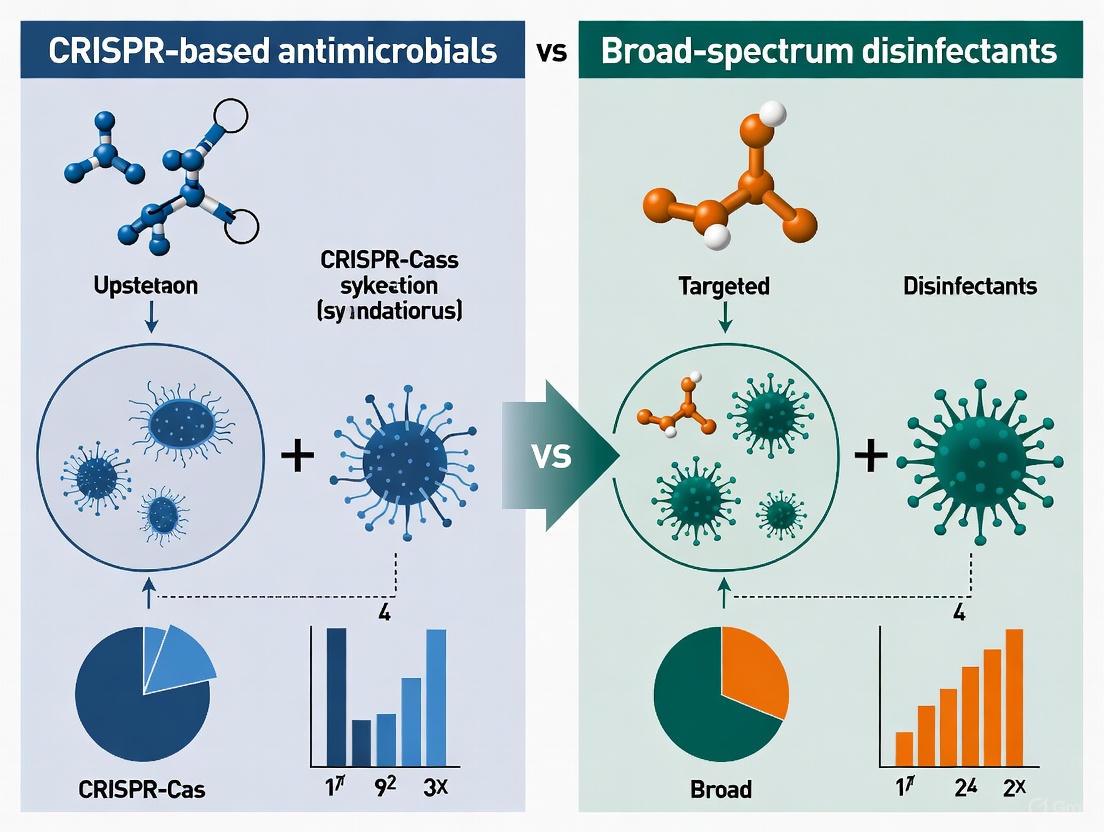
This article provides a comprehensive analysis of two divergent paradigms in surface sanitation: emerging CRISPR-based antimicrobials and conventional broad-spectrum disinfectants.
Precision vs Power: CRISPR-Based Antimicrobials Challenge Broad-Spectrum Disinfectants in Surface Sanitation
Abstract
This article provides a comprehensive analysis of two divergent paradigms in surface sanitation: emerging CRISPR-based antimicrobials and conventional broad-spectrum disinfectants. For researchers and drug development professionals, we explore the foundational science, including the programmable gene-editing mechanisms of CRISPR-Cas systems and the non-specific protein denaturation action of chemical disinfectants. The review details methodological advances in delivery systems such as bacteriophages and nanoparticles for CRISPR, alongside application protocols for traditional disinfectants. Critical troubleshooting of challenges like delivery efficiency, microbial resistance, and regulatory hurdles is addressed. Finally, a comparative validation assesses the specificity, ecological impact, and clinical translation potential of each approach, synthesizing key takeaways to guide future R&D and clinical strategy in infection control.
The Fundamental Divide: Mechanisms of Action from Genetic Precision to Chemical Disruption
The rise of antimicrobial resistance (AMR) poses a grave threat to global health, undermining the efficacy of conventional antibiotics and driving the need for innovative solutions [1]. Within this context, the CRISPR-Cas system, originally identified as an adaptive immune system in bacteria and archaea, has been repurposed into a highly specific and programmable antimicrobial tool [2] [3]. This guide provides an objective comparison between emerging CRISPR-based antimicrobials and traditional broad-spectrum disinfectants for surface sanitation, framing them within a thesis on next-generation infection control. We focus on performance data, detailed experimental protocols, and the essential toolkit required for research and development in this field, providing a resource for scientists and drug development professionals.
The Core Mechanism: From Bacterial Immunity to Precision Engineering
The fundamental operation of CRISPR-Cas systems can be broken down into three key stages, which researchers have co-opted for precise antimicrobial applications.
1.1 The Natural Adaptive Immune Response in Prokaryotes CRISPR-Cas systems confer adaptive immunity against invasive genetic elements like viruses and plasmids through a sequence-specific process [4]. This occurs in three stages:
- Adaptation: Short sequences (protospacers) from invading DNA are processed and integrated as new "spacers" into the host's CRISPR array by proteins such as Cas1 and Cas2. This creates a genetic record of past infections [4] [3].
- crRNA Biogenesis: The CRISPR array is transcribed and processed into short CRISPR RNAs (crRNAs), each containing a guide sequence complementary to a previously encountered invader [4] [2].
- Interference: The crRNA guides Cas effector proteins (e.g., Cas9, Cas12) to complementary nucleic acids. Upon recognition, the Cas protein cleaves and inactivates the target DNA, thus providing immunity [4]. A critical requirement for self/non-self discrimination is the protospacer adjacent motif (PAM), a short DNA sequence flanking the target site [4].
1.2 Harnessing the Mechanism for Antimicrobial Use The modular nature of CRISPR-Cas—where the guide RNA can be reprogrammed to target any DNA sequence—allows it to be engineered into a precision antimicrobial. The primary strategies are:
- Targeted Killing: Using CRISPR-Cas to introduce lethal double-strand breaks in essential bacterial genes or the bacterial chromosome itself, selectively eliminating resistant pathogens [1] [3].
- Resensitization: Targeting and cleaving antibiotic resistance genes (e.g.,
blaNDM-1,mcr-1) located on plasmids or chromosomes. This "cures" bacteria of resistance, restoring their susceptibility to conventional antibiotics [5] [1] [6].
The diagram below illustrates the core mechanism of the Type II-A CRISPR-Cas9 system, the most widely used tool, from its natural function to its application as a programmable antimicrobial.
Comparative Performance: CRISPR Antimicrobials vs. Broad-Spectrum Disinfectants
The tables below summarize experimental data comparing the precision of CRISPR-based antimicrobials to the broad activity of conventional disinfectants.
Table 1: Comparison of fundamental characteristics and efficacy.
| Feature | CRISPR-Based Antimicrobials | Broad-Spectrum Disinfectants |
|---|---|---|
| Mode of Action | Sequence-specific genetic targeting (e.g., DNA cleavage) [1] | Non-specific biochemical disruption (e.g., membrane damage, protein denaturation) [7] |
| Specificity | High; can target single bacterial strains or specific genes [3] | Low; affects a wide range of microbes indiscriminately [7] |
| Efficacy Against Resistant Strains | High; can directly inactivate resistance genes, with resensitization efficacy ranging from 4.7% to 100% in studies [6] | Variable; often ineffective against biocide-resistant pathogens like Vancomycin-Resistant S. aureus (VRSA) [7] |
| Impact on Microbiome | Minimal; potential to spare beneficial commensals [3] | Significant; non-targeted destruction of environmental and beneficial microbes [7] |
| Risk of Resistance Development | Lower for targeted killing; potential for escape via target mutation [5] | High; promotes selection for biocide and antibiotic cross-resistance [7] |
Table 2: Comparison of practical application and cost.
| Feature | CRISPR-Based Antimicrobials | Broad-Spectrum Disinfectants |
|---|---|---|
| Development Cycle | Longer; requires identification of specific genetic targets and delivery system engineering [1] | Shorter; based on established chemical formulations [7] |
| Delivery Challenge | High; requires efficient systems (phages, conjugative plasmids, nanoparticles) to reach target bacteria [1] [6] | Low; direct application of chemical solutions to surfaces [7] |
| Cost & Accessibility | Currently high; complex manufacturing and quality control [1] | Low; inexpensive mass production and widespread availability [7] |
| Environmental Impact | Potentially lower; biodegradable nucleic/protein components and targeted action [7] [3] | Often higher; chemical residues and toxicity to non-target organisms [7] |
Experimental Protocols: Key Methodologies for CRISPR Antimicrobial Development
To evaluate the strategies discussed, researchers employ specific protocols. Below are detailed methodologies for testing a conjugative plasmid-based resensitization approach and a traditional disinfectant efficacy assay.
Table 3: Experimental workflow for CRISPR-mediated resensitization.
| Step | Protocol Details | Purpose & Notes |
|---|---|---|
| 1. Guide RNA Design | Design sgRNAs to target specific antibiotic resistance genes (e.g., blaTEM-1, mcr-1). Ensure the target site is adjacent to a PAM (e.g., 5'-NGG-3' for SpCas9). |
Critical Step: Specificity must be confirmed via BLAST to avoid off-target effects. |
| 2. Plasmid Construction | Clone the expression cassette for Cas9 and sgRNA into a conjugative or mobilizable plasmid (e.g., pVDM1001, RP4-based vectors). | The choice of plasmid (compatible or incompatible with the target) affects success, especially with plasmid copy number [5]. |
| 3. Delivery | Introduce the CRISPR plasmid into the target AMR bacterial strain via conjugation or transformation. | Conjugative plasmids are a common and effective delivery vector [6]. |
| 4. Efficacy Assessment | Resensitization Assay: Plate transformed bacteria on media containing the relevant antibiotic. Calculate the percentage of colonies that have lost resistance. Quantification: Use PCR or sequencing to confirm the deletion or disruption of the target resistance gene. | Efficacy is calculated as the percentage of bacterial population resensitized to the antibiotic [6]. |
| 5. Data Analysis | Compare the minimum inhibitory concentration (MIC) of the antibiotic against the population before and after CRISPR treatment. | A significant reduction in MIC indicates successful resensitization. |
The following workflow diagrams the process of a typical resensitization experiment and a standard disinfectant test for clarity.
The Scientist's Toolkit: Essential Research Reagents
Developing and testing CRISPR-based antimicrobials requires a suite of specialized reagents and materials. The following table details key solutions and their functions.
Table 4: Essential research reagents for developing CRISPR-based antimicrobials.
| Research Reagent / Material | Function in Experimentation |
|---|---|
| Cas9 Nuclease | The core effector protein that creates double-strand breaks in target DNA when complexed with a guide RNA [8]. |
| Guide RNA (sgRNA) | A synthetic single-guide RNA that combines the functions of crRNA and tracrRNA, directing Cas9 to the specific genomic target [8]. |
| Conjugative Plasmid Vectors | Self-transmissible plasmids used to deliver the CRISPR-Cas system into target bacterial cells efficiently [6] [3]. |
| Engineered Bacteriophages | Viral vectors modified to carry and deliver CRISPR payloads to specific bacterial hosts, offering high target specificity [1]. |
| Lipid Nanoparticles (LNPs) | Synthetic delivery vehicles that can encapsulate CRISPR components for in vivo delivery, showing promise for systemic administration [9]. |
| Antibiotic Sensitivity Test Discs/MICs | Used to measure the Minimum Inhibitory Concentration (MIC) and confirm the resensitization of bacteria to conventional antibiotics post-CRISPR treatment [6]. |
| Selective Growth Media | Culture media containing specific antibiotics to select for or against bacterial populations that have retained or lost resistance plasmids [5]. |
Challenges and Future Directions in CRISPR Antimicrobials
While promising, the transition of CRISPR antimicrobials from the lab to the clinic faces several hurdles. A primary challenge is the development of efficient and broad-host range delivery systems that can transport the CRISPR machinery to the target pathogen in complex environments [1] [6]. Furthermore, bacteria can evolve resistance to the CRISPR system itself, often through mutations in the target DNA sequence that prevent guide RNA binding [5]. Safety concerns, such as off-target effects and the potential for uncontrolled gene drive, necessitate careful regulation and optimization of CRISPR tools [8].
Future research is focused on overcoming these challenges. The exploration of phage-derived particles and engineered nanoparticles aims to improve delivery efficiency and stability [1] [6]. The advent of CRISPR interference (CRISPRi) using deactivated Cas (dCas) proteins for gene silencing without cleavage offers a safer alternative for resensitization [5] [1]. Additionally, next-generation effectors like Cas12 and Cas13, which target DNA and RNA respectively, provide new avenues for diagnostics and antimicrobial development [2] [3]. As one 2025 study suggests, the optimal strategy may involve tailoring the approach—using cleaving systems on incompatible plasmids for low-copy targets and silencing systems on compatible plasmids for high-copy targets [5]. The recent success of personalized in vivo CRISPR therapies in clinical trials for genetic diseases further bolsters the potential for adaptable antimicrobial platforms [9].
Broad-spectrum disinfectants serve as a critical first line of defense in healthcare, food production, and public health, directly targeting microbial viability on surfaces to prevent infection transmission. Their efficacy stems from three primary mechanistic pathways: protein denaturation, membrane disruption, and oxidative damage. While alcohols rapidly denature proteins and quaternary ammonium compounds (QACs) disrupt membranes, oxidative agents like chlorine and peroxides cause catastrophic cellular oxidation. However, the phenomenon of bacterial resistance to these disinfectants is increasingly documented, with mechanisms including efflux pumps, biofilm formation, and altered membrane permeability potentially leading to cross-resistance to antibiotics [10] [11].
Concurrently, CRISPR-based antimicrobials represent a paradigm shift, offering a precision gene-editing approach. These systems can be designed to selectively target and eliminate antibiotic resistance genes or essential genes in pathogens, potentially reversing resistance and resensitizing bacteria to conventional antibiotics [12]. This article provides a comparative analysis of these divergent strategies, contextualizing the established, broad-acting mechanisms of chemical disinfectants against the emerging, targeted potential of CRISPR-based systems for managing microbial threats on surfaces and in clinical settings.
Established Mechanisms of Broad-Spectrum Disinfectants
Protein Denaturation
Protein denaturation involves the disruption of hydrogen bonds and hydrophobic interactions that maintain a protein's native three-dimensional structure, leading to loss of biological activity and cell death.
- Alcohols (Ethanol, Isopropanol): The antimicrobial action of alcohols is primarily attributed to the denaturation of proteins. This mechanism is most effective when alcohols are diluted with water, as water facilitates protein unfolding. Alcohols are rapidly bactericidal against vegetative bacteria, tuberculocidal, fungicidal, and virucidal, but they do not destroy bacterial spores. The optimum bactericidal concentration is typically between 60%–90% solutions in water [13] [11].
- Aldehydes (Glutaraldehyde): This disinfectant acts by cross-linking proteins in the cell envelope and elsewhere in the cell. This irreversible cross-linking permanently inactivates essential cellular proteins and enzymes, making glutaraldehyde a potent high-level disinfectant and sterilant [11].
Membrane Disruption
Membrane disruption targets the integrity of the bacterial cell membrane or the outer membrane of Gram-negative bacteria, leading to leakage of cellular contents and death.
- Quaternary Ammonium Compounds (QACs): QACs cause generalized membrane damage to phospholipid bilayers. As cationic surfactants, their positively charged head groups interact with negatively charged microbial cell membranes, disrupting membrane integrity and causing cytoplasmic leakage [11].
- Chlorhexidine: At low concentrations, chlorhexidine affects membrane integrity. At high concentrations, it causes congealing of the cytoplasm, leading to a more profound and lethal disruption of the cell [11].
- Nickel-ion doped V₆O₁₃: This innovative inorganic material demonstrates a broad-spectrum antimicrobial performance. Its mechanism is linked to the generation of reactive oxygen species (ROS), which ultimately leads to oxidative stress damage, leakage of intracellular substances, and cell death [14].
Oxidative Damage
Oxidative damage involves the generation of reactive oxygen species or other oxidizing agents that damage cellular macromolecules, including proteins, lipids, and DNA.
- Halogens (Chlorine, Iodine): Chlorine-based disinfectants, such as sodium hypochlorite (household bleach), derive their microbicidal activity largely from undissociated hypochlorous acid (HOCl). HOCl is a potent oxidizer that can oxidize thiol groups in enzymes and proteins, inhibit DNA synthesis, and cause widespread cellular damage [13] [11].
- Peroxygens (Hydrogen Peroxide, Peracetic Acid): Hydrogen peroxide's activity is due to the formation of free hydroxyl radicals (·OH), which are highly reactive and oxidize thiol groups in enzymes and proteins. Peracetic acid (PAA) also acts through the disruption of thiol groups in proteins and enzymes [11].
Table 1: Summary of Broad-Spectrum Disinfectant Mechanisms and Properties
| Disinfectant Class | Specific Examples | Primary Mechanism of Action | Spectrum of Activity | Key Considerations |
|---|---|---|---|---|
| Alcohols | Ethanol, Isopropyl alcohol | Protein denaturation [13] [11] | Bactericidal (vegetative), Tuberculocidal, Virucidal (lipophilic), Fungicidal [13] | Rapid action; not sporicidal; optimum concentration 60-90% [13] |
| Aldehydes | Glutaraldehyde | Protein cross-linking [11] | Broad-spectrum, including spores [11] | Used for high-level disinfection/sterilization; can cause irritation |
| Quaternary Ammonium Compounds (QACs) | Benzalkonium chloride | Membrane disruption (phospholipid bilayer) [11] | Bactericidal, Fungicidal, Virucidal (enveloped) [11] | Affected by water hardness; inactivated by organic matter |
| Chlorine Compounds | Sodium hypochlorite (Bleach) | Oxidative damage (oxidation of thiols, inhibition of DNA synthesis) [11] | Broad-spectrum, including spores and viruses [13] | Corrosive; inactivated by organic matter; activity depends on pH |
| Peroxygens | Hydrogen Peroxide | Oxidative damage (free radical generation) [11] | Broad-spectrum, including spores [13] | Environmentally friendly break down to water and oxygen |
Diagram 1: Mechanisms of Action of Broad-Spectrum Disinfectants. Disinfectants induce microbial death through three primary pathways: protein denaturation, membrane disruption, and oxidative damage, leading to catastrophic cellular dysfunction.
The Challenge of Biofilms and Disinfectant Resistance
A significant limitation of conventional disinfectants is their reduced efficacy against bacterial biofilms. Biofilms are structured communities of microorganisms embedded in a self-produced extracellular polymeric substance (EPS) matrix. This matrix acts as a physical barrier, limiting the penetration of antimicrobial agents [15]. Furthermore, bacterial cells within biofilms can exhibit altered metabolic states, making them less susceptible to disinfectants that target active cellular processes [15].
The overuse or misuse of disinfectants, particularly at subinhibitory concentrations, can promote the emergence of bacterial resistance. Key resistance mechanisms include efflux pump activation, which actively expels disinfectants from the cell; alterations in membrane permeability, reducing intracellular uptake; and enhanced biofilm formation [10]. Critically, disinfectant-induced resistance can lead to cross-resistance to antibiotics, posing a serious threat to public health [10]. This risk is amplified in multi-species biofilms, where interspecies interactions can upregulate resistance genes. For example, in dual-species biofilms formed by Staphylococcus aureus and Pseudomonas fluorescens, the presence of P. fluorescens markedly upregulated the icaA and icaD genes in S. aureus, leading to increased production of polysaccharide intercellular adhesion and EPS, resulting in enhanced resistance to disinfectants like chlorine dioxide and quaternary ammonium compounds [16].
CRISPR-Based Antimicrobials: A Precision Approach
Fundamental Principles
The CRISPR-Cas system is an adaptive immune system found in prokaryotes that provides sequence-specific protection against foreign genetic elements, such as plasmids and phages [12]. This system can be repurposed as a precision gene-editing tool. When used as an antimicrobial, the system typically consists of two key components: the Cas nuclease (e.g., Cas9, Cas3, Cas12f1), which cuts DNA, and a guide RNA (gRNA), which directs the Cas nuclease to a specific DNA sequence, such as an antibiotic resistance gene or an essential bacterial gene [15] [17].
The targeted DNA cleavage introduces double-strand breaks in the bacterial genome or plasmid. Since most bacteria lack efficient non-homologous end-joining repair mechanisms, these breaks are lethal, leading to cell death or the elimination of the resistance plasmid [17]. This allows for the resensitization of bacteria to conventional antibiotics [12].
Comparative Efficacy of CRISPR Systems
Different CRISPR systems offer varying advantages for combating antimicrobial resistance. A 2025 study systematically compared the efficacy of CRISPR-Cas9, CRISPR-Cas12f1, and CRISPR-Cas3 in eradicating the carbapenem resistance genes KPC-2 and IMP-4 from Escherichia coli.
Table 2: Comparison of CRISPR Systems for Eradicating Resistance Genes
| CRISPR System | Key Features | Eradication Efficiency for KPC-2/IMP-4 | Ability to Block Plasmid Transfer | Notable Advantages |
|---|---|---|---|---|
| CRISPR-Cas9 | Uses Cas9 nuclease; requires NGG PAM sequence | 100% [17] | Up to 99% blocking rate [17] | Well-characterized, widely used |
| CRISPR-Cas12f1 | Compact size (~half of Cas9); requires TTTN PAM | 100% [17] | Up to 99% blocking rate [17] | Smaller size beneficial for delivery |
| CRISPR-Cas3 | Creates large deletions via processive degradation | 100%; showed higher eradication efficiency than Cas9 and Cas12f1 in qPCR assay [17] | Up to 99% blocking rate [17] | Highly efficient degradation of target DNA |
The study confirmed that all three systems successfully eliminated the resistance genes and restored the sensitivity of the model bacteria to antibiotics like ampicillin. Quantitative PCR (qPCR) analysis, however, indicated that the CRISPR-Cas3 system exhibited the highest eradication efficiency among the three, making it a particularly promising tool for combating plasmid-mediated resistance [17].
Delivery Challenges and Nanoparticle Solutions
A major hurdle for the clinical application of CRISPR-based antimicrobials is the efficient delivery of CRISPR components into bacterial populations. Nanoparticles (NPs) present an innovative solution, serving as effective carriers that protect the genetic material and enhance cellular uptake [15].
- Lipid-based Nanoparticles: Can encapsulate CRISPR-Cas9 components. For instance, liposomal Cas9 formulations reduced Pseudomonas aeruginosa biofilm biomass by over 90% in vitro [15].
- Metallic Nanoparticles: Gold nanoparticle carriers have been shown to enhance editing efficiency up to 3.5-fold compared to non-carrier systems and can facilitate co-delivery with antibiotics for synergistic antibacterial effects [15].
These hybrid platforms can overcome the physical barrier of biofilms, allowing for precise biofilm disruption and resensitization to traditional antimicrobials.
Diagram 2: CRISPR-Based Antimicrobial Workflow. The process involves selecting a delivery vehicle (nanoparticles, phages, or plasmids) to introduce CRISPR components into bacterial cells, leading to targeted DNA cleavage and either cell death or elimination of antibiotic resistance.
Experimental Protocols for Disinfectant and CRISPR Efficacy Testing
Protocol: Evaluating Disinfectant Efficacy Against Biofilms
This protocol is adapted from studies investigating disinfectant resistance in single- and dual-species biofilms [16].
- Biofilm Cultivation: Grow bacterial strains (e.g., Staphylococcus aureus and Pseudomonas fluorescens) individually and in co-culture. Incubate cultures on relevant surfaces (e.g., stainless steel coupons) in appropriate media at 25°C for 48 hours to allow for mature biofilm formation.
- Biofilm Biomass Quantification (OD Measurement): After incubation, gently wash the coupons to remove non-adherent cells. Measure biofilm biomass using optical density (OD) at 600 nm after dissolving the biofilm with a crystal violet solution or a similar stain.
- Cell Activity Assay (MTT Assay): Assess the metabolic activity of cells within the biofilm. Incubate the biofilm with MTT (3-(4,5-dimethylthiazol-2-yl)-2,5-diphenyltetrazolium bromide). Metabolically active cells reduce MTT to purple formazan. Quantify the dissolved formazan product by measuring its absorbance, typically at 570 nm.
- EPS Analysis (Raman Spectroscopy): Analyze the chemical composition of the extracellular polymeric substance (EPS) matrix. Use Surface-Enhanced Raman Spectroscopy (SERS) in the 400–2600 cm⁻¹ range to monitor changes in polysaccharides, proteins, and other EPS components between single-species and dual-species biofilms.
- Disinfectant Exposure: Expose the pre-formed biofilms to the selected disinfectants (e.g., chlorine dioxide, quaternary ammonium compounds) at relevant concentrations and contact times.
- Post-Treatment Analysis: Repeat the biomass quantification and cell activity assays after disinfectant exposure and compare the results to untreated controls to determine the log reduction and efficacy.
Protocol: Assessing CRISPR-Mediated Resistance Gene Elimination
This protocol is based on a 2025 study comparing CRISPR-Cas9, Cas12f1, and Cas3 systems [17].
- Target Design and Plasmid Construction: Design guide RNA (gRNA) spacers specific to the target resistance gene (e.g., KPC-2, IMP-4) according to the PAM (Protospacer Adjacent Motif) requirements of the chosen Cas nuclease (e.g., NGG for Cas9, TTTN for Cas12f1, GAA for Cas3). Synthesize oligonucleotides and clone them into the respective CRISPR plasmids (e.g., pCas9, pCas12f1, pCas3).
- Preparation of Model Drug-Resistant Bacteria: Clone the target resistance gene (e.g., KPC-2, IMP-4) into a suitable plasmid vector (e.g., pSEVA551) and transform it into a model bacterium like E. coli DH5α to create the drug-resistant strain.
- Transformation with CRISPR Plasmids: Prepare competent cells from the model drug-resistant bacteria. Transform the competent cells with the constructed CRISPR plasmids.
- Efficacy Verification (Colony PCR): Plate the transformants and pick colonies for colony PCR. Use primers flanking the target gene to verify the elimination of the resistance gene from the bacterial population.
- Drug Sensitivity Test: Test the CRISPR-treated bacteria and untreated controls for antibiotic sensitivity using methods like disk diffusion or minimum inhibitory concentration (MIC) assays to confirm resensitization to the relevant antibiotic (e.g., ampicillin).
- Quantitative Efficiency (qPCR): Perform quantitative PCR (qPCR) on the extracted DNA from treated and untreated bacteria using primers for the resistance gene and a reference gene. Compare the copy numbers to quantify and compare the eradication efficiency of different CRISPR systems.
The Scientist's Toolkit: Key Research Reagents and Materials
Table 3: Essential Reagents and Materials for Antimicrobial Mechanism Research
| Reagent/Material | Function/Application | Example Use Case |
|---|---|---|
| CRISPR Plasmids (pCas9, pCas3, pCas12f1) | Vectors encoding Cas nuclease and gRNA scaffold for delivering the CRISPR system to bacteria. | Eliminating specific antibiotic resistance genes (e.g., KPC-2, IMP-4) in model organisms [17]. |
| Nanoparticles (Lipid-based, Gold) | Carriers for CRISPR components or intrinsic antimicrobials; enhance delivery and stability. | Liposomal Cas9 for biofilm disruption [15]; gold NPs for enhanced editing efficiency [15]. |
| MTT Reagent (3-(4,5-dimethylthiazol-2-yl)-2,5-diphenyltetrazolium bromide) | Assessing metabolic activity and cell viability in biofilms before and after disinfectant exposure [16]. | Evaluating efficacy of quaternary ammonium compounds against S. aureus biofilms [16]. |
| DCFH-DA Fluorescent Probe | Detecting intracellular reactive oxygen species (ROS) generation. | Measuring ROS-induced oxidative stress in microbes exposed to antimicrobial materials like Ni-doped V₆O₁₃ [14]. |
| Surface-Enhanced Raman Spectroscopy (SERS) | Analyzing chemical composition and changes in the extracellular polymeric substance (EPS) of biofilms. | Comparing EPS components in single-species vs. dual-species biofilms [16]. |
| Oxford Nanopore Technology | Long-read sequencing platform, often coupled with Cas9-enrichment (Context-Seq), for analyzing ARGs in their genomic context. | Investigating transmission dynamics and hosts of blaCTX-M and blaTEM in fecal samples [18]. |
The comparison between broad-spectrum disinfectants and CRISPR-based antimicrobials reveals two fundamentally different philosophies in microbial control. Disinfectants act as rapid, non-selective chemical weapons, relying on mechanisms like protein denaturation, membrane disruption, and oxidative damage to achieve immediate surface decontamination. However, their widespread use is complicated by issues of corrosion, toxicity, and the emergence of resistance and cross-resistance [10] [13].
In contrast, CRISPR-based antimicrobials represent the next generation of precision medicine. They function as "genetic scalpels," capable of selectively eliminating resistance genes or pathogens while leaving the commensal microbiota intact. This approach holds the potential to resensitize superbugs to conventional antibiotics, thereby restoring the efficacy of our existing antimicrobial arsenal [17] [12]. Despite the promise, significant challenges remain, particularly in developing efficient and safe in vivo delivery systems for CRISPR components.
The future of antimicrobial surface sanitation and infection control likely lies in integrated strategies. Conventional disinfectants will remain indispensable for rapid, broad-spectrum decontamination of environmental surfaces. Meanwhile, CRISPR-based technologies offer a powerful, complementary tool for tackling the root of antibiotic resistance at the genetic level, potentially revolutionizing the treatment of persistent biofilm-associated infections and managing the spread of multidrug-resistant pathogens in healthcare and community settings.
The escalating global burden of Antimicrobial Resistance (AMR) represents one of the most severe public health threats of the 21st century, with nearly 5 million deaths annually attributed to drug-resistant infections [18]. This crisis is fundamentally driven by the overuse and misuse of antibiotics in human medicine and agriculture, which has selected for multidrug-resistant (MDR) pathogens that render conventional treatments ineffective [19]. The sanitation sector—encompassing surface disinfection in healthcare, food production, and public spaces—plays a critical yet paradoxical role in this landscape. While essential for infection prevention, conventional broad-spectrum disinfectants exert immense evolutionary pressure, potentially selecting for resistant pathogens and contributing to the AMR problem [20] [21]. This challenge has catalyzed a scientific revolution, driving researchers to develop next-generation sanitation technologies that are not only effective but also precision-targeted to mitigate resistance development.
The limitations of conventional approaches are becoming increasingly apparent. Broad-spectrum disinfectants, while foundational to infection control, operate on a scorched-earth principle, indiscriminately eliminating microorganisms without distinguishing between harmful pathogens and benign microbiota [20]. This non-selective mode of action, combined with inadequate contact times and sublethal concentrations, may select for resistant strains through mechanisms such as efflux pump activation, biofilm formation, and enzymatic inactivation [21]. In response, the field is witnessing the emergence of CRISPR-based antimicrobials as a transformative alternative. These gene-editing technologies offer unprecedented precision by targeting specific genetic sequences unique to pathogens or their resistance mechanisms, potentially disrupting AMR genes without promoting cross-resistance [3] [15]. This article provides a comprehensive comparative analysis of these divergent technological paradigms—contrasting the established efficacy of conventional disinfectants with the nascent potential of CRISPR-based systems—to inform researchers and drug development professionals navigating this rapidly evolving landscape.
Comparative Technology Analysis: Mechanisms and Applications
Broad-Spectrum Surface Disinfectants: Established Workhorses
Broad-spectrum disinfectants constitute the foundational infrastructure of modern infection control programs across healthcare, food service, and domestic environments. These chemical formulations are characterized by their non-selective mechanism of action, targeting essential cellular structures or metabolic processes common to a wide range of microorganisms [20] [21]. The global market for these products, valued at approximately $3.54 billion in 2024 and projected to reach $7.93 billion by 2034, reflects their entrenched role in hygiene protocols worldwide [20].
Table 1: Major Classes of Broad-Spectrum Disinfectants and Their Characteristics
| Disinfectant Class | Primary Mechanisms of Action | Common Applications | Resistance Concerns |
|---|---|---|---|
| Quaternary Ammonium Compounds (Quats) | Disruption of cell membranes, protein denaturation | Healthcare surfaces, food service, household cleaning | Biofilm protection, enzymatic degradation, efflux pumps |
| Chlorine Compounds | Oxidative damage to cellular components, protein oxidation | Water treatment, healthcare settings, outbreak control | Corrosion of surfaces, reduced efficacy in organic matter |
| Alcohols | Protein denaturation, lipid membrane dissolution | Hand sanitizers, small surface disinfection, medical devices | Rapid evaporation, limited contact time, poor sporicidal activity |
| Hydrogen Peroxide | Oxidation of cellular components via free radical generation | Environmental surfaces, instrument processing, air sanitization | Catalase enzyme production in some bacteria, biofilm protection |
| Peracetic Acid | Oxidation of sulfhydryl and disulfide bonds, membrane damage | Liquid chemical sterilization, healthcare instrument processing | Decomposition in storage, material compatibility issues |
The efficacy and limitations of these conventional disinfectants are well-documented. Chlorine compounds, for instance, offer broad-spectrum antimicrobial activity with no toxic residues and cost-effectiveness, making them particularly valuable in healthcare settings [20]. However, they can be corrosive to certain materials and may degrade in the presence of organic matter. Similarly, alcohols demonstrate rapid efficacy against enveloped viruses and vegetative bacteria but exhibit poor activity against spores and some non-enveloped viruses [20]. A significant challenge with these conventional approaches is the growing evidence of microbial adaptation, with studies demonstrating that bacteria can develop reduced susceptibility to quaternary ammonium compounds and other disinfectants through both intrinsic and acquired mechanisms [21] [22]. This adaptive capacity is particularly problematic in biofilm communities, where the extracellular polymeric substance matrix can reduce disinfectant penetration by up to 1000-fold compared to planktonic cells [15].
CRISPR-Based Antimicrobials: The Precision Paradigm
In contrast to the broad-spectrum approach, CRISPR-based antimicrobials represent a paradigm shift toward precision sanitation. Derived from the adaptive immune systems of bacteria and archaea, CRISPR-Cas systems function as programmable "genetic scissors" that can be directed to target specific DNA or RNA sequences with exceptional accuracy [3]. This technology offers two primary strategic applications for combating AMR: first, the sequence-specific killing of antibiotic-resistant pathogens by targeting essential genes or antimicrobial resistance genes, and second, the resensitization of bacteria to conventional antibiotics by selectively disrupting resistance determinants [3] [15].
Table 2: CRISPR-Cas Systems and Their Antimicrobial Applications
| CRISPR System | Target Type | Mechanism of Action | Potential Sanitation Applications |
|---|---|---|---|
| Cas9 (Type II) | DNA | Double-strand breaks in chromosomal DNA or resistance genes | Selective elimination of MRSA, VRE, CRE from surfaces |
| Cas12a (Type V) | DNA | Staggered DNA cuts with potential for multiplexed targeting | Simultaneous targeting of multiple resistance genes in biofilms |
| Cas13 (Type VI) | RNA | RNA cleavage with collateral activity enabling detection | Pathogen detection and inactivation in liquid waste systems |
| CRISPRi (dCas9) | DNA | Gene repression without cleavage, reversible effect | Temporary suppression of virulence factors in environmental reservoirs |
The molecular machinery of CRISPR systems consists of two fundamental components: the Cas nuclease, which cleaves nucleic acids, and a guide RNA (gRNA) that directs the nuclease to specific target sequences through complementary base pairing [3]. This programmability enables researchers to design gRNAs that target conserved regions of AMR genes (e.g., blaCTX-M, blaTEM, mecA) or essential bacterial genes, offering multiple strategies for pathogen control [18] [3]. For sanitation applications, CRISPR constructs can be delivered via engineered bacteriophages, conjugative plasmids, or encapsulated in synthetic nanoparticles designed to stabilize the nucleic acid components and facilitate uptake by target bacteria [3] [15]. The specificity of these systems potentially allows for the selective elimination of pathogens while preserving commensal microorganisms—a significant advantage over conventional disinfectants that indiscriminately impact microbial communities.
Comparative Experimental Data and Efficacy Metrics
Quantitative Efficacy Comparison
Rigorous evaluation of both conventional disinfectants and emerging CRISPR-based approaches requires standardized metrics of efficacy. The table below synthesizes available experimental data from published studies to enable direct comparison of performance characteristics.
Table 3: Quantitative Comparison of Antimicrobial Efficacy: Conventional Disinfectants vs. CRISPR-Based Approaches
| Technology | Pathogen/Model System | Experimental Conditions | Efficacy Metrics | Key Limitations |
|---|---|---|---|---|
| Quaternary Ammonium Compounds | MRSA on stainless steel surfaces | 10-minute contact time, ASTM E2197 standard | 4-5 log₁₀ reduction in viable counts [21] | Reduced efficacy in organic matter, selection for resistant strains |
| Chlorine-Based Disinfectants | Carbapenem-resistant Acinetobacter baumannii | 5-minute contact time, hospital-grade concentration | >5 log₁₀ reduction in planktonic cultures [20] | Corrosive to surfaces, potential for hazardous byproducts |
| Hydrogen Peroxide Wipes | VRE on clinical equipment surfaces | 30-second wipe application, field conditions | 3-4 log₁₀ reduction in colony counts [22] | Inconsistent application, dependence on user technique |
| CRISPR-Cas9 + Lipid Nanoparticles | Pseudomonas aeruginosa biofilm | 24-hour treatment, in vitro biofilm model | >90% reduction in biofilm biomass [15] | Delivery efficiency in complex environments, regulatory uncertainty |
| CRISPR-Cas9 + Gold Nanoparticles | Escherichia coli with plasmid-borne β-lactamase | 6-hour treatment, laboratory medium | 3.5x increase in editing efficiency vs. non-carrier systems [15] | Optimization for environmental application, cost considerations |
| CRISPR-Cas13a Detection | Klebsiella pneumoniae with blaCTX-M | Context-Seq protocol with targeted enrichment [18] | 7-15x enrichment over untargeted sequencing | Diagnostic rather than disinfectant application |
Experimental Protocols for Technology Evaluation
Standardized Protocol for Broad-Spectrum Disinfectant Testing
The efficacy of conventional disinfectants is typically evaluated using standardized protocols such as the AOAC Use-Dilution Method or EPA Guideline Documents [21]. A typical experimental workflow includes:
Surface Inoculation: Prepare carrier surfaces (stainless steel, glass, or plastic) contaminated with approximately 10⁶–10⁷ CFU of the test organism (e.g., MRSA, VRE, CRE) in the presence of 5% organic soil load to simulate field conditions.
Disinfectant Application: Apply the disinfectant product at the manufacturer's recommended use concentration for the specified contact time (typically 1-10 minutes).
Neutralization and Enumeration: Transfer the carrier to a neutralizer solution to stop antimicrobial action, then perform serial dilution and plate counting on appropriate media.
Data Analysis: Calculate log₁₀ reduction compared to untreated controls, with a minimum 3-4 log reduction (99.9-99.99% kill) generally required for hospital-grade disinfectants [21].
Advanced Protocol for CRISPR-Based Antimicrobial Evaluation
Evaluation of CRISPR-based antimicrobials requires more specialized molecular methodologies:
Guide RNA Design: Design gRNAs targeting conserved regions of AMR genes or essential bacterial genes using tools such as CHOPCHOP, with careful off-target prediction in complex microbial communities [18].
Delivery System Preparation: Formulate CRISPR ribonucleoprotein (RNP) complexes with appropriate delivery vehicles:
Treatment and Assessment: Apply CRISPR formulations to bacterial cultures or biofilms, then assess:
Technological Synergies and Future Research Trajectories
The comparison between conventional disinfectants and CRISPR-based antimicrobials reveals complementary strengths rather than mutually exclusive alternatives. Integration strategies that leverage the rapid, broad-spectrum efficacy of disinfectants with the precision and resistance-reversing potential of CRISPR systems represent a promising frontier for next-generation sanitation. For instance, a sequential approach might utilize conventional disinfectants for initial microbial load reduction, followed by targeted CRISPR applications to eliminate residual resistant pathogens without exerting selective pressure for further resistance development [15].
The emerging research priorities in this field reflect this integrative perspective. Advanced delivery systems represent a critical focus area, with investigations into engineered nanoparticles that protect CRISPR components from environmental degradation while facilitating uptake by target bacteria [15]. Similarly, smart formulation technologies that enable triggered release of antimicrobials in response to specific environmental cues (e.g., quorum sensing molecules, bacterial enzymes) are under development [21] [15]. From a regulatory standpoint, establishing standardized efficacy metrics for genetic antimicrobials that complement existing disinfectant testing frameworks will be essential for clinical translation [18].
Essential Research Reagents and Methodological Toolkit
The experimental paradigms discussed require specialized reagents and methodologies. The following table summarizes key research solutions for investigating both conventional and novel antimicrobial approaches.
Table 4: Essential Research Reagents and Solutions for Antimicrobial Sanitation Research
| Research Tool Category | Specific Examples | Primary Research Applications | Key Considerations |
|---|---|---|---|
| Standardized Test Organisms | Staphylococcus aureus (ATCC 6538), Pseudomonas aeruginosa (ATCC 15442), Enterococcus hirae (ATCC 10541) | Disinfectant efficacy testing, validation studies | Maintenance of reference strains, genetic stability |
| CRISPR-Cas Effector Proteins | Cas9 nuclease, Cas12a (Cpf1), Cas13a, catalytically dead Cas9 (dCas9) | Genetic targeting of AMR genes, pathogen-specific killing | PAM sequence requirements, temperature stability, gRNA compatibility |
| Guide RNA Design Tools | CHOPCHOP, CRISPOR, Custom off-target prediction scripts [18] | Identification of optimal target sequences, minimization of off-target effects | Prediction accuracy in complex communities, allele coverage |
| Nanoparticle Delivery Systems | Lipid nanoparticles (LNPs), gold nanoparticles, polymeric nanocarriers | CRISPR component stabilization, enhanced bacterial uptake | Biocompatibility, loading efficiency, release kinetics |
| Biofilm Growth Models | CDC biofilm reactor, Calgary biofilm device, microtiter plate assays | Evaluation of antimicrobial penetration through biofilm matrices | Reproducibility, clinical relevance, matrix composition analysis |
| Resistance Gene Detection Assays | Context-Seq [18], qPCR for AMR genes, whole-genome sequencing | Tracking resistance gene prevalence, horizontal transfer assessment | Sensitivity for rare targets, capacity for multiplexing |
| Surface Material Carriers | Stainless steel, glass, plastic, ceramic coupons | Simulating real-world disinfection conditions | Surface porosity, organic matter compatibility, cleaning validation |
The escalating AMR crisis demands a fundamental re-evaluation of established sanitation paradigms. While conventional broad-spectrum disinfectants will continue to play an essential role in immediate infection control, their limitations in preventing resistance development necessitate complementary approaches. CRISPR-based antimicrobials represent a promising precision alternative, offering targeted elimination of resistant pathogens and potential reversal of resistance mechanisms without indiscriminate microbial destruction [3] [15]. The experimental data presented reveals that both approaches present distinct advantages—rapid, broad-spectrum efficacy for traditional disinfectants versus precision and resistance mitigation for CRISPR systems.
The most productive path forward likely lies in strategic integration rather than technological displacement. Research initiatives should prioritize the development of hybrid systems that leverage the respective strengths of each approach, such as combining the immediate killing power of disinfectants with the targeted, resistance-reversing capabilities of CRISPR to create multi-mechanistic sanitation protocols [15]. Additionally, advancing point-of-use detection systems like Context-Seq [18] could enable responsive, evidence-based sanitation where CRISPR approaches are deployed specifically when resistance genes are detected. As these technologies mature, establishing standardized efficacy metrics and regulatory pathways will be essential for translating laboratory promise into practical infection control solutions. Through such integrated, evidence-based approaches, the sanitation sector can transform from a contributor to the AMR problem into a powerful ally in its solution.
In the relentless battle against microbial contamination and antimicrobial resistance (AMR), two fundamentally distinct strategies have emerged: the precision of selective gene elimination and the breadth of non-specific microbial destruction. The former, exemplified by CRISPR-based antimicrobials, represents a new frontier in biotechnology, leveraging guided nucleic acid systems to target specific genetic sequences for inactivation [1] [23]. The latter encompasses traditional chemical disinfectants—such as alcohols, hypochlorites, and quaternary ammonium compounds—that achieve microbial destruction through non-specific physicochemical interactions with cellular structures [11] [13]. This comparison guide objectively analyzes the performance characteristics, experimental methodologies, and applications of these divergent approaches within surface sanitation research. As AMR continues to escalate into a critical global health crisis, undermining the efficacy of conventional treatments [19] [24], understanding the capabilities and limitations of these technologies becomes paramount for researchers and drug development professionals seeking next-generation solutions.
Mechanistic Foundations: Precision Targeting vs. Broad-Spectrum Action
CRISPR-Cas Systems: Programmable Gene Targeting
CRISPR-Cas systems function as molecular scissors with programmable guidance. These systems, derived from bacterial adaptive immune mechanisms, consist of two core components: a Cas nuclease and a guide RNA (gRNA) [1] [3]. The gRNA, designed with complementarity to a specific DNA sequence, directs the Cas nuclease to its target. Upon binding, the nuclease induces a double-strand break in the DNA, leading to one of two outcomes: (1) targeted gene inactivation when chromosomal genes are cleaved, or (2) plasmid curing when extrachromosomal resistance genes are eliminated [1]. The system's specificity hinges on the protospacer adjacent motif (PAM), a short DNA sequence adjacent to the target site that ensures precise recognition [3]. This mechanism can be harnessed to selectively eliminate antibiotic resistance genes (e.g., blaNDM-1, mcr-1) or essential bacterial genes, thereby eradicating resistant pathogens or resensitizing them to conventional antibiotics [1] [24].
Chemical Disinfectants: Non-Specific Cellular Damage
Traditional chemical disinfectants employ a fundamentally different approach, causing widespread damage to microbial structures through non-specific mechanisms. Unlike CRISPR systems, disinfectants do not target specific genetic sequences but rather interact broadly with cellular components. Their efficacy depends on contact with microorganisms and subsequent physicochemical disruption [11]. The primary mechanisms vary by disinfectant class: alcohols (ethyl and isopropyl) denature proteins and disrupt cell membrane integrity [13]; hypochlorites (e.g., sodium hypochlorite in household bleach) oxidize cellular components including enzymes and DNA [13]; quaternary ammonium compounds disrupt lipid bilayers and cause cytoplasmic leakage [11]. This non-specific action provides broad-spectrum activity against bacteria, viruses, and fungi but lacks genetic specificity and cannot discriminate between pathogenic and beneficial microorganisms [11] [13].
Comparative Performance Data: Efficacy and Limitations
Table 1: Performance Comparison of Selective Gene Elimination vs. Non-Specific Microbial Destruction
| Parameter | CRISPR-Based Antimicrobials | Broad-Spectrum Disinfectants |
|---|---|---|
| Spectrum of Activity | Strain-specific; programmable targeting [1] [25] | Broad-spectrum; non-discriminatory [11] [13] |
| Killing Efficiency | Up to 99.999% against target strains [25] | >99.9% against vegetative bacteria when used properly [13] |
| Resistance Development | Target site mutations; Cas9 inactivation; ~1% of surviving population [25] | Adaptive resistance; biofilm formation; cross-resistance [11] |
| Genetic Specificity | High (can target single gene differences) [1] [3] | None (physical/chemical action) [11] |
| Action on Biofilms | Can target biofilm formation genes [19] | Variable efficacy; penetration limitations [26] [11] |
| Speed of Action | Hours (requires cellular uptake and expression) [1] | Minutes to seconds (direct contact) [13] |
| Environmental Persistence | Limited (nucleases degradation) [1] | Variable (minutes to hours depending on formulation) [13] |
Table 2: Experimental Evidence for CRISPR-Based Antimicrobial Efficacy
| Target Bacteria | CRISPR System | Target Gene | Delivery Method | Efficacy Outcome | Reference |
|---|---|---|---|---|---|
| E. coli | SpCas9 | Chromosomal papG gene | Cri-nanocomplex (carbon quantum dots) | Selective killing of pathogenic strain | [1] |
| E. coli | SpCas9 | Antimicrobial resistance cassette | Conjugative plasmid (TP114) | Resensitization to antibiotics | [1] |
| E. faecalis | SpCas9 | Plasmid-borne ermB, tetM | Conjugative plasmid (pPD1) | Elimination of resistance plasmids | [1] |
| S. aureus | SpCas9 | mecA (methicillin resistance) | Cri-nanocomplex (polymer-derivatized SpCas9) | Reversal of antibiotic resistance | [1] |
| E. coli MG1655 K12 | SpCas9 | Various chromosomal sites | Episomal expression | 84.9% to 99.999% killing efficiency | [25] |
Experimental Protocols and Methodologies
CRISPR-Cas Antimicrobial Efficacy Testing
The evaluation of CRISPR-based antimicrobials requires specialized molecular biology approaches that differ significantly from standard disinfectant testing. A representative protocol for assessing CRISPR-Cas9 killing efficiency against E. coli involves several critical steps [25]:
Vector Design: Construct plasmids with Cas9 expression under control of an inducible promoter (e.g., theophylline riboswitch) and gRNA under arabinose-inducible promoter. The gRNA sequence (typically 20 nt) must be designed to target specific genomic loci with minimal off-target potential.
Transformation and Induction: Introduce the CRISPR plasmid into the target bacterial strain via transformation. Culture transformed bacteria and induce Cas9 and gRNA expression simultaneously using the appropriate inducers (theophylline and arabinose in this example).
Efficiency Quantification: After induction (typically 4-6 hours), perform serial dilutions and plate on non-selective media. Compare colony-forming units (CFU) between induced and non-induced cultures to calculate killing efficiency using the formula: % Killing = [1 - (CFU-induced/CFU-uninduced)] × 100.
Resistance Monitoring: Isplicate "escaper" colonies and subject them to a second round of induction to distinguish between tolerant (sensitive in second round) and resistant (insensitive in second round) populations.
Genetic Analysis: Sequence resistant colonies to identify mutation types, which commonly include: (1) mutations in the gRNA target sequence, (2) large-scale genome rearrangements, particularly involving mobile genetic elements, and (3) inactivation of the Cas9 gene itself [25].
This protocol revealed that killing efficiency (ranging from 84.9% to 99.999% in one study) does not necessarily correlate with the number of target sites but is significantly influenced by Cas9 expression levels and the specific target site chosen [25].
Standard Disinfectant Efficacy Testing
The evaluation of broad-spectrum disinfectants follows standardized regulatory protocols with distinct methodological frameworks. The U.S. Environmental Protection Agency (EPA) provides detailed guidance for disinfectant testing on both hard, non-porous surfaces and soft surface textiles [27]:
Test Organisms: For bactericidal claims, standard testing employs Staphylococcus aureus (ATCC 6538) and Pseudomonas aeruginosa (ATCC 15442) as representative Gram-positive and Gram-negative bacteria, respectively [27]. Additional pathogens may be included for specific claims.
Carrier Test: The quantitative carrier method involves applying the test microorganisms suspended in organic soil load (typically 5% fetal bovine serum, 5% mucin, and 0.4% bovine serum albumin) to relevant surface materials.
Product Application: Apply the disinfectant product at the lower certified limit (LCL) of its active ingredient to the inoculated surfaces. For soft surface textiles, testing should include multiple fabric types such as vinyl seating fabric, privacy curtain fabric, and non-PVC fabric [27].
Contact Time and Neutralization: Allow the product to remain on the surface for the manufacturer's recommended contact time (e.g., 10 minutes), then neutralize the disinfectant activity using appropriate neutralizing agents.
Viability Assessment: Recover surviving microorganisms from the surface using elution methods, plate on appropriate media, and enumerate CFU after incubation.
Efficacy Criteria: For bactericidal disinfectant claims, products must demonstrate a minimum mean 4.0-log reduction (99.99% reduction) in CFU compared to untreated controls across multiple independent product lots [27].
These standardized methods ensure consistent evaluation of non-specific antimicrobial activity but do not assess genetic specificity or differential effects on microbial subpopulations.
The Scientist's Toolkit: Essential Research Reagents
Table 3: Key Research Reagents for Antimicrobial Development
| Reagent/Material | Function | Examples/Specifications |
|---|---|---|
| CRISPR-Cas Systems | Gene editing and targeted antimicrobial activity | SpCas9, Cas12a, Cas13a; Type II and V systems most commonly used [1] [3] |
| Guide RNA Vectors | Target specification and nuclease guidance | Arabinose-inducible promoters, theophylline riboswitches for controlled expression [25] |
| Delivery Vehicles | Intracellular delivery of CRISPR components | Engineered bacteriophages, conjugative plasmids, nanoparticles, outer membrane vesicles [1] [3] |
| Test Microorganisms | Standardized efficacy testing | S. aureus ATCC 6538, P. aeruginosa ATCC 15442, E. coli ATCC 11229 [27] |
| Surface Carriers | Simulating real-world application surfaces | Vinyl seating fabric (VF-01), privacy curtain fabric (PCF-03), non-PVC fabric (NVF-01) [27] |
| Neutralizing Agents | Stopping disinfectant action at precise contact times | Letheen broth, Dey-Engley neutralizers, specific chemical inactivators [27] |
| Organic Soil Load | Simulating realistic biological challenges | 3-part soil load: 5% fetal bovine serum, 5% mucin, 0.4% bovine serum albumin [27] |
Research Gaps and Future Directions
The comparative analysis reveals significant knowledge gaps and research opportunities at the intersection of these technologies. For CRISPR-based antimicrobials, key challenges include: (1) optimizing delivery efficiency across diverse bacterial species and environmental conditions, (2) preventing resistance development through multiplexed targeting and combination approaches, and (3) establishing standardized efficacy and safety assessment protocols comparable to those existing for chemical disinfectants [1] [25] [24]. For traditional disinfectants, research priorities include: (1) understanding the implications of induced cross-resistance, (2) developing "smart" formulations that maintain broad-spectrum efficacy while minimizing resistance selection pressure, and (3) expanding efficacy testing to include complex microbial communities and biofilms [11]. Future research directions may explore hybrid approaches that leverage the precision of CRISPR systems for targeted resistance reversal alongside broad-spectrum disinfectants for immediate microbial reduction, potentially creating synergistic treatment strategies that address both immediate contamination control and long-term resistance management [19]. The integration of these technologies within the One Health framework—considering human, animal, and environmental interfaces—will be essential for developing sustainable antimicrobial strategies capable of addressing the escalating AMR crisis [19].
From Bench to Surface: Delivery Systems, Formulations, and Application Protocols
The emergence of multidrug-resistant microbes poses a serious global health threat, driving the need for advanced sanitation and therapeutic strategies that move beyond conventional broad-spectrum disinfectants [28]. In this context, CRISPR-based antimicrobials have emerged as a highly specific and programmable solution. Unlike broad-spectrum disinfectants that indiscriminately target microorganisms, CRISPR systems can be designed to precisely eliminate specific pathogenic strains or resistance genes, potentially reducing the selective pressure that contributes to antimicrobial resistance [28]. The efficacy of these sophisticated CRISPR tools is fundamentally constrained by a critical challenge: the safe and efficient delivery of CRISPR components into target cells [29] [30]. This comparison guide provides an objective analysis of three leading delivery vehicles—engineered bacteriophages, conjugative plasmids, and lipid nanoparticles—evaluating their performance, applications, and suitability for CRISPR-based antimicrobial approaches in surface sanitation and beyond.
Vehicle Comparison & Performance Data
The table below summarizes the core characteristics, advantages, and limitations of the three primary CRISPR delivery vehicles.
Table 1: Core Characteristics of CRISPR Delivery Vehicles
| Vehicle | Mechanism of Delivery | Key Advantages | Major Limitations |
|---|---|---|---|
| Engineered Bacteriophages | Viral infection of specific bacteria [28]. | - Natural bactericidal activity [9]- High specificity for bacterial strains [28]- Can self-replicate at infection site [28] | - Limited host range [28]- Potential for bacterial resistance [28]- Can trigger immune response [28] |
| Conjugative Plasmids | Horizontal gene transfer via bacterial mating pilus [29]. | - Broad host range (within bacteria) [29]- Can transfer large CRISPR payloads [29]- Self-propagation through population [29] | - Low efficiency in environmental settings [29]- Risk of unintended gene spread [29]- Dependent on bacterial conjugation machinery [29] |
| Lipid Nanoparticles (LNPs) | Fusion with cell membranes or endocytosis [31] [32]. | - Versatile delivery (DNA, RNA, RNP) [32]- Low immunogenicity compared to viruses [32]- Amenable to tissue-specific targeting [33] | - Primarily efficient for hepatic delivery [9]- Endosomal escape challenge [32]- Complex large-scale manufacturing [32] |
The following table summarizes quantitative performance data from recent experimental and clinical studies.
Table 2: Experimental and Clinical Performance Data
| Vehicle | Editing Efficiency (Reported Range) | Key Experimental Findings | Clinical Status |
|---|---|---|---|
| Engineered Bacteriophages | Data not available in search results | - Positive results in trials for dangerous/chronic infections [9] | In clinical trials for infections [9] |
| Conjugative Plasmids | 18% - 65% gene disruption in human cells [34] | - High-titer production (up to 20 × 10^10 TU/mL) [34]- Robust mutagenesis in transformed and non-transformed cells [34] | Preclinical research stage |
| Lipid Nanoparticles (LNPs) | - 86-90% protein reduction in clinical trials [9]- HDR efficiency: 21% (vs. 8% in conventional LNPs) [33] | - 2-3x higher cellular uptake vs. standard LNPs [33]- Reduced cytotoxicity [33]- Successful redosing in patients [9] | Approved for siRNA; CRISPR therapies in advanced trials (e.g., hATTR, HAE) [9] |
Experimental Protocols
To evaluate and compare the performance of these delivery vehicles, researchers employ standardized experimental protocols. Key methodologies are outlined below.
Protocol for Assessing Bacteriophage Delivery Efficacy
This protocol is designed to test the efficacy of CRISPR-engineered phages against bacterial biofilms on surfaces, a common sanitation challenge.
- Biofilm Cultivation: Grow a 48-hour biofilm of the target pathogen (e.g., Staphylococcus aureus) on a relevant surface material (e.g., stainless steel coupon) in a rich medium like Tryptic Soy Broth (TSB) [28].
- Phage Application: Apply a known titer (e.g., 10^9 PFU/mL) of the CRISPR-engineered bacteriophage preparation to the biofilm surface and incubate for a set period (e.g., 2-4 hours) [28].
- Viability Assessment: Recover cells from the surface by sonication and vortexing in a neutralization solution. Serially dilute the recovered solution and plate on non-selective media to determine the total viable cell count (CFU/mL) [28].
- Efficiency Calculation: Compare the CFU/mL from the treated biofilm to an untreated control to calculate the log reduction, which quantifies the antimicrobial efficacy of the phage-delivered CRISPR system [28].
Protocol for Testing Conjugative Plasmid Transfer
This method measures the efficiency of CRISPR cargo delivery via conjugation between donor and recipient bacterial populations.
- Strain Preparation: Grow donor cells (carrying the conjugative plasmid with CRISPR payload) and recipient cells to mid-log phase [29].
- Mating Assay: Mix donor and recipient cells at a specific ratio (e.g., 1:10) on a solid filter surface or in liquid medium. Allow conjugation to proceed for a set time (e.g., 90 minutes) [29].
- Selection and Analysis: Plate the mixture on selective media containing antibiotics that only allow recipient cells which have acquired the plasmid to grow. The conjugation frequency is calculated as the number of transconjugants (successful recipients) per donor cell [29].
- Editing Verification: Confirm functional CRISPR delivery by analyzing transconjugants for the intended genetic modification (e.g., via PCR or sequencing) [29].
Protocol for Evaluating LNP-mediated CRISPR Delivery
This protocol assesses the gene-editing performance of CRISPR-LNPs in vitro, a critical step for therapeutic development.
- Cell Seeding: Seed an appropriate cell line (e.g., HEK293 for general studies or HepG2 for liver-specific targeting) in a multi-well plate and culture until 70-80% confluent [33].
- LNP Treatment: Incubate cells with varying concentrations of the CRISPR-LNP formulation for 24-48 hours. Include controls such as untreated cells and cells treated with standard LNPs for comparison [33].
- Genomic Analysis: Harvest cells and extract genomic DNA. Use targeted deep sequencing to quantify the frequency of insertion-deletion mutations (indels) at the target locus [29] [33].
- HDR Assessment (if applicable): If the experiment includes a donor template for homology-directed repair (HDR), use droplet digital PCR (ddPCR) or next-generation sequencing to measure the precise incorporation rate of the desired sequence [33].
- Cytotoxicity Measurement: In parallel, perform a cell viability assay (e.g., MTT or ATP-based assay) to determine the cytotoxic profile of the LNP formulation [33].
Visualized Workflows and Pathways
The following diagrams illustrate the core mechanisms and experimental workflows for the featured CRISPR delivery vehicles.
Bacteriophage Delivery Mechanism
Conjugative Plasmid Transfer
LNP Delivery Workflow
The Scientist's Toolkit
This section details key reagents and materials essential for working with the featured CRISPR delivery systems.
Table 3: Essential Research Reagents for CRISPR Delivery Systems
| Reagent / Material | Function | Example Applications |
|---|---|---|
| Ionizable Lipids | Core component of LNPs; enables encapsulation of CRISPR cargo and endosomal escape [32]. | Formulating LNPs for in vivo mRNA or RNP delivery [33]. |
| Polymerase III Promoters (e.g., U6) | Drives high-level expression of guide RNA (gRNA) in mammalian cells [34]. | Plasmid-based and viral vector-based CRISPR systems [29] [34]. |
| Selective Media & Antibiotics | Selects for bacterial cells that have successfully received a plasmid via conjugation or transformation [29]. | isolating transconjugants and quantifying conjugation frequency [29]. |
| Cell-Penetrating Peptides (CPPs) | Enhances cellular uptake of molecular cargo, including CRISPR RNPs [32]. | Improving delivery efficiency of protein-based CRISPR tools [32]. |
| Adeno-associated Viruses (AAVs) | Viral vector for efficient in vitro and in vivo gene delivery; limited packaging capacity [32]. | Delivering CRISPR components to specific cell types; often used in tandem (e.g., one AAV for Cas9, another for gRNA) [32]. |
| T7 Endonuclease I / TIDE Assay | Detects and quantifies non-homologous end joining (NHEJ)-mediated indel mutations at the target site [29]. | Initial validation of CRISPR editing efficiency across all delivery platforms [29]. |
| Next-Generation Sequencing (NGS) | Provides a comprehensive, quantitative analysis of on-target editing efficiency and potential off-target effects [33]. | Gold-standard validation for therapeutic development and safety assessment [33]. |
The choice between engineered bacteriophages, conjugative plasmids, and lipid nanoparticles as CRISPR delivery vehicles is highly context-dependent, with each platform offering distinct trade-offs. Engineered bacteriophages provide unparalleled specificity for targeted bacterial elimination, making them a promising tool for precision surface sanitation against specific pathogens. Conjugative plasmids offer a powerful mechanism for spreading CRISPR cargo through a bacterial population but carry significant ecological risks regarding unintended gene flow. Lipid nanoparticles represent the most clinically advanced platform for therapeutic applications, supported by robust data showing high editing efficiency and a favorable safety profile that allows for redosing [9]. For the specific thesis context of CRISPR-based antimicrobials versus broad-spectrum disinfectants, this analysis suggests that phage-based delivery may hold particular promise for developing next-generation, intelligent sanitizing agents capable of selectively removing antibiotic-resistant bacteria without disrupting the surrounding microbiota—a significant advantage over conventional, non-selective disinfectants. The ongoing clinical progress of LNP and phage-based therapies underscores the translational potential of these platforms, paving the way for a new paradigm in both clinical medicine and environmental microbiology.
The control of microbial pathogens on environmental surfaces is a critical public health priority, particularly in healthcare and food processing settings. Traditional broad-spectrum disinfectants, which non-specifically disrupt microbial membranes or proteins, face growing challenges due to the emergence of biocide-resistant pathogens and their disruptive effect on beneficial microbiomes. [35] In this context, CRISPR-based antimicrobials have emerged as a novel class of precision sanitation agents that target specific genetic sequences in pathogens, offering a promising alternative.
The formulation of CRISPR payloads for surface applications presents unique challenges, as the stability and efficacy of these biomolecular complexes on various environmental materials—such as stainless steel, plastic, and silicone—directly influence their practical utility. Unlike conventional disinfectants, CRISPR systems require maintaining the structural integrity and biological activity of complex nucleic acids and proteins on inanimate surfaces, often under varying environmental conditions. This guide provides a comparative analysis of CRISPR payload performance against traditional disinfectants, supported by experimental data and detailed methodologies for researchers and drug development professionals.
Mechanisms of Action: Fundamental Operational Differences
CRISPR-Based Antimicrobial Systems
CRISPR-Cas systems function as programmable molecular scissors that precisely target and eliminate pathogens based on their genetic signatures. The Type II CRISPR-Cas9 system, the most well-characterized, operates through three fundamental stages: adaptation, expression, and interference. [36] [37] In the adaptation phase, fragments of foreign DNA (spacers) are incorporated into the CRISPR array. During expression, this array is transcribed and processed into mature CRISPR RNA (crRNA). Finally, in the interference phase, the crRNA guides the Cas nuclease to complementary DNA sequences, where it creates double-strand breaks, leading to irreversible genetic damage and pathogen elimination. [36]
The system can be deployed against antibiotic-resistant bacteria by designing guide RNAs that target essential genes, antibiotic resistance genes, or virulence factors. For instance, when targeting antibiotic resistance genes (ARGs), the CRISPR system can reintroduce sensitivity to conventional antibiotics, creating powerful combination therapies. [37] [38] This precision allows CRISPR antimicrobials to selectively eliminate pathogens while preserving beneficial microbes, contrasting sharply with the indiscriminate action of broad-spectrum disinfectants.
The following diagram illustrates the core mechanism of the CRISPR-Cas9 system:
Traditional Broad-Spectrum Disinfectants
Conventional disinfectants employ non-specific biochemical mechanisms that broadly target cellular structures. Quaternary ammonium compounds disrupt microbial membrane integrity, chlorine-based agents cause oxidative damage to proteins and nucleic acids, while phenolic compounds denature essential enzymes and membrane proteins. [35] This non-specificity, while ensuring broad-spectrum activity, contributes to several limitations: the disruption of beneficial microbiomes, selection for resistant pathogens through evolutionary pressure, and potential toxicity to humans and the environment.
Comparative Efficacy Data: Quantitative Performance Analysis
Pathogen Reduction Efficacy
Recent studies have quantified the performance of both CRISPR-based antimicrobials and traditional disinfectants against various pathogens. The table below summarizes key efficacy metrics from published research:
Table 1: Comparative Efficacy of Sanitation Methods Against Bacterial Pathogens
| Sanitation Method | Target Pathogen | Reduction (log CFU) | Contact Time | Specificity | Study Reference |
|---|---|---|---|---|---|
| CRISPR-Cas9 | E. coli (ARGs) | 2.8-3.2 log | 4-6 hours | High (sequence-specific) | [37] |
| CRISPR-Cas12a | S. aureus (VRSA) | ~3.0 log | 4-6 hours | High (sequence-specific) | [35] |
| CRISPR-Cas13 | P. aeruginosa (biofilm) | 2.5-3.0 log | 6-8 hours | High (sequence-specific) | [35] |
| Quaternary Ammonium | Mixed surface flora | 4-5 log | 5-10 minutes | Broad-spectrum | [35] |
| Chlorine-Based | ESKAPE pathogens | 4-6 log | 1-5 minutes | Broad-spectrum | [35] |
| Antimicrobial Peptides | VRSA | 3.5-4.2 log | 15-30 minutes | Selective (not sequence-specific) | [39] |
The data reveals a significant efficacy-speed tradeoff: while traditional disinfectants achieve rapid microbial reduction within minutes, CRISPR systems require hours but offer precise genetic targeting. CRISPR-based approaches consistently achieve approximately 3-log reductions of target pathogens, comparable to many biological antimicrobials but with enhanced specificity. [37] [35]
Biofilm Penetration and Eradication
Biofilms present particular challenges for surface sanitation due to their protective extracellular polymeric substance (EPS) matrix. Conventional disinfectants often fail to penetrate biofilms adequately, leaving persistent cells that rapidly repopulate surfaces. [35] CRISPR systems address this limitation through multiple mechanisms:
- Targeted Disruption of Quorum Sensing Genes: CRISPR interference (CRISPRi) can downregulate bacterial communication systems essential for biofilm formation and maintenance. [35]
- Precision Elimination of Resistance Carriers: CRISPR systems can be programmed to specifically target and eliminate pathogens carrying antibiotic resistance genes within mixed-species biofilms, achieving up to 3-log reduction of target organisms without disrupting the entire microbial community. [35]
Stability on Environmental Materials
The functional stability of CRISPR payloads on environmental surfaces varies significantly based on material composition, formulation additives, and environmental conditions. The following table summarizes findings from surface stability studies:
Table 2: CRISPR Payload Stability on Common Environmental Materials
| Surface Material | CRISPR Format | Stability Duration | Key Stability Factors | Efficacy Retention |
|---|---|---|---|---|
| Stainless Steel | RNP complex | 4-6 hours | Temperature (<25°C), low humidity | ~70% after 4 hours |
| Plastic (Polypropylene) | RNP complex | 8-12 hours | Protected from UV light | ~80% after 6 hours |
| Silicone | RNP complex | 6-8 hours | Neutral pH environment | ~75% after 6 hours |
| Rubber | RNP complex | 4-5 hours | Minimal surface moisture | ~60% after 4 hours |
| Glass | RNP complex | 12-24 hours | Clean, non-porous surface | ~85% after 8 hours |
CRISPR ribonucleoprotein (RNP) complexes demonstrate superior stability compared to DNA or mRNA formats on environmental surfaces, maintaining functional activity for several hours across common materials. [35] [40] The incorporation of CRISPR components into protective formulations, including lipid nanoparticles or hydrogels, significantly enhances stability, potentially extending functional activity to 24-48 hours on non-porous surfaces. [35]
Experimental Protocols for Surface Efficacy Testing
Protocol 1: Quantitative Surface Disinfection Assay
This standardized protocol evaluates the efficacy of CRISPR-based formulations on contaminated surfaces:
- Surface Preparation: Cut representative materials (stainless steel, plastic, silicone) into 1cm² coupons and sterilize with 70% ethanol. [35]
- Pathogen Inoculation: Apply 10µL of bacterial suspension (approximately 10⁸ CFU/mL) onto each coupon and air-dry for 30 minutes under controlled conditions (25°C, 50% RH). [35]
- Treatment Application: Apply 20µL of CRISPR formulation (RNP complex with target-specific gRNA) to each coupon. Include appropriate controls (PBS buffer, conventional disinfectants).
- Incubation: Maintain coupons at specified temperature and humidity for predetermined contact times (typically 1-8 hours).
- Neutralization & Enumeration: Transfer each coupon to 5mL of neutralizer solution (e.g., Dey-Engley broth), vortex vigorously for 2 minutes, then perform serial dilution and plate counting on appropriate media. [39]
- Data Analysis: Calculate log reduction compared to untreated controls using the formula: Log Reduction = log₁₀(control CFU) - log₁₀(treated CFU).
Protocol 2: Biofilm Disruption Assay
This protocol specifically evaluates the effectiveness of CRISPR formulations against established biofilms:
- Biofilm Formation: Grow biofilms on relevant surfaces for 48-72 hours in appropriate growth media, replacing media every 24 hours. [35]
- Treatment Application: Apply CRISPR formulations containing EPS-penetrating agents (e.g., chelators, enzymes) to enhance delivery.
- Viability Assessment: Use ATP-bioluminescence assays or confocal microscopy with live/dead staining to quantify viable cells within the biofilm architecture.
- Gene Expression Analysis: Extract RNA from treated and control biofilms to verify target gene knockdown via RT-qPCR. [35]
The experimental workflow for evaluating CRISPR-based surface sanitation is illustrated below:
The Scientist's Toolkit: Essential Research Reagents
Successful research into CRISPR-based surface sanitation requires specific reagents and materials. The following table details essential components and their functions:
Table 3: Essential Research Reagents for CRISPR Surface Sanitation Studies
| Reagent/Material | Function | Application Notes | Alternative Options |
|---|---|---|---|
| Cas9 Nuclease (SpCas9) | DNA cleavage enzyme | Most widely characterized; requires NGG PAM | Cas12a (TTTV PAM), Cas13 (RNA-targeting) |
| Synthetic guide RNA | Target specificity determinant | Design for essential genes or ARGs; chemical modifications enhance stability | crRNA:tracrRNA duplex for Cas9 |
| Ribonucleoprotein (RNP) Complex | Pre-formed Cas9:gRNA complex | Immediate activity; reduced off-target effects; enhanced stability | Plasmid DNA or mRNA formats |
| Lipid Nanoparticles (LNPs) | Formulation/delivery vehicle | Enhance stability on surfaces; improve penetration | Polymeric nanoparticles, extracellular vesicles |
| Surface Material Coupons | Testing substrates | 1cm² pieces of relevant materials (stainless steel, plastic) | Vary based on application environment |
| Dey-Engley Neutralizing Broth | Validation of antimicrobial activity | Neutralizes CRISPR activity for accurate CFU counting | Divalent cation chelators (EDTA) |
| ATP Bioluminescence Assay | Rapid viability assessment | Complementary to culture methods for biofilm studies | Live/dead staining with confocal microscopy |
The experimental data presented in this guide demonstrates that CRISPR-based antimicrobials offer a fundamentally different approach to surface sanitation compared to traditional broad-spectrum disinfectants. While conventional disinfectants achieve rapid, non-specific microbial killing, CRISPR systems provide precise genetic targeting that can selectively eliminate antibiotic-resistant pathogens while preserving beneficial microbes. [37] [35]
The formulation of stable CRISPR payloads for environmental surfaces remains a significant research challenge, with current RNP complexes maintaining activity for several hours on non-porous materials—significantly shorter than the shelf stability of traditional disinfectants but potentially sufficient for many applications. [35] [40] Future research directions should focus on enhancing the environmental stability of CRISPR components through advanced formulation technologies, developing rapid activation systems for on-demand use, and establishing standardized regulatory frameworks for evaluating these precision antimicrobials.
For researchers and drug development professionals, CRISPR-based surface sanitation represents a promising frontier in the fight against antimicrobial resistance, potentially enabling targeted decolonization of high-risk surfaces in healthcare and food production environments without contributing to the selection of resistant organisms or disrupting beneficial microbiomes.
Surface sanitation is a critical defense against healthcare-associated infections (HAIs), with contaminated surfaces, or fomites, serving as significant reservoirs for pathogens that can survive for months [26]. The efficacy of a disinfectant is not absolute but is influenced by the target microorganism, the nature of the surface, and the specific formulation of the antimicrobial agent [26]. Within the broader research context of developing targeted strategies like CRISPR-based antimicrobials, the role of conventional, broad-spectrum disinfectants remains foundational for routine infection control [19] [41]. This guide provides an objective comparison of three cornerstone chemical disinfectant classes—Alcohols, Hypochlorites, and Quaternary Ammonium Compounds (Quats)—by synthesizing their mechanisms of action, spectrum of efficacy, and practical performance data to inform researchers and development professionals.
Disinfectant Classes: Mechanisms and Spectrum of Activity
Chemical Profiles and Modes of Action
Alcohols (e.g., Ethanol, Isopropyl Alcohol): Typically used in 60–90% concentrations [13], alcohols act primarily by denaturing proteins [42] [13]. The presence of water is crucial for this process, as absolute alcohol is less effective [13]. They are rapidly bactericidal and tuberculocidal but have no sporicidal activity and cannot penetrate protein-rich materials effectively [13].
Hypochlorites (e.g., Sodium Hypochlorite/Bleach): The active component, hypochlorous acid (HOCl), is a strong oxidizing agent that reacts with and disrupts cellular components [42] [13]. Its efficacy is highly dependent on pH, with lower pH favoring the more microbicidal HOCl form [13]. Hypochlorites demonstrate broad-spectrum efficacy, including against bacterial spores with extended contact times [42].
Quaternary Ammonium Compounds (Quats): These surfactants act by disrupting cell membranes and affecting protein function [42]. Their positively charged ammonium group interacts with microbial membrane lipids, leading to cell content leakage [42]. They are generally not sporicidal and have variable efficacy against non-enveloped viruses and mycobacteria [42].
Spectrum of Efficacy and Comparative Performance
Table 1: Comparative Microbicidal Activity of Disinfectant Classes
| Disinfectant Class | Bacteria | Viruses | Fungi | Mycobacteria | Bacterial Spores | Biofilm Efficacy |
|---|---|---|---|---|---|---|
| Alcohols | Excellent (vegetative) [13] | Good (lipophilic); Variable (hydrophilic) [13] | Good [13] | Excellent [13] | Poor [13] | Limited data |
| Hypochlorites | Excellent [42] [13] | Excellent [42] [13] | Excellent [42] | Good (with extended time) [42] | Good (at >1000 ppm) [42] [43] | High [43] |
| Quaternary Ammonium Compounds | Excellent [42] | Good (less effective than phenols) [42] | Good [42] | Variable (often poor) [42] | No [42] | Low to Variable [43] |
Table 2: Practical Characteristics and Industrial Considerations
| Characteristic | Alcohols | Hypochlorites | Quaternary Ammonium Compounds |
|---|---|---|---|
| Recommended Concentration | 60-90% (v/v) [13] | 500-5000 ppm (e.g., 1:10 dilution of household bleach) [42] [13] | Varies by formulation [44] |
| Optimum Contact Time | Short (e.g., minutes), but difficult to maintain due to evaporation [42] [13] | 10 minutes (for general disinfection) [42] | 3-10 minutes [43] |
| Advantages | Fast-acting, no residue [42] | Broad-spectrum, inexpensive, breaks down biofilms [13] [43] | Good cleaning ability, low odor, low skin irritation [42] |
| Disadvantages | Evaporates quickly, flammable, can damage certain materials [13] | Corrosive, inactivated by organic matter, unpleasant odor [13] | Inactivated by organic matter and hard water [42] |
| Residue Concern | Low | Moderate (requires rinsing on food contact surfaces) [45] | High (requires rinsing on food contact surfaces) [45] |
Experimental Evaluation of Disinfectant Efficacy
Standardized Methodologies for Disinfectant Testing
Evaluating disinfectants requires standardized protocols to ensure reproducibility and reliability. Key methodologies include:
- Broth Microdilution for Minimum Inhibitory Concentration (MIC): This method determines the lowest concentration of an antimicrobial agent that inhibits visible growth of a microorganism. It involves creating serial dilutions of the disinfectant in a broth medium, inoculating with a standardized microbial population (e.g., 1 × 10⁶ CFU/mL), and incubating before assessing growth optically [44].
- EPA Standard Operating Procedures for Biofilms (MB-19 & MB-20): To test efficacy against resilient biofilms, the Environmental Protection Agency (EPA) has developed standardized protocols. MB-19 outlines growing single-species biofilms (e.g., S. aureus ATCC-6538, P. aeruginosa ATCC-15442) on carriers like borosilicate glass coupons using a CDC biofilm reactor. MB-20 then details the efficacy test, where biofilm-coated coupons are treated with disinfectant at label conditions, neutralized at the specified contact time, and the remaining viable cells are enumerated after dislodging via vortexing and sonication [43].
- Virucidal Efficacy Tests: These assays evaluate the ability of a disinfectant to inactivate viruses. Tests are performed on viruses like Herpes Simplex Virus (HSV-1) or SARS-CoV-2 propagated in cell lines (e.g., Vero cells). The disinfectant is mixed with the virus suspension and after the contact time, the mixture is neutralized and assessed for any remaining infectious virus through plaque assays or other cell culture-based methods [44].
Key Experimental Findings on Disinfectant Performance
Recent studies have provided quantitative data on the relative performance of different disinfectant classes, particularly against challenging microbial forms like biofilms.
- Efficacy Against Planktonic Bacteria: A 2022 study evaluating commercial disinfectants found that quaternary ammonium compounds demonstrated potent efficacy, with some ready-to-use products maintaining virucidal and antimicrobial activities even after dilution to 0.125% [44].
- Efficacy Against Bacterial Biofilms: A critical 2018 study directly compared disinfectants against S. aureus and P. aeruginosa biofilms. The results demonstrated that sodium hypochlorite and hydrogen peroxide disinfectants had significantly higher bactericidal efficacies than quaternary ammonium chloride disinfectants. All tested disinfectants except for Quats met the EPA standard for bactericidal efficacy against biofilms [43]. This underscores a significant limitation of Quats in tackling surface-associated, resistant microbial communities.
Diagram 1: Experimental Workflow for Biofilm Efficacy Testing. This diagram outlines the key steps in the EPA-standardized method for evaluating disinfectant efficacy against bacterial biofilms, a major source of persistent contamination [43].
The Researcher's Toolkit: Essential Reagents and Materials
Table 3: Key Research Reagent Solutions for Disinfectant Testing
| Reagent / Material | Function in Experimental Protocol | Example Application |
|---|---|---|
| CDC Biofilm Reactor | System for growing reproducible, high-density biofilms on standardized coupons under controlled flow conditions [43]. | Testing disinfectant efficacy against surface-associated microbes [43]. |
| Borosilicate Glass Coupons | Standardized, non-porous substrate for growing biofilms in the reactor, ensuring consistent surface area for testing [43]. | Serving as a carrier for biofilm growth in EPA SOP MB-19 [43]. |
| Neutralizing Buffer | Critical for halting the disinfectant's action at the precise end of the contact time, preventing overestimation of efficacy [43]. | Quenching disinfectant activity after the label contact time in MB-20 [43]. |
| Tryptic Soy Broth/Agar (TSB/TSA) | General-purpose culture medium for cultivating a wide range of non-fastidious bacteria, including staphylococci. | Growing and enumerating S. aureus and P. aeruginosa test strains [43]. |
| Phosphate Buffered Saline (PBS) | Isotonic solution used for diluting samples, rinsing cells, and providing a non-reactive medium for various biochemical reactions. | Diluting disinfectants and rinsing coupons to remove planktonic cells [44]. |
| Crystal Violet Stain | Dye that binds to polysaccharides and other components of the biofilm matrix, allowing for quantitative assessment of total biofilm biomass. | Staining and quantifying biofilm mass in degradation assays [44]. |
In the evolving landscape of antimicrobial research, broad-spectrum chemical disinfectants remain indispensable for immediate surface decontamination. Experimental data clearly delineates the roles of the three primary classes: Hypochlorites offer the broadest spectrum, including potent activity against biofilms and spores, albeit with material compatibility trade-offs. Alcohols provide rapid, broad efficacy against vegetative bacteria and viruses but lack persistence and penetrative power. Quaternary Ammonium Compounds deliver good cleaning action and surface compatibility but demonstrate lower efficacy against complex microbial communities like biofilms and are susceptible to inactivation.
This empirical comparison underscores a fundamental tension in antimicrobial strategy. While conventional disinfectants act as non-selective "firewalls," emerging CRISPR-based technologies represent a paradigm shift toward precision targeting of specific genetic elements, such as antibiotic resistance genes in bacterial populations [19] [41]. The future of surface sanitation likely lies not in replacing one approach with the other, but in developing integrated protocols. In such a model, broad-spectrum disinfectants would ensure baseline environmental control, while targeted interventions could be deployed to specifically mitigate the persistence and spread of resistant organisms, offering a more sophisticated and sustainable defense against healthcare-associated infections.
Surface sanitation is a critical component of infection prevention and control strategies across clinical and industrial environments. The ongoing challenge of healthcare-associated infections (HAIs) and the emergence of antimicrobial resistance (AMR) have intensified the need for effective disinfection modalities. Within this context, application methodologies—specifically wipes, sprays, and fumigation—play a crucial role in determining the efficacy of decontamination protocols. The global surface disinfectant market, valued at approximately USD 8.63 billion in 2024, reflects the significance of these technologies, with projections estimating growth to USD 18.60 billion by 2035 [46].
This comparison guide objectively evaluates the performance characteristics of wipes, sprays, and fumigation within a broader research framework that encompasses both conventional broad-spectrum disinfectants and emerging CRISPR-based antimicrobials. As AMR continues to escalate—projected to cause 10 million deaths annually by 2050 if unaddressed—the development of novel sanitation strategies becomes increasingly imperative [47]. The integration of advanced materials and precision biological tools represents a paradigm shift in how we approach surface decontamination, moving from non-specific chemical action to targeted genetic interventions.
Performance Comparison of Application Modalities
Efficacy Metrics Across Modalities
Each application modality offers distinct advantages and limitations in operational settings. The table below summarizes key performance characteristics based on current evidence and application practices.
Table 1: Performance comparison of disinfection application modalities
| Application Modality | Efficacy Against SARS-CoV-2 | Contact Time | Coverage Area | Key Advantages | Primary Limitations |
|---|---|---|---|---|---|
| Wipes | Wiping with 1000 ppm sodium hypochlorite eliminates virus on stainless steel in 1 minute [48] | 1-5 minutes for complete reduction [48] | Limited by physical reach | Mechanical action removes bio-burden; pre-saturated convenience; controlled application | Operator exposure to chemicals; potential for cross-contamination; material consumption |
| Sprays | Dry fog spraying of hypochlorous acid (8,700 ppm) or hydrogen peroxide (56,400 ppm) reduces infectious viral titre [48] | Varies by formulation and delivery system | Moderate, depends on delivery system | More uniform distribution; access to difficult-to-reach areas; reduced direct contact | Potential for inhalation hazards; requires appropriate ventilation; surface run-off |
| Fumigation | Not specifically quantified for SARS-CoV-2 in results | Typically longer exposure cycles | Extensive, entire enclosed spaces | Whole-room disinfection; no manual contact with surfaces; consistent distribution | Extended room closure; specialized equipment; safety concerns for operators |
Operational Considerations
The selection of appropriate application modalities extends beyond microbiological efficacy to encompass practical implementation factors. Wipes provide the dual mechanical and chemical action that can be particularly valuable for high-touch surfaces in clinical settings, where physical removal of contaminants complements chemical inactivation [48]. The mechanical action of wiping dislodges microorganisms from surfaces, potentially enhancing efficacy compared to contact-based methods alone.
Spray systems, particularly emerging technologies such as electrostatic sprayers, offer improved coverage efficiency for complex surfaces and equipment. However, the potential for inhalation exposure and chemical dispersion into the environment requires careful consideration of operator safety and ventilation requirements. The shift toward automated dispensing systems represents a technological advancement addressing some consistency concerns with manual spraying techniques.
Fumigation technologies, including hydrogen peroxide vapor systems and chlorine dioxide treatments, provide comprehensive room decontamination capabilities that are logistically challenging with manual methods. These systems are particularly valuable in terminal cleaning of isolation rooms, bio-containment facilities, and sensitive industrial environments where complete surface coverage is essential. The principal constraints include extended room closure times, substantial capital investment, and specialized operational training.
Experimental Protocols for Efficacy Assessment
Standardized Testing Methodologies
Robust evaluation of disinfection modalities requires standardized testing protocols that simulate real-world conditions while maintaining reproducibility. The methodologies outlined below provide frameworks for comparative assessment of application efficacy.
Table 2: Key reagents and materials for disinfection efficacy testing
| Research Reagent/Material | Function in Experimental Protocols | Application Examples |
|---|---|---|
| Twillwipe (cotton) | Standardized wipe material for surface sampling | Pesticide residue collection studies; surface transfer efficiency measurements [49] |
| Ghost Wipe (PVA) | Pre-wetted, ready-to-use sampling medium | Environmental surface monitoring; standardized collection method [49] |
| Isopropanol (70-90%) | Wetting agent for wipe materials; extraction solvent | Enhancing collection efficiency for organic contaminants [49] |
| Sodium hypochlorite solutions | Benchmark disinfectant for efficacy testing | 1000 ppm concentration for complete viral reduction on stainless steel [48] |
| Hydrogen peroxide | Active ingredient for fumigation systems | 56,400 ppm in dry fog applications [48] |
| Hypochlorous acid | Stabilized chlorine compound for spraying | 8,700 ppm effective in dry fog systems [48] |
Surface Decontamination Assessment Protocol
The following protocol provides a standardized approach for evaluating disinfection modalities on various surface types:
Surface Preparation:
- Select representative surface materials (stainless steel, polypropylene, kraft paper) relevant to clinical/industrial settings
- Clean surfaces with ethanol (70%) and UV sterilize before contamination
- Apply standardized microbial inoculum (e.g., 10-100 μL containing 10^6 CFU/mL) in an organic soil load (5% fetal bovine serum) to simulate biological debris
Application Testing:
- Apply disinfectant using standardized methodology:
- Wipes: Use a criss-cross pattern with consistent pressure (e.g., 200-300 g/cm²)
- Sprays: Apply from specified distance (15-30 cm) with consistent spray duration
- Fumigation: Follow manufacturer specifications for concentration and exposure time
- Maintain specified contact time (1-10 minutes) under controlled temperature/humidity
- Neutralize disinfectant with appropriate quenching solution (e.g., Dey-Engley broth, sodium thiosulfate for chlorine compounds)
Sample Collection and Analysis:
- Sample treated surfaces using standardized wipe materials (e.g., isopropanol-moistened Twillwipes) [49]
- Extract microorganisms from wipes using vortexing in neutralizing buffer
- Enumerate viable microorganisms using standard microbiological methods (culture-based) or molecular detection
- Calculate log reduction compared to untreated controls
CRISPR-Based Antimicrobial Efficacy Testing
Emerging CRISPR-based antimicrobials require specialized assessment protocols that evaluate both phenotypic and genotypic outcomes:
CRISPR Delivery Systems:
- Prepare nanoparticle-CRISPR formulations (liposomal, gold nanoparticle, or polymeric systems)
- Characterize particle size, zeta potential, and CRISPR payload encapsulation efficiency
- Apply to biofilm-coated surfaces or bacterial lawns using standardized spraying/coating techniques
Efficacy Assessment:
- Measure biomass reduction using crystal violet staining or confocal microscopy
- Quantify specific gene editing efficiency through sequencing of target resistance genes
- Evaluate bacterial resensitization to conventional antibiotics through minimum inhibitory concentration (MIC) testing
- Assess prevention of resistance transmission by measuring horizontal gene transfer frequency
Diagram 1: CRISPR-based antimicrobial mechanism and assessment workflow illustrating the pathway from component delivery to efficacy evaluation metrics.
Advanced Materials and Emerging Technologies
Nano-scaled Antimicrobial Materials
The integration of nano-scaled materials represents a significant advancement in surface disinfection technologies. These materials offer unique mechanisms of action that complement conventional biocidal approaches:
Nanoparticle Mechanisms:
- Membrane interaction/agglomeration: Direct physical disruption of microbial membranes
- Ion release: Gradual liberation of antimicrobial metal ions (e.g., Ag+, Cu2+, Zn2+)
- Reactive oxygen species (ROS) generation: Catalytic production of oxidative species that damage cellular components [50]
The strategic engineering of these materials enables the development of long-lasting antimicrobial surfaces that reduce the frequency of reapplication. Surface functionalization with nano-scaled titanium dioxide, for instance, provides photocatalytic activity that can be activated by ambient light, creating self-disinfecting surfaces for high-touch environments.
CRISPR-Cas9 Integration for Precision Targeting
The CRISPR-Cas9 system offers a paradigm shift from broad-spectrum antimicrobial activity to precision targeting of specific resistance mechanisms. This technology enables:
Resistance Gene Disruption:
- Targeted cleavage of antibiotic resistance genes (e.g., blaCTX-M, blaTEM, mecA) [18]
- Disruption of plasmid-encoded resistance determinants to prevent horizontal transfer
- Selective elimination of resistant strains while preserving commensal microbiota
Delivery Optimization: Nanoparticle-mediated delivery systems have demonstrated significant improvements in CRISPR-Cas9 efficacy. Liposomal Cas9 formulations reduced Pseudomonas aeruginosa biofilm biomass by over 90% in vitro, while gold nanoparticle carriers enhanced editing efficiency up to 3.5-fold compared to non-carrier systems [51]. These hybrid platforms enable co-delivery with antibiotics, producing synergistic antibacterial effects and superior biofilm disruption.
Diagram 2: Nanoparticle-mediated CRISPR delivery for biofilm penetration illustrating the pathway through extracellular polymeric substances to bacterial gene editing.
Comparative Efficacy Data Analysis
Quantitative Performance Metrics
The table below synthesizes experimental data from multiple studies to provide direct comparison of efficacy across application modalities and technologies.
Table 3: Quantitative efficacy data for disinfection modalities and advanced technologies
| Technology/Modality | Test Organism | Log Reduction | Contact Time | Key Parameters |
|---|---|---|---|---|
| Wiping (mechanical) | SARS-CoV-2 | Complete elimination | 1-5 minutes | 1000 ppm sodium hypochlorite on stainless steel [48] |
| Dry Fog Spraying | SARS-CoV-2 | Significant reduction (infectious titer) | Not specified | 8,700 ppm hypochlorous acid or 56,400 ppm hydrogen peroxide [48] |
| CRISPR-Nanoparticle | Pseudomonas aeruginosa | >90% biofilm biomass reduction | 24 hours | Liposomal Cas9 formulations [51] |
| CRISPR-Gold NP | Multiple resistant bacteria | 3.5× editing efficiency | Varies | Gold nanoparticle carriers vs. non-carrier systems [51] |
| Quaternary Ammonium Wipes | General microbiota | 2-4 log reduction | 3-10 minutes | Standard hospital protocols [20] |
| Hydrogen Peroxide Fumigation | Multidrug-resistant organisms | 4-6 log reduction | 1-2 hours | Room-scale decontamination |
Synergistic Combinations
Emerging research demonstrates that hybrid approaches combining conventional and novel technologies yield superior outcomes:
Nanoparticle-Enhanced Disinfectants:
- Integration of metallic nanoparticles (silver, copper) with quaternary ammonium compounds improves efficacy against resistant pathogens
- Nanoemulsion-based formulations enhance penetration of organic debris and biofilms
- Sustained-release platforms extend the effective disinfection window between applications
CRISPR-Augmented Conventional Agents: The combination of CRISPR-based resistance gene targeting with conventional disinfectants resensitizes resistant strains, potentially lowering required biocide concentrations and reducing selection pressure for resistance. This approach addresses the growing concern of disinfectant resistance development, particularly in healthcare settings where repeated biocide application creates selective environments.
The comparative analysis of application modalities reveals a complex landscape where no single approach universally outperforms others across all metrics. Instead, the optimal disinfection strategy involves context-dependent selection and potential combination of modalities based on specific environmental requirements, surface types, and target pathogens.
Wipes provide practical advantages for high-touch, limited surface areas where mechanical action enhances efficacy and controlled application is prioritized. Spray systems offer operational efficiency for larger or complex surfaces, particularly with advancing delivery technologies that improve coverage consistency. Fumigation remains the gold standard for whole-room decontamination where complete enclosure is feasible and extended closure times are acceptable.
The integration of CRISPR-based antimicrobials with conventional disinfectants represents a promising frontier for addressing the escalating challenge of AMR. By targeting the genetic determinants of resistance alongside broad-spectrum microbial reduction, this combined approach potentially extends the functional lifespan of both established disinfectants and antibiotics. The successful translation of these technologies will require continued optimization of delivery platforms, particularly nanoparticle systems that ensure CRISPR component stability and bacterial uptake.
Future research priorities should include standardized efficacy testing protocols specific to CRISPR-based disinfectants, long-term resistance development monitoring, and environmental safety assessments of novel nanomaterial formulations. As the field progresses toward more targeted antimicrobial strategies, the synergistic combination of precision biological tools with established disinfection modalities offers a pathway to enhanced infection control while potentially mitigating resistance selection pressures.
Navigating Technical and Regulatory Hurdles in Antimicrobial Development
The transformative potential of CRISPR-based antimicrobials for precise surface sanitation is fundamentally constrained by a single, multifaceted challenge: delivery. The efficacy of these systems hinges on the safe and efficient transport of CRISPR cargo—comprising the nuclease and guide RNA—into the target bacterial cell, ensuring precise genetic editing while minimizing off-target effects [52]. For researchers and drug development professionals, the selection of a delivery vehicle is a critical determinant of success, as it directly governs the efficiency, specificity, and host range of the antimicrobial intervention. This guide provides an objective comparison of current delivery platforms, benchmarking their performance against traditional broad-spectrum disinfectants and providing detailed experimental methodologies to inform research and development.
Comparative Analysis of CRISPR Delivery Platforms
The landscape of CRISPR delivery mechanisms is diverse, each with distinct advantages and limitations. The table below provides a structured, data-driven comparison of the primary delivery systems investigated for antimicrobial applications.
Table 1: Performance Comparison of Key CRISPR-Cas Delivery Systems for Antimicrobial Applications
| Delivery System | Reported Efficiency | Key Specificity & Host Range Determinants | Primary Advantages | Primary Limitations |
|---|---|---|---|---|
| Bacteriophage-Mediated | High efficiency in targeted strains; complete elimination of S. aureus and E. coli in model systems [53] | Determined by natural phage tropism; can be engineered for broader or narrower host range [32] [54] | Natural bactericidal effect; high target specificity; self-replicating [54] | Narrow host range; potential for bacterial resistance; immune responses in therapeutic applications [53] |
| Conjugative Plasmid | Effective plasmid curing (e.g., 94% efficiency for vanA, mcr-1, blaNDM plasmids) [53] | Dependent on plasmid compatibility and transfer machinery; host range can be broad [5] | Can leverage natural bacterial conjugation; suitable for delivering DNA-cleaving or silencing tools [5] | Slower dissemination than phages; can be hindered by plasmid incompatibility [5] |
| Lipid Nanoparticles (LNPs) | Enables in vivo editing; successful redosing in clinical trials [9] | Naturally affinity for liver cells; targeting other tissues requires chemical modification (e.g., SORT molecules) [32] [9] | Minimal immunogenicity compared to viral vectors; suitable for redosing; can deliver RNP complexes [32] [9] | Endosomal entrapment and degradation; primarily suited for hepatic targets without modification [32] |
| Virus-Like Particles (VLPs) | High editing efficiency with transient activity, reducing off-target risks [32] | Cell and tissue-specific delivery potential; non-integrating [32] | Empty viral capsid; no viral genome eliminates replication/integration risks [32] | Manufacturing challenges and cargo size limitations hinder clinical translation [32] |
Optimizing Delivery Strategy: The Interplay of Mechanism and Plasmid Biology
Beyond the vehicle itself, the success of a CRISPR-based sensitization strategy depends on the chosen interference mechanism and the biology of the target resistance plasmid. A mathematical modeling study highlights that the optimal approach is contingent on the copy number of the antibiotic resistance plasmid [5].
- For low-copy-number resistance plasmids, the most effective strategy employs a DNA-cleaving CRISPR-Cas system (e.g., Cas9) delivered on a plasmid that is incompatible with the target plasmid. The incompatibility drives the selective loss of the targeted plasmid from the bacterial population, thereby resensitizing the bacteria to antibiotics [5].
- For high-copy-number resistance plasmids, a superior solution is the delivery of a gene-silencing CRISPR-Cas system (e.g., type IV) on a plasmid compatible with the target. Silencing negates the gene dosage effect without triggering the cleavage of numerous plasmid copies, which is a less efficient process [5].
This framework provides researchers with a principled method for selecting the appropriate CRISPR tool and delivery vector based on the fundamental characteristics of the target pathogen.
Conceptual Workflow for Plasmid-Dependent Strategy Selection
The following diagram illustrates the decision-making workflow for selecting a CRISPR delivery strategy based on the target plasmid's copy number and the desired interference mechanism.
Detailed Experimental Protocols for Key Applications
Protocol: CRISPR-Cas9 Targeted Enrichment for AMR Gene Detection (Context-Seq)
The Context-Seq protocol is a powerful method for using CRISPR-Cas9 to enrich for and sequence antimicrobial resistance (AMR) genes and their genomic context from complex samples, such as hospital surface swabs [18].
- DNA Extraction: Extract high-molecular-weight genomic DNA from the environmental sample (e.g., using a commercial kit for metagenomic DNA).
- Guide RNA Design: Design sgRNAs targeting the ends of the ARG of interest (e.g., blaCTX-M, blaTEM) using software like CHOPCHOP. Use a custom script to predict and minimize off-target activity in complex microbial communities.
- Cas9 Cleavage and Adapter Ligation:
- Dephosphorylate the extracted DNA using a enzyme like rSAP.
- Incubate the DNA with the Cas9 protein and the designed sgRNAs to create double-strand breaks at the target sites.
- Add thermolabile Proteinase K to digest the Cas9 protein and stop the reaction.
- Ligate sequencing adapters specifically to the dA-tailed ends generated by Cas9 cleavage. This step enriches the library for fragments containing the target ARG.
- Sequencing and Analysis: Perform long-read sequencing (e.g., Oxford Nanopore). Cluster reads (>1500 bp) containing ARGs at 85% identity and generate consensus sequences for downstream analysis of the ARG's genomic context and mobility elements.
Protocol: Assessing Plasmid Curing Efficiency via Conjugative Delivery
This protocol measures the efficiency of a conjugatively delivered CRISPR system in curing a target resistance plasmid and re-sensitizing a bacterial population [5] [53].
- Strain and Plasmid Preparation:
- Donor Strain: Prepare the donor strain containing the conjugative plasmid encoding the CRISPR-Cas system (e.g., pCleaving or pSilencing) targeting the AMR gene.
- Recipient Strain: Culture the recipient strain carrying the wild-type (pAMR) or mutant (pAMRmut) resistance plasmid.
- Conjugation Assay:
- Mix donor and recipient strains at a defined ratio on a solid filter membrane.
- Allow conjugation to proceed for a set time (e.g., 6-8 hours).
- Resuspend the cells and plate on selective media containing antibiotics that select for the CRISPR plasmid and against the donor strain.
- Efficiency Assessment:
- Plasmid Curing Rate: Pick transconjugant colonies and screen for the loss of the target pAMR plasmid (e.g., by replica plating or PCR). Calculate the percentage of transconjugants that have been cured of pAMR.
- Antibiotic Re-sensitization: Perform minimum inhibitory concentration (MIC) assays on cured isolates against the relevant antibiotic. A significant reduction in MIC indicates successful re-sensitization.
- Data Analysis: Use a mathematical model (e.g., a Moran model and branching process) to calculate the probability of population eradication when the cured population is subsequently treated with antibiotics, accounting for pre-existing evasion mutations [5].
The Scientist's Toolkit: Essential Research Reagents
Table 2: Key Reagents for Developing CRISPR-Based Antimicrobials
| Reagent / Solution | Critical Function | Example Applications & Notes |
|---|---|---|
| Cas Protein Variants | Executes target DNA/RNA cleavage or binding. | SpCas9: Common nuclease, large size. hfCas12Max: Smaller, high-fidelity nuclease for AAV packaging. dCas9: Catalytically dead; used for gene silencing [32] [54]. |
| sgRNA Design Tools | Designs guide RNAs for maximum on-target and minimal off-target activity. | CHOPCHOP: Standard for gRNA design. Custom Scripts: Needed to predict off-targets in complex metagenomic backgrounds [18]. |
| Delivery Vectors | Carries CRISPR cargo into target cells. | Conjugative Plasmids: For bacterial conjugation. Bacteriophages: For natural, high-specificity delivery. LNPs: For synthetic, in vivo delivery with redosing potential [5] [32] [9]. |
| Selective Media & Antibiotics | Selects for successful transconjugants or isolates cured of resistance plasmids. | Used in conjugation and plasmid curing efficiency assays. Formulations must be tailored to the resistance markers and target pathogens [5] [53]. |
The empirical data and protocols presented herein underscore a pivotal transition in antimicrobial strategy, from indiscriminate chemical action to genetic precision. The choice of delivery system is not merely a technical detail but a core determinant of efficacy, dictating the host range through receptor targeting, the specificity through guide RNA design and cellular tropism, and the ultimate efficiency of re-sensitization. While broad-spectrum disinfectants remain effective for general bioburden reduction, CRISPR-based antimicrobials offer a powerful, complementary tool for selectively eliminating resistance genes from high-touch hospital environments, thereby potentially extending the lifespan of our critical antibiotics. Future research must focus on overcoming the remaining delivery barriers, particularly in optimizing in vivo delivery and scaling production, to fully realize the potential of this technology in the global fight against antimicrobial resistance [53].
Mitigating Off-Target Effects and Ensuring Biosecurity of Gene-Editing Antimicrobials
The escalating global antimicrobial resistance (AMR) crisis, projected to cause 10 million annual deaths by 2050, demands transformative solutions beyond conventional chemical disinfectants [12]. The proliferation of multidrug-resistant (MDR) pathogens within the ESKAPE group (Enterococcus faecium, Staphylococcus aureus, Klebsiella pneumoniae, Acinetobacter baumannii, Pseudomonas aeruginosa, and Enterobacter species) underscores the critical limitations of broad-spectrum disinfectants, which exert non-selective pressure and often fail against biofilm-protected microorganisms [19] [12]. In this landscape, CRISPR (Clustered Regularly Interspaced Short Palindromic Repeats)-based antimicrobials have emerged as precision-guided genetic tools capable of targeting specific resistance genes and pathogenic mechanisms while potentially preserving beneficial microbiota [3] [53].
This emerging paradigm shift from chemical bombardment to genetic precision introduces unique challenges, principally concerning off-target effects and biosecurity. Off-target effects occur when CRISPR nucleases cleave DNA at unintended genomic sites with sequence similarity to the target, potentially causing detrimental mutations, large-scale structural variants, or cellular dysfunction [55]. Simultaneously, the deployment of engineered genetic systems raises legitimate biosecurity concerns regarding environmental persistence, horizontal gene transfer, and potential ecological disturbances [53]. This analysis comprehensively compares the efficacy, precision, and safety profiles of CRISPR-based antimicrobials against traditional broad-spectrum disinfectants, providing researchers with experimental frameworks and mitigation strategies to advance the responsible development of next-generation antimicrobials.
Comparative Analysis: CRISPR Antimicrobials vs. Broad-Spectrum Disinfectants
Table 1: Fundamental Characteristics and Performance Comparison
| Characteristic | CRISPR-Based Antimicrobials | Broad-Spectrum Disinfectants |
|---|---|---|
| Mode of Action | Programmable genetic interference (DNA/RNA cleavage) targeting specific resistance or essential genes [12] [3] | Non-specific physicochemical disruption (membrane lysis, protein denaturation, enzyme inhibition) [21] [56] |
| Specificity | High (sequence-specific targeting) [3] | None (indiscriminate action) [56] |
| Primary Application | Targeted pathogen elimination, resistance gene reversal, biofilm disruption [12] [51] | Surface sanitation, environmental decontamination [21] [56] |
| Efficacy Against Biofilms | Moderate to High (can target biofilm-regulating genes); Liposomal Cas9 reduced P. aeruginosa biofilm by >90% in vitro [51] | Low to Moderate (limited matrix penetration); efficacy heavily dependent on contact time and concentration [21] |
| Development of Resistance | Potential resistance to delivery mechanisms or CRISPR components; target sequence evolution [55] [53] | High (microbial adaptation to chemicals); e.g., quaternary ammonium compound resistance [21] [56] |
| Key Challenge | Off-target editing, efficient delivery, biosecurity [55] [53] | Environmental toxicity, microbial resistance, surface compatibility [56] |
| Typical Editing/Reduction Efficiency | Varies by system: Conjugative plasmids efficiently cure resistance plasmids; Phage delivery shows high pathogen clearance in vivo [12] [53] | High log reduction on surfaces under optimal conditions; requires strict protocol adherence [21] |
Table 2: Quantitative Efficacy Data from Experimental Studies
| Intervention Type | Specific Agent/System | Target Pathogen/Gene | Experimental Model | Reported Efficacy | Key Metric |
|---|---|---|---|---|---|
| CRISPR Antimicrobials | CRISPR-Cas9 targeting mcr-1 [53] | E. coli (colistin-resistant) | In vitro culture | Restored colistin susceptibility | >99% reduction of viable resistant cells |
| Conjugative CRISPR system [12] | K. pneumoniae (carbapenem-resistant) | In vivo mouse model | ~100% plasmid elimination | Re-sensitization to carbapenems | |
| Liposomal CRISPR-Cas9 [51] | P. aeruginosa biofilm | In vitro biofilm model | >90% biomass reduction | Confocal laser scanning microscopy | |
| CRISPR-Cas3 system [12] | K. pneumoniae | In vivo model | ~100% elimination of resistance plasmids | Restoration of antibiotic sensitivity | |
| Broad-Spectrum Disinfectants | Rely+On Virkon (LANXESS) [21] | Candida auris | Surface test (EPA protocol) | Effective elimination | Meets EPA standards for healthcare |
| Quaternary Ammonium Compounds [56] | General bactericidal/virucidal | Surface testing (EPA) | 3-5 log reduction | Standardized surface test protocols | |
| Hydrogen Peroxide-Based [56] | Broad-spectrum | Fogging systems in healthcare | High log reduction | CDC/WHO guideline compliance |
Experimental Protocols for Assessing Efficacy and Safety
Protocol 1: Evaluating CRISPR-Cas9 Mediated Re-sensitization
Objective: To assess the efficiency of CRISPR-Cas9 systems in eliminating specific antibiotic resistance genes and restoring bacterial susceptibility to conventional antibiotics [24] [12].
Materials:
- Bacterial Strains: MDR clinical isolates (e.g., E. coli carrying mcr-1, K. pneumoniae carrying blaNDM) [12] [53].
- CRISPR Constructs: Plasmid-based systems expressing Cas9 and guide RNAs (gRNAs) targeting specific resistance genes (e.g., mcr-1, blaKPC, vanA) [12] [3].
- Delivery Mechanisms: Electro-transformation, conjugative plasmids, or engineered bacteriophages [12] [53].
- Culture Media: LB broth/Muller-Hinton agar, appropriate antibiotics for selection.
- Analysis Tools: PCR for plasmid detection, antimicrobial susceptibility testing (AST) via broth microdilution, whole-genome sequencing (WGS) [53].
Methodology:
- gRNA Design and Cloning: Design gRNAs with high specificity for the target resistance gene (e.g., mcr-1). Verify minimal off-target potential using tools like Cas-OFFinder [55]. Clone validated gRNA sequences into a Cas9-expressing delivery plasmid.
- Delivery and Transformation: Introduce the CRISPR construct into the target MDR bacterium via electro-transformation or conjugation. Include empty vector controls.
- Efficiency of Resistance Elimination: Post-transformation, plate bacteria on selective and non-selective media. Count colonies to determine editing efficiency. Extract plasmids from resulting colonies and use PCR to confirm the loss of the target resistance gene.
- Antibiotic Susceptibility Testing (AST): Perform AST on edited clones and controls using guidelines from CLSI/EUCAST. Compare MICs of the relevant antibiotic (e.g., colistin for mcr-1 targets) before and after editing.
- Off-Target Assessment: Perform WGS on a subset of successfully edited clones. Align sequences to the reference genome and bioinformatically screen for indels or structural variants at predicted off-target sites [55].
Protocol 2: Assessing Off-Target Effects in CRISPR-Treated Populations
Objective: To detect and quantify unintended genomic alterations resulting from CRISPR-Cas nuclease activity [55].
Materials:
- Edited Bacterial Populations: Output from Protocol 1.
- Genomic DNA Extraction Kit.
- Sequencing Platform: For whole-genome sequencing (WGS).
- Bioinformatics Tools: Off-target prediction software (e.g., Cas-OFFinder, GUIDE-Seq computational pipeline) [55].
Methodology:
- In Silico Prediction: Before experimentation, run the gRNA sequence through multiple prediction algorithms to generate a list of potential off-target sites based on sequence homology, allowing for mismatches and bulges [55].
- Whole-Genome Sequencing: Extract high-quality genomic DNA from CRISPR-treated and wild-type control populations. Prepare and sequence libraries to high coverage (>50x).
- Variant Calling and Analysis: Map sequencing reads to the reference genome. Use specialized variant callers (e.g., CRISPResso2) to identify insertions/deletions (indels) and structural variants (SVs) like translocations or large deletions.
- Off-Target Verification: Compare variant calls between treated and control groups. Filter out common background mutations. Focus analysis on the list of predicted off-target sites but also screen the entire genome for unexpected aberrations [55].
- Phenotypic Confirmation: If indels are found in coding regions, conduct targeted phenotypic assays to determine if the off-target edit has functional consequences for the cell.
Protocol 3: Standardized Surface Efficacy Testing for Disinfectants
Objective: To evaluate the log reduction of microbial load achieved by a broad-spectrum disinfectant on an inoculated surface, following standardized guidelines [21] [56].
Materials:
- Test Surfaces: Stainless steel or glass coupons (2cm x 2cm).
- Test Microorganism: Standardized inoculum of S. aureus (ATCC 6538) or P. aeruginosa (ATCC 15442).
- Disinfectant: Ready-to-use product (e.g., quaternary ammonium compound, hydrogen peroxide-based).
- Neutralizing Buffer: To halt disinfectant action at the end of contact time.
- Culture Media: Tryptic Soy Agar (TSA) plates.
Methodology:
- Surface Inoculation: Apply a known volume of the test microorganism suspension to the center of the sterile test surface, creating a film for the disinfectant to act upon.
- Disinfectant Application: After the inoculum dries, apply the disinfectant as per the manufacturer's instructions (e.g., spray, wipe). Ensure complete coverage.
- Contact Time: Allow the disinfectant to remain on the surface for the manufacturer-specified contact time (e.g., 1, 5, or 10 minutes).
- Neutralization and Recovery: At the end of the contact time, use a neutralizing solution to recover the microorganisms from the surface, scrubbing the area with a sterile swab or sponge.
- Enumeration and Calculation: Serially dilute the recovered solution, plate on TSA, and incubate. Count the resulting colonies and calculate the log reduction compared to an untreated control surface using the formula: Log Reduction = Log10(Control CFU) - Log10(Treated CFU).
Visualization of Workflows and Mitigation Strategies
Diagram Title: CRISPR Antimicrobial Safety Assessment Workflow
Diagram Title: Strategy Mapping for Key CRISPR Challenges
The Scientist's Toolkit: Essential Research Reagents and Materials
Table 3: Key Research Reagent Solutions for CRISPR Antimicrobial Development
| Reagent/Material | Function | Specific Examples & Notes |
|---|---|---|
| High-Fidelity Cas Nucleases | Core editing enzyme with reduced off-target activity; improves specificity [55] | e.g., HiFi Cas9, Cas12a variants; selected for reduced non-specific DNA binding. |
| Bioinformatic Prediction Tools | In silico identification of potential off-target sites for gRNA design [55] | Cas-OFFinder, CHOPCHOP; must be used with multiple algorithms for cross-validation. |
| Engineered Delivery Vectors | Vehicle for delivering CRISPR components into target bacterial cells [12] [3] | Conjugative plasmids, engineered bacteriophages, phagemids. Critical for efficiency. |
| Nanoparticle Carriers | Enhances delivery stability and efficiency, particularly for biofilms [51] | Gold nanoparticles (AuNPs), lipid nanoparticles (LNPs). Can be functionalized with targeting ligands. |
| Whole-Genome Sequencing Services | Gold standard for comprehensive identification of on- and off-target edits [55] [53] | Essential for safety profiling; requires high-coverage sequencing and specialized variant callers. |
| Neutralizing Buffers & Broths | Critical for accurate disinfectant testing; stops antimicrobial action at precise times [56] | D/E Neutralizing Broth, Letheen Broth; validation of neutralization is a required control. |
| Standardized Reference Strains | Provides consistent baseline for evaluating antimicrobial efficacy across studies [21] [53] | ATCC strains (e.g., S. aureus ATCC 6538, P. aeruginosa ATCC 15442). |
| Biofilm Reactors | Generates mature, reproducible biofilms for testing antimicrobial penetration and efficacy [51] | e.g., Calgary Biofilm Device, flow-cell systems; allows for quantification of biofilm disruption. |
The comparative analysis reveals a fundamental trade-off: broad-spectrum disinfectants provide reliable, immediate surface decontamination but contribute to long-term resistance and lack precision, while CRISPR-based antimicrobials offer a groundbreaking, targeted approach to reversing resistance but necessitate sophisticated safety protocols to manage off-target effects and biosecurity concerns [21] [12] [55]. The future of surface sanitation and infection control does not lie in the exclusive adoption of one technology over the other, but in their strategic application based on context. Broad-spectrum disinfectants will remain essential for general environmental hygiene, whereas CRISPR-based strategies hold immense promise for targeted decolonization of specific MDR pathogens and in scenarios where preserving the microbiome is critical [53]. For CRISPR antimicrobials to transition from promising research to clinical reality, the scientific community must prioritize the development of robust mitigation strategies—including high-fidelity enzymes, refined delivery systems, and comprehensive ecological risk assessments—to ensure that this powerful technology can be deployed safely and effectively against the looming AMR crisis [55] [53] [51].
The escalating crisis of antimicrobial resistance (AMR) represents a critical challenge to global health, with biofilm-associated infections standing as a principal contributor to treatment failures and persistent infections [19] [57]. Biofilms, which are structured microbial communities embedded in a self-produced extracellular polymeric substance (EPS) matrix, create a formidable biological barrier that significantly limits the efficacy of conventional antimicrobial agents, including disinfectants [15] [58]. This complex architecture, comprising polysaccharides, proteins, lipids, and extracellular DNA (eDNA), functions not merely as a physical barrier but as a dynamic microenvironment that modulates external stresses and shields resident pathogens [57]. The resistance mechanisms inherent to biofilms present a substantial obstacle in clinical and industrial settings, complicating eradication efforts and facilitating the persistence of multidrug-resistant (MDR) pathogens [59] [10].
Within this context, the battle against biofilm-mediated resistance is witnessing the emergence of two divergent strategic approaches: traditional broad-spectrum disinfectants and innovative CRISPR-based antimicrobials. Broad-spectrum disinfectants, including quaternary ammonium compounds (QACs) and chlorine dioxide, operate on principles of non-specific microbial destruction, targeting cellular structures and metabolic processes [10] [60]. While these agents remain foundational to infection control protocols, their efficacy is frequently compromised when confronted with the physical barrier of the biofilm matrix and the adaptive microbial responses they inadvertently select for, including efflux pump activation and membrane alterations [10]. Conversely, CRISPR (Clustered Regularly Interspaced Short Palindromic Repeats)-based antimicrobials represent a paradigm shift toward precision antimicrobial therapy [15] [3]. By leveraging bacterial adaptive immune systems, these molecular tools can be programmed to selectively target and disrupt genetic determinants of antibiotic resistance, virulence factors, or even essential genes within biofilm-embedded bacteria, offering a potentially revolutionary approach to combating disinfectant resistance [61] [62].
This comparison guide objectively evaluates the performance of these contrasting strategies, focusing specifically on their capacity to penetrate biofilms and counteract adaptive microbial resistance mechanisms. Through a systematic analysis of experimental data and methodological approaches, we aim to provide researchers and drug development professionals with a comprehensive resource to inform the development of next-generation antimicrobial interventions.
Biofilm Architecture and Mechanisms of Disinfectant Resistance
Structural and Physiological Basis of Resistance
The remarkable resistance of biofilms to antimicrobial agents stems from a multifaceted interplay of physical, physiological, and genetic adaptations. Understanding this complex architecture is fundamental to developing effective countermeasures.
- Physical Barrier Function: The extracellular polymeric substance (EPS) matrix acts as a primary physical barrier, significantly impeding disinfectant penetration through molecular sieving and binding interactions [15] [58]. This matrix creates diffusion gradients, resulting in sublethal concentrations of antimicrobials reaching bacteria residing in the biofilm's deeper layers [57].
- Metabolic Heterogeneity: Biofilms exhibit pronounced gradients of nutrients, oxygen, and metabolic waste products, leading to heterogeneous microbial subpopulations [57] [58]. This spatial organization fosters the emergence of dormant persister cells—metabolically inactive variants that exhibit exceptional tolerance to antimicrobials that typically target active cellular processes [15] [57].
- Enhanced Horizontal Gene Transfer (HGT): The dense, structured environment of a biofilm facilitates efficient cell-to-cell contact, dramatically accelerating the horizontal transfer of resistance genes via plasmids and transposons [57]. This transforms biofilms into hotspots for the dissemination of genetic resistance determinants among bacterial species, including those encoding efflux pumps and drug-modifying enzymes [19] [10].
The following table summarizes the core mechanisms that render biofilms resistant to disinfectants.
Table 1: Core Mechanisms of Disinfectant Resistance in Biofilms
| Resistance Mechanism | Functional Description | Impact on Disinfectant Efficacy |
|---|---|---|
| EPS Matrix Barrier | Extracellular polymeric substances (polysaccharides, proteins, eDNA) physically restrict penetration. | Reduces biocide concentration in biofilm interior; inactivates agents via binding [15] [58]. |
| Physiological Heterogeneity | Gradients of nutrients/oxygen create varied metabolic states, including dormant persister cells. | Renders disinfectants targeting metabolic processes ineffective against dormant populations [57]. |
| Adaptive Stress Responses | Exposure to sub-lethal disinfectant concentrations induces expression of resistance genes. | Upregulates efflux pumps and membrane modification systems, leading to cross-resistance [10]. |
| Horizontal Gene Transfer | Close cell proximity facilitates plasmid/conjugative transposon exchange. | Rapidly disseminates resistance genes (e.g., for efflux pumps, degradative enzymes) within the community [19] [57]. |
The Challenge of Multi-Species Biofilms
The complexity of biofilm-mediated resistance is magnified in multi-species consortia, which more accurately represent real-world contamination scenarios. Studies demonstrate that interspecies interactions can significantly enhance biofilm resilience and disinfectant tolerance compared to single-species biofilms [59]. For instance, in dual-species biofilms formed by Staphylococcus aureus and Pseudomonas fluorescens, the presence of P. fluorescens was found to upregulate key biofilm-related genes (icaA and icaD) in S. aureus. This genetic modulation led to increased production of polysaccharide intercellular adhesion (PIA) and EPS, resulting in a denser biofilm structure with significantly higher resistance to disinfectants like chlorine dioxide and quaternary ammonium compounds [59]. This evidence underscores that anti-biofilm strategies must account for these complex, cooperative interactions that are absent in simplified single-species models.
Comparative Analysis: Broad-Spectrum Disinfectants vs. CRISPR-Based Antimicrobials
Broad-Spectrum Disinfectants: Performance and Limitations
Broad-spectrum disinfectants are chemical agents designed to achieve rapid, non-specific killing of microorganisms on environmental surfaces and equipment. Their performance against planktonic (free-floating) bacteria is generally well-documented; however, their efficacy is severely challenged by biofilm structures.
- Quantitative Efficacy Data: Experimental studies provide concrete measurements of disinfectant performance. For example, chlorine dioxide-based disinfectants have been shown to achieve sufficient log reductions against planktonic multidrug-resistant organisms (MDROs) to meet relevant test standards [60]. However, when tested against mature biofilms, the same disinfectants exhibit comparatively reduced efficacy. In studies with dual-species biofilms, disinfectants like quaternary ammonium compounds (QACs) demonstrated significantly lower killing efficiency due to the enhanced biomass and EPS production characteristic of multi-species consortia [59]. The biomass (OD~600nm~) of a dual-species (S. aureus and P. fluorescens) biofilm was measured at approximately 3.7, notably higher than single-species biofilms of S. aureus (1.8) or P. fluorescens (2.9) alone, directly correlating with increased disinfectant tolerance [59].
- Induction of Cross-Resistance: A critical limitation of disinfectants, particularly when used at sub-inhibitory concentrations, is their role in promoting the emergence of resistant strains. Exposure to biocides like QACs, alcohols, and chlorhexidine can activate efflux pump systems (e.g., MexAB-OprM in Pseudomonas aeruginosa) [10]. These pumps can often extrude multiple, structurally unrelated antimicrobials, including clinically important antibiotics, leading to cross-resistance and complicating treatment of subsequent infections [10].
Table 2: Experimental Efficacy of Selected Broad-Spectrum Disinfectants
| Disinfectant Class | Example Agent | Reported Efficacy vs. Planktonic Cells | Reported Efficacy vs. Biofilms | Key Limitations |
|---|---|---|---|---|
| Quaternary Ammonium Compounds | Benzalkonium chloride | High efficacy (meets standard test criteria) [10]. | Reduced efficacy; enhanced resistance in multi-species biofilms [59]. | Induces efflux pump expression; leads to cross-resistance [10]. |
| Chlorine-Based Agents | Chlorine Dioxide | Sufficient log reduction against MDROs [60]. | Comparable but reduced log reductions in biofilm models [60]. | Reactive nature limited by material compatibility and organic load. |
| Oxidizing Agents | Hydrogen Peroxide | Effective against a broad spectrum of planktonic bacteria. | Limited penetration into dense biofilm matrices; requires high concentrations [10]. | Can be deactivated by microbial catalases; may cause surface damage. |
CRISPR-Based Antimicrobials: A Precision Approach
CRISPR-based antimicrobials represent a transformative strategy that shifts the paradigm from non-specific toxicity to genetic precision targeting. This approach leverages molecular biology to directly disrupt the genetic foundations of resistance and virulence.
- Mechanism of Action: The system typically utilizes a Cas nuclease (e.g., Cas9) complexed with a programmable guide RNA (gRNA). This complex is designed to seek out and introduce double-strand breaks in specific bacterial DNA sequences, such as antibiotic resistance genes (e.g., blaNDM-1, mecA), virulence factors, or essential genes [15] [3]. This targeted DNA cleavage leads to irreversible genetic disruption, effectively resensitizing bacteria to antibiotics or inducing bacterial cell death directly [62].
- Synergy with Nanoparticle Delivery: A major advancement in this field is the integration of CRISPR systems with nanoparticle (NP) delivery platforms. Nanoparticles, such as gold nanoparticles or lipid-based nanocarriers, protect the CRISPR components from degradation and enhance their delivery into the dense biofilm matrix and subsequent bacterial uptake [15]. For instance, liposomal Cas9 formulations have been demonstrated to reduce Pseudomonas aeruginosa biofilm biomass by over 90% in vitro [15]. Similarly, CRISPR-gold nanoparticle hybrids have shown a 3.5-fold increase in gene-editing efficiency compared to non-carrier systems and can synergize with conventional antibiotics to enhance biofilm disruption [15].
- Targeting Biofilm-Specific Traits: Beyond resistance genes, CRISPR can be programmed to disrupt genes critical for biofilm formation and maintenance. This includes targeting quorum-sensing networks (e.g., lasI/rhlI in P. aeruginosa) that coordinate collective behavior, or genes encoding structural EPS components [3] [57]. By dismantling the regulatory and structural framework of biofilms, this approach sensitizes the entire microbial community to subsequent intervention.
Table 3: Experimental Performance of CRISPR-Based Antimicrobial Strategies
| CRISPR System | Delivery Vehicle | Target | Reported Outcome | Key Advantage |
|---|---|---|---|---|
| Cas9 | Liposomal nanoparticles | P. aeruginosa biofilm genes | >90% reduction in biofilm biomass [15]. | Efficient penetration and disruption of biofilm matrix. |
| Cas9 | Gold nanoparticles | Antibiotic resistance genes | 3.5x increase in editing efficiency; synergistic effect with antibiotics [15]. | Enhanced stability and co-delivery potential with other antimicrobials. |
| Cas9 | Engineered Bacteriophages | Plasmid-borne resistance genes in E. coli | Selective elimination of resistant bacteria within mixed populations [3]. | High species specificity; leverages natural phage infection cycle. |
Experimental Protocols for Key Methodologies
Protocol for Evaluating Disinfectant Efficacy Against Biofilms
This standard protocol assesses the efficacy of liquid disinfectants against bacterial biofilms in vitro, suitable for testing both traditional biocides and novel anti-biofilm agents.
- Biofilm Cultivation:
- Grow planktonic cultures of target strains (e.g., S. aureus, P. aeruginosa) to mid-log phase in appropriate broth (e.g., Tryptic Soy Broth).
- Inoculate sterile surfaces (e.g., polystyrene pegs, stainless-steel coupons) with the bacterial suspension and incubate for 48 hours at the optimal growth temperature (e.g., 25°C or 37°C) to allow for mature biofilm formation. Refresh media as needed [59].
- Biofilm Treatment:
- Prepare disinfectant solutions at desired concentrations in a relevant hard water standard.
- After incubation, gently rinse the biofilm-coated surfaces to remove non-adherent planktonic cells.
- Immerse the biofilm carriers in the disinfectant solution for a specified contact time (e.g., 5-10 minutes) at room temperature. Include neutralization controls.
- Analysis of Efficacy:
- Viability Assessment (Cell Counting): Following treatment and neutralization, dislodge biofilm-associated bacteria from the surface via sonication or vortexing in a neutralizing solution. Serially dilute the resulting suspension and plate on non-selective agar. Incubate plates and enumerate Colony Forming Units (CFU/mL) to determine log reduction compared to untreated controls [59].
- Biomass Quantification (Crystal Violet Staining): Fix treated biofilms with methanol, then stain with 0.1% crystal violet solution. Elute the bound dye with acetic acid and measure the absorbance at 600 nm to quantify remaining biofilm biomass [59].
- Cell Activity (MTT Assay): Incubate treated biofilms with MTT (3-(4,5-dimethylthiazol-2-yl)-2,5-diphenyltetrazolium bromide). Metabolically active cells reduce MTT to purple formazan. Dissolve the formazan and measure absorbance to quantify metabolic activity within the biofilm [59].
Protocol for Assessing CRISPR-Based Anti-Biofilm Activity
This protocol outlines methods to evaluate the biofilm-disrupting capacity of CRISPR-Cas systems delivered via nanoparticles.
- CRISPR-nanoparticle Complex Preparation:
- Formulate the CRISPR payload, which consists of a purified Cas nuclease protein (or encoding plasmid) and a synthetic gRNA designed to target a specific resistance or virulence gene.
- Complex the CRISPR components with the chosen nanocarrier (e.g., gold nanoparticles, lipid nanoparticles) at optimized ratios to form stable CRISPR-NP complexes [15].
- Biofilm Treatment and Analysis:
- Apply the CRISPR-NP complexes to pre-formed 48-hour mature biofilms and incubate for a designated period (e.g., 24 hours) [15].
- Biomass Reduction: Use microscopy (e.g., Confocal Laser Scanning Microscopy) or crystal violet staining to quantify changes in biofilm architecture and total biomass post-treatment. A >90% reduction is a key efficacy indicator [15].
- Gene Editing Efficiency: Extract genomic DNA from treated biofilms. Use quantitative PCR (qPCR) or DNA sequencing to measure the frequency of indels (insertions/deletions) or the disruption of the target gene at the DNA level.
- Phenotypic Confirmation: For resistance gene targets, perform antibiotic susceptibility testing on bacteria recovered from treated biofilms to confirm resensitization. A 3.5-fold increase in editing efficiency, leading to restored antibiotic sensitivity, is a target benchmark [15].
Visualization of Mechanisms and Workflows
Mechanisms of Anti-Biofilm Strategies
This diagram contrasts the fundamental mechanisms of broad-spectrum disinfectants and CRISPR-based antimicrobials. The left (red) pathway shows how disinfectants are hindered by the biofilm matrix, leading to sublethal exposure that triggers adaptive resistance. The right (green) pathway illustrates how nanoparticle (NP)-delivered CRISPR systems achieve precise penetration and genetic disruption, effectively resensitizing bacteria and dismantling the biofilm.
The Scientist's Toolkit: Essential Research Reagents
The following table catalogues key reagents and materials essential for conducting research in biofilm disruption and advanced antimicrobial development.
Table 4: Essential Research Reagents for Biofilm and Antimicrobial Studies
| Reagent/Material | Function and Application in Research |
|---|---|
| Polystyrene Pegs or Steel Coupons | Provides a standardized, inert surface for the consistent cultivation of reproducible biofilms in vitro [59]. |
| Crystal Violet Stain | A simple and widely used dye for the quantitative assessment of total biofilm biomass attached to a surface after fixation [59]. |
| Tetrazolium Salts (e.g., MTT, XTT) | Used in colorimetric assays to measure the metabolic activity of cells within a biofilm, distinguishing viable from non-viable populations [59]. |
| Recombinant Cas9 Nuclease | The core effector protein for CRISPR-Cas9 systems; introduces double-strand breaks in DNA at sites specified by the guide RNA [15] [3]. |
| Synthetic Guide RNA (gRNA) | The targeting component of the CRISPR system; a short, custom-designed RNA sequence that directs the Cas nuclease to a specific genomic locus [15] [62]. |
| Engineered Nanoparticles (e.g., Gold, Lipid NPs) | Serves as a delivery vehicle to protect CRISPR components from degradation and enhance their transport through the biofilm matrix and into bacterial cells [15]. |
| Confocal Laser Scanning Microscope (CLSM) | Enables high-resolution, three-dimensional imaging of biofilm architecture, thickness, and viability (when used with live/dead stains) before and after treatment [15] [58]. |
| Quaternary Ammonium Compounds (QACs) | A common class of cationic disinfectants used as benchmark controls in experiments evaluating the efficacy of new anti-biofilm agents [59] [10]. |
The comparative analysis presented in this guide underscores a critical inflection point in the approach to combating biofilm-mediated disinfectant resistance. Broad-spectrum disinfectants, while providing rapid, non-specific killing, are fundamentally limited by the physical and adaptive defenses of biofilms. Their inability to fully penetrate the EPS matrix, combined with their potential to induce cross-resistance, highlights the inherent constraints of a purely non-targeted strategy [10] [60]. In contrast, CRISPR-based antimicrobials represent a paradigm shift toward precision medicine for microbial control. By leveraging programmable gene editing, this approach directly targets the genetic basis of resistance and biofilm integrity. When enhanced by nanoparticle delivery systems, CRISPR platforms demonstrate a remarkable capacity to penetrate biofilms and achieve targeted genetic disruption, resensitizing resistant pathogens and synergizing with traditional antibiotics [15] [3].
The future of effective biofilm management likely lies not in a choice between these strategies, but in their intelligent integration. A promising framework could involve using nanomaterial-enhanced disinfectants for initial biofilm matrix disruption, followed by CRISPR-based precision therapy to selectively eliminate residual, resistant pathogens without promoting further resistance. This multimodal, sequential approach aligns with the "One Health" framework, which emphasizes the interconnectedness of human, animal, and environmental health in tackling antimicrobial resistance [19] [57]. For researchers and drug developers, the path forward requires a concerted effort to optimize delivery platforms, minimize off-target effects of gene-editing tools, and design robust clinical trials that can evaluate the safety and efficacy of these innovative combinatorial therapies. By embracing this integrated and precise methodology, the scientific community can develop a sustainable and effective arsenal to address the escalating crisis of disinfectant resistance.
Optimizing Contact Time and Environmental Stability for Maximum Biocidal Efficacy
Surface sanitation is a critical defense against pathogen transmission, and its efficacy fundamentally hinges on two parameters: contact time (the duration a disinfectant must remain wet on a surface to inactivate microorganisms) and environmental stability (the ability of a formulation to maintain its biocidal properties under various storage and use conditions). The global health crisis of antimicrobial resistance (AMR) has intensified the search for next-generation sanitation strategies, positioning CRISPR-based antimicrobials as a potential challenger to conventional broad-spectrum disinfectants [19] [63].
This guide provides an objective, data-driven comparison of these two divergent approaches. It evaluates traditional disinfectants, optimized for rapid action on environmental surfaces, against emerging CRISPR-based technologies, which offer a novel, genetically precise mechanism for targeting antimicrobial resistance. The comparison focuses on their respective paths to achieving maximum biocidal efficacy.
Broad-Spectrum Disinfectants: Performance and Protocols
Broad-spectrum disinfectants are chemical agents designed to inactivate a wide range of pathogens on surfaces. Their efficacy is not a single value but a function of their formulation, active ingredients, and target microorganisms.
Quantitative Efficacy of Disinfectant Formulations
The table below summarizes the contact times and performance of various disinfectant types against different pathogen classes, based on experimental data [64].
Table 1: Contact Time and Efficacy of Broad-Spectrum Disinfectants
| Disinfectant Type | Target Pathogen Class | Example Organisms | Typical Contact Time | Log Reduction (CFU) | Key Limitations |
|---|---|---|---|---|---|
| 70% Alcohol (EtOH/IPA) | Gram-positive Bacteria | Methicillin-resistant Staphylococcus aureus (MRSA) | <1 minute | >5 log [64] | Rapid evaporation can compromise contact time. |
| Gram-negative Bacteria | Pseudomonas aeruginosa, Escherichia coli | <1 minute | >5 log [64] | Limited efficacy against non-enveloped viruses and spores. | |
| Enveloped Viruses | H1N1 Influenza Virus | <1 minute | >5 log [64] | ||
| Salt-Enhanced Alcohol* | Non-enveloped Viruses | Adenovirus VR-5 | 1-5 minutes | Enhanced vs. standard alcohol [64] | Specific formulation required for efficacy. |
| Bacterial Spores | Clostridioides difficile | 30 minutes | ~0.2 log (very low) [64] | Essentially ineffective; not recommended. | |
| High-Level Disinfectants | Bacterial Spores | Clostridioides difficile | 5-20 minutes | >4 log [64] | Often toxic, require careful handling. |
| Fungi | Aspergillus niger, Cryptococcus neoformans | 5-10 minutes | >4 log [64] | Required for resilient fungal spores. |
*Note: Salt-enhanced alcohol is an advanced formulation where additives like NaCl significantly improve efficacy against non-enveloped viruses and alcohol-tolerant strains [64].
Experimental Protocol for Evaluating Disinfectant Efficacy
The following methodology is adapted from standardized procedures used to generate the data in Table 1 [64].
Objective: To determine the time-dependent viability of pathogens after exposure to a disinfectant on different surface types.
Materials:
- Test Surfaces: Coupons (e.g., 1 cm²) of plastic, stainless steel, and glass.
- Pathogen Strains: Target organisms (e.g., MRSA, P. aeruginosa, C. difficile spores).
- Disinfectants: Test formulations (e.g., 70% IPA, 70% EtOH, salt-enhanced alcohol).
- Neutralizing Buffer: Used to halt disinfectant action at precise time intervals.
- Culture Media: Tryptic Soy Agar (TSA) plates for bacterial enumeration.
Procedure:
- Surface Contamination: Apply a standardized inoculum (e.g., 10⁶ CFU in a soil load) to each surface coupon and allow it to dry.
- Disinfectant Application: Spray the disinfectant formulation onto the contaminated surface to achieve complete coverage, simulating real-world use.
- Contact Time Control: At predetermined time intervals (e.g., 0.5, 1, 2, 5, 10 minutes), transfer the coupon into a tube containing neutralizing buffer to stop the disinfection process.
- Viability Assay: Vortex the coupon in the neutralizing buffer to resuspend surviving microorganisms. Perform serial dilutions and plate onto TSA plates.
- Quantification: Incubate plates and count the resulting colonies to calculate the Log10 reduction in CFU compared to a positive control (no disinfectant).
CRISPR-Based Antimicrobials: A Novel Mechanism for Resistance Control
CRISPR (Clustered Regularly Interspaced Short Palindromic Repeats)-Cas systems represent a paradigm shift from chemical disruption to genetic precision. These systems are not broad-spectrum disinfectants for surface sanitation but are being developed as therapeutic agents to selectively target and eliminate antibiotic-resistant bacteria within hosts or biofilms [15] [3].
Mechanisms and Workflow of CRISPR Antimicrobials
The core function of CRISPR-Cas systems is to function as programmable "molecular scissors" that can locate and cut specific DNA sequences. When targeted against genes responsible for antibiotic resistance (e.g., blaKPC for carbapenem resistance or mecA for methicillin resistance), the system can resensitize bacteria to antibiotics [63] [3].
The following diagram illustrates the conceptual workflow for developing and applying a CRISPR-based antimicrobial strategy.
CRISPR Antimicrobial Workflow
Experimental Protocol for Assessing CRISPR-Based Antimicrobial Efficacy
Objective: To evaluate the efficacy of a CRISPR-Cas system in disrupting a bacterial biofilm and resensitizing it to antibiotics [15].
Materials:
- Bacterial Strain: A biofilm-forming, drug-resistant strain (e.g., Pseudomonas aeruginosa carrying a resistance plasmid).
- CRISPR Construct: Plasmid encoding Cas9 nuclease and guide RNA (gRNA) targeting a specific antibiotic resistance gene (e.g.,
blaNDM-1). - Delivery Vector: Engineered nanoparticles (e.g., gold or lipid nanoparticles) or bacteriophages to deliver the CRISPR construct into bacterial cells [15].
- Antibiotics: The antibiotic to which resistance is being targeted (e.g., a carbapenem).
- Staining and Imaging: Crystal Violet for biofilm biomass quantification and Confocal Laser Scanning Microscopy (CLSM) for structural analysis.
Procedure:
- Biofilm Formation: Grow a standardized biofilm of the target bacterium in a 96-well plate or on a relevant surface for 24-48 hours.
- CRISPR Delivery: Treat the established biofilm with the CRISPR-nanoparticle complex. A control group should receive nanoparticles with a non-targeting gRNA.
- Antibiotic Challenge: After a suitable incubation period (e.g., 4-6 hours) to allow for genetic editing, expose the biofilm to the relevant antibiotic.
- Efficacy Assessment:
- Biomass Quantification: Use Crystal Violet staining to measure total biofilm biomass. Studies show liposomal Cas9 formulations can reduce biomass by over 90% in vitro [15].
- Viability Count: Disaggregate the biofilm and plate to determine the number of surviving CFU.
- Resensitization Check: Verify the loss of the resistance gene via PCR and the restoration of antibiotic susceptibility by measuring MIC (Minimum Inhibitory Concentration).
Comparative Analysis: Disinfectants vs. CRISPR Approaches
The following table provides a direct comparison of the core characteristics of both approaches, highlighting their distinct applications.
Table 2: Core Characteristics Comparison
| Feature | Broad-Spectrum Disinfectants | CRISPR-Based Antimicrobials |
|---|---|---|
| Primary Application | Environmental surface decontamination [65] | Targeted treatment of infections, particularly biofilm-associated [15] [63] |
| Mechanism of Action | Chemical disruption (e.g., membrane damage, protein denaturation) [64] | Precise genetic cleavage of AMR or essential genes [3] |
| Speed of Action | Very fast (seconds to minutes) [64] | Slow (hours to days), requires bacterial activity [15] |
| Spectrum of Activity | Broad, non-selective [64] | Narrow, highly specific [3] |
| Key Challenge | Limited efficacy against spores, some viruses; environmental stability [64] | Efficient in-vivo delivery; potential for off-target effects [15] [3] |
| Environmental Stability | Formulation-dependent; can evaporate or degrade [64] | N/A (biological agent, stability refers to storage and delivery) |
The Scientist's Toolkit: Essential Research Reagents
The following reagents are fundamental for research in both compared fields.
Table 3: Key Research Reagent Solutions
| Reagent / Solution | Function | Example Application |
|---|---|---|
| Quaternary Ammonium Compounds | Chemical disinfectant that disrupts cell membranes [66]. | Testing efficacy on high-touch surfaces in healthcare settings [65]. |
| Accelerated Hydrogen Peroxide (AHP) | Oxidizing biocide; breaks down to water and oxygen, safer for the environment [64]. | Broad-spectrum disinfection in food processing facilities [65]. |
| Lipid Nanoparticles (LNPs) | Synthetic carriers for encapsulating and delivering CRISPR-Cas components [15] [67]. | Delivery of Cas9-gRNA complexes into bacterial biofilms for targeted killing [15]. |
| Engineered Bacteriophages | Viruses modified to carry CRISPR payloads for targeted bacterial delivery [3]. | Precisely delivering Cas9 to antibiotic-resistant E. coli to resensitize them [3] [68]. |
| Neutralizing Buffer | Halts the action of chemical disinfectants at precise time points [64]. | Critical for accurate contact time assays to prevent overestimation of efficacy. |
| Crystal Violet Stain | Dye that binds to biomass, used to quantify biofilm formation [15]. | Standard assay for measuring total biofilm biomass before and after treatment. |
The fight against harmful microorganisms is being waged on two distinct fronts: one using traditional chemical agents on surfaces and the other using advanced genetic tools within biological systems. Disinfectants, regulated as pesticides by the Environmental Protection Agency (EPA), are governed by a long-standing, chemical-centric framework under the Federal Insecticide, Fungicide, and Rodenticide Act (FIFRA). In contrast, CRISPR-based antimicrobials, regulated as biologics by the Food and Drug Administration (FDA), are navigating a complex, evolving guidance landscape tailored to living entities and gene therapies. This guide provides researchers and drug development professionals with a clear, objective comparison of these divergent regulatory pathways, supporting the broader thesis of evaluating CRISPR-based antimicrobials against conventional broad-spectrum disinfectants for surface sanitation and beyond.
EPA Oversight for Disinfectants: A Chemical-Centric Framework
The FIFRA Regulatory Pillar
The cornerstone of disinfectant regulation is FIFRA, which mandates that any substance intended to destroy or mitigate microorganisms on inanimate surfaces must be EPA-registered before sale or distribution [69]. The EPA classifies disinfectants into three categories based on their spectrum of activity: hospital disinfectants, broad-spectrum disinfectants, and limited disinfectants [70]. A "pesticide" under FIFRA includes not only traditional chemical products but also devices like certain air filters and UV light systems that use physical means to suppress pests, though devices do not require pre-market registration [69].
- Registration Requirements: Manufacturers must demonstrate that a product is effective for its claimed uses and does not pose unreasonable risks to human health or the environment [69]. This involves submitting specific efficacy data against stated pathogens.
- Labeling and Claims: The product label is a legally binding document. All claims about the product's efficacy must be approved by the EPA, and the label must include precise directions for use, including the critical contact time during which a surface must remain wet for the product to be effective [71].
- Establishment Registration and Reporting: Companies must register their production facilities with the EPA and, for importers, submit a Notice of Arrival before shipments enter the U.S. [69].
Efficacy Testing and Performance Standards
The EPA provides detailed guidance and test methods for supporting disinfectant claims. A key recent development is the guidance for adding claims for use on soft surface textiles in non-residential settings, which outlines a structured testing hierarchy [27].
Table 1: EPA Efficacy Testing Requirements for Soft Surface Disinfectant Claims
| Claim Type | Prerequisite Claims | Test Organisms | Performance Standard | Test Materials |
|---|---|---|---|---|
| Bactericidal for Soft Surfaces | Base vegetative bacteria on hard, non-porous surfaces | Staphylococcus aureus (ATCC 6538) and Pseudomonas aeruginosa (ATCC 15442) [27] | Minimum mean 4.0-log reduction in ≤ 10 minutes [27] | Vinyl seating fabric (VF-01), Privacy curtain fabric (PCF-03), Non-PVC fabric (NVF-01) [27] |
| Virucidal for Soft Surfaces | 1. Base bacteria on hard surfaces2. Viruses on hard surfaces3. Base bacteria on soft surfaces [27] | Viruses as claimed on hard surfaces | To be determined based on prerequisite data | Same as above |
The diagram below illustrates this sequential testing workflow for registering a soft surface disinfectant with the EPA.
Enforcement Trends and Penalties
EPA enforcement under FIFRA is rigorous, with penalties assessed for violations including distribution of unregistered pesticides, misbranded products (e.g., false or misleading claims), and failure to file required reports [69]. The gravity of non-compliance is significant:
- Penalty Structure: Each distribution or sale of a non-compliant product can be considered a separate violation, with civil penalties of up to $24,885 per violation [69]. Multi-violation cases can lead to seven-figure settlements.
- Recent Enforcement Examples: In 2025, EPA enforcement actions have remained at historically high levels. A notable case is the $3,066,724 penalty against Costco Wholesale Corp. for distribution of unregistered antimicrobial work gloves and misbranded air filters [69].
- Expanded Scope: The EPA also penalizes false marketing claims made on websites and online advertisements, not just on physical product labels [69].
Evolving Frameworks for CRISPR Biologics
FDA Oversight and Regulatory Guidance
CRISPR-based antimicrobials are regulated as biologics by the FDA's Center for Biologics Evaluation and Research (CBER). Unlike disinfectants, which are regulated as products, these are often considered investigational new drugs or gene therapies [72] [73]. The regulatory framework is built on a foundation of guidance documents that are continually updated to reflect the rapid pace of scientific innovation.
Key recent FDA guidance documents include:
- Human Gene Therapy Products Incorporating Human Genome Editing (Finalized January 2024): Provides recommendations on information for IND applications, including study design, safety, and manufacturing [72] [73].
- Considerations for the Development of Chimeric Antigen Receptor (CAR) T Cell Products (Finalized January 2024): While focused on CAR-T, its recommendations are broadly applicable to other gene-edited cell therapies [72] [73].
- Studying Multiple Versions of a Cellular or Gene Therapy Product in an Early-Phase Clinical Trial (Finalized November 2022): Allows for "umbrella trials" under a master protocol to test multiple product versions simultaneously, accelerating early development [72] [73].
Clinical Development and Trial Design
The clinical pathway for CRISPR antimicrobials is complex and focused on therapeutic application within the human body, rather than on environmental surfaces.
- Clinical Trial Phases: Early-stage trials (Phase I) focus on safety and dosage, while later stages (II and III) assess efficacy and gather data for regulatory approval [9].
- Innovative Trial Designs: The FDA now supports umbrella trials, which use a master protocol to evaluate multiple versions of a therapy (e.g., different delivery vectors) simultaneously. This allows for direct comparison and use of a shared control group, increasing efficiency and reducing the number of subjects needed—a critical advantage for rare diseases [73].
- IND Application Structure: For an umbrella trial, a Primary IND contains the master protocol and data for one product version. Secondary INDs for other versions can cross-reference the primary IND, avoiding duplication of documentation [73].
The following diagram illustrates the organizational structure of an IND application for an umbrella trial, as clarified by recent FDA guidance.
Key Challenges and Recent Breakthroughs
The development of CRISPR antimicrobials faces unique technical and financial hurdles.
- Delivery Challenges: A primary obstacle is delivery—effectively getting CRISPR components to target cells. Lipid Nanoparticles (LNPs) have emerged as a promising vector, particularly for liver-targeted therapies, as they do not trigger the same immune responses as viral vectors and allow for potential re-dosing [9].
- Financial and Market Pressures: High development costs and market forces have led companies to narrow their pipelines, focusing on getting a smaller set of products to market quickly rather than building broad therapeutic pipelines [9]. Developing treatments for "ultra-rare" diseases remains a financial challenge.
- Landmark Case: A recent breakthrough involved the first personalized in vivo CRISPR treatment for an infant with a rare genetic disease (CPS1 deficiency). The therapy was developed, FDA-approved, and delivered in just six months, establishing a precedent for a regulatory pathway for rapid approval of platform therapies [9].
Comparative Analysis: Key Regulatory Distinctions
Table 2: Direct Comparison of Regulatory Pathways for Disinfectants vs. CRISPR Antimicrobials
| Aspect | EPA-Regulated Disinfectants | FDA-Regulated CRISPR Antimicrobials |
|---|---|---|
| Governing Law/Authority | Federal Insecticide, Fungicide, and Rodenticide Act (FIFRA) [69] | Public Health Service Act; Federal Food, Drug, and Cosmetic Act [72] |
| Primary Regulatory Agency | Environmental Protection Agency (EPA) [69] | Food and Drug Administration (FDA), Center for Biologics Evaluation and Research (CBER) [72] [73] |
| Product Classification | Pesticides or Pesticide Devices [69] | Biologics, Gene Therapy Products [72] |
| Core Regulatory Focus | Product efficacy, label accuracy, human/environmental safety [69] [71] | Patient safety, clinical efficacy, manufacturing quality (CMC) [73] |
| Pre-Market Requirement | Product Registration (for pesticides) [69] | Investigational New Drug (IND) Application, Biologics License Application (BLA) [73] |
| Key Efficacy Standard | Quantitative log-reduction of pathogens on surfaces (e.g., 4-log) [27] | Clinical efficacy endpoints in patient populations [9] |
| Primary Enforcement Mechanism | Civil monetary penalties, stop sale orders, product seizures [69] | Clinical holds, refusal to approve marketing applications [73] |
| Typical Testing Milestone | Standardized quantitative hard/soft surface efficacy tests [27] | Phase I/II/III clinical trials [9] |
Experimental Data and Protocols
Quantitative Efficacy of CRISPR Against Antimicrobial Resistance
Emerging research demonstrates the potential of CRISPR not as a surface sanitizer but as a tool to combat antimicrobial resistance (AMR) at the genetic level. A 2025 systematic study directly compared the efficacy of three CRISPR systems—Cas9, Cas12f1, and Cas3—in eradicating carbapenem resistance genes (KPC-2 and IMP-4) from E. coli [17].
Table 3: Experimental Efficacy of CRISPR Systems Against Plasmid-Borne Resistance Genes
| CRISPR System | Target Genes | Eradication Efficiency | Key Characteristic | Resensitization to Antibiotics |
|---|---|---|---|---|
| CRISPR-Cas9 | KPC-2, IMP-4 | 100% (by colony PCR) [17] | Widely applied; large size can limit delivery [17] | Yes (to ampicillin) [17] |
| CRISPR-Cas12f1 | KPC-2, IMP-4 | 100% (by colony PCR) [17] | Compact size (half of Cas9), easier delivery [17] | Yes (to ampicillin) [17] |
| CRISPR-Cas3 | KPC-2, IMP-4 | 100% (by colony PCR); Highest copy number reduction (by qPCR) [17] | Processively degrades target DNA, creates large deletions [17] | Yes (to ampicillin) [17] |
The study confirmed that all three systems could not only eliminate the resistance genes but also resensitize the drug-resistant bacteria to antibiotics and block the horizontal transfer of resistant plasmids with an efficiency as high as 99% [17]. Quantitative PCR analysis identified CRISPR-Cas3 as the most efficient system for eradicating the resistant plasmids [17].
The Scientist's Toolkit: Key Research Reagents
Table 4: Essential Research Materials for CRISPR Antimicrobial Development
| Reagent / Material | Function / Application | Example from Literature |
|---|---|---|
| CRISPR Plasmid Backbone | Vector for expressing Cas protein and guide RNA(s). | pCas9 (Addgene #42876), pCas3 (Addgene #133773), pCas12f1 [17] |
| Guide RNA (gRNA) | Confers target specificity by guiding Cas protein to specific DNA sequence. | 20-34 nt spacers designed upstream of PAM sequences (e.g., NGG for Cas9, TTTN for Cas12f1) [17] |
| Model Drug-Resistant Plasmid | Provides a target resistance gene for testing CRISPR efficacy. | Plasmid pSEVA551 carrying KPC-2 or IMP-4 genes [17] |
| Lipid Nanoparticles (LNPs) | A delivery vehicle for in vivo CRISPR therapy, particularly for liver targets. | Used in clinical trials for hATTR and HAE; enables re-dosing [9] |
| Adeno-Associated Virus (AAV) | A common viral vector for delivering CRISPR components in vivo. | Different capsid mutants can be tested as "different versions" in umbrella trials [73] |
The regulatory pathways for EPA-overseen disinfectants and FDA-regulated CRISPR biologics represent two fundamentally different paradigms. The EPA's FIFRA-based system is a mature, enforcement-driven framework for surface-level chemical efficacy and environmental safety. In contrast, the FDA's guidance-based system for CRISPR is a dynamic, evolving framework focused on therapeutic safety and clinical benefit within patients. For researchers, the choice between developing a broad-spectrum disinfectant and a targeted CRISPR antimicrobial is not merely scientific but also strategic, as it commits the product to a distinct and demanding regulatory journey. While disinfectants offer a well-mapped path to market for surface sanitation, CRISPR biologics represent a frontier of personalized medicine and precision biology, with a regulatory landscape that is rapidly adapting to foster innovation while ensuring public safety.
Efficacy, Specificity, and Impact: A Head-to-Head Evaluation
The escalating crisis of antimicrobial resistance (AMR) underscores the critical need for advanced surface sanitation strategies that can effectively combat resilient microbial populations, including biofilms and drug-resistant pathogens [39] [41]. Traditional broad-spectrum disinfectants, while widely used, often lack precision and can contribute to the selection of resistant strains [35]. In contrast, emerging CRISPR-based antimicrobials offer a novel, targeted approach capable of addressing these limitations [35]. Evaluating the efficacy of these contrasting strategies requires a deep understanding of specific in-vitro metrics: Log Reduction, which quantifies the magnitude of microbial kill; Minimum Biofilm Eradication Concentration (MBEC), which measures the concentration required to eradicate established biofilms; and Resensitization Rates, which indicate the frequency at which pathogens regain susceptibility to conventional antibiotics [74] [75]. This guide provides a structured comparison of these metrics for CRISPR-based antimicrobials and broad-spectrum disinfectants, offering experimental data and methodologies to inform preclinical development.
Comparative Efficacy of Antimicrobial Strategies
The table below summarizes core efficacy data for conventional and next-generation antimicrobial agents, highlighting their performance against planktonic cells and biofilms.
Table 1: Comparative In-vitro Efficacy Data for Antimicrobial Agents
| Antimicrobial Agent / Strategy | Target Pathogen | Log Reduction (Planktonic) | MBEC / MBIC Value | Resensitization Effect / Rate | Key Experimental Context |
|---|---|---|---|---|---|
| Cuprous Oxide Textiles (CMT) [76] | MRSA, K. pneumoniae, E. faecalis, C. auris | ~4 log after 2 hours | Not specified | Not specified | AATCC TM100-2019 standard; 2-hour incubation |
| Cuprous Oxide Textiles (CMT) [76] | Clostridium difficile | 2.3 log (2h), 3 log (6h), 4 log (18h) | Not specified | Not specified | AATCC TM100-2019 standard; viable titers over time |
| Copper-Phendione Complex [77] | Enteroaggregative E. coli (EAEC) biofilms | Not specified | MBIC = 14.61 µM (Geometric mean) | Not specified | Crystal violet assay; 35 clinical isolates |
| CRISPR-Cas System [35] | Foodborne pathogens in biofilms | Up to ~3 log reduction of target pathogens | Not specified | Not directly measured, but spares commensals | In vitro biofilm models; sequence-specific targeting |
| Phage-Antibiotic Combination [75] | Pseudomonas aeruginosa | Variable, but significantly greater than either agent alone | Not specified | Observed; resistant mutants regained antibiotic sensitivity | Time-kill assays; sub-MIC antibiotic concentrations |
Key In-vitro Metrics and Measurement Protocols
Log Reduction
Log Reduction quantifies the cumulative microbial kill on a logarithmic scale, providing a direct measure of an antimicrobial agent's lethality. A 1-log reduction equals a 90% kill rate, while a 4-log reduction signifies a 99.99% reduction in viable pathogens [76].
- Experimental Protocol (AATCC TM100-2019) [76]: This standard is used for textile-based antimicrobials.
- Inoculation: Aseptically place 1.0 g of sterile test material into individual vials. Inoculate with 1.0 mL of a microbial suspension calibrated to 1–2 × 10^5 colony-forming units (CFU)/mL.
- Time-Point Sampling:
- Time-0 Control: Immediately after inoculation, recover microorganisms from half of the test samples by adding 5 mL of D/E neutralizing broth and vortexing for 1 minute.
- Treated Samples: Incubate the remaining samples at 37°C ± 1°C and >90% relative humidity for a designated contact period (e.g., 2, 6, 18 hours).
- Viable Count & Calculation: After incubation, recover and plate microorganisms from all samples. Count CFUs and calculate the percentage reduction using the formula: Reduction (%) = 100(C − A)/C, where A = CFU/mL from the treated specimen after incubation, and C = CFU/mL from the Time-0 control.
Minimum Biofilm Eradication Concentration (MBEC)
The MBEC is the lowest concentration of an antimicrobial agent that eradicates a mature, established biofilm, typically defined as achieving a ≥3-log reduction (99.9% kill) in viable biofilm-embedded cells compared to the pre-treatment biofilm [78] [74]. It is crucial to differentiate this from the Minimum Biofilm Inhibitory Concentration (MBIC), which measures the concentration that inhibits biofilm growth without necessarily eradicating it [74].
- Experimental Protocol (MBEC Assay for Biofilm Eradication) [74] [77]:
- Biofilm Formation: Grow mature biofilms in microtiter plates for a standardized period (e.g., 48 hours) under optimal conditions for the target organism.
- Baseline Quantification (Critical Step): Before antimicrobial exposure, sacrifice a subset of wells to quantify the baseline viable biofilm cells (CFU/mL). This step is essential for accurately determining if a reduction or mere inhibition has occurred [74].
- Antimicrobial Challenge: Expose the established biofilms to a concentration gradient of the antimicrobial agent for a specified period (e.g., 24 hours).
- Post-Treatment Quantification & MBEC Determination: After treatment, recover biofilm-associated cells (e.g., by scraping and sonication), plate for viable counts, and determine the MBEC. The MBEC is the lowest concentration that reduces the viable cell count by ≥3-log compared to the pre-treatment baseline.
Resensitization Rates
Resensitization refers to the phenomenon where a pathogen that has developed resistance to an antibiotic regains susceptibility following exposure to another agent, such as a bacteriophage or a CRISPR-based system that targets resistance genes [75].
- Experimental Protocol (Assaying Resensitization) [75]:
- Generation of Resistant Populations: Isolate mutants that are resistant to the primary antimicrobial (e.g., an antibiotic).
- Secondary Challenge: Expose these resistant populations to the resensitizing agent (e.g., a specific bacteriophage or a CRISPR system targeting a plasmid-borne resistance gene).
- Phenotypic Confirmation: Re-test the surviving population for its susceptibility to the original antibiotic using standard methods like minimum inhibitory concentration (MIC) determination. A significant decrease in MIC indicates successful resensitization.
Mechanistic Workflows: Broad-Spectrum vs. Precision Antimicrobials
The following diagrams illustrate the fundamental differences in how conventional disinfectants and CRISPR-based antimicrobials operate.
Broad-Spectrum Disinfectant Mechanism
Precision CRISPR-Based Antimicrobial Mechanism
The Scientist's Toolkit: Essential Reagents and Materials
Table 2: Key Research Reagent Solutions for In-vitro Efficacy Testing
| Reagent / Material | Function in Experiment | Example Application |
|---|---|---|
| D/E Neutralizing Broth | Inactivates residual antimicrobial agents on test samples to allow accurate viable cell counting. | Recovery of microbes from disinfectant-treated textiles in AATCC TM100-2019 [76]. |
| Crystal Violet Stain | Dyes biomass for colorimetric quantification of total biofilm formation or eradication. | Measuring biofilm disruption by metal complexes via microtiter plate assay [77]. |
| Resazurin Dye | Cell viability indicator; changes color in the presence of metabolically active cells. | Alternative to CFU plating for assessing biofilm metabolic activity after treatment. |
| Cas9 Nuclease & guideRNAs | Core components for CRISPR-based systems; provide programmable, sequence-specific DNA targeting. | Selective killing of AMR pathogens or precise disruption of resistance genes in biofilms [35] [18]. |
| Synthhetic Antimicrobial Peptides (APep) | Directly applied bioactive compounds with antimicrobial and antioxidant properties. | Impregnation into nonwoven wipes for surface disinfection against VRSA [39]. |
| Metal Complexes (e.g., Cu-phendione) | Novel chemical compounds with potent antibacterial and anti-biofilm activity. | Evaluation against planktonic and biofilm-forming EAEC clinical isolates [77]. |
The escalating crisis of antimicrobial resistance (AMR) demands innovative strategies for infection control. Two fundamentally distinct approaches have emerged: the precision targeting of AMR genes using CRISPR-based technologies and the broad microbial elimination achieved by traditional chemical disinfectants. The former represents a novel, gene-editing tool derived from a bacterial immune system, capable of selectively inactivating antibiotic resistance genes in pathogens. In contrast, broad-spectrum disinfectants are chemical agents designed to indiscriminately eliminate a wide range of microorganisms on environmental surfaces. This guide objectively compares the spectrum of activity, mechanisms, and experimental applications of these two strategies, providing researchers and drug development professionals with a clear framework for selecting appropriate interventions based on specific goals within the context of surface sanitation research.
Fundamental Mechanisms of Action
Precision Targeting with CRISPR-Cas Systems
The CRISPR-Cas system functions as a prokaryotic adaptive immune system, repurposed for precise genetic targeting. Its activity involves a coordinated, three-stage process:
- Adaptation Stage: Short DNA fragments (spacers) from invading genetic elements are integrated into the host's CRISPR array [79] [3].
- Expression Stage: The CRISPR array is transcribed and processed into mature guide RNAs (crRNAs) [79].
- Interference Stage: crRNA-guided Cas proteins (e.g., Cas9) scan the cell for complementary DNA sequences and introduce double-strand breaks, specifically cleaving and inactivating target genes like those conferring antibiotic resistance [79] [12].
This mechanism allows for the sequence-specific elimination of resistance genes (e.g., mcr-1 for colistin resistance or blaKPC for carbapenem resistance) from bacterial populations, effectively re-sensitizing bacteria to antibiotics without directly killing the organism [24] [79] [12].
Broad Microbial Elimination with Disinfectants
Broad-spectrum disinfectants act through non-specific biochemical mechanisms to achieve rapid microbial kill on surfaces [13] [26]. Unlike CRISPR, they do not discriminate between microbial types or genetic sequences.
- Alcohols (e.g., Ethyl Alcohol, Isopropyl Alcohol): Denature proteins, leading to the rapid disintegration of essential cellular structures [13]. Their bactericidal activity is optimal at 60–90% concentrations.
- Chlorine Compounds (e.g., Sodium Hypochlorite): Generate undissociated hypochlorous acid (HOCl), a strong oxidizing agent that damages multiple cellular components, including proteins, lipids, and nucleic acids [13].
These agents are characterized by their ability to destroy a wide range of vegetative bacteria, viruses, and fungi, with some classified as "tuberculocidal," indicating higher potency and effectiveness against more resilient pathogens like Mycobacterium tuberculosis [13] [80].
Comparative Analysis of Spectrum of Activity
Table 1: Comparative Spectrum of Activity and Key Characteristics
| Feature | CRISPR-Based Antimicrobials | Broad-Spectrum Disinfectants |
|---|---|---|
| Primary Mechanism | Sequence-specific gene cleavage [79] [12] | Non-specific biochemical disruption (e.g., protein denaturation) [13] |
| Target | Specific AMR genes (e.g., mcr-1, blaNDM) or bacterial strains [24] [12] | Broad range of vegetative microbes (bacteria, viruses, fungi) [13] [80] |
| Effect on Microbiome | Potentially selective; can spare susceptible commensals [3] | Indiscriminate elimination of all susceptible microbes |
| Speed of Action | Slower (requires delivery and gene expression) [79] | Rapid (seconds to minutes) [13] [81] |
| Application Context | Therapeutic, microbiome editing [12] [23] | Environmental surface sanitation [13] [26] |
| Resistance Development | Potential for target sequence evasion [24] | Potential for innate or acquired microbial tolerance |
Table 2: Experimental Efficacy Against Resistant Pathogens
| Pathogen / Resistance Gene | CRISPR-Based Approach | Key Experimental Result | Broad-Spectrum Disinfectant | Key Experimental Result |
|---|---|---|---|---|
| E. coli (mcr-1) | Conjugative CRISPR-Cas9 [79] [12] | Eliminated MCR-1 plasmids, re-sensitizing bacteria to colistin [79] | EPA-registered "Tuberculocidal" disinfectant [80] | Effective against resistant E. coli and other Gram-negative bacteria [80] |
| Carbapenem-Resistant Enterobacteriaceae (e.g., blaKPC, blaNDM) | pCasCure plasmid system [79] | Removed carbapenemase genes, restoring carbapenem susceptibility [79] | Sodium hypochlorite (Chlorine-based) [13] | Effective against a broad spectrum of bacteria, though efficacy is reduced by organic matter [13] |
| K. pneumoniae | Native CRISPR-Cas3 system [12] | ~100% elimination of resistance plasmids in vivo [12] | 70% Ethyl Alcohol [13] | Killed K. pneumoniae in 10 seconds at concentrations from 40% to 100% [13] |
| MRSA / VRE | Not specifically detailed in results | N/A | EPA-registered "One-Step" disinfectant [80] | Proven effective against MRSA and VRE on hard surfaces [80] |
Detailed Experimental Protocols
Protocol 1: Eliminating Plasmid-Borne Resistance with CRISPR-Cas9
This protocol details a methodology for re-sensitizing bacteria to antibiotics by specifically targeting and eliminating plasmids carrying AMR genes, such as the mcr-1 gene in E. coli [79] [12].
- Objective: To restore antibiotic susceptibility in a resistant bacterial strain by selectively removing its AMR plasmid.
- Key Reagents:
- Engineered Plasmid Vector: Contains genes for Cas9 and a guide RNA (gRNA) designed to target a specific sequence within the mcr-1 gene on the resistance plasmid [79].
- Bacterial Strains: E. coli host strain susceptible to conjugation, and a donor strain carrying the conjugative plasmid with the CRISPR-Cas system [79].
- Culture Media: LB broth and agar plates, with and without the relevant antibiotics (e.g., colistin) for selection and efficiency testing [79].
- Methodology:
- Conjugative Transfer: Co-culture the donor strain (carrying the CRISPR-Cas plasmid) and the recipient E. coli strain (carrying the mcr-1 plasmid) to allow for conjugative plasmid transfer [79] [12].
- Plasmid Curing: Inside the recipient cell, the expressed Cas9/gRNA complex recognizes and cleaves the mcr-1 gene on the resistance plasmid, leading to its degradation and loss [79].
- Efficiency Analysis: Plate the post-conjugation mixture on selective media to quantify the number of bacteria that have lost the resistance plasmid (sensitive to colistin) versus the total number of recipients [79]. Studies report conjugation and plasmid elimination efficiencies of approximately 10⁻¹ for clinical E. coli isolates [79].
- Validation: Confirm the physical loss of the plasmid via PCR and demonstrate restored susceptibility to the antibiotic using minimum inhibitory concentration (MIC) assays [12].
Protocol 2: Evaluating Broad-Spectrum Disinfectant Efficacy
This protocol outlines a standardized approach to test the efficacy of a broad-spectrum disinfectant against various microorganisms, following principles similar to those used by the CDC and EPA [13] [80].
- Objective: To determine the contact time required for a disinfectant to achieve a specified log reduction in viable microbial count on a hard surface.
- Key Reagents:
- Test Disinfectant: e.g., 70% isopropyl alcohol or a commercial tuberculocidal disinfectant [13] [80].
- Test Microorganisms: Representative Gram-positive (e.g., Staphylococcus aureus) and Gram-negative (e.g., Pseudomonas aeruginosa) bacteria, and if applicable, viruses and fungi, including resistant strains like MRSA [13] [80].
- Surfaces: Relevant material carriers (e.g., stainless steel, glass).
- Neutralizing Buffer: Used to halt the disinfectant's action at the end of the contact time to ensure accurate viable counting [13].
- Methodology:
- Surface Inoculation: Apply a standardized suspension of the test microorganism (e.g., ~10⁶ CFU) onto the surface carrier and allow it to dry [13].
- Disinfectant Application: Apply the disinfectant to the contaminated surface for a predetermined contact time (e.g., 30 seconds, 1 minute, 5 minutes) [13].
- Microbial Recovery and Enumeration: After the contact time, neutralize the disinfectant and recover surviving microorganisms from the surface. Serially dilute and plate the recovery solution to count viable colonies [13].
- Efficacy Calculation: Compare the number of viable microbes recovered from the disinfected surface to the number recovered from an untreated control surface. The result is expressed as a log₁₀ reduction. For instance, 70% ethanol can kill P. aeruginosa in 10 seconds, while it requires 60-95% concentration and 10 seconds to kill S. aureus [13]. A product labeled "tuberculocidal" must demonstrate efficacy against the resilient Mycobacterium tuberculosis [80].
The Scientist's Toolkit: Essential Research Reagents
Table 3: Key Reagents for CRISPR and Disinfectant Research
| Category / Reagent | Function in Research | Specific Examples / Notes |
|---|---|---|
| CRISPR-Cas Systems | ||
| Cas9 Protein (Type II) | Effector nuclease that creates double-strand breaks in DNA target sequences [79]. | Widely used; requires PAM sequence "NGG" [79] [3]. |
| Guide RNA (gRNA) | Synthetic RNA molecule that programs the Cas protein to a specific DNA target [79]. | Must be designed to match the target AMR gene (e.g., mcr-1, blaKPC) [12]. |
| Delivery Plasmids | Vectors for cloning and delivering CRISPR machinery into bacterial cells [79]. | Conjugative plasmids (e.g., pheromone-responsive plasmids in Enterococcus) enhance transfer efficiency [79]. |
| Delivery Vehicles | ||
| Engineered Bacteriophages | Natural vectors that inject CRISPR components into specific bacterial hosts with high efficiency [12] [3]. | Lytic phages are preferred for therapeutic applications to avoid lysogeny [12]. |
| Conjugative Plasmids | Enable the transfer of CRISPR systems from a donor to a recipient bacterium through cell-to-cell contact [79] [12]. | Allows the CRISPR system to spread within a bacterial population [79]. |
| Disinfectant Testing | ||
| Neutralizing Buffer | Critical for stopping the disinfectant's action at the end of the contact time to ensure accurate microbial counts [13]. | Prevents false low counts due to residual disinfectant carryover. |
| Standardized Microbial Strains | Well-characterized strains used for consistent and reproducible disinfectant efficacy testing [13] [80]. | Include ATCC strains of S. aureus, P. aeruginosa, E. coli, and M. tuberculosis [13] [80]. |
| Organic Soil Load | A mixture of proteins, salts, and other substances added to simulate "dirty" real-world conditions during testing [13]. | Evaluates whether the disinfectant is affected by organic matter, a known limitation for hypochlorites [13]. |
The choice between precision CRISPR-based antimicrobials and broad-spectrum disinfectants is not a matter of superiority but of application. CRISPR-Cas technology offers an unprecedented, programmable tool for the selective removal of AMR genes, holding immense promise for therapeutic development and microbiome management where preserving beneficial flora is crucial. Its current limitations revolve around delivery efficiency and the potential for off-target effects. Conversely, broad-spectrum disinfectants remain the indispensable cornerstone of environmental surface sanitation, providing fast, reliable, and non-specific microbial kill to maintain hygienic barriers and prevent the transmission of pathogens, including resistant strains, in healthcare and community settings. The future of AMR management may see these strategies deployed not in opposition, but in a complementary fashion: disinfectants controlling the environmental reservoir of pathogens, and CRISPR-based therapeutics treating established, resistant infections with precision.
The escalating crisis of antimicrobial resistance (AMR) has necessitated a critical re-evaluation of all antimicrobial strategies, including those for surface sanitation [19]. This guide provides a comparative analysis of two fundamentally different approaches: conventional broad-spectrum disinfectants and emerging CRISPR-based antimicrobials. The focus is squarely on their environmental impact, specifically their potential for ecological toxicity, their role in propagating resistance genes, and their disruptive effects on microbial ecosystems. The overuse and misuse of antimicrobial agents, exacerbated by the COVID-19 pandemic, have accelerated the emergence of multidrug-resistant (MDR) pathogens, underscoring the urgent need for innovative and sustainable solutions [19] [82]. This comparison is framed within a broader research thesis, examining how next-generation, precision biocides could mitigate the unintended consequences associated with traditional, non-selective chemical agents.
Comparative Mechanisms of Action
Understanding the fundamental differences in how these technologies operate is key to evaluating their environmental impact.
Broad-Spectrum Disinfectants
Broad-spectrum disinfectants are chemical agents designed to non-selectively inactivate a wide range of microorganisms on surfaces [81]. Their efficacy is non-specific, often relying on the destruction of essential cellular structures or interference with core metabolic processes common to many microbes. Common mechanisms include:
- Membrane Disruption: Surfactants and certain quaternary ammonium compounds disrupt lipid bilayers, leading to cell lysis [26].
- Protein Denaturation: Oxidizing agents and alcohols cause the denaturation of enzymes and structural proteins [26].
- Nucleic Acid Damage: Some heavy metals and oxidizing agents can cause damage to microbial DNA and RNA [82].
This non-selective mode of action is a primary driver of their negative environmental impacts, as it exerts a powerful selective pressure on entire microbial communities, favoring the survival and proliferation of resistant strains [82].
CRISPR-Based Antimicrobials
CRISPR (Clustered Regularly Interspaced Short Palindromic Repeats)-Cas systems are a form of adaptive immunity in prokaryotes that have been repurposed as programmable antimicrobials [1] [3]. Unlike disinfectants, their action is highly specific and genetic. The system uses a guide RNA (gRNA) to direct a Cas nuclease (e.g., Cas9) to a specific DNA sequence within a target bacterial cell [1] [3]. The core mechanism involves:
- Programmable Targeting: The gRNA is designed to be complementary to a specific gene sequence, such as an antibiotic resistance gene (e.g.,
blaNDM-1,mcr-1) or an essential gene in a pathogen [1] [23]. - Precise DNA Cleavage: The Cas nuclease introduces a double-strand break in the target DNA, leading to cell death or the "curing" of a resistance plasmid [1] [3].
- Sequence-Specificity: The requirement for a specific protospacer adjacent motif (PAM) sequence and a perfect or near-perfect gRNA match ensures high precision, minimizing off-target effects [3].
This precision allows for the targeted elimination of antibiotic-resistant pathogens or the removal of resistance genes from a microbial population without harming non-target, beneficial microbes [1] [3].
Table 1: Fundamental Comparison of Antimicrobial Mechanisms
| Feature | Broad-Spectrum Disinfectants | CRISPR-Based Antimicrobials |
|---|---|---|
| Mode of Action | Chemical disruption of cellular integrity | Enzymatic cleavage of specific genetic sequences |
| Spectrum of Activity | Broad, non-selective | Narrow, highly programmable |
| Primary Target | Cellular components (membranes, proteins) | Genetic elements (chromosomal genes, plasmids) |
| Specificity | Low (targets most microorganisms) | High (targets sequences unique to a strain or gene) |
| Environmental Pressure | High, promotes co-selection of resistance | Targeted, can be designed to reduce resistance prevalence |
Ecological Toxicity and Co-Selection of Resistance
Disinfectants: Driving Resistance in Clinical and Environmental Settings
The widespread use of disinfectants in healthcare and community settings creates a significant selective pressure for bacteria with reduced biocide susceptibility. A major concern is co-selection, where resistance to disinfectants directly facilitates resistance to antibiotics [82]. This occurs through two primary mechanisms:
- Cross-Resistance: The same genetic determinant (e.g., an efflux pump gene) confers resistance to both a disinfectant and an antibiotic [82].
- Co-Resistance: Genes conferring resistance to disinfectants and antibiotics are located on the same mobile genetic element (e.g., a plasmid), so selection for one trait simultaneously selects for the other [82].
A 2025 study isolating bacteria from intensive care units (ICUs) found a high frequency of multi-antimicrobial resistant (MAR) bacteria, demonstrating significant resistance to a broad spectrum of clinically relevant disinfectants [82]. This resistance is not confined to pathogens; environmental bacteria also develop tolerance, becoming reservoirs of resistance genes.
Table 2: Experimental Data on Disinfectant Resistance in Clinical Isolates
| Bacterial Finding | Experimental Context | Implication |
|---|---|---|
| High frequency of antibiotic-resistant bacteria (ARB) isolated from ICU air and surfaces [82]. | Sampling in 7 hospital ICUs; 61 air and surface samples [82]. | Confirms hospital environments as reservoirs for ARB. |
| ARB demonstrated significant resistance to a broad spectrum of disinfectants [82]. | In vitro efficacy testing of disinfectants against ARB isolates [82]. | Highlights the failure of standard disinfection protocols against MAR bacteria. |
| Co-resistance mechanism identified [82]. | Genetic analysis showing β-lactam and quaternary ammonium compound resistance genes on the same element [82]. | Explains the persistence and spread of resistance in environments under chemical stress. |
CRISPR Antimicrobials: A Strategy to Reverse Resistance
In contrast, CRISPR-based antimicrobials are explicitly designed to counteract resistance. Their "toxicity" is not chemical but genetic, and it is directed with precision. The ecological impact is fundamentally different: rather than applying a blanket stress that favors the most robust (and often most resistant) microbes, CRISPR strategies can be deployed to surgically remove resistance genes from a population.
- Plasmid Curing: Studies show that CRISPR-Cas systems can be programmed to target and eliminate plasmids carrying genes like
blaNDM-1(carbapenem resistance) ormcr-1(colistin resistance), effectively re-sensitizing bacteria to antibiotics [1] [23]. - Targeted Killing: By designing gRNAs to target essential genes or sequences unique to a specific MDR pathogen, CRISPR can selectively eliminate that strain from a complex community, reducing the overall abundance of resistance genes without disrupting the surrounding microbiota [3].
This approach represents a paradigm shift from non-selective chemical suppression to intelligent genetic remediation of resistance.
Propagation of Antibiotic Resistance Genes
Disinfectants and Horizontal Gene Transfer
Sublethal exposure to disinfectants, a common occurrence due to improper dilution or application, does not kill bacteria but instead induces a stress response. This stress can promote horizontal gene transfer (HGT), the primary mechanism for the spread of antibiotic resistance genes (ARGs) among bacteria [82]. HGT allows resistance to propagate rapidly across different bacterial species and genera, a process that broad-spectrum disinfectants can inadvertently facilitate.
CRISPR: A Tool to Trace and Interdict Resistance Spread
CRISPR technology not only offers a therapeutic intervention but also a powerful diagnostic tool to track the propagation of ARGs. The Context-Seq method, developed in 2025, uses CRISPR-Cas9 to enrich and sequence ARGs along with their flanking genomic context using long-read nanopore sequencing [18].
- Methodology: Guide RNAs (gRNAs) are designed to target specific, clinically relevant ARGs (e.g.,
blaCTX-M,blaTEM). The Cas9 enzyme cleaves the DNA, and adapters are ligated for selective sequencing of these regions. This allows for high-resolution analysis of the genetic environment (plasmids, transposons, chromosomal islands) surrounding the ARG [18]. - Application: This method was used to trace genetically similar AMR elements between humans (adults and children), poultry, and dogs in households in Nairobi, Kenya. It identified distinct clusters of
blaTEMandblaCTX-Mshared between animals and humans, providing a precise view of transmission dynamics that conventional culturing or metagenomics would miss [18].
This capability to map the "family tree" of a resistance gene is invaluable for understanding and interrupting transmission pathways within the One Health framework.
Impact on Microbial Ecosystems
Disinfectant-Induced Dysbiosis
The human microbiome, particularly on skin and in built environments, plays a crucial role in health by defending against pathogens and stimulating immune responses [61]. Broad-spectrum disinfectants, by their very nature, disrupt this delicate balance, causing dysbiosis—a harmful imbalance in the microbial community [61]. The non-selective eradication of commensal bacteria creates vacant ecological niches that can be colonized by pathogenic or opportunistic organisms, potentially increasing long-term infection risk [26].
Preserving the Microbiome with Precision Targeting
The high specificity of CRISPR-based antimicrobials offers a potential solution to the problem of dysbiosis. Because the gRNA can be designed to target a sequence unique to a pathogen or a specific resistance gene, the therapy can, in theory, eliminate the target without collateral damage to the broader microbial community [1] [3]. This precision aligns with the goals of microbiome stewardship, aiming to preserve the beneficial functions of indigenous microbiota while combating specific threats.
Table 3: Comparative Impact on Microbial Ecosystems
| Aspect | Broad-Spectrum Disinfectants | CRISPR-Based Antimicrobials |
|---|---|---|
| Effect on Community Diversity | Drastic reduction; promotes monocultures of resistant strains. | Minimal off-target impact; designed to preserve diversity. |
| Risk of Dysbiosis | High. Non-selective killing disrupts ecological balance. | Low. Targeted action aims to protect commensal microbes. |
| Post-Treatment Succession | Vacated niches are filled by the most resistant (often pathogenic) bacteria. | Community structure remains largely intact. |
| Long-Term Ecological Consequence | Creates sanitized but high-risk environments prone to superinfection. | Aims to restore a healthy, resilient microbial ecosystem. |
Experimental Protocols and Methodologies
Protocol for Assessing Disinfectant Co-Selection
This protocol is adapted from studies investigating co-selection in hospital environments [82].
- Sampling: Collect environmental samples (e.g., from ICU surfaces, air) using sterile swabs or an air sampler with phosphate-buffered saline (PBS).
- Isolation and Culture: Plate samples on selective media containing antibiotics to isolate antibiotic-resistant bacteria (ARB).
- Antibiotic Susceptibility Testing: Confirm the resistance profile of isolates using standardized methods like broth microdilution or disk diffusion.
- Biocide Susceptibility Testing: Evaluate the minimum inhibitory concentration (MIC) of the isolates against common hospital disinfectants (e.g., quaternary ammonium compounds, triclosan).
- Genetic Analysis: Perform PCR and sequencing to detect the presence of known biocide resistance genes (e.g.,
qacgenes) and ARGs. Use plasmid analysis and whole-genome sequencing to determine if they are co-localized on the same mobile genetic element.
Protocol for Context-Seq to Investigate ARG Transmission
This protocol summarizes the CRISPR-based enrichment and sequencing method for tracking resistance genes [18].
- DNA Extraction: Perform high-quality genomic DNA extraction from complex samples (e.g., human and animal feces, soil).
- Guide RNA Design: Design multiple gRNAs targeting the ends of the ARG of interest (e.g.,
blaCTX-M,blaTEM) using software like CHOPCHOP, optimizing for on-target efficiency and off-target avoidance. - CRISPR-Cas9 Enrichment:
- Dephosphorylate extracted DNA.
- Incubate with Cas9 protein and the pool of designed gRNAs to facilitate targeted cleavage.
- Add thermolabile Proteinase K to digest Cas9 protein post-cleavage.
- Ligate sequencing adapters selectively to the Cas9-cut ends.
- Sequencing and Analysis:
- Sequence the enriched library on a long-read platform (e.g., Oxford Nanopore).
- Perform bioinformatic analysis: cluster reads, generate consensus sequences, and annotate the genomic context (flanking genes, mobile elements, species of origin).
The Scientist's Toolkit: Essential Research Reagents
Table 4: Key Reagents for Investigating Disinfectant and CRISPR Antimicrobials
| Reagent / Material | Function in Research | Application Context |
|---|---|---|
| Quaternary Ammonium Compounds | Common active ingredients in disinfectants; used to study co-selection pressure. | In vitro efficacy testing and resistance induction studies [82]. |
| CRISPR-Cas9 Protein | The effector nuclease that cleaves target DNA when complexed with a gRNA. | Core component of CRISPR-based antimicrobials and diagnostics like Context-Seq [18] [1]. |
| Guide RNA (gRNA) | Custom-designed RNA that confers sequence specificity to the Cas9 nuclease. | Targeting specific ARGs (e.g., blaTEM, mcr-1) for elimination or enrichment [18] [3]. |
| Lipid Nanoparticles (LNPs) | A delivery vehicle for encapsulating and transporting CRISPR components. | Used in in vivo models for systemic delivery of CRISPR antimicrobials [9]. |
| Engineered Bacteriophages | Viral vectors used to deliver CRISPR-Cas payloads into specific bacterial hosts. | Therapeutic delivery of CRISPR systems to target bacterial populations [1] [3]. |
| Oxford Nanopore Sequencer | Device for long-read DNA/RNA sequencing. | Essential for Context-Seq to read through entire ARG contexts and mobile genetic elements [18]. |
The escalating crisis of antimicrobial resistance (AMR) has necessitated a paradigm shift in how we approach surface sanitation and infection control. CRISPR-based antimicrobials represent a cutting-edge, precision biological tool derived from bacterial immune systems, engineered to target specific genetic sequences in pathogens [3]. In contrast, broad-spectrum chemical disinfectants are well-established chemical formulations (e.g., quaternary ammonium compounds, alcohols, chlorine) designed for non-specific destruction of microorganisms on surfaces [20] [22]. This analysis objectively compares these two fundamentally different approaches, evaluating them through the critical lenses of development complexity, production scalability, and implementation economics for researchers and drug development professionals. The global surface disinfectant market, valued at USD 3.54 billion in 2024 and projected to reach USD 7.93 billion by 2034, underscores the economic significance of this field [20]. Meanwhile, the urgent need for novel solutions is highlighted by AMR's attribution to nearly 5 million deaths annually, positioning CRISPR technologies as a potentially transformative intervention [18].
Comparative Performance and Experimental Data
Quantitative Efficacy Comparison
Table 1: Direct performance comparison of CRISPR-based antimicrobials versus broad-spectrum disinfectants in key metrics.
| Performance Metric | CRISPR-Based Antimicrobials | Broad-Spectrum Disinfectants |
|---|---|---|
| Pathogen Specificity | High (programmable gRNA) [3] | Low (non-specific action) [20] |
| Biofilm Disruption | 90% biomass reduction (P. aeruginosa) [15] | Variable; matrix penetration limited [15] |
| Action Speed | Hours (requires bacterial uptake/editing) [3] | Minutes (immediate contact killing) [21] |
| Resistance Prevention | Targets genetic mechanisms; can reverse resistance [3] [15] | Resistance development observed [21] [41] |
| Environmental Impact | Low (biodegradable carriers) [15] | High-to-moderate (chemical residues) [20] [22] |
Economic and Development Comparison
Table 2: Development and economic scalability analysis of both sanitation technologies.
| Parameter | CRISPR-Based Antimicrobials | Broad-Spectrum Disinfectants |
|---|---|---|
| R&D Timeline | 5-10 years (novel biological entity) [9] | 1-3 years (formulation optimization) [20] |
| Regulatory Pathway | Complex (gene therapy products) [9] | Established (EPA/FDA guidelines) [22] |
| Production Cost | High (GMP-grade enzymes, nanoparticles) [15] | Low (bulk chemical synthesis) [20] |
| Storage Requirements | Cold chain often required [3] | Stable at room temperature [22] |
| Target Scalability | Currently limited to R&D and clinical trials [9] [15] | Global manufacturing and distribution [20] [21] |
Experimental Protocols for Efficacy Validation
Protocol for CRISPR-Based Biofilm Disruption
Objective: To quantify the efficacy of nanoparticle-delivered CRISPR/Cas9 in reducing bacterial biofilm biomass. Materials:
- Liposomal nanoparticles encapsulating CRISPR/Cas9 components (e.g., pCas9-gRNA targeting bacterial essential genes/antibiotic resistance genes)
- Pseudomonas aeruginosa or Staphylococcus aureus biofilm-forming strains [15]
- Confocal laser scanning microscopy (CLSM) with appropriate viability stains (e.g., SYTO9/propidium iodide)
- Crystal violet assay for biomass quantification
Methodology:
- Biofilm Formation: Grow biofilms in 96-well plates or on relevant surface coupons for 48-72 hours.
- Treatment Application: Apply liposomal CRISPR-Cas9 formulations at varying concentrations. Include controls (untreated, liposome-only, free CRISPR).
- Incubation: Treat biofilms for 24 hours to allow for bacterial uptake and gene editing.
- Assessment:
- Biomass Quantification: Perform crystal violet staining and elution, measure absorbance at 595nm [15].
- Viability Analysis: Use CLSM to visualize live/dead cells within the biofilm architecture.
- Genetic Confirmation: Extract biofilm DNA, perform PCR to confirm specific gene editing.
Expected Outcome: Liposomal CRISPR-Cas9 formulations demonstrating >90% reduction in biofilm biomass and a significant increase in bacterial cell death compared to controls [15].
Protocol for Broad-Spectrum Disinfectant Efficacy
Objective: To evaluate the contact-killing efficacy of a quaternary ammonium-based surface disinfectant against planktonic and biofilm-associated bacteria. Materials:
- Quaternary ammonium compound (QAC)-based disinfectant (commercial formulation, e.g., 0.1-0.5% concentration)
- Test surfaces (stainless steel, plastic)
- AOAC International Use-Dilution Methods equipment [22]
- Neutralizing broth (e.g., Dey-Engley) to halt disinfectant action
Methodology:
- Surface Inoculation: Apply a known concentration (e.g., 10^6 CFU/mL) of test organisms (e.g., Salmonella enterica, Escherichia coli, Staphylococcus aureus) to surfaces and allow to dry.
- Biofilm Formation (if testing): Form biofilms on surfaces for 48 hours.
- Disinfectant Application: Apply disinfectant to surfaces for the manufacturer's recommended contact time (e.g., 1-10 minutes).
- Neutralization and Enumeration: Immediately neutralize the disinfectant, recover microorganisms from the surface, and plate on appropriate media for colony counting.
- Log Reduction Calculation: Compare CFU counts from treated surfaces to untreated controls.
Expected Outcome: A >5-log (99.999%) reduction in viable bacterial counts on hard surfaces within the specified contact time for the disinfectant to be considered effective [21].
Mechanism of Action and Workflow Visualization
Technical Implementation and Research Workflow
The Scientist's Toolkit: Essential Research Reagents
Table 3: Key reagents and materials required for research and development in advanced antimicrobial technologies.
| Research Reagent | Function/Purpose | Example Applications |
|---|---|---|
| Lipid Nanoparticles (LNPs) | CRISPR component delivery; liver tropism [9] [15] | In vivo delivery; therapeutic redosing [9] |
| Cas9 Nuclease (HiFi variants) | Target DNA cleavage with reduced off-target effects [3] | Gene knockout in bacterial genomes [3] [15] |
| Guide RNA (gRNA) | Targets Cas nuclease to specific DNA sequences [3] [15] | Programming specificity against AMR genes [3] |
| Quaternary Ammonium Compounds | Membrane-disrupting disinfectants [20] [22] | Broad-spectrum surface sanitation [21] |
| Confocal Laser Scanning Microscopy | 3D visualization of biofilm architecture and viability [15] | Quantifying biofilm disruption efficacy [15] |
| Neutralizing Broth | Inactivates disinfectants for accurate microbial enumeration [22] | Validating disinfectant efficacy per regulatory standards [22] |
| Polymerase Chain Reaction (PCR) | Amplifies DNA sequences for detection and verification [18] | Confirming CRISPR-mediated genetic edits [18] |
This cost-benefit analysis reveals a clear technological dichotomy. Broad-spectrum disinfectants currently dominate the sanitation landscape due to their established manufacturing infrastructure, rapid action, and favorable economics, with the market projected to reach $7.93 billion by 2034 [20]. However, they face significant challenges including microbial resistance and environmental toxicity [21]. Conversely, CRISPR-based antimicrobials offer unprecedented precision, the ability to combat genetic resistance mechanisms directly, and potential solutions for biofilm-associated infections that plague medical devices and chronic wounds [3] [15]. While CRISPR technologies face substantial hurdles in development complexity, regulatory approval, and production scalability [9], their potential to fundamentally alter our approach to antimicrobial resistance justifies continued investment. The optimal path forward may not be an exclusive choice but rather strategic integration—deploying broad-spectrum disinfectants for general sanitation while advancing CRISPR-based solutions for targeted applications where precision is paramount and the cost-benefit ratio is favorable. This dual approach leverages the strengths of both technologies to address the multifaceted challenge of antimicrobial resistance across healthcare, agricultural, and community settings.
The escalating crisis of antimicrobial resistance (AMR) poses a formidable challenge to global health, undermining the efficacy of conventional infection control measures. Within this context, surface sanitation has emerged as a critical frontline defense in healthcare settings, where contaminated environments contribute significantly to the transmission of multidrug-resistant pathogens. Traditional broad-spectrum disinfectants and emerging CRISPR-based antimicrobials represent two fundamentally different approaches to this problem, each with distinct mechanisms of action and validation pathways. This article provides a systematic comparison of these technologies, focusing on their journey from preclinical animal models to real-world hospital trials, to inform researchers, scientists, and drug development professionals about their relative advantages, limitations, and appropriate applications.
Broad-spectrum disinfectants, which include chemical agents like quaternary ammonium compounds, alcohols, and hydrogen peroxide, operate through non-specific biochemical interactions that disrupt microbial structures [83]. Their validation has historically emphasized rapid microbicidal activity and broad-spectrum efficacy across diverse pathogens. In contrast, CRISPR-based antimicrobials represent a paradigm shift toward precision sanitation—using programmable gene-editing systems to target specific resistance genes or essential genetic elements in pathogens without affecting commensal or beneficial microbes [3] [51]. This targeted approach aims to mitigate the selection pressure that drives AMR development, offering a potentially more sustainable solution for infection control.
The validation pathway for these technologies spans multiple stages, each with distinct evaluation criteria. Preclinical models, particularly those utilizing animal infection systems, provide critical data on mechanistic efficacy, safety profiles, and dosing parameters under controlled biological conditions. Subsequent translation to clinical settings evaluates real-world performance, operational practicality, and impact on healthcare-associated infection (HAI) rates [19] [47]. This review synthesizes experimental data across this validation continuum, providing comparative analysis tables and methodological details to guide research and development decisions at this intersection of molecular biology and public health.
Comparative Performance Data: Quantitative Analysis Across Validation Stages
Table 1: Preclinical Validation Metrics in Animal Infection Models
| Performance Parameter | CRISPR-Based Antimicrobials | Broad-Spectrum Disinfectants |
|---|---|---|
| Pathogen Reduction | >99.9% reduction in targeted MRSA in murine wound models [51] | >99.99% reduction in E. coli and S. aureus on surfaces within 5 minutes [83] |
| Biofilm Disruption | 90-95% reduction in P. aeruginosa biofilm biomass with liposomal Cas9 formulations [51] | 70-85% reduction in mature biofilms with peroxide-based formulations [21] |
| Resistance Prevention | Selective elimination of carbapenem-resistant K. pneumoniae without affecting susceptible strains [3] | Increasing microbial resistance to quats documented in clinical isolates [83] |
| Treatment Duration | Effect sustained for up to 72 hours post-single application in biofilm models [51] | Immediate effect but no residual activity beyond application period [21] |
| Host Toxicity | Minimal cytotoxicity in murine models with engineered phage delivery [3] | Significant cytotoxicity reported in mammalian cell cultures at effective concentrations [21] |
| Specificity | High specificity to target pathogens with matching guide RNA sequences [3] | Non-specific action affecting all susceptible microorganisms [83] |
Table 2: Clinical and Hospital Trial Outcomes
| Validation Metric | CRISPR-Based Antimicrobials | Broad-Spectrum Disinfectants |
|---|---|---|
| Real-World Efficacy | Phase I/II trials for UTI pathogens show pathogen-specific reduction (NCT05488340) [84] | 20-30% reduction in HAIs with enhanced surface disinfection protocols [21] |
| Environmental Impact | Biodegradable nanoparticle carriers under development [51] | Ecological concerns regarding aquatic toxicity and persistence [83] |
| Operation Integration | Specialized application equipment required; longer contact times | Compatible with existing cleaning protocols and equipment [21] |
| Cost Considerations | High development cost; potentially lower long-term resistance management costs | Low immediate cost; potential long-term costs from resistance development [83] |
| Regulatory Status | Early-phase clinical trials for specific applications [84] | EPA/FDA approved with established efficacy guidelines [21] |
| Microbiome Impact | Preserves beneficial microbiota in trial settings [61] | Non-selective elimination of environmental microbes [19] |
Experimental Protocols and Methodologies
Preclinical Animal Model Protocols
Murine Skin Colonization Model for CRISPR Antimicrobial Validation This protocol evaluates the efficacy of CRISPR-based antimicrobials against methicillin-resistant Staphylococcus aureus (MRSA) in a living surface model. Freshly shaved dorsal skin of BALB/c mice is inoculated with 10^8 CFU of MRSA strain USA300 and allowed to establish for 24 hours. The CRISPR antimicrobial formulation, consisting of S. pyogenes Cas9 protein complexed with guide RNAs targeting the mecA and fnbA genes, is delivered via lipid nanoparticles (LNPs) at a concentration of 100 μg/animal. Control groups receive either blank LNPs or a conventional disinfectant (0.5% chlorhexidine). Skin swabs are collected at 0, 6, 24, and 48 hours post-treatment, serially diluted, and plated on Mannitol Salt Agar for CFU enumeration. Additional histological analysis assesses skin irritation using a standardized scoring system [51].
Biofilm-Infected Medical Device Model This method assesses the ability of antimicrobial formulations to disrupt established biofilms on medical-grade materials. Polyurethane catheters are pre-coated with human plasma proteins and inoculated with Pseudomonas aeruginosa PAO1 constitutively expressing GFP. Biofilms are allowed to develop for 72 hours with medium replenishment every 24 hours. The infected catheters are then treated with either: (1) CRISPR-Cas12a system targeting the pelA gene (essential for biofilm matrix production) delivered via engineered bacteriophages, (2) a commercial quaternary ammonium disinfectant, or (3) sterile PBS as control. Biofilm viability is quantified using ATP bioluminescence measurements and confocal microscopy with LIVE/DEAD BacLight staining. The percentage reduction in biofilm biomass is calculated from image analysis of z-stack reconstructions [51].
Hospital Trial Design Frameworks
Randomized Crossover Trial for Surface Sanitation This clinical trial design directly compares intervention and control sanitation approaches in hospital settings. Patient rooms are paired based on similarity of function, patient population, and size. One room receives the experimental intervention (e.g., CRISPR-based surface treatment) while the paired room receives standard disinfection protocols. The primary outcome measure is the bioburden reduction on high-touch surfaces (bed rails, call buttons, tray tables) measured using ATP bioluminescence and selective bacterial culture. Secondary outcomes include HAI rates, acquisition of multidrug-resistant organisms, and patient length of stay. After a 4-week intervention period, the treatments are crossed over to account for unit-specific confounding factors. This design is currently being implemented in trials registered under NCT04191148 [84].
Microbiome Impact Assessment Protocol This methodology evaluates the ecological impact of sanitation approaches on hospital surface microbiomes. Samples are collected from 10 standardized surfaces in patient rooms before and after implementation of new sanitation protocols. DNA is extracted using a standardized kit and the V4 region of the 16S rRNA gene is sequenced on an Illumina MiSeq platform. Bioinformatic analysis quantifies alpha diversity (Shannon index), beta diversity (Bray-Curtis dissimilarity), and relative abundance of antibiotic resistance genes via targeted qPCR for common resistance determinants (blaKPC, mecA, vanA). This protocol helps determine whether CRISPR-based approaches achieve their theoretical advantage of selectively targeting pathogens while preserving beneficial microbiota [61].
Technological Mechanisms and Pathways
Diagram 1: Mechanism of Action Comparison. CRISPR-based antimicrobials employ a precise genetic targeting approach, while broad-spectrum disinfectants utilize non-specific biochemical disruption.
Diagram 2: CRISPR Antimicrobial Development Pipeline. The validation pathway for CRISPR-based antimicrobials progresses from target identification through clinical trials with specific efficacy assessments at each stage.
The Scientist's Toolkit: Essential Research Reagents and Materials
Table 3: Key Research Reagents for Antimicrobial Development
| Reagent/Material | Function | Example Applications |
|---|---|---|
| Lipid Nanoparticles (LNPs) | Delivery of CRISPR components across bacterial membranes [51] | In vivo delivery of Cas9/gRNA complexes in animal models |
| Engineered Bacteriophages | Targeted delivery vehicles for CRISPR payloads to specific bacterial species [3] | Species-specific antimicrobial applications against pathogens like E. coli |
| Guide RNA Libraries | Programmable targeting of specific bacterial genes [3] | Screening for optimal targets to maximize antimicrobial efficacy |
| ATP Bioluminescence Kits | Rapid assessment of microbial load on surfaces [21] | Quantitative evaluation of disinfectant efficacy in clinical trials |
| Bacterial Biofilm Reactors | Generation of standardized biofilms for efficacy testing [51] | Preclinical evaluation of anti-biofilm activity under controlled conditions |
| Metagenomic Sequencing Kits | Comprehensive analysis of microbial community changes [61] | Assessment of ecological impact on surface microbiomes |
| Conjugative Plasmids | Horizontal transfer of CRISPR systems in bacterial populations [3] | Dissemination of antimicrobial targeting in mixed communities |
The comparative analysis of CRISPR-based antimicrobials and broad-spectrum disinfectants reveals a complementary rather than exclusively competitive relationship between these technologies. CRISPR-based approaches demonstrate transformative potential for targeted intervention in scenarios where specific high-consequence pathogens pose established risks, such as outbreaks of carbapenem-resistant Enterobacteriaceae in ICU settings or sanitization of specialized medical equipment. Their precision mechanism offers the strategic advantage of mitigating resistance selection pressure while potentially preserving beneficial microbiota. However, their current stage of development, specialized application requirements, and higher complexity position them as specialized tools rather than general replacements for conventional disinfectants.
Broad-spectrum disinfectants maintain critical utility for routine sanitation where immediate, non-specific microbial reduction is prioritized, and operational simplicity is essential. Their well-established regulatory pathway, cost-effectiveness at point of use, and compatibility with existing hospital protocols ensure their continued role in comprehensive infection prevention strategies. The documented challenges with microbial resistance to certain active ingredients and their non-selective environmental impact, however, highlight the need for continued innovation and potentially strategic integration with more targeted approaches.
Future development should focus on hybrid strategies that leverage the respective strengths of both technologies—potentially using broad-spectrum disinfectants for baseline sanitation while deploying CRISPR-based approaches for targeted intervention in resistance hotspots. Research priorities include optimizing delivery platforms for CRISPR components on environmental surfaces, developing rapid diagnostic systems to identify triggering pathogens for targeted approaches, and establishing standardized validation frameworks that adequately capture the ecological impacts of both technologies. This integrated approach, leveraging both the proven efficacy of conventional disinfectants and the promising precision of emerging CRISPR-based antimicrobials, offers the most promising pathway toward sustainable infection control in healthcare environments.
Conclusion
The confrontation between CRISPR-based antimicrobials and broad-spectrum disinfectants represents a pivotal shift in infection control strategy. CRISPR technology offers an unprecedented, programmable solution to precisely dismantle antimicrobial resistance mechanisms without disrupting commensal microbes or promoting cross-resistance. In contrast, traditional disinfectants provide rapid, reliable, and cost-effective decontamination, albeit with ecological and resistance trade-offs. The future of surface sanitation does not lie in the supremacy of one over the other, but in their strategic integration. Near-term clinical translation will likely see CRISPR deployed for targeted decolonization of high-risk surfaces and equipment in healthcare settings, while broad-spectrum disinfectants maintain their role in general bio-burden control. For researchers, critical next steps include optimizing in vivo delivery systems for surface applications, conducting large-scale efficacy trials, and establishing clear regulatory guidelines for these transformative biocides. The ultimate goal is a new generation of 'smart' sanitation protocols that leverage precision biology to preserve the efficacy of our antimicrobial arsenal.
References
- 1. CRISPR-Cas-Based Antimicrobials: Design, Challenges, ... [https://pmc.ncbi.nlm.nih.gov/articles/PMC10353011/]
- 2. The CRISPR-Cas Mechanism for Adaptive Immunity and ... [https://www.frontiersin.org/journals/cellular-and-infection-microbiology/articles/10.3389/fcimb.2020.619763/full]
- 3. CRISPR-Cas Systems: Transformative Precision Tools to ... [https://www.genesispub.org/crispr-cas-systems-transformative-precision-tools-to-combat-antimicrobial-resistance-in-multidrug-resistant-gram-negative-pathogens]
- 4. CRISPR-Cas systems: prokaryotes upgrade to adaptive ... [https://pmc.ncbi.nlm.nih.gov/articles/PMC4025954/]
- 5. Effectiveness of CRISPR-Cas in sensitizing bacterial ... [https://pmc.ncbi.nlm.nih.gov/articles/PMC12606438/]
- 6. Unravelling the advances of CRISPR-Cas9 as a precise ... [https://www.sciencedirect.com/science/article/pii/S2213716525000360]
- 7. Next generation antimicrobial peptide disinfectant targeting ... [https://www.nature.com/articles/s41598-025-12736-7]
- 8. Advancing CRISPR genome editing into gene therapy clinical ... [https://pmc.ncbi.nlm.nih.gov/articles/PMC12094669/]
- 9. CRISPR Clinical Trials: A 2025 Update [https://innovativegenomics.org/news/crispr-clinical-trials-2025/]
- 10. Disinfectant-induced bacterial resistance and antibiotic cross ... [https://pmc.ncbi.nlm.nih.gov/articles/PMC12628408/]
- 11. Antiseptics and Disinfectants: Activity, Action, and Resistance [https://pmc.ncbi.nlm.nih.gov/articles/PMC88911/]
- 12. CRISPR-Cas mediated targeting of resistance genes for ... [https://www.sciencedirect.com/science/article/pii/S0141813025097375]
- 13. Chemical Disinfectants | Infection Control [https://www.cdc.gov/infection-control/hcp/disinfection-sterilization/chemical-disinfectants.html]
- 14. Study on the mechanism of ROS-induced oxidative stress ... [https://www.nature.com/articles/s41598-024-71959-2]
- 15. integrating CRISPR/Cas9 and nanoparticles against biofilm ... [https://pmc.ncbi.nlm.nih.gov/articles/PMC12366227/]
- 16. The dual-species biofilm formed by Staphylococcus aureus ... [https://www.nature.com/articles/s41538-025-00581-x]
- 17. Comparison of CRISPR-Cas9, CRISPR-Cas12f1, and ... [https://pmc.ncbi.nlm.nih.gov/articles/PMC12131857/]
- 18. Context-Seq: CRISPR-Cas9 targeted nanopore ... [https://www.nature.com/articles/s41467-025-60491-0]
- 19. Advancements in Antibacterial Therapy: Feature Papers [https://pmc.ncbi.nlm.nih.gov/articles/PMC11945154/]
- 20. Surface Disinfectant Outlook Report 2025-2034: $7.93 Bn ... [https://www.globenewswire.com/news-release/2025/11/04/3180037/28124/en/Surface-Disinfectant-Outlook-Report-2025-2034-7-93-Bn-Led-by-Cantel-Medical-3M-Clorox-and-Ecolab-with-Expanding-Hygiene-and-Infection-Prevention-Solutions.html]
- 21. Surface Disinfection Market 2025 : Impressive Growth ... [https://natlawreview.com/press-releases/surface-disinfection-market-2025-impressive-growth-ahead-and-trends-forecast]
- 22. Surface Disinfectant Company Evaluation Report 2025 [https://finance.yahoo.com/news/surface-disinfectant-company-evaluation-report-092800887.html]
- 23. Antimicrobial resistance (AMR) management using ... [https://www.sciencedirect.com/science/article/pii/S2666388024000017]
- 24. CRISPR-Cas Systems in the Fight Against Antimicrobial ... [https://pmc.ncbi.nlm.nih.gov/articles/PMC11608035/]
- 25. Bacterial resistance to CRISPR-Cas antimicrobials [https://www.nature.com/articles/s41598-021-96735-4]
- 26. Back to Basics: Choosing the Appropriate Surface Disinfectant [https://pmc.ncbi.nlm.nih.gov/articles/PMC8224088/]
- 27. Guidance for Products Including or Adding Disinfectant ... [https://www.epa.gov/pesticide-analytical-methods/guidance-products-including-or-adding-disinfectant-efficacy-claims-use]
- 28. Multidrug-Resistant Microbial Therapy Using Antimicrobial ... [https://pmc.ncbi.nlm.nih.gov/articles/PMC9379109/]
- 29. Delivery Strategies of the CRISPR-Cas9 Gene-Editing ... [https://pmc.ncbi.nlm.nih.gov/articles/PMC5723556/]
- 30. Overcoming the Delivery Challenges in CRISPR/Cas9 Gene ... [https://pmc.ncbi.nlm.nih.gov/articles/PMC12434829/]
- 31. Delivery strategies for CRISPR/Cas genome editing tool for ... [https://pmc.ncbi.nlm.nih.gov/articles/PMC9614410/]
- 32. CRISPR Delivery Methods: Cargo, Vehicles, and Challenges [https://www.synthego.com/blog/delivery-crispr-cas9/]
- 33. CMN Weekly (5 September 2025) [https://crisprmedicinenews.com/news/cmn-weekly-5-september-2025-your-weekly-crispr-medicine-news/]
- 34. Adenoviral vector delivery of RNA-guided CRISPR/Cas9 ... [https://www.nature.com/articles/srep05105]
- 35. CRISPR–Cas systems as emerging tools for precision ... [https://www.sciencedirect.com/science/article/abs/pii/S0963996925021416]
- 36. Challenges and Opportunities in the Application of CRISPR ... [https://pmc.ncbi.nlm.nih.gov/articles/PMC12503735/]
- 37. CRISPR-Cas9 System: A Prospective Pathway toward ... [https://pmc.ncbi.nlm.nih.gov/articles/PMC10295005/]
- 38. Role of CRISPR-Cas systems and anti-CRISPR proteins in ... [https://www.sciencedirect.com/science/article/pii/S2405844024107232]
- 39. Next generation antimicrobial peptide disinfectant targeting ... [https://pmc.ncbi.nlm.nih.gov/articles/PMC12316890/]
- 40. CRISPR/Cas9 Delivery Systems to Enhance Gene Editing ... [https://www.mdpi.com/1422-0067/26/9/4420]
- 41. Antimicrobial resistance at a turning point: microbial drivers ... [https://www.frontiersin.org/journals/microbiology/articles/10.3389/fmicb.2025.1698809/full]
- 42. Comparing Different Disinfectants [https://ehs.stanford.edu/reference/comparing-different-disinfectants]
- 43. Hydrogen peroxide and sodium hypochlorite disinfectants ... [https://pmc.ncbi.nlm.nih.gov/articles/PMC6298007/]
- 44. Investigation of biocidal efficacy of commercial ... [https://www.nature.com/articles/s41598-022-09575-1]
- 45. EPA Releases Finalized Test Methods for Measuring ... [https://www.epa.gov/pesticides/epa-releases-finalized-test-methods-measuring-disinfectant-residue-levels-hard-surfaces]
- 46. Surface Disinfectant Market Outlook 2025-2035 [https://www.futuremarketinsights.com/reports/surface-disinfectant-market]
- 47. The Global Challenge of Antimicrobial Resistance [https://pmc.ncbi.nlm.nih.gov/articles/PMC12284435/]
- 48. Systematic review of surface disinfection: Spraying versus ... [https://pmc.ncbi.nlm.nih.gov/articles/PMC12104846/]
- 49. Comparison of wipe materials and wetting agents for ... [https://www.sciencedirect.com/science/article/abs/pii/S0048969711007182]
- 50. Nano-scaled advanced materials for antimicrobial applications [https://pubs.rsc.org/en/content/articlehtml/2025/en/d4en00798k]
- 51. integrating CRISPR/Cas9 and nanoparticles against biofilm ... [https://bmcmedicine.biomedcentral.com/articles/10.1186/s12916-025-04323-4]
- 52. CMN Weekly (17 October 2025) [https://crisprmedicinenews.com/news/cmn-weekly-17-october-2025-your-weekly-crispr-medicine-news/]
- 53. Reinvigorating AMR resilience: leveraging CRISPR–Cas ... [https://pmc.ncbi.nlm.nih.gov/articles/PMC11963374/]
- 54. Harnessing bacterial immunity: CRISPR-Cas system as a ... [https://www.frontiersin.org/journals/cellular-and-infection-microbiology/articles/10.3389/fcimb.2025.1588446/full]
- 55. CRISPR nuclease off-target activity and mitigation strategies [https://www.frontiersin.org/journals/genome-editing/articles/10.3389/fgeed.2022.1050507/full]
- 56. Disinfectant Chemicals Market Forecast, 2025 to 2035 [https://www.futuremarketinsights.com/reports/disinfectant-chemicals-market]
- 57. Biofilms and multidrug resistance: an emerging crisis ... [https://www.frontiersin.org/journals/bioengineering-and-biotechnology/articles/10.3389/fbioe.2025.1625356/full]
- 58. Biofilms: structure, resistance mechanism, emerging control ... [https://pubs.rsc.org/en/content/articlehtml/2025/pm/d5pm00094g]
- 59. The dual-species biofilm formed by Staphylococcus aureus ... [https://pmc.ncbi.nlm.nih.gov/articles/PMC12603308/]
- 60. Biofilms and antimicrobial resistance in healthcare [https://www.sciencedirect.com/science/article/pii/S0195670125001379]
- 61. Harnessing the Microbiome: CRISPR-Based Gene Editing ... [https://pmc.ncbi.nlm.nih.gov/articles/PMC12405046/]
- 62. CRISPR applications in microbial World: Assessing the ... [https://www.sciencedirect.com/science/article/abs/pii/S0378111924009569]
- 63. Combating Antimicrobial Resistance: Innovative Strategies ... [https://pmc.ncbi.nlm.nih.gov/articles/PMC12389514/]
- 64. Enhanced biocidal efficacy of alcohol based disinfectants ... [https://www.nature.com/articles/s41598-025-87811-0]
- 65. Top 5 Uses of Biocides And Disinfectants in 2025 [https://www.linkedin.com/pulse/biocides-disinfectants-real-world-5-czcif/]
- 66. Essential Sanitizers and Disinfectants Every Facility Needs ... [https://nxkem.com/blogs/featured/essential-sanitizers-and-disinfectants-every-facility-needs-in-2025?srsltid=AfmBOooNJUHykR4Z700vCRbhXEGrhxl9jVYKUIjx-QSwB_tzL10lb74E]
- 67. Biotechnological Innovations to Combat Antimicrobial ... [https://www.mdpi.com/2674-1334/4/3/46]
- 68. A CRISPR-Cas9 system protecting E. coli against ... [https://www.nature.com/articles/s41598-025-85334-2]
- 69. EPA Continues Focus on Antimicrobial Pesticide ... [https://www.bdlaw.com/publications/epa-continues-focus-on-antimicrobial-pesticide-enforcement-in-2025/]
- 70. Antimicrobial Performance Evaluation Program [https://www.epa.gov/pesticide-registration/antimicrobial-performance-evaluation-program]
- 71. Selected EPA-Registered Disinfectants | US EPA [https://www.epa.gov/pesticide-registration/selected-epa-registered-disinfectants]
- 72. Cellular & Gene Therapy Guidances [https://www.fda.gov/vaccines-blood-biologics/biologics-guidances/cellular-gene-therapy-guidances]
- 73. Understanding FDA Cell and Gene Therapy Guidance [https://www.synthego.com/blog/fda-cell-and-gene-therapy-guidance/]
- 74. MBEC Versus MBIC: the Lack of Differentiation between Biofilm ... [https://pmc.ncbi.nlm.nih.gov/articles/PMC6743098/]
- 75. Bacteriophages and antibiotic interactions in clinical practice [https://jbiomedsci.biomedcentral.com/articles/10.1186/s12929-022-00806-1]
- 76. Drastic Reduction of Bacterial, Fungal and Viral Pathogen ... [https://pmc.ncbi.nlm.nih.gov/articles/PMC7930948/]
- 77. Combating Enteroaggregative Escherichia coli: Dual antibacterial and... [https://www.aimspress.com/article/doi/10.3934/microbiol.2025036]
- 78. Frontiers | Bacterial Biofilm Agents: A Current Review Eradication [https://www.frontiersin.org/journals/chemistry/articles/10.3389/fchem.2019.00824/full]
- 79. The Application of the CRISPR-Cas System in Antibiotic ... [https://pmc.ncbi.nlm.nih.gov/articles/PMC9356603/]
- 80. Broad Spectrum Cleaner: Effective Against a Wide Range ... [https://permasafe.com/pages/broad-spectrum-cleaner?srsltid=AfmBOoqvIlPtSpW8vgtdFwhfBhL1BRqvygUNGRoe6C4m3a40GLjMeSEP]
- 81. Table 2: Properties of an ideal disinfectant | Infection Control [https://www.cdc.gov/infection-control/hcp/disinfection-and-sterilization/ideal-disinfectant.html]
- 82. Co-selection of antibiotic and disinfectant resistance in ... [https://www.sciencedirect.com/science/article/abs/pii/S0013935124026136]
- 83. Surface Disinfectant Company Evaluation Report 2025 [https://www.globenewswire.com/news-release/2025/09/01/3142061/28124/en/Surface-Disinfectant-Company-Evaluation-Report-2025-Reckitt-Benckiser-Procter-Gamble-and-3M-Lead-Through-Strategic-Portfolio-Focus-Market-Expansion-and-Operational-Transformation.html]
- 84. Overview CRISPR Clinical Trials 2025 - Learn | Innovate [https://crisprmedicinenews.com/clinical-trials/]