Probing the Mechanical World of Staphylococcal Biofilms: An AFM Guide for Research and Drug Development
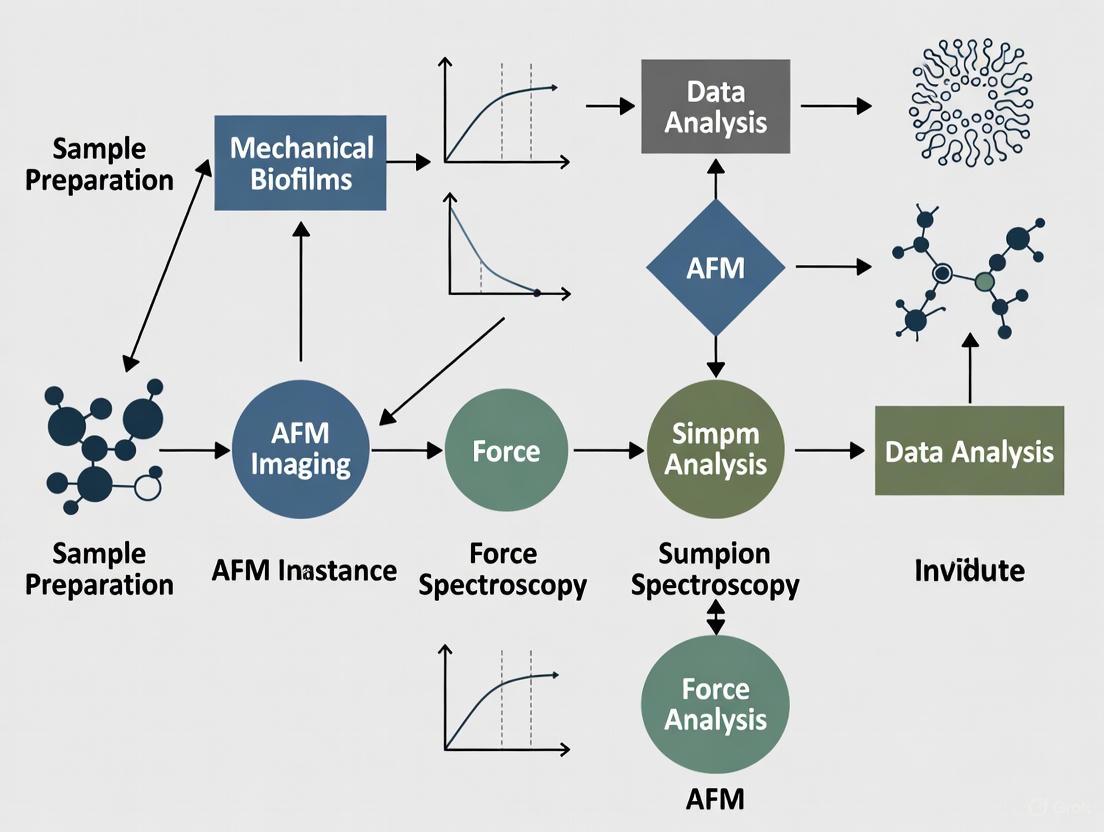
Atomic Force Microscopy (AFM) has emerged as a pivotal tool for quantifying the mechanical properties of Staphylococcus aureus biofilms, which are crucial for understanding their recalcitrance to treatment.
Probing the Mechanical World of Staphylococcal Biofilms: An AFM Guide for Research and Drug Development
Abstract
Atomic Force Microscopy (AFM) has emerged as a pivotal tool for quantifying the mechanical properties of Staphylococcus aureus biofilms, which are crucial for understanding their recalcitrance to treatment. This article provides a comprehensive resource for researchers and drug development professionals, covering the foundational principles of biofilm mechanics, detailed AFM methodologies, strategies for troubleshooting and standardizing measurements, and advanced validation techniques. By synthesizing current research, we outline how mechanical properties like stiffness and viscoelasticity serve as key biomarkers for biofilm maturity and integrity, offering new avenues for developing targeted anti-biofilm strategies and screening therapeutic agents.
Understanding Staphylococcal Biofilm Mechanics: From Structure to Functional Properties
Staphylococcus aureus biofilms represent a significant challenge in clinical and industrial settings due to their role in chronic infections and antimicrobial resistance. A biofilm is a structured microbial community embedded in a self-produced extracellular polymeric substance (EPS) matrix that adheres to biotic or abiotic surfaces [1] [2]. This architectural complexity provides mechanical stability and protection against environmental stresses, antibiotics, and host immune responses [1]. The EPS matrix, composed of polysaccharides, proteins, extracellular DNA (eDNA), and lipids, forms the structural backbone of the biofilm, while the spatial organization of bacterial cells into three-dimensional structures defines its functional integrity [2] [3]. Understanding the precise composition and organization of these components is crucial for research aimed at disrupting biofilm integrity, particularly in investigations of their mechanical properties using techniques like Atomic Force Microscopy (AFM). This guide provides a comprehensive technical overview of S. aureus biofilm architecture, with detailed methodologies for researchers investigating the mechanical properties of staphylococcal biofilms.
The Process of Biofilm Development
The formation of S. aureus biofilms is a dynamic, multi-stage process that transitions from free-living planktonic cells to complex, structured communities [1] [2].
Figure 1: The developmental cycle of S. aureus biofilms, highlighting key stages and molecular determinants. The process begins with initial attachment mediated by surface adhesins, progresses through growth and matrix production, and culminates in dispersal that seeds new colonization sites [1] [2].
Stage 1: Initial Attachment
The biofilm lifecycle initiates when planktonic cells attach to surfaces, which can be either biotic (host tissues) or abiotic (medical implants) [1]. This attachment is facilitated by:
- MSCRAMMs (Microbial Surface Components Recognizing Adhesive Matrix Molecules): Cell wall-anchored proteins including fibronectin-binding proteins (FnbA, FnbB), fibrinogen-binding protein (Fib), clumping factors (ClfA, ClfB), and serine-aspartate repeat proteins (SdrC, SdrD, SdrE) that mediate specific binding to host extracellular matrix components [2].
- Wall Teichoic Acids (WTAs): Non-proteinaceous cell wall polymers that modulate surface charge and hydrophobicity, influencing non-specific adhesion [1].
- Extracellular DNA (eDNA): Released through autolysis, provides an initial electrostatic net for surface attachment [1] [3].
- Physicochemical Factors: Bacterial surface hydrophobicity and electrostatic interactions with substrata [1].
Stage 2: Microcolony Formation and Growth
Following attachment, cells proliferate and form microcolonies. This stage is characterized by the production of the extracellular matrix that facilitates cell-cell adhesion [1]. The primary polysaccharide component, Polysaccharide Intercellular Adhesion (PIA), also known as poly-N-acetylglucosamine (PNAG), is synthesized by enzymes encoded by the icaADBC operon [2]. During this phase, cells transition from surface-protein mediated attachment to matrix-component mediated cohesion [2].
Stage 3: Maturation
Microcolonies develop into complex three-dimensional structures characterized by towers and channels [1] [2]. This architectural remodeling is regulated by:
- Quorum Sensing (QS): The Accessory Gene Regulator (Agr) system coordinates population-density dependent gene expression [1].
- Phenol-Soluble Modulins (PSMs): Surfactant peptides that create fluid channels within the biofilm, facilitating nutrient transport and structural rearrangement [1] [2].
- Extracellular DNA (eDNA): Released through controlled autolysis mediated by the Atl murein hydrolase and the Cid/Lrg system, eDNA provides structural integrity and contributes to the biofilm's electrostatic properties [3].
Stage 4: Dispersion
The final stage involves the active dispersal of cells from the biofilm to colonize new niches [2]. This process is triggered by:
- Proteases and Nucleases: Degrade protein and eDNA components of the matrix [1] [2].
- PSMs: Their surfactant properties disrupt matrix integrity, facilitating cell release [2]. Dispersed cells return to a planktonic state, completing the lifecycle and enabling infection dissemination [2].
Composition of the Extracellular Polymeric Substance (EPS) Matrix
The EPS matrix is a complex, dynamic amalgam of biochemical constituents that determine the biofilm's structural and mechanical properties. The composition varies significantly between strains and is influenced by environmental conditions [4] [3].
Table 1: Major Components of the S. aureus Biofilm EPS Matrix
| Matrix Component | Key Elements | Structural/Functional Role | Genetic Regulation |
|---|---|---|---|
| Polysaccharides | PIA/PNAG (Poly-N-acetylglucosamine) | Primary intercellular adhesion; cationic polymer forming electrostatic bridges [2] | icaADBC operon (icaA, icaD, icaB, icaC) [2] |
| Proteins | MSCRAMMs (e.g., FnbA, FnbB, ClfA, ClfB) [2]Bap (Biofilm-associated protein) [2]Cytoplasmic proteins [4] | Initial surface attachment [2]Intercellular adhesion & amyloid fiber formation [2]Cell-surface association in response to low pH [4] | Variable expression based on surface type & environmental conditions [2] |
| Extracellular DNA (eDNA) | Genomic DNA fragments [3] | Electrostatic net for cell-cell & cell-surface interactions; structural stability; nutrient source [3] | Controlled autolysis via atl murein hydrolase & cid/lrg system [3] |
| Other Components | Phenol-Soluble Modulins (PSMs) [2]Lipids [3] | Biofilm structuring & dispersal (surfactant properties) [2]Matrix stability & hydrophobicity [3] | agr quorum sensing system [1] [2] |
Strain-Dependent and Environment-Dependent Variation in Matrix Composition
The relative contribution of each matrix component differs substantially among S. aureus strains and is influenced by environmental conditions [4]. For instance:
- PIA-Dominant Biofilms: Characteristic of certain laboratory strains (e.g., SA113) and clinical isolates, where the polysaccharide matrix forms the primary structural scaffold [2].
- Protein-Dominant Biofilms: Prevalent among food-source isolates and some clinical strains, where proteinaceous components are more critical for structural integrity than PIA [4]. Treatment with proteinase K can reduce biofilm biomass by 60-70% in such strains [4].
- Environmental Influences: Factors such as glucose supplementation, high salt concentrations, anaerobiosis, and iron availability can significantly alter the expression of matrix components, particularly PIA [4].
Molecular Regulation of Biofilm Architecture
The development and three-dimensional structure of S. aureus biofilms are finely controlled by an interconnected network of regulatory systems.
Figure 2: Key regulatory systems governing S. aureus biofilm development. The Agr quorum sensing system controls the transition from attachment to dispersal phases, while the Sae system and the Cid/Lrg system regulate virulence factor production and eDNA release, respectively [1] [3].
The Accessory Gene Regulator (Agr) Quorum Sensing System
The Agr system is a central regulator that coordinates gene expression in response to cell population density [1]. Its primary functions in biofilm biology include:
- Repression of Surface Protein Expression: At high cell density, Agr downregulates genes encoding surface adhesins (MSCRAMMs), facilitating the detachment of cells from the primary biofilm mass [1].
- Induction of Extracellular Enzymes and PSMs: Agr upregulates the production of proteases, nucleases, and PSMs, which are essential for matrix remodeling and biofilm dispersal [1] [2].
- Impact on Biofilm Phenotype: Mutations in the agr locus often result in thicker, more stable biofilms under static conditions, highlighting its role as a negative regulator of biofilm accumulation [1].
Regulation of Extracellular DNA Release
The controlled release of eDNA through autolysis is critical for biofilm structural integrity [3]. This process involves:
- Atl Murein Hydrolase: The major autolysin in S. aureus, a bifunctional enzyme with amidase and glucosaminidase activities that cleaves peptidoglycan bonds, leading to cell lysis and DNA release [3].
- Cid/Lrg System: Functions analogously to holin/antiholin systems in bacteriophages. CidA promotes murein hydrolase activity and cell lysis, while LrgA inhibits it [3]. This system fine-tunes the degree of autolysis to provide sufficient eDNA without causing excessive biofilm disruption.
The SaeRS Two-Component System
The SaeRS system responds to environmental signals such as low pH and antimicrobial peptides, regulating the expression of numerous virulence factors and surface proteins that influence biofilm formation [5]. Specific mutations in this system (e.g., in strain Newman D2C) can significantly alter biofilm formation capacity compared to closely related strains (e.g., Newman) [5].
Experimental Methods for Biofilm Analysis
A range of techniques is available for quantifying biofilm formation, analyzing matrix composition, and visualizing three-dimensional architecture. The choice of method depends on the specific research question, particularly when investigating mechanical properties.
Table 2: Methodologies for Biofilm Cultivation and Analysis
| Method | Principle | Key Applications | Technical Considerations |
|---|---|---|---|
| Static Microplate Assay [6] | Biofilms grown in wells of polystyrene microplates, stained with Crystal Violet (CV) | Total biomass quantification; high-throughput screening of biofilm formation capacity [6] | Does not distinguish live/dead cells; no structural information; affected by EPS-CV binding [6] |
| Colony Forming Unit (CFU) Enumeration [6] [7] | Biofilms disaggregated & plated for viable bacterial counts | Quantification of cultivable bacteria within biofilm [7] | May underestimate population due to viable but non-culturable (VBNC) cells; labor-intensive [6] |
| Confocal Laser Scanning Microscopy (CLSM) [4] [7] | Optical sectioning of fluorescently-labeled biofilms | 3D visualization of biofilm architecture, spatial distribution of matrix components (proteins, polysaccharides, eDNA) [4] | Provides high-resolution structural data; allows live imaging; requires specific fluorescent probes [4] |
| Enzymatic & Chemical Matrix Disruption [4] | Treatment with specific enzymes (e.g., proteinase K, DNase I) or chemicals (NaIO₄) | Determination of matrix composition based on sensitivity to specific treatments [4] | Proteinase K sensitivity indicates protein-rich matrix; DNase sensitivity indicates eDNA-dependent structure [4] [3] |
| Digital Microscopy & Image Analysis on Biomaterials [8] | Biofilms grown on relevant biomaterials (e.g., titanium, steel), stained & imaged | Quantification of bacterial coverage rate (BCR) on non-translucent surfaces [8] | Direct assessment of biofilm formation on medically-relevant materials; informs AFM substrate selection [8] |
Detailed Protocol: Biofilm Cultivation for Architectural Analysis
For researchers investigating the mechanical properties of biofilms, consistent cultivation is essential. The following protocol is adapted for generating robust biofilms suitable for AFM analysis:
Materials Required:
- Strains: S. aureus reference strains (e.g., SA113, Newman, or clinical isolates) [5]. Note: Genetic background significantly impacts phenotype; strain Newman D2C (NCTC 10833) has different biofilm-forming capacity than strain Newman (NCTC 8178) due to mutations in agr and sae [5].
- Growth Medium: Tryptic Soy Broth (TSB) or TSB supplemented with 0.4% glucose (TSBG) or 4% NaCl (TSBN) to enhance matrix production [4].
- Substrata: Depending on research focus: 96-well polystyrene plates [6], polyurethane-based catheter tubing [5], or metallic biomaterials (titanium, stainless steel washers) [8].
Procedure:
- Inoculum Preparation: Grow bacteria overnight in TSB. Dilute the culture 1:100 in fresh TSB or TSBG to approximately 10⁶ CFU/mL [4].
- Surface Inoculation: Add 200 µL of bacterial suspension per well of a 96-well tissue culture-treated plate. Include broth-only wells as negative controls [4].
- Incubation: Incubate plates aerobically at 37°C for 24-48 hours. For dynamic conditions, use an orbital shaker at 120 rpm [4]. For AFM studies, biofilms may be grown directly on suitable substrates placed within the wells.
- Washing: Gently remove planktonic cells by washing the biofilm twice with 200 µL of phosphate-buffered saline (PBS) or 0.9% NaCl [4].
- Analysis: Process the biofilm according to the chosen downstream analysis method (e.g., CV staining, CLSM, or AFM).
Detailed Protocol: Matrix Composition Analysis by Enzymatic Treatment
This protocol determines the relative contribution of proteins and eDNA to biofilm integrity, which directly influences mechanical properties.
Materials Required:
- Proteinase K Solution: 0.1 mg/mL in 20 mM Tris-HCl with 1 mM CaCl₂ [4].
- DNase I Solution: Commercially available preparation in appropriate buffer [3].
- Sodium Metaperiodate (NaIO₄) Solution: 40 mM for polysaccharide disruption [4].
- Control Solution: 0.9% NaCl.
Procedure:
- Biofilm Cultivation: Grow 48-hour biofilms as described in Section 5.1.
- Washing: Gently wash biofilms twice with 200 µL of 0.9% NaCl.
- Enzyme/Chemical Treatment: Add 200 µL of the test solution (Proteinase K, DNase I, or NaIO₄) or control (NaCl) to respective wells.
- Incubation: Incubate plates for 2 hours at 37°C without shaking [4].
- Biomass Assessment: Wash treated biofilms once with 0.9% NaCl. Dislodge remaining biofilm by scraping and sonication (5-second pulse at 22% amplitude) in 200 µL of 0.9% NaCl [4].
- Quantification: Measure the optical density at 600 nm (OD₆₀₀) of the sonicated suspension. Compare OD values between treatments and control to determine the contribution of each matrix component to structural stability [4].
The Scientist's Toolkit: Essential Research Reagents
Table 3: Key Reagents for S. aureus Biofilm Research
| Reagent/Category | Specific Examples | Function in Biofilm Research |
|---|---|---|
| Growth Media & Supplements | Tryptic Soy Broth (TSB) [4]TSB + 0.4% Glucose (TSBG) [4]TSB + 4% NaCl (TSBN) [4] | Standard biofilm growth medium [4]Induces PIA-dependent biofilm formation [4]Modulates matrix composition [4] |
| Matrix-Disrupting Enzymes | Proteinase K [4]DNase I [3] | Degrades protein components of biofilm matrix [4]Degrades eDNA scaffold; disrupts biofilm structure [3] |
| Staining & Visualization | Crystal Violet (CV) [6]SYTO dyes [4]FilmTracer SYPRO Ruby [4]WGA-Oregon Green [4] | Total biofilm biomass quantification [6]Nucleic acid staining for cell visualization [4]General protein matrix staining [4]Specific staining of N-acetylglucosamine (PIA) [4] |
| Specialized Substrata | Polystyrene microplates [4]Polyurethane catheter tubing [5]Titanium/Stainless steel washers [8] | Standard in vitro adhesion & biofilm studies [4]Relevant model for catheter-associated biofilms [5]Model for orthopedic implant-associated biofilms [8] |
The architectural complexity of Staphylococcus aureus biofilms, governed by the precise composition and spatial organization of their EPS matrix, presents a significant research challenge and opportunity. The strain-specific and environmentally-responsive nature of matrix composition necessitates careful selection of bacterial strains and growth conditions, particularly when investigating mechanical properties. The methodologies outlined herein—from cultivation protocols to compositional analysis and advanced imaging—provide a framework for systematic investigation of biofilm architecture. For research focused on AFM and mechanical characterization, understanding the biochemical underpinnings of matrix composition is paramount, as the relative contributions of PIA, proteins, and eDNA directly determine the viscoelastic and adhesive properties being measured. Future research integrating these compositional analyses with direct mechanical measurements will yield critical insights for developing novel anti-biofilm strategies aimed at disrupting the structural integrity of these resilient communities.
Staphylococcal biofilms, particularly those formed by Staphylococcus aureus, present a significant challenge in healthcare settings due to their role in persistent medical device-related infections. The mechanical properties of these biofilms—stiffness, adhesion, and viscoelasticity—are not merely physical attributes but crucial determinants of their virulence, persistence, and resistance to treatment [9]. This technical guide examines these core mechanical properties within the context of atomic force microscopy (AFM) research, providing researchers and drug development professionals with standardized methodologies, quantitative benchmarks, and practical experimental frameworks for characterizing staphylococcal biofilms. Understanding these properties enables more effective strategies for combating biofilm-associated infections through targeted mechanical disruption.
Quantitative Mechanical Properties of Staphylococcal Biofilms
The mechanical properties of staphylococcal biofilms exhibit considerable variability depending on bacterial strain, growth conditions, maturation state, and measurement methodology. The following tables summarize key quantitative findings from AFM-based research.
Table 1: Stiffness and Adhesion Properties of S. aureus Biofilms and Cells
| Property | Measured Value | Measurement Technique | Experimental Context | Source |
|---|---|---|---|---|
| Young's Modulus (Stiffness) | ~2.3 MPa | AFM force spectroscopy | "Hairy" S. aureus ATCC 27217 cell surface (16h culture) | [10] |
| Young's Modulus (Stiffness) | ~0.35 MPa | AFM force spectroscopy | "Bald" S. aureus ATCC 27217 cell surface (16h culture) | [10] |
| Cell-Surface Adhesion | Stronger adhesion to hydrophobic surfaces | Physicochemical analysis | Initial bacterial attachment governed by cell wall macromolecules | [5] |
| Cell-Surface Adhesion | Weaker adhesion to plasma-coated surfaces | In vitro catheter adhesion assay | Decoration with human blood plasma reduces S. aureus adhesion | [5] |
Table 2: Viscoelastic Properties of S. aureus Biofilms
| Property | Measured Value | Measurement Technique | Experimental Context | Source |
|---|---|---|---|---|
| Shear Modulus (G) | 0.9 to 5 Pa | Stress-strain curves from microcolony deformation | S. aureus biofilm response to fluid shear (0 to 1.8 Pa) | [11] |
| Viscosity (η) | 3,500 ± 2,900 Pa·s | Creep curve analysis | S. aureus biofilm microcolonies under sustained shear stress | [11] |
| Relaxation Time | ~12 minutes | Ratio of viscosity to elasticity | Characteristic time for transition from solid-like to fluid-like behavior | [11] |
| Structural Response | J-shaped stress-strain curves with hysteresis | Mechanical testing under fluctuating shear | Demonstration of viscoelasticity, similar to soft biological tissues | [11] |
Experimental Protocols for AFM-Based Characterization
AFM Force Spectroscopy for Cell Wall Mechanics
This protocol details the procedure for measuring time-dependent evolution of surface nanotopography and mechanical properties of S. aureus from initial adhesion to early biofilm formation [10].
- Bacterial Strain and Preparation: Use S. aureus ATCC 27217 or relevant strain. Culture in Trypticase Soy Broth (TSB) at 37°C without agitation. Harvest cells at different growth phases (e.g., 16h for mature cells). Prepare both "non-centrifuged" samples (direct fixation) and "centrifuged" samples (pelleted and resuspended) to assess preparation artifacts [10].
- Sample Fixation: Preserve native cell wall structure by direct fixation of planktonic suspensions with 2% glutaraldehyde in distilled water for 10 minutes at room temperature. Glutaraldehyde creates irreversible protein cross-linking, stabilizing membrane proteins and surface appendages [10].
- AFM Force Mapping: Conduct AFM in force spectroscopy mode using appropriate cantilevers (e.g., silicon nitride tips). Map surface topography and mechanical properties in native liquid environment. Acquire force-distance curves at multiple positions on individual cells to quantify spatial heterogeneity [10].
- Young's Modulus Calculation: Process force-distance curves using appropriate contact mechanics models (e.g., Hertz model, Sneddon model) to calculate Young's modulus values. Differentiate between "hairy" (high roughness, ~2.3 MPa) and "bald" (low roughness, ~0.35 MPa) cell subpopulations [10].
Microscale Viscoelasticity Assessment
This methodology enables quantification of biofilm viscoelastic response to fluid shear forces, relevant to understanding biofilm behavior in vascular and catheter environments [11].
- Biofilm Cultivation: Grow S. aureus biofilms (e.g., strain ATTC 25923) in glass capillary flow cells integrated into a once-through flow system. Use 1/10-strength brain heart infusion broth at 37°C. Inoculate with 24-h broth culture and allow 30-minute attachment period before establishing continuous laminar flow (e.g., 60 ml/h to approximate central venous catheter conditions) [11].
- Microscopic Monitoring: Monitor biofilms with camera-mounted microscope (e.g., Olympus BH2 with Cohu 4910 camera) using appropriate imaging software (e.g., Scion Image). Conduct measurements after 3-day growth period from multiple independent experiments [11].
- Shear Stress Application: Control flow rate and wall shear stress using peristaltic pump. For stress-strain curves, incrementally increase and decrease wall shear stress (τw) from 0 to 1.8 Pa with approximately 5-second intervals, measuring deformation angles of individual microcolonies [11].
- Viscoelastic Parameter Calculation: Calculate shear modulus (G) using equation G = τw/α, where α is the shear angle (change in angle between upstream edge of microcolony and substratum). For creep tests, apply sustained τw (0.46 or 1.125 Pa) for 300 seconds, measure deformation, then monitor recovery for 300 seconds after stress removal. Calculate G and viscosity (η) from creep curves [11].
Machine Learning Classification of Biofilm Maturity
This protocol employs deep learning for automated classification of biofilm maturity stages based on topographic characteristics identified by AFM, reducing observer bias and manual evaluation time [12].
- Image Acquisition: Acquire AFM images of staphylococcal biofilms at various maturation stages. Identify common topographic characteristics: substrate, bacterial cells, and extracellular matrix [12].
- Classification Scheme Development: Establish a classification framework with 6 distinct classes based on topographic features, independent of incubation time. Validate classification scheme with human researchers, establishing ground truth with mean accuracy of 0.77 ± 0.18 [12].
- Algorithm Training: Design and train deep learning algorithm to identify pre-set biofilm characteristics and discriminate between the six maturity classes. Optimize algorithm to achieve mean accuracy of 0.66 ± 0.06 with recall comparable to human researchers and off-by-one accuracy of 0.91 ± 0.05 [12].
- Tool Implementation: Deploy trained algorithm as an open-access desktop tool for research community use. This enables standardized, automated classification of AFM biofilm images [12].
Biofilm ML Classification Workflow
The Scientist's Toolkit: Research Reagent Solutions
Table 3: Essential Research Reagents and Materials for Staphylococcal Biofilm Mechanics
| Reagent/Material | Function/Application | Research Context |
|---|---|---|
| Silicon Nitride AFM Tips | Nanomechanical probing of cell surface properties | Measuring Young's modulus of S. aureus cells in liquid environment [10] |
| Glass Capillary Flow Cells | Mimicking physiological shear conditions | Studying viscoelastic responses to fluid shear in catheter infection models [11] |
| Glutaraldehyde Fixative | Preservation of native cell wall structure | Stabilizing membrane proteins and surface appendages for SEM/AFM imaging [10] |
| Chlorogenic Acid | Natural adjuvant for antibiotic therapy | Disrupting biofilm matrix integrity when combined with cefazolin [13] |
| Polystyrene Microplates | High-throughput biofilm formation assays | Standardized assessment of adhesion and biofilm development [5] |
| Polyurethane-based Catheter Tubing | Testing biofilm formation on medical device materials | Evaluating bacterial adhesion to clinically relevant surfaces [5] |
Technical Diagrams and Workflows
AFM Mechanics Analysis Pathway
Viscoelastic Stress Response
The study of bacterial biofilms has progressively shifted from a purely microbiological perspective to one that integrates biophysical principles, where mechanical properties are recognized as critical determinants of biofilm function and resilience. Staphylococcus aureus biofilms, in particular, represent a significant clinical challenge in healthcare-associated infections, exhibiting dramatically increased resistance to antibiotics and host immune responses [14]. The biofilm lifecycle—comprising adhesion, maturation, and dispersion—is not merely a biological program but a mechanically driven process where structural integrity, viscoelasticity, and adhesive strength dictate pathological outcomes. Atomic force microscopy (AFM) has emerged as a pivotal technology in this domain, enabling researchers to quantify these mechanical properties at the nanoscale on living bacterial cells in their native environments [15] [16]. This technical guide synthesizes current AFM research to establish a comprehensive framework linking mechanical properties to staphylococcal biofilm development, providing methodologies, quantitative benchmarks, and visualization tools for researchers and drug development professionals.
The Biofilm Lifecycle: A Mechanical Perspective
The traditional model of biofilm development describes a multi-stage process. A contemporary understanding, synthesized from recent research, conceptualizes this as three main phases: (1) aggregation and attachment, (2) growth and accumulation, and (3) disaggregation and detachment [17]. Throughout these phases, the mechanical properties of the biofilm and its constituent cells are not passive outcomes but active mediators of development.
Stage 1: Adhesion and Aggregation - The Mechanical Foundations
The initial attachment of planktonic S. aureus cells to a surface is governed by nanoscale interaction forces. AFM-based force spectroscopy has been instrumental in quantifying the specific ligand-receptor bonds and nonspecific interactions that mediate this irreversible attachment [16]. A critical mechanical factor in staphylococcal adhesion is the role of surface proteins and their activation by metal ions.
Zinc-Dependent Adhesion Mechanics: The S. aureus surface protein G (SasG) and its homologous proteins demonstrate remarkable mechanical functionality. Research shows that Zn²⁺ ions activate SasG-mediated cell-cell adhesion through a dual mechanism: firstly, by increasing cell wall rigidity, and secondly, by facilitating zinc-dependent homophilic bonds between SasG proteins protruding from opposing cell surfaces [15]. This represents a sophisticated mechanical adaptation where a chemical signal (Zn²⁺ availability) directly modulates adhesive capacity.
Single-Protein Mechanics: Single-cell force measurements reveal that individual SasG domains exhibit extraordinary mechanical strength, withstanding forces up to ~500 pN before unfolding. This robust mechanical design ensures that SasG-mediated adhesion can withstand physiological shear forces that would disrupt weaker interactions [15].
The following diagram illustrates the Zn²⁺-dependent mechanical adhesion process:
Diagram: Zinc's dual role in activating S. aureus adhesion via SasG. Zn²⁺ increases cell wall rigidity while enabling homophilic bonds between opposing SasG proteins.
Stage 2: Maturation and Accumulation - Structural Mechanics of a Microbial Community
As biofilms transition from microcolonies to mature structures, their mechanical properties evolve significantly. The mature biofilm is a composite material whose mechanical integrity derives from both cellular components and the extracellular polymeric substance (EPS) matrix.
Matrix-Dependent Cohesion: The EPS consists of polysaccharides, proteins, extracellular DNA (eDNA), and lipids that form a viscoelastic hydrogel encasing the bacterial population [14] [17]. This matrix gives biofilms their characteristic cohesion and resistance to mechanical stress.
Developmental Staging Based on Mechanics: Recent research has quantitatively defined biofilm development stages based on growth dynamics:
- Stage 1 (0-6 hours): Initial attachment and early microcolony formation
- Stage 2 (6-16 hours): Active accumulation and EPS production
- Stage 3 (16-24 hours): Structural maturation
- Stage 4 (>24 hours): Fully mature biofilm with dispersion capacity [18]
This staging system provides a standardized framework for correlating mechanical properties with developmental timing, essential for reproducible research.
Stage 3: Dispersion - Mechanical Release Mechanisms
Dispersion represents the culmination of the biofilm lifecycle, wherein bacteria detach to colonize new niches. This process is mechanically regulated through both active and passive mechanisms.
Surfactant-Mediated Detachment: S. aureus produces phenol-soluble modulins (PSMs) that function as powerful surfactants, reducing interfacial tensions within the biofilm matrix and facilitating mechanical separation [14]. These amphipathic peptides disrupt the non-covalent forces maintaining biofilm integrity, creating channels for nutrient transport and ultimately enabling detachment of biofilm masses.
Electrochemical Signatures Preceding Dispersion: Zeta-potential (ζ) measurements reveal that the electrostatic properties of biofilms change systematically throughout development. Weak biofilm formers maintain a significantly more negative ζ-potential than strong producers throughout all growth stages, suggesting surface charge characteristics may influence dispersal readiness [18].
Atomic Force Microscopy: Probing Biofilm Mechanics
AFM has revolutionized the study of biofilm mechanics by providing multiparametric nanoscale analysis under physiologically relevant conditions. The technology enables simultaneous topographical imaging and quantitative mechanical mapping of living biofilms.
AFM Operational Modes for Biofilm Analysis
Imaging Modalities: For soft, hydrated biological samples like biofilms, tapping mode (intermittent contact) AFM is preferred as it minimizes lateral forces that could damage delicate structures [16]. Phase imaging, captured simultaneously with topography, provides qualitative mapping of material properties based on variations in viscoelasticity and adhesion.
Force Spectroscopy: This technique measures interaction forces between the AFM tip and sample by recording cantilever deflection as a function of tip-sample separation [16]. These force-distance curves contain rich information about adhesion strength, elasticity, and specific molecular interactions.
Single-Cell Force Spectroscopy (SCFS): A specialized application where a single bacterial cell is attached to the AFM cantilever, enabling direct measurement of cell-surface and cell-cell interaction forces [15]. This approach has been pivotal in understanding the nanomechanics of SasG-mediated adhesion.
Nanoindentation: Quantifying Mechanical Properties
AFM can function as a nanoindenter to measure the mechanical properties of biofilms and individual cells. By comparing force curves obtained on a rigid reference surface and the soft biological sample, the indentation depth can be calculated and correlated with mechanical models [16].
The Hertz model is commonly applied to analyze force-indentation data, describing the elastic deformation of two perfectly homogeneous smooth bodies touching under load. The model is expressed as:
( F = \frac{4}{3} \cdot \frac{E}{1-\nu^2} \cdot \sqrt{R} \cdot \delta^{3/2} )
Where:
- F = force on the cantilever
- E = Young's modulus (stiffness)
- ν = Poisson's ratio (typically assumed as 0.5 for biological samples)
- R = tip radius
- δ = indentation depth [16]
This analytical framework allows quantitative comparison of biofilm mechanical properties across different conditions, strains, and treatments.
Quantitative Mechanical Properties of Staphylococcal Biofilms
Table 1: Experimentally Measured Mechanical Properties of S. aureus Biofilms and Components
| Property/Parameter | Value/Range | Measurement Technique | Biological Significance | Source |
|---|---|---|---|---|
| SasG Unfolding Force | ~500 pN | Single-molecule AFM | Withstands physiological shear forces during adhesion | [15] |
| Cell Wall Young's Modulus | 495 ± 272 kPa | Multiparametric AFM imaging | Baseline stiffness without Zn²⁺; reflects peptidoglycan elasticity | [15] |
| Strong Biofilm Former ζ-potential | Less negative | Electrokinetic measurement | Surface charge characteristic of robust biofilm producers | [18] |
| Weak Biofilm Former ζ-potential | More negative | Electrokinetic measurement | Electrostatic signature of poor biofilm formation | [18] |
| PIA Contribution to Adhesion | Cationic polymer | Biochemical analysis | Mediates intercellular adhesion in many strains | [14] |
Table 2: Antibiotic Efficacy Against Mature (Stage 4) S. aureus Biofilms
| Antibiotic | Efficacy Against Biofilms | Effective Concentration Range | Fold Increase Over MIC | Key Finding | |
|---|---|---|---|---|---|
| Daptomycin | ≥75% reduction in viability | 32-256 μg/mL | 64-512× MIC | Significant biofilm reduction across all strong/weak biofilms | [18] |
| Vancomycin | Limited efficacy | Up to 1024 μg/mL tested | >1000× MIC | Standard dosing often insufficient for biofilm eradication | [18] |
| Levofloxacin | Variable, strain-dependent | Up to 1024 μg/mL tested | >1000× MIC | Inconsistent activity against mature biofilms | [18] |
Experimental Protocols: Methodologies for Reproducible Research
Protocol: Nanoscale Mechanical Mapping of Living Biofilms
This protocol details the procedure for multiparametric AFM analysis of S. aureus biofilm mechanical properties, adapted from established methodologies [15] [16].
Sample Preparation:
- Grow S. aureus biofilms on appropriate substrates (e.g., glass, titanium, polyurethane) for 24-48 hours under desired conditions.
- For Zn²⁺ stimulation experiments, add 1 mM ZnCl₂ to the growth medium.
- Gently rinse with PBS or appropriate buffer to remove non-adherent cells while preserving biofilm architecture.
AFM Immobilization:
- Use mechanical entrapment in porous membranes or chemical fixation with poly-L-lysine treated surfaces.
- Polydimethylsiloxane (PDMS) stamps with microstructures matching cell dimensions provide optimal immobilization with minimal physiological impact [16].
Instrumentation and Acquisition:
- Employ a commercial AFM system with fluid cell for imaging in physiological buffer.
- Use silicon nitride cantilevers with nominal spring constants of 0.01-0.1 N/m for soft biological samples.
- Calibrate cantilever sensitivity and spring constant using established thermal tuning methods.
- Acquire force volume images (arrays of 64×64 or 128×128 force curves) across multiple biofilm regions.
Data Analysis:
- Convert force-distance curves to force-indentation curves using reference measurements on rigid substrates.
- Fit retraction curves to quantify adhesion forces.
- Apply Hertz model to approach curves to calculate Young's modulus values.
- Generate spatial maps of topography, adhesion, and stiffness for correlation.
Protocol: Single-Cell Force Spectroscopy of Bacterial Adhesion
This specialized protocol measures the interaction forces between individual bacterial cells, crucial for understanding intercellular adhesion mechanisms [15].
Probe Preparation:
- Functionalize tipless AFM cantilevers with a 5-10 μm layer of polydopamine or UV-curable glue.
- Attach a single bacterial cell to the functionalized surface using minimal force.
- Verify single-cell attachment optically and through force spectroscopy signature.
Interaction Measurements:
- Approach the cell-functionalized probe to a biofilm or cell lawn surface at controlled velocity (0.5-1 μm/s).
- Apply controlled contact force (100-500 pN) and dwell time (0.1-1 s) to simulate physiological conditions.
- Retract probe at constant velocity while recording deflection.
Data Interpretation:
- Analyze multiple approach-retract cycles (n>100) to establish statistical significance.
- Identify specific binding events through sawtooth patterns in retraction curves, characteristic of molecular unfolding.
- Compare adhesion forces with and without chemical treatments (e.g., EDTA chelation to test metal ion dependence).
The following diagram illustrates the core AFM workflow for biofilm mechanical analysis:
Diagram: AFM workflow for biofilm mechanical analysis, from sample preparation to quantitative property mapping.
The Scientist's Toolkit: Essential Research Reagents and Materials
Table 3: Key Research Reagents and Materials for Biofilm Mechanical Studies
| Reagent/Material | Function/Application | Specific Examples | Technical Considerations | |
|---|---|---|---|---|
| Functionalized AFM Probes | Nanomechanical probing | Silicon nitride tips (soft cantilevers), cell-functionalized tipless cantilevers | Spring constant calibration critical for quantitative measurements | [15] [16] |
| Immobilization Substrates | Sample stabilization for AFM | Poly-L-lysine coated glass, PDMS microstructured stamps, porous membranes | Must balance immobilization strength with physiological relevance | [16] |
| Zn²⁺ Solutions | Activate SasG-mediated adhesion | ZnCl₂ in physiological buffers | Optimal effect at ~1 mM concentration; reversible with EDTA chelation | [15] |
| Textured Biomaterials | Study topography-adhesion relationships | PUU films with submicron pillar arrays (400-700 nm diameters) | Reduced contact area correlates with decreased bacterial adhesion | [19] |
| Antibiotic Stock Solutions | Biofilm eradication studies | Daptomycin, vancomycin, levofloxacin | Require 64-512× MIC for effective biofilm reduction | [18] |
The mechanical properties of S. aureus biofilms are not merely emergent features but fundamental determinants of their developmental program and therapeutic resistance. Through technologies like AFM, researchers can now quantify these properties with unprecedented resolution, revealing how molecular-scale mechanics dictate macroscopic biofilm behavior. The zinc-dependent activation of SasG illustrates how mechanical adhesion is chemically regulated, while the stage-dependent changes in electrostatic properties and antibiotic susceptibility demonstrate the dynamic nature of biofilm mechanics throughout the lifecycle.
Future research directions will likely focus on manipulating these mechanical properties for therapeutic benefit, whether through surface topography engineering that minimizes bacterial adhesion [19], small molecule inhibitors that disrupt key mechanical interactions like Zn²⁺-dependent adhesion [15], or antibiotic dosing strategies optimized for biofilm penetration based on their mechanical staging [18]. The integration of AFM with complementary technologies like confocal microscopy and transcriptomics will further elucidate the complex interplay between mechanical forces and genetic regulation in biofilm communities. As these tools and understanding advance, targeting the mechanical vulnerabilities of biofilms represents a promising frontier for combating device-related and chronic staphylococcal infections.
PIA-Dependent and Protein-Dependent Mechanistic Pathways in S. aureus
Staphylococcus aureus biofilm formation represents a significant challenge in clinical settings due to its role in persistent infections and antibiotic resistance. The mechanical integrity and resilience of these biofilms are governed by two primary mechanistic pathways: the polysaccharide intercellular adhesion (PIA)-dependent pathway and various protein-dependent pathways. Within the context of staphylococcal biofilm research, atomic force microscopy (AFM) has emerged as a powerful tool for elucidating the nanoscale mechanical properties and molecular interactions that underpin biofilm development and stability. This technical guide provides an in-depth analysis of these pathways, with particular emphasis on AFM methodologies that enable researchers to quantify the biophysical forces governing biofilm formation, maturation, and dispersal.
PIA-Dependent Biofilm Pathway
The polysaccharide intercellular adhesion (PIA) pathway represents the most extensively characterized mechanism of staphylococcal biofilm formation. PIA, also known as poly-N-acetylglucosamine (PNAG), is a cationic, partially deacetylated homopolymer of β-1-6-linked N-acetylglucosamine that plays a crucial role in bacterial adhesion and aggregation during biofilm development [2] [20].
Genetic Regulation and Biosynthesis
The PIA biosynthesis machinery is encoded by the icaADBC operon, which is conserved across staphylococcal species [2] [20]. This operon consists of four core genes with distinct enzymatic functions:
- IcaA: A transmembrane N-acetylglucosamine transferase that catalyzes the synthesis of oligomeric PIA precursors [2].
- IcaD: Functions as a chaperone protein that stabilizes IcaA and enhances its specificity for polymer formation [2].
- IcaC: A transmembrane protein responsible for translocating newly synthesized PIA to the cell surface [2].
- IcaB: A deacetylase that removes acetyl groups from mature PIA, conferring a positive charge essential for intercellular adhesion [2].
The regulation of PIA production is complex and influenced by various environmental factors. Research demonstrates that ica operon expression and subsequent PIA production are strongly induced during in vivo infection, even in strains that exhibit minimal PIA production under standard in vitro conditions [21].
Table 1: Components of the icaADBC Operon and Their Functions in PIA Biosynthesis
| Gene | Protein Function | Role in PIA Biosynthesis |
|---|---|---|
| icaA | N-acetylglucosamine transferase | Catalyzes polymerization of N-acetylglucosamine residues |
| icaD | Chaperone protein | Stabilizes IcaA and increases polymer specificity |
| icaC | Transmembrane transporter | Mediates export of PIA to the cell surface |
| icaB | Deacetylase | Removes acetyl groups, creating positive charge for adhesion |
Structural and Functional Properties
PIA is characterized by its cationic nature, derived from the partial deacetylation (approximately 15-20%) of N-acetylglucosamine residues [20]. This positive charge enables electrostatic interactions with negatively charged bacterial cell surfaces, facilitating cell-cell adhesion [2]. The polymer typically contains approximately 130 N-acetylglucosamine residues, with molecular weight estimates ranging from 20 kDa to over 460 kDa, variations that likely reflect differences in analytical methodologies and growth conditions [20].
Functionally, PIA contributes significantly to biofilm matrix cohesion and provides protection against host immune mechanisms. The deacetylated form of PIA demonstrates increased resistance to antimicrobial peptides and impedes phagocytic uptake, enhancing bacterial survival during infection [2] [20].
Protein-Dependent Biofilm Pathways
While PIA represents a crucial biofilm component, many S. aureus strains utilize protein-dependent mechanisms for biofilm formation, either independently or in conjunction with PIA [22]. These protein-based pathways involve various cell wall-anchored (CWA) proteins that mediate specific molecular interactions.
Major Protein Mediators
Biofilm-Associated Protein (Bap)
Bap is a high-molecular-weight surface protein (2,276 amino acids) that promotes both initial surface attachment and intercellular adhesion through extracellular polysaccharide-independent mechanisms [2] [22]. The N-terminal region of Bap is released into the extracellular matrix and can assemble into amyloid fibers that contribute to biofilm structural integrity [2]. During infection, Bap facilitates persistence by enhancing epithelial cell adhesion while simultaneously interfering with FnBPs-mediated cellular internalization pathways [2].
Fibronectin-Binding Proteins (FnBPs)
FnBPs, particularly FnbA and FnbB, are multifunctional adhesins that recognize host extracellular matrix components such as fibronectin [2]. These proteins play a dual role in biofilm development by mediating initial attachment to conditioned biomaterials and promoting intercellular accumulation through homophilic interactions [22].
Staphylococcus aureus Surface Protein G (SasG)
SasG promotes Zn²⁺-dependent cell-cell adhesion through homophilic interactions between G5-E domains on adjacent cells [15]. This protein forms β-sheet-rich fibrils that protrude from the cell surface, with remarkable mechanical strength that enables resistance to physiological shear forces [15]. Single-molecule force spectroscopy measurements have demonstrated that individual SasG domains can withstand unfolding forces of up to ∼500 pN [15].
Other Protein Components
Additional protein factors contribute to S. aureus biofilm formation, including:
- Clumping factors (ClfA, ClfB): Fibrinogen-binding proteins that facilitate surface attachment [2] [22].
- Serine-aspartate repeat proteins (SdrC, SdrD, SdrE): Adhesins that recognize host matrix components [2].
- Protein A (SpA): A multifunctional protein that can influence interspecies interactions in polymicrobial biofilms [23].
Table 2: Key Protein Components in S. aureus Biofilm Formation
| Protein | Primary Function | Mechanism of Action |
|---|---|---|
| Bap | Initial attachment and intercellular adhesion | Forms amyloid fibers; interferes with host internalization |
| FnBPs | Host protein binding and cell-cell adhesion | Binds fibronectin; mediates homophilic interactions |
| SasG | Zn²⁺-dependent intercellular adhesion | Forms mechanically strong homophilic bonds between G5-E domains |
| ClfA, ClfB | Fibrinogen binding | Mediates attachment to protein-coated surfaces |
| Protein A | Immune evasion and interspecies interaction | Alters biofilm formation in co-infecting species |
AFM Methodologies for Biofilm Mechanical Characterization
Atomic force microscopy provides powerful capabilities for investigating the mechanical properties of S. aureus biofilms at the nanoscale. Several specialized AFM modalities have been developed to characterize biofilm structure, adhesion, and stiffness.
Multiparametric Imaging
Multiparametric AFM imaging enables simultaneous mapping of topological, mechanical, and adhesive properties of living bacterial cells [15]. This technique involves recording arrays of force curves across the cell surface at high spatial resolution, providing correlated data on:
- Surface topography: Reveals nanoscale surface features and roughness
- Young's modulus: Quantifies cell wall stiffness through analysis of force-indentation curves using Hertzian contact mechanics
- Adhesion forces: Maps the distribution of adhesive sites across the cell surface
Application of this methodology to S. aureus has demonstrated that Zn²⁺ significantly alters cell surface properties, increasing wall rigidity and activating SasG-mediated adhesion [15].
Single-Cell Force Spectroscopy (SCFS)
SCFS measures interaction forces between individual bacterial cells and surfaces by immobilizing a single cell on the AFM cantilever [15]. This approach allows direct quantification of:
- Cell-surface adhesion forces: Measures strength of bacterial attachment to substrates
- Cell-cell interaction forces: Quantifies homophilic protein interactions mediating intercellular adhesion
- Unbinding forces: Characterizes the mechanical strength of specific molecular interactions
SCFS studies of SasG have revealed that this protein mediates cell-cell adhesion through specific Zn²⁺-dependent homophilic bonds with remarkable mechanical stability [15].
Stiffness Measurements During Biofilm Maturation
AFM-based nanomechanical measurements can track changes in cell stiffness throughout biofilm development. Studies have documented distinct temporal patterns in S. aureus stiffness during biofilm maturation:
- 48-hour biofilms: Young's modulus ≈ 0.9 MPa
- 96-hour biofilms: Young's modulus ≈ 1.3 MPa [24]
This progressive stiffening reflects structural reorganization and matrix consolidation during biofilm maturation, which may contribute to enhanced mechanical stability and antibiotic tolerance.
Experimental Protocols
AFM Sample Preparation for Biofilm Analysis
Materials:
- Polished silicon or glass substrates
- Bacterial culture in appropriate growth medium
- Phosphate-buffered saline (PBS) or appropriate imaging buffer
- Atomic force microscope with appropriate cantilevers
Procedure:
- Grow S. aureus cultures to mid-exponential phase (OD600 = 0.8) in suitable biofilm-promoting medium [21].
- For surface attachment studies, incubate substrates with bacterial suspension for 1-2 hours at 37°C.
- Gently rinse substrates with imaging buffer to remove non-adherent cells.
- For mature biofilm analysis, continue incubation for 24-96 hours with periodic medium refreshment [24].
- Mount prepared samples in AFM fluid cell and maintain at constant temperature during measurement.
Multiparametric Imaging Protocol
Instrument Settings:
- Cantilever: Silicon nitride with nominal spring constant of 0.01-0.1 N/m
- Setpoint: 0.5-1 nN to minimize sample deformation
- Scanning frequency: 0.5-1 Hz
- Resolution: 256 × 256 pixels
Data Acquisition:
- Approach the sample surface and engage in contact mode.
- Record force-volume images by acquiring complete force curves at each pixel.
- Convert force-distance curves to force-indentation curves.
- Calculate Young's modulus using the Hertz contact model.
- Extract adhesion forces from retraction curves.
Analysis:
- Process topographic data to obtain surface roughness parameters.
- Generate Young's modulus maps and calculate average values.
- Create adhesion force maps and identify adhesive nanodomains.
Single-Cell Force Spectroscopy Protocol
Cell Probe Preparation:
- Functionalize tipless cantilevers with polydopamine or polyethyleneimine coating.
- Incubate functionalized cantilevers with concentrated bacterial suspension (OD600 = 2.0) for 15 minutes.
- Gently rinse to remove loosely attached cells.
- Verify single-cell attachment optically.
Force Measurement:
- Approach cell-functionalized probe toward substrate or cell lawn at constant velocity (0.5-1 μm/s).
- Maintain contact for defined dwell time (0.1-1 s) with constant force (200-500 pN).
- Retract probe at constant velocity while recording deflection.
- Repeat measurements at different locations (n ≥ 100).
- For Zn²⁺-dependent studies, perform in Tris buffer with 1 mM ZnCl₂ [15].
Data Processing:
- Convert cantilever deflection to force using spring constant.
- Align approach and retraction curves.
- Analyze adhesion forces, rupture events, and work of adhesion.
Research Reagent Solutions
Table 3: Essential Research Reagents for S. aureus Biofilm and AFM Studies
| Reagent/Category | Specific Examples | Research Function |
|---|---|---|
| Genetic Tools | ica mutant strains (e.g., CW25, CW26) [21] | Determine PIA-specific contributions to biofilm phenotypes |
| SasG-deficient strains [15] | Elucidate protein-mediated adhesion mechanisms | |
| Biochemical Reagents | Proteinase K [23] | Differentiate protein-dependent versus polysaccharide-dependent biofilms |
| ZnCl₂ and EDTA [15] | Modulate zinc-dependent protein interactions in SasG-mediated adhesion | |
| AFM Consumables | Silicon nitride cantilevers (soft, 0.01-0.1 N/m) [15] | Enable high-resolution imaging and force measurements on delicate biological samples |
| Polydopamine/polyethyleneimine coatings | Facilitate reliable cell immobilization for single-cell force spectroscopy | |
| Imaging Substrates | Polished silicon wafers [24] | Provide atomically flat surfaces for controlled attachment studies |
| Glass coverslips | Allow correlation with optical microscopy |
Integrated Pathway Analysis and Mechanical Implications
The mechanical properties of S. aureus biofilms emerge from the integrated contribution of both PIA-dependent and protein-dependent pathways, each imparting distinct biophysical characteristics to the biofilm matrix.
Complementary Mechanical Roles
PIA provides a hydrated gel-like matrix that contributes to biofilm cohesion through electrostatic interactions and chain entanglement [2] [20]. This polysaccharide matrix creates a viscoelastic environment that can dissipate mechanical stress and protect embedded cells. In contrast, protein-mediated interactions typically provide more specific and mechanically robust connections, with SasG homophilic bonds demonstrating exceptional resistance to mechanical unfolding [15].
The synergistic action of these components creates a composite material with optimized mechanical performance. PIA may contribute to initial matrix formation and cell entrapment, while protein components reinforce the structure through high-strength specific interactions.
Environmental Regulation of Mechanical Properties
The mechanical behavior of S. aureus biofilms is highly responsive to environmental conditions. Zinc availability represents a critical regulatory factor for protein-dependent biofilm formation, playing a dual role in both increasing cell wall rigidity and activating SasG-mediated adhesion [15]. This metal-dependent mechanical switching may represent an adaptive mechanism that allows S. aureus to modulate biofilm stability in response to environmental cues.
Similarly, PIA production is strongly influenced by environmental conditions, with expression significantly upregulated during in vivo infection compared to standard in vitro culture [21]. This environmental sensitivity highlights the importance of studying biofilm mechanical properties under physiologically relevant conditions.
Visualizing Biofilm Pathways and Experimental Approaches
Biofilm Formation Pathways and AFM Analysis
AFM Workflow for Biofilm Characterization
The mechanical properties of S. aureus biofilms are determined by the integrated action of PIA-dependent and protein-dependent pathways, each contributing distinct structural and adhesive characteristics to the biofilm matrix. AFM-based methodologies provide powerful tools for quantifying these properties at the nanoscale, revealing fundamental insights into the molecular interactions that govern biofilm development and stability. The continuing refinement of these biophysical approaches, coupled with genetic and biochemical analyses, promises to advance our understanding of staphylococcal biofilm pathogenesis and inform the development of novel anti-biofilm therapeutic strategies.
How Mechanical Properties Confer Protection Against Antibiotics and Host Defenses
Staphylococcus aureus and Staphylococcus epidermidis are leading causes of infections associated with indwelling medical devices, largely due to their propensity to form biofilms [25]. These biofilms are structured communities of bacterial cells encased in a self-produced extracellular matrix. The transition from a free-floating, planktonic lifestyle to a biofilm mode of growth represents a fundamental shift in bacterial physiology and confers a remarkable increase in resistance to both antimicrobial agents and host immune defenses [25] [26]. While biochemical factors such as decreased metabolic activity and persister cell formation contribute to this resilience, the physical and mechanical properties of the biofilm matrix play an equally critical and indispensable role. This protective shield, a complex amalgamation of polymers, creates a formidable physical barrier that restricts the penetration of antibiotics and hinders the effector mechanisms of immune cells [27]. Advanced techniques like Atomic Force Microscopy (AFM) have begun to quantitatively unravel how the nanoscale mechanical characteristics of the bacterial cell wall and the encompassing biofilm matrix underpin this protective phenomenon, offering new insights for combating these recalcitrant infections [10].
The Structural and Mechanical Architecture of the Staphylococcal Biofilm
Biofilm Matrix Composition and Organization
The staphylococcal biofilm matrix is a heterogeneous mixture of extracellular polymeric substances (EPS). Its composition is dynamic and can vary based on the strain and environmental conditions, but typically includes polysaccharides (such as poly-N-acetylglucosamine, PIA/PNAG), proteins (e.g., adhesins, fibronectin-binding proteins, and extracellular enzymes), extracellular DNA (eDNA), and teichoic acids [25] [27] [28]. This matrix facilitates the initial attachment of cells to surfaces and is responsible for the mechanical cohesion of the biofilm. The EPS encases the bacterial cells, providing mechanical stability, protecting against antimicrobial serum factors and immune cell invasion, and retaining essential nutrients and enzymes [26]. Observations of biofilms reveal a complex organization with void spaces and water channels that facilitate the transport of oxygen and nutrients, illustrating that it is not a uniform, impenetrable slab but a sophisticated, heterogeneous structure [26].
Nanomechanical Heterogeneity Revealed by AFM
Atomic Force Microscopy has been pivotal in moving beyond a purely biochemical understanding of biofilms to a mechanical one. AFM force spectroscopy allows for the direct measurement of the surface nanotopography and mechanical properties of living bacterial cells in their native liquid environment, from initial adhesion to the early stages of biofilm genesis [10].
A key finding from AFM studies is the existence of distinct subpopulations of S. aureus cells with dramatically different mechanical properties, termed "hairy" and "bald" cells [10] [29]. The table below summarizes the quantitative differences between these two cell types:
Table 1: Nanomechanical Properties of S. aureus Cell Subpopulations
| Cell Type | Surface Topography | Young's Modulus (Stiffness) | Surface Roughness | Key Characteristics |
|---|---|---|---|---|
| "Hairy" Cells | Herringbone structure with ~70 nm lateral features | ~2.3 MPa | ~5 nm | Stiffer, rougher surface; herringbone patterns detach and form globular clusters between cells |
| "Bald" Cells | Smoother surface | ~0.35 MPa | ~0.5 nm (10x lower) | Softer, smoother surface |
This mechanical heterogeneity is not static. Over a 24-hour period, researchers observed the gradual detachment of the herringbone patterns from the "hairy" cell envelopes. These detached structures accumulated between bacteria as globular clusters, concurrently with the secretion of a soft extracellular polymeric substance [10]. This process represents a critical step in the transition from isolated adhering cells to a nascent biofilm community, where cell wall material itself may be repurposed into part of the extracellular matrix. The relative proportion of these subpopulations is also highly sensitive to laboratory handling, such as centrifugation and resuspension, which can dramatically evanesce the "hairy" population [10]. This underscores the importance of gentle sample preparation to preserve the native state of cells for meaningful mechanical characterization.
Mechanisms of Protection Conferred by Mechanical Properties
Physical Barrier and Restricted Diffusion
The dense, anionic nature of the biofilm matrix acts as a formidable physical barrier that significantly retards the penetration of antimicrobial molecules [27]. This is not merely a simple filter; it involves complex interactions:
- Binding and Inactivation: Positively charged antibiotics, such as aminoglycosides, can bind to and form complexes with negatively charged biopolymers in the matrix, particularly eDNA. This binding effectively neutralizes the antibiotic, preventing it from reaching its cellular target [27].
- Enzymatic Degradation: Some matrix components or enzymes associated with it can break down certain antibiotics, further reducing the effective concentration that penetrates the biofilm interior [27].
- Molecular Sieving: The gel-like nature of the EPS creates a tortuous path for diffusing molecules, physically slowing down their journey to the cells nestled deep within the biofilm [28].
Modulation of Host Immune Cell Function
The mechanical properties of biofilms directly impair the efficacy of the host's immune response. Neutrophils and macrophages, the primary innate immune effectors, are severely hampered in their ability to clear biofilm infections.
- Impaired Phagocytosis: The large, cohesive biomass of a biofilm is physically too large for any single phagocyte to engulf. Furthermore, the stiff, cross-linked matrix can pose a physical barrier that prevents immune cells from making direct contact with the bacterial cells inside [30] [26].
- Altered Immune Signaling: Staphylococcal biofilms actively skew host immunity toward an anti-inflammatory, pro-fibrotic response. Macrophages associated with S. aureus biofilms show a decrease in pro-inflammatory inducible nitric oxide synthase (iNOS) and an increase in arginase-1 (Arg1) activity, which is involved in tissue remodeling and collagen formation [30]. This alternative activation (M2 phenotype) of macrophages is less effective at microbial killing.
- Evasion of Extracellular Traps: Neutrophils can release Neutrophil Extracellular Traps (NETs) to ensnare and kill pathogens. However, the biofilm matrix can shield bacteria. In some cases, host-derived DNA from NETs can even integrate into the biofilm, forming a physical shield that further protects the bacterial community from other antibiotics and immune cells [27].
Table 2: Mechanical and Physical Defense Mechanisms of Staphylococcal Biofilms
| Protective Mechanism | Functional Role | Outcome |
|---|---|---|
| Matrix-Based Diffusion Barrier | Binds, inactivates, and retards influx of antimicrobial molecules | Reduced antibiotic concentration at the cell surface; can require 100-1000x MIC for eradication [26] |
| Cell Wall & Matrix Stiffness | Provides structural integrity and resistance to mechanical stress and phagocytosis | Physical impediment to immune cell penetration and engulfment |
| Immunomodulatory Secretome | Secretion of toxins (e.g., Hla, PSMs) and factors that skew macrophage polarization | Killing of neutrophils; suppression of pro-inflammatory responses; promotion of tissue fibrosis [30] |
| Metabolic & Phenotypic Heterogeneity | Gradients of nutrients/oxygen create zones of slow growth and dormant persister cells | Reduced metabolic activity decreases efficacy of many time-dependent antibiotics |
Experimental Protocols for Probing Biofilm Mechanics
Atomic Force Microscopy (AFM) for Nanomechanical Profiling
AFM is a cornerstone technique for directly measuring the mechanical properties of bacterial cells and biofilms at the nanoscale.
Detailed Methodology:
- Sample Preparation: S. aureus strains (e.g., ATCC 27217) are cultured in Trypticase Soy Broth (TSB) without agitation at 37°C. A critical step is to minimize harsh processing. "Non-centrifuged" planktonic bacterial suspensions are used directly to preserve delicate surface structures like the "hairy" herringbone patterns, which are evanesced by centrifugation and resuspension [10].
- Immobilization: A 40 μL drop of the bacterial suspension is deposited onto a sterile, UV-treated aluminum coupon and allowed to sediment for 1.5 hours at room temperature [10].
- AFM Force Spectroscopy: Measurements are performed in the liquid to maintain native conditions. A sharp tip on a flexible cantilever is brought into contact with the cell surface. The force-distance curves obtained during approach and retraction are used to calculate the Young's modulus, a measure of cell surface stiffness or elasticity [10].
- Data Acquisition and Analysis: The surface is raster-scanned to create a topographical map. Thousands of force curves are collected to generate spatially resolved mechanical property maps. The Young's modulus is extracted by fitting the retraction curve with appropriate contact mechanics models, such as the Hertzian or Sneddon models [10].
Biofilm Cultivation and Strength Quantification
The microtiter plate assay is a standard method for quantifying biofilm formation capacity and strength.
Detailed Methodology:
- Inoculum Preparation: Isolates are cultured overnight in TSB supplemented with 0.5% glucose. The culture is then diluted 1:40 in fresh TSB-0.5% glucose to standardize the starting bacterial load [18] [31].
- Biofilm Growth: Aliquots (200 μL) of the bacterial suspension are added to wells of a 96-well polystyrene tissue culture plate. The plate is incubated statically at 37°C for a defined period (e.g., 24-48 hours) to allow biofilm development [31].
- Biofilm Staining and Quantification:
- After incubation, the planktonic cells are gently removed, and the adhered biofilms are washed.
- Biofilms are fixed with 200 μL methanol for 20 minutes and dried.
- The fixed biofilms are stained with 0.1% crystal violet for 10-15 minutes.
- Excess stain is rinsed away, and the bound dye is dissolved in 95% ethanol.
- The absorbance (OD) of the dissolved crystal violet is measured at 540 nm using a microplate reader, which serves as a proxy for biofilm biomass [31].
This protocol can be adapted to classify biofilms as weak or strong producers based on statistically significant optical density cut-off (ODc) values [18].
Diagram 1: Experimental workflow for characterizing biofilm mechanical properties and biomass.
The Scientist's Toolkit: Essential Research Reagents and Materials
Table 3: Key Research Reagent Solutions for Biofilm Mechanical Studies
| Reagent / Material | Function / Application | Specific Example / Note |
|---|---|---|
| Atomic Force Microscope | Measures nanoscale topography and mechanical properties (Young's modulus) of living cells in liquid. | Critical for identifying "hairy" vs. "bald" subpopulations and tracking cell wall remodeling [10]. |
| Polystyrene Microtiter Plates | Standardized substrate for in vitro biofilm cultivation and quantification. | TC-treated, sterile plates (e.g., Corning #3596) are commonly used for biofilm assays [18]. |
| Crystal Violet Stain | Dye that binds to biomass; used for colorimetric quantification of biofilm formation. | A 0.1% solution is standard; OD540 is measured after ethanol elution [31]. |
| Cation-Adjusted Mueller Hinton Broth (CA-MHB) | Medium for antimicrobial susceptibility testing, including against biofilms. | Supplemented with 12.5 mg/L Mg²⁺ and 25-50 mg/L Ca²⁺ for daptomycin testing [18]. |
| Trypticase Soy Broth (TSB) with Glucose | Rich medium for cultivating staphylococcal biofilms. | Supplemented with 1.25% dextrose to enhance biofilm formation [18]. |
| Glutaraldehyde Fixative | Cross-linking fixative for electron microscopy samples; stabilizes proteinaceous structures. | Preserves cell membrane and surface appendages for SEM/TEM (2-4% v/v) [10]. |
The mechanical properties of staphylococcal biofilms, arising from their complex structural architecture and nanoscale cell wall organization, are not a passive consequence of growth but an active component of their formidable defense strategy. Techniques like AFM have illuminated how nanomechanical heterogeneity and the remodeling of the cell wall contribute directly to the protection against antibiotics and host immune defenses. The physical barrier provided by the stiff, cohesive extracellular matrix restricts molecular diffusion and physically impedes phagocytic cells, while the biofilm's ability to induce an alternative, pro-fibrotic immune response ensures its persistence. Moving forward, targeting the mechanical integrity of the biofilm—through enzymes that degrade the matrix, agents that disrupt its assembly, or drugs that sensitize the bacterial cell wall—represents a promising therapeutic frontier. Combating biofilm-associated infections will require a dual approach that addresses both the biological vulnerabilities of the pathogen and the physical resilience of its communal fortress.
AFM in Action: A Practical Guide for Mechanical Characterization of Biofilms
Atomic Force Microscopy (AFM) has established itself as a cornerstone technique in biofilm research, providing unparalleled capability for investigating the structural and mechanical properties of microbial communities at the nanoscale. Within the specific context of Staphylococcal biofilms—a major concern in clinical settings due to their role in nosocomial infections and antimicrobial resistance—AFM offers unique insights into the fundamental mechanisms governing biofilm development, resilience, and response to therapeutic agents [32] [33]. The mechanical characteristics of these biofilms, including their adhesion strength, viscoelastic behavior, and structural organization, are critical determinants of their persistence and pathogenicity. This technical guide details the three principal AFM operational modes—Contact, Tapping, and Force Spectroscopy—for comprehensive biofilm interrogation, with specific emphasis on their application to Staphylococcal systems.
Basic Principles of Atomic Force Microscopy
AFM operates by physically scanning a sharp probe (tip) attached to a flexible cantilever across a sample surface. The interaction forces between the tip and the sample cause cantilever deflections, which are monitored via a laser beam reflected from the top of the cantilever onto a position-sensitive photodetector [16]. A feedback loop maintains a constant interaction force or oscillation amplitude by adjusting the sample height, generating a three-dimensional topographical image. A key advantage of AFM for biofilm research is its ability to operate under physiological conditions (in liquid), enabling the observation of samples in their native, hydrated state with minimal preparation, thus avoiding artifacts associated with dehydration or fixation [16] [34].
The core components of an atomic force microscope are illustrated in the following diagram:
Core AFM Operational Modes
Contact Mode
Principle of Operation: In Contact Mode, the AFM tip is dragged across the sample surface while maintaining constant, direct physical contact. The feedback loop adjusts the sample height to keep the cantilever deflection (and thus the force applied) constant throughout the scan. This generates a topographical map based on the vertical movement of the scanner.
Applications in Staphylococcal Biofilm Research: Contact mode is suitable for imaging relatively robust, well-adhered biofilms. It has been used to visualize the surface topography of Staphylococcus aureus biofilms, revealing differences between "hairy" and "bald" phenotypic subpopulations based on their surface nanostructures [35]. However, its application is limited on soft, poorly immobilized, or hydrated samples.
Limitations: The sustained lateral forces during scanning can displace or damage weakly adsorbed bacterial cells and degrade the soft extracellular polymeric substance (EPS) of a hydrated biofilm [16]. This makes it less ideal for imaging delicate biological samples under native conditions.
Tapping Mode (Intermittent Contact Mode)
Principle of Operation: Tapping Mode overcomes the limitations of Contact Mode by oscillating the cantilever at or near its resonance frequency. The tip only intermittently contacts the surface at the bottom of each oscillation cycle, significantly reducing lateral forces and sample damage [16]. Changes in the oscillation amplitude (or phase) due to tip-sample interactions are used by the feedback loop to track the topography.
Applications in Staphylococcal Biofilm Research: This is the most frequently used mode for high-resolution imaging of soft biological samples. It allows for the visualization of individual S. aureus cells, their surface features, and the surrounding EPS matrix without substantial distortion [32] [16]. Phase imaging, which maps the phase lag between the driven and actual oscillation, can be captured simultaneously and provides qualitative differentiation of material properties, helping to distinguish cells from the surrounding EPS [16].
Experimental Protocol for Tapping Mode Imaging of Biofilms:
- Sample Preparation: Immobilize S. aureus cells on a solid substrate (e.g., glass, mica). Chemical immobilization using poly-L-lysine or mechanical entrapment in porous membranes is often required to withstand scanning forces [16].
- Instrument Setup: Engage a sharp silicon or silicon nitride cantilever. Set the drive frequency slightly below the cantilever's resonant frequency in the imaging medium (air or liquid).
- Engagement and Scanning: Engage the tip onto the surface. Adjust the setpoint (amplitude damping) and gains to achieve stable feedback with minimal force.
- Data Acquisition: Scan the area of interest, simultaneously recording height and phase data.
Force Spectroscopy
Principle of Operation: Force Spectroscopy bypasses imaging to directly measure the interaction forces between the AFM tip (or a modified probe) and the sample. The cantilever's deflection is recorded as the probe approaches, contacts, and retracts from the surface at a single location, generating a force-distance curve [16] [34].
Applications in Staphylococcal Biofilm Research: This mode is exceptionally powerful for quantifying the mechanical properties of biofilms.
- Adhesion Forces: The "pull-off" force during retraction quantifies the adhesion between the probe and the biofilm surface [32] [34].
- Nanomechanical Properties: By indenting the biofilm and applying contact mechanics models (e.g., Hertz, Sneddon), properties like the Young's modulus (stiffness) can be extracted [16] [35]. Studies on S. aureus have revealed significant differences in Young's modulus between "hairy" (~2.3 MPa) and "bald" (~0.35 MPa) cell subpopulations [35].
- Viscoelasticity: Holding the tip under constant load and measuring the creep response allows for quantification of viscous and delayed elastic moduli [34].
Experimental Protocol for Microbead Force Spectroscopy (MBFS) on Biofilms: This standardized method quantifies adhesion and viscoelasticity over a defined contact area [34].
- Probe Functionalization: Attach a ~50 µm diameter glass bead to a tipless cantilever. Coat the bead with a layer of the bacterial biofilm of interest (e.g., S. aureus or P. aeruginosa).
- Calibration: Precisely calibrate the cantilever's spring constant using the thermal tune method.
- Force Curve Acquisition: Approach the biofilm-coated bead to a clean glass surface in liquid with defined parameters (loading force, contact time, retraction speed).
- Data Analysis:
- Adhesion: Calculate the adhesive pressure from the maximum pull-off force in the retraction curve divided by the contact area.
- Viscoelasticity: Fit the indentation-depth-vs-time data during the constant-force hold period to a viscoelastic model (e.g., Voigt Standard Linear Solid) to extract elastic moduli and viscosity.
The workflow for conducting these force measurements is summarized below:
Comparative Analysis of AFM Modes
Table 1: Comparative summary of core AFM modes for biofilm interrogation.
| Feature | Contact Mode | Tapping Mode | Force Spectroscopy |
|---|---|---|---|
| Primary Function | Topographical imaging | Topographical imaging & phase mapping | Quantifying forces & mechanical properties |
| Tip-Sample Interaction | Continuous contact | Intermittent contact | Single-point contact/indentation |
| Lateral Forces | High | Low | Not applicable (no lateral scan) |
| Sample Damage Risk | High (soft samples) | Low | Low to moderate (localized) |
| Best For | Rigid, well-adhered samples | High-resolution imaging of soft, fragile biofilms & cells | Measuring adhesion, stiffness (Young's modulus), and viscoelasticity |
| Key Biofilm Insights | General surface morphology | Nanoscale cell surface structure, EPS distribution, and material contrast | Link between genetic makeup and mechanical robustness [34], phenotypic variation [35] |
Table 2: Quantitative mechanical properties of bacterial biofilms and cells obtained via AFM.
| Organism / Sample | Property Measured | Value | Operational Mode & Notes | Source |
|---|---|---|---|---|
| Staphylococcus aureus (hairy phenotype) | Young's Modulus | ~2.3 MPa | Force Spectroscopy (Nanoindentation) | [35] |
| Staphylococcus aureus (bald phenotype) | Young's Modulus | ~0.35 MPa | Force Spectroscopy (Nanoindentation) | [35] |
| Pseudomonas aeruginosa PAO1 (Early Biofilm) | Adhesive Pressure | 34 ± 15 Pa | Force Spectroscopy (Microbead Force Spectroscopy) | [34] |
| Pseudomonas aeruginosa PAO1 (Mature Biofilm) | Adhesive Pressure | 19 ± 7 Pa | Force Spectroscopy (Microbead Force Spectroscopy) | [34] |
| Pseudomonas aeruginosa wapR (Early Biofilm) | Adhesive Pressure | 332 ± 47 Pa | Force Spectroscopy (Microbead Force Spectroscopy) | [34] |
Advanced Applications and Future Directions
The application of AFM in biofilm research is continuously evolving. Recent advancements are poised to further deepen our understanding of Staphylococcal biofilm mechanics:
- Large-Area Automated AFM: Traditional AFM is limited by a small scan range. New automated platforms can now perform high-resolution imaging over millimeter-scale areas, bridging the gap between nanoscale features and the macroscale architecture of biofilms [36] [37]. This has revealed large-scale organizational patterns, such as honeycomb structures in bacterial colonies, previously obscured by the limited field of view [36] [37].
- Machine Learning and AI Integration: The massive datasets generated by AFM, especially from large-area scans, are being analyzed with machine learning (ML) algorithms. ML can automate cell detection, classification, and the analysis of complex biofilm features [36]. For instance, deep learning algorithms have been developed to automatically classify the maturity stages of staphylococcal biofilms based on AFM topographic characteristics with accuracy comparable to human researchers [12].
- Correlative Microscopy: Combining AFM with complementary techniques like Scanning Electron Microscopy (SEM) and Transmission Electron Microscopy (TEM) provides a more comprehensive view. For example, SEM/TEM has helped identify "bald" and "hairy" S. aureus subpopulations, whose distinct nanomechanical properties were then quantified by AFM [35].
The Scientist's Toolkit: Essential Research Reagents and Materials
Table 3: Key reagents and materials for AFM-based biofilm interrogation.
| Item | Function / Application | Examples / Specifications |
|---|---|---|
| Silicon Nitride Tips | Standard probes for imaging soft biological samples in liquid. | V-shaped cantilevers with low spring constants (e.g., 0.01 - 0.1 N/m). |
| Functionalized Microbeads | Spherical probes for Force Spectroscopy with defined contact geometry. | ~50 µm glass beads attached to tipless cantilevers for Microbead Force Spectroscopy (MBFS) [34]. |
| Poly-L-Lysine | Chemical immobilization agent; promotes cell adhesion to substrates. | Used to treat glass or mica surfaces to securely immobilize bacterial cells for imaging [16]. |
| Polydimethylsiloxane (PDMS) Stamps | Mechanical immobilization device; traps cells for stable imaging. | Microfabricated stamps with pores to physically secure microbial cells, preventing displacement by the tip [16]. |
| PFOTS-Treated Glass | Hydrophobic substrate for studying biofilm assembly on engineered surfaces. | (Tridecafluoro-1,1,2,2-tetrahydrooctyl)trichlorosilane-treated glass used to control bacterial adhesion patterns [36]. |
The mechanical properties of bacterial biofilms, such as Young's modulus and surface roughness, are critical determinants of their stability, resilience, and resistance to mechanical and chemical challenges. Within the specific context of Staphylococcal biofilm research, quantifying these parameters using Atomic Force Microscopy (AFM) provides indispensable insights for designing anti-biofilm strategies in drug development. This technical guide details the core methodologies, data interpretation, and experimental protocols for reliably measuring these nanomechanical parameters, framing them within the broader thesis of understanding Staphylococcal biofilm mechanics.
Theoretical Background: Mechanics of Staphylococcal Biofilms
The extracellular polymeric substance (EPS) matrix is the primary scaffold of a biofilm, governing its physical and mechanical characteristics [38]. For Staphylococcal biofilms, this matrix is a complex mixture of polysaccharides (such as PIA - polysaccharide intercellular adhesin), proteins, extracellular DNA (eDNA), and lipids [5] [18]. The composition and architecture of this EPS matrix directly define the biofilm's cohesive strength and elastic response to stress.
- Young's Modulus (E): This is a measure of a material's stiffness, defined as the ratio of tensile stress to tensile strain within the elastic range of deformation. In biofilms, a higher Young's modulus indicates a stiffer, more structurally rigid matrix. This property is predominantly influenced by the composition and cross-linking of the EPS.
- Surface Roughness: This is a topographic measure of surface irregularities. In developing biofilms, surface roughness evolves as microcolonies form and mature, affecting bacterial adhesion, colonization, and the interaction with antimicrobial agents.
AFM excels at probing these properties in situ and at the nanoscale, allowing for correlations between local mechanical properties and the heterogeneous structure of the biofilm.
Quantifying Young's Modulus of Staphylococcal Biofilms
Core AFM Methodology
Young's modulus is typically measured using AFM force spectroscopy. In this mode, a calibrated probe with a known spring constant is extended towards the biofilm surface until contact, then retracted. The resulting force-distance curve is analyzed using a contact mechanics model, most commonly the Hertz model, to extract the Young's modulus.
Detailed Experimental Protocol:
- Probe Selection and Calibration: Use silicon nitride cantilevers with a nominal spring constant (e.g., 0.01-1 N/m). The exact spring constant and the optical lever sensitivity must be calibrated prior to measurements, typically using the thermal tune method.
- Biofilm Preparation: Grow Staphylococcal biofilms (e.g., S. aureus Newman or S. epidermidis) on a suitable substrate (e.g., glass coverslips, collagen-coated hydroxyapatite, or in an open flow cell) under controlled hydrodynamic and nutrient conditions [39] [5]. For consistent humidity during AFM scanning, equilibrate the hydrated biofilm sample in a chamber at ~90% relative humidity [40].
- Data Acquisition: Collect force-volume maps or multiple single-point force curves over the biofilm surface. A typical measurement might involve a 64x64 grid of force curves over an 8x8 μm area [41]. Apply a consistent, low loading force to avoid plastic deformation of the soft biofilm material.
- Data Analysis: Fit the approach segment of the force curve with the Hertz model for a pyramidal (or spherical) indenter to calculate the local Young's modulus. Statistical analysis of thousands of force curves is used to generate a histogram and spatial map of stiffness.
Key Factors Influencing Young's Modulus
Research has identified several factors that significantly impact the measured Young's modulus of Staphylococcal biofilms, as summarized in the table below.
Table 1: Factors Affecting Young's Modulus in Staphylococcal Biofilms
| Factor | Effect on Young's Modulus | Key Findings |
|---|---|---|
| EPS Composition | Directly determines matrix stiffness. | Enzymatic degradation of matrix components (e.g., with protease K, DNase I, periodic acid) significantly reduces Young's modulus, confirming EPS's primary role in mechanical integrity [38]. |
| Divalent Cations | Increases stiffness via ionic cross-linking. | Addition of Ca²⁺ (10 mM) during cultivation increases biofilm cohesiveness and stiffness by forming ion bridges within the EPS [40] [38]. |
| Biofilm Maturity | Generally increases with maturation. | Mature 3-week-old oral biofilms showed higher EPS volume and altered mechanical properties compared to 1-week-old biofilms [41]. |
| Microcolony Architecture | Varies with size and morphology. | Young's modulus increases with microcolony diameter and is higher in isolated, circular microcolonies compared to those with a diffuse morphology [39]. |
Measuring Surface Roughness of Staphylococcal Biofilms
Core AFM Methodology
Surface roughness is derived from AFM topographic imaging. It quantifies the texture of the biofilm surface at the micro- to nanoscale.
Detailed Experimental Protocol:
- Imaging Parameters: Use contact or tapping mode in liquid or controlled humidity to maintain biofilm hydration. Scan sizes typically range from 5x5 μm to 80x80 μm, with a resolution of 512x512 pixels [41] [42].
- Data Processing: After acquiring the topographical image, apply a first-order flattening algorithm to remove sample tilt. The key parameter for surface roughness is the Root Mean Square (RMS) Roughness (Rq), which is the standard deviation of all height values within the analyzed area.
- Analysis: The RMS roughness is calculated using the manufacturer's software or analysis tools like Gwyddion according to the formula: ( Rq = \sqrt{\frac{1}{n} \sum{i=1}^{n} (zi - \bar{z})^2} ) where ( zi ) is the current height value, and ( \bar{z} ) is the mean height.
Key Findings on Biofilm Surface Roughness
Surface roughness is not a static property and provides insights into the biofilm's developmental stage and structural organization.
Table 2: Surface Roughness Characteristics in Biofilm Development
| Parameter | Young Biofilms (e.g., 1-week-old) | Mature Biofilms (e.g., 3-week-old) |
|---|---|---|
| RMS Roughness (Rq) | Significantly higher [41] | Significantly lower [41] |
| Structural Interpretation | Roughness indicates initial, heterogeneous colonization and the formation of discrete microcolonies and voids. | Smoother surfaces suggest a more confluent, homogeneous biofilm structure where EPS and cells have filled the voids [41]. |
The Scientist's Toolkit: Essential Research Reagents and Materials
Successful nanomechanical characterization relies on specific reagents and materials to modify, grow, and analyze biofilms.
Table 3: Research Reagent Solutions for Staphylococcal Biofilm AFM Research
| Reagent / Material | Function / Purpose | Example in Context |
|---|---|---|
| EPS Modifier Agents | To investigate the role of specific EPS components in mechanical properties. | Proteinase K (degrades proteins), DNase I (degrades eDNA), Periodic Acid (cleaves polysaccharides), Lipase (hydrolyzes lipids) [38]. |
| Divalent Cations | To study ionic cross-linking within the EPS matrix. | CaCl₂ and MgCl₂ are used to enhance matrix cohesion and increase measured Young's modulus [40] [38]. |
| Fluorescent Probes | For correlative microscopy (e.g., CLSM) to link structure with mechanics. | SYTO 9 (labels live cells), Alexa Fluor 647-labelled dextran (can be used to label EPS polysaccharides) [41]. |
| Specialized Substrata | To grow biofilms under physiologically relevant conditions for AFM. | Collagen-coated Hydroxyapatite discs (mimic tooth/environment), open PDMS flow cells (allow growth under shear stress with AFM access) [41] [39]. |
| Fixative Agents | To stabilize biofilm structure for AFM measurements, though may alter native properties. | Glutaraldehyde (used for fixing biofilms prior to AFM examination in some studies) [41]. |
Integrated Experimental Workflow
The following diagram illustrates the comprehensive workflow from sample preparation to data analysis for quantifying the nanomechanical properties of Staphylococcal biofilms.
The mechanical properties of bacterial biofilms, such as their stiffness, cohesiveness, and adhesion strength, are critical determinants of their persistence and antimicrobial tolerance. For Staphylococcus aureus, a leading cause of biofilm-associated infections on medical devices and wounds, understanding these properties is essential for developing effective countermeasures [43] [44]. Atomic Force Microscopy (AFM) has emerged as a premier technique for characterizing these properties at the nanoscale, providing unique insights into the biofilm matrix's structure and function [16]. However, the reliability of AFM data is profoundly influenced by the initial steps of sample preparation. This guide details standardized protocols for developing in vitro biofilm models and preparing fixed biofilm samples specifically for AFM analysis, ensuring the generation of reproducible, high-quality, and biologically relevant nanomechanical data.
In Vitro Biofilm Model Development
The foundation of robust AFM analysis is a well-characterized and consistently produced biofilm. The following section outlines established protocols for cultivating S. aureus biofilms on various substrates.
Substrate Selection and Preparation
The choice of substrate is crucial as it influences initial bacterial attachment and biofilm architecture, thereby affecting mechanical measurements.
- Abiotic Surfaces: Common substrates include medical-grade titanium alloys (e.g., Ti-6Al-4V or Ti-6Al-7Nb), polystyrene (as used in 96-well plates for TCP assays), and glass coverslips [43] [45]. These are relevant for studying implant-associated infections.
- Substrate Functionalization: To promote adhesion, substrates can be functionalized. For instance, polydimethylsiloxane (PDMS) stamps with microstructures can be used to immobilize spherical microbial cells physically [16]. Alternatively, glass surfaces can be treated with adhesion-promoting coatings like poly-L-lysine [16].
- Preparation Protocol: Titanium alloy discs (typically 4-5 mm in diameter) should be sterilized, for example, by autoclaving, prior to being placed in the wells of a culture plate [45].
Bacterial Strain and Culture Conditions
- Strain Selection: Clinical isolates of S. aureus or standard reference strains (e.g., ATCC 35556 for strong biofilm production) are commonly used. Studies often focus on methicillin-resistant S. aureus (MRSA) due to its clinical relevance [43].
- Culture Media: Trypticase Soy Broth (TSB) is frequently used for the growth of staphylococcal biofilms [43] [45]. The medium may be supplemented with sugars like glucose to enhance biofilm formation.
- Inoculum Standardization: A fresh bacterial suspension is adjusted to a 0.5 McFarland standard (approximately 1.5 × 10^8 CFU/mL) to ensure a consistent starting density [44] [45].
Biofilm Cultivation
The cultivation process can be tailored to produce biofilms of varying maturity.
- Static Model: A diluted culture (e.g., 1:100 in fresh medium) is added to the substrate-containing wells (e.g., 200 µL per well of a 96-well plate) and incubated statically for a defined period [43].
- Maturation Time: Biofilm maturity should be defined by its structural characteristics rather than incubation time alone [45]. Early biofilms may be examined after 24 hours, while mature biofilms can be cultured for up to 7 days to develop complex structures with significant extracellular matrix [45].
Table 1: Key Parameters for In Vitro S. aureus Biofilm Cultivation.
| Parameter | Typical Specification | Function/Rationale |
|---|---|---|
| Substrate | Medical-grade Titanium, Polystyrene | Models implant surface; enables adhesion |
| Culture Medium | Trypticase Soy Broth (TSB) | Supports robust biofilm growth |
| Inoculum Density | 0.5 McFarland Standard | Ensures reproducible initial attachment |
| Incubation Time | 24 hours (early) to 7 days (mature) | Allows study of maturation stages |
Biofilm Fixation and Processing for AFM
To withstand the forces exerted by the AFM tip and preserve native structure for imaging, biofilms often require fixation.
Fixation Protocols
Fixation stabilizes the biofilm's structure for subsequent analysis.
- Chemical Fixation: The most common method involves using 0.1% (v/v) glutaraldehyde in MilliQ water. The biofilm sample is immersed in the fixative for 4 hours at room temperature [45]. This cross-links proteins and other macromolecules within the extracellular matrix.
- Post-Fixation Processing: After fixation, the fixative is removed, and samples are left to dry overnight at ambient conditions [45]. This step is critical for AFM imaging in air, though it may alter the native hydrated mechanical properties.
Hydration Control
While drying is common, some AFM measurements aim to characterize biofilms in a hydrated state, which is more physiologically relevant.
- Humidity Control: For "moist" biofilm analysis, samples can be equilibrated in a chamber with a saturated NaCl solution (~90% relative humidity) for one hour before AFM measurement. The AFM itself can be operated within a humidity-controlled chamber to maintain this state during scanning [40].
- Liquid Imaging: AFM can be performed fully submerged in liquid, preserving the native state. This requires robust immobilization of the biofilm to the substrate to prevent displacement by the scanning tip [16].
The following workflow diagram summarizes the key stages from biofilm cultivation to AFM analysis, highlighting the critical decision points for fixation and hydration.
AFM Imaging and Analysis of Prepared Biofilms
With the sample prepared, AFM can be used to interrogate the biofilm's structural and mechanical properties.
Imaging Modes and Parameters
- Intermittent Contact (Tapping) Mode: This is the preferred mode for imaging soft, biological samples like biofilms as it minimizes lateral forces that could damage the sample [16]. Phase imaging, collected simultaneously, provides contrast based on variations in the sample's mechanical properties, helping to distinguish cells from the extracellular polymeric substance (EPS) [16].
- Key Imaging Parameters:
- Scan Size: Varies from detailed 5×5 μm scans of individual cells and matrix features to large-area scans stitching together millimeter-scale areas [42] [45].
- Scan Rate: Typically between 0.2 and 0.4 Hz to maintain stability and image quality [45].
- Cantilevers: Uncoated silicon cantilevers with resonant frequencies of 160-225 kHz and spring constants of 36-90 N/m are suitable [45].
Quantifying Mechanical Properties
AFM can function as a nanoindenter to measure mechanical properties.
- Force Spectroscopy: Force-distance curves are obtained by indenting the AFM tip into the biofilm at multiple locations. The resulting data is fit with mechanical models (e.g., Hertz model) to extract the Young's modulus (E), a measure of stiffness [16].
- Cohesive Energy Measurement: A specific protocol involves using the AFM tip to abrade a defined region of the biofilm under an elevated load. The volume of displaced material and the frictional energy dissipated are used to calculate the cohesive energy (in nJ/μm³), a direct measure of the biofilm's internal strength [40]. Studies show cohesive energy can increase with biofilm depth and with the addition of calcium ions [40].
Table 2: Key AFM Measurements for Staphylococcal Biofilm Mechanical Properties.
| Measurement Type | Output Parameter | Biological Significance | Example Protocol |
|---|---|---|---|
| Nanoindentation | Young's Modulus (Stiffness) | Indicates structural rigidity; linked to antimicrobial penetration [24] | Fit force curves with Hertz model [16] |
| Abrasion Test | Cohesive Energy | Quantifies internal strength and resistance to detachment [40] | Calculate from abraded volume & friction [40] |
| Adhesion Force Mapping | Adhesion Force (nN) | Measures bond strength between biofilm and surfaces [16] | Obtain force curves on different regions |
Advanced Applications and Classification
Advanced computational methods are now being integrated with AFM to standardize analysis.
Machine Learning for Biofilm Classification
Manual classification of biofilm maturity from AFM images is subjective. A proposed framework classifies staphylococcal biofilms into six distinct classes (0-5) based on the relative coverage of three characteristics visible in AFM images: the substrate, bacterial cells, and extracellular matrix (ECM) [45].
- Class 0: Only substrate is visible (100%).
- Classes 1-2: Transition from substrate dominance to bacterial cell dominance (50-100% cells).
- Classes 3-5: ECM becomes increasingly prominent, eventually covering 100% of the field of view and obscuring cells [45].
A deep learning algorithm has been developed to automate this classification, achieving an accuracy comparable to human researchers. This tool provides an unbiased and high-throughput method for defining biofilm maturity for mechanical testing [45].
Large-Area and Automated AFM
Traditional AFM is limited by small scan areas. Large-area automated AFM approaches, combined with machine learning for image stitching, now enable high-resolution imaging over millimeter-scale areas. This links nanoscale cellular features to the functional macroscale organization of the biofilm, providing a more comprehensive structural context for mechanical property mapping [42].
The Scientist's Toolkit: Essential Research Reagents
Table 3: Key Reagent Solutions for Staphylococcal Biofilm AFM Research.
| Reagent / Material | Function in Protocol | Specification Notes |
|---|---|---|
| Trypticase Soy Broth (TSB) | Biofilm culture medium | Standardized for robust growth; may be supplemented with glucose |
| Medical-grade Titanium Discs | Biofilm substrate | Models implant materials; requires sterilization [45] |
| Glutaraldehyde | Chemical fixative | 0.1% (v/v) in MilliQ water; cross-links and stabilizes structure [45] |
| Polydimethylsiloxane (PDMS) Stamps | Cell immobilization | Micro-structured stamps for physical entrapment of cells [16] |
| Poly-L-Lysine | Coating for adhesion | Chemically treats substrates (e.g., glass) to enhance bacterial attachment [16] |
| Silicon Cantilevers | AFM probe | For intermittent contact mode; resonant frequency ~160-225 kHz [45] |
Within the broader thesis research on the mechanical properties of staphylococcal biofilms via Atomic Force Microscopy (AFM), this case study provides a detailed protocol and analytical framework for quantifying the temporal evolution of Staphylococcus aureus biofilm stiffness. A critical challenge in screening anti-biofilm therapeutics is understanding how biofilm mechanics change throughout maturation, as this viscoelastic behavior directly influences treatment efficacy [46]. This guide details the methodology for comparing the nanomechanical properties of S. aureus biofilms at 48-hour and 96-hour time points, representing key stages in biofilm development. The subsequent data and protocols are designed for researchers, scientists, and drug development professionals to standardize mechanical characterization in this field.
Key Quantitative Findings on S. aureus Biofilm Mechanics
The following tables summarize quantitative data relevant to tracking the maturation of S. aureus biofilms, including mechanical properties and formation timelines.
Table 1: Documented Mechanical Properties of S. aureus from AFM Studies
| Bacterial Phenotype | Young's Modulus (MPa) | Surface Roughness (nm) | Measurement Technique | Source Context |
|---|---|---|---|---|
| "Hairy" Cell (from 16h culture) | ~2.3 | ~5 | AFM Force Spectroscopy | [10] |
| "Bald" Cell | ~0.35 | ~0.5 (approx.) | AFM Force Spectroscopy | [10] |
| General Cell Surface | Information available (Specific value not listed) | Information available (Specific value not listed) | AFM (Kelvin-Voigt model) | [47] |
Table 2: Time Course of S. aureus Biofilm Formation
| Time Point | Percentage of Biofilm-Producing Isolates | Observations |
|---|---|---|
| 24 hours | 34.6% | Initial attachment and microcolony formation. |
| 48 hours | 69.2% | Significant increase in biofilm-positive isolates; maturation phase. |
| 72 hours | 80.8% | Near-maximum biofilm detection; maturation ongoing. |
| 96 hours | (Data not available in search results) | Inferred to be mature biofilm stage with potential remodeling. |
Source: Adapted from [48]
Experimental Protocol for Time-Resolved AFM Stiffness Measurement
This section provides a detailed methodology for tracking stiffness changes in S. aureus biofilms from 48h to 96h.
Biofilm Cultivation and Sample Preparation
- Bacterial Strains: Use well-characterized strains such as S. aureus ATCC 27217 [10] or the Newman strain derivatives [5]. Precisely report the strain used, as significant phenotypic differences exist between closely related strains like Newman and Newman D2C [5].
- Growth Conditions: Cultivate bacteria in Trypticase Soy Broth (TSB) at 37°C without agitation. To preserve critical surface structures, avoid centrifugation and resuspension during sample preparation; instead, use "non-centrifuged" planktonic suspensions directly [10].
- Substrate Selection: Grow biofilms on sterile, polished glass slides or tissue culture-treated polystyrene suitable for AFM.
- Fixation: For structural analysis, fix samples in 2.5% glutaraldehyde in 0.1M cacodylate buffer (pH 7.2) to stabilize the biofilm architecture [10]. For live cell AFM measurements, perform imaging in native liquid conditions without fixation.
Atomic Force Microscopy (AFM) Stiffness Mapping
- Instrumentation: Use an AFM equipped with a liquid cell and temperature control stage to maintain physiological conditions during measurement.
- Probes: Employ sharp, silicon nitride cantilevers with spring constants calibrated prior to measurement (e.g., via thermal tune method).
- Force Spectroscopy: Acquire force-volume maps or use a peak-force tapping mode across multiple, representative locations on the biofilm surface. The following diagram illustrates the core workflow for AFM-based stiffness measurement.
- Data Analysis: Fit the retraction portion of the obtained force-distance curves with an appropriate contact mechanics model (e.g., Hertz, Sneddon, or Oliver-Pharr models for spherical/pyramidal tips) to calculate the Young's Modulus (E) as a direct measure of stiffness [47] [10]. Report the model and assumptions used.
The Scientist's Toolkit: Essential Research Reagents and Materials
Table 3: Key Research Reagent Solutions for S. aureus Biofilm Mechanics
| Item | Function/Description | Example/Note |
|---|---|---|
| S. aureus Strains | Biofilm-forming subjects for study. | Strains Newman (NCTC 8178) and Newman D2C (ATCC 25904) are common but phenotypically distinct; specify accurately [5]. |
| Trypticase Soy Broth (TSB) | Standard growth medium for S. aureus biofilm cultivation. | Promotes robust growth; can be supplemented with glucose to enhance PIA-dependent biofilm formation [10] [5]. |
| Glutaraldehyde | Cross-linking fixative for electron microscopy studies. | Stabilizes proteinaceous surface structures and biofilm architecture for SEM/TEM imaging [10]. |
| AFM with Liquid Cell | Core instrument for nanomechanical property mapping. | Allows measurement of living biofilms in physiological fluid conditions [10]. |
| Polystyrene Microplates | High-throughput screening of biofilm formation. | Used in static or dynamic 96-well assays for initial adhesion and biofilm mass quantification [5]. |
| Polyurethane-based Catheter Tubing | Relevant substrate for mimicking implant-associated infections. | Provides a realistic surface for studying biofilm formation in conditions that simulate medical devices [5]. |
Discussion and Interpretation of Temporal Changes
The transition from 48h to 96h represents a critical period in biofilm maturation. The significant jump in biofilm-positive isolates between 24h and 48h, as shown in Table 2, indicates that the 48h time point captures an active stage of matrix consolidation and bacterial proliferation [48]. By 96h, the biofilm is expected to have reached a mature state, potentially exhibiting increased mechanical strength due to a denser EPS matrix or undergone remodeling through the action of nucleases and proteases, which could alter its physical properties [5].
The presence of different cell subpopulations, namely "hairy" (stiffer) and "bald" (softer) cells, as identified in Table 1, introduces heterogeneity that must be accounted for in AFM measurements [10]. A mature biofilm's overall stiffness is an aggregate property resulting from the contribution of these cells and the extracellular matrix. Tracking changes from 48h to 96h may reveal not only a change in average stiffness but also a shift in the spatial distribution and proportion of these mechanically distinct phenotypes.
This standardized approach to mechanical characterization provides a powerful tool for evaluating the impact of antimicrobial agents on biofilm integrity, serving as a quantitative biomarker for treatment efficacy [46].
Applying AFM Data to Screen Anti-biofilm Compounds and Enzymatic Treatments
Atomic Force Microscopy (AFM) has emerged as a powerful tool for quantifying the mechanical properties of bacterial biofilms, providing crucial insights for developing anti-biofilm strategies. For staphylococcal biofilms, which are major contributors to implant-associated infections, understanding their mechanical behavior through AFM is essential for screening effective compounds and enzymatic treatments [5] [45]. Biofilms are structured microbial communities encased in a self-produced extracellular polymeric substance (EPS) matrix that confers mechanical stability and resistance to antimicrobials [49] [38]. The EPS matrix, constituting up to 90% of the biofilm dry mass, is primarily responsible for its mechanical properties, including viscoelastic behavior, cohesion, and adhesion to surfaces [49] [38].
AFM enables researchers to probe these mechanical properties at the nanoscale, offering significant advantages over traditional microbiological methods. Unlike optical or electron microscopy, AFM requires minimal sample preparation, can operate under physiological conditions, and provides quantitative mechanical mapping alongside high-resolution topographical imaging [42] [50]. This capability is particularly valuable for assessing how anti-biofilm treatments targeting specific EPS components alter the structural integrity and mechanical resilience of staphylococcal biofilms [38]. The nanomechanical data obtained through AFM serve as sensitive biomarkers for treatment efficacy, potentially revealing subtle changes in biofilm stability long before conventional viability assays detect significant bacterial reduction [49] [45].
AFM Fundamentals for Biofilm Characterization
Key Measurement Principles
AFM characterizes biofilm mechanical properties through tip-sample interactions measured during force spectroscopy operations. The instrument operates by scanning a sharp probe (cantilever) across the biofilm surface while monitoring deflections via a laser beam reflected from the cantilever onto a photodetector [42] [50]. The force-distance curves obtained provide quantitative data on mechanical parameters including Young's modulus (stiffness), adhesion forces, and viscoelastic properties [42] [38] [50]. For biofilms, these measurements typically reveal viscoelastic behavior, characterized by time-dependent responses to applied stress that allow biofilms to dissipate mechanical energy and withstand external forces [49] [50].
Advanced AFM methodologies now enable large-area automated scanning across millimeter-scale areas, overcoming traditional limitations of small imaging areas (<100 µm) that restricted representativeness of biofilm samples [42]. This approach, combined with machine learning algorithms for image analysis, allows comprehensive characterization of biofilm heterogeneity and mechanical properties across relevant spatial scales [42] [45]. When operating in liquid environments, AFM preserves the native state of biofilms and can measure mechanical properties like stiffness, adhesion, and viscoelasticity under physiologically relevant conditions [42] [24].
Critical Mechanical Parameters for Anti-biofilm Screening
The mechanical parameters derived from AFM force spectroscopy provide crucial metrics for evaluating anti-biofilm treatment efficacy. Young's modulus (E), a measure of biofilm stiffness, indicates structural integrity and resistance to deformation [38]. Treatments that degrade matrix components typically reduce E values, making biofilms more susceptible to removal [38]. Adhesion force measurements quantify how strongly biofilms attach to surfaces, with effective treatments often reducing adhesion to facilitate detachment [38] [50]. Viscoelastic parameters, including storage and loss moduli, describe the solid-like and liquid-like behaviors of biofilms, respectively, which influence how biofilms respond to fluid shear forces and mechanical disruption [49] [50].
For staphylococcal biofilms, these mechanical properties are intimately linked to EPS composition, which varies with genetic regulation, environmental conditions, and growth phase [38] [5]. The complex interplay between matrix components creates a cohesive network whose mechanical properties can be strategically targeted by anti-biofilm compounds [38].
Quantitative AFM Data on Biofilm Mechanical Properties
Baseline Mechanical Properties of Staphylococcal Biofilms
Table 1: AFM-Measured Mechanical Properties of Staphylococcal Biofilms
| Biofilm Strain | Growth Conditions | Young's Modulus (E) | Adhesion Force | Key Matrix Components | Reference |
|---|---|---|---|---|---|
| S. epidermidis (untreated control) | 12-day CDC biofilm reactor | 0.51 ± 0.23 kPa | 9.8 ± 2.1 nN | Protein-dominated EPS | [38] |
| S. aureus (early biofilm, 24h) | Titanium alloy, static | 0.9 MPa (48h), 1.3 MPa (96h) | Not specified | Proteins, eDNA, PIA | [24] [5] |
| S. aureus (mature biofilm, 7-day) | Titanium alloy, dynamic | Oscillatory stiffness pattern | Not specified | Increased ECM coverage | [24] [45] |
The mechanical properties of staphylococcal biofilms exhibit considerable variability depending on strain, growth conditions, and maturation state. S. epidermidis biofilms typically demonstrate lower stiffness values compared to S. aureus, reflecting differences in their EPS composition and matrix organization [38] [5]. Mature biofilms generally develop increased mechanical robustness through enhanced ECM production and structural reorganization, as evidenced by the oscillatory stiffness behavior observed in 7-day S. aureus biofilms [24]. This temporal evolution of mechanical properties underscores the importance of standardized biofilm growth conditions when screening anti-biofilm treatments [49] [5].
AFM-Measured Treatment Effects on Biofilm Mechanics
Table 2: AFM Assessment of Anti-Biofilm Treatment Efficacy
| Treatment Type | Specific Agent | Target | Young's Modulus Change | Biofilm Structural Impact | Reference |
|---|---|---|---|---|---|
| Protease | Proteinase K | Protein cleavage | Significant reduction (p<0.05) | Reduced biovolume & thickness | [38] |
| Polysaccharidase | Periodic Acid | PNAG oxidation | Significant reduction (p<0.05) | Increased roughness coefficient | [38] |
| Nuclease | DNase I | eDNA degradation | Significant reduction (p<0.05) | Disrupted structural integrity | [38] |
| Lipase | Lipase | Lipid hydrolysis | Not significant | Minimal structural changes | [38] |
| Divalent Cations | Ca²⁺ | Ionic cross-linking | Significant increase (p<0.05) | Enhanced matrix stability | [38] |
| Antibiotic | Ciprofloxacin | Bacterial cells | Altered viscoelastic response | Structural weakening | [49] |
Enzymatic treatments targeting specific EPS components produce distinctive mechanical alterations measurable by AFM. Proteases and nucleases typically induce the most substantial reductions in biofilm stiffness, reflecting the crucial role of proteins and eDNA in maintaining structural integrity [38]. The mechanical responses to treatment are biofilm-specific, with protein-dominated S. epidermidis biofilms showing particular susceptibility to protease treatments [38]. Interestingly, some treatments like divalent cation supplementation can actually enhance biofilm stiffness through ionic bridging effects, demonstrating the complex structure-function relationships within the EPS matrix [38]. These quantitative mechanical changes provide sensitive indicators of treatment efficacy that often precede visible structural degradation.
Experimental Protocols for AFM-Based Compound Screening
Biofilm Cultivation and Sample Preparation
For consistent AFM analysis, standardized biofilm cultivation is essential. The following protocol is adapted from established methods for staphylococcal biofilm formation:
- Surface Selection: Use clinically relevant substrates such as medical-grade titanium alloys (Ti-6Al-4V or Ti-5Al-2.5Fe) or glass coverslips, depending on research focus [45]. Prepare discs (diameter 4-5mm, height 1.5mm) to fit 96-well plates.
- Surface Conditioning: For medical device-relevant studies, precondition surfaces with human blood plasma or serum to simulate in vivo protein deposition [5].
- Inoculum Preparation: Grow S. aureus strains (e.g., Newman, SA113, or clinical isolates) to mid-log phase (OD600 ≈ 0.5-0.7) in appropriate media (e.g., Tryptic Soy Broth with 1% glucose) [5].
- Biofilm Growth: Transfer bacterial suspension to wells containing substrates. For static conditions: incubate 24-48h at 37°C; for dynamic conditions: use CDC biofilm reactor with constant media flow [38] [5].
- Treatment Application: Apply enzymatic treatments or anti-biofilm compounds at optimized concentrations in appropriate buffers. Include negative controls (buffer alone) and positive controls (established antibiofilm agents) [38].
- Fixation: For high-resolution AFM imaging, fix biofilms with 0.1% glutaraldehyde for 4h at room temperature, then air-dry overnight [45]. For live biofilm measurements, maintain in appropriate buffer throughout AFM analysis.
AFM Operation and Mechanical Property Mapping
- Instrument Setup: Use AFM with liquid capability and temperature control (e.g., JPK NanoWizard, Bruker BioScope). Select appropriate cantilevers: silicon ACL probes with spring constants of 36-90 N/m and nominal tip radius of 6nm for high-resolution imaging [45].
- Imaging Parameters: Operate in intermittent contact (AC) mode for topographical imaging with scan speeds of 0.2-0.4 Hz over 5×5 µm to 100×100 µm areas, depending on analysis scale [45].
- Force Spectroscopy: Acquire force-distance curves at multiple locations (minimum 25 points per sample) with trigger forces of 1-5 nN to ensure sufficient indentation without sample damage [38].
- Data Processing: Fit retraction curves with appropriate contact mechanics models (Hertz, Sneddon, or DMT models) to calculate Young's modulus [38] [50]. Use JPKSPM Data Processing or similar software for batch analysis.
- Machine Learning Integration: Implement classification algorithms to categorize biofilm maturity stages based on AFM-derived characteristics (substrate coverage, bacterial cells, ECM presence) [45].
Experimental Workflow for AFM-Based Screening
The Scientist's Toolkit: Essential Research Reagents
Table 3: Key Research Reagents for AFM-Based Anti-Biofilm Screening
| Reagent Category | Specific Examples | Function in Biofilm Research | Application Notes |
|---|---|---|---|
| EPS-Targeting Enzymes | Proteinase K, Trypsin, Dispersion B, DNase I, Lipase | Selective degradation of specific EPS matrix components | Use at optimized concentrations (0.1-1 mg/mL) in appropriate buffers; assess enzymatic activity under assay conditions |
| Divalent Cations | CaCl₂, MgCl₂ | Modulation of ionic cross-linking in EPS matrix | Typically applied at 1-10 mM concentrations; can strengthen matrix structure |
| Chemical Treatments | Periodic Acid, EDTA, Urea, Glutaraldehyde | EPS oxidation, chelation, or denaturation; sample fixation | Concentration-dependent effects; include cytotoxicity controls |
| AFM Consumables | Silicon ACL Cantilevers, Ti-coated tips | Nanomechanical probing and topographical imaging | Select appropriate spring constants (36-90 N/m) and tip geometries for biofilm samples |
| Biofilm Stains | SYTO 9, Propidium Iodide, FITC-ConA | Visualization of cells and matrix components | Combine with AFM for correlative microscopy; use non-fluorescent stains for AFM-only studies |
| Reference Strains | S. aureus SA113, Newman, Newman D2C | Standardized biofilm formers for comparative studies | Note significant phenotypic differences between closely related strains (e.g., Newman vs. Newman D2C) |
Data Interpretation and Integration with Complementary Methods
Correlative Microscopy and Analysis
Effective interpretation of AFM mechanical data requires integration with complementary analytical techniques that provide information about biofilm composition and structure. Confocal Laser Scanning Microscopy (CLSM) enables three-dimensional visualization of biofilm architecture and quantification of biovolume, thickness, and roughness parameters following treatments [38]. Fourier Transform Infrared (FTIR) Spectroscopy identifies chemical changes in EPS composition, verifying target engagement of enzymatic treatments [38]. Scanning Electron Microscopy (SEM) provides high-resolution surface morphology information, though it requires sample dehydration that may alter native biofilm structure [24].
The emerging paradigm of multi-modal biofilm characterization combines AFM mechanical data with compositional and structural information from these complementary techniques. This integrated approach reveals structure-function relationships, such as how the reduction of specific EPS components translates to mechanical weakening [38] [50]. For instance, FTIR can confirm polysaccharide degradation after Dispersion B treatment, while concurrent AFM measurements quantify the resulting reduction in cohesive strength [38].
Machine Learning-Enhanced Classification
Recent advances incorporate machine learning algorithms to standardize AFM-based biofilm classification, reducing observer bias and enabling high-throughput analysis [45]. These systems typically classify biofilms into maturity stages based on characteristic AFM features:
- Class 0: Bare substrate (100% implant material, 0% cells or ECM)
- Class 1: Initial attachment (50-100% substrate, 0-50% cells, 0% ECM)
- Class 2: Cell coverage (0-50% substrate, 50-100% cells, 0% ECM)
- Class 3: Early ECM production (0% substrate, 50-100% cells, 0-50% ECM)
- Class 4: ECM dominance (0% substrate, 0-50% cells, 50-100% ECM)
- Class 5: Mature biofilm (0% substrate, not identified cells, 100% ECM) [45]
These classification systems demonstrate mean accuracy of 0.77±0.18 for human observers and 0.66±0.06 for machine learning algorithms, with off-by-one accuracy of 0.91±0.05 for automated classification [45]. This approach standardizes biofilm maturity assessment beyond simple incubation time, providing more consistent frameworks for evaluating treatment effects across different laboratories [45].
Multi-modal Biofilm Assessment Approach
Application to Anti-Biofilm Compound Development
Strategic Screening Approaches
AFM-based mechanical characterization enables sophisticated screening strategies for anti-biofilm compound development. Matrix-targeting approaches focus on degrading specific EPS components to weaken biofilm structure, while combination therapies integrate mechanical disruption with conventional antimicrobials [49] [51] [38]. The quantitative mechanical data provided by AFM helps establish dose-response relationships for enzymatic treatments, identifying optimal concentrations that maximize matrix disruption while minimizing potential tissue toxicity [38].
For staphylococcal biofilms, strategic screening should account for strain-specific differences in EPS composition and mechanical properties. Research has demonstrated that S. aureus Newman and Newman D2C strains, despite close phylogenetic relationship, exhibit significantly different adhesion behavior and biofilm formation capacities due to mutations in global regulatory loci (agr and sae) [5]. These phenotypic differences highlight the importance of careful strain selection and characterization in anti-biofilm screening campaigns.
Translation to Applied Settings
The ultimate goal of AFM-based screening is developing effective interventions for biofilm-associated infections, particularly those involving medical devices. Promising applications include:
- Surface Modification Strategies: Using AFM mechanical data to guide development of anti-adhesion coatings that resist biofilm formation [52] [50].
- Treatment Optimization: Identifying enzymatic cocktails that selectively target dominant EPS components in specific biofilm types [51] [38].
- Clinical Decision Support: Establishing mechanical property benchmarks that correlate with treatment success, potentially guiding debridement strategies in device-related infections [49] [45].
The integration of AFM mechanical characterization with established microbiological methods creates a comprehensive framework for anti-biofilm drug development, bridging the gap between compound discovery and clinical application. This approach is particularly valuable for addressing the persistent challenge of biofilm-associated antibiotic tolerance, where mechanical disruption can enhance antimicrobial penetration and efficacy [49] [51].
Overcoming Challenges: Standardizing AFM Measurements for Reproducible Biofilm Data
Addressing Biofilm Heterogeneity and Sample-to-Sample Variability
The mechanical characterization of Staphylococcal biofilms via Atomic Force Microscopy (AFM) is fundamentally complicated by structural heterogeneity and significant sample-to-sample variability. Biofilms are complex, dynamic ecosystems where bacteria are encased in a self-produced extracellular polymeric substance (EPS) matrix, leading to inherent spatial and temporal variations in their physical properties. This heterogeneity manifests not only between different bacterial strains and growth conditions but also within a single biofilm colony, where cells at the top experience different microenvironments compared to those at the base [53]. For researchers and drug development professionals, this variability presents a substantial challenge for data reproducibility, reliable antibiotic screening, and accurate modeling of biofilm behavior. Recognizing and systematically addressing these sources of variation is therefore not merely a technical exercise but a prerequisite for generating meaningful, comparable, and translatable mechanical data in AFM research.
Technical Guide: Standardizing AFM Workflows for Reproducible Results
Establishing a Standardized AFM Protocol
A rigorous and standardized AFM protocol is the first line of defense against uncontrolled variability. The following methodology provides a framework for consistent sample preparation, measurement, and analysis.
Experimental Protocol: AFM-Based Mechanical Mapping of Staphylococcal Biofilms
Biofilm Cultivation:
- Strain Selection: Use clinically relevant, well-characterized strains (e.g., Staphylococcus aureus ATCC 25923 or LUH14616). Maintain consistent stock culture practices to minimize genetic drift [54] [45].
- Growth Conditions: Cultivate biofilms in a CDC biofilm reactor or a standardized drip flow system to ensure controlled, reproducible shear conditions and nutrient availability, which profoundly impact EPS production and structure [53] [38]. For S. epidermidis, a 12-day growth period in a CDC reactor has been used to establish mature biofilms [38].
- Substrate: Use consistent, well-characterized substrates. Medical-grade titanium alloys (e.g., TAN or TAV) are relevant for implant-associated infection studies. Surfaces should be cleaned and sterilized using a validated protocol before each experiment [45].
Sample Preparation for AFM:
- Fixation: To preserve native biofilm structure, fix samples with 0.1% (v/v) glutaraldehyde for 4 hours at room temperature. This step stabilizes the EPS matrix and cellular components for AFM imaging in ambient conditions [45].
- Drying: After removing the fixative, allow samples to air-dry overnight. While measurements in liquid are ideal, controlled drying at constant humidity (~90%) can provide reproducible results for mechanical mapping [40].
AFM Measurement:
- Mode: Perform measurements in intermittent contact (AC) mode to minimize lateral forces that can damage soft samples.
- Probes: Use uncoated silicon cantilevers with a spring constant of 36–90 N/m and a nominal tip radius of ~6 nm [45].
- Data Acquisition: Acquire force-volume maps or high-resolution topographical images over multiple, randomly selected locations. Scan sizes should vary (e.g., from 5x5 μm to capture single cells to larger areas >50x50 μm) to assess heterogeneity at different scales [42]. A scan speed between 0.2 and 0.4 Hz is often suitable [45].
Data Analysis:
- Mechanical Properties: Fit force-distance curves with appropriate contact mechanics models (e.g., Hertz, Sneddon, or DMT models) to extract Young's modulus (stiffness) and adhesion forces.
- Spatial Analysis: Use software tools to map properties and calculate spatial averages and standard deviations, rather than relying on single-point measurements.
A Framework for Classifying Biofilm Maturity
Classifying biofilms based on topographic characteristics, rather than incubation time alone, provides a more reliable metric for comparing samples. The following classification scheme, developed for staphylococcal biofilms, uses AFM-derived features to define six distinct maturity classes [45].
Table 1: Biofilm Maturity Classification Based on AFM Topography
| Biofilm Class | Substrate Visibility | Bacterial Cell Coverage | Extracellular Matrix (ECM) Coverage | Interpretation |
|---|---|---|---|---|
| Class 0 | 100% | 0% | 0% | Bare substrate, no biofilm |
| Class 1 | 50-100% | 0-50% | 0% | Initial attachment, isolated cells |
| Class 2 | 0-50% | 50-100% | 0% | Confluent cell layer, minimal ECM |
| Class 3 | 0% | 50-100% | 0-50% | Mature biofilm, ECM beginning to envelop cells |
| Class 4 | 0% | 0-50% | 50-100% | ECM-dominated structure, cells largely embedded |
| Class 5 | 0% | Not Identifiable | 100% | Thick, dense ECM, fully mature biofilm |
This framework allows researchers to bin experimental data by structural class, thereby reducing variability introduced by comparing biofilms at fundamentally different developmental stages.
Understanding the magnitude of variation caused by specific factors is crucial for experimental design. The following table summarizes quantitative findings from the literature on how specific conditions alter the mechanical properties of staphylococcal and other biofilms.
Table 2: Factors Influencing Biofilm Mechanical Properties
| Factor | Effect on Mechanical Properties | Quantitative Change (Young's Modulus) | Reference |
|---|---|---|---|
| Divalent Cations (Ca²⁺) | Increases cohesion via ion bridging in EPS | Increase from 0.10 ± 0.07 nJ/μm³ to 1.98 ± 0.34 nJ/μm³ (cohesive energy) | [40] |
| EPS Degradation (Protease K) | Reduces stiffness by degrading protein components | Significant decrease (p < 0.05) vs. untreated control | [38] |
| EPS Degradation (DNase I) | Reduces stiffness by degrading eDNA | Significant decrease (p < 0.05) vs. untreated control | [38] |
| pH (Alkaline) | Weakens adhesion and reduces biofilm formation | Highest biofilm formation at pH 7 & 9; lowest at pH 3 & 12 | [54] |
| Reduced Peptidoglycan Cross-linking | Decreases cell wall stiffness | Measurable reduction in stiffness in PBP4-deficient MRSA | [54] |
| Antibiotic Treatment (e.g., Ciprofloxacin) | Alters EPS structure and mechanical response | Modified viscoelastic response in P. aeruginosa and S. epidermidis | [49] |
Diagram 1: Standardized workflow for AFM analysis of biofilms, integrating maturity classification to reduce variability.
The Scientist's Toolkit: Key Reagents and Materials
Table 3: Research Reagent Solutions for Biofilm Mechanical Studies
| Reagent / Material | Function / Application | Technical Notes |
|---|---|---|
| CDC Biofilm Reactor | Provides controlled, reproducible shear conditions for growing standardized biofilms. | Essential for generating biofilms that mimic flow conditions in industrial or medical settings [38]. |
| Medical Grade Titanium Alloys (TAN, TAV) | Clinically relevant substrate for studying implant-associated biofilms. | Discs must be polished and sterilized identically to ensure surface consistency [45]. |
| EPS Modifier Agents (Proteinase K, DNase I, Periodic Acid) | Selectively degrade specific EPS components (proteins, eDNA, polysaccharides) to probe their role in mechanics. | Use optimized concentrations to avoid complete biofilm dissolution; allows structure-function studies [38]. |
| Divalent Cations (CaCl₂, MgCl₂) | Enhance EPS cross-linking, increasing biofilm cohesion and mechanical strength. | Typical concentration of 10 mM used to investigate ion bridging effects [40]. |
| Glutaraldehyde (0.1% v/v) | Cross-linking fixative that preserves biofilm structure for AFM imaging in ambient conditions. | Fix for 4 hours at room temperature; over-fixation can artificially alter mechanics [45]. |
| Machine Learning Classification Tool | Automated, unbiased classification of AFM images into maturity classes. | Open-access algorithms are available to standardize classification and reduce observer bias [45]. |
Advanced Techniques: Mitigating Heterogeneity through Innovation
Leveraging Large-Area and Automated AFM
Traditional AFM is limited by small scan sizes (typically <100x100 μm), making it difficult to capture the full architectural complexity of biofilms. Large-area automated AFM, combined with machine learning (ML) for image stitching and analysis, overcomes this limitation. This approach allows for the acquisition of high-resolution topographical data over millimeter-scale areas, revealing patterns like cellular orientation and honeycomb structures previously obscured by the scale mismatch [42]. Automation also minimizes user intervention and bias, enabling continuous, multi-day experiments to track dynamic changes. The resulting large datasets are ideal for ML algorithms to quantitatively extract parameters like cell count, confluency, and shape, providing a statistically robust analysis of heterogeneity [42].
Integrating AFM with Complementary Modalities
Correlating AFM data with other analytical techniques provides a more comprehensive picture that contextualizes mechanical variability. For example:
- AFM-IR (Infrared Spectroscopy): This technique combines the topographical resolution of AFM with chemical identification. It has been used to identify resistance-related changes in the biochemical composition of Staphylococcus aureus, such as increased cell wall carbohydrates in vancomycin-resistant strains [54].
- Confocal Laser Scanning Microscopy (CLSM): Correlative AFM-CLSM allows for the simultaneous collection of structural/mechanical data and fluorescently-labeled biological information (e.g., live/dead staining, specific EPS components), directly linking mechanical properties to biological activity and composition [38].
Diagram 2: Physiological heterogeneity within a biofilm, showing how microenvironments create distinct subpopulations with different mechanical properties and antibiotic susceptibility [53].
Addressing biofilm heterogeneity and sample-to-sample variability is not an insurmountable obstacle but a critical dimension of robust AFM research on staphylococcal biofilms. By adopting a standardized framework that includes rigorous protocols, a maturity classification system, and the strategic use of advanced tools like large-area AFM and machine learning, researchers can transform variability from a source of noise into a subject of inquiry. This disciplined approach enables the generation of reliable, comparable mechanical data that is essential for advancing our understanding of biofilm-associated infections and accelerating the development of effective anti-biofilm strategies.
The mechanical characterization of bacterial biofilms via Atomic Force Microscopy (AFM) has emerged as a critical methodology for understanding biofilm-associated infections and developing therapeutic interventions. Staphylococcal biofilms, in particular, present a significant challenge in clinical settings due to their inherent tolerance to antibiotics and mechanical resilience. This resilience is derived from their complex extracellular polymeric substance (EPS) matrix, a viscoelastic material that exhibits both solid-like and liquid-like mechanical responses. To quantitatively describe this behavior, rheological models are essential for extracting meaningful mechanical parameters from AFM force-indentation data. The selection of an appropriate model is not merely a technical formality but a fundamental decision that influences the biological interpretation of data. Within this context, the Kelvin-Voigt and Standard Linear Solid (SLS) models represent two foundational approaches for characterizing the viscoelastic properties of staphylococcal biofilms, each with distinct advantages and limitations that must be understood within the framework of AFM experimentation and microbiological research goals.
The mechanical properties of biofilms are increasingly recognized as a virulence factor. As noted in research, "biofilm viscoelasticity contributes to the virulence of chronic biofilm infections" [9]. This viscoelasticity enables biofilms to withstand mechanical and chemical challenges, facilitating survival and persistence. For microbiologists and drug development professionals, the parameters derived from these models—such as elastic modulus, viscosity, and relaxation times—serve as potential biomarkers for evaluating antibiotic efficacy [49] and understanding fundamental biofilm behaviors like dispersal and clogging [55].
Theoretical Foundations of Viscoelasticity
Core Principles of Linear Viscoelasticity
Biological materials, including staphylococcal biofilms, are viscoelastic, meaning they display a combination of elastic solid and viscous fluid characteristics. The elastic response, governed by the storage modulus (G' or the Young's modulus E for incompressible materials), describes the material's ability to store energy and recover its shape. The viscous response, governed by the loss modulus (G'') and viscosity (η), describes the material's ability to dissipate energy and flow over time [47]. The relationship between stress (σ) and strain (ε) over time (t) for a linear viscoelastic material is described by the Boltzmann superposition principle:
σ(t) = ∫₀ᵗ G(t-u) ε(u) du
where G(t) is the material's shear relaxation modulus [47]. In AFM experiments, the Fourier transform of this relationship is often used, leading to the complex modulus G*(ω) = G'(ω) + iG''(ω), which characterizes the material's response across different frequencies [47].
Mechanical Equivalent Models
The behavior described by these constitutive equations is commonly represented using mechanical equivalent models constructed from springs (representing ideal elastic response) and dashpots (representing ideal viscous response). These models provide an intuitive framework for understanding and fitting experimental data.
Table 1: Fundamental Elements of Rheological Models
| Component | Physical Representation | Mechanical Response | Mathematical Relation |
|---|---|---|---|
| Spring (Elastic) | Storage of energy, instantaneous deformation | Solid-like, reversible | σ = kε |
| Dashpot (Viscous) | Dissipation of energy, time-dependent flow | Liquid-like, irreversible | σ = η(dε/dt) |
The two models central to this discussion—Kelvin-Voigt and Standard Linear Solid—are different combinations of these basic elements, designed to capture a more realistic material response than either element could alone.
Model Deep Dive: Kelvin-Voigt vs. Standard Linear Solid
The Kelvin-Voigt Model
The Kelvin-Voigt model is one of the simplest viscoelastic models, consisting of a spring and a dashpot connected in parallel. This arrangement means that both elements experience the same strain, while the total stress is the sum of the stresses in each element.
Configuration: Spring (stiffness k) and dashpot (viscosity η) in parallel. Governing Equation: σ(t) = kε(t) + η(dε/dt) Key Feature: The parallel connection prevents instantaneous deformation, as the dashpot resists immediate movement. It is particularly useful for characterizing creep behavior (deformation under constant stress) but is less ideal for describing stress relaxation (decay of stress under constant strain) as it predicts an instantaneous stress drop to zero upon application of a constant strain, which is often unphysical [56] [57].
Applications in Staphylococcal Biofilm Research: The Kelvin-Voigt model has been frequently applied in AFM studies of bacterial cells. For instance, it has been used to extract the Young's modulus, viscosity, and relaxation time of Staphylococcus aureus [47]. Its simplicity is a key advantage, requiring the fitting of only two parameters (k and η), which is beneficial for initial characterization or when data is limited. However, this simplicity can also be a limitation, as the model's inability to fully capture the stress relaxation dynamics of complex biological materials like biofilms may lead to oversimplified interpretations.
The Standard Linear Solid (SLS) Model
The Standard Linear Solid model, also known as the three-parameter model, provides a more sophisticated representation of viscoelastic behavior by incorporating an additional spring. It overcomes the key limitation of the Kelvin-Voigt model in stress relaxation.
Configuration: A spring (k₁) in series with a Kelvin-Voigt unit (spring k₂ and dashpot η). Governing Equation: σ + (η/k₂)(dσ/dt) = k₁ε + η(1 + k₁/k₂)(dε/dt) Key Feature: The SLS model predicts a gradual, rather than instantaneous, stress relaxation. Upon application of a constant strain, the stress relaxes exponentially from an initial value to a final, non-zero equilibrium value. This is a more realistic representation of the behavior of many polymeric materials, including biofilms [57].
Applications in Staphylococcal Biofilm Research: The SLS model has been employed to characterize the mechanical properties of various bacteria, including Pseudomonas aeruginosa, Escherichia coli, and Bacillus subtilis [47]. It is described as a "standard solid" model in rheological studies of microbial surfaces [58] [47]. For staphylococcal biofilms, whose matrix is a complex network of polysaccharides, proteins, and extracellular DNA, the SLS model can more accurately capture the initial elastic response and the subsequent relaxation governed by the reconfiguration of the polymer network. The equilibrium stress represents the load-bearing capacity of the permanent network within the biofilm.
Comparative Analysis
Table 2: Direct Comparison of the Kelvin-Voigt and Standard Linear Solid Models
| Aspect | Kelvin-Voigt Model | Standard Linear Solid (SLS) Model |
|---|---|---|
| Mechanical Structure | Spring and dashpot in parallel | Spring in series with a Kelvin-Voigt unit |
| Number of Fitting Parameters | 2 (k, η) | 3 (k₁, k₂, η) |
| Stress Relaxation Prediction | Poor; predicts instantaneous drop to zero | Excellent; predicts exponential decay to an equilibrium value |
| Creep Prediction | Good; predicts gradual approach to steady state | Good; more accurate representation |
| Computational Complexity | Low | Moderate |
| Representative Fidelity | Low; oversimplified for biofilms | High; captures essential viscoelastic features |
| Reported Use in Studies | S. aureus [47] | P. aeruginosa, E. coli, B. subtilis [47] |
| Best Suited For | Initial screening, creep-dominated analyses | Detailed analysis, especially stress relaxation |
The choice between models involves a trade-off between simplicity and physical accuracy. While the Kelvin-Voigt model is a useful starting point, the SLS model is generally more physically meaningful for characterizing the viscoelastic solid nature of biofilms, particularly when analyzing AFM stress-relaxation data [59].
Experimental Protocols for AFM-Based Rheology
AFM Force Spectroscopy and Stress Relaxation
AFM static force spectroscopy (SFS) is a primary technique for quantifying the nanomechanical properties of biofilms. The standard protocol involves approaching the biofilm surface with a calibrated cantilever at a constant velocity until a predefined trigger force is reached. This force is then held constant for a specified period (the "hold" or "dwell" time), during which the tip indentation and the decaying force are recorded—a measurement known as a stress relaxation test [56] [59].
Detailed Protocol for Stress Relaxation on Staphylococcal Biofilms:
- Sample Preparation: Grow Staphylococcus biofilms (e.g., S. aureus or S. epidermidis) on suitable substrates like glass coverslips or Petri dishes using standard culture conditions. Gently rinse with a buffer like PBS to remove non-adherent planktonic cells before AFM measurement [59].
- Cantilever Selection and Calibration: Use tipless triangular cantilevers or cantilevers modified with spherical colloidal probes (e.g., 5-10 μm silica beads) to simplify geometry and data analysis. The cantilever's spring constant must be precisely calibrated using the thermal noise method or a reference standard [59].
- AFM Measurement Parameters:
- Trigger Force: A range of forces (e.g., 1 nN to 8 nN) should be tested to ensure measurements are within the linear viscoelastic regime and do not cause permanent damage to the biofilm structure [59].
- Approach Velocity: A constant velocity (e.g., 1-5 μm/s) is typically used.
- Dwell Time: The hold time at maximum indentation should be sufficiently long to capture the relaxation process, often between 1 and 60 seconds [59].
- Data Acquisition: Perform multiple force-indentation curves (dozens to hundreds) across different locations on the biofilm to account for sample heterogeneity.
Data Analysis and Model Fitting
The raw AFM data (cantilever deflection vs. piezoelectric position) is converted into force-indentation curves. For the SLS model, the analysis leverages the Lee and Radok framework for spherical indentation of a viscoelastic half-space, which uses a viscoelastic correspondence principle with Hertzian contact mechanics [56].
Fitting Workflow for the Standard Linear Solid Model:
- Data Conditioning: Convert the raw data into a force-vs-time and indentation-vs-time dataset for the relaxation segment (the dwell period).
- Model Specification: Implement the force-indentation relationship for the SLS model, derived from the general solution for a spherical indenter: F(t) = (4√R / 3) * [ k₁ h(t)^(3/2) + η (1 + k₁/k₂) * (d/dt [h(t)^(3/2)]) - (η/k₂) ∫₀ᵗ exp(-(k₂/η)(t-u)) (dF/du) du ] (This is a simplified representation; the exact solution involves integral transforms [56]).
- Parameter Extraction: Use a non-linear least squares fitting algorithm to find the values of k₁, k₂, and η that minimize the difference between the model prediction and the experimental force relaxation data.
- Calculation of Material Properties: The fitted parameters can be translated into more standard engineering properties:
- Instantaneous Young's Modulus (E₀): Related to k₁ + k₂.
- Equilibrium Young's Modulus (E_∞): Related to k₁.
- Relaxation Time (τ): τ = η / k₂.
Diagram 1: AFM Viscoelastic Characterization Workflow. This flowchart outlines the key steps from sample preparation to the biological interpretation of fitted rheological parameters.
The Scientist's Toolkit: Research Reagents and Materials
Successful mechanical characterization of staphylococcal biofilms relies on a suite of specialized materials and reagents.
Table 3: Essential Research Reagents and Materials for Biofilm AFM Mechanics
| Reagent / Material | Function / Purpose | Example / Specification |
|---|---|---|
| Bacterial Strain | Subject of mechanical study | Staphylococcus aureus (e.g., biofilm-forming clinical isolate) |
| Growth Medium | Supports biofilm growth and matrix production | Tryptic Soy Broth (TSB) with added glucose (e.g., 1%) |
| AFM Cantilever | Nanomechanical force sensor | Triangular tipless cantilevers (e.g., Bruker NP-O) |
| Colloidal Probe | Spherical tip for well-defined contact geometry | Silica microsphere (Ø 5-10 μm) glued to cantilever [59] |
| Buffers | Maintain physiological conditions during AFM | Phosphate Buffered Saline (PBS) or Leibovitz L-15 medium [59] |
| DNase I / Protease | Investigate role of specific matrix components | Enzyme to degrade eDNA/proteins; alters viscoelasticity [55] |
| Antibiotic / Biocide | Test efficacy of treatment | Ciprofloxacin; alters mechanical properties as a biomarker [49] |
| Fluorescent Stain (PI) | Visualize matrix components and biofilm structure | Propidium Iodide for eDNA [55] |
| UV-Curable Glue | Attach colloidal probe to cantilever | Norland Optical Adhesive (NOA68) [59] |
Advanced Considerations and Future Directions
Beyond Basic Models: The Five-Element Maxwell and Power Law
While the SLS model is a significant improvement over Kelvin-Voigt, research indicates that even more complex models may be necessary to fully capture the hierarchical and dynamic nature of the biofilm matrix. A recent study on HeLa cells found that a five-element Maxwell model, which incorporates multiple relaxation times, provided the best fit for stress relaxation data [59]. This suggests that staphylococcal biofilms, with their complex network of polysaccharides, proteins, and eDNA, likely exhibit a distribution of relaxation times, which simpler models cannot represent.
Furthermore, power-law rheology and models based on fractional calculus (using "springpots") are gaining traction for describing soft biological materials [59]. These models are often more successful at capturing the broad spectrum of relaxation behaviors without requiring a large number of fitting parameters. The selection of a five-element model or a power-law model becomes crucial when investigating the subtle mechanical changes induced by chemical treatments, such as the disruption of the actin cytoskeleton in eukaryotic cells or the degradation of the EPS matrix in biofilms [59].
Stress-Hardening and the Role of eDNA
A groundbreaking 2025 study revealed that biofilm streamers exhibit stress-hardening behavior, where both their differential elastic modulus and effective viscosity increase linearly with external stress [55]. This nonlinear rheological property is of direct relevance to staphylococcal biofilms in infection contexts, where they endure significant shear stress from bodily fluids.
The study identified that this adaptive mechanical response originates from the properties of extracellular DNA (eDNA), which forms the structural backbone of the streamers, with extracellular RNA (eRNA) acting as a modulator [55]. This finding has profound implications for model selection and data interpretation. It suggests that a single set of linear viscoelastic parameters (e.g., a constant E and η) may be insufficient to describe biofilm mechanics across the range of stresses encountered in vivo. Future AFM studies should therefore incorporate experiments at multiple prestress levels, and models may need to be adapted to account for this stress-hardening phenomenon, which is a purely physical mechanism enhancing biofilm resilience [55].
Diagram 2: eDNA-Driven Stress-Hardening in Biofilms. This diagram illustrates the relationship between the biochemical composition of the biofilm matrix (eDNA/eRNA), the resulting nonlinear mechanical response (stress-hardening), and its ultimate biological consequence of enhanced resilience and virulence.
Atomic Force Microscopy (AFM) has emerged as a pivotal tool in biofilm research, enabling the nanoscale investigation of their structure and mechanical properties. For Staphylococcal biofilms, which are implicated in numerous device-related infections, understanding their mechanical behavior is key to developing effective anti-biofilm strategies. The reliability of data on biofilm properties such as Young's modulus, adhesion, and viscoelasticity is highly dependent on the precise optimization of AFM parameters. This guide provides a detailed framework for cantilever selection, scan optimization, and data analysis specifically tailored for staphylococcal biofilm research, supporting the broader thesis that biofilm mechanical properties are a critical target for therapeutic intervention.
AFM Operational Modes and Their Selection for Biofilms
The choice of AFM operational mode is fundamental, as it dictates the nature of the tip-sample interaction and influences the resulting data on biofilm mechanics. Biofilms are living, hydrated, and viscoelastic materials, making the selection of an appropriate mode crucial to avoid artifacts or sample damage.
Contact Mode: In this mode, the tip scans the surface while maintaining a constant, repulsive force contact with the sample. It provides high resolution and fast scanning speeds [60]. However, the lateral (dragging) forces exerted on the sample can easily deform or damage soft, weakly adhered biological structures like biofilms [60]. Its use is therefore generally limited for quantitative mechanical mapping of intact biofilms.
Non-Contact Mode: The cantilever oscillates near its resonant frequency at a small amplitude and scans at a distance where attractive van der Waals forces are dominant. This mode minimizes sample contact and is suitable for very soft materials [60]. A significant drawback for biofilm imaging in liquid—their native environment—is the ubiquitous presence of a fluid layer on the sample surface. The tip can easily get trapped in this layer, leading to unwanted "jump-to-contact" events and image distortion [60].
Tapping Mode (Dynamic Contact Mode): This mode strikes a balance between the previous two. The cantilever is oscillated at a large amplitude (often up to 200 nm) [60]. As the tip intermittently "taps" the surface, the oscillation amplitude is reduced due to tip-sample interactions. The feedback system maintains a constant oscillation amplitude, and the image is generated from the Z-feedback signal [60]. This mode significantly reduces lateral forces compared to contact mode, making it the preferred and most widely used mode for imaging staphylococcal and other biofilms. It provides high resolution while minimizing sample damage, even for delicate structures like the extracellular polymeric substance (EPS) matrix [60].
The following diagram illustrates the workflow for selecting and optimizing the primary AFM imaging mode for biofilm analysis.
Cantilever Selection and Key Parameters
The cantilever is the core mechanical sensor of the AFM, and its properties directly limit the maximum scanning velocity, resolution, and reliability of measurements [60]. The table below summarizes the key parameters and considerations for selecting a cantilever for biofilm studies.
Table 1: Cantilever Parameters and Selection Criteria for Biofilm Analysis
| Parameter | Description | Importance for Biofilm Analysis | Typical Considerations for Staphylococcal Biofilms |
|---|---|---|---|
| Spring Constant (k) | Stiffness of the cantilever. | A low spring constant is essential for high force sensitivity and to prevent excessive deformation or damage to the soft biofilm [60]. | Use soft cantilevers (k < 5 N/m, often ~0.1 - 1 N/m) to measure low indentation forces and obtain accurate Young's modulus values. |
| Resonant Frequency | The natural frequency of the cantilever in free air. | A high resonant frequency allows for faster scanning speeds and better stability in tapping mode, helping to overcome noise and environmental vibrations. | Select a cantilever with a high resonant frequency relative to its spring constant. This provides a high "quality factor" for stable imaging in fluid. |
| Tip Geometry | The shape and sharpness of the probe at the cantilever's end. | Defines the ultimate spatial resolution and influences indentation measurements for mechanical properties. | A sharp, pyramidal tip is standard for high-resolution topography. Spherical colloidal probes are preferred for quantitative nanomechanical mapping to define a well-known contact area. |
| Coating | Material applied to the reflective side of the cantilever. | Enhances laser reflectivity. A coating like gold is standard. For certain force spectroscopy modes, a functionalized tip may be required. | A standard reflective coating (e.g., Au/Al) is sufficient for most imaging. For single-molecule force spectroscopy on SasG proteins, tips may be functionalized with specific ligands or ions [15]. |
Optimizing Scan Parameters for High-Quality Data
Optimizing scan parameters is an iterative process to achieve faithful surface tracking while minimizing imaging time and tip wear. The following protocol, based on trace-retrace analysis, is highly effective.
A Step-by-Step Optimization Protocol
- Optimize Imaging Speed / Tip Velocity: Observe the Trace and Retrace height contours.
- Problem: If the Trace and Retrace lines do not overlap closely, the tip is not tracking the topography accurately [61].
- Solution: Gradually reduce the Scan Rate or Tip Velocity. Observe how the lines come closer together. A small offset is acceptable, but further reduction beyond this point unnecessarily increases acquisition time [61].
- Optimize Proportional & Integral Gains: Again, observe the Trace and Retrace height contours.
- Problem: If the lines do not follow each other, the feedback loop is too sluggish.
- Solution: Gradually increase the Proportional Gain and Integral Gain until the lines closely overlap with no visible noise.
- Over-Gaining: Increasing gains further introduces 'noise' or spikes due to feedback oscillations. If noise is visible, reduce the gains gradually until it disappears [61].
- Optimize Amplitude Setpoint (for Tapping Mode): The setpoint defines the damping of the cantilever oscillation amplitude upon contact.
- Problem: Poor tracking of Trace and Retrace lines.
- Solution: Gradually decrease the Setpoint (increasing the tip-sample interaction) until the Trace and Retrace lines follow each other closely.
- Critical Note: Reducing the Setpoint further increases tip wear and can damage soft samples. Keep the Setpoint at the highest value that still provides stable tracking to maximize tip life [61].
Table 2: Troubleshooting Common AFM Image Artifacts in Biofilm Imaging
| Artifact Type | Possible Causes | Solutions |
|---|---|---|
| Probe Artifacts (e.g., double tips, smeared features) | Contaminated or damaged (chipped) tip [62]. | Image a known sharp standard to check the tip. Replace the cantilever if contaminated or damaged. |
| Noise (High-frequency) | Electronic noise, low gains, or a setpoint that is too high [62]. | Change the scan/drive frequency, adjust gains, or slightly decrease the setpoint. |
| Low-Frequency Waves in background | Laser light reflecting off the sample instead of the cantilever [62]. | Re-center the laser spot on the cantilever and adjust the photodetector. |
| Hysteresis/Creep | Scanner non-linearity, especially at the extremes of its motion range [62]. | Scan a calibration grating to check. Keep the scan area centered and avoid the very edges of the scanner's range. |
| Streaks or Bands | Poor line leveling during image processing [62]. | Use a mask to exclude real features during leveling or apply a planar fit. |
Data Analysis and Quantification of Mechanical Properties
AFM data extends far beyond topographical imaging. Force-distance curves, obtained by pressing the tip into the sample and retracting it, are the foundation for quantifying mechanical properties.
Quantifying Young's Modulus from Force Curves
The Young's modulus (E) of a staphylococcal biofilm is typically extracted from the indentation phase of the force curve. The data is fitted with a mechanical model, most commonly the Hertz model [15]. The process involves:
- Converting the force curve into a force vs. indentation curve.
- Fitting the approach curve with the Hertz model for the appropriate tip geometry (e.g., spherical) [15].
- Calculating the Young's Modulus, which reflects the cell wall or biofilm matrix's resistance to compression [15]. A higher Young's modulus indicates a stiffer material.
Table 3: Experimental Parameters from AFM Studies on Staphylococcal Biofilms
| Biofilm Strain / Treatment | Measured Property | Value | Technique & Notes | Source Context |
|---|---|---|---|---|
| S. aureus SasG8(+) (untreated) | Young's Modulus | 495 ± 272 kPa | Multiparametric AFM imaging; reflects native cell wall stiffness. | [15] |
| S. aureus SasG8(+) (with 1 mM Zn²⁺) | Young's Modulus | Increased | Zn²⁺ adsorption increases cell wall cohesion and rigidity. | [15] |
| S. epidermidis (Protein-dominated EPS) | Young's Modulus | Significantly changed (P<0.05) after EPS modification | AFM nanoindentation; shows EPS composition directly mechanics. | [38] |
| S. epidermidis (treated with Protease K) | Young's Modulus | Significantly changed (P<0.05) | Degradation of protein EPS components weakens biofilm. | [38] |
| S. epidermidis (treated with DNAse I) | Young's Modulus | Significantly changed (P<0.05) | Degradation of eDNA in EPS weakens biofilm structure. | [38] |
| SasG - G5-E domain | Unfolding Force | ~500 pN | Single-molecule force spectroscopy; explains protein's strength. | [15] |
Advanced Applications: Single-Cell and Single-Molecule Force Spectroscopy
- Single-Cell Force Spectroscopy (SCFS): A single bacterial cell is attached to the AFM cantilever to probe its adhesive interactions. This has been used to show that S. aureus surface protein SasG mediates Zn²⁺-dependent, homophilic cell-cell adhesion, a key mechanism in biofilm accumulation [15].
- Multiparametric Imaging: This mode collects arrays of force curves at high speed, generating correlated maps of topography, adhesion, and elasticity simultaneously. It revealed that Zn²⁺ not only activates SasG adhesion but also generally increases the rigidity and adhesive character of the entire S. aureus cell surface [15].
The Scientist's Toolkit: Research Reagent Solutions
Table 4: Essential Reagents and Materials for Staphylococcal Biofilm AFM Research
| Reagent / Material | Function in AFM Biofilm Research | Example Use Case |
|---|---|---|
| EPS Modifier Agents | To selectively degrade or modify specific components of the biofilm matrix to study their contribution to mechanical properties. | Protease K degrades proteins; DNAse I degrades eDNA; Periodic acid oxidizes polysaccharides [38]. |
| Divalent Cations (e.g., Zn²⁺, Ca²⁺, Mg²⁺) | To investigate the role of ion bridging in EPS matrix cross-linking and stability. | Zn²⁺ activates SasG-mediated homophilic adhesion and increases cell wall rigidity in S. aureus [15]. Ca²⁺ and Mg²⁺ can strengthen the EPS matrix via ionic bridges [38]. |
| Specific Antibodies | To block specific surface receptors or proteins, confirming their role in adhesion mechanisms. | Anti-α5β1 integrin antibody used to block integrin-ECM binding in neuronal studies [63]. Analogous blocking antibodies can be used for staphylococcal surface factors. |
| Functionalized Cantilevers | To measure specific ligand-receptor interactions via force spectroscopy. | Cantilevers tips can be coated with fibronectin to measure binding forces with bacterial surface proteins, or with ions like Zn²⁺ to probe specific protein interactions [15] [63]. |
Mastering AFM parameter optimization is not a mere technical exercise but a prerequisite for generating reliable and reproducible data on the mechanical properties of staphylococcal biofilms. The systematic approach outlined here—from selecting the appropriate cantilever and tapping mode to meticulously optimizing scan speed, gains, and setpoint—ensures high-fidelity imaging and accurate nanomechanical characterization. As research continues to link biofilm mechanics to antibiotic tolerance and pathogenicity, these robust AFM methodologies will be indispensable in the development of novel anti-biofilm strategies and therapeutic interventions.
The Critical Role of Growth Conditions and Substrate Material on Mechanical Readings
The mechanical characterization of Staphylococcus aureus biofilms via Atomic Force Microscopy (AFM) is a cornerstone for understanding biofilm-mediated infections and developing anti-biofilm strategies. However, the nanomechanical data extracted from these investigations are not intrinsic material properties but are profoundly influenced by extrinsic experimental variables. This technical guide delineates the critical impact of bacterial growth conditions and substrate material properties on the mechanical readings of staphylococcal biofilms, framing this discussion within the broader context of AFM research reproducibility and data interpretation. For researchers and drug development professionals, a deep understanding of these factors is paramount for designing robust experiments, comparing data across studies, and translating fundamental research into therapeutic applications.
The Influence of Growth Conditions on Biofilm Mechanics
The physiological state of bacteria, dictated by their growth environment, directly governs the architecture and composition of the resulting biofilm, thereby defining its mechanical properties.
Genetic and Metabolic Determinants
The genetic background of the S. aureus strain under investigation is a primary source of phenotypic variation. Strains Newman and Newman D2C are phylogenetically close and frequently conflated in literature, yet they harbor critical differences in global regulatory loci (agr and sae) that drastically alter their biofilm formation capacity in vitro [5]. These genetic disparities lead to significant differences in the production of key biofilm matrix components, such as polysaccharide intercellular adhesin (PIA), and surface adhesins, which in turn modify the biofilm's mechanical integrity and cellular adhesion strength [5].
Furthermore, nutrient availability, particularly iron concentration, serves as a potent environmental regulator of bacterial behavior and biofilm mechanics. S. aureus modulates its surface structure and metabolic activity in response to iron availability, an adaptive process that influences nanomechanical properties [47] [64]. Real-time nanomotion studies have demonstrated that wild-type S. aureus and isogenic siderophore-deficient mutants (unable to produce iron-scavenging staphyloferrins A and B) exhibit distinct motility patterns and growth dynamics under iron-depleted conditions [64]. This metabolic reprogramming inevitably affects the mechanical properties of the cell surface and the ensuing biofilm architecture.
Comparative Analysis of S. aureus Strain Phenotypes
Table 1: Impact of Genetic and Metabolic Factors on S. aureus Biofilm Phenotypes
| Factor | Strain/Condition | Key Genetic/Regulatory Feature | Observed Impact on Biofilm Phenotype | Implication for Mechanical Properties |
|---|---|---|---|---|
| Genetic Background | S. aureus Newman | Functional agr system [5] | Poor to moderate biofilm former in static in vitro assays [5] | Likely lower adhesion strength and altered matrix stiffness |
| S. aureus Newman D2C | Mutations in agr and sae loci [5] | Forms a moderate, less PIA-dependent biofilm in vitro [5] | Different mechanical resilience due to altered matrix composition | |
| Iron Availability | Wild-Type Strain | Functional siderophore production [64] | Robust growth and biofilm formation under iron-restriction [64] | Maintains mechanical integrity under nutrient stress |
| ΔsbnAΔsfaD Mutant | Deficient in siderophore production [64] | Abrogated growth in iron-poor medium; restored with FeCl₃ [64] | Compromised mechanical properties under iron starvation |
The Impact of Substrate Materials on Bacterial Adhesion and Biofilm Assembly
The abiotic surface, or substrate, onto which a biofilm grows is not a passive spectator but an active participant that influences initial attachment, biofilm architecture, and ultimately, the measured mechanical properties.
Material-Specific Adhesion Dynamics
The physicochemical properties of the substrate—including surface roughness, hydrophobicity, and material composition—critically determine the initial density and distribution of bacterial cells. AFM studies on various substrates common in industrial and medical settings (e.g., aluminum, steel, rubber, and polypropylene) have demonstrated that surface roughness is a dominant factor [65]. A larger number of adherent Pseudomonas aeruginosa cells were found on rough polypropylene compared to smoother steel surfaces, as surface asperities increase the effective contact area for bacterial attachment [65] [5]. Furthermore, material composition influences the surface free energy, which modulates the strength of bacterial adhesion [65] [16]. S. aureus generally adheres more firmly to hydrophobic surfaces, which facilitate denser interactions between bacterial surface macromolecules and the substratum [5].
Advanced Imaging of Substrate-Dependent Assembly
Emerging large-area automated AFM techniques, combined with machine learning, have revealed how substrates guide the mesoscale organization of biofilms. Studies on Pantoea sp. YR343 have shown that surface properties can induce a preferred cellular orientation, leading to the formation of large, highly ordered patterns such as a honeycomb lattice [42]. This level of organization, which would be impossible to discern with small-scale AFM scans, suggests that flagellar coordination and cell-surface interactions work in concert to direct biofilm assembly beyond the initial attachment phase [42]. Consequently, the mechanical properties of a biofilm exhibiting such a defined architecture would be highly anisotropic—meaning they would vary significantly depending on the direction of measurement—a critical factor often overlooked in nanoindentation experiments.
Substrate Properties and Experimental Data
Table 2: Effect of Substrate Properties on Bacterial Adhesion and Biofilm Formation
| Substrate Property | Experimental Observation | Impact on Biofilm Mechanics |
|---|---|---|
| Roughness | Increased bacterial adhesion on rough polypropylene vs. smooth steel [65]. Altered initial adhesion capacity of S. aureus to nanostructured and micrometer-rough surfaces [5]. | Altered probe-sample contact area during nanoindentation, potentially leading to inaccurate modulus calculation. Influences the homogeneity of biofilm thickness, affecting measurement reproducibility. |
| Hydrophobicity/Hydrophilicity | S. aureus adheres more densely to hydrophobic surfaces via numerous macromolecular interactions [5]. Adhesion to hydrophilic surfaces is governed by fewer, specific adhesin-substratum interactions [5]. | Stronger interfacial adhesion can increase the measured adhesion force in force spectroscopy and influence the perceived stiffness of the basal biofilm layer. |
| Material Composition & Chemistry | Formation of a conditioning film from bodily fluids (e.g., blood plasma) on implanted devices drastically alters initial bacterial adhesion [5]. | The mechanical properties of the conditioning film itself may contribute to or mask the mechanical signature of the nascent biofilm. |
| Surface Treatment/Patterning | PFOTS-treated glass induced ordered honeycomb patterning in Pantoea sp. YR343 biofilms [42]. Silicon substrates with specific modifications showed significant reduction in bacterial density [42]. | Guides large-scale biofilm architecture, leading to anisotropic mechanical properties. Controls biofilm thickness and coverage, determining appropriate AFM measurement locations. |
Methodological Framework for AFM-Based Nanomechanical Characterization
Accurate mechanical characterization requires meticulous attention to experimental protocol, from sample preparation to data acquisition and analysis.
Sample Preparation and Immobilization
Reliable AFM imaging and force measurement on microbial cells require effective cell immobilization to prevent cells from being displaced by the scanning probe. Methods can be broadly categorized as mechanical or chemical.
- Mechanical Entrapment: Trapping bacterial cells in porous polymer membranes (e.g., polycarbonate filters with pore sizes comparable to the cell diameter) provides strong, benign immobilization suitable for imaging in liquid growth media [66] [16]. Advanced methods using polydimethylsiloxane (PDMS) microstructured stamps offer predictable and reproducible immobilization for spherical cells [16].
- Chemical Fixation: Adsorbing cells onto adhesion-promoting substrates like poly-L-lysine or gelatin-coated surfaces is a common alternative. While this method can be effective, the chemical treatments may alter the native physiological state and nanomechanical properties of the cell surface if not optimized carefully [16].
AFM Operational Modes and Probe Selection
Choosing the appropriate AFM mode is critical for soft, hydrated biological samples.
- Intermittent Contact (Tapping) Mode: This is the most frequently used mode for imaging biofilms and single cells as it minimizes lateral (drag) forces, reducing sample damage [16]. Simultaneously acquired phase imaging data provides qualitative contrast based on variations in surface mechanical properties, helping to distinguish between different components of the biofilm, such as cells and extracellular polymeric substances (EPS) [16].
- Force Spectroscopy & Nanoindentation: This mode involves collecting force-distance curves to quantify nanomechanical properties. The complex elastic constant ( k(\omega) ) of the sample is derived from the force ( F(\omega) ) and deformation ( x(\omega) ) relationship: ( F(\omega) = k(\omega)x(\omega) ) [47]. For reliable nanoindentation, using well-characterized, stiff (HARD) AFM probes with a large tip apex radius is recommended to facilitate tip geometry characterization and avoid damage [67]. The application of colloidal probes (spherical particles attached to tipless cantilevers) can simplify data analysis by providing a well-defined contact geometry [67].
Data Analysis and Mechanical Modeling
Converting force-distance curves into quantitative mechanical parameters requires careful modeling.
- Model Selection: Bacterial cell surfaces and biofilms are viscoelastic, exhibiting both solid-like (elastic) and liquid-like (viscous) behaviors. The Hertzian contact model is widely used to extract the Young's modulus (( E )) from the initial, elastic portion of the indentation curve, assuming small, reversible deformations [16] [47].
- Viscoelastic Models: For a more complete description, phenomenological models such as the Standard Solid or Kelvin-Voigt models are employed to quantify both elastic moduli and viscous relaxation times [47]. These models are essential for understanding time-dependent mechanical responses, such as creep and stress relaxation, which are characteristic of biological polymers in the EPS matrix [47].
The following workflow diagram summarizes the key experimental and analytical steps involved in obtaining nanomechanical properties of biofilms, highlighting critical decision points that influence the final readings.
The Scientist's Toolkit: Essential Research Reagents and Materials
Table 3: Key Research Reagent Solutions for Staphylococcal Biofilm AFM Mechanics
| Item | Function/Application | Technical Considerations |
|---|---|---|
| Defined Bacterial Strains | Use of well-characterized strains (e.g., Newman vs. Newman D2C) with known genetic profiles for reproducible biofilm studies [5]. | Critical to verify strain genotype and avoid mislabeling; differences in regulatory loci (agr, sae) drastically alter biofilm phenotype [5]. |
| Chemically-Defined Growth Media | Allows precise control of nutrient availability (e.g., iron depletion using chelators like DIP) to study metabolic effects on biofilm mechanics [64]. | Eliminates unknown variables from complex media; essential for investigating the role of specific nutrients like iron [64]. |
| Functionalized Substrates | Surfaces with controlled roughness, chemistry (e.g., PFOTS-treated glass), or patterned with microstructures to study substrate-guided biofilm assembly [42]. | Enables investigation of how surface properties influence initial attachment, biofilm architecture, and measured mechanics [65] [42]. |
| Porous Immobilization Membranes | Polycarbonate filters with pore sizes ~1.2 µm for mechanical entrapment of cells during AFM imaging in liquid [66] [16]. | Provides strong attachment without harsh chemicals, keeping cells hydrated and viable for physiological measurements [66]. |
| Standardized & Functionalized AFM Probes | Probes with well-defined geometry and stiffness (e.g., HQ:NSC14 for force volume; colloidal probes for nanoindentation) for quantitative mechanical mapping [67]. | Precise calibration of cantilever spring constant and tip shape is a prerequisite for accurate, reproducible modulus values [67] [47]. |
| Viscoelastic Analysis Software | Tools for fitting force-distance curves with appropriate mechanical models (Hertz, Kelvin-Voigt, Standard Solid) [47]. | Moving beyond simple Hertzian analysis to viscoelastic models is often necessary to capture the true mechanical behavior of biofilms [47]. |
The mechanical properties of Staphylococcus aureus biofilms, as measured by AFM, are a product of a complex interplay between the biological system and the experimental environment. Growth conditions, dictated by genetic strain and nutrient availability, define the intrinsic structural composition of the biofilm. Simultaneously, the extrinsic properties of the substrate material govern the adhesion and large-scale architecture of the microbial community. Ignoring either of these factors leads to data that is not reproducible and of limited biological relevance. Therefore, a rigorous and standardized approach—encompassing meticulous strain validation, controlled growth environments, careful substrate selection, and appropriate AFM methodologies—is non-negotible. Embracing this holistic view is critical for advancing our fundamental understanding of biofilm mechanics and for designing effective anti-biofilm therapies in clinical and industrial settings.
Best Practices for Data Interpretation and Avoiding Common Pitfalls
Atomic Force Microscopy (AFM) has become an indispensable tool for characterizing the mechanical properties of staphylococcal biofilms, providing unique insights into their structure-function relationships and response to therapeutic agents. Unlike conventional microscopy techniques, AFM enables quantitative nanomechanical property mapping under physiologically relevant conditions, allowing researchers to probe biofilm elasticity, adhesion, and viscoelasticity in aqueous environments [16]. The mechanical behavior of biofilms—governed by their complex extracellular polymeric substance (EPS) matrix and cellular components—plays a crucial role in their persistence and antibiotic resistance [47] [46]. However, the accurate interpretation of AFM-derived data requires careful consideration of multiple technical factors, from sample preparation to computational analysis, to avoid common pitfalls that can compromise data validity and reproducibility.
This technical guide outlines established best practices for AFM-based mechanical characterization of staphylococcal biofilms, with particular emphasis on standardized data interpretation methodologies. The protocols and guidelines presented here are framed within the context of advancing a broader thesis on staphylococcal biofilm mechanics, providing researchers with a structured framework for generating reliable, comparable datasets that can effectively support drug development initiatives.
AFM Operational Modes and Mechanical Properties
Understanding the fundamental operational modes of AFM is essential for selecting the appropriate measurement strategy for specific research questions in staphylococcal biofilm mechanics.
Primary Imaging Modes for Biofilms
Contact Mode: The AFM tip maintains continuous contact with the sample surface during scanning. While this mode provides high-resolution topographic imaging, the constant lateral forces can potentially deform soft biofilm structures or displace poorly adhered cells [16].
Tapping Mode (Intermittent Contact): The cantilever vibrates near its resonance frequency, briefly touching the sample during each oscillation cycle. This approach significantly reduces lateral forces and sample deformation, making it the preferred method for imaging hydrated, mechanically delicate biofilms [16]. Simultaneously acquired phase images provide qualitative differentiation of surface components based on variations in mechanical properties.
Force Spectroscopy and Nanoindentation
AFM force-distance curves form the basis for quantifying mechanical properties of staphylococcal biofilms [16]. In this mode, the tip approaches the sample surface until contact is established, indents the material, and then retracts. The resulting force curve captures the mechanical response throughout this interaction cycle.
Table 1: Key Mechanical Properties Measurable via AFM
| Property | Description | Typical Units | Biological Significance |
|---|---|---|---|
| Young's Modulus (E) | Measure of elastic stiffness; resistance to reversible deformation | Pa or kPa | Indicates biofilm rigidity/softness; relates to EPS composition and structural integrity [47] |
| Adhesion Force | Maximum attractive force during tip retraction | nN | Reflects surface macromolecule properties and cohesion within biofilm matrix [16] |
| Viscoelastic Parameters | Time-dependent mechanical response | Various | Characterizes energy dissipation capacity; influences biofilm deformation under stress [47] [46] |
| Roughness Parameters | Topographic heterogeneity at nanoscale | nm | Describes surface morphology; relates to structural organization and porosity [68] |
Experimental Protocols for Robust Data Generation
Sample Preparation and Immobilization
Proper immobilization of staphylococcal cells and biofilms is critical for successful AFM analysis, as inadequate attachment can result in sample displacement during scanning.
Mechanical Entrapment: Filter membranes with pore sizes comparable to bacterial dimensions (approximately 1.2 μm for Staphylococcus aureus) can physically trap cells while allowing AFM tip access to the upper surface [66]. This method preserves native surface structures without chemical modification.
Chemical Immobilization: Substrate functionalization with poly-L-lysine (PLL) or other adhesion-promoting molecules enhances bacterial attachment [16] [68]. For biofilms, grow directly on adhesion-promoting substrates rather than transferring pre-formed structures to minimize disruption.
Preservation of Native State: Sample preparation techniques significantly impact surface properties. Centrifugation and resuspension procedures can dramatically alter the population of surface "hairy" structures compared to "bald" cells in S. aureus, directly affecting measured mechanical properties [10]. Minimize processing steps that may remove loosely-attached surface macromolecules.
AFM Measurement Parameters
Consistent instrumentation parameters are essential for obtaining comparable data within and between studies:
- Imaging Forces: Maintain between 0.5-1.0 nN in contact mode to balance image quality with sample preservation [66].
- Cantilever Selection: Use sharpened Si₃N₄ tips with spring constants of 5-20 mN/m for soft biological samples [66] [16].
- Liquid Environment: Perform measurements in growth medium or appropriate buffer to maintain biofilm hydration and physiological conditions [66].
- Temperature Control: Implement temperature stabilization (e.g., 20-37°C) as thermal drift affects piezoelectric scanner performance and bacterial viability [66].
Figure 1: Comprehensive workflow for AFM-based mechanical characterization of staphylococcal biofilms, highlighting critical steps from sample preparation to data interpretation.
Data Processing and Analysis Framework
Force Curve Analysis and Model Selection
The conversion of raw force-distance data to meaningful mechanical properties requires appropriate theoretical models and careful data processing.
Elastic Model Application: The Hertz model is most commonly used for analyzing bacterial cell indentation, assuming parabolic tip geometry, small deformations, and homogeneous, linear elastic material behavior [16]. For larger indentations relative to sample thickness, the Sneddon modification may be more appropriate.
Viscoelastic Characterization: Staphylococcal biofilms exhibit time-dependent mechanical responses requiring viscoelastic modeling. Common approaches include:
Adhesion Analysis: The minimum force during cantilever retraction quantifies adhesion between tip and sample surface. Chemical functionalization of AFM tips with specific molecules enables measurement of targeted interactions.
Table 2: Common Pitfalls in AFM Data Interpretation and Mitigation Strategies
| Pitfall Category | Specific Issue | Impact on Data | Mitigation Strategy |
|---|---|---|---|
| Sample Preparation | Excessive centrifugation | Alters surface nanostructure and mechanical properties [10] | Use "non-centrifuged" samples where possible; gentle processing |
| Inadequate immobilization | Cell displacement during scanning; invalid measurements [16] | Optimize substrate functionalization; verify stability pre-measurement | |
| Instrumentation | Incorrect spring constant calibration | Systematic errors in all force measurements | Regular calibration using thermal tune or reference cantilevers |
| Excessive imaging force | Sample deformation; destruction of delicate structures [16] | Use lowest possible force consistent with measurable signal | |
| Data Analysis | Inappropriate contact point detection | Incorrect indentation depth calculation | Implement consistent, automated contact point algorithms |
| Over-simplified mechanical models | Inaccurate property quantification [46] | Validate model assumptions; use multiple complementary approaches | |
| Insufficient sampling | Poor statistical power; unrepresentative data | Acquire force curves from multiple locations/cells/biofilms [12] | |
| Biological Variability | Uncontrolled growth conditions | High sample-to-sample variability | Standardize culture conditions, harvest times, and media [5] |
| Strain misidentification | Inappropriate comparisons between studies [5] | Genetically verify strains; careful documentation |
Statistical Considerations and Reproducibility
The inherent heterogeneity of biofilms necessitates robust statistical approaches:
Spatial Sampling: Collect force curves from multiple predefined locations across the biofilm surface to capture structural heterogeneity [46]. A minimum of 50-100 force curves per condition is typically recommended.
Biological Replicates: Perform experiments with independently cultured biofilms (3+ replicates) rather than technical replicates from the same culture to account for biological variability [12] [68].
Temporal Considerations: Report biofilm age and growth conditions precisely, as mechanical properties evolve throughout maturation [12].
Advanced Applications and Integration with Complementary Techniques
Correlation with Structural Data
Integrating AFM mechanical data with structural information provides comprehensive insights into staphylococcal biofilm organization:
Multimodal Microscopy: Combine AFM with scanning electron microscopy (SEM) and transmission electron microscopy (TEM) to correlate mechanical properties with ultrastructural features [66] [10]. For example, "hairy" S. aureus cells exhibit herringbone surface patterns with higher Young's modulus (~2.3 MPa) compared to "bald" cells (~0.35 MPa) [10].
Machine Learning Classification: Recent advances enable automated classification of biofilm maturity stages based on AFM topographic features, achieving accuracy comparable to human researchers (algorithm accuracy: 0.66 ± 0.06 vs. human accuracy: 0.77 ± 0.18) [12]. These approaches reduce observer bias in structural-mechanical correlations.
Monitoring Therapeutic Interventions
AFM mechanical characterization provides valuable insights into antibiotic action and resistance mechanisms:
Treatment Efficacy Assessment: Combined chlorogenic acid and cefazolin treatment disrupts MRSA biofilm integrity, revealed by AFM through structural collapse and altered mechanical properties [13].
Matrix-Targeting Strategies: Monitor changes in biofilm stiffness and adhesion following treatments with matrix-degrading enzymes or inhibitory compounds [46].
Figure 2: Integrated approach for comprehensive biofilm characterization, combining AFM mechanical data with complementary techniques to establish structure-function relationships.
The Scientist's Toolkit: Essential Research Reagents and Materials
Table 3: Key Research Reagent Solutions for Staphylococcal Biofilm AFM Research
| Reagent/Material | Function/Application | Specific Examples | Technical Considerations |
|---|---|---|---|
| Immobilization Substrates | Secure cells/biofilms during AFM scanning | Poly-L-lysine coating; Polycarbonate filter membranes (1.2 μm pore) [66] [68] | PLL concentration (10 μg/mL); filter pore size matched to cell dimension |
| Cantilever Probes | Surface sensing and force application | Oxide-sharpened Si₃N₄ tips; spring constants 5-20 mN/m [66] | Calibrate spring constants regularly; match tip geometry to sample features |
| Growth Media | Support biofilm development under defined conditions | Trypticase soy broth (TSB); specific formulations for S. aureus [66] [5] | Standardize across experiments; document precisely for reproducibility |
| Fixation Reagents | Structural preservation (when required) | Glutaraldehyde (2-4% for SEM/TEM correlation) [10] | May alter mechanical properties; use only when essential for correlation |
| Reference Materials | Method validation and calibration | Polyacrylamide gels of known stiffness; polystyrene beads | Establish measurement accuracy before biofilm experiments |
| Therapeutic Agents | Investigate mechanical response to treatment | Antibiotics (cefazolin); natural products (chlorogenic acid) [13] | Use clinical relevant concentrations; include proper vehicle controls |
The rigorous mechanical characterization of staphylococcal biofilms via AFM provides invaluable insights for understanding biofilm persistence and developing anti-biofilm strategies. By implementing standardized methodologies for sample preparation, data acquisition, and analysis—as outlined in this technical guide—researchers can generate reliable, comparable mechanical property data that advances our fundamental understanding of staphylococcal biofilm behavior. The integration of AFM with complementary analytical approaches and emerging computational methods such as machine learning classification will further enhance our ability to correlate mechanical properties with biological function, ultimately supporting the development of novel therapeutic interventions against biofilm-associated infections.
Beyond Basic AFM: Validating and Correlating Mechanical Data with Complementary Techniques
The comprehensive characterization of staphylococcal biofilms necessitates a multi-faceted analytical approach, as no single technique can fully elucidate their complex architecture and mechanical properties. Atomic Force Microscopy (AFM) provides high-resolution topographical and nanomechanical data but offers a limited field of view and lacks molecular specificity. Cross-validation with other biophysical tools is therefore essential to build a complete and reliable picture of biofilm mechanics. This technical guide details how Scanning Electron Microscopy (SEM), Confocal Laser Scanning Microscopy (CLSM), and Bulk Rheometry complement AFM findings, providing researchers with a robust framework for validating and interpreting data within the context of staphylococcal biofilm research. Integrating these tools bridges the gap between nanoscale and bulk properties, between surface topography and internal architecture, and between mechanical performance and biological function [12] [46].
Complementary Techniques for Biofilm Analysis
Scanning Electron Microscopy (SEM)
2.1.1 Principle and Application SEM generates high-resolution, topographical images by scanning the sample surface with a focused electron beam and detecting signals from electron-matter interactions, such as secondary electrons (SE) and backscattered electrons (BSE) [69]. It provides detailed, qualitative information on the surface morphology of staphylococcal biofilms, such as the arrangement of bacterial cells and the texture of the extracellular polymeric substance (EPS) [24]. Unlike AFM, which can operate under physiological conditions, SEM typically requires extensive sample preparation, including dehydration and sputter-coating, which can introduce artifacts [69].
2.1.2 Protocol for Sample Preparation and Imaging
- Fixation: Submerge biofilm samples, grown on an appropriate substrate (e.g., glass coverslip), in a 4% glutaraldehyde solution for a minimum of 1 hour to preserve structure [70].
- Dehydration: Gradually dehydrate the fixed sample using a graded series of ethanol concentrations (e.g., 50%, 70%, 90%, 100%) to remove all water content [70].
- Critical Point Drying: This step is recommended to remove the solvent without causing the structural collapse associated with air-drying.
- Sputter-Coating: Coat the dried sample with a thin, conductive layer of gold or gold/palladium to prevent charging under the electron beam [70].
- Imaging: Transfer the sample to the SEM chamber and image using an accelerating voltage suitable for biological samples (typically 5-15 kV) [70].
Confocal Laser Scanning Microscopy (CLSM)
2.2.1 Principle and Application CLSM is a non-destructive optical imaging technique that provides volumetric data on the three-dimensional structure of biofilms. It excels in visualizing the spatial distribution of live and dead cells, as well as specific matrix components, through the use of fluorescent dyes and labels [5]. This allows for the correlation of biofilm viability and architecture with mechanical properties measured by AFM or rheometry. CLSM is particularly valuable for observing biofilm heterogeneity and internal voids without disrupting the native hydrated structure [70].
2.2.2 Protocol for Viability Staining and 3D Imaging
- Staining: Gently rinse the hydrated biofilm sample and stain it using a fluorescent viability kit, such as the LIVE/DEAD BacLight kit. A typical staining ratio is 3 µL of SYTO 9 dye and 3 µL of propidium iodide per 1 mL of filter-sterilized deionized water [70].
- Incubation: Incubate the stained sample in the dark at room temperature for 20 minutes, then rinse gently to remove excess dye [70].
- Imaging: Place the sample on a glass slide and image using a CLSM system equipped with appropriate lasers and filters. For the BacLight kit, use laser wavelengths of 488 nm (excitation for SYTO 9, live cells) and 561 nm (excitation for propidium iodide, dead cells), with emission filters set to 525 nm and 595 nm, respectively [70].
- 3D Reconstruction: Capture a z-stack of images through the biofilm's thickness (e.g., a volume of 31.7 × 31.7 × 10.0 µm³) and use image analysis software to reconstruct the three-dimensional structure and quantify the ratio of live to dead cells [70].
Bulk Rheometry
2.3.1 Principle and Application Bulk rheometry characterizes the viscoelastic response of a material to an applied stress or strain, providing macroscopic mechanical properties that are averaged over the entire sample volume [47] [46]. For biofilms, it is the primary tool for quantifying key parameters such as the elastic (storage) modulus (G'), viscous (loss) modulus (G''), and yield stress (the stress required to make the material flow) [70]. This technique directly measures how a biofilm will behave under mechanical loads, such as fluid shear in industrial pipelines or during mechanical debridement in medical contexts [46].
2.3.2 Protocol for Oscillatory Strain Sweep Testing
- Biofilm Growth: Grow S. epidermidis biofilms directly on the rheometer's Peltier plate under controlled shear stress (e.g., 0.1 Pa) and temperature (37°C) using a continuous flow of tryptic soy broth supplemented with 1% glucose [70].
- Equilibration/Treatment: After the growth phase, bring the fixture to a stationary position and expose the biofilm to any desired experimental conditions (e.g., heat treatment at 45°C or 60°C for 1 hour) [70].
- Rheological Characterization: Perform an oscillatory strain sweep test at a constant, physiologically relevant frequency (e.g., 1 Hz) over a range of strains (e.g., 0.01% to 100%) [70].
- Data Analysis: Plot the elastic stress (τElastic = G' × strain) against the applied strain. The yield stress is defined as the maximum value of τElastic observed in this plot [70].
Quantitative Data Correlation Across Techniques
Integrating data from AFM, SEM, CLSM, and rheometry allows for a multi-scale understanding of how biofilm structure dictates mechanical function. The following tables summarize typical quantitative data obtainable from staphylococcal biofilms and how they correlate across techniques.
Table 1: Summary of Quantitative Data from Complementary Biophysical Techniques on Staphylococcal Biofilms
| Technique | Key Measurable Parameters | Typical Values for S. aureus / S. epidermidis | Spatial Resolution | Key Complementary Role to AFM |
|---|---|---|---|---|
| AFM | Young's Modulus, Adhesion Force, Surface Roughness | Stiffness: 0.6 - 1.3 MPa (S. aureus) [24] | Nanoscale (Å - nm) | Provides baseline nanomechanical and topographical data. |
| CLSM | Biofilm Thickness, Biovolume, Live/Dead Ratio, 3D Architecture | Live/Dead ratio varies with treatment; e.g., heat >60°C significantly reduces viability [70] | ~200 nm laterally | Correlates nanomechanics with 3D structure and cell viability. |
| Bulk Rheometry | Elastic Modulus (G'), Viscous Modulus (G''), Yield Stress | G' ~10 Pa, Yield Stress ~20 Pa (S. epidermidis) [70] | Macroscopic (mm) | Validates AFM stiffness trends at the bulk scale. |
| SEM | Surface Morphology, Cell Arrangement, EPS Texture | Qualitative data on connectivity tubes and cell clusters [24] | ~1 nm | Validates AFM topography on a larger field of view. |
Table 2: Correlative Data from Multi-Technique Studies
| Experimental Manipulation | AFM Findings | CLSM Findings | Bulk Rheometry Findings | Integrated Conclusion |
|---|---|---|---|---|
| Biofilm Maturation (48h vs 96h) | Stiffness decreases over time in S. aureus (0.9 MPa to 1.3 MPa) [24] | N/A | N/A | Mechanical integrity evolves during maturation, measurable at the nanoscale. |
| Heat Treatment (60°C for 1h) | N/A | Significant reduction in cell viability [70] | Order of magnitude reduction in yield stress [70] | Loss of cell viability critically undermines biofilm mechanical integrity. |
| Genetic Modulation (e.g., agr/sae loci) | N/A | Altered 3D architecture and density [5] | Modified viscoelastic properties and cohesion [5] [46] | Genetic regulation directly impacts both structure and mechanical function. |
Integrated Experimental Workflow
A logical workflow for cross-validating the mechanical properties of staphylococcal biofilms employs these techniques in a complementary sequence, often beginning with non-destructive methods.
The Scientist's Toolkit: Research Reagent Solutions
Table 3: Essential Research Reagents and Materials for Biofilm Mechanobiology
| Item Name | Function/Application | Example Use Case |
|---|---|---|
| LIVE/DEAD BacLight Bacterial Viability Kit | Fluorescent staining for simultaneous determination of live and dead bacteria. | Differentiating viable and non-viable cell regions in CLSM for correlation with mechanical strength [70]. |
| Glutaraldehyde (e.g., 4% Solution) | Cross-linking fixative agent for preserving biofilm structure. | Preparing hydrated staphylococcal biofilms for SEM analysis by stabilizing the EPS and cellular components [70]. |
| Tryptic Soy Broth (TSB) with 1% Glucose | Rich growth medium for cultivating staphylococcal biofilms. | Promoting robust biofilm formation for consistent mechanical testing in rheometry and AFM studies [70]. |
| Glucono-δ-lactone (GDL) | Acidifying agent that slowly lowers pH. | Inducing controlled gelation of protein matrices in model biofilm or gel studies [71]. |
| Polystyrene Microplates or Polyurethane Catheter Tubing | Substrata for in vitro biofilm growth. | Mimicking medical device surfaces to study adhesion and biofilm formation under clinically relevant conditions [5]. |
| S. aureus Strains (e.g., Newman, Newman D2C, SA113) | Genetically distinct model organisms for biofilm research. | Investigating how specific genetic backgrounds (e.g., agr/sae mutations) influence biofilm mechanics and structure [5]. |
The cross-validation of AFM data with SEM, CLSM, and bulk rheometry is not merely a best practice but a necessity for generating robust, multi-scale models of staphylococcal biofilm mechanics. SEM provides essential topographical validation, CLSM links mechanics to 3D structure and viability, and bulk rheometry confirms that nanoscale properties are relevant at the macroscale. By adopting the integrated protocols and workflows outlined in this guide, researchers can deconvolute the complex structure-function relationships in biofilms with greater confidence, accelerating the development of effective anti-biofilm strategies and reliable biofilm-based bioprocesses.
Correlating AFM Stiffness with Biofilm Composition via FTIR and Chemical Analysis
The mechanical integrity of staphylococcal biofilms is a critical determinant of their persistence in both clinical and industrial settings. These complex structures are primarily composed of a self-produced extracellular polymeric substance (EPS) matrix, which can constitute over 90% of the biofilm's dry mass [38]. Understanding the relationship between the chemical composition of the EPS and its resultant mechanical properties is essential for developing effective biofilm control strategies. This technical guide examines an integrated analytical approach combining Atomic Force Microscopy (AFM) for nanomechanical characterization with Fourier Transform Infrared (FTIR) spectroscopy for chemical analysis, providing researchers with a comprehensive methodology to correlate biofilm composition with mechanical function.
The viscoelastic properties of biofilms, particularly stiffness quantified by Young's modulus, directly influence their resistance to mechanical removal and antimicrobial penetration [46]. For Staphylococcus aureus and Staphylococcus epidermidis, the primary constituents of the EPS matrix include polysaccharides, proteins, extracellular DNA (eDNA), and lipids, with their relative abundance and interactions dictating the overall mechanical robustness of the biofilm community [38] [2]. This guide details experimental protocols and analytical techniques that enable precise characterization of these relationships, framed within the broader context of staphylococcal biofilm AFM research.
Integrated Workflow for Mechanical and Chemical Analysis
Correlating AFM-derived stiffness measurements with biofilm composition requires a systematic workflow that integrates biological preparation, mechanical testing, chemical analysis, and data correlation. The following diagram illustrates the comprehensive experimental approach:
This integrated methodology enables researchers to systematically perturb specific EPS components and quantitatively measure the corresponding mechanical and chemical consequences, establishing causal rather than merely correlative relationships.
Quantitative Effects of EPS Modification on Biofilm Stiffness
The foundational relationship between EPS composition and biofilm mechanics has been demonstrated through targeted degradation studies. Research on Staphylococcus epidermidis biofilms treated with specific EPS-modifying agents revealed significant changes in mechanical properties measured via AFM, coupled with FTIR confirmation of chemical alterations [38].
Table 1: EPS Modification Agents and Their Effects on Biofilm Properties
| Treatment Agent | Target EPS Component | Effect on Young's Modulus | FTIR Spectral Changes | Structural Changes (CLSM) |
|---|---|---|---|---|
| Proteinase K | Proteins | Significant decrease [38] | Reduced amide I and II bands [38] | Reduced biovolume and thickness [38] |
| DNase I | Extracellular DNA (eDNA) | Significant decrease [38] | Reduced nucleic acid signatures [38] | Reduced biovolume and thickness [38] |
| Periodic Acid | Polysaccharides (PIA/PNAG) | Significant decrease [38] | Reduced polysaccharide peaks [38] | Reduced biovolume and thickness [38] |
| Lipase | Lipids | No significant change [38] | Reduced lipid ester peaks [38] | Minimal structural changes [38] |
| Ca²⁺ | Divalent cation bridging | Significant increase [38] | Altered carboxylate stretching [38] | Increased compactness [38] |
| Mg²⁺ | Divalent cation bridging | Significant increase [38] | Altered carboxylate stretching [38] | Increased compactness [38] |
The data demonstrates that proteins, eDNA, and polysaccharides constitute the primary structural components responsible for maintaining biofilm mechanical integrity, while lipids appear to play a less critical role in Staphylococcus epidermidis biofilms. The strengthening effect of divalent cations highlights the importance of electrostatic interactions in biofilm mechanics, particularly through ion bridging between an EPS components [38].
FTIR Spectral Signatures of Key Biofilm Components
FTIR spectroscopy provides a non-destructive method for monitoring chemical changes in biofilms following EPS modifications. The technique identifies functional groups and biomolecules through their characteristic infrared absorption frequencies.
Table 2: Characteristic FTIR Spectral Signatures of Major Biofilm Components
| Biofilm Component | FTIR Spectral Region (cm⁻¹) | Associated Functional Groups | Interpretation |
|---|---|---|---|
| Proteins | 1705-1600 (Amide I) [72] | C=O stretching of amides [72] | Secondary structure quantification |
| 1600-1500 (Amide II) [38] | N-H bending, C-N stretching [38] | Protein backbone conformation | |
| Polysaccharides | 1200-950 [72] | C-OH, C-O-C, C-C stretching [72] | PIA/PNAG and other exopolysaccharides |
| Lipids | 3000-2800 [72] | C-H stretching (CH₂, CH₃) [72] | Fatty acid chains in membranes |
| 1750-1700 [38] | C=O stretching of esters [38] | Lipid esters | |
| Nucleic Acids | 1250-1220 [38] | PO₂ stretching [38] | Phosphodiester backbone of eDNA |
| 1050-1000 [38] | Sugar-phosphate backbone [38] | Ribose/deoxyribose sugars |
Advanced FTIR techniques, including synchrotron-sourced macro ATR-FTIR microspectroscopy, enable spatial mapping of chemical heterogeneity within biofilms at sub-micron resolution, revealing microdomains with varying biochemical composition [72]. This spatial resolution is crucial for understanding how localized chemical differences influence mechanical properties at different positions within a biofilm.
Experimental Protocols
Biofilm Cultivation and EPS Modification
For reproducible results, standardized biofilm growth protocols are essential:
- Reactor System: Utilize a CDC biofilm reactor to grow model staphylococcal biofilms under controlled shear conditions that more accurately mimic natural environments than static well plates [38].
- Growth Conditions: Grow Staphylococcus epidermidis or Staphylococcus aureus biofilms for 12 days in appropriate media to ensure mature biofilm development [38].
- EPS Modification: Treat biofilms with optimized concentrations of EPS-modifying agents:
- Validation: Confirm treatment efficacy through FTIR spectral changes before proceeding with AFM analysis [38].
AFM Nanomechanical Characterization
AFM provides quantitative measurements of biofilm mechanical properties at the nanoscale:
- Instrumentation: Use atomic force microscopy with colloidal probes (5-10 μm diameter) to minimize sample damage [38] [73].
- Measurement Mode: Employ force volume mode to collect 2D arrays of force-distance curves across the biofilm surface [73].
- Environmental Control: Perform measurements in liquid under physiological conditions to maintain biofilm viability and native structure [42] [73].
- Data Acquisition: Acquire a minimum of 100-200 force curves per sample across multiple locations to account for biofilm heterogeneity [38].
- Data Analysis: Fit approach curves with appropriate contact mechanics models (e.g., Hertz, Sneddon, or Chen models) to calculate Young's modulus [73].
- Large-Area Mapping: Implement automated large-area AFM with machine learning-assisted stitching to correlate local mechanical properties with macroscopic biofilm features [42].
FTIR Spectroscopic Analysis
FTIR protocols for biofilm characterization:
- Sample Preparation: Grow biofilms on IR-transparent substrates (e.g., calcium fluoride slides) to enable direct transmission measurements [74].
- Spectral Acquisition: Collect spectra in the mid-IR range (4000-750 cm⁻¹) with 4 cm⁻¹ resolution, co-adding 64-128 scans per spectrum [72].
- Spatial Mapping: For heterogeneous analysis, acquire spectral maps with a step size of 5-10 μm using synchrotron or conventional FTIR microspectroscopy [72].
- Data Pre-processing: Apply vector normalization, baseline correction, and second derivative processing to enhance spectral features [72].
- Multivariate Analysis: Utilize principal component analysis (PCA) and hierarchical cluster analysis (HCA) to identify spectral patterns correlated with mechanical properties [72].
Research Reagent Solutions
The following table compiles key reagents and materials essential for conducting correlated AFM-FTIR biofilm studies:
Table 3: Essential Research Reagents for AFM-FTIR Biofilm Studies
| Reagent/Material | Function | Application Note |
|---|---|---|
| Proteinase K | Protease that cleaves peptide bonds in proteins [38] | Targets proteinaceous biofilm components; validates protein contribution to stiffness |
| DNase I | Enzyme that degrades extracellular DNA [38] | Disrupts eDNA matrix scaffold; assesses DNA's mechanical role |
| Periodic Acid | Chemical oxidizer of vicinal diols in polysaccharides [38] | Specifically targets PIA/PNAG polysaccharides in staphylococcal biofilms |
| Lipase | Enzyme that hydrolyzes ester bonds in lipids [38] | Evaluates contribution of lipid components to mechanical properties |
| Divalent Cations (Ca²⁺, Mg²⁺) | Promote ion bridging between anionic EPS components [38] | Strengthens matrix cohesion; demonstrates electrostatic interactions |
| Calcium Fluoride Slides | IR-transparent substrate for FTIR measurements [74] | Enables direct FTIR analysis without biofilm transfer |
| CDC Biofilm Reactor | Standardized system for reproducible biofilm growth [38] | Generates uniform biofilms under controlled shear conditions |
| AFM Colloidal Probes | Spherical tips for nanomechanical indentation [73] | Minimizes sample damage during mechanical characterization |
Molecular Mechanisms of EPS Contribution to Mechanical Properties
The mechanical properties of staphylococcal biofilms emerge from complex molecular interactions between EPS components. The following diagram illustrates how specific constituents contribute to overall biofilm stiffness:
The diagram highlights that proteins, polysaccharides, and eDNA form the primary structural network, with divalent cations enhancing stiffness through electrostatic cross-linking, while lipids play a comparatively minor mechanical role in staphylococcal biofilms.
Discussion and Research Implications
The correlation between AFM stiffness measurements and FTIR chemical analysis provides invaluable insights into the structure-function relationships within staphylococcal biofilms. The experimental evidence demonstrates that proteins, polysaccharides, and eDNA collectively form the primary structural framework responsible for mechanical integrity, while lipids appear to play a secondary role [38]. This hierarchical understanding enables more targeted anti-biofilm strategies focused on disrupting key structural components rather than general antimicrobial approaches.
The electrostatic properties of the biofilm matrix emerge as a critical factor influencing mechanical stability. Divalent cations significantly enhance biofilm stiffness through ion bridging between anionic EPS components [38]. Recent research further reveals that Staphylococcus aureus actively modulates its cell surface charge in response to substrate electrostatic properties, altering its susceptibility to charged antibiotics and potentially influencing matrix mechanics [75]. This electromechanical coupling represents a promising avenue for future biofilm control strategies.
From a methodological perspective, the integration of large-area automated AFM with machine learning algorithms addresses the critical challenge of biofilm heterogeneity, enabling comprehensive characterization across relevant length scales [42]. Similarly, advances in synchrotron-sourced FTIR microspectroscopy provide unprecedented spatial resolution for mapping chemical heterogeneity within biofilms [72]. These technical innovations facilitate more robust correlations between localized composition and mechanical properties.
For the drug development community, these findings offer multiple intervention points: enzymatic disruption of structural EPS components, chelation of divalent cations to reduce cross-linking, or surface charge modifications to impair matrix assembly [38] [75] [76]. The quantitative framework established through AFM-FTIR correlation provides essential biomarkers for evaluating anti-biofilm compound efficacy beyond traditional viability assays, potentially accelerating the development of novel therapeutic approaches against recalcitrant staphylococcal biofilm infections.
Leveraging Machine Learning for Automated Classification of AFM Biofilm Images
Atomic force microscopy (AFM) has emerged as a powerful tool for characterizing the structural and mechanical properties of bacterial biofilms at the nanoscale. However, traditional AFM analysis faces significant challenges in linking cellular-scale features to the functional macroscale organization of biofilms, primarily due to limited scan ranges and the labor-intensive nature of data interpretation [42]. These challenges are particularly relevant in Staphylococcal biofilms AFM research, where heterogeneity and complexity demand high-throughput, quantitative analytical methods.
The integration of machine learning (ML) with AFM imaging represents a transformative approach for biofilm research, enabling automated, unbiased, and high-content analysis of biofilm architecture and maturation. This technical guide examines the implementation of ML frameworks for classifying AFM-derived biofilm images, with specific emphasis on their application within the context of investigating the mechanical properties of staphylococcal biofilms.
Machine Learning Classification Framework for Staphylococcal Biofilms
Characteristic-Based Classification Scheme
A recent groundbreaking study established a standardized framework for classifying staphylococcal biofilm maturity based on topographic characteristics identified through AFM, independent of incubation time [12] [45]. This framework defines six distinct classes (0-5) based on the relative percentages of three key characteristics visible in AFM images: visible implant material substrate, bacterial cell coverage, and presence of extracellular matrix (ECM).
Table 1: Biofilm Classification Framework Based on AFM Topographic Characteristics
| Biofilm Class | Implant Material | Bacterial Cells | Extracellular Matrix | Description |
|---|---|---|---|---|
| Class 0 | 100% | 0% | 0% | Bare substrate without cells or ECM |
| Class 1 | 50-100% | 0-50% | 0% | Initial attachment with sparse cells |
| Class 2 | 0-50% | 50-100% | 0% | Significant cell coverage, minimal ECM |
| Class 3 | 0% | 50-100% | 0-50% | Confluent cells with initial ECM deposition |
| Class 4 | 0% | 0-50% | 50-100% | ECM becoming dominant structure |
| Class 5 | 0% | Not Identifiable | 100% | Fully matured biofilm with dense ECM |
This classification system corresponds directly to the biological process of biofilm development: initial surface attachment (Classes 0-1), microcolony formation and cellular proliferation (Classes 2-3), and extensive ECM production that characterizes mature biofilms (Classes 4-5) [45]. The framework provides researchers with a consistent vocabulary for describing biofilm maturation stages, which is particularly valuable for correlating structural changes with mechanical properties in staphylococcal biofilms.
Performance of Human vs. Machine Classification
The implementation of this classification scheme has been validated through both human observer assessment and machine learning algorithms, with comparative performance metrics detailed below.
Table 2: Performance Comparison: Human Observers vs. Machine Learning Algorithm
| Metric | Human Observers | ML Algorithm |
|---|---|---|
| Mean Accuracy | 0.77 ± 0.18 | 0.66 ± 0.06 |
| Recall | Not Specified | Comparable to Human |
| Off-by-One Accuracy | Not Specified | 0.91 ± 0.05 |
Human evaluators achieved a mean accuracy of 0.77 ± 0.18 when classifying AFM biofilm images using the proposed framework [45]. However, manual evaluation is inherently time-consuming and subject to observer bias and variability. To address these limitations, a deep learning algorithm was developed that achieved a mean accuracy of 0.66 ± 0.06 compared to the established ground truth, with an "off-by-one" accuracy of 0.91 ± 0.05, indicating that the vast majority of misclassifications were adjacent classes [12] [45]. This performance demonstrates the algorithm's capability to discriminate between the six predefined classes with reliability approaching human expertise, while offering significant advantages in throughput and consistency.
Experimental Protocols for ML-Assisted AFM Biofilm Analysis
AFM Imaging Protocol for Staphylococcal Biofilms
Sample Preparation:
- Utilize medical grade 5 titanium-aluminum-niobium (TAN) or titanium-aluminum-vanadium (TAV) alloy discs (diameter 4-5 mm) as substrate material to mimic implant surfaces [45].
- Prepare bacterial suspensions of Staphylococcus aureus strains (e.g., LUH14616) and establish 24-hour (early) and 7-day (late) biofilm cultures using validated in vitro biofilm models [45].
- Fix staphylococcal biofilms with 0.1% (v/v) glutaraldehyde in MilliQ water for 4 hours at room temperature, then remove fixative and allow samples to dry overnight [45].
- Store fixed and dried discs with biofilms at 4°C prior to AFM imaging to preserve structural integrity.
AFM Imaging Parameters:
- Conduct measurements in ambient conditions using intermittent contact (AC) mode to minimize sample damage [45].
- Employ uncoated silicon ACL cantilevers (AppNano) with typical resonance frequencies of 160-225 kHz, spring constant of 36-90 N/m, and nominal tip radius of 6 nm [45].
- Set scan speeds between 0.2 and 0.4 Hz for optimal resolution and minimal artifacts [45].
- Acquire multiple scans of 5 μm × 5 μm areas to obtain detailed images of implant material and biofilm surfaces, ensuring appropriate scale for capturing individual S. aureus cells (approximately 1.0 ± 0.5 μm) and ECM features [45].
- Process captured images using JPKSPM Data Processing software or equivalent for flattening and noise reduction [45].
Large-Area AFM with Automated Imaging
For comprehensive analysis of biofilm organization across multiple scales, implement large-area automated AFM:
- Utilize automated AFM platforms capable of capturing high-resolution images over millimeter-scale areas, overcoming traditional AFM limitations [42] [77].
- Implement machine learning-assisted image stitching algorithms to create seamless composite images from multiple high-resolution scans with minimal overlap [42].
- Apply sparse scanning approaches to reduce acquisition time while maintaining image quality through computational reconstruction [42].
- Employ ML-driven automated probe conditioning to maintain consistent image quality during extended acquisition sessions [42].
Dataset Preparation and ML Algorithm Training
Image Annotation and Ground Truth Establishment:
- Manually screen AFM images to identify three key characteristics: visible implant material substrate, bacterial cell coverage, and presence of extracellular matrix [45].
- Use a 10 × 10 grid to divide each image into 100 individual fractions, scoring each square for the presence of individual characteristics and calculating percentage coverage for each [45].
- Classify images according to the six-class framework (Table 1) to establish ground truth for algorithm training [45].
- Address class imbalance in the dataset through weighting schemes during model training to prevent bias toward overrepresented classes [45].
Algorithm Design and Training:
- Implement a deep learning architecture capable of feature extraction from AFM topographical data [45].
- Partition dataset into training and test sets, reserving approximately five images per class for testing [45].
- Apply data augmentation techniques to increase effective dataset size and improve model generalization [45].
- Train the model using the established ground truth annotations, employing appropriate loss functions for multi-class classification [12].
Computational Workflow for ML-Based Classification
The following diagram illustrates the integrated experimental and computational workflow for ML-assisted classification of AFM biofilm images:
Diagram 1: ML-Assisted AFM Biofilm Analysis Workflow
Classification Logic and Decision Pathway
The ML algorithm classifies biofilm maturity through a hierarchical decision process based on characteristic percentages, as visualized below:
Diagram 2: Biofilm Classification Decision Logic
Essential Research Reagents and Materials
Table 3: Essential Research Reagents and Materials for AFM-ML Biofilm Studies
| Category | Specific Item | Function/Application | Research Context |
|---|---|---|---|
| Bacterial Strains | Staphylococcus aureus LUH14616 | Primary biofilm-forming organism | Study pathogenicity and mechanical properties [45] |
| S. aureus Newman & Newman D2C | Comparative biofilm studies | Genetic regulation of biofilm formation [5] | |
| Substrate Materials | Medical Grade 5 Titanium Alloys (TAN, TAV) | Mimic implant surfaces | Study biofilm formation on medical devices [45] |
| PFOTS-treated Glass Coverslips | Hydrophobic surface modification | Control bacterial adhesion properties [42] | |
| Nanoscale-ridged Silicon | Anti-fouling surface design | Test surface modification effects on biofilm [77] | |
| Imaging Consumables | Uncoated Silicon ACL Cantilevers | AFM probe for biofilm imaging | High-resolution topographical imaging [45] |
| Glutaraldehyde (0.1% v/v) | Biofilm fixation | Preserve native biofilm structure for AFM [45] | |
| Computational Tools | Biofilm Classification Algorithm | Automated maturity classification | Open access tool for standardized analysis [12] |
| JPKSPM Data Processing Software | AFM image processing | Image flattening, noise reduction [45] | |
| Image Stitching Algorithms | Large-area composite creation | Connect nanoscale to microscale features [42] |
Integration with Staphylococcal Biofilm Mechanical Properties Research
The ML classification framework for AFM images provides critical structural context for investigating the mechanical properties of staphylococcal biofilms. Research has demonstrated that biofilm maturation stages classified through this system correlate with significant changes in mechanical properties:
Structural-Mechanical Property Relationships:
- Early stage biofilms (Classes 1-2) typically exhibit different mechanical properties compared to mature biofilms (Classes 4-5), with ECM composition significantly influencing mechanical behavior [24].
- AFM-based nanomechanical mapping can quantify properties including stiffness, adhesion, and viscoelasticity across different maturation stages, revealing mechanical heterogeneity within biofilm structures [42] [24].
- For S. aureus, stiffness measurements have shown a consistent decrease over time during biofilm maturation, with values of 0.9 MPa at 48 hours decreasing to 1.3 MPa at 96 hours, reflecting structural changes during maturation [24].
Surface Property Influences:
- Surface characteristics including roughness, hydrophobicity, and chemical composition significantly influence initial bacterial attachment and subsequent biofilm development [5].
- Nanostructured surfaces with specific ridge patterns can disrupt normal biofilm formation, offering potential strategies for designing antifouling surfaces that resist bacterial accumulation [77].
- The decoration of implant materials with host factors such as blood plasma significantly alters initial adhesion capacity of S. aureus, highlighting the importance of physiological relevance in experimental models [5].
Future Directions and Implementation Considerations
The integration of machine learning with AFM biofilm imaging represents a rapidly advancing field with several promising development pathways:
Multi-Modal Data Integration: Future implementations should incorporate complementary data from techniques including scanning electron microscopy, confocal laser scanning microscopy, and Raman spectroscopy to create comprehensive biofilm profiles [42] [78]. ML algorithms capable of fusing these multimodal datasets could significantly enhance classification accuracy and provide deeper insights into structure-function relationships in staphylococcal biofilms.
Real-Time Analysis and Active Learning: Development of real-time ML classification during AFM imaging would enable adaptive scanning protocols, where areas of interest identified by the algorithm could be immediately targeted for higher-resolution imaging or nanomechanical characterization [42]. This approach would optimize imaging time and provide more efficient data acquisition for mechanical properties research.
Standardization and Validation: Wider adoption of ML classification in biofilm research requires standardization of imaging parameters, annotation protocols, and validation metrics across different laboratories and bacterial strains [12] [45]. Particular attention should be paid to strain-specific characteristics, as evidenced by the substantial differences in biofilm formation capacities between closely related S. aureus strains Newman and Newman D2C [5].
The implementation of ML-assisted AFM image classification provides researchers with a powerful, standardized approach for quantitatively assessing staphylococcal biofilm maturation stages, enabling more robust correlations between structural organization and mechanical properties in both fundamental research and therapeutic development contexts.
The mechanical properties of bacterial biofilms are key determinants of their physical resilience, resistance to antimicrobial treatments, and persistence in clinical environments. Within the broader context of staphylococcal biofilm research, understanding how these properties compare across major pathogens like Staphylococcus aureus and Pseudomonas aeruginosa provides critical insights for developing targeted therapeutic strategies. Atomic Force Microscopy (AFM) has emerged as a powerful tool for quantifying nanomechanical characteristics of biofilms under physiologically relevant conditions, enabling researchers to probe stiffness, adhesion, and cohesion at the single-cell and community levels [79] [16]. This technical guide synthesizes current AFM-based research to compare the mechanical properties of these clinically relevant pathogens, detailing experimental protocols and highlighting implications for biofilm control in clinical settings.
Nanomechanical Properties of S. aureus and P. aeruginosa Biofilms
AFM-based research has revealed significant differences in how S. aureus and P. aeruginosa biofilms respond mechanically to their environment and maturation processes. The nanomechanical properties of these pathogens influence their colonization capabilities, resistance mechanisms, and persistence on biotic and abiotic surfaces.
Table 1: Comparative Nanomechanical Properties of S. aureus and P. aeruginosa Biofilms
| Property | S. aureus | P. aeruginosa | Experimental Conditions | Citation |
|---|---|---|---|---|
| Stiffness Trend (Maturation) | Consistent decrease over time (0.9 MPa at 48 h → 1.3 MPa at 96 h) | Oscillatory behavior during maturation (0.6 MPa at 48 h → 1.3 MPa at 96 h) | Foodborne strains; AFM-based cell stiffness measurements | [24] |
| Cell Surface Hydrophobicity | Increases during biofilm development | Increases during biofilm development | Crystal violet assay; Cell surface hydrophobicity measurements | [24] |
| Zn²⁺ Dependency | Strong (SasG-mediated adhesion) | Not explicitly documented | Multiparametric AFM imaging; Single-cell force spectroscopy | [15] |
| Collagen Response | Produces stiffer biofilms in presence of collagen | Exhibits synergistic stiffening in dual-species biofilms with S. aureus | Wound-like media with collagen; Microrheology | [80] |
| Early Aggregate Mechanics | Not specifically studied | Increased mechanical stiffness in aggregates (218.7 kPa) vs. planktonic cells (50.8 kPa) | Synthetic cystic fibrosis sputum medium (SCFM2); AFM force spectroscopy | [81] [82] |
Staphylococcal Biofilm Mechanics
S. aureus biofilm mechanics are characterized by surface protein-mediated interactions that respond to environmental factors. The zinc-dependent mechanical properties of the SasG surface protein significantly influence staphylococcal adhesion [15]. Nanoscale multiparametric imaging of living bacteria reveals that Zn²⁺ adsorption increases cell wall rigidity and activates SasG-mediated adhesion through specific homophilic bonds between β-sheet-rich G5-E domains on neighboring cells [15]. These bonds can withstand remarkably strong unfolding forces of up to ∼500 pN, explaining how S. aureus biofilms can resist physiological shear forces [15].
Environmental conditions substantially impact S. aureus biofilm mechanics. In wound-mimicking conditions, the presence of collagen significantly increases biofilm stiffness, suggesting that host factors play a crucial role in mechanical adaptation [80]. When grown in dual-species biofilms with P. aeruginosa, synergistic effects lead to even stiffer structures than single-species biofilms, with collagen mediating complex interspecies interactions [80].
Pseudomonas aeruginosa Biofilm Mechanics
P. aeruginosa exhibits distinct mechanical adaptation patterns, particularly in its formation of suspended aggregates during early infection stages. Unlike surface-attached biofilms, these aggregates represent a critical intermediate form with unique mechanical properties [81] [82]. When grown in synthetic cystic fibrosis sputum medium (SCFM2) with mucin, P. aeruginosa aggregates develop complex architecture and significantly increased resistance to deformation compared to planktonic cells, with elastic modulus values approximately 4.3 times higher [82].
The mechanical behavior of P. aeruginosa during biofilm maturation follows an oscillatory pattern rather than a linear progression, as evidenced by stiffness measurements showing variation from 0.6 MPa at 48 hours to 1.3 MPa at 96 hours [24]. This nonlinear mechanical development suggests complex structural remodeling throughout the biofilm lifecycle. Environmental cues such as mucin appear sufficient to enhance mechanical resilience even without mature extracellular matrix components, indicating that spatial organization alone can confer significant structural robustness [82].
AFM Methodologies for Biofilm Mechanical Characterization
Atomic Force Microscopy provides versatile capabilities for investigating biofilm mechanics, from high-resolution imaging to quantitative force measurements. Understanding the specific AFM modalities and their applications is essential for designing appropriate experimental protocols in comparative mechanics research.
AFM Operational Modes for Biofilm Analysis
Several AFM operational modes have been developed specifically to characterize soft biological samples like biofilms while minimizing damage:
Tapping Mode: The most frequently used mode for imaging soft biological samples, which reduces friction and drag through intermittent cantilever contact with the surface [16]. This mode simultaneously captures topographical data and phase imaging, which qualitatively distinguishes between materials on heterogeneous surfaces based on mechanical properties [16].
Multiparametric Imaging: This advanced mode records arrays of force curves across the cell surface at high speed and positional accuracy, generating correlated images of structure, adhesion, and mechanics simultaneously [15]. Unlike conventional imaging, this approach provides quantitative nanomechanical mapping while maintaining imaging speed.
Single-Cell Force Spectroscopy (SCFS): A specialized technique where a single living cell is attached to the AFM cantilever to directly measure interaction forces between the cell and specific substrates or other cells [79] [15]. This method is particularly valuable for quantifying adhesion forces in native cellular environments.
Large Area Automated AFM: An emerging approach that combines automated scanning with machine learning to capture high-resolution images over millimeter-scale areas, overcoming AFM's traditional limitation of small imaging areas [42]. This enables researchers to link nanoscale features to macroscale biofilm organization.
Critical Experimental Protocols
Proper sample preparation and immobilization are crucial for reliable AFM characterization of biofilm mechanics. Microbial cells require secure immobilization to withstand lateral forces during scanning while maintaining physiological relevance.
Table 2: Essential Research Reagents and Materials for AFM Biofilm Studies
| Reagent/Material | Function | Application Examples | Considerations |
|---|---|---|---|
| Poly-L-Lysine (PLL) | Surface coating for cell immobilization | Adsorption of P. aeruginosa aggregates to glass slides [82] | Antimicrobial activity may affect cell viability [79] |
| Polydimethylsiloxane (PDMS) Stamps | Mechanical entrapment of spherical cells | Selective immobilization of microbial cells based on size [16] | Requires creation of silicon master with specific dimensions [16] |
| Porous Membranes | Physical trapping of cells | Immobilization in early AFM studies using membranes with pore diameters matching cell size [16] | Can be sporadic and unpredictable [16] |
| Agarose Gels | Soft substrate for mechanical entrapment | Enhanced contrast for in-air scanning [79] | Provides secure immobilization for diffuse biofilms [79] |
| Silicon Nitride Tips | Standard AFM probes | Multiparametric imaging of bacterial cells [15] | Various cantilever shapes (conical, spherical, tippless) available for specific applications [79] |
| Aminosilanes (e.g., APTES) | Chemical functionalization of substrates | Enhanced cell adhesion to surfaces [79] | Provides consistent and controlled adhesion processes [79] |
The following workflow diagram illustrates a generalized protocol for AFM-based mechanical characterization of bacterial biofilms:
Data Analysis and Theoretical Frameworks
Analysis of AFM force spectroscopy data requires appropriate theoretical models to extract meaningful mechanical properties. The Hertz model is most commonly used for analyzing force curves obtained through nanoindentation experiments [16]. This model describes the elastic deformation of two perfectly homogeneous smooth bodies touching under load, with the fundamental equation:
[ F = \frac{4}{3} \cdot \frac{E}{1-v^2} \cdot \sqrt{R} \cdot \delta^{3/2} ]
Where F is the force on the cantilever, E is the Young's modulus, v is the Poisson ratio, R is the tip radius, and δ is the indentation depth [16].
For more complex or adhesive systems, additional models such as Johnson-Kendall-Roberts (JKR) or Derjaguin-Muller-Toporov (DMT) may be applied to account for adhesive forces between the tip and sample [16]. Recent advances incorporate machine learning algorithms for automated analysis of large-area AFM data, enabling efficient segmentation, classification, and extraction of parameters such as cell count, confluency, and morphology [42].
Clinical Implications and Therapeutic Perspectives
The distinct mechanical properties of S. aureus and P. aeruginosa biofilms have significant implications for clinical management of biofilm-associated infections. Understanding these mechanical differences enables more targeted approaches to biofilm control.
The zinc-dependent adhesion mechanism in S. aureus represents a promising target for novel anti-biofilm strategies [15]. Disrupting Zn²⁺ availability or interfering with SasG-mediated homophilic bonds could potentially compromise biofilm integrity without applying selective pressure for traditional antibiotic resistance [15].
For P. aeruginosa infections, particularly in cystic fibrosis patients, the discovery that early aggregates exhibit significantly increased mechanical stiffness suggests a therapeutic window for disrupting these communities before they develop into mature, treatment-resistant biofilms [81] [82]. The finding that environmental cues alone can enhance mechanical resilience indicates that modifying the infection environment may be as important as targeting the bacteria directly.
The synergistic stiffening observed in S. aureus and P. aeruginosa dual-species biofilms highlights the clinical challenge of polymicrobial infections, particularly in chronic wounds [80]. This mechanical cooperation between species likely contributes to enhanced colonization and treatment resistance, suggesting that effective therapeutic approaches may require broad-spectrum activity against both pathogens.
AFM-based research has revealed fundamental differences in the mechanical properties of S. aureus and P. aeruginosa biofilms, providing new insights into their persistence in clinical environments. S. aureus relies heavily on surface protein-mediated interactions that are sensitive to environmental factors like zinc availability and collagen presence, while P. aeruginosa demonstrates remarkable adaptability through early aggregate formation with emergent mechanical properties. These distinct mechanical adaptation strategies highlight the need for pathogen-specific approaches to biofilm control. The continuing development of AFM technologies, particularly large-area automated imaging and machine learning-assisted analysis, promises to further unravel the complex structure-function relationships in biofilms, potentially identifying new vulnerabilities for therapeutic exploitation.
`}
Bridging In Vitro AFM Findings with In Vivo Infection Model Outcomes
Atomic Force Microscopy (AFM) provides unparalleled insights into the nanoscale structural and mechanical properties of staphylococcal biofilms, yet translating these in vitro findings to clinically relevant in vivo outcomes remains a significant challenge in therapeutic development. This technical guide explores integrated methodologies that bridge this divide, leveraging advanced AFM techniques like PeakForce QNM quantitative nanomechanical mapping alongside sophisticated in vivo infection models. We demonstrate how machine learning-enhanced AFM classification of biofilm maturity correlates with treatment efficacy in invertebrate models, enabling more predictive screening of anti-biofilm strategies. By providing standardized protocols, quantitative comparison frameworks, and validated experimental workflows, this whitepaper equips researchers with practical tools to align nanoscale mechanical property assessment with functional biological outcomes in drug development.
The mechanical properties of staphylococcal biofilms—including their stiffness, adhesion, and viscoelastic characteristics—fundamentally influence their resistance to mechanical disruption and antibiotic penetration. AFM has emerged as a powerful tool to quantify these properties at the nanoscale under physiologically relevant conditions [83]. However, traditional AFM approaches have faced limitations in scalability, throughput, and clinical translation. The inherent heterogeneity of biofilms means that small-area AFM scans may not capture representative structural features, while the artificial conditions of in vitro biofilm models may not accurately reflect the complex host environment encountered in clinical infections [42].
Recent technological advances are now overcoming these limitations. Large-area automated AFM enables high-resolution imaging over millimeter-scale areas, capturing the spatial heterogeneity previously obscured by conventional techniques [42]. Concurrently, the development of standardized classification schemes for biofilm maturity based on topographic characteristics provides a framework for correlating structural features with mechanical properties [12]. These advances, combined with the adoption of ethically compliant in vivo models like Galleria mellonella, create new opportunities for establishing predictive relationships between AFM-measured parameters and treatment outcomes in living systems.
Quantitative Data Integration: From Nanoscale Measurements to Macroscale Outcomes
AFM-Based Classification of Biofilm Structural Properties
Table 1: AFM-Based Classification of Staphylococcal Biofilm Maturity and Structural Properties
| Maturity Class | Key Topographic Features | Human Classification Accuracy | Machine Learning Algorithm Accuracy | Off-by-One Accuracy (ML) |
|---|---|---|---|---|
| Class 1 | Initial attachment, sparse cells | 0.77 ± 0.18 (mean ± SD) | 0.66 ± 0.06 (mean ± SD) | 0.91 ± 0.05 (mean ± SD) |
| Class 2 | Microcolony formation | - | - | - |
| Class 3 | Early EPS production | - | - | - |
| Class 4 | Structured communities | - | - | - |
| Class 5 | Mature biofilm with channels | - | - | - |
| Class 6 | Dispersing cells | - | - | - |
AFM enables quantitative classification of biofilm maturity stages based on topographic characteristics identifiable through atomic force microscopy, including substrate characteristics, bacterial cell organization, and extracellular matrix composition. Independent researchers can classify staphylococcal biofilm images with mean accuracy of 0.77 ± 0.18 when using a standardized classification scheme. Machine learning algorithms now achieve comparable performance with mean accuracy of 0.66 ± 0.06 and off-by-one accuracy of 0.91 ± 0.05, enabling high-throughput screening of biofilm structural properties [12].
Correlation of AFM Findings with In Vivo Treatment Efficacy
Table 2: Bridging AFM Mechanical Properties with In Vivo Treatment Outcomes
| Experimental Model | AFM-Measured Parameters | Treatment Intervention | In Vivo Efficacy Metrics | Quantitative Outcomes |
|---|---|---|---|---|
| Galleria mellonella implant model | Biofilm structural complexity (SEM verification) | Vancomycin + rifampicin combination | Bacterial load reduction, host survival | 5 log10 CFU reduction per larva; 50% improved survival [84] |
| Guinea pig tissue cage model (titanium beads) | Not measured directly; inferred maturity class | P407 hydrogel with vancomycin + TEC | Bacterial load reduction at implant site | 2.1-4.3 log10 CFU reduction compared to controls [85] |
| In vitro correlation model | Nanomechanical properties via PeakForce QNM | Enzymatic cocktail + antibiotic | Biomass reduction, enhanced antibiotic penetration | 80% biofilm biomass reduction; 3.8 log10 additional killing [85] |
The translation of AFM findings to in vivo efficacy is demonstrated through implant-associated infection models. Galleria mellonella serves as an ethical invertebrate model for studying Staphylococcus aureus and Enterococcus faecalis biofilms on cardiac implant surrogates. When treated with vancomycin and rifampicin combination therapy, this model shows substantial bacterial reduction and improved survival, providing a critical bridge between nanoscale mechanical properties and therapeutic outcomes [84].
Experimental Protocols for Integrated AFM-In Vivo Analysis
Automated Large-Area AFM for Biofilm Structural Analysis
Protocol Objective: To capture high-resolution structural and mechanical properties of staphylococcal biofilms over millimeter-scale areas, enabling representative sampling of heterogeneous biofilm architectures.
Materials and Reagents:
- Polydimethylsiloxane (PDMS) or glass substrates (preferably PFOTS-treated for controlled surface properties)
- Staphylococcal bacterial strains (e.g., Staphylococcus aureus ATCC 25923)
- Appropriate growth media (e.g., Tryptic Soy Broth)
- Atomic Force Microscope with automated large-area capability
- Soft AFM probes (e.g., Bruker OBL-B with nominal spring constant of 0.006 N/m for living cells)
Methodology:
- Substrate Preparation: Treat glass coverslips with PFOTS to create a uniform hydrophobic surface that promotes controlled bacterial attachment.
- Biofilm Cultivation: Inoculate sterile growth medium with staphylococcal culture and incubate with prepared substrates for defined periods (typically 30 minutes to 48 hours) at 37°C.
- Sample Preparation: Gently rinse substrates with phosphate buffer to remove non-adherent cells while preserving biofilm integrity.
- AFM Imaging Parameters:
- Employ PeakForce QNM mode for quantitative nanomechanical mapping
- Set peak forces appropriately for soft biological samples (typically 100-500 pN)
- Implement automated large-area scanning with minimal image overlap (5-10%)
- Capture multiple millimeter-scale regions per sample to ensure statistical representation
- Data Processing: Use machine learning-based image stitching algorithms to create seamless large-area reconstructions, followed by automated segmentation for cell detection and classification [42].
Critical Considerations: Maintain hydration during imaging when possible to preserve native biofilm structure. For mechanical property quantification, calibrate probes immediately before use on reference samples with known mechanical properties.
Galleria mellonella Implant-Associated Biofilm Model
Protocol Objective: To evaluate biofilm formation and treatment efficacy of staphylococcal clinical isolates on implant-relevant materials in an invertebrate model system.
Materials and Reagents:
- Final instar Galleria mellonella larvae (≥300 mg each)
- Clinical isolates of Staphylococcus aureus and Enterococcus faecalis
- Expanded polytetrafluoroethylene (ePTFE) sutures as cardiac implant surrogates
- Vancomycin and rifampicin antibiotics
- Sterile phosphate-buffered saline (PBS) for dilutions
Methodology:
- Larva Preparation: Acclimate larvae at appropriate temperature (typically 37°C) for 24 hours before experimentation.
- Biofilm Establishment (Two Methods):
- In vivo biofilm formation: Inject bacterial suspension (typically 105 CFU/larva) into larvae containing pre-implanted ePTFE sutures, allowing natural colonization.
- Pre-formed biofilm transplantation: Pre-form biofilms on ePTFE sutures in vitro, then implant into larvae.
- Treatment Administration: Administer antibiotic combinations (e.g., vancomycin + rifampicin) via injection at appropriate therapeutic doses.
- Outcome Assessment:
- Monitor survival rates daily over 5-7 days
- Quantify bacterial loads by explanting sutures, sonicating to disperse biofilms, and performing viable counts
- Analyze biofilm structure on explanted sutures using scanning electron microscopy [84]
Critical Considerations: Include appropriate controls (PBS-injected larvae, uninfected implants). Optimize bacterial inoculum to achieve consistent infection without rapid lethality.
Visualizing Integrated Workflows: From AFM to In Vivo Validation
Experimental Workflow for Correlating AFM Findings with In Vivo Outcomes
Experimental Correlation Workflow
AFM-Enhanced Biofilm Characterization and Therapeutic Targeting
AFM to Therapeutic Targeting
The Scientist's Toolkit: Essential Research Reagents and Materials
Table 3: Research Reagent Solutions for Integrated AFM-In Vivo Biofilm Studies
| Category | Specific Product/Model | Key Function | Application Context |
|---|---|---|---|
| AFM Probes | Bruker OBL-B (0.006 N/m) | High-resolution imaging of super soft biological samples | Living cell mechanical property quantification [83] |
| AFM Calibration Samples | Commercial gelatin gels | Reference samples for Young's modulus calibration | Mechanical property standardization (∼100 kPa) [83] |
| Home-made Calibration Samples | Gelatin or agarose gels | Softer reference samples for calibration | Mechanical property standardization (down to 1 kPa) [83] |
| Surface Modifications | PFOTS-treated glass | Controlled surface properties for bacterial attachment | Standardized substrate for adhesion studies [42] |
| Implant Surrogates | Expanded polytetrafluoroethylene (ePTFE) sutures | Cardiac implant analogs for in vivo studies | Biofilm formation in Galleria mellonella model [84] |
| Therapeutic Enzymes | Tri-enzymatic cocktail (TEC) | Targets biofilm matrix components | Enhanced antibiotic penetration in combination therapy [85] |
| Delivery Systems | Poloxamer P407 thermosensitive hydrogel | Sustained release of active agents | Localized delivery maintaining therapeutic levels [85] |
Discussion: Integrating Methodologies for Predictive Biofilm Research
The integration of advanced AFM methodologies with physiologically relevant in vivo models represents a paradigm shift in staphylococcal biofilm research. Machine learning-enhanced classification of AFM-derived topographic features provides a standardized framework for categorizing biofilm maturity stages that can be correlated with mechanical property data and, ultimately, treatment responses [12]. The combination of large-area AFM imaging with automated analysis addresses the critical challenge of biofilm heterogeneity, ensuring that sampled regions represent structurally significant features rather than random artifacts.
The Galleria mellonella implant model offers a ethically compliant, cost-effective bridge between in vitro AFM findings and mammalian infection models. This system demonstrates high predictive value for treatment efficacy, as evidenced by the superior performance of vancomycin-rifampicin combinations against Staphylococcus aureus biofilms [84]. Similarly, the guinea pig tissue cage model provides a more complex mammalian system for evaluating localized therapeutic approaches, such as enzyme-antibiotic combinations delivered via sustained-release hydrogels [85].
Critical to successful translation is the alignment of measurement scales and experimental conditions between AFM and in vivo methodologies. Standardized substrate preparation, controlled hydration conditions during imaging, and appropriate mechanical models for data analysis (e.g., Sneddon fit for soft biological samples) ensure that AFM-derived parameters have biological relevance. Concurrently, in vivo models must incorporate surface materials and growth conditions that allow meaningful comparison with in vitro AFM data.
Bridging AFM findings with in vivo infection model outcomes requires a multidisciplinary approach that aligns nanoscale characterization with functional biological assessment. The methodologies and frameworks presented in this technical guide provide a roadmap for correlating the mechanical properties of staphylococcal biofilms with therapeutic efficacy across experimental models. As AFM technologies continue to evolve—with improvements in automation, large-area imaging, and machine learning-assisted analysis—and in vivo models become more refined in their recapitulation of clinical biofilm infections, researchers are positioned to develop increasingly predictive screening platforms for anti-biofilm therapeutics. This integration enables not only better understanding of fundamental structure-function relationships in biofilms but also more efficient translation of promising therapeutic strategies toward clinical application.
Conclusion
The mechanical characterization of Staphylococcal biofilms via AFM provides profound insights that are directly translatable to combating chronic infections. The key takeaway is that properties like stiffness and viscoelasticity are not mere physical descriptors but dynamic biomarkers of biofilm health, maturity, and resistance. The integration of standardized AFM methodologies with machine learning classification and multi-technique validation creates a powerful framework for the future. This paves the way for mechano-informed drug discovery, where compounds are screened for their ability to disrupt biofilm integrity, and for the development of novel, targeted therapies that specifically aim to weaken the mechanical fortress of the biofilm, ultimately restoring the efficacy of conventional antimicrobials and host defenses.
References
- 1. Staphylococcal Biofilm Development: Structure, Regulation ... [https://pmc.ncbi.nlm.nih.gov/articles/PMC7430342/]
- 2. A Review of Biofilm Formation of Staphylococcus aureus ... [https://pmc.ncbi.nlm.nih.gov/articles/PMC9854888/]
- 3. Beyond the double helix: the multifaceted landscape of ... [https://www.frontiersin.org/journals/cellular-and-infection-microbiology/articles/10.3389/fcimb.2024.1400648/full]
- 4. Compositional Analysis of Biofilms Formed by ... [https://www.frontiersin.org/journals/microbiology/articles/10.3389/fmicb.2016.00390/full]
- 5. Assessment of the biofilm formation capacities ... [https://www.nature.com/articles/s41598-025-00521-5]
- 6. Biofilms Exposed: Innovative Imaging and Therapeutic ... [https://pmc.ncbi.nlm.nih.gov/articles/PMC12466655/]
- 7. Quantitative Insights and Visualization of Antimicrobial ... [https://pmc.ncbi.nlm.nih.gov/articles/PMC10604264/]
- 8. New quantitative image analysis of staphylococcal biofilms ... [https://www.sciencedirect.com/science/article/abs/pii/S0949265815324209]
- 9. Biofilm mechanics: Implications in infection and survival [https://www.sciencedirect.com/science/article/pii/S2590207519300176]
- 10. Direct observation of the cell-wall remodeling in adhering ... [https://pmc.ncbi.nlm.nih.gov/articles/PMC7389151/]
- 11. Viscoelasticity of Staphylococcus aureus Biofilms in Response ... [https://pmc.ncbi.nlm.nih.gov/articles/PMC1082509/]
- 12. Machine learning assisted classification of staphylococcal ... [https://www.sciencedirect.com/science/article/pii/S2590207525000310]
- 13. Efficacy of Chlorogenic Acid Combined With Cefazolin ... [https://pmc.ncbi.nlm.nih.gov/articles/PMC12226163/]
- 14. A Review of Biofilm Formation of Staphylococcus aureus ... [https://www.mdpi.com/2079-6382/12/1/12]
- 15. Zinc-dependent mechanical properties of Staphylococcus ... [https://pmc.ncbi.nlm.nih.gov/articles/PMC4720321/]
- 16. Atomic Force Microscopy of Biofilms—Imaging, Interactions ... [https://www.intechopen.com/chapters/50739]
- 17. How to study biofilms: technological advancements in ... [https://www.frontiersin.org/journals/cellular-and-infection-microbiology/articles/10.3389/fcimb.2023.1335389/full]
- 18. Staphylococcus biofilm dynamics and antibiotic resistance [https://pmc.ncbi.nlm.nih.gov/articles/PMC12054104/]
- 19. Submicron Topography Design for Controlling Staphylococcal ... [https://pmc.ncbi.nlm.nih.gov/articles/PMC9885517/]
- 20. The staphylococcal exopolysaccharide PIA – Biosynthesis ... [https://pmc.ncbi.nlm.nih.gov/articles/PMC7674160/]
- 21. Biofilm Formation, icaADBC Transcription, and ... [https://pmc.ncbi.nlm.nih.gov/articles/PMC1064907/]
- 22. Protein-based biofilm matrices in Staphylococci - PMC [https://pmc.ncbi.nlm.nih.gov/articles/PMC4261907/]
- 23. Staphylococcus aureus Protein A Mediates Interspecies ... [https://pmc.ncbi.nlm.nih.gov/articles/PMC4895107/]
- 24. Surface Interactions and Mechanical Properties Shaping ... [https://www.sciencedirect.com/science/article/pii/S2213716524003102]
- 25. Staphylococcal Biofilms - PMC - PubMed Central - NIH [https://pmc.ncbi.nlm.nih.gov/articles/PMC6282163/]
- 26. Staphylococcus aureus Evasion of Host Immunity in the ... [https://pmc.ncbi.nlm.nih.gov/articles/PMC6105484/]
- 27. Mechanisms of antimicrobial resistance in biofilms [https://www.nature.com/articles/s44259-024-00046-3]
- 28. Biofilms: structure, resistance mechanism, emerging ... [https://pubs.rsc.org/en/content/articlehtml/2025/pm/d5pm00094g]
- 29. an AFM study supported by SEM and TEM - ADS [https://ui.adsabs.harvard.edu/abs/arXiv:1902.01602]
- 30. Interplay between Staphylococcal Biofilms and Host Immunity [https://www.frontiersin.org/journals/immunology/articles/10.3389/fimmu.2014.00037/full]
- 31. Antibiotic Resistance, Biofilm Formation, and Molecular ... [https://pmc.ncbi.nlm.nih.gov/articles/PMC12357173/]
- 32. Phenotypic and genotypic characterization of biofilm ... [https://pubmed.ncbi.nlm.nih.gov/28757274/]
- 33. Atomic force microscopy in biofilm study [https://pubmed.ncbi.nlm.nih.gov/24793174/]
- 34. Absolute Quantitation of Bacterial Biofilm Adhesion and ... [https://pmc.ncbi.nlm.nih.gov/articles/PMC2711294/]
- 35. An AFM study supported by SEM and TEM [https://www.sciencedirect.com/science/article/pii/S2468233018300331]
- 36. Analysis of biofilm assembly by large area automated AFM [https://pmc.ncbi.nlm.nih.gov/articles/PMC12062311/]
- 37. DOE Scientists Develop Novel AFM Method to Transform ... [https://www.labcompare.com/617-News/620684-DOE-Scientists-Develop-Novel-AFM-Method-to-Transform-Biofilm-Research/?catid=61]
- 38. Matrix matters: How extracellular substances shape biofilm ... [https://www.sciencedirect.com/science/article/abs/pii/S0927776524006003]
- 39. Mechanical properties of the superficial biofilm layer ... [https://pubs.rsc.org/en/content/articlehtml/2016/sm/c6sm00687f]
- 40. Biofilm Cohesiveness Measurement Using a Novel Atomic ... [https://pmc.ncbi.nlm.nih.gov/articles/PMC1892862/]
- 41. Evaluation of extracellular polymeric substances matrix ... [https://pmc.ncbi.nlm.nih.gov/articles/PMC10547949/]
- 42. Analysis of biofilm assembly by large area automated AFM [https://www.nature.com/articles/s41522-025-00704-y]
- 43. In vitro biofilm formation by Staphylococcus aureus isolated ... [https://pmc.ncbi.nlm.nih.gov/articles/PMC5779313/]
- 44. Quantitative Insights and Visualization of Antimicrobial ... [https://www.mdpi.com/2227-9059/11/10/2640]
- 45. Machine learning assisted classification of staphylococcal ... [https://pmc.ncbi.nlm.nih.gov/articles/PMC12127609/]
- 46. analysis and critical review | npj Biofilms and Microbiomes [https://www.nature.com/articles/s41522-018-0062-5]
- 47. The mechanical properties of microbial surfaces and biofilms [https://pmc.ncbi.nlm.nih.gov/articles/PMC7389442/]
- 48. Time course of biofilm formation by Staphylococcus aureus ... [https://www.sciencedirect.com/science/article/abs/pii/S0378113507001812]
- 49. Towards standardized mechanical characterization of ... [https://pmc.ncbi.nlm.nih.gov/articles/PMC6102240/]
- 50. Advances in biofilm characterization: utilizing rheology and ... [https://link.springer.com/article/10.1007/s42114-024-00950-2]
- 51. Enzymatic dispersion of biofilms: An emerging biocatalytic ... [https://pmc.ncbi.nlm.nih.gov/articles/PMC9478923/]
- 52. Customized biofilm device for antibiofilm and antibacterial ... [https://pmc.ncbi.nlm.nih.gov/articles/PMC9987098/]
- 53. Heterogeneity in Pseudomonas aeruginosa Biofilms ... [https://pmc.ncbi.nlm.nih.gov/articles/PMC3318454/]
- 54. (PDF) Atomic as a Potential Diagnostic Technique... Force Microscopy [https://www.academia.edu/55948244/Atomic_Force_Microscopy_as_a_Potential_Diagnostic_Technique_in_Staphylococcal_Infections]
- 55. Stress-hardening behaviour of biofilm streamers [https://www.nature.com/articles/s41467-025-64557-x]
- 56. Extracting viscoelastic material parameters using an atomic ... [https://pmc.ncbi.nlm.nih.gov/articles/PMC7308608/]
- 57. Standard linear solid model – Knowledge and References [https://taylorandfrancis.com/knowledge/Engineering_and_technology/Materials_science/Standard_linear_solid_model/]
- 58. The mechanical properties of microbial surfaces and biofilms [https://www.sciencedirect.com/science/article/pii/S2468233019300064]
- 59. Measuring biological materials mechanics with atomic force ... [https://pmc.ncbi.nlm.nih.gov/articles/PMC9796732/]
- 60. Characteristics and Functionality of Cantilevers ... [https://pmc.ncbi.nlm.nih.gov/articles/PMC10573440/]
- 61. How to Optimize AFM scan parameters in 2min [https://www.nanoandmore.com/guide-to-optimizing-AFM-scan-parameters-settings?srsltid=AfmBOooiONt1f5nHedaewN3kyn7bBz9jW7QMazA3eeH4A8Jyg0_zboPY]
- 62. AFM Scanning Parameters and Image Artifacts [https://sassafras13.github.io/ImageArtifactsScanParams/]
- 63. Atomic Force Microscopy Protocol for Measurement of ... [https://pmc.ncbi.nlm.nih.gov/articles/PMC4854888/]
- 64. Unveiling the real-time behaviour of Staphylococcus ... [https://www.nature.com/articles/s41598-025-16164-5]
- 65. Effects of substrates on biofilm formation observed by ... [https://www.sciencedirect.com/science/article/abs/pii/S0304399109000588]
- 66. Atomic Force Microscopy of Cell Growth and Division in ... [https://pmc.ncbi.nlm.nih.gov/articles/PMC415778/]
- 67. How to Choose AFM Tips for Mechanical Measurements in ... [https://www.spmtips.com/how-to-choose-afm-probes-by-experiment-mechanical.html]
- 68. Pathogen-on-a-Chip: Impedance-Based Detection of ... [https://www.mdpi.com/2079-6374/15/9/596]
- 69. A review of micro-resolved crystochemical and mechanical ... [https://www.nature.com/articles/s44296-024-00044-6]
- 70. Effects of Temperature on the Morphological, Polymeric ... [https://pmc.ncbi.nlm.nih.gov/articles/PMC5563478/]
- 71. Impact of Oil Bodies on Structure, Rheology and Function ... [https://www.mdpi.com/2304-8158/13/9/1289]
- 72. Analysis of Pathogenic Bacterial and Yeast Biofilms Using the ... [https://pmc.ncbi.nlm.nih.gov/articles/PMC8271424/]
- 73. Nanomechanical characterization of soft nanomaterial ... [https://www.sciencedirect.com/science/article/pii/S259000642500064X]
- 74. Investigating the chemical pathway to the formation of ... [https://www.sciencedirect.com/science/article/pii/S2590207523000382]
- 75. Electrostatic charge at the biomaterial-pathogen interface ... [https://pmc.ncbi.nlm.nih.gov/articles/PMC11965051/]
- 76. Physicochemical properties and formulation development of a ... [https://journals.plos.org/plosone/article?id=10.1371/journal.pone.0246408]
- 77. New imaging approach transforms study of bacterial biofilms [https://www.ornl.gov/news/new-imaging-approach-transforms-study-bacterial-biofilms]
- 78. Harnessing machine learning to predict antibiotic ... [https://www.nature.com/articles/s41522-025-00833-4]
- 79. Physics Comes to the Aid of Medicine—Clinically-Relevant ... [https://www.mdpi.com/2076-0817/9/11/969]
- 80. Mechanical properties of Staphylococcus aureus and ... [https://pubmed.ncbi.nlm.nih.gov/40178412/]
- 81. AFM characterization of early P. aeruginosa aggregates ... [https://pubmed.ncbi.nlm.nih.gov/41070956/]
- 82. AFM characterization of early P. aeruginosa aggregates ... [https://pmc.ncbi.nlm.nih.gov/articles/PMC12625752/]
- 83. Quantitative Imaging of Living Biological Samples by ... [https://www.bruker.com/en/products-and-solutions/microscopes/materials-afm/resource-library/an-135-quantitative-imaging-of-living-biological-samples-by-peakforce-qnm-atomic-force-microscopy.html]
- 84. Implant-associated biofilms of Staphylococcus aureus and ... [https://pubmed.ncbi.nlm.nih.gov/41225144/]
- 85. Targeting Staphylococcus aureus biofilm-related infections ... [https://www.sciencedirect.com/science/article/pii/S259020752500036X]