SYTO9 and Propidium Iodide: A Comprehensive Guide to Bacterial Viability Assessment
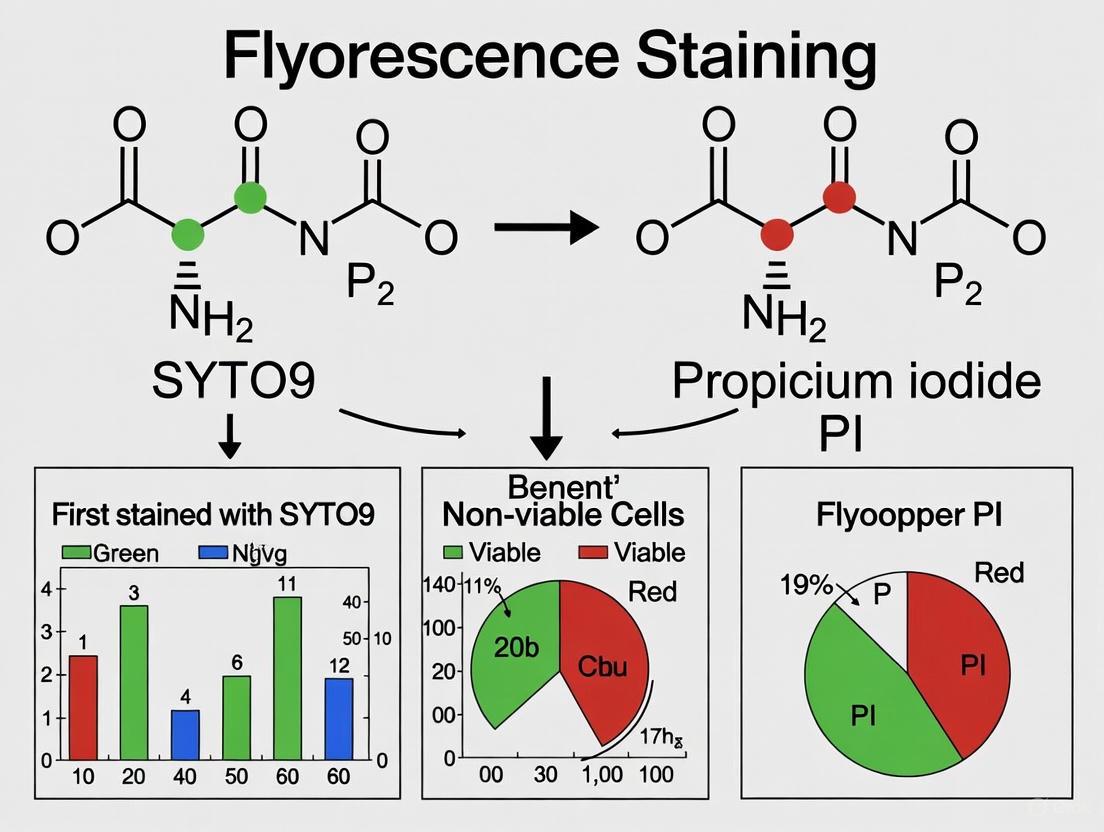
This article provides a critical and up-to-date overview of the SYTO9/PI fluorescence staining method for assessing bacterial viability.
SYTO9 and Propidium Iodide: A Comprehensive Guide to Bacterial Viability Assessment
Abstract
This article provides a critical and up-to-date overview of the SYTO9/PI fluorescence staining method for assessing bacterial viability. Aimed at researchers and drug development professionals, it covers the foundational principles of the assay, detailing how membrane integrity serves as a proxy for cell death. It delivers optimized protocols for flow cytometry and microscopy applications, highlights common pitfalls and troubleshooting strategies—including issues with extracellular DNA and species-specific variations—and validates the method through comparison with established techniques like colony forming unit (CFU) counts and metabolic assays. The review also discusses emerging alternatives and the future direction of viability staining in biomedical research.
The Science of Live/Dead Staining: How SYTO9 and PI Work
In bacterial viability research, the loss of plasma membrane integrity is increasingly regarded as the definitive 'point of no return' marking irreversible cell death. Fluorescence staining techniques utilizing SYTO9 and propidium iodide (PI) provide a powerful methodology for assessing this crucial parameter by differentiating between cells with intact and compromised membranes. This application note details standardized protocols for utilizing these fluorescent dyes across various experimental setups, presents quantitative data on their performance characteristics, and discusses critical considerations for accurate interpretation within pharmaceutical and microbiological research contexts. The methodologies outlined enable researchers to precisely distinguish between live, compromised, and dead bacterial populations based on this fundamental physiological marker.
The assessment of bacterial viability is fundamental to multiple research domains, including antimicrobial drug discovery, infectious disease pathogenesis, and industrial microbiology. While bacterial death can be defined through various parameters, the irreversible loss of plasma membrane integrity represents a critical 'point of no return' that is consistently associated with non-viability [1] [2]. Unlike metabolic activity or cultivability, which may be transiently lost in certain physiological states, membrane rupture represents an irreversible event from which bacteria cannot recover.
Fluorescence-based viability staining leveraging the SYTO9 and propidium iodide (PI) combination provides a direct methodological approach for evaluating this parameter. The underlying principle relies on the differential permeability of these dyes through bacterial membranes:
- SYTO9: A green-fluorescent nucleic acid stain that penetrates all bacterial cells, regardless of membrane status, labeling both live and dead populations [3].
- Propidium Iodide (PI): A red-fluorescent nucleic acid stain that only enters cells with compromised membranes, displacing SYTO9 due to its higher DNA affinity [4] [5].
This membrane integrity-based classification offers researchers a rapid, quantitative, and morphologically informative alternative to traditional culture-based methods like colony forming unit (CFU) assays, enabling viability assessment at the single-cell level [6].
Experimental Protocols
Basic Staining Protocol for Planktonic Bacteria
This foundational protocol is optimized for assessing viability in bacterial suspensions using fluorescence microscopy [4].
Materials Required
- Bacterial culture (late log-phase recommended)
- LIVE/DEAD BacLight Bacterial Viability Kit (e.g., L7012) or component dyes
- Wash buffer: 0.85% NaCl (phosphate buffers not recommended)
- Fluorescence microscope with FITC (for SYTO9) and Texas Red (for PI) filter sets
Procedure
- Culture Preparation: Grow 25 mL bacterial culture to late log-phase in appropriate nutrient broth.
- Cell Harvesting and Washing:
- Centrifuge at 10,000 × g for 10 minutes
- Remove supernatant completely
- Resuspend pellet in 2 mL wash buffer
- Dilute 1 mL suspension into 20 mL wash buffer
- Incubate at room temperature for 1 hour, mixing every 15 minutes
- Repeat centrifugation and resuspend final pellet in 10 mL wash buffer
- Staining Solution Preparation: Combine equal volumes of SYTO9 and PI stock solutions in a microfuge tube.
- Staining Reaction: Add 3 µL of dye mixture per milliliter of bacterial suspension.
- Incubation: Incubate at room temperature in the dark for 15 minutes.
- Microscopy: Pipette 5 µL stained suspension onto glass slide, apply coverslip, and image immediately using appropriate filters.
Critical Notes
- Timing: Image samples within 30 minutes of staining to prevent dye leakage [6]
- Controls: Always include validation controls with known live and dead populations
- Background: Wash thoroughly to remove growth medium that may cause background fluorescence
Advanced Protocol for Bacteria-Host Cell Interactions
This modified protocol enables differentiation between internalized and adherent bacteria during infection studies, providing viability assessment for specific bacterial populations [6].
Additional Materials
- Host cells adherent to 12 mm glass coverslips
- MOPS/MgCl2 buffer: 0.1 M MOPS, pH 7.2, containing 1 mM MgCl2
- External bacterial marker: Alexa Fluor 647-coupled antibody or lectin
- Permeabilization agent: 0.1% saponin
Procedure
- Infection and Staining:
- Infect host cells with bacteria of interest (do not fix with aldehydes)
- Rinse gently with MOPS/MgCl2 buffer
- Incubate 10 min with Alexa Fluor 647-conjugated antibody/lectin in MOPS/MgCl2 to label external bacteria
- Rinse twice with MOPS/MgCl2 buffer
- Viability Staining:
- Prepare Live/Dead Staining Solution: 5 μM SYTO9, 30 μM PI, 0.1% saponin in MOPS/MgCl2
- Add 0.5 mL solution to cells, incubate 15 min in dark
- Rinse twice with MOPS/MgCl2
- Mounting and Imaging:
- Invert coverslips onto slides, seal with clear nail polish (no mounting media)
- Image within 30 minutes using three-color capability
Interpretation Guide
| Bacterial Population | SYTO9 Signal | PI Signal | Alexa Fluor 647 Signal |
|---|---|---|---|
| Internal Viable | Positive | Negative | Negative |
| Internal Nonviable | Positive | Positive | Negative |
| External Viable | Positive | Negative | Positive |
| External Nonviable | Positive | Positive | Positive |
Flow Cytometry Protocol for Quantitative Assessment
This protocol adapts the staining method for high-throughput quantification using flow cytometry, optimized for yeast but applicable to bacterial systems [1].
Key Modifications for Flow Cytometry
- Staining Buffer: Use 0.85% saline instead of growth media or water to minimize artifacts
- Dye Concentrations: Prepare working stocks (33.4 μM SYTO9, 0.2 mM PI) in sterile deionized water
- Cell Density: Standardize cell suspension to OD600 = 1 before staining
- Controls: Include unstained and single-stained controls for compensation
- Analysis: Distinguish live (green), damaged (intermediate), and dead (red) populations based on fluorescence intensity
Data Presentation and Technical Considerations
Quantitative Staining Performance
Table 1: Species-Specific Variations in SYTO9/PI Staining Intensity
| Bacterial Species | SYTO9 Alone (Live vs. Dead) | SYTO9 After PI (Live vs. Dead) | PI Signal Strength | Key Characteristics |
|---|---|---|---|---|
| S. aureus (Gram+) | No difference | 9-fold weaker in dead cells | Low intensity | Consistent SYTO9 binding; clear PI displacement |
| P. aeruginosa (Gram-) | 18-fold stronger in dead cells | 2.7-fold stronger in dead cells | Low intensity | Differential SYTO9 affinity; residual SYTO9 after PI |
| E. coli (Gram-) | Similar to P. aeruginosa | Similar to P. aeruginosa | Low intensity | Strong eNA interference in biofilms |
Table 2: Method Comparison for Viability Assessment
| Method | Measurement Principle | Time Required | Information Level | Key Limitations |
|---|---|---|---|---|
| SYTO9/PI Staining | Membrane integrity | 30-45 minutes | Single-cell, morphological | eNA interference; species variability |
| Colony Forming Units (CFU) | Reproductive capacity | 24-48 hours | Population average | Misses VBNC; no morphological data |
| Fluorescein Diacetate (FDA) | Esterase activity | 30-45 minutes | Single-cell, metabolic | Underestimates in starved cells |
| Electron Microscopy | Ultrastructural details | Days | Single-cell, structural | Difficult viability interpretation |
Technical Limitations and Validation Strategies
Several critical technical considerations must be addressed for accurate viability interpretation:
Species-Specific Staining Variations: Gram-negative bacteria frequently exhibit differential SYTO9 affinity between live and dead cells, with dead cells showing significantly brighter SYTO9 staining even before PI addition [5]. This necessitates species-specific protocol validation.
Extracellular Nucleic Acid Interference: In biofilm populations, extracellular nucleic acids (eNA) can bind PI, creating a false dead signal layer that underestimates true viability [2]. Combining membrane integrity staining with metabolic indicators (e.g., fluorescein diacetate) provides validation.
SYTO9 Photobleaching: SYTO9 exhibits significant photobleaching effects, with 4-8% signal loss every 5 minutes, particularly problematic in dead cells and at lower cell densities [5]. Standardize imaging parameters and minimize light exposure before acquisition.
Background Fluorescence Challenges: PI demonstrates relatively weak fluorescence intensity compared to background values, requiring careful background subtraction and potential signal amplification for accurate quantification [5].
Visualization of Experimental Workflows
SYTO9/PI Staining Mechanism
Figure 1: SYTO9/PI Staining Mechanism. SYTO9 penetrates all cells, while PI only enters membrane-compromised cells, where it displaces SYTO9 due to higher DNA affinity.
Host Cell Infection Viability Assay
Figure 2: Host-Pathogen Viability Assay Workflow. Sequential staining identifies bacterial location and viability status simultaneously.
The Scientist's Toolkit: Essential Research Reagents
Table 3: Key Reagents for Bacterial Viability Assessment
| Reagent | Function | Key Considerations | Example Products |
|---|---|---|---|
| SYTO9 | Green-fluorescent nucleic acid stain labels all bacteria | Penetrates intact membranes; prone to photobleaching | LIVE/DEAD BacLight kits |
| Propidium Iodide (PI) | Red-fluorescent dead cell indicator | Membrane-impermeable; higher DNA affinity than SYTO9 | Separate purchase or kits |
| Calcein AM | Esterase activity viability indicator | Measures metabolic activity; good cell retention | CellTrace calcein kits |
| Saponin | Mild detergent for host cell permeabilization | Enables intracellular bacterial staining | Various suppliers |
| Alexa Fluor 647 | Far-red fluorescent conjugate | Labels extracellular bacteria; minimal spectral overlap | Antibody/lectin conjugates |
The SYTO9/PI fluorescence staining method provides researchers with a robust toolkit for assessing bacterial viability based on the fundamental biological parameter of membrane integrity. While the technique offers significant advantages in speed, sensitivity, and single-cell resolution, its successful implementation requires careful attention to species-specific variations, potential artifacts from extracellular nucleic acids, and appropriate validation against complementary viability measures. When applied with these considerations, membrane integrity assessment serves as a reliable indicator of the 'point of no return' in bacterial cell death, making it an invaluable approach for pharmaceutical development, pathogenesis research, and microbiological investigation.
The Biochemistry of SYTO9 and Propidium Iodide (PI)
The assessment of bacterial viability is a cornerstone of microbiological research, playing a critical role in fields ranging from antimicrobial drug development to environmental monitoring. Among the most widely adopted techniques are those utilizing fluorescent nucleic acid stains that differentiate cells based on membrane integrity, with SYTO 9 and propidium iodide (PI) forming a fundamental staining pair. These dyes enable rapid, quantitative analysis of bacterial populations when coupled with techniques like fluorescence microscopy, flow cytometry, or fluorimetry [7] [1]. The underlying biochemistry of these dyes—their spectral properties, membrane permeability, and binding affinities—directly dictates their application and interpretation in experimental settings. This application note details the biochemical principles, practical protocols, and critical considerations for employing SYTO 9 and PI in bacterial viability assessment, providing a structured framework for researchers in scientific and drug development fields.
Biochemical Properties and Mechanism of Action
Fundamental Dye Characteristics
SYTO 9 and propidium iodide are both nucleic acid-binding fluorophores but possess distinct biochemical properties that enable their differential application in viability staining.
SYTO 9 is a green-fluorescent cyanine dye that exhibits high permeability to both prokaryotic and eukaryotic cell membranes. Its excitation maximum occurs at 483 nm, with a fluorescence emission maximum at 503 nm [3]. A key biochemical characteristic is its significant enhancement in quantum yield upon binding to nucleic acids; it displays low intrinsic fluorescence in its unbound state but fluoresces intensely when bound to DNA or RNA [5] [8]. This property makes it an excellent stain for identifying total bacterial populations, as it readily enters all cells regardless of membrane integrity.
Propidium Iodide (PI) is a red-fluorescent stain belonging to the phenanthridinium family. It intercalates into double-stranded nucleic acids with no sequence preference, typically with one dye molecule per four to five base pairs [5]. Unlike SYTO 9, PI is membrane-impermeant and generally excluded from cells with intact cytoplasmic membranes. Its fluorescence enhances 20- to 30-fold when bound to DNA [5]. PI exhibits a stronger binding affinity for nucleic acids than SYTO 9, with association constants of 3.7 × 10⁵/M for PI compared to 1.8 × 10⁵/M for SYTO 9 [5].
Table 1: Biochemical Properties of SYTO 9 and Propidium Iodide
| Property | SYTO 9 | Propidium Iodide (PI) |
|---|---|---|
| Nucleic Acid Target | DNA & RNA | Primarily DNA |
| Excitation Maximum | 483 nm [3] | ~535 nm (when bound to DNA) |
| Emission Maximum | 503 nm [3] | ~617 nm (when bound to DNA) |
| Membrane Permeability | Permeant to intact membranes [3] | Impermeant to intact membranes [2] [5] |
| Binding Affinity | 1.8 × 10⁵/M [5] | 3.7 × 10⁵/M [5] |
| Fluorescence Enhancement | Significant upon nucleic acid binding [3] | 20-30 fold upon nucleic acid binding [5] |
Mechanism of Competitive Binding
The operational principle of the SYTO 9/PI viability stain relies on their differential membrane permeability and competitive binding to nucleic acids. In a typical assay, both dyes are applied to a bacterial population. SYTO 9, being membrane-permeant, labels all cells—those with both intact and compromised membranes. PI, being membrane-impermeant, only enters cells with damaged membranes [2] [5].
When both dyes are present within the same cell (one with a compromised membrane), PI displaces SYTO 9 from nucleic acid binding sites due to its higher affinity [5]. This displacement, combined with a Förster Resonance Energy Transfer (FRET) effect where SYTO 9 emission is absorbed by PI, results in a dramatic spectral shift [1]. Consequently, cells with intact membranes fluoresce bright green, while cells with compromised membranes fluoresce red [1].
Figure 1: Mechanism of SYTO 9 and PI competitive binding for bacterial viability assessment.
Critical Experimental Considerations and Limitations
Technical Constraints and Variabilities
Researchers must recognize several critical limitations when employing SYTO 9 and PI for viability assessment:
Gram Stain Variability: SYTO 9 staining intensity varies significantly between Gram-positive and Gram-negative bacteria due to differences in cell envelope structure. For Staphylococcus aureus (Gram-positive), live and dead cells stain with equal intensity using SYTO 9 alone. In contrast, for Pseudomonas aeruginosa (Gram-negative), dead cells exhibit an 18-fold stronger SYTO 9 signal than live cells [5] [8]. Even after PI counterstaining, dead P. aeruginosa cells still display 2.7-fold higher SYTO 9 intensity than live ones [5].
Photostability Issues: SYTO 9 demonstrates pronounced bleaching, with signal intensity decreasing by 4-8% every 5 minutes during measurement, depending on cell physiological state and concentration [5]. This necessitates minimized light exposure and standardized reading times.
Background Fluorescence: Unbound PI produces substantial background signal (approximately 700 RFU), which can complicate interpretation, especially when dead cell numbers are low [5]. Appropriate background controls are essential.
Adherent Cell Limitations: For adherent cells in biofilms, PI staining significantly underestimates viability due to extracellular nucleic acids (eNA) in the biofilm matrix. One study showed that 96% of E. coli and 76% of Staphylococcus epidermidis initial biofilm cells stained PI-positive, yet 68% were metabolically active and 82-89% were cultivable after harvesting [2].
Table 2: Key Limitations and Methodological Considerations
| Limitation | Impact on Assay | Recommended Mitigation |
|---|---|---|
| Differential Gram Staining [5] [8] | Uneven SYTO 9 signal between species; potential viability over/underestimation | Validate for each bacterial species; use standardized inoculum |
| SYTO 9 Photobleaching [5] | Signal decay over time; quantification inaccuracy | Fixed imaging parameters; minimize light exposure; rapid measurement |
| High PI Background [5] | Reduced signal-to-noise ratio; masks true PI-positive cells | Include background controls; wash steps if protocol allows |
| eNA in Biofilms [2] | False dead signals from matrix staining; viability underestimation | Combine with metabolic assays (e.g., FDA); use cultivation validation |
| Cytotoxicity of SYTO 9 [9] | Potential inhibition of bacterial growth in live assays | Consider alternative dyes (e.g., MycoLight) for long-term studies |
Correlation with Viability Criteria
Bacterial viability is assessed through three established criteria: culturability, metabolic activity, and membrane integrity [7]. The SYTO 9/PI assay specifically evaluates membrane integrity, which is an irreversible indicator of cell death [1]. However, discrepancies can occur between this method and other viability indicators:
Viable But Non-Culturable (VBNC) State: Bacteria may retain membrane integrity and metabolic activity but lose culturability under stress conditions [7]. SYTO 9/PI staining would classify these cells as viable, while plate counts would not.
Membrane Damage vs. Metabolic Activity: Studies comparing SYTO 9/PI with fluorescein diacetate (FDA) staining, which measures enzymatic activity, reveal populations with compromised membranes that remain metabolically active [2].
Post-Stress Recovery: Flow cytometry assays with SYTO 9/PI may show higher viability than colony forming unit (CFU) counts after sublethal stress, as they measure survival immediately after treatment while CFU assesses the ability to recover and reproduce [1].
Experimental Protocols and Methodologies
Standard Staining Protocol for Flow Cytometry
The following protocol is optimized for quantifying bacterial viability using flow cytometry, adapted from established methodologies [1]:
Reagents and Equipment:
- SYTO 9 stock solution (3.34 mM in DMSO)
- Propidium iodide stock solution (0.2 mM in deionized water)
- Sterile 0.85% saline buffer
- Phosphate-buffered saline (PBS) or appropriate buffer
- Flow cytometer with 488 nm excitation and appropriate filters (530/30 nm for SYTO 9, 695/40 nm for PI)
Procedure:
- Sample Preparation: Harvest bacterial cells by centrifugation (3,000 × g for 5 min). Resuspend in sterile 0.85% saline buffer to approximately 10⁷-10⁸ cells/mL.
- Dye Working Solutions: Prepare fresh SYTO 9 working solution at 33.4 μM in deionized water. PI working solution (0.2 mM) can be stored at 4°C for up to 6 months.
- Staining: Combine 900 μL bacterial suspension with 50 μL SYTO 9 working solution and 50 μL PI working solution. Final concentrations: ~1.67 μM SYTO 9 and ~10 μM PI.
- Incubation: Mix thoroughly and incubate in darkness at room temperature for 15 minutes.
- Flow Cytometry Analysis: Analyze samples within 30 minutes of staining. Use 488 nm excitation with SYTO 9 detection at 530/30 nm and PI detection at 695/40 nm.
- Controls: Include unstained cells, single-stained controls (SYTO 9 only and PI only) for compensation, and known live/dead populations for validation.
Data Interpretation: Create a density plot of PI (Y-axis) versus SYTO 9 (X-axis) fluorescence. Live populations appear SYTO 9-positive/PI-negative; dead populations appear PI-positive with diminished SYTO 9 fluorescence due to displacement; damaged cells may show intermediate staining [1].
Fluorimetry-Based Quantification Protocol
For rapid, bulk measurement of bacterial viability, fluorimetry provides a cost-effective alternative [10] [8]:
Reagents and Equipment:
- SYTO 9 and PI stock solutions
- Fluorimeter with 485 nm excitation and emission detection at 500-530 nm (SYTO 9) and 610-650 nm (PI)
- Appropriate buffer (peptone water or HEPES recommended)
Procedure:
- Sample Preparation: Prepare bacterial suspensions in peptone water across expected concentration range (~10⁵-10⁸ CFU/mL).
- Staining: Add SYTO 9 to final concentration of 0.5-1 μM. Incubate 5-30 minutes in darkness.
- Measurement: Record fluorescence intensities for both dyes. For multi-species samples, note that fluorescence intensity per cell is species-specific [8].
- Data Analysis: Use multi-spectra support vector regression (SVR) for most reliable prediction of live bacteria percentage, particularly for samples above 60% viability where linear SYTO 9:PI intensity ratios become less reliable [10].
The Scientist's Toolkit: Essential Research Reagents
Table 3: Essential Reagents for SYTO 9/PI Viability Assays
| Reagent/Buffer | Function/Application | Key Considerations |
|---|---|---|
| SYTO 9 (3.34 mM stock) | Green-fluorescent nucleic acid stain for total cell count | Light-sensitive; prepare fresh working solutions; cytotoxic at high concentrations [9] |
| Propidium Iodide (20 mM stock) | Red-fluorescent dead cell stain | Membrane impermeant; higher DNA affinity than SYTO 9; stable at 4°C [5] [1] |
| Sterile 0.85% Saline | Staining buffer and cell resuspension | Minimizes artifacts compared to water or growth media [1] |
| HEPES Buffer | Alternative staining buffer | Avoids interference from phosphate buffers with DNA backbone [9] |
| Ethylenediaminetetraacetic acid (EDTA) | Permeabilizing agent for Gram-negative bacteria | Chelates divalent cations to increase outer membrane permeability [8] |
| DNase I | Enzyme for biofilm studies | Degrades extracellular DNA to reduce false PI signals in biofilms [2] |
| Microsphere Suspension | Reference standards for flow cytometry | Used for instrument calibration and quantification [10] |
Förster Resonance Energy Transfer (FRET) is a physical phenomenon where energy is transferred from an excited donor fluorophore to a proximal acceptor fluorophore through non-radiative dipole-dipole coupling. This process is extremely sensitive to the distance between fluorophores, typically occurring in the 2.5-10 nm range, making it a powerful tool for studying molecular interactions and conformational changes in biological systems [11]. In the context of bacterial viability assessment, the SYTO9 and propidium iodide (PI) dye pair functions as a FRET-based competitive binding system that reveals cell membrane integrity through distinct fluorescence signatures.
The competitive binding dynamic arises from their differential affinity for nucleic acids and their distinct cellular accessibility. SYTO9, being a membrane-permeant dye, labels all cells in a population. PI, in contrast, only enters cells with compromised membranes and, upon binding to nucleic acids, effectively quenches SYTO9 fluorescence via FRET while emitting its own characteristic red fluorescence [1] [12]. This displacement of one signal by another provides a direct, rapid mechanism for differentiating between live and dead bacterial populations.
Theoretical Framework of the SYTO9/PI FRET Pair
Photophysical Mechanism of FRET
The efficiency of FRET (E) is governed by the Förster equation, which shows a sixth-power dependence on the distance (R) between the donor and acceptor: [E = \frac{1}{1 + (R/R_0)^6}] where R₀ is the Förster distance at which FRET efficiency is 50% [13] [14]. For the SYTO9/PI pair, several factors optimize this energy transfer:
- Spectral Overlap: SYTO9 emission and PI absorption spectra exhibit significant overlap, a prerequisite for efficient FRET [1].
- Proximity upon Binding: When both dyes intercalate with nucleic acids, their molecular proximity falls within the effective FRET range.
- Competitive Displacement: PI has a higher affinity for nucleic acids than SYTO9. In cells with compromised membranes, PI enters and displaces SYTO9 from DNA/RNA binding sites, leading to FRET-induced quenching of SYTO9 fluorescence and enhanced PI emission [12].
This FRET-based competitive binding creates a sensitive mechanism where membrane integrity directly controls the fluorescence output, enabling quantitative viability assessment.
Practical Implications for Viability Assessment
The SYTO9/PI staining principle enables bacterial classification into three distinct populations based on fluorescence patterns [1]:
- Live Cells: Intact membranes exclude PI; only SYTO9 binds nucleic acids, producing green fluorescence.
- Dead Cells: Compromised membranes allow PI entry; PI binds DNA and quenches SYTO9 via FRET, resulting in red fluorescence with diminished green signal.
- Damaged/Compromised Cells: Intermediate staining patterns may occur, reflecting subpopulations with partial membrane damage.
This classification is visually represented in the following diagram of the competitive binding process:
Quantitative Parameters and Staining Optimization
Successful application of the SYTO9/PI FRET assay requires optimization of several key parameters. The following table summarizes critical staining conditions and their impact on the FRET signal:
Table 1: Optimization Parameters for SYTO9/PI Staining and FRET Detection
| Parameter | Recommended Condition | Impact on FRET Efficiency | References |
|---|---|---|---|
| Staining Buffer | 0.85% saline buffer | Minimizes artifacts and false positives | [1] |
| Dye Concentration | Manufacturer's recommendation (e.g., 3.34 mM SYTO9, 20 mM PI) | Ensures proper donor:acceptor ratio | [1] |
| Staining Time | 15-30 minutes | Allows complete dye penetration and equilibration | [1] |
| SYTO9:PI Ratio | As provided in commercial kits | Optimizes competitive displacement | [1] [12] |
| Measurement Window | Immediate analysis post-staining | Prevents dye diffusion artifacts | [1] |
| Excitation/Emission | ~480/500 nm (SYTO9), ~490/635 nm (PI) | Matches spectral overlap for FRET | [1] [12] |
The optimal dye ratio provided in commercial kits maximizes the FRET effect while minimizing nonspecific staining. Deviations from these optimized conditions can significantly impact the accuracy of viability assessment, particularly by altering the competitive binding dynamics between the two dyes.
Experimental Protocol: SYTO9/PI Staining for Flow Cytometry
This protocol provides a standardized method for bacterial viability assessment using SYTO9/PI staining coupled with flow cytometry analysis, adapted from the optimized procedure described by [1].
Materials and Reagents
Table 2: Essential Research Reagent Solutions
| Reagent/Equipment | Function in Assay | Specifications/Alternatives |
|---|---|---|
| SYTO 9 dye (3.34 mM) | Membrane-permeant nucleic acid stain (FRET donor) | Labels all bacterial cells; green fluorescence (∼500 nm) |
| Propidium Iodide (20 mM) | Membrane-impermeant nucleic acid stain (FRET acceptor) | Labels only cells with compromised membranes; red fluorescence (∼635 nm) |
| Sterile 0.85% saline buffer | Staining and dilution medium | Minimizes staining artifacts compared to water or growth media |
| Flow cytometer with 488 nm laser | Instrumentation for quantification | Capable of detecting FL1 (green) and FL3 (red) fluorescence channels |
| 96-well plates | Sample processing | Suitable for high-throughput applications |
| Centrifuge | Cell pelleting and washing | Fixed-angle rotor, 3,000 × g capability |
Step-by-Step Procedure
Sample Preparation
- Grow bacterial culture to mid-log phase (OD600 ~1.0).
- Apply experimental treatments (e.g., antibiotics, stress conditions) in appropriate media.
- Include mock-treated (negative control) and lethally-treated (e.g., 70% isopropanol, positive control) samples.
Cell Harvesting and Washing
- Transfer 600 μL of bacterial culture to a 96-deep well plate.
- Pellet cells by centrifugation at 3,000 × g for 5 minutes at room temperature.
- Carefully aspirate supernatant without disturbing the cell pellet.
Staining Application
- Resuspend cell pellets in 0.85% saline buffer adjusted to OD600 = 1.0.
- Add SYTO9 and PI dyes at the manufacturer's recommended concentrations.
- Incubate in the dark for 15-30 minutes at room temperature.
Flow Cytometry Analysis
- Analyze samples using a flow cytometer with a 488 nm excitation laser.
- Detect SYTO9 fluorescence in the green channel (FL1, ∼500 nm).
- Detect PI fluorescence in the red channel (FL3, ∼635 nm).
- Collect a minimum of 10,000 events per sample for statistical reliability.
The complete experimental workflow is illustrated below:
Data Interpretation and Gating Strategy
- Live Population: SYTO9-high, PI-low fluorescence.
- Dead Population: SYTO9-dim, PI-high fluorescence (FRET-positive).
- Damaged/Compromised Population: Intermediate fluorescence in both channels.
The percentage of live cells can be calculated as: % Viability = (Live Cell Count / Total Cell Count) × 100
Technical Considerations and Limitations
While the SYTO9/PI FRET assay provides a rapid viability assessment, researchers should be aware of several important limitations:
VBNC State Detection: Bacteria in the viable but non-culturable (VBNC) state maintain membrane integrity and will thus be stained as live by SYTO9/PI, despite being non-culturable [7]. This can lead to overestimation of cultivable populations.
Metabolic Activity: The assay assesses membrane integrity alone, not metabolic activity. Stressed cells with intact but dysfunctional membranes may be misclassified as viable [12] [7].
Alternative Staining Methods: For applications requiring metabolic activity assessment, alternatives like CAM/TMA-DPH staining may be preferable. CAM detects esterase activity in viable cells, while TMA-DPH labels all cell membranes regardless of viability [12].
FRET Signal Optimization: Inconsistent staining conditions (dye concentration, incubation time, buffer composition) can significantly impact FRET efficiency and result interpretation [1] [15].
The FRET pair dynamic between SYTO9 and PI provides a powerful mechanism for competitive binding and signal displacement that enables rapid, quantitative assessment of bacterial viability. The optimized protocols presented here facilitate reproducible implementation of this technique across various research applications. When properly controlled and interpreted in the context of its limitations, this FRET-based approach offers researchers a valuable tool for antimicrobial screening, biofilm studies, and general microbiology research.
The SYTO 9 and propidium iodide (PI) viability staining method is a cornerstone technique in microbiology for rapidly distinguishing between live and dead bacterial cells. This protocol is commercially available as the LIVE/DEAD BacLight Bacterial Viability Kit and operates on the principle of bacterial membrane integrity. SYTO 9 is a green-fluorescent nucleic acid stain that permeates all bacterial membranes, staining both live and dead cells. In contrast, propidium iodide (PI) is a red-fluorescent stain that only penetrates cells with compromised membranes, typically indicative of cell death. When both dyes are present, PI exhibits a stronger affinity for nucleic acids than SYTO 9 and competitively displaces it in cells with compromised membranes [5] [16].
This application note details the core uses of this staining methodology within modern microbiological research, with a specific focus on antimicrobial testing and biofilm studies. We provide structured experimental data, optimized protocols, and visual workflows to facilitate implementation across various research contexts, from basic laboratory studies to drug development applications.
Key Research Applications and Data
The SYTO9/PI staining system provides critical quantitative data across diverse research applications. The table below summarizes core findings and methodological considerations from recent studies.
Table 1: Key Research Applications and Findings Using SYTO9/PI Viability Staining
| Research Area | Key Finding | Quantitative Data | Methodological Consideration |
|---|---|---|---|
| Antimicrobial Susceptibility Testing (AST) | Rapid detection of antibiotic-induced cell death, enabling faster results than culture-based methods [16]. | Assay reproducibly detected viability reduction when live cells fell below ~50% in a sample of 1 × 10⁸ cells/mL [16]. | Staining must be performed at each sampling time as prolonged dye exposure can negatively impact cell viability [16]. |
| Biofilm Viability Assessment | PI staining can overestimate dead cells in biofilms due to binding with extracellular nucleic acids (eNA) in the matrix [2]. | In 24-hour biofilms, 96% of E. coli and 76% of S. epidermidis were PI-positive, yet 68% of cells were metabolically active and >80% were cultivable [2]. | Results from adherent cells should be validated by an alternative method (e.g., cultivation) to confirm viability [2]. |
| Yeast Post-Stress Survival | SYTO9/PI with flow cytometry distinguishes live, damaged, and dead populations, providing survival quantification immediately after stress [1]. | At a sublethal H₂O₂ dose (100 mM), SYTO9/PI estimated a higher survival rate than CFU, reflecting measurement of viability at an earlier stage [1]. | An optimized protocol using 0.85% saline as a staining buffer minimizes artifacts compared to water or growth media [1]. |
| Gram-Strain Variability | Staining efficacy differs between bacterial types; SYTO9 alone stains dead Gram-negative cells more intensely than live ones [5]. | Dead P. aeruginosa cells exhibited an 18-fold stronger SYTO9 signal than live cells. This effect was not observed in S. aureus [5]. | The bleaching effect of SYTO9 is significant, with 4-8% signal loss every 5 minutes, varying by cell physiology and number [5]. |
Detailed Experimental Protocols
Optimized Protocol for SYTO9/PI Staining and Analysis
This protocol is adapted for use with a microplate reader or spectrofluorometer, specifically optimized for E. coli but applicable to other bacteria with appropriate validation [16].
Materials:
- LIVE/DEAD BacLight reagents (SYTO 9 and Propidium Iodide) or component dyes.
- Bacterial culture in mid-log growth phase.
- Sterile 0.85% saline buffer.
- Appropriate growth media (e.g., Minimal A salts with 0.2% glucose for low background fluorescence).
- Microcentrifuge tubes and microplate.
Procedure:
- Sample Preparation: Harvest bacterial cells by centrifugation (e.g., 3,000 × g for 5 min). Wash the cell pellet once with sterile 0.85% saline buffer to remove residual fluorescent media components [16].
- Staining Solution Preparation: Prepare a working stock of SYTO 9 at 33.4 µM and PI at 0.2 mM in sterile, deionized water. The SYTO 9 stock should be prepared fresh for each experiment [1].
- Staining Incubation: Resuspend the bacterial pellet to a density of approximately 1 × 10⁸ cells/mL in saline. Add the SYTO 9 and PI working stocks to the cell suspension at a recommended ratio (e.g., 1:1 or as optimized for your strain). Incubate the mixture for 15 minutes at room temperature in the dark [16].
- Fluorescence Measurement: Transfer the stained suspension to a microplate. Measure fluorescence intensity using the following parameters:
- Data Analysis: Calculate the proportion of live cells using the adjusted dye ratio formula [16]. This requires generating a standard curve with known ratios of live and heat-killed cells specific to your bacterial strain and instrument.
Protocol for Confocal Microscopy of Biofilms
This protocol is used for the spatial visualization of live/dead cells within a biofilm structure [2] [17].
Materials:
- Biofilm grown on a suitable substrate (e.g., glass coverslip).
- LIVE/DEAD BacLight reagents.
- Sterile phosphate-buffered saline (PBS).
- Confocal laser scanning microscope (CLSM).
Procedure:
- Staining: Gently rinse the biofilm with PBS to remove loosely attached planktonic cells. Apply the SYTO9/PI staining mixture directly onto the biofilm surface.
- Incubation: Incubate the stained biofilm in the dark for 15-20 minutes at room temperature [17].
- Imaging: Gently rinse the biofilm with PBS to remove unbound dye. Image immediately using a CLSM. Use appropriate laser lines and filter sets for SYTO9 (e.g., Argon laser 488 nm excitation, emission bandpass 500-550 nm) and PI (e.g., HeNe laser 543 nm excitation, emission longpass 560 nm) [2].
- Image Analysis: Use image analysis software (e.g., ImageJ) to quantify the green and red fluorescence channels. Be aware that the presence of extracellular DNA (eDNA) can lead to red fluorescence not associated with dead cells, potentially requiring validation via cultivation [2].
The Scientist's Toolkit: Essential Research Reagents
Table 2: Key Reagent Solutions for SYTO9/PI Viability Assays
| Reagent / Material | Function / Application | Example Product / Note |
|---|---|---|
| SYTO 9 Green Fluorescent Nucleic Acid Stain | Membrane-permeant dye that labels all cells (live and dead) for total cell count [3]. | LIVE/DEAD BacLight component (Cat. No. L7007, L7012) [5] [3]. |
| Propidium Iodide (PI) | Membrane-impermeant dye that labels only cells with compromised membranes [5]. | LIVE/DEAD BacLight component; can be purchased separately [5] [1]. |
| 0.85% Saline Buffer | Optimal staining buffer that minimizes staining artifacts compared to water or growth media [1]. | Simple laboratory preparation (0.85 g NaCl in 100 mL dH₂O, sterilized). |
| BacLight Bacterial Viability Kit | Premixed, optimized kit for ease of use and rapid viability assessment [5] [17]. | LIVE/DEAD BacLight (L7007) from Invitrogen [17]. |
| Fluorescein Diacetate (FDA) | Metabolic activity stain used to validate viability results from SYTO9/PI, especially in biofilms [2]. | Provides an independent measure of metabolic activity; hydrolyzed by intracellular esterases in live cells. |
| Confocal Laser Scanning Microscope (CLSM) | Instrument for high-resolution spatial imaging of live/dead distribution in 3D structures like biofilms [5] [2]. | e.g., Zeiss LSM 510 META [17]. |
Workflow and Staining Mechanism Visualization
The following diagram illustrates the core mechanism of SYTO9/PI staining and its integration into a standard experimental workflow for antimicrobial testing and biofilm research.
Diagram 1: SYTO9/PI Staining Mechanism and Workflow. The diagram illustrates how SYTO9 enters all cells, while PI only enters cells with compromised membranes. In dead cells, PI displaces SYTO9 due to higher DNA affinity, muting green and enhancing red fluorescence [5] [1] [16]. This principle is applied in a standard workflow for treatment evaluation.
Optimized Protocols for SYTO9/PI Staining in Flow Cytometry and Microscopy
In fluorescence-based bacterial viability assessment, the choice of staining buffer is a critical pre-analytical variable that can significantly influence the accuracy, reproducibility, and interpretation of results. Within this context, 0.85% saline (a solution of 0.85% w/w sodium chloride) has emerged as a standardized buffer for LIVE/DEAD staining protocols utilizing SYTO 9 and propidium iodide (PI). Its adoption is driven by the need for a consistent, non-toxic, and physiologically compatible medium that minimizes staining artifacts while maintaining cellular integrity during the assessment process. This application note details the scientific rationale, experimental evidence, and methodological protocols supporting the use of 0.85% saline in viability staining for research and drug development applications.
The fundamental principle of the widely used LIVE/DEAD BacLight assay relies on the differential permeability of two DNA-binding fluorophores: SYTO 9, which permeates all cells, and PI, which only enters cells with compromised membranes. However, the staining outcome is profoundly affected by the chemical environment in which the dye-cell interaction occurs. Suboptimal buffers can induce osmotic stress, cause non-specific dye binding, or quench fluorescence signals, leading to inaccurate viability counts. Inconsistent buffer choices thus contribute to inter-laboratory variability, hindering direct comparison of results across studies.
Quantitative Evidence: Performance Data of 0.85% Saline
Empirical studies across multiple microbial models have demonstrated that 0.85% saline provides an optimal balance of simplicity, cost-effectiveness, and technical performance. The quantitative evidence supporting its use is summarized in the table below.
Table 1: Quantitative Evidence Supporting the Use of 0.85% Saline as a Staining Buffer
| Study Model | Key Finding | Performance Metric | Comparative Buffers |
|---|---|---|---|
| HIV Rapid Test (SD-Bioline) [18] | Diagnostic agreement with manufacturer's buffer | 98.64% agreement (κ=0.97, "very good") | Manufacturer's proprietary buffer |
| Yeast Staining (C. glabrata) [1] [19] | Minimization of staining artifacts | Low "dead-like" cells and unstained cells | Deionized water, PBS, Growth Media |
| Bacterial Staining (General) [8] | Standard suspension medium | 0.85% NaCl in 0.1% peptone water, pH 7 | Various complex media |
The high concordance (98.64%) with a manufacturer's proprietary buffer in a diagnostic setting underscores the reliability of 0.85% saline [18]. The kappa value of 0.97 indicates near-perfect agreement beyond chance, validating its performance in a critical application. In microbiology, its primary advantage lies in minimizing artifacts. When compared to deionized water—which can cause osmotic lysis and a high percentage of false "dead-like" cells—or rich growth media—which can lead to a significant population of unstained cells—0.85% saline provides a clear superior performance [1] [19]. Its isotonic nature prevents osmotic shock, thereby preserving the membrane integrity that the assay seeks to measure.
Recommended Protocols for Staining with 0.85% Saline
Protocol for Yeast Viability Assessment Using Flow Cytometry
This standardized protocol is adapted for the opportunistic pathogen Candida glabrata but can be optimized for other yeast species [1] [19].
Key Materials:
- FungaLight Yeast LIVE/DEAD Kit (Thermo Fisher, L34952) or component dyes (SYTO 9 and PI).
- Sterile 0.85% saline buffer.
- Hydrogen Peroxide (for stress induction).
- Synthetic Complete (SC) media.
- Flow cytometer with 488 nm excitation and filters for green (530/30 nm) and red (e.g., 600 nm LP) fluorescence.
Step-by-Step Methodology:
- Culture and Stress Treatment: Grow C. glabrata to mid-log phase (OD600 ~1.0) in SC media. Apply the desired stressor (e.g., H2O2 at sublethal to lethal doses) for a predetermined duration (e.g., 120 minutes).
- Cell Harvesting: Post-treatment, pellet cells by centrifugation (e.g., 3,000 × g for 5 min). Carefully aspirate the supernatant.
- Buffer Resuspension: Resuspend the cell pellet in a sterile, pre-chilled 0.85% saline solution. Adjust the cell density to a standardized OD600 (e.g., OD600 = 1.0) for consistent staining.
- Dye Preparation and Staining:
- Prepare a fresh working stock of SYTO 9 (e.g., 33.4 µM in deionized water).
- Have a PI working stock (e.g., 0.2 mM) available.
- Combine 100 µL of cell suspension with the recommended final concentrations of SYTO 9 and PI (e.g., from the FungaLight kit instructions).
- Incubation: Incubate the stained cell suspension in the dark for a specified time (e.g., 15-30 minutes) at room temperature.
- Flow Cytometry Analysis: Analyze the samples immediately on a flow cytometer. Use unstained and single-stained controls to set voltages and compensation. The live population (SYTO 9 positive, PI negative) and dead population (PI positive) can be distinguished on a bivariate dot plot of green vs. red fluorescence.
General Protocol for Bacterial Viability Staining
For bacterial viability assessment with SYTO 9 and PI, 0.85% saline serves as an excellent wash and resuspension buffer [8].
Key Materials:
- LIVE/DEAD BacLight Bacterial Viability Kit (or component dyes).
- Sterile 0.85% saline.
- Appropriate growth medium (e.g., Tryptic Soy Broth).
- Fluorometer, microplate reader, or flow cytometer.
Step-by-Step Methodology:
- Culture Preparation: Grow bacterial cells to the desired growth phase.
- Cell Washing: Pellet cells by centrifugation. Wash once with 0.85% saline to remove residual growth medium that might interfere with staining.
- Final Resuspension: Resuspend the final cell pellet in 0.85% saline to a desired optical density or cell density (e.g., 10^5–10^8 CFU/mL).
- Staining: Add SYTO 9 and PI to the cell suspension at optimized concentrations (typically in the µM range). A common practice is to use a mixture of both dyes from a commercial kit.
- Incubation and Analysis: Incubate in the dark for 15-30 minutes before acquiring fluorescence measurements.
Mechanisms and Workflow: How 0.85% Saline Optimizes Staining
The following diagram illustrates the critical role of 0.85% saline within the experimental workflow and its mechanistic impact on staining outcomes.
Diagram 1: Staining workflow and the mechanistic impact of 0.85% saline versus suboptimal buffers.
The diagram illustrates the standard staining workflow (center) and contrasts the positive outcomes of using 0.85% saline (green) with the artifacts introduced by suboptimal buffers like deionized water or growth media (red). The core mechanism of 0.85% saline is its isotonicity, which matches the osmotic pressure inside a microbial cell. This preserves membrane integrity, preventing false-positive PI staining due to lysis. Furthermore, its simple chemical composition lacks fluorescent interferents found in complex media and avoids the ionic extremes that can cause dye precipitation or quenching, ensuring consistent and reliable staining.
The Scientist's Toolkit: Essential Reagents for Standardized Staining
Table 2: Essential Research Reagent Solutions for LIVE/DEAD Staining
| Reagent / Solution | Function / Purpose | Key Considerations |
|---|---|---|
| 0.85% Saline (NaCl) | Isotonic staining and washing buffer | Prevents osmotic shock; minimizes staining artifacts; cost-effective [1] [8]. |
| SYTO 9 Dye | Green-fluorescent nucleic acid stain for all cells. | Cell-permeable; fluorescence enhances upon nucleic acid binding; prepare fresh working stocks [5] [16]. |
| Propidium Iodide (PI) | Red-fluorescent nucleic acid stain for dead cells. | Membrane-impermeable; higher DNA affinity than SYTO 9; can stain extracellular DNA in biofilms, leading to overestimation of death [5] [2]. |
| Phosphate Buffered Saline (PBS) | Alternative washing and staining buffer. | Provides pH buffering; performance is similar to saline but may be slightly inferior in some systems [19]. |
| Fixable Viability Dyes | For experiments requiring cell fixation post-staining. | Essential if samples cannot be analyzed immediately on the flow cytometer [20]. |
| FcR Blocking Reagent | Reduces non-specific antibody binding in complex samples. | Used when combining viability staining with immunophenotyping (e.g., in human blood cells) [20]. |
The standardization of 0.85% saline as a staining buffer for SYTO 9/PI viability assays represents a simple yet powerful strategy to enhance the rigor and reproducibility of microbiological research. Robust experimental data confirms that its isotonic and chemically simple formulation effectively minimizes common staining artifacts, thereby providing a more accurate assessment of cell viability. Its adoption is highly recommended for researchers and drug development professionals seeking to generate reliable, comparable, and high-quality data in fluorescence-based viability studies.
The accurate quantification of cell survival after stress is a cornerstone of microbiological research, crucial for understanding antimicrobial resistance, evaluating biocide efficacy, and industrial fermentation monitoring. While the Colony Forming Unit (CFU) assay has been a long-standing standard, it measures clonogenicity—the ability to recover and reproduce—which is a process requiring 24-48 hours [1]. Fluorescence staining with SYTO 9 and propidium iodide (PI) offers a rapid, scalable alternative that assesses viability based on plasma membrane integrity, an irreversible marker of cell death [1] [21]. This protocol details an optimized method for using SYTO 9 and PI, coupled with flow cytometry, to achieve quantitative survival metrics for yeast cells immediately post-stress, providing complementary and timely data alongside CFU assays [1].
Principle of the SYTO 9 and Propidium Iodide Viability Assay
The assay leverages the differential permeability and binding characteristics of two nucleic acid stains:
- SYTO 9 is a green-fluorescent cell-permeant dye that labels all cells, both live and dead, leading to a bright green fluorescence upon binding nucleic acids [3] [1].
- Propidium Iodide (PI) is a red-fluorescent dye that is impermeant to intact membranes and only enters cells with compromised plasma membranes [1] [21].
When used in combination, a critical interaction occurs: PI exhibits a stronger affinity for nucleic acids than SYTO 9 and will competitively displace SYTO 9 in cells where both dyes are present [1] [21]. Furthermore, the dyes form a Förster Resonance Energy Transfer (FRET) pair, where the emission of SYTO 9 is absorbed by PI. Consequently:
- Live cells with intact membranes exhibit bright green fluorescence (SYTO 9 only).
- Dead cells with compromised membranes exhibit muted green and strong red fluorescence (PI dominates) [1].
This interplay allows for clear distinction between live, dead, and an intermediate "damaged" population, providing a nuanced view of a cell population's health after stress [1].
Materials and Reagents
The Scientist's Toolkit: Research Reagent Solutions
| Name | Function/Description | Example Company/Catalog |
|---|---|---|
| SYTO 9 | Green-fluorescent nucleic acid stain; labels all cells. | From FungaLight kit (L34952) or separate (S34854) [1] [22] |
| Propidium Iodide (PI) | Red-fluorescent nucleic acid stain; labels only membrane-compromised cells. | From FungaLight kit (L34952) or various vendors [1] |
| 0.85% Saline Buffer | Staining buffer; minimizes artifacts compared to water or growth media [1]. | Prepare with Sodium Chloride (Sigma Aldrich S9888) [1] |
| Synthetic Complete (SC) Media | For yeast cell growth and stress treatment [1]. | Prepare with Yeast Nitrogen Base (Sigma Aldrich Y0626) [1] |
| Hydrogen Peroxide | Standard stressor for inducing oxidative damage [1]. | Sigma Aldrich (H1009) [1] |
| 96-Well Deep Well Plate | For high-throughput sample processing [1]. | Thermo Fisher (278606) [1] |
| Flow Cytometer with Plate Reader | For automated, high-throughput analysis of stained samples. | Attune NxT (A24858) [1] |
Step-by-Step Protocol
Application of Hydrogen Peroxide Stress
- Grow mid-log phase culture: Inoculate Candida glabrata (or target organism) from a single colony into SC media and grow overnight at 30°C. The next day, dilute the culture to OD600 ~0.2 in fresh media and grow for approximately 4 hours (about two doublings) to reach mid-log phase (OD600 ~1) [1].
- Prepare stress media: Serially dilute hydrogen peroxide from a 30% stock (9.8 M) into SC media to the desired concentrations (e.g., mock treatment, 10 mM, 100 mM, 1 M). Keep concentrations on ice and use within 30 minutes [1].
- Standardize and pellet cells: Measure the OD600 of the mid-log culture and standardize it to OD600 = 1 using SC media. Transfer 600 µL of the standardized culture into a 96-deep well plate. Pellet cells by centrifugation at 3,000 × g for 5 minutes at room temperature. Carefully aspirate the supernatant without disturbing the pellet [1].
- Apply stress: Add 600 µL of the mock or hydrogen peroxide stress media to each well. Gently pipette to resuspend the cells. Incubate the plate for 120 minutes at 30°C with shaking at 300 rpm [1].
Staining with SYTO 9 and Propidium Iodide
- Prepare reagents: Prior to the experiment, prepare sterile 0.85% saline buffer. Prepare a 0.2 mM working stock of PI in deionized water (can be stored at 4°C for up to 6 months). Immediately before staining, prepare a fresh 33.4 µM working stock of SYTO 9 in deionized water [1].
- Wash and standardize cells: After stress incubation, mix the cells in each well and measure the OD600. Pellet cells by centrifugation at 3,000 × g for 5 minutes and remove the supernatant. Resuspend the cell pellet in 0.85% saline buffer, standardizing the cell density to OD600 = 1 [1].
- Stain cells: For each sample, combine the staining components to a final volume of 1 mL as follows:
- 890 µL of cells (OD600 = 1) in saline buffer
- 50 µL of 0.2 mM PI working stock (Final: 10 µM)
- 60 µL of 33.4 µM SYTO 9 working stock (Final: 2 µM) Incubate the staining reaction in the dark for 15-30 minutes [1].
Flow Cytometry Analysis
- Configure flow cytometer: Use a flow cytometer equipped with a 488 nm laser. Detect SYTO 9 fluorescence in the green channel (e.g., 530/30 nm filter) and PI fluorescence in the red channel (e.g., 617 nm filter) [1].
- Set up controls: Run unstained cells and single-stained controls (cells with SYTO 9 only and cells with PI only) to set photomultiplier tube (PMT) voltages and compensation [1].
- Acquire data: Acquire data for all samples, measuring tens of thousands of events per sample.
- Analyze data: Create a scatter plot of Green Fluorescence (SYTO 9) vs. Red Fluorescence (PI). Gate the population into three distinct subpopulations [1]:
- Live cells: SYTO 9 bright / PI negative.
- Dead cells: SYTO 9 dim / PI bright.
- Damaged cells: Intermediate staining (often SYTO 9 bright / PI intermediate).
The entire workflow, from staining to analysis, is summarized below.
Expected Results and Data Interpretation
When applied to C. glabrata treated with a sublethal dose of hydrogen peroxide (100 mM), this protocol reveals distinct cell populations. The quantitative results from flow cytometry can be compared directly with traditional CFU assays, as shown in the table below.
Table 1: Comparison of Survival Quantification by SYTO 9/PI Staining and CFU Assay [1]
| Treatment Condition | % Live (SYTO 9/PI) | % Dead (SYTO 9/PI) | % Damaged (SYTO 9/PI) | Survival % (CFU) |
|---|---|---|---|---|
| Mock (No stress) | ~98% | ~1% | ~1% | 100% |
| 100 mM H₂O₂ | ~65% | ~10% | ~25% | ~40% |
| 1 M H₂O₂ (Lethal) | ~5% | ~90% | ~5% | ~0% |
A key observation is that at sublethal stress levels (100 mM H₂O₂), the SYTO 9/PI assay often estimates a higher survival rate than the CFU assay. This difference highlights the complementary nature of the two methods: SYTO 9/PI evaluates immediate membrane integrity after stress, while the CFU assay measures the ability to recover and reproduce [1]. The "damaged" population identified by SYTO 9/PI may represent cells that are initially viable but unable to form colonies, providing earlier and more nuanced insight into the stress response [1].
Critical Considerations and Troubleshooting
- Species-Specific Staining: The intensity of SYTO 9 staining can vary significantly between species and between Gram-positive and Gram-negative bacteria. For instance, dead Gram-negative cells (P. aeruginosa) may stain 18-fold brighter with SYTO 9 than their live counterparts, a difference not observed in Gram-positive cells (S. aureus) [22] [21]. This necessitates optimization and validation for each new microbial species.
- Photostability: SYTO 9 is prone to photobleaching, with signal intensity decreasing by 4-8% every 5 minutes [21]. It is critical to minimize light exposure during staining and analysis and to maintain consistent timing for all samples.
- Background Fluorescence: Unbound PI produces a high background signal, which can interfere with accurate quantification of low levels of dead cells [21]. Always include a background control (unbound PI in buffer) and ensure sufficient event counts for reliable statistics.
- Staining Buffer: The use of 0.85% saline buffer is recommended, as it produces minimal staining artifacts compared to deionized water or growth media [1].
Critical Instrument Settings for Flow Cytometry and Confocal Microscopy
The assessment of bacterial viability is a cornerstone of microbiological research, particularly in drug development and environmental studies. The fluorescent nucleic acid stain pair SYTO 9 and propidium iodide (PI) has emerged as a powerful tool for differentiating live and dead bacterial cells based on membrane integrity [23]. This application note details the critical instrument settings and standardized protocols for implementing this viability assay using both flow cytometry and confocal microscopy, enabling researchers to obtain reproducible, quantitative data.
SYTO 9 is a green-fluorescent nucleic acid stain that permeates all bacterial membranes, labeling both live and dead cells. In contrast, propidium iodide is a red-fluorescent nucleic acid stain that only penetrates cells with compromised membranes, which are considered dead or dying [23]. When both dyes are present, PI exhibits a stronger affinity for nucleic acids than SYTO 9 and competitively reduces its green fluorescence through a Förster Resonance Energy Transfer (FRET) mechanism [1]. Consequently, live bacteria with intact membranes fluoresce bright green, while dead bacteria with compromised membranes fluoresce red.
Flow Cytometry Protocols and Settings
Optimized Staining Protocol for Yeast and Bacterial Cells
The following protocol, adapted from a 2025 Journal of Visualized Experiments publication, provides a standardized method for SYTO 9/PI staining coupled with flow cytometry analysis of yeast cells, with principles applicable to bacterial systems [1].
Materials:
- FungaLight Yeast LIVE/DEAD Kit (Thermo Fisher, L34952) or component dyes
- SYTO 9 working solution: 33.4 µM in deionized water (prepare fresh)
- Propidium Iodide working solution: 0.2 mM in deionized water
- Sterile 0.85% saline buffer
- 96-well deep well plate
- Flow cytometer with 488 nm laser and appropriate filters
Procedure:
Sample Preparation: Harvest mid-log phase cells (OD600 ~1) by centrifugation at 3,000 × g for 5 minutes. For stress treatments, resuspend cell pellets in appropriate stress media and incubate under defined conditions.
Post-Treatment Processing: After treatment, pellet cells and carefully resuspend in sterile 0.85% saline buffer to standardize cell density to OD600 = 1. Researchers have found saline buffer produces minimal staining artifacts compared to deionized water or growth media [1].
Staining: Combine SYTO 9 and PI with the cell suspension at optimized concentrations. For Candida glabrata, a final concentration of 2.5 µM SYTO 9 and 1.5 µM PI has been validated [1]. Incubate in darkness for 15-30 minutes at room temperature before analysis.
Flow Cytometry Analysis: Analyze samples using a 488 nm laser for excitation. Collect green fluorescence through a 500-560 nm bandpass filter (SYTO 9) and red fluorescence through a 610-650 nm bandpass filter (PI).
Critical Flow Cytometer Settings and Configuration
Proper instrument configuration is essential for accurate resolution of live, dead, and damaged cell populations. The following settings provide a foundation for bacterial viability analysis:
Table 1: Critical Flow Cytometer Settings for SYTO 9/PI Viability Assay
| Parameter | Configuration | Rationale |
|---|---|---|
| Laser | 488 nm blue laser | Optimal excitation for both SYTO 9 (483 nm max) and PI (490 nm max) [23] |
| Filters | Green: 500-560 nm bandpass (SYTO 9)Red: 610-650 nm bandpass (PI) | Matches emission maxima: SYTO 9 at 503 nm, PI at 635 nm [23] [1] |
| Voltage/Gain | Adjusted using unstained and single-color controls | Ensures proper signal separation and minimizes spectral overlap |
| Threshold | Forward scatter (FSC) or green fluorescence | Excludes debris and noise from analysis |
| Collection Rate | ≤1,000 events/second | Prevents coincidence and ensures single-cell analysis |
Flow Cytometry Gating Strategy and Data Interpretation
A systematic gating strategy is crucial for accurate population discrimination:
- Singlets Gate: Select single cells using FSC-H vs FSC-A to exclude aggregates and ensure single-cell analysis.
- Live Cell Population: Cells with high green fluorescence (SYTO 9) and low red fluorescence (PI) represent viable bacteria with intact membranes.
- Dead Cell Population: Cells with high red fluorescence (PI) and diminished green fluorescence represent non-viable bacteria with compromised membranes.
- Intermediate/Damaged Population: Cells with intermediate fluorescence in both channels may represent damaged or stressed cells, a population that provides complementary information to traditional CFU assays [1].
Flow Cytometer Calibration and Quality Control
Regular instrument calibration is essential for quantitative reproducibility and inter-instrument comparison. Fluorescent calibration beads provide reference standards for instrument performance monitoring [24].
Table 2: Flow Cytometer Calibration Beads for Viability Assays
| Bead Type | Application | Key Features | Example Products |
|---|---|---|---|
| Alignment Beads | Laser alignment and optical focus | Laser-specific particles; ensure optimal illumination | AlignFlow Beads (A16500 series) [24] |
| Fluorescent Reference Particles | Instrument standardization and PMT calibration | Assigned ERF values; multiple intensity peaks | AccuCheck ERF Particles (A55950) [24] |
| Size Calibration Beads | Forward/side scatter calibration and size reference | Polystyrene microspheres of defined sizes | Flow Cytometry Size Calibration Kit (F13838) [24] |
Confocal Microscopy Protocols and Settings
Sample Preparation and Imaging Protocol for Biofilm Analysis
Confocal microscopy enables three-dimensional visualization of bacterial viability within structurally complex environments like biofilms, providing spatial context that flow cytometry cannot [25]. The following protocol is adapted from the "Biofilm Viability Checker" methodology for standardized analysis [25].
Materials:
- FilmTracer LIVE/DEAD Biofilm Viability Kit (Invitrogen) or component dyes
- SYTO 9 stock solution: 3.34 mM in DMSO
- Propidium Iodide stock solution: 20 mM in DMSO
- Sterile physiological buffer
- Appropriate growth media for biofilm formation
- Glass-bottom dishes or specialized biofilm surfaces
Procedure:
Biofilm Formation: Grow biofilms on relevant surfaces under controlled conditions. For translational studies, medical implant materials or flow cell systems may be used.
Staining: Prepare working stain solution in sterile buffer. For the FilmTracer kit, add 1.5 µL of SYTO 9 and 1.5 µL of PI per 1 mL of buffer. Gently apply stain to biofilm without disrupting structure and incubate in darkness for 20-30 minutes.
Imaging: Acquire z-stack images using a confocal microscope with appropriate laser lines and filter sets. For quantitative comparisons, maintain consistent imaging parameters (laser power, gain, resolution) across all samples.
Critical Confocal Microscope Settings for SYTO 9/PI Imaging
Optimal configuration of the confocal microscope is required to maximize signal-to-noise ratio and accurately distinguish live from dead cells:
Table 3: Critical Confocal Microscope Settings for SYTO 9/PI Viability Imaging
| Parameter | Configuration | Rationale |
|---|---|---|
| Excitation | 488 nm laser line | Efficiently excites both SYTO 9 (483 nm) and PI (490 nm) [23] |
| Emission Detection | Green: 500-550 nm bandpass (SYTO 9)Red: 620-680 nm bandpass (PI) | Matches emission profiles while minimizing bleed-through |
| Pinhole Size | 1 Airy unit or less | Optimizes optical sectioning and z-resolution |
| Scan Speed | 200-400 Hz (depending on signal strength) | Balances image quality with reduced photobleaching |
| Zoom Factor | Adjusted for Nyquist sampling | Ensures proper pixel resolution (typically 0.1-0.2 µm/pixel) |
| Z-step Size | 0.5-1.0 µm between optical sections | Enables accurate 3D reconstruction of biofilm architecture |
Automated Image Analysis for Biofilm Viability Quantification
Manual analysis of confocal micrographs introduces subjectivity and variability. The open-source Biofilm Viability Checker protocol implemented in Fiji/ImageJ provides standardized, automated processing [25]:
- Image Pre-processing: Split channels and apply background subtraction to correct for uneven illumination.
- Automated Thresholding: Apply Huang's fuzzy thresholding algorithm separately to green and red channels to objectively distinguish signal from background.
- Morphological Operations: Use binary operations (erosion, dilation) to refine bacterial cells and remove noise.
- Viability Quantification: Calculate the percentage of live (green) and dead (red) pixels within the biofilm, excluding background areas.
- 3D Analysis: Reconstruct z-stacks to determine total biofilm biovolume and spatial distribution of live/dead cells.
This automated approach demonstrates higher consistency (coefficient of variation: 4.24-11.5%) compared to traditional CFU counting (CV: 17.0-78.1%) [25].
Research Reagent Solutions and Experimental Controls
Essential Materials for Bacterial Viability Assessment
Table 4: Key Research Reagent Solutions for SYTO 9/PI Viability Assays
| Reagent/Category | Specific Examples | Function/Application |
|---|---|---|
| Viability Stains | SYTO 9, Propidium Iodide | Differential staining based on membrane integrity [23] |
| Commercial Kits | LIVE/DEAD BacLight Bacterial Viability Kit (L7012) | Optimized dye combinations with standardized protocols [23] |
| Instrument Calibration | AccuCheck ERF Particles (A55950), AlignFlow Beads (A16500) | Instrument performance verification and standardization [24] |
| Fixable Viability Dyes | eFluor Fixable Viability Dyes | Safer alternatives to PI for fixation-compatible workflows [26] |
| Image Analysis Software | Fiji/ImageJ with Biofilm Viability Checker | Automated, objective quantification of confocal micrographs [25] |
Essential Experimental Controls
Appropriate controls are mandatory for interpreting SYTO 9/PI viability assays:
- Unstained Cells: Assess autofluorescence levels and background signals.
- Single-Stained Controls: Compensate for spectral overlap in flow cytometry and validate channel separation.
- Viability Standards: Include populations of known viability (e.g., heat-killed cells for 100% dead, exponentially growing culture for high viability).
- Fixation Controls: When using fixable viability dyes, validate that fixation doesn't alter staining patterns [26].
Visualizing Experimental Workflows
SYTO 9/PI Staining Mechanism
Flow Cytometry Workflow for Bacterial Viability
Confocal Microscopy Workflow for Biofilm Viability
Troubleshooting and Technical Considerations
Addressing Common Challenges in SYTO 9/PI Viability Assays
Spectral Overlap and Compensation: SYTO 9 emission can spill into PI detection channels. Use single-stained controls for proper compensation in flow cytometry and channel-specific thresholding in confocal microscopy [1] [25].
PI Staining of Extracellular DNA: In biofilms, PI can stain extracellular DNA, potentially overestimating dead cell populations. Automated analysis of separate channels rather than merged images provides more accurate quantification [25].
Buffer Optimization: Staining in 0.85% saline buffer minimizes artifacts compared to deionized water or growth media [1]. Always include unstained controls to identify buffer-specific background.
Fixation Compatibility: Traditional SYTO 9/PI staining requires fresh, unfixed cells. For safer handling or combined intracellular staining, consider fixable viability dyes that maintain signal after chemical fixation [26].
Instrument Performance Monitoring: Regular calibration with reference beads ensures consistent performance across experiments and instruments, particularly important for multi-center studies [24].
The combination of SYTO 9 and propidium iodide provides a powerful approach for bacterial viability assessment when implemented with optimized instrument settings and standardized protocols. Flow cytometry offers high-throughput quantitative analysis of cell populations, while confocal microscopy enables spatial resolution of viability within complex structures like biofilms. The critical settings and methodologies outlined in this application note provide researchers with a foundation for obtaining reliable, reproducible viability data to advance drug development and microbiological research.
Adapting the Assay for High-Throughput Analysis in Microtiter Plates
The adaptation of the SYTO9 and propidium iodide (PI) bacterial viability assay for microtiter plates represents a significant advancement in microbiological research, enabling rapid, quantitative assessment of bacterial cell viability essential for antimicrobial susceptibility testing, biocide screening, and pharmaceutical development. This transition from microscopy-based methods to high-throughput platforms allows researchers to process numerous samples simultaneously, dramatically reducing analysis time from hours to minutes [10] [5]. The core principle relies on the differential permeability of two nucleic acid binding dyes: SYTO9 penetrates all bacterial membranes, staining both live and dead cells green, while PI only enters cells with compromised membranes, staining dead cells red and reducing SYTO9 fluorescence through competitive displacement [27] [4]. When implemented in microtiter plates, this staining methodology provides a reliable proxy for membrane integrity across hundreds of experimental conditions in a single run, facilitating robust statistical analysis and dose-response characterization [28] [16].
Core Principles of SYTO9/PI Staining
Biochemical Mechanism of Action
The SYTO9/PI viability staining system functions through a carefully orchestrated competitive binding process to nucleic acids within bacterial cells. SYTO9, a green-fluorescent nucleic acid stain (excitation/emission maxima ∼480/500 nm), readily penetrates all bacterial cells regardless of membrane integrity due to its membrane-permeant properties [27]. In contrast, propidium iodide (PI), a red-fluorescent stain (excitation/emission maxima ∼490/635 nm), is only able to enter bacterial cells with disrupted or compromised membranes [2]. Once inside cells, PI exhibits a stronger affinity for nucleic acids than SYTO9, with association constants of 3.7 × 10⁵/M for PI compared to 1.8 × 10⁵/M for SYTO9 [5]. This differential affinity enables PI to displace SYTO9 from DNA binding sites in dead cells, resulting in a shift from green to red fluorescence [5] [27].
The accurate interpretation of viability staining results requires understanding that membrane integrity serves as a proxy for viability, with the critical assumption that cells with compromised membranes are non-viable [2]. This mechanism is visually summarized in the following signaling pathway:
Critical Methodological Considerations
Several critical factors must be considered when implementing SYTO9/PI staining to ensure accurate viability assessment. Different bacterial species exhibit variable staining affinity, with Gram-positive Staphylococcus aureus showing equal SYTO9 intensity for live and dead cells, while Gram-negative Pseudomonas aeruginosa demonstrates 18-fold stronger SYTO9 signal in dead cells compared to live ones [5]. Additionally, SYTO9 demonstrates significant photobleaching effects, with signal intensity decreasing by approximately 4-8% every 5 minutes, with higher reduction rates observed in dead cells compared to live ones [5].
The presence of extracellular nucleic acids in bacterial biofilms can significantly interfere with accurate viability assessment, as PI binds to this extracellular DNA, potentially leading to overestimation of dead cell populations [2]. Research has demonstrated that while 96% of adherent E. coli cells in 24-hour biofilms stained PI-positive (red), 68% of these cells were metabolically active, indicating false dead signals caused by extracellular DNA binding [2]. Furthermore, the background fluorescence from unbound PI presents measurement challenges, as unbound PI exhibits strong background signal (approximately 700 RFU) compared to the relatively weak signal from dead cells (1200 RFU after background subtraction) [5].
Protocol Adaptation for Microtiter Plates
Sample Preparation and Staining Optimization
Successful adaptation of the SYTO9/PI assay to microtiter plates requires careful optimization of sample preparation to ensure reproducible and reliable results. Bacterial cultures should be grown to mid-log phase (OD₆₀₀ ~1.0) to ensure consistent physiological states, then harvested by centrifugation at 3,000 × g for 5 minutes at room temperature [1]. Cells should be resuspended in non-fluorescent growth media or 0.85% saline buffer, as phosphate-based wash buffers may decrease staining efficiency and should be avoided [16] [4]. For high-throughput applications, the pre-staining washing step can be eliminated when using non-fluorescent media, significantly streamlining the workflow without compromising results [16].
The staining protocol requires precise dye preparation and application. SYTO9 working solution should be prepared fresh for each experiment at a concentration of 33.4 μM in sterile, deionized water, while PI working stock can be prepared at 0.2 mM and stored for up to 6 months at 4°C [1]. For staining in microtiter plates, equal volumes of SYTO9 and PI working solutions should be combined, with 3 μL of this dye mixture added per milliliter of bacterial suspension at a concentration of approximately 1 × 10⁸ cells/mL [16] [4]. Samples should then be incubated in the dark at room temperature for 15 minutes to allow complete dye penetration and binding [4]. The following workflow diagram illustrates the optimized protocol for microtiter plates:
Microplate Selection and Configuration
The choice of microplate represents a critical consideration often overlooked in assay development. Plates should conform to SBS/ANSI standards for compatibility with automated handling systems and readers [28]. For bacterial viability assays, black-walled, clear-bottom plates are recommended to minimize cross-talk between wells while allowing optical verification if needed [28]. The plate material should exhibit low autofluorescence and chemical compatibility with assay reagents, with polystyrene being the most common choice [28].
For most bacterial viability applications, 96-well plates provide an optimal balance between throughput and reagent consumption, with typical working volumes of 100-200 μL per well [28]. Higher density plates (384-well or 1536-well) can be employed for ultra-high-throughput screening but require more precise liquid handling systems and optimized bacterial concentrations to maintain signal detection [28]. The manufacturing process of microplates can introduce variability, with injection molding potentially creating conduits between adjacent wells; therefore, visual inspection and quality control are recommended, particularly for miniature well formats [28].
Quantitative Analysis and Data Processing
Fluorescence Measurement Parameters
Accurate quantification of bacterial viability in microtiter plates requires optimization of fluorescence measurement parameters. For the SYTO9 signal, emissions should be integrated from 505–515 nm, while PI emissions are best captured from 600–610 nm [16]. These specific ranges help minimize spectral overlap and improve differentiation between live and dead cell populations. Excitation wavelengths should be set to 480 nm for SYTO9 and 490 nm for PI, though many microplate readers can utilize a single excitation wavelength around 485 nm for both dyes due to their overlapping excitation spectra [27] [16].
The optimal bacterial concentration for reliable detection in microtiter plates ranges from 1 × 10⁷ to 1 × 10⁸ cells/mL, with higher concentrations providing stronger signals but potentially increasing well-to-well variability due to cellular aggregation [10] [16]. Each sample should be measured with multiple technical replicates (typically 3-5 wells) to account for positional effects within the microplate reader, as edge wells may exhibit different evaporation rates than center wells [28]. Instrument gain settings should be optimized using control samples containing 100% live and 100% dead cells to maximize dynamic range while avoiding signal saturation [16].
Data Analysis Methods
Several analytical approaches can be employed to convert raw fluorescence data into quantitative viability measurements, each with distinct advantages and limitations:
Table 1: Comparison of Analysis Methods for SYTO9/PI Viability Data
| Method | Principle | Range of Reliability | Advantages | Limitations |
|---|---|---|---|---|
| SYTO9:PI Fluorescence Intensity Ratio [10] | Simple ratio of green to red fluorescence | Limited reliability above ~60% live cells | Simple calculation, follows kit manufacturer's recommendation | Becomes non-linear at higher viability; variable between species |
| Adjusted Fluorescence Intensity Ratio [16] | Modified ratio accounting for spectral overlap | 7-100% live cells at 10⁸ cells/mL | Improved linearity; better performance across diverse samples | Requires initial calibration with known live/dead ratios |
| Single-Spectrum Support Vector Regression (SVR) [10] | Machine learning approach using single spectrum | Moderate reliability | Handles complex spectral patterns; requires less data per sample | Lower accuracy than multi-spectra approaches |
| Multi-Spectra SVR [10] | Machine learning using multiple spectral measurements | 7-100% live cells at 10⁸ cells/mL; 7-73% at 10⁷ cells/mL | Most reliable method; handles photobleaching effects | Requires extensive training data; complex implementation |
The adjusted dye ratio method has demonstrated particular utility for high-throughput applications, reproducibly detecting reductions in culture viability when the proportion of live cells falls below approximately 50% in media supporting bacterial growth [16]. This method incorporates correction factors for the overlapping emission spectra of the two dyes and can be calculated using the formula: Adjusted Ratio = (SYTO9 Intensity - SYTO9 Background) / (PI Intensity - PI Background) × Correction Factor [16].
Essential Research Reagent Solutions
Successful implementation of the SYTO9/PI assay in microtiter plates requires specific reagents and materials optimized for high-throughput applications. The following table summarizes the essential research reagent solutions:
Table 2: Essential Research Reagent Solutions for SYTO9/PI Microtiter Plate Assays
| Reagent/Material | Specifications | Function | Optimization Notes |
|---|---|---|---|
| SYTO 9 Stain [1] [4] | 3.34 mM in DMSO; protect from light | Green fluorescent nucleic acid stain; penetrates all cells | Prepare fresh working solution (33.4 μM) for each experiment |
| Propidium Iodide (PI) [1] [4] | 20 mM in DMSO; protect from light | Red fluorescent nucleic acid stain; penetrates compromised membranes | Working stock (0.2 mM) stable for 6 months at 4°C |
| Staining Buffer [1] [16] | 0.85% saline (non-fluorescent) | Maintains cell viability during staining; minimizes background | Phosphate buffers not recommended; avoid fluorescent growth media |
| Microplates [28] | Black-walled, clear-bottom; SBS/ANSI standard | Sample containment compatible with readers and automation | Low autofluorescence; chemical compatibility with assay reagents |
| Positive Control (Live Cells) [5] [16] | Untreated, mid-log phase culture | Reference for 100% viability | Confirm >95% viability by alternative method (e.g., culture) |
| Negative Control (Dead Cells) [5] [16] | Alcohol-treated (70% isopropanol, 1 hour) | Reference for 0% viability | Confirm <5% viability by alternative method |
| Reference Beads [10] | ~1-10 μm fluorescent microspheres | Normalization for cell concentration and instrument variation | Particularly important for flow cytometry applications |
Troubleshooting and Validation Strategies
Common Technical Challenges
Several technical challenges commonly arise when implementing SYTO9/PI assays in microtiter plates, each requiring specific mitigation strategies. High background fluorescence frequently results from incomplete removal of growth media or inadequate washing; this can be addressed by ensuring thorough centrifugation and resuspension in non-fluorescent buffers [5] [16]. Weak signal intensity may indicate insufficient dye concentration, inadequate incubation time, or incorrect bacterial density; optimization should include dye titration experiments and verification of cell concentrations using optical density measurements or counting chambers [16].
Inconsistent results between replicates often stem from uneven cell distribution within wells; this can be mitigated through gentle mixing prior to measurement and ensuring homogeneous cell suspensions before plating [28]. Discrepancy between staining results and culturalbility may indicate the presence of viable but non-culturable (VBNC) cells, injured cells with compromised membranes that remain metabolically active, or extracellular DNA interference in biofilm samples [10] [2]. For biofilm applications, pretreatment with DNase I (10-100 μg/mL for 30 minutes) before staining can help reduce false positive PI signals from extracellular DNA [2].
Validation Against Reference Methods
Rigorous validation against established reference methods is essential to ensure accurate viability interpretation. The colony forming unit (CFU) assay remains the gold standard for validation, though it typically yields lower viability estimates than membrane integrity staining due to the presence of injured cells that cannot form colonies but maintain membrane integrity [1] [16]. For example, studies with Candida glabrata demonstrated that SYTO9/PI staining estimated higher survival rates (immediately after stress) compared to CFU (which requires recovery and reproduction), highlighting how these methods provide complementary information about different stages of the cell death process [1].
Metabolic activity assays using fluorescein diacetate (FDA) or similar probes can provide additional validation, particularly for challenging samples like biofilms where PI staining may underestimate true viability [2]. Research has demonstrated that while only 3.65% of adherent E. coli cells in biofilms stained green with SYTO9 alone (suggesting very low viability), 67.91% of these same cells showed metabolic activity with FDA staining, indicating significant overestimation of cell death by the SYTO9/PI system in biofilm environments [2]. Therefore, validation experiments should always include multiple assessment methods when working with new bacterial strains or sample types.
Application Scenarios and Limitations
Optimal Applications
The microtiter plate SYTO9/PI assay excels in several specific application scenarios. Antimicrobial susceptibility testing represents a primary application, with the optimized protocol capable of detecting significant reductions in viability within 2-4 hours of antibiotic exposure, dramatically faster than traditional 24-48 hour culture-based methods [16]. High-throughput compound screening for antibacterial activity represents another ideal application, with the 96-well format enabling rapid evaluation of hundreds or thousands of compounds in a single experiment [28]. The method also shows excellent utility for kinetic studies of bacterial death, allowing repeated measurements from the same sample over time to monitor the progression of antimicrobial activity [10] [16].
For bacterial species that exhibit consistent staining patterns across physiological states, the assay provides rapid quantification of viability without the need for culturalbility, enabling assessment of samples containing viable but non-culturable (VBNC) cells or cells injured by stress treatments that remain membrane-intact but cannot form colonies on standard media [10] [16]. The non-destructive nature of the staining (when properly optimized) also allows for subsequent analysis of samples by alternative methods if necessary [16].
Important Limitations and Considerations
Despite its numerous advantages, the SYTO9/PI microtiter plate assay possesses several important limitations that must be considered during experimental design. Species-specific staining variability represents a significant challenge, with Gram-negative bacteria like Pseudomonas aeruginosa and Escherichia coli often showing stronger SYTO9 staining in dead cells compared to live ones, while Gram-positive species like Staphylococcus aureus and Bacillus subtilis typically exhibit more consistent staining patterns [5]. This variability necessitates preliminary validation for each bacterial species studied.
Biofilm applications present particular challenges due to the presence of extracellular DNA, which binds PI and creates a false dead signal, potentially leading to significant underestimation of true viability in adherent populations [2]. The inability to distinguish between different physiological states of dead and dying cells represents another limitation, as the binary live/dead classification fails to capture intermediate states such as metabolic dormancy or sublethal injury [1] [2]. Finally, instrument sensitivity limitations may restrict accurate detection at lower bacterial concentrations (<10⁷ cells/mL), particularly for PI signals which are inherently weaker than SYTO9 signals and suffer from higher background interference [10] [5].
Beyond the Basics: Overcoming Common SYTO9/PI Assay Pitfalls
A critical challenge in microbiology is the accurate assessment of bacterial viability within biofilms, which are complex aggregates of microorganisms encased in a self-produced extracellular matrix. The SYTO9 and propidium iodide (PI) staining system has become a widely adopted method for distinguishing live from dead bacteria based on membrane integrity. However, this method faces significant limitations when applied to biofilms due to the presence of extracellular nucleic acids (eNA) in the biofilm matrix, which can bind dyes and cause substantial false positive signals [29] [30] [31].
The biofilm matrix is composed of diverse extracellular polymeric substances (EPS), including polysaccharides, proteins, and notably, extracellular DNA (eDNA) and RNA (eRNA) [32] [33]. These eNA molecules are not merely cellular debris but play crucial structural roles, contributing to biofilm stability, viscoelasticity, and integrity [33] [31]. When SYTO9 and PI are applied to biofilm structures, they bind indiscriminately to these matrix-associated nucleic acids, leading to overestimation of dead cell populations (in the case of PI) or total cell counts (in the case of SYTO9), thereby compromising data accuracy [30] [21].
This application note details the mechanisms behind this confounding problem, presents experimental validation of the limitations, and provides optimized protocols and alternative methods to enhance accuracy in biofilm viability assessment.
Mechanisms of False Positives: Molecular Interactions in the Matrix
The Structural Role of Extracellular Nucleic Acids in Biofilms
Extracellular nucleic acids in biofilms form intricate structural networks that directly interfere with viability staining. Research on Pseudomonas aeruginosa biofilms has revealed that eRNA associates with eDNA to form matrix fibers that maintain biofilm architecture [31]. Degradation of eRNA leads to disintegration of eDNA networks and loss of biofilm viscoelasticity, demonstrating their structural interdependence [31]. In Candida albicans biofilms, eDNA constitutes approximately 5% of the extracellular matrix dry weight and contributes significantly to biofilm integrity and drug resistance [33].
The following diagram illustrates how these extracellular components create a challenging environment for accurate fluorescence staining:
Limitations of SYTO9/PI Chemistry in Complex Matrices
The standard SYTO9/PI staining mechanism operates on the principle of membrane integrity and competitive binding. SYTO9 penetrates all cells, while PI only enters membrane-compromised cells and competitively displaces SYTO9 due to its higher affinity for nucleic acids [1] [3]. However, this mechanism fails to account for critical factors in biofilm environments:
- Differential binding affinity: PI has a higher association constant (3.7 × 10⁵/M) compared to SYTO9 (1.8 × 10⁵/M), leading to preferential binding to any available nucleic acids, whether intracellular or extracellular [21].
- Gram variability: The staining performance varies significantly between Gram-positive and Gram-negative bacteria. Dead cells of Pseudomonas aeruginosa (Gram-negative) exhibit 18-fold stronger SYTO9 signal than live cells, even before PI addition [21].
- Dye stability: SYTO9 demonstrates substantial photobleaching, with 4-8% signal loss every 5 minutes, further complicating quantitative measurements [21].
Experimental Evidence: Quantifying the Staining Problem
Systematic Validation of SYTO9/PI Limitations
Rigorous studies have demonstrated the inconsistent performance of SYTO9/PI staining across different bacterial species. As shown in the table below, the staining characteristics vary considerably between Gram-positive and Gram-negative organisms:
Table 1: Comparison of SYTO9/PI Staining Characteristics Across Bacterial Species
| Parameter | Staphylococcus aureus (Gram-positive) | Pseudomonas aeruginosa (Gram-negative) | Escherichia coli (Gram-negative) |
|---|---|---|---|
| SYTO9 Signal (Dead vs. Live Cells) | Equal intensity | 18-fold stronger in dead cells | Similar pattern as P. aeruginosa |
| SYTO9 Reduction After PI (Dead Cells) | 87% decrease | 85% decrease | Not specified |
| Residual SYTO9 in Dead Cells (After PI) | 9-fold weaker than live cells | 2.7-fold stronger than live cells | Not specified |
| PI Signal Strength | Linear increase with dead cells | Linear increase with dead cells | Linear increase with dead cells |
| Background Fluorescence Issues | Significant | Significant | Significant |
These differential staining patterns demonstrate that Gram-negative bacteria particularly challenge interpretation, as dead cells maintain stronger SYTO9 signals even after PI displacement [21].
Direct Comparison with Alternative Methods
Recent research has compared SYTO9/PI with metabolic-based staining alternatives. A 2025 study evaluated CAM/TMA-DPH staining as an alternative approach, with results summarized below:
Table 2: Performance Comparison of Viability Staining Methods Against CFU Reference
| Bacterial Species | SYTO9/PI Correlation with CFU (r value) | CAM/TMA-DPH Correlation with CFU (r value) | Notes on SYTO9/PI Performance |
|---|---|---|---|
| Pseudomonas aeruginosa | 0.65 - 0.79 | 0.91 | Moderate to strong correlation |
| Klebsiella pneumoniae | -0.04 | 0.59 | No correlation/negative correlation |
| Staphylococcus aureus | 0.65 - 0.79 | 0.83 | Moderate to strong correlation |
| Enterococcus faecium | 0.65 - 0.79 | 0.82 | Moderate to strong correlation |
This data demonstrates that SYTO9/PI staining consistently underestimates viability in untreated biofilms, particularly in Klebsiella pneumoniae where it showed a negative correlation with the gold standard CFU method [30]. In contrast, the metabolic-based CAM/TMA-DPH staining showed strong positive correlations across all species tested.
Optimized Protocols for Enhanced Specificity
Pre-staining Matrix Disruption Protocol
To minimize false positives from extracellular nucleic acids, implementing a matrix disruption step before staining is critical. The following workflow outlines an optimized procedure:
Detailed Protocol:
Enzymatic Matrix Disruption
Wash Steps
Optimized Staining Procedure
- Prepare fresh SYTO9 working stock (33.4 μM) for each experiment [1]
- Use PI working stock (0.2 mM) that can be stored at 4°C for up to 6 months [1]
- Combine equal volumes of SYTO9 and PI, then add 3 μL of dye mixture per mL of bacterial suspension [4]
- Incubate at room temperature in the dark for exactly 15 minutes
- Proceed immediately to analysis to minimize SYTO9 bleaching effects [21]
Automated Image Analysis to Minimize User Bias
Manual interpretation of SYTO9/PI stained biofilms introduces additional variability. Implementing standardized automated analysis improves reproducibility:
Image Acquisition Parameters
- Use consistent laser power and gain settings across all samples
- Collect z-stack images at minimum 1μm intervals to capture full biofilm architecture
- Maintain consistent resolution (1024×1024 pixels recommended)
Biofilm Viability Checker Algorithm [25]
- Apply automated thresholding using Otsu's method or similar approach
- Utilize morphological operations to separate clustered cells
- Analyze green and red channels separately to avoid signal overlap
- Calculate viability metrics based on pixel intensity ratios
Validation Controls
- Include unstained controls for autofluorescence assessment
- Use single-stained controls for signal crossover correction
- Validate against CFU counts for method correlation [25]
Alternative Approaches: Beyond SYTO9/PI Staining
Metabolic-Based Viability Assessment
Given the limitations of membrane integrity stains, metabolic-based probes offer a promising alternative:
CAM/TMA-DPH Staining Protocol [30]
- Calcein Acetoxymethyl (CAM): A non-fluorescent ester converted by cellular esterases into fluorescent calcein in viable cells
- TMA-DPH: A membrane-labeling dye that visualizes the total biofilm population regardless of viability
- Staining Procedure:
- Prepare CAM working solution (1μM in buffer)
- Prepare TMA-DPH solution (100μM in DMSO, diluted to 1μM in buffer)
- Apply CAM solution first and incubate for 30 minutes at 37°C
- Add TMA-DPH solution and incubate for additional 10 minutes
- Image using standard FITC and TRITC filter sets
This metabolic-based approach demonstrated strong correlation with CFU counts (r = 0.59-0.91 across species) compared to SYTO9/PI (r = -0.04-0.79) [30].
Advanced Detection Methodologies
For applications requiring highest specificity, consider these advanced techniques:
- Fluorescence in situ Hybridization (FISH): Uses nucleic acid probes targeting specific RNA sequences, bypassing extracellular nucleic acid interference [32]
- Nucleic Acid Mimics: Engineered probes resistant to degradation with enhanced specificity [32]
- Combined Metabolic/Membrane Stains: Integrated approaches using multiple viability indicators
- Microscopy with Advanced Segmentation: CLSM coupled with robust image analysis algorithms [25]
Table 3: Key Research Reagents for Biofilm Viability Analysis
| Reagent/Kit | Primary Function | Advantages | Limitations |
|---|---|---|---|
| SYTO9/PI Kit [4] | Membrane integrity-based viability staining | Rapid (15-30 min), widely adopted, works with multiple detection platforms | Susceptible to eNA false positives, species-dependent variability, SYTO9 bleaching |
| CAM/TMA-DPH [30] | Metabolic activity-based viability assessment | Strong correlation with CFU, species-independent consistency, minimal eNA interference | Longer incubation (40 min total), requires esterase activity, newer methodology |
| DNase I/RNase A | Enzymatic degradation of extracellular nucleic acids | Reduces false positives from eNA, improves staining accuracy, cost-effective | Potential effect on compromised cells, requires optimization for each biofilm type |
| Biofilm Viability Checker [25] | Automated image analysis algorithm | Reduces user bias, improves reproducibility, handles complex 3D structures | Requires computational resources, learning curve for implementation |
| FUN-1 Cell Stain [1] | Metabolic conversion in live cells | Visualizes metabolic activity directly, different mechanism from SYTO9/PI | Requires longer incubation (30-60 min), more complex interpretation |
Based on the current evidence, researchers should approach SYTO9/PI biofilm viability data with appropriate caution. The following practices are recommended to enhance experimental reliability:
- Implement Control Experiments: Always include enzymatic pre-treatment controls (DNase/RNase) to assess eNA contribution to signals
- Validate with Complementary Methods: Correlate SYTO9/PI results with CFU counts or metabolic assays for each new biofilm model
- Standardize Imaging and Analysis: Use automated image analysis tools to minimize interpretation bias
- Consider Alternative Stains: For critical applications, implement metabolic-based probes like CAM/TMA-DPH that show superior correlation with reference methods
- Report Limitations Transparently: Acknowledge potential eNA interference in publications and include methodological caveats
The extracellular nucleic acid problem represents a significant challenge in biofilm research, but through careful methodological optimization and validation, researchers can generate more reliable, interpretable viability data to advance antimicrobial development and biofilm science.
The differential classification of bacteria as Gram-positive or Gram-negative remains a cornerstone of microbiology, originating from Hans Christian Gram's seminal work in 1882 [34] [35]. This classification scheme critically underpins modern research techniques, including advanced bacterial viability assessment using fluorescent stains like SYTO9 and propidium iodide (PI). The fundamental difference in staining affinity between these two bacterial groups stems from profound structural disparities in their cell envelopes [36] [34] [35]. The Gram-positive cell wall is characterized by a thick, multi-layered peptidoglycan matrix, while the Gram-negative cell wall features a thin peptidoglycan layer surrounded by a complex outer membrane rich in lipopolysaccharides [35]. This application note details the protocols for both classical Gram staining and contemporary fluorescence-based viability staining, framing them within a unified conceptual framework that highlights how cell wall architecture dictates staining outcomes in both techniques. We provide detailed methodologies, data on reagent solutions, and guidance for researchers and drug development professionals navigating these essential tools.
Theoretical Foundation: Cell Wall Architecture and Staining Mechanisms
Structural Basis for Differential Staining
The differential staining observed in both Gram and fluorescence-based methods is a direct consequence of the distinct cell wall structures of Gram-positive and Gram-negative bacteria. The table below summarizes the key structural components that govern staining affinity.
Table 1: Bacterial Cell Wall Structures and Their Staining Implications
| Structural Feature | Gram-Positive Bacteria | Gram-Negative Bacteria | Impact on Staining |
|---|---|---|---|
| Peptidoglycan Layer | Thick (20-80 nm), multi-layered, comprising 90% of cell wall [35]. | Thin (2-7 nm), single-layered, comprising ~10% of cell wall [35]. | Determines the ability to retain the crystal violet-iodine complex during decolorization [36]. |
| Outer Membrane | Absent. | Present, composed of phospholipids and lipopolysaccharides (LPS) [35]. | The lipid-rich outer membrane is dissolved by organic solvents, allowing dye loss [34]. |
| Permeability | Dehydrated and tightened by alcohol, becoming less porous [36]. | Porins and other channels provide initial permeability; outer membrane dissolution creates high porosity [34]. | Governs the entry and exit of dyes and decolorizing agents. |
Visual Workflow of Staining Techniques
The following diagram illustrates the procedural and mechanistic workflow for both the classical Gram stain and the fluorescence-based viability stain, highlighting the critical decision points determined by cell wall structure.
Diagram 1: Staining Pathways for Classification and Viability. This workflow contrasts the multi-step Gram staining process, where the outcome is determined by cell wall structure, with the simpler fluorescence staining process, where the outcome is determined by membrane integrity.
Experimental Protocols
Protocol 1: Classical Gram Staining
The Gram stain is a differential staining technique that classifies bacteria based on the chemical and physical properties of their cell walls [36] [34].
3.1.1 Essential Reagents
- Crystal Violet Solution: Primary stain.
- Gram's Iodine: Mordant that forms a complex with crystal violet.
- Decolorizer: A mixture of acetone and ethanol (50:50 v:v) is commonly used [34].
- Safranin or Basic Fuchsin: Counterstain.
- Distilled Water: For rinsing.
3.1.2 Step-by-Step Procedure [36] [34] [35]
Smear Preparation and Heat Fixation:
- Using an inoculation loop, aseptically transfer a small amount of bacterial culture to a clean microscope slide and spread it to form a thin, even smear.
- Allow the smear to air-dry completely.
- Pass the slide through a Bunsen burner flame 2-3 times to heat-fix the specimen. This adheres the bacteria to the slide and kills them.
Primary Staining with Crystal Violet:
- Completely cover the heat-fixed smear with crystal violet solution.
- Let stand for 60 seconds.
- Gently rinse the slide with a slow stream of distilled water for no more than 5 seconds.
Mordant Application with Gram's Iodine:
- Flood the smear with Gram's iodine solution.
- Let stand for 60 seconds.
- Rinse gently with distilled water.
Critical Decolorization Step:
- Tilt the slide and apply the decolorizer (acetone/ethanol) dropwise until the solvent flows colorlessly from the slide (typically 3-15 seconds). Avoid over-decolorization.
- Immediately rinse with water to stop the decolorization process.
Counterstaining with Safranin:
- Flood the smear with safranin solution.
- Let stand for 30-60 seconds.
- Rinse gently with distilled water.
- Blot dry with bibulous paper or allow to air-dry.
3.1.3 Interpretation of Results [34] [35]
- Gram-Positive Bacteria: Appear purple or violet due to the retention of the crystal violet-iodine complex within their thick peptidoglycan layer.
- Gram-Negative Bacteria: Appear pink or red because the decolorizer removed the primary stain, and the thin peptidoglycan layer took up the safranin counterstain.
Protocol 2: Fluorescence Viability Staining with SYTO9 and PI
This protocol assesses bacterial viability based on membrane integrity, using the LIVE/DEAD BacLight Bacterial Viability Kit as a reference [4] [21].
3.2.1 Essential Reagents and Equipment
- LIVE/DEAD BacLight Bacterial Viability Kit (containing SYTO9 and PI).
- Wash Buffer: 0.85% NaCl solution. Phosphate buffers are not recommended as they may decrease staining efficiency [4].
- Nutrient Broth (e.g., Tryptic Soy Broth, LB Broth) for culture.
- Fluorescence Microscope with standard FITC (for SYTO9) and Texas Red (for PI) filter sets [4].
- Microcentrifuge tubes, vortex mixer.
3.2.2 Step-by-Step Procedure [4] [10]
Culture Preparation and Harvesting:
- Grow a 25 mL bacterial culture to the late log-phase in an appropriate nutrient broth.
- Centrifuge the culture at 10,000 × g for 10 minutes to pellet the cells.
- Carefully remove and discard the supernatant.
Cell Washing and Preparation:
- Resuspend the cell pellet in 2 mL of wash buffer (0.85% NaCl).
- Dilute 1 mL of this suspension into 20 mL of fresh wash buffer.
- Incubate at room temperature for 1 hour, mixing every 15 minutes.
- Repeat the centrifugation and resuspension steps in wash buffer two more times to ensure complete removal of the growth medium. This washing is critical for reducing background fluorescence [4] [37].
- After the final wash, resuspend the pellet in 10 mL of wash buffer.
Staining and Incubation:
- In a microfuge tube, combine equal volumes of the SYTO9 and propidium iodide stock solutions from the kit.
- Add 3 µL of the mixed dye solution to each 1 mL of the bacterial suspension.
- Mix the sample gently by vortexing at a low speed.
- Incubate the stained bacterial suspension in the dark at room temperature for 15 minutes.
Microscopy and Visualization:
- Pipette 5 µL of the stained suspension onto a clean glass slide and carefully cover with a coverslip.
- Image the cells using a fluorescence microscope with the appropriate filters:
- SYTO9 (Live cells): Excitation/Emission ~480/500 nm (FITC filter set), fluoresces green.
- PI (Dead cells): Excitation/Emission ~490/635 nm (Texas Red filter set), fluoresces red [4].
Research Reagent Solutions
The following table details the key reagents and materials required for the fluorescence-based viability staining protocol, which is central to the thesis research context.
Table 2: Essential Research Reagents for Fluorescence Viability Staining
| Item Name | Function / Role in Experiment | Critical Specifications / Notes |
|---|---|---|
| SYTO9 Green Fluorescent Nucleic Acid Stain | Membrane-permeant stain that labels all bacterial cells (both live and dead) [4] [21]. | Fluorescence is enhanced upon binding nucleic acids. Can be displaced by PI in cells with compromised membranes. Prone to photobleaching [21]. |
| Propidium Iodide (PI) Red Fluorescent Nucleic Acid Stain | Membrane-impermeant stain that only enters cells with damaged membranes, labeling dead cells [4] [21]. | Exhibits stronger affinity for nucleic acids than SYTO9 and will displace it upon entry. Requires storage at ≤20°C, protected from light [4]. |
| FluoroBrite DMEM or Optically Clear Buffer | Imaging medium for live-cell fluorescence microscopy [37]. | Specially formulated to reduce background fluorescence (autofluorescence) compared to standard culture media, improving signal-to-noise ratio. |
| Glass-Bottom Culture Dishes | Vessel for imaging stained bacterial samples under the microscope. | Plastic dishes can autofluoresce brightly; glass-bottom vessels significantly reduce this background signal [37]. |
| 0.85% NaCl Wash Buffer | Isotonic solution for washing and resuspending bacterial cells post-culture. | Effectively removes growth medium. Phosphate-based buffers (e.g., PBS) may reduce staining efficiency and are not recommended [4]. |
Data Presentation and Analysis
Quantitative Analysis of Fluorescence Staining
Research has demonstrated that the relationship between fluorescence signals and the proportion of live cells is not always straightforward and can be species-dependent. The following table synthesizes key quantitative findings from studies using SYTO9 and PI.
Table 3: Quantitative Considerations in SYTO9/PI Viability Staining
| Observation | Quantitative / Descriptive Data | Implication for Research |
|---|---|---|
| Differential SYTO9 Uptake | In S. aureus (Gram-positive), live and dead cells stain with similar SYTO9 intensity. In P. aeruginosa (Gram-negative), dead cells can exhibit an 18-fold stronger SYTO9 signal than live cells [21]. | Staining intensity alone cannot universally distinguish live/dead cells. The Gram reaction of the target bacterium must be considered during protocol optimization. |
| SYTO9 Photobleaching | SYTO9 signal intensity can decrease by 4-8% every 5 minutes during measurement, with higher rates in dead cells and at lower cell densities [21]. | Imaging and data acquisition must be performed rapidly and consistently after staining to avoid artifactual signal loss. |
| PI Signal Strength | The absolute fluorescence intensity of PI is relatively weak compared to SYTO9, and unbound PI contributes significant background signal [21]. | Accurate measurement requires careful background subtraction and may necessitate higher signal amplification for PI. |
| Analysis Method Comparison | A study comparing analysis methods found that multi-spectra support vector regression (SVR) provided more reliable quantification of live cell percentage than simple SYTO9:PI intensity ratios [10]. | Advanced statistical analysis of full spectral data can improve accuracy over standard ratio-based methods, especially at high viability (>60%). |
Troubleshooting and Best Practices
Mitigating Background Fluorescence in Viability Staining
High background fluorescence can obscure specific signals and reduce the accuracy of viability counts. The following strategies are recommended to minimize noise [37]:
- Thorough Washing: After the staining incubation is complete, perform 2-3 additional washes with a buffered saline solution to remove unbound fluorophores from the suspension.
- Dye Concentration Titration: Optimize the concentration of SYTO9 and PI for your specific bacterial strain and experimental conditions. Using a titration series (below, at, and above the suggested concentration) can identify the level that provides bright specific signal with minimal background.
- Control for Autofluorescence: Measure the fluorescence of an unstained sample (cells + treatment) to determine if the cells, treatment, or growth medium are contributing to background. This value can be subtracted if necessary.
- Vessel Selection: Use glass-bottom dishes for microscopy instead of plastic-bottom dishes, as the latter can autofluoresce very brightly.
Addressing Common Gram Staining Pitfalls
Accurate Gram staining is technique-sensitive. Common errors and their solutions include [36] [34] [35]:
- Over- or Under-Decolorization: This is the most critical step. Over-decolorization will make Gram-positive cells appear Gram-negative (false negative), while under-decolorization will make Gram-negative cells appear Gram-positive (false positive). Use a thin smear and practice timing with control samples.
- Smear Thickness: An excessively thick smear will prevent even decolorization, leading to misleading results and trapped crystal violet precipitate that can be mistaken for Gram-positive bacteria.
- Culture Age: Using old cultures (especially for Gram-positive bacteria) can lead to variable results, as the peptidoglycan layer may degrade and cause cells to stain Gram-negatively.
- Use of Controls: Always include known Gram-positive (e.g., Staphylococcus aureus) and Gram-negative (e.g., Escherichia coli) controls on the same slide to verify the staining procedure's performance.
Managing SYTO9 Photobleaching and PI Background Fluorescence
Accurate assessment of bacterial viability is fundamental to microbiological research, antimicrobial drug development, and industrial fermentation monitoring. The SYTO 9 and propidium iodide (PI) dual-staining approach, widely known through kits like the LIVE/DEAD BacLight, serves as a cornerstone technique for differentiating live and dead bacterial populations based on cell membrane integrity [4]. However, researchers frequently encounter two significant technical challenges that can compromise data integrity: the rapid photobleaching of SYTO 9 and confounding PI background fluorescence [9]. This application note details the underlying causes of these issues and provides optimized, validated protocols to mitigate them, ensuring reliable and reproducible results for research and drug development applications.
Core Challenges and Optimized Solutions
Understanding SYTO 9 Photobleaching
SYTO 9 is a cell-permeable nucleic acid stain that exhibits a substantial increase in fluorescence upon binding to nucleic acids. A primary limitation is its rapid photobleaching, which leads to a diminishing fluorescent signal during imaging, particularly under prolonged or intense illumination [9]. This decay can result in an underestimation of the total cell count and complicates quantitative measurements, especially in time-lapse experiments.
Optimized Solutions:
- Alternative Fluorophores: MycoLight Green JJ98 presents a potential alternative with spectral profiles similar to SYTO 9 but demonstrating superior photostability and significantly lower cytotoxicity, enabling longer imaging windows and more accurate cell counts [9].
- Protocol Adjustments: Minimizing light exposure during staining and incubation by performing these steps in the dark is crucial. During imaging, use lower laser intensities coupled with higher detector gains or sensitivities to reduce the photon flux that drives photobleaching.
Mitigating PI Background Fluorescence
PI is a membrane-impermeant dye that selectively enters cells with compromised membranes. The challenge with PI arises from non-specific staining of extracellular nucleic acids (eNA) present in the biofilm matrix or from lysed cells [30] [9]. This can lead to a false-positive dead cell signal, severely overestimating non-viable populations, particularly in adherent cultures and biofilms.
Optimized Solutions:
- Staining Buffer Optimization: Phosphate-containing buffers can hinder accurate measurement and are not recommended [9]. Instead, using 0.85% saline for washing and resuspending cells prior to staining has been shown to minimize staining artifacts and background signal compared to water or growth media [1] [16].
- Metabolic Activity Probes: For a more accurate viability assessment, consider shifting from membrane integrity-based stains to metabolic probes. The combination of Calcein AM (CAM) and TMA-DPH has demonstrated a stronger positive correlation with colony-forming unit (CFU) counts than SYTO 9/PI in multi-species biofilm studies [30]. CAM is a non-fluorescent compound converted to green-fluorescent calcein by intracellular esterases in viable cells, while TMA-DPH labels the membranes of the entire population, providing a superior structural counterstain.
Table 1: Troubleshooting SYTO 9 and PI Common Issues
| Challenge | Root Cause | Impact on Data | Recommended Solution |
|---|---|---|---|
| SYTO 9 Photobleaching [9] | Rapid decay of fluorescence under light exposure. | Underestimation of total cell count; invalid quantitative/time-lapse data. | Use MycoLight Green JJ98; reduce light exposure; optimize microscope settings. |
| PI Background Fluorescence [30] [9] | Non-specific binding to extracellular nucleic acids (eNA). | Overestimation of dead cells; false positives in biofilms. | Use 0.85% saline buffer; switch to metabolic probes (CAM/TMA-DPH). |
| Viability Overestimation by CFU | Presence of viable but non-culturable (VBNC) cells. | Discrepancy between staining and culture results. | Use flow cytometry with SYTO 9/PI for a direct count of membrane-intact cells. |
| Species-Dependent Staining [9] | Variable SYTO 9 binding affinity in Gram-positive vs. Gram-negative bacteria. | Inaccurate live/dead ratios across different species. | Validate staining protocol for each bacterial strain; be aware of intensity variations. |
Quantitative Comparison of Staining Methods
The choice of staining methodology significantly impacts the quantitative outcome of viability assays. Studies comparing different staining techniques to the gold standard of CFU counting reveal important performance differences.
Table 2: Correlation of Staining Methods with CFU Counts
| Staining Method | Basis of Detection | Correlation with CFU (r-value) | Key Advantages | Noted Limitations |
|---|---|---|---|---|
| CAM / TMA-DPH [30] | Esterase activity (CAM) & membrane labeling (TMA-DPH). | 0.59 - 0.91 (Strong positive correlation across species) | Accurately reflects metabolic vitality; minimal false positives. | Requires functional esterases; not for metabolically dormant cells. |
| SYTO 9 / PI [30] | Membrane integrity. | -0.04 - 0.79 (Variable, can be negative correlation) | Well-established protocol; fast. | Prone to overestimate death; signal varies by bacterial species. |
| SYTO 9 / PI (Flow Cytometry) [1] | Membrane integrity. | Consistent with CFU for mock/lethal treatments. | High-throughput; distinguishes live, damaged, and dead populations. | Can overestimate survival vs. CFU at sublethal stresses. |
Detailed Experimental Protocols
Optimized Protocol for SYTO 9/PI Staining for Flow Cytometry
This protocol is adapted for Candida glabrata but can be optimized for other yeast and bacterial species [1].
You will need:
- SYTO 9 dye (e.g., 3.34 mM stock solution)
- Propidium Iodide (PI) (e.g., 20 mM stock solution)
- Sterile 0.85% saline buffer
- Flow cytometer with 488 nm laser and appropriate filters (e.g., FITC for SYTO 9, Texas Red for PI)
Procedure:
- Sample Preparation: Harvest cells post-treatment by centrifugation (e.g., 3,000 × g for 5 min). Aspirate the supernatant carefully.
- Wash and Resuspend: Wash the cell pellet once with sterile 0.85% saline buffer and resuspend in saline to a standardized optical density (e.g., OD600 = 1).
- Dye Preparation: Prepare a working stock of SYTO 9 at 33.4 µM in deionized water (prepare fresh for each experiment). Prepare a working stock of PI at 0.2 mM in deionized water (can be stored at 4°C for up to 6 months).
- Staining: Combine equal volumes of the SYTO 9 and PI working stocks. Add this dye mixture to the cell suspension at a manufacturer-recommended ratio (e.g., 3 µL of dye mix per mL of bacterial suspension [4]).
- Incubation: Incubate the stained suspension in the dark at room temperature for 15 minutes [1] [4].
- Flow Cytometry Analysis: Analyze the samples immediately on a flow cytometer. Use unstained and single-stained controls to set photomultiplier tube (PMT) voltages and for spectral compensation.
Alternative Protocol: CAM/TMA-DPH Staining for Confocal Microscopy
This metabolic-based staining method offers an alternative for biofilm viability assessment with reduced false positives [30].
You will need:
- Calcein AM (CAM) dye
- TMA-DPH dye
- Appropriate buffer (e.g., HEPES)
- Confocal Laser Scanning Microscope (CLSM)
Procedure:
- Sample Preparation: Grow and treat biofilms on suitable surfaces (e.g., glass-bottom dishes).
- Staining: Prepare a staining solution containing CAM and TMA-DPH in an appropriate buffer according to the manufacturer's instructions.
- Incubation: Add the staining solution to the biofilm and incubate in the dark for a specified duration (e.g., 30-60 minutes).
- Washing: Gently wash the biofilm with buffer to remove excess, non-hydrolyzed dye.
- Imaging: Image immediately using a CLSM. CAM (green fluorescence, indicative of live cells) can be excited at ~490 nm and emission detected at ~515 nm. TMA-DPH (blue fluorescence, labeling all cells) can be excited at ~355 nm and emission detected at ~455 nm.
The Scientist's Toolkit
Table 3: Essential Reagents and Their Functions
| Reagent | Function/Principle | Application Note |
|---|---|---|
| SYTO 9 | Cell-permeable nucleic acid stain; labels all cells. | Prone to photobleaching; staining intensity can vary between bacterial species [9]. |
| Propidium Iodide (PI) | Membrane-impermeant nucleic acid stain; labels dead cells. | Binds to extracellular DNA, causing background; use saline instead of phosphate buffers [9] [16]. |
| MycoLight Green JJ98 | Cell-permeable nucleic acid stain; alternative to SYTO 9. | Improved photostability and lower cytotoxicity; spectra similar to SYTO 9 [9]. |
| Calcein AM (CAM) | Metabolically activated stain (by esterases); labels live cells. | Indicates enzymatic activity, a marker of viability; reduces false positives from membrane damage alone [30]. |
| TMA-DPH | Lipophilic dye labeling cell membranes; labels all cells. | Used as a counterstain with CAM to visualize total biofilm structure [30]. |
| 0.85% Saline Buffer | Isotonic wash and staining buffer. | Minimizes staining artifacts and background compared to water or growth media [1]. |
Experimental Workflow and Decision Pathway
The following diagram illustrates the optimized workflow for preparing and analyzing bacterial viability samples, integrating steps to manage the core challenges.
Optimizing Dye Concentrations and Incubation Times to Minimize Artifacts
Within the broader scope of improving the accuracy of bacterial viability assessment, the optimization of fluorescent staining protocols represents a critical step. The SYTO 9 and propidium iodide (PI) viability staining method, which uses membrane integrity as a proxy for cell viability, provides a rapid alternative to traditional culture-based methods [1] [7]. However, its reliability is heavily dependent on precise technical execution. Unoptimized parameters—including dye concentration, solvent choice, incubation time, and buffer composition—are frequent sources of artifacts and data misinterpretation [38] [21]. This application note details a standardized, optimized protocol to minimize these artifacts, ensuring reproducible and accurate quantification of bacterial viability for research and drug development applications.
Critical Artifacts and Their Causes in SYTO 9/PI Staining
A thorough understanding of common artifacts is a prerequisite for protocol optimization. The following issues have been consistently identified in the literature:
- Overestimation of Viability (False Positives): This occurs when PI concentrations are too low (< 3 µM), leading to incomplete staining of membrane-compromised cells and an underestimation of the dead population [38].
- Underestimation of Viability (False Negatives): This artifact has two primary causes: 1) the use of solvents like DMSO that can damage cell membranes during staining [38], and 2) the presence of extracellular nucleic acids (eNA) in biofilm structures, which can bind PI and create a false "dead" signal layer, thereby significantly underestimating the population of viable adherent cells [2].
- Spectral Inaccuracies and Bleaching: The interdependency of SYTO 9 and PI signals, including Förster Resonance Energy Transfer (FRET) and competitive binding for nucleic acids, complicates quantitative analysis [1] [39]. Furthermore, SYTO 9 exhibits a strong bleaching effect, with signal intensity decreasing dramatically over time, which can skew results if measurement timing is not consistent [21].
- Species-Specific Staining Affinity: A critical and often overlooked variable is the differential binding of SYTO 9 between live and dead cells across bacterial species. For instance, dead cells of Pseudomonas aeruginosa exhibit an 18-fold stronger SYTO 9 signal than live cells, an effect not observed in Staphylococcus aureus [21]. This necessitates validation for each new bacterial species studied.
Optimized Staining Parameters
The following parameters, synthesized from multiple systematic optimization studies, provide a robust foundation for reliable viability staining.
Table 1: Optimized Staining Parameters for SYTO 9 and PI
| Parameter | Recommended Specification | Rationale & Impact of Deviation |
|---|---|---|
| Staining Buffer | 0.85% Saline [1] | Minimizes staining artifacts vs. water or growth media. Phosphate buffers may reduce staining efficiency [4]. |
| Dye Solvent | TRIS Buffer or Deionized Water [38] | DMSO can progressively damage bacterial membranes, increasing false dead counts [38]. |
| SYTO 9 Working Concentration | 33.4 µM [1] [40] | Prepared fresh for each experiment to ensure potency and consistent fluorescence [1]. |
| PI Working Concentration | 0.2 - 0.4 mM [1] [40] | Concentrations < 3 µM cause incomplete staining of dead cells; concentrations > 12 µM can cause false positives by penetrating intact membranes [38]. |
| Staining Incubation Time | 15 minutes in the dark [16] [40] | A standardized time ensures stable dye binding. Prolonged exposure can negatively impact cell viability [16]. |
| Staining Temperature | Room Temperature (specified, not vague) [38] | High temperatures can permeabilize cell membranes, creating artifacts [38]. |
Detailed Experimental Protocol
Reagent and Cell Preparation
This protocol is adapted for a standard analysis of Candida glabrata [1] or Escherichia coli [40], but should be validated for other species.
Research Reagent Solutions: Table 2: Essential Materials and Reagents
| Item | Function / Specification |
|---|---|
| SYTO 9 dye | Green-fluorescent nucleic acid stain; labels all cells. Prepare a 33.4 µM working solution fresh in deionized water [1]. |
| Propidium Iodide (PI) | Red-fluorescent nucleic acid stain; labels cells with compromised membranes. Prepare a 0.2-0.4 mM working solution in deionized water; stable at 4°C for up to 6 months [1]. |
| Staining Buffer | 0.85% (w/v) Sodium Chloride (NaCl) solution. A sterile, non-fluorescent isotonic buffer to wash and resuspend cells [1]. |
| Growth Media | e.g., Synthetic Complete (SC) media or Tryptic Soy Broth (TSB). Must be removed via washing prior to staining to avoid background fluorescence [1] [40]. |
| Flow Cytometer / Spectrometer | For quantification. Requires filters for FITC (SYTO 9) and Texas Red (PI) [1] [39]. |
Procedure:
- Culture Preparation: Grow bacteria to mid-log phase (OD600 ~1.0) in an appropriate growth media to ensure a population of metabolically active cells [1] [40].
- Cell Harvesting and Washing:
- Transfer 600 µL of culture into a microcentrifuge tube.
- Pellet cells by centrifugation at 3,000 × g for 5 minutes at room temperature.
- Carefully aspirate the supernatant to remove all growth media.
- Resuspend the cell pellet in 600 µL of 0.85% saline buffer. Repeat this wash step once to ensure complete removal of the media [1].
- Dye Mixture Preparation: In a microfuge tube protected from light, combine equal volumes of the SYTO 9 (33.4 µM) and PI (0.2 mM) working solutions. Vortex gently to mix [4].
Staining and Analysis Procedure
- Staining Reaction:
- Data Acquisition:
- Analyze the stained samples using your chosen instrument (e.g., flow cytometer, spectrofluorometer) within a short, consistent timeframe after staining to mitigate the effects of SYTO 9 bleaching [21].
- For flow cytometry, use a 488 nm laser for excitation. Collect SYTO 9 fluorescence at 500-520 nm and PI fluorescence at 610-635 nm [1] [40].
- Data Interpretation:
- The optimized emission integration ranges are 505–515 nm for SYTO 9 and 600–610 nm for PI [16].
- Be cautious of the simple SYTO 9:PI intensity ratio. Employing multivariate analysis of the full spectrum or using an adjusted dye ratio can provide more reliable quantification, especially for samples with mixed populations [16] [40].
The following diagram illustrates the key procedural steps and the underlying dye-cell interaction mechanisms.
Validation and Troubleshooting
- Validation Against CFU: Compare staining results with Colony Forming Unit (CFU) counts for lethal and mock treatments. Note that the LIVE/DEAD assay may indicate a higher survival rate than CFU at sublethal stress doses, as it measures membrane integrity at an earlier stage of cell death [1].
- Inclusion of Controls: Always include unstained cells, single-stained controls (SYTO 9 only, PI only), and defined live/dead cell populations (e.g., using isopropanol-killed cells) to set instrument gates and identify spectral overlap [21] [40].
- Troubleshooting Artifacts:
- High Background: Ensure complete removal of growth media and unbound dye through rigorous washing.
- Unexpectedly High "Dead" Counts in Biofilms: Suspect eNA interference [2]. Validate results with a metabolic activity assay like fluorescein diacetate (FDA) staining [2].
- Low Signal: Confirm dye concentrations and check for excessive bleaching; measure fluorescence immediately after staining.
The reliability of bacterial viability data obtained with SYTO 9 and PI is profoundly dependent on technical precision. By implementing this optimized protocol—which specifies critical parameters such as 0.85% saline buffer, a dye solvent of TRIS or water, a PI concentration of 0.2-0.4 mM, and a standardized 15-minute incubation—researchers can significantly minimize common artifacts. Adherence to this detailed protocol, coupled with appropriate validation for specific bacterial species and models, will enhance the reproducibility and accuracy of viability assessment in fundamental research and antimicrobial drug development.
Validating Your Results: How SYTO9/PI Compares to Other Viability Methods
Within bacterial viability assessment research, a critical distinction exists between immediate cellular integrity and the capacity for future reproduction. Fluorescence staining using the nucleic acid-binding dyes SYTO 9 and propidium iodide (PI) offers a rapid snapshot of cell membrane integrity, a key indicator of immediate viability [4] [5]. In contrast, the Colony Forming Unit (CFU) assay is a long-established method that quantifies a bacterial population's clonogenic potential—the ability of a cell to divide and form a visible colony [41] [42]. This application note delineates the fundamental principles, appropriate applications, and technical protocols for these two pivotal techniques, framing them within a broader research context. Understanding the divergence in the biological information each method provides is essential for researchers and drug development professionals to select the optimal tool for their specific experimental questions, particularly when screening antimicrobial agents or evaluating bacterial response to stressors.
Core Principles and Biological Significance
SYTO9/PI Staining: A Measure of Membrane Integrity
The SYTO9/PI assay is a dual-staining approach that classifies cells based on the status of their plasma membrane. SYTO 9, a green-fluorescent nucleic acid stain, is membrane-permeant and labels all cells in a population, regardless of viability status [5]. Propidium iodide (PI), a red-fluorescent nucleic acid stain, is membrane-impermeant and can only enter cells with compromised membrane integrity, a hallmark of cell death [5] [2]. When both dyes are present, PI exhibits a stronger affinity for nucleic acids than SYTO 9 and competitively displaces it in cells with compromised membranes [1] [5]. Consequently, cells with intact membranes fluoresce green, while cells with damaged membranes fluoresce red [1]. This method provides a rapid assessment of viability based on a critical physiological property, delivering results within minutes to a few hours.
The CFU Assay: A Measure of Reproductive Capacity
The CFU assay is a culture-based method that measures the concentration of viable, culturable bacteria in a sample that retain the ability to undergo cell division and form visible colonies [41] [42]. The process involves serially diluting a bacterial sample, plating it on a nutrient-rich agar medium, and incubating it for a period of 24-48 hours [42]. Each visible colony arises from a single, viable bacterial cell capable of reproduction. The count of these colonies, multiplied by the dilution factor, provides the CFU/ml value, a direct measure of the sample's clonogenic potential [42] [43]. This assay remains the gold standard for quantifying bacteria capable of growth and reproduction.
Comparative Analysis: Information Output and Interpretation
The following table summarizes the critical differences in the data generated by these two methods, which often yield divergent results for the same sample.
Table 1: Comparative Analysis of SYTO9/PI Staining and the CFU Assay
| Feature | SYTO9/PI Viability Staining | CFU Assay |
|---|---|---|
| Parameter Measured | Membrane integrity [5] [2] | Clonogenic potential (reproductive capacity) [41] |
| Time to Result | Minutes to a few hours [1] [44] | 24 to 48 hours [1] [42] |
| Key Information | Immediate, physical state of the cell membrane; can distinguish a "damaged" population [1] | Long-term ability to recover, replicate, and form a colony [1] |
| Throughput | High (adaptable to flow cytometry and microplate readers) [1] [44] | Low (manual plating and counting) [42] |
| Discrepancy Scenario | A cell with a transiently damaged but repairable membrane may be stained PI-positive ("dead"), yet can still recover and form a colony on a plate [1] [2]. | A cell that is metabolically active but has lost the ability to divide will not form a colony, leading to an overestimation of death by CFU [44]. |
Experimental Protocols
Detailed Protocol: SYTO9/PI Staining for Flow Cytometry
This protocol is optimized for quantifying post-stress viability in yeast and bacteria using flow cytometry, providing a standardized approach to enhance reproducibility [1] [44].
A. Sample Preparation and Staining
- Culture and Treat: Grow bacterial culture to mid-log phase. Centrifuge and resuspend the pellet in the appropriate stressor or control solution for the desired duration [1].
- Wash Cells: Pellet cells by centrifugation (e.g., 3,000 × g for 5 min). Carefully remove the supernatant and resuspend the cell pellet in sterile 0.85% saline buffer. This wash step is critical to remove growth medium that can cause staining artifacts [1] [4]. Note: Phosphate-based wash buffers are not recommended as they may decrease staining efficiency [4].
- Standardize Cell Density: Adjust the cell suspension to a standardized optical density (e.g., OD600 = 1) using the saline buffer [1].
- Prepare Dye Working Solutions:
- Stain Cells: Combine equal volumes of the SYTO 9 and PI working stocks. Add this mixture to the bacterial suspension. A common ratio is 3 µL of dye mixture per mL of bacterial suspension [4] [44].
- Incubate: Incubate the stained suspension in the dark at room temperature for 15 minutes [4].
B. Flow Cytometry Data Acquisition and Analysis
- Instrument Setup: Use a flow cytometer equipped with a blue laser (488 nm excitation). Configure detectors to capture:
- Run Controls: Always include unstained cells and single-stained controls (cells with SYTO 9 only and PI only) to set photomultiplier tube (PMT) voltages and compensate for spectral bleed-through [1].
- Acquire Data: Acquire data for tens of thousands of events per sample to ensure statistical robustness.
- Analyze Populations: Plot green fluorescence (SYTO 9) vs. red fluorescence (PI) on a scatter plot. Distinct populations can be gated as:
- Viable Cells: SYTO 9 high / PI low.
- Dead/Damaged Cells: PI high / SYTO 9 low to intermediate. An intermediate "damaged" population is often visible [1].
Detailed Protocol: Colony Forming Unit (CFU) Assay
This protocol details the serial dilution and spread plate method for determining the concentration of viable bacteria in a sample [42] [43].
A. Serial Dilution and Plating
- Prepare Dilution Series: Label a series of sterile tubes with the dilution factors (e.g., 10⁻², 10⁻³, 10⁻⁴, 10⁻⁵, 10⁻⁶). Aseptically add the appropriate volume of diluent (e.g., saline or phosphate buffer) to each tube.
- Perform Dilutions: Vortex the original bacterial sample thoroughly. Aseptically transfer a known volume (e.g., 100 µL) of the sample into the first tube (10⁻² dilution) and mix thoroughly. This is a 1:100 dilution. Using a fresh pipette tip, transfer 100 µL from the first tube to the second tube (10⁻⁴ dilution) and mix. Continue this process serially to achieve the desired range of dilutions [42].
- Plate Aliquots: For each dilution you wish to test, transfer an aliquot (typically 100 µL) onto the surface of a pre-poured, dry nutrient agar plate. Immediately spread the aliquot evenly over the surface using a sterile spreader [42].
- Incubate: Allow the liquid to be absorbed by the agar, then invert the plates and incubate them at the optimal temperature for the bacterium for 24-48 hours [42].
B. Counting and Calculation
- Count Colonies: After incubation, select plates that have between 25 and 250 discrete colonies for counting [42]. Count the number of colonies on each countable plate.
- Calculate CFU/ml: Use the following formula:
- CFU/ml = (Number of colonies counted) / (Volume plated in mL × Dilution Factor)
- Example: If 45 colonies are counted on a plate spread with 100 µL (0.1 mL) of a 10⁻⁶ dilution, the calculation is: CFU/ml = 45 / (0.1 × 10⁻⁶) = 4.5 × 10⁸ [42].
Visualizing the Experimental Workflows
The following diagrams illustrate the logical steps and key decision points in both the SYTO9/PI and CFU methodologies.
Diagram 1: A comparison of the SYTO9/PI staining and CFU assay workflows, highlighting the rapid, cytometry-based approach versus the longer, culture-based method.
The Scientist's Toolkit: Essential Research Reagents
Successful implementation of these viability assays requires specific reagents and equipment. The following table lists key solutions and their functions.
Table 2: Essential Reagents and Materials for Viability Assessment
| Item | Function/Description | Example/Comment |
|---|---|---|
| SYTO 9 Stain | Green-fluorescent, membrane-permeant nucleic acid stain for labeling all cells. | Often sold in kits with PI (e.g., LIVE/DEAD BacLight Kit). Prepare working stock fresh [1]. |
| Propidium Iodide (PI) | Red-fluorescent, membrane-impermeant nucleic acid stain for labeling dead/damaged cells. | Has higher DNA affinity than SYTO 9. Working stock can be stored at 4°C [1] [5]. |
| 0.85% Saline Buffer | Isotonic wash and resuspension buffer to minimize staining artifacts. | Preferred over water or growth media for resuspending cells prior to staining [1] [4]. |
| Nutrient Agar Plates | Solid growth medium to support bacterial colony formation. | Type of agar (e.g., LB, TSA) depends on the bacterial species being studied [42]. |
| Flow Cytometer | Instrument for quantifying fluorescence of individual cells in a suspension. | Must be equipped with a 488 nm laser and appropriate filter sets for FITC and Texas Red [1]. |
| Serial Dilution Tubes | Containers with sterile diluent for performing logarithmic dilutions of the bacterial sample. | Critical for achieving a countable number of colonies (25-250) on an agar plate [42] [43]. |
Critical Considerations and Limitations
While both techniques are invaluable, researchers must be aware of their limitations to avoid data misinterpretation.
- Membrane Integrity vs. Culturability: The most significant source of discrepancy is that membrane integrity does not always equate to the ability to form a colony. Cells can be temporarily damaged, stain PI-positive, yet repair themselves and grow on a plate [1] [2]. Conversely, cells may be metabolically active but unable to divide, leading to an overestimation of death in the CFU assay [44].
- Gram-Strain Variability: The staining efficiency of SYTO 9 can vary significantly between bacterial species, particularly between Gram-positives and Gram-negatives. For instance, dead cells of Pseudomonas aeruginosa (Gram-negative) can exhibit much stronger SYTO 9 signals than live cells, a phenomenon not observed in Staphylococcus aureus (Gram-positive) [5].
- Biofilms and Extracellular DNA: In biofilm populations, the presence of extracellular nucleic acids (eNA) can bind to PI, creating a false "dead" signal layer and leading to a significant underestimation of true viability. This necessitates validation with an alternative method, such as cultivation [2].
- Dye and Instrument Artifacts: SYTO 9 is prone to photobleaching, and its signal can decrease dramatically during measurement [5]. Furthermore, unbound PI contributes to a high background fluorescence signal, which can make accurate quantification of low levels of cell death challenging [5]. Proper controls and standardized instrument settings are essential to mitigate these issues [1] [44].
The choice between SYTO9/PI staining and the CFU assay is not a matter of which is superior, but of which is most appropriate for the specific research question. The SYTO9/PI assay provides a rapid, high-throughput measure of immediate cellular viability based on membrane integrity, making it ideal for kinetic studies, screening applications, and detecting subtle, non-lethal membrane damage [1] [44]. The CFU assay, while slower, remains the definitive method for quantifying clonogenic potential and reproductive capacity, providing critical information in fields like antimicrobial efficacy testing and food safety [41] [42]. For a comprehensive understanding of bacterial response to stress or antimicrobial agents, these methods are not mutually exclusive but are powerfully complementary. Employing them in tandem offers a multi-faceted view of cell physiology, from immediate injury to long-term reproductive consequences, thereby enriching the data available for robust scientific conclusions in drug development and fundamental microbiological research.
Correlation with Metabolic Activity Assays (e.g., FDA, XTT)
In bacterial viability assessment, no single assay provides a complete picture of cellular health. The fluorescence staining method using SYTO 9 and propidium iodide (PI) is a widely adopted technique that classifies cells based on a single criterion: plasma membrane integrity [1] [12]. While this offers a rapid snapshot of viability, it is increasingly recognized that this measure must be correlated with assays reporting on cellular metabolic activity for a more robust interpretation.
Metabolic activity, a hallmark of living cells, is frequently assessed using assays based on tetrazolium salt reduction (e.g., XTT) or enzymatic substrate hydrolysis (e.g., Fluorescein Diacetate (FDA)). These assays measure different physiological aspects of the cell. A strong correlation between membrane integrity and metabolic activity data reinforces viability conclusions, while discrepancies can reveal subtler cellular states, providing deeper insights for researchers and drug development professionals optimizing antimicrobial agents or validating cell therapies.
Core Principles of the Assays
SYTO 9/PI Membrane Integrity Staining
The SYTO 9/PI staining method operates on a straightforward principle:
- SYTO 9: A green-fluorescent nucleic acid stain that is membrane-permeant and labels all cells in a population, regardless of viability [3].
- Propidium Iodide (PI): A red-fluorescent nucleic acid stain that is only permeable to cells with damaged or compromised plasma membranes. PI also has a higher affinity for nucleic acids than SYTO 9 and can quench the green fluorescence of SYTO 9 upon binding [1].
In this dual-staining system, cells with an intact membrane exhibit green fluorescence, while cells with a compromised membrane exhibit red fluorescence. This allows for the differentiation of live (green) and dead (red) populations via microscopy or flow cytometry [1] [12].
Metabolic Activity Assays (XTT and FDA)
Metabolic assays measure biochemical functions, a key indicator of viability that can be independent of membrane integrity.
XTT Assay: This colorimetric assay relies on the reduction of the yellow, water-soluble XTT tetrazolium salt to a soluble, orange formazan product by metabolic enzymes (e.g., NADH dehydrogenase and succinate dehydrogenase) in viable cells [45] [46]. The amount of formazan produced, measured by its absorbance, is directly proportional to the number of metabolically active cells [45]. A key advantage over earlier tetrazolium salts like MTT is that the XTT formazan product is water-soluble, eliminating the need for a solubilization step and simplifying the protocol [45].
FDA Assay: This fluorometric assay utilizes a non-fluorescent substrate, fluorescein diacetate (FDA), which is lipophilic and passively diffuses into cells. Once inside, non-specific intracellular esterases in viable cells hydrolyze FDA into a green-fluorescent product, fluorescein, which is retained by cells with intact membranes. The resulting fluorescence intensity corresponds to the enzymatic activity and viability of the cell population [7].
Table 1: Fundamental Principles of Key Viability Assays
| Assay | Measured Parameter | Detection Method | Key Staining/Reagent | Underlying Principle |
|---|---|---|---|---|
| SYTO 9/PI | Plasma Membrane Integrity | Fluorescence (Microscopy/Flow Cytometry) | SYTO 9 & Propidium Iodide | SYTO 9 enters all cells; PI enters only membrane-compromised cells and quenches SYTO 9 [1] [3]. |
| XTT | Metabolic Activity (Dehydrogenase Enzymes) | Absorbance (Microplate Reader) | XTT Tetrazolium Salt | Metabolically active cells reduce XTT to a water-soluble orange formazan [45] [46]. |
| FDA | Metabolic Activity (Esterase Enzymes) | Fluorescence (Microscopy/Plate Reader) | Fluorescein Diacetate (FDA) | Intracellular esterases in live cells hydrolyze non-fluorescent FDA to green-fluorescent fluorescein [7]. |
Conceptual Relationship Between Assay Types
The diagram below illustrates the conceptual relationship and primary output of these complementary viability assessment methods.
Experimental Protocols for Correlation Studies
To ensure reproducible and meaningful correlation data between SYTO 9/PI staining and metabolic assays, standardized protocols are essential. The following sections provide detailed methodologies.
Detailed Protocol: SYTO 9/PI Staining for Flow Cytometry
This protocol is adapted from an optimized LIVE/DEAD assay for yeast, which is directly applicable to bacterial pathogens [1].
Materials:
- Strains: Bacterial culture of interest (e.g., Candida glabrata, Pseudomonas aeruginosa).
- Media: Appropriate liquid growth medium (e.g., Synthetic Complete media for yeast, LB for bacteria).
- Staining Buffer: Sterile 0.85% saline buffer. (Note: This was found to produce minimal staining artifacts compared to water or growth media [1].)
- Stains: SYTO 9 and Propidium Iodide (PI). These can be purchased individually or as a commercial kit (e.g., FungaLight Yeast LIVE/DEAD Kit, Thermo Fisher [1]).
- Equipment: Flow cytometer with autosampler capability (e.g., Attune NxT), microcentrifuge, 96-well plates.
Staining Procedure:
- Culture and Treatment: Grow bacteria to mid-log phase. Treat with the stressor or compound of interest (e.g., hydrogen peroxide, antibiotic) in a 96-deep well plate. Include mock-treated and lethal-dose controls [1].
- Cell Harvesting and Washing:
- Pellet cells by centrifugation at 3,000 × g for 5 minutes at room temperature.
- Carefully aspirate the supernatant without disturbing the pellet.
- Resuspend the cell pellet in 0.85% saline buffer and standardize the cell density to an OD600 of ~1.0 [1].
- Stain Application:
- Prepare a working stock of SYTO 9 (e.g., 33.4 µM) fresh for each experiment.
- A working stock of PI (e.g., 0.2 mM) can be stored at 4°C for up to 6 months [1].
- Add the appropriate volumes of SYTO 9 and PI to the cell suspension. The optimal concentration should be determined empirically (e.g., a 1:1 mixture from the commercial kit is a common starting point).
- Incubate in the dark for 15–30 minutes.
- Flow Cytometry Analysis:
- Acquire samples on a flow cytometer. Use unstained and single-stained controls to set up compensation and define gating boundaries.
- Plot Green Fluorescence (SYTO 9, e.g., FITC channel) vs. Red Fluorescence (PI, e.g., PerCP-Cy5-5 or PE-Texas Red channel).
- Populations are typically identified as:
- Live: SYTO 9 high / PI low.
- Dead/Damaged: SYTO 9 low / PI high.
- An intermediate "damaged" population may also be visible [1].
Detailed Protocol: XTT Metabolic Assay
This protocol is adapted from manufacturer instructions and established methods for assessing bacterial metabolic activity [45] [47] [46].
Materials:
- Cells: Bacterial culture, treated and harvested in parallel with the SYTO 9/PI samples.
- Assay Kit: CyQUANT XTT Cell Viability Assay (Thermo Fisher) or Cell Proliferation Kit II (XTT) (Roche/Merck) [48] [46].
- Equipment: 96-well clear flat-bottom microplate, CO₂ incubator, microplate reader capable of absorbance measurements.
Assay Procedure:
- Cell Seeding and Treatment:
- XTT Labeling Mixture Preparation:
- Thaw the XTT reagent and Electron Coupling Reagent (often Phenazine Methosulfate, PMS) in a 37°C water bath.
- Mix the entire volume of the Electron Coupling Reagent into the XTT reagent. For one 96-well plate, a common mixture is 5 mL XTT reagent + 0.1 mL Electron Coupling Reagent [46].
- Note: The XTT/PMS working solution is light-sensitive and should be used immediately after preparation [48].
- Reagent Addition and Incubation:
- Add 50-70 µL of the XTT labeling mixture to each well containing 100 µL of cell suspension [48] [47].
- Incubate the plate for a predetermined time at the optimal growth temperature for the bacterium (e.g., 2-4 hours at 37°C). The incubation time must be optimized to ensure the signal is within the dynamic range of the plate reader [47].
- Absorbance Measurement:
- Data Calculation:
- Calculate the net absorbance for each well:
Abs_net = Abs_(450-500nm) - Abs_(>650nm). - Average the values from replicate wells and subtract the average absorbance of the background control (medium only) wells.
- The resulting absorbance value is proportional to the number of metabolically active cells.
- Calculate the net absorbance for each well:
Workflow for Correlative Analysis
A robust correlation study requires running SYTO 9/PI and metabolic assays in parallel on the same treated samples. The integrated workflow is outlined below.
Data Interpretation and Correlation Analysis
Correlating data from membrane integrity and metabolic activity assays can reveal complex physiological states beyond a simple live/dead dichotomy.
Quantitative Data Comparison
Table 2: Interpreting Correlated Data from SYTO 9/PI and Metabolic Assays
| SYTO 9/PI (Membrane Integrity) | XTT/FDA (Metabolic Activity) | Biological Interpretation |
|---|---|---|
| High % Live Cells | High Metabolic Signal | Healthy, viable population. Strong correlation confirms active metabolism and intact membranes. |
| Low % Live Cells | Low Metabolic Signal | Non-viable or severely compromised population. Strong correlation confirms cell death. |
| High % Live Cells | Low Metabolic Signal | Early-stage stress or "viable but non-culturable" (VBNC) state. Membranes are intact, but metabolic activity is reduced or dormant [7]. |
| Low % Live Cells | High Metabolic Signal | Mechanically damaged or recovering population. Membrane is temporarily compromised, but core metabolic machinery remains active. |
Case Study: Highlighting Discrepancies
A study on Candida glabrata treated with a sublethal dose of hydrogen peroxide (100 mM) demonstrated a key difference between these assays. The SYTO 9/PI assay estimated a higher survival rate immediately after stress compared to the Colony Forming Unit (CFU) assay. This is because SYTO 9/PI measures viability at an early stage of the cell-death process, identifying cells that are damaged but still maintain membrane integrity. In contrast, the CFU assay, which measures the ability to recover and reproduce, quantified a lower survival rate, capturing the failure of some membrane-intact cells to later proliferate [1]. A metabolic assay like XTT in this scenario would likely yield an intermediate value, reflecting the reduced metabolic activity in the stressed, membrane-intact cells.
The Scientist's Toolkit: Key Reagent Solutions
Table 3: Essential Reagents and Kits for Viability Assays
| Reagent / Kit Name | Supplier Examples | Function in Assay | Critical Notes |
|---|---|---|---|
| FungaLight Yeast LIVE/DEAD Kit | Thermo Fisher [1] | Provides pre-qualified SYTO 9 and PI dyes for standardized live/dead staining of yeast and bacteria. | Ideal for standardization; components can also be purchased separately. |
| SYTO 9 Stain | Thermo Fisher [3] | Green-fluorescent nucleic acid stain labeling all cells (live and dead). | Prepare working stock fresh for each experiment. |
| Propidium Iodide (PI) | Multiple Suppliers (Thermo Fisher, Sigma-Aldrich) | Red-fluorescent nucleic acid stain exclusive to membrane-compromised cells. | Working stock can often be stored at 4°C for months [1]. |
| CyQUANT XTT Cell Viability Assay | Thermo Fisher [48] | Provides XTT salt and electron-coupling reagent for metabolic activity measurement. | Single-use vials ensure stability; avoid freeze/thaw cycles [48]. |
| Cell Proliferation Kit II (XTT) | Roche / Merck Millipore [46] | Another commercial source for XTT-based metabolic activity assays. | Contains XTT reagent and the electron-coupling reagent PMS. |
| PMS (N-methyldibenzopyrazine methyl sulfate) | Included in XTT Kits [45] [46] | An electron-coupling reagent that enhances the reduction of XTT. | Can be toxic at high concentrations; use at manufacturer-recommended levels [45]. |
| Sterile Saline Buffer (0.85%) | Lab-prepared | Optimal resuspension buffer for SYTO 9/PI staining to minimize artifacts [1]. | Superior to water or growth media for staining consistency. |
Correlating SYTO 9/PI membrane integrity staining with metabolic activity assays such as XTT provides a more nuanced and comprehensive understanding of bacterial viability than either method alone. While SYTO 9/PI offers a rapid, morphology-based snapshot, metabolic assays report on the functional state of the cell. The protocols and frameworks presented here allow researchers to design robust experiments where strong correlations validate their findings, and discrepancies reveal insightful biological phenomena, such as early-stage stress responses and heterogenous population states. This integrated approach is crucial for advanced applications in microbiology, antimicrobial drug development, and evaluating the efficacy of novel anti-biofilm strategies.
Accurate assessment of bacterial viability is fundamental to evaluating both biofilm formation and the efficacy of antibacterial treatments, particularly in drug development research. For over two decades, the SYTO9 and propidium iodide (PI) fluorescent staining combination has served as a cornerstone methodology for bacterial viability assessment based on cell membrane integrity. In this approach, SYTO9 (green-fluorescent stain) penetrates all bacterial cells, while PI (red-fluorescent stain) penetrates only bacteria with compromised membranes, theoretically allowing differentiation between live and dead populations [30]. However, growing evidence reveals significant limitations of this membrane integrity-based approach, including non-specific staining, false positive/negative patterns due to off-target binding, changes in membrane potential, and dye excretion [30]. Most critically, SYTO9/PI staining overlooks metabolic activity, a fundamental indicator of cellular viability, thereby necessitating the exploration of more reliable alternatives for advanced research applications.
The emerging CAM/TMA-DPH staining system addresses these limitations through a fundamentally different mechanism. Calcein acetoxymethyl (CAM) serves as a metabolic activity marker by penetrating cell membranes and being converted by intracellular esterases into fluorescent calcein, which is retained only in viable cells [30]. This transformation enables CAM to differentiate between functionally active and inactive cells based on their enzymatic activity rather than mere membrane integrity. Complementing this approach, TMA-DPH (1-(4-trimethylammoniumphenyl)-6-phenyl-1,3,5-hexatriene p-toluenesulfonate) acts as a general membrane stain that labels the entire bacterial population regardless of viability status [30]. This innovative combination offers researchers a more nuanced tool for investigating bacterial viability, particularly in complex structures like biofilms where metabolic heterogeneity significantly influences treatment outcomes.
Comparative Performance Analysis
Quantitative Comparison of Staining Systems
Table 1: Comparative performance of CAM/TMA-DPH versus SYTO9/PI staining systems
| Parameter | CAM/TMA-DPH | SYTO9/PI |
|---|---|---|
| Staining Mechanism | Metabolic activity (CAM) + Membrane labeling (TMA-DPH) | Membrane integrity only |
| Viability Correlation with CFU (Range across species) | r = 0.59 - 0.91 [30] | r = -0.04 - 0.79 [30] |
| False Positive/Negative Rates | Low (metabolic activity-based) | Variable across species [30] |
| Performance in Untreated Biofilms | Accurate viability reflection | Consistent underestimation, especially in K. pneumoniae [30] |
| Species-Specific Variability | Consistent performance across species | Highly variable, negative correlation in K. pneumoniae (r = -0.04) [30] |
| Key Advantage | Reflects metabolic vitality | Simple, established protocol |
Limitations of Conventional SYTO9/PI Staining
The SYTO9/PI staining system demonstrates considerable limitations that impact its reliability for precise viability assessment. Research has consistently shown that SYTO9/PI staining underestimates viability in untreated biofilms, with particularly pronounced effects in Klebsiella pneumoniae where a negative correlation with CFU counts (r = -0.04) has been observed [30]. This substantial discrepancy suggests fundamental flaws in the underlying membrane integrity principle for certain bacterial species. While SYTO9/PI shows better correlation in other species (r = 0.65-0.79), these values still fall short of the consistency demonstrated by the CAM/TMA-DPH method [30].
The technical challenges of SYTO9/PI extend beyond correlation metrics. Studies utilizing spectroscopic analysis of SYTO9/PI-stained samples have found that the linear relationship between the SYTO9:PI intensity ratio and the percentage of live bacteria becomes unreliable, particularly above approximately 60% viability [10]. This nonlinearity introduces significant interpretation challenges at higher viability ranges, precisely where accurate assessment is most critical for evaluating antibacterial treatment efficacy. Additionally, the system is susceptible to false results due to membrane potential changes [30], active dye excretion by bacterial cells [30], and differential binding to nucleic acids that may not directly correlate with viability status.
CAM/TMA-DPH Staining Protocol
Workflow Visualization
Detailed Experimental Methodology
Bacterial Strains and Culture Conditions:
- Utilize relevant bacterial strains based on research objectives (e.g., Pseudomonas aeruginosa, Klebsiella pneumoniae, Staphylococcus aureus, and Enterococcus faecium for biofilm studies) [30].
- Prepare overnight cultures in appropriate nutrient broth (e.g., Todd Hewitt broth for E. faecium, Mueller-Hinton broth for other strains) [30].
- Adjust optical density to 0.08 at 600 nm, corresponding to approximately 10^7–10^8 CFU/mL [30].
Biofilm Maturation and Treatment:
- Allow biofilms to mature for specific durations relevant to research goals (typically 24-48 hours).
- Expose mature biofilms to varying concentrations of antibacterial agents or sterile medium as control.
- Include appropriate negative (untreated) and positive (killed cells) controls for staining validation.
Staining Solution Preparation:
- Prepare fresh staining solution containing both CAM and TMA-DPH in appropriate buffer.
- Optimal concentration should be determined empirically for specific experimental conditions.
- Protect staining solution from light during preparation and use.
Staining Procedure:
- Apply staining solution to biofilm samples, ensuring complete coverage.
- Incubate at room temperature in the dark for 15 minutes [30].
- Avoid extended incubation periods to prevent potential dye artifacts.
Image Acquisition and Analysis:
- Acquire images using confocal laser scanning microscopy (CLSM) with appropriate filter sets.
- For CAM (viable cells): excitation/emission ~488/515 nm [30].
- For TMA-DPH (total cells): excitation/emission ~358/435 nm [30].
- Use quantitative image analysis software (e.g., Biofilm Viability Checker, ImageJ) to determine viability ratios based on metabolic activity [30].
- Correlate fluorescence data with standard CFU counts to validate results across experimental conditions.
Research Reagent Solutions
Table 2: Essential research reagents for fluorescence-based viability assessment
| Reagent | Function | Application Notes |
|---|---|---|
| CAM (Calcein AM) | Metabolic viability marker | Converted to fluorescent calcein by intracellular esterases in viable cells [30] |
| TMA-DPH | Membrane stain | Labels all bacterial membranes regardless of viability; monitors membrane dynamics [30] [49] |
| SYTO 9 | Nucleic acid stain | Penetrates all bacteria; green fluorescence [4] |
| Propidium Iodide | Membrane integrity indicator | Penetrates only bacteria with compromised membranes; red fluorescence [4] |
| Rhodamine B | Fluorescent tracer | Water-soluble fluorophore for visualizing material penetration [50] |
| Fluo-3 | Calcium-sensitive dye | Fluorescence increases upon binding calcium ions in bioceramic materials [50] |
| DRAQ5 | Nuclear dye | Far-red fluorescent DNA dye; superior photostability for nuclear staining [51] |
| SYBR Gold | Nucleic acid stain | High image quality for nuclear staining; compatible with PBS solvent [51] |
Alternative Fluorescent Probes
Advanced Staining Systems for Specialized Applications
Beyond the CAM/TMA-DPH system, several alternative fluorescent probes offer unique advantages for specialized research applications. The Rhodamine B and Fluo-3 staining combination provides distinct benefits for material penetration studies, particularly in evaluating bioceramic sealer penetration into tubular dentine using confocal microscopy [50]. Rhodamine B, being highly water-soluble, serves as an effective tracer for hydrophilic materials, while Fluo-3 specifically interacts with calcium ions present in calcium silicate-based sealers, significantly increasing fluorescence upon binding [50]. Comparative studies have indicated that while both fluorophores effectively demonstrate sealer penetration, Rhodamine B may yield higher measured penetration values in apical sections, potentially due to its hydrophilic nature corresponding with the properties of calcium silicate-based sealers [50].
For nuclear staining applications in virtual pathology and advanced microscopy, DRAQ5 and SYBR Gold have demonstrated superior performance characteristics compared to alternatives like TO-PRO3 and RedDot1 [51]. These dyes exhibit enhanced photostability and image quality, with critical dependence on staining protocols. Research indicates that phosphate-buffered saline (PBS) as both solvent and rinsent consistently outperforms other solutions across multiple nuclear dyes [51]. Furthermore, dye concentration and staining time significantly influence signal-to-noise ratio more than other staining parameters, emphasizing the importance of protocol optimization for specific research applications.
Technical Considerations for Probe Selection
The selection of appropriate fluorescent probes requires careful consideration of multiple technical factors. Photostability represents a critical parameter, with dyes like TO-PRO3 and Eosin Y515 demonstrating significantly faster degradation compared to alternatives like DRAQ5 and SYBR Gold [51]. Solvent compatibility substantially affects performance, with PBS consistently outperforming ethanol and deionized water combinations for most nuclear dyes [51]. Concentration optimization remains essential, as excessively high dye concentrations can lead to fluorescence quenching effects, particularly notable with TMA-DPH at concentrations above critical thresholds in plasma membranes [49].
Researchers should also consider the specific binding mechanisms of alternative probes. DRAQ5 directly intercalates with DNA, providing excellent nuclear specificity, while SYBR Gold exhibits high sensitivity for nucleic acids with minimal background staining [51]. For membrane dynamics studies, TMA-DPH incorporates instantaneously into plasma membranes according to water/membrane partition equilibrium, making it valuable for both fluorescence anisotropy measurements and as a quantitative tracer for endocytosis and intracellular membrane traffic [49]. Understanding these mechanistic differences enables researchers to select optimal probes for their specific experimental requirements and model systems.
The development and validation of CAM/TMA-DPH as an alternative to conventional SYTO9/PI staining represents a significant advancement in bacterial viability assessment methodologies. By shifting from membrane integrity-based assessment to metabolic activity monitoring, this emerging approach addresses fundamental limitations that have compromised accuracy in biofilm viability studies. The strong positive correlation with CFU counts across diverse bacterial species (r = 0.59-0.91) demonstrates the reliability of this method for both basic research and applied drug development applications [30].
Implementation of the CAM/TMA-DPH protocol provides researchers with a robust tool for accurately evaluating antibacterial treatment efficacy, particularly against resilient biofilm-associated infections. The detailed methodology presented herein, coupled with appropriate analytical approaches, enables comprehensive assessment of bacterial viability that better reflects physiological status. As fluorescence technologies continue to evolve, the principles underlying CAM/TMA-DPH staining – specifically, the preference for metabolic activity markers over structural integrity assessments – will likely guide future probe development and staining paradigm innovation.
Bacterial viability assessment using SYTO9 and propidium iodide (PI) is a cornerstone of microbiological research, particularly in evaluating antimicrobial efficacy. However, a growing body of evidence reveals significant discrepancies between membrane integrity-based staining results and culturability measurements. This application note examines the technical limitations of SYTO9/PI staining across various bacterial species and experimental conditions, provides optimized protocols to minimize artifacts, and presents alternative methodological approaches to enhance accuracy in viability assessment for drug development applications.
The LIVE/DEAD BacLight Bacterial Viability Kit, utilizing SYTO9 and propidium iodide (PI), operates on the principle of differential membrane permeability [4]. SYTO9, a green-fluorescent nucleic acid stain, penetrates all bacterial cells regardless of viability. PI, a red-fluorescent stain, only penetrates cells with compromised membranes and reduces SYTO9 fluorescence by competitive binding [5]. While this method provides rapid viability assessment, researchers must recognize that it assesses specifically membrane integrity rather than overall viability, which can diverge significantly from culturability measurements for several physiological and technical reasons.
Critical limitations identified in recent studies include:
- Species-dependent staining variability between Gram-positive and Gram-negative bacteria [5] [8]
- Overestimation of death in adherent cells and biofilms due to extracellular nucleic acid binding [2]
- Variable dye affinity and bleaching effects that complicate quantification [5]
- Discrepancies with metabolic activity measurements and culturability [12] [2]
Quantitative Data: Comparing Viability Assessment Methods
Correlation Between SYTO9/PI Staining and Culturability
Table 1: Correlation between SYTO9/PI staining and CFU counts across bacterial species
| Bacterial Species | Correlation with CFU (SYTO9/PI) | Correlation with CFU (CAM/TMA-DPH) | Key Observation |
|---|---|---|---|
| Klebsiella pneumoniae | r = -0.04 | r = 0.91 | SYTO9/PI showed near-zero correlation |
| Staphylococcus aureus | r = 0.79 | r = 0.59 | Moderate correlation for SYTO9/PI |
| Pseudomonas aeruginosa | r = 0.65 | r = 0.85 | Better correlation with metabolic stain |
| Enterococcus faecium | r = 0.71 | r = 0.76 | Comparable performance |
Data adapted from Frontiers study comparing staining methods [12]
Method-Dependent Viability Assessment in Biofilms
Table 2: Viability assessment of 24-hour biofilms using different methods
| Assessment Method | E. coli Viability | S. epidermidis Viability | Notes |
|---|---|---|---|
| SYTO9/PI staining (in situ) | 3.65% | 24.31% | Majority PI-positive |
| Metabolic activity (FDA) | 67.91% | 68.30% | Contradicts PI data |
| Culturability (after harvesting) | 82% | 89% | Confirms metabolic activity data |
| SYTO9 staining alone | 96.35% PI-positive | 75.69% PI-positive | Single stain control |
Data demonstrates significant overestimation of cell death by SYTO9/PI in biofilms [2]
Experimental Protocols
Standard SYTO9/PI Staining Protocol for Planktonic Cells
Principle: Simultaneous staining with SYTO9 and PI distinguishes cells based on membrane integrity [4].
Materials:
- LIVE/DEAD BacLight Bacterial Viability Kit (Cat. No. L7012)
- Nutrient broth (e.g., LB Broth)
- 0.85% NaCl wash buffer (phosphate buffers not recommended)
- Fluorescence microscope or other detection instrument
Procedure:
- Grow 25 mL bacterial culture to late log-phase in nutrient broth
- Centrifuge at 10,000 × g for 10 minutes and remove supernatant
- Resuspend pellet in 2 mL wash buffer
- Dilute 1 mL cell suspension in 20 mL wash buffer
- Incubate at room temperature for 1 hour, mixing every 15 minutes
- Repeat centrifugation and resuspension in wash buffer twice
- Combine equal volumes of SYTO9 and PI in microfuge tube
- Add 3 µL dye mixture per mL bacterial suspension
- Incubate at room temperature in dark for 15 minutes
- Analyze by microscopy (5 µL on glass slide) or other instrumentation
Critical Considerations:
- Wash thoroughly to remove growth medium that may affect staining
- Protect samples from light during staining to prevent photobleaching
- SYTO9 exhibits significant bleaching effect (4-8% signal loss every 5 minutes) [5]
- Gram-negative bacteria may require optimization due to differential staining [5]
Metabolic Activity Assessment with CAM/TMA-DPH Staining
Principle: Calcein acetoxymethyl (CAM) detects esterase activity in viable cells, while TMA-DPH labels all cell membranes regardless of viability [12].
Materials:
- Calcein AM (CAM) stock solution
- TMA-DPH (1-(4-trimethylammoniumphenyl)-6-phenyl-1,3,5-hexatriene p-toluenesulfonate)
- Dimethyl sulfoxide (DMSO)
- Appropriate buffer (e.g., PBS)
- Confocal laser scanning microscope
Procedure:
- Prepare working solutions of CAM and TMA-DPH in DMSO
- Treat bacterial samples with antibiotic or test compound
- Add CAM to final concentration of 1-5 µM
- Incubate for 15-30 minutes at growth temperature
- Add TMA-DPH to final concentration of 1-2 µM
- Incubate for additional 5-10 minutes
- Analyze by CLSM using appropriate filter sets:
- CAM (calcein): Ex/Em ~495/515 nm
- TMA-DPH: Ex/Em ~355/455 nm
- Quantify viability using image analysis software
Advantages:
- Based on metabolic activity rather than membrane integrity alone
- Strong correlation with CFU counts across species [12]
- Minimal interference from extracellular DNA in biofilms
Mechanisms and Visualization
Staining Mechanism Workflow
Factors Contributing to Discrepancies
The Scientist's Toolkit: Essential Research Reagents
Table 3: Key research reagents for bacterial viability assessment
| Reagent / Kit | Primary Function | Application Notes |
|---|---|---|
| LIVE/DEAD BacLight Bacterial Viability Kit (L7012) | Membrane integrity assessment | Standard method; requires validation against culturability |
| Calcein AM (CAM) | Metabolic activity detection | Detects esterase activity in viable cells |
| TMA-DPH | Membrane labeling | Stains all cells regardless of viability |
| Propidium Iodide (PI) | Dead cell staining | Membrane-impermeable DNA stain |
| SYTO9 | Total cell staining | Membrane-permeable nucleic acid stain |
| Fluorescein Diacetate (FDA) | Metabolic activity detection | Enzymatic cleavage in viable cells |
| DNase I | Extracellular DNA digestion | Reduces false positives in biofilm staining |
Discussion and Best Practices
Interpretation Guidelines for Researchers
When interpreting SYTO9/PI staining results, particularly when discrepancies with culturability occur, consider these critical factors:
Species-Specific Response: Gram-negative bacteria like P. aeruginosa show 18-fold stronger SYTO9 staining in dead cells compared to live cells, while Gram-positive S. aureus shows minimal difference [5]. This fundamental difference in staining efficiency can lead to significant misinterpretation if not calibrated for specific species.
Biofilm Applications: In biofilm viability assessment, SYTO9/PI staining dramatically underestimates true viability—showing only 3.65% viability for E. coli biofilms while metabolic activity and culturability measurements indicate 68-82% viability [2]. This discrepancy is largely attributed to extracellular DNA in the biofilm matrix that binds PI independently of cell viability.
Mechanism of Antibiotic Action: Membrane integrity-based staining may not correlate with culturability when evaluating antibiotics with non-lytic mechanisms of action. For electrophilic biocides like DBNPA that target cellular proteins without immediate membrane disruption, SYTO9/PI staining may significantly underestimate efficacy compared to culturability [52].
Method Selection Framework
For reliable viability assessment:
- Use SYTO9/PI for rapid screening of membrane-disrupting agents against planktonic cultures
- Validate with CAM/TMA-DPH or FDA staining when working with biofilms or non-lytic antimicrobials
- Always include culturability assays (CFU counting) as the reference standard
- Employ DNase pretreatment (5-15 U/mL for 15-30 minutes) before SYTO9/PI staining of biofilms to reduce eDNA interference
SYTO9/PI staining remains a valuable tool for bacterial viability assessment, but researchers must recognize its limitations as a membrane integrity probe rather than a true viability indicator. The divergence between membrane integrity and culturability represents a complex interplay of technical, physiological, and environmental factors rather than methodological failure. For critical applications in drug development, orthogonal validation using metabolic probes and culture-based methods provides essential verification of staining results. The continued development of alternative staining approaches like CAM/TMA-DPH offers promising avenues for more accurate viability assessment across diverse experimental conditions.
Conclusion
The SYTO9/PI staining method remains a powerful, rapid tool for bacterial viability assessment, particularly valued for its speed and scalability. However, this review underscores that its results are not absolute. Accurate interpretation requires a clear understanding of its mechanism and limitations, including its susceptibility to overestimating death in biofilms due to extracellular DNA and its variable performance across bacterial species. The future of viability assessment lies in multi-parametric approaches that combine membrane integrity with metabolic and clonogenic data. For critical applications, validating SYTO9/PI results with an alternative method, such as CFU counts or metabolic probes like CAM, is strongly recommended to ensure reliable and biologically relevant conclusions in biomedical and clinical research.
References
- 1. An Optimized LIVE/DEAD Assay Coupled with Flow ... [https://pmc.ncbi.nlm.nih.gov/articles/PMC12453624/]
- 2. Propidium iodide staining underestimates viability of ... [https://www.nature.com/articles/s41598-019-42906-3]
- 3. SYTO 9 Stain | Thermo Fisher Scientific - US [https://www.thermofisher.com/us/en/home/life-science/cell-analysis/fluorophores/syto-9.html]
- 4. LIVE/DEAD BacLight Bacterial Viability Kit Protocol [https://www.thermofisher.com/us/en/home/references/protocols/cell-and-tissue-analysis/protocols/live-dead-baclight-bacterial-viability-protocol.html]
- 5. Critical aspects of using bacterial cell viability assays with the ... [https://pmc.ncbi.nlm.nih.gov/articles/PMC4337318/]
- 6. Fluorescence Microscopy Methods for Determining the ... [https://pmc.ncbi.nlm.nih.gov/articles/PMC3814296/]
- 7. Recent Methods for the Viability Assessment of Bacterial ... [https://www.mdpi.com/2076-0817/11/9/1057]
- 8. Species Dependence of SYTO 9 Staining of Bacteria [https://www.frontiersin.org/journals/microbiology/articles/10.3389/fmicb.2020.545419/full]
- 9. Exploration of SYTO® 9 Variabilities of Labeling Live ... [https://www.aatbio.com/resources/assaywise/2020-9-1/exploration-of-syto-9-variabilities-of-labeling-live-bacterial-cells-and-analysis-of-mycolight-fluorophore-alternatives-for-live-bacterial-labeling-and-viability-assessment]
- 10. Rapid and cost-effective evaluation of bacterial viability ... [https://pmc.ncbi.nlm.nih.gov/articles/PMC6571086/]
- 11. FRET-based dynamic structural biology [https://elifesciences.org/articles/60416]
- 12. CAM/TMA-DPH as a promising alternative to SYTO9/PI for ... [https://www.frontiersin.org/journals/cellular-and-infection-microbiology/articles/10.3389/fcimb.2024.1508016/full]
- 13. Quantification of FRET-induced angular displacement ... - PMC [https://pmc.ncbi.nlm.nih.gov/articles/PMC8099864/]
- 14. Quantification of FRET-induced angular displacement by ... [https://www.nature.com/articles/s41467-021-22816-7]
- 15. FRET or No FRET: A Quantitative Comparison [https://www.sciencedirect.com/science/article/pii/S0006349503751261]
- 16. Optimisation of the Protocol for the LIVE/DEAD ® BacLight ... [https://www.frontiersin.org/journals/microbiology/articles/10.3389/fmicb.2019.00801/full]
- 17. 2.6. Assessment of the Viability of Bacterial Cells [https://bio-protocol.org/exchange/minidetail?id=9695458&type=30]
- 18. A 0.85% saline as alternative detection buffer for SD- ... [https://pubmed.ncbi.nlm.nih.gov/33552359/]
- 19. An Optimized LIVE/DEAD Assay Using Flow Cytometry to ... [https://pmc.ncbi.nlm.nih.gov/articles/PMC12157429/]
- 20. Protocol for FACS Staining and Considerations for Gating [https://www.stemcell.com/protocol-for-facs-staining.html]
- 21. Critical aspects of using bacterial cell viability assays with the ... [https://bmcmicrobiol.biomedcentral.com/articles/10.1186/s12866-015-0376-x]
- 22. Species Dependence of SYTO 9 Staining of Bacteria - PMC [https://pmc.ncbi.nlm.nih.gov/articles/PMC7494787/]
- 23. Bacterial Viability and Vitality Assays for Flow Cytometry [https://www.thermofisher.com/us/en/home/life-science/cell-analysis/flow-cytometry/flow-cytometry-assays-reagents/flow-cytometry-microbiology-assays/flow-cytometry-bacteria-viability-vitality-assays.html]
- 24. Flow Cytometer Calibration and Size Reference Beads [https://www.thermofisher.com/sa/en/home/life-science/cell-analysis/flow-cytometry/flow-cytometry-calibration/flow-cytometer-alignment-and-linearity-beads.html]
- 25. Biofilm viability checker: An open-source tool for automated ... [https://www.nature.com/articles/s41522-021-00214-7]
- 26. A flow cytometry method for safe detection of bacterial ... [https://pubmed.ncbi.nlm.nih.gov/37786349/]
- 27. LIVE/DEAD Cell Viability Assays [https://www.thermofisher.com/us/en/home/life-science/cell-analysis/cell-viability-and-regulation/cell-viability/live-dead-cell-viability-assays.html]
- 28. Microplate Selection and Recommended Practices in High ... [https://www.ncbi.nlm.nih.gov/books/NBK558077/]
- 29. challenges and opportunities in biofilm detection - PMC [https://pmc.ncbi.nlm.nih.gov/articles/PMC7242124/]
- 30. CAM/TMA-DPH as a promising alternative to SYTO9/PI for ... [https://pmc.ncbi.nlm.nih.gov/articles/PMC11790577/]
- 31. RNA is a key component of extracellular DNA networks in ... [https://www.nature.com/articles/s41467-023-43533-3]
- 32. Imaging biofilms using fluorescence in situ hybridization [https://pmc.ncbi.nlm.nih.gov/articles/PMC10239779/]
- 33. Extracellular Nucleic Acids Present in the Candida ... [https://www.frontiersin.org/journals/cellular-and-infection-microbiology/articles/10.3389/fcimb.2021.681030/full]
- 34. Gram Staining - StatPearls - NCBI Bookshelf [https://www.ncbi.nlm.nih.gov/books/NBK562156/]
- 35. Mastering Gram Staining to Differentiate Gram-Positive and ... [https://live-biotherapeutic.creative-biolabs.com/mastering-gram-staining-differentiate-gram-positive-negative-bacteria.htm]
- 36. Gram Staining [https://serc.carleton.edu/microbelife/research_methods/microscopy/gramstain.html]
- 37. Background in Fluorescence Imaging [https://www.thermofisher.com/us/en/home/life-science/cell-analysis/cell-analysis-learning-center/molecular-probes-school-of-fluorescence/imaging-basics/protocols-troubleshooting/troubleshooting/background-fluorescence.html]
- 38. A pipeline for developing and testing staining protocols ... [https://www.sciencedirect.com/science/article/abs/pii/S0167701216303098]
- 39. Near real-time enumeration of live and dead bacteria using ... [https://www.nature.com/articles/s41598-019-41221-1]
- 40. Rapid and cost-effective evaluation of bacterial viability ... [https://link.springer.com/article/10.1007/s00216-019-01848-5]
- 41. Colony-forming unit (CFU) [https://revive.gardp.org/resource/colony-forming-unit-cfu/?cf=encyclopaedia]
- 42. 1.15: Determination of Bacterial Numbers [https://bio.libretexts.org/Bookshelves/Microbiology/Microbiology_Laboratory_Manual_(Hartline)/01%3A_Labs/1.15%3A_Determination_of_Bacterial_Numbers]
- 43. Maximum likelihood estimators for colony-forming units [https://pmc.ncbi.nlm.nih.gov/articles/PMC11371269/]
- 44. Optimisation of the Protocol for the LIVE/DEAD ... [https://pmc.ncbi.nlm.nih.gov/articles/PMC6474257/]
- 45. Introduction to XTT assays for cell-viability assessment [https://www.abcam.com/en-us/knowledge-center/cell-biology/xtt-assays-for-cell-viability-assessment]
- 46. Protocol Guide: XTT Assay for Cell Viability and Proliferation [https://www.merckmillipore.com/GW/en/technical-documents/protocol/cell-culture-and-cell-culture-analysis/cell-counting-and-health-analysis/cell-proliferation-kit-xtt-assay]
- 47. 2.6. XTT Metabolic Assay [https://bio-protocol.org/exchange/minidetail?id=7424031&type=30]
- 48. CyQUANT XTT Cell Viability Assay Protocol [https://www.thermofisher.com/us/en/home/references/protocols/cell-and-tissue-analysis/protocols/cyquant-xtt-cell-viability-assay-protocol.html]
- 49. A comparison of the fluorescence properties of TMA-DPH ... [https://www.medchemexpress.com/mce_publications/7548145.html?srsltid=AfmBOopqO9IgZUBqCu_g11xRNgnRKG0EFjZS-HkTSZ75mbbSTqRbz3nr]
- 50. A Comparison of Two Fluorescent Stains for the Evaluation ... [https://www.mdpi.com/2076-3417/14/17/7738]
- 51. Quantitative and comparative assessment of dyes ... [https://pmc.ncbi.nlm.nih.gov/articles/PMC11399393/]
- 52. A Multi-Purpose Approach to the Mechanisms of Action of Two Biocides (Benzalkonium Chloride and Dibromonitrilopropionamide): Discussion of Pseudomonas fluorescens’ Viability and Death - PMC [https://pmc.ncbi.nlm.nih.gov/articles/PMC8894764/]