Toxin-Antitoxin Modules in Bacterial Persistence: Mechanisms, Functions, and Therapeutic Targeting
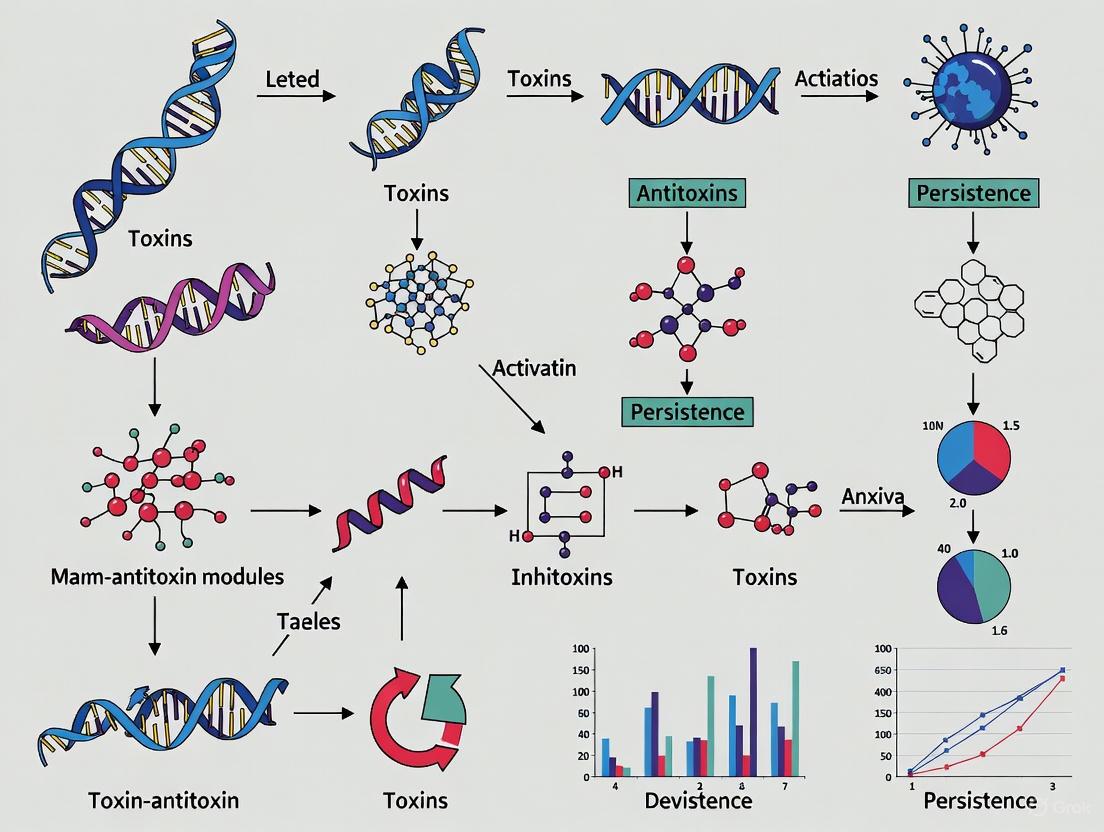
This article provides a comprehensive analysis of the mechanisms by which bacterial toxin-antitoxin (TA) modules contribute to phenotypic persistence and antibiotic tolerance.
Toxin-Antitoxin Modules in Bacterial Persistence: Mechanisms, Functions, and Therapeutic Targeting
Abstract
This article provides a comprehensive analysis of the mechanisms by which bacterial toxin-antitoxin (TA) modules contribute to phenotypic persistence and antibiotic tolerance. Aimed at researchers and drug development professionals, it synthesizes foundational knowledge on TA system classification and function with current methodological approaches for their study. The content explores the complex interplay between TA systems and other persistence pathways, addresses key challenges in the field, and evaluates TA systems as novel targets for anti-persister therapeutic development. By integrating recent advances and comparative analyses, this review aims to bridge fundamental knowledge with translational applications for combating recalcitrant bacterial infections.
Understanding Toxin-Antitoxin Systems: From Basic Architecture to Persistence Mechanisms
Historical Discovery and Definition of TA Modules
The historical discovery of Toxin-Antitoxin (TA) modules emerged from investigations into a fundamental paradox in bacteriology: the inability of antibiotics to sterilize bacterial cultures, despite demonstrating potent killing efficacy in vitro [1]. In 1944, Bigger identified and named a subpopulation of bacterial persister cells that survived intensive antibiotic exposure without acquiring heritable resistance [1]. These dormant cells were later recognized as a significant clinical challenge in chronic and relapsing infections, including Staphylococcus aureus in prosthetic implants and Mycobacterium tuberculosis in pulmonary infections [1] [2]. The molecular underpinnings of this persistence phenomenon remained elusive for decades until a series of key discoveries revealed the pivotal role of ubiquitous genetic elements now known as TA modules. These modules, initially characterized as plasmid "addiction" systems, have since been recognized as critical regulators of bacterial growth arrest and survival under stress, fundamentally shaping our understanding of bacterial physiology and antibiotic tolerance [3].
The Initial Discovery: Plasmid Maintenance and Post-Segregational Killing
The foundational discovery of TA modules dates to 1983, with the identification of a stability mechanism on an Escherichia coli plasmid [1] [4]. Researchers observed that these plasmids employed a unique strategy to ensure their inheritance by daughter cells during cell division. This phenomenon was termed post-segregational killing (PSK) or plasmid addiction [3] [4]. The molecular basis for PSK is a two-component system where a long-lived toxin and a short-lived antitoxin are co-expressed. If a daughter cell fails to inherit the plasmid during division, it ceases production of the unstable antitoxin. The pre-existing, stable toxin is then liberated to inhibit essential cellular processes, leading to cell death or growth arrest [1] [4]. This altruistic death of plasmid-free cells ensures the propagation of the plasmid-bearing lineage within the bacterial population. The first TA system identified was a plasmid-borne type II system, setting the stage for the classification and characterization of many subsequent modules [4].
Expansion to the Chromosome: From Addiction Modules to Persistence Regulators
Following their discovery on plasmids, TA modules were subsequently found to be abundant on bacterial chromosomes [1]. This finding prompted a significant shift in their perceived biological role, expanding beyond simple plasmid maintenance. Chromosomally encoded TA modules were linked to broader physiological functions, including abortive infection as a defense mechanism against bacteriophages and, most notably, the formation of persister cells [1] [2]. During phage infection, TA module activation causes altruistic suicide of the infected cell, thereby impairing phage replication and protecting the broader bacterial population [1]. In the context of antibiotic stress, activation of chromosomal TA modules induces a transient, dormant state in a subpopulation of cells, leading to multidrug tolerance without genetic resistance [1] [2]. This link was strengthened by the observation that pathogenic strains often harbor a significantly greater number of TA modules than their non-pathogenic relatives; for instance, M. tuberculosis carries 88 TA modules compared to only 5 in the faster-growing, non-pathogenic M. smegmatis [1].
Classification of TA Modules
The classification of TA modules is dynamically evolving, based on the nature of the antitoxin and its mechanism of toxin inhibition. Initially, six primary classes were defined, but advances in the field have now expanded this to eight distinct types [1] [4].
Table 1: Classification of Toxin-Antitoxin Systems
| Type | Nature of Antitoxin | Mechanism of Antitoxin Action | Examples |
|---|---|---|---|
| I | RNA | Antisense RNA binds toxin mRNA, inhibiting translation and promoting degradation [4]. | |
| II | Protein | Protein antitoxin binds directly to protein toxin, neutralizing its activity [1] [4]. | MazE/MazF, RelB/RelE |
| III | RNA | RNA antitoxin binds directly to protein toxin, forming a neutralizing complex [4]. | |
| IV | Protein | Protein antitoxin protects the cellular target instead of binding the toxin itself [4]. | |
| V | Protein | Protein antitoxin specifically cleaves the mRNA of the toxin [4]. | |
| VI | Protein | Protein antitoxin targets its cognate toxin for degradation by proteases [4]. | |
| VII | Protein | Antitoxin is inactivated by post-translational modification of its cognate toxin [4]. | |
| VIII | RNA | Antitoxin RNA inhibits the expression of its cognate RNA toxin [4]. |
Among these, Type II TA modules are the most extensively studied. In these systems, both the toxin and antitoxin are proteins, with the antitoxin typically binding directly to the toxin to form a stable, inactive complex [4]. The operon is autoregulated at the transcriptional level by the TA complex itself [4].
Molecular Targets and Mechanisms of Toxin Action
TA module toxins function by selectively targeting essential cellular processes to induce growth arrest or cell death. The primary molecular targets of well-characterized toxins, particularly from type II systems, are summarized below.
Table 2: Molecular Targets and Mechanisms of Type II Toxin Action
| Toxin/Family | Primary Target | Molecular Mechanism | Cellular Outcome |
|---|---|---|---|
| CcdB | DNA Gyrase [4] | Inhibits DNA rejoining, trapping gyrase in a cleavage complex [4]. | DNA double-strand breaks; replication arrest. |
| ParE | DNA Gyrase [4] | Targets DNA gyrase, inducing genome instability [4]. | Replication inhibition; cell death. |
| MazF | mRNA/rRNA [4] | Ribonuclease that degrades free cellular RNA with limited sequence specificity [4]. | Global inhibition of protein synthesis. |
| RelE | mRNA [4] | Ribosome-dependent endonuclease that cleaves mRNA in the ribosomal A-site [4]. | Co-translational inhibition of protein synthesis. |
| VapC | tRNA/rRNA [4] | Ribonuclease that specifically cleaves the anticodon stem-loop of tRNAs [4]. | Disruption of tRNA function and translation. |
| HipA | Glu-tRNA Synthetase [4] | Phosphorylates aminoacyl-tRNA synthetases [4]. | Prevents tRNA charging; inhibits translation. |
| Doc | Elongation Factor Tu (EF-Tu) [4] | Phosphorylates and inactivates EF-Tu [4]. | Inhibits tRNA delivery to the ribosome. |
| MbcT | NAD+ [4] | Hydrolyzes and depletes cellular NAD+ pools [4]. | Disruption of redox reactions and energy metabolism. |
| ζ-toxin | UDP-sugars [4] | Phosphorylates and depletes UDP-activated sugars [4]. | Inhibition of cell wall synthesis. |
Regulatory Dynamics and Activation Triggers
The core regulatory principle of most TA modules lies in the differential stability of the toxin and antitoxin. The antitoxin is typically labile and susceptible to rapid degradation by host proteases (e.g., Lon, ClpXP), while the toxin is highly stable [1] [4]. Under normal growth, continuous antitoxin production ensures toxin neutralization. Under stress (e.g., antibiotic exposure, nutrient starvation), protease activity increases, leading to antitoxin degradation. This frees the stable toxin to act on its target, inducing growth arrest and enabling the cell to enter a persistent, dormant state [1] [4]. This regulatory pathway and its outcomes are illustrated below.
Diagram 1: TA Module Regulatory Pathway
Key Experimental Methodologies in TA Module Research
The functional characterization of TA modules relies on a suite of molecular biology and biochemical techniques designed to confirm toxin lethality, verify antitoxin neutralization, and elucidate molecular targets.
Experimental Workflow for Characterizing a TA Module
A standard experimental pipeline for validating a putative TA system involves the following key steps, which are visualized in the workflow diagram below.
Diagram 2: TA Module Characterization Workflow
Detailed Experimental Protocols
Protocol 1: Toxin Lethality and Antitoxin Neutralization Assay (Steps 2-5) This foundational assay confirms the toxic nature of a putative toxin and the neutralizing capacity of its cognate antitoxin.
Molecular Cloning:
- Clone the putative toxin gene into an inducible expression plasmid (e.g., pBAD, pET, under control of an inducible promoter like Ptac or ParaBAD) [4].
- Co-clone the putative toxin and antitoxin genes into a compatible inducible system.
Transformation and Growth Curves:
- Transform the toxin-only plasmid, the TA co-expression plasmid, and an empty vector control into a suitable E. coli strain.
- Inoculate cultures and grow to mid-log phase.
- Induce toxin expression by adding a defined concentration of inducer (e.g., 0.2% L-arabinose for ParaBAD).
- Monitor optical density (OD600) every 30-60 minutes for 4-8 hours post-induction.
Expected Results and Interpretation:
- Cells expressing the toxin alone should show a rapid cessation of growth or a decrease in OD600 compared to the control.
- Cells co-expressing the toxin and antitoxin should exhibit a growth profile similar to the control, demonstrating neutralization.
Protocol 2: Protein-Protein Interaction Analysis (Step 6) This protocol confirms the direct physical interaction between the toxin and antitoxin.
Protein Purification:
- Express and purify the toxin and antitoxin proteins individually, often as His-tagged fusion proteins using affinity chromatography (e.g., Ni-NTA resin) [4].
Interaction Assay:
- Affinity Co-purification: Co-express the His-tagged antitoxin with an untagged toxin. Perform cell lysis and pass the lysate over a Ni-NTA column. After washing, elute bound proteins. Analyze the eluate by SDS-PAGE. The presence of both proteins indicates complex formation.
- Surface Plasmon Resonance (SPR) or Isothermal Titration Calorimetry (ITC): Use purified proteins to quantify the binding affinity (KD) and stoichiometry of the TA interaction.
Protocol 3: Identifying the Toxin's Molecular Target (Step 7) This is a critical step for defining the TA system's mechanism of action.
Hypothesis Generation: Based on sequence homology (e.g., similarity to known ribonucleases like MazF or RelE), formulate a testable hypothesis.
In Vitro Activity Assays:
- For Ribonucleases: Incubate purified toxin with total cellular RNA or synthetic RNA substrates. Analyze products by gel electrophoresis (e.g., denaturing urea-PAGE) for signs of cleavage.
- For Kinases (e.g., HipA): Perform in vitro kinase assays with purified toxin, γ-32P-ATP, and putative target proteins (e.g., elongation factors, synthetases). Detect phosphorylation by autoradiography or phospho-staining.
In Vivo Validation:
- Use a bacterial two-hybrid system (e.g., BACTH) to test for toxin interaction with a suspected target protein inside the cell.
- For toxins targeting DNA gyrase (e.g., CcdB), demonstrate the induction of the SOS response DNA damage response using reporter gene fusions.
The Scientist's Toolkit: Essential Research Reagents
Table 3: Key Reagents for TA Module Research
| Reagent / Material | Function and Application | Specific Examples |
|---|---|---|
| Inducible Expression Vectors | Allows controlled, conditional expression of toxin genes to study lethality. | pBAD (arabinose-inducible), pET (IPTG-inducible) [4]. |
| Affinity Chromatography Resins | Purification of recombinant toxin and antitoxin proteins for in vitro studies. | Ni-NTA Agarose for His-tagged proteins [4]. |
| Protease-Deficient Strains | Facilitates study of TA complex regulation by preventing antitoxin degradation. | E. coli Δlon, ΔclpP [4]. |
| RNA Isolation and Analysis Kits | To analyze the ribonuclease activity of toxins on cellular or synthetic RNA. |
Toxin-antitoxin (TA) systems are ubiquitous genetic elements found in the genomes of bacteria and archaea, composed of a stable toxin and its cognate unstable antitoxin [5] [1]. These bipartite modules were initially discovered on plasmids in Escherichia coli and characterized as "addiction modules" that promote plasmid maintenance through post-segregational killing (PSK) [1] [6]. Under normal physiological conditions, the antitoxin neutralizes its toxin counterpart; however, under stress conditions or following plasmid loss, the antitoxin is rapidly degraded or downregulated, freeing the toxin to act on its cellular targets [5]. TA systems have since been identified on various mobile genetic elements (MGEs), including integrative and conjugative elements (ICEs), bacteriophages, integrons, and transposons, suggesting a broader role in MGE maintenance and competition beyond simple plasmid addiction [6].
The significance of TA systems extends beyond their function as selfish genetic elements. These systems play crucial roles in bacterial physiology, including genetic element maintenance, virulence, stress resistance, phage inhibition, biofilm formation, and persister cell formation [5] [1]. Persisters are a subpopulation of transiently multidrug-tolerant bacterial cells that contribute to antibiotic treatment failure and chronic infections, making TA systems a focus of intense research in antimicrobial development [7] [8]. Currently, TA systems are classified into eight distinct types (I-VIII) based on the nature of the antitoxin and its mechanism of toxin neutralization [5] [9]. This classification reflects remarkable mechanistic diversity in how antitoxins counteract toxins, ranging from protein-protein interactions to RNA-RNA interactions and post-translational modifications.
Classification Framework and Mechanisms
The classification of TA systems is based on the fundamental nature of the antitoxin and its molecular mechanism of toxin inhibition [1] [10]. This systematic categorization has expanded from the original three types to the current eight types as novel mechanisms have been discovered, reflecting the diversity and complexity of these genetic modules.
Table 1: Comprehensive Classification of Toxin-Antitoxin Systems
| TA Type | Toxin Nature | Antitoxin Nature | Mechanism of Neutralization | Primary Toxin Targets |
|---|---|---|---|---|
| Type I | Small hydrophobic protein | Small antisense RNA | Antitoxin RNA binds toxin mRNA, inhibiting translation via degradation or ribosome binding site occlusion [10] | Cell membrane integrity, ATP production [6] |
| Type II | Protein (various enzymatic activities) | Protein | Antitoxin protein binds to and sterically blocks toxin active site [5] [9] | Translation (RNases), DNA replication, cell wall synthesis [6] |
| Type III | Protein (endoribonuclease) | RNA | RNA antitoxin binds directly to toxin protein, inhibiting activity [10] [11] | Cellular mRNAs (sequence-specific cleavage) [11] |
| Type IV | Protein (various activities) | Protein | Antitoxin protects cellular targets rather than directly interacting with toxin [6] [9] | Cell division, DNA integrity, metabolic stress [6] |
| Type V | Protein (membrane damage) | Protein (endoribonuclease) | Antitoxin degrades toxin mRNA specifically [6] [9] | Membrane integrity [6] |
| Type VI | Protein (DNA replication inhibition) | Protein | Antitoxin directs toxin for degradation by ATP-dependent proteases [6] [9] | DNA replication elongation [6] |
| Type VII | Protein (tRNA disruption) | Protein | Antitoxin inactivates toxin through post-translational modifications [6] [9] | tRNA function [6] |
| Type VIII | RNA (tRNA sequestration) | RNA | Antitoxin represses toxin expression as antisense RNA or via CRISPR-Cas recruitment [6] [9] | Protein synthesis via tRNA availability [6] |
The operational mechanisms of these eight TA types can be visualized through the following molecular pathways:
Diagram 1: Molecular Mechanisms of TA System Types I-VIII. Under stress conditions, antitoxins are degraded or downregulated, freeing toxins to act on their cellular targets through type-specific mechanisms.
Detailed Analysis by TA System Type
Type I Systems
Type I TA systems are characterized by a protein toxin whose translation is inhibited by a small antisense RNA antitoxin. The toxin mRNA and antitoxin RNA are typically encoded on opposite DNA strands with overlapping regions that enable complementary base-pairing [10]. This interaction inhibits toxin translation either through degradation of the toxin mRNA via RNase III or by occluding the Shine-Dalgarno sequence or ribosome binding site [10]. Toxins of type I systems are generally small, hydrophobic proteins that confer toxicity by damaging cell membranes and causing ATP loss [6]. The well-characterized hok/sok system represents the prototype type I TA system, where the sok antitoxin RNA binds the hok toxin mRNA, preventing its translation and thereby stabilizing plasmids in various Gram-negative bacteria [10]. Other notable examples include tisB/istR, induced during the SOS response in E. coli, and fst/RNAII, the first type I system identified in Gram-positive bacteria [10].
Type II Systems
Type II systems represent the most extensively studied TA class, featuring both protein toxins and protein antitoxins. The antitoxin typically binds directly to the toxin, sterically blocking its active site or disrupting interaction with substrates [5] [9]. These systems are organized in operons with the antitoxin gene usually preceding the toxin gene, preventing toxin expression without the antitoxin [10]. Type II toxins exhibit diverse toxic activities, with the most common being endoribonucleases that cleave cellular mRNAs, though some target DNA replication or cell wall synthesis [6] [10]. The VapBC (virulence-associated protein) family is the most abundant type II system, representing between 37-42% of all predicted type II loci [10] [12]. Other prominent families include MazEF, where MazF is an endoribonuclease that cleaves mRNAs at specific sequences, and CcdAB, where CcdB poisons DNA gyrase [10]. Type II systems are preferentially associated with plasmids but are also found in genomic islands, ICEs, and other mobile genetic elements [6].
Type III Systems
Type III TA systems consist of a protein toxin that is typically an endoribonuclease and an RNA antitoxin that directly binds and inhibits the toxin [10] [11]. These systems are classified into three families based on toxin sequence homology: toxIN, cptIN, and tenpIN [11]. The RNA antitoxins generally form conserved pseudoknot structures and bind directly to their cognate toxins to neutralize toxicity [11]. Type III systems primarily function in phage defense and plasmid maintenance through abortive infection mechanisms, where activation of the toxin during phage infection leads to cell death before phage replication can complete, thereby protecting the bacterial population [11]. A recent bioinformatic analysis has identified over 700 putative TenpN toxin sequences across different bacteria and viruses, significantly expanding beyond the previously documented 25 bacterial sequences, highlighting the diversity and widespread nature of these systems [11].
Type IV to VIII Systems
The more recently discovered TA types (IV-VIII) exhibit increasingly diverse mechanisms of toxin neutralization. In type IV systems, the antitoxin functions by protecting the cellular target of the toxin rather than directly interacting with the toxin itself [6] [9]. Type V systems feature an antitoxin that functions as an endoribonuclease specifically degrading toxin-encoding mRNAs [6] [9]. Type VI antitoxins act as proteolytic adaptors that direct toxins for degradation by ATP-dependent proteases [6] [9]. Type VII systems utilize post-translational modifications, where the antitoxin inactivates the toxin through direct chemical modification [6] [9]. Finally, type VIII systems represent the most novel class where both toxin and antitoxin are RNA molecules; the antitoxin represses toxin expression either as antisense RNAs or by mimicking CRISPR RNAs that recruit Cas proteins as transcriptional repressors [6] [9].
Table 2: Mobile Genetic Element Associations of TA Systems
| TA Type | Primary MGE Associations | Secondary MGE Associations | Representative Functions |
|---|---|---|---|
| Type I | Prophages, Plasmids | Genomic islands, ICEs, IS/Tn clusters | Membrane depolarization, ATP loss [6] |
| Type II | Plasmids | Genomic islands, IS clusters, ICEs, integrons | RNase activity, peptidoglycan inhibition [6] |
| Type III | Plasmids | ICEs, prophages, IS clusters | Phage defense, plasmid maintenance [6] [11] |
| Type IV | Genomic islands | Prophages, IS/Tn, ICEs | DNA damage, cell division inhibition [6] |
| Type V | Genomic islands | IS/Tn | Membrane damage [6] |
| Type VI | Prophages | Chromosomal regions | DNA replication inhibition [6] |
| Type VII | IS clusters/Tn | Plasmids, genomic islands, ICEs | tRNA disruption [6] |
| Type VIII | Prophages | Genomic islands, IS/Tn | tRNA sequestration [6] |
Research Methodologies and Experimental Approaches
Genomic Identification and Bioinformatics
The identification of TA systems in bacterial genomes relies on both sequence-based and structure-based bioinformatic approaches. Standard methodology involves searching for paired genes encoding potential toxins and antitoxins using tools like BLAST with carefully curated query sequences [12] [11]. For type III systems, specific criteria include identifying a toxin gene preceded by a terminator and further upstream, a set of tandem repeats characteristic of RNA antitoxins [11]. Databases such as TADB 3.0 provide comprehensive repositories of known and predicted TA systems across bacterial species [9]. Recent analyses of marine bacteria using these approaches have revealed 4856 TA systems in 2179 metagenome-assembled genomes from the Global Ocean Microbiome Catalogue, with type II systems overwhelmingly dominant (97.63%) [9]. Similar bioinformatic exploration of type III tenpIN systems has identified over 700 putative TenpN toxin sequences across bacteria and viruses, significantly expanding known diversity [11].
Molecular Docking and Structural Analysis
Molecular docking simulations provide insights into TA interactions at the atomic level. In recent studies comparing VapBC3 systems in Mycobacterium tuberculosis and M. bovis, HADDOCK 2.4 was employed to assess functional implications of vapC3 mutations [12]. The analysis revealed that VapBC3 in M. bovis exhibits more stable interaction (HADDOCK score: 20.4 ± 5.4) compared to M. tuberculosis (73.9 ± 11.0), with significant differences in Van der Waals energy (-77.2 ± 3.3 vs. -86.2 ± 10.1) and electrostatic energy (-188.2 ± 54.3 vs. -200.6 ± 34.5) [12]. Structural models predicted by AlphaFold can be visualized using UCSF ChimeraX molecular graphics software to identify structural divergences, such as the truncated VapC3 protein in M. bovis resulting from a nucleotide deletion [12].
Functional Characterization
Functional analysis of TA systems typically involves genetic manipulation to assess phenotypes under various conditions. For example, in characterizing PezAT and MbcTA systems in M. tuberculosis, researchers used temperature-sensitive mycobacteriophages to generate ΔpezAT and ΔmbcT mutant strains [13]. These mutants were then exposed to oxidative stress, nitrosative stress, and rifampicin to assess growth differences. Results demonstrated that deletion of pezAT reduced M. tuberculosis growth upon exposure to detergent stress or rifampicin, while mbcT deletion showed no significant effects under various stress conditions [13]. Additionally, both systems were dispensable for growth in macrophages and guinea pigs, suggesting functional redundancy among TA systems [13].
Diagram 2: TA System Research Workflow. The standard methodology for identifying and characterizing toxin-antitoxin systems integrates bioinformatic prediction with experimental validation.
The Scientist's Toolkit: Essential Research Reagents
Table 3: Essential Research Reagents for TA System Investigation
| Reagent/Category | Specific Examples | Function/Application | Key Features |
|---|---|---|---|
| Bioinformatic Tools | TADB 3.0, BLAST, BPROM, ARNold | TA system identification, promoter/terminator prediction | Database curation, pattern recognition [9] [11] |
| Molecular Cloning | Temperature-sensitive mycobacteriophages, overexpression vectors | Mutant generation, toxin-antitoxin expression | Genetic manipulation, conditional expression [13] |
| Structural Analysis | HADDOCK 2.4, AlphaFold, UCSF ChimeraX | Molecular docking, structure prediction, visualization | Protein-protein interaction analysis, 3D modeling [12] |
| Expression Systems | M. smegmatis, E. coli strains | Heterologous TA expression, functional characterization | Non-pathogenic background, genetic tractability [13] |
| Stress Assay Reagents | Rifampicin, H₂O₂, NO donors, detergents | Induction of TA system activation | Physiological relevance, response measurement [13] |
TA Systems in Bacterial Persistence and Pathogenesis
The role of TA systems in bacterial persistence represents a significant focus in current research, particularly given the clinical challenges of recurrent infections and antibiotic treatment failures. Persisters are a subpopulation of transiently multidrug-tolerant bacterial cells that can survive antibiotic exposure without genetic resistance mechanisms [7] [8]. In Salmonella enterica serovar Typhimurium, multiple TA modules have been implicated in persister formation under host microenvironment conditions [7]. For example, the type I toxin TisB triggers persister formation by dissipating the proton gradient and impeding ATP production following antibiotic-induced DNA damage [9]. Similarly, RelE/B and SehA/B TA systems facilitate the persistent phenotype in Salmonella [9].
In Mycobacterium tuberculosis, which carries an exceptionally high number of TA systems (approximately 88), these modules are thought to contribute to dormancy and antibiotic tolerance [1] [12]. The VapBC3 system, particularly abundant in mycobacteria, exhibits metal-dependent ribonuclease activity and is upregulated in response to stressors including nutrient deprivation, hypoxia, and drug exposure [12]. Overexpression of VapC3 leads to growth cessation, a phenomenon reversed by co-expression of its cognate antitoxin VapB3 [12]. Comparative analysis of VapBC3 in M. tuberculosis and M. bovis has revealed species-specific variations that may influence host adaptation and virulence strategies [12].
However, the relationship between TA systems and persistence remains complex and sometimes controversial. While early studies strongly implicated TA systems in persistence formation, some recent evidence challenges the essentiality of specific TA modules. For instance, deletion of particular TA systems in M. tuberculosis, such as PezAT and MbcTA, did not significantly impact growth in macrophages or guinea pigs, suggesting functional redundancy among the numerous TA systems present in this pathogen [13]. Similarly, in E. coli, some type II TA systems do not appear to induce persistence under antibiotic exposure as previously believed [6]. These contradictory findings highlight the need for more precise methodologies in persister research and careful differentiation between true persistence and other survival phenomena such as tolerance and the viable but non-culturable state [8].
The comprehensive classification of TA systems into eight distinct types reflects the remarkable diversity and complexity of these genetic modules in bacterial physiology and evolution. From their initial characterization as plasmid addiction systems to their current recognition as multifunctional elements involved in stress response, phage defense, and bacterial persistence, TA systems continue to reveal new biological insights and potential applications. The expanding classification scheme (now encompassing types I-VIII) demonstrates how ongoing research continues to uncover novel mechanisms of toxin inhibition and neutralization.
Future research directions should focus on several key areas. First, the exploration of TA systems in understudied environmental bacteria, such as those from marine ecosystems, may reveal novel TA types and mechanisms adapted to extreme conditions [9]. Second, resolving the controversial role of TA systems in bacterial persistence requires more sophisticated single-cell approaches and careful differentiation between various dormant states [7] [8]. Third, the species-specific variations in TA systems, such as those observed between M. tuberculosis and M. bovis, warrant further investigation to understand how these differences influence host adaptation and virulence [12]. Finally, the potential therapeutic applications of TA systems—as targets for novel antibacterial strategies or as tools in biotechnology—represent promising translational avenues [5] [1].
As research methodologies continue to advance, particularly in bioinformatics, structural biology, and single-cell analysis, our understanding of these fascinating genetic elements will undoubtedly deepen, potentially revealing new biology and novel approaches to combat persistent bacterial infections.
Molecular Architecture and Genetic Organization of TA Operons
Toxin-antitoxin (TA) systems are small genetic modules ubiquitously found in bacterial and archaeal genomes, playing a crucial role in bacterial persistence, stress response, and antimicrobial tolerance [14] [15]. These systems consist of a stable toxin that inhibits essential cellular processes and a labile antitoxin that neutralizes the toxin's activity under normal growth conditions [16]. Within the context of bacterial persistence research, TA systems are recognized as central mediators of the dormant, antibiotic-tolerant state that characterizes persister cells, which contribute significantly to chronic and relapsing infections [15] [7]. The molecular architecture and genetic organization of these operons determine their regulatory sophistication and functional outcomes, making them a critical focus for understanding bacterial pathogenesis and developing novel therapeutic strategies.
Classification and Genetic Organization of TA Systems
TA systems are classified based on the nature and mode of action of the antitoxin component, with eight distinct types (I-VIII) currently identified [14] [16]. The genetic organization of these systems follows conserved principles but exhibits variations that reflect their functional specialization and evolutionary origins.
Table 1: Classification of Toxin-Antitoxin Systems Based on Antitoxin Nature and Mechanism
| Type | Toxin Nature | Antitoxin Nature | Mechanism of Neutralization | Genetic Organization |
|---|---|---|---|---|
| Type I | Protein | RNA (antisense) | Translation inhibition & mRNA degradation [16] | Adjacent genes, antisense RNA encoded in overlapping region [16] |
| Type II | Protein | Protein | Protein-protein interaction & toxin sequestration [16] [17] | Bicistronic operon with antitoxin gene preceding toxin gene [17] |
| Type III | Protein | RNA (direct binding) | Toxin sequestration by repeat RNA motifs [16] | Adjacent genes with specific repeat structures |
| Type IV | Protein | Protein | Competition for cellular target [16] | Bicistronic operon similar to Type II |
| Type V | Protein | Protein (RNase) | Cleavage of toxin mRNA [16] | Bicistronic operon with regulatory antitoxin |
| Type VI | Protein | Protein | Protease adaptor promoting toxin degradation [17] | Bicistronic operon with unstable toxin |
Type II TA systems represent the most extensively characterized class, typically organized as bicistronic operons with the antitoxin gene preceding the toxin gene [17]. This arrangement ensures preferential synthesis of the antitoxin before toxin expression, preventing inadvertent cellular damage. The operons are often transcribed from a single promoter located upstream of the antitoxin gene, with the two genes frequently overlapping by a few nucleotides, enabling coupled translation that maintains stoichiometric balance between the components [17].
Table 2: Characterized Type II TA Systems in Model Organisms
| Organism | TA System | Toxin Target | Toxin Mechanism | Regulatory Features |
|---|---|---|---|---|
| E. coli K-12 | MazE/MazF | mRNA | Endoribonuclease cleavage [18] [19] | Autoregulation, SOS response activation [19] |
| E. coli K-12 | RelB/RelE | mRNA | Ribosome-dependent endonuclease [19] | Amino acid starvation response [19] |
| E. coli K-12 | MqsR/MqsA | mRNA | Endoribonuclease [18] | Biofilm formation, stress response [18] |
| M. tuberculosis | VapBC | mRNA | Endoribonuclease [16] | Extensive family with 30+ systems [16] |
| Plasmid F | CcdB/CcdA | DNA gyrase | Topoisomerase poisoning [19] | Post-segregational killing, plasmid maintenance [19] |
The following diagram illustrates the genetic organization and regulatory relationships in a canonical Type II TA operon:
Diagram 1: Genetic organization and regulation of a canonical Type II TA operon, showing transcriptional autoregulation and stress-responsive activation.
Molecular Architecture of TA Components
The protein components of TA systems exhibit specialized structural features that enable their precise regulatory functions and toxic activities. Type II toxins are classified into 12 super-families based on amino acid sequence and three-dimensional structure similarities, while type II antitoxins form 20 super-families [16]. This structural diversity reflects the evolutionary adaptation of TA systems to target various essential cellular processes.
Toxin proteins typically employ enzymatic mechanisms to disrupt critical cellular functions. The majority target translation through ribonuclease activity (MazF, RelE, VapC, MqsR) [18] [19], while others interfere with DNA replication (CcdB, ParE) through DNA gyrase poisoning [19], or cell wall synthesis. The toxins are characterized by their stability and specific catalytic activities that, when unleashed, inhibit cell growth or lead to death.
Antitoxins possess a modular architecture consisting of distinct functional domains. In type II systems, antitoxins typically contain an amino-terminal DNA-binding domain (DBD) and a carboxy-terminal region responsible for toxin binding [16]. The DBD enables the antitoxin to function as a transcriptional repressor for the TA operon, while the toxin-binding domain facilitates neutralization through direct protein-protein interaction. Some exceptions exist, such as MqsA, which positions the DBD at the C-terminal region and the toxin-binding domain at the N-terminal part [16].
The following diagram illustrates the molecular interactions and functional consequences of TA system activation under stress conditions:
Diagram 2: Molecular transitions in TA system function between normal and stress conditions, showing the proteolytic switch that triggers persistence.
The TA complex formation is essential for neutralization under normal conditions and also enhances the DNA-binding capability of the antitoxin, enabling tighter repression of the TA operon [17]. This conditional cooperativity creates a sophisticated feedback loop where the toxin functions as a corepressor, fine-tuning its own expression based on the cellular stoichiometry of the TA components.
Genomic Distribution and Evolutionary Patterns
TA systems demonstrate remarkable diversity in their genomic distribution across bacterial species. Comparative genomics studies of 950 Escherichia coli genomes spanning 19 different sequence types (STs) revealed a median of 23 toxin groups per strain, with numbers ranging from 0 to 37 [18]. This distribution follows distinct phylogroup-specific patterns, with significant genomic reduction observed in members of phylogroups B2 (ST131, ST95, ST73, ST12, and ST127) and C (ST410), evidenced by diminished toxin repertoires amidst abundant orphan antitoxins [18].
Table 3: Genomic Distribution of TA Systems Across E. coli Sequence Types
| Phylogroup | Sequence Type (ST) | Average Toxins Per Strain | Genomic Features | Clinical Relevance |
|---|---|---|---|---|
| B2 | ST131 | Reduced (~14) [18] | Genomic reduction [18] | Multidrug-resistant infections [18] |
| B2 | ST95 | Reduced [18] | Diminished toxin repertoire [18] | Extraintestinal pathogenic E. coli [18] |
| B2 | ST73 | Reduced [18] | Genomic optimization [18] | Urinary tract infections [18] |
| D | ST38 | Higher (up to 37) [18] | Expanded toxin arsenal [18] | Diverse infection types [18] |
| D | ST405 | Higher than average [18] | Multiple TA copies [18] | Multidrug-resistant lineage [18] |
| F | ST648 | Higher than average [18] | Abundant TA systems [18] | Emerging MDR pathogen [18] |
The abundance of TA systems in bacterial chromosomes varies tremendously, with some species like Mycobacterium tuberculosis encoding up to 88 TA systems (approximately 30 confirmed functional), while obligate intracellular bacteria with reduced genomes harbor few or none [16] [19]. This distribution pattern supports the hypothesis that TA systems are particularly valuable for free-living bacteria that must cope with fluctuating environmental conditions rather than stable intracellular niches [19].
Evolutionary analyses reveal that TA systems are frequently associated with mobile genetic elements (MGEs) such as plasmids, phages, genomic islands, and integrative conjugative elements [18] [19]. This association facilitates horizontal gene transfer and explains the patchy distribution of TA systems across bacterial lineages. The evolutionary processes governing TA systems include "mixing and matching" of toxin and antitoxin super-families, gene duplication, and functional degeneration through accumulation of nonsense mutations or deletion events [16] [19].
Experimental Methods for TA System Analysis
The study of TA systems requires specialized methodologies to characterize their genetic organization, molecular interactions, and physiological functions. Recent advances in high-throughput genomics and machine learning have significantly enhanced our ability to identify and analyze these systems across bacterial populations.
Genomic Identification and Characterization
Computational prediction of TA pairs typically involves sequence similarity searches against known TA databases, identification of conserved genomic architectures, and validation of potential operonic organization. The SLING software tool has been successfully employed to predict 169 toxin groups and 290 antitoxin groups across 950 E. coli isolates, resulting in the identification of 314 unique TA pairs [18]. Quality control measures for genomic analyses include using high-quality genome assemblies with contig numbers restricted to 192 or fewer, minimum N50 values of 53,400 bp, and average G+C content of approximately 50.59% for draft genomes [18].
Machine learning approaches have been applied to identify ST-specific signatures, including TA systems, that could be implicated in context-specific adaptation strategies [18]. These methods enable the classification of high-risk clonal lineages based on their TA repertoires and provide insights into the epidemiological success of specific sequence types.
Molecular Interaction Studies
Experimental validation of predicted TA systems requires both genetic and biochemical approaches:
- Toxicity assays: Cloning toxin genes under inducible promoters and assessing growth inhibition upon induction in host cells [16].
- Neutralization tests: Co-expression of antitoxin and toxin genes to demonstrate rescue of toxicity [16].
- Protein-protein interaction studies: Yeast two-hybrid systems, bacterial two-hybrid systems, co-immunoprecipitation, and surface plasmon resonance to characterize binding affinities and complex formation [16] [17].
- Structural analyses: X-ray crystallography and NMR spectroscopy to determine three-dimensional structures of toxins, antitoxins, and their complexes [16].
- Transcriptional regulation studies: Electrophoretic mobility shift assays (EMSAs) and reporter gene fusions to investigate DNA binding and autorepression capabilities [17].
Persistence and Phenotypic Assays
Linking TA systems to persistence phenotypes requires specialized methodologies:
- Persister cell isolation: Treatment of stationary phase cultures with high concentrations of bactericidal antibiotics (e.g., fluoroquinolones, aminoglycosides) followed by quantification of surviving cells through CFU counts [15] [7].
- Single-cell analysis: Microfluidics coupled with time-lapse microscopy to monitor growth arrest and resuscitation at the single-cell level [15] [20].
- Proteomic approaches: Mass spectrometry analysis of protein expression patterns in persister subpopulations to identify key regulators [7].
- TA activation monitoring: Reporter systems fusing TA promoters to fluorescent proteins to visualize activation dynamics in response to stress conditions [19].
Research Reagent Solutions for TA System Investigation
Table 4: Essential Research Tools for TA System Analysis
| Reagent/Category | Specific Examples | Function/Application | Experimental Context |
|---|---|---|---|
| Bioinformatics Tools | SLING [18] | TA pair prediction from genomic data | Comparative genomics, evolutionary studies |
| Cloning Systems | Inducible expression vectors (pBAD, pET, pLATE) | Controlled toxin/antitoxin expression | Toxicity assays, neutralization tests |
| Protease Assays | Lon protease mutants, protease inhibitors | Study antitoxin degradation | Stress response mechanisms |
| Antibiotic Persistence Assays | Ciprofloxacin, ampicillin, tobramycin | Persister cell isolation and quantification | Persistence frequency measurement |
| Protein Interaction Tools | Bacterial two-hybrid, co-IP kits, SPR chips | TA complex characterization | Binding affinity, complex stoichiometry |
| Structural Biology | Crystallization screens, NMR reagents | 3D structure determination | Mechanism of action studies |
| Transcriptional Reporters | GFP, RFP, luciferase fusions | Promoter activity monitoring | Regulation studies under stress |
| Microfluidics Devices | CellASIC, microfluidic traps | Single-cell persistence dynamics | Heterogeneity studies |
| RNA Sequencing | RNA-seq, Ribosome profiling | Transcriptome analysis upon toxin activation | Target identification |
| Mutant Libraries | Transposon mutants, deletion strains | Functional genomics screens | TA system network analysis |
Regulatory Networks and Cross-Talk Between TA Systems
TA systems do not function in isolation but participate in complex regulatory networks that integrate multiple stress signals and coordinate bacterial responses. The stringent response alarmone (p)ppGpp has emerged as a central regulator of TA system activation, particularly in the context of persistence formation [15] [20]. Under nutrient limitation or other stresses, elevated (p)ppGpp levels trigger a regulatory cascade involving Lon protease activation, which degrades antitoxins and liberates toxins to induce dormancy [17].
Cross-interactions between non-cognate components of different TA systems represent another layer of regulatory complexity. While studies have generally shown high specificity in toxin-antitoxin pairing, some examples of cross-talk have been documented. For instance, expression of chimeric MazF toxins in E. coli led to endogenous MazF activation, likely through competition for the endogenous MazE antitoxin [16]. Similarly, expression of inactive toxin mutants has been used to titrate endogenous antitoxins and activate chromosomal TA loci [16]. These interactions may facilitate the evolution of new regulatory circuits and functional diversification.
The positioning of TA systems within broader regulatory networks is evidenced by their association with other genetic elements. Genomic analyses have revealed significant correlations between TA systems and antimicrobial resistance genes, virulence factors, and mobile genetic elements [18]. This genetic linkage suggests coordinated evolution and functional integration, where TA systems contribute to the stabilization and maintenance of associated genetic cargo.
The molecular architecture and genetic organization of TA operons represent a sophisticated biological solution to the challenge of stress adaptation in bacteria. The precise arrangement of toxin and antitoxin genes, the structural specialization of their protein products, and their integration into global regulatory networks all contribute to the ability of bacteria to transition into and out of dormant persister states. Understanding these fundamental aspects of TA biology provides critical insights for addressing the clinical challenge of persistent infections, which are notably resistant to conventional antibiotic therapies. Future research directions should focus on elucidating the structural basis of TA interactions with unprecedented resolution, mapping the complete regulatory networks governing persistence across major bacterial pathogens, and exploiting this knowledge to develop anti-persister therapeutic strategies that specifically target key nodes in these systems.
Toxin-antitoxin (TA) modules are ubiquitous genetic elements found in bacteria and archaea, composed of a stable protein toxin and a labile cognate antitoxin [21] [14]. Under favorable growth conditions, the antitoxin neutralizes the toxin's activity, allowing normal cellular function. However, during conditions of stress or starvation, the antitoxin is degraded, freeing the toxin to inhibit growth and promote a dormant, persistent state [21] [22]. This sophisticated regulatory system plays a crucial role in bacterial physiology, contributing to plasmid maintenance, phage resistance, stress survival, and—most significantly for therapeutic applications—the formation of persister cells that tolerate antibiotic treatment [21] [23].
Persister cells represent a transiently antibiotic-tolerant subpopulation that underlies the recalcitrance and relapse of many bacterial infections [23] [24]. Unlike genetic resistance, persistence is a phenotypic state characterized by slow growth or growth arrest, enabling bacteria to survive lethal antibiotic concentrations without genetic mutation [22] [23]. The presence of persister cells establishes phenotypic heterogeneity within bacterial populations and increases the probability of successful adaptation to environmental change, including antibiotic pressure [23]. TA modules have emerged as central regulators of this phenomenon, with their activation leading to targeted disruption of essential cellular processes [21] [14].
This technical review comprehensively examines the molecular mechanisms through which bacterial toxins induce growth arrest and persistence, with particular focus on translation inhibition via tRNA targeting and metabolic disruption through stringent response activation. We synthesize current understanding of these pathways, present standardized experimental methodologies for their investigation, and visualize the complex regulatory networks governing bacterial persistence.
TA systems are classified into eight types (I-VIII) based on the nature and mode of action of their antitoxin components [22] [14]. Type I systems utilize RNA antitoxins that inhibit toxin translation, type II systems employ protein antitoxins that directly bind and neutralize toxins, while subsequent types utilize increasingly sophisticated mechanisms including protection of cellular targets and promoted degradation [21] [14]. Type II systems represent the most abundant and extensively studied family, featuring protein antitoxins that form tight complexes with their cognate toxins [21].
Table 1: Classification of Toxin-Antitoxin Systems
| Type | Toxin Nature | Antitoxin Nature | Mechanism of Antitoxin Action | Examples |
|---|---|---|---|---|
| I | Protein | RNA | Inhibits toxin mRNA translation | Hok/Sok, Fst/RNAII |
| II | Protein | Protein | Direct protein-protein interaction neutralizes toxin | MazEF, RelBE, HipBA, VapBC |
| III | Protein | RNA | RNA directly binds and inhibits toxin protein | ToxIN, CptIN |
| IV | Protein | Protein | Protects cellular targets of toxin | YeeU/YeeV |
| V | Protein | Protein | Degrades toxin mRNA | GhoT/GhoS |
| VI | Protein | Protein | Promotes toxin degradation by ClpXP | SocAB |
The functional diversity of TA modules is reflected in their varied molecular targets and mechanisms of action. Toxins can broadly be categorized based on their primary intracellular targets:
- Translation-targeting toxins: Inhibit protein synthesis through tRNA cleavage, acetylation, or ribosomal modification
- Metabolic-disrupting toxins: Alter central metabolism through stringent response activation or enzyme inhibition
- DNA replication inhibitors: Interfere with chromosome replication through gyrase inhibition or DNA cleavage
- Membrane-targeting toxins: Disrupt membrane potential and integrity
This review will focus specifically on translation inhibition through tRNA targeting and metabolic disruption through stringent response activation, as these represent two well-characterized pathways to bacterial persistence with distinct mechanistic foundations.
Translation Inhibition Through tRNA-Targeting Toxins
Molecular Mechanisms of tRNA Targeting
Several TA systems employ toxins that specifically target tRNA molecules to inhibit translation and induce growth arrest. These toxins utilize diverse enzymatic activities to disable tRNA function through three primary mechanisms: preventing aminoacylation, acetylating the primary amino group, or endonucleolytic cleavage [21]. All these mechanisms ultimately converge on translation inhibition, resulting in rapid cessation of protein synthesis and entry into a dormant state.
The VapC family of toxins and the MazF-mt9 toxin function as sequence-specific endonucleases that cleave tRNAs at specific positions, rendering them non-functional [21]. Structural studies have revealed that both sequence and structural components of the tRNA determine recognition and cleavage efficiency by these toxins [21]. For example, some VapC toxins display remarkable specificity for a single tRNA isotype, while others target a broader subset of tRNAs, though the precise determinants of this specificity require further characterization [21].
In contrast, the TacT and AtaT toxins function as acetyltransferases that modify the amino group of specific tRNAs, preventing their proper charging with amino acids and thereby inhibiting translation [21]. This acetylation creates a stable modification that persists even after toxin inactivation, potentially contributing to the prolonged dormancy observed in some persistent cells.
A distinct mechanism is employed by the HipA toxin, which phosphorylates and inactivates glutamyl-tRNA synthetase, preventing aminoacylation of tRNAGlu and consequently inhibiting translation [21]. This represents an indirect approach to disrupting tRNA function by targeting the aminoacyl-tRNA synthetase machinery rather than the tRNA molecules themselves.
Table 2: tRNA-Targeting Toxins and Their Mechanisms
| Toxin | TA System | Mechanism | Specificity | Molecular Result |
|---|---|---|---|---|
| VapC toxins | VapBC | Endonucleolytic cleavage | Specific tRNA or subset | Cleaved tRNA fragments |
| MazF-mt9 | MazEF | Endonucleolytic cleavage | Specific sequence motifs | Cleaved tRNA |
| TacT | TacAT | Acetylation of amino group | Specific tRNAs | Non-aminoacylatable tRNA |
| AtaT | AtaT | Acetylation of amino group | Specific tRNAs | Non-aminoacylatable tRNA |
| HipA | HipBA | Phosphorylation of GluRS | tRNAGlu indirectly | Uncharged tRNAGlu |
Regulatory Control and Activation
The activity of tRNA-targeting toxins is tightly regulated through conditional cooperativity, wherein the ratio of antitoxin to toxin determines the transcriptional and functional output of the system [21]. During favorable growth conditions, the antitoxin is present in excess and forms a complex with the toxin that represses transcription of the TA operon [21]. This repression is mediated by DNA-binding domains within the antitoxin component, with evidence suggesting stronger binding when the antitoxin is complexed with the toxin [21].
Under stress conditions or nutrient deprivation, cellular proteases such as Lon or Clp are activated and preferentially degrade the antitoxin component due to its relatively labile nature [21] [22]. This degradation shifts the ratio in favor of the toxin, destabilizing the repressor complex on the TA operon promoter and allowing increased expression of the TA genes [21]. However, the liberated toxin molecules simultaneously inhibit growth through their effects on tRNA function, creating a self-limiting regulatory circuit that enables rapid response to environmental cues while preventing uncontrolled toxin activation.
The following diagram illustrates the regulatory dynamics of a typical type II TA system and its connection to persistence formation:
Experimental Analysis of tRNA-Targeting Toxins
tRNA Cleavage Assay
Purpose: To detect and quantify endonucleolytic cleavage of specific tRNA molecules by toxins such as VapC and MazF-mt9.
Methodology:
- Recombinant toxin purification: Clone toxin gene into expression vector (e.g., pET series) and express in E. coli BL21(DE3). Purify using affinity chromatography (Ni-NTA for His-tagged proteins).
- tRNA substrate preparation: Extract total tRNA from bacterial cultures using acid phenol method or commercial kits. Alternatively, synthesize specific tRNA transcripts in vitro.
- In vitro cleavage reaction: Incubate purified toxin (0.1-1 µM) with tRNA substrates (0.5-2 µg/µL) in reaction buffer (20 mM HEPES-KOH pH 7.5, 50 mM KCl, 10 mM MgCl₂, 1 mM DTT) at 37°C for 15-60 minutes.
- Analysis: Resolve reaction products by denaturing urea-PAGE (10-15%) and visualize with SYBR Gold staining. For quantitative analysis, use 5'-end-labeled tRNA substrates and phosphorimaging.
Key considerations: Include catalytically inactive toxin mutants as negative controls. Test specificity using tRNA mutants with altered sequence/structure. Determine kinetic parameters (kcat, KM) using varying substrate concentrations.
Aminoacylation Inhibition Assay
Purpose: To assess toxin-mediated inhibition of tRNA charging with amino acids, relevant for HipA and acetyltransferase toxins.
Methodology:
- Aminoacylation reaction: Prepare reaction mixture containing 50 mM HEPES-KOH pH 7.5, 25 mM KCl, 10 mM MgCl₂, 5 mM ATP, 0.1-1 µM specific aminoacyl-tRNA synthetase, 50 µM cognate amino acid, and 2 µM specific tRNA.
- Toxin pretreatment: Preincubate tRNA substrate with purified toxin (0.5-5 µM) for 10 minutes at 37°C before adding to aminoacylation reaction.
- Reaction monitoring: Initiate aminoacylation by adding [³H]- or [¹⁴C]-labeled amino acid. At timepoints (0-30 minutes), quench aliquots with acidic sodium acetate pH 4.5 and spot on filter papers.
- Detection: Wash filters with cold TCA (5%) to remove unincorporated label, then measure radioactivity by scintillation counting.
Key considerations: Compare aminoacylation rates with toxin-treated versus untreated tRNA. For acetyltransferase toxins, confirm modification by mass spectrometry.
Metabolic Disruption Through Stringent Response Activation
The Stringent Response Pathway
The stringent response represents a universal bacterial adaptation to nutrient limitation and other stressors, mediated by the alarmone guanosine tetraphosphate (ppGpp) [22] [24]. This signaling molecule orchestrates massive transcriptional reprogramming, redirecting cellular resources from growth-related processes to stress survival by inhibiting translation, DNA replication, and certain metabolic pathways while activating stress response genes [22].
Under nutrient-rich conditions, cellular ppGpp levels remain low. However, upon amino acid starvation or other stresses, RelA and SpoT enzymes are activated, leading to rapid ppGpp synthesis [22]. The resulting ppGpp accumulation binds to RNA polymerase and alters its promoter specificity, simultaneously repressing stable RNA (rRNA, tRNA) transcription and activating hundreds of stress response genes [22] [24].
This metabolic rewiring creates a state of growth arrest and reduced metabolic activity that characterizes bacterial persistence. The connection between stringent response and persistence is well-established, with numerous studies demonstrating that ppGpp-deficient strains show dramatically reduced persister formation under various stress conditions [22] [24].
Integration of TA Modules with Stringent Response
TA modules and the stringent response represent complementary mechanisms for achieving growth arrest and persistence, with considerable cross-talk and integration between these systems [22] [24]. Several lines of evidence support this connection:
Transcriptional regulation: Many TA operons contain promoters with ppGpp-binding sites, directly linking their expression to stringent response activation [24].
Protease activation: The Lon protease, responsible for antitoxin degradation in many type II systems, is upregulated during stringent response [22].
Metabolic sensing: Both systems respond to similar nutritional cues, particularly amino acid starvation and carbon source limitation [24].
Phenotypic synergy: Bacterial strains lacking both TA modules and stringent response capability show additive reductions in persister formation, suggesting partially redundant pathways to dormancy [24].
The following diagram illustrates the integrated network connecting stringent response, TA modules, and persistence formation:
Experimental Analysis of Stringent Response in Persistence
ppGpp Quantification Assay
Purpose: To measure cellular ppGpp levels during persistence formation and stress response.
Methodology:
- Metabolic labeling: Grow bacterial cultures in low-phosphate MOPS medium containing ⁵²P-orthophosphate (50-100 µCi/mL) to mid-exponential phase.
- Stress induction: Apply appropriate stressor (e.g., serine hydroxamate for amino acid starvation, mupirocin for isoleucine starvation) for defined durations (0-60 minutes).
- Nucleotide extraction: Collect aliquots at timepoints, immediately mix with equal volume of 2M formic acid, and incubate on ice for 30 minutes. Centrifuge and collect supernatant.
- Chromatographic separation: Spot supernatants on polyethyleneimine-cellulose TLC plates and separate using 1.5 M KH₂PO₄ pH 3.6 as mobile phase.
- Detection and quantification: Visualize ppGpp spots by phosphorimaging and quantify using ImageQuant software. Normalize to GTP spot intensity.
Key considerations: Include ppGpp-zero strains (e.g., ΔrelA ΔspoT) as negative controls. Optimize separation conditions for specific bacterial species.
Metabolic Profiling of Persister Cells
Purpose: To characterize the metabolic state of toxin-induced persister cells.
Methodology:
- Persister isolation: Treat bacterial cultures with bactericidal antibiotic (e.g., ampicillin 100 µg/mL, ciprofloxacin 5-10 µg/mL) for 3-5 hours. Wash surviving cells and isolate via centrifugation or fluorescence-activated cell sorting for label-free approaches.
- Metabolite extraction: Resuspend persister cells in 80% methanol precooled to -80°C. Perform three freeze-thaw cycles, then centrifuge to remove debris.
- LC-MS analysis: Separate metabolites using HILIC chromatography (for polar metabolites) or reversed-phase chromatography (for lipids). Analyze using high-resolution mass spectrometer in both positive and negative ionization modes.
- Data processing: Use software (e.g., XCMS, MS-DIAL) for peak picking, alignment, and identification. Normalize to protein content or internal standards.
- Pathway analysis: Identify significantly altered metabolites and map to metabolic pathways using KEGG or MetaCyc databases.
Key considerations: Process samples rapidly to preserve metabolic state. Include exponentially growing and stationary-phase controls for comparison.
The Researcher's Toolkit: Essential Reagents and Methodologies
Table 3: Essential Research Reagents for Studying Toxin Mechanisms
| Reagent/Method | Specific Application | Function/Purpose | Key Considerations |
|---|---|---|---|
| His-tagged toxin expression vectors (pET series) | Recombinant toxin production | Affinity purification of toxins for in vitro assays | Test multiple fusion tags; verify proper folding |
| tRNA purification kits (acid phenol method) | tRNA substrate preparation | Isolate native tRNA substrates for cleavage/modification assays | Ensure integrity by denaturing PAGE |
| ⁵²P-ATP/TTP | Radioactive labeling | End-labeling of tRNA/DNA substrates for sensitive detection | Requires radiation safety protocols |
| HILIC chromatography columns (e.g., ZIC-pHILIC) | Metabolomic analysis | Separation of polar metabolites for MS detection | Requires specific LC-MS expertise |
| Lon protease assay kit | Protease activity measurement | Quantify Lon protease activity during antitoxin degradation | Use specific fluorogenic substrates |
| Bacterial persistence mutants (e.g., hipA7, ΔrelA) | Genetic controls | Reference strains with altered persistence phenotypes | Verify genotype regularly |
| Microfluidic persister traps | Single-cell analysis | Isolate and monitor individual persister cells | Requires specialized equipment |
| SYBR Gold nucleic acid stain | tRNA visualization | Sensitive detection of tRNA in gels | More sensitive than ethidium bromide |
The molecular mechanisms of toxin action in bacterial persistence represent a sophisticated interplay between targeted translation inhibition and systemic metabolic disruption. tRNA-targeting toxins achieve rapid growth arrest through precise enzymatic modification or cleavage of essential translation components, while stringent response-activating toxins orchestrate a comprehensive cellular reprogramming toward dormancy. These pathways, though distinct in their immediate targets, converge on the common phenotypic outcome of antibiotic tolerance and persistence.
The experimental frameworks presented here—encompassing biochemical assays for toxin activity, molecular methods for persistence quantification, and analytical approaches for metabolic characterization—provide comprehensive tools for elucidating these mechanisms in greater depth. Future research directions should focus on the dynamic interplay between different TA systems, the species-specific variations in their implementation, and the potential for combination therapies that simultaneously disrupt multiple persistence pathways.
As the threat of antibiotic-resistant infections continues to grow, understanding the fundamental mechanisms of bacterial persistence becomes increasingly crucial for developing novel therapeutic strategies that either prevent persistence formation or actively eradicate persister cells. The toxin mechanisms detailed in this review represent promising targets for such approaches, potentially opening new frontiers in our ongoing battle against chronic and recurrent bacterial infections.
The Role of Proteases in Antitoxin Degradation and Persister Formation
Bacterial persister cells, a subpopulation of transiently antibiotic-tolerant cells, pose a significant challenge in treating persistent infections. Toxin-antitoxin (TA) modules have emerged as pivotal molecular switches in persister formation, with proteolytic degradation of antitoxins serving as the central activation mechanism. This technical review comprehensively examines the molecular interplay between cellular proteases and TA modules, detailing how protease-mediated antitoxin degradation triggers bacterial dormancy and antibiotic tolerance. We synthesize current understanding of specific protease pathways, experimental methodologies for investigating these systems, and quantitative data on protease-TA interactions. The article provides researchers with advanced protocols and resources to further elucidate this critical bacterial stress response mechanism, offering foundational knowledge for developing novel therapeutic strategies against persistent bacterial infections.
Bacterial persistence represents a phenomenon wherein a small subpopulation of genetically susceptible cells enters a transient, non-growing or slow-growing state, enabling survival during antibiotic exposure and other environmental stresses [15] [25]. These bacterial persisters are not antibiotic-resistant mutants but rather phenotypic variants that can resume growth after stress removal, often leading to recurrent infections and treatment failures [15]. The clinical significance of persisters is profound, as they contribute to chronic infections in tuberculosis, typhoid fever, Lyme disease, and recurrent urinary tract infections [15].
At the molecular level, toxin-antitoxin modules have been identified as crucial players in persister formation. These genetic elements typically consist of two components: a stable toxin that inhibits essential cellular processes and a labile antitoxin that neutralizes the toxin's activity under normal conditions [1] [14]. During stress conditions, activation of TA modules occurs primarily through proteolytic degradation of antitoxins by cellular proteases, freeing toxins to induce growth arrest and dormancy [26]. This review examines the specific protease pathways involved in antitoxin degradation, their regulation, and the consequent formation of persister cells, providing a technical foundation for researchers investigating bacterial persistence and novel antibacterial strategies.
Protease Pathways in TA Module Activation
Major Protease Systems in Antitoxin Degradation
The activation of TA modules hinges on the controlled degradation of antitoxin proteins, primarily mediated by ATP-dependent proteases within bacterial cells. The Lon protease stands as the most extensively characterized protease in TA module regulation, playing a pivotal role in antitoxin degradation across multiple bacterial species [26]. This AAA+ protease recognizes specific structural features of antitoxins, particularly those with intrinsically disordered regions, facilitating their selective degradation under stress conditions [26]. The ClpP protease also contributes significantly to antitoxin turnover, often functioning in concert with its regulatory ATPase subunits ClpA and ClpX to recognize and unfold antitoxin substrates [26].
The molecular basis for selective antitoxin degradation lies in the distinctive biophysical properties of antitoxin proteins. Most antitoxins contain intrinsically disordered domains that lack stable tertiary structure, making them particularly susceptible to protease recognition and degradation [27] [26]. This structural vulnerability creates a fundamental asymmetry in TA module dynamics: toxins typically represent stable, folded enzymes with extended half-lives, while antitoxins are metabolically unstable with half-lives typically less than 15-20 minutes [26]. This differential stability enables rapid TA module activation when antitoxin synthesis is compromised or degradation is enhanced.
Regulation of Protease Activity and TA Module Activation
Protease-mediated TA module activation is intricately regulated through multiple signaling pathways that respond to environmental and intracellular cues. Under stress conditions such as nutrient limitation, antibiotic exposure, or oxidative damage, bacteria activate proteases through both transcriptional and post-translational mechanisms [26]. The Lon protease demonstrates increased expression during specific stress conditions, including heat shock and rifampicin treatment, amplifying its capacity for antitoxin degradation [26].
The integration of TA modules with broader stress response networks is evidenced by their connection to key regulatory systems. The stringent response, mediated by the alarmone (p)ppGpp, activates polyphosphate synthesis through Obg GTPase, resulting in TA module activation in a protease-dependent manner [26]. Additionally, co-transcription of TA genes with stress response regulators has been observed; for instance, mazEF is co-transcribed with relA (which activates σS) in Gram-negative bacteria and with sigB (which encodes σB) in Gram-positive bacteria, linking TA modules directly to general stress response sigma factors [27].
Table 1: Major Protease Systems Involved in TA Module Activation
| Protease | Recognition Mechanism | Primary TA Substrates | Regulatory Signals |
|---|---|---|---|
| Lon | Recognizes intrinsically disordered regions in antitoxins | Multiple type II TA antitoxins | Heat shock, rifampicin, nutrient starvation |
| ClpP (with ClpA/ClpX) | Unfolds antitoxins via ATP-dependent mechanism | Specific type II antitoxins | Stringent response, antibiotic stress |
| Other cellular proteases | Substrate-specific recognition | Lesser-characterized antitoxins | Varying stress conditions |
Quantitative Analysis of Protease-TA Interactions
The dynamics of protease-antitoxin interactions have been quantitatively characterized through controlled experimental investigations. Under normal growth conditions, the half-life of antitoxins typically ranges from 15-20 minutes, ensuring rapid turnover and necessitating continuous synthesis to maintain toxin inhibition [26]. During stress conditions, this half-life can be significantly reduced through enhanced protease expression or activity, leading to accelerated antitoxin depletion.
Transcriptomic analyses under antibiotic stress reveal distinct expression patterns of TA modules and proteases. During rifampicin treatment, significant upregulation of lon protease gene expression has been observed, correlating with increased degradation of specific antitoxins [26]. Interestingly, different TA modules demonstrate variable responses to protease upregulation; modules such as cbtA-cbeA, fic-yhfG, higBA, hipBA, and mazEF maintain regulation despite increased lon levels, suggesting the presence of additional regulatory mechanisms that protect these antitoxins from degradation [26].
Table 2: Quantitative Parameters of Protease-TA Interactions
| Parameter | Normal Conditions | Stress Conditions | Measurement Method |
|---|---|---|---|
| Antitoxin half-life | 15-20 minutes | Significantly reduced | Pulse-chase experiments, Western blot |
| Lon protease expression | Basal level | Up to 5-fold increase | RNA-Seq, qPCR |
| Free toxin concentration | Minimal | Stochastic spikes leading to persistence | Single-cell fluorescence, mathematical modeling |
| Persister frequency | 0.001%-1% of population | Can increase significantly | Antibiotic killing assays, CFU counting |
Mathematical modeling of TA module dynamics has provided additional quantitative insights into persister formation. Models incorporating conditional cooperativity - the mechanism whereby toxins act as co-repressors or anti-repressors depending on their ratio to antitoxins - demonstrate that stochastic fluctuations in free toxin levels can trigger persister states [28]. These models indicate that when the toxin translation rate exceeds twice the antitoxin translation rate, toxins accumulate sufficiently to induce growth arrest, with the amplitude of stochastic toxin spikes determining the duration of the persister state [28].
Experimental Approaches and Methodologies
Characterizing TA Module Activation
The functional analysis of TA modules and their protease-mediated activation employs standardized experimental approaches that establish the fundamental characteristics of bona fide TA systems. The initial validation involves demonstrating toxin toxicity through controlled overexpression experiments. As exemplified in the characterization of the VapBC-4 module from Leptospira interrogans, recombinant toxin expression in Escherichia coli results in measurable growth inhibition, which is specifically rescued by co-expression of its cognate antitoxin [29].
Critical to establishing TA functionality is confirming direct molecular interactions between toxin and antitoxin components. Both in vitro and in vivo interaction assays provide complementary evidence: dot blot assays demonstrate binding capability in purified systems, while pull-down assays confirm interactions under physiological conditions [29]. Additionally, functional characterization of toxin activity, such as verifying the ribonuclease capability of VapC toxins through RNA degradation assays, establishes the molecular mechanism of growth inhibition [29].
Transcriptional studies under stress conditions provide insights into the physiological relevance of TA modules. Investigating expression patterns during nutritional stress or antibiotic exposure, through techniques such as RNA-Seq and quantitative PCR, reveals the environmental conditions that trigger TA module activation and their potential roles in bacterial adaptation [26] [29]. These comprehensive characterization approaches collectively establish whether a putative TA module represents a functional system involved in bacterial persistence.
Investigating Protease-Antitoxin Interactions
The specific molecular interactions between proteases and antitoxins require specialized methodologies to elucidate degradation mechanisms and kinetics. In vitro degradation assays utilizing purified components reconstruct the proteolytic process, combining isolated proteases (Lon or ClpP) with antitoxin substrates to measure degradation rates and identify cleavage products [26]. These assays can be complemented with antitoxin mutagenesis to determine specific recognition motifs or structural features essential for protease targeting.
Genetic approaches provide in vivo validation through the construction of protease-deficient strains and comparison with wild-type counterparts. Measuring antitoxin stability and persister frequency in lon-deficient or clpP-deficient backgrounds establishes the necessity of specific proteases for TA module activation [26]. Additionally, utilizing regulated expression systems to control antitoxin production while monitoring toxin activation and growth arrest enables quantitative analysis of the kinetics of persister formation.
Advanced techniques for monitoring protein dynamics in live cells, including fluorescence-based reporters and single-cell time-lapse microscopy, offer unprecedented resolution of the stochastic processes leading to persister formation. These approaches capture the heterogeneous expression of TA components within bacterial populations and correlate transient toxin activation with the emergence of antibiotic-tolerant subpopulations [28].
Research Reagent Solutions
Table 3: Essential Research Reagents for Investigating Protease-TA Interactions
| Reagent/Category | Specific Examples | Research Applications | Technical Considerations |
|---|---|---|---|
| Protease Sources | Lon protease, ClpP with ClpA/ClpX subunits | In vitro degradation assays | Commercial preparations or purified recombinant proteins |
| TA Module Components | Recombinant toxins (VapC-4, MazF, RelE) and antitoxins | Toxicity, interaction, and rescue experiments | Use regulated expression systems to control timing |
| Bacterial Strains | E. coli DH5α (cloning), BL21(DE3) (expression), protease-deficient mutants | Genetic studies, protein production, functional analysis | Verify genotype and maintain selection pressure |
| Molecular Biology Tools | Plasmid vectors with inducible promoters, reporter genes, affinity tags | Cloning, expression, purification, and detection | Select appropriate inducers and affinity matrices |
| Detection Assays | Dot blot, pull-down, RNA degradation, antibiotic killing assays | Interaction studies, functional characterization, persister quantification | Include proper controls and standardize assay conditions |
Signaling Pathways in Protease-Mediated Persister Formation
The activation of TA modules through proteolytic degradation integrates multiple environmental and intracellular signals into a coordinated persistence response. The following diagram illustrates the primary signaling pathway through which nutrient stress and antibiotic exposure trigger protease-mediated antitoxin degradation, leading to bacterial persistence:
Pathway Overview: Environmental stresses, particularly nutrient starvation and antibiotic exposure, initiate the signaling cascade by inducing the stringent response and alternative sigma factors (σS in Gram-negative bacteria, σB in Gram-positive bacteria) [27] [26]. These signaling molecules upregulate or activate cellular proteases, primarily Lon and ClpP, which selectively target and degrade antitoxin proteins due to their intrinsic structural instability [26]. The resulting imbalance in the toxin-antitoxin ratio releases free toxins to inhibit essential cellular processes such as translation, DNA replication, and ATP synthesis, ultimately inducing a state of growth arrest that characterizes bacterial persisters [25] [26]. This coordinated pathway allows bacterial subpopulations to enter a protective dormant state during transient stress conditions.
Protease-mediated antitoxin degradation represents a fundamental regulatory mechanism in bacterial persistence, serving as the critical activation switch for TA modules in response to environmental stress. The coordinated actions of Lon, ClpP, and other cellular proteases on labile antitoxins create a rapid response system that enables bacterial subpopulations to transition into protective dormant states. The experimental methodologies and research reagents detailed in this review provide the technical foundation for advancing our understanding of these processes. As the role of TA modules in chronic infections and antibiotic treatment failures becomes increasingly apparent, targeting the protease pathways that regulate persistence emerges as a promising therapeutic strategy. Future research elucidating the precise molecular mechanisms of antitoxin recognition and degradation will undoubtedly reveal new opportunities for combating persistent bacterial infections.
Toxin-antitoxin (TA) modules are ubiquitous genetic elements in bacteria and archaea, comprising a stable toxin and a labile antitoxin that counteracts it [30] [1]. These systems were initially discovered on plasmids in Escherichia coli and were characterized as "addiction modules" that ensure plasmid maintenance through post-segregational killing (PSK) [1]. Beyond their plasmid stabilization role, chromosomal TA modules are now recognized as crucial regulators of bacterial physiology, playing key roles in stress response, biofilm formation, multidrug tolerance, and bacterial persistence [30] [31] [1].
The fundamental paradigm of TA systems involves a toxin that inhibits essential cellular processes such as translation, DNA replication, or cell wall synthesis, and an antitoxin that neutralizes this toxic effect [1]. Under normal growth conditions, the antitoxin prevents toxin activity. However, during stress, selective degradation of the labile antitoxin allows the stable toxin to exert its effect, leading to growth arrest or dormancy that enables bacterial survival under adverse conditions [30] [1]. This mechanism is particularly relevant for understanding bacterial persistence—a transient, non-heritable state of antibiotic tolerance that differs genetically from resistance [2].
TA systems are classified into eight types (I-VIII) based on the nature and mode of action of their antitoxins [30] [1]. The most extensively studied are type II systems, where both toxin and antitoxin are proteins, and the antitoxin directly binds to and inhibits the toxin [31]. This whitepaper focuses on the current understanding of TA systems in three major bacterial pathogens: Mycobacterium tuberculosis, Escherichia coli, and Staphylococcus aureus, with emphasis on their classification, functions, and implications for bacterial persistence and therapeutic development.
Classification and Mechanisms of TA Systems
Current Classification Schema
TA modules are categorized into eight distinct types based on the molecular nature of the antitoxin and its mechanism of toxin inhibition [30] [1]. The classification criteria have evolved with the discovery of novel systems, expanding from the original six types to the current eight-class system.
Table 1: Classification of Toxin-Antitoxin Systems
| Type | Toxin Nature | Antitoxin Nature | Mechanism of Antitoxin Action | Examples |
|---|---|---|---|---|
| I | Protein | RNA | RNA antitoxin binds toxin mRNA, inhibiting translation | hok/sok |
| II | Protein | Protein | Protein antitoxin directly binds and neutralizes toxin | VapBC, MazEF |
| III | Protein | RNA | RNA antitoxin directly binds and inhibits toxin protein | - |
| IV | Protein | Protein | Antitoxin binds target protein, preventing toxin binding | - |
| V | Protein | Protein | Antitoxin cleaves toxin mRNA | - |
| VI | Protein | Protein | Antitoxin facilitates toxin degradation by proteases | - |
| VII | RNA | RNA | RNA antitoxin inhibits RNA toxin | - |
| VIII | Protein | Protein | Antitoxin (HipA) phosphorylates toxin (HipB) | - |
Molecular Mechanisms of Toxin Action
Toxins from TA systems target essential cellular processes to induce growth arrest or dormancy. The primary molecular targets include:
Translation Inhibition: Many toxins, including VapC family members, function as sequence-specific ribonucleases that cleave tRNA, mRNA, or rRNA, thereby halting protein synthesis [12]. For instance, VapC20 cleaves tRNA^fMet in M. tuberculosis, inhibiting translation initiation [30].
DNA Replication Interference: Toxins such as CcdB from the F plasmid in E. coli target DNA gyrase, leading to double-strand breaks and replication arrest [30]. Similarly, the toxin ParE from E. coli inhibits DNA replication by targeting DNA gyrase [30].
Cell Wall Synthesis Disruption: Recent studies on the PezAT system in M. tuberculosis indicate that toxin overexpression alters peptidoglycan precursor levels, potentially affecting cell wall integrity [32].
Membrane Integrity: The Hok toxin in the type I hok/sok system of E. coli damages membrane potential, affecting cellular respiration [33].
The diversity of toxin targets underscores the multifaceted role of TA systems in bacterial physiology and their contribution to persistence mechanisms across different bacterial species.
TA Systems in Major Bacterial Pathogens
Mycobacterium tuberculosis
M. tuberculosis possesses an exceptionally high number of TA systems, with 88 identified modules, predominantly of type II [1]. This abundance correlates with the pathogen's ability to enter prolonged dormant states and develop antibiotic persistence. The VapBC family is particularly abundant, comprising approximately 50 subfamilies in mycobacteria [12].
Table 2: Key TA Systems in Mycobacterium tuberculosis
| TA System | Type | Toxin Function | Role in Pathogenesis | Regulation |
|---|---|---|---|---|
| VapBC3 | II | Metal-dependent ribonuclease [12] | Upregulated under stress (nutrient deprivation, hypoxia, drugs) [12] | Autoregulated by VapB3-VapC3 complex [12] |
| VapBC35 | II | Ribonuclease inhibiting growth [34] | Adaptation to oxidative stress [34] | Cross-interacts with non-cognate antitoxin VapB3 [34] |
| MazEF3 | II | Sequence-specific ribonuclease [12] | Persister cell formation | Point mutation at codon 65 in rifampin-resistant strains [12] |
| RelJK | II | - | - | Mutation at codon 44 (Asp→Asn) in rifampin-resistant M. bovis [12] |
| PezAT | II | Alters peptidoglycan precursors [32] | Rifampicin tolerance, detergent stress response [32] | Upregulated under oxidative/nitrosative stress and rifampicin [32] |
| MbcTA | II | - | Stress adaptation [32] | Upregulated under oxidative/nitrosative stress and rifampicin [32] |
Recent comparative analyses have revealed species-specific variations in TA systems within the M. tuberculosis complex. A significant mutation was identified at nucleotide 719 of the vapC3 gene in M. bovis isolates, resulting in a truncated toxin protein (109 amino acids) compared to the full-length version (137 amino acids) in M. tuberculosis [12]. Molecular docking simulations indicate that this mutation leads to a more stable VapBC3 interaction in M. bovis, potentially influencing species-specific functional differences in stress response and persistence mechanisms [12].
Functional studies demonstrate that deletion of specific TA systems, such as ΔpezAT, reduces M. tuberculosis growth under detergent stress or rifampicin exposure, confirming their role in stress adaptation [32]. However, redundancy among TA systems is evident, as single deletions often do not completely abolish persistence, suggesting functional overlap and compensatory mechanisms within the extensive TA network [32].
Escherichia coli
E. coli encodes multiple type II TA systems that contribute to plasmid maintenance, phage defense, and persistence. These systems have been extensively characterized and serve as models for understanding TA biology.
Table 3: Key TA Systems in Escherichia coli
| TA System | Type | Toxin Function | Biological Role | Regulatory Mechanism |
|---|---|---|---|---|
| Hok/Sok | I | Membrane pore formation, disrupts energy metabolism [33] | Post-segregational killing, plasmid maintenance [33] | RNA antitoxin (sok) binds toxin mRNA inhibiting translation [33] |
| CcdAB | II | DNA gyrase inhibition [30] | Plasmid stabilization, persistence [30] | Antitoxin (CcdB) degradation during stress activates toxin [30] |
| MazEF | II | RNA cleavage [30] | Stress response, programmed cell death [30] | Autoregulated by MazE-MazF complex [30] |
| RelBE | II | Ribosome-dependent ribonuclease [30] | Stress-induced growth arrest [30] | Transcriptional autoregulation under stress [30] |
| ParDE | II | DNA gyrase inhibition [30] | Plasmid stabilization [30] | Antitoxin degradation activates toxin [30] |
The hok/sok system exemplifies how TA modules promote plasmid persistence through post-segregational killing. The Hok toxin is a transmembrane protein that disrupts the cytoplasmic membrane, collapsing the membrane potential and leading to rapid cell death [33]. The Sok antisense RNA antitoxin prevents hok translation by binding to its mRNA [33]. During plasmid segregation, plasmid-free cells lose the sok gene, leading to Hok toxin activation and selective elimination of these cells [33].
Recent research on plasmid fitness demonstrates that the combination of active partitioning systems and TA modules provides the greatest evolutionary advantage for low-copy plasmids in E. coli [33]. Intracellular competitions between plasmid genotypes revealed that plasmids harboring both partition and TA systems outcompeted those with either system alone, highlighting the synergistic effect of these persistence strategies [33].
Staphylococcus aureus
While information on specific TA systems in S. aureus from the search results is limited, genomic analyses reveal a diverse arsenal of antimicrobial resistance genes (ARGs) that contribute to its pathogenicity and persistence. A recent bioinformatics study of 95 S. aureus whole genomes from Africa identified numerous resistance genes, with efflux pumps being particularly prominent [35].
Table 4: Key Antimicrobial Resistance Genes in Staphylococcus aureus
| Gene/Family | Mechanism Category | Antibiotic Class Affected | Primary Function |
|---|---|---|---|
| norC | Antibiotic Efflux (AE) [35] | Fluoroquinolones [35] | Major Facilitator Superfamily (MFS) efflux pump [35] |
| arlR | Antibiotic Target Alteration (ATA) [35] | Fluoroquinolones [35] | Response regulator in two-component system [35] |
| S. aureus LmrS | Antibiotic Efflux (AE) [35] | Multiple drugs [35] | Multidrug efflux pump [35] |
| S. aureus norA | Antibiotic Efflux (AE) [35] | Fluoroquinolones [35] | MFS antibiotic efflux pump [35] |
| S. aureus FosB | Antibiotic Inactivation (AI) [35] | Fosfomycin [35] | Fosfomycin thiol transferase [35] |
| Major Facilitator Superfamily (MFS) | Antibiotic Efflux (AE) [35] | Multiple classes [35] | Primary active transport of antibiotics [35] |
| MATE Transporter | Antibiotic Efflux (AE) [35] | Multiple drugs [35] | Multidrug and toxic compound extrusion [35] |
| SMR Antibiotic Efflux Pump | Antibiotic Efflux (AE) [35] | Multiple drugs [35] | Small multidrug resistance efflux pump [35] |
The mechanisms of action for these resistance genes include antibiotic efflux (AE), antibiotic inactivation (AI), antibiotic target alteration (ATA), antibiotic target protection (ATP), and antibiotic target replacement (ATR) [35]. Antibiotic efflux was the most prevalent mechanism, with a pooled frequency of 887 across all genomes, highlighting the importance of transport systems in S. aureus resistance and persistence [35].
Phylogeographic analysis indicates that West and East Africa serve as hubs for the spread of ARGs in S. aureus, with human samples being the primary source (79% of genomes) [35]. This distribution underscores the role of human transmission in disseminating resistance mechanisms.
Methodologies for TA System Analysis
Comparative Genomic Analysis
Identification and characterization of TA systems across bacterial pathogens relies on bioinformatic approaches:
Diagram 1: TA System Bioinformatics Workflow. This workflow outlines the key steps for computational analysis of toxin-antitoxin systems, from sequence retrieval to functional interpretation.
The comparative analysis of VapBC3 in M. bovis and M. tuberculosis exemplifies this approach [12]. Researchers used BLAST NCBI for sequence comparison, SnapGene 5.3.1 for annotation and visualization, and identified a significant mutation at nucleotide 719 of the vapC3 gene in M. bovis that results in a truncated protein [12]. Structural models were predicted using AlphaFold and visualized with UCSF ChimeraX, revealing substantial structural differences between the species [12].
Molecular Docking Protocols
Molecular docking simulations provide insights into TA complex interactions and the functional implications of mutations:
Experimental Protocol: HADDOCK Docking for VapBC3 Complexes [12]
Structure Preparation: Obtain 3D structures of toxin (VapC3) and antitoxin (VapB3) through experimental determination or prediction using AlphaFold.
Active Residue Definition: Identify residues involved in the interaction interface based on experimental data or conservation analysis.
Docking Parameters:
- Implement HADDOCK 2.4 with standard protocols
- Define ambiguous interaction restraints (AIRs) for active residues
- Generate 1000 structures in rigid body docking
- Refine 200 best structures in semi-flexible refinement
- Cluster results based on pairwise RMSD
Analysis Metrics:
- HADDOCK score (comprehensive scoring function)
- RMSD from reference structure
- Van der Waals energy
- Electrostatic energy
- Desolvation energy
- Buried surface area
- Restraints violation energy
In the VapBC3 study, docking revealed a stronger binding affinity in M. bovis (HADDOCK score: 20.4 ± 5.4) compared to M. tuberculosis (73.9 ± 11.0), indicating a more stable interaction potentially influenced by the C-terminal truncation [12].
Functional Characterization in Model Systems
Functional analysis of TA systems often employs heterologous expression and gene deletion:
Experimental Protocol: Functional Analysis of PezAT and MbcTA in M. tuberculosis [32]
Transcript Level Assessment:
- Culture M. tuberculosis under stress conditions (oxidative, nitrosative, rifampicin)
- Extract RNA at multiple time points
- Perform RT-qPCR to quantify toxin and antitoxin transcript levels
- Normalize using housekeeping genes
Phenotypic Characterization:
- Generate deletion mutants using temperature-sensitive mycobacteriophages
- Create overexpression strains using inducible promoters
- Compare growth kinetics under stress conditions
- Assess antibiotic tolerance profiles
Biochemical Analysis:
- Analyze cell wall precursors in toxin overexpression strains
- Use HPLC/MS to quantify peptidoglycan intermediates
- Compare profiles between induced and uninduced cultures
Pathogenesis Assessment:
- Infect macrophage cell lines with wild-type and mutant strains
- Quantify intracellular bacterial loads
- Assess survival in guinea pig models
This approach demonstrated that PezAT deletion reduces M. tuberculosis growth under detergent stress or rifampicin exposure, while MbcT deletion showed no significant phenotype, suggesting functional redundancy [32].
The Scientist's Toolkit: Essential Research Reagents
Table 5: Key Research Reagents for TA System Investigation
| Reagent/Resource | Application | Function/Utility | Example Use |
|---|---|---|---|
| HADDOCK 2.4 [12] | Molecular Docking | Protein-protein docking using biochemical data | VapBC3 interaction analysis [12] |
| AlphaFold [12] | Structure Prediction | AI-based protein structure prediction | VapC3 structural modeling [12] |
| UCSF ChimeraX [12] | Molecular Visualization | 3D structure visualization and analysis | Structural comparison of VapC3 variants [12] |
| SnapGene 5.3.1 [12] | Sequence Analysis | Molecular biology software for mapping and design | TA system sequence annotation [12] |
| CARD Database [35] | Resistance Gene Analysis | Comprehensive Antibiotic Resistance Database | AMR gene identification in S. aureus [35] |
| BEAST Tool [35] | Evolutionary Analysis | Bayesian evolutionary analysis sampling trees | Phylogeography of AMR genes [35] |
| Temperature-sensitive mycobacteriophages [32] | Genetic Manipulation | Gene deletion in mycobacteria | Generation of ΔpezAT and ΔmbcT mutants [32] |
| pCON Plasmids [33] | Plasmid Fitness Studies | Model plasmids for stability experiments | Intracellular plasmid competitions [33] |
TA Systems as Therapeutic Targets
The involvement of TA systems in bacterial persistence makes them attractive targets for novel antibacterial strategies. Artificial activation of TA modules represents a promising approach to eliminate persistent bacterial populations [30] [1]. Several strategies have been proposed:
Antitoxin Degradation
Targeting the labile antitoxin for accelerated degradation would release the toxin, triggering growth inhibition or cell death. This approach exploits the inherent instability of antitoxins compared to their cognate toxins [30].
Inhibition of TA Complex Formation
Small molecules that disrupt the toxin-antitoxin interaction without degrading the antitoxin could prevent toxin neutralization, effectively activating the toxin [30]. Structural studies of TA complexes provide the foundation for rational drug design targeting these interfaces.
Transcriptional Deregulation
Compounds that interfere with the autoregulation of TA operons could lead to unbalanced toxin expression, activating the system under inappropriate conditions [30]. This strategy requires detailed understanding of promoter recognition and DNA binding by TA complexes.
The extensive cross-interaction networks between non-cognate TA components, as demonstrated by the interaction between VapC35 and VapB3 in M. tuberculosis [34], suggest that targeting central hubs in these networks could simultaneously activate multiple TA systems, potentially overcoming functional redundancy.
TA systems represent sophisticated regulatory modules that enable bacterial pathogens to adapt to stressful environments, including antibiotic exposure. The extensive repertoire of these systems in M. tuberculosis, their well-characterized roles in E. coli persistence, and their association with resistance mechanisms in S. aureus highlight their fundamental importance in bacterial pathophysiology.
Comparative analyses reveal both conserved mechanisms and species-specific adaptations in TA systems, reflecting evolutionary pressures shaped by host environments and transmission dynamics. The structural and functional characterization of these systems, facilitated by advanced bioinformatic and molecular docking approaches, provides critical insights for developing novel antibacterial strategies that target persistence mechanisms.
Future research should focus on elucidating the cross-talk between different TA systems, understanding their integration with global regulatory networks, and developing specific activators that can trigger TA-mediated growth arrest without promoting resistance development. As the threat of antibiotic resistance continues to grow, targeting TA systems represents a promising avenue for combating persistent bacterial infections and addressing the challenge of treatment failure in chronic bacterial diseases.
Connecting TA Modules to the Dormant Persister Phenotype
Toxin-antitoxin (TA) systems are small genetic modules ubiquitously present in the chromosomes of free-living bacteria and plasmids, consisting of a stable toxin protein that disrupts essential cellular processes and a labile antitoxin that neutralizes the toxin's activity [36] [27]. These systems have been increasingly recognized as pivotal players in the formation of dormant persister cells—a transient, non-genetic phenotypic variant of bacteria that exhibits multidrug tolerance without possessing inherited resistance mechanisms [36] [15]. Persister cells represent a major clinical challenge as they underlie chronic and recurrent infections, contribute to biofilm-related treatment failures, and may serve as a reservoir for the development of genuine antibiotic resistance [37] [15].
The connection between TA systems and bacterial persistence was first established through early observations that a small fraction of bacterial populations survived antibiotic treatment without genetic mutation [36]. Subsequent research has revealed that TA modules function as sophisticated stress response systems that can induce a reversible state of dormancy through precise post-transcriptional and post-translational regulation [27] [38]. This technical guide comprehensively details the molecular mechanisms, experimental methodologies, and quantitative dynamics through which TA modules induce and regulate the dormant persister phenotype, providing researchers with a framework for investigating these complex biological systems and developing novel therapeutic interventions targeting persistent infections.
Molecular Classification of TA Systems
TA systems are currently classified into eight distinct types (I-VIII) based on the nature of the antitoxin and its mechanism of toxin neutralization [38]. The characteristics of the primary TA types are detailed in Table 1.
Table 1: Classification and Characteristics of Major TA System Types
| Type | Toxin Nature | Antitoxin Nature | Mechanism of Neutralization | Examples |
|---|---|---|---|---|
| I | Protein | Non-coding RNA (antisense) | Post-transcriptional inhibition of toxin translation | Hok/Sok, TisB/IstR-1 |
| II | Protein | Protein | Protein-protein complex formation | HipBA, MqsR/MqsA, RelBE |
| III | Protein | Non-coding RNA | Toxin-RNA complex formation | - |
| IV | Protein | Protein | Competition for target binding | - |
| V | Protein | Protein | Specific cleavage of toxin mRNA | - |
| VI | Protein | Protein | Protease adapter promoting toxin degradation | - |
| VII | Protein | Protein | Post-translational modification of toxin | - |
| VIII | RNA | Non-coding RNA | RNA-RNA interaction | - |
Among these, type II systems represent the most extensively studied and characterized class, particularly in the context of persister cell formation [38] [39]. In type II systems, the antitoxin is a protein that typically possesses two functional domains: a structured DNA-binding domain and an intrinsically disordered toxin-neutralizing domain that folds upon binding to its cognate toxin [28]. The labile nature of protein antitoxins makes them susceptible to degradation by host proteases such as Lon and ClpXP, providing a crucial regulatory mechanism for toxin activation under stress conditions [36] [28].
Mechanisms Linking TA Systems to Persister Formation
Core Pathways to Cellular Dormancy
TA systems facilitate persistence through multiple interconnected mechanisms that ultimately converge on metabolic arrest and growth inhibition. The activation of TA systems occurs through a carefully orchestrated sequence of molecular events initiated by environmental stressors, culminating in a dormant state that protects bacterial cells from antibiotic-mediated killing.
Figure 1: TA System Activation Pathway Leading to Persister Formation. Environmental stresses trigger a cascade resulting in antitoxin degradation, toxin release, and metabolic arrest.
Specific Toxin Activities and Cellular Targets
Different TA toxins target distinct essential cellular processes to induce dormancy. The specific mechanisms and targets of major persister-associated TA toxins are summarized in Table 2.
Table 2: Cellular Targets and Mechanisms of Major TA Toxins in Persister Formation
| Toxin | TA System | Primary Target | Molecular Mechanism | Impact on Persistence |
|---|---|---|---|---|
| HipA | HipBA | EF-Tu | Phosphorylation of glutamyl-tRNA synthetase | Inhibits translation; increases persistence 10,000-fold in hipA7 mutants [36] [40] |
| MqsR | MqsRA | mRNA | Sequence-specific endoribonuclease activity (5'-GCU sites) | Degrades most cellular transcripts; induces dormancy [36] |
| RelE | RelBE | mRNA | Ribosome-dependent mRNA cleavage | Inhibits translation; 10,000-fold persistence increase when overexpressed [36] |
| TisB | TisB/IstR-1 | Membrane integrity | Forms membrane pores; dissipates proton motive force | Reduces ATP levels; induces multidrug tolerance [36] |
| MazF | MazEF | mRNA | Sequence-specific endoribonuclease activity | Inhibits translation; contributes to stress-induced persistence [27] |
| CcdB | CcdAB | DNA gyrase | Poisoning of gyrase; inhibits DNA replication | Indces bacteriostasis; linked to plasmid maintenance [28] |
The activation of these toxins does not occur uniformly across bacterial populations. Rather, stochastic fluctuations in gene expression create a phenotypic heterogeneity where only a subset of cells experiences sufficient toxin activation to enter the persistent state [38] [28]. This bet-hedging strategy ensures that a portion of the population survives unforeseen environmental stresses.
Regulatory Networks and Signaling Integration
TA systems do not function in isolation but are integrated into broader bacterial stress response networks. The alarmone (p)ppGpp (guanosine pentaphosphate and tetraphosphate) serves as a central regulator that connects nutritional status to TA system activation [36] [40]. During nutrient limitation or other stresses, (p)ppGpp accumulates and triggers the stringent response, simultaneously modulating TA system expression and activity [36].
Additionally, conditional cooperativity represents a key regulatory feature of type II TA systems, wherein the toxin acts as a corepressor or derepressor of its own operon depending on the cellular toxin:antitoxin ratio [28]. This sophisticated feedback mechanism prevents uncontrolled toxin activation during normal growth while enabling rapid response to environmental stresses through preferential antitoxin degradation.
Quantitative Analysis of TA System Dynamics
Mathematical Modeling of TA Module Dynamics
The dynamics of TA systems can be described through mathematical models that capture the intricate balance between toxin and antitoxin production, complex formation, and degradation. A minimal model for type II TA system dynamics includes several key components [39]:
Let (y1) represent antitoxin (A) concentration, (y2) toxin (T) concentration, and (y_3) the TA complex (AT) concentration. The system dynamics can be described by:
[ \begin{align} \frac{dy_1}{dt} &= \frac{k'_1}{(1 + \frac{y_3}{s'_1})(b'_m y_2 + 1)} - d_1 y_1 + d_3 y_3 - k_3 y_1 y_2 \ \frac{dy_2}{dt} &= \frac{k'_2}{(1 + \frac{y_3}{s'_2})(b'_m y_2 + 1)} - \frac{d_2 y_2}{b'_c y_2 + 1} + d_3 y_3 - k_3 y_1 y_2 \ \frac{dy_3}{dt} &= -d_3 y_3 + k_3 y_1 y_2 \end{align} ]
where (k'1) and (k'2) represent production rates, (d1), (d2), and (d3) degradation/dilution rates, (k3) the TA association rate, and (s'1), (s'2), (b'm), (b'c) are inhibition parameters [39].
This model incorporates negative feedback regulation through TA complex formation and toxin-induced growth inhibition, effectively capturing the essential features of TA system dynamics that lead to persister formation.
Persister Subpopulation Dynamics
The switching between normal and persister states follows quantifiable dynamics that can be modeled based on environmental conditions. Mathematical models have related phenotypic switching rates to substrate and antibiotic concentrations, with the general form:
[ \begin{align} a(C_S, C_A) &= a' + a_S \frac{K}{C_S + K} + a_A \frac{C_A}{C_A + K'} \ b(C_S, C_A) &= b' + b_S \frac{C_S}{C_S + K} + b_A \frac{C_A}{C_A + K'} \end{align} ]
where (a) and (b) represent switching rates to and from the persister state, (CS) substrate concentration, (CA) antibiotic concentration, and other parameters are system-specific constants [41].
These models accurately reproduce the observed dynamics of persister populations, including the characteristic decrease in persister fractions during early exponential growth and their subsequent increase as substrates become limited [41].
Experimental Methodologies for Investigating TA-Mediated Persistence
Core Protocols for Persister Isolation and Characterization
The investigation of TA system involvement in persister formation employs specific methodological approaches designed to isolate, quantify, and characterize the dormant subpopulation.
Figure 2: Experimental Workflow for Studying TA-Mediated Persistence. Key methodological approaches for investigating the role of TA systems in persister formation.
Essential Research Reagents and Tools
The study of TA systems and bacterial persistence requires specific research tools and reagents designed to manipulate and measure TA activity and its effects on bacterial physiology.
Table 3: Essential Research Reagents for Investigating TA-Mediated Persistence
| Reagent/Tool | Function/Application | Key Features | Experimental Use |
|---|---|---|---|
| Fluorescence-Activated Cell Sorting (FACS) | Isolation of dormant cells based on metabolic activity | Uses GFP reporters under ribosomal promoters; low fluorescence indicates low metabolic activity [36] | Separation of persister subpopulations for downstream analysis |
| TA Gene Deletion Mutants | Determining contribution of specific TA systems to persistence | Single and multiple TA knockout strains | Comparison of persistence rates between wild-type and mutant strains |
| Toxin Overexpression Plasmids | Inducing persistence through controlled toxin production | Inducible promoters controlling toxin gene expression | Testing sufficiency of specific toxins to induce dormancy |
| Lon/ClpXP Protease Mutants | Investigating antitoxin degradation mechanisms | Strains deficient in key protease activities | Establishing requirement of antitoxin degradation for persistence |
| Microfluidic Culture Devices | Single-cell analysis of persistence dynamics | Enables long-term observation of individual cells | Monitoring switching rates between normal and persister states |
| RNA-Seq and DNA Microarrays | Transcriptomic profiling of persister cells | Genome-wide expression analysis | Identifying TA systems upregulated in persisters |
Protocol for Isolation of TA-Induced Persisters
A standardized protocol for investigating TA-mediated persistence includes the following key steps:
Culture Conditions: Grow bacterial cultures to stationary phase (16-24 hours) or establish biofilms, as these conditions naturally enrich for persister cells (up to 1% of population compared to 0.001% in exponential phase) [36].
Antibiotic Selection: Treat cultures with bactericidal antibiotics at 5-10× MIC for 3-5 hours to eliminate non-persister cells. Common choices include ampicillin (cell wall synthesis inhibitor) or ciprofloxacin (DNA gyrase inhibitor) [36] [41].
Persister Isolation: Wash antibiotic-treated cells with fresh medium to remove antibiotics. Surviving persisters can be quantified by plating serial dilutions or separated via FACS using metabolic reporters [36].
TA System Activation Analysis: Isolve RNA from persister and control populations for transcriptomic analysis via DNA microarrays or RNA-Seq. Key TA genes to examine include mqsR, hipA, relE, tisB, and dinJ [36] [39].
Genetic Verification: Compare persistence levels in wild-type strains versus isogenic TA deletion mutants under identical conditions to establish contribution of specific TA systems [36].
This protocol enables researchers to reliably isolate persister cells and investigate the specific involvement of TA systems in their formation and maintenance.
Research Implications and Therapeutic Perspectives
The investigation of TA systems in bacterial persistence has profound implications for addressing the global crisis of antibiotic resistance and chronic infections. Understanding the molecular mechanisms that underlie TA-mediated persistence provides multiple avenues for therapeutic intervention:
First, TA systems represent potential targets for anti-persister compounds that could prevent entry into the dormant state or actively resuscitate persisters, rendering them susceptible to conventional antibiotics [37] [15]. Small molecules that inhibit toxin activity or stabilize antitoxins could potentially prevent persistence in clinical settings.
Second, the regulatory networks controlling TA system activation offer additional intervention points. Compounds that modulate (p)ppGpp synthesis or protease activity involved in antitoxin degradation could disrupt the stress response pathways that trigger persistence [36] [40].
Finally, combination therapies that target both actively growing cells and persisters hold promise for completely eradicating bacterial infections and preventing relapses [15]. The inclusion of pyrazinamide in tuberculosis treatment regimens provides a successful precedent for this approach, significantly shortening therapy duration and reducing relapse rates through its activity against non-replicating populations [15].
As research continues to unravel the complex dynamics of TA systems and their integration with global bacterial physiology, new strategies will emerge to combat the challenging problem of persistent infections, potentially transforming the treatment of chronic bacterial diseases.
Research Methods and Therapeutic Applications: From TA System Identification to Drug Discovery
Bioinformatic Approaches for TA System Prediction and Annotation
Toxin-Antitoxin (TA) systems are genetic modules ubiquitously found in the chromosomes of free-living bacteria, consisting of a stable toxin and its cognate, unstable antitoxin [27]. Under normal growth conditions, the antitoxin neutralizes the toxin. However, under stress, the antitoxin is degraded, allowing the toxin to act on its target and induce a state of growth arrest or dormancy [27] [25]. This transient, non-heritable dormancy is a primary mechanism underlying bacterial persistence, a phenomenon where a small subpopulation of bacteria survives exposure to high doses of antibiotics and can regrow once the treatment ceases, leading to relapsing infections [15] [25]. Persisters are genetically drug-susceptible but phenotypically tolerant, posing a significant challenge in treating chronic infections [15]. Therefore, accurately identifying and annotating TA systems is a critical first step in understanding their contribution to bacterial persistence and developing novel therapeutic strategies.
Core Bioinformatic Prediction Strategies
Predicting TA systems from genomic sequences relies on a combination of homology-based searches and ab initio prediction methods. The following section details these core strategies and presents a comparative analysis of the tools involved.
Homology-Based and Sequence Analysis Methods
Homology-based prediction is the most straightforward approach for identifying known TA systems. It involves scanning a query genome against databases of confirmed TA genes using tools like BLASTP or HMMER [42]. A key resource is the TADB (Toxin-Antitoxin Database), a comprehensive repository of TA system loci that serves as a reference for such searches. The process typically involves searching for toxin and antitoxin genes separately and then determining if the identified pairs are located adjacent to each other on the genome, a hallmark of TA operons [27] [25]. For type II TA systems, where both components are proteins, this method is highly effective. However, its major limitation is its inability to discover novel or highly divergent TA families not represented in existing databases.
2Ab Initioand Machine Learning Approaches
To overcome the limitations of homology-based methods, ab initio approaches predict TA systems based on sequence features and genomic context without relying on direct sequence similarity. A powerful method involves using Hidden Markov Models (HMMs). As demonstrated in the development of the TAPPM tool for tail-anchored proteins, custom HMMs can be constructed to capture the specific sequence features of a protein family, such as the transmembrane domain and flanking regions of TA toxins [42]. The prediction system then compares the likelihood scores of a query sequence against the TA model and other negative-set models (e.g., general membrane proteins or signal peptide-containing proteins) to make a classification [42]. This method has achieved high accuracy, with Area Under the Curve (AUC) values reaching 0.963 in benchmark studies [42]. The general workflow for a combined prediction pipeline integrating these methods is illustrated below.
Table 1: Key Bioinformatic Tools for TA System Prediction
| Tool/Method | Type | Primary Function | Key Features / Target |
|---|---|---|---|
| BLAST/HMMER | Homology-based | Identify known TA genes | Scans against TA databases (e.g., TADB); high sensitivity for known families. |
| TAPPM [42] | Ab initio (HMM) | Predicts tail-anchored proteins | Uses HMMs for proteins with C-terminal transmembrane domains; AUC ~0.96. |
| Custom HMMs | Ab initio (HMM) | Classify TA-like sequences | Trained on sequence & structural features of toxins/antitoxins. |
| Genomic Context Analysis | Rule-based | Filters candidate TA pairs | Identifies co-located, divergently oriented toxin and antitoxin genes. |
Functional Annotation and Characterization
Once candidate TA systems are predicted, the next critical step is their functional annotation, which involves inferring the biochemical activity of the toxin and the regulatory mechanism of the antitoxin.
Toxin Functional Domain Prediction
Toxin proteins often possess characteristic catalytic domains. Bioinformatic tools are used to predict these functional domains by comparing the candidate toxin sequence against protein family databases such as Pfam, CDD (Conserved Domain Database), and INTERPRO. For instance, common toxin functions include:
- Ribonuclease (RNase) activity: Associated with domains like RelE, MazF, and VapC.
- Protein kinase activity: For example, the HipA toxin phosphorylates targets like the aminoacyl-tRNA synthetase GltX [25].
- Inhibitors of cell wall synthesis or DNA gyrase.
Accurate domain annotation provides the first clue toward understanding the toxin's molecular mechanism and its potential role in inducing persistence.
Antitoxin and Regulatory Feature Identification
Antitoxins are typically characterized by two key features: a) the domain that interacts with and neutralizes the toxin, and b) an intrinsically disordered region that makes the antitoxin susceptible to proteolytic degradation by host proteases like Lon or Clp [27] [25]. Predicting these intrinsically disordered regions using tools like IUPred2 or DISOPRED3 can support the identification of antitoxins. Furthermore, promoter and operator sites within the TA operon can be identified using tools for Transcription Factor Binding Site (TFBS) prediction, which helps elucidate the autoregulatory circuit governing TA system expression.
Experimental Validation Protocols
Bioinformatic predictions require experimental validation to confirm both the identity and the functional role of a predicted TA system in persistence. The following protocols outline key methodologies.
Protocol for Genetic Deletion and Persister Assay
This protocol tests whether a predicted TA system is necessary for persister formation.
- Strain Construction: Create a knockout mutant of the entire TA operon or the toxin gene in the wild-type bacterial background (e.g., E. coli K-12) using homologous recombination with a selectable marker (e.g., kanamycin resistance cassette).
- Culture Growth: Grow wild-type and mutant strains to mid-exponential phase (OD₆₀₀ ~ 0.5) in suitable liquid medium (e.g., LB).
- Antibiotic Challenge: Treat the cultures with a high concentration of a bactericidal antibiotic (e.g., 10x MIC of ciprofloxacin or ampicillin). Ensure the antibiotic is chosen based on the toxin's predicted mechanism.
- Viability Counting: At specific time intervals (e.g., 0, 2, 4, 8, and 24 hours), take aliquots, wash to remove the antibiotic, serially dilute, and spot them onto solid medium plates. Count the colony-forming units (CFUs) after overnight incubation.
- Data Analysis: Plot the kill curves (log CFU/mL vs. time). A significant reduction in persister frequency (e.g., 10 to 100-fold) in the mutant strain compared to the wild-type indicates the TA system contributes to persistence [25].
Protocol for Overexpression and Toxicity Confirmation
This protocol tests whether the predicted toxin is sufficient to induce growth arrest.
- Plasmid Construction: Clone the predicted toxin gene into an inducible expression vector (e.g., pBAD series with an arabinose-inducible promoter).
- Transformation: Introduce the recombinant plasmid and an empty vector control into a suitable bacterial strain.
- Induction and Growth Monitoring: Grow transformed strains to early exponential phase and induce toxin expression with an inducer (e.g., 0.2% L-arabinose). Monitor the growth curve (OD₆₀₀) over several hours.
- Phenotypic Analysis: A cessation of growth following induction of the toxin, but not the empty vector, confirms the toxic nature of the predicted gene. Co-expression of the cognate antitoxin from a second plasmid should rescue this growth inhibition, confirming the TA pair's specific interaction.
The logical relationship between bioinformatic prediction and experimental validation is summarized in the workflow below.
Table 2: Essential Research Reagent Solutions
| Reagent / Material | Function in TA Research | Example Use Case |
|---|---|---|
| Inducible Expression Vector (e.g., pBAD) | Controlled overexpression of toxin or antitoxin gene. | Validating toxin-induced growth arrest and antitoxin-mediated rescue. |
| Knockout Mutant Strains | Determining the necessity of a TA module for a phenotype. | Comparing persister levels between wild-type and mutant strains. |
| Antibiotics (e.g., Ciprofloxacin, Ampicillin) | Applying lethal selective pressure to kill growing cells. | Conducting time-kill curve assays to quantify persister frequency. |
| Protease Inhibitors | Inhibiting specific host proteases (e.g., Lon, Clp). | Investigating the post-translational regulation of antitoxin stability. |
Integrated Workflow and Pathway Visualization
A comprehensive research program integrates bioinformatic predictions with experimental validation to elucidate the role of TA systems in the broader network of bacterial persistence. This network includes key stress response pathways like the stringent response, governed by the alarmone (p)ppGpp, and alternative sigma factors like RpoS (ϬS) in Gram-negative bacteria [27] [25]. The connection between TA systems and these pathways is crucial; for example, the HipBA system leads to (p)ppGpp accumulation via RelA, thereby activating a general stress response that promotes dormancy and persistence [25]. The following diagram illustrates this integrated pathway.
Bioinformatic approaches form the indispensable foundation for the discovery and initial characterization of Toxin-Antitoxin systems. The synergy of homology searches, machine learning models like HMMs, and functional domain annotation efficiently narrows down candidate loci from vast genomic data. However, the ultimate validation of a TA system's function and its contribution to bacterial persistence relies on a rigorous, hypothesis-driven experimental pipeline. As research continues to unravel the complex interplay between TA systems and global stress response networks, the integrated workflow presented here provides a robust roadmap for scientists and drug developers aiming to target bacterial persistence at its root.
Toxin-antitoxin (TA) modules are ubiquitous genetic elements in bacteria, consisting of a stable toxin and a labile antitoxin. Under normal physiological conditions, the antitoxin neutralizes its cognate toxin. During stress conditions, such as antibiotic exposure or nutrient limitation, the antitoxin is degraded, freeing the toxin to inhibit essential cellular processes and induce a state of growth arrest or persistence [1]. This transient, multidrug-tolerant phenotype enables a subpopulation of bacteria to survive antibiotic treatment and is a significant factor in the recalcitrance of chronic bacterial infections [43]. Table 1 summarizes the key characteristics of TA modules and their role in persistence.
Table 1: Toxin-Antitoxin Modules and Their Role in Bacterial Persistence
| Aspect | Description | Role in Persistence |
|---|---|---|
| Basic Structure | Typically a two-gene system: a stable toxin and a labile antitoxin [1]. | The degradation of the antitoxin during stress allows the toxin to function [1]. |
| Toxin Targets | Essential cellular processes like translation, DNA replication, and cell wall synthesis [1]. | Induces growth arrest or dormancy, enabling survival during antibiotic exposure [43]. |
| Phenotype | Transient, non-heritable, and multidrug-tolerant [44]. | Different from genetic resistance; persisters are susceptible once they resume growth [43]. |
| Clinical Impact | Linked to chronic and relapsing infections (e.g., Tuberculosis, Melioidosis) [45] [43]. | Contributes to treatment failure despite antibiotic susceptibility [45]. |
The experimental validation of direct molecular interactions within TA systems is therefore crucial for understanding the fundamental mechanisms of bacterial persistence and for developing novel therapeutic strategies to target persistent infections [1] [43]. This guide details three key methodologies for this purpose.
Electrophoretic Mobility Shift Assay (EMSA)
Principle and Workflow
The Electrophoretic Mobility Shift Assay (EMSA) is a foundational technique used to study protein-nucleic acid interactions. It detects whether a protein (e.g., an antitoxin or a TA complex) binds to a specific DNA sequence by observing a reduction in the electrophoretic mobility of the DNA-protein complex compared to the free DNA [46]. The following diagram illustrates the core workflow and principle of EMSA.
Detailed Protocol for TA Systems
- DNA Probe Preparation and Labeling: A DNA fragment containing the putative promoter or operator region of the TA operon is amplified by PCR. The fragment is typically labeled at one end with a fluorophore or biotin for subsequent detection.
- Protein Purification: The toxin and antitoxin proteins are purified separately. For the binding reaction, various combinations are used: antitoxin alone, toxin alone, or pre-formed toxin-antitoxin complexes.
- Binding Reaction:
- Combine the labeled DNA probe (typically 0.1-1 nM) with the purified protein(s) in a suitable binding buffer (e.g., 10 mM Tris, 50 mM KCl, 1 mM DTT, 0.05% NP-40, 50 µg/mL BSA, 10% glycerol).
- Include a reaction with only the DNA probe as a negative control.
- For competition assays, include an excess of unlabeled specific (identical) or non-specific (different) DNA to confirm binding specificity.
- Incubate the reactions at a relevant temperature (e.g., 30-37°C) for 20-30 minutes.
- Gel Electrophoresis:
- Load the reactions onto a pre-run, non-denaturing polyacrylamide gel (typically 4-6%).
- Run the gel in a low-ionic-strength buffer (e.g., 0.5x TBE) at a low constant voltage (e.g., 80-100 V) at 4°C to prevent complex dissociation during the run.
- Detection: Transfer and immobilize the DNA if necessary (e.g., for biotinylated probes), then visualize using an appropriate method (chemiluminescence, fluorescence, or autoradiography).
Key Research Reagents for EMSA
Table 2: Essential Reagents for EMSA in TA Studies
| Reagent / Solution | Function / Purpose | Example / Notes |
|---|---|---|
| Labeled DNA Probe | The target for binding; its shift indicates interaction. | Biotin- or fluorophore-labeled PCR product of the TA promoter. |
| Purified TA Proteins | The interacting molecules being studied. | Recombinantly expressed and purified toxin, antitoxin, or complex. |
| Binding Buffer | Provides optimal ionic conditions for specific protein-DNA interaction. | Contains Tris, KCl, DTT, glycerol, and carrier protein (BSA). |
| Non-Specific DNA | Used in competition assays to confirm binding specificity. | Poly(dI-dC) or sheared salmon sperm DNA. |
| Non-Denaturing Gel | Matrix for separating bound and unbound DNA based on size/charge. | 4-6% polyacrylamide gel in 0.5x TBE buffer. |
Bacterial Two-Hybrid (B2H) System
Principle and Workflow
The Bacterial Two-Hybrid (B2H) system is a powerful genetic method for detecting protein-protein interactions in vivo. It is based on the functional complementation of two fragments of a reporter enzyme, such as adenylate cyclase (CyaA) from Bordetella pertussis. The toxin and antitoxin proteins are fused to these fragments; if they interact, they reconstitute enzyme activity, leading to the production of a detectable signal [47] [46]. The following diagram illustrates the core principle of the most common B2H system.
Detailed Protocol for TA Systems
- Strain and Plasmids: Use an E. coli reporter strain deficient in adenylate cyclase (e.g., BTH101). The bait (e.g., antitoxin) is cloned into a plasmid to create a fusion with the T25 fragment, while the prey (e.g., toxin) is cloned into a separate plasmid to create a fusion with the T18 fragment [46].
- Transformation and Plating:
- Co-transform the bait and prey plasmids into the reporter strain.
- Plate the transformed cells on selective medium (e.g., LB with appropriate antibiotics, X-Gal, and IPTG). Incubate at 30°C for 24-48 hours.
- Interaction Detection:
- Qualitative Assessment: Protein interactions result in blue colonies due to the reconstitution of adenylate cyclase, which activates the lacZ reporter gene, leading to β-galactosidase production and cleavage of the X-Gal substrate [47] [46].
- Quantitative Assessment: Perform a β-galactosidase assay on liquid cultures. Measure the enzymatic activity spectrophotometrically using ONPG as a substrate to obtain a quantitative value of the interaction strength [47].
- Controls: Always include positive control (plasmids with known interacting partners like Zip-Zip) and negative control (empty vectors or non-interacting proteins) [46].
Key Research Reagents for B2H
Table 3: Essential Reagents for the Bacterial Two-Hybrid System
| Reagent / Solution | Function / Purpose | Example / Notes |
|---|---|---|
| B2H Reporter Strain | Host for interaction assay; lacks endogenous adenylate cyclase. | E. coli BTH101 (cya-) [46]. |
| Bait & Prey Vectors | Plasmids for expressing proteins as fusions to enzyme fragments. | pKT25 (T25 fragment) and pUT18 (T18 fragment) [46]. |
| X-Gal (Chromogen) | Colorimetric substrate for β-galactosidase. | Turns blue upon cleavage; allows visual detection of interactions on plates [46]. |
| IPTG (Inducer) | Inducer for the lac promoter controlling fusion gene expression. | Ensures controlled, high-level expression of the bait and prey fusions. |
| ONPG (Substrate) | Quantitative substrate for β-galactosidase. | Used in liquid assays to measure interaction strength spectrophotometrically [47]. |
Bioluminescence Resonance Energy Transfer (BRET)
Principle and Workflow
Bioluminescence Resonance Energy Transfer (BRET) is a highly sensitive technique for detecting protein-protein interactions in live, native environments. It relies on the non-radiative transfer of energy between a bioluminescent donor (typically a luciferase fused to one protein) and a fluorescent acceptor (e.g., GFP fused to its partner). If the toxin and antitoxin interact, bringing the donor and acceptor into close proximity (<10 nm), excitation of the donor will cause light emission from the acceptor [43]. The following diagram illustrates the BRET principle.
Detailed Protocol for TA Systems
- Construct Design: Fuse the toxin gene to the DNA sequence of a bioluminescent donor protein (e.g., NanoLuc luciferase). Fuse the antitoxin gene to the DNA sequence of a fluorescent acceptor protein (e.g., a variant of GFP with suitable spectral overlap).
- Cell Transfection and Preparation:
- Express the fusion constructs in an appropriate bacterial host. This can be done via plasmid transformation, ensuring the donor- and acceptor-fusion proteins are co-expressed.
- Grow bacterial cultures to the desired growth phase.
- BRET Measurement:
- Harvest cells and resuspend them in a suitable buffer.
- Add the luciferase substrate (e.g., furimazine for NanoLuc) to the cell suspension.
- Immediately measure light emission using a plate-reading luminometer equipped with appropriate filters. Typically, two readings are taken: one at the donor emission wavelength (e.g., 475 nm) and one at the acceptor emission wavelength (e.g., 535 nm).
- Data Analysis: The BRET ratio is calculated as (Acceptor Emission) / (Donor Emission). A significant increase in the BRET ratio in cells expressing both fusion proteins compared to control cells expressing only the donor-fusion confirms a specific interaction.
Key Research Reagents for BRET
Table 4: Essential Reagents for BRET Assays in TA Studies
| Reagent / Solution | Function / Purpose | Example / Notes |
|---|---|---|
| Donor Fusion Vector | Plasmid for expressing a toxin/antitoxin fused to a luciferase. | pNL(vectors) for NanoLuc luciferase fusions. |
| Acceptor Fusion Vector | Plasmid for expressing the interacting partner fused to a fluorescent protein. | pGFP(vectors) for GFP variant fusions. |
| Luciferase Substrate | Provides the chemical energy for bioluminescence. | Furimazine (for NanoLuc) or Coelenterazine (for Rluc). |
| Filter-based Luminometer | Instrument to detect light emission at specific wavelengths. | Critical for simultaneous measurement of donor and acceptor signals. |
The three techniques detailed here offer complementary advantages for studying TA interactions. EMSA provides direct, in vitro evidence of protein-DNA binding, crucial for understanding TA module autoregulation, but does not confirm direct protein-protein binding between toxin and antitoxin [1]. The Bacterial Two-Hybrid system is a powerful genetic tool for detecting direct protein-protein interactions in vivo and can be used for high-throughput screening of interaction partners or mutants, though it involves protein fusions that could potentially interfere with native structure or function [47] [46]. BRET allows for the sensitive, real-time quantification of dynamic protein interactions in live cells under near-physiological conditions, making it ideal for studying the kinetics of TA interaction and dissociation in response to environmental stresses, albeit with a requirement for specialized instrumentation and fusion protein optimization [43].
In the context of bacterial persistence research, the application of these techniques has been instrumental. For instance, validating the direct interaction between a toxin and its antitoxin via B2H, followed by EMSA to demonstrate their co-operative binding to the operon's promoter, can fully elucidate the autoregulatory loop of a TA system [1] [46]. Furthermore, BRET can be used to monitor how this interaction is disrupted in vivo by persistence-inducing signals like nutrient starvation or antibiotic stress [43]. By providing a comprehensive guide to these core methodologies, this resource aims to facilitate the rigorous experimental validation necessary to unravel the complex role of TA modules in bacterial persistence and advance the development of anti-persister therapies.
High-Throughput Screening Platforms for TA Modulators
Toxin-antitoxin (TA) modules are ubiquitous genetic elements in bacteria consisting of a stable toxin protein and its cognate labile antitoxin. Under normal physiological conditions, the antitoxin neutralizes the toxin's activity. However, during stress conditions such as antibiotic exposure, nutrient starvation, or immune system attack, the antitoxin is degraded, allowing the toxin to disrupt essential cellular processes and induce a transient dormant state [1]. This phenotypic switch creates bacterial persisters—non-growing, metabolically dormant cells that survive antibiotic treatment without genetic resistance mechanisms [15]. These persister cells are now recognized as a critical factor in chronic and relapsing infections, treatment failures, and potentially the evolution of antimicrobial resistance [15] [7].
The strategic importance of TA systems in persistence formation makes them attractive targets for novel antibacterial therapies. However, targeting these systems requires sophisticated screening approaches due to the complex nature of persistence and the transient characteristics of persister cells. High-throughput screening (HTS) platforms have emerged as essential tools for identifying compounds that can disrupt TA function or directly target persister cells, offering potential solutions to the growing crisis of persistent bacterial infections and antimicrobial resistance [1] [15].
TA Module Classification and Molecular Mechanisms
TA modules are currently classified into eight distinct types (I-VIII) based on the nature of the antitoxin and its mechanism of toxin inhibition [1]. The table below summarizes the key characteristics of each type:
Table 1: Classification of Toxin-Antitoxin Modules
| Type | Toxin Nature | Antitoxin Nature | Mechanism of Inhibition |
|---|---|---|---|
| I | Protein | RNA | Antitoxin RNA binds toxin mRNA, preventing translation |
| II | Protein | Protein | Protein-protein interaction neutralizes toxin |
| III | Protein | RNA | RNA-protein interaction neutralizes toxin |
| IV | Protein | Protein | Antitoxin interferes with toxin target |
| V | Protein | Protein | Antitoxin cleaves toxin mRNA |
| VI | Protein | Protein | Antitoxin promotes toxin degradation |
| VII | Protein | RNA | Antitoxin RNA cleaves toxin mRNA |
| VIII | Protein | Protein | Antitoxin enzymatic activity neutralizes toxin |
Type II TA modules are the most extensively studied and comprise a protein toxin associated with a protein antitoxin that directly interacts with and neutralizes the toxin [1]. The toxins typically target essential cellular processes including:
- DNA replication through DNA cleavage or inhibition of replication initiation
- Protein translation via mRNA cleavage or ribosome degradation
- Cell wall synthesis by interfering with peptidoglycan biosynthesis
- Membrane integrity through pore formation or disruption of energy metabolism [1] [15]
The following diagram illustrates the operational mechanism of Type II TA modules under normal and stress conditions:
High-Throughput Screening Assay Development for Persister Cells and TA Modulators
Key Challenges in Anti-Persister Drug Screening
Developing HTS platforms for TA modulators and anti-persister compounds presents unique technical challenges that distinguish them from conventional antibiotic screening:
- Low Persister Frequency: Persister cells typically constitute only 0.001–0.07% of bacterial populations in standard laboratory growth media, making detection difficult [48].
- Metabolic Heterogeneity: Persisters exist in a spectrum of metabolic states from completely dormant to slow-growing, requiring assays that account for this variability [15].
- Transient Phenotype: The persister state is reversible, complicating prolonged screening experiments [15] [49].
- Lack of Genetic Markers: Persisters are phenotypically rather than genetically distinct, preventing selection-based screening approaches [48].
Advanced HTS Platform Designs
Nutrient Deprivation-Based Screening
Recent research has demonstrated that maintaining carbon starvation during antibiotic exposure enables generation of high concentrations of persister cells (tolerating ≥50× MIC of ciprofloxacin), facilitating screening for biocidal antibiotics [48]. The protocol involves:
- Growing Staphylococcus aureus to stationary phase in rich medium (tryptic soy broth)
- Transferring to carbon-free minimal medium (modified M9 salts) before antibiotic exposure
- Adding ciprofloxacin at 50× MIC for 24 hours
- Screening compound libraries against the persister-enriched population [48]
This approach successfully identified seven compounds from four structural clusters with activity against antibiotic-tolerant S. aureus, though most exhibited high cytotoxicity, highlighting the need for further optimization [48].
Global High-Throughput Fluorescence Screening (GhitFluors)
The GhitFluors platform represents an innovative approach that uses fluorescent chemosensors to detect modulators of protein function [50]. Although originally developed for plant ABA signaling, this platform offers transferable methodology for TA modulator screening:
- Principle: Fluorescent chemosensors bind target proteins and undergo emission changes; competitive binding of test compounds displaces the chemosensor, altering fluorescence
- Key Features: Low fluorescent background, high stability (>3 hours), large spectral shifts (≈80 nm), and appropriate binding affinity to target proteins
- Throughput: Compatible with 384-well plates and automated microplate readers [50]
The workflow for adapting GhitFluors to TA modulator screening is illustrated below:
Host-Targeted Therapy Screening
An alternative approach targets host factors that support intracellular bacterial persistence. A recent screen of 257 ubiquitin-proteasome system (UPS) modulators identified several compounds that enhanced macrophage-mediated clearance of Salmonella enterica without direct antibacterial activity [51]. The top candidate, AZ-1 (a dual USP25/USP28 inhibitor), demonstrated:
- Significant reduction in intracellular bacterial burden (≥1.5 log10 fold change)
- Broad-spectrum activity against multidrug-resistant ESKAPE pathogens
- In vivo efficacy in reducing fecal bacterial loads and clinical scores [51]
This host-directed approach represents a promising strategy for combating persistent intracellular infections where TA modules play a key role.
Essential Research Reagents and Methodologies
Table 2: Key Research Reagents for TA Modulator Screening
| Reagent/Category | Specific Examples | Function/Application | Experimental Context |
|---|---|---|---|
| Bacterial Strains | Staphylococcus aureus SAU060112, Escherichia coli K12, Salmonella Typhimurium | Model organisms for persistence studies | [48] [51] |
| Growth Media | Tryptic Soy Broth (TSB), Modified M9 (mM9) salts | Culture maintenance and persister induction | [48] |
| Antibiotics | Ciprofloxacin, Rifampicin, Ampicillin | Persister selection and counter-screening | [48] [15] |
| Fluorescent Probes | Lebactin, HCS CellMask Red, Hoechst stain | Target binding and cellular staining | [50] [51] |
| Compound Libraries | Kinase inhibitor library (900 compounds), UPS-targeted library (257 compounds) | Source of potential TA modulators | [52] [51] |
| Detection Instruments | High-content imaging systems, Flow cytometers, Microplate readers | Quantification of screening outcomes | [53] [51] |
Protocol for High-Throughput Persister Cell Screening
Based on established methodologies [48], the following protocol enables efficient screening for anti-persister compounds:
Bacterial Culture Preparation:
- Grow clinical isolate S. aureus SAU060112 in TSB overnight at 37°C with shaking (180 rpm)
- Dilute 1:1000 in fresh TSB and incubate overnight again
Persister Enrichment:
- Harvest stationary-phase cultures (approximately 10^9 CFU/mL)
- Transfer to carbon-free minimal medium (mM9) to maintain starvation conditions
- Add ciprofloxacin at 50× MIC and incubate for 24 hours
Compound Screening:
- Dispense persister-enriched culture into 96-well or 384-well plates
- Add compound libraries at appropriate concentrations (typically 10-50 μM)
- Incubate for 24 hours at 37°C
Viability Assessment:
- Enumeration of colony forming units (CFU) after treatment
- Definition of hits: compounds achieving ≥3-log reduction in CFU/mL
- Counter-screening for cytotoxicity using mammalian cell lines
Hit Validation:
- Dose-response assays with serial compound dilutions
- Time-kill kinetics against persister populations
- Synergy testing with conventional antibiotics [48]
Data Analysis and Hit Validation Strategies
Quantitative Assessment of Screening Results
Table 3: Representative HTS Results from TA and Persister-Targeted Screens
| Screening Focus | Library Size | Initial Hits | Hit Rate | Confirmed Active | Key Findings |
|---|---|---|---|---|---|
| Kinase Inhibitors against GBM* | 900 compounds | 84 common inhibitors11 type 1-specific18 type 2-specific | 12.5% | R406, Ponatinib | Identified subtype-specific inhibitors with synergistic combinations [52] |
| UPS Modulators for intracellular bacteria | 257 compounds | 59 significant hits | 23% | AZ-1, CB-5339, MG-115 | Host-targeted approach reduced bacterial load without direct antibacterial activity [51] |
| Fragments against S. aureus persisters | 250 fragments | 7 compounds from 4 structural clusters | 2.8% | Undisclosed motifs | Identified anti-persister activity but high cytotoxicity [48] |
*Note: While the GBM study [52] screened kinase inhibitors against cancer subtypes, the HTS methodology and data analysis approaches are directly applicable to TA modulator screening.
Mechanistic Validation of TA Modulators
Following primary screening, confirmed hits require rigorous mechanistic validation:
TA-Specific Activity Assessment:
- Reporter assays measuring toxin activation or antitoxin degradation
- Electrophoretic mobility shift assays (EMSAs) for protein-DNA interactions in type II TA systems
- Co-immunoprecipitation to evaluate toxin-antitoxin binding disruption
Persister Susceptibility Profiling:
- Time-kill curves against antibiotic-tolerant populations
- Assessment of minimal duration for killing (MDK) persisters
- Evaluation of post-antibiotic effect against resuscitating persisters
Resistance Development Studies:
- Serial passage experiments to determine resistance potential
- Genomic sequencing of resistant mutants (if any) to identify mechanism
Synergy Testing:
- Checkerboard assays with conventional antibiotics
- Evaluation of combination indices using Bliss independence or Loewe additivity models [15]
High-throughput screening platforms for TA modulators represent a cutting-edge approach to address the significant challenge of bacterial persistence. The development of robust, reproducible assays that specifically target persister cells and their underlying TA mechanisms has enabled the identification of novel chemical starting points for anti-persister therapeutics.
Future directions in this field should focus on:
- Improved Persister Models: Development of more physiologically relevant persistence models that better mimic host environments
- Advanced Detection Technologies: Implementation of single-cell analysis techniques and microfluidics to capture persister heterogeneity
- Structural Guidance: Utilization of structural biology insights for rational design of TA complex disruptors
- Host-Pathogen Interface: Expanded screening of host-directed therapies that modulate persistence without direct antibacterial pressure
As screening technologies continue to evolve and our understanding of TA module biology deepens, HTS platforms will play an increasingly vital role in delivering novel therapeutic options against persistent bacterial infections. The integration of these approaches with traditional antibiotic discovery holds promise for addressing the escalating crisis of antimicrobial resistance and treatment-refractory infections.
Measuring Persister Frequency in TA-Deficient and Overexpression Mutants
Bacterial persistence is a phenomenon in which a small subpopulation of genetically drug-susceptible cells enters a transient, slow-growing or non-growing state, allowing them to survive lethal doses of antibiotics [15]. These bacterial persisters are not antibiotic-resistant mutants but rather phenotypic variants that can resume growth once antibiotic pressure is removed, contributing to chronic and relapsing infections [15] [54]. Within this complex biological phenomenon, toxin-antitoxin (TA) modules have emerged as crucial molecular mechanisms regulating persister formation and survival.
TA modules typically consist of two components: a stable toxin that disrupts essential cellular processes and a labile antitoxin that neutralizes the toxin's activity [55]. Under stress conditions, the antitoxin is degraded, allowing the toxin to act on its target and induce a state of metabolic dormancy or growth arrest that characterizes persister cells [54] [56]. The investigation of TA-deficient and overexpression mutants provides critical insights into the molecular basis of bacterial persistence, offering potential targets for novel therapeutic strategies against persistent infections.
Core Principles of Persister Frequency Measurement
Defining Persister Cells and Key Characteristics
Persister cells exhibit several defining characteristics that distinguish them from other bacterial subpopulations. Antibiotic tolerance in persisters is non-heritable and phenotypic, meaning that upon regrowth, the progeny remain susceptible to the same antibiotics [15] [54]. These cells often demonstrate metabolic heterogeneity, ranging from complete metabolic quiescence to significantly reduced metabolic activity [15] [57]. This dormancy contributes to their ability to survive antibiotic treatments that typically target active cellular processes.
The refractory nature of persisters is transient and reversible; once the antibiotic pressure is removed, these cells can resume normal growth [15]. Persister populations also exhibit hierarchical persistence levels, with some cells demonstrating "deep" persistence (stronger tolerance) and others showing "shallow" persistence (weaker tolerance) [15]. Research has revealed that persisters can originate from both growth-arrested cells generated before antibiotic exposure and actively growing cells that survive treatment through various adaptive mechanisms [58].
The Central Role of TA Modules in Persistence
TA modules function as sophisticated molecular switches that regulate bacterial physiology in response to environmental stresses. These systems facilitate metabolic reprogramming,
where toxins target essential cellular processes such as translation, replication, or ATP production to induce dormancy [55] [54]. For example, the TisB toxin embedded in the inner membrane dissipates the proton motive force, leading to ATP depletion and increased survival against fluoroquinolone antibiotics [54].
These modules also function as stress response integrators, connecting various environmental signals to persistence pathways. Recent research has uncovered novel TA systems where small molecules like c-di-GMP serve as antitoxins, highlighting the diversity of regulatory mechanisms [56]. In Pseudomonas aeruginosa, TA systems help bacteria adapt to stress and express virulence factors, with genomic analyses revealing 12-15 type II TA systems across major strains [55]. The dynamic equilibrium between toxins and antitoxins allows for rapid adaptation to changing environments, making TA modules central players in persistence regulation.
Experimental Design and Methodologies
Generating TA-Modified Bacterial Strains
The genetic manipulation of TA modules requires precise methodologies to ensure accurate interpretation of persistence phenotypes. For TA-deficient mutants, targeted gene deletion through CRISPR-Cas9 systems or traditional knockout methods is employed to eliminate specific toxin or antitoxin genes [54]. Essential controls include complementation strains where the deleted TA module is reintroduced on a plasmid to confirm that observed phenotypes are directly linked to the TA manipulation [54].
For TA overexpression mutants, inducible expression systems are utilized to control toxin production. This involves cloning toxin genes into plasmids under inducible promoters (e.g., arabinose- or IPTG-inducible systems) [56]. The use of toxin variants with mutated active sites provides critical negative controls to distinguish specific toxin effects from non-specific physiological changes [56].
Recent studies emphasize the importance of validating genetic modifications through whole-genome sequencing to rule out unintended mutations and confirm the integrity of the modified TA loci [55]. For functional validation, Western blotting and quantitative PCR assess toxin expression levels, while phenotypic assays confirm the anticipated physiological effects of TA manipulation [54] [56].
Standardized Persister Frequency Assays
The gold standard for quantifying persister cells is the biphasic killing curve assay, which measures bacterial survival over time under antibiotic exposure [15] [57]. The following table outlines the core parameters for standardized persister assays:
Table 1: Core Parameters for Standardized Persister Assays
| Parameter | Typical Conditions | Considerations for TA Mutants |
|---|---|---|
| Antibiotic Concentrations | 10-100× MIC for bactericidal antibiotics [57] [56] | Verify MIC is unchanged in TA mutants to confirm absence of resistance |
| Treatment Duration | 3-24 hours, with multiple time points [57] | Time-course reveals differences in death kinetics between strains |
| Culture Conditions | Mid-exponential (OD₆₀₀ ≈ 0.5) and stationary phase (OD₆₀₀ > 2.0) cultures [54] [58] | TA-mediated persistence often shows growth-phase dependence |
| Recovery Conditions | Drug removal by washing/ dilution, plating on antibiotic-free media [57] | Allow 24-48 hours for colony formation as persisters may have delayed growth |
| Control Strains | Wild-type, complemented mutants, and vector controls [54] | Essential to confirm phenotypes are TA-specific |
The calculations for persister frequency are determined using the formula: Persister Frequency = CFU/mL after antibiotic treatment ÷ CFU/mL before antibiotic treatment. This standardized approach enables meaningful comparisons between different TA mutants and experimental conditions [57] [56].
Diagram 1: Experimental workflow for measuring persister frequency
Advanced Single-Cell and Metabolic Approaches
Advanced methodologies provide deeper insights into persister dynamics beyond population-level measurements. Microfluidic devices enable single-cell observation of persistence dynamics, allowing researchers to track individual cells before, during, and after antibiotic exposure [58]. These systems reveal heterogeneous survival strategies among persisters, including continuous growth with morphological changes, responsive growth arrest, or post-exposure filamentation [58].
Metabolic profiling assays leverage the phenomenon of metabolite-enabled aminoglycoside killing, where specific carbon sources can stimulate metabolic activity in persisters, rendering them susceptible to aminoglycoside antibiotics [57]. This approach can be adapted to high-throughput screening using phenotype microarrays to identify metabolic capabilities of different persister populations [57].
ATP level quantification provides functional readouts of TA toxin activity, as many toxins (e.g., TisB) reduce ATP concentrations to induce dormancy [54]. Comparing ATP levels between TA mutants and wild-type strains under antibiotic stress can confirm toxin functionality and its relationship to persistence phenotypes [54].
Data Analysis and Interpretation
Quantitative Comparison of Persister Levels
Robust data analysis is essential for drawing meaningful conclusions about TA module functions in persistence. The following table demonstrates a framework for comparing persister frequencies across different TA mutants:
Table 2: Representative Persister Frequency Data from TA Manipulation Studies
| Bacterial Strain | TA Modification | Antibiotic Treatment | Persister Frequency | Fold Change vs WT |
|---|---|---|---|---|
| E. coli WT | None | Ciprofloxacin (5 μg/mL) | 1 × 10⁻³ | 1.0 |
| E. coli ΔtisAB | Deletion mutant | Ciprofloxacin (5 μg/mL) | 5 × 10⁻⁵ | 0.05 |
| E. coli tisB+ | Overexpression | Ciprofloxacin (5 μg/mL) | 5 × 10⁻² | 50.0 |
| S. Typhimurium WT | None | Ciprofloxacin | 1 × 10⁻³ | 1.0 |
| S. Typhimurium ΔtisAB | Deletion mutant | Ciprofloxacin | ~3 × 10⁻⁴ | ~0.3 |
| P. aeruginosa WT | None | Meropenem (8 μg/mL) | Varies by strain | 1.0 |
| UPEC16 WT | None | Ampicillin (150 μg/mL) | Baseline | 1.0 |
| UPEC16 c-di-GMP↑ | Antitoxin manipulation | Ampicillin (150 μg/mL) | Increased | >1.0 |
Data compiled from [55] [54] [56]
When interpreting results, researchers should assess the statistical significance of differences in persister frequencies between TA mutants and controls using appropriate tests (e.g., t-tests for pairwise comparisons, ANOVA for multiple strains) [54] [58]. The growth phase dependence of TA-mediated persistence should be evaluated, as some TA modules specifically function during exponential growth while others operate in stationary phase [54] [58]. Analysis of death kinetics in time-kill curves can reveal whether TA mutations affect the initial killing rate or the duration of the persistent plateau, providing mechanistic insights [57].
Troubleshooting Common Experimental Challenges
Several technical challenges can complicate the interpretation of persister assays in TA mutants. Variable baseline persistence may occur due to subtle differences in culture conditions; maintaining rigorous standardization of growth media, temperature, and shaking conditions is essential [57]. The stochastic nature of persistence means that low-frequency persister populations show natural variation between replicates, necessitating sufficient biological replication (typically n≥3) [58].
Non-specific genetic effects can confound results if secondary mutations accumulate during strain construction; whole-genome sequencing of key mutants provides critical validation [55]. The viable but non-culturable (VBNC) state may be confused with persistence, as VBNC cells do not form colonies on standard media but remain metabolically active; differentiation requires specific viability staining or resuscitation protocols [57].
The Scientist's Toolkit: Essential Research Reagents
Table 3: Key Research Reagents for TA-Persistence Studies
| Reagent/Category | Specific Examples | Function/Application |
|---|---|---|
| Bacterial Strains | E. coli MG1655 (K-12), P. aeruginosa PA14, UPEC clinical isolates [55] [58] [56] | Model organisms with well-characterized genetics and TA systems |
| Antibiotics | Ampicillin, Ciprofloxacin, Meropenem, Kanamycin [55] [57] [58] | Selective pressure for persister formation and killing assays |
| Genetic Tools | CRISPR-Cas9 systems, IPTG-inducible plasmids, Gene deletion kits [54] [56] | Construction of TA-deficient and overexpression mutants |
| Detection Assays | ATP quantification kits, LIVE/DEAD staining, Flow cytometry [54] [57] | Assessment of metabolic activity and viability at single-cell level |
| Specialized Equipment | Microfluidic devices (MCMA), Fluorescence microscopes, FACS systems [58] | Single-cell analysis and sorting of rare persister populations |
| Culture Media | LB, M9 minimal media, Biolog Phenotype Microarrays [57] | Control of growth conditions and high-throughput metabolic screening |
Mechanistic Insights from TA-Persistence Studies
Signaling Pathways in TA-Mediated Persistence
Research on TA modules has revealed complex signaling networks that regulate persistence formation. The following diagram illustrates key pathways identified in recent studies:
Diagram 2: Signaling pathways in TA-mediated persistence
The SOS response pathway activates certain TA modules like tisB/istR-1 under DNA-damaging stress (e.g., fluoroquinolone treatment) [54]. The energy depletion pathway involves toxins that disrupt membrane potential or ATP synthesis, creating a metabolically dormant state [54]. The genotoxic pathway features toxins like HipH that induce DNA double-strand breaks, promoting genome instability and alternative persistence mechanisms [56]. Recent findings also highlight cross-regulation between TA modules and prophages, where TA activation can suppress prophage induction, indirectly enhancing bacterial survival under antibiotic stress [54].
Functional Validation of TA Modules
Confirming the molecular mechanisms of TA modules requires multifaceted experimental approaches. For toxins affecting cellular energetics like TisB, direct measurement of ATP concentrations and membrane potential using fluorescent dyes provides functional validation of the proposed mechanism [54]. For genotoxic toxins such as HipH, detection of DNA double-strand breaks through γ-H2AX staining or comet assays confirms the damage induction [56].
Epistasis experiments analyzing double mutants can position TA modules within broader genetic networks, revealing interactions with other persistence mechanisms [54]. Additionally, transcriptomic analysis of TA mutants identifies global expression changes, helping distinguish direct toxin effects from indirect adaptive responses [56].
The systematic measurement of persister frequency in TA-deficient and overexpression mutants provides crucial insights into the molecular mechanisms underlying bacterial antibiotic tolerance. This technical guide has outlined standardized approaches for generating TA-modified strains, conducting persister assays, and interpreting resulting data within the broader context of persistence research.
The experimental frameworks described here enable researchers to move beyond correlation and establish causal relationships between specific TA modules and persistence phenotypes. As research in this field advances, these methodologies will continue to evolve, particularly through the integration of single-cell technologies and computational modeling. The ultimate application of this knowledge lies in developing novel therapeutic strategies that specifically target persistence mechanisms, potentially overcoming the limitations of current antibiotic treatments for chronic and recurrent infections.
The consistent observation that TA modules represent central regulators of bacterial persistence across multiple species highlights their significance as both fundamental biological mechanisms and potential targets for anti-persister therapies. Future research building on these methodological foundations will further elucidate the complex networks through which TA modules control entry into, maintenance of, and exit from the persistent state.
Linking Specific TA Systems to Virulence and Pathogen-Host Interactions
Toxin-antitoxin (TA) modules are ubiquitous genetic elements in bacteria, consisting of a stable toxin and a labile antitoxin that neutralizes it [1]. Initially discovered as plasmid maintenance systems, chromosomal TA modules are now recognized as crucial regulators of bacterial physiology under stress [1] [59]. This review examines the specific roles of TA systems in bacterial pathogenesis, focusing on their mechanisms in promoting virulence, host adaptation, and persistence during infection. For pathogenic bacteria, TA systems facilitate survival within hostile host environments and contribute to chronic infections, making them significant targets for therapeutic intervention [59]. The abundance of TA systems in pathogens like Mycobacterium tuberculosis (88 TA modules) compared to non-pathogenic relatives highlights their potential importance in virulence [1].
Classification and Mechanisms of TA Systems
TA systems are classified into eight types (I-VIII) based on the molecular nature of the antitoxin and its mechanism of toxin inhibition [1] [59]. The following table summarizes the key characteristics of each type.
Table 1: Classification of Toxin-Antitoxin Systems
| Type | Toxin Nature | Antitoxin Nature | Mechanism of Antitoxin Action | Example Targets/Effects |
|---|---|---|---|---|
| I | Protein | RNA | Binds toxin mRNA, inhibiting translation or promoting degradation [59] [60]. | Membrane disruption, ATP depletion [59] [60]. |
| II | Protein | Protein | Protein-protein interaction directly inhibits toxin activity [1] [59]. | mRNA cleavage (RelE, MazF), DNA gyrase poisoning (ParE) [59]. |
| III | Protein | RNA | RNA-protein interaction directly inhibits toxin activity [60]. | Not specified in results. |
| IV | Protein | Protein | Binds toxin's target substrate, protecting it indirectly [59]. | Not specified in results. |
| V | Protein | Protein | Cleaves toxin mRNA, inhibiting translation [59]. | Not specified in results. |
| VI | Protein | Protein | Acts as proteolytic adapter for toxin degradation [59]. | Not specified in results. |
| VII | Protein | Protein | Post-translational modification of toxin [59]. | Not specified in results. |
| VIII | Protein | RNA | Inhibits toxin transcription or promotes toxin RNA degradation [59]. | Not specified in results. |
Key Regulatory Mechanisms in Pathogenesis
Type I and Type III systems are unique as their antitoxins are RNA molecules. In Type I systems, the antisense RNA antitoxin typically binds the toxin mRNA via complementary base pairing, which can occlude the ribosome binding site, induce degradation by RNases, or block a translation-coupled upstream open reading frame [60]. Type II systems, the most extensively studied, involve direct protein-protein interactions where the antitoxin neutralizes the toxin by binding to its active site [59]. Under normal conditions, the TA complex is stable; however, during stress (e.g., antibiotic exposure, nutrient starvation), cellular proteases preferentially degrade the labile antitoxin, freeing the toxin to act on its target and induce growth arrest or dormancy [1] [59]. This phenotypic switch is fundamental to the role of TA systems in persistence and virulence.
Diagram 1: TA System Activation Under Stress. Environmental stress triggers the degradation of the labile antitoxin, freeing the stable toxin to act on its cellular target and induce growth arrest.
TA Systems in Bacterial Virulence and Persistence
TA systems contribute to pathogenesis by promoting intracellular survival, biofilm formation, antibiotic persistence, and adaptation to host-induced stresses [1] [59]. The following table outlines the specific roles of TA systems in various pathogens.
Table 2: Documented Roles of TA Systems in Bacterial Pathogens
| Pathogen | TA System(s) | Role in Virulence/Persistence | Experimental Evidence |
|---|---|---|---|
| Mycobacterium tuberculosis | Multiple (88 genomic loci) | High abundance suggests role in survival, persistence, and pathogenesis during infection [1]. | Genomic analysis and correlation with chronic infection [1]. |
| Salmonella enterica serovar Typhimurium | Multiple TA modules | Increases persister cell formation in host microenvironment; facilitates long-term colonization and relapse infection [7]. | Murine typhoid model: TA mutants showed reduced persister counts and survival under antibiotic stress [7]. |
| Staphylococcus aureus | SprG1/SprF1 (Type I) | SprG1 toxin forms pores, causing membrane damage; system involved in bacterial competition and survival [60]. | Gene deletion and overexpression studies demonstrating membrane disruption and survival phenotypes [60]. |
| Escherichia coli | TisB/IstR (Type I) | TisB toxin depolarizes membrane, reducing ATP; induced under DNA damage stress, promoting antibiotic persistence [60]. | Fluorescence microscopy and survival assays post-antibiotic treatment [60]. |
| Helicobacter pylori | AapA1/IsoA1 (Type I) | AapA1 toxin inhibits cell envelope synthesis, leading to cell lysis; proposed role in host adaptation [60]. | Gene expression analysis and morphological studies of cells [60]. |
Mechanisms of Persistence and Biofilm Formation
A primary function of TA systems in pathogenesis is the generation of persister cells—a dormant subpopulation tolerant to antibiotics without genetic resistance [15] [7]. For example, in Salmonella Typhimurium, specific TA modules are activated under host conditions (e.g., nutrient deprivation, acid stress), leading to a halt in bacterial growth that allows survival during antibiotic treatment [7]. Once the antibiotic pressure is removed, these persisters can resume growth, potentially leading to relapsing infections [7]. This phenotype is distinct from antibiotic resistance and is a significant factor in treatment failure for chronic infections like tuberculosis and recurrent urinary tract infections [15]. Furthermore, TA systems contribute to biofilm formation, a key virulence trait that enhances bacterial resistance to host immune responses and antibiotics [1] [59]. The heterogeneous metabolic state within biofilms is partly maintained by TA system activity, providing a protected niche for persistent cells [1] [15].
Experimental Methodologies for TA System Research
Core Workflow for Functional Characterization
Investigating the role of a TA system in virulence follows a multi-step process, from genomic identification to phenotypic validation in infection models. The following diagram outlines a generalized experimental workflow.
Diagram 2: Experimental Workflow for TA System Analysis. The core pipeline for characterizing TA system function progresses from genetic identification to validation in host models.
Detailed Experimental Protocols
Protocol 1: Assessing Persister Cell Formation via Antibiotic Killing Curves
- Principle: Persisters survive antibiotic treatment that kills growing cells but remain susceptible upon regrowth. This assay measures the fraction of bacteria surviving a high dose of a bactericidal antibiotic over time [15] [7].
- Procedure:
- Grow bacterial cultures (wild-type and TA mutant/overexpression strains) to the desired phase (e.g., stationary phase for high persister numbers).
- Treat cultures with a high concentration of a bactericidal antibiotic (e.g., 10-100x MIC of ampicillin or ciprofloxacin).
- At specific time intervals (e.g., 0, 2, 4, 8, 24 hours), remove aliquots, wash to remove the antibiotic, and serially dilute them.
- Plate dilutions on non-selective agar plates and count colony-forming units (CFUs) after incubation.
- Plot the log CFU/mL versus time. A biphasic curve, with an initial rapid kill followed by a stable plateau, indicates persister cell presence.
- Key Reagents: Bactericidal antibiotic, non-selective growth medium and agar, culture tubes/flasks.
Protocol 2: Validating TA Interactions via Electrophoretic Mobility Shift Assay (EMSA)
- Principle: This assay detects direct binding between a protein antitoxin and its toxin (Type II) or an RNA antitoxin and its toxin mRNA (Type I/III) by observing a reduction in electrophoretic mobility upon complex formation [59] [60].
- Procedure (for Protein-RNA, Type I):
- In vitro transcription: Synthesize and purify the toxin mRNA fragment. Label it with a fluorophore or radioisotope.
- Protein purification: Express and purify the cognate RNA antitoxin.
- Binding reaction: Incubate a constant amount of labeled mRNA with increasing concentrations of the antitoxin RNA in a suitable buffer.
- Non-denaturing gel electrophoresis: Load the reaction mixtures onto a non-denaturing polyacrylamide gel. The RNA-RNA complex will migrate slower than the free mRNA.
- Visualization: Detect the shifted bands using an appropriate imaging system (e.g., phosphorimager for radioactive labels, fluorescence scanner for fluorophores).
- Key Reagents: Purified toxin and antitoxin components, nucleotides for transcription, non-denaturing gel equipment, binding buffer.
The Scientist's Toolkit: Research Reagent Solutions
Table 3: Essential Research Tools for Investigating TA Systems in Pathogenesis
| Reagent / Resource | Function / Application | Examples / Key Features |
|---|---|---|
| PHI-base (Pathogen-Host Interactions) [61] | Expertly curated database of experimentally verified genes affecting pathogen-host interaction outcomes. | Search for pathogen genes with phenotypes like "reduced virulence" or "loss of pathogenicity"; contains data on 6780 genes from 268 pathogens [61]. |
| VFDB (Virulence Factor Database) [62] | Centralized resource for bacterial virulence factors. | Compare genomic sequences to known virulence factors; useful for identifying potential TA systems linked to pathogenesis [62]. |
| PseudomonasNet [63] | Genome-scale functional network for P. aeruginosa genes. | Use network-search algorithms (pathway-centric, gene-centric) to identify novel genes involved in virulence and antibiotic resistance [63]. |
| Deletion Mutant Libraries | High-throughput screening for virulence and persistence phenotypes. | Systematically test the function of individual TA genes in a pathogen's genome in relevant models (e.g., macrophage survival, biofilm assay) [7] [63]. |
| Fluorescent Reporter Plasmids | Monitor gene expression and promoter activity in real-time. | Fuse TA promoter to GFP; track expression heterogeneity in response to stress (e.g., antibiotics) within host cells or biofilms [7]. |
| In Vivo Infection Models | Ultimate validation of TA system role in pathogenesis. | Use murine models (e.g., typhoid model for Salmonella [7]) to compare bacterial load and persistence of wild-type vs. TA mutants in relevant organs. |
Specific TA systems are integral components of the virulence repertoire in numerous bacterial pathogens. Through well-defined molecular mechanisms, they modulate central cellular processes to induce dormancy, enhance stress tolerance, and promote biofilm formation, directly impacting the establishment of chronic and relapsing infections. The continued development of sophisticated bioinformatics resources and rigorous experimental methodologies is paving the way for a deeper, systems-level understanding of how these modules function within complex host environments. Ultimately, targeting TA systems represents a promising, innovative strategy for disarming pathogens and combating persistent infections.
TA Systems as Targets for Novel Anti-Persister Compounds
Toxin-antitoxin (TA) systems are genetic modules ubiquitously present in bacterial genomes that play a multifaceted role in bacterial persistence, biofilm formation, and stress response. These systems, typically composed of a stable toxin and its cognate labile antitoxin, have emerged as promising targets for developing novel anti-persister therapeutics. This technical guide comprehensively examines the classification mechanisms of TA systems, their validated roles in persister cell formation, current experimental methodologies for investigating their function, and emerging therapeutic strategies targeting these systems. With persistent infections contributing significantly to treatment failure and relapse across numerous bacterial pathogens, understanding and targeting TA systems represents a paradigm shift in combating antibiotic tolerance. This review synthesizes current research findings and provides a framework for researchers and drug development professionals to advance anti-persister drug discovery.
Bacterial persisters refer to genetically drug-susceptible quiescent (non-growing or slow-growing) bacterial subpopulations that survive under stress conditions such as antibiotic exposure, acidic environments, and nutrient starvation [64] [15]. These phenotypic variants are not antibiotic-resistant mutants but can regrow after stress removal and remain susceptible to the same antibiotics, underlying the problems of chronic infections, relapse after treatment, and biofilm-associated infections [64]. The clinical importance of persisters is evident in persistent infections including tuberculosis, typhoid fever, Lyme disease, and recurrent urinary tract infections [15].
TA modules are genetic elements consisting of two genes in an operon encoding a stable toxin that disrupts essential cellular processes and a labile antitoxin that neutralizes the toxin's activity [14] [65]. These systems were initially discovered as plasmid addiction systems that stabilize mobile genetic elements through post-segregational killing but are now recognized as crucial regulators of bacterial physiology under stress conditions [33] [65]. The abundance and redundancy of TA systems in bacterial pathogens, along with their direct involvement in persistence mechanisms, make them attractive targets for novel therapeutic approaches against persistent infections.
Classification and Molecular Mechanisms of TA Systems
TA systems are classified based on the nature of the antitoxin and its mechanism of toxin inhibition. Current research recognizes at least eight distinct classes, with Types I-VIII identified to date [14]. The table below summarizes the key characteristics of major TA system types:
Table 1: Classification of Toxin-Antitoxin Systems
| Type | Toxin Nature | Antitoxin Nature | Mechanism of Inhibition | Primary Targets |
|---|---|---|---|---|
| I | Protein | Antisense RNA | Prevents toxin translation by binding toxin mRNA | Cell membrane, replication |
| II | Protein | Protein | Protein-protein interaction, transcriptional regulation | mRNA translation, replication |
| III | Protein | RNA | RNA-protein interaction | Translation |
| IV | Protein | Protein | Interaction with target protein | Cytoskeleton |
| V | Protein | Protein | Cleaves antitoxin mRNA | mRNA stability |
| VI | Protein | Protein | Proteolytic degradation of toxin | Multiple |
| VII | Protein | Protein | Unknown | Unknown |
| VIII | Protein | RNA | Antisense RNA | DNA gyrase |
Type II systems represent the most extensively studied class, where both toxin and antitoxin are proteins [14] [66]. The antitoxin typically neutralizes the toxin through direct protein-protein interaction while also serving as a transcriptional repressor for the TA operon through binding to a conserved palindromic motif in the operator region [65]. Under normal physiological conditions, the antitoxin counteracts the toxicity; however, during stress conditions, cellular proteases such as ClpXP or Lon degrade the labile antitoxin, freeing the toxin to exert its effect on bacterial physiology [67].
The molecular targets of toxins vary considerably across different TA systems. Most toxins are proteinaceous entities that affect essential cellular processes:
- Translation inhibition: Toxins such as MqsR, MazF, RelE, YoeB, and YafQ prevent translation through cleavage of RNAs [65]. MqsR cleaves mRNA primarily at GCU sites [65], while MazF exhibits sequence-specific mRNA interferase activity [15].
- DNA replication interference: Some toxins target components of the DNA replication machinery.
- Cell membrane disruption: The Hok toxin from the type I hok/sok system binds to the cell membrane, inhibiting cell respiration [33].
- Other essential processes: Additional toxins have been identified that interfere with cell wall synthesis, DNA gyrase activity, and EF-Tu elongation function [66].
Table 2: Characterized Toxin-Antitoxin Systems and Their Mechanisms
| TA System | Toxin | Antitoxin | Toxin Mechanism | Biological Role |
|---|---|---|---|---|
| MqsR/MqsA | MqsR | MqsA | RNase cleaving at GCU sites | Biofilm formation, persistence |
| MazF/MazE | MazF | MazE | Sequence-specific mRNA interferase | Persister formation, quorum sensing |
| RelE/RelB | RelE | RelB | mRNA cleavage | Persister formation, stress response |
| Hok/Sok | Hok | Sok (RNA) | Membrane binding, inhibits respiration | Plasmid stabilization, persistence |
| HipA/HipB | HipA | HipB | Inhibits translation via glutamylation | High-persistence mutant |
The following diagram illustrates the general regulatory mechanism of type II TA systems under normal and stress conditions:
The Role of TA Systems in Persister Cell Formation
TA systems contribute significantly to bacterial persistence through their ability to induce a dormant state that is tolerant to conventional antibiotics. The molecular mechanisms linking TA systems to persister formation involve complex regulatory networks that respond to environmental and intracellular stressors.
Molecular Pathways to Persistence
Under stress conditions, activated TA systems induce a state of dormancy or growth arrest that protects bacterial cells from antibiotics that typically target active cellular processes [65]. The first direct evidence linking TA systems to persister formation came from studies on the MqsR/MqsA system in E. coli, where deletion of mqsR reduced persister cell formation while its overexpression increased persistence [67]. Similarly, the HipA toxin from the hipBA locus, the first identified persister gene, inhibits protein synthesis and leads to multi-drug tolerance when overexpressed [67].
In Staphylococcus aureus, a novel chromosomally-encoded tripartite type I TA system has been identified that modulates persister cell formation [68]. In this system, toxin ectopic induction increased susceptibility to fluoroquinolones (norfloxacin, ciprofloxacin, and ofloxacin) through down-regulation of the MDR efflux pump norA, demonstrating how TA systems can influence antibiotic susceptibility through regulatory networks [68].
Evidence from Genetic Studies
Genetic studies provide compelling evidence for the role of TA systems in persistence:
- Deletion of the mqsRA operon in E. coli decreased persister cell formation [67]
- Overexpression of mqsR increased persister formation [67]
- Deletion of norA in S. aureus increased persister cell survival [68]
- hipA mutants exhibit high-persistence phenotypes without changes in MIC [15]
The redundancy of TA systems in bacterial genomes explains why deletion of individual systems often produces modest effects on persistence, while simultaneous deletion of multiple TA systems significantly reduces persister formation [65]. For example, E. coli possesses at least 37 known TA systems, creating a robust network that ensures survival under diverse stress conditions [67].
Connection to Biofilm Formation
TA systems play an integral role in biofilm formation and the associated antibiotic tolerance of biofilm communities. The MqsR/MqsA system was first linked to biofilm formation through transcriptome studies identifying mqsR induction in biofilm cells [65]. Subsequent research demonstrated that deletion of mqsRA reduced biofilm formation, confirming its importance in this process [65].
Studies with a strain lacking five major TA systems (MazF/MazE, RelE/RelB, YoeB/YefM, YafQ/DinJ, and ChpB) revealed complex biofilm phenotypes, with decreased biofilm formation at 8 hours but increased formation at 24 hours, indicating temporal regulation of biofilm development by TA systems [65]. The mechanism involves TA-mediated regulation of secondary messenger 3',5'-cyclic diguanylic acid and fimbrial genes, influencing the transition between planktonic and biofilm lifestyles [65].
Experimental Approaches for TA System Research
Cloning and Toxicity Evaluation
Research on TA systems requires specialized methodologies to handle the inherent toxicity of toxin genes. A novel streamlined cloning approach incorporates an additional prokaryotic promoter to express the antitoxin during the cloning process, preventing the deleterious effects of toxin expression in bacterial cells [66]. This method enables efficient construction of toxin vectors and rapid screening of effective TA systems in eukaryotic cells.
For toxicity evaluation in insect cells (Sf9 and S2 cells), researchers have developed a fluorescence-based assessment protocol:
- Transfect cells with toxin-expressing vectors
- Quantify toxicity by counting red fluorescent cells post-transfection
- Neutralization assays with corresponding antitoxins in dose-dependent manner
- Comparative analysis of toxin effectiveness across different systems [66]
This approach has identified toxins such as MazF (E. coli-2782), RelE (Spn-1223), and RelE (Spn-1104) as having high toxicity in insect cells, while other toxins showed varying degrees of effectiveness [66].
Compound Screening and Evaluation
Conventional antibiotic discovery focuses on growth inhibition, which is ineffective against dormant persister cells. A rational approach to discovering persister control agents uses tailored chemoinformatic clustering based on specific physicochemical properties that enhance penetration into persister cells [69]. Key criteria for identifying persister control agents include:
- Positive charge under physiological conditions to interact with negatively charged bacterial membranes
- Ability to penetrate via energy-independent diffusion
- Amphiphilic character for membrane activity
- Strong binding to intracellular targets to kill persisters during wake-up [69]
Experimental screening of compounds against persister cells involves:
- Preparation of persister-enriched cultures through antibiotic treatment
- Compound treatment at specified concentrations (e.g., 100 µg/mL)
- Assessment of killing efficacy against model strains (E. coli HM22 with hipA7 allele for high persistence)
- Validation against clinical isolates and biofilms (e.g., uropathogenic E. coli and P. aeruginosa)
- Biofilm disruption assays to evaluate anti-biofilm activity [69]
The following diagram illustrates this rational drug discovery workflow:
The Scientist's Toolkit: Essential Research Reagents
Table 3: Key Research Reagents for TA System and Persister Research
| Reagent/Resource | Specifications | Application | Key Features |
|---|---|---|---|
| E. coli HM22 | hipA7 allele | High-persistence model strain | High-level persistence due to hipA7 mutation |
| Asinex SL#013 Library | 80 iminosugar-based compounds | Anti-persister compound screening | Known antimicrobial activity against Gram-negative pathogens |
| pCON Plasmid System | pBBR1 backbone, alternative markers (nptII, cat) | Plasmid stability and TA function studies | Enables intracellular competition assays |
| Sf9 Insect Cells | Lepidopteran cell line | Eukaryotic toxicity assessment | Model for TA system function in eukaryotes |
| ChemMine Platform | JOELib descriptors, clustering algorithms | Chemoinformatic analysis | Molecular descriptor extraction and compound clustering |
| Maestro Software | Schrödinger Release 2023-1 | Structural and physicochemical analysis | Molecular modeling and property calculation |
TA Systems as Therapeutic Targets
Current Anti-Persister Compounds
Several compounds with activity against persister cells have been identified through targeted screening approaches. Application of a rational chemoinformatic clustering approach to the Asinex SL#013 Gram Negative Antibacterial Library identified five compounds (171, 161, 173, 175) that effectively kill E. coli persister cells, with efficacy rates of 85.2% ± 2.7% to 95.5% ± 1.7% at 100 µg/mL concentration [69]. These compounds also demonstrated activity against P. aeruginosa and uropathogenic E. coli persisters, as well as efficacy against biofilm-associated persister cells [69].
Established antibiotics with anti-persister activity include minocycline, rifamycin SV, and eravacycline, which accumulate more in persisters than normal cells and can kill E. coli persister cells by 70.8%, 75.0%, and 99.9%, respectively, when treated at 100 µg/mL [69]. These compounds share the ability to penetrate bacterial membranes through energy-independent diffusion and bind strongly to intracellular targets.
Strategic Approaches to Targeting TA Systems
Multiple strategic approaches have emerged for targeting TA systems in persistent infections:
Artificial Activation of TA Modules: Directly activating toxins in bacterial populations to induce dormancy or cell death through compound screening [14].
Inhibition of TA Regulation: Targeting the regulatory mechanisms that control TA system expression to prevent persistence induction.
Combination Therapies: Using TA-targeting compounds alongside conventional antibiotics to eradicate both active and dormant subpopulations.
Anti-biofilm Strategies: Disrupting TA-mediated biofilm formation through interference with quorum sensing and persistence pathways.
The following diagram illustrates the strategic approaches to targeting TA systems for anti-persister therapy:
Challenges and Future Perspectives
Despite promising developments, several challenges remain in translating TA system research into clinical therapies:
Redundancy: The presence of multiple TA systems in bacterial genomes necessitates targeting multiple systems simultaneously or identifying master regulators.
Species Specificity: TA systems vary significantly between bacterial species, requiring pathogen-specific therapeutic development.
Selective Toxicity: Developing compounds that selectively activate bacterial toxins without affecting eukaryotic cells remains challenging.
Diagnostic Limitations: The lack of rapid diagnostic tools to identify persister-rich infections complicates targeted therapy.
Future research directions should focus on:
- Identifying core regulatory networks controlling multiple TA systems
- Developing combination therapies that target both persistence and resistance mechanisms
- Exploring phage therapy and other biological approaches to target TA systems
- Advancing diagnostic capabilities to identify patients who would benefit from anti-persister therapies
TA systems represent compelling targets for novel anti-persister compounds due to their central role in bacterial persistence, biofilm formation, and stress response. The multifaceted functions of these genetic modules, from plasmid stabilization to persistence regulation, provide multiple avenues for therapeutic intervention. While challenges remain in overcoming system redundancy and achieving selective toxicity, rational drug design approaches that leverage the unique physicochemical properties enabling persister penetration show significant promise. As our understanding of TA system biology expands, so too will opportunities to develop targeted therapies against persistent infections, potentially revolutionizing treatment for chronic and biofilm-associated diseases. The continued integration of chemoinformatic approaches, mechanistic studies, and compound screening will be essential to advance this promising field toward clinical application.
Toxin-antitoxin (TA) modules are ubiquitous genetic elements in bacteria, typically consisting of a stable toxin protein and its cognate, labile antitoxin [14]. Under normal physiological conditions, the antitoxin neutralizes the toxin. However, under stress or following plasmid loss, the antitoxin is degraded, freeing the toxin to act on its cellular target and induce growth arrest or cell death [70]. The ε and ζ proteins constitute a well-characterized TA system originally discovered on the pSM19035 plasmid from Streptococcus pyogenes [71] [70]. This system plays a crucial role in plasmid maintenance through post-segregational killing (PSK), ensuring stable inheritance by eliminating plasmid-free daughter cells [70].
This case study explores the therapeutic potential of disrupting the ε-ζ TA interaction. The core hypothesis is that a small molecule that disrupts the ε-ζ complex would liberate the ζ toxin, triggering bacterial suicide or a state of growth arrest that could potentiate the effects of conventional antibiotics [72] [73]. This approach offers a novel strategy to combat multidrug-resistant pathogens, particularly Firmicutes like methicillin-resistant Staphylococcus aureus (MRSA) and vancomycin-resistant enterococci (VRE), which frequently harbor such TA systems [73].
The ε-ζ TA System: Mechanism and Function
Molecular Architecture and Regulation
The ε and ζ genes are organized in an operon alongside the ω gene, which codes for a global transcriptional regulator [71]. Unlike many other TA systems, the ω-ε-ζ operon is not autoregulated by the antitoxin or the TA complex; instead, the Omega protein strongly represses the entire operon's transcription [71].
- The ζ Toxin: The ζ toxin is a 287-amino-acid protein, considerably larger than many other TA toxins (~100 amino acids) [71]. It is bactericidal for gram-positive Bacillus subtilis and bacteriostatic for Escherichia coli [71]. The toxin's structure reveals a phosphoryltransferase fold, and its N-terminal region, particularly a Walker A ATP/GTP binding motif, is essential for its toxic activity [71].
- The ε Antitoxin: The ε antitoxin is a labile protein that forms a tight complex with the ζ toxin, neutralizing its activity [71] [70]. The N-terminal region of ε is responsible for binding to the ζ toxin [71]. The antitoxin has a significantly shorter half-life (~18 minutes) in vivo compared to the stable ζ toxin (half-life >1 hour), which is critical for the system's function [71].
The solved crystal structure of the complex reveals a heterotetramer (ε₂-ζ₂) where two ε antitoxin monomers are sandwiched between two ζ toxin monomers. In this complex, the antitoxin occludes the toxin's active site, thus keeping it in an inactive state [70].
Mechanism of Toxin Action and Cellular Impact
For years, the cellular target of the ζ toxin remained elusive. Recent research has elucidated that ζ toxins function as small-molecule kinases that specifically phosphorylate the essential peptidoglycan precursor UDP-N-acetylglucosamine (UNAG) [70]. The resulting product, UDP-N-acetylglucosamine-3-phosphate (UNAG-3P), acts as a potent competitive inhibitor of MurA, the enzyme that catalyzes the first committed step in bacterial cell wall synthesis [70]. This inhibition disrupts the entire peptidoglycan biosynthesis pathway, ultimately leading to cell lysis and death [70].
Phenotypically, the expression of the free ζ toxin induces a reversible state of growth arrest characterized by a drastic reduction in the rates of replication, transcription, and translation [72] [73]. However, if the toxin's action is prolonged, the cells pass a "point of no return" and can no longer be rescued, even by the subsequent synthesis of the ε antitoxin [73]. The following table summarizes the key characteristics of the ε and ζ proteins:
Table 1: Key Characteristics of the ε-ζ TA System Components
| Component | Role | Key Functional Domains/Motifs | Molecular Mechanism of Action | Phenotypic Effect when Active |
|---|---|---|---|---|
| ζ Toxin | Toxin | N-terminal region; Walker A motif (e.g., K46) [71] | Phosphorylates UNAG to form UNAG-3P, inhibiting MurA and cell wall synthesis [70] | Growth arrest; inhibition of replication, transcription, and translation; eventual cell lysis [72] [73] |
| ε Antitoxin | Antitoxin | N-terminal region [71] | Binds to and occludes the active site of ζ toxin, neutralizing its activity [70] | Maintains complex, preventing toxin activity and ensuring cell proliferation [70] |
High-Throughput Screening Assay Development
The BRET-Based Screening Strategy
A primary strategy for identifying disruptors of the ε-ζ interaction involves developing a high-throughput screening (HTS) assay based on Bioluminescence Resonance Energy Transfer (BRET) [72] [73]. BRET is a proximity-dependent assay where energy is transferred from a bioluminescent donor to a fluorescent acceptor if the two are in close proximity.
- Vector Construction: For this assay, the ε antitoxin gene was fused to the gene encoding Luciferase (Luc), creating a Luc-ε fusion protein. Similarly, the ζ toxin gene was fused to the Green Fluorescent Protein (GFP) gene, creating a ζ-GFP fusion protein [73].
- Assay Principle: In cells co-expressing Luc-ε and ζ-GFP, the ε and ζ moieties interact, bringing the Luc donor and GFP acceptor into close proximity. This allows for efficient BRET upon the addition of the luciferase substrate. A compound that disrupts the ε-ζ interaction will cause a measurable decrease in the BRET signal, identifying it as a "hit" [73].
- Controls and Validation: A mutant, non-toxic ζ variant (ζK46A-GFP), where a critical lysine in the Walker A motif is mutated to alanine, was generated as a control [72] [73]. Molecular dynamics studies predicted that residues like Asp18 in ζ are critical for the ε-ζ interaction, and mutating these residues (e.g., ζD18A) was shown to affect the BRET signal, validating the assay's sensitivity [72].
Experimental Workflow for HTS
The following diagram outlines the logical workflow for the BRET-based high-throughput screening campaign to identify disruptors of the ε-ζ interaction:
Key Research Reagents and Methodologies
Successful research in this field relies on a specific toolkit of reagents and methodologies. The table below details essential materials and their functions in studying the ε-ζ system and conducting antimicrobial screens.
Table 2: Research Reagent Solutions for ε-ζ TA System Studies
| Research Reagent / Material | Function and Application in ε-ζ Research |
|---|---|
| pGAD424-ε & pGBT9-ζ Vectors | Yeast two-hybrid system vectors used for in vivo interaction studies between ε and ζ proteins, confirming interaction and mapping domains [71]. |
| Luc-ε & ζ-GFP Fusion Plasmids | Genetically encoded constructs for the BRET assay. The fusion proteins serve as donor and acceptor to monitor ε-ζ interaction in a high-throughput setting [72] [73]. |
| ζK46A-GFP Mutant Plasmid | A catalytically inactive toxin control (mutation in Walker A motif) used to validate that observed effects in screens are due to specific toxin activity and not non-specific protein aggregation [72] [73]. |
| BRET Assay Kit/Reagents | Includes the luciferase substrate (e.g., coelenterazine) and instrumentation (microplate reader) to detect and quantify energy transfer between Luc-ε and ζ-GFP [73]. |
| E. coli & B. subtilis Reporter Strains | Bacterial strains engineered to inducibly express the ζ toxin. Used in secondary assays to confirm the bacteriotoxic or bacteriostatic effects of identified hit compounds [71] [73]. |
Secondary Assays and Validation
Compounds identified as "hits" in the primary BRET screen must be validated through a series of secondary assays to confirm their biological relevance and potential as antimicrobial leads.
- Toxin Activation and Bacterial Growth Inhibition: Hit compounds are applied to bacterial cultures (e.g., E. coli or B. subtilis) expressing the ε-ζ system from a plasmid. A successful disruptor compound will free the ζ toxin, leading to measurable growth inhibition or cell death [73]. This can be monitored by optical density (OD) measurements and colony-forming unit (CFU) counts.
- Potentiation of Conventional Antibiotics: A key therapeutic hypothesis is that a TA disruptor could potentiate the effects of traditional antibiotics. This is tested by combining sub-lethal concentrations of the hit compound with a genuine antibiotic and assessing for enhanced bacterial killing [73].
- Structural Analysis: Molecular dynamics simulations and structural biology techniques (e.g., X-ray crystallography) can be used to understand the precise binding mode of the lead compound, guiding further optimization [72].
The following diagram illustrates the multi-faceted mechanism by which a successful disruptor compound exerts its antimicrobial effect, combining direct toxin activation with potentiation of conventional antibiotics:
Targeting the ε-ζ TA interaction represents a paradigm-shifting approach in the fight against multidrug-resistant bacterial infections. The strategies outlined here—centered on a BRET-based HTS assay to find molecules that disrupt the ε-ζ complex—leverage a fundamental bacterial survival mechanism and turn it into an Achilles' heel.
The future of this research path involves hit-to-lead optimization, comprehensive in vivo efficacy and toxicity studies, and potentially expanding the target scope to other clinically relevant TA systems. The ε-ζ system, with its well-characterized structure and mechanism, serves as an excellent prototype for the development of a novel class of anti-infectives that could potentially reverse the tide of antibiotic resistance.
Challenges and Complexities: Navigating the Contradictions in TA-Persistence Research
The intrinsic differences between Gram-positive and Gram-negative bacteria represent a fundamental paradigm in microbiology that extends deeply into the mechanisms of bacterial persistence and antibiotic tolerance. These structural variations, primarily in cell envelope architecture, create distinct environmental niches and defense mechanisms that influence how bacteria respond to stress, including antibiotic attack [74] [75]. Within this context, toxin-antitoxin (TA) modules have emerged as crucial genetic circuits that mediate bacterial survival under adverse conditions [76] [77]. These ubiquitous systems, found in both bacterial domains but often with species-specific variations, contribute significantly to the formation of persister cells—dormant bacterial subpopulations that exhibit multidrug tolerance and contribute to the recalcitrance of chronic infections [44] [14]. This technical review examines the intersection of bacterial cell wall architecture and TA system function, providing a framework for understanding how these systems operate within the distinct physiological contexts of Gram-positive and Gram-negative organisms, with implications for novel antimicrobial development.
Structural Foundations: Gram-Positive and Gram-Negative Cell Envelopes
The architectural divergence between Gram-positive and Gram-negative bacterial envelopes establishes distinct physicochemical environments that influence fundamental cellular processes, including the operation of TA systems.
Gram-Positive Cell Wall Architecture
Gram-positive bacteria are characterized by a thick, multilayered peptidoglycan sacculus that can represent up to 90% of the cell wall composition [78]. This complex mesh-like structure consists of alternating N-acetylglucosamine (NAG) and N-acetylmuramic acid (NAM) sugar chains cross-linked by peptide bridges that often include a pentaglycine interbridge for additional structural integrity [78]. The peptidoglycan layer is porous, allowing relatively free passage of most small molecules, with exoenzymes employed to break down larger nutrients [78].
Embedded within the peptidoglycan layers are teichoic acids, anionic glycopolymers that contribute to the net negative charge of the cell surface and play crucial roles in maintaining cell wall rigidity, regulating cell division, and providing resistance to environmental stresses such as high temperatures and β-lactam antibiotics [78]. Teichoic acids exist in two forms: wall teichoic acids (WTA) covalently linked to peptidoglycan and lipoteichoic acids (LTA) anchored to the cell membrane [78].
Gram-Negative Cell Envelope Complexity
The Gram-negative cell envelope presents a more complex, multi-layered structure that creates a significant permeability barrier. While containing a much thinner peptidoglycan layer (representing only 5-10% of the cell wall), these organisms possess an additional outer membrane that constitutes the bulk of their cell wall structure [75] [78]. This outer membrane is an asymmetric lipid bilayer with phospholipids in the inner leaflet and lipopolysaccharides (LPS) in the outer leaflet [75].
The LPS layer consists of three components: lipid A (which anchors the structure and acts as an endotoxin), a core polysaccharide, and the O-antigen polysaccharide that projects into the environment [78]. This tightly packed LPS structure, bridged by divalent cations, dramatically reduces permeability to hydrophobic compounds and provides exceptional intrinsic resistance to many antibiotics [75]. The periplasmic space between the inner and outer membranes contains the peptidoglycan layer and periplasmic enzymes that break down large nutrients [78]. Transport across the outer membrane occurs through porin proteins, which can be specific or non-specific [78].
Table 1: Comparative Structural Characteristics of Bacterial Cell Envelopes
| Characteristic | Gram-Positive Bacteria | Gram-Negative Bacteria |
|---|---|---|
| Peptidoglycan Layer | Thick (20-80 nm), multilayered; 90% of cell wall | Thin (2-7 nm), single layer; 5-10% of cell wall |
| Outer Membrane | Absent | Present (asymmetric bilayer with LPS) |
| Teichoic Acids | Present (WTA and LTA) | Absent |
| Lipopolysaccharide (LPS) | Absent | Present (lipid A + core + O-antigen) |
| Periplasmic Space | Absent | Present |
| Permeability | High (porous peptidoglycan) | Selective (porin-dependent) |
| Gram Stain Reaction | Purple (retains crystal violet) | Pink/red (retains safranin) |
Toxin-Antitoxin Systems: Classification and Mechanisms
TA systems are small genetic modules composed of a stable toxin and its cognate labile antitoxin that play multifaceted roles in bacterial physiology and stress response [77] [14]. These systems are classified into eight types (I-VIII) based on the nature and mode of action of the antitoxin component [76] [14].
Type I TA Systems
In type I systems, the antitoxin is an antisense RNA that regulates toxin expression at the translational level [77]. The toxins are typically small hydrophobic proteins that integrate into the cytoplasmic membrane and form pores, disrupting membrane potential and inhibiting ATP synthesis [77]. Examples include hok-sok, tisB-istR1, and shoB-ohsC, first discovered on plasmids in Escherichia coli but since identified in both Gram-positive and Gram-negative chromosomes [77].
Type II TA Systems
Type II systems represent the most extensively studied TA class, with proteinaceous antitoxins that neutralize their cognate toxins through direct protein-protein interaction [77] [79]. The TA complex autoregulates its own transcription by binding to promoter regions [77]. Well-characterized examples include mazEF, relBE, higBA, and vapBC, which target essential cellular processes including mRNA stability, translation, and DNA replication [77]. These systems are widely distributed in both Gram-positive and Gram-negative pathogens and have been strongly linked to persistence formation [76] [77].
Type III-VIII TA Systems
Higher-order TA systems (Types III-VIII) employ diverse neutralization mechanisms [77] [14]. Type III systems utilize RNA antitoxins that directly inhibit protein toxins [77]. Type IV systems involve proteins that interact with the same target as the toxin but without direct toxin-antitoxin interaction [77]. Type V systems feature antitoxins that are endoribonucleases specifically cleaving toxin mRNAs [77]. The recently identified Types VI-VIII employ additional novel mechanisms, including toxins that target the β-sliding clamp (DnaN) in DNA replication [77].
Table 2: Toxin-Antitoxin System Classification and Functions
| TA Type | Antitoxin Nature | Toxin Targets | Representative Systems | Primary Functions |
|---|---|---|---|---|
| Type I | Antisense RNA | Cell membrane | hok-sok, tisB-istR1 | Membrane potential disruption, ATP inhibition |
| Type II | Protein | mRNA, DNA replication, cell wall | mazEF, relBE, ccdAB | Persistence, biofilm formation, plasmid maintenance |
| Type III | RNA | Growth arrest | toxIN | Growth inhibition under stress |
| Type IV | Protein | Cytoskeletal proteins | yeeU-cbtA | Cell division inhibition, morphology changes |
| Type V | Protein (mRNA cleaver) | mRNA stability | ghoTS | mRNA cleavage, growth regulation |
| Type VI | Protein | β-sliding clamp (DnaN) | socAB | DNA replication inhibition |
Species-Specific Variations in TA System Function
The structural differences between Gram-positive and Gram-negative bacteria create distinct environments that influence TA system operation, regulation, and functional outcomes.
Cellular Compartmentalization and TA Activation
In Gram-negative bacteria, the periplasmic space and outer membrane create a compartmentalized cellular architecture that influences TA system activation and function [75] [78]. The presence of this additional compartment may allow for more complex regulation of TA systems, particularly those with membrane-associated toxins. For instance, the activation of type I TA systems like tisB-istR1 results in pore formation in the inner membrane, which is structurally and functionally distinct from the effects in Gram-positive organisms lacking an outer membrane [77].
In Gram-positive bacteria, the absence of an outer membrane and the thick, porous peptidoglycan layer allow more direct access to the extracellular environment [78]. This structural difference may influence how TA systems sense environmental stresses and how toxins interact with their cellular targets. The presence of teichoic acids in the Gram-positive cell wall, with their associated negative charge, may also affect the localization and function of certain TA modules [78].
Stress Sensing and Signal Transduction
The distinct envelope structures of Gram-positive and Gram-negative bacteria necessitate different mechanisms for sensing environmental stresses, which in turn activates TA systems. Gram-negative bacteria can detect antibiotic penetration through disturbances in the carefully balanced homeostasis of the outer membrane, particularly the LPS layer [75]. Modifications to lipid A in response to environmental conditions or antibiotics can alter membrane permeability and potentially influence TA system activation [75].
In Gram-positive bacteria, stress sensing may occur through different mechanisms, potentially involving the thick peptidoglycan layer and teichoic acids [78]. The direct exposure of the peptidoglycan to the environment in Gram-positive organisms, without the protective outer membrane, creates a fundamentally different interface with the extracellular milieu that likely shapes TA system regulation and function.
Persistence and Antibiotic Tolerance Mechanisms
TA systems in both Gram-positive and Gram-negative bacteria contribute to persistence—a transient, multidrug-tolerant state that enables bacterial populations to survive antibiotic treatment [44] [14]. However, the specific mechanisms and consequences of persistence may differ between these bacterial groups due to their structural variations.
In Gram-negative bacteria, the synergistic action of the low-permeability outer membrane and active efflux systems creates a significant barrier to antibiotic penetration [75]. When combined with TA-mediated dormancy, this results in exceptionally effective antibiotic tolerance. The four Gram-negative pathogens identified by the WHO as critical priorities for antibiotic development (E. coli, K. pneumoniae, A. baumannii, and P. aeruginosa) all exhibit high levels of intrinsic resistance that synergize with TA-mediated persistence [75] [44].
In Gram-positive bacteria, such as Staphylococcus and Streptococcus species, the absence of this outer membrane barrier means that persistence may rely more heavily on TA-mediated dormancy without the additional protection of limited drug penetration [80]. This fundamental difference in protective mechanisms may influence the composition and regulation of TA systems in these organisms.
Experimental Methodologies for TA System Analysis
Gram Staining Procedure
The fundamental differentiation of bacterial envelopes employs the Gram staining technique, developed by Hans Christian Gram in 1884 [74]. This method remains crucial for contextualizing TA system studies within the appropriate structural paradigm.
Protocol:
- Prepare a bacterial smear on a glass slide, air dry, and heat-fix by passing through a flame 2-3 times [74].
- Flood the smear with crystal violet stain for 1 minute, then gently rinse with water [74].
- Apply Gram's iodine solution for 1 minute to form crystal violet-iodine complexes, then rinse [74].
- Decolorize with 95% ethyl alcohol or acetone for 5-10 seconds until alcohol runs almost clear, then immediately rinse with water [74].
- Counterstain with safranin for 45 seconds, rinse, and blot dry [74].
- Observe under oil-immersion microscopy: Gram-positive bacteria appear purple, Gram-negative bacteria pink/red [74].
TA System Activation and Persistence Assays
Evaluating TA system function involves monitoring persistence formation under antibiotic stress and directly measuring TA activation.
Persistence Assay Protocol:
- Grow bacterial cultures to mid-exponential phase (OD600 ≈ 0.3-0.5) [44].
- Expose to lethal concentrations of antibiotics (e.g., 10-100× MIC of fluoroquinolones or aminoglycosides) for 3-6 hours [44].
- Serially dilute and plate on drug-free media to quantify surviving colony-forming units (CFUs) [44].
- Calculate persister frequency as (CFUmL⁻¹ after antibiotic treatment)/(CFUmL⁻¹ before treatment) [44].
TA Activation Monitoring:
- Clone TA operons into inducible expression vectors [79].
- Transform into appropriate bacterial hosts (considering species-specific variations) [77].
- Induce toxin expression using sub-inhibitory concentrations of inducers (e.g., 0.1-0.5 mM IPTG) [79].
- Monitor growth inhibition and morphological changes over time [77] [79].
- For structural studies, purify TA complexes using affinity chromatography and analyze via X-ray crystallography or cryo-EM [79].
Molecular Interaction Analysis
Understanding TA complex formation and disruption requires detailed biophysical characterization.
BRET (Bioluminescence Resonance Energy Transfer) Assay Protocol:
- Fuse antitoxin to luciferase (e.g., Luc-ε) and toxin to GFP (e.g., ζ-GFP) [72].
- Co-express fusion proteins in appropriate bacterial hosts [72].
- Measure energy transfer between luciferase and GFP using a microplate reader [72].
- Screen for compounds that disrupt TA interaction by monitoring decreased BRET signals [72].
- Validate hits through secondary assays measuring bacterial growth inhibition and persister formation [72].
Research Reagent Solutions
Table 3: Essential Research Reagents for TA System Studies
| Reagent/Category | Specific Examples | Function/Application |
|---|---|---|
| Bacterial Strains | E. coli BW25113, B. subtilis 168, S. aureus RN4220 | Model organisms for Gram-negative and Gram-positive studies |
| Expression Vectors | pET series, pBAD series, pMG series | Inducible expression of TA components |
| Antibiotics | Ampicillin, kanamycin, chloramphenicol | Selection markers, persistence induction |
| Inducers | IPTG, arabinose, anhydrotetracycline | Controlled induction of TA system expression |
| Staining Reagents | Crystal violet, Gram's iodine, safranin | Bacterial differentiation and morphological analysis |
| Chromatography Media | Ni-NTA, glutathione sepharose, heparin columns | TA complex purification for structural studies |
| BRET Components | Luciferase-ε fusion, ζ-GFP fusion | Molecular interaction screening and disruption assays |
Visualization of TA System Activation in Gram-Positive and Gram-Negative Paradigms
Diagram 1: Comparative TA System Activation Pathways in Gram-Positive and Gram-Negative Bacteria
Diagram 2: Structural Environments for TA Systems in Gram-Positive and Gram-Negative Bacteria
Discussion and Future Perspectives
The species-specific variations between Gram-positive and Gram-negative bacteria create distinct paradigms for TA system function and persistence mechanisms. The complex, multi-layered envelope of Gram-negative bacteria provides an intrinsic permeability barrier that synergizes with TA-mediated dormancy to create exceptionally effective antibiotic tolerance [75]. In contrast, Gram-positive bacteria, with their more accessible thick peptidoglycan structure, may rely more exclusively on TA system activation for persistence formation [80] [78]. These fundamental differences have important implications for developing TA-targeted therapeutic strategies.
Recent advances in understanding the structural basis of TA system neutralization, particularly for toxSAS enzymes, provide promising avenues for novel antibacterial development [79]. The detailed mechanistic insights into how antitoxin domains like pZFD block toxin active sites create opportunities for designing small molecules that disrupt this interaction, artificially activating toxins to induce bacterial suicide [79] [72]. However, the translation of these fundamental discoveries into clinical applications must account for the species-specific variations outlined in this review.
Future research directions should include comprehensive comparative analyses of TA system repertoires across diverse bacterial species, structural studies of TA complexes from both Gram-positive and Gram-negative pathogens, and development of species-specific delivery systems for TA-targeting therapeutics. The integration of these approaches will enable more effective strategies to combat persistent bacterial infections and address the growing crisis of antibiotic resistance.
Reconciling Discrepant Findings on TA Deletion Phenotypes
The study of bacterial toxin-antitoxin (TA) modules is characterized by a fundamental paradox: while the overexpression of toxins consistently induces growth arrest and a dormant, persister-like state, genetic deletion of TA loci often produces conflicting and highly variable phenotypic outcomes across different studies [1] [81] [82]. This discrepancy presents a significant challenge for researchers attempting to define the precise physiological role of TA systems in bacterial persistence, stress response, and pathogenesis. The reconciliation of these discrepant findings requires a critical examination of methodological approaches, strain-specific effects, and experimental conditions that influence TA system functionality [82]. Recent evidence suggests that TA systems do not typically promote population-wide cell stasis but rather create phenotypic heterogeneity through transient, moderate toxin activity in subsets of cells, leading to metabolic diversity that enhances overall population survival in fluctuating environments [82]. This technical guide synthesizes current evidence to provide a framework for interpreting TA deletion phenotypes, with particular emphasis on standardized methodologies that can resolve apparent contradictions in the literature.
Variation in Deletion Strategies and Genetic Backgrounds
Table 1: Methodological Variables Affecting TA Deletion Phenotypes
| Experimental Variable | Impact on Phenotypic Interpretation | Recommended Standardization |
|---|---|---|
| Number of TA systems deleted | Single vs. pan-deletion strains yield different conclusions about redundancy and specificity [81] | Report exact number and identity of deleted loci |
| Genetic background | Strain-specific genetic networks influence TA functionality [81] [82] | Use isogenic strains with precise deletions |
| Stress conditions applied | TA systems show stress-specific activation [81] [83] | Test multiple, physiologically relevant stresses |
| Phenotypic readouts | Varying assays (CFU, fluorescence, molecular markers) capture different aspects of persistence [81] | Employ multiple complementary assays |
| Timing of assessment | Transient effects may be missed at single time points [82] | Implement time-course experiments |
Discrepant findings often originate from fundamental differences in deletion strategies. Studies employing single TA deletions frequently report minimal phenotypic consequences, suggesting functional redundancy, while research using pan-deletion strains (with multiple TA systems removed) can reveal more pronounced effects [81]. The construction of a comprehensive pan-TA deletion strain in Legionella pneumophila (∆7TA), which removed all seven predicted TA systems, demonstrated that the deletion of a single system (GndRX) was sufficient to significantly alter survival outcomes under genotoxic stress, with the ∆gndRX strain showing enhanced survival relative to wild type [81]. This highlights that functional analysis of individual TA systems must be interpreted within the context of the complete TA network present in a specific strain.
Strain-Specific and Context-Dependent Effects
The genetic background of bacterial strains significantly influences TA deletion phenotypes. For instance, Mycobacterium tuberculosis carries approximately 88 TA modules, while the non-pathogenic Mycobacterium smegmatis possesses only 5, and Legionella pneumophila encodes just 7 predicted systems [1] [81]. This substantial variation in TA repertoire across species suggests that TA system functionality may have evolved differently depending on the ecological niche and pathogenic strategy of each bacterium [1]. Furthermore, the same TA system can exhibit different behaviors depending on the environmental context; the Bro-Xre TA module in Weissella cibaria is strongly activated by tetracycline stress but shows minimal response to other antibiotics [83]. This stress-specific activation pattern underscores the importance of testing multiple, physiologically relevant stress conditions when characterizing TA deletion phenotypes rather than relying on a single stressor.
Case Studies: Contrasting TA Deletion Outcomes
GndRX in Legionella pneumophila: Enhanced Death Phenotype
In Legionella pneumophila, deletion of the GndRX system revealed a surprising non-canonical functionality. Contrary to the expected model where TA systems promote survival during stress, the presence of GndRX actually caused rapid cell death during DNA stress through depletion of cellular NAD+ [81]. The ∆gndRX strain exhibited enhanced survival under genotoxic stress compared to wild type, with the ∆gndRX population appearing to adopt a dormant state characterized by metabolic downregulation [81]. Strikingly, this enhanced survival phenotype could be transferred from ∆gndRX to wild-type cells through a contact-dependent mechanism during co-culture, suggesting complex intercellular communication dynamics within bacterial populations [81]. This case illustrates how TA systems can be domesticated by the host bacterium for specialized functions that may diverge from traditional paradigms.
Bro-Xre in Weissella cibaria: Canonical Persistence Induction
In contrast to the unusual GndRX system, the Bro-Xre TA module in Weissella cibaria functions as a typical persistence inducer in response to tetracycline stress [83]. When activated, the Bro toxin disrupts multiple cellular metabolic processes, including energy metabolism, amino acid metabolism, and nucleotide metabolism [83]. Specifically, genes related to intracellular energy pathways such as PTS, EMP, HMP, TCA, and oxidative phosphorylation were downregulated, leading to reduced ATP synthesis and proton motive force [83]. This metabolic disruption resulted in a persistent phenotype characterized by increased cell length and higher persister cell frequency under tetracycline stress [83]. This case represents the more classical model of TA system function in persistence induction through metabolic modulation.
Experimental Approaches for Reliable TA Phenotyping
Standardized Protocols for Persistence Assays
Quantitative assessment of persistence requires carefully controlled conditions to yield comparable results across laboratories. The following protocol, adapted from recent TA deletion studies, provides a standardized approach:
Culture Conditions: Grow bacterial strains to mid-log phase (OD₆₀₀ ≈ 0.3-0.5) in appropriate medium with consistent aeration and temperature control [81] [83].
Antibiotic Exposure: Apply lethal doses of antibiotics (e.g., 10-100× MIC of fluoroquinolones or aminoglycosides) for predetermined durations (typically 5-24 hours) [81].
Viability Assessment: Quantify surviving cells through CFU counting and/or fluorescence-based viability staining at multiple time points [81] [83].
Metabolic Profiling: Monitor ATP levels, membrane potential, and respiratory activity using established assays (e.g., ATP quantification kits, DiBAC₄(3) staining) [83].
Molecular Validation: Confirm TA system activation through RT-qPCR of toxin-antitoxin transcripts and detection of toxin-mediated metabolic alterations [83].
Critical Controls and Replication Standards
To ensure robust and interpretable results, the following controls and replication strategies are essential:
- Isogenic Strains: Compare deletion mutants to wild-type controls with identical genetic backgrounds [81] [82].
- Complemented Strains: Include strains with the TA system reintroduced in trans to verify phenotype specificity [83].
- Multiple Stressors: Test deletion phenotypes under diverse stress conditions (antibiotic, nutritional, oxidative, genotoxic) to identify stress-specific effects [81] [83].
- Technical and Biological Replication: Employ sufficient replication (minimum n=3 biological replicates with technical duplicates) to account for stochastic persistence formation [82].
The Scientist's Toolkit: Essential Research Reagents
Table 2: Key Research Reagents for TA Deletion Studies
| Reagent/Category | Specific Examples | Research Application |
|---|---|---|
| Promoter Prediction Tools | BPROM, iProEP, Sigma70Pred [11] | Identification of putative TA operon promoters |
| Terminator Prediction Tools | ARNold, iTER-pseKNC, FindTerm [11] | Detection of rho-independent terminators in TA loci |
| Viability Stains | DiBAC₄(3) [83] | Measurement of bacterial membrane potential |
| ATP Quantification Kits | Commercial ATP assay kits [83] | Assessment of cellular energy status |
| Gene Deletion Systems | CRISPR-based editing, lambda Red recombination [81] | Construction of precise TA deletion mutants |
| Expression Vectors | Arabinose-inducible systems [83] | Controlled toxin expression for phenotype validation |
Conceptual Framework: Reconciling Discrepancies Through Network Analysis
The discrepant findings regarding TA deletion phenotypes can be reconciled through a network perspective that accounts for the complex interactions between TA systems and global regulatory networks. Rather than functioning as isolated modules, TA systems are integrated into broader physiological programs that include:
Phage Defense Systems: Many TA systems primarily function in anti-phage defense, with persistence being a secondary effect or consequence of infection [84].
Metabolic Integration: TA systems are connected to central metabolism, with toxins specifically targeting energy-generating pathways [83] [4].
Stress Response Coordination: TA systems interact with global stress regulators (e.g., RpoS) to modulate bacterial adaptation [84] [82].
Cell-Cell Communication: Emerging evidence suggests TA systems can influence population dynamics through contact-dependent interactions [81].
This conceptual framework recognizes that TA deletion phenotypes are context-dependent, influenced by genetic background, environmental conditions, and the metabolic state of the cell.
Reconciling discrepant findings on TA deletion phenotypes requires methodological standardization, comprehensive genetic analysis, and context-dependent interpretation. The field must move beyond oversimplified models of TA function and embrace the complexity and diversity of these systems across bacterial taxa. Future research should focus on:
- Developing standardized protocols for TA deletion and phenotyping across laboratories
- Employing single-cell approaches to capture the heterogeneous effects of TA systems
- Investigating the evolutionary trajectories that have shaped TA system functionality in different pathogens
- Exploring the integration of TA systems with other bacterial stress response networks
Through these approaches, researchers can transform apparent contradictions in TA deletion phenotypes into a more nuanced understanding of how these fascinating systems contribute to bacterial survival and persistence.
Technical Challenges in Studying Stochastic Persister Formation
Bacterial persistence represents a significant challenge in treating chronic infections, with stochastic formation contributing to phenotypic heterogeneity that enables a small subpopulation to survive antibiotic exposure [15]. Unlike genetic resistance, this non-inheritant tolerance arises through transient phenotypic switching mechanisms that remain incompletely understood [44] [85]. The study of stochastic persister formation is particularly complex due to the low-frequency occurrence of these cells within populations and the multifactorial triggers influencing their emergence [86] [85]. Research in this domain is further complicated by technical limitations in detecting, quantifying, and analyzing these rare, transient cells, especially within the framework of toxin-antitoxin (TA) module functionality [44] [15]. This technical guide examines the core challenges and methodologies central to advancing our understanding of stochastic persistence mechanisms.
Core Technical Challenges in Stochastic Persister Research
Detection and Quantification Hurdles
The accurate identification and measurement of persister cells present fundamental methodological challenges that impact data reliability and cross-study comparisons.
Low Abundance and Transient Nature: Persisters typically constitute less than 1% of a bacterial population, making their detection and isolation technically demanding [15] [87]. Their transient, non-genetic nature means this subpopulation is dynamic, with cells constantly entering and exiting the persistent state based on stochastic triggers and environmental conditions [86] [85].
Inconsistent Methodological Standards: Research suffers from non-standardized quantification methods. Studies employ varying antibiotic exposure times (hours to days), different growth states (exponential, late exponential, stationary), and diverse culture conditions (liquid media vs. agar) [86]. This methodological heterogeneity complicates direct comparison of persister fractions reported across different laboratories [86] [87].
Mathematical Modeling Limitations: Precisely defining the "persister fraction" remains challenging. Simplified two-state models (normal vs. persister) incorporating switching rates (α and β) and antibiotic killing rates (μ) have been proposed to derive quantitative estimates independent of experimental idiosyncrasies [86]. However, these models may oversimplify the continuum of persister states, from "shallow" to "deep" persistence [15].
Physiological and Mechanistic Complexity
The intrinsic biological features of persister cells create significant obstacles for mechanistic studies aimed at unraveling their formation and maintenance.
Multidrug Tolerance Specificity: Evidence suggests persistence is not always a general multidrug tolerance state. Different environmental E. coli isolates showed no correlation in persister fractions across antibiotics, even between drugs with nearly identical modes of action like ciprofloxacin and nalidixic acid [86]. This indicates that physiological changes beyond simple dormancy underlie persistence and that mechanisms may be antibiotic-specific [86].
Energetic Heterogeneity: Recent research implicates ATP levels as a key factor in persister formation. Subpopulations with low ATP concentrations demonstrate increased survival following antibiotic challenge [85]. This heterogeneity in energy generation arises from stochastic fluctuations in the expression of Krebs cycle enzymes like isocitrate dehydrogenase (Icd), creating metabolic diversity that influences antibiotic tolerance [85].
TA Module Controversy: While toxin-antitoxin systems have been proposed as central regulators of persistence through targeted metabolic inhibition, accumulating evidence presents a conflicting picture [44] [85]. Some studies report that overexpression of specific TA toxins increases persister frequencies, while systematic deletion of multiple TA loci (up to 10 genes) in E. coli K12 reduced persister fractions by approximately 100-fold [86]. However, other research has challenged the primacy of type II mRNA-interferase TA systems in persistence, creating confusion in the field and highlighting the potential for strain-specific effects or methodological confounders [44] [85].
Table 1: Key Technical Challenges in Studying Stochastic Persister Formation
| Challenge Category | Specific Technical Hurdles | Impact on Research |
|---|---|---|
| Detection & Quantification | Low abundance (<1% of population) [15] [87] | Requires specialized sensitive detection methods |
| Non-standardized antibiotic exposure times & growth conditions [86] | Limits cross-study comparisons and reproducibility | |
| Defining appropriate mathematical models for quantification [86] | Challenges in accurate persister fraction estimation | |
| Mechanistic Complexity | Antibiotic-specific persistence responses [86] | Contradicts simple dormancy model; requires drug-specific studies |
| Stochastic fluctuations in metabolic enzymes [85] | Creates heterogeneous subpopulations difficult to characterize | |
| Conflicting evidence on TA module roles [44] [85] | Generates controversy regarding fundamental mechanisms | |
| Experimental Limitations | Distinguishing between different persister types (Type I/II) [86] [15] | Complicates mechanistic studies of formation pathways |
| Low-throughput nature of single-cell analyses [85] | Limits statistical power and comprehensive profiling | |
| Potential for bacteriophage contamination in lab strains [87] | May confound results in TA system studies |
Essential Methodologies and Experimental Approaches
Single-Cell Analysis Techniques
Advanced single-cell methodologies have become indispensable for probing the stochastic nature of persister formation, moving beyond bulk population analyses that mask critical heterogeneity.
Microfluidics Time-Lapse Microscopy: Platforms like the "mother machine" enable continuous observation of individual bacterial lineages under controlled conditions [85]. This approach allows researchers to track the temporal dynamics of persister formation, resuscitation, and cell fate following antibiotic exposure at single-cell resolution, capturing the inherent stochasticity of these processes [85].
Fluorescence-Activated Cell Sorting (FACS): This technology enables isolation and analysis of subpopulations based on fluorescent reporters for metabolic activity, specific protein expression, or physiological states [85]. Studies have successfully used FACS to separate cells based on Krebs cycle enzyme levels (GltA, Icd, SucA), demonstrating that dim populations with low enzyme expression exhibit higher survival rates after antibiotic challenge [85].
ATP Biosensing at Single-Cell Resolution: Genetically encoded ratiometric ATP sensors like iATPSnFr1.0 permit dynamic monitoring of cellular energy states in live cells [85]. This methodology confirmed that subpopulations with lower ATP levels before antibiotic exposure are enriched for persisters, providing direct evidence for the "low energy" mechanism of persistence [85].
Molecular Genetic Approaches
Elucidating the genetic basis of persistence requires specialized genetic tools tailored to address the low-frequency, transient nature of the phenotype.
Controlled Toxin Overexpression Systems: Inducible expression systems allow researchers to directly test the persistence-inducing potential of specific TA toxins. However, results must be interpreted cautiously, as supraphysiological expression levels may produce artifactual phenotypes not reflecting natural stochastic formation [44].
Systematic TA Module Deletion: Creating sequential deletions of multiple TA loci (e.g., deleting up to 10 TA pairs) helps elucidate their cumulative contribution to persistence [86]. Such studies in E. coli K12 demonstrated an additive effect, with the complete deletion series reducing persister fractions by approximately 100-fold [86].
Fluorescent Transcriptional Reporters: Chromosomal fusions of native promoters (e.g., from Krebs cycle genes or TA operons) to fast-folding fluorescent proteins like mVenus enable monitoring of expression dynamics in individual cells, revealing cell-to-cell variation that may predispose to persistence [85].
Table 2: Quantitative Analysis of Persister Fractions Across Bacterial Species and Conditions
| Bacterial Species | Growth Phase | Antibiotic Challenge | Persister Fraction Range | Key Determinants |
|---|---|---|---|---|
| E. coli K12 | Exponential | Ampicillin, Ciprofloxacin | 0.01% - 1% [86] | Number of functional TA modules [86] |
| E. coli Environmental Isolates | Exponential | Various antibiotics | Highly variable, not correlated across drugs [86] | Antibiotic-specific mechanisms [86] |
| Staphylococcus aureus | Exponential | Multiple classes | Up to 5% in MRSA strains [87] | Metabolic state, ATP levels [85] |
| Pseudomonas aeruginosa | Stationary | Multiple classes | Higher than exponential phase [87] | Quorum sensing signals, stress responses [88] [89] |
| Multiple species | Exponential vs. Stationary | Various | Generally higher in stationary phase [87] | Growth rate, nutrient availability |
Diagram 1: Stochastic Persister Formation Pathways. This diagram illustrates the proposed molecular pathways leading to stochastic persister formation, integrating toxin-antitoxin modules with metabolic regulation.
The Scientist's Toolkit: Essential Research Reagents
Table 3: Key Research Reagents for Studying Stochastic Persister Formation
| Research Reagent | Specific Examples | Experimental Function |
|---|---|---|
| ATP Biosensors | iATPSnFr1.0, QUEEN [85] | Ratiometric measurement of ATP levels in single living cells |
| Fluorescent Protein Reporters | mVenus, sfGFP fusions [85] | Monitoring expression dynamics of key genes in single cells |
| Microfluidics Devices | Mother machine, high-throughput variants [85] | Long-term single-cell imaging under controlled fluidic conditions |
| Metabolic Mutants | icd (isocitrate dehydrogenase) mutants [85] | Studying the relationship between energy generation and persistence |
| TA System Tools | Inducible toxin expression constructs, multi-gene deletion strains [44] [86] | Functional analysis of specific TA modules in persistence |
| Specialized Growth Media | Minimal media with specific carbon sources (pyruvate, acetate) [85] | Probing metabolic requirements for persister formation |
Detailed Experimental Protocols
Microfluidics-Based Single-Cell Persistence Analysis
This protocol enables direct observation of persister formation and resuscitation at single-cell resolution using mother machine devices.
Device Preparation: Fabricate or acquire a high-throughput mother machine device featuring multiple growth trenches orthogonal to a main media channel [85].
Bacterial Strain Preparation: Transform or integrate an appropriate fluorescent reporter (e.g., iATPSnFr1.0 for ATP or mVenus for specific protein expression) into your target bacterial strain [85].
Device Loading: Inoculate the device with a stationary-phase culture (48 hours post-inoculation) to increase the frequency of persister cells. Flow the same culture medium used for growth through the device for 1 hour to maintain consistent conditions [85].
Growth Resumption: Switch to fresh growth medium for 1-2 hours to allow cells to resume growth while monitoring single-cell fluorescence and division events [85].
Antibicide Exposure: Introduce fresh medium containing a lethal concentration of antibiotic (e.g., ampicillin at 10-100× MIC). Continue flow for 5+ hours to ensure killing of non-persister cells [85].
Data Acquisition and Analysis: Acquire time-lapse images throughout the experiment. Analyze data to identify non-lysing, non-growing cells that survive antibiotic exposure and subsequently resume growth after antibiotic removal [85].
Mathematical Modeling of Persister Dynamics
This quantitative approach provides a framework for estimating persister fractions and switching rates independent of specific experimental timepoints.
Model Selection: Implement a two-state dynamic model where normal cells (N) switch to persister state (P) at rate α, and persisters revert to normal state at rate β. During antibiotic treatment, normal cells die at rate μ, while persisters are protected from killing [86].
Time-Kill Assay: Expose a bacterial population to a lethal antibiotic concentration. Remove samples at multiple time points (e.g., 0, 2, 4, 6, 8, 24 hours), wash to remove antibiotic, and plate for viable counts [86] [87].
Parameter Estimation: Fit the mathematical model to the time-kill data using nonlinear regression to estimate the parameters α, β, and the initial persister fraction [86].
Model Validation: Compare model predictions with experimental data at time points not used for parameter estimation. Validate through genetic manipulations that alter predicted switching rates [86].
Diagram 2: Single-Cell Persister Analysis Workflow. This diagram outlines the experimental workflow for microfluidics-based analysis of stochastic persister formation and resuscitation.
The study of stochastic persister formation remains technically challenging due to the low-frequency, transient nature of the phenotype and the complex molecular networks governing its emergence. Future methodological advances will likely focus on higher-throughput single-cell approaches, more sensitive biosensors for metabolic activity, and integrated computational models that can predict persister dynamics across different bacterial species and environmental conditions. As these technical hurdles are addressed, particularly within the context of TA module functionality, researchers will move closer to developing effective therapeutic strategies that specifically target the persistent subpopulation responsible for recalcitrant infections.
Differentiating Between Antibiotic Resistance and Persistence Mechanisms
Antibiotic treatment failure in bacterial infections represents a critical challenge in modern healthcare. While antibiotic resistance is widely recognized, a less understood phenomenon—antibiotic persistence—increasingly contributes to relapsing infections and therapeutic complications. This technical guide delineates the fundamental distinctions between genetically encoded antibiotic resistance and the transient, phenotypic state of antibiotic persistence. Particular emphasis is placed on the role of toxin-antitoxin (TA) modules in bacterial persistence formation. Through structured comparative tables, experimental protocols, and mechanistic diagrams, this review provides researchers and drug development professionals with a comprehensive framework for understanding these divergent survival strategies and their implications for antimicrobial development.
The escalating crisis of antibiotic treatment failure stems from two distinct bacterial survival strategies: antibiotic resistance and antibiotic persistence. Antimicrobial resistance (AMR) is genetically inherited and enables bacteria to grow in the presence of antibiotics, typically characterized by elevated minimum inhibitory concentrations (MICs) [90]. In contrast, antibiotic persistence describes a transient, non-inherited phenotypic state in which susceptible bacteria survive antibiotic exposure without genetic modification [15]. This phenomenon is characterized by the presence of dormant bacterial subpopulations that tolerate antibiotic treatment despite maintaining genetic susceptibility, later regrowing once antibiotics are removed [91].
The clinical significance of persistence cannot be overstated. Persisters underlie many chronic and relapsing infections, including tuberculosis, recurrent urinary tract infections, and biofilm-associated infections on medical implants [15]. Critically, evidence suggests that persistence may serve as a precursor to genetic resistance, creating an evolutionary pathway for treatment failure [90]. Within this context, bacterial TA modules have emerged as crucial molecular machinery regulating persistence entry and maintenance through their sophisticated control of bacterial growth and metabolism [14].
Fundamental Distinctions: Resistance Versus Persistence
Table 1: Core Characteristics Differentiating Antibiotic Resistance and Persistence
| Feature | Antibiotic Resistance | Antibiotic Persistence |
|---|---|---|
| Genetic Basis | Stable, genetically encoded mutations or acquired resistance genes [91] | Transient phenotypic state without genetic alteration [91] [15] |
| Minimum Inhibitory Concentration (MIC) | Increased [90] | Unchanged [90] |
| Population Heterogeneity | Typically uniform resistance across population [91] | Small subpopulation (typically 0.001%-1%) of tolerant cells [91] [15] |
| Heritability | Stable inheritance to offspring [91] | Non-heritable; reversible upon resuscitation [91] |
| Mechanistic Foundation | Target modification, antibiotic inactivation, reduced permeability, efflux pumps [90] | Growth arrest, metabolic dormancy, stress response activation [15] |
| Clinical Manifestation | Treatment failure with continued bacterial growth during therapy | Relapsing infections after apparently successful treatment [15] |
The population dynamics of resistance versus persistence follow distinct patterns. Resistance typically emerges through selective expansion of resistant clones, eventually dominating the population under antibiotic pressure. Conversely, persistence represents a bet-hedging strategy where a small subpopulation enters a dormant state, surviving antibiotic exposure that eliminates the majority population [15]. This phenotypic heterogeneity enhances overall population survival in unpredictably fluctuating environments [91].
Table 2: Molecular Mechanisms of Resistance Versus Persistence
| Mechanistic Category | Antibiotic Resistance Mechanisms | Antibiotic Persistence Mechanisms |
|---|---|---|
| Cellular Target Modification | Mutations in target sites (e.g., DNA gyrase, RNA polymerase) [90] | Transient target protection through sequestration |
| Antibiotic Inactivation | Enzyme production (e.g., β-lactamases, aminoglycoside-modifying enzymes) [90] | Not applicable |
| Cellular Uptake/Efflux | Reduced permeability (porin loss), enhanced efflux pump expression [90] | Reduced proton motive force, decreased energy metabolism [90] |
| Cellular Metabolism | Largely unchanged or compensatory metabolism | Dramatically reduced metabolism, dormancy programs [15] |
| Key Regulatory Systems | Resistance gene regulators, mutation repair systems | TA modules, stringent response, SOS response [14] [15] |
Toxin-Antitoxin Modules: Molecular Orchestrators of Persistence
TA modules represent small genetic elements composed of a stable toxin protein and its cognate labile antitoxin (protein or RNA) that neutralizes the toxin [14]. Under normal growth conditions, antitoxins counterbalance toxin activity. During stress conditions, including antibiotic exposure, rapid antitoxin degradation or transcriptional downregulation enables toxin activation, leading to bacterial growth arrest and persistence development [14] [92].
TA System Classification and Mechanisms
Table 3: Classification of Toxin-Antitoxin Systems
| TA Type | Antitoxin Nature | Mechanism of Antitoxin Action | Example Systems |
|---|---|---|---|
| Type I | Small non-coding RNA [92] | Base-pairing with toxin mRNA, preventing translation [92] | hok/sok, tisB/istR-1 [92] |
| Type II | Protein [92] | Protein-protein interaction with toxin, neutralization [92] | relBE, mazEF, hipBA [92] |
| Type III | RNA [92] | Direct toxin protein binding and inhibition | Not specified in sources |
| Type IV | Protein | Competition with toxin for target binding | Not specified in sources |
| Type V | Protein | Cleavage of toxin mRNA | Not specified in sources |
| Type VI | Protein | Not fully characterized | Not specified in sources |
Type II systems represent the most extensively studied TA class. These systems typically feature operons with two small open reading frames, wherein the antitoxin gene generally precedes the toxin gene [92]. Transcription is commonly autoregulated through toxin-antitoxin complex binding to promoter regions [92]. A notable feature of many type II systems is conditional cooperativity, wherein different stoichiometric ratios of toxin to antitoxin produce complexes with distinct DNA-binding affinities, creating sophisticated feedback regulation [92].
Diagram 1: Type II TA System Regulation (76 chars)
TA Modules in Persistence Formation
TA modules facilitate persistence through controlled induction of bacterial dormancy. Toxin activation targets essential cellular processes—primarily translation and replication—inducing a reversible growth arrest that protects bacteria from antibiotic killing [14]. This multifaceted toxicity includes:
- mRNA cleavage: RelE and related toxins function as ribosome-dependent RNases that cleave mRNA, halting protein synthesis [92]
- DNA replication inhibition: CcdB toxins target DNA gyrase, preventing DNA replication [92]
- Cell wall biosynthesis disruption: Not specified in sources
- Membrane integrity alteration: Not specified in sources
The stochastic activation of TA systems generates persister subpopulations capable of surviving antibiotic exposure. Upon antibiotic removal, cellular machinery degrades toxins or synthesizes new antitoxins, enabling resuscitation from the persistent state [14].
Experimental Methodologies for Differentiation
Minimum Inhibitory Concentration (MIC) versus Minimum Duration of Killing (MDK) Assays
Differentiating resistance from persistence requires complementary assays evaluating both growth inhibition and killing kinetics:
MIC Determination Protocol
- Prepare serial two-fold dilutions of antibiotics in appropriate broth medium
- Standardize bacterial inoculum to approximately 5×10^5 CFU/mL
- Incubate at appropriate temperature for 16-20 hours
- Identify lowest antibiotic concentration preventing visible growth [90]
MDK Determination Protocol
- Exponentially growing cultures to high antibiotic concentrations (typically 10-100×MIC)
- Remove samples at timed intervals (0, 2, 4, 8, 24 hours)
- Serially dilute and plate for CFU enumeration
- Wash cells or use antibiotic-inactivating agents before plating if necessary
- Plot time-kill curves; persisters manifest as biphasic killing with non-linear reduction [15]
Persister Isolation and Characterization
Replica Plating Tolerance Isolation System (REPTIS)
- Plate antibiotic-treated culture on non-selective agar
- After colony growth, replicate onto antibiotic-containing and antibiotic-free plates using sterile velvet
- Identify persisters as colonies growing only on antibiotic-free plates [90]
Tolerance Disk (TD) Assay
- Spread bacterial culture on agar plates
- Apply antibiotic-containing disks
- Incubate plates beyond standard duration
- Identify persisters as colonies within inhibition zone after extended incubation [90]
Diagram 2: Experimental Differentiation Workflow (76 chars)
The Researcher's Toolkit: Essential Reagents and Methodologies
Table 4: Key Research Reagent Solutions for Resistance and Persistence Studies
| Reagent/System | Function/Application | Experimental Utility |
|---|---|---|
| Time-Kill Assay Components | Quantitative assessment of bactericidal activity [93] | Persister quantification through biphasic killing curve analysis [93] |
| REPTIS (Replica Plating Tolerance Isolation System) | Isolation of persister cells [90] | Physical separation of persisters from resistant clones |
| Tolerance Disk (TD) Assay | Screening for tolerant isolates [90] | High-throughput identification of persistent bacteria |
| Fluorescent Protein Reporters | Monitoring gene expression in single cells | Visualization of TA system activation in real-time |
| ATP Detection Assays | Quantification of cellular ATP levels [91] | Assessment of metabolic activity in persistent cells |
| Protease Inhibitors | Inhibition of antitoxin degradation [92] | Investigation of TA system regulation |
| RNA Sequencing | Transcriptomic profiling | Identification of persistence-associated gene expression patterns |
| Microfluidic Systems | Single-cell analysis under constant antibiotic exposure | Real-time observation of persistence dynamics |
Therapeutic Implications and Future Directions
The distinction between resistance and persistence carries profound therapeutic implications. Traditional antibiotic development focused primarily on compounds with low MICs against resistant pathogens. However, effective treatment of persistent infections requires anti-persister compounds that target dormant bacteria [15]. Promising strategies include:
- TA system activation: Artificial triggering of toxin activity in persistent cells [14]
- Membrane-active compounds: Disruption of membrane integrity in dormant cells [93]
- Metabolic stimulation: Forcing persisters out of dormancy to sensitize them to antibiotics [15]
- Combination therapies: Sequential or simultaneous targeting of both growing and dormant populations [15]
The development of persister-specific diagnostics represents another critical frontier. Current clinical microbiology primarily identifies resistance patterns through MIC testing, leaving persistence undetected. Incorporation of time-kill assays or molecular markers of persistence into diagnostic workflows could guide more effective treatment regimens for chronic and relapsing infections [93].
Antibiotic resistance and persistence represent distinct but interconnected bacterial survival strategies with collective profound impact on clinical outcomes. While resistance operates through stable genetic modifications that prevent antibiotic inhibition, persistence employs transient phenotypic dormancy to evade killing. TA modules stand as central molecular regulators of persistence, coordinating bacterial growth arrest through sophisticated toxin-antitoxin interactions. Their study not only illuminates fundamental bacterial physiology but also reveals novel therapeutic targets for combating recalcitrant infections. Future antimicrobial innovation must simultaneously address both resistance mechanisms and persistence strategies to overcome the escalating crisis of antibiotic treatment failure.
Optimizing Models for Studying TA Function in Biofilms and Chronic Infections
Toxin-antitoxin (TA) systems are small genetic modules abundantly found in bacterial chromosomes and plasmids, playing a crucial role in bacterial stress response, persistence, and biofilm formation [94] [4]. These systems typically consist of a stable toxin that disrupts essential cellular processes and a labile antitoxin that neutralizes the toxin under normal growth conditions [4]. Under stress conditions such as antibiotic exposure, nutrient starvation, or immune system attack, the antitoxin is rapidly degraded, allowing the toxin to induce a state of bacteriostasis that enables bacterial survival [4] [15]. This transient growth arrest is fundamentally linked to the recalcitrance of chronic infections, as non-growing or slow-growing persister cells within biofilms can survive antibiotic treatments and lead to infection relapse [95] [15].
The study of TA system function within biofilm environments presents unique methodological challenges, requiring optimized models that accurately capture the complex spatial, metabolic, and genetic heterogeneity of these microbial communities [95] [96]. Biofilms, characterized by their protective extracellular polymeric substance (EPS) matrix, create gradients of nutrients, oxygen, and metabolic activity that influence TA system activation and function [95]. This technical guide provides a comprehensive framework for developing and utilizing advanced experimental models to investigate TA system mechanisms in biofilm-associated chronic infections, with emphasis on quantitative assessment methods, pathway visualization, and optimized reagent systems for drug development research.
TA System Mechanisms and Biological Significance
Classification and Molecular Mechanisms
TA systems are classified into eight types (I-VIII) based on the nature and mode of action of their antitoxins [4]. Type II systems, the most extensively studied, feature both protein toxins and protein antitoxins that form stable complexes [4]. The antitoxins typically contain two domains: one for DNA binding that enables transcriptional auto-regulation of the TA operon, and another that binds and inhibits the cognate toxin [4]. Under stress conditions, cellular proteases (such as Lon or Clp) preferentially degrade the antitoxin, freeing the toxin to act on its cellular targets [4].
Table 1: Major Type II TA Systems in E. coli and Their Functions
| TA System | Toxin Target/Mechanism | Biological Role | Prevalence in Clinical Isolates |
|---|---|---|---|
| MazEF | mRNA cleavage (ribosome-independent RNase) [4] | Programmed cell death, growth modulation [94] | 80% [94] |
| RelBE | mRNA cleavage (ribosome-dependent RNase) [4] | Global translation inhibition, stress response [94] | 85% [94] |
| HipBA | Phosphorylation of Glu-tRNA synthetase & EF-Tu [4] | Biofilm formation, persistence [94] | 70% [94] |
| CcdAB | DNA gyrase inhibition [4] | Plasmid maintenance, DNA damage [94] | 91% [94] |
| MqsRA | mRNA cleavage (ribosome-independent RNase) [94] | Persister formation, biofilm regulation [94] | 82% [94] |
TA Systems in Biofilm Development and Chronic Infections
Biofilms represent a protected mode of growth that allows bacteria to survive in hostile environments, including during chronic infections [95]. The biofilm lifecycle involves distinct stages: initial attachment, microcolony formation, maturation, and dispersal [95]. TA systems influence multiple stages of this lifecycle through their effects on bacterial persistence, metabolic regulation, and cellular differentiation [94] [95].
In clinical settings, biofilm-associated infections are particularly problematic on medical devices such as catheters, prosthetic joints, and cardiac implants, where approximately 65% of device-related infections involve biofilm formation [95]. The hipBA TA system has been specifically identified as associated with biofilm formation in clinical isolates of E. coli, with 70% of isolates carrying this locus [94]. The MqsRA system also plays a significant role in linking quorum sensing with biofilm formation and persister cell regulation [94]. These systems contribute to the antibiotic tolerance of biofilms by enabling subpopulations of metabolically dormant persister cells to survive treatment and repopulate the biofilm after antibiotic removal [15].
Optimized Experimental Models for TA-Biofilm Research
In Vitro Biofilm Cultivation Models
Effective study of TA systems in biofilms requires models that replicate key aspects of clinical biofilms, including their three-dimensional architecture, heterogeneity, and stress response capabilities. Different models offer distinct advantages for specific research applications:
Microtiter Plate Assays: This high-throughput method involves growing biofilms in 96-well plates, with staining (typically crystal violet) to quantify attached biomass [94]. Optimized protocols include adjusting bacterial inoculum to OD~600~ 0.45-0.65, incubating for 24 hours without shaking, and careful washing to remove non-adherent cells before staining [94]. The bound dye is then eluted using ethanol-acetone (80:20) and quantified spectrophotometrically at 492 nm [94].
Congo Red Agar (CRA) Method: This qualitative screening method uses Congo red-containing agar to identify biofilm-producing isolates based on colony morphology [94]. Biofilm-positive strains typically produce black, dry crystalline colonies, while weak producers remain pink with darkened centers [94]. The medium consists of brain heart infusion supplemented with 5% sucrose and 0.8 g/L Congo red [94].
Flow Cell Systems: These models allow for continuous nutrient supply and waste removal, supporting development of more structurally complex biofilms that better mimic natural environments [95] [97]. They are particularly suitable for studying spatial organization and TA system expression patterns in different biofilm regions under controlled hydrodynamic conditions [95].
Table 2: Biofilm Quantification Methods for TA System Research
| Method | Principle | Applications in TA Research | Advantages | Limitations |
|---|---|---|---|---|
| Crystal Violet Staining [94] [97] | Dye binding to cells and matrix | Total biofilm biomass quantification | High-throughput, inexpensive | Does not distinguish live/dead cells |
| Colony Forming Units (CFU) [97] | Viable cell enumeration | Persister cell isolation and quantification | Direct measure of viability | Labor-intensive, may miss viable non-culturable cells |
| ATP Bioluminescence [97] | ATP quantification as viability marker | Metabolic activity mapping in biofilms | Rapid, sensitive | Does not directly correlate with cell number |
| BiofilmQ Image Cytometry [96] | 3D spatial analysis of fluorescence | TA system expression patterns in biofilm architecture | Spatially resolved quantification | Requires specialized equipment and expertise |
Advanced Imaging and Spatial Analysis Techniques
Modern biofilm research increasingly relies on advanced imaging technologies that preserve spatial information while quantifying TA system activity. The BiofilmQ software platform represents a significant advancement in this area, enabling comprehensive 3D quantification of biofilm internal architecture and fluorescent reporter distributions [96].
Key capabilities of BiofilmQ for TA system research include:
- Spatially Resolved Cytometry: The software dissects biofilm images into cubical grids, quantifying 49 different structural, textural, and fluorescence parameters for each cube with spatial context [96].
- Single-Cell Resolution Analysis: For high-resolution images, custom-segmented objects can be imported, enabling tracking of TA expression heterogeneity at the single-cell level [96].
- Temporal Tracking: Time-series analysis reveals dynamics of TA system activation during biofilm development and in response to stressors [96].
For optimal results, researchers should choose appropriate cube sizes based on their biological question - smaller cubes (~cell volume) for single-cell level heterogeneity, larger cubes for community-level patterns in macroscopic colonies [96].
Methodological Framework for TA System Analysis
Genetic Detection of TA Systems
PCR-based detection remains a fundamental method for identifying TA systems in clinical and laboratory strains. Optimized protocols include:
- Primer Design: Specific primers targeting key TA genes (Table 3) should be designed with annealing temperatures between 58.5-58.7°C for consistent amplification [94].
- Reaction Conditions: Standard 25μL reactions containing 3μL template DNA, 1.5mM MgCl~2~, 10mM dNTPs, 2.5pM primers, and 1 unit Taq polymerase [94].
- Amplification Parameters: Initial denaturation at 95°C for 5 minutes, followed by 35 cycles of denaturation (94°C, 1 minute), annealing (58.5-58.7°C, 45 seconds), and extension (72°C, 1 minute), with final extension at 72°C for 10 minutes [94].
- Analysis: PCR products are typically analyzed by 1% agarose gel electrophoresis [94].
Table 3: Essential Research Reagents for TA System Investigation
| Reagent/Category | Specific Examples | Application in TA-Biofilm Research |
|---|---|---|
| PCR Primers [94] | mazF, relE, hipA, mqsR, ccdB | Detection of TA genes in clinical isolates |
| Culture Media [94] | Congo Red Agar, LB broth, Nutrient agar | Biofilm cultivation and phenotypic screening |
| Staining Reagents [94] [97] | Crystal Violet, Congo Red | Biofilm visualization and quantification |
| Molecular Biology Kits | DNA extraction kits, protease inhibitors | TA system expression and stability studies |
| Antibiotics [15] | Fluoroquinolones, β-lactams, Aminoglycosides | Persister cell induction and isolation |
Persister Cell Isolation and Characterization
Persister cells represent a key phenotypic consequence of TA system activation, requiring specialized isolation and quantification methods:
- Antibiotic Selection: High concentrations of bactericidal antibiotics (e.g., 10-100× MIC of fluoroquinolones or β-lactams) are applied to exponentially growing cultures for several hours to kill non-persisters [15].
- CFU Enumeration: After antibiotic exposure, surviving persisters are quantified by plating on drug-free media after thorough washing or drug inactivation [97] [15].
- Flow Cytometry Sorting: Fluorescent reporter strains can be used to sort persister populations based on metabolic markers or TA system activation [97].
- Single-Cell Analysis: Microfluidic devices combined with time-lapse microscopy enable tracking of individual persister cells and their resuscitation dynamics [15].
Integrated Signaling Pathways in TA-Mediated Biofilm Persistence
The relationship between TA systems, biofilm formation, and persistence involves complex regulatory networks that can be visualized through the following pathway diagram:
TA Systems in Biofilm Persistence and Chronic Infection
Experimental Workflow for TA System Functional Analysis
A systematic approach to investigating TA system function in biofilm models ensures comprehensive data collection and reproducible results. The following workflow outlines key steps from model establishment to data analysis:
TA System Experimental Workflow
Therapeutic Targeting of TA Systems in Chronic Infections
The central role of TA systems in bacterial persistence makes them attractive targets for novel therapeutic approaches aimed at treating chronic biofilm-associated infections. Several strategies show promise:
- TA System Inhibition: Small molecules that disrupt toxin-antitoxin binding or prevent toxin activation could reduce persister formation and sensitize biofilms to conventional antibiotics [4].
- Anti-persister Compounds: Drugs that specifically target the dormant metabolic state of persister cells, such as metabolic stimulants that reactivate bacterial metabolism followed by conventional antibiotics, show potential for eradicating persistent infections [15].
- Combination Therapies: Approaches that simultaneously target multiple TA systems or combine TA inhibition with traditional antibiotics may prevent compensatory mechanisms and improve treatment outcomes [4] [15].
Recent advances in understanding the structural biology of TA complexes have enabled structure-based drug design, while high-throughput screening methods allow identification of compounds that specifically target persister cells without affecting growing populations [15]. These approaches represent a paradigm shift from traditional antibiotic discovery toward anti-persister and anti-biofilm strategies that directly address the challenge of chronic infections.
Optimized models for studying TA system function in biofilms and chronic infections require integrated approaches that combine genetic, molecular, and spatial analysis techniques. The methods outlined in this technical guide provide a framework for investigating the complex relationship between TA systems, bacterial persistence, and biofilm-associated antibiotic tolerance. As research in this field advances, the development of standardized models and analytical approaches will facilitate the discovery of novel therapeutic strategies that target TA systems to overcome the challenge of chronic and recurrent bacterial infections.
Bacterial survival in dynamic host environments depends on sophisticated molecular mechanisms that allow rapid adaptation to stress, including antibiotic exposure. Toxin-Antitoxin (TA) systems have emerged as critical mediators of bacterial persistence, a dormant state linked to chronic and relapsing infections [15] [7]. These systems are increasingly recognized not as isolated modules but as components deeply integrated within broader regulatory networks. This integration is particularly evident in their interplay with small regulatory RNAs (sRNAs) and two-component signal transduction systems (TCSs) [98] [60]. sRNAs, which are key post-transcriptional regulators, and TCSs, which are primary sensors of environmental change, jointly govern TA system activity and function. This whitepaper examines the complex crosstalk between these systems, highlighting how their coordinated action modulates bacterial phenotype switching, persistence development, and virulence control. Understanding these interconnected networks provides novel insights for addressing the pressing challenge of persistent bacterial infections and informs therapeutic strategies targeting regulatory pathways rather than simply microbial growth.
Classification and Core Mechanisms of TA Systems
Defining Toxin-Antitoxin Modules
Toxin-antitoxin modules are ubiquitous genetic loci composed of a stable toxin and its cognate, labile antitoxin [1] [60]. Under normal physiological conditions, the antitoxin neutralizes the toxin's activity. During stress conditions, such as antibiotic exposure, nutrient starvation, or oxidative stress, the labile antitoxin is degraded, allowing the toxin to act on its cellular targets and inhibit growth [1]. This growth arrest enables bacteria to survive transient stressful conditions and is fundamental to the persister phenotype [15] [7].
TA systems were initially discovered on plasmids, where they functioned as "addiction modules" through post-segregational killing, ensuring plasmid stability in bacterial populations [1]. They are now known to be widely distributed on bacterial chromosomes, where they influence diverse physiological processes including biofilm formation, phage defense, virulence, and antibiotic persistence [1] [60].
TA System Classification
TA systems are categorized into eight types (I-VIII) based on the nature of the antitoxin and its mechanism of toxin inhibition [1]. The table below summarizes the key characteristics of the major TA system types:
Table 1: Classification of Bacterial Toxin-Antitoxin Systems
| Type | Toxin Nature | Antitoxin Nature | Mechanism of Antitoxin Action | Examples |
|---|---|---|---|---|
| I | Protein | RNA | Antisense RNA binds toxin mRNA, inhibiting translation and/or promoting degradation [60] | E. coli SymE-SymR, S. aureus SprG1/SprA1AS [60] |
| II | Protein | Protein | Protein antitoxin binds and neutralizes toxin protein [1] [60] | E. coli MazEF, HipAB [1] |
| III | Protein | RNA | RNA antitoxin directly binds and neutralizes toxin protein [60] | E. coli ToxIN [60] |
| IV | Protein | Protein | Antitoxin protein competes with toxin for target binding [60] | E. coli CbtA-CbeA [60] |
| V | Protein | Protein | Antitoxin is an RNase that cleaves toxin mRNA [60] | E. coli GhoTS [60] |
| VI | Protein | Protein | Antitoxin recruits protease to degrade toxin [60] | Recently discovered systems |
This review focuses particularly on Type I and Type III systems, where the antitoxin is an RNA molecule, creating a direct interface with RNA-based regulatory networks.
Small Regulatory RNAs: Key Regulators in Bacterial Stress Responses
Small regulatory RNAs are a class of riboregulators, typically 50-250 nucleotides in length, that fine-tune gene expression at the post-transcriptional level [98] [99]. They are crucial for bacterial adaptation to environmental changes, including those encountered during host infection [98]. Base-pairing sRNAs, which often require the RNA chaperone Hfq, constitute a major functional class. These sRNAs typically bind to the 5' untranslated region (5' UTR) of target mRNAs, leading to translational repression or activation, and frequently, message degradation [98] [99].
The expression of many sRNAs is controlled by transcriptional factors, including TCSs and alternative sigma factors, linking sRNA activity directly to environmental sensing [98]. For instance, in E. coli, the sRNAs CpxQ and CyaR are regulated by the CpxA/CpxR TCS, while MicF is regulated by the EnvZ/OmpR TCS in response to envelope stress and osmolality, respectively [98].
sRNAs in Regulatory Circuits
sRNAs are integrated into specific regulatory circuits that determine the dynamics of the bacterial response to stress. These circuits include [99]:
- Single-Input Modules (SIMs): A single regulator (e.g., a transcription factor) coordinately controls multiple sRNAs or targets, enabling a synchronized response to an environmental cue.
- Feedforward Loops (FFLs): A transcription factor regulates both an sRNA and its target mRNA, allowing the sRNA to alter the dynamics of target regulation and filter out noise.
- Feedback Loops: sRNAs can participate in negative or positive feedback loops to speed up or slow down regulatory responses, respectively.
Table 2: Regulatory Circuits Involving sRNAs and Their Functional Impact
| Regulatory Circuit | Key Components | Functional Benefit | Example |
|---|---|---|---|
| Single-Input Module (SIM) | Master Regulator → Multiple sRNAs/targets | Coordinates expression of multiple genes for a unified response [99] | OxyR activation of OxyS and other genes in oxidative stress [99] |
| Feedforward Loop (FFL) | TF → sRNA + TF → mRNA → sRNA regulates mRNA | Alters dynamics of target regulation; can generate pulse-like responses or ensure step-function activation [99] | ArcA activates arcZ sRNA, which then represses flhDC and other targets [98] [99] |
| Positive Feedback Loop | sRNA/mRNA → Enhanced sRNA/mRNA production | Slows response, amplifies signal, can create bistable switch [99] | RprA activates rpoS, which can influence multiple regulators [98] |
| Negative Feedback Loop | sRNA/mRNA → Repressed sRNA/mRNA production | Speeds up response, reduces cell-cell variability [99] |
These circuits allow sRNAs to introduce sophisticated temporal control and fine-tuning of gene expression, which is critical for managing stress responses that involve TA systems and persistence.
Two-Component Signal Transduction Systems: Bacterial Environmental Sensors
Canonical TCS Structure and Function
Two-component systems are ubiquitous bacterial signaling pathways that enable cells to sense and respond to a wide array of environmental and intracellular cues [98] [100]. A canonical TCS consists of a sensor histidine kinase (HK) and a cognate response regulator (RR) [100]. The HK is often membrane-associated and contains a variable sensing domain. Upon signal detection, the HK autophosphorylates at a conserved histidine residue. This phosphoryl group is then transferred to a conserved aspartate residue in the receiver domain of the RR [98] [100]. Phosphorylation typically activates the RR, which then elicits a cellular response, most commonly through binding DNA and modulating transcription [100].
TCSs are highly abundant in bacterial genomes, with the number of systems often correlating with the complexity of the organism's lifecycle and environmental niche [98]. They control vital processes including metabolism, virulence, and antibiotic resistance [100].
Non-Canonical TCS Complexity and Specificity
While the canonical HK-RR pathway is well-established, recent research has revealed remarkable diversity in TCS organization and regulation. This includes TCSs involved in complex phosphorelays, RRs with non-transcriptional outputs (e.g., enzymatic activity or protein-protein interactions), and intricate mechanisms to ensure signaling fidelity and prevent cross-talk between parallel TCS pathways [100]. This complexity allows TCSs to integrate multiple signals and generate highly specific, appropriate responses to a changing environment, ultimately influencing downstream effectors like sRNAs and TA systems.
Integrated Networks: How sRNAs and TCSs Regulate TA Systems and Persistence
sRNAs as Direct Antitoxins in Type I and III TA Systems
The most direct interplay occurs in Type I and Type III TA systems, where the antitoxin itself is an sRNA. In Type I systems, the antisense RNA antitoxin base-pairs with the toxin mRNA, typically occluding the ribosome binding site or triggering degradation of the message, thereby preventing toxin synthesis [60]. In Staphylococcus aureus, the SprA1AS RNA antitoxin binds the sprA1 toxin mRNA to repress its translation, and the toxin SprA1 is a membrane pore-forming protein that affects membrane potential [60].
In Type III systems, the RNA antitoxin does not target the mRNA but instead directly binds and neutralizes the toxin protein itself. The E. coli ToxIN system is a well-characterized example where the ToxI RNA pseudoknot structure repeatedly binds and inhibits the ToxN toxin, an endoribonuclease [60].
The following diagram illustrates the fundamental regulatory mechanisms of Type I and Type III TA systems:
TCS and sRNA Regulatory Control Over TA Modules
Beyond being direct antitoxins, sRNAs and TCSs form networked regulatory cascades that control the expression and activity of TA systems. The expression of many TA modules is regulated by TCSs that sense specific host-related stresses. For example, the PhoP/PhoQ TCS in Salmonella, activated by low Mg²⁺ and antimicrobial peptides, regulates genes critical for intracellular survival and virulence, including sRNAs like MgrR and PinT that influence persistence [98] [7].
Furthermore, a single sRNA can regulate multiple TA components, and conversely, toxins can influence the expression of global regulators, creating complex feedback loops. This network-level integration allows the bacterium to weigh multiple inputs (e.g., nutrient starvation, envelope stress, antibiotic presence) before committing to the growth-arrested persister state.
The diagram below synthesizes this complex interplay between different regulatory layers:
Functional Outcome: Persister Cell Formation and Virulence
The ultimate functional output of this regulatory crosstalk is often the formation of persister cells. TA systems are strongly implicated in this process. For instance, in Salmonella enterica serovar Typhimurium, multiple TA modules are activated under host microenvironment conditions, increasing the proportion of antibiotic-tolerant persisters [7]. The toxin components achieve this by targeting essential cellular processes:
- Membrane Integrity: Pore-forming toxins like TisB in E. coli dissipate the membrane potential, reducing ATP levels [60].
- Energy Metabolism: Toxins can disrupt pathways like the TCA cycle and oxidative phosphorylation. The Bro toxin in Weissella cibaria downregulates energy pathways, reducing ATP synthesis and inducing persistence to tetracycline [83].
- Macromolecular Synthesis: Many toxins (e.g., those with RNase activity) inhibit translation, transcription, or DNA replication, forcing the cell into a dormant state [1] [60].
This stress-induced dormancy allows a subpopulation of bacteria to survive antibiotic treatment that kills actively growing cells. When the antibiotic is removed, some persisters can resuscitate, leading to relapse of infection [15] [7]. This paradigm is central to understanding chronic and recurrent infections like tuberculosis and typhoid fever.
Experimental Approaches and Research Tools
Methodologies for Studying Network Interplay
Dissecting the complex relationships between TCSs, sRNAs, and TAs requires a combination of global, discovery-driven approaches and targeted, mechanistic studies.
- Network Inference and Transcriptomics: Computational tools like the Inferelator use transcriptomic data to infer regulatory networks, estimating sRNA regulatory activity from the expression profiles of their known targets, which is often a better proxy for function than sRNA abundance alone [101]. RNA-seq is used to identify differentially expressed sRNAs and TA components under specific stress conditions or in genetic knockouts of TCSs [83].
- Validation of Interactions: Direct, physical interactions between sRNAs and their mRNA targets (e.g., toxin mRNAs) can be validated using techniques like Electrophoretic Mobility Shift Assays (EMSAs) with purified RNAs, or in vivo using GFP-reporter fusions and site-directed mutagenesis of the sRNA binding site. The role of specific TCSs can be tested by constructing deletion mutants of the HK or RR and assessing the expression and phenotype of downstream TA systems [98] [83].
- Phenotypic Assays: The functional consequence of network activity is often measured through persistence assays. This involves treating a bacterial culture with a high concentration of a bactericidal antibiotic and plating for survivors after specified time points. The number of persisters is quantified as CFUs after antibiotic exposure [15] [83]. Membrane potential and ATP levels can be measured using fluorescent dyes like DiBAC₄(3) and luciferase-based assays, respectively, to link toxin activity to metabolic shutdown [83].
The Scientist's Toolkit: Essential Research Reagents
Table 3: Key Research Reagents for Investigating TA-sRNA-TCS Networks
| Reagent / Tool | Function / Application | Example Use Case |
|---|---|---|
| Hfq Antibody | Immunoprecipitation of Hfq-bound RNAs (RIP-seq) | Identify the full repertoire of sRNAs and their mRNA targets that depend on this chaperone [101] [99] |
| Fluorescent Reporter Plasmids | Construction of transcriptional (GFP) fusions to promoter regions | Measure the activity of sRNA or TA promoters in response to TCS activation or environmental stress [101] |
| DiBAC₄(3) dye | Fluorescent indicator of bacterial membrane potential | Detect toxin-induced membrane depolarization in Type I TA systems (e.g., TisB, Hok) [60] [83] |
| ATP Assay Kit | Bioluminescent quantification of intracellular ATP levels | Correlate toxin activation with depletion of cellular energy, a hallmark of persistence [83] |
| CRISPR Interference (CRISPRi) | Targeted knockdown of specific gene expression | Knock down TCS or sRNA genes to study their effect on TA system expression and persister formation [101] |
| The Inferelator | Network inference software | Reconstruct genome-wide regulatory networks from transcriptomic data, integrating TFs and sRNAs [101] |
The intricate interplay between toxin-antitoxin systems, small RNAs, and two-component signal transduction pathways represents a sophisticated bacterial strategy for survival in hostile environments. Rather than operating in isolation, these systems are nodes in a dense regulatory network that allows bacteria to process multiple signals, make "decisions," and execute a coordinated physiological response—most notably, entry into a protective persistent state. Viewing TA systems through this lens of network biology moves beyond the characterization of individual modules and provides a more holistic understanding of their role in bacterial pathophysiology, particularly in chronic and relapsing infections. Future research leveraging systems-level approaches and targeted mechanistic studies will be crucial to fully elucidate these connections. This knowledge is a prerequisite for developing novel therapeutic strategies that disrupt these regulatory networks, potentially re-sensitizing persistent bacterial populations to conventional antibiotics and improving the treatment of stubborn infections.
Overcoming Limitations in Translating In Vitro Findings to In Vivo Models
Translating findings from controlled in vitro environments to complex in vivo systems presents a significant challenge in biomedical research, particularly in the study of bacterial persistence mediated by toxin-antitoxin (TA) modules. This whitepaper provides an in-depth technical guide to overcoming these translational limitations, offering strategic frameworks, detailed methodologies, and practical tools for researchers and drug development professionals. By focusing on the mechanisms of TA modules in bacterial persistence, we outline robust experimental approaches that bridge the in vitro-to-in vivo gap, enabling more accurate prediction of therapeutic efficacy and acceleration of anti-infective drug discovery.
Bacterial persister cells represent a metabolically dormant subpopulation that exhibits remarkable tolerance to antibiotics, contributing significantly to chronic and recurrent infections [1] [102]. These persisters are not mutant variants but rather phenotypic variants of the wild-type population, with toxin-antitoxin modules playing a central role in their formation and maintenance. TA modules consist of a stable toxin and its cognate labile antitoxin, which under normal growth conditions form a neutral complex. During stress conditions, such as antibiotic exposure, the antitoxin is selectively degraded, freeing the toxin to inhibit essential cellular processes and induce growth arrest [1]. This sophisticated biological system presents particular challenges for translational research, as simplified in vitro models often fail to capture the complex physiological context in which these modules operate in vivo.
The global challenge of antimicrobial resistance has intensified the need for effective strategies targeting bacterial persistence. With the anti-inflammatory therapeutics market alone projected to reach $146.14 billion by 2032 and inflammation being implicated in numerous disease processes, understanding the translational pathway for treatments targeting persistent bacterial populations becomes increasingly critical [103]. This whitepaper addresses the multifaceted approach required to successfully bridge in vitro and in vivo models in TA module research, providing technical guidance for researchers navigating this complex translational landscape.
Fundamental Mechanisms of TA Modules in Bacterial Persistence
Toxin-antitoxin modules are ubiquitous genetic elements in bacteria, currently classified into eight distinct types (I-VIII) based on the nature and mode of action of the antitoxin [1]. In the context of bacterial persistence, these systems function as sophisticated stress response mechanisms that modulate cellular activity through precise regulatory mechanisms.
Molecular Architecture and Classification
TA modules are characterized by their genetic organization, typically featuring two components: a toxin that inhibits essential cellular processes and an antitoxin that neutralizes the toxin's activity. The antitoxin gene generally precedes the toxin gene in the operon, providing a strategic advantage for prioritized production [1]. Type II TA systems, among the most extensively studied, feature proteinaceous toxins and antitoxins that form stable complexes. The antitoxin typically functions as a transcriptional autoregulator, while the toxin targets vital cellular processes including replication, translation, and cell wall synthesis [1].
The table below summarizes the primary TA module types and their key characteristics:
Table 1: Classification of Toxin-Antitoxin Modules and Their Mechanisms
| Type | Toxin Nature | Antitoxin Nature | Mechanism of Neutralization | Primary Cellular Targets |
|---|---|---|---|---|
| I | Protein | RNA | Antisense RNA binding to toxin mRNA | Membrane integrity, replication |
| II | Protein | Protein | Protein-protein interaction | DNA replication, translation |
| III | Protein | RNA | RNA-protein interaction | Translation |
| IV | Protein | Protein | Protein-protein interaction | Cytoskeleton formation |
| V | Protein | Protein | Cleaves antitoxin mRNA | RNA stability |
| VI | Protein | Protein | Promotes toxin degradation | Protein degradation |
| VII | Protein | Protein | Unknown | Unknown |
| VIII | Protein | RNA | RNA-protein interaction | Translation |
Physiological Role in Persistence and Biofilm Formation
Under normal growth conditions, TA modules remain inactive due to the antagonistic effect of the antitoxin. However, under stress conditions such as nutrient limitation, oxidative stress, or antibiotic exposure, cellular proteases selectively degrade the more labile antitoxin, enabling the toxin to exert its inhibitory effect [102]. This results in rapid growth arrest and induction of the persistent state. Mycobacterium tuberculosis, for instance, carries 88 TA modules, while the non-pathogenic Mycobacterium smegmatis harbors only 5, suggesting a correlation between TA module abundance and pathogenic potential [1].
TA modules further contribute to bacterial survival through their role in biofilm formation, which provides structural protection and enhances antibiotic tolerance. The chromosomal encoded TA modules have been demonstrated to directly influence multidrug tolerance and persister cell formation through this mechanism [1]. This multifaceted functionality underscores the importance of developing accurate translational models that capture both the molecular mechanisms and physiological consequences of TA module activation.
Key Limitations in In Vitro to In Vivo Translation
Successfully translating TA module research from in vitro to in vivo contexts requires recognizing and addressing several fundamental limitations inherent to current experimental approaches.
Biological Complexity and System Dynamics
Living organisms exhibit intricate physiological interactions that simplified in vitro systems cannot fully replicate. The static nature of traditional in vitro cultures fails to capture the dynamic interplay between organs, tissues, and various physiological factors that influence bacterial behavior and host-pathogen interactions in vivo [104]. This complexity gap is particularly relevant for TA module research, as the induction of persistence is strongly influenced by microenvironmental conditions that fluctuate dramatically in vivo.
The transition from in vitro to in vivo models introduces numerous additional variables, including immune system interactions, tissue-specific microenvironments, pharmacokinetic parameters, and interspecies differences [104] [103]. These factors collectively contribute to the notoriously poor success rate in drug development, with only approximately 7% of drugs successfully progressing through development due primarily to lack of efficacy in target patient populations [104].
Model Validity and Pathophysiological Relevance
Selecting appropriate models that accurately reflect disease pathology and treatment response represents another significant translational challenge. Many in vitro models lack crucial elements of the in vivo environment, such as host immune components, tissue architecture, and metabolic diversity, which substantially influence TA module activation and bacterial persistence [103].
The limitations of current models are particularly evident in the context of bacterial infections, where pathogens often reside in protected niches such as macrophages, granulomas, biofilms, or specific organ systems [1]. Mycobacterium tuberculosis, for example, persists within granulomas, while Helicobacter pylori occupies the stomach niche, and Salmonella typhi resides in the gallbladder [1]. These specific microniches create unique environmental conditions that dramatically influence TA module activation and persistence induction, conditions that are difficult to replicate in standard in vitro culture systems.
Table 2: Comparative Analysis of Model Systems for TA Module and Persistence Research
| Model Characteristic | In Vitro (Traditional) | In Vitro (Advanced) | In Vivo |
|---|---|---|---|
| Environmental Complexity | Low - Controlled, single variables | Medium - Multiple cell types, some spatial organization | High - Full physiological context |
| Host Immune Components | Absent or limited | May include immune cells | Fully present and functional |
| Pharmacokinetic Considerations | Not applicable | Partial, through microfluidics | Complete ADME parameters |
| Spatial Heterogeneity | Low | Medium to high | High |
| Pathophysiological Relevance | Variable | Improved | High |
| Throughput | High | Medium | Low |
| Cost | Low | Medium | High |
Strategic Frameworks for Effective Translation
Developing a robust translational strategy requires intentional integration of experimental approaches across the in vitro-to-in vivo continuum. The following evidence-based frameworks enhance the predictive value of preclinical research on TA modules and bacterial persistence.
Integrated Experimental Design
Establishing a close scientific connection between in vitro and in vivo studies is fundamental to successful translation. Research should be designed with translation in mind from the outset, using in vitro models that accurately represent specific disease aspects or molecular targets of interest [104]. The knowledge gained from reductionist in vitro systems should directly inform the design of subsequent in vivo experiments, creating a continuous feedback loop that refines both model systems and experimental questions.
Effective integration also involves close collaboration between multidisciplinary team members, particularly in vitro and in vivo pharmacologists and drug metabolism scientists [104]. This collaborative approach ensures that critical parameters measured in vitro are meaningfully connected to relevant endpoints in vivo, creating a cohesive translational pipeline rather than a disjointed series of experiments.
Predictive PK/PD Modeling and Biomarker Development
Advanced computational modeling and simulation techniques can significantly enhance translational success by predicting in vivo drug behavior based on in vitro data. These models integrate pharmacokinetic (absorption, distribution, metabolism, excretion) and pharmacodynamic (biological effect) parameters to forecast compound behavior in complex biological systems [104] [103].
Complementing PK/PD modeling, the identification and utilization of reliable biomarkers provides crucial insights into treatment response and therapeutic efficacy. In anti-inflammatory research, for example, specific blood cytokines serve as distal markers of target engagement, while clinical signs like swelling or redness function as disease markers [104]. In TA module research, appropriate biomarkers might include quantification of persistence rates, toxin activation status, or metabolic activity profiles that indicate bacterial dormancy.
Experimental Protocols and Methodologies
Robust, standardized experimental approaches are essential for generating translatable data in TA module and persistence research. The following protocols provide detailed methodologies for key experiments in this field.
Protocol for Assessing TA Module Activation in Vitro
This protocol outlines a comprehensive approach for evaluating TA module induction and its effect on bacterial persistence under controlled laboratory conditions.
Materials and Reagents:
- Bacterial strains (wild-type and TA module mutants)
- Appropriate growth media
- Antibiotics for selection and stress induction
- Protease inhibitors (for assessing antitoxin stability)
- RNA protection buffer and extraction kits
- Quantitative PCR reagents
- Western blot equipment and reagents
- Antibodies specific to toxin and antitoxin (for type II systems)
Procedure:
- Culture Conditions and Stress Induction:
- Grow bacterial cultures to mid-exponential phase (OD600 ≈ 0.5) in appropriate media.
- Divide cultures into control and treatment groups.
- Apply relevant stress conditions (antibiotic sub-MIC concentrations, nutrient limitation, etc.) to treatment groups.
- Collect samples at predetermined time points (0, 2, 4, 8, 24 hours) for analysis.
Molecular Analysis of TA Expression:
- Extract RNA from collected samples using RNA protection and purification systems.
- Perform quantitative RT-PCR to measure transcript levels of toxin and antitoxin components.
- Normalize expression to housekeeping genes and calculate fold-changes relative to control.
- For type II systems, perform protein extraction and Western blotting to assess toxin and antitoxin protein levels.
Persistence Quantification:
- Expose cultures to high concentrations of bactericidal antibiotics (e.g., 10-100× MIC of fluoroquinolones or aminoglycosides).
- Determine viable counts by plating serial dilutions before and after antibiotic exposure.
- Calculate persister frequency as (CFU after antibiotic treatment / CFU before treatment) × 100.
Data Analysis:
- Correlate TA module expression patterns with persister frequencies across conditions.
- Compare results between wild-type and TA deletion mutants to establish causal relationships.
- Perform statistical analyses to determine significance (typically ANOVA with post-hoc testing).
Protocol for LPS-Induced Inflammation Model for In Vivo Translation
The lipopolysaccharide (LPS) model provides a robust system for evaluating anti-inflammatory compounds in vivo and can be adapted for studying TA modules in the context of host-pathogen interactions.
Materials and Reagents:
- LPS from E. coli O55:B5 or other relevant strains
- Experimental animals (typically mice, 6-8 weeks old)
- Test compounds and appropriate vehicles
- Blood collection tubes (EDTA-treated for plasma)
- Tissue homogenization equipment
- ELISA kits for cytokine quantification (TNF-α, IL-6, IL-1β)
- Anesthesia and euthanasia solutions following institutional guidelines
Procedure:
- Experimental Design:
- Randomize animals into control and treatment groups (n=6-8 per group).
- Administer test compounds or vehicle control via appropriate route (oral, i.p., i.v.) at predetermined times before LPS challenge.
- Administer LPS (typically 0.1-1 mg/kg) or vehicle control via i.p. or i.v. injection.
Sample Collection:
- Collect blood samples at multiple time points (1, 3, 6, 24 hours) post-LPS challenge.
- Process blood for plasma separation and store at -80°C until analysis.
- For tissue analysis, euthanize animals at designated endpoints and collect relevant tissues (spleen, liver, lung).
- Homogenize tissues in appropriate buffers and clarify by centrifugation.
Biomarker Analysis:
- Measure pro-inflammatory cytokine levels in plasma and tissue homogenates using ELISA.
- Quantify test compound concentrations in biological matrices using LC-MS/MS for PK/PD correlation.
- For bacterial infection models, determine bacterial loads in tissues by plating homogenates.
Data Interpretation:
- Calculate percentage inhibition of cytokine production in treatment groups compared to LPS control.
- Establish correlation between compound exposure (PK) and cytokine suppression (PD).
- Compare in vivo efficacy with in vitro potency to determine translational efficiency.
The Scientist's Toolkit: Essential Research Reagents and Materials
Selecting appropriate reagents and tools is critical for generating reliable, translatable data in TA module and persistence research. The following table details essential materials for experiments in this field.
Table 3: Research Reagent Solutions for TA Module and Persistence Studies
| Reagent/Tool | Function/Application | Key Considerations | Representative Examples |
|---|---|---|---|
| Bacterial Strains | In vitro and in vivo model systems | Include wild-type, TA deletion mutants, and complemented strains | M. tuberculosis H37Rv, E. coli K-12, P. aeruginosa PAO1 |
| TA-Specific Antibodies | Detection and quantification of toxin/antitoxin proteins | Verify specificity; assess cross-reactivity | Custom antibodies against MazF, RelE, HipA toxins |
| qPCR Assays | Quantifying TA module expression | Design primers to distinguish between similar TA modules | Commercial RNA extraction kits, SYBR Green master mixes |
| Persistence Assay Reagents | Quantifying persister cell populations | Standardize antibiotic concentrations and exposure times | Ciprofloxacin, tobramycin, ampicillin at 10-100× MIC |
| Advanced Culture Systems | Mimicking in vivo conditions | Incorporate multiple cell types, flow, or gradient systems | 3D organoids, organs-on-chips, biofilm flow cells |
| LPS Preparation | Inducing inflammatory responses in vivo | Standardize source, purity, and dosage | E. coli O55:B5, ultrapure preparation for in vivo use |
| Cytokine Detection Kits | Measuring immune responses | Validate species specificity and detection limits | TNF-α, IL-6, IL-1β ELISA or multiplex immunoassays |
| Computational Tools | PK/PD modeling and data integration | Ensure compatibility with experimental data formats | NonMem, Phoenix WinNonlin, R/Python for custom modeling |
Quantitative Data Analysis and Interpretation
Effective translation requires robust quantitative approaches to analyze and interpret data across experimental systems. The following methodologies enhance the reliability and predictive value of TA module research.
Statistical Considerations for Translational Research
Appropriate statistical analysis is fundamental for deriving meaningful conclusions from experimental data. For in vitro persistence assays, data often follow a non-normal distribution, requiring non-parametric tests such as Mann-Whitney U or Kruskal-Wallis for group comparisons. Correlation analyses between TA expression levels and persistence frequencies should employ Spearman's rank correlation coefficient rather than Pearson's when normality assumptions cannot be met.
For in vivo studies, power calculations should guide sample size determination, with typical animal studies requiring 6-8 subjects per group to detect biologically relevant effects with 80% power at α=0.05. Longitudinal data from time-course experiments should be analyzed using repeated measures ANOVA or mixed-effects models to account for within-subject correlations. Multiple comparison adjustments (e.g., Bonferroni, Tukey, or False Discovery Rate) are essential when evaluating multiple endpoints or time points.
Cross-Model Data Integration and Meta-Analysis
Integrating data across different model systems enhances translational predictive value. Cross-tabulation analysis, which examines relationships between categorical variables such as TA module types and persistence phenotypes across different bacterial strains, can identify meaningful patterns [105]. Similarly, gap analysis methodologies can quantify the magnitude of effect size differences between in vitro and in vivo systems, highlighting areas where predictive accuracy needs improvement [105].
MaxDiff (Maximum Difference) analysis, though more common in market research, can be adapted to prioritize which TA modules or mechanisms show the most significant translational potential based on multiple efficacy and safety parameters [105]. These quantitative approaches facilitate evidence-based decision-making in the drug discovery pipeline, helping researchers allocate resources to the most promising targets and compounds.
Table 4: Quantitative Data Analysis Methods for Translational Research
| Analysis Method | Application in TA Research | Key Outputs | Tools/Software |
|---|---|---|---|
| Descriptive Statistics | Summarizing persistence frequencies, TA expression levels | Mean, median, standard deviation, range | Excel, GraphPad Prism, R |
| Cross-Tabulation | Identifying relationships between TA types and phenotypes | Contingency tables, chi-square statistics | SPSS, R, Python pandas |
| Regression Analysis | Modeling relationships between TA expression and persistence | Correlation coefficients, prediction equations | R, Python scikit-learn, GraphPad |
| Gap Analysis | Quantifying in vitro-in vivo efficacy disparities | Effect size differences, prioritization metrics | Excel, custom scripts |
| PK/PD Modeling | Predicting in vivo efficacy from in vitro data | Exposure-response relationships, dose predictions | NonMem, Phoenix, WinNonlin |
| Power Analysis | Determining appropriate sample sizes | Minimum detectable effect, required N | G*Power, R pwr package |
Successfully translating in vitro findings on toxin-antitoxin modules to predictive in vivo models requires a multifaceted approach that addresses biological complexity through integrated experimental design, advanced model systems, and robust quantitative frameworks. The strategic methodologies outlined in this technical guide provide a roadmap for enhancing translational efficiency in bacterial persistence research, ultimately accelerating the development of novel therapeutic interventions targeting recalcitrant infections.
As the field advances, emerging technologies including single-cell analysis, CRISPR-based screening, and humanized animal models offer promising avenues for further improving translational predictability. Additionally, the systematic application of computational modeling and biomarker validation will continue to refine our understanding of the complex relationship between TA module activation and bacterial persistence in clinically relevant contexts. By adopting these comprehensive approaches, researchers can overcome historical limitations in translation and make meaningful progress toward addressing the significant challenge of antimicrobial resistance.
Validation and Context: Placing TA Systems Within the Broader Persistence Network
Comparative Analysis of TA Systems Across Bacterial Species and Pathogens
Toxin-antitoxin (TA) systems are genetic modules ubiquitously present in bacterial and archaeal genomes, consisting of a stable toxin and its cognate, labile antitoxin [59]. Historically identified as plasmid maintenance systems, their role has expanded to include critical functions in bacterial physiology, stress response, and phage defense [84] [59] [106]. This review provides a comparative analysis of TA systems across diverse bacterial pathogens, examining their classification, molecular mechanisms, and contributions to bacterial persistence and pathogenesis. Understanding these systems is paramount for developing novel therapeutic strategies against persistent bacterial infections.
Classification and Molecular Mechanisms of TA Systems
TA systems are currently categorized into eight distinct types (I-VIII) based on the nature of the antitoxin and its mechanism of toxin inhibition [59].
Table 1: Classification of Toxin-Antitoxin Systems
| Type | Toxin Nature | Antitoxin Nature | Mechanism of Inhibition | Example Systems |
|---|---|---|---|---|
| I | Protein | RNA | Antitoxin RNA binds toxin mRNA, inhibiting translation or promoting degradation. | Hok/Sok, TisB/IstR1 |
| II | Protein | Protein | Antitoxin protein binds and neutralizes toxin protein. | MazF/MazE, RelE/RelB, CcdB/CcdA |
| III | Protein | RNA | Antitoxin RNA binds directly to toxin protein. | ToxN/ToxI |
| IV | Protein | Protein | Antitoxin binds to the toxin's substrate, preventing toxin activity. | - |
| V | Protein | Protein | Antitoxin protein cleaves toxin mRNA. | - |
| VI | Protein | Protein | Antitoxin acts as a proteolytic adapter for toxin degradation. | - |
| VII | Protein | Protein | Antitoxin inhibits toxin via post-translational modification. | - |
| VIII | RNA | RNA | Antitoxin RNA inhibits toxin transcription or promotes its degradation. | CreT/CreA |
Among these, Type II systems are the most extensively characterized. These protein-protein systems are abundant on bacterial chromosomes and are classified into toxin superfamilies based on their structure and mode of action, including ParE/RelE, MazF, VapC, HipA, and Zeta, among others [59]. Their toxins arrest cell growth by targeting essential cellular processes:
- RNA Degradation: MazF and RelE are mRNA endonucleases, while VapC cleaves specific tRNAs or rRNA [59].
- Protein Synthesis Inhibition: HipA phosphorylates glutamyl-tRNA synthetase, disrupting translation [59].
- DNA Replication Inhibition: CcdB and ParE poison DNA gyrase, causing DNA breaks [59] [106].
- Cell Wall Synthesis Disruption: Zeta toxins inhibit cell wall biosynthesis by acting as a UDP-N-acetylglucosamine kinase [59].
- Metabolic Disruption: Toxins like MbcT deplete essential metabolites like NAD+ [59].
The antitoxin typically binds directly to the toxin's active site, neutralizing its activity. Under stress conditions, cellular proteases degrade the labile antitoxin, freeing the toxin to act on its target [84].
Figure 1: General Activation Mechanism of Type II TA Systems. Under stress, labile antitoxins are degraded, releasing the stable toxin which then targets essential cellular processes to induce growth arrest.
Distribution of TA Systems in Major Bacterial Pathogens
The number and repertoire of TA systems vary significantly across bacterial species, often reflecting their lifestyle and pathogenic strategies.
Table 2: TA System Distribution in Key Bacterial Pathogens
| Bacterial Pathogen | Notable TA Systems | Key Roles in Pathogenesis | References |
|---|---|---|---|
| Mycobacterium tuberculosis | Multiple TA systems (e.g., MazF, VapC) | Persistence during latency, antibiotic tolerance, disease reactivation. | [15] [107] |
| Escherichia coli | MqsR/MqsA, RelE/RelB, MazF/MazE | Biofilm formation, phage defense, general stress response. | [84] [59] |
| Staphylococcus aureus | Multiple Type II TA systems | Persister formation, adaptation to acidic and oxidative stress in immune cells. | [107] [59] |
| Pseudomonas aeruginosa | Tas1-Tis1, Hha/TomB | Biofilm formation, evasion of host immune responses (via antimicrobial peptides). | [107] [59] |
| Salmonella enterica | Multiple TA systems | Intracellular survival, adaptation to nutrient deprivation and acid stress in host cells. | [107] |
| Vibrio cholerae | MosT/MosA | Stabilization of the SXT integrative and conjugative element. | [59] |
Intracellular pathogens like Mycobacterium tuberculosis harbor a large number of TA systems, which facilitate adaptation to the hostile environment within host immune cells and promote persistence during latent infection [15] [107]. For example, the MqsR/MqsA system in E. coli is induced during bile acid stress in the gastrointestinal tract and regulates the general stress response and biofilm formation [84]. In Salmonella and Staphylococcus aureus, TA systems are upregulated in response to intracellular acidification and nutrient deprivation, enhancing bacterial survival within immune cells [107].
TA Systems in Bacterial Persistence and Biofilm Formation
Bacterial persisters are a subpopulation of transiently dormant, antibiotic-tolerant cells that contribute significantly to chronic and relapsing infections [15]. TA systems are established key players in persister formation. Toxin activation leads to a dramatic reduction or cessation of metabolism, rendering the cell insensitive to antibiotics that target active cellular processes [15] [84] [59].
Beyond individual cell dormancy, TA systems are crucial for biofilm formation, a protected mode of growth where bacteria are embedded in an extracellular matrix. Biofilms are a major source of persister cells and are highly tolerant to antibiotics and host immune responses [15] [108]. The MqsR/MqsA system in E. coli and Xylella fastidiosa regulates biofilm formation by modulating the expression of the master regulator of curli and cellulose production, CsgD [84]. In Caulobacter crescentus, the ParDE4 TA system induces cell death within the biofilm, releasing DNA that reinforces the biofilm matrix [107]. This altruistic behavior enhances the overall resilience of the bacterial community.
Experimental Analysis of TA Systems
Studying TA systems requires a multidisciplinary approach combining molecular biology, biochemistry, and microbiology. The following workflow outlines a standard methodology for characterizing a TA system, from identification to functional analysis.
Figure 2: Workflow for the Experimental Characterization of a TA System.
Table 3: Key Research Reagents and Methodologies for TA System Analysis
| Reagent / Method | Function/Description | Application Example | References |
|---|---|---|---|
| Inducible Expression Vectors | Plasmid systems allowing controlled, separate expression of toxin and antitoxin genes. | Functional validation of toxin toxicity and antitoxin neutralization in E. coli. | [106] |
| Differential Scanning Fluorimetry (DSF) | Measures protein thermal stability changes upon ligand binding. | Identifying toxin substrates, e.g., ShosT binding to PRPP. | [106] |
| RNA-Seq / Transcriptomics | High-throughput sequencing to analyze global gene expression changes. | Identifying regulons controlled by TA systems (e.g., MqsA regulation of rpoS and csgD). | [84] |
| CRISPR-Cas Gene Editing | Targeted gene knockout in bacterial chromosomes. | Generating TA system deletion mutants to study loss-of-function phenotypes. | - |
| Crystallography & Cryo-EM | High-resolution determination of protein and protein-nucleic acid complex structures. | Elucidating neutralization mechanisms (e.g., FaRel2:ATfaRel2 complex). | [79] [106] |
| Fluorescence Reporter Assays | Using GFP or other reporters to monitor gene expression in real-time. | Studying TA system induction dynamics under stress. | - |
Key Experimental Protocols:
- Growth Arrest Assay: The toxin gene is cloned under a tightly regulated, inducible promoter (e.g., arabinose-induced pBAD). Expression is induced in mid-log phase culture, and bacterial growth is monitored by measuring optical density (OD600) over time. Co-expression of the antitoxin should rescue growth, confirming the TA pair [106].
- Biochemical Activity Assay: The purified toxin protein is incubated with its putative substrate. For an RNase toxin, total RNA is incubated with the toxin, and degradation is analyzed via gel electrophoresis or spectrophotometric methods. For kinases or transferases, specific substrates are monitored using coupled enzyme assays or mass spectrometry [59] [106].
- Persister Quantification Assay: Bacteria are treated with a high concentration of a bactericidal antibiotic (e.g., ciprofloxacin) for a defined period. The drug is then removed by washing or inactivation, and surviving persister cells are quantified by plating on solid media and counting colony-forming units (CFUs) after 24-48 hours. This is performed for both wild-type and TA system knockout strains [15].
TA Systems in Phage Defense and Therapeutic Applications
A major recent advancement is the recognition that many TA systems function in defense against bacteriophage infection [84] [106]. Upon phage infection, host transcription shutoff or specific phage proteins can trigger toxin activation. This leads to a "suicide" response where the infected cell dies (abortive infection, Abi) or severely reduces its metabolism, thereby limiting phage replication and protecting the bacterial population [84] [106]. For instance, the ShosTA system is activated by T7 phage Gp0.7 protein, which inhibits host transcription, leading to toxin-mediated cell death and providing phage resistance [106].
The role of TA systems in persistence and biofilm formation makes them attractive targets for novel antimicrobial strategies [15] [108]. Potential approaches include:
- Developing small molecules that disrupt the toxin-antitoxin interaction, forcing continuous toxin activation.
- Designing compounds that mimic the antitoxin to lock the toxin in an inactive state, sensitizing bacteria to conventional antibiotics.
- Utilizing bacteriophages or phage-derived enzymes that can target dormant persister cells and disrupt biofilms, often in combination with antibiotics [109].
The World Health Organization (WHO) has highlighted the critical need for innovative antibacterial agents, as the current clinical pipeline is insufficient, particularly against critical-priority pathogens [110]. Targeting non-growing, persistent cells through TA systems represents a promising avenue to address this unmet need.
TA systems are versatile and sophisticated genetic modules that play a multifaceted role in bacterial biology, from regulating metabolism under stress to defending against phages and enhancing virulence. Their contribution to bacterial persistence and biofilm formation establishes them as a critical factor in chronic and relapsing infections. The comparative analysis across pathogens reveals both common mechanistic themes and species-specific adaptations. Future research should focus on elucidating the precise signaling pathways that activate these systems in vivo during infection and leveraging this knowledge for the rational design of anti-persister therapies. Overcoming the challenges posed by bacterial persistence is essential for improving the treatment of stubborn bacterial infections and combating the global antimicrobial resistance crisis.
Validating TA System Function Through Genetic Complementation
Toxin-antitoxin (TA) systems are small genetic modules ubiquitous in bacterial genomes and mobile genetic elements, composed of a stable toxin and its cognate, labile antitoxin [111] [5]. Under optimal growth conditions, the antitoxin neutralizes the toxin's activity; however, under stress or following plasmid loss, the antitoxin is rapidly degraded, freeing the toxin to act on its cellular targets and induce growth arrest or cell death [111] [5] [14]. These systems are classified into eight types (I-VIII) based on the nature and mechanism of action of the antitoxin [111] [5]. In the context of bacterial persistence, TA systems have garnered significant interest as perfect candidates for controlling the transient, multidrug-tolerant phenotype exhibited by a fraction of a bacterial population upon antibiotic exposure [44] [15]. This phenomenon allows bacteria to escape killing by drugs and is presumed to be partly responsible for the recalcitrance of many bacterial infections [44]. The precise biological functions of chromosomal TA systems extend beyond plasmid maintenance to include management of various stresses, virulence, pathogenesis, and biofilm formation [111]. Validating the specific functions of TA systems, particularly their role in persistence, requires robust genetic tools, with genetic complementation serving as a critical approach for confirming phenotype-genotype relationships.
Principles of Genetic Complementation in TA System Research
Genetic complementation is a fundamental technique used to demonstrate that an observed phenotype results from a specific genetic lesion. In TA system research, this involves reintroducing a functional copy of the TA genes into a mutant strain and assessing whether the wild-type phenotype is restored [112] [113]. This method is particularly crucial for distinguishing the individual contributions of the toxin and antitoxin, especially given the tight regulatory interplay and potential polar effects in TA operons. A successful complementation experiment provides strong evidence for the proposed function of a TA module. For instance, in the ICESsuHN105 element of Streptococcus suis, the coordinated stabilization function of the SezAT (type II) and AbiE (type IV) TA systems was confirmed through genetic complementation, where reintroduction of the antitoxins SezA and AbiEi restored ICE stability and multidrug resistance in the double deletion mutant [112]. The general workflow for complementing a TA system mutant involves several key stages, from initial mutant generation to final phenotypic verification, as illustrated below.
Experimental Design and Methodologies
Complementation Strategies and Vector Systems
Two primary genetic strategies are employed for complementing TA systems: shuttle vector-based complementation and chromosomal integration. Each approach offers distinct advantages and limitations, as outlined in the table below.
Table 1: Comparison of Genetic Complementation Strategies for TA Systems
| Strategy | Description | Advantages | Limitations | Key Applications |
|---|---|---|---|---|
| Shuttle Vector-Based | TA genes cloned into a plasmid that can replicate in the host species [112] [113]. | - High copy number can boost expression- Straightforward construction- Flexible for multiple constructs | - Plasmid instability without selection- Potential for unnatural expression levels- Metabolic burden on host | - Functional analysis of toxin/antitoxin- Heterologous expression [114] |
| Chromosomal Integration (cis-Complementation) | TA genes integrated into a specific chromosomal site (e.g., attachment sites, neutral locus) [112] [113]. | - Stable inheritance without selection- Single-copy, more physiological expression- Avoids plasmid effects | - More complex molecular cloning- Potential for positional effects on expression | - Long-term physiological studies- Validating virulence roles in animal models [113] |
Step-by-Step Protocol for TA System Complementation
The following protocol provides a detailed methodology for validating TA system function through genetic complementation, incorporating best practices from recent studies.
Phase 1: Vector Construction and Preparation
- Primer Design and Gene Amplification: Design primers to amplify the complete TA operon, including its native promoter region, from the wild-type genomic DNA. This ensures the regulatory elements necessary for appropriate expression are included [112]. Restriction sites compatible with the chosen vector should be incorporated into the primers.
- Vector Ligation and Transformation: Digest both the purified PCR product and the complementation vector with the appropriate restriction enzymes. Ligate the TA operon into the vector backbone using T4 DNA ligase. Transform the ligation mixture into a standard cloning strain (e.g., E. coli DH5α) and select on agar plates with the relevant antibiotic [112] [113].
- Clone Verification: Screen successful transformants by colony PCR and analytical restriction digest. Verify the sequence of the inserted TA operon by Sanger sequencing to ensure no mutations were introduced during amplification [112].
Phase 2: Introduction into Mutant Strain and Validation
- Transformation: Introduce the verified complementation construct into the TA system mutant strain. For many bacteria, this may require specialized transformation techniques, such as electroporation, as developed for pathogens like Borrelia duttonii and Streptococcus suis [112] [113]. Include controls: the mutant strain with an empty vector and the wild-type strain.
- Molecular Validation:
Phase 3: Functional Phenotypic Assays The ultimate validation requires demonstrating that the complementation strain has restored the phenotypes associated with the wild-type TA system.
- Toxicity Suppression Assay: The fundamental test for TA system function. Transform the complementation construct into a susceptible expression strain (e.g., using an arabinose-inducible system in E. coli). Induce toxin expression and monitor cell growth (OD600) and viability (CFU/mL) over time. Successful complementation should neutralize the toxin's lethality, allowing growth similar to the uninduced control [112].
- Persistence Assay: To test the role in antibiotic tolerance, expose mid-log phase cultures of the wild-type, mutant, and complementation strains to a high concentration of a bactericidal antibiotic (e.g., fluoroquinolones or aminoglycosides). Sample at intervals, wash to remove the antibiotic, plate on drug-free media, and enumerate CFUs to determine the persister frequency [44] [15]. Complementation should restore the wild-type persister frequency.
- Biofilm Formation Assay: If the TA system is implicated in biofilm formation, use crystal violet staining or confocal microscopy to quantify biofilm biomass and structure in the complementation strain compared to controls [111] [14].
- Genetic Element Stability Assay: For TA systems associated with plasmid or ICE stability, conduct a plasmid/ICE loss assay. Grow the complementation strain without selection pressure for several generations, then plate and screen colonies for the presence of the genetic element. Complementation should restore the high stability seen in the wild-type [111] [112].
Table 2: Key Phenotypic Assays for Validating TA System Complementation
| Phenotype | Experimental Method | Key Measurements | Expected Result in Complemented Strain |
|---|---|---|---|
| Core TA Function | Toxicity Suppression Assay [112] | OD600, CFU/mL over time | Restoration of cell growth and viability upon toxin induction |
| Antibiotic Persistence | Persister Assay [44] [15] | Persister frequency (CFU/mL post-treatment) | Reversion to wild-type level of antibiotic tolerance |
| Biofilm Formation | Microtiter Plate Assay [111] [14] | Crystal violet absorbance (A570/A600) | Restoration of wild-type biofilm formation capacity |
| Genetic Element Stability | Plasmid/ICE Loss Assay [111] [112] | % of cells retaining element after ~20 generations | Reversion to wild-type level of element stability |
Case Study: Functional Validation of SezAT and AbiE in ICE Stability
A seminal example of genetic complementation in TA research is the validation of the coordinated role of the type II system SezAT and the type IV system AbiE in stabilizing the integrative and conjugative element (ICE) ICESsuHN105 in Streptococcus suis [112]. This case study effectively demonstrates the workflow and logic required to dissect complex TA system interactions.
The researchers first observed that single deletions of SezAT or AbiE did not affect antibiotic susceptibility, but the double deletion mutant became highly susceptible, suggesting functional redundancy [112]. Genetic complementation was crucial to pinpoint the responsible components and the mechanism. They reintroduced the antitoxins SezA and AbiEi individually and in combination into the double mutant. The key findings were:
- Phenotypic Restoration: Complementation with both SezA and AbiEi fully restored multidrug resistance, confirming that the antitoxins were the key mediators of this phenotype [112].
- Mechanistic Insight: Further analysis revealed that the antitoxins AbiEi and SezA, which are DNA-binding proteins, directly bind to sequences in the origin of transfer (oriT) and the attachment (attL) sites, respectively. This controls the genetic stability of the ICE by moderating its excision and extrachromosomal copy number [112].
- Network Regulation: A regulatory link was uncovered where AbiEi negatively regulates the transcription of
SezATby binding to its promoter, optimizing the coordinated network for ICE stability [112].
This case highlights how genetic complementation, combined with biochemical assays, can unravel the complex, coordinated functions of multiple TA systems and their protein antitoxins in stabilizing mobile genetic elements, a mechanism that may be broadly applicable to other ICEs [112].
The Scientist's Toolkit: Essential Reagents and Solutions
Successful genetic complementation of TA systems relies on a suite of specialized reagents and tools. The following table details key components for constructing and analyzing complementation strains.
Table 3: Essential Research Reagents for TA System Complementation Studies
| Reagent / Tool | Function / Purpose | Specific Examples |
|---|---|---|
| Complementation Vectors | Provides backbone for gene delivery and expression. | - Shuttle vectors (e.g., pBAD33, pET28a for E. coli systems [112])- Integration vectors for chromosomal insertion [113] |
| Antibiotics | Selective pressure to maintain complementation constructs. | - Kanamycin, Chloramphenicol, Ampicillin [112] [33] |
| Restriction Enzymes & Ligases | Molecular tools for cloning TA genes into vectors. | - Type II restriction enzymes (e.g., EcoRI, BamHI)- T4 DNA Ligase |
| Polymerase Chain Reaction (PCR) | Amplifies TA genes and verifies constructs. | - High-fidelity DNA polymerase (e.g., Phusion)- Colony PCR mix |
| Expression Inducers | Controls toxin expression in toxicity assays. | - L-arabinose (for pBAD vectors [112])- Isopropyl β-d-1-thiogalactopyranoside (IPTG) |
| Antibodies | Detects toxin and antitoxin protein expression. | - Custom polyclonal or monoclonal antibodies- Anti-His tag antibodies for tagged proteins |
| Specialized Stains & Assay Kits | Measures phenotypic outcomes. | - Crystal violet (biofilm staining)- Live/Dead cell viability kits- ATP measurement kits (metabolic activity) |
Genetic complementation remains a cornerstone methodology for unequivocally establishing the function of toxin-antitoxin systems in bacterial physiology and persistence. As demonstrated, this technique, when applied rigorously, can confirm the roles of specific toxins and antitoxins, unravel complex regulatory networks between multiple TA systems, and connect molecular interactions to high-level phenotypes like antibiotic tolerance and ICE stability. The continued development of genetic tools for a wider range of bacterial species, including pathogens like Borrelia duttonii and Streptococcus suis, is expanding the frontiers of TA system research [112] [113].
Looking forward, the integration of artificial intelligence and machine learning with functional genetics holds great promise. AI can analyze complex omics datasets to predict new TA system functions and identify key regulatory nodes, while robotic automation can accelerate the high-throughput cloning and phenotypic screening of TA modules [115]. Furthermore, the validated roles of TA systems in persistence and virulence make them attractive targets for novel antibacterial strategies. These include developing compounds that artificially activate toxins to eliminate persistent cells or designing inhibitors that disrupt the TA complex to sensitize bacteria to conventional antibiotics [14]. As these innovative approaches mature, genetic complementation will continue to be the critical, final step in validating these new discoveries, solidifying its indispensable role in the ongoing effort to understand and combat bacterial persistence.
Toxin-antitoxin (TA) systems are ubiquitous genetic modules composed of a stable toxin and a labile antitoxin that neutralizes it. These systems, first discovered on plasmids, are now recognized as abundant chromosomal elements that function as sophisticated stress-responsive regulators in bacterial physiology [116] [14] [3]. Under favorable conditions, the antitoxin maintains the toxin in an inactive state, but during environmental stress, disruption of the antitoxin-toxin ratio leads to toxin-mediated growth arrest or cell death through targeting essential cellular processes [116]. While initially characterized for their role in plasmid maintenance through post-segregational killing, TA systems are now implicated in multiple bacterial adaptive responses, including biofilm formation, persistence, and phage defense [116] [65] [3].
The biological significance of TA systems extends to their interplay with fundamental bacterial stress response pathways, particularly the stringent response, and their contribution to multicellular behaviors like biofilm formation [65] [117]. This review examines the complex relationships between TA systems, biofilm development, and stringent response signaling, focusing on the molecular mechanisms that position TA modules as key integrators of bacterial stress adaptation. Understanding these connections provides critical insights for developing novel therapeutic strategies against persistent bacterial infections.
Molecular Mechanisms of TA System Function
Classification and Functional Diversity
TA systems are currently classified into eight types (I-VIII) based on the nature and mode of action of the antitoxin [116] [14]. Table 1 summarizes the key characteristics of each TA type.
Table 1: Classification of Toxin-Antitoxin Systems
| Type | Toxin Nature | Antitoxin Nature | Mechanism of Antitoxin Action |
|---|---|---|---|
| I | Protein | RNA (antisense) | Inhibits toxin translation via antisense RNA binding [116] |
| II | Protein | Protein | Protein-protein interaction inhibits toxin activity [116] [14] |
| III | Protein | RNA | RNA directly binds and neutralizes toxin protein [116] |
| IV | Protein | Protein | Competitively binds toxin substrate [118] |
| V | Protein | Protein | Enzymatically degrades toxin mRNA [118] |
| VI | Protein | Protein | Mediates proteolytic degradation of toxin [118] |
| VII | Protein | Protein | Enzymatically neutralizes toxin activity [118] |
| VIII | RNA | RNA (antisense) | Antisense RNA directly binds RNA toxin [116] [118] |
Type II systems represent the most extensively studied class, where both toxin and antitoxin are proteins, and the antitoxin typically functions as a transcriptional repressor in addition to directly inhibiting toxin activity [14] [65]. The abundance of TA systems varies significantly across bacterial species, with Mycobacterium tuberculosis containing at least 93 systems and Escherichia coli K-12 possessing approximately 35 [116].
Regulation and Activation Dynamics
TA system activation is governed by a precise balance between toxin and antitoxin components. The antitoxin is typically labile and rapidly degraded under stress conditions, while the toxin is stable [14]. This differential stability creates a temporal window for toxin activation when antitoxin production is compromised. For type II systems, transcriptional autoregulation occurs through toxin-antitoxin complexes binding to operator regions [65].
Mathematical modeling of TA system dynamics reveals that negative feedback regulation and toxin-induced growth modulation are essential features describing their behavior [39]. The minimal model capturing these dynamics can be represented by a system of ordinary differential equations describing the concentrations of antitoxin (A), toxin (T), and the TA complex (AT):
Where k₁ and k₂ represent production rates, d₁, d₂, and d₃ degradation rates, k₃ complex formation rate, s₁ and s₂ feedback thresholds, and bₘ and b꜀ inhibition parameters [39]. This model highlights the intricate balance maintaining TA system homeostasis and the potential for rapid transition to toxin-activated states under stress.
TA Systems in Biofilm Development
Mechanisms of Biofilm Modulation
Biofilms are structured microbial communities encased in extracellular matrix that confer significant tolerance to antimicrobial agents and environmental stresses [65]. TA systems have emerged as important regulators of biofilm dynamics, influencing both formation and dispersal phases. The first definitive link between TA systems and biofilm formation was established with the identification of MqsR/MqsA in E. coli, where mqsR was induced in biofilm cells [65].
Multiple TA systems influence biofilm architecture through different molecular mechanisms. In Pseudomonas aeruginosa, RelBE expression is upregulated in biofilms, while in Staphylococcus aureus, SprG1/SprF1 (type I) and MazEF, RelBE (type II) systems show increased toxin expression during biofilm growth [116]. Conversely, the ParDE4 system in Caulobacter crescentus is transcriptionally downregulated during biofilm formation [116], suggesting system-specific regulatory roles.
Table 2: TA Systems Regulating Biofilm Formation in Bacterial Pathogens
| TA System | Type | Bacterium | Effect on Biofilm | Proposed Mechanism |
|---|---|---|---|---|
| MqsRA | II | Escherichia coli | Promotes formation | Linked to autoinducer-2 quorum sensing; regulates motility [65] [94] |
| RelBE | II | Pseudomonas aeruginosa | Promotes formation | Upregulation in biofilm conditions [116] |
| MazEF, RelBE | II | Staphylococcus aureus | Promotes formation | Increased toxin mRNA levels in biofilms [116] |
| SprG1/SprF1 | I | Staphylococcus aureus | Promotes formation | Upregulation of SprG1 toxin mRNA [116] |
| ParDE4 | II | Caulobacter crescentus | Inhibits formation | Transcriptional downregulation during biofilm formation [116] |
| HipBA | II | Escherichia coli | Promotes formation | Associated with clinical isolates strong biofilm formers [94] |
Experimental Evidence and Methodologies
Research investigating TA system involvement in biofilm formation typically employs genetic deletion coupled with phenotypic assays. In a comprehensive study of 150 E. coli clinical isolates, researchers used Congo red agar (CRA) and microtiter plate assays to quantify biofilm formation while detecting TA genes via PCR with specific primers [94]. This approach revealed that 80-91% of isolates contained MazEF, RelBE, hipBA, ccdAB, or MqsRA systems, with statistical analysis indicating a significant association between hipBA presence and biofilm formation [94].
Microtiter plate biofilm assays involve growing bacteria in 96-well plates for 24 hours, removing planktonic cells, staining adherent biomass with crystal violet, eluting the dye with ethanol:acetone (80:20), and measuring absorbance at 492 nm [94]. Parallel genetic analysis provides correlation between TA systems and biofilm formation capacity. Studies deleting multiple TA systems (e.g., Δ5 strain lacking MazF/MazE, RelE/RelB, YoeB/YefM, YafQ/DinJ, and ChpB) demonstrate that these systems collectively influence biofilm architecture, with deletion resulting in decreased early biofilm formation (8 hours) but increased biofilm at 24 hours, linked to reduced dispersal [65].
The molecular mechanisms connecting TA systems to biofilm regulation involve several pathways. In E. coli, deletion of five TA systems induces yjgK expression, which represses type I fimbriae, thereby altering attachment capabilities [65]. Additionally, toxin-mediated cell lysis in biofilms may provide extracellular DNA and other macromolecules that strengthen biofilm matrix integrity [65]. The MqsRA system also interfaces with quorum sensing via autoinducer-2, creating a coordinated population-level response [65].
Interplay with Stringent Response
The Stringent Response Pathway
The stringent response is a universal bacterial adaptation to nutrient limitation and other stresses, coordinated by the signaling molecules guanosine tetraphosphate and pentaphosphate (collectively termed (p)ppGpp) [117]. In Beta- and Gammaproteobacteria, (p)ppGpp synthesis is mediated by RelA and SpoT enzymes [117]. RelA responds specifically to amino acid starvation through detection of uncharged tRNAs, while SpoT handles (p)ppGpp degradation and responds to other stresses [117].
Under nutrient limitation, (p)ppGpp accumulates and extensively rewires bacterial transcription by binding directly to RNA polymerase in conjunction with its cofactor DksA [117]. This transcriptional reprogramming typically downregulates energy-intensive processes like ribosome biogenesis and upregulates stress response and survival genes. Recent research demonstrates that (p)ppGpp production is graded according to stress severity rather than functioning as a binary switch, with progressively higher levels engaging additional cellular responses [117].
Integration of TA Systems and Stringent Response
The functional connection between TA systems and stringent response represents a layered stress adaptation network. A proposed model suggests that under stress conditions, increased (p)ppGpp levels inhibit polyphosphatase (Ppx), leading to polyphosphate (polyP) accumulation, which activates Lon protease to degrade TA antitoxins, thereby freeing toxins to inhibit growth and induce persistence [119]. However, this model has been challenged by contradictory evidence showing that YefM antitoxin degradation occurs independently of ppGpp and polyP [119].
Despite mechanistic uncertainties, multiple experimental observations support functional connections between these systems. In E. coli, the CRP-Sxy complex activates competence genes during sugar starvation, simultaneously upregulating TA systems like ToxTA in Haemophilus influenzae and chpSB, higBA, and hicAB in E. coli [116]. Since sugar starvation triggers cAMP elevation and CRP activation, this establishes an indirect link between nutritional status and TA regulation.
The diagram below illustrates the proposed regulatory network integrating stringent response, TA systems, and biofilm formation:
Diagram 1: Integrated regulatory network of stringent response and TA systems in bacterial stress adaptation. Solid lines represent experimentally supported relationships, while dashed lines indicate proposed but contested mechanisms.
The functional outcome of this integration is particularly evident in biofilm environments, where (p)ppGpp signaling induces transcriptomic changes that impair motility and promote antibiotic tolerance [117]. As (p)ppGpp levels increase proportionally to stress severity, sequential transcriptional changes occur: initial increases suppress motility and pyocyanin production, while higher levels upregulate biofilm-related genes at the expense of virulence factors, promoting condensed biofilm formation [117]. This graded response enables precise adaptation to environmental challenges.
Experimental Approaches and Research Tools
Key Methodologies for TA System Research
Investigating TA system functions requires complementary genetic, molecular, and phenotypic approaches. The following experimental protocols represent core methodologies in the field:
Genetic Deletion and Complementation Analysis:
- Design primers flanking the TA operon with overhangs for homologous recombination.
- Amplify resistance cassette using PCR with overlapping ends.
- Introduce deletion construct into target strain using λRed recombinase system or similar.
- Select for mutants using appropriate antibiotics.
- Verify deletion by colony PCR and sequencing.
- For complementation, clone TA operon into expression vector with native or inducible promoter.
- Introduce complementation construct into deletion mutant.
- Compare phenotypes between wild-type, mutant, and complemented strains [65] [119].
Biofilm Phenotyping Protocol (Microtiter Plate Assay):
- Grow bacterial cultures overnight in appropriate medium.
- Dilute cultures to standardized optical density (OD₆₀₀ ≈ 0.1).
- Transfer 100μL aliquots to polystyrene 96-well microtiter plates.
- Incubate statically for 24-48 hours at optimal growth temperature.
- Carefully remove planktonic cells by washing with phosphate-buffered saline.
- Fix adherent cells with 99% methanol for 15 minutes.
- Stain with 0.1% crystal violet solution for 15 minutes.
- Wash extensively to remove unbound dye.
- Elute bound dye with 33% glacial acetic acid.
- Measure absorbance at 492 nm using plate reader [94].
TA System Expression Analysis:
- Extract total RNA from bacterial cultures under experimental conditions.
- Treat with DNase I to remove genomic DNA contamination.
- Synthesize cDNA using reverse transcriptase with random hexamers or gene-specific primers.
- Perform quantitative PCR with SYBR Green or TaqMan chemistry.
- Use housekeeping genes (e.g., rpoB, gyrA) for normalization.
- Calculate fold-change using comparative Cт method [116].
Essential Research Reagents
Table 3: Key Research Reagents for Investigating TA System Biology
| Reagent/Category | Specific Examples | Research Application |
|---|---|---|
| Genetic Tools | λRed recombinase system, CRISPR-interference, transposon mutagenesis | Targeted gene deletion, knockdown, and random mutagenesis [119] |
| Expression Vectors | pBAD, pET, pACYC series | Complementation, toxin expression tuning, protein purification [39] |
| Detection Reagents | Specific primers for PCR, SYBR Green for qPCR, antibody for Western blot | Detection of TA genes and expression at DNA, RNA, protein levels [94] |
| Phenotypic Assays | Crystal violet, Congo red, calcofluor white | Biofilm formation and extracellular matrix quantification [94] |
| Stress Inducers | Serine hydroxamate (SHX), antibiotics, carbonyl cyanide m-chlorophenyl hydrazone (CCCP) | Induction of stringent response, persistence, and TA activation [117] |
| Protease Inhibitors | MG132, PMSF, specific Lon protease inhibitors | Investigation of antitoxin degradation pathways [119] |
Therapeutic Implications and Future Perspectives
The functional connections between TA systems, biofilm formation, and stringent response have significant implications for addressing persistent bacterial infections. As key regulators of bacterial persistence and biofilm formation, TA systems represent potential targets for novel antimicrobial strategies [14] [15]. Proposed approaches include artificial activation of TA toxins to eliminate dormant persister cells [14] [118], interference with TA complex formation [118], and acceleration of antitoxin degradation [118].
The graded nature of (p)ppGpp signaling suggests that interventions targeting different activation thresholds could disrupt bacterial adaptation without imposing strong selective pressure for resistance [117]. Combined approaches that simultaneously disrupt stringent response signaling and activate specific TA modules may be particularly effective against biofilm-associated infections that display enhanced antibiotic tolerance [117] [15].
However, significant challenges remain in translating this knowledge into clinical applications. The redundancy of TA systems within individual bacterial genomes complicates targeted approaches [116] [65]. Additionally, controversies in the field regarding the precise molecular connections between stringent response and TA activation highlight the need for further mechanistic studies [119]. Future research should focus on elucidating the specific conditions governing TA system activation in infection contexts, developing species-specific TA targeting approaches, and exploring combination therapies that exploit these native bacterial stress response systems for therapeutic benefit.
TA systems occupy a critical position at the intersection of bacterial stress response pathways, functioning as key mediators between stringent response signaling and phenotypic outcomes like biofilm formation and persistence. The complex regulatory networks integrating these systems enable bacteria to mount precisely graded responses to environmental challenges, particularly in the context of biofilm growth where antibiotic tolerance is enhanced. While mechanistic details continue to be elucidated, current evidence firmly establishes that TA systems are not isolated genetic elements but integral components of global bacterial adaptation machinery. Research in this area holds promise for developing novel approaches to combat persistent infections that resist conventional antibiotic treatments.
Single-Cell Approaches for Validating TA-Mediated Persistence Heterogeneity
The role of Toxin-Antitoxin (TA) modules in bacterial persistence represents a paradigm of physiological heterogeneity, where genetically identical microbial populations exhibit differential survival under antibiotic pressure. TA systems are ubiquitous genetic loci composed of a stable toxin component and its cognate antitoxin, which neutralizes the toxin under normal growth conditions [30]. Under stress conditions, labile antitoxins are degraded, freeing toxins to modulate cellular processes and potentially induce dormancy [25]. This transition to dormancy creates antibiotic-tolerant persister cells that survive treatment without genetic resistance, contributing to chronic and recurrent infections [15].
The relationship between TA systems and persistence remains scientifically contentious. While early models positioned TA modules as central regulators of persistence, recent research utilizing single-cell technologies has challenged this paradigm, revealing a more complex physiological landscape [120]. This technical guide examines how contemporary single-cell approaches are resolving these controversies by quantifying heterogeneity in TA expression and activity, thereby enabling researchers to validate specific hypotheses about persistence mechanisms within the framework of a broader thesis on TA function.
Table: Key TA System Types and Their Proposed Mechanisms in Persistence
| TA Type | Toxin Nature | Antitoxin Nature | Proposed Persistence Mechanism | Evidence Status |
|---|---|---|---|---|
| Type I | Protein | RNA | Membrane disruption, ATP inhibition [25] | Supported |
| Type II | Protein | Protein | Translation inhibition via ribonucleases [30] [120] | Controversial |
| Type III | RNA | RNA | mRNA sequestration [30] | Emerging |
| Type VIII | RNA | RNA | tRNA sequestration, CRISPR-linked [121] [122] | Novel |
Single-Cell Methodologies for TA-Persistence Investigation
Microfluidics and Live-Cell Imaging
Microfluidic devices create controlled microenvironments for monitoring individual bacterial cells throughout antibiotic challenge and recovery phases. This approach enables direct observation of growth resumption in persister cells following antibiotic removal, allowing researchers to correlate persistence events with preceding TA expression dynamics [120]. The methodology involves:
- Device fabrication: Polydimethylsiloxane (PDMS) chips with bacterial trapping features (typically 1-5μm channels)
- Continuous medium perfusion with defined chemical environments
- Precise antibiotic pulsing capabilities for timed exposure
- Time-lapse microscopy with phase contrast and fluorescence imaging
- Automated cell tracking and morphology analysis
Critical implementation considerations include optimizing trapping geometry for the specific bacterial species, maintaining physiologically relevant flow rates (typically 0.5-5μL/min), and controlling for potential surface effects on bacterial physiology [120].
Single-Cell RNA Sequencing (scRNA-seq)
scRNA-seq captures transcriptomic heterogeneity in bacterial populations by profiling gene expression at individual cell resolution, overcoming the averaging effect of bulk RNA-seq [123]. This methodology is particularly valuable for identifying rare subpopulations with elevated TA expression and correlating these expression patterns with stress response pathways.
Table: scRNA-seq Workflow for TA-Persistence Studies
| Step | Key Considerations | TA-Specific Applications |
|---|---|---|
| Sample preparation | Optimize digestion to preserve RNA integrity [123] | Compare unstressed vs. antibiotic-pulsed cultures |
| Single-cell isolation | Droplet-based (10X) vs. FACS selection [123] | Target cell size parameters associated with dormancy |
| Library construction | 3'-end vs. full-length transcript protocols [123] | Include spike-ins for TA transcript detection |
| Sequencing depth | 50,000-100,000 reads/cell for bacterial transcripts | Ensure coverage for low-abundance TA mRNAs |
| Data analysis | Unique molecular identifier (UMI) counting, clustering | Identify TA expression correlates with persistence markers |
For TA-specific applications, researchers should implement targeted enrichment approaches to improve detection of low-abundance TA transcripts and incorporate multiplexed protein tagging (e.g., CITE-seq) to monitor toxin production simultaneously with transcriptomes [123].
Experimental Protocols for Validating TA-Mediated Persistence
Fluorescent Reporter System Construction
Reporter systems enable real-time monitoring of TA system activation in individual cells using microfluidic cultivation [120].
Protocol: Transcriptional GFP Fusion for TA Activation Monitoring
- Amplify TA operon promoter region (300-500bp upstream)
- Clone into low-copy plasmid with GFPmut3 or similar stable variant
- Incorporate transcriptional terminators to prevent read-through
- Transform with constitutive RFP reference plasmid for normalization
- Validate with toxin overexpression and antibiotic challenge controls
Critical validation steps:
- Correlate fluorescence intensity with toxin activity via western blot
- Test promoter specificity using TA deletion mutants
- Verify that reporter insertion does not affect persistence frequency
- Establish that high fluorescence cells show growth arrest
Persister Isolation and TA Expression Profiling
This protocol isolates persisters after antibiotic treatment for subsequent single-cell analysis of TA expression patterns [25].
- Culture preparation: Grow test strain to mid-exponential phase (OD600 0.3-0.5) in defined medium
- Antibiotic treatment: Apply ciprofloxacin (10× MIC) or ampicillin (100μg/mL) for 3-5 hours [120]
- Persister collection: Wash 3× with fresh medium to remove antibiotic
- Viability staining: Use propidium iodide (dead) and SYTO 9 (live) to identify intact persisters
- Cell sorting: FACS isolation of viable, non-growing cells based on staining and light scatter
- Downstream analysis: scRNA-seq, single-cell proteomics, or microculture regrowth
For TA-specific applications, include controls with TA system deletions and toxin overexpression strains to establish baseline persistence frequencies and validate TA-dependent effects [120].
The Scientist's Toolkit: Essential Research Reagents
Table: Key Reagent Solutions for Single-Cell TA-Persistence Research
| Reagent Category | Specific Examples | Research Function |
|---|---|---|
| Microfluidic systems | CellASIC ONIX, Emulate Organ-Chips | Single-cell cultivation with temporal control |
| Reporter plasmids | pUA66-Pta-gfp, pBAD-TOXIN constructs | Monitoring TA activation and heterogeneity |
| Antibiotic solutions | Ofloxacin (5μg/mL), ampicillin (100μg/mL) [120] | Persister selection and killing curve assays |
| Viability stains | SYTO 9/propidium iodide (LIVE/DEAD) | Distinguishing viable persisters from dead cells |
| scRNA-seq kits | 10X Genomics Chromium Single Cell 3' | Capturing transcriptomic heterogeneity |
| TA mutant strains | Δ10 TA deletion strains [120] | Establishing TA-specific contributions |
Signaling Pathways in TA-Mediated Persistence
The following diagrams illustrate key pathways and experimental workflows for investigating TA-mediated persistence heterogeneity.
Diagram 1: TA System Activation and Persistence Formation
Diagram 2: Single-Cell Experimental Workflow
Data Interpretation and Validation Frameworks
Establishing Causal Relationships
Single-cell data revealing TA expression heterogeneity in persisters requires careful interpretation to distinguish correlation from causation:
- Temporal analysis: Establish that TA activation precedes persistence development, not vice versa
- Dose-response relationships: Quantify how TA expression levels correlate with persistence probability
- Genetic validation: Compare persistence frequencies in wild-type versus TA deletion strains
- Functional rescue: Restore persistence in deletion mutants via controlled toxin expression
Recent studies employing these approaches have questioned the essentiality of type II TA systems for persistence, demonstrating that deletion of 10 TA systems did not affect persistence to ofloxacin or ampicillin [120]. These findings highlight the importance of multifactorial validation when ascribing persistence mechanisms to specific TA systems.
Metabolic Context Integration
TA systems do not function in isolation but within complex metabolic networks that influence persistence. Single-cell technologies enable researchers to contextualize TA activity within:
- Energy metabolism: Correlate ATP levels and proton motive force with TA activation
- Central carbon metabolism: Identify metabolic prerequisites for TA-mediated dormancy
- Stringent response: Determine (p)ppGpp dependence of TA effects on persistence
- Metabolite supplementation: Test how exogenous metabolites reverse TA effects [124]
This integrated perspective reveals that metabolic regulation often supersedes TA activity in persistence control, explaining why TA deletions may not eliminate persistence due to redundant dormancy mechanisms [124].
Single-cell approaches have transformed our understanding of TA systems in bacterial persistence by replacing population averages with high-resolution views of physiological heterogeneity. While these technologies have challenged oversimplified models of TA-mediated persistence, they have simultaneously revealed nuanced, context-dependent roles for specific TA modules in subpopulations under defined conditions. The continued refinement of single-cell methodologies—particularly multimodal assays that simultaneously capture transcriptomic, proteomic, and metabolic states—will further elucidate how TA systems contribute to the persister phenotype within the complex regulatory networks of bacterial stress response. For researchers pursuing therapeutic strategies targeting persistence, these approaches offer validated experimental frameworks for distinguishing genuine persistence mechanisms from correlative artifacts, ultimately supporting the development of more effective treatments for chronic and recurrent bacterial infections.
Contrasting Chromosomal versus Plasmid-Encoded TA Module Functions
Toxin-antitoxin (TA) modules are ubiquitous genetic elements composed of a stable toxin and a labile antitoxin that neutralizes it. First identified on plasmids, these systems were later found abundantly on bacterial chromosomes, with their functions evolving beyond their original role. For researchers and drug development professionals working on bacterial persistence, understanding the functional divergence and convergence of these systems based on their genomic location is fundamental. This guide provides a technical overview of the distinct and overlapping biological roles of chromosomal versus plasmid-encoded TA modules, supported by experimental data and methodologies relevant to current research in the field.
TA Module Classification and Core Mechanisms
TA systems are currently classified into eight types (I-VIII) based on the nature and mode of action of the antitoxin [1]. The most well-studied are type II systems, where both components are proteins and the antitoxin neutralizes the toxin through direct binding [125] [3]. The antitoxin gene typically precedes the toxin gene, ensuring its preferential production, and the antitoxin is often metabolically unstable [1]. Under normal growth conditions, the TA complex is tightly autoregulated at the transcriptional level. However, under stress conditions or following plasmid loss, the labile antitoxin is rapidly degraded by host proteases, freeing the stable toxin to act on its cellular target [5] [3].
Common molecular targets of TA toxins include:
- Translation: mRNA cleavage or ribosome degradation (e.g., MazF, VapC)
- DNA Replication: DNA gyrase inhibition (e.g., CcdB)
- Cell Wall Synthesis: Peptidoglycan precursor synthesis interference
- Membrane Integrity: Membrane depolarization [1] [3] [83]
The following diagram illustrates the core genetic organization and regulatory mechanism of a typical type II TA system.
Functional Confluence and Divergence by Genomic Location
Despite a shared core structure, the biological functions of TA systems are significantly influenced by their genomic context—plasmid vs. chromosomal. The table below summarizes the primary functions and characteristics associated with each location.
Table 1: Functional Contrasts Between Plasmidic and Chromosomal TA Modules
| Feature | Plasmid-Encoded TA Modules | Chromosomal-Encoded TA Modules |
|---|---|---|
| Primary Role | Plasmid stabilization via Post-Segregational Killing (PSK) [125] [3] | Stress response, persistence formation, stabilization of genomic islands [125] [1] |
| Activation Trigger | Loss of plasmid from daughter cell [33] | Nutritional, antibiotic, oxidative stress; phage infection [1] [76] |
| Phenotypic Outcome | Cell death of plasmid-free segregants [125] | Transient growth arrest (dormancy), leading to antibiotic tolerance/persistence [8] [15] |
| Impact on Host Fitness | Direct fitness benefit to the plasmid [33] | Often costly; may decrease competitive fitness; benefits are context-dependent [126] |
| Functional Evidence | Well-established and demonstrated [33] [3] | Complex and sometimes controversial; high redundancy complicates deletion studies [8] [126] |
Plasmid-Encoded TA Modules: The "Addiction" Model
The canonical function of plasmidic TA systems is post-segregational killing (PSK) or "plasmid addiction." This process ensures stable plasmid inheritance by eliminating daughter cells that fail to inherit the plasmid after cell division [3]. The mechanism relies on the differential stability of the toxin and antitoxin. In a plasmid-containing cell, both are produced. If a daughter cell loses the plasmid, the labile antitoxin is rapidly degraded, allowing the stable toxin to kill the cell. This provides a competitive advantage to plasmid-bearing cells and enforces the vertical transmission of the plasmid [125] [33]. Recent research confirms that combining a TA system with an active partitioning system provides the highest fitness advantage for low-copy-number plasmids [33].
Chromosomal TA Modules: Multifunctional Stress Responders
The role of chromosomal TA systems is more complex and multifaceted. They are increasingly viewed as sophisticated stress-responsive modules that contribute to bacterial survival in fluctuating environments.
- Bacterial Persistence: A key function is the formation of persister cells—a transient, dormant subpopulation highly tolerant to antibiotics. Toxin activation induces a state of growth arrest, allowing bacteria to survive antibiotic treatment that kills actively growing cells [8] [15]. For instance, the HipA7 toxin in E. coli causes a 100- to 1000-fold increase in persister frequency [8]. However, the contribution of any single TA system can be subtle due to significant redundancy; for example, deleting 10 TA loci in E. coli did not reduce persistence levels [8].
- Stabilization of Genomic Islands: Many chromosomal TA systems are located within integrative and conjugative elements (ICEs), superintegrons, and pathogenicity islands. They act as stabilization factors, preventing the loss of these large genetic elements through a PSK-like mechanism, analogous to their role in plasmids. Examples include the MosAT system stabilizing the SXT ICE in Vibrio cholerae and the SgiTA system in Salmonella Genomic Island 1 [125].
- Anti-Phage Defense: Some TA systems function in abortive infection (Abi). Upon phage infection, the toxin is activated, leading to altruistic suicide of the infected cell. This limits phage replication and spread, protecting the bacterial population [1] [3].
- Metabolic Regulation and Virulence: TA systems can modulate central metabolism to induce persistence. A study on the Bro-Xre system in Weissella cibaria showed that toxin activation under tetracycline stress disrupted energy, amino acid, and nucleotide metabolism, reducing ATP synthesis and inducing a persistent state [83].
The diagram below synthesizes the primary functions of TA systems based on their genomic location.
Experimental Approaches and Key Protocols
Studying TA module function requires a combination of genetic, molecular, and phenotypic assays. Below are detailed protocols for key experiments cited in this field.
Protocol: Intracellular Plasmid Competition Assay
This assay, used to quantify the fitness advantage conferred by plasmid stability systems like TAs, involves competing two plasmid variants within a bacterial population [33].
Strain & Plasmid Construction:
- Use a recipient bacterial strain (e.g., E. coli).
- Engineer two competing plasmids with identical backbones but differing stability traits (e.g., one with a TA system
pCON-Tand one withoutpCON-U) and different selectable markers (e.g., Kanamycin resistancenptIIand Chloramphenicol resistancecat).
Co-Transformation & Competition:
- Co-transform the recipient strain with both competing plasmids and plate on media containing both antibiotics to select for cells harboring both plasmids.
- Inoculate a single double-resistant colony into liquid LB and grow to mid-exponential phase.
- Dilute the culture and subject it to serial transfer in antibiotic-free medium for a defined number of generations (e.g., 5 daily transfers of 1:1000 dilution).
Determination of Plasmid Fitness:
- At the end of the competition, plate dilutions of the culture onto non-selective media to obtain single colonies.
- Replica-plate or patch a large number of colonies (e.g., 100-200) onto plates containing each antibiotic separately.
- Classify colonies as homoplasmic for plasmid A, homoplasmic for plasmid B, heteroplasmic (containing both), or plasmid-free.
- The plasmid genotype found in a significantly higher frequency of homoplasmic hosts is considered more fit.
Protocol: Assessing Persister Cell Formation
The gold-standard method for quantifying persisters is through antibiotic killing assays [8] [15].
Culture Preparation:
- Grow the bacterial strain of interest to stationary phase (to enrich for persisters) or mid-exponential phase.
- Normalize the cell density.
Antibiotic Exposure:
- Treat the culture with a high concentration of a bactericidal antibiotic (e.g., 100x MIC of ampicillin or ciprofloxacin).
- Incubate for a fixed period (e.g., 3-5 hours) or take time-point samples.
Viable Cell Count:
- At each time point, wash the cells to remove the antibiotic. This is critical as persisters resume growth once the stress is removed.
- Serially dilute and plate the samples on antibiotic-free solid media.
- Incubate the plates and count the colony-forming units (CFU) the next day. The surviving fraction represents the persister population.
Genetic Manipulation:
- To test the role of a specific TA system, compare persister frequencies in a wild-type strain versus an isogenic mutant where the TA locus has been deleted. Overexpression of the toxin (via an inducible promoter) should increase persister frequency.
The Scientist's Toolkit: Essential Research Reagents
Table 2: Key Reagents for TA Module Research
| Reagent / Tool | Function in Research | Example Application |
|---|---|---|
| pCON Plasmid Series [33] | Engineered plasmid backbones for stability competition assays. | Comparing fitness of plasmids with/without TA or partition systems. |
| Inducible Promoter Systems (e.g., pBAD, Ptet) | Controlled overexpression of toxin genes. | Studying toxin effects and inducing persistence artificially. |
| Fluorescent Protein Reporters (e.g., GFP, mCherry) | Tagging and visualizing protein localization and gene expression. | Monitoring TA operon expression dynamics in single cells. |
| DiBAC4(3) dye [83] | Fluorescent probe for measuring membrane potential. | Assessing toxin-induced disruption of membrane integrity and energy metabolism. |
| ATP Assay Kits [83] | Bioluminescent quantification of intracellular ATP levels. | Measuring cellular energy status after toxin activation. |
| RT-qPCR Reagents [83] | Quantifying mRNA expression levels. | Measuring transcript levels of TA genes under stress conditions. |
TA modules, whether plasmid or chromosomal, are powerful genetic switches that modulate bacterial life and death decisions. While plasmidic systems are masters of genetic inheritance, chromosomal systems have been co-opted as versatile regulators of stress response and survival. The functional overlap in their core mechanism—transient growth inhibition—belies a profound divergence in their ultimate biological roles. For those in drug development, understanding this distinction is paramount. Targeting the pathway from toxin-induced dormancy to persistence, rather than the toxins themselves, offers a promising avenue for designing novel therapeutic strategies to combat chronic and relapsing bacterial infections. The experimental tools and frameworks outlined herein provide a foundation for ongoing research into these complex and critical genetic systems.
Toxin-Antitoxin (TA) modules are small genetic operons ubiquitous in bacterial genomes and plasmids, constituting a critical component of the bacterial stress response machinery. These modules typically encode a stable toxin that disrupts essential cellular processes and a labile antitoxin that neutralizes the toxin under normal physiological conditions [1]. Within the broader context of bacterial persistence research, TA modules represent a fundamental mechanism through which genetically identical bacterial populations generate phenotypic heterogeneity, enabling a subset of cells to enter a transient, dormant state that confers tolerance to antibiotics and other environmental stresses [15]. The systems biology perspective provides a powerful framework for unraveling the complex dynamics of TA networks, moving beyond descriptive studies to quantitative, predictive models that can explain how molecular interactions within these modules give rise to population-level phenomena such as persistence and biofilm formation.
The significance of TA modules in clinical settings cannot be overstated. Bacterial persisters, which are intimately connected with TA system activation, underlie chronic and recurrent infections across numerous pathogens, including Mycobacterium tuberculosis, Pseudomonas aeruginosa, and Escherichia coli [15]. These non-growing or slow-growing bacterial variants survive antibiotic exposure not through genetic resistance mechanisms but via phenotypic dormancy, allowing for treatment failure and infection relapse. With the World Health Organization highlighting antimicrobial resistance as a major global health threat, understanding the molecular underpinnings of bacterial persistence has become increasingly urgent [127]. Systems biology approaches, integrating mathematical modeling with experimental validation, offer promising pathways toward novel therapeutic strategies that specifically target persister cells by manipulating TA network dynamics.
Classification and Molecular Mechanisms of TA Modules
A Expanding Classification System
TA modules are currently classified into eight distinct types (I-VIII) based on the nature of the antitoxin and its mechanism of toxin neutralization [1]. Type I systems feature protein toxins regulated by antisense RNA antitoxins that prevent toxin translation. Type II systems, the most extensively studied, involve both protein toxins and protein antitoxins that form tight complexes, with the antitoxin typically also serving as a transcriptional repressor. Type III systems utilize RNA antitoxins that directly bind and inhibit protein toxins. The more recently discovered types IV-VIII employ increasingly sophisticated mechanisms, including antitoxins that protect the toxin's target (Type IV), RNA antitoxins that cleave toxin mRNA (Type V), and antitoxins that promote degradation of the toxin (Type VI) [1].
The functional repertoire of TA modules is as diverse as their classification. While initially discovered for their role in plasmid maintenance through post-segregational killing, chromosomal TA modules are now recognized as key players in multiple physiological processes, including stress response, biofilm formation, phage defense, and persister cell formation [1] [76]. Pathogenic bacteria often harbor an abundance of TA modules; for instance, Mycobacterium tuberculosis carries 88 TA modules, while the relatively non-pathogenic Mycobacterium smegmatis possesses only 5, suggesting a potential connection between TA module abundance and pathogenicity [1].
Molecular Targets and Activation Mechanisms
TA module toxins target essential cellular processes with remarkable precision. The majority impact translation through various mechanisms: ribosome-dependent mRNA cleavage (RelE), selective mRNA endonucleases (MazF), ribosome modification (VapC), or phosphorylation of translation factors (HipA) [1] [28]. Other toxins target DNA replication (CcdB, ParE inhibit gyrase), cell wall synthesis, or membrane integrity [1]. This diversity of targets allows bacteria to implement a coordinated shutdown of multiple cellular processes during stress conditions.
TA module activation occurs primarily through controlled proteolysis of the antitoxin. Under stress conditions, cellular proteases such as Lon and ClpP are activated or induced, leading to accelerated degradation of the more labile antitoxin [26]. This tilts the delicate balance toward the stable toxin, allowing it to act on its cellular targets and induce growth arrest. The HipA toxin, for instance, is activated only when its expression level exceeds a specific threshold, as demonstrated through single-cell measurements where cells with HipA levels above this threshold entered prolonged dormancy [128]. This threshold mechanism creates a bistable switch that can generate phenotypic heterogeneity within an isogenic population.
Quantitative Modeling of TA System Dynamics
Foundational Mathematical Frameworks
Systems biology approaches have developed sophisticated mathematical models to capture the complex dynamics of TA modules. These models typically employ ordinary differential equations (ODEs) to describe the temporal changes in toxin and antitoxin concentrations, incorporating key biochemical processes such as transcription, translation, complex formation, and degradation. A minimal model for type II TA systems can be described by the following ODE system [39]:
$$ \begin{aligned} \frac{d y1}{dt} &= \frac{k'{1}}{\left( 1 + \frac{y{3}}{s'{1}}\right) \left( b'{m} y{2} + 1 \right) } - d{1} y{1} + d{3} y{3} - k{3} y{1} y{2} \ \frac{d y{2}}{dt} &= \frac{k'{2}}{\left( 1 + \frac{y{3}}{s'{2}}\right) \left( b'{m} y{2} + 1\right) } - \frac{d{2} y{2}}{b'{c} y{2} + 1} + d{3} y{3} - k{3} y{1} y{2} \ \frac{d y{3}}{dt} &= - d{3} y{3} + k{3} y{1} y{2} \end{aligned} $$
Where (y1), (y2), and (y_3) represent the concentrations of antitoxin, toxin, and toxin-antitoxin complex, respectively. This model incorporates negative feedback regulation through TA complex binding to the operator site, toxin-induced growth inhibition, and the differential stability of toxin and antitoxin components.
Table 1: Key Parameters in Minimal TA System Model
| Parameter | Biological Meaning | Typical Values |
|---|---|---|
| (k'1), (k'2) | Production rates of antitoxin and toxin | Variable |
| (s'1), (s'2) | Feedback strength parameters | Variable |
| (b'_m) | Toxin inhibition constant on production | Variable |
| (b'_c) | Toxin effect on degradation | Variable |
| (d1), (d2) | Degradation rates of antitoxin and toxin | (d1 > d2) |
| (d_3) | Dissociation rate of TA complex | Variable |
| (k_3) | TA association rate constant | Variable |
Stochastic Models and Persister Cell Formation
Beyond deterministic approaches, stochastic models have been essential for understanding how TA modules generate persister cells. These models incorporate the inherent randomness of biochemical reactions occurring in small volumes with low copy numbers of molecules. The Gelens et al. model demonstrated that rare, stochastic spikes in free toxin concentration can trigger transitions to the persister state, with the toxin level exceeding a critical threshold determining the duration of dormancy [28]. This aligns perfectly with experimental observations of the HipBA system, where single-cell measurements revealed that growth arrest occurs only when HipA levels surpass a specific threshold [128].
The phenomenon of conditional cooperativity represents a key regulatory feature incorporated in advanced TA models. In this mechanism, the toxin acts as a corepressor at optimal toxin:antitoxin ratios but becomes a derepressor when this ratio is disturbed [28]. This creates a sophisticated feedback system that maintains tight control over toxin activity under normal conditions while allowing rapid activation during stress. Models incorporating conditional cooperativity show reduced metabolic burden and enhanced stability against unwanted toxin activation.
Table 2: Evolutionary Model Parameters for Persistence [129]
| Parameter | Wild-type E. coli | hipQ Mutant |
|---|---|---|
| Switching rate to persister (a) | (1.2 × 10^{-6}) | 0.001 |
| Switching rate from persister (b) | 0.1 | (10^{-6}–10^{-4}) |
| Normal cell growth rate (G) | 2 | 2 |
| Persister growth rate (G) | 0 | 0.2 |
| Normal cell death rate (S) | -4 | -4 |
| Persister death rate (S) | -0.4 | -0.4 |
Experimental Methodologies for Investigating TA Dynamics
Single-Cell Approaches for Phenotypic Heterogeneity
Understanding TA module dynamics and persistence requires experimental methodologies capable of resolving heterogeneity at the single-cell level. Key techniques include:
Time-lapse microscopy: Enables direct observation of growth arrest and resuscitation at the single-cell level, coupled with fluorescent reporters to correlate protein expression with phenotypic states [128]. This approach revealed the threshold behavior of HipA expression, where only cells exceeding a specific fluorescence level entered dormancy.
Microfluidics-based cultivation: Allows long-term monitoring of individual cells under controlled environmental conditions, enabling researchers to track switching rates between normal and persister states [128] [129].
Colony appearance assays: Provide quantitative data on dormancy duration by monitoring the emergence of colonies after antibiotic exposure or toxin induction. This method demonstrated that HipA expression results in extremely broad distributions of growth arrest times, spanning from hours to days [128].
Molecular Biology Techniques for TA Characterization
At the molecular level, several key methodologies facilitate the study of TA systems:
RNA-Seq and transcriptomics: Reveals global expression patterns of TA modules under various stress conditions and identifies regulatory networks [39]. For example, transcriptomic studies showed upregulation of RNase-based toxins (mazF, relE, yafQ) during heat shock.
Protein-protein interaction studies: Surface plasmon resonance, yeast two-hybrid systems, and co-immunoprecipitation characterize binding affinities and stoichiometries in TA complexes, providing essential parameters for mathematical models.
Protease activity assays: Quantify antitoxin degradation rates by Lon and ClpXP proteases, crucial for understanding TA module activation kinetics [26].
In vitro reconstitution: Rebuilding TA systems with purified components allows precise control over individual parameters and testing model predictions without cellular complexity.
Visualization of TA Module Regulatory Networks
TA Module Regulatory Network
Research Reagent Solutions for TA System Investigation
Table 3: Essential Research Reagents for TA System Studies
| Reagent/Category | Specific Examples | Function/Application |
|---|---|---|
| Expression Plasmids | pCON plasmids with stability traits [33] | Intracellular competition assays, fitness studies |
| Fluorescent Reporters | HipA-mCherry fusions [128] | Single-cell toxin expression monitoring |
| Protease Systems | Lon and ClpP proteases [26] | In vitro antitoxin degradation studies |
| Antibiotic Selection | Kanamycin (nptII), Chloramphenicol (cat) [33] | Plasmid maintenance and competition assays |
| Model TA Systems | relBE, mazEF, hipBA, ccdAB [1] [28] | Mechanistic studies of different TA classes |
| Bacterial Strains | E. coli hipBA deletion strains [128] | Controlled genetic background for TA studies |
Interplay Between TA Modules and Bacterial Physiology
Persister Cell Formation and Heterogeneity
TA modules play a central role in the formation of persister cells—dormant bacterial subpopulations that exhibit multidrug tolerance without genetic resistance. The connection between TA systems and persistence was firmly established through studies of the hipBA module, where a single mutation (hipA7) resulted in a thousandfold increase in persistence [128]. Persisters are not a uniform state but exist along a continuum of dormancy depths, with varying metabolic activities and resuscitation times [15]. Type I persisters form during stationary phase and exhibit deep dormancy, while Type II persisters arise spontaneously during growth through stochastic phenotype switching and represent a more heterogeneous population with varying degrees of dormancy [129].
Mathematical modeling suggests that this persistence continuum arises from the nonlinear dynamics of TA systems coupled with host physiology. The combination of conditional cooperativity, toxin-mediated growth inhibition, and stochastic fluctuations creates a system capable of generating diverse phenotypic states from identical genetic backgrounds [28]. The duration of the persister state appears to be determined by how far the toxin level exceeds the critical threshold, with higher excess leading to prolonged dormancy [128].
Biofilm Development and Antibiotic Tolerance
Beyond planktonic persistence, TA modules significantly contribute to biofilm formation and the associated antibiotic tolerance that characterizes many chronic infections. Biofilms are structured microbial communities encased in an extracellular matrix that provides physical protection and creates heterogeneous microenvironments. Within biofilms, TA systems are upregulated and facilitate the formation of dormant subpopulations that resist antibiotic treatment [127]. The extracellular polymeric substances (EPS) that constitute the biofilm matrix further limit antibiotic penetration and promote the development of antibiotic tolerance [127].
Clinical isolates from chronic infections, such as Pseudomonas aeruginosa from cystic fibrosis patients, frequently exhibit high-persister (hip) mutations that increase the frequency of persister cell formation [127]. This suggests strong selection for enhanced TA system functionality during chronic infections, making these systems attractive targets for novel therapeutic approaches aimed at eradicating persistent infections.
Experimental Workflow for TA-Persistence Studies
TA-Persistence Study Workflow
Therapeutic Implications and Future Perspectives
The systems-level understanding of TA module dynamics opens promising avenues for combating persistent bacterial infections. Several strategic approaches emerge from current research:
Artificial activation of TA modules: Purposefully triggering toxin activation in combination with conventional antibiotics could eliminate persister cells by pushing them into irreversible toxicity or preventing their resuscitation [1]. This approach requires precise timing and dosage control to avoid potentially harmful release of bacterial components.
Protease inhibition: Developing specific inhibitors of Lon or ClpP proteases could prevent stress-induced antitoxin degradation, thereby locking TA modules in their inactive state and sensitizing bacteria to antibiotics [26]. However, this approach must contend with the essential functions of these proteases in bacterial physiology.
Combination therapies: Simultaneously targeting multiple TA systems or combining TA-directed compounds with antibiotics that have different mechanisms of action may prevent resistance development and improve efficacy against persistent infections [15] [127].
Anti-biofilm strategies: Agents that disrupt biofilm integrity or prevent biofilm formation can work synergistically with TA-targeting approaches by improving antibiotic penetration and reducing persister enrichment in protected niches [127].
The integration of systems biology models with high-throughput experimental data continues to refine our understanding of TA network dynamics. Future research directions include multi-scale models that connect molecular-level TA interactions to population-level persistence phenomena, incorporation of TA system crosstalk and network effects, and integration of host-pathogen interactions for more clinically relevant predictions. As modeling frameworks become increasingly sophisticated and validated with precise experimental data, they will accelerate the development of novel therapeutic strategies targeting the fundamental mechanisms of bacterial persistence.
Toxin-antitoxin (TA) systems are genetic modules ubiquitously present in prokaryotes, consisting of a stable toxin that disrupts essential cellular processes and a labile antitoxin that neutralizes the toxin's activity [14]. While initially discovered as plasmid addiction systems, chromosomal TA systems are increasingly recognized as crucial regulators of bacterial stress physiology [38]. Beyond their role in stabilizing genetic elements, TA systems have been implicated in bacterial adaptation to hostile environments, including those encountered during host infection [130]. This review synthesizes clinical and experimental evidence establishing the correlation between TA system expression and adverse infection outcomes, with particular focus on their contributions to antibiotic treatment failure through persistence and biofilm formation.
The mechanistic link between TA systems and treatment failure centers on their ability to induce a transient, multidrug-tolerant state. Under stress conditions, labile antitoxins are degraded, enabling toxins to modulate bacterial metabolism through diverse mechanisms including mRNA cleavage, protein synthesis inhibition, and DNA replication interference [38] [14]. This metabolic modulation facilitates bacterial survival during antibiotic exposure and other host-derived stresses, ultimately contributing to chronic and recalcitrant infections [15] [130].
TA Systems and Their Molecular Mechanisms
Classification and Functional Diversity
TA systems are classified into eight types (I-VIII) based on the molecular nature and inhibition mechanism of the antitoxin [38] [14]. The table below summarizes the key characteristics of each type:
Table 1: Classification of Toxin-Antitoxin Systems
| Type | Toxin Nature | Antitoxin Nature | Mechanism of Antitoxin Action |
|---|---|---|---|
| I | Protein | Non-coding RNA | Antisense RNA binds toxin mRNA, blocking translation [38] |
| II | Protein | Protein | Protein-protein complex formation [38] [14] |
| III | Protein | Non-coding RNA | Toxin-protein:antitoxin-RNA complex formation [38] |
| IV | Protein | Protein | Antitoxin competes with toxin for target binding [38] |
| V | Protein | Protein | Antitoxin is an RNase that degrades toxin mRNA [38] |
| VI | Protein | Protein | Antitoxin promotes toxin degradation by proteases [38] |
| VII | Protein | Protein | Antitoxin modifies toxin post-translationally [38] |
| VIII | RNA | Non-coding RNA | Antisense RNA antitoxin inhibits RNA toxin [38] |
Type II systems represent the most extensively characterized class, featuring protein-based toxins and antitoxins that form stable complexes [38]. These toxins typically interfere with essential cellular processes through ribonuclease activity, kinase function, or interactions with critical cellular targets [38].
Molecular Targets of TA System Toxins
TA system toxins exhibit diverse molecular targets that enable metabolic modulation under stress conditions:
- mRNA Interference: Multiple type II toxins (e.g., MqsR, MazF, RelE) function as sequence-specific ribonucleases that cleave mRNA, thereby globally repressing translation [38] [65]. For instance, MqsR cleaves mRNA primarily at GCU sites, while MazF targets ACA sites [65].
- Membrane Integrity: Type I toxins such as TisB and Hok insert into the inner membrane, dissipating the proton motive force and reducing ATP levels [38].
- Cell Division Apparatus: Toxins like CcdA and YpjF directly interact with cytoskeletal proteins MreB and FtsZ, inhibiting cell division and elongation [38].
- DNA Replication: Toxins including TopAI interact with topoisomerase I, inhibiting both replication and transcription [38].
This target diversity enables TA systems to implement comprehensive metabolic control programs that enhance bacterial survival during stress exposures, including antibiotic treatment.
Clinical Evidence Linking TA Systems to Infection Outcomes
TA Systems in Bloodstream Infections
Recent clinical studies provide direct evidence correlating TA systems with adverse outcomes in bloodstream infections. A 2023 investigation of Escherichia coli isolates from leukemia patients with bloodstream infections revealed a high prevalence of TA genes among multidrug-resistant strains [131].
Table 2: Prevalence of TA System Genes in E. coli Bloodstream Isolates from Leukemia Patients
| TA System Gene | Prevalence (%) | Associated Clinical Context |
|---|---|---|
| mazF | High (exact percentage not specified) | Multidrug-resistant isolates from leukemia patients [131] |
| ccdB | Comparable frequency to mazF | Associated with ESBL-producing strains [131] |
| relB | Comparable frequency to mazF | Isolates from patients with acute leukemia [131] |
| hipA | Detected | Present in MDR isolates [131] |
| mqsR | Detected | Biofilm-forming strains [131] |
This study demonstrated that 22% of isolates exhibited multidrug-resistant (MDR) phenotypes, while 53% were extended-spectrum β-lactamase (ESBL) producers, with TA systems frequently co-occurring with these resistance determinants [131]. The presence of TA systems in these virulent, resistant clones suggests their contribution to the recalcitrance of bloodstream infections in immunocompromised patients.
TA Systems and Persistence in Chronic Infections
The association between TA systems and bacterial persistence represents a fundamental mechanism underlying treatment failure in chronic infections. Persisters are non-growing or slow-growing bacterial subpopulations that survive antibiotic exposure without genetic resistance mechanisms [15] [8]. Multiple lines of evidence support the role of TA systems in persistence:
- Genetic Evidence: Early studies identified that hipA7 mutants of E. coli exhibit high-persistence phenotypes, with this allele containing two substitutions (G22S and D291S) in the HipA toxin that increase bacterial survival upon ampicillin exposure without changing MIC [8].
- Expression Analyses: Transcriptomic studies reveal preferential induction of TA systems such as mqsRA in biofilm populations, with deletion of this system reducing persister frequencies [65].
- Biochemical Evidence: The HipA toxin phosphorylates glutamyl-tRNA synthase, depleting its activity and thereby inhibiting translation through the stringent response alarmone (p)ppGpp [15] [8].
The diagram below illustrates the established mechanisms through which TA systems promote bacterial persistence and treatment failure:
Diagram 1: TA Systems in Persistence and Treatment Failure (82 characters)
Methodologies for Investigating TA Systems in Clinical Outcomes
Molecular Detection of TA Systems
Comprehensive analysis of TA systems in clinical isolates employs multiple molecular techniques:
- PCR Amplification: Standardized protocols for detecting TA genes in bacterial isolates utilize specific primer sets with annealing temperatures optimized for each target [131]. Reaction mixtures typically include 10 μL master mix, 0.5 μL of each primer (10 pmol), 2 μL DNA template, and 12 μL distilled water in a 25 μL total volume [131].
- Antibiotic Susceptibility Profiling: Clinical isolates are tested against antibiotic panels using Kirby-Bauer disk diffusion and broth microdilution methods according to CLSI guidelines to determine minimum inhibitory concentrations (MICs) [131].
- Phenotypic Characterization: Biofilm formation capacity is quantified using microtiter plate assays, with optical density measurements categorizing isolates as weak, moderate, or strong biofilm producers [131].
Experimental Workflow for TA System Functional Analysis
The diagram below outlines a standardized experimental workflow for investigating TA system involvement in persistence and treatment outcomes:
Diagram 2: TA System Investigation Workflow (76 characters)
Research Reagent Solutions for TA System Investigation
Table 3: Essential Research Reagents for TA System Studies
| Reagent/Category | Specific Examples | Function/Application |
|---|---|---|
| PCR Components | Specific primers for mazF, relE, hipA, mqsR, ccdB [131] | Detection and amplification of TA genes from clinical isolates |
| Culture Media | Mueller-Hinton agar, LB broth [131] | Antibiotic susceptibility testing and bacterial propagation |
| Antibiotic Disks | Imipenem (10 μg), Ceftazidime (30 μg), Ciprofloxacin (5 μg) [131] | Phenotypic resistance profiling using disk diffusion |
| Molecular Biology Kits | DNA extraction kits, PCR master mixes [131] | Nucleic acid purification and amplification |
| Biofilm Assay Materials | 96-well microtiter plates, crystal violet stain [131] | Quantification of biofilm formation capacity |
TA Systems as Therapeutic Targets
The strategic targeting of TA systems represents a promising approach for combating persistent infections. Two primary therapeutic strategies have emerged:
- TA System Activation: Artificial activation of toxin function using specific inducers could force bacterial populations into a metabolically dormant state, rendering them susceptible to conventional antibiotics that target actively growing cells [14].
- Persistence Interruption: Inhibiting key TA system regulators could prevent persister formation, thereby allowing antibiotics to eliminate the entire bacterial population [15].
The intricate relationship between TA systems, persistence, and biofilm formation establishes them as attractive targets for adjunct therapies aimed at improving treatment outcomes for chronic infections.
Clinical and experimental evidence firmly establishes the correlation between TA system expression and unfavorable infection outcomes. Through their roles in bacterial persistence, biofilm formation, and stress adaptation, TA systems contribute significantly to treatment failure in various infectious contexts. The prevalence of TA genes in multidrug-resistant clinical isolates, particularly among pathogens causing bloodstream infections in immunocompromised patients, underscores their clinical relevance.
Future research directions should focus on elucidating pathogen-specific TA system functions, developing standardized methodologies for persistence quantification, and exploring TA systems as therapeutic targets. As our understanding of the complex regulatory networks governing TA system activation advances, so too will opportunities for innovative interventions against persistent bacterial infections.
Conclusion
Toxin-antitoxin modules represent sophisticated adaptive systems that enable bacterial populations to survive antibiotic treatment through transient growth arrest and dormancy. The multifaceted mechanisms of TA systems—spanning eight distinct classes with diverse molecular targets—highlight their central role in bacterial persistence. Future research must prioritize translating this knowledge into clinical applications, particularly through the development of TA-targeting compounds that can eradicate persister cells and resensitize biofilms to conventional antibiotics. Integrating TA system biology with other persistence mechanisms and advancing single-cell analytical techniques will be crucial for developing next-generation antimicrobial strategies capable of addressing the global challenge of chronic and relapsing infections.
References
- 1. Bacterial toxin-antitoxin modules: classification, functions, and ... [https://pmc.ncbi.nlm.nih.gov/articles/PMC8610362/]
- 2. Toxin-Antitoxin Systems and Bacterial Persistence [https://www.nature.com/research-intelligence/nri-topic-summaries/toxin-antitoxin-systems-and-bacterial-persistence-micro-1837]
- 3. An Overview of Toxin-Antitoxin Biology [https://www.sciencedirect.com/science/article/pii/S1097276518300030]
- 4. Type II Toxin-Antitoxin Systems in Escherichia coli - PMC [https://pmc.ncbi.nlm.nih.gov/articles/PMC11869752/]
- 5. Toxin–antitoxin systems: Classification, biological roles, ... [https://www.sciencedirect.com/science/article/pii/S0944501322001999]
- 6. Beyond plasmid addiction: the role of toxin–antitoxin ... [https://pmc.ncbi.nlm.nih.gov/articles/PMC12548467/]
- 7. Toxin-Antitoxin Systems: A Key Role on Persister ... [https://pmc.ncbi.nlm.nih.gov/articles/PMC9541301/]
- 8. Clarifying the Link between Toxin–Antitoxin Modules and ... [https://www.sciencedirect.com/science/article/abs/pii/S0022283619301500]
- 9. The Prevalence and Diversity of Marine Toxin–Antitoxin ... [https://www.mdpi.com/1660-3397/23/11/436]
- 10. Toxin-antitoxin system [https://en.wikipedia.org/wiki/Toxin-antitoxin_system]
- 11. Bioinformatic exploration reveals features of tenpIN family ... [https://www.nature.com/articles/s41598-025-04853-0]
- 12. Comparative in silico analysis of vapBC3 toxin-antitoxin ... [https://www.nature.com/articles/s41598-025-24448-z]
- 13. Understanding the role of PezAT and MbcTA toxin-antitoxin ... [https://www.sciencedirect.com/science/article/abs/pii/S1472979225000988]
- 14. Bacterial toxin-antitoxin modules: classification, functions, ... [https://www.sciencedirect.com/science/article/pii/S2666517421000286]
- 15. Bacterial persisters: molecular mechanisms and ... [https://www.nature.com/articles/s41392-024-01866-5]
- 16. Toxin-Antitoxin Systems as Multilevel Interaction Systems - PMC [https://pmc.ncbi.nlm.nih.gov/articles/PMC3920263/]
- 17. Keeping the Wolves at Bay: Antitoxins of Prokaryotic Type II ... [https://www.frontiersin.org/journals/molecular-biosciences/articles/10.3389/fmolb.2016.00009/full]
- 18. Unraveling the evolutionary dynamics of toxin-antitoxin ... [https://pmc.ncbi.nlm.nih.gov/articles/PMC10790755/]
- 19. Type II Toxin-Antitoxin Systems: Evolution and Revolutions [https://pmc.ncbi.nlm.nih.gov/articles/PMC7167474/]
- 20. Molecular Mechanisms Underlying Bacterial Persisters [https://www.sciencedirect.com/science/article/pii/S0092867414002979]
- 21. Toxins targeting tRNAs: translation inhibition by bacterial ... [https://pmc.ncbi.nlm.nih.gov/articles/PMC6294680/]
- 22. Recent Advances in Bacterial - PMC Persistence Mechanisms [https://pmc.ncbi.nlm.nih.gov/articles/PMC10531727/]
- 23. infections and... | Nature Reviews Microbiology Persistent bacterial [https://www.nature.com/articles/nrmicro.2017.42?error=cookies_not_supported&code=853a5a61-6f3c-44af-958c-8fbe4f200fcc]
- 24. Frontiers | Persistence of Intracellular Bacterial Pathogens—With... [https://www.frontiersin.org/journals/cellular-and-infection-microbiology/articles/10.3389/fcimb.2020.615450/full]
- 25. Molecular mechanism and application of emerging ... [https://bmcmicrobiol.biomedcentral.com/articles/10.1186/s12866-024-03628-3]
- 26. Toxin-Antitoxin Modules Are Pliable Switches Activated by ... [https://www.mdpi.com/2072-6651/8/7/214]
- 27. Toxin–antitoxins and sigma factors may optimize the fitness of ... [https://pmc.ncbi.nlm.nih.gov/articles/PMC12440627/]
- 28. A General Model for Toxin-Antitoxin Module Dynamics Can ... [https://journals.plos.org/ploscompbiol/article?id=10.1371/journal.pcbi.1003190]
- 29. The VapBC-4 Characterization Indicates It Is a Bona Fide ... [https://www.mdpi.com/2076-2607/13/4/879]
- 30. Bacterial toxin-antitoxin modules: classification, functions, and association with persistence - PubMed [https://pubmed.ncbi.nlm.nih.gov/34841338/]
- 31. Type II Toxin-Antitoxin Systems in Escherichia coli [https://pubmed.ncbi.nlm.nih.gov/40027916/]
- 32. Understanding the role of PezAT and MbcTA toxin-antitoxin ... [https://pubmed.ncbi.nlm.nih.gov/41242055/]
- 33. The combination of active partitioning and toxin-antitoxin ... [https://www.nature.com/articles/s41467-025-62473-8]
- 34. Understanding the physiological role and cross-interaction ... [https://pubmed.ncbi.nlm.nih.gov/40016306/]
- 35. Profile and evolution of antimicrobial resistance genes in ... [https://www.nature.com/articles/s41598-025-01398-0]
- 36. Bacterial Persister Cell Formation and Dormancy - PMC [https://pmc.ncbi.nlm.nih.gov/articles/PMC3837759/]
- 37. Plausible role of bacterial toxin-antitoxin system in persister ... [https://pubmed.ncbi.nlm.nih.gov/30891951/]
- 38. Bacterial toxin-antitoxin systems - PubMed Central - NIH [https://pmc.ncbi.nlm.nih.gov/articles/PMC10643148/]
- 39. A minimal model for gene expression dynamics of bacterial ... [https://www.nature.com/articles/s41598-021-98570-z]
- 40. Are Bacterial Persisters Dormant Cells Only? [https://www.frontiersin.org/journals/microbiology/articles/10.3389/fmicb.2021.708580/full]
- 41. Relating switching rates between normal and persister ... [https://pmc.ncbi.nlm.nih.gov/articles/PMC5658594/]
- 42. Development of a prediction for tail-anchored proteins system [https://bmcbioinformatics.biomedcentral.com/articles/10.1186/s12859-016-1202-7]
- 43. Review Bacterial persisters: formation, eradication, and ... [https://www.sciencedirect.com/science/article/abs/pii/S0966842X14000705]
- 44. Clarifying the Link between Toxin-Antitoxin Modules and ... [https://pubmed.ncbi.nlm.nih.gov/30914294/]
- 45. Predicting toxins found in toxin–antitoxin systems with a ... [https://www.nature.com/articles/s41598-020-73887-3]
- 46. The Bacterial Two-Hybrid System Uncovers ... [https://www.frontiersin.org/journals/microbiology/articles/10.3389/fmicb.2016.01864/full]
- 47. Bacterial two-hybrid systems evolved: innovations for protein ... [https://pmc.ncbi.nlm.nih.gov/articles/PMC12369361/]
- 48. A high-throughput assay identifies molecules with ... [https://pmc.ncbi.nlm.nih.gov/articles/PMC11316564/]
- 49. Protocol for assessing single-cell persister recovery ... [https://www.sciencedirect.com/science/article/pii/S2666166724001497]
- 50. High‐Throughput Fluorescence Screening Enables Globally ... [https://pmc.ncbi.nlm.nih.gov/articles/PMC12165062/]
- 51. Targeting deubiquitinating enzymes and ubiquitin pathway ... [https://pmc.ncbi.nlm.nih.gov/articles/PMC12506015/]
- 52. Development of a Comparative High-Throughput ... [https://www.sciencedirect.com/science/article/pii/S2772892725000586]
- 53. A high-throughput drug screening assay for anti-tau ... [https://www.nature.com/articles/s41598-025-21680-5]
- 54. TisB enables antibiotic tolerance in Salmonella by preventing ... [https://pmc.ncbi.nlm.nih.gov/articles/PMC12626290/]
- 55. Evolution of Resistant Mutants in Pseudomonas aeruginosa ... [https://pmc.ncbi.nlm.nih.gov/articles/PMC12299539/]
- 56. Cyclic di-GMP as an antitoxin regulates bacterial genome ... [https://elifesciences.org/articles/99194]
- 57. Establishment of a Method To Rapidly Assay Bacterial ... [https://pmc.ncbi.nlm.nih.gov/articles/PMC3754326/]
- 58. Observation of persister cell histories reveals diverse ... [https://elifesciences.org/articles/79517]
- 59. Toxin-antitoxin systems in bacterial pathogenesis - PMC [https://pmc.ncbi.nlm.nih.gov/articles/PMC10123168/]
- 60. RNA Regulated Toxin-Antitoxin Systems in Pathogenic ... [https://www.frontiersin.org/journals/cellular-and-infection-microbiology/articles/10.3389/fcimb.2021.661026/full]
- 61. PHI-base: the pathogen–host interactions database - PMC [https://pmc.ncbi.nlm.nih.gov/articles/PMC7145647/]
- 62. Virulence factor activity relationships (VFARs) - PubMed Central [https://pmc.ncbi.nlm.nih.gov/articles/PMC5897045/]
- 63. Network-assisted investigation of virulence and antibiotic ... [https://www.nature.com/articles/srep26223]
- 64. Bacterial persisters: molecular mechanisms and therapeutic development - PubMed [https://pubmed.ncbi.nlm.nih.gov/39013893/]
- 65. Toxin-Antitoxin Systems Influence Biofilm and Persister Cell Formation and the General Stress Response - PMC [https://pmc.ncbi.nlm.nih.gov/articles/PMC3165247/]
- 66. A streamlined cloning and toxicity evaluation strategy of ... [https://www.sciencedirect.com/science/article/abs/pii/S0048357524004942]
- 67. Persister Cells in E. coli - microbewiki [https://microbewiki.kenyon.edu/index.php/Persister_Cells_in_E._coli]
- 68. A novel type I toxin-antitoxin system modulates persister cell formation in Staphylococcus aureus - ScienceDirect [https://www.sciencedirect.com/science/article/pii/S1438422120300102]
- 69. A rational approach to discovering new persister control ... [https://pmc.ncbi.nlm.nih.gov/articles/PMC12406675/]
- 70. ε/ζ systems: their role in resistance, virulence, and ... [https://pmc.ncbi.nlm.nih.gov/articles/PMC3218275/]
- 71. In Vivo Interactions between Toxin-Antitoxin Proteins ... [https://pmc.ncbi.nlm.nih.gov/articles/PMC2681916/]
- 72. A toxin-antitoxin module as a target for antimicrobial ... [https://pubmed.ncbi.nlm.nih.gov/19800365/]
- 73. A toxin–antitoxin module as a target for antimicrobial ... [https://www.sciencedirect.com/science/article/abs/pii/S0147619X09001164]
- 74. Gram Positive vs Gram Negative Bacteria Explained [https://www.technologynetworks.com/immunology/articles/gram-positive-vs-gram-negative-323007]
- 75. The Gram-negative permeability barrier [https://pmc.ncbi.nlm.nih.gov/articles/PMC10746187/]
- 76. Type II toxin-antitoxin systems as stress-responsive ... [https://pubmed.ncbi.nlm.nih.gov/40970936/]
- 77. Toxin–antitoxin systems and their role in disseminating and ... [https://pmc.ncbi.nlm.nih.gov/articles/PMC5812544/]
- 78. Bacteria: Cell Walls – General Microbiology [https://open.oregonstate.education/generalmicrobiology/chapter/bacteria-cell-walls/]
- 79. Mechanisms of neutralization of toxSAS from toxin ... [https://www.nature.com/articles/s41589-024-01630-4]
- 80. Gram-positive and gram-negative: What is the difference? [https://www.medicalnewstoday.com/articles/gram-positive-vs-gram-negative]
- 81. A bacterial toxin-antitoxin system involved in an unusual ... [https://pmc.ncbi.nlm.nih.gov/articles/PMC12457610/]
- 82. Bacterial toxin-antitoxin systems: Novel insights on ... [https://www.sciencedirect.com/science/article/pii/S2666517423000251]
- 83. The Bro-Xre toxin-antitoxin modules in Weissella cibaria [https://www.frontiersin.org/journals/microbiology/articles/10.3389/fmicb.2024.1505841/full]
- 84. Conformational change as a mechanism for toxin activation in ... [https://pmc.ncbi.nlm.nih.gov/articles/PMC11575165/]
- 85. Bacterial persisters are a stochastically formed subpopulation ... [https://pmc.ncbi.nlm.nih.gov/articles/PMC8084331/]
- 86. Quantitative analysis of persister fractions suggests different ... [https://pmc.ncbi.nlm.nih.gov/articles/PMC3682893/]
- 87. A Quantitative Survey of Bacterial Persistence in the Presence ... [https://pmc.ncbi.nlm.nih.gov/articles/PMC7460088/]
- 88. Mini review: Persister cell control strategies [https://www.frontiersin.org/journals/pharmacology/articles/10.3389/fphar.2025.1706115/full]
- 89. Mini review: Persister cell control strategies - PMC [https://pmc.ncbi.nlm.nih.gov/articles/PMC12568461/]
- 90. Antibiotic resistance and persistence—Implications for human ... [https://pmc.ncbi.nlm.nih.gov/articles/PMC7726816/]
- 91. Link Between Antibiotic Persistence and ... [https://www.frontiersin.org/journals/cellular-and-infection-microbiology/articles/10.3389/fcimb.2022.900848/full]
- 92. Toxin–antitoxin systems: Biology, identification, and application [https://pmc.ncbi.nlm.nih.gov/articles/PMC3827094/]
- 93. A Quantitative Survey of Bacterial Persistence in the ... [https://pubmed.ncbi.nlm.nih.gov/32823501/]
- 94. Association Between Toxin-Antitoxin Systems and Biofilm ... [https://brieflands.com/journals/jjm/articles/59746]
- 95. Biofilm Formation in Chronic Infections - PubMed Central - NIH [https://pmc.ncbi.nlm.nih.gov/articles/PMC11527504/]
- 96. Quantitative image analysis of microbial communities with ... [https://www.nature.com/articles/s41564-020-00817-4]
- 97. Quantitative and Qualitative Assessment Methods for Biofilm ... [https://pmc.ncbi.nlm.nih.gov/articles/PMC6133255/]
- 98. Interplay between Regulatory RNAs and Signal Transduction ... [https://pmc.ncbi.nlm.nih.gov/articles/PMC7602753/]
- 99. Base pairing small RNAs and their roles in global ... [https://pmc.ncbi.nlm.nih.gov/articles/PMC2920360/]
- 100. Untangling the Complexity of Two-Component Signal ... [https://www.mdpi.com/2076-2607/13/9/2013]
- 101. Inference of Bacterial Small RNA Regulatory Networks and ... [https://pmc.ncbi.nlm.nih.gov/articles/PMC8534726/]
- 102. - Toxin systems in antitoxin growth arrest and bacterial persistence [https://www.nature.com/articles/nchembio.2044?error=cookies_not_supported&code=25905dba-ef08-4da5-94dd-a2cdee4fa31f]
- 103. From in vitro to in vivo: Effective translation for anti- ... [https://www.ddw-online.com/from-in-vitro-to-in-vivo-effective-translation-for-anti-inflammatory-treatments-29686-202405/]
- 104. In Vitro to In Vivo Translation in Lead Optimization [https://www.sygnaturediscovery.com/news-and-events/blog/in-vitro-to-in-vivo-translation-in-lead-optimization/]
- 105. Top 6 Visualizations for Quantitative Data Analysis Methods [https://chartexpo.com/blog/quantitative-data-analysis-methods]
- 106. A toxin-antitoxin system provides phage defense via DNA ... [https://www.nature.com/articles/s41467-025-58540-9]
- 107. Toxin-antitoxin systems as survival tools for bacteria [https://fems-microbiology.org/femsmicroblog-toxin-antitoxin-systems-as-survival-tools-for-bacteria/]
- 108. Mechanisms of microbial persistence and strategies to ... [https://www.frontiersin.org/research-topics/65972/mechanisms-of-microbial-persistence-and-strategies-to-counter-themundefined]
- 109. Targeting bacterial persistence with bacteriophages [https://www.sciencedirect.com/science/article/abs/pii/S0042682225002624]
- 110. WHO releases new reports on new tests and treatments in ... [https://www.who.int/news/item/02-10-2025-who-releases-new-reports-on-new-tests-and-treatments-in-development-for-bacterial-infections]
- 111. Biological Functions of Type II Toxin-Antitoxin Systems in ... [https://pmc.ncbi.nlm.nih.gov/articles/PMC8230891/]
- 112. Type II and IV toxin-antitoxin systems coordinately stabilize ... [https://pmc.ncbi.nlm.nih.gov/articles/PMC11062541/]
- 113. PLOS Neglected Tropical Diseases - Research journals [https://journals.plos.org/plosntds/article?id=10.1371/journal.pntd.0012348]
- 114. Discovery of Functional Toxin/Antitoxin Systems in Bacteria ... [https://www.sciencedirect.com/science/article/pii/S1097276513001299]
- 115. AI-driven modelling, antimicrobial discovery, and precision ... [https://www.sciencedirect.com/science/article/pii/S3050787125000617]
- 116. Insight into the environmental cues modulating ... [https://pmc.ncbi.nlm.nih.gov/articles/PMC11951105/]
- 117. (p)ppGpp imposes graded transcriptional changes to ... [https://www.nature.com/articles/s41522-025-00795-7]
- 118. Characterization of toxin-antitoxin systems from public ... [https://pmc.ncbi.nlm.nih.gov/articles/PMC9424990/]
- 119. Commentary: What Is the Link between Stringent ... [https://www.frontiersin.org/journals/microbiology/articles/10.3389/fmicb.2017.00191/full]
- 120. Reassessing the Role of Type II Toxin-Antitoxin Systems in ... [https://pmc.ncbi.nlm.nih.gov/articles/PMC6016239/]
- 121. The toxin–antitoxin RNA guards of CRISPR-Cas evolved ... [https://pmc.ncbi.nlm.nih.gov/articles/PMC9458426/]
- 122. Associate toxin-antitoxin with CRISPR-Cas to kill multidrug- ... [https://www.nature.com/articles/s41467-023-37789-y]
- 123. Single‐Cell Sequencing Redefines Immune Heterogeneity ... [https://pmc.ncbi.nlm.nih.gov/articles/PMC12538650/]
- 124. Metabolite-driven reprogramming of bacterial persisters [https://www.sciencedirect.com/science/article/abs/pii/S1368764625001256]
- 125. Toxin–Antitoxin Genes in Plasmids and Chromosomes - PMC [https://pmc.ncbi.nlm.nih.gov/articles/PMC5543033/]
- 126. Chromosomal toxin-antitoxin systems in Pseudomonas ... [https://www.nature.com/articles/s41598-020-65504-0]
- 127. Bacterial Persister Cells and Development of Antibiotic ... - PMC [https://pmc.ncbi.nlm.nih.gov/articles/PMC11335562/]
- 128. Regulation of phenotypic variability by a threshold-based ... [https://pmc.ncbi.nlm.nih.gov/articles/PMC2906590/]
- 129. Bacterial Persistence: A Model of Survival in Changing ... [https://pmc.ncbi.nlm.nih.gov/articles/PMC1449587/]
- 130. Toxin-antitoxin systems in bacterial pathogenesis [https://www.sciencedirect.com/science/article/pii/S2405844023014275]
- 131. Evaluation of antibiotic resistance, toxin-antitoxin systems ... [https://bmcmicrobiol.biomedcentral.com/articles/10.1186/s12866-023-03081-8]